

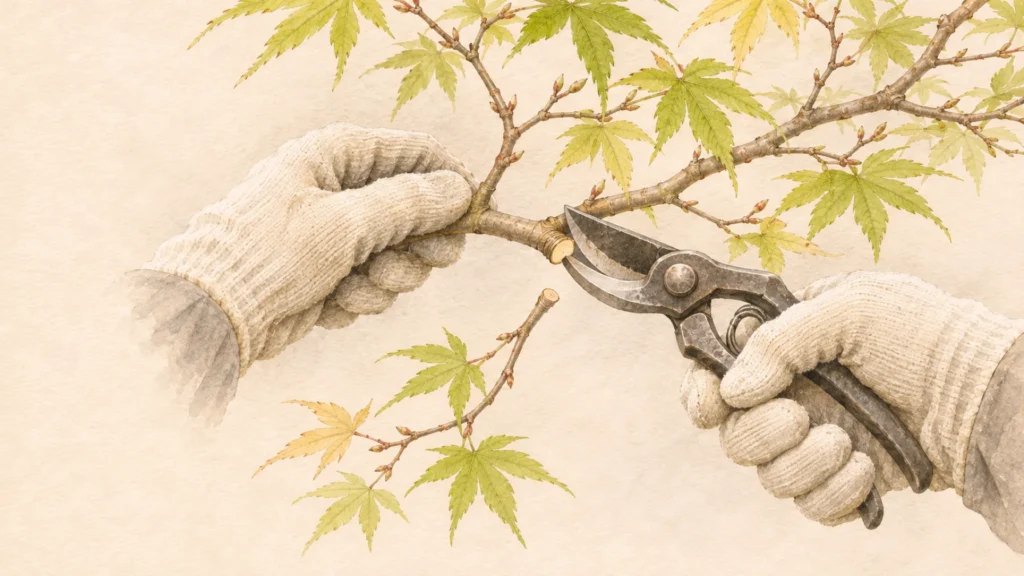
Prune a Japanese maple (Acer palmatum) in the dormant season, after the leaves have fallen and before sap starts to rise, and do it by thinning rather than shortening. In Japanese practice that thinning is called sukashi (透かし, “see-through”): whole branches come out where they fork, the outline stays, and light reaches the inside of the crown.
This guide follows one question from start to finish: how do you prune a Japanese maple the Japanese way — when, which branches, where to cut, and how much? It starts with what makes a maple different from a pine or a holly (its paired buds and its layered crown), then covers the calendar, the sap, the order of work and the limits, with figures from Japanese municipal manuals and Western extension sources side by side.
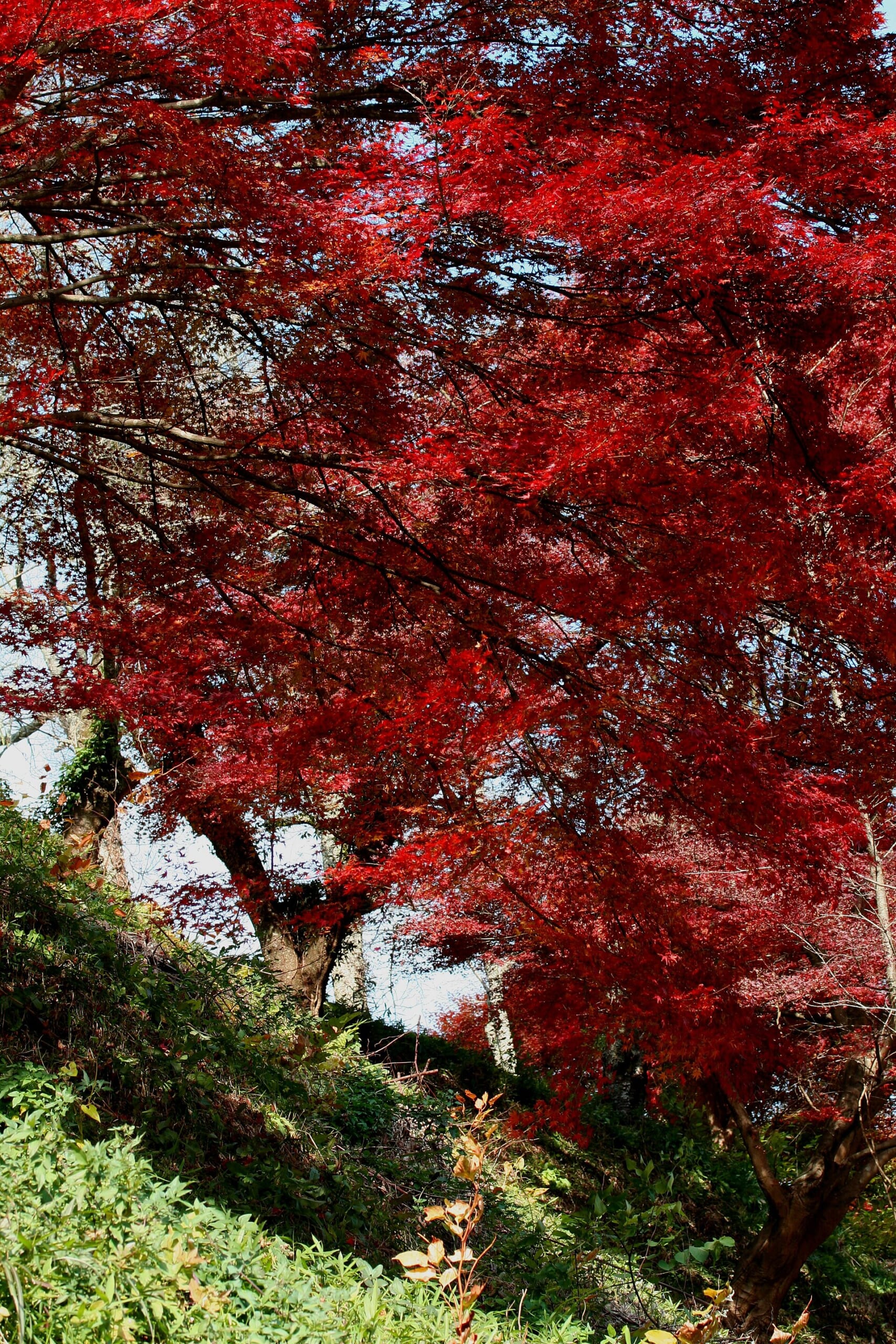
Prefer to watch? The video version:
Why a maple is thinned, not clipped — The habit decides the method
Most pruning advice assumes a tree that sprouts again from old wood and tolerates shaping. A Japanese maple is valued for something else: the line of its branches and the way its leaves sit in separate layers. Three habits explain why Japanese pruners take branches out one at a time instead of trimming the surface.
Paired buds, paired shoots
Japanese maple leaves are opposite, which means each node carries two leaves and two buds facing each other (NC State Extension lists A. palmatum leaves as “opposite, and simple with 5 to 9 lobes”). The consequence for pruning is practical. A UC Master Gardener guide on pruning Japanese maples notes that the buds face the direction they will grow, and that when you cut back to a bud pair, two branches form; you can steer the tree by choosing one bud and rubbing out the other. Every cut on a maple is a choice about direction, not just about length.
Layers like a series of fans
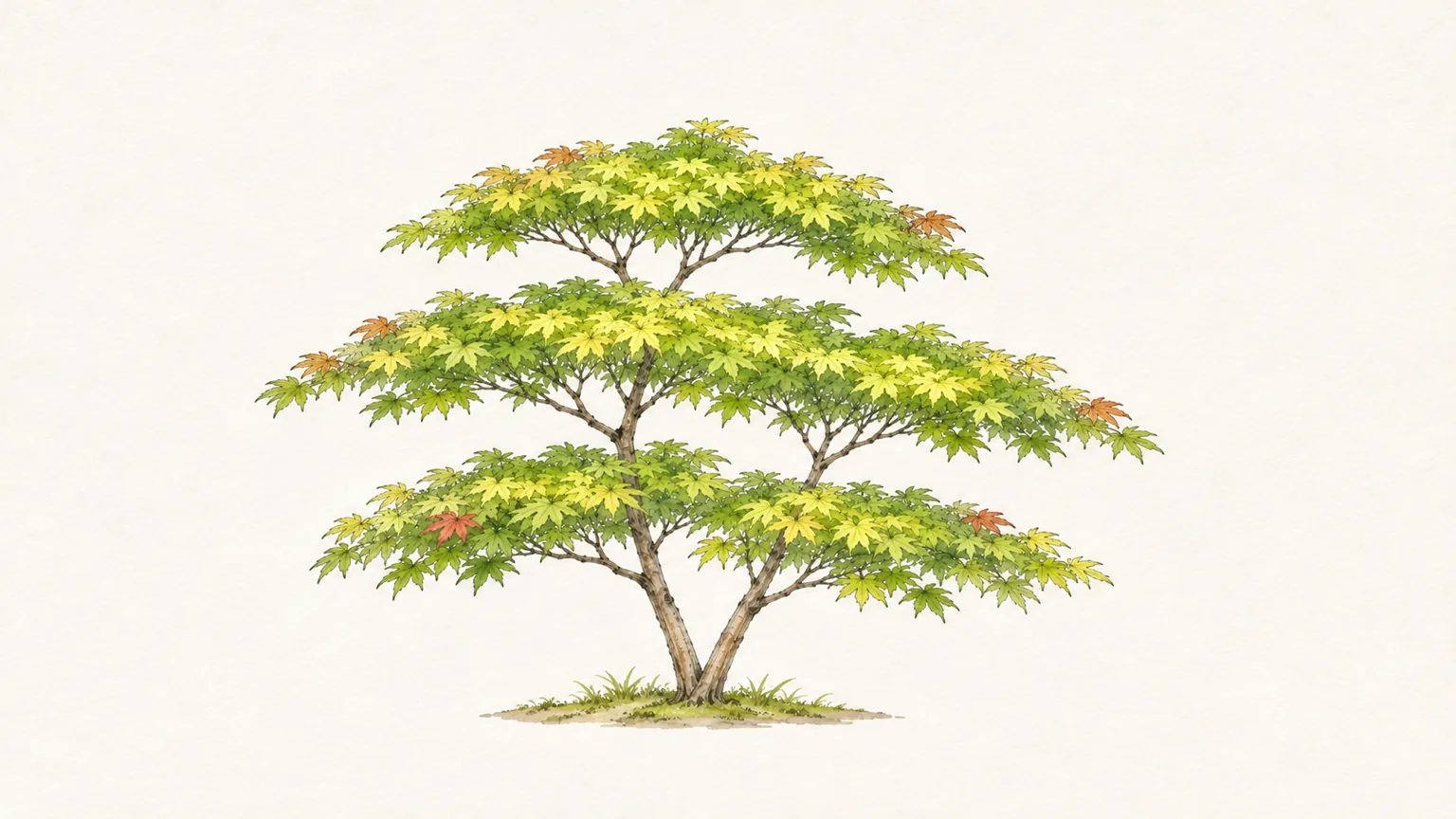
The same UC guide describes the look to aim for: branches separated into overlapping layers that do not touch each other, so that you can see between the leaf layers, “like a series of fans”. Lateral branches that grow down into the layer below, or up into the layer above, are the ones to remove or to cut back to a side branch facing up and out. This is the Western description of what the Japanese tradition calls a tiered, see-through crown. Our article on the three levels of sukashi sets out how the method is graded from heavy to fine.
A slow, small tree with thin wood
NC State gives a mature height of 15 to 25 feet (about 4.5 to 7.5 m), with growth that is slow to moderate. The RHS Plant Finder entry cited here for Acer palmatum (D) lists a maximum height for that entry of 1.5 to 2.5 m (5 to 8 feet) and describes a small, slow-growing deciduous shrub. The UC guide adds that the branch diameter is relatively small: pruners of three-quarters to one inch, medium loppers and a small handsaw cover most work. Slow growth is the key practical fact. A branch removed wrongly today will not be replaced for years, so the pruning is done by looking first and cutting second.
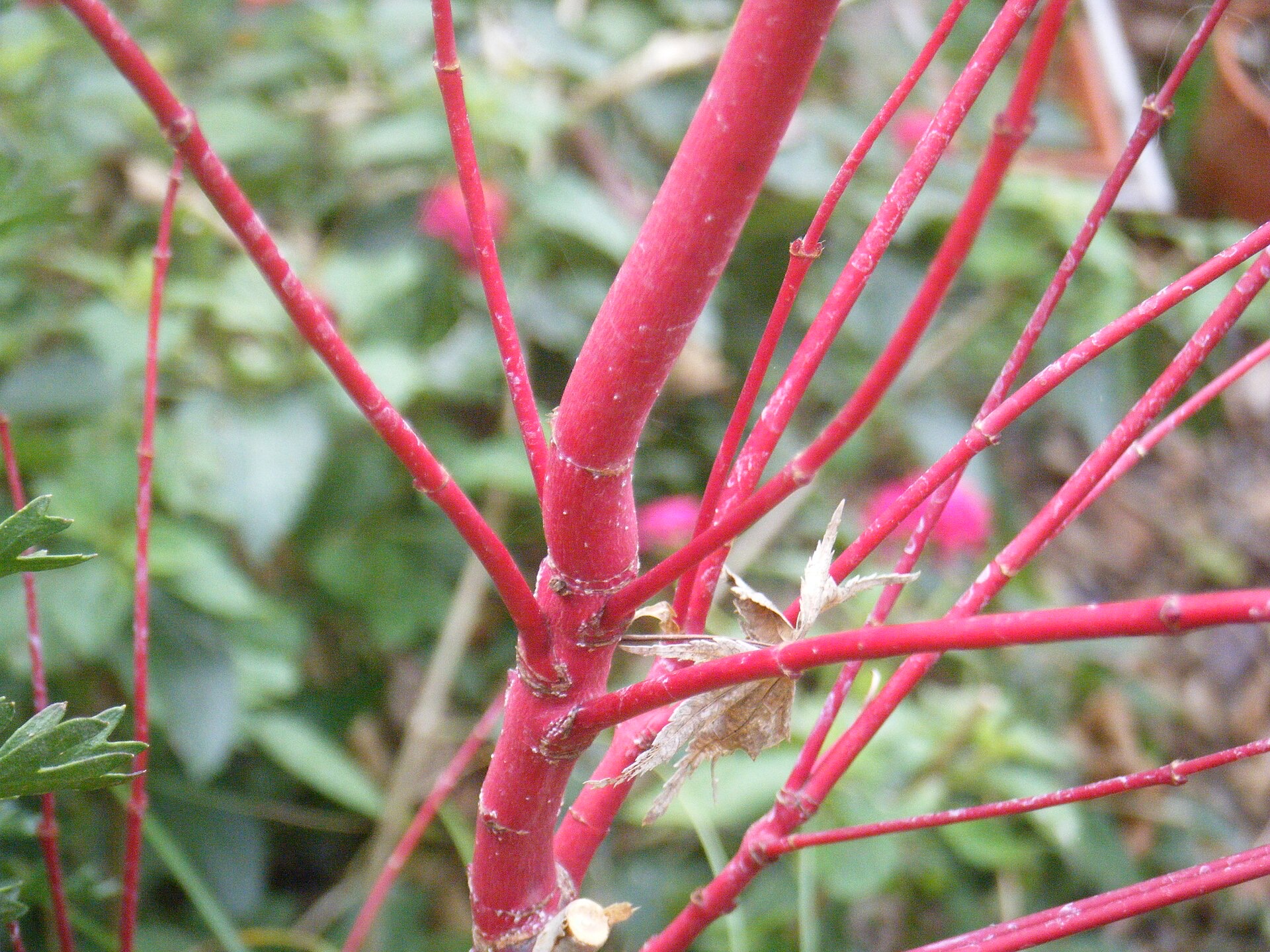
When to prune — Leaf fall to sap rise, by climate
Two independent sources give overlapping windows from two different climates, and a third and fourth show how the window moves with the winter.
| Source | Window for Acer palmatum | Reason given |
|---|---|---|
| Royal Horticultural Society (UK) | After leaf fall but before January | Maples bleed sap if cut in mid to late winter or early spring |
| Horticulture Magazine (UK) | November to March; major work late summer to late winter, before sap rises; not in freezing weather | Growing-season cuts can bleed; winter shows the structure |
| UC Master Gardener, Tulare and Kings Counties (California) | February is “a perfect month”; light thinning again in late spring or early summer | Leafless tree shows the branch structure |
| Saitama Prefecture street-tree manual (Japan, 2020) | Late autumn until just before the buds open | Pruning an active tree does the most damage; dormancy does the least |
The Japanese calendar
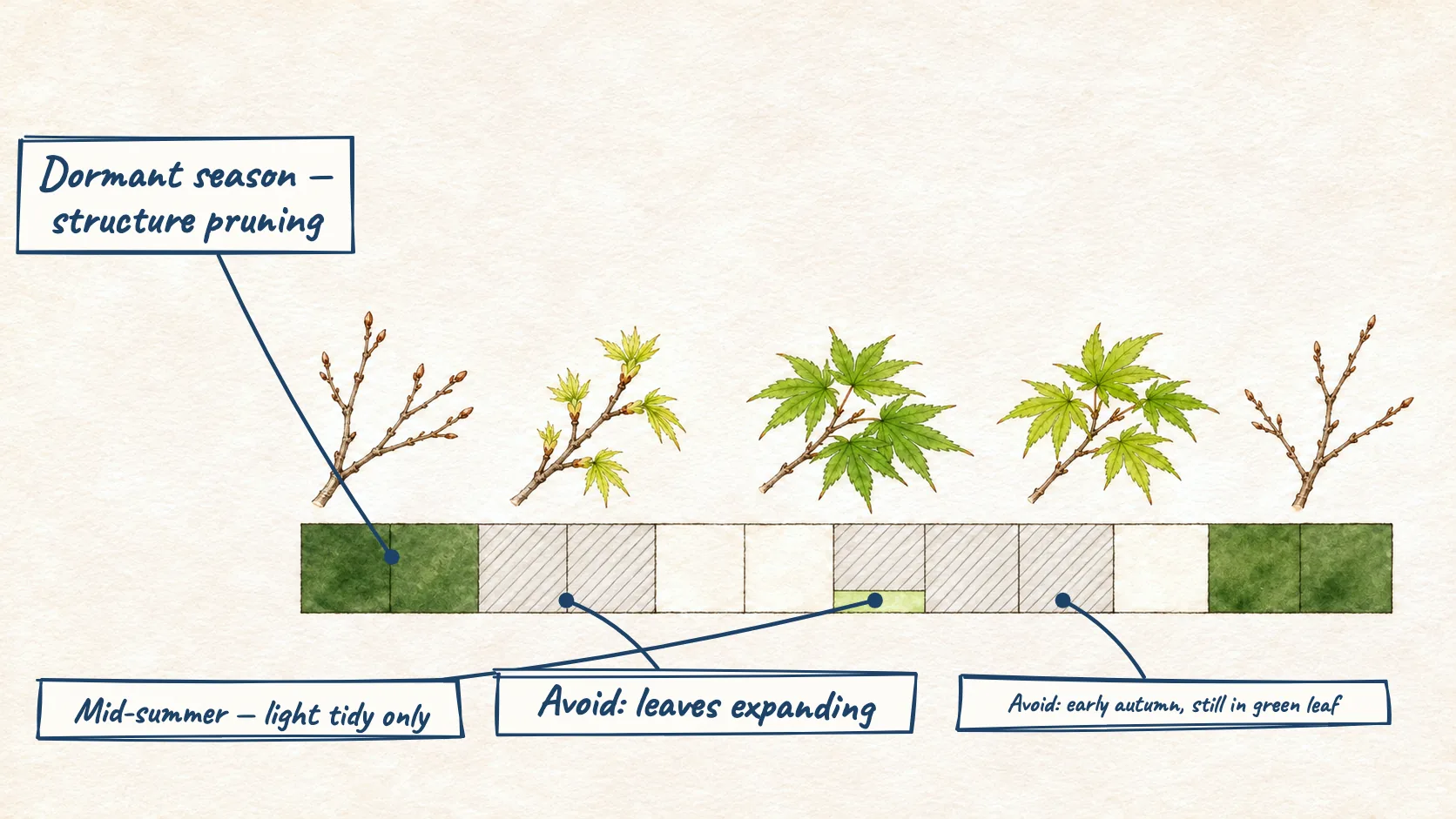
The Saitama manual states the principle behind the Japanese calendar: traditional Japanese gardeners prune deciduous trees in the dormant period between late autumn and bud break, and evergreens when growth slows in summer, because cutting an active tree costs it more. It adds that light summer pruning, called natsu-sentei (夏期剪定), is for tidying the new shoots that grew from winter cuts, and that leaf removal in summer should stay at one-third of the foliage or less.
Why the window shifts with the winter
The RHS closes its window at the end of the year because British late winter is when the sap begins to move. The California guide recommends February but does not explain the reason for the difference. The recommendations differ; this alone does not establish that they describe the same sap behaviour. The practical reading for a garden is the Japanese one: use the state of the tree, not the calendar date. Work once the leaves are down and finish before the buds swell. Horticulture Magazine adds that pruning should be avoided in freezing weather.
Three times that are ruled out
The Saitama manual names three times to avoid: while spring leaves are expanding, heavy pruning in summer, and cutting trees still in green leaf in early autumn. Its reasoning is that a tree cut while still in green leaf is forced to push new growth, and that growth is killed by winter. In Japanese practice the working rule is therefore simple: structure in the dormant season, a light tidy in summer, nothing in between.
Sap and bleeding — What is happening in the wood
Maples are one of the groups that lose sap freely from pruning cuts, and the flow alarms people more than it should. It helps to know what causes it.
Why a maple pushes sap in late winter
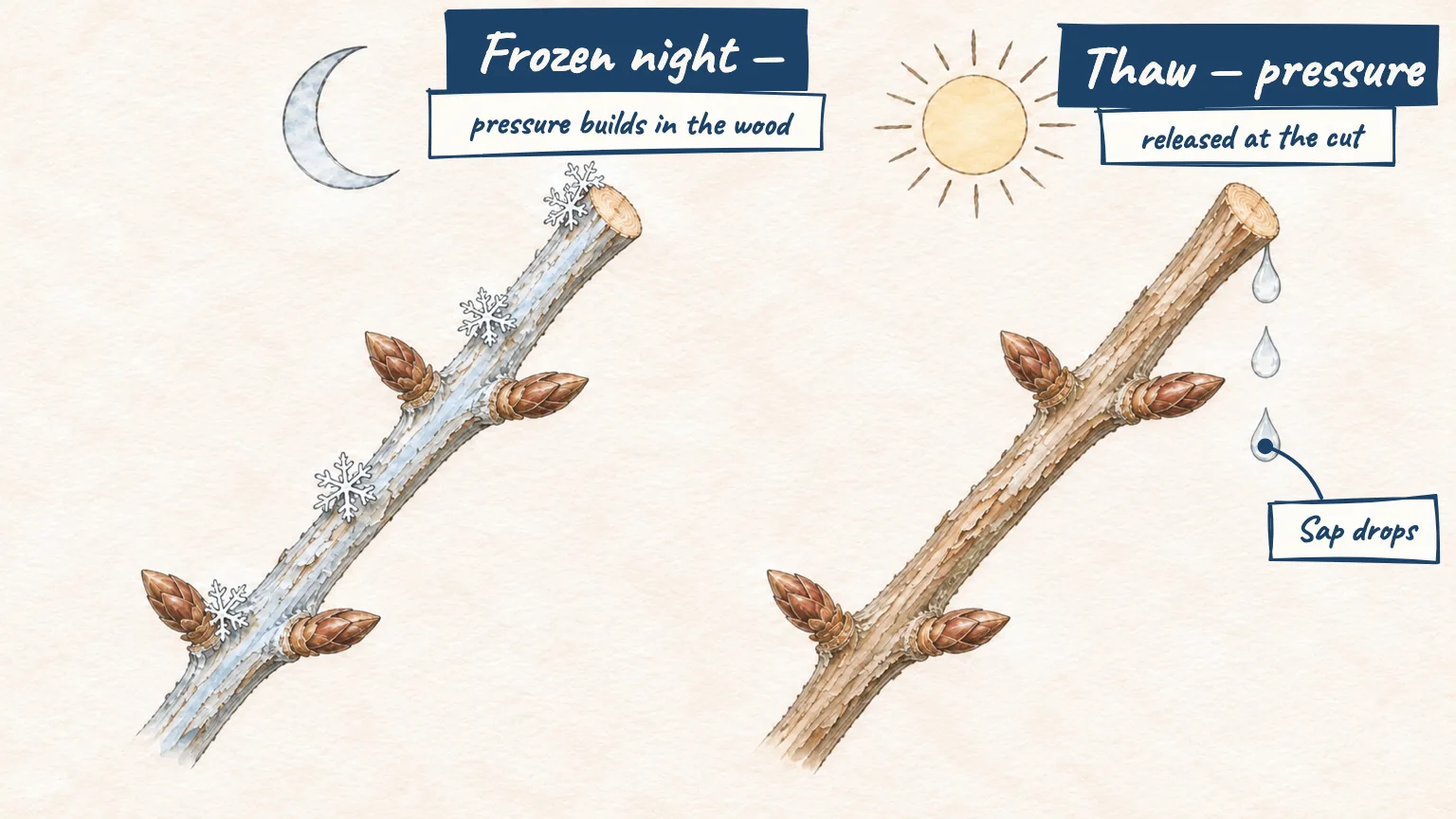
Maples are not unusual in having sap; they are unusual in having pressure. A 2021 paper comparing red and sugar maple (arXiv 2106.02802) describes how these species generate positive pressure in the wood in response to repeated freeze–thaw cycles while the tree is leafless and dormant. During freezing, sap is drawn into gas-filled fibres; during the thaw, the stored pressure is released into the vessels, and the sap can flow out of any opening. The authors note that this pressure can persist on and off for weeks or even months, and their own record covers about 40 days. The paper is about sugar and red maple, the species tapped for syrup, not Acer palmatum. But the RHS names acers as a group prone to bleeding, so the same behaviour is a reasonable explanation (this is our inference, not a measurement on A. palmatum), and the practical point is the same: late winter, when the nights freeze and the days thaw, is when a cut will run.
What the authorities say to do
The RHS lists acers, birches and grapevines as prone to bleeding and says it is usually seen in late winter to early spring. University of Wisconsin Extension names maple among the trees that bleed heavily and says the flow does not harm the tree. Penn State Extension calls it a natural defence mechanism and says a little sap flow will not harm a properly pruned tree. The RHS gives the practical advice: let the cut heal naturally, and do not bind it, wrap it or paint it, because that traps moisture and invites fungal disease. Prolonged bleeding can, in rare cases, lead to loss of vigour and even death, so the sensible response is to prune at the right time, not to treat the cut.
A difference worth knowing
One Japanese source takes a different line on cuts. The Tokyo Metropolitan agricultural research centre’s 2025 street-tree manual, describing A. palmatum ‘Tsukasa Silhouette’, says to apply a paste-type fungicide to the cut surface when a cut is large. The RHS no longer recommends painting cuts. This guide does not settle that difference. It is worth knowing that the Japanese street-tree practice quoted here and the British garden advice are not identical, and that both agree on the more important point, a clean cut at the right place and the right time. Sap running from bark where nothing has been cut points to a different problem, such as disease, insect damage or drought stress.
Read the tree first — Three orders of branch
Before the first cut, Japanese pruners sort the crown into three orders of branch, the same vocabulary the Saitama manual uses. We cover the general method of reading a tree in reading tree structure before pruning; this section gives the maple version.
The three orders
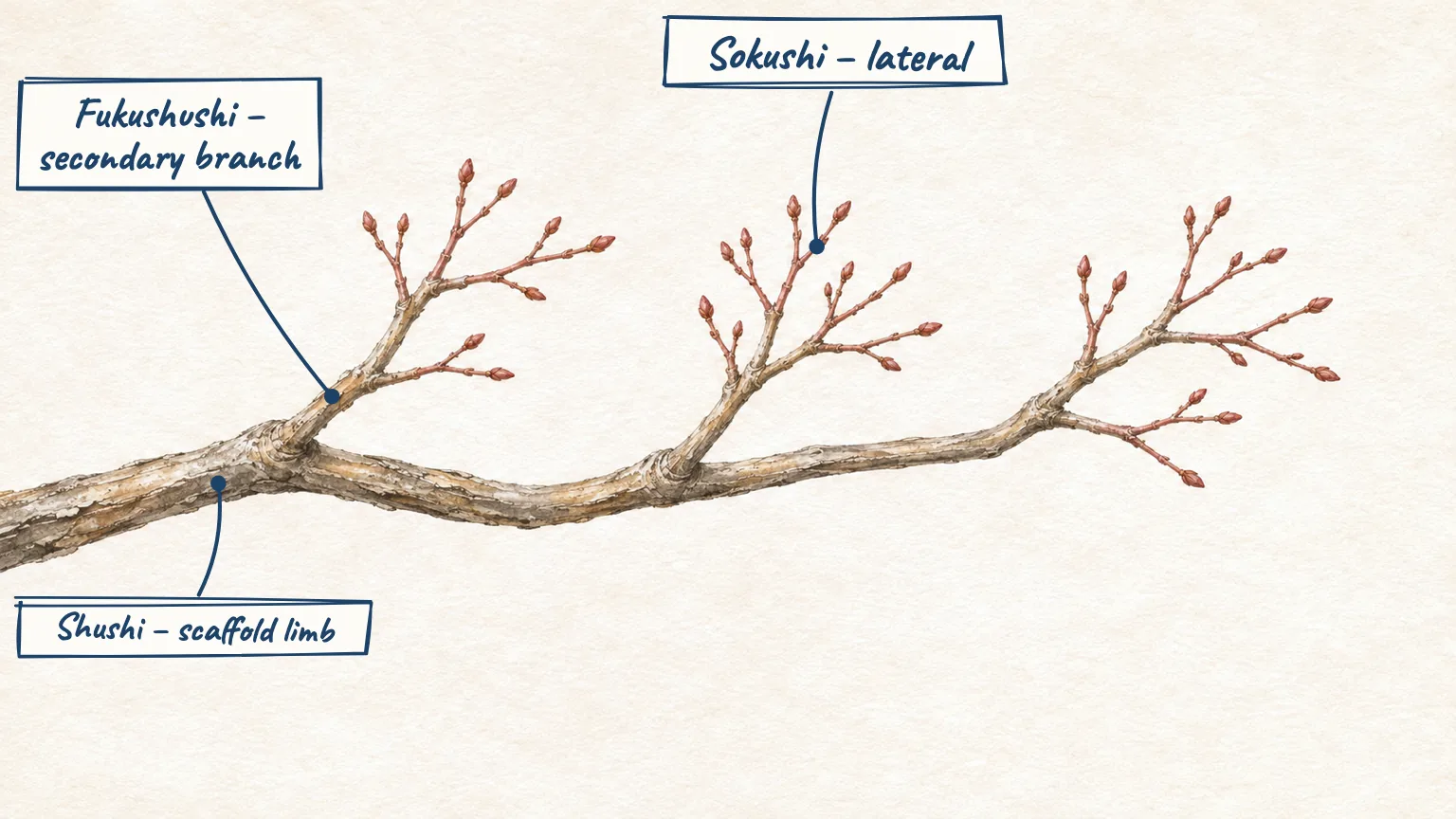
– Shushi (主枝) — scaffold limbs, the skeleton nearest the trunk – Fukushushi (副主枝) — secondary branches that divide from a scaffold limb – Sokushi (側枝) — laterals that divide from the secondaries and carry the outer foliage
Thinning by order
The manual’s definition of branch thinning, eda-sukashi (枝透かし), is to thin crowded branches while keeping that scaffold, secondary, lateral structure, and to cut at the point where a branch divides so that the scar does not look unnatural. Which order you thin gives the levels: ō-sukashi (大透かし) takes part of a scaffold limb, naka-sukashi (中透かし) takes secondaries, and ko-sukashi (小透かし) takes laterals. The manual says street-tree work is generally a combination of the middle and fine levels. For a Japanese maple in a garden the fine level does most of the work, because the tree is small and the wood is thin.
Start at the base and work up
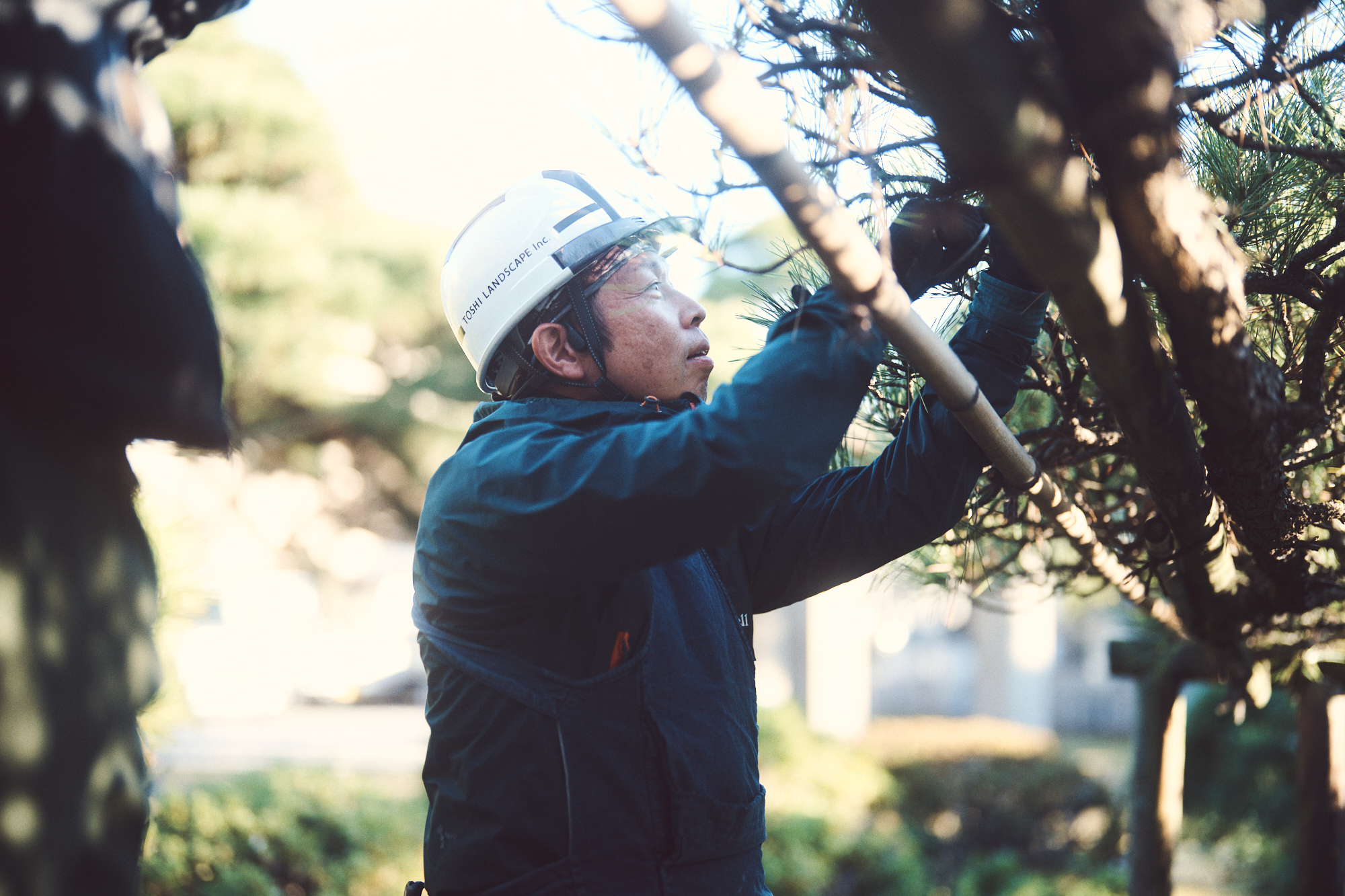
The UC guide’s method suits this reading stage: examine the tree from the bottom up and the inside out, follow each branch to its end, and, as it puts it, “if in doubt, don’t cut”. Japanese maples are often multi-stemmed, and the skirt usually needs lifting before you can see the trunks. Deadwood tends to be at the bottom and inside, where branches have been shaded out.
Two traits of maples as street trees
The Saitama manual also notes two traits of the maples (カエデ類): the branches tend to run obliquely, which leaves the crown uneven, and the tree needs watching for drying and sunburn. Heavy thinning that suddenly exposes bark to the sun is the usual way to produce the second problem.
The branches to take first — Imi-eda on a maple
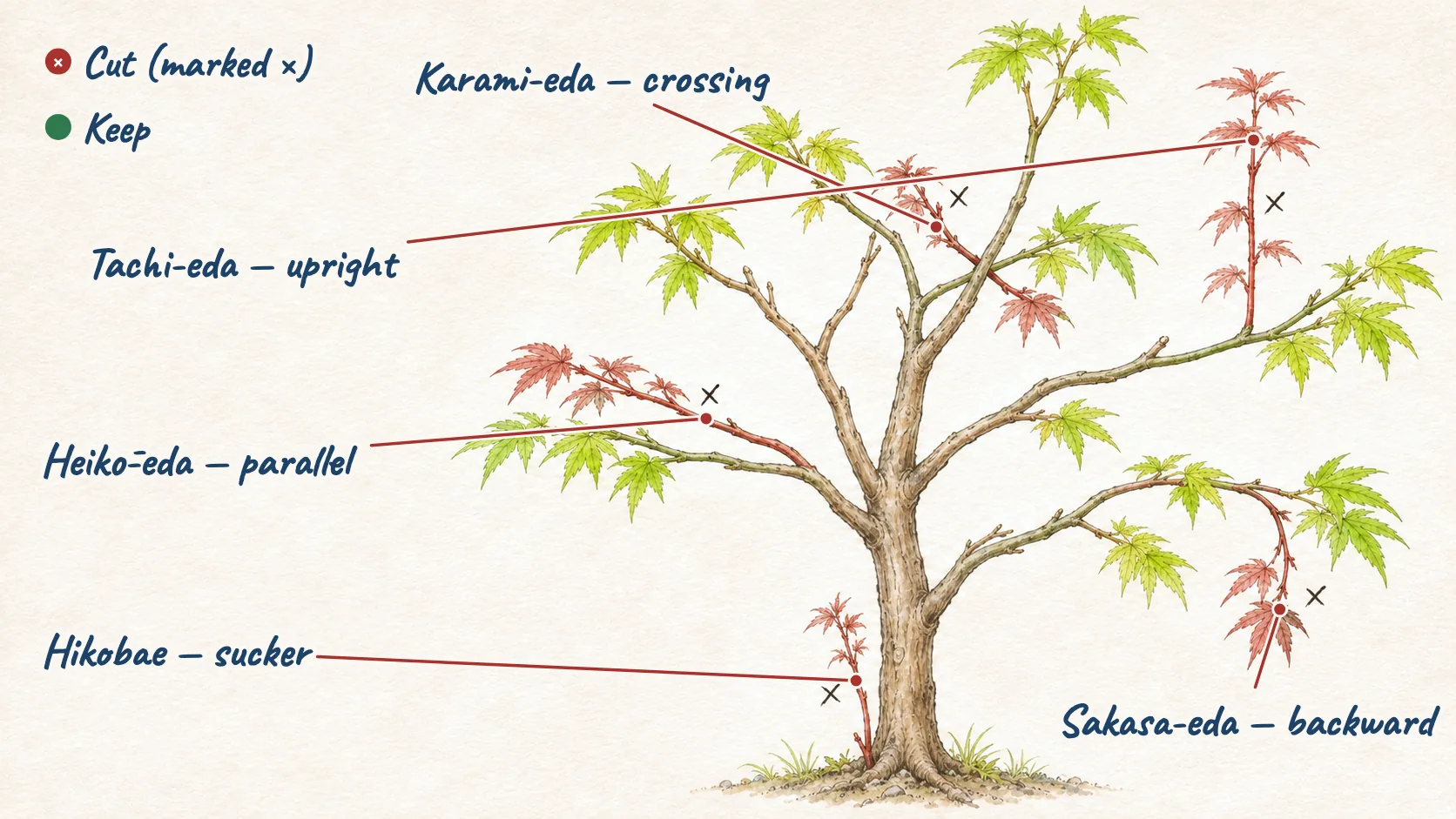
Imi-eda (忌み枝, literally “taboo branches”) is the gardener’s name for branches that spoil the form of a tree. The full list, the Japanese terms and the reasons behind each are in our article on imi-eda, so this section keeps to what is particular to maples.
Which imi-eda a maple produces most
| Type | How it shows on a maple | Source |
|---|---|---|
| Dead and shaded-out wood | At the bottom and inside of the crown | UC Master Gardener |
| Tochō-shi (徒長枝) — vigorous long shoot | Appears readily on A. palmatum; cut it off near the base | Tokyo manual (2025) |
| Karami-eda (絡み枝) and heikō-eda (平行枝) | Crossing or overlapping; where two run parallel, remove one | UC Master Gardener; Saitama manual |
| Hanging or climbing laterals | A lateral that drops into the layer below, or rises into the layer above | UC Master Gardener |
| Hikobae (ひこばえ) — sucker | Rises from the base; a multi-stemmed maple needs care about which stem is a sucker | Saitama manual; UC Master Gardener |
What the manual lets you keep
The Saitama manual draws a line between suckers, parallel branches and tangled branches and the rest. Suckers, parallel branches and tangled branches are basically not needed. The others can be kept on purpose, as normal branches, when a tree is being rebuilt after heavy thinning, so the manual warns against removing all of them without thought.
The inside of the crown
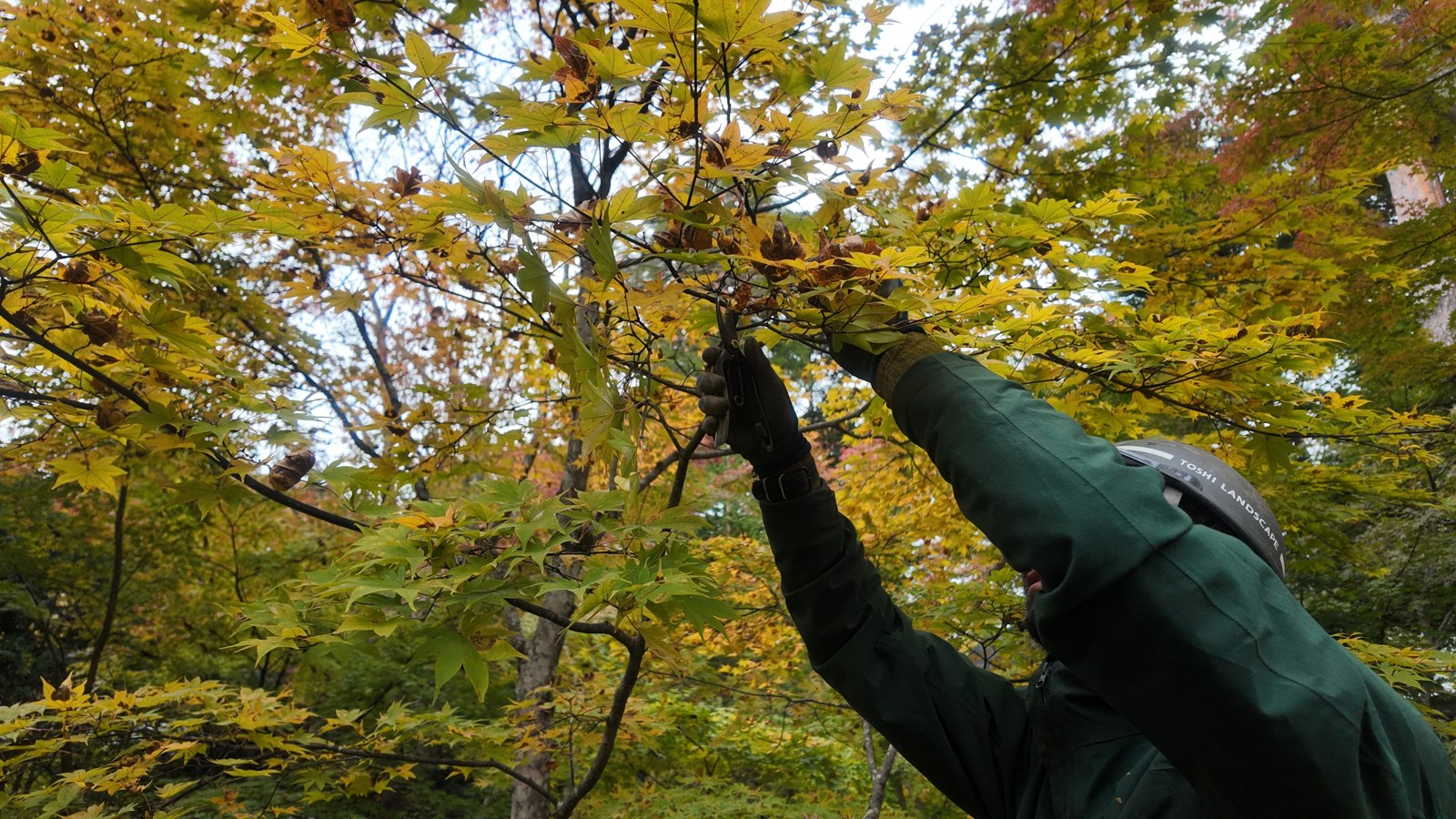
The RHS advice for A. palmatum is to remove winter dieback, badly placed or crossing shoots, and to cut back to a well-placed side branch with no stub. It also says the most graceful shape develops when the tree grows fairly naturally. The Tokyo manual adds one detail that is easy to get backwards: leave the very fine small twigs as far as possible. The aim is a see-through crown, not a bare one. Both traditions point the same way: take out what is dead, rubbing or redundant, and leave the tree’s own habit alone.
Where the blade goes — Bud pairs, side branches and the collar
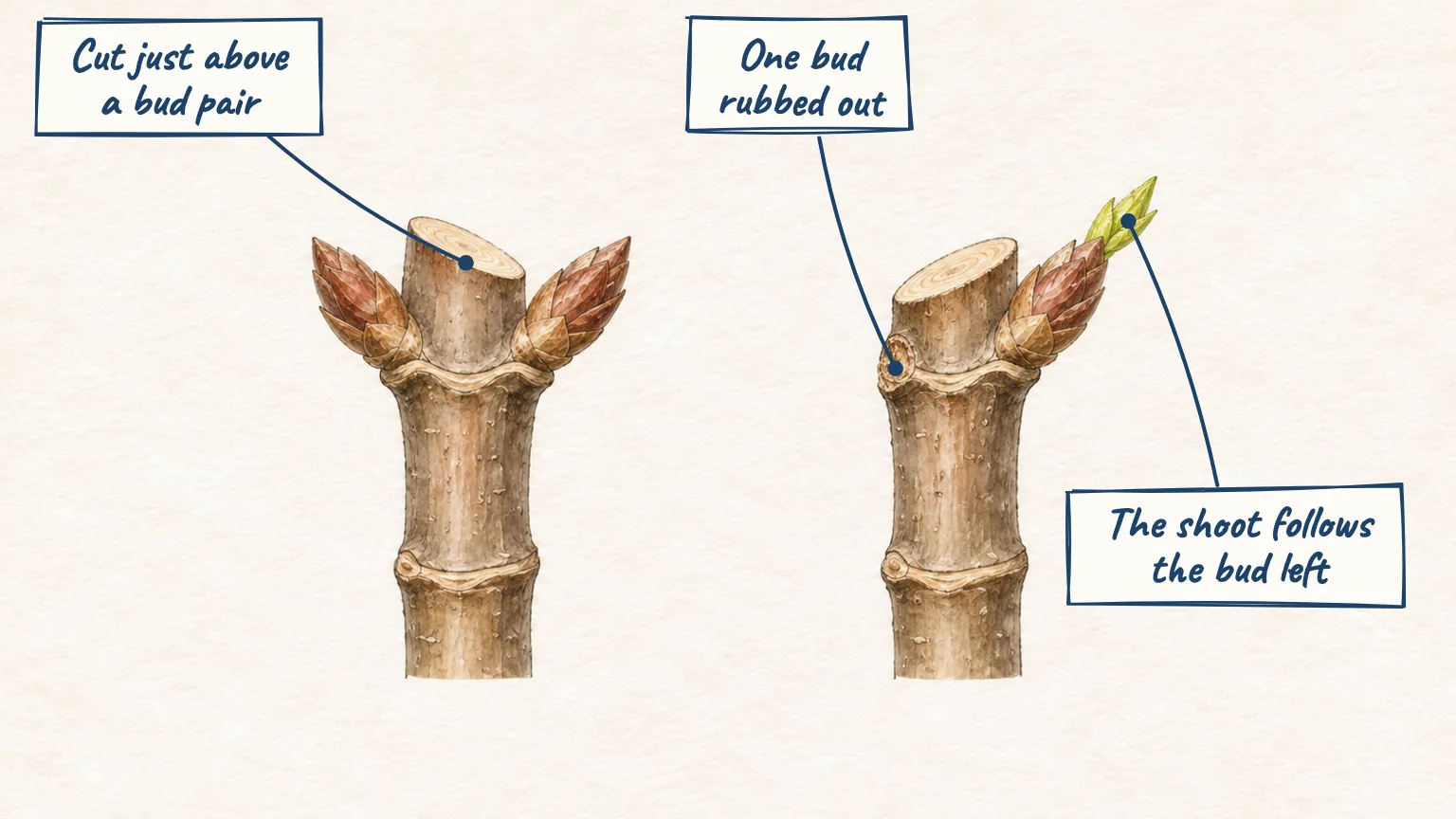
Cutting back to a bud pair
When a shoot must be shortened, the cut goes just above a bud pair, and the maple’s opposite buds make a choice available. If both buds are left, two shoots grow, which suits an open fork where the crown needs a branch. If one is rubbed out, one shoot grows, in the direction its bud faced. NC State Extension describes the single-bud version: a slanted cut above the bud to be left, taking care not to expose the stem directly behind it, with the opposite bud removed or pinched out. On a maple that has already become crowded, the usual choice is the single bud, aimed outward and slightly up.
Cutting back to a side branch
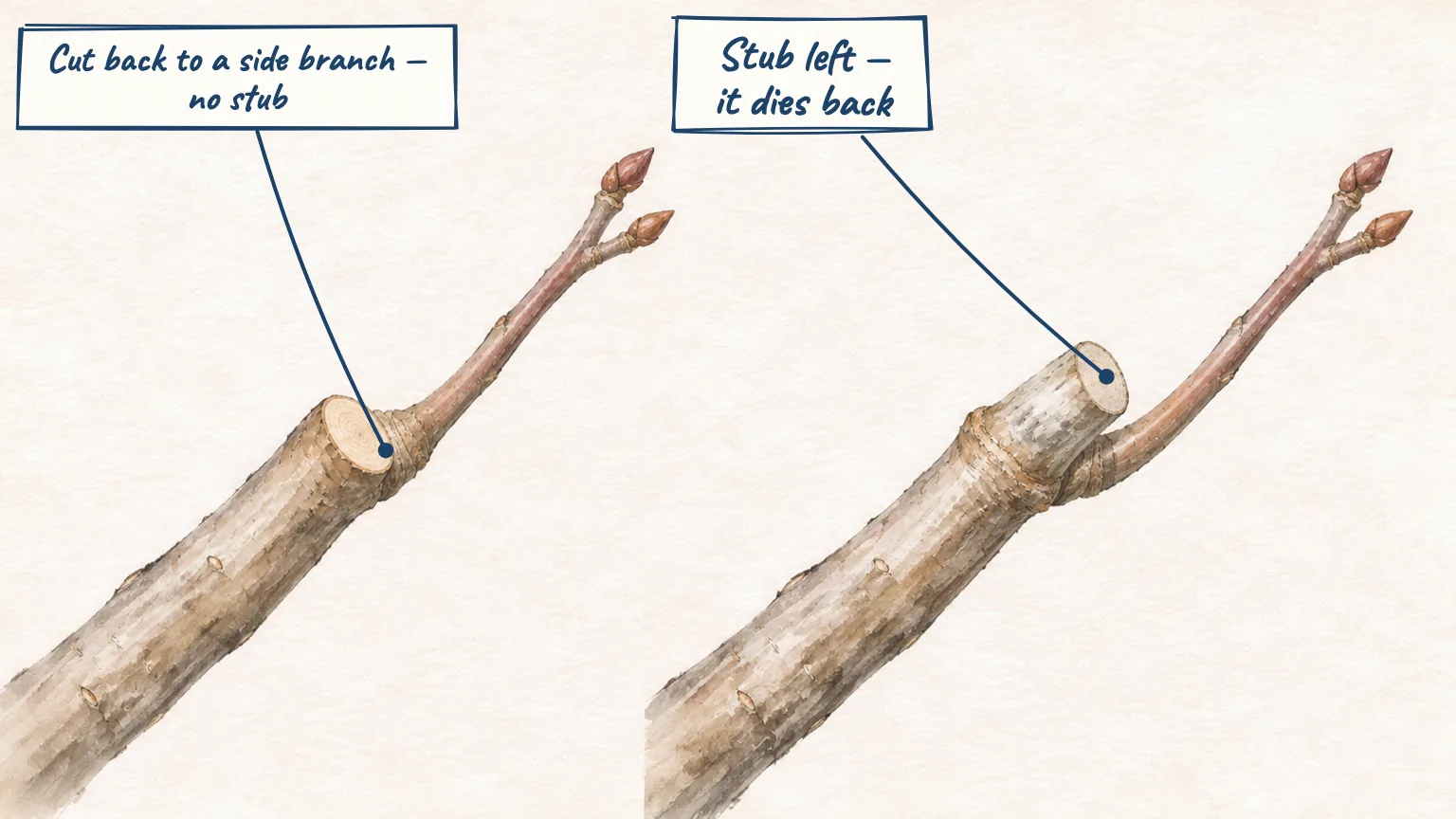
For larger wood the cut goes to a side branch. The RHS advises cutting back to a well-placed side branch with no stub; Horticulture Magazine says to trace a long branch back to a side branch to reduce size, and warns that stubs decay and die back. The Saitama manual calls the same move kirikaeshi (切返し): cutting back to a shorter side branch that becomes the new tip. The Tokyo manual adds its own rule for thick, long branches: cut them off at a point on the trunk side of the thin branches. The UC guide gives the opposite caution: pruning a large branch back to a small side branch leaves an unbalanced look. The side branch should be a fair fraction of the one removed. For larger limbs and the cut at the collar, see the three-cut method.
The right tool
Because maple wood is thin, the cut is made with a small tool and a sharp one. The UC guide states that a clean wound heals more quickly than a torn one, and that three-quarter to one-inch pruners, medium loppers and a small handsaw cover most work. Japanese pruners choose shears and saws by the branch size, and the same logic applies: a fine-bladed tool for twigs, a pull saw for anything that fills the hand.
How much to take — Limits for a tree that does not like heavy cuts
The numbers, side by side
| Source | Limit | Applies to |
|---|---|---|
| Horticulture Magazine (UK) | About 20% of the canopy for small Japanese maples, ideally less; about a quarter of any single branch’s length | Small Japanese maples |
| Horticulture Magazine (UK) | Up to one-third of the canopy, with major renovation over several years | Larger maples |
| UC Master Gardener (California) | Not more than 30% of the tree per year | Japanese maple |
| Saitama manual (Japan) | One-third of foliage or less | Summer leaf removal |
| University of Wisconsin Extension | One-third | Young trees |
The figures do not agree exactly and do not claim to. They share a message: take less than you think. For dormant-season work in Japan, the Saitama manual gives no percentage; the practical limit is the see-through test described below. The general one-quarter rule and the problem of lion’s tailing are covered in the imi-eda article.
How well do maples tolerate pruning?
The Saitama manual’s species table of 14 common street trees rates the maple group (カエデ類, which it defines as including iroha-momiji, Acer palmatum) as “somewhat” tolerant of pruning (やや有), with pruning needed every year, many pests and diseases, and a note to watch for drying and sunburn. For comparison, ginkgo is rated “tolerant”, zelkova “somewhat”, and cherry “not tolerant”, with the interval between prunings of three to five years for ginkgo and zelkova.
| Street tree (Saitama manual table) | Pruning tolerance | Usual interval |
|---|---|---|
| Ginkgo | Tolerant | 3 to 5 years |
| Zelkova | Somewhat tolerant | 3 to 5 years |
| Maple group (incl. Acer palmatum) | Somewhat tolerant | Every year |
| Cherry group | Not tolerant | Every year |
This is a street-tree table, written for roadside trees that are cut for clearance. It is a rough guide for a garden tree rather than a measure of its resilience, but it shows where the maple sits: not a tree that is cut hard every few years, but one that is kept in order with small cuts every year.
A Tokyo trial — what happens after hard and light cuts
The Tokyo manual contains a rare thing for this tree: a measured trial. The research centre pruned A. palmatum ‘Tsukasa Silhouette’, a narrow-growing cultivar proposed for street planting, at four intensities from March 2020 to December 2023 and photographed the result. “Weak” meant removing clear unwanted branches such as tochō-shi and suckers and shortening branches that stick out of the crown. “Medium” shortened lateral branches and removed about half of the upright and inward-pointing branches. “Strong” shortened lateral branches hard and cut most upright and inward branches at the base. “None” meant only removing suckers.
| Level (2023) | Height × width after the March cut | Height × width in December |
|---|---|---|
| None | 365 × 226 cm | 377 × 232 cm |
| Weak | 352 × 178 cm | 404 × 215 cm |
| Medium | 386 × 128 cm | 440 × 223 cm |
| Strong | 410 × 109 cm | 475 × 204 cm |
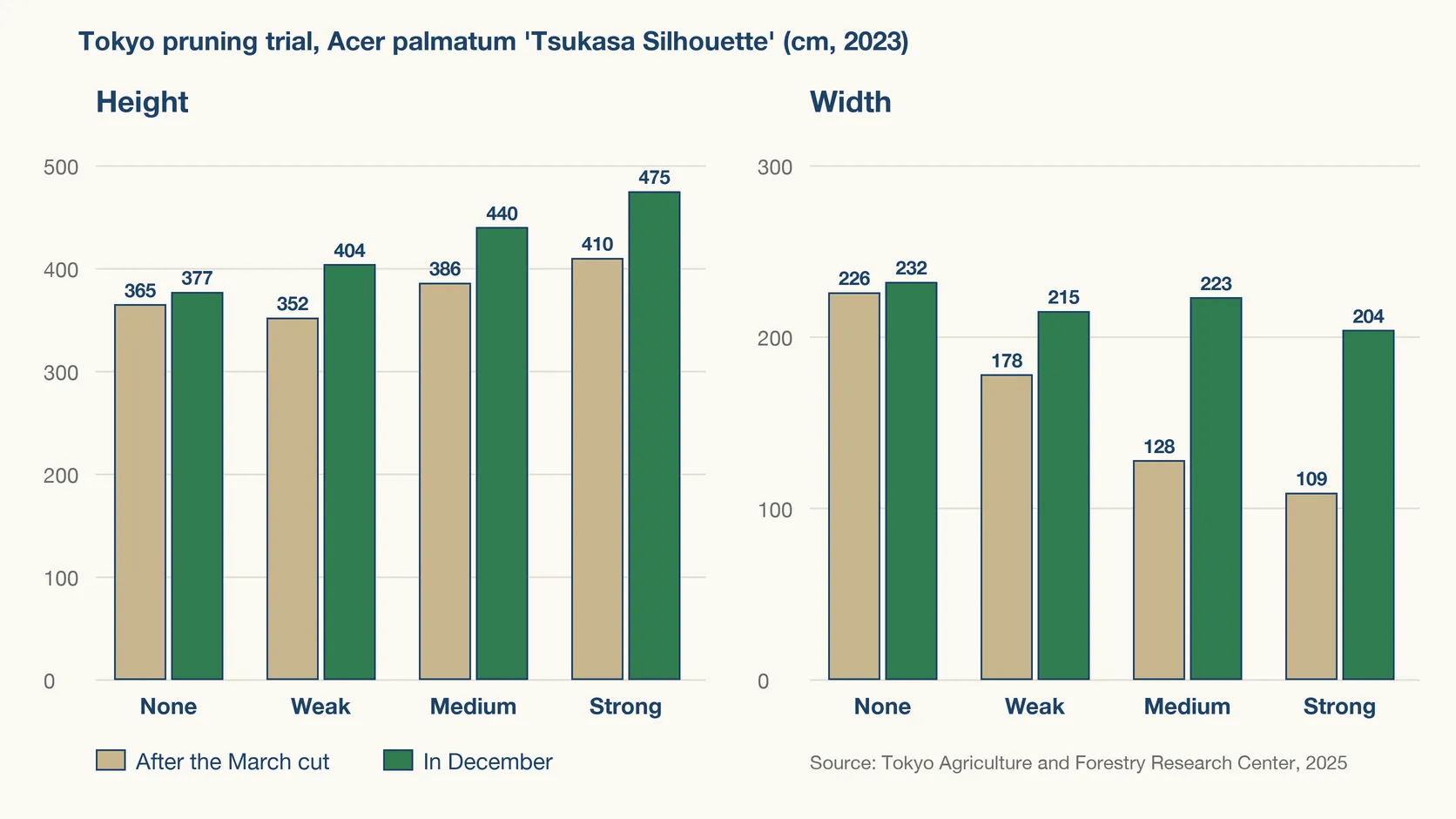
The manual’s own conclusion, for this cultivar and this purpose, was strong winter pruning from planting: cut the sideways and diagonal shoots back so that more small twigs form, and the tree keeps the slim form the street needs. Two cautions apply. First, this is one narrow street cultivar in one trial, and “strong” here meant shortening shoots and removing upright and inward ones, not stripping the crown. Second, read the table for its direction of travel. Strong cuts were followed by the most regrowth (by simple subtraction from the figures, the tree gained 65 cm in height and 95 cm in width between March and December, against 12 and 6 cm for the unpruned one). A maple pushes back hard against hard cuts. That is the reason the sukashi tradition, in a garden where you want the tree to stay as it is, takes fewer and smaller cuts.
The order of work — Four passes
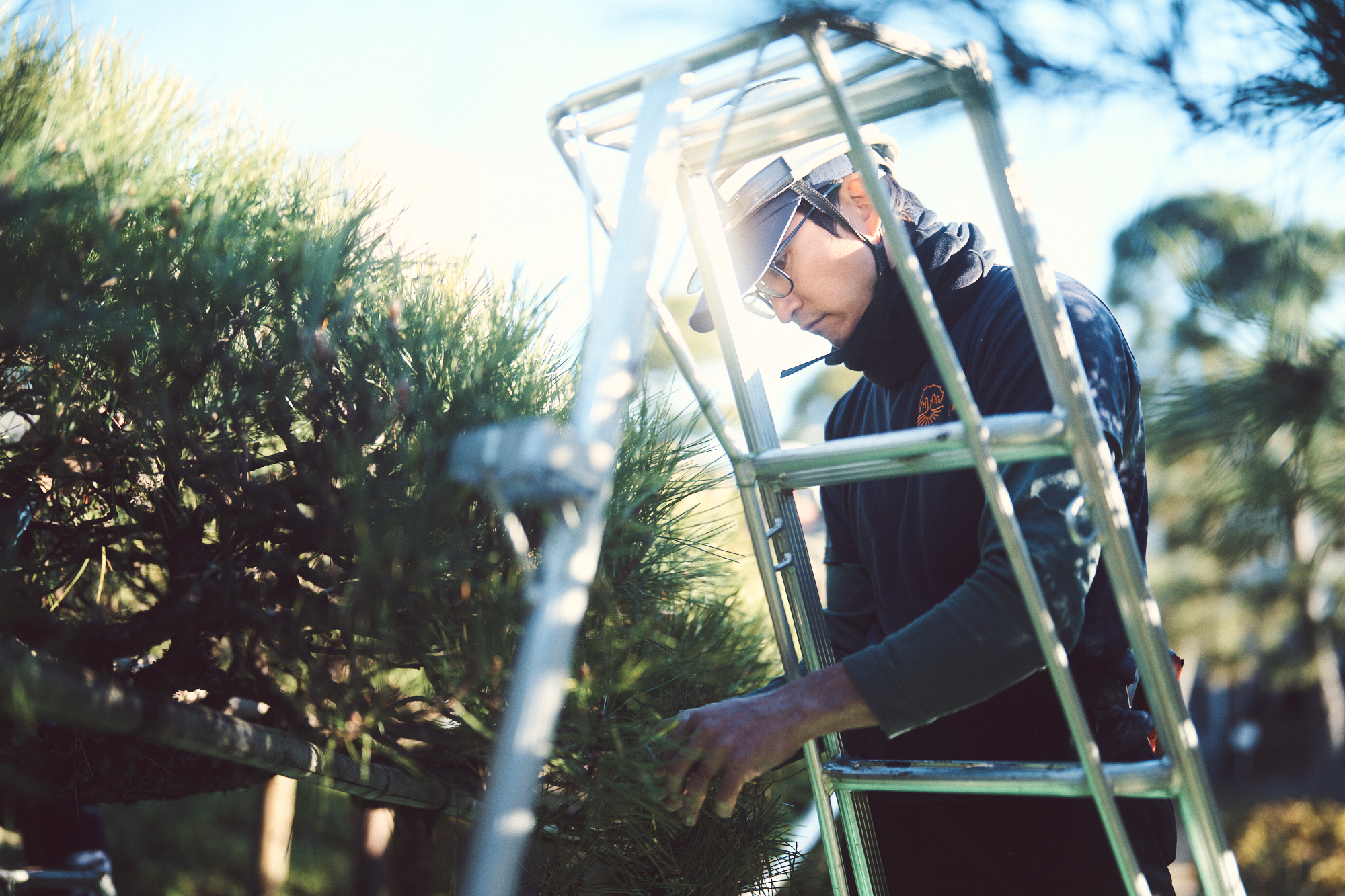
In Japanese practice the order matters more than the number of cuts. A workable sequence for a garden maple:
- Dead and diseased wood first. Take it back to living tissue at a fork.
- The no-argument imi-eda. Suckers, parallel and tangled branches.
- Thin at the forks. Choose the branch to lose at each crowded fork, by order: a secondary before a scaffold limb, a lateral before a secondary. Cut just outside the branch collar, never flush and never leaving a stub. Use kirikaeshi, cutting back to a shorter side branch, when the tree needs to be slightly smaller.
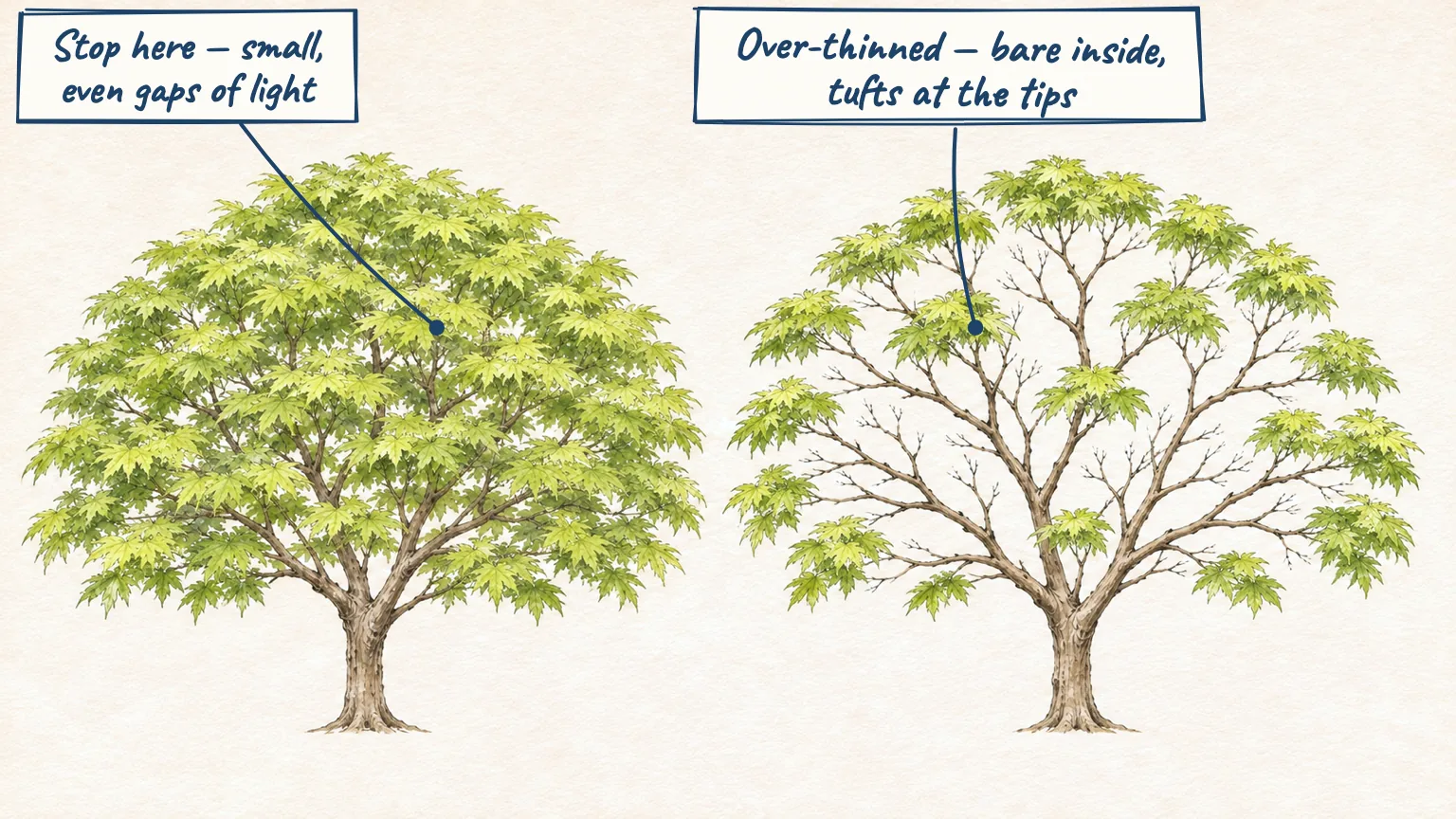
- Step back and look through the crown. Stop when light shows in small, even gaps, not in large bare patches.
Top and bottom
The Saitama manual also says to thin the upper crown a little harder than the lower, because trees grow strongest at the top. Leave more foliage low, where the tree makes its own shade. The UC guide adds a mirror image: step back after each branch and look at the tree from several angles, and fine-tune the layers in late spring or early summer when the tree is in full leaf.
The see-through test
The stopping rule is visual. Light should show in small, even gaps across the crown. Large bare patches, or a crown that looks like tufts at the ends of bare branches, means the thinning went too far.
Forms, cultivars and seasons — Not every maple is cut the same way
Upright, laceleaf and weeping forms
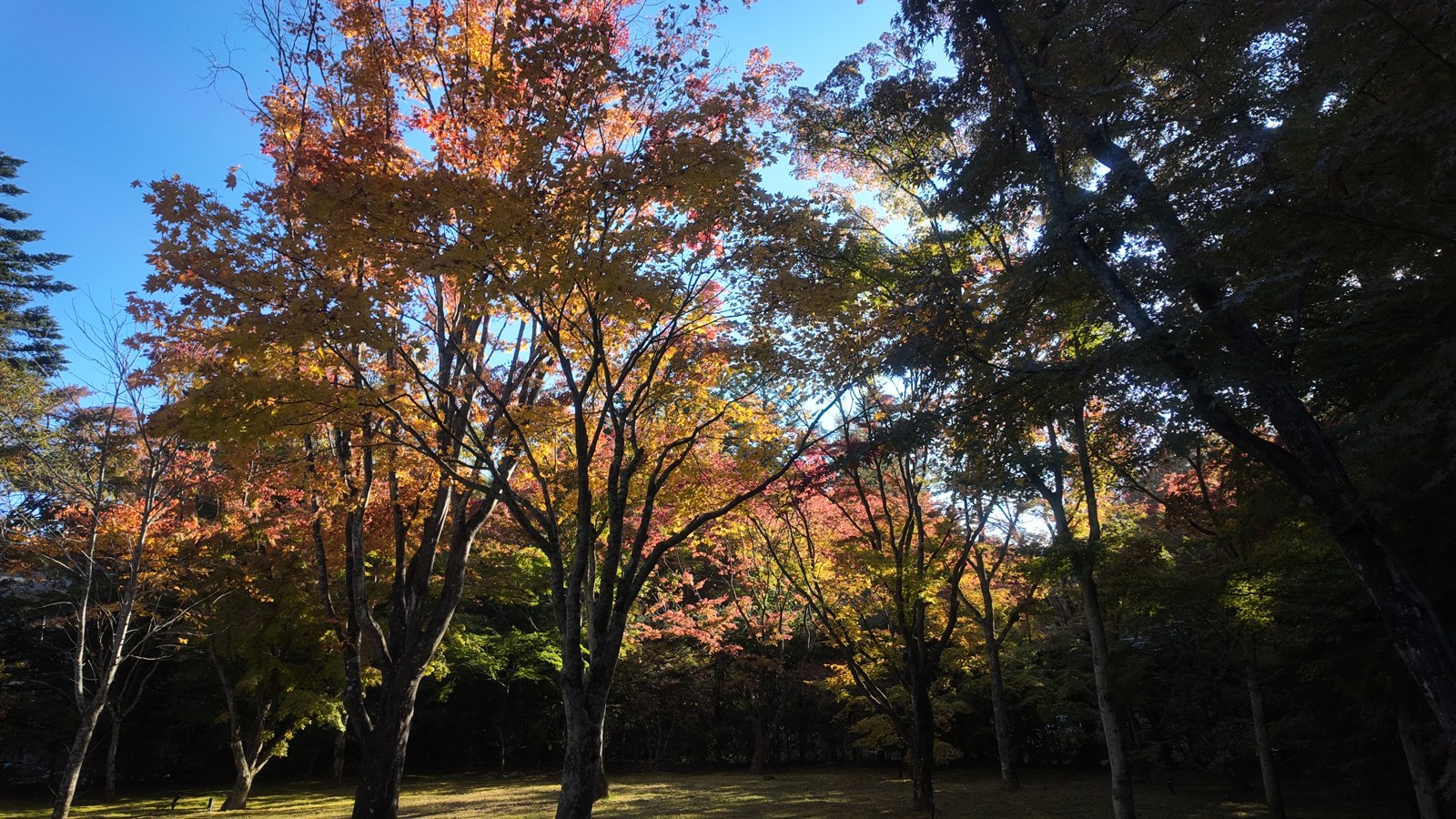
The UC guide notes more than 300 cultivars and divides them roughly into upright airy trees (such as ‘Bloodgood’ and ‘Burgundy Lace’) and shorter forms with finely dissected leaves (such as ‘Crimson Queen’ and the laceleaf maples). The method above applies to both, but the scale differs. An upright tree is thinned from the scaffold down; a weeping, mounding laceleaf has so many fine, arching branches that the work is mostly at the tips and in the tangle where branches meet, and the structure can only be read in winter.
A young tree
Horticulture Magazine says young trees can be formed in their first winter by pruning to create a short trunk and a shrubby habit, and that Japanese maples are usually well shaped when bought, so heavy shaping is rarely needed. The UC guide says to start training while the tree is small, for the practical reason that small cuts on young wood leave small wounds.
Other maples, other seasons
| Situation | Timing and approach | Source |
|---|---|---|
| Garden A. palmatum | After leaf fall, before January in the UK; February in California | RHS; UC Master Gardener |
| Snakebark maples | Late summer | RHS |
| Street-tree maples in Japan | Dormant season; annual light work | Saitama manual |
| Narrow street cultivar (‘Tsukasa Silhouette’) | Strong winter pruning each year from planting | Tokyo manual |
The table is a reminder that the rules in this guide are for a garden A. palmatum. Other maples, other cultivars and other purposes have their own timing.
What goes wrong — Mistakes and misunderstandings
– Shearing the surface. Clipping a maple with hedge shears is karikomi, a different technique with a different aim, and it leaves dense outer leaves over an empty interior. The difference between the two is the subject of Niwaki vs Topiary. – Stripping the inside. Removing every inner twig and leaving tufts at the ends is lion’s tailing, the pattern ANSI A300 defines as a pruning fault. On a maple it also exposes thin bark to sun, the sunburn problem the Saitama manual flags. – Pruning at sap rise. If a late-winter cut is unavoidable, accept the bleeding; it is not a reason to do something to the wound. – Treating the wound. Binding, wrapping and painting are what the RHS advises against. – Cutting a thick limb back to a twig. The UC guide’s warning: the result looks unbalanced. – Taking too much in one season. The limits above differ, but none allows half the tree. – Reading a street-tree rule as a garden rule. The Tokyo trial, the Saitama table and the British advice answer different questions. Strong pruning that suits a slim street cultivar is not a recipe for a garden specimen.
Frequently asked questions
When is the best time to prune a Japanese maple? After the leaves drop and before sap rises: late autumn through midwinter. The RHS says after leaf fall but before January. The Saitama manual says late autumn until just before bud break. The California UC Master Gardener guide recommends February.
Will a Japanese maple die if it bleeds? Not normally. The RHS says bleeding is usually not harmful and heals over time, and Wisconsin and Penn State Extension both say it does not harm the tree. Do not wrap or paint the cut. Prolonged bleeding can in rare cases weaken the plant.
Why do maples bleed in late winter? Research on sugar and red maple shows that freeze–thaw cycles build pressure in the wood of leafless trees, and sap runs out of any wound while that pressure lasts, on and off for weeks or months. The studies are on the syrup species; the RHS names acers generally as prone to bleeding.
How much can I cut off a Japanese maple? Take less than you think. Horticulture Magazine puts it at around 20% of the canopy for small trees, UC Master Gardener at 30% a year, and the Saitama manual caps summer leaf removal at one-third. For dormant-season work, aim for a few well-placed cuts at forks and stop when light shows evenly through the crown.
Which branches go first? Dead wood, then suckers, parallel and tangled branches. See our imi-eda guide for the full list. On a maple, also look for laterals that drop into the layer below.
Can I clip a Japanese maple into shape? You can, but it is no longer thinning, and the result is the shell of leaves over an empty interior that sukashi is meant to avoid. Clipping fills the outer layer with leaves and leaves the inside bare. In Japan the maple is thinned branch by branch; clipped, rounded shapes are done on evergreens such as holly and box, as covered in best plants for cloud pruning.
Sources
– Royal Horticultural Society. Bleeding from pruning cuts — https://www.rhs.org.uk/advice/profile?pid=325 (checked 2026-10-29). – Royal Horticultural Society. Acer palmatum (D), Plant Finder — https://www.rhs.org.uk/plants/74232/acer-palmatum-d/details (checked 2026-10-29). – Royal Horticultural Society. How to grow Japanese maples (RHS Growing Guide), pruning section. Checked 2026-10-23. – NC State Extension Gardener Plant Toolbox. Acer palmatum — https://plants.ces.ncsu.edu/plants/acer-palmatum/ (checked 2026-10-29). – NC State Extension. Illustration and text on cutting opposite-budded trees — https://content.ces.ncsu.edu/print_image/17137 (checked 2026-10-29). – Le Strange, M., UC Master Gardener, Tulare/Kings Counties. Pruning Japanese Maples (21 February 2013) — https://ucanr.edu/sites/ucmgplacer/files/378927.pdf (checked 2026-10-29). – Horticulture Magazine (UK). Acer pruning — https://horticulture.co.uk/blogs/growing/acer-pruning (checked 2026-10-29). – Tokyo Metropolitan Agriculture, Forestry and Fisheries Promotion Foundation, Tokyo Agriculture and Forestry Research Center. Atarashii gairoju-yō chū-kōboku sentei manyuaru (Pruning manual for new medium and tall street trees), March 2025, section on Acer palmatum ‘Tsukasa Silhouette’ — https://www.tokyo-aff.or.jp/uploaded/life/85642_1066462_misc.pdf (checked 2026-10-29). – Saitama Prefecture. Gairoju Sentei Manual (Street-Tree Pruning Manual), December 2020 — ch. 5 (timing, prohibited pruning, unwanted branches, branch thinning) and the species table in ch. 7 (https://www.pref.saitama.lg.jp/documents/4144/gairozyusenntei2.pdf, checked 2026-10-29), citing the Japan Landscape Contractors Association handbooks (2014, 2018). – Experimental and computational comparison of freeze–thaw induced pressure generation in red and sugar maple, arXiv:2106.02802 — https://arxiv.org/abs/2106.02802 (checked 2026-10-29). – University of Wisconsin–Madison Extension, Division of Extension Horticulture. Pruning Deciduous Trees. Checked 2026-10-23. – Penn State Extension. Tree Myths and Misconceptions. Checked 2026-10-23. – Tree Care Industry Association. ANSI A300 Part 1 — Pruning (definition of lion’s tailing). Checked 2026-10-17.