A Japanese pruning saw cuts on the pull stroke because pulling keeps the blade in tension, and a blade in tension can be far thinner than one that must survive being pushed. A thin blade removes less wood per stroke, so it cuts green branches faster with less effort. To choose one for garden trees, match blade length to branch size, tooth size to green or dry wood, and blade shape to where you will stand when you cut.
Pull saw pruning — why tension beats compression
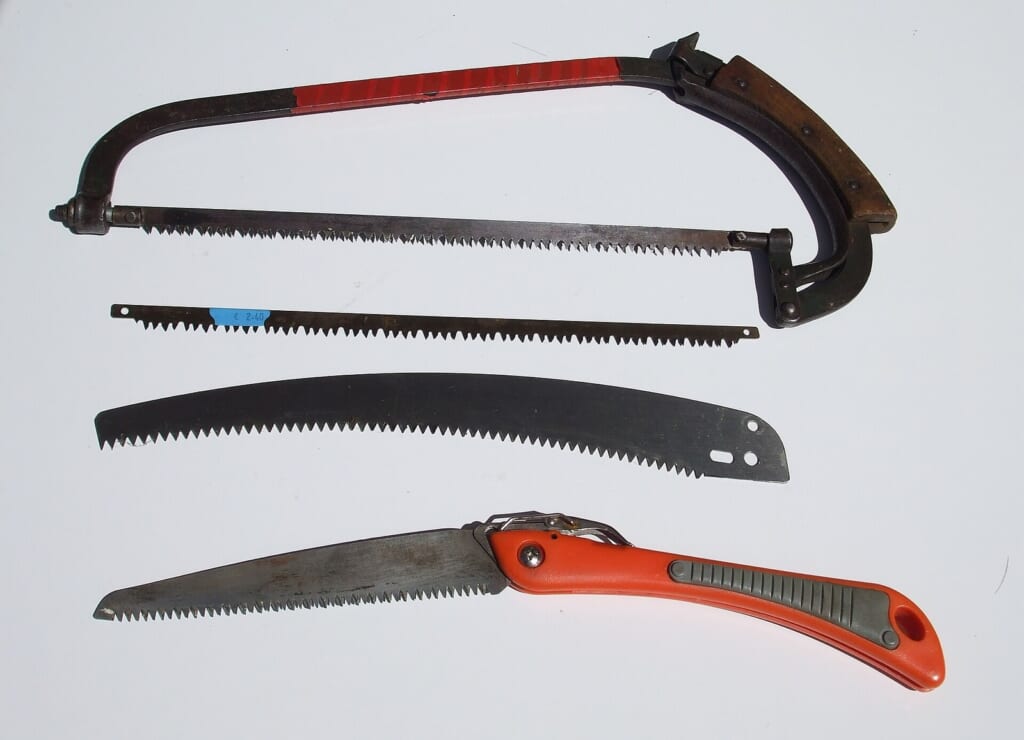
On a traditional Western carpenter’s saw or bow saw, the teeth face away from the handle and cut as you push. Pushing loads the blade in compression, and a thin steel plate under compression buckles sideways, the way a ruler bows when you press its ends together. So push saws use a thicker plate.
A Japanese saw reverses the teeth so they face the handle. The working stroke is the pull, which loads the blade in tension. A plate under tension straightens itself instead of bowing, so the blade can be thin. The Japanese encyclopedia Nipponica notes that most of the world’s saws are push-cut; Japan’s pull-cut type is the exception. In pruning, the idea has travelled: many pruning saws sold in Europe and North America now cut on the pull too. Push cutting survives mainly in carpentry and bow saws.
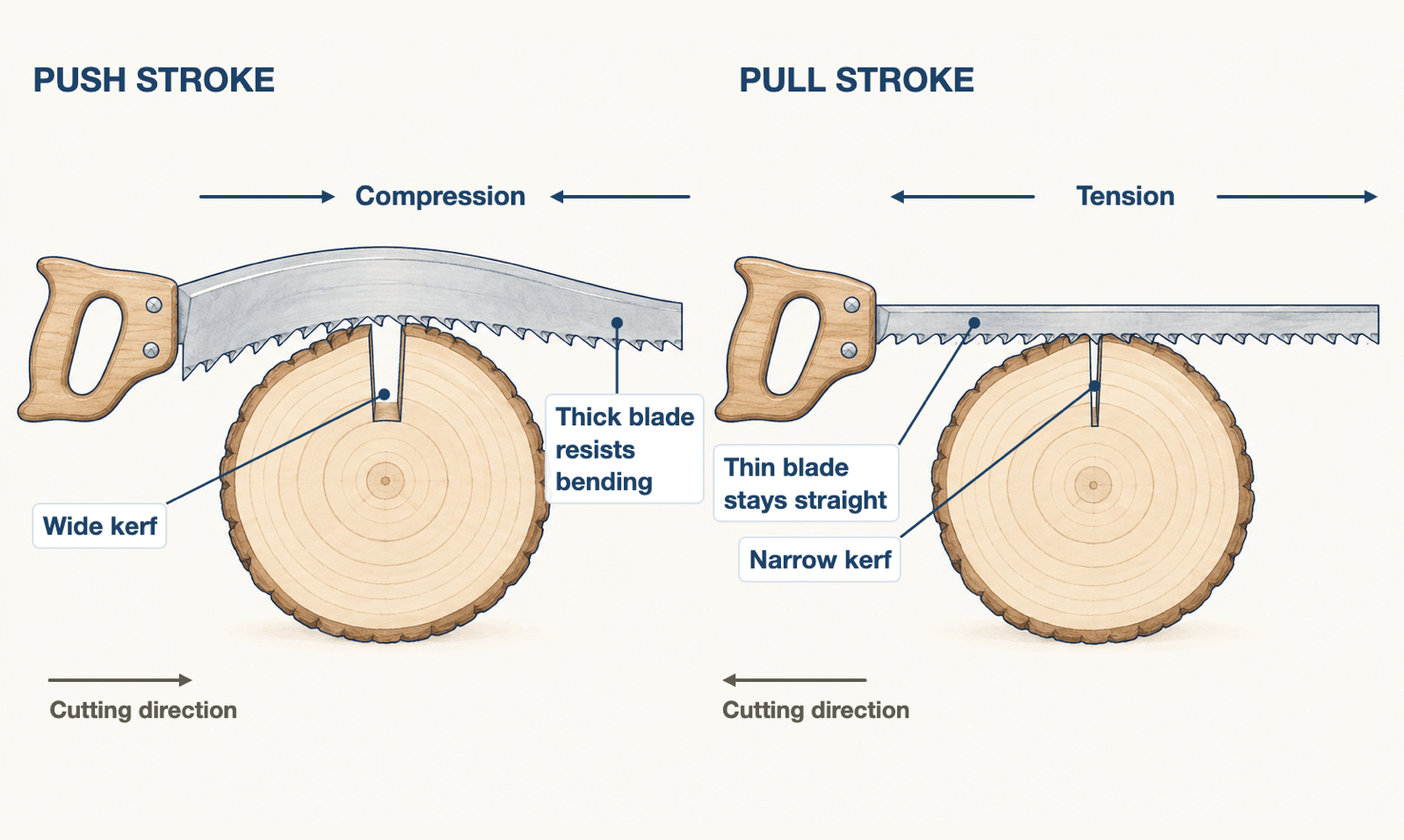
For pruning, the thin blade pays off three ways. The kerf (the slot the saw leaves) is narrow, so each stroke removes less wood and takes less effort. And a narrow kerf leaves a cleaner edge at the bark, which is what you want at the branch collar.
There is also a body-position reason. When you pull, the reaction draws you toward the branch rather than pushing you back. In Japanese practice, much pruning is done from a three-legged ladder, the sankyaku kyatatsu (三脚脚立), or from inside a dense crown. A stroke that brings your weight in toward the tree is easier to control.
The trade-off is fragility. A thin blade bends if you twist it or force it on the return stroke. Silky, a Japanese maker, lists swinging or twisting the blade sideways as a cause of broken blades in its FAQ.
Blade, teeth, and impulse hardening — what makes it fast in green wood
Three features separate a Japanese pruning saw from a carpentry pull saw.
- Tooth geometry. Japanese crosscut teeth are shaped like the point of a small knife, according to the Heibonsha World Encyclopedia, so each tooth slices fibres rather than scraping them. Pruning saws use larger teeth with deeper gullets, because wet, stringy sawdust from living wood has to be carried out of the cut.
- A thin, often taper-ground plate. Many blades are ground thinner toward the back so they clear the kerf instead of rubbing. Some are chrome-plated to reduce friction from sap.
- Impulse-hardened teeth. Shōgeki yaki-ire (衝撃焼入れ), impulse hardening, heats only the tooth tips for an instant, then quenches them. The tips become very hard while the blade body stays tough enough to flex. The hardened band often shows as a darker strip along the teeth.
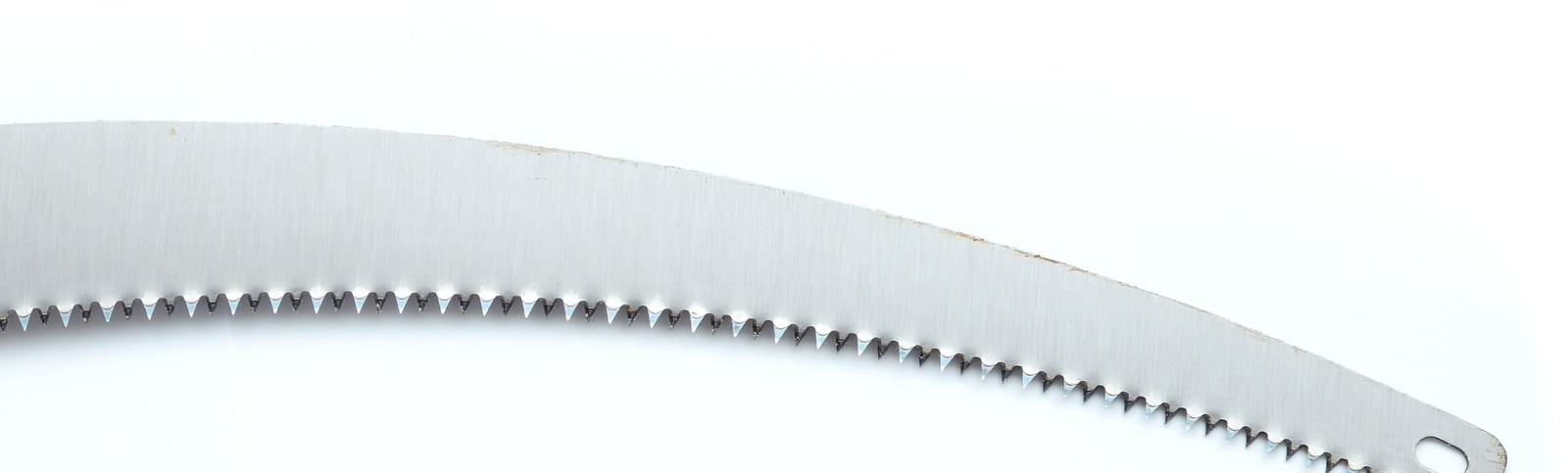
Japanese makers state tooth size as teeth per 30 mm (about 1.2 in) of blade. Fewer teeth mean bigger bites.
| Tooth size | Typical count per 30 mm | Best for | Finish |
|---|---|---|---|
| Coarse (ara-me, 荒目) | about 6–8 | Large live limbs | Rougher, fastest |
| All-purpose (bannō-me, 万能目) | about 10 | General garden pruning | Balanced |
| Fine (hoso-me, 細目) | about 13–14 | Deadwood, small branches, finishing cuts | Smooth, slower |
The working rule in Japan: coarse teeth for green wood, fine teeth for dry wood. Fine teeth clog in a wet, thick branch; coarse teeth chatter in hard deadwood.
Best Japanese pruning saw for the job — start with length
The gullets between the teeth carry sawdust out, and they empty only when they leave the kerf. If a branch is nearly as thick as the blade is long, the gullets pack before they clear, and the saw binds. Choose length before brand.
| Blade length | Carry style | Typical use in garden trees |
|---|---|---|
| 150–210 mm (6–8 in) | Folding, in a pocket | Small deadwood, tight interiors of clipped niwaki |
| 240–270 mm (9.5–10.5 in) | Folding or scabbard | The all-round size for residential gardens |
| 300–420 mm (12–16.5 in) | Scabbard on the belt | Large limbs, removals, rope-access work |
The University of Kentucky’s forestry extension guide states that branches over 1.5 in (about 4 cm) need a hand saw or pole saw designed for pruning. A pole saw extends reach, but the finishing cut at the collar still needs a blade you can place exactly by hand.
Straight or curved, folding or scabbard — choose by where you stand
Straight blades give the most control. They track a line well, which makes it easier to place the final cut just outside the collar without nicking the trunk. Silky’s US distributor notes that straight blades are still the most common in Japan, while curved blades dominate in North America.
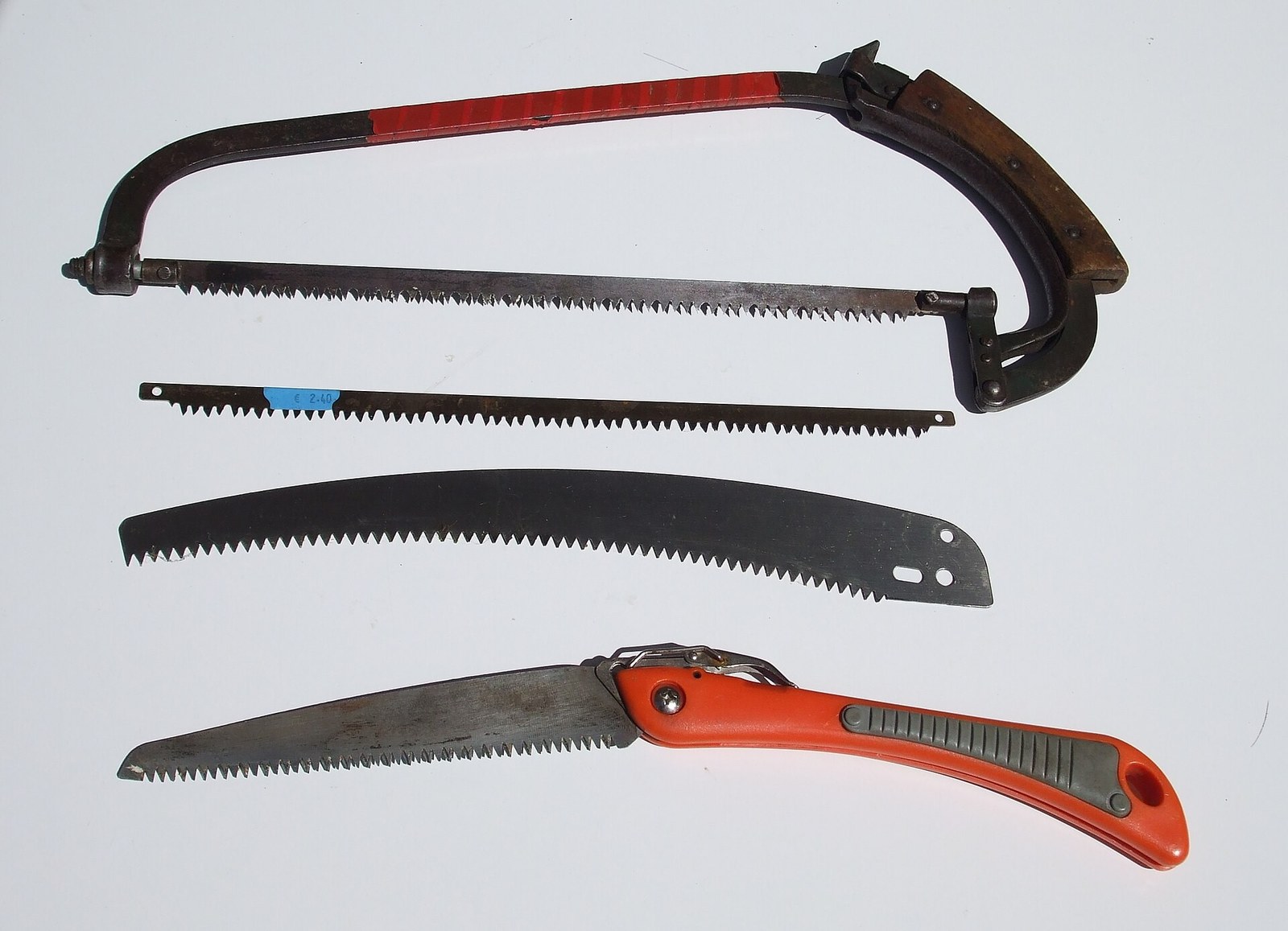
Curved blades bite harder. The curve presses the teeth into the wood as you pull, so they cut faster overhead or below the waist, where your arm swings in an arc. They suit clearing volume, such as storm damage.
Then decide how you carry it.
- **Folding (orikomi, 折込).** The blade folds into the handle, fits a pocket, and is safe to carry up a ladder. The hinge limits length and stiffness.
- **Scabbard (saya, 鞘).** A fixed blade in a belt sheath, which Japanese gardeners call a koshi-noko (腰鋸), a hip saw. It draws and re-sheathes with one hand while the other holds the tree.
In Japanese garden practice, a common pairing is a straight scabbard saw on the belt plus a small folding saw for the inside of dense pines. Clipped forms such as karikomi carry many short, tight branches, so a short blade that fits between them earns its place.
The three-cut method with a pull saw
The USDA Forest Service guide How to Prune Trees draws the line simply: a branch you can support with one hand is cut once; a branch too heavy to support gets a three-step cut, so its weight cannot rip bark down the stem as it falls. Iowa State University Extension applies the method to branches over 1.5 in (about 4 cm) and gives the distances.
| Cut | Extension guidance | What changes with a pull saw |
|---|---|---|
| 1. Undercut | 6–12 in (15–30 cm) from the trunk, sawing upward about one-third of the way through | Teeth up, blade under the branch, pull |
| 2. Top cut | 1–2 in (2.5–5 cm) beyond the first, sawing down until the branch drops | Coarse teeth clear wet sawdust quickly |
| 3. Final cut | Just outside the branch collar and branch bark ridge | A straight blade with all-purpose or fine teeth leaves a clean face |
USDA also offers a check before the saw comes out. Its decision guide for branch size reads: under 5 cm (2 in), go ahead; 5–10 cm (2–4 in), think twice; over 10 cm (4 in), have a good reason. A larger blade makes a large cut easier, not wiser.
Where the final cut lands decides how well the tree seals the wound. A torn edge or a cut into the collar opens a path for decay, which shows up years later in the signs described in how to read tree decay without technology. The same discipline applies to the thinning cuts in Japan’s wind-resistant pruning: fewer, cleaner cuts at the right junction.
Care and replacement blades — sap, rust, and when to stop
Pine resin, yani (ヤニ), is the main enemy of a pruning saw in Japanese gardens, where pines are worked every year, from midori-tsumi in spring to needle thinning in autumn. Resin adds friction and traps moisture against the steel.
- Clean after each day. Silky’s FAQ recommends a resin-dissolving cleaner, or soaking the blade in kerosene, followed by rust-preventive oil.
- Store dry. A thin film of oil is enough. Never leave the blade in a wet scabbard.
- Do not pry, twist, or cut into soil. Grit at ground level dulls hardened teeth fast.
Can you sharpen it? Silky states that products without impulse hardening can be touched up with a saw file, and recommends replacing the blade once the tooth tips have worn round. Hardened tips resist an ordinary file, so in practice the blade is a consumable: the handle stays, the blade is changed. Replacement blades must match the model and length.
Miki, in Hyogo Prefecture, whose forged blades, saws included, were designated a national Traditional Craft in 1996, built its name on saws a craftsman would straighten and resharpen. Me-tate (目立て), resharpening, survives for carpentry saws. For pruning saws, where green wood and grit wear teeth quickly, the replaceable hardened blade has largely taken over.
Replace the blade when the saw wanders off line, you find yourself pressing harder, or the cut face comes out torn.
Frequently asked questions
Is a Japanese pull saw better than a Western pruning saw?
Many modern Western pruning saws already cut on the pull. The real contrast is with push-cut carpentry and bow saws: a pull blade can be thinner and cuts with less effort; a thicker push blade tolerates rougher handling. Among pull-cut pruning saws, choose by tooth size, length and shape.
What size Japanese pruning saw should I buy for garden trees?
For most residential garden trees, a 240–270 mm (about 10 in) blade with all-purpose teeth covers the bulk of the work. Add a short folding saw for tight interiors, or a longer scabbard saw for large limbs.
Why does my pull saw keep getting stuck?
Usually the branch weight is closing the kerf (use the three-cut method), the teeth are too fine for green wood, or resin has built up on the plate. Twisting the blade to free it is how thin blades get bent.
Sources
- Silky (UM Kogyo), Q&A — https://www.silky.jp/QandA/ (checked 2026-10-17)
- Silky Saws USA (Vertical Supply Group), “Straight versus curved blades” — https://silkysaws.com/silky-stories/straight-versus-curved-blades-which-one-is-right-for-you (checked 2026-10-17)
- Christopher Reeves, Pruning Trees, FORFS 17-07, University of Kentucky Forestry Extension (checked 2026-10-17)
- Iowa State University Extension, pruning a large tree branch — https://yardandgarden.extension.iastate.edu/faq/what-proper-way-prune-large-tree-branch (checked 2026-10-17)
- Association for the Promotion of Traditional Craft Industries, Banshu Miki Uchihamono — https://kougeihin.jp/en/craft/0712/ (checked 2026-10-17)
- Nipponica and Heibonsha World Encyclopedia, “Saw (鋸)”, via Kotobank — https://kotobank.jp/word/%E9%8B%B8-112123 (checked 2026-10-17)
- Bedker, P. J., O’Brien, J. G., Mielke, M. E., How to Prune Trees, USDA Forest Service NA-FR-01-95, revised 2012 — https://research.fs.usda.gov/treesearch/12602 (checked 2026-10-17)
Related reading
- Niwaki vs Topiary — what Western gardens get wrong
- Why do Japan’s ancient trees live for a thousand years?
New field notes from Japan’s trees every day — subscribe to the Japan Blue Arborist Journal on LinkedIn, or via the form in the footer.