Choosing Japanese pruning shears by brand name is a reliable way to get stuck. The prices overlap, the shapes look alike, and nothing in the catalogue tells you which one belongs in your hand. The deciding factor is not on the maker’s side of the question. Decide first whether you intend to resharpen one pair for life or swap blades and keep working; the maker follows from that answer.
This article sorts the companies that make pruning shears in Japan into three kinds, walks through the regions and the steel behind them, and ends with how to choose. If you want the short answer for a first pair: buy an Okatsune. The reasons come later in the article.
The order is: ① sort the makers into three kinds ② look at the regions ③ understand the steel and the structure of the blade ④ apply it to the way you actually work. Tool articles tend to become product comparisons, but a comparison only helps once you know which side of the operation you are on.
Three kinds of makers — volume manufacturers, a dedicated factory, regional smiths
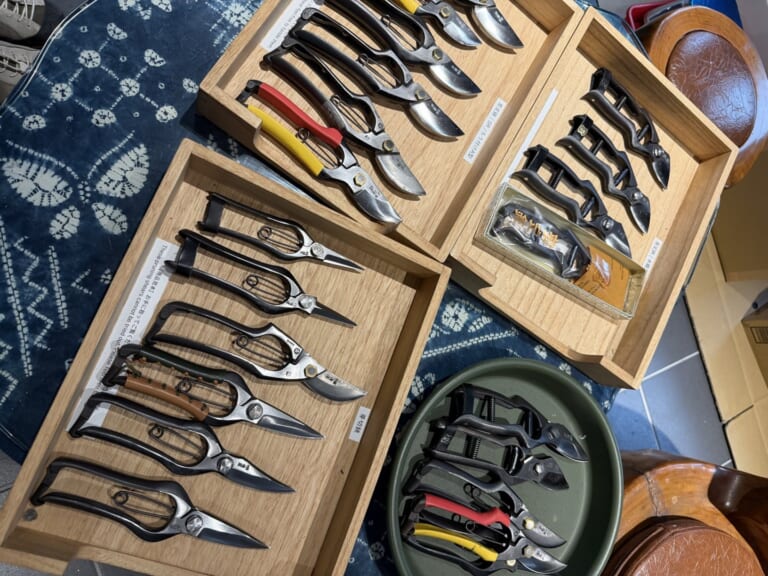
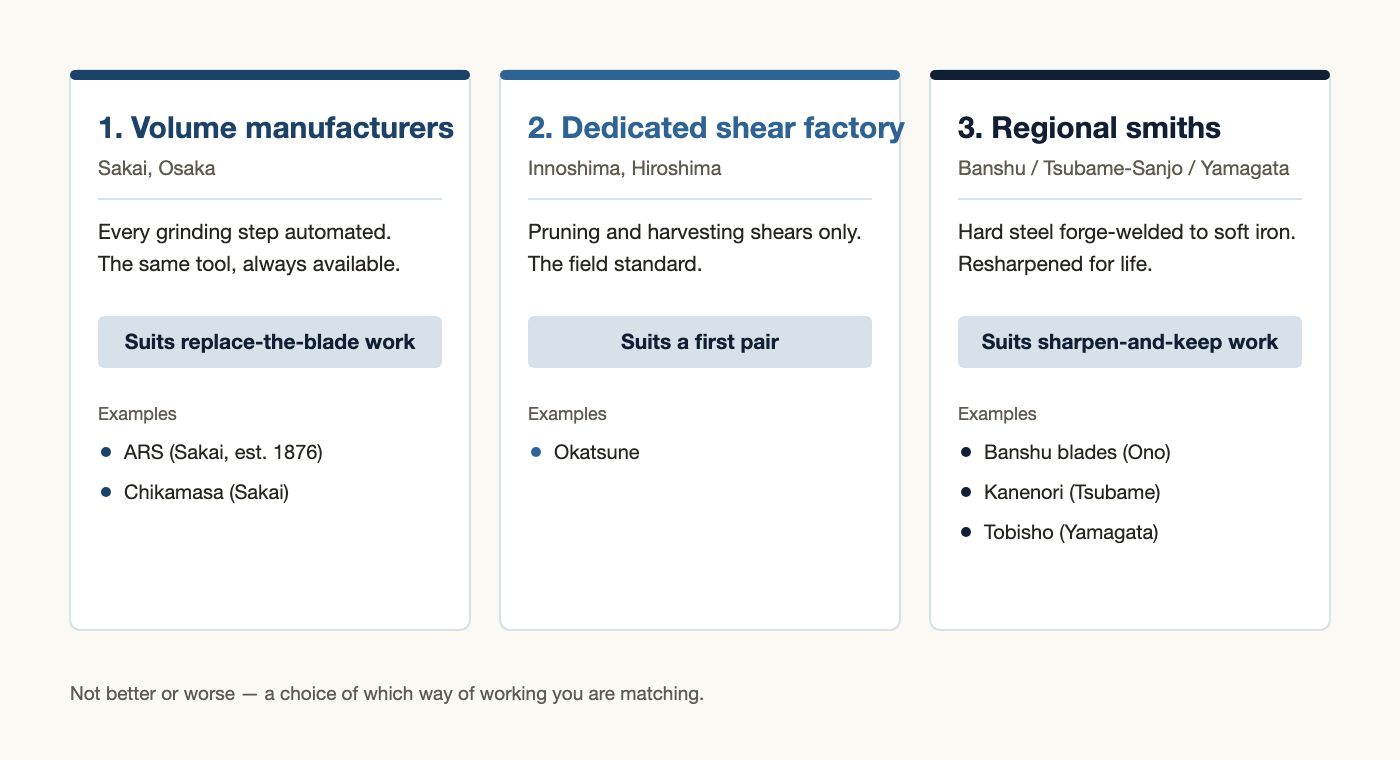
The companies making pruning shears in Japan fall into three groups: large edge-tool manufacturers that automate the whole grinding process (Sakai, Osaka), a factory that builds shears and nothing else (Innoshima, Hiroshima), and regional smiths who forge-weld hard steel onto soft iron (Banshu in Hyogo, Tsubame-Sanjo in Niigata, Yamagata).
These three are not ranked against each other. They are a choice about which way of working you are matching. If you intend to sharpen every week and keep one pair for life, a regional smith is the right direction. If you equip a crew of ten and people come and go, a volume manufacturer is. Comparing brands before settling that question produces no answer at all.
| ① Volume manufacturers | ② Dedicated shear factory | ③ Regional smiths | |
|---|---|---|---|
| Region | Sakai, Osaka | Innoshima, Hiroshima | Banshu / Tsubame-Sanjo / Yamagata |
| How they are made | Every grinding step automated | One category, made in depth | Hard steel forge-welded to soft iron |
| Strength | Consistent, always available | Depth in a single use case | Comes back after sharpening |
| Weakness | Not chasing the ceiling | Limited range of tools | Hard to buy six identical pairs |
| Suits | Replace-the-blade work | A first pair | Sharpen-and-keep work |
Sakai’s volume manufacturers — the same tool, always available
Sakai has been a blade town for centuries, and it is where Japan’s volume garden-tool makers cluster. ARS Corporation (Sakai, Osaka) is the representative case: the company states on its own site that it was founded in 1876, and that it works across garden and industrial blades alike.
What defines this kind of maker is production that does not depend on one craftsman’s hands. ARS states that it automated the entire grinding process for its shears, and that it developed the world’s first “no-set” (asari-wakenashi) saw tooth geometry. Chikamasa, a shear specialist, operates in the same ward of the same city.
The strength of volume production is that the same tool is available again next year, and behaves the same way in the next person’s hand. Equip ten people, train a new hire on the tool everyone else is using, replace a lost pair without a conversation. For anyone running a crew, that is worth more than the last five percent of sharpness.
“Machine-ground” sounds like a compromise, but the opposite is closer to the truth. A person sharpening by hand changes the angle slightly from day to day. A machine does not. The first pair and the hundredth being identical is, for whoever issues the tools, the definition of quality.
What this kind of maker does not chase is the ceiling. The sharpness that returns after grinding, the way a handle beds into a particular hand over ten years — that belongs to the smiths. Read volume-made shears as “high average, no pursuit of the maximum” and they will not disappoint you.
Innoshima’s dedicated factory — pruning and harvesting shears only
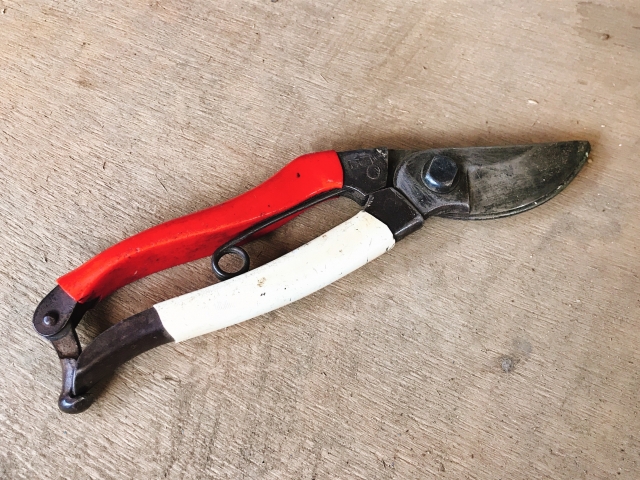
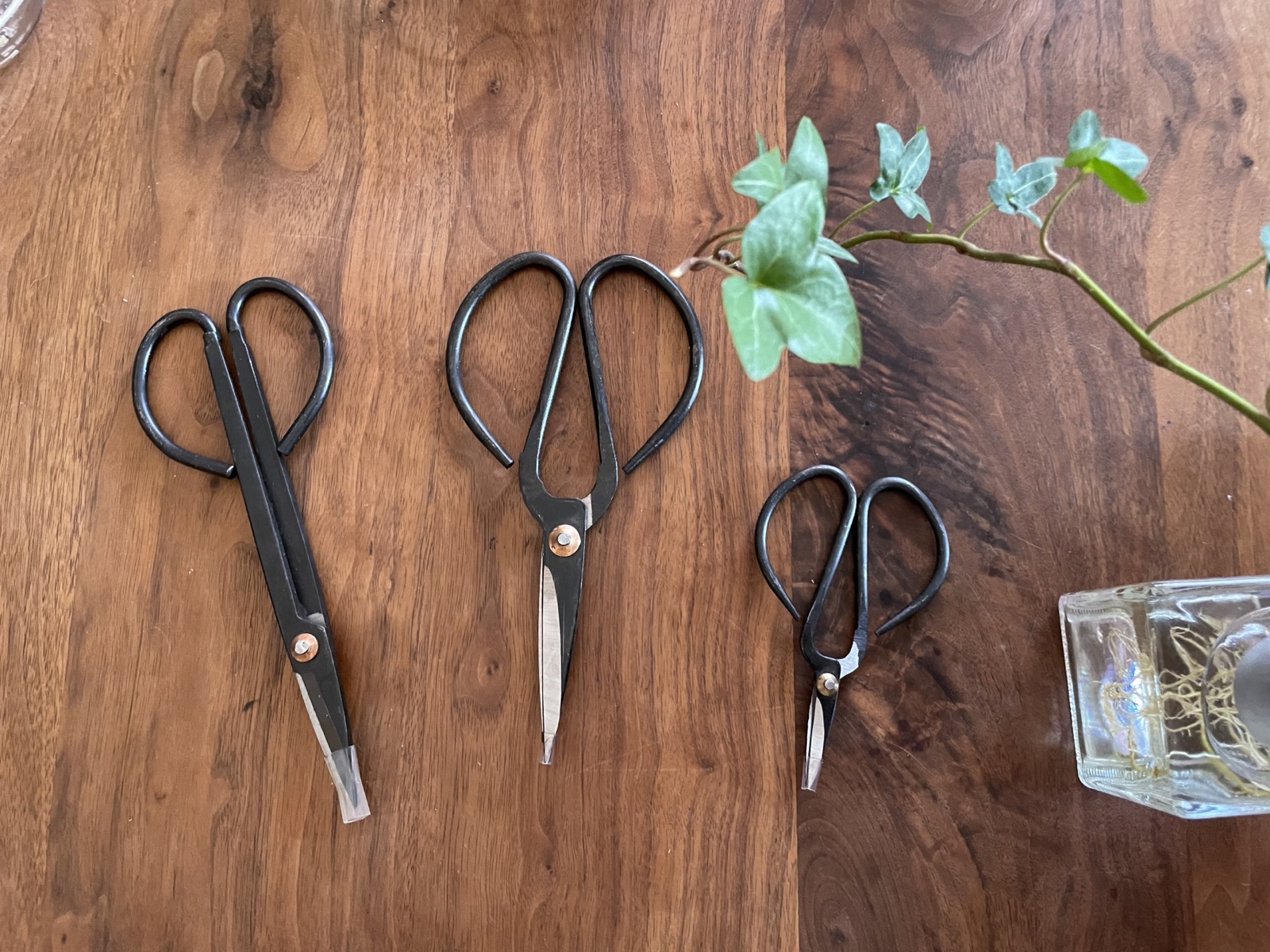
Okatsune (Okatsune Scissors Factory Co., Ltd.) sits on Innoshima island in Onomichi, Hiroshima, and builds pruning shears and fruit-harvesting shears. The red-and-white handles are recognisable enough that the name travels abroad unchanged.
A factory that limits its range gets depth in exchange. It is also, by a wide margin, the pair you see most often on Japanese sites.
“Common on site” is a property of its own, separate from performance. When many people use the same pair, you can ask the person next to you how they sharpen it; parts are easy to replace; advice is specific rather than promotional. For a first tool, that access to information is worth as much as the edge itself.
The weakness is range. If you want hedge shears and bud shears from the same maker, the catalogue runs out, and you fill the gap from a volume manufacturer or a smith.
Regional smiths — Banshu, Tsubame-Sanjo, Yamagata
Banshu (Ono, Hyogo) — a town of shears and sickles
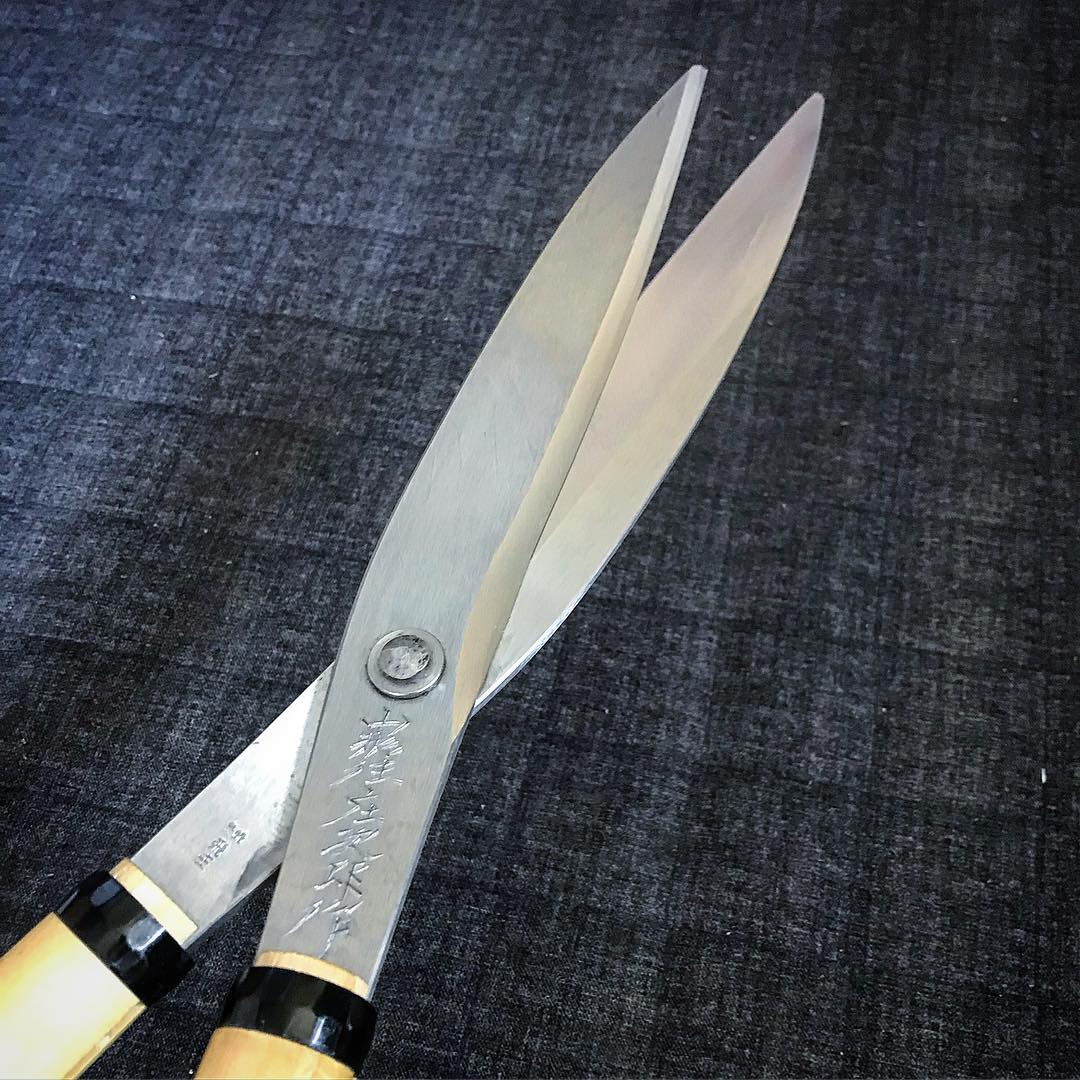
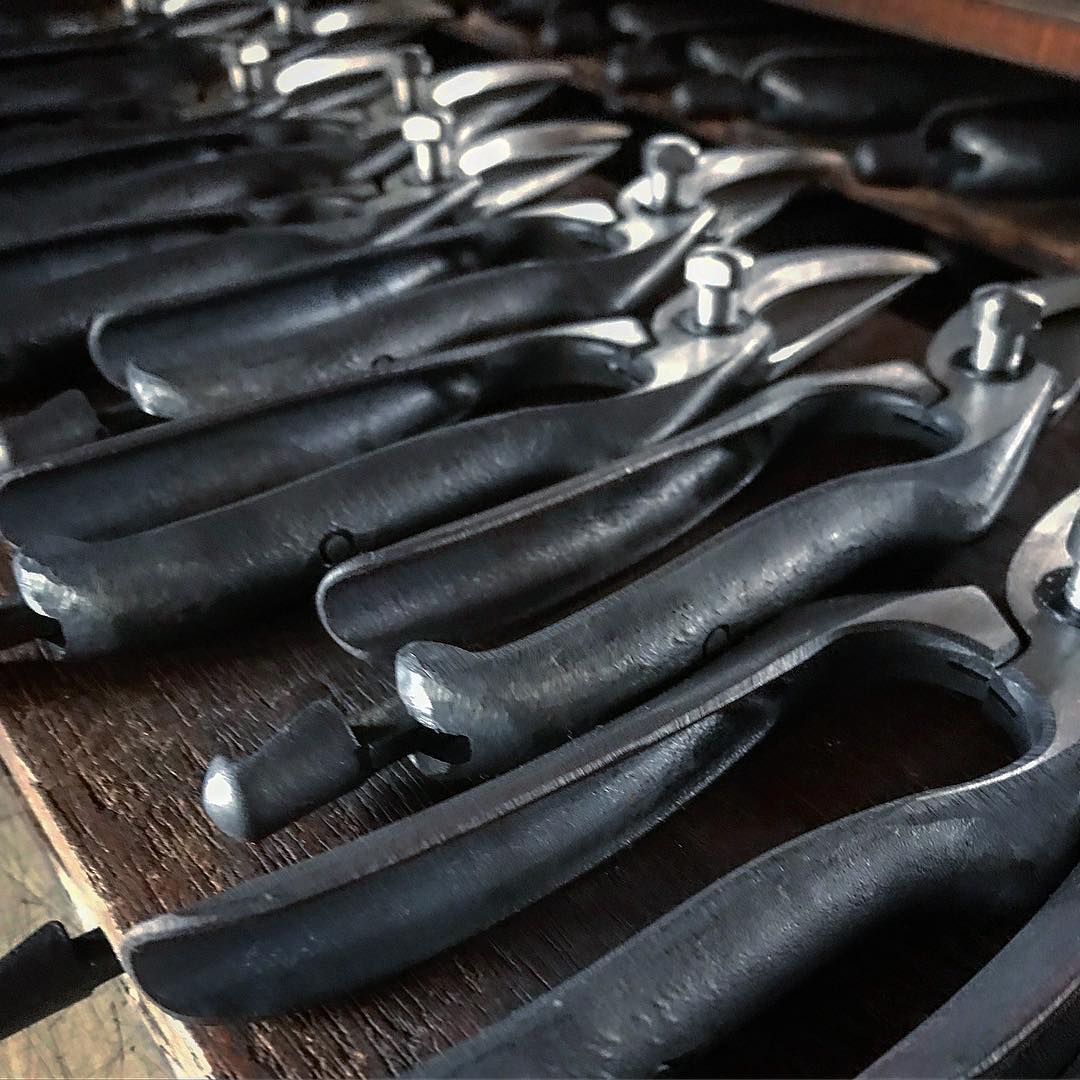
Ono City in Hyogo is a shear and sickle town, not a kitchen-knife town. The city’s own materials date Banshu blades back 250 years and note that Banshu sickles account for roughly 70% of national production. Grip shears, tailor’s shears, ueki-basami (garden shears) and pruning shears are each made by different smiths.
That 70% figure says something about the character of the place. Sickles and shears both cut grass and green wood, and what they need is toughness more than hardness — an edge that survives hitting soil and stone and returns when sharpened. A knife town optimises in a different direction. Garden shears growing out of this region follows from that.
Tsubame-Sanjo (Niigata) — from nails to edge tools
Sanjo began somewhere else entirely. According to the city’s records, nail smiths were invited from Edo in 1625 to give flood-stricken farmers winter work, and the craft widened to sickles, saws and knives after saw and hatchet methods arrived from the Aizu region in 1661. Among garden tools, Igarashi Hamono Kogyo (brand name Kanenori, Sanjo, Niigata) makes professional-grade pruning shears, hedge shears and hatchets.
That history shows in the tools. Sanjo is the region of variety: more sizes, more specifications, more individual makers working to their own patterns. It is a difficult place to buy your first pair and a rewarding one for your second.
Yamagata — where pruning shears are the local speciality
In Yamagata, pruning shears are the main product rather than a sideline. Yamagata uchihamono is traced to smiths brought into the region in the Nanboku-chō period (14th century), and the regional craft record describes the method as jiyū tanren — free forging, in which soft iron and hard steel are joined in the fire and hammered until the blade has both spring and toughness.
In Yamagata City, Tobisho (Tobitsuka Shear Works) builds pruning shears, bud shears and hedge shears, combining that traditional process with laboratory testing methods, as the company states publicly.
Jiyū tanren is worth unpacking. Nothing is cast into a mould; the shape and the properties are drawn out by hammering hot steel. The hammering orders the structure of the steel and gives it spring. Two blades of the same shape, one forged this way, behave differently once they have been sharpened a dozen times. The price of a regional pair is, in large part, the hours of that process.
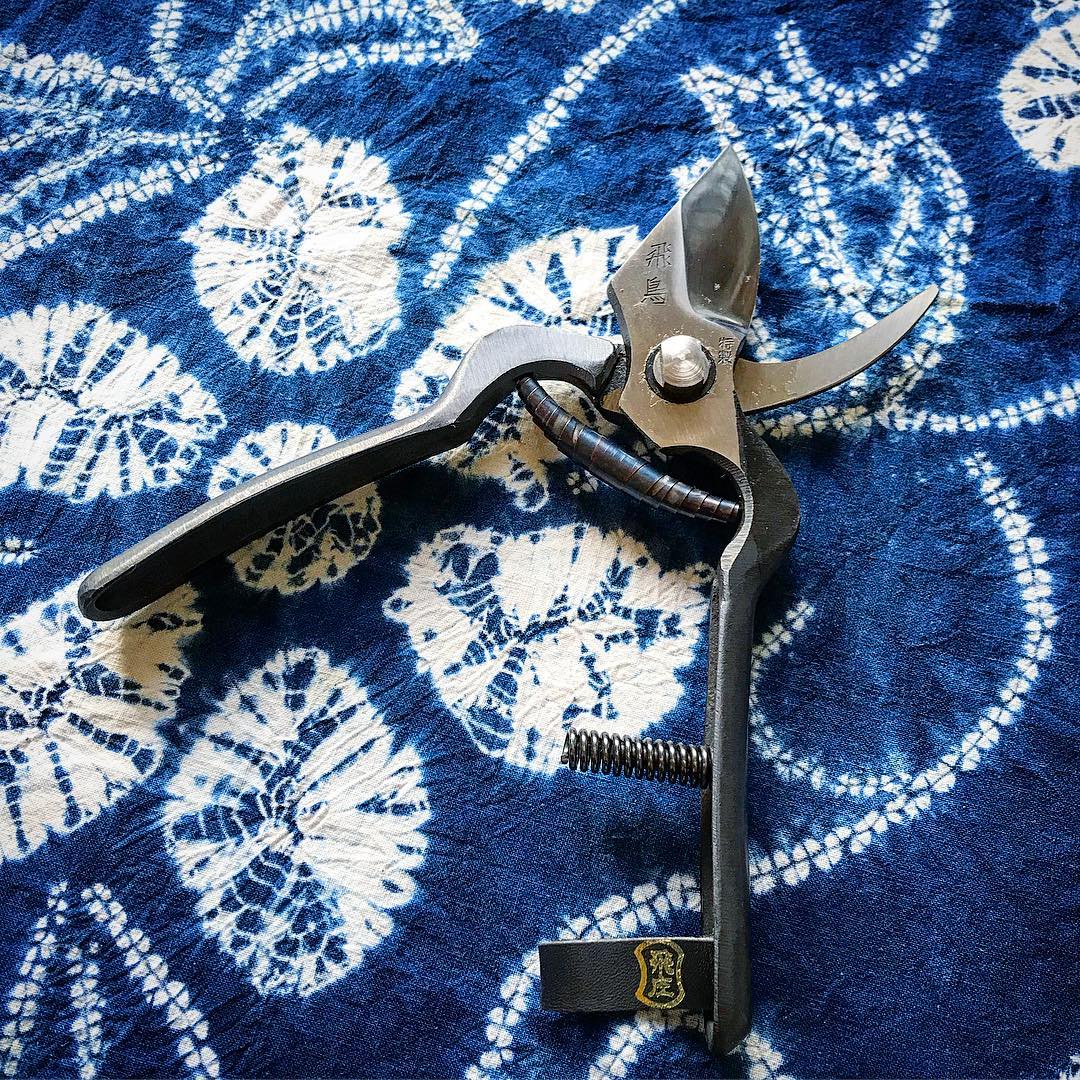
One line on Tobisho’s site is worth more than any marketing claim: they sharpen and repair shears bought from other makers, not only their own. The sharpen-and-keep model is supported on the manufacturing side, not merely asserted by the buyer. If you are weighing a smith-made pair, that is the point that decides it.
What regional pairs give you is a tool that comes back after sharpening. What they cost you is uniformity: order six and you may get six slightly different tools, because different hands made them. Read that trade-off the way you would read the difference between niwaki and topiary — a difference of intent, not of rank.
What the steel changes — Yasugi steel and forge welding
Yasugi steel — White, Blue, and the new Aigami
The centre of Japanese blade steel is Yasugi steel, produced at Proterial’s Yasugi Works in Shimane Prefecture. The familiar names — White Paper (shirogami), Blue Paper (aogami), Silver Paper (gingami) — come from the colour of the paper the finished steel was wrapped in, not from anything in the metal. White Paper is high-carbon and hard; Blue Paper adds chromium and tungsten for wear resistance and sits above it.
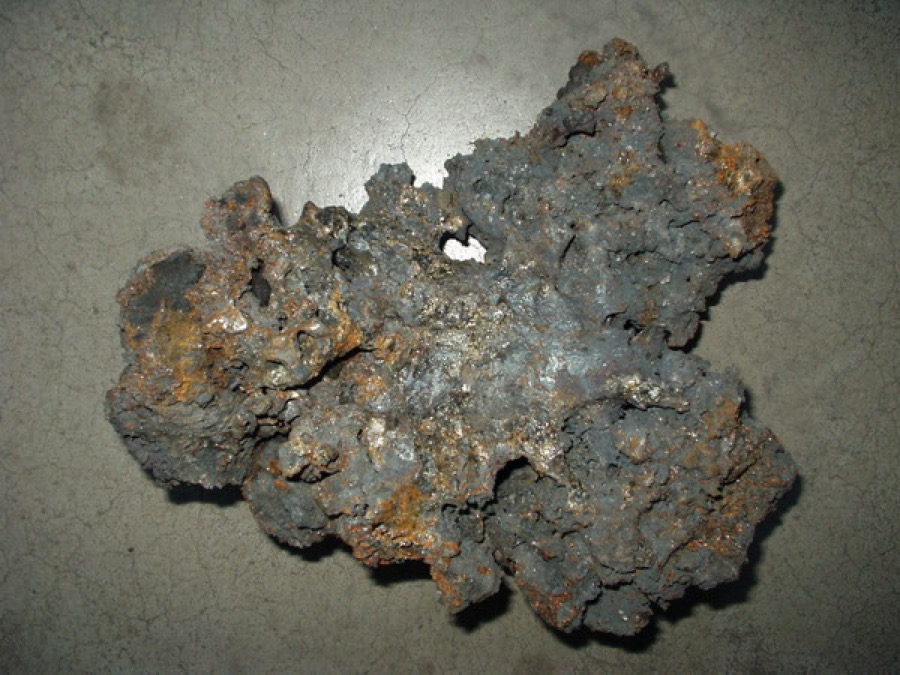
Which is better cannot be answered in one line. Raising hardness raises the ceiling of sharpness and makes the edge easier to chip. Pruning shears cut an uneven material, sometimes at a bad angle, often in one hand. Unlike a kitchen knife, the conditions are never controlled, so hardness alone is not rewarded on site. Smiths select steels to settle that trade-off, not to win a specification contest.
The category is still moving. On 9 December 2025, Proterial began selling a new blade steel, Aigami No. 2, which the company describes as matching or exceeding Blue Paper No. 2 in hardness while offering corrosion resistance comparable to its GIN3 stainless. Note the scope honestly: the stated applications are premium kitchen knives and outdoor knives, not pruning shears. No shear maker has announced it.
Forge welding — why a resharpened blade comes back
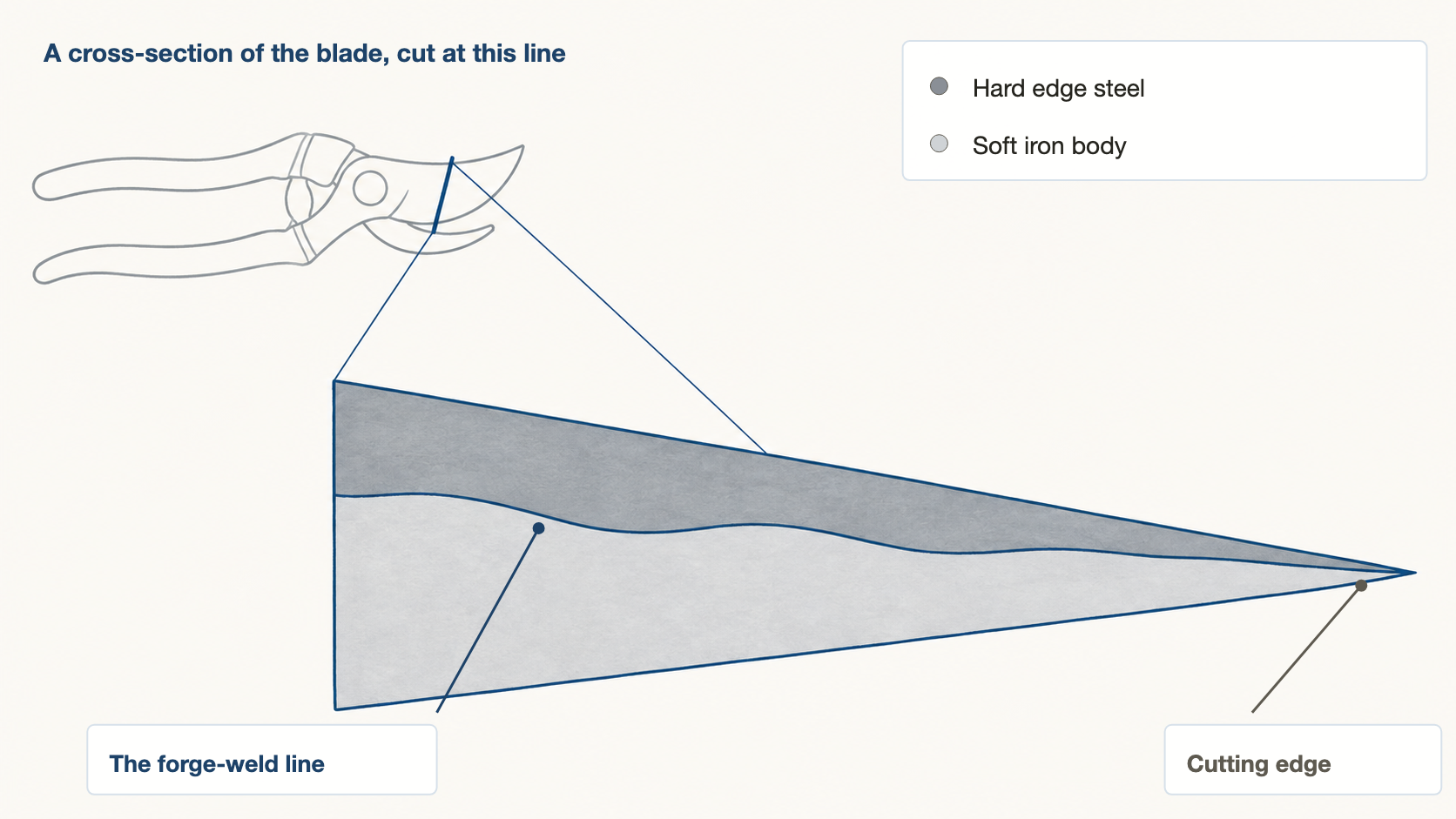
Japanese edge tools are built by joining a hard steel edge to a soft iron body. A blade made entirely of hard steel would chip, so only the edge is hard and the body absorbs the shock.
Grinding metal away therefore does not use the tool up: a fresh plane of edge steel appears from inside. “Sharpen it and use it for life” is a statement about structure, not sentiment. Understanding that changes how the price of a forged pair reads.
The reverse is also true. A blade without that structure does not come back. Shears made throughout from a single material lose their performance once the edge is worn, and no amount of sharpening restores what was never there. That is a reasonable design if you intend to replace the tool — but it is worth knowing which kind of tool is in your hand before you spend an evening at the stone.
Carbon versus stainless — a question of operation
Stainless resists rust and forgives neglect. Carbon steel reaches a higher ceiling of sharpness but will rust if you put it away wet. If you make several hundred cuts a day, how quickly the edge bites and how little your hand tires decide the day’s output — which is why tool choice and pruning strategy travel together, as they do in Japan’s wind-resistant pruning methods. Use a pair a few times a year and the easier-to-maintain steel will, in practice, cut better.
Four decisions before you compare brands
| Decide | The measure |
|---|---|
| ① Sharpen or replace | Sharpening points to a smith or a specialist factory; replacing points to a volume manufacturer. Comparing brands before answering this produces no answer |
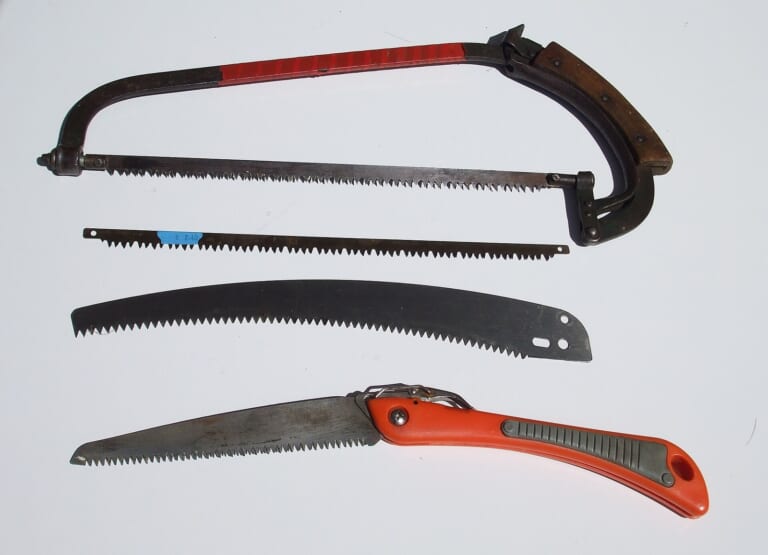
| ② What you are cutting | Pruning shears handle branches up to roughly 2–2.5 cm (about 1 inch); past that, change to a saw. Buds and thin shoots belong to ueki-basami (up to roughly 0.8 cm, about 5/16 inch) |
| ③ Hand size and hours | A few millimetres of length is nothing in a shop and a different tool after eight hours. Open and close the pair before you buy it |
| ④ Whether it can be disinfected | Shears that cut a diseased tree must not go straight into the next one. Whether a pair comes apart for cleaning carries the same weight as sharpness |
None of the four is settled by a catalogue. In order:
1. Sharpen or replace — decide the operation first
This is the largest fork. If you sharpen, a tool whose edge returns (a forge-welded regional pair, or a specialist factory’s) earns its price. If you replace, a maker with available spare blades and repeat stock is the rational choice.
For an organisation, the question becomes “who sharpens?” If everyone can, regional pairs come alive. If one person can, give that person the forged pair and equip everyone else with replaceable blades. Tool choice is also a question of where the skill sits.
2. What you are cutting — change tools past the limit
Pruning shears cut up to roughly 2–2.5 cm. Forcing anything thicker twists the blade and crushes the cut. A crushed cut is a wound that closes badly, so changing to a saw protects the tree as much as the tool.
Go the other way and the problem inverts: used on buds and fine shoots, a pruning shear is too large to take the one stem you intended. That work belongs to ueki-basami, the tool used for jobs like spring candle pinching on pines. One pair cannot cover both, not because of quality but because the two were designed around different tasks.
3. Hand size and hours — hold it before you buy
Millimetres of overall length are invisible in a shop and obvious after a day, because the same point of the palm takes the same pressure a thousand times. Even if you order the rest online, buy the first pair somewhere you can open and close it. Check the finger catch when open and how the tool sits in a closed hand.
Left-handed users should confirm whether a left-handed version exists. A single-bevel blade has a handedness built into it, and using a right-handed pair in the left hand leaves a ragged cut. Some makers will build one to order, so ask before you buy.
4. Whether it can be disinfected — a tool that travels between trees
The fourth matters most when you see shears as a tool for diagnosing and treating trees rather than as garden equipment. A cut is a wound, and shears move from tree to tree all day — the same logic that applies to the shears used for cloud pruning and hedge work.
Taking a blade that cut a diseased tree into the next tree is carrying pathogens from wound to wound. Does it come apart for cleaning? Can the pivot be loosened and wiped? For anyone managing trees, that single question outranks price.
Buy an Okatsune first
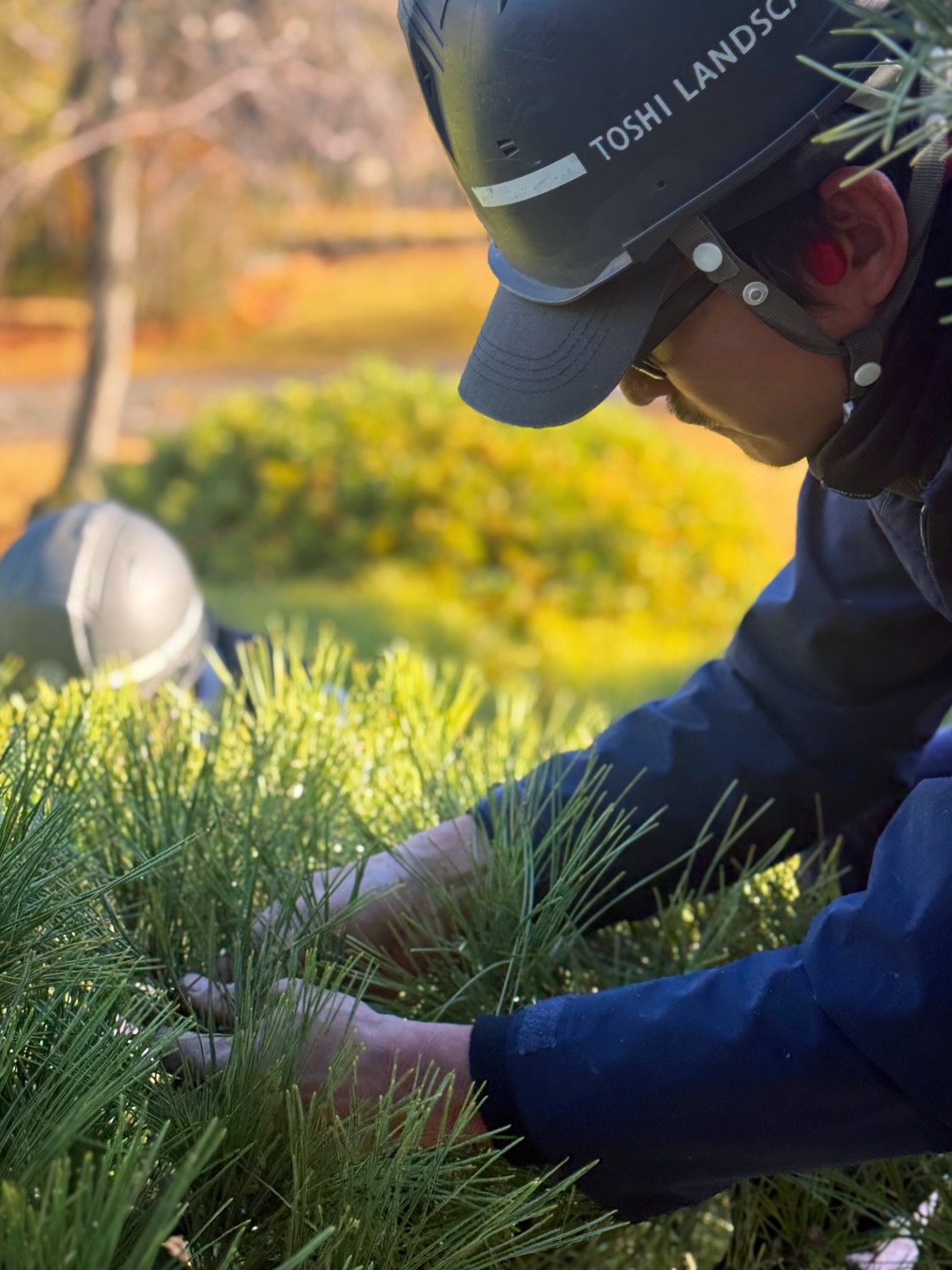
After all that sorting, the pair I recommend to anyone buying their first is the Okatsune. Three reasons.
The durability is high for the price. Cheap shears loosen at the pivot and twist at the blade; these hold up. The cutting performance is not a problem. It is not competing for the absolute ceiling against a smith’s one-off, but it is not short of what professional work requires. And more people in the field are using this pair than any other — parts are easy to replace, and you can ask the person beside you how they sharpen it. At the stage where you are undecided, being on the same tool as everyone else is worth more than it sounds.
You do not need a smith-made pair to start. Use one every day, learn to sharpen, find the length that fits your hand, then move to a forged pair. Reverse the order and you will own an expensive tool that rusts because the maintenance habit never formed.
The same order works for an organisation. Issue volume-made shears to everyone, and let people choose their own pair once they can sharpen. New staff learn on one consistent tool; the ones who sharpen move on to something fitted to their hand. That beats handing expensive shears to everyone.
The part that lasts longer than the purchase — sharpening, resin, disinfection
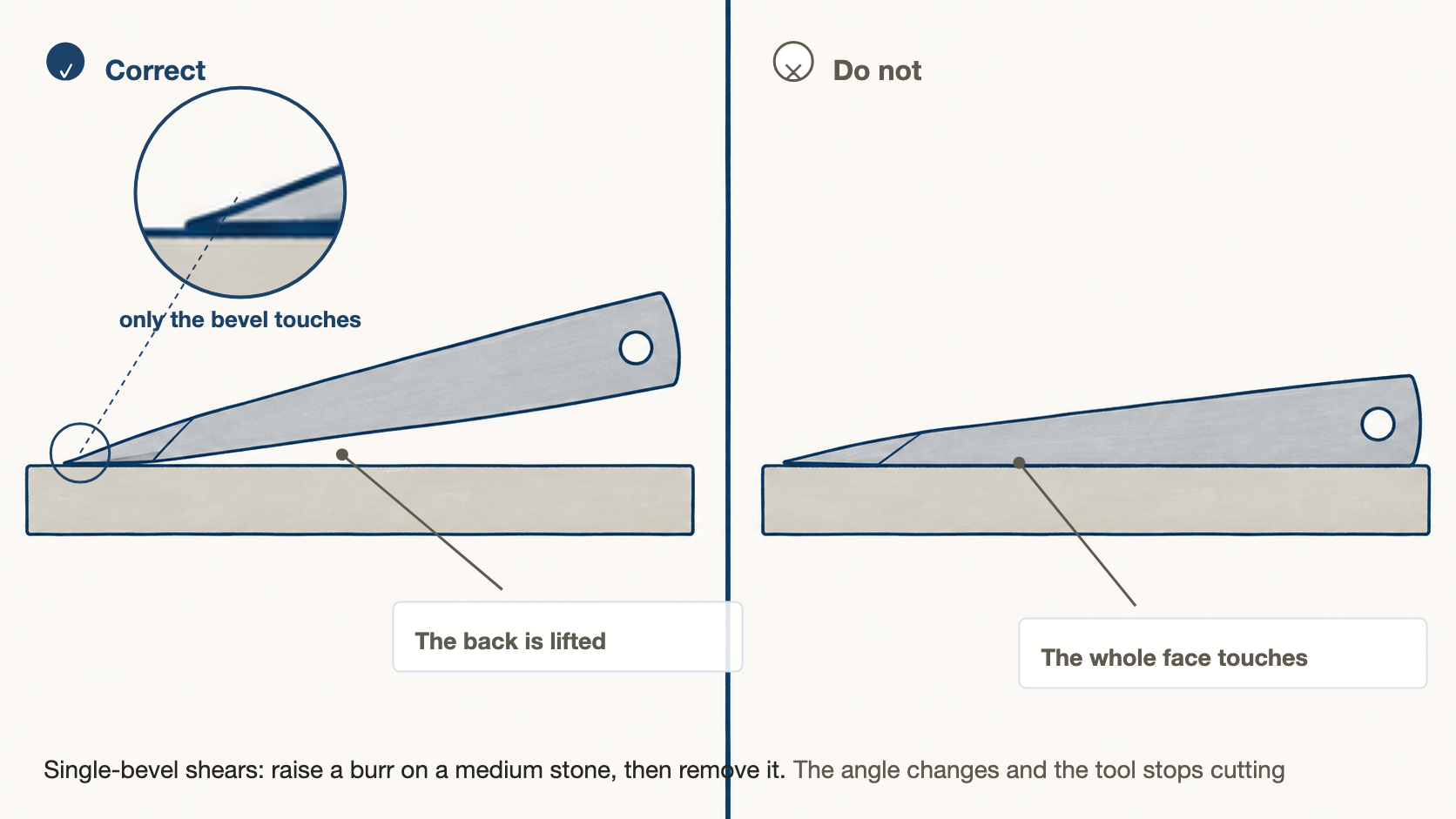
On single-bevel shears, work only the shinogi — the bevel on the face side — and leave the back alone; change that angle and the tool stops cutting.
The procedure is not difficult. Flatten the stone and wet it. Lay the bevel flat against the stone and move it without changing the angle. When a thin burr appears along the back of the edge, that face is sharpened. Move to the finishing stone, then lay the back flat and take the burr off. You are not grinding the back; you are removing the burr.
Frequency follows use. Cutting daily, every few days; seasonal work, once before and once after. Restoring an edge while it still cuts removes less metal than rescuing one that has gone.
Pine and other evergreens leave resin on the blade, so wipe it down at the end of the day and dissolve anything that has set. Once a season, take the pair apart, clean it and oil the pivot. After a diseased tree, disinfect before moving on.
The presence or absence of this routine moves sharpness more than the choice of maker does. And if the time is not there, ask the maker to sharpen it — as Tobisho does, including for other makers’ shears.
Where to buy — a shop you can hold it in, and tools you order
Buy the first pair where you can hold it: a hardware or blade shop, or a large garden centre that keeps tools out of the box. Fit is not a dimension on a page.
By the second or third pair, when you are looking at regional work, fewer shops stock the tools in person and you order from the maker or from a dealer in that region. Ask whether sharpening and repair are offered. A tool you sharpen is a tool you will own for a long time, and the relationship after the sale is the longer half.
When buying online, the same question applies: does the seller handle sharpening and parts? Whether a tool lasts ten years matters more to the cost than what you paid once.
In closing — decide the order and the choice narrows
Japanese pruning shears are not chosen from a brand list. Decide whether you will sharpen or replace, decide what you are cutting, and the field narrows on its own. Knowing the regions and the steel then lets you pick the pair that lasts longer at the same price.
And if you are still undecided about your first pair: buy the Okatsune, use it daily, and learn to sharpen it. Tools separate not at the moment of purchase, but somewhere down the line of maintenance.
Frequently asked questions
Q1. Which Japanese pruning shears should I buy first? A. An Okatsune. The durability is high for the price, the cutting performance is sufficient for professional work, and because so many people use them you can get parts and sharpening advice easily.
Q2. Which maker is best overall? A. There is no overall answer. For sharpening and long service, a regional smith (Banshu, Tsubame-Sanjo, Yamagata) or a dedicated factory; for consistency across changing staff, a volume manufacturer in Sakai. The operation decides it.
Q3. Do expensive shears stay sharp longer? A. Steel and heat treatment do differ. But an unmaintained premium pair loses to a maintained inexpensive one. What you actually buy at the high end is how well the edge returns after sharpening.
Q4. Do I need both pruning shears and ueki-basami? A. If you do both kinds of work, yes. Pruning shears remove branches; ueki-basami pinch buds and fine shoots. They are not interchangeable. With only one, choose by whichever task dominates your day.
Q5. Is stainless unsuitable for professional use? A. Not at all. In wet conditions, or where there is no time for daily maintenance, stainless is the rational choice. Choose carbon steel only if wiping the blade down is genuinely part of your routine.
Sources
– ARS Corporation, “About ARS Corporation” (founded 1876; Sakai, Osaka; fully automated shear grinding; the first “no-set” saw) – Chikamasa official site (Sakai-shi Naka-ku, Osaka) – Ono City, “Traditional industries: Banshu abacus and blades” (250 years; Banshu sickles ≈ 70% of national production) – Sanjo City, “The history of Sanjo smithing” (nail smiths invited in 1625; saw and hatchet methods from Aizu in 1661) – Igarashi Hamono Kogyo (Kanenori), official site (Sanjo, Niigata; professional garden blades) – Tobisho (Tobitsuka Shear Works), official site (Yamagata City; pruning, bud and hedge shears; sharpening and repair accepted for other makers’ tools) – Yamagata Prefecture Furusato Kogei, “Yamagata uchihamono” (origins in the Nanboku-chō period; jiyū tanren free forging) – Proterial news release, 9 December 2025, “Launch of Aigami blade steel” (Aigami No. 2; Yasugi Works)
All accessed 11 October 2026.
Related reading
– Karikomi — the Japanese art of cloud pruning explained – Midori-tsumi — reading a pine tree’s future in its spring candles – Niwaki vs topiary — what Western gardens get wrong – Typhoon-proofing trees — Japan’s wind-resistant pruning methods
Field notes from Japan’s trees arrive a few times each month — subscribe via the form in the footer, or follow the work on LinkedIn.