Sukashi pruning (透かし, literally “see-through”) is the Japanese term for thinning a crown by taking out whole branches where they fork, so the tree keeps its outline while light and air reach the interior. Saitama Prefecture’s street-tree pruning manual grades it into three levels — ō-sukashi, naka-sukashi and ko-sukashi — according to the order of branch being thinned. For anyone who works to ANSI A300, BS 3998 or the USDA Forest Service guide, its nearest relative is crown thinning, and most of its rules have a direct Western equivalent.
This guide works as a translation key. It takes the vocabulary of that one public manual (December 2020), which draws on the Japan Landscape Contractors Association handbook, and sets each term beside the word a Western arborist would use.
What sukashi means — one of four basic Japanese cuts
The Saitama manual opens its section on timing with a comparison: pruning is closer to surgery than to a haircut, because it removes living tissue. It then names four basic operations. Sukashi makes sense only next to the other three.
| Japanese cut | What the Saitama manual describes | Nearest Western term |
|---|---|---|
| Eda-oroshi (枝おろし) | Removing a scaffold limb at its base on the trunk | Removal cut |
| Eda-sukashi (枝透かし) | Thinning crowded branches at a fork while keeping the scaffold, secondary, lateral structure | Crown thinning |
| Kirikaeshi (切返し) | Removing a long branch just above a shorter side branch, which becomes the new tip | Reduction cut (drop-crotch cut) |
| Kiritsume (切詰め) | Shortening a shoot partway, usually above a bud, so new shoots rebuild the spread | Heading cut |
The manual treats kiritsume as the second-best option, used when kirikaeshi cannot shrink a crown enough, and counts shearing with hedge shears as one form of it. That is why sukashi and karikomi, the Japanese art of cloud pruning, look so different on the same street: one works inside the crown at forks, the other clips the surface.
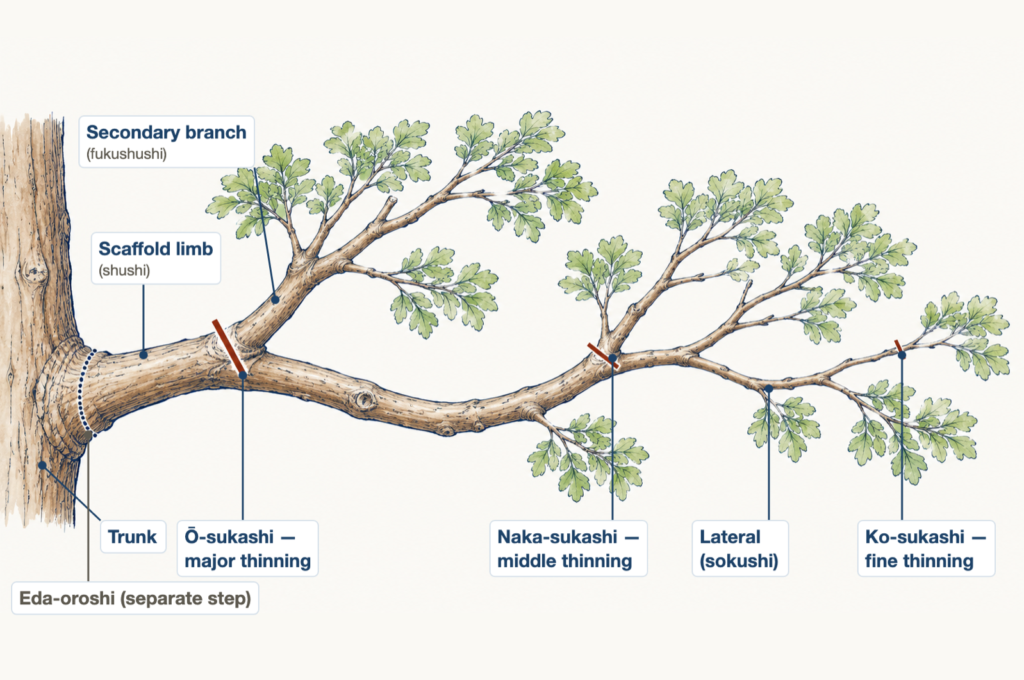
The manual’s glossary defines the branch orders behind these terms:
– Shushi (主枝) — scaffold limbs, the part of the branch system nearest the trunk – Fukushushi (副主枝) — secondary branches dividing from a scaffold limb – Sokushi (側枝) — laterals dividing from the secondaries, forming the outer crown
The three levels — ō-sukashi, naka-sukashi, ko-sukashi
Sukashi is graded by which of those orders is thinned.
– Ō-sukashi (大透かし), major thinning. Part of a scaffold limb is thinned out at a fork. The manual describes this as coarse thinning of the thick branches that form the tree’s skeleton. – Naka-sukashi (中透かし), middle thinning. Some of the secondary branches, which make up the middle of the crown, are removed at their forks. – Ko-sukashi (小透かし), fine thinning. Overlong laterals at the branch tips are thinned, together with some tip foliage.
One line in the manual sets the routine: street-tree pruning is generally carried out as a combination of naka-sukashi and ko-sukashi. Ō-sukashi is the heavier tool, used when the structure of a crown has to change.
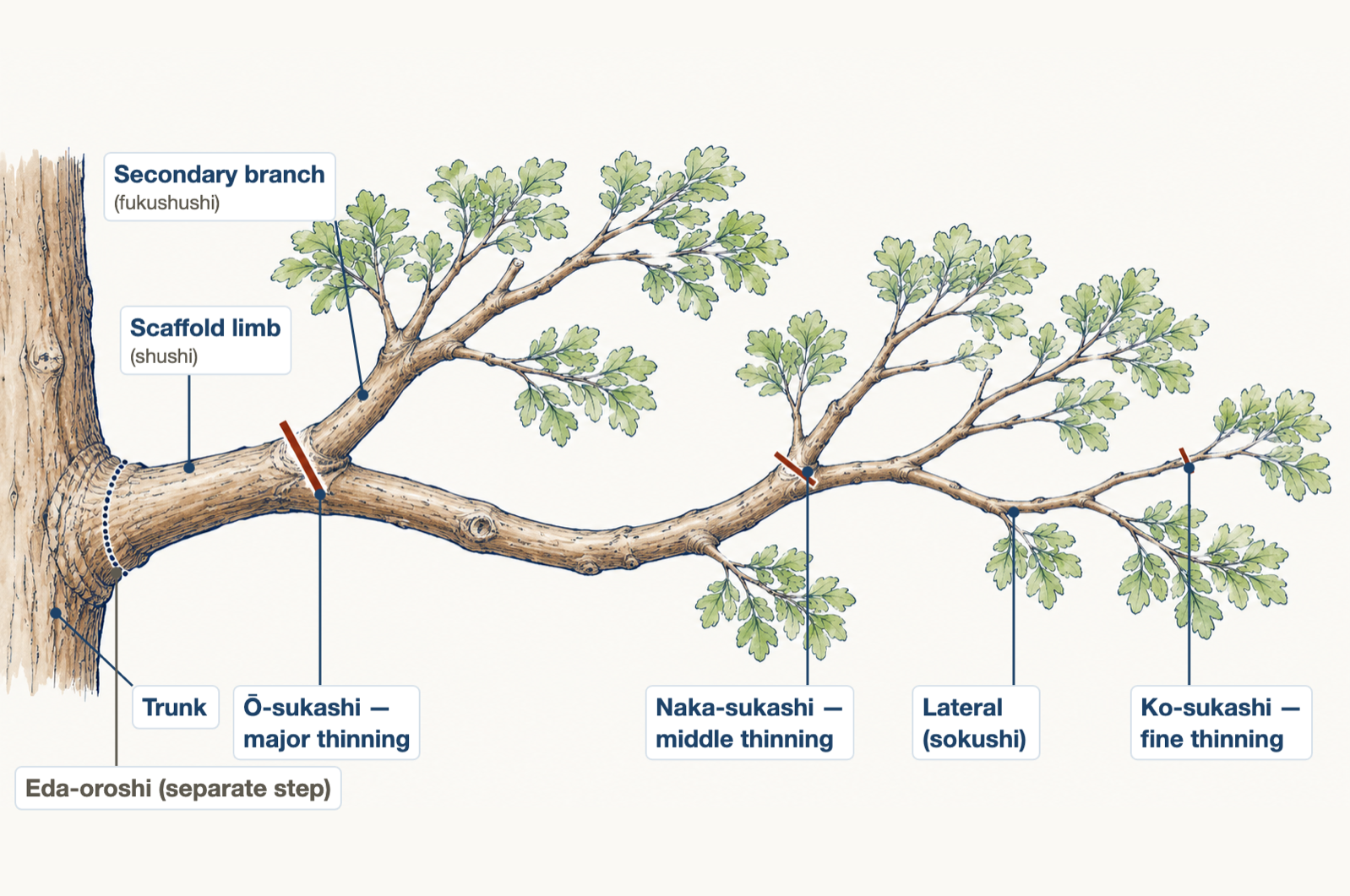
Translated into a Western work order, the three levels are three bands of crown thinning: ō-sukashi reaches into the largest branches a thinning specification would allow, ko-sukashi stays among the smallest.
Which branches come out — the Japanese list beside the USDA list
The Saitama glossary marks a set of branch types as “normally removed”. Most have a counterpart in the USDA Forest Service guide How to Prune Trees.
| Japanese term | Meaning in the Saitama glossary | USDA counterpart |
|---|---|---|
| Karami-eda (からみ枝) | A branch that tangles around another main branch | Branches that rub or cross another branch |
| Sakasa-eda (さかさ枝) | A branch growing downward or into the crown, against the tree’s habit | No single term; a thinning target |
| Heikō-shi (平行枝) | One of two branches running the same way, one above the other | No single term |
| Tachi-eda (立枝) | A branch rising parallel to the trunk | Competing upright stems |
| Tochō-shi (徒長枝) | An abnormally long, soft shoot | Water sprouts |
| Dōbuki-eda (胴吹き枝) | Small shoots from the trunk, a sign of weakness | Epicormic sprouts |
| Hikobae (ひこばえ) | Shoots from the base or from roots near it | Basal sprouts |
USDA adds two structural rules the Japanese list does not spell out. Branches with narrow, V-shaped unions should go, because they trap included bark and crack below the fork. And laterals should be no more than one-half to three-quarters of the diameter of the stem they grow from, so they do not turn into codominant stems.
Where the cut goes — at the fork, outside the collar
The Saitama manual defines sukashi by its cut position: branches are taken off where they divide, so the cut does not leave an unnatural mark. It instructs crews not to damage the branch collar — the zone where branch tissue and trunk tissue mix — and rules out flush cuts against the parent stem because of the decay risk.
USDA describes the same cut in more detail. It starts just outside the branch bark ridge and angles down, away from the stem, without injuring the collar. A branch too heavy to hold in one hand is first cut back in three steps so its weight cannot tear the bark.
Kirikaeshi needs one more rule, and here the Western guide supplies a number the Japanese manual does not. USDA asks that a reduction cut be made to a lateral at least one-third the diameter of the stem removed, to prevent dieback and a flush of epicormic sprouts below the cut. The Saitama glossary gives kirikaeshi two uses: shrinking a crown substantially, and replacing damaged or unsightly branches with younger ones.
When — the Japanese pruning calendar
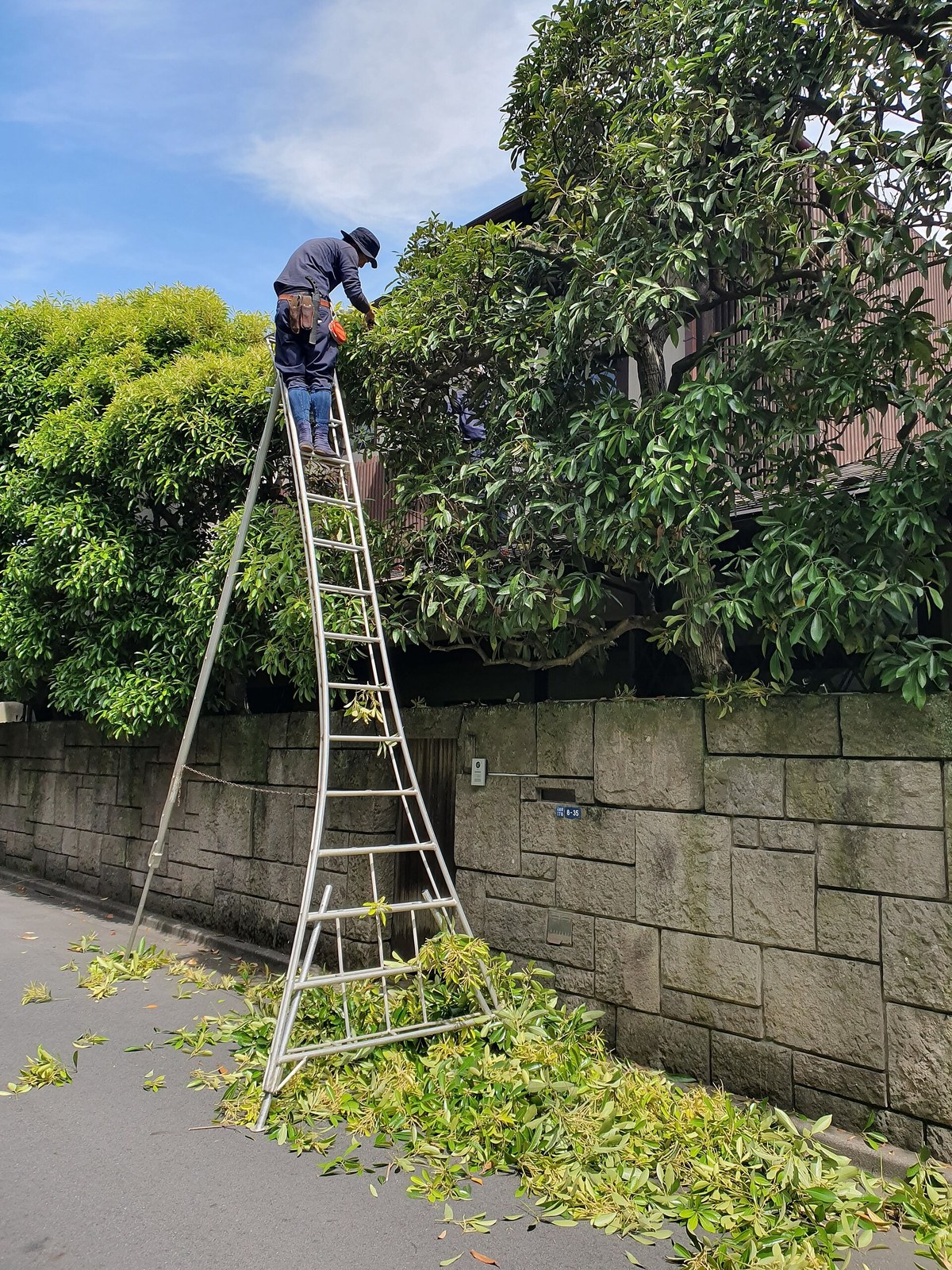
The Saitama manual’s calendar table is titled “Pruning times in Tokyo” and adapted from a 1985 book on street-tree pruning, so its dates assume the climate of the Tokyo area. Two windows are allowed.
- Winter pruning for deciduous trees during dormancy, when the skeleton is shaped. Thinning of cold-hardy evergreen conifers also fits here. For warm-climate species whose cut ends die back in the cold, the work moves to the milder end of winter.
- Summer pruning to tidy regrowth on deciduous trees and to thin evergreens. The manual credits it with better air movement inside the crown, fewer pest outbreaks and less wind-throw. Because the trees are in leaf, removal is kept to one-third of the foliage or less, and only trees that need it are pruned.
Four practices are banned outright: pruning while spring leaves are expanding, heavy summer pruning, early-autumn cutting of trees still in green leaf, and deep-winter pruning of warm-climate evergreen broadleaves.
USDA’s calendar is shorter. Hardwoods are pruned in the dormant season, to see the structure, to give wounds the full growing season to close, and to reduce disease transmission; oaks and elms follow local disease timing. Conifers can be pruned at any time, though dormant-season work reduces resin flow.
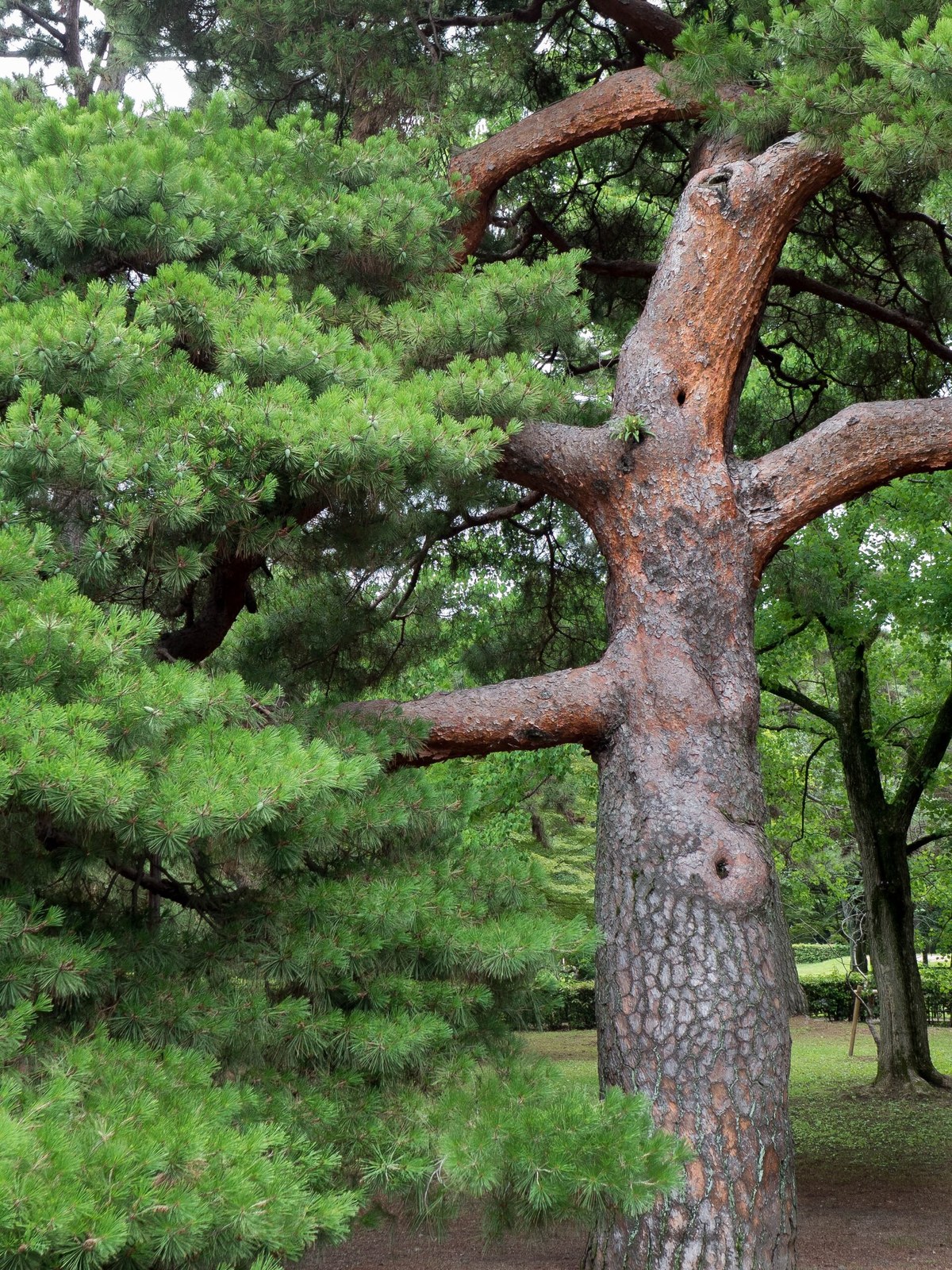
Pines run on their own cycle; see Midori-tsumi, reading a pine tree’s future in its spring candles. The best-known form of sukashi on pines is Gosho-sukashi (御所透かし) at Kyoto Gyoen, the park around the Kyoto Imperial Palace. The Japan Tourism Agency describes it as trimming so restrained that visitors barely notice it, done with blades on bamboo poles up to 4–5 m (13–16 ft) long.
How much — the budget, then where to spend it
Each guide sets a ceiling for a single visit:
– USDA Forest Service: no more than one-quarter of the living crown at a time, with larger changes spread over successive years. – BS 3998 (UK), as summarised by the Arboricultural Association: crown thinning should state a percentage, not more than 30% overall, leaving an even density of foliage without changing the tree’s size or shape. – Saitama manual: one-third of the foliage or less for summer thinning.
Where the Japanese manual goes further is distribution. It cites apical dominance: trees grow most strongly at the top, the lower crown falls into its own shade, and lower branches die back. Its answer is to thin the top harder, with a guide ratio of 1 : 2 : 3 for the branches kept in the upper, middle and lower thirds of the crown. The manual gives two reasons — the lower foliage stays healthy, and a crown that is lighter on top catches less wind.
Western standards make the same point from the other side. The Tree Care Industry Association defines lion’s tailing as “the removal of an excessive number of inner, lateral branches from parent branches”, and USDA warns that it leads to sunscald, epicormic sprouting and weak branches. USDA also asks that, after crown raising, live branches remain on at least two-thirds of the tree’s height.
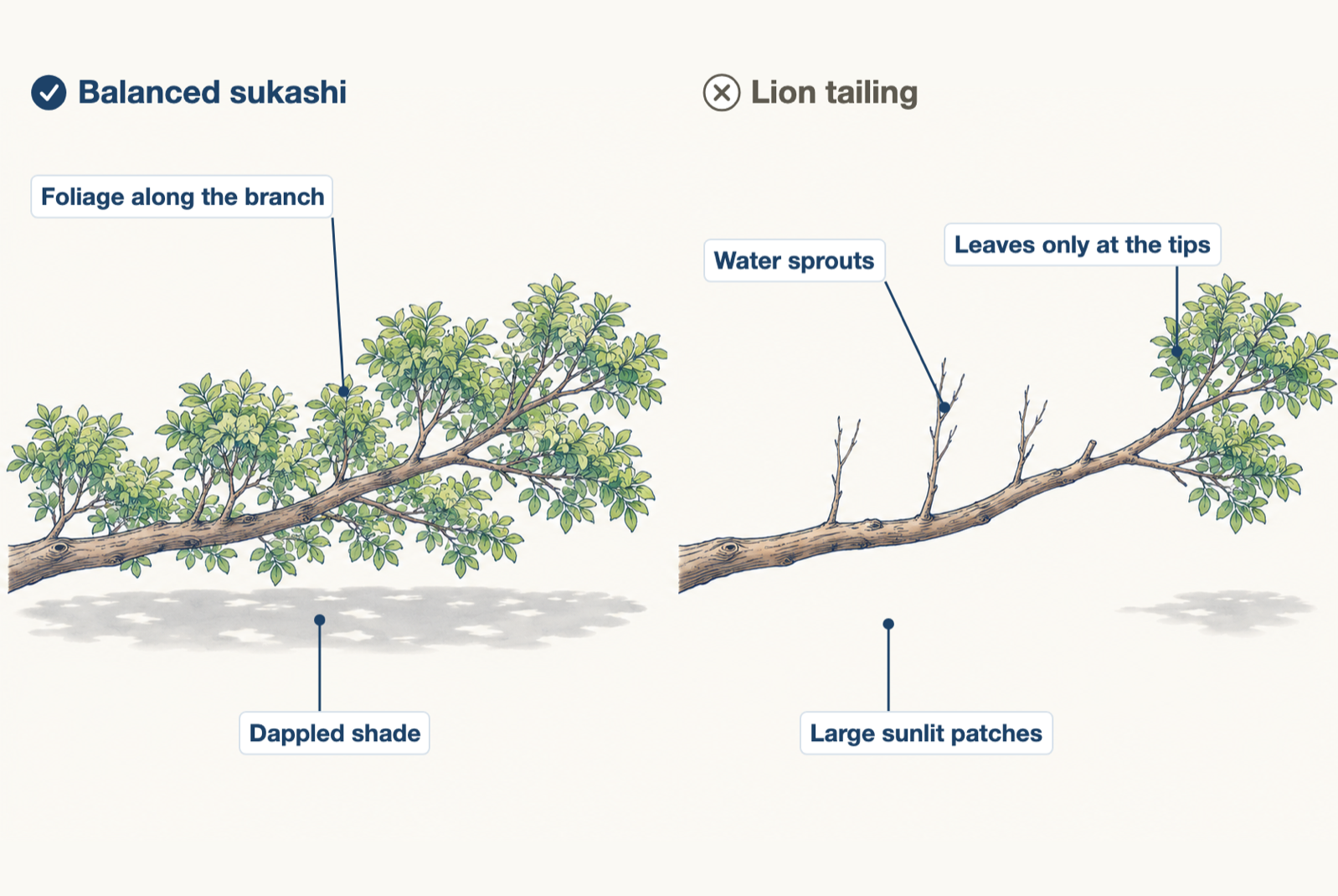
Read together, the two traditions agree on the cut and on the danger of overthinning. They differ in emphasis: Western guides cap the total, the Japanese manual also tells you where in the crown the total should come from. The same logic, applied to storm exposure, sits behind Japan’s wind-resistant pruning methods, and the long, repeated maintenance it assumes is what separates niwaki from Western topiary.
Frequently asked questions
Is sukashi the same as crown thinning? Very close. Both remove live branches at their point of origin to reduce density without changing the outline, and both reject lion’s tailing. Sukashi adds a grading by branch order (ō, naka, ko) and, in the Saitama manual, a top-to-bottom distribution ratio.
What is the difference between sukashi and karikomi? Sukashi removes whole branches at forks inside the crown. Karikomi shears the outer surface to a shape; the Saitama manual classes it as a form of heading back (kiritsume).
How much can I remove in one sukashi session? USDA advises no more than one-quarter of the living crown at a time; UK guidance on BS 3998 caps crown thinning at 30%; the Saitama manual keeps summer thinning to one-third of the foliage or less. Spread larger corrections over several years.
Sources
– Saitama Prefecture, Department of Prefectural Land Development, Road Environment Division. Gairoju Sentei Manual (Street-Tree Pruning Manual), December 2020 — ch. 5 (timing, sukashi, cut position, apical dominance) and ch. 8 (glossary). Checked 2026-10-17. – Japan Landscape Contractors Association. Gairoju Sentei Handbook (2014), as cited in the Saitama manual above. Checked 2026-10-17. – Bedker, P. J., O’Brien, J. G., Mielke, M. E. How to Prune Trees. USDA Forest Service, NA-FR-01-95, revised 2012. Checked 2026-10-17. – Tree Care Industry Association. ANSI A300 Part 1 — Pruning (definition of lion’s tailing). Checked 2026-10-17. – Arboricultural Association. A brief guide to tree work terminology and definitions (BS 3998:2010). Checked 2026-10-17. – Japan Tourism Agency, Multilingual Explanation Database. Gosho-sukashi Pine-Trimming Tools (2018). Checked 2026-10-17.
Related reading
– Tokyo’s street trees — why they look beautiful, why they’re struggling – Why are Japanese street trees so small? – How to read tree decay without technology
New field notes from Japan’s trees every day — subscribe to the Japan Blue Arborist Journal on LinkedIn, or via the form in the footer.