Among boxwood alternatives, Japanese holly (Ilex crenata) comes closest in leaf, gloss, and response to shearing, and it is a host of neither box blight nor box tree moth. It fails where boxwood forgave mistakes: wet winters, alkaline soil, and the cold edge of its range. In Japan, where it is called inutsuge (犬柘植), it is the everyday shrub of clipped hedges and sheared balls, and the way Japanese gardeners plant and shear it answers most problems Western growers report.
Below: why box is failing, how the two plants differ, where Japanese holly struggles, its USDA zones, the Japanese two-cut shearing calendar, and other candidates.
Why boxwood needs an alternative — blight on one side, moth on the other
Box blight is caused by the fungi Calonectria pseudonaviculata and C. henricotiae. The RHS records C. pseudonaviculata in the UK from the mid-1990s. North America’s first confirmation came in October 2011, from North Carolina and Connecticut (UConn). Its hosts are all in the box family: Buxus, Pachysandra, and Sarcococca.
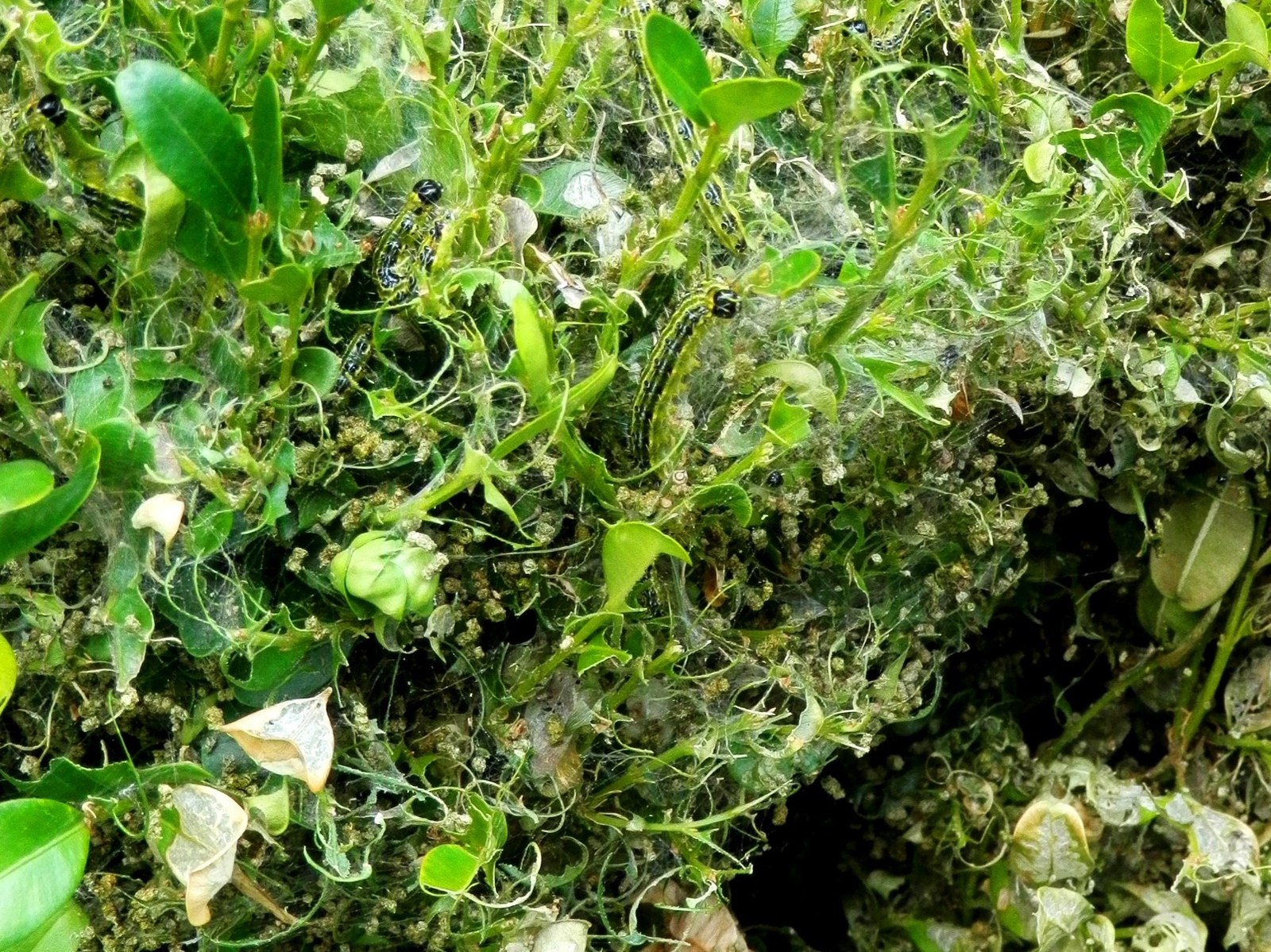
Box tree moth (Cydalima perspectalis) is a caterpillar that strips boxwood to bare twigs. The RHS dates the first adult in Britain to 2007. USDA APHIS detected it in New York in 2021, and has since confirmed it in Delaware, Kentucky, Maryland, Massachusetts, Michigan, Ohio, Pennsylvania, Virginia, and West Virginia.
Japan sees this differently. The moth is native to East Asia, and EPPO lists it across Japan, from Hokkaido to the Ryukyus. Japanese gardeners know it as tsuge-no-meiga (ツゲノメイガ), a routine pest of box. But Japan’s clipped hedges and sheared balls were never built mainly on box. They were built on inutsuge.
Japanese holly vs boxwood — two different plants that look alike
The Japanese name says it plainly. Inu (犬, “dog”) is a prefix for a plant that resembles a more valued one, so inutsuge reads as “false box”. The resemblance is convergence, not kinship: boxwood belongs to the Buxaceae, Japanese holly to the holly family, Aquifoliaceae.
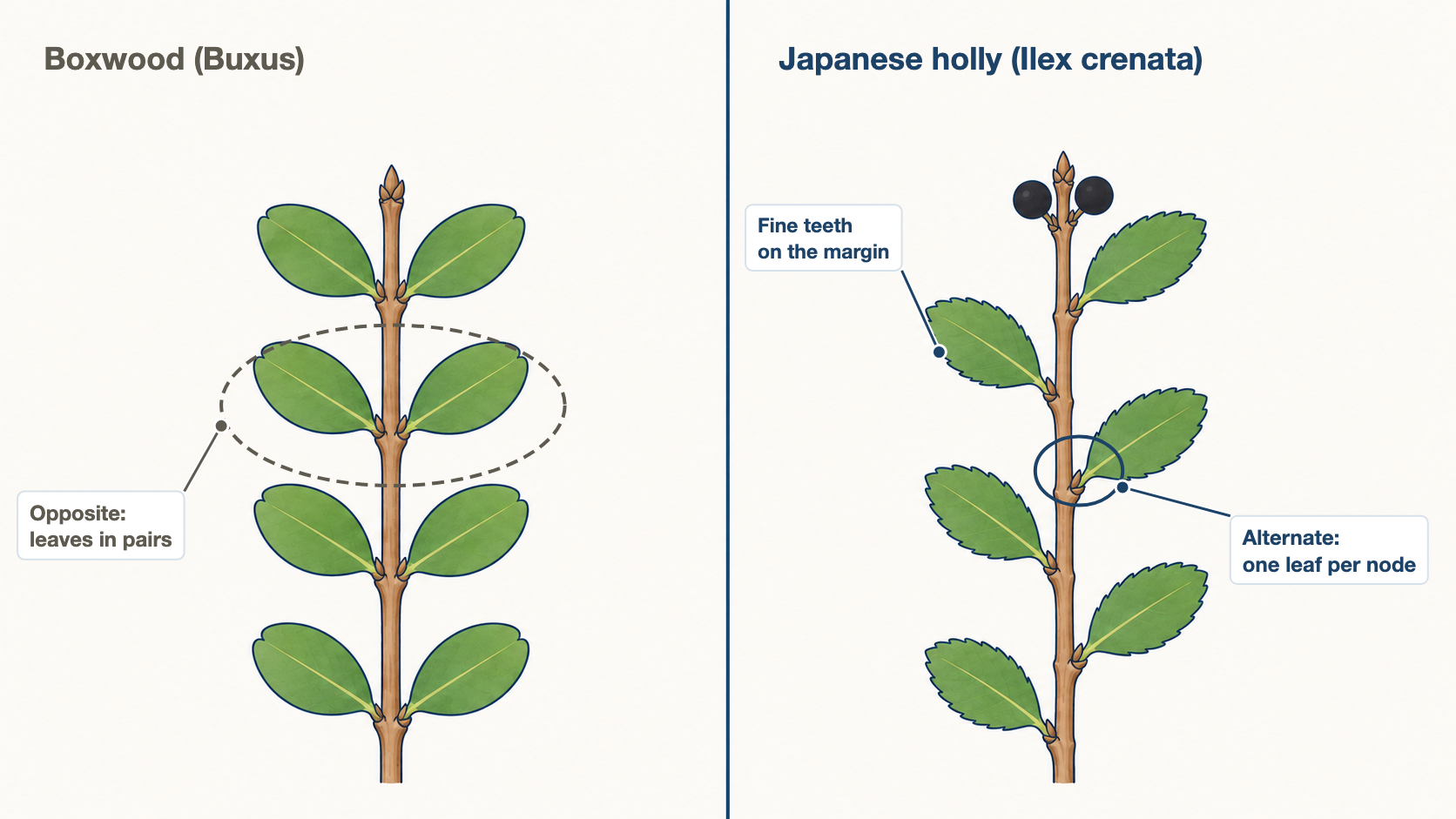
The fastest field check is the leaf arrangement. Boxwood leaves are opposite, in pairs along the twig. Japanese holly leaves are alternate. The holly leaf margin also carries fine, shallow teeth, which is what crenata (“scalloped”) refers to. Japanese holly is dioecious, and female plants carry small black fruit in autumn.
| Boxwood (Buxus) | Japanese holly (Ilex crenata) | |
|---|---|---|
| Family | Buxaceae | Aquifoliaceae |
| Leaf arrangement | Opposite | Alternate |
| Leaf margin | Smooth | Finely toothed |
| Box blight | Host | Not a host (blight hosts are all Buxaceae) |
| Box tree moth | Main host | Not a host (APHIS host range assessment, 2023) |
| Soil | Tolerates lime | Wants acidic to neutral, well-drained soil |
| Main weakness | Blight, moth | Wet roots, black root rot, alkaline soil |
On the moth: APHIS first stopped imports of Buxus, Euonymus, and Ilex from Canada, then lifted the holly restriction in December 2023 (DA-2023-24), after a host range assessment “concluded Ilex spp. are not hosts.”
Why inutsuge is the backbone of Japanese karikomi
Karikomi (刈込) — the Japanese practice of shearing shrubs into solid forms — depends on a plant that answers a cut with many fine shoots. Inutsuge does. A Noda City (Chiba) plant guide notes its very strong budding power: the more it is sheared, the finer it branches, until a hedge stands like a “green wall”.
In Japanese practice it fills three roles:
– Ikegaki (生垣) — clipped hedges along property lines. – Tamamono (玉物) — single sheared balls or domes, often planted in groups at the foot of larger trees. – Tamachirashi (玉散らし) — a small tree whose branch ends are clipped into separate pads. Western nurseries usually sell this form as “cloud-pruned” holly.
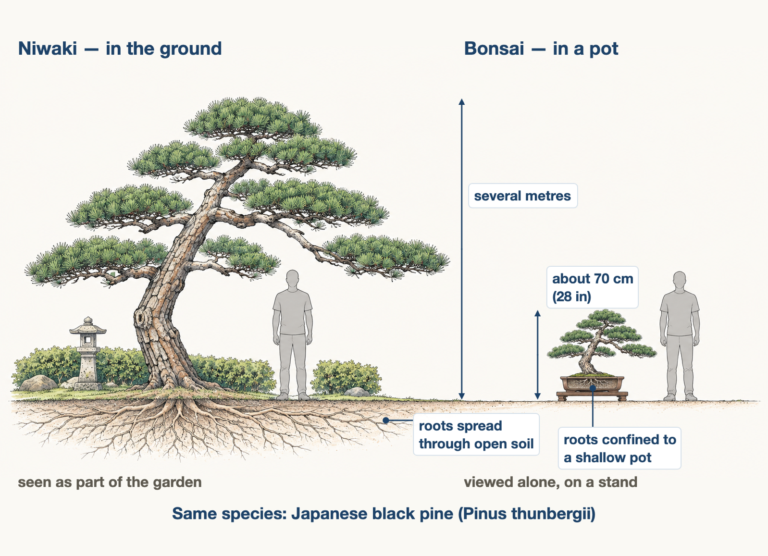
Tamachirashi shows the difference between niwaki and topiary: the pads follow the tree’s own branches, not an imposed shape.
Japanese nurseries carry several selections. Mame-tsuge (豆柘植) has small, puffed, glossy leaves that make a dense surface on tamamono; the nearest Western selection is ‘Convexa’, with similarly cupped leaves. Kinme-tsuge (金芽柘植) pushes golden new growth.
Where Japanese holly fails — water, soil, and black root rot
The RHS writes that its advisers soon began receiving samples of poorly growing Japanese holly. In the society’s survey, it was “the most widely planted alternative, but also the least successful.” The plant dislikes winter wet and hot, dry summers. Its optimum is cool, damp summers and well-drained, neutral to acidic soil.
In the eastern United States the main problem is root disease. Virginia Cooperative Extension calls black root rot (Thielaviopsis basicola) “a serious and extremely common problem on Japanese holly.” The fungus favors neutral to alkaline, wet, cool soil and heavy fertilization. Extension advises good drainage before planting, and a potting medium near pH 5.5 in nurseries. NC State Extension adds that alkaline soil yellows the leaves.
In Japanese practice these failures point to the planting base, the shokusai kiban (植栽基盤), before the plant. Inutsuge goes into soil that drains freely and is never compacted along the edge; on heavy ground, the bed is raised. The shallow roots are mulched and watered in dry spells. Replanting the same waterlogged trench repeats the failure with a different plant.
Cold climates — what the USDA zones say, and what Japan shows
Cornell gives zones 5–8, NC State 5a–8b, and Virginia Tech 6b to 8 for most cultivars. The safe reading: zone 5 is the edge. There, plant a cultivar proven in your region, sheltered from winter wind, which NC State also advises.
Japan shows the same limit. Japanese references place the upright species in Honshu, Shikoku and Kyushu, not Hokkaido. The Tohoku Regional Forest Office gives its northern limit as the shores of Lake Towada; Heibonsha’s encyclopedia puts it at Iwate Prefecture southward. In Hokkaido and on the snowy Sea of Japan coast it gives way to a creeping variety, hai-inutsuge (ハイイヌツゲ, I. crenata var. radicans). The upright hedge shrub belongs to temperate Japan, and in snow country sheared shrubs are bound or covered each winter so snow cannot split them.
One more check: birds spread the seed, and Noda City notes that inutsuge naturalizes widely even in Japan. Arlington County, Virginia, lists Ilex crenata as a “Threat” on its invasive plant list (version 07-1-24). It is not on Virginia’s 2024 statewide list, but check local lists before planting near woodland.
| Plant | USDA zones (source) | Box-like? | Note |
|---|---|---|---|
| Ilex crenata | 5–8 (Cornell) | Closest | Drainage, acidic soil |
| Ilex glabra (inkberry) | 5–9 (Cornell) | Close in dwarf cultivars | Native to eastern North America |
| Ilex × meserveae (blue holly) | 5–7 (Cornell) | Holly-shaped leaf | For colder sites |
| Chamaecyparis obtusa ‘Nana’ | 5–9 (Cornell) | Texture differs | Irregular globe, little shearing |
| Cephalotaxus harringtonia | 6–9 (Cornell) | Needle leaf | Shade-tolerant |
| Ilex crenata ‘Sky Pencil’ | 7–9 (Univ. of Arkansas) | Columnar only | Vertical accent, not a hedge |
When to shear — the Japanese two-cut calendar
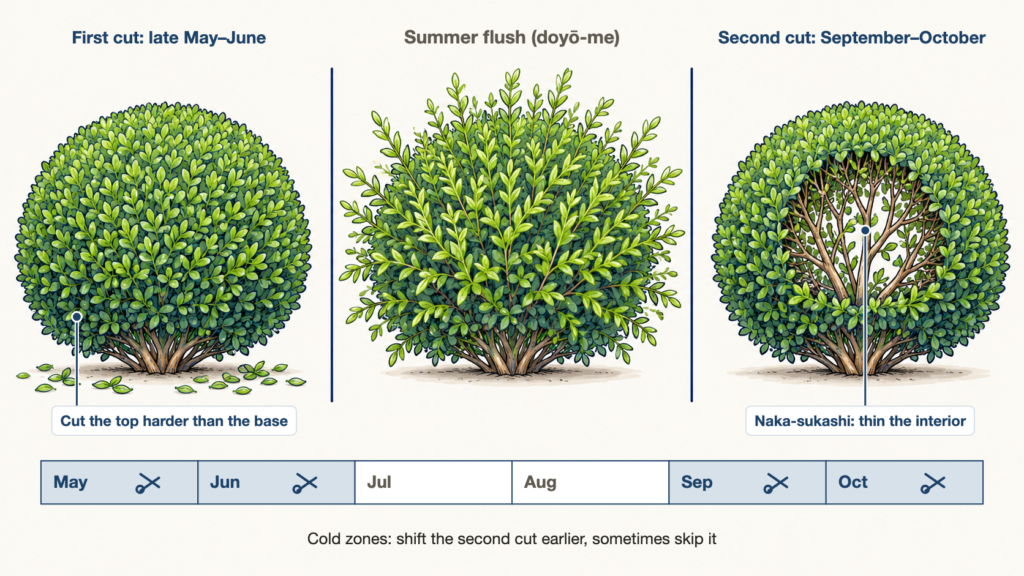
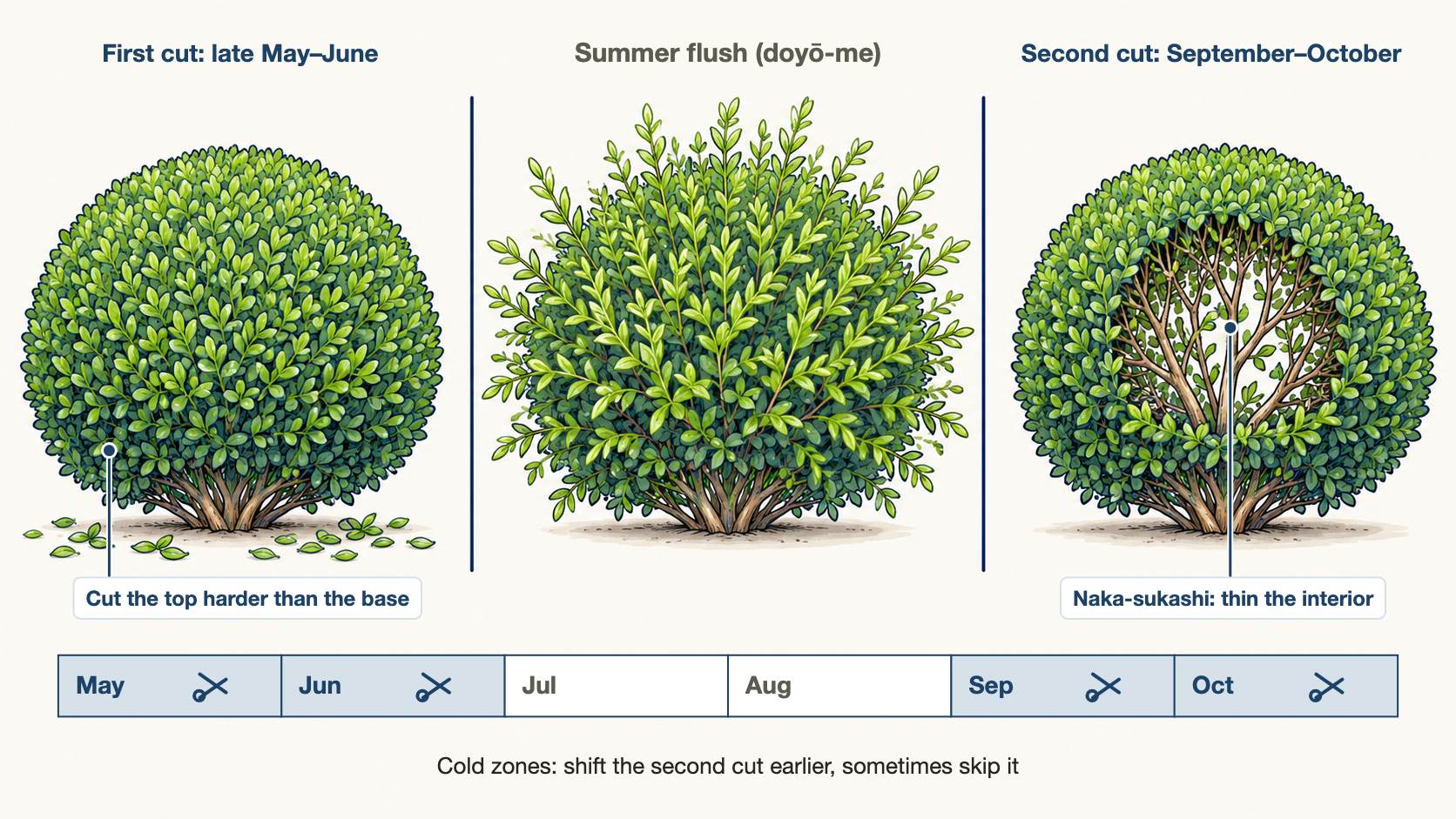
A greening guide from Setagaya City, Tokyo, sets out the standard schedule. Sheared shrubs are cut one to three times a year. For one cut, June–July suits almost every species. For two, the first comes in late May–June, when spring shoots stop growing, and the second in September–October, when the summer flush, doyō-me (土用芽), has stopped. The guide names inutsuge as suited to two cuts, and warns against the autumn cut for plants that are not cold-hardy.
The same logic of timing work to the shoot cycle runs through midori-tsumi, the spring candle work on Japanese pines: cut when a flush has finished, never while it is still soft.
| Cut | Timing in Japan | What it does | Cold-zone reading (zones 5–6) |
|---|---|---|---|
| First | Late May–June, after spring shoots stop | Sets the form for the year | Same; wait until shoots have firmed |
| Second | September–October, after the summer flush stops | Tidies the second flush | Bring forward to late summer, or skip |
| Interior thinning | With either cut | Lets light into the dense shell | Same |
The cold-zone column is our reading, not a published rule: in a short season, regrowth after an autumn cut may not harden before frost.
Two more points from the guide: cut the top harder than the base, so the lower skirt stays dense; and where the shell has grown thick, thin it from inside (naka-sukashi, 中すかし) so light reaches the interior. A shrub never thinned inside goes bare behind its surface, and cannot be cut back without showing holes.
Other candidates — Mame-tsuge, ‘Sky Pencil’, and plants outside the hollies
‘Sky Pencil’ is a narrow, upright Japanese holly. The University of Arkansas records that Norihiro Shibamichi found it wild on Mount Daisen, Honshu, and that it reached American gardens through the U.S. National Arboretum in 1992. It grows 8–10 ft (2.4–3 m) tall and 12–18 in (30–45 cm) wide, rated for zones 7–9, with winter protection for containers below 20 °F (−7 °C). It is a vertical accent, not a replacement for a low box edge or a sheared ball.
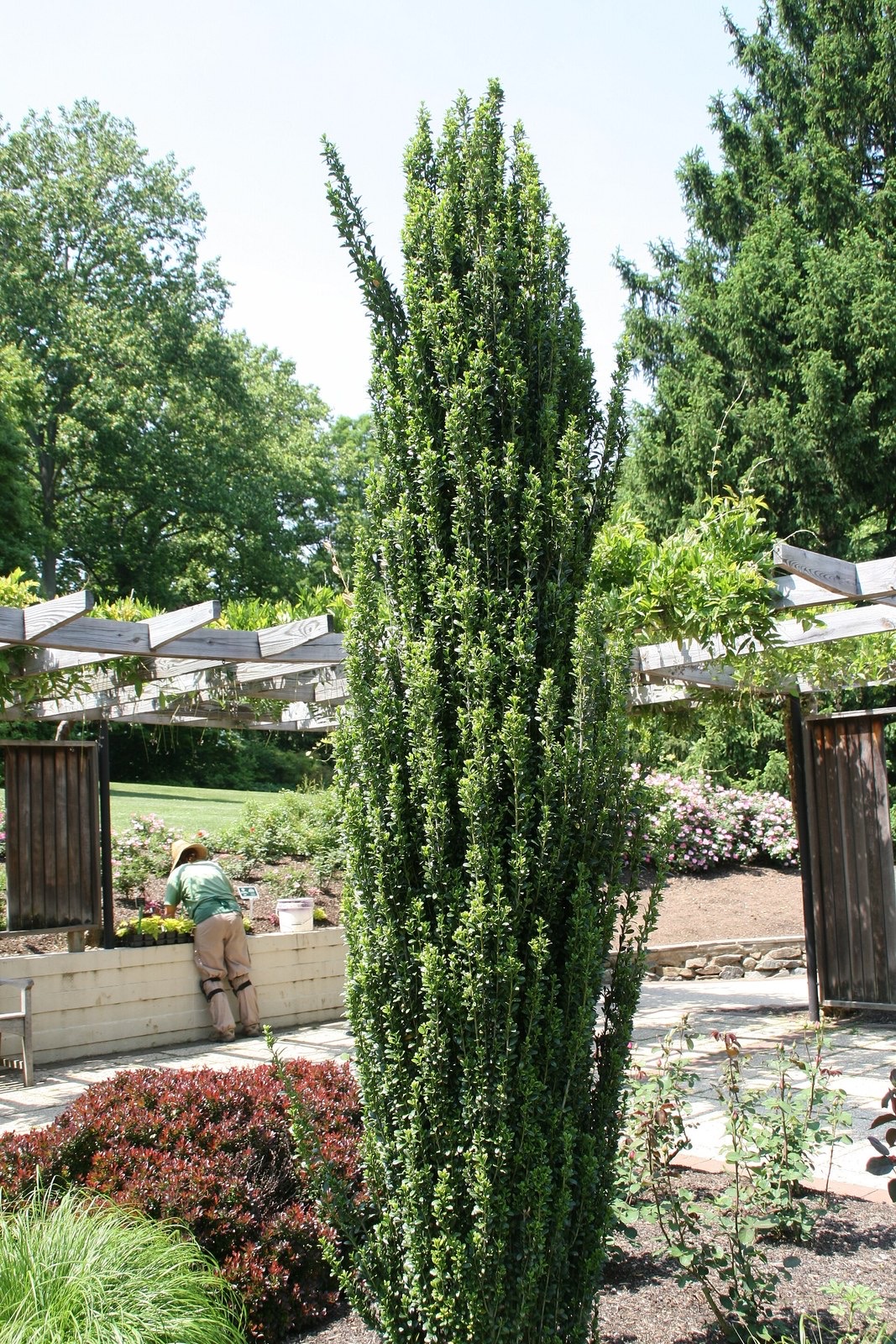
Outside the hollies, the RHS names yew, Osmanthus, Podocarpus, Lonicera, Euonymus, and Sarcococca. Two need caution: Sarcococca is in the box family and a box blight host (UConn), and APHIS notes conflicting reports of Euonymus alatus and E. japonicus as box tree moth hosts. To stay clear of both problems, hollies and yew are the cleaner choice.
Frequently asked questions
Does Japanese holly get box blight or box tree moth? No. Box blight affects only the box family, and a 2023 USDA APHIS assessment concluded that Ilex species are not box tree moth hosts. Japanese holly’s problems are at the roots, above all black root rot in wet, alkaline soil.
Can Japanese holly be cloud pruned? Yes. Inutsuge is a main species for tamachirashi, the pad form sold in the West as cloud pruning. Pads are clipped in late May–June and September–October, with interior thinning so each pad keeps its foliage.
Is Japanese holly hardy in zone 5? Zone 5 is the edge. Cornell and NC State include it; Virginia Tech rates most cultivars to 6b. Choose a locally proven cultivar, shelter it from winter wind, and avoid a late shear that pushes soft growth before frost.
Sources
All checked 2026-10-17.
– RHS: Box blight; Box tree caterpillar; Box alternatives: how to choose. – USDA APHIS: Box Tree Moth; Federal Order DA-2023-24 (December 19, 2023). – UConn Home & Garden Education Center: Boxwood Blight. – EPPO Global Database: Cydalima perspectalis, distribution. – Cornell, New York State IPM: Alternatives to Boxwood. – NC State Extension Plant Toolbox: Ilex crenata. – Virginia Cooperative Extension: Japanese Holly; Black Root Rot of Holly (450-606). – University of Arkansas Division of Agriculture: Sky Pencil Holly. – Arlington County, Virginia: Nonnative Invasive Plants (07-1-24). – Tohoku Regional Forest Office, Japan: イヌツゲ. – Heibonsha, World Encyclopedia: イヌツゲ (via Kotobank, checked 2026-10-18). – Noda City, Chiba: イヌツゲ plant card. – Setagaya City, Tokyo: greening guide, “Maintenance” chapter.
Related reading
– Karikomi: the Japanese art of cloud pruning explained – Niwaki vs Topiary: what Western gardens get wrong – Midori-tsumi: reading a pine tree’s future in its spring candles
New field notes from Japan’s trees every day — subscribe to the Japan Blue Arborist Journal on LinkedIn, or via the form in the footer.