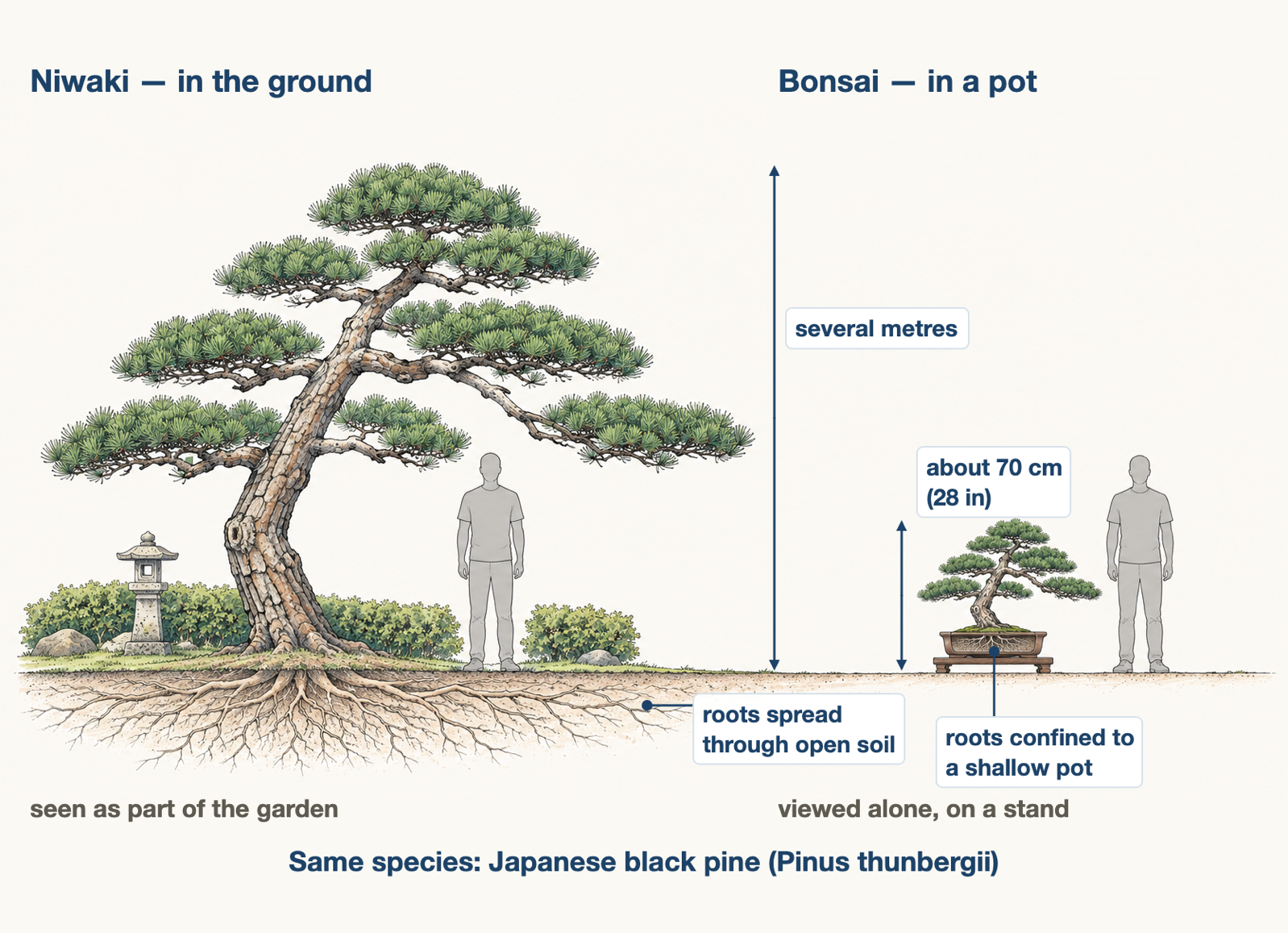
Niwaki (庭木) are trees grown in the ground as part of a garden; bonsai (盆栽) are trees grown in a container and appreciated as a single object. That one fact, ground or pot, decides almost everything else: how big the tree gets, what it is for, how often it is touched, and who looks after it. The pruning techniques overlap a great deal, which is why the two are so often confused.
This article compares niwaki and bonsai point by point, using the same species, Japanese black pine (Pinus thunbergii), on both sides. It also clears up two common mix-ups: cloud pruning is not bonsai, and “daisugi bonsai” is a pot-sized interpretation of a forestry technique.
What niwaki means — and what bonsai means
The words are plain Japanese. Niwa (庭) means garden and ki (木) means tree, so niwaki simply means “garden tree.” Bon (盆) is a tray or shallow pot and sai (栽) is planting, so bonsai means “tray planting.”
In Japan, niwaki is an everyday word. An unpruned maple in a backyard is a niwaki. So is a hedge plant, a fruit tree by the gate, or a pine shaped for a century. Garden contractors, nurseries, and homeowners all use it in this broad sense. In English, the word has narrowed to mean the sculpted, cloud-like style that Western gardeners first met through books and nurseries. That narrower meaning is useful, but it hides the starting point: in Japanese, niwaki is defined by where the tree lives, not by how it is shaped.
Bonsai is defined the same way. A bonsai is a tree whose whole life is managed inside a container. The Royal Horticultural Society puts it directly: the only difference between niwaki and bonsai is that bonsai are grown in containers while niwaki are grown in the ground, and size has nothing to do with the naming. That is the cleanest one-line answer, and it matches Japanese usage.
| Niwaki (庭木) | Bonsai (盆栽) | |
|---|---|---|
| Literal meaning | Garden tree | Tray planting |
| Where it grows | In the ground | In a container |
| Defined by | Its place in a garden | Its life in a pot |
| Typical size | Several metres | Usually under 1 m (3 ft) |
| Viewed as | Part of a composition | A single object |
| Main caretaker | Niwashi / uekiya (garden tree specialist) | Bonsai-ka (bonsai professional) |
Ground or pot — the difference that drives all the others
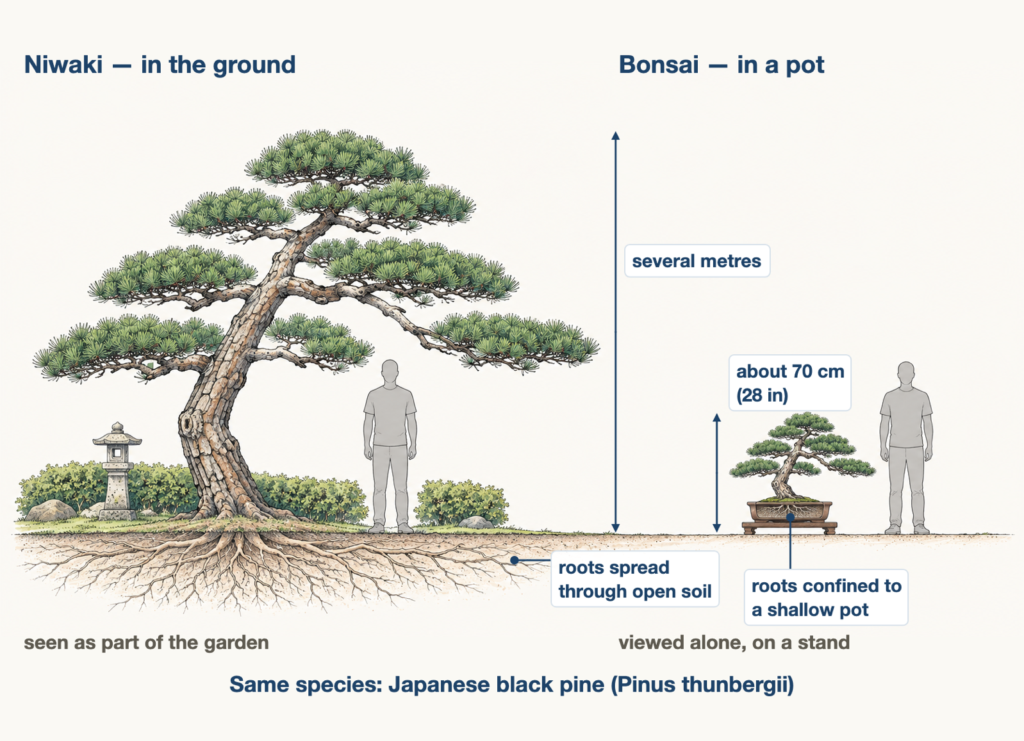
Roots are where the two arts truly part ways. A niwaki’s roots spread through open soil, find their own water and anchor a tree that must stand through typhoons and snow. A bonsai’s roots live in a few litres of soil. The grower supplies the water, controls the nutrients and trims the roots at each repotting.
That changes the arborist’s questions. For a garden pine, the questions are soil compaction, drainage, the root zone under paving, and wind load on the crown. For a bonsai, those questions mostly disappear, and are replaced by pot size, soil mix, and watering rhythm. The same species, managed by the same principles of growth, ends up needing two different kinds of expertise.
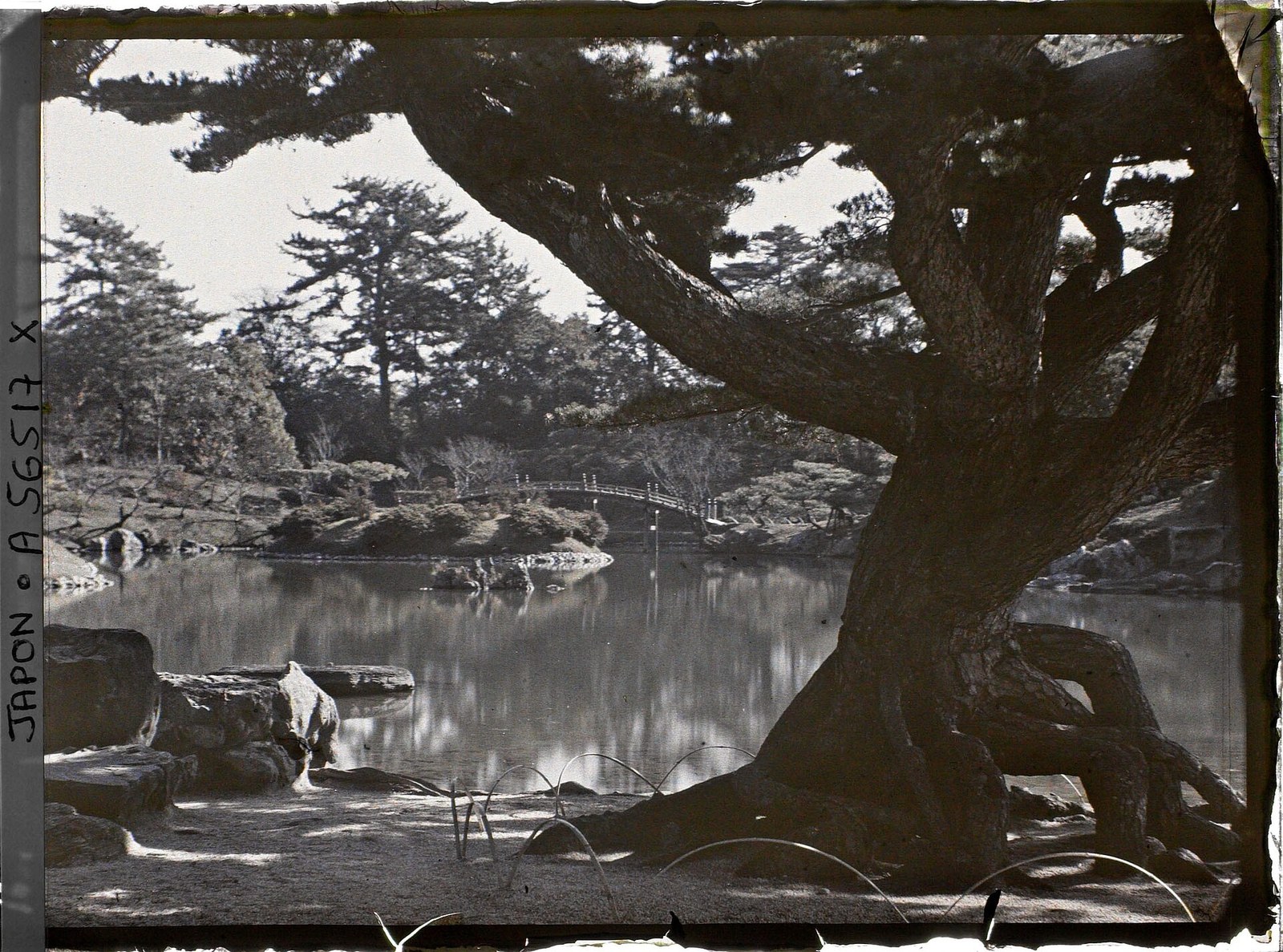
The boundary is not permanent, and one famous tree proves it. At Ritsurin Garden in Takamatsu, the Neagari Goyomatsu, a Japanese white pine beside the Kikugetsutei teahouse, stands about 8 m (26 ft) tall. According to Japan’s Tourism Agency multilingual database, it began life as a bonsai that the shogun Tokugawa Ienari presented to the lord of the Takamatsu domain in 1833. It was later planted out in the garden, where it grew large. The moment it left the pot, it stopped being a bonsai and became a niwaki.
Scale — the same black pine at 73 cm and at 8 m
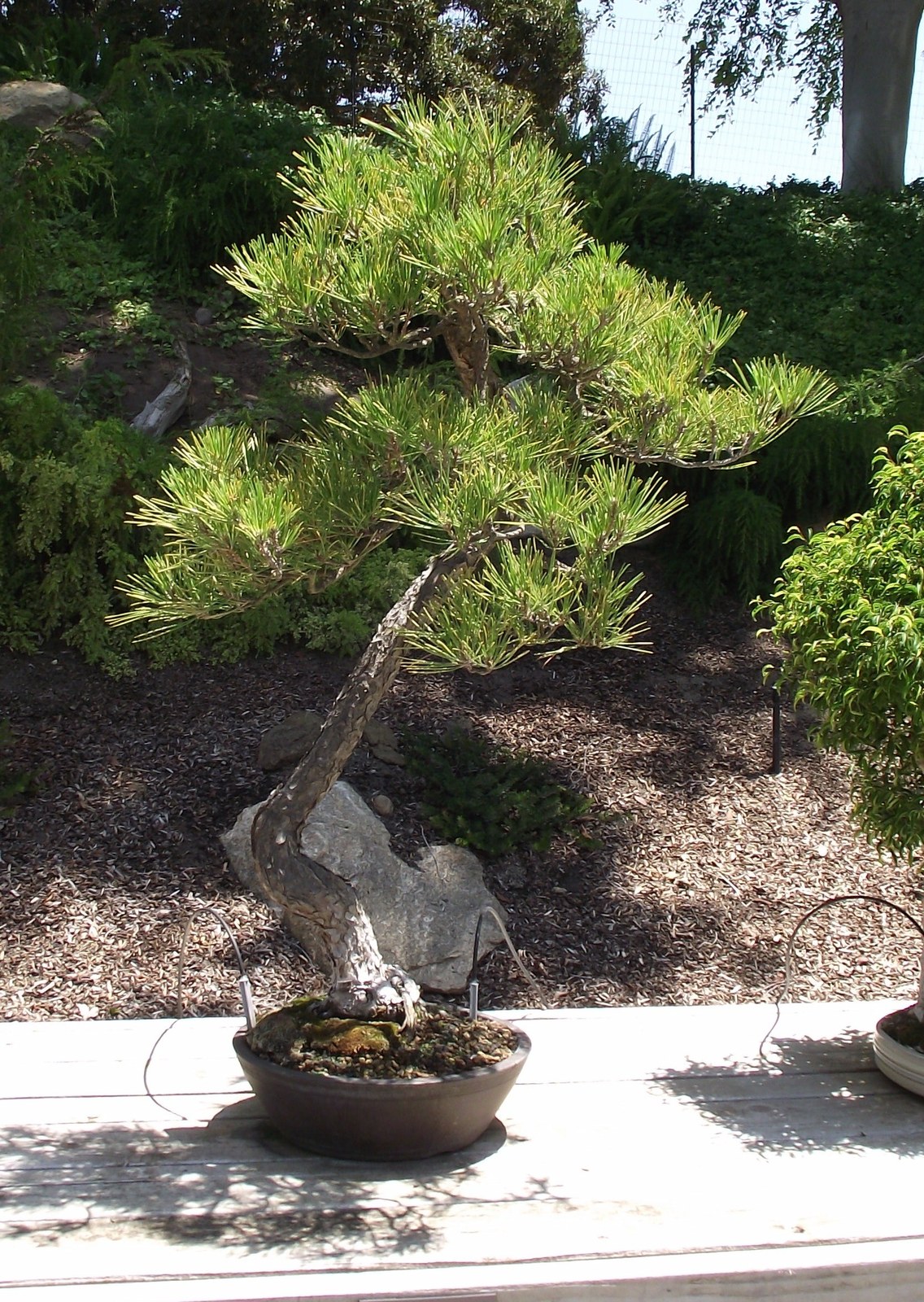
Scale follows from the container. A shallow pot limits root mass, and root mass limits the crown. The black pine bonsai named Zuikō in the Omiya Bonsai Art Museum collection in Saitama measures 73 cm (29 in) tall. A garden black pine in Japan is routinely kept at several metres, sized to sit in proportion with a building, a pond, or a view.
Both aim at the impression of an old tree, from different reference points:
– Bonsai compresses a whole mature tree, often an old tree on a cliff or by the sea, into something you can see in one glance from a metre away. – Niwaki keeps a full-size tree in proportion with its surroundings: a pine leaning over water, a crown that frames the view from a veranda, a tree that will not shade out the moss beneath it.
This is why the scale question is not “big bonsai versus small niwaki.” A niwaki is sized to the garden. A bonsai is sized to the viewer.
Purpose — a role in the garden versus a single object
A niwaki has a job. In Japanese gardens, trees are placed to screen, frame, shade, balance a stone, or lead the eye toward the hills beyond, the idea behind shakkei, borrowed scenery. A garden pine is shaped with the main viewing point in mind, usually the main room of the house, but it is always seen together with stones, water, paths, and other trees. If it fights the composition, it is pruned back into it.
A bonsai is the composition. It is displayed on a stand, often in an alcove with a scroll or accent plant, and viewed from a defined front. Its pot, its soil surface, and the angle of its trunk are all part of the work. Nothing around it competes.
That is why styling choices do not transfer directly: a dramatic low branch that suits a bonsai can block a real garden path.
Shared techniques, different hands
Many techniques carry the same Japanese names in both arts. The table shows where they meet and where they diverge, using black pine as the example.
| Technique | In niwaki (garden black pine) | In bonsai (black pine bonsai) |
|---|---|---|
| Me-tsumi (芽摘み) — bud pinching | Used to control density on many species | Central to keeping growth fine |
| Midori-tsumi (緑摘み) — pinching spring candles | The core spring task on garden pines | Used, but often replaced by me-kiri on black pine |
| Me-kiri (芽切り) — cutting new shoots in early summer | Less common; midori-tsumi is the norm | Common, to force a second, shorter-needled flush |
| Momiage (もみあげ) — needle plucking | The core late-autumn task | Used at a smaller scale |
| Harigane-kake (針金掛け) — wiring | Limited to young or small branches | The main way branches are set |
| Branch training with rope | Common on mature limbs, tied with palm-fibre rope (shuro-nawa) | Rare |
| Root work | Done before transplanting (nemawashi) | Done at regular repotting |
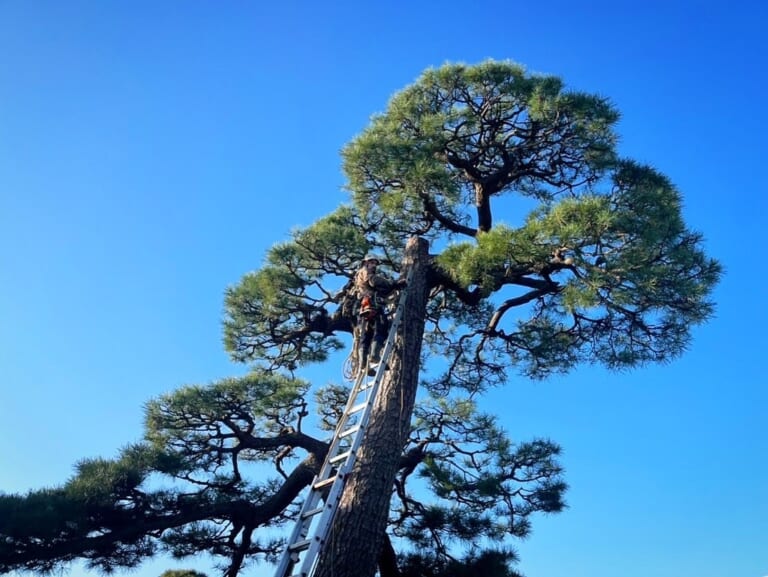
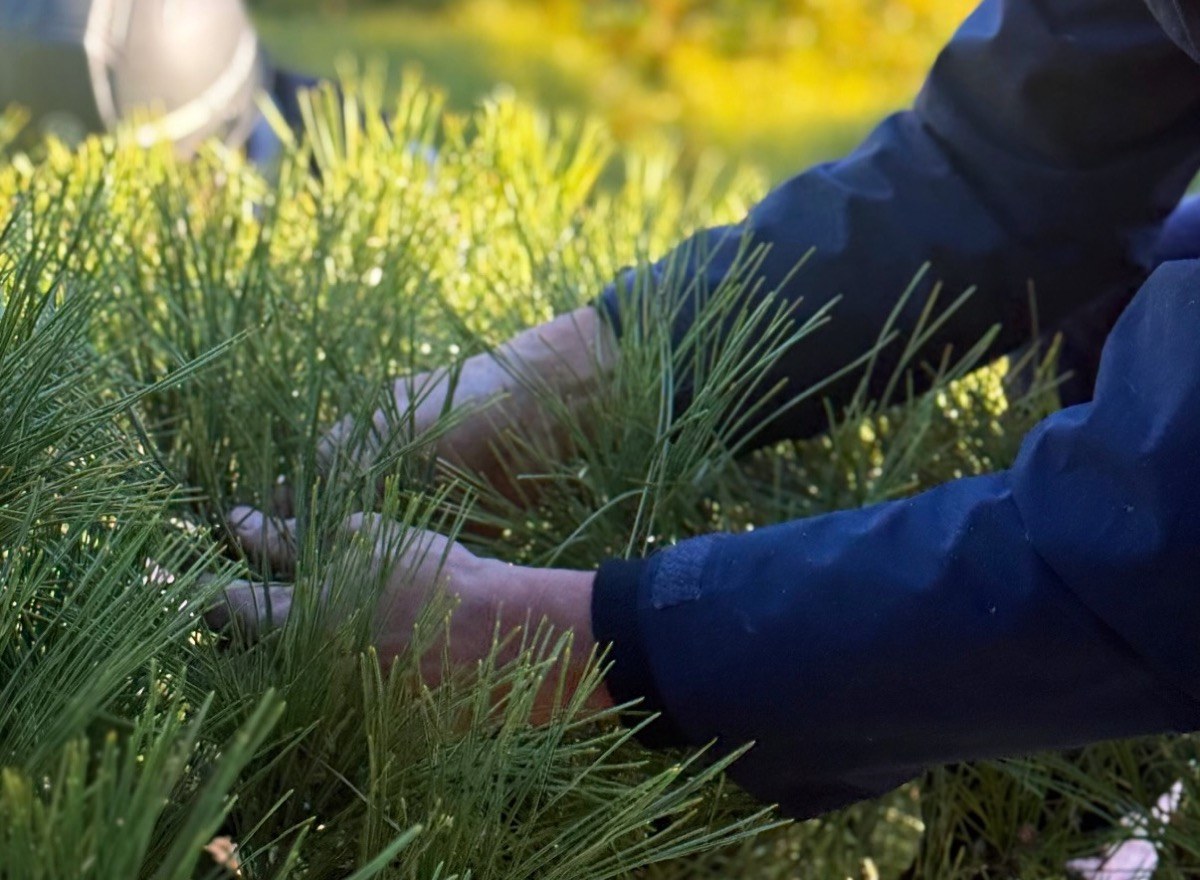
On garden pines, the yearly rhythm in Japanese practice is two main visits: midori-tsumi, the spring candle pinching, around May to June, and momiage around November to December. A bonsai is checked far more often, because a small pot can dry out within a day in summer.
The caretakers differ too. In Japan, garden trees are looked after by niwashi or uekiya, garden tree specialists who work within landscape contracting. Their trade has a national trade skill test for zōen (造園), landscape construction, held under the Human Resources Development Promotion Act in grades 1 to 3. Bonsai professionals usually train inside bonsai nurseries. The best-known centre is Omiya Bonsai Village in Saitama, founded in 1925 after bonsai growers left Tokyo following the 1923 Great Kanto Earthquake, and given the official place name Bonsai-chō in the early 1940s.
The scale of garden pine work is easy to underestimate. At Ritsurin Garden alone there are nearly 1,400 pines, and around 1,000 of them are tended regularly by resident gardeners. That is niwaki as a full-time profession, not a hobby.
Common mix-ups — cloud pruning is not bonsai, daisugi bonsai is not daisugi
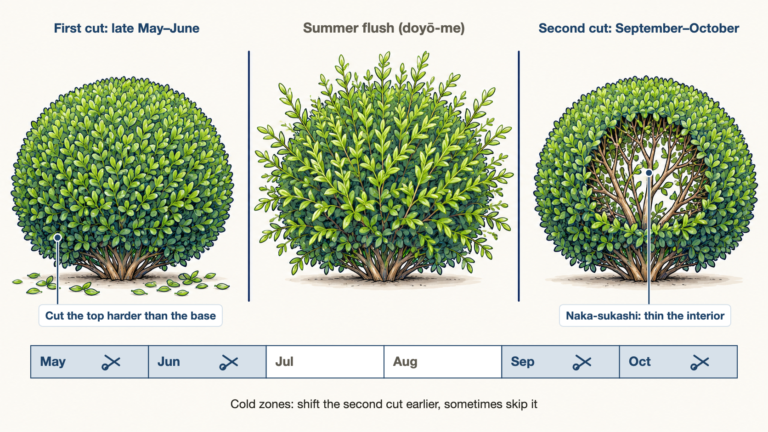
Cloud pruning is not bonsai. The rounded foliage pads that Western nurseries sell as “cloud trees” are niwaki styling applied to garden plants such as box, yew, holly, or pine. In Japanese trade language this pad style is often called tamachirashi (玉散らし). Because the tree grows in the ground, it is niwaki, even if it is small. A large cloud-pruned tree in a container on a terrace is closer to bonsai in how it is managed, even though nobody would display it on a stand. For the sheared side of this family, see karikomi, the Japanese approach to cloud pruning.
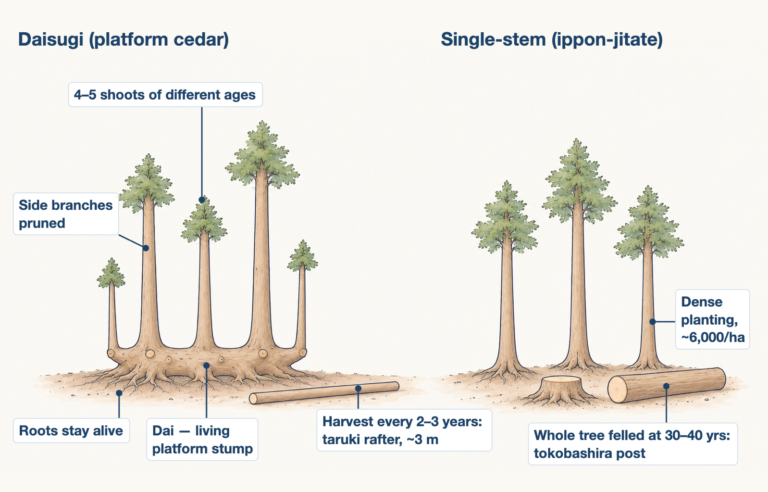
Daisugi bonsai is a bonsai interpretation of a forestry technique. Daisugi is a method from the Kitayama district of Kyoto for raising many straight poles from one cedar base. Kyoto Prefecture describes its main product as rafter poles, with a target of 3 m (10 ft) long and 3 cm (1.2 in) across at the top. The same prefecture notes that daisugi trees are widely used as garden trees because of their form. So in Japan, a daisugi is either a forestry tree or a niwaki. A daisugi-style tree in a pot is a bonsai that borrows the look, which is a valid creative choice, but a different thing from the original.
One more confusion is worth naming: niwaki is not Japanese topiary. That comparison deserves its own space, covered in Niwaki vs Topiary.
Frequently asked questions
What is the difference between niwaki and bonsai? Niwaki are trees grown in the ground as part of a garden. Bonsai are trees grown in a container and viewed as single objects. Size, purpose, care frequency, and caretaker all follow from that difference.
Can a bonsai become a niwaki? Yes. Once a bonsai is planted in the ground, it is no longer a bonsai. The Neagari Goyomatsu at Ritsurin Garden was a bonsai in 1833 and is now an 8 m garden pine.
Is cloud pruning the same as bonsai? No. Cloud pruning is a niwaki styling method for trees in the ground. It shares ideas with bonsai, such as foliage pads, but the tree’s place, scale, and purpose are different.
Sources
– Royal Horticultural Society, “Cloud pruning” — rhs.org.uk/advice/profile?pid=540 (checked 2026-10-17) – Japan Tourism Agency multilingual database, “Ritsurin Garden and Pine Trees” — mlit.go.jp/tagengo-db/en/R2-01860.html (checked 2026-10-17) – Japan Tourism Agency multilingual database, “History of Omiya Bonsai Village” — mlit.go.jp/tagengo-db/en/R1-01346.html (checked 2026-10-17) – Omiya Bonsai Art Museum, Saitama, collection item A-010 “Zuikō” (Pinus thunbergii) — bonsai-art-museum.jp/en/collection/a-010/ (checked 2026-10-17) – Kyoto Prefecture, Forestry Division, page on daisugi — pref.kyoto.jp/rinmu/14100033.html (checked 2026-10-17) – Japan Vocational Ability Development Association (JAVADA), National Trade Skill Test, “Zōen” (landscape construction) — javada.or.jp/jigyou/gino/giken/3kyu/syokusyu/02.html (checked 2026-10-17)
Related reading
– Why do Japan’s ancient trees live for a thousand years? – Typhoon-proofing trees: Japan’s wind-resistant pruning methods
New field notes from Japan’s trees every day — subscribe to the Japan Blue Arborist Journal on LinkedIn, or via the form in the footer.