Shakkei (借景) borrows a distant mountain into the garden. How it works on site, its Chinese roots (jiejing), and how to apply it outside Japan.
Introduction
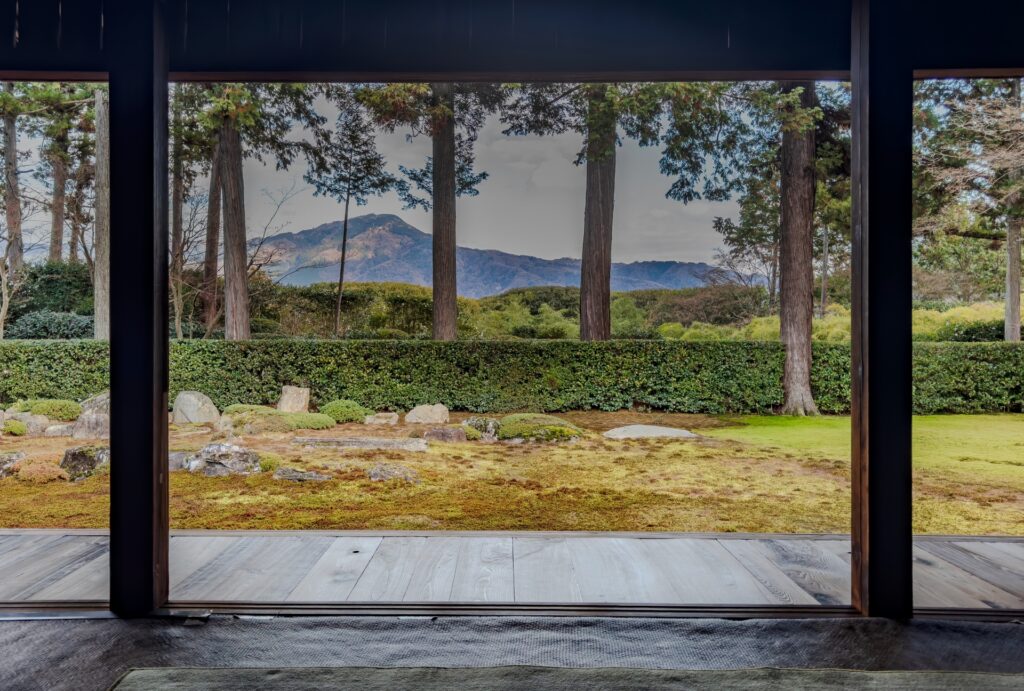
What if the mountain beyond your garden wall could become part of the garden itself? That is the essence of shakkei (借景) — the Japanese principle of borrowed scenery. Shakkei is the deliberate practice of incorporating landscape elements that exist outside a garden’s physical boundaries into the garden’s overall composition, creating a sense of depth, scale, and harmony that transcends the limits of the site. Far from being merely a poetic concept, shakkei is a highly disciplined design and construction technique — and one that remains deeply relevant to contemporary landscape practice worldwide.
What Is Shakkei? Concept, Origin, and History
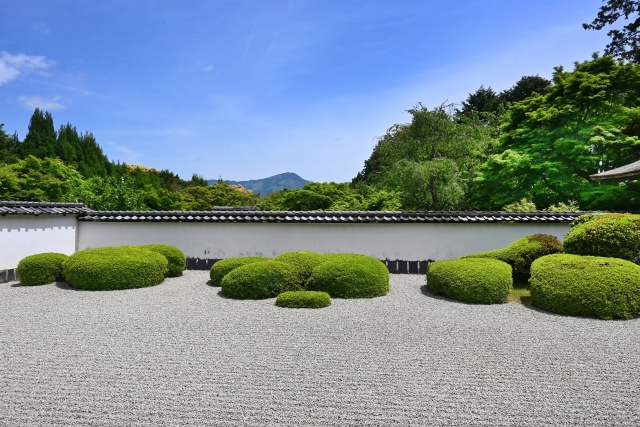
From China to Japan: A Shared Garden Philosophy
The term shakkei is Chinese in origin and appears in the 17th-century garden treatise Yuanye (園冶), which describes the principle of “incorporating background landscape into the composition of a garden.” The concept traveled to Japan, where it merged with Zen aesthetics, the philosophy of ma (間, negative space), and wabi-sabi — giving it a distinctly Japanese depth and restraint. Wikipedia
The original Japanese term for this practice was ikedori (生け捕り), meaning “captured alive.” As garden scholar Günter Nitschke observes, this older term makes clear that shakkei is more than a view of a distant landscape — it is the art of capturing both natural features, such as mountains and hills, and man-made structures, such as temples and pagodas, as living elements of the garden. North American Japanese Garden Association
The Four Classical Categories of Borrowed Scenery
According to the Yuanye, there are four categories of borrowed scenery: yuanjie (遠借, “distant borrowing” — mountains and lakes), linjie (隣借, “adjacent borrowing” — neighboring buildings and features), yangjie (仰借, “upward borrowing” — clouds and stars), and fujie (俯借, “downward borrowing” — rocks and ponds). Together, these categories reveal that shakkei is not a single trick of the eye but a comprehensive framework for reading and composing with the full landscape surrounding a site. Wikipedia
A Masterpiece in Practice: Shugakuin Imperial Villa
The clearest historical expression of shakkei at scale is Kyoto’s Shugakuin Imperial Villa (修学院離宮). Constructed between 1655 and 1659 under Emperor Emeritus Gomizunoo, the villa’s upper garden was designed with elevated viewing pavilions to incorporate borrowed scenery from Mount Hiei and the distant Kyoto hills. In the lower villa, a mountain range is incorporated as a backdrop of the garden through this gardening method, which provides a more three-dimensional effect to the overall composition. GrokipediaKunaicho
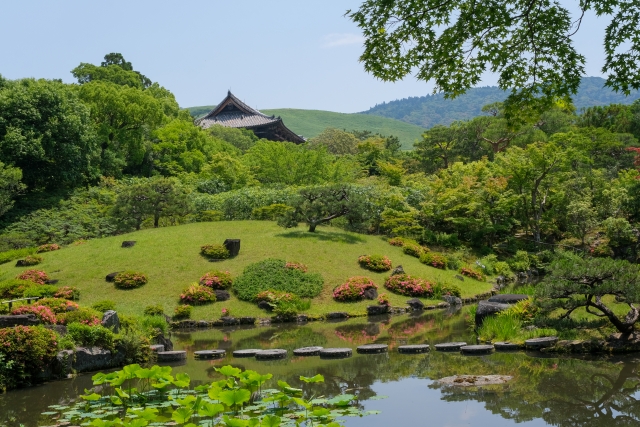
Other notable examples of shakkei include Kinkaku-ji in Kyoto and Isui-en in Nara, which borrows the roof of the Nandaimon Gate at Tōdai-ji and the mountains of Wakakusa, Kasuga, and Mikasa in the far distance. Each demonstrates how the garden’s perceived boundaries stretch far beyond what any fence or wall could contain. North American Japanese Garden Association
The Practitioner’s Perspective: How Shakkei Actually Works on Site
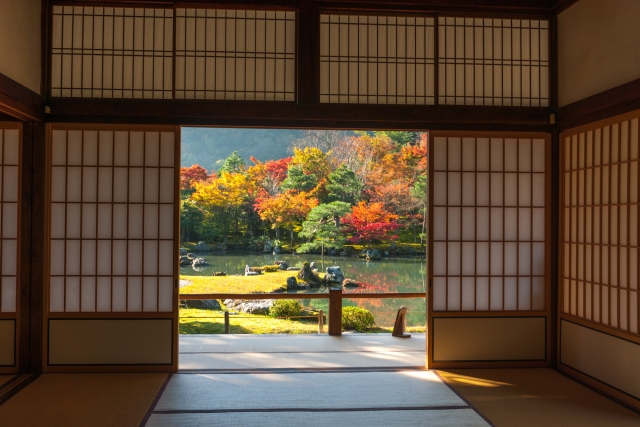
This is where most writing on shakkei falls short. The philosophy is well documented; the construction process is not. Here is how landscape professionals approach shakkei in real design and build contexts.
Framing: Turning Scenery into Composition
The foundational technique of shakkei is framing — using physical elements within the garden to isolate and present the borrowed view like a painting in a gallery. Hedges, stone walls, gates, tree canopies, and architectural openings all serve as frames. The choice of frame shape — horizontal, vertical, or circular — dramatically changes the mood and scale of the borrowed element.
Key design considerations for framing:
- Eye-level calibration: The frame’s opening must be positioned at the viewer’s natural sightline from the intended viewing point (typically a seat, terrace, or interior room).
- Three-layer depth structure: Effective shakkei compositions layer foreground, middle ground, and background. The borrowed scenery functions as the background, giving the eye somewhere to travel.
- Seasonal dynamics: Deciduous trees used as framing elements reveal or conceal the borrowed view with the seasons — a deliberate design variable, not an afterthought.
Editing the View: What You Hide Is as Important as What You Show
One of the four design essentials of a shakkei garden is that the designer edits the view to reveal only the features they wish to show. In practice, this means strategically concealing utility poles, neighboring structures, roads, and anything that breaks the intended composition — while keeping the target view open. This is often achieved through massed evergreen planting, earth berms, or low walls positioned at precise distances from the viewing point. Wikipedia
This editing process requires a thorough site survey from multiple positions and times of day. What looks clean at noon may be compromised by low sun angles in the afternoon, or by seasonal foliage changes that expose unwanted elements.
Plant Selection: Connecting Garden to Horizon
Simply revealing an external landscape is not enough. The garden’s planting must relate to the borrowed scenery so that the two feel like a single, continuous world rather than a foreground pasted in front of a backdrop.
If the distant view features a ridge of coniferous forest, echoing that texture with evergreen plantings in the garden’s rear zone creates visual continuity. Conversely, placing fine-textured, low-growing plants in the foreground — mosses, clipped azaleas (karikomi), or ground-covering ferns — emphasizes the scale difference and makes the distant scenery feel even more expansive. Shakkei gives gardens a layered, painterly quality much like that of Song dynasty artwork, which is why it became particularly popular in Zen temple gardens. North American Japanese Garden Association
Why Shakkei Matters in Modern Landscape Design
Making Small Gardens Feel Larger
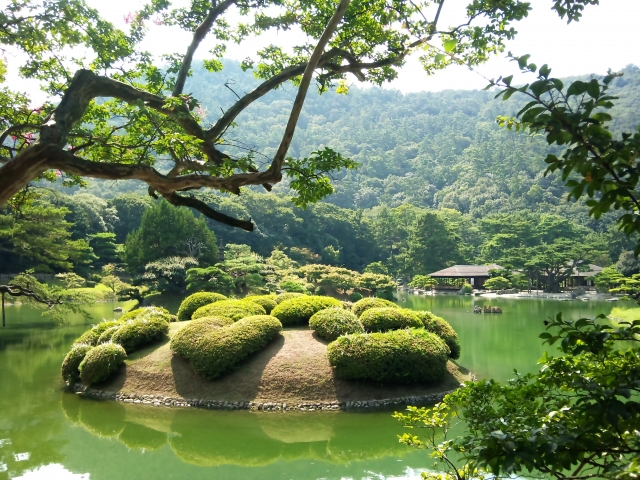
Urban gardens are where shakkei delivers its most dramatic return. Shakkei employs scale and perspective by using topography and plant size to frame views that seamlessly entwine background landscapes with their foreground. In a Japanese city garden of 30 square meters or less, incorporating the sky, a mature street tree, or even a neighboring roofline as a deliberate borrowed element can transform the spatial experience entirely. HomeLight
The grounds of the Adachi Museum of Art appear endless when you gaze across the garden — vastly larger than its 40 acres (165,000 square meters). The boundaries seem virtually impossible to identify as the landscape stretches into the distance toward the mountain range horizon. The principle scales equally well to intimate residential spaces. ZenFusionHome
Sustainability and Design Economy
Shakkei is fundamentally an act of working with what already exists. Rather than over-constructing a garden to manufacture a sense of completeness, shakkei asks the designer to read the surroundings and find the composition that is already there, waiting to be revealed. This reduces planting density, material use, and ongoing maintenance — making it a compelling approach within any sustainability-conscious brief.
Cultural and Experiential Value
For hospitality projects — ryokan, retreat centers, meditation spaces, tea gardens — shakkei is not merely an aesthetic choice but a strategic one. Applying shakkei successfully to a home or garden involves more than simply framing a view: it requires a careful analysis of the landscape and surrounding elements to create a composition with depth, scale, and texture that integrates the borrowed scenery in a poetic way. When guests sense that the view has been intentionally composed for them, the memory of that place deepens considerably. Dwell
Shakkei and Western Garden Design: A Parallel Tradition
Western garden design has its own parallel concept worth noting for context. A ha-ha is a recessed landscape feature consisting of a sunken ditch and retaining wall, designed to form an invisible boundary that separates cultivated gardens from adjacent pastures while preserving an unobstructed panoramic view. Originally a feature of formal French gardens of the early 18th century, the ha-ha was widely adopted throughout England under the Georgian garden movement. GrokipediaNational Trust
Both shakkei and the ha-ha pursue the same underlying goal — dissolving the perceived boundary between designed space and the wider landscape. The philosophical origins, however, differ markedly. The ha-ha is primarily a functional solution to the problem of livestock management that happens to produce a visual effect. Shakkei begins from the opposite direction: the visual and experiential composition comes first, and all physical decisions — including what to hide — serve that end.
Applying Shakkei Beyond Japan: It Works Anywhere
Shakkei’s underlying logic is not culture-specific. While shakkei refers to the traditional technique of incorporating an outside view into a garden design, the concept also offers inspiration for connecting built forms with nature in a profound manner. Scottish moorland, Californian oak savanna, Australian bushland, the rooflines of a European city — all contain elements that can be borrowed, framed, and composed into a garden’s experience. Dwell
The practical checklist for applying shakkei principles on any site:
- Survey the surroundings before finalizing the garden layout — not after.
- Identify one to three elements outside the boundary worth borrowing.
- Determine the optimal viewing position inside the garden and design outward from it.
- Plan what to conceal (unwanted elements) using planting or structures.
- Build in three depth layers: foreground, middle ground, and borrowed background.
- Select plants that connect visually and texturally to the borrowed element.
- Revisit the composition across seasons before finalizing planting positions.
Frequently Asked Questions
Q: What does shakkei mean, and how is it pronounced?
Shakkei (借景) is a Japanese term meaning “borrowed scenery.” It is pronounced “shah-kay” and refers to the garden design principle of intentionally incorporating landscape elements from outside the garden’s boundaries into its overall composition.
Q: Is shakkei only for traditional Japanese gardens?
Not at all. While shakkei developed within the Japanese garden tradition, the principles of framing, depth layering, and visual editing apply to any garden or landscape project, regardless of style or geography. Contemporary landscape architects apply shakkei logic to residential gardens, public parks, and architectural projects worldwide.
Q: Can shakkei be used in a small urban garden?
Absolutely — and it may be most valuable there. Even a compact city garden can borrow the sky, a visible tree crown, or a distant roofline as a composed background element. The key is identifying what is worth showing and then designing the garden to present it intentionally.
Q: What is the difference between shakkei and just having a good view?
Intent and design control. A good view is incidental; shakkei is deliberate. The landscape practitioner identifies, frames, edits, and integrates the external view into the garden as a designed element — controlling sightlines, concealing distractions, and calibrating planting to link the foreground to the borrowed scenery.
Q: Can shakkei principles be applied in architectural design as well?
Yes. Window placement, aperture sizing, and interior orientation can all be designed to “borrow” external landscape elements in exactly the same spirit. Many contemporary architects working with Japanese spatial principles explicitly cite shakkei as a guiding concept in how they frame views from within a building.
Conclusion
Shakkei is one of the most elegant ideas in the history of garden design: that the garden need not end at its fence. By deliberately reading, framing, and composing with the landscape beyond the site’s boundaries, a skilled designer can expand a garden’s experiential scale far beyond what its physical dimensions would suggest — and do so with less material, less construction, and more sensitivity to the existing environment.
For landscape professionals working anywhere in the world, shakkei offers a disciplined framework for one of the most underutilized resources available: the view that is already there, waiting to be borrowed.
Field notes from Japan’s trees arrive a few times each month — subscribe via the form in the footer, or follow the work on LinkedIn.