Yes, daisugi is real. Daisugi (台杉, “platform cedar”) is a documented way of growing Kitayama cedar (Cryptomeria japonica) in the hills north of Kyoto: one rooted stump is kept alive while several straight shoots grow from it and are cut, one by one, for slim polished poles. Kyoto Prefecture and Kyoto City both describe it in their own publications, and daisugi platforms are still kept and pruned in Kyoto’s Kita Ward today.
What the viral posts get wrong is the scale, the numbers and the present tense. This article checks the common claims against official Japanese sources, explains what daisugi timber is actually used for, and separates daisugi from two things it is often confused with: bonsai and the giant wild “platform cedars” of Kyoto’s high mountains. For how the technique works step by step, see our main guide to daisugi.
Why People Ask If Daisugi Is a Hoax — What the Photos Show
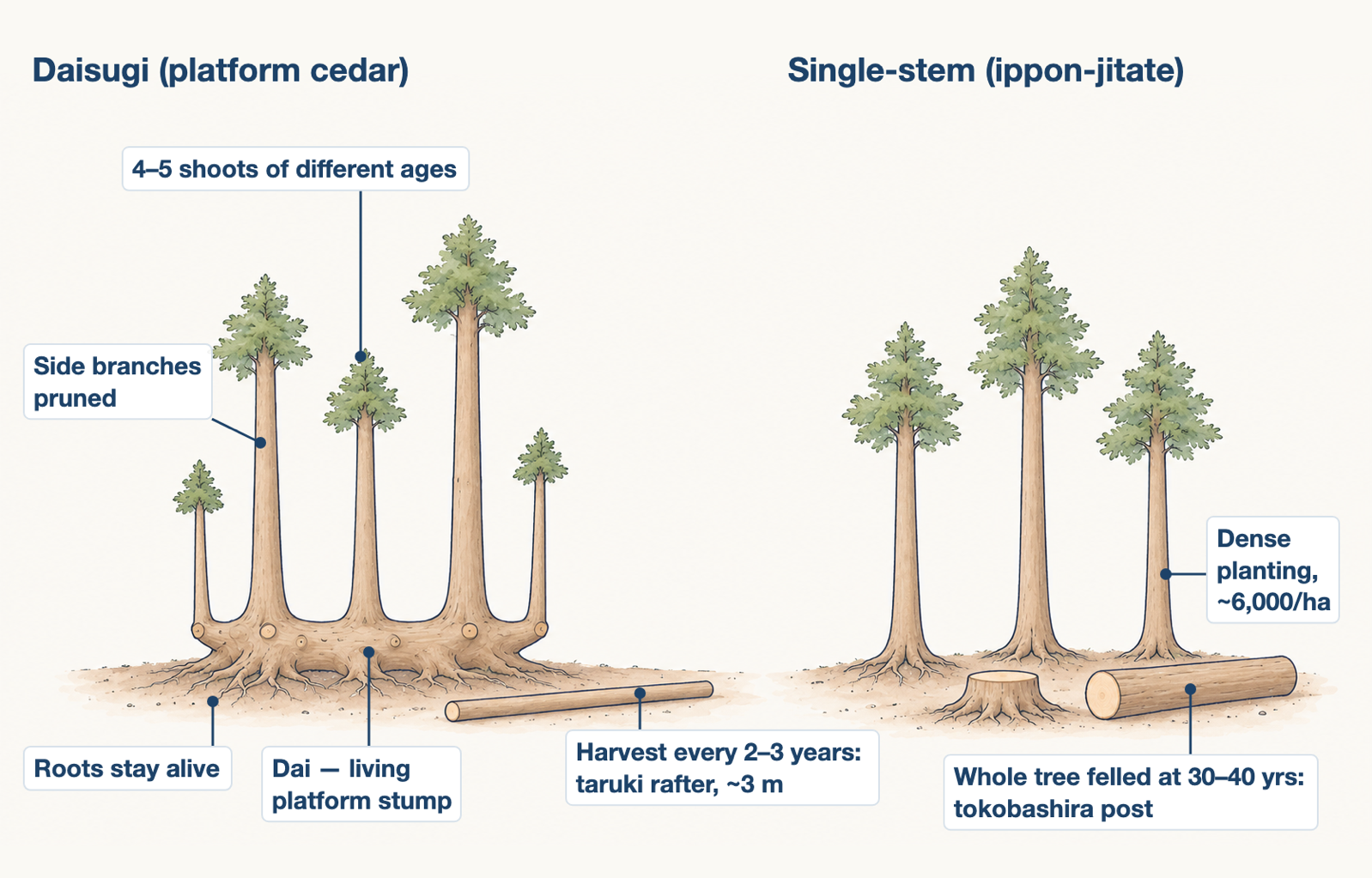
The images that circulate online usually show a broad, moss-dark stump with a crowd of perfectly vertical trunks rising from it, like a hedge of masts. It looks edited, or like a bonsai photographed from too close, so viewers reasonably ask whether it is a single tree at all.
It is a single tree. The vertical trunks are not separate trees or grafts; they are shoots from the same living stump, sharing one root system. In Japanese forestry this is called sprout regeneration, the same principle Western foresters know from coppicing. What makes daisugi look unreal is the discipline: the shoots are thinned and their side branches removed for decades, which is why they stand so straight and so evenly spaced.
Viral Daisugi Claims vs Official Sources — A Fact Check
The table compares the most repeated claims with what Kyoto’s official sources state.
| Viral claim | What the primary sources say | Verdict |
|---|---|---|
| “It’s fake / photoshopped” | Kyoto Prefecture and a Kyoto City cultural landscape survey both describe daisugi (台杉仕立て, daisugi-jitate) as one of two growing methods in Kitayama forestry | Real |
| “Dozens of trunks grow on one tree at once” | In the forestry practice the survey describes, an average of about 4–5 shoots are kept per stump. Old ornamental specimens can carry far more | Exaggerated for working stands |
| “It produces all of Kyoto’s famous cedar logs” | Since the early 20th century the main method has been single-stem stands, clear-felled on a 30–40 year rotation. Daisugi mainly supplied thin rafter poles | Misleading |
| “Daisugi wood is X% stronger or more flexible” | No official or academic source found for this check gives a measured strength or flexibility ratio for daisugi wood | Unverified — figures not repeated here |
| “Nobody does it anymore” | Daisugi platforms in Kyoto’s Kita Ward are still pruned, and young daisugi are being raised again | False |
| “It’s a kind of bonsai” | Daisugi is full-size forestry. Its target product is a pole about 3 m (10 ft) long | False |
A note on the strength figures: the percentages attached to daisugi timber usually trace back to a widely shared social-media thread, not a test report. No Japanese government, university or wood-science publication checked for this article contains the original measurement.
What official sources do say about Kitayama cedar logs is more modest: dense growth rings, a diameter that barely changes from base to tip, a smooth white surface that does not discolour, and resistance to checking (cracking) once finished. Those are the qualities a carpenter is paying for.
Is Daisugi Still Used? — Kitayama Today
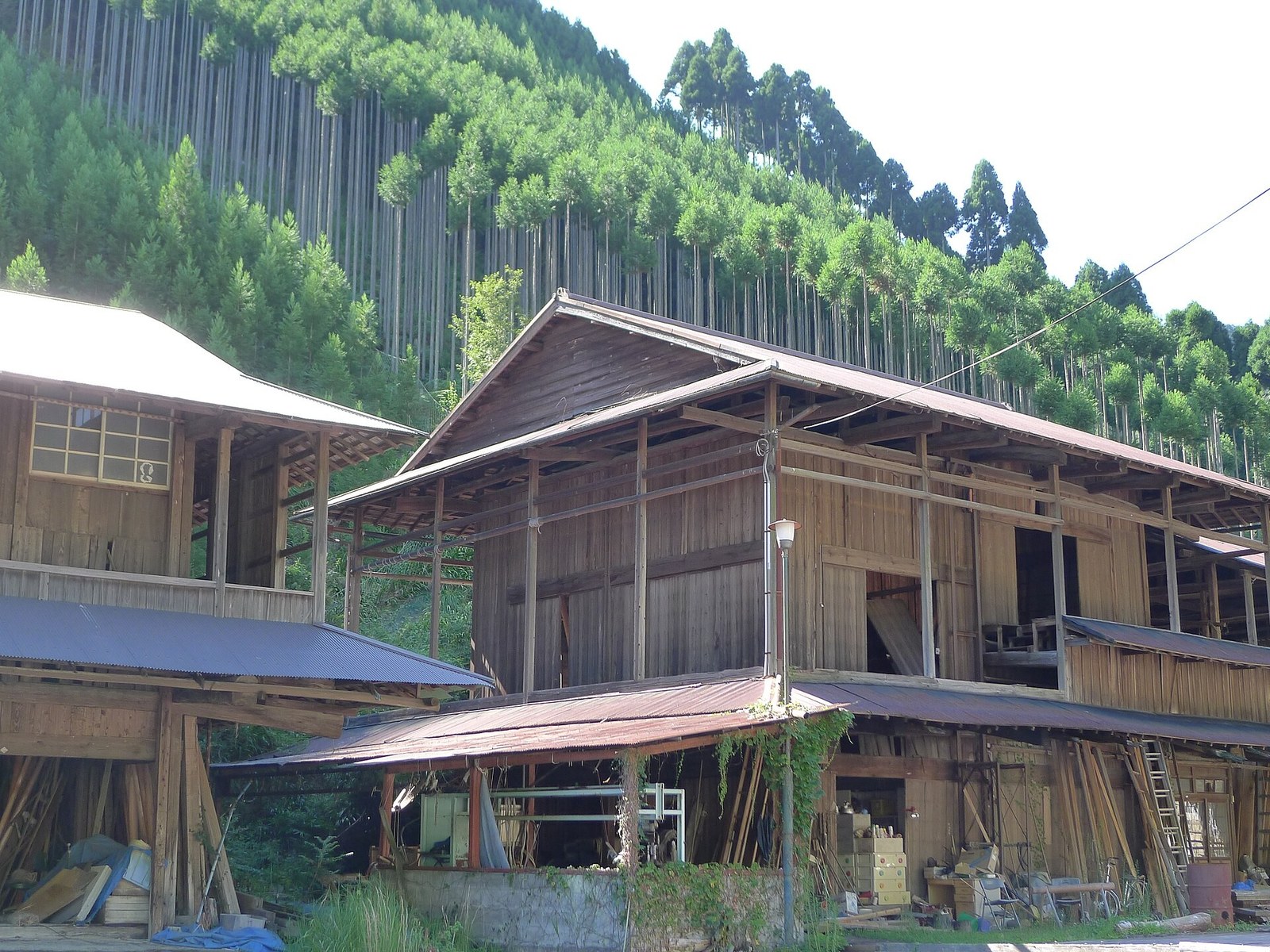
Daisugi is still alive, but its role has changed. According to the Kyoto City survey Kyoto Nakagawa’s Kitayama Forestry Landscape (京都中川の北山林業景観), daisugi was the main method in Nakagawa only until around the middle of the Meiji era. From the end of the Meiji era into the Taishō era (roughly the 1900s to the 1920s), growers shifted toward single-stem planting (一本仕立て, ippon-jitate) to meet rising demand for polished logs. Aerial photographs from 2003 showed daisugi stands shrinking and concentrated on the east side of the Nakagawa settlement.
The market changed too. The survey records that sales at the Kitayama log cooperative’s auction peaked in 1988 at about ¥1.43 billion and then declined, and that demand for polished logs fell sharply from 1997, as Japanese homes lost their tatami rooms and alcoves and moved to factory-cut timber.
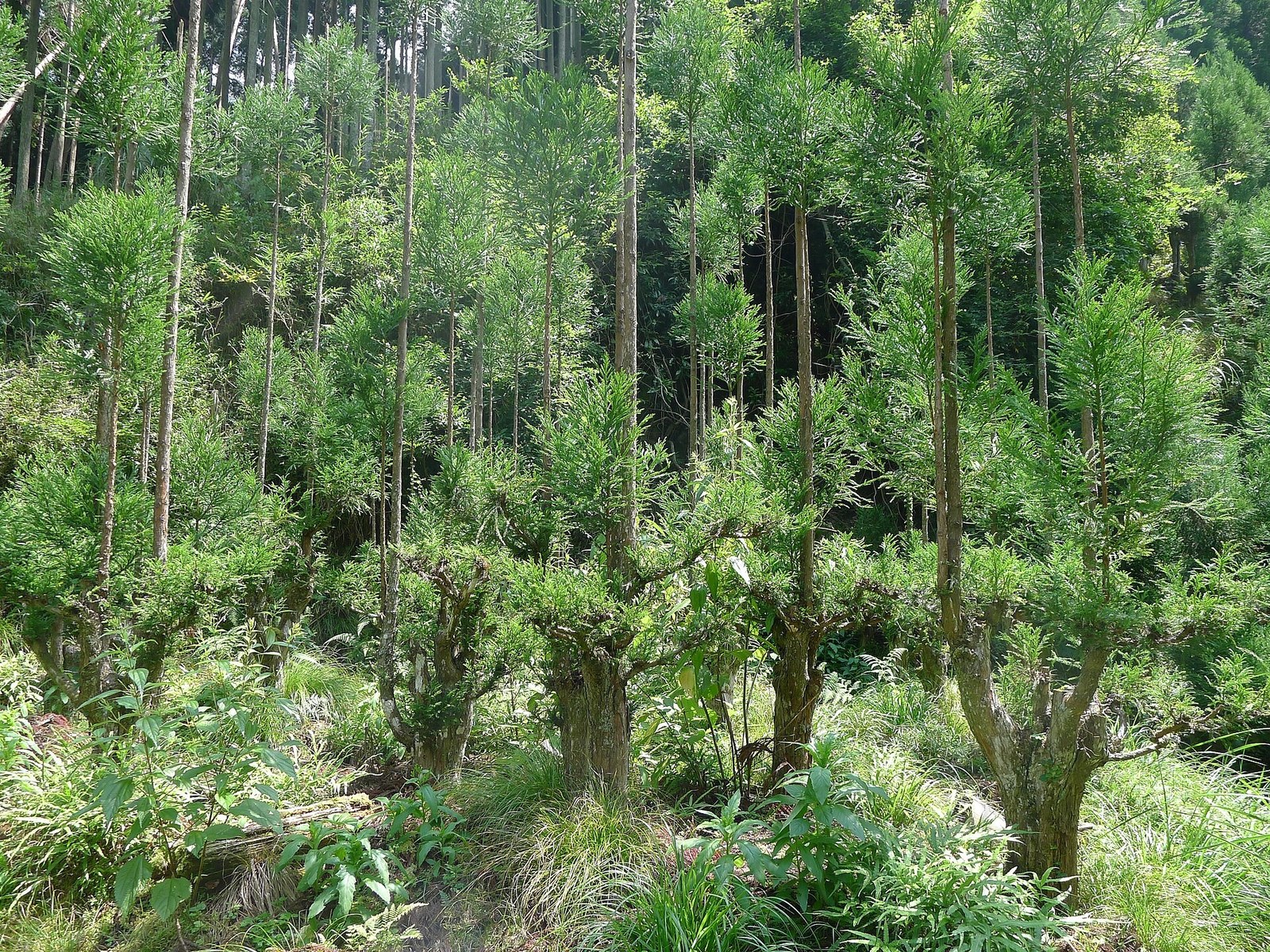
Yet the stands have not disappeared. In 2024, Kyoto City’s Kita Ward introduced the Kitayama Ō-daisugi (北山大台杉), described as Nakagawa’s oldest daisugi at about 400 years, as a sight worth visiting. A Kyoto University of the Arts design project is turning pruning residue from Kitayama daisugi into paper and textiles, which tells you the platforms are still being pruned. The same project report names the real threat plainly: a shortage of successors to carry the skill on.
What Daisugi Timber Is Used For — Taruki, Not Tokobashira
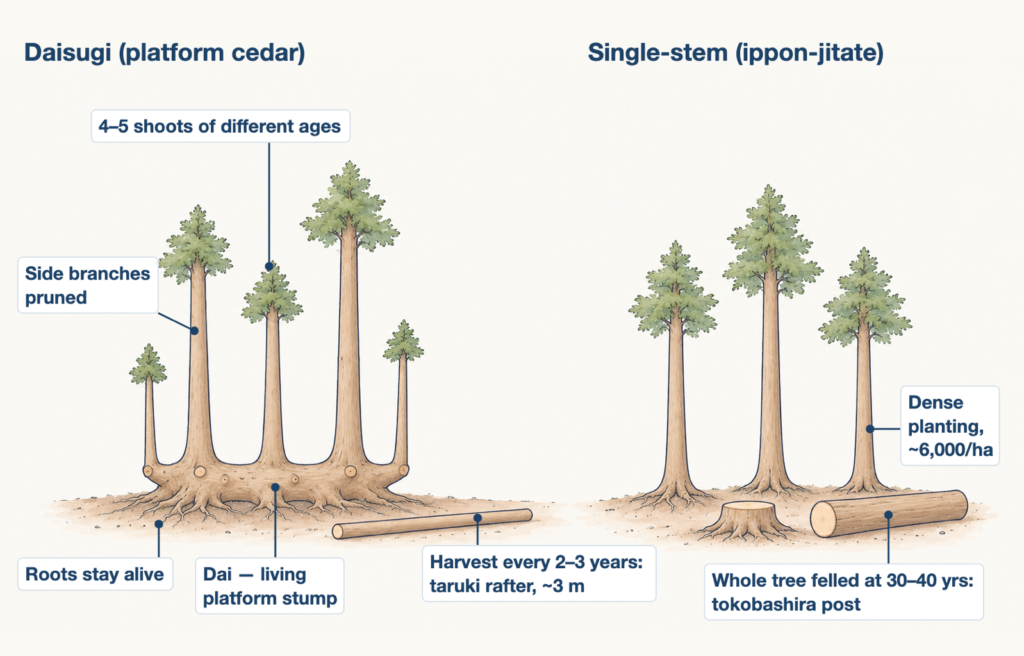
Daisugi has a specific job. Kyoto Prefecture states that daisugi mainly produce material for taruki (垂木) — rafters — with a target size of about 3 m long and 3 cm at the top end (10 ft by 1.2 in). In sukiya-style buildings and tea houses these slender round poles are often left exposed as finish timber, so a straight, knot-free, evenly tapered pole matters as much as structural strength.
The thick, polished alcove post that many articles associate with daisugi — the tokobashira (床柱) — comes mainly from the other method. Kyoto Prefecture describes single-stem trees (単木仕立て) grown at high density with early, heavy pruning, targeting logs about 3 m long and 10–12 cm (4–4.7 in) at the top end for tokobashira.
| Daisugi (台杉仕立て) | Single-stem (一本仕立て) | |
|---|---|---|
| Planting density | About 3,000 per ha (≈1,200 per acre) | About 6,000 per ha (≈2,400 per acre) |
| What is harvested | Selected shoots, every 2–3 years | The whole tree, clear-felled at 30–40 years |
| Main product | Taruki rafters, small poles | Polished logs, tokobashira alcove posts |
| Typical size | ~3 m × 3 cm top diameter | ~3 m × 10–12 cm top diameter |
| Tree after harvest | Stump stays alive | Replanted |
Both methods end in the same finishing process for Kitayama logs (北山丸太, Kitayama maruta), a Kyoto Prefecture designated traditional craft product. The bark is peeled immediately after felling, the logs are dried in the midsummer sun for about a week, soaked, then polished by hand with sand. Unlike European coppice, daisugi aimed at a finished architectural surface, not firewood or fencing.
Daisugi Bonsai vs Real Daisugi — A Question of Scale
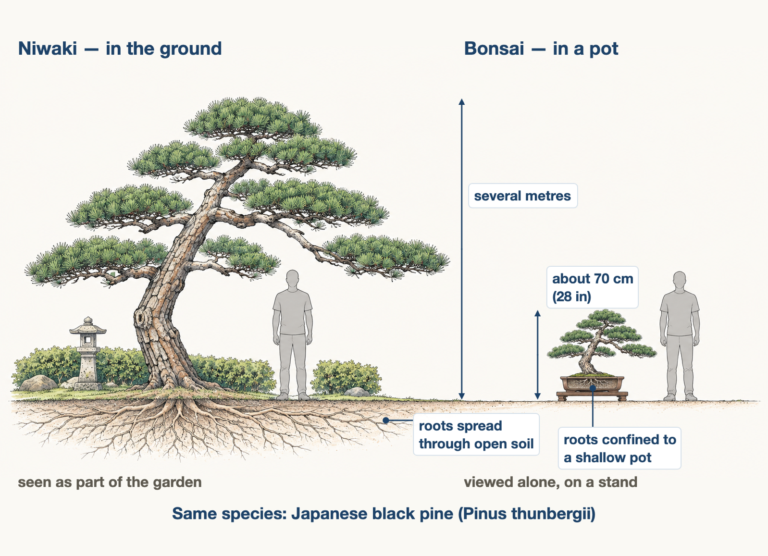
Searches for “daisugi bonsai” are rising, and the confusion runs both ways. A daisugi-style bonsai is a container tree styled to imitate the silhouette: a low trunk with several upright leaders. It is a visual reference, not the technique. In real daisugi the platform is a mature cedar stump, and the shoots grow to rafter length.
Between the two sits the garden daisugi. In Japanese practice, daisugi are also planted as garden trees, where the same training is kept up for its form rather than for timber. The logic is familiar Japanese garden pruning: remove side shoots early and never let one leader dominate. If you are trying the form at home, our comparison of niwaki and topiary explains why Japanese training works with the tree’s own growth rather than against it.
In Nakagawa itself, the survey notes that valley-side house gardens are built around the view of the mountain across the valley, a local version of shakkei, the borrowed scenery of Kyoto’s great gardens.
Daisugi vs Fukujō Daisugi — The Wild Giants Are Not the Same Thing
Some of the most dramatic “daisugi” photos from Kyoto are not of the forestry technique at all. High in the Katanami River headwaters (upper Katsura system), in Keihoku, Kyoto City’s Ukyō Ward, stand fukujō daisugi (伏条台杉): giant Ashiu cedars (ashiu-sugi), the snow-country form of Japanese cedar, with several trunks rising from one root crown. Kyoto Prefecture explains how they form: heavy snow presses the lower branches to the ground, the branches root where they touch, and each rooted branch grows on as a trunk of its own.
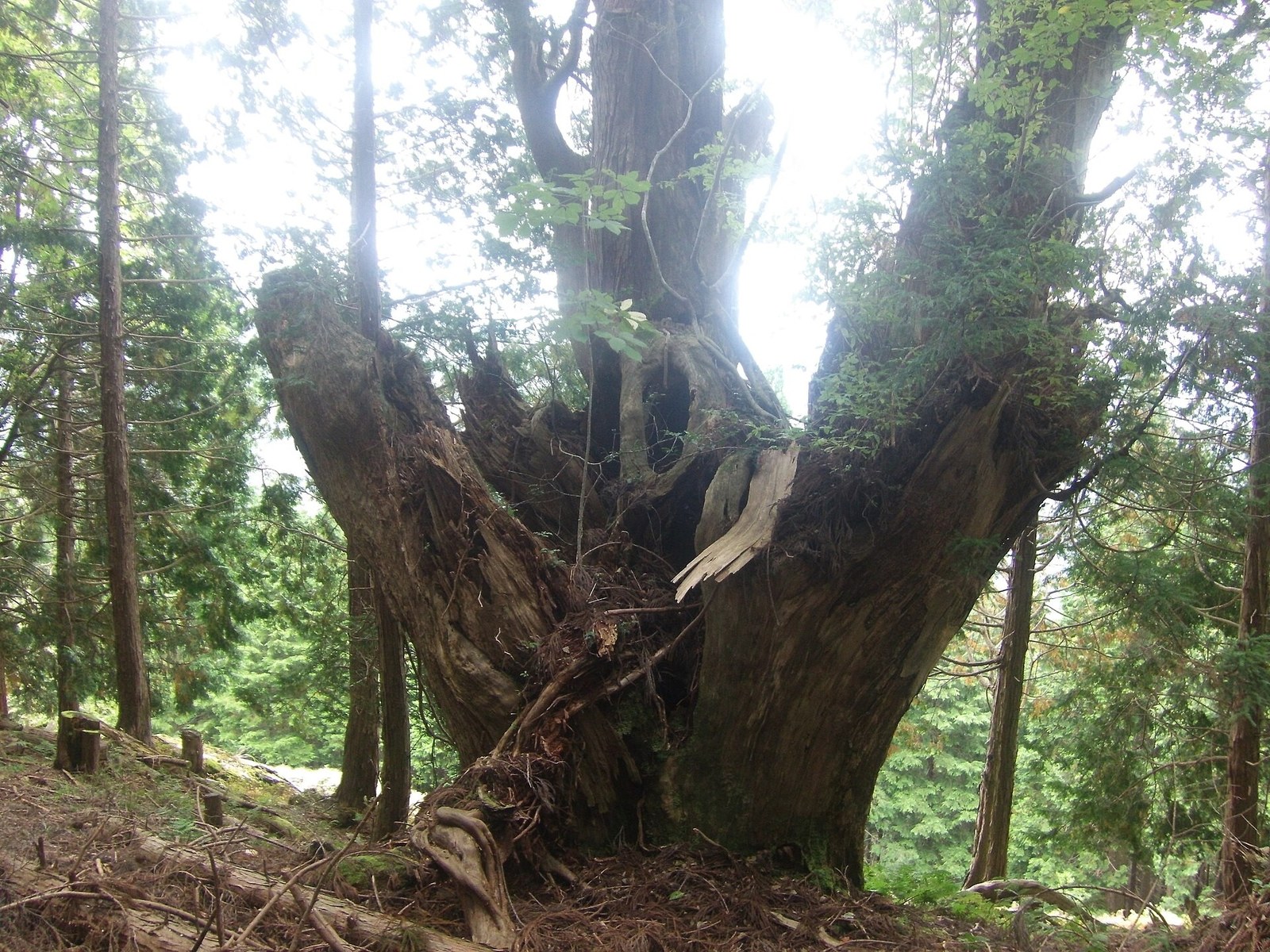
Kyoto Prefecture’s model-forest page calls these giants the prototype of the Kitayama daisugi and gives figures of up to 600 years of age, 10 m (33 ft) around at chest height and 50 m (164 ft) tall. They show what cedar does on its own under snow, and why some trees survive so long in Japan’s mountains, a theme we explore in why Japan’s ancient trees live for a thousand years. But they are wild trees, not a harvested crop.
On age, Kyoto Prefecture dates Kitayama cedar forestry to around the Ōei era (1394–1427). For daisugi itself, the Kyoto City survey cites plantings in neighbouring Yamaguni in the Kyōhō era (1716–1736) and an 1858 pruning diary that mentions “dai-mono” (台物), platform stock. The “600 years” often attached to daisugi is the age of Kitayama forestry; daisugi’s own firm record is about 300 years.
Frequently asked questions
Is daisugi real or fake? Daisugi is real. It is a recorded method of Kitayama cedar forestry north of Kyoto, described by Kyoto Prefecture and Kyoto City. The trunks in the photos are shoots from one living stump, not separate trees.
Is daisugi still used today? Yes, on a smaller scale. Most Kitayama logs now come from single-stem stands, but daisugi platforms are still pruned in Kyoto’s Kita Ward, young daisugi are being raised again, and the form is also grown as a garden tree.
Is daisugi a type of bonsai? No. Daisugi is a full-size forestry technique whose main product is a rafter pole about 3 m (10 ft) long. “Daisugi bonsai” are container trees styled to look like it.
Sources
– Kyoto Prefecture, “京都府の木「北山杉」” (Kitayama cedar, the prefectural tree) — daisugi training, taruki target size, single-stem tokobashira target size. https://www.pref.kyoto.jp/rinmu/14100033.html (checked 2026-10-17) – Kyoto Prefecture, “北山丸太” (Kitayama maruta, traditional craft products) — product types, peeling, sun-drying, sand polishing, pruning cycle. https://www.pref.kyoto.jp/senshoku/kitayama.html (checked 2026-10-17) – Kyoto City, 京都中川の北山林業景観 (Kyoto Nakagawa’s Kitayama Forestry Landscape), Introduction — survey with the Nara National Research Institute for Cultural Properties. https://kyoto-bunkaisan.city.kyoto.lg.jp/report/pdf/tyousa/06/nakagawa0.pdf (checked 2026-10-17) – Kyoto City Kita Ward, ward newsletter, November 2024 — Kitayama Ō-daisugi, about 400 years old. https://www.city.kyoto.lg.jp/kita/cmsfiles/contents/0000334/334429/2411_kita_web_01.pdf (checked 2026-10-17) – Kyoto Prefecture Model Forest, “京都市右京区京北:下黒田町(片波川源流域)のスギ” — fukujō daisugi, formation under snow. https://www.pref.kyoto.jp/modelforest/tenjounoki10/keihoku.html (checked 2026-10-17) – Kyoto University of the Arts, “北山杉・北山台杉をデザインで未来につなぐ” project summary — use of daisugi pruning residue, successor shortage. https://chiemori.jp/sangaku/wp-content/uploads/2025/03/638d21ca51a3b41d582ce1bff8c7bd74.pdf (checked 2026-10-17)
Related reading
– Daisugi: the 600-year-old Japanese technique of growing trees on trees – Karikomi: the Japanese art of cloud pruning explained – Midori-tsumi: reading a pine tree’s future in its spring candles
New field notes from Japan’s trees every day — subscribe to the Japan Blue Arborist Journal on LinkedIn, or via the form in the footer.