

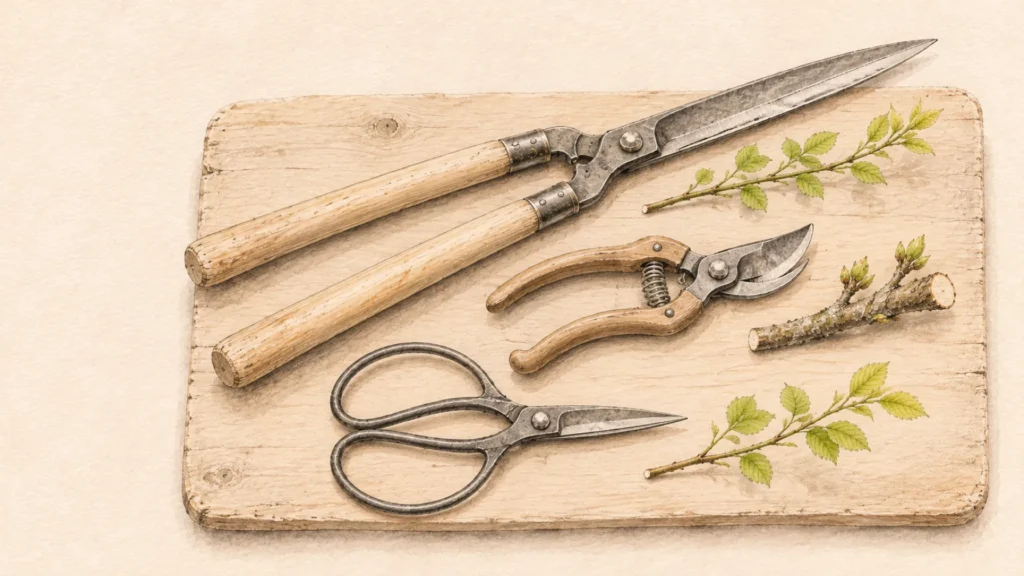
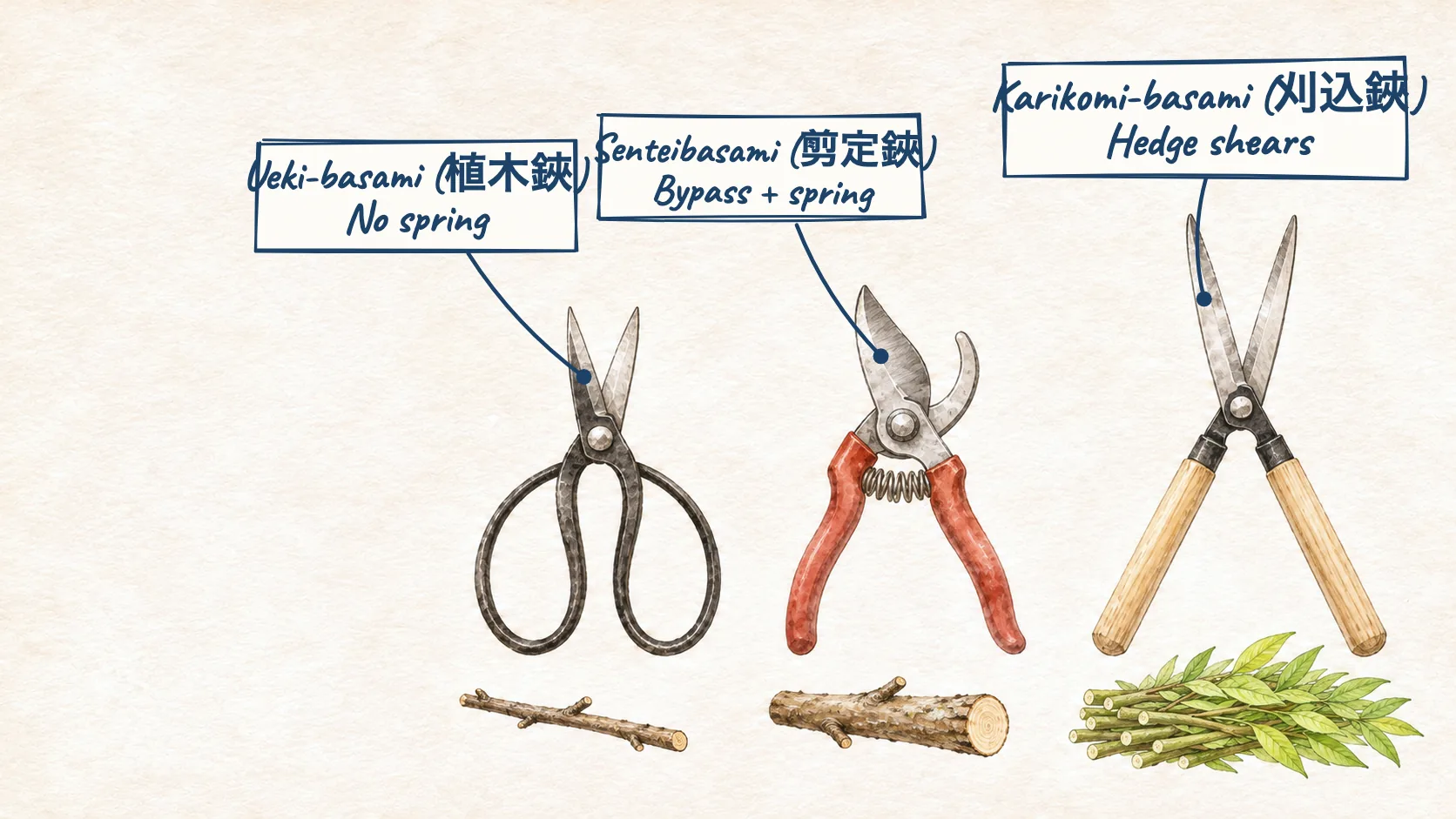
Japanese pruning shears are three different tools, not one: ueki-basami (植木鋏), the spring-less snips with large loop handles; senteibasami (剪定鋏), the spring-loaded bypass pruner; and karikomi-basami (刈込鋏), the long-bladed hedge shears. Choose by the job first (fine thinning, woody stems, or clipping a surface), then by how the blade is made, and only then by brand. Whichever pair you buy, wipe it, oil it and keep it away from wood it was not built to cut.
This article answers one question: how do Japanese shears differ, and how should you choose, use and look after a pair? It sorts the three tools, traces where the regional patterns and the A-type and B-type names come from, compares bypass and anvil designs against university research, sets out published cutting limits, and ends with the care routine that one Yamagata workshop publishes. Throughout, claims come from the makers’ own pages and from university extension services, and where a maker publishes nothing, I say so.
Three tools, three jobs — what the Japanese names mean
Japanese tool catalogs separate shears by task, not by size. The industry association of Sanjo, a Niigata toolmaking town, lists wood-handled and garden shears (ki-basami, 木鋏) as one family and hand-grip shears (nigiri-basami, 握り鋏) as another, with tree-trimming shears (ueki-basami) a sub-type of the first. The word “shears” is a category, not a single product.
Ueki-basami — the spring-less loop-handle snips
The toolmaker Toyama Hamono describes the ueki-basami as the traditional Japanese garden shear: no spring, a large loop handle (tsurute, 蔓手), opened and closed entirely by hand. It is used on trees, bonsai and flower arrangement. The loop gives control and keeps the tool in the hand, because nothing springs it open for you. That is also its weakness for a beginner: every opening stroke is your own.
Senteibasami — the spring-loaded bypass pruner
The senteibasami is the tool Western readers know as secateurs. Its blades pass each other like scissors: a curved cutting blade and a hooked counter blade, with a return spring in the handles. Toyama records that it was developed in Europe for fruit-tree pruning and reached Japan in the Meiji era (1868–1912). Japanese makers then built their own versions, which is where the “A-type” and “B-type” names below come from.
Karikomi-basami — the hedge shears
Karikomi (刈込) is the shaping of shrubs into smooth, dense forms; for the shaping logic, see Karikomi: the Japanese art of cloud pruning. Tobisho describes its karikomi shears as suited to trimming branches and foliage evenly. They cut many shoots in one pass, which makes them the wrong tool for selecting one branch.
| Tool | Japanese name | Build | Best at |
|---|---|---|---|
| Loop-handle snips | Ueki-basami (植木鋏), also ki-basami (木鋏) | No spring; large loop handles; opened and closed entirely by hand | Fine work inside dense growth: thinning twigs, shaping pines |
| Spring pruner | Senteibasami (剪定鋏) | Bypass blades with a return spring | Woody stems, fruit trees, general garden pruning |
| Hedge shears | Karikomi-basami (刈込鋏) | Long blades; two-handed, with one-handed types also made | Evening out a clipped surface across many shoots |
Regional patterns — why there are so many shapes
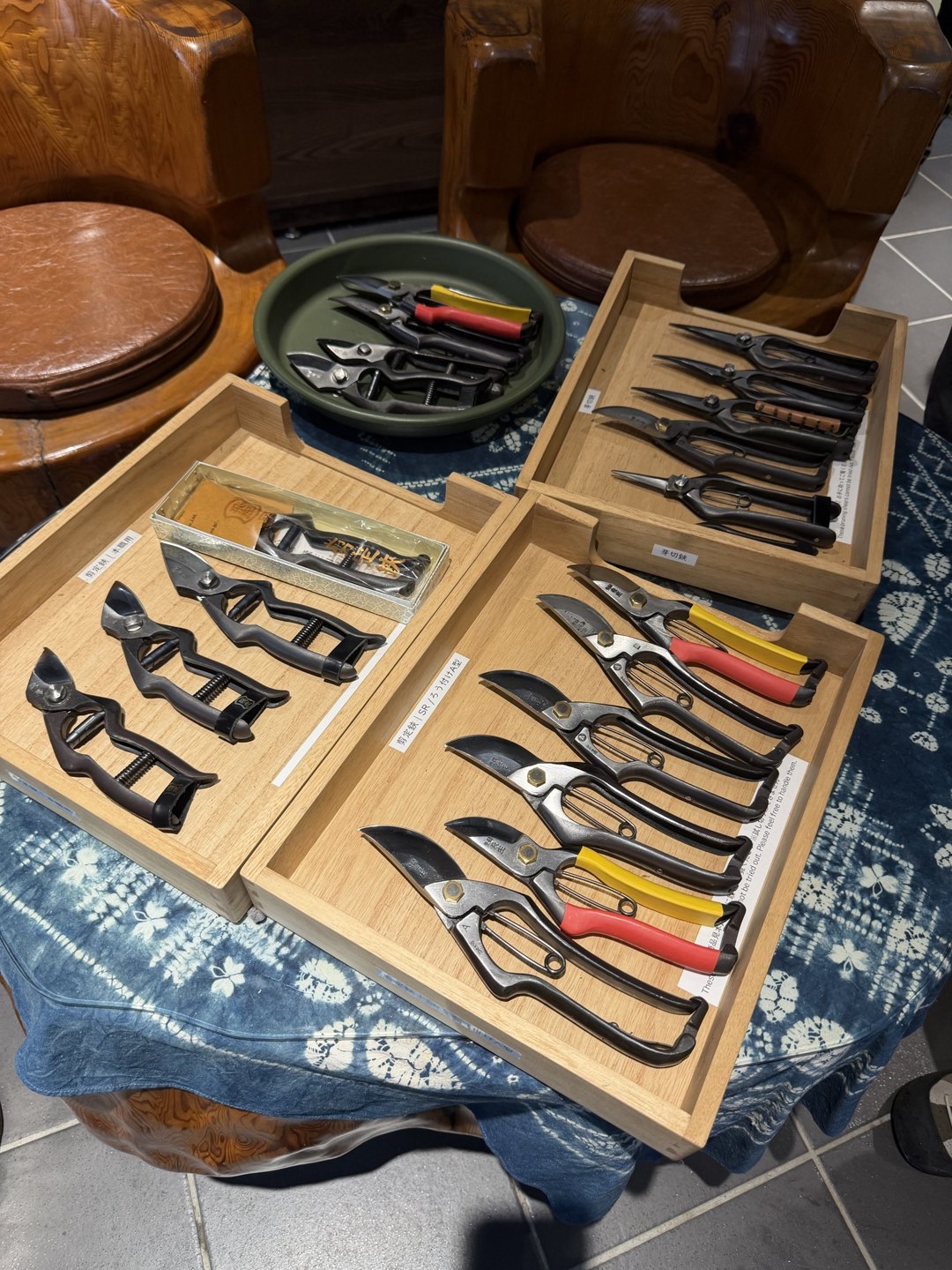
Toyama makes a point that surprises newcomers: Japanese shear names are not one classification. Some name a region, some a manufacturing method, some a shape, and one has an origin nobody can confirm. Knowing which kind of name you are reading saves a lot of confusion when you meet a catalog.
Tsushima type — leverage for dense pine foliage
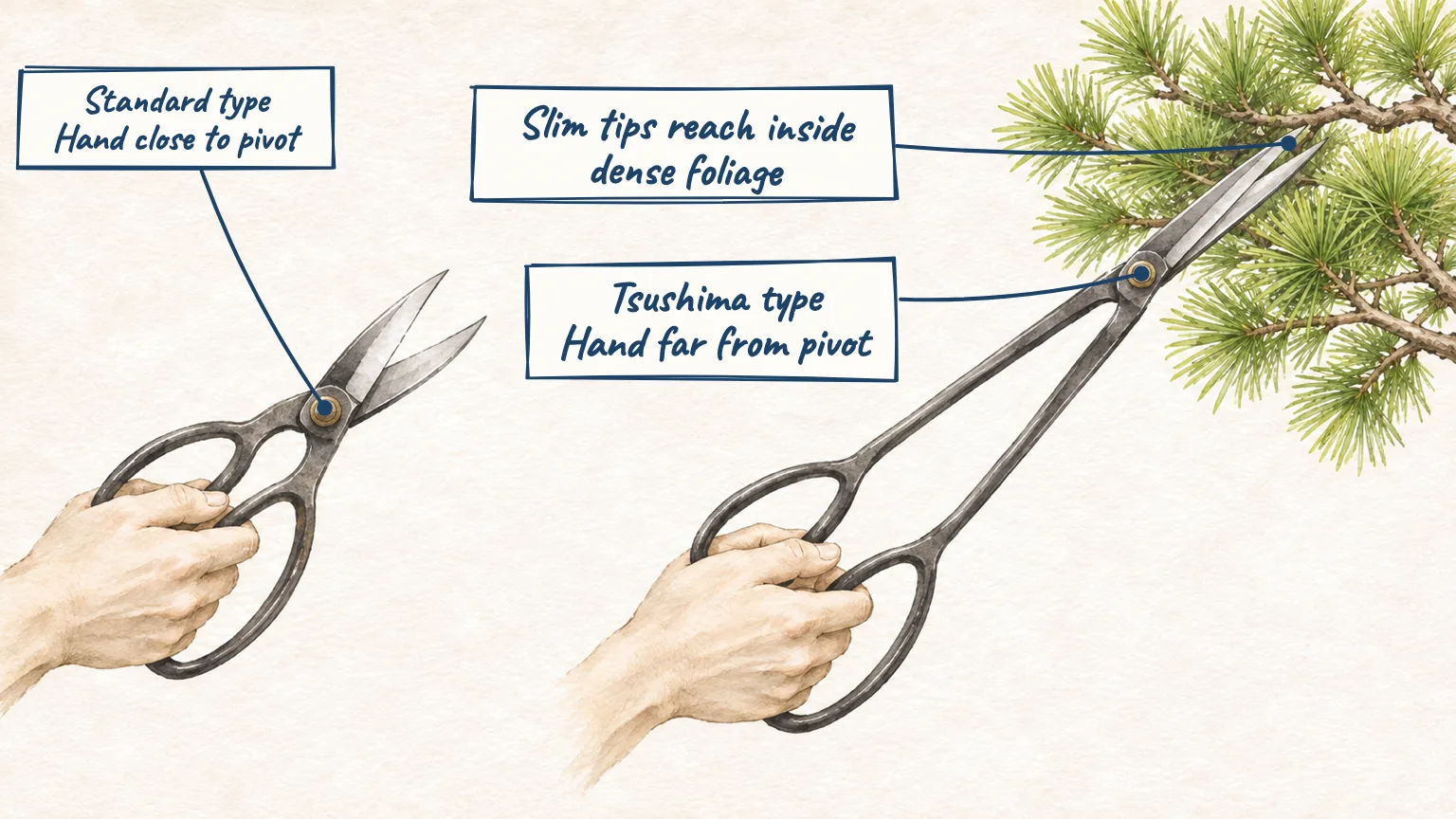
The Tsushima type comes from the Tsushima area of Aichi Prefecture and is a specialised ueki-basami. Its body and handles are long, so the hand sits far from the pivot (kashime). Toyama says this gives leverage, lets slim blades reach into narrow gaps in dense foliage and suits pine care. It notes this is unusual among spring-less shears, most of which put the hand close to the pivot. The maker’s T1-2 model has a slim blade line with the tip kept visible among crowded branches.
Okubo and Tsugaru types — the general pair and the orchard pair
The Okubo type is described by Toyama as the most widely used general-purpose garden shear in Japan, used for garden work, bonsai and flower arrangement. The tip handles fine thinning and the base cuts thicker twigs. The origin of the name is uncertain; one theory links it to a samurai, but Toyama says standard records do not confirm this.
The Tsugaru type was developed in the apple-growing region of Aomori. Local records, as Toyama relays them, put the first apple pruning shears at around 1904 (Meiji 37). Its curved form suits the horizontal and downward cuts used to train apple trees, and the spring works as a cushion for workers who make thousands of cuts in a day. This is a clear case of a tool shaped by one crop.
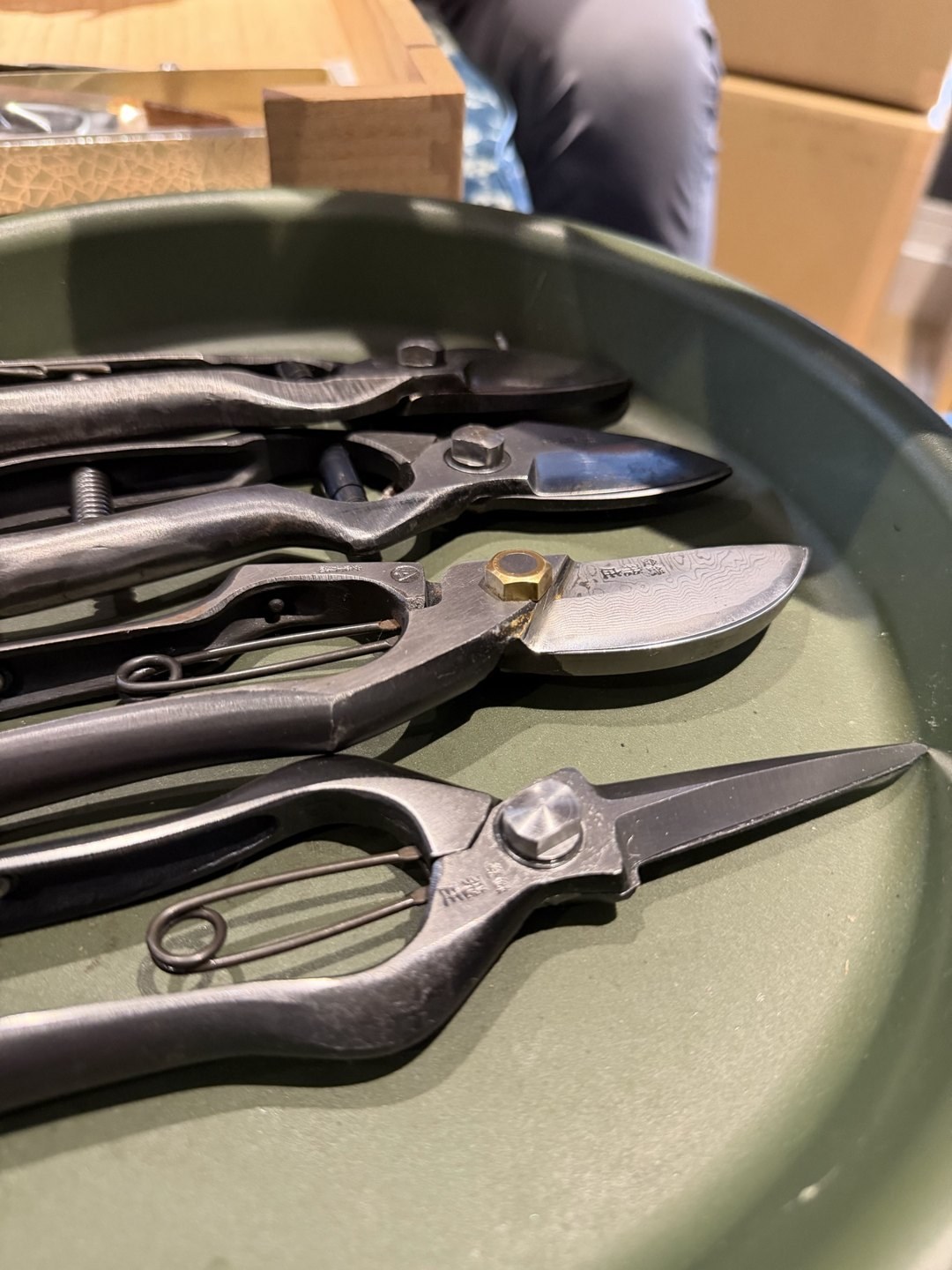
How the blades are made — A-type and B-type
The names “A-type” and “B-type” refer to construction, not shape, and they arose inside the spring-pruner category as Japanese makers developed their own methods after the Meiji-era import.
A-type — a hard blade brazed to a softer body
In the original A-type, the handle body was cast iron and only the cutting edge was hard, high-quality blade steel, joined to the body by brass brazing. Using hard steel only at the edge saved expensive steel. Toyama describes A-type blades as relatively heavy but very durable and sharp, typically thinner and suited to cutting fibrous bark cleanly.
B-type — one piece, forged in a die
In the B-type, the whole tool is die-forged from a single round steel bar, so blade and handle form one continuous body. Hard steel was once difficult and costly to forge this way, and wider steel choices later made it practical. Modern B-type blades are associated with a thick, rounded hamaguri (clam-shell) edge, which reduces friction and gives strength for thick branches.
| A-type | B-type | |
|---|---|---|
| Construction | Hard blade brazed to a softer body | Blade and handle forged as one piece |
| Edge shape | Typically thinner | Thick, rounded clam-shell edge |
| Associated strength | Clean slicing of fibrous bark | Strength on thick, hard wood |
| Caution | Today the name often describes a shape | Same |
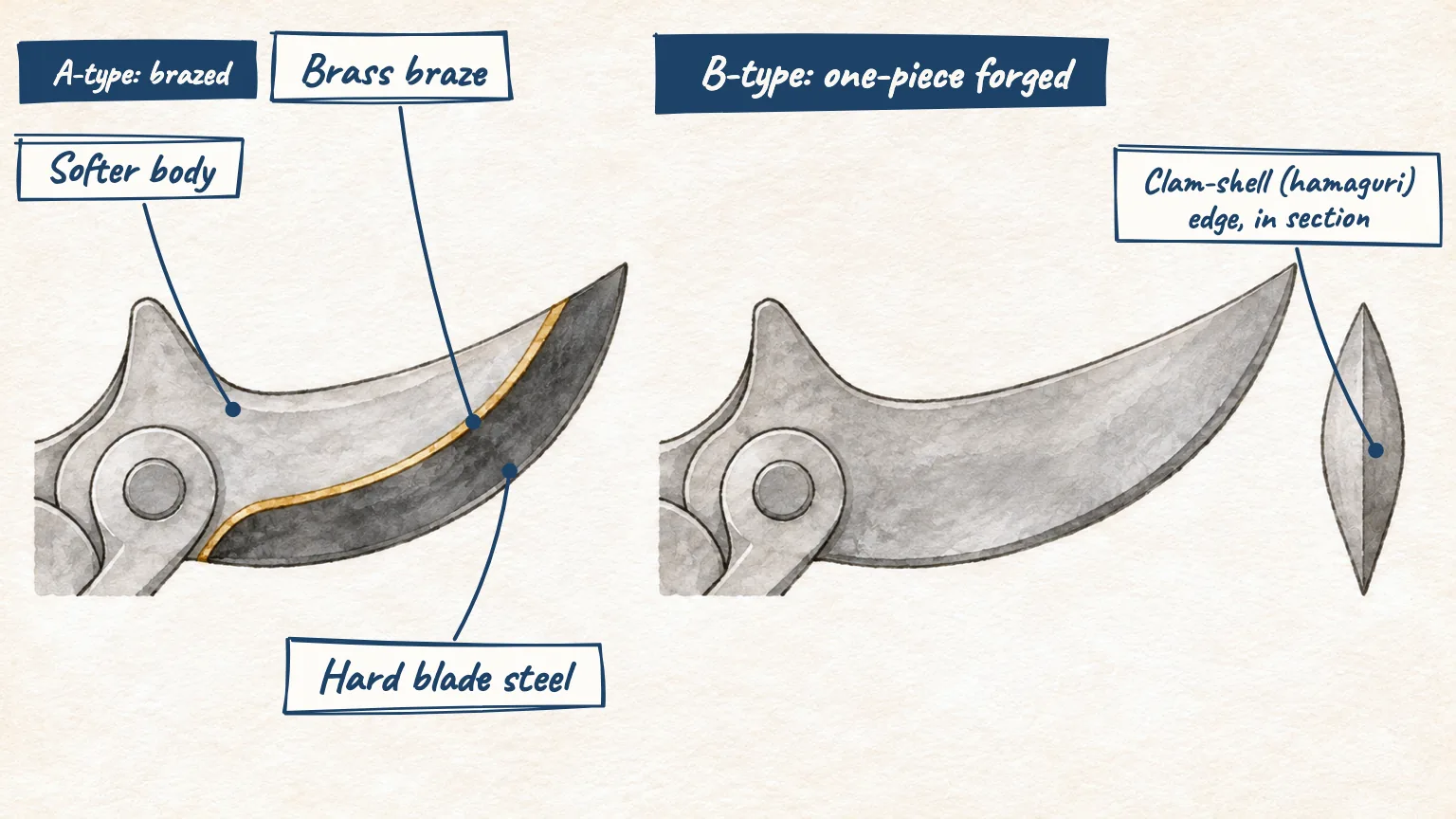
Toyama adds a warning that matters when you shop: modern A-type-shaped shears are often forged in one piece, so the label “A-type” no longer reliably tells you how a pair is made. If construction matters to you, read the maker’s own description.
Inside one workshop — what Tobisho says its process involves
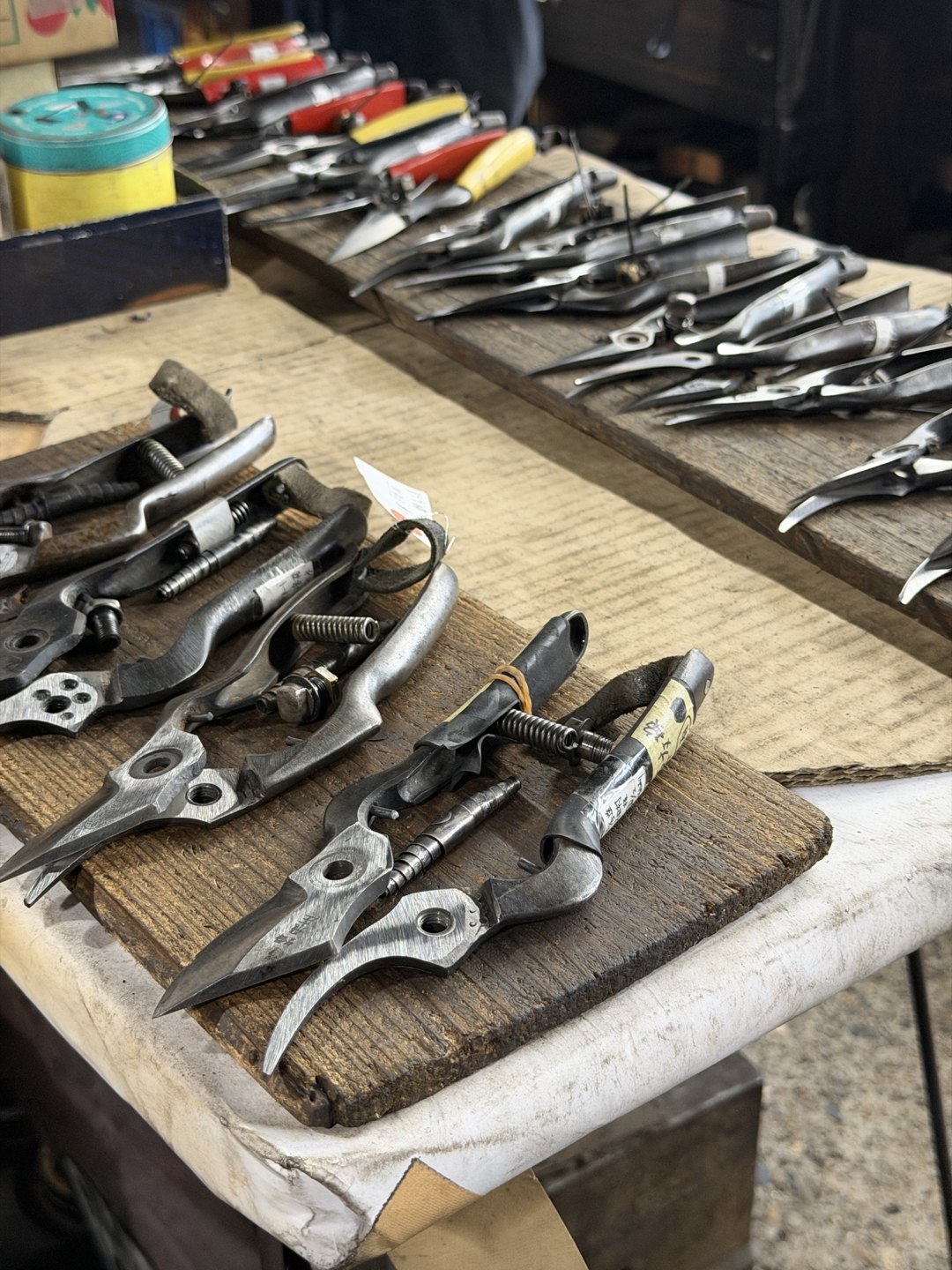
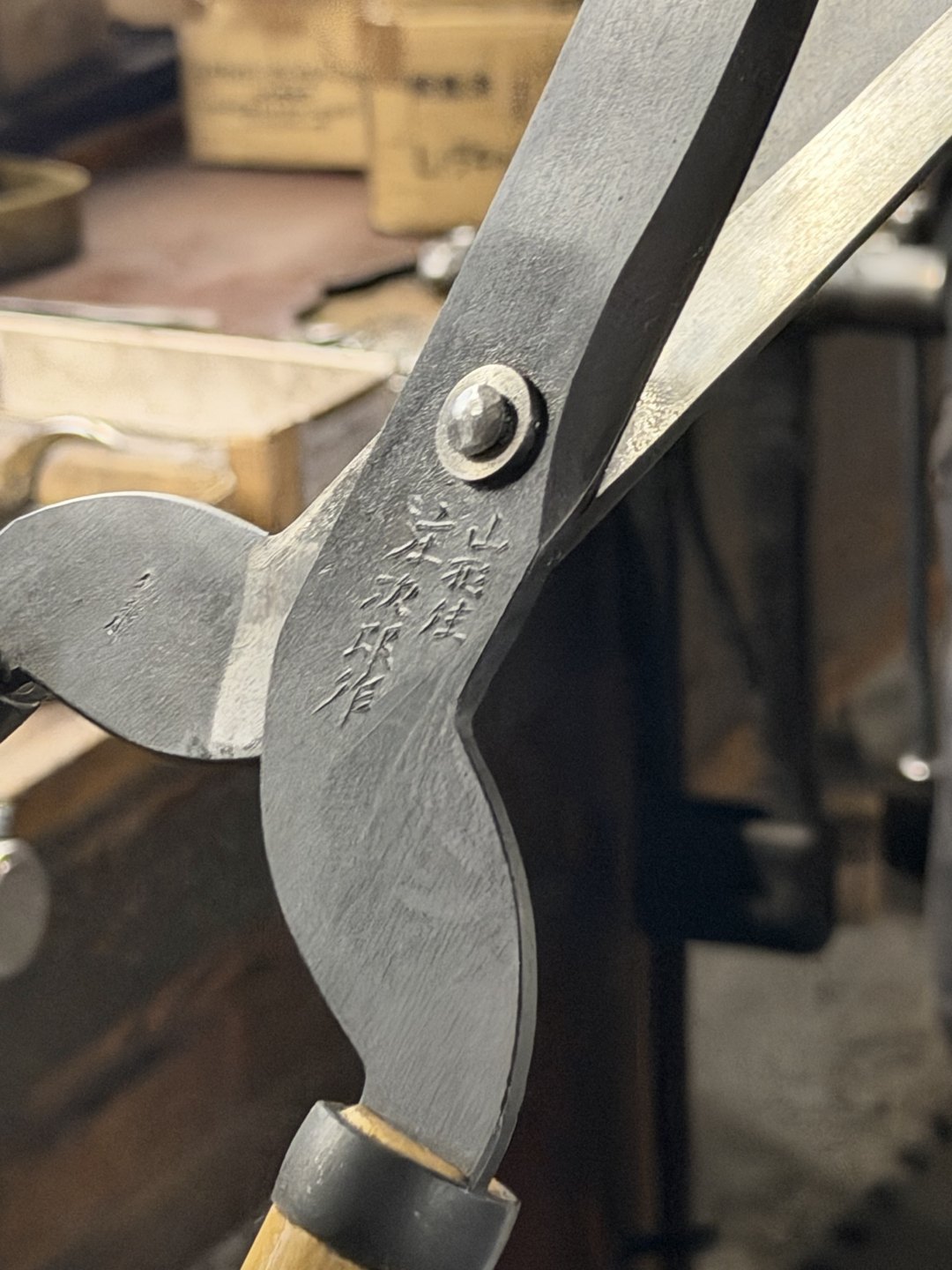
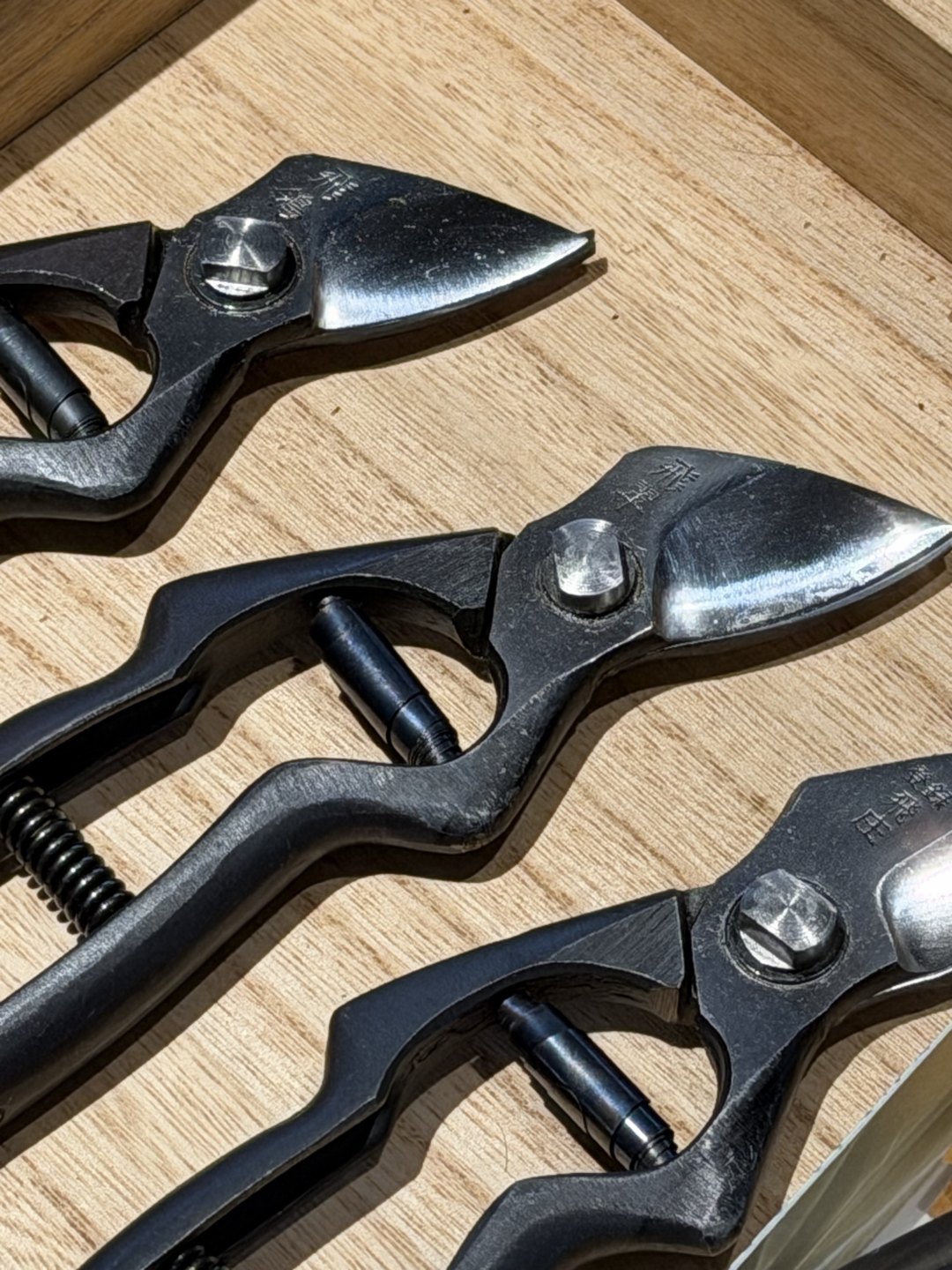
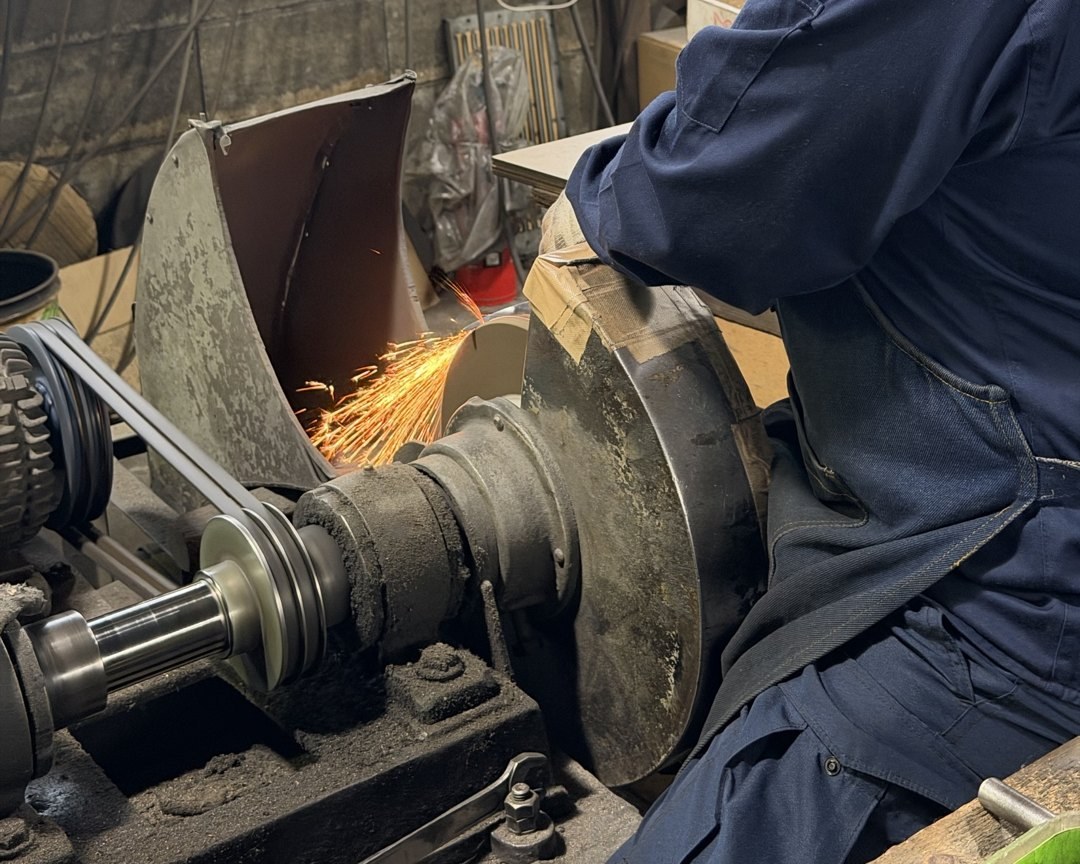
Tobisho, a shear workshop in Yamagata City, publishes its process. It says a pair passes through more than 200 steps, starting from two steel bars. Rough forging shapes a thin handle section at one end and a flat blade section at the other. Die forging at about 900 °C (1,650 °F) brings the shape close to final, and a pair of shears uses eight dies in total. Brazing, for the A-type only, fuses brass and a blade metal to the handle. The cutting and receiving blades are matched as a pair and marked with an aimon so they stay together. Heat treatment follows at about 800 °C (1,470 °F), then quenching and tempering. The back of the cutting blade is relieved into a three-dimensional curve (ura-suki, 裏スキ), the receiving blade is twisted, and the edge is shaped like a clam shell.
The company says brazing is labor-intensive and that only one or two makers in Japan still do it, itself included; that is the company’s own estimate, not an industry survey. Its brazed blades use Yasugi blue-paper steel (Yasugi aogami, 安来青紙鋼), chosen for wear resistance.
Bypass or anvil — what university research says
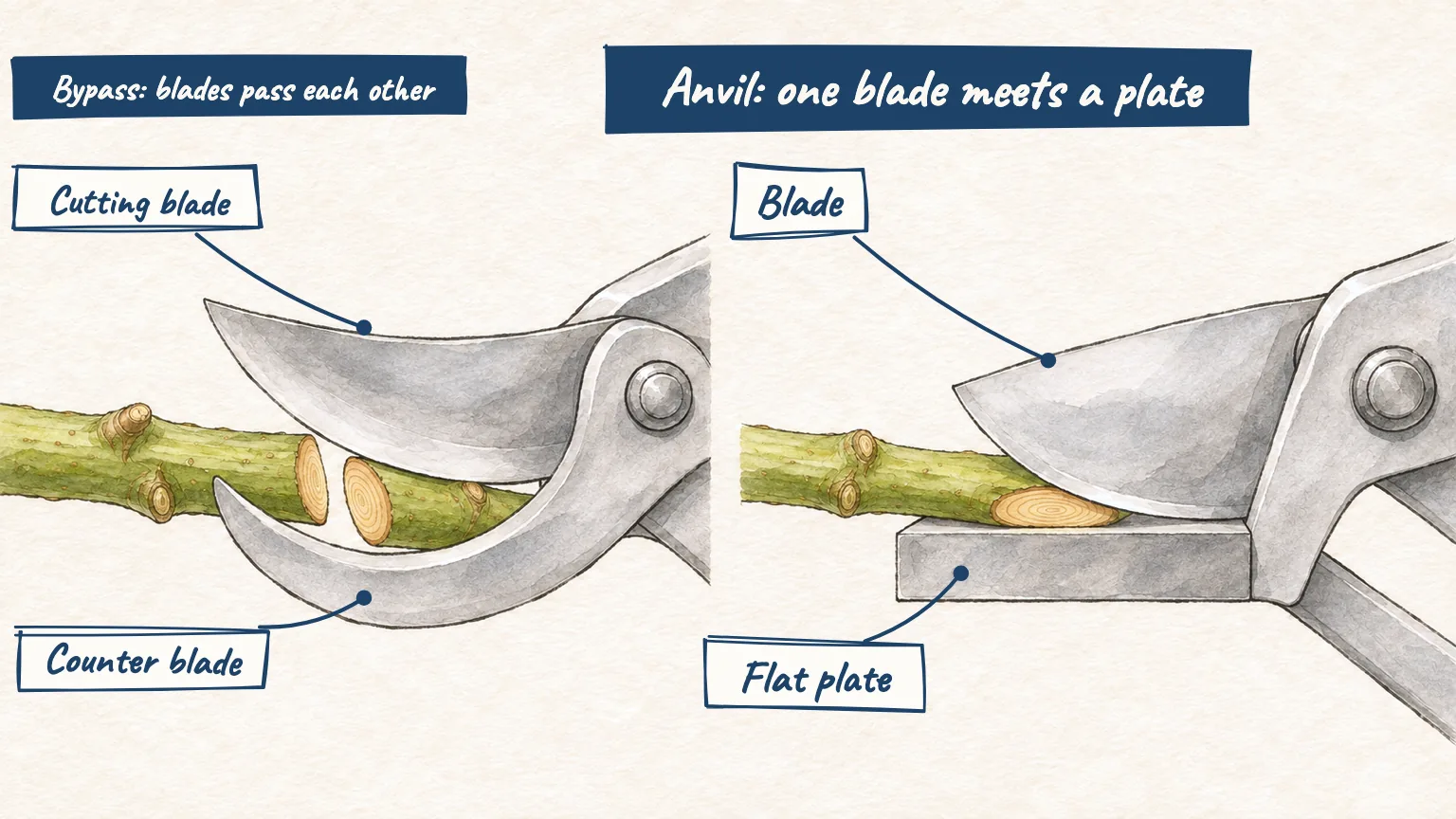
Most Western catalogs sell two pruner designs. A bypass pruner has two blades that pass each other. An anvil pruner has a single sharpened blade that closes against a flat plate. The Japanese senteibasami discussed here is the bypass kind, though anvil types exist, as the ARS pruning shears guide notes.
The standard advice
Extension services have long preferred bypass for live wood. Iowa State says bypass hand pruners are preferred over anvil types: sharp bypass pruners make close, clean cuts, while anvil types cannot cut as close and are more likely to crush stems. Anvil pruners work well on dead branches and are less likely to jam. The University of New Hampshire gives the same reason for avoiding anvils on living wood.
A test that found nothing
Researchers at the University of Florida (UF/IFAS) tested the advice. The Koeser lab compared anvil and bypass pruners in small and large sizes, making 60 small cuts on live oak (Quercus virginiana) branches up to half an inch (about 13 mm) thick. They checked the cuts shortly after pruning, several months later and at the end of the following growing season, then peeled the bark back and measured discoloration. The pruner type did not significantly affect internal or surface discoloration. Larger cuts showed a trend toward bark splitting and slower closure that narrowly missed statistical significance (P = 0.054). The authors summed it up: “we found nothing.”
How to read the result
Treat it as a narrow finding, not a reversal. The study used one species, and live oak is known for resisting decay. Some damage may take longer than one season to appear, and variation between individual cuts was high. Blade sharpness was not tested. What follows for a Japanese-shear buyer is modest. A well-set bypass pair remains the standard recommendation for live wood, and the difference between designs is probably smaller than the difference between a sharp blade and a dull one.
How thick is too thick — cutting limits
No shear should be asked to do a saw’s work. Published limits are guides for clean cuts in live wood, not targets.
What the published numbers say
| Source | Guide | Notes |
|---|---|---|
| Colorado State University Extension | Hand pruners: limbs up to ¼ to ½ in (about 6–13 mm), depending on wood hardness | Loppers up to about 2 in (50 mm); saws for branches larger than ½ in |
| Iowa State University Extension | Hand pruners up to ¾ in (about 19 mm) | Loppers ¾ to 1½ in (19–38 mm); larger cuts with hand pruners tear the wood and can damage the pruners |
| ARS 130DX (maker catalog) | 15 mm (about ⅝ in) on live wood | Official wording is a “guide for cutting” |
| ARS 140DX (maker catalog) | 9 mm (about ⅜ in) | A florist and garden shear, lighter than the 130DX |
The four figures do not agree, and they should not. They answer different questions. The extension numbers describe comfortable repeated cutting with ordinary tools; the maker’s number is a ceiling for a sharp, well-set pair. Read the smaller figure as your working range and the larger as the edge of what is safe for the tool.
Signs you have asked too much
If the blades start to twist, if the handle needs both hands and a lean, or if the bark tears instead of parting, change tools. Tobisho says the same about new shears: do not twist the blades while applying force. A crushed or torn cut closes more slowly than a clean one, so the wrong tool costs the tree as well as the blade.
Past the pruner — where a saw takes over
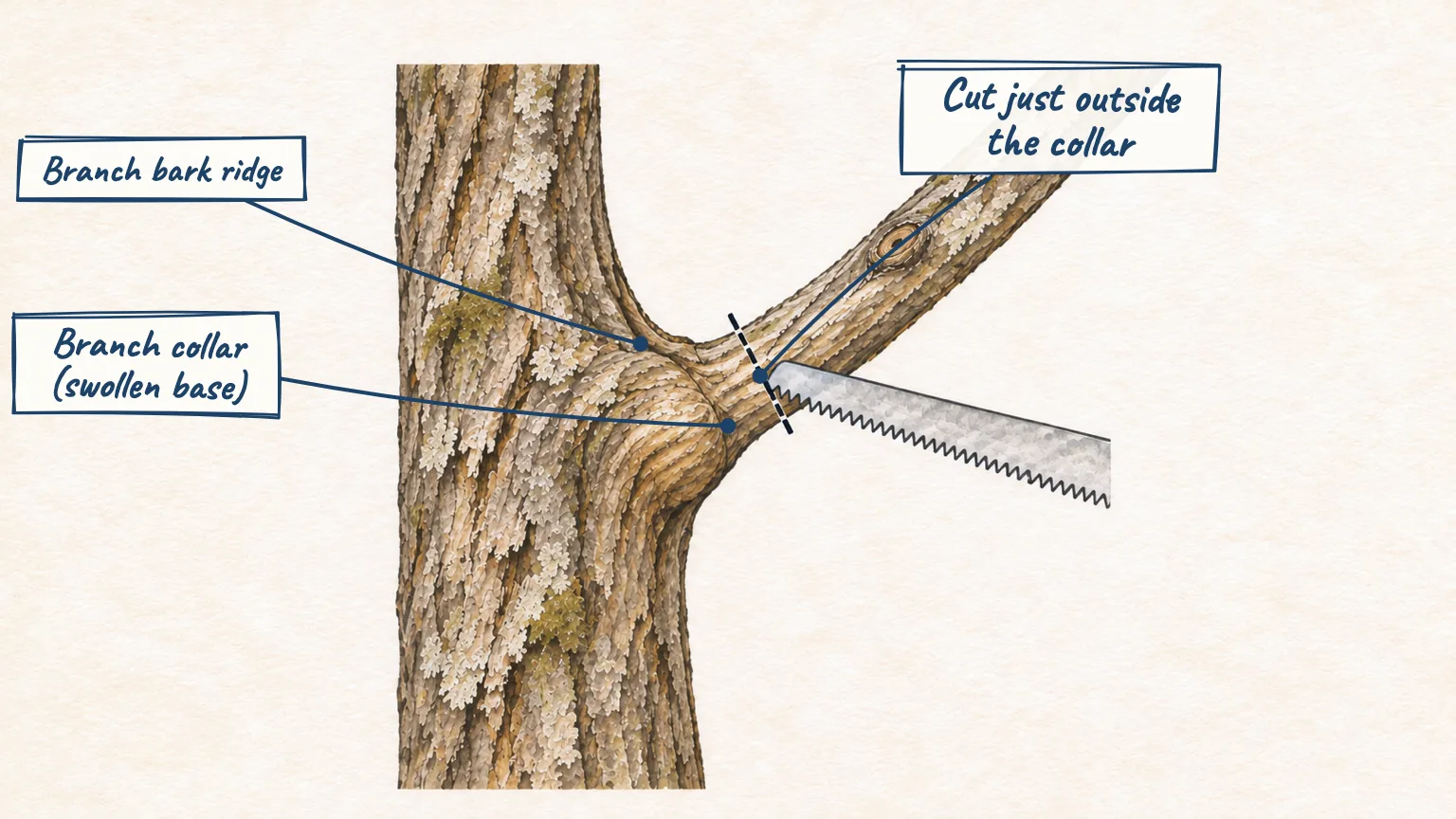
Colorado State recommends the three-cut method for any branch over 1 in (25 mm) in diameter, and notes that cuts over 4 in (100 mm) raise the decay risk and deserve careful thought. The same source says the final removal cut belongs just outside the branch collar, the swollen area at the base where branch and trunk tissue overlap; where no collar shows, follow the branch bark ridge. These rules are the reason a pruner is a tool for thin wood only.
Cutting with each tool — what to do in the field
Thinning and heading cuts
Colorado State separates two kinds of cut. A thinning (removal) cut takes a side branch back to its parent branch or the trunk; it reduces density and has little effect on height. A heading cut is made at a bud rather than at a branch union, removing the terminal bud and releasing lower buds, and the extension recommends avoiding it in most landscape situations. In Japanese practice, where the aim is often a designed outline, shaping cuts are deliberately different from these structural rules. For where that logic comes from, see Niwaki vs topiary: what Western gardens get wrong.
Hedge shears — leaves, not branches
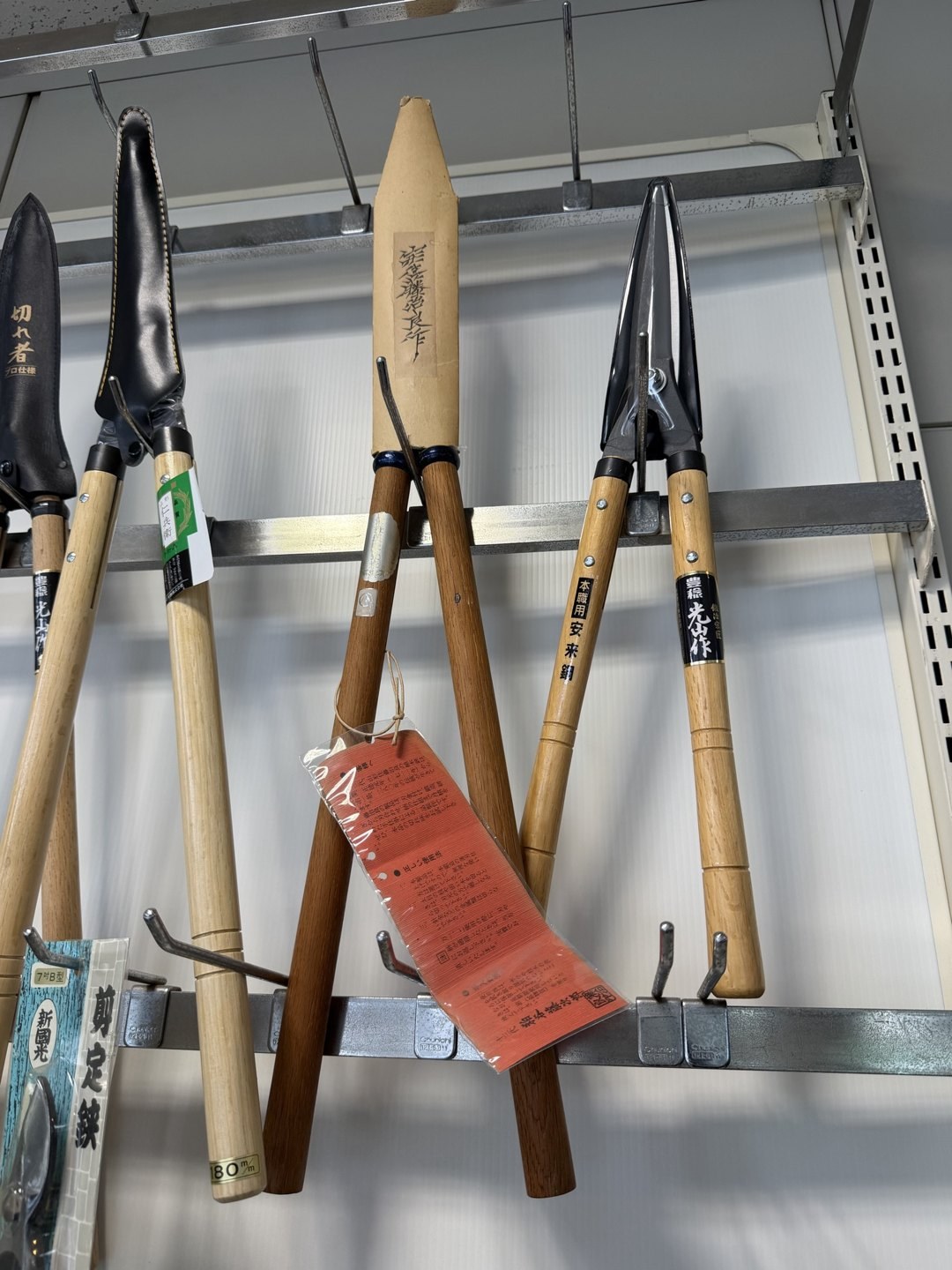
Tobisho’s karikomi range shows how specialised hedge shears are. The double-edged type (ryoba, 両刃) is for trimming leaves only: long blades, but lightened for extended use. The single-edged type (kataba, 片刃) is also long and light, and using the blade base lets you cut slightly thicker branches. A reverse-blade type (hanba, 反刃) has a curved blade for rounded surfaces, such as a chabohiba (dwarf hinoki cypress). There are also one-handed models and pine-needle shears (松葉切り鋏). Tobisho’s page gives no blade length figures, so I give none.
Pine — hands first, shears second
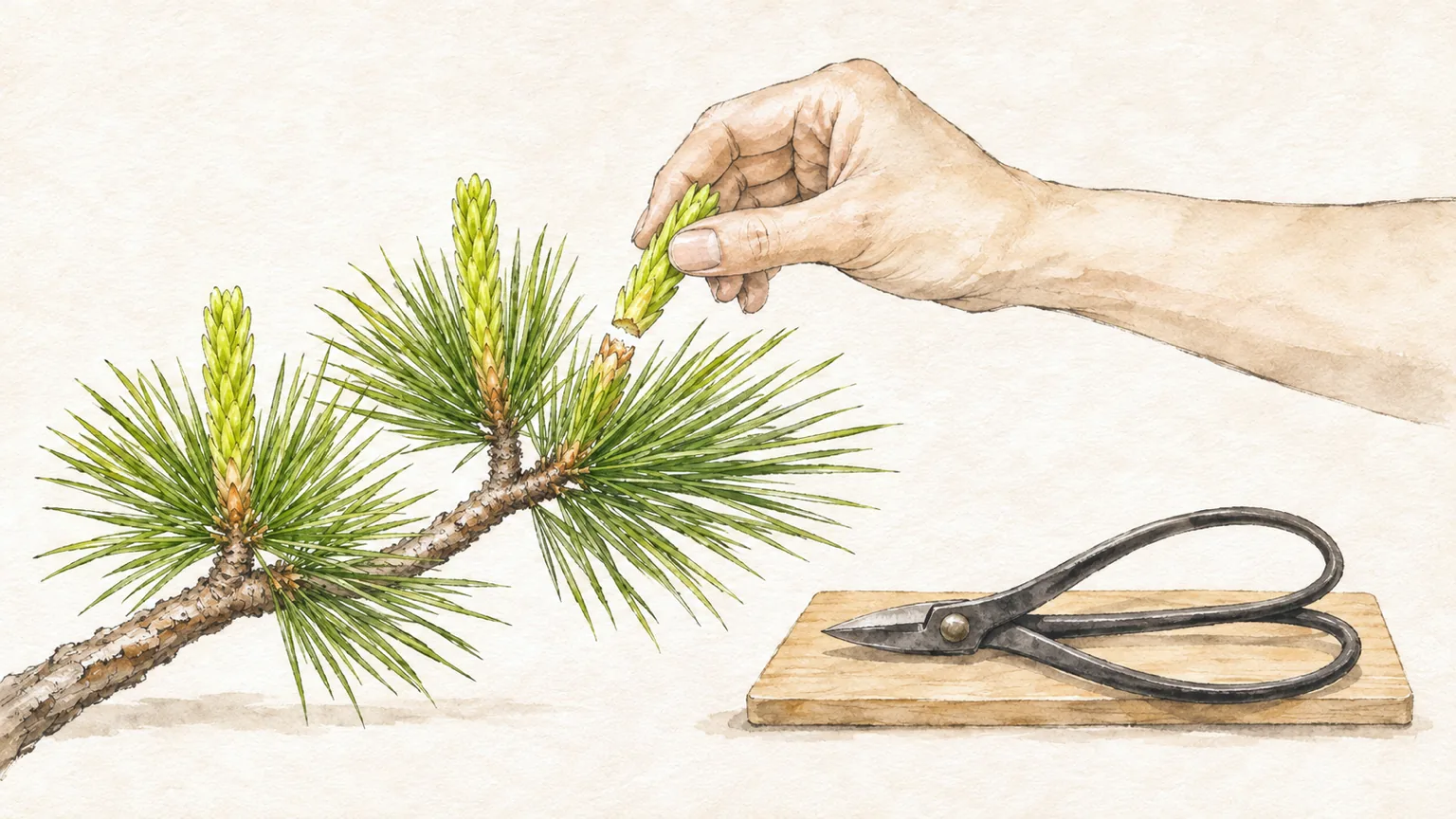
Pine work is its own case. The new spring shoots (candles) of a Japanese black pine are handled by hand in midori-tsumi (緑摘み) rather than cut; see Midori-tsumi: reading a pine tree’s future in its spring candles. Shears then do the later, selective work, and this is where the long-reach Tsushima pattern earns its place. Pine-needle shears are a separate, specialised tool.
Species and season — what you cut and when
Timing rules from extension services
Colorado State gives the general US timing: late winter before buds swell suits most trees, and spring to summer after leaves reach full size and darken is also acceptable. Species that bleed sap, such as birch, maple, walnut and willow, are better pruned after the spring growth flush. Fall and late fall to mid-winter are generally undesirable, and dead, diseased or damaged wood can come out at any time. On drought-stressed trees, the extension says not to remove live wood. These are American recommendations; I have not found a Japanese public source that gives a comparable table in the same form, so I do not invent one.
Matching the shear to the plant
The range Tobisho publishes is the plainest guide to matching tool and plant. A reverse-blade hedge shear for a rounded cypress, a pine-needle shear for needles, a bud-cutting shear (芽切鋏) listed among its repair categories, and a one-handed hedge shear all exist because a different plant or cut asked for them. The same logic runs through the regional patterns above: the Tsugaru type for apples, the Tsushima type for pine.
A practical order follows from this:
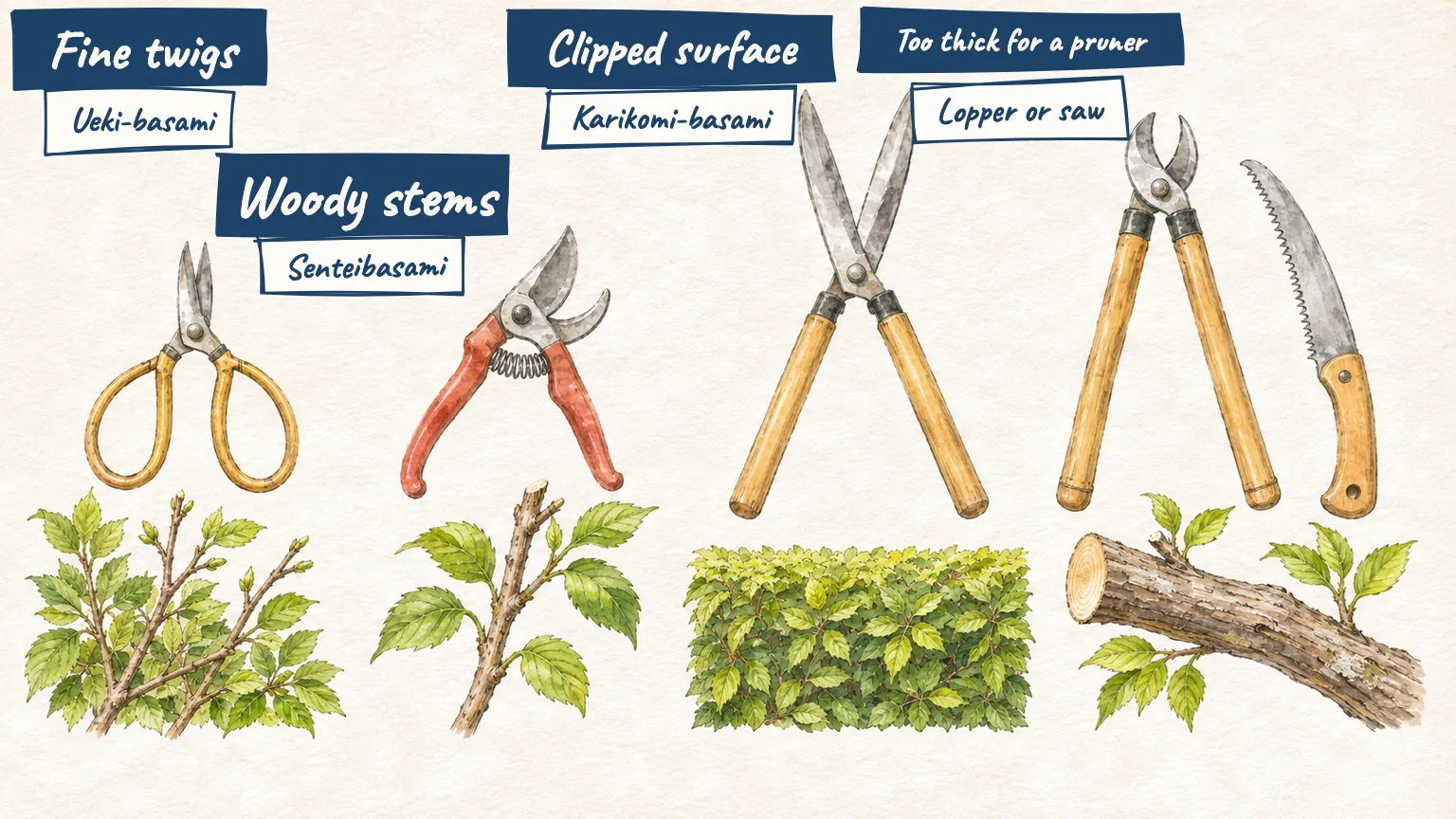
- Cutting small twigs inside dense growth? A ueki-basami, if you are willing to learn the hand motion. Nothing springs the blades open, so control is entirely yours.
- General pruning on woody stems well inside the stated limit? A bypass senteibasami. Pick a size that fits your hand, since a tool that is too large tires the wrist.
- Shaping a clipped surface? Karikomi-basami, chosen by blade type for leaves, thicker shoots or rounded forms.
- A branch that makes you lean on the handles? Stop, and reach for a lopper or a pruning saw.
Okatsune, ARS and Tobisho — what each maker publishes
These three names come up most often when buyers compare Japanese pruners. The table is limited to what the companies and public records say.
| Maker | Where | What is documented |
|---|---|---|
| ARS (アルスコーポレーション) | Sakai, Osaka | Founded 1876 (company profile). Catalog lists 130DX as high-carbon tool steel with a hard-chrome finish and a 15 mm cutting guide |
| Tobisho (飛庄, Tobisho Seihasami-jo) | Yamagata City, Yamagata Prefecture | Shear workshop founded 1930 by Shojiro Tobizuka; the family’s blade-smithing business dates to 1804 (Bunka 1), and the current head is the fourth generation of shear craftsmen. Brazed A-type uses Yasugi blue-paper steel |
| Okatsune (岡恒) | Innoshima, Onomichi, Hiroshima Prefecture | The company is registered there (government corporate registry). A local chamber of commerce lists the affiliated shear workshop as making shears since 1925 |
What the differences mean
Tobisho’s brazed A-type is a hand-joined blade-steel design in the traditional Japanese mold. ARS publishes catalog specifications for a range of hard-chrome-finished carbon-steel tools. For Okatsune, I could not find the maker’s own published steel grade or cutting capacity for its popular models, so I leave out the numbers that appear on retailer pages: those are retailer claims, not maker specifications. I do not rank the three. They are different workshops with different methods and catalogs, so compare the specific model, its stated cutting guide and how its blade is made.
Why steel type affects your routine
Both ARS (high-carbon tool steel) and Tobisho (Yasugi steel) name steels that rust when left wet. That is the bridge to the next section: a carbon-steel pair is only as good as its care.
Daily care — wipe, oil and sharpen with a plan
The one maker page that gives a care routine is Tobisho’s. Treat it as one workshop’s advice for its own shears, and check your own maker’s instructions for other brands.
New shears and the first week
New blades are sharp but can chip when they bite into wood. Tobisho says to break them in on the thinnest branches first. For thick branches, angle the blade about 45°, insert it slowly and rotate gently, press straight down and do not twist the blades while applying force.
After each day’s work
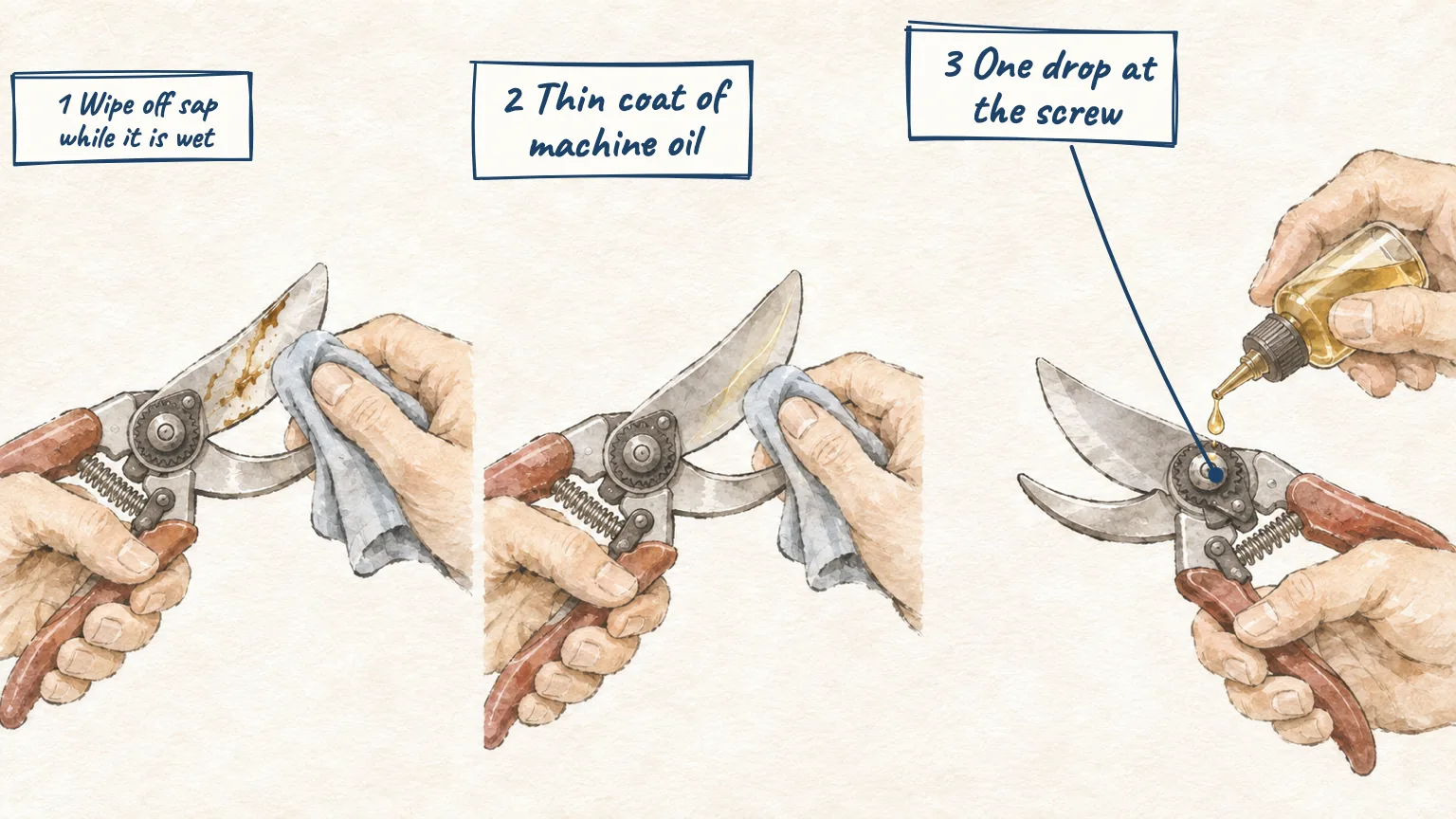
Tobisho gives three steps. Wipe the blades with a firm cloth while sap (resin) is still wet. Apply a thin coat of machine oil or rust preventive. Put one drop of oil at the screw, the inner sliding surface, to keep the edge sharp longer. If resin has already hardened, scrape it off with a hard plastic tool shaped like a ruler. Two things to avoid: do not use a whetstone to remove hardened resin, because it grinds away the blade, and do not use edible oil, because it promotes oxidation.
Sharpening and sending a pair back
Colorado State says to sharpen only the bevelled edge of a bypass blade, never the flat side. Tobisho runs a resharpening and repair service that accepts other makers’ shears too; turnaround is usually about two weeks, longer in the busy season from November to March, and hedge shears take longer. Its pages list replaceable parts (springs, screw, leather holder, color grips), so a worn pair is not necessarily a finished pair. I give no prices because they change; see the Tobisho maintenance page for current figures.
Choosing a pair — mistakes buyers make
Common misconceptions
Four mistakes recur. The first is assuming that “A-type” tells you how a pair is made; it often describes only a shape now. The second is trusting one maker’s cutting figure as a rule for all pairs; ARS’s 15 mm is a guide for its model on live wood, not a universal number. The third is buying one pair for every job; hedge shears are the wrong tool for selecting a branch, and a spring pruner is the wrong tool for a clipped surface. The fourth is treating a retailer’s description as the maker’s specification.
A short checklist before you buy
Check which of the three tools the job needs, the maker’s stated cutting guide for the model, how the blade is made (brazed or forged) as described by the maker, whether springs and screws can be replaced, and whether the maker offers resharpening. Those five questions separate a tool you can keep for years from one you replace.
Frequently asked questions
**What is the difference between ueki-basami and senteibasami?** The ueki-basami has no spring, large loop handles, and is operated entirely by hand. The senteibasami is a spring-loaded bypass pruner that came to Japan from European fruit pruning in the Meiji era.
Does “A-type” mean a better pair? No. A-type means a hard blade brazed to a softer body, B-type means one-piece forging, and today the label often describes shape rather than construction. Read the maker’s description of the actual pair.
Are bypass pruners really better than anvil pruners? Extension services recommend bypass for live wood, mainly because anvil types crush stems. A University of Florida test on live oak found no significant difference on small cuts, but it covered one species and about one season. Use bypass for live wood and treat anvil as reasonable for dead wood.
How thick a branch can Japanese shears cut? For a hand pruner, extension guidance runs from about ¼ to ¾ in (6–19 mm), and ARS’s catalog guide for the 130DX is 15 mm. Treat these as clean-cut guides, and switch to a lopper or saw when you need to lean on the handles.
How do I stop my shears rusting? Wipe off sap while it is wet, apply a thin coat of machine oil or rust preventive, and put one drop at the screw. Tobisho advises against edible oil and against using a whetstone to remove hardened resin.
Are Okatsune, ARS and Tobisho interchangeable? Not exactly. They come from different workshops with different construction methods and catalogs. Compare the specific model, its stated cutting guide and how its blade is made, rather than the brand alone.
Sources
Checked on 2026-10-29. Where the page text was unavailable on this date (ARS catalog and pruning guide), the figures come from the earlier check on 2026-10-23.
– Colorado State University Extension, “Pruning Cuts” — https://extension.colostate.edu/resource/pruning-cuts/ – Iowa State University Extension, “Guide to Pruning Equipment” — https://yardandgarden.extension.iastate.edu/how-to/guide-pruning-equipment – University of Florida IFAS Extension, Hillsborough County, “Anvil vs. Bypass: The Conclusion” — https://blogs.ifas.ufl.edu/hillsboroughco/2026/07/02/anvil-vs-bypass-the-conclusion/ – University of New Hampshire Extension, “The Basics of Pruning Trees and Shrubs” — https://extension.unh.edu/resource/basics-pruning-trees-and-shrubs-fact-sheet – Toyama Hamono, explanation of A-type and B-type pruning shears and ueki-basami — https://www.toyamahamono.com/post/剪定鋏の「a型」「b型」とはなにか。 – Tobisho, company history — https://www.tobisho.jp/about – Tobisho, brazed A-type description — https://www.tobisho.jp/commentary – Tobisho, manufacturing process — https://www.tobisho.jp/process/ – Tobisho, maintenance and repair — https://www.tobisho.jp/maintenance/ – Tobisho, karikomi shears — https://www.tobisho.jp/feature/karikomi – Tobisho, product list (steel and length) — https://shop.tobisho.jp/collections/all – ARS Corporation, company profile — https://www.ars-edge.co.jp/company/outline.html – ARS Corporation, general catalog — https://www.ars-edge.co.jp/catalog/ARS_CATALOG.pdf – ARS Corporation, pruning shears guide — https://www.ars-edge.co.jp/contents/productguid-senteibasami/ – Sanjo Kogyokai (Sanjo industry association), shears — https://www.sanjo-kogyokai.or.jp/technology/hasami – gBizINFO (Japanese government corporate registry), Okatsune — https://info.gbiz.go.jp/hojin/ichiran?hojinBango=3240001037948 – Innoshima Chamber of Commerce, member profile — https://cci.in-no-shima.jp/members/okatune.html