

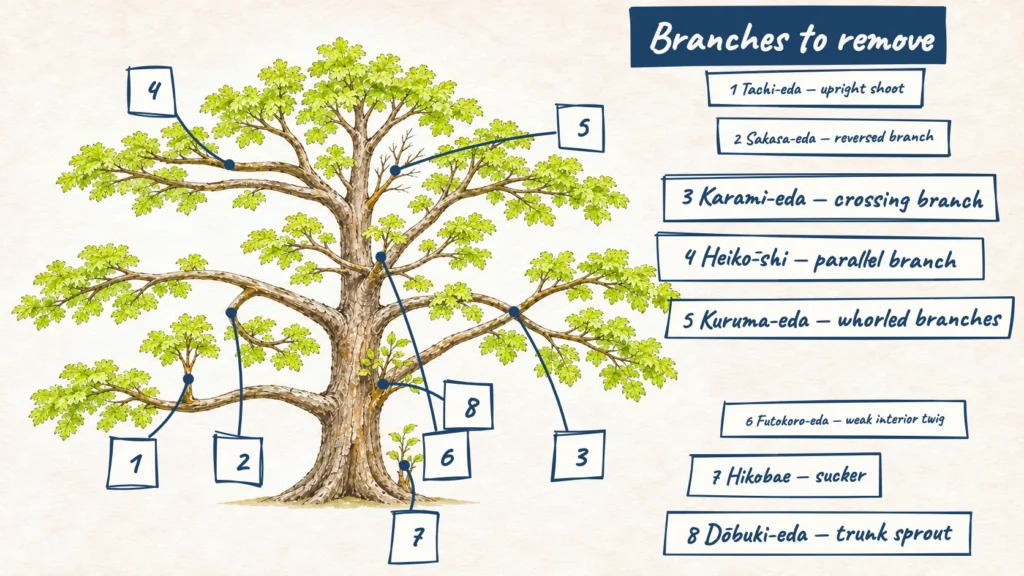
Which branches to prune? Start with the list every arboriculture guide shares: dead, diseased and damaged branches; branches that cross and rub; weak, narrow V-shaped unions; and stems competing with the main leader. Water sprouts and suckers usually follow. Japanese gardeners carry a longer, named list called imi-eda (忌み枝, roughly “branches to be avoided”), which adds faults of direction and position — upright shoots, branches turning back toward the trunk, stacked pairs, whorls and weak interior twigs. On both lists the branch is a candidate, not an automatic cut.
This article answers one question: which branches come off, why, how to recognise each one, and when the right decision is to leave it. It sets out the shared list with its sources, tests what research says about weak unions, names each imi-eda with its closest English term, and ends with the order of work and the mistakes that turn a good list into bad pruning.
Prefer to watch? The video version:
The short list every guide agrees on — dead, crossing, weak, competing
The International Society of Arboriculture’s (ISA) brochure on pruning mature trees opens with a principle that frames everything else: because each cut can change how the tree grows, no branch should be removed without a reason. The usual reasons fall into a short list. The ANSI A300 pruning standard, as summarised by the Tree Care Industry Association, frames the same idea as objectives — managing risk, managing health, developing structure, improving aesthetics — so a cut is judged by which objective it serves.
Dead, dying, diseased and damaged wood
The ISA calls this cleaning: removing dead, dying, diseased, weakly attached and low-vigor branches from the crown. The University of Maryland Extension adds that damaged, diseased and dead branches can be removed at any time of year. In Japan the same class is kare-eda (枯れ枝), and it is the one category nobody argues about.
Crossing and rubbing branches
The USDA Forest Service guide How to Prune Trees says branches that rub or cross another branch should be removed. Rubbing wears through bark and opens a wound. Where two branches cross, remove the one that is weaker, badly placed or growing toward the centre; the other usually needs no cut.
Weak unions and competing leaders
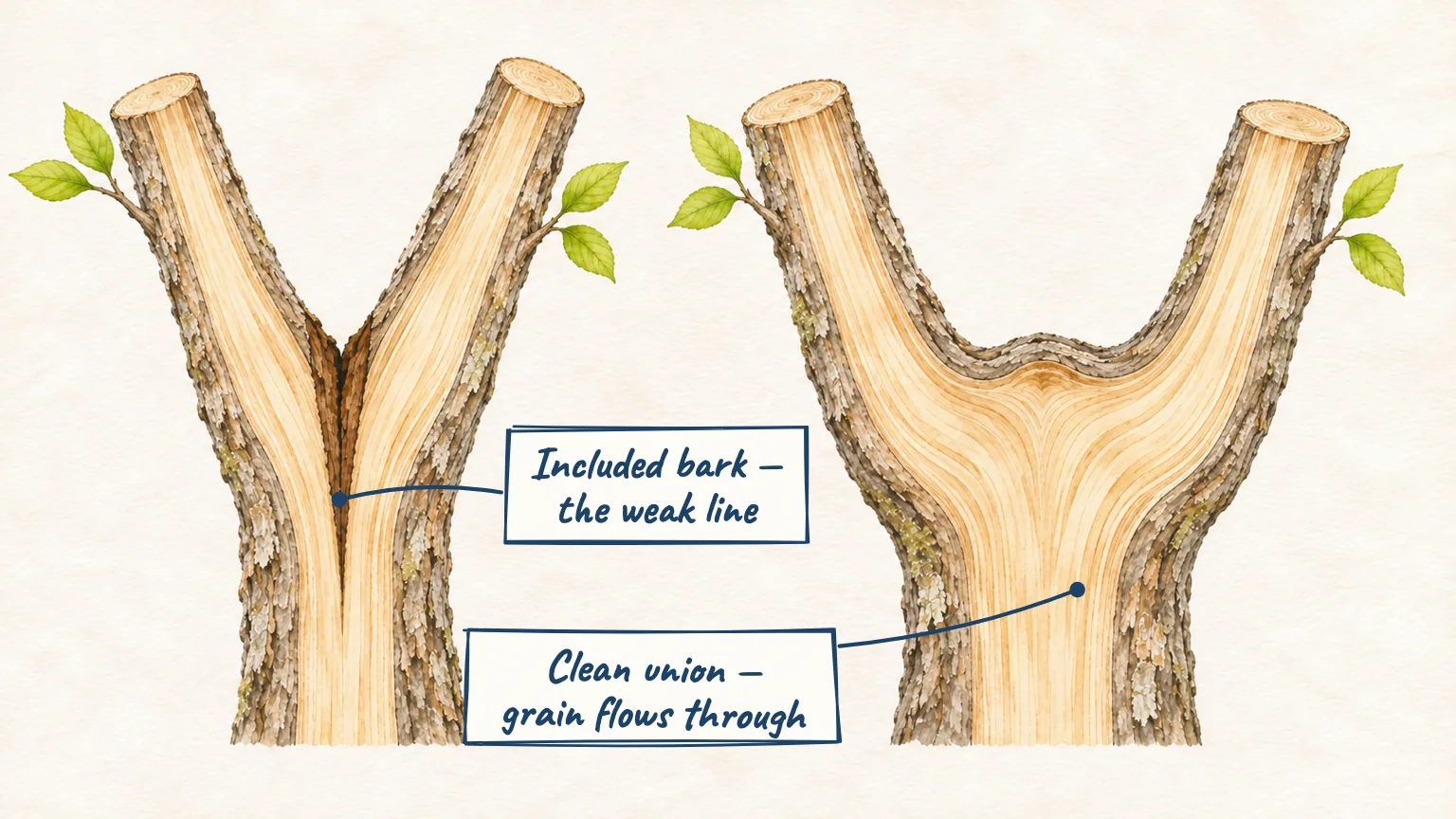
The same guide explains that branches attached at sharply acute angles often form included bark — a wedge of bark rolled inward between them — which prevents a strong attachment and often leads to a crack below the union. Codominant stems of similar size from one point often form included bark too. The USDA notes that removing some laterals from one of them can slow it enough for the other to become dominant. It also recommends that laterals be no more than one-half to three-quarters of the diameter of the stem where they attach.
Weak unions under test — what research says about included bark
“Narrow V-shaped unions are weak” is repeated so often that it is worth checking how well it holds. Three studies, on four species, give a more careful picture.
Red maple — Smiley (2003)
E. Thomas Smiley tested 84 codominant stems from 26 felled red maples (Acer rubrum), pulling each union with a winch until it broke. Stem diameters ran from 4.9 to 23.4 cm (about 2 to 9 inches), and the paper gives example values calculated from its fitted results. Unions with included bark broke at lower force than unions without it. In the paper’s example values, a 10 cm (4 in) stem with included bark broke at a load of 392 kg against 484 kg without — almost 20 per cent weaker — while at 25 cm (10 in), slightly beyond the tested range, the calculated gap was about 14 per cent. The difference was proportionally larger in smaller stems. Smiley’s conclusion was cautious and practical: because the reduction is still notable in larger stems, treat all codominant junctions as weak.
Hazel — Slater and Ennos (2015)
Duncan Slater and Roland Ennos tested 241 forks of coppice hazel (Corylus avellana), three to eight years old, 106 of them with bark inclusions. Overall, bark-included forks were 24.3 per cent weaker than normal ones. But the amount mattered less than the form: forks where the bark was largely embedded in wood did not differ significantly from normal forks, and cup-shaped forks were about 36 per cent stronger than those with the bark sitting right at the apex. The authors’ reading is that the more the bark is occluded by new wood, the less of a defect it is. They also cautioned that the study covered one species and only juvenile wood.
European beech and sycamore maple — Rust (2023)
Steffen Rust pulled apart 94 branch unions from European beech and sycamore maple (Forests 14:1041, as summarised by the University of Florida IFAS Extension). He found no difference in breaking strength between V-shaped and U-shaped forks in either species, and included bark had mixed or limited effects. The most worrying finding was hidden cracks discovered after testing. His suggestion is that visible fork shape and angle may not reliably predict structural weakness.
What to take from the three
| Study | Material | What it found | What limits it |
|---|---|---|---|
| Smiley 2003 | 84 codominant stems, red maple | Included bark made unions weaker, more so in small stems | One species; stems pulled to failure |
| Slater and Ennos 2015 | 241 forks, hazel | Embedded bark close to normal; bark at the apex weakest | Juvenile coppice wood only |
| Rust 2023 | 94 unions, beech and sycamore maple | No V-versus-U difference; hidden cracks mattered | Mixed effect of included bark by species |
The studies do not agree on how weak, but they point the same way for practice. Included bark is a reason to look hard at a union, not a verdict; a crack, a bulge or a wedge that is open at the top is more informative than the angle alone. For a pruner this supports the Western habit of correcting codominant stems while they are small, and the Japanese habit of reading each branch where it joins.
Imi-eda — the Japanese names, with their English equivalents
Japanese garden training goes further than the shared list, because a garden tree is also a composition seen from fixed viewpoints. Apprentices learn a named vocabulary of branch faults, and each name describes a direction, a position or a kind of growth.
The eight common faults
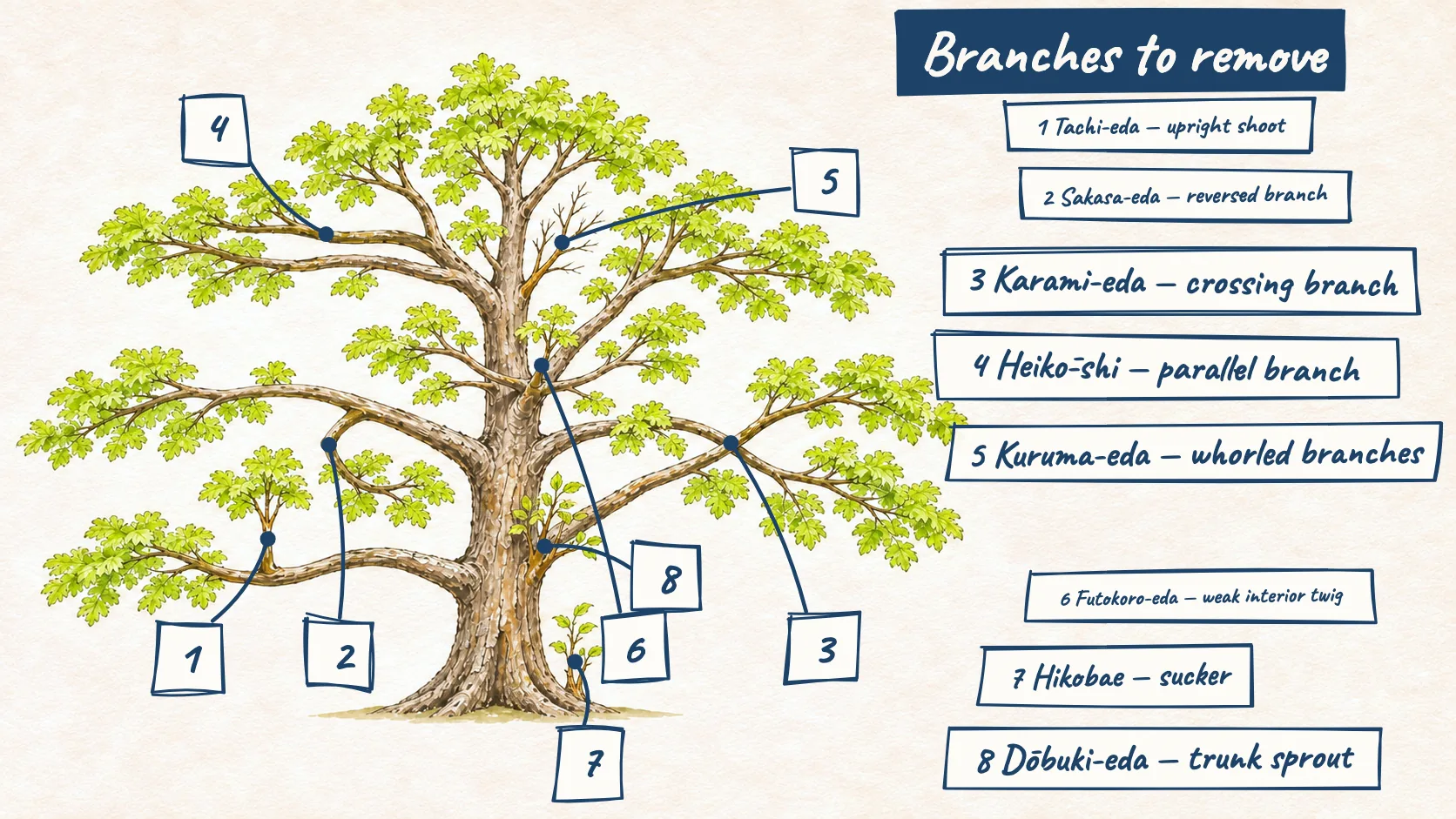
The diagram above numbers the eight most common. The table gives each with its closest English term.
| No. | Japanese term | What it looks like | Closest English term |
|---|---|---|---|
| 1 | Tachi-eda (立ち枝) — upright branch | Rises vertically from the top of a horizontal limb | Vertical shoot; often a water sprout |
| 2 | Sakasa-eda (逆さ枝) — reversed branch | Grows back in toward the trunk, into the crown’s interior | No standard name; “branch growing toward the centre” |
| 3 | Karami-eda (絡み枝) — tangled branch | Crosses another branch, often touching it | Crossing or rubbing branch |
| 4 | Heikō-shi (平行枝) — parallel branch | Two branches stacked one above the other, running the same way | No standard name |
| 5 | Kuruma-eda (車枝) — wheel branches | Several shoots radiating like spokes from one point | Whorled or clustered branches |
| 6 | Futokoro-eda (懐枝) — “bosom” branch | Thin, weak twig deep inside the crown | Interior shoot |
| 7 | Hikobae (蘖) — sucker | Shoots rising from the root collar or shallow roots | Sucker, basal sprout |
| 8 | Dōbuki-eda (胴吹き枝) — trunk sprout | Small shoots bursting straight out of the trunk | Epicormic shoot, water sprout on the trunk |
Two more that travel with the list
Kare-eda (枯れ枝), dead branches, and tochō-shi (徒長枝), the long, soft, vigorous shoot that grows far beyond its neighbours — the closest match to a water sprout on a branch — belong with the eight. A branch that simply hangs downward has its own name, sagari-eda (下がり枝), and is not always a fault: Saitama Prefecture’s street-tree manual suggests keeping one from an upper limb to fill an empty space.
Where the two lists overlap
The overlap is large. Karami-eda, hikobae and dōbuki-eda are the crossing branches, suckers and epicormic shoots of any English guide, and kare-eda is cleaning. The Japanese list adds names where English has only a description, especially for sakasa-eda and heikō-shi. A name is useful because it carries a judgment: say “sakasa-eda” and the listener already knows which way it points and why it is in the way.
Reading each imi-eda — direction, position and the usual cut
A name is only a starting point. Each type fails in a different way, and the usual action depends on that failure.
Tachi-eda and tochō-shi — upright growth
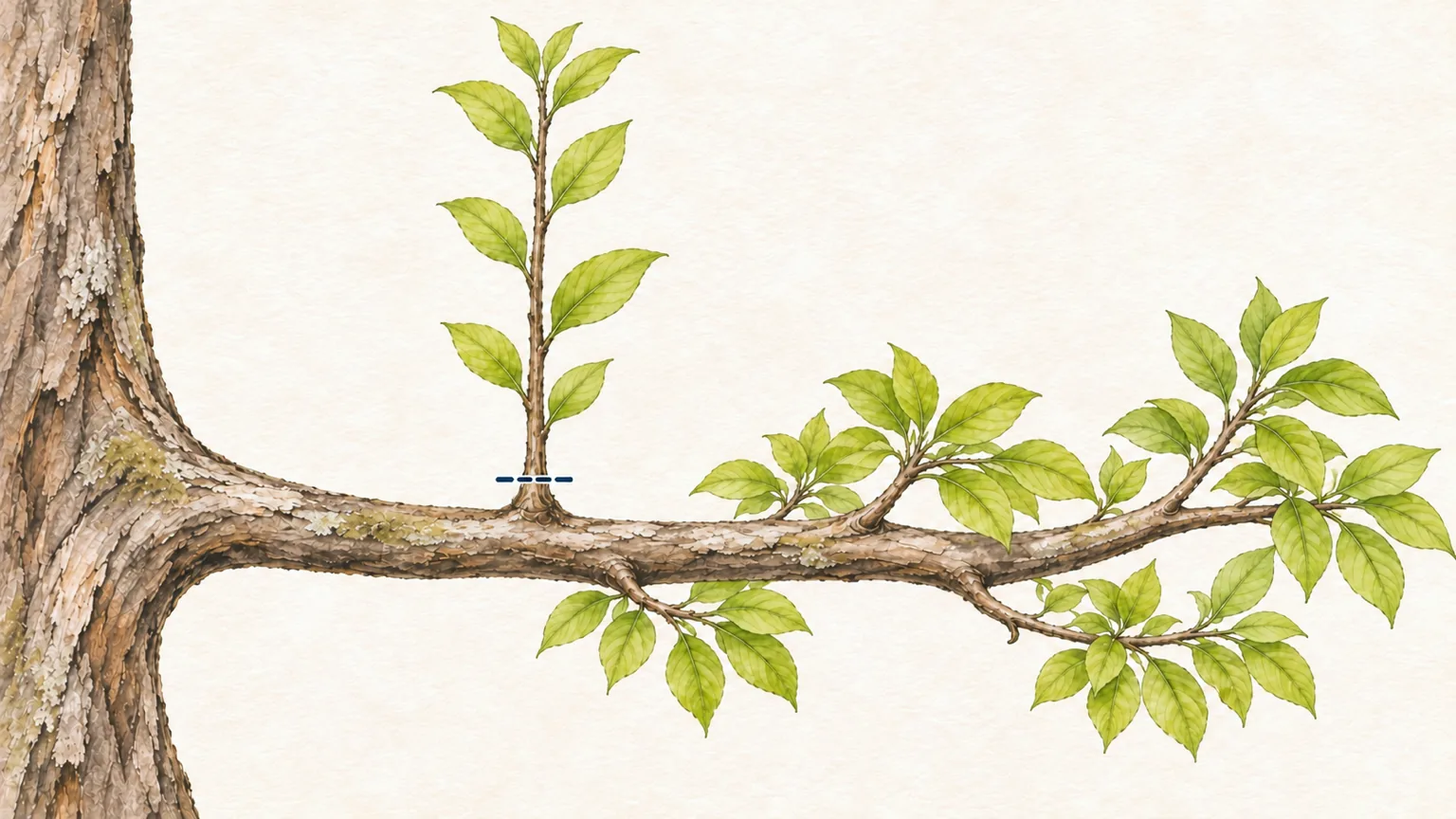
A tachi-eda rises straight from the top of a horizontal limb. It is vigorous, it grows into the layer above, and it competes with the limb it sits on. The tochō-shi is the same idea on a different scale: a long, soft shoot that has outrun its neighbours. Gardeners usually cut both back to their origin; the exception is a shoot that is filling a gap (see the section on keeping branches).
Sakasa-eda and karami-eda — branches in the wrong place
A sakasa-eda heads back toward the trunk, into the space the outward-growing branches will need. Remove it at its origin. A karami-eda crosses another branch; the choice is which of the pair to take, and the answer follows the same logic as the Western crossing branch — the weaker or worse-placed one.
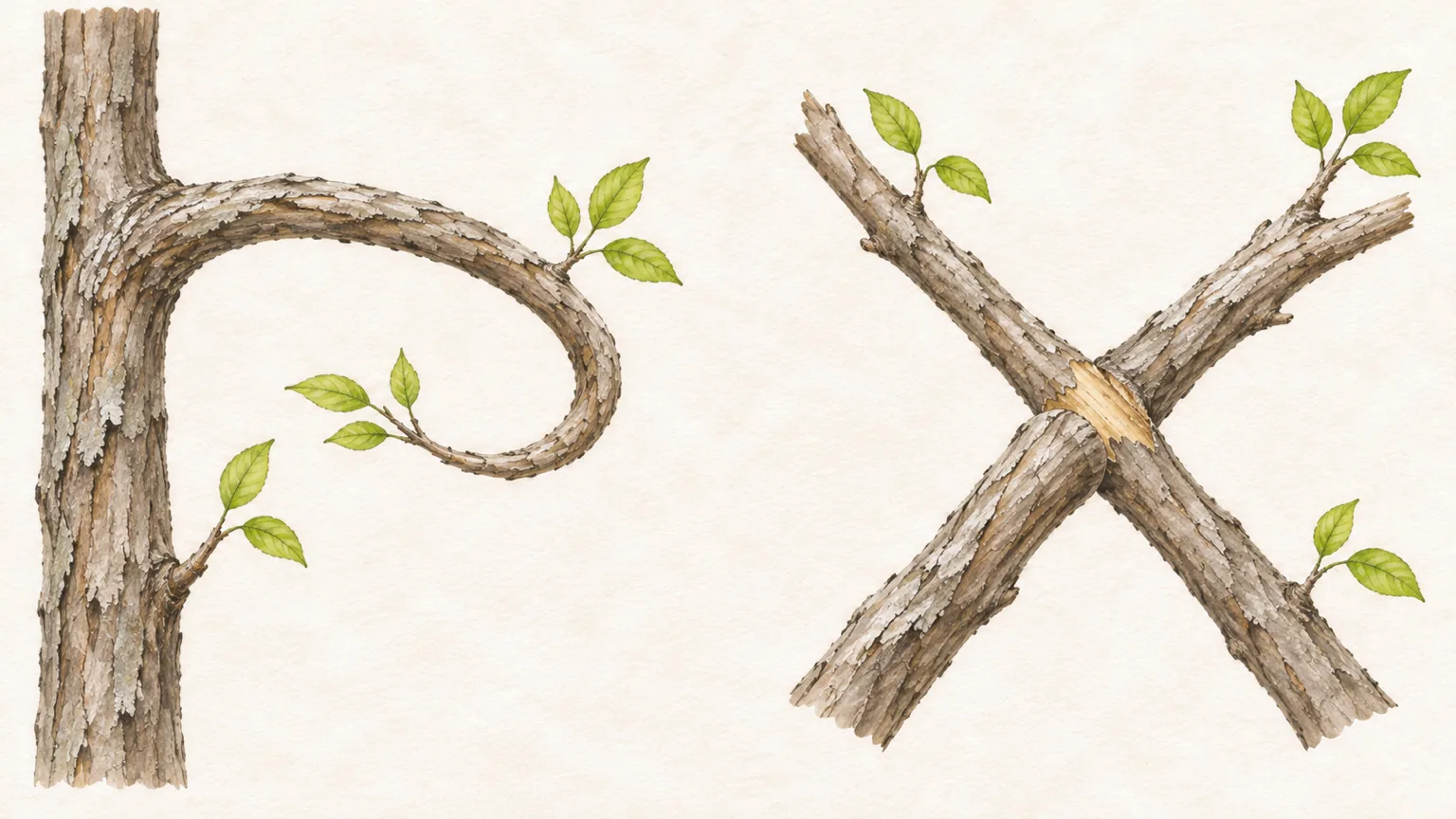
Heikō-shi and kuruma-eda — two stacked, many at once
Heikō-shi are two branches stacked one above the other and running the same way. They read as one heavy line instead of two, and the lower one is shaded by the upper. Kuruma-eda crowd several unions into one point on the stem, where they thicken into a knot.
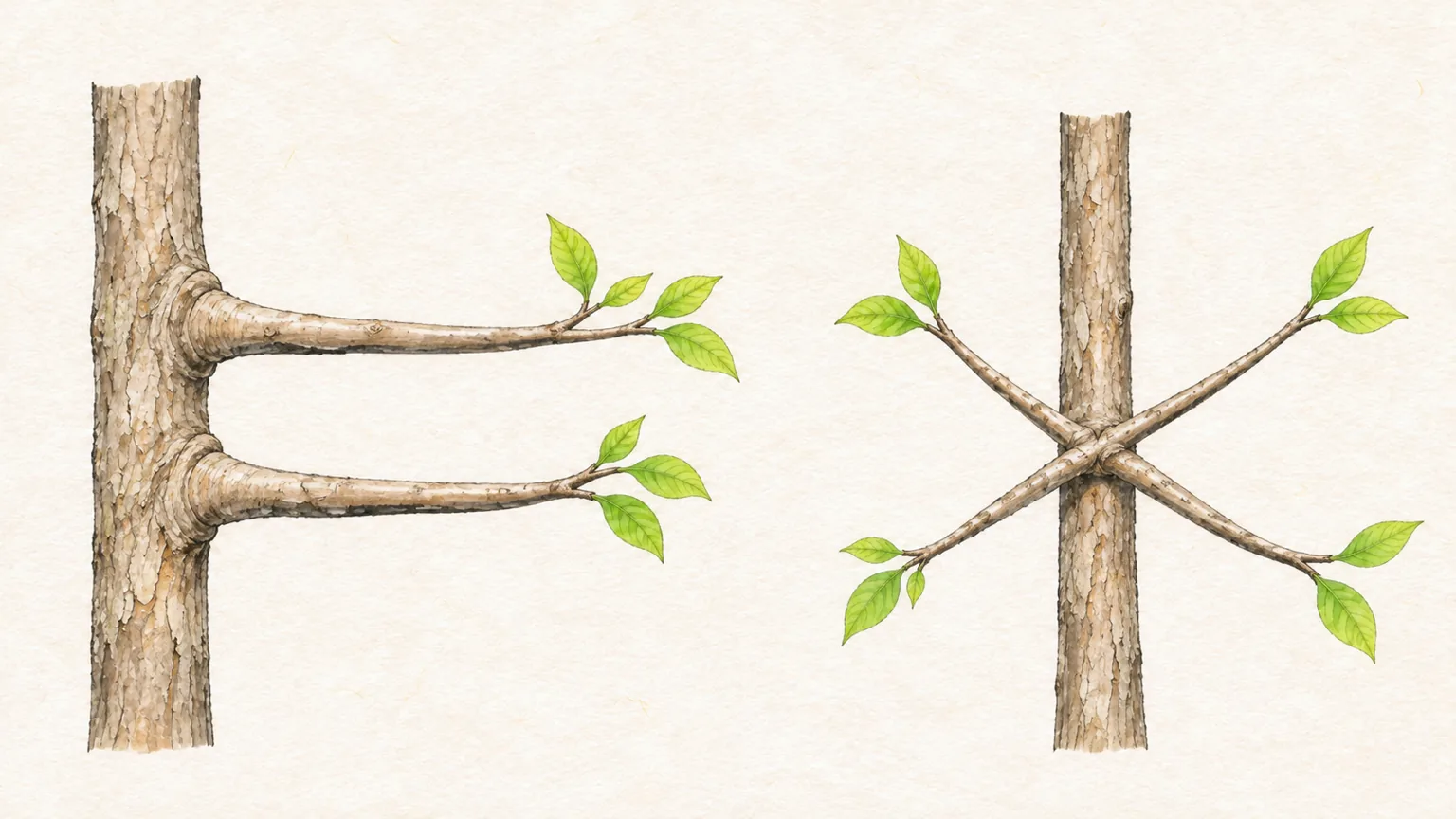
Futokoro-eda — the weak twig inside
A futokoro-eda is thin and weak, deep in the crown near the trunk. It contributes little and is usually thinned. It is also the category most easily overdone, as the section on lion’s tails explains.
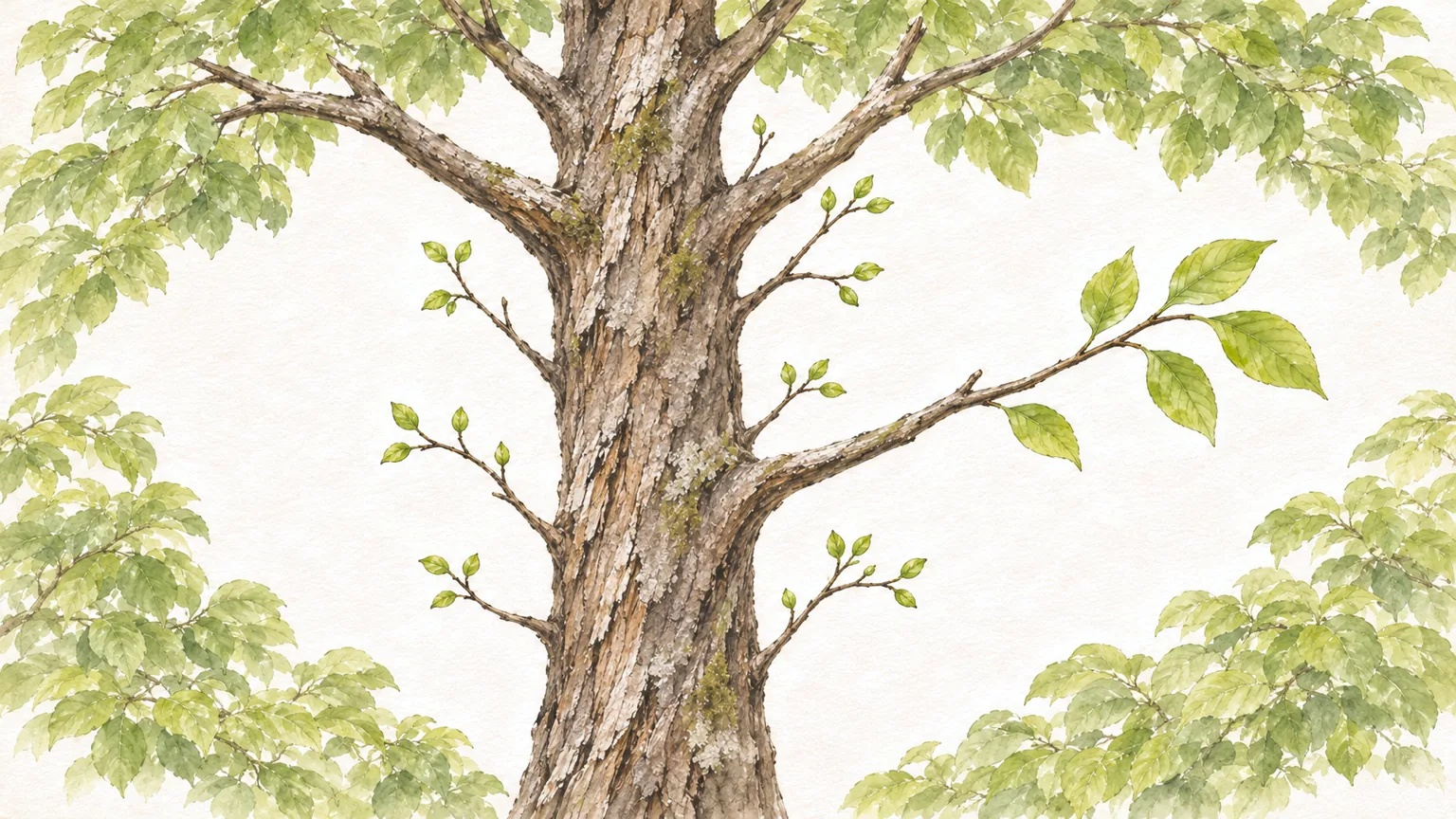
The usual action for each
| Imi-eda | Why it is a fault | Usual action | When it can stay |
|---|---|---|---|
| Tachi-eda | Grows into the layer above | Cut at origin | Fills a gap in a sparse area |
| Sakasa-eda | Grows into the crown | Cut at origin | Rarely |
| Karami-eda | Crosses and rubs | Cut the weaker of the pair | If they do not touch |
| Heikō-shi | Reads as one heavy line, shades the lower | Keep the better, cut the other | Neither, if both are needed |
| Kuruma-eda | Many unions at one point | Thin to one or two | One or two best-placed shoots |
| Futokoro-eda | Weak, adds little | Thin | If it points outward |
Why the extra names exist — layers, light and composition
A Japanese garden tree is usually built as a series of horizontal layers with open space between them. Several imi-eda are faults only in relation to that design.
Layers and open space
– Tachi-eda and heikō-shi fill the gaps that make the layers readable. An upright shoot on a horizontal limb grows into the layer above; a stacked pair reads as one heavy line instead of two. – Sakasa-eda heads back into the crown, into space the tree’s outward-growing branches will need. – Kuruma-eda crowds several unions into one point on the stem, where they thicken into a knot.
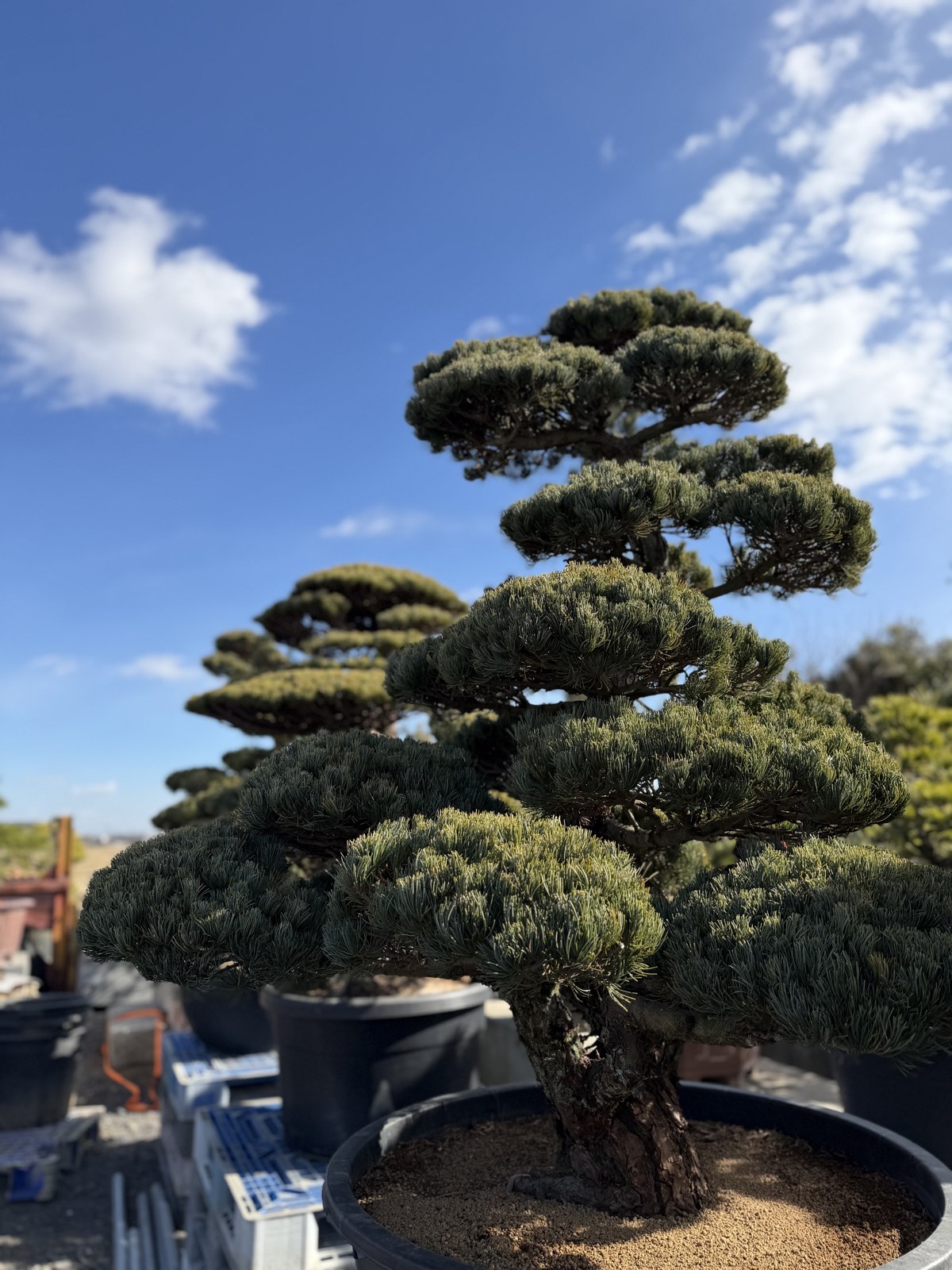
Light and wind
Branches that grow inward or stack on top of each other put leaves where they shade other leaves. Thinning them lets light reach buds deeper in the crown, which keeps foliage growing close to the trunk — essential for a tree that has to hold one size for decades, as with karikomi (刈込), Japanese cloud pruning. An open crown also lets wind through rather than catching it, the principle behind Japan’s typhoon-proofing pruning.
Selection against shearing
Imi-eda removal works branch by branch, choosing what stays; shearing cuts to a surface and ignores individual branches. How this layered structure differs from topiary is discussed in Niwaki vs Topiary. The Western A300 objective “improve aesthetics” and the Japanese composition rules are close cousins: both accept that a cut can be justified by how the tree will look, provided the structure is not harmed.
Sprouts and suckers — what they say about the last pruning
Water sprouts, trunk sprouts and suckers are rarely random.
Why sprouts appear
The USDA notes that topping and tipping invariably result in epicormic sprouts, which are weakly attached to the stem. The Royal Horticultural Society (RHS) explains the mechanism for fruit trees: excessive pruning stresses the tree, which then strives to restore the balance between its roots and the top growth it can support, and heavy pruning — especially more than 25 per cent of the canopy in one go — produces many vigorous upright shoots.
Water sprouts and dōbuki-eda
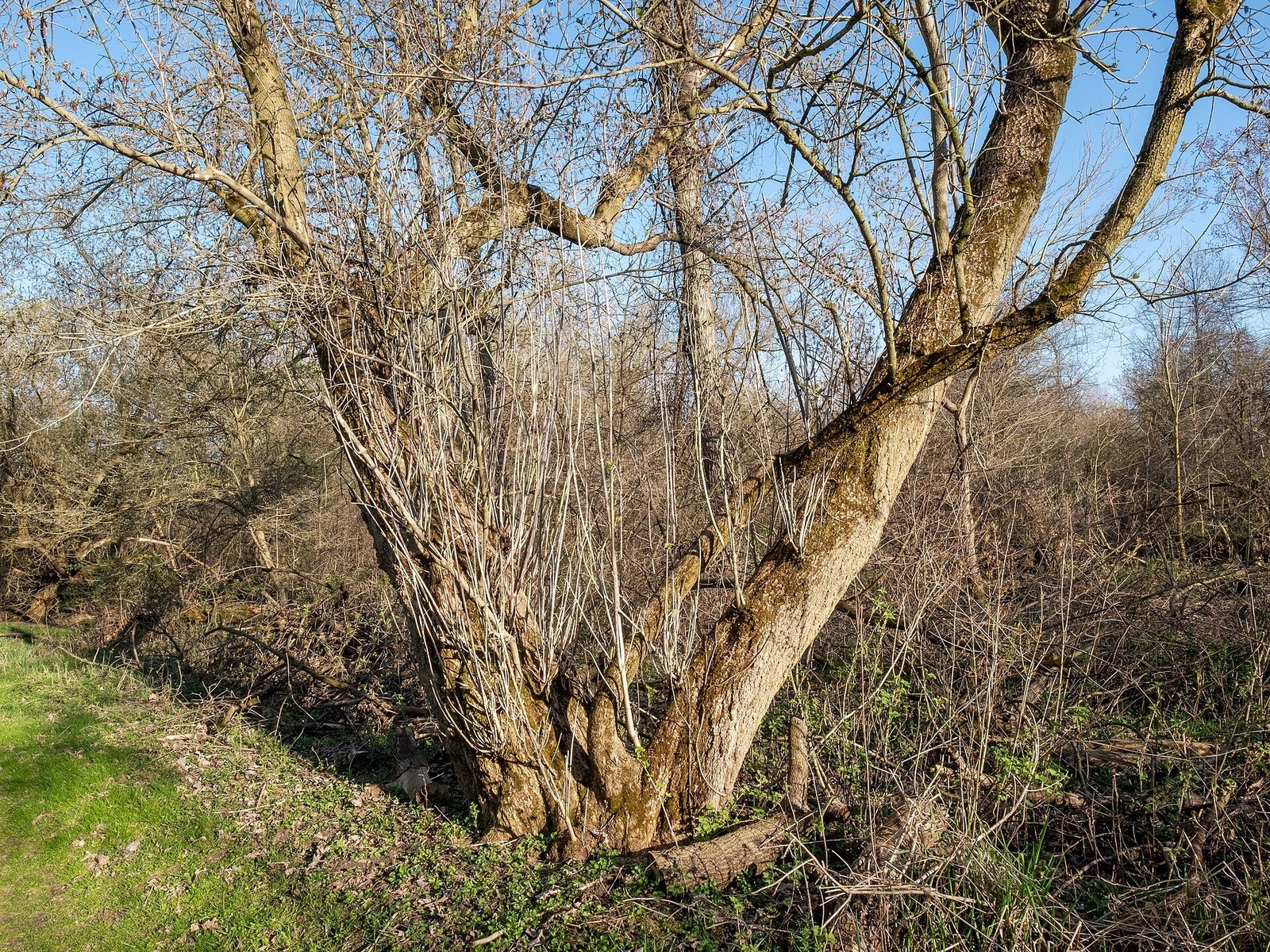
The practical consequence is that a crop of sprouts is evidence of what happened before. If the previous pruning was heavy, removing every new sprout at once is another heavy pruning, and the cycle repeats. The RHS suggests that where a tree keeps producing watershoots, removing them in late summer, when growth slows, may help reduce the number produced the following spring.
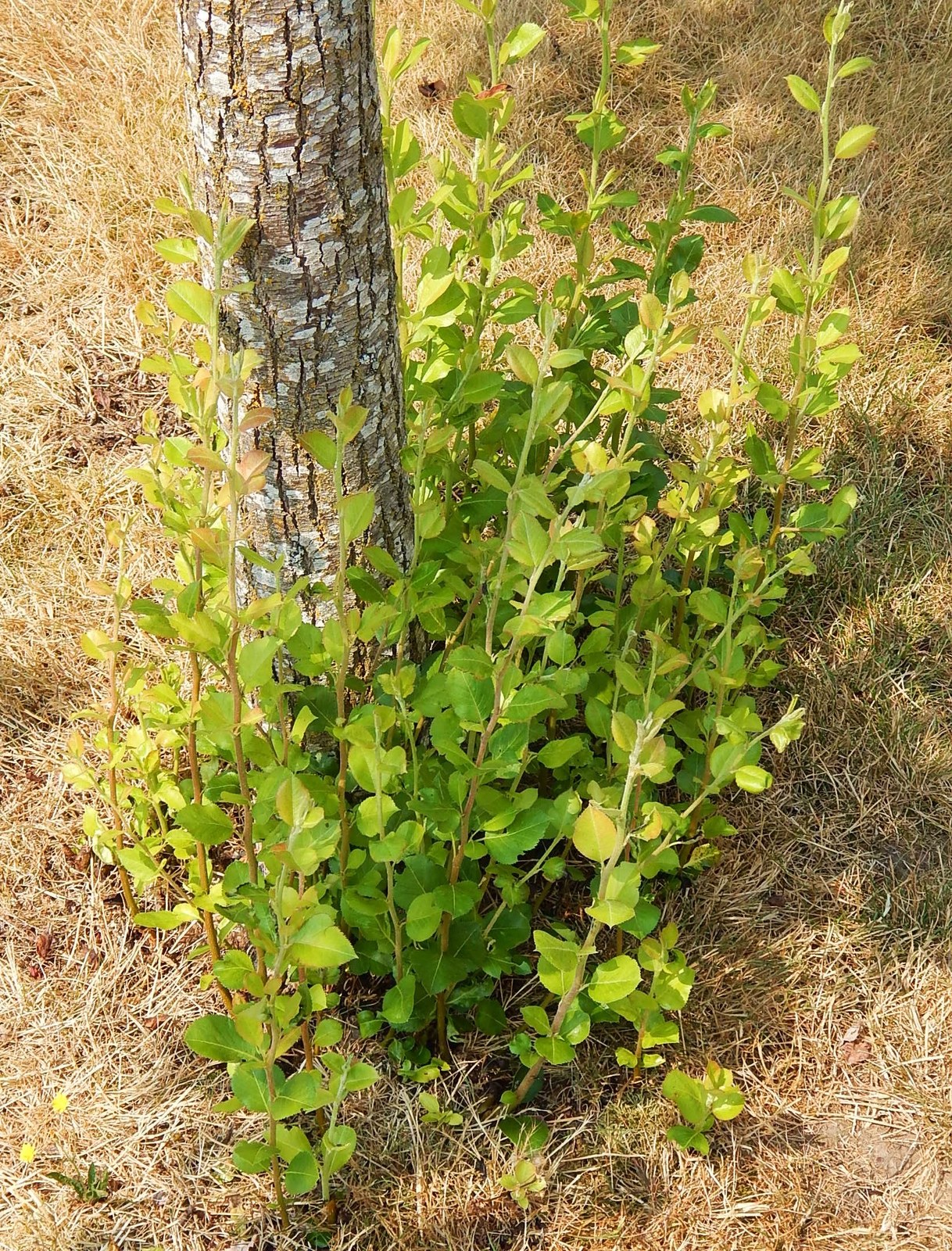
Suckers and hikobae
Suckers from the root collar can also come from root stress or, on grafted trees, the rootstock; check the base before cutting.
Removing too many — the one-quarter limit and lion’s tails
A neglected tree may carry dozens of branches on either list. Removing all of them in one visit is the most common way to turn a good list into bad pruning.
The quantity limits
The USDA Forest Service advises that no more than one-quarter of the living crown be removed at a time when thinning, both to avoid unnecessary stress and to prevent excessive production of epicormic sprouts; if more must come out, spread it over successive years. The other sources agree closely.
| Source | Limit | Applies to |
|---|---|---|
| USDA Forest Service | No more than one-quarter of the living crown at a time | Thinning |
| University of Maryland Extension | One-fourth | Removal of live branches |
| ISA | Generally no more than 25 per cent of the crown at once, less for mature trees | Mature trees |
| RHS | More than 25 per cent in one go produces many vigorous shoots | Fruit trees |
| Arboricultural Association (UK) | Crown thinning not more than 30 per cent overall | Crown thinning |
The UK figure is the loosest, and it is defined for broadleaved crown thinning rather than for removing a list of faults. The common message is the same: do not take most of the tree in one season.
Lion’s tails
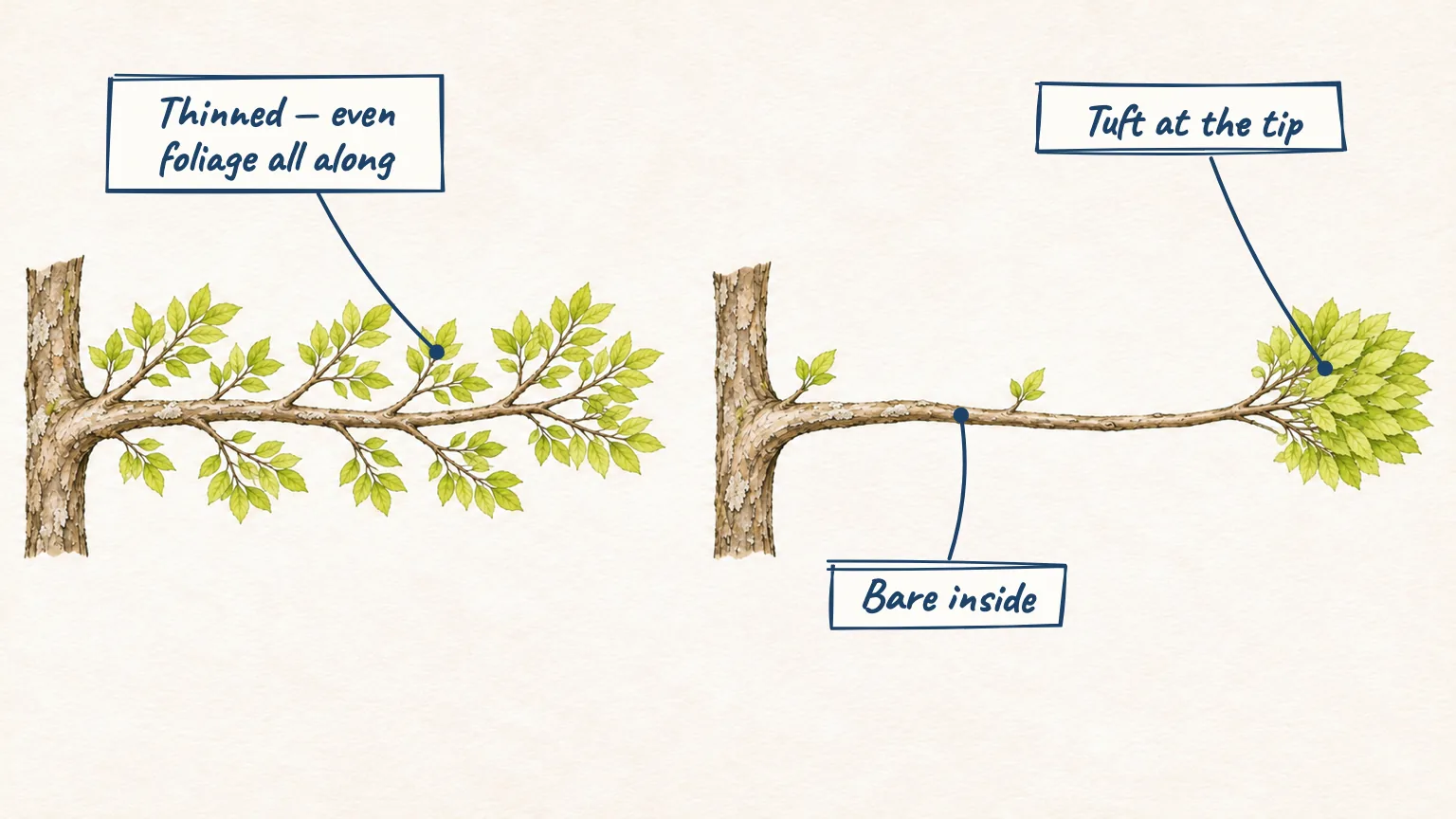
The USDA warns against removing all inner lateral branches and foliage, which leaves tufts of branches only at the ends — “lion’s tails”. It lists the consequences: sunscald, abundant epicormic sprouts, weak branch structure and breakage. Kansas State University’s fact sheet on lion tailing makes the same case. A pruner who removes every futokoro-eda and every interior shoot produces exactly this.
Spreading the work over years
Both traditions arrive at the same rule: thin the interior, never empty it. If the tree needs more than the limit, plan two or three visits, and let the tree show in the intervening season how it responds. A neglected tree is not corrected in one afternoon.
Branches worth keeping — the decision test
Both lists are lists of candidates. Some branches on them are better kept.
Branches that can stay
– A sprout in a sparse area. The RHS notes that watershoots growing where the tree is sparse, such as the lower parts of older branches, can be left to form new branches. On a tree that has lost a limb, a well-placed shoot is the raw material for its replacement. – One shoot from a whorl. Thinning kuruma-eda to the one or two best-placed shoots solves the crowding without leaving a gap. – An interior shoot pointing outward. A futokoro-eda that runs roughly horizontal and outward is the start of the tree’s next inner layer; it is the interior growth that prevents lion’s tailing. Tokyo’s street-tree plan says to grow such branches into secondary limbs where a branch is needed, and Yokohama’s pruning specification says well-directed horizontal ones must be kept. This is the logic of sukashi (透かし) thinning. – The better of a parallel pair. With heikō-shi there is no rule that the upper or lower branch goes. Compare their thickness, the angle of each union and the space around them, and keep the one that serves the tree’s structure.
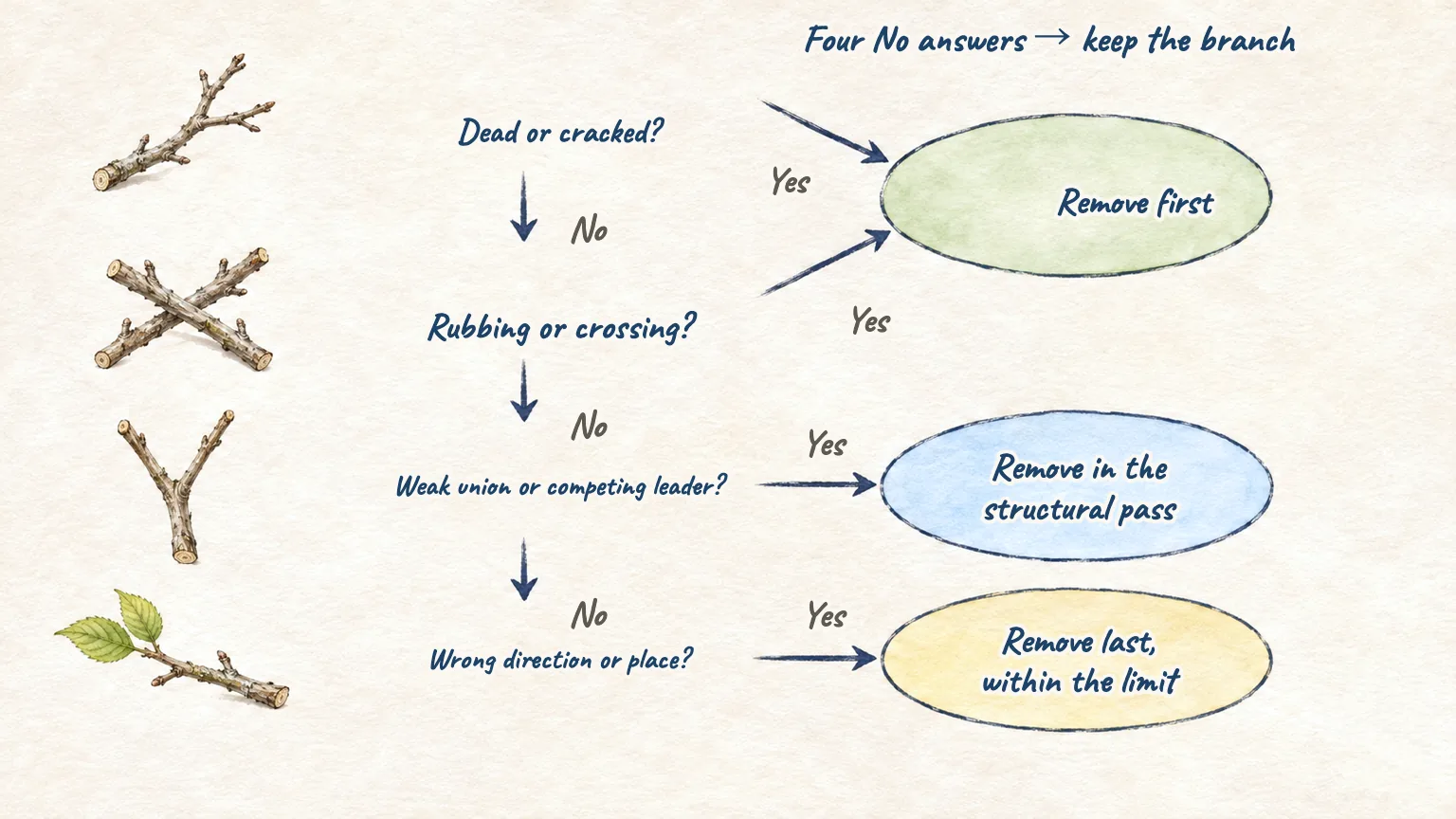
A decision order for any branch
Ask four questions in turn. Is it dead, cracked or diseased? Is it rubbing or crossing? Is its union weak, or is it competing with a leader? Is it in the wrong direction or place for the tree’s structure or composition? A branch that passes all four stays. Dead or cracked wood and rubbing branches come out first; a weak union or competing leader is dealt with in the structural pass; a branch that fails only the last question waits for the final pass, within the quantity limit.
Making the cut — reading first, then collar and order
Reading the tree before the first cut
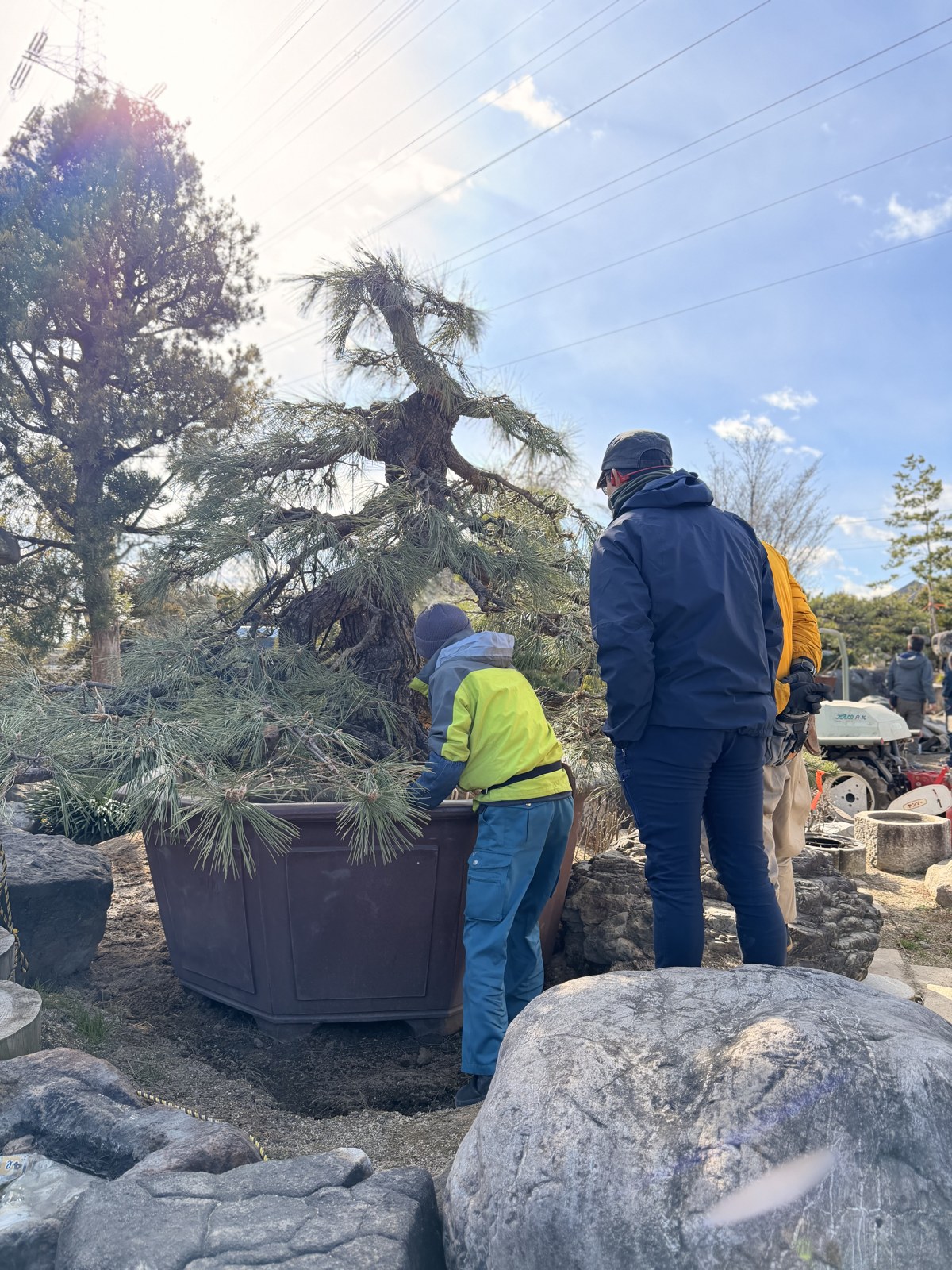
Good work starts with standing back. Walk around the tree, look up at the whole crown, and mark mentally which branches fail which test. Tools come second to this look.
Where the cut goes
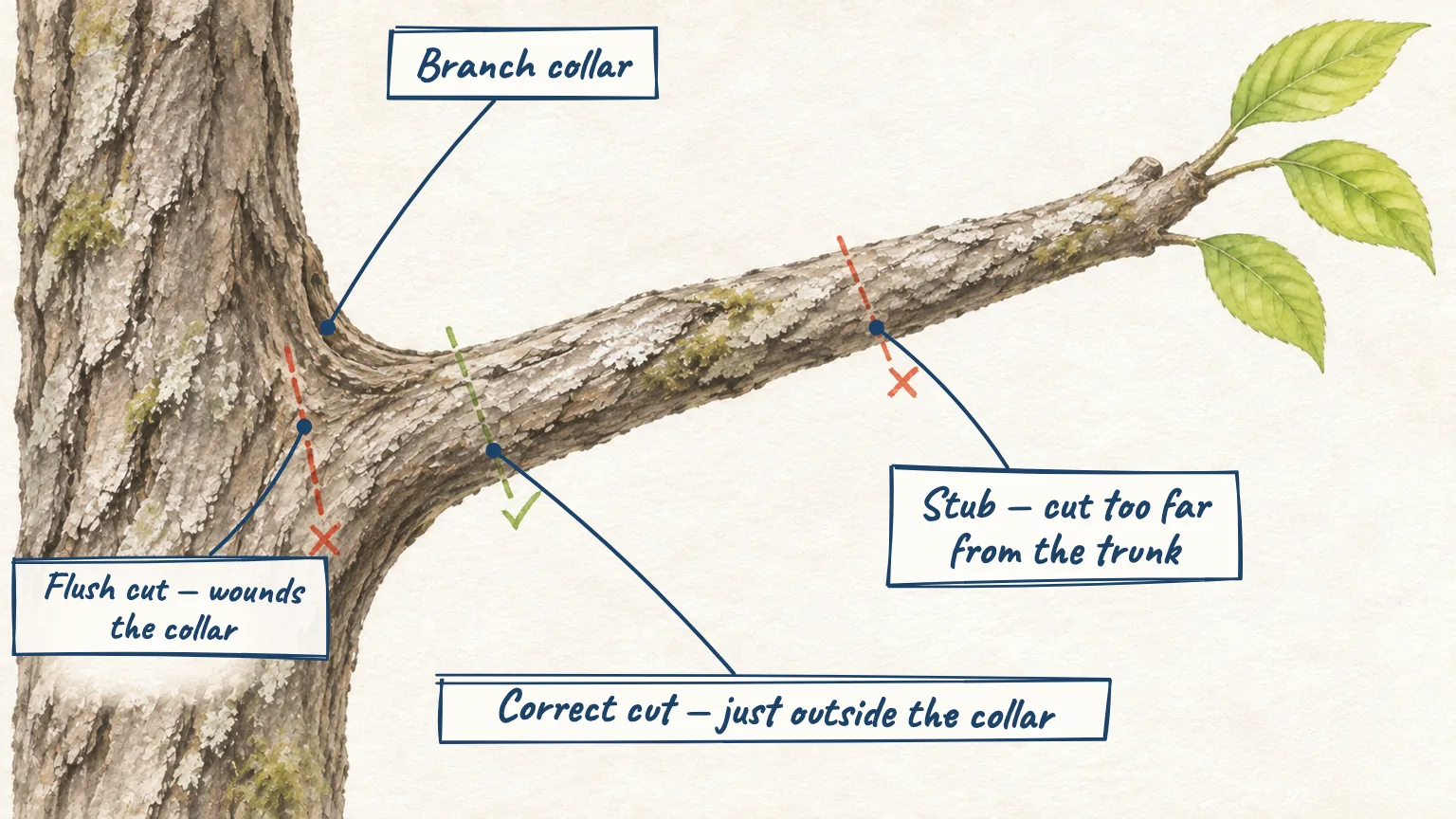
Whatever is removed, the cut goes at the branch’s point of origin, just outside the branch collar — not flush with the trunk, and not leaving a stub. The USDA explains why: branch and stem tissue stay separate at the union, and cutting only branch tissue lets the wound seal more effectively.
The order of work
The order of work follows the shared list. Dead and damaged wood comes out first, because it costs the tree nothing and reveals the structure. Crossing branches, which are wounding the tree now, go with them. Structural faults — weak unions and competing leaders — come next. The finer imi-eda judgments about direction and composition come last, once the framework is clear, and within the one-quarter limit.
Species, season and place — why the same branch is judged differently
Season
Damaged, diseased and dead branches can be removed at any time of year, according to the University of Maryland Extension. Sprout removal is a different matter: the RHS suggests late summer, when growth slows, to reduce the following spring’s flush.
Species
The research above shows how much species matters. Hazel forks behaved differently from maple unions, and Rust’s beech and sycamore maple results did not match the usual V-shaped rule. A guide written for one species should not be applied to another without looking at the union itself.
Street tree and garden tree
The Japanese municipal manuals quoted here — Sapporo, Saitama, Tokyo, Yokohama — are written for street trees, where the goals are clearance, safety and sustained health. A garden tree adds composition. The same branch can be a fault in one setting and an asset in the other: Saitama’s hanging branch filling a gap is a street-tree example, while a stacked pair in a garden layer is a composition fault.
Common mistakes and misunderstandings
Treating the list as an order
A branch on the list is a candidate. Removing every imi-eda found, in one visit, produces the lion’s tail and the sprout flush described above.
Treating every V-shaped union as doomed
The studies show included bark weakens a union, but not uniformly, and hidden cracks matter. Look at the union, not just the angle.
Cutting flush, or leaving a stub
Both are wrong. The collar is the reference point.
Cutting the sprouts, not the cause
If the last pruning was heavy, sprouts will come back. Spread the work over seasons.
Frequently asked questions
What are imi-eda in Japanese pruning? Imi-eda (忌み枝) are the branch types Japanese gardeners treat as candidates for removal: upright shoots (tachi-eda), reversed branches (sakasa-eda), crossing branches (karami-eda), parallel pairs (heikō-shi), whorls (kuruma-eda), weak interior twigs (futokoro-eda), suckers (hikobae), trunk sprouts (dōbuki-eda), vigorous long shoots (tochō-shi) and dead wood (kare-eda).
Should I remove all water sprouts at once? No. Water sprouts usually follow heavy pruning or stress, and removing them all in one visit can trigger more. Remove some, keep any well placed in sparse areas as future branches, and stay within about one-quarter of the crown per visit.
Which branch of a parallel pair should I cut? Not automatically the upper one. Keep the branch with the stronger union, the more suitable thickness and the more open space around it, and remove the other at its point of origin.
Is a V-shaped union always weak? No. Smiley found included bark made red maple unions weaker, especially in small stems, but Rust found no strength difference between V-shaped and U-shaped forks in beech and sycamore maple. Hidden cracks were the more serious warning.
How much can I prune at one time? The USDA, the University of Maryland Extension and the ISA all give about one-quarter of the crown at a time as the guide; the UK Arboricultural Association caps crown thinning at 30 per cent overall. Mature trees get less.
Where exactly do I make the cut? At the branch’s point of origin, just outside the branch collar. Not flush with the trunk, and not leaving a stub.
Sources
– Bedker, P. J., O’Brien, J. G., Mielke, M. M., How to Prune Trees, USDA Forest Service, NA-FR-01-95, rev. 2012 — checked 2026-10-17 – International Society of Arboriculture, Pruning Mature Trees (TreesAreGood brochure, v03.2021) — checked 2026-10-17 – University of Maryland Extension, Pruning Trees in the Home Landscape: https://extension.umd.edu/resource/pruning-trees-home-landscape/ — checked 2026-10-17 – Royal Horticultural Society, Apples and pears: managing watershoots: https://www.rhs.org.uk/fruit/apples/managing-watershoots — checked 2026-10-17 – Kansas State University Research and Extension, Lion Tailing and Its Impact on Tree Health (MF3551): https://bookstore.ksre.ksu.edu/download/lion-tailing-and-its-impact-on-tree-health_MF3551 — checked 2026-10-17 – Smiley, E. T., “Does Included Bark Reduce the Strength of Codominant Stems?”, Arboriculture & Urban Forestry 29(2):104–106, 2003: https://auf.isa-arbor.com/content/29/2/104 — checked 2026-10-29 – Slater, D., Ennos, R., “The Level of Occlusion of Included Bark Affects the Strength of Bifurcations in Hazel (Corylus avellana L.)”, Arboriculture & Urban Forestry 41(4):194–207, 2015: https://auf.isa-arbor.com/content/41/4/194 — checked 2026-10-29 – University of Florida IFAS Extension, “Branch Union Strength: Challenging Common Assumptions About V-Shaped vs. U-Shaped Forks” (summary of Rust 2023, Forests 14:1041): https://blogs.ifas.ufl.edu/gcrec/?p=781 — checked 2026-10-29 – Arboricultural Association, “A brief guide to tree work terminology and definitions”: https://treecare.org.uk/?p=537 — checked 2026-10-29 – Tree Care Industry Association, ANSI A300 Part 1 (Pruning) summary: https://treecareindustryassociation.org/business-support/ansi-a300-standards/part-1-pruning/ — checked 2026-10-29 – Sapporo City, 街路樹剪定技術指針 (Street-tree pruning guidelines), FY2016 — checked 2026-10-18 – Saitama Prefecture, 街路樹剪定マニュアル (Street-tree pruning manual), December 2020 — checked 2026-10-18 – Tokyo Metropolitan Government, 街路樹維持管理計画書 (Street-tree maintenance plan), December 2021 — checked 2026-10-18 – City of Yokohama, street-tree pruning specification (特記仕様書), January 2019 — checked 2026-10-18