

By Isaki Kasahara, a Japanese arborist pruning, assessing and caring for Japan’s trees and gardens · Updated November 28, 2026
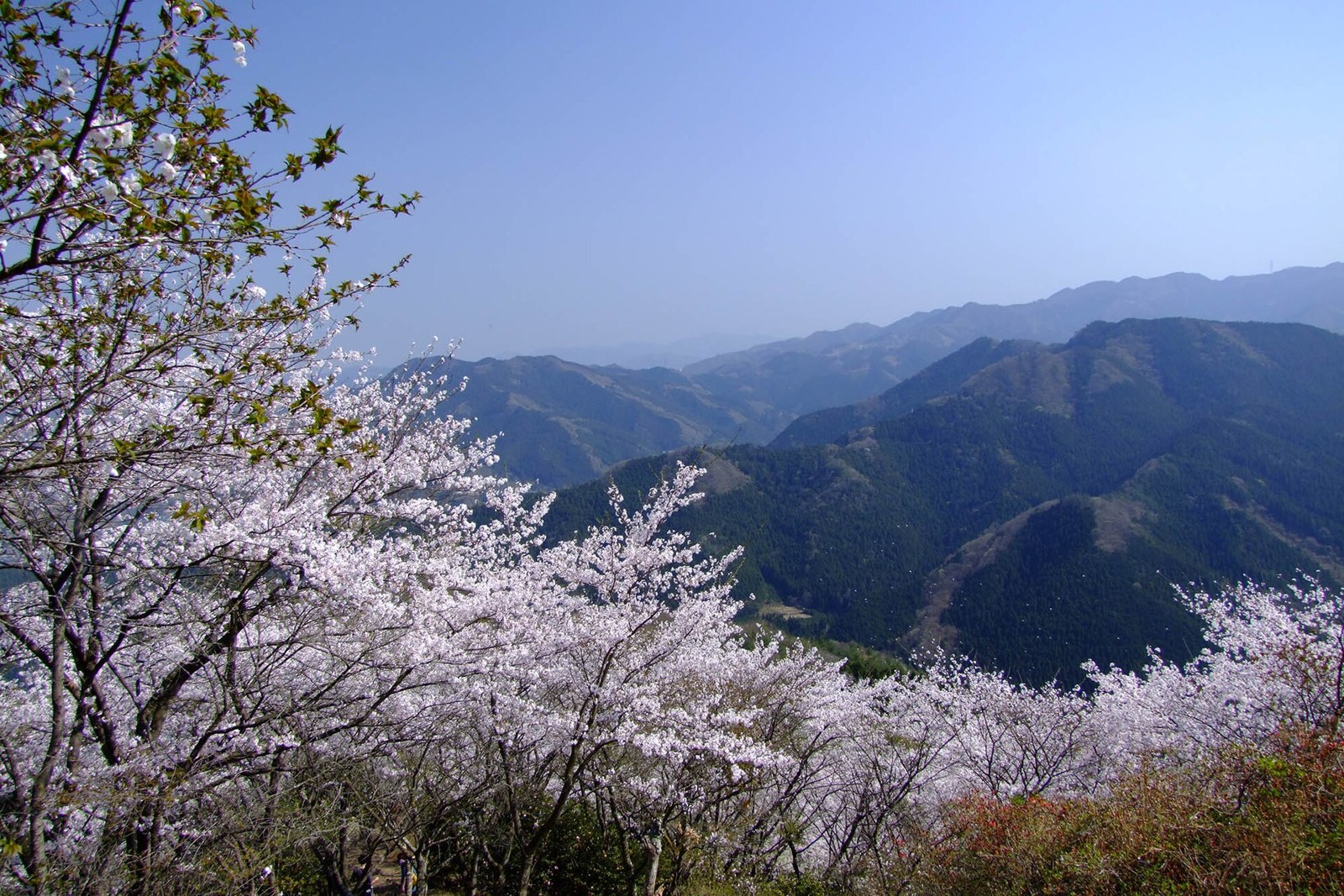
On Sakurayama, a 591-metre hill in Fujioka, Gunma Prefecture, there are cherry blossoms in November because most of them are Fuyu-zakura (冬桜) — “winter cherry”, a cultivar that flowers twice a year, once from autumn into winter and again in April, as an inherited trait rather than a seasonal accident. They stand beside maples in autumn colour because the village that planted the hill in 1908 put in maples along with its cherries, so in late November the white blossom and the red leaves arrive at the same time.
This article explains what kind of cherry the winter cherry is, how a hill came to be planted with it by mistake and protected by the state, why the protected trees have been dying, how Fujioka City now cares for them, and what to expect if you go.
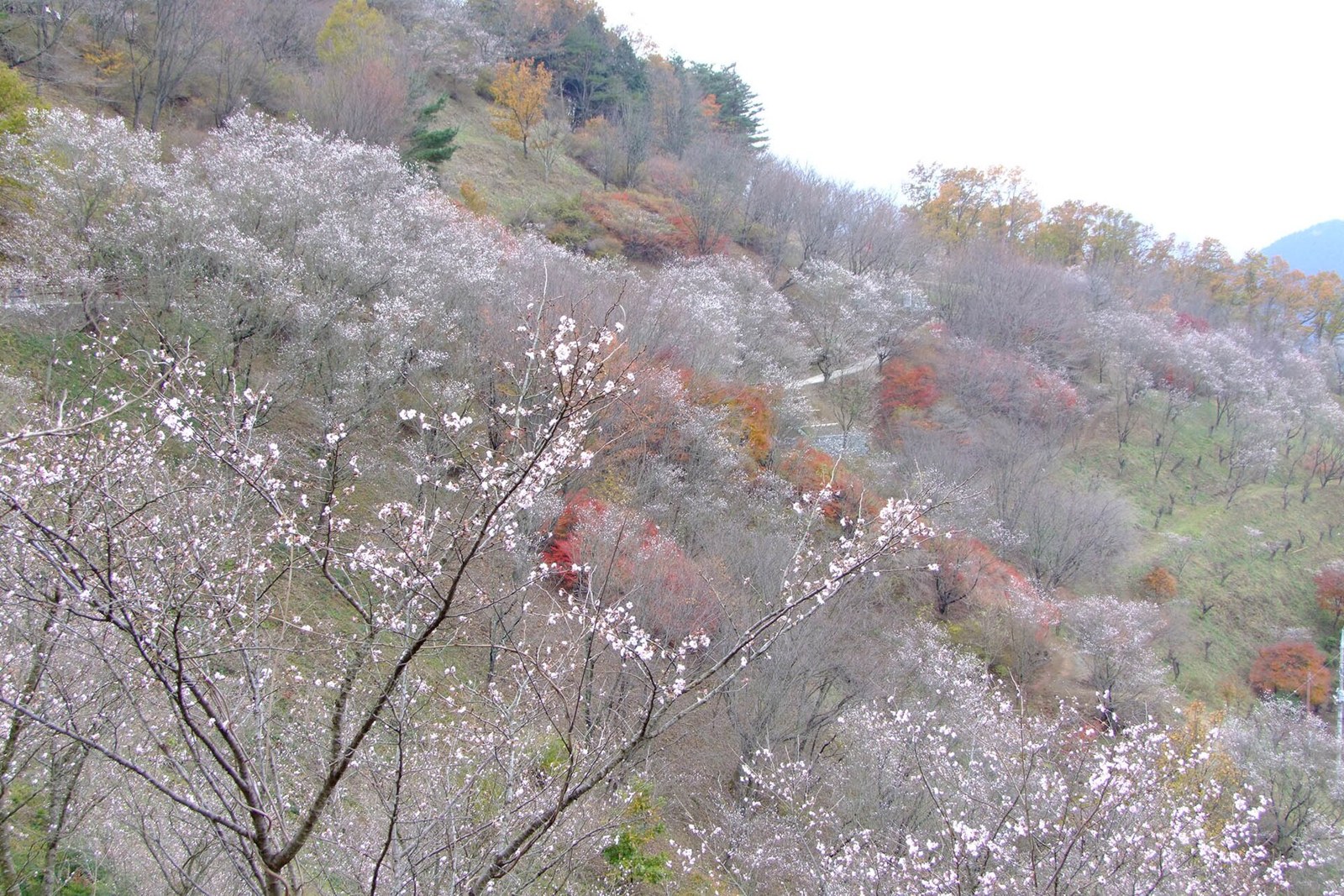
On the summit in late November — white blossom over red maples
What you see
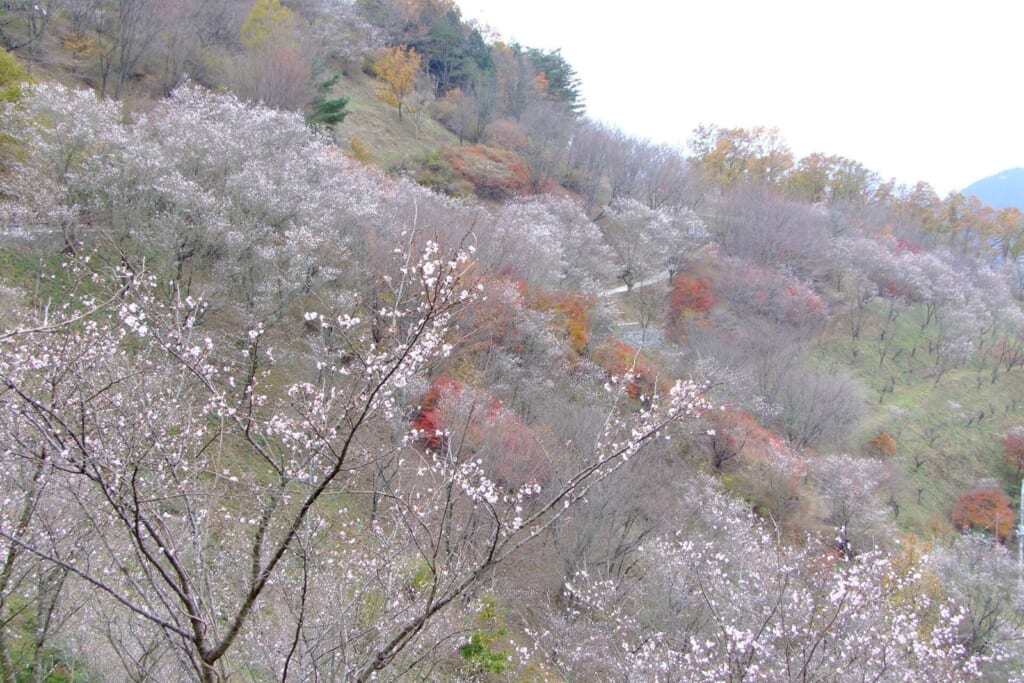
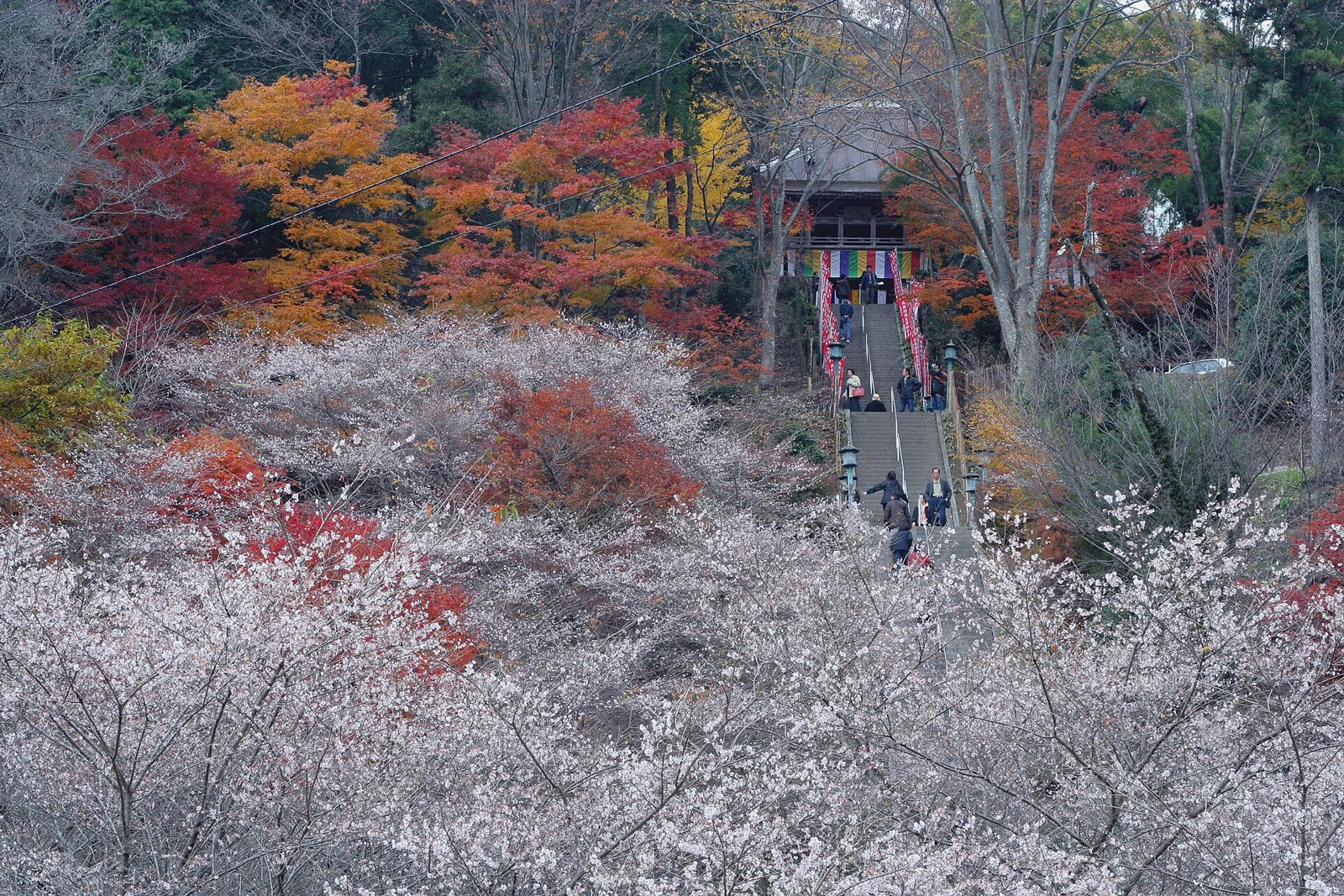
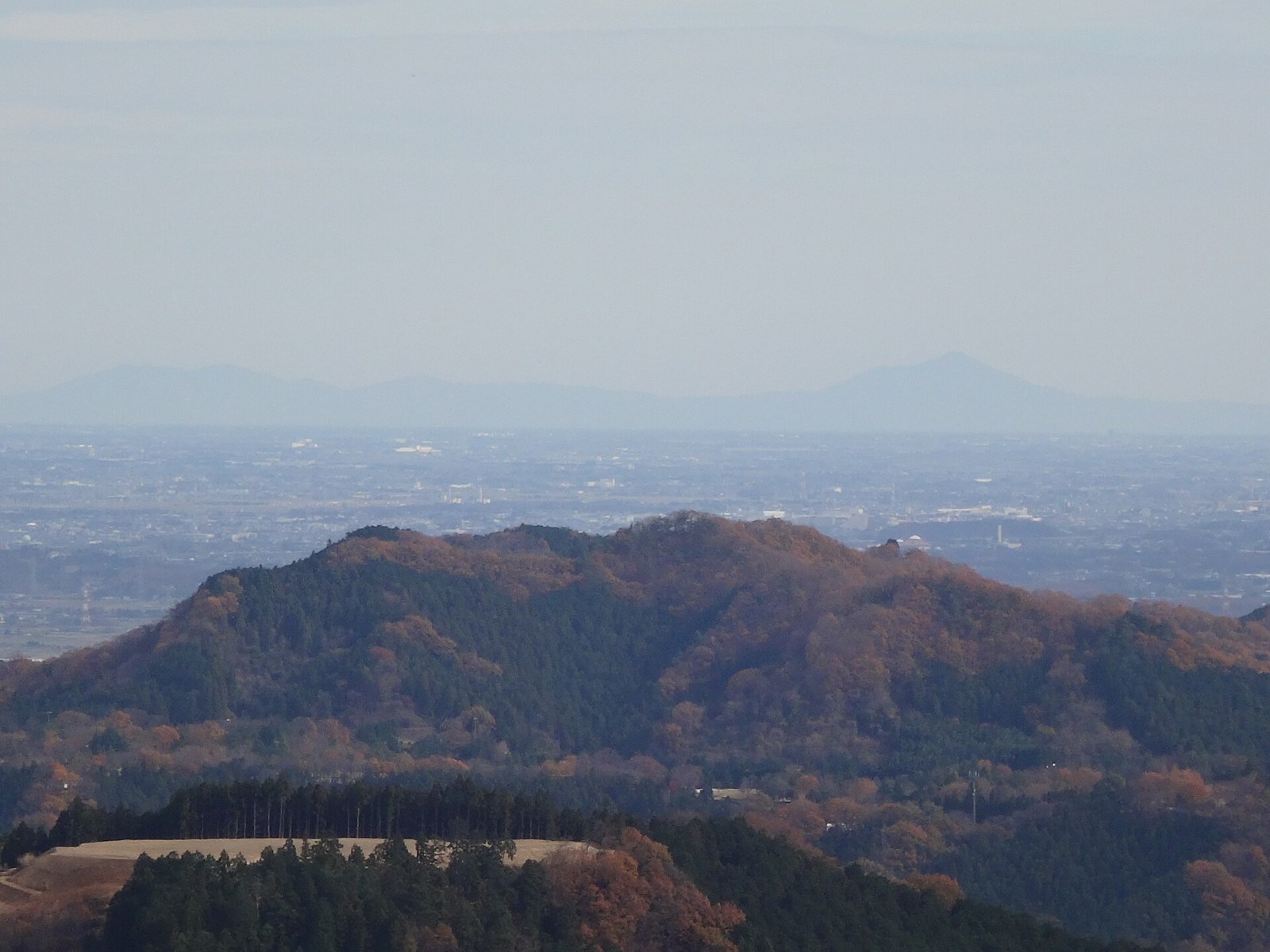
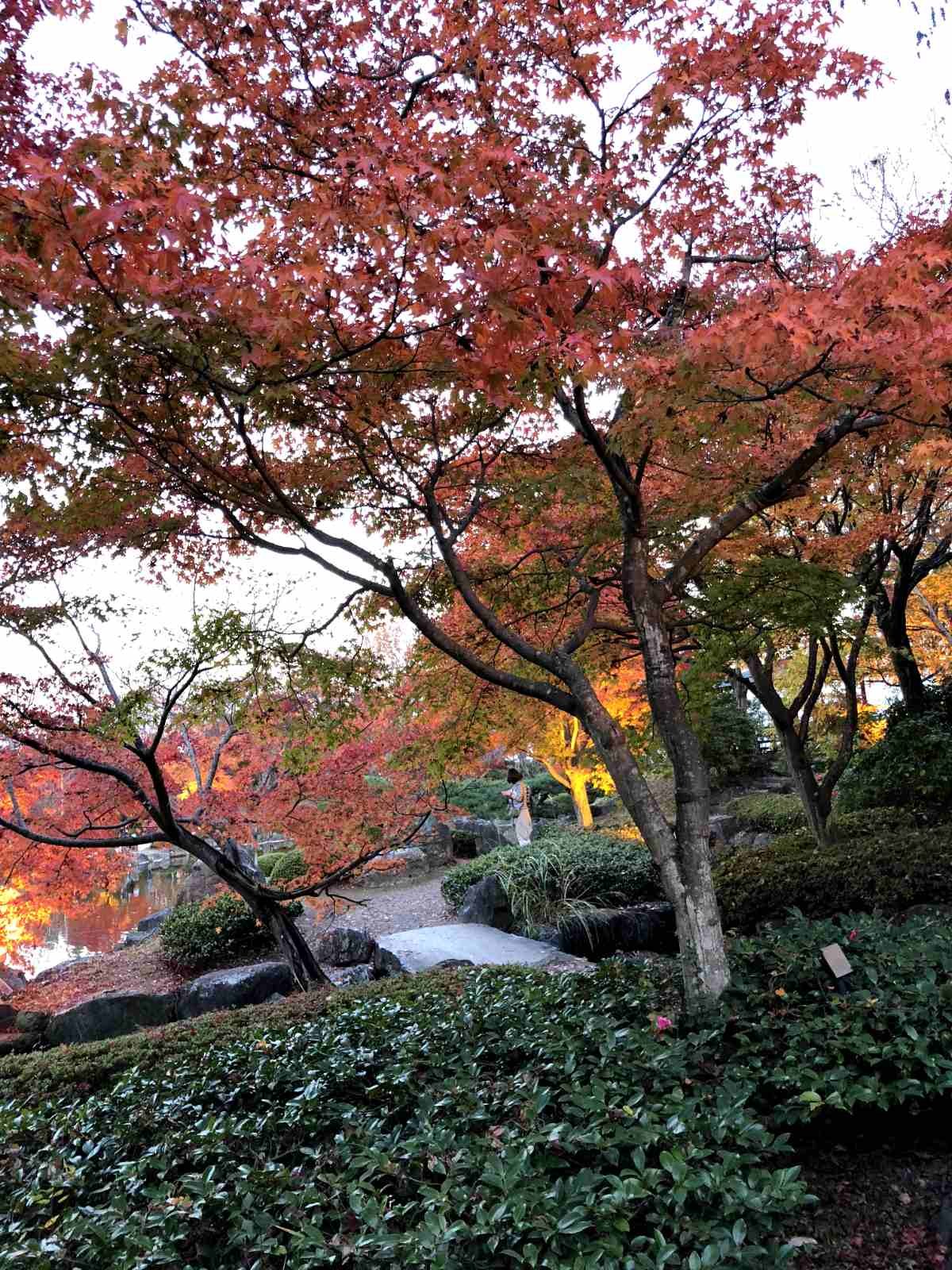
Walk up to the summit area of Sakurayama Park (桜山公園) in the second half of November and the scene does not match the calendar. The cherry branches are bare of leaves, yet they carry single flowers that the city describes as white to pale pink. In the Japanese garden of the first plaza, momiji (紅葉) — Japanese maples in autumn colour — and zelkova trees turn red and orange. From the observation deck you look across both at once. On 11 November 2026 the city’s own on-site report said the winter cherries and the autumn leaves were both at their best.
The flowers are not dense. A winter cherry in November does not look like a Somei-yoshino in April, a cloud of pink with no gaps. It looks like a bare tree that has been dusted with snow, with blossoms open here and there along the twigs. That restraint is part of the appeal: against blue winter sky the white reads clearly, and against the red maples it glows. In most of Japan, November belongs to the maples alone — the season described in the work behind Kyoto’s maple gardens. Here the cherries share it.
The numbers on the hill
Fujioka City’s tourist pages count about 7,000 winter cherries in the park, along with about 3,000 Somei-yoshino that flower in spring and about 5,000 azaleas, including Ōmurasaki, Kurume and Kirenge types. The park today covers 47 hectares (about 116 acres): 15 hectares of prefectural forest park and 32 hectares of city park. The cherries climb toward the summit at 591 metres (1,939 feet).
Those 7,000 trees are not all the protected monument. The national designation, “Sanbagawa (Sakura)” (三波川(サクラ)), covers a defined area inside the park, and that area holds far fewer trees — a point that matters later in the story.
Two seasons in one view
| What | Where in the park | When (city guidance) |
|---|---|---|
| Fuyu-zakura, autumn–winter flowering | Throughout the park, about 7,000 trees | Mid-November to mid-December; best mid-November to early December |
| Maple and zelkova colour | First plaza (Japanese garden); views with cherries from the observation deck | Overlaps the cherries; a city autumn–winter guide gives early November to early December for the combined view |
| Fuyu-zakura, spring flowering | Same trees | April (mid-April in the city’s camera record) |
| Somei-yoshino | About 3,000 trees | Spring |
Fuyu-zakura — a cherry that is meant to flower twice
Name and botany
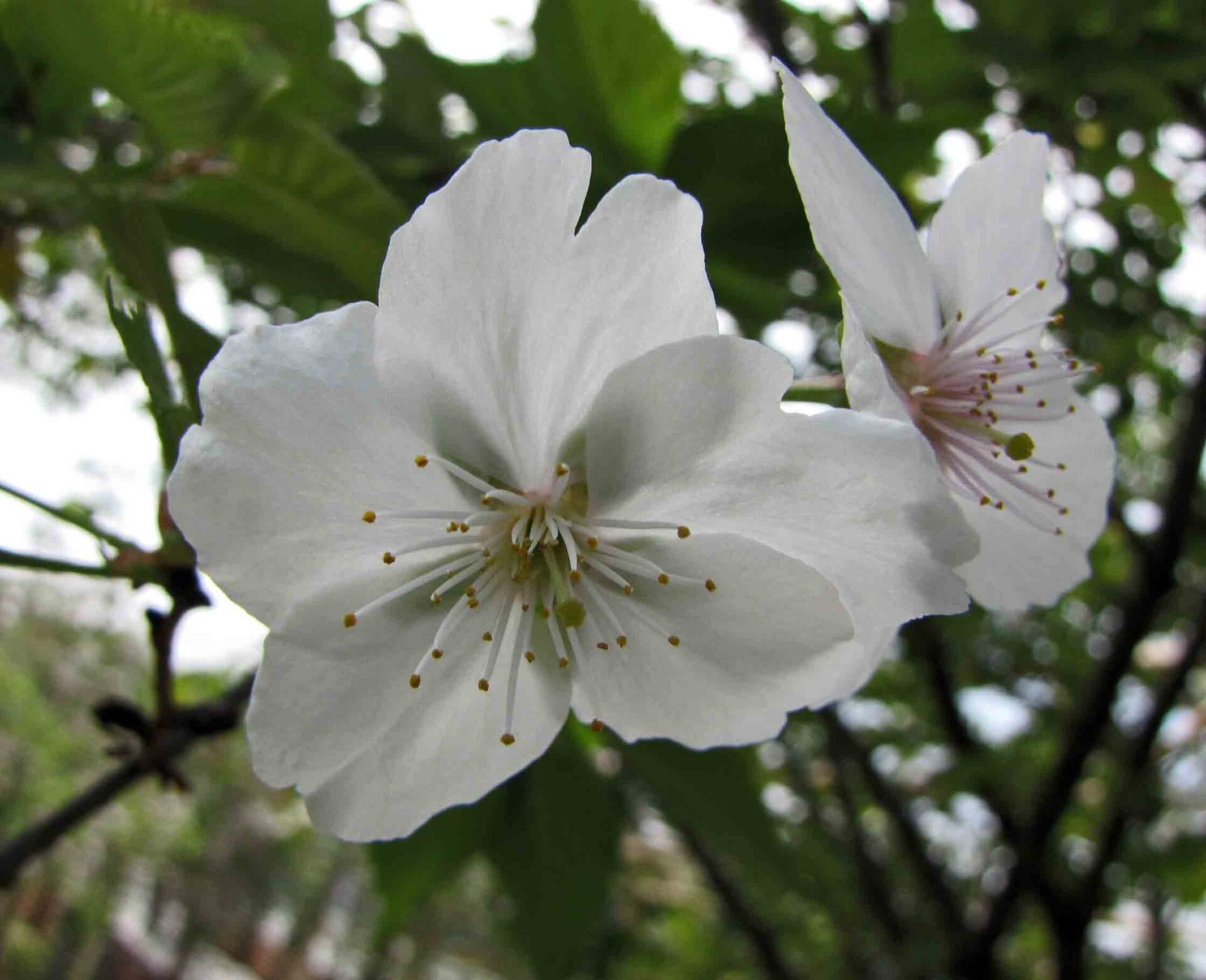
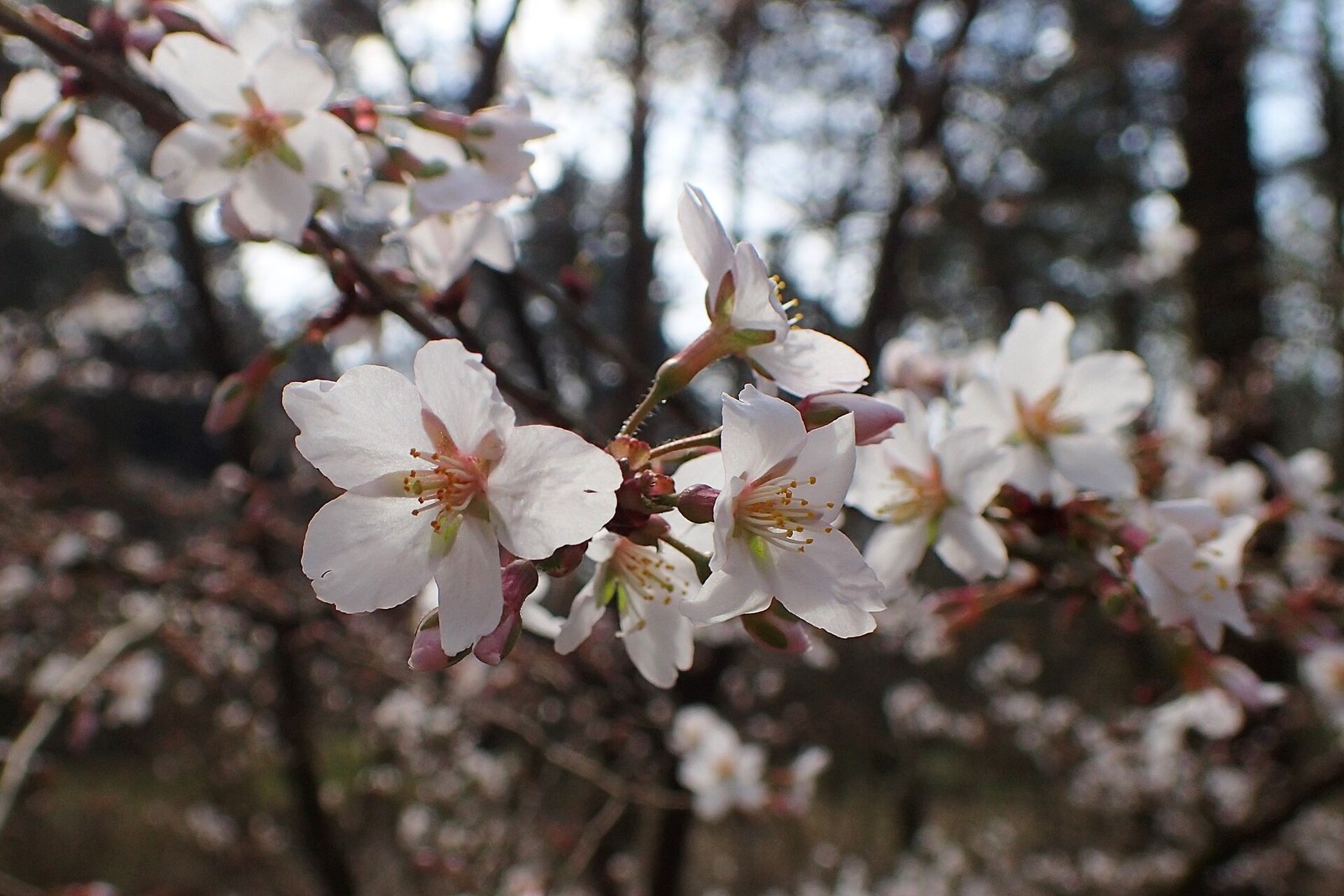
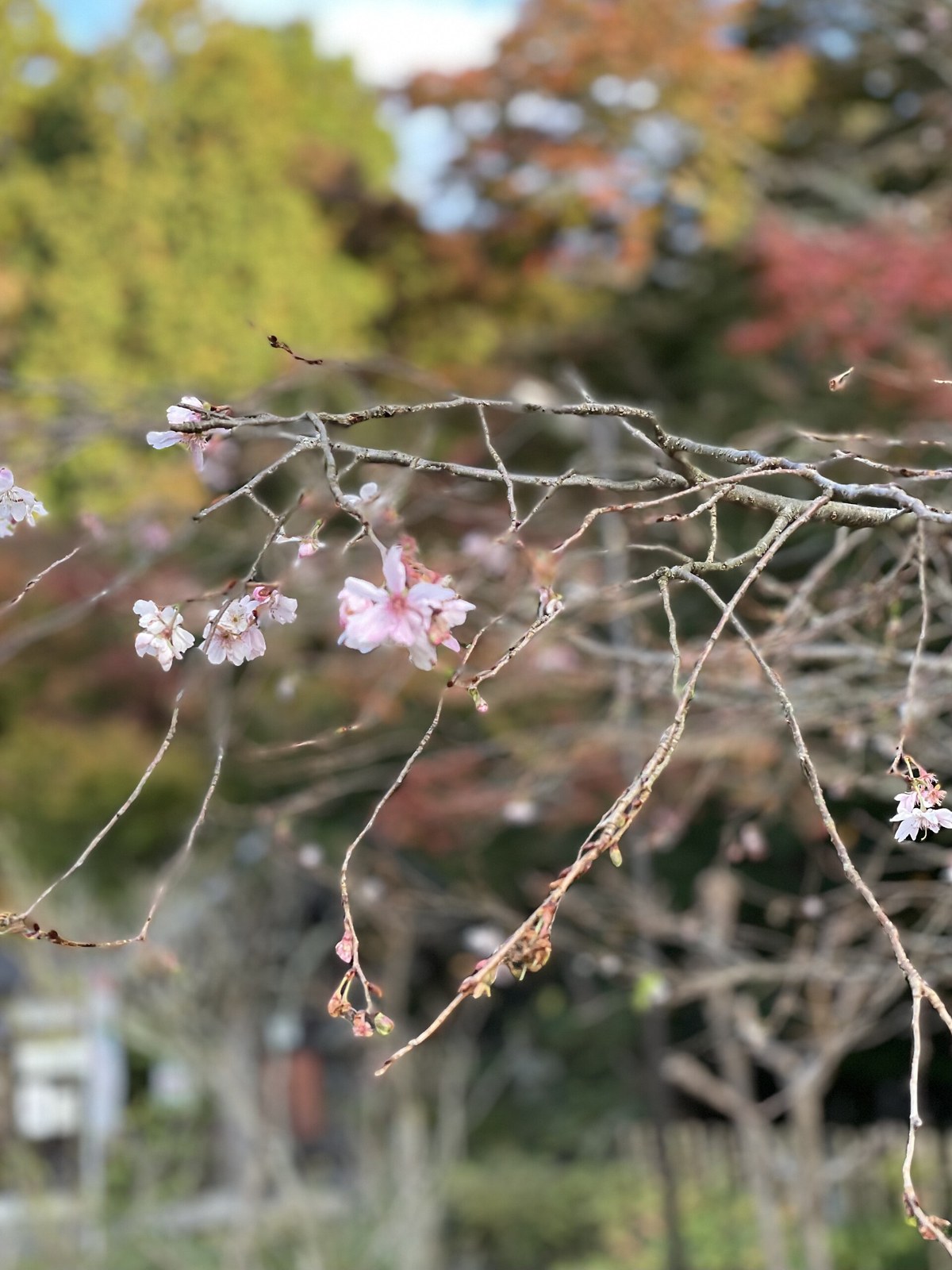
The Flower Association of Japan (日本花の会) lists the winter cherry as Cerasus × parvifolia ‘Fuyu-zakura’. Because its leaves are small, it is also called Koba-zakura (小葉桜) — “small-leaved cherry”. Fujioka City describes the Sakurayama trees as having single flowers about 2.5 cm (1 inch) across, white to pale pink.
Sources differ on how big the flowers are. The city calls them small; the Flower Association of Japan and the Forestry and Forest Products Research Institute (FFPRI, 森林総合研究所) classify them as medium-sized and white.
Parents nobody agrees on
The cultivar’s parentage is not settled. Fujioka City says the winter cherry is presumed to be a hybrid of Yama-zakura and Mame-zakura, two wild cherries of Japan. FFPRI’s cultivar material calls it a cross between Mame-zakura and Ōshima-zakura (the Oshima cherry), as does Ishikawa Prefecture’s forestry experiment station. The Flower Association of Japan gives Mame-zakura crossed with either a garden cherry (sato-zakura) or Yama-zakura.
All the sources agree on one parent, Mame-zakura. For the rest, the honest answer is that Japanese institutions publish different hybrids, and none of the sources checked here settles it.
How it differs from other twice-flowering cherries
Japan has several cherries that flower in autumn as well as spring. They are easy to confuse, and they are not the same plant.
| Cherry | Name used by the source | Flower | Where it is famous |
|---|---|---|---|
| Fuyu-zakura (冬桜) | Cerasus × parvifolia ‘Fuyu-zakura’ | Single, white (city: white to pale pink) | Sakurayama, Fujioka, Gunma |
| Jūgatsu-zakura (十月桜) — “October cherry” | Cerasus × subhirtella ‘Autumnalis’ | Double, pale pink | — |
| Kobuku-zakura (子福桜) | Cerasus ‘Kobuku-zakura’ | Double, white; sometimes grown by mistake as Jūgatsu-zakura | — |
| Shiki-zakura (四季桜) — “four-season cherry” | — | Flowers in spring and autumn | Obara, Toyota City, Aichi: about 10,000 trees |
| Winter-flowering cherry (UK) | Prunus × subhirtella ‘Autumnalis’ (RHS) | Semi-double, white | British gardens |
The last row is the trap for English-speaking readers. In Britain the Royal Horticultural Society calls Prunus × subhirtella ‘Autumnalis’ the “winter-flowering cherry”. The trees on Sakurayama are not that plant. In Japan ‘Autumnalis’ is the October cherry, a double-flowered cultivar; Sakurayama’s winter cherry is single-flowered and belongs to a different hybrid group. The English names overlap; the trees do not.
Why it flowers in November — what is known, and what is not
Not a “return bloom”
An ordinary spring cherry such as Somei-yoshino can also put out a few flowers in autumn. Those are kaerizaki (返り咲き) — “return blooms”: when the tree’s leaves are damaged and lost early, some flower buds meant for next spring open out of season.
FFPRI’s Tama Forest Science Garden draws a clear line between the two. Cultivars like the winter cherry have “a genetic character of flowering twice, in spring and autumn”, and their autumn flowers are not called return blooms. The winter cherry is not a confused tree. It is doing what the cultivar does every year.
How a spring cherry decides to open
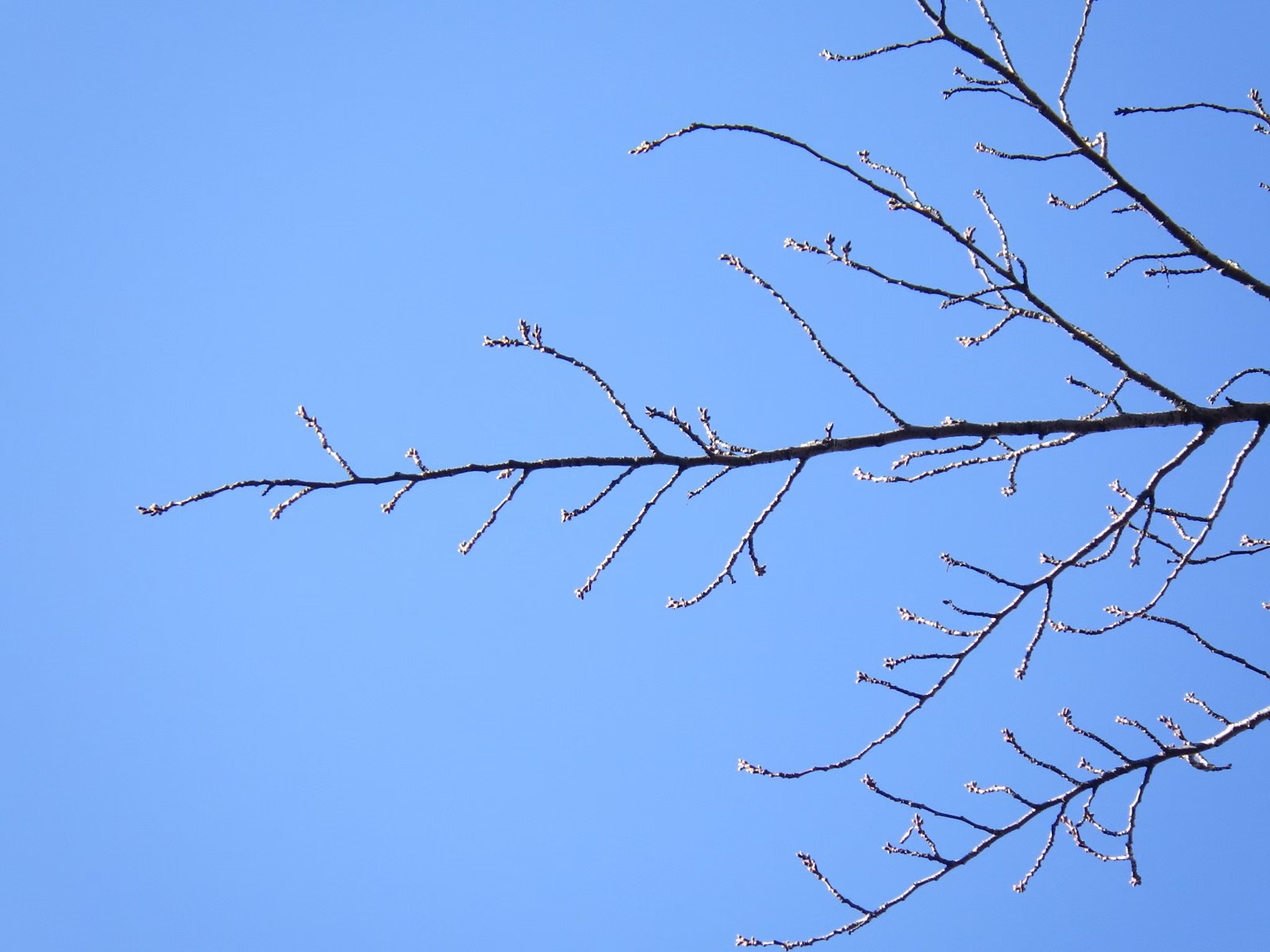
For ordinary spring cherries the mechanism is well studied. FFPRI’s research on Somei-yoshino shows that flower buds need a long enough period of cold to break their winter dormancy, and then a long enough warm period to move from dormancy to flowering. The Japan Meteorological Agency’s official cherry flowering dates, for their part, are observations of designated sample trees. They say nothing about when Sakurayama’s winter cherries will open.
Why the autumn flowers are still unexplained
For the twice-flowering cultivars, the same institute states plainly that why these cherries flower in autumn “is not yet understood”. The spring dormancy research on Somei-yoshino cannot simply be borrowed to explain the winter cherry’s November flowers.
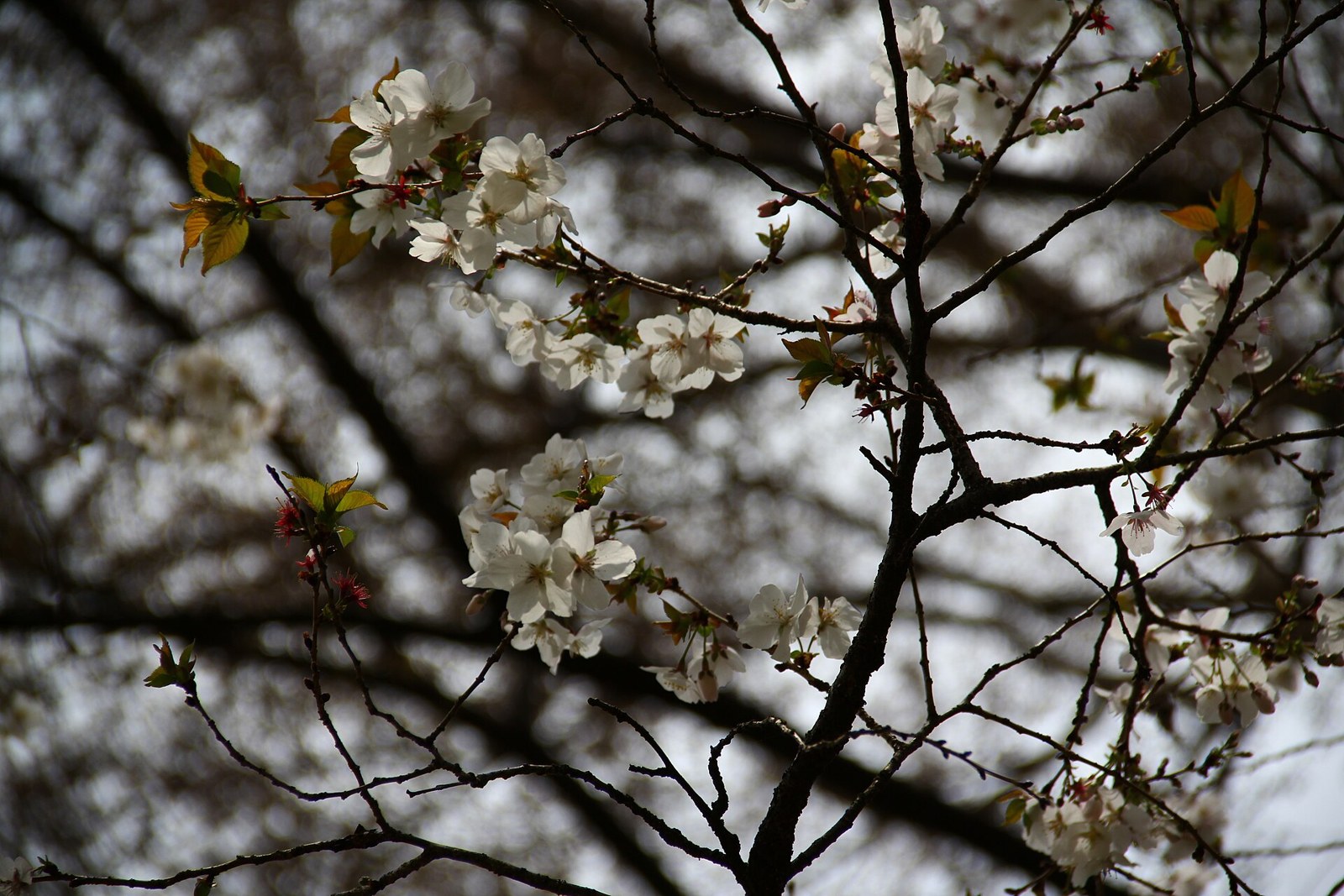
What can be described is the pattern. Fujioka City’s tree-health report, published in 2025, includes a fixed-camera record of the Sakurayama trees. In it, the winter cherries were already leafless by mid-October, began flowering here and there from mid-October, reached a peak around December, and then the flower buds that had not opened flowered together in mid-April. A flowering study in the same report describes the two seasons in contrasting terms: the November–December peak is not showy but sparse and prolonged, while the spring flowering goes to full bloom all at once.
So one set of buds is shared across two seasons. Some open as the leaves fall, the rest wait out the winter and open in spring. Which buds go first, and what triggers them, remains unclear.
The year on Sakurayama
| Month | What the winter cherry does (city report, camera record) |
|---|---|
| Mid-October | Leaves already fallen; first scattered flowers |
| November | Flowering spreads; maples colour at the same time |
| Around December | Autumn–winter peak, sparse and prolonged rather than showy |
| Winter | Remaining flower buds wait |
| Mid-April | Remaining buds open together, a spring full bloom |
1908 — a village plants a hill
A victory memorial
Sakurayama’s cherries began as a war memorial. In March 1908, Iizuka Shiga (飯塚志賀), head of Sanbagawa village, laid out a park of about 5 hectares (12 acres) on the hill to commemorate Japan’s victory in the Russo-Japanese War. The village planted 1,000 cherry seedlings, and villagers brought 310 maple seedlings of their own to plant with them.
So the village’s first planting already included both cherries and maples. Whether any of the maples in the park today are survivors of that planting, the sources do not say.
The trees that flowered at the wrong time
According to the city’s 2025 report, the 1,000 seedlings were bought as Somei-yoshino. Among them were trees that flowered in autumn.
That is the mystery at the centre of Sakurayama. Nobody set out to plant a hill of winter cherries. A village bought its seedlings as Somei-yoshino, and some of what arrived turned out to be something else — something that, on a hilltop in the Gunma mountains, threw white flowers into the November maples.
A note on the founder’s name
The city’s history page gives the village head as Iizuka Shiga. The tree-health report spells the given name two ways in different sections; this article follows the city’s history page.
1931–1937 — a botanist identifies it, the state protects it
Miyoshi Manabu’s visit
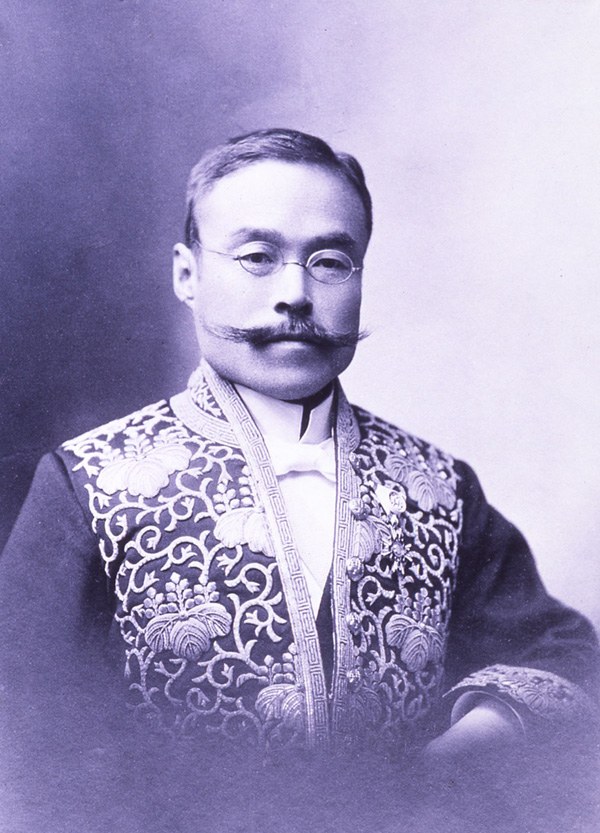
The autumn flowering remained unexplained for more than twenty years. In 1931, Miyoshi Manabu (三好学, 1862–1939), a botany professor at the Imperial University in Tokyo and a leading researcher on cherries, came to Sakurayama as a natural-monument investigator for the Ministry of Education. In 1932 it was announced that the autumn-flowering trees were not Somei-yoshino but Fuyu-zakura.
Miyoshi matters beyond this hill. The National Museum of Nature and Science presents him as one of the people who built Japan’s movement to protect natural monuments. Five years after his survey, the hill was designated.
The designation, in its own words
On 17 April 1937 the hill’s cherries were designated a national Place of Scenic Beauty and Natural Monument under the name “Sanbagawa (Sakura)”. The official description, written in the formal Japanese of the time, reads in translation:
> “It is on the summit of Sakurayama. The trees are winter cherry and Somei-yoshino, numbering about one thousand, said to have been planted around Meiji 41 [1908] to commemorate the Russo-Japanese War. The winter cherry is a rare kind; growing as densely as on this mountain, and above all flowering in winter, it is a scenic cherry site without equal; moreover, that some among them show variation in their floral parts is of scholarly value.”
Two reasons are given: the view, and the science. The flowering in winter made the scenery unique, and the variation in the floral parts made the trees worth studying. The city’s records put the number of winter cherries at the time of designation at 344. In August 1937 Sanbagawa village became the custodian body; Fujioka City has since inherited that role.
Why the monument carries a village’s name
“Sanbagawa” is the name of the former village that planted the hill, and the monument is named for that place, with its subject, cherry, in brackets. Today the designated land lies in three named districts (aza) of Sanbagawa, Fujioka City. Until January 2006 the park’s address was Onishi Town, Tano District; Onishi has since merged into Fujioka. In February 2010 the designated area was revised, with land both added and removed; the sources checked here do not give the reasons.
1973 — fire, and the grafts that saved the line
The fire
In 1973 a forest fire burned 123 hectares (about 304 acres) around the hill. The city’s history records about 1,000 winter cherries lost; the tree-health report says only about 100 escaped.
For a cultivar that exists on the hill as hundreds of individual trees, a fire like that could have ended the monument. It did not, because of work that had started almost twenty years earlier.
The preservation society and its grafts
In 1955 local people formed the Sanbagawa Sakurayama Preservation Society (三波川桜山保存会), with Iizuka Kaoru as its head. The same year, Yamago Isojirō and Arai Tamishi began grafting winter cherries locally. In grafting, a cut shoot (the scion) from an existing tree is joined to a rootstock, so the crown that grows carries the scion tree’s characteristics.
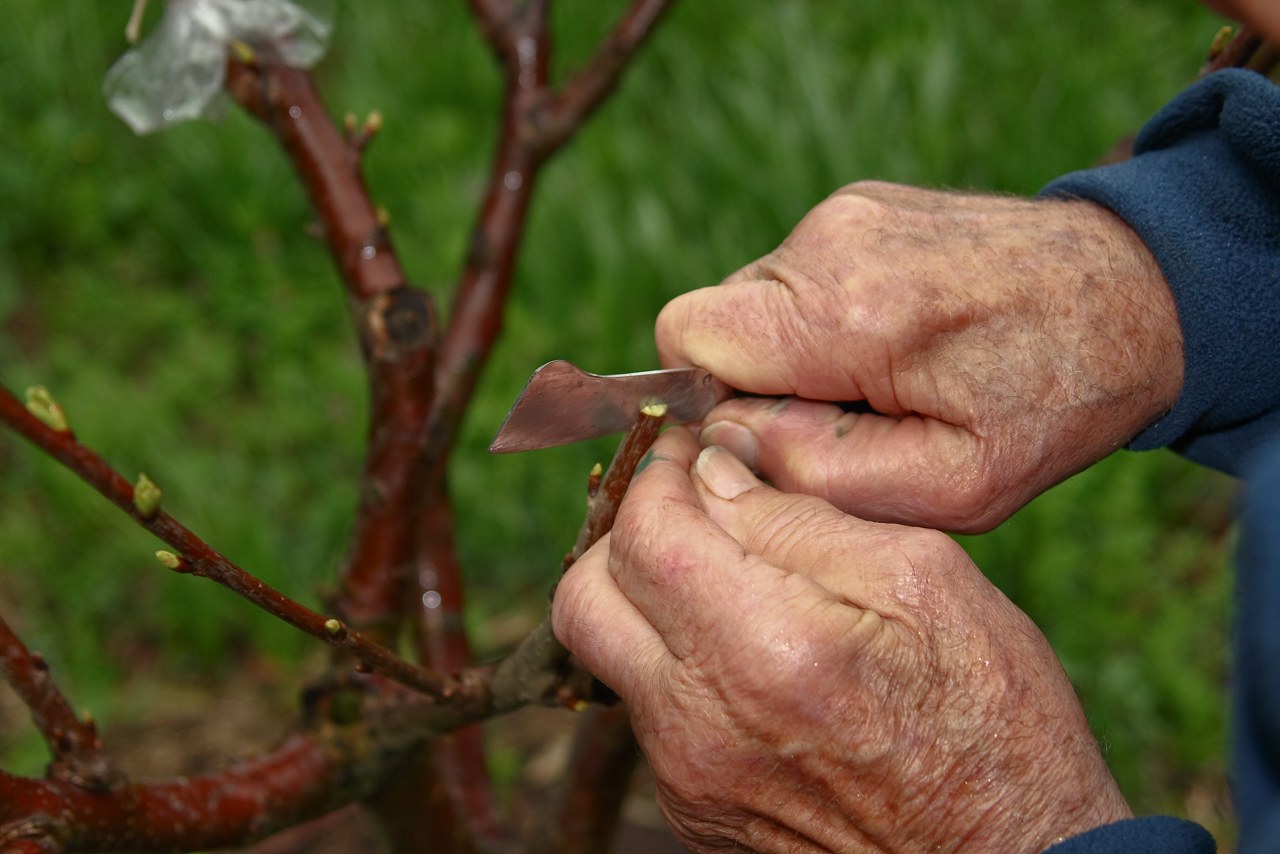
When the fire came, the growers had 900 seedlings ready. The city’s history says they could be planted at once. In the reconstruction work the society planted 900 winter cherries and 300 Somei-yoshino.
A tree for every house
In 1979 Arai Tamishi donated 350 winter-cherry seedlings to the households of Sanbagawa — the record says every household. The record is short, but it means winter cherries spread beyond the park and into the village.
Why grafting mattered
| Year | Event | Winter cherries involved |
|---|---|---|
| 1908 | Planting as “Somei-yoshino”, with 310 maples | Part of 1,000 cherry seedlings |
| 1931–32 | Miyoshi Manabu’s survey; identified as Fuyu-zakura | — |
| 1937 | National designation | 344 recorded |
| 1955 | Preservation society formed; local grafting begins | — |
| 1973 | Forest fire, 123 ha | About 100 survived (report); about 1,000 lost (city history) |
| After 1973 | Reconstruction planting | 900 winter cherries, 300 Somei-yoshino |
| 1979 | Seedlings given to the households of Sanbagawa | 350 |
| 2003 | Winter-cherry regeneration project, including witches’-broom control | — |
| 2006 | Fujioka City becomes manager of the prefectural forest park | — |
730 to 158 — the quiet decline in the protected area
Counting the monument
The 7,000 trees in the tourist brochure and the trees inside the designated area are two different counts. Fujioka City’s tree-health report, which gathers survey and planning work up to fiscal 2024, tracks the winter cherries inside the designated area. Its Table 5 gives the surviving trees as:
| Survey year | Surviving winter cherries in the surveyed area |
|---|---|
| 2001 | 730 |
| 2012 | 407 |
| 2020 | 186 |
| 2024 | 158 |
These are not simply the survivors of the 344 trees of 1937; the area has been replanted and has lost trees since, so the two figures cannot be read as one survival rate. But the direction is clear. In little more than twenty years the protected stand fell to roughly a fifth of its 2001 count.
Five grades of decline
From 2012 the city followed a panel of 469 trees across zones A to E, assessing them every year around August. Each tree was graded from I, good, to V, close to death, by looking at tree form, shoot growth and dieback, leaf density, size and colour, bark, the tree’s ability to sprout new shoots from the trunk or base, and the presence of witches’ broom disease.
In the 2024 assessment, no tree was graded I. Three were II, “slightly poor”; 58 were III, “poor”; 74 were IV, “very poor”; and 20 were V, “close to death”. The graded trees in that table add up to 155, three fewer than the 158 survivors in Table 5; the report does not explain the gap.
Looking for the cause
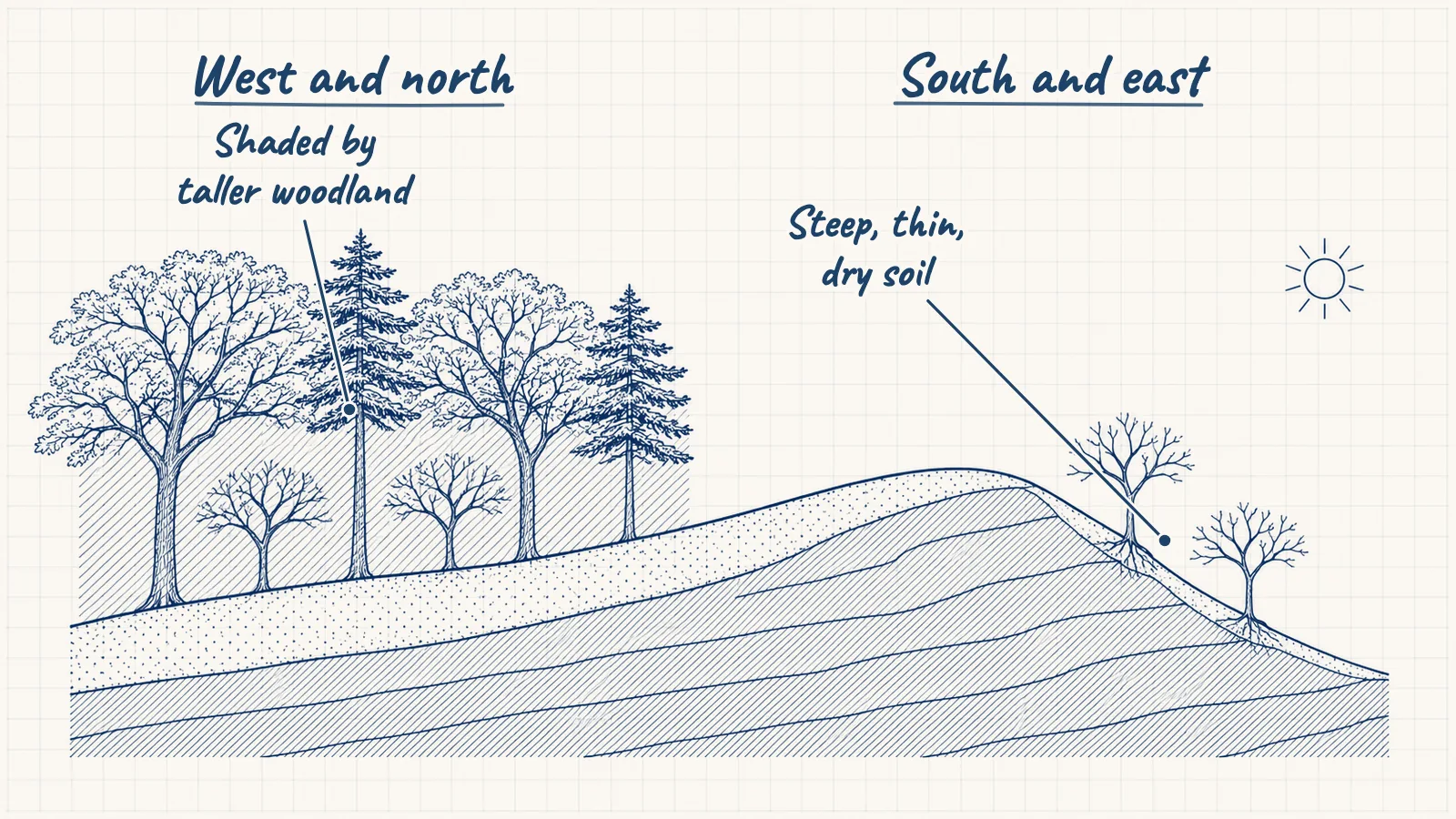
The investigation tested several explanations. Drone photographs taken from above showed how far the surrounding woodland had closed in, especially on the west and north sides of the summit, where the report describes the slopes as having “become forest”. Soil physics was measured at three points, in zones A, B and D: water permeability, water-holding capacity and soil hardness. Root rot was checked too: in July 2023 the team chose 59 of the 185 trees then alive in the designated area and set 590 trap stakes to catch honey fungus (naratake, ナラタケ類). One species, watage-naratake, was found; naratake-modoki, another root-rotting honey fungus, was not.
What the report concluded
The report’s conclusion is that the decline and deaths are driven less by any particular pest, and less by the age of the trees themselves, than by differences in where the trees are growing. In its assessment table, light and management are rated “◎”, the strongest factor; soil water and nutrients “○”; tree age and pests and diseases “△”, a weaker factor.
On the west and north sides, the problem is shade from the surrounding trees, together with thin soil and dryness. On the south and east sides, where sunlight is not blocked, the slopes are steep and the soil layer shallow, and the report suspects a shortage of water and nutrients. The soil at the three test points was not hard enough to stop roots growing, so soil compaction was not found to explain the decline across the area.
To an arborist this is a familiar pattern in old plantings: cherries need light, and when the woodland around a planted stand is left to grow for decades, the cherries end up under trees taller than themselves. The same lesson — that an old tree’s trouble is often in its surroundings rather than in the tree — runs through why Japan’s ancient trees can live for a thousand years.
How the trees are cared for now — pruning, feeding, watering, opening the canopy
Cutting out witches’ broom in the leafless months
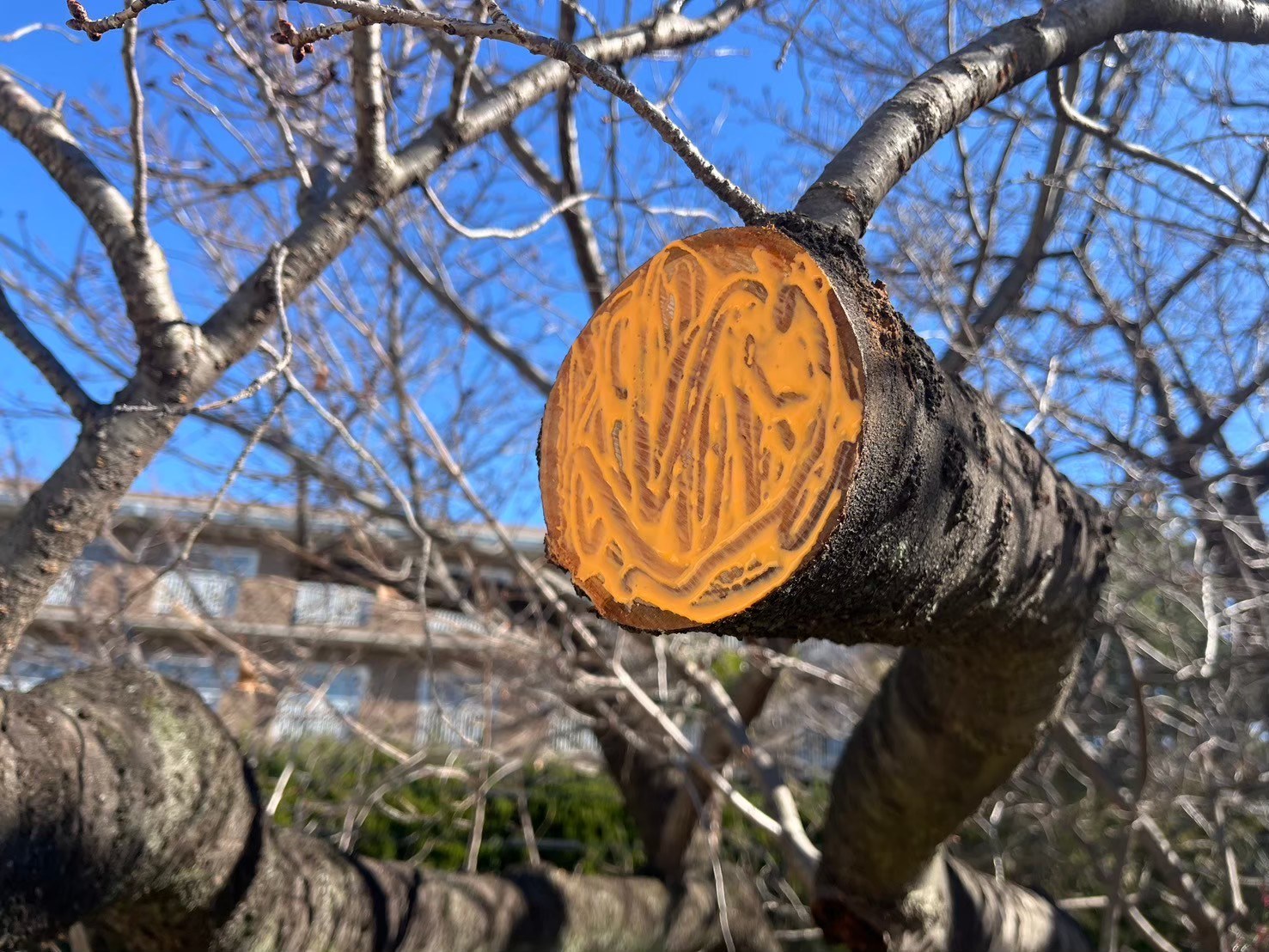
Tengu-su-byō (てんぐ巣病) — cherry witches’ broom — is caused by the fungus Taphrina wiesneri. FFPRI’s guidance is to cut out infected branches and leaves from winter into spring and burn them.
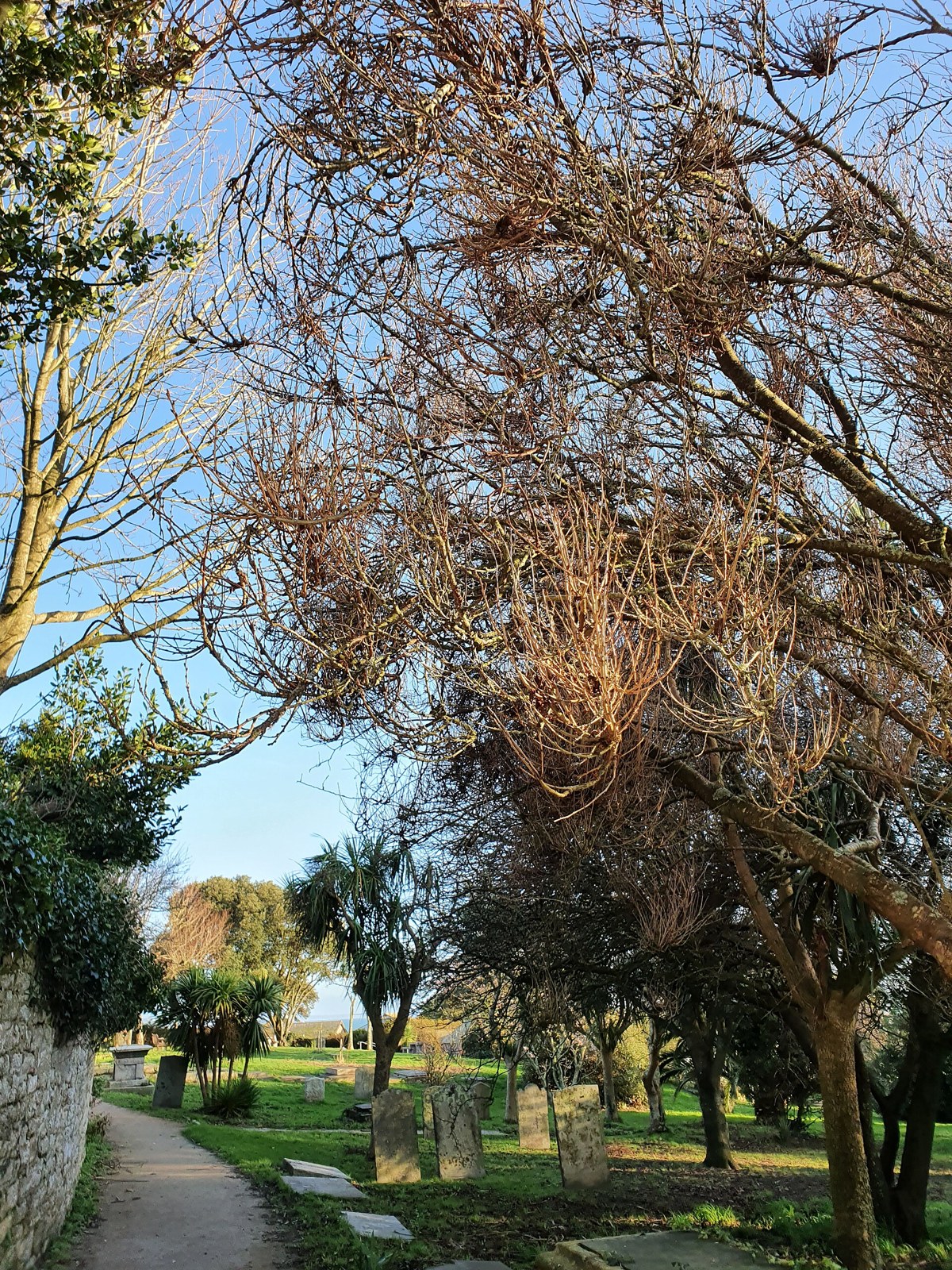
At Sakurayama, the emergency work of 2021 to 2024 also removed infected branches during the leafless period: dead branches and branches infected with witches’ broom were pruned, each cut was treated with a fungicidal wound dressing, and the cut branches were carried out of the area for disposal. The 2003 regeneration project had already included witches’-broom control as part of its work.
Feeding around each tree
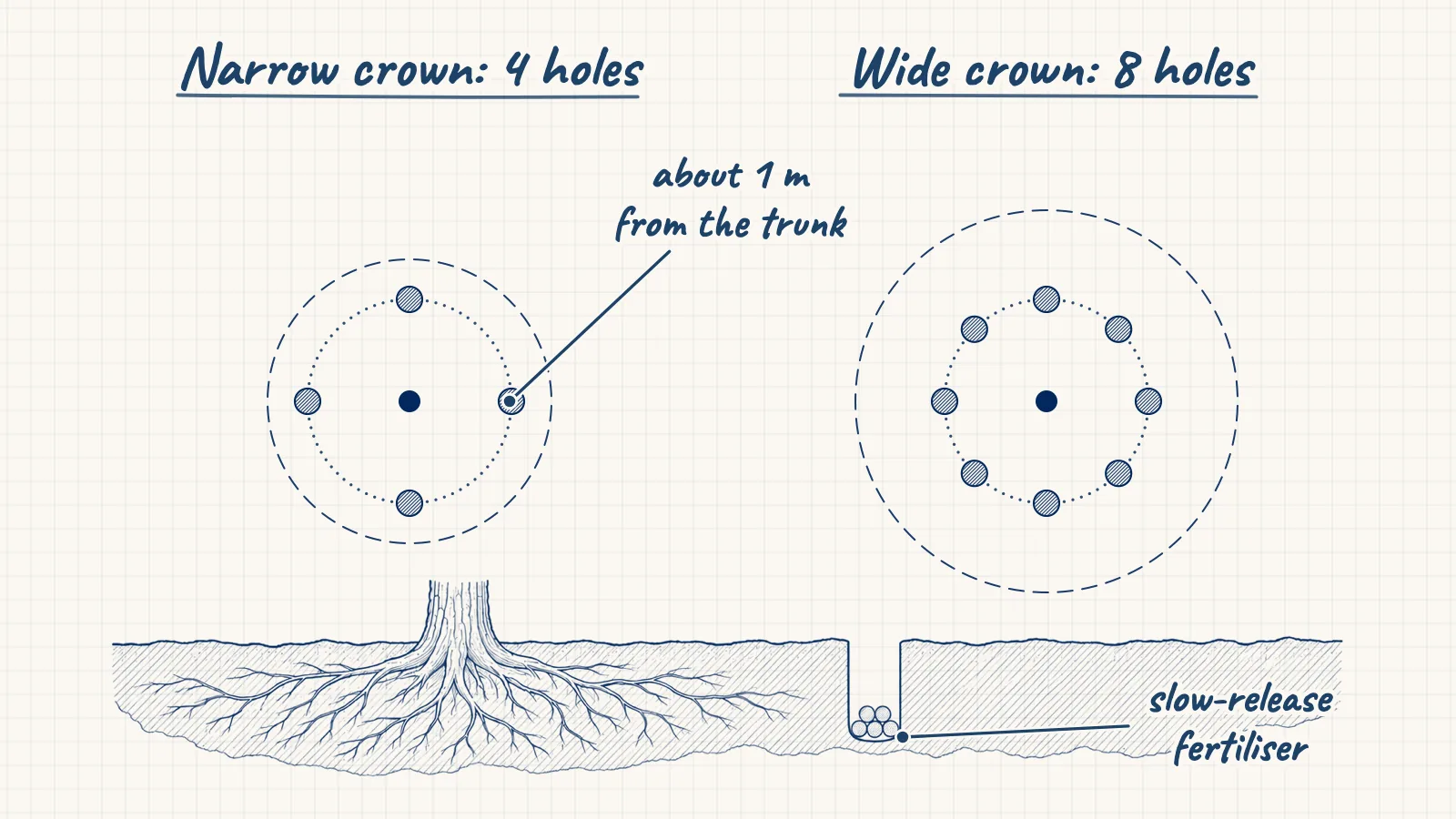
In the same period, each tree was fed through holes set on a circle about 1 metre (3 feet) from the trunk. The number of holes, four to eight, depended on the spread of the branches, and a slow-release solid fertiliser went into each.
Summer soil drenches
From 2022, 30 trees received soil drenches — liquid applied into the root zone — three times each summer, in July, August and September. The timing matches the report’s concern about water and nutrients running short on thin, steep soils.
Opening the forest slowly
The obvious answer to shade is to cut the surrounding trees. The report agrees that the woodland needs thinning, but warns against doing it quickly. An old tree that has lived in shade for decades can be harmed by a sudden change of conditions, and opening the canopy can dry the site out. Its advice is to change the environment gradually, watching how each tree responds.
Replanting with the right trees
The report accepts replanting to restore the scene, with two conditions. Young trees should be checked to confirm they descend from the Sanbagawa (Sakura) trees themselves, not bought-in winter cherries of unknown origin. And before a tree goes into the spot where another died, someone should check whether that spot can still grow a cherry.
The care programme at a glance
| Problem identified | Measure (2021–2024 unless noted) | Detail from the report |
|---|---|---|
| Witches’ broom, dead wood | Pruning in the leafless period | Fungicidal dressing on cuts; branches removed from site |
| Weak growth | Fertilising | 4–8 holes on a ring about 1 m from the trunk; slow-release solid fertiliser |
| Summer drought on thin soil | Soil drenches | 30 trees from 2022; July, August, September |
| Shade from surrounding woodland | Gradual thinning | Watch each tree’s response; avoid drying the site |
| Gaps in the stand | Replanting | Trees of Sanbagawa (Sakura) origin; check the site first |
A different kind of protected tree — how this compares with Western practice
The plant, not one specimen
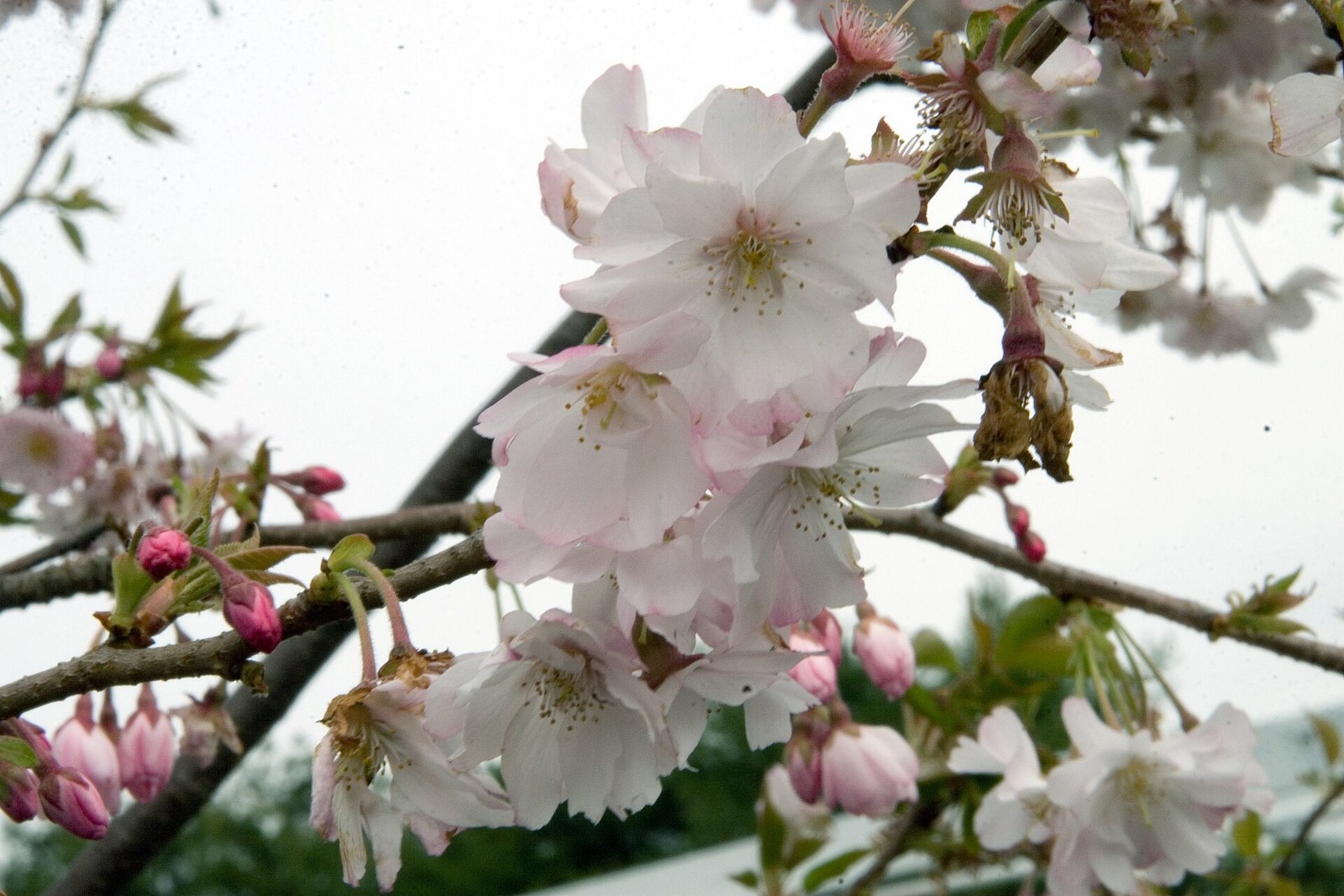
The RHS plant entry for the winter-flowering cherry describes a cultivar with semi-double white flowers — a plant to choose for a garden. The 1937 designation at Sakurayama protects something else — a stand: a hilltop of a rare cultivar, the scene it makes when it flowers in winter, and the variation in its floral parts. That changes what care means. Keeping one ancient tree alive is a matter of that tree’s roots and crown. Keeping a stand alive means keeping the conditions that let a cherry grow there at all — light, soil, water — and replacing losses with trees of the right lineage.
Why the lineage rule matters
The insistence on Sanbagawa-origin stock follows from the designation. If the variation in the floral parts is part of the scholarly value, then filling gaps with winter cherries of unknown origin would slowly replace the thing being protected with something else. Local people had begun grafting winter cherries by 1955; the report’s rule asks that new trees keep that link to the hill.
What other cherry stories in Japan share
Japan’s best-known old cherries are single great trees, and their rescues were work on the roots: the Usuzumi cherry and its 238 root grafts, or the Yamataka Jindai-zakura, whose buried roots were dug free and given new soil. Sakurayama sits at the other end: many modest trees, a cultivar rather than an individual, and a decline driven by the forest around them. The common thread is that in each case the answer was found underground and around the tree, in light and soil, more than in the crown.
What the winter cherries are not — common misconceptions
“They are confused trees flowering out of season”
They are not. The winter cherry is a cultivar with an inherited habit of flowering twice. Out-of-season flowers on ordinary cherries are kaerizaki, “return blooms”, a different thing that follows leaf loss.
“It is the same as the winter-flowering cherry in British gardens”
The RHS name “winter-flowering cherry” belongs to Prunus × subhirtella ‘Autumnalis’, which in Japan is the double-flowered October cherry. Sakurayama’s Fuyu-zakura is Cerasus × parvifolia ‘Fuyu-zakura’, single-flowered, of different parentage.
“There are 7,000 protected trees”
The park has about 7,000 winter cherries by the city’s count. The national monument covers a designated area inside the park, where the city’s survey counted 158 surviving trees in 2024.
“Tourists trampled them to death”
The report found the soil at its test points was not compacted enough to stop root growth. Its main suspects are shade, thin soil and dryness, not visitors’ feet.
“Everyone knows what the winter cherry is a cross of”
Japanese institutions give three different answers. All include Mame-zakura; the other parent is disputed.
Visiting Sakurayama in late November
When to go
Fujioka City gives the winter cherries’ usual season as mid-November to mid-December, and its winter-cherry Q&A names mid-November to early December as the best time. On 11 November 2026 the city reported both the cherries and the autumn leaves at their best. The autumn flowering is spread over weeks, so check the city’s latest flowering report before you go.
The festival
The Sakurayama Festival (桜山まつり) began on 1 December 1925. In 2026 the 101st festival is scheduled for Sunday 6 December, 10:30 to 14:00, in the park’s third plaza, organised by the Fujioka City Tourism Association. Parking is free on festival day.
The evening illuminations that older English-language guides still mention have been cancelled for fiscal 2026, according to the city.
Getting there
By car, the city gives about 40 minutes and 21 km (13 miles) from either Honjō-Kodama IC or Fujioka IC, and asks drivers to follow the park signs around Onishi. In the flowering season parking costs ¥500 for a car and ¥100 for a motorcycle. Car parks 1 and 2 are closed from 16:30 to 8:30.
By public transport, take a local bus to Onishi Post Office (鬼石郵便局). The park is about 7 km (4.3 miles) from there; the city suggests a taxi, about 15 minutes, or a walk of about 1 hour 40 minutes.
While you are there — the Sanba-stone garden
The Japanese garden in the first plaza is built with about 1,500 tonnes of Sanba-seki (三波石) — “Sanba stone”, a local stone in which white quartz, washed clean by water, stands out against a bluish body. It has long been prized as a garden stone, and Gunma Prefecture calls it one of its special products. It is also where the city points visitors for maple colour, so in late November stone, maples and winter cherries can be seen on one walk.
Frequently asked questions
Why do cherry trees bloom in November in Japan?
Some Japanese cherry cultivars, including Fuyu-zakura (winter cherry), Jūgatsu-zakura (October cherry) and Shiki-zakura (four-season cherry), have an inherited habit of flowering in autumn and again in spring. Ordinary spring cherries can also flower in autumn after losing their leaves early; those are “return blooms” and are not the same thing.
Where can I see cherry blossoms and autumn leaves at the same time?
Sakurayama Park in Fujioka, Gunma Prefecture, is a place known for exactly this. About 7,000 winter cherries flower from mid-November to mid-December, and the city reports both the cherries and the maples at their best in mid-November.
What is Fuyu-zakura?
Fuyu-zakura (冬桜) is a Japanese cherry cultivar, Cerasus × parvifolia ‘Fuyu-zakura’, also called Koba-zakura for its small leaves. It has single white flowers and flowers twice, from autumn into winter and again in April. One parent is Mame-zakura; the other is disputed.
Is Sakurayama’s winter cherry the same as the winter-flowering cherry sold in the UK?
No. The RHS “winter-flowering cherry” is Prunus × subhirtella ‘Autumnalis’, with semi-double flowers. In Japan that plant is Jūgatsu-zakura. Sakurayama’s trees are a different cultivar.
Why are the protected winter cherries declining?
Fujioka City’s 2025 report points mainly to light and growing conditions: woodland shading the west and north sides, and thin, dry soil on the steep south and east sides. It rates pests and tree age as weaker factors.
When is the Sakurayama Festival in 2026?
Sunday 6 December 2026, 10:30 to 14:00, in the third plaza of Sakurayama Park. It is the 101st festival; the first was held in 1925.
Sources
– Agency for Cultural Affairs, Cultural Heritage Online, “Sanbagawa (Sakura)”: https://online.bunka.go.jp/heritages/detail/162301 — checked 2026-11-14 – Gunma Prefecture, list of nationally designated cultural properties: https://www.pref.gunma.jp/uploaded/attachment/677573.pdf — checked 2026-11-14 – Gunma Prefecture, Sakurayama Forest Park: https://www.pref.gunma.jp/page/143868.html — checked 2026-11-14 – Fujioka City, “Sanbagawa (Sakura)” (cultural properties): https://www.city.fujioka.gunma.jp/soshiki/kyoikuiinkai/bunkazaihogo/2/3/meisyou_tennenkinenbutu/1044.html — checked 2026-11-14 – Fujioka City, tree-health restoration report for Sanbagawa (Sakura), 2025 (parts 1–3): https://www.city.fujioka.gunma.jp/soshiki/kyoikuiinkai/bunkazaihogo/4/11145.html — checked 2026-11-14 – Fujioka City, history of Sakurayama Park: https://www.city.fujioka.gunma.jp/soshiki/onisisogoshisho/nigiwaikanko/1/sakurayamakouennorekisi.html — checked 2026-11-14 – Fujioka City, about the winter cherry: https://www.city.fujioka.gunma.jp/soshiki/onisisogoshisho/nigiwaikanko/1/huyusakura.html — checked 2026-11-14 – Fujioka City, flower information for Sakurayama Park: https://www.city.fujioka.gunma.jp/soshiki/onisisogoshisho/nigiwaikanko/1/sakurayamakouenhananokaikazyouhou.html — checked 2026-11-14 – Fujioka City, winter cherry flowering status (11 November 2026): https://www.city.fujioka.gunma.jp/soshiki/onisisogoshisho/nigiwaikanko/4/11865.html — checked 2026-11-14 – Fujioka City, autumn leaves at Sakurayama Park: https://www.city.fujioka.gunma.jp/soshiki/onisisogoshisho/nigiwaikanko/4/sakurayamakouenkouyou.html — checked 2026-11-14 – Fujioka City, mayor’s press conference, 9 November 2026 (festival): https://www.city.fujioka.gunma.jp/soshiki/kikakubu/hisho/1/reiwa8/11173.html — checked 2026-11-14 – Fujioka City, access to Sakurayama Park: https://www.city.fujioka.gunma.jp/soshiki/onisisogoshisho/nigiwaikanko/1/sakurayamakouenakusesu.html — checked 2026-11-14 – Fujioka City, Sakurayama Park: https://www.city.fujioka.gunma.jp/soshiki/onisisogoshisho/nigiwaikanko/1/sakurayamakouentop.html — checked 2026-11-14 – Fujioka City, walking map of Sakurayama Park: https://www.city.fujioka.gunma.jp/soshiki/onisisogoshisho/nigiwaikanko/1/sakurayamakouenannsakuhaikinngumap.html — checked 2026-11-14 – Fujioka City, autumn–winter sightseeing guide: https://www.city.fujioka.gunma.jp/soshiki/keizaibu/shokokanko/2/1/10987.html — checked 2026-11-14 – Fujioka City, Sanba stone (tourism): https://www.city.fujioka.gunma.jp/soshiki/keizaibu/shokokanko/2/fujioka_kanko/1654.html — checked 2026-11-14 – Flower Association of Japan, cherry encyclopedia, “Fuyu-zakura”: https://www.hananokai.or.jp/sakura-zukan/fuyu-zakura/ — checked 2026-11-14 – Flower Association of Japan, “Jūgatsu-zakura”: https://www.hananokai.or.jp/sakura-zukan/jugatsu-zakura/ — checked 2026-11-14 – Flower Association of Japan, “Kobuku-zakura”: https://www.hananokai.or.jp/sakura-zukan/kobuku-zakura/ — checked 2026-11-14 – Forestry and Forest Products Research Institute, cherry cultivar material: https://www.ffpri.go.jp/pubs/chukiseika/documents/3rd-chuukiseika5rev.pdf — checked 2026-11-14 – Forestry and Forest Products Research Institute, Tama Forest Science Garden Q&A: https://www.ffpri.go.jp/tmk/info/faq.html — checked 2026-11-14 – Forestry and Forest Products Research Institute, “Cherries that flower in autumn”: https://www.ffpri.go.jp/snap/2022/11-aki-sakura.html — checked 2026-11-14 – Forestry and Forest Products Research Institute, press release on cherry dormancy (2024): https://www.ffpri.go.jp/press/2024/20240918/index.html — checked 2026-11-14 – Forestry and Forest Products Research Institute, Kyushu branch, cherry witches’ broom: https://www.ffpri.go.jp/kys/business/tatuta/jubyo/sakuteng.html — checked 2026-11-14 – Ishikawa Prefecture Forest Experiment Station, “Fuyu-zakura”: https://www.pref.ishikawa.lg.jp/ringyo/sakura/data/huyuzakura.html — checked 2026-11-14 – Japan Meteorological Agency, phenological observations: https://www.data.jma.go.jp/sakura/data/index.html — checked 2026-11-14 – Toyota City, Obara four-season cherries: https://www.city.toyota.aichi.jp/shisei/jichiku/1008649/obara/1011191.html — checked 2026-11-14 – National Diet Library, Portraits of Modern Japanese Historical Figures, Miyoshi Manabu: https://www.ndl.go.jp/portrait/datas/6345 — checked 2026-11-14 – National Museum of Nature and Science, history of natural monument designation: https://www.kahaku.go.jp/special/past/nihon/infomation/chapter_7.htm — checked 2026-11-14 – Royal Horticultural Society, Prunus × subhirtella ‘Autumnalis’: https://www.rhs.org.uk/plants/94024/prunus-%C3%97-subhirtella-autumnalis/details — checked 2026-11-14 – Gunma Official Tourist Guide, “Sakurayama Park Winter Cherry Blossoms”: https://www.visit-gunma.jp/en/spots/sakurayama-park-winter-cherry-blossoms/ — checked 2026-11-14