

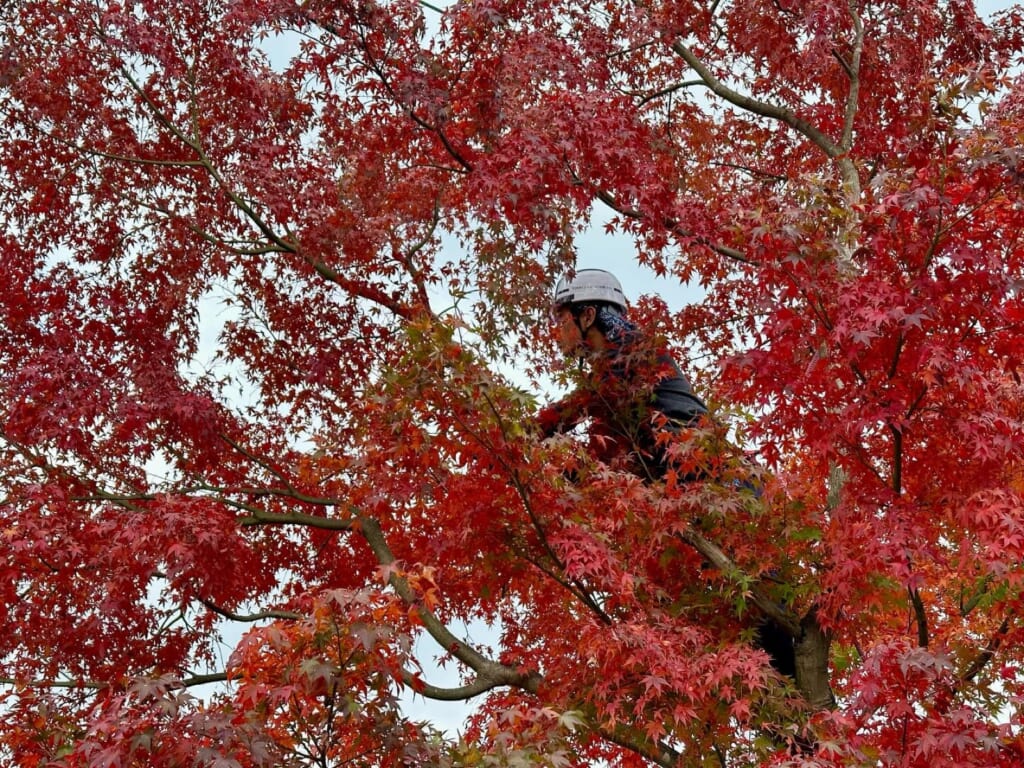
At the Kyoto temples whose records we could find, the weeks before the autumn crowds go into getting the whole site ready, not into reshaping the maples. Eikandō, long known as “Eikandō of the maples,” says its preparation continues throughout October — garden maintenance, the pruning of trees, and repairs to the corridors between its halls — while at Giō-ji the moss keepers water, weed and sweep all summer. Japanese guidance puts a maple’s basic structural pruning after leaf fall, with only light pruning at other times, and we found no temple record of maples being cut back for the colour.
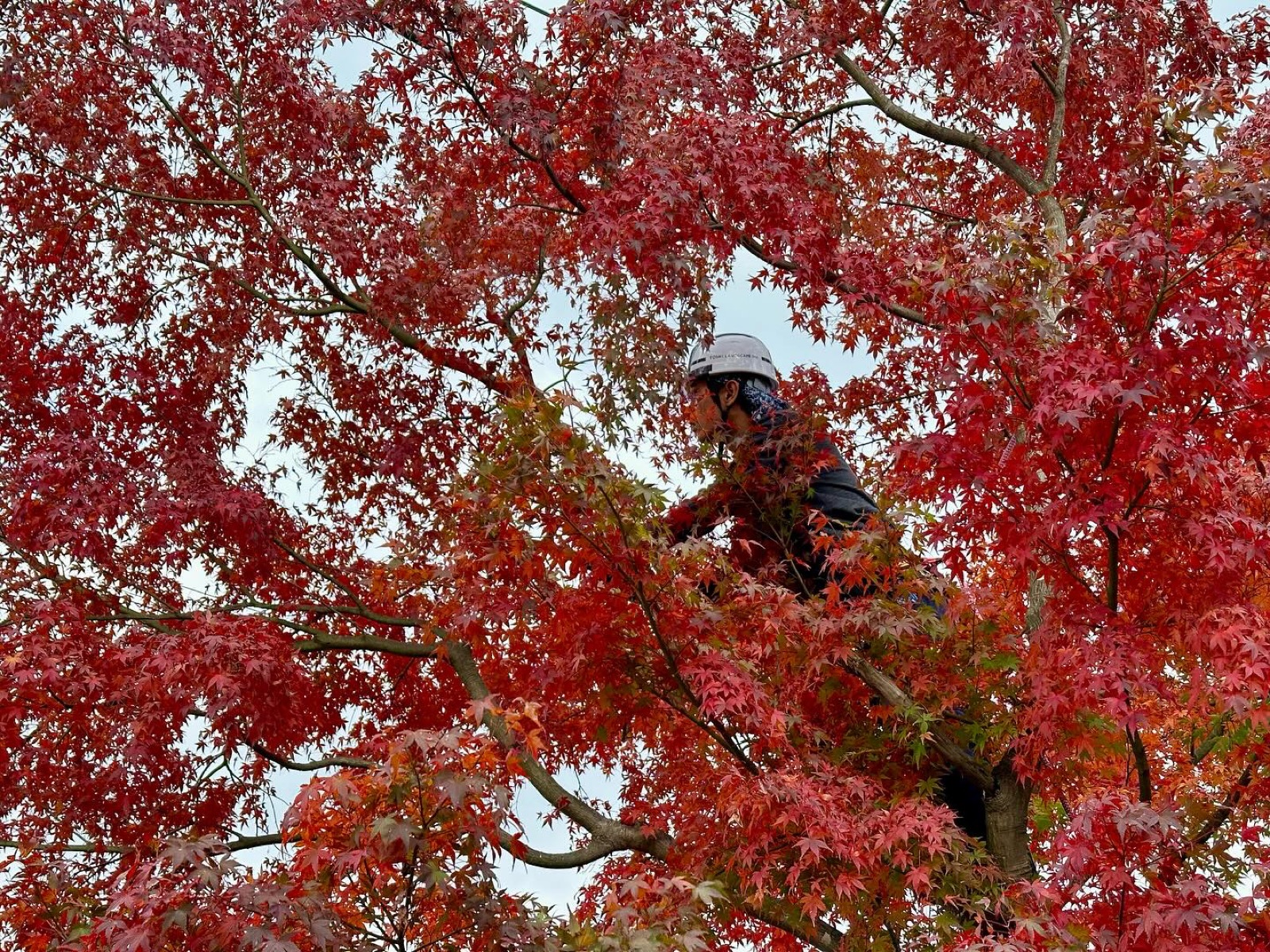
A July day at Shinnyo-dō — summer tending with the regrowth counted in
Gardeners in the shoin garden
On 10 July 2025, the temple diary of Shinnyo-dō (真如堂) recorded a two-day visit from its gardeners: “Today and tomorrow, the gardeners are tending the shoin garden.”
The gardeners thinned the crowded garden, and the diary’s writer added the result: “Now Mount Daimonji will be easy to see again.” To a gardener’s eye — this is our reading, not the temple’s words — it is the old idea of shakkei, borrowing the scenery beyond the garden, kept alive one branch at a time.
Cutting with the regrowth in mind
The most interesting line in the diary is about the future. The work was done “anticipating that the branches will soon grow out again.” A July cut is not meant as the final shape; the regrowth is part of the plan.
The diary does not say the work was aimed at autumn colour, and it does not single out maples; it was a summer tending of the whole garden. That is as far as the record goes — but it is a dated glimpse of the work done months before the crowds.
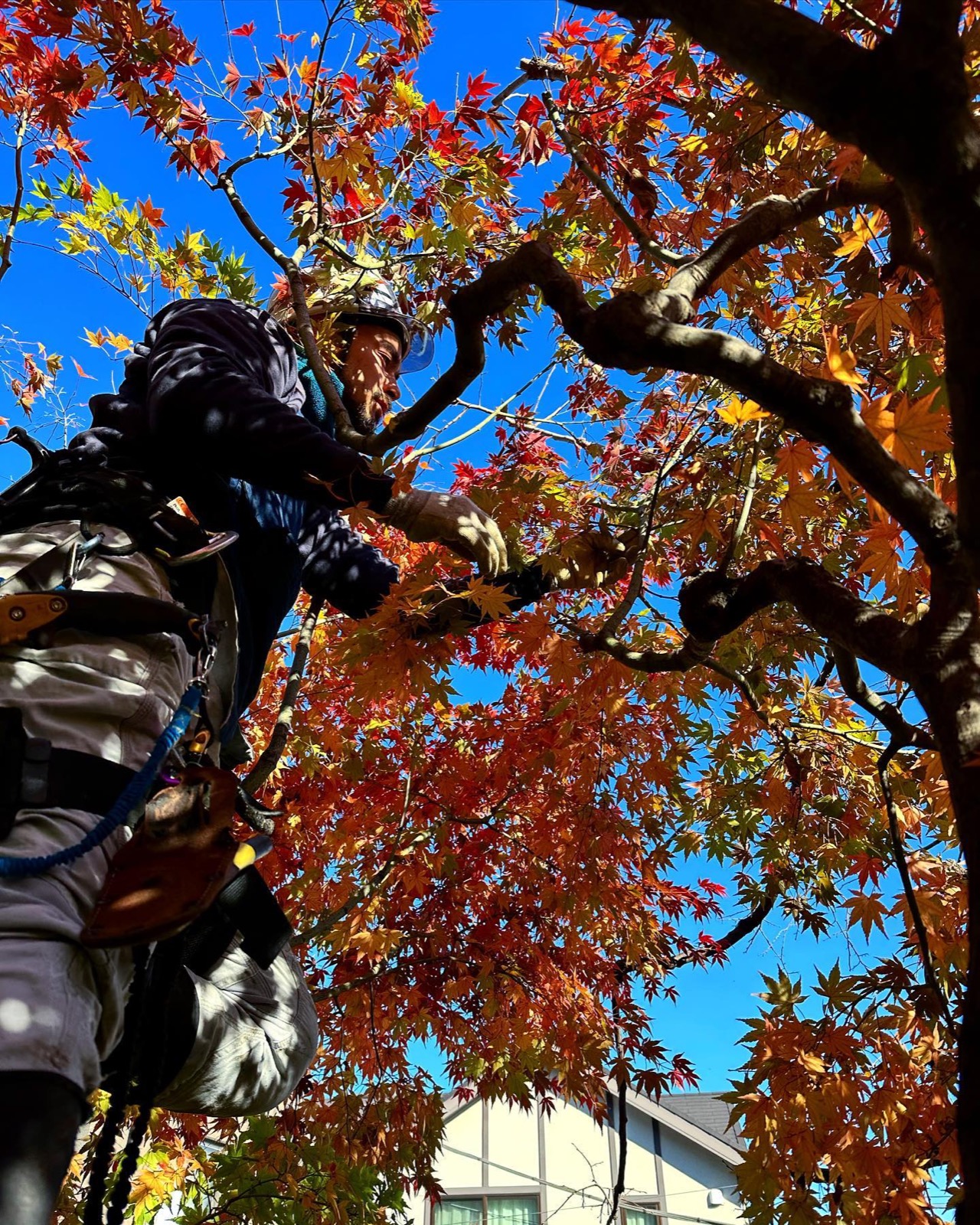
Why the big cuts wait for winter — what the tree allows
The calendar Japanese cities publish
Japanese municipal guidance agrees that a maple’s basic pruning belongs after leaf fall, though the months differ by city. Nagasaki City’s guide groups maples with other deciduous broadleaf trees such as yamabōshi and aodamo, and says simply: “Deciduous broadleaf trees are pruned while looking at the branches after the leaves have fallen.” Its kihon sentei (基本剪定), basic structural pruning, runs from December to February. Light pruning is allowed in March, June, September and October, with a warning about summer: “Summer is the season when the tree grows, so pruning heavily will damage it.”
The Sapporo Park and Greenery Association, writing for a much colder city, says summer pruning should only go as far as “improving airflow and light inside the crown, keeping the number of leaves that photosynthesise.” Summer work stays light, and leaves the tree its leaves.
Sap that moves early
Winter work has to finish early because of the maple’s own physiology. The Niigata Prefectural Urban Greenery Center states that “maples move their sap early, so the work should be finished by around early February.” The Sapporo association, in a colder city, sets an earlier limit: “In February the roots begin to draw up water, so even light pruning should be finished within the year.” The two deadlines differ; the reason given, rising sap, is the same.
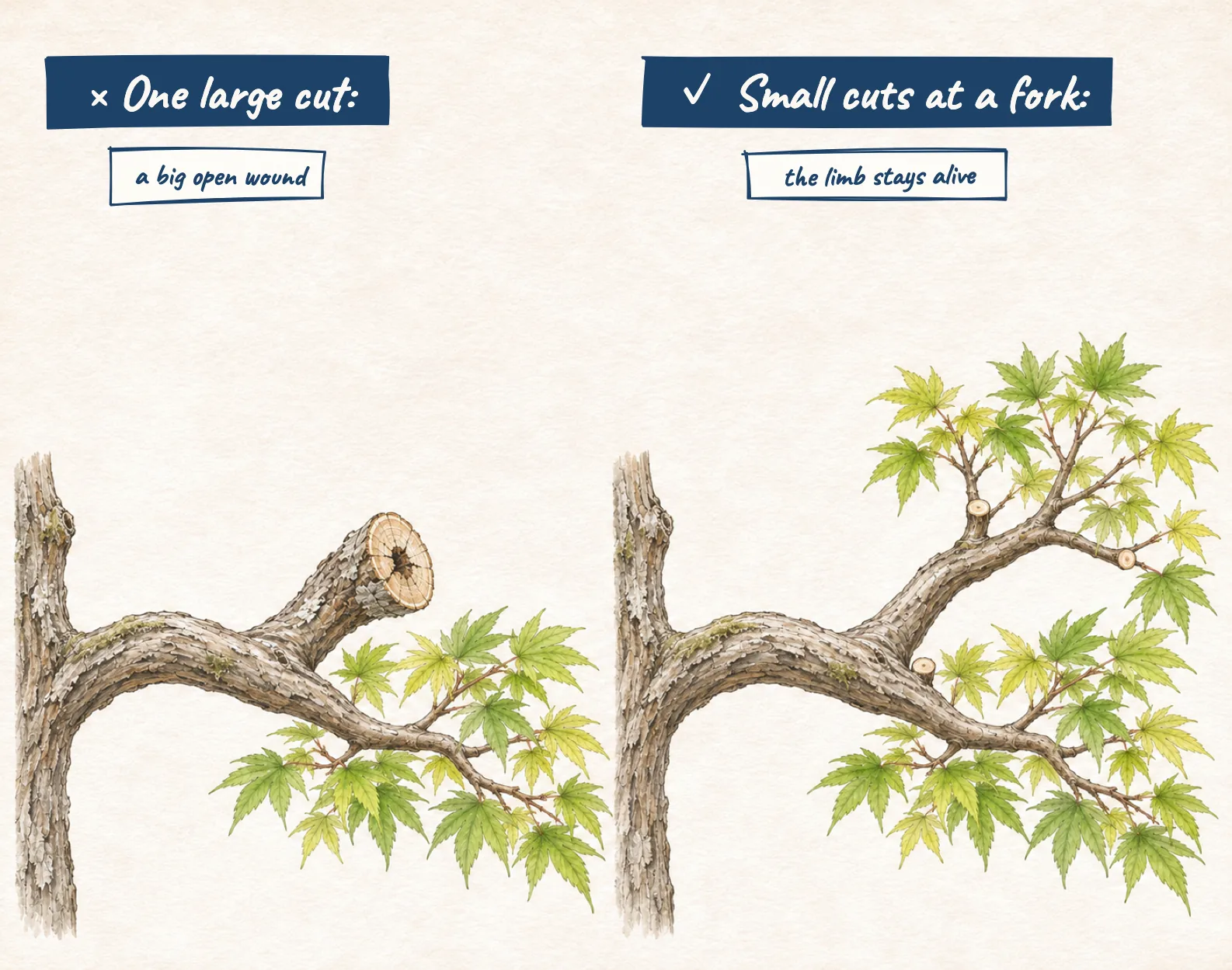
The Niigata center adds a second warning that matters even more in a temple garden: maples are “a species that easily dies back from the cut when a large branch is removed.”
| Season | What Japanese guidance allows on maples | Why | Source |
|---|---|---|---|
| December–February | Basic (structural) pruning, after leaf fall | The branch structure can be seen | Nagasaki City |
| By around early February | Finish winter pruning | Maple sap moves early | Niigata center |
| By the end of the year (Sapporo) | Finish even light pruning | Roots start drawing water in February | Sapporo association |
| June (also March, Sept., Oct.) | Light pruning only | Heavy summer cuts damage a growing tree | Nagasaki City |
| Summer | Thinning for light and air, keeping leaves | The tree needs its photosynthesising leaves | Sapporo association |
| Any season | Avoid removing large branches | Maples die back easily from large cuts | Niigata center |
What sukashi looks like on a maple
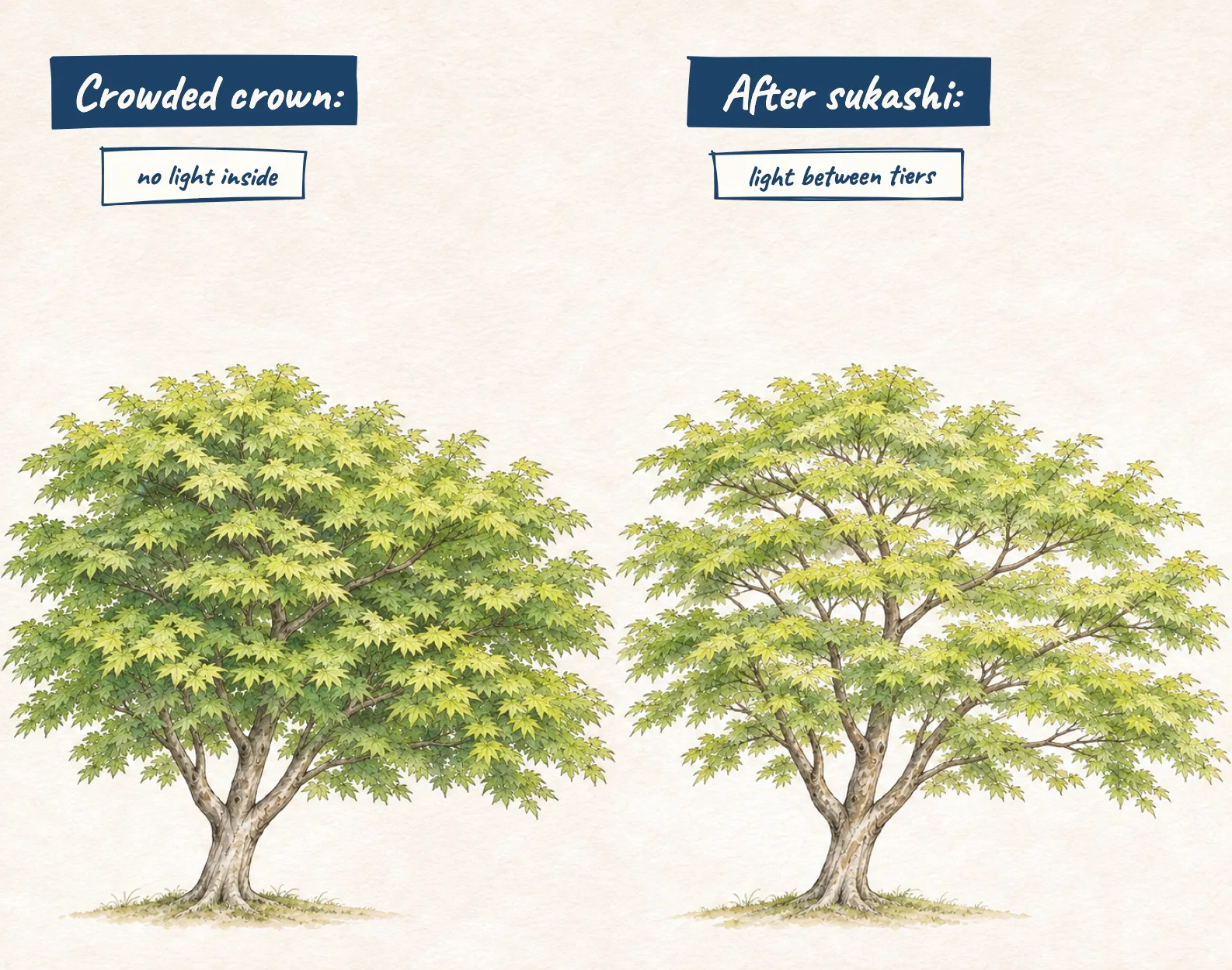
Japanese gardeners call this kind of light thinning sukashi (透かし), “making see-through”. We looked at the cuts in detail in how Japanese gardeners prune a maple with sukashi.
Why the structural decisions wait for bare branches
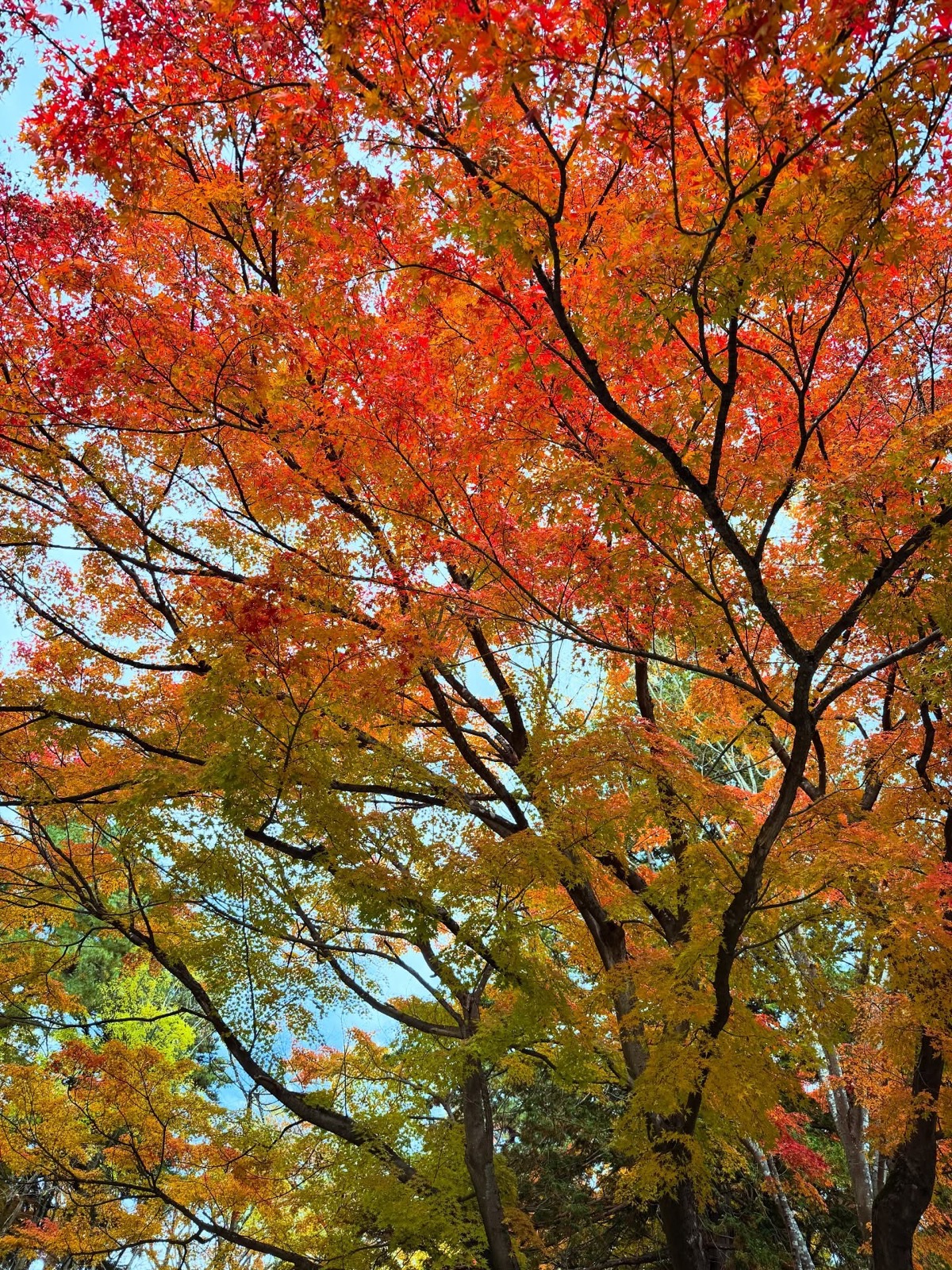
Nagasaki allows light pruning in October, but its basic pruning waits until “after the leaves have fallen,” when the branches can be seen. The photograph at the top of this article shows why: at full colour, the leaves hide almost the whole framework of the tree.
October at Eikandō — a month of getting ready
The temple of the maples
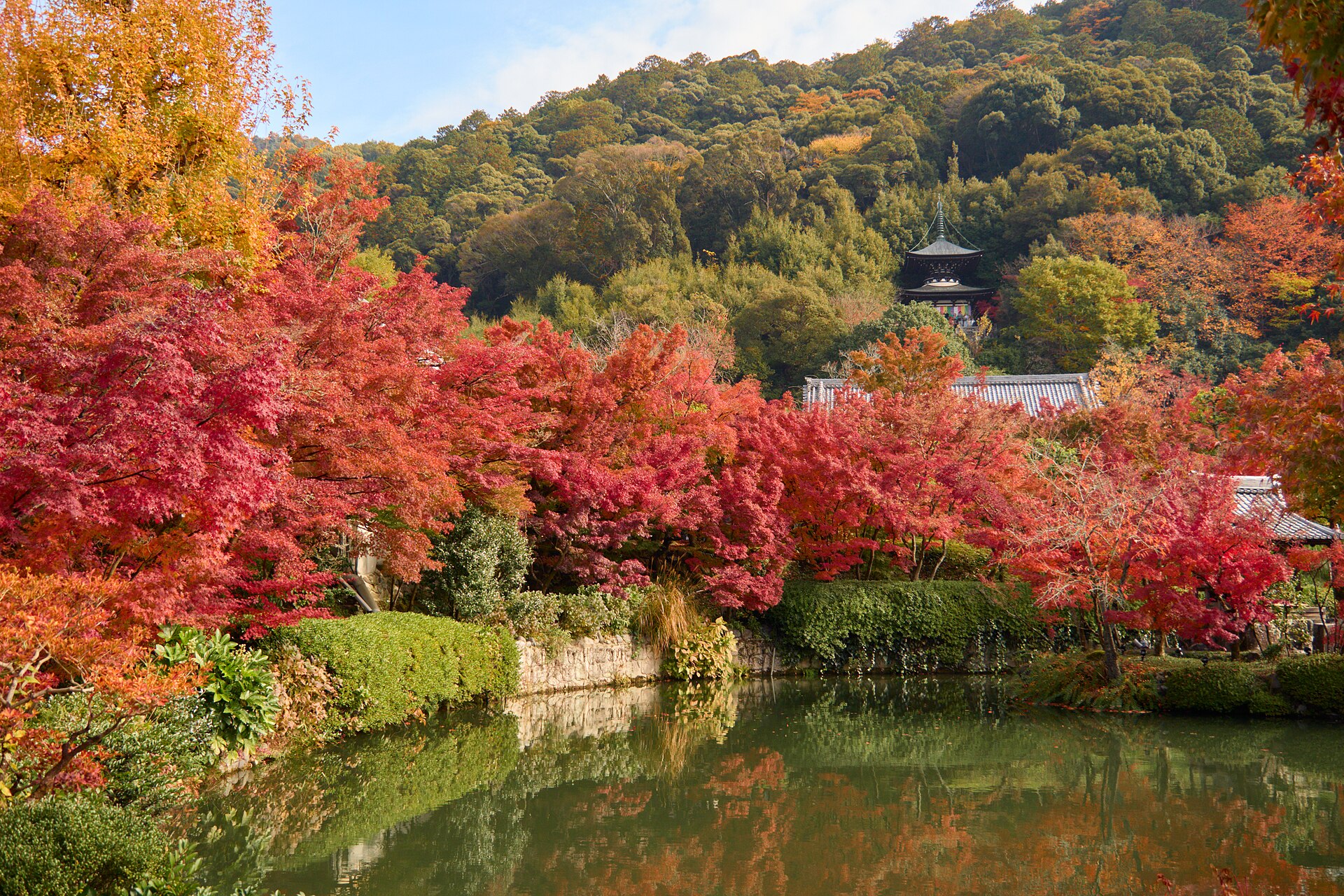
If one temple can stand for Kyoto’s maple season, it is Eikandō (永観堂). Its own history describes it as having been “praised by the pens and voices of many cultured people” for more than eleven hundred years, under the nickname “Eikandō of the maples” (Momiji no Eikandō). A Kyoto City transport leaflet notes that its autumn colour was already sung in the Kokin Wakashū, the classical anthology of Japanese poetry. Kyoto’s official tourism website puts the number of autumn-foliage trees around its stroll garden at about 3,000.
What the temple says it does in October
Eikandō’s monthly events page describes the run-up to autumn in plain terms. Ahead of the November treasure exhibition and the evening illuminations, preparation work “continues throughout October”: garden maintenance, the pruning of trees, and the reinforcement and repair of the corridors that connect its halls.
The list names jumoku no sentei (樹木の剪定), the pruning of trees, without saying which trees, and it puts that pruning beside building repairs. The trees are one part of a site being readied.
A dry October, seen up close
In 2025 the preparation met a problem. On 6 October 2025, a Fuji Television crew visiting Eikandō found maple leaves that had dried and withered before the colour arrived. The temple’s Hamano Kōin told the reporters that the trees were managed by gardeners who came in for the work, and that watering by sprinkler “had not been enough to keep up.” Even at the temple of the maples, the colour depended on the summer the trees had just been through.
A hot summer and the colour — the part no gardener controls
What happens inside a reddening leaf
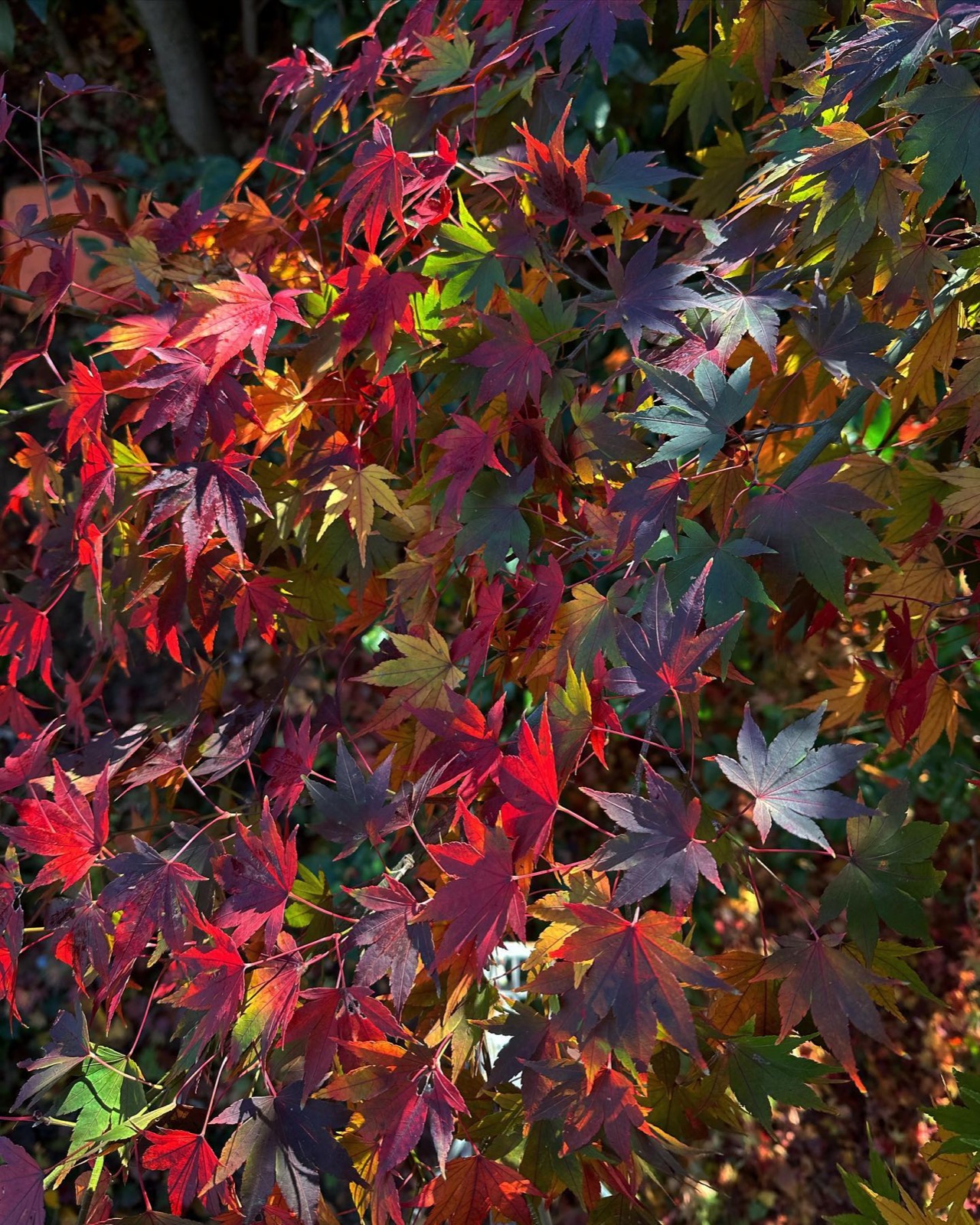
Autumn red in a Japanese maple is not just green fading away. A 2022 study of Acer palmatum found that as leaves turned semi-red and then fully red, they actively accumulated anthocyanins, the red pigments, while chlorophyll and carotenoids were being broken down. The red is made, not merely revealed.
Warm days, cold nights, no drought
The Nagano Local Meteorological Office lists what makes for beautiful autumn leaves: “days that are warm and nights that turn cold,” leaves that receive plenty of sunlight, and leaves “that do not dry out and wither.” An Environment Ministry field report from Kyushu gives a rule of thumb for timing: colouring needs a daily minimum below about 8°C (46°F) to begin, and moves quickly once minima fall to 5°C (41°F) or below. Those figures are a guide, not a threshold for every tree.
A 2005 experiment on young Japanese maples tested the cold-night idea directly. Saplings kept indoors at night lost their green, measured with a chlorophyll meter, more slowly than saplings left outdoors in the cold.
When the summer is too hot
The other half of the Nagano list — leaves that do not dry out — is where a hot summer bites. A Kansai Television report dated 11 November 2025 visited Rokuō-in, a Kyoto temple. Staff member Suita Yōko pointed to leaves that were “a little curled,” and explained that “because of the heat and the lack of rain, water did not reach the branches.”
Outside Japan, the advice frames the same risk as a question of siting. North Carolina State Extension warns that “summer heat can scorch the leaves in full sun” and that “drought and heat can adversely stress these plants.” The risk is the same on both sides of the Pacific. In a temple garden the trees are already where they are, so the response lies in the care — at Eikandō in 2025, sprinklers.
| Condition | Effect on colour | Source |
|---|---|---|
| Warm days, cold nights | Encourages vivid colour | Nagano Local Meteorological Office |
| Daily minimum below about 8°C (46°F) | Colouring begins (rule of thumb) | Environment Ministry, Kyushu office |
| Daily minimum 5°C (41°F) or below | Colouring speeds up (rule of thumb) | Environment Ministry, Kyushu office |
| Plenty of sunlight on the leaves | Helps colour develop | Nagano Local Meteorological Office |
| Leaves drying out | Leaves wither before colouring | Nagano office; Rokuō-in, 2025 |
| Full sun with summer heat, drought | Leaf scorch, stress | NC State Extension |
The moss beneath the maples — Giō-ji and Saihō-ji
Three hours of water a day
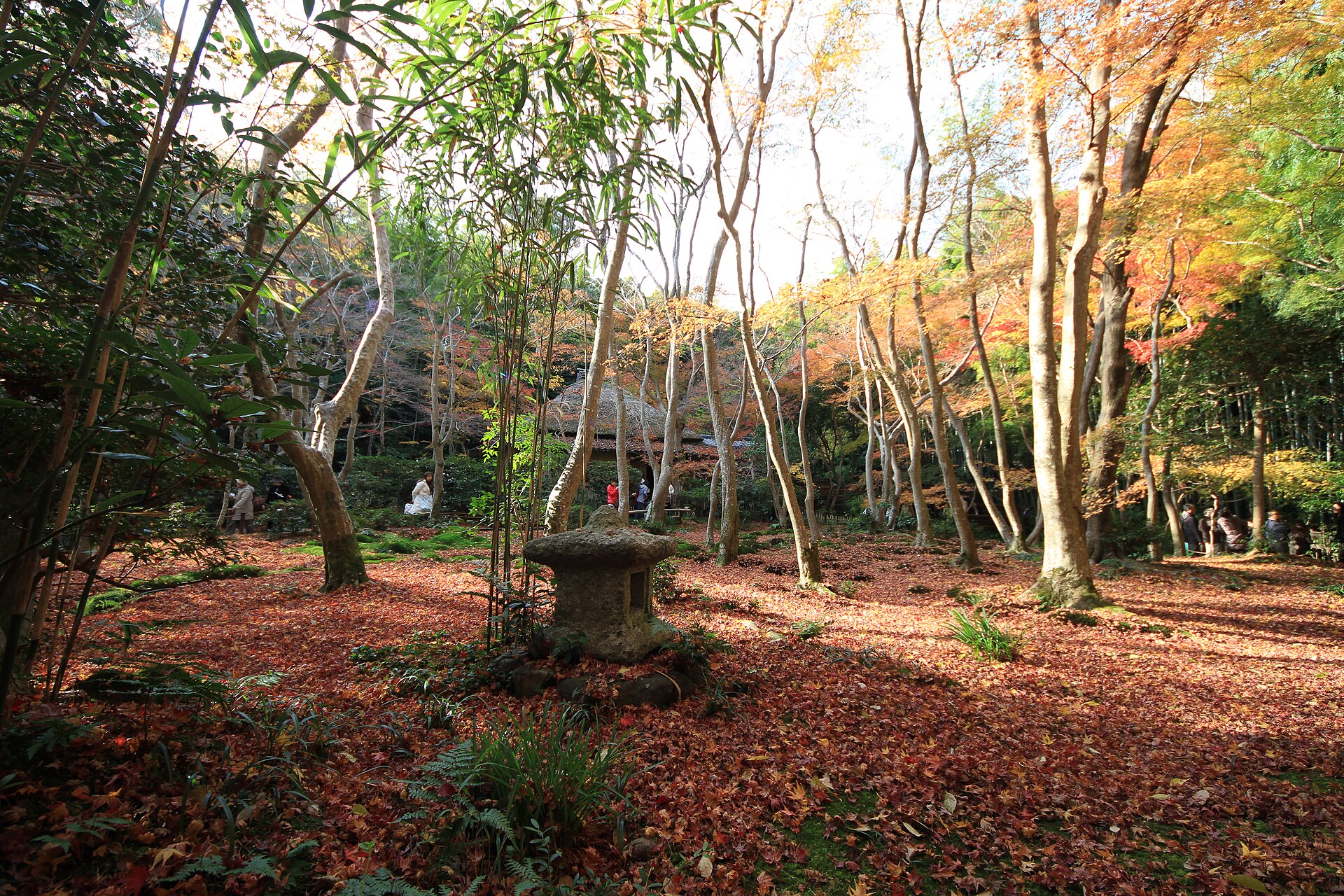
Under many of Kyoto’s maples lies a second garden that needs daily care: moss. At Giō-ji (祇王寺), a small Kyoto temple, the magazine Katei Gahō followed the moss keeper Mizuguchi Masahiro and his colleagues in 2025. In summer they water twice a day, at 6 a.m. and 4 p.m., for about three hours in total. They collect fallen leaves with hand brooms, cut the weeds that grow between the moss, and remove the unwanted liverwort jagoke with tweezers. The green carpet under the red leaves in November is the result of a summer of early mornings.
Sweeping for light, not for tidiness
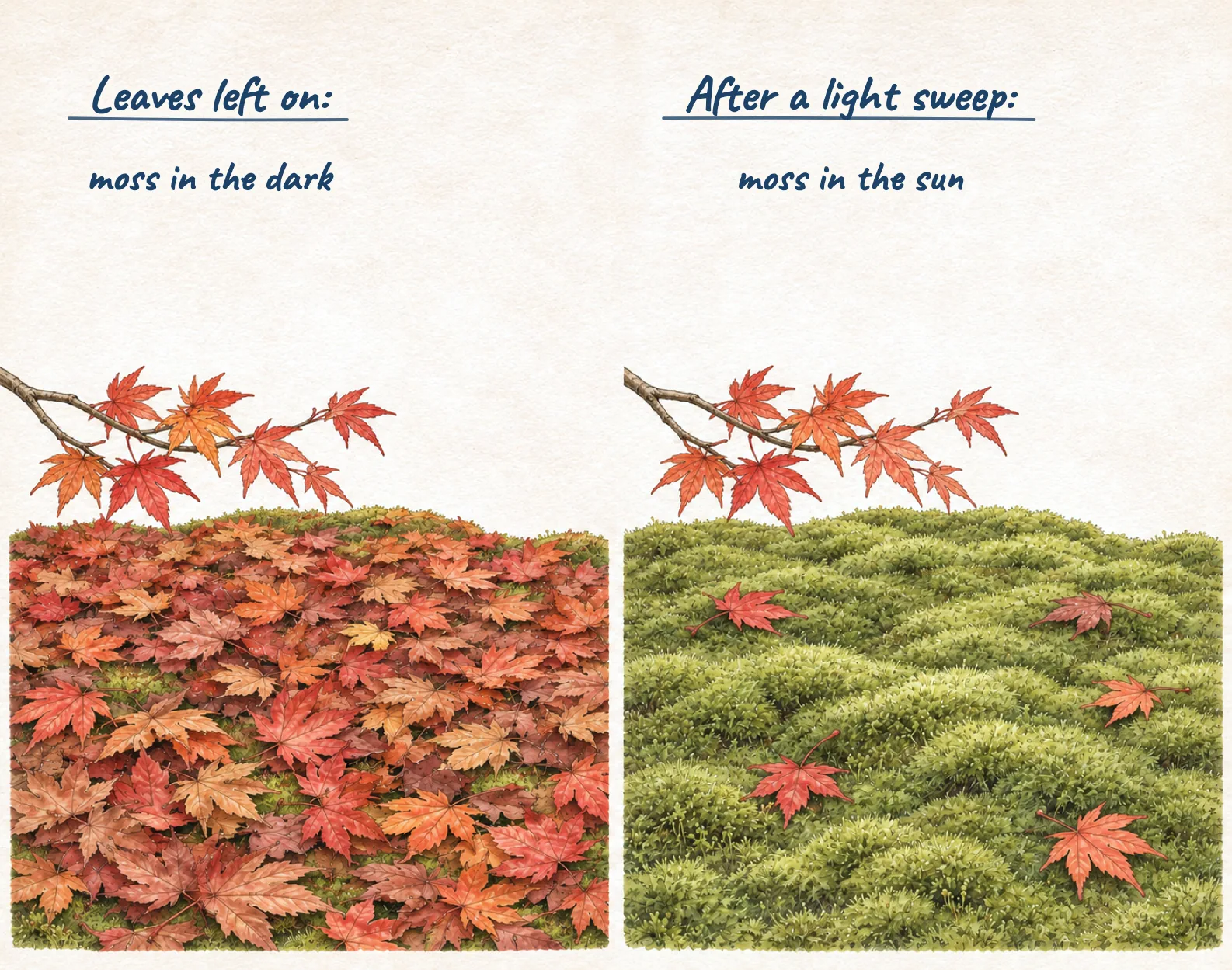
Saihō-ji (西芳寺), Kyoto’s moss temple, has published an interview with Miyazaki Kōji of its garden department that explains why moss is swept at all. “We create an environment where light and water can reach everywhere,” he says. “We sweep so that the moss is exposed to sunlight and the night dew, and does not become stuffy.”
The sweeping itself is gentle: “If you are too strong, you peel the moss off, so you don’t need much force.” And in winter the sweeping basically stops: “During winter, to let the moss rest, we basically don’t do any sweeping.” At Saihō-ji, then, the moss rests in the same cold months in which a maple’s basic pruning is done.
To sweep or not to sweep — fallen leaves as part of the garden
Leaving some of the red on the ground
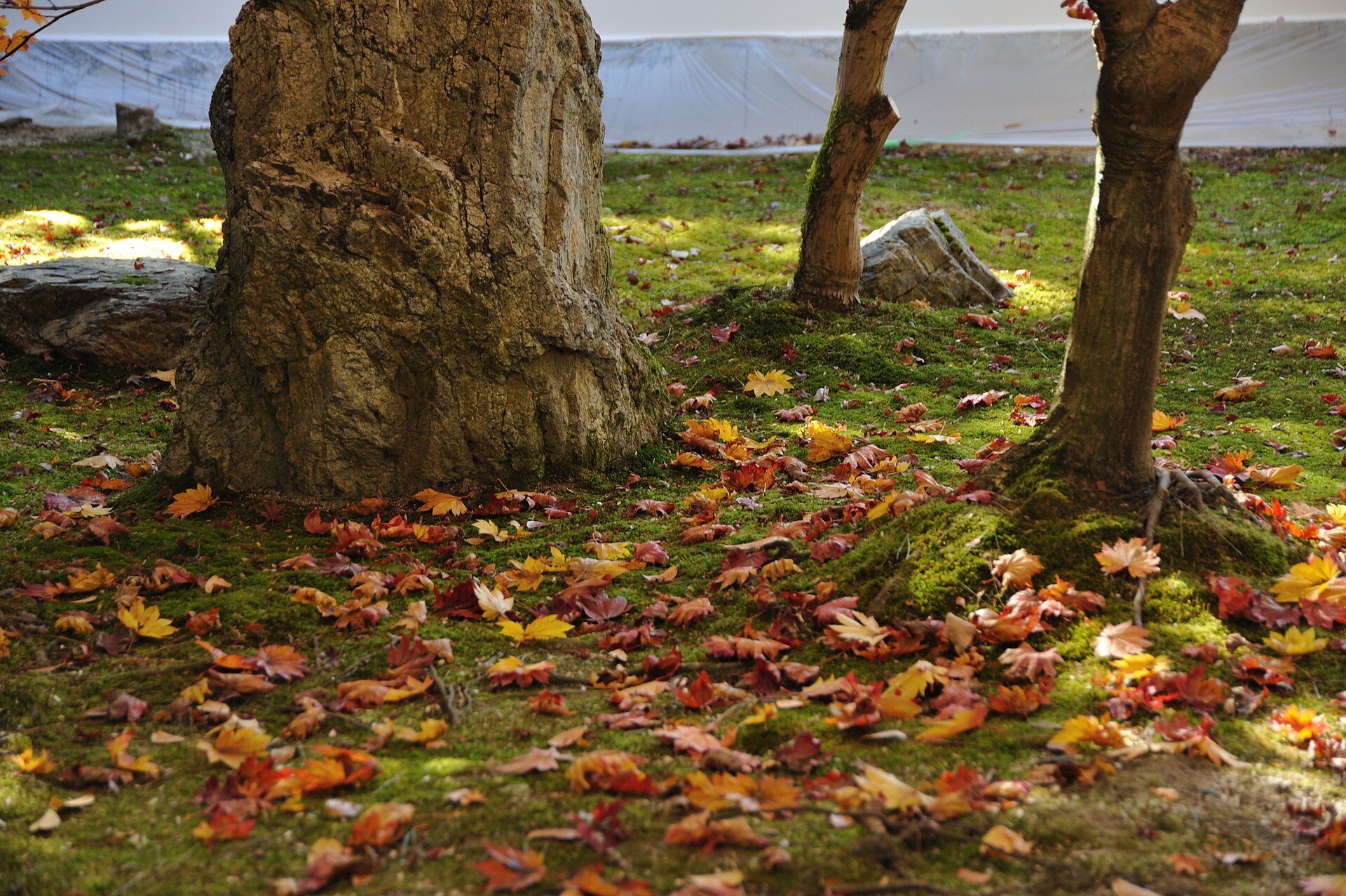
At Giō-ji, Katei Gahō reported, the keepers sweep the moss, but “in the autumn-colour season, they leave a certain amount of fallen leaves to preserve the scenery of chiri-momiji.” Chiri-momiji (散り紅葉) means scattered maple leaves — red lying on green moss.
The moss needs light, so it cannot stay buried for long; the scene needs the leaves, so they cannot all be removed. Giō-ji keeps both by leaving “a certain amount” — a judgement the magazine does not put into numbers.
The carpet that means the season is ending
Shinnyo-dō uses the fallen leaves as its calendar. Its seasonal page says that “when the carpet of scattered maples spreads behind the main hall, the autumn colour is in its final stage.” On 18 November 2025 its diary recorded a more ordinary problem: “It’s windy, so sweeping the fallen leaves is hard.”
A priest who put down the broom
The most human account comes from Kōrin-in (岡林院), a sub-temple of Kōdai-ji. In an article published on 24 December 2025, Maidona News reported that the priest Aoyama Kōin had described sweeping the garden, turning around, and finding that “the place I had just swept had gone back to the way it was” under fresh leaves. He decided, “Let’s stop for today,” and sat on the veranda to look instead. On that day, at least, the leaves won.
Counting the trees — what a maple garden holds
Thousands, not dozens
The numbers show the scale of what these gardens look after. They are the temples’ and the city’s own published approximate counts — we did not check how they were made — and the Nanzen-ji figure comes from an older leaflet.
| Garden | Approximate autumn-foliage trees | Source |
|---|---|---|
| Eikandō | about 3,000 | Kyoto official tourism site |
| Tōfuku-ji (Tsūtenkyō–Kaisandō area) | about 2,000 | Tōfuku-ji |
| Kiyomizu-dera | about 1,000 | Kiyomizu-dera |
| Kitano Tenmangū (Odoi maple garden) | about 350 | Kitano Tenmangū |
| Nanzen-ji | about 300 (older leaflet) | Kyoto City transport bureau |
| Jōjakkō-ji (mountain path) | about 200 | Kyoto official tourism site |
Which maples
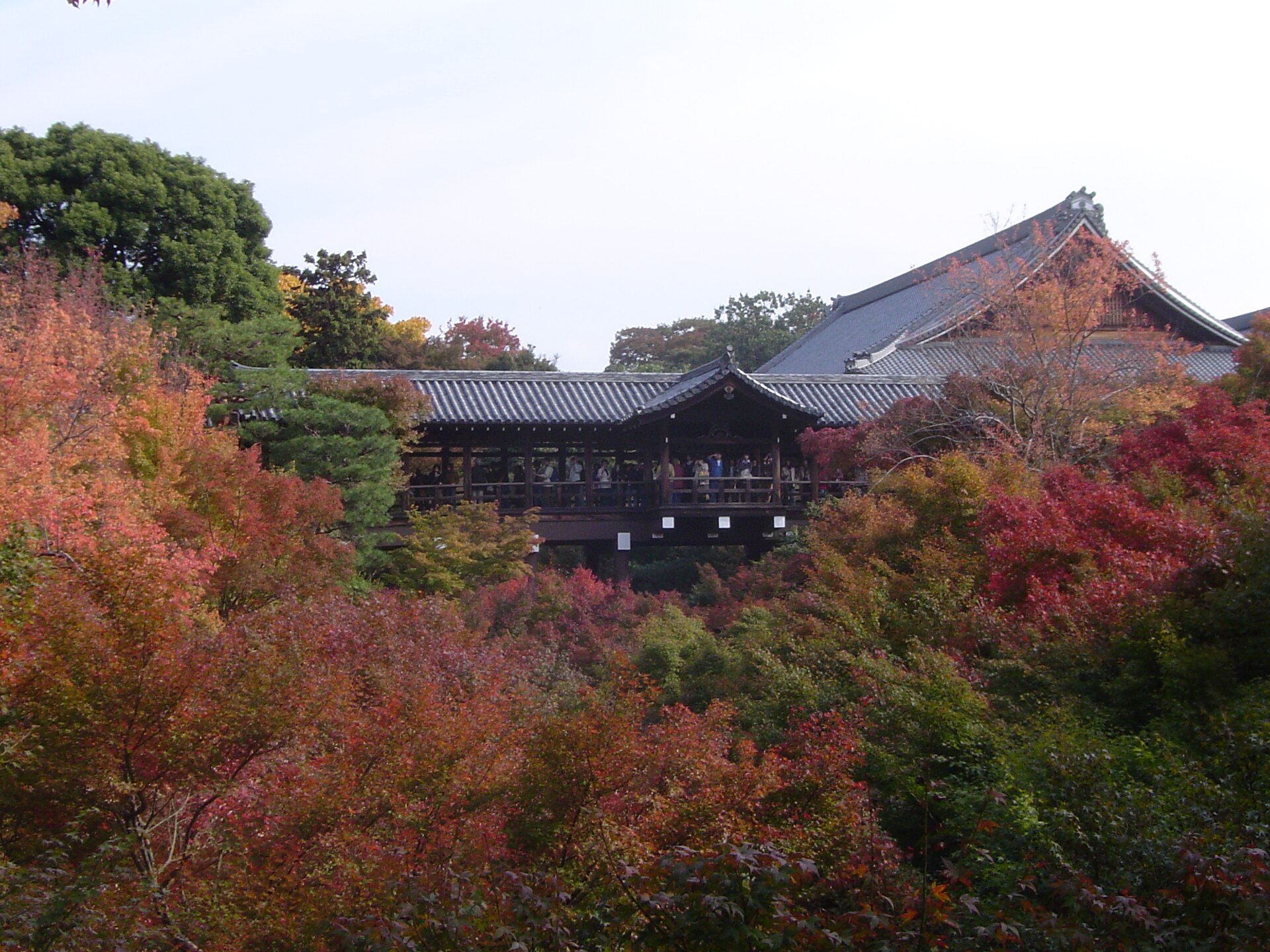
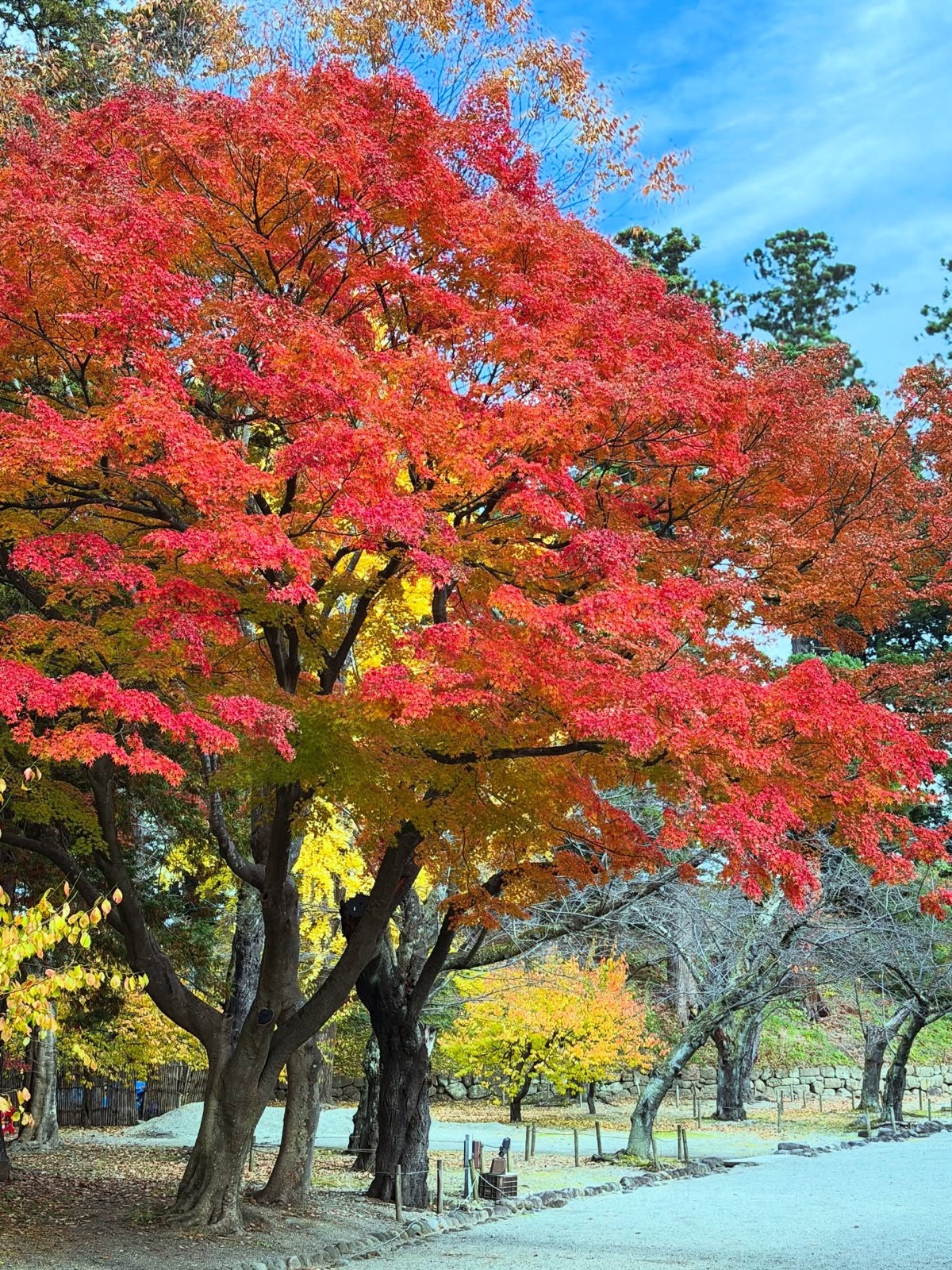
The classic temple maple is iroha-momiji, Acer palmatum Thunb., native to Honshu from Fukushima westward, Shikoku and Kyushu, as well as southern Korea and eastern China. Kyoto City’s tree guide notes it colouring across the grounds of Tōfuku-ji. But Tōfuku-ji also has something unusual near the Tsūtenkyō bridge: maples known as tōkaede (唐楓) or Tsūten-kaede. The temple’s guide describes rare three-lobed maples that turn golden, said to have been brought from Song China by Shōichi Kokushi.
Replacing a tree with the same kind
A garden of a thousand maples also loses trees. Kiyomizu-dera, in a 2015 article on its own site, said the maple avenue from the Otowa waterfall toward its southern garden “cannot do without care,” and that when old trees die or become diseased they are replaced, “basically with the same kind.” When the temple plants in a new location, it follows tekichi tekiboku (適地適木), “the right tree in the right place.” Kitano Tenmangū describes its maple garden as a mix of trees that grew there naturally and others planted later. A famous maple view is renewed, quietly, tree by tree.
A city that fills in November — the crowds by the numbers
Almost six million visits in one month
Kyoto City’s 2025 tourism survey estimated 5.866 million tourist visits in November 2025, up from 5.389 million in November 2024. The 107 major hotels surveyed by the Kyoto City Tourism Association ran at 87.4% room occupancy in November 2024. These are city-wide figures, not counts at any one temple, but they set the conditions every maple garden opens into in November.
What the temples do about it
The temples’ answers are practical, and most are about time. Tōfuku-ji, Nanzen-ji and Tenryū-ji offer access before the normal opening; Enkō-ji uses timed reservations “to avoid congestion”; several temples close their car parks or ask visitors not to come by car. Tōfuku-ji’s current guidance also says photography on its bridges may be restricted.
| Temple | 2026 arrangement | Dates |
|---|---|---|
| Tōfuku-ji | Advance-booked early access | 19 Nov–6 Dec |
| Nanzen-ji | Monk-guided early visit, 7:30–8:20 a.m. | Selected November dates |
| Tenryū-ji | Garden opens 7:30 a.m., one hour early | 14–30 Nov |
| Enkō-ji | Timed reservations; car park closed | 10 Nov–10 Dec |
| Bishamon-dō | Asks visitors not to come by private car | 20 Nov–6 Dec |
| Shinnyo-dō | No sightseeing vehicles in the autumn season | Autumn season |
The city works the same way at a larger scale. Its official comfort map gives time-of-day congestion forecasts on a five-level scale, with live camera feeds, and the city promotes morning and evening sightseeing to ease the daytime crush.
After dark — the illuminated garden
A second opening each day
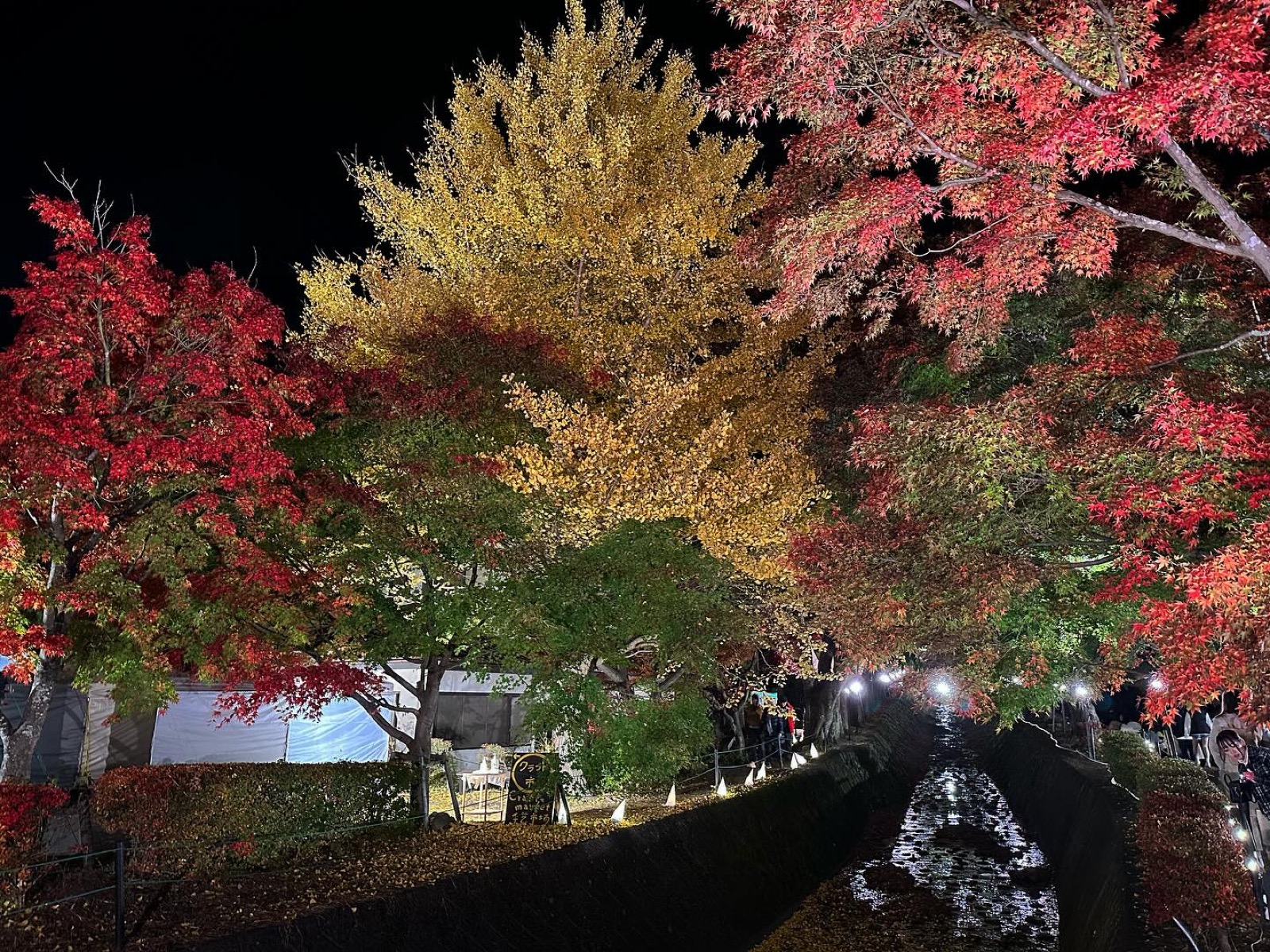
Many maple temples now open a second time after sunset. Eikandō’s 2026 illuminations run from 20 November to 6 December, closing at 9 p.m. Kōdai-ji’s autumn night opening runs from 23 October to 13 December. Hōgon-in shows how the two openings are kept apart: its illuminations run from 13 November to 6 December, 5:30 to 8:30 p.m., and “you cannot visit through both day and night”: the day and night sessions are separate admissions.
Not every garden lights up
Not every temple joins in. Jōjakkō-ji states in its published visitor questions that it “does not hold night visits or illuminations” (an answer dated September 2022). Its mountain path of about 200 maples is a daytime garden.
We could not find a first-hand record, from any temple or newspaper, of how the lights themselves are installed — who sets them, when, and how the beams are aimed. That part of the preparation stays behind the scenes.
The official colour date is getting later — what the weather service measures
One tree at Nijō Castle
Kyoto’s official maple colour date is not taken at a temple. The Japan Meteorological Agency observes one designated specimen tree at each station, and Kyoto’s is an iroha-kaede inside Nijō Castle. The agency defines the colouring date as “the first day when most of the leaves have turned red or yellow and green can hardly be seen.” That is a different measure from the “best viewing” that tourism listings advertise, usually mid- to late November, with Shinnyo-dō, Kitano Tenmangū and Shisen-dō extending into early December.
A long-term trend, with ups and downs
| Year | Kyoto maple colouring date (Nijō Castle specimen) | Difference from normal |
|---|---|---|
| 1991–2020 normal | 5 December | — |
| 2022 | 12 December | — |
| 2023 | 13 December | — |
| 2024 | 20 December | +15 days, latest on record |
| 2025 | 10 December | +5 days |
The Kyoto Local Meteorological Office found that between 1974 and 2009 maple colouring in Kyoto came, on average, about 2.5 days later per decade. Nationally, Climate Change in Japan 2025 gives about 3.1 days later per decade for maple colouring and yellowing across 1953–2024.
How long Kyoto has done this — a thousand years of maple viewing
The habit of going out to see the maples is old. Besides the Kokin Wakashū poems that the city leaflet links with Eikandō’s colour, the Momiji no Ga (紅葉賀) chapter of The Tale of Genji includes a rehearsal of the court dance Seigaiha ahead of an imperial excursion. In 1799 the illustrated guidebook Miyako Rinsen Meishō Zue (都林泉名勝図会) by Akisato Ritō included a scene of maple viewing at Tōfuku-ji’s Tsūten bridge.
The Kyoto Prefectural archives explain when this became popular rather than courtly: momijigari (紅葉狩), maple viewing, “became established as a pastime in the lives of ordinary people from the Azuchi–Momoyama and Edo periods onward, when famous places and pleasure spots formed inside and outside the capital.” The crowds on the Tsūtenkyō bridge today stand in a scene already being drawn for visitors two centuries ago.
What a gardener outside Kyoto can take from it — five habits
The order of the year
Put the temple records beside the municipal guidance and a year appears: basic cuts after leaf fall, light thinning in summer, water through the heat, preparation in October, and decisions about leaves in November.
Common mistakes the guidance warns against
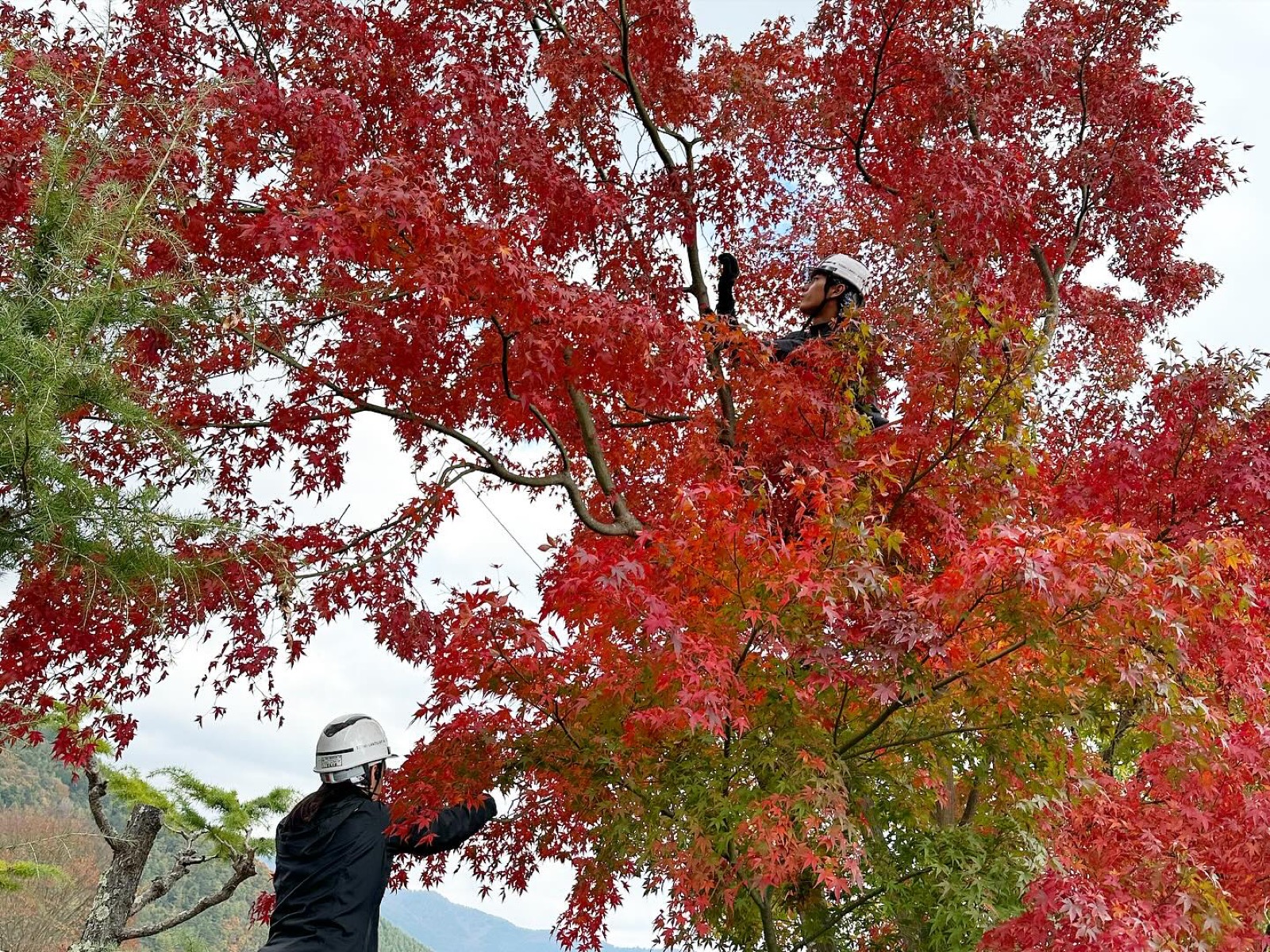
– Cutting large branches. The Niigata center warns that maples die back easily when a large branch is removed. – Heavy summer pruning. Nagasaki and Sapporo both limit summer work to light thinning. – Late winter cuts. Niigata’s guidance says finish by around early February; Sapporo’s, in a colder city, within the year. The principle is to finish before the sap moves. – Trusting rain alone in a hot summer. Kyoto’s 2025 reports — dried leaves at Eikandō in early October, curled leaves at Rokuō-in in November — both pointed to heat and dry weather. – Sweeping moss hard. Saihō-ji’s gardener sweeps lightly, because force peels the moss away.
The months will differ with the climate outside Japan. What carries over is the sequence: the big decisions with bare branches, light work in leaf, water in drought, and in autumn, let the tree show what it has. For how Japanese garden trees are shaped differently from clipped topiary, see niwaki vs topiary.
Frequently asked questions
Do Kyoto temples prune their maples just before the autumn colour? We found no temple record of maples being cut back just before peak colour. Eikandō lists tree pruning among its October preparations without naming which trees. Japanese municipal guidance puts basic maple pruning after leaf fall; Nagasaki allows light pruning in October.
When should a Japanese maple be pruned? Nagasaki City puts basic pruning from December to February, after leaf fall. Niigata says to finish by around early February because maple sap moves early; Sapporo, in a colder climate, within the year. Summer work should only improve air and light, keeping the leaves.
Why do Kyoto’s maple leaves sometimes wither before turning red? In 2025, Eikandō reported dried leaves in early October, and Rokuō-in staff blamed heat with low rainfall for curled leaves. Japan’s weather service lists leaves not drying out as one of the conditions for good colour.
Why do some temples leave fallen maple leaves on the moss? For the scenery of chiri-momiji, scattered maple leaves. Giō-ji leaves a certain amount in the autumn season, while still sweeping enough for the moss to get light and water.
When do Kyoto’s maples reach peak colour? Most temples’ usual best viewing is mid- to late November, some into early December. The official colouring date for the Nijō Castle specimen has a 1991–2020 normal of 5 December, and has been getting later.
How can visitors avoid the crowds? Use the early-access hours several temples offer, timed reservations where required, public transport rather than a car, and Kyoto’s official comfort map, which forecasts congestion by time of day.
Sources
– Shinnyo-dō temple diary, “Summer pruning” (10 July 2025) — https://shin-nyo-do.jp/blog/index.cgi?mode=entry&pg=20&ym=202507 (checked 2026-10-30) – Shinnyo-dō temple diary, 18 November 2025 — https://shin-nyo-do.jp/blog/index.cgi?mode=entry&no=272&ym=202511 (checked 2026-10-30) – Shinnyo-dō, Seasons — https://shin-nyo-do.jp/season/ (checked 2026-10-30) – Shinnyo-dō, Access — https://shin-nyo-do.jp/access/ (checked 2026-10-30) – Nagasaki City, “How to prune trees” — https://www.city.nagasaki.lg.jp/page/5245.html (checked 2026-10-30) – Sapporo Park and Greenery Association, Toyohira Park Green Center newsletter No. 150 — https://www.sapporo-park.or.jp/toyohira/control-panel/wp-content/uploads/2011/09/tayori150.pdf (checked 2026-10-30) – Niigata Prefectural Urban Greenery Center, plant Q&A “Momiji” — https://www.greenery-niigata.or.jp/useful/qa/system/detail.php?plant_id=655 (checked 2026-10-30) – Eikandō, Monthly events — https://eikando.or.jp/gyouji.html (checked 2026-10-30) – Eikandō, Brief history — https://www.eikando.or.jp/mobile_jp/mb_eikando.html (checked 2026-10-30) – Kyoto City Transport Bureau, autumn leaves leaflet (Eikandō) — https://www.city.kyoto.lg.jp/kotsu/cmsfiles/contents/0000288/288747/122-3.pdf (checked 2026-10-30) – Kyoto City Transport Bureau, autumn leaves leaflet (Nanzen-ji) — https://www.city.kyoto.lg.jp/kotsu/cmsfiles/contents/0000286/286578/2015-12-2-3.pdf (checked 2026-10-30) – Kyoto official tourism site, Eikandō — https://ja.kyoto.travel/event/single.php?event_id=5019 (checked 2026-10-30) – Fuji Television, Mezamashi Media (7 October 2025) — https://mezamashi.media/articles/-/207057 (checked 2026-10-30) – “Leaf Coloration in Acer palmatum Is Associated with a Positive Regulator ApMYB1” (2022) — https://pmc.ncbi.nlm.nih.gov/articles/PMC8955597/ (checked 2026-10-30) – Nagano Local Meteorological Office, “Features of autumn” — https://www.jma-net.go.jp/nagano/shosai/kikou/document/aki.html (checked 2026-10-30) – Ministry of the Environment, Kyushu Regional Office (19 October 2015) — https://kyushu.env.go.jp/blog/2015/10/post-103.html (checked 2026-10-30) – Matsumoto, “Experimental study on the effect of low temperature on the autumn colouring of Acer palmatum”, Japanese Journal of Biometeorology 42(2) — https://www.jstage.jst.go.jp/article/seikisho/42/2/42_2_65/_article/-char/ja (checked 2026-10-30) – Kansai Television (11 November 2025) — https://www.ktv.jp/news/feature/251111-momiji/ (checked 2026-10-30) – NC State Extension, “Focus on Form and Foliage With Japanese Maples” — https://extensiongardener.ces.ncsu.edu/gardening-publications-2/extgardener-previous-newsletters/extgardener-past-features/extgardener-focus-on-form-and-foliage-with-japanese-maples/ (checked 2026-10-30) – Katei Gahō, Giō-ji moss garden (18 November 2025) — https://www.kateigaho.com/travel/local/180158 (checked 2026-10-30) – Saihō-ji, “The handwork that carries Saihō-ji forward” — https://intosaihoji.com/journal/tsugu001/ (checked 2026-10-30) – Maidona News (24 December 2025) — https://maidonanews.jp/article/16224022?page=1 (checked 2026-10-30) – Tōfuku-ji, early-morning access — https://tofukuji.jp/special_event/morning_viewing_2025/ (checked 2026-10-30) – Tōfuku-ji, visitor guide — https://tofukuji.jp/guide/ (checked 2026-10-30) – Kyoto City, Higashiyama tree guide — https://www.city.kyoto.lg.jp/kensetu/cmsfiles/contents/0000021/21776/higashiyama16.pdf (checked 2026-10-30) – National Museum of Nature and Science, Tsukuba Botanical Garden, “Iroha-momiji” — https://tbg.kahaku.go.jp/recommend/illustrated/result.php?name=%E3%82%A4%E3%83%AD%E3%83%8F%E3%83%A2%E3%83%9F%E3%82%B8 (checked 2026-10-30) – Forestry and Forest Products Research Institute, Kyushu, “Iroha-momiji” — https://www.ffpri.go.jp/kys/business/jumokuen/jumoku/zukan/irohamomizi.html (checked 2026-10-30) – Kiyomizu-dera, FAQ — https://www.kiyomizudera.or.jp/faq/ (checked 2026-10-30) – Kiyomizu-dera, Yodan-dō vol. 14 (2015) — https://www.kiyomizudera.or.jp/yodan/vol14/index_3.html (checked 2026-10-30) – Kitano Tenmangū, Odoi maple garden — https://kitanotenmangu.or.jp/guidance/odoi/ (checked 2026-10-30) – Kyoto official tourism site, Jōjakkō-ji — https://ja.kyoto.travel/flower/momiji/single.php?flower_id=1227 (checked 2026-10-30) – Jōjakkō-ji, FAQ — https://jojakko-ji.or.jp/faq/ (checked 2026-10-30) – Kyoto official tourism site, Tōfuku-ji — https://ja.kyoto.travel/flower/momiji/single.php?flower_id=1200 (checked 2026-10-30) – Kyoto official tourism site, Kitano Tenmangū — https://ja.kyoto.travel/flower/momiji/single.php?flower_id=1212 (checked 2026-10-30) – Kyoto official tourism site, Shisen-dō — https://ja.kyoto.travel/flower/momiji/single.php?flower_id=1178 (checked 2026-10-30) – Kyoto City, 2025 Kyoto Tourism Survey — https://www.city.kyoto.lg.jp/sankan/cmsfiles/contents/0000354/354593/honsatsu.pdf (checked 2026-10-30) – Kyoto City Tourism Association, monthly report November 2024 — https://www.kyokanko.or.jp/wp/wp-content/uploads/KTA_monthly_report_202411.pdf (checked 2026-10-30) – Kyoto official tourism site, comfort map — https://ja.kyoto.travel/comfort/kyoto/ (checked 2026-10-30) – Kyoto City, spreading visitor numbers — https://www.city.kyoto.lg.jp/sankan/page/0000315511.html (checked 2026-10-30) – Kyoto official tourism site, autumn 2026 measures — https://ja.kyoto.travel/news/format.php?id=453 (checked 2026-10-30) – Nanzen-ji, early-morning visits — https://www.nanzenji.or.jp/information/20210930-4-2-2-2-2-2-3-2-2-2-2-3-3-2-3 (checked 2026-10-30) – Tenryū-ji, Visiting — https://www.tenryuji.com/visit/ (checked 2026-10-30) – Enkō-ji, autumn special opening — https://www.enkouji.jp/news/ (checked 2026-10-30) – Bishamon-dō — https://www.bishamon.or.jp/ (checked 2026-10-30) – Hōgon-in, events — https://www.hogonin.jp/event/index.html (checked 2026-10-30) – Kyoto night tourism, 2026 — https://ja.kyoto.travel/times/night/article/single.php?id=454 (checked 2026-10-30) – Kōdai-ji, events — https://www.kodaiji.com/saiji (checked 2026-10-30) – Japan Meteorological Agency, phenological observation guidelines — https://www.data.jma.go.jp/sakura/data/shishin.pdf (checked 2026-10-30) – Nijō Castle, specimen trees — https://nijo-jocastle.city.kyoto.lg.jp/wp-content/uploads/2021/11/0d66f7453430f527a3dddf273a6bd63c.pdf (checked 2026-10-30) – Kyoto Local Meteorological Office, annual report 2025 — https://www.jma-net.go.jp/kyoto/2_data/publications/doc_kishou_year/kyoto-kisho-2025nenpou.pdf (checked 2026-10-30) – Kyoto Local Meteorological Office, annual report 2024 — https://www.data.jma.go.jp/kyoto/2_data/publications/doc_kishou_year/kyoto-kisho-2024nenpou.pdf (checked 2026-10-30) – Japan Meteorological Agency, maple colouring by year — https://www.data.jma.go.jp/sakura/data/pdf/015.pdf (checked 2026-10-30) – Kyoto Local Meteorological Office, changes in Kyoto’s phenology — https://www.jma-net.go.jp/kyoto/2_data/publications/doc_others/kyoto-Kaika_Mankai_Henka.pdf (checked 2026-10-30) – MEXT, JMA, Climate Change in Japan 2025, column 3 — https://www.data.jma.go.jp/cpdinfo/ccj/2025/html_honpen/cc2025_honpen_4.html (checked 2026-10-30) – Tsuruga Municipal Museum, “Momiji no Ga” — https://jmapps.ne.jp/tsuruga/det.html?data_id=326 (checked 2026-10-30) – Kyoto Prefectural Library and Archives, Resource Guide No. 25 — https://www.pref.kyoto.jp/rekisaikan/documents/shiryoguide025re.pdf (checked 2026-10-30)