Ishiwari-zakura has split a granite boulder over 360 years. The biology, the legend, the care behind Morioka's stone-breaking cherry tree.
Introduction
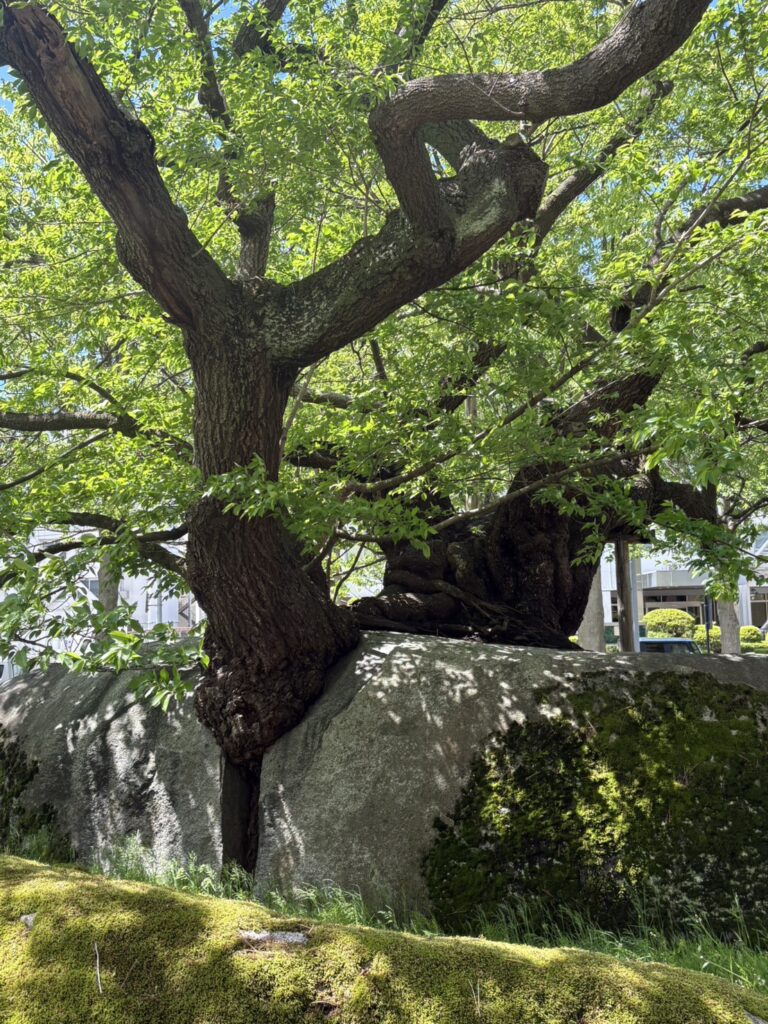
In the heart of Morioka, Iwate Prefecture, a single cherry tree blooms quietly each spring — not in a park or along a riverbank, but wedged inside a crack in a massive granite boulder. Its trunk, over 1.35 meters in diameter, is visibly compressed by the rock on both sides. Yet this tree has been flowering for more than 360 years. This is Ishiwari Zakura (石割桜), literally “the cherry tree that splits the stone” — one of Japan’s most extraordinary living natural monuments and a quiet testament to the power of resilience, adaptation, and generations of human care.
What Is Ishiwari Zakura? History and Basic Facts
Location and Scale
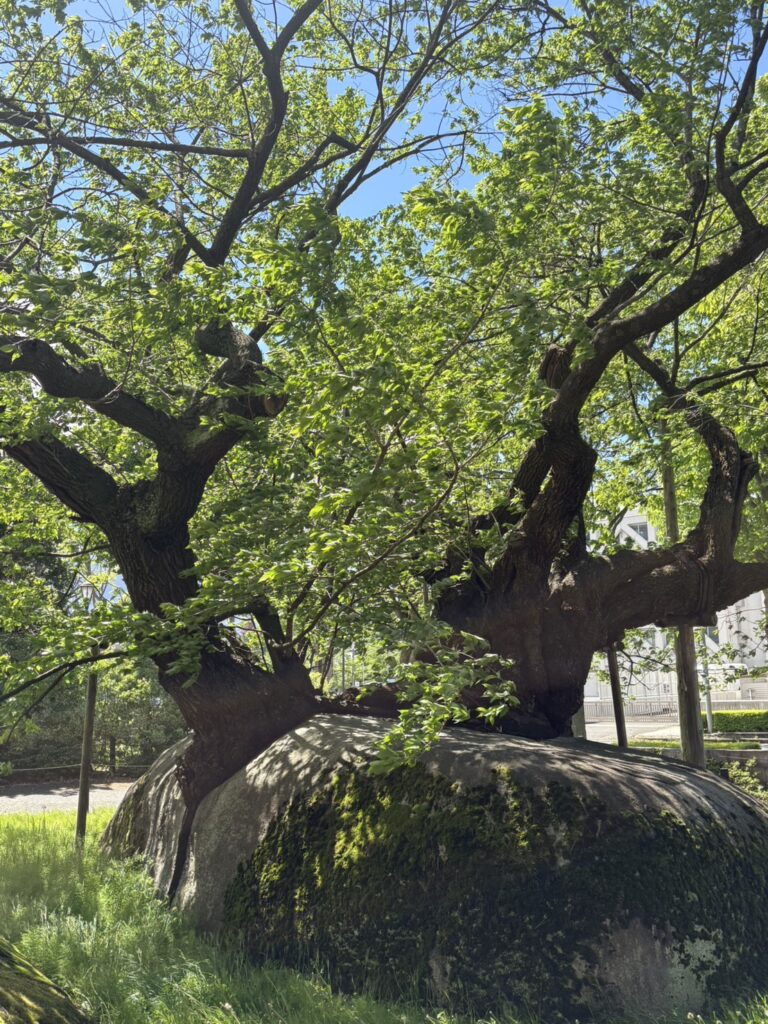
Ishiwari Zakura stands in the front garden of the Morioka District Court, in the Uchinomaru district of central Morioka city. It is not hidden away in a forest or enshrined on a mountaintop — it grows in the middle of an active urban space, visible to anyone passing by on the street.
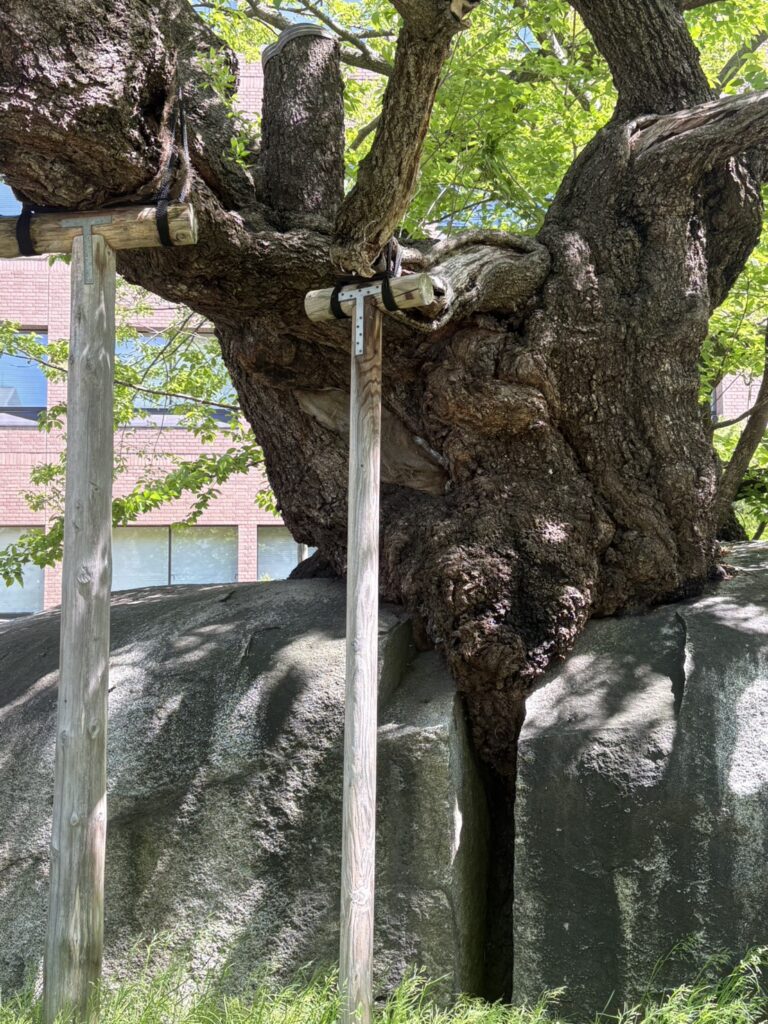
The tree’s vital statistics are striking. Its trunk circumference measures approximately 4.24 meters, with a diameter of around 1.35 meters and a height of roughly 10 meters. In spring, it produces pale pink blossoms characteristic of its species. The granite boulder itself is even more imposing: approximately 7 meters from north to south and 6 meters from east to west, with a fissure roughly 2 meters wide — and it is precisely within that fissure that the tree has taken root.
The tree’s species is Edo Higan (Cerasus itosakura), a wild cherry native to Japan known for its exceptional longevity and stress tolerance — qualities that will become central to understanding how this tree has survived.
Designated a National Natural Monument in 1923
In 1923, the Japanese government designated Ishiwari Zakura as a National Natural Monument (国指定天然記念物). This designation was not granted simply because of the tree’s age or unusual appearance. It reflects the recognition that this single tree embodies the intersection of natural history, ecological science, and human cultural memory — a combination rarely found so vividly in one living organism.
The Legend: Lightning, Stone, and a Seed
According to local tradition, the story of Ishiwari Zakura begins in the early Edo period, during the Kan’ei era (1624–1644). A large granite boulder stood in the garden of a samurai estate belonging to Kita Kenmotsu, a local lord who held land in what is now central Morioka. One night, the boulder was struck by lightning. The impact split the rock open, leaving a deep fissure in the granite.
Into that crack, at some point, an Edo Higan seed found its way. It germinated, put down roots, and began to grow — slowly, quietly, persistently — over the centuries that followed.
In the early Meiji era, the tree was known locally as Ouunseki (桜雲石), meaning “cherry-cloud stone.” Somewhere along the way, the name shifted to Ishiwari Zakura — the tree that splits the stone — and that name has carried through to the present day.
A Closer Look: Why Has This Tree Survived?
The Physical Stress of Growing Inside Rock
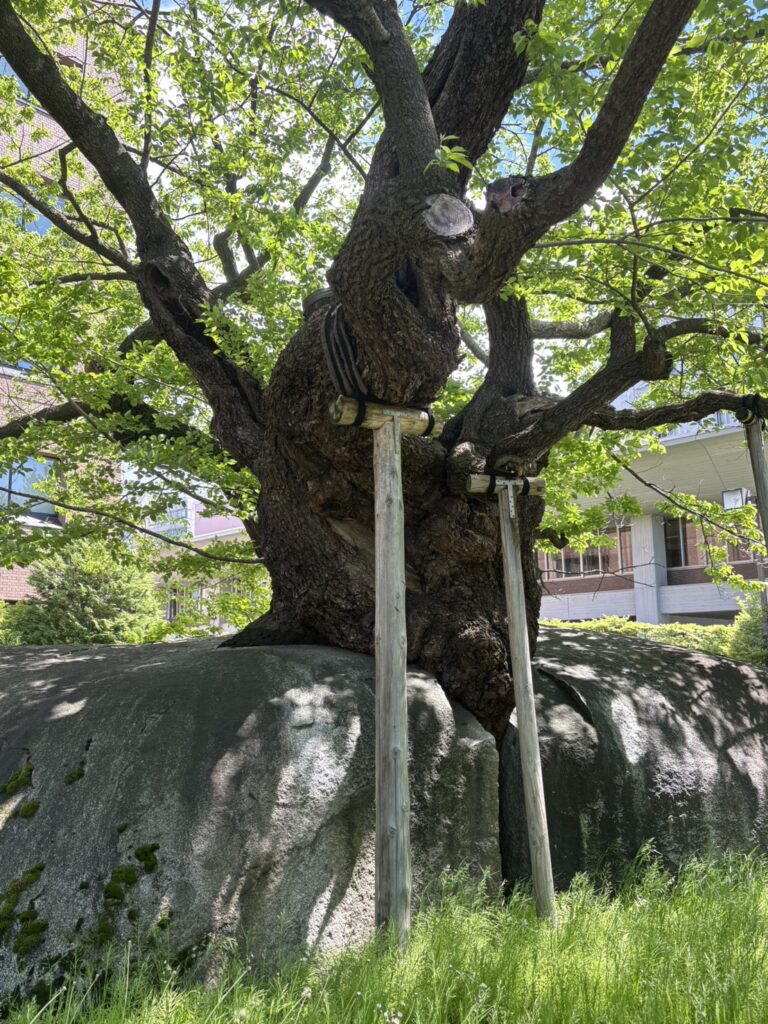
Stand close to Ishiwari Zakura and the situation becomes clear: this is not a tree growing near a boulder. The trunk is actively compressed by granite on both sides. In normal circumstances, a tree’s trunk expands radially as it grows, adding new layers of wood year after year. Sustained physical pressure from an unyielding surface — especially one as hard and unforgiving as granite — would logically be expected to impair or eventually kill a tree over time.
And yet, for over three and a half centuries, this tree has continued to flower.
The Resilience of Edo Higan (Cerasus itosakura)
Part of the answer lies in the biology of the species itself. Edo Higan is among the longest-lived cherry trees known in Japan. Several of the country’s most celebrated ancient cherry trees belong to this same species:
- Jindai Zakura (神代桜) in Yamanashi Prefecture — estimated at 1,800 to 2,000 years old
- Neo-dani Usuzumi Zakura (根尾谷淡墨桜) in Gifu Prefecture — estimated at 1,500 years old
Both of these trees have survived centuries in difficult terrain. Edo Higan has a notably strong root system, capable of extending through narrow soil passages and extracting moisture and nutrients from surprisingly limited ground. In the case of Ishiwari Zakura, the roots are believed to reach beneath the granite mass itself, accessing deeper soil layers that other species might never tap.
This capacity for adaptive root growth is a defining characteristic of the species — and almost certainly the reason this tree chose a crack in a boulder as its home and has refused to leave.
The 2000 Treatment: When Human Care Became Essential
Biological resilience alone, however, has its limits. By the year 2000, signs of decline in the tree’s vigor had become noticeable enough to prompt action. A team of jumoku-i (樹木医) — Japan’s certified tree doctors — was called in to conduct a full assessment and treatment. It was the first major intervention in approximately 50 years.
Jumoku-i is a professional qualification unique to Japan, developed in the 1990s to address the growing need for specialized arboricultural expertise in a country with deep cultural ties to its trees. These practitioners combine knowledge of tree pathology, soil science, and traditional landscape management to diagnose and treat trees that cannot easily be replaced.
The root zone of Ishiwari Zakura is severely constrained by its location within the rock fissure and the surrounding urban infrastructure. Soil quality and volume — factors that directly govern a tree’s access to water, nutrients, and oxygen — are therefore critical variables. The 2000 treatment involved soil analysis, remediation, and targeted care aimed at restoring the conditions the tree needed to continue thriving. It worked. The tree’s condition improved, and it has continued to bloom each spring in the years since.
One Tree, One City: What Ishiwari Zakura Means for Urban Landscapes
A Cultural Presence in the Heart of the City
What makes Ishiwari Zakura unusual among Japan’s ancient trees is not just its biology — it is its location. This tree does not stand in a remote mountain shrine or a carefully maintained historical garden. It stands in front of a government court building, in the middle of a functioning city, where office workers, students, and tourists pass by it every day.
During the spring flowering season, people gather around it — not in an organized, ticketed event, but spontaneously, the way people are drawn to something that simply demands to be seen. Outside the flowering season, it continues to anchor the streetscape as a familiar landmark. In this way, Ishiwari Zakura functions less like a tourist attraction and more like a neighbor: always present, quietly shaping the character of the place.
Urban Greenery Is Not Sustained by Strength Alone
The lesson Ishiwari Zakura offers to those who design and manage urban landscapes is a subtle but important one. A common assumption in urban planting is that the solution to longevity is selecting the toughest, most resilient species and placing them in the ground. But resilience in a tree is not a fixed state — it is a dynamic condition that must be actively supported.
Ishiwari Zakura has survived not because it was left alone to prove its strength, but because successive generations recognized its value and responded to its needs. Root zone management, soil remediation, regular assessment by trained professionals — these interventions, performed at the right time, made the difference between a tree that declined and one that recovered.
In Japan, the concept of “reading a tree” (木を読む, ki wo yomu) is fundamental to landscape management. Practitioners observe how a tree’s vigor changes across seasons, how its canopy responds to stress, how the soil beneath it shifts over time. They intervene minimally, but precisely. Ishiwari Zakura has been “read” by people who cared about it for over three centuries — and that sustained attention is as much a part of its survival story as its own biology.
From Landscape to Living Heritage
There is a meaningful distinction between a tree that is part of a landscape and a tree that has become part of a culture. Ishiwari Zakura crossed that threshold long ago.
It is referenced in local poetry, depicted in historical illustrations, and discussed in school curricula. It appears in tourism materials not as a scenic backdrop, but as a subject — something with a story that people come specifically to encounter. The boulder and the tree together have become a single cultural artifact, inseparable from the identity of Morioka as a city.
This transformation — from planting to place, from object to meaning — does not happen automatically. It requires time, memory, and the kind of care that says: this tree matters, not only today, but to the people who will stand here after us.
Frequently Asked Questions
Q: When is the best time to visit Ishiwari Zakura? A: The tree typically blooms in early to mid-April, though the exact timing varies by year depending on winter temperatures. A visit during cherry blossom season also allows you to combine it with the sakura at Morioka Castle Ruins Park (Iwate Park), which blooms at approximately the same time.
Q: What species is Ishiwari Zakura? A: It is an Edo Higan (Cerasus itosakura), a species of wild cherry native to Japan and among the longest-lived of all cherry tree varieties. The same species includes Japan’s oldest known cherry trees, some estimated at over 1,500 years of age.
Q: How can a tree grow inside a crack in granite? A: Edo Higan has an unusually strong and adaptive root system that can extract water and nutrients through extremely narrow soil passages. The roots of Ishiwari Zakura are believed to extend beneath the granite mass to reach deeper soil, allowing the tree to sustain itself despite the highly constrained root zone.
Q: How is Ishiwari Zakura maintained? A: As a National Natural Monument, it is subject to regular monitoring and professional care. Certified jumoku-i (tree doctors) conduct periodic assessments, and soil management is carried out to support the tree’s health. A major treatment was performed in 2000 to address declining vigor.
Q: Is Ishiwari Zakura free to visit? A: Yes. The tree stands in the front garden of the Morioka District Court, which is accessible to the public at no charge. During the cherry blossom season, evening illumination is sometimes provided, allowing visitors to view the tree after dark as well.
Conclusion
The name Ishiwari Zakura — “the cherry tree that splits the stone” — carries a certain drama to it. But the reality, observed up close, is quieter and more instructive. This tree did not force its way through granite. It found a way to coexist with it. Over 360 years, it adapted, endured, and — with the help of people who recognized its value — recovered when it needed to.
That combination of biological resilience and sustained human attention is the true story of this tree. It is a story worth understanding, not only for what it says about Edo Higan cherry trees, but for what it says about the relationship between living things, the landscapes they inhabit, and the people who choose to care for them across generations.
If you find yourself in Morioka, stand in front of Ishiwari Zakura. Look past the blossoms, and look at the trunk — compressed, shaped, and still alive inside the stone. Three and a half centuries of persistence are written there, without a single word.
Field notes from Japan’s trees arrive a few times each month — subscribe via the form in the footer, or follow the work on LinkedIn.