

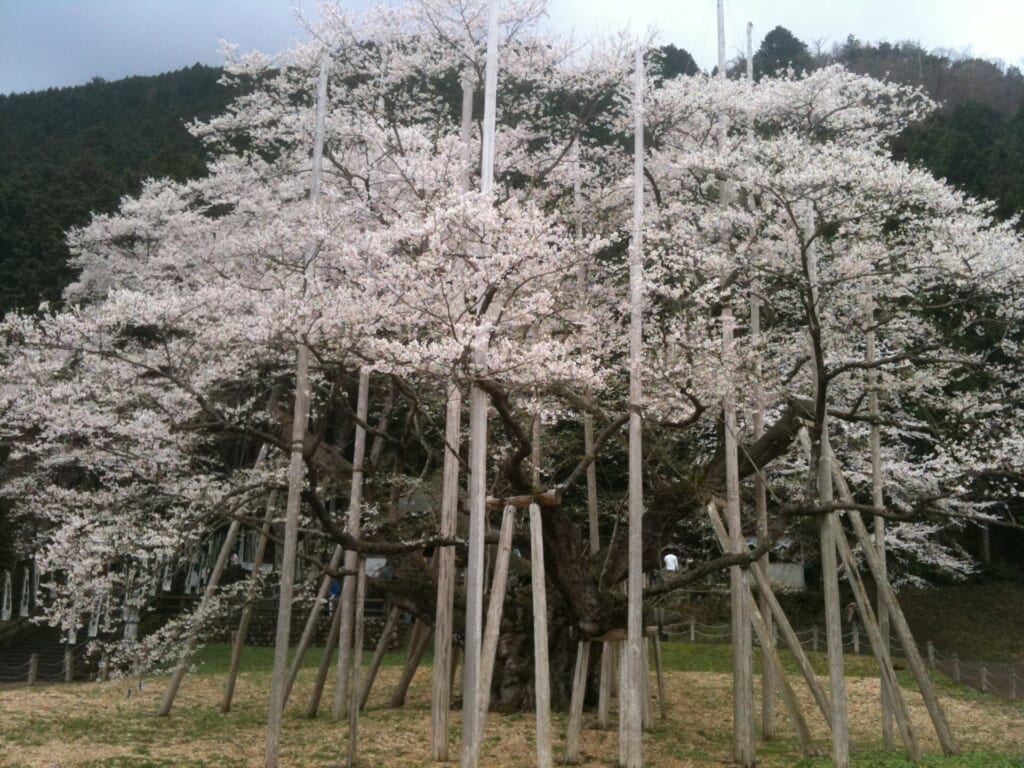
The Usuzumi cherry (淡墨桜, Usuzumi-zakura) of Neodani in Gifu Prefecture, said to be more than 1,500 years old, recovered from near death after a rescue built around root grafting. In the spring of 1949, a dentist, Maeda Toshiyuki (前田利行), led the work to make 238 root grafts, joining young roots of wild mountain cherry to the old roots that still had some life in them, alongside soil replacement, fertiliser and termite control. A report published in 1996 described the grafted roots as thickened and putting out many fine roots.
Standing Under the Usuzumi Cherry — What You See First
A crown on stilts
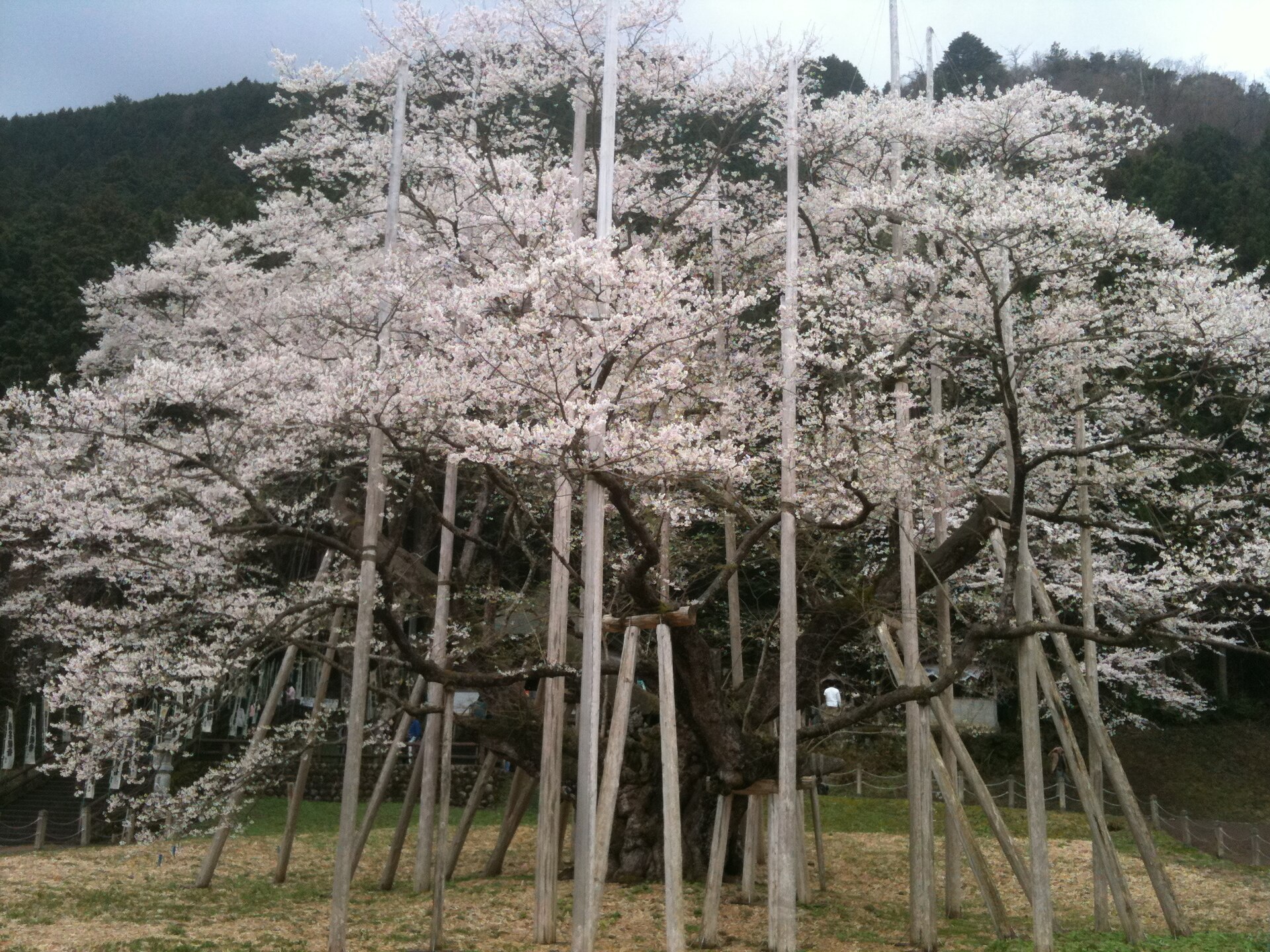
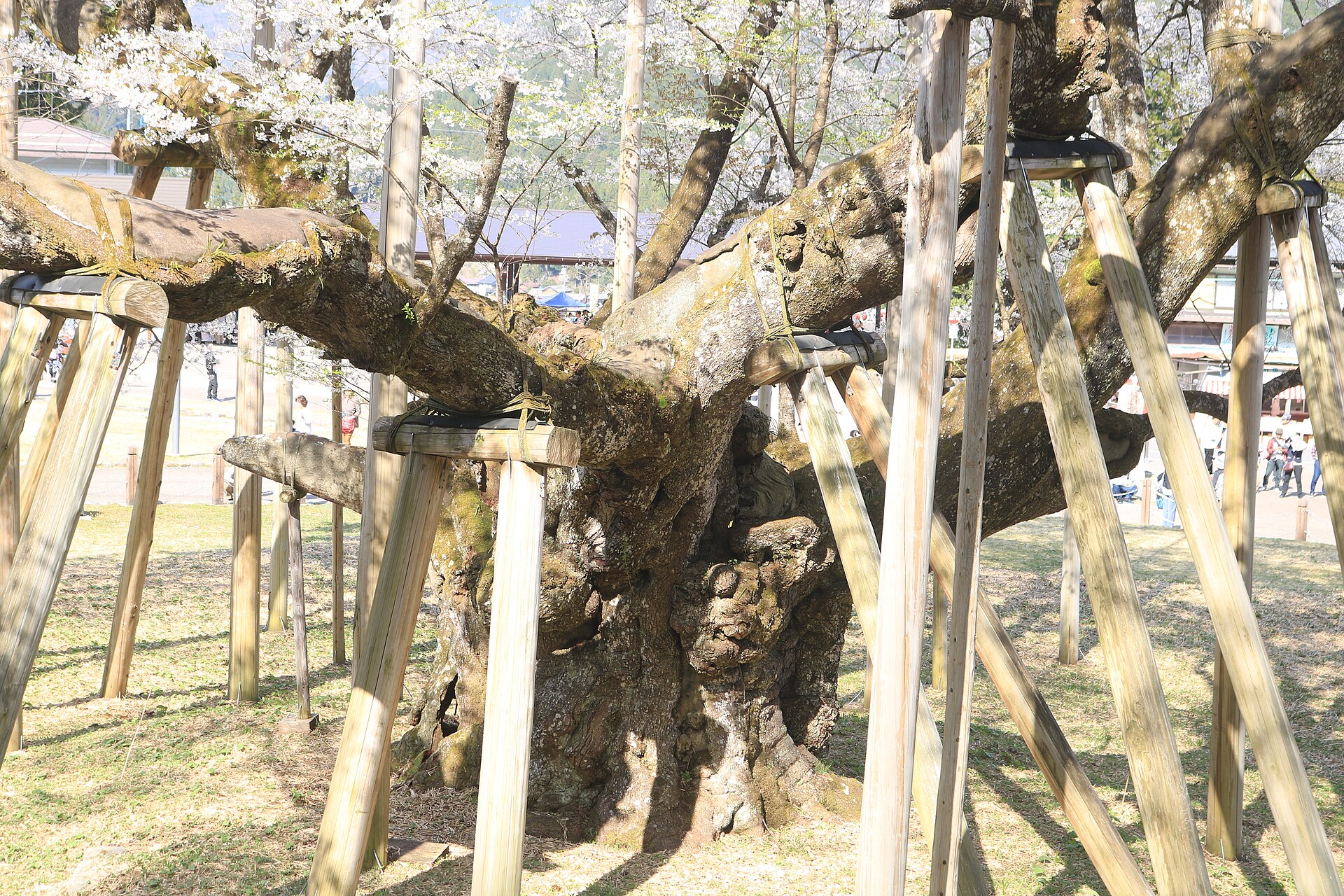
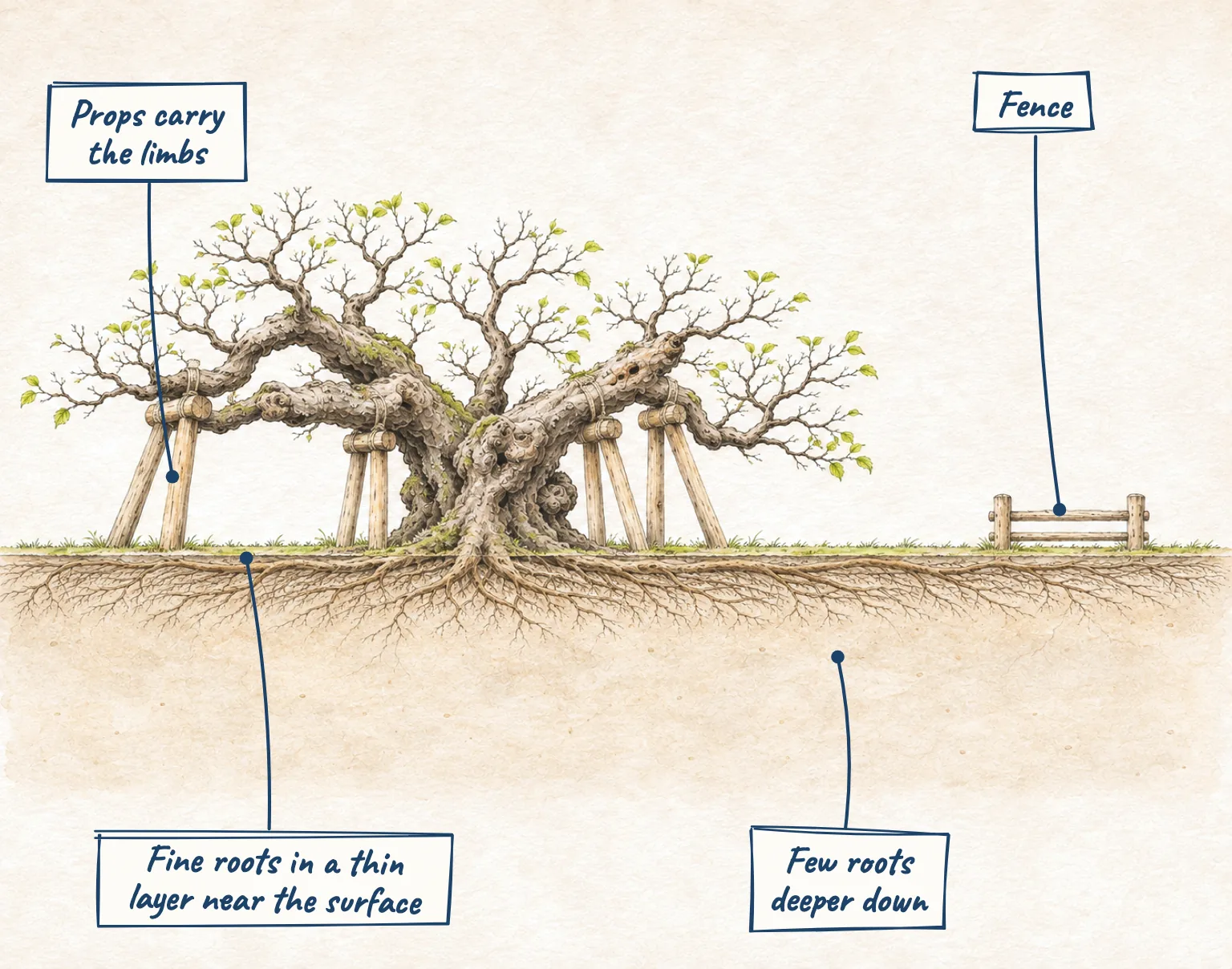
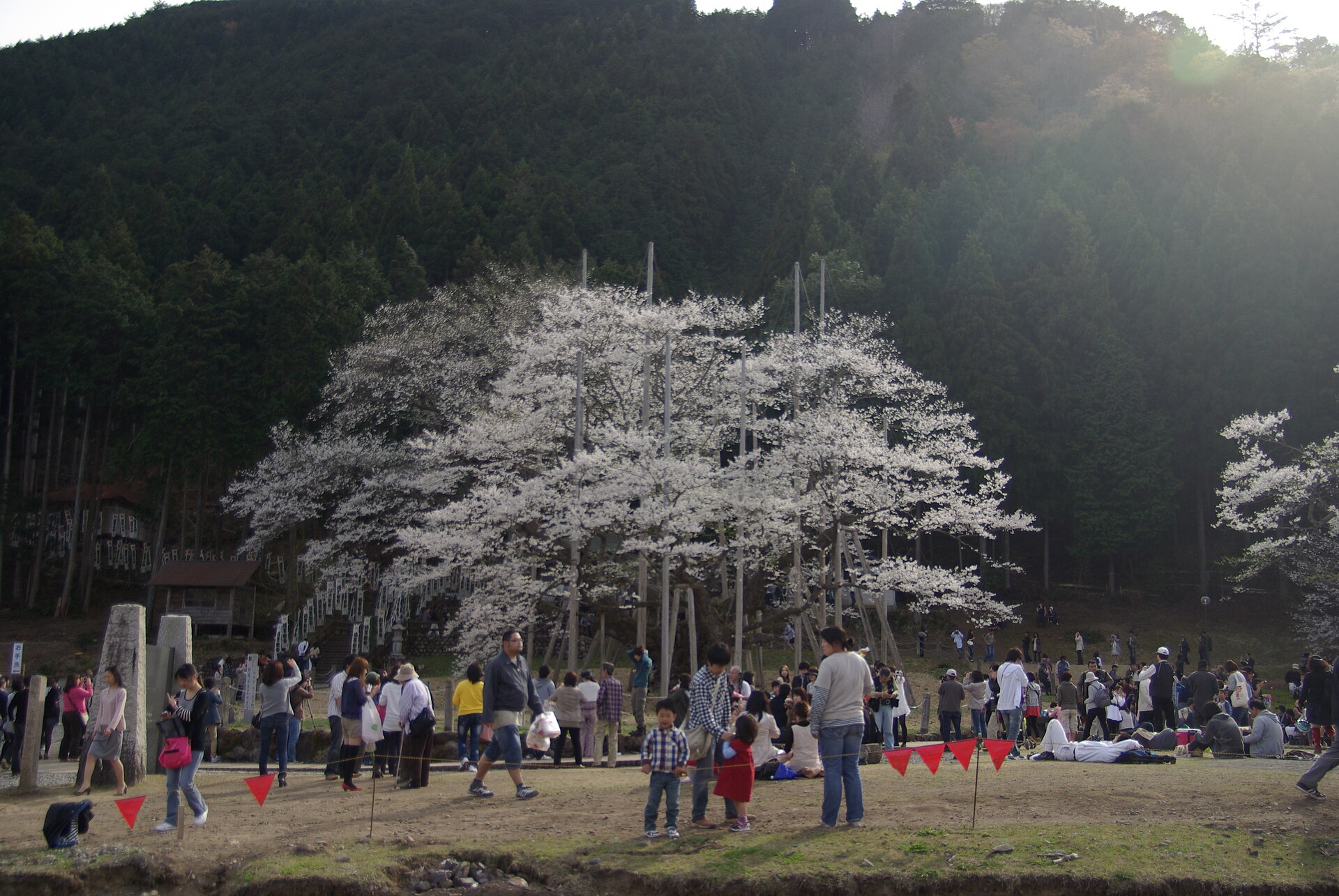
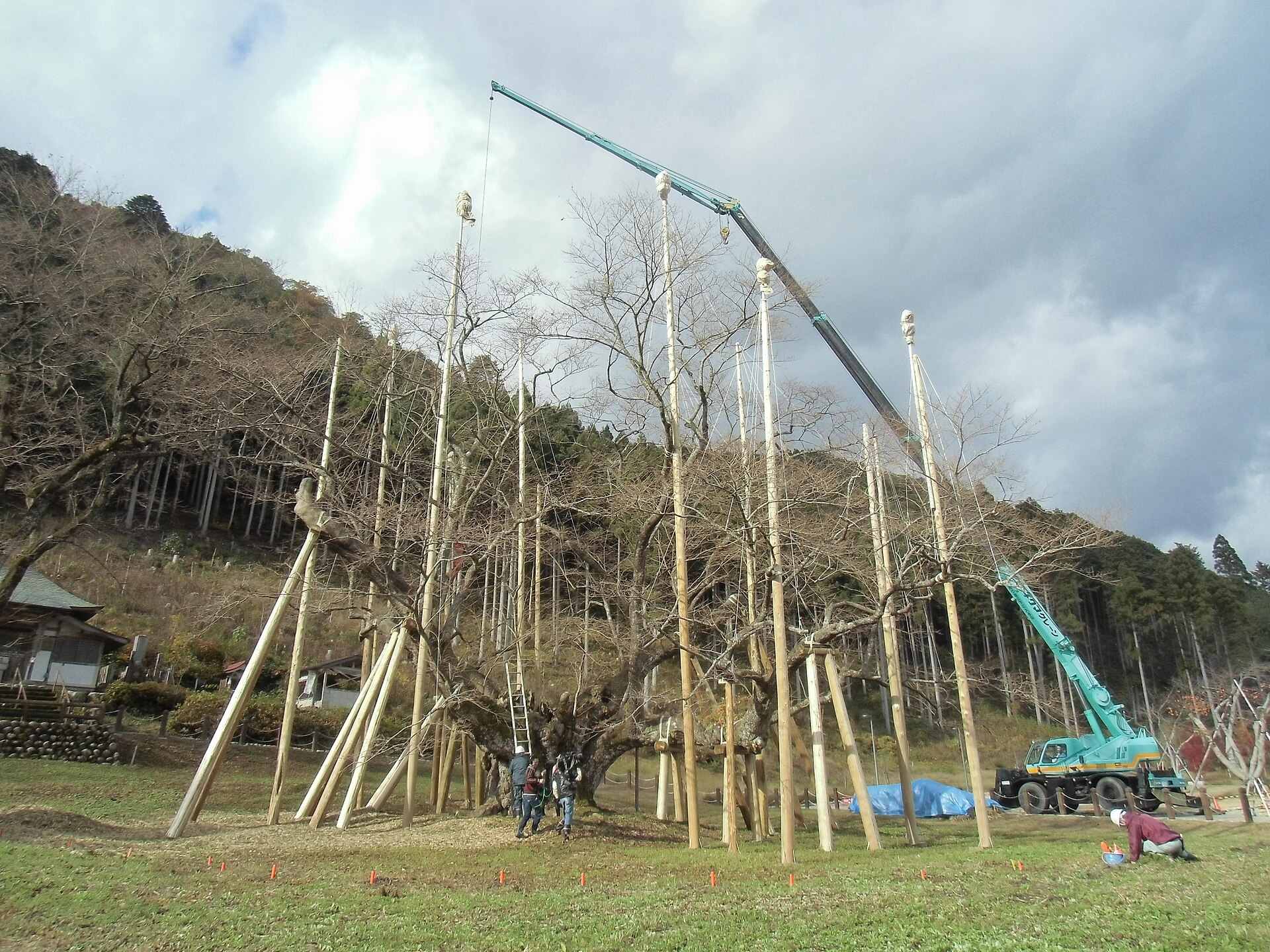
Walk into Usuzumi Park in the Neo valley in April and the first thing you notice is not the blossom. It is the timber. Dozens of wooden posts rise from the grass around the trunk, some vertical, some leaning, each ending in a cradle under a limb. The crown spreads over them like a roof over its pillars.
Motosu City measured the tree in January 2019 at 17.3 m (57 ft) tall, with a trunk girth of 9.4 m (31 ft) at eye height and a branch spread of 22.4 m (73 ft) east to west and 24.2 m (79 ft) north to south.
The props are not decoration. A city audit report published in March 2026 explains why they keep being renewed: most of the branches and the trunk are hollow (ほとんどの枝や幹が空洞), and the tree can no longer hold up its own weight. The props are, in a very literal sense, the tree’s skeleton now.
Pale pink, white, then the colour of thin ink
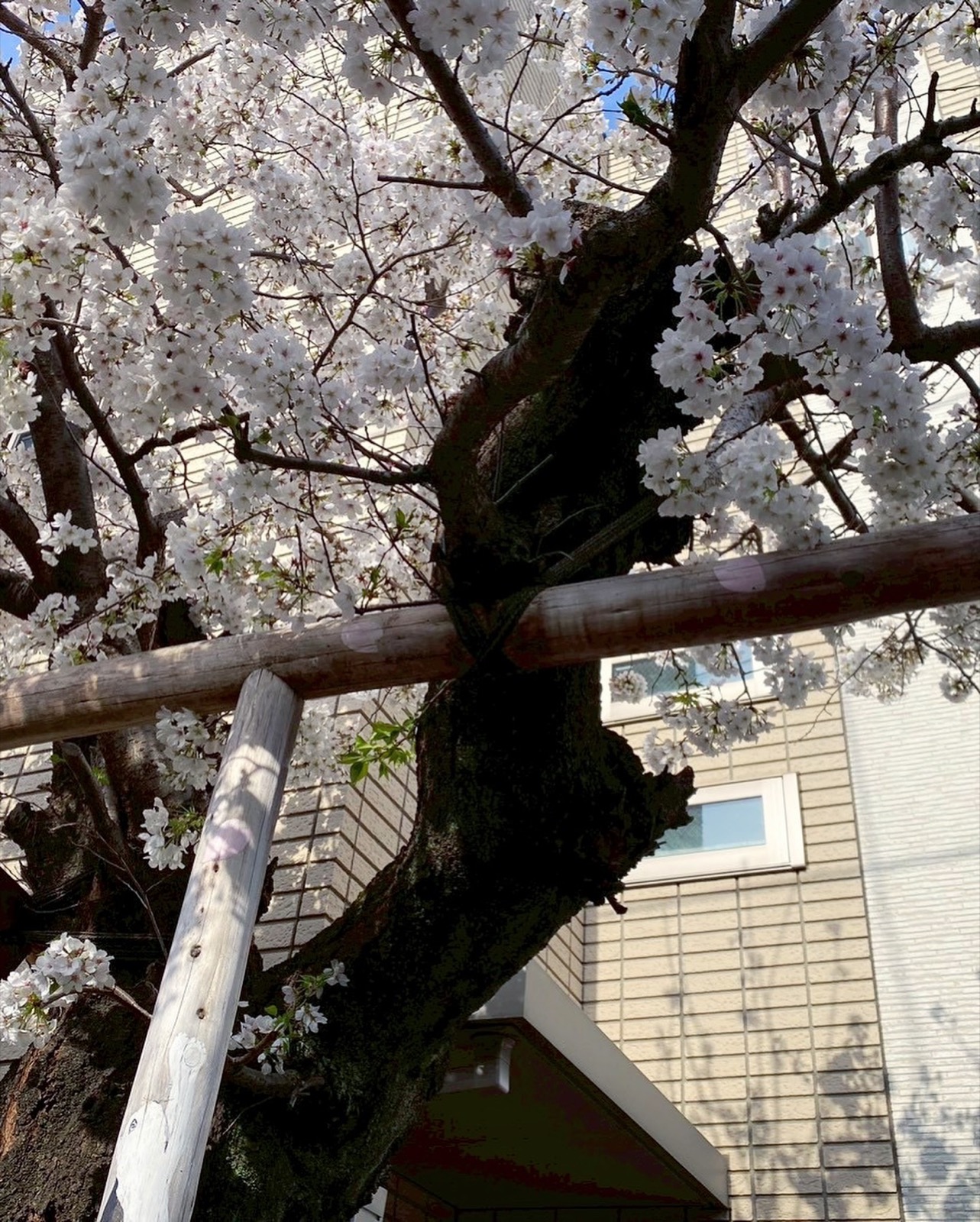
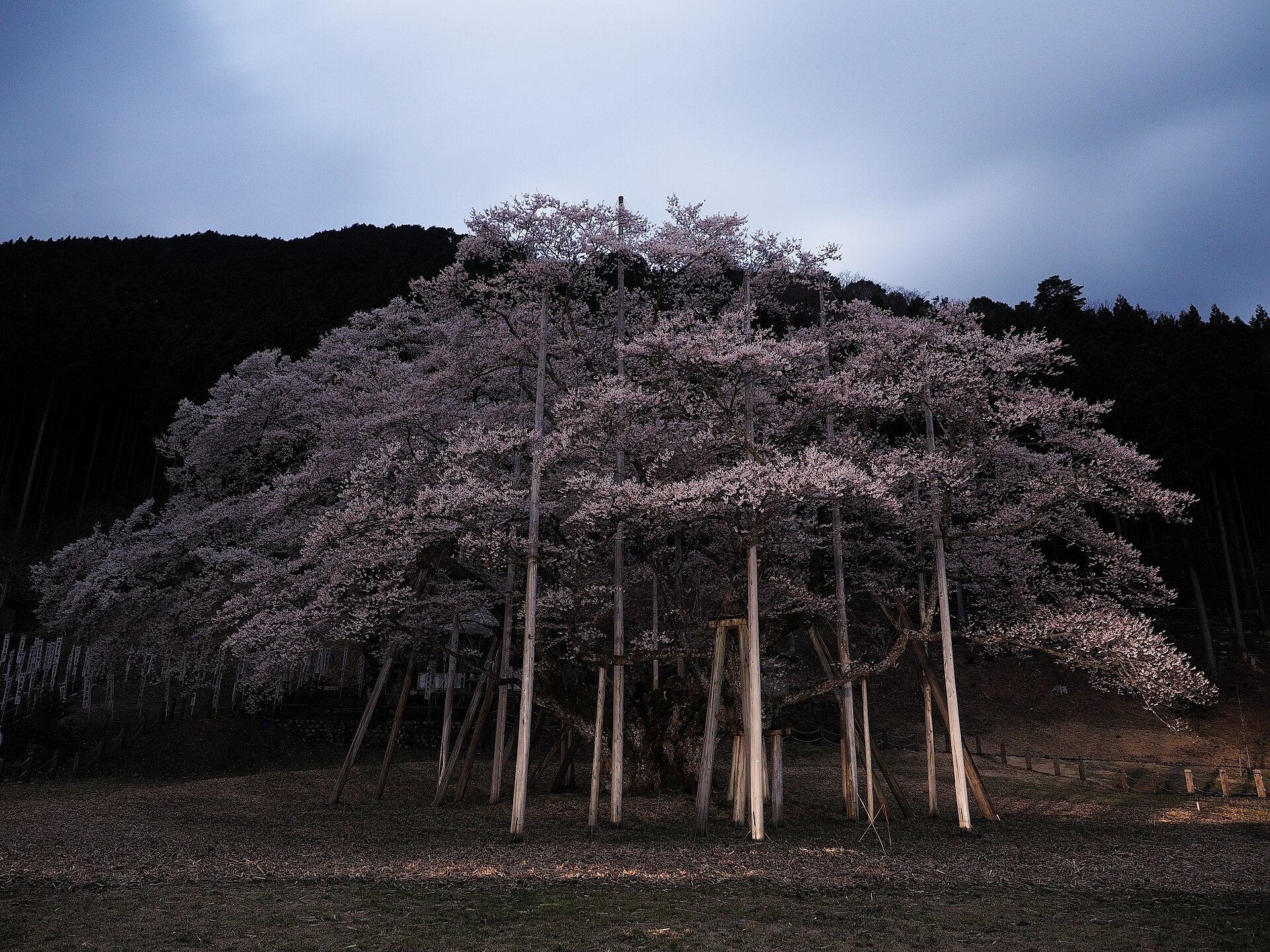
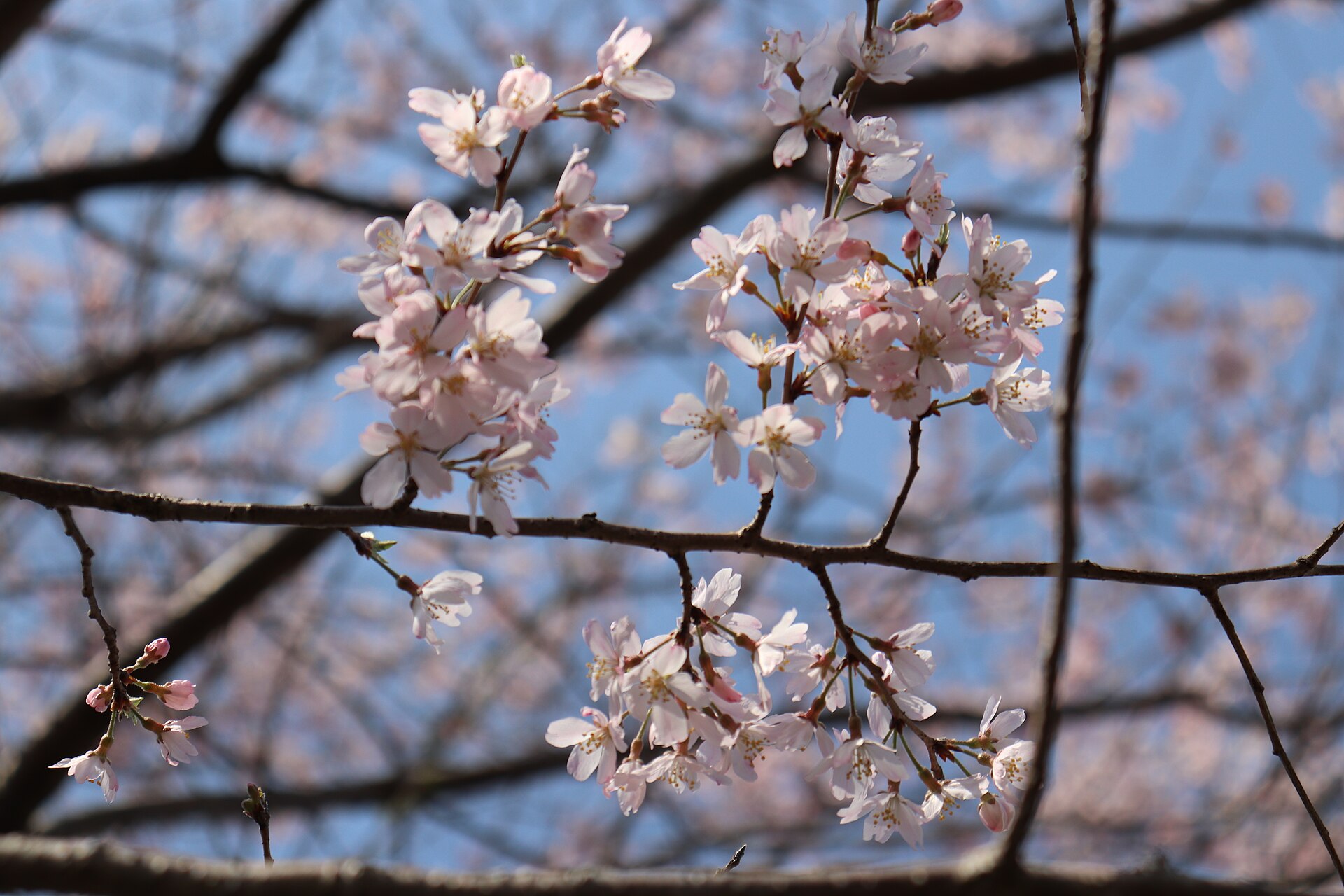
The name explains what the visitor waits for. According to Motosu City, the buds are pale pink, the open flowers are white, and as the petals begin to fall they take on a faint ink-grey tone (特異の淡い墨色). Usuzumi means “pale ink” — the wash of diluted sumi ink used in calligraphy. Gifu Prefecture’s forest research institute gives the same origin: the name comes from the colour of the petals as they start to scatter.
Edohigan, a wild cherry
Botanically, the Usuzumi cherry is an old Edohigan (江戸彼岸), a wild cherry; Gifu Prefecture’s forest research institute lists it in the Edohigan group. Older literature calls the species Prunus spachiana (or Cerasus spachiana); Kew’s Plants of the World Online now treats that name as a synonym of Prunus itosakura.
The tree was designated a national Natural Monument (天然記念物) under the name 根尾谷淡墨ザクラ on 12 October 1922, according to the national register of cultural properties, with an additional designation on 16 March 1978. The local tourism association describes it as one of the “Three Great Cherry Trees of Japan” (日本三大桜), alongside the Yamataka Jindai cherry in Yamanashi and the Miharu Takizakura in Fukushima. That title is a popular grouping, not a legal category.
1,500 Years Old? — Legends, Measurements and What Is Actually Known
Two founding legends
Motosu City gives the tree’s age as “more than 1,500 years” (1,500余年). The national Agency for Cultural Affairs is more careful: locally, it says, the tree is said to be well over a thousand years old (地元では樹齢千数百年といわれ). We found no published scientific dating.
What the sources do record are legends. Gifu Prefecture records that Emperor Keitai, who is said to have taken refuge in the Neo valley as a child, planted the cherry when he left for the capital to take the throne. Motosu City’s version is more specific: the young prince, sorry to leave the villagers, burned down the birthing hall (産殿) of 桧隅高田皇子 and planted a single cherry seedling on the site. The prefecture also records a second legend, that the tree was planted in the Nara period as a grave marker for the ancestors of the Neo family.
Neither story is supported by records we could find.
Why the numbers do not agree
Anyone who reads more than one Japanese source on the tree will find different sizes. That is normal for an old tree, and it is worth understanding before quoting any figure.
| Source | Height | Girth | Spread (E–W × N–S) | Notes |
|---|---|---|---|---|
| Motosu City (measured Jan 2019) | 17.3 m (57 ft) | 9.4 m (31 ft) at eye height | 22.4 × 24.2 m (73 × 79 ft) | Date of measurement stated |
| Gifu Prefecture cultural property page | 28 m (92 ft) | 11 m (36 ft) at base; 9 m (30 ft) at eye height | 30 × 27 m (98 × 89 ft) | No measurement date given |
| Gifu forestry centre survey (published 1996) | 17 m (56 ft) | 12 m (39 ft) at the thickest point | 27 × 21 m (89 × 69 ft) | Survey report |
The figures were not recorded under consistent conditions, so they cannot be compared directly, or read as growth or storm loss. In this article we use the 2019 city figures because they carry a date.
The Decline — Snow, Cracks and a Three-Year Sentence
A limb lost in the snow
Motosu City’s history of the tree places the beginning of its decline in a heavy snowfall in the early Taishō era (the 1910s). The limb known as the “first limb” (一の枝) — described by the city simply as about 4 m (13 ft) “thick” (太さ約4m), without saying how it was measured — broke, and the main trunk cracked.
A forecast of death within three years
By around 1948, the city’s history says, people feared the tree was dying. A Dr Honda (本田博士), sent by the Ministry of Education, examined it and judged that it would probably not escape death within three years (今後3年以内に枯死は免れないだろう). We have not seen his diagnosis itself; the words come from the city’s account.
For a designated Natural Monument, that verdict amounted to a forecast of loss.
The Dentist and the Dying Roots — Autumn 1948
Digging down to the problem
In the autumn of 1948, Maeda, a dentist, came to survey the tree. The Forestry Agency’s Chūbu regional office, in a 2011 public newsletter, also names him as a dentist and records that he carried out root grafting in 1949. How a dentist came to the work is not explained in the sources we checked; Motosu City notes that a group including 松岡楯雄 proposed a society to honour and preserve the tree, but we could not confirm who formally asked Maeda to act.
What the excavated roots revealed
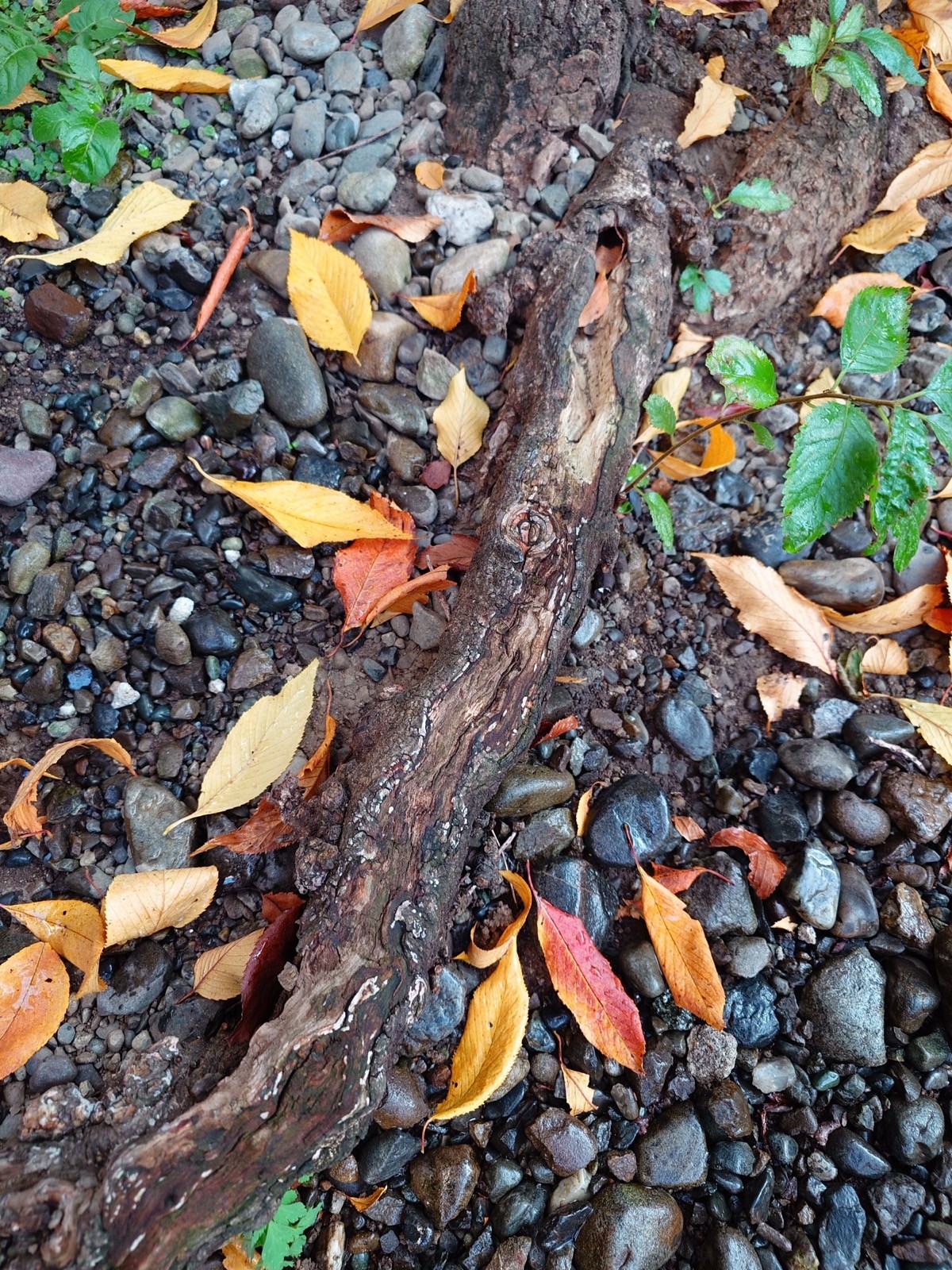
What lay underground is recorded more clearly. When the soil around the base was opened, the great roots were almost all dead (巨根は殆ど枯死の状態), and the decayed parts were full of termites (無数の白蟻が生息).
The record does not say how much the termites contributed to the decline, and we do not assume they were the cause. What it does show is the deciding fact for the rescue: among the dead roots, some still carried a little life. Those surviving roots were what the grafts would be joined to.
238 Root Grafts — Spring 1949
Nearly four weeks of work
According to Motosu City, Maeda led the work from 10 March to 5 April 1949, together with 中島英一 and others he had taught the technique, with labourers doing the digging. They made 238 root grafts.
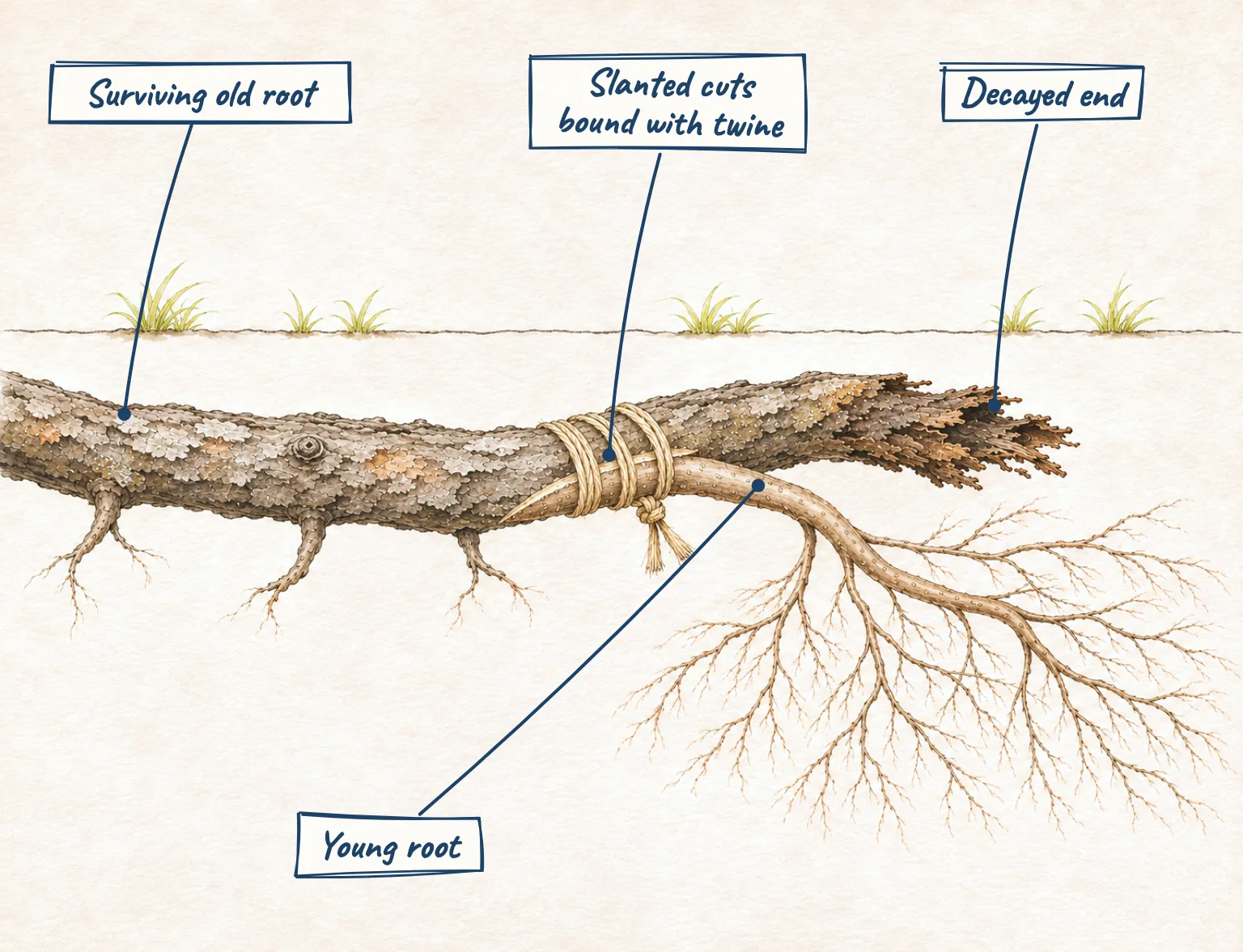
The material was wild cherry: young roots of yamazakura (山桜) dug from the mountains nearby. These were joined to the parts of the Usuzumi cherry’s own root system that still had a little life in them (僅かに活力のある残根). The work, the city records, was not only grafting. The team also killed the termites, protected the graft points against frost, replaced soil and added fertiliser.
Precision matters here: the city’s account says 238 root grafts made with young roots. It does not say that 238 young trees were planted around the trunk.
What a root graft is supposed to do
A graft only takes if the cambium — the thin living layer just under the bark that produces new wood and bark — of both pieces is brought into contact and held still while the tissues knit. Japan’s National Institute for Land and Infrastructure Management (NILIM), in its guide to conserving landmark trees, describes this sequence for root and young-tree grafts: align the cambium, join and fix the pieces, then protect them while they heal.
Once the join holds, the young root becomes part of the old tree’s supply line. It supplements the water and nutrient supply the old roots can no longer provide, and it can grow new fine roots of its own.
After the grafting: keeping feet off the roots
The city’s history says that once the grafting was done, cultivation was banned within about 10 m (33 ft) of the tree, and entry to the grafted area was forbidden. Both rules protected a root zone that had just been opened, cut and rebuilt.
Root Grafting Explained — Two Methods, One Goal
Grafting young trees versus grafting roots
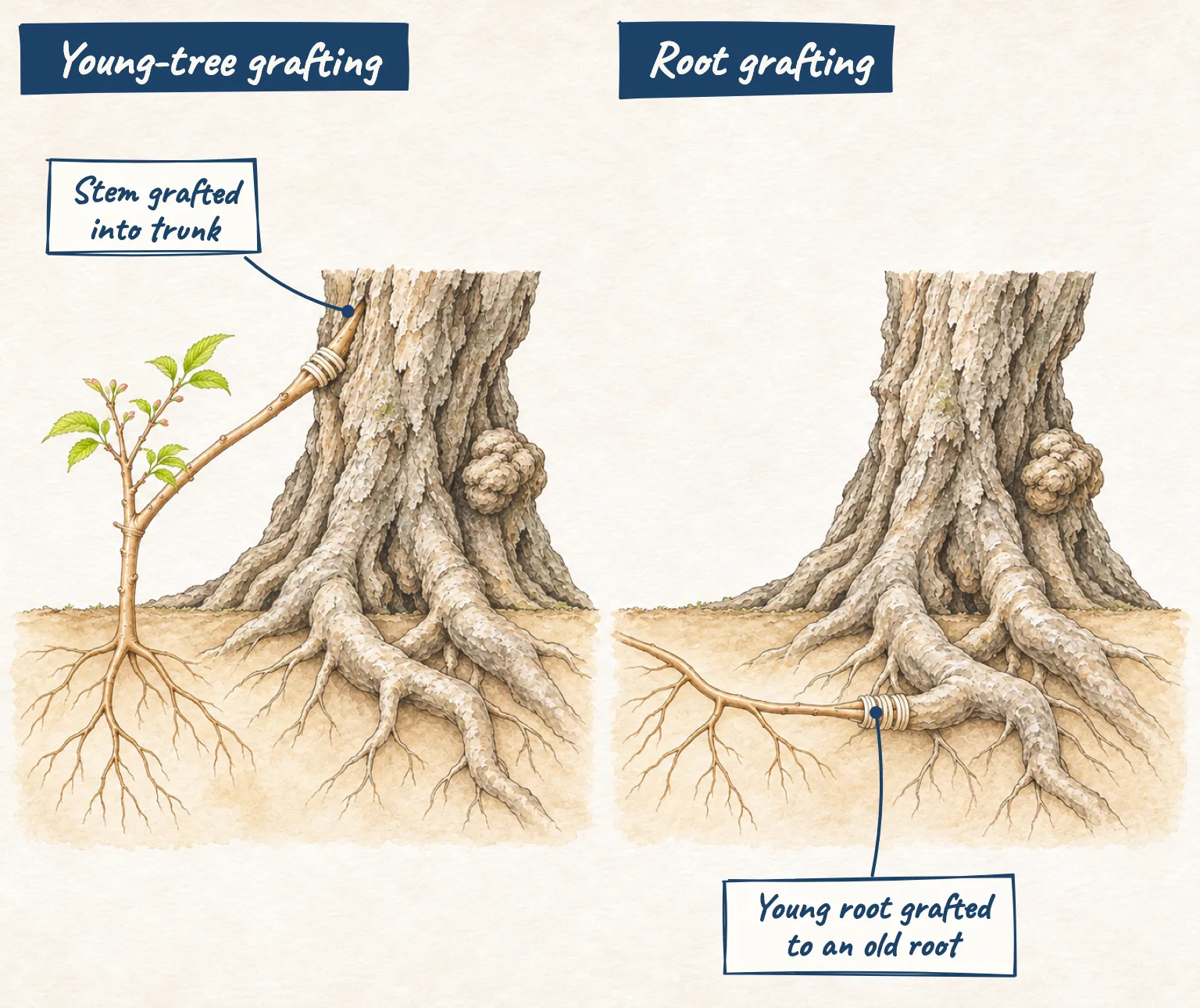
NILIM’s guide separates two ways of giving an old tree new roots. In wakagi-tsugi (若木接ぎ, young-tree grafting), young trees are planted close to the base of the old tree, allowed to establish, and then their stems are grafted onto the old trunk. In ne-tsugi (根接ぎ, root grafting), roots taken from young trees are grafted directly onto the root system of the tree being conserved.
The Usuzumi cherry’s 1949 treatment, as Motosu City describes it, belongs to the second type: young roots onto surviving old roots.
The English names, and where they differ
English-language horticulture has close relatives of both methods, but the terms do not map one-to-one.
| Method | Japanese term | What is joined | Typical purpose in the sources |
|---|---|---|---|
| Young-tree grafting | 若木接ぎ (wakagi-tsugi) | Stem of a young tree planted at the base → old trunk | Supplement the root system of an old tree (NILIM) |
| Root grafting | 根接ぎ (ne-tsugi) | Root taken from a young tree → root of the old tree | Supplement the root system of an old tree (NILIM) |
| Inarching | — | Rooted stock planted at the base → established tree | Replace or add to a root system (Cornell) |
| Bridge grafting | — | Scions spanning a girdled wound on the trunk | Reconnect cambium above and below damage (UConn) |
Cornell University’s horticulture notes describe inarching as using stock plants “deliberately planted in the ground at the base of an established tree”, which is close to wakagi-tsugi. The University of Connecticut describes bridge grafting as connecting the cambium “above and below the girdled area” of a damaged trunk — a repair across a wound, not a root-to-root join. Calling the Usuzumi cherry’s treatment “bridge grafting” would be wrong; “root grafting” is the accurate English.
Timing
NILIM’s guide gives April to July as the working season for both young-tree and root grafting. Other sources describe other methods and species: a pear trial reported by Japan’s agricultural research organisation NARO planted rootstocks in autumn and made approach grafts (寄せ接ぎ) the following June to August to restore vigour, and UConn advises bridge grafting in spring, after the buds begin to swell and the bark lifts easily.
The 1949 work at Neodani began on 10 March, earlier than NILIM’s general April–July window. The sources do not say why, and we have not found a record of the graft method in more detail than the city’s summary.
The same idea, half a century later
Root grafting is still used on heritage trees in Japan. In 2006, according to a report by the practitioners in the journal of the Japanese Society of Tree Health, a large old kuroganemochi (Ilex rotunda) protected by Fukuoka City received root grafts using about 300 roots, together with grafts from seedlings; the joins were made by matching the cambium and fixing them with wood screws.
Did It Work? — What a Report Published in 1996 Found
Grafted roots, decades later
Motosu City’s history describes vigorous growth after the treatment. The most useful evidence, though, comes from a report published in 1996 by Nohira Teruo (野平照雄) of the Gifu Prefecture forestry centre, who took part in a survey of the tree. The grafted roots examined had grown to a circumference of up to 40 cm (16 in) and were putting out many fine roots (周囲40cmまでに成長し、細根が多数伸びていた). The author considered that the grafting had been effective in restoring the tree’s vigour (樹勢回復は有効であったと考えられた).
That is a field assessment, not a controlled experiment. Nobody left a second Usuzumi cherry untreated for comparison, and the grafting was done alongside soil replacement, fertiliser and termite control. But grafted roots that had survived and thickened to as much as 40 cm around show that at least some of the 1949 joins took.
Where the living roots were
The same survey reported many fine roots in the top 5 cm (2 in) of soil, over an area about 20 m (66 ft) square, with some root rot and internal decay in the trunk alongside signs of recovery.
The 1968 measures had already widened the fence “to protect the roots” (根を守る). The later survey shows what that ground holds: a thin layer of feeding roots under soil that people could otherwise walk on.
Reading an old cherry on our own jobs
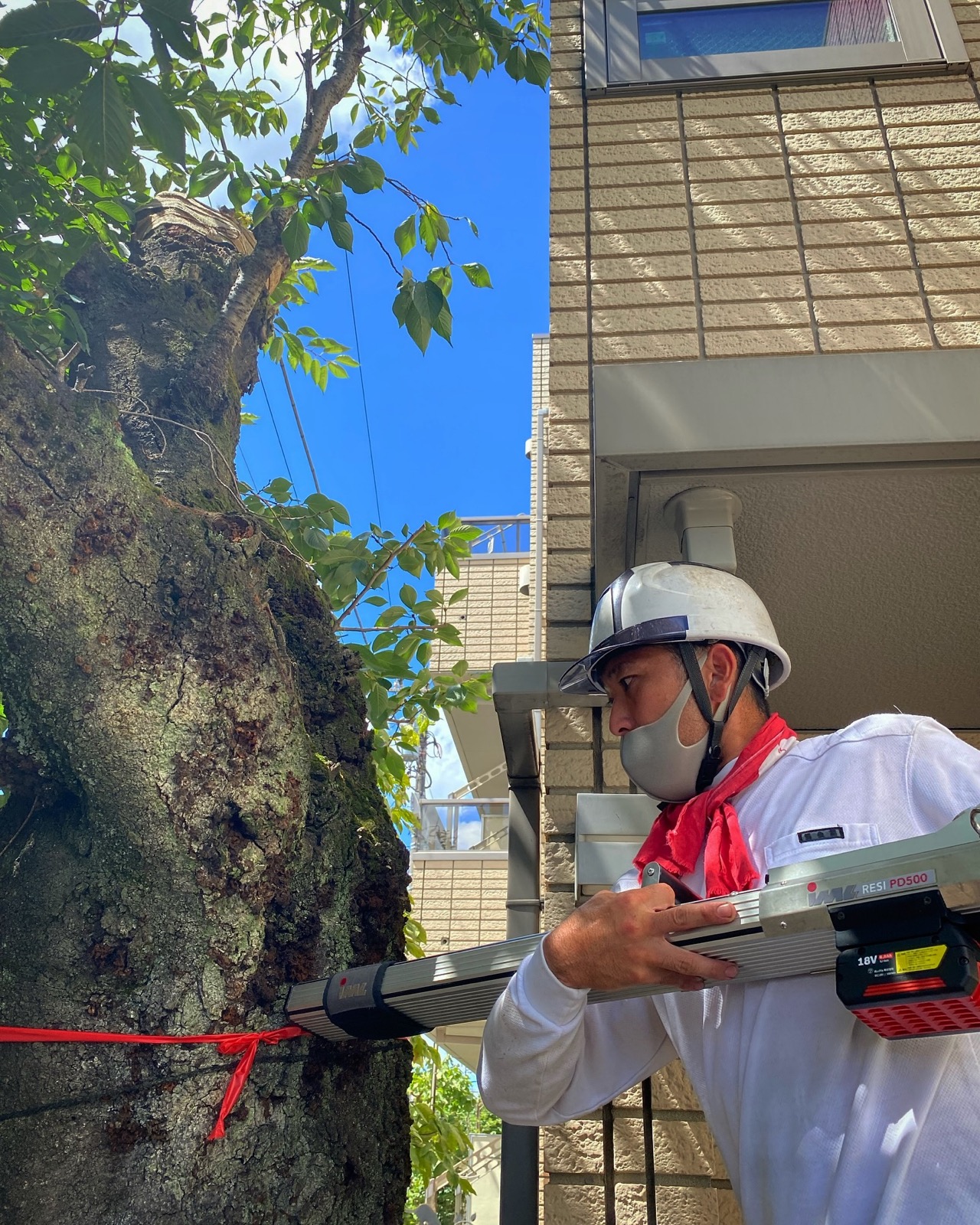
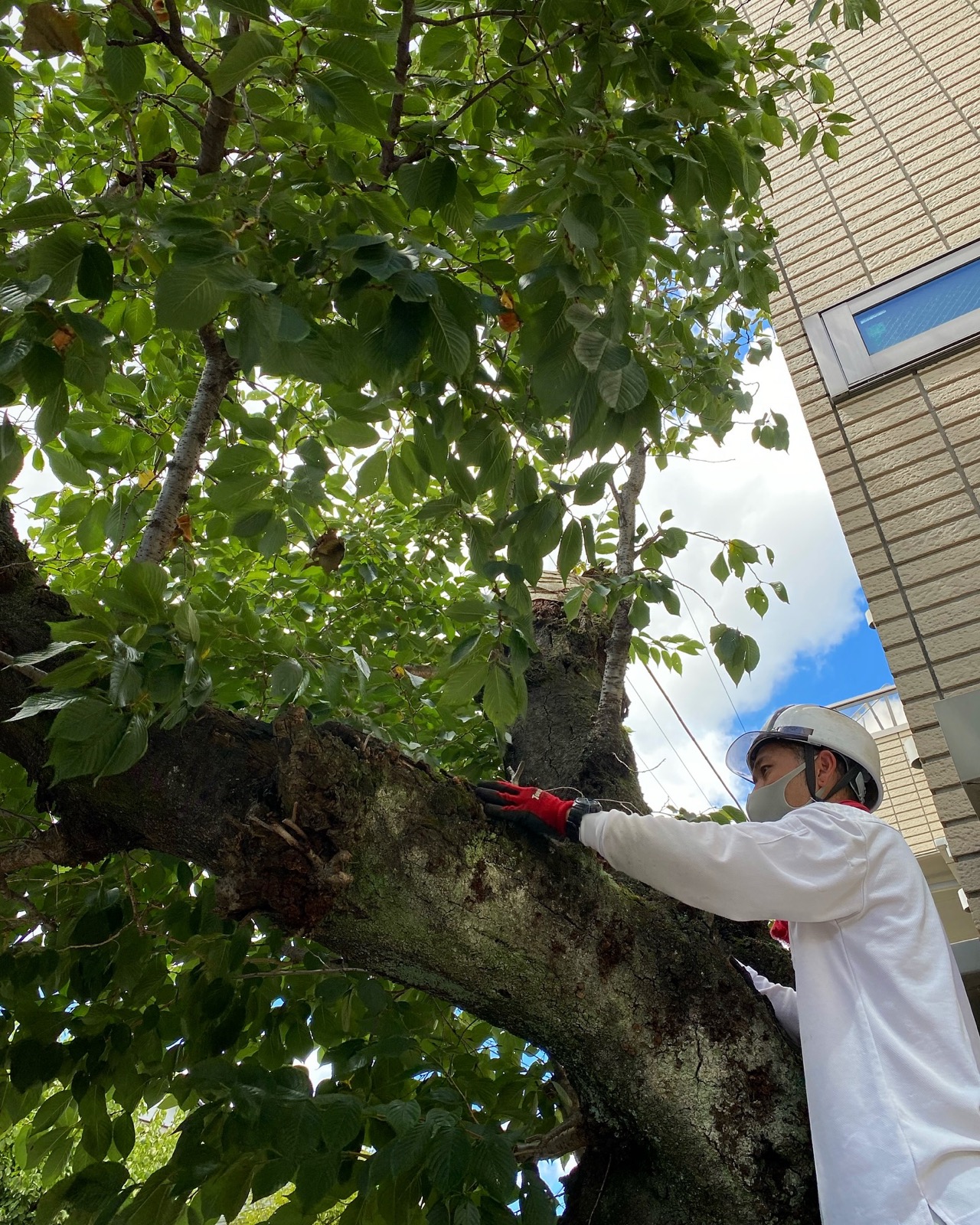
The survey reported in 1996 dug to see roots. On our own jobs with old cherries in Tokyo, we read the bark by hand first and then test the trunk with a resistance drill, an instrument we explain in how a Resistograph works. Neither replaces looking at the roots; they tell you about the trunk and limbs the props are carrying.
A Typhoon and a Novelist — 1959 to 1968
The Ise Bay Typhoon
In September 1959, according to Motosu City’s public newsletter, the Ise Bay Typhoon struck the tree directly: thick limbs broke, and leaves and small branches were stripped away. The newsletter records that the tree’s recovery afterwards was slow.
Uno Chiyo’s letter
The tree’s second rescue came from a writer. The novelist Uno Chiyo (宇野千代) visited the village on 11 April 1967, according to the city’s history. She wrote about the tree in the magazine Taiyō (太陽) in its April 1968 issue, and wrote to the Governor of Gifu, Hirano Saburō (平野三郎), urging that it be protected. The governor visited the tree on 9 April 1968.
On the governor’s instruction, the prefecture’s cultural properties council asked 堀武義, a professor at Gifu University, to diagnose the tree. The measures that followed, as the city lists them, were to enlarge the fence to protect the roots, add props to protect the limbs, treat the trunk and apply fertiliser. Uno later published Usuzumi no Sakura (薄墨の桜) with Shinchōsha in 1975.
The two rescues are eighteen years apart: the root grafts in 1949, Uno’s campaign from 1967.
Decades of Care — Props, Soil and Snow Ropes
A timeline of treatment
| Year | What happened | Source |
|---|---|---|
| 1910s (early Taishō) | Heavy snow breaks the first limb; trunk cracks | Motosu City |
| c. 1948 | Ministry-sent Dr Honda forecasts death within three years | Motosu City |
| Autumn 1948 | Maeda surveys the tree | Motosu City |
| 10 Mar – 5 Apr 1949 | Roots found nearly dead with termites; 238 root grafts, termite control, soil replacement, fertiliser | Motosu City |
| Sept 1959 | Ise Bay Typhoon breaks thick limbs | Motosu City newsletter |
| 1967–1968 | Uno Chiyo visits and appeals; governor visits; fence enlarged, props added | Motosu City |
| 1989 – FY1996 | Four life-extension treatments | Motosu City |
| 1996 (published) | Report: grafted roots up to 40 cm around, many fine roots | Gifu forestry centre |
| Sept 2018 | Typhoon No. 21 topples props; four large limbs break | Motosu City |
| FY2024–2025 | Prop timber selected, felled, treated; props replaced | Motosu City audit report |
Treatments of their time
Between 1989 and fiscal 1996, the city records four rounds of life-extension treatment: removing decayed wood, spraying fungicide, applying a wood-hardening agent and filling cavities with urethane. These belong to their period; the list is a record of what was done, not a recommendation.
Typhoon No. 21, 2018
In September 2018, Typhoon No. 21 knocked over props and broke four large limbs, each 20–30 cm (8–12 in) in diameter and 6–8 m (20–26 ft) long, according to Motosu City. The broken ends were treated against decay, and props were tied back with wire to reduce the risk of their falling again.
Soil, mulch and snow ropes
The city’s newsletter of April 2019 describes the work of the tree doctor 大平猛司 (a jumoku-i, 樹木医), including soil improvement and yukitsuri (雪つり), the snow ropes that take weight off limbs in winter. It also describes spreading kaya (カヤ, cut grass thatch) around the trunk to encourage soil life.
Soil work around an old cherry in Tokyo
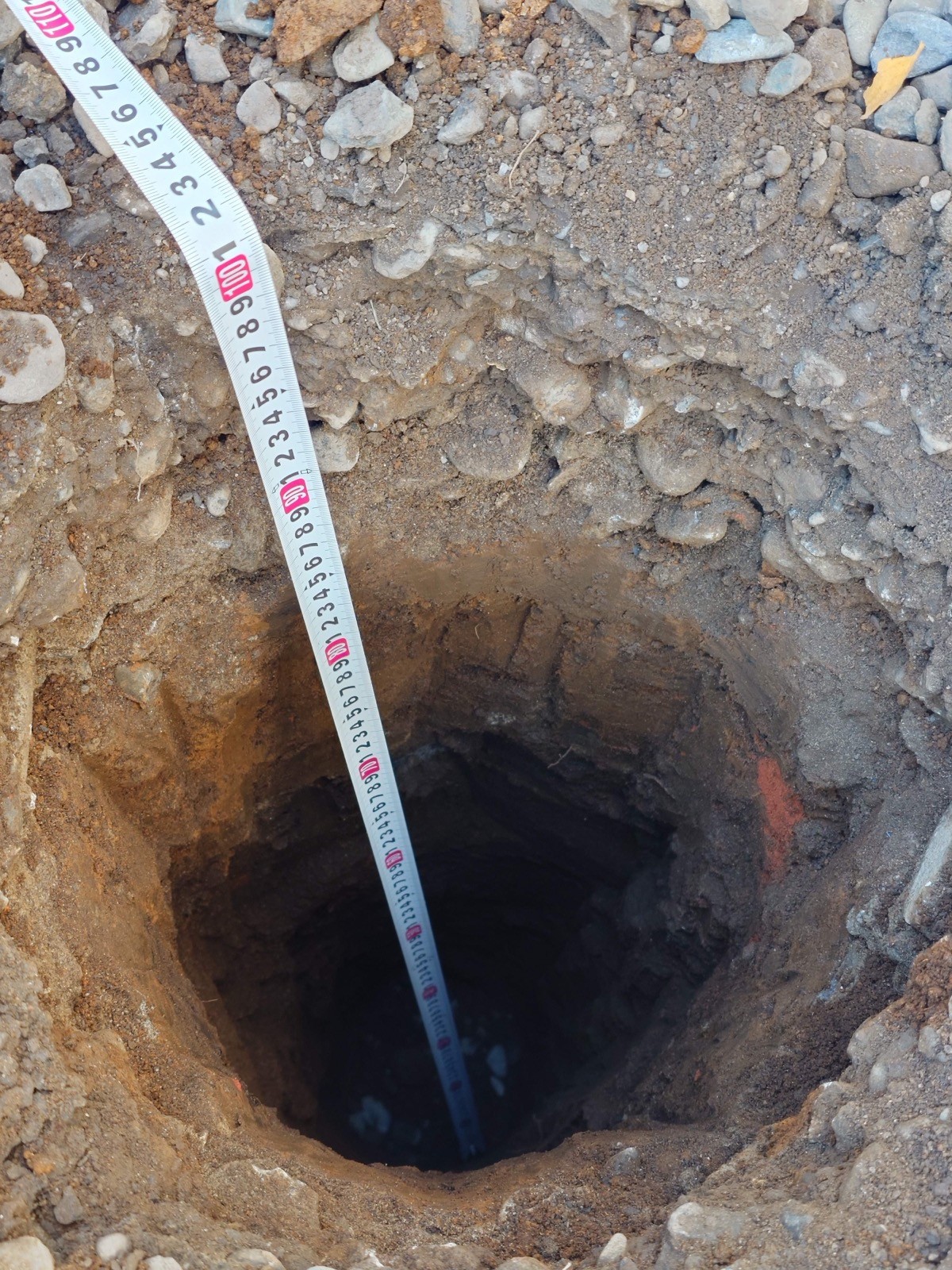
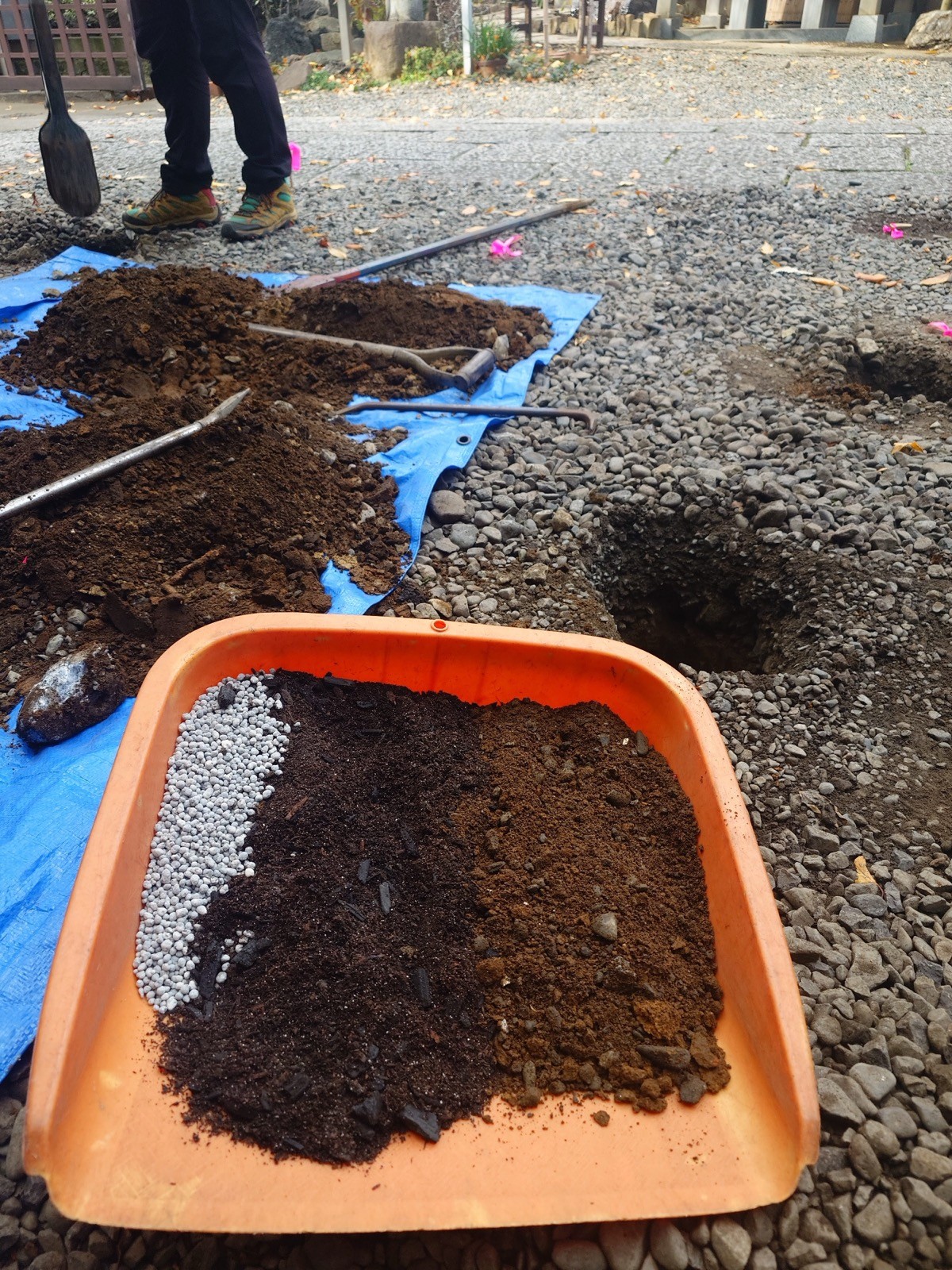
On one of our jobs in Tokyo, around an old weeping cherry in November 2025, the soil work looked like this: narrow vertical holes opened in a pattern under the crown, each one measured, then backfilled with a blend of dark organic material and pale grit.
The props are still being replaced
The work has not stopped. The city’s March 2026 audit report records that in fiscal 2024 timber for props was selected, felled and given preservative treatment, and that in fiscal 2025 props were replaced and dead branches dealt with. In a council session in August 2025, the city described regular management by a tree doctor, a protection committee meeting twice a year, and branch breakage after snow more than 1 m (3 ft) deep in February 2025.
Keeping the Genes — Grafted Clones and Seedlings
A broken branch becomes a new tree
Even a broken limb can be useful. Gifu Prefecture’s forest research institute grows a Usuzumi cherry propagated from branches broken in a 1990 snowfall, used as scions for grafting. The scion carries the parent tree’s genes; the rootstock beneath it may be a different tree.
Free grafted seedlings
A 2002 report from the prefecture’s forest research institute describes a programme of grafted cherry seedlings that gave away about 2,200 trees a year, free of charge. That total covers four kinds of cherry, including the Usuzumi; it is not the number of Usuzumi seedlings alone.
Seedlings are not clones
Seed-grown offspring have also been given to other places. Shimotsuke City in Tochigi Prefecture received 20 seedlings in February 1985, and its public newsletter reported in 2022 that nine Usuzumi cherries stood in its Tenpyō-no-oka Park. These grew from seed, so they are offspring of the tree, not clonal copies of it.
What the Usuzumi Cherry Teaches About Old Trees
Roots and crown together
The tree’s history keeps coming back to the roots: dead roots found in the 1949 excavation, 238 root grafts, a fence widened in 1968 to protect roots, and grafted roots measured in a report published in 1996. But it is equally a history of snow, typhoons, cracked and hollow limbs, and props. Root care bought the tree time; protecting the crown has kept it standing.
One technique family, different joins
The grafting methods in this story are relatives, not synonyms. Bridge grafting, as UConn describes it, spans a wound on the trunk. Inarching, in Cornell’s description, plants rooted stock at the base of a tree and joins it above ground. The Usuzumi cherry’s 1949 treatment, as Motosu City records it, joined roots to roots below ground. When you read about saving an old tree with grafts, the first question is where the join was made, because that tells you what problem it was meant to solve.
If you want to see how other Japanese giants survive with hollow trunks and props, read our field notes on the hollow great zelkova of Higashine and why Japan’s ancient trees live for a thousand years.
Visiting the Usuzumi Cherry — Season, Place, Manners
When it blooms
The tourism association gives early April as the usual peak, and the prefecture says mid-April. Real years vary: the city’s records show full bloom from 25 March to 1 April in 2023, and from 8 to 13 April in 2025. Check the city’s bloom report before travelling.
Where it is
The tree stands in Neo Itadokoro, Motosu City, Gifu Prefecture (岐阜県本巣市根尾板所字上段995), at the centre of Usuzumi Park, which also has a lawn of 4,500 m² (about 48,400 sq ft) and an open-air stage.
Staying off the roots
Stay outside the fence. It exists to protect the roots, and the report published in 1996 found many fine roots in the top 5 cm (2 in) of soil.
Frequently asked questions
How old is the Usuzumi cherry?
Motosu City gives its age as more than 1,500 years, and the Agency for Cultural Affairs says it is locally said to be well over a thousand years old. Legends link it to Emperor Keitai; we found no published scientific dating.
What is root grafting (ne-tsugi)?
Root grafting joins roots taken from young trees onto the surviving roots of an old tree, with the cambium layers aligned and fixed so they knit. It supplements a failing root system. A related method, young-tree grafting (wakagi-tsugi), plants young trees at the base and grafts their stems into the trunk.
Who saved the Usuzumi cherry in 1949?
According to Motosu City, the dentist Maeda Toshiyuki (前田利行) led the work from 10 March to 5 April 1949, with others he had trained. They made 238 root grafts using young roots of wild mountain cherry.
Is root grafting the same as bridge grafting?
No. Bridge grafting joins scions across a girdled wound on the trunk to reconnect the cambium above and below it. Root grafting joins roots to roots underground.
When is the best time to see it?
Usually early to mid-April, but it varies: full bloom came from 25 March in 2023 and from 8 April in 2025, according to the city’s records.
Sources
– Motosu City, protection and restoration history (再生保護) — https://www.city.motosu.lg.jp/0000000238.html (checked 2026-10-31) – Motosu City, features of the tree (特徴) — https://www.city.motosu.lg.jp/0000000302.html ; legend (伝説) — https://www.city.motosu.lg.jp/0000000278.html ; Usuzumi Park — https://www.city.motosu.lg.jp/0000000256.html (checked 2026-10-31) – Motosu City, typhoon damage and treatment, 2018 — https://www.city.motosu.lg.jp/0000001076.html (checked 2026-10-31) – Motosu City, Kōhō Motosu, April 2019, pp. 10–13 — https://www.city.motosu.lg.jp/cmsfiles/contents/0000002/2072/kouhou2019.4.pdf (checked 2026-10-31) – Motosu City, regular audit report FY2025, p. 32 — https://www.city.motosu.lg.jp/cmsfiles/contents/0000000/360/teikikansa_r7.pdf (checked 2026-10-31) – Motosu City Council, minutes of 25 August 2025 — https://www.city.motosu.lg.jp/cmsfiles/contents/0000002/2968/r7dai4__3gou.pdf (checked 2026-10-31) – Motosu City, past bloom records — https://www.city.motosu.lg.jp/cmsfiles/contents/0000000/272/R7sakura.pdf (checked 2026-10-31) – Motosu Tourism Association, Usuzumi cherry — https://motosukankou.gr.jp/01_event/01_01_01.html (checked 2026-10-31) – Agency for Cultural Affairs, national register of cultural properties — https://kunishitei.bunka.go.jp/bsys/maindetails/401/1240 ; Cultural Heritage Online — https://online.bunka.go.jp/heritages/detail/172095 (checked 2026-10-31) – Gifu Prefecture, 根尾谷淡墨ザクラ — https://www.pref.gifu.lg.jp/page/367133.html (checked 2026-10-31) – Gifu Prefectural Research Institute for Forests, Edohigan (Usuzumi-zakura) — https://www.forest.rd.pref.gifu.lg.jp/sakura/encyclopedia/usuzumi.html (checked 2026-10-31) – Nohira Teruo, Gifu Prefecture forestry centre, survey report, 1996 — https://www.forest.rd.pref.gifu.lg.jp/rd/ikurin/9606gr.html (checked 2026-10-31) – 中川一, Gifu Prefecture forest science institute, cherry grafting, 2002 — https://www.forest.rd.pref.gifu.lg.jp/rd/rinsan/71mj4.html (checked 2026-10-31) – Forestry Agency, Chūbu Regional Forest Office, newsletter of 2 March 2011 — https://www.rinya.maff.go.jp/chubu/koho/mailmaga/backnumber/h22/20110302.html (checked 2026-10-31) – National Institute for Land and Infrastructure Management, Technical Note No. 565, pp. 244–245 — https://www.nilim.go.jp/lab/bcg/siryou/tnn/tnn0565pdf/ks056510.pdf (checked 2026-10-31) – NARO, Saga fruit tree research results (root approach grafting of pear) — https://www.naro.go.jp/laboratory/karc/prefectural_results/byougai/043062.html (checked 2026-10-31) – 白石眞一 et al., Tree and Forest Health 11(4), pp. 174–175, 2007 — https://www.jstage.jst.go.jp/article/treeforesthealth/11/4/11_KJ00006675889/_pdf (checked 2026-10-31) – Cornell University, Approach Grafting and Inarching — https://courses.cit.cornell.edu/hort494/mg/methods.alpha/AprMeth.html (checked 2026-10-31) – University of Connecticut, Bridge-Grafting and Inarching Damaged Trees — https://ipm.cahnr.uconn.edu/bridge-grafting-and-inarching-damaged-trees/ (checked 2026-10-31) – Royal Botanic Gardens, Kew, Plants of the World Online, Prunus spachiana — https://powo.science.kew.org/taxon/urn:lsid:ipni.org:names:730287-1 (checked 2026-10-31) – National Diet Library Collaborative Reference Database (Gifu Prefectural Library), Taiyō April 1968 — https://crd.ndl.go.jp/reference/entry/index.php?id=1000059257&page=ref_view ; NDL Search, Usuzumi no Sakura (Shinchōsha, 1975) — https://ndlsearch.ndl.go.jp/books/R100000094-I1096016 (checked 2026-10-31) – Shimotsuke City, Kōhō Shimotsuke, May 2022, p. 6 — https://www.city.shimotsuke.lg.jp/manage/contents/upload/6269d6b60d8fc.pdf (checked 2026-10-31)