

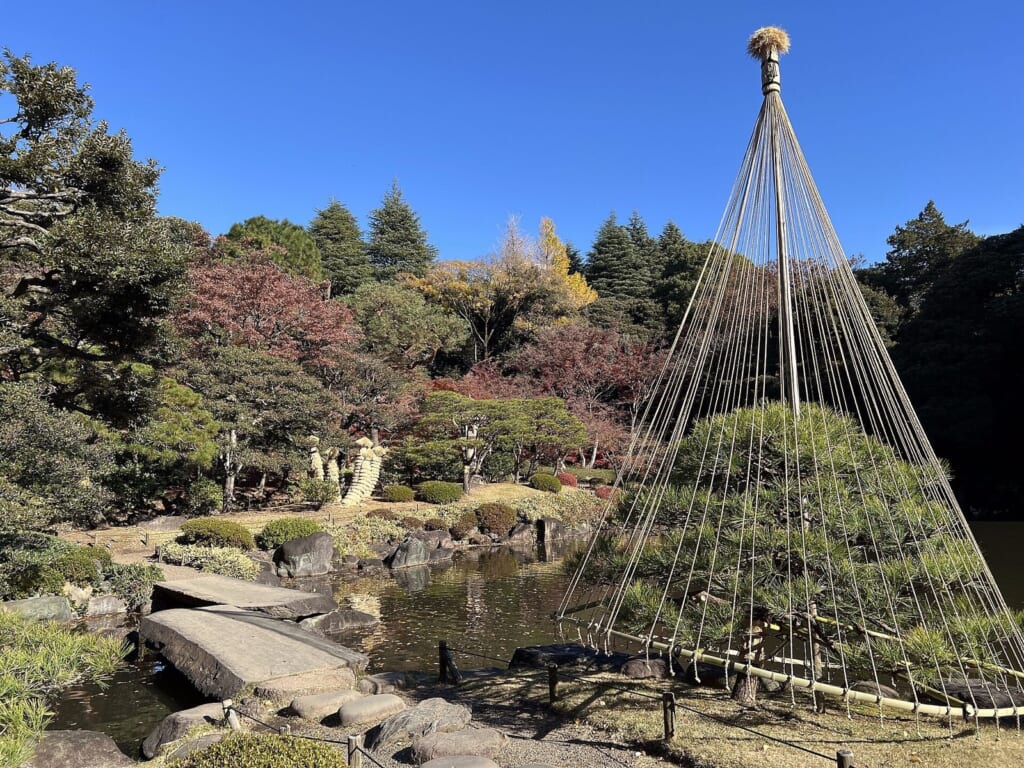
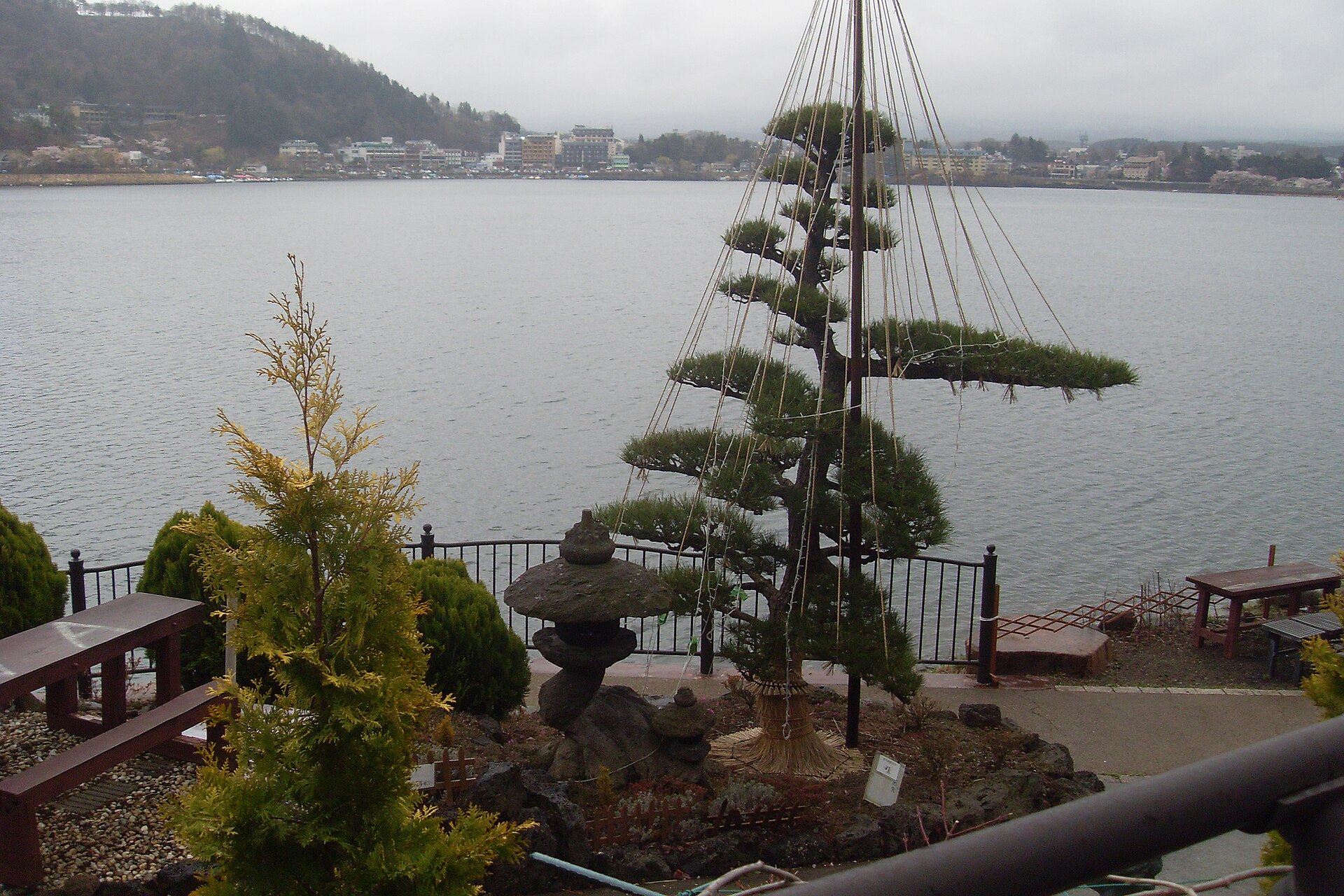
Yukitsuri (雪吊り, “snow suspension”) is a seasonal rope frame that protects garden trees, above all pines, from snow: a pole stands beside the trunk, and ropes radiate from its top to the branches. When wet, heavy snow loads a long horizontal limb, the rope takes part of that weight and passes it up to the pole top, down the pole, and into the ground.
This article reads yukitsuri as a structure and as a job done in a set order. It covers what the snow does to a pine, what each part of the frame does, where the force goes, how the ropes are counted and tied, and how the same idea looks in Western practice. Kenrokuen in Kanazawa begins its season on 1 November, so the dates and numbers below come mostly from that garden and from one municipal park in Chiba that wrote its procedure down.
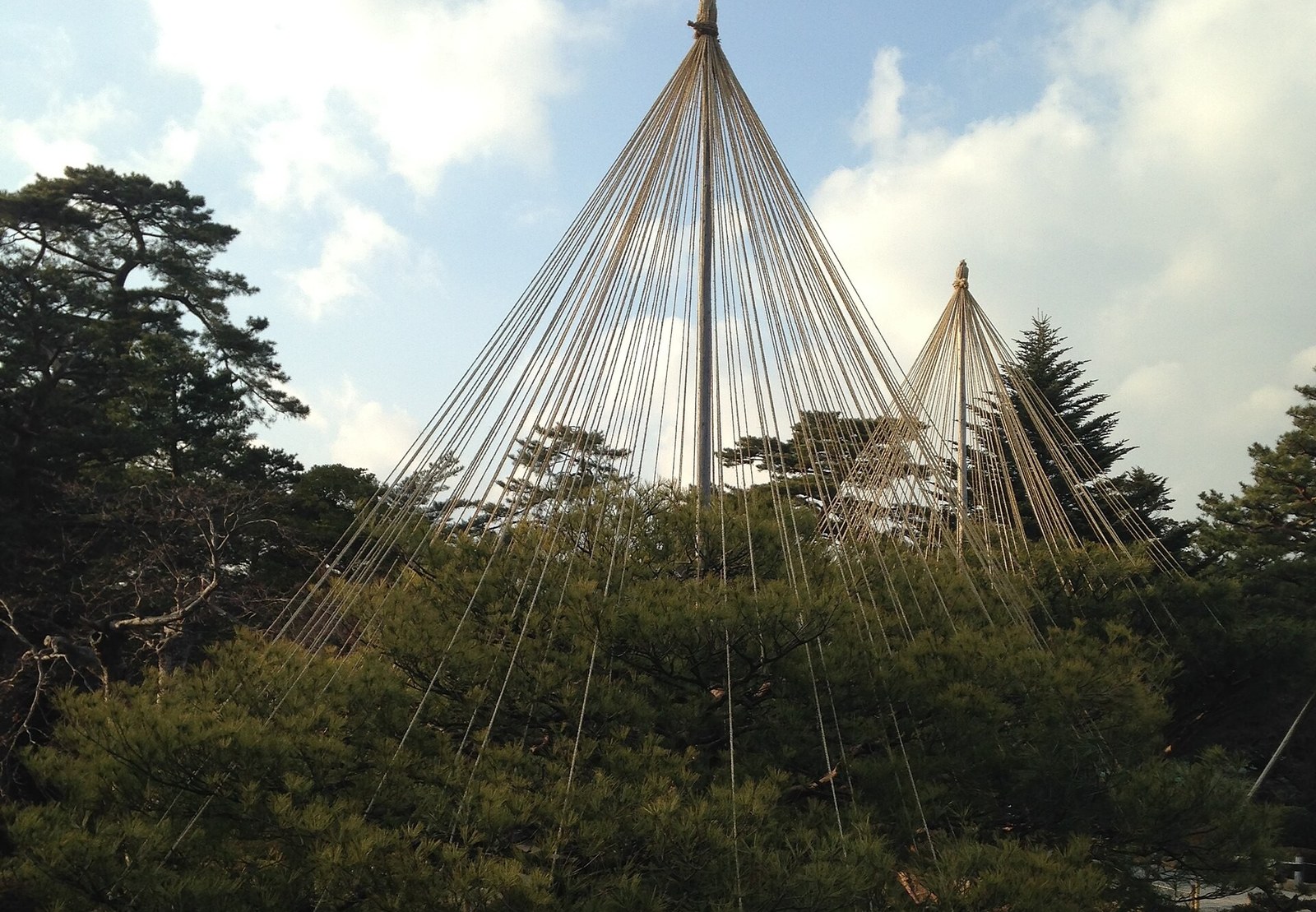
Prefer to watch? The video version (7 min):
Why snow breaks pines — wet snow on a long lever
Wet snow and dry snow behave differently
Japan’s National Research Institute for Earth Science and Disaster Resilience (NIED) separates snow accretion into two types. Wet-type accretion comes from snow falling at 0 °C or above, carrying liquid water; NIED notes that it sticks easily and grows large. Dry-type accretion, from snow below 0 °C, is lighter. NIED adds that wet accretion linked to low-pressure systems passing along Japan’s south coast arrives under strong wind, so the snow that sticks is dense and heavy.
Forest research in Toyama Prefecture, on Japan’s snowy Sea of Japan side, points the same way. A Toyama forestry bulletin explains the high rate of crown-snow damage in the western hills by the temperature at snowfall being close to 0 °C, which produces the wet snow that clings to a crown (Kato 2015). Dry-type snow is not harmless: NIED notes that it melts and refreezes into a hard mass, which then falls and injures. For a pine, though, the damage mode is the wet one, a heavy load that stays on the limb. Snow is not one load. The same snowfall in the same garden can be harmless one night and destructive the next, depending on a degree or two.
NIED’s general list of countermeasures for accreted snow sorts them into three kinds: surfaces that resist sticking, physical or heated removal, and stops or fences that hold the snow where it lies. All of them work on the snow. Yukitsuri works on the structure instead. It accepts that the snow will land and changes how the limb carries it.
A pine is built as a row of cantilevers
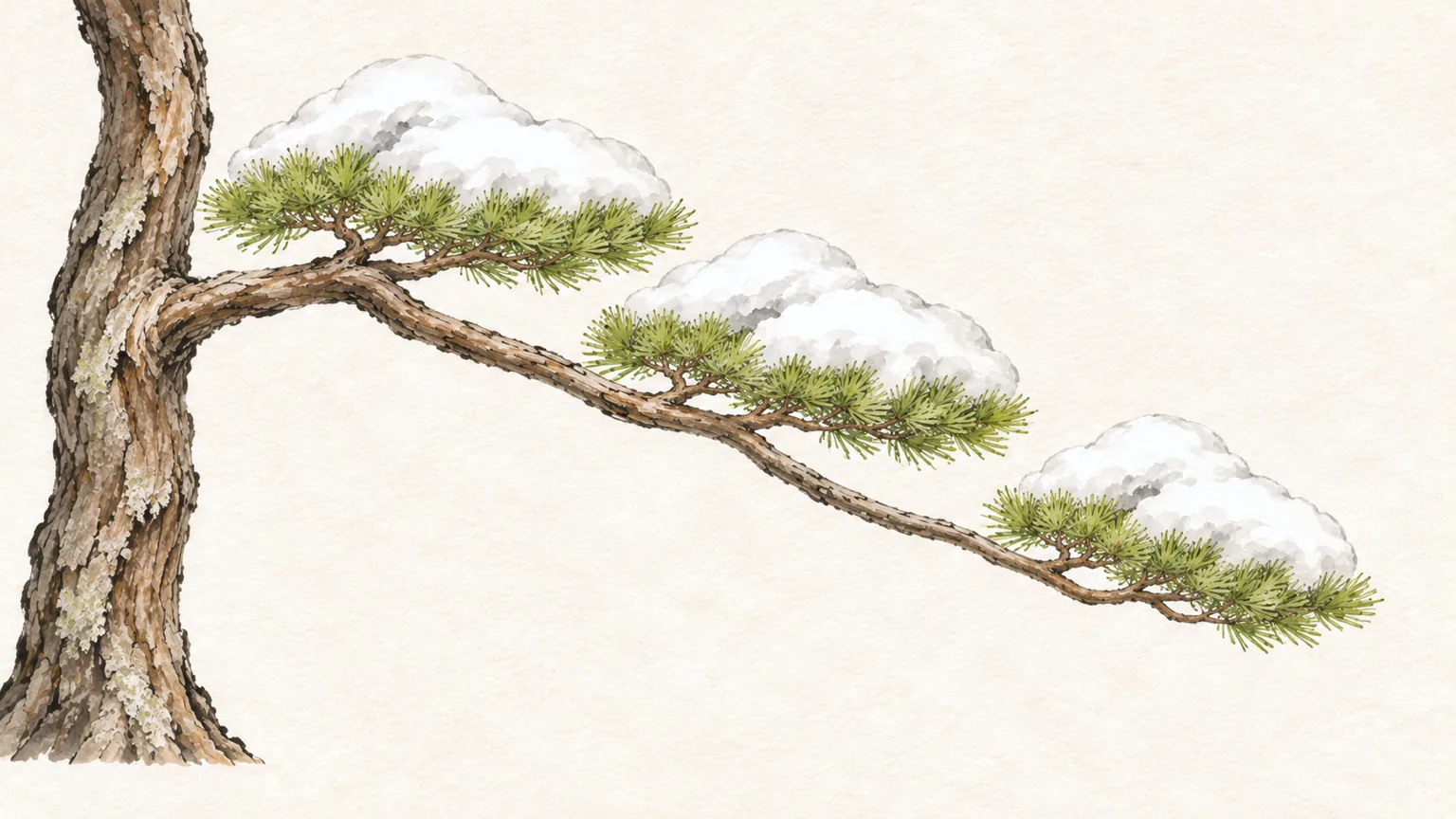
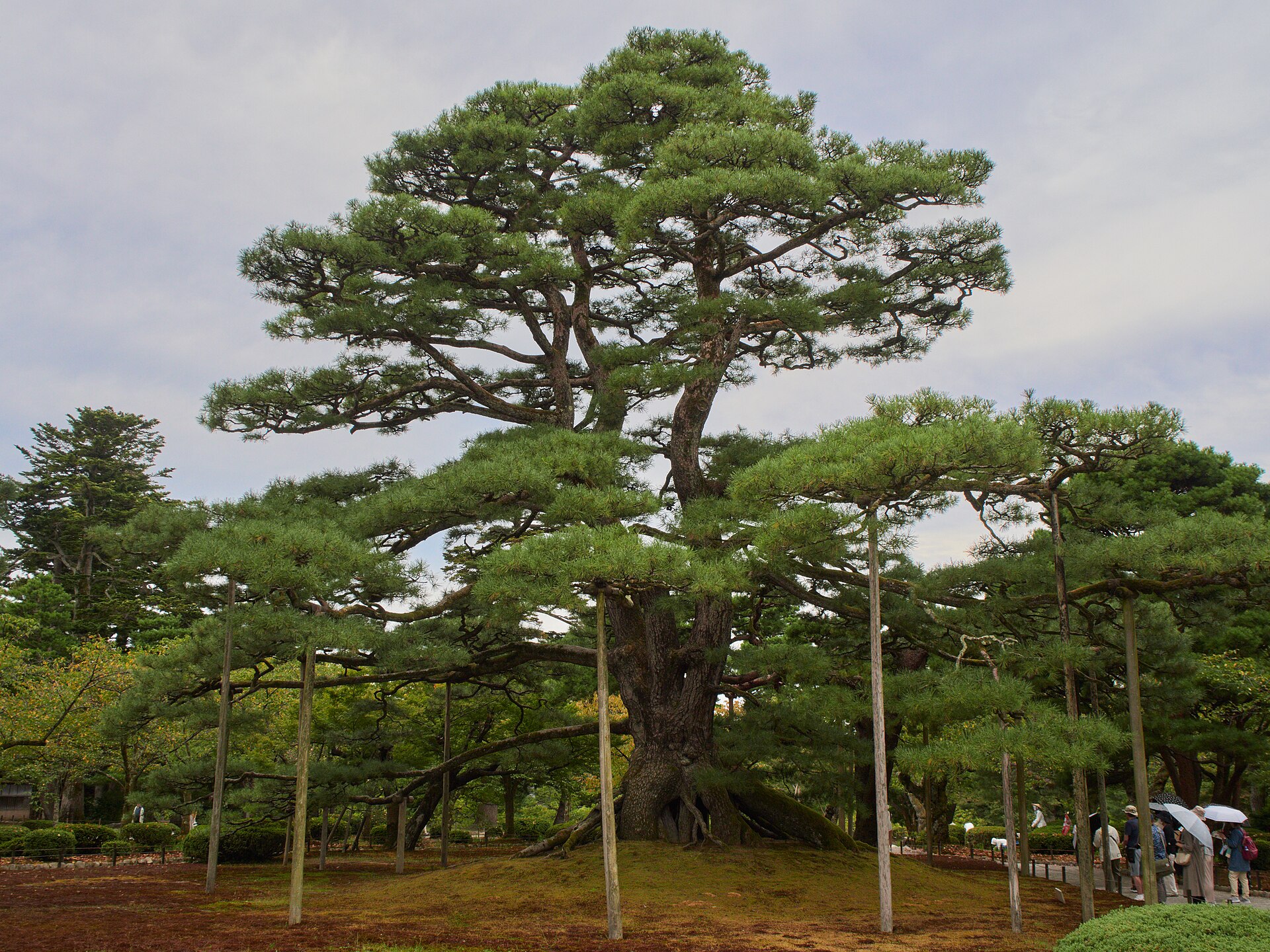
Now put that snow on a garden pine. Japanese garden pines, mostly black pine (Pinus thunbergii) and red pine (Pinus densiflora), are trained for decades into long, near-horizontal limbs with flat pads of foliage. That shape is the point of the design, and the worst shape for snow. Each pad is a shelf. Each limb is a cantilever: fixed at the trunk, free at the tip.
For a cantilever under an even load, the bending moment at the base grows with the square of the length. Double the reach of a limb and, for the same snow per metre, the stress at the union roughly quadruples. Damage therefore concentrates on the oldest, widest limbs. The cloud-pad shaping described in our piece on Karikomi, the Japanese art of cloud pruning creates exactly these shelves.
How much a crown can carry — a measured case
Measured snow loads give a sense of scale. Akio Kato of the Toyama Prefectural Forest Research Institute weighed snow on cedar crowns over seven winters (Cryptomeria, the clone called Boka-sugi, which is known to resist crown-snow damage poorly). The load on a single tree rose in a straight line with the water content of the snowfall, and it tracked the tree’s foliage mass. A sample tree with 26 kg of foliage carried 308 kg of snow after 58 mm of snowfall water equivalent. The most load built up when temperature moved from above to below freezing, with little sunshine and weak wind.
This was cedar, not pine, so the figure is a scale, not a pine rule. Its lesson transfers: foliage is where snow lodges, and a crown with a lot of foliage on long limbs is a heavy target. A trained pine carries its foliage at the far end of its levers.
What the frame is made of — the anatomy of ringo-tsuri
Two basic forms, pole or no pole
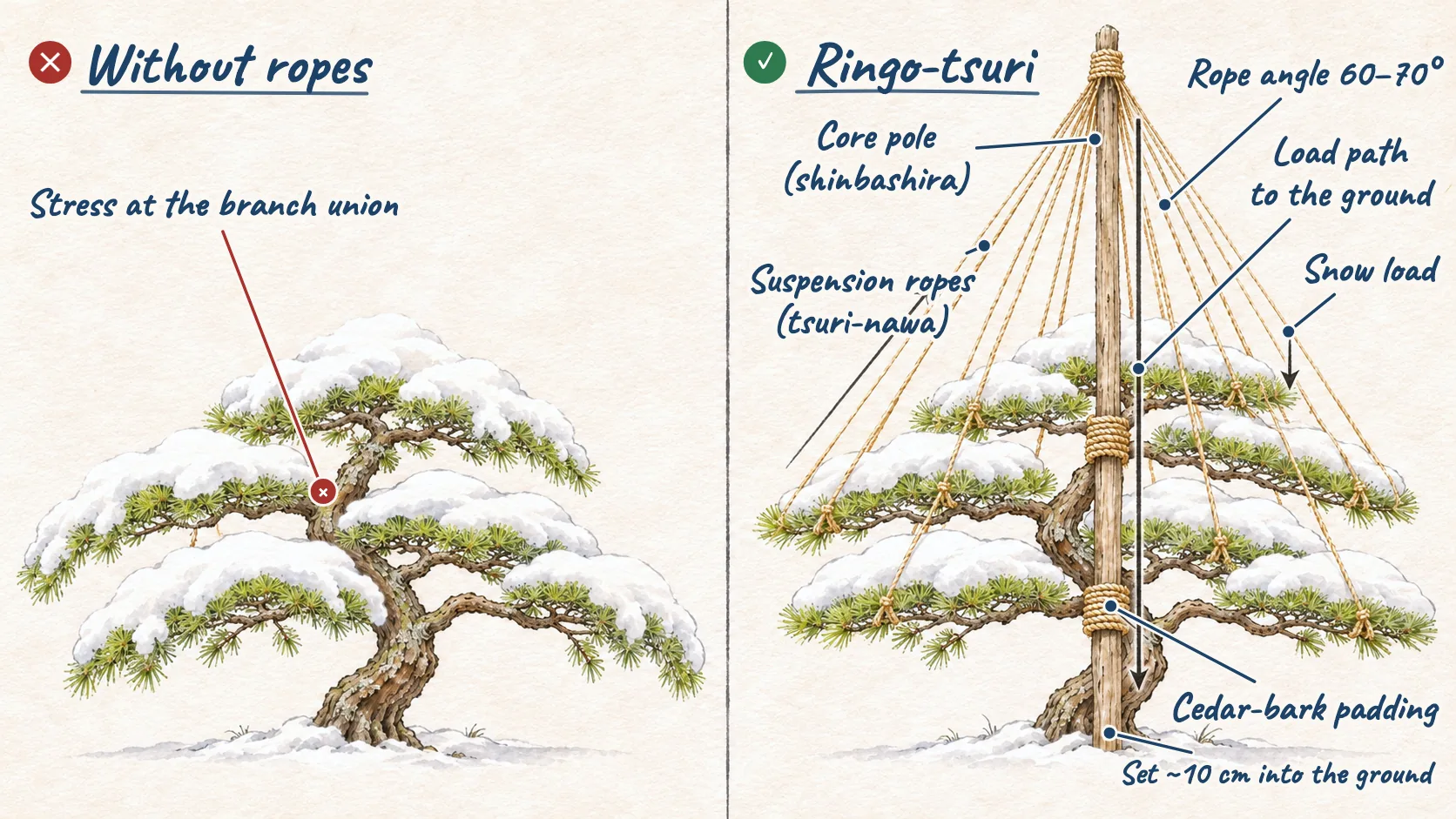
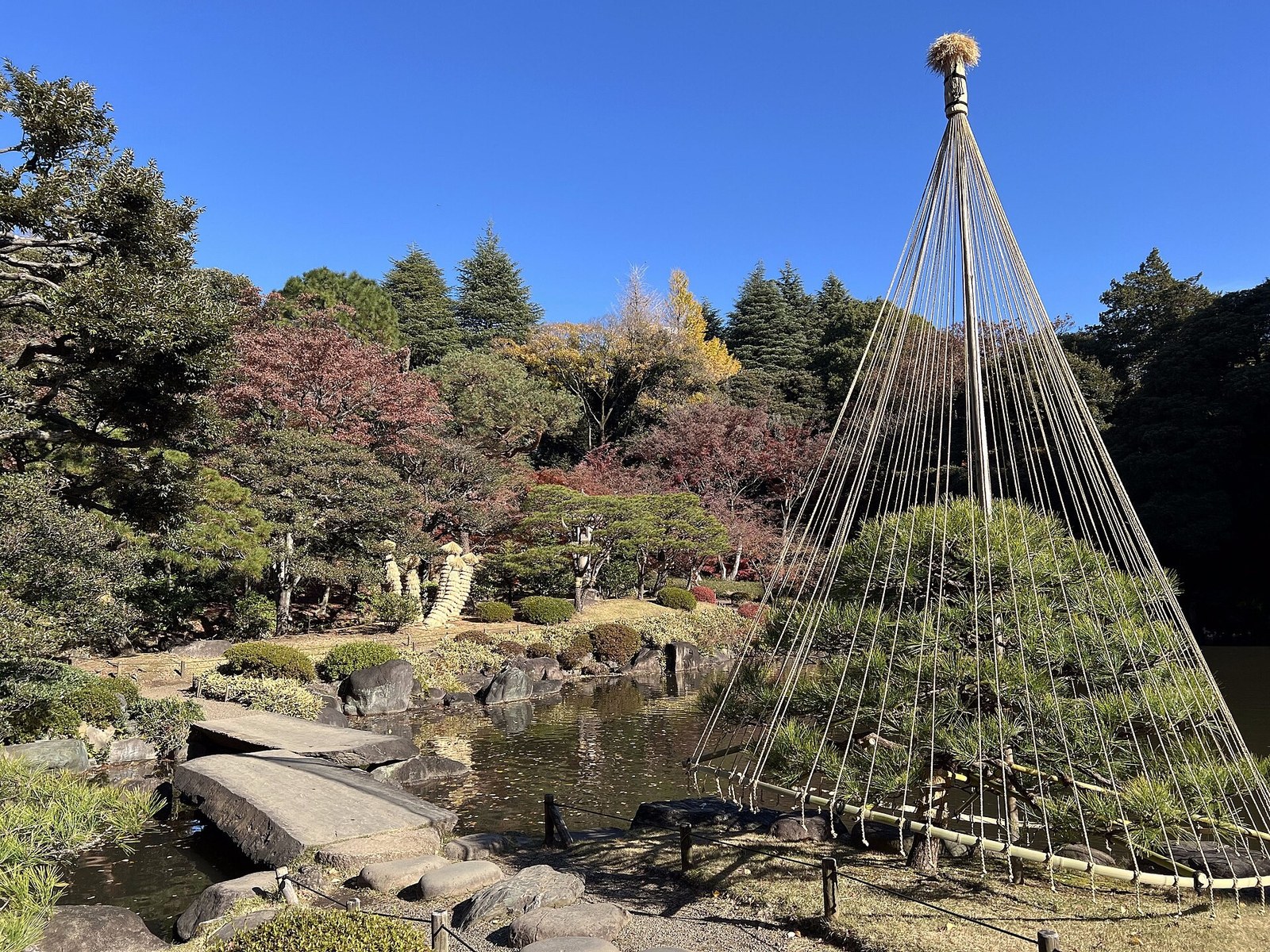
The representative form of yukitsuri is ringo-tsuri (りんご吊り), “apple suspension.” Chiba City’s park office defines it plainly: a pole is set near the trunk, and ropes run radially from the pole top to each branch. A second form, miki-tsuri (幹吊り, “trunk suspension”), skips the pole and runs the ropes from the trunk itself.
Why “apple”? Chiba’s document says only that the Kenrokuen style is called ringo-tsuri in the Tohoku region. A popular story links the name to apple orchards, but I could not open a primary source for it, so it stays out of this article.
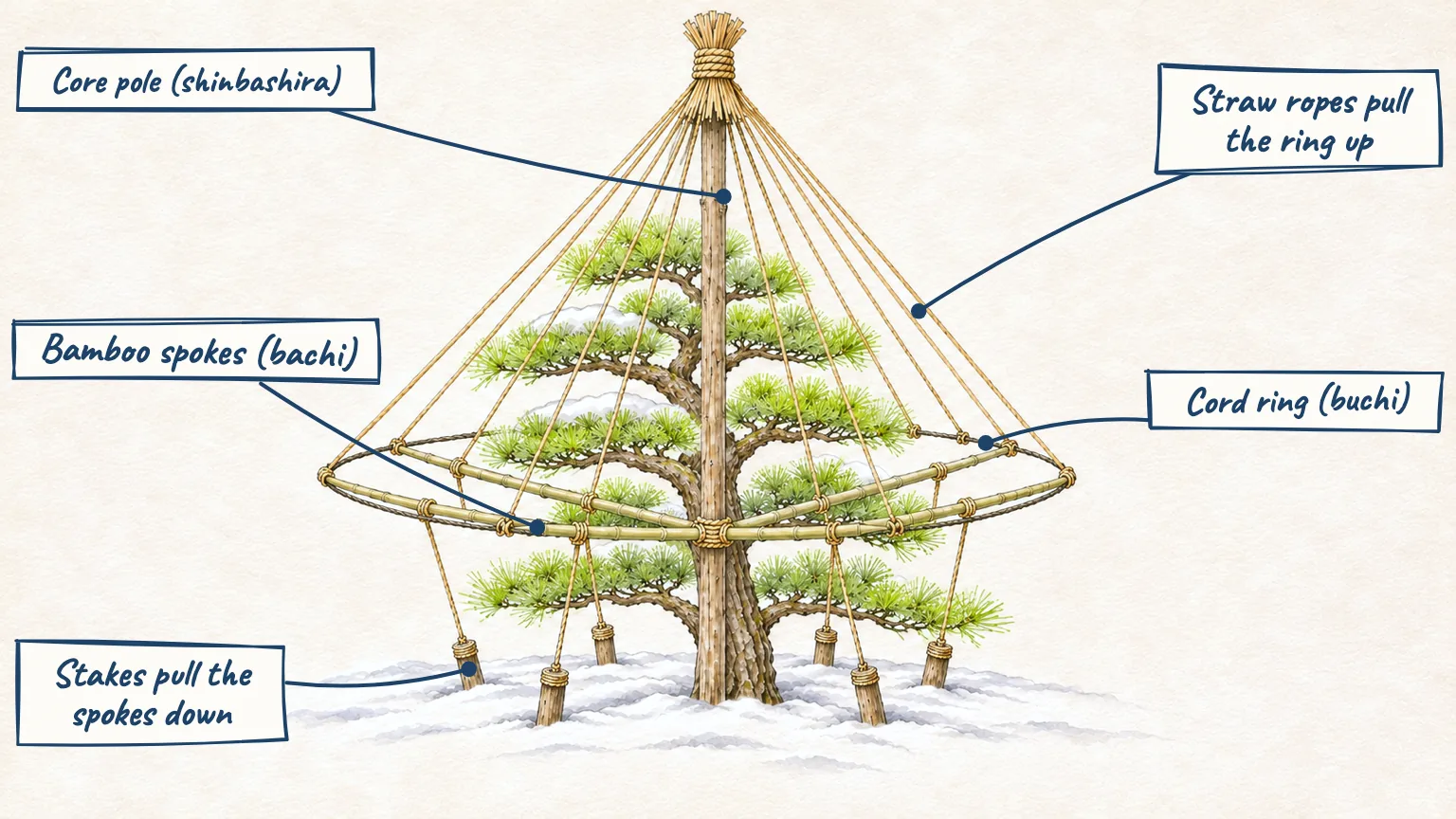
The parts and what each does
| Part | Japanese | What it does |
|---|---|---|
| Core pole | Shinbashira (芯柱) or hobashira (帆柱, “mast”) | Stands beside the trunk, taller than the tree; collects the rope loads at its top |
| Suspension ropes | Tsuri-nawa (吊り縄) | Straw ropes from the pole top to the limbs; carry part of each limb’s weight |
| Cord | Shuro-nawa (棕櫚縄) | Black hemp-palm cord for binding and finishing knots |
| Trunk padding | Sugikawa (杉皮) | Cedar-bark strips or tape where the pole meets the trunk, protecting the bark |
Materials in the field
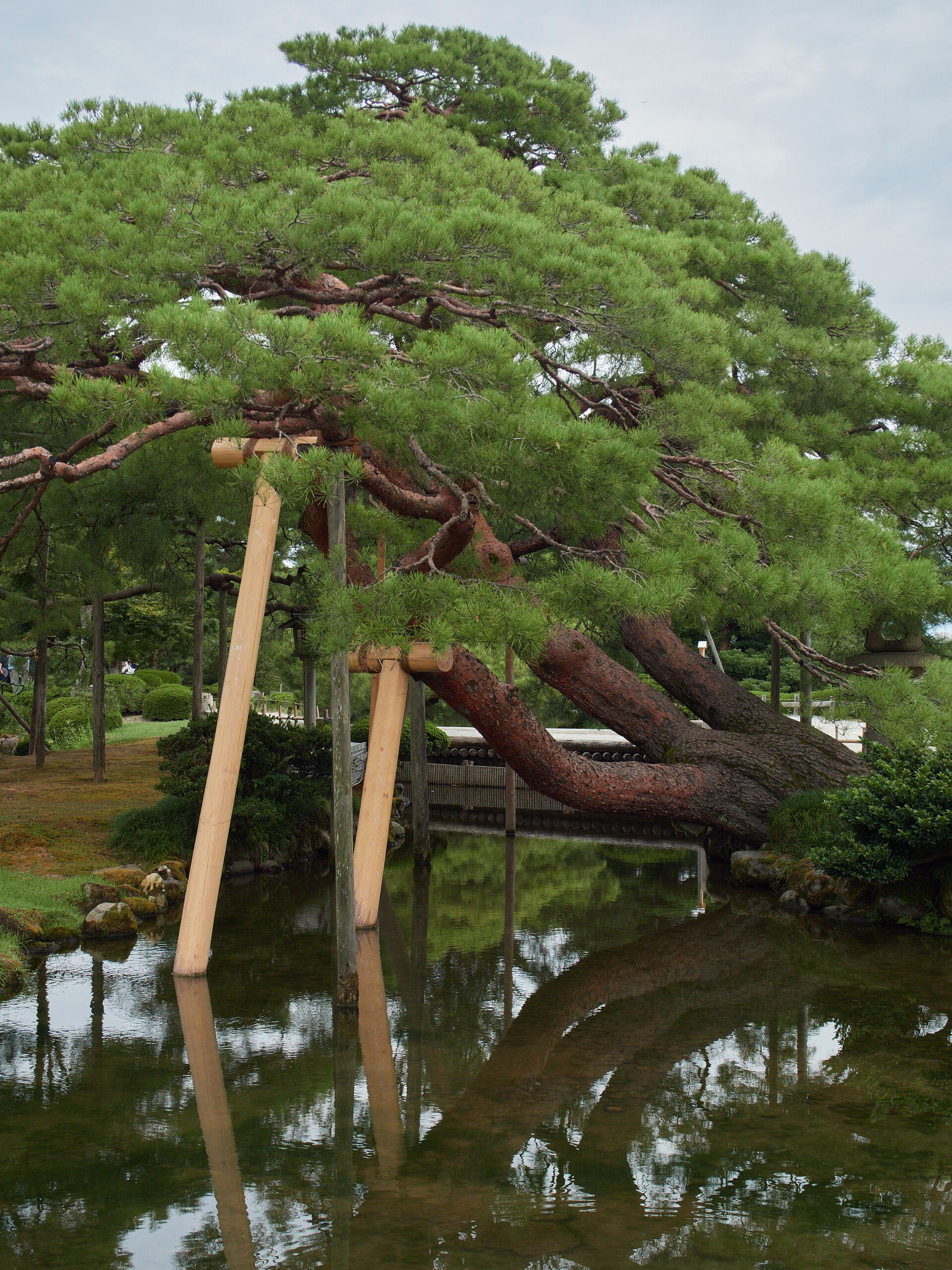
Kenrokuen’s management office lists straw rope in two diameters, 6 mm and 8 mm, with about 4,000 kg used in a season, and core poles of ate (アテ, hiba cypress) logs or madake bamboo. Chiba’s procedure names a hinoki or sugi log for the pole, one per tree, straw rope for the suspension lines and black shuro cord for lashing. Apart from a little wire at the pole head, everything in the frame is natural material, and the frame comes down in spring and is built again the next winter: yukitsuri is a seasonal structure, not a fixture.
Where the load goes — from branch tip to the ground
Snow loads the limb. The rope, tied out along it, takes part of that load in tension. All ropes meet at the pole top. The pole carries their combined pull down in compression to the ground, while the trunk ties keep it plumb. Three effects make this efficient.
The limb gets a second support
In the simplest textbook beam model, a uniformly loaded cantilever has a peak bending moment of wL²/2 at its base. Add a support at the tip and the peak falls to wL²/8, one quarter. Real branches are not uniform beams, and a rope is not a rigid prop, but the direction is clear: the union at the trunk, where limbs break, is relieved.
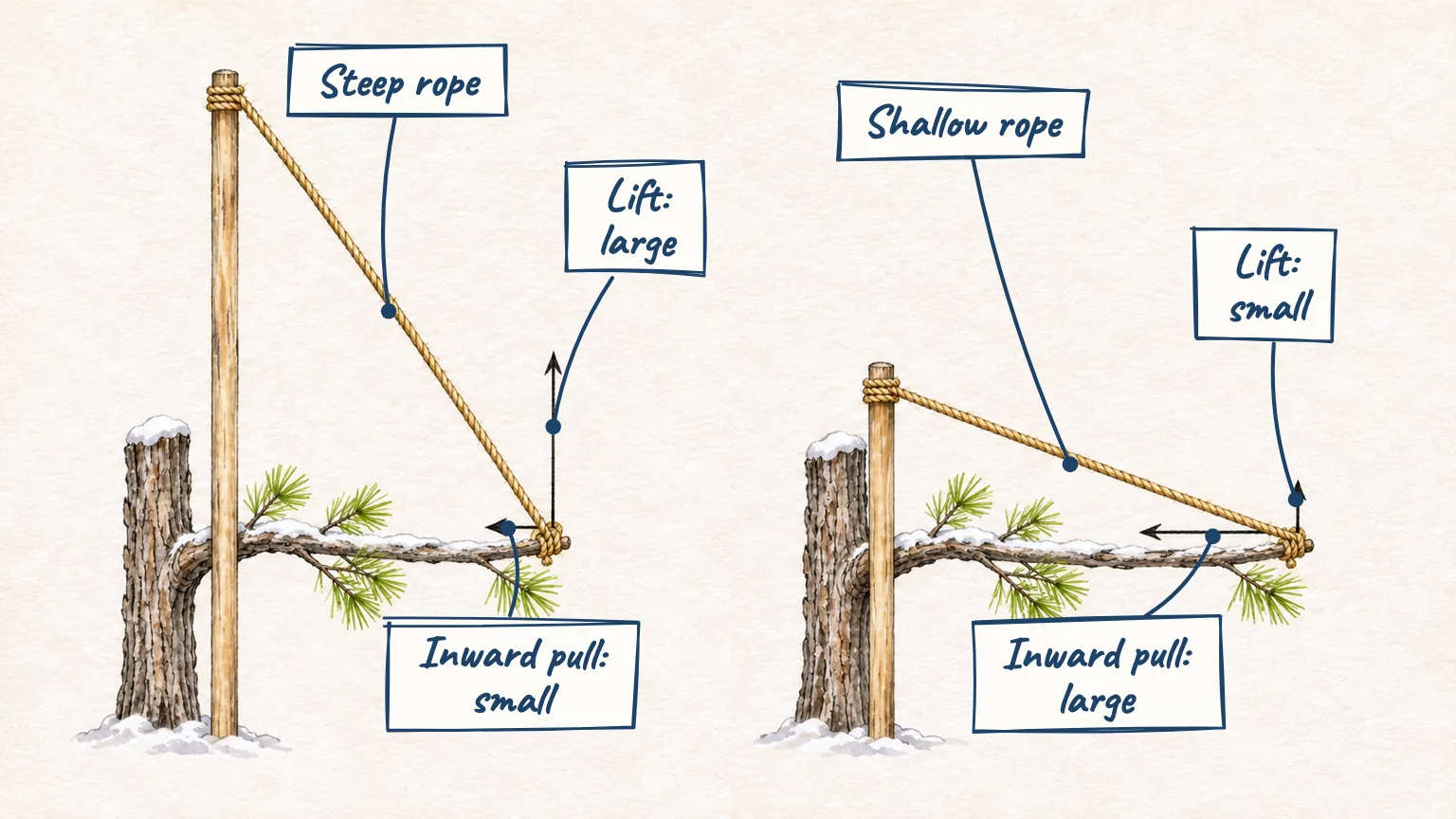
Steep ropes lift, shallow ropes squeeze
A rope at angle θ from horizontal turns sin θ of its tension into lift and cos θ into an inward pull. At 65°, about 91% of the tension lifts. At 30°, only half does, and the inward pull per unit of lift is nearly four times larger, bending the limb toward the trunk instead of holding it up. This is why the pole must be tall. Chiba’s rule of 60–70° is not decoration; it is where the geometry pays.
A full circle of ropes balances at the top
Because the ropes radiate evenly, their sideways pulls cancel at the pole top, leaving the pole in near-pure compression, the load a straight timber handles best. When snow loads one side more, the trunk ties take the imbalance. That is why the lashing at the trunk matters as much as the ropes.
Setting out the numbers — pole, ropes and spokes
Measure the tree first
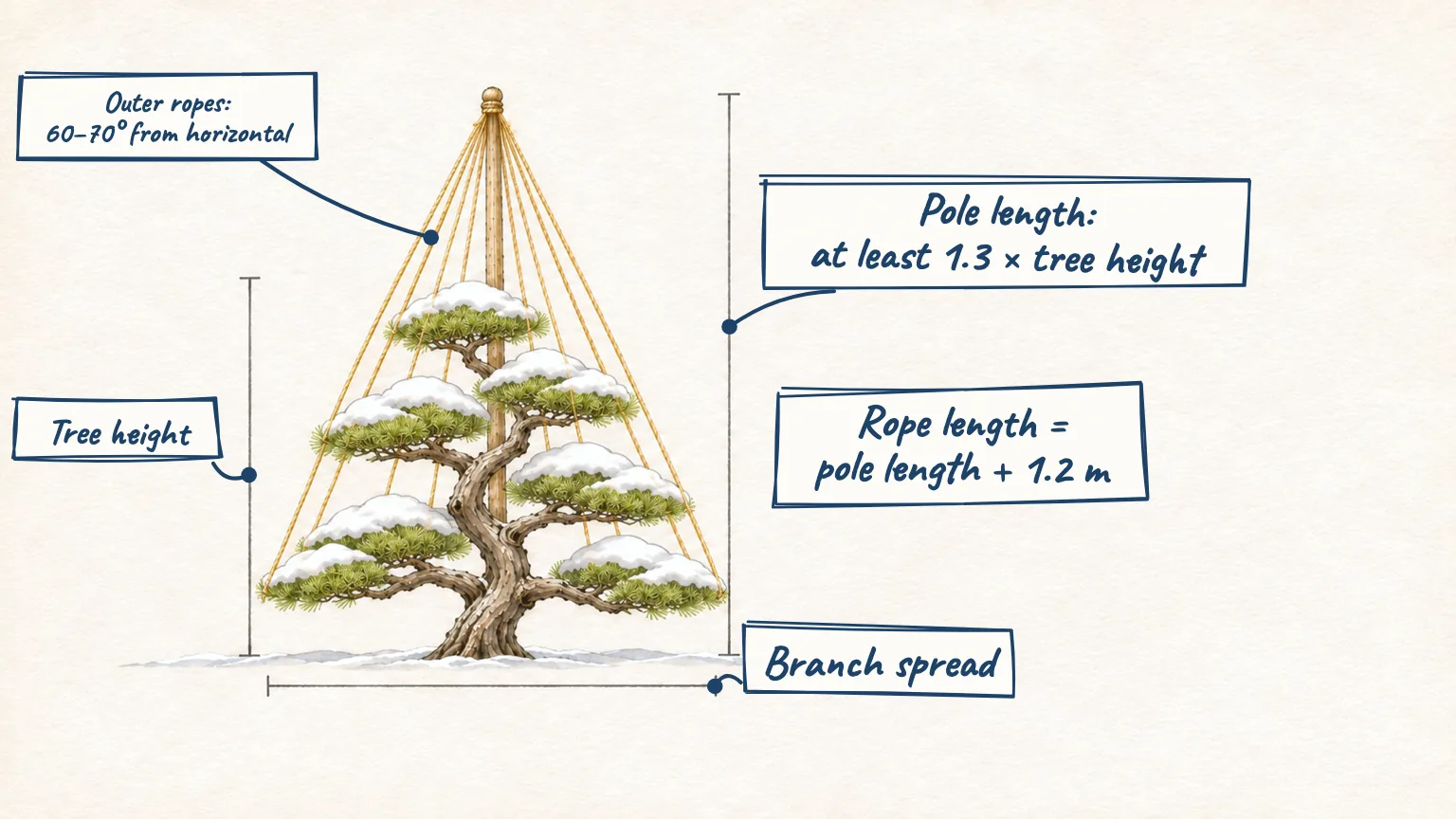
Chiba’s procedure, reproducing 1991 lecture notes of the Japanese Garden Society (日本庭園協会), starts with a survey: measure the pine’s height and its branch spread. Every other number follows from those two.
– Pole length: at least 1.3 × tree height, and at least the branch spread, to keep the ropes at 60–70°. – Rope count: ring circumference ÷ 0.2 m, one rope per 20 cm. – Rope length: pole height + 1.2 m. – Bamboo spokes: about circumference ÷ 0.8 m, which is roughly a quarter of the rope count. – Ground stakes: one for every three spokes.
A worked example from five pines
Chiba recorded the specification for its five black pines in November 2011. The figures let you check the rules.
| Tree | Ring diameter (m) | Ring circumference (m) | Ropes | Spokes |
|---|---|---|---|---|
| 1 | 8.0 | 25.1 | 125 | 31 |
| 2 | 4.8 | 15.1 | 75 | 19 |
| 3 | 5.4 | 17.0 | 76 | 21 |
| 4 | 5.4 | 17.0 | 84 | 21 |
| 5 | 4.8 | 15.1 | 75 | 19 |
Divide 25.1 m by 0.2 m and you get 125.5, rounded down to the 125 ropes on tree 1. Divide 15.1 m the same way and you get 75.5, rounded to 75. Spokes follow the 0.8 m rule: 25.1 ÷ 0.8 is 31.4 and 17.0 ÷ 0.8 is 21.25, rounded to 31 and 21. Trees 3 and 4 share a ring size but not a rope count (76 and 84), so the formula is best read as a starting figure, not a fixed result. Chiba’s ring belongs to its Nanbu-style frame, described below; the same document describes the Kenrokuen style as having no ring, and gives no ring-based count for it.
A hypothetical pine, worked through
To see how the rules fit together, take an imagined pine 6 m tall with a crown 6 m wide. This is arithmetic, not a record from any garden. The pole must be at least 1.3 × 6 = 7.8 m, which also clears the 6 m spread. Each rope is 7.8 + 1.2 = 9.0 m long. Suppose the lowest limb sits 3 m up and 2.5 m out from the trunk: the rope climbs 4.8 m over a run of 2.5 m, which is about 62° from horizontal, inside the 60–70° band. If a crew used a 5 m pole on the same tree, the same limb would see a rope rising 2 m over 2.5 m, about 39°, and the squeeze from the shallow-rope effect would be back.
Rigging step by step — from bare pine to finished frame
The steps below follow Chiba’s Nanbu-style procedure. They are the most fully written-down sequence I found, and they show the logic of the whole job.
Step 1 — Prepare the ropes
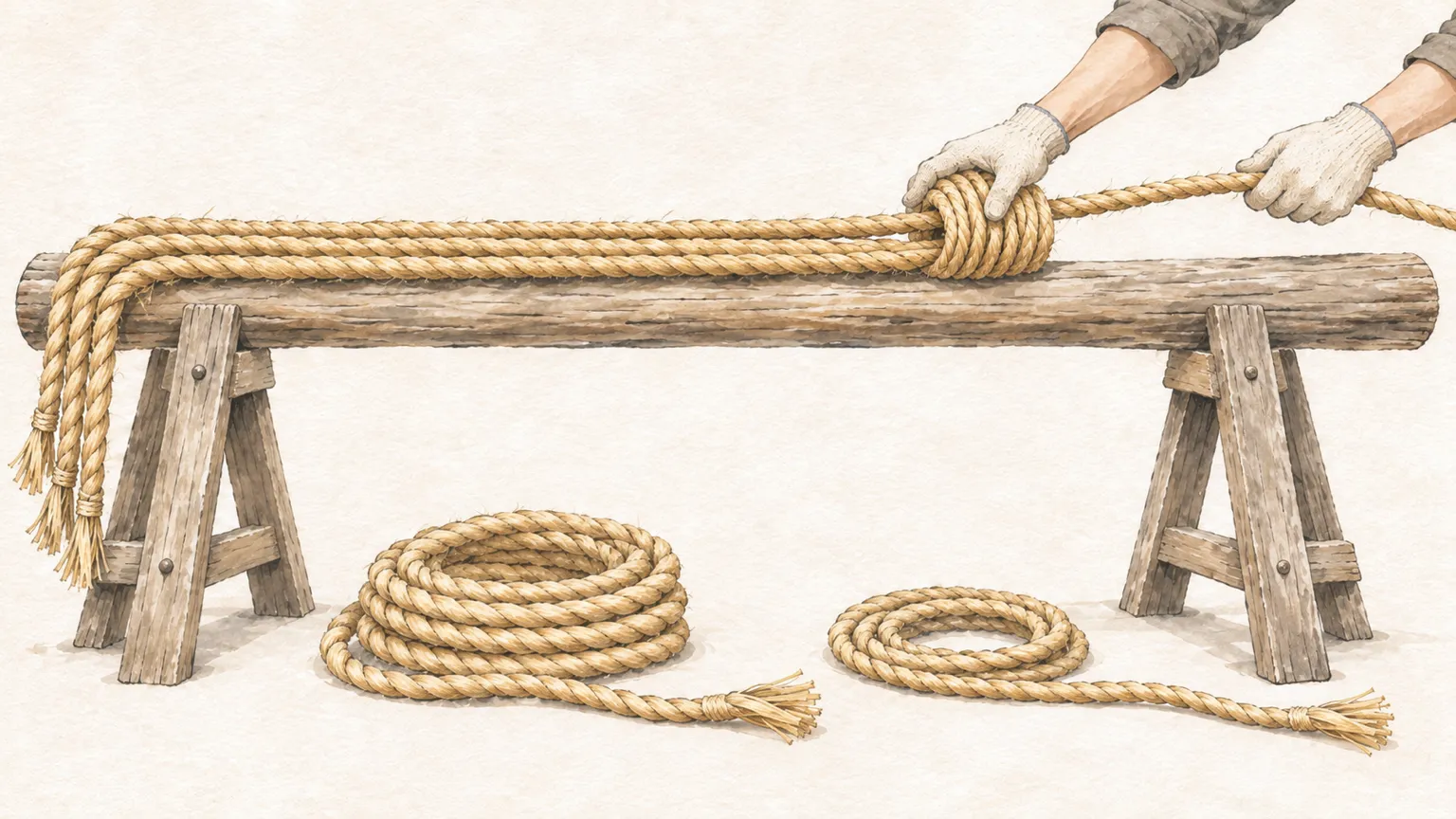
Straw rope arrives twisted and fuzzy. The crew builds a bench, rests the pole on it, cuts each rope to length and pulls it taut to take out the twist. The rope is then drawn through a rolled-up rope scrubber, up and down, to strip loose fibres, and stray fuzz is cut off with shears. Ropes are bundled in fives or eights and the bundles are tied halfway up the pole, ready to be spread.
Step 2 — Dress and raise the pole
The pole position is first marked with split bamboo pushed into the ground, then the pole is lifted away again so the ropes can be dressed at the work bench. A head ornament is built at the pole tip, and the ropes are lashed to it with shuro cord, wired in three places and finished with decorative knots, tied from the tip with three, five and seven strands of black cord. In the Nanbu style the ropes just below the wired point are then braided in pairs into the woven head, and the ends are left hanging as a trimmed fringe. The pole is then stood in the position marked earlier, which must have two places where it can be tied to the trunk. It is checked for plumb, sunk about 10 cm into the ground and lashed to the trunk with cedar-bark tape wound at two or more places.
Step 3 — Spokes, stakes and ring
Bamboo spokes (bachi, バチ) are cut 7 cm above a node, thin end outward, and set so their tips lie on one circle at 80 cm intervals. Their length is a little over half the branch spread. They are lashed to the pole and to the pine in two or more places. Ground stakes are driven in at an angle, one for every three spokes, and tied to the spoke tips; the stake is knotted first, the spoke with a u-no-kubi knot (鵜の首結び, “cormorant’s neck”). Last, a ring (buchi, 縁) of five-strand shuro cord is run round the spoke tips, started at the back of the tree so the join is hidden. The five knots where the cord meets itself are staggered so they do not sit on top of one another.
#### Gauge sticks keep the geometry even
The crew does not measure every spoke. Chiba’s procedure has them cut two gauge sticks, one a little over half the branch spread to set how far the spokes reach, one 80 cm to set the spacing. The first spoke tip is placed at a mark on the pole set at the height of the pine’s lowest branch; the rest are fitted with both sticks so their tips fall on one circle at equal intervals. A third stick, 20 cm long, does the same job later for the rope ties. The method turns a drawing into a repeatable routine.
Step 4 — Tie the ropes off
The rope bundles come off the pole, are spread one by one without crossing, and are tied to the ring at 20 cm intervals using a spacing stick. Every tie is a u-no-kubi knot. The crew then checks the whole frame for slack and cuts each rope 3 cm beyond its knot. A loose spoke tie is not a worry: the ropes, once tied, pull the spokes up and pull the shuro lines tight.
Three styles — Kenrokuen, Hokubu and Nanbu
The Kenrokuen style is the practical original
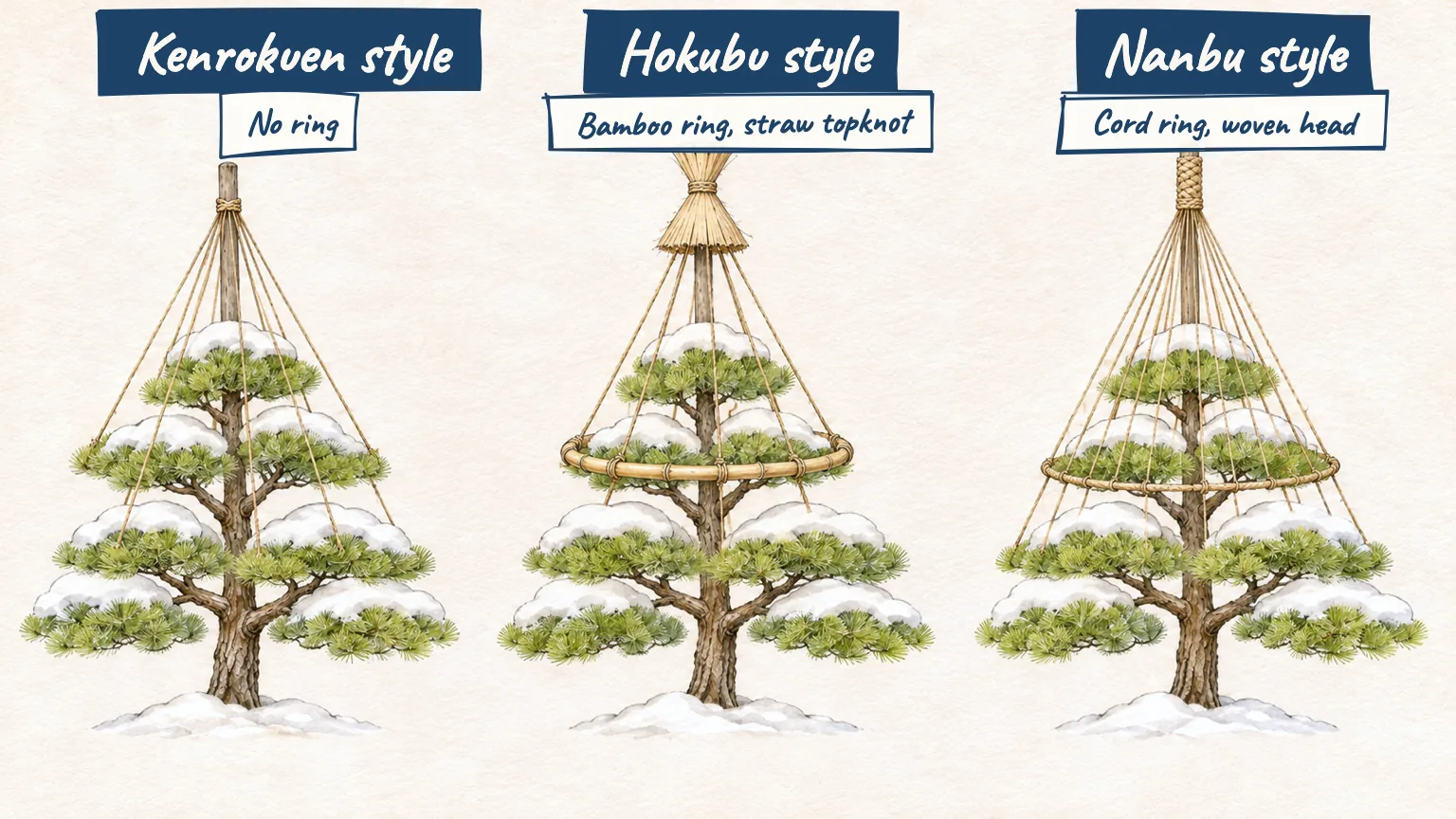
Chiba City’s document, quoting the Tokyo Metropolitan Park Association, describes three basic styles. The Kenrokuen style has a head ornament of rope wound at the pole top with decorative knots at the left, right and tip. It makes no ring, and the ropes tie directly to the branches. Chiba calls it the original and a practical form that prevents breakage under snow.
Hokubu and Nanbu are Tokyo’s decorative variants
Hokubu and Nanbu are not regions of Japan: Chiba explains that the former Northern and Southern Park Offices of Tokyo’s Bureau of Construction each developed a version from the Kenrokuen method.
– Hokubu style (北部式) — a straw topknot (warabocchi, ワラボッチ) at the pole tip; bamboo spokes with a split-bamboo ring at their tips; ropes tie to the ring. Often seen in ornamental gardens. – Nanbu style (南部式) — a woven head ornament made from the ropes themselves; spokes and a hemp-palm cord ring; many fine ropes laid in a smooth curve. Also decorative.
What the difference means structurally
In the Kenrokuen style the ropes carry the limbs. In the Nanbu style as Chiba builds it, the spokes are tied down to ground stakes and the ropes pull up the ring, so the frame tensions itself into a cone around the tree. It suits a city where heavy snow is occasional. Chiba’s park has five black pines on an island in its Watauchi pond, and the frames are built from cedar logs, bamboo and rough rope. The city began its yukitsuri in 1992 (Heisei 4) to protect pine branches, to pass on a tradition and to create a winter view, and the frame stays up from mid-November to late February.
Kenrokuen’s Karasaki pine — a case at full scale
The tree
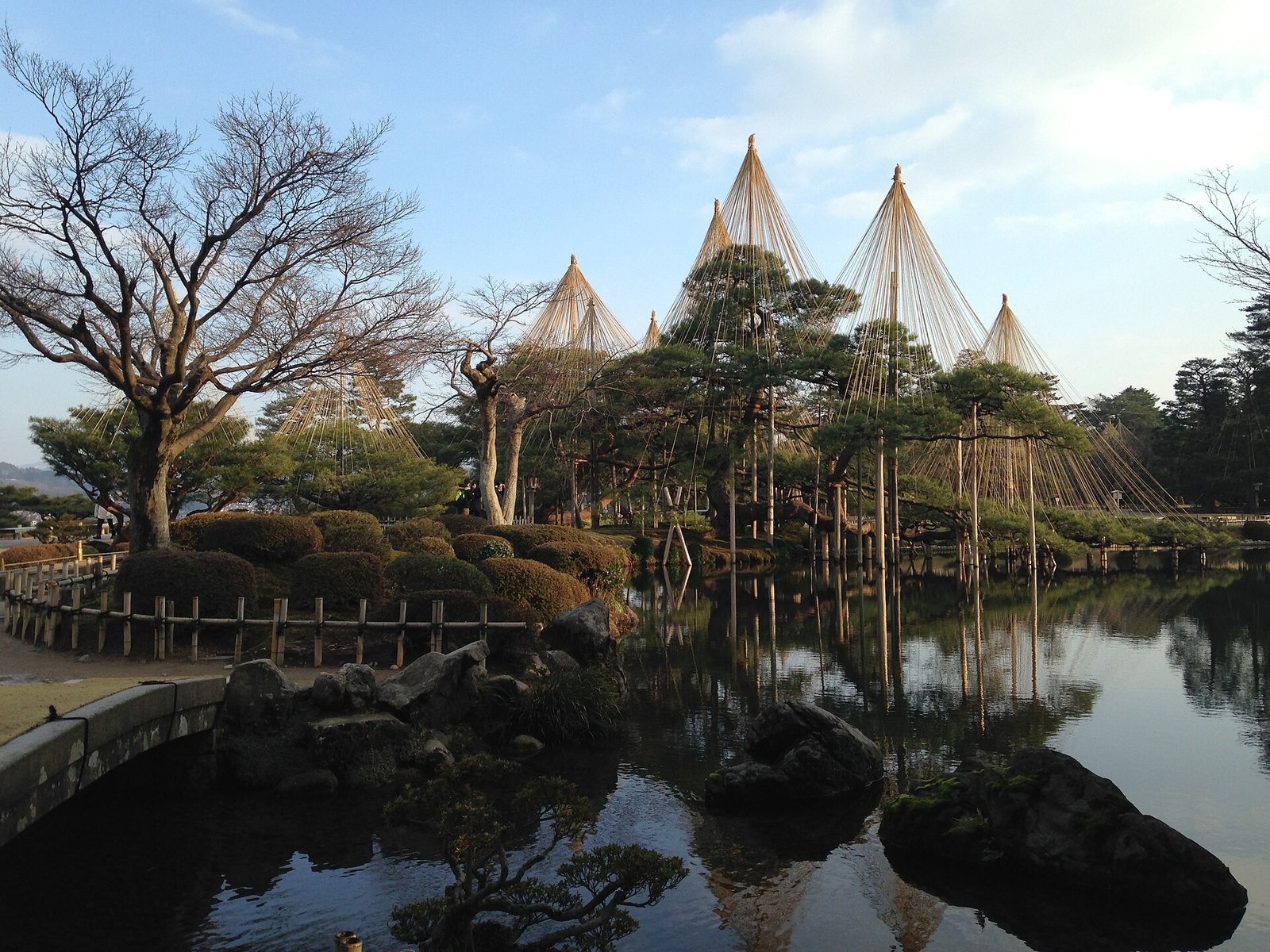
Kenrokuen, the Maeda family’s garden in Kanazawa, opens its yukitsuri season on 1 November with the Karasaki pine (唐崎松, Karasaki-no-matsu). The garden’s official guide says the tree grew from a seed of the famous Karasaki pine on Lake Biwa, obtained by Maeda Nariyasu, the 13th lord. The Maeda crest is a stylised plum blossom, a thread we follow in how kamon plants shaped Japanese landscape design.
The season in numbers
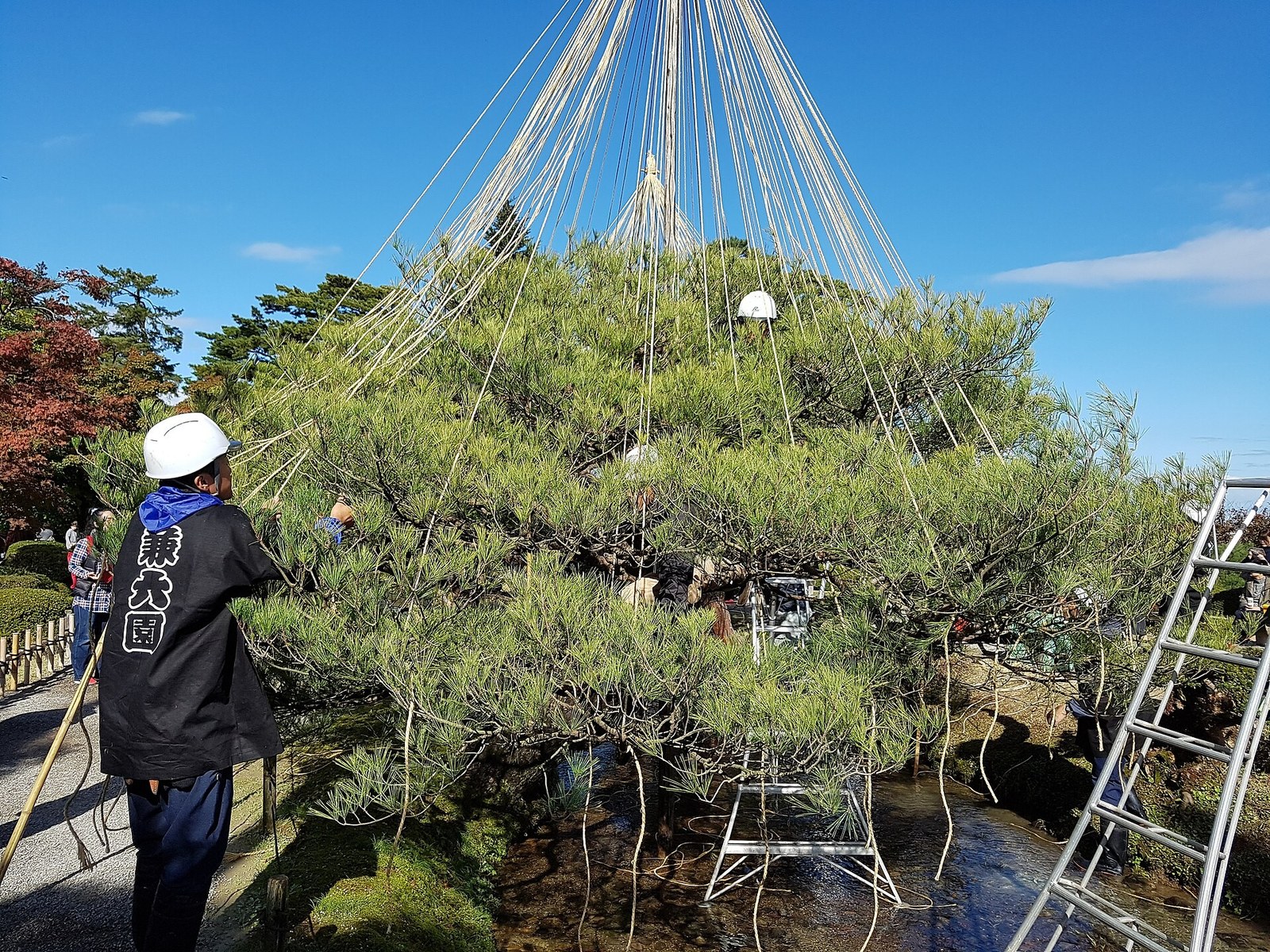
Because the Karasaki pine spreads so wide, one pole is not enough. The Kanazawa Castle and Kenrokuen Management Office’s notice for the 2025 season states that the tree receives five core poles and about 800 ropes. Its two notices, from October 2025 and March 2025, give the scale of the whole garden and the calendar.
| Item | Figure |
|---|---|
| Ringo-tsuri | 50 trees in the autumn 2025 notice (52 in the March 2025 notice): Karasaki pine, Sugomori pine, others |
| Miki-tsuri | 59 trees (Neagari pine, Banshu pine, others) |
| Other methods | About 700 locations (azaleas, others) |
| Straw rope | About 4,000 kg, 6 mm plus 8 mm diameters |
| Pole materials | Ate (hiba) logs, madake bamboo |
| Installation labour | About 500 person-days, from 1 November, finish planned for mid-December |
| Removal labour | About 80 person-days in March 2025 |
The counts shift a little from year to year, so treat any single number as that winter’s figure.
Why the order matters
On a rainy 1 November, the crew starts with lower trees and the Karasaki pine moves to a later day (4 November in 2025). In March the order reverses: removal in 2025 began on 14 March with the Sugomori pine on Shichifukujin-yama (about 10 m tall and 10 m wide), and the Karasaki pine and the Ganmatsu came off last, on 21 March.
Not every winter job is yukitsuri — yukigakoi, komomaki and what ropes cannot do
Four jobs, four targets
Japan’s winter tree wraps solve different problems.
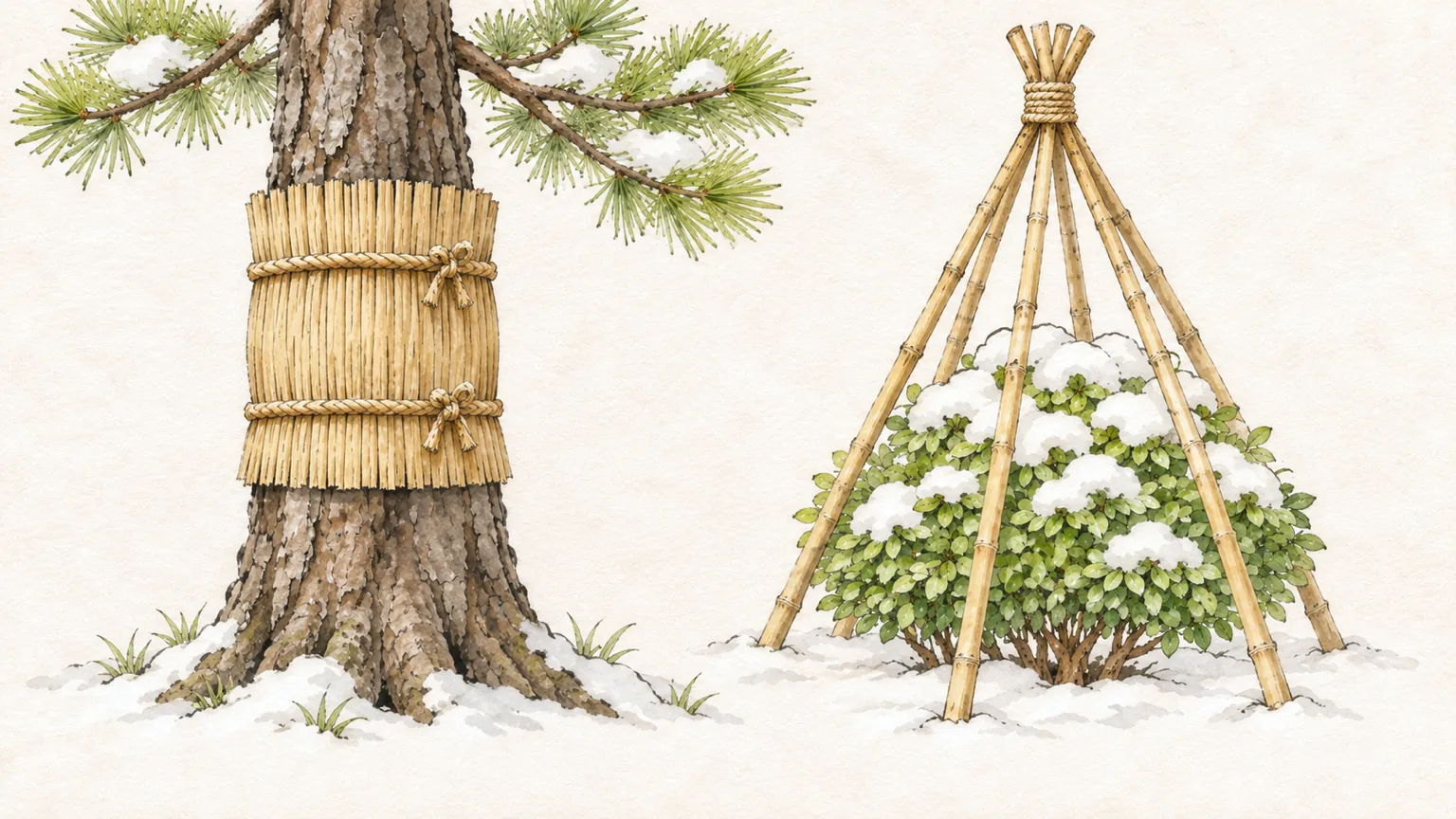
– Yukitsuri (雪吊り) — branch breakage from snow load; ropes lift limbs from a pole or the trunk. – Yukigakoi (雪囲い) — shrubs crushed or split by snow; a cage of bamboo, boards or straw sheds the snow. – Komomaki (菰巻き) — overwintering insects on pines; a straw band round the trunk, removed in spring. – Waramaki (藁巻) — cold on warm-region plants such as sago palm; straw wrapped round the trunk.
Only yukitsuri carries the weight of snow on the limbs back to the ground through a pole: closer to a cable system than a blanket. Wraps and frames shed snow or shield a plant, but they do not hold up branches. Kenrokuen itself shows the split: pine limbs get ropes, while about 700 other locations, such as azaleas, get other methods.
When ropes make sense
The notices I could open do not state a selection rule, so this is a reading of them. Kenrokuen puts ringo-tsuri on its largest pines, such as the Karasaki pine and the Sugomori pine, and miki-tsuri on others, such as the Neagari pine, and treats about 700 other locations differently. The force argument above says why a wide crown wants a pole: the higher the rope meets the pole, the steeper the rope. Where snow is rare, Chiba’s example shows the frame serving scenery and tradition as much as protection, and a decorative style fits.
Common misconceptions and mistakes
– “The ropes hold the tree up.” They do not hang the tree. They give each long limb a second point of support. – “It is only for show.” The Kenrokuen style exists to stop breakage. The decorative styles are Tokyo offices’ variants of it. – A short pole. A pole under 1.3 times the tree height gives shallow ropes that squeeze the limb inward. – Unpadded contact. Chiba winds cedar-bark tape at each place the pole is tied to the trunk. Skipping it leaves the pole and lashing bearing directly on bare bark. – Twisted or fuzzy ropes. Chiba gives a full step to removing twist and loose fibres before anything goes up. – Slack ropes. Chiba checks the whole frame for slack before cutting the rope ends; a slack rope carries nothing until the limb has already dropped.
How other snowy regions handle it — tie, brush, cable
Different premises
North American guidance starts from different premises: fewer trained horizontal limbs, more upright evergreens, and permanent hardware as the usual tool for structural support.
| Approach | Typical guidance | What it addresses |
|---|---|---|
| Tie-up | Iowa State University Extension: tie arborvitae before a storm with fabric strips or flexible cord; remove by mid-to-late April | Multi-stemmed shrubs splaying open |
| Brushing | Iowa State: brush upward, never downward; Clemson Extension cautions that removal can itself cause damage | Snow already on the plant |
| Structural pruning | Clemson: remove competing vertical stems early | Weak forks that split |
| Cabling | ANSI A300 Part 3 covers cabling, bracing, guying, propping, including a hub-and-spoke layout | Permanent support of weak unions |
The closest relative
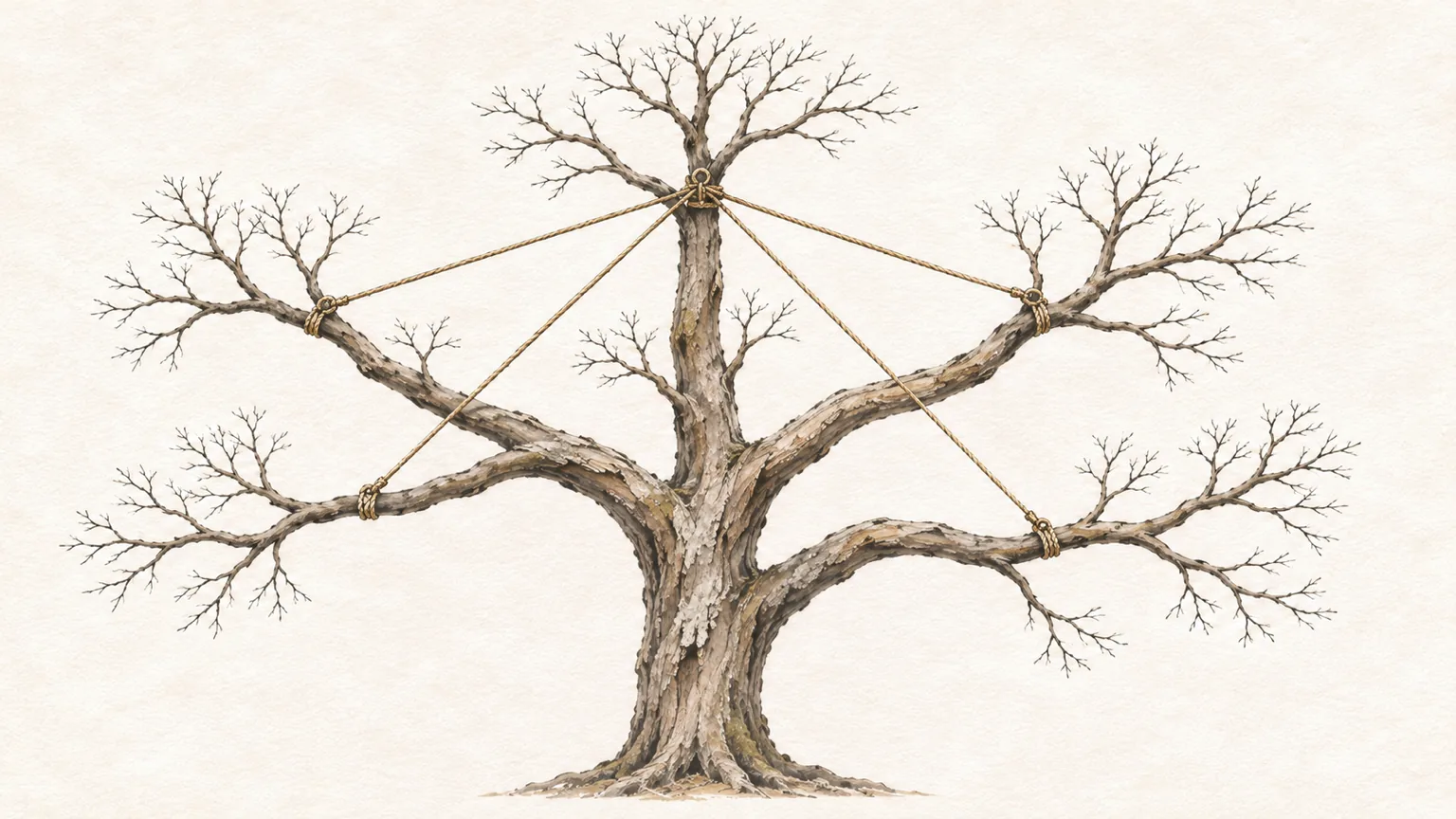
The hub-and-spoke cable is yukitsuri’s closest Western relative: one central point, spans radiating to several limbs. The difference is time. A cable stays for years; a yukitsuri goes up for one winter and comes down in spring. Wind is a separate problem, covered in typhoon-proofing trees with Japan’s wind-resistant pruning. That yearly rhythm of small care is also part of why Japan’s ancient trees live for a thousand years.
Where the two traditions meet
Neither approach is better. The Western methods answer shrubs and forks that split. Yukitsuri answers a long limb that has been trained to be long. Both aim to move load to a stronger part of the tree or the ground. The Japanese answer is temporary, because the load is temporary.
A winter calendar — when the frame goes up, stays, and comes down
Going up: November
Kenrokuen starts on 1 November at 9 a.m., with the Karasaki pine first and work finishing in mid-December. Chiba’s park starts around Rittō, the start of winter in the traditional calendar, in early November.
Holding: December to early March
In Chiba, the frame can be seen from mid-November to late February. At Kenrokuen the Karasaki pine stays dressed from early November until the March removal, so the frame works through the whole snow season.
Coming down: March
Kenrokuen’s removal in 2025 ran from 14 to 21 March. The removal runs about a week and the order is the reverse of the autumn’s showpiece: the Karasaki pine and the Ganmatsu come off last.
Frequently asked questions
What is yukitsuri? A Japanese method of protecting garden trees, especially pines, from snow. Ropes radiate from a pole beside the trunk to the branches, carrying part of the snow load so limbs do not break.
Do the ropes hold the whole tree up? No. The ropes give each long limb a second support, which lowers the bending at the point where the limb joins the trunk. The tree stands on its own roots and trunk.
What is the difference between ringo-tsuri and miki-tsuri? Ringo-tsuri uses a pole beside the trunk and ropes from its top. Miki-tsuri uses no pole; the ropes start at the trunk. Kenrokuen uses 50 or so of the first and 59 of the second.
How many ropes does a tree need? In Chiba’s procedure, one rope per 20 cm of ring circumference, so a ring of 25.1 m takes 125 ropes. The Karasaki pine at Kenrokuen takes about 800 ropes and five poles.
When does yukitsuri start and end at Kenrokuen? It starts on 1 November, with the Karasaki pine, and finishes in mid-December. Removal in 2025 ran from 14 to 21 March. If it rains on the first day, the Karasaki pine moves to a later date.
Can I use yukitsuri outside Japan? The principle suits any tree with long horizontal limbs. Keep the ropes steep, spread them evenly round the crown, pad every point where the pole touches the trunk, and take the frame down in spring.
Sources
– Kanazawa Castle and Kenrokuen Management Office (Ishikawa Prefecture), “兼六園の雪吊りについて,” 27 Oct 2025 — https://www.pref.ishikawa.lg.jp/kisya/r7/documents/1027_10_kouennryokuti1.pdf (accessed 2026-10-29) – Kanazawa Castle and Kenrokuen Management Office, “兼六園雪吊りの取り外し作業について,” 7 Mar 2025 — https://www.pref.ishikawa.lg.jp/kisya/r6-1/documents/0307_10_kouenryokuti.pdf (accessed 2026-10-29) – Kenrokuen official garden guide, Karasaki pine entry — https://shiro-niwa.pref.ishikawa.lg.jp/kanazawa-castle/_wp/wp-content/uploads/2026/01/fr_kenrokuen.pdf (accessed 2026-10-17) – Chiba City, “千葉公園「松の雪吊り」南部様式” — https://www.city.chiba.jp/toshi/koenryokuchi/kanri/chuo-mihama/documents/yukituri-tejun_2_1.pdf (accessed 2026-10-29) – Nara National Research Institute for Cultural Properties, Japanese Garden Dictionary, “Snow protection” — https://www.nabunken.go.jp/org/bunka/jgd/pages/SnowProtection.html (accessed 2026-10-29) – NIED, “着雪について” — https://ftp.bosai.go.jp/seppyo/research/img/40_cyakusetu.pdf (accessed 2026-10-29) – Kato A., “ボカスギ樹冠における冠雪荷重の垂直分布の推定,” Bulletin of the Toyama Forest Research Institute 7 (2015) — https://taffrc.pref.toyama.jp/nsgc/shinrin/wp-content/uploads/sites/9/2024/09/p.1-11-嘉戸昭夫-ボカスギ樹冠における冠雪荷重の垂直分布の推定-1.pdf (accessed 2026-10-29) – Iowa State University Extension, “How to Prevent Ice and Snow Damage on Trees and Shrubs” — https://yardandgarden.extension.iastate.edu/how-to/how-prevent-ice-and-snow-damage-trees-and-shrubs (accessed 2026-10-17) – Clemson Extension HGIC, “Protecting Evergreens from Ice and Snow Damage” — https://hgic.clemson.edu/protecting-evergreens-from-ice-and-snow-damage/ (accessed 2026-10-17) – TCIA, ANSI A300 Part 3: Supplemental Support Systems — https://treecareindustryassociation.org/business-support/ansi-a300-standards/part-3-supplemental-support-systems/ (accessed 2026-10-17)