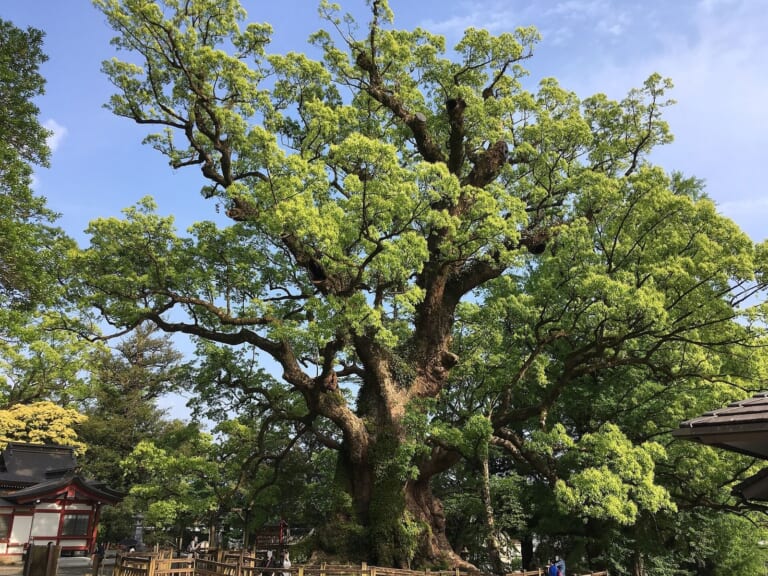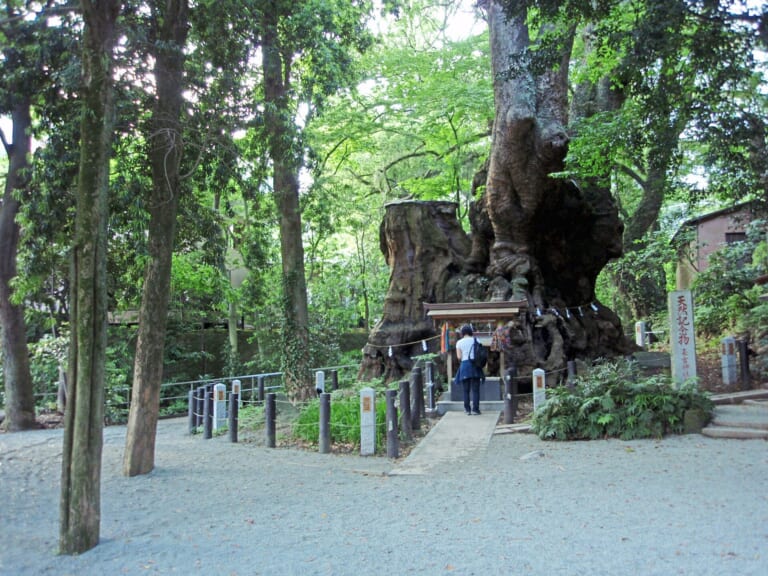
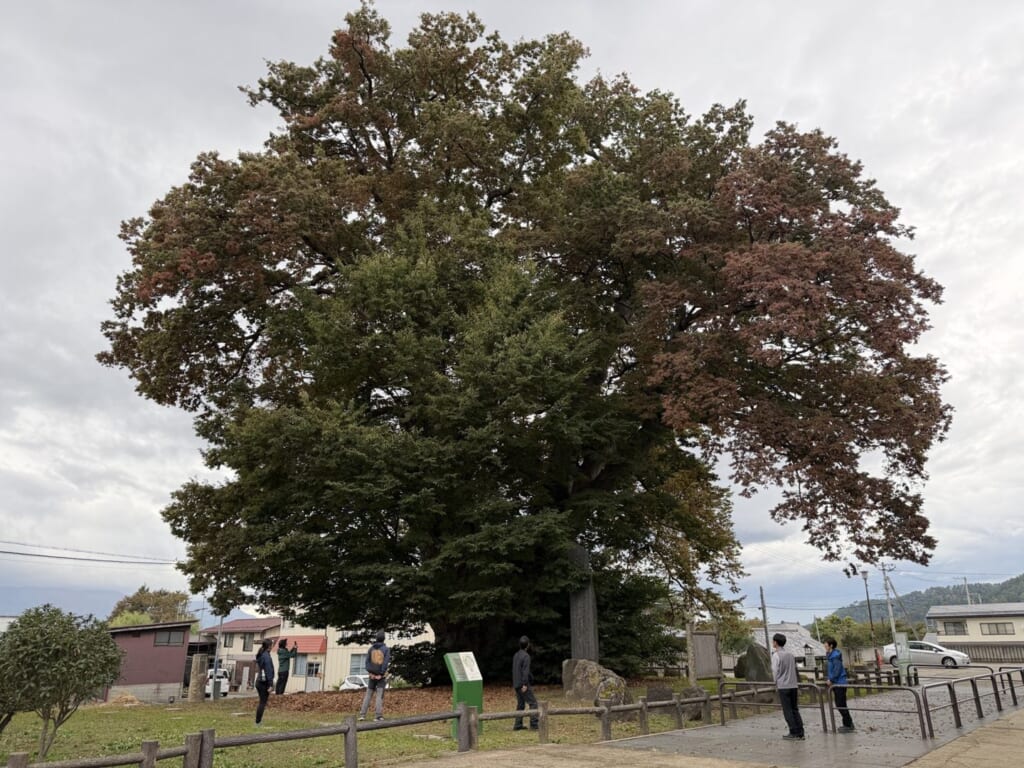
The Higashine Great Zelkova (東根の大ケヤキ, Higashine no Ō-keyaki) is a Japanese zelkova (Zelkova serrata, keyaki in Japanese) that stands in the schoolyard of Higashine Elementary School in Yamagata Prefecture, northern Japan. It is a Special Natural Monument (特別天然記念物, tokubetsu tennen kinenbutsu), the highest grade of protection Japan gives to a living tree. The city of Higashine gives its trunk girth as 16.0 m (52 ft) measured 1.2 m (3.9 ft) above the ground, its height as 28 m (92 ft), and its estimated age as more than 1,500 years. It is often called the largest zelkova in Japan.
I visited the tree on the afternoon of 19 October 2026. What I went to see was not the size of the crown but the traces of the care that keeps this old tree alive. Inside the hollow trunk stand steel props. Large limbs are tied together with Cobra, a dynamic cabling system. Around the base, root suckers and epicormic shoots have been deliberately left uncut.
Below: the short answer, the basic facts, why published girths disagree, the city’s yearly maintenance record, then what I saw — base, trunk, hollow, cabling, ground — and what each piece of care tells a tree manager.
The short answer — the hollow is not repaired, it is supported
The Higashine Great Zelkova has lost the upper part of its main stem, and the centre of its trunk is hollow. Japan’s Agency for Cultural Affairs describes it this way: the top of the main trunk is gone and the base is hollow, yet the tree is well managed and vigorous.
The care given to the tree points in one direction. It does not try to fill the hollow or restore the tree to what it was. It accepts the hollow, then supports the tree so that it does not fall, does not take in water, and does not lose its leaves or roots. Keeping the shoots at the base is part of the same approach. Higashine City, for its part, runs a vigour survey, spraying, dead-wood removal and the replacement of branch-support ropes as a standing programme every fiscal year.
What matters in veteran-tree care is what each intervention prevents, and who checks that it still works. At Higashine, that cycle can be followed in public documents.
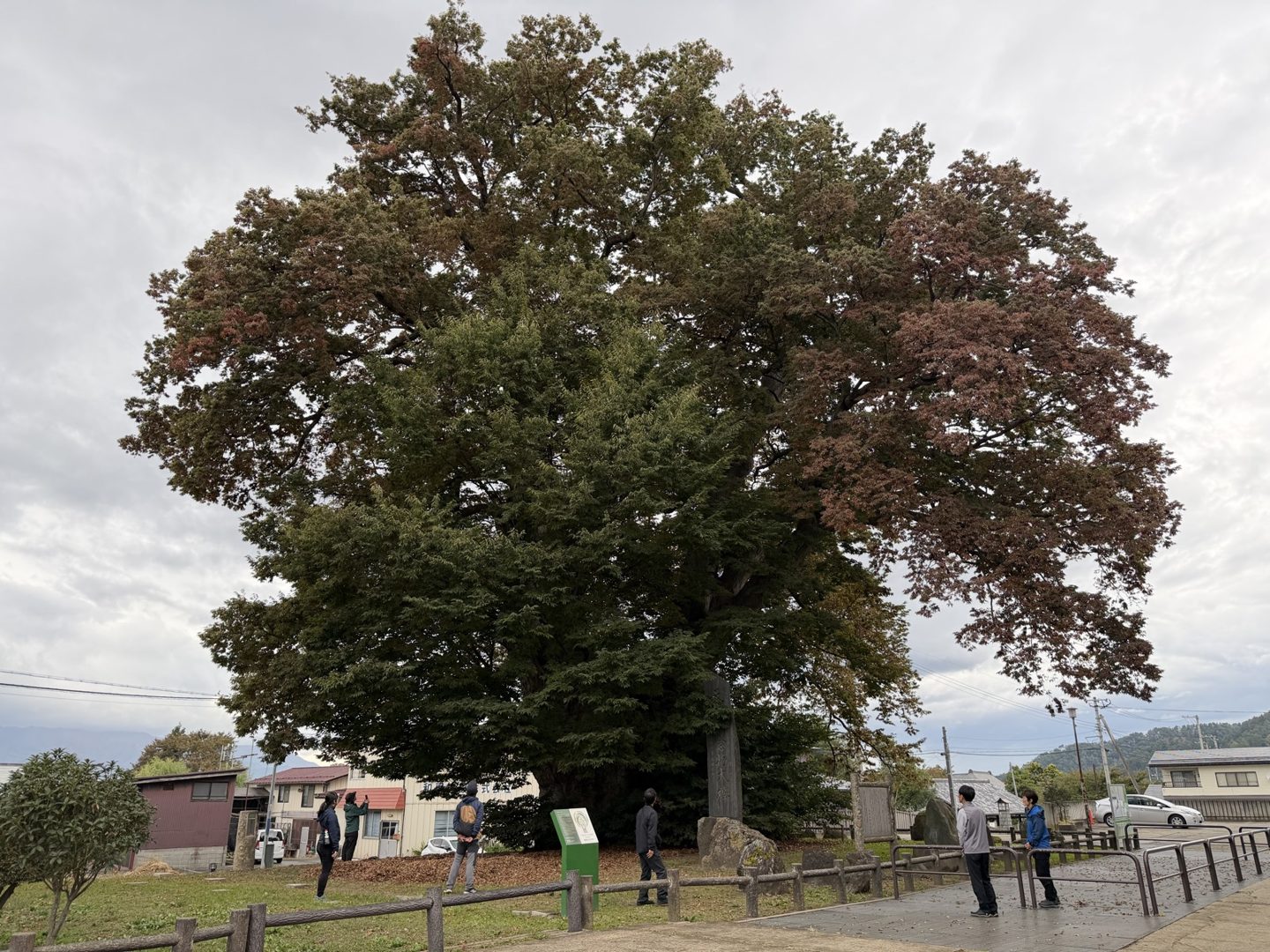
What the tree is — a Special Natural Monument known as the “Yokozuna of the East”
The tree stands in a corner of the schoolyard of Higashine Elementary School. According to the Agency for Cultural Affairs database of nationally designated cultural properties, it was designated a Natural Monument on 20 October 1926 and raised to Special Natural Monument on 11 September 1957. It became a monument first, then was promoted to the top grade 31 years later.
The interpretation board on site, put up by a local town-planning council together with Higashine City, calls it “the largest zelkova in Japan” and “one of the three great zelkovas of Japan”. In a traditional ranking of Japanese zelkovas, styled after the sumo league table, it was named the yokozuna — grand champion — of the East. It was also chosen for the “New 100 Famous Trees of Japan”, a selection made to coincide with the 1990 International Garden and Greenery Exposition in Osaka.
The board also gives the tree’s history. Two great zelkovas once stood here, known as the father tree (雄槻, chichi-keyaki) and the mother tree (雌槻, haha-keyaki). The father tree died in 1885, and the surviving mother tree is today’s Great Zelkova. The school stands on the site of the inner bailey of Odajima Castle, built in 1347 by the warlord Odajima Nagayoshi. The board notes that the zelkova was already standing here long before the castle.
Girth from 12 m to 16 m — why the published figures disagree
Published girths for the Higashine Great Zelkova range from 12 m to 16 m (39–52 ft). Rather than one figure being wrong, the most natural reading is that they were measured at different times and at different heights.
| Source | Girth | Measured at | Height | Age |
|---|---|---|---|---|
| Agency for Cultural Affairs database | 12 m or more | not stated | not stated | estimated over 1,000 years |
| Environment Agency, 4th National Survey (FY1988) | 12.6 m | not stated | — | — |
| Ministry of the Environment, 6th National Survey (FY1999–2000) | 15.6 m | not stated | — | — |
| Higashine City cultural-property page | 16.0 m (root collar 24 m) | 1.2 m above ground | 28 m | estimated over 1,500 years |
| On-site interpretation board | 16 m (diameter 5 m) | 1.2 m above ground | 28 m | over 1,500 years |
The girth of a giant tree changes a great deal with the height at which you measure it. The root flare bulges near the ground, and burls or cavity openings change the path of the tape. Japan’s national survey of giant trees uses, as a rule, the girth at 1.3 m (4.3 ft) above the ground. Higashine City quotes the girth at 1.2 m. On a tree with strong root flare, even 10 cm of difference in height changes the result, so the series 12.6 m, 15.6 m, 16 m cannot be read as growth.
The label “largest in Japan” depends on the same thing. In the FY1988 national survey, Higashine ranked third among zelkovas by girth. In the FY1999–2000 survey, its 15.6 m was the largest value among the zelkovas listed in the table of the largest trees of each species. Rankings change with which survey, and which method of measurement, you compare. Age works the same way: a hollow tree has no rings left to count, so both 1,000 and 1,500 years are estimates from tradition and size.
For a tree manager, the lesson is simple: measure at the same height and position every time, and record how you measured. Girth over the years is one of the few signs of whether an old tree is still putting on wood.
The city’s maintenance record — what is done every year
Higashine’s Board of Education publishes an annual self-evaluation report, and the Great Zelkova appears in it as an “environmental improvement programme”. Read across two of these reports, the care looks like this.
| When | What | As written in the report |
|---|---|---|
| Every year | Vigour-promoting treatment | Applied on the basis of a vigour survey plus expert advice |
| Every year | Spraying | Against zelkova gall aphids, among other pests |
| Every year | Dead-wood removal, vigour survey | Carried out to maintain the tree and its vigour |
| Every 3 years | Replacement of branch-support ropes | Recorded for FY2016 and FY2022 |
| FY2017 | Trunk repair | Decay repaired where the hollow in the centre of the trunk had been reinforced |
| FY2017 | Soil improvement | Activated charcoal buried to improve water uptake |
| From December 2020 | Response to a branch failure | Survey commissioned after a limb broke; fungicide plus artificial bark to be applied to the break |
| FY2022 plan | Exclusion fence | To be installed on the east side of the tree for the safety of the children |
The care runs as a cycle with inspection built in. Ropes are replaced every three years, and the reinforcement inside the hollow was itself repaired when decay was found: the supports, too, wear out.
The FY2022 report adds that, “in view of its ageing”, the tree will be observed more closely on the advice of experts including jumoku-i (樹木医), Japan’s certified tree doctors. Even a Special Natural Monument grows old; the answer is closer watching.
Shoots at the base — deliberately left uncut
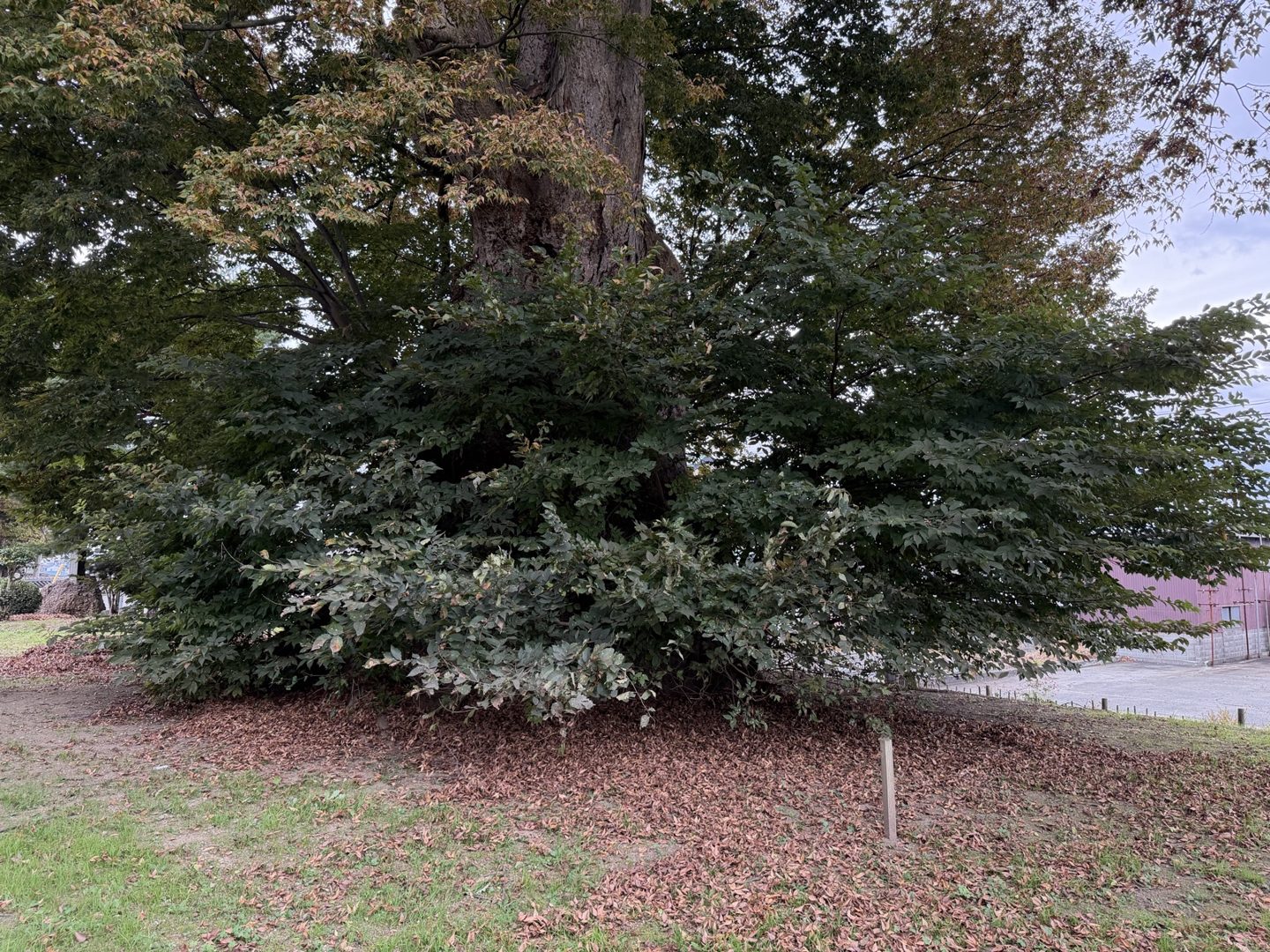
Seen from a distance, the lower trunk disappears into a dense green thicket. This is not the crown hanging down. It is a mass of root suckers (ひこばえ, hikobae — young shoots that rise from the root collar) and epicormic shoots (胴吹き枝, dōbuki-eda — shoots that grow straight out of the trunk), all near the base of the tree.
In ordinary tree work, both are usually cut as unwanted growth: they spoil the form and are said to draw energy from the tree. At Higashine, the shoots near the base are left in place on purpose. For an old tree that has lost its main stem, there are good reasons.
The first is leaf area. A tree that has lost its trunk top and major limbs has lost that much foliage. Leaves close to the base make sugars right next to the roots and the lower trunk, and feed the living shell of wood around the hollow. The second is protection. The thicket shades the base of the trunk and shields the bark from strong sun and drying.
The third is the future. Old trees rebuild lost limbs slowly, from new shoots raised out of dormant buds — a process called reiteration. The shoots at the base are where that rebuilding begins. Cutting them takes away the tree’s own chance to rebuild, and adds fresh wounds to an old trunk.
Keeping them has a cost: humidity collects inside the thicket, the base is hard to see, and epicormic shoots are often weakly attached. The shoots you keep are the ones you must inspect.
| Treatment of basal shoots | Benefits | What to watch | Suits |
|---|---|---|---|
| Keep them | Leaf area kept; trunk shaded; candidates for future limbs | Humidity inside the thicket, poor view of the base, splitting at the attachment | Old trees that have lost their main stem; fenced trees where people do not reach the base |
| Keep some | Strong shoots grow on; an inspection path stays open | Choosing which to keep takes experience; every cut is a new wound | Trees where the base must be reached for inspection or treatment |
| Cut all | Neat form; clear view of the base | Leaf area falls; the more you cut, the more shoots return | Street trees, park paths — generally avoided on veteran trees |
The trunk — burls, ridges, and a covered break
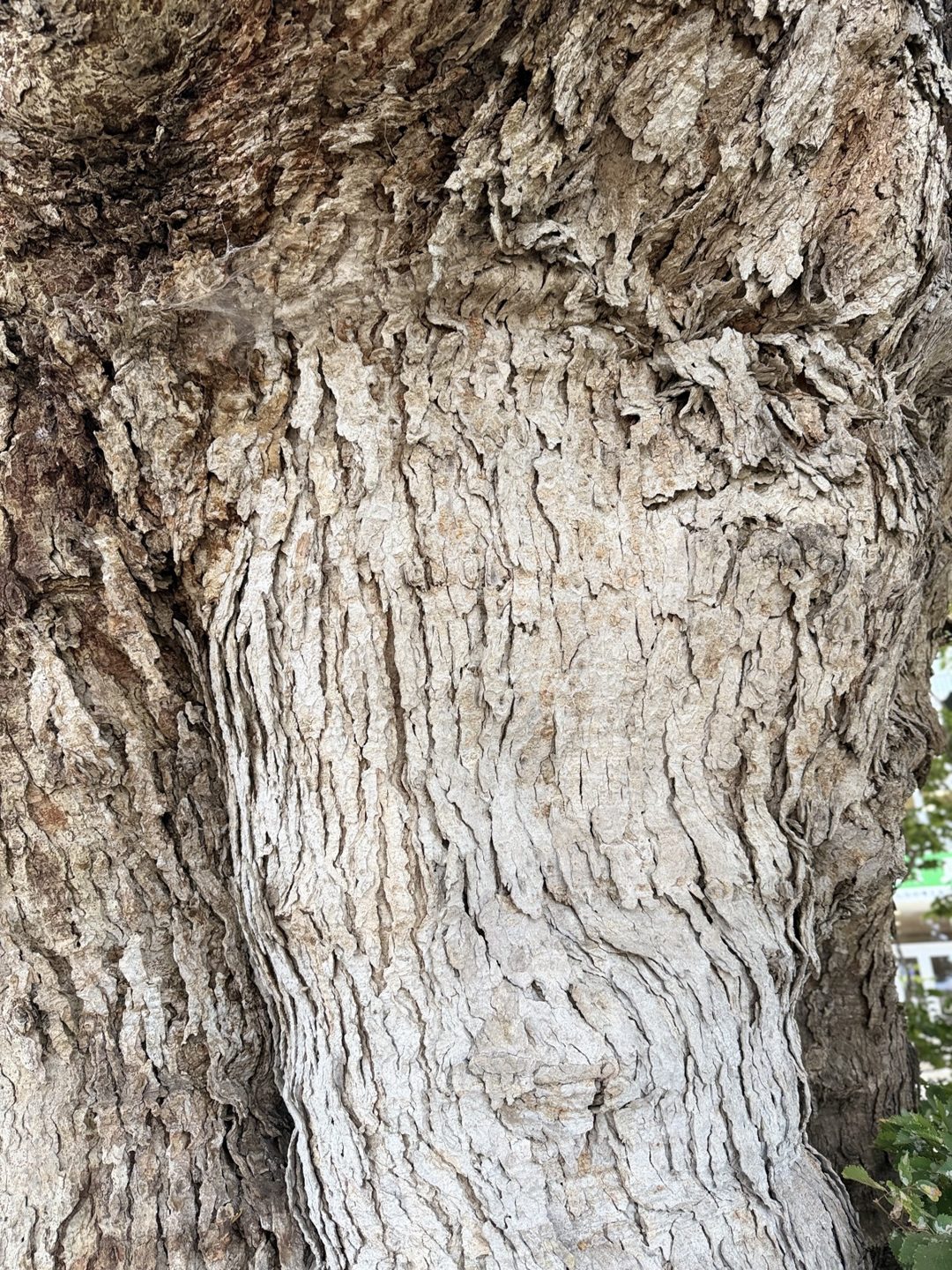
Inside the outer thicket, the trunk itself comes into view. Its surface is folded into burls and ridges, nothing like the smooth bark of a young zelkova. Suckers crowd around the base.
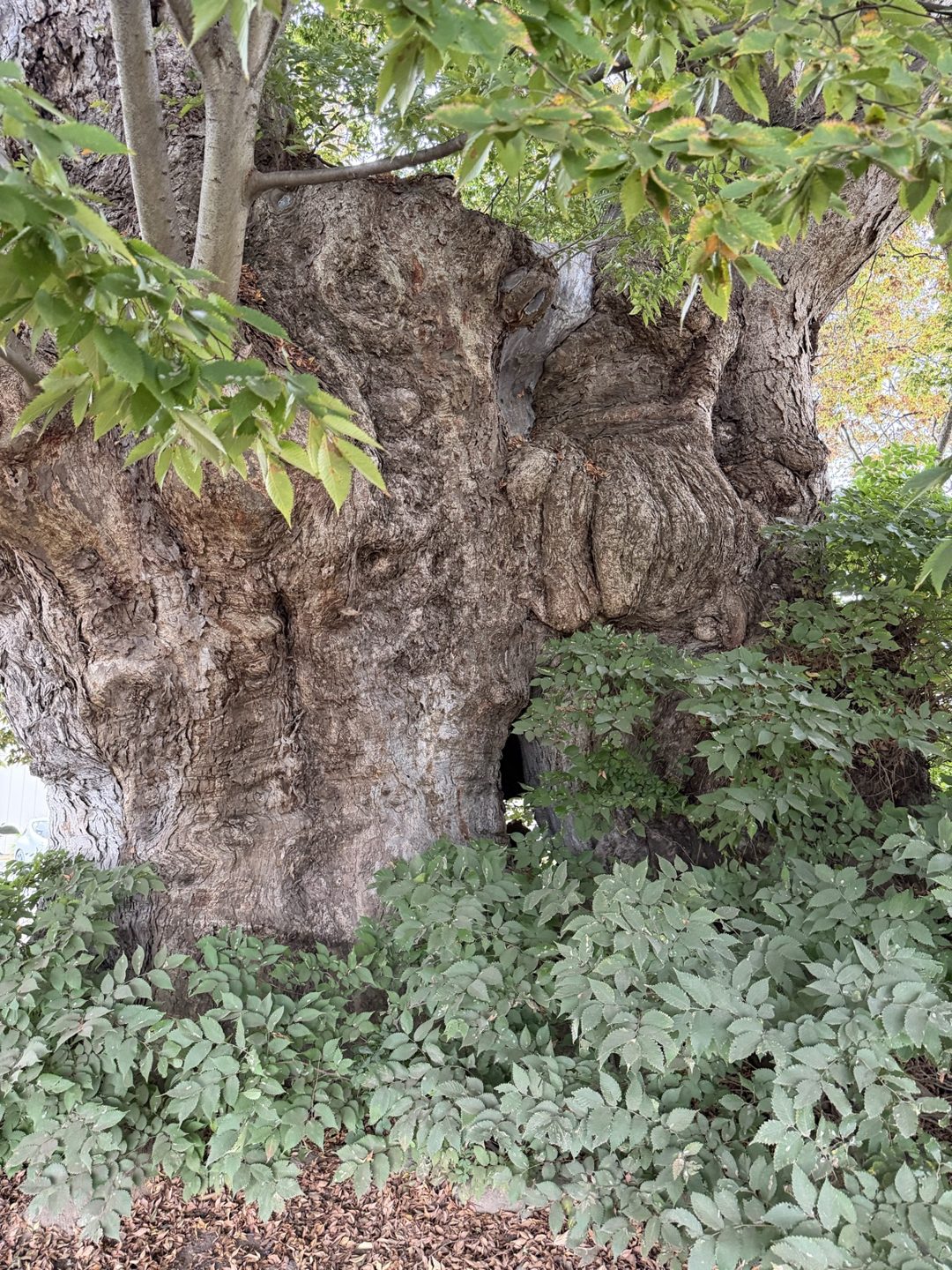
Looking up, several trunks and limbs end abruptly. Over the broken ends, a grey covering has been laid like a small roof. Young shoots grow right beside it. I did not confirm the material on site; the surface is wrinkled, and it may be a thin sheet or a built-up coating.
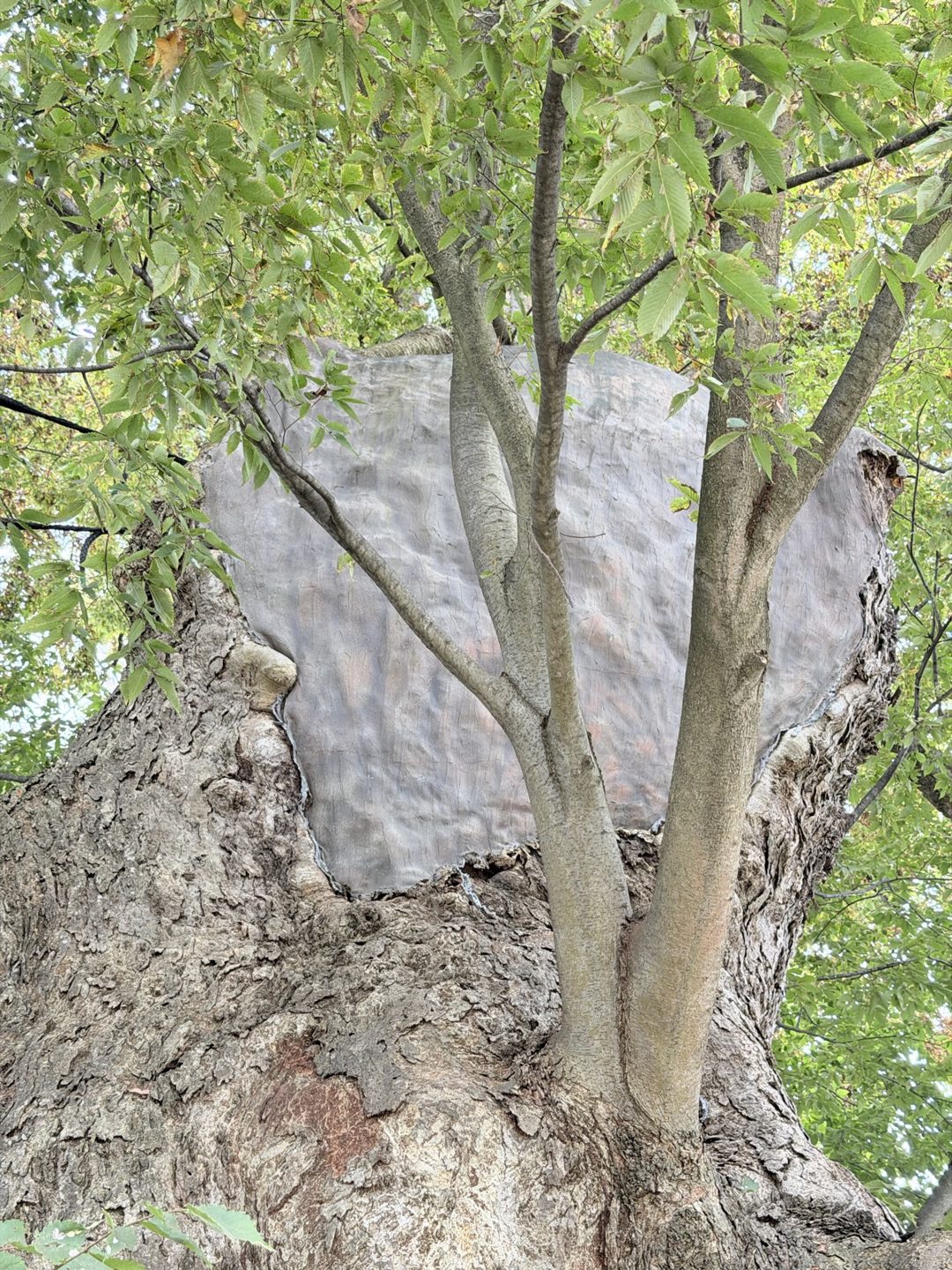
The purpose of covering a break is presumably to keep rain out of the trunk. A break that holds water is an entry point for decay. A roof over it stops rain falling straight into the hollow. The city’s report also notes fungicide plus artificial bark for the 2020 branch failure.
But whatever is under a covering can no longer be seen, and if water collects beneath it, it traps moisture. A covering only makes sense with a routine for checking underneath it.
A narrow grey strip also runs down a vertical crack in the trunk, as if sealing the split face.
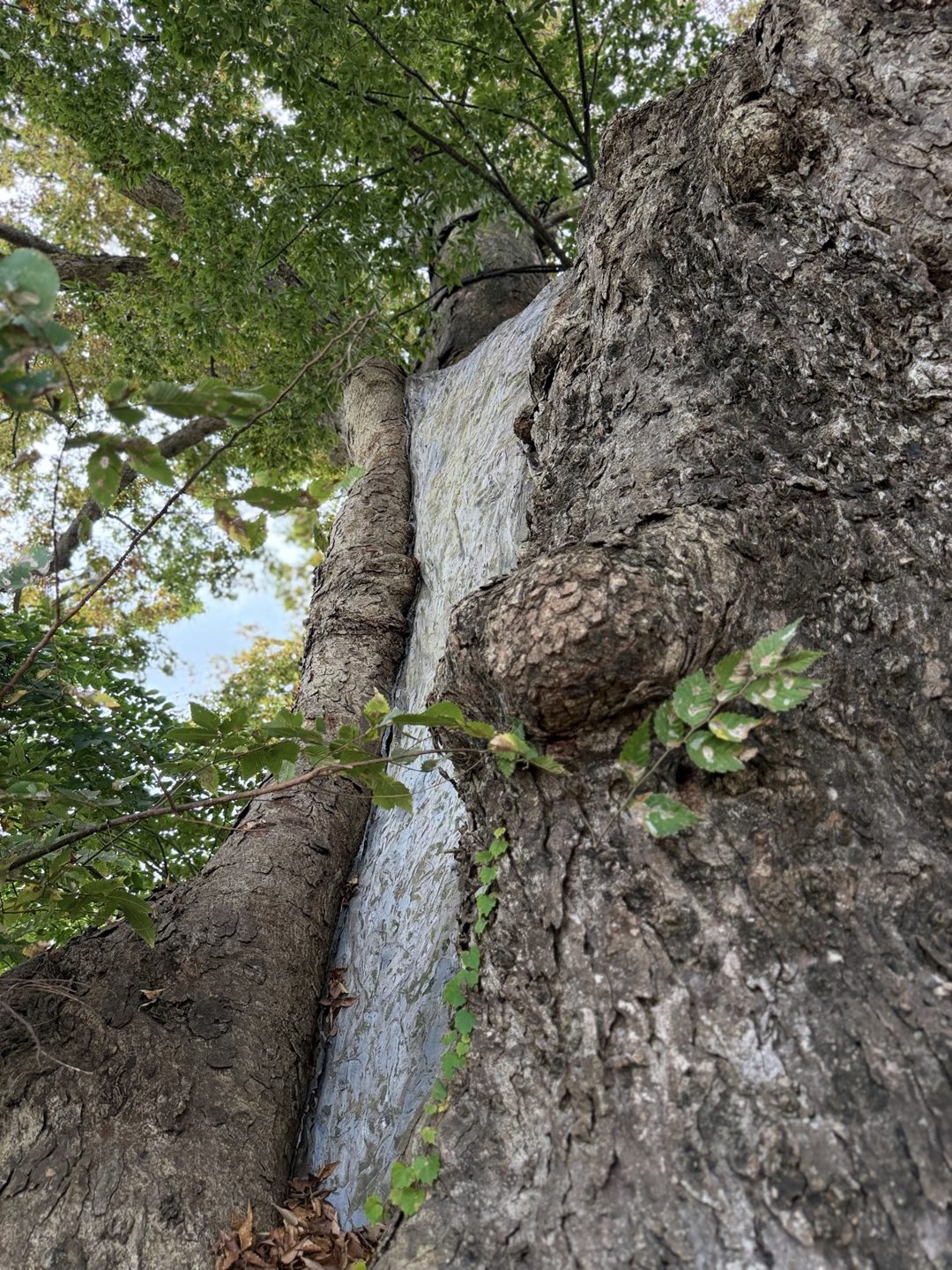
Shoots growing right beside these old wounds are a good sign. A branch growing next to a treated wound shows that the cambium there is alive. As those shoots thicken, it is worth checking that the edge of the covering does not start to girdle them.
Inside the hollow — steel props holding the trunk from within
Low on the trunk there is an opening about the size of a person’s head. Inside, pale, dry decayed wood is piled up, and the hollow opens into darkness beyond.
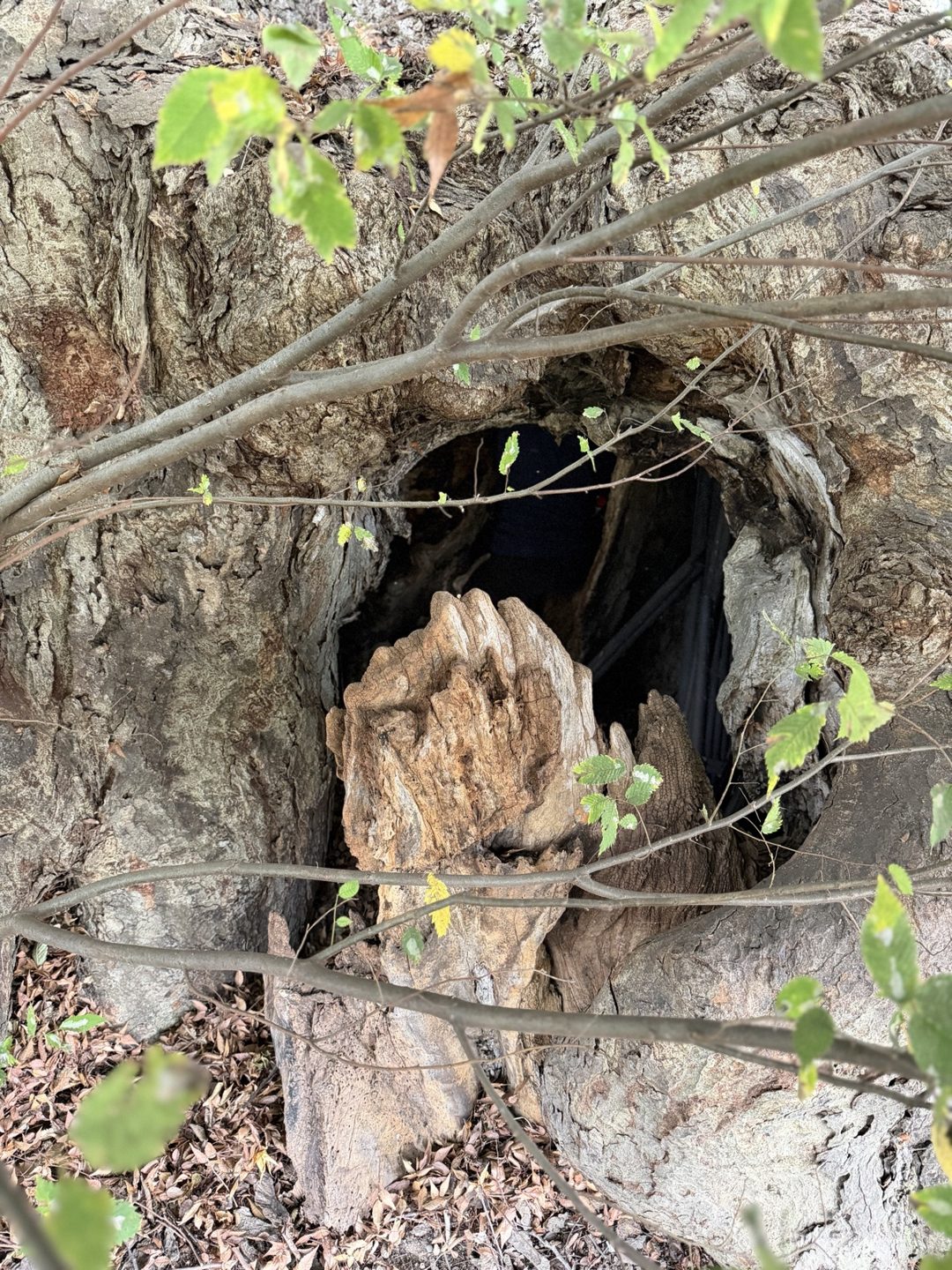
Looking up through another opening, I could see several steel props standing inside the hollow trunk. They rise from below, are tied together by horizontal members, and brace the inner wall of the hollow from inside. From outside it looks like a single great trunk; inside, it is a tube, and the props hold the tube up. The city’s report speaks of decay “where the hollow in the centre of the trunk had been reinforced”, which most likely refers to internal reinforcement of this kind, although the report does not describe it.
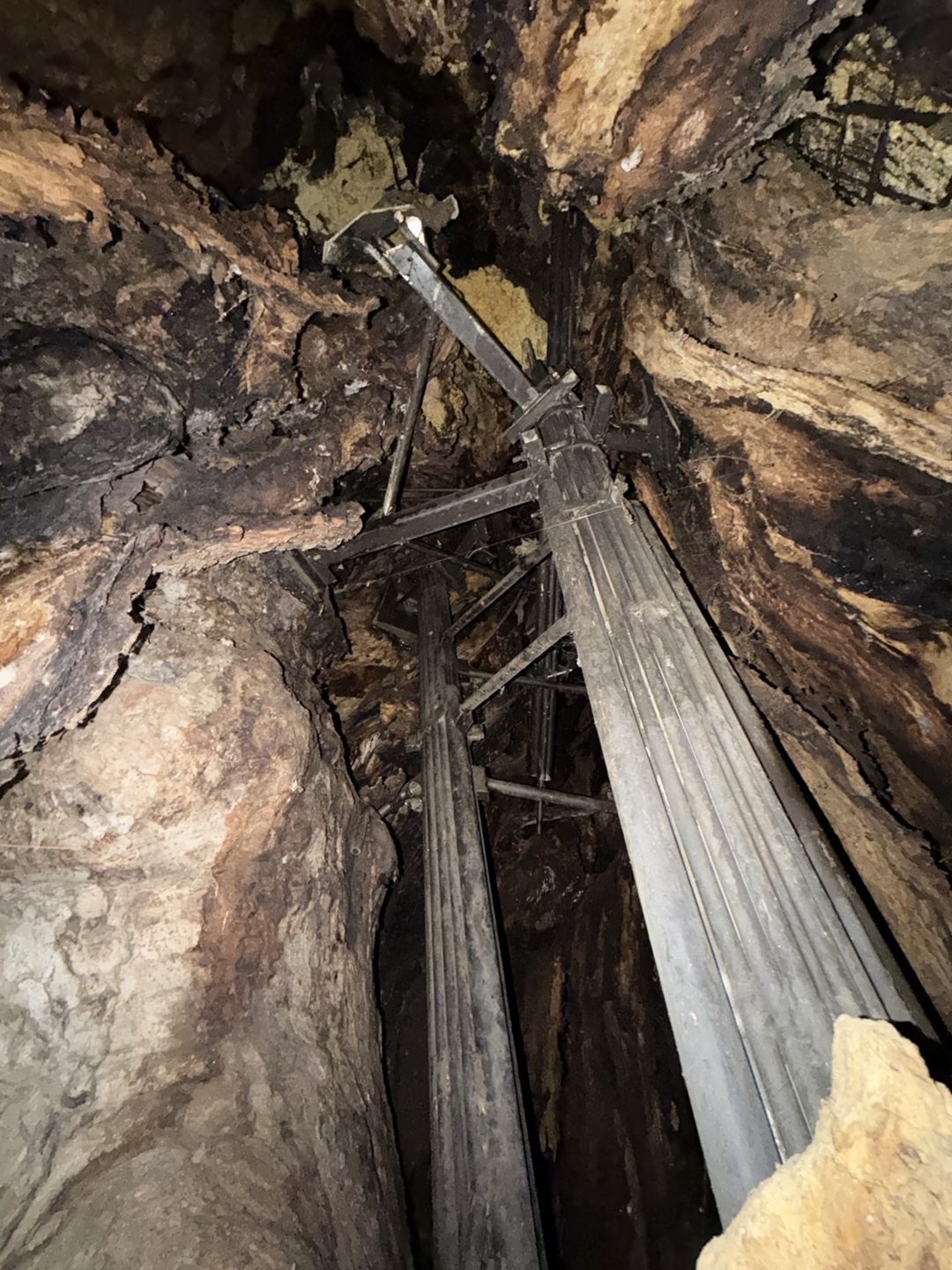
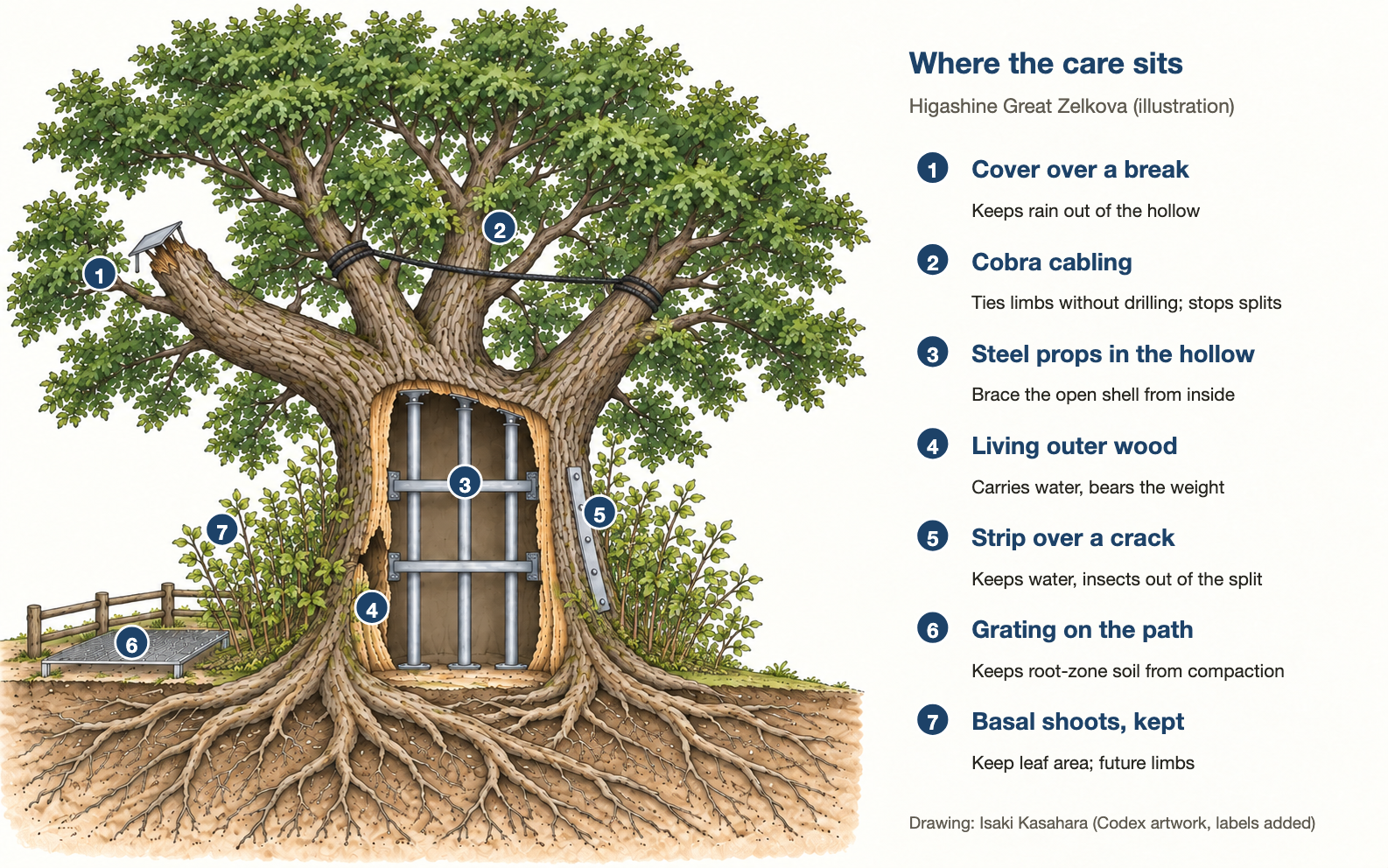
The key point is that a hollow does not, by itself, mean a tree is about to fall. A tree carries water and bears its own weight in its outer, newer wood, not in its centre. If the centre rots away, the tree can still stand as a hollow tube as long as the outer wall is thick enough. A rule of thumb from tree biomechanics, proposed by Claus Mattheck and colleagues, relates the remaining wall thickness to the radius of the trunk: when the wall falls below about 30 percent of the radius, the risk of failure rises sharply.
I did not measure this tree’s wall thickness. Even from outside, though, there are several openings, and the wall is not a closed tube everywhere. An open tube is much weaker in torsion and bending than a closed one. The internal props can be read as stopping the open shell from folding inward or leaning.
Trees also limit decay themselves. They build boundaries around a wound and wall the decay into compartments — the process Alex Shigo described as CODIT (compartmentalization of decay in trees). The colour bands on the inner wall of the hollow are traces of those boundaries. Scraping all the decayed wood out of a hollow risks breaking those boundaries, which is why that kind of cavity surgery is now generally avoided.
The FY2017 repair suggests decay had appeared where the supports touch the wood. A support is only complete if those contact faces are inspected too.
Cobra cabling — tying limbs together without drilling
Looking up into the crown, I could see large limbs tied together with black rope at several points. This is Cobra, a cabling system that links limbs to support them. It holds limbs that might split, or whose forks might open, by tying them to their neighbours.
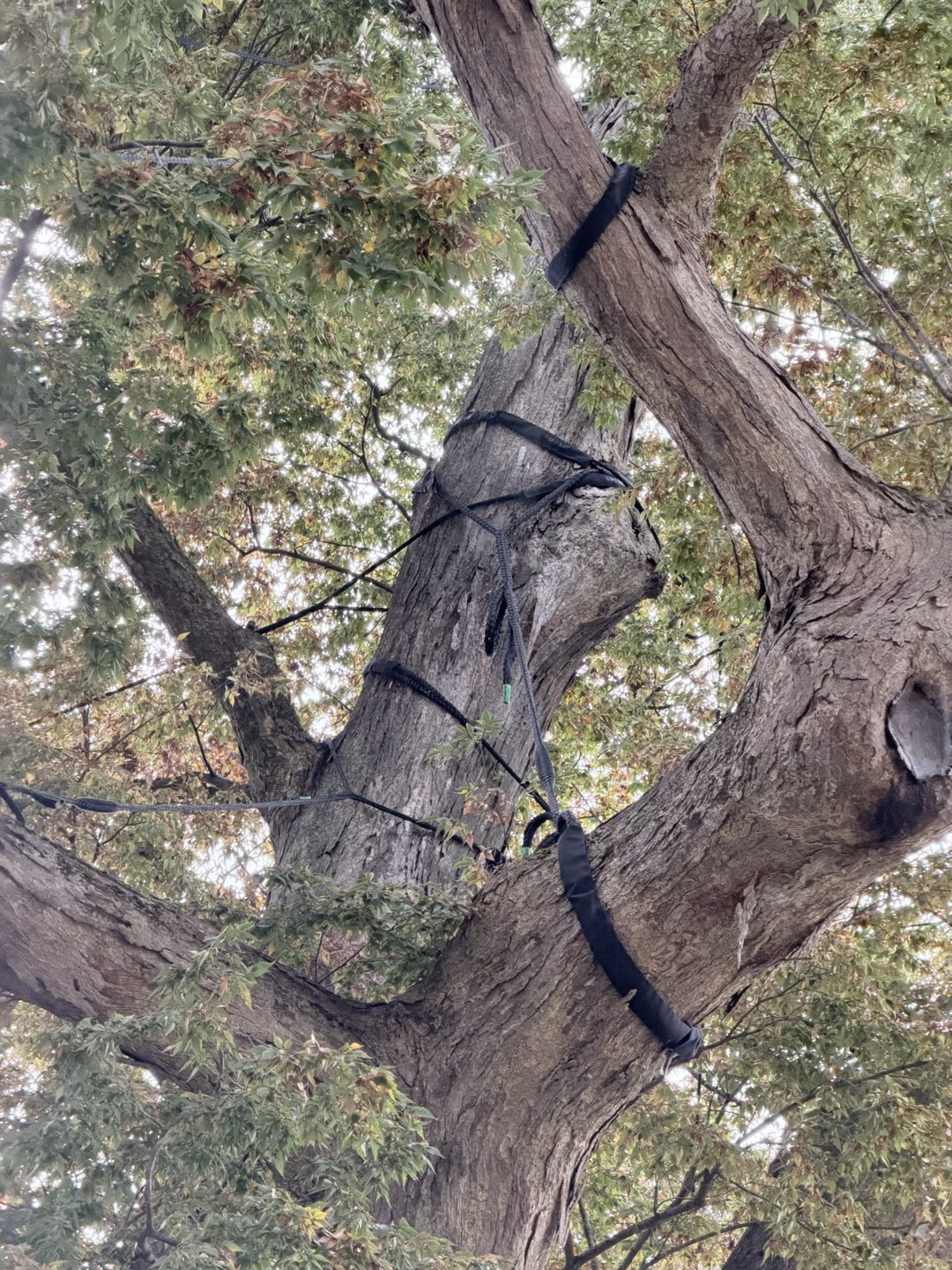
There are two broad ways to support a limb. One is to drill through it and install a bolt or steel rod; the other is to tie it from outside with rope. Drilling holds firmly, but it makes a new wound in the tree. In an old tree already carrying hollows and decay, a new hole can become a new entry point for rot.
Cobra uses a hollow-braided synthetic rope that is wrapped around the limbs, so nothing is drilled. The rope also has some stretch, allowing limbs to sway in the wind. Limbs that move keep laying down the supporting wood at their base and in the trunk. A rigid steel cable can suppress that response and leave a limb dependent on its support. The idea of dynamic cabling is to leave the movement in place and stop only the large opening that would lead to a split.
The city replaces its branch-support “wire ropes” every three years; I have not confirmed whether that means this Cobra installation. Rope degrades in sun and weather, and wraps tighten as limbs grow, so a fixed replacement cycle is part of the treatment. Check for bark constriction at the wraps, and for rope so slack it supports nothing.
The ground — a steel grating plus a fence
The tree is fenced, and part of the visitors’ path is laid with steel grating. Below the grating is soil, continuous with the area where the roots spread.
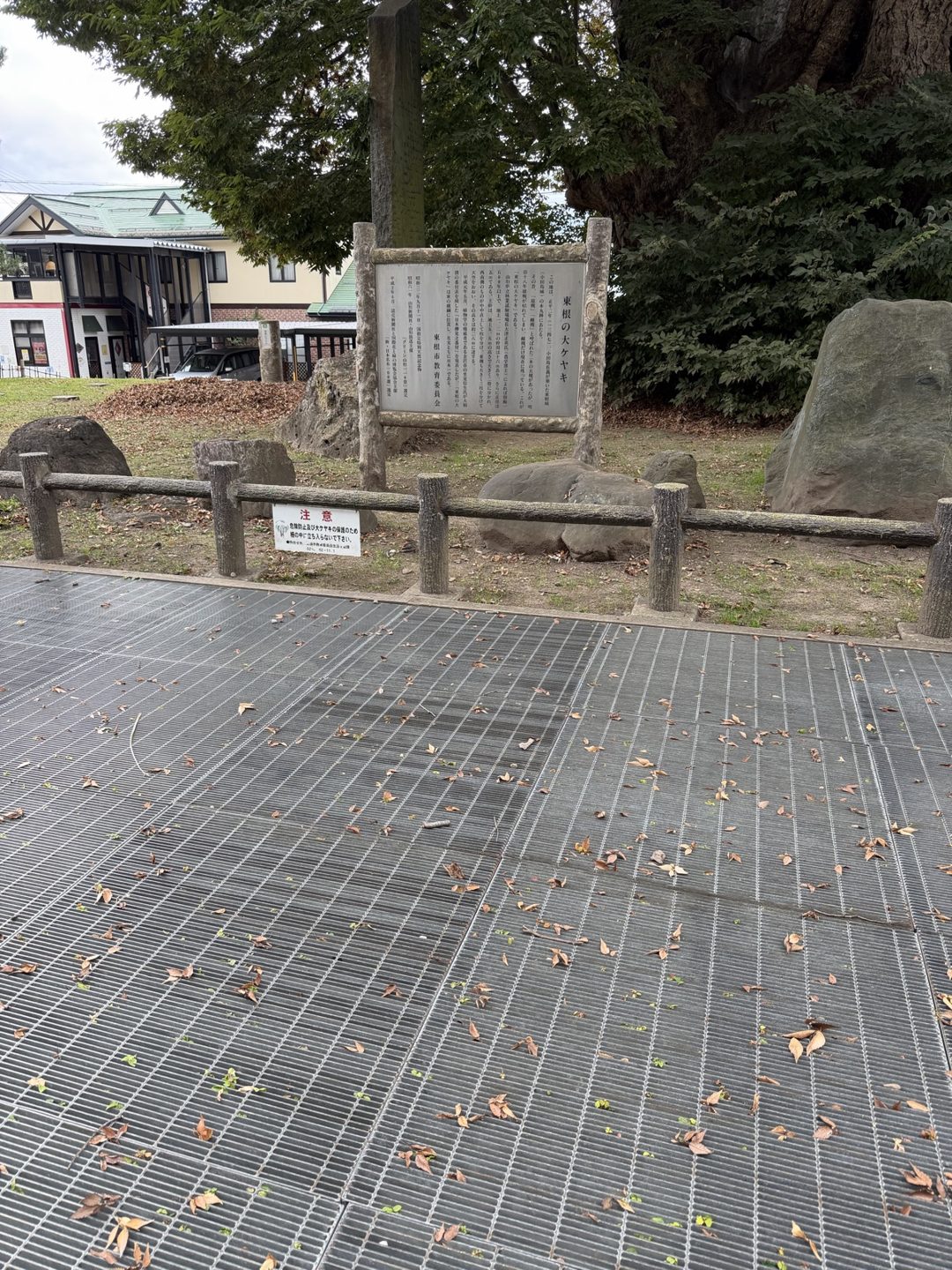
Soil compaction around the base is one of the most commonly cited causes of decline in veteran trees. When people walk over the roots day after day, the soil tightens, and the spaces through which roots breathe and rain soaks in are lost. When roots weaken, leaf area falls, and so does the tree’s ability to keep thickening the shell around its hollow. Compaction is damage that works slowly.
The grating spreads the weight of visitors and keeps their feet off the soil, while rain and air still reach the ground through its gaps. The fence keeps people away from the base; the grating keeps a path open while protecting the soil. I could not find the installation date or stated purpose of the grating in public records.
The FY2017 soil improvement, burying activated charcoal, worked on the same unseen part. The life of a veteran tree is often decided by its roots, not its trunk.
Reading the care — what each measure prevents, and where to check it
Here is the care seen at Higashine, organised by purpose and by what to inspect. The “purpose” column is what can be read from appearance and from the public record.
| Measure | What I saw | Purpose (as read) | Where to check that it works |
|---|---|---|---|
| Props in the hollow | Steel posts with cross-members inside the trunk | Stop the open shell folding in or leaning | Decay plus cracking where props meet the wall; lean of the props; corrosion at their feet |
| Covering on breaks | Grey covering over broken trunk tops | Reduce rain falling into the hollow | Lifting or shifting; moisture beneath; bark rolling over the edge |
| Strip over a crack | Narrow covering along a vertical split | Reduce water plus insects entering the crack | Bark swelling at the edges; widening of the crack |
| Cobra cabling | Black rope tying large limbs, no drilling | Allow sway, but stop forks opening into splits | Rope cutting into bark; slack; cracks at the fork |
| Basal shoots | Suckers plus epicormic shoots kept near the base | Keep leaf area; shade the trunk; future limbs | Vigour of the shoots; splitting at attachments; humidity inside |
| Grating plus fence | Steel grating on the path; fence around the tree | Keep the soil over the roots from compaction | Softness of soil under the grating; changes in crown density |
Everything in the right-hand column can be seen and recorded from outside. Care is not finished when it is installed. It only means something if someone keeps checking that it works.
What tree managers can take from Higashine
For a tree like Higashine, where care has been added over generations, the record of that care becomes part of the tree. Whoever takes over the tree next needs to know what was done, when, and by whom. Higashine City’s annual report is one way of keeping that record.
A few questions are worth asking before anyone inspects or treats a veteran tree. Is there a record of past treatments — year, method, contractor? At what height, and along what line, was the girth measured? Are there photographs taken every year from the same spot in the same season? When was the area under any covering last checked, and how? How often are cables and ropes replaced? Is there a policy on whether root suckers and epicormic shoots are cut or kept?
The wall thickness of a hollow trunk can be measured with instruments that do little harm to the tree. Sonic tomography sends sound through the trunk to map its interior, and a resistance drill such as the Resistograph reads density along a fine needle. A single measurement becomes the baseline for every later one. Before any instrument, much can be read by eye from the outside.
How often to inspect depends on the tree and on how the space around it is used. Where children or visitors pass close by, an external check at least once a year, plus an extra check after typhoons or heavy snow, is a reasonable baseline. The branch failure at Higashine in December 2020 also came in the snow season.
Why Japan’s ancient trees live for a thousand years has many answers. Higashine adds a practical one: long life is supported, recorded and checked, year after year.
Visiting — what you can see from outside the fence
Walk once around the fence and you can find the burls and ridges of the trunk, the covering over the broken tops, the shoots at the base, and the Cobra rope in the crown. Please stay on the path and do not enter the root zone. The tree stands in a working schoolyard, so be mindful of school hours and of the children.
A great ginkgo stands nearby. According to the board on site, it was moved about 18 m (59 ft) in the autumn and winter of 2001 to make way for a road improvement. There are two ways to protect a giant tree: support it where it stands, or move it. Seeing the two trees one after the other makes the difference clear.
Frequently asked questions
Q1. Where is the Higashine Great Zelkova? A. It stands in the schoolyard of Higashine Elementary School in Higashine City, Yamagata Prefecture. Yamagata Prefecture gives the address as Honmaru-minami 1-chōme, Higashine. Because it is on school grounds, please respect the school’s hours and stay outside the fence.
Q2. Why do sources give different girths? A. They were measured at different times and heights. Higashine City gives 16.0 m at 1.2 m above ground; the national survey of FY1999–2000 gave 15.6 m; the FY1988 survey gave 12.6 m. Age estimates also differ — over 1,500 years locally, over 1,000 years in the national database — because a hollow tree cannot be dated by its rings.
Q3. Shouldn’t root suckers plus epicormic shoots be cut? A. On an old tree that has lost its main stem or major limbs, keeping the shoots near the base can be better for the tree. They maintain leaf area, shade the base of the trunk, and can grow into replacement limbs. Higashine keeps them on purpose, while their attachments plus the humid interior of the thicket need regular checks.
Q4. Is a hollow tree dangerous? A. A hollow alone does not mean a tree will fall. Trees bear their weight in their outer wood, so a hollow tree can stand as a tube if the remaining wall is thick enough. Whether it is dangerous depends on wall thickness, the size of openings, lean, and how the area around it is used.
Q5. What should a tree manager do first to protect a veteran tree? A. Gather the record of past treatments, fix the method for measuring girth, and start taking photographs from the same points every year. With that record, the next inspection knows where to look. For trees with large hollows, one measurement of the interior with sonic tomography gives a baseline for comparison.
Sources
– Agency for Cultural Affairs, Database of Nationally Designated Cultural Properties: Higashine no Ō-keyaki – Higashine City: Cultural properties of Higashine – Higashine City Board of Education, annual inspection and evaluation reports: FY2017 / FY2022 – Yamagata Prefecture: Yamagata cultural-property search — Higashine no Ō-keyaki – Ministry of the Environment, Biodiversity Center of Japan: Giant tree surveys / 4th survey report / 6th survey follow-up, summary – On-site interpretation board for the Great Zelkova, plus the board on the transplanting of the great ginkgo (checked on site, 19 October 2026) – Mattheck, C. & Breloer, H. (1994) The Body Language of Trees. HMSO. – Shigo, A. L. (1984) Compartmentalization: A conceptual framework for understanding how trees grow and defend themselves. Annual Review of Phytopathology 22: 189–214.
Web sources accessed on 25 October 2026.
Related reading
– Japan’s Sacred Giant — the 2,000-Year-Old Camphor Tree of Kinomiya Shrine – Miharu Takizakura — Japan’s 1,000-Year-Old Weeping Cherry – VTA vs Jumoku-i — Comparing Two Tree Diagnosis Systems
Field notes from Japan’s trees arrive a few times each month — subscribe via the form in the footer, or follow the work on LinkedIn.