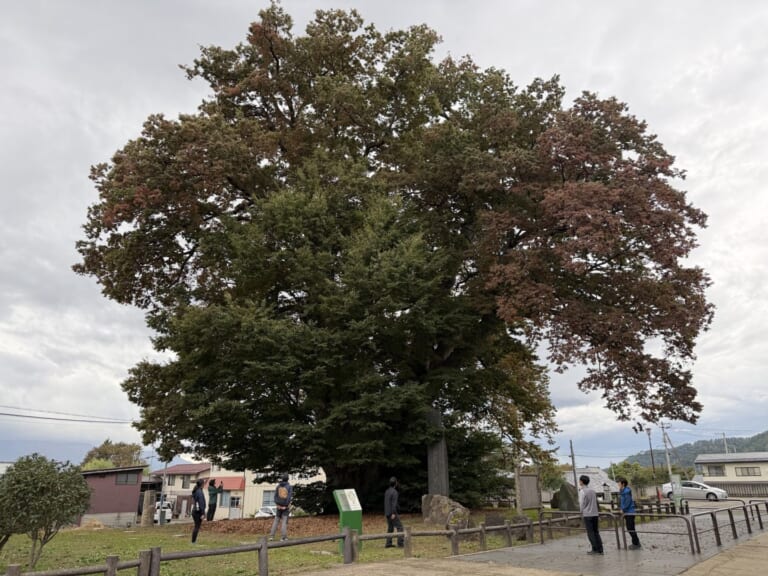
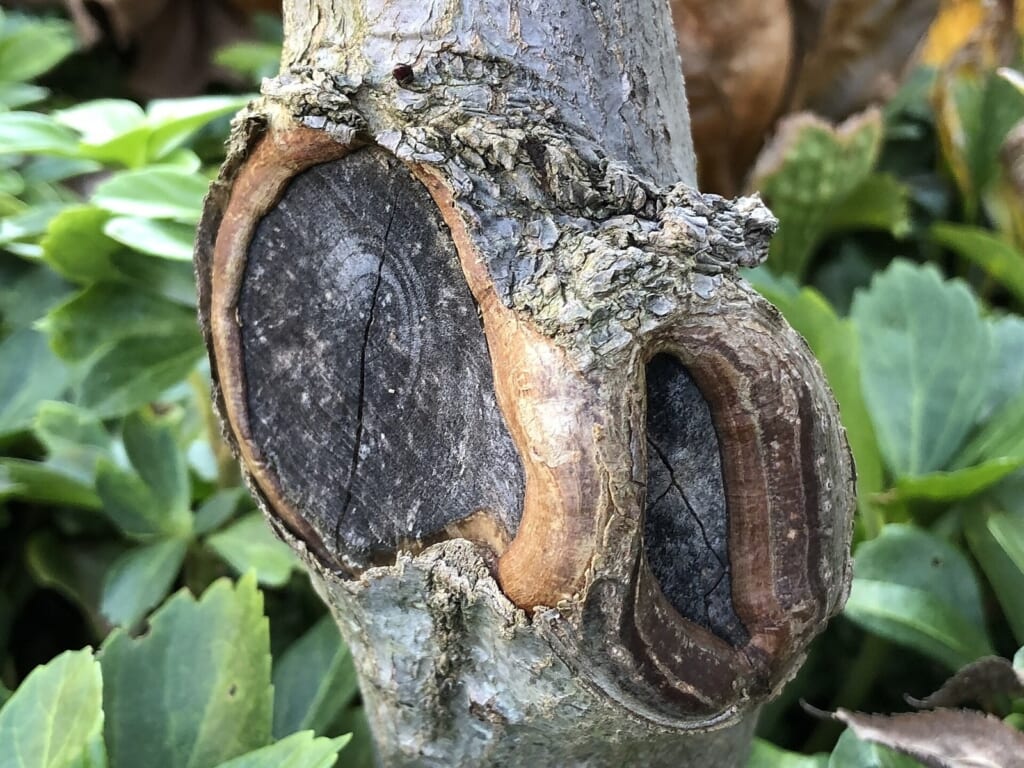
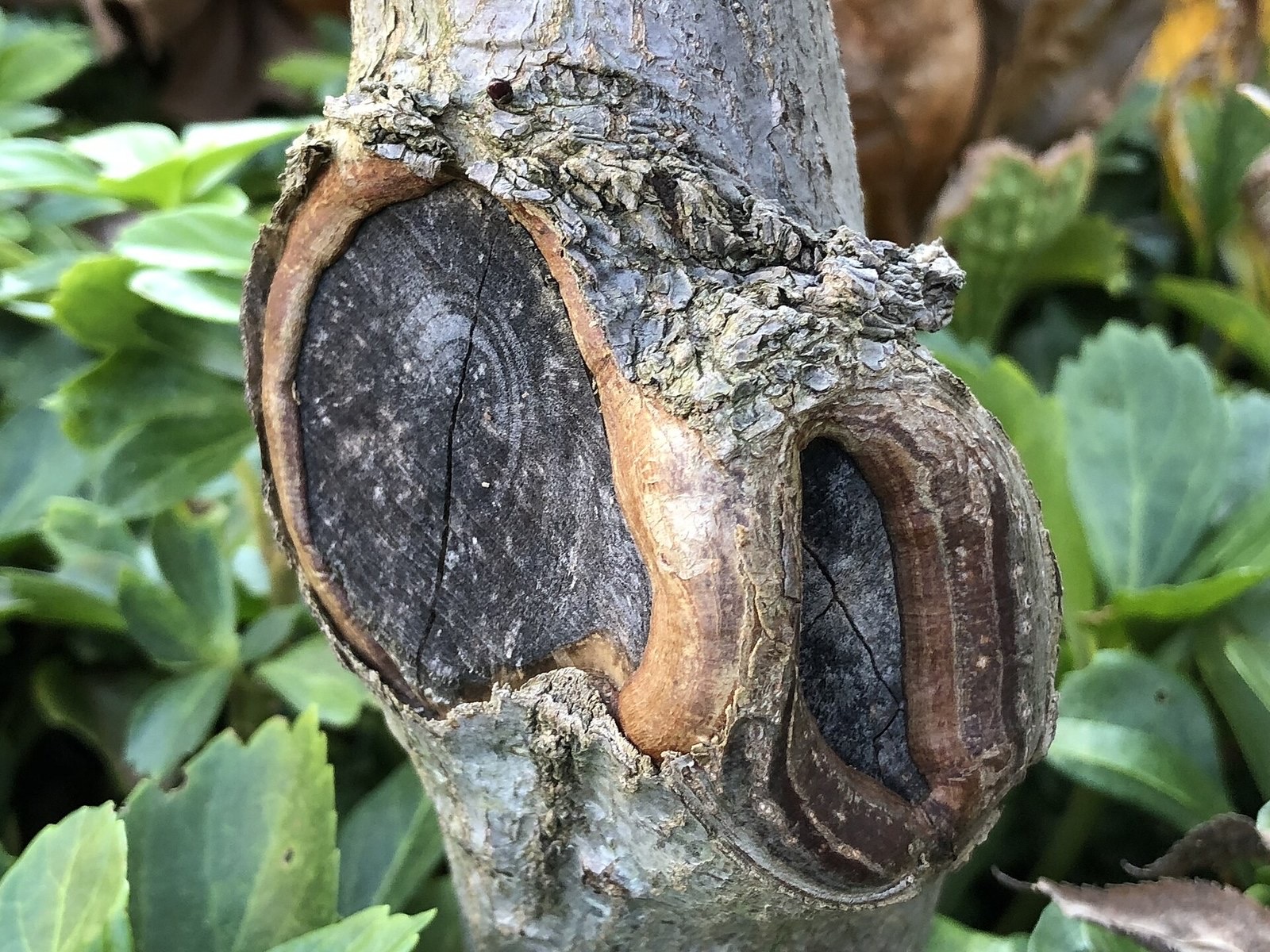
Trees do not heal wounds the way skin heals. They respond in two separate ways: on the outside they grow new tissue over the wound from its edges (first callus, then woundwood, the rolled ridge most people call tree scar tissue), and on the inside they chemically wall off the damaged wood so decay cannot spread freely. How well a pruning cut closes depends far more on its size, its timing and its position — just outside the branch collar — than on anything painted on it afterwards.
This article answers “how do trees heal wounds?” in practical terms: what woundwood is, Alex Shigo’s CODIT model, the factors research has tied to fast or slow closure, how to check a cut a season later, and why some Japanese specifications still call for wound treatment that most Western research advises against.
Do trees heal? Woundwood covers, it does not repair
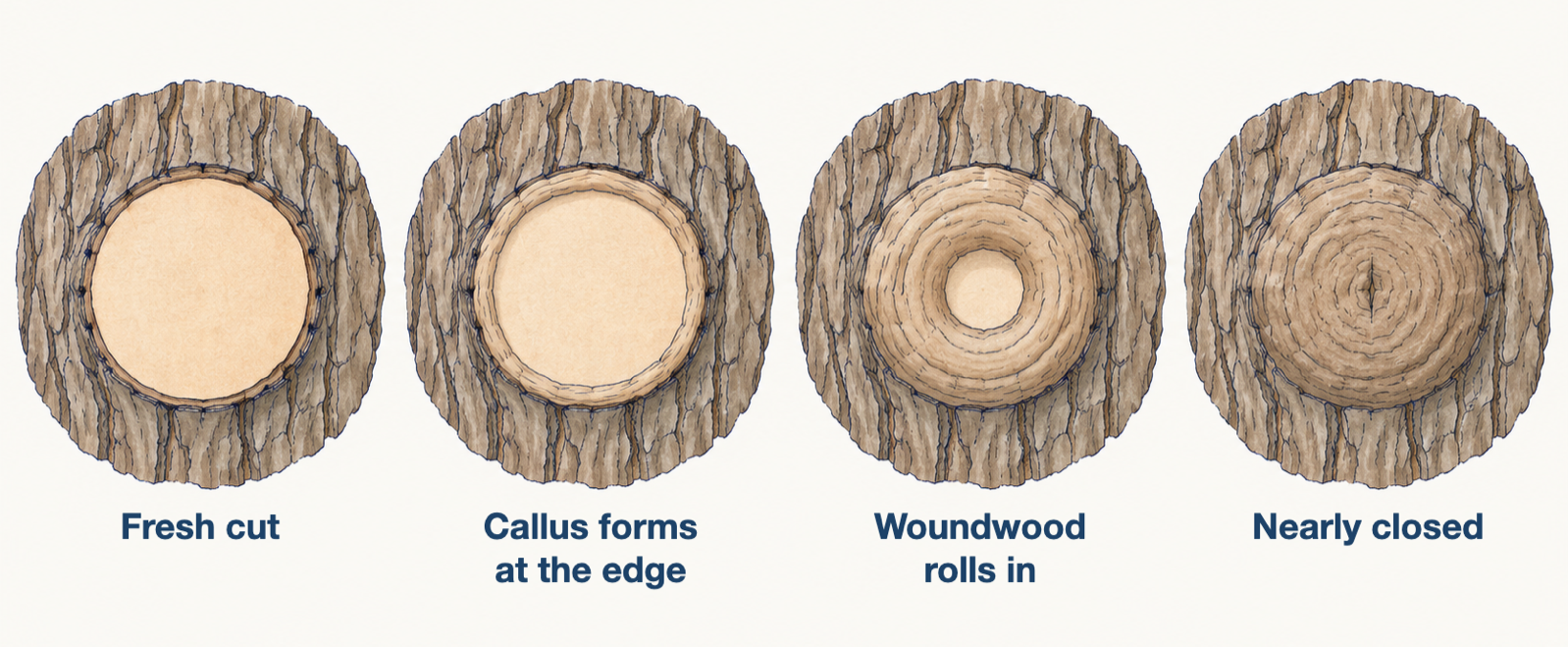
When bark is cut, living cambium at the edge of the wound starts dividing. The first tissue is callus, a mass of soft, undifferentiated cells. Within the same growing season it differentiates into woundwood: lignified wood with bark on its outer face. Woundwood advances from the edges a little more each year until the lips meet. Japanese uses the word makikomi (巻き込み), “rolling in”, for this closure.
Two points follow from how woundwood forms:
– It covers the wound; it does not replace the wood. The injured wood stays inside the trunk for the life of the tree, buried under new rings. – It grows only from living cambium. Where the cambium around a wound has died, nothing rolls in from that side, and the tree thickens elsewhere instead. One-sided closure can reshape a trunk for decades, as the survivor trees in Hiroshima’s Survivor Trees Still Lean Toward Ground Zero show.
CODIT — how trees seal wounds from the inside
In 1977 Alex Shigo and Harold Marx of the USDA Forest Service published Compartmentalization of Decay in Trees, built on the dissection of thousands of trees. Their model, CODIT, describes four “walls” that limit the spread of discoloration and decay from a wound.
| Wall | What forms it | Direction it resists | Practical meaning |
|---|---|---|---|
| Wall 1 | Plugging of vessels above and below the wound | Up and down the stem | The weakest wall, which is why decay columns usually run furthest up and down |
| Wall 2 | The dense latewood of each growth ring | Inward, toward the pith | Slows decay moving ring by ring toward the centre |
| Wall 3 | Living ray cells | Around the stem | Keeps a column from spreading sideways |
| Wall 4 (barrier zone) | New wood formed by the cambium after wounding | Outward, into new rings | The strongest wall; it separates old injury from all later growth |
This is why arborists say trees seal rather than heal. The tree does not remove decay; it confines it. Wall 4 explains how a tree can carry a decay column inside a shell of sound new wood, and why the thickness of that shell matters in risk assessment. For field methods, see How to Read Tree Decay Without Technology.
What decides how fast a pruning cut closes
Research names several factors, and only one of them is in the pruner’s hands on the day.
- Wound size. Larger wounds take longer to close and expose more wood. The USDA Forest Service guide How to Prune Trees gives a simple decision rule for branch diameter: under 5 cm (2 in), go ahead; 5–10 cm (2–4 in), think twice; over 10 cm (4 in), have a good reason.
- Size relative to the trunk. Eisner, Gilman and Grabosky (2002) found that removing limbs large relative to the trunk, especially codominant stems, caused more discoloration inside the trunk of red maple and live oak.
- Species and the individual tree. In their 13-year study of wound dressings, Shigo and Walter Shortle found that the individual tree influenced the outcome more than any treatment, and that in red maple the width of healthy wood behind the wound was the major factor.
- Timing. USDA recommends dormant-season pruning for most hardwoods, partly to give wounds the whole following growing season to close.
- Vigour. A fast-growing tree lays down wider rings, so its woundwood advances faster.
- Branch attachment and cut position. In Hamburg, Dujesiefken and Stobbe studied 750 pruning wounds on 115 urban trees and listed the factors that set the size of the internal defect: wound diameter, species, time of wounding, wound treatment, and how the branch was attached to the stem. Where the cut goes is the subject of the next section.
Branch collar cut vs flush cut vs stub cut
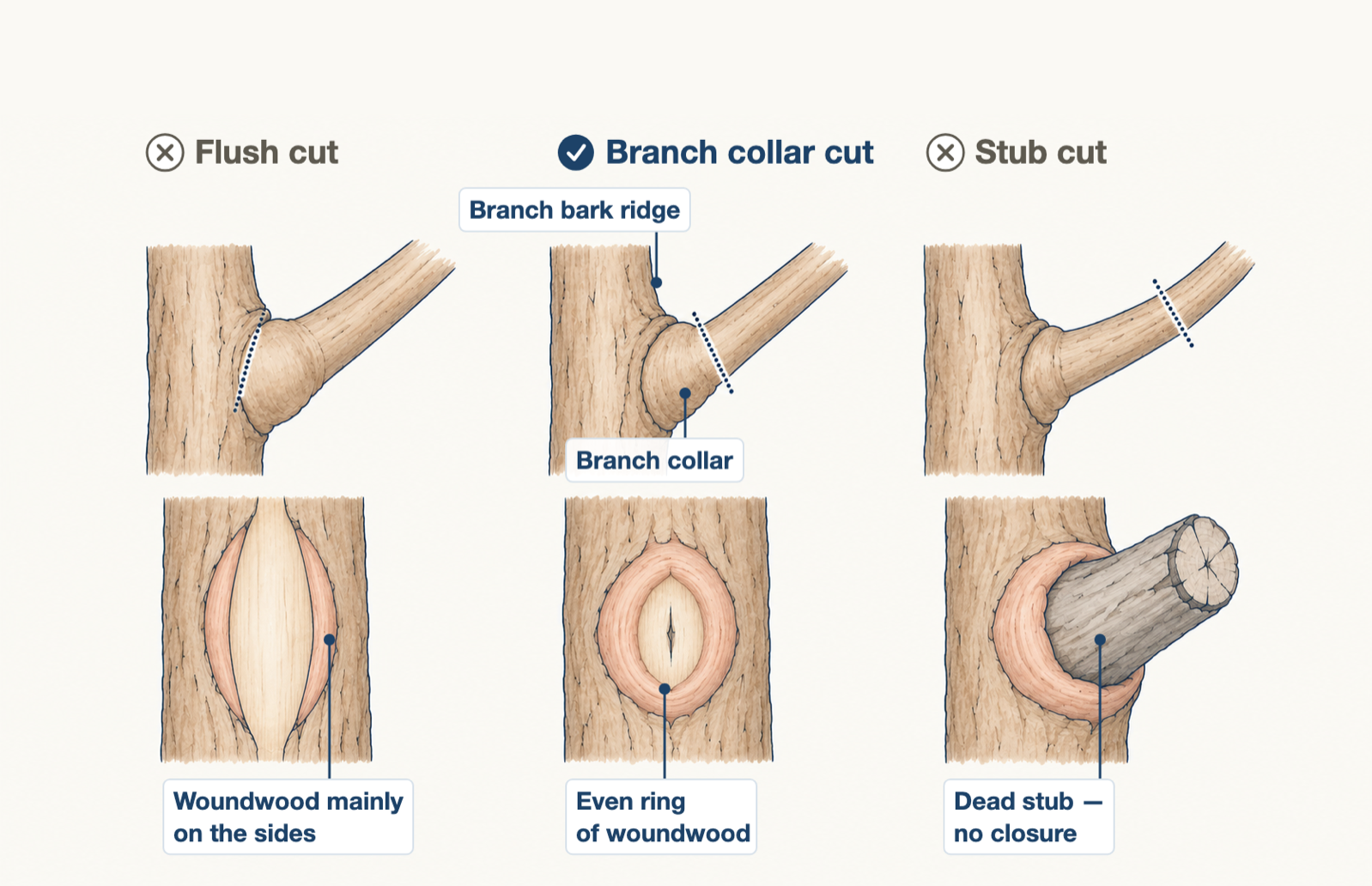
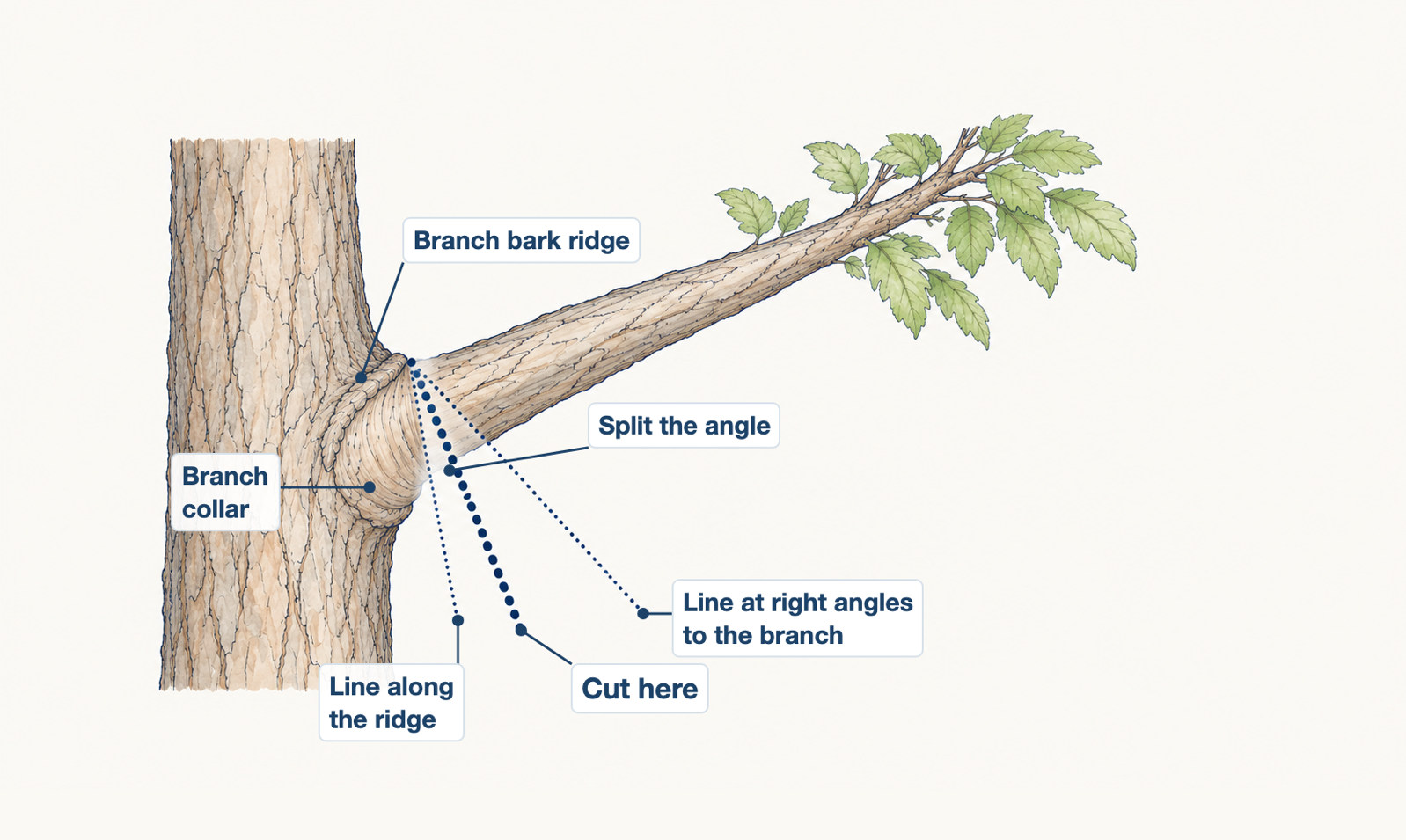
Cut position is the factor the pruner controls completely. Two landmarks guide it:
– Branch bark ridge — the raised line of bark in the crotch where branch meets trunk. – Branch collar — the swelling at the underside of the branch base, where trunk tissue wraps around the branch.
USDA describes the proper cut: begin just outside the branch bark ridge and angle down, away from the stem, without injuring the collar. Where the collar is not visible, the angle of the cut should roughly match the angle formed by the branch bark ridge and the trunk. Saitama Prefecture’s street-tree pruning manual (2020) gives the Japanese public-sector version of the same rule: leave the collar, where branch and trunk tissues mix, intact, and do not flush-cut, because removing the collar enlarges the wound and raises the risk of decay fungi entering.
| Cut | Where it is made | Inside the stem | How woundwood responds |
|---|---|---|---|
| Branch collar cut | Just outside the collar, not behind the ridge | Trunk tissue is not opened | An even ring forms around the cut |
| Flush cut | Flat against the trunk, through the collar | Trunk tissue is exposed; the wound is larger | Pronounced on the sides, little at top or bottom |
| Stub cut | Well beyond the collar | The stub dies; decay can move down it | Forms around the base of the dead stub, delaying closure |
For any branch too heavy to hold in one hand, USDA prescribes three steps: a shallow notch on the underside outside the collar, a second cut farther out that drops the branch, then the final cut at the collar. The notch stops the falling weight from tearing bark down the trunk.
Checking a cut one season later
USDA suggests judging pruning quality by looking at the wounds after one growing season. The woundwood pattern tells you where the cut was made:
– A concentric ring of woundwood forms around proper cuts. – Woundwood mostly on the sides, with little at top or bottom, follows flush cuts made inside the branch bark ridge or collar. – Woundwood around the base of a dead stub follows stub cuts; the tree must close over the stub as well.
On street trees, repeated heavy cuts leave wounds that may never close; see Tokyo Street Trees: Why They Look Beautiful, and Why They’re Struggling.
Wound dressing on trees — Western research vs Japanese practice
The Western position. USDA states that wound dressings are unnecessary in most cases and may be detrimental: they do not stop decay or cure disease, and can slow closure. The basis is Shigo and Shortle’s 1983 report, in which no material prevented decay over 13 years on 275 dissected trees. The recognised exceptions are oaks and elms wounded when disease vectors are active. Texas A&M Forest Service advises no oak pruning from February through June in oak wilt areas, and painting every oak wound at any time of year.
The Japanese position. Tokyo’s street-tree maintenance plan (Tokyo Metropolitan Government, 2021) requires “fungicidal treatment with closure-promoting treatment” (bōkin oyobi yugō sokushin shori, 防菌及び癒合促進処理) on large cuts and on stub-removal cuts 3 cm (1.2 in) or more across. In Japan, wound pastes are called yugōzai (癒合剤). Some are registered agricultural chemicals, and the same products are used in fruit growing as part of disease control in apple orchards.
The orchard data is more nuanced than either side’s slogan. In a 1997–98 trial, the Iwate Agricultural Research Center compared six pastes on pruning cuts about 20 mm (0.8 in) across on four-year-old apple trees. Selected results:
| Treatment | Cuts showing callus formation |
|---|---|
| Organic copper paste | 95.8% |
| Thiophanate-methyl paste | 92.3% |
| No treatment | 85.0% |
| Thiophanate-methyl oil paste | 76.2% |
| Iminoctadine acetate paste | 52.0% |
The best pastes did slightly better than bare wood, and some did clearly worse. The Center concluded that the poorer pastes should not be used to protect pruning cuts at all.
The two traditions are answering different questions. Western studies measured decay behind the wound over many years; Japanese standards target infection of the fresh cut surface. Both agree that no paste rescues a cut in the wrong place.
Frequently asked questions
Do trees heal their wounds? No. Trees grow woundwood over a wound and wall off the damaged wood inside (CODIT), but the injured wood is never replaced.
Should I seal a tree wound after pruning? For most trees, no; USDA advises that dressings are unnecessary and can be harmful. The main exceptions are oaks and elms where oak wilt or Dutch elm disease is present. In Japan, Tokyo’s street-tree specification requires treatment on large cuts and on stub-removal cuts of 3 cm or more, so follow the specification you work under.
How long does it take a pruning cut to close? It depends on size, species, timing and vigour. Small cuts made outside the collar on vigorous trees close fastest. Large cuts, flush cuts and stubs may never close completely.
Sources
All sources confirmed 2026-10-17.
– Shigo, A.L. & Marx, H.G. (1977). Compartmentalization of Decay in Trees. USDA Forest Service, Agriculture Information Bulletin 405 – Shigo, A.L. & Shortle, W.C. (1983). Wound Dressings: Results of Studies Over 13 Years. Journal of Arboriculture 9(12): 317–329 – Eisner, N.J., Gilman, E.F. & Grabosky, J.C. (2002). Branch morphology impacts compartmentalization of pruning wounds. Journal of Arboriculture 28(2): 99–105 – Dujesiefken, D. & Stobbe, H. (2002). The Hamburg Tree Pruning System. Urban Forestry & Urban Greening 1(2): 75–82 – Bedker, P.J., O’Brien, J.G. & Mielke, M.E. How to Prune Trees. USDA Forest Service, NA-FR-01-95, revised 2012 – Texas A&M Forest Service (2021). Prevent the spread of oak wilt in Texas this spring – Saitama Prefecture (2020). 街路樹剪定マニュアル [Street-Tree Pruning Manual], ch. 5 – Tokyo Metropolitan Government, Bureau of Construction (2021). 街路樹維持管理計画書 [Street Tree Maintenance Plan] – Iwate Agricultural Research Center (2000). Effects of wound pastes on callus formation at apple pruning cuts
Related reading
– Japan’s Falling Trees Crisis: When the Postwar Planting Boom Reaches Its Limit – Typhoon-Proofing Trees: Japan’s Wind-Resistant Pruning Methods – VTA vs Jumoku-i: Comparing Two Tree Diagnosis Systems
New field notes from Japan’s trees every day — subscribe to the Japan Blue Arborist Journal on LinkedIn, or via the form in the footer.