

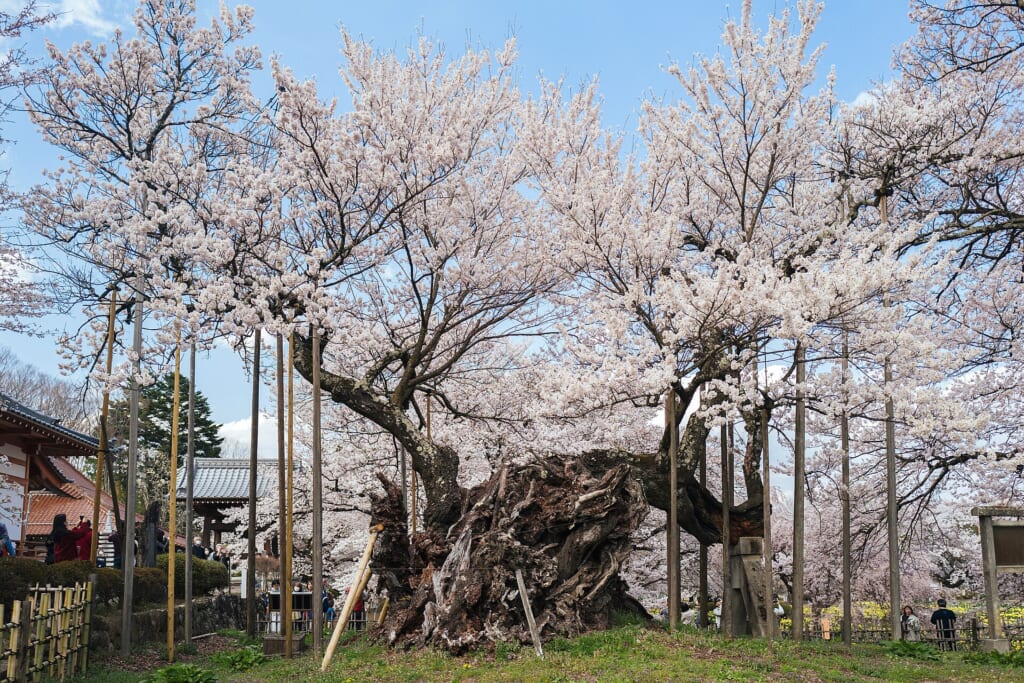
The Yamataka Jindai-zakura (山高神代桜), an Edohigan cherry at Jissō-ji temple in Hokuto, Yamanashi Prefecture, is said to be 1,800 or 2,000 years old, though none of the sources we checked explains how those ages were estimated. What has kept it alive in recent decades is work on the ground beneath it: a 2002 investigation linked its decline to trampling, to 40 to 80 cm of fill heaped over the roots in 1971, to root disease and to a roof that dried the soil, and a restoration spanning four fiscal years, with works from February 2003 to March 2006, dug that soil out and replaced it in stages, a quarter of the root-zone area at a time. Since then the temple and a local preservation society have watered the tree and cut the grass in summer and protected its roots in winter, and a 2020 survey found that new roots had taken hold.
Below: the fence where visitors stand, the legends about the tree’s age, the measures that harmed it, the restoration that turned it round, the care that continues, and the young trees raised from its seed and branches.
At the Fence — What You See of the Jindai-zakura First
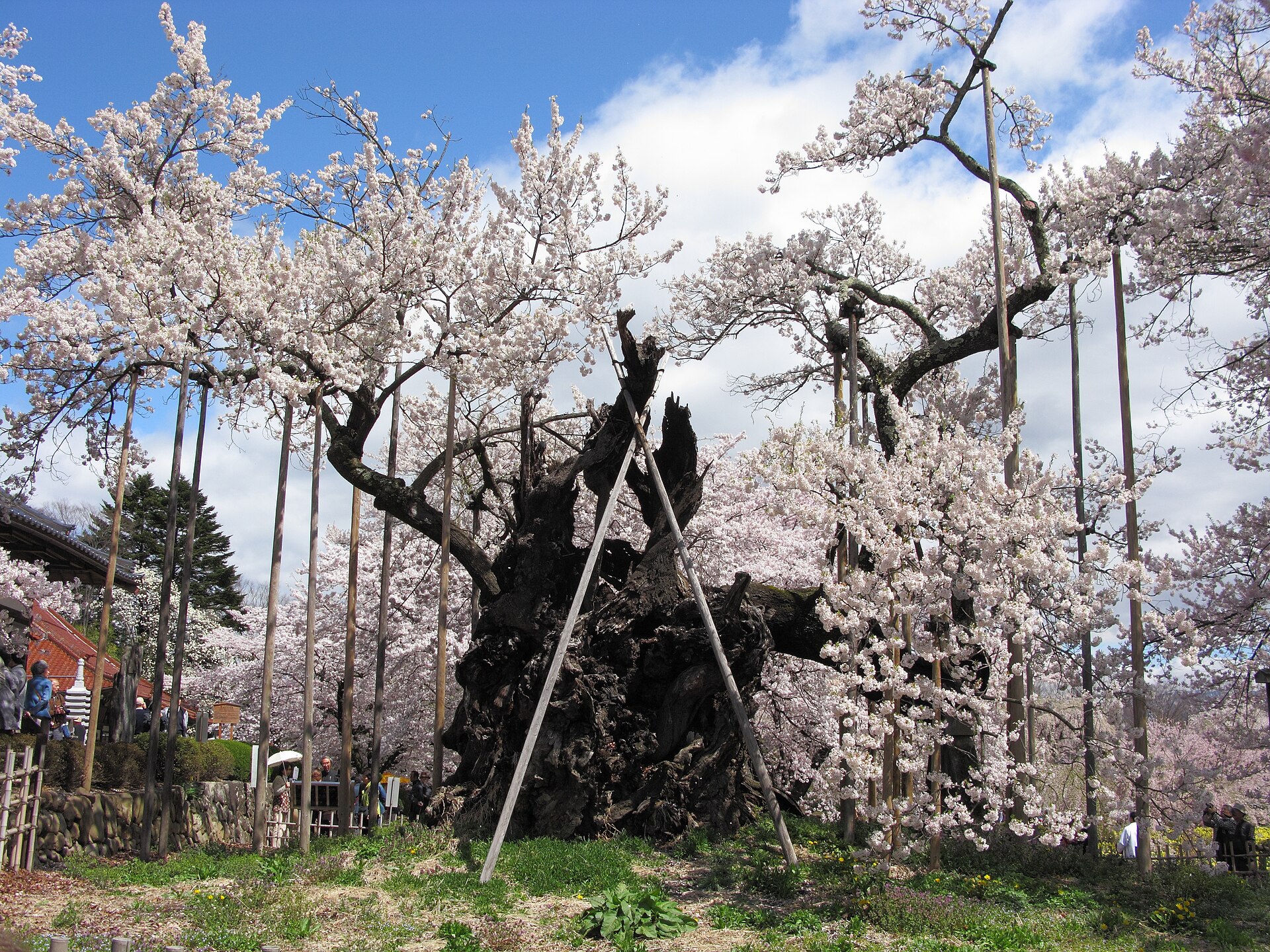
A trunk that has come apart
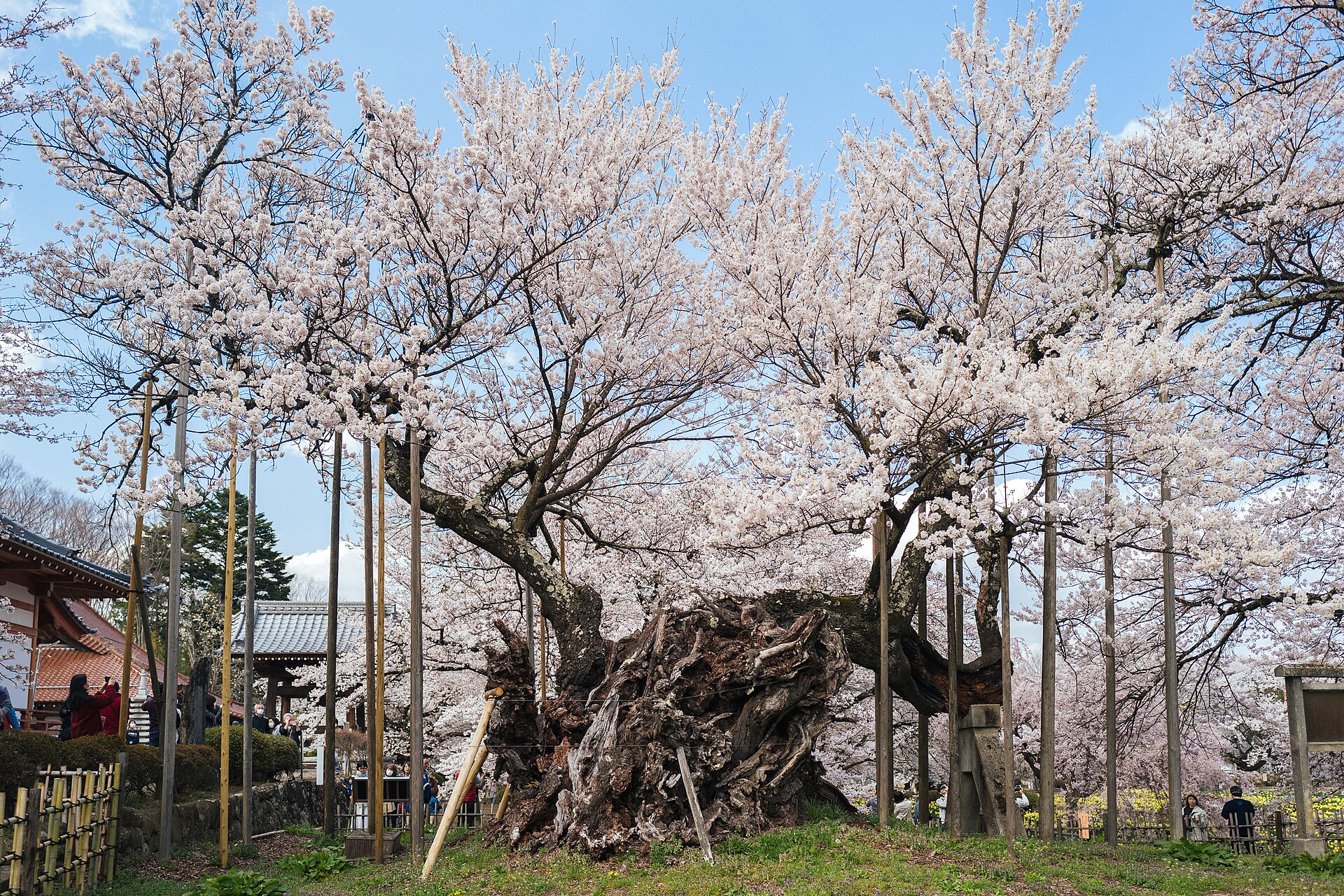
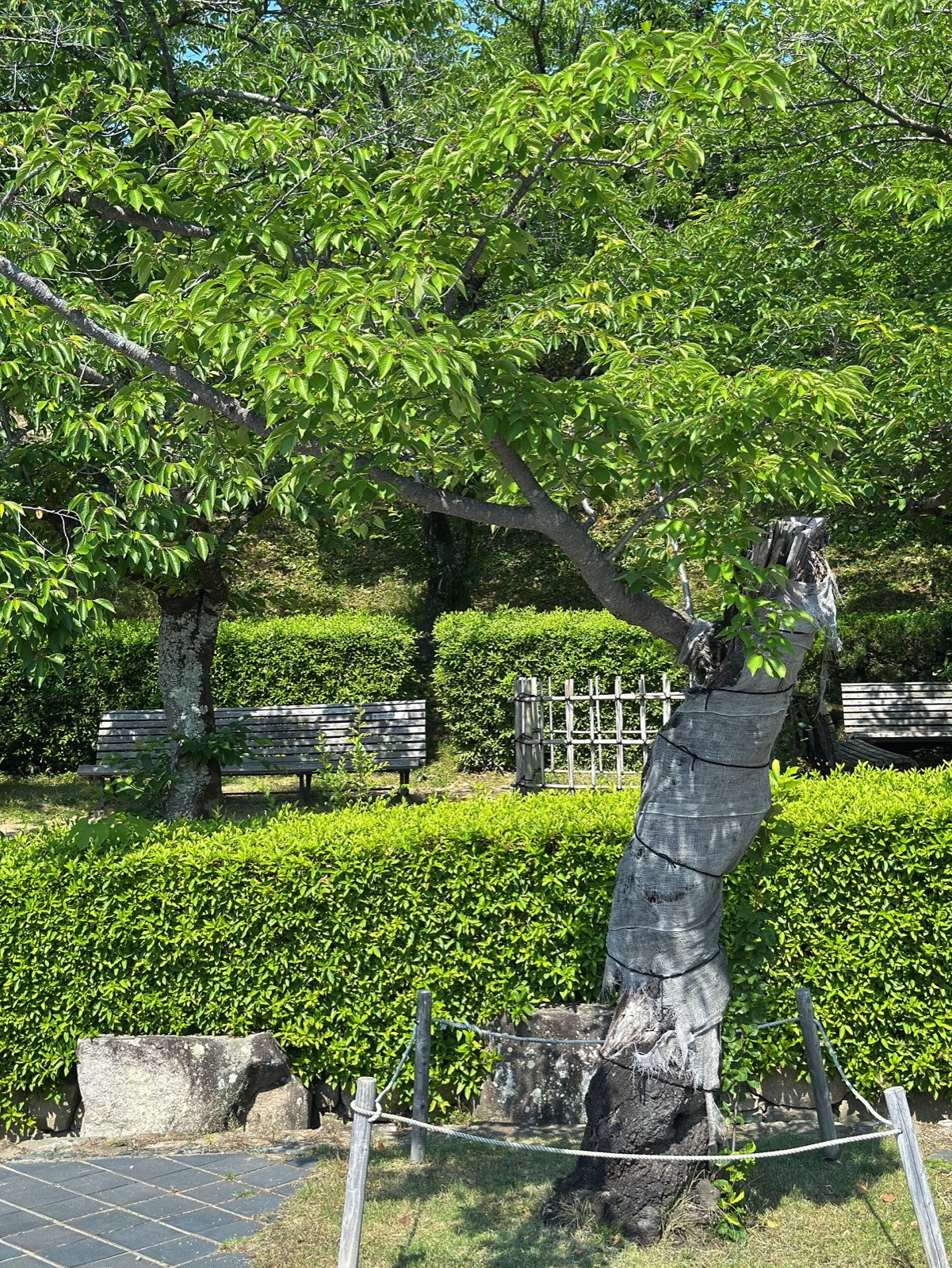
Walk through the gate of Jissō-ji in early April and the first thing that stops you is not the blossom. It is the trunk. What should be one column of wood has opened into a heap of grey, twisted fragments, some standing, some leaning, much of it hollow. Out of this broken base rise the living limbs, propped on tall poles. The crown above is wide and white, and from a distance it looks like any old cherry in flower. Up close, you can see how much of it is being held up.
You do not get closer than a fence. A low barrier keeps visitors back from the root zone, and Hokuto City’s rules for the press say that photography and filming inside the protective fence are prohibited in principle. That fence, and the soil it protects, is the real subject of this story.
A national monument since 1922
The tree was designated a Natural Monument (天然記念物, tennen kinenbutsu) of Japan on 12 October 1922. The national register lists it as an ordinary natural monument, not a special one, and Cultural Heritage Online, the Agency for Cultural Affairs’ database, names Hokuto City as the body responsible for its care. Hokuto City describes it, together with the Usuzumi cherry of Neodani and the Miharu Takizakura, as one of “Japan’s three great cherries.” Kitamoto City lists it among five cherries designated in 1922 that are known together as the “five great cherries of Japan.” Both are popular names rather than legal ranks, but they show how early the tree was singled out.
In 1990, according to the temple, it was also chosen for the Shin Nihon Meiboku Hyakusen (新日本名木百選), a separate list of a hundred notable trees.
An Edohigan cherry
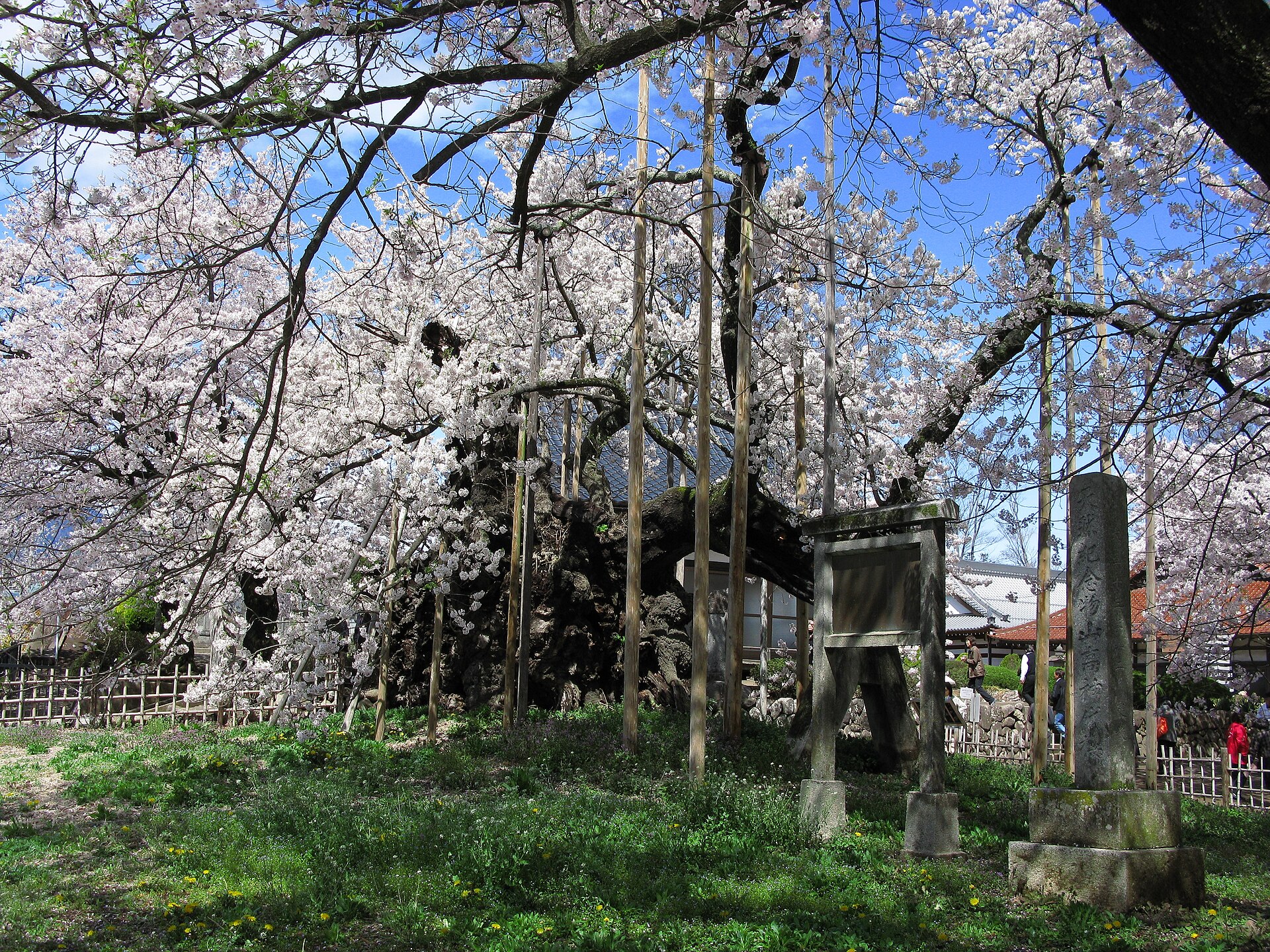
The species is Edohigan (エドヒガン), the wild cherry the temple names on its own site. The Forestry and Forest Products Research Institute lists Edohigan as Cerasus itosakura (Siebold) Masam. et Suzuki; older Japanese documents, including the historical description held by the Agency for Cultural Affairs, use different names. It is the same species as the Usuzumi cherry, and it is not the Somei-yoshino that lines Japan’s parks and rivers; Jissō-ji has around 30 of those as well, planted around the old tree.
The blossom brings the crowds in spring, but the care recorded by Hokuto City runs all year: watering and grass cutting in summer, protection of the roots in winter.
How Old Is the Jindai-zakura? — Legend, Estimate, Measurement
Two legends
Jissō-ji tells two stories about the tree. In the first, it was planted by Yamato Takeru (日本武尊), the legendary prince, during his campaign to the eastern provinces; the temple introduces this explicitly as legend. In the second, the Buddhist teacher Nichiren saw the tree weakening in the Kamakura period, prayed for its recovery, and the tree revived. The tree’s other name, Myōhō-zakura (妙法桜), is linked to that story.
Neither story is a planting record. They are part of the tree’s cultural history; they do not establish when it was planted.
What the official sources actually say
The sources that give an age all present it as an estimate. Yamanashi Prefecture’s tourism site says the estimated age “is said to be 1,800 years, or 2,000.” A 2005 Hokuto City article says the tree “is said to be” 1,800 years old. The temple also describes it as said to be 2,000 years old. None of these sources describes a method: no ring count, no radiocarbon date, no growth model, no named person who made the estimate.
For the Jindai-zakura, the honest description is “very old, traditionally said to be 1,800 or 2,000 years old.” The same question runs through Japan’s other famous old trees; we looked at it for Yakushima’s great cedar in How old is Jōmon Sugi, really?.
Why the measurements disagree
The tree’s size is just as hard to pin down. The sources report different figures, often without a measurement date or a consistent measuring position.
| Source | Height | Girth | Crown spread | Measured |
|---|---|---|---|---|
| Nihon Hana no Kai, figures at designation (1922) | 13.6 m (45 ft) | 10.6 m (35 ft) at 1.5 m height | 27.0 m E–W, 30.6 m N–S | At designation |
| Agency for Cultural Affairs, historical description | — | 3 jō 5 shaku at 5 shaku above ground | — | Not stated |
| Hokuto City article, 2005 | — | 12.78 m at the base | — | Not stated |
| Yamanashi Prefecture tourism site (data as of Dec 2024) | 10.3 m | 13.5 m around the roots | — | Not stated |
| Hokuto Tourism Association | — | 11.8 m | 17.3 m E–W, 13.0 m N–S | Not stated |
The published figures differ, but they do not form a consistent series from which change over time can be calculated. The girth figures in particular cannot be compared, because “at the base,” “around the roots” (nemawari, 根回り) and “at 1.5 m” are different places on a tree whose base is a broken ring of wood. The practical point for anyone managing an old tree is simple: record where and when you measured, or the number cannot be used later.
The Decline — Three Years to Live, a Typhoon, a “Serious” Verdict
1948: a sentence of death
The temple’s own chronology records that in 1948 the tree was declared likely to die “within three years.” The page does not say who made the diagnosis. The same year appears in the history of the Usuzumi cherry, which we traced in The Usuzumi cherry and its 238 root grafts, but the two trees took very different paths. At Neodani, the response was to graft new roots on. At Yamataka, the next decades brought a different kind of care.
1959: Typhoon No. 7
In August 1959, Typhoon No. 7 broke large limbs on the tree, according to the temple chronology.
1992: “serious”
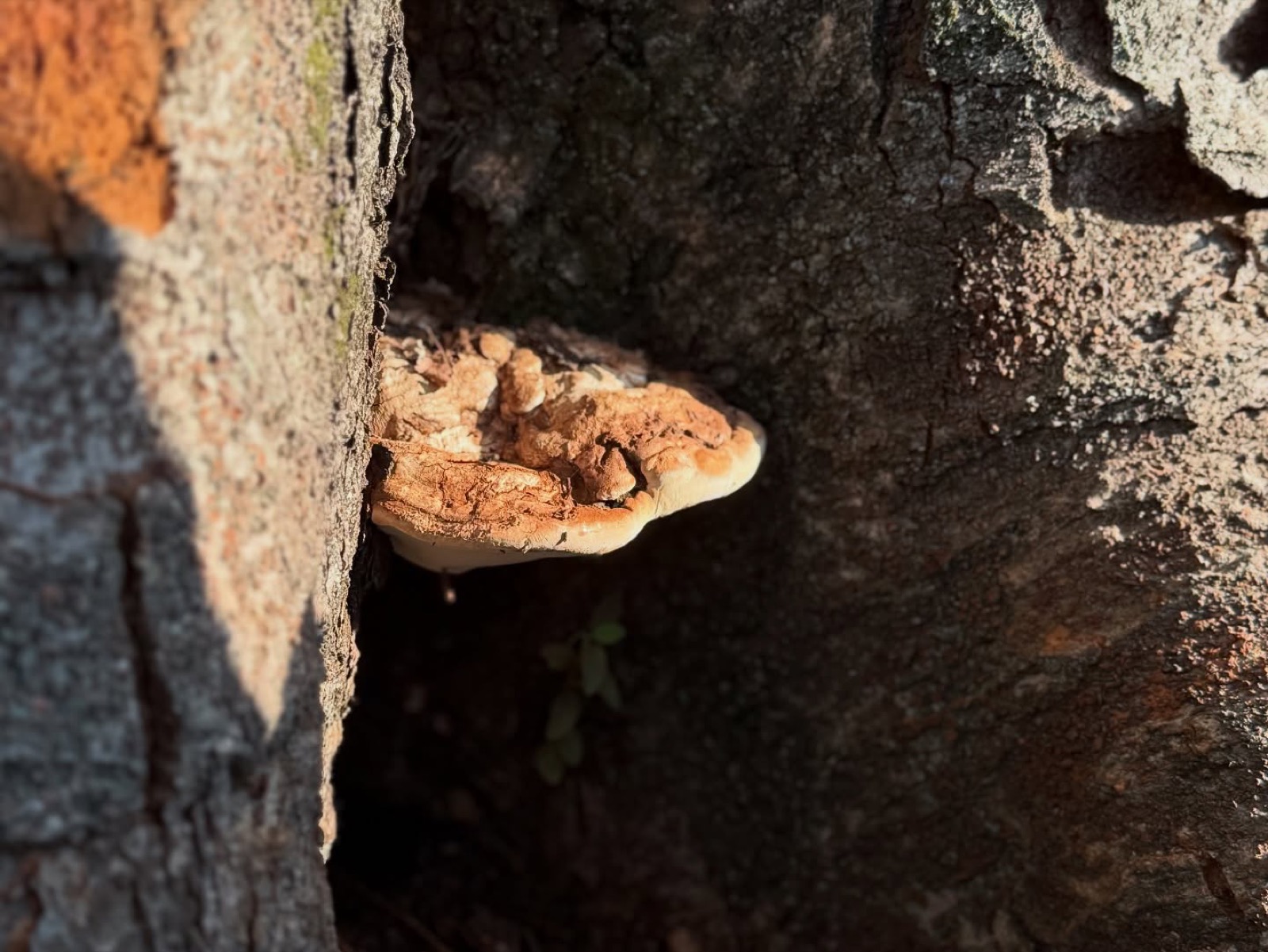
In September 1992, a tree doctor (jumoku-i, 樹木医) who examined the tree described its condition as “serious,” the temple records. Two years later, in June 1994, large dead limbs were removed and the decayed parts of the trunk were given “surgery” (外科手術). Yet the tree kept declining, and the investigation that followed pointed below ground.
Care That Hurt — Fill, Cleaning and a Roof
What the 2002 investigation found
In 2002 the board of education of what was then Mukawa village, now part of Hokuto City, asked Nihon Hana no Kai (日本花の会), a foundation that works on cherry conservation, to investigate why the tree was declining. The foundation later designed and supervised the restoration, so its reports come from a party to the work, but they are a detailed public account.
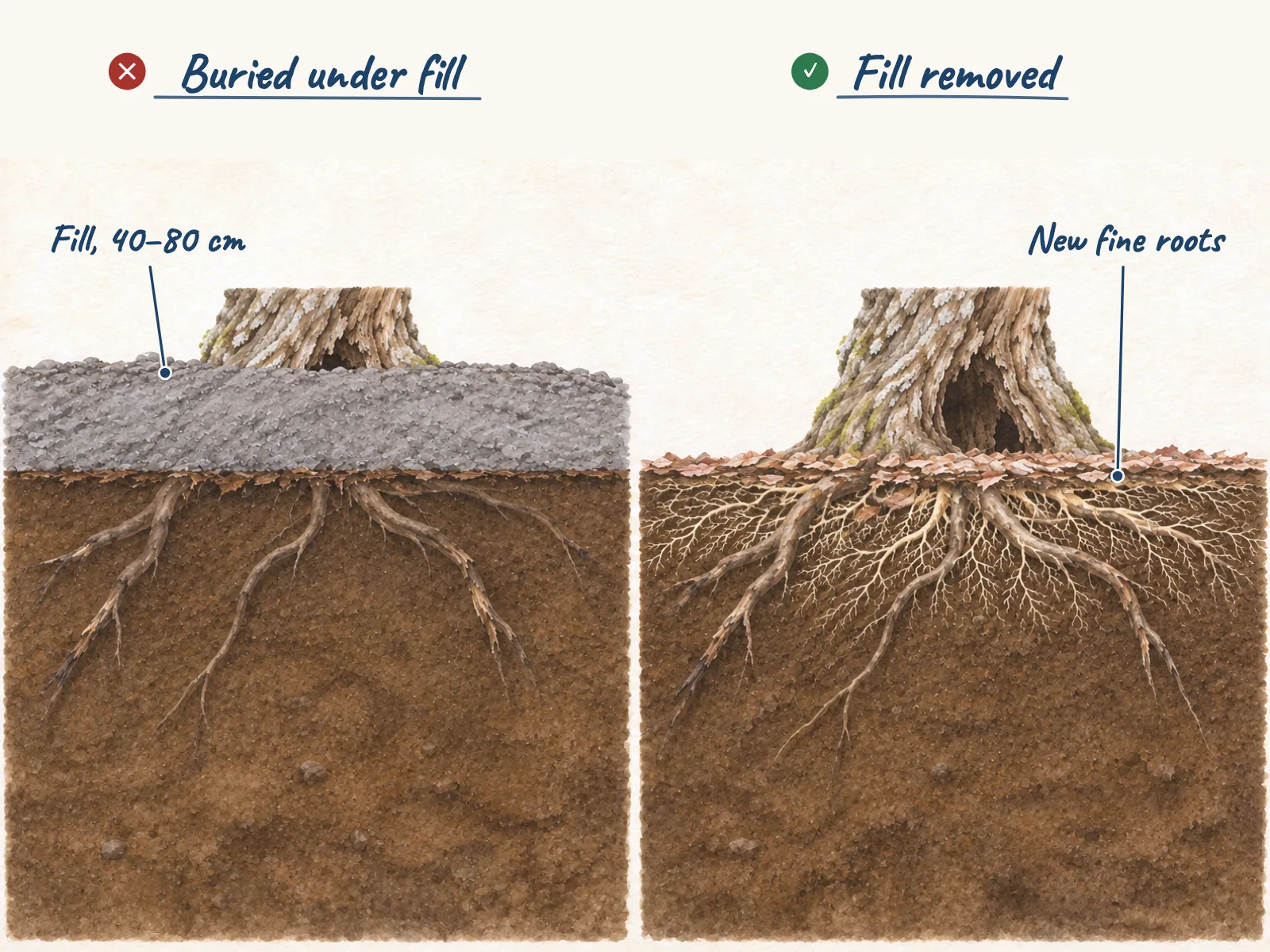
The investigation found that after designation the tree had been given a stone enclosure, and that soil had been piled up inside it on two occasions. The fill added in 1971 was 40 to 80 cm deep (about 16 to 31 inches). In the same year, the temple chronology records, the temple and the village board of education installed props and rebuilt the approach path.
How deep fill harms roots
The foundation’s explanation is a chain of causes. Years of visitors’ feet had already compacted the soil and weakened the roots. Thick fill on top of that left too little oxygen reaching the soil, and the roots weakened further and died back. Roots need air as well as water, and the fine roots that do most of the absorbing grow mainly in the upper layers of soil, where air can reach them; this is why a deep layer of new soil over an old root system is a well-known cause of decline.
The investigation also found root-knot nematode disease (ネコブセンチュウ病) on the roots in the fill layer. The report suggests, in hedged terms, that this “seems to be” the main cause of the poor leaf flush and the dieback of branches.
Two quieter causes
Two more findings concern upkeep and protection. First, the ground inside the enclosure had been kept clean, so almost no organic matter went back into the soil, and the soil supported little biological activity. Leaf litter is one of the main ways organic matter returns to the ground under a tree.
Second, the roof on a yagura (櫓) frame built over the trunk in 1984 had slowed the decay of the trunk by keeping rain off it. But it also kept the ground directly beneath dry, and in that dry soil the adventitious roots (不定根, futeikon), new roots that an old tree can form from its trunk, failed to develop.
| Measure | Year | What the investigation found |
|---|---|---|
| Stone enclosure, fill added inside | After 1922 | Fill buried roots already weakened by trampling |
| Fill of 1971, 40–80 cm | 1971 | Less oxygen to the roots; dieback; nematode disease in the fill layer |
| Roof over the trunk | 1984 | Slowed trunk decay, but the soil beneath stayed dry; adventitious roots did not develop |
| Keeping the enclosure clean | Ongoing | Little organic matter; low soil biological activity |
The investigation does not say that anyone acted carelessly. What it shows is how measures aimed at the visible tree affected the soil, slowly, over decades.
The Restoration, 2003–2006 — Replacing the Soil a Quarter at a Time
Who did the work
Hokuto City describes the large-scale restoration as running from fiscal 2002 to 2005; Nihon Hana no Kai records the start of works in February 2003, and the temple chronology records the end in March 2006, “four years” in all. The village board of education commissioned the design and supervision from Nihon Hana no Kai. The work on site was done by a local firm, 雲松園, with Kobayashi, a jumoku-i, in charge.
The method, step by step
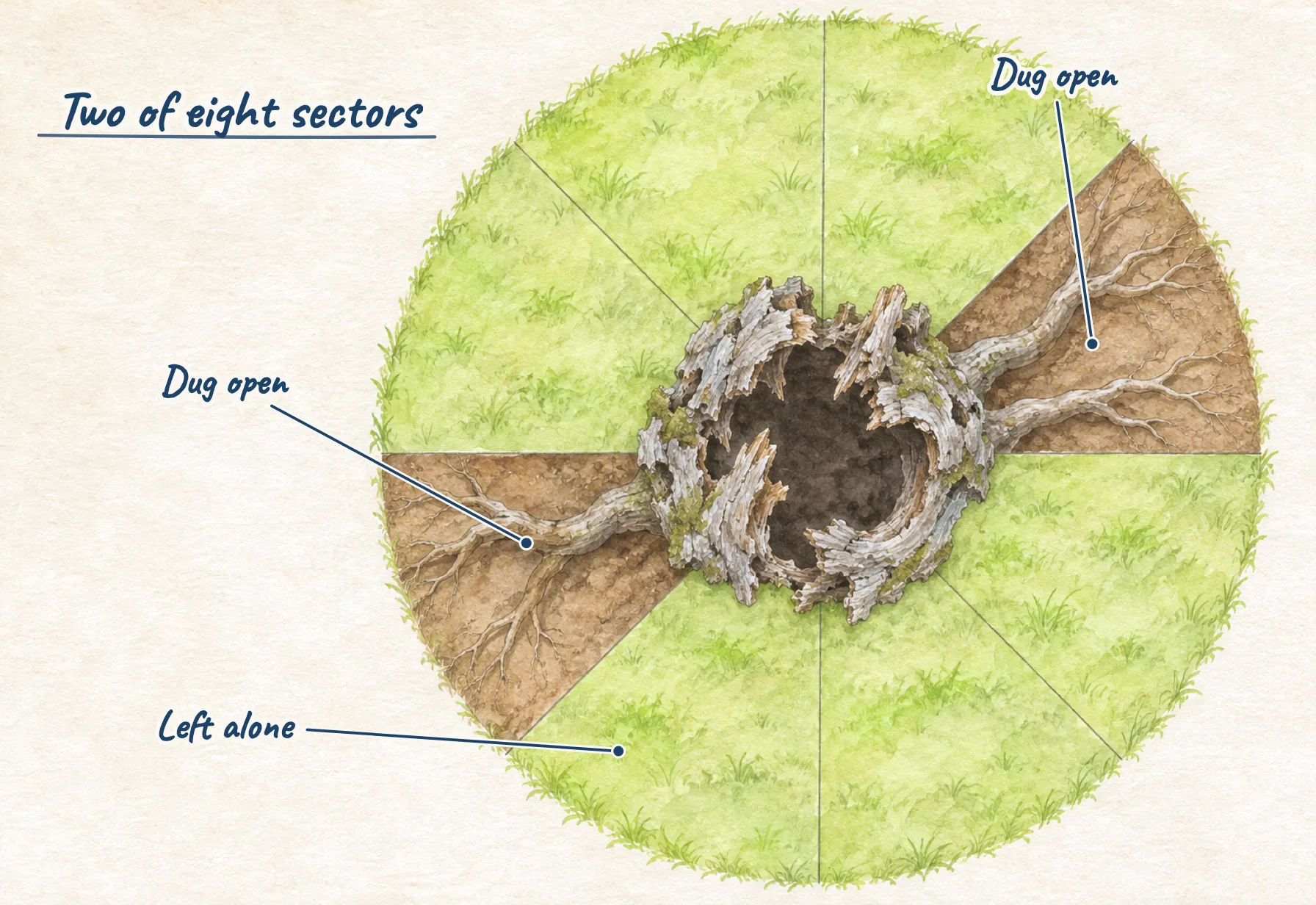
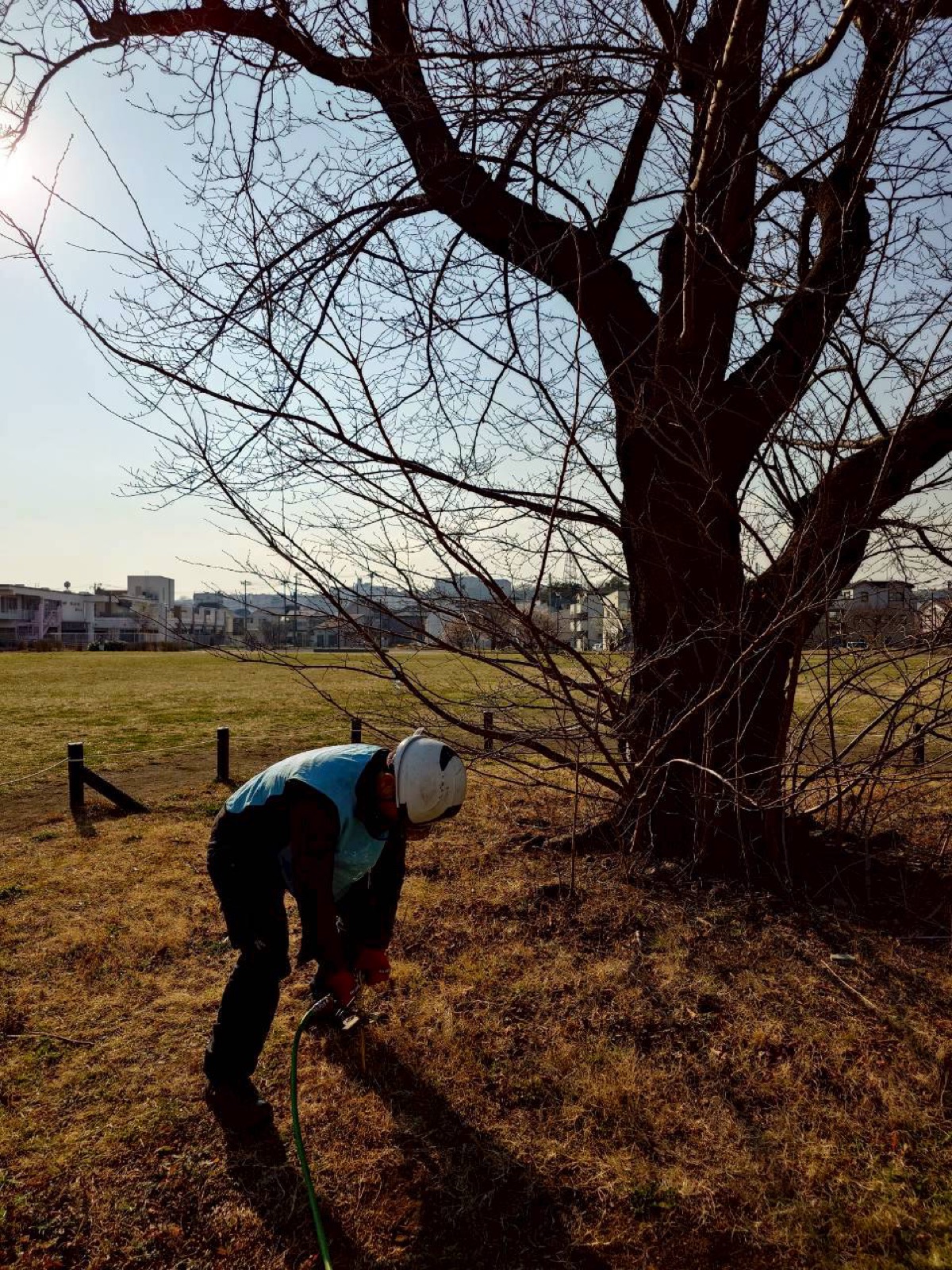
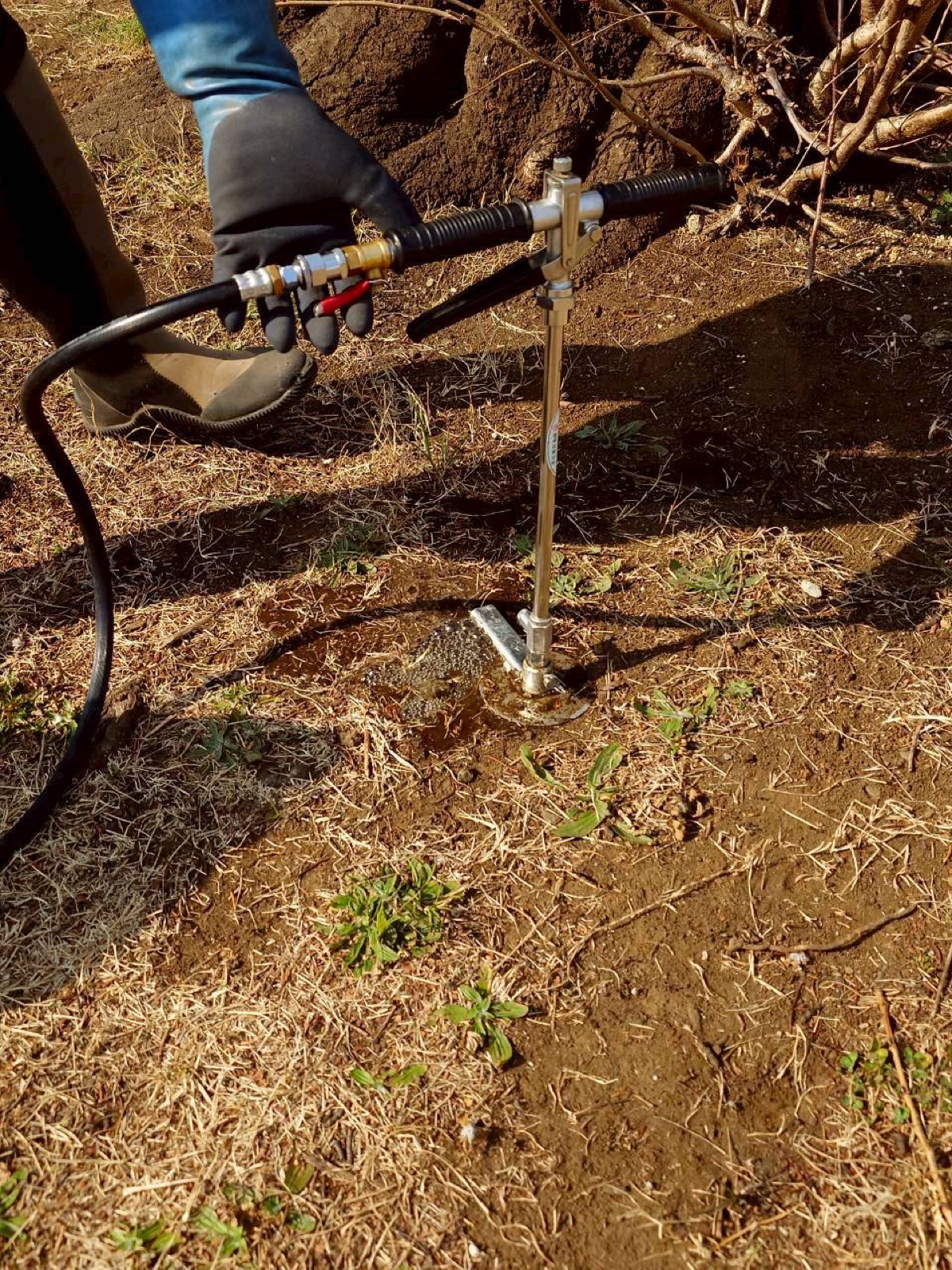
A technical lecture published in the journal Tree and Forest Health in 2017, which draws on Hokuto City’s 2006 works report, describes the method. The soil was never opened all around the tree at once. Each round worked on two opposite eighths of the root-zone area, a quarter in total, and the improvement was spread over four years.
| Step | What was done |
|---|---|
| 1. Excavation | Soil dug out with the help of compressed air |
| 2. Root care | Exposed roots protected during the work |
| 3. Backfill | Red soil mixed with soil amendments put back |
| 4. Top dressing | A growing medium rich in nutrients and beneficial microorganisms spread on the surface |
| 5. Next sectors | Two more opposite eighths in the next round, until the whole root zone had been treated over four years |
Working in stages meant that in any one round most of the root zone was left undisturbed, still supplying the tree while one quarter was opened. The top dressing answered one of the investigation’s findings directly: the surface soil, which had received little organic matter for years, was given a biologically richer layer.
Taking away the roof, moving the road
The roof came off during the works; the temple chronology gives the date both as 2003 and as 2004, so the year is uncertain. On the south side, an old village road ran close to the tree. A detour was built so that the root zone could be left alone, according to Hokuto City’s 2005 article, which records the work but not the year it was finished.
The documented work centred on soil improvement, followed by continuing care and monitoring.
Did It Work? — What Came Back, What Did Not
2004: the lower crown recovers
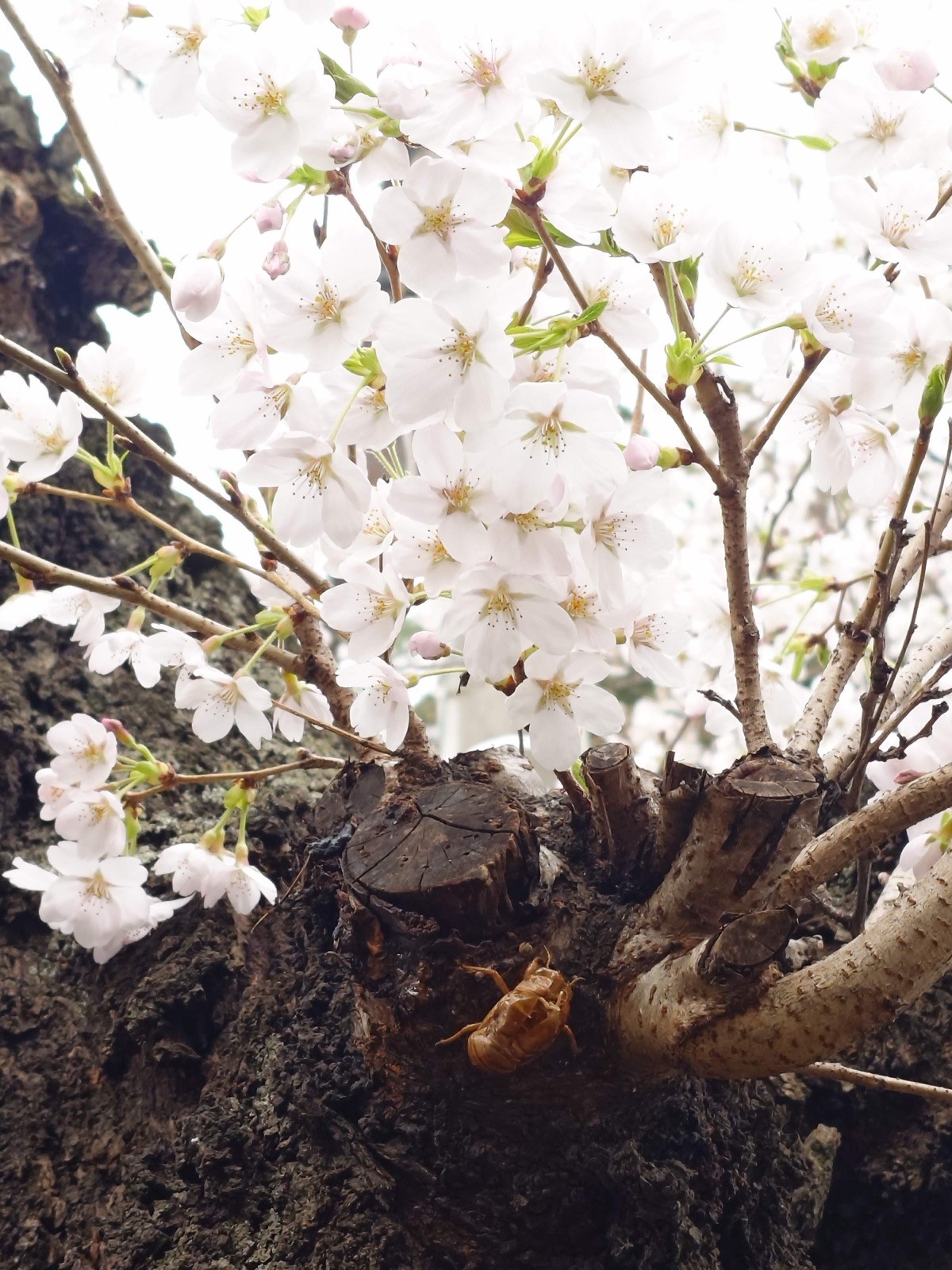
By June 2004, Nihon Hana no Kai reported, the lower branches and leaves had recovered, but the dieback of upper branches had not stopped. New shoot growth was reported to be about twice that of the year before, though the report does not say how many shoots were measured or how. The person reporting “felt” there were more flowers. These are cautious notes: a partial recovery, with little detail on method, written down.
2007: healthy roots in the new soil
In 2007 Wada Hiroyuki (和田博幸) reported in the magazine Green Age that healthy roots of the Jindai-zakura were growing into the improved soil, and that the symptoms of root rot and root-knot nematode disease were being held down. The same report records a warning sign. Rhizomorphs, the bootlace-like strands of honey fungus (ナラタケ, Armillaria), were found in the soil, and mycelium and fruiting bodies developed on zelkova stakes pushed into the ground as a test. The report raised the concern that the tree might be infected by Armillaria root rot in the future. That is a record of risk in the soil, not a diagnosis of the tree.
What has not gone away
Hokuto City’s preservation committee papers are frank. Root surveys in fiscal 2011 and 2012 confirmed that root-knot nematode disease had come back. In fiscal 2019, the committee secretariat reported that decay and collapse of the main trunk were progressing. Hokuto City’s newsletter of March 2025 lists the decay of old limbs and the recurrence of nematode disease as continuing problems.
So the restoration did not make the tree young. The records describe a root system growing again, around a trunk that is still decaying.
The Care Today — Committee, Props, Water and Snow
A committee with a national inspector at the table
The tree’s care is overseen through a committee convened by Hokuto City. The minutes for fiscal 2015 list Wada Hiroyuki as coordinator, and record attendance by an inspector from the Agency for Cultural Affairs, Yamanashi Prefecture’s cultural properties division and the prefectural forest research institute. In fiscal 2020 the Agency’s list of subsidies included a grant of 2,358,000 yen to Hokuto City for “regeneration of a natural monument.” That is a single year’s grant, not the cost of the 2000s works, whose total has not been published in the sources we checked.
Props, snow, roots
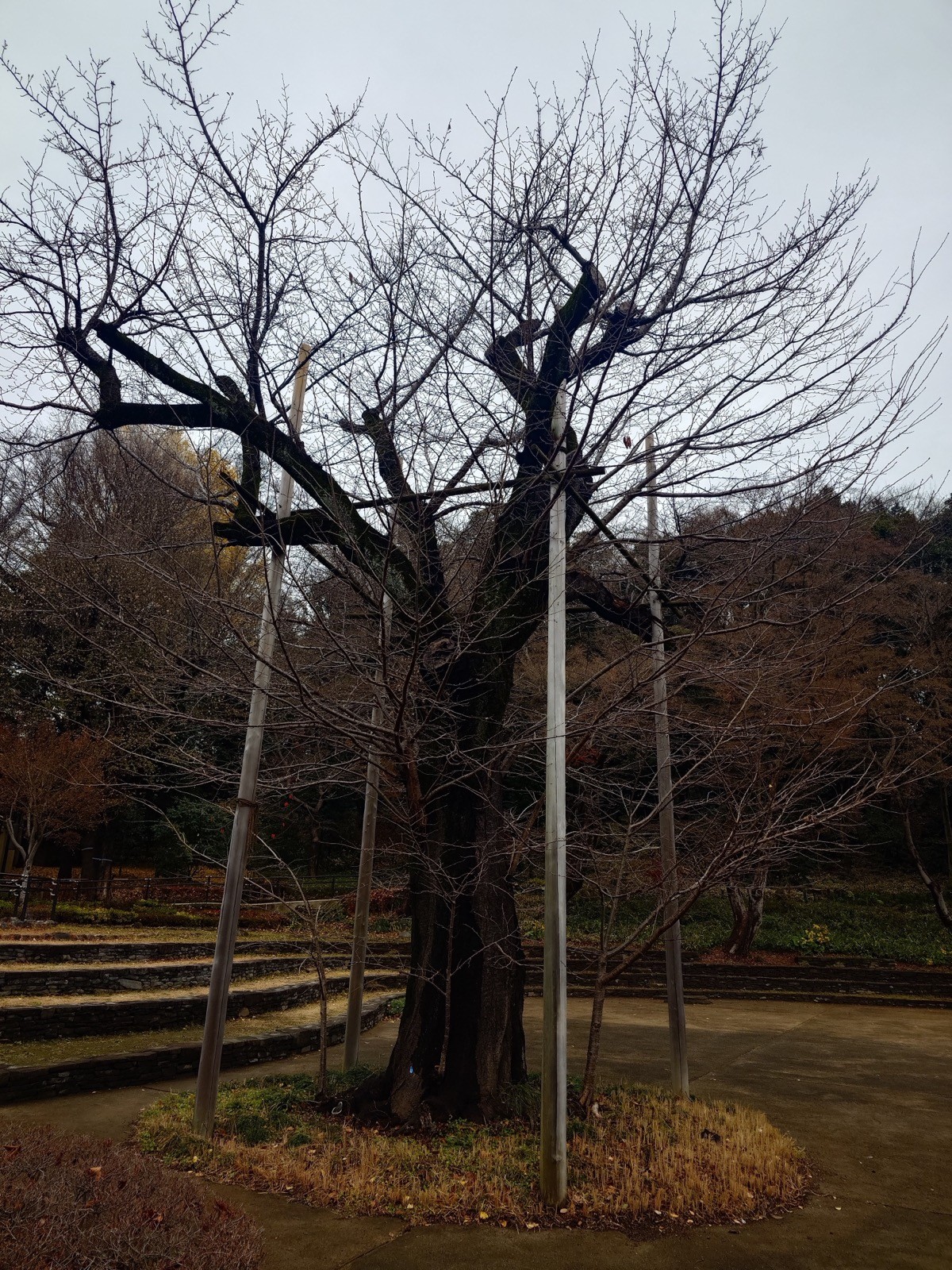
In fiscal 2014, the committee papers record, work was done on the snow-rope (yukitsuri, 雪吊り) supports on the east side, which let ropes carry part of the weight of snow on the limbs. The same year, the committee checked how adventitious roots were developing, and at its next meeting it reported on callus formation. At its fiscal 2015 meeting it went one step further and proposed treating the tree with a commercial rooting agent, Oxyberon, at 1,000-fold and 500-fold dilution. The minutes record this as a proposal; they do not say it was carried out.
Adventitious roots are also what the split-bamboo method used on some old temple trees sets out to encourage; we explain it in Why old temple trees in Japan have bamboo tubes in their roots. The records we checked for the Jindai-zakura do not say whether that method was used here, so we do not claim it.
The everyday work
According to Hokuto City’s newsletter of March 2025, Jissō-ji and the Jindai-zakura preservation society continue to water the tree and cut the grass in summer, and to protect the roots in winter. A survey in 2020 found that adventitious roots had become established and that the number of medium-sized roots had increased, and the city reports that the tree is producing more flowers, although it does not give a count. The 2025 newsletter also announced further surveys planned for fiscal 2025; their results were not yet public in the sources we checked.
| Year | Event or treatment |
|---|---|
| 1922 | Designated a Natural Monument (12 October) |
| 1948 | Declared likely to die “within three years” |
| 1959 | Typhoon No. 7 breaks large limbs (August) |
| 1971 | Props installed, approach rebuilt; fill 40–80 cm deep around the roots |
| 1984 | Roof built over the trunk |
| 1992 | Condition judged “serious” by a jumoku-i (September) |
| 1994 | Dead limbs removed; surgery on decayed parts (June) |
| 2002 | Investigation into the causes of decline |
| 2003–2006 | Soil restoration, a quarter of the root-zone area at a time; roof removed |
| FY2011–2012 | Root surveys find nematode disease has returned |
| FY2014 | Snow-rope supports on the east side; adventitious roots checked |
| FY2019 | Committee reports trunk decay progressing |
| 2020 | Adventitious roots established; more medium-sized roots |
Keeping the Genes — Seedlings, Space Seeds and Grafted Clones
Young trees sent near, far
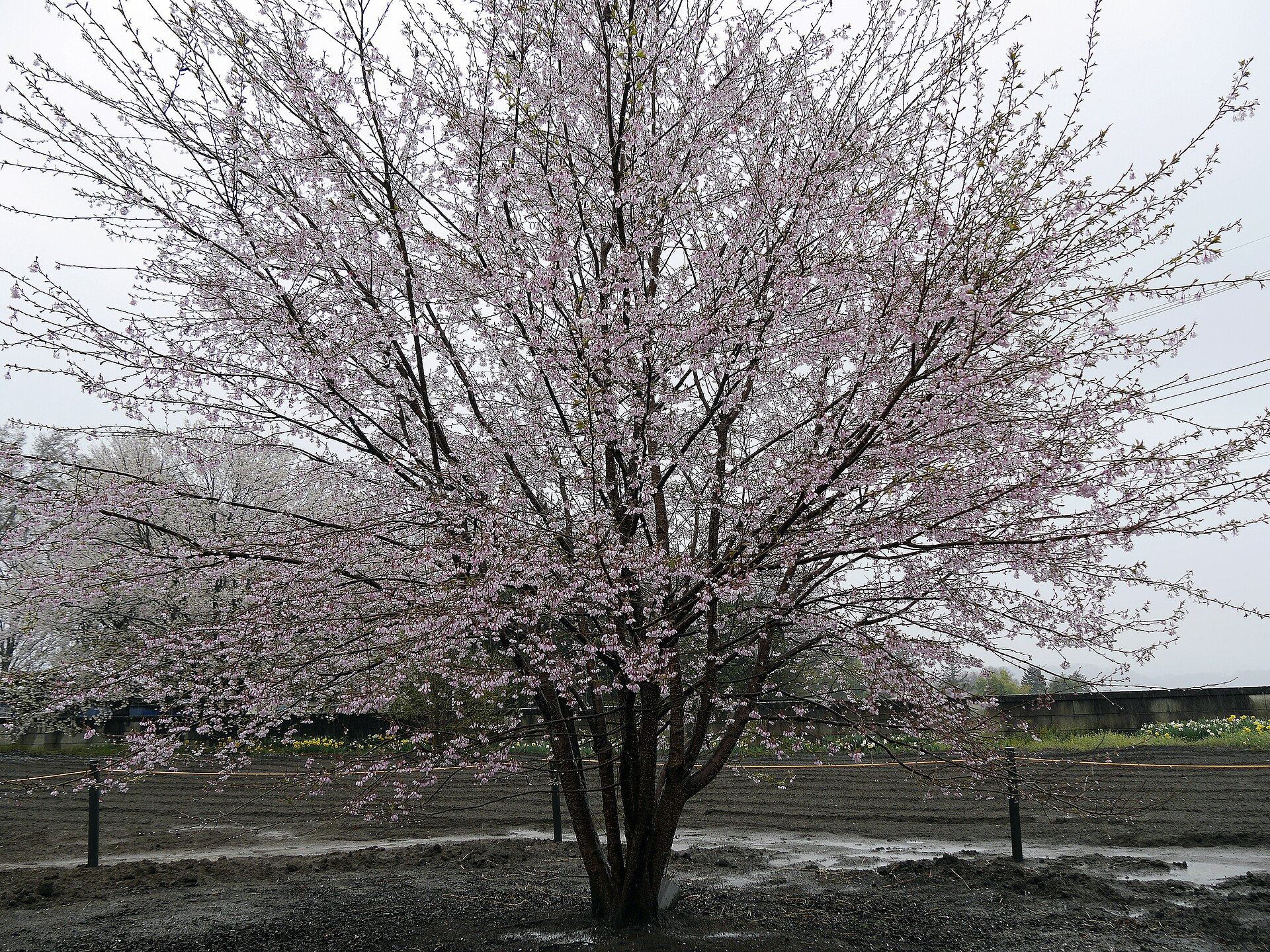
The temple has given young trees grown from the Jindai-zakura’s seed to the recovery group Oraga Ōtsuchi Yume Hiroba (おらが大槌夢広場) in Ōtsuchi, Iwate, following an exchange in 2012. It also reports that young trees of the Jindai-zakura have been presented abroad, through events marking ties with countries including Hungary, Austria, Poland and Taiwan; it does not say how those were propagated.
The “space” Jindai-zakura
Seeds of the tree have also been to space and back. According to the temple, pupils at the local Mukawa junior high school sowed them, two germinated, and one was planted in the temple grounds, where it has flowered.
Why a seedling is not a copy
Separate from the old tree’s own recovery, there is a second line of care: keeping its genes. A seedling is a child of the tree, not the tree itself. It combines genes from the old tree, the seed parent, with genes from whichever cherry supplied the pollen, so its genes are a new mix. A graft is different: a piece of the old tree’s shoot, the scion, is joined to a young rootstock, and everything that grows from the scion carries the old tree’s genes, while the roots belong to the rootstock.
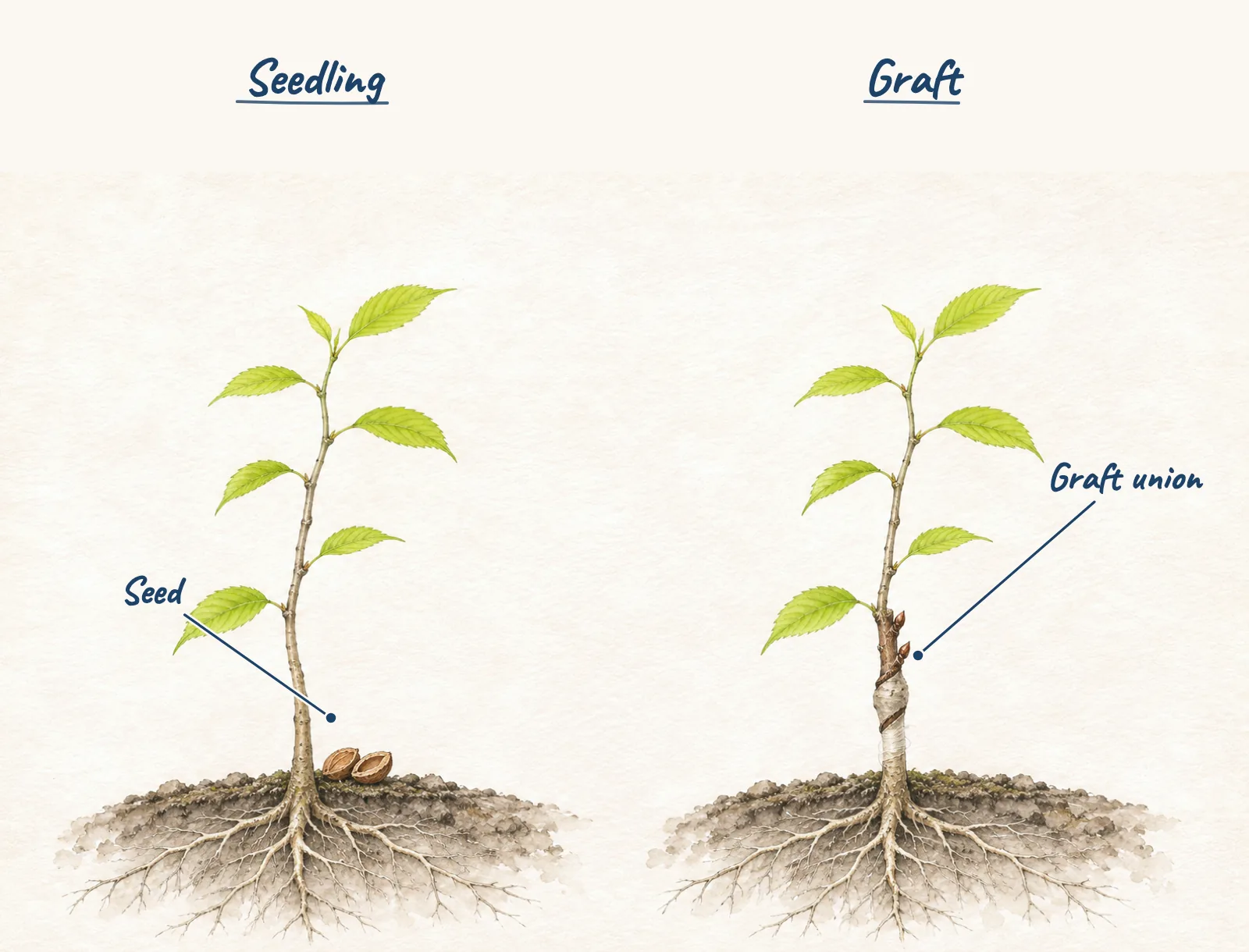
Yamanashi Prefecture’s Forest Research Institute took the grafting route. Because so little material can be taken from a monument, it used branches cut in pruning as scions, and grew rootstocks from seed. Its report of December 2019 records that two grafted young trees had been raised. Where they are now is not stated in the report.
Children of other great cherries
Jissō-ji also grows the children of other famous cherries: a young tree from the Miharu Takizakura, received in 2000, and one from the Usuzumi cherry, planted in April 1999. Near the gate, on the right, is a young tree from the weeping cherry of Kuonji, planted in April 1977. The temple garden brings together the Jindai-zakura itself and young trees descended from the other two great cherries. (Our article on the Miharu Takizakura tells the story of that tree.)
What the Jindai-zakura Teaches About Old Trees
Look under the tree
Read as a whole, the record of this tree is about the ground. The measures that were most visible, the enclosure, the raised soil, the clean ground, the roof, were the ones the 2002 investigation linked to its decline; the recovery came from reversing them: taking the fill away, feeding the soil, letting rain back in, keeping people off.
Recorded care
The other thread is the record itself. The restoration was done in stages, over four years. The people who did it wrote down what they found, including the parts that did not improve, and committee records from 2014, 2015 and 2019 show the roots being checked again. (Why Japan’s old trees can last so long in the first place is the subject of Why do Japan’s ancient trees live for a thousand years?)
Visiting the Jindai-zakura — Season, Fence, Manners
When it flowers
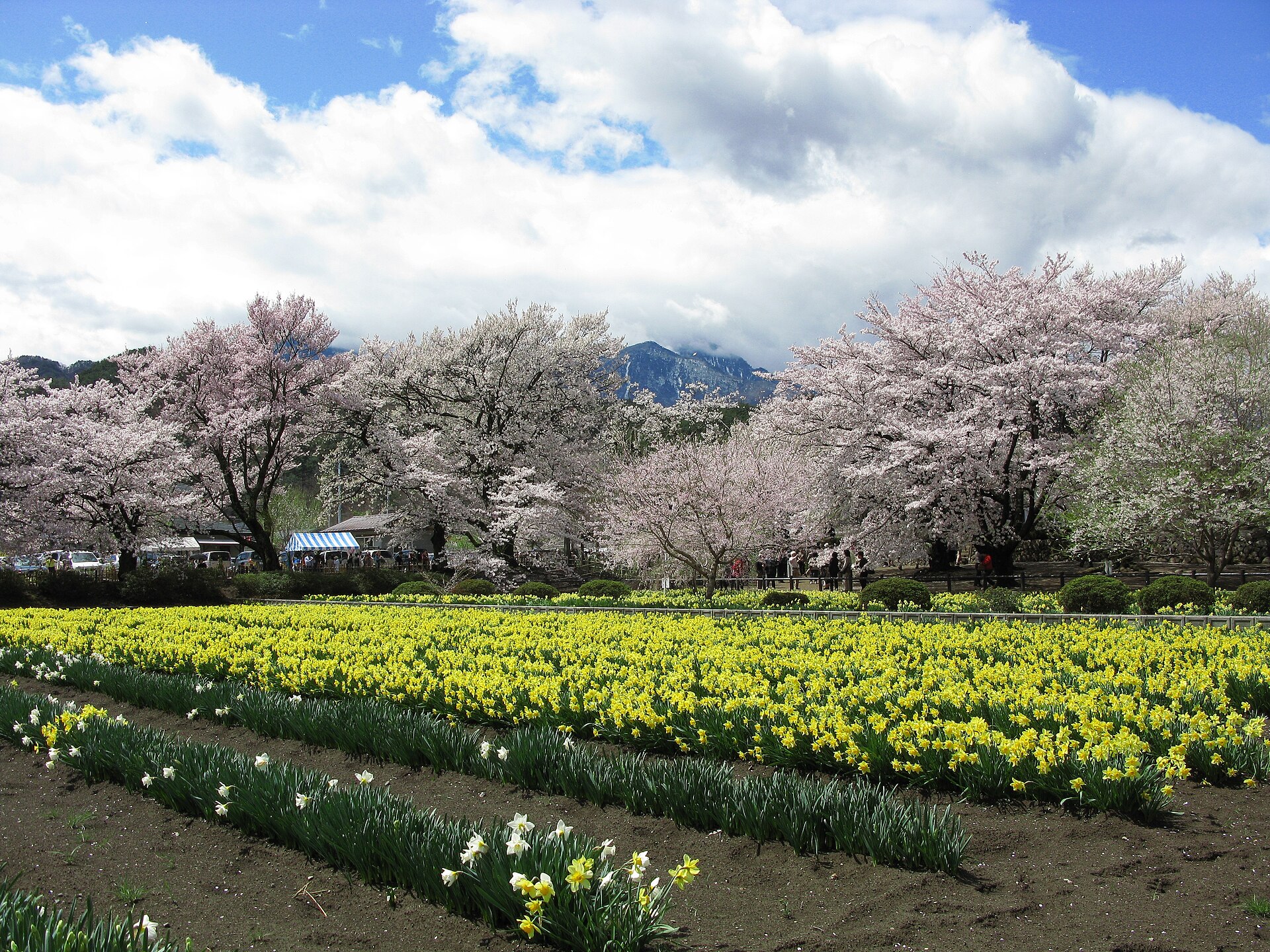
Yamanashi Prefecture gives the usual best time as late March to early April; the temple says early April in an average year, earlier or later with the weather. Around the same time, according to the Hokuto Tourism Association, some 80,000 daffodils flower in the temple grounds, along with the Somei-yoshino.
Getting there, what it costs
Jissō-ji is at 2763 Yamataka, Mukawa-chō, Hokuto, Yamanashi. There is no parking in the grounds; temporary parking opens nearby during the blossom season. The temple says the grounds can be visited by wheelchair. Since 2025 the temple has charged admission during the flowering period only; for spring 2026, the announced fees were 500 yen for general visitors, 300 yen for residents of Hokuto, and free for junior high school pupils and younger.
Stay outside the fence
Visitors view the tree from outside the fence. The 2002 investigation named trampling as one of the factors in the tree’s decline, and the roots that have grown back since 2006 are in the ground the fence protects.
Frequently asked questions
How old is the Yamataka Jindai-zakura?
It is said to be 1,800 or 2,000 years old. Both are presented as estimates; none of the sources we checked gives a method such as a ring count or radiocarbon date. The temple presents the story that Yamato Takeru planted it as legend.
Why was the tree dying?
A 2002 investigation found that roots already weakened by trampling had been buried under fill, including 40 to 80 cm added in 1971, which reduced the oxygen reaching them. Root-knot nematode disease in the fill layer, low biological activity in soil that received little organic matter, and a roof that dried the soil below it added to the damage.
How was it saved?
Between 2003 and 2006 the soil around the tree was dug out with the help of compressed air, a quarter of the root-zone area at a time, and replaced with red soil mixed with amendments, topped with a soil rich in nutrients and microbes. The roof was removed, and a detour was built for an old road on the south side to keep traffic off the roots.
Is the Jindai-zakura healthy now?
Surveys have recorded partial recovery, not a cure. A 2020 survey found new adventitious roots established and more medium-sized roots, and Hokuto City reports more flowers. Trunk decay and the return of root-knot nematode disease remain problems.
Are there young trees grown from the Jindai-zakura?
Yes. The temple has given seed-grown young trees to a recovery group in Ōtsuchi, Iwate, reports young trees presented abroad, and a tree grown from seeds flown to space grows in the temple grounds. Yamanashi Prefecture’s Forest Research Institute has also raised two grafted trees from pruned branches, carrying the old tree’s genes above the graft.
When is the best time to see it?
Usually late March to early April. Admission is charged during the flowering period, and visitors view the tree from outside the protective fence.
Sources
– Agency for Cultural Affairs, national register of cultural properties, 山高神代ザクラ — https://kunishitei.bunka.go.jp/heritage/detail/401/1094 (checked 2026-11-06) – Agency for Cultural Affairs, Cultural Heritage Online, 山高神代ザクラ — https://online.bunka.go.jp/heritages/detail/138467 (checked 2026-11-06) – Hokuto City, cultural properties: 山高神代ザクラ (2005 article; press rules) — https://www.city.hokuto.yamanashi.jp/docs/1578.html (checked 2026-11-06) – Hokuto City, Kōhō Hokuto, March 2025, p. 26 — https://www.city.hokuto.yamanashi.jp/fs/4/3/4/5/5/7/_/__2025.3_____.pdf (checked 2026-11-06) – Hokuto City, preservation committee minutes, FY2015 — https://www.city.hokuto.yamanashi.jp/fs/2/6/3/7/1/4/_/H27-01jindaigiji.pdf (checked 2026-11-06) – Hokuto City, preservation committee minutes, FY2019 — https://www.city.hokuto.yamanashi.jp/fs/2/6/3/7/1/5/_/______1_________.pdf (checked 2026-11-06) – Hokuto City, location information — https://www.city.hokuto.yamanashi.jp/fc/location/22452.html (checked 2026-11-06) – Jissō-ji temple, official site: home, the tree, chronology, precincts, FAQ — https://www.jindaizakura.com/ ; https://www.jindaizakura.com/jindaizakura/ ; https://www.jindaizakura.com/jindai-history/ ; https://www.jindaizakura.com/precincts/ ; https://www.jindaizakura.com/contact/ (checked 2026-11-06) – Jissō-ji temple, admission notice for spring 2026 (拝観料についてのお知らせ) — https://www.jindaizakura.com/news/%E6%8B%9D%E8%A6%B3%E6%96%99%E3%81%AB%E3%81%A4%E3%81%84%E3%81%A6%E3%81%AE%E3%81%8A%E7%9F%A5%E3%82%89%E3%81%9B%EF%BC%88%E4%BB%A4%E5%92%8C8%E5%B9%B4-%E6%98%A5%EF%BC%89/ (checked 2026-11-06) – Nihon Hana no Kai (日本花の会), the Jindai-zakura: decline, investigation, restoration works — https://www.hananokai.or.jp/sakura/sakura-area/sakura-care-info1/ ; https://www.hananokai.or.jp/sakura/sakura-area/sakura-care-info1/2/ ; https://www.hananokai.or.jp/sakura/sakura-area/sakura-care-info1/3/ (checked 2026-11-06) – 川九邦雄, 技術講座第3回:樹木治療における土壌の診断と土壌改良, Tree and Forest Health (樹木医学研究) 21(3), pp. 153–160, 2017 — https://www.jstage.jst.go.jp/article/treeforesthealth/21/3/21_153/_pdf (checked 2026-11-06) – 和田博幸, サクラの材質腐朽病害の診断と治療, Green Age, April 2007, Japan Greenery Research and Development Center — https://www.jpgreen.or.jp/greenage/archive/jyusei/200704_02wada.pdf (checked 2026-11-06) – 和田博幸, 国指定天然記念物 山高神代ザクラの樹勢回復, Tree and Forest Health 28(1), pp. 32–37, 2024 (table of contents) — https://www.jstage.jst.go.jp/browse/treeforesthealth/28/1/_contents/-char/ja (checked 2026-11-06) – Agency for Cultural Affairs, subsidies granted FY2020 — https://www.bunka.go.jp/seisaku/bunkazai/joseishien/hojo/r02_kofu/pdf/92270401_19.pdf (checked 2026-11-06) – Yamanashi Prefectural Forest Research Institute, Fukyū Tsūshin No. 62, p. 2, December 2019 — https://www.pref.yamanashi.jp/documents/60896/fukyutusin62.pdf (checked 2026-11-06) – Forestry and Forest Products Research Institute, Kyushu Research Center, Edohigan — https://www.ffpri.go.jp/kys/business/jumokuen/jumoku/zukan/edohigan.html (checked 2026-11-06) – Yamanashi Prefecture official tourism site, 山高神代桜 — https://www.yamanashi-kankou.jp/kankou/spot/p1_4256.html (checked 2026-11-06) – Hokuto Tourism Association, 山高神代桜 — https://www.hokuto-kanko.jp/spot/sakura_jindai/ (checked 2026-11-06) – Kitamoto City, the five great cherries of Japan — https://www.city.kitamoto.lg.jp/shisei/gaiyo/1/1418095931078.html (checked 2026-11-06)