

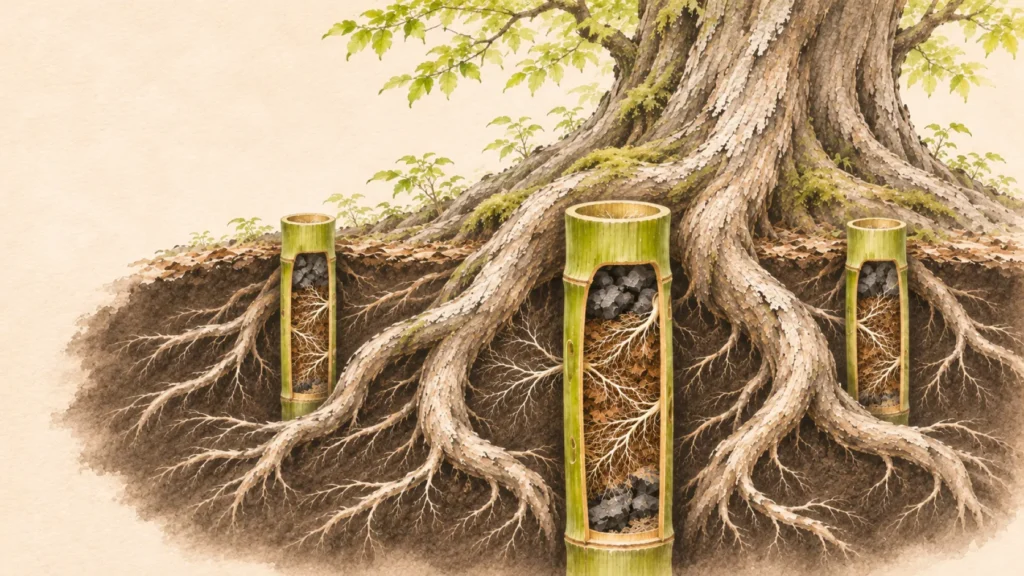
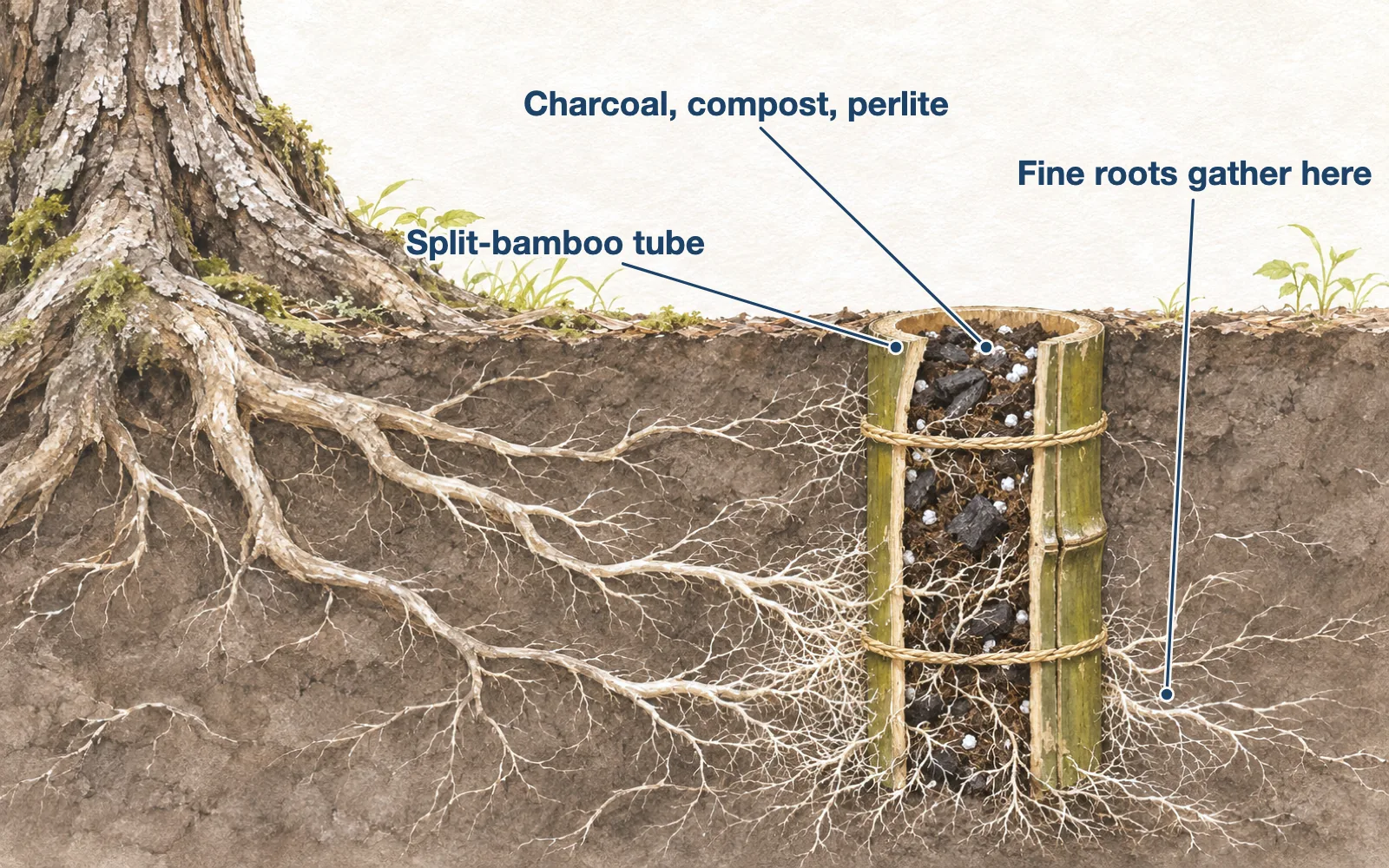
The bamboo tubes you see sunk into the ground around old temple and shrine trees in Japan are a soil treatment called warichiku sōnyū-hō (割竹挿入法), the split-bamboo insertion method. Their job is to open packed soil in the root zone to air and water and to give roots pockets of better soil to grow into. It is a Japanese cousin of what Western arborists call vertical mulching.
A Ring of Bamboo in the Gravel — What You Are Looking At
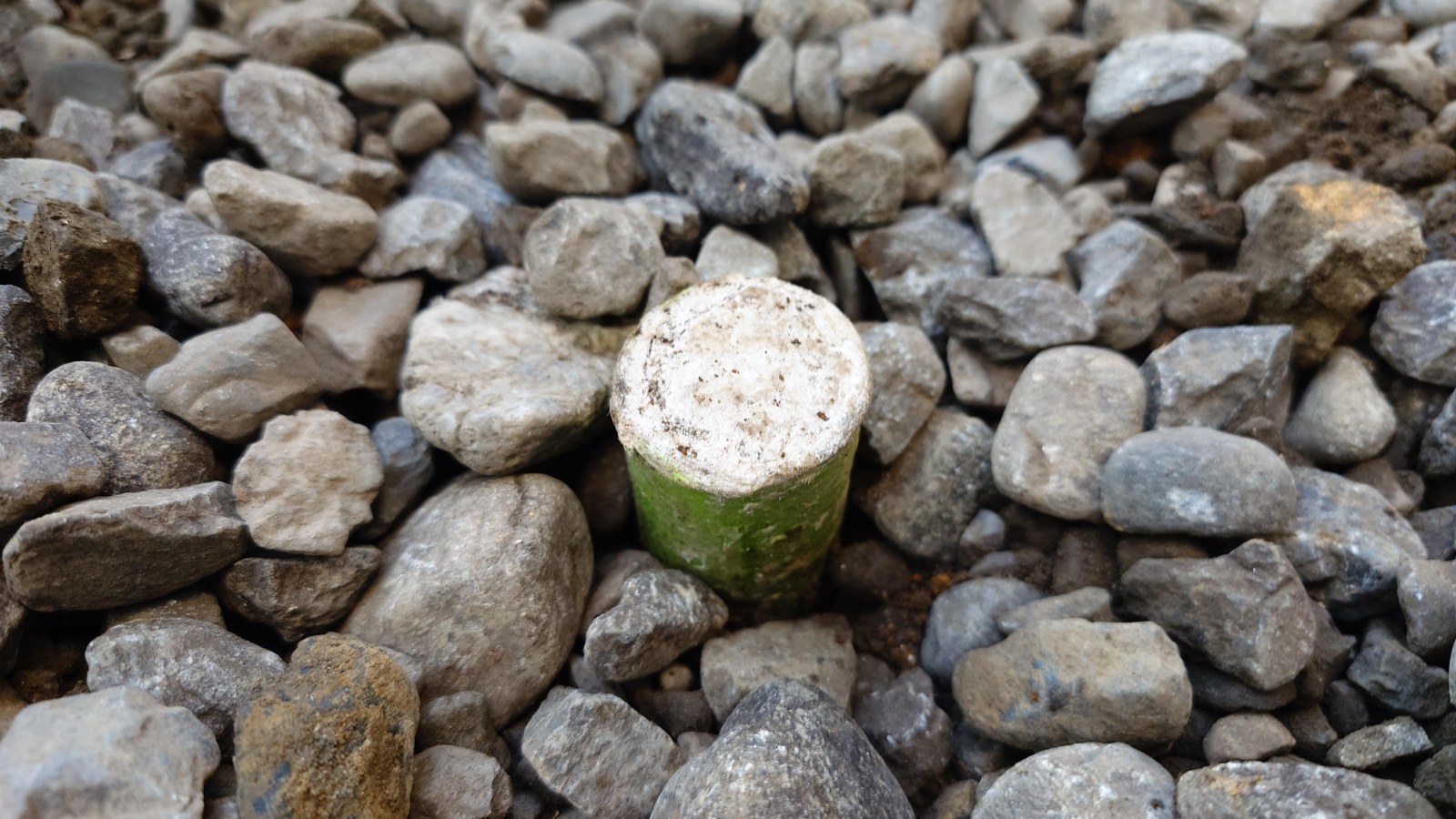
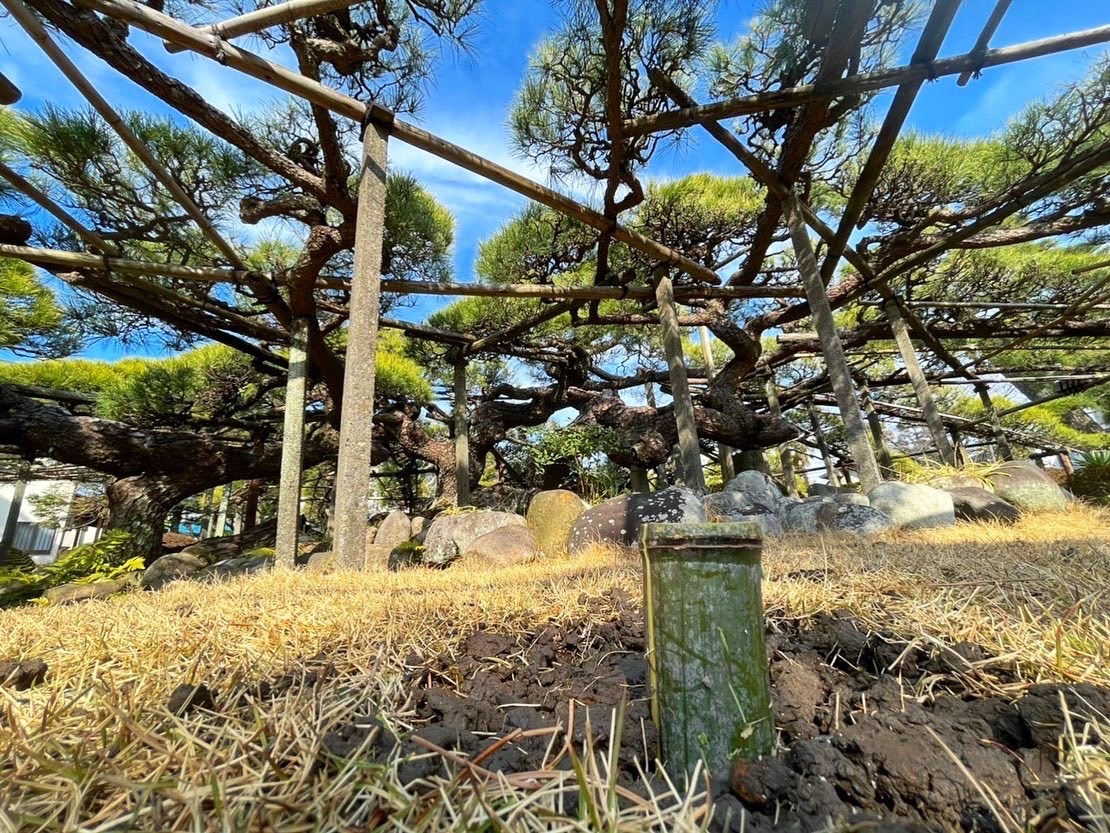
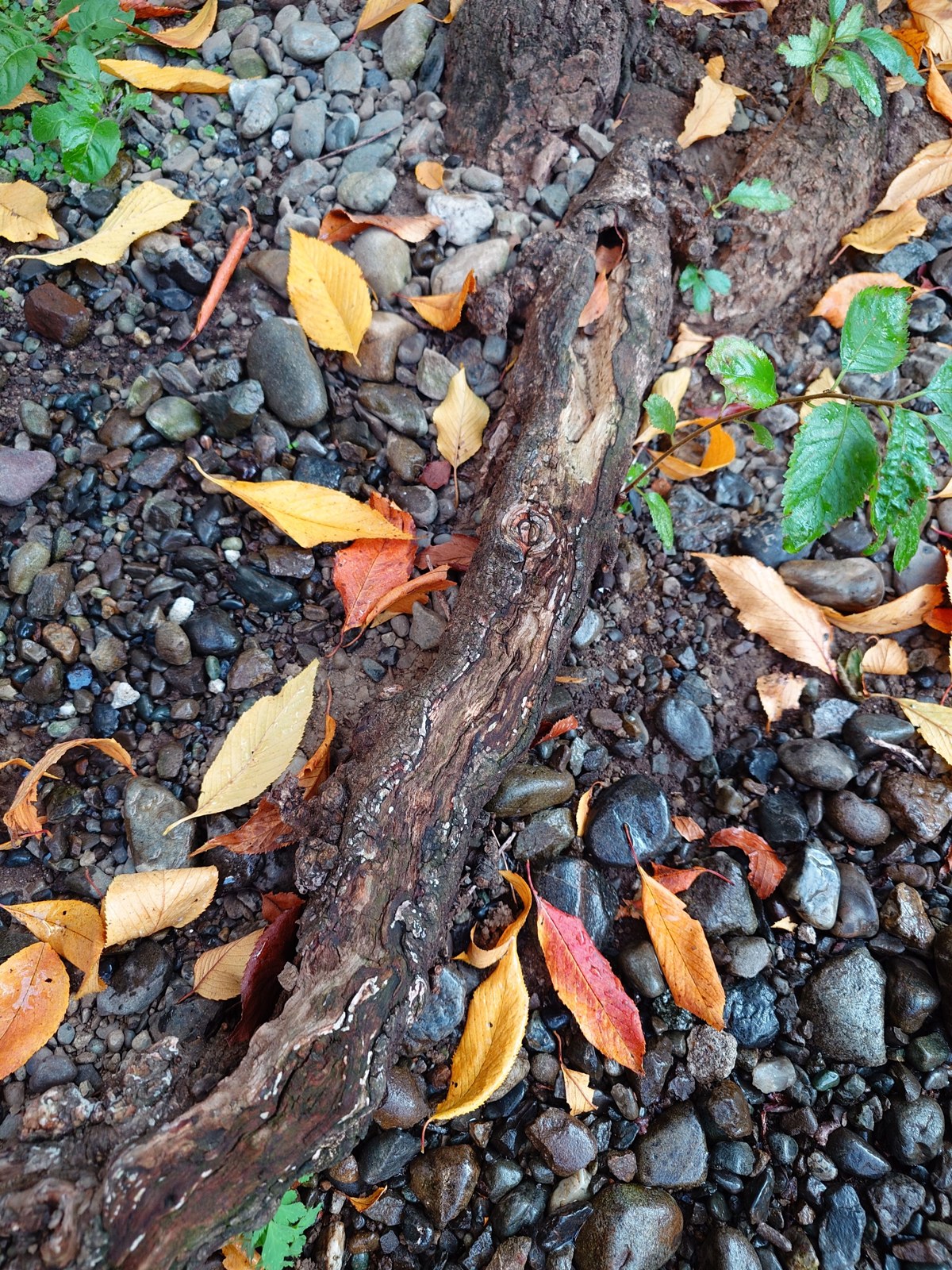
Walk into the grounds of an older temple in Japan in late autumn and the first things you notice are the obvious ones: a great pine propped on wooden crutches, or a weeping cherry dropping yellow leaves onto raked gravel. Look down, though, and you may see something odd. Here and there in the gravel, or in the moss and dry grass under the branches, a green or straw-coloured ring of bamboo sits flush with the ground. Sometimes there are several of them, scattered in a loose pattern well out from the trunk. Sometimes the tops are filled with something white, or covered with a scrap of hemp cloth.
They are not plumbing or survey markers, although one Japanese bulletin notes that crews also water through the bamboo holes in summer. Each ring is the top of a tube, and the tube goes down into the soil where the tree’s roots are, or where somebody hopes they will be. Below, we follow them from the gravel down: who first thought of them, how they are made and installed, and what Japanese site reports and Western research can and cannot tell us.
Why it matters to the people who look after the tree
At Toshi Landscape we install these tubes on jobs in and around Tokyo; the photographs in this article are from our own work. An old tree in a temple or shrine may be a shinboku (神木), a sacred tree, or a designated natural monument. That limits what soil work is acceptable. You cannot strip a courtyard of its gravel, dig through the roots of an old pine and start again. You work through small openings, a few at a time, and leave something in place.
The Problem Under an Old Tree — Packed Soil That Roots Cannot Use
What trampling does
The soil around a famous tree is often the most walked-on soil in the whole site. Worshippers gather at the trunk, festivals set up stalls under the crown, and maintenance vehicles park in the shade. Year after year the surface is pressed down until the pore spaces that once held air and drained water are crushed out. Roots need oxygen to grow and to take up water; in hard, airless soil, fine roots struggle to extend.
The Japanese sources we reviewed treat this as a problem of cause first. The Japan Greening Center’s teaching material on restoring the vigour of landscape trees puts the emphasis on finding out what is weakening the tree before treating it. Soil work is one of several answers, not a cure-all. Sometimes the right first step is simply to stop the trampling: a record from the Hyogo Branch of the Japan Tree Doctors Association describes laying slatted wooden walkways over a mountain path through an old cedar stand to keep feet off the root zone.
Why you cannot just dig it up
The obvious fix for packed soil is to dig it over and add organic matter. Under an old tree, that destroys the roots you are trying to help. The Japanese and Western sources we consulted are all cautious here. The American standard for soil management, ANSI A300 Part 2 (2018), recommends against mechanical tilling inside a tree’s critical root zone, and lists methods that “minimize root damage” for working amendments into soil around existing trees. The split-bamboo method belongs to the same family: open a series of small vertical holes, change the soil in and around each one, and leave the rest of the root zone undisturbed.
Where the Idea Came From — A Schoolyard, an Orchard, a Group of Tree Doctors
Hori Taisai’s account
The person most associated with the method is Hori Taisai (堀大才), a Japanese tree-health specialist whose account of how he came to it is published by the Jumoku Seitai Kenkyūkai (樹木生態研究会, roughly “tree ecology study group”). He writes that the idea came to him after seeing unprocessed bamboo poles pushed into the ground at the base of young trees at Nirasaki Elementary School in Yamanashi Prefecture. He connected that with the takotsubo (蛸壺, “octopus pot”) method used in fruit orchards, in which pockets of improved soil are buried in the root zone, and worked out the split-bamboo version from there.
From a private garden to the classroom
Hori writes that he asked colleagues in the study group to try it at a private house, and that he went on to propose it at many sites. He also had students of the Kankyō Ryokuchi (環境緑地学科, environmental greening) course at Tokyo University of Agriculture install it during practical classes, which helped spread it into the profession.
What his recollection does not give is a date. It does not say which year the first tubes went in, and Hori himself is unsure which tree was first: he says he thinks it was a crape myrtle. We have not found a primary source that fixes the year, so we do not give one. Today the method appears in Japanese technical writing under several names. A 2017 technical lecture in the journal Tree and Forest Health by Kawaku Kunio calls it warichiku sōnyū tateana-shiki dojō kairyō-hō (割竹挿入縦穴式土壌改良法), roughly “split-bamboo insertion, vertical-hole soil improvement”.
Making a Warichiku Tube — Split, Clear, Fill, Tie
The basic steps
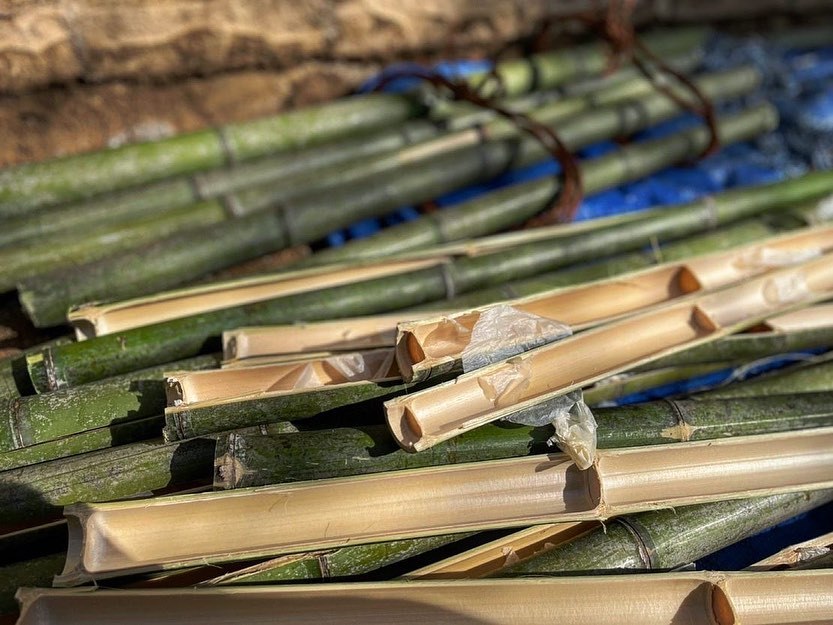
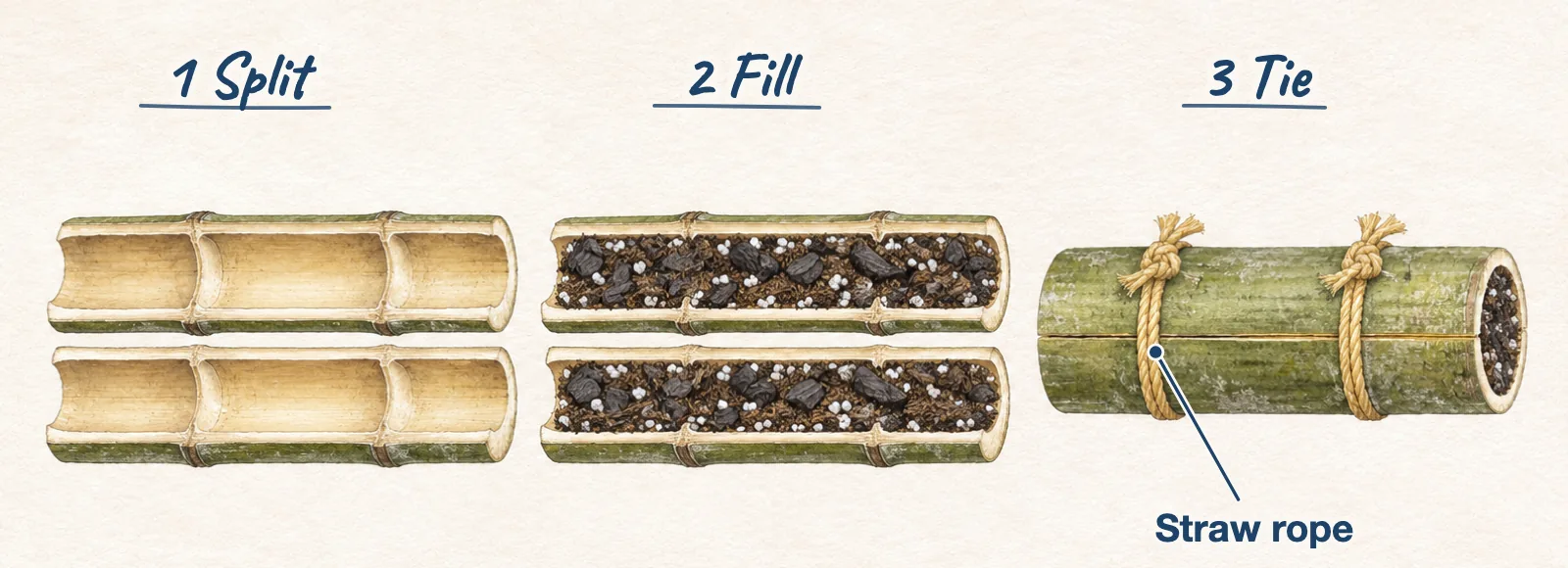
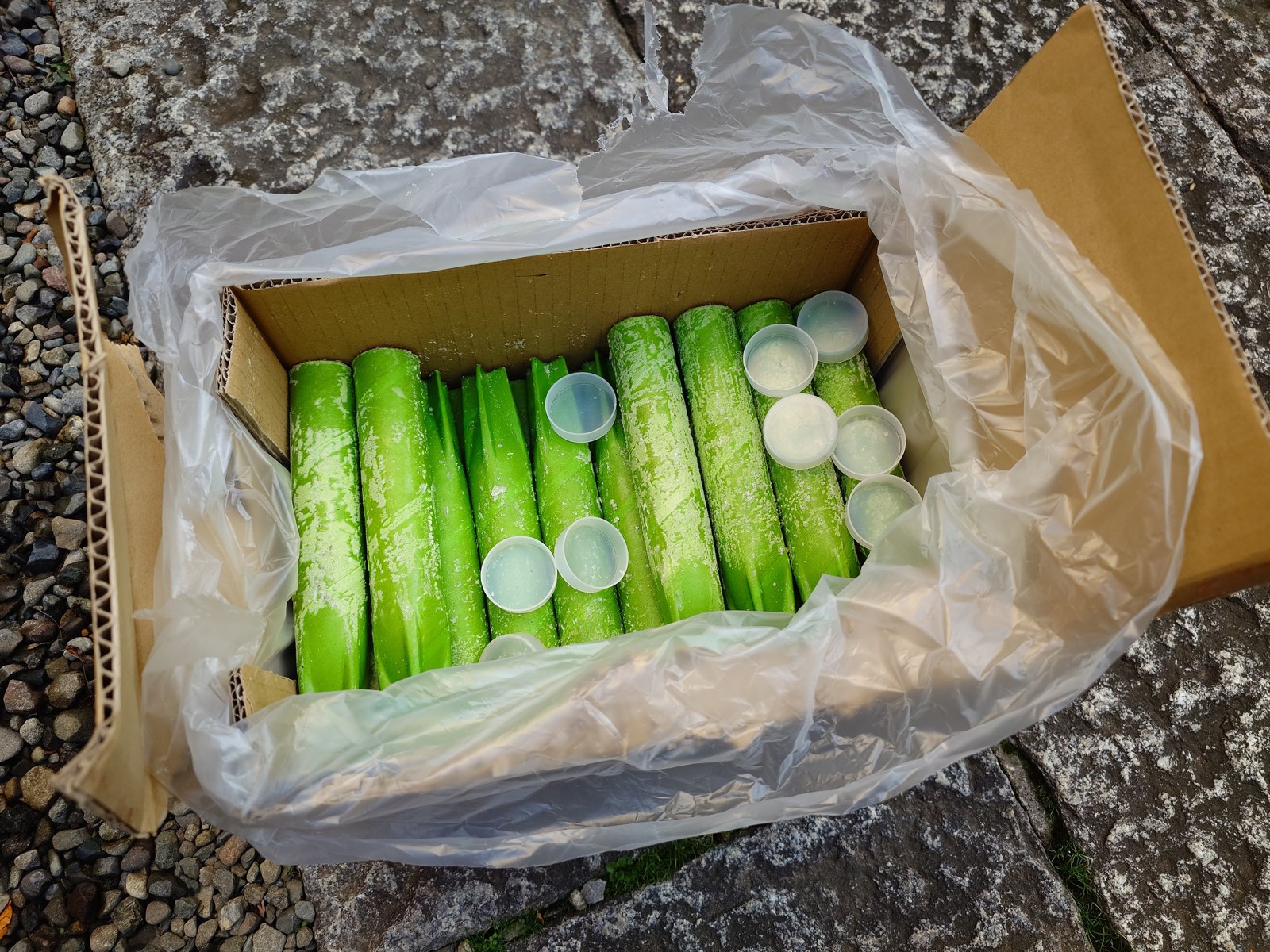
The method’s name describes the tube. Wari means split and chiku (or take) means bamboo. Hori describes splitting a length of bamboo lengthwise, removing the nodes (the solid partitions inside a bamboo culm), tying the halves back together with cord and pushing the resulting pipe into a vertical hole.
Practitioners add their own details. A Japan Biotope Association technical bulletin by Naoki (2020) has the nodes removed except the lowest one. One tree-doctor practice, Jumokui Jinbe, publishes a specification that cuts the bamboo to about 0.6–1 m (2–3.3 ft), splits it, knocks out the nodes and drills holes, then either chars it or “de-oils” it before use, and ties it back into a tube with hemp-palm (shuro) or hemp rope.
Sizes reported from real jobs
There is no single national specification. The numbers below come from individual documents and sites, and they are not interchangeable.
| Source | Bamboo | Hole | Fill | Notes |
|---|---|---|---|---|
| Naoki, Japan Biotope Association (2020) | Split, nodes removed except the lowest | 15–20 cm (6–8 in) across, about 1 m (3.3 ft) deep | Well-matured compost around the tube | Do not put compost down as far as a layer where water collects |
| Toyoda, Kimori No. 30 (2021), Furubira, Hokkaido | Ready-processed sarashidake bamboo 5–6 cm (2–2.4 in) across, 60 cm (24 in) long, split in two, nodes removed | 15–20 cm (6–8 in) across, about 60 cm (24 in) deep | Matured compost, charcoal, site soil around the tube | Earth auger plus a post-hole digger |
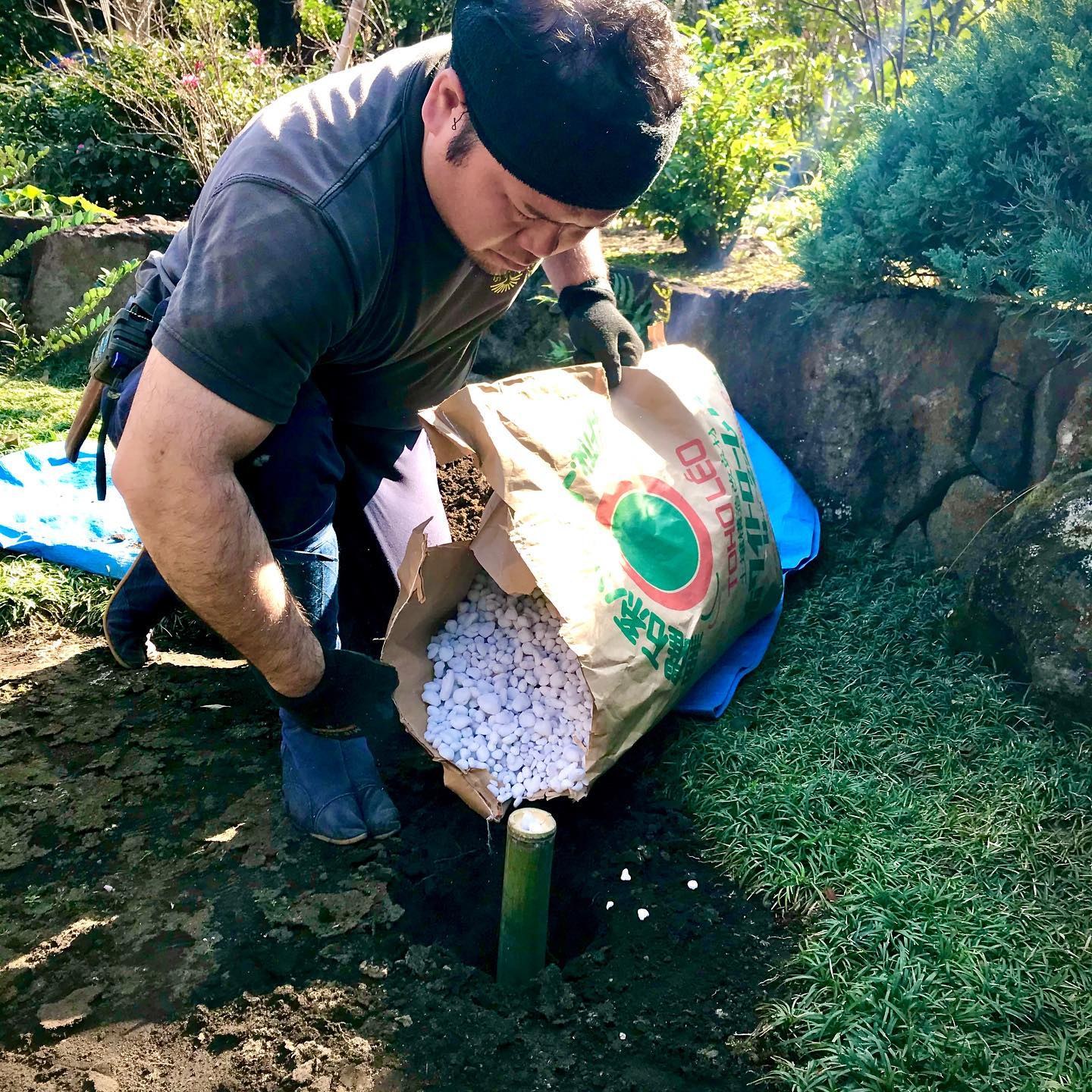
| Jumokui Jinbe (2023) | Cut to 0.6–1 m (2–3.3 ft); charred or de-oiled; tied with hemp-palm or hemp rope | Not stated | Backfilled with perlite | Top covered with hemp cloth |
| Chiba sakura management guide (2016) — related perforated tube | Moso bamboo about 10 cm (4 in) across, about 50 cm (20 in) long; nodes removed, holes drilled, not split | About 50 cm (20 in) deep | Rice husks, crushed charcoal, slow-release fertiliser inside, outside | Top left 3 cm (1.2 in) proud, or buried 4–5 cm (1.6–2 in) where people walk |
Two things stand out. First, the width of the hole and the width of the bamboo are different numbers: in Hokkaido a 5–6 cm tube went into a 15–20 cm hole, leaving a collar of improved soil around it. Second, depth varies from about 50 cm to about 1 m depending on the site, the soil and the person writing.
Inside or Around? Two Ways to Use the Tube
Fill the tube
Some descriptions put the improvement inside the bamboo. Kawaku’s 2017 lecture describes split bamboo “packed with charcoal, compost and the like” (割竹に炭や堆肥等を詰めたもの) and buried. Read that way, the tube is a container that carries a column of loose, porous material down into the root zone.
Fill around the tube
Others put the improvement outside. In the Japan Biotope Association bulletin, the bamboo goes into the hole and the space around it is backfilled with fully matured compost. The Hokkaido job did the same with a mix of matured compost, charcoal and site soil. Here the tube is closer to a vent: a hollow column that lets air and water down through the improved collar.
A cherry-care guide published by the Chiba Prefecture Sakura no Kai (千葉県さくらの会) with greening partners describes a related device built differently again: a whole, unsplit Moso bamboo with the nodes knocked out and holes drilled in the wall, with rice husks, crushed charcoal and slow-release fertiliser placed inside and outside.
We do not think one version is “correct”. The sources simply describe different jobs. What they agree on is the purpose. Kawaku’s lecture expects slow, long-term nutrient supply and “some improvement in aeration” (多少の通気性改善効果) — modest words, and an expectation rather than a measured result. A 2011 report on the nationally designated weeping hornbeam at Sajikami Shrine in Hinode, Tokyo, proposes the method to lead roots deeper and improve air and water movement in the soil.
Installing in the Root Zone — Holes, Depth, Where Not to Dig
Making the holes
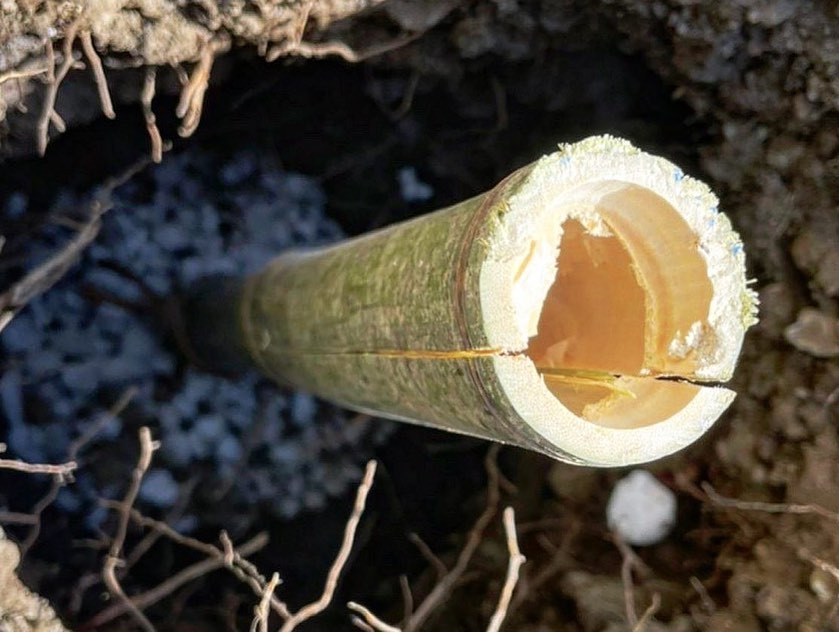
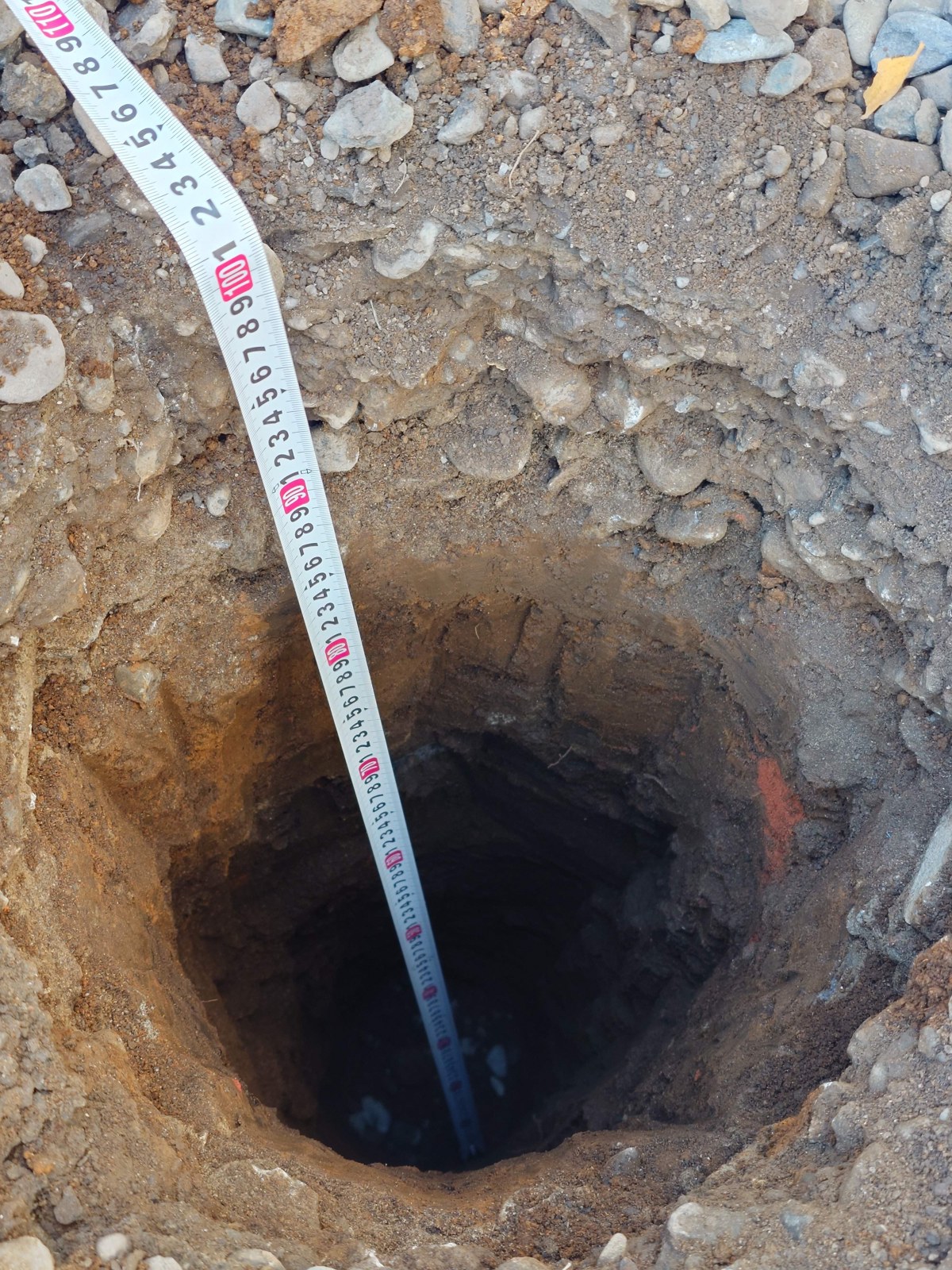
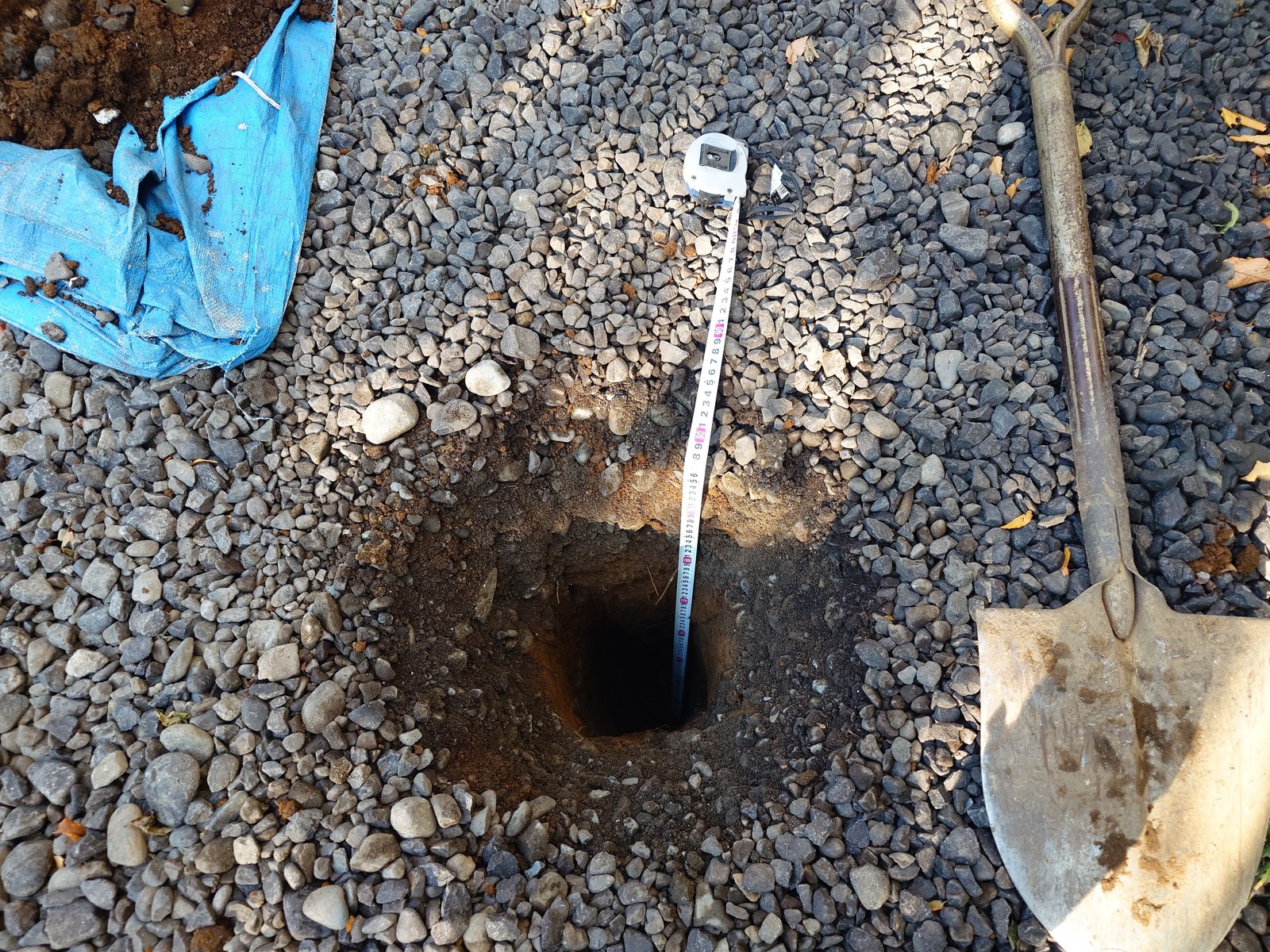
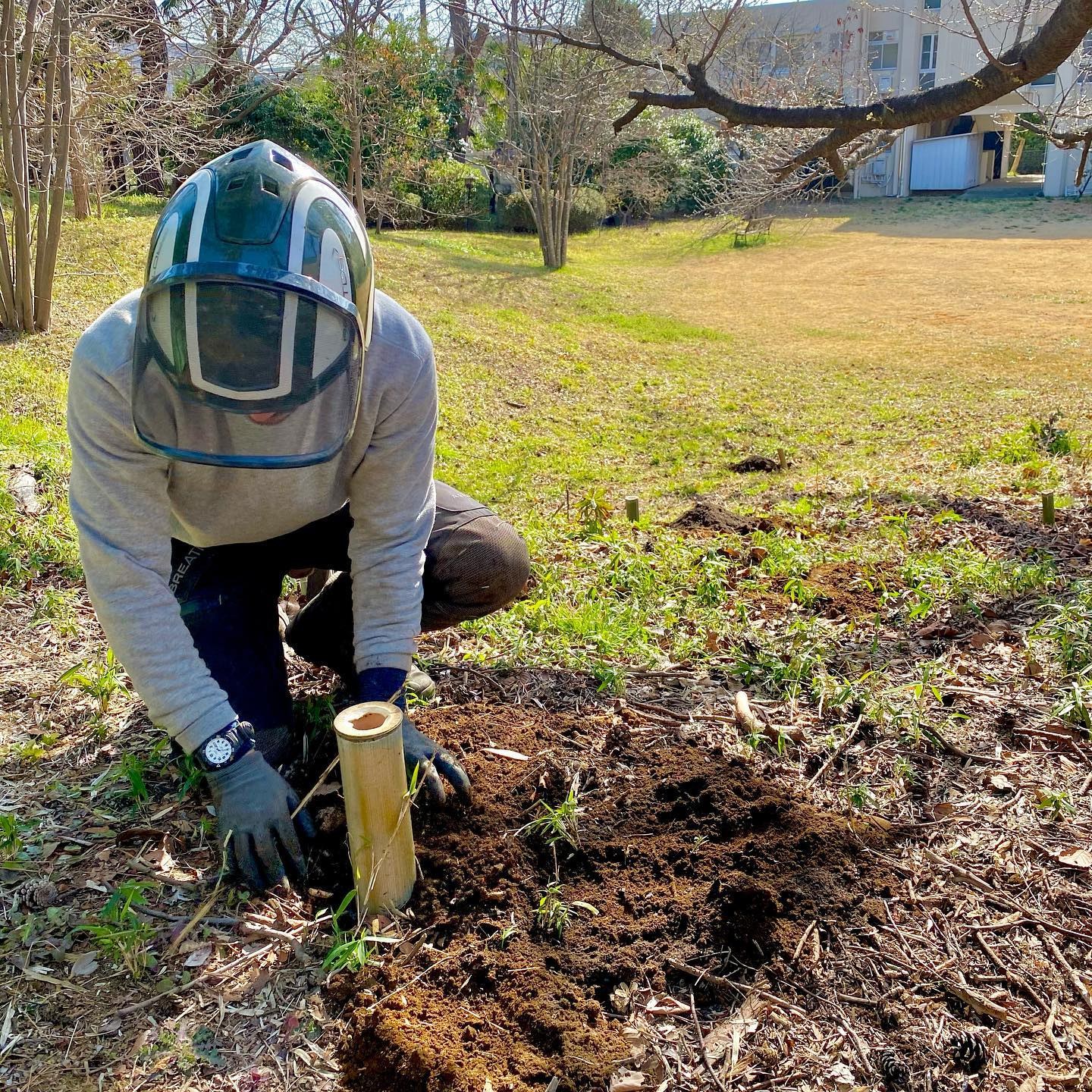
Holes are opened by hand or with light machines. The Hokkaido crew used an earth auger and a double-handled post-hole digger. Air excavation is not required by any of the Japanese specifications we found, although the Western guidance cited below lists it as one way to dig. On the job shown here, a tape measure went down the hole before anything went in: the useful depth depends on what the crew finds, such as gravel, a hard layer, a wet layer or a large root.
How many, and where
None of the sources gives a fixed count. In Furubira, holes went in at “several dozen places inside and outside the crown” — and some of those held perlite instead of bamboo, so the number of tubes is not known. A 2024 plan by the City of Ōno in Fukui Prefecture for the nationally designated Great Zelkova of Senpukuji Temple, which combines hydraulic drilling with split-bamboo insertion and puts fertiliser and charcoal inside the bamboo, says the number of holes and the fertiliser will be decided on the day, by the tree doctor, after checking conditions on site. The same plan schedules the soil work for autumn.
When to stop
The sources are just as clear about what can go wrong.
| Risk | What the source says | What it means on site |
|---|---|---|
| Cutting roots | Hori records a “big failure” (大失敗) of his own: cutting the roots of a natural monument during soil work (not described as a split-bamboo job), after which the tree declined | Move the hole when you hit a large root. Texas A&M Forest Service gives the same rule for vertical mulching: never cut through large roots |
| Raw organic matter | Hori warns that uncomposted organic matter carries a risk of white root rot (Rosellinia) and Armillaria root rot; use fully composted material | Only well-matured compost goes into or around the tube |
| Waterlogged layer | Naoki advises not putting compost down as far as a layer where water collects | A deeper hole is not automatically better |
| Settling, tripping | Texas A&M notes that filled holes can sink as organic matter breaks down, creating a tripping hazard | Matters most where visitors walk |
| Wet soil | ANSI A300 Part 2 (2018) has soil be “moist but not saturated” before air excavation | Pick the day as well as the season |
Finishing the top
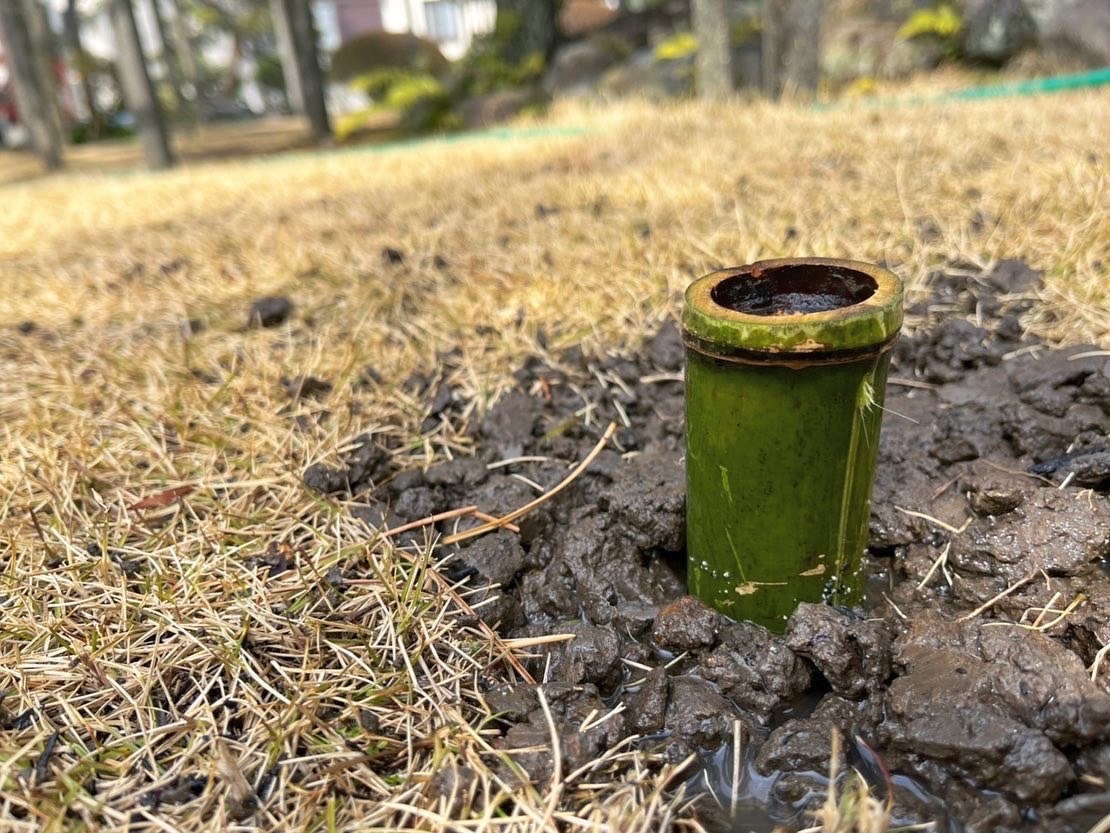
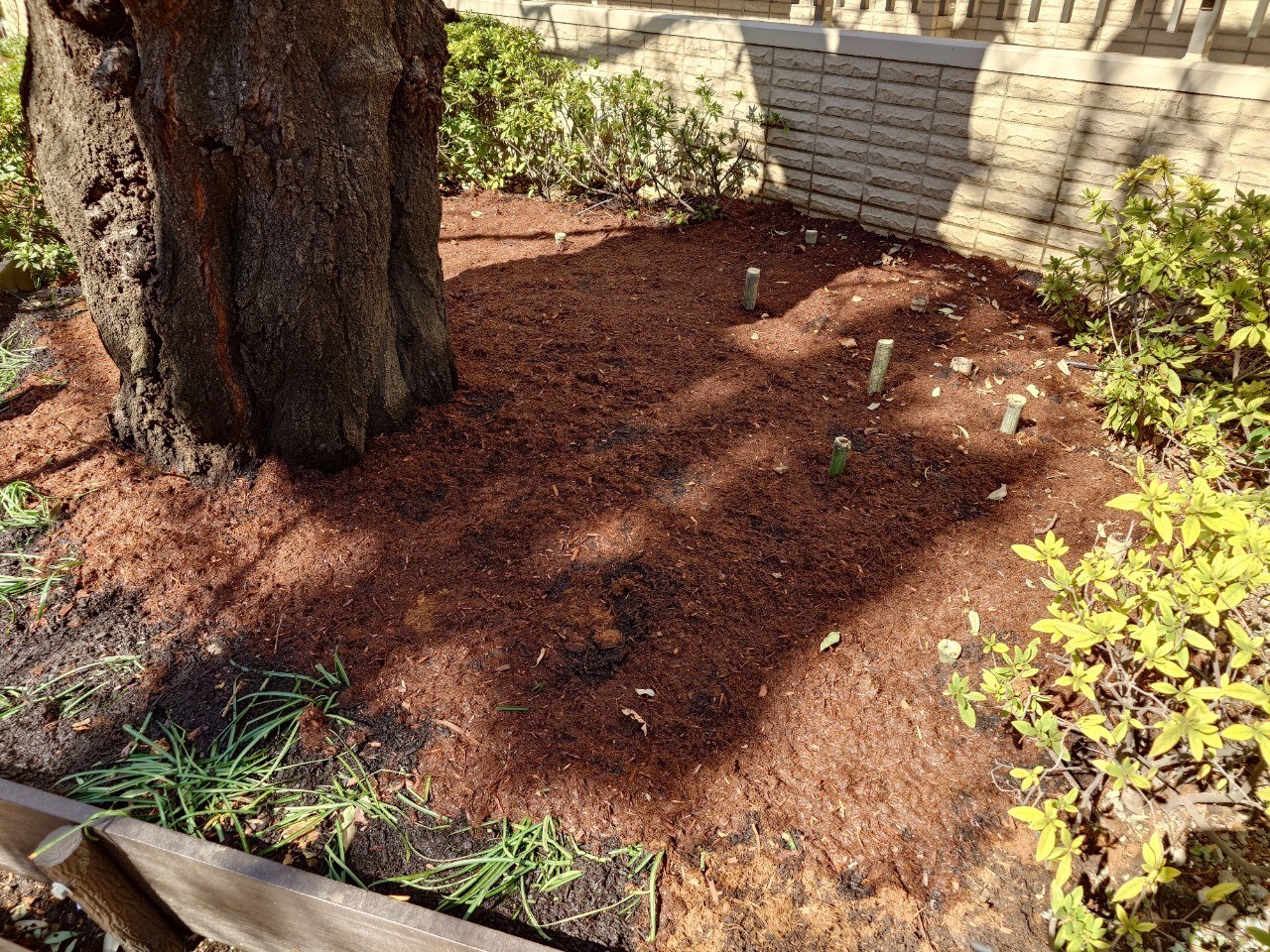
The top is a practical detail with a reason behind it. The Chiba guide leaves about 3 cm (1.2 in) of tube showing where nobody walks, and buries the top 4–5 cm (1.6–2 in) below the surface where people do. Jumokui Jinbe covers the bamboo with hemp cloth. On the temple job pictured at the top of this article, the rim finished flush with the gravel, which is why visitors notice it as a ring rather than a pipe.
What the Roots Do — What Japanese Site Reports Show
Roots around the bamboo
The clearest observation we found is modest. In the Japan Biotope Association bulletin, a treated site was dug up again one year after installation and roots were found growing around the split bamboo. It is an observation: the bulletin reports no root-mass measurements and no untreated comparison.
Cases, and what each one is
Most published Japanese cases are mixed treatments, plans or proposals. It is worth keeping those apart.
| Tree | Status | What the source says |
|---|---|---|
| Old Ezo mountain cherry (Prunus sargentii), Fībira no Mori (フィービラの森), Furubira, Hokkaido | Carried out | Soil improvement in 3 of the years of a 2016–2019 recovery project; flowering rose a little from the second year, with more flowers, leaves over four years — but pruning, fertiliser, watering were done too |
| Weeping cherry owned by Kumano Nachi Taisha | Carried out | Reported by the installer in an article dated 11 February 2023; installation date not given; results described only as expected |
| Great Zelkova of Senpukuji, Ōno, Fukui (national natural monument) | Planned (2024) | Hydraulic drilling plus split bamboo; holes decided on the day |
| Weeping hornbeam of Sajikami Shrine, Hinode, Tokyo (national natural monument) | Proposed (2011) | Listed in the future management policy; not shown as carried out |
| Mokkoku (Ternstroemia gymnanthera) of Yamasaki Hachiman Shrine, Shisō, Hyogo | Related work, FY2005 | Bamboo tubes set in air-injection holes 30 cm (12 in) deep, filled with a soil conditioner; not stated whether the bamboo was split |
The published record that would separate the method’s effect from everything else done to the same tree is thin. We found no published comparative trial of split bamboo alone, no success rate and no figure for how many years it takes to work.
Why Bamboo? — A Local Material That Rots Away
Using what grows nearby
Bamboo is cheap, light, hollow and easy to split, and in much of Japan it is a nuisance. The Chiba cherry guide makes that link directly: it uses Moso bamboo from stands that are spreading where they are not wanted, as part of a policy of using materials produced locally wherever possible. Cost depends on place, though. The Hokkaido report notes that there, ready-processed sarashidake (晒竹, bamboo sold already processed; the report does not name the species) was cheaper to buy than Moso.
Rotting is the point
The material also disappears. The Chiba guide says its Moso air tubes (the unsplit, perforated kind) rot within “a few years” and go back to the soil. That matters because of what the guide says happened with the plastic-net air tubes used before: as roots grew into them and thickened, the netting cut into the roots. Using a material that rots away is meant to avoid leaving anything behind that could tighten around a root. The guide’s “a few years” is a description, not a measured service life, and research from Japan’s Forestry and Forest Products Research Institute on Moso bamboo used in forest-road works found that bamboo loses strength faster in the ground and at ground level than above it.
The Western Cousins — Vertical Mulching, Radial Trenching, Air Tillage
How vertical mulching is specified
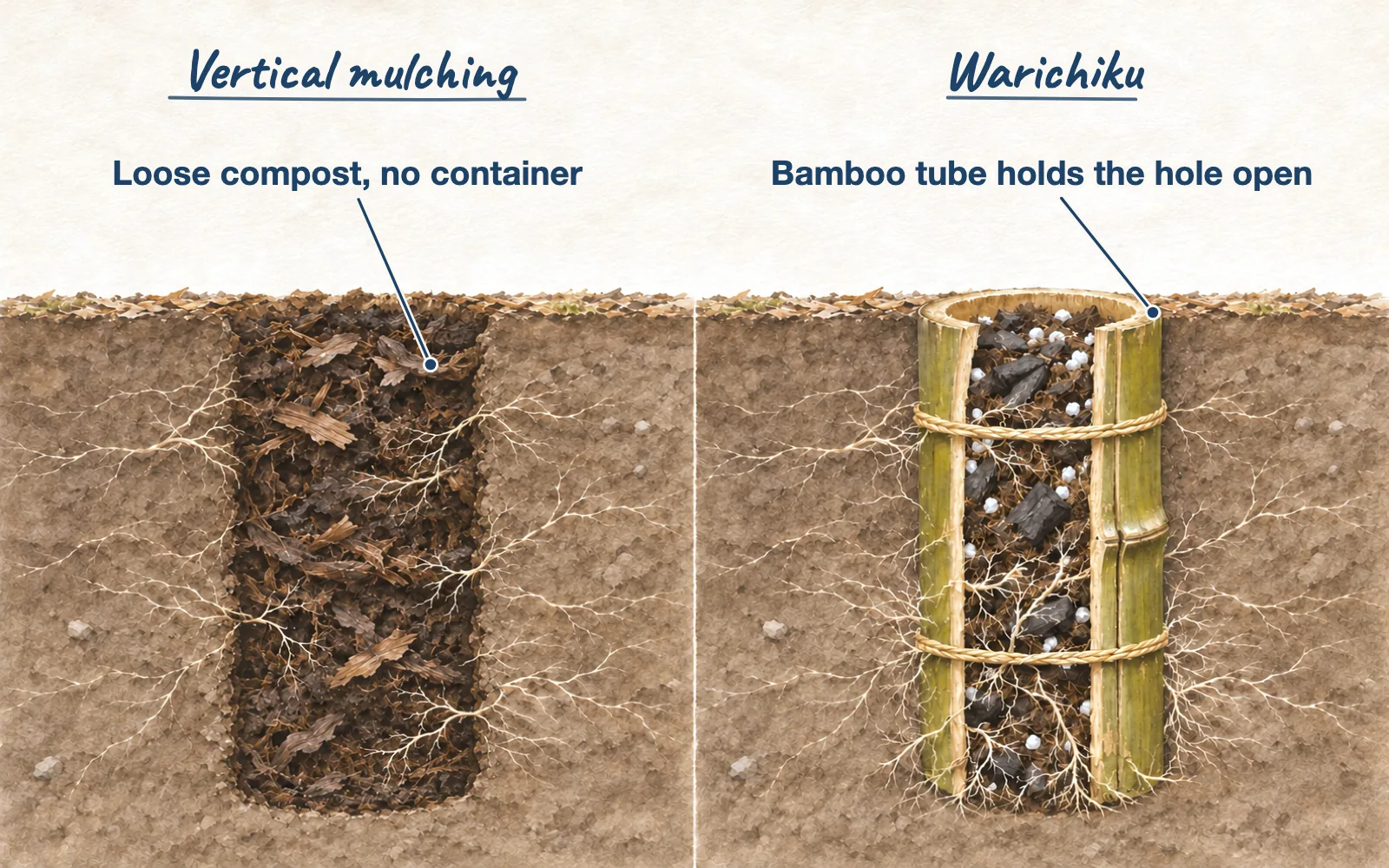
Arborists in North America and Europe tackle the same problem with similar thinking but different hardware. In the two specifications below, the holes are smaller and shallower than the Japanese examples above, and there is no tube: the hole itself, filled with loose material, is the treatment.
| Texas A&M Forest Service | Bartlett technical report, UK (2020) | |
|---|---|---|
| Hole width | 2–4 in (5–10 cm) | 7.5 cm (3 in) |
| Hole depth | 6–10 in (15–25 cm) | 30 cm (12 in) |
| Layout | First hole in each row 3–8 ft (0.9–2.4 m) from the trunk; holes, rows 1–3 ft (0.3–0.9 m) apart | 50 cm (20 in) grid under the crown |
| Fill | Compost, mulch, gravel, sand | 5% biochar, 50% John Innes potting compost, 40% multipurpose compost, 5% slow-release fertiliser (the report’s own mix, not a recipe for split-bamboo work) |
| Tools, timing | Auger, air spade, post-hole digger; winter, while dormant | Whole area then covered with 5–10 cm (2–4 in) of wood chips |
What Western trials found
The Western versions have been tested in published trials, and the results are mixed.
| Study | What was tested | Main finding |
|---|---|---|
| Kalisz et al. (1994) | Perlite-filled vertical holes, 5 cm wide, 45 cm deep, 16 per tree, sugar maples in pasture | After three growing seasons, root mass inside the holes was significantly lower: 0.6 kg/m³ against 4.4 kg/m³ in undisturbed soil away from the holes; tree water status did not differ |
| Watson, Kelsey, Woodtli (1996) | Soil replacement in radial trenches, plus a separate trial of excavated holes, pits | Fine-root density in amended soil increased by up to 320%; rooting depth up to 68% deeper; trunk growth of Tilia, Platanus better but not significantly different |
| Watson (2002) | Radial trenches followed on three white oaks (Quercus alba) | After 14 years, root density inside the trenches still significantly greater; no increase in root growth in the untreated soil next to the trench |
| Smiley (2001) | High-pressure nitrogen injection (Terravent) | No significant change in soil bulk density at three sites |
| Fite, Smiley et al. (2011) | Air tillage, fertiliser, mulch on 200 red maples (Acer rubrum) in four cities | Combined treatment significantly reduced soil strength in 2006; of the single treatments, mulch was the most beneficial |
| Percival, Graham, Franklin (2023) | Vertical mulching with or without biochar, five years | Vertical mulching had little influence on soil quality; of the single treatments, wood-chip mulch was the most effective, most cost-effective |
None of these trials tested Japanese split bamboo, and their fill, hole size, soils and species all differ. They cannot prove or disprove the Japanese method. Read one by one, they say different things: some soil-replacement trials found more roots inside the treated soil, though not beyond it; the perlite-hole trial found fewer roots inside the holes; and in two studies, surface mulch was the most useful of the single treatments.
Different starting points, not better or worse
The two sets of sources we read start from different places. The Western documents cited here are standards, extension guidance and replicated trials across many trees: ANSI A300 Part 2 (2018) has the plant, site and soil assessed before anything is specified, lists vertical mulching among methods that limit root damage, and has air tillage considered as a preferred way to relieve compaction. (The A300 parts were combined into a single document in 2023, so the 2018 clause numbers should not be read as current.)
The Japanese documents cited here are mostly site reports, plans and practitioners’ specifications for one named tree, often protected by law and owned by a shrine or temple, in a courtyard where gravel, ceremony and visitors stay. They emphasise the tree doctor’s judgement on the day, a limited number of openings and local materials. The structural difference is that the Japanese method places a bamboo member in the hole; whether that changes how roots grow compared with a well-made vertical mulch hole is something we found no published trial of.
Species, season, site
The sources do not compare the method across species. The cases above include cherries, a zelkova, a hornbeam, a mokkoku and pines, but no source we found ranks how each responds. Timing is also local: the Ōno plan schedules the work for autumn, while Texas A&M recommends winter dormancy for vertical mulching; these are two documents written for different climates, not a national rule for either country. Site matters most of all: a layer where water collects, foot traffic and what material is cheap nearby all changed the specifications above.
Reading the Tubes on Your Next Temple Visit — What They Tell You
What a ring in the ground tells you
If you see bamboo rings around an old tree, you can read a few things from them. Somebody treated the soil environment of the root zone, possibly alongside other work on the tree. They chose to work through small openings instead of digging the root zone over. The spread of the rings shows roughly where they expected the working roots to be, often well out under the crown rather than at the trunk. The colour of the rim says less than you might think: it depends on whether the bamboo was bleached, charred or de-oiled before use, as well as on weathering.
What not to do
Do not stand on them or pull at them. In the Chiba guide, tops are buried a few centimetres down where people walk and left standing a little proud where nobody is meant to walk. Either way, the soil around it is the part of the site the tree’s caretakers are trying hardest to protect.
For the wider story of how Japan keeps very old trees going, see why Japan’s ancient trees live for a thousand years. The same patient approach to a single tree shows in the support and root care of the Higashine Great Zelkova, and the profession behind the tube decisions is explained in what a jumoku-i is. The same soil pressures on city trees, at a much larger scale, are the subject of Japan’s falling-trees crisis.
Frequently asked questions
What is warichiku sōnyū-hō?
It is a Japanese soil treatment for weakened trees. Bamboo is split lengthwise, the inner nodes are removed (one specification keeps the lowest), and the tube is tied back together and set upright in a hole in the root zone. Depending on the source, materials such as charcoal, compost or perlite go inside the tube, or are backfilled around it. Its aims are to let air and water into packed soil and to lead new roots into improved soil.
Who invented the split-bamboo method?
Hori Taisai has written that he devised it after seeing bamboo poles pushed into the ground beside young trees at a school in Yamanashi Prefecture, and linking that with an orchard technique. He does not give a year, and we have not found a source that does.
How deep are the tubes, how many are used?
It varies by site. Published split-bamboo examples use holes about 60 cm (24 in) to about 1 m (3.3 ft) deep, with tubes 60 cm to 1 m long; a related unsplit, perforated tube in a Chiba guide is about 50 cm (20 in) long in a hole about 50 cm deep. The number is not fixed; one municipal plan for a natural monument leaves it to the tree doctor to decide on the day.
Does it work?
There is a site observation of roots growing around the bamboo and a report of a tree improving after treatment, but that treatment also included pruning, feeding, watering. We found no published comparative trial of split bamboo alone. Western trials of related methods give mixed results.
How is it different from vertical mulching?
Vertical mulching fills holes with loose material and leaves no structure behind. The split-bamboo method places a bamboo tube in the hole, a material chosen partly because it rots away. The Japanese holes in the sources cited here are also wider and deeper than those in the two Western specifications cited.
Does the bamboo rot?
Yes, by design. The Chiba cherry-care guide says its unsplit, perforated Moso bamboo air tubes rot within a few years and return to the soil, a reason given for replacing the plastic-net tubes that had cut into growing roots.
Sources
– Kawaku Kunio (2017). Lecture on soil diagnosis, improvement. Tree and Forest Health 21(3), pp. 153–160 (cited p. 158). https://www.jstage.jst.go.jp/article/treeforesthealth/21/3/21_153/_pdf (checked 2026-11-06) – Hori Taisai (2025). 土壌改良の考え方と基本. Jumoku Seitai Kenkyūkai. https://jyumokuseitai.org/%E6%A8%B9%E6%9C%A8%E7%94%9F%E6%85%8B%E7%A0%94%E7%A9%B6%E4%BC%9A%E5%8E%9F%E7%A8%BF%E3%80%80%E5%9C%9F%E5%A3%8C%E6%94%B9%E8%89%AF%E3%81%AE%E8%80%83%E3%81%88%E6%96%B9%E3%81%A8%E5%9F%BA%E6%9C%AC/ (checked 2026-11-06) – Naoki Satoshi (2020). 土壌改良について. Japan Biotope Association technical bulletin No. 11, pp. 8–9. https://www.biotope.gr.jp/wp-content/uploads/gijutumenoNo11.pdf (checked 2026-11-06) – Toyoda Sakae (2021). Kimori No. 30, pp. 27–28. Japan Tree Doctors Association, Hokkaido Branch. https://jumokui-hokkaido.jp/common/pdf/kimori_00030.pdf (read 2026-11-06; the PDF returned 404 later the same day) – Jumokui Jinbe (2023). 割竹挿入法. https://jumokuijimbe.com/waritake/ (checked 2026-11-06) – City of Ōno, Fukui (2024). Cultural properties council materials, Senpukuji Great Zelkova. https://www.city.ono.fukui.jp/kosodate/bunka-rekishi/hogo/bunkazaishingikai.files/0021_20240430.pdf (checked 2026-11-06) – Hinode Town Board of Education (2011). Report on restoring the weeping hornbeam of Sajikami Shrine (幸神神社), p. 93. https://sitereports.nabunken.go.jp/files/attach/63/63622/140138_1_%E5%9B%BD%E6%8C%87%E5%AE%9A%E5%A4%A9%E7%84%B6%E8%A8%98%E5%BF%B5%E7%89%A9%E5%B9%B8%E7%A5%9E%E7%A5%9E%E7%A4%BE%E3%81%AE%E3%82%B7%E3%83%80%E3%83%AC%E3%82%A2%E3%82%AB%E3%82%B7%E3%83%87%E6%A8%B9%E5%8B%A2%E5%9B%9E%E5%BE%A9%E8%AA%BF%E6%9F%BB%E5%A0%B1%E5%91%8A%E6%9B%B8.pdf (checked 2026-11-06) – Chiba Prefecture Sakura no Kai et al. (2016). さくらの植栽と管理, PDF pp. 18–19. https://c-green.or.jp/images/activity/sakuranokai/sakura-kanri.pdf (checked 2026-11-06) – Japan Tree Doctors Association, Hyogo Branch (2014). 20th anniversary record, pp. 22–25. https://treedoctors-hyogo.com/img/kinenshi20_3.pdf (read 2026-11-06; server unreachable later the same day) – Japan Greening Center. 緑化樹木の樹勢回復技術〈診断編〉. https://www.jpgreen.or.jp/kyoukyu_jyouhou/gijyutsu/j_shindan/index.html (checked 2026-11-06) – Forestry and Forest Products Research Institute (2021). https://www.ffpri.go.jp/research/saizensen/2021/20210712-01.html (checked 2026-11-06) – Texas A&M Forest Service. Vertical mulching. https://tfsweb.tamu.edu/trees/tree-care/mulching/vertical-mulching-composting/ (checked 2026-11-06) – Percival, G. (2020). Vertical mulching. Bartlett Tree Experts technical report. https://www.bartlett.com/dynamic/pdf/technical-reports/Vertical%20Mulching%20UK%20GP%202020.pdf (checked 2026-11-06) – ANSI A300 Part 2 (2018), Soil Management. https://west-chester.com/DocumentCenter/View/10139/A300-2 (checked 2026-11-06) – TCIA (2023). Introducing the newly designed ANSI A300. https://tcimag.tcia.org/training/introducing-the-newly-designed-ansi-a300-tree-care-standards/ (checked 2026-11-06) – Kalisz et al. (1994). Journal of Arboriculture. https://joa.isa-arbor.com/request.asp?ArticleID=2618&JournalID=1&Type=2 (checked 2026-11-06) – Watson, Kelsey, Woodtli (1996). Journal of Arboriculture. https://joa.isa-arbor.com/request.asp?ArticleID=2727&JournalID=1&Type=2 (checked 2026-11-06) – Watson (2002). Journal of Arboriculture. https://joa.isa-arbor.com/request.asp?ArticleID=56&JournalID=1&Type=2 (checked 2026-11-06) – Smiley (2001). Journal of Arboriculture. https://joa.isa-arbor.com/request.asp?ArticleID=2946&JournalID=1&Type=2 (checked 2026-11-06) – Fite, Smiley et al. (2011). Arboriculture & Urban Forestry. https://joa.isa-arbor.com/request.asp?ArticleID=3217&JournalID=1&Type=2 (checked 2026-11-06) – Percival, Graham, Franklin (2023). Arboriculture & Urban Forestry 49(4), abstract. https://joa.isa-arbor.com/article_detail.asp?ArticleID=11549&IssueID=4&JournalID=1&VolumeID=49 (checked 2026-11-06)