

By Isaki Kasahara, a Japanese arborist pruning, assessing and caring for Japan’s trees and gardens · Updated November 26, 2026
The brown patches that spread across Kyoto’s Higashiyama hills in the summers around 2010 were oaks and chinquapins killed by Japanese oak wilt, called nara-gare (ナラ枯れ). A beetle about 4–5 mm long bores into the trunk and carries a fungus that clogs the tree’s water-carrying vessels, so an infected tree runs out of water when summer transpiration peaks and its leaves turn brown, often from late July to mid-August. The leading explanation for why Japan’s forests were so exposed is that coppice oaks once cut every 20–30 years for fuel stopped being cut after the fuel revolution of 1955–1964, and many grew into the large trunks the beetle prefers.
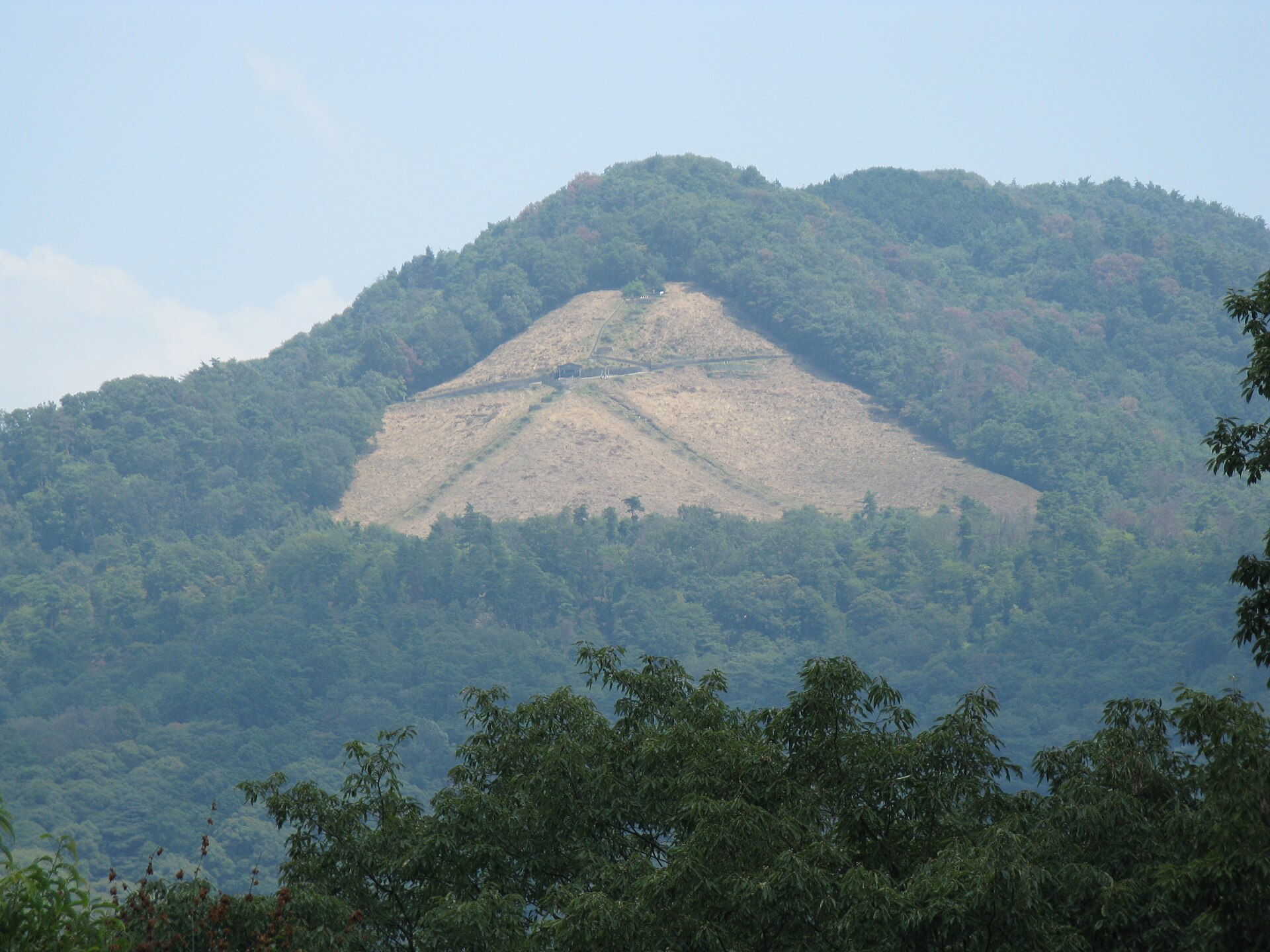
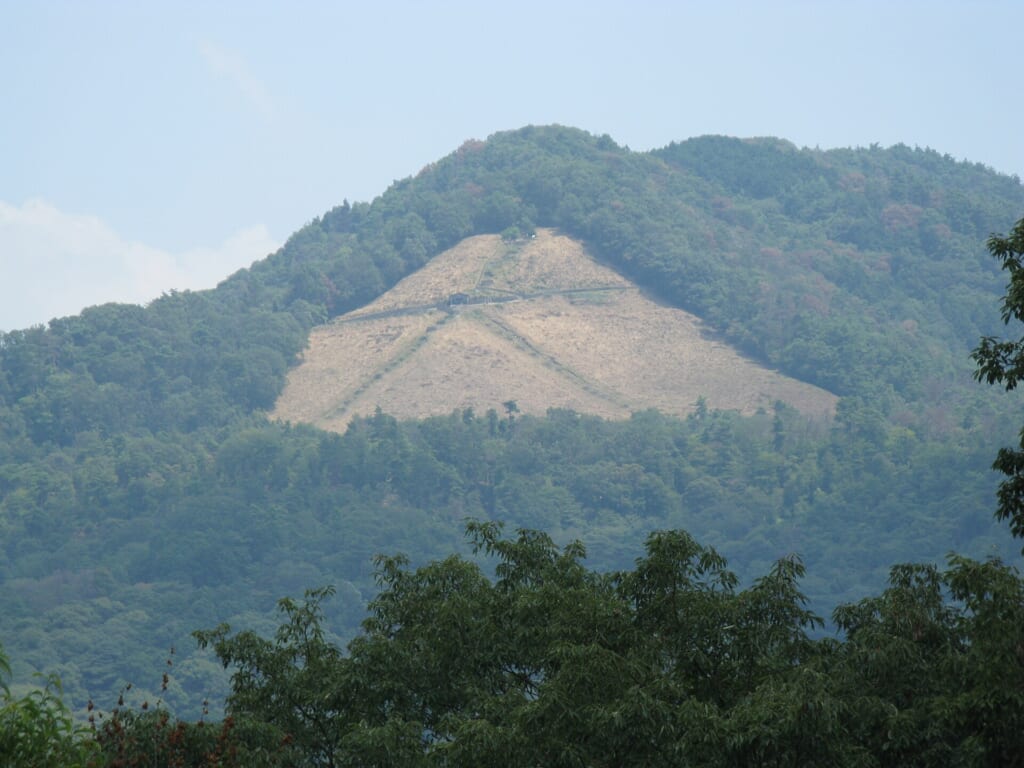
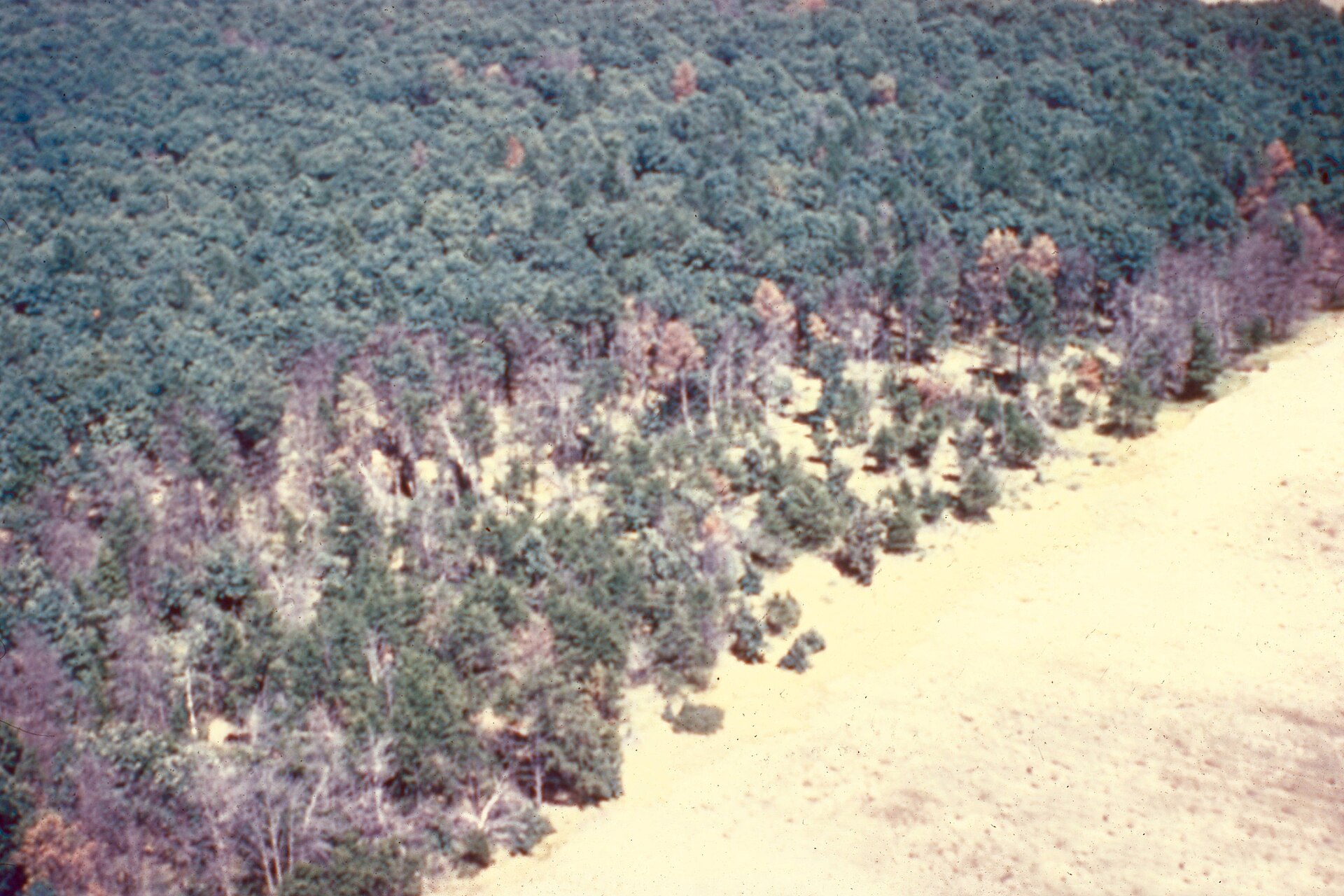
Kyoto City’s forestry newsletter includes a photograph from August 2010 of Daimonji-yama, one of the Higashiyama hills; the caption says the oak wilt damage there was conspicuous. Damage had been spreading in the city since around 2005. In fiscal 2010, the peak year, the city counted about 17,000 damaged trees. The sections below follow that summer from the beetle and the fungus inside the wood to the winter work that comes after.
Higashiyama in August — the summer the hills went brown
What the city figure means
The 17,000 figure is for the city of Kyoto as a whole, and it is a 2010 figure. It is not a measure of the hills today, and I have not found a published count for Higashiyama alone in 2025 or 2026.
The forests behind the temples
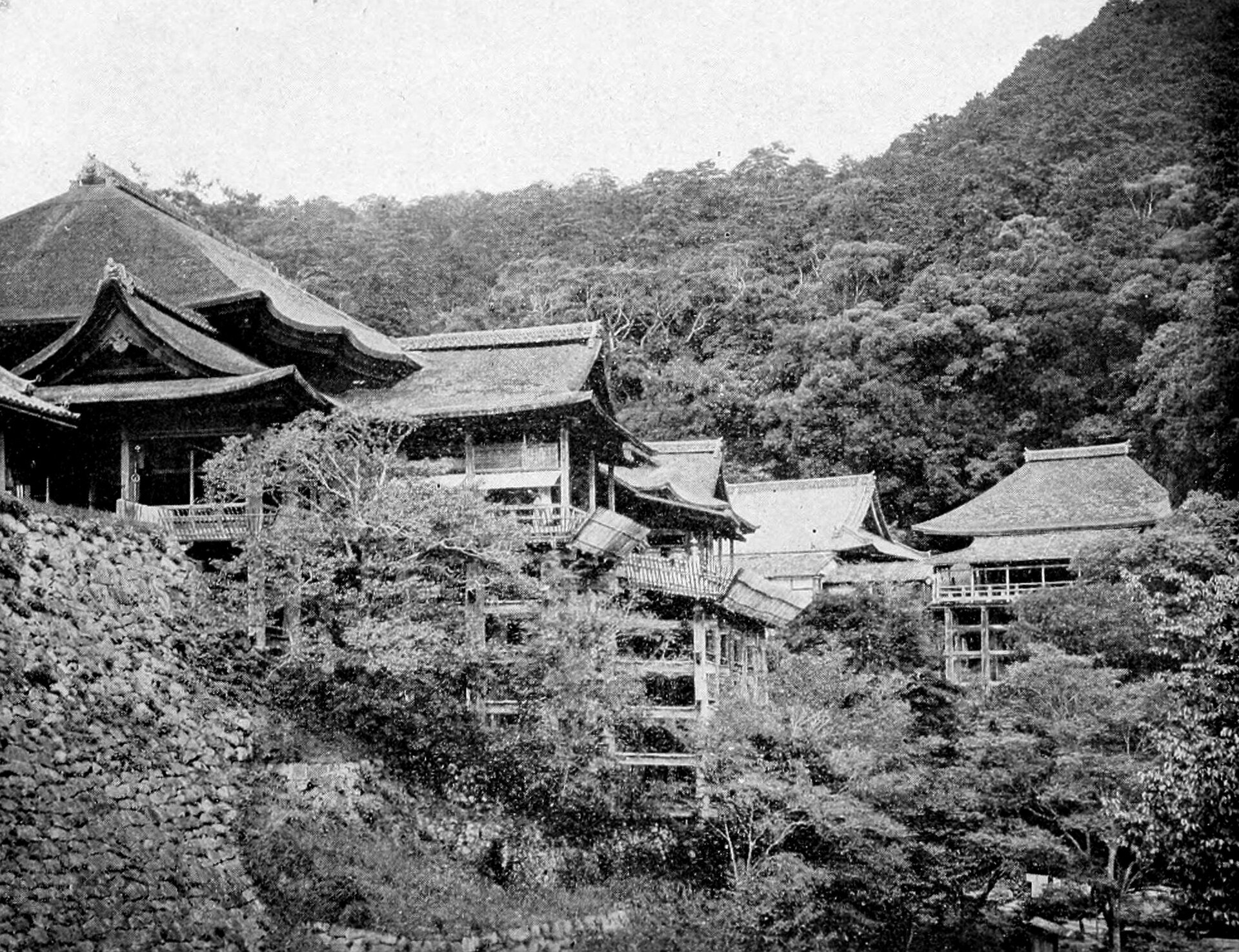
The hills have names in the national forest records. In the Kōdaiji-yama national forest, whose foot reaches Kiyomizu-dera, a World Heritage site, the Forestry Agency reports that trees were attacked from 2005 and that dead trees were felled and fumigated. The main species among the dead were konara oaks and shii (chinquapins) that had grown large. In the Ginkakuji-yama national forest at the northern end of the range, a study by the Forestry and Forest Products Research Institute (FFPRI) found that tree death peaked in 2010.
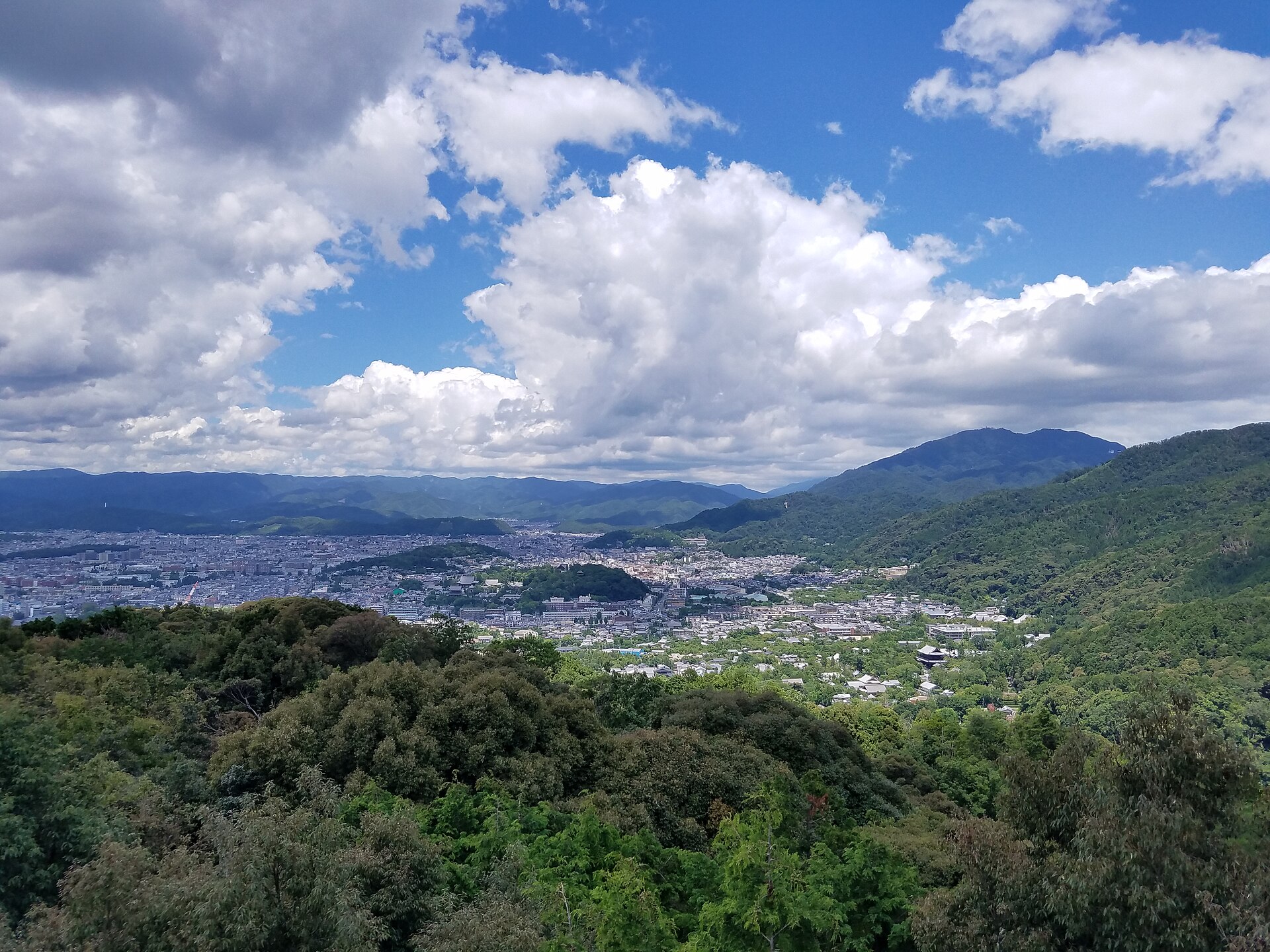
The Kyoto prefectural government records that the damage in the prefecture went beyond the deciduous oaks, reaching kojii (a chinquapin) and arakashi (an evergreen oak).
Kashinaga — a beetle that farms a fungus
Who the beetle is
The insect is kashinaga-kikuimushi (カシノナガキクイムシ), usually shortened to kashinaga: Platypus quercivorus, an ambrosia beetle. FFPRI describes it as a dark, cylindrical beetle 4–5 mm long, about 0.16–0.20 in. Ambrosia beetles do not eat wood. They grow fungi on the walls of their tunnels, and both the adults and the larvae feed on that fungus.
To carry their crop from tree to tree, female kashinaga have a pouch on the upper side of the thorax called a mycangium (菌嚢, kinnō). The fungi travel in it, and among them is the one that kills oaks.
How an attack builds
The attack begins with a male. He bores into a trunk and digs a short starting gallery a few centimetres long. He then releases an aggregation pheromone, which FFPRI’s paper identifies as quercivorol (ケルキボロール, kerukiborōru). The scent draws in many more beetles, male and female, and the tree is attacked by a great many borers at once. Mass attack of this kind can contribute to a rapid decline.
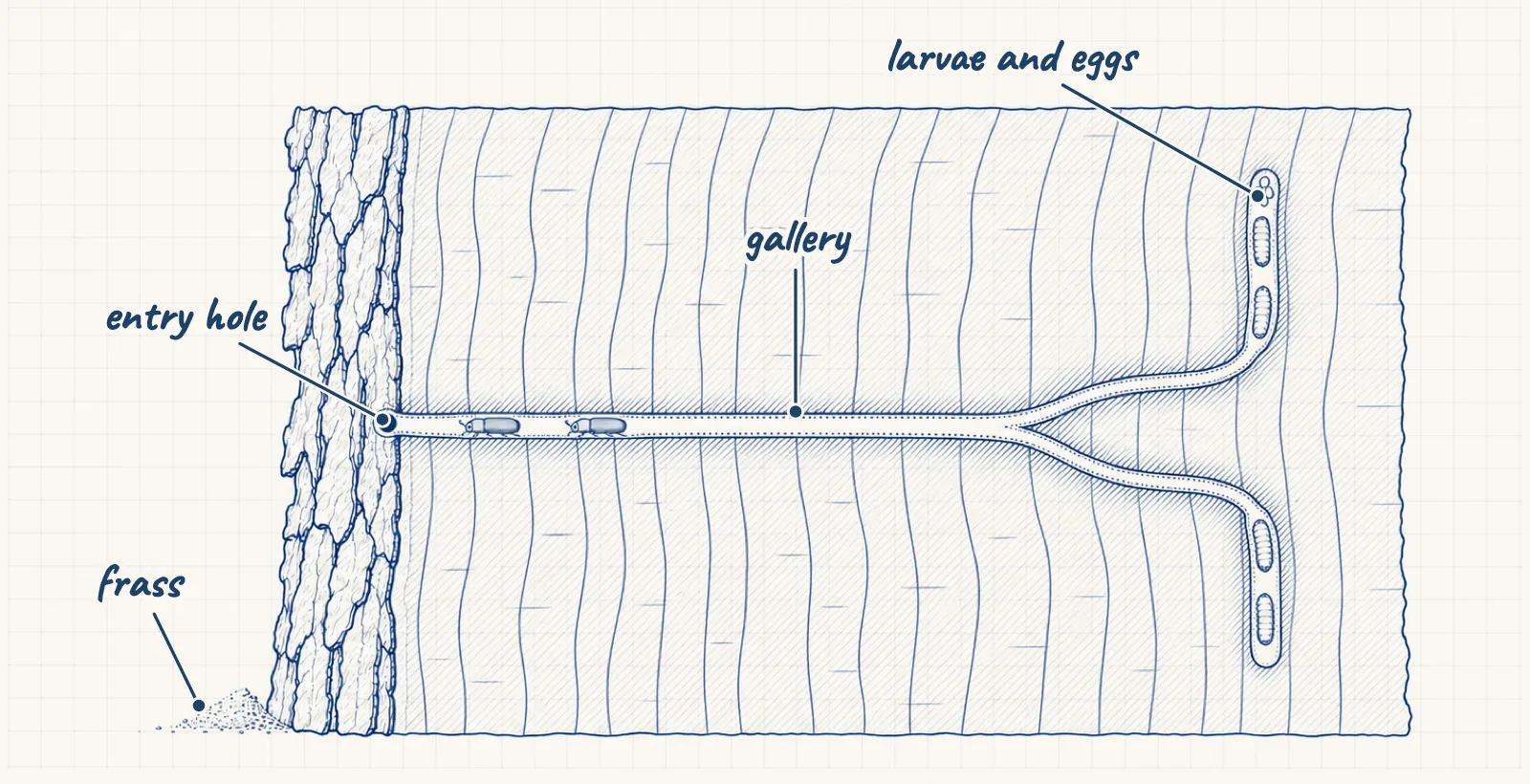
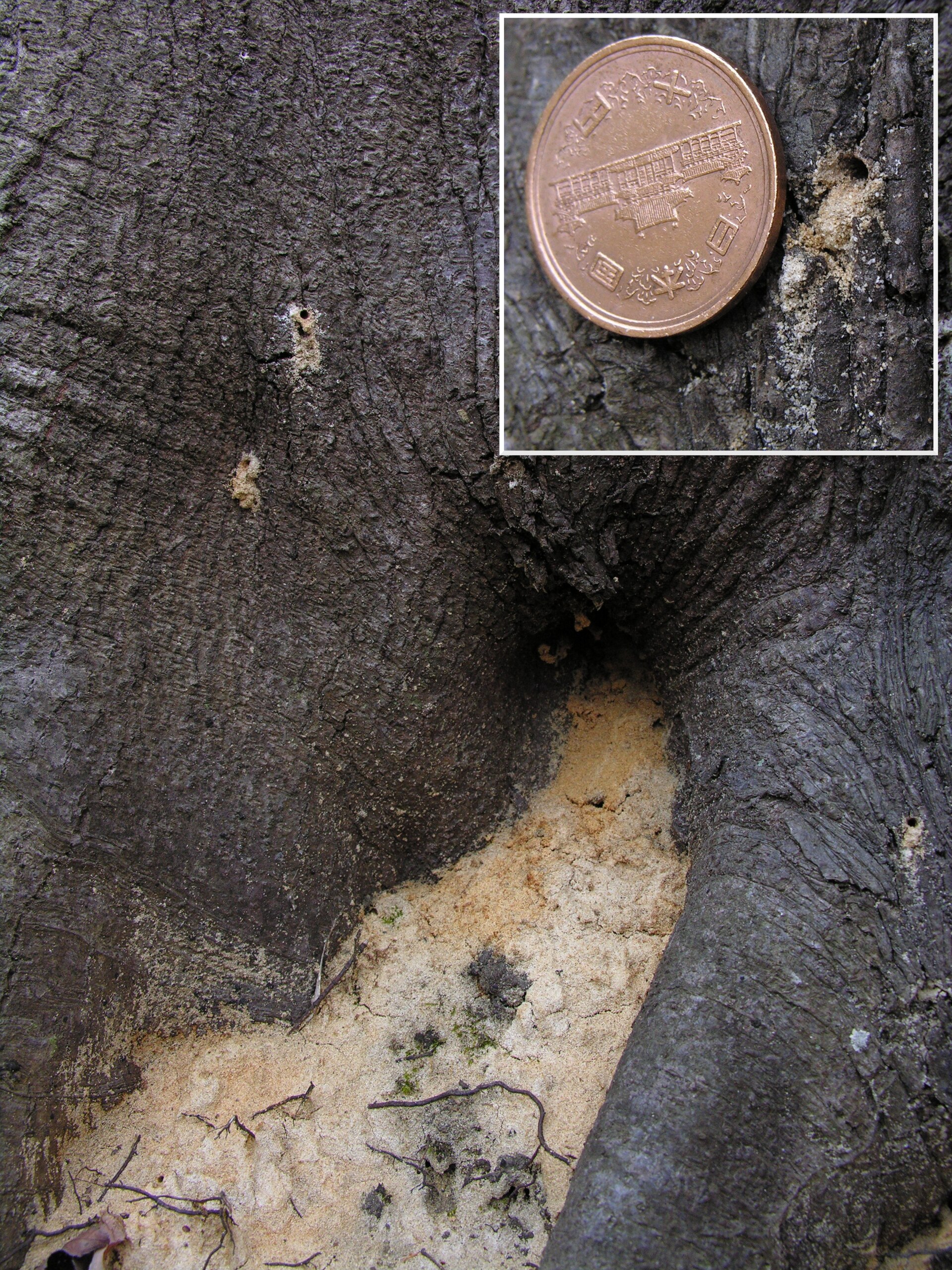
Once paired, the female extends the gallery to several tens of centimetres and lays eggs. The larvae grow on the fungus that lines the gallery walls. The entry holes on the bark are about 1.5 mm across, a little under a sixteenth of an inch. At the foot of an attacked trunk, a pale powder of wood shavings and droppings, called frass, piles up on the ground and in bark crevices.
One generation a year
New adults leave the dead or dying tree mainly in June to August of the following year. In the Tōhoku region, research describes one generation a year as the norm, though some individuals emerge by autumn. The output can be large: FFPRI gives the example of a big tree around 30 cm (12 in) in diameter from which tens of thousands of adults emerged. That is one example, not an average, but it shows how much potential for spread a single large tree can hold.
| Season | What the beetle is doing | What you can see |
|---|---|---|
| June–August | New adults emerge from last year’s trees and attack new ones | Frass at the trunk base; 1.5 mm holes in the bark |
| Late July–mid-August | Water transport in infected trees fails | Leaves on whole crowns change colour; some dead leaves stay on |
| Autumn–spring | Many beetles remain in the attacked wood until the main emergence (some leave by autumn) | Dead trees standing in the stand |
| Following summer | Adults emerge from trees left untreated | The cycle can repeat |
The timing in the table follows the Forestry Agency and FFPRI materials; it shifts with region and weather.
Why a tree dies of thirst in midsummer
The fungus in the sapwood
The fungus is Raffaelea quercivora in FFPRI’s papers. The European plant health database EPPO now lists it under the name Dryadomyces quercivorus, with Raffaelea quercivora kept as a former name. Japanese foresters simply call it nara-kin (ナラ菌), the oak fungus.
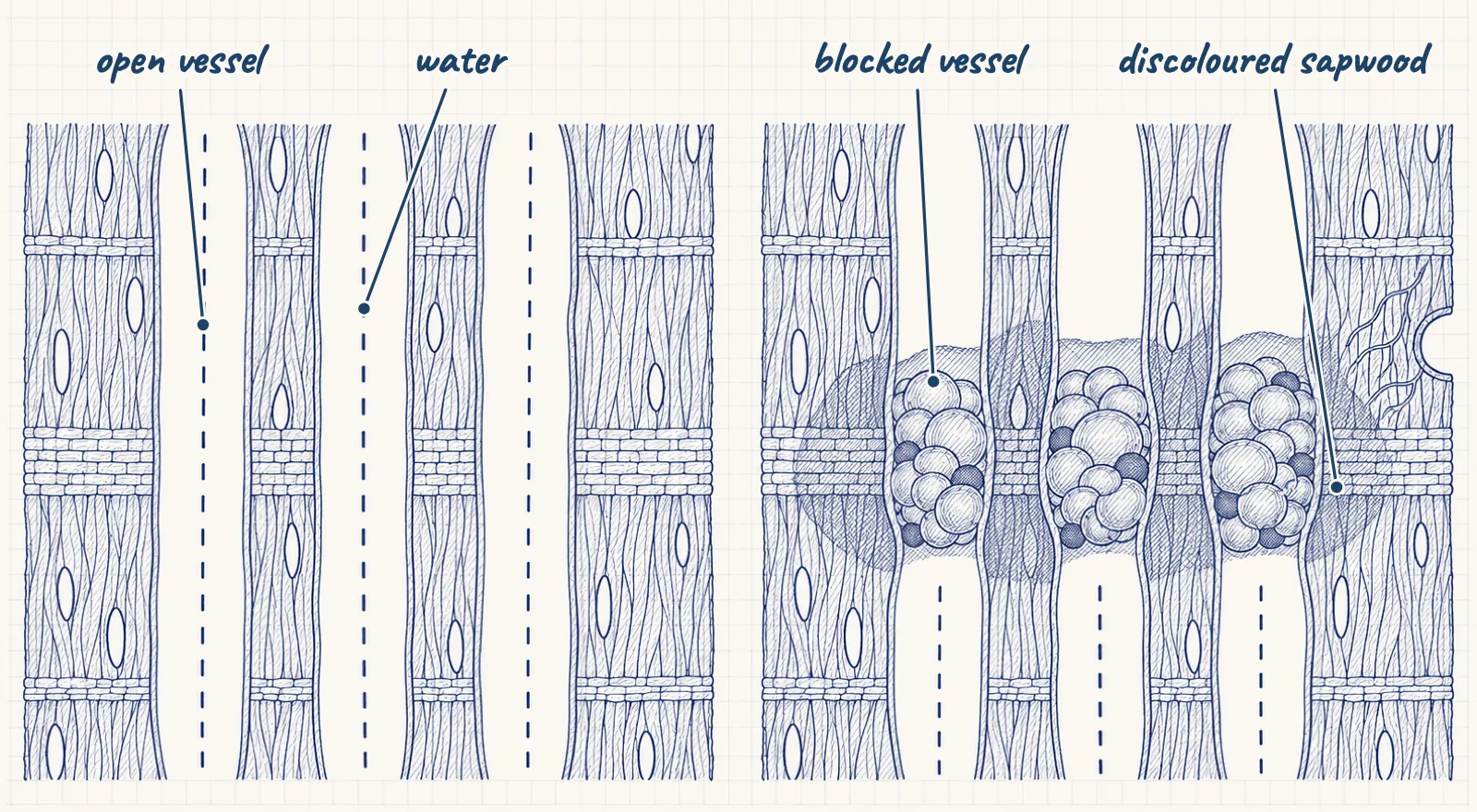
As the fungus spreads through the sapwood, the cells it infects die and the wood turns brown. Sap cannot rise through that part of the trunk any more. The tree also fights back: it produces defensive compounds that end up blocking its own vessels. In large vessels, balloon-like growths called tyloses may form after water flow has stopped.
Why late July
The symptoms usually become conspicuous in summer. FFPRI’s explanation is that infected trees die from lack of water after the end of the rainy season, from around late July, when transpiration is most active. The Forestry Agency gives the same window: on many oaks, the leaves change colour and the tree dies between late July and mid-August.
Why the leaves stay on
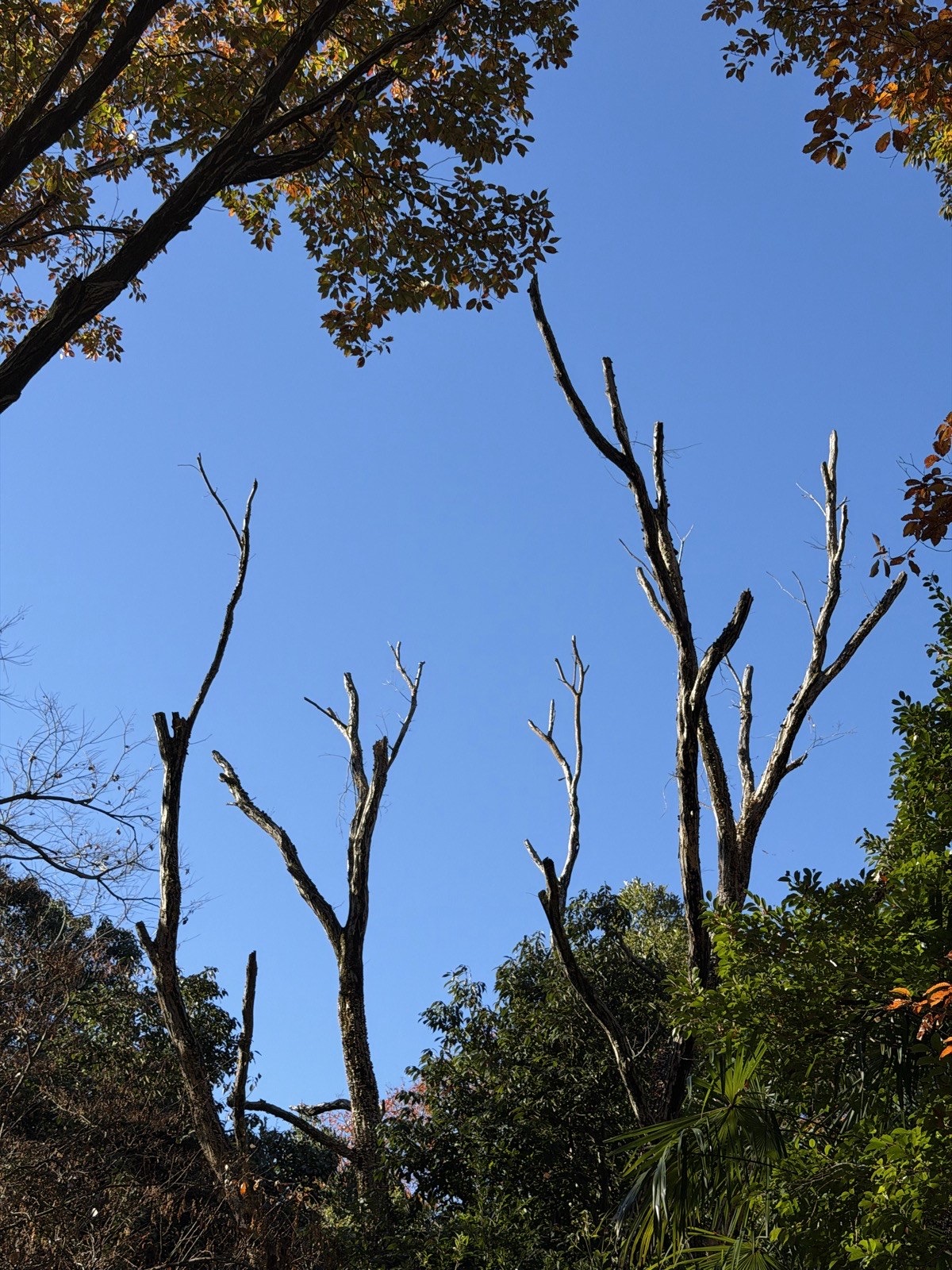
A deciduous tree normally drops its leaves in autumn. An oak killed by oak wilt can keep some of them. A paper in a Japanese remote-sensing journal explains why: in oak wilt there is no abscission layer forming at the base of the leaf stalk, as there is in normal leaf fall, and field surveys confirmed that some dead leaves remain on the branches. That helps explain why the damage was so visible: dead crowns could hold discoloured leaves among the green ones.
Not every oak dies — the species and the trunk
Mizunara and konara
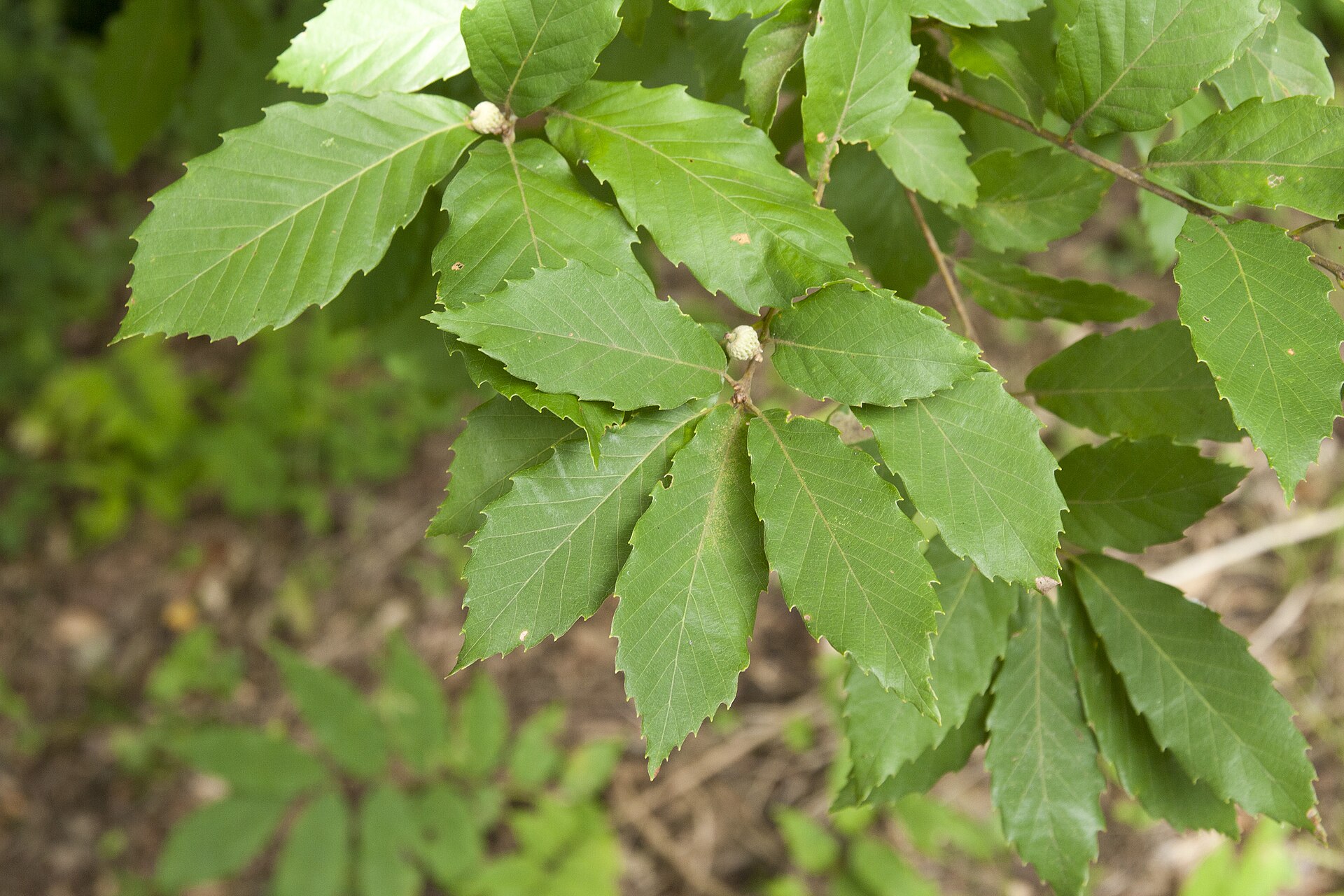
The beetle can bore into many trees, but the death rate differs by species. Among the deciduous oaks, FFPRI’s research found the death rate is high in mizunara (ミズナラ), the Mongolian oak, and lower in konara (コナラ). FFPRI also notes that tree death has been recorded in every genus of Japanese beech-family trees except the beeches themselves, and lists the Japanese chestnut, Castanea crenata, among them.
The evergreens
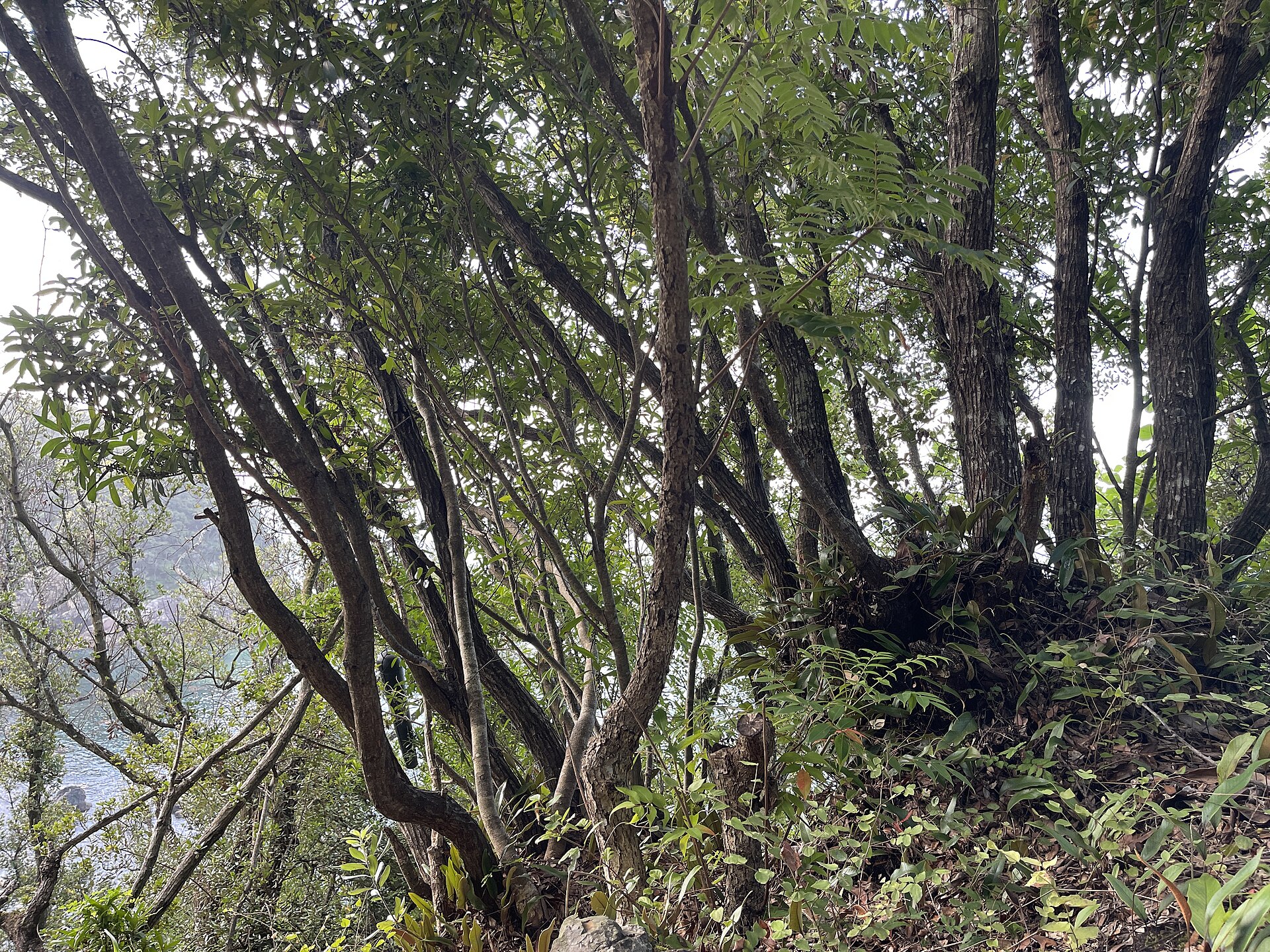
For evergreen beech-family trees, an FFPRI risk assessment ranks the risk of death as sudajii (a chinquapin) highest, then matebashii (another chinquapin relative), then the evergreen oaks such as ubamegashi and arakashi — the trees that supply wood for binchōtan (備長炭) white charcoal. This matters on Higashiyama, where much of the forest is now chinquapin.
Attack is not a death sentence
Not every attacked tree dies. Holes and frass mean the beetle has arrived; they do not by themselves mean the tree is lost. In Honshu, the typical victims are large trunks. In Hokkaido, though, the prefectural government reports damage to thinner trees under 30 cm (12 in) in diameter and to trees with few entry holes. A rule of thumb from one region does not travel well to the next.
| Tree | Japanese name | What the research says |
|---|---|---|
| Mongolian oak | Mizunara (ミズナラ) | High death rate; higher than konara |
| Konara oak | Konara (コナラ) | Lower than mizunara, but a main victim on Higashiyama |
| Japanese chestnut | Kuri (クリ) | Deaths recorded |
| Chinquapins | Sudajii, kojii, matebashii | Sudajii ranked highest risk among evergreens |
| Evergreen oaks | Ubamegashi, arakashi | Ranked below the chinquapins; damage recorded in Kyoto |
| Beeches | Buna (ブナ) | The one beech-family genus without recorded deaths |
Why Japan’s oak forests were ready — the end of coppicing
Cut every twenty to thirty years
The hills around Japanese villages and cities were long used as shintan-rin (薪炭林) — coppice woods for firewood and charcoal. The Forestry Agency describes how these woods were cut at intervals of about 20–30 years and regrew from the stumps, sprouting new stems. That rhythm limited how large many stems could grow before they were cut again.
The fuel revolution
Then demand fell away. The Forestry Agency records that demand for firewood and charcoal dropped sharply with the fuel revolution of the Shōwa 30s, the decade from 1955 to 1964. The coppices were left alone. Their oaks kept growing.
FFPRI calls this a strong hypothesis, not a proven single cause: oaks that were no longer used were left across Japan and grew large, and those large trees suited the beetle. The beetle’s habits support it. FFPRI notes that kashinaga bore into thick trees at a higher rate, and that large trees produce more offspring than small ones.
A Japanese situation
If the hypothesis holds, the Japanese part of the story is land use: many oaks that had been cut back on a fixed rhythm were left to grow on, and gradually reached the sizes the beetle favours.
| Period | How the oak woods were used | What it meant for the beetle |
|---|---|---|
| Edo period | Heavy fuel cutting; temple forests near Kyoto held only small pines | — |
| Until the 1950s | Coppice cut every 20–30 years and regrown from stumps | Trunks rarely reached large size |
| Shōwa 30s (1955–1964) | Fuel revolution; demand for firewood and charcoal collapsed | Cutting stopped |
| From the 1980s | Large, unmanaged oaks over wide areas | Damage spread without dying down |
Higashiyama’s own history — a borrowed-scenery forest
From pine to chinquapin
Higashiyama has its own version of this story. A Forestry Agency planning document cites analysis of old maps showing that fuel cutting was so heavy in the Edo period that even the temple forests on what is now national forest held only small pines. From the Meiji era onward, the Kōdaiji-yama forest gradually shifted from a mainly red-pine forest to an evergreen broadleaf forest centred on chinquapin. From the Shōwa 30s, pine wilt cut the red pines back further. Our article on pine wilt disease in Japan explains that other epidemic, which took Kyoto’s pines a generation before nara-gare took its oaks.
The city’s vegetation survey describes large blocks of chinquapin forest pushing into the red-pine woods and still expanding, with well-developed deciduous woods of abemaki and konara oak at the foot of the hills. The Forestry Agency, for its part, lists large konara and chinquapin as the main dead trees in Kōdaiji-yama. Both are hosts for the beetle.
A forest managed for the view
These are not timber forests. The Forestry Agency states that Higashiyama’s national forests are managed with scenery as their main purpose, as the backdrop — shakkei (借景), borrowed scenery — to the temples and shrines below. Our article on shakkei, the Japanese art of borrowing scenery explains how gardens use hills like these as part of their design.
That management has a long record. In 1934 the Muroto typhoon struck the Kōdaiji-yama forest, damaging about 65,000 trees and 11,000 m³ of timber. In 1936 the Higashiyama National Forest Scenery Plan was drawn up. In 1993 a new management policy set out to maintain and improve forest beauty fitting the landscape of the old capital, with attention to disaster prevention as well. When a forest exists to be looked at, brown crowns over Kiyomizu-dera are not only a forestry loss.
An old disease spreading north — from Kyushu to Hokkaido
Older than it looks
Oak wilt is not new to Japan. A study of old documents from Iiyama in Nagano Prefecture found that in 1750, leaves turned colour from summer and many oaks died; the authors judge that it was the same disease, though no one at the time could identify a fungus. FFPRI’s search of old records adds a probable case on Mount Takahara in Tochigi Prefecture in October 1880, and finds that the first damage record in Kyushu’s statistics dates from 1934.
What changed is that the outbreaks no longer died down. A Forestry Agency office in Tōhoku writes that since the 1980s the damage has kept spreading, mainly on the Sea of Japan side, and in recent years on the Pacific side as well.
The northward line
Prefecture by prefecture, the dates show when damage was first recorded in the north. Akita confirmed its first case in 2006 in Nikaho. Aomori found damage in Fukaura in fiscal 2010, saw it die out, then found it again in fiscal 2016. Iwate confirmed its first case in Ōshū in 2010, and on the coast in Ōfunato in 2013.
In Hokkaido, in 2020, FFPRI announced that kashinaga had been trapped for the first time in Hokkaido, in Fukushima and Matsumae in the far south-west of the island, and stressed that no damaged trees had been found. The first damaged trees were confirmed in October 2023, in the same two towns. The Hokkaido government reported more damage in the south-west of the island in 2025.
| Year | Where | What happened |
|---|---|---|
| 1750 | Iiyama, Nagano | Old documents record mass oak death; judged to be oak wilt |
| 1880 | Mt Takahara, Tochigi | Probable oak wilt in old records |
| 1934 | Kyushu | First damage in regional statistics |
| From the 1980s | Sea of Japan side | Damage spreads without dying down |
| 2005 | Kyoto city, Higashiyama | Damage begins to spread |
| 2006 | Nikaho, Akita | First record in Akita |
| 2010 | National; Ōshū, Iwate; Fukaura, Aomori | National peak; first records in Iwate and Aomori |
| 2020 | Fukushima and Matsumae, Hokkaido | First beetles trapped; no damaged trees |
| October 2023 | Same Hokkaido towns | First damaged trees confirmed |
The national numbers
The Forestry Agency measures damage by the volume of killed timber. The national figure peaked in fiscal 2010 at 325,000 m³. In fiscal 2025, the latest confirmed year, it was 212,000 m³, with damage in 45 of Japan’s 47 prefectures.
Kyoto shows the other side. The agency’s table for Kyoto Prefecture gives 1,200 m³ in fiscal 2021, 1,500 m³ in 2022, 1,100 m³ in 2023, 500 m³ in 2024 and 100 m³ in 2025 — 19% of the year before. The 19% is the agency’s own figure, calculated from unrounded values. Kyoto Prefecture’s reported damage volume has fallen steeply, while national damage remains substantial. Neither figure is a count for Higashiyama alone.
Winter work — felling and fumigation
Why winter
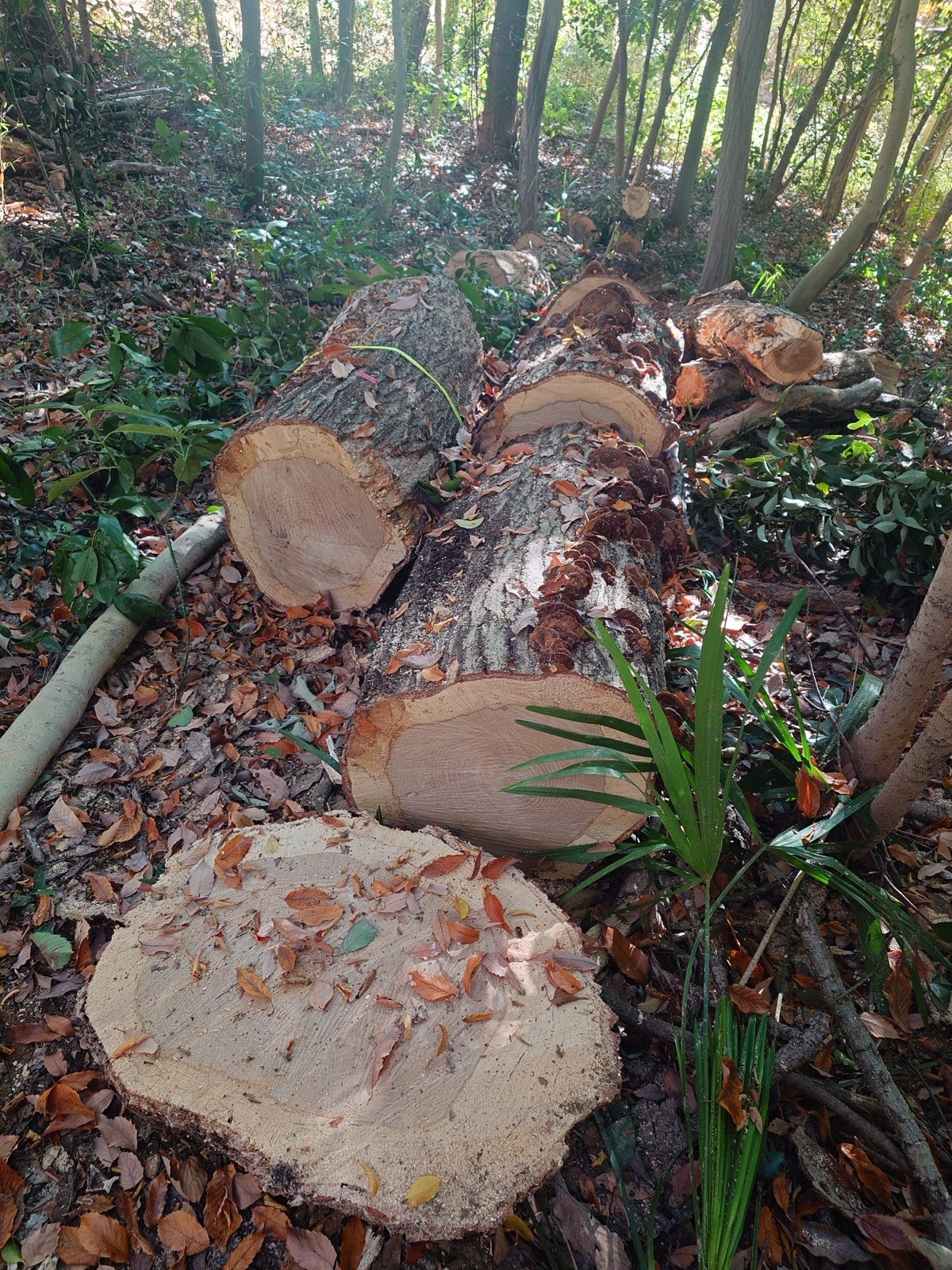
The beetle’s weak point is that many of the next generation stay inside the attacked wood until the main emergence in June to August. The Forestry Agency’s guidance is to fell the damaged trees in autumn to spring, before the new adults emerge, and then fumigate, burn or chip the wood. In the Kōdaiji-yama forest, that is what was done: dead trees were felled and the felled wood fumigated.
How fumigation is done
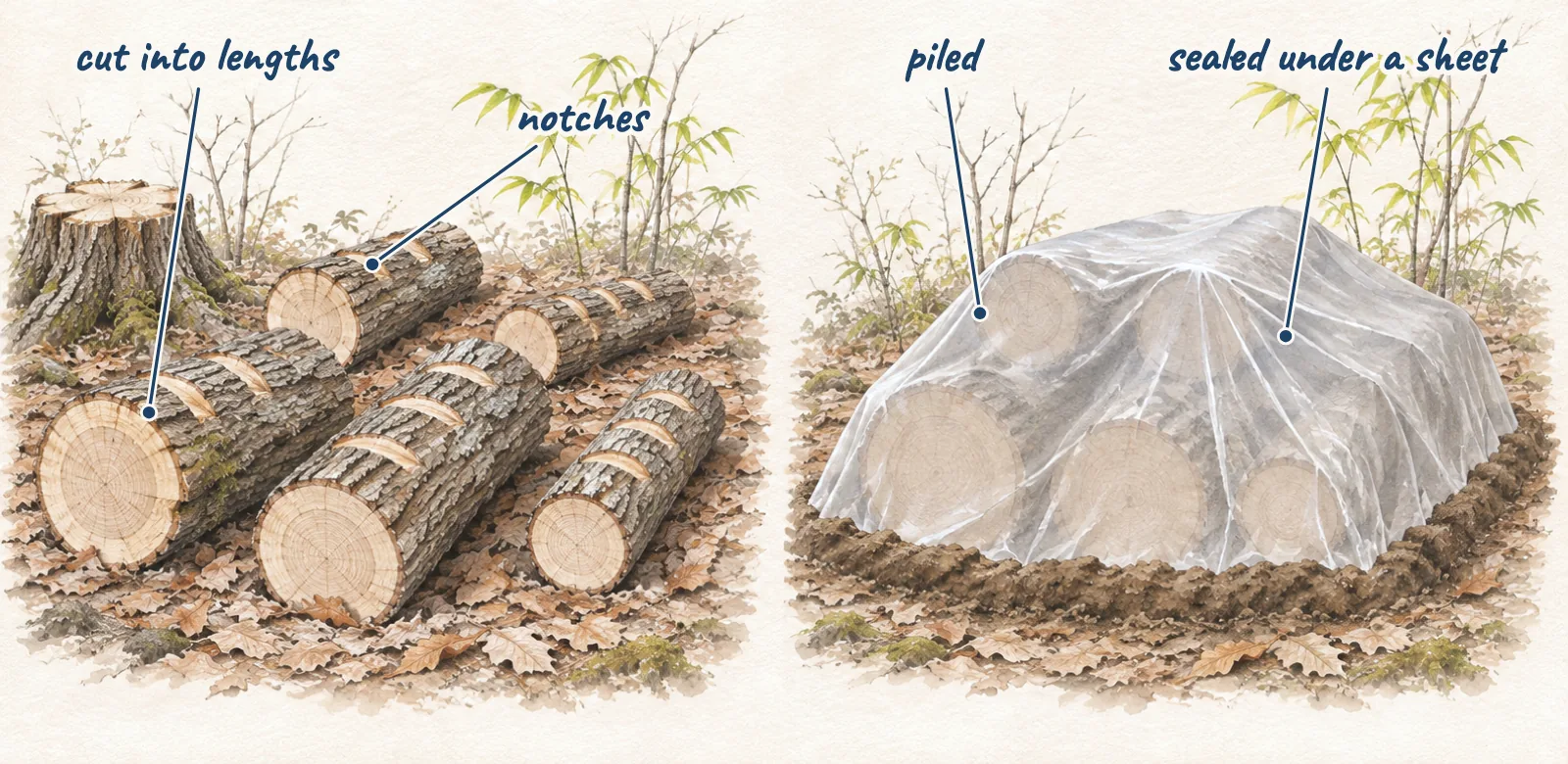
The agency describes the method. The trunk is cut into lengths, notches are cut into the surface of the wood so the gas can penetrate, the pieces are piled, and the pile is sealed under a sheet and treated with a fumigant, carbam. There is a catch. “Fell in winter” does not mean “fumigate in the depths of winter”. Hokkaido’s treatment manual notes that the fumigant does not vaporise at low temperatures, and says fumigation should not be done from November to early April. In cold regions, felling and fumigation therefore have to be scheduled separately.
The stump and the firewood
The trunk is not the whole tree. FFPRI points out that the beetle also bores into and breeds in the stumps of damaged trees, and new adults emerge from them the following year. Treating the trunk and leaving the stump can leave part of the problem in place.
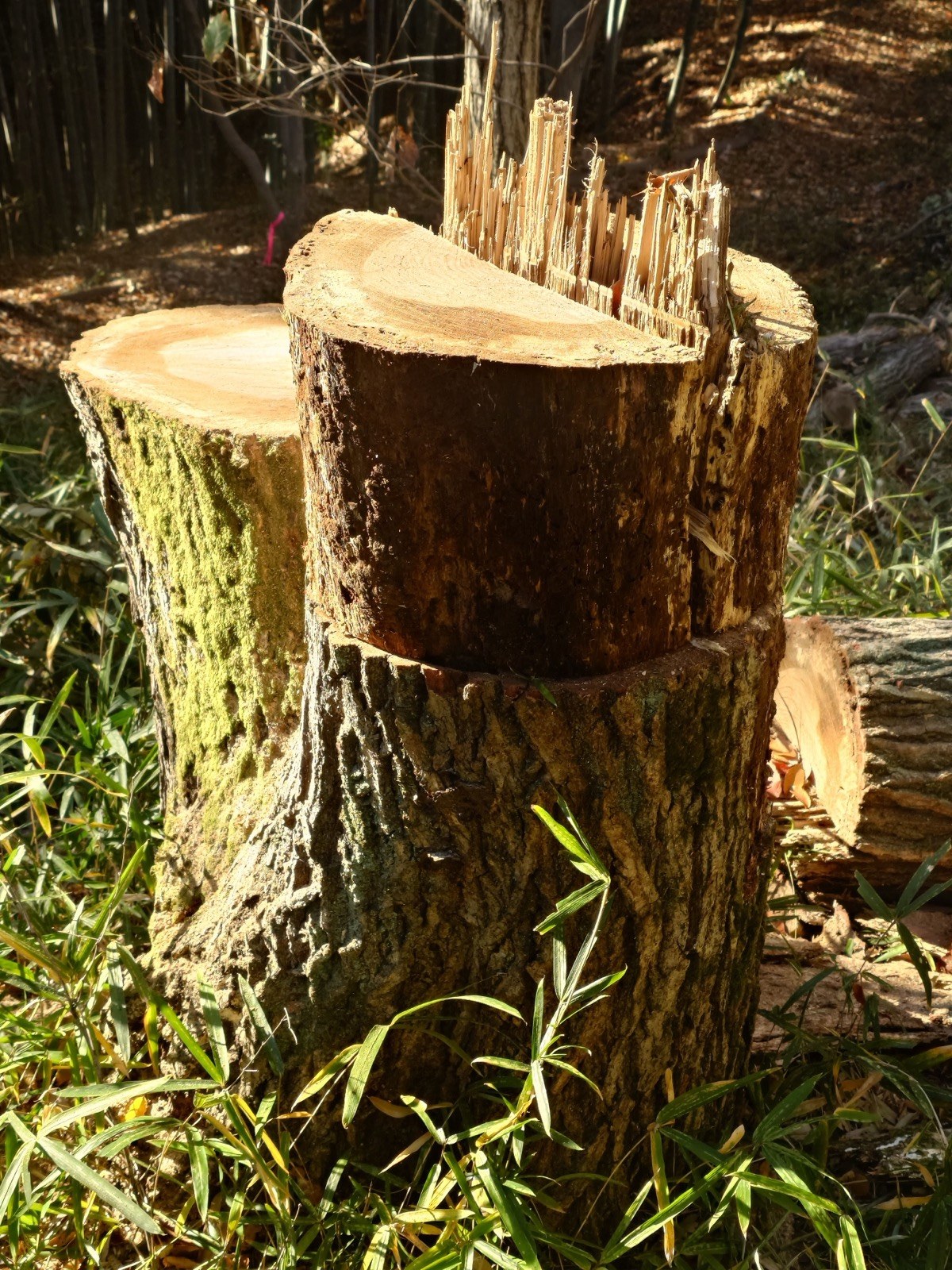
Firewood is tempting, and it has been used. Kyoto University’s forest station reported that damaged trees on its land were felled and fumigated, and that part of the wood was used as fuel for wood stoves. That is not permission to carry untreated logs away. Wood moved or stored untreated can release beetles in June to August, so how the wood is used has to be decided together with how it is treated.
Kyoto City added a further step after the felling. Since fiscal 2011 it has planted trees on damaged sites and put up deer fences around them, so that the gaps fill again rather than staying open.
| Step | Season | Purpose |
|---|---|---|
| Find dead trees | Late summer–autumn | Discoloured crowns that keep some leaves can be conspicuous |
| Fell | Autumn–spring, before emergence | Get the wood down while the beetles are inside |
| Cut, notch, pile, seal | After felling | Let the fumigant reach the beetles in the wood |
| Fumigate with carbam | When temperatures allow (not Nov–early Apr in Hokkaido) | Kill larvae and new adults |
| Or burn / chip | Autumn–spring | Alternatives to fumigation |
| Deal with the stump | With the trunk | Stumps can produce beetles too |
Protecting the trees that matter — sheets, traps and injections
Spring: wrapping healthy trunks
Felling deals with trees already lost. For trees that must be kept — a shrine’s sacred tree, a temple’s backdrop, a park’s specimen oak — the Forestry Agency names prevention before damage or at its early stage, together with removing damaged trees around them.
The simplest method is to wrap the trunk. In spring, before the beetles fly, healthy trunks are covered with a vinyl sheet or coated with a sticky agent to stop adults boring in. The Kyoto Prefectural Botanical Garden wrapped trunks in vinyl and thinned out suppressed trees from 2008 onward to protect its valuable beech-family trees.
A sticky sheet has a second use that is easy to confuse with the first. Wrapped around a tree that was attacked the year before, it traps the new adults as they come out, rather than keeping beetles out of a healthy tree. The target tree is different, and so is the reason.
Traps and bait logs
Beetles can also be drawn to where they can be killed. In the bait-log method, oak logs are set out with a synthetic pheromone lure; the beetles bore in, and the logs, beetles and all, are then destroyed with chemicals or by chipping. It is a method of killing, not just of luring.
At shrines and temples in Kyoto, the prefecture’s forest technology centre reports combining traps with sheet wrapping at a shrine whose sacred tree is an oak. The prefecture lists Otokoyama, in the grounds of Iwashimizu Hachimangū in Yawata, and Tōno, in the grounds of Jōruri-ji in Kizugawa, as places where kashinaga traps were set.
Injection, and its limits
The last tool is a fungicide injected into the trunk of a healthy konara or mizunara. FFPRI’s guidance is clear about its limits. For deciduous oaks, it must be done at leaf flush, because at other times the chemical does not spread through the tree. And it does little for an oak that is already wilting: it is a preventive, not a cure.
| Method | Which tree | When | What it does |
|---|---|---|---|
| Vinyl sheet / sticky coating | Healthy trees | Spring | Stops beetles boring in |
| Sticky sheet | Trees attacked last year | Before emergence | Traps adults coming out |
| Bait logs with pheromone | Nearby stand | Flight season | Gathers beetles, then destroys them |
| Traps | Around valued trees | Flight season | Catches beetles |
| Fungicide injection | Healthy konara, mizunara | Leaf flush | Prevents infection; not a cure |
| Felling and fumigation | Dead and dying trees | Autumn–spring | Kills the next generation |
What about mesh?
You will also see trunks wrapped in mesh, as on our own job below. I have not found a Forestry Agency, FFPRI, Kyoto Prefecture or Kyoto City document that sets out the conditions or results of mesh separately from vinyl or sticky sheets, so I will not claim a figure for how well it works.
From the field
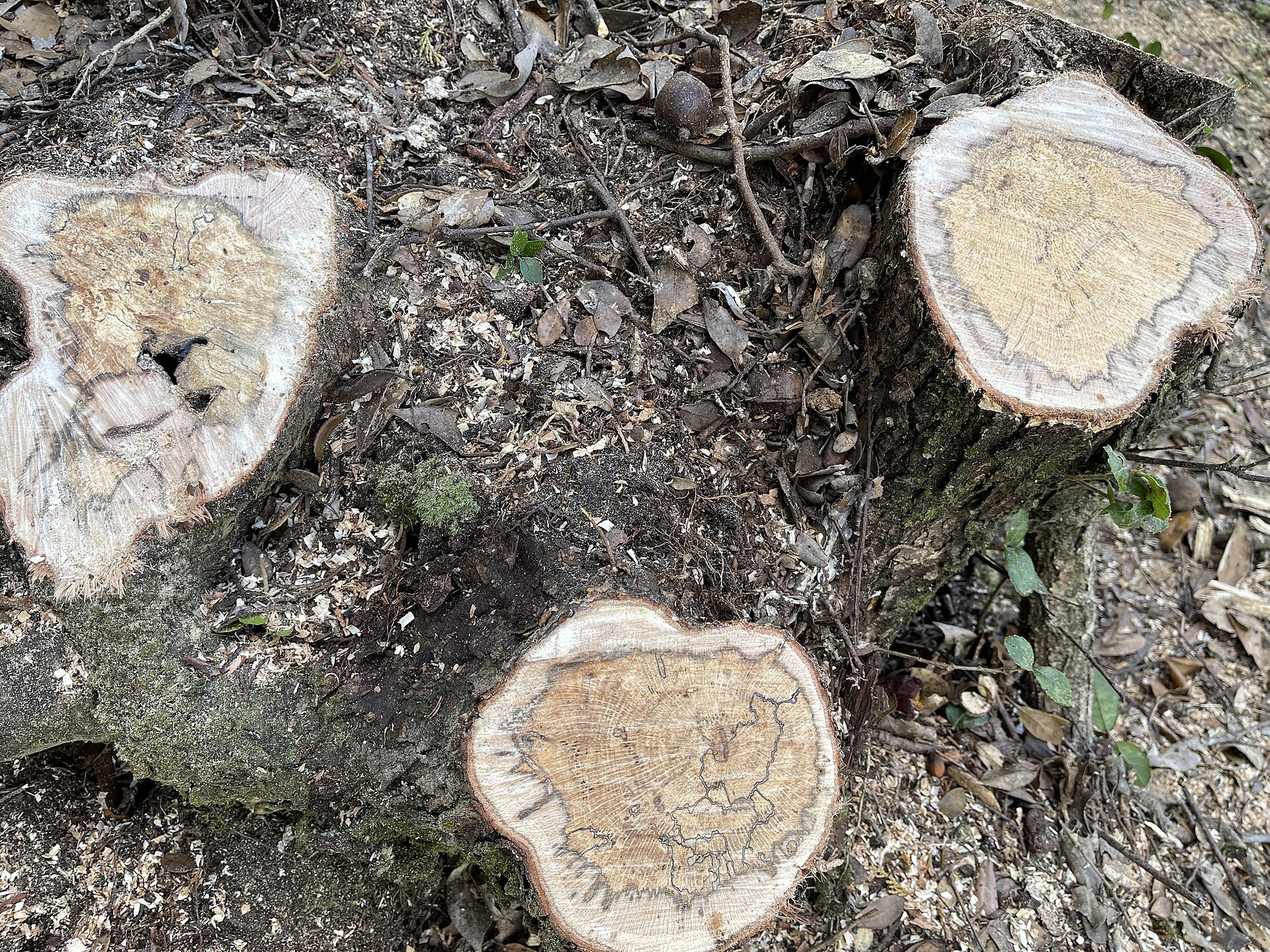
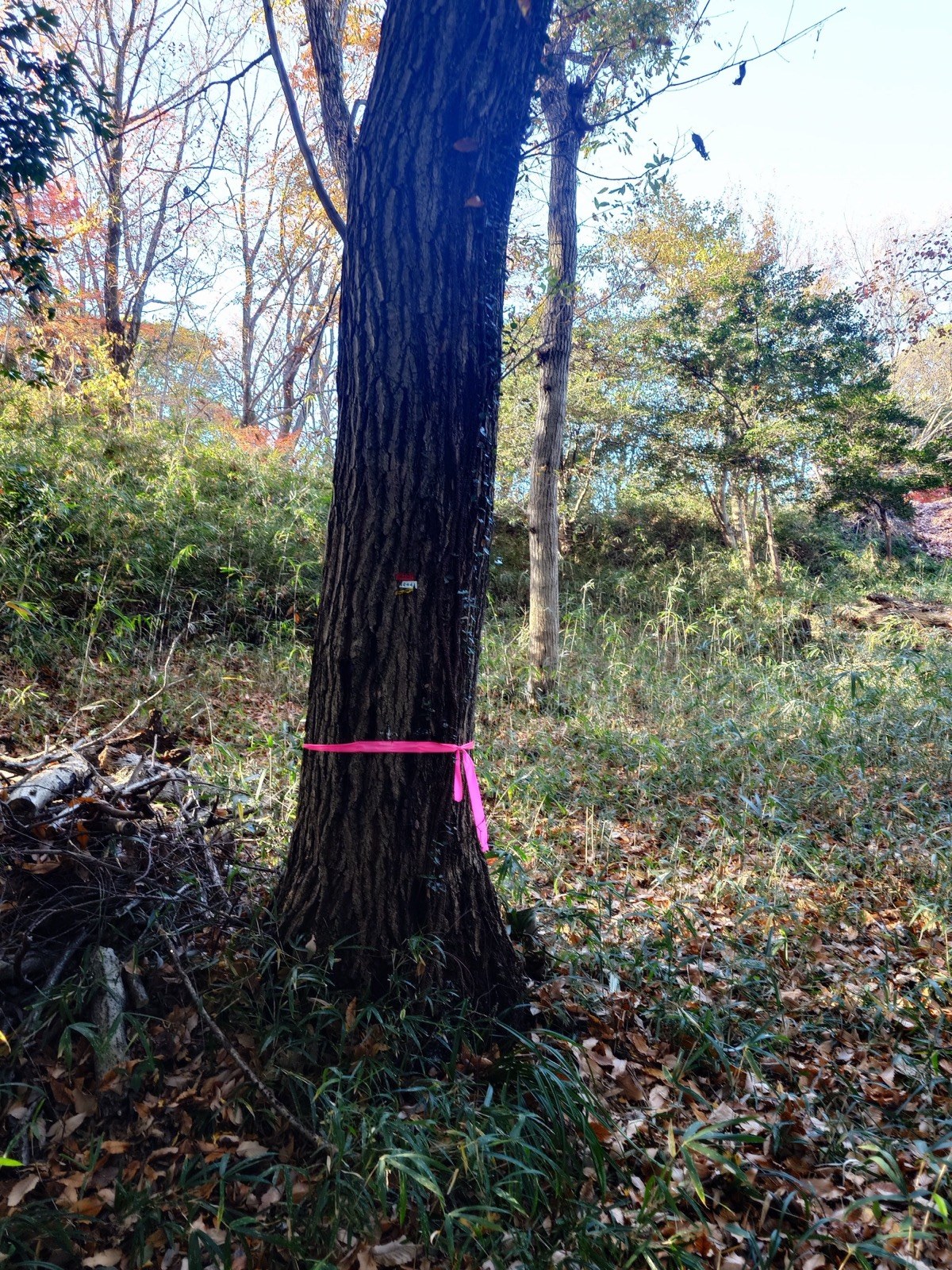
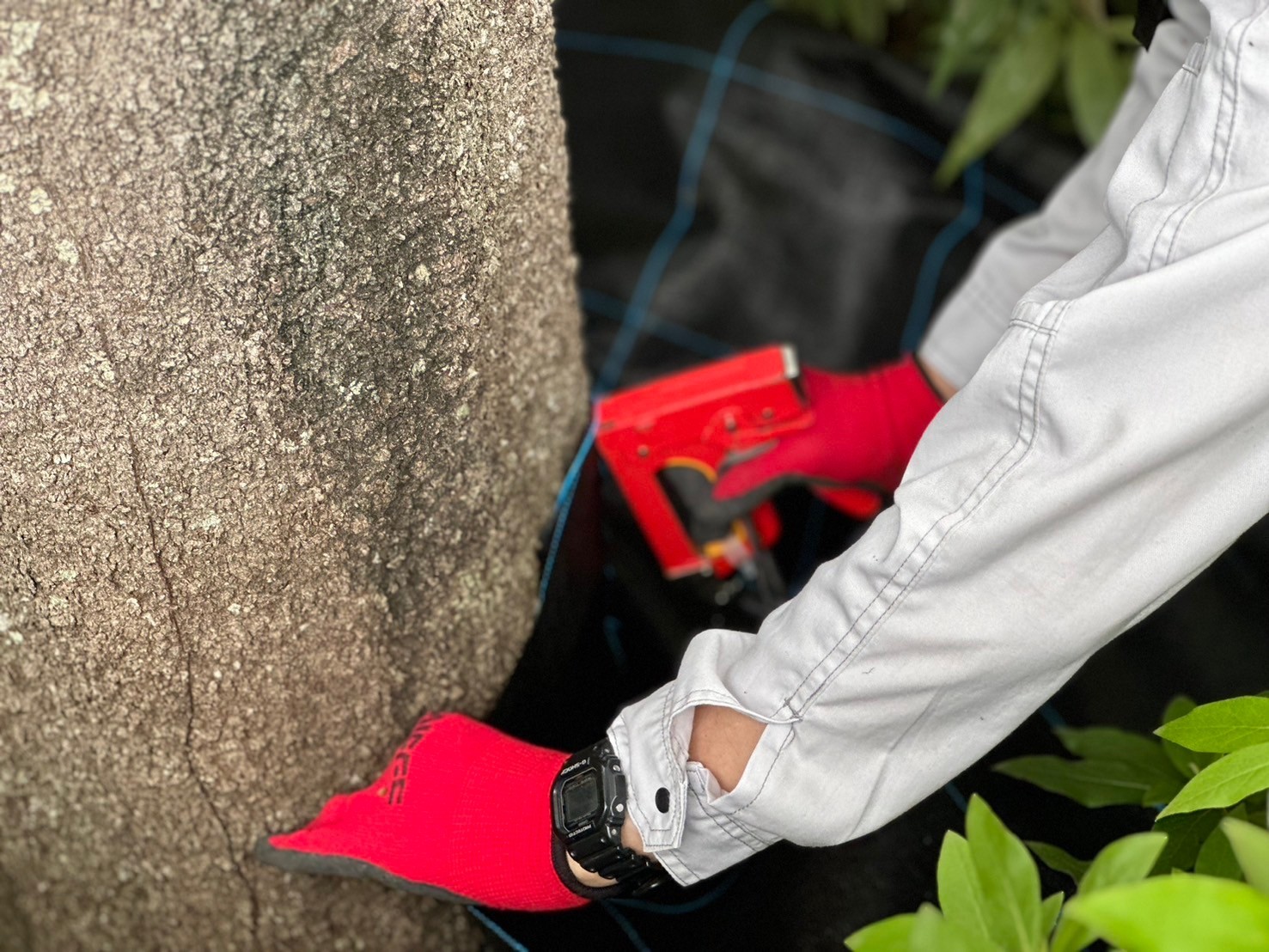
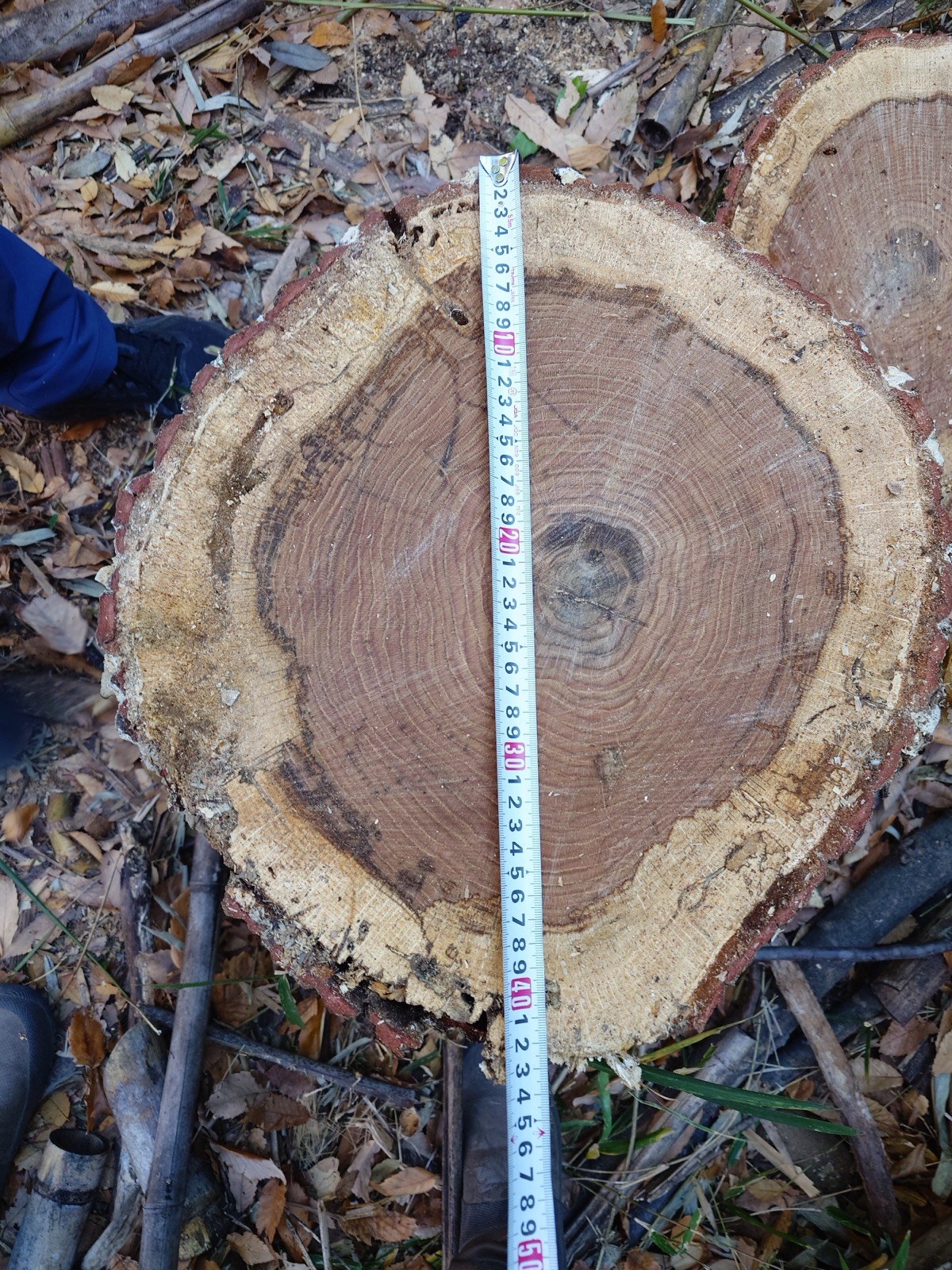
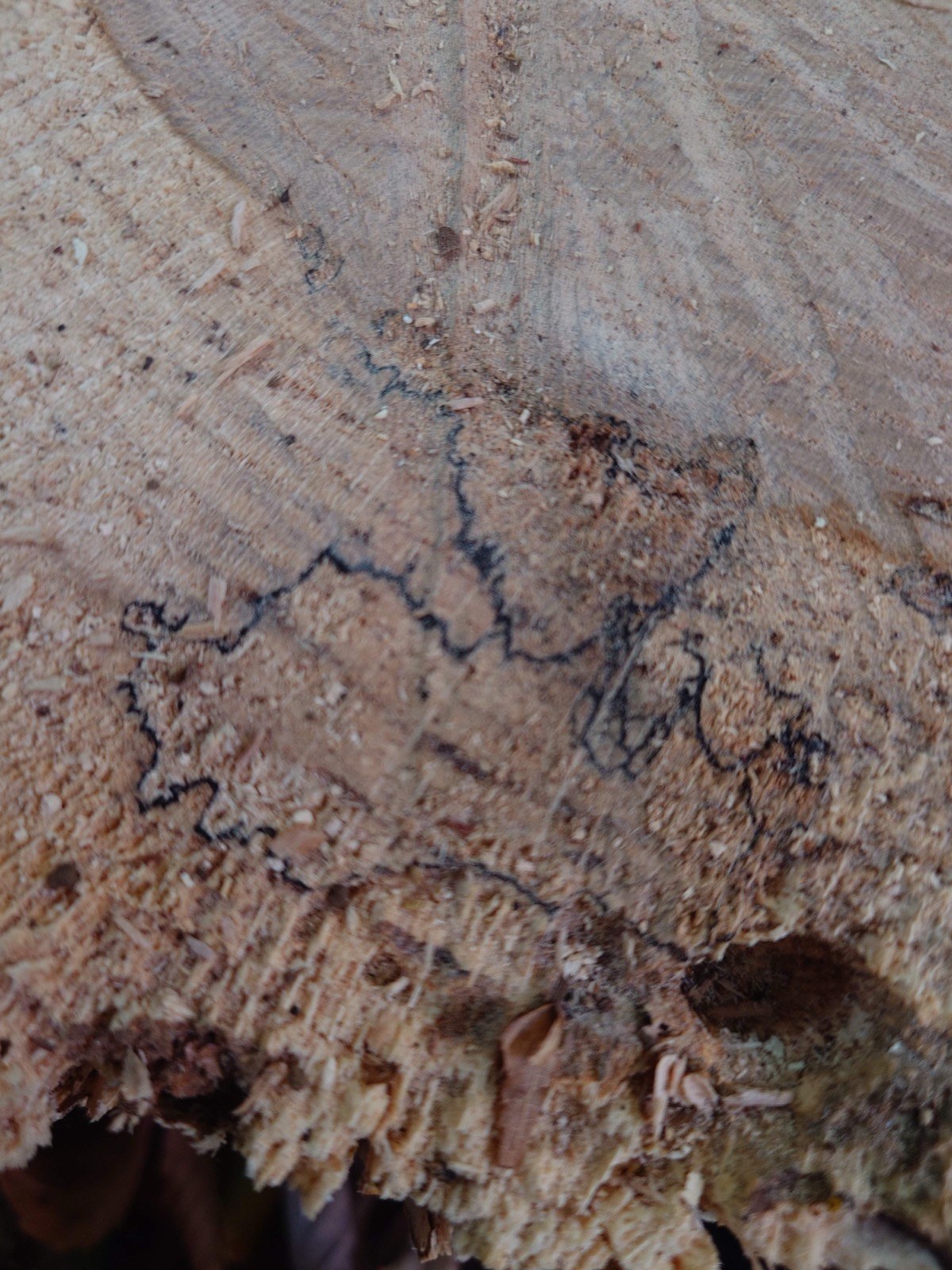
In May 2024, as an oak wilt precaution, we wrapped protective mesh around the trunks of trees in a park in Tokyo and fixed it with a staple gun and tape. In December 2025 we examined trees killed by oak wilt in a woodland in western Tokyo: we felled some, measured the diameter of the cut faces, and recorded the dark streaks in the cross-sections and the split wood. What the photos from that day keep is the inside of the trees, which no view of the crown shows. Our piece on reading tree decay without technology describes the field checks that come before any instrument.
Same name, different disease — oak wilt in the United States, Korea and Europe
American oak wilt
In North America, “oak wilt” names a different disease caused by a different organism. The American pathogen is Bretziella fagacearum. It spreads in two ways: sap beetles (family Nitidulidae) carry spores to fresh wounds, and the fungus passes between neighbouring trees through root grafts, where the roots of two trees have fused.
That is why the American advice looks so different from the Japanese. University of Minnesota Extension treats April to July as high risk in that state and tells owners not to wound, prune or fell oaks in that period. Texas A&M’s materials explain that spore-producing mats form under the bark of infected red oaks, most often in spring, and that their fruity smell draws insects. To stop spread through roots, crews dig trenches to cut the connections between neighbouring trees. In Minnesota, an oak in the red oak group infected through a branch can die in as little as four weeks; oaks in the white oak group decline more slowly, over two to five years or longer.
Korea
Korea has a related disease. There the beetle is Platypus koryoensis and the fungus is Dryadomyces quercus-mongolicae, formerly Raffaelea quercus-mongolicae, according to a 2025 US Forest Service paper.
Europe
EPPO’s distribution table, updated in 2026, does list P. quercivorus under “Europe” — but the entry is the Russian Far East. It is not a record of Japanese-type oak wilt in western or central Europe. How European oaks would react to the Japanese fungus is not known; EPPO itself notes the lack of data. In Japan, FFPRI makes the same point from the other side: it is not well understood whether foreign oaks would be killed by nara-gare, and it advises caution in botanical gardens, gardens and parks.
| Japan | United States | Korea | |
|---|---|---|---|
| Name | Nara-gare (Japanese oak wilt) | Oak wilt | Similar disease |
| Fungus | Raffaelea quercivora (Dryadomyces quercivorus) | Bretziella fagacearum | Dryadomyces quercus-mongolicae |
| Insect carrier | Ambrosia beetle Platypus quercivorus that bores in | Sap beetles visiting fresh wounds | Ambrosia beetle Platypus koryoensis |
| Other spread | — | Root grafts between neighbouring trees | — |
| Examples of control | Fell and fumigate in autumn–spring; wrap and inject healthy trees | No wounding April–July (Minnesota guidance); trenching to cut root connections | — |
The two sets of advice answer different biology. In Japan, the beetle itself carries the fungus into the trunk and its next generation develops in the dead wood, so the work focuses on that brood. In the American disease, fresh wounds and shared roots are routes of spread, so the guidance focuses on those, with timing set state by state.
Reading a tree — signs and judgement
Signs to check
For a garden owner or park manager in Japan, there are three things to check. In early summer, look at the base of beech-family trees for frass: pale, fine powder gathered at the foot of the trunk and in bark cracks. Look for the holes, about 1.5 mm across. From late July, watch the crowns for whole-tree discoloration with some leaves staying on. None of these alone confirms oak wilt; together on a beech-family tree in summer they make it a suspect, and the tree should be assessed.
Where to stop
The judgement that matters is about timing. A tree that is wilting in August is unlikely to be saved by injection. It may harbour next year’s beetles, so once it has been assessed, the question becomes whether and when to fell and treat it before the June emergence. Not every attacked tree dies, which is another reason to assess before felling. A healthy tree next to it is the one to protect, in spring, with wrapping or injection at leaf flush. Mixing up the two — injecting a dying tree, or felling and leaving the stump — is where effort is wasted.
A dead oak is also a tree-safety question in parks and along paths. Japan’s ageing urban trees raise the same kind of question; our article on Japan’s falling trees crisis looks at that wider problem.
| What you see | When | What it usually means | What to do |
|---|---|---|---|
| Frass at the trunk base | June–August | Possible beetle attack | Watch the crown; arrange an assessment |
| About 1.5 mm holes | June–August | Possible entry holes | Same; check neighbouring trees |
| Whole crown discoloured, some leaves attached | Late July–mid-August | Suspected oak wilt | Assess; if confirmed dead, plan treatment before emergence |
| Healthy oak beside a dead one | Spring | At risk this year | Wrap the trunk or inject at leaf flush |
Frequently asked questions
What is nara-gare?
Nara-gare (ナラ枯れ) is the Japanese name for Japanese oak wilt, a disease in which an ambrosia beetle, Platypus quercivorus, carries a fungus, Raffaelea quercivora, into oaks and related trees. The fungus blocks the tree’s water flow, and infected trees often die between late July and mid-August.
Why do the leaves turn brown in summer instead of falling in autumn?
The tree dies of water shortage after the rainy season, when transpiration is highest. Because no abscission layer forms at the leaf stalk, some dead leaves stay attached, so discoloured crowns can stand out among green trees.
Is Japanese oak wilt the same as oak wilt in the United States?
No. The American disease is caused by Bretziella fagacearum, which spreads through sap beetles to fresh wounds and through root grafts. The Japanese disease is carried by an ambrosia beetle that bores into the trunk.
When is the right time to fell and fumigate infected trees in Japan?
In autumn to spring, before new adults emerge in June to August. In cold regions such as Hokkaido, fumigation is avoided from November to early April because the fumigant does not vaporise in the cold.
Can trunk injection save a tree that is already wilting?
Not usually. FFPRI notes that fungicide injection works poorly on oaks that are already wilting. It is a preventive for healthy konara and mizunara, and on deciduous oaks it must be done at leaf flush.
Why did oak wilt increase in Japan?
The leading explanation, which FFPRI calls a strong hypothesis, is that coppice oaks once cut every 20–30 years for fuel were left uncut after the fuel revolution of 1955–1964 and grew large. The beetle prefers large trunks and produces more offspring in them.
Sources
– Forestry Agency, oak wilt overview (damage mechanism, seasons, control methods, FY2025 figures): https://www.rinya.maff.go.jp/j/hogo/higai/attach/pdf/naragare-23.pdf — checked 2026-11-14 – Forestry Agency, national damage volume trend: https://www.rinya.maff.go.jp/j/hogo/higai/attach/pdf/naragare-18.pdf — checked 2026-11-14 – Forestry Agency, damage volume by prefecture: https://www.rinya.maff.go.jp/j/hogo/higai/attach/pdf/naragare-19.pdf — checked 2026-11-14 – Forestry Agency, coppice forests and the fuel revolution: https://www.rinya.maff.go.jp/j/tokuyou/jyunkanriyou/ — checked 2026-11-14 – Forestry Agency Kinki-Chūgoku, Kyoto office, Kōdaiji-yama national forest: https://www.rinya.maff.go.jp/kinki/kyoto/information/mail-news/200104-mail-news03.html — checked 2026-11-14 – Forestry Agency Kinki-Chūgoku, Kōdaiji-yama outline: https://www.rinya.maff.go.jp/kinki/kyoto/information/evrepo/220531chuugoku_kokkarinngyou/pdf/100531koudaijiyama_gaiyou.pdf — checked 2026-11-14 – Forestry Agency Kinki-Chūgoku, Kyoto office overview: https://www.rinya.maff.go.jp/kinki/kyoto/information/pamphlet/pdf/100426kannaigaiyou.pdf — checked 2026-11-14 – Forestry Agency Kinki-Chūgoku, Arashiyama advisory meeting materials: https://www.rinya.maff.go.jp/kinki/kyoto/katudo_hokoku/220929arasiyama_ikenkoukan/pdf/220929arasiyama_siryou.pdf — checked 2026-11-14 – Forestry Agency Kinki-Chūgoku, Higashiyama national forest management policy: https://www.rinya.maff.go.jp/kinki/kyoto/about_us/attach/pdf/houkokushonado-4.pdf — checked 2026-11-14 – Forestry Agency Kinki-Chūgoku, planning notes (Edo-period temple forests): https://www.rinya.maff.go.jp/kinki/kyoto/information/kotomatu/plannote/plannote.html — checked 2026-11-14 – Forestry Agency, Higashiyama recreation forest: https://www.rinya.maff.go.jp/j/kokuyu_rinya/kokumin_mori/katuyo/reku/rekumori/higashiyama.html — checked 2026-11-14 – Forestry Agency Kantō, oak wilt control methods: https://www.rinya.maff.go.jp/kanto/policy/business/hogozigyou/naragare2.html — checked 2026-11-14 – Forestry Agency Tōhoku, oak wilt spread: https://www.rinya.maff.go.jp/tohoku/policy/business/management/hozen/narakare.html — checked 2026-11-14 – Forestry Agency Hokkaido, oak wilt treatment manual: https://www.rinya.maff.go.jp/hokkaido/policy/conservation/naragare/attach/pdf/naragare-3.pdf — checked 2026-11-14 – FFPRI Kansai, oak wilt manual: https://www.ffpri.go.jp/fsm/research/pubs/documents/nara-fsm_201202.pdf — checked 2026-11-14 – FFPRI Kansai, satoyama series 3: https://www.ffpri.go.jp/fsm/research/pubs/documents/satoyama3_201002.pdf — checked 2026-11-14 – FFPRI, aggregation pheromone research: https://www.ffpri.go.jp/labs/kanko/402-5.pdf — checked 2026-11-14 – FFPRI, kashinaga snapshot: https://www.ffpri.go.jp/snap/2015/7-kashinaga.html — checked 2026-11-14 – FFPRI Tōhoku, kashinaga life cycle: https://www.ffpri.go.jp/thk/research/publication/thk/documents/2-2.pdf — checked 2026-11-14 – FFPRI, 2023 oak wilt lecture Q&A: https://www.ffpri.go.jp/event/2023/20231221naragarelec/qanda.html — checked 2026-11-14 – FFPRI, mid-term results (species death rates): https://www.ffpri.go.jp/pubs/chukiseika/documents/5th-chuukiseika32-2.pdf — checked 2026-11-14 – FFPRI, mid-term results (evergreen risk): https://www.ffpri.go.jp/pubs/chukiseika/documents/3rd-chuukiseika26.pdf — checked 2026-11-14 – FFPRI, mid-term results (Ginkakuji-yama): https://www.ffpri.go.jp/thk/business/arc/past_info/documents/4th-chuukiseika16.pdf — checked 2026-11-14 – FFPRI, research information 115 (trunk injection): https://www.ffpri.go.jp/fsm/research/pubs/joho/documents/research-information115.pdf — checked 2026-11-14 – FFPRI, results (Kyoto shrine protection): https://www.ffpri.go.jp/pubs/documents/seika-17.pdf — checked 2026-11-14 – FFPRI, 2020 press release (first beetles in Hokkaido): https://www.ffpri.go.jp/press/2020/20201225/index.html — checked 2026-11-14 – FFPRI, 2025 press release (entry holes): https://www.ffpri.go.jp/press/2025/20250528/documents/20250528press.pdf — checked 2026-11-14 – FFPRI Kyushu, historical records of oak wilt: https://www.ffpri.go.jp/kys/research/kankou/nenpo/documents/30kysnenpopass-1.pdf — checked 2026-11-14 – Journal of the Japanese Forest Society, 1750 records from Iiyama: https://www.jstage.jst.go.jp/article/jjfs/92/2/92_2_115/_pdf — checked 2026-11-14 – Journal of the Japan Society of Photogrammetry and Remote Sensing, dead leaves remaining: https://www.jstage.jst.go.jp/article/jsprs/49/5/49_5_294/_pdf — checked 2026-11-14 – Kyoto City, forestry newsletter (Daimonji-yama 2010, damage counts, replanting): https://www.city.kyoto.lg.jp/sankan/cmsfiles/contents/0000238/238897/dayoriR103.pdf — checked 2026-11-14 – Kyoto City, vegetation of Higashiyama: https://www.city.kyoto.lg.jp/tokei/cmsfiles/contents/0000281/281258/2.pdf — checked 2026-11-14 – Kyoto Prefecture, red data book (fungi): https://www.pref.kyoto.jp/kankyo/rdb/bio/fungi_g.html — checked 2026-11-14 – Kyoto Prefecture, biodiversity strategy (trap sites): https://www.pref.kyoto.jp/shizen-kankyo/documents/senryaku05.pdf — checked 2026-11-14 – Kyoto Prefectural Botanical Garden: https://www.pref.kyoto.jp/plant/20130403yomoyama.html — checked 2026-11-14 – Kyoto University, Field Science Education and Research Center annual report 2010: https://repository.kulib.kyoto-u.ac.jp/dspace/bitstream/2433/152319/1/fserc2010.pdf — checked 2026-11-14 – Hokkaido Government, oak wilt in Hokkaido: https://www.pref.hokkaido.lg.jp/sr/srs/new23/206717.html — checked 2026-11-14 – Hokkaido Research Organization, 2023 results: https://www.hro.or.jp/upload/51727/R5-4koumokubetsu.pdf — checked 2026-11-14 – Akita Prefecture: https://www.pref.akita.lg.jp/pages/archive/6086 — checked 2026-11-14 – Aomori Prefecture: https://www.pref.aomori.lg.jp/soshiki/nourin/rinsei/byougaichu.html — checked 2026-11-14 – Iwate Prefecture: https://www.pref.iwate.jp/_res/projects/default_project/_page_/001/031/504/021116saisyuuan.pdf — checked 2026-11-14 – EPPO Global Database, Dryadomyces quercivorus: https://gd.eppo.int/taxon/RAFFQU — checked 2026-11-14 – EPPO Global Database, Platypus quercivorus distribution: https://gd.eppo.int/taxon/PLTPQU/distribution — checked 2026-11-14 – EPPO, mini data sheet on Raffaelea quercivora: https://gd.eppo.int/download/doc/1013_minids_RAFFQU.pdf — checked 2026-11-14 – USDA Forest Service, Yang et al. 2024 (Bretziella fagacearum): https://www.fs.usda.gov/nrs/pubs/jrnl/2024/nrs_2024_yang_001.pdf — checked 2026-11-14 – USDA Forest Service, oak wilt spread: https://research.fs.usda.gov/download/treesearch/58373.pdf — checked 2026-11-14 – USDA Forest Service, Park et al. 2025 (Korean oak wilt): https://www.fs.usda.gov/rm/pubs_journals/2025/rmrs_2025_park_h001.pdf — checked 2026-11-14 – University of Minnesota Extension, oak wilt in Minnesota: https://extension.umn.edu/garden-and-home/yard-and-garden/yard-and-garden-problems/oak-wilt-in-minnesota — checked 2026-11-14 – Texas A&M Forest Service, oak wilt: https://agrilifeextension.tamu.edu/wp-content/uploads/2025/04/TFS_OakWilt_v4.pdf — checked 2026-11-14 – Texas A&M, eight-step oak wilt management: https://plantdiseasehandbook.tamu.edu/landscaping/eight-step-program-to-oak-wilt-management/ — checked 2026-11-14