

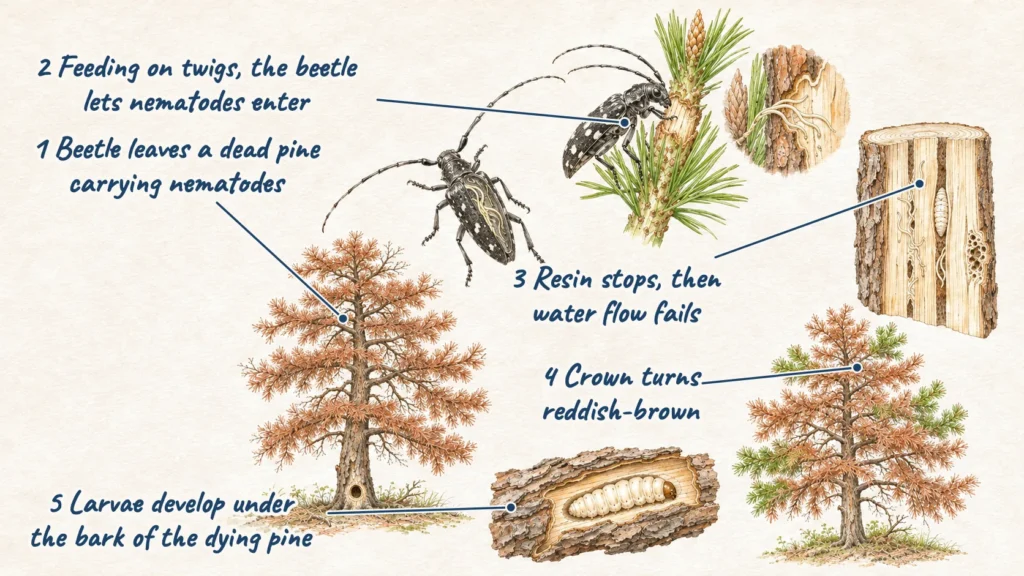
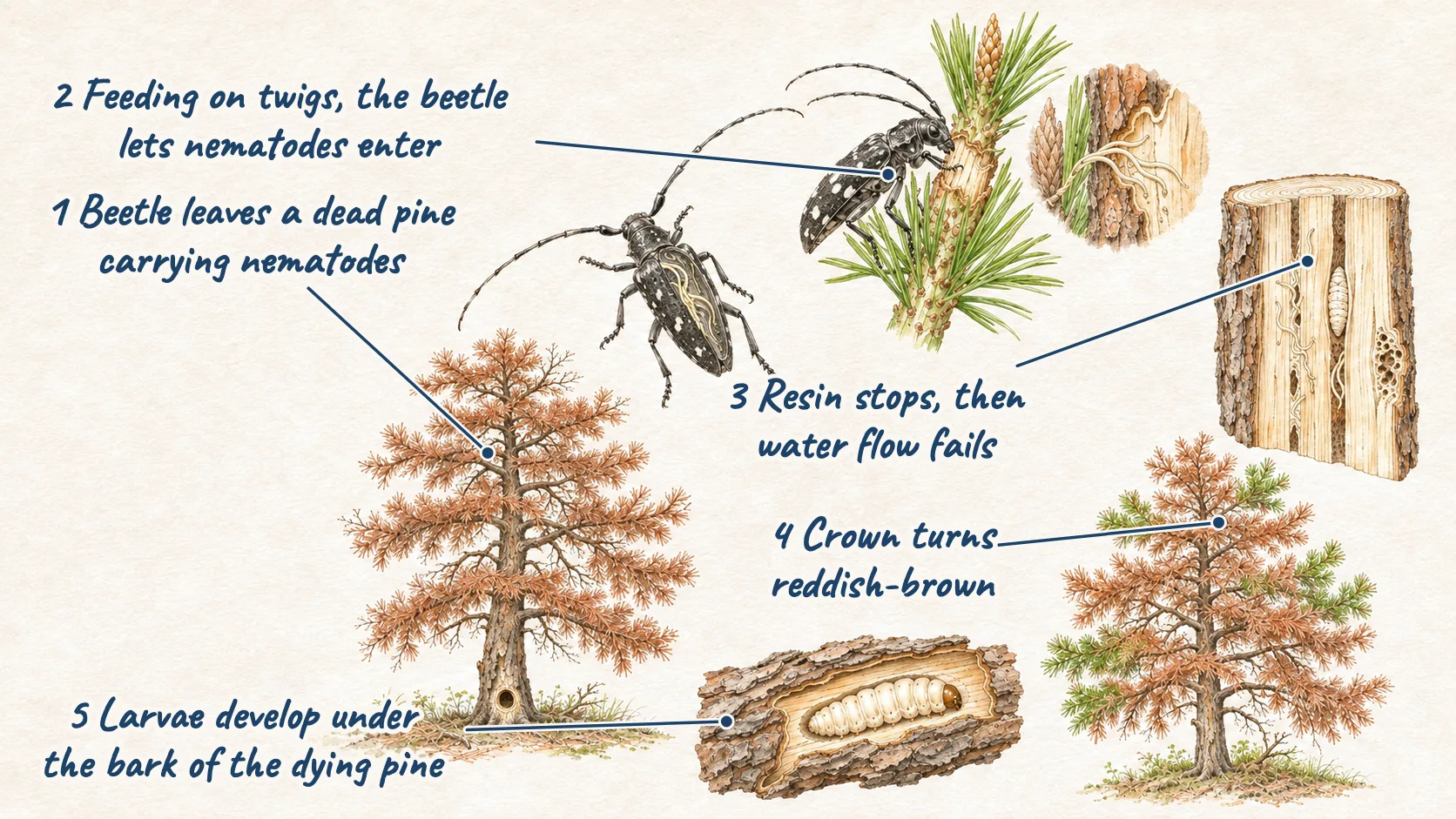
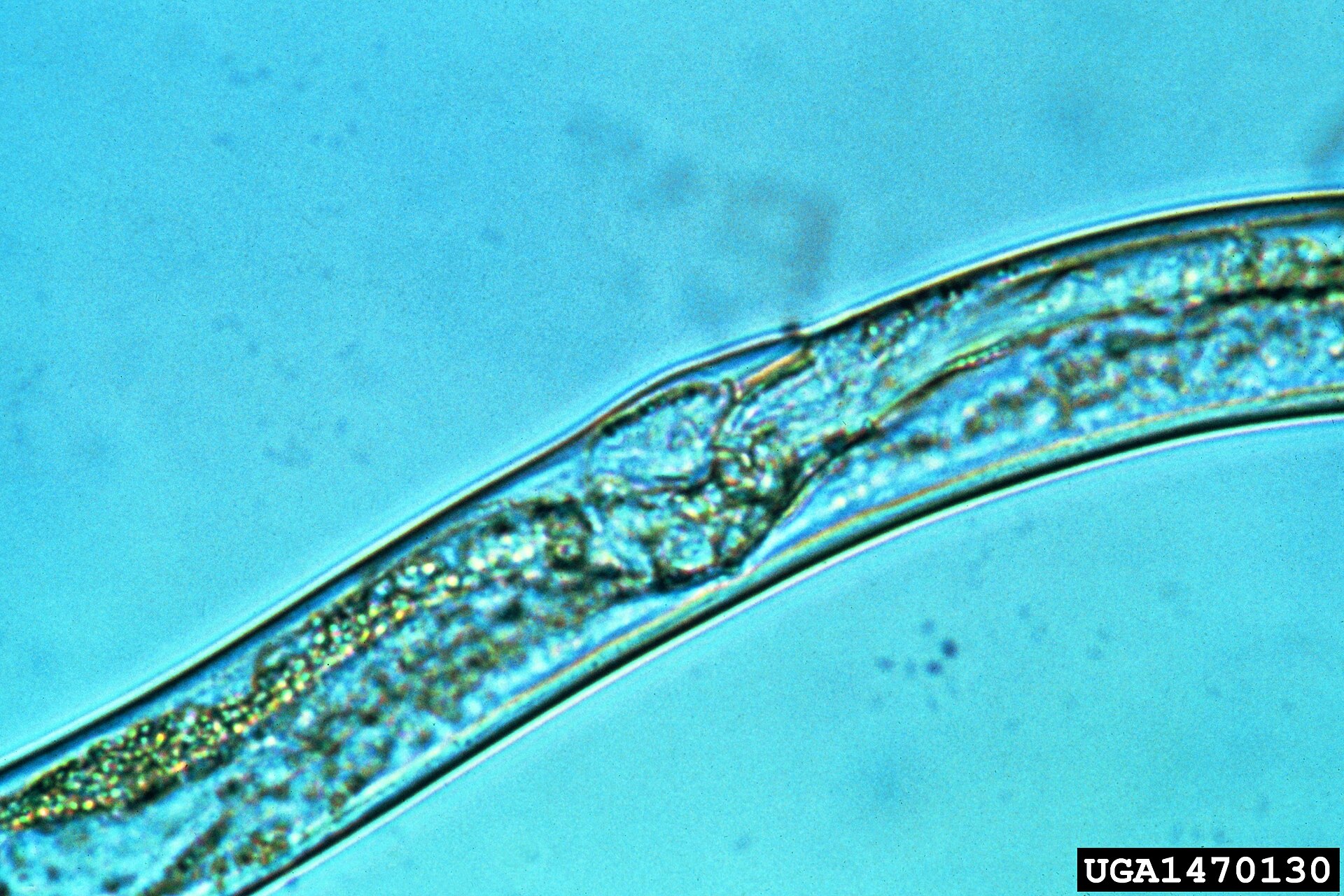
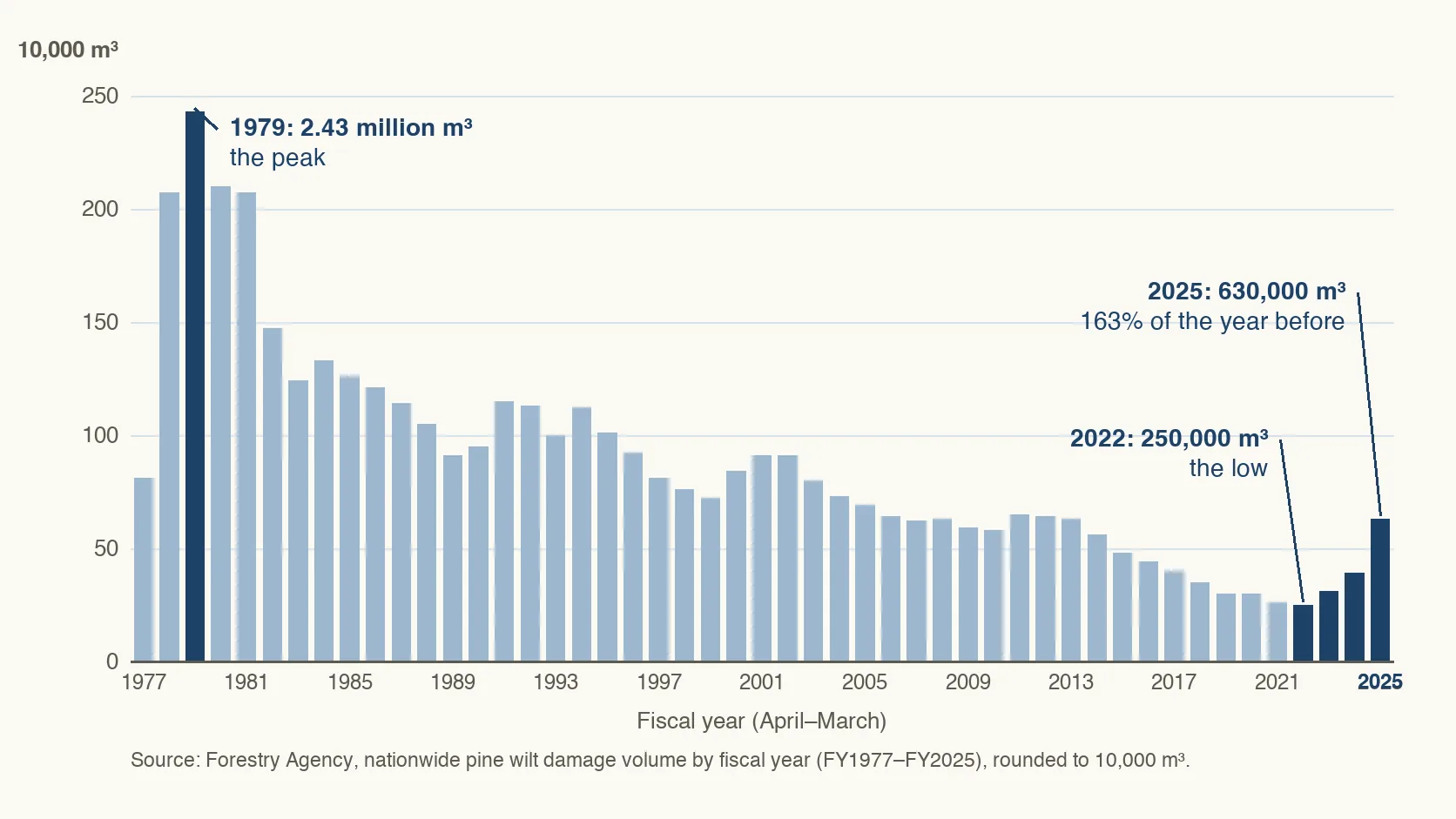
Pine wilt disease begins when a longhorn beetle, the Japanese pine sawyer (Monochamus alternatus, matsunomadara-kamikiri), feeds on the twigs of a healthy pine and lets a roundworm about 1 mm long, the pinewood nematode (Bursaphelenchus xylophilus, matsunozaisenchū), slip into the wood. The nematode multiplies, the tree’s water-carrying cells fill with air, and the pine can be dead within a season. In Japan the disease is still often called matsukui-mushi, “the pine-eating insect”, a name that blames the wrong animal. Nationwide damage peaked at about 2.43 million m³ of timber in fiscal 1979, fell to about 250,000 m³ in fiscal 2022, and has risen each year since, reaching about 630,000 m³ in fiscal 2025, the latest year published.
This article answers one question: how the disease works, where Japan stands now, and how it is held back. It follows the infection from the beetle’s first bite, the research that identified the cause, the Forestry Agency’s damage figures, and the layered control used in forests and gardens.
Prefer to watch? The video version (6 min):
What the Disease Is — Three Organisms, One Misleading Name
The pathogen, the carrier and the host
Three living things have to meet for a pine to die, and each has a separate job.
| Organism | Role | Key facts |
|---|---|---|
| Pinewood nematode (B. xylophilus) | The pathogen | Adults are about 1 mm long and multiply fast. Native to North America; the disease was first recorded in Japan in 1905 in Nagasaki Prefecture |
| Japanese pine sawyer (M. alternatus) | The vector | One of six Monochamus species that use pines in Japan, and by far the most important carrier |
| Pine (Pinus) | The host | Every Japanese pine species tested so far is susceptible; Japanese black pine (Pinus thunbergii, kuromatsu) is especially vulnerable |
The nematode cannot travel between trees by itself. It depends on the beetle to cross open air, and it depends on a pine to reproduce in. Remove either one from the picture and the cycle stops, which is why every control method in Japan targets the beetle, the nematode’s entry, or the supply of dying pines.
Why “matsukui-mushi” misleads
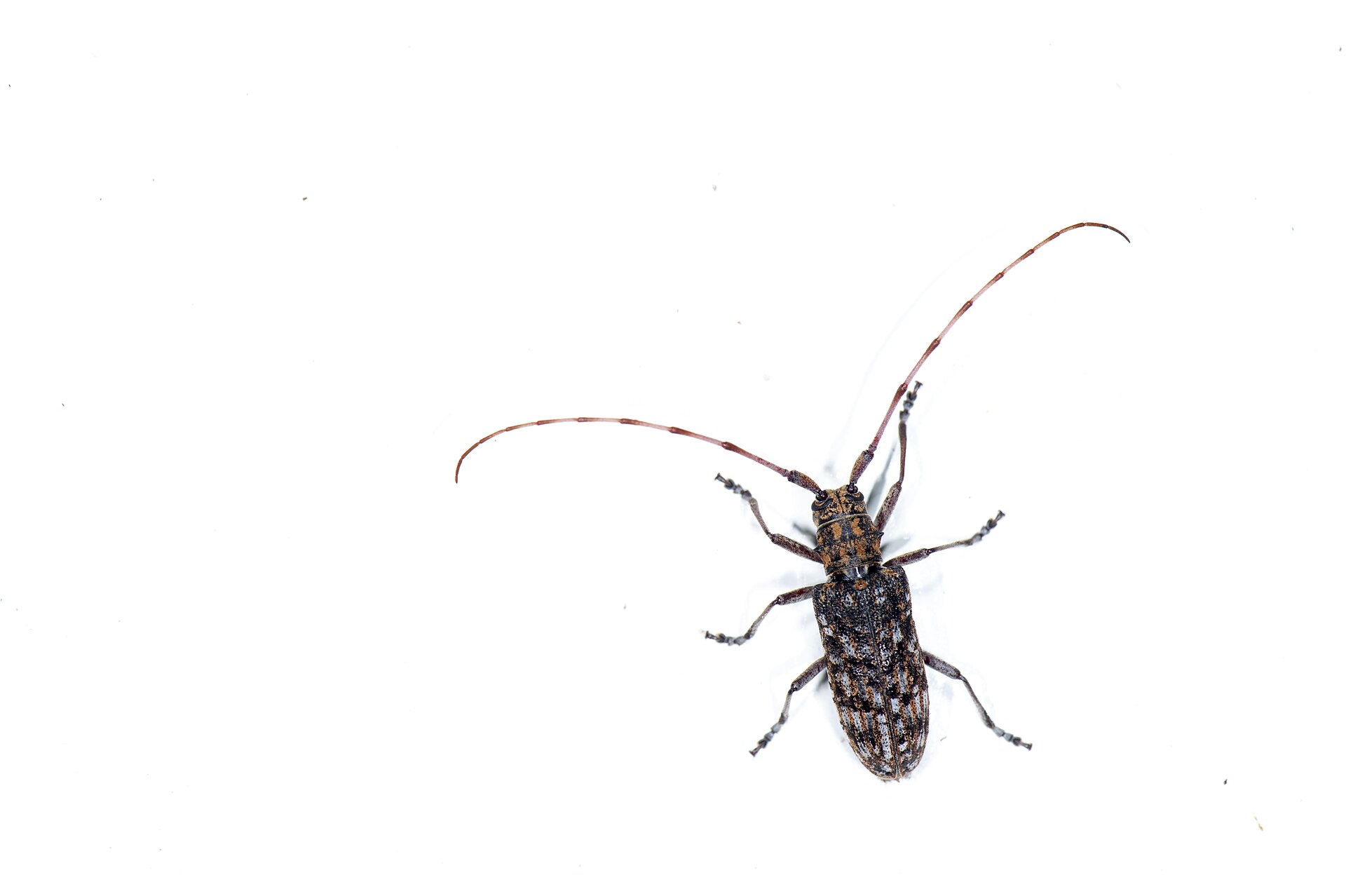
Matsukui-mushi literally means “pine-eating insect”. A prefectural forestry office explains that it is not the name of any real species: weevils and longhorn beetles were once blamed for pine deaths, and the term survived, even in law. The adult beetle does feed on pine, but only on the bark of young twigs. The animal that kills the tree is the nematode.
A ride, not a parasitism
The relationship between nematode and beetle is a lift, not a parasitism. The Forestry and Forest Products Research Institute (FFPRI) describes the nematodes as travelling in the beetle’s tracheae without feeding on it. In Japan the disease mainly affects pines. Cedar and cypress are not typical hosts in this context; this is not a universal host list for non-Pinus conifers.
How the Nematode Kills — Water Fails Before Needles Do
Entry through a feeding wound
The key paper on transmission is a 1972 study by Katsura Morimoto and Atsushi Iwasaki of the Government Forestry Experiment Station, Kyushu. They examined more than 2,000 beetles from damaged pines: about 71% carried nematodes, on average about 3,146 dispersal-stage larvae per beetle, mostly under the wing cases and around the breathing pores. Most of those larvae, by the authors’ estimate over 80%, dropped off between the beetle’s emergence and its egg-laying. The larvae that landed on twigs left the beetle at the feeding wounds, moulted, and entered the water-carrying wood. Transmission occurred mostly from mid-May to early August, and healthy pine branches enclosed in nets with beetles died in about a month.
FFPRI adds that the load varies a great deal: a few beetles carry nematodes in the tens or hundreds of thousands. The average in the 1972 sample is a reminder that most beetles carry far fewer, yet one feeding beetle is enough to start an infection.
Air in the water pipes
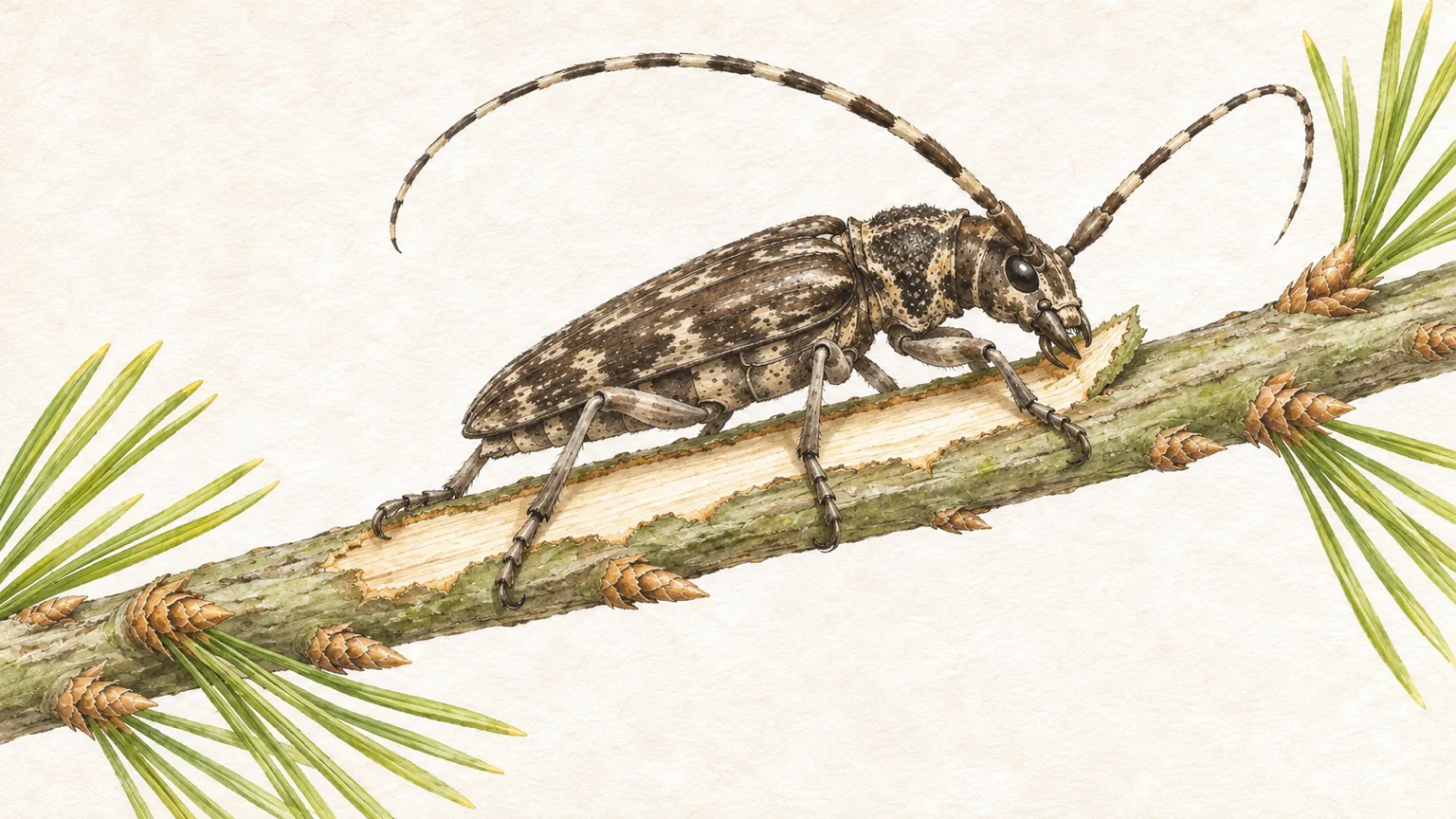
Why does the tree die? The long-standing signal that foresters use is that infected pines stop secreting resin within weeks, while the needles still look normal. A 1988 FFPRI study by Keiko Kuroda and colleagues followed the mechanism in black pines inoculated with the nematode. They injected dye into the trunk base each week to see where sap could still rise. About two weeks after inoculation, the flow was disturbed and the water-carrying cells, the tracheids, began to fill with gas. Whitish streaks of these gas-filled cells spread until they covered the whole cross-section. By about week four, the wood’s water content had fallen to roughly 30% of that of a healthy tree and the nematode population was growing. The authors judged that water deficit from this cavitation was the main cause of death. Resin leakage was limited to very small areas, so they did not consider resin plugging a major factor. They also noted that what triggers the cavitation was still unexplained.
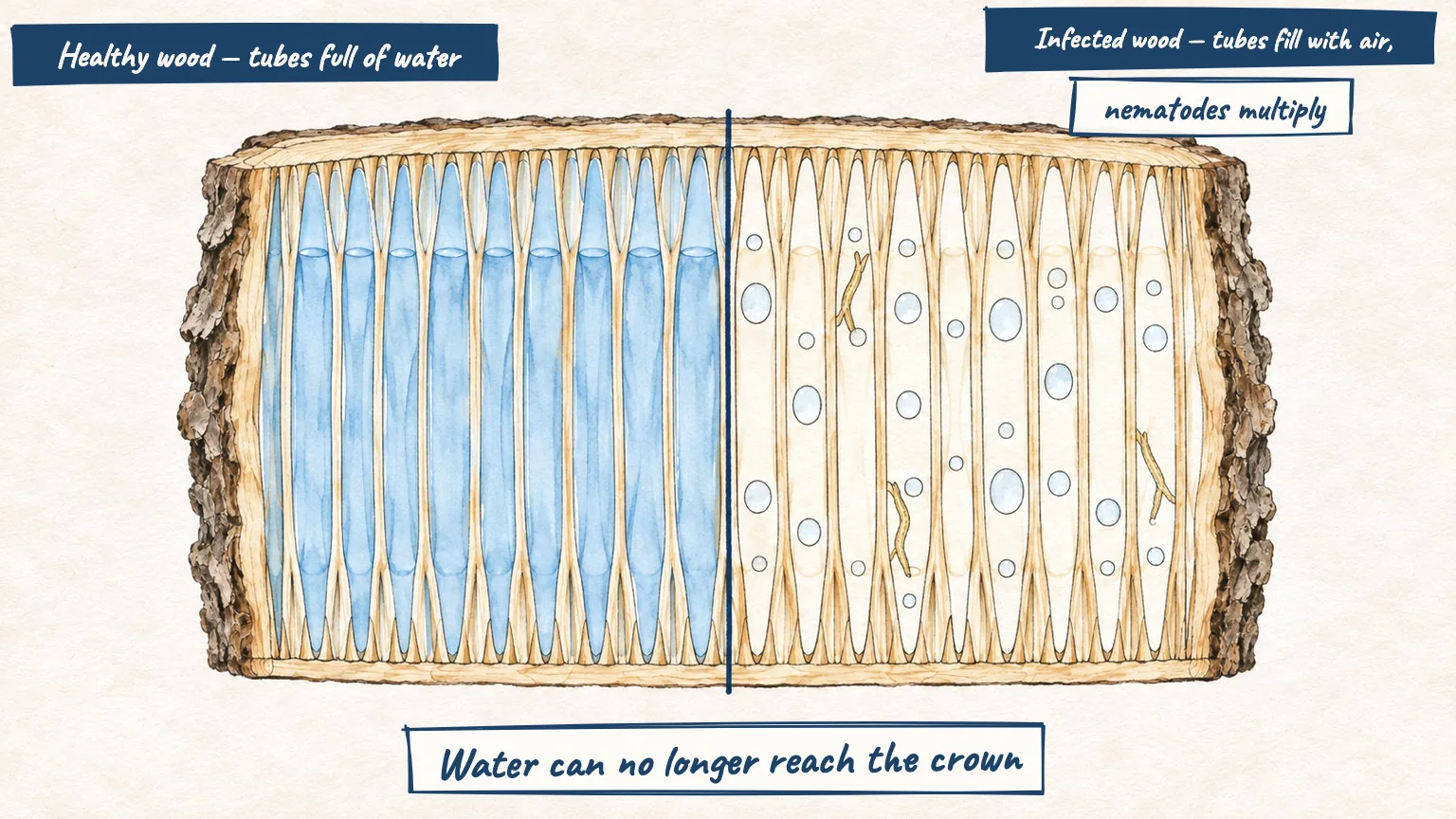
The practical meaning is simple. By the time the crown turns brown, the tree has been losing water for weeks, and nothing applied to the tree at that point can reverse it.
Why temperature and season matter
The nematode’s speed depends on warmth. The European and Mediterranean Plant Protection Organization (EPPO) datasheet gives its generation time as about 12 days at 15 °C, 6 days at 20 °C and 3 days at 30 °C, and says the disease is favoured by hot summers. Inoculation experiments by Tomoya Kiyohara and Yozan Tokushige in 1971 show the same pattern in the tree: inoculations from June to August gave the highest mortality and the shortest delay before death, while autumn inoculations (September–October) had killed nothing by December 20.
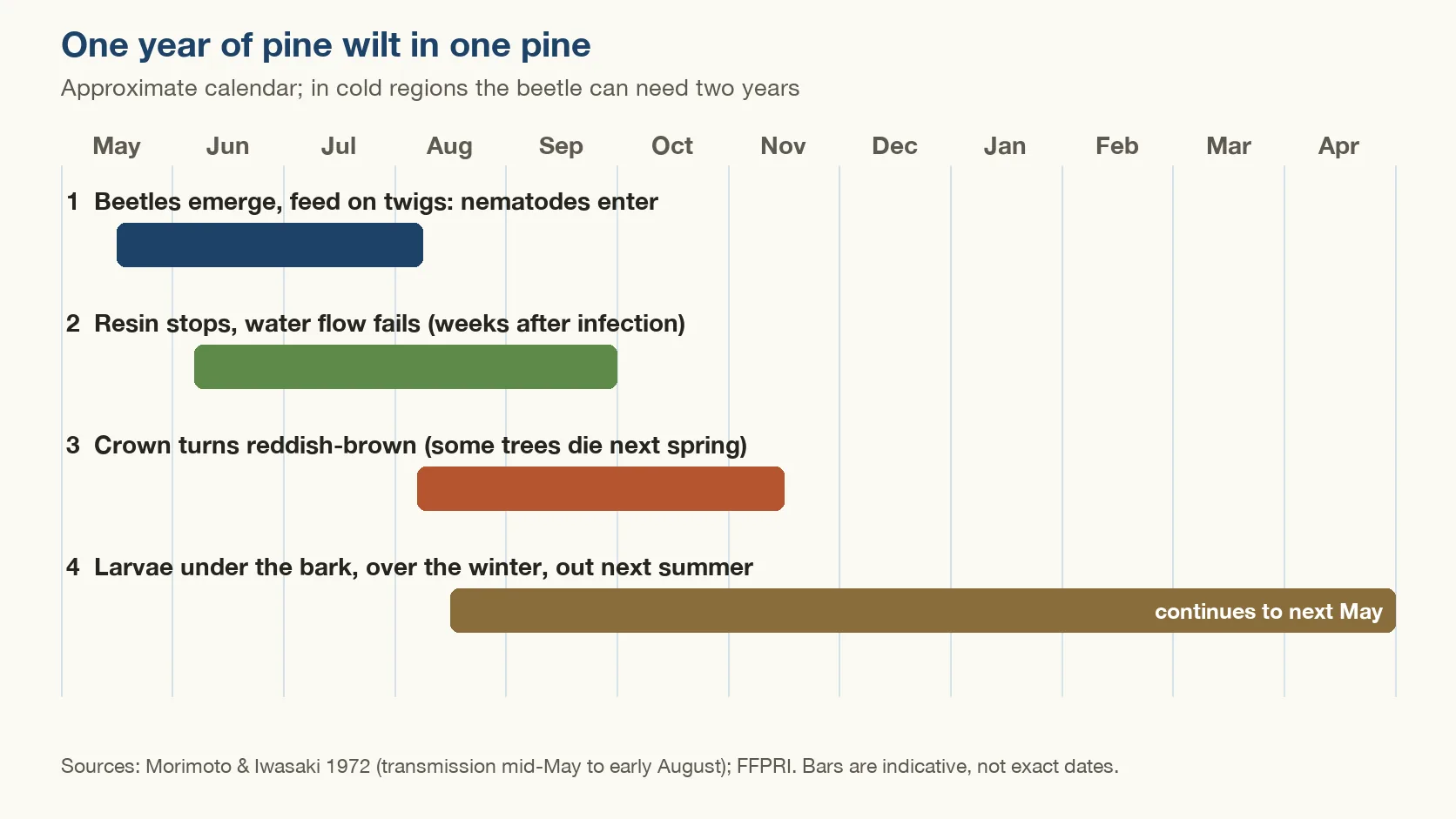
A Year in the Life of One Pine — The Infection Calendar
The cycle is easiest to follow from a pine that died last year.
Early summer — emergence and maturation feeding
Beetles that grew up under the bark of a dead pine chew a round exit hole about 7–8 mm wide and fly out. In the next several weeks the adult beetle feeds on the bark of young twigs on living pines (“maturation feeding”) before it can breed. This is the window in which nematodes leave the beetle through the feeding wounds and enter the tree.
Adult beetles usually move only about 10 m at a time, though a single flight can reach around 3 km, according to FFPRI. That is why the nearest dead pine is the usual source of the next infection, and why distance from an infected stand is protective but never a guarantee.
Summer to autumn — decline and browning
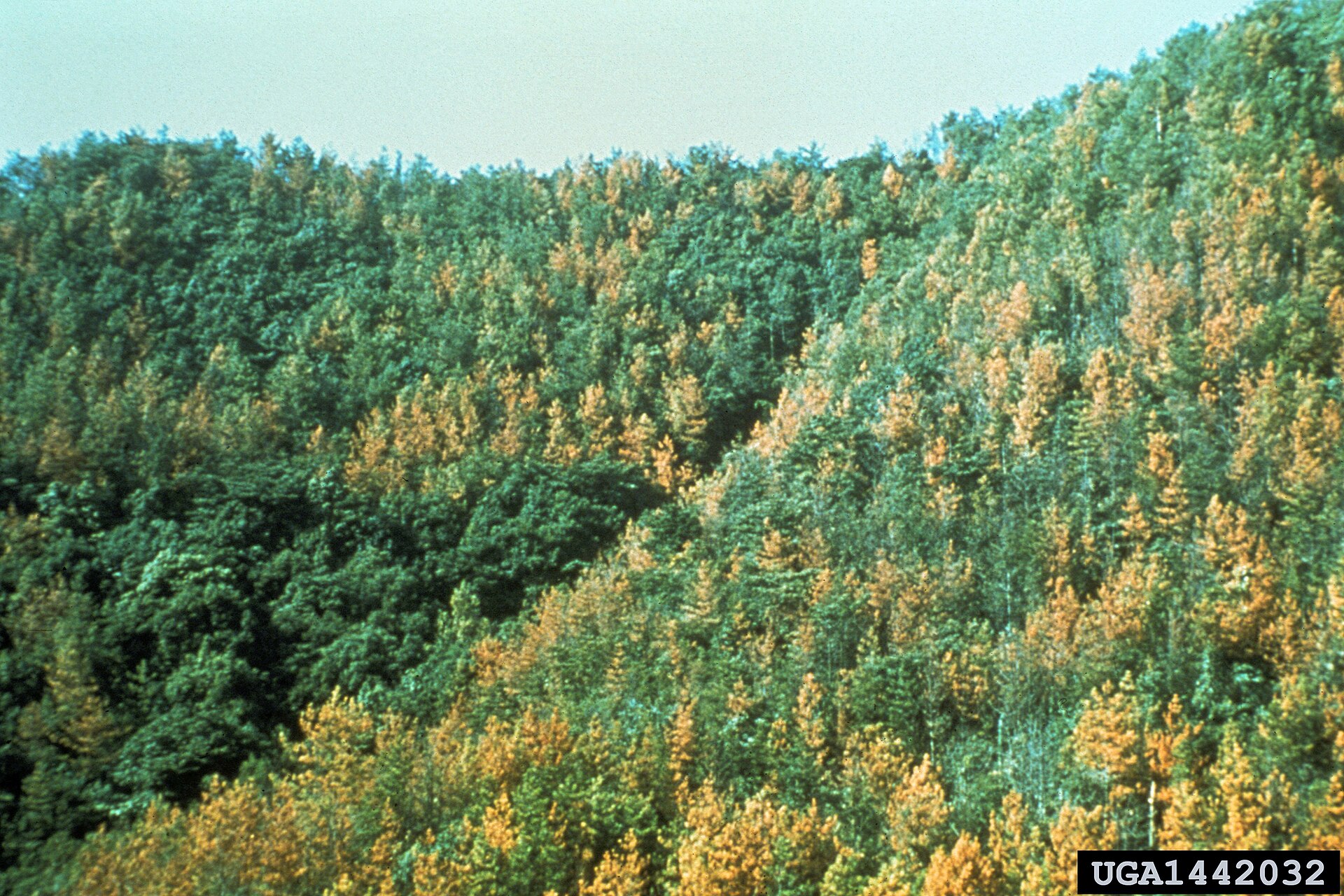
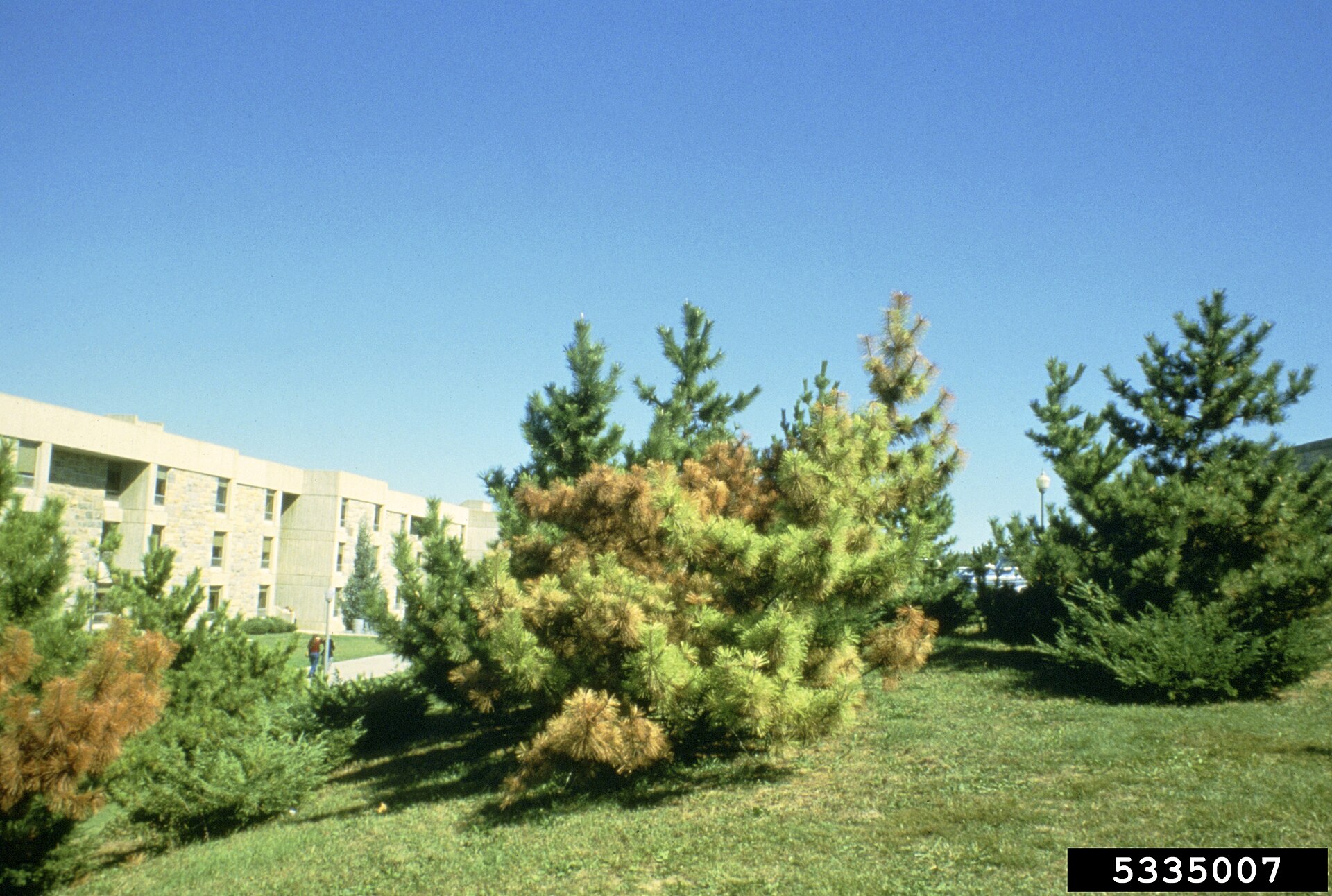
Within weeks of infection the tree stops secreting resin, and the water-conducting wood begins to fail, as the Kuroda study described. Needle colour is still normal at this stage, which is why leaf colour alone is a late warning. Typically from late summer into autumn the whole crown turns reddish-brown. Some trees die the following spring instead, and some die only in part.
Next generation — egg-laying under the bark
Female beetles find pines that have stopped producing resin, by their smell, and lay eggs there. The larvae feed under the bark, overwinter in the wood, and emerge the next summer carrying the nematodes. In cold regions the beetle can need two years to complete its cycle. The pine that the nematode killed has become the nursery for the next wave of carriers, and this is the weak point that sanitation felling aims at.
Finding the Cause — From the First Record in 1905 to the 1971 Tests
The first record and the wrong suspect
The National Institute for Environmental Studies (NIES) database records the first appearance of the disease in Japan in 1905 in Nagasaki Prefecture, and a second record in 1921 in Hyōgo Prefecture. The introduction route is listed as accidental, by imported lumber. EPPO similarly presumes the nematode reached Kyushu from North America in infected timber early in the twentieth century. By 1982 the disease had spread across almost all of Japan, according to NIES.
For decades the deaths were explained by bark beetles, which attack weakened or dead trees. Kiyohara and Tokushige, working at the same Kyushu research branch as Morimoto and Iwasaki, began from a different observation: they had found the nematode in the wood of dead pines and set out to test whether it could kill healthy ones.
The 1971 inoculation tests
In Journal of the Japanese Forestry Society (1971), Kiyohara and Tokushige reported what they found. Injecting about 600 nematodes into the trunk wood of a pine did not kill it; about 30,000 per tree killed nearly all the inoculated trees. Fungal spores and fungal filtrate alone were harmless, so the nematode, not the culture medium, was responsible. Nematodes placed on unwounded bark did nothing, and wounded bark gave low mortality, while xylem inoculation caused high mortality wherever it was applied. The result was cautious in wording (the nematode is “one of the causal agents”), but it moved the field from a beetle-borer theory to an infectious disease with a known pathogen.
Naming the carrier
The 1972 Morimoto and Iwasaki paper completed the picture by showing that Monochamus alternatus carries the nematode into healthy pines. The name matsukui-mushi is older than all this work, which is why it still appears in the title of the Forestry Agency’s damage page, while the technical name used by researchers is pine wilt disease (matsu zaisenchū-byō, マツ材線虫病).
Japan’s Numbers — From Fiscal 1977 to Fiscal 2025
The long decline
The Forestry Agency tracks damage as the volume of timber from killed pines, reported at different levels of rounding in the chart and table used here. Its series begins in fiscal 1977 at about 810,000 m³, jumps to 2.07 million in fiscal 1978, and peaks in fiscal 1979 at 2.43 million. From there it falls in steps.
| Fiscal year | Nationwide damage | Note |
|---|---|---|
| 1977 | about 810,000 m³ | First year of the published series |
| 1979 | about 2.43 million m³ | Recorded peak |
| 1990 | about 950,000 m³ | A bump back up from the 1989 figure of 910,000 |
| 2000 | about 840,000 m³ | |
| 2010 | about 580,000 m³ | |
| 2022 | about 249,000 m³ | The low point of the series |
| 2023 | about 315,000 m³ | 127% of the previous year; the first increase in 12 years |
| 2024 | about 390,000 m³ | 124% of the previous year |
| 2025 | about 634,000 m³ | 163% of the previous year; the agency page was updated on 30 September 2026 |
The volumes come from the agency’s national chart (fiscal 1977–2025) and its prefectural table (fiscal 2021–2025). Japanese fiscal years run April to March, so “fiscal 2025” ends in March 2026. The figure is the volume of killed timber, not a count of trees.
The rise since 2023
The Forestry Agency attributes the 2023 turn to hot, dry summers, and damage rose in each of the three fiscal years 2023–2025. Even so, the fiscal 2025 figure is roughly a quarter of the 1979 peak (633,600 m³ against 2.43 million m³) and about 2.5 times the fiscal 2022 low (248,600 m³). The long decline and the recent rise are both true at once.
Where the damage is now
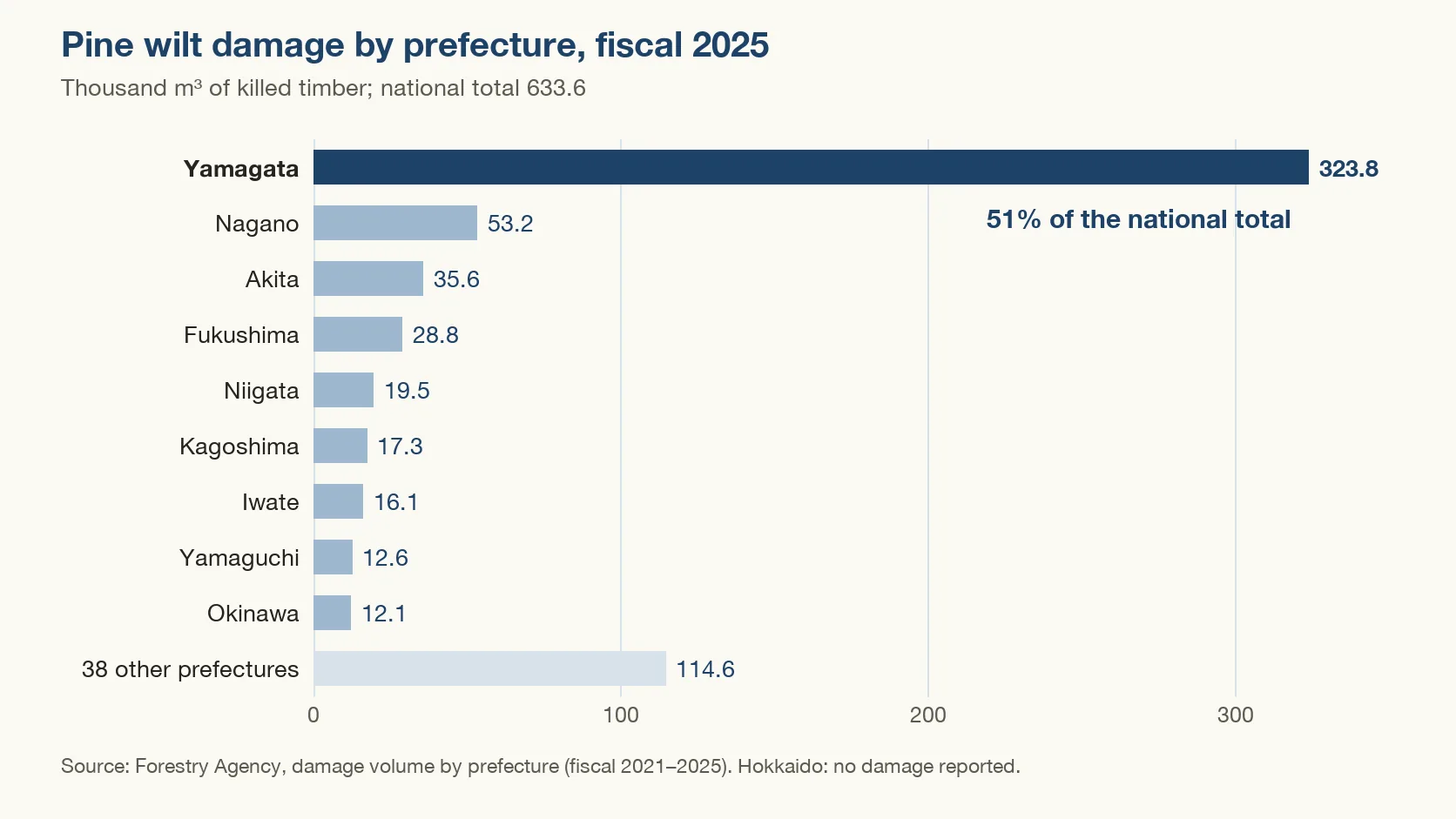
The prefectural table shows how uneven the picture is. In fiscal 2025 Yamagata Prefecture reported 323,800 m³, about 51% of the national total; its figure was 25,000 m³ in fiscal 2022, 59,000 in 2023 and 108,800 in 2024. Yamagata’s jump from fiscal 2024 to 2025 (215,000 m³) is about 88% of the national increase over the same year (244,000 m³). The agency’s page does not explain this, and I have not found a source that does, so the cause should be treated as open.
Behind Yamagata come Nagano (53,200 m³, down 12% on the year), Akita (35,600), Fukushima (28,800), Niigata (19,500), Kagoshima (17,300) and Iwate (16,100). Hokkaido reported no damage in any of the five years, and Aomori reported only 100 to 1,100 m³. Tokyo’s figure rose to 5,800 m³ from 700. A research note from FFPRI in 2024, covering the Tohoku region for fiscal 2012–2022, found that the disease had newly reached 11 municipalities and the beetle 9, so the northern edge is still moving.
Control in Layers — Each Method Has One Job
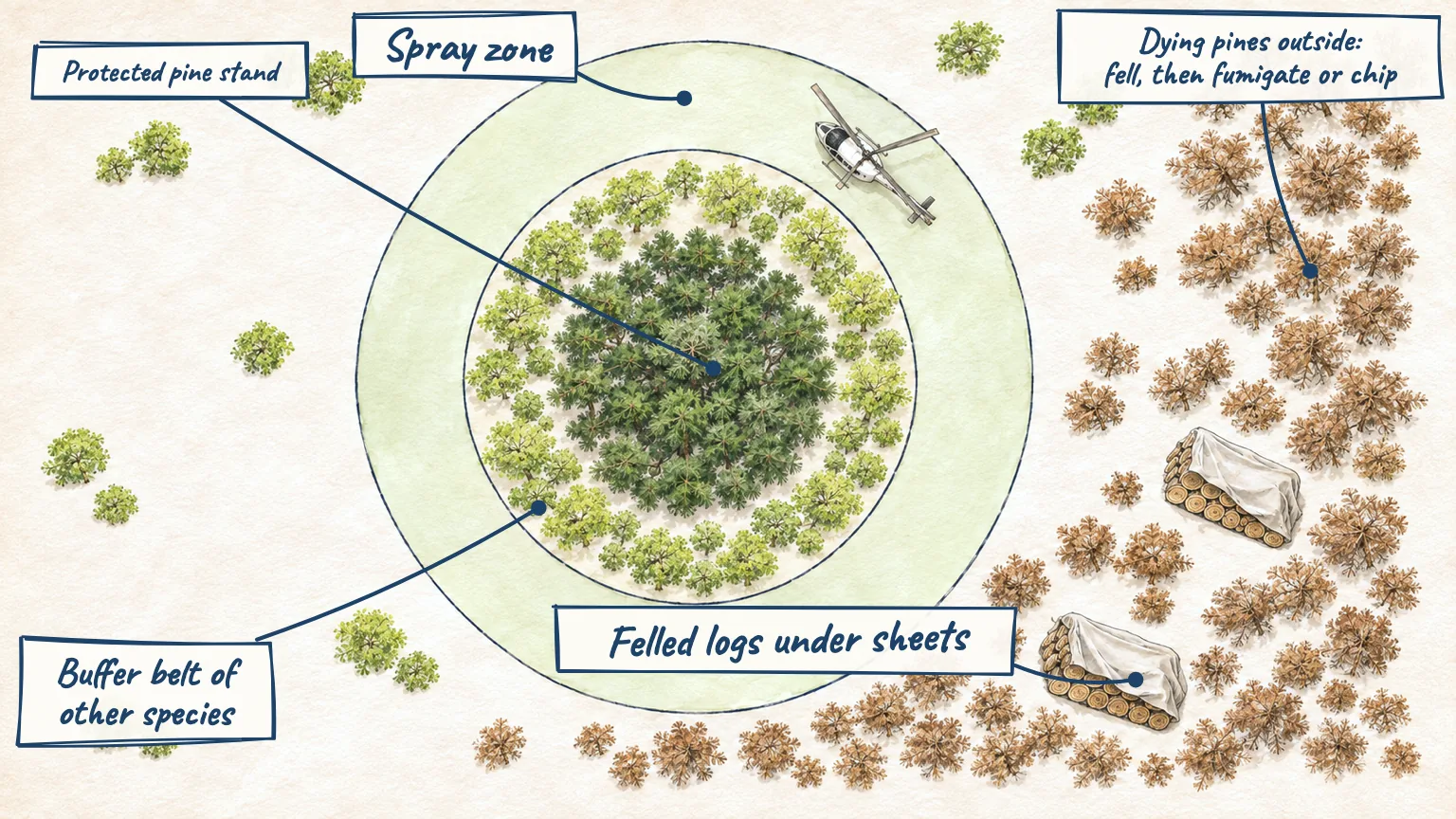
FFPRI’s guidance stresses that no single method works on its own. The Forestry Agency organizes the work around priority protection of valuable pine forests, integrated control in the surrounding forests, aerial surveys to find infested trees, and treatment of felled wood. Each method has a specific job and a specific limit.
| Method | What it does | Limit |
|---|---|---|
| Sanitation felling (batsutō kujo, 伐倒駆除) | Fell dead and dying pines and destroy the beetles inside, by fumigation under sealed sheeting, by chipping, or by burning | Must finish before adults emerge; has to kill nearly all beetles in the stand to work |
| Preventive spraying | Coats the crown so beetles that feed on twigs die; by helicopter, drone, or ground sprayer | Prevents infection but does not cure; normally two applications per season; cannot succeed without reducing beetle numbers |
| Trunk injection | Drilled into the lower trunk to protect an individual tree | Preventive only; lasts up to 7 years depending on the product; stressful for old trees; not recommended for five-needle pines |
| Resistant pines | Seedlings from seed orchards of selected trees | “Less likely to die” is not “cannot die”; heavy beetle pressure can still kill them |
| Isolation and species conversion | Remove pines, or replace them with other species, in a buffer around stands you want to keep | Buffers of 2–3 km are common, but beetles can fly further |
Sanitation felling — removing the breeding ground
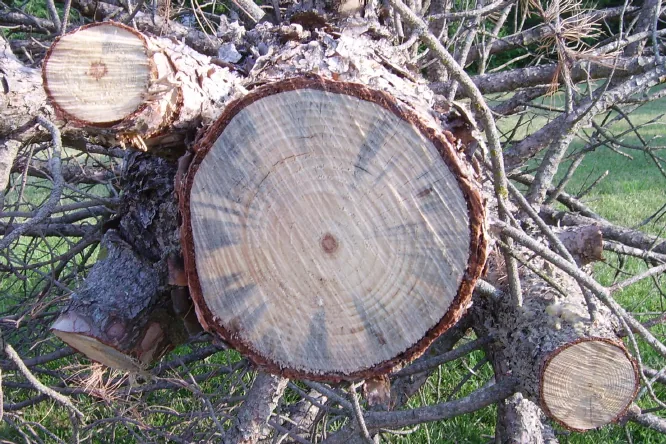
Dead and dying pines are where the next generation of beetles develops, so felling them and killing the larvae inside is the core of forest control. The Forestry Agency lists three ways to treat the wood: fumigation, chipping, or incineration. The work has to be finished before the adults emerge in early summer. FFPRI’s point is that any method that leaves infested logs or slash on site through the flight season defeats itself, because weakened pines and fresh-cut wood attract egg-laying females. For the same reason some prefectures in northern Honshu, such as Iwate and Aomori, restrict summer felling of pines in areas where invasion is feared.
Spraying and injection — protecting a standing tree
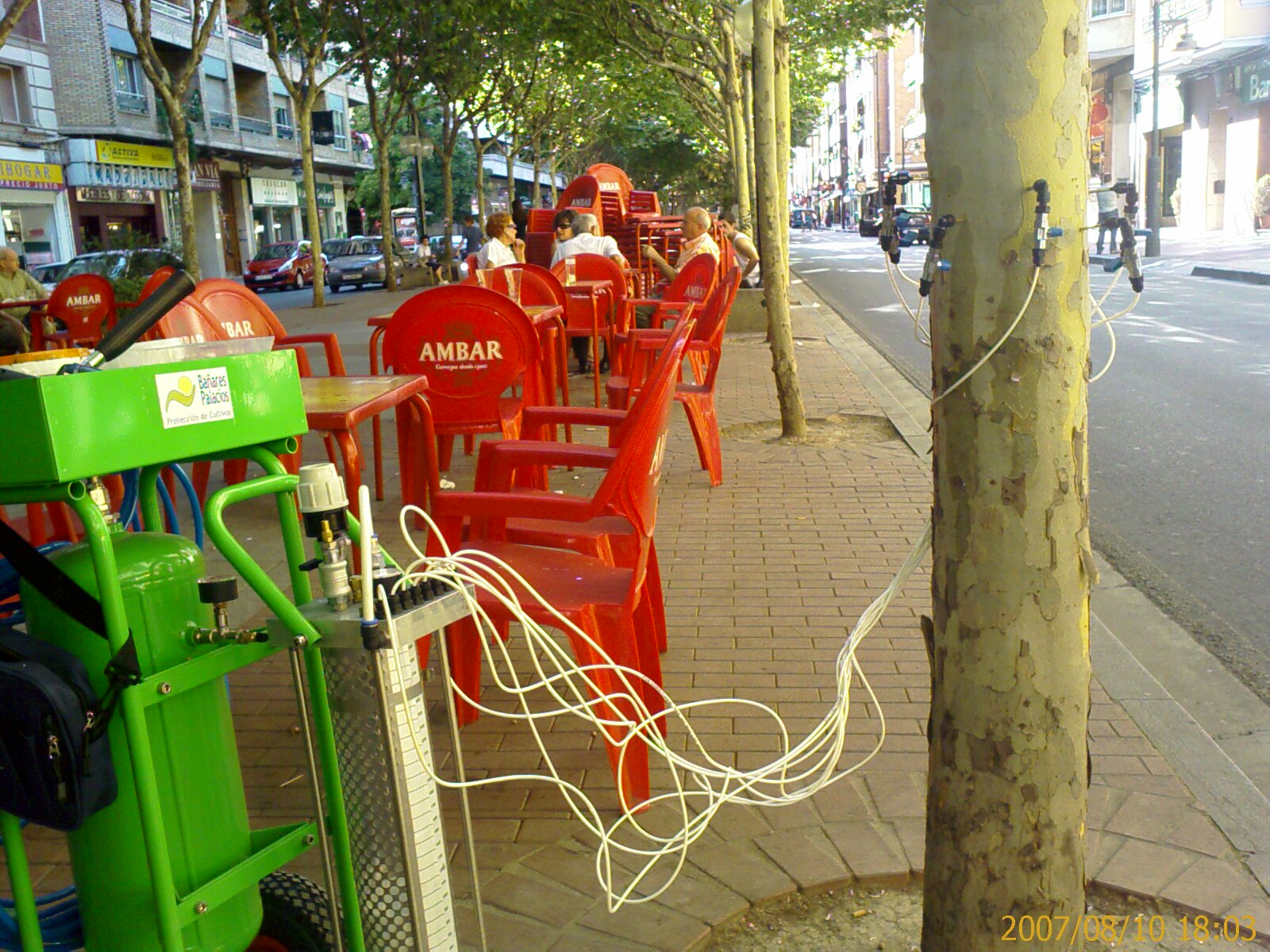
Preventive spraying and trunk injection protect trees that are still healthy. Spraying kills beetles that feed on the twigs; the Forestry Agency lists aircraft, helicopters, drones and ground sprayers. Trunk injection places a chemical in healthy pines to block the nematode, with protection lasting up to 7 years depending on the product. Two points matter in practice. Neither method does anything for a tree that is already infected: FFPRI states that trunk injection has no curative effect. And injection is itself stressful for an old tree, so it is reserved for trees worth protecting.
Buffers, species conversion and the case of Fukiagehama
Around a stand worth keeping, the agency recommends converting pines to other species to create protective belts, and FFPRI cites buffers of 2–3 km as common. The same institute records one success: at Fukiagehama in Kagoshima, a coordinated programme of felling, spraying, resistant planting and species conversion pushed annual damage from about 16,000 m³ in 1992 to near zero by 1999. Damage rose again after about 2015, passing 4,000 m³ in 2020, which shows that control needs to be kept up rather than finished.
Resistant Pines — What “Resistant” Means
Breeding by inoculation
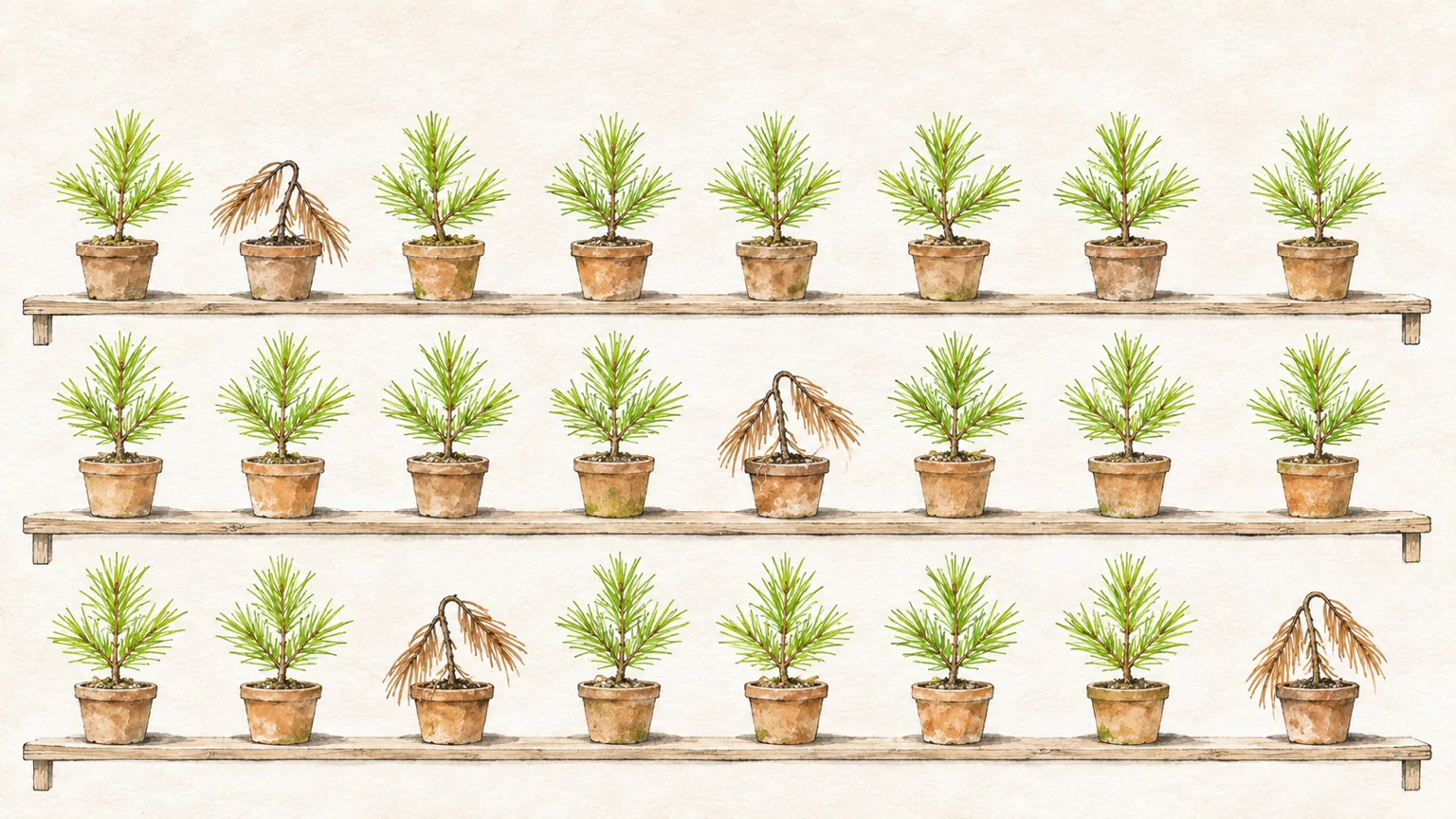
Japanese researchers have bred pines that are far less likely to die. The Forest Tree Breeding Center (part of FFPRI) has selected cultivars of Japanese red pine (Pinus densiflora) and Japanese black pine and lists 326 red pine and 293 black pine cultivars as of the end of fiscal 2024. Seedlings are grown from seed orchards made up of these selections and supplied to growers.
Where resistance stops
Two cautions apply. Resistance was selected for survival, not form, so a resistant seedling is not automatically a good garden tree. And resistant stands are easier to defend, but still not safe on their own. For high-value garden pines, Japanese practice therefore combines resistant stock or injection with monitoring, instead of relying on one measure.
Which Pines, Which Seasons, Which Regions — Why Risk Is Uneven
Species
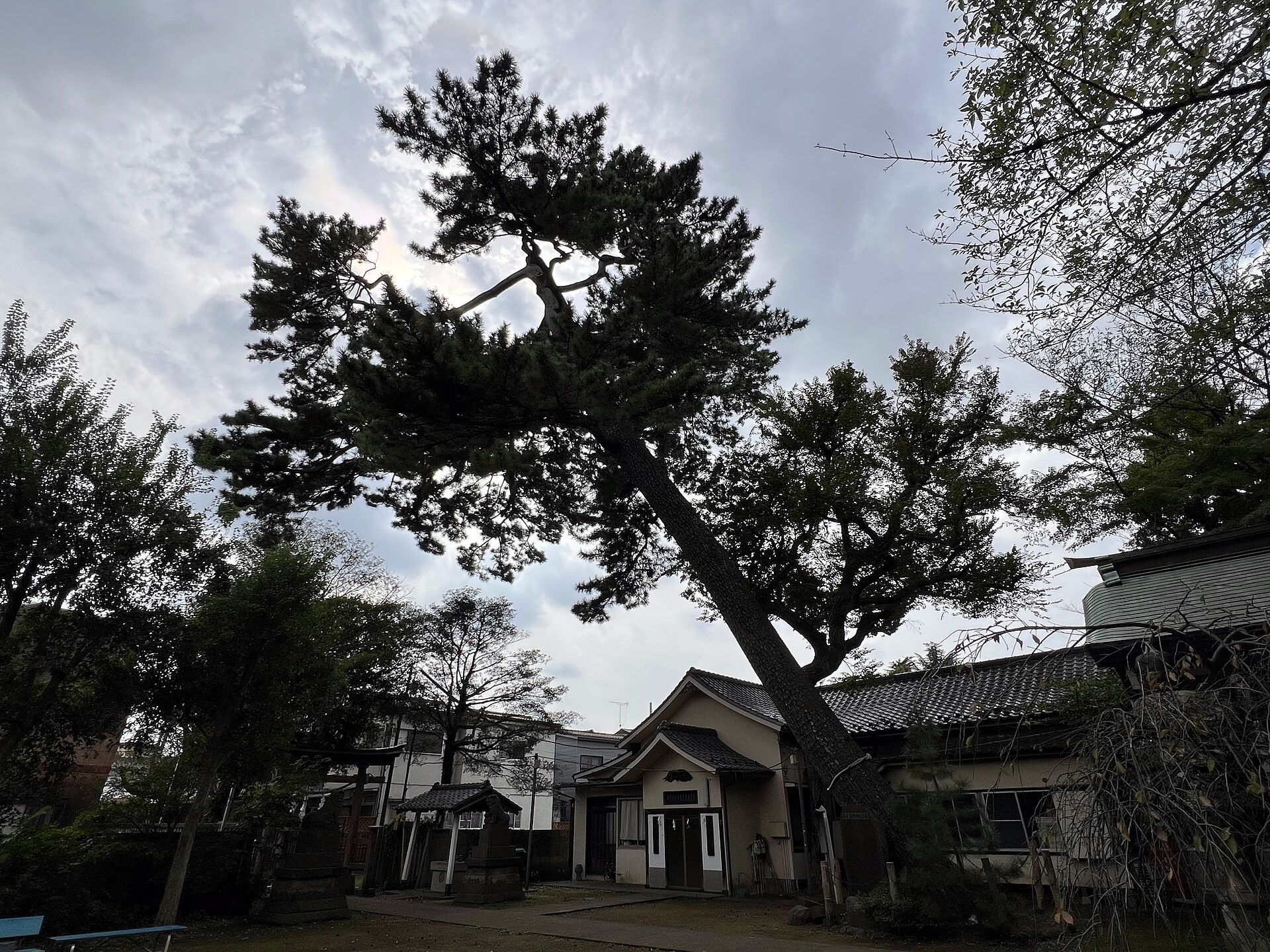
All Japanese Pinus species tested are susceptible, and Japanese black pine is especially vulnerable, which matters because it is the pine of Japan’s coasts, shrines and gardens. Five-needle pines, a group that includes the garden favourite Pinus parviflora (goyōmatsu), are a special case for owners: FFPRI does not recommend trunk injection for them. Conifers outside Pinus are not the main concern in this Japanese control context.
Season
Season matters twice. The flight and feeding season, from early summer, is when infection happens, and Kiyohara’s experiment shows that June–August inoculations gave the highest mortality. The winter is when work is easiest to do before the beetle returns. In cold regions, the beetle’s two-year cycle stretches the calendar.
Region and warming
It is tempting to read the disease’s spread northward as pure climate change. FFPRI’s view is more careful. Warmth does favour both the nematode and the beetle, but the disease started in south-western Japan and spread outward, so a southwest-to-northeast pattern is expected anyway. The present northern limit reflects a contest between the disease and the effort spent on control. Warming still raises the chance of outbreaks in cold regions once protected by low temperatures, which makes monitoring at the leading edge more important.
Japan, Europe and North America — Same Nematode, Different Situations
Home range and newcomers
The nematode is native to North America, and EPPO notes that native American conifers are mostly resistant to it. In Japan and in Europe, it arrived in forests whose pines had not evolved with it. That is a difference in history, not in effort, and it explains why a disease that is a minor feature in its homeland became a national forestry problem in Japan.
Europe
In Europe the nematode was first reported in continental Portugal in 1999, in Spain in 2011 and on Madeira in 2012. The main European vector is a different beetle, Monochamus galloprovincialis. The EPPO datasheet places the nematode on the A2 list, and the EU treats it as a quarantine pest under Annex II B of Regulation (EU) 2019/2072, with emergency measures. The datasheet’s main concern about introduction is wood packaging: mature larvae can survive in processed timber for several months, and the standard guidance is ISPM 15 treatment of packaging material.
| Japan | Europe | North America | |
|---|---|---|---|
| Status of the nematode | Introduced; disease first recorded 1905 | Introduced; first reported 1999 (Portugal) | Native |
| Main carrier | M. alternatus | M. galloprovincialis | Native Monochamus species |
| Focus of public effort | Priority protection of valuable stands, felling, spraying, resistant seedlings | Quarantine listing, import controls on wood packaging, containment | Native pines mostly resistant |
The comparison is about circumstances. Japan’s infection is old and widespread, so its work is about holding the line in the pines that matter most. Europe’s is newer, so a large part of its work is about keeping it from spreading to new places.
For Owners of Individual Pines — A Practical Order
What to watch
Do not wait for needles to turn. Learning to read a pine’s vigour from its spring candles gives you a baseline to compare against. If the resin has stopped flowing, the tree may already be infected even with green needles. A dead pine nearby is the likely source of the next infection.
What to do, and when
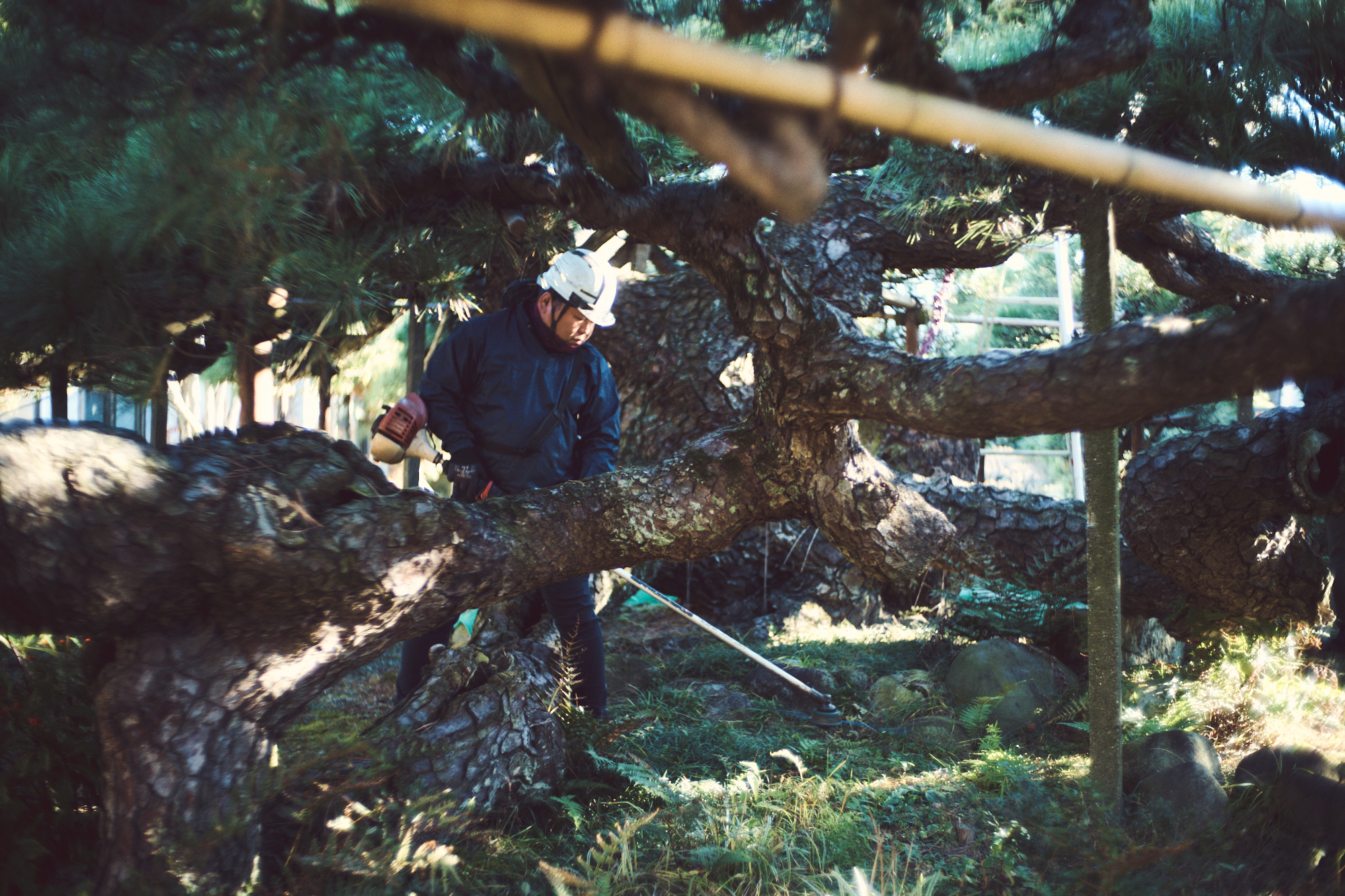
– Remove dead pines before the beetle flight season rather than after it, and treat the wood fully. This is the same winter window in which garden pines get momiage, so the two jobs can be planned together. – Apply injection or spraying as prevention, at the right time, and record which trees were treated and when. – Read decay and dieback with the field methods used in Japan before assuming the cause.
Common mistakes
– Treating a browning pine with spray or injection. Both are preventive only; a pine confirmed to be dying from pine wilt has to be removed and its wood destroyed. – Leaving felled pine logs or slash on site through the flight season. – Assuming distance protects a tree. A single flight can reach around 3 km. – Treating pines as the same as other conifers. Cedar and cypress are not typical hosts in this Japanese context, so a nearby dead cedar is not the pine-wilt warning sign described here. – Relying on one measure. High-value garden pines are protected by combining resistant stock or injection with monitoring and quick removal of dead neighbours.
These are general principles from FFPRI’s guidance; products, registrations and timing differ by country and by year, so check your local labels and regulations.
Frequently asked questions
Is pine wilt disease caused by insects eating the pine? No. The beetle (Monochamus alternatus) carries the nematode and wounds the twigs, but the nematode blocks water transport and kills the tree. The adult beetle only feeds on twig bark.
Which pines does it kill? All Japanese Pinus species tested are susceptible, and Japanese black pine is especially vulnerable. Non-pine conifers are not the main concern in this Japanese control context.
Can an infected pine be cured? Trunk injection and crown spraying are preventive. FFPRI states that trunk injection has no curative effect on a tree that is already infected. The practical response is removal and destruction of the wood before beetles emerge.
Where is the damage heaviest now? In fiscal 2025 Yamagata Prefecture reported about 323,800 m³, about half of the national total of about 633,600 m³, followed by Nagano and Akita. Hokkaido reported none.
Why did damage rise again after 2022? The Forestry Agency attributes the 2023 increase to hot, dry summers. The agency’s page does not say why Yamagata rose so steeply in fiscal 2025, so that remains an open question.
Is pine wilt only a Japanese problem? No. The nematode is native to North America. The disease was recorded in Japan in 1905, reached China, Taiwan and Korea in the 1980s, and was first reported in Portugal in 1999, with later reports from Spain (2011) and Madeira (2012).
Sources
– Forestry Agency (Rinya-chō). “松くい虫被害対策” (Pine wilt damage countermeasures), including nationwide damage volumes. rinya.maff.go.jp/j/hogo/higai/matukui.html, page updated 30 September 2026; checked 2026-10-29. – Forestry Agency. “全国の松くい虫被害量(被害材積)の推移” (matukui-10.pdf, fiscal 1977–2025) and “都道府県別松くい虫被害量(被害材積)の推移(総数)” (matukui-11.pdf, fiscal 2021–2025). Checked 2026-10-29. – Forestry Agency. “令和5年度森林病害虫被害の概要” (fiscal 2023: about 310,000 m³, 127% of the previous year, first increase in 12 years), via e-Stat; and “松くい虫被害について” (matukui-5.pdf, fiscal 2024). Checked 2026-10-24. – Forest Tree Breeding Center (FFPRI). “マツノザイセンチュウ抵抗性育種” (cumulative resistant cultivars as of the end of fiscal 2024: red pine 326, black pine 293). ffpri.go.jp/ftbc, checked 2026-10-24. – Kiyohara, T. and Tokushige, Y. (1971). Inoculation experiments of a nematode, Bursaphelenchus sp., onto pine trees. Journal of the Japanese Forestry Society 53(7): 210–218. jstage.jst.go.jp/article/jjfs1953/53/7/53_7_210/_article, checked 2026-10-29. – Morimoto, K. and Iwasaki, A. (1972). Rôle of Monochamus alternatus as a vector of Bursaphelenchus lignicolus. Journal of the Japanese Forestry Society 54(6): 177–183. jstage.jst.go.jp/article/jjfs1953/54/6/54_6_177/_article, checked 2026-10-29. – Kuroda, K., Yamada, T., Mineo, K. and Tamura, H. (1988). Effects of cavitation on the development of pine wilt disease caused by Bursaphelenchus xylophilus. Japanese Journal of Phytopathology 54(5): 606–615. jstage.jst.go.jp/article/jjphytopath1918/54/5/54_5_606/_article, checked 2026-10-29. – Aikawa, T. (2024). 東北地方におけるマツ材線虫病とマツノマダラカミキリの分布変遷 (Changes in the distribution of pine wilt disease and the Japanese pine sawyer in the Tohoku region, fiscal 2012–2022). Bulletin of FFPRI 23(4): 153–164. jstage.jst.go.jp/article/ffpri/23/4/23_153/_article, checked 2026-10-29. – FFPRI (Forestry and Forest Products Research Institute). “マツ材線虫病にどう対処するか — 防除対策の考え方と実践” (How to deal with pine wilt disease), ISBN 978-4-909941-30-5, checked 2026-10-23. – National Institute for Environmental Studies. “Bursaphelenchus xylophilus,” Invasive Species of Japan database. nies.go.jp/biodiversity/invasive/DB/detail/70040e.html, checked 2026-10-29. – EPPO Global Database. “Bursaphelenchus xylophilus” datasheet. gd.eppo.int/taxon/BURSXY/datasheet, checked 2026-10-29. – Nagano Prefecture Forestry Research Center. “松くい虫ってどんな虫ですか?” pref.nagano.lg.jp/ringyosogo/joho/kids/matsukuimushi.html, checked 2026-10-29.