

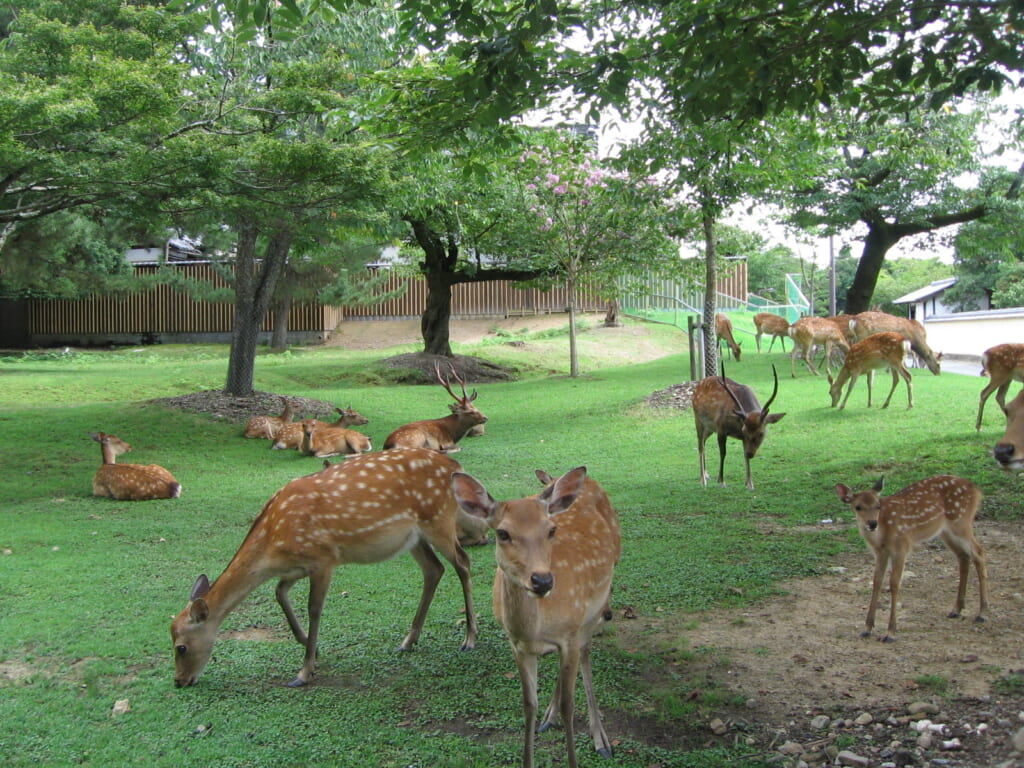
The trees in Nara Park look as if someone has trimmed their lower edges with a ruler because the park’s deer eat the leaves and shoots within their reach, and that feeding draws the line. A Nara Prefecture planting document calls the result a “deer line” (ディアライン) and notes that the height to the lowest branches of the park’s tall trees has been cut to about 2 metres (6.6 ft) by feeding deer. English-language forestry and park sources use “browse line” for comparable feeding boundaries.
Prefer to watch? The video version (5 min):
Standing under the line — what visitors see in Nara Park
A lawn, a row of trees, and a ceiling
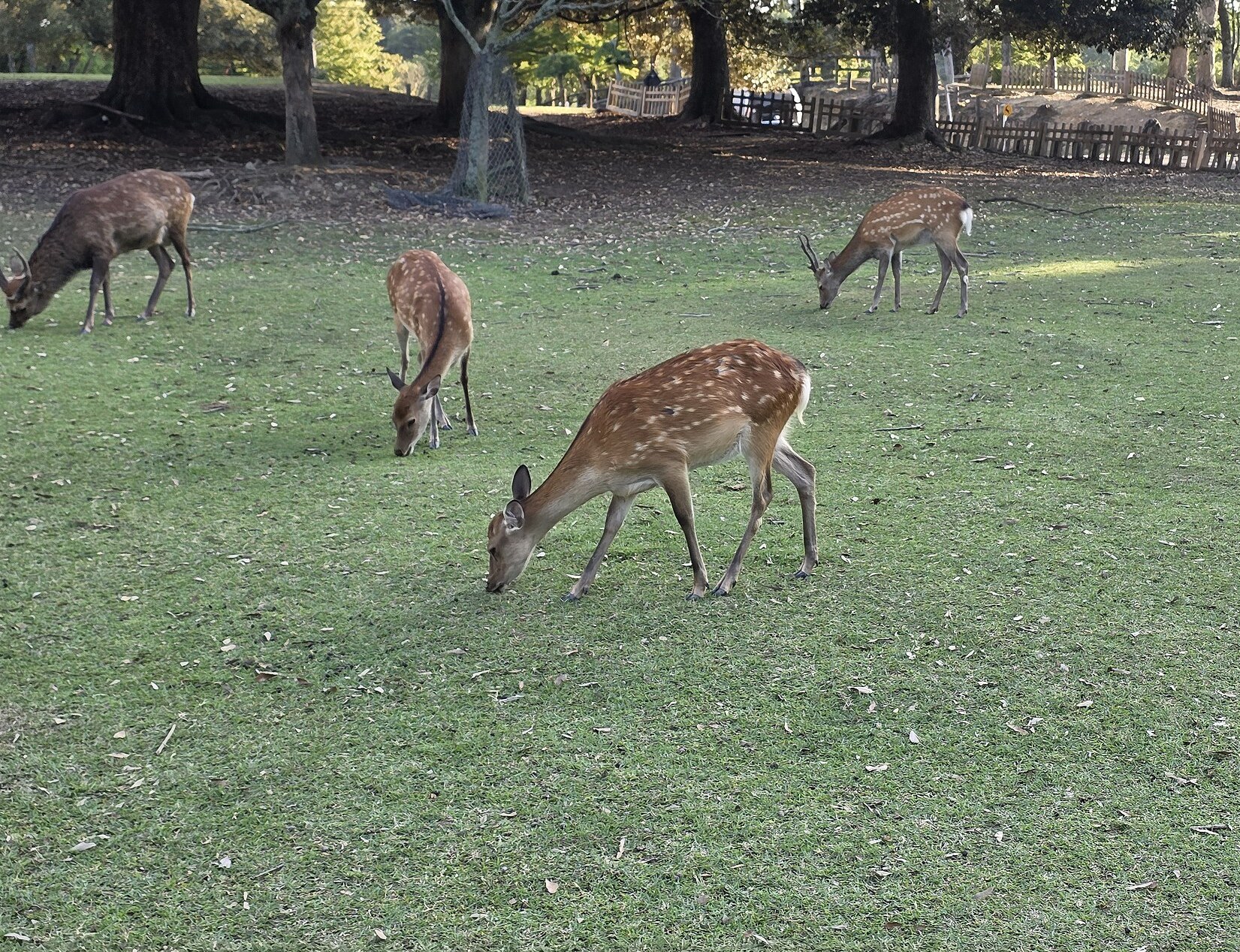
Walk out onto Tobihino, one of the open lawns of Nara Park, and the first thing you see is deer. The second, if you look past them, is the trees. Beneath the evergreen crowns there is a clear space, as though the leaves had been told to stop at a fixed height. Under that ceiling the eye runs on through the park: trunks, heavy limbs, the lawn, and the next group of trees.
From a distance the effect is uncannily tidy. The lower edge of the foliage runs flat, the kind of line a gardener would need a string and a long-handled pair of shears to produce. To anyone who knows Japanese gardens it can look like trees clipped in the manner of karikomi, the Japanese art of cloud pruning. The prefecture’s own description points elsewhere: the edge is cut by deer, one mouthful at a time.
What the prefecture’s own documents say
Nara Prefecture treats the line as a known feature of the landscape. In a committee document on whether to introduce flowering plants to the park, the prefecture says the park’s tall trees show “high lower branches” and labels the effect directly: “下枝が高い ⇒ディアライン” — “high lower branches ⇒ deer line.” The same page states that “the height to the lowest branches is cut to about 2 m” (枝下の高さが約2mにカットされている).
The word the document uses, ディアライン, is simply the English “deer line” written in katakana. Japan’s Ministry of Agriculture, Forestry and Fisheries uses it too, defining it as “a line in the vegetation created by deer damage.” The Ministry of the Environment’s Kinki regional office describes the same thing as a “browsing line”: the leaves within reach of the deer’s necks are eaten away, and a boundary forms between the bare zone below and the foliage above.
How deer draw a straight line — the mechanism
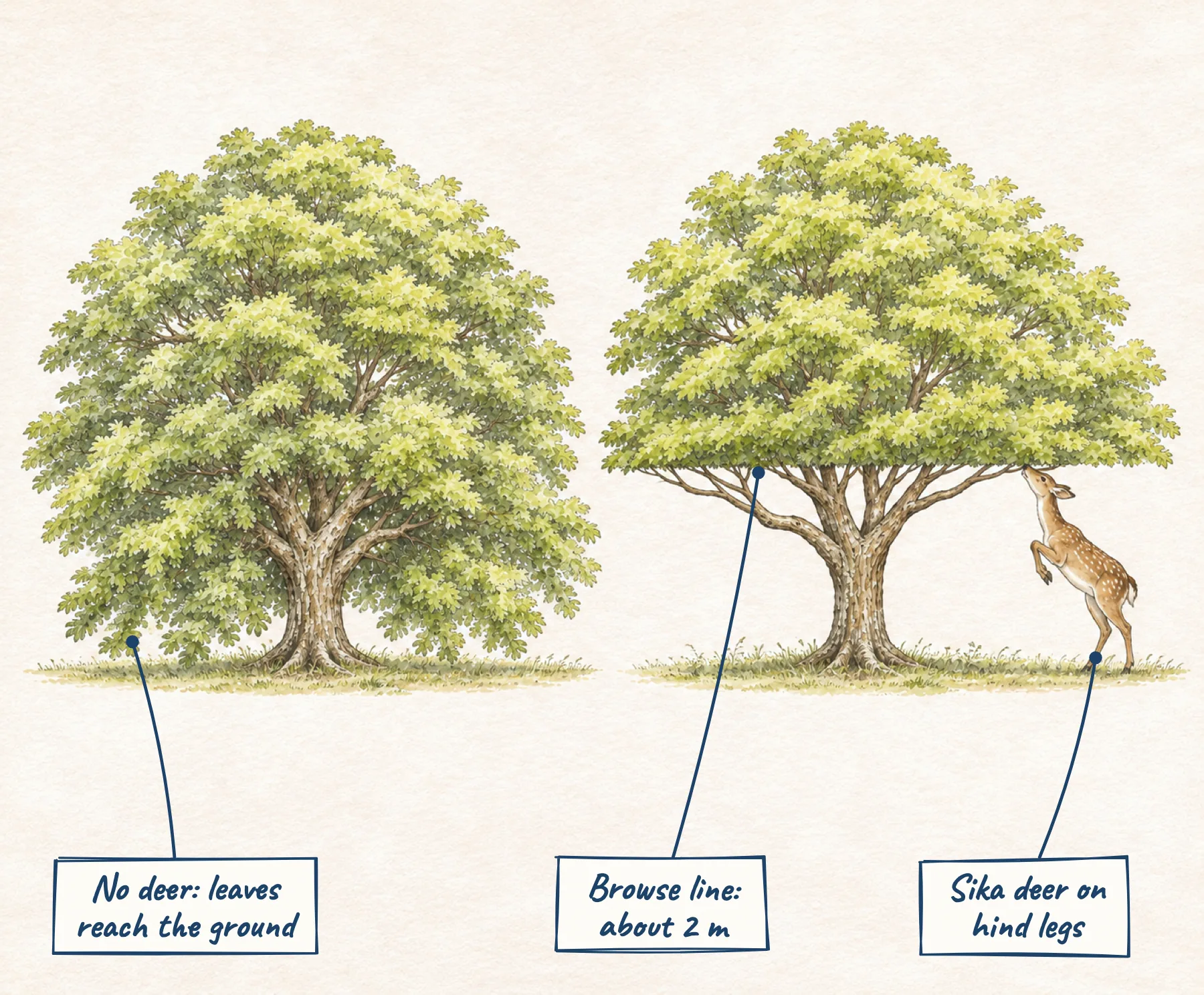
The reach of a deer on its hind legs
A browse line is not cut; it is the top of a feeding zone. Deer eat leaves, shoots and twigs from the ground up, and they keep eating until they run out of reach. The Shimane Prefecture Mountainous Region Research Center describes how sika deer (Cervus nippon, the species that lives in Nara) “stand up on their hind legs and eat leaves and fruit up to a height of about 2 m.” Kochi Prefecture uses almost the same figure to tell landowners how to recognise heavy deer pressure: “a deer line where the leaves below about 2 m, the height a deer’s mouth can reach, have been eaten uniformly.” A research summary from Nagasaki Prefecture’s agriculture and forestry centre, written for forest regeneration on Tsushima, states plainly that “the deer line is 2 m, the height at which deer can feed.”
Why the line comes out level
Three features of the park offer a plausible explanation for why the edge looks ruled rather than ragged.
– The ground is level. On a flat lawn, the top of a deer’s reach sits at roughly the same height from tree to tree, so the lower edges of neighbouring crowns line up. – The pressure is repeated. A single browsing visit would leave a ragged edge. Repeated browsing keeps suppressing growth within reach, so the boundary holds near the limit of reach. – The leaves are taken evenly. Kochi’s wording matters here: the leaves below about 2 m are eaten uniformly (一様に). That evenness is what turns a feeding zone into a visible line.
“About 2 metres” is a description, not a measurement
It is tempting to say that every tree in Nara is trimmed to exactly 2 metres. The sources do not support that. The prefecture’s “about 2 m” is a description of the park’s trees, not a survey of every crown, and the regional figures from Shimane, Kochi and Nagasaki are approximate. The figures below come from guidance and descriptions covering different plants, sites and deer species; several are upper limits rather than measurements. What is consistent is the shape, not a single number.
Season and species change the line too. Wisconsin’s Department of Natural Resources describes a browse line made by white-tailed deer feeding on pines in winter, “a uniform line that separates the dead branches from the green limbs.” The USDA Forest Service suggests that if young eastern hemlocks have no branches lower than 6 feet, there may be cause for concern. At Tatton Park the example walkers are shown is a beech avenue.
| Source | Where | Deer | Height given for the browse line or feeding reach |
|---|---|---|---|
| Nara Prefecture planting document | Nara Park | Sika deer | Lowest branches cut to about 2 m (6.6 ft) |
| Shimane Prefecture research center | Shimane, Japan | Sika deer | Feeds up to about 2 m standing on hind legs |
| GOV.UK tree protection guidance | Britain | Red, sika, fallow deer | Up to 1.8 m (5.9 ft) at moderate density |
| GOV.UK tree protection guidance | Britain | Roe deer | Up to 1.1 m (3.6 ft) |
| The Royal Parks | Richmond Park, London | Park deer | Leaves and twigs eaten below 6 ft (1.8 m) |
| Penn State Extension | Pennsylvania | Deer | Vegetation eaten from ground level to 5 ft (1.5 m) |
Sacred deer — why so many animals live in a city park
A god who arrived on a white deer
Behind the long protection of Nara’s deer is the faith of Kasuga Taisha. The shrine’s own account says its main sanctuary was built in 768, in the Nara period, on the order of Empress Shōtoku. The shrine’s guide to its precinct marks the spot where, according to tradition, the deity Takemikazuchi-no-mikoto descended onto Mount Mikasa “riding on the back of a white deer” from Kashima. Because a god arrived on a deer, the shrine explains, “the Kasuga sacred deer are the companions of the god, and came to be treasured as messengers of the god” (春日神鹿は神様のお供であり、神の使いとして大切に扱われるようになりました).
Protection written into the city’s rules
Over the following centuries that reverence turned into rules. The Nara Deer Preservation Foundation (奈良の鹿愛護会), which looks after the animals today, records that in 1672 the Nara magistrate Mizoguchi Nobukatsu began the annual cutting of the stags’ antlers, a practice carried on every year under the magistrate’s supervision. The Nara City Historical Materials Preservation House points to an entry dated Bunsei 5, seventh month, day 29 (1822) in a neighbourhood chronicle, in which the magistrate’s office issued instructions on protecting the sacred deer and on stopping people from treating them roughly.
On 18 September 1957 the national government designated “the deer of Nara” (奈良のシカ) a Natural Monument. The Agency for Cultural Affairs’ register records no defined area for the designation (地域を定めない) and gives its location as “throughout Nara City.”
How many deer, and where they are protected
The Nara Deer Preservation Foundation publishes a yearly count of the park’s deer. Its 2026 survey, carried out on 15 and 16 July between 5:30 and 8:00 in the morning, counted 1,687 deer. The same table shows 1,233 in 2023, 1,325 in 2024 and 1,465 in 2025.
| Year of count | Deer counted in Nara Park |
|---|---|
| 2023 | 1,233 |
| 2024 | 1,325 |
| 2025 | 1,465 |
| 2026 (15–16 July) | 1,687 |
Nara Prefecture’s protection plan for the Natural Monument divides the area into four zones. Zone A is the priority protection zone, “the core area of protection.” Zone B, the protection zone, includes the Kasugayama Primeval Forest and the urban areas around Zone A. Zone C is a buffer. In Zone D, the management zone, deer are handled under a separate wildlife management plan (第二種特定鳥獣管理計画).
The lawn the deer keep — grazing as gardening
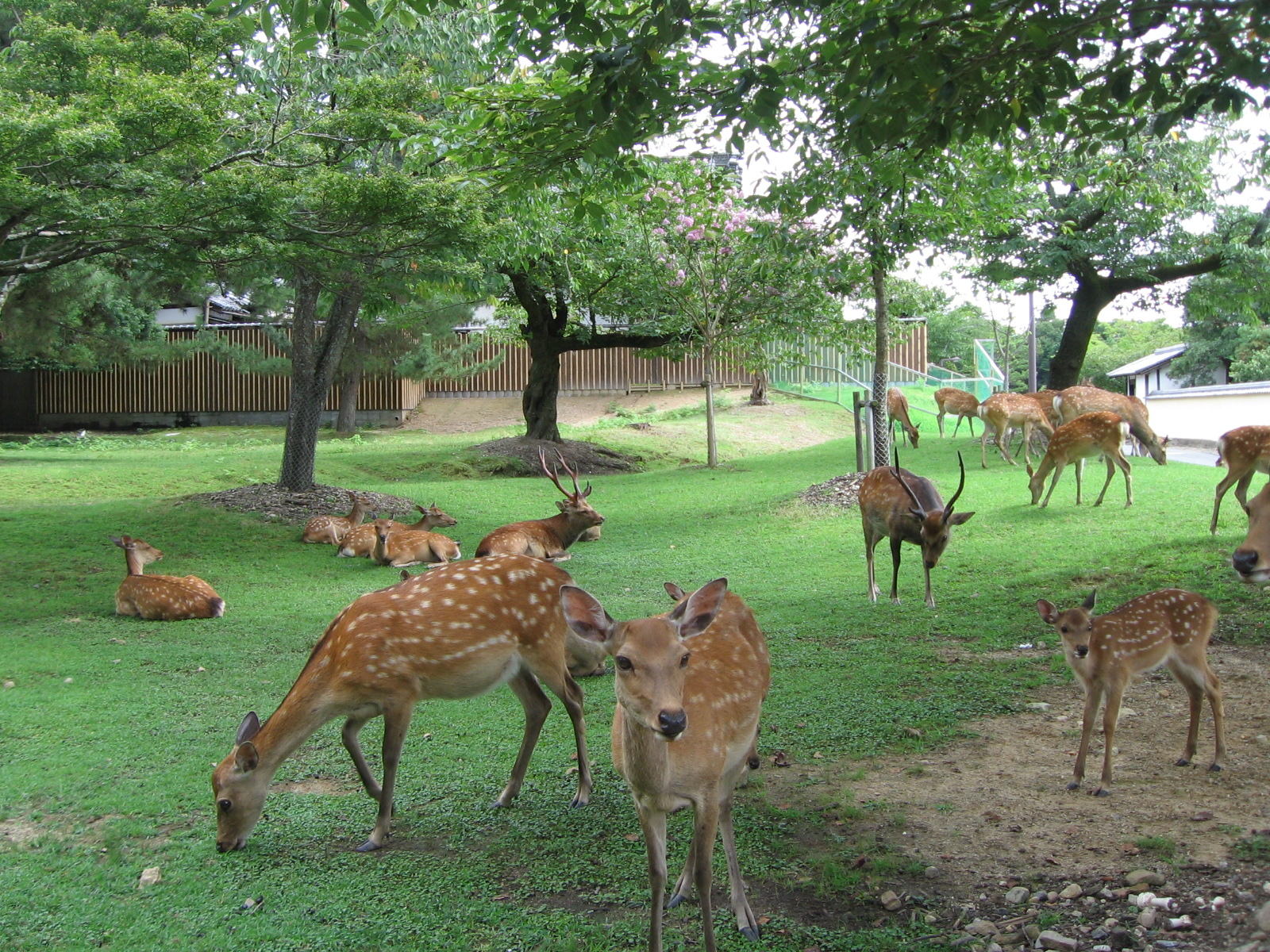
The main food is grass
The same animals that lift the trees’ skirts also graze the ground beneath them. The Nara Deer Preservation Foundation states that the deer’s staple food is noshiba (ノシバ), Japanese lawn grass (Zoysia japonica). A study of the deer’s diet on Tobihino and in the Kasugayama forest by the ecologists Seiki Takatsuki and Yuri Maesako, published in the Japanese Journal of Conservation Ecology, describes Tobihino’s turf as a grass community “maintained by the deer’s strong grazing pressure” (シバ群落がシカの強い採食圧によって維持される).
Why there are so few flowers
The prefecture’s document on flower planting is frank about the cost. It lists deer feeding as the first reason the park has held back from planting flowers: “Reason 1: feeding damage by deer” (理由1:シカによる食害). The same document links “an increase in unpalatable plants” to the formation of the park’s open landscape. In other words, the planners see the open, grassy, high-ceilinged park and the scarcity of soft, edible plants as two sides of the same process.
What the deer leave behind — plants that survive the appetite
The “will not eat” list
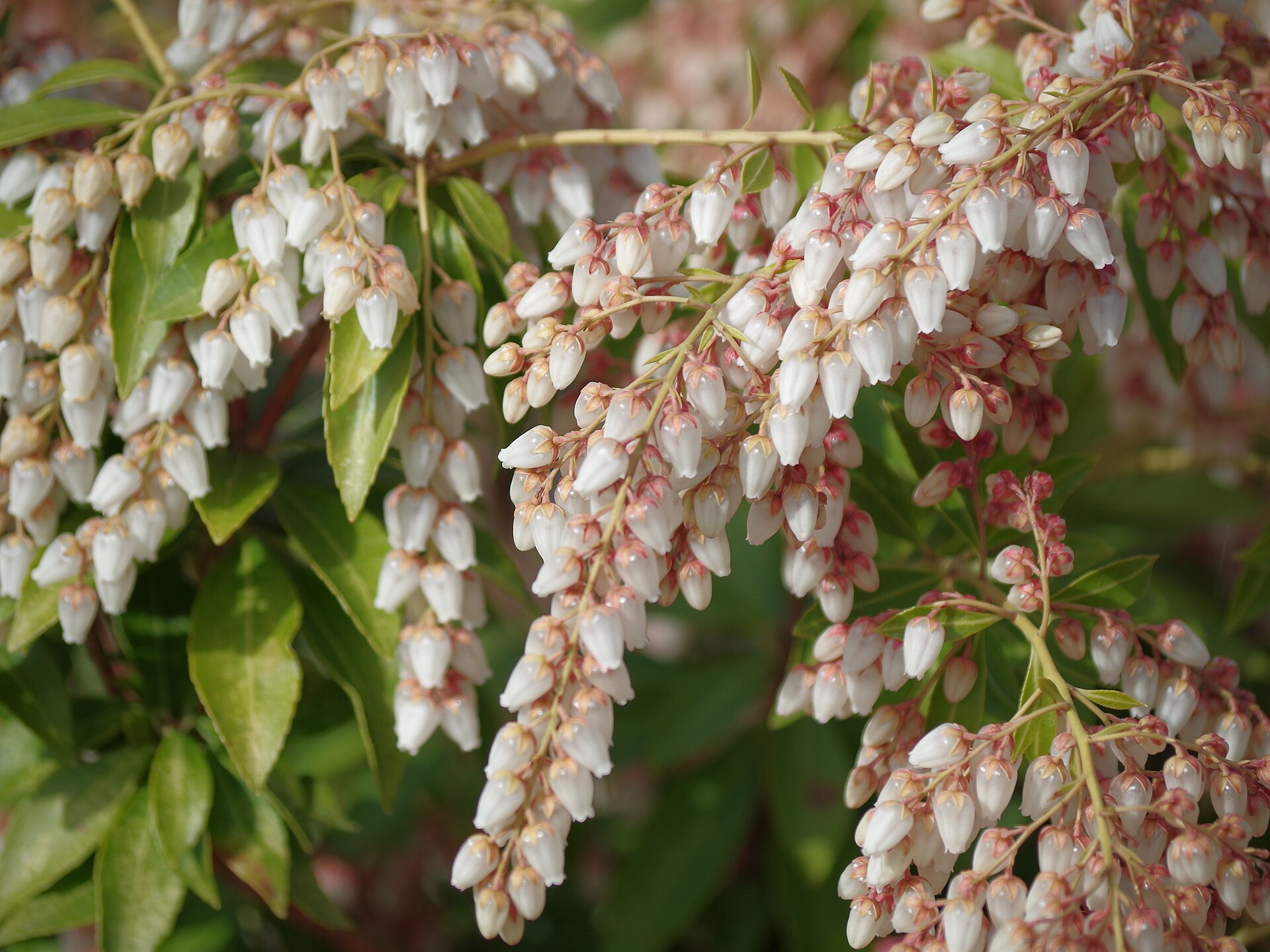
A browse line is selective. Feeding tilts the plants below it toward the ones deer avoid. The Nara Deer Preservation Foundation’s page on deer behaviour lists the woody plants the deer “do not eat” (食べない物): nagi (Nageia nagi), nankinhaze (Chinese tallow tree, Triadica sebifera) and asebi (Pieris japonica, Japanese andromeda). Among herbs, it lists the stinging nettle, irakusa.
A nettle that grows more stings
The pressure works on plants over generations, too. A study presented to the Ecological Society of Japan compared stinging nettles in Nara Park with nettles elsewhere and estimated that deer feeding is “increasing the number and density of the nettle’s stinging hairs through natural selection.” Deer browsing appears to favour better-defended nettles through natural selection. The study is about the hairs on each plant, not about whether nettles are spreading.
“Unpalatable” does not mean safe
There is a limit to the list. A Forestry Agency page on deer damage on Yakushima warns that when vegetation changes under heavy pressure, deer “start to eat even the things they dislike” (嫌いなものでも食べるようになってきます). A plant on the avoided list is one deer usually pass over, not one they will never touch.
Behind the park — the Kasugayama Primeval Forest
A forest protected since 841
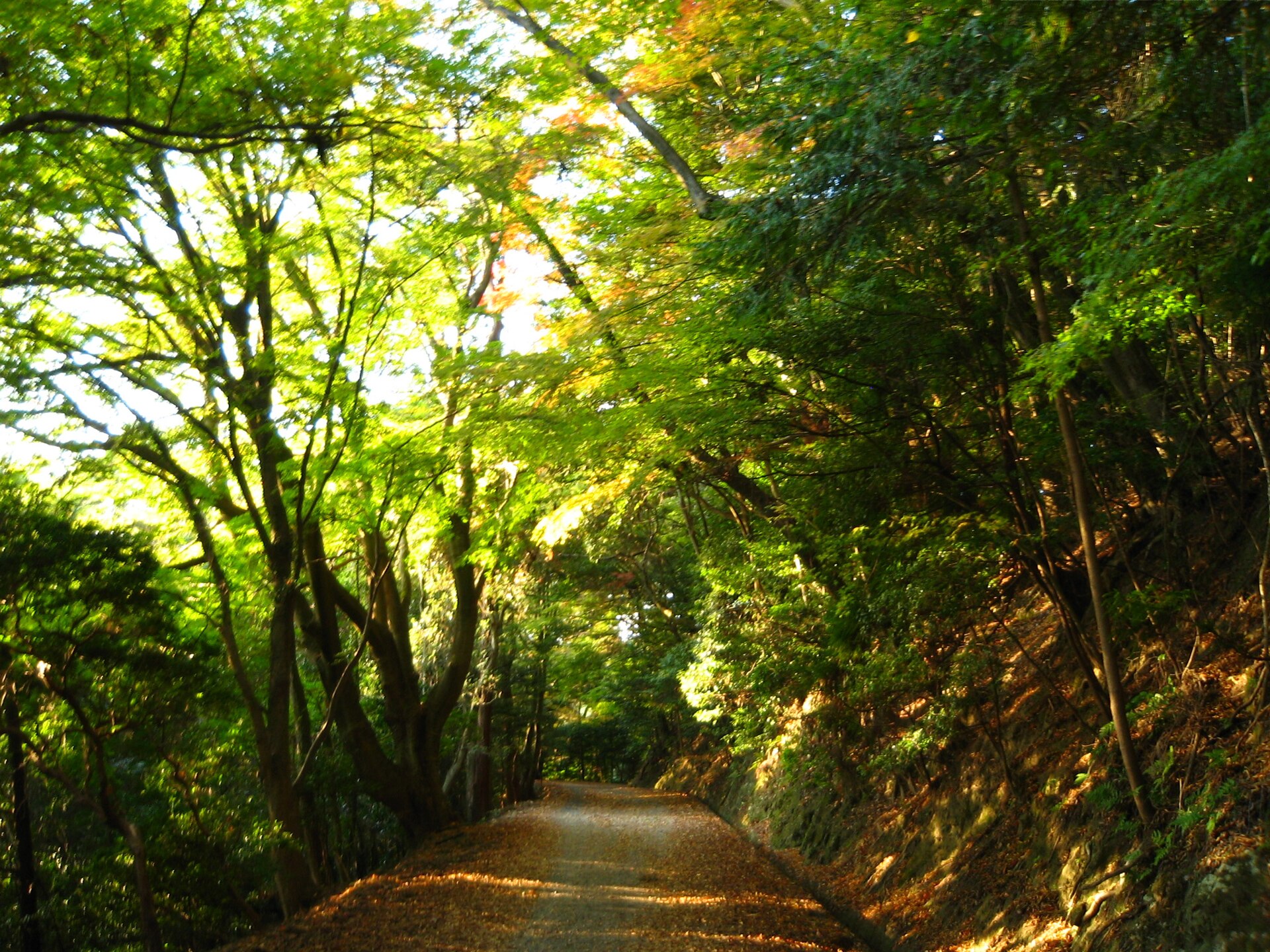
Beyond the lawns, the hills rise into the Kasugayama Primeval Forest. Japan’s Agency for Cultural Affairs explains that hunting and logging on Kasugayama were banned in 841, and that the forest has been protected ever since as the sacred mountain of Kasuga Taisha. The shrine’s own history says the court issued an official order forbidding hunting and the cutting of trees to protect the sacred precinct, and Nara Prefecture’s conservation plan for the forest dates the ban to an imperial command of the 8th year of Jōwa (841).
The forest was designated a Natural Monument on 9 December 1924 and a Special Natural Monument on 15 February 1955, according to the Agency for Cultural Affairs’ register. In 1998 it was inscribed on the UNESCO World Heritage List as part of the Historic Monuments of Ancient Nara.
This is where the story turns. The deer and the forest both carry the protection of Kasuga Taisha and of the state. In the forest, the protected animal is now eating the protected trees’ future.
A forest floor with almost nothing on it
Inside the forest, the browse line is no longer a pleasing ceiling over a lawn. Takatsuki and Maesako describe the forest floor at their study sites as “extremely poor” (きわめて貧弱である). Their analysis of droppings showed that “deer in the forest were basically eating forest plants.”
When the canopy cannot replace itself
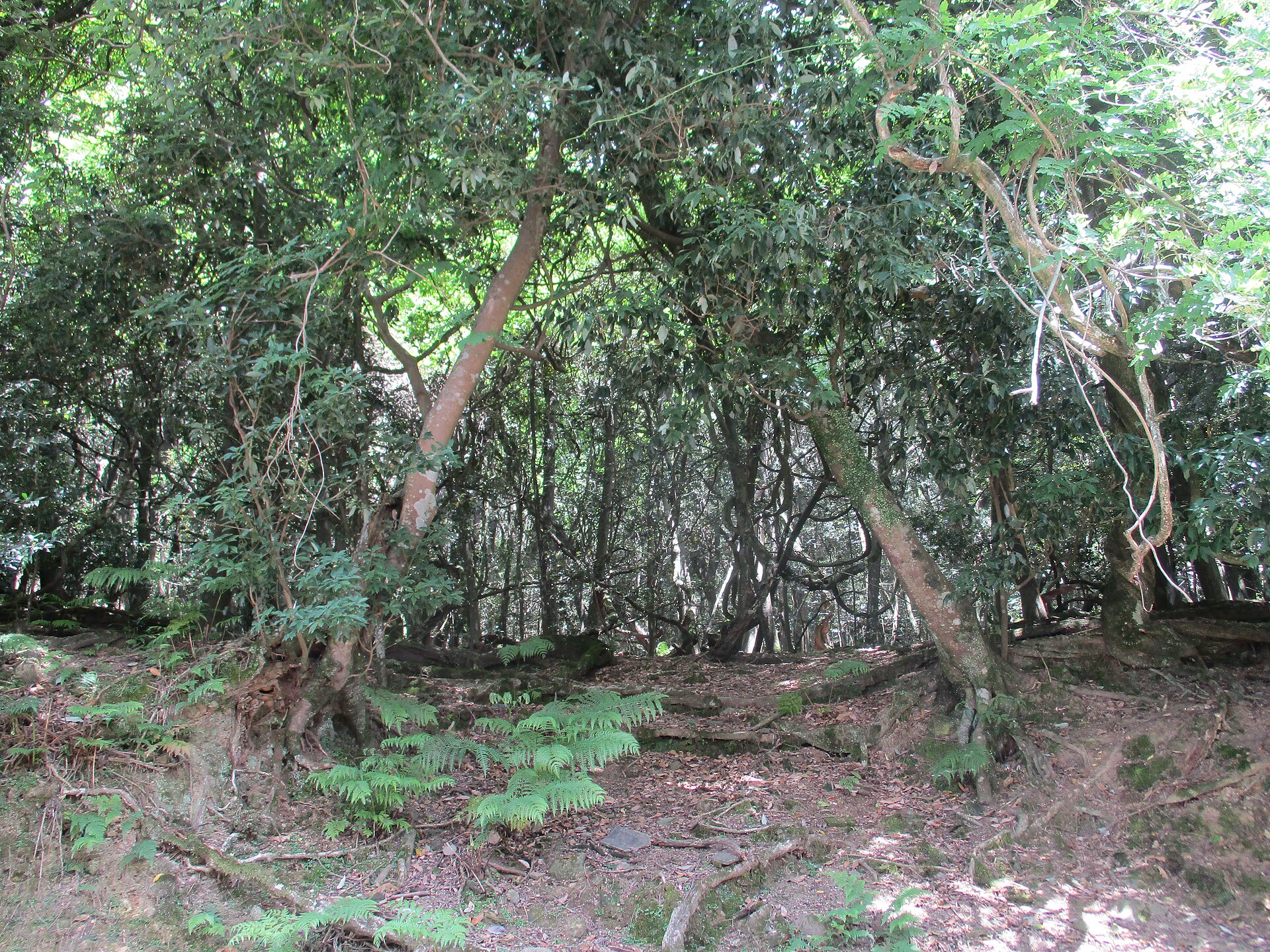
A browse line in a forest matters because of what it removes: the seedlings and saplings that would one day replace the canopy trees. Nara Prefecture’s conservation plan concludes that, because of excessive deer feeding pressure and the invasion of Chinese tallow trees, “it has become difficult to maintain the evergreen broadleaf forest into the future” (将来にわたり照葉樹林を維持することが困難な状況にある).
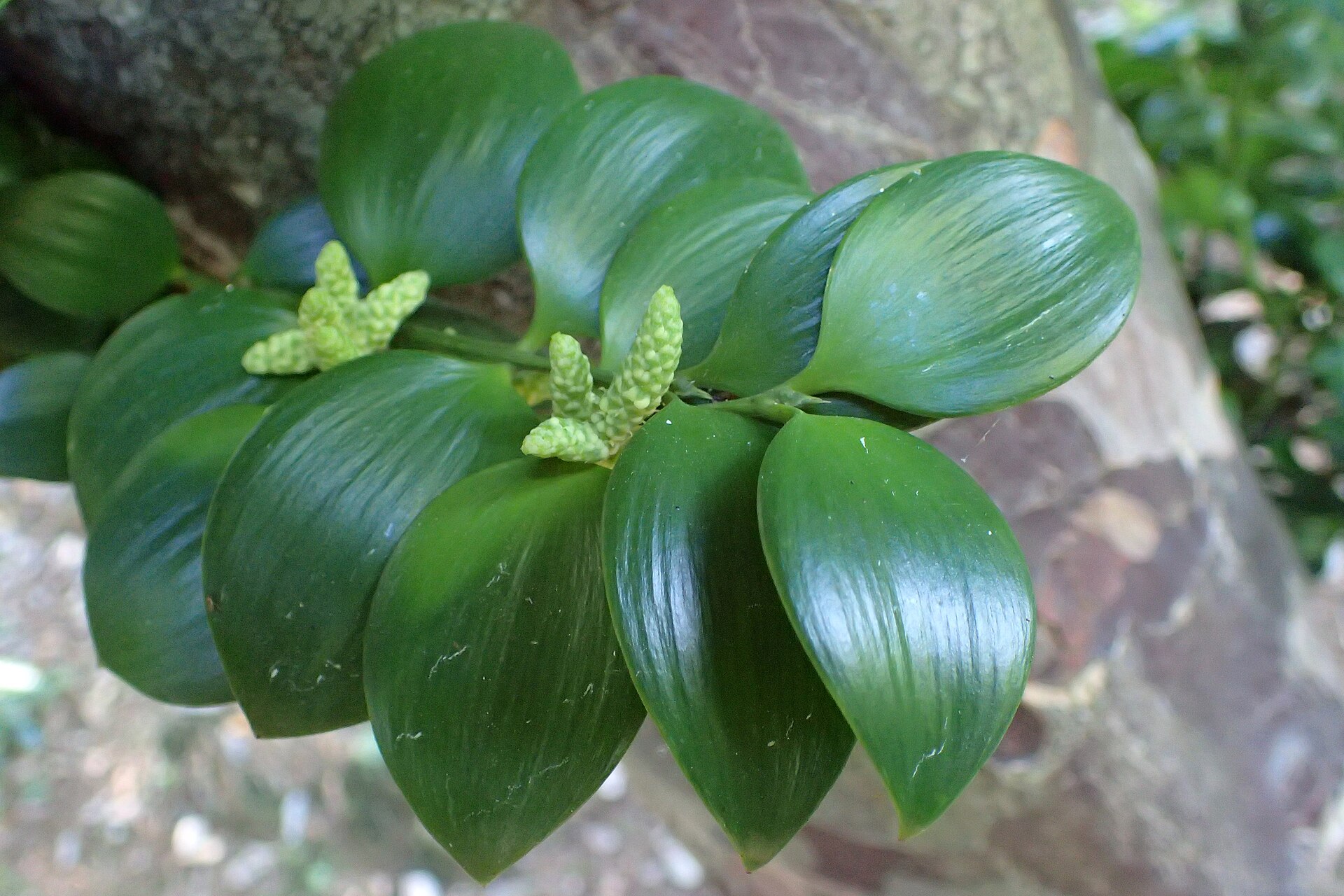
The plan names the two plants that benefit. Nagi, which deer avoid, “has gradually spread into the primeval forest.” Chinese tallow has invaded “especially the gaps” — the openings left when old trees fall, which in a healthy forest would fill with young native trees. Research presented to the Ecological Society of Japan found a clear correspondence between Chinese tallow invasion and gap formation. Japan’s Forestry Agency cites Kasugayama as an example of a forest where deer have reduced native species and where Chinese tallow and nagi “have come to dominate.”
Fences in a sacred forest — Nara’s experiment
Thirty-two fences, then more
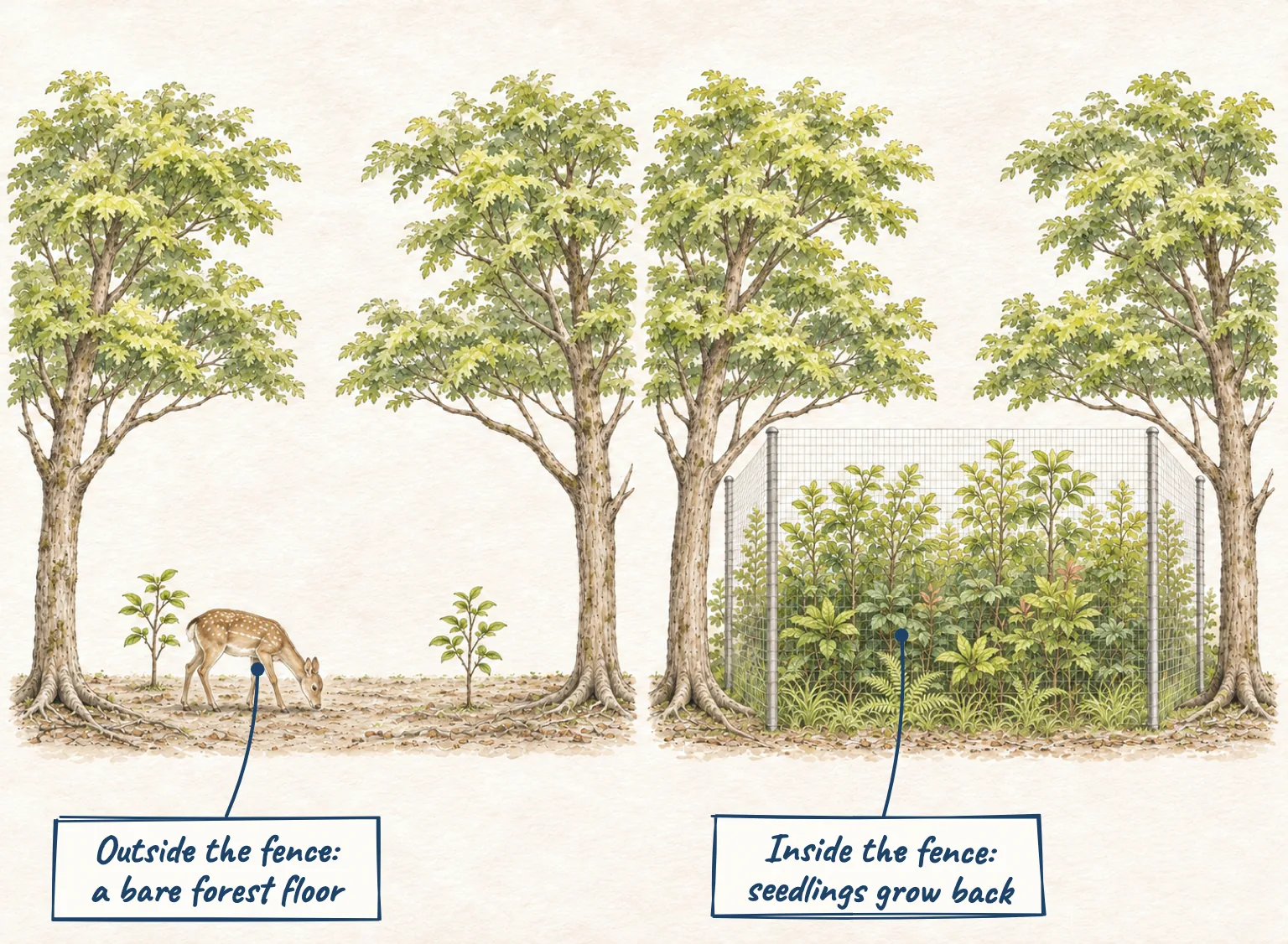
The prefecture’s answer has been to fence off small plots of forest floor so that the deer cannot reach them. Its progress report on the conservation plan records that vegetation protection fences (植生保護柵) were installed from 2013, with 32 plots fenced between 2013 and 2015 and 4 more in 2016. The fences are scattered across Kasugayama, Hanayama and a regeneration area. In fiscal 2025 the prefecture added 5 new fenced plots inside the forest and set up 4 small experimental fences on Mount Wakakusa, outside the Special Natural Monument area.
What grows when the deer are kept out
The prefecture monitors the fenced plots against unfenced plots beside them. In a monitoring comparison covering 35 of the fenced plots installed in 2013–2016, it reports that in both the second and third surveys “more species appeared inside the fences,” and that the total plant cover was also higher inside, “in the same way as the number of species.”
Researchers have looked at the most important places, the gaps. In a study presented to the Japanese Forest Society in 2017, Hikichi, Kanzaki and Maesako found that in all nine canopy gaps they examined, seedlings survived better inside deer fences than outside. They also reported a gradual loss under long-term browsing: seeds germinate, the seedlings are eaten, the buried seed bank is depleted, and the gaps’ capacity to regenerate declines.
| What was compared | Inside the fence | Outside the fence | Source |
|---|---|---|---|
| Number of plant species (35 fences, 2nd and 3rd surveys) | More | Fewer | Nara Prefecture, FY2025 report |
| Total plant cover (same fences) | Higher | Lower | Nara Prefecture, FY2025 report |
| Seedling survival in canopy gaps (9 gaps) | Higher in every gap | Lower | Hikichi, Kanzaki and Maesako, 2017 |
Two plans on one map
The planning map explains the setting. The forest sits in Zone B of the deer protection plan, while the separate wildlife management plan covers Zone D, outside it. Inside the forest, the measure the prefecture reports year by year is the fenced plot and its monitoring: a place where both the animal and the forest are protected monuments, and the work is to keep the forest floor alive alongside the deer.
The same line in Britain and America
A “distinctive” feature of Richmond Park
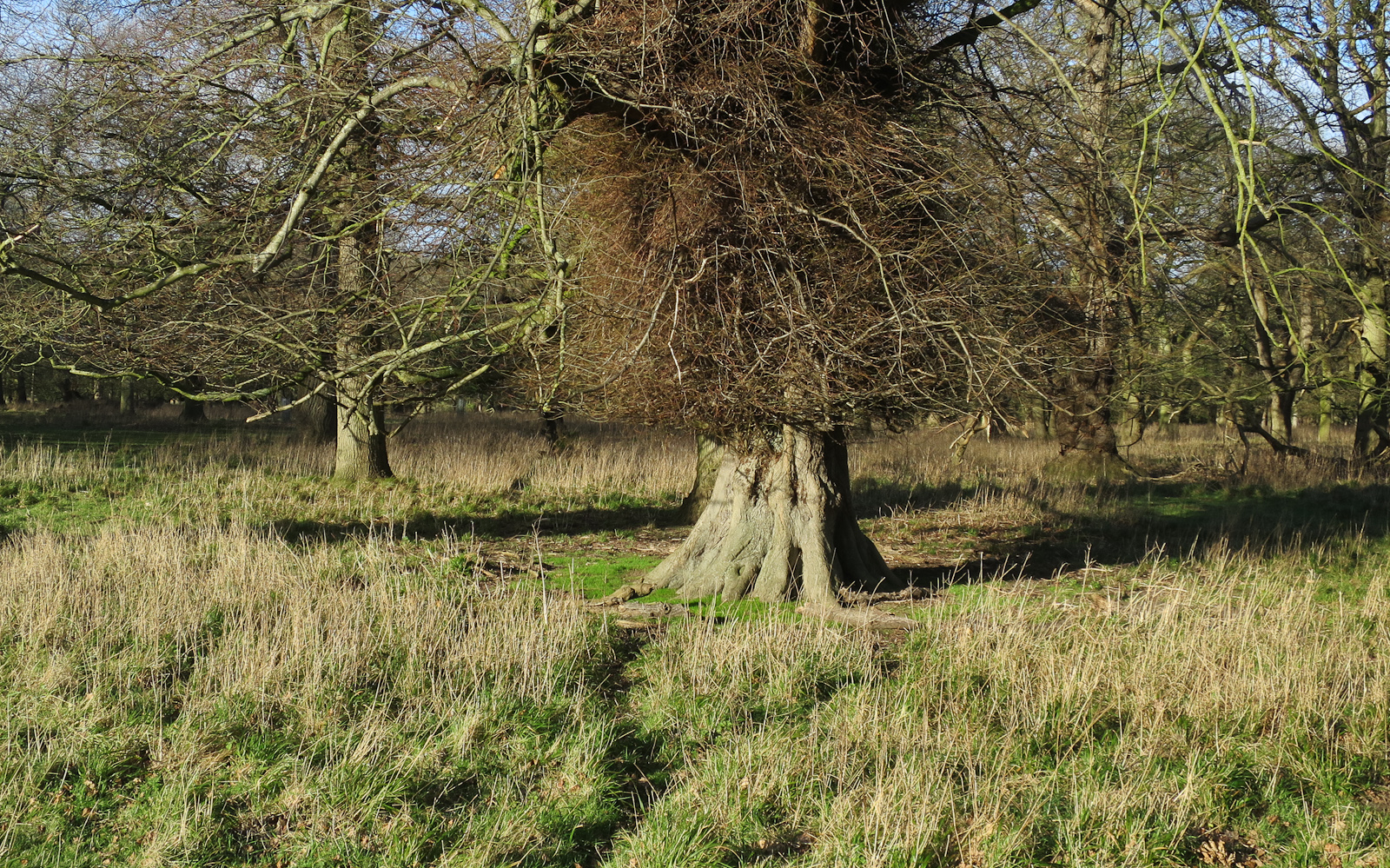
The browse line is not unique to Japan, and British parks also present it as a feature of the landscape. The Royal Parks, describing the deer of Richmond Park in London, explain that the deer’s grazing keeps the park’s landscape open, and add: “You might notice too that parkland trees have a distinctive ‘browse line’ as the deer eat all the leaves and twigs growing below 6ft.” The National Trust’s conservation trail at Tatton Park in Cheshire points walkers to a beech avenue where “deer love to eat the lower branches of Beech trees, creating a ‘browse line’ where all the branches start at a certain height.”
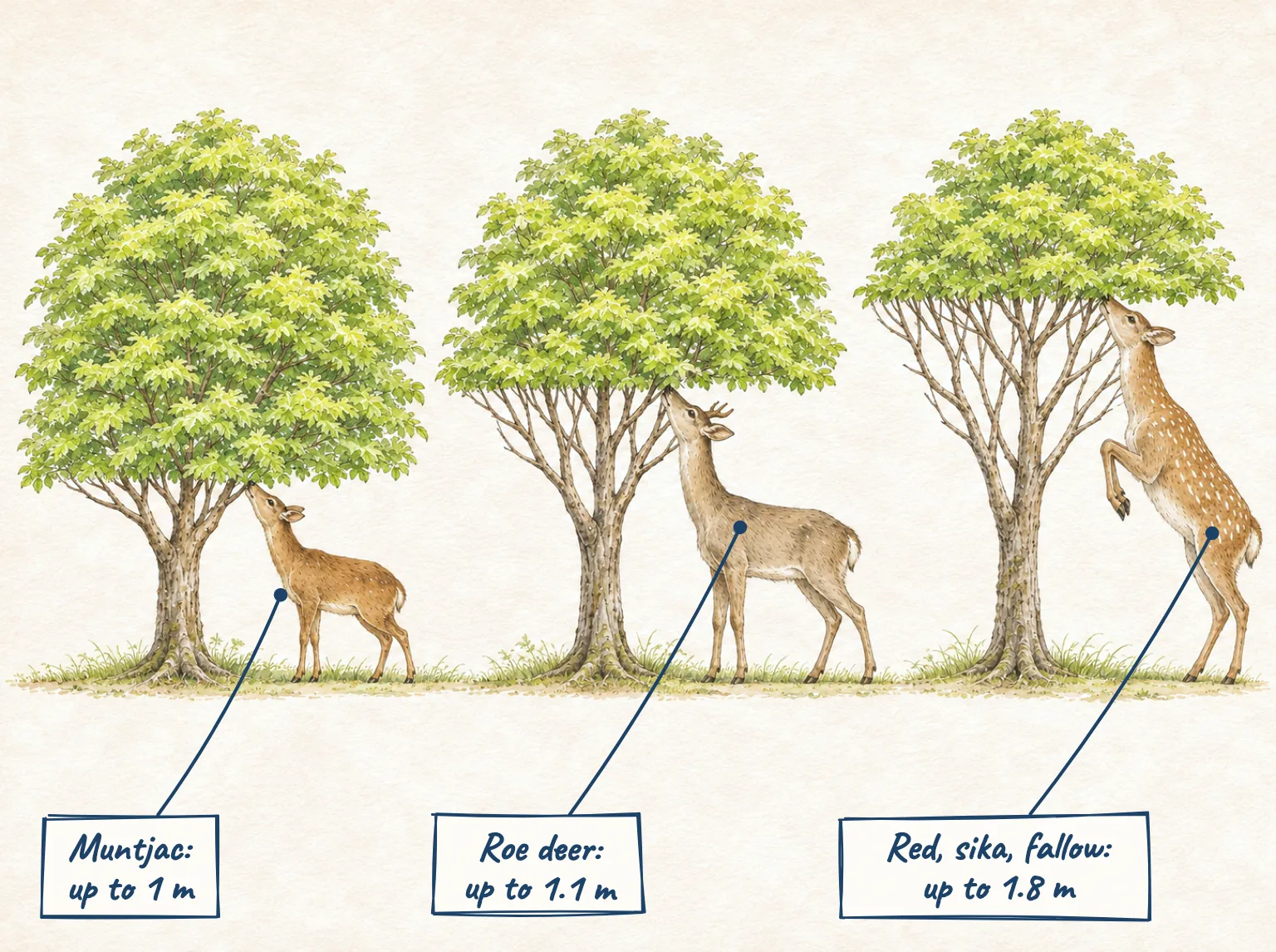
The British government’s technical guidance on protecting trees from mammal damage gives the expected heights by species at moderate deer density: up to 1.8 metres for red, sika and fallow deer, up to 1.1 metres for roe deer and up to 1 metre for Reeves’s muntjac. The sika figure is the closest comparison to Nara, because it is the same species. The Deer Initiative adds a detail that fits Nara well: deer “can stand briefly on their hind legs to feed,” so damage can reach higher than the usual figures, and “this is especially true in deer parks.”
In a woodland, the same line is a warning
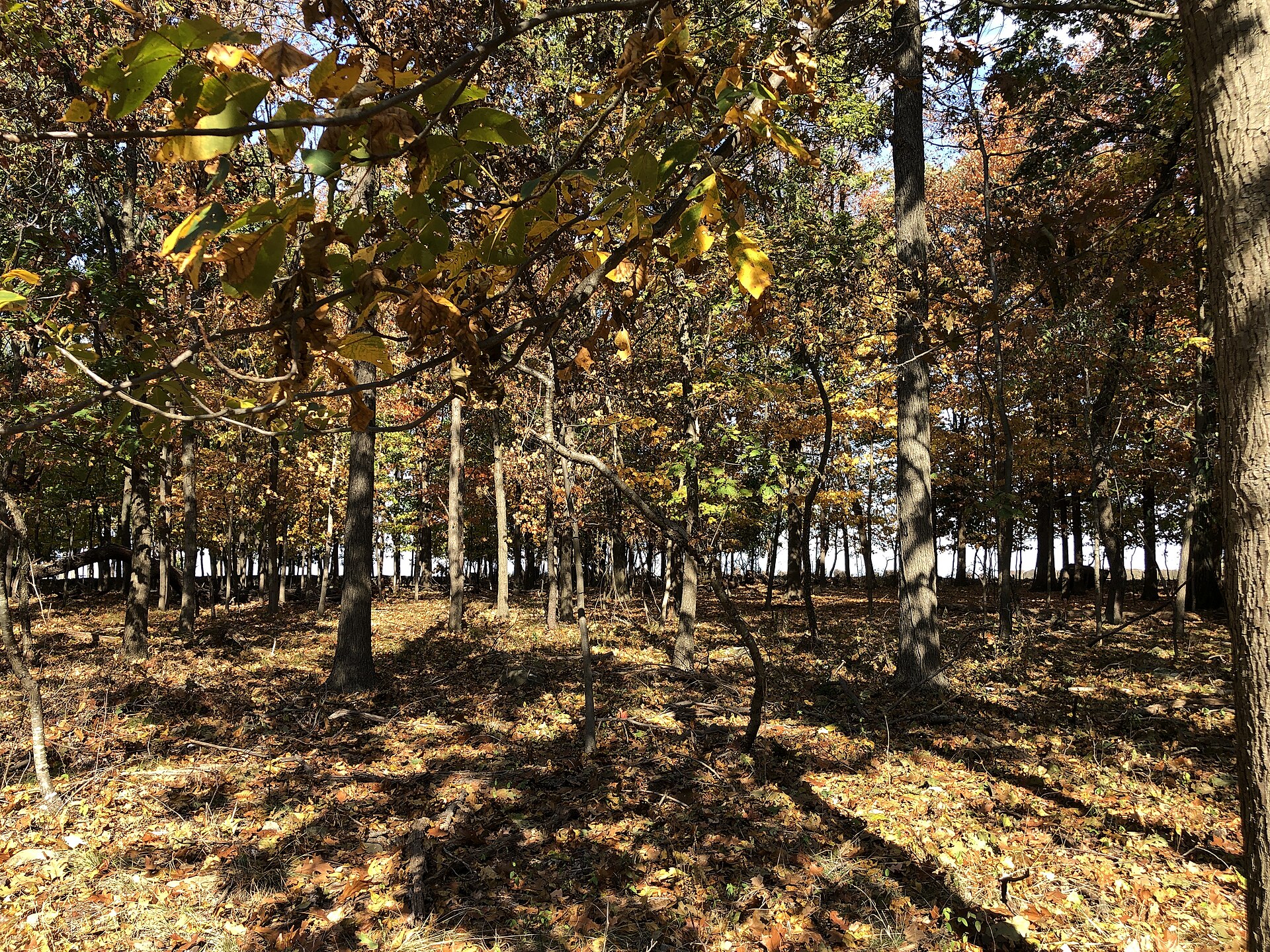
Move from a park into a wood, and the reading changes. The Forestry Commission’s practice note Managing Deer in the Countryside gives a simple field test: if you can see far into a wood at 0.5–1.5 metres above the ground, but not above that height, “then a clear ‘browse line’ is present.” The Woodland Trust’s survey guidance for restoring ancient woodland lists two warning signs of browsing damage: a field layer with “a lawn-like appearance,” or “a ‘browse line’ on trees.”
A lawn-like ground layer and a clean browse line are what visitors photograph in Nara Park. In a British woodland survey, they are signs to investigate.
What the research found
American and British studies over several decades show why. Aldo Leopold, in his essay “Thinking Like a Mountain,” wrote that he had “seen every edible tree defoliated to the height of a saddlehorn” as deer multiplied, and warned that recovery of the damaged range could take decades. In northwestern Pennsylvania, Tilghman kept deer at five densities, from 0 to 80 deer per 259 hectares, for five years; on clear-cut plots the tree seedlings at the lowest density were “nearly twice as tall” as those at the highest, and heavy browsing narrowed regeneration to little more than black cherry. Another ten-year study, by Horsley, Stout and deCalesta, found that the number of tree species fell as deer density rose, in every forestry treatment they tested.
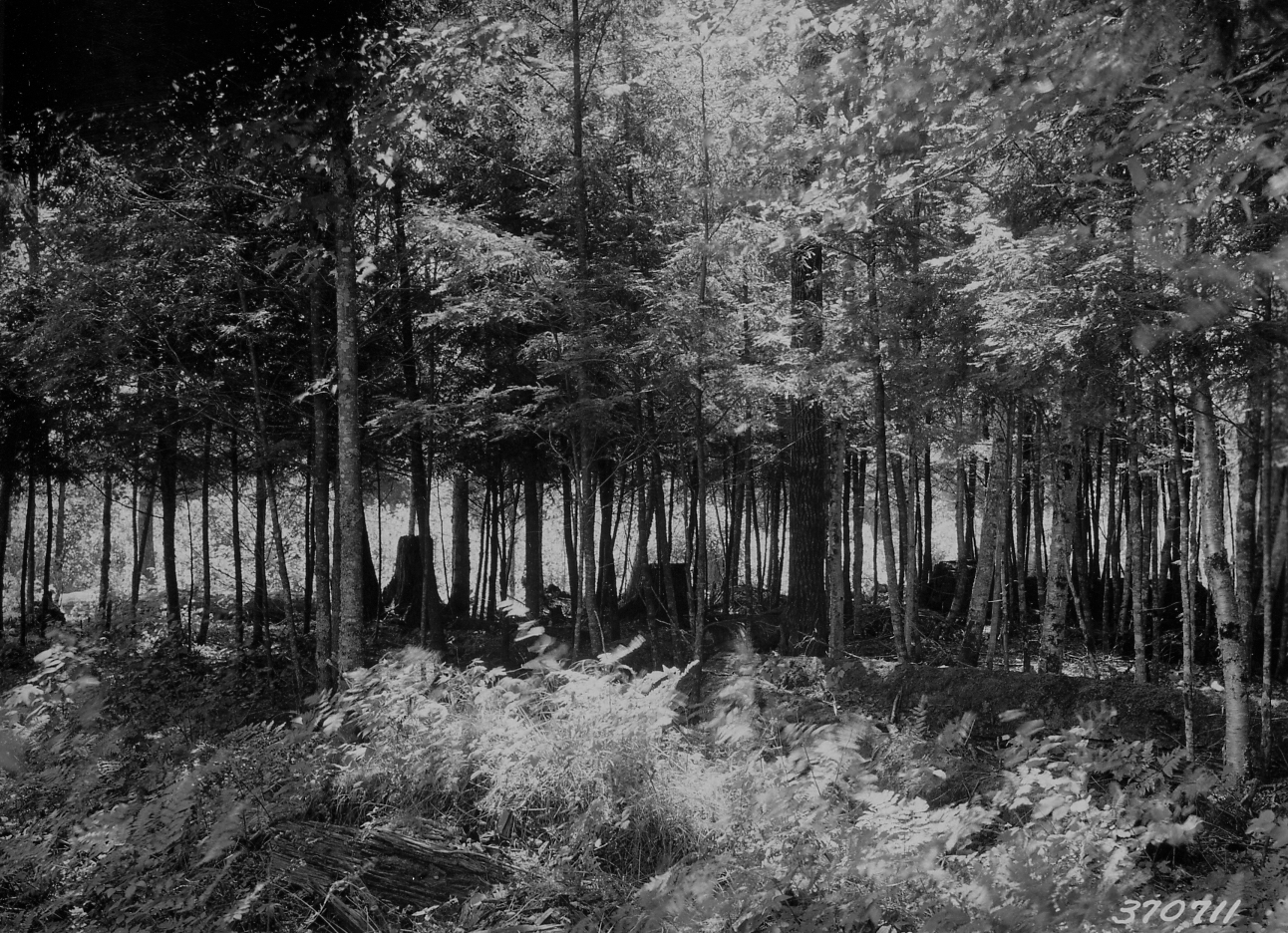
A review by Côté and colleagues in 2004 summarised the pattern: “sustained overbrowsing reduces plant cover and diversity, alters nutrient and carbon cycling, and redirects succession to shift future overstory composition,” and many of these simplified states are “difficult to reverse.” In Britain, Fuller and Gill described serious impacts on woodland regeneration that had “become widespread in Britain as a consequence of increasing numbers of deer.” Gill and Fuller’s analysis of 13 woods found that a foliage density score fell as deer density rose, to as much as 92 per cent below the score at zero deer density, with the steepest loss below 1.5 metres. In eight pairs of fenced and unfenced three-year-old coppice plots at Bradfield Woods, the median territory density of migrant birds was 7.60 per hectare inside the fences and 2.60 outside.
How high the fences are
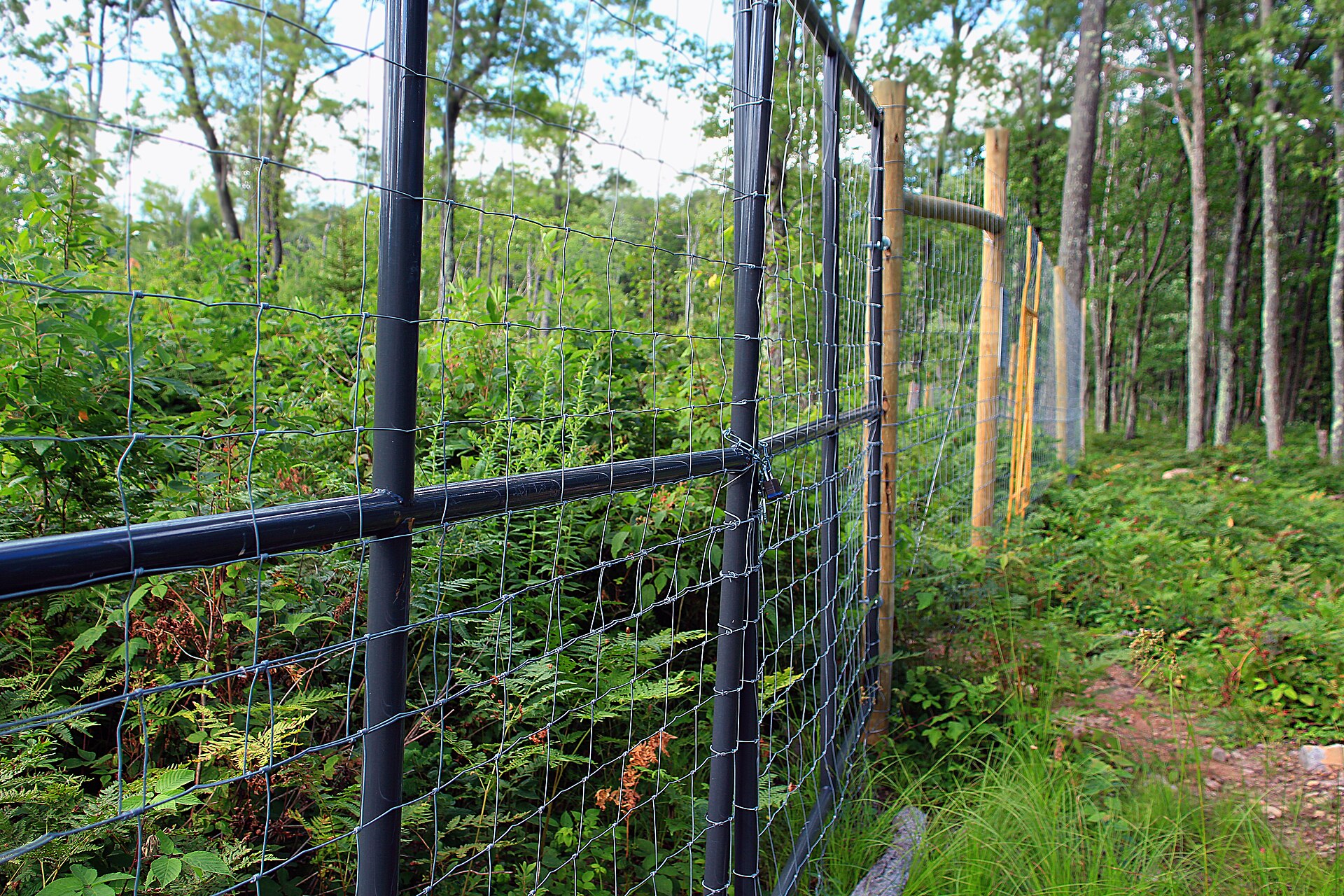
Fence specifications are set high. New York State’s reforestation grant specifications require deer exclosure fences “at least eight (8) feet tall” (about 2.4 m), and the University of California’s integrated pest management guidance recommends a 7- or 8-foot fence “especially where mule deer are found.” In England, the Countryside Stewardship deer-fencing specification (FG9) sets a minimum of 1.8 metres for red, sika and fallow deer. Individual tree shelters follow the same logic: the Forestry Commission’s guidance says their height “must match, or exceed, the browsing mammal.”
Same line, different premise — a park, a forest, a woodland
A landscape in one place, a symptom in another
The browse line in Nara and the browse line in a Pennsylvania wood are physically the same thing: the upper edge of what deer can eat. What differs is the premise: what the land is managed for, and what the deer are in that place. Neither reading is better. Nara itself holds both readings, a landscape feature on the lawns and a conservation problem in the forest, a short walk apart.
Examples from the sources used in this article:
| Nara Park lawns | Kasugayama Primeval Forest | Richmond Park and Tatton Park | British and American woodlands | |
|---|---|---|---|---|
| What the deer are | Sacred messengers of Kasuga Taisha; a Natural Monument | The same animals, under the same protection plan | Park deer | Wild deer (examples from the cited British and American sources) |
| What the land is managed for | Open lawns and the park landscape | A Special Natural Monument forest | Open parkland | Regeneration, timber, habitat |
| How the browse line is described | A “deer line” in the prefecture’s planting document | Part of a forest floor described as “extremely poor” | A “distinctive” feature walkers can look for | A sign of browsing damage in survey guidance |
| Measures in the sources | Few flowers planted, because of deer feeding | Fenced plots; monitoring inside and outside | Explained to visitors | 1.8–2.4 m fences; tree shelters; culling permits |
Why the response differs
In New York, a permittee under the Deer Management Assistance Program receives antlerless deer tags to hand out to licensed hunters using the property during the hunting season, and where deer are causing damage, a Deer Damage Permit, subject to its conditions, allows deer to be taken at any time of year by non-hunting methods. In England, shooting deer at night requires registering to use a class licence (CL55) or applying for an individual licence (A16) from Natural England. Fences and shelters are part of the same toolkit.
Nara’s starting point is different. The deer are themselves the protected monument, and the measure documented in the forest is the fenced plot. It is a place where a god is said to have arrived on a deer, and it produces a landscape that a European visitor would recognise from Richmond Park and a forester would recognise from a heavily browsed wood, a short walk apart.
In a Japanese garden, a level lower edge is usually a gardener’s work, as the difference between niwaki and topiary shows. In Nara the same shape is an ecological record, which is why it belongs with landscape design that puts ecology ahead of appearance.
Reading a browse line — what to look for
A field check, step by step
Whether you are standing in Nara or in a wood at home, the sources in this article add up to a simple sequence. No single sign settles the question; together they tell you where to look harder.
- Look through the wood at knee to chest height. The Forestry Commission’s test: if you can see far at 0.5–1.5 metres but not above, a clear browse line is present.
- Note the height, as a clue. British guidance gives up to 1.8 metres for red, sika and fallow deer, 1.1 metres for roe deer and 1 metre for muntjac at moderate density. Height alone does not identify the animal: deer can stand on their hind legs, and the figures are upper limits.
- Check the ground layer. A lawn-like field layer under woodland trees is the Woodland Trust’s second warning sign.
- Look at what grows below the line. In Nara the deer pass over asebi, nagi and Chinese tallow. A shrub layer dominated by avoided species is worth recording.
- Look into the gaps, then compare. Where an old tree has fallen, look for young native trees. A bare gap suggests regeneration may be held back. Nara’s method is the reliable test: fence a plot, monitor inside and outside, and compare species, cover and seedling survival over the years.
For gardeners near deer
The same sources give practical numbers. The Forestry Commission’s guidance says a tree shelter’s height “must match, or exceed, the browsing mammal”; a management document published by Natural England lists Forestry Authority recommended minimum heights for guards and shelters of 1.8 metres for red deer and 1.6 metres for fallow and sika deer. Fence heights in the sources range from 1.8 metres under England’s FG9 specification for red, sika and fallow deer to 8 feet (2.4 m) for New York’s reforestation grants. Nara’s list of what deer leave alone is a starting point for planting near deer, with the caution that deer can come to eat plants they normally avoid.
Nara is also a reminder of what a browse line can cost over a long time. Many of Japan’s old trees and sacred forests owe their survival to protection from people, a theme in why Japan’s ancient trees live so long. Kasugayama shows that protection from people is not the same as protection from everything.
Frequently asked questions
Do gardeners trim the trees in Nara Park to make the flat line?
No. The flat lower edge is a browse line made by deer eating the leaves and shoots within their reach. Nara Prefecture’s planting document describes it as a “deer line” with the height to the lowest branches cut to about 2 metres by deer feeding.
How high is the browse line in Nara?
About 2 metres (6.6 ft), according to Nara Prefecture. Shimane Prefecture describes sika deer feeding up to about 2 m when standing on their hind legs. It is an approximate height, not a precise one.
Why are there so many deer in Nara?
The deer have long been protected as sacred messengers of Kasuga Taisha, whose tradition says its deity arrived on a white deer. In 1957 “the deer of Nara” were designated a national Natural Monument. The Nara Deer Preservation Foundation counted 1,687 deer in the park in its July 2026 survey.
Is the browse line harming the forest?
In the open park, the prefecture’s documents describe it as a feature of the landscape. In the Kasugayama Primeval Forest, behind the park, Nara Prefecture’s conservation plan states that heavy deer feeding and invasive Chinese tallow trees have made it difficult to maintain the evergreen broadleaf forest into the future. Fenced plots there contain more plant species and more plant cover than unfenced plots.
What plants do Nara’s deer not eat?
The Nara Deer Preservation Foundation lists nagi (Nageia nagi), Chinese tallow tree (Triadica sebifera) and Japanese andromeda (Pieris japonica) among the woody plants deer do not eat, and stinging nettle among the herbs. Under heavy pressure, deer may eat plants they normally avoid.
Do deer parks in Britain have the same line?
Yes. The Royal Parks describe a “distinctive ‘browse line’” on Richmond Park’s trees, where deer eat the leaves and twigs below 6 ft, and British government guidance gives browse line heights of up to 1.8 metres for red, sika and fallow deer.
Sources
– Nara Prefecture, 草花類植栽の検討 (study on introducing flowering plants to Nara Park), pp. 6, 9, 14 — https://www.pref.nara.lg.jp/documents/6509/siryou1-1.pdf (checked 2026-10-31) – Nara Prefecture, 天然記念物「奈良のシカ」保護計画 (protection plan for the deer of Nara), pp. 3–4 — https://www.pref.nara.lg.jp/documents/6497/hogokeikaku-1.pdf (checked 2026-10-31) – Nara Prefecture, 春日山原始林保全計画 (Kasugayama Primeval Forest conservation plan), chapters I and III — https://www.pref.nara.lg.jp/n111/49401.html (checked 2026-10-31) – Nara Prefecture, progress report on Kasugayama conservation projects — https://www.pref.nara.lg.jp/documents/6508/03_sannkoushiryou1_jigyoushinntyoku.pdf (checked 2026-10-31) – Nara Prefecture, list of vegetation protection fences in Kasugayama — https://www.pref.nara.lg.jp/documents/6508/05_sannkoushiryou3_hogosakuithirann.pdf (checked 2026-10-31) – Nara Prefecture, FY2025 Kasugayama conservation and regeneration report — https://www.pref.nara.lg.jp/documents/6508/01_shiryou1_r7jigyou.pdf (checked 2026-10-31) – Agency for Cultural Affairs, Cultural Heritage Online: 奈良のシカ — https://online.bunka.go.jp/heritages/detail/162848 (checked 2026-10-31) – Agency for Cultural Affairs, register of designated cultural properties: 春日山原始林 — https://kunishitei.bunka.go.jp/heritage/detail/401/1951 (checked 2026-10-31) – Agency for Cultural Affairs, Cultural Heritage Online: Kasugayama Primeval Forest — https://online.bunka.go.jp/special_content/component/50 (checked 2026-10-31) – UNESCO World Heritage Centre, Historic Monuments of Ancient Nara — https://whc.unesco.org/en/list/870/ (checked 2026-10-31) – Kasuga Taisha, about the shrine — https://www.kasugataisha.or.jp/about/ (checked 2026-10-31) – Kasuga Taisha, precinct guide — https://www.kasugataisha.or.jp/guidance/index/ (checked 2026-10-31) – Nara Deer Preservation Foundation, population counts — https://naradeer.com/learning/number.html (checked 2026-10-31) – Nara Deer Preservation Foundation, history of protection — https://naradeer.com/learning/hogonorekishi.html (checked 2026-10-31) – Nara Deer Preservation Foundation, behaviour and ecology — https://naradeer.com/learning/ecology.html (checked 2026-10-31) – Nara City Historical Materials Preservation House, antler cutting — https://www.city.nara.lg.jp/site/bunkazai/5684.html (checked 2026-10-31) – Takatsuki S. and Maesako Y., diet of deer on Tobihino and in the Kasugayama forest, Japanese Journal of Conservation Ecology 29(2) — https://www.jstage.jst.go.jp/article/hozen/29/2/29_2401/_html/-char/ja (checked 2026-10-31) – Hikichi M., Kanzaki M. and Maesako Y., long-term browsing and forest regeneration, Japanese Forest Society 128th meeting — https://www.jstage.jst.go.jp/article/jfsc/128/0/128_289/_article/-char/ja/ (checked 2026-10-31) – Ecological Society of Japan, 51st meeting abstract on nettle stinging hairs and deer — https://www.jstage.jst.go.jp/article/esj/ESJ51/0/ESJ51_0_451/_article/-char/ja/ (checked 2026-10-31) – Ecological Society of Japan, 51st meeting abstract on nagi and Chinese tallow in Kasugayama — https://www.jstage.jst.go.jp/article/esj/ESJ51/0/ESJ51_0_791/_article/-char/ja/ (checked 2026-10-31) – Forestry Agency Kyushu Regional Forest Office, deer damage on Yakushima — https://www.rinya.maff.go.jp/kyusyu/keikaku/yakushimasyokubutu/yakusikasyokugaijoukyou.html (checked 2026-10-31) – Shimane Prefecture, effective measures against sika deer damage — https://www.pref.shimane.lg.jp/admin/region/kikan/chusankan/choju/nousai_shimane.data/4NOSAI_2.pdf (checked 2026-10-31) – Kochi Prefecture, sika deer ecology and damage control — https://www.pref.kochi.lg.jp/doc/sikahigai/ (checked 2026-10-31) – Nagasaki Prefecture, natural regeneration in sika deer habitat on Tsushima — https://www.pref.nagasaki.jp/e-nourin/nougi/theme/result/R4seika-jouhou/gyousei/G-04-07.pdf (checked 2026-10-31) – Ministry of Agriculture, Forestry and Fisheries, aff January 2022 — https://www.maff.go.jp/j/pr/aff/2201/spe1_01.html (checked 2026-10-31) – Ministry of the Environment, Kinki Regional Environment Office, “browsing line” — https://kinki.env.go.jp/blog/2008/05/584.html (checked 2026-10-31) – GOV.UK, Protecting trees from mammal damage: deer — https://www.gov.uk/guidance/protecting-trees-from-mammal-damage-technical-guidance/deer (checked 2026-10-31) – GOV.UK, Countryside Stewardship FG9 deer fencing — https://www.gov.uk/countryside-stewardship-grants/deer-fencing-fg9 (checked 2026-10-31) – GOV.UK, Tree protection: the use of tree shelters and guards — https://www.gov.uk/government/publications/tree-protection-the-use-of-tree-shelters-and-guards (checked 2026-10-31) – Natural England, Deer: how to protect your property from damage — https://www.gov.uk/guidance/deer-how-to-protect-your-property-from-damage (checked 2026-10-31) – Natural England (English Nature), Options for management — https://publications.naturalengland.org.uk/file/78019 (checked 2026-10-31) – Forestry Commission, Practice Note 6: Managing Deer in the Countryside — https://cdn.forestresearch.gov.uk/1999/01/fcpn6.pdf (checked 2026-10-31) – The Deer Initiative, Deer Signs — https://thedeerinitiative.co.uk/wp-content/uploads/2024/07/Deer-Signs.pdf (checked 2026-10-31) – Woodland Trust, Ancient Woodland Restoration: Survey and Assessment — https://www.woodlandtrust.org.uk/media/4731/ancient-woodland-restoration-survey-and-assessment.pdf (checked 2026-10-31) – The Royal Parks, Deer in Richmond Park — https://www.royalparks.org.uk/visit/parks/richmond-park/deer-richmond-park (checked 2026-10-31) – National Trust, Tatton Park Beech Avenue Conservation Trail — https://static.nationaltrust.org.uk/trails/visit/cheshire-greater-manchester/tatton-park/beech-avenue-conservation-trail-walking.pdf (checked 2026-10-31) – Penn State Extension, Regenerating Hardwood Forests — https://extension.psu.edu/downloadable/download/sample/sample_id/13364/ (checked 2026-10-31) – Côté S. D. et al. (2004), Ecological impacts of deer overabundance, Annual Review of Ecology, Evolution, and Systematics — https://www.annualreviews.org/content/journals/10.1146/annurev.ecolsys.35.021103.105725 (checked 2026-10-31) – Tilghman N. G. (1989), Journal of Wildlife Management 53 — https://www.fs.usda.gov/nrs/pubs/jrnl/1989/ne_1989_tilghman_001.pdf (checked 2026-10-31) – Horsley S. B., Stout S. L. and deCalesta D. S. (2003), Ecological Applications 13 — https://www.fs.usda.gov/ne/warren/aboutus/pdf/Horsley%20et%20al%20-%202003.pdf (checked 2026-10-31) – Fuller R. J. and Gill R. M. A. (2001), Forestry 74 — https://academic.oup.com/forestry/article/74/3/193/518133 (checked 2026-10-31) – Gill R. M. A. and Fuller R. J. (2007), Ibis 149 — https://onlinelibrary.wiley.com/doi/full/10.1111/j.1474-919X.2007.00731.x (checked 2026-10-31) – Leopold A., “Thinking Like a Mountain” (U.S. Fish and Wildlife Service reprint) — https://trainingcenter.fws.gov/resources/knowledge-resources/wildread/thinking-like-a-mountain.pdf (checked 2026-10-31) – New York State DEC, Community Reforestation Grant (deer fencing standards) — https://dec.ny.gov/sites/default/files/2024-12/coregrantrfa.pdf (checked 2026-10-31) – New York State DEC, Deer Management Assistance Program — https://dec.ny.gov/nature/animals-fish-plants/white-tailed-deer/deer-management-conflict-avoidance/management-assistance-program (checked 2026-10-31) – New York State DEC, Deer Damage Permits — https://dec.ny.gov/nature/animals-fish-plants/white-tailed-deer/deer-management-conflict-avoidance/deer-damage-permits (checked 2026-10-31) – Wisconsin DNR, Sandhill Wildlife Area management — https://dnr.wisconsin.gov/topic/Lands/WildlifeAreas/sandhill/management.html (checked 2026-10-31) – USDA Forest Service, White-tailed Deer in Northeastern Forests — https://www.vassar.edu/sites/default/files/2022-12/USDA_White-tailed_Deer_in_NE_Forests.pdf (checked 2026-10-31) – University of California IPM, Deer — https://ipm.ucanr.edu/home-and-landscape/deer/ (checked 2026-10-31)