

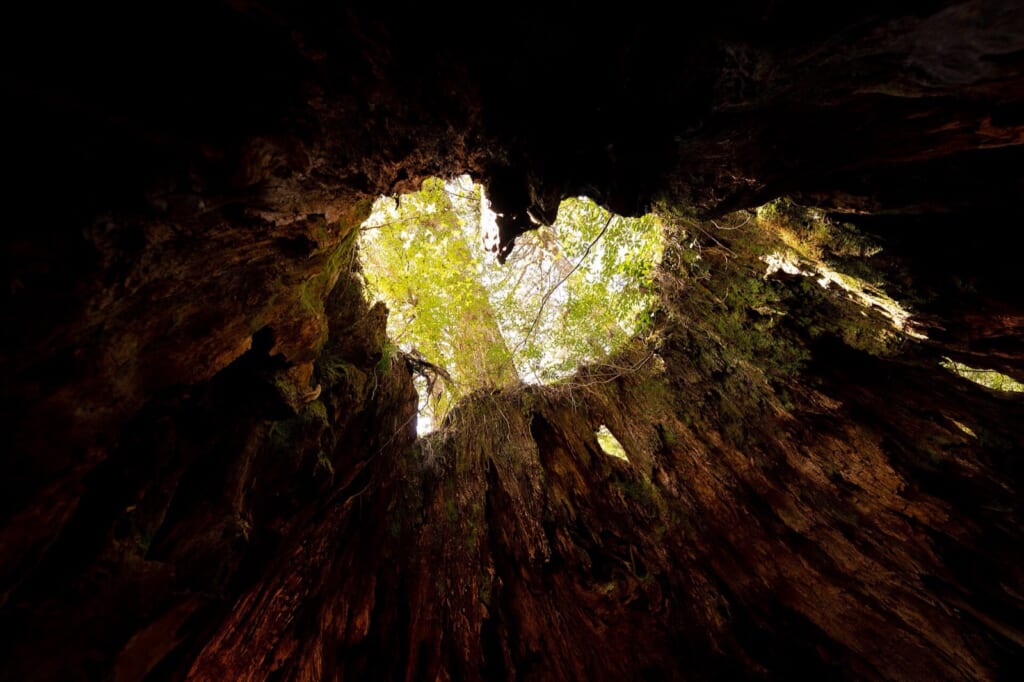
The Wilson Stump on Yakushima carries a British name because Ernest Henry Wilson, an English-born plant hunter collecting for Harvard’s Arnold Arboretum, documented and photographed it in February 1914. The cedar itself had been cut down long before. Local tradition says it fell in 1586 for Toyotomi Hideyoshi’s Great Buddha Hall in Kyoto, but the sources checked for this article do not establish that this particular tree was felled under his orders.
What follows is the stump’s story in the order a visitor meets it: the room inside, the botanist who made it famous, the loggers who left it behind, and the forest that grew back around it.
Inside the Wilson Stump — a room in a cedar
Stepping through the gap
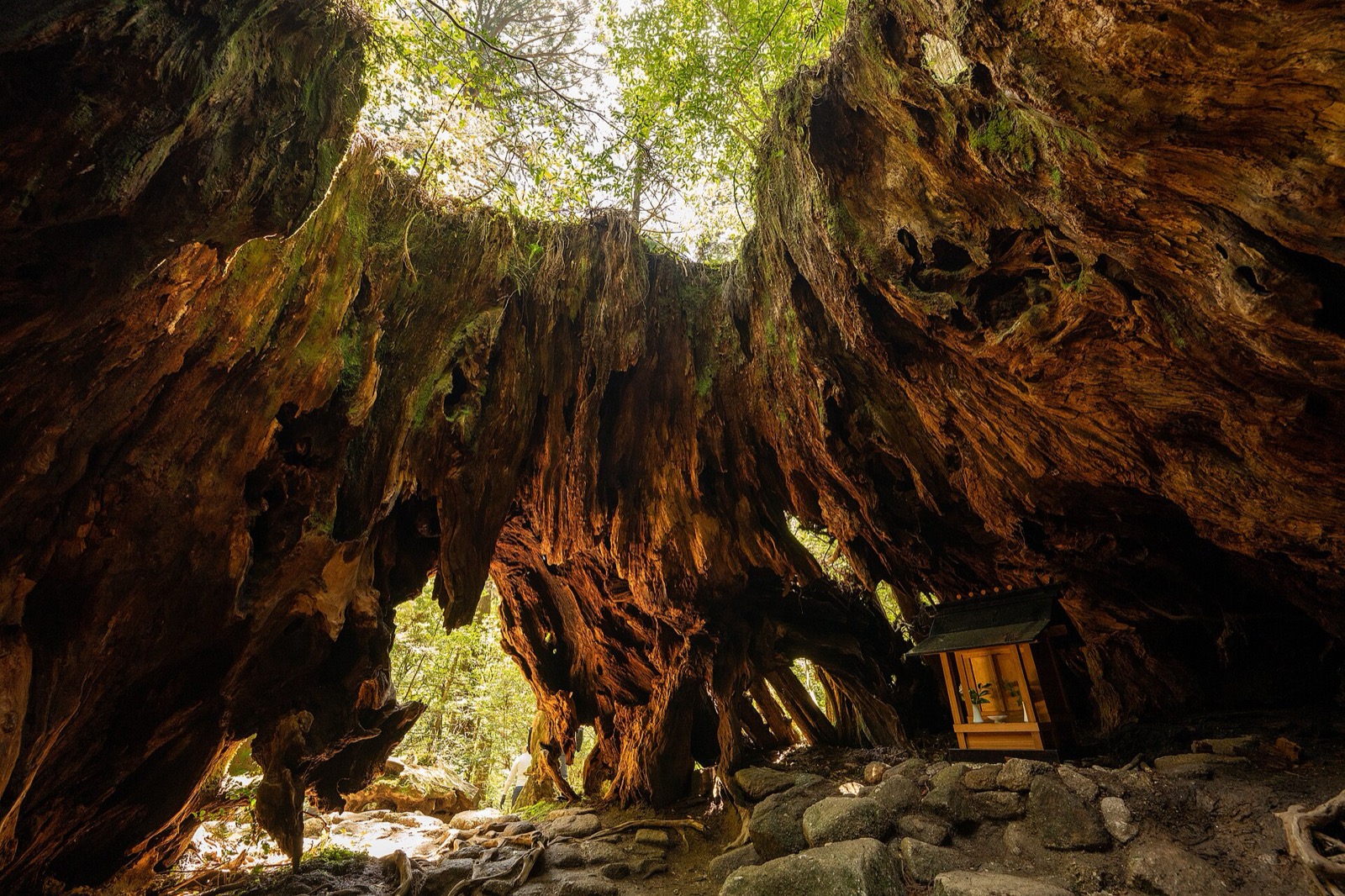
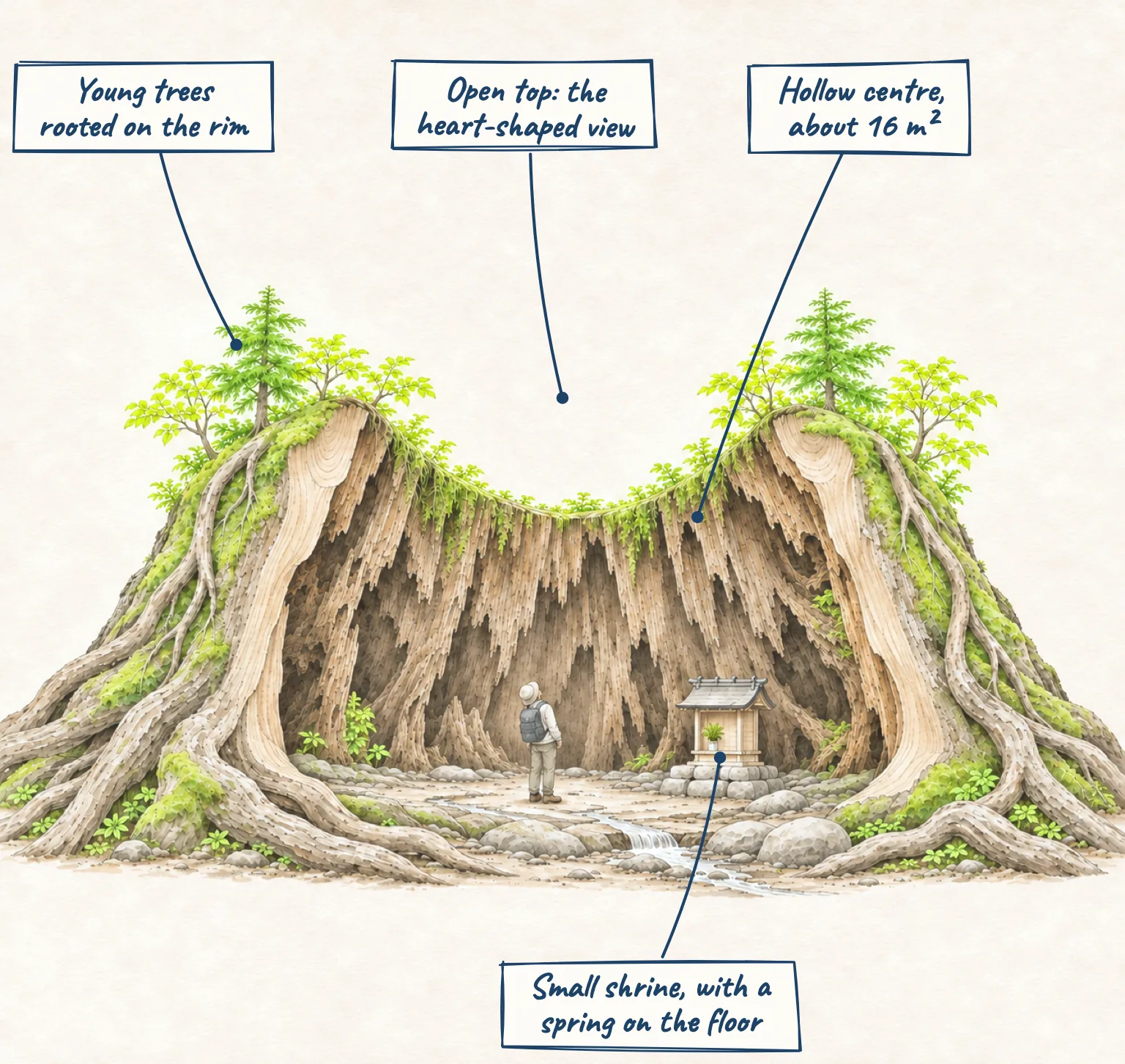
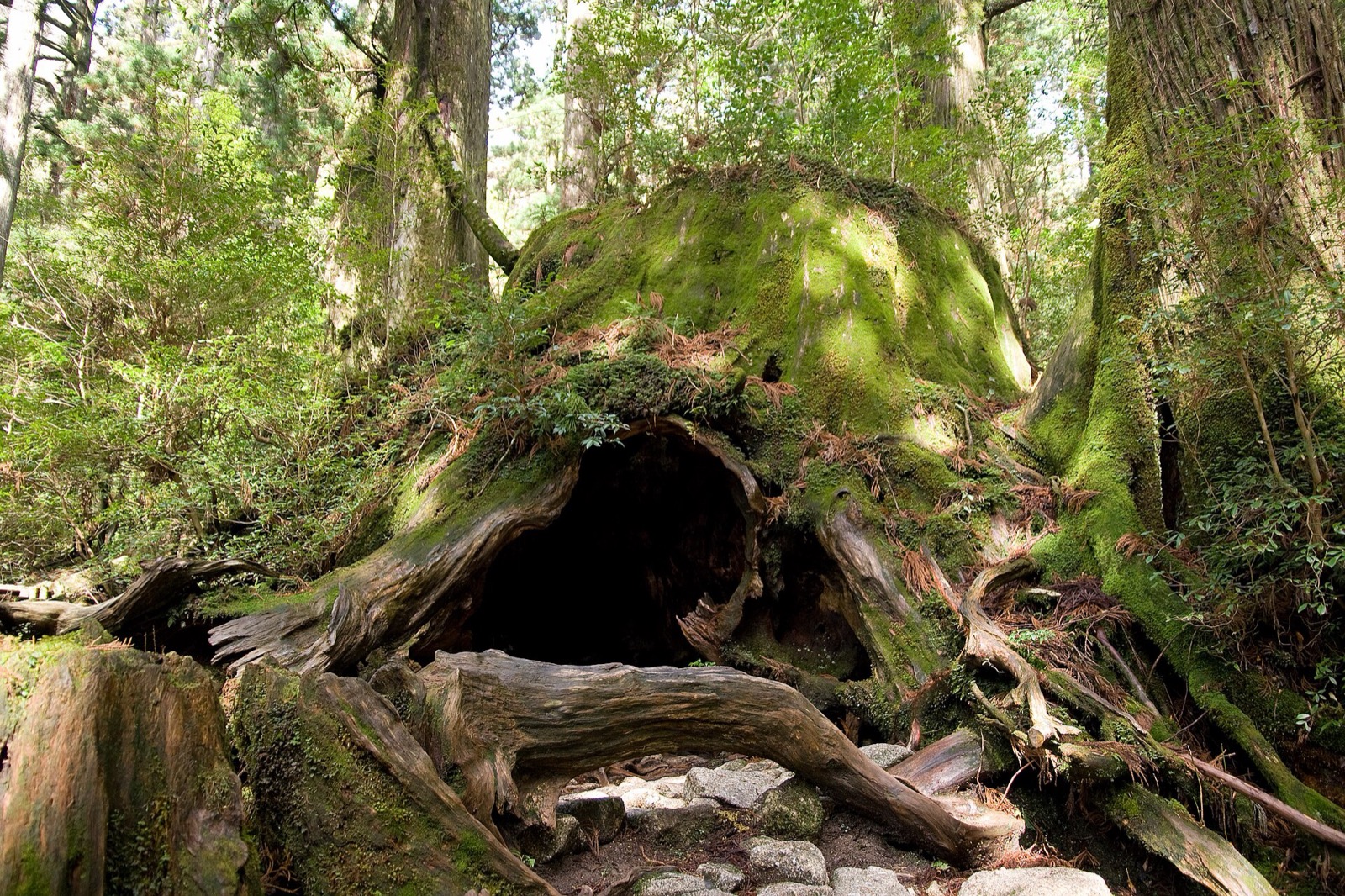
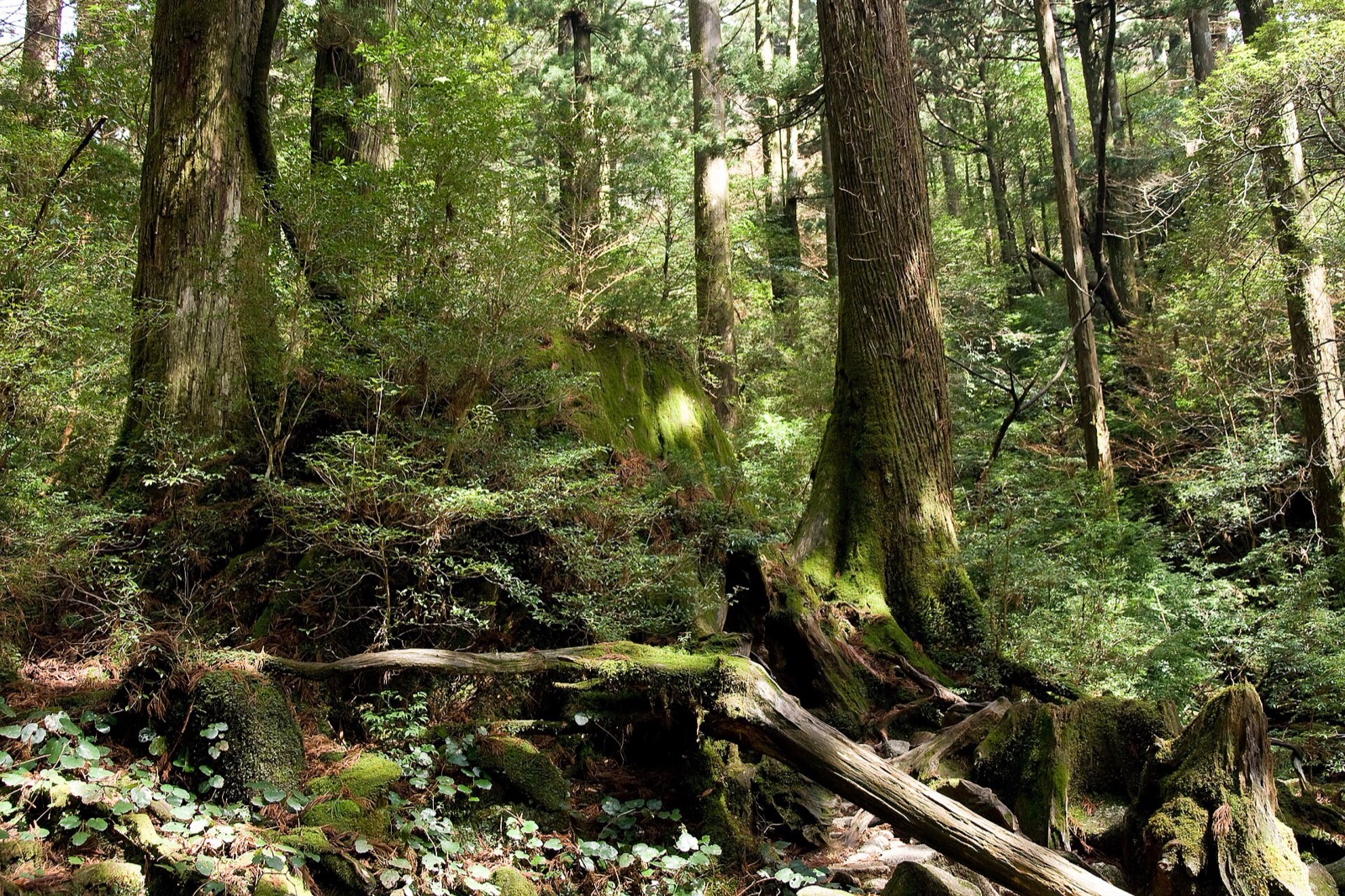
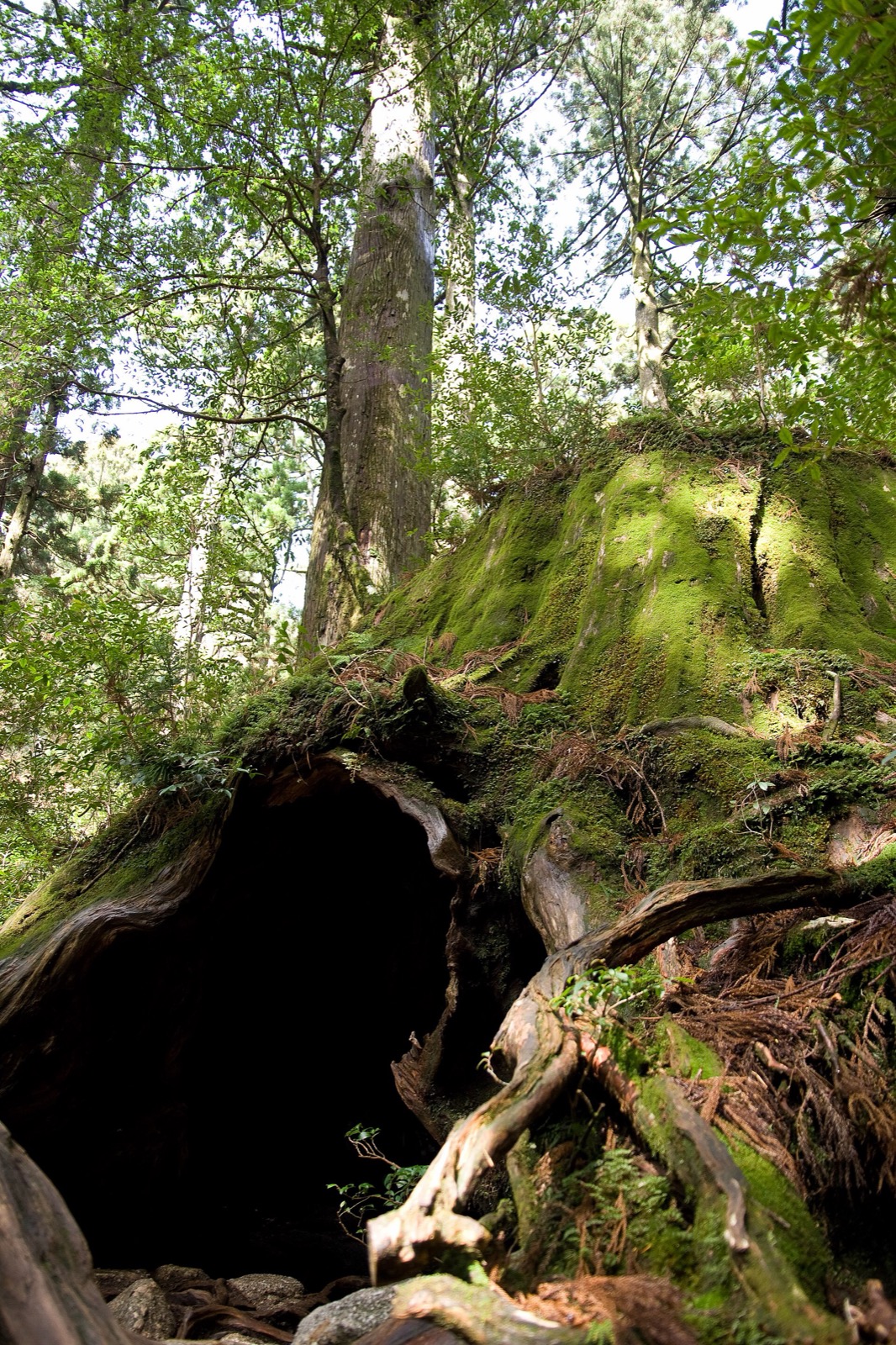
The stump stands beside the Ōkabu trail (大株歩道), the path that climbs through Yakushima’s cedar forest towards Jōmon Sugi. Yakushima Town lists its elevation as 1,050 metres. From the trail you see a mound of moss and roots, taller than a person, with a dark gap at its base. Step through the gap and you are inside the tree.
The town describes the interior as a hollow of about 16 square metres — roughly ten tatami mats, the size of a generous Japanese living room. A spring rises inside and makes a small stream across the floor. Against the back wall sits a small shrine. A guide published by the Japan Tourism Agency calls it Tamashiro Shrine (木魂神社, “spirit of the tree”) and says it enshrines three deities, including the god that dwells in the stump. The same guide says the stump is considered the oldest on Yakushima.
The heart in the roof
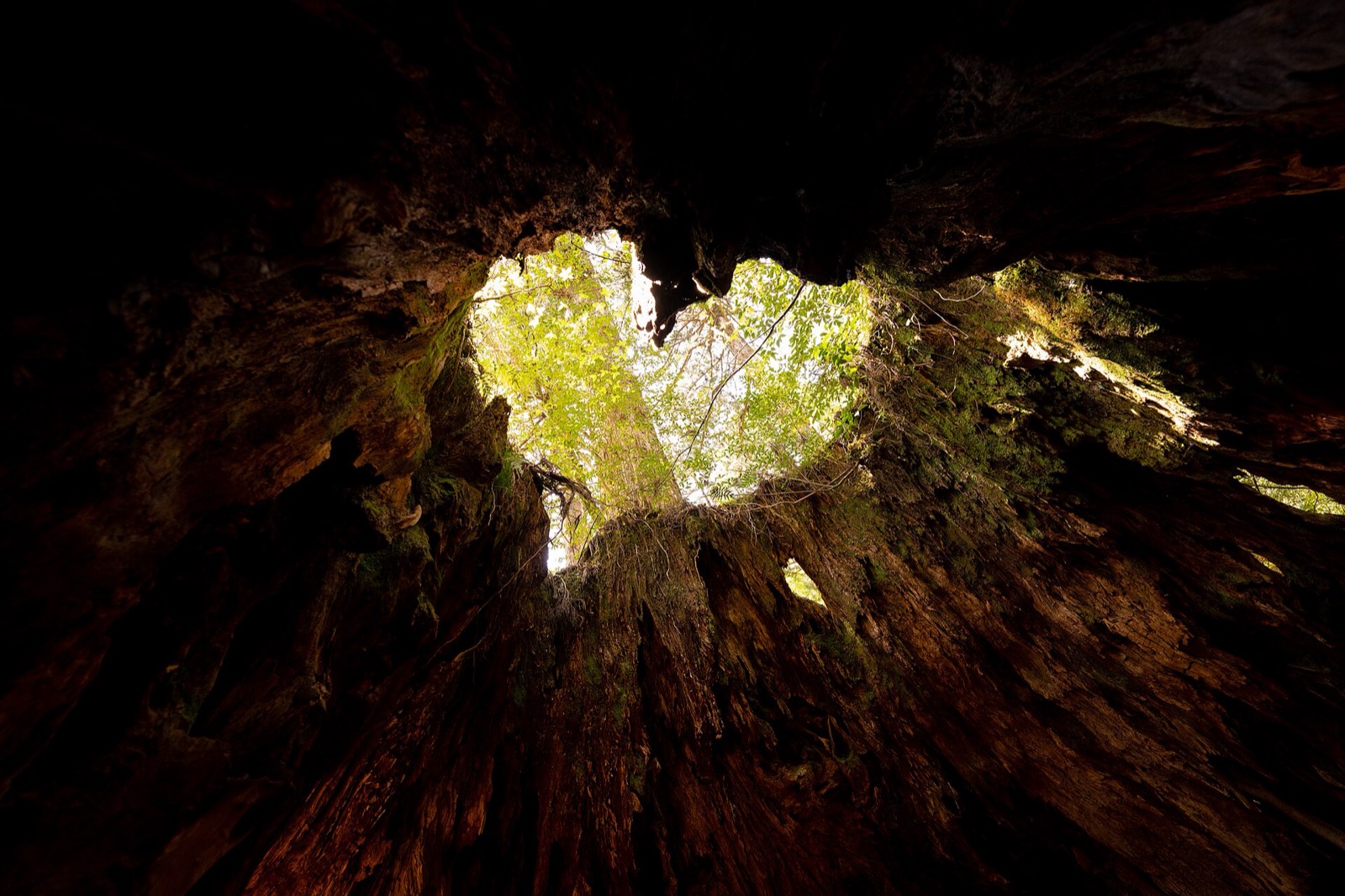
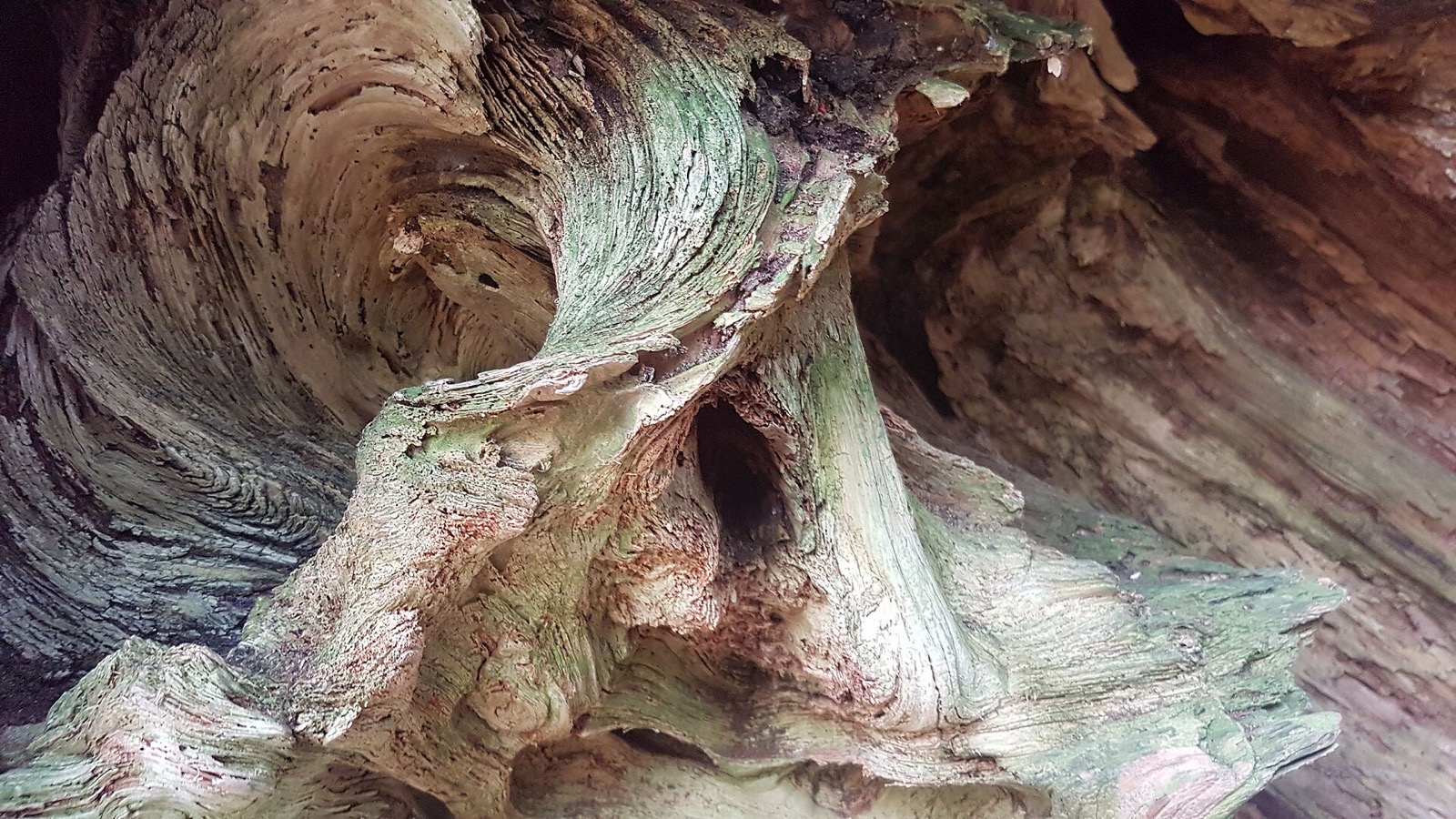
Then you look up. The top of the stump is open, and from the right spot inside, the jagged rim frames the sky and the leaves above as a heart. The Yakushima Tourism Association describes the view with an exclamation mark — “a heart!” — and the Arnold Arboretum’s own article on Wilson notes that “the skyward view is heart-shaped.” Nobody carved it. It is simply the outline of what is left of the tree.
The heart is what most photographs show. The name over the trail sign points somewhere else: to a February morning in 1914, and a man with a camera.
A shell of old wood
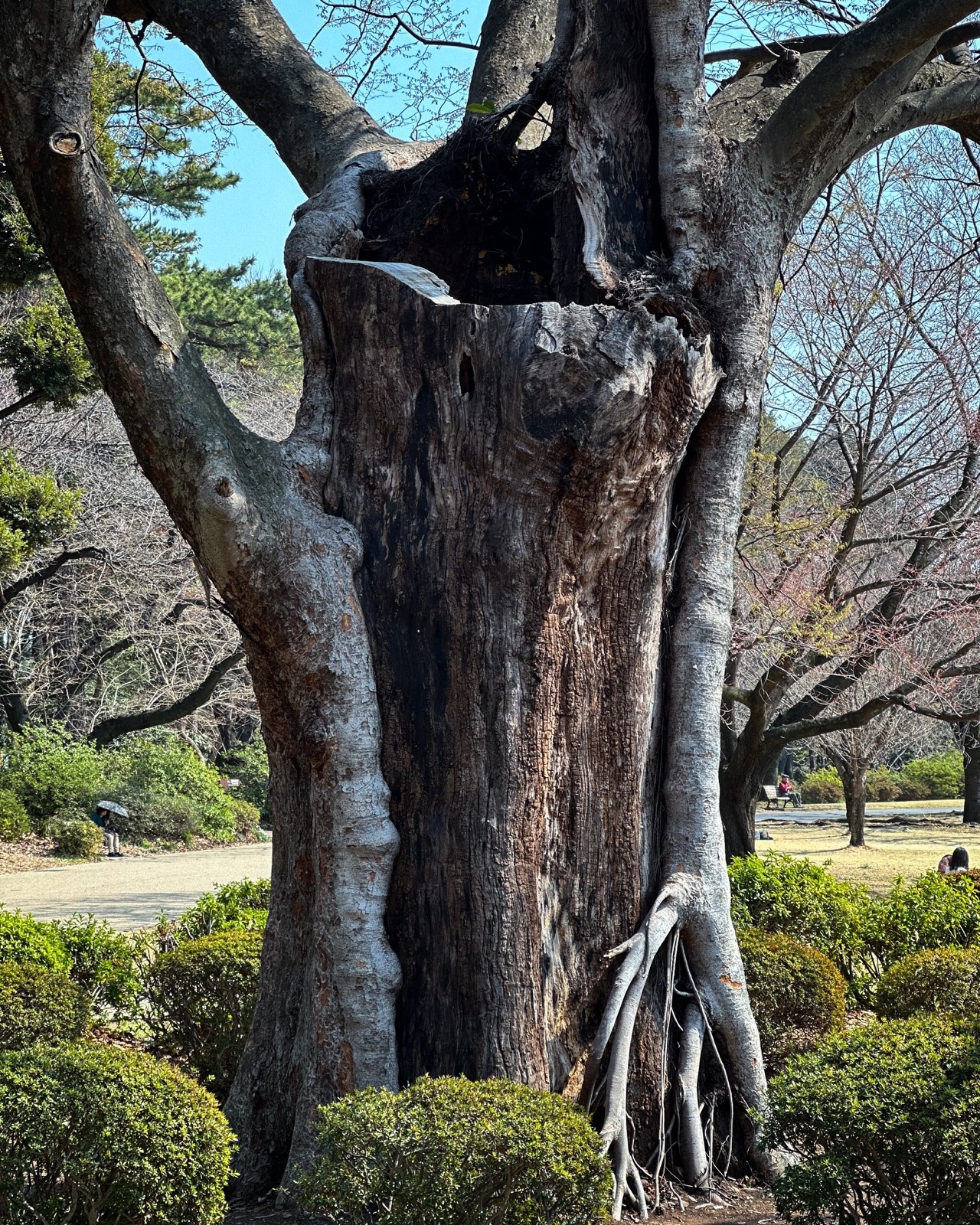
What stands today is a shell. The centre of the trunk is gone; the outer wood remains, thick enough to make walls you can lean on. That this shell has survived so long on a wet mountain is a story in itself, and it comes later in this article: Yakushima’s cedar is rich in resin and resists decay. If you want to see how arborists read decay in living trees, our guide to reading tree decay without instruments walks through the signs.
How big is the Wilson Stump? — the numbers, and why they disagree
Different measurements, different things
Size figures for the stump vary from source to source, partly because they measure different things. Yakushima Town’s list of notable trees gives a girth at breast height of 13.8 metres. Japan’s World Heritage nomination dossier mentions the stump’s “root circumference of 32 metres” — a measurement around the flaring base, where a cedar spreads widest. The Japan Tourism Agency’s guide says the diameter of the stump “exceeds four metres.” The interior area, 16 square metres, is a different quantity again. When and how each figure was measured is not stated.
Wilson left a figure that may belong here too. The Arnold Arboretum’s article quotes his note: “Of dead stumps the largest I saw measured 50 ft. in girth seven feet from the ground.” Fifty feet is about 15 metres, taken a little over two metres up. Whether that largest stump was this one is not certain, so it belongs beside the modern figures, not among them.
What the sources say — and where they differ
| Item | Figure | Source | Note |
|---|---|---|---|
| Elevation | 1,050 m | Yakushima Town; Forestry Agency | Tourism Association gives 1,030 m |
| Girth at breast height | 13.8 m | Yakushima Town; Forestry Agency | Shown in brackets in both lists |
| Root circumference | 32 m | World Heritage nomination (via Ministry of the Environment) | Measured around the base |
| Diameter | over 4 m | Japan Tourism Agency | No exact figure given |
| Interior | about 16 m² (10 tatami) | Yakushima Town | — |
| Height of stump | 4 m / 5 m | Town / Tourism Association | Not reconciled |
| Estimated age | 2,000 / 3,000 years | Two pages of the town’s website | Method not stated |
| Estimated age | 1,100–3,400 years (median 2,300) | Forestry Agency conservation centre | Based on published yakusugi disc data |
| Largest dead stump Wilson saw | 50 ft (about 15 m), 7 ft up | Wilson, quoted by the Arnold Arboretum | May or may not be this stump |
Why there is no firm age
The age is the weakest number in the table. One page of the town’s website says “estimated 2,000 years”; another says 3,000. Neither gives a method. The Forestry Agency’s conservation centre on Yakushima offers a range instead — 1,100 to 3,400 years, with a median of 2,300 — and explains that it was estimated with reference to cross-section disc data for yakusugi published by Yoshida Shigejirō of Kyushu University. A range that wide shows how uncertain any single figure is. With the centre of the trunk gone, the rings that would carry the oldest dates are no longer there to count.
Ernest Henry Wilson — the plant hunter behind the name
From Chipping Campden to Harvard
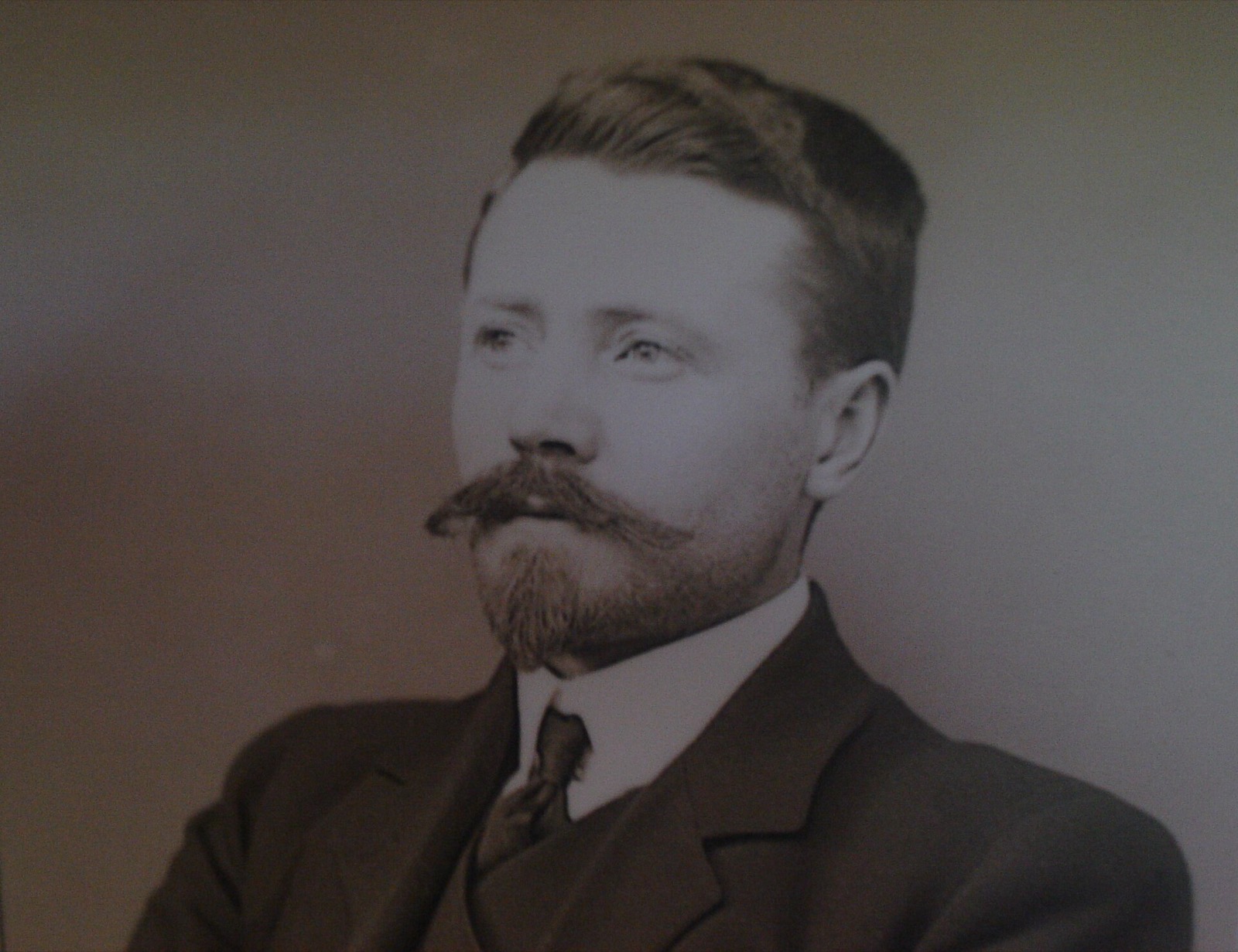
Ernest Henry Wilson (1876–1930) was born at Chipping Campden, Gloucestershire, England. By 1914 he was collecting for the Arnold Arboretum of Harvard University. Japanese official guides introduce him simply as “a British plant hunter and botanist.”
In the introduction to his book The Conifers and Taxads of Japan (1916), Wilson wrote: “To investigate these problems, to collect specimens and take photographs of the trees was one of the principal objects of the Arnold Arboretum Expedition to Japan in 1914.” Japan’s conifers were one of the expedition’s principal aims, and by the end of the year he could write that he had seen growing “every conifer and taxad known from Japan,” with the exception of one juniper and its variety.
Why Yakushima came first
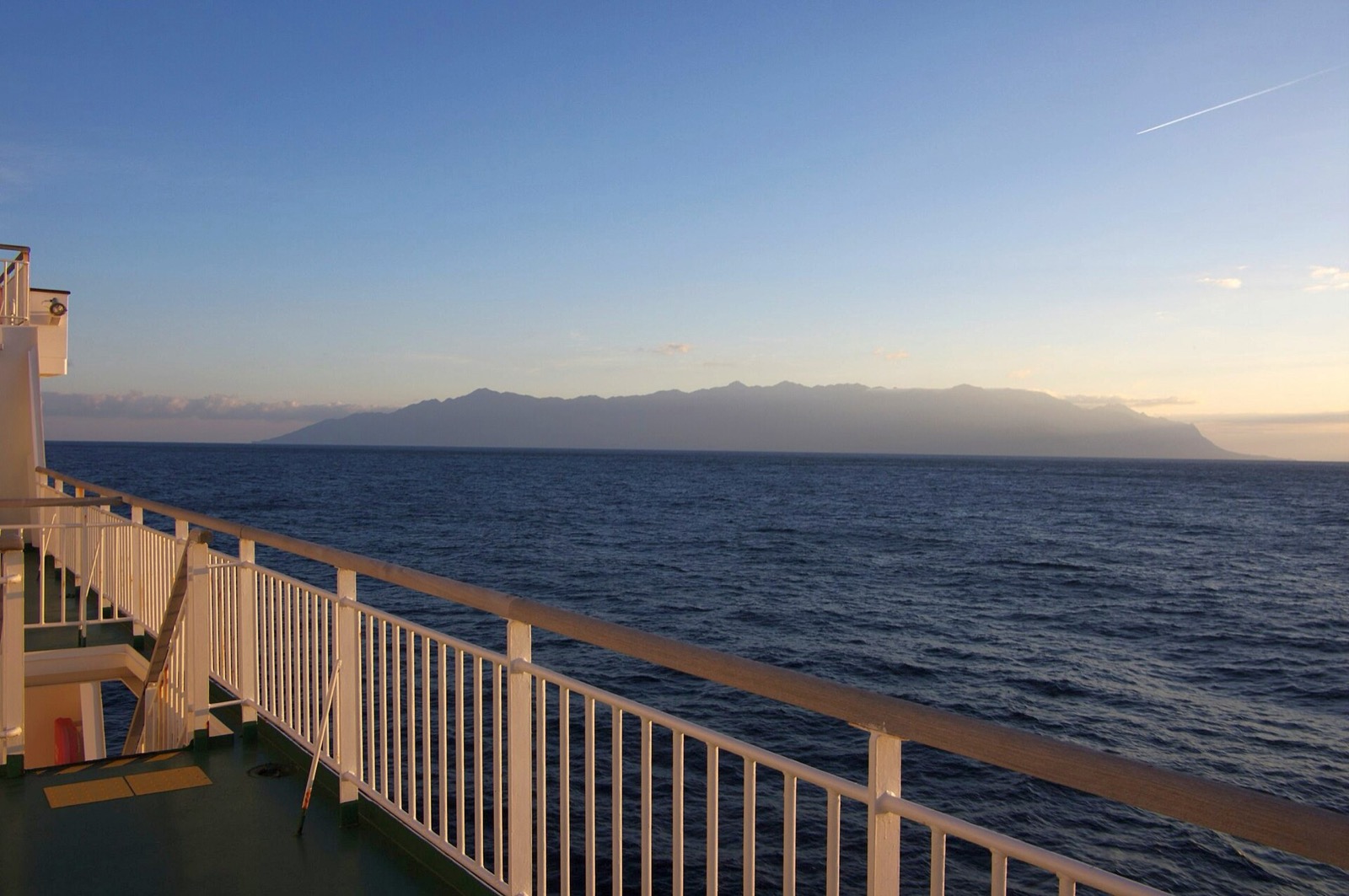
“My first journey after my arrival in Japan in early February 1914 was to the forests on the island of Yaku-shima, situated some 90 miles south of Kagoshima in Kyushu,” he wrote. The island, he noted in his day, “is not only the extreme southern limit of the Japanese archipelago proper, but also marks the southern limit of the Japanese flora.” For a botanist mapping Japan’s conifers, it was the natural place to begin.
He did not go alone. Dr H. Shirasawa wrote on his behalf to Dr Naito, head of the Kagoshima forestry bureau, who assigned his assistant, Mr Miyoshi, to accompany him. Without the forestry officials, Wilson admitted, the trip would have been impossible: “there are no roads, only trails laid on logs for the use of the forest guards, and no accommodation other than rough huts.”
February 1914 — what Wilson saw on Yakushima
A forest he ranked above all others in Japan
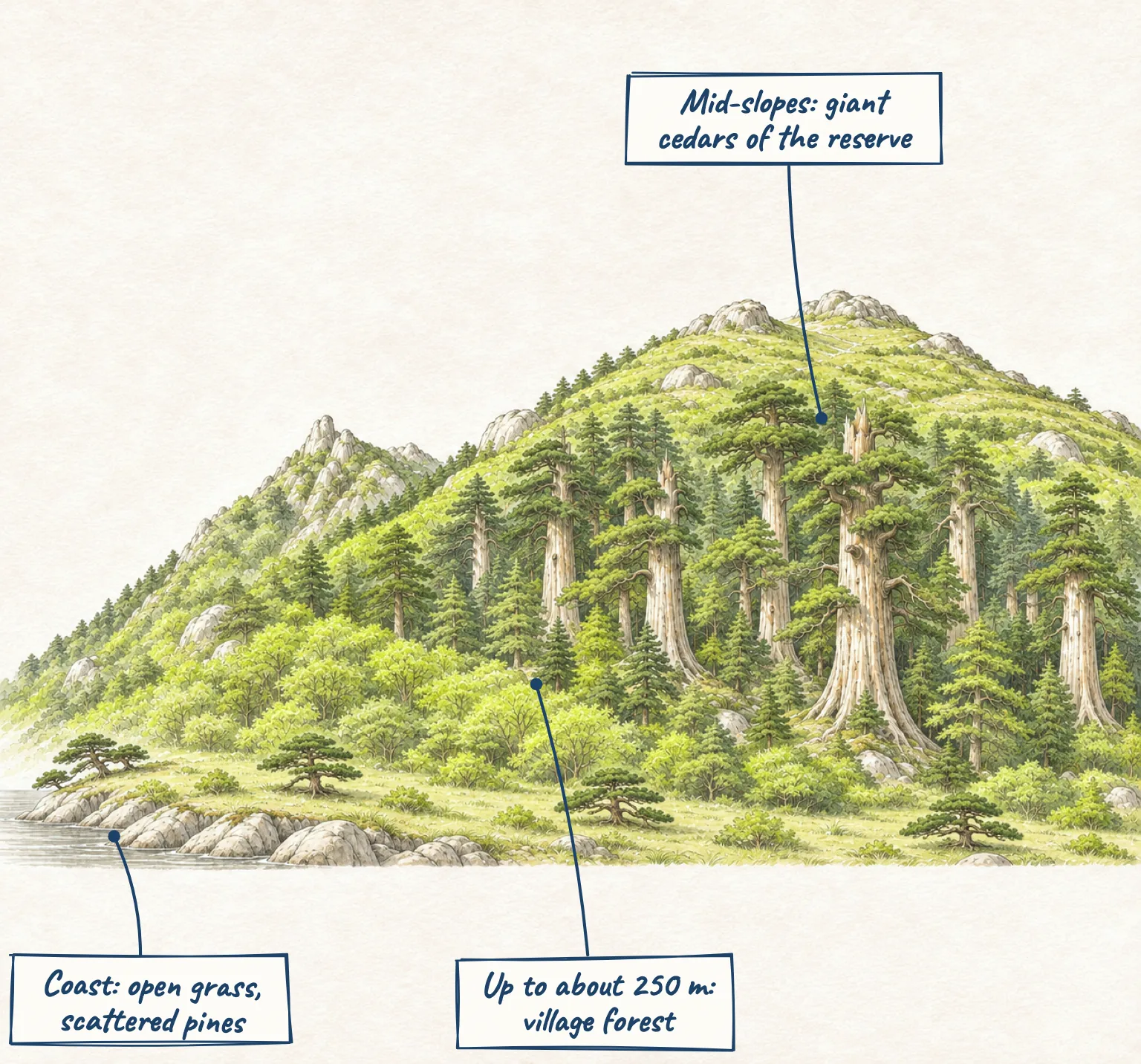
Wilson described the island as “a mountain of granite blocks upthrust from the bed of the ocean,” culminating in Miyanoura, which he gave as 1,928 metres. In February the summit “was hidden in snow.” Below it he described the forest in belts: coastal savannah from sea level to about 100 metres, then a narrow belt of mixed, chiefly evergreen forest to about 250 metres, belonging to the villagers, and above that a government forest reserve covering the rest of the island.
Inside the reserve, he estimated, 99 per cent of the trees were evergreen, of which 60 per cent were conifers, and Cryptomeria alone made up “fully 50 per cent. of the entire forest.” Ferns, mosses, liverworts and lichens covered rocks, trunks and logs. “Nowhere else, not even on famed Mt. Omei, in western China, have I seen such a wealth of this vegetation,” he wrote. His conclusion: “To me the most interesting and remarkable forest in all Japan is this on Yaku-shima.”
Measuring the cedars
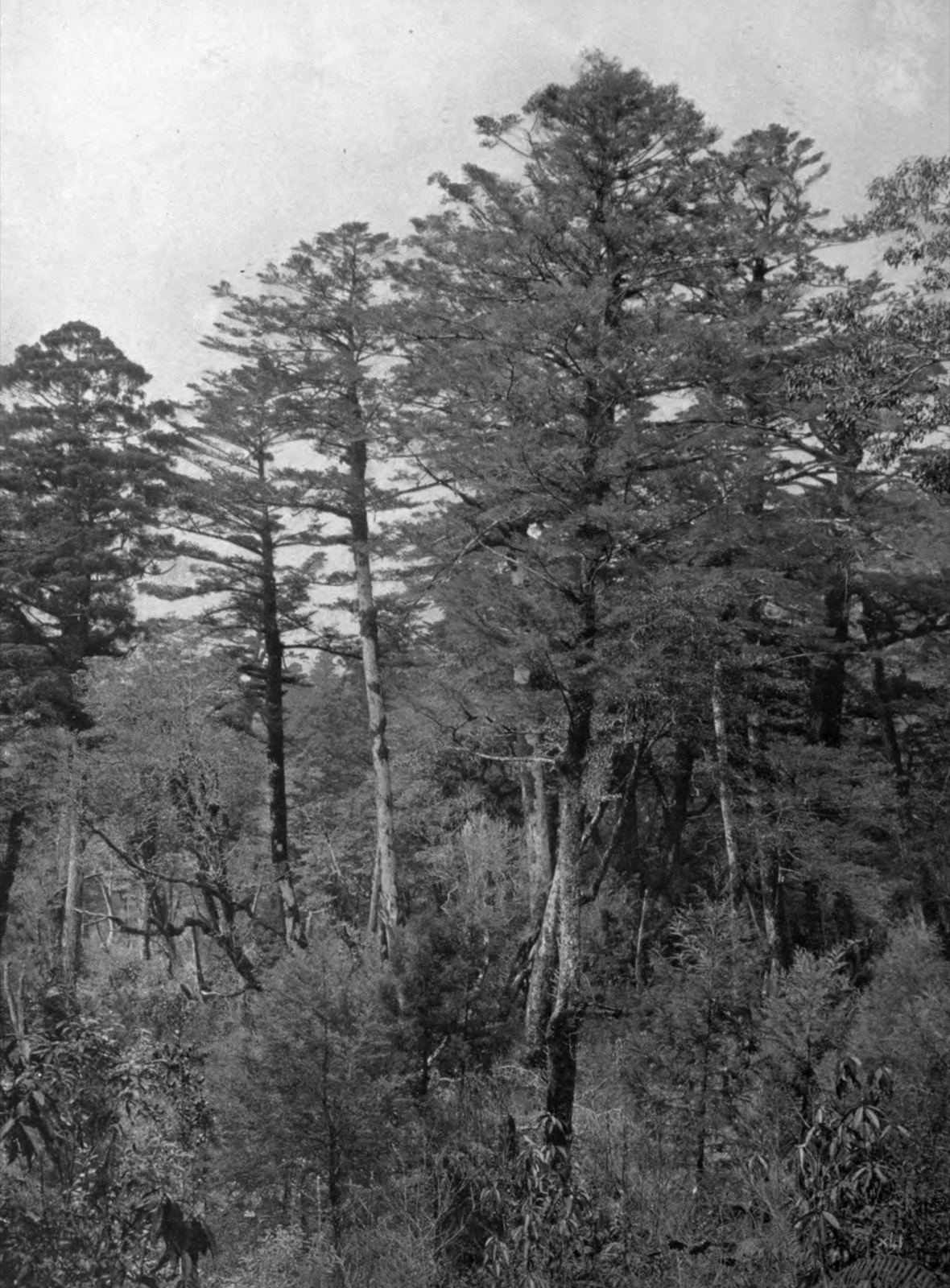
Wilson measured as he walked. The cedars reached about 40 metres at most, with average trees of 30 to 35 metres; many of the oldest had lost their tops, which he put down to strong winds. Living trees averaged 6 to 8 metres in girth, and the largest he measured were 10 metres. Then came the stumps: “Of dead and rotting stumps I measured several from 16 to 18 m. in girth.” The biggest trunks he measured were dead ones.
He thought the cedar “seems to be at its best between 600 and 1200 m.,” and he compared it with the giant sequoia, Sequoia gigantea: “these two trees in appearance and general characteristics strongly resemble one another.” For Western readers in 1916, that comparison placed Yakushima’s cedars beside the most famous big trees they knew.
The day at the stump
The Arnold Arboretum’s account, written by library assistant Larissa Glasser, records the stump as “first encountered and documented by Wilson in February 1914.” It cites Jirosuke Maki, one of Wilson’s aides, who recalled Wilson returning to base camp on 21 February 1914. At the stump, the account says, “Sensing the uniqueness of the discovery, Wilson began to carefully set up his camera.” The Japan Tourism Agency guide adds that one of his photographs showed the stump’s size by comparison with members of the expedition, and that his 1916 book drew attention around the world to the forest and the stump that bears his name.
Be careful with the word “discovered.” The forest guards who laid the log trails knew the forest, and the people who cut the tree knew where it stood. What Wilson did was measure the forest, photograph the stump and introduce both to English-speaking readers. The town puts it simply: the stump was “named after Dr Wilson.” When the name was first used, and by whom, has not been confirmed.
Who cut the Wilson Stump? — the Hideyoshi story, and what the records show
The story as it is told
The most famous account of the stump’s origin links it to Toyotomi Hideyoshi, the warlord who unified Japan in the late sixteenth century. The Yakushima Tourism Association says the tree is “said to have been cut in Tenshō 14 [1586] for presentation to Hideyoshi.” The town’s official guide says it was “said to have been felled for the construction of the Great Buddha Hall of Hōkō-ji in Kyoto.” The Arnold Arboretum article goes further and calls it “one of the trees felled in 1586 on the order of Hideyoshi Toyotomi.”
What the sources themselves admit
Read closely, the Japanese sources hedge. The Tourism Association adds, in the same sentence: “the exact information is unknown.” The Japan Tourism Agency guide on Hideyoshi and Yakushima’s cedar says that whether the timber Hideyoshi ordered “finally reached Kyoto is unknown.” None of the sources checked for this article names this stump in a felling order.
There is also a competing view. According to the same Tourism Agency guide, the botanist Tashiro Zentarō wrote in a 1926 report that the regrowth on the stump suggested the tree had been cut in the early eighteenth century — more than a century after Hideyoshi. The original page of that report has not been checked for this article.
| Claim | Who says it | Status |
|---|---|---|
| Felled in 1586 (Tenshō 14) for Hideyoshi | Tourism Association; Arnold Arboretum | Tradition; the Association says details are unknown |
| Timber for the Great Buddha Hall, Hōkō-ji, Kyoto | Yakushima Town guide | “Said to”; not tied to this stump in the sources checked |
| The timber reached Kyoto | — | Unknown (Japan Tourism Agency) |
| Felled in the early 18th century | Tashiro Zentarō, 1926 report (via Japan Tourism Agency) | Inference from regrowth; report not checked here |
What the records do support is the broader history of logging on Yakushima — and that history explains why stumps like this one stand all through the forest.
Paying tax in shingles — why Yakushima’s forest is full of stumps
Hiraki: tax paid in cedar shingles
From around the seventeenth century, the World Heritage nomination dossier says, the Satsuma domain, which then ruled Yakushima, turned to the cedar and began logging it “for financial and other purposes.” The wood became hiraki (平木), roof boards. According to Yakushima’s ecotourism plan, published by the Ministry of the Environment, islanders “delivered yakusugi made into hiraki to the Satsuma domain in place of tax rice.”
The town’s newsletter describes a hiraki as a thin board about 50 cm long and 10 cm wide. A Forestry Agency report on a hiraki-making workshop gives the finished thickness as about 1 cm. A study by the historian Haraguchi Izumi gives the exchange rate: one koku of rice equalled 14,000 hiraki.
Tomari Jochiku and the start of heavy logging
The island’s management plan dates the serious start of logging to 1642, when the Confucian scholar Tomari Jochiku (泊如竹) advised the Shimazu lords to use the cedar — “it is said,” the plan adds. A Kagoshima Prefecture guide repeats a local story that he persuaded islanders who feared the felling by telling them he had “obtained permission from the gods.” A study of old cedar forest on Yakushima reports that “both logging from 1642 to ca. 1850, and natural gap formations” started the regeneration of the forest that stands today.
Why the stumps were left standing tall
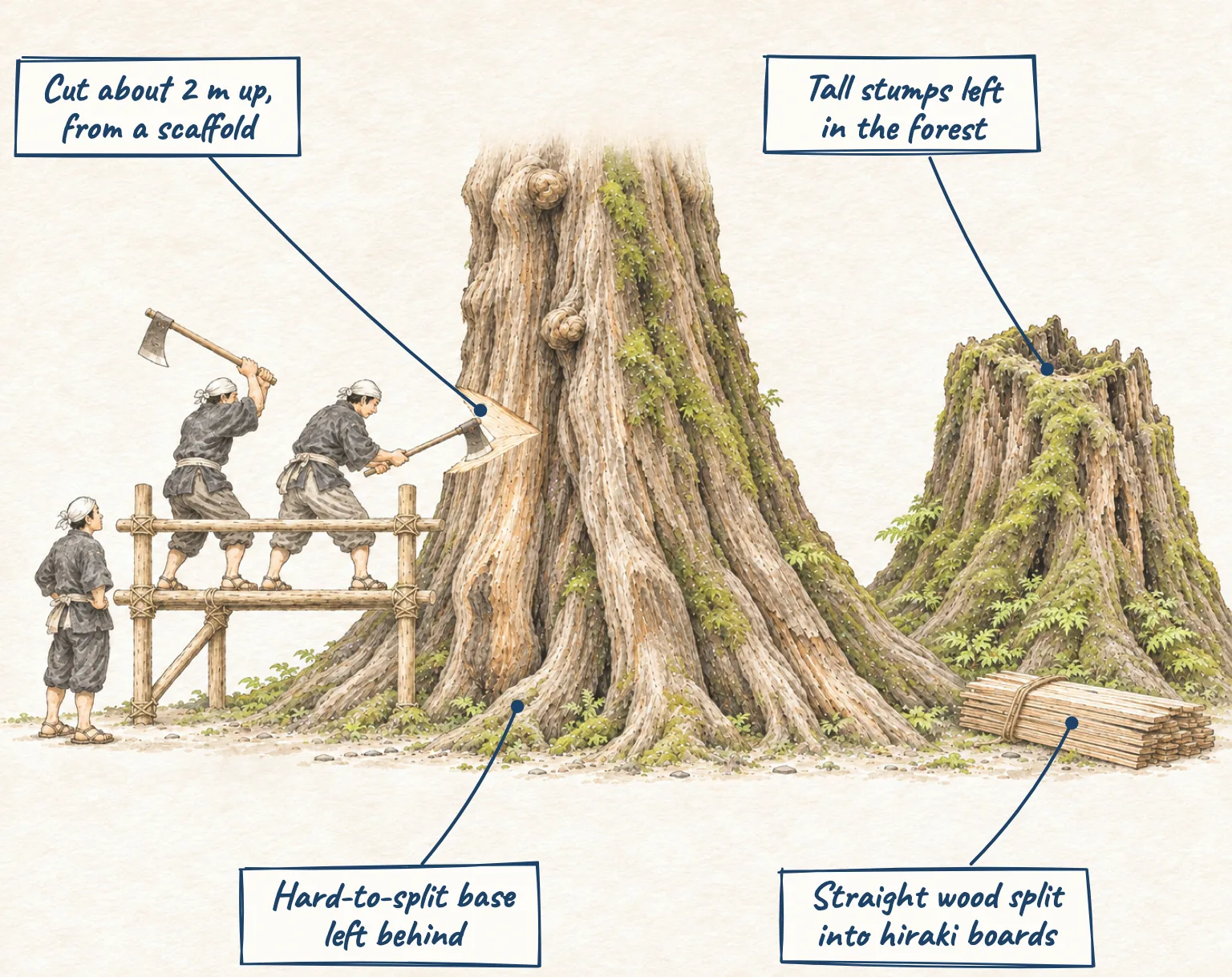
Shingles explain the stumps. A Forestry Agency leaflet for Yakusugi Land puts it plainly: because Edo-period cedar was used mainly for hiraki, loggers “chose trees that split easily and used only the parts that were easy to work. Unused branches, trunks and root stumps were left in the forest.” Hiraki were split by hand with an axe, so only straight-grained wood would do. The town newsletter adds that the boards were made on the spot and carried down the mountain on people’s backs.
The wood near the base of a big cedar was hard to split, and loggers had no use for it. A 1995 design-history paper on Yakushima’s cedar says they built scaffolds and cut “at a high position, around 2 metres above the ground,” and that “the countless tall stumps still seen in the forest” date from that time. No record says exactly how the Wilson Stump was cut, but tall stumps like it are what this method left all over the island.
Still being done in 1914
Wilson saw the tail end of this economy. “In that part of the forest I visited no felling is being done now,” he wrote. “The wood of fallen trees is made into shingles and carried out on men’s backs.” He also recorded an older trade: “logs for the pillars and columns of temples were exported to Korea, China and other eastern countries,” and Yaku-sugi wood “commands a much higher price in the market than that of the same tree from anywhere else in the empire.”
Why a stump lasts for centuries — resin, rain and slow growth
Decay-resistant wood
Yakushima’s cedar grows on granite. Japan’s Ministry of the Environment explains that because the trees grow on poor granite mountains, “growth is slow and the annual rings are dense,” and that resin-rich wood resists decay; both are thought to contribute to the trees’ long lives. UNESCO describes the montane forest as receiving “high rainfall, in excess of 8,000 mm annually.” A Ministry of the Environment article adds that the cedar’s rich resin makes it resistant to rot and insects.
Wilson saw this for himself. On fallen trees “which the foresters said had been felled 80 years before, the wood was still perfectly sound a couple of inches below the moss-clad exterior.” The same durability is why the stumps and offcuts that Edo loggers left could be recovered for craftwork generations later.
A stump that became a nursery
Wilson noticed something else. The cedar he saw there, he wrote, “does not sucker nor sprout from stools, but perpetuates itself only by seeds,” and on the forest floor seedlings rarely survived. “I saw only on fallen trees and old stumps the Cryptomeria successfully renewing itself unaided by man.” On those raised platforms young cedars grew to 26 metres tall and 6 metres in girth. Seedlings of the wheel tree, Trochodendron aralioides, grew with them: “The two trees in these forests, it would seem, have a curious predilection for one another.”
Japanese foresters call this kirikabu kōshin (切株更新), stump regeneration. The forest conservation centre’s newsletter describes Nidai Ōsugi, “a second-generation cedar that germinated and grew from a seed that fell on a stump about 4 m tall.” On the Wilson Stump, the centre’s database lists kakuremino, yuzuriha and sakura-tsutsuji among the main plants growing on the stump. The Japan Tourism Agency guide adds that three young cedars growing around the stump are thought to have come from seeds the tree dropped before it was cut.
Decay, read two ways
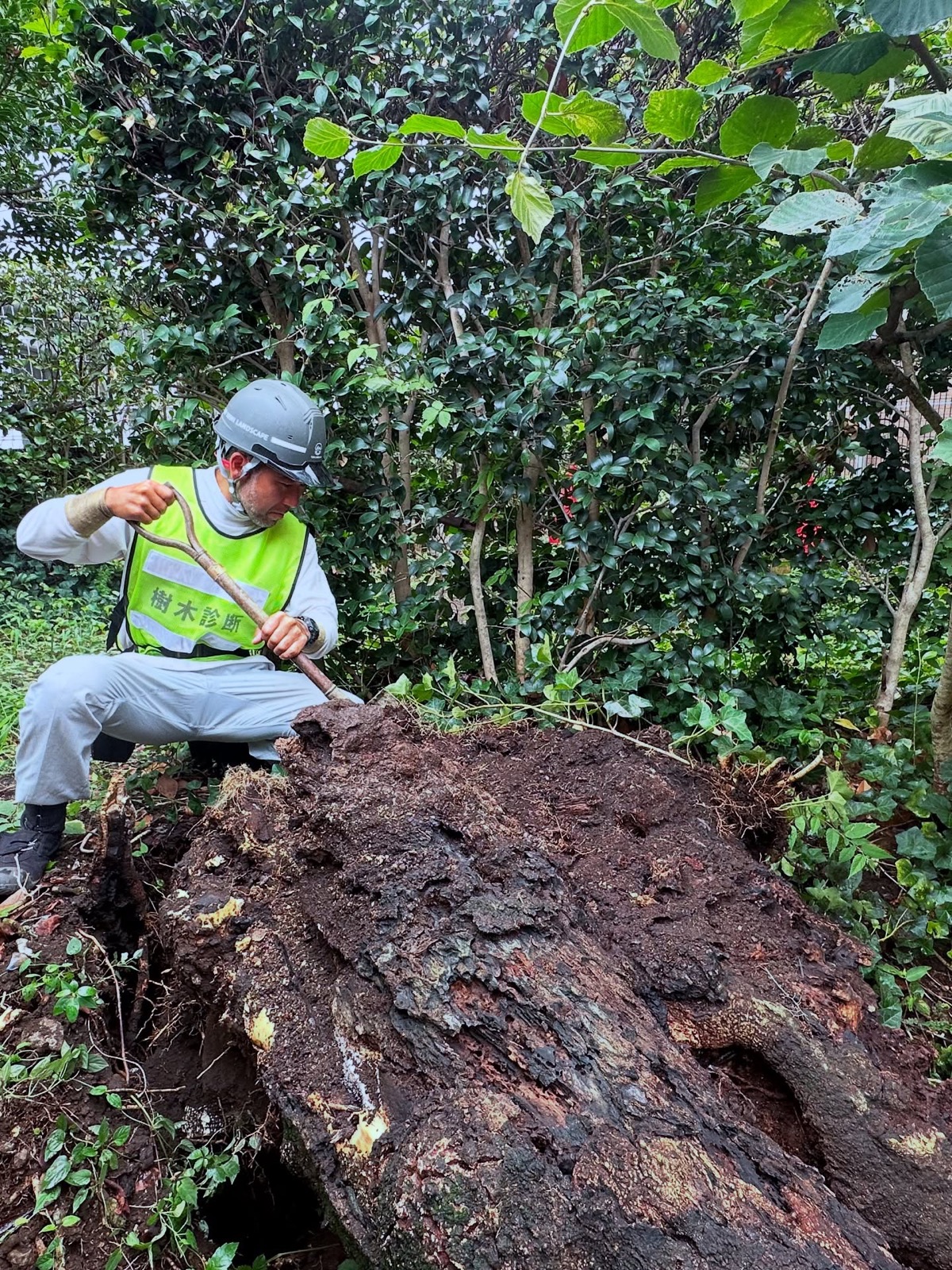
In our own work, decay is something to measure. When a trunk comes down, the question is how far the soft wood runs and what it means for the trees still standing. In a protected forest like Yakushima’s, the same decay plays a different role. It opened the room inside the Wilson Stump, and the raised, slowly rotting wood is where Wilson saw the next generation of cedar taking hold.
From timber to protection — how the forest around the stump was saved
Railways and chainsaws
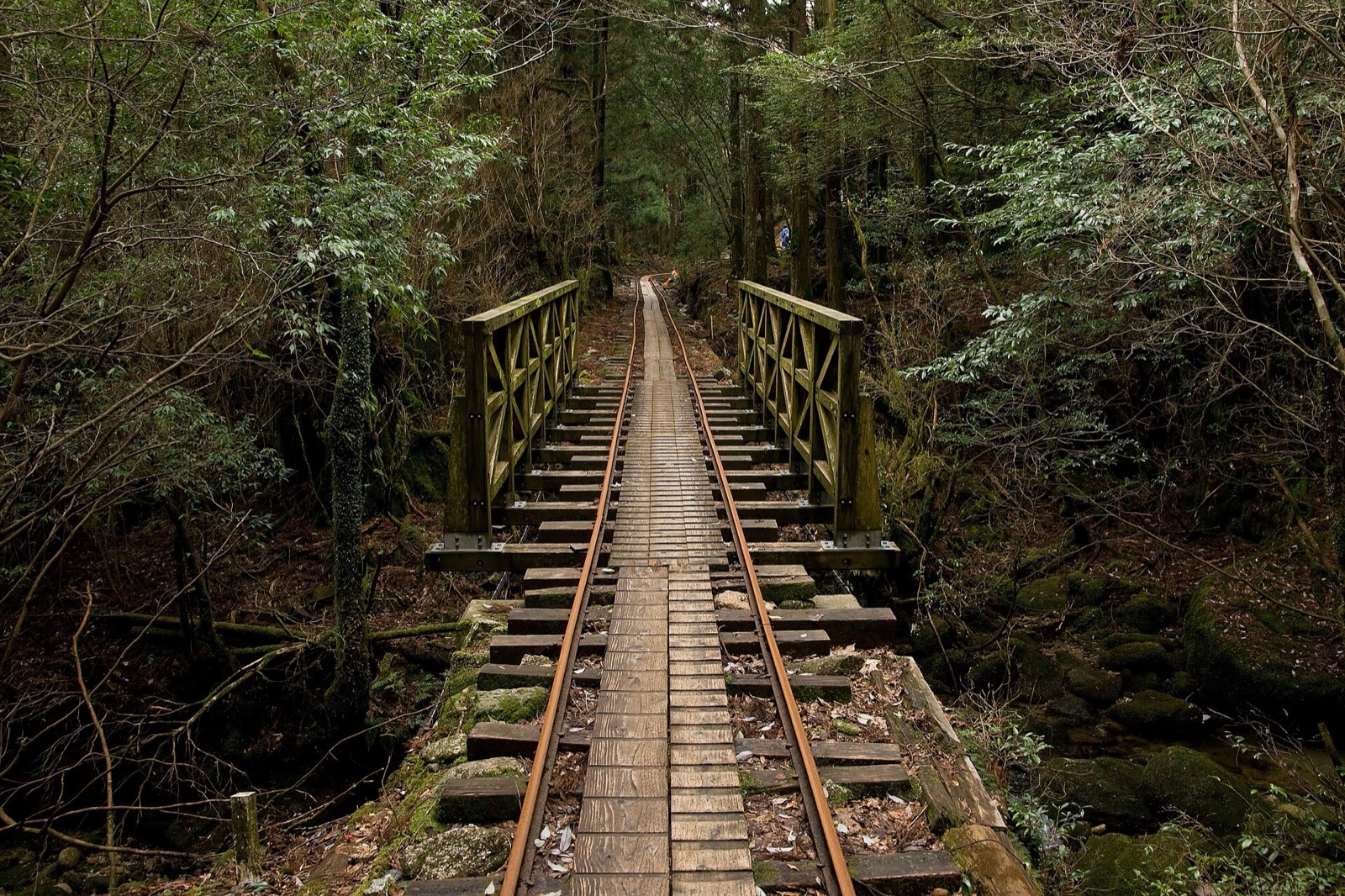
Logging did not stop with the Edo period. A Forestry Agency newsletter records that in 1889 a survey of public and private land placed about 80 per cent of the island in the national forest. In 1923 a forest railway about 16 kilometres long was completed between Anbō and Kosugidani, and large-scale use of the forest began. After the Second World War, with rising demand for timber and the arrival of chainsaws, logging of the national forest “reached its peak” from the mid-1950s to the early 1970s, according to the World Heritage area management plan.
Opposition and World Heritage
Around 1970, the nomination dossier says, local municipalities and conservation groups began opposing the felling of Yakushima’s natural forest. In 1993 Yakushima was inscribed as a World Heritage site. UNESCO lists it today under criteria (vii) and (ix), which Japan’s Forestry Agency describes as natural scenery and ecosystems.
| Period | What happened | Source |
|---|---|---|
| Tradition: 1586 | The Wilson Stump said to be cut for Hideyoshi | Tourism Association (details unknown) |
| c. 17th century | Satsuma domain begins logging yakusugi | World Heritage nomination |
| 1642 | Tomari Jochiku advises the Shimazu to use the cedar (“it is said”) | World Heritage area management plan |
| 1642 – c. 1850 | Logging that, with natural gaps, regenerated the forest | Tropics journal (J-STAGE) |
| 1889 | About 80% of the island placed in national forest | Forestry Agency |
| February 1914 | E. H. Wilson documents the stump | Arnold Arboretum |
| 1923 | Anbō–Kosugidani forest railway (about 16 km) completed | Management plan |
| Mid-1950s – early 1970s | National forest logging peaks | Management plan |
| c. 1970 | Opposition to logging natural forest begins | World Heritage nomination |
| 1993 | World Heritage inscription | UNESCO |
| March 2019 | Nationwide supply of buried cedar ends; small supply to island workshops continues | Forestry Agency |
Buried wood: the stumps’ second life
The stumps and offcuts that Edo loggers left behind have their own name: domaiboku (土埋木), “buried wood.” The Forestry Agency’s Yakusugi Land leaflet gives that name to the branches, trunks and root stumps left in the forest. The Ministry of the Environment notes that today’s yakusugi crafts are made from domaiboku. In March 2019 the Forestry Agency stopped supplying it widely across Japan; it continues to supply small quantities to island workshops that carry on the craft tradition.
What “yakusugi” means — and where Jōmon Sugi fits
A local name, not a separate species
Yakusugi (屋久杉) is not its own species. The Ministry of the Environment’s World Heritage centre calls it “a regional name for the sugi growing wild on Yakushima.” The tree is Cryptomeria japonica, a species endemic to Japan, whose native range runs from Yakushima — its southern limit — north to Aomori. Locally, yakusugi means wild sugi at least 1,000 years old, growing at elevations from about 500 metres to near the summits. Younger wild trees are called kosugi (小杉). It is the same species Japanese growers shape in daisugi, the technique of growing trees on trees.
Jōmon Sugi, 1.9 kilometres on
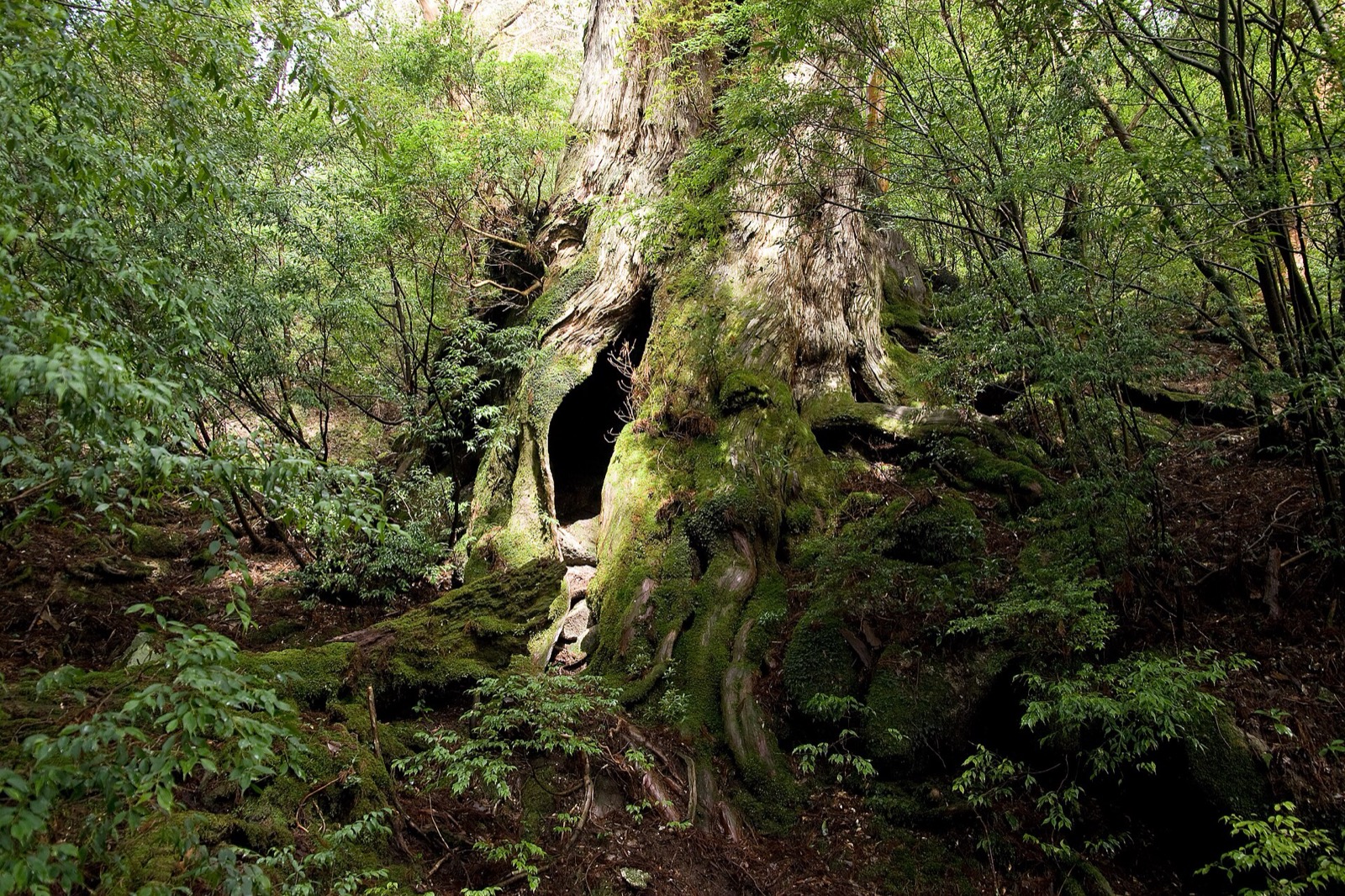
The Wilson Stump is a stop on the way to Jōmon Sugi. According to the Japan Tourism Agency guide, Jōmon Sugi is about 1.9 kilometres further along the Ōkabu trail, around an hour and a half on foot. The town’s guide says the tree was found in 1966 by Iwakawa Teiji, a resident of Miyanoura. Its age is a long debate of its own and deserves a separate article. What matters here is the contrast: Jōmon Sugi is a survivor, the Wilson Stump is a tree that was taken, and the walk between them passes through the forest that grew back in between.
Common misunderstandings
| You may read | What the sources support |
|---|---|
| Wilson discovered the stump | He documented and photographed it in 1914; local people knew the forest |
| Wilson named it after himself | It was named after him; who named it, and when, is unconfirmed |
| It was cut for Hideyoshi in 1586 | A tradition; the Tourism Association says details are unknown |
| Yakusugi is a separate species | A local name for wild Cryptomeria japonica at least 1,000 years old |
| The tree was 3,000 years old | Published estimates range from 1,100 to 3,400 years |
Visiting the Wilson Stump — what care means for a dead tree
A stump that people wear down
A living hollow tree in a town raises a structural question: can the shell still carry the crown? A dead stump in a protected forest raises a different one: can it survive its visitors? The Japan Tourism Agency guide says the stump and its surroundings once held many more kinds of epiphytes and shrubs, but heavy hiker traffic killed most of them. Because the area is still recovering, hikers are asked to stay on the path between the rest area and the stump. Going inside is allowed; climbing the stump or stepping into the undergrowth around it is not.
A living hollow, by contrast
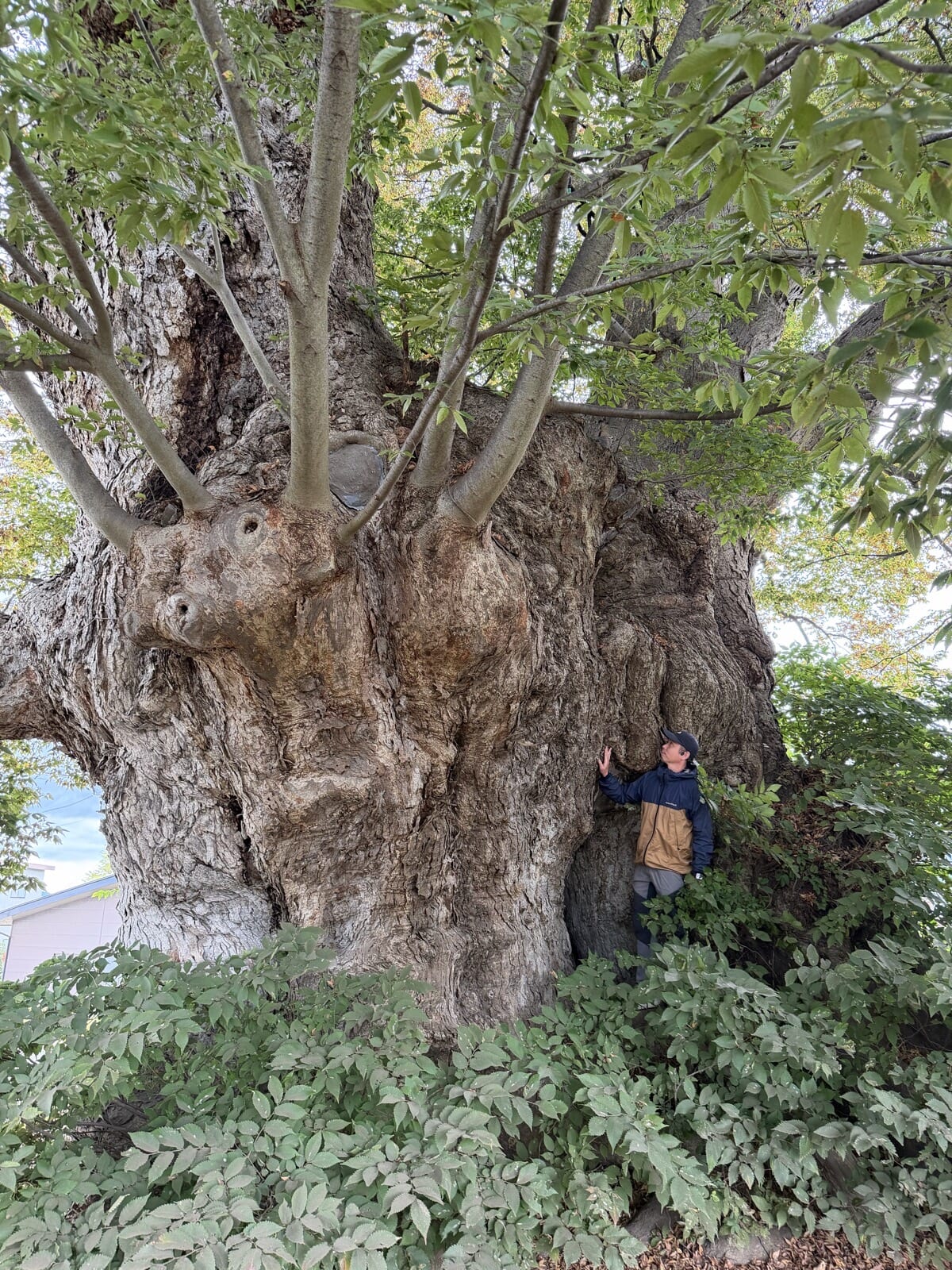
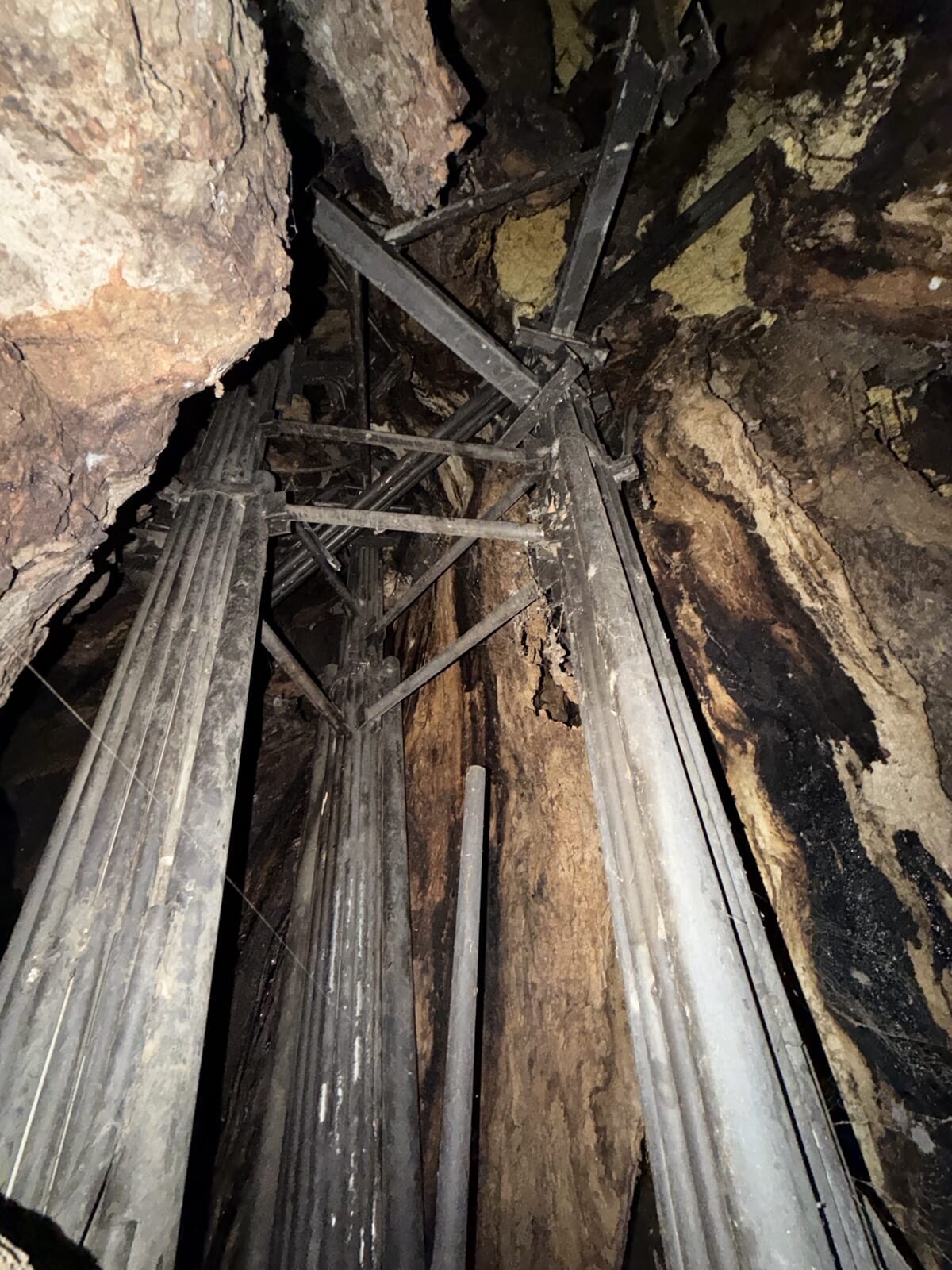
Our team inspected the great zelkova of Higashine, a living hollow giant in Yamagata Prefecture. Inside its trunk, steel supports brace the shell. That is what care looks like for a hollow tree that is still alive and still carrying a crown. The Wilson Stump has no crown to carry. Its care is the path, the rule against climbing, and time.
What the stump keeps
Stand inside again before you leave. The spring is still running across the floor, the shrine is still at the back, and above the rim the young trees catch the light through the heart. Wilson’s camera recorded this stump more than a century ago; the forest around it records the logging, the regrowth and the protection that came after. If you want to know why Japan’s ancient trees live for a thousand years, part of the answer is here, in the trees that were cut and what grew from them.
Frequently asked questions
Why is it called the Wilson Stump?
It is named after Ernest Henry Wilson (1876–1930), an English-born plant hunter collecting for Harvard’s Arnold Arboretum, who documented and photographed the stump in February 1914. Who first used the name, and when, has not been confirmed.
Was the Wilson Stump cut for Toyotomi Hideyoshi?
That is the local tradition: the tree is said to have been felled in 1586 for Hideyoshi, for the Great Buddha Hall of Hōkō-ji in Kyoto. The Yakushima Tourism Association itself says the exact facts are unknown, and a 1926 report suggested an early-eighteenth-century felling instead.
Where is the heart shape inside the Wilson Stump?
Step inside the hollow and look up. From the right spot, the jagged opening at the top frames the sky and leaves as a heart.
How big is the Wilson Stump?
Yakushima Town gives a breast-height girth of 13.8 metres and an interior of about 16 square metres, roughly ten tatami mats. The World Heritage nomination gives a root circumference of 32 metres, measured around the base.
Why are there so many tall stumps in Yakushima’s forest?
Edo-period logging produced hiraki roof shingles, split by hand. Loggers used only straight, easy-to-split wood, cut from scaffolds about 2 metres above the ground, and left stumps and branches in the forest.
Can you go inside the Wilson Stump?
Yes. According to the Japan Tourism Agency guide, entering is allowed, but visitors are asked to stay on the path, not to climb the stump and not to step into the undergrowth around it.
Sources
– Yakushima Town, “Wilson Stump” (notable trees list) — https://www.town.yakushima.kagoshima.jp/soshiki/kanko_machizukuri/kankosushin/kankospot/yakusugikyoboku_chomeiki/302.html (checked 2026-10-31) – Yakushima Town, Wilson Stump (sightseeing) — https://www.town.yakushima.kagoshima.jp/soshiki/kanko_machizukuri/kankosushin/kankospot/yama/926.html (checked 2026-10-31) – Yakushima Town, Yakushima and Kuchinoerabujima guide — https://www.town.yakushima.kagoshima.jp/section/gaido_jp/pageindices/index23.html (checked 2026-10-31) – Yakushima Town newsletter, June 2026, p. 15 — https://www.town.yakushima.kagoshima.jp/material/files/group/1/202606chouhouhyoushi3.pdf (checked 2026-10-31) – Japan Tourism Agency, “Wilson Stump” — https://www.mlit.go.jp/tagengo-db/common/001781539.pdf (checked 2026-10-31) – Japan Tourism Agency, “Toyotomi Hideyoshi and Yakusugi” — https://www.mlit.go.jp/tagengo-db/common/001557004.pdf (checked 2026-10-31) – Yakushima Tourism Association, Wilson Stump — https://yakukan.jp/spot/7007.html (checked 2026-10-31) – Arnold Arboretum, “Ernest Henry Wilson, Yakushima, and the Wilson Stump” — https://arboretum.harvard.edu/stories/ernest-henry-wilson-yakushima-and-the-wilson-stump/ (checked 2026-10-31) – Arnold Arboretum Archives, Ernest Henry Wilson papers — https://arboretum.harvard.edu/wp-content/uploads/2020/07/III_EHW_2012.pdf (checked 2026-10-31) – E. H. Wilson, The Conifers and Taxads of Japan (1916), Internet Archive — https://archive.org/details/coniferstaxadsof00wilsuoft (checked 2026-10-31) – Ministry of the Environment, Yakushima World Heritage nomination (text) — https://www.env.go.jp/park/yakushima/ywhcc/common/data/kaigi/kagaku/1/090628-s2.pdf (checked 2026-10-31) – Ministry of the Environment, Yakushima World Heritage Center, on yakusugi — https://www.env.go.jp/park/yakushima/ywhcc/quiz/6-a.html (checked 2026-10-31) – Ministry of the Environment, Yakushima ecotourism plan — https://www.env.go.jp/nature/ecotourism/try-ecotourism/certification/yakushima/kousou/images/document/kousou.pdf (checked 2026-10-31) – Ministry of the Environment Kyushu Office, yakusugi article — https://kyushu.env.go.jp/blog/2017/01/post-259.html (checked 2026-10-31) – Forestry Agency, Yakushima World Heritage area management plan — https://www.rinya.maff.go.jp/kyusyu/yakusima/attach/pdf/renrakukaigi-19.pdf (checked 2026-10-31) – Forestry Agency, Yakusugi Land leaflet — https://www.rinya.maff.go.jp/j/kokuyu_rinya/kokumin_mori/katuyo/reku/rekumori/pdf/yakushima_arakawa.pdf (checked 2026-10-31) – Forestry Agency, Yakushima forest ecosystem reserve — https://www.rinya.maff.go.jp/kyusyu/keikaku/hogorin/shinrin_seitaikei/yakusima.html (checked 2026-10-31) – Yakushima Forest Ecosystem Conservation Center, notable yakusugi data — https://www.rinya.maff.go.jp/kyusyu/yakusima_hozen_c/yakusugi/ (checked 2026-10-31) – Yakushima Forest Ecosystem Conservation Center, newsletter No. 277 (stump regeneration) — https://www.rinya.maff.go.jp/kyusyu/yakusima_hozen_c/attach/pdf/H30/DA_H30_277.pdf (checked 2026-10-31) – Yakushima Forest Ecosystem Conservation Center, newsletter No. 316 (national forest, 1889) — https://www.rinya.maff.go.jp/kyusyu/yakusima_hozen_c/alps/bk/316.pdf (checked 2026-10-31) – Yakushima Forest Ecosystem Conservation Center, newsletter No. 317 (hiraki workshop) — https://www.rinya.maff.go.jp/kyusyu/yakusima_hozen_c/alps/bk/317.pdf (checked 2026-10-31) – Forestry Agency, FY2018 implementation report (buried wood supply) — https://www.rinya.maff.go.jp/j/kokuyu_rinya/jissi/jyokyo_2018/attach/pdf/index-3.pdf (checked 2026-10-31) – Kagoshima Prefecture, Anbō area guide — https://www.pref.kagoshima.jp/ap09/documents/127110_20260313152256-1.pdf (checked 2026-10-31) – “The Dynamics of Old Cryptomeria japonica Forest on Yakushima Island,” Tropics 6(4) — https://www.jstage.jst.go.jp/article/tropics/6/4/6_4_421/_article (checked 2026-10-31) – Haraguchi Izumi, traditional forest protection on Yakushima, Tropics 6(4) — https://www.jstage.jst.go.jp/article/tropics/6/4/6_4_451/_article/-char/ja/ (checked 2026-10-31) – Japanese Society for the Science of Design, special issue 1995, p. 45 — https://www.jstage.jst.go.jp/article/jssds/3/1/3_KJ00007040349/_pdf/-char/ja (checked 2026-10-31) – UNESCO World Heritage Centre, Yakushima — https://whc.unesco.org/en/list/662/ (checked 2026-10-31)