

By Isaki Kasahara, a Japanese arborist pruning, assessing and caring for Japan’s trees and gardens · Updated November 26, 2026
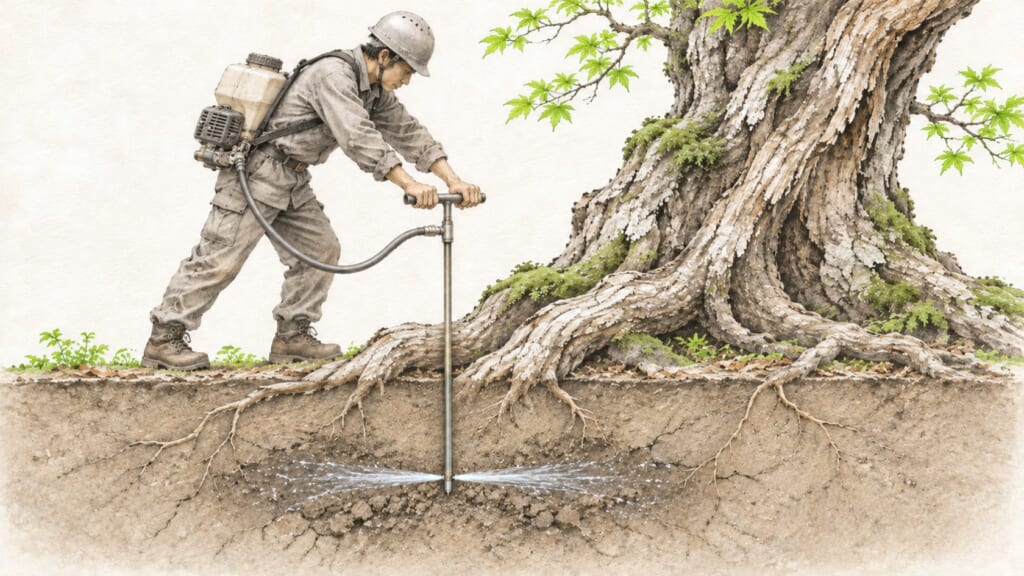
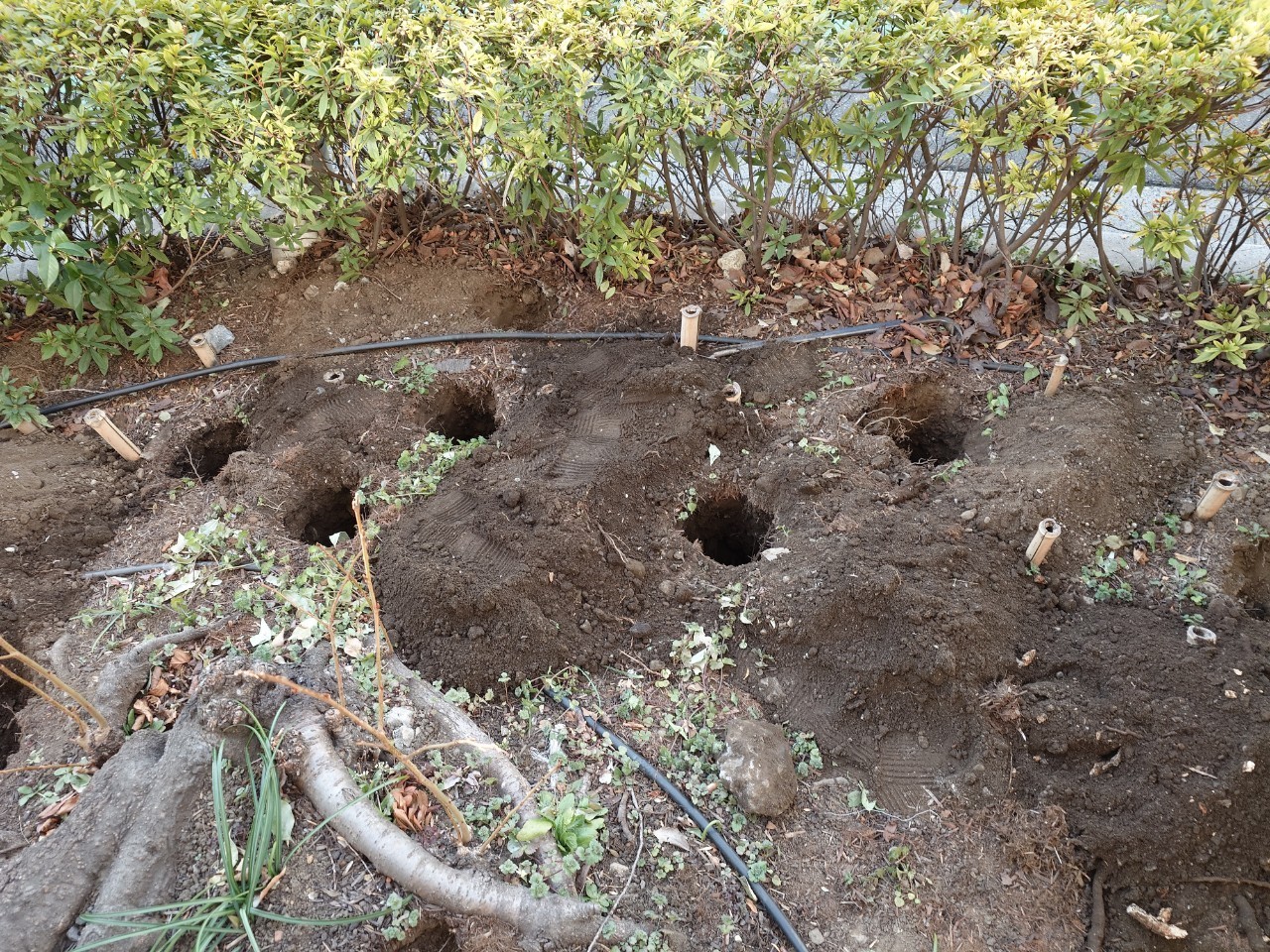
Where a spade cannot get between an old tree’s roots, Japanese arborists can loosen compacted soil from below with water instead. In suiatsu senkō-hō (水圧穿孔法), the “water-pressure boring” method, the pump of a backpack sprayer feeds water to a thin probe pushed into the root zone; jets from its tip break up small pockets of packed soil and leave a narrow hole that can take a thin bamboo cane, without opening a trench.
Published Japanese examples work at depths of roughly 40 cm to 1.1 m (16 in to 3.6 ft), with pump pressures of about 2–3 MPa (290–435 psi).
Under the Boardwalk — A Pine That Could Not Be Dug
Marking the points
In a 2020 technical note, the Japan Biotope Association describes work on a pine designated as a natural monument. The tree stood beside a boardwalk, and the soil to be improved lay underneath it. A spade could not reach that soil without lifting the boards.
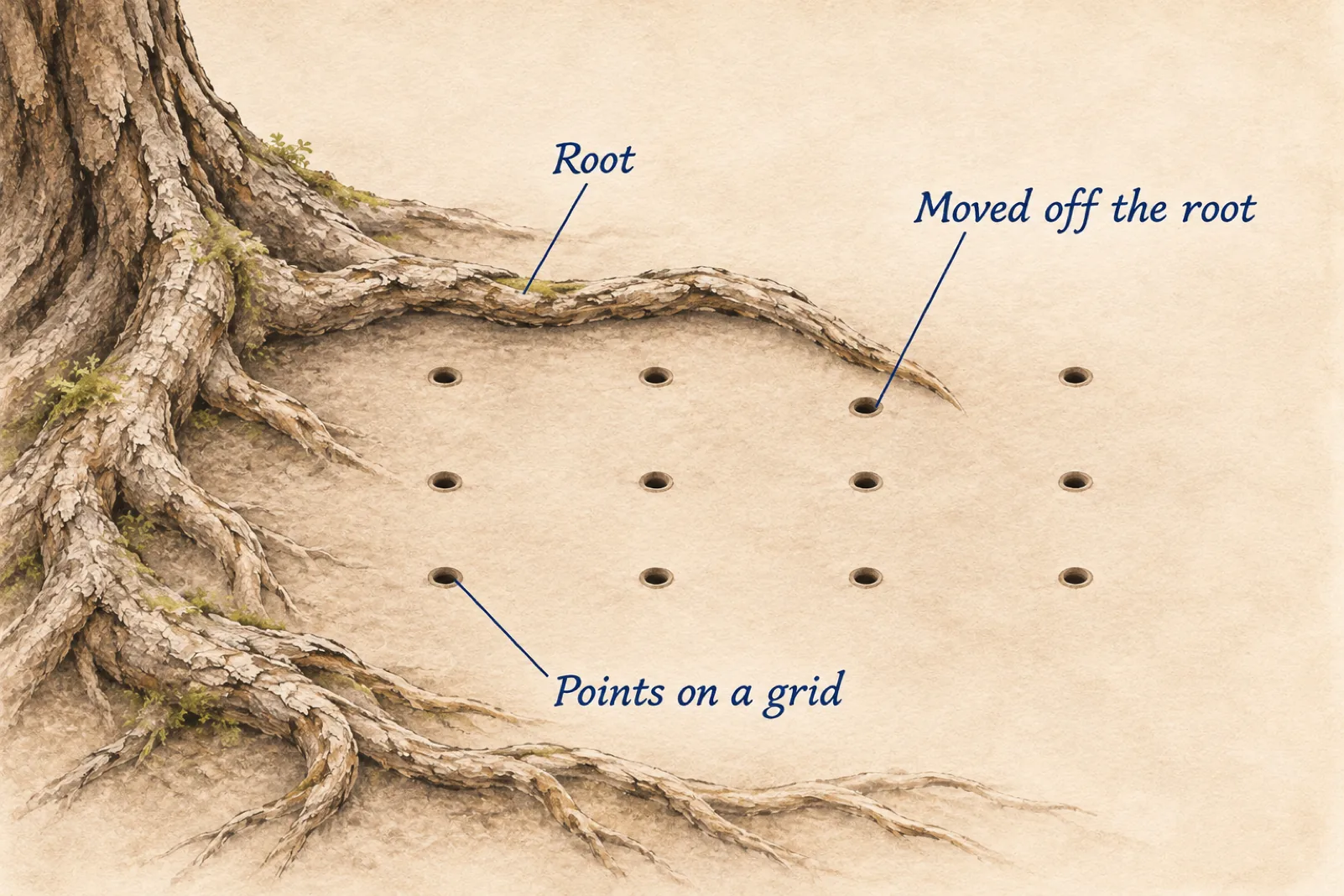
The crew began by marking treatment points at 50 cm (20 in) intervals. Then they joined two probes into a single lance 1.6 m (5.2 ft) long, put a mark at 1.1 m (3.6 ft), and bored down to the mark at each point. They swapped the original four-outlet tip for one with two outlets facing down. Where a stone or a large root stopped the lance, they shifted the point and tried again.
What went into each hole
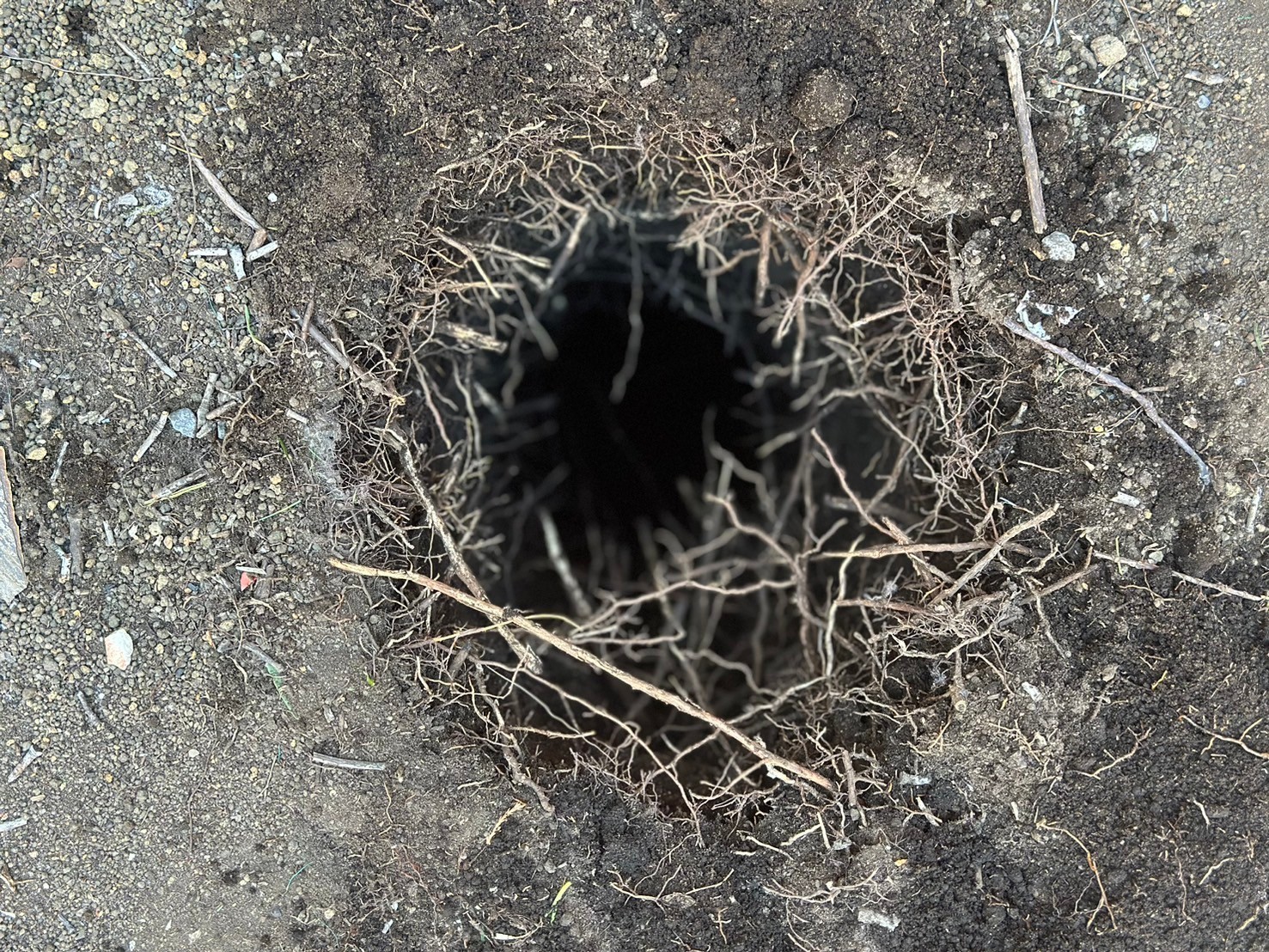
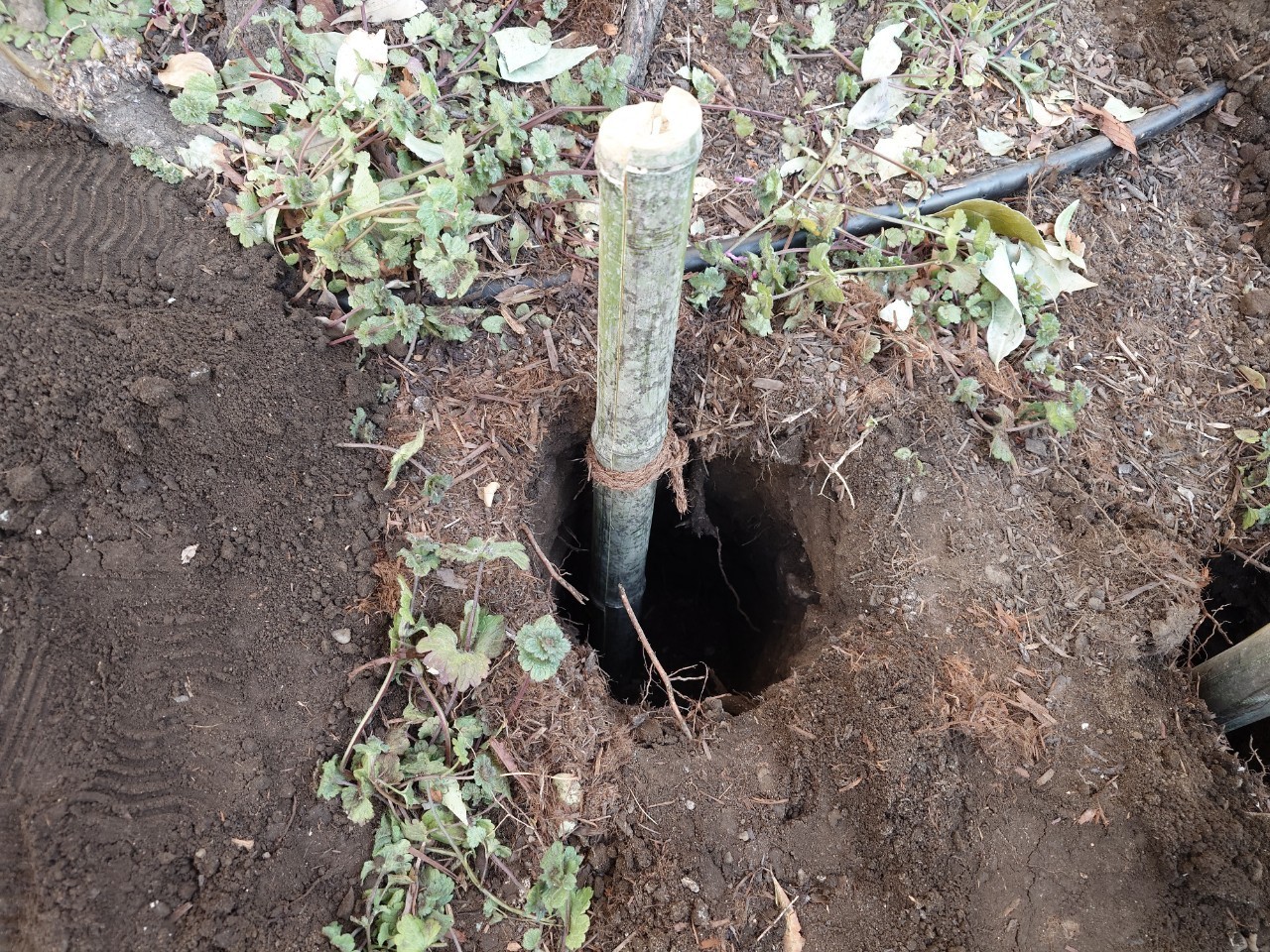
Into each hole went a thin bamboo cane about 1 m long and 10–25 mm across, with its internal nodes broken. The note’s summary gives the depth as 1 m; the detailed account gives the 1.1 m mark. Either way, the soil under the walkway was opened at depth, and the walkway stayed where it was.
That is the whole idea of the method in one job: reach the packed soil through a hole the width of a probe, instead of removing the surface to get at it.
Why the Soil Needs Opening — Compaction Around Old Trees
Fewer, smaller pores
Roots breathe and drink through the pores between soil grains. University of Florida IFAS Extension explains that constant foot or equipment traffic compacts soil and “reduces the total number and size of pores”.
Soil scientists track this with bulk density, the dry mass of soil per unit volume. The USDA Natural Resources Conservation Service gives general benchmarks, by soil texture, above which bulk density restricts root growth:
| Soil texture | Bulk density that restricts root growth (USDA NRCS) |
|---|---|
| Sandy | above 1.80 g/cm³ |
| Silty | above 1.65 g/cm³ |
| Clayey | above 1.47 g/cm³ |
How hard is too hard
The other measure is penetration resistance, the force needed to push a probe through soil. In a study of barley in British field soils (Valentine et al., 2012, Annals of Botany), penetration resistance was typically 1–3 MPa, and roots in the field samples typically grew at less than half the rate measured in the same soils repacked. For transplanted eucalyptus seedlings, a study in Soil Research estimated that 2–2.8 MPa halved the relative growth rate of lateral roots under the test conditions.
Neither study was on old trees, and no source found for this article sets one figure at which an old tree’s roots stop. Note also that MPa appears twice in this article for different things: here it is the soil’s resistance to a probe; later it is the pressure of the water in a pump. The two are not comparable.
Why not dig it out
Replacing compacted soil means digging, and structural and fine roots can lie near the surface, where excavation may damage them. Around many old trees there are also boardwalks, fences and paths that keep visitors off the roots — the viewing deck at the Jōmon Sugi, described in How Old Is Jōmon Sugi?, is one example. And where the tree is a designated natural monument, soil work needs permission first, as explained below.
Where the Idea Came From — An Orchard Injector and a Tree-Doctor Trainee
A machine from the orchard
The method has a short, traceable history. Taisai Hori, writing for the tree ecology group 樹木生態研究会 (Jumoku Seitai Kenkyūkai), recalls how it started. A company in Kurayoshi, Tottori Prefecture, had been injecting a “secret liquid” into the base of declining trees with a soil injector of the kind used in orchards to sterilise soil, and getting good results.
From an idea to a nozzle
Hori passed on the idea of using such an injector to bore holes with water to Kunio Yasuda, who had come from Hyōgo Prefecture for tree-doctor (jumoku-i, 樹木医) training. After returning home, Yasuda put it into practice, including developing a nozzle for the injector. Hori does not give a year.
Hori now recommends two techniques for improving aeration and water movement in compacted soil around existing trees: the split-bamboo vertical-hole method and water-pressure boring. More recently he has recommended inserting thin bamboo, such as yadake (arrow bamboo), with the nodes crushed, into the narrow holes that water boring leaves.
What Happens Below — Water at the Tip
Jets, not a drill
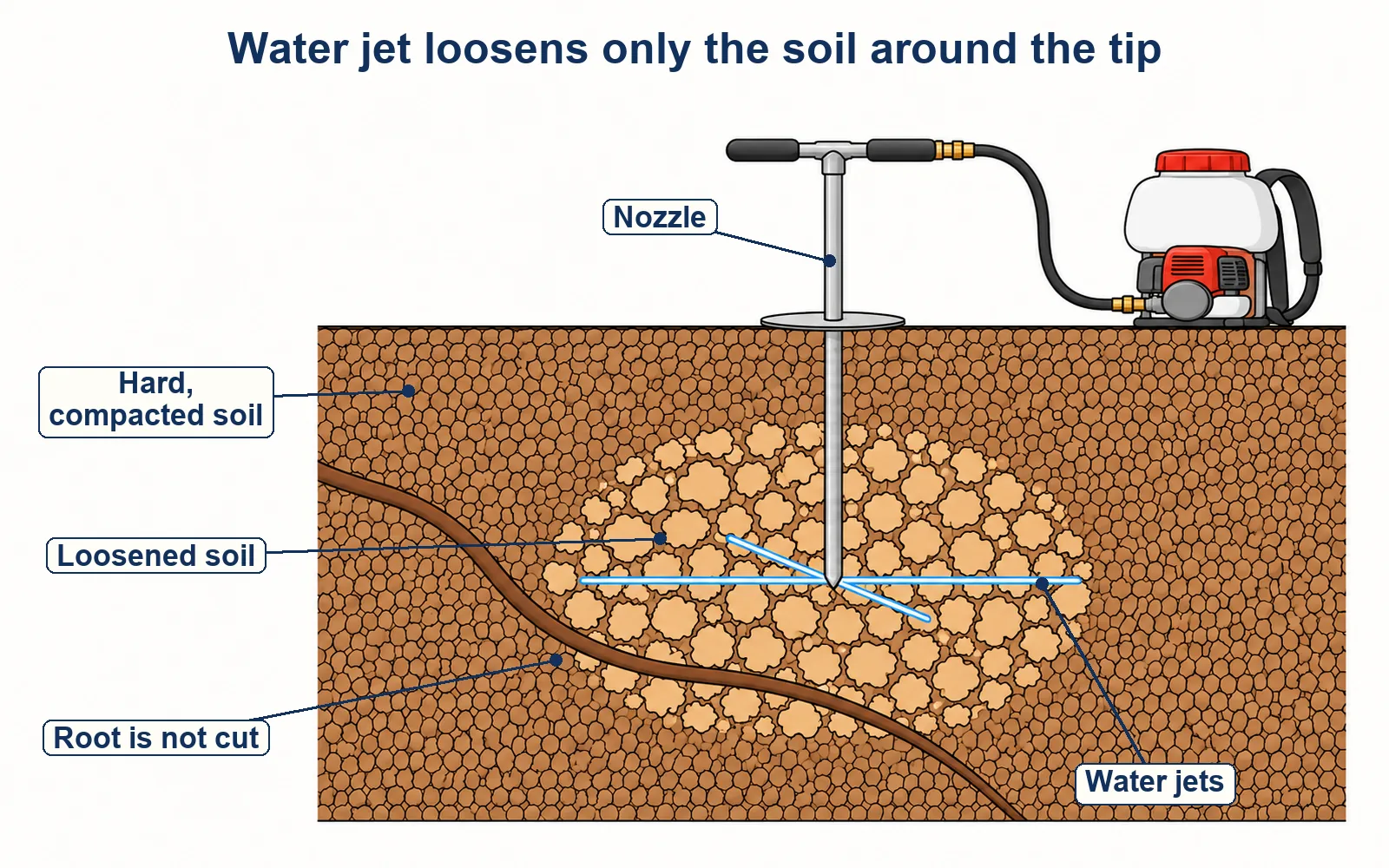
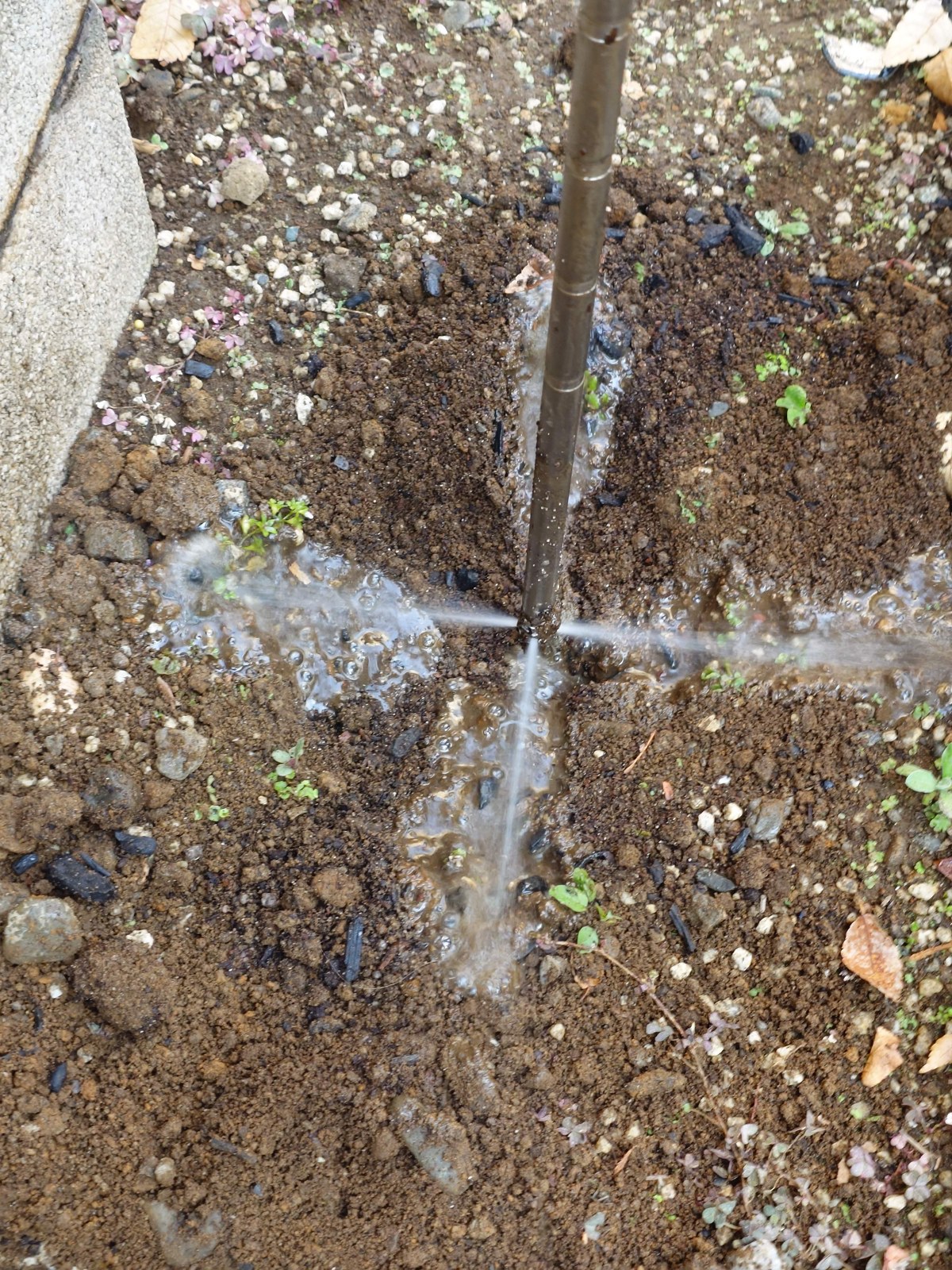
The probe carries water down to its tip, where it leaves through small outlets — sideways on the probes described below. The water works on the soil around the tip, below the surface, and the probe leaves a narrow entry hole from the surface down to that depth. Unlike a trench or a wide auger hole, the method does not remove the soil above the treated zone.
Roots in the way
An auger can sever roots it meets. A hand-held probe is different in one practical way: a large root or a stone stops it, and the crew can move it, as the Biotope Association job shows. That does not mean the probe never touches a root, and no study was found that measured root injury from the method.
A hole that stays useful
What happens after boring depends on the job. Hori’s thin bamboo cane is meant to give air and water a pathway down the narrow hole. Liquid can also travel with the water itself. Other specifications, described in the records below, use larger holes and backfill them with compost or soil improver.
The Equipment — Pump Ratings and Probe Ratings
One documented setup
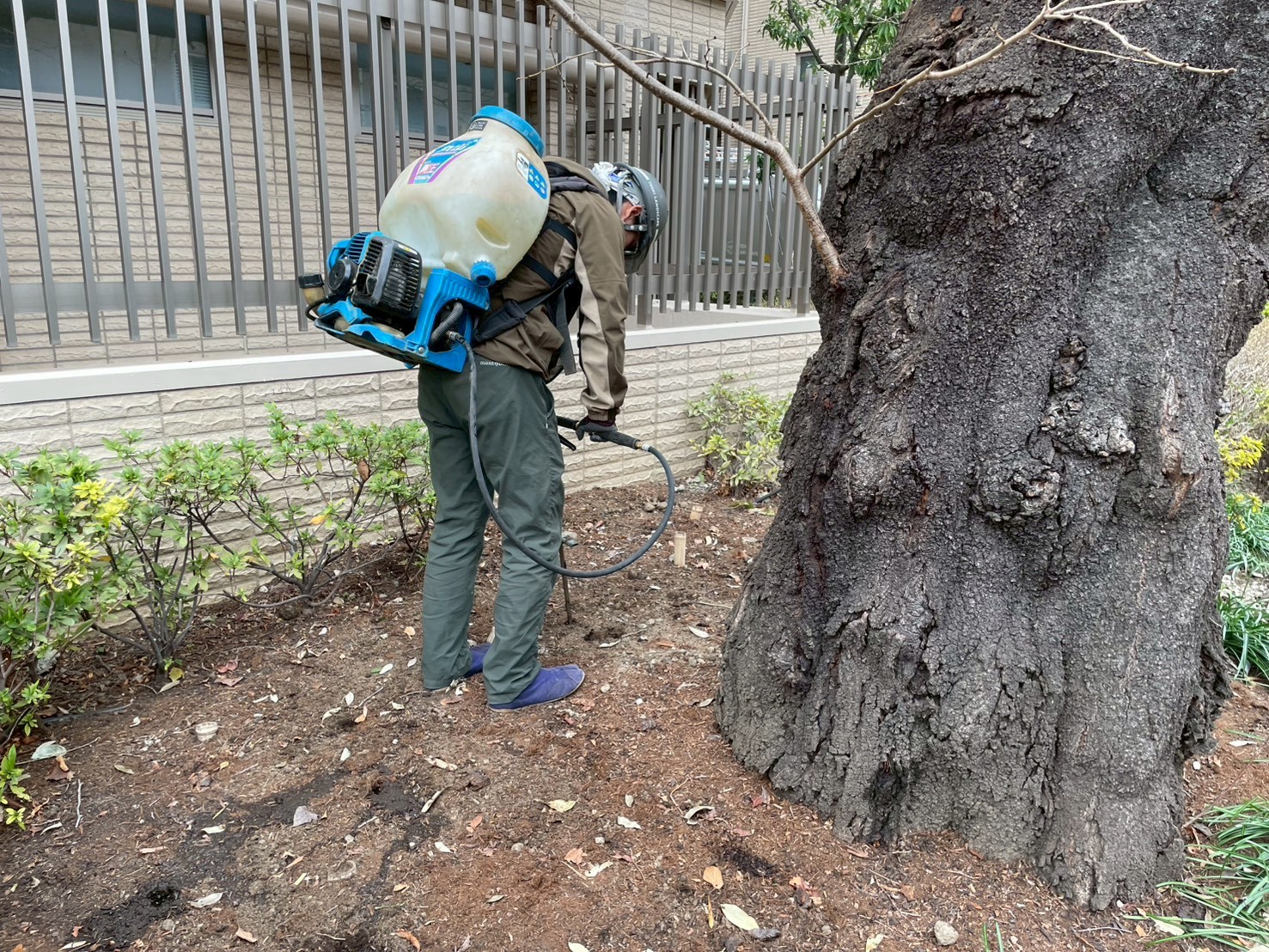
The parts are not special to arboriculture. The pump is an ordinary backpack sprayer of the kind used for spraying trees and hedges; the probe is sold as a liquid-fertiliser injector for soil. One common pairing is a Maruyama MS5910D-20-1 backpack sprayer, sold under the name 霧王, with a Nagata Seisakusho Pore Nozzle (ポアーノズル).
Reading the numbers
Two pairs of figures are easy to confuse. The first is pressure. Maruyama gives 3.0 MPa as the pump’s maximum, measured with the outlet shut. Nagata gives 3.0 MPa as the probe’s maximum working pressure. They are listed as the same number, but they are different ratings. The second is flow. Maruyama’s 7.5 L/min is the pump’s intake; Nagata’s flow figures are for the probe at stated pressures. Neither maker states the flow when the two are used together, and neither maker was found naming the other’s product as a match.
| Item | Pump: Maruyama MS5910D-20-1 | Probe: Nagata Pore Nozzle S | Probe: Nagata Pore Nozzle SDX |
|---|---|---|---|
| Pressure rating | 3.0 MPa maximum (outlet shut) | 3.0 MPa maximum working | 3.0 MPa maximum working |
| Flow | 7.5 L/min pump intake | 25.0 / 28.2 / 30.5 L/min at 2.0 / 2.5 / 3.0 MPa | 6.6 / 7.1 / 7.8 L/min at 2.0 / 2.5 / 3.0 MPa |
| Size, weight | 20 L tank; 8.4 kg dry | 930 mm long | 930 mm long |
| Tip outlets | — | four × 2.0 mm | four × 2.0 mm |
| Other | 6-step pressure setting; 23.9 mL two-stroke engine | — | internal 1.7 mm orifice; introduces air during injection |
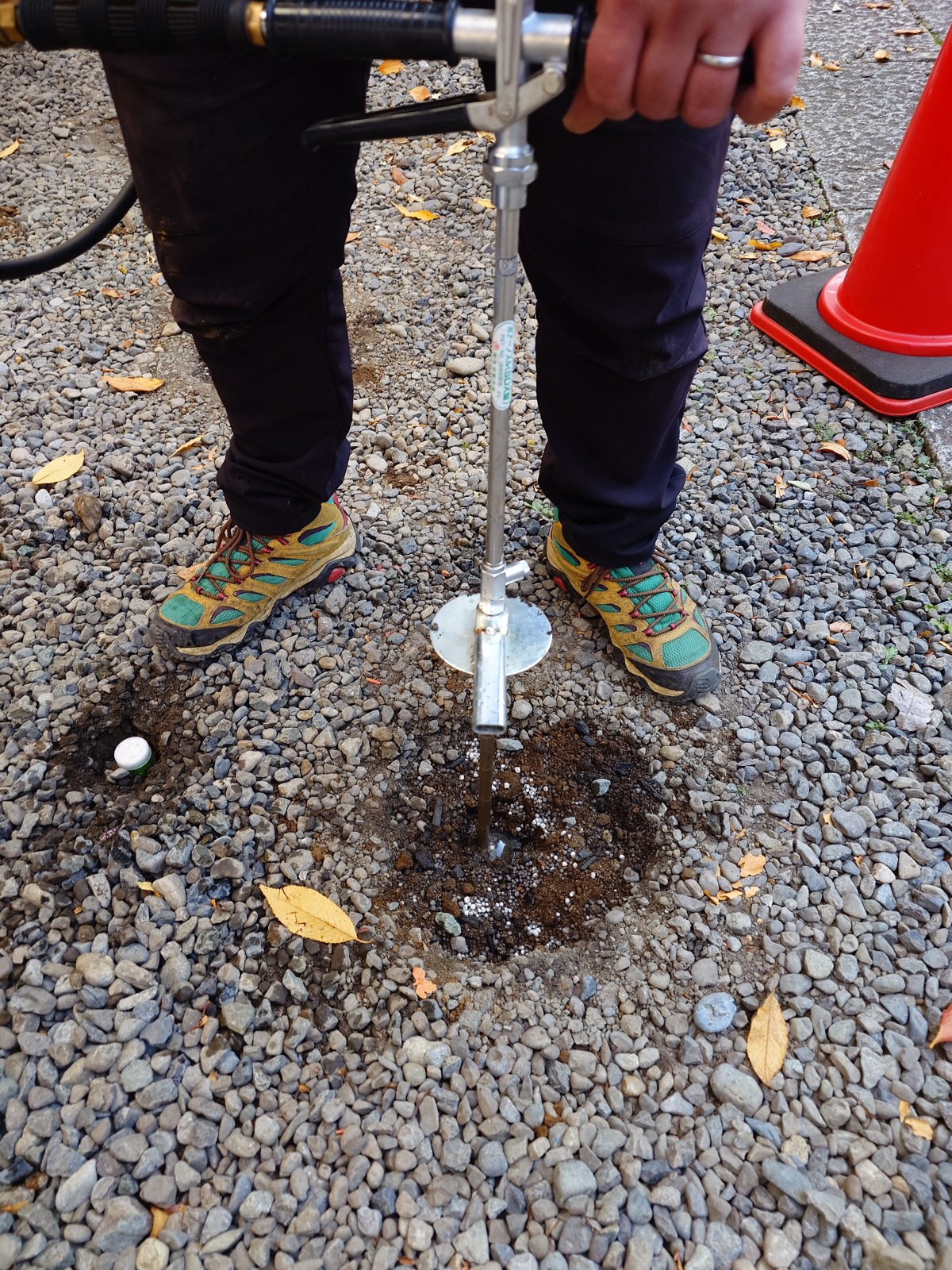
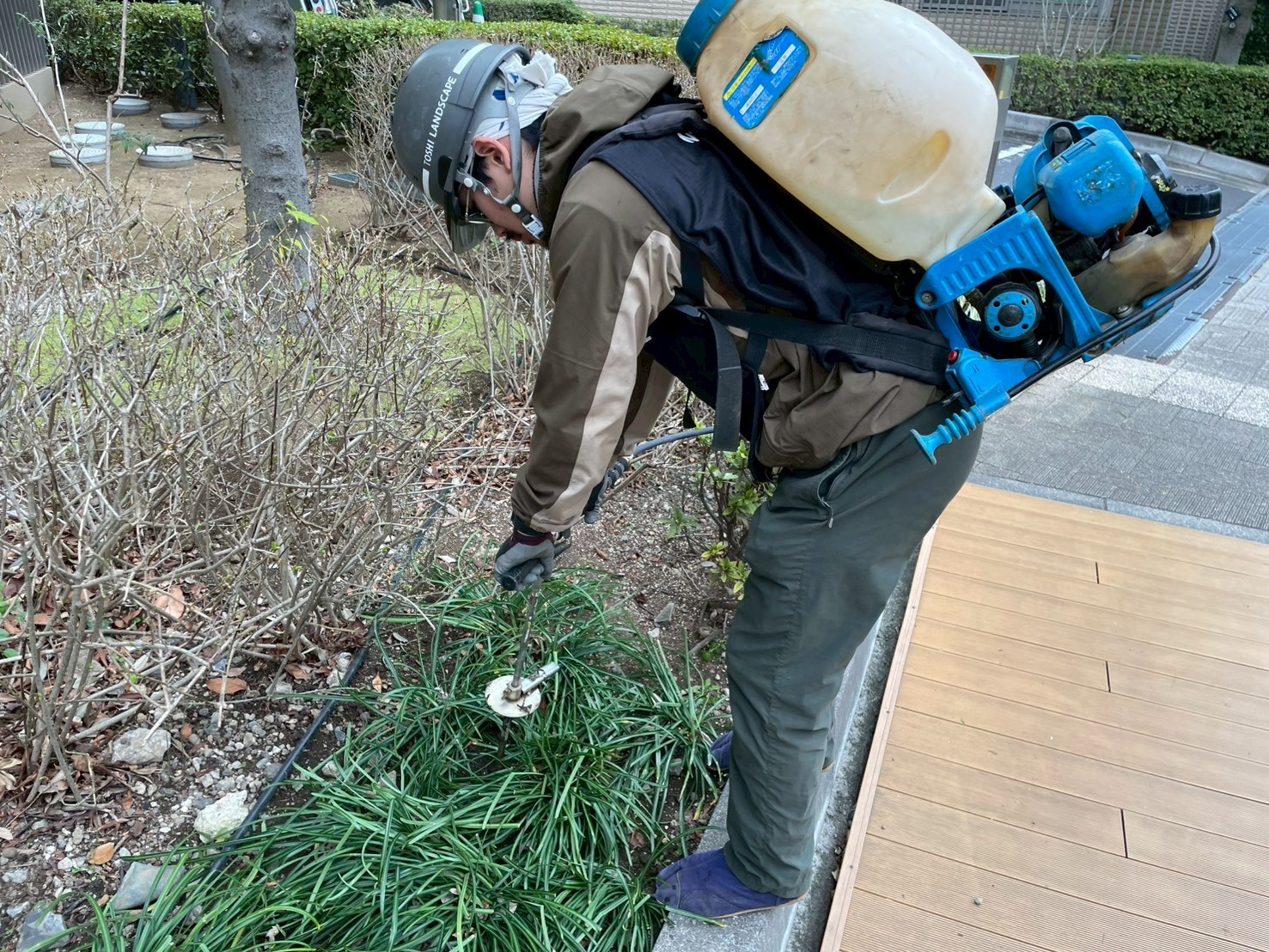
In everyday use, working pressures of 2–3 MPa, chosen for the site, and depths of about 40–80 cm (16–31 in) are typical, which keeps the pump and probe inside their 3.0 MPa ratings. On the probe in the photographs here, a round plate on the shaft stops it at the surface.
Marking, Inserting, Adding — The Work Step by Step
1. Mark the treatment points
Buried pipes, cables and footings are located first, with their depths, alongside the large roots; a lance pushed to a metre can reach all of them. The Biotope Association job used 50 cm spacing, with points shifted around stones and large roots. A 2024 plan by Ōno City, Fukui Prefecture, for the nationally designated Great Zelkova of Senpukuji (専福寺の大ケヤキ), left the number of holes to be decided on the day, after checking the site with a tree doctor.
2. Plan the order of work
The Ōno plan sets out the order: work from the road on the west side towards the main hall on the east, while avoiding foot traffic at the base of the tree. Treating the soil and then walking on it again would undo part of the work.
3. Insert the probe
The probe is pushed straight down at each point with the water already running, and drawn out once it reaches the chosen depth. The depth depends on the job: about 40–80 cm in routine work, a 1.1 m mark under the boardwalk pine, 800 mm in a 2025 specification for Shinjuku Gyoen. Where the lance meets a large root or a stone, it is not forced; it comes out and the point moves.
4. Add bamboo or backfill, if any
Records differ on what goes into the hole:
– Thin bamboo: canes 10–25 mm across, nodes broken, set into narrow holes (Biotope Association; Hori). – Liquid feed with the water: weak solutions are the rule; for a tree already in decline, a dilution of around 1,000 times is a common working figure. – Backfill into wider holes: cow-manure compost with charcoal (Shirahama Shrine, 1998) or a soil amendment containing organic fertiliser (Shinjuku Gyoen specification, FY2025).
5. Choose the season
The boring itself does not depend on the season, and in winter it is usually done with water alone. Liquid feed is better kept for the months when the tree is in leaf and active, when roots can take it up. Recorded jobs fall in different seasons: the Ōno plan schedules soil work for autumn; Shimonoseki City treated the Kawatana camphor in November 2017 and October 2018; at Jingu Gaien the work ran from April to June 2024, with more in April 2025.
Choosing the Method — Soil, Roots and Space
Can the ground be dug?
The split-bamboo method, warichiku sōnyū-hō (割竹挿入法), needs a dug vertical hole wide enough for a bamboo tube and fill. It is explained in Why Japan’s Temple Trees Have Bamboo Tubes in Their Roots. Water boring needs only room for a probe. The practical question is therefore whether a hole can be dug at a given point without cutting roots — or whether a boardwalk, a planted bed or a tangle of roots rules it out.
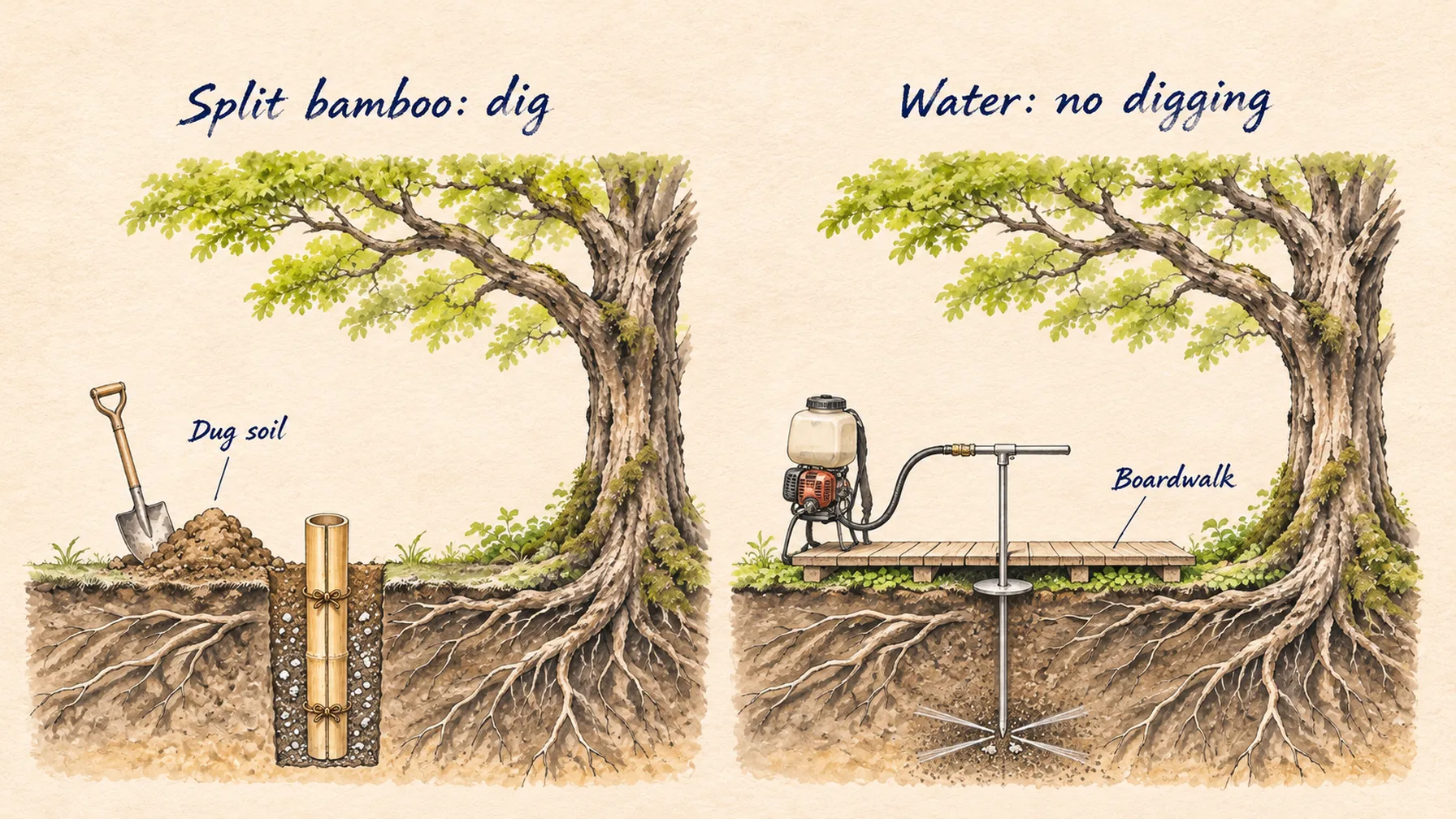
Both on one tree
The two are not exclusive. The Ōno plan for the Senpukuji zelkova combines water boring with split bamboo, with fertiliser and charcoal put into the bamboo, to improve aeration and drainage. Hori’s recommendation of thin canes in water-bored holes is a third, in-between form.
When neither is the answer
Two records show limits. At Kawatana, Shimonoseki City reported a hardened layer that the probe would not pass, and tried an earth auger. In a 2019 trial on greenhouse lemons, Hiroshima Prefecture dug holes with high-pressure water and filled them with bark compost; afterwards, poor drainage remained a problem. A hard layer the probe cannot cross, or water with nowhere to go, are different problems from surface compaction.
Checks before and after
Put together, the records suggest a sequence of questions rather than a single rule. Before treatment: is the problem compaction near the surface, a hard layer deeper down, or water that cannot drain? The NRCS benchmarks and a probe’s resistance speak to the first; the Kawatana layer and the Hiroshima holes are examples of the other two. Where are the large roots, and can a spade get in without meeting them? Is the tree designated, so that permission comes first? After treatment, three separate things can be checked: whether the soil changed, whether the holes stayed open, and — over years, not weeks — whether the tree’s growth changed. Those checks need a record made on the day: a plan showing where each hole went, how many there were and how deep, so that hardness and drainage can be measured again at the same spots by the same method.
One treatment is rarely the end. Soil packs down again, quickly where people keep walking, so the work is usually treated as recurring care: new points in a different part of the root zone each year, with the next round decided by how the tree has responded, and the trampling itself dealt with where it continues.
Where it sits in Japanese street-tree practice
Injecting liquid into the root zone is also part of routine Japanese street-tree care. The Tokyo Metropolitan Government’s street-tree inspection manual lists, among treatments where trampling has reduced aeration and drainage, mixing liquid fertiliser or vitality promoters into the soil with a soil injector. Water boring takes the same kind of tool deeper and uses the water itself as the working part.
Records From Japan’s Protected Trees — Plans, Specifications, Reports
Several Japanese records describe completed or planned water-boring work. They are of different kinds, and none is a controlled trial.
| Tree | Record type | What it says |
|---|---|---|
| A pine beside a boardwalk (natural monument), Japan Biotope Association, 2020 | Technical note on completed work | 50 cm spacing; bored to a 1.1 m mark; thin bamboo canes inserted |
| Kawatana no Kusu no Mori (川棚のクスの森), Shimonoseki, Yamaguchi (national natural monument) | City reports; NPO account | Water boring in Nov 2017 and Oct 2018, again in FY2023 and FY2024; a 2024 Forest Creation Forum account reported 1,350 holes described as 1 m deep, with no annual breakdown |
| Juniper grove, Shirahama Shrine, Shimoda, Shizuoka (prefectural natural monument) | Case report (NILIM case book) | 1998: water jet used to make about 20 holes, 16 cm wide and at least 1 m deep; cow-manure compost with charcoal |
| Great Zelkova of Senpukuji, Ōno, Fukui (national natural monument) | Municipal plan, 2024 | Water boring with split bamboo in autumn; tree doctor present; number of holes set on the day |
| Ginkgo avenue, Meiji Jingu Gaien, Tokyo | Developer’s progress report | Water boring April–June 2024; continued April 2025 |
| A large plane tree, Shinjuku Gyoen, Tokyo | Works specification, FY2025 | 50 holes, 100 mm wide and 800 mm deep, with a 2.5 MPa engine pump; backfill with soil amendment containing organic fertiliser |
The Jingu Gaien avenue is the subject of Jingu Gaien’s Ginkgo Avenue.
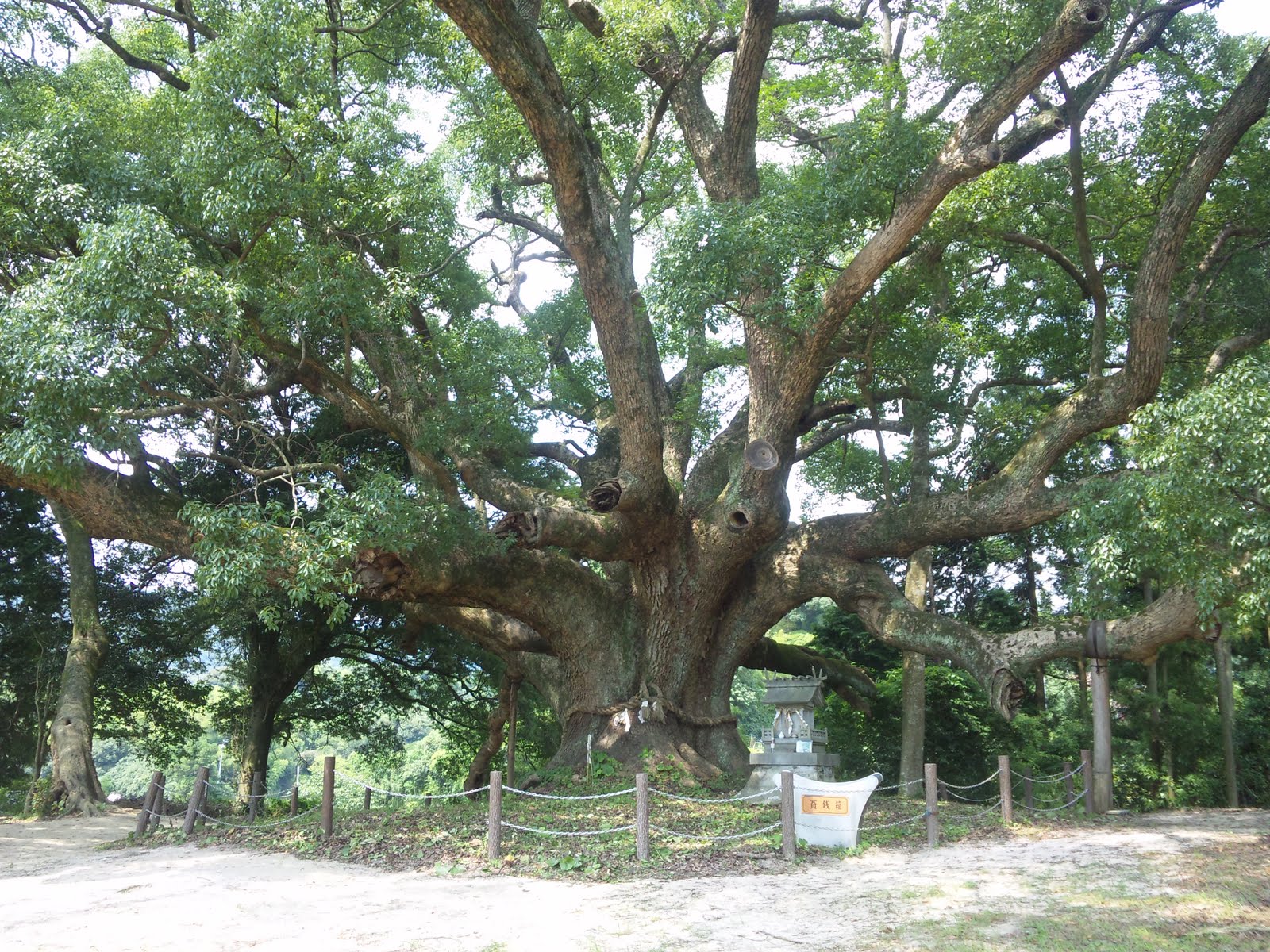
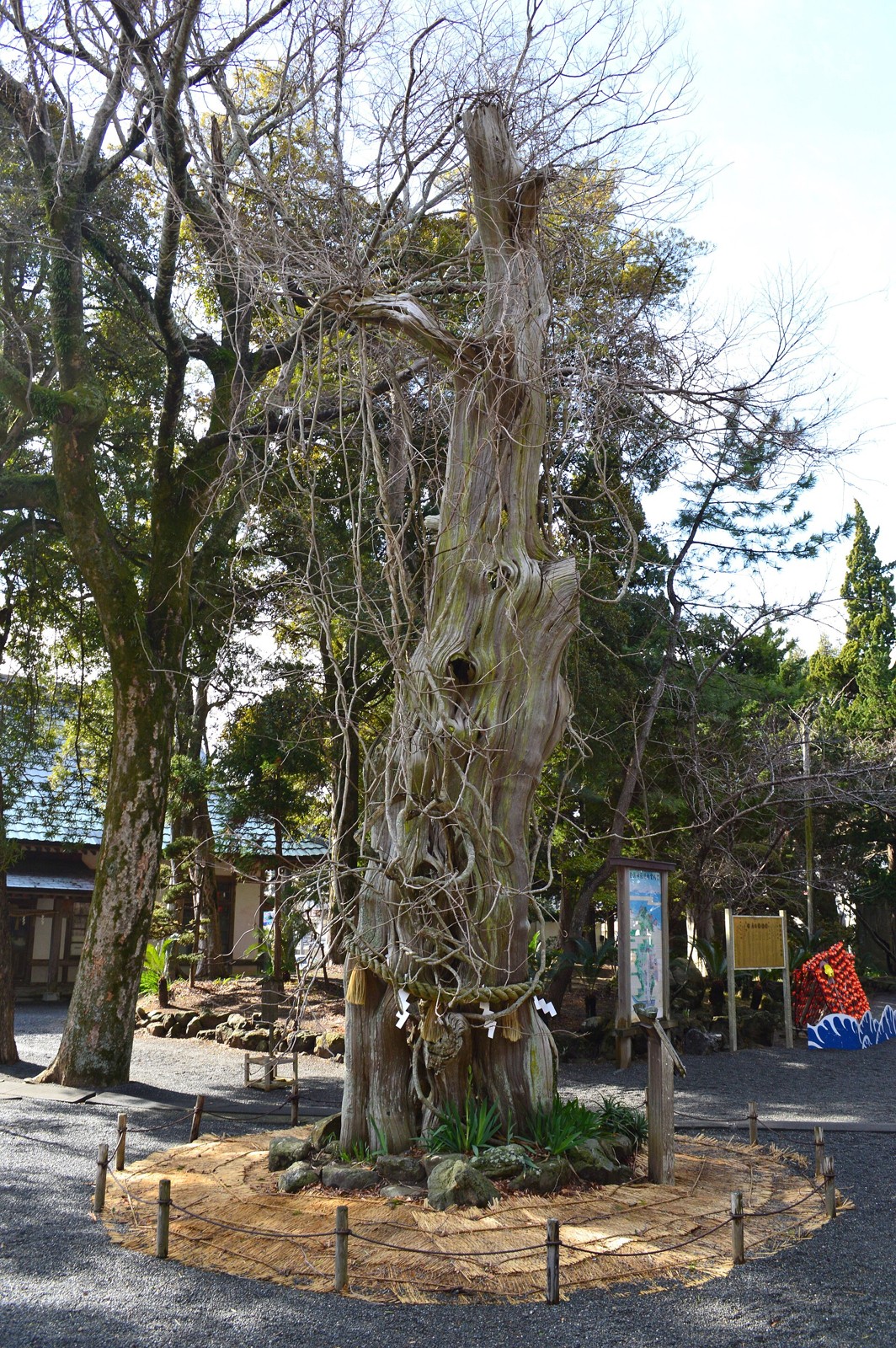
Permission First — Article 125 and Natural Monuments
What the law says
Japan’s Law for the Protection of Cultural Properties, Article 125(1), requires permission from the Commissioner for Cultural Affairs to alter the current state of a historic site, place of scenic beauty or natural monument, or to do anything that affects its preservation. For alterations, it exempts maintenance measures and emergency measures needed after an extraordinary disaster; for acts affecting preservation, it exempts those whose effect is minor. Article 125(2) leaves the scope of maintenance measures to a ministry ordinance. Under Article 125(7), the Commissioner may order restoration where work was done without permission or in breach of a permit condition.
In practice
How individual authorities classify water boring is not known here, and nothing in this article suggests it is exempt. For a designated tree, the first step is to ask the responsible cultural-property authority whether the planned soil work needs permission under Article 125. The Ōno plan shows one municipality bringing the method into a wider conservation project, with its cultural properties council, a tree doctor on site and rules on where people could walk. For why Japan goes to such lengths for its oldest trees, see Why Do Japan’s Ancient Trees Live for a Thousand Years?
How the West Handles the Same Problem — Feeding, Loosening, Exposing
Feeding: liquid injection
US extension guidance describes pressurised liquid injection mainly as a way to feed trees. Clemson Extension gives a depth of 4–8 in (10–20 cm), with points 1–3 ft (30–91 cm) apart. NC State Extension notes that injection gets fertiliser below turf roots, and that it “may have a positive effect on soil structure”. The 2018 edition of ANSI A300 Part 2 (§18.6.4.2) gives a spacing of 12–36 in and a depth of 4–8 in, “not to exceed 12 inches”.
Loosening in place
The same 2018 edition lists the idea behind the Japanese method, too. §17.2.2 names “hydraulic injection” among ways to add amendments to the soil of existing plants that “minimize root damage”, and §17.3.1 lists “hydraulic soil loosening under high-pressure water” among tillage methods. The Japanese records above work deeper: 40 cm to over 1 m, where the US feeding guidance stops at 12 in.
Exposing roots: air, vacuum, water
Removing soil to expose roots is a different job. The British standard BS 5837:2012, §7.2.1, for limited, justified digging in a root protection area, asks for hand tools “and preferably” compressed-air soil displacement. Street Works UK (§4.1.4(d)) lists vacuum excavation where ground disturbance must be kept low, “for example around tree roots”. The University of California IPM programme lists “hydroexcavation or pneumatic excavation” side by side.
| Purpose | Typical Western reference | What stays in the ground | Japanese water boring |
|---|---|---|---|
| Feeding | Clemson; ANSI A300 Part 2 (2018) §18.6.4.2 | Liquid fertiliser at 4–8 in, 12 in maximum | Feed can travel with the water |
| Loosening in place | ANSI A300 Part 2 (2018) §17.2.2, §17.3.1 | Loosened soil; amendments | The main purpose, at 40 cm to over 1 m |
| Exposing roots | BS 5837 §7.2.1; Street Works UK; UC IPM | Soil removed, roots exposed | Not the aim; soil stays in place |
What Has Been Measured — and What Has Not
By what each study measured
| Study | Treatment | Measured | Result |
|---|---|---|---|
| Neely et al. (1970) | Liquid soil injection, dry fertiliser in holes, surface spreading | Tree response to feeding | No soil method significantly better than the others |
| Smiley, Fraedrich & Booth (1991) | Slow-release suspension fertiliser injected into soil, nutrient-poor willow oaks | Leaf nitrogen | Improved significantly |
| Smiley (2001) | High-pressure nitrogen gas injection (Terravent) | Soil bulk density | Soil fractured, but no significant difference in bulk density between sampled areas |
| Fite, Smiley et al. (2011) | Air tillage, fertiliser, mulch under established red maples, four US sites | Soil strength | First year: combined treatment significantly reduced soil strength relative to untreated controls at all four sites; mulch the most beneficial single treatment |
None of these tests the Japanese method. They do show why the questions have to be kept apart: making cracks, changing density, feeding a tree and improving its growth are four different results.
The Japanese records
At Shirahama Shrine, a 2006 follow-up of the 1998 work reported little shoot growth and found no observable soil-improvement effect. At Kawatana, the probe met a layer it could not pass. The sources reviewed for this article did not include a controlled trial of the backpack-sprayer method alone measuring root injury, lasting changes in soil resistance, or tree recovery.
Where It Goes Wrong — Mistakes and Misreadings
Treating a hole as a result
A hole proves only that a hole was made. Whether the soil changed, and whether the tree responded, are separate checks — the Shirahama follow-up is the reminder.
Strong feed
An article in the Japanese journal Tree and Forest Health, on feeding during root preparation for transplanting, warns that concentrated fertiliser can draw water out of stressed root cells. A working dilution of about 1,000 times is far weaker than, for example, the 250-fold dilution Hyponex lists for its liquid concentrate (ハイポネックス原液) applied at the base of garden trees, though the products and methods differ.
Forcing the probe
The probe is meant to stop at a large root or a stone, and the point is meant to move. Running above the 3.0 MPa ratings of the pump and probe defeats the purpose.
Mistaking drainage for hardness
The Hiroshima lemon trial is the warning. Where water has nowhere to go below, an open hole does not solve it.
Walking on finished work
The Ōno plan’s order of work keeps feet away from the base of the tree. It costs nothing and is easy to forget.
Frequently asked questions
What is suiatsu senkō-hō?
It is a Japanese method of loosening compacted soil around existing trees without digging. A backpack sprayer’s pump feeds water to a thin probe pushed into the root zone; the jets break up packed soil around the tip and leave a narrow hole, which can take a thin bamboo cane.
Who came up with it?
Taisai Hori writes that the idea came from seeing a company in Kurayoshi, Tottori, inject liquid into the roots of declining trees with an orchard soil injector. He passed the idea to Kunio Yasuda, a tree-doctor trainee from Hyōgo, who developed a nozzle. No year is given.
How deep, and at what pressure?
Examples range from about 40–80 cm in routine work to 800 mm in a Shinjuku Gyoen specification and a 1.1 m mark under a boardwalk pine. Pump pressures of 2–3 MPa are reported; the pump and probe in one documented setup are both rated to 3.0 MPa.
Is it the same as deep-root fertilising?
The tools are similar, but US liquid injection is aimed at feeding, typically at 4–8 in and at most 12 in. The Japanese method is aimed at loosening soil at depth; feed is optional.
Does a natural monument need permission?
Work that alters a natural monument or affects its preservation needs permission under Article 125 of the Law for the Protection of Cultural Properties, with limited exceptions. Ask the responsible cultural-property authority before planning soil work on a designated tree.
What do the records say about results?
They show where and how it was used, not controlled results. One case report found no observable soil-improvement effect eight years later, and no controlled trial of the method alone was found.
Sources
– Japan Biotope Association, technical note No.11 (2020), pp.8–9: https://www.biotope.gr.jp/wp-content/uploads/gijutumenoNo11.pdf (checked 2026-11-23) – Tree Ecology Research Group (樹木生態研究会), Hori Taisai, “土壌改良の考え方と基本”: https://jyumokuseitai.org/%E6%A8%B9%E6%9C%A8%E7%94%9F%E6%85%8B%E7%A0%94%E7%A9%B6%E4%BC%9A%E5%8E%9F%E7%A8%BF%E3%80%80%E5%9C%9F%E5%A3%8C%E6%94%B9%E8%89%AF%E3%81%AE%E8%80%83%E3%81%88%E6%96%B9%E3%81%A8%E5%9F%BA%E6%9C%AC/ (checked 2026-11-23) – Maruyama Mfg., MS5910D-20-1 instruction manual, p.31: https://www.maruyama.co.jp/instruction/pdf/244134_MS5910D-20-1xxMS5910D-25-1.pdf (checked 2026-11-23) – Maruyama Mfg., MS5910D-20-1 product page: https://www.maruyama.co.jp/products/portable-sprayer-ms5910d-20-1/ (checked 2026-11-23) – Nagata Seisakusho, general catalogue 2023–2024, pp.155–156: https://www.nagataseisakusyo.co.jp/02catalog/catalog2023.pdf (checked 2026-11-23) – Nagata Seisakusho, Pore Nozzle SDX: https://www.nagataseisakusyo.co.jp/pr%20poasdx.htm (checked 2026-11-23) – Ōno City, cultural properties council papers, April 2024, pp.10–12: https://www.city.ono.fukui.jp/kosodate/bunka-rekishi/hogo/bunkazaishingikai.files/0021_20240430.pdf (checked 2026-11-23) – Shimonoseki City, Kawatana no Kusu no Mori: https://www.city.shimonoseki.lg.jp/soshiki/112/3066.html and https://www.city.shimonoseki.lg.jp/uploaded/attachment/90756.pdf (checked 2026-11-23) – Forest Creation Forum, newsletter No.334: https://moridukuri.jp/information/241031 (checked 2026-11-23) – National Institute for Land and Infrastructure Management, case book on giant and old trees, p.104: https://www.nilim.go.jp/lab/bcg/siryou/tnn/tnn0566pdf/ks0566.pdf (checked 2026-11-23) – Jingu Gaien district redevelopment, greenery: https://www.jingugaienmachidukuri.jp/green/ (checked 2026-11-23) – Ministry of the Environment, Shinjuku Gyoen giant tree protection works, FY2025 specification: https://www.kkj.go.jp/d/?A=dG9reW8vZW52X2dhcmRlbl9zaGluanVrdWd5b2VuLzIwMjYvMjAyNjAxMjNfMDAwMTRfMDEucGRmCg%3D%3D&L=ja (checked 2026-11-23) – Tokyo Metropolitan Government Bureau of Construction, 街路樹診断等マニュアル, p.69: https://www.kensetsu.metro.tokyo.lg.jp/content/000051876.pdf (checked 2026-11-23) – Hiroshima Prefecture, western agricultural technology office: https://www.pref.hiroshima.lg.jp/site/nougijutsu/genkou46.html (checked 2026-11-23) – Law for the Protection of Cultural Properties, Article 125 (e-Gov): https://laws.e-gov.go.jp/law/325AC0100000214 (checked 2026-11-23) – University of Florida IFAS Extension, “Soil Compaction in the Urban Landscape”: https://ask.ifas.ufl.edu/publication/SS529 (checked 2026-11-23) – USDA NRCS, “Soil Quality Indicators: Bulk Density”: https://www.nrcs.usda.gov/sites/default/files/2022-10/nrcs142p2_051591.pdf (checked 2026-11-23) – Valentine et al. (2012), Annals of Botany: https://pmc.ncbi.nlm.nih.gov/articles/PMC3394656/ (checked 2026-11-23) – Soil Research 52: 87–96, eucalyptus root penetration: https://connectsci.au/sr/article/52/1/87/46576/Comparison-of-the-penetration-of-primary-and (checked 2026-11-23) – Clemson Cooperative Extension, “Fertilizing Trees & Shrubs”: https://hgic.clemson.edu/factsheet/fertilizing-trees-shrubs/ (checked 2026-11-23) – NC State Extension, “A Gardener’s Guide to Fertilizing Trees and Shrubs”: https://content.ces.ncsu.edu/a-gardeners-guide-to-fertilizing-trees-and-shrubs (checked 2026-11-23) – ANSI A300 Part 2 (2018 edition), §17.2.2, §17.3.1, §18.6.4.2: https://west-chester.com/DocumentCenter/View/10139/A300-2 (checked 2026-11-23) – University of California IPM, “Protecting Trees During Construction”: https://ipm.ucanr.edu/home-and-landscape/protecting-trees-during-construction/ (checked 2026-11-23) – BS 5837:2012, §7.2.1: https://framptons-planning.com/wp-content/uploads/2021/03/CD-E7-BS5837-2012-Trees-in-relation-to-design-demolition-construction.pdf (checked 2026-11-23) – Street Works UK, Volume 4, Issue 3 (2026), §4.1.4(d): https://streetworks.org.uk/wp-content/uploads/2026/01/Street-Works-UK-Publications-Volume-4-Issue-3-2026.pdf (checked 2026-11-23) – Neely et al. (1970), “Fertilization of Established Trees”: https://iopn.library.illinois.edu/journals/inhs/article/download/158/120/770 (checked 2026-11-23) – Smiley, Fraedrich & Booth (1991), Journal of Arboriculture: https://joa.isa-arbor.com/request.asp?ArticleID=2467&JournalID=1&Type=2 (checked 2026-11-23) – Smiley (2001), Journal of Arboriculture: https://joa.isa-arbor.com/request.asp?ArticleID=2946&JournalID=1&Type=2 (checked 2026-11-23) – Fite et al. (2011), Arboriculture & Urban Forestry: https://joa.isa-arbor.com/request.asp?ArticleID=3217&JournalID=1&Type=2 (checked 2026-11-23) – Tree and Forest Health 12(3), note on feeding during root preparation: https://www.jstage.jst.go.jp/article/treeforesthealth/12/3/12_KJ00006259322/_pdf/-char/ja (checked 2026-11-23) – Hyponex, ハイポネックス原液 product page: https://www.hyponex.co.jp/products/products-637/ (checked 2026-11-23)