

By Isaki Kasahara, a Japanese arborist pruning, assessing and caring for Japan’s trees and gardens · Updated November 18, 2026
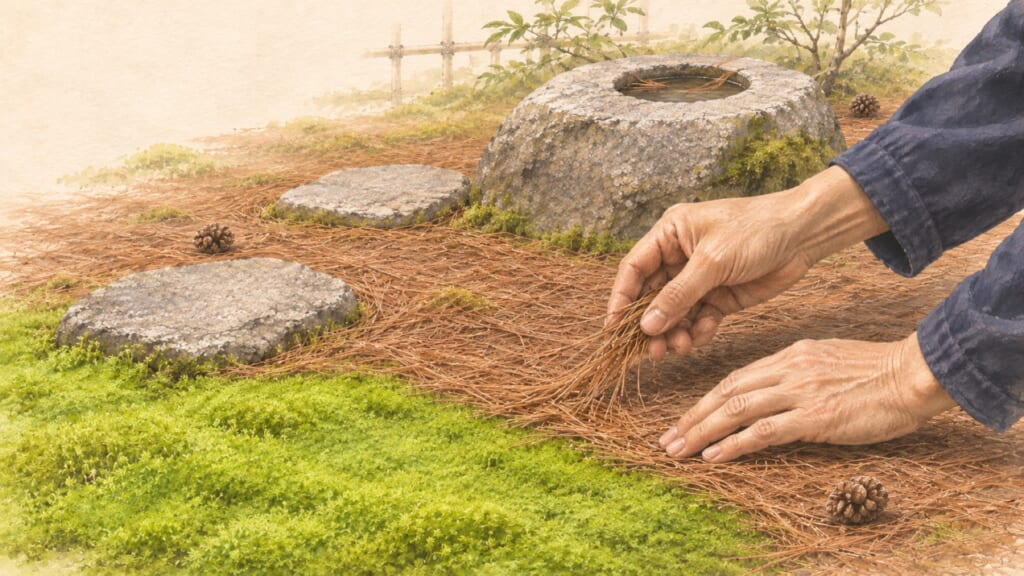
Some of Kyoto’s gardens cover their moss with pine needles in winter to help protect it: the layer, called shiki-matsuba (敷松葉), is laid, as Japanese sources describe it, to keep frost needles from lifting the moss and cold, dry wind from drying the ground. Over time the practice has also become a piece of winter scenery, especially in tea gardens, where the brown carpet tells a guest that the cold season has begun.
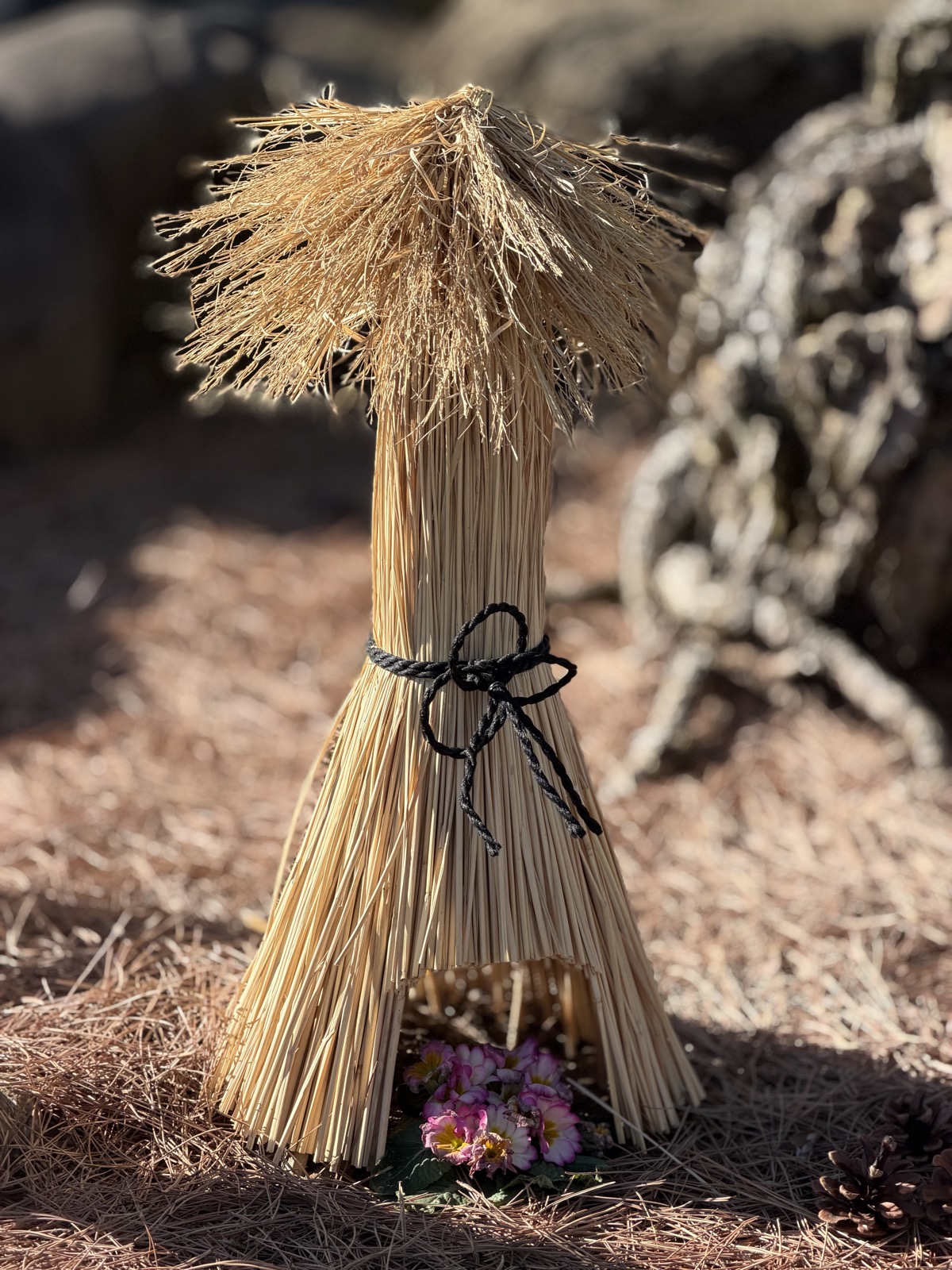
A courtyard without a single stray leaf — Kōhō-an
What the newspaper saw
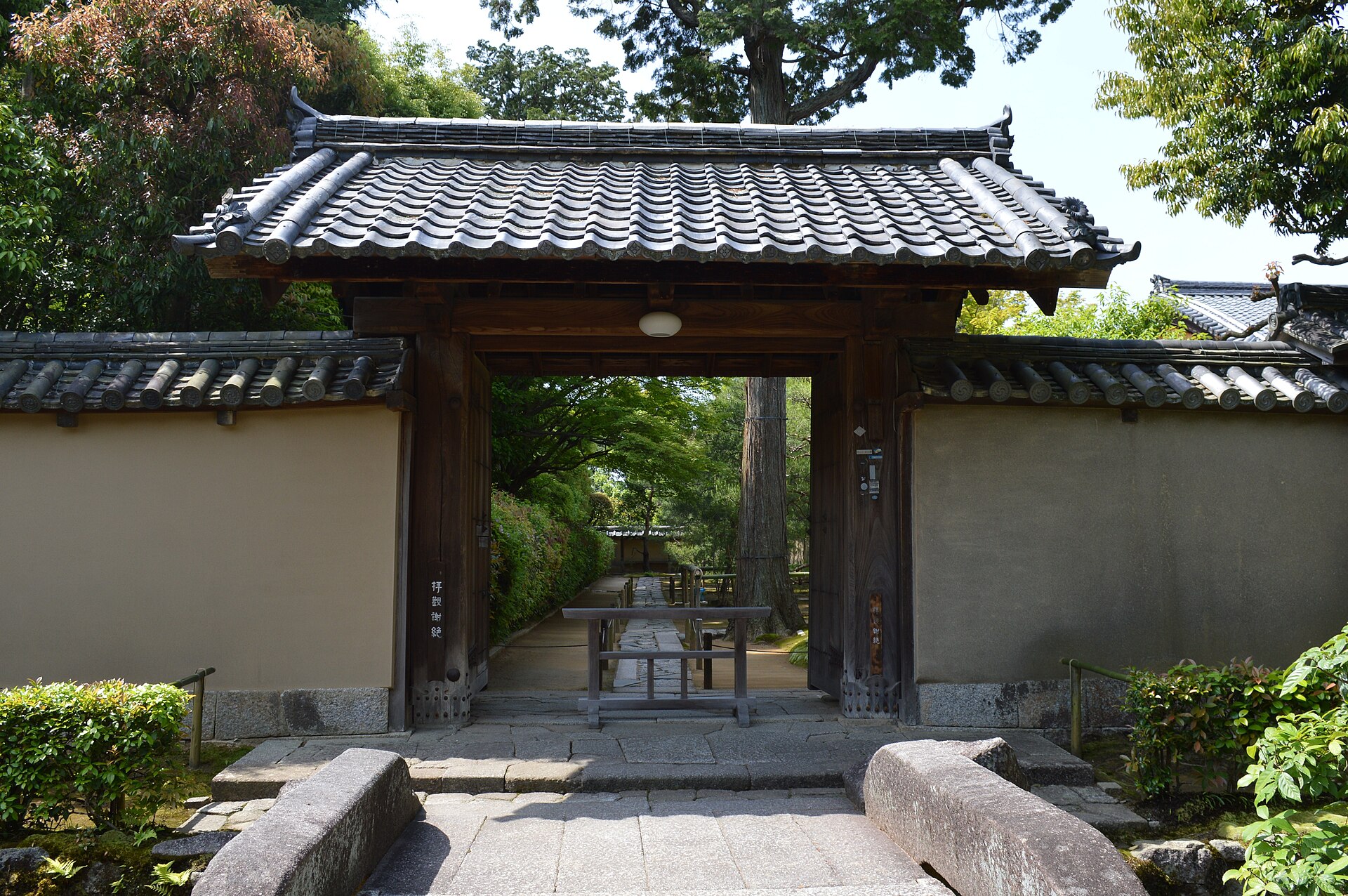
On 5 February 2022 the Kyoto Shimbun published a short piece on Kōhō-an, a sub-temple of Daitoku-ji in Kyoto. It described the garden in front of the main hall under a carpet of shiki-matsuba spread across the whole garden, with “not a single fallen leaf mixed in”, laid “for the care of the moss and the soil” in this season of winter.
A mulch kept so clean that no other leaf breaks it is the first clue that this layer is meant to be looked at as well as to work. The rest of the answer takes us into frost, tea, pine forests and a garden specification written in 2024.
What shiki-matsuba means — a word, a season and a technique
The word
Shiki (敷) means “to spread” or “to lay down”, and matsuba (松葉) means “pine needles”. The Nara National Research Institute for Cultural Properties gives the English heading “pine-needle covering” in its Japanese garden dictionary and defines it as “covering the ground with withered pine needles to prevent it from drying out over the winter season.”
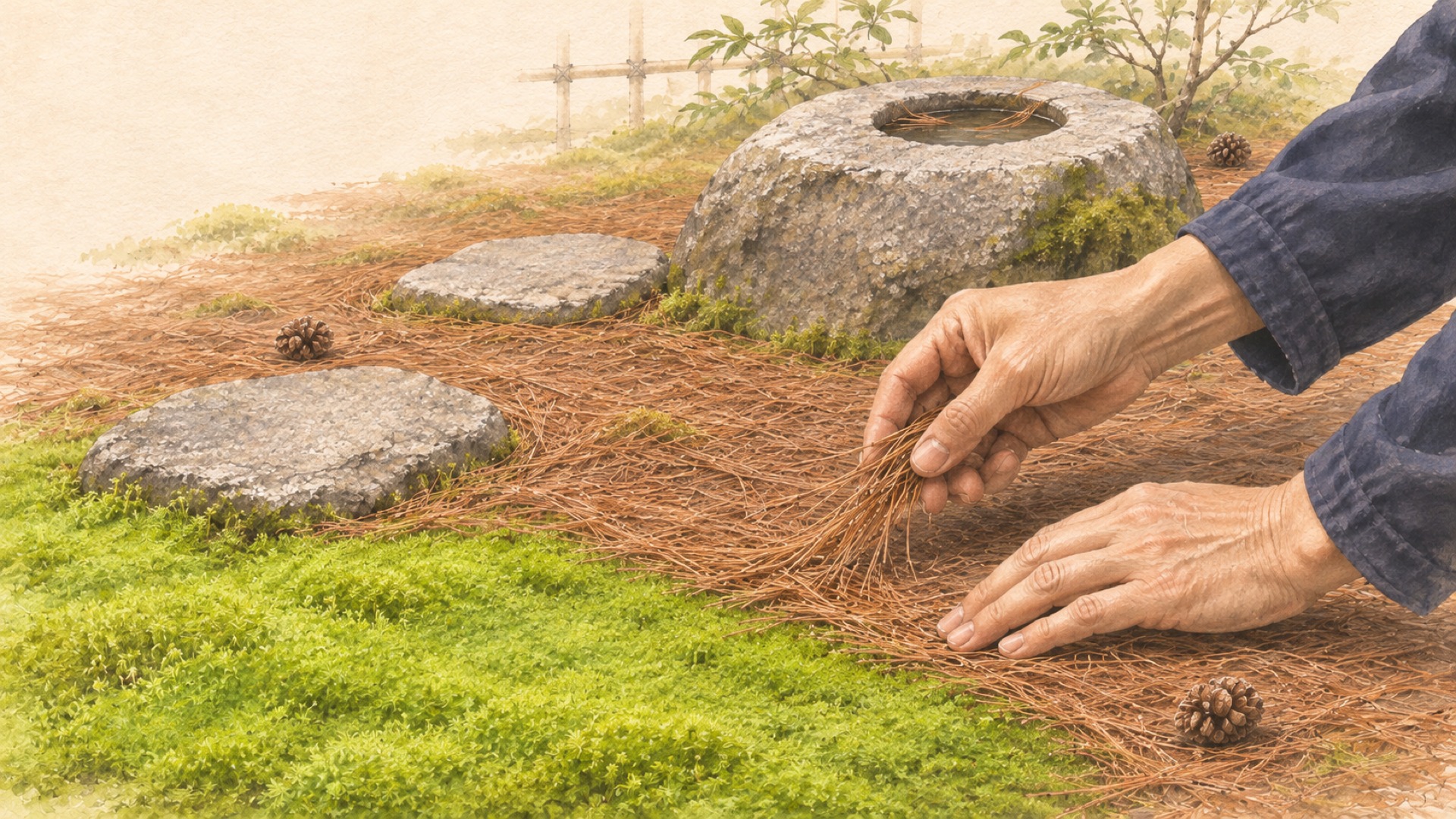
The same dictionary entry adds a second role. In tea gardens, it says, shiki-matsuba is “a seasonal decorative element” that serves to “accentuate the feel of winter.” The definition already holds two purposes: protecting the ground and marking the season.
A winter word in poetry
Shiki-matsuba is also a seasonal word, a kigo (季語), in Japanese haiku. The haiku almanac Kigo to Saijiki lists it under early winter (初冬) and explains it as laying needles to protect moss and similar plants from frost damage.
Protection first, scenery later
The Japanese Institute of Landscape Architecture (JILA) published a summary of traditional garden techniques in its FY2024 research report, and entry 180 is “the technique of shiki-matsuba”. It describes shiki-matsuba as a winter technique for protecting the moss in roji (露地, tea gardens) and similar places. Its original purpose, the report says, was to stop moss being damaged by frost; over time the meaning of creating a winter landscape grew stronger, and today needles are sometimes laid even where there is no moss at all.
Frost needles and dry wind — what winter does to moss
How a frost needle grows
Shimobashira (霜柱), frost needles, form when water rises through the soil by capillary action and freezes at the surface. Yamaguchi University’s explainer describes the process: water is drawn up from below the surface, it freezes, and the new ice pushes up the ice that formed before it. As more water freezes, the ice pushes up whatever sits on top.
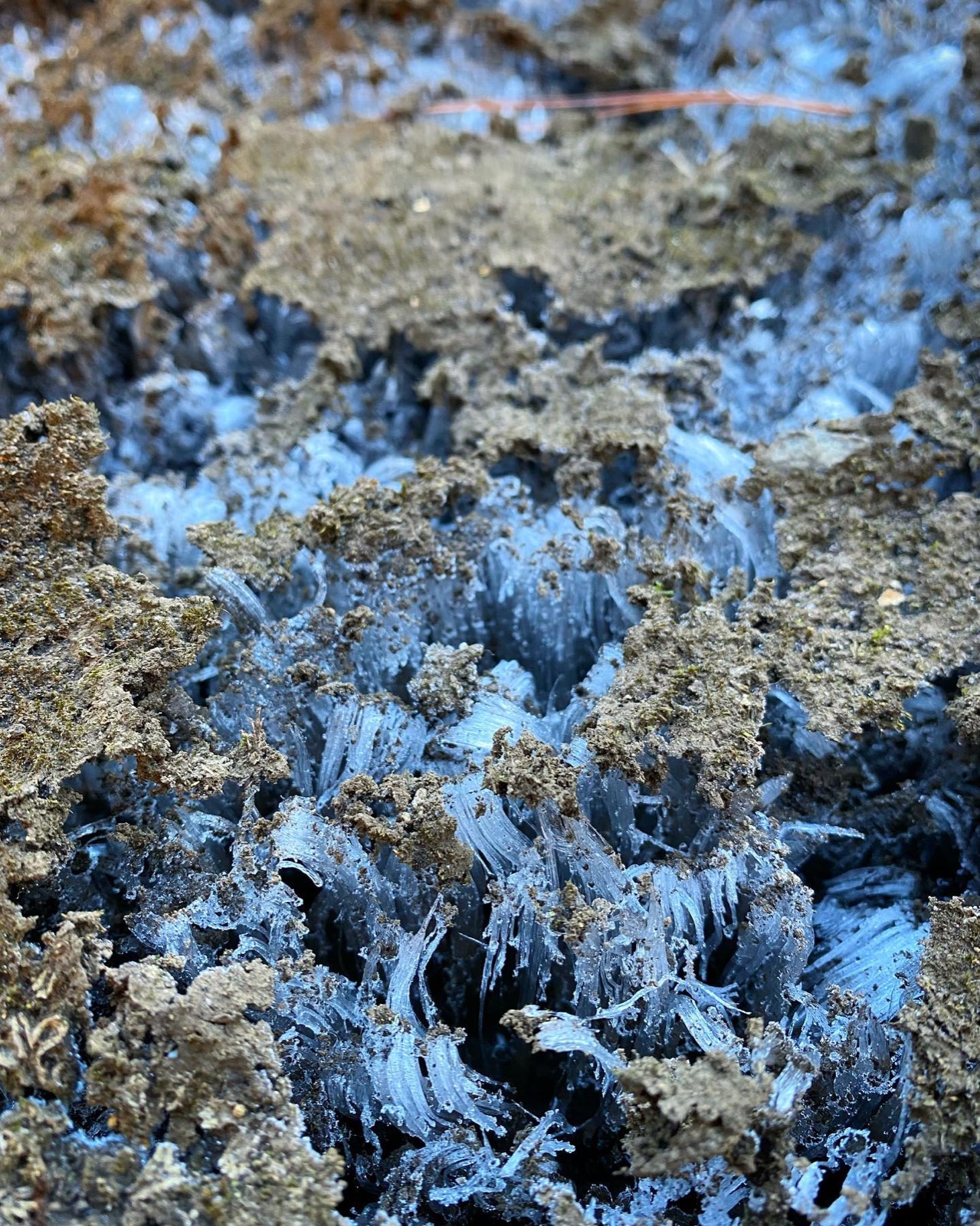
Not every soil grows frost needles equally well. The same Yamaguchi University piece says they form easily in soil where fine particles are mixed with slightly larger ones. A paper published by the Japanese Geomorphological Union names the Kantō loam (関東ローム) as a soil whose internal structure suits capillary rise and therefore frost-needle growth.
What lifting does to a plant
Iowa State University Extension explains the same problem from the gardener’s side. Repeated freezing and thawing of soil in winter can push some perennials out of the ground, and shallow-rooted plants are among the most likely to be heaved. Heaving, it says, “exposes the plant’s crown and roots to cold, dry air.”
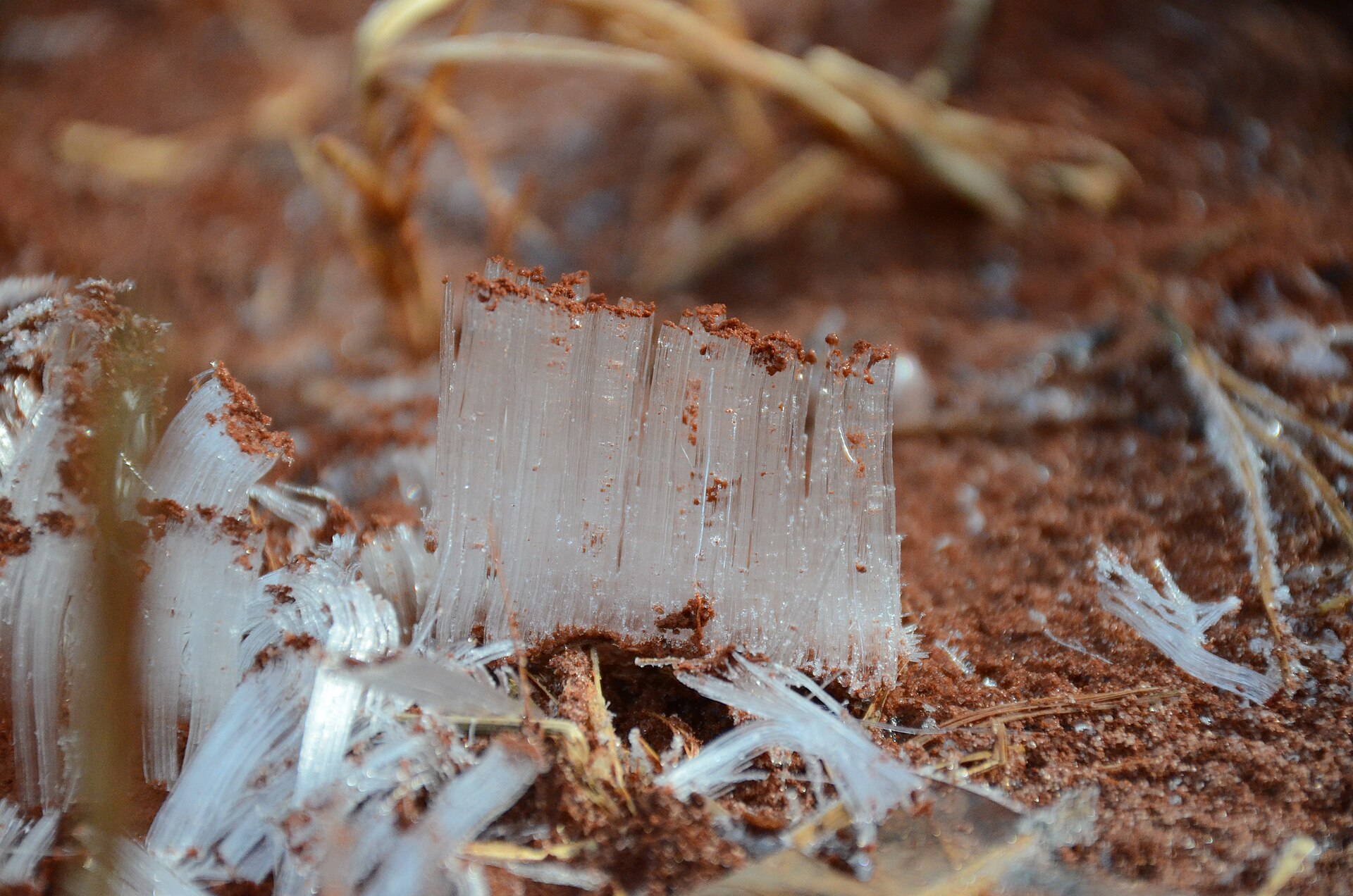
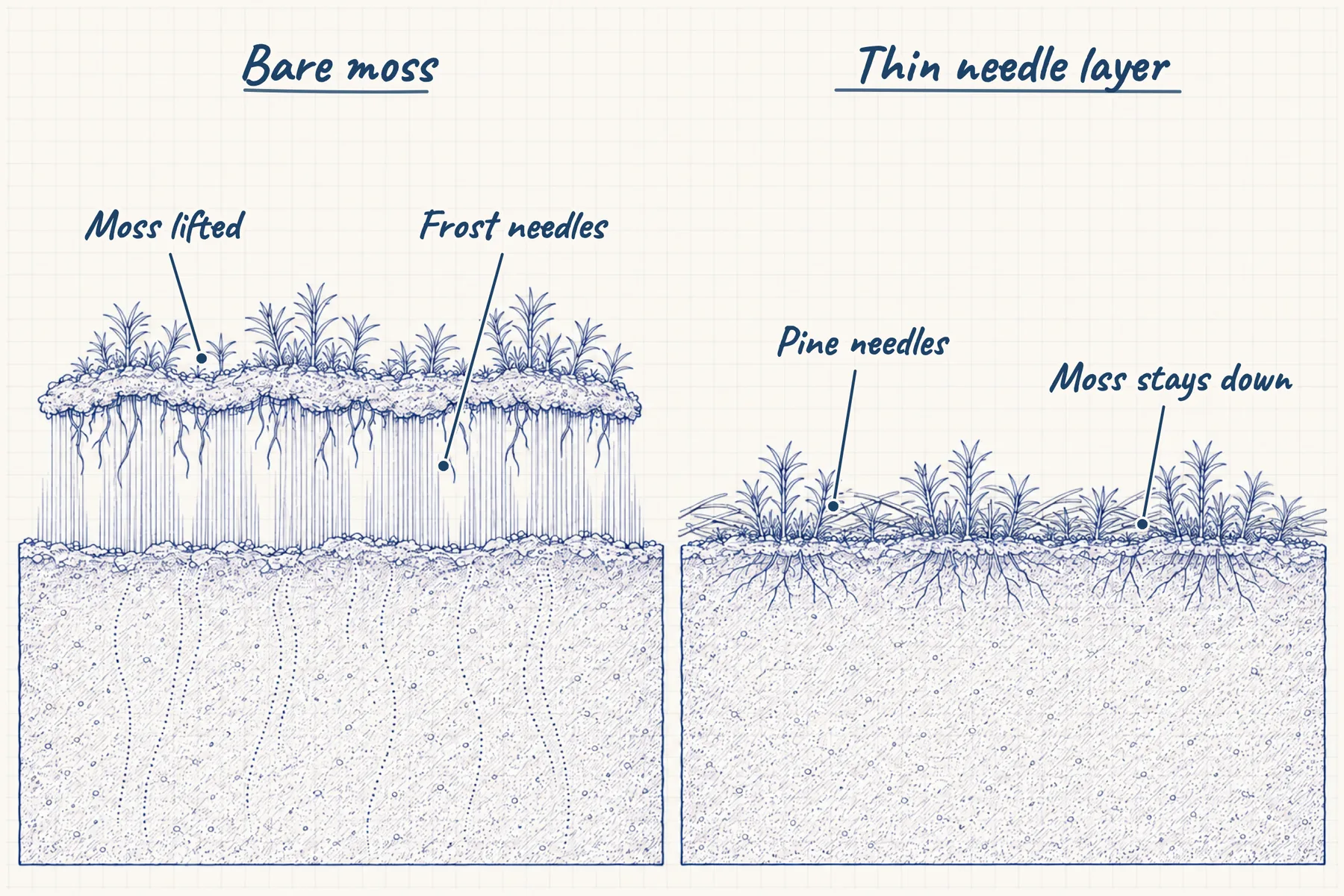
A Japanese garden specification published in 2024 by the Kyoto International Conference Center states the risk plainly for its sugigoke (杉苔, haircap moss): the moss has to be protected from “being lifted from the base by frost needles” and from “drying by cold wind.” Its answer to both is a covering of pine needles.
What freezing does to moss cells
Laboratory work on moss adds a detail. A 2005 study on the moss Physcomitrella patens found that its protonemal cells became more tolerant of freezing after exposure to low temperatures between 10 °C and 0 °C (50 °F to 32 °F), with the greatest tolerance after several days at 0 °C. A 2010 study on Ceratodon purpureus found that ice forming outside the moss cells drew water out of them, and that in winter-acclimated plants, chlorophyll fluorescence measurements showed no evidence of damage after thawing from −20 °C (−4 °F).
These are two species in the laboratory, not the mosses of a Kyoto temple. They suggest that freezing alone is not necessarily fatal to every moss, and that drying is part of how ice harms it. The garden specification above names lifting and drying as the threats a cover is meant to reduce.
| Winter threat | What happens | What a needle layer changes |
|---|---|---|
| Frost needles (shimobashira) | Ice columns grow from below and lift the moss | A straw-mulch study (not pine needles) recorded fewer frost needles |
| Repeated freeze and thaw | Plants are pushed up, exposing their base | Covers the surface to help reduce frost-heave damage (the aim stated in the Kyoto specification) |
| Cold, dry wind | Exposed moss and bare soil dry out | Covers the ground surface |
| A bare winter garden | Little colour or texture | Adds a warm brown layer that reads as winter |
What a mulch does to the ground temperature
There is no study, as far as I could find, that measured frost needles under a pine-needle layer in a Japanese garden. The closest field evidence comes from mountain revegetation work. The Tateyama Route Revegetation Research Committee, in its fourth report, recorded that on clear March days when frost needles formed, the ground-surface temperature under straw mulching was 3 to 5 °C (about 5 to 9 °F) higher than the air temperature; the report does not say how that compares with bare ground. It also reported that the mulch reduced frost needles and prevented frost-heave damage.
Straw is not pine needles, and an alpine slope is not a temple courtyard, but the result suggests a possible mechanism: a loose cover changes conditions at the surface, where frost needles start.
Kyoto’s winter in numbers — mild, but not frost-free
Eighteen days a year below zero
According to the Japan Meteorological Agency’s normals for 1991–2020, the mean daily minimum in Kyoto is 3.5 °C (38.3 °F) in December, 1.5 °C (34.7 °F) in January and 1.6 °C (34.9 °F) in February. On average, the minimum falls below 0 °C on 18.0 days a year.
These are averages for the city, not ground temperatures in a garden. But they show that Kyoto’s winter regularly reaches the freezing point, and wherever the ground surface freezes and moist soil supplies water, frost needles can form.
Different winter care in Kyoto’s moss gardens
Kyoto’s temple gardens are also among the best-known moss gardens in Japan. Our article on why Japanese temples grow moss instead of lawn follows the daily sweeping, weeding and repair that keep that moss alive through the rest of the year. Winter care is not identical in every garden. Saihō-ji, the “moss temple”, described in a Kyoto Prefecture leaflet a different approach: in winter its gardeners leave fallen leaves on the moss and let it rest until spring. Shiki-matsuba is one answer to the same season, not the only one.
Shōsei-en — when pine needles become a lakeshore
A pine grove by Ingetsu Pond
Shōsei-en is a garden belonging to Higashi Honganji in Kyoto. On the banks of its pond, Ingetsu-ike, stands a grove of black pines (Pinus thunbergii). The temple’s own guide to the garden’s plants says that pine needles are spread on the ground in this pine-grove area to create the look of a seaside. A Kyoto Prefecture document on garden management describes the same scene as likening the pond’s edge to a natural lakeshore.
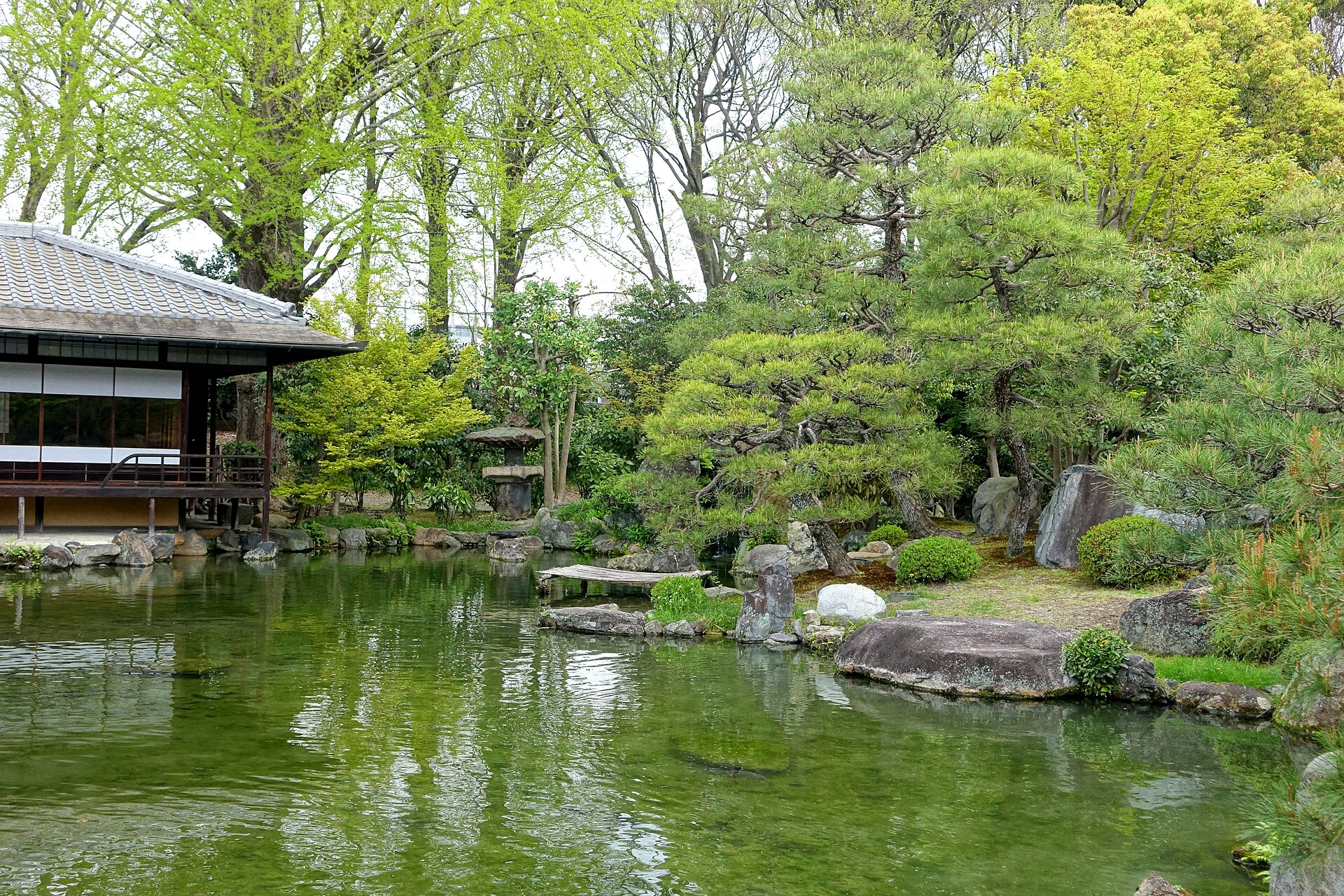
Here, in the official description, shiki-matsuba is about scenery rather than frost: the needles turn the ground into a pine-strewn shore, and the pond becomes the sea.
What the gardeners wrote
In 2024 the gardeners who manage Shōsei-en, from Ueyakato Landscape, published a practice report through JILA. They write that shiki-matsuba is laid in the black pine grove on the shore of Ingetsu-ike as part of the maintenance work carried out towards the new year, and the photograph that accompanies it was taken in January 2024.
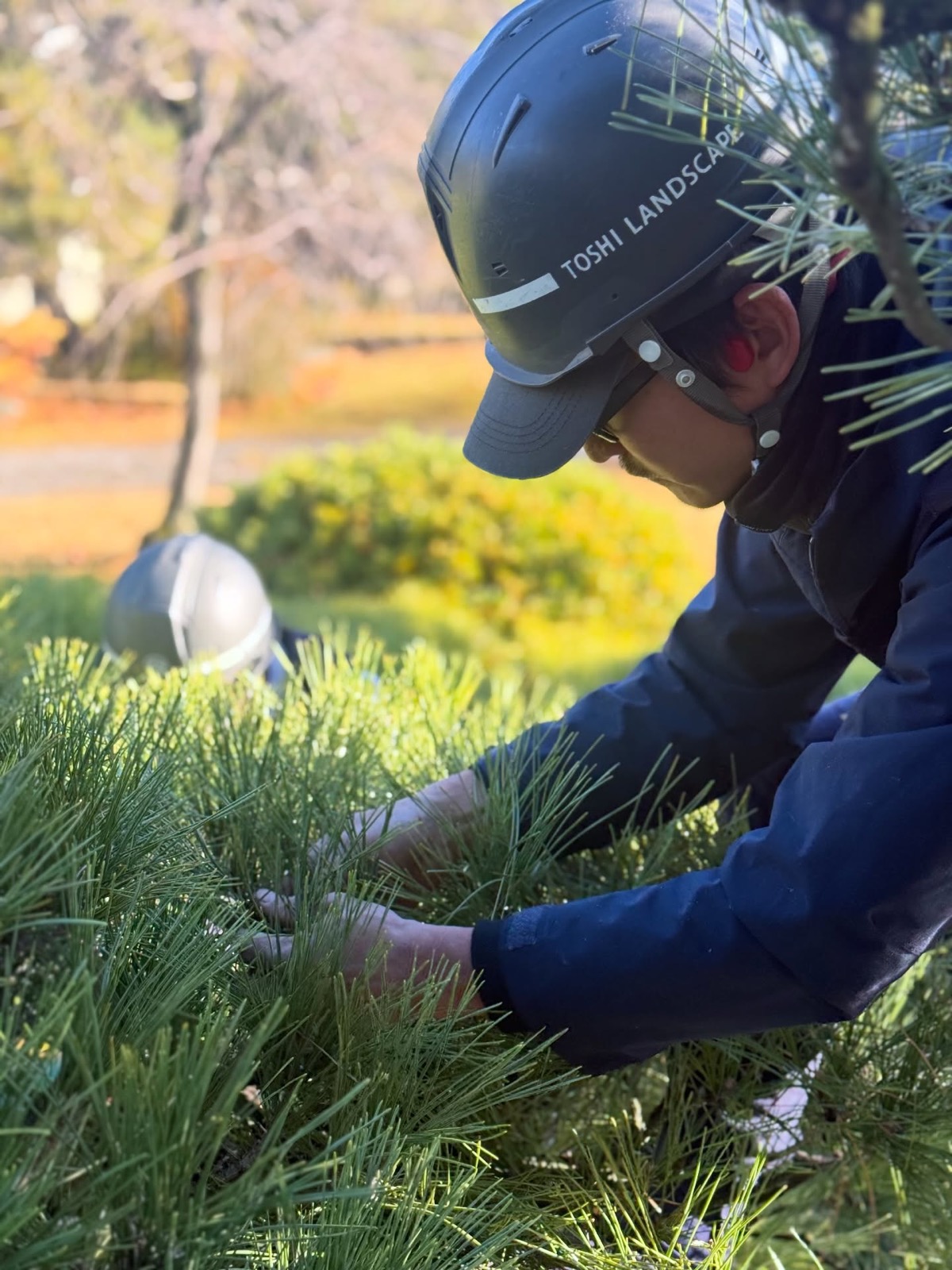
The report explains that traditional shiki-matsuba is a winter arrangement made with needles obtained from hamushiri (葉むしり), the removal of needles by hand during pine maintenance. Then it lists the management aims they attach to it in the pine grove:
– suppressing undergrowth, – controlling bacteria, and – slightly acidifying the soil through organic acids from the needles, which the authors expect to benefit the vigour of the black pines.
The same report records that, in recent years, the ground under the pine grove has changed from grassland to moss.
The tea garden — a carpet that grows and shrinks
The new year of tea
To understand why shiki-matsuba became a decoration, you have to look at the calendar of the tea ceremony. Omotesenke, one of the main schools of tea, explains on its official site that the season of the ro (炉, sunken hearth) runs from November to April. It describes early November, around rittō (立冬, the start of winter, about 7 or 8 November in the present calendar), as the beginning of the new year in tea, when kuchikiri (口切, opening the jar of new tea) and kairo (開炉, opening the hearth) fall in the same season.
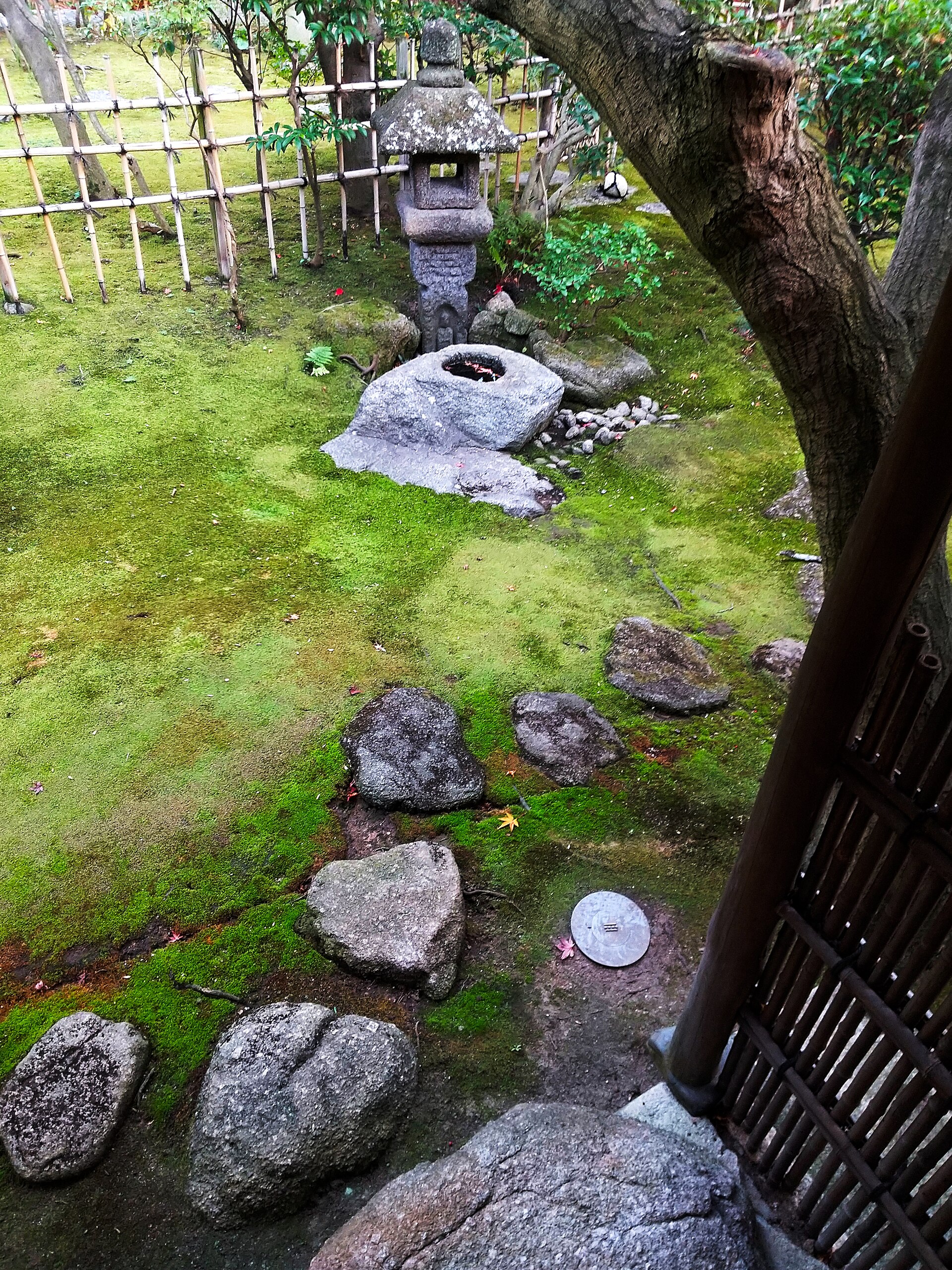
The roji, the garden a guest walks through to reach the tea room, follows the same turn of the year. The Nara institute defines roji as an alternative name for chaniwa (茶庭, tea garden), the space between the waiting room and the tearoom.
Brown needles, laid a little at a time
A 2006 TV Asahi feature on Omotesenke described the custom in more detail. When December comes, it said, shiki-matsuba is placed in the roji. The needles are steamed until they turn brown. At first only a little is laid; the amount is increased as winter deepens and reduced again as spring approaches, so that the guest feels “the deepening of winter and the coming of spring” through the needles underfoot.
Omotesenke’s own guide to its roji adds the other end of the season. In spring, it says, the pine needles laid in the roji are lifted a little at a time, and it is said that the very last of them are left in the chiri-ana (塵穴), the dust pit to the left of the outer waiting bench. A photograph on another page of the same guide shows needles spread at the foot of a pine.
How shiki-matsuba is laid — the gardener’s steps
Choosing the needles
The JILA technique report names two materials: akamatsu (アカマツ, Japanese red pine, Pinus densiflora) and kuromatsu (クロマツ, Japanese black pine). It recommends red pine for its bright colour, its soft appearance and because it is easier to lay. The needles should be free of pests and diseases, and the report notes that they are bought from suppliers, while also warning that good-quality material has become scarce.
Not every garden buys. The Kyoto International Conference Center specification asks its contractor to reuse fallen pine needles from the site. Koishikawa Kōrakuen in Tokyo, in a 2019 newsletter, wrote that the needles laid at the foot of its winter arrangement had been gathered little by little in the early morning inside the garden. At Yanaka-no-Mori, which records its garden work online, participants in its Tsukubane-gaku course picked up needles fallen from a daiō-matsu (大王松) in the back garden in January 2021 and sorted out the straightest and cleanest ones.
Laying, step by step
| Step | What the gardener does | Why |
|---|---|---|
| 1. Prepare | Gather needles free of pests and diseases; red or black pine | Clean material; red pine lays easily and looks soft |
| 2. Estimate | Allow roughly one bale (俵, hyō) for every one and a half tsubo, about 5 m² (53 sq ft) | A rough guide to the amount, not a measured thickness |
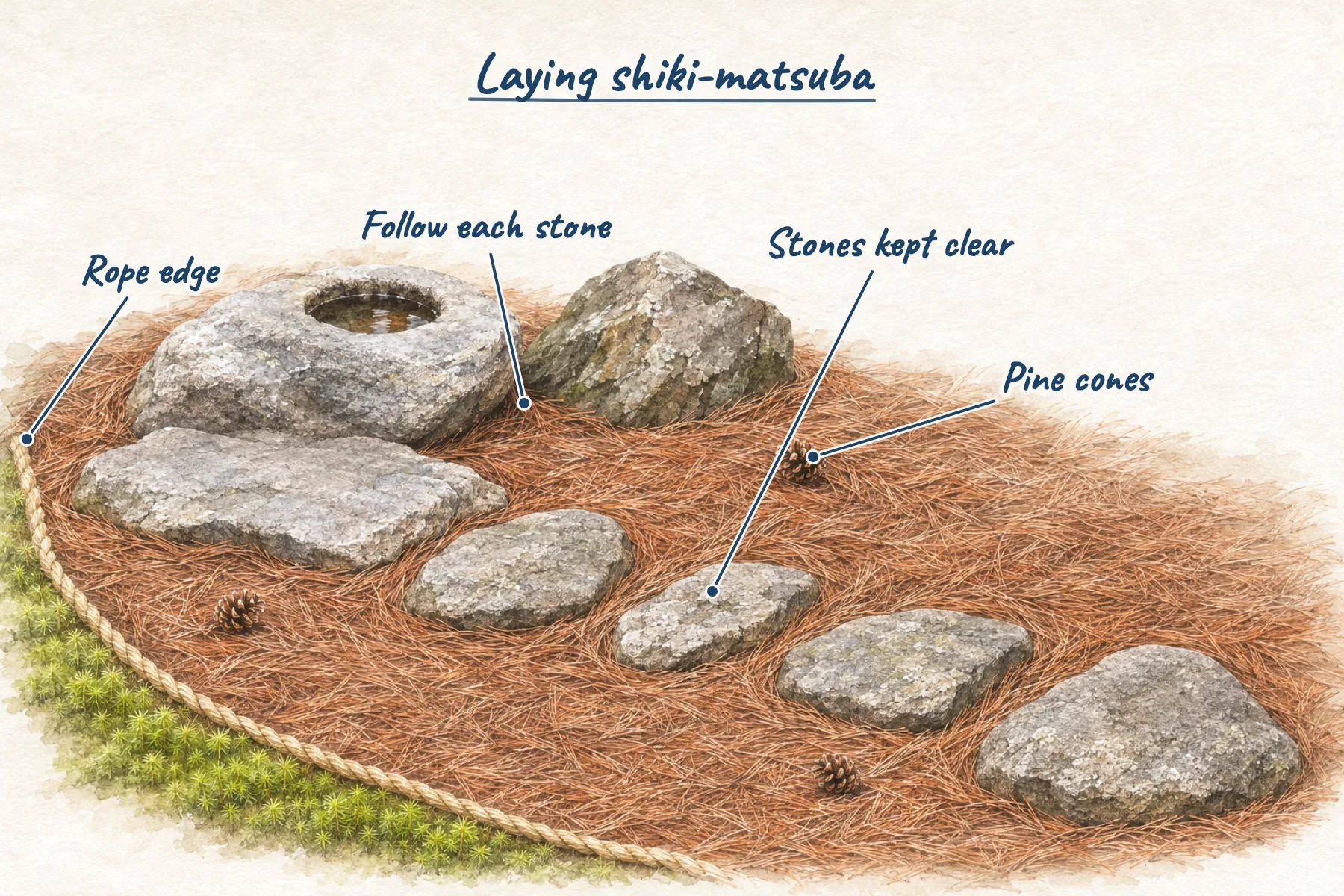
| 3. Edge (optional) | Some gardens frame the edge with braided rope | A clean border to the covered area |
| 4. Lay | Spread the needles around the tsukubai (water basin), landscape stones and large trees with particular care; follow the shapes of objects and the ground so the layer reads like a pattern | As described in the JILA report |
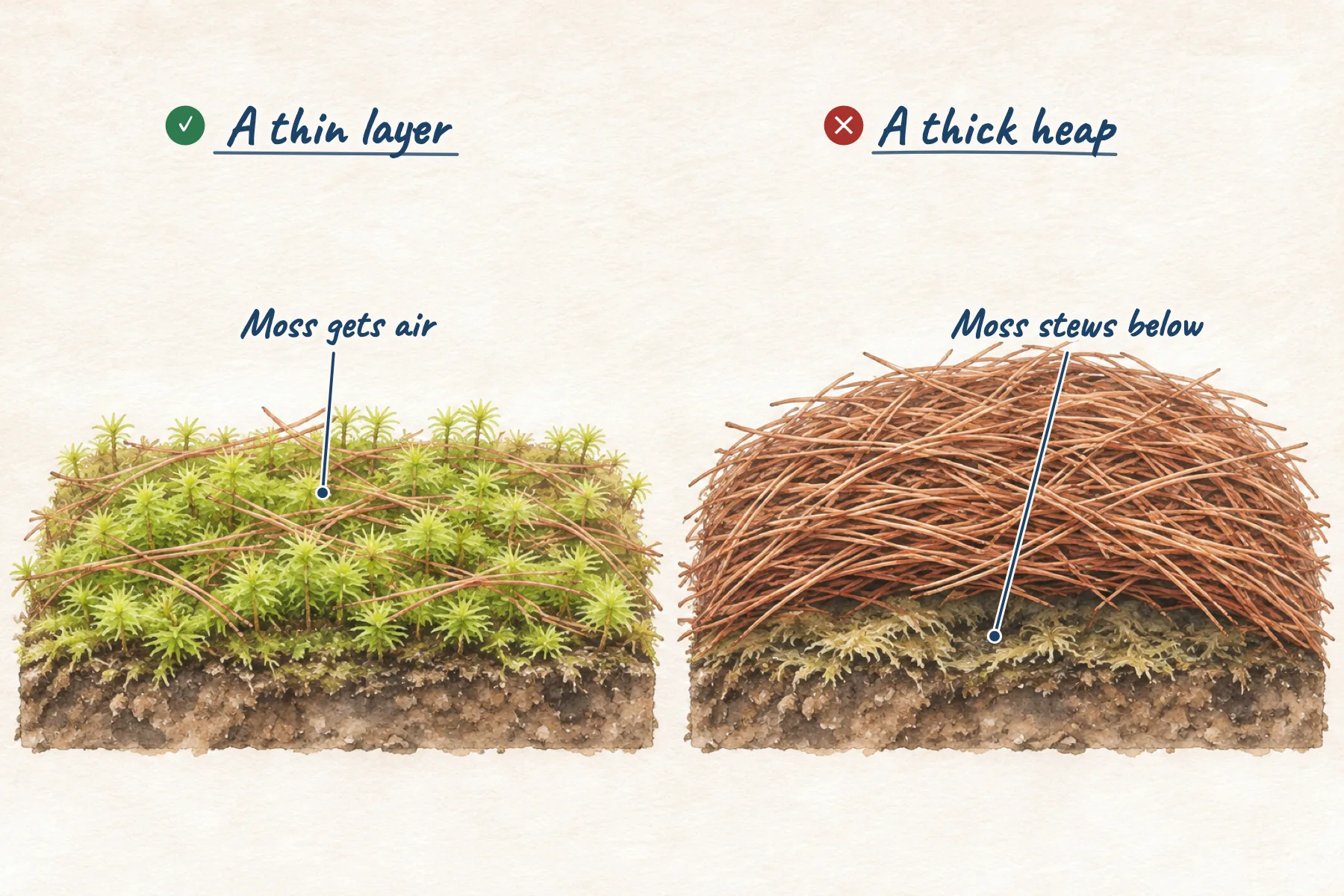
| 5. Keep it thin on moss | Do not lay too thickly where there is moss | A thick layer makes the moss stew |
| 6. Keep paths walkable | Around stepping stones, lay so walking is not hindered | The garden still has to be used |
| 7. Decorate | Place pine cones, called kankoro, here and there | A finishing touch |
| 8. Settle | Pat the whole surface by hand, then water with a watering can | Loose needles tighten and settle |
Source: JILA, FY2024 research report, entry 180 “Shiki-matsuba technique”.
Patterns as well as cover
Shiki-matsuba is meant to be seen. At Yanaka-no-Mori, a 2019 class made it in two hours by laying the needles alternately vertical and horizontal to form a checkerboard, ichimatsu (市松). That is an extreme version, more like a textile than a mulch, but it shows how far the visual side of the practice can go.
The finishing water
Why water a winter mulch? The JILA report explains that watering with a can makes the loose needles “tighten up” and settle into place. Separately, University of Florida extension notes that pine straw is not easily washed away because the needles knit together.
Where the needles come from — from forest fuel to garden material
A forest floor once raked for fuel
For a long time, pine needles in Japan were not waste. The Japan Science and Technology Agency’s article on red pine and matsutake mushrooms notes that people raked up the fallen needles in pine forests for many years and used them as fuel and fertiliser. A 2017 study by Kikuchi Keiko of Tohoku Gakuin University records that in Kitakama, in Natori, Miyagi Prefecture, villagers continued matsuba-sarai (松葉さらい), the gathering of dead pine needles, in the black pine coastal forest until around 1970, using them as fuel for cooking and for the goemon-buro, a traditional iron bath.
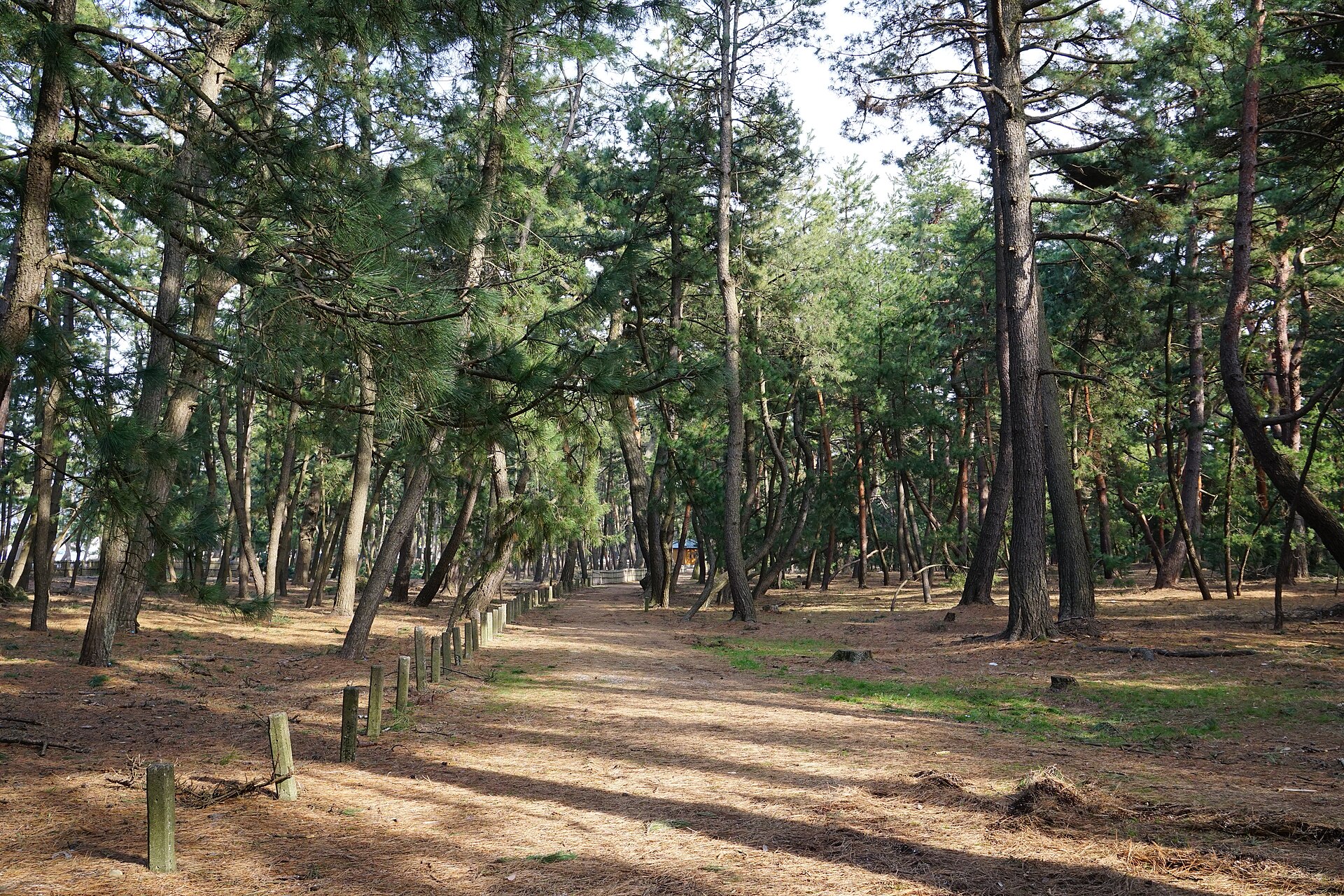
The Kinki-Chugoku Regional Forest Office of the Forestry Agency has also reported a needle-raking day at Kehi-no-Matsubara, a pine forest in Fukui, where the needles collected filled 150 bags and, it said, would be reused as fertiliser.
Where the needles come from today
Today the JILA report warns that good-quality material for shiki-matsuba has become scarce, and some gardens, such as Koishikawa Kōrakuen and the conference center, gather needles from their own grounds.
Gardens where shiki-matsuba is documented
Shiki-matsuba is associated with Kyoto, but it is also documented in gardens elsewhere. The table below lists only the gardens where an official page, a garden newsletter, a report or a newspaper confirms the practice. The year in brackets is the year of the source, not a promise that the same work is done in the same way every winter.
| Garden | Place or operator | When (as reported) | Stated purpose or context | Source |
|---|---|---|---|---|
| Kōhō-an, Daitoku-ji | Kyoto | Winter (2022) | Care of moss and soil | Kyoto Shimbun |
| Shōsei-en, Higashi Honganji | Kyoto | Maintenance towards the new year (photo January 2024) | Seaside scenery; undergrowth control; soil | Higashi Honganji; JILA practice report |
| Hōshō-an tea house, Kyoto International Conference Center | Kyoto | Winter (2024 specification) | Prevent frost lifting and drying by cold wind | Garden management specification |
| Omotesenke roji | Kyoto | From December (2006 TV report); lifted gradually in spring (Omotesenke) | A sign of the season | TV Asahi; Omotesenke |
| Isuien | Nara | Listed among December’s highlights | Not stated | Isuien official site |
| Koishikawa Kōrakuen | Tokyo | Scheduled for completion around 15 December (2019) | Not stated (part of a winter arrangement) | Tokyo Metropolitan Park Association |
| Kantenpapa Garden | Operated by Ina Food Industry | Winter (2022 report) | Prevent frost, protect moss | Company CSR report |
| Yanaka-no-Mori | Not stated in the cited record | 29 November (2019) | Purpose not stated; made during a garden course | Yanaka-no-Mori |
| Portland Japanese Garden | Oregon, USA | Winter (2026 article) | Protect moss from frost | Portland Japanese Garden |
The Hōshō-an specification is the clearest technical statement I found. In June 2024 the conference center invited tenders for its garden maintenance; for the area around its tea house it lists 68.4 m² (about 736 sq ft) of sugigoke and instructs the contractor to reuse fallen pine needles as shiki-matsuba. It is the custom written as a contract clause.
Pine straw in the American South — the same material, a different job
A common mulch
Readers in the southeastern United States will already know pine needles as a mulch. University of Florida extension describes pine straw as “widely used throughout the Southeast.” UF/IFAS adds that longleaf and slash pines are favoured for commercial production because their long needles bale well. North Carolina State University’s Extension Gardener Handbook notes that pine straw lets water and air pass into the soil easily.

On one property, extension sources disagree. Iowa State University calls pine-needle mulch “light, airy, slow to decompose”, while Virginia Cooperative Extension writes that pine needles “decompose quickly.” The difference probably depends on species, climate and what the needles are compared with, but I could not find a study that tested this under matching conditions, so I would not quote either as a rule.
Winter mulch against heaving
The idea of using a loose cover to stop frost lifting plants is also familiar in American gardening advice. Iowa State University recommends that perennials planted in late summer or early autumn be mulched in late autumn with “straw or pine needles” to reduce heaving. Its guide to perennial beds suggests about 4 inches (10 cm) of mulch, applied after the ground freezes, where extra protection is needed, and removing the excess as soon as the top layer thaws in spring.
| Shiki-matsuba (Japanese gardens) | Pine straw (US Southeast) | Winter mulch (US Midwest advice) | |
|---|---|---|---|
| Main material | Red or black pine needles | Longleaf or slash pine needles | Straw or pine needles, among others |
| Main purpose | Frost and drying protection for moss; winter scenery | General landscape mulch | Reducing frost heaving of perennials |
| Thickness | Thin over moss, so it does not stew | — | About 4 inches (10 cm) where needed |
| Timing | Winter to spring; Omotesenke from December | Not specified in the cited extracts | After the ground freezes; removed when the top layer thaws |
| What the cited sources describe | Protection plus seasonal display; pattern, edging, pine cones | Use and properties as mulch | Protection against heaving |
A Japanese garden in Oregon
The custom has also travelled with Japanese gardens themselves. In a February 2026 article on moss, the Portland Japanese Garden explained that its Garden Department places coverings of dried pine needles on the moss in winter to help protect it from frost, and called this shiki-matsuba. A photograph in the same article shows shiki-matsuba in the garden’s Flat Garden.
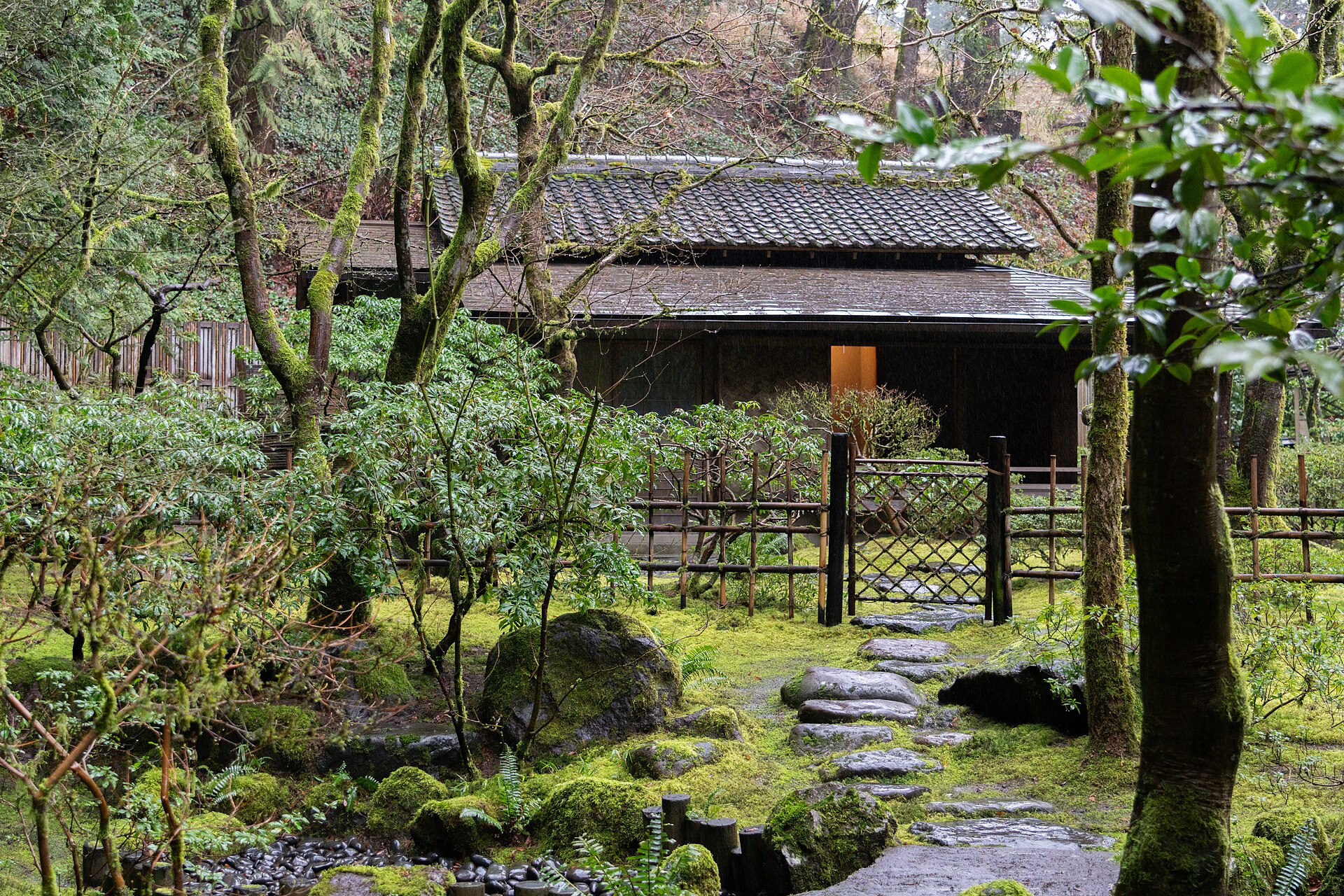
So the difference is not that one country uses pine needles and the other does not. The American extension sources cited here describe protection and mulch properties; the Japanese sources also describe a seasonal display, with the layer kept thin over moss, shaped around stones and the water basin, finished with pine cones and watered so it lies flat. The comparison here is with North America only; I did not look for European sources. Japanese winter garden work often pairs function with display; we saw the same pairing of function and display in yukitsuri, the snow ropes tied over garden pines, and in komomaki, the straw belts wrapped around pine trunks.
Judging the layer — thickness, timing and lifting
How thick
The JILA report sets the limit with two warnings: do not lay the needles too thickly over moss, because the moss will stew, and do not pile them around stepping stones so that walking becomes awkward. Its quantity, about one bale for every one and a half tsubo, is a local measure; the report does not give the weight of a bale. The Iowa figure of about 4 inches is a recommendation for perennials, not a specification for covering moss.
When to lay and when to lift
The sources describe a range rather than a date. Omotesenke’s roji received its needles from December in the 2006 feature; Koishikawa Kōrakuen’s winter arrangement was due around 15 December 2019; Shōsei-en lays them during maintenance towards the new year; the haiku almanac places shiki-matsuba in early winter. No source I found gives a single starting month for all gardens.
At Omotesenke, lifting is gradual: the needles are lifted a little at a time in spring, and the 2006 TV Asahi feature describes the layer thinning as spring approaches. Iowa’s separate advice for perennials is to remove excess winter mulch once the top layer of soil thaws. I found no published lifting dates for Kōhō-an, Shōsei-en, Isuien, Koishikawa Kōrakuen or Portland, so I have not given a month.
Common misunderstandings about shiki-matsuba
“It keeps the moss warm”
Warmth alone does not explain the practice. The Japanese sources give a more specific reason: frost needles lifting the moss and dry wind drying it. And the JILA report warns against laying it too thickly over moss, because the moss will stew.
“It is only for show”
The decorative role is real, but the conference center specification and the Kantenpapa Garden report both still give protection of moss as the reason. Display and protection are not alternatives.
“Any pine needles will do”
The JILA report specifies red or black pine free of pests and diseases. The Yanaka-no-Mori participants sorted their daiō-matsu needles for straightness and cleanliness. The 2006 feature on Omotesenke described needles steamed brown. Each source sets its own standard, but none treats any litter as good enough.
“It is an ancient, unchanged custom”
I could not confirm when shiki-matsuba began. In this research I was unable to check a passage in the Edo-period haikai handbook Kefukigusa (毛吹草) or other early texts, so I make no claim about its first appearance. What the sources do show is that the practice keeps changing: JILA notes that its meaning has shifted from protection towards scenery, and Shōsei-en’s gardeners describe new aims such as undergrowth control and soil acidity.
What the brown layer means
Return to the Kōhō-an garden the Kyoto Shimbun described, and the carpet of needles reads differently. The newspaper gave its purpose as the care of the moss and the soil; the Japanese sources suggest what that care means, a soil that rises on frosty nights and a wind that dries what it uncovers. In tea gardens it is also the calendar’s sign that the year has turned. And, in a country where pine needles were once raked for fuel, it is a material that gardens now buy, gather by hand at dawn, or save from their own trees.
In winter, look at the ground under the pines and around the water basins: where the needles lie thin and tidy, someone has decided how much the moss can bear and how much the guest should see. If you are visiting in autumn instead, our piece on the work behind Kyoto’s maple gardens describes autumn maintenance in Kyoto’s gardens.
Frequently asked questions
What is shiki-matsuba?
Shiki-matsuba (敷松葉) is the Japanese garden practice of covering the ground, usually moss, with dried pine needles in winter. The Nara National Research Institute for Cultural Properties defines it as covering the ground with withered pine needles to stop it drying out in winter, and notes that in tea gardens it is also a seasonal decoration.
Why do Japanese gardens put pine needles on moss?
To help protect the moss from being lifted by frost needles (shimobashira) and from drying in cold wind, and, in tea gardens, to show that winter has begun.
When is shiki-matsuba laid and removed?
In winter, but dates vary by garden. A 2006 TV report described Omotesenke’s roji receiving the needles from December, and Omotesenke describes lifting them a little at a time in spring. Shōsei-en lays them during maintenance towards the new year.
Which pine needles are used?
The Japanese Institute of Landscape Architecture names Japanese red pine and Japanese black pine, and prefers red pine for its colour, soft look and ease of laying. Needles should be free of pests and diseases.
Is it the same as pine straw mulch?
The material is similar. The extension sources cited here describe pine straw in the US Southeast as a widely used mulch. Shiki-matsuba, as the Japanese sources describe it, is laid thinly over moss for winter, shaped around stones and water basins, and in the examples cited, finished with pine cones and lifted gradually in spring.
Where can I see shiki-matsuba outside Japan?
The Portland Japanese Garden in Oregon has described laying shiki-matsuba over its moss in winter, including in its Flat Garden.
Sources
– Nara National Research Institute for Cultural Properties, Japanese Garden Dictionary, “Pine-needle covering” (checked 2026-11-17): https://www.nabunken.go.jp/org/bunka/jgd/pages/PineNeedleCovering.html – Nara National Research Institute for Cultural Properties, Japanese Garden Dictionary, “Roji” (checked 2026-11-17): https://www.nabunken.go.jp/org/bunka/jgd/pages/TeaGarden_roji.html – Kigo to Saijiki, “Shiki-matsuba” (Japanese; checked 2026-11-17): https://kigosai.sub.jp/001/archives/8978 – Japanese Institute of Landscape Architecture, FY2024 research report on Japanese garden techniques, entry 180 (Japanese; checked 2026-11-17): https://researchpromotion.jila-zouen.org/wp-content/uploads/2025/05/2024_nihonteien_seikahoukoku.pdf – Kyoto Shimbun (official note), Kōhō-an, 5 February 2022 (Japanese; checked 2026-11-17): https://note.com/kyotoshimbun/n/n1505c308f91c – Higashi Honganji, Plants of Shōsei-en (Japanese; checked 2026-11-17): https://www.higashihonganji.or.jp/about/guide/shoseien/green/ – Japanese Institute of Landscape Architecture, practice report on the management of Shōsei-en (Japanese; checked 2026-11-17): https://www.jstage.jst.go.jp/article/jilatech/3/0/3_16/_pdf/-char/ja – Kyoto Prefecture, garden management case material (Japanese; checked 2026-11-17): https://www.pref.kyoto.jp/biodic/news/documents/04.pdf – Kyoto International Conference Center, garden maintenance specification, June 2024 (Japanese; checked 2026-11-17): https://www.icckyoto.or.jp/wp-content/uploads/2024/06/proposal20240621_03-1.pdf – Omotesenke, The tea gatherings of Omotesenke (Japanese; checked 2026-11-17): https://www.omotesenke.jp/chanoyu/7_11_1a.html – Omotesenke Fushin-an, Seasons of tea (Japanese; checked 2026-11-17): https://www.omotesenke.jp/list5/list5-2/list5-2-3/ – Omotesenke, roji guide, “From the outer waiting bench” (Japanese; checked 2026-11-17): https://www.omotesenke.jp/chanoyu/7_7_7c.html – Omotesenke, roji guide, “To the middle roji” (Japanese; checked 2026-11-17): https://www.omotesenke.jp/chanoyu/7_7_16b.html – TV Asahi, “Omotesenke”, 1 December 2006 (Japanese; checked 2026-11-17): https://www.tv-asahi.co.jp/miyako/2006/11/27_01/fryday.html – Isuien, The garden (Japanese; checked 2026-11-17): https://www.isuien.or.jp/garden – Tokyo Metropolitan Park Association, Koishikawa Kōrakuen newsletter no. 104 (Japanese; checked 2026-11-17): https://www.tokyo-park.or.jp/park/koishikawakorakuen/assets/kawaraban/kawara104.pdf – Ina Food Industry, CSR Report 2022 (Japanese; checked 2026-11-17): https://kantenpp.co.jp/wp-content/themes/kantenpapa_corp/csr/csrreport.pdf – Yanaka-no-Mori, shiki-matsuba completed, 2019 (Japanese; checked 2026-11-17): https://www.yanakanomori.org/?p=6925 – Yanaka-no-Mori, gathering pine needles, 2021 (Japanese; checked 2026-11-17): https://www.yanakanomori.org/?p=7826 – Yamaguchi University, Academi-Q no. 14 (Japanese; checked 2026-11-17): https://www.yamaguchi-u.ac.jp/info/academi-q/back_number/academiq_no14/index.html – Japanese Geomorphological Union paper on the Tamagawa Aqueduct slopes, via the National Diet Library (Japanese; checked 2026-11-17): https://dl.ndl.go.jp/view/prepareDownload?contentNo=1&itemId=info%3Andljp%2Fpid%2F10808320 – Tateyama Route Revegetation Research Committee, Report no. 4 (Japanese; checked 2026-11-17): https://tkk.alpen-route.co.jp/wp/wp-content/themes/tkk002/pdf/ryokuka4.pdf – Japan Meteorological Agency, Kyoto climate normals 1991–2020 (Japanese; checked 2026-11-17): https://www.data.jma.go.jp/stats/etrn/view/nml_sfc_ym.php?block_no=47759&day=&month=&prec_no=61&view=a2&year=1938 – Minami et al., Planta, 2005 (checked 2026-11-17): https://pubmed.ncbi.nlm.nih.gov/15349781/ – Lenné et al., Plant, Cell & Environment, 2010 (checked 2026-11-17): https://onlinelibrary.wiley.com/doi/10.1111/j.1365-3040.2010.02178.x – Kyoto Prefecture, moss leaflet (Japanese; checked 2026-11-17): https://www.pref.kyoto.jp/kankyo/documents/kokepamphlet.pdf – Japan Science and Technology Agency, “Red pine and matsutake” (Japanese; checked 2026-11-17): https://scienceteam.jst.go.jp/student/science-reading-material/w55_2014/ – Forestry Agency, Kinki-Chugoku Regional Forest Office, needle raking at Kehi-no-Matsubara (Japanese; checked 2026-11-17): https://www.rinya.maff.go.jp/kinki/fukui/information/261116_matubakaki.html – Kikuchi Keiko, history of coastal forest planting on Sendai Bay, Tohoku Gakuin University, 2017 (Japanese; checked 2026-11-17): https://www.tohoku-gakuin.ac.jp/research/journal/bk2017/pdf/no03_02.pdf – Iowa State University Extension, perennials heaved out of the ground in winter (checked 2026-11-17): https://yardandgarden.extension.iastate.edu/faq/which-perennials-are-most-likely-be-heaved-out-ground-winter – Iowa State University Extension, How to maintain perennial beds and borders (checked 2026-11-17): https://yardandgarden.extension.iastate.edu/how-to/how-maintain-perennial-beds-and-borders – Iowa State University Extension, Using mulch in the garden (checked 2026-11-17): https://yardandgarden.extension.iastate.edu/how-to/using-mulch-garden – Virginia Cooperative Extension, SPES-661 (checked 2026-11-17): https://ext.vt.edu/content/pubs_ext_vt_edu/en/SPES/spes-661/spes-661.html – NC State Extension, Extension Gardener Handbook, Herbaceous Ornamentals (checked 2026-11-17): https://content.ces.ncsu.edu/extension-gardener-handbook/10-herbaceous-ornamentals – University of Florida IFAS, Mulch (checked 2026-11-17): https://gardeningsolutions.ifas.ufl.edu/care/planting/mulch/ – UF/IFAS Extension Santa Rosa County, Mulch in Northwest Florida Landscapes, 10 September 2026 (checked 2026-11-17): https://blogs.ifas.ufl.edu/santarosaco/2026/09/10/mulch-in-northwest-florida-landscapes/ – UF/IFAS, Guide to Fertilization for Pine Straw Production, FR395 (checked 2026-11-17): https://ask.ifas.ufl.edu/publication/FR395 – Royal Botanic Gardens, Kew, Plants of the World Online, Pinus thunbergii (checked 2026-11-17): https://powo.science.kew.org/taxon/urn%3Alsid%3Aipni.org%3Anames%3A263377-1/general-information – Royal Botanic Gardens, Kew, Plants of the World Online, Pinus densiflora (checked 2026-11-17): https://powo.science.kew.org/taxon/urn%3Alsid%3Aipni.org%3Anames%3A262894-1/general-information – Portland Japanese Garden, “Moss”, 5 February 2026 (checked 2026-11-17): https://japanesegarden.org/2026/02/05/moss/