

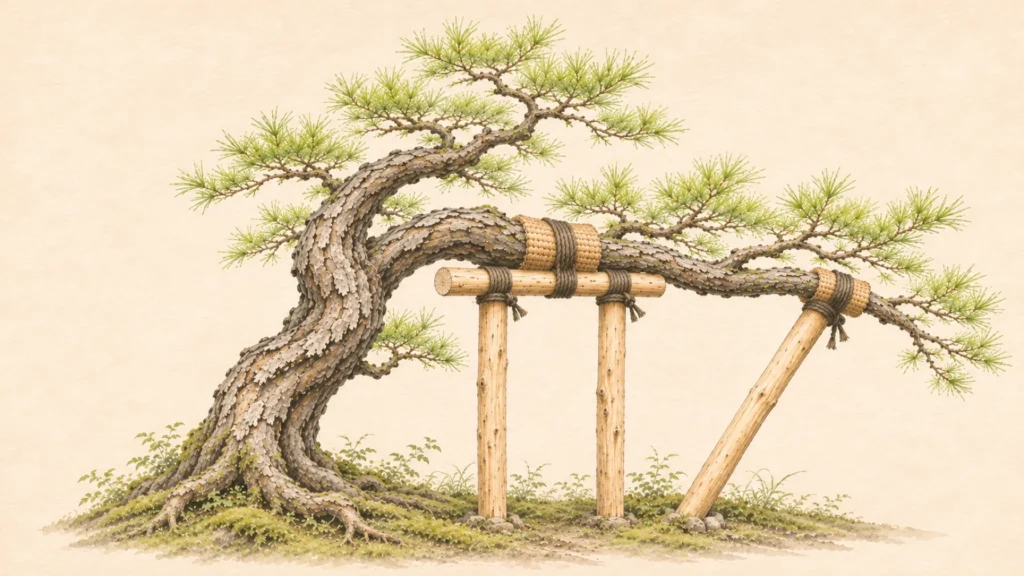
Japanese garden pines lean on wooden crutches because their long, low limbs are part of the garden’s design, and a post under a limb lets the garden keep that reach instead of cutting it back. Such branch supports are often called hōzue (頬杖), “cheek-rests”, after the gesture of resting your cheek on your hand. They give a limb a second point of support, help it ride out wind and snow, and stop it sagging, as long as gardeners keep inspecting and renewing them.
What follows starts under a pine at Kenrokuen, follows the props to the 37-metre pine of Yoshimine-dera, then looks at how a prop is made and kept, when Japanese and British practice choose a prop over a saw, and what research can and cannot say about wood that grows under support.
Under a pine at Kenrokuen — the first thing you notice
A limb that stops to rest
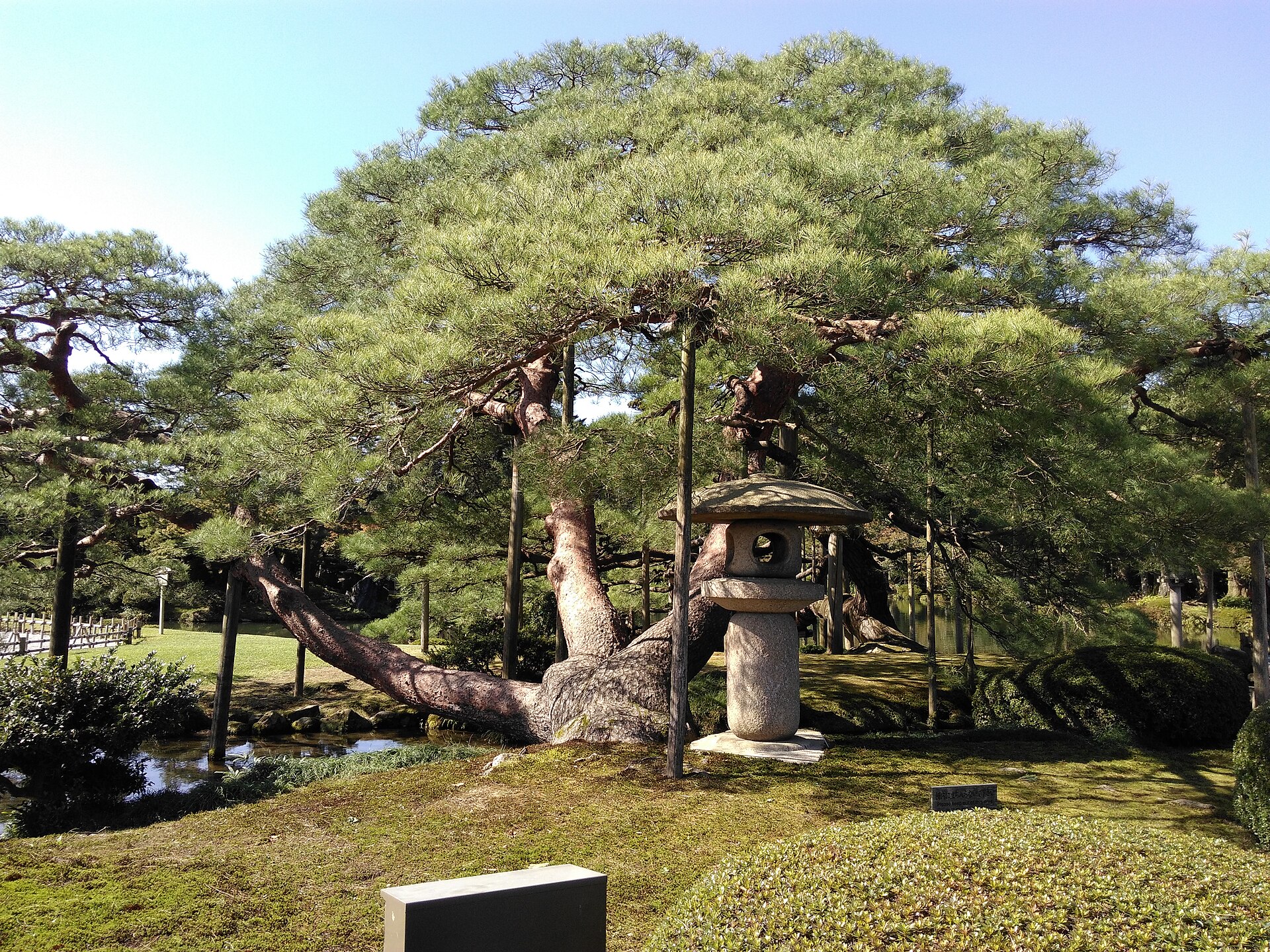
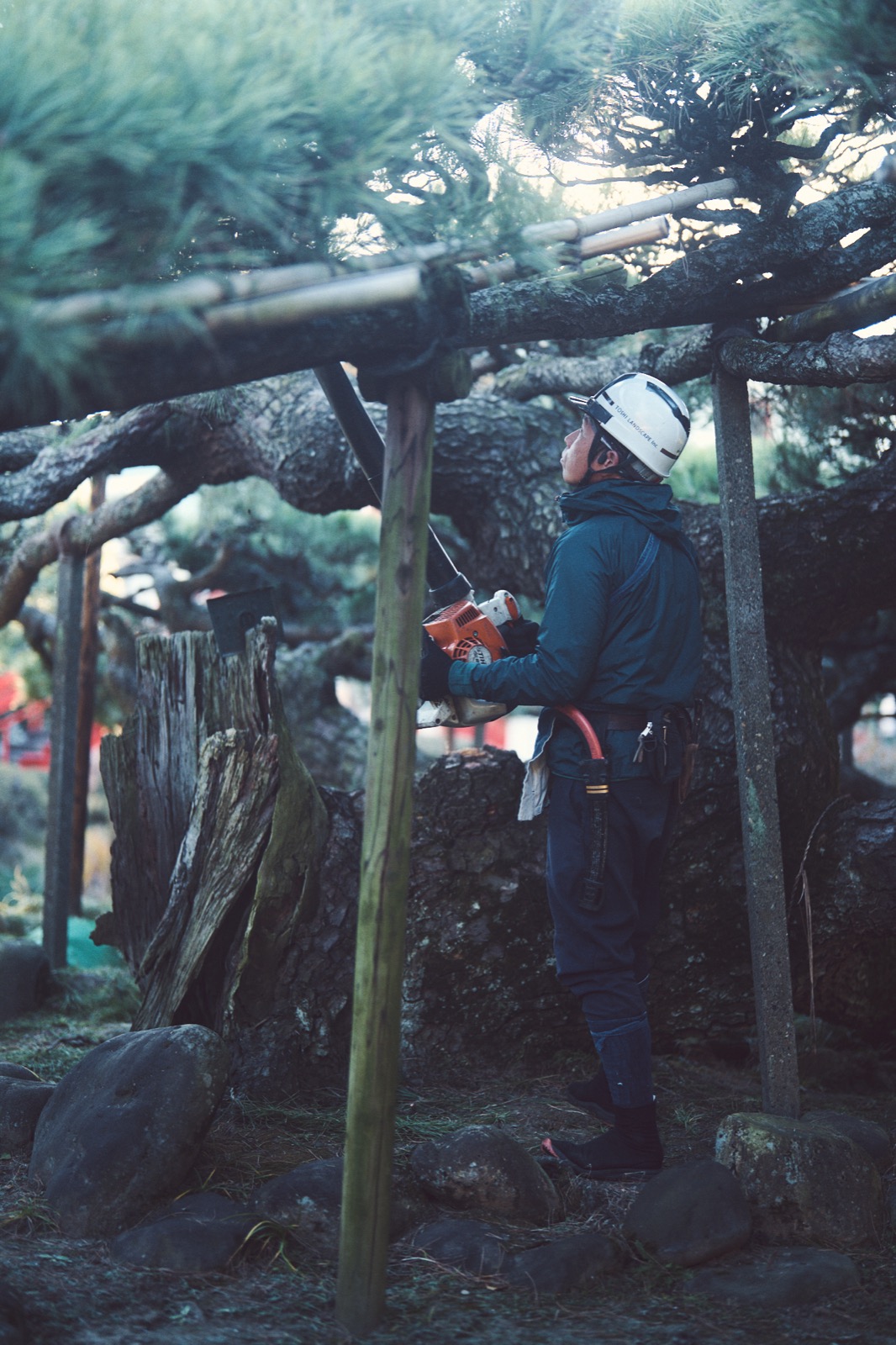
Stand beside one of the stone lanterns at Kenrokuen in Kanazawa and look at the pine behind it. The trunk leans, the lower limbs reach out across the moss, and under them stand plain posts of peeled timber, as if the tree had paused mid-stride to lean on a stick. A crutch usually suggests an injury. In a Japanese garden it does not have to. It can mean that someone has decided this limb is worth keeping at full length.
A garden that ranks its trees
The garden’s tourism association counts about 8,200 trees. It ranks 19 of them as tokubetsu meiboku (特別名木, “special named trees”) and 54 as meiboku (名木, “named trees”), its two grades of especially notable trees. Of pines, it counts about 200 prominent trees alone, without giving a total, most of them Japanese black pine (Pinus thunbergii) and Japanese red pine (Pinus densiflora).
The same page asks visitors to “notice the differences in branch form and species of the pines”, and then to find out what the garden does “so that precious named trees do not die out”. That second line is the subject of this article. Props are one of the tools a garden uses to keep a valued branch form.
Karasaki, one of Kenrokuen’s special named pines, is best known for its winter snow ropes, which we covered in our piece on yukitsuri snow ropes. Ropes pull a limb up from above. Here we stay with the posts that push from below.
Hōzue — why the name is a cheek-rest
A gesture, not a medical device
English speakers reach for “crutch”. Japanese gardeners can reach for a gesture. A newsletter from the Tokyo Metropolitan Park Association for Koishikawa Kōrakuen explains that resting your cheek on your hand is called hōzue o tsuku, and that the supports in that garden are called hōzue for the same reason. The limb need not be broken: the image is of a tree resting its cheek.
The note lists what the supports do. They help a tree that has not yet rooted to take hold. They keep branches from breaking under strong wind or the weight of snow. And they hold up branches that extend sideways so they do not sag. The writer adds a line that is hard to improve on: the craftsmen let the trees rest their cheeks “with love”. The trees in that note are weeping cherries, a reminder that the habit is not limited to pines.
Three jobs, one tool
Those three roles, as the Tokyo note gives them, fit different moments in a tree’s life:
| Role | When it matters | What the support does |
|---|---|---|
| Establishment | After planting | Helps steady the tree while new roots grow |
| Storm insurance | Wind, heavy snow | Gives a long limb a second point of support |
| Keeping the form | Year after year | Stops a limb that runs sideways from drooping |
How long a support stays depends on the tree and the purpose. A stake for a young tree is meant to help it establish. A hōzue under the limb of a named pine serves the third role, and it is renewed for as long as the garden wants that limb.
The long limb is the design — why garden pines grow sideways
What an old black pine tends to do
Part of the answer is botany. Japan’s Forestry and Forest Products Research Institute describes old Japanese black pines as trees whose branches grow thick and spread horizontally, forming an umbrella-like crown. That natural tendency helps explain why black pine suits the broad, spreading forms of Japanese gardens.
The pine that hangs over the water
Part of the answer is design. The Japanese Garden Dictionary of the Nara National Research Institute for Cultural Properties defines nagashi-matsu (流松, “flowing pine”) as a key tree planted near a pond with its branches hanging over the water. At Katsura Imperial Villa in Kyoto, the Imperial Household Agency describes the Sumiyoshi Pine as a tree positioned to screen the view of the pond. In both cases the pine’s reach is part of the view. Change the reach and the intended view changes with it.
Length is what makes it heavy
Part of the answer is mechanics. Japan’s National Institute for Land and Infrastructure Management (NILIM), in its guidance on preventing street-tree failure, notes that the bending moment that breaks branches grows larger the longer the branch is and the more load sits towards its tip. A limb trained to run out over a pond is long by design, and foliage or snow near its far end adds to the load.
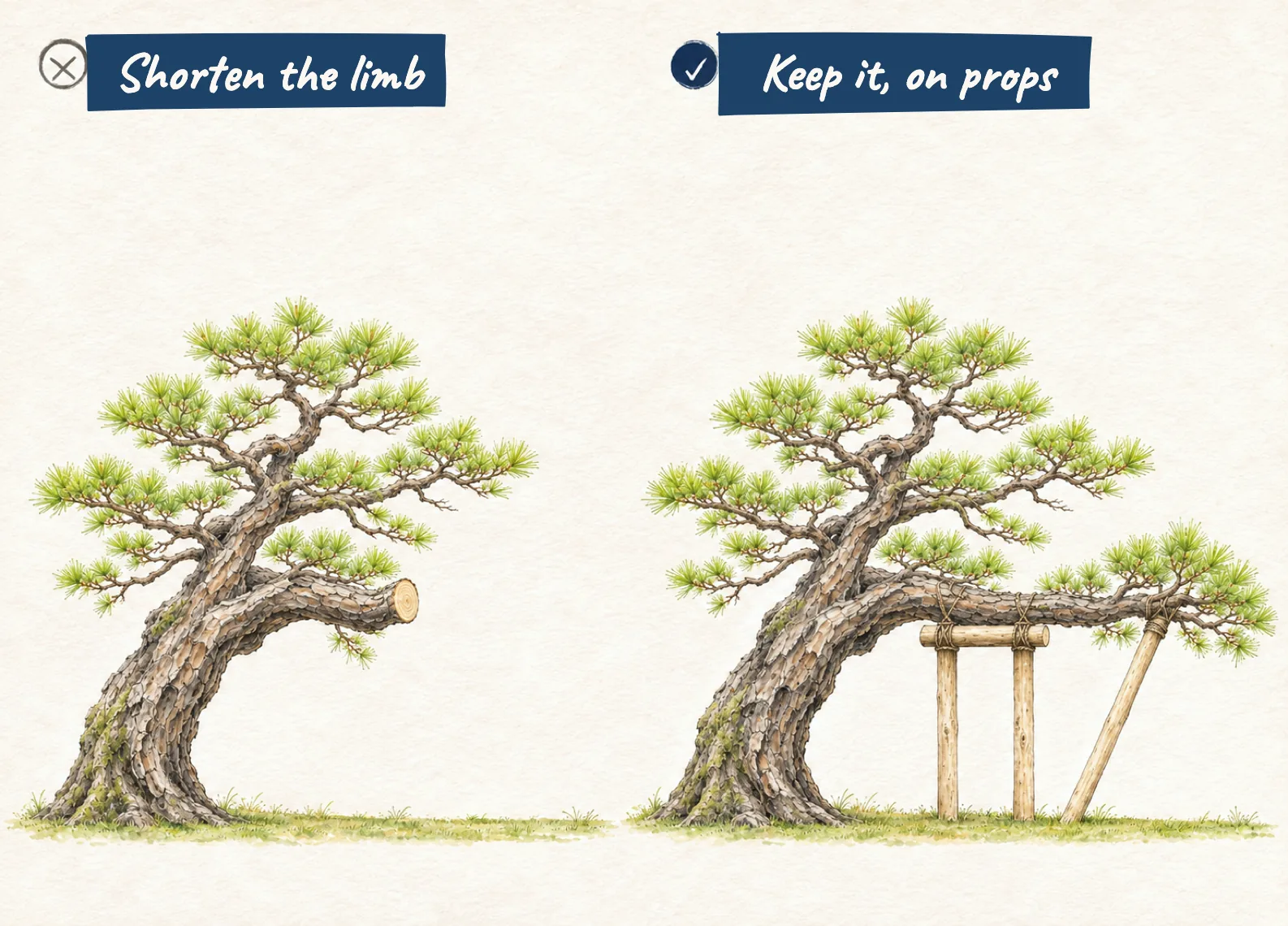
A post under the limb gives it another point of support. If nothing else touches it, the limb passes its whole load to the trunk at the place where the two join. With a post, part of the weight goes down the timber into the ground, and the loads along the limb are shared differently. The garden keeps the length the design asks for without asking the trunk to carry all of it. Our article on reading a tree’s structure before pruning explains how to read where a limb attaches before deciding what to do with it.
Sometimes the supports shape the tree
In Nikkō, Tochigi Prefecture describes the Himekomatsu (日光のひめこまつ), whose branches have been artificially guided outward in four directions with supports so that they spread horizontally. Here the support is not a rescue. It is a training tool, the frame along which the form was guided.
Once fifty metres of pine — the supports at Yoshimine-dera
A tree trained to run sideways
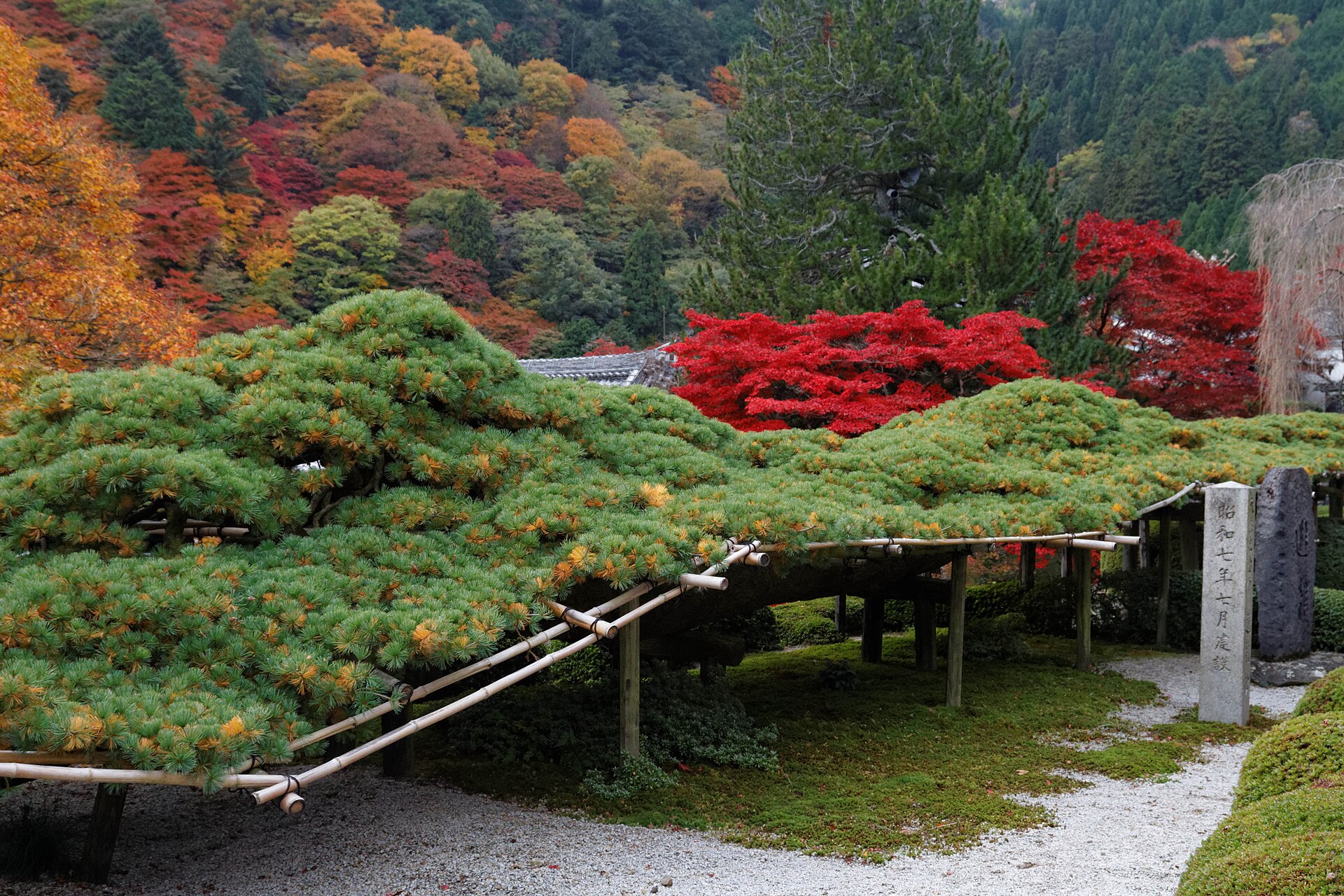
A striking example stands in Kyoto. Yoshimine-dera’s Yūryū-no-matsu (遊龍の松, literally “playing dragon pine”) is a five-needle pine more than 600 years old, designated a national Natural Monument in 1932. Japan’s Tourism Agency describes it as being cared for so that it grows horizontally along wooden supports.
The temple’s own guide gives its numbers. The tree was once about 50 metres long in total. In 1994, more than 15 metres were cut off because of pine-wilt damage. Its total length is now 37 metres, and it is still maintained to grow sideways along timber.
What the 1994 cut tells us
The loss of more than 15 metres matters for this story. Supports answer a structural problem. They do not treat pine wilt, and they do not reverse decay. A support belongs alongside the other care a tree needs, not in place of it.
The species matters too. Yūryū-no-matsu is a five-needle pine, not the black or red pine that dominates Kenrokuen, and the Nikkō Himekomatsu is another trained pine with its own character. What unites them is not the species but the decision to keep a long, low line, and the supports that decision requires.
Other named pines
Other famous gardens show how much a named pine can be worth. Ritsurin Garden in Takamatsu has nearly 1,400 pines. Japan’s Forestry Agency writes that about 1,000 of them have been worked on by craftsmen for 300 years. Its three celebrated pines are Tsurukame-matsu, Hako-matsu (which from a distance looks like a long, narrow box) and Neagari-goyō-matsu, which began as a bonsai received in 1833. In Tokyo, Hama-rikyū’s “Three-Hundred-Year Pine” near the Ōte gate is said to have been planted when the sixth shogun, Tokugawa Ienobu, remodelled the garden. Kinkaku-ji in Kyoto lists its own named pine, Rikushū-no-matsu, in the temple’s precinct guide. Trees like these can embody generations of care, which gives their managers a reason to think hard before cutting their characteristic limbs.
A supported pine in 1856
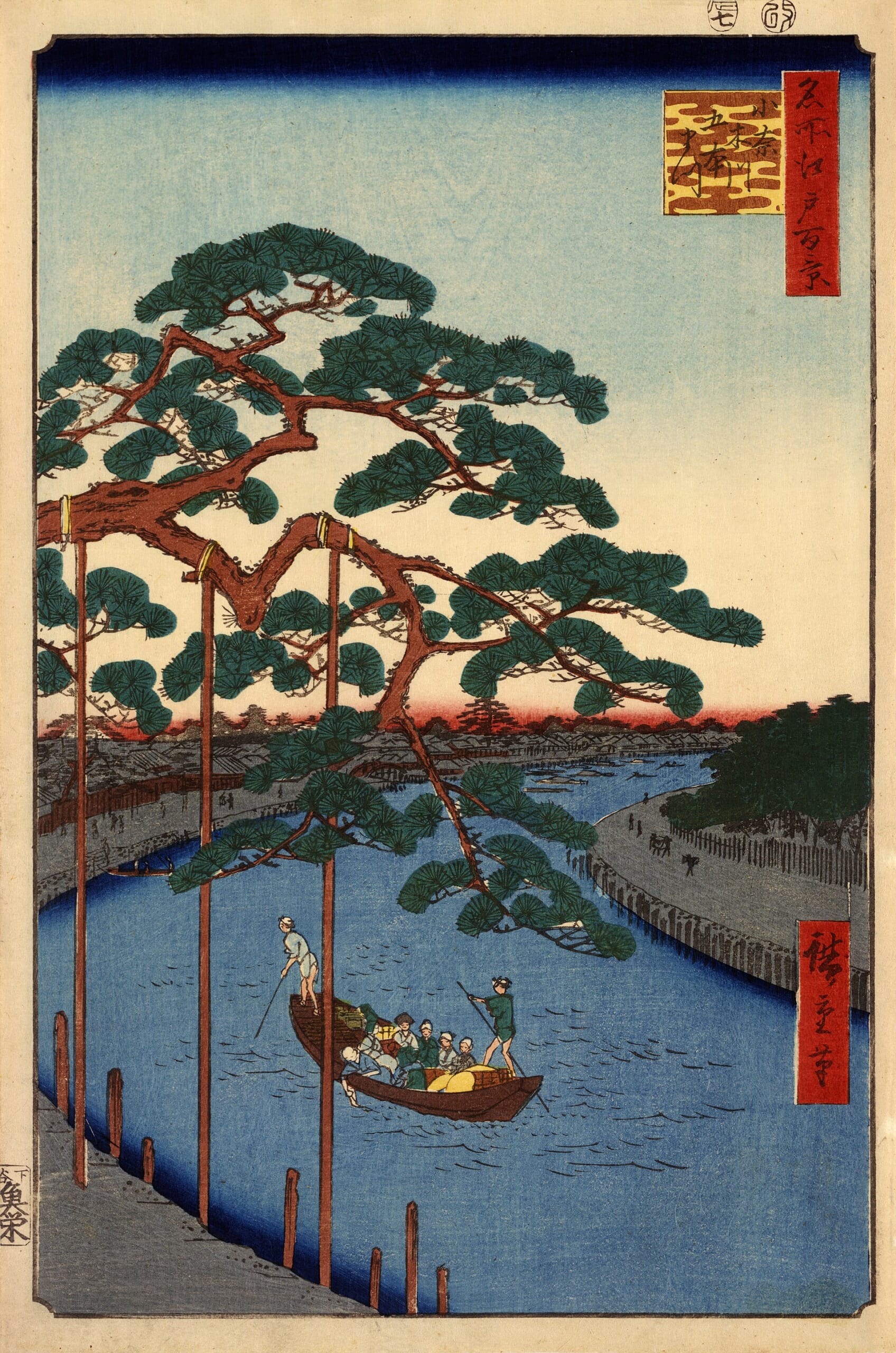
How old is the habit? No source we checked identifies the first prop under a Japanese pine. What we can show is a picture. Utagawa Hiroshige’s print Gohonmatsu Pine by Onagigawa River, from his series One Hundred Famous Views of Edo, is dated the seventh month of Ansei 3 (1856). The impression held by the Edo-Tokyo Museum shows a pine whose long limb reaches out over the canal, with posts beneath its spreading branches. By 1856, at the latest, a supported pine was part of a famous view of Edo.
How a prop is made and kept — timber, bark, palm rope
The vocabulary of supports
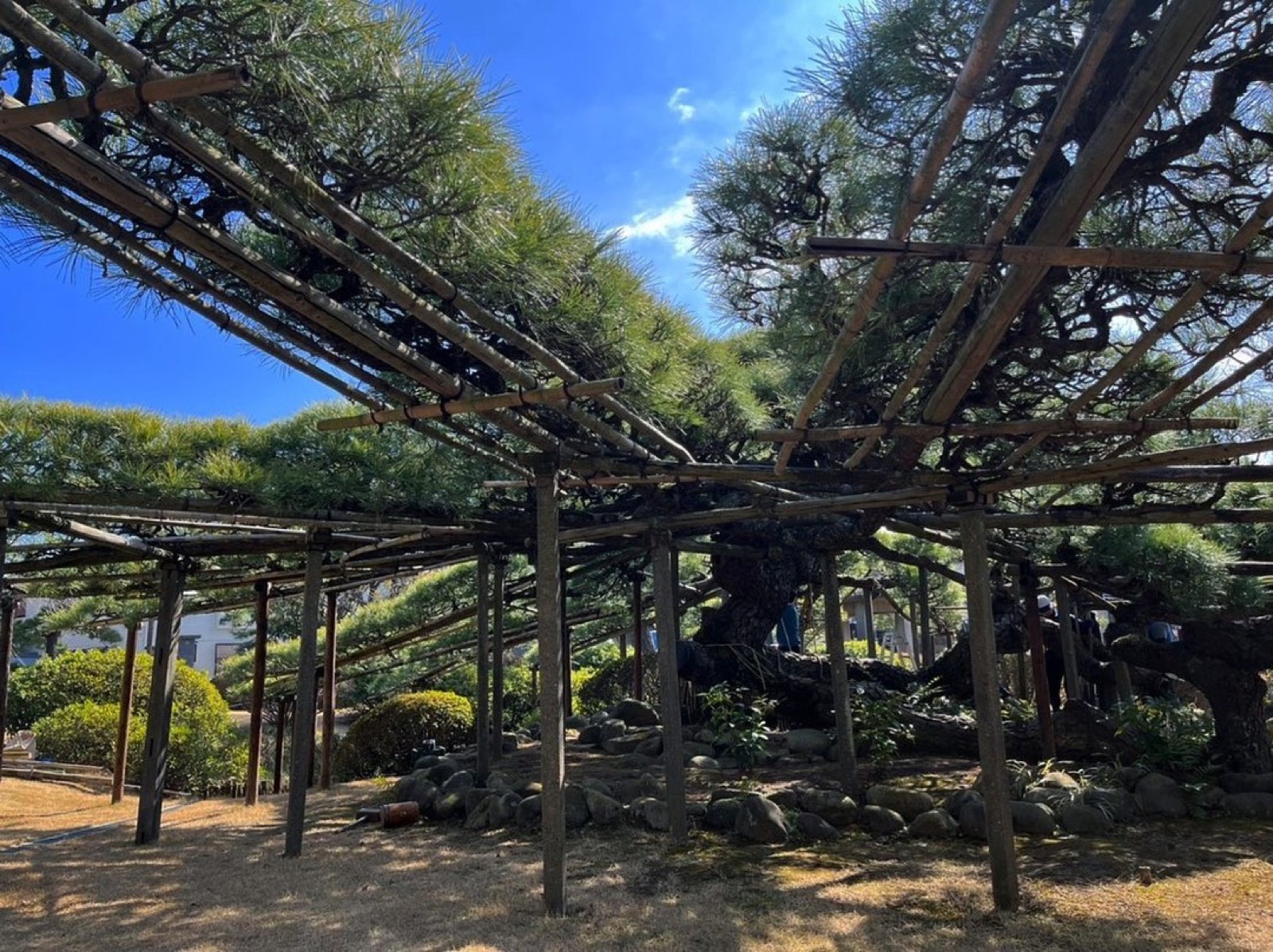
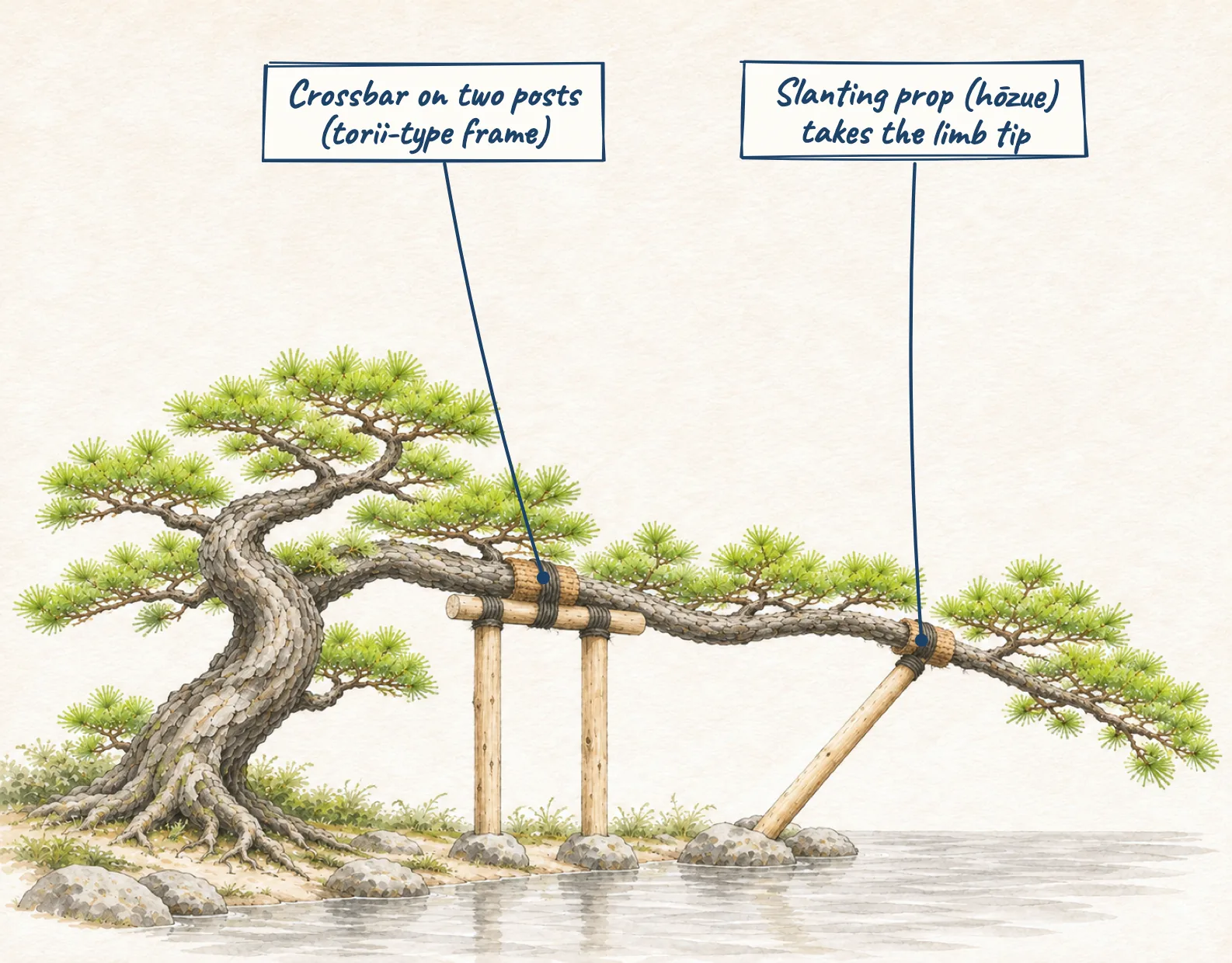
Japanese public works documents use a short vocabulary. NILIM’s guide to planting supports describes the single or attached stake (soegi-gata, ippon-gata), set alongside the trunk or slanting against it and tied in place. It describes the torii type, logs assembled into the shape of a shrine gate. And it recognises steel supports made from materials such as steel pipe. Those definitions are written for planting supports on trunks. Under the limbs of garden pines, the same parts reappear in forms you can recognise by eye:
| What you see (our grouping by appearance) | Parts | Related term in NILIM’s guide |
|---|---|---|
| One slanting post under a limb | A single log | Single or attached stake |
| Two posts with a crossbar under a limb | Logs in a gate shape | Torii type |
| Rows of posts with rails under several limbs | Many logs, tied | (no single term) |
| Metal posts | Steel pipe | Steel supports |
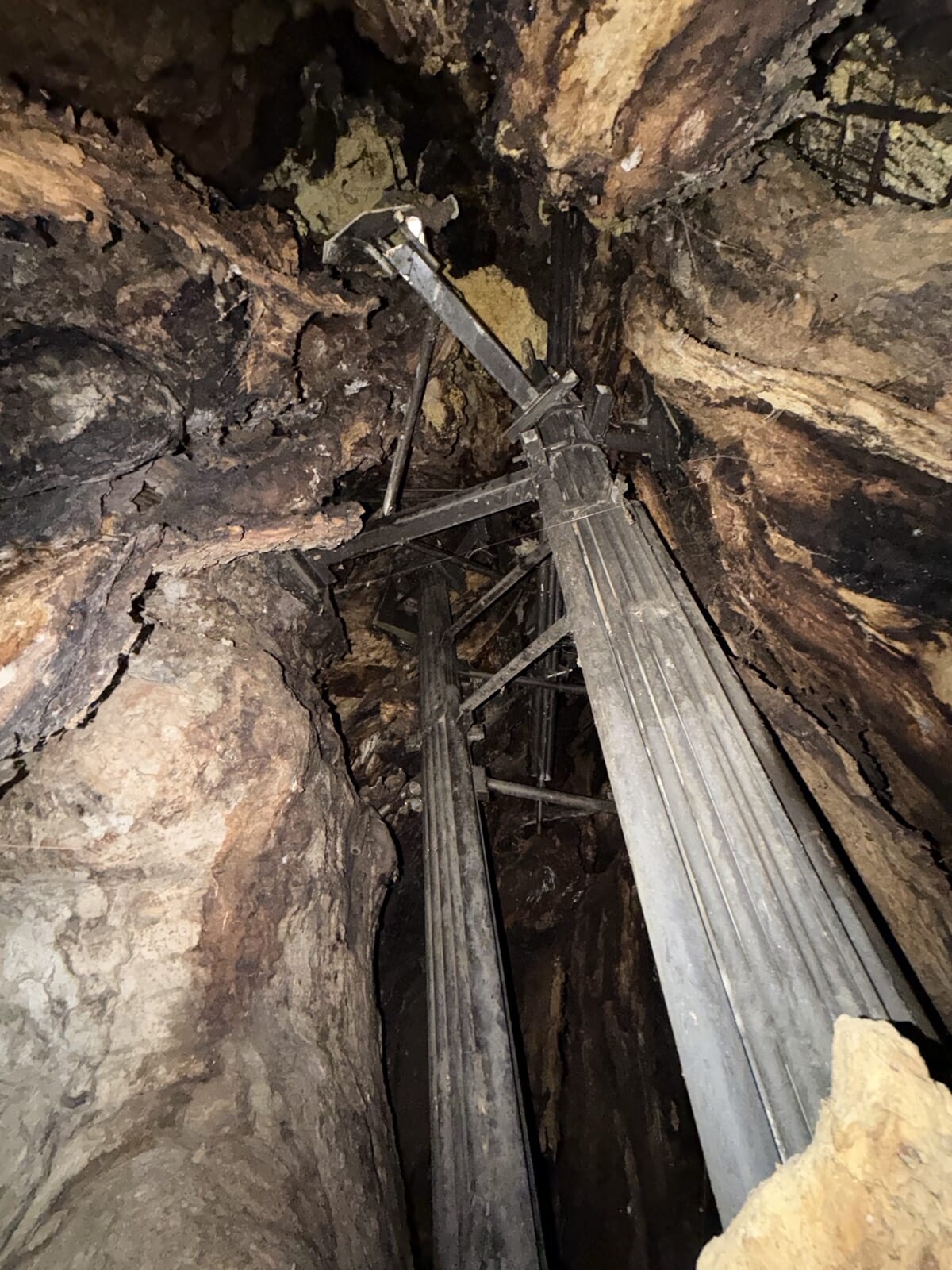
Steel is not only for pines. During our street-tree survey in Higashine, Yamagata, we photographed metal supports standing inside the hollow trunk of the town’s great zelkova; that tree’s story is in our article on the Higashine great zelkova. The idea is the same: give the tree a second path to the ground.
Timber
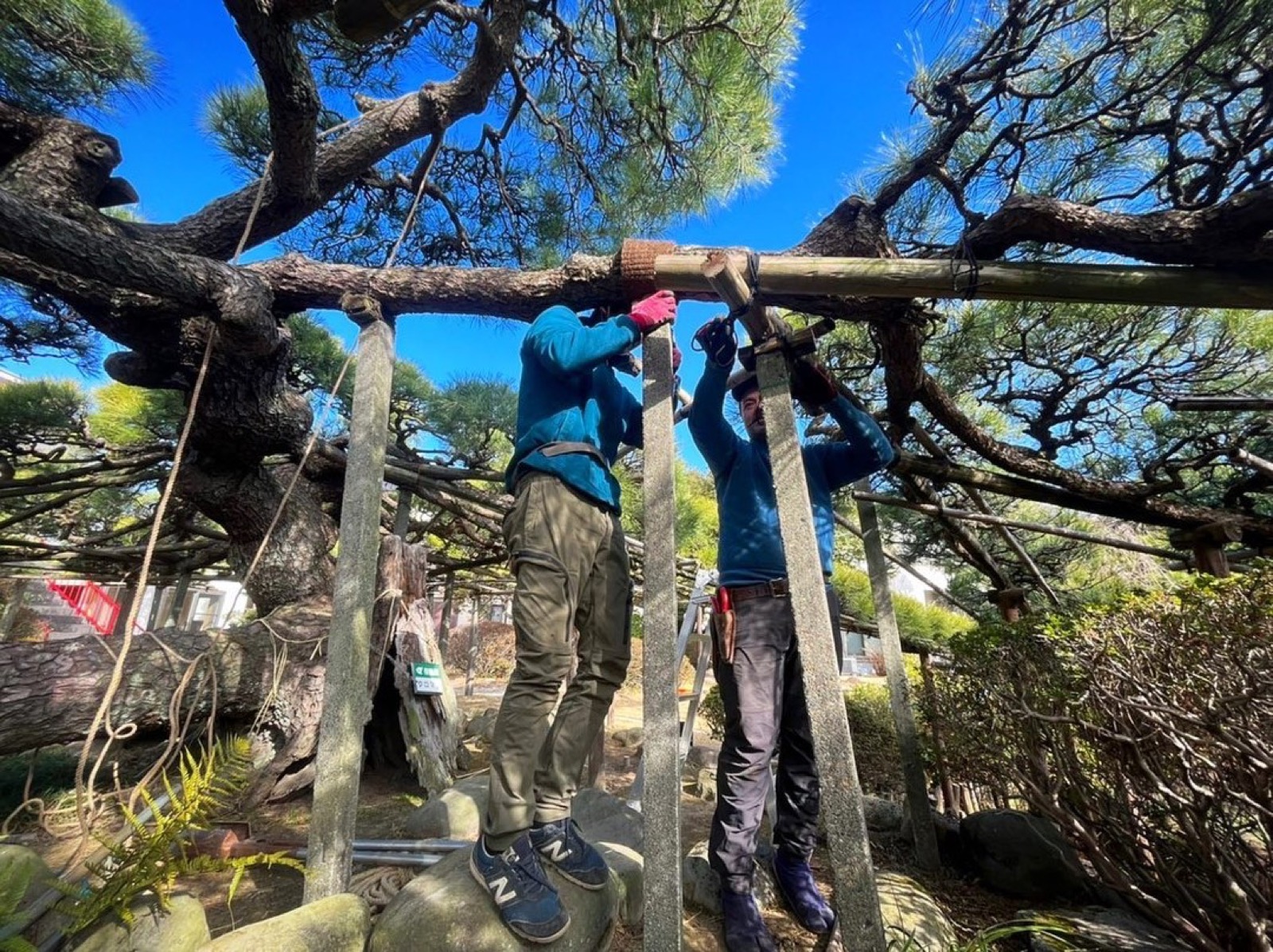
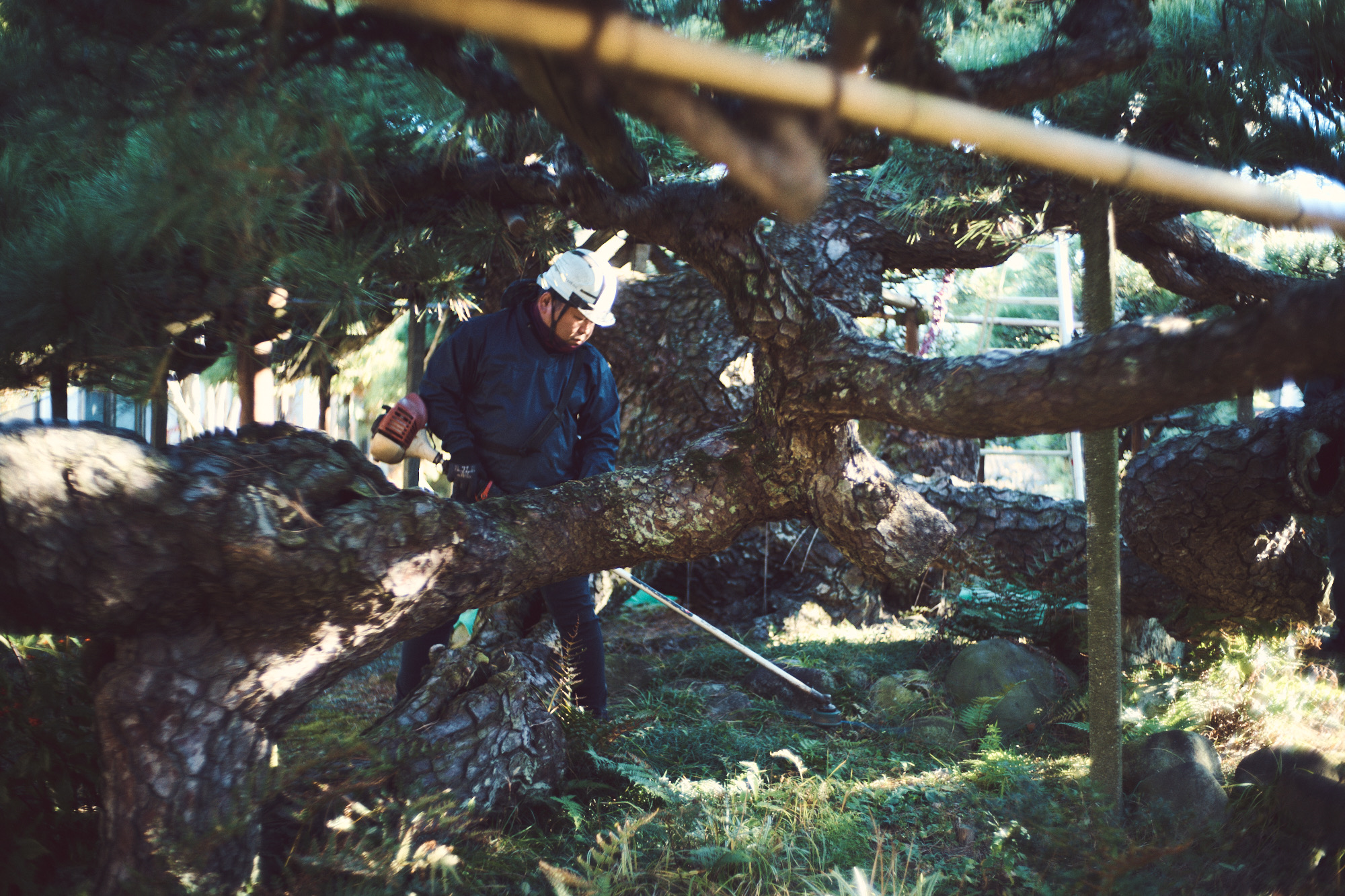
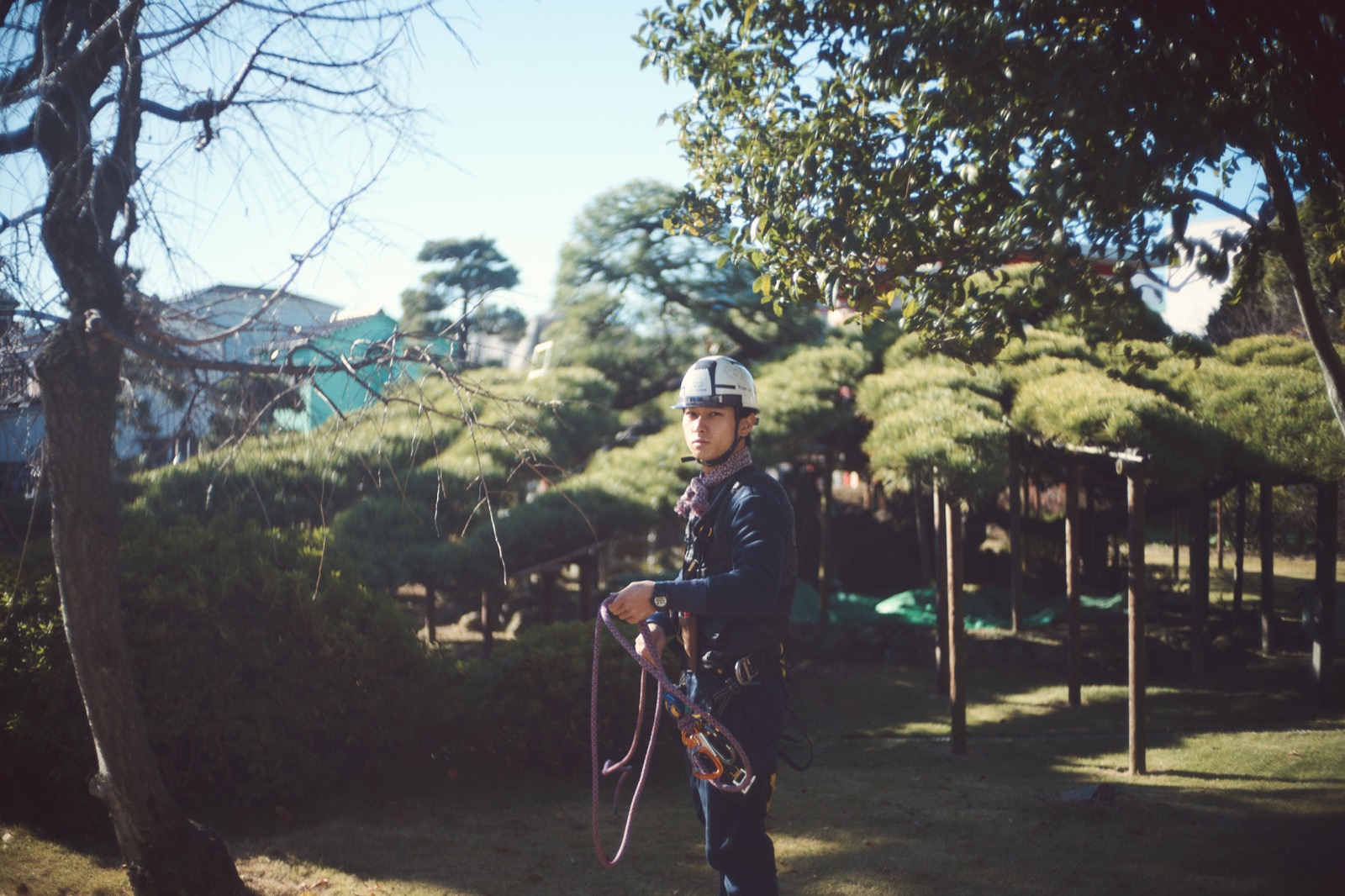
The Ministry of Land, Infrastructure, Transport and Tourism (MLIT), in its Common Specification for Park and Green Space Works, lists debarked sugi (Japanese cedar), hinoki (Japanese cypress) or karamatsu (Japanese larch) as log support material. In our crews’ work on old garden pines, the photographs show the order of a renewal: new posts stand under the limbs, and a new crossbar is lifted onto them and tied.
Padding the contact
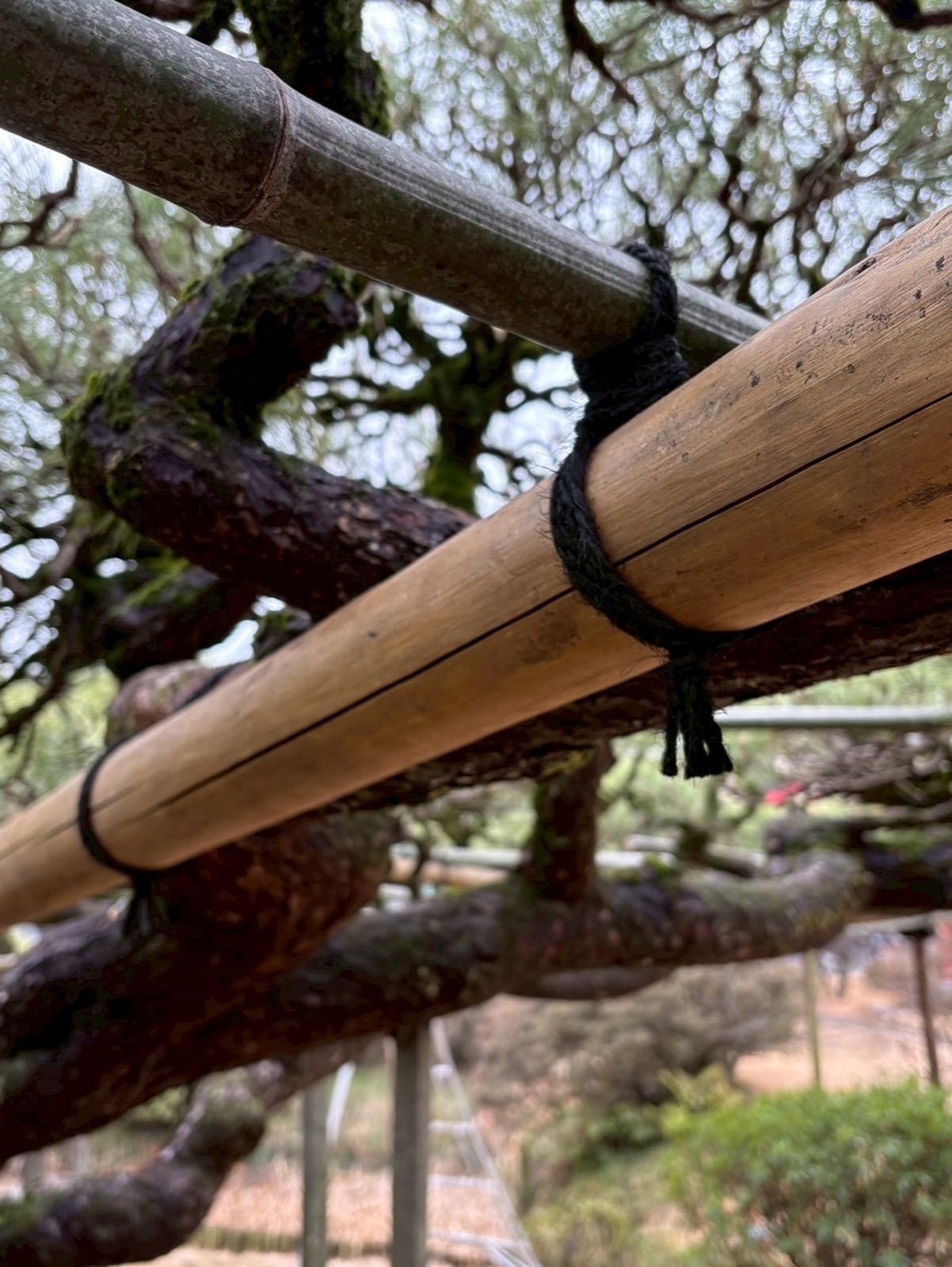
The point where timber meets bark is where supports can do harm. Chiba Prefecture’s civil works specification, for repairing supports, requires cedar bark or an equivalent to be wrapped around the trunk before it is tied with shuro (hemp-palm) rope. A Fukushima Prefectural Forestry Experiment Station report recommends laying soft material such as rubber at the contact between a support and a branch.
Firm, not rigid
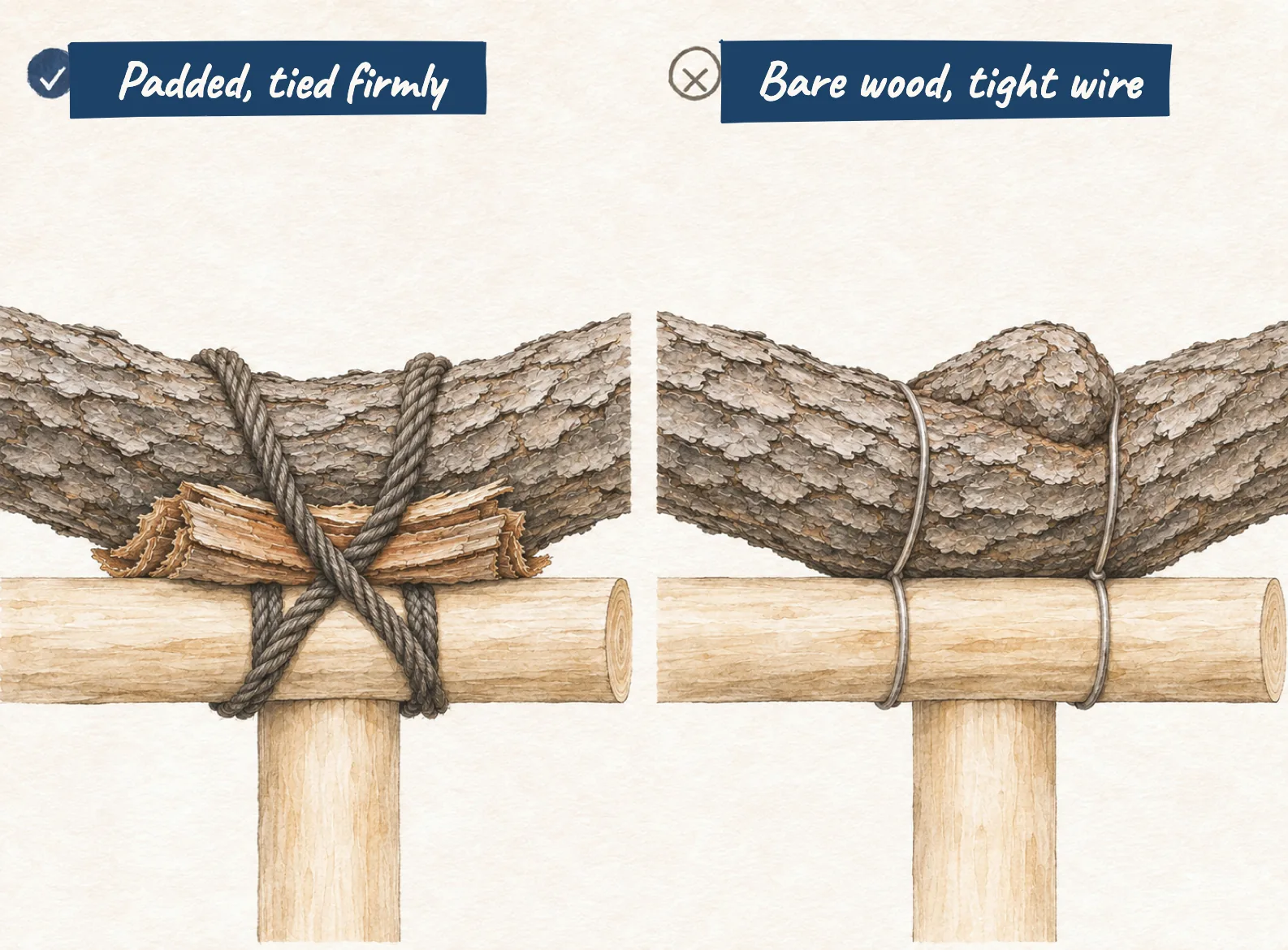
The same Fukushima report gives a warning that runs against instinct: fixing a branch too firmly to its support can lead to the branch breaking. The tie’s job is to keep the bar where it belongs, not to clamp the limb to it.
Inspect, retie, replace
Supports wear out faster than pines. Published Japanese guidance gives a picture of what to check. Each document applies to its own scope, not to any particular garden:
| Check | Example of published guidance | What to look for |
|---|---|---|
| Biting | Kanagawa Natural Monument manual | Supports or wires sinking into the trunk |
| Position | Kanagawa Natural Monument manual | Attached supports at their intended fulcrum |
| Cushioning | Kanagawa Natural Monument manual | Padding present at the contact |
| Frequency | Tottori planting guidance | Inspection at least twice a year |
| Replacement | Tottori planting guidance | Decayed material unlikely to last until next year |
| Retying | Chiba specification | New material when supports are retied |
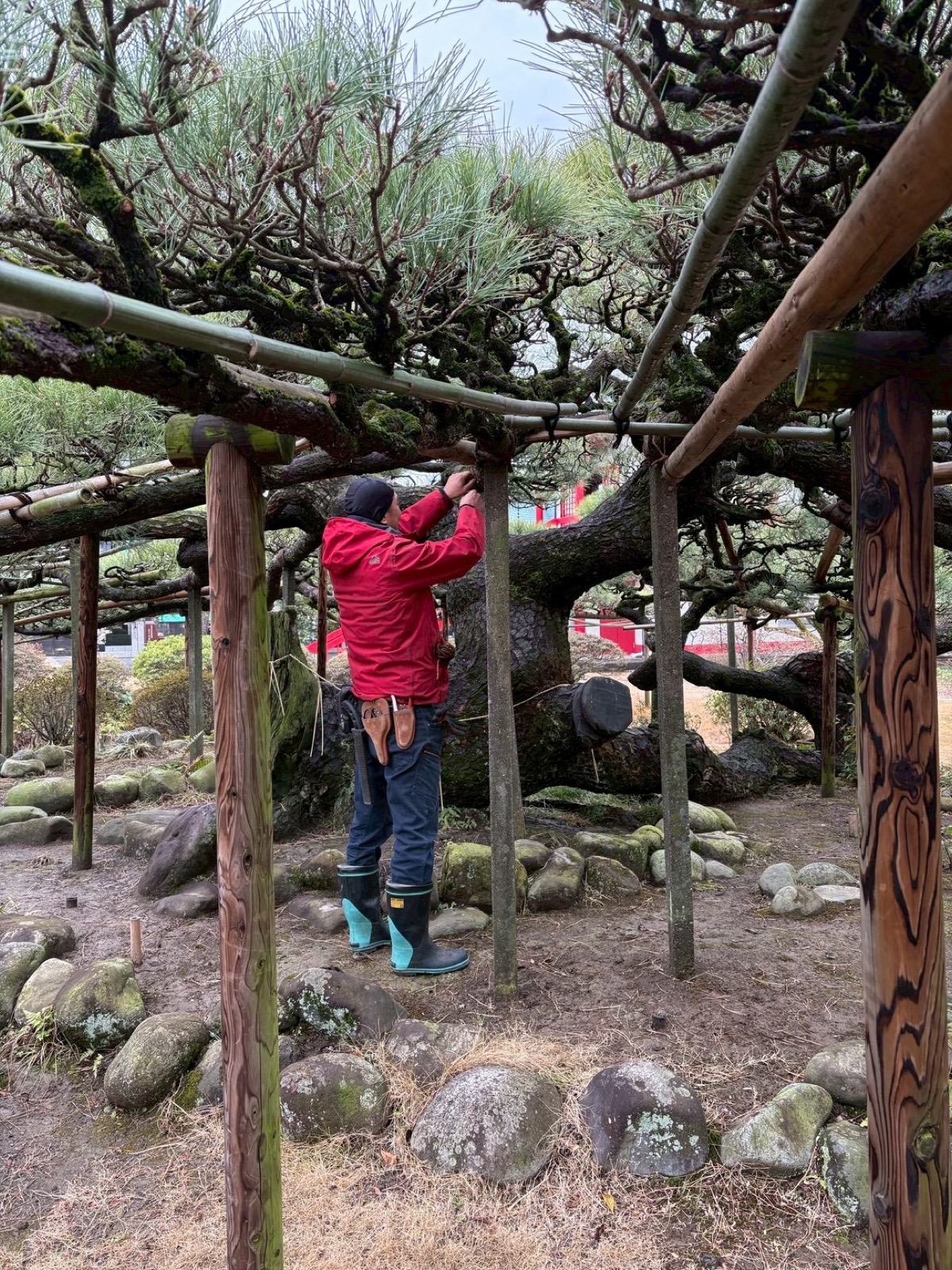
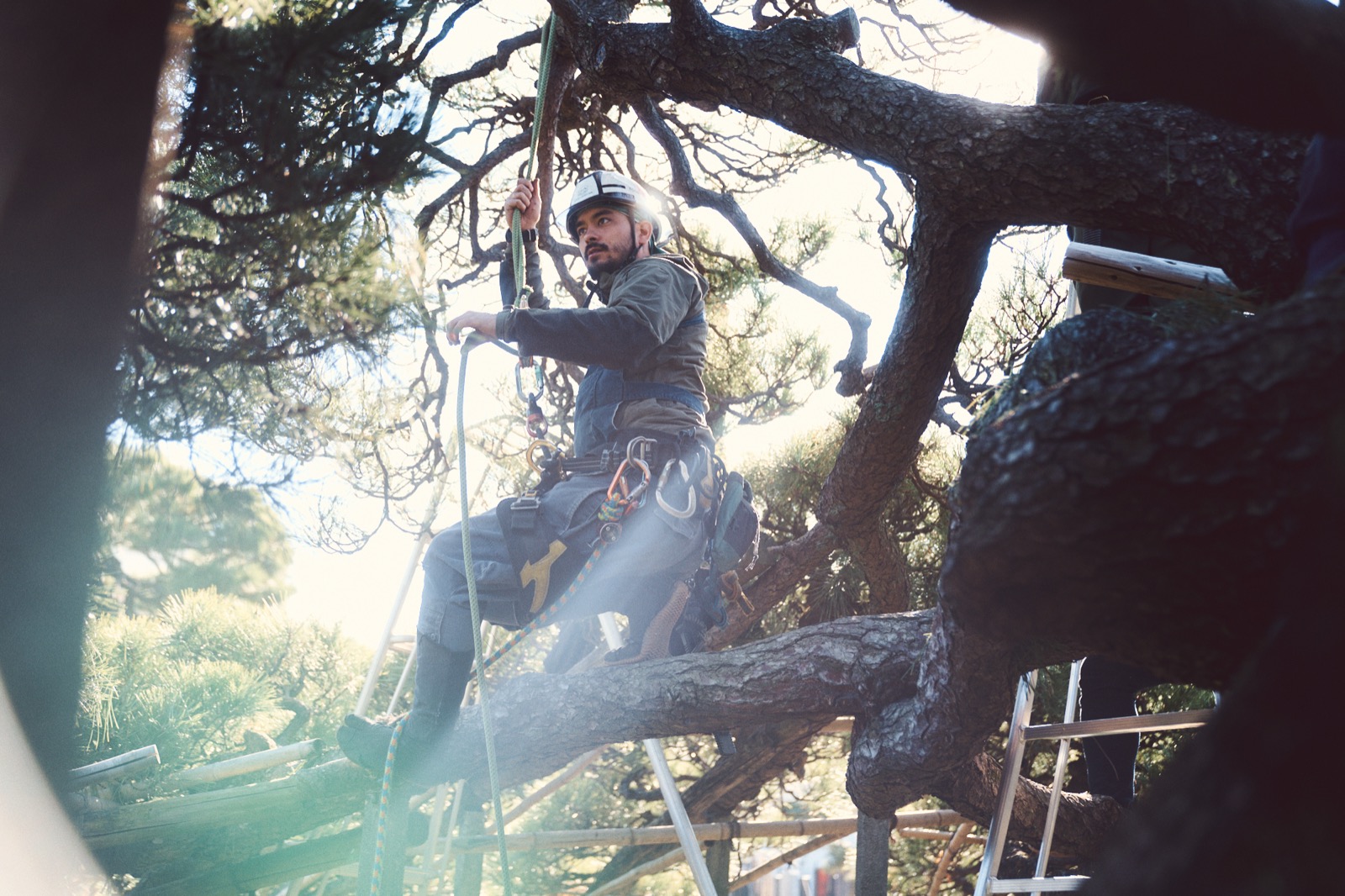
The Kanagawa manual asks inspectors to check whether supports or wires are biting into the trunk, and some of that can be spotted from the ground: rope, wire or timber sinking into bark as the wood thickens around it. Each item in the table is an inspection point, which means each one is something that goes wrong when no one looks.
Prop or prune — the judgment in Japan and in Britain
Japan: the crown is the value
Japan’s Ministry of the Environment, in a tree-management specification for its national gardens, tells contractors to protect drooping branches with supports as needed, but excludes obstructive branches. The rule is not “prop everything”. It is closer to “prop the branches you mean to keep”.
NILIM’s case study of the Great Muku of Mukunoto, a national Natural Monument, adds another part of the reasoning. Because the tree is designated, it cannot easily be pruned, and reducing a tree’s size is difficult when the size of its crown is itself what matters. Even when a garden pine is not legally designated, a similar aim can apply if its spreading crown is the reason it is valued.
Britain: propping when removal conflicts
British Standard BS 3998:2010, Tree work — Recommendations, reaches a similar place by a different route. It recommends propping when removing a tree or branch would conflict with other management objectives or the use of the site. It names long, heavy, low branches liable to fail as a case where propping can be used instead of pruning. It also sets limits: a branch prop should reduce the probability of failure, “not to replace the support” the branch gives itself, and excessive upward support could “adversely affect adaptive growth”.
The veteran-tree literature adds caution about the saw. English Nature’s handbook Veteran Trees: A Guide to Good Management lists propping alongside crown reduction, cable bracing and removing the target as options for improving safety while minimising damage to wildlife value. The Ancient Tree Forum’s later guidance treats some form of pruning as the main option against mechanical failure, while recognising bracing, guying and propping, and reminds managers that “pruning is a form of damage”, so a veteran tree’s ability to tolerate it must be assessed. Our guide to the three-cut method shows how to remove a heavy limb cleanly when removal is the right call.
Weighing the options
| Option | What it costs | What it keeps |
|---|---|---|
| Remove the limb | A large pruning wound | Nothing of the limb |
| Shorten the limb | Pruning wounds, less reach | Part of the form |
| Prop the limb | Supports to inspect, renew | The limb’s length |
| Keep people away | No work on the tree | The tree; the limb may still fail, but fewer people are beneath it |
In practice the options can be combined: a limb can be lightly shortened and propped, or propped while the path beneath it is moved. The questions behind the choice are the same in Kanazawa and in Sherwood. How much is this limb worth to the place? Can the ground under it carry a post? And will someone come back to inspect the support?
What the wood does under a prop — adaptive growth
Pines push from below
A branch is not a passive beam. In conifers, the US Forest Service defines compression wood as abnormal wood formed on the lower side of branches and inclined trunks. A review in New Phytologist (Groover, 2016) explains that reaction wood helps a branch maintain its angle as its own growing weight pulls it downward. A pine limb is, in effect, propping itself from the inside.
Claus Mattheck’s uniform-stress concept, set out in the Arboricultural Journal in 2002, proposes that trees respond to uneven stress with load-adaptive growth that moves them back towards an even distribution. A post under a limb changes where the stress sits. That is why BS 3998 warns against excessive upward support.
What experiments show
The research is mostly on trunks and cables, not on props under old pines, so it points rather than proves:
| Study | Tree | What was restrained | Result | What it can say about props |
|---|---|---|---|---|
| Moore et al., 2014, Trees | Radiata pine, 5 years | Stem guyed against sway | Less radial growth at breast height; no effect on compression wood | Stopping movement can reduce growth |
| Burton and Smith, 1972, USDA FS | Young loblolly pine | Stem guyed | Markedly less radial growth in the immobilised part | Same direction, older study |
| Kane and Autio, 2014, UF&UG | Red oak, 5 years | Steel or polypropylene cables | No general reduction in annual increment | Not every support reduces growth |
| Slater, 2021, Arboricultural Journal | Young aspen, 3 years | Wire bracing at branch junctions | 95% of braced junctions had included bark | In this experiment, wire bracing went with altered junction development |
Two more findings frame the table. Groover’s review notes that reaction wood can still develop when a stem is supported before it tilts, which suggests gravity is a primary signal. And thigmomorphogenesis, the response of plants to mechanical stimulation, commonly reduces elongation and increases radial growth (Braam, 2005).
We found no direct study of props under veteran black or red pines. The results differ between studies, and none tested a timber post beneath a mature pine limb. What they support is caution: some forms of restraint reduced growth, and a rigid fixing at a junction changed it. That fits the Fukushima warning against fixing a branch too firmly, and the BS 3998 warning against too much support.
Japan and Britain — the same tool at different moments
The Major Oak
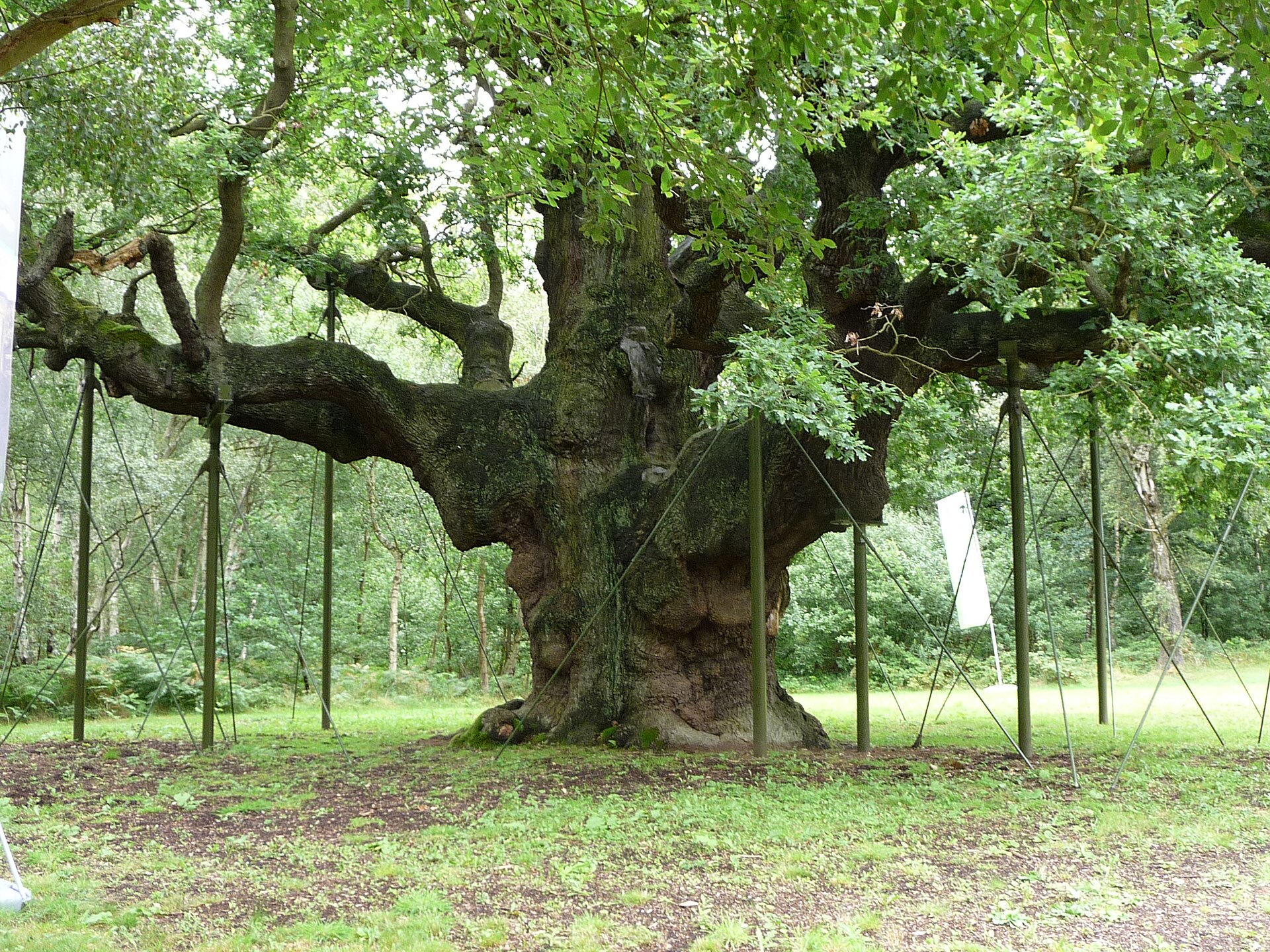
Japan is not alone. In Sherwood Forest, the official account of the Major Oak records iron bracing in place as early as 1904, with wooden props installed at the same time. The wooden supports were replaced by metal props in the early 2000s; a photograph on the official site shows metal props being erected in 2001. The country park is managed by an RSPB-led consortium in partnership with Nottinghamshire County Council. The same account now reports that the tree is no longer able to sustain living branches. The sources we checked do not blame the props for that, and neither do we.
Kew, Wilmington, Anuradhapura
At the Royal Botanic Gardens, Kew, a Japanese pagoda tree planted in 1762 grows almost horizontally and is supported by metal straps and props. In Wilmington, a church magazine from November 2020 describes the churchyard’s ancient yew, whose heavy boughs are supported by a number of wooden props. Further afield, in Anuradhapura, Sri Lanka, a Trent University thesis documents ornate branch supports on the sprawling limbs of the Jaya Sri Maha Bodhi.
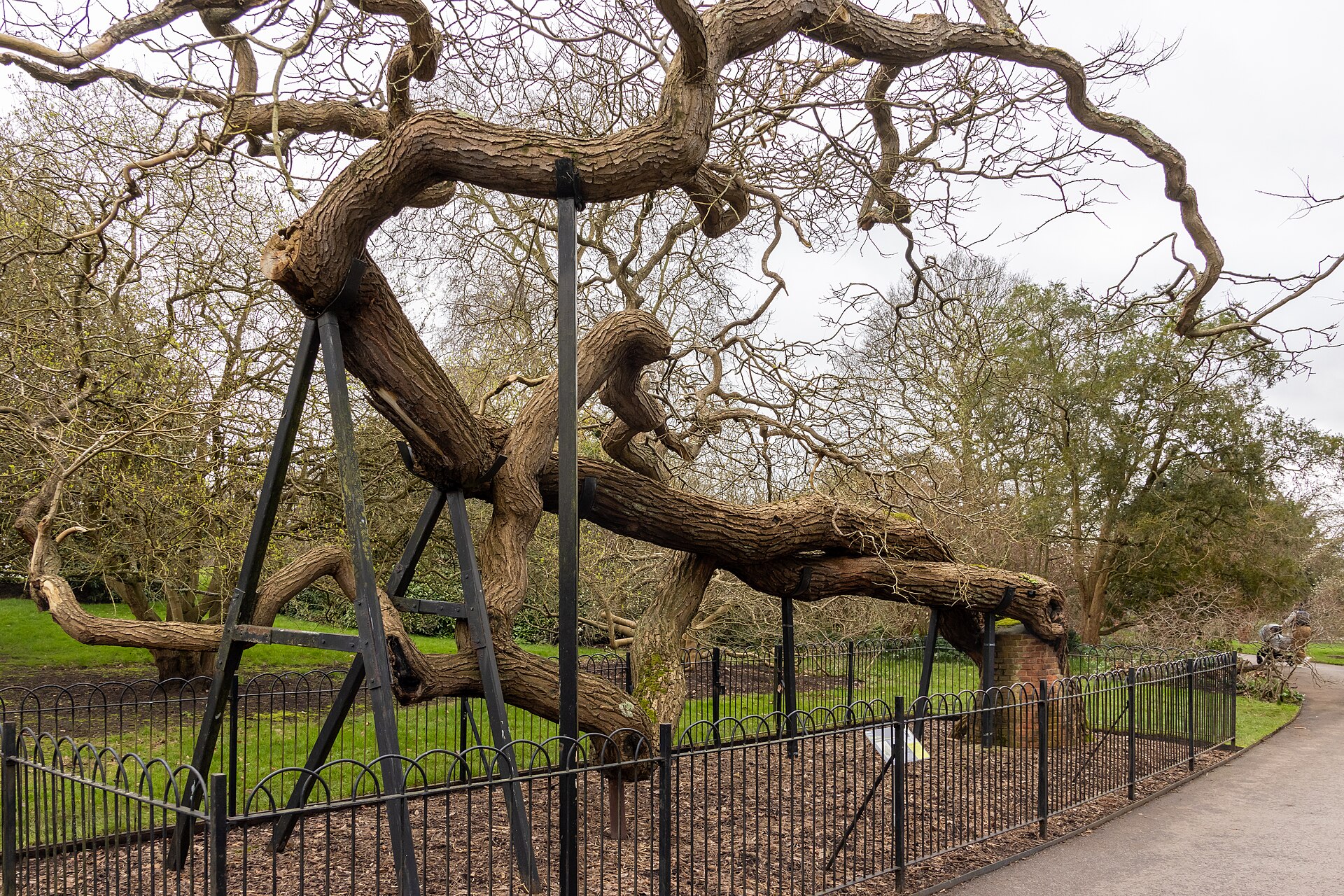
Same tool, different starting point
The examples here differ less in the timber than in the reason it arrives. The British guidance cited in this article discusses props as part of veteran-tree management: ways to reduce the chance of failure while keeping an old tree and its habitat. The Japanese examples emphasise keeping or guiding a form: at Nikkō, supports guided the branches outward, and at Yoshimine-dera the pine is maintained along wooden supports. One set of sources props what a tree has become. The other also props what a tree is being trained to become. Each starts from different trees, sites and goals.
The British literature also offers options that sit less easily in some designed gardens. The Ancient Tree Forum explains that living branches resting on the ground can form new roots by layering and help stabilise or perpetuate the tree. Separately, the Woodland Trust advises leaving fallen branches uncut where they lie, for their value to wildlife. In a wood pasture there may be room for a limb to come down to the ground. In a garden where a limb is meant to clear the path and float over the water, a prop keeps it in the air.
| Japanese examples in this article | British sources in this article | |
|---|---|---|
| Main purpose | Keep or guide a designed form | Reduce failure, keep veteran trees, habitat |
| Limb near the ground | Kept clear of paths, water | Living limbs may root by layering |
| Published guidance cited | Prefectural specifications, Natural Monument manual | BS 3998, Ancient Tree Forum, English Nature |
| Inspection examples | At least twice a year (Tottori) | Annual from the ground, five-yearly aerial (BS 3998 default) |
Common misconceptions — what a crutch does not mean
“The tree must be dying”
Not necessarily. Keeping horizontal branches from sagging is one of the ordinary roles the Tokyo Park Association lists for hōzue. A prop can mean the limb is valued, not that the tree is failing.
“The prop carries the whole limb”
It should not. BS 3998 is explicit that a branch prop should reduce the probability of failure, not replace the branch’s own support, and warns that excessive support may adversely affect adaptive growth.
“Tighter is safer”
The Fukushima report warns the reverse: fixing a branch too firmly to its support can lead to breakage. Padding and a firm, renewable tie are the Japanese answer.
“Once in, it can be forgotten”
Timber decays and rope perishes. Tottori’s guidance asks for inspections at least twice a year, and BS 3998 adds checks after heavy snow and high winds. The Kanagawa manual’s check for supports biting into the trunk is a reminder that a forgotten support can start to harm the tree it was meant to help.
“Props are only for pines”
Weeping cherries at Koishikawa Kōrakuen rest on hōzue, a zelkova in Yamagata stands on steel, and Kew’s pagoda tree leans on straps and props. Pines are simply where many visitors first notice them, because garden pines are so often trained to reach sideways.
Frequently asked questions
What are the wooden poles under Japanese pine trees?
They are branch supports, often called hōzue (頬杖) in Japanese gardens, after the gesture of resting one’s cheek on one’s hand. They give long, low limbs a second point of support so they do not sag or break under wind or snow, and they let the garden keep the tree’s designed form.
Do the props mean the tree is unhealthy?
Not necessarily. Many garden pines are trained so that their limbs run sideways over water or paths, and keeping such limbs from sagging is a documented purpose of hōzue. A prop does not treat disease; pine wilt and other health problems need separate assessment and management.
What are Japanese tree props made of?
MLIT’s Common Specification for Park and Green Space Works lists debarked Japanese cedar, Japanese cypress or Japanese larch for log supports. Chiba Prefecture’s specification wraps cedar bark at the contact before tying with hemp-palm rope, and steel pipe supports are also used.
How often should a tree prop be checked?
Tottori Prefecture’s guidance says at least twice a year, with replacement when material will not last until the next year. BS 3998:2010 gives an annual ground inspection, a detailed aerial check every five years by default, and extra checks after heavy snow or high winds.
Is propping better than pruning a heavy branch?
Neither is better everywhere. BS 3998 allows propping instead of pruning for long, heavy, low branches when removal would conflict with other goals, and the Ministry of the Environment’s specification supports drooping branches that are not obstructive. The Fukushima report warns that fixing a branch too firmly can lead to breakage, while BS 3998 warns that excessive upward support can adversely affect adaptive growth.
Where can I see propped pines in Japan?
Kenrokuen in Kanazawa, where timber posts stand under the low limbs of pines beside its stone lanterns, and Yoshimine-dera in Kyoto, whose Yūryū-no-matsu, 37 metres long in total, is maintained to grow horizontally along wooden supports.
Sources
– Kenrokuen Tourism Association, “Midori no monogatari” (green stories) — https://kenrokuen.or.jp/sdgs_green/ (accessed 2026-10-31) – Tokyo Metropolitan Park Association, Koishikawa Kōrakuen Kawaraban No. 33 — https://www.tokyo-park.or.jp/park/koishikawakorakuen/assets/kawaraban/kawara33.pdf (accessed 2026-10-31) – Forestry and Forest Products Research Institute, Kyushu, Kuromatsu — https://www.ffpri.go.jp/kys/business/jumokuen/jumoku/zukan/kuromatu.html (accessed 2026-10-31) – Nara National Research Institute for Cultural Properties, Japanese Garden Dictionary, “Stretching pine” — https://www.nabunken.go.jp/org/bunka/jgd/pages/StretchingPine.html (accessed 2026-10-31) – Imperial Household Agency, Sumiyoshi Pine — https://kyoto-gosho.kunaicho.go.jp/tree/4E12 (accessed 2026-10-31) – NILIM, guidance on street-tree failure — https://www.nilim.go.jp/lab/bcg/siryou/tnn/tnn1059pdf/Ks1059006.pdf (accessed 2026-10-31) – Tochigi Prefecture, Nikkō no Himekomatsu — https://bunkazai.pref.tochigi.lg.jp/cultural/%E3%80%90%E6%97%A5%E5%85%89%E3%81%AE%E3%81%B2%E3%82%81%E3%81%93%E3%81%BE%E3%81%A4%E3%80%91/ (accessed 2026-10-31) – Yoshimine-dera, cultural properties — https://yoshiminedera.com/guide/properties/index.html ; garden guide — https://yoshiminedera.com/guide/garden/index.html (accessed 2026-10-31) – Japan Tourism Agency, Yoshimine-dera — https://www.mlit.go.jp/tagengo-db/R5-00174.html (accessed 2026-10-31) – Japan Tourism Agency, Ritsurin Garden and its pines — https://www.mlit.go.jp/tagengo-db/R2-01860.html (accessed 2026-10-31) – Forestry Agency, pine forest protection with prefectures — https://www.rinya.maff.go.jp/j/kouhou/kouhousitu/jouhoushi/attach/pdf/2902-4.pdf (accessed 2026-10-31) – Kinkaku-ji, precinct guide — https://www.shokoku-ji.jp/kinkakuji/guide/ (accessed 2026-10-31) – Edo-Tokyo Museum, Hiroshige, Gohonmatsu Pine by Onagigawa River — https://museumcollection.tokyo/works/6235052/ (accessed 2026-10-31) – NILIM, planting supports — https://www.nilim.go.jp/lab/bcg/siryou/tnn/tnn0621pdf/ks062107.pdf (accessed 2026-10-31) – MLIT, Common Specification for Park and Green Space Works — https://www.mlit.go.jp/common/001231133.pdf (accessed 2026-10-31) – Chiba Prefecture, Civil Works Common Specification, Part 16 — https://www.pref.chiba.lg.jp/gikan/koukyoujigyou/shiyousho/documents/17-r6-syokusai-kouji.pdf (accessed 2026-10-31) – Fukushima Prefectural Forestry Experiment Station, Research Report No. 31 (National Diet Library) — https://dl.ndl.go.jp/view/prepareDownload?contentNo=1&itemId=info%3Andljp%2Fpid%2F9625515 (accessed 2026-10-31) – Kanagawa Prefecture, Natural Monument Management Manual — https://www.pref.kanagawa.jp/documents/85198/natural_monument.pdf (accessed 2026-10-31) – Tottori Prefecture, planting management, chapter 4 — https://www.pref.tottori.lg.jp/secure/1116466/04_chapter4_2.pdf (accessed 2026-10-31) – Ministry of the Environment, tree management specification — https://www.env.go.jp/garden/content/000356100.pdf (accessed 2026-10-31) – NILIM, Great Muku of Mukunoto case study — https://www.nilim.go.jp/lab/bcg/siryou/tnn/tnn0566pdf/ks056607.pdf (accessed 2026-10-31) – BS 3998:2010 Tree work — Recommendations (public copy, West Berkshire Council) — https://www.westberks.gov.uk/media/50570/CD17-2-BS3998-2010-Tree-Work-Recommendations/pdf/CD17.2_BS3998.2010_Tree_Work__Recommendations.pdf (accessed 2026-10-31) – Read, H. (2000), Veteran Trees: A Guide to Good Management, English Nature — https://ancienttreeforum.co.uk/wp-content/uploads/2015/03/Veteran-Trees-A-Guide-to-Good-Management-almost-complete.pdf (accessed 2026-10-31) – Ancient Tree Forum, Ancient and other veteran trees: further guidance on management — https://ancienttreeforum.org.uk/wp-content/uploads/2015/02/ATF_book.pdf (accessed 2026-10-31) – Woodland Trust, Caring for special trees on farms — https://www.woodlandtrust.org.uk/media/50305/ancient-and-veteran-trees-caring-for-special-trees-on-farms.pdf (accessed 2026-10-31) – Sherwood Forest, Caring for the Major Oak — https://visitsherwood.co.uk/caring-for-the-major-oak/ (accessed 2026-10-31) – Nottinghamshire County Council, Country Parks — https://www.nottinghamshire.gov.uk/culture-leisure/country-parks (accessed 2026-10-31) – Royal Botanic Gardens, Kew, Painting Kew’s heritage trees — https://www.kew.org/read-and-watch/painting-kews-heritage-trees (accessed 2026-10-31) – St Mary and St Peter, Wilmington, parish magazine (November 2020) — https://d3hgrlq6yacptf.cloudfront.net/5f15d661aae9d/content/pages/documents/1603986305.pdf (accessed 2026-10-31) – Trent University thesis, Socio-Ecology and the Sacred — https://digitalcollections.trentu.ca/_flysystem/fedora/2022-04/Socio_Ecology_and_the_Sacred_A_Comparative_Study_of_Entanglement_and_Natural_Sites_in_Tropical_Asia.pdf (accessed 2026-10-31) – USDA Forest Service, Softwoods of North America (glossary) — https://www.fpl.fs.usda.gov/documnts/fplgtr/fplgtr102.pdf (accessed 2026-10-31) – Groover, A. (2016), Gravitropisms and reaction woods of forest trees, New Phytologist — https://nph.onlinelibrary.wiley.com/doi/10.1111/nph.13968 (accessed 2026-10-31) – Braam, J. (2005), In touch: plant responses to mechanical stimuli, New Phytologist — https://nph.onlinelibrary.wiley.com/doi/10.1111/j.1469-8137.2004.01263.x (accessed 2026-10-31) – Mattheck, C. et al. (2002), Arboricultural Journal — https://doi.org/10.1080/03071375.2002.9747317 (accessed 2026-10-31) – Moore, J. et al. (2014), Trees — https://link.springer.com/article/10.1007/s00468-014-1030-1 (accessed 2026-10-31) – Burton, J. D. and Smith, D. M. (1972), USDA Forest Service Research Note SO-80 — https://research.fs.usda.gov/treesearch/30324 (accessed 2026-10-31) – Kane, B. and Autio, W. (2014), Urban Forestry and Urban Greening — https://www.sciencedirect.com/science/article/abs/pii/S1618866714000363 (accessed 2026-10-31) – Slater, D. (2021), Arboricultural Journal — https://www.tandfonline.com/doi/abs/10.1080/03071375.2021.1903211 (accessed 2026-10-31)