

By Isaki Kasahara, a Japanese arborist pruning, assessing and caring for Japan’s trees and gardens · Updated November 28, 2026
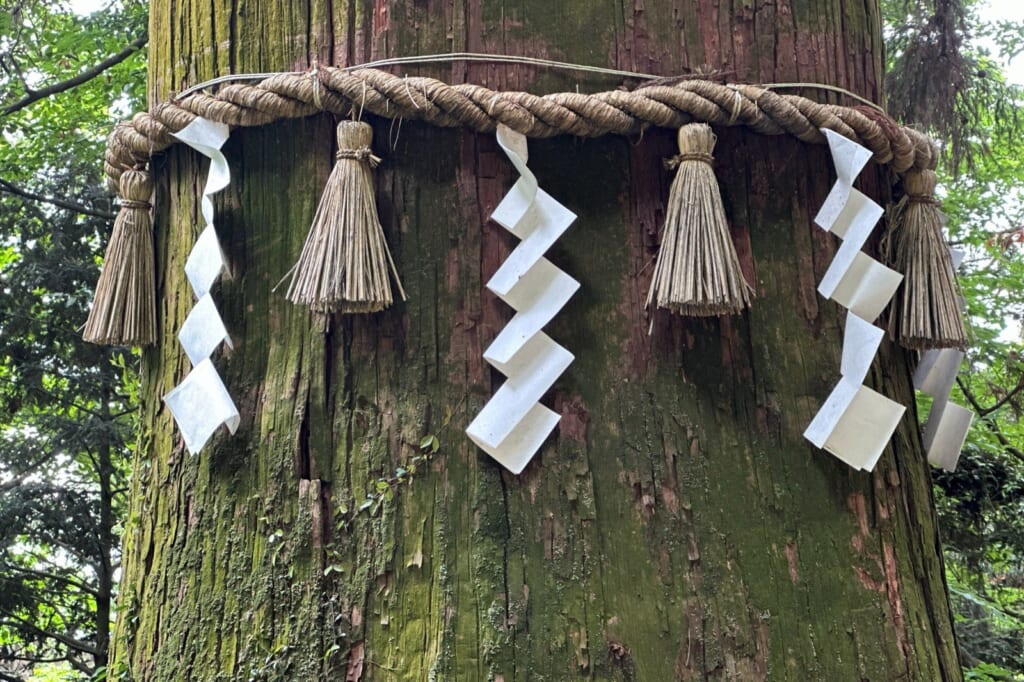
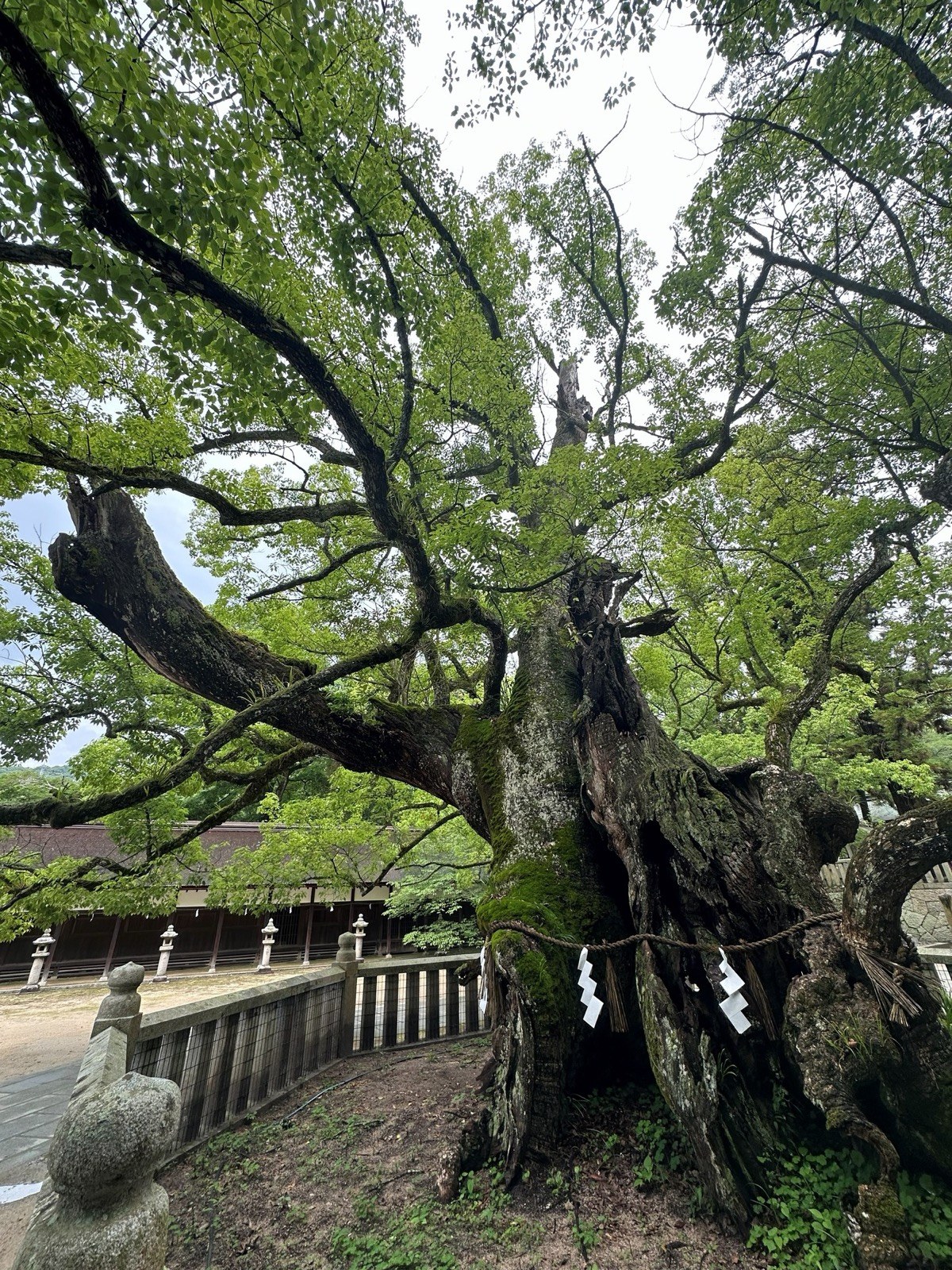
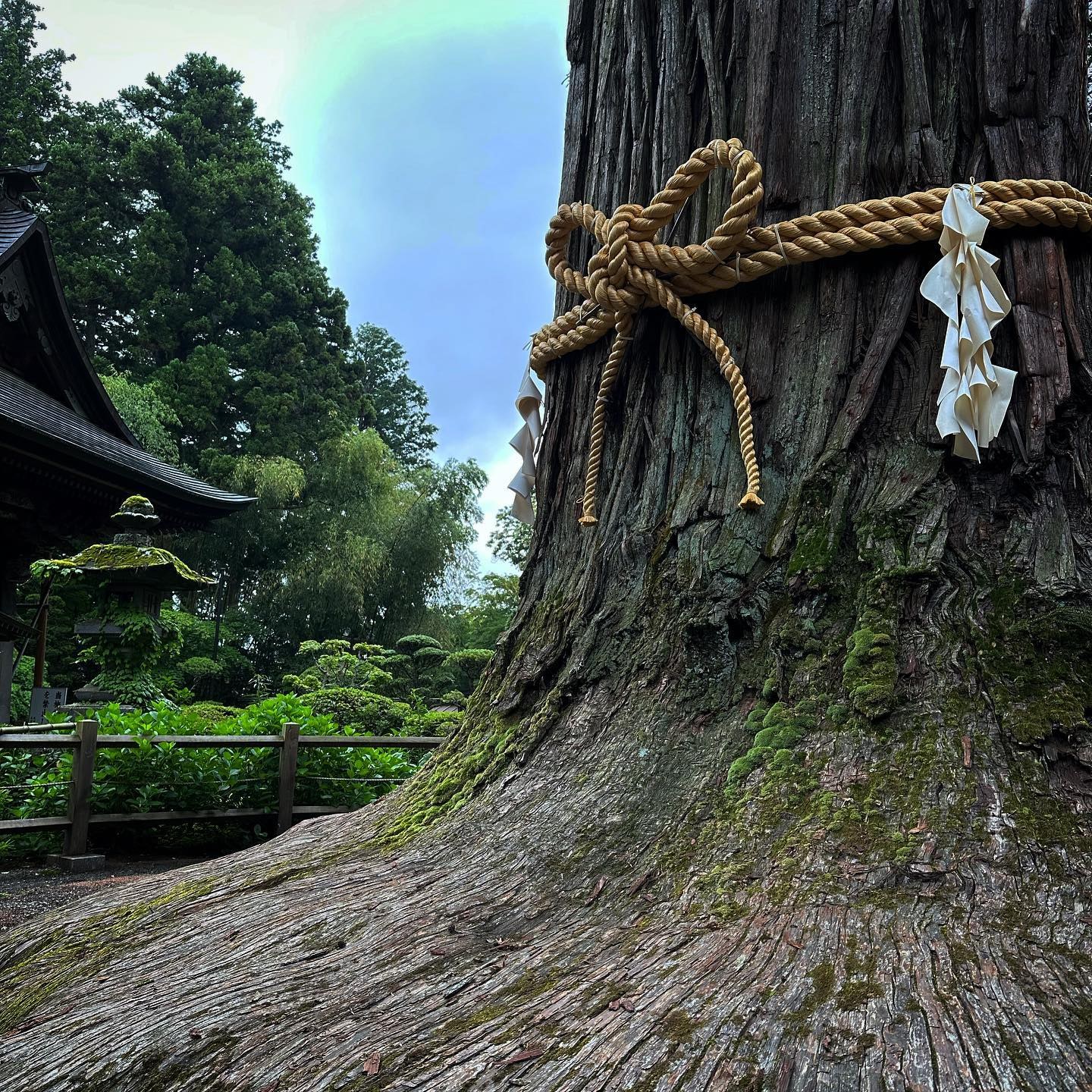
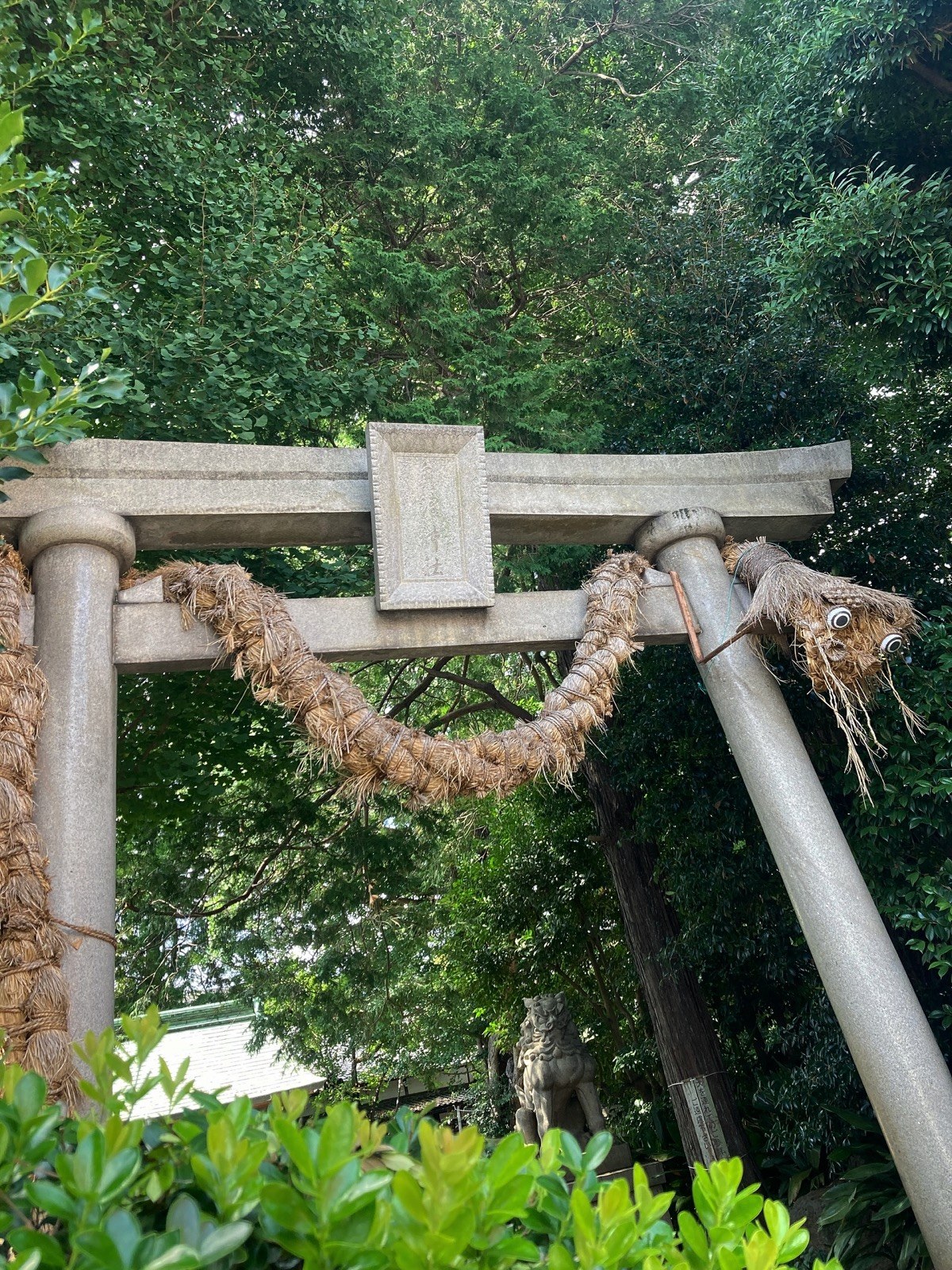
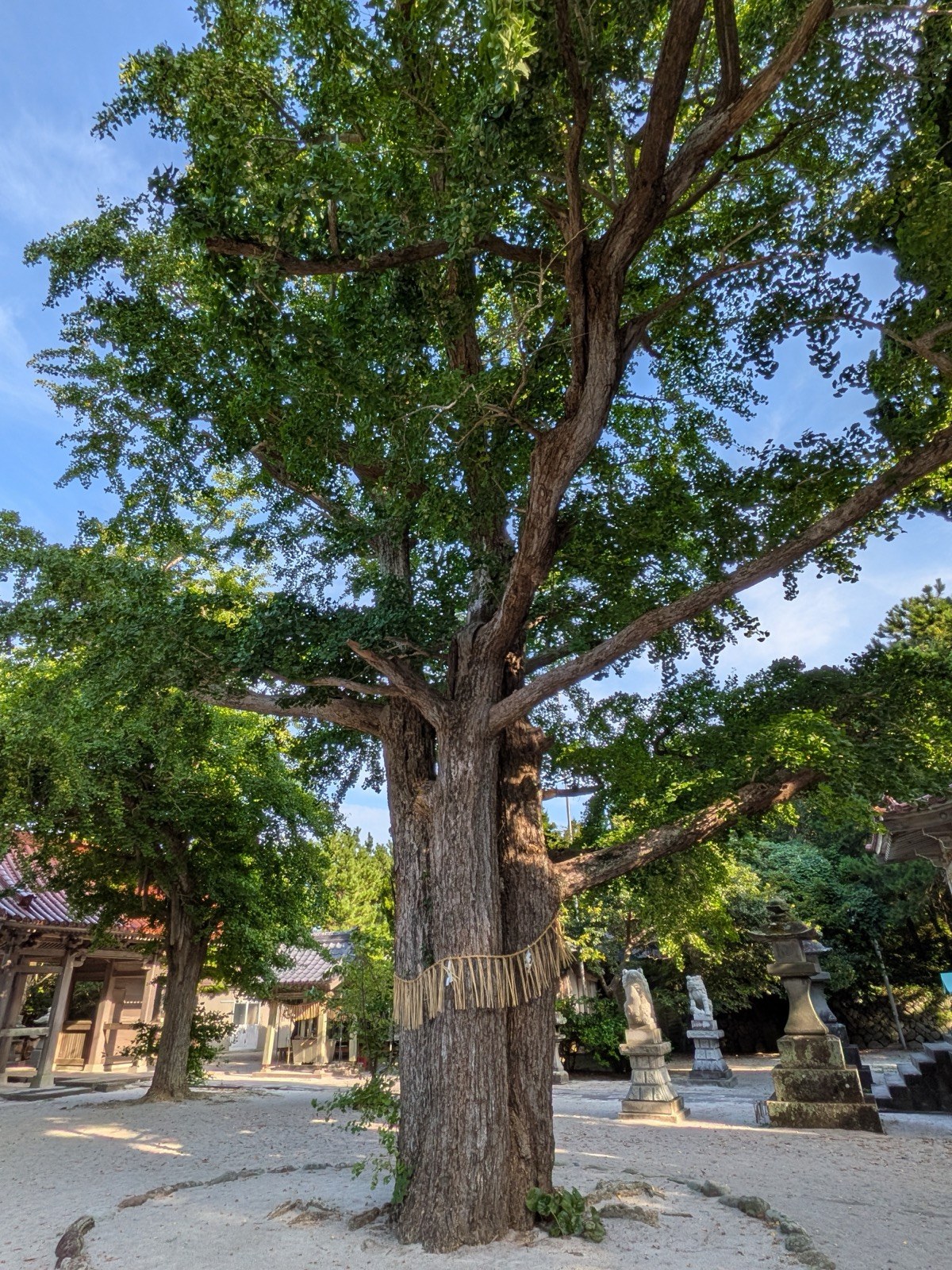
Japan ties a shimenawa (注連縄), a twisted straw rope, around a sacred tree to mark a boundary. The tree is regarded as a place where a kami (a Shinto deity) dwells, and the rope sets that sacred, pure space apart from the world around it; it is a sign, not a support.
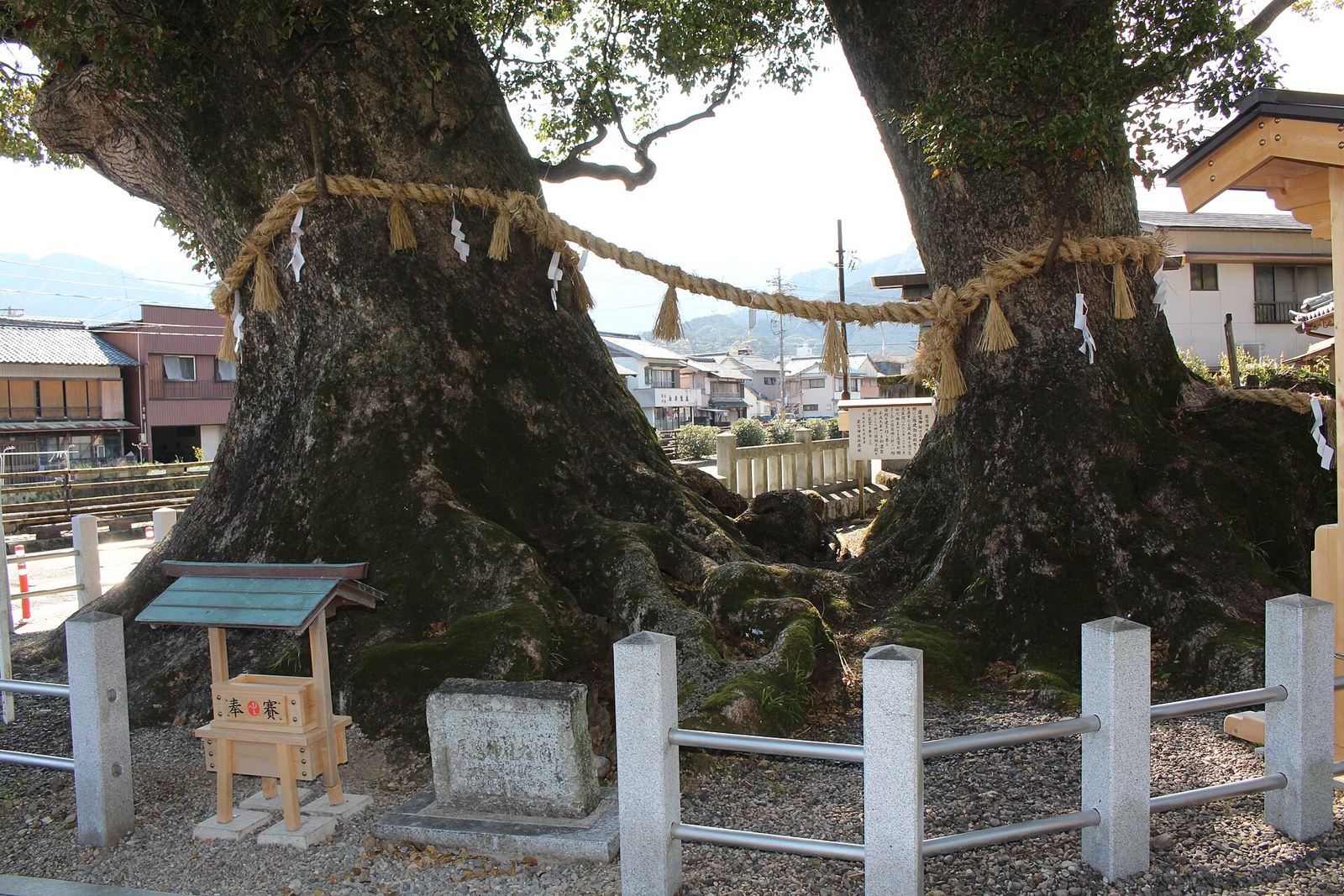
Twice a year, in June and in December, the parishioners of Owase Shrine in Mie Prefecture turn out together to hang a new great rope on what the shrine calls “these two sacred trees” (この二つの御神木). The rope is plaited under the lead of the shrine’s board of representatives. Beside the shrine stand two camphors more than 1,000 years old by the city’s estimate, each about 9 to 10 m around the trunk.
This article starts from those camphors and follows the rope: what it means, where the idea comes from, how to read its twist and paper strips, who makes it and when it is changed at four different shrines, and what a band around a living trunk means to an arborist.
Under the married camphors — a rope at Owase Shrine
Two trees in front of the old shrine
Owase is a city in the south of Mie Prefecture, and a wet one: the Japan Meteorological Agency’s 1991–2020 normal for annual rainfall at Owase is 3,969.6 mm, about 156 inches. In the grounds of Owase Shrine stand two camphor trees, Cinnamomum camphora, the evergreen that Mie Prefecture describes as native to the warm-temperate zone and growing to a great size.
Of the pair, the southern one, on the side of the Kitagawa river, measures 10 m (about 33 ft) around the trunk at eye height; the northern one, on the side of the main hall, measures 9 m (about 30 ft). Mie Prefecture gives their height as about 25 m (82 ft). Owase City estimates both to be about 1,000 years old or more, and they have been a Mie Prefecture Natural Monument since 12 November 1937.
A husband and a wife
The shrine calls them the o-kusu and me-kusu, the male and female camphor, and together Meoto-kusu (夫婦楠), the married pair. They stand in front of the furumiya, the site of the shrine’s original sanctuary, and the shrine writes that people have long come to them to pray for a good marriage, a happy couple and children. Behind the present main hall stands a third camphor of the same generation, which the shrine calls Kamiyo-kusu (神代楠), the camphor of the age of the gods.
The shrine’s main deity is Takehaya Susanoo no Mikoto. Its old documents were lost to a tsunami, so the shrine itself says the details of its founding are hard to establish; its tradition places the enshrinement in the Taihō era (701–703). Each year from 1 to 5 February the town holds the Ya-ya Festival here, which Mie Prefecture selected on 3 November 2002 for documentation as an intangible folk cultural property (a prefectural “selection”, not a designation).
The rope that changes
The shrine’s page on its traditions records who looks after the rope. In my translation: the shrine’s board of representatives leads the plaiting of a great shimenawa, and the parishioners turn out together to re-hang it on “these two sacred trees” (この二つの御神木) twice a year, in June and in December. Just before that sentence the page introduces both the married pair and the Kamiyo-kusu, so it does not make clear which two trees it means.
What is clear is the shape of the practice. A rope plaited by local hands and replaced twice a year is not a label put on a tree once. It is something a community does again and again.
What the rope says — a boundary, not a decoration
“To demarcate sacred or pure space”
Kokugakuin University’s English-language Encyclopedia of Shinto opens its entry on the shimenawa with this definition: “A straw rope hung before or around a site to demarcate sacred or pure space.” It lists the places it is hung: in front of the inner sanctuary, at the entrance to a shrine precinct, around a ritual site. A tree is one more of those sites.
The Tokyo Shrine Association puts the purpose in practical terms: the rope is stretched across a sacred area to separate the inside from the outside, so that the inside is not touched by impurity. The Association of Shinto Shrines (Jinja Honchō) adds the other half: the rope shows that what lies inside it is in a sacred, pure state.
Shime — a mark that says “this is held”
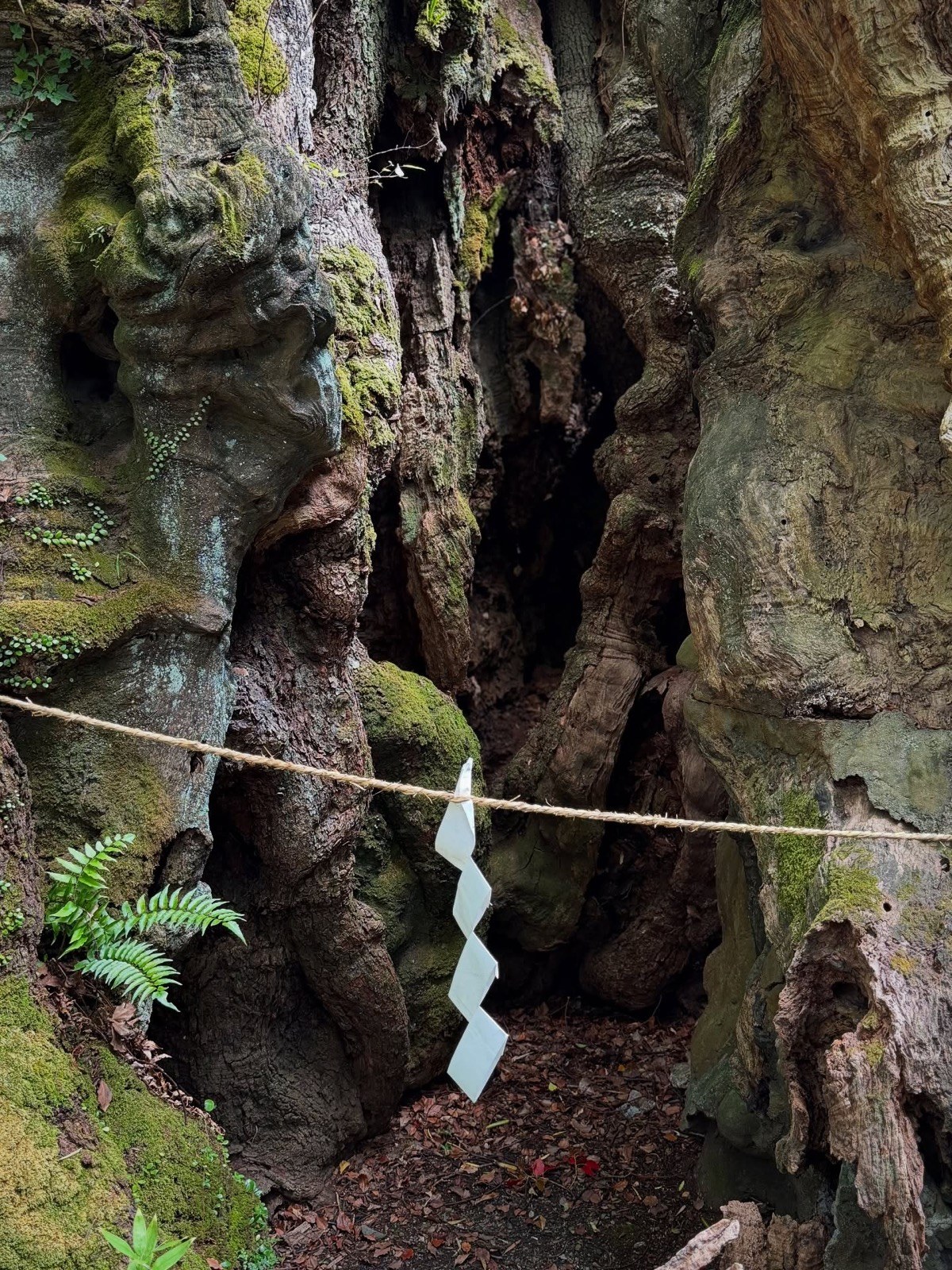
The word itself carries the older meaning. Kokugakuin explains that in ancient Japan shime were signs of ownership or exclusive possession, a “marker,” and that a rope was one way of making that mark. The same encyclopedia notes other ways of writing the word, including 七五三 (“7-5-3”) and 標縄, where the first character carries the sense of a mark.
Read that way, a shimenawa on a camphor does not say “this tree is old” or “this tree is large.” It says “this place is held apart.”
The paper strips
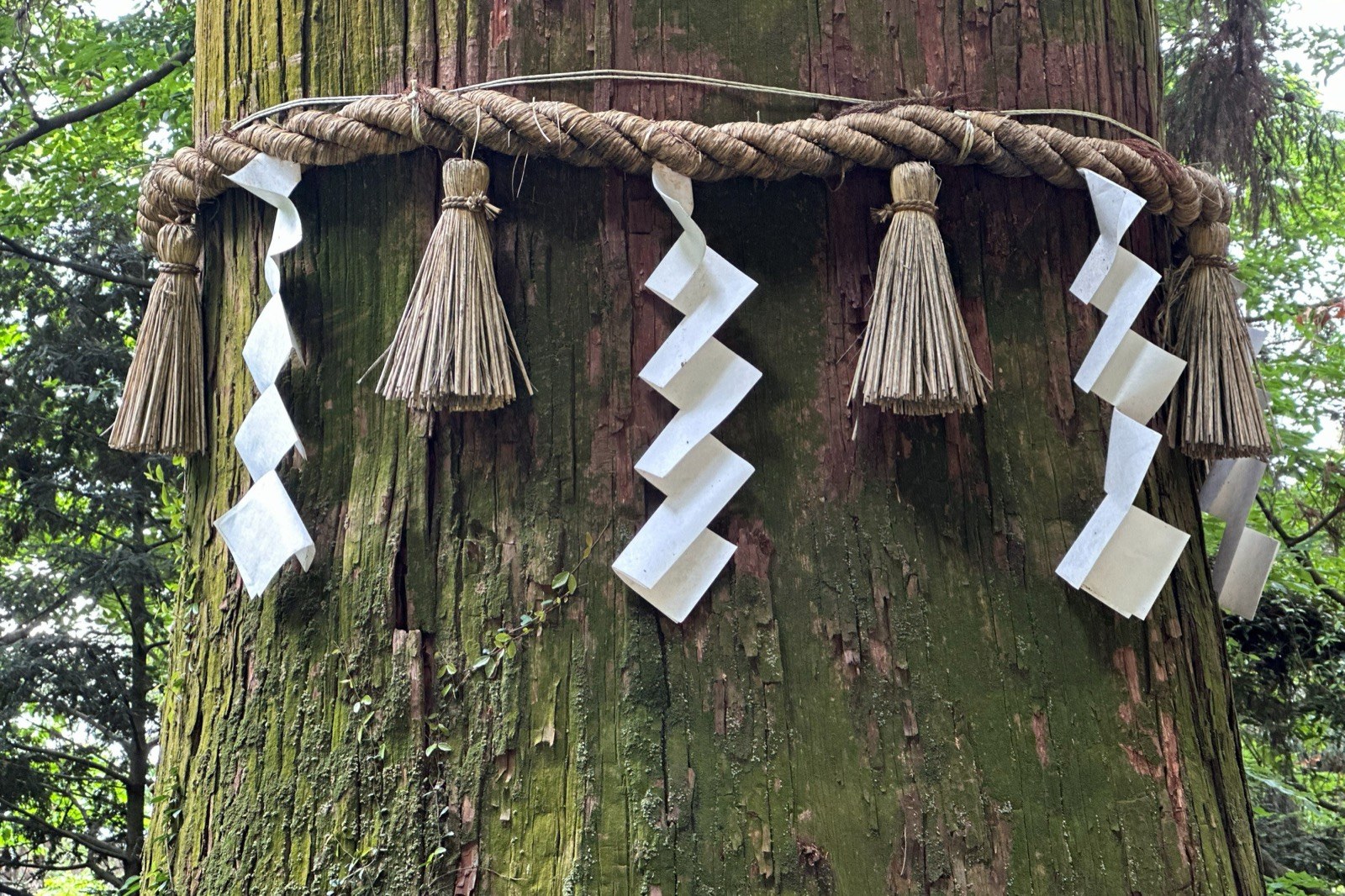
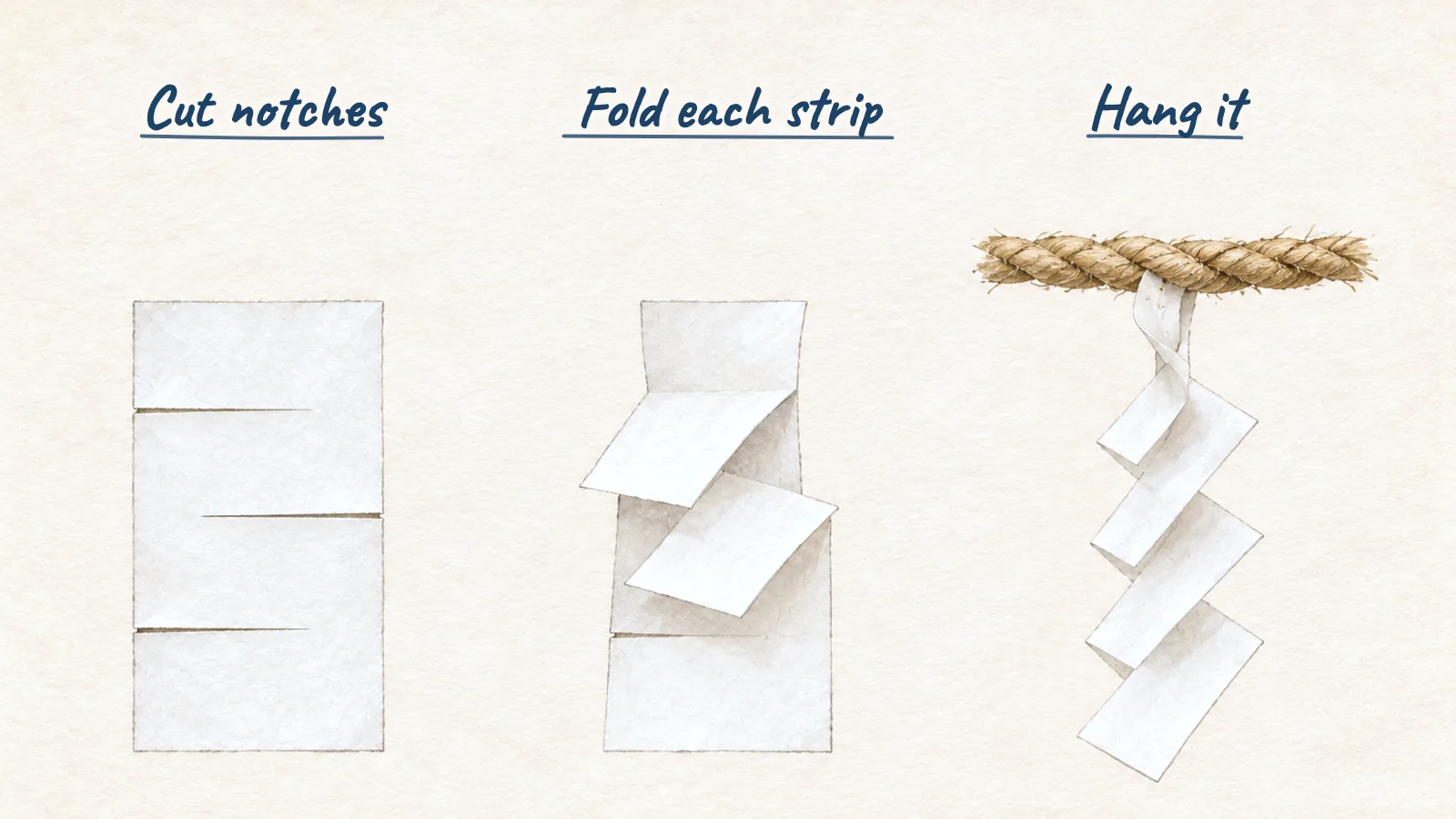
The white paper zigzags are shide (紙垂). Jinja Honchō describes them as pieces of paper, such as hanshi, cut and folded, that show a thing is sacred and pure. Kokugakuin adds that they symbolise sacred borders. So the rope and its paper say the same thing twice: one draws the line, the other marks it as a holy one.
| Term | Japanese | What it is |
|---|---|---|
| Shimenawa | 注連縄・標縄・七五三縄 | Straw rope that marks sacred or pure space |
| Shide | 紙垂 | Cut, folded paper hung from the rope; shows sacredness and purity |
| Shinboku / goshinboku | 神木・御神木 | A tree regarded as sacred |
| Yorishiro | 依代 | An object a kami comes down into during a rite |
| Himorogi | 神籬 | A temporary sacred space set up for a rite |
| Iwakura | 磐座 | A rock formation to which a kami is invited |
Why a tree — shinboku, yorishiro and himorogi
A tree as the place a kami comes down
Kokugakuin defines a shinboku (神木), or goshinboku with the honorific, as “a tree regarded as sacred, as the symbol of sacred territory or a place in which the kami dwell,” and notes that such trees today are “frequently encircled by sacred border ropes.” I wrote about the idea of the shinboku itself in Shinboku: Japan’s sacred trees, explained by an arborist; this article picks up the rope that piece only touched on.
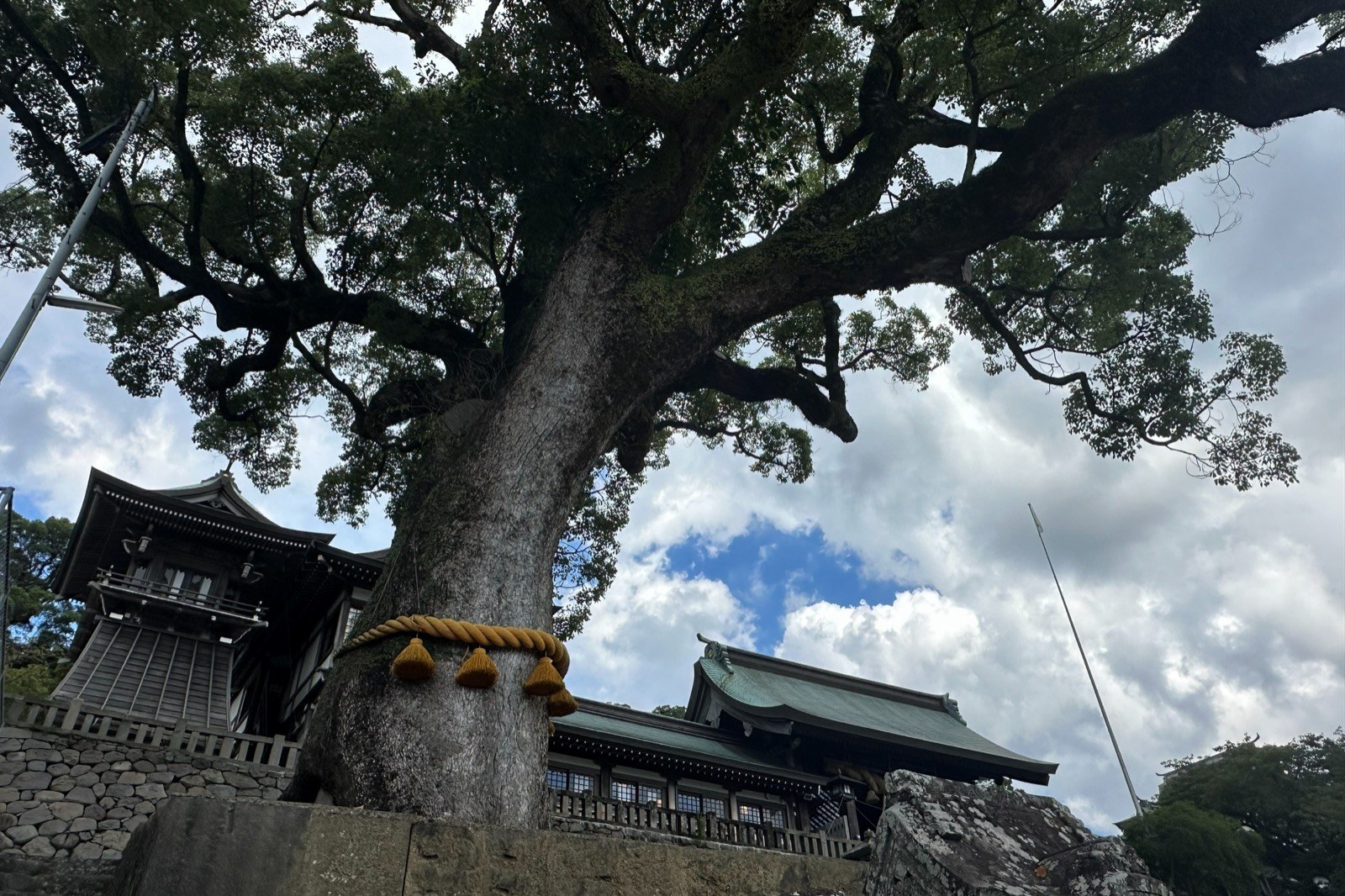
The key word for a reader outside Japan is yorishiro (依代). Kokugakuin defines it as the place, object or person a kami descends into and dwells in during a rite, and notes that yorishiro “may take the form of natural objects such as trees or rocks.” The tree is not exactly the god. It is the place the god comes to, and the rope marks that place.
The same rope on rocks and on ritual sites
Trees are not the only thing roped. A himorogi (神籬) is a temporary sacred space set up for a rite; Kokugakuin describes its present form as branches set at four corners, “between which are strung sacred border ropes (shimenawa).” An iwakura (磐座), in Kokugakuin’s words, is “a formation of rocks considered to be sacred to which a kami is invited.” The English guide Soul of Japan, published by Ise Jingū with Jinja Honchō, says shimenawa are placed around objects and trees “to indicate the presence of kami.”

So the rope is not only a tree custom. It is a general way of drawing a sacred line, and a tree is one of the places it is drawn.
How many big trees are in sacred hands
Japan’s Ministry of the Environment keeps a national survey of giant trees, defined in principle as trees with a trunk girth of 3 m or more at 1.3 m above the ground. Its 2000 follow-up survey covered 64,479 trees, and in 2018 the ministry described its database as holding about 70,000. Among the trees in the 2000 survey for which owners could be counted, shrines and temples owned 57 percent, or 21,262 trees.
That figure does not say how many of them carry a rope, and it covers only the trees whose owners were counted. It does show that, in that survey, more than half of those giant trees belonged to shrines and temples.
The first rope — a myth at the mouth of a cave
Amaterasu and the rope behind her
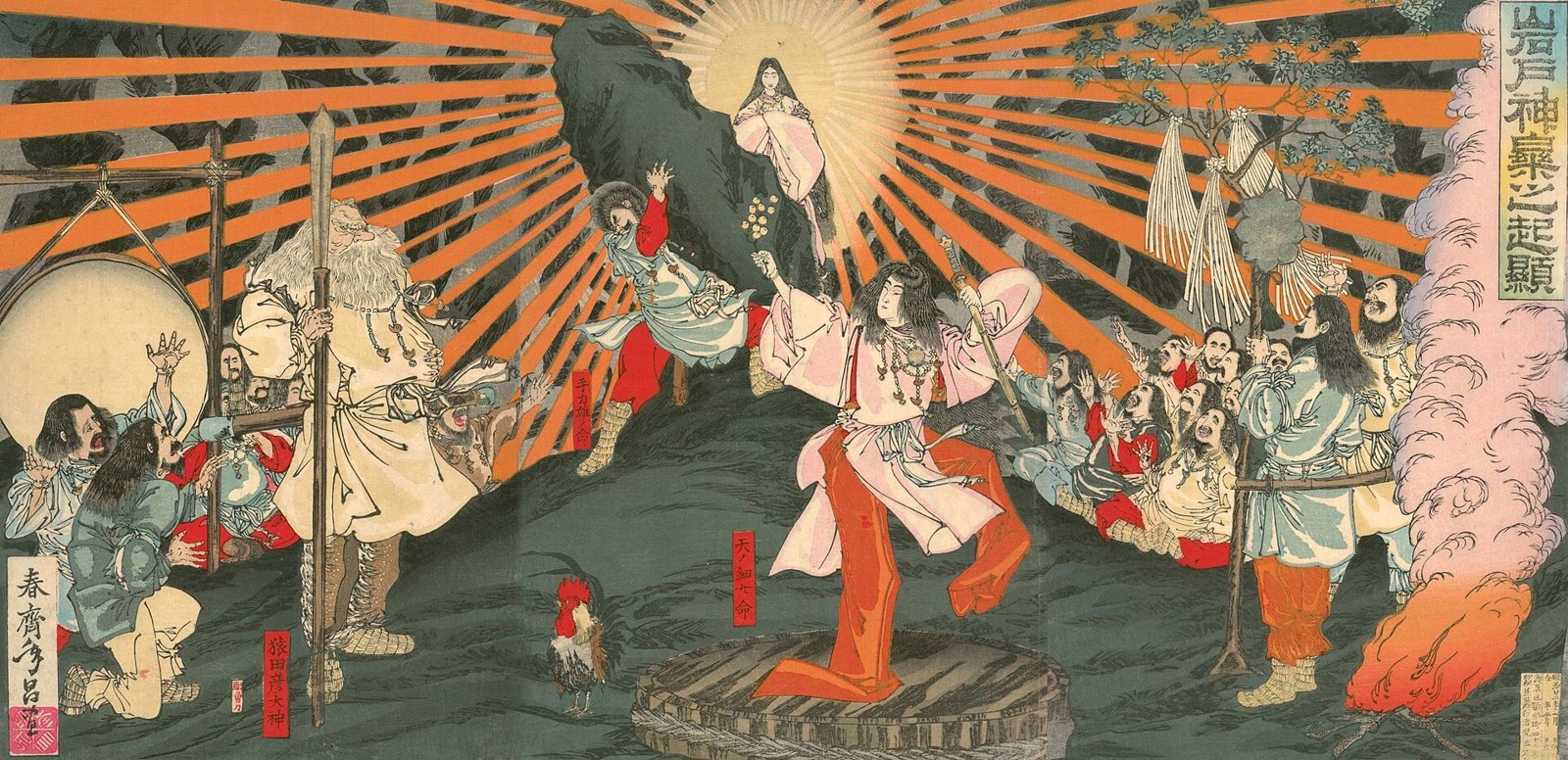
Japan’s early chronicles give the rope a story. In the Kojiki, the sun goddess Amaterasu shuts herself in a rock cave and the world goes dark. When she is drawn out, a god stretches a rope behind her — in the text, shirikume-nawa (尻久米縄) — so that she cannot go back in. Kokugakuin’s annotated Kojiki gives the passage, and notes that the Nihon Shoki writes the same rope as 端出之縄. Jinja Honchō’s English pamphlet on Shinto myths tells it simply: the gods “stretched a sacred rope across the entrance.”
A myth, not a date
This is a story about what a rope does — it closes a boundary — not evidence of when people first tied rope around trees. No surviving shimenawa is that old; straw does not last. What the myth shows is the idea itself: a rope marks a line that is not to be crossed, and keeps something precious on the right side of it.
Reading the rope — twist, shape and paper
Twisted to the left, usually
A Japanese shimenawa is usually hidari-nai (左綯い), “left-twisted.” The Okayama Shrine Association explains that left-twisting is the common form, but that some shrines and regions, by their own custom, combine right-twisted and left-twisted strands. So the direction of the twist is a habit with exceptions, not a rule you can use to judge whether a rope is “correct.”
Burdock and radish
The shape varies too. The Fukushima Shrine Association names two familiar forms by the vegetables they resemble: gobō-jime (牛蒡注連), thin and the same thickness along its length like a burdock root, and daikon-jime (大根注連), thick at the base and tapering like a daikon radish. A study in the bulletin of Oita Prefectural College of Arts and Culture lists further forms, including the maedare-jime (前垂注連), but the researchers themselves revised their classification, so there is no single agreed list.
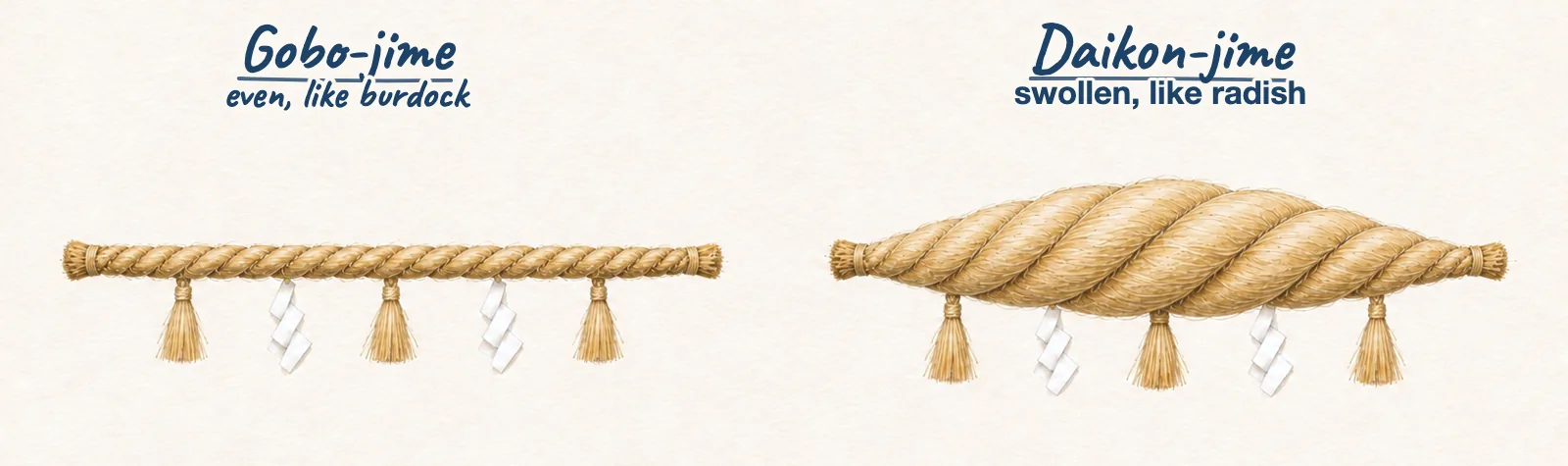
| What you see | Name | What it tells you |
|---|---|---|
| Even, thin rope | Gobō-jime (牛蒡注連) | Burdock form; thickness does not change |
| Thick at one end, tapering | Daikon-jime (大根注連) | Radish form; base thick, tip thin |
| Other forms | e.g. maedare-jime (前垂注連) | Classifications differ between studies |
| White zigzag paper | Shide (紙垂) | Marks sacredness and purity |
| Left-twisted strands | Hidari-nai (左綯い) | The common form; some shrines differ |
Paper, tassels and the finished rope
In Esaka Shrine’s own method, three straw bundles are made, two are twisted together, the third is added, and the rope is finished with tufts of straw the shrine calls shime-no-ko (〆の子) and paper shide. Other shrines do it differently; in this one, the straw comes first, the twist next and the marks last.
Who renews it, and when — four shrines, four calendars
Twice a year at Owase
At Owase the rope is renewed in June and December, by parishioners, with a rope whose plaiting the shrine’s board of representatives leads. The shrine’s page does not give fixed dates or a formal name for the event; it gives only the two months.
Once a year, on 15 August, in Niigata
In Jōetsu, Niigata Prefecture, the sacred tree of Hachiman Shrine is a Japanese cedar, the Kushiike no Ōsugi: about 800 years old by estimate, 7.3 m around at eye height, about 30 m tall, and a Niigata Prefecture cultural property since 10 February 1954. The city reports that every year on 15 August the people of the Kaminakajō hamlet plait a rope and hang it on the cedar, then hold the festival rite. In the year the city wrote about, eight residents did the work.
On the morning of the festival, in Chiba
At Matsuzawa Kumano Shrine in Asahi, Chiba Prefecture, the sacred tree is a cedar that the shrine says was designated a city Natural Monument in 1977; Chiba Prefecture gives it a height of 30 m and an age of about 800 years. The shrine’s newsletter records that in 2019 the Miyamoto fire service organisers and young people (宮本消防世話人と若人) made a new great rope on 29 September, and that on the morning of the annual festival the brand-new rope was hung on the great torii gate and on the sacred cedar.
Ropes made by a whole town
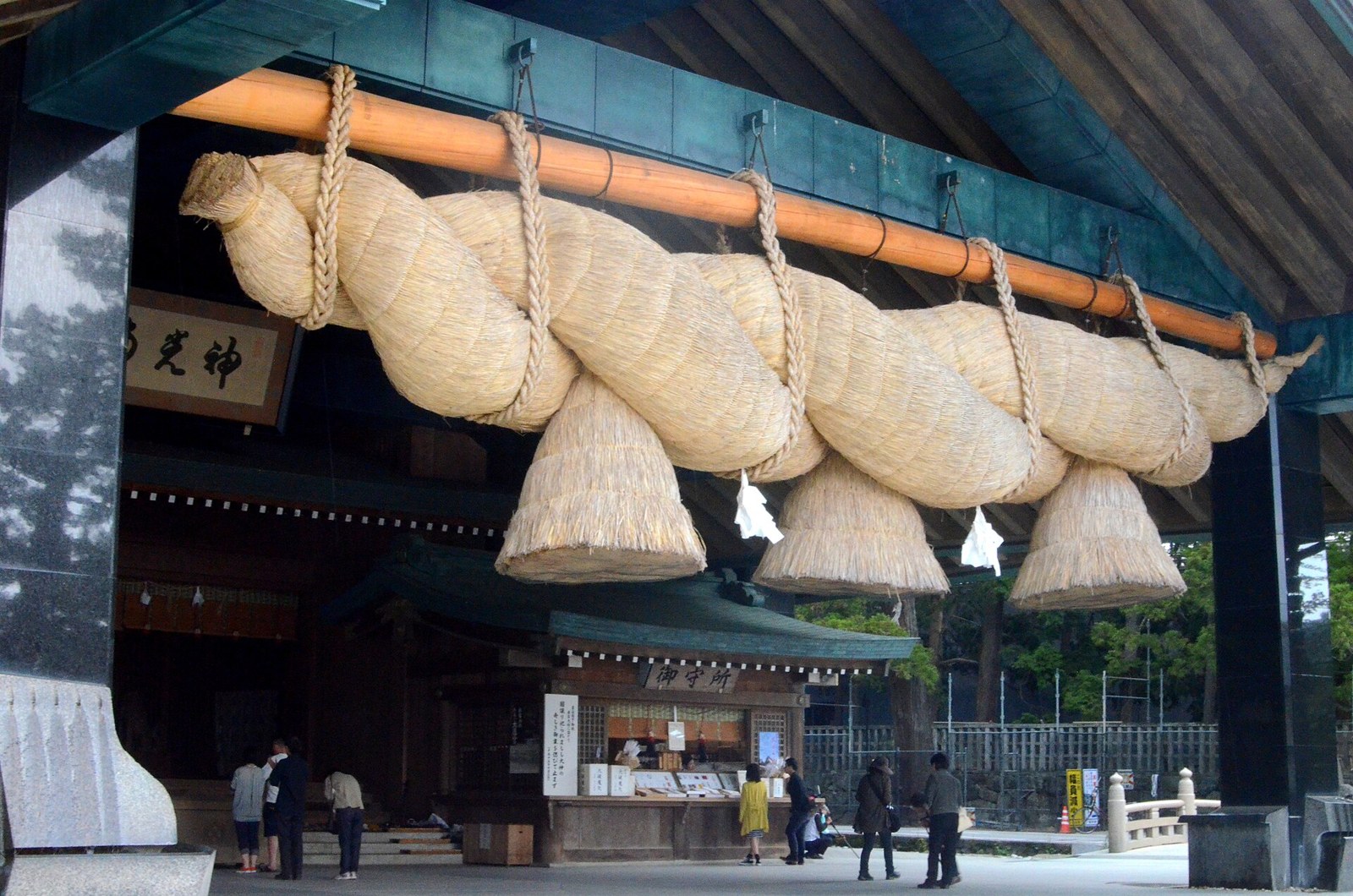
Some of the largest ropes come from one town. Izumo Taisha records that the great shimenawa hung on its Kagura-den hall on 17 July 2018 was made in Iinan, Shimane Prefecture, by the Izumo Taisha Kannōkōsha Tonbara branch and the Iinan Shimenawa Enterprise Cooperative (飯南町注連縄企業組合), and that it was 13.6 m (about 45 ft) long and weighed 5.2 tonnes. Iinan town reports that the rope hung on 21 July 2026 was the same length and weighed 4.7 tonnes. That rope hangs on a building, not a tree, but it shows how far a town will go to keep the line renewed.
| Shrine | What is roped | Who renews it | When |
|---|---|---|---|
| Owase Shrine, Mie | “Two sacred trees” (camphors) | Parishioners; rope plaited under the board of representatives | June and December |
| Hachiman Shrine, Jōetsu, Niigata | Kushiike no Ōsugi (cedar) | Residents of Kaminakajō hamlet | 15 August each year |
| Matsuzawa Kumano Shrine, Asahi, Chiba | Sacred cedar and great torii | Miyamoto fire service organisers and young people (2019) | Morning of the annual festival |
| Izumo Taisha, Shimane | Kagura-den hall (not a tree) | Made in Iinan (2018 maker recorded by the shrine) | Replaced 2018 and 2026 |
Is there a “right” time?
The Niinamesai (新嘗祭) on 23 November is the festival at which, Jinja Honchō says, shrines throughout the country give thanks for the new crop, so it would be easy to assume that new rope always follows the new harvest. In the sources for this article, no shrine authority states such a rule, and the calendars above — June and December, mid-August, a September festival, July — differ from shrine to shrine. None of the sources describes how the rope is fastened to the trunk, or how tightly; for the tree, that is the detail that matters most, and I could not confirm it.
Straw cut green — how a shimenawa is made
Rice grown for rope, not for grain
Ordinary rice straw is the leftover of a harvest. For the Iinan ropes, the straw is grown on purpose. The Iinan group explains that its 2018 rope used a dedicated variety, Akaho-mochi, which was cut green, before the grain had fully filled, and dried and stored. The group also names a local heirloom variety, written 亀治, among the straw it uses for rope.
Sorting, then twisting
The Iinan group describes sorting the straw by hand to remove damaged stalks and those of poor colour. A folk-craft document published through the Ministry of Land, Infrastructure, Transport and Tourism’s Hokuriku office describes one way of preparing rope straw: the stalks are cleaned of loose leaves (suguri, すぐり) and beaten to soften them before twisting. The same document notes an exception that matters here: for ritual use, some ropes are twisted from unbeaten straw just as it is.
When the straw is hard to find
Green-cut straw is not easy to come by. Jinja Honchō reports on a rope-making event at Nagikibayashi Shrine, where the organisers named the difficulty of obtaining green-cut straw and of finding farmers willing to help. A rope renewed every year depends on someone growing and cutting that straw.
Why the rope is renewed — purity and tokowaka
What the sources say
Owase Shrine says when its rope is renewed and by whom; it does not say why. Two other sources explain related ideas. Jinja Honchō says the rope shows that what lies inside it is in a sacred, pure state. Ise Jingū explains tokowaka (常若) as “always youthful,” and describes the Shikinen Sengū, in which the shrine buildings, the sacred garments and the treasures are all made new once every 20 years.
My reading, not the shrine’s
Put together, those two ideas suggest a reason: a rope that is meant to show purity is kept new, as Ise keeps its buildings new on a far larger scale. That is my analogy, not a statement by Owase Shrine or any of the shrines in this article.
What a rope does to a tree — an arborist’s view
A line around a growing trunk
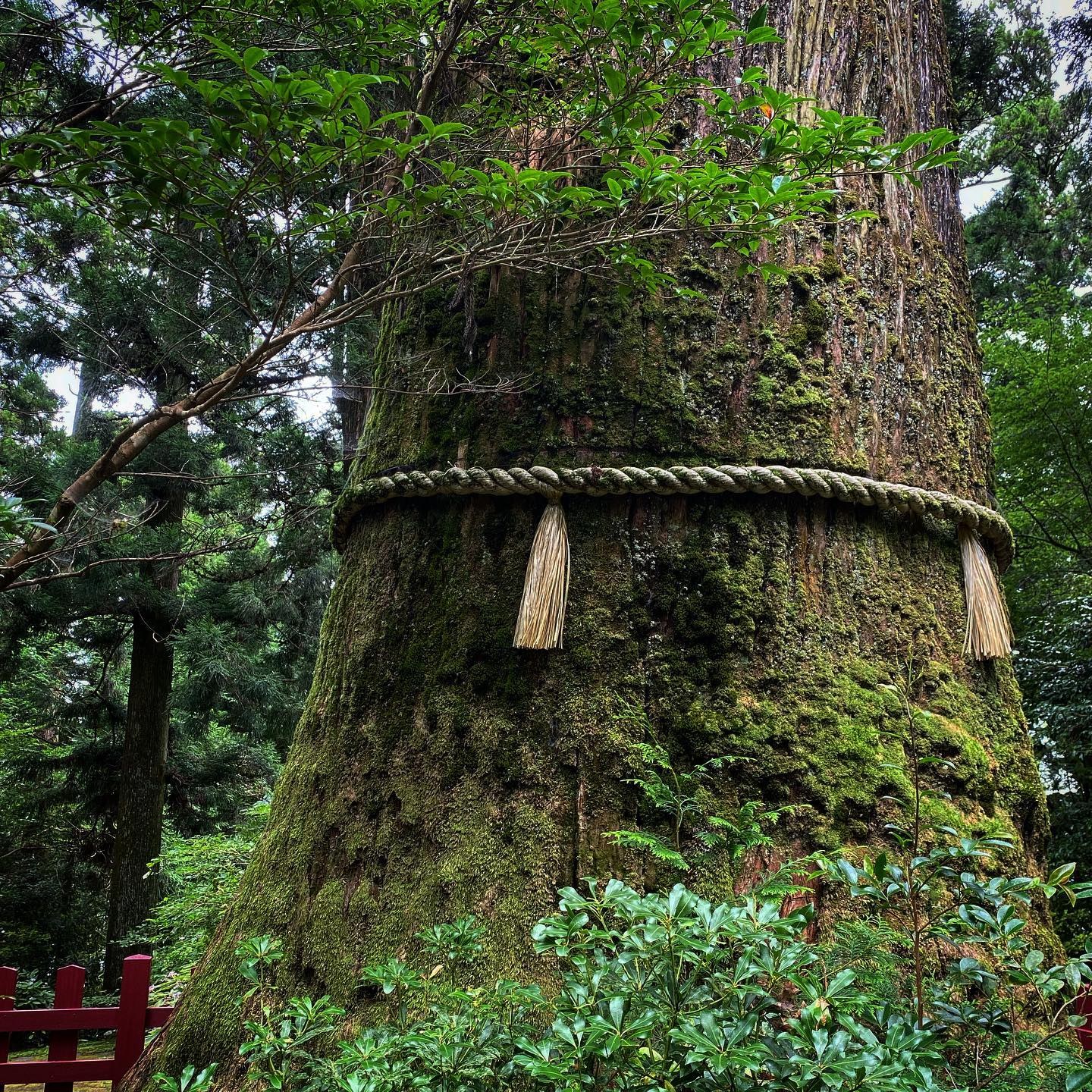
To an arborist, anything tied around a trunk raises one question: what happens as the trunk grows? A tree thickens every year by adding new wood and bark from a thin living layer under the bark, the cambium. The University of Missouri Extension describes the cambium as the layer that produces new phloem and xylem and notes that it is “vulnerable to girdling by wires.” The University of Tennessee’s Master Gardener text explains the consequence: when a ring of phloem is lost, the sugars made in the leaves can no longer reach the roots.
What extension services warn about
Michigan State University’s guide to abiotic injury says that ropes left around tree trunks, or wires from staking, may constrict growth or become embedded in the trunk or branches, and lists reduced growth or dieback above the constriction, and swelling, as signs. Colorado State University Extension warns that tree-staking straps can seriously injure a tree if attached badly or left on too long. The University of California’s IPM guidance on staking recommends forming a loose loop around the trunk.
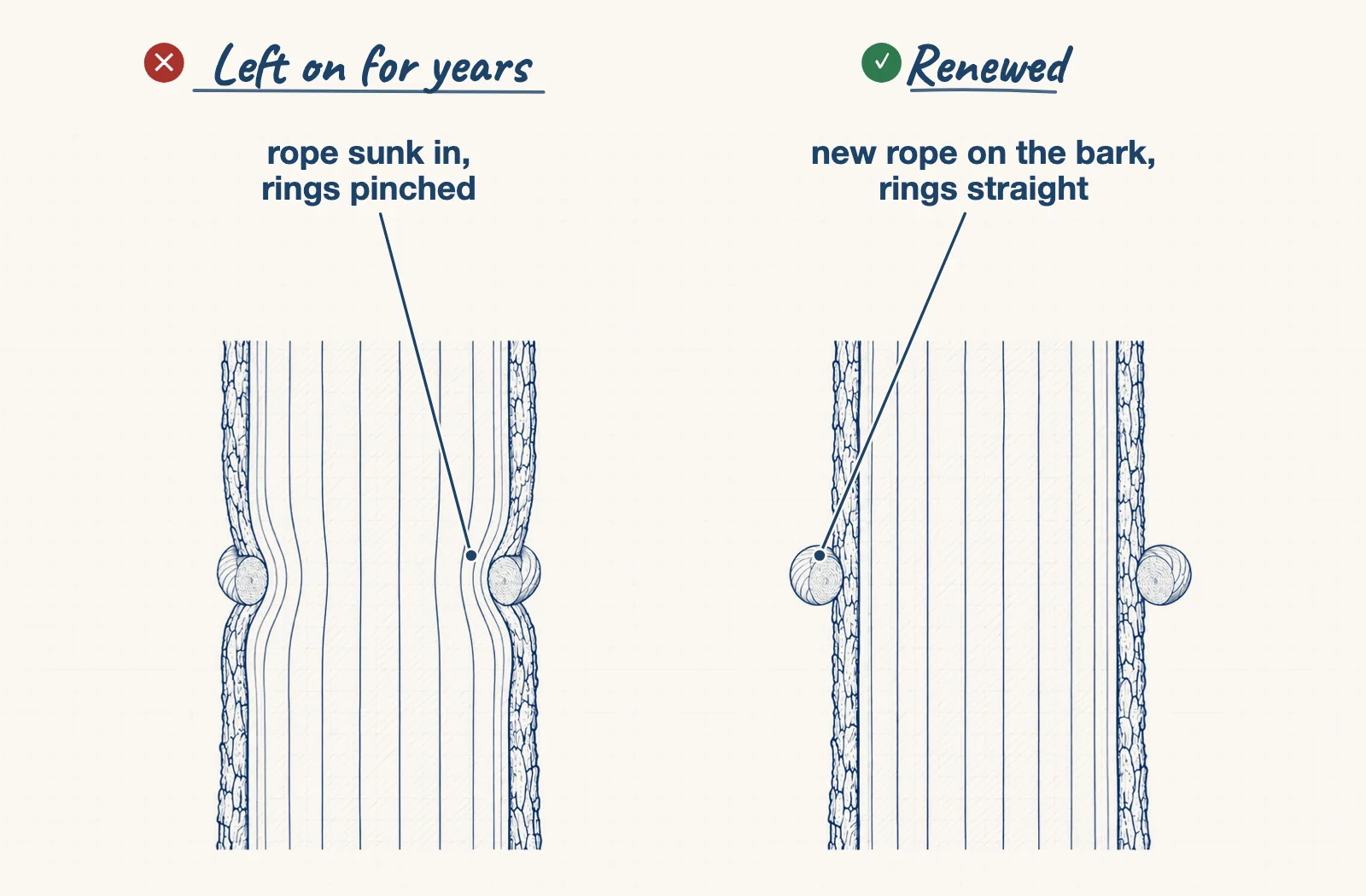
These are general warnings about ties on trees. None of them measured shimenawa, and I found no Japanese shrine or local government source that says sacred-tree ropes are hung loosely, or renewed, because of the tree’s growth. So I will not claim that the custom was designed for the tree.
Why renewal happens to help
What I can say is how the custom looks through those warnings. A rope that is taken down and re-hung every year, or every six months, does not stay on the trunk for years at a time. Each renewal is also a moment when people are standing at the base of the tree. That does not prove the custom is harmless: I found no study that measured shimenawa damage, and how often a rope is changed says nothing about how tightly it is tied.
A rope that is no longer renewed is a different case, because then it is simply a band left on a trunk. If you look after a roped tree, the signs to watch for are the ones Michigan State lists for any tie: growth constricted at the band, the band becoming embedded, reduced growth or dieback, and swelling. If you see them, tell the shrine office rather than cutting or loosening the rope yourself; the rope belongs to the shrine.
The rope marks the tree; the care keeps it
At Owase, the rope is not the only thing the camphors receive. Mie Prefecture’s record of cultural property protection lists a regeneration project for the Owase Shrine camphors, including branch removal and soil improvement, with “recovery of tree vigour” completed on 19 January 2009. The rope says the tree is sacred; the soil work and pruning are what help it live. I wrote more about how reverence and tree care pull together, and sometimes against each other, in Sacred trees in Japan: how reverence shapes tree care.
Japan and elsewhere — clootie wells and rag trees
Scotland: a rag for every visitor
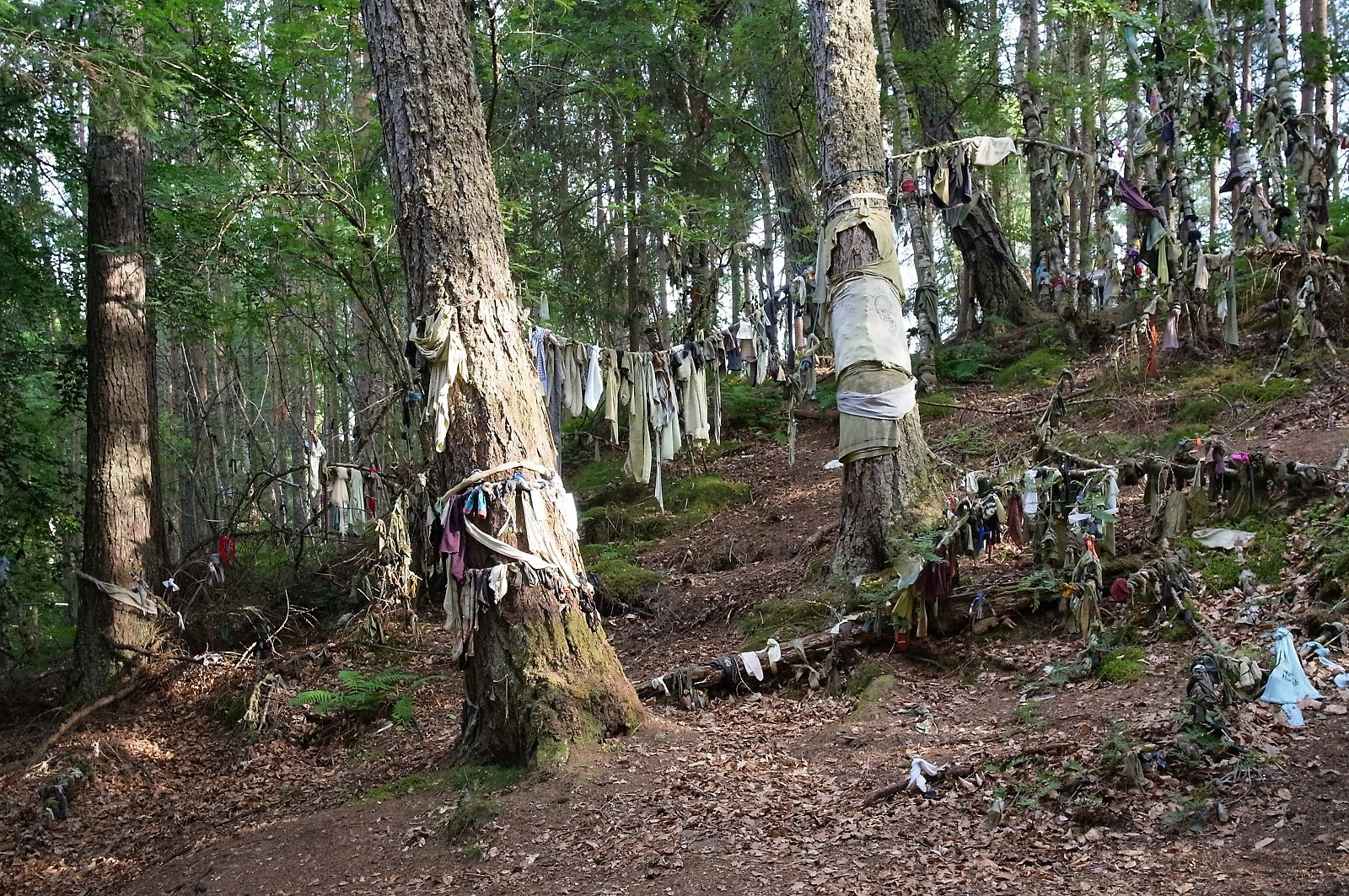
Europe has its own trees tied with cloth. At the Munlochy Clootie Well in the Scottish Highlands, managed by Forestry and Land Scotland, a “cloot” is “a rag dipped in the well and tied to a tree.” The agency asks visitors to keep their cloots “small, appropriate and biodegradable,” and recommends pure wool or pure cotton for the environment’s sake.
Ireland: ribbons by holy wells
The National Museum of Ireland describes ribbons and rags left by pilgrims on trees beside holy wells, in its account of St Brigid’s Day traditions.
Two different premises
The difference in the examples here is not in how sacred the tree is but in who ties the cloth. At Munlochy, each visitor ties a piece of cloth, and the managing agency’s guidance is about what that cloth is made of. At the Japanese shrines in this article, the rope is made and hung by the shrine community, on the shrine’s own schedule.
| Examples in this article | Japan (shimenawa on a shinboku) | Scotland and Ireland (clootie and rag trees) |
|---|---|---|
| Who ties it | Shrine community: parishioners, residents, local groups | Individual visitors and pilgrims |
| Material | Rice straw; at Iinan, grown and cut green for the purpose | Cloth; small, biodegradable, wool or cotton advised at Munlochy |
| Renewal | Owase twice a year; Jōetsu every 15 August | Not described in the sources |
| Meaning | Marks a sacred, pure boundary | Linked to holy wells and pilgrims |
Ropes at home — New Year shime-kazari and the bonfire
The same line on a front door
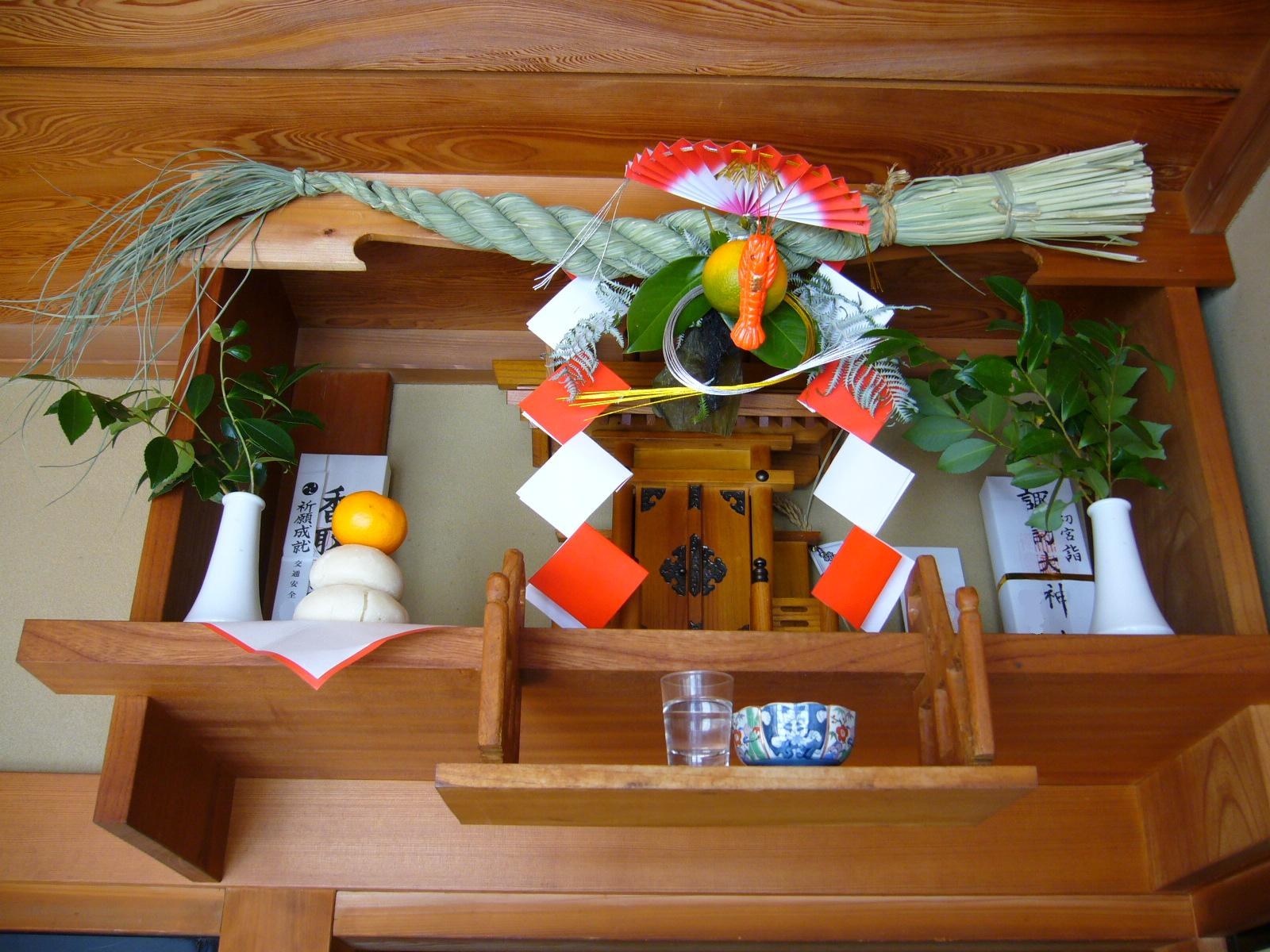
The shimenawa is not only for shrines. Jinja Honchō notes that ropes are made for household kamidana, home altars, as well as for shrine buildings and sacred grounds, and the Hyōgo Shrine Association explains that at New Year a rope with shide is hung to welcome the year god, the toshigami, into a sacred, pure place. The New Year decoration draws the same kind of boundary around a home. The pine and bamboo set at the gate for the same visitor are the subject of Kadomatsu — why Japan cuts pine and bamboo to welcome the New Year.
Burned at the shrine
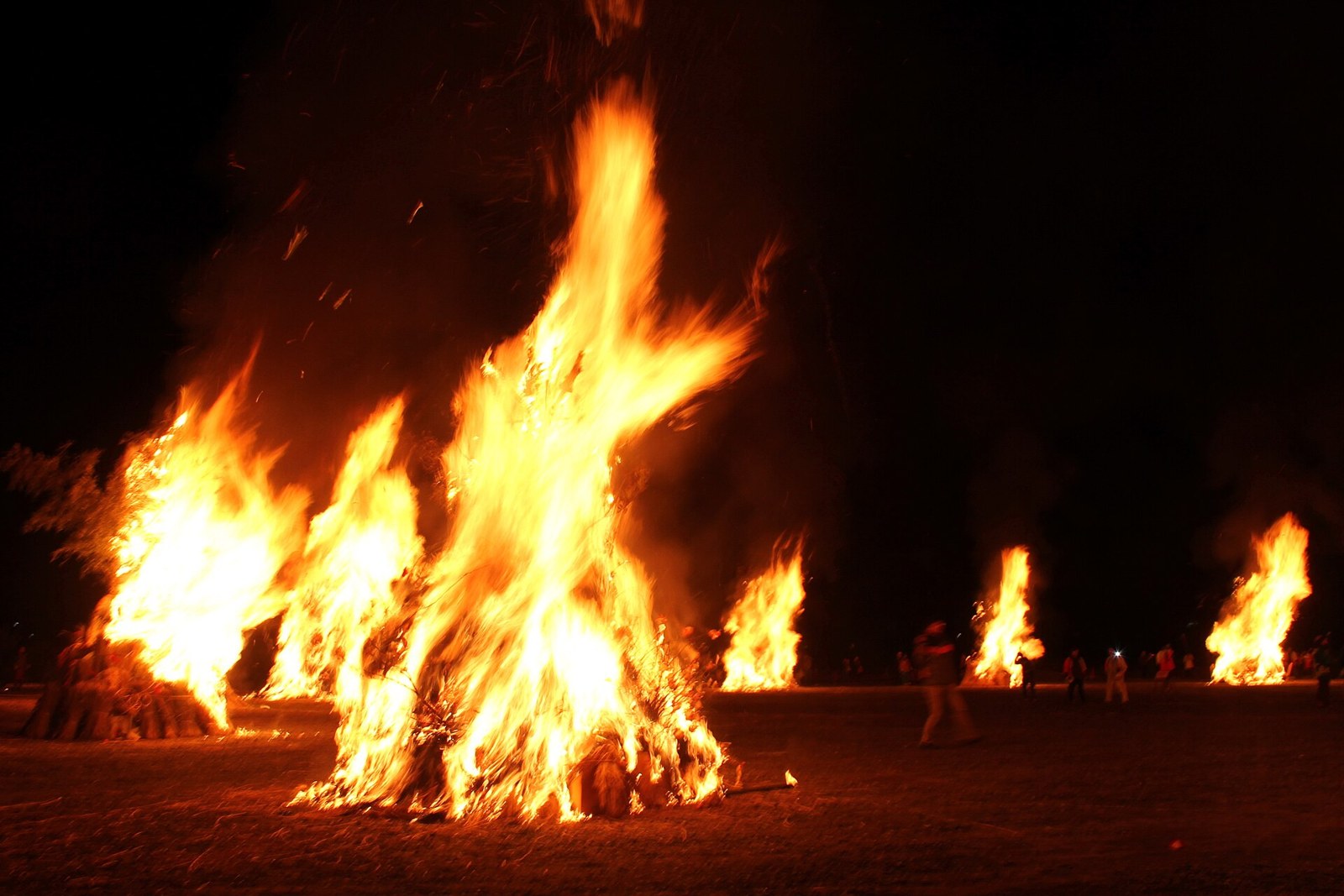
Jinja Honchō explains that many shrines hold sagichō (左義長) or dondo-yaki (どんど焼き) between New Year’s Eve and around 15 January, the “Little New Year,” where New Year decorations are burned along with old talismans. Practices differ by shrine: Ise Jingū’s return point for old talismans states that it cannot accept shimenawa. The rope on a sacred tree follows the same logic — it is not simply discarded, it is replaced — but where and how each shrine disposes of its old tree rope was not something the sources for this article described.
What people get wrong about the rope
“The rope holds the old tree together”
It does not. Every definition in this article describes the rope as a marker of sacred space, not as a support for the trunk.
“Only trees get a shimenawa”
The same rope is strung around himorogi, the temporary ritual spaces, and hung at shrine entrances and in front of inner sanctuaries. Trees are one kind of sacred place among several.
“Every shrine renews its rope after the harvest festival”
The Niinamesai on 23 November is certain; a nationwide rule linking it to rope renewal is not, in the sources here. Owase renews in June and December, a Niigata hamlet in August, a Chiba shrine on its festival morning.
“A real shimenawa always twists to the left”
Left-twisting is the common form, but the Okayama Shrine Association notes shrines that combine right and left. The twist is a custom, and customs vary.
“Tying rope round a tree can’t hurt it”
I found no study that measured it either way. Michigan State University’s extension guide explains that ropes left around trunks may constrict growth or become embedded. Renewing the rope keeps it from staying on for years, but how it is tied matters too.
Meeting a roped tree — what to look for
At the rope
Look at the straw’s colour and condition, the twist, and the shape: even like a burdock, or tapering like a radish. Look at the shide, and at whether tufts of straw hang from the rope.
At the trunk
Look where the rope meets the bark. If the bark is swelling around the rope, or the rope is sinking into the bark, those are the signs extension guides link to ties left on trees, and they are worth mentioning to the shrine office.
Around the tree
At Owase, the married pair stand in front of the furumiya, the site of the shrine’s original sanctuary. If you are there in early February, the Ya-ya Festival is held at the same shrine from 1 to 5 February. Roped trees are not only found in shrine grounds; some stand in the middle of city streets, as I described in Why Japan leaves trees standing in the middle of the road.
Some communities also hold a rite before a large tree is cut; that is the subject of Why Japan blesses a tree before cutting it down.
Frequently asked questions
What is the rope around sacred trees in Japan called?
It is called a shimenawa (注連縄), a twisted rope of rice straw. Kokugakuin University’s Encyclopedia of Shinto defines it as a straw rope hung before or around a site to demarcate sacred or pure space. The white zigzag paper strips hanging from it are called shide (紙垂).
Why do Japanese shrines tie rope around trees?
The rope marks the tree as a shinboku, a tree regarded as sacred, either as a symbol of sacred territory or as a place where a kami dwells. The rope separates that pure space from the outside world, so that the inside is not touched by impurity.
Who makes and replaces the shimenawa on a sacred tree?
At the shrines in this article, the local community. At Owase Shrine in Mie, parishioners re-hang a rope plaited under the shrine’s board of representatives; in Jōetsu, Niigata, hamlet residents plait and hang the rope on their sacred cedar; at a shrine in Chiba, local fire service organisers and young people made it in 2019.
How often is the rope on a sacred tree changed?
It depends on the shrine. Owase Shrine changes it twice a year, in June and December; a hamlet in Niigata, every 15 August; a shrine in Chiba, on the morning of its annual festival.
Does a shimenawa harm the tree?
Extension guides such as Michigan State University’s warn that ropes left around trunks may constrict growth or become embedded. I found no study that measured this for shimenawa. Regular renewal keeps a rope from staying for years, but a rope that is no longer renewed is simply a band left on the trunk.
Why is the shimenawa made of rice straw?
The sources for this article describe what it is made of rather than why. In Iinan, Shimane, the straw for its great ropes comes from a dedicated rice variety cut green, before the grain fills, then dried and sorted by hand.
Sources
– Kokugakuin University, Encyclopedia of Shinto, “Shimenawa”: https://d-museum.kokugakuin.ac.jp/eos/detail/?id=9616 — checked 2026-11-14 – Kokugakuin University, Encyclopedia of Shinto, “Shinboku, Shinju”: https://d-museum.kokugakuin.ac.jp/eos/detail/?id=9662 — checked 2026-11-14 – Kokugakuin University, Encyclopedia of Shinto, “Shide”: https://d-museum.kokugakuin.ac.jp/eos/detail/?id=9643 — checked 2026-11-14 – Kokugakuin University, Encyclopedia of Shinto, “Yorishiro”: https://d-museum.kokugakuin.ac.jp/eos/detail/?id=9657 — checked 2026-11-14 – Kokugakuin University, Encyclopedia of Shinto, “Himorogi”: https://d-museum.kokugakuin.ac.jp/eos/detail/?id=9639 — checked 2026-11-14 – Kokugakuin University, Encyclopedia of Shinto, “Iwakura”: https://d-museum.kokugakuin.ac.jp/eos/detail/?id=9693 — checked 2026-11-14 – Kokugakuin University, Kojiki annotated text, “Ame no Iwaya 3”: https://kojiki.kokugakuin.ac.jp/kojiki/%E5%A4%A9%E3%81%AE%E7%9F%B3%E5%B1%8B%E2%91%A2/ — checked 2026-11-14 – Jinja Honchō, Shinto Myths (English): https://www.jinjahoncho.or.jp/en/assets/pdf/pamphlet/shinto_myths.pdf — checked 2026-11-14 – Jinja Honchō, “Kamidana”: https://www.jinjahoncho.or.jp/omatsuri/kamidana/ — checked 2026-11-14 – Jinja Honchō, annual festivals (Niinamesai): https://www.jinjahoncho.or.jp/omatsuri/koureisai/ — checked 2026-11-14 – Jinja Honchō, how to keep talismans (sagichō, dondo-yaki): https://www.jinjahoncho.or.jp/omatsuri/ofuda/ — checked 2026-11-14 – Jinja Honchō, shimenawa-making event: https://www.jinjahoncho.or.jp/sys/5298 — checked 2026-11-14 – Ise Jingū and Jinja Honchō, Soul of Japan (English): https://www.isejingu.or.jp/en/pdf/soul-of-japan.pdf — checked 2026-11-14 – Ise Jingū, “What is the Shikinen Sengū”: https://www.isejingu.or.jp/sengu/the63rd/about.html — checked 2026-11-14 – Ise Jingū, FAQ: https://www.isejingu.or.jp/qa/ — checked 2026-11-14 – Tokyo Shrine Association, “What does the shimenawa mean?”: https://mamechishiki.tokyo/?p=875 — checked 2026-11-14 – Okayama Shrine Association, Shrine Q&A: https://www.okayama-jinjacho.or.jp/shinto/qa/ — checked 2026-11-14 – Fukushima Shrine Association, shrine dictionary: https://fukushima-jinjacho.or.jp/tips/dictionary/?category=4&title=1 — checked 2026-11-14 – Hyōgo Shrine Association, “New Year”: https://www.hyogo-jinjacho.com/faq/faq07.html — checked 2026-11-14 – Oita Prefectural College of Arts and Culture, study of shimenawa forms (IV): https://geitan.repo.nii.ac.jp/record/629/files/KJ00004260194.pdf — checked 2026-11-14 – Owase Shrine, origins: http://owasejinja.net/owj/owj.html?pid=kig&renban=5177 — checked 2026-11-14 – Owase Shrine, traditions and cultural properties (camphors): http://owasejinja.net/owj/owj.html?pid=densh&renban=4241 — checked 2026-11-14 – Owase Shrine, traditions and cultural properties (rope renewal): http://owasejinja.net/owj/owj.html?pid=densh&renban=5631 — checked 2026-11-14 – Owase City, “The great camphors of Owase Shrine”: https://www.city.owase.lg.jp/0000013033.html — checked 2026-11-14 – Owase City, “Owase Ya-ya Festival”: https://www.city.owase.lg.jp/0000013039.html — checked 2026-11-14 – Mie Prefecture, “Owase Shrine”: https://www.pref.mie.lg.jp/ONORIN/HP/86871024070-01-01-01.htm — checked 2026-11-14 – Mie Prefectural Board of Education, cultural property protection in Mie: https://www.pref.mie.lg.jp/common/content/000847193.pdf — checked 2026-11-14 – Japan Meteorological Agency, normals for Owase: https://www.data.jma.go.jp/stats/etrn/view/nml_sfc_ym.php?block_no=47663&day=&month=&prec_no=53&view=a1&year= — checked 2026-11-14 – Jōetsu City, “Kushiike no Ōsugi”: https://www.city.joetsu.niigata.jp/soshiki/bunkagyousei/chikinotakara-r2-no18.html — checked 2026-11-14 – Jōetsu City, Kaminakajō hamlet and the great cedar: https://www.city.joetsu.niigata.jp/soshiki/jichi-chiiki/furusato03.html — checked 2026-11-14 – Matsuzawa Kumano Shrine, newsletter no. 12: https://kumanojinja.kajiro.jp/wp/wp-content/uploads/2020/01/tayori_12.pdf — checked 2026-11-14 – Matsuzawa Kumano Shrine, newsletter no. 15: https://kumanojinja.kajiro.jp/wp/wp-content/uploads/2021/06/tayori_15.pdf — checked 2026-11-14 – Chiba Prefecture, natural heritage: https://www.pref.chiba.lg.jp/kkbunka/b-shigen/05shizen/index.html — checked 2026-11-14 – Izumo Taisha, Kagura-den great shimenawa replacement: https://izumooyashiro.or.jp/archives/hounou/4033 — checked 2026-11-14 – Iinan Town, administrative report (2026): https://www.iinan.jp/soshiki/6/11492.html — checked 2026-11-14 – Iinan Great Shimenawa Creation Hall, “We make it”: https://ohshimenawa.com/?mode=f6 — checked 2026-11-14 – Iinan Great Shimenawa Creation Hall, “Iinan, home of Japan’s largest shimenawa”: https://ohshimenawa.com/?mode=f12 — checked 2026-11-14 – Esaka Shrine, “Shrine notes (5): shimenawa”: https://esakajinja.or.jp/23%20tukiaisatu.html — checked 2026-11-14 – MLIT Hokuriku Regional Bureau, “Rope twisted by hand”: https://www.hrr.mlit.go.jp/uetsu/contents/dam/yokokawa/topics/tp090209/data/ee.pdf — checked 2026-11-14 – Ministry of the Environment, giant tree database renewal (2018): https://www.env.go.jp/press/105178.html — checked 2026-11-14 – Ministry of the Environment, 6th giant tree follow-up survey: https://www.env.go.jp/press/2887.html — checked 2026-11-14 – Michigan State University, “Abiotic injury — girdling wires and ropes”: https://www.canr.msu.edu/ipm/uploads/files/WoodyLandscape_PDFs/AbioticInjury_GildingWiresandRopes.pdf — checked 2026-11-14 – University of Missouri Extension, “Plants and Their Environment”: https://extension.missouri.edu/publications/mg2 — checked 2026-11-14 – University of Tennessee Master Gardener Program, “Basic Botany”: https://mastergardener.tennessee.edu/chapter-3-basic-botany-plant-physiology-and-plant-classification/ — checked 2026-11-14 – Colorado State University Extension, “Tree Staking and Underground Stabilization”: https://extension.colostate.edu/resource/tree-staking-and-underground-stabilization/ — checked 2026-11-14 – University of California IPM, “Staking”: https://ipm.ucanr.edu/home-and-landscape/staking/ — checked 2026-11-14 – Forestry and Land Scotland, “Munlochy Clootie Well”: https://forestryandland.gov.scot/visit/destinations/munlochy-clootie-well — checked 2026-11-14 – National Museum of Ireland, “St Brigid’s Day”: https://source.museum.ie/ga-IE/News/St-Brigids-Day-a-weaving-tradition-of-Celtic-ritu — checked 2026-11-14