In short — what a shinboku is
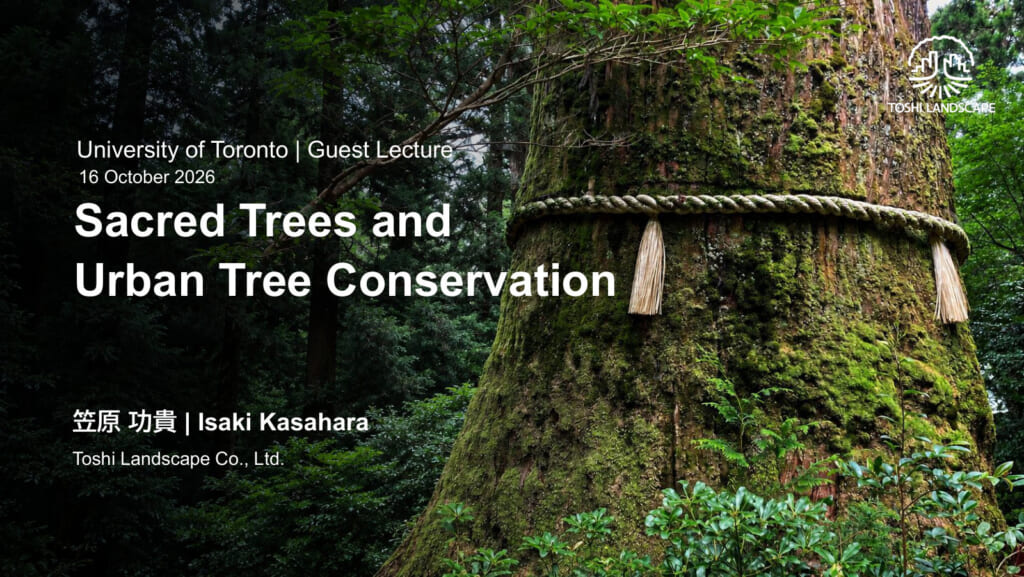
- A shinboku (神木), or sacred tree, is a tree that a community in Japan has long revered as a place where a kami (deity) descends, or as a dwelling of the kami itself.
- What makes a tree sacred is not its species or size. It is the overlap of place, history, form and belief. And being sacred is a separate matter from being protected by law.
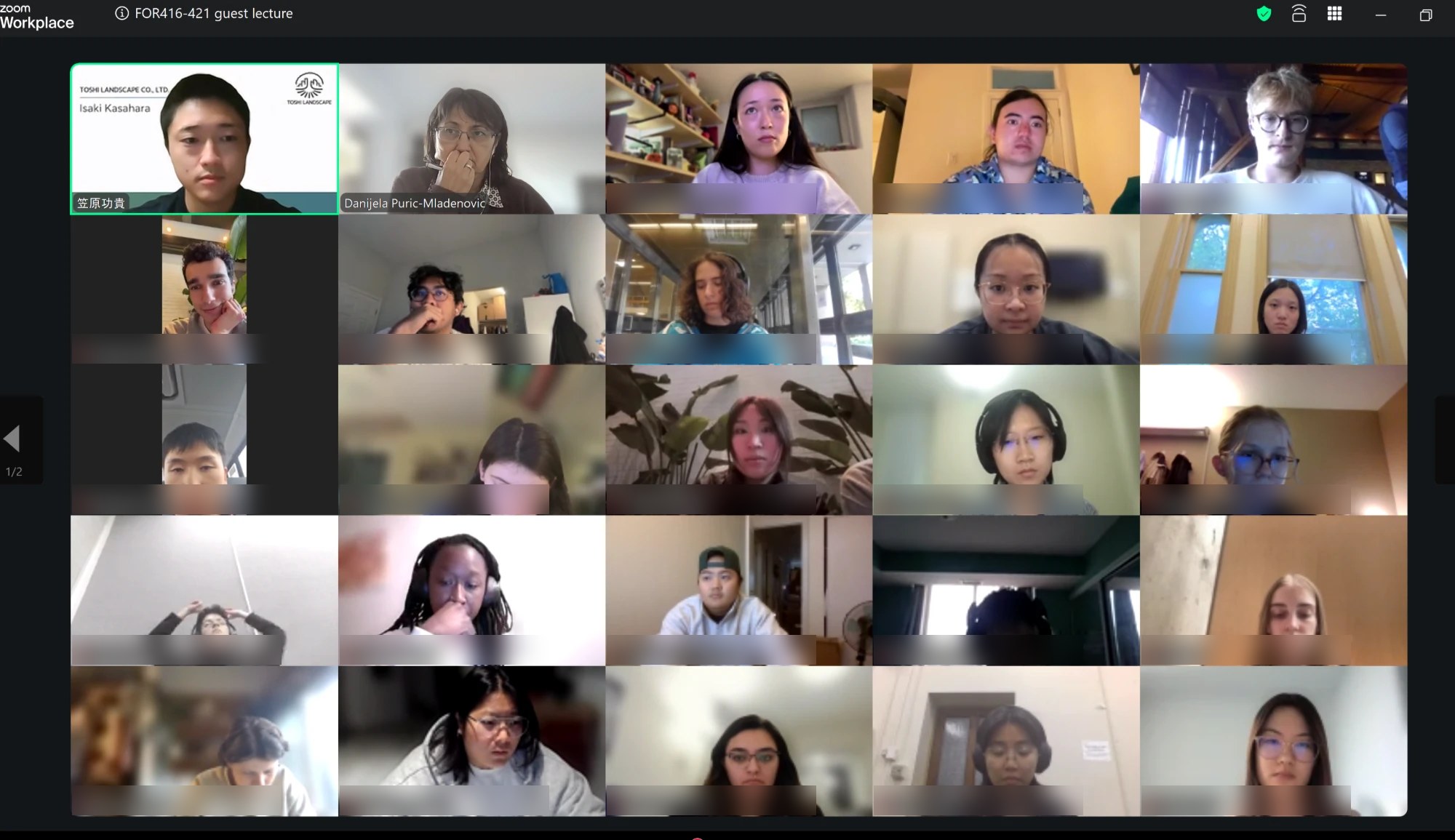
- In October 2026, I gave a guest lecture on sacred trees in Japan to an urban forestry class at the University of Toronto. I spoke in Japanese, with AI interpretation carrying my words into English.
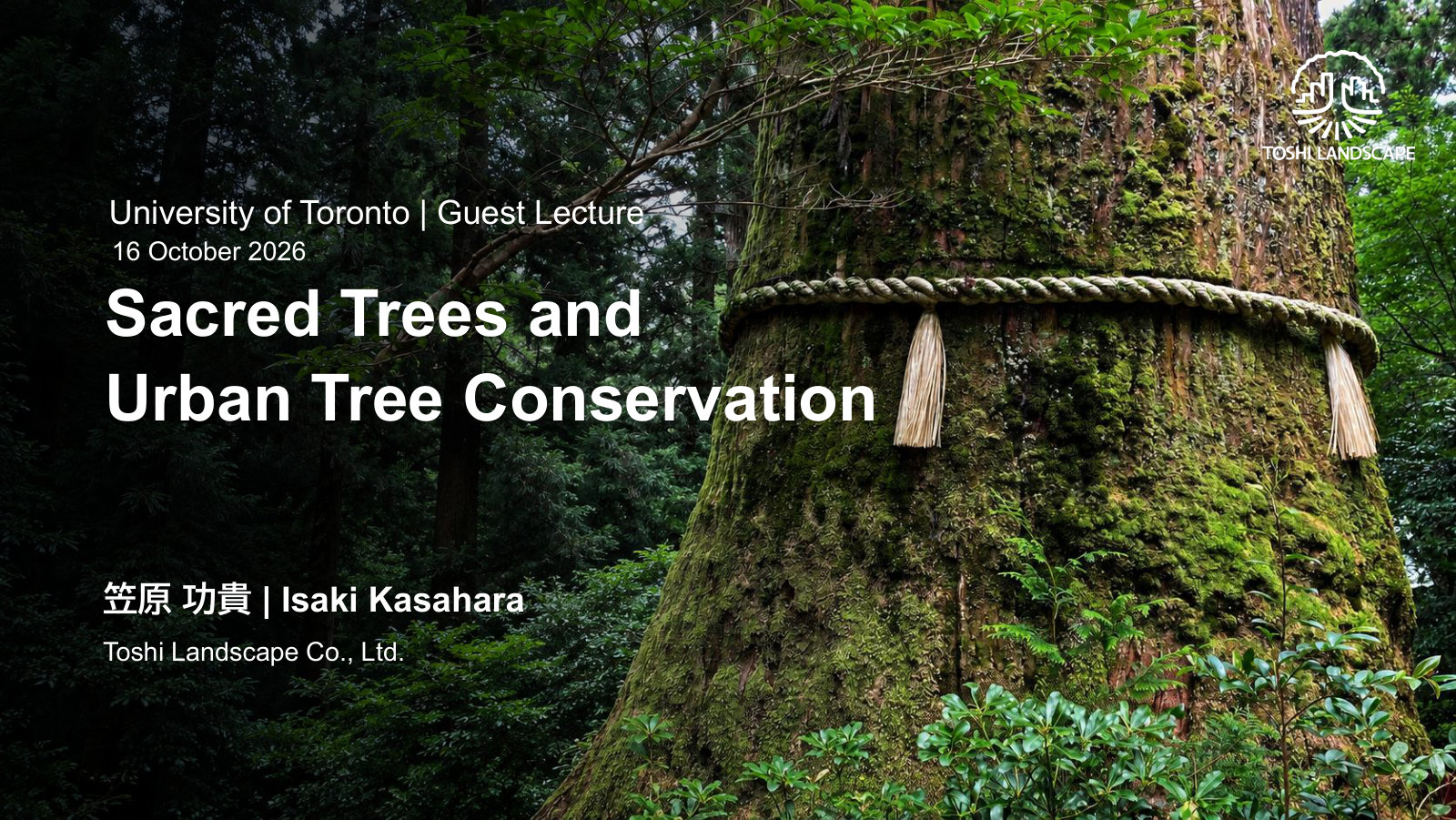
On October 15, 2026 (early on the 16th in Tokyo), I gave a guest lecture over Zoom for FOR416/FOR421 Green Urban Infrastructure, an urban forestry course at the University of Toronto’s John H. Daniels Faculty of Architecture, Landscape, and Design. I was invited by Dr. Danijela Puric-Mladenovic, who works in forest conservation. The lecture was titled Sacred Trees and Urban Tree Conservation.
I am an arborist at Toshi Landscape in Tokyo. I am not an academic, and English is not my first language. How I came to speak to a Canadian classroom is a story I will tell later in this post. First, here is what I taught.
What is a shinboku? — sacred trees in Japan, defined
A shinboku is a tree that has received special respect for religious or historical reasons. In Shinto, a tree can hold one of two broad meanings. The first is yorishiro (依り代), a place or object a kami descends to. The second is goshintai (御神体), an object in which a kami is believed to dwell. A shimenawa (注連縄), the twisted straw rope tied around the trunk, marks the tree as a sacred place.
What makes a tree sacred? — place, history, form and belief
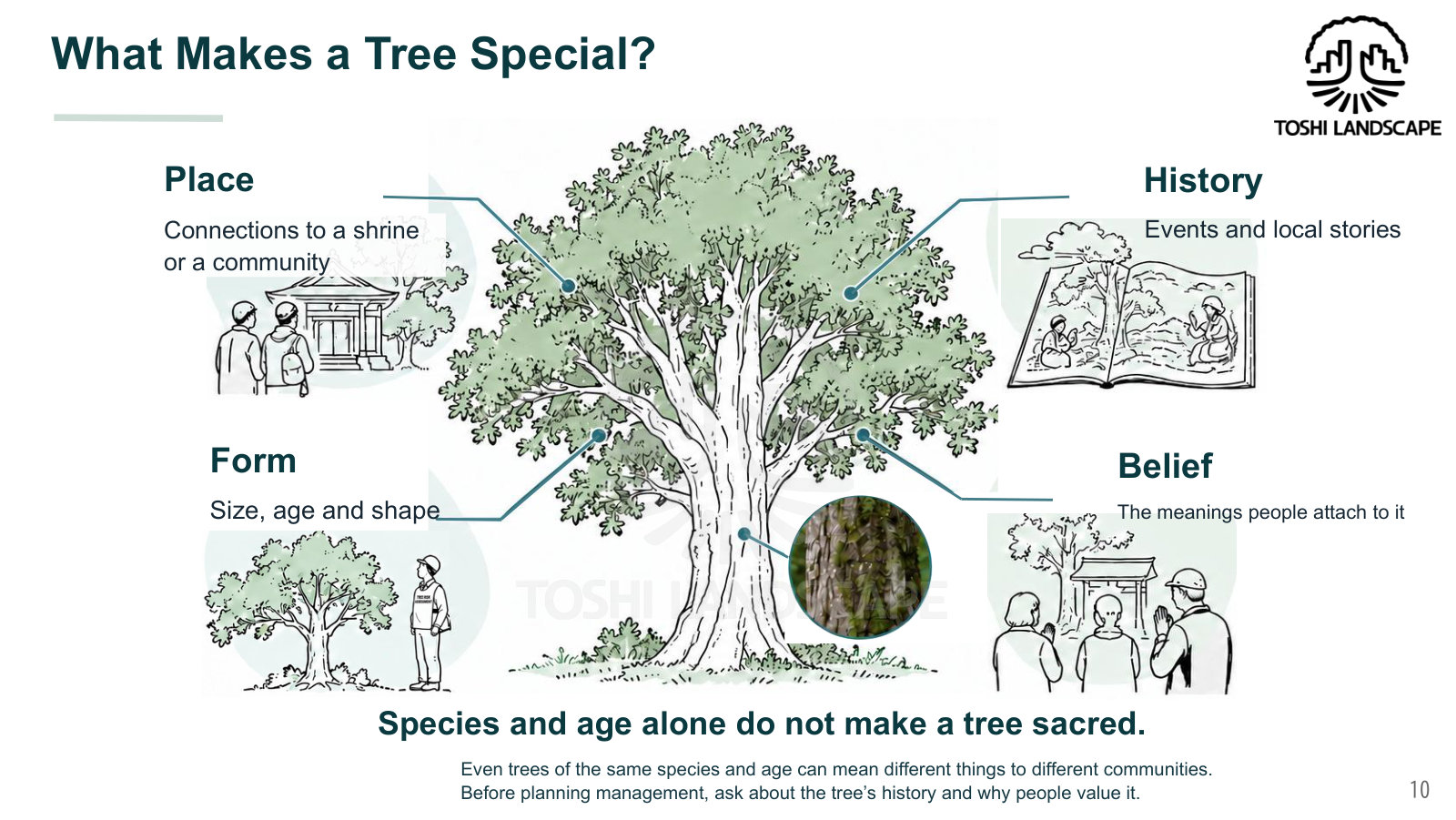
Species and age alone never make a tree sacred. A tree becomes special when four things overlap: place, history, form and belief. Two trees of the same species and the same age can mean entirely different things to different communities.
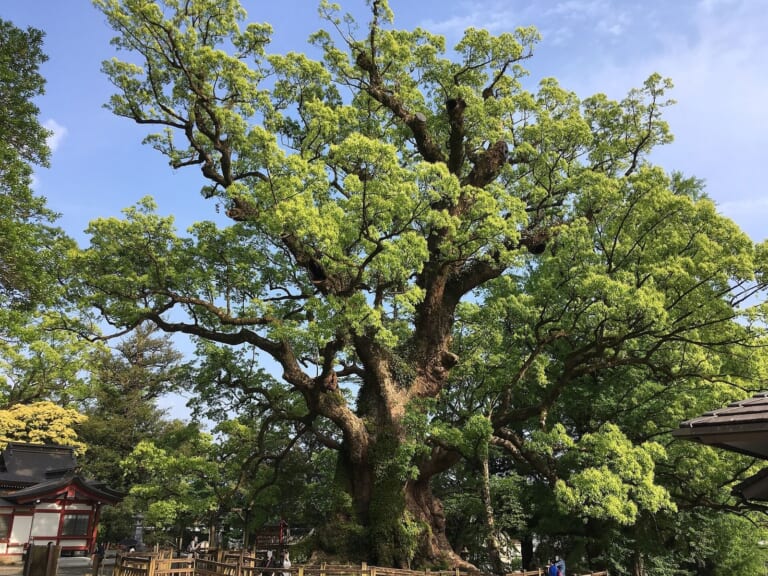
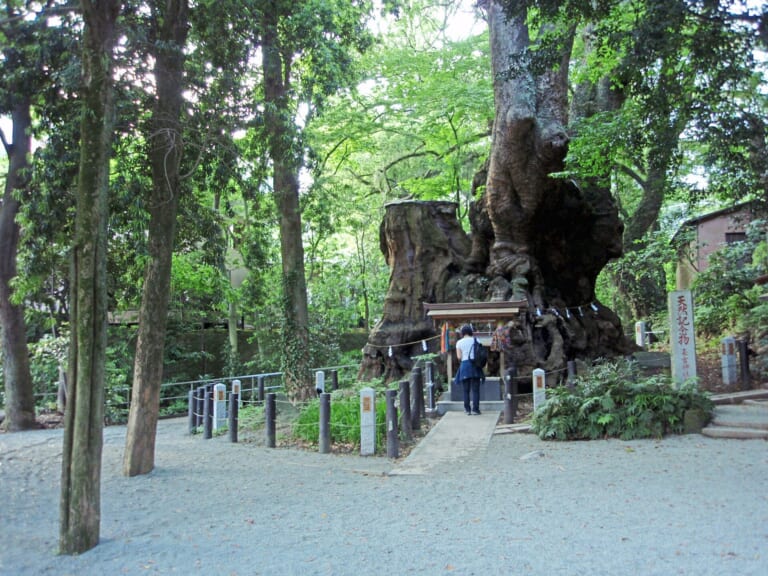
I opened the lecture with the Great Camphor (Cinnamomum camphora) at Kinomiya Shrine in Atami, Shizuoka. Tradition holds that it is more than 2,100 years old, and its trunk measures about 24 metres (79 ft) around. It is designated a National Natural Monument. Walking once around the trunk is said to add a year to your life, and many visitors circle it with a wish in mind. I have written about this tree in more detail in Japan’s Sacred Giant: the 2,000-year-old camphor of Kinomiya Shrine.
Are sacred trees protected by law? — sacred status vs legal protection
Sacred status and legal protection are separate matters. Only some sacred trees are designated as natural monuments. However deeply a tree is revered, it can still decline. Soil compacted under visitors’ feet, paving over the roots, weather damage, pests and diseases, and a shortage of people and funding to keep caring for the tree all threaten shinboku. The long lives of Japan’s oldest trees depend on that care, as I explain in why Japan’s ancient trees live for a thousand years.
How are old trees cared for in the field? — the Garyu no Matsu
The heart of the lecture was a tree my team cares for: the Garyu no Matsu (臥竜の松), the “reclining dragon pine,” at Jushoin Temple in Edogawa, Tokyo. It is a Japanese black pine (Pinus thunbergii) estimated to be about 500 years old. It stands about 5 metres (16 ft) tall, and its crown spreads 16.5 metres (54 ft) east to west and 18.4 metres (60 ft) north to south. It is a registered natural monument of Edogawa Ward and a designated Landscape Important Tree. A storm in the Taisho period (1912–1926) is said to have broken its trunk, and its low, spreading form gave it the name “reclining dragon.”
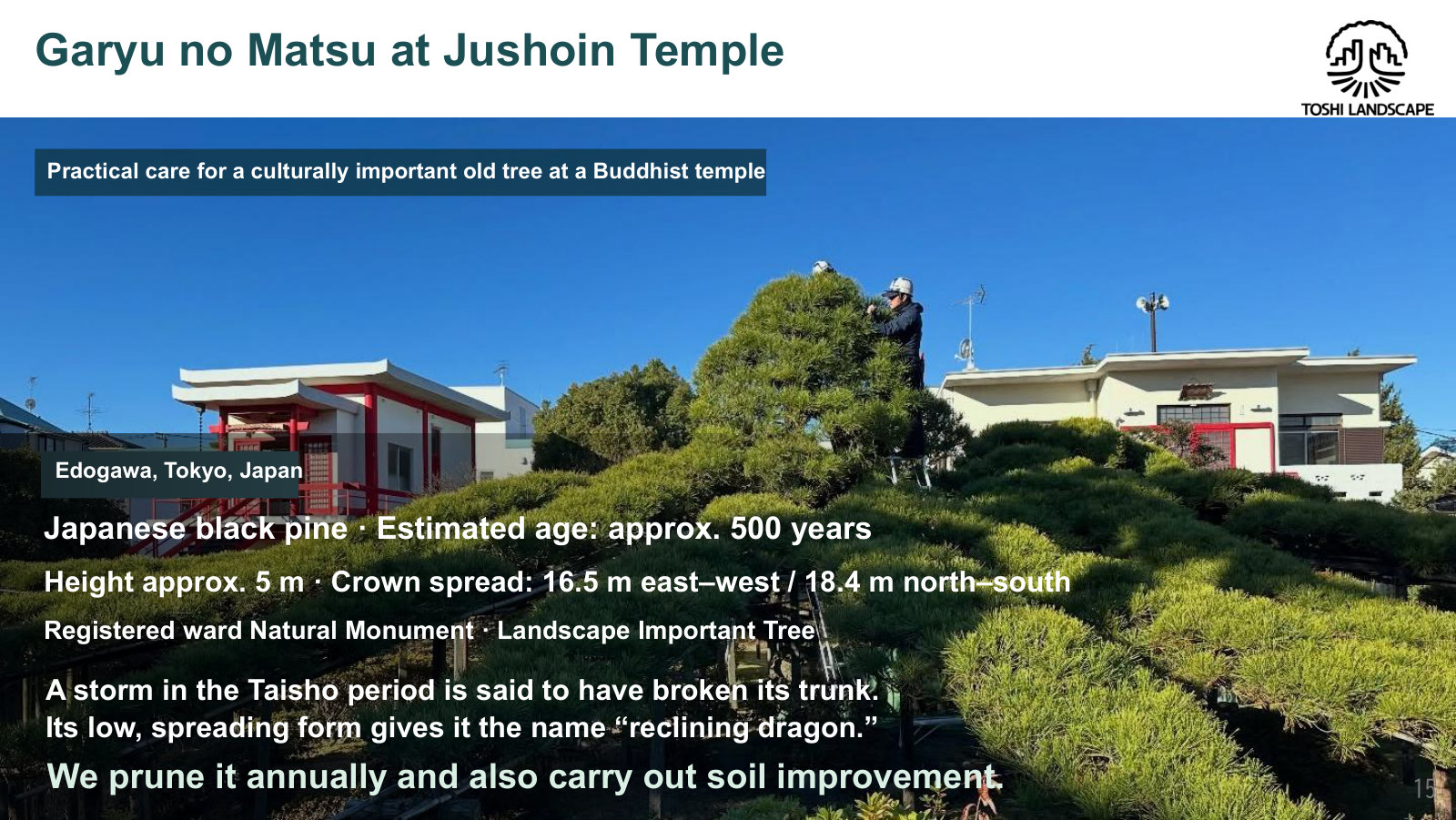
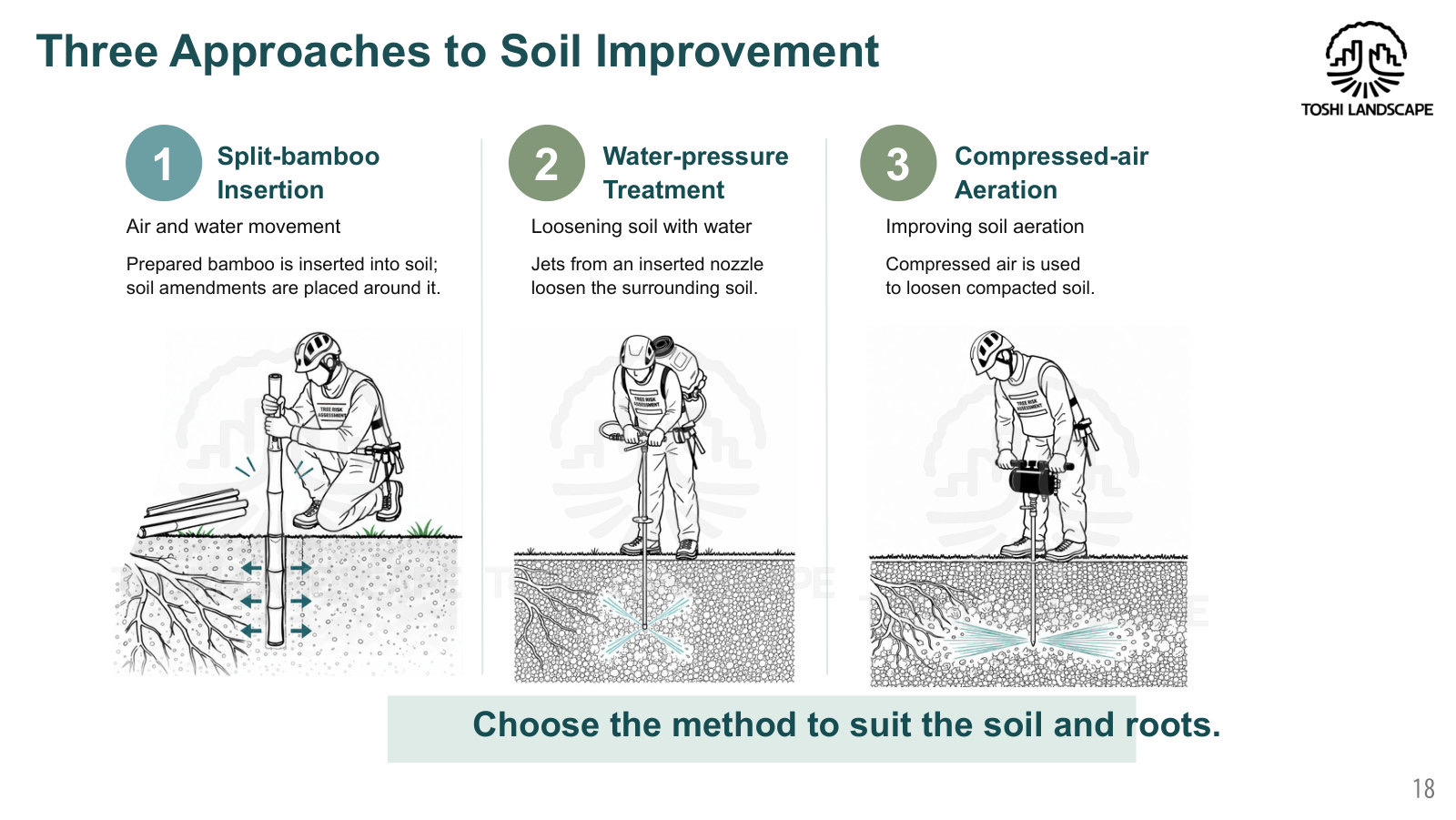
We prune this pine every year, in the Japanese tradition of hands-on pine work such as midori-tsumi, the spring thinning of candles. We also improve the soil, because roots need air and water just as the crown needs light. We use three methods:
- Split-bamboo insertion: split bamboo is driven into the soil to open channels for air and water, with soil amendments placed around it.
- Water-pressure treatment: water jetted from an inserted nozzle loosens compacted soil.
- Compressed-air aeration: compressed air is injected to break up compacted soil.
None of these is a default. We choose the method to suit the soil, the position of the roots and the site. And we never stop at a single treatment. Every year we repeat a cycle of assessing, deciding, acting and reviewing. Caring for an old tree is not a one-off intervention. It is a system that has to keep running.
Are there sacred trees outside Japan? — Toronto and Serbia
To connect Japan with the students’ own city, I introduced a Toronto example. The heritage red oak at 76 Coral Gable Drive is, according to the City of Toronto, about 250 years old, and it stood in the backyard of a private home. Public efforts to save this single tree led the city to acquire the land, and a parkette is now being built around it.
I also compared shinboku with zapis, the sacred trees of Serbia. A zapis is tied to Serbian Orthodoxy and local tradition, and it serves as a place of prayer and gathering. The religious backgrounds differ. What the two share is that people gather around these trees and pass their memories on through them.
Three lessons for future urban foresters — what I asked the students
I closed with three principles I try to practise myself:
- Understand both a tree’s condition and what it means to the community around it.
- Look beyond the crown, to the roots and the soil.
- Sustain the people and systems of care, not just a single piece of work.
My final slide asked a question: Which tree in your community would you like to pass on to the next generation?
How the lecture came about — from a LinkedIn post to a classroom
It began with a post I wrote on LinkedIn about shinboku. Dr. Puric-Mladenovic read it and sent me a message. She is originally from Serbia, and she told me that Serbia also has a culture of sacred trees that no one would cut down. She wanted to write about the bond between trees and people across cultures, and she asked whether I could give a guest lecture for her class.
I was honoured, and I was also honest. I told her I was not yet confident enough to give a live lecture and answer questions in English. Instead, I offered a written interview and photographs with English explanations. She replied that English was her second language too, so she understood completely. We agreed on the written format.
When she wrote to me again in July, I had changed my mind. Real-time translation in tools such as Google Meet and ChatGPT had reached the point where I believed a live lecture could work. I would speak in Japanese, and AI interpretation would carry my words into English. When I offered to try, she welcomed the idea.
Over the summer, she sent me nineteen questions about shinboku: their culture and history, how they are protected, what they suggest for urban forestry, and how they compare with sacred trees in Serbia. Answering them in writing first turned out to be the best preparation I could have had. By the time I began building my slides, I knew exactly what I wanted to say.
After the lecture — crossing the language barrier
Afterwards, Dr. Puric-Mladenovic told me the interpretation had worked well and that she had understood everything.
The students asked a great many questions. The one that stayed with me was this: do Japanese people feel something special about sacred trees from childhood? Answering it, I realised again how close these trees had been to me since I was young.
Working with AI interpretation made timing difficult. Even so, the conversation worked, questions and answers included.
Six months ago, I turned down the live version of this opportunity because of language. This time, I crossed that barrier in a concrete way. It did not disappear, but it became something I could get past with some care. If you are a practitioner who has hesitated to share your work abroad because of English, I hope this story is a small encouragement.
My sincere thanks to Dr. Puric-Mladenovic and to her students for their attention and their questions.
Frequently asked questions
Q1. What is the difference between a shinboku and an ordinary old tree?
A. It is not a matter of species or age. It depends on how the tree has been treated within a community’s faith and history. A tree wrapped in a shimenawa and honoured with prayers and festivals is a shinboku.
Q2. What does the shimenawa rope around a sacred tree mean?
A. The shimenawa marks the tree as a sacred place where a kami descends.
Q3. Are all sacred trees in Japan protected as natural monuments?
A. No. Only some are designated. Being sacred and being legally protected are separate matters, and many shinboku have no designation at all.
Q4. What does an arborist focus on when caring for a sacred tree?
A. Not only pruning the crown, but checking the soil at the base. Roots weaken easily under visitors’ feet and paving, so we improve the soil with a method suited to the site and keep observing the tree every year.
Sources
– Kinomiya Shrine, official website: The Great Camphor (大楠) and top page (age, trunk girth, the tradition of walking around the tree). Accessed October 16, 2026. – City of Toronto: Historic Red Oak Tree Parkette at 76 Coral Gable Drive. Accessed October 16, 2026. – Garyu no Matsu dimensions and designations: Toshi Landscape care records.
Related reading
– Japan’s Sacred Giant: the 2,000-year-old camphor of Kinomiya Shrine – Why do Japan’s ancient trees live for a thousand years? – Japan’s falling trees crisis: when the postwar planting boom reaches its limit
Field notes from Japan’s trees arrive a few times each month — subscribe via the form in the footer, or follow the work on LinkedIn.
Isaki Kasahara, Arborist, Toshi Landscape (Tokyo)