

By Isaki Kasahara, a Japanese arborist pruning, assessing and caring for Japan’s trees and gardens · Updated November 18, 2026
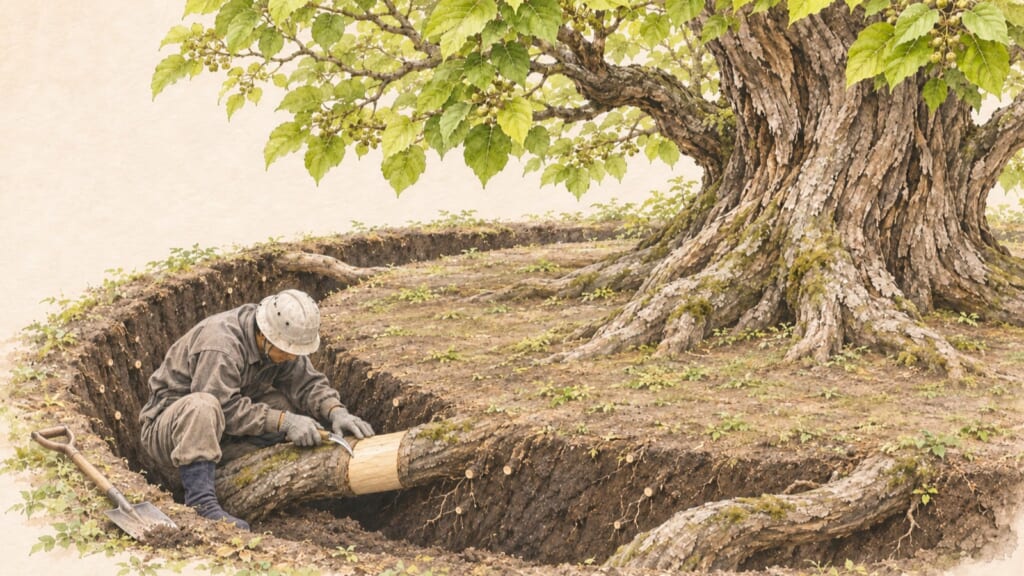
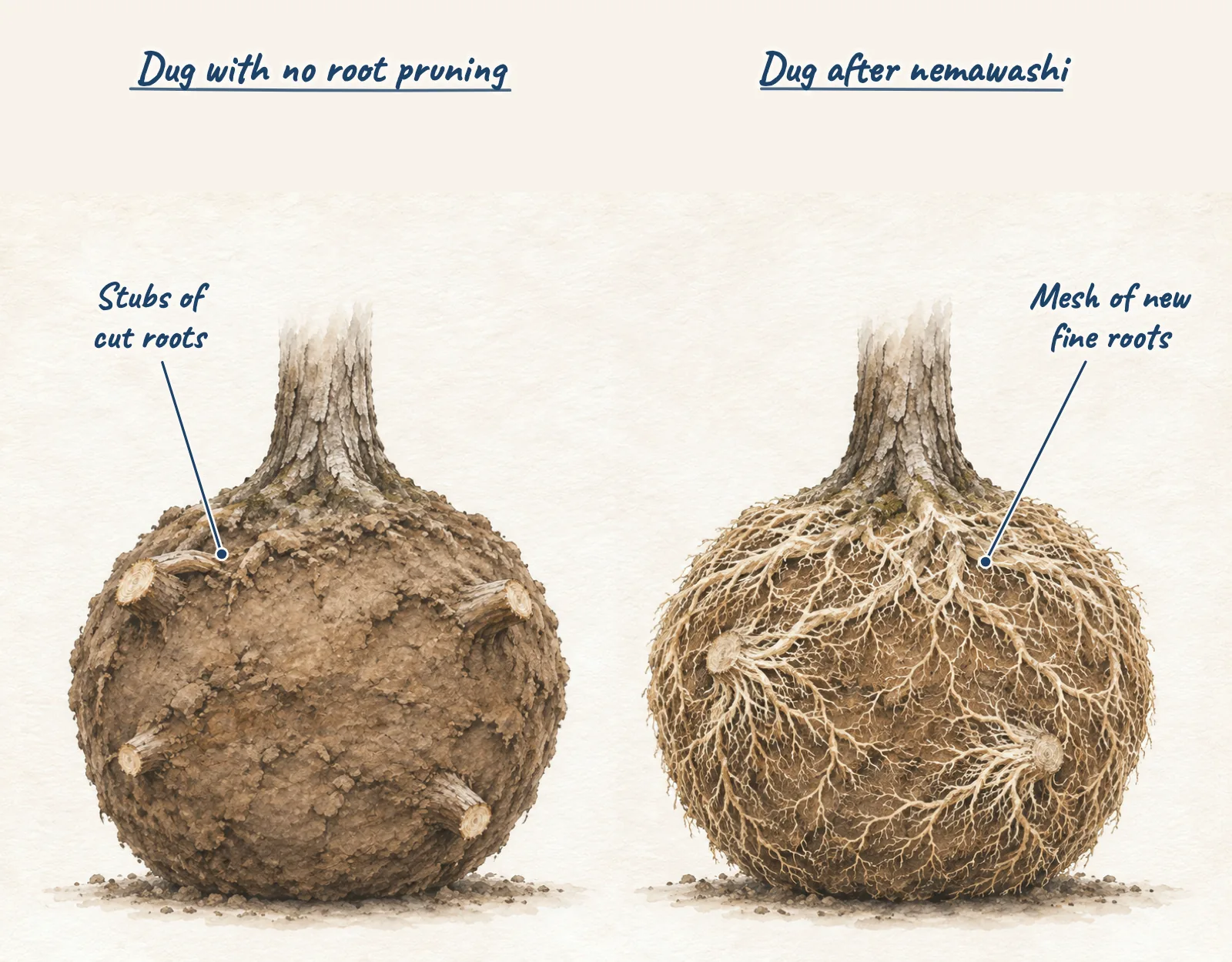
Nemawashi (根回し) is root pruning done where a tree stands, before it is transplanted, so that new fine roots grow inside the root ball that will be moved. It is done months or years ahead because those roots need time to grow: one Japanese technical review gives six months to a year including a growing season, and Japanese public guidance allows one to three years for old, valuable or hard-to-move trees. What follows traces one old tree through that wait, the biology behind it, the steps written into Japanese specifications, and how they compare with American guidance.
A January day in Matsudo — a tree over 200 years old moves sixteen metres
The capstan turns
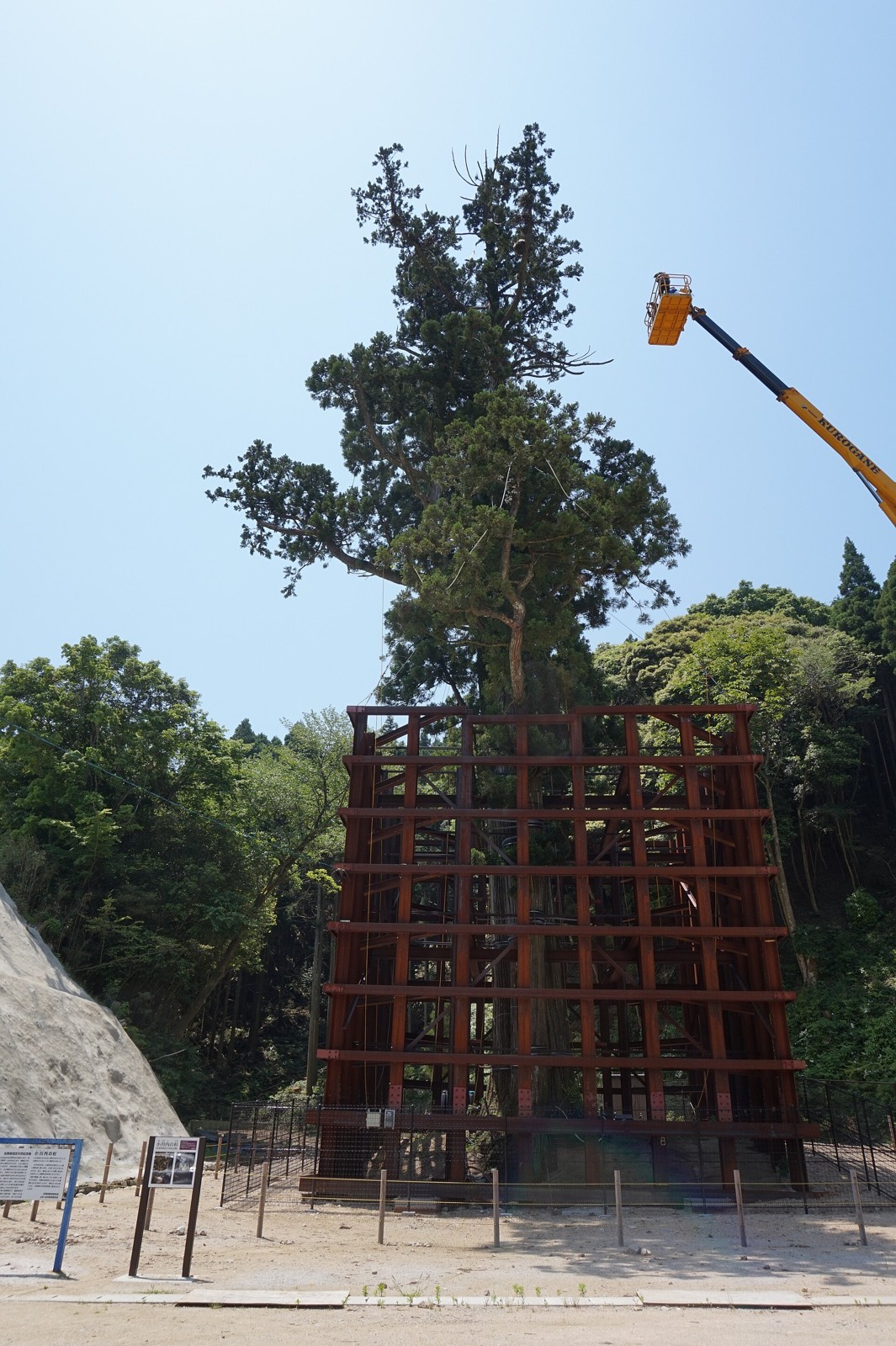
On 15 January 2012, in the city of Matsudo, more than a hundred people in total took turns at a kagurasan (神楽桟) — a hand-turned capstan winch for hauling heavy loads. At the other end of the ropes was a kenponashi (ケンポナシ, Hovenia dulcis) more than 200 years old. A rerouted city road was going to take the ground it grew on.
The tree was not lifted. It was hauled upright, root ball and all, by a method called tatebiki (立曳き) — upright hauling. According to a technical report in GREEN AGE, the journal of the Japan Greenery Research and Development Center, the move covered a little over 16 metres (about 52 feet) and took about three and a half hours, watched by more than two hundred people.
The preparation underground
The crowd saw the last three and a half hours. An important part of the preparation had taken place underground long before. The report explains that the city’s first proposal was a one-year root-pruning programme followed by lifting the tree out. After re-reading the city’s own root survey, the adviser proposed something different: divide the root zone into four sectors, root-prune them in stages over two years, and give the tree two years of care leading up to the move. The report does not say whether those two years of care overlap with the pruning years.
That preparation is nemawashi, in its original sense.
Where the word came from — a gardening term before it meant meetings
One dictionary entry, two meanings
The Japanese dictionary Digital Daijisen lists both meanings under a single entry. The first is horticultural: preparing for a transplant by encouraging fine roots to form. The second is figurative: taking steps in advance so that a negotiation or meeting goes smoothly.
A 1999 business guide from JETRO, Japan’s trade promotion agency, made the link for foreign readers: “The word nemawashi (root-binding) comes from gardening,” describing it as “preparing the roots of a plant or tree for transplanting.” Setagaya City in Tokyo, explaining a keyaki (Zelkova serrata) transplant at its city hall, added a note for residents saying the same: the everyday sense of talking things over with everyone beforehand comes from this landscaping term.
What the gardener actually does
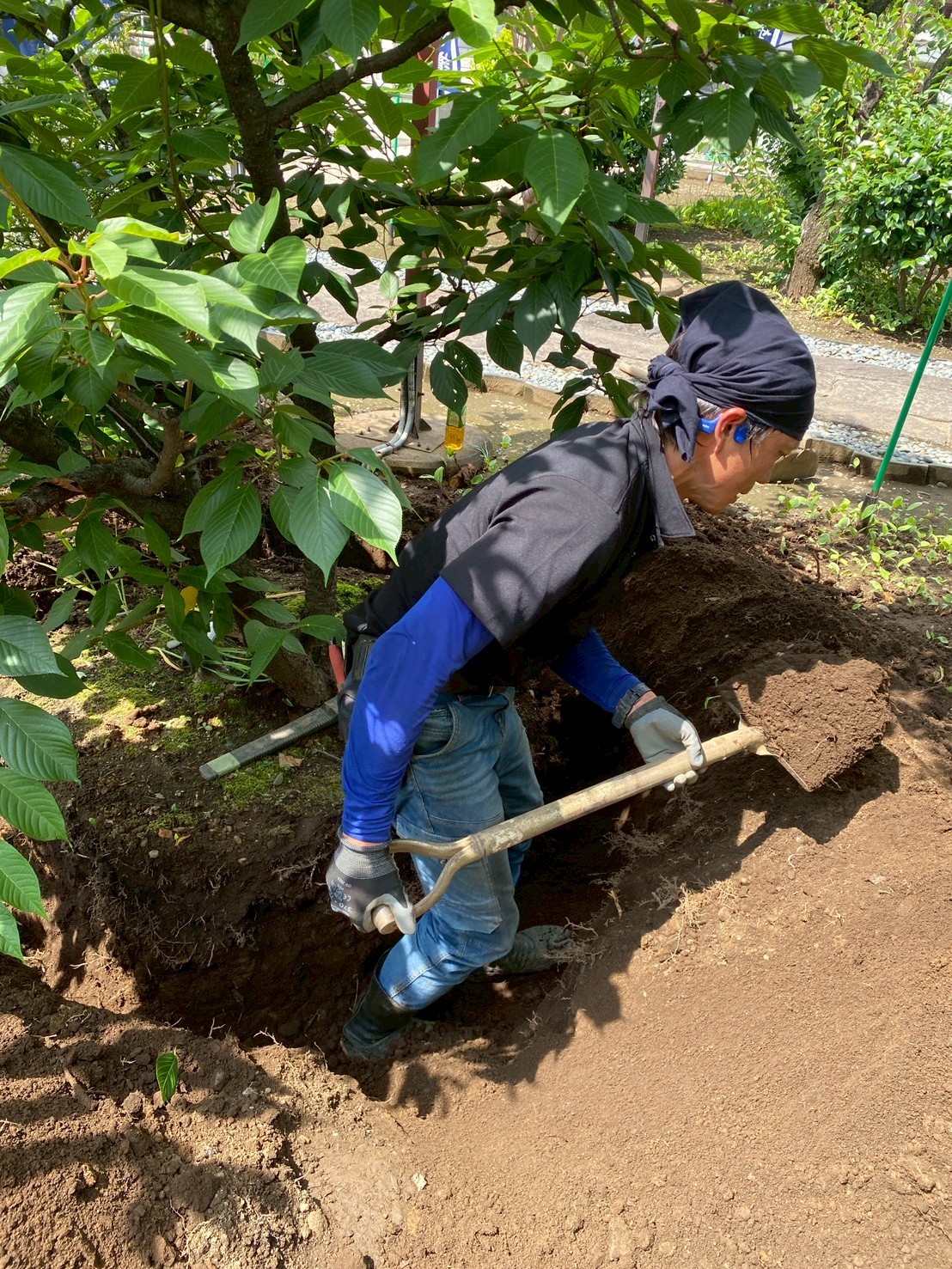
In the horticultural sense, the gardener is not persuading anyone. They cut selected roots of a healthy tree on purpose, in a planned pattern, and then wait while new fine roots develop closer to the trunk.
The problem with moving a big tree — the roots that matter are far away
Where the fine roots are
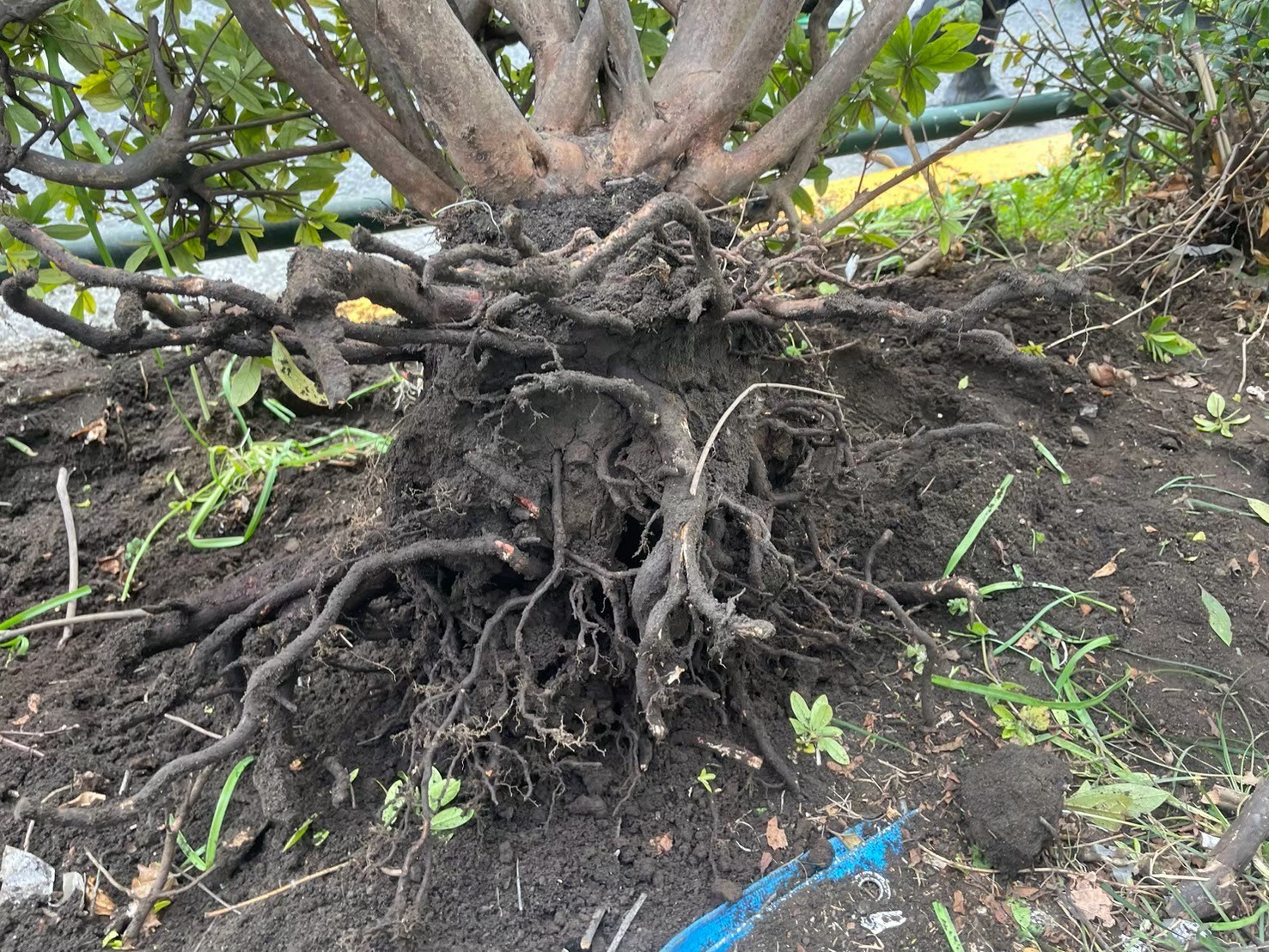
A tree takes up water mainly through fine roots near the root tips. Setagaya City’s explanation of its keyaki transplant puts it simply: fine roots, which absorb the water and nutrients a tree needs, are mainly at the tips, and the bigger the tree, the further its roots extend and the further from the trunk its fine roots sit. Japan’s Ministry of the Environment, in its construction cost reference for natural parks, gives that as the reason for root pruning: a whole root system cannot easily be dug without damage, so many fine roots need to be grown close to the main trunk.
How much can be lost
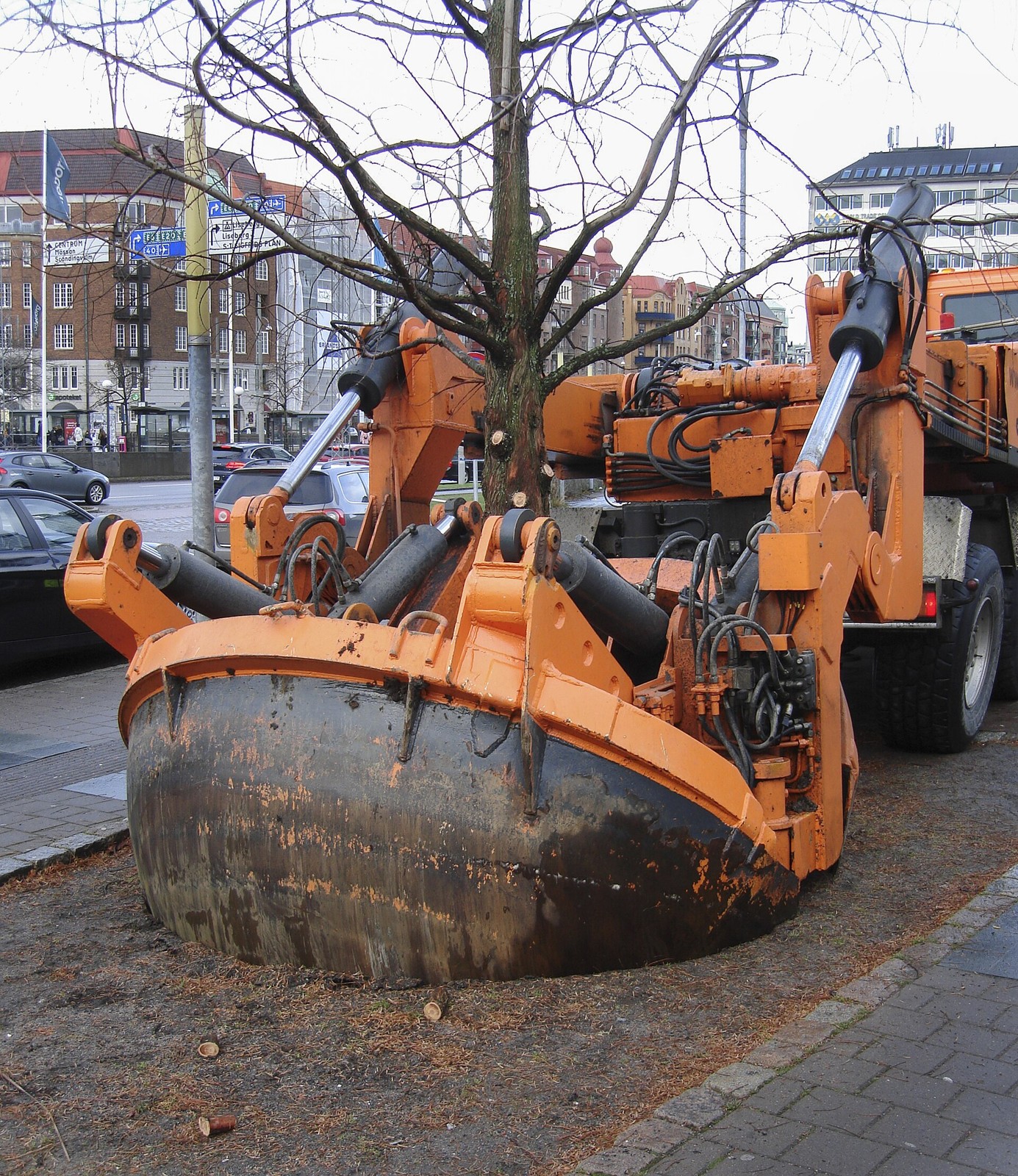
American research gives a sense of scale for one kind of digging. In a 1982 study of nursery trees in the Journal of Arboriculture, Gary Watson and E. B. Himelick reported that “Tree spades, commonly used to transplant nursery trees, reduce the root system by up to 98 percent.” That is a maximum for nursery trees dug by machine, not a rule for every transplant, but it shows how much of a root system can be left behind in the ground.
Why not cut everything at once
Two reasons appear in the sources. The first is time: Hori’s review, discussed below, describes the usual interval as including a growing season. The second is stability. A University of Florida extension guide on root pruning field-grown trees and shrubs warns that cutting all the roots at once can cause shock or leave the tree unstable. A tall tree standing in the ground after root pruning still needs anchoring roots until the day it is dug.
How cutting makes roots — the biology behind nemawashi
The cut
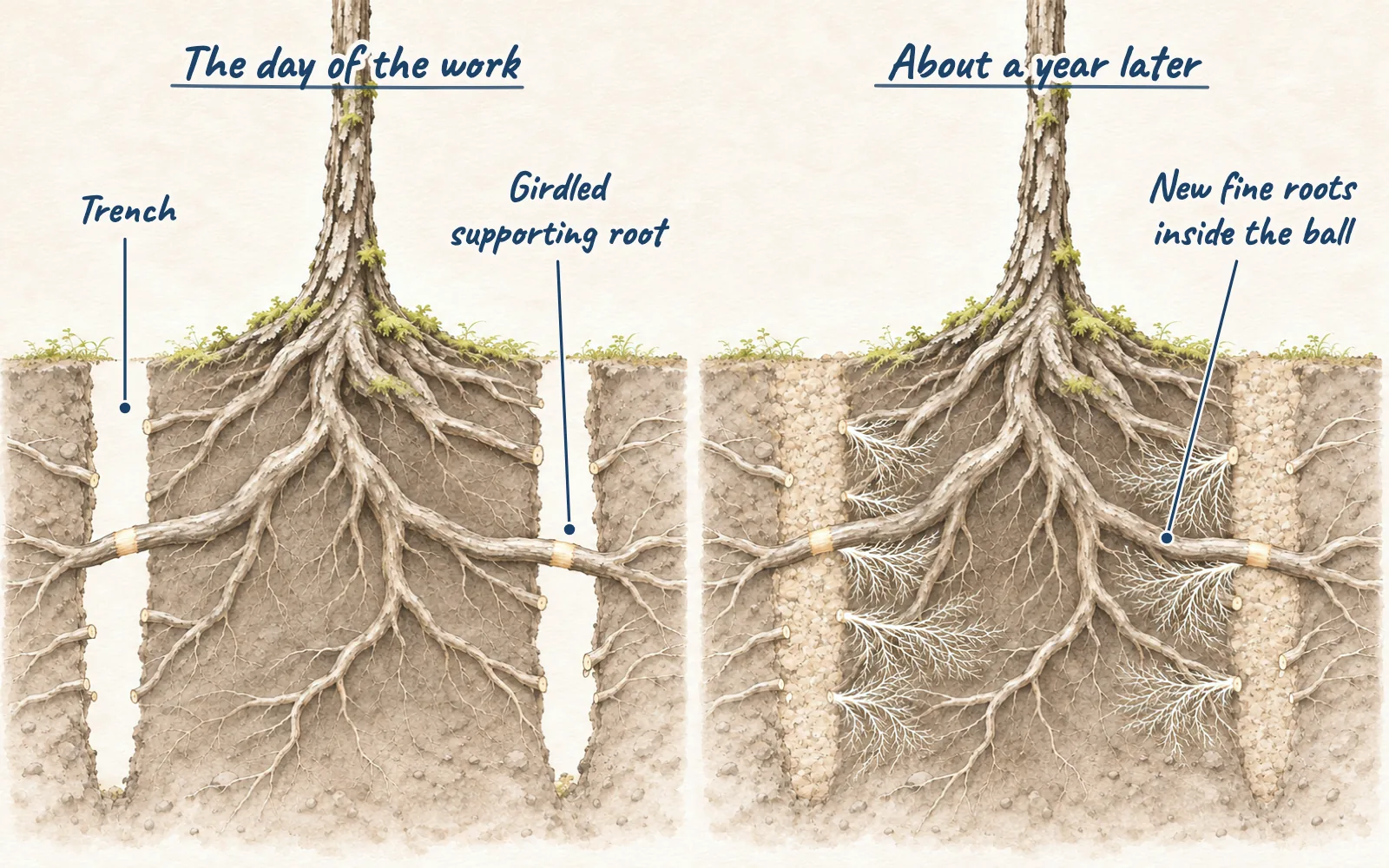
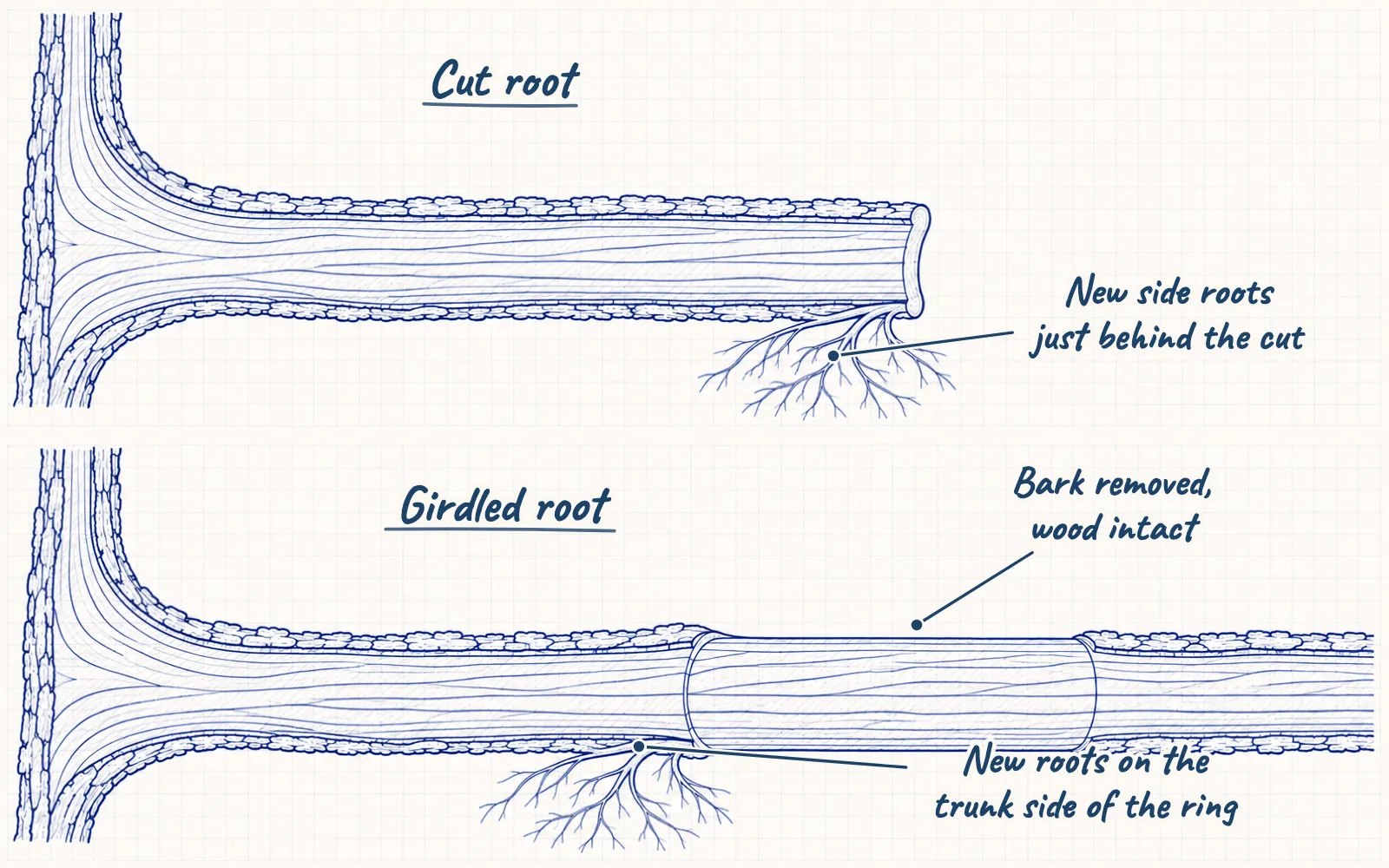
A 2008 technical review of tree transplanting by Hori, in the Japanese journal Tree and Forest Health (樹木医学研究), explains what happens near a cut root. When a root is cut or damaged, sugars, amino acids and auxin accumulate near the wound, which promotes the formation of lateral root primordia (側根の原基形成) — the starting points of new side roots — and their growth.
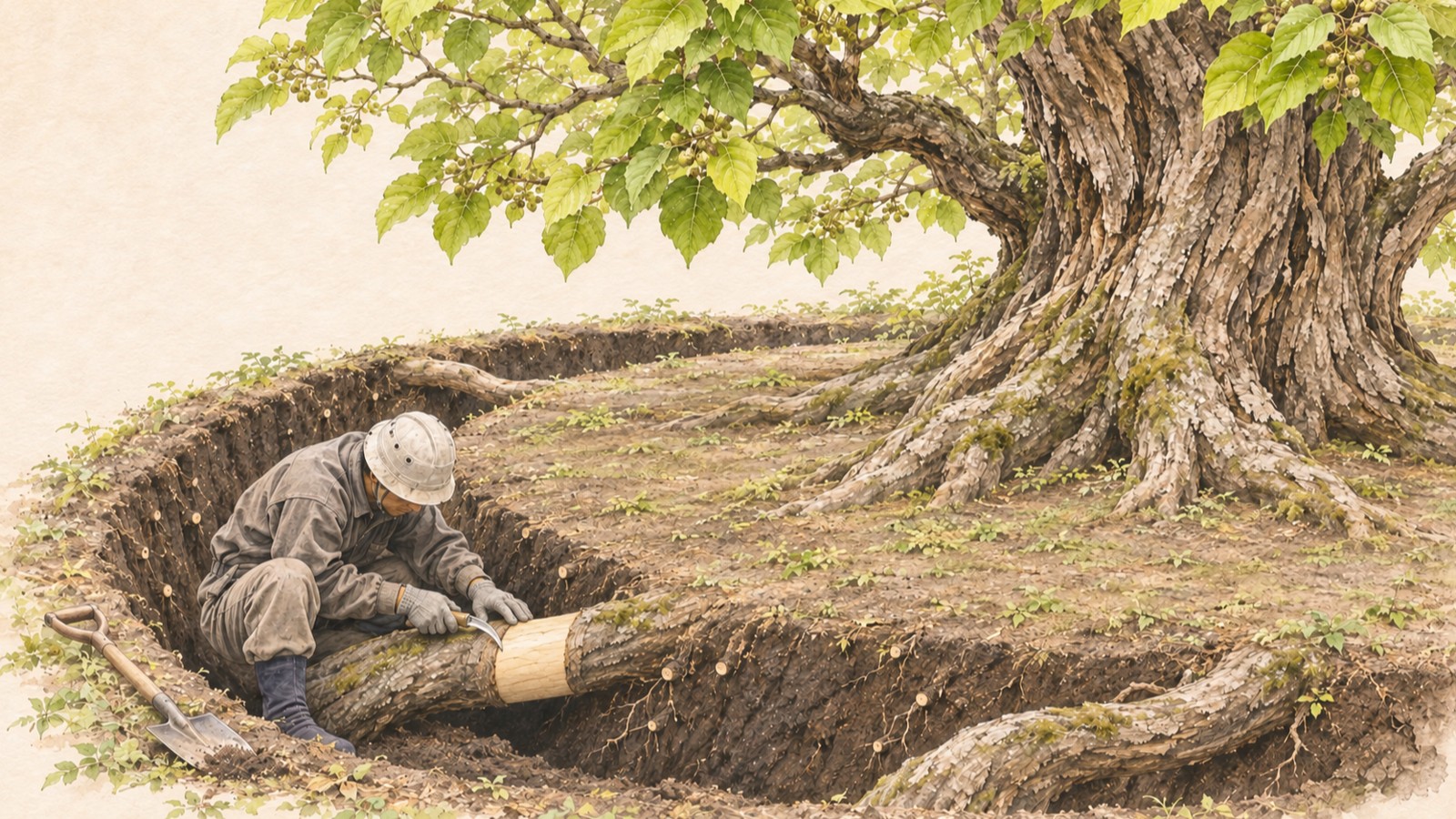
That is why the cut is placed with care. Minato City’s tree management manual in Tokyo defines nemawashi as cutting the roots slightly inside the boundary of the root ball that will later be dug (掘取り時の根鉢のやや内側), so that new fine roots grow from the cut ends. The new roots then form inside the volume that will actually be lifted.
The girdle — kanjō hakuhi
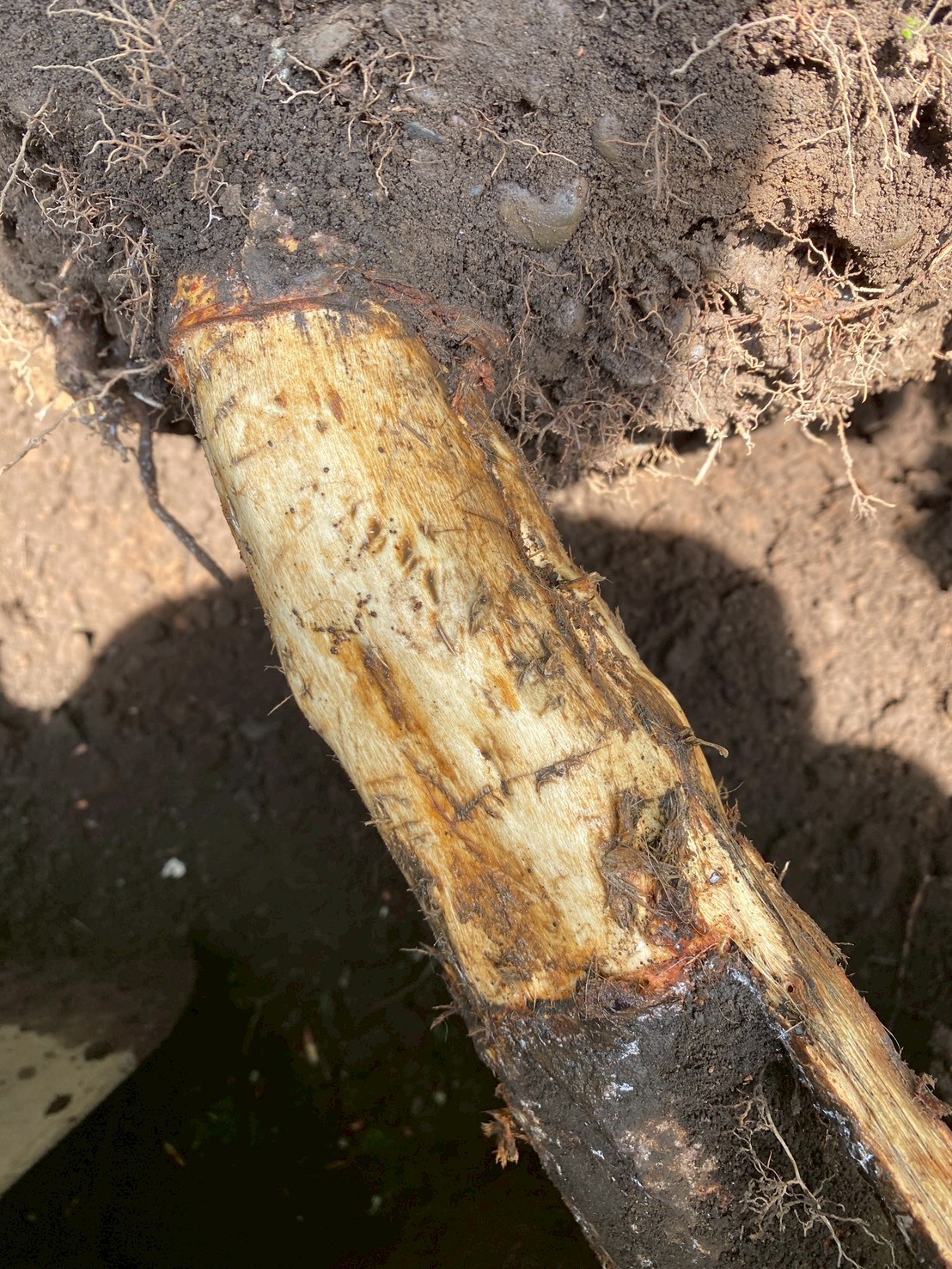
The second technique is subtler. In the trench method described below, a few thick roots are left uncut, but a band of bark is stripped from each. The Japanese term is kanjō hakuhi (環状剥皮) — ring girdling. Hori explains the mechanism: removing the band interrupts the flow of sugars through the phloem, so they accumulate on the trunk side of the girdle, and side roots form there.
The wood underneath — the water-carrying xylem — stays intact. The Kamigamo Experimental Station of Kyoto University, describing its root pruning of a pine, notes that with girdling “water transport is maintained” (通水機能は保持される), which reduces branch dieback and means less of the crown needs pruning. The girdled roots also keep holding the tree up. Japan’s Ministry of Land, Infrastructure, Transport and Tourism (MLIT) specifies in its common specification for park and green-space works that some thick roots are left uncut and girdled “to the cambium” (形成層まで環状はく皮) — the bark is removed down to the growth layer, not merely scraped.
What the research measured
Studies of root pruning measure different things, and their results should not be merged into one claim. Watson and T. Davis Sydnor (1987) compared nursery Colorado spruce root pruned five years before digging with untreated trees, and found “a four-fold increase in the amount of root surface area in the root ball” — more root surface in the ball, not four times the survival. Edward Gilman’s 1992 trial on southern magnolia (Magnolia grandiflora) found root-pruned trees grew slightly faster in the first year after transplanting, but at similar rates to untreated trees in the second and third years.
In Japan, Takeuchi and colleagues (2012) measured sap flow in a 6.4-metre (21-foot) southern magnolia through the whole process: it fell after root pruning, reached its highest speed four months later, and fell again after the move. In a 2009 study, Takeuchi and Nishimura followed a ring-cupped oak (Quercus glauca) moved by a simplified method without root pruning: sap flow dropped 23 percent after the roots were cut, and the tree was still judged to have established well.
| Study | Tree | What was measured | Finding |
|---|---|---|---|
| Watson & Himelick (1982) | Nursery trees | Root loss from tree spade digging | Up to 98% of the root system removed |
| Watson & Sydnor (1987) | Colorado spruce | Root surface area in the root ball | Four-fold increase after root pruning five years earlier |
| Gilman (1992) | Southern magnolia | Growth after transplanting | Slightly faster in year one; similar in years two and three |
| Gilman & Anderson (2006) | Cathedral Oak live oak | Small roots; water stress after digging | More roots under 3 mm only when hand root pruning continued through the whole production period; less water stress after digging with either pruning schedule (through production, or in the final year only) |
| Takeuchi et al. (2012) | Southern magnolia, 6.4 m | Sap flow | Fell after root pruning; peaked four months later |
| Takeuchi & Nishimura (2009) | Ring-cupped oak | Sap flow, no root pruning | 23% drop after root cutting; judged to have established well |
Some of these studies found more roots in the root ball or less water stress after digging. None gives a single figure for how much root pruning raises survival, and one tree moved without it did well. The Japanese manuals recommend nemawashi as a way to reduce risk for certain trees, not as a guarantee.
The trench method — nemawashi step by step
Japanese specifications describe two main methods. Kagawa Prefecture’s construction guide sets them out side by side.
| Method | What is done (Kagawa) | Note (Kagawa) |
|---|---|---|
| Mizobori-shiki (溝掘式) — trench method | A trench is dug around the root ball; thick supporting roots are kept, and these or part of the taproot are girdled | The thick roots left in place act as supports |
| Dankon-shiki (断根式) — root-severing method | Soil is dug around the tree and the side roots that appear are cut | Generally shallow-rooted species, or those without a strong taproot |
Step 1: Size the root ball
The first decision is the size of the future root ball, nebachi (根鉢). Tottori Prefecture’s public facilities greening manual gives three to five times the root collar diameter. Kyoto University’s Kamigamo station used about four to five times the trunk diameter at ground level for a Korean pine (Pinus koraiensis) planted some 30 years earlier. Sapporo City’s standard drawings for landscape works include a reference table that sets ball diameter, ball height and digging width for each band of trunk girth. The ratios differ between documents; the scale of the tree sets the scale of the ball.
Step 2: Dig, and keep the anchors
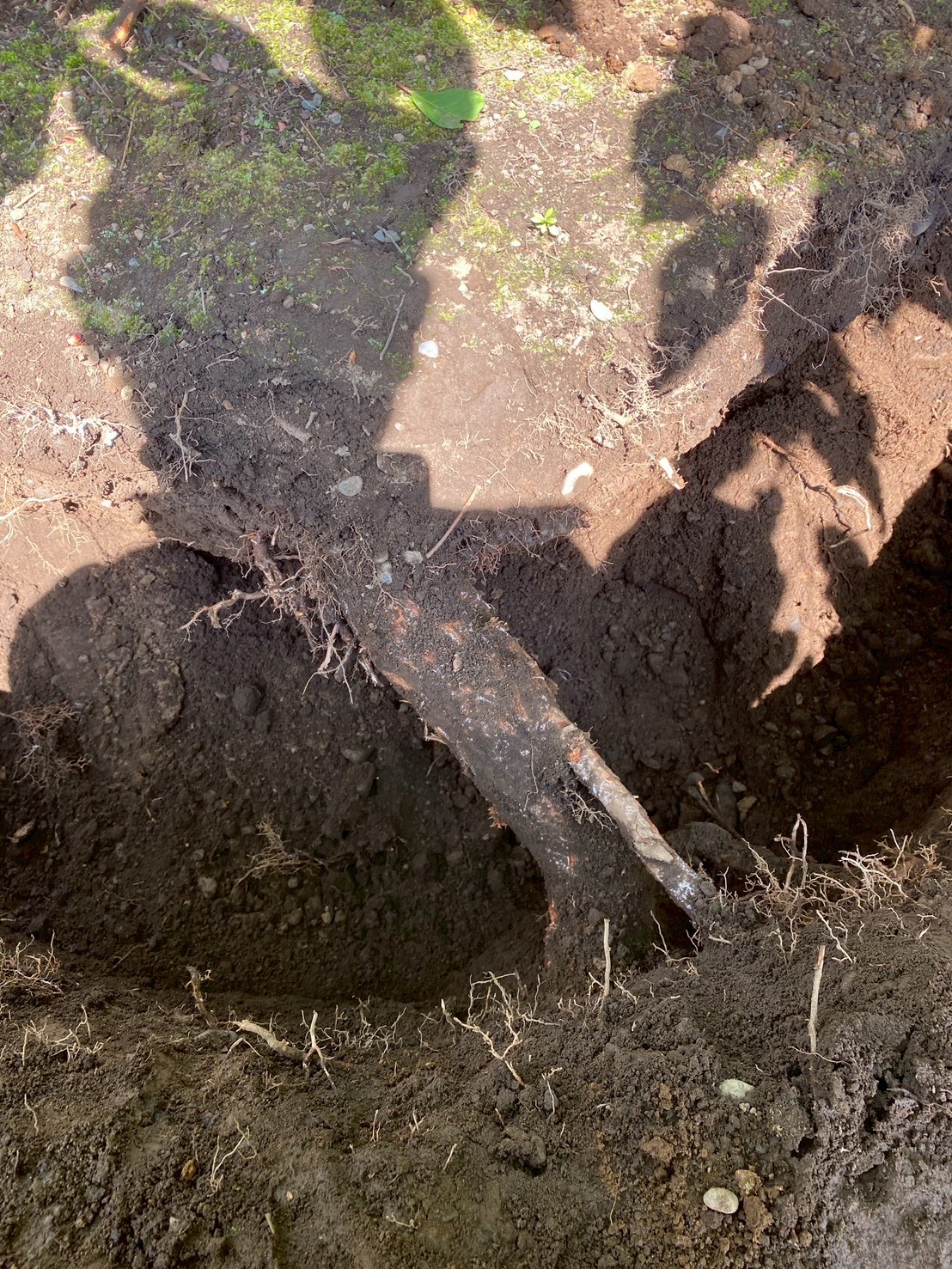
The trench is dug around the marked circle. Tottori’s manual says supporting roots should be kept in three or four directions (支持根は三方か四方にとり) and the other roots cut with a sharp blade, with the cut surfaces trimmed. Sapporo’s standard drawing shows three to four main supporting roots left. At Kyoto University’s Kamigamo station, thick roots of roughly 3 cm (1.2 in) or more, plus the roots under the trunk, were kept as supporting roots, while thinner side roots were cut back.
Step 3: Girdle the supporting roots
The retained supporting roots are girdled. Band widths differ between documents: Tottori gives about 10 cm (4 in), Kagawa about 15 cm (6 in), and Sapporo 10 to 15 cm. MLIT’s specification requires the bark to be removed down to the cambium.
Step 4: Backfill, water and support
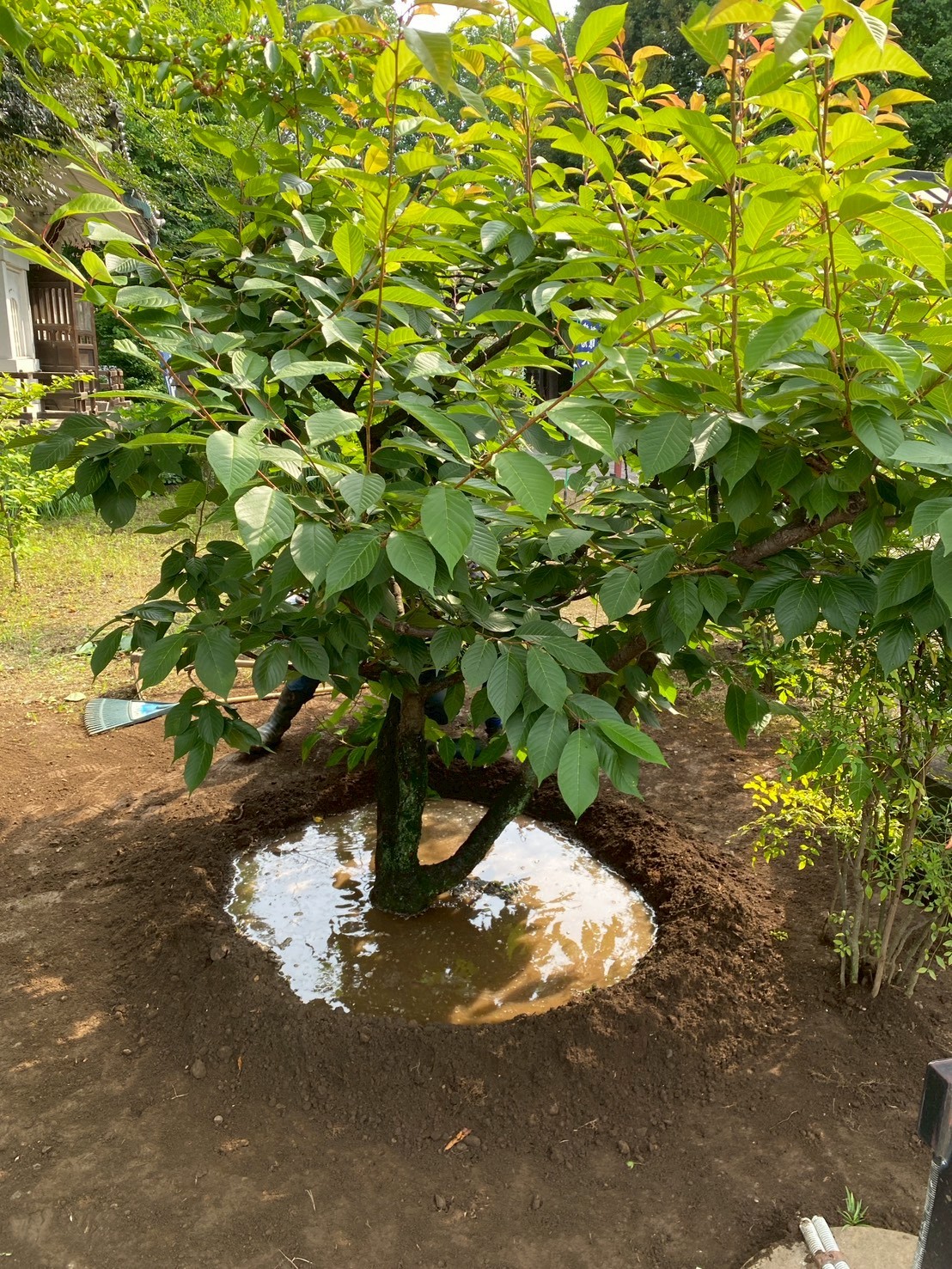
MLIT’s specification requires the trench to be backfilled and thoroughly watered. Thinning branches, removing some leaves and fitting stakes are listed as work done “as needed” (必要に応じて). The Kyoto University record shows one case in practice: pumice and sand were mixed into the backfill because the existing soil was hard, the soil was settled with water — mizugime (水極め) — to keep the cut roots from drying out, and four bamboo tubes with the nodes knocked out were inserted for aeration. The root ball was then watered from above, and some branches were pruned.
How long to wait — months for most trees, years for some
The usual interval
Hori’s 2008 review gives the ordinary interval between root pruning and transplanting as six months to a year, with a growing season in between.
Longer for valuable or hard-to-move trees
For some trees, the documents allow more time. Tottori’s manual gives one to two years for trees that have not been moved for many years, valuable trees and hard-to-move species. The Ministry of the Environment’s reference gives one to three years for old trees, rare or valuable trees and hard-to-move species. A 2024 report by the Japanese Institute of Landscape Architecture’s research committee on Japanese gardens describes, for valuable or weakened trees, dividing nemawashi into two or three rounds over two or three years (2、3回に分け、2、3年かけて).
| Situation | Interval before moving | Source |
|---|---|---|
| Ordinary root pruning | 6 months to 1 year, with a growing season between | Hori (2008) |
| Long-established, valuable or hard-to-move trees | 1–2 years | Tottori Prefecture |
| Old, rare or valuable trees; hard-to-move species | 1–3 years | Ministry of the Environment |
| Valuable or weakened trees | 2–3 rounds over 2–3 years | Japanese Institute of Landscape Architecture committee report (2024) |
The roots decide, not the calendar
Kagoshima Prefecture’s planting specification sets two conditions for digging a root-pruned tree: the necessary amount of fine roots can be confirmed growing from around the cuts (必要量伸び出していることが確認されるとき), and it is the normal planting season. The interval is a guide; the deciding signal is the roots.
Which season
The sources do not agree on one season. Minato City’s manual names spring before bud break as the best time to root-prune, says the work should be done before autumn at the latest, and says the dormant period should be avoided because no roots form then (the Ministry of the Environment’s reference, below, takes a different view). For trees root-pruned in spring, it suggests moving deciduous trees that autumn or the following early spring, and evergreens the following spring or in the early-summer rainy season, sometimes a year later still. The Ministry of the Environment’s reference, by contrast, says the dormant season is good for root-pruning deciduous trees. Setagaya City root-pruned its keyaki in March 2020, “early spring, suited to transplant preparation,” and explained that the move had to come one to two years later, in the dormant period from late autumn to early spring. These sources do not resolve the difference in seasonal advice; species, climate and local practice all play a part.
Which trees get nemawashi — species, size and value
Hard-to-move species
Japanese municipalities publish lists of trees that are difficult to transplant. Tokyo’s Kita City, in its greening technical standards, lists among conifers akamatsu (Pinus densiflora), momi (Abies firma) and inugaya (Cephalotaxus harringtonia), and among broadleaved evergreens akagashi (Quercus acuta), tabunoki (Machilus thunbergii) and shirodamo (Neolitsea sericea).
Large and valuable trees
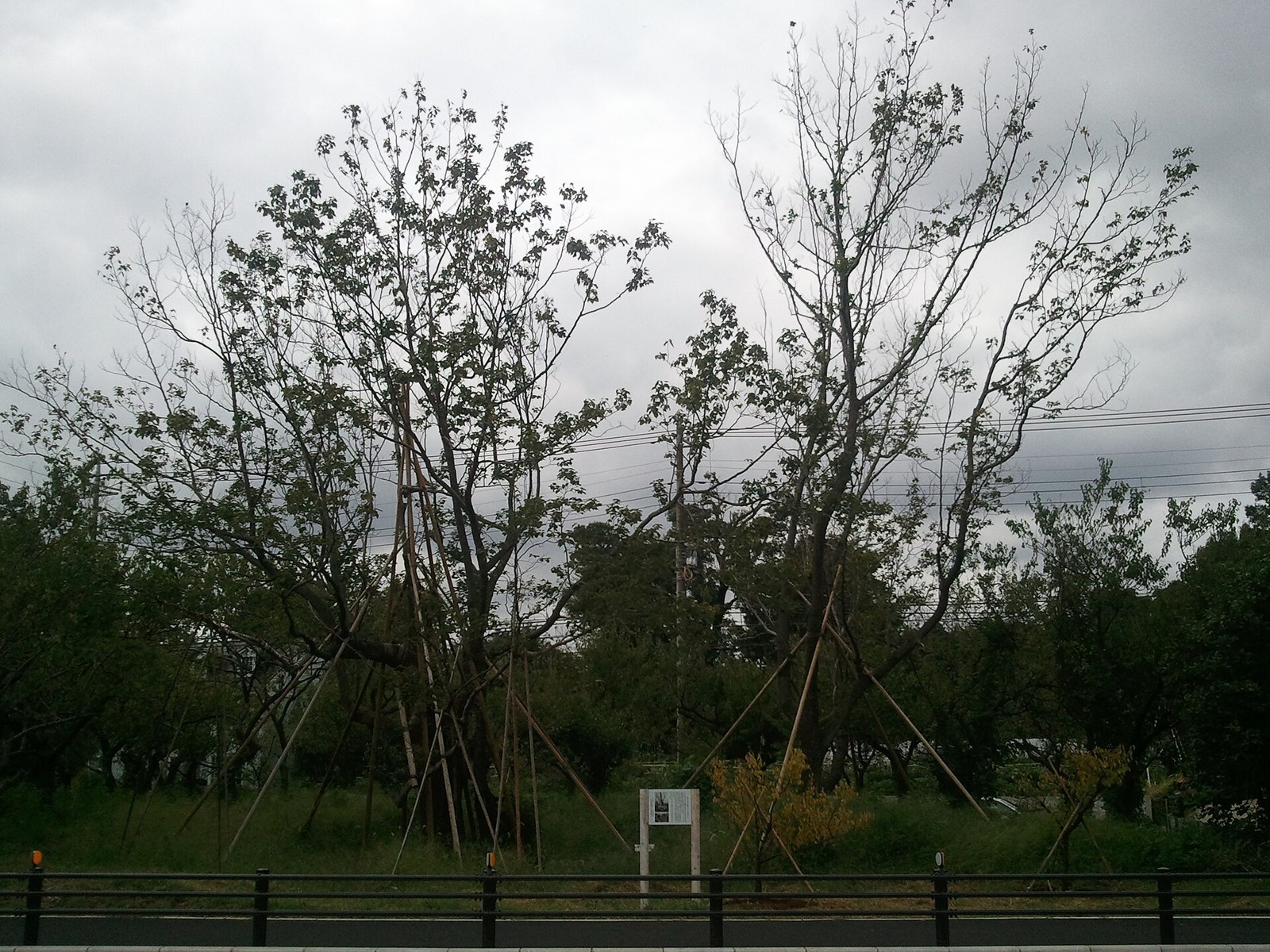
Minato City’s manual recommends nemawashi wherever possible for hard-to-move species, large-diameter trees and valuable trees (移植困難な樹種、大径木や貴重樹木), to reduce the risk of the tree dying after the move. The Matsudo kenponashi was more than 200 years old and assessed as being in poor condition: the report gave its above-ground decline as grade III (poor). Lightning had charred the inner walls of its hollow trunk; one of its two main stems had died at a height of 7 metres (23 feet); and a trunk sprout had grown to about 10 metres (33 feet). How old trees in Japan go on living with hollow trunks is the subject of why Japan’s ancient trees live for a thousand years; for a transplant, a hollow trunk changes how the tree can be handled.
Nursery stock
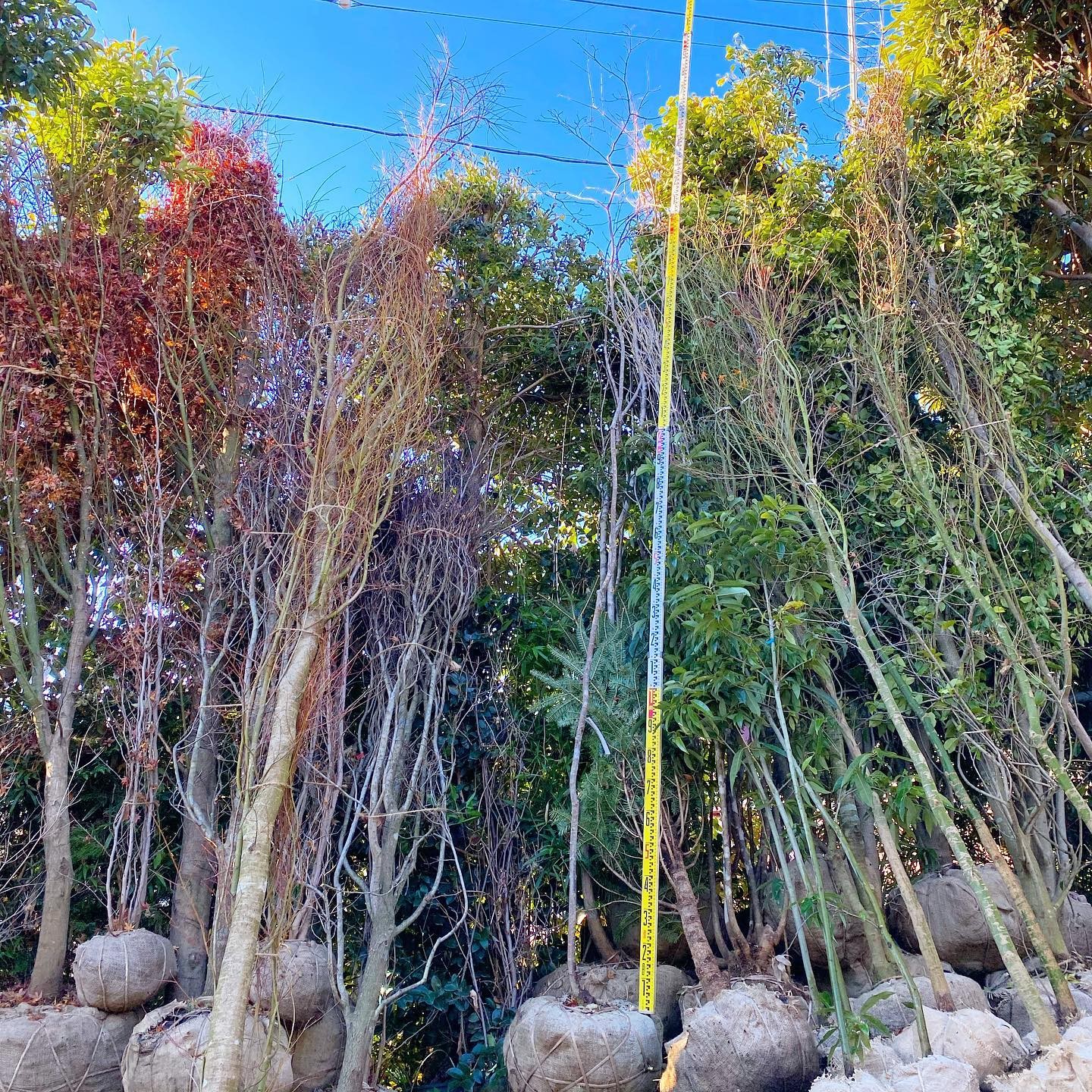
Nemawashi is not only for rescue moves. MLIT’s 2025 standard specification for public building works requires planting stock, as a rule, to be cultivated trees with many fine roots that have been root pruned or container grown (根回し又はコンテナ栽培(容器栽培)をした細根の多い栽培品). Under that specification, a tree supplied for a public building project is expected to arrive with its roots already prepared.
Back to Matsudo — why two years, in four sectors
An uneven root system
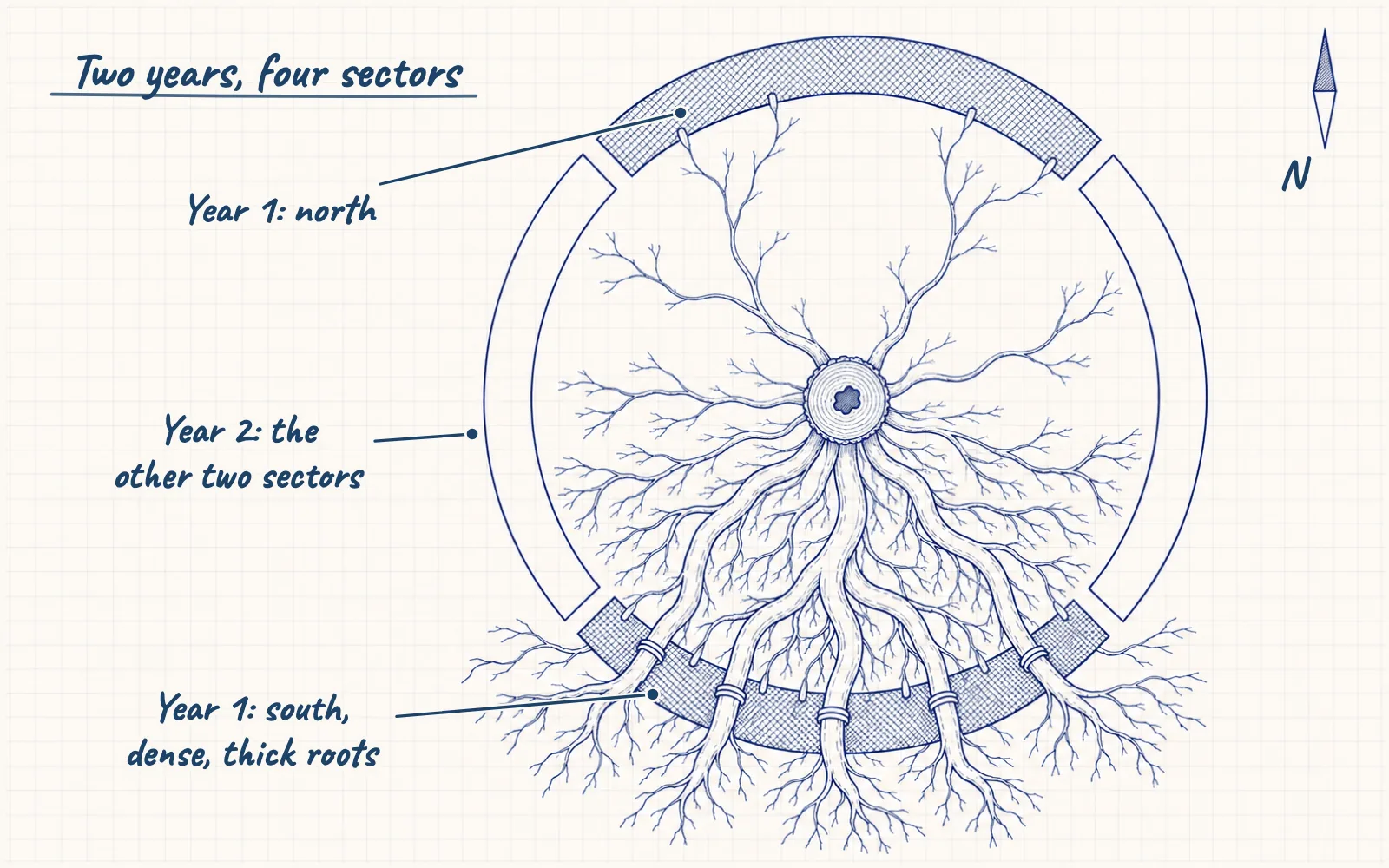
The Matsudo report shows how these rules played out on one tree. The city had surveyed the roots in advance. Re-reading the survey, the adviser found the roots on the north side sparse, while the south side, where the trunk sprout was growing, was dense with roots, including thick ones. The report judged that soil would not bind into a firm root ball around such coarse roots, and that lifting a tree with a hollow trunk risked it breaking apart.
The case against a one-year programme
The report’s comparison of methods is direct. Of digging and moving the tree directly with a large excavator, it says that because nemawashi would not be carried out, a lower likelihood of successful establishment was expected for an old tree, and the risk was high. A one-year root-pruning programme was also expected to reduce the chance of establishment for a tree with roots this uneven. The adviser proposed dividing the root zone and root-pruning it in two stages over two years, checking safety along the way. The city’s road schedule was adjusted to allow the time.
The root pruning was carried out over two years in four sectors. In the first year the crew worked on the dense south side and the diagonally opposite north side. The report says the tree had two years of care leading up to the move; it does not say whether that time overlaps with the pruning years.
Waiting for dormancy
Even then, the calendar slipped. Archaeological excavation along the road line delayed the work, and the city asked for the move to be finished by the end of 2011. The adviser explained that bad weather had delayed leaf fall, so the tree was not fully dormant and this was not the right time to move it. The city agreed to wait, and the move took place on 15 January 2012.
A second case: the Setagaya keyaki
Setagaya City’s keyaki is a second documented case. After a tree assessment found that the keyaki in the city hall courtyard could be moved, it was root-pruned in March 2020. (For how tree assessment is approached in Japan and the West, see VTA vs jumoku-i.) Setagaya’s note for residents describes the work plainly: dig around the tree, keep the large side roots and the main root, cut the rest so that fine roots grow, and girdle the kept roots to encourage rooting. In November 2021 the tree, by then weighing 20 tonnes (about 44,000 lb), was pruned for transport, its root ball wrapped in burlap, and it was lifted with a 100-tonne crane and moved by trailer. After planting, its trunk was wrapped in burlap to prevent sunscald on bark newly exposed by the pruning. Another old keyaki, hollow but still standing, is described in the Higashine great zelkova.
Japan and the United States — what the documents say
Root pruning in the American standard
Root pruning before transplanting is part of American practice too. The American transplanting standard, ANSI A300 Part 6 (2012 edition), states: “Root pruning should be considered prior to transplanting.” An annex to that edition, which is not part of the standard itself, says field-grown trees sold balled and burlapped must have their roots pruned “at least 6 inches (15 cm) inside the final rootball size,” and “within adequate time” for fibrous roots to develop at the edge of the root ball before harvest. The same edition defines a tree spade as “equipment used to transplant large trees.”
University extension guidance
University of Florida extension material covers both nursery stock and trees already growing in a landscape. One publication gives six to ten weeks before transplanting; a county extension guide gives a minimum of three to four months and, for larger trees or where a tree spade cannot be used, describes cutting roots on at least two sides of the tree to a depth of 18 to 24 inches (about 46 to 61 cm). The university also advises that trees “should not be pruned at transplanting to compensate for root loss.” MLIT’s specification, by comparison, lists branch thinning and leaf removal at root pruning as work done as needed; the two documents describe different stages and purposes.
Comparing the documents
The principle is the same on both sides: cut roots in advance, inside the future root ball, and give new roots time to grow. The table compares only the documents cited here; it is not a survey of national practice, and the intervals are not directly comparable because the trees, climates and purposes differ.
| Japanese documents cited | American documents cited | |
|---|---|---|
| Where the cut goes | Slightly inside the root ball to be dug (Minato) | At least 6 in (15 cm) inside the final root ball, for nursery stock (ANSI annex) |
| Supporting roots | Kept in 3–4 directions (Tottori) or 3–4 roots (Sapporo), girdled to the cambium (MLIT) | Roots cut on at least two sides (UF/IFAS county guide); the cited passages do not describe girdling |
| Interval | 6 months to 1 year (Hori); 1–3 years for old or valuable trees (Ministry of the Environment) | 6–10 weeks (UF/IFAS); at least 3–4 months (UF/IFAS county guide); “adequate time” (ANSI annex) |
| Crown pruning | Branch thinning and leaf removal as needed, at root pruning (MLIT) | Not to compensate for root loss at transplanting (UF/IFAS) |
Common misunderstandings — what nemawashi does not do
“Any time will do”
Minato’s manual rules out the dormant period for root pruning because no roots form then (other sources differ, as noted above), and Kagoshima’s specification says to dig only when enough fine roots can be confirmed and the planting season has come. In Matsudo, the adviser held the move back because the tree was not yet fully dormant. Timing applies at both ends: when the roots are cut, and when the tree is moved.
“Cut every root, get more new roots”
Cutting every root at once can reduce both anchorage and water uptake, which is why the Florida guide warns of shock and instability. Tottori keeps supporting roots in three or four directions; Sapporo shows three to four main roots kept. Girdling lets those roots continue to carry water while new roots form on the trunk side of the girdled band.
“A famous move tells you how it was prepared”
One of Tokyo’s historical transplants is the Kubikake Ichō (首賭けイチョウ, literally “neck-wager ginkgo”) in Hibiya Park. According to the Tokyo Metropolitan Park Association, the tree was due to be felled for road widening near what is now the Hibiya crossing, and was moved in 1902 at Honda’s insistence, travelling about 450 metres (1,480 feet) over 25 days. A column by the landscape architect Isoya Shinji on the Ministry of the Environment’s giant tree database adds that rails were laid for the move. The 25 days were the move itself. The official sources checked for this article do not say whether the ginkgo was root-pruned beforehand, or for how long.
Before the first cut — questions the documents raise
Questions to settle early
Taken together, the Japanese documents point to questions that need answers well before a large tree is moved. Is the species on a hard-to-move list, such as Kita City’s? Is the tree large, valuable or long established, as Minato and Tottori describe? Has the root system been surveyed, and is it even on all sides, or lopsided like the Matsudo tree’s? Is there time for at least the ordinary interval Hori describes, or the longer periods given for old and valuable trees? Has a tree assessment been made, as Setagaya did before deciding its keyaki could be moved?
What changes the plan
In Matsudo, two findings changed the plan: an uneven root system, which turned a one-year programme into a two-year one, and a tree that was not yet dormant, which moved the date. In Setagaya, the assessment came first and the root pruning followed. In both cases the visible move came at the end of a much longer stretch of preparation.
Frequently asked questions
What is nemawashi in gardening?
Nemawashi (根回し) is root pruning carried out where a tree stands, before it is transplanted. Roots are cut slightly inside the future root ball so that new fine roots grow from the cuts. In the trench method, a few thick supporting roots are left and girdled, and the trench is backfilled and watered.
How long before transplanting is nemawashi done?
One Japanese technical review gives six months to a year, with a growing season in between. Tottori Prefecture allows one to two years and the Ministry of the Environment one to three years for old, valuable or hard-to-move trees. Kagoshima Prefecture’s specification says the tree is ready when enough new fine roots can be confirmed and the normal planting season has arrived.
Why are some roots girdled instead of cut?
Girdling removes a band of bark down to the cambium. That blocks the flow of sugars in the phloem, so they collect on the trunk side and stimulate new roots there. The wood underneath still carries water, and the root still helps anchor the tree.
Is nemawashi the same as root pruning in the United States?
The principle is the same. ANSI A300 Part 6 (2012) says root pruning should be considered before transplanting, and University of Florida guidance covers both nursery and landscape trees. The Japanese documents cited here add girdled supporting roots and, for old or valuable trees, intervals of one to three years.
Which trees need nemawashi most?
Minato City’s manual recommends it wherever possible for hard-to-move species, large-diameter trees and valuable trees. Kita City’s list of hard-to-move species includes akamatsu (Pinus densiflora), momi (Abies firma) and akagashi (Quercus acuta).
Why does the word also mean consensus-building in business?
Digital Daijisen lists the gardening meaning and the figurative meaning — preparing the ground before a meeting or negotiation — in the same entry. JETRO and Setagaya City both explain that the business sense comes from the gardening practice.
Sources
– Minato City, Tree Management Manual (April 2023), p.7 (checked 2026-11-17): https://www.city.minato.tokyo.jp/documents/146837/bessi15.pdf – Ministry of the Environment, construction cost reference for natural parks, “root pruning,” p.3-40 (checked 2026-11-17): https://www.env.go.jp/nature/sizenkouensekisankijyun.pdf – Shogakukan, Digital Daijisen, “nemawashi,” via Kotobank (checked 2026-11-17): https://kotobank.jp/word/%E6%A0%B9%E5%9B%9E%E3%81%97-178519 – JETRO, Communicating with Japanese in Business (1999) (checked 2026-11-17): https://www.jetro.go.jp/ext_images/mexico/mercadeo/communicationwith.pdf – Hori (堀大才) (2008) “Theory and practice of tree transplanting,” Tree and Forest Health 12(3): 150–156 (checked 2026-11-17): https://www.jstage.jst.go.jp/article/treeforesthealth/12/3/12_KJ00006259322/_pdf – Kyoto University Kamigamo Experimental Station, root pruning of a pine (2022) (checked 2026-11-17): https://fserc.kyoto-u.ac.jp/wp/kamigamo/digging-round-root/ – Kagawa Prefecture, construction methods, “root pruning,” p.58 (checked 2026-11-17): https://www.pref.kagawa.lg.jp/documents/5717/04yonsyou.pdf – Sapporo City, standard drawings for landscape works, FY2026, Fig. 2-4-1 (checked 2026-11-17): https://www.city.sapporo.jp/ryokuka/shiryo/zouen/documents/00_r8_hyoujyunzu_2.pdf – Tottori Prefecture, public facilities greening manual, ch.3, p.3-51 (checked 2026-11-17): https://www.pref.tottori.lg.jp/secure/1116466/03_chapter3.pdf – MLIT, common specification for park and green-space works, 2-4-3 (checked 2026-11-17): https://www.mlit.go.jp/common/001231133.pdf – MLIT, standard specification for public building works, 2025 edition, 23.3.2 (checked 2026-11-17): https://www.mlit.go.jp/gobuild/content/001888816.pdf – Kagoshima Prefecture, planting specification, art. 108 (checked 2026-11-17): https://www.pref.kagoshima.jp/ah03/infra/kokyo/gizyutu/siyousyo/documents/syokusai.pdf – Kita City, greening technical standards, Table 6 (checked 2026-11-17): https://www.city.kita.lg.jp/_res/projects/default_project/_page_/001/010/068/attachment.pdf – Japanese Institute of Landscape Architecture, research committee on Japanese gardens, 2024 report, item 092 (checked 2026-11-17): https://researchpromotion.jila-zouen.org/wp-content/uploads/2025/05/2024_nihonteien_seikahoukoku.pdf – Takeuchi, S. et al. (2012) sap flow in a transplanted southern magnolia, Journal of the Japanese Society of Revegetation Technology 38(1): 27–32 (checked 2026-11-17): https://www.jstage.jst.go.jp/article/jjsrt/38/1/38_27/_article/-char/ja – Takeuchi, S. & Nishimura, Y. (2009), Journal of the Japanese Society of Revegetation Technology 35(1): 186–189 (checked 2026-11-17): https://www.jstage.jst.go.jp/article/jjsrt/35/1/35_1_186/_article/-char/ja – Watson, G. W. & Sydnor, T. D. (1987) “The effect of root pruning on the root system of nursery trees,” Journal of Arboriculture 13(5) (checked 2026-11-17): https://joa.isa-arbor.com/request.asp?ArticleID=2153&JournalID=1&Type=2 – Gilman, E. F. (1992) root pruning prior to transplanting southern magnolia, Journal of Arboriculture 18(4) (checked 2026-11-17): https://joa.isa-arbor.com/request.asp?ArticleID=2509&JournalID=1&Type=2 – Gilman, E. F. & Anderson, P. J. (2006) “Root pruning and transplant success for Cathedral Oak live oaks,” Journal of Environmental Horticulture 24(1) (checked 2026-11-17): https://doi.org/10.24266/0738-2898-24.1.13 – Watson, G. W. & Himelick, E. B. (1982) “Root distribution of nursery trees and its relationship to transplanting success,” Journal of Arboriculture 8(9) (checked 2026-11-17): https://joa.isa-arbor.com/request.asp?ArticleID=1825&JournalID=1&Type=2 – ANSI A300 (Part 6)-2012, planting and transplanting (checked 2026-11-17): https://west-chester.com/DocumentCenter/View/10143/A300-6 – UF/IFAS Extension Broward County, “How to root prune and transplant field grown trees and shrubs” (checked 2026-11-17): https://blogs.ifas.ufl.edu/browardco/2021/09/16/how-to-root-prune-and-transplant-field-grown-trees-and-shrubs/ – UF/IFAS, MG089 (checked 2026-11-17): https://ask.ifas.ufl.edu/publication/MG089.pdf – Tokyo Metropolitan Park Association, Hibiya Park (checked 2026-11-17): https://www.tokyo-park.or.jp/park/hibiya/ – Ministry of the Environment, giant tree database, column by Isoya Shinji (進士五十八) (checked 2026-11-17): https://kyoju.biodic.go.jp/?_action=gtcontents&_command=column037 – Fujii, T. (2012) “The future seen by Seki-san’s Forest (2),” GREEN AGE, July 2012, Japan Greenery Research and Development Center (checked 2026-11-17): https://www.jpgreen.or.jp/greenage/archive/isyoku/201207.pdf – Setagaya City, report on the keyaki workshops, city hall redevelopment, p.8 (checked 2026-11-17): https://www.city.setagaya.lg.jp/documents/9290/R3report.pdf