

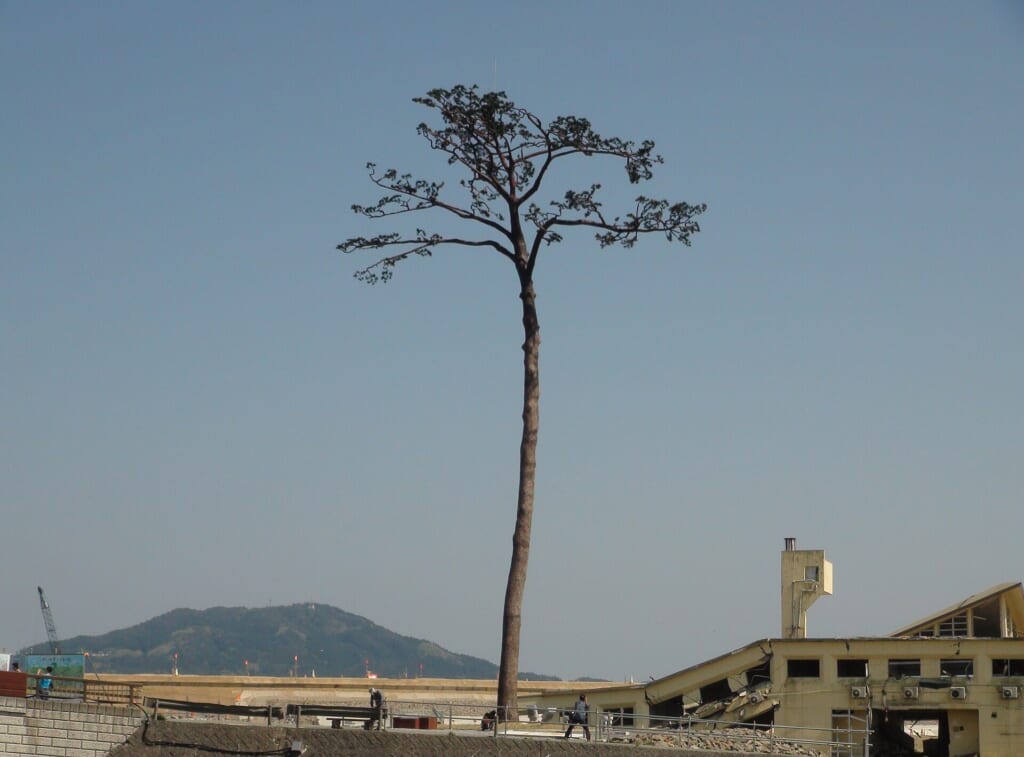
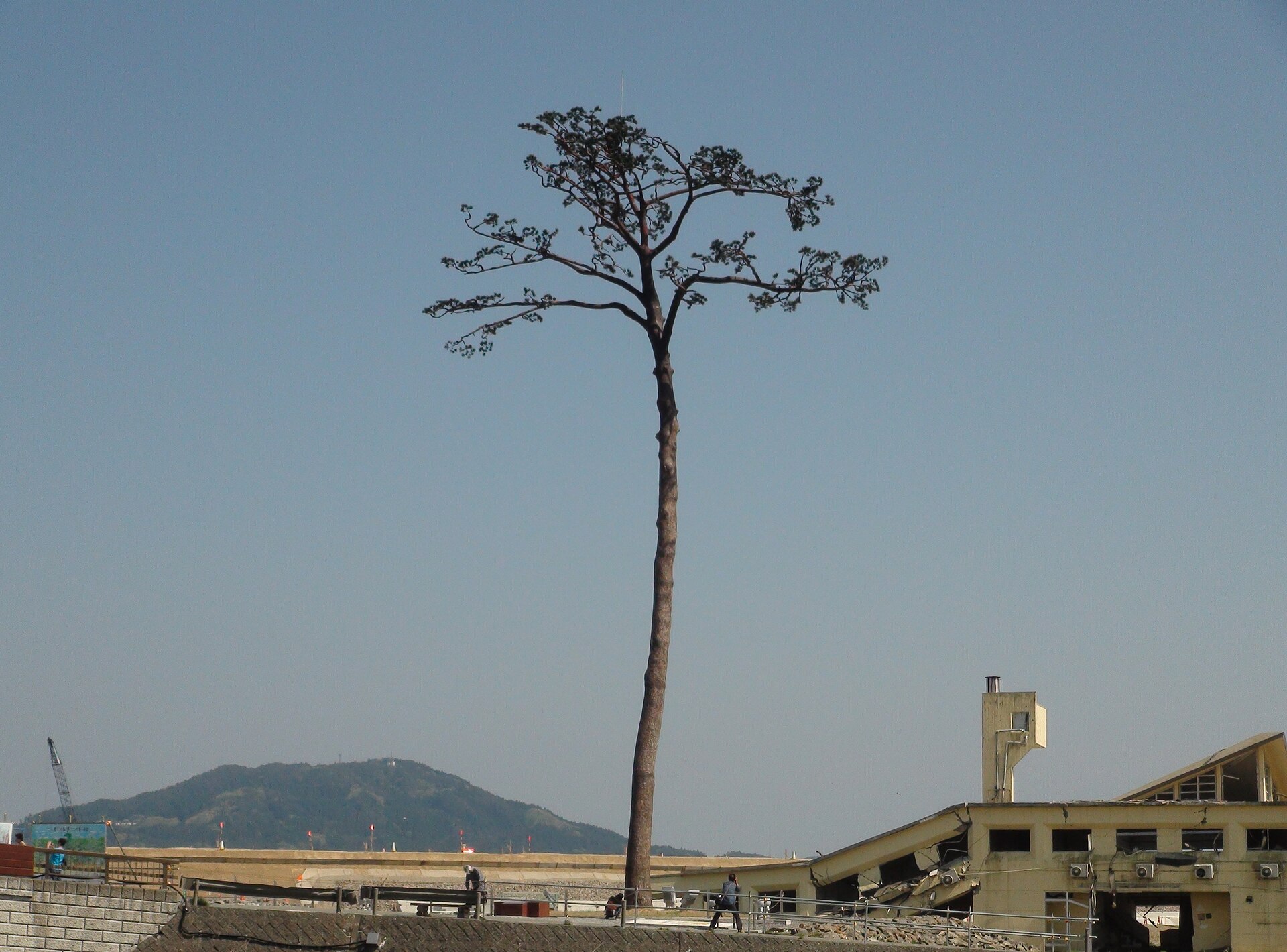
The Miracle Pine of Rikuzentakata was the only tree left standing out of roughly 70,000 pines at Takata-matsubara after the 2011 tsunami, and it still died: the earthquake lowered the ground by about 80 cm, salty groundwater rose into the root zone, and the roots drowned and rotted; according to the city, its death was confirmed in May 2012. It lives on in two ways. Scientists cut twigs from it in April 2011 and grafted them onto young pines, so that the growing shoots are genetic copies of the old tree; others raised seedlings from its cones. In May 2026, seed collected from those grafted successors was handed to the British Ambassador in Tokyo, intended for the Millennium Seed Bank of the Royal Botanic Gardens, Kew.
Below: the forest it came from, why a survivor of the wave could not survive the ground it stood in, the rescue attempt, the monument, the grafts, and the replanted forest.
A Pine on an Empty Plain — Rikuzentakata, Summer 2011
What the photographs of 2011 show
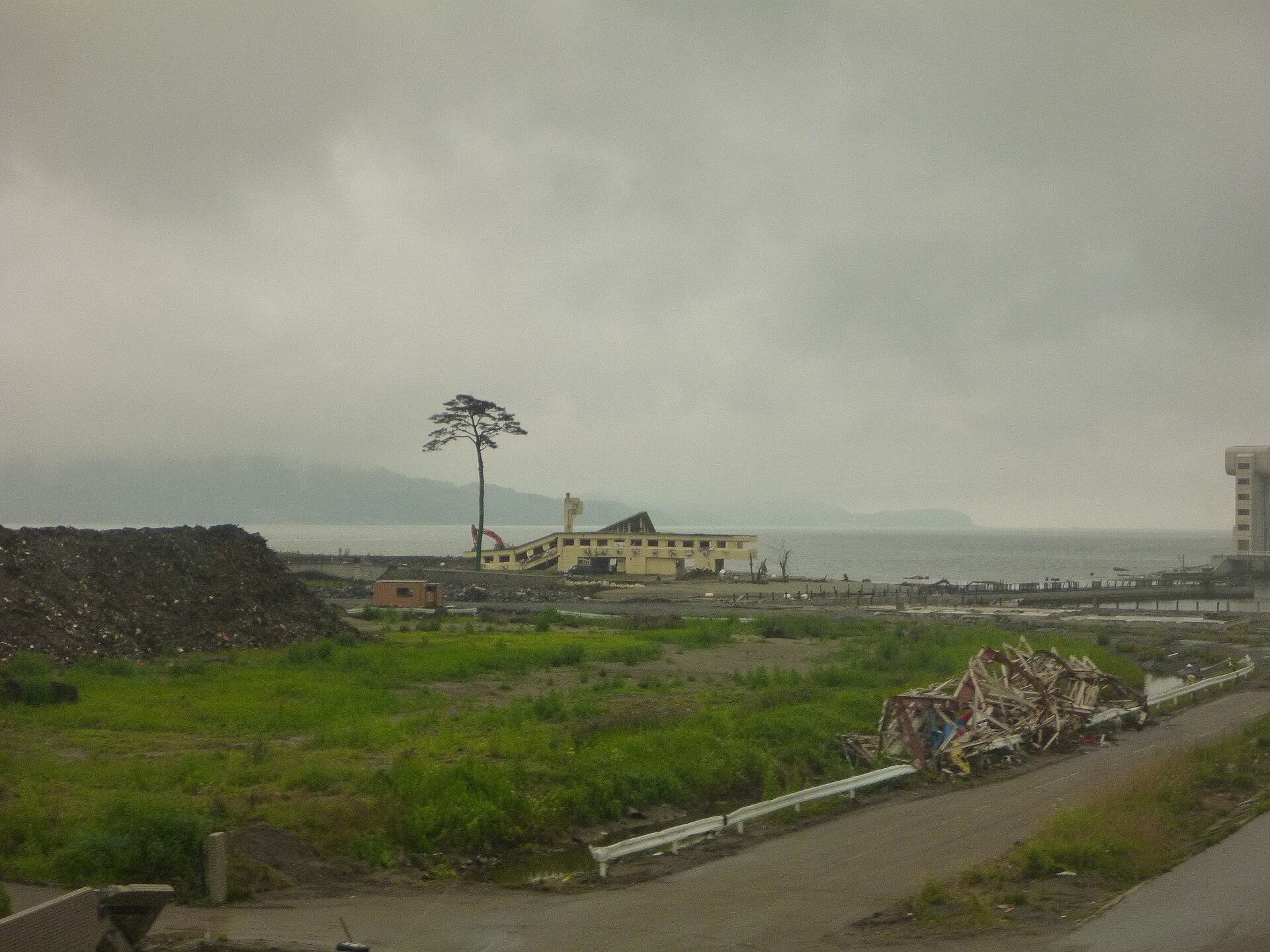
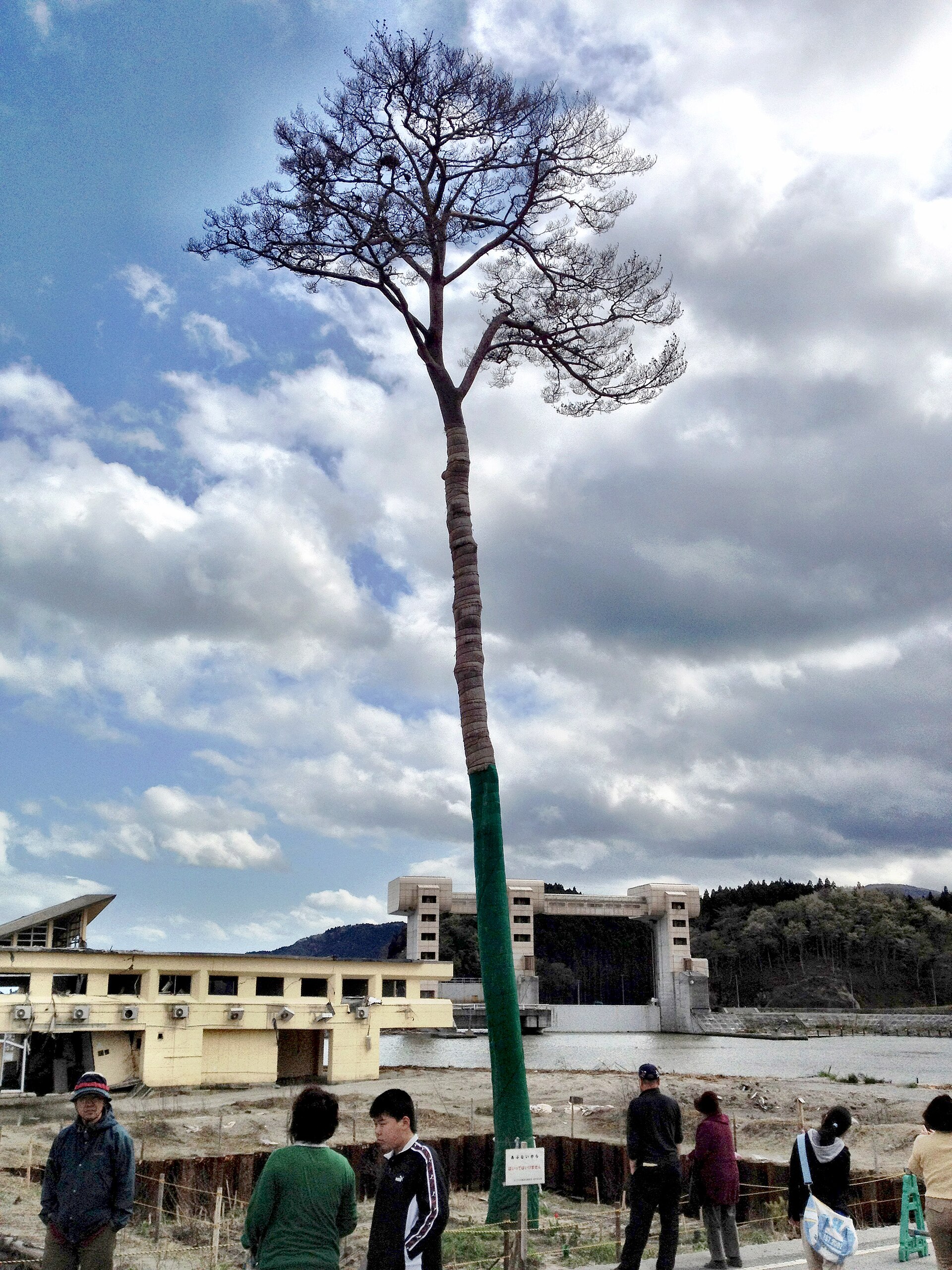
A photograph taken in July 2011 shows mostly grey sky. Below it, grass covers a flat plain, with a heap of debris on the left and a tangle of wreckage beside a road. Out toward the bay, next to the broken shape of a youth hostel, a single tall pine holds a small crown on a long bare trunk. Nothing else on the shoreline rises to its height.
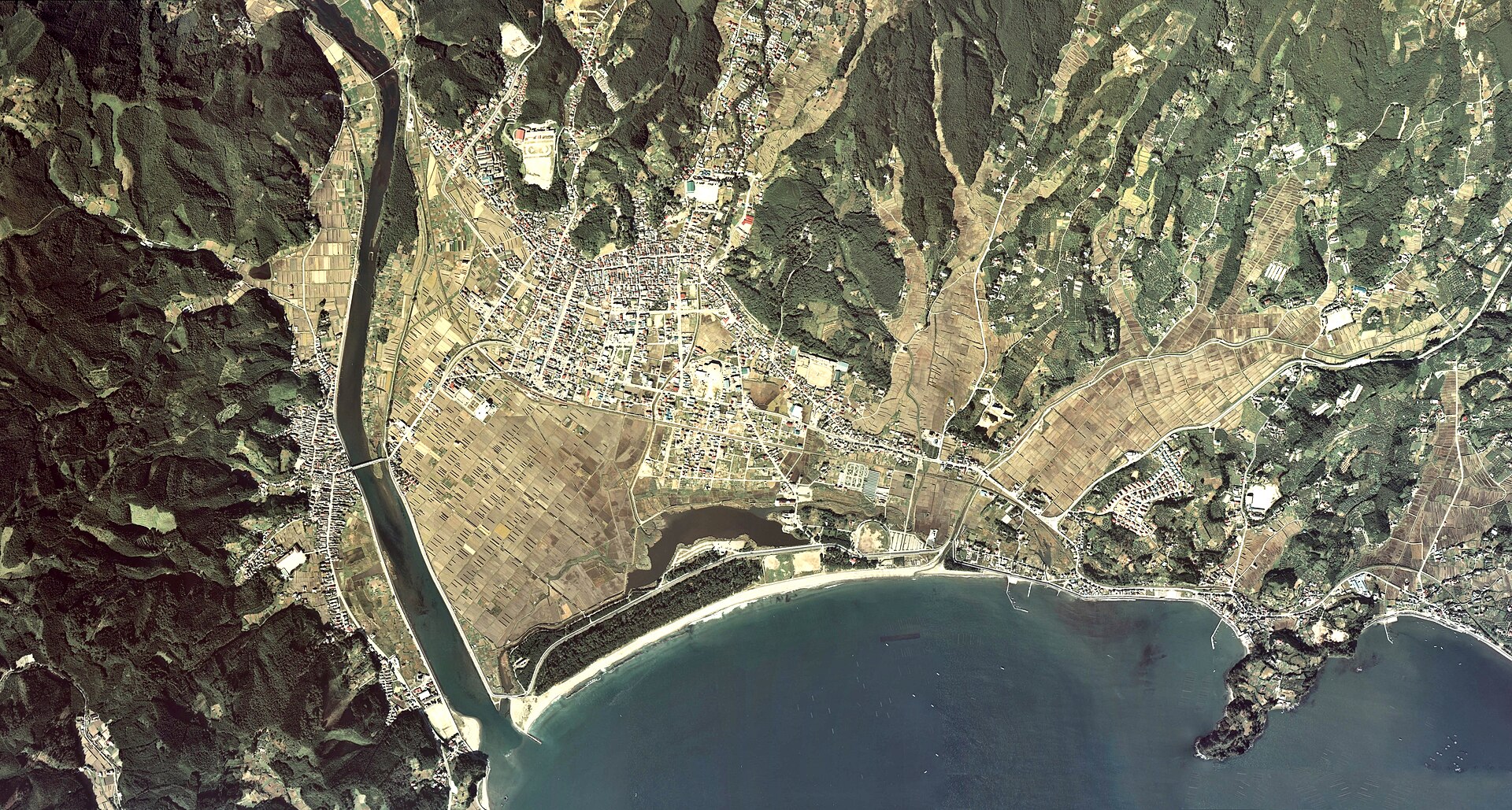
That tree was what remained of Takata-matsubara (高田松原, “the Takata pine grove”), a coastal forest of Japanese black pine and Japanese red pine that had lined the shore of Rikuzentakata in Iwate Prefecture for roughly three and a half centuries. Rikuzentakata City describes it simply: of the roughly 70,000 pines, it was the only one that held out. People began calling it Kiseki no Ippon-matsu (奇跡の一本松), “the miracle single pine”.
The scale of the disaster around it
The tree became a symbol because of what happened around it. The Urban Renaissance Agency, in its account of the reconstruction, describes the tsunami that swallowed Takata-matsubara and struck the city as reaching about 15 m. A city official, in a lecture recorded by Japan’s Fire and Disaster Management Agency, gave the maximum tsunami height in the city as 17.6 m. As of 31 January 2026, Iwate Prefecture counts 1,606 dead in Rikuzentakata, with 201 still missing; its September 2025 breakdown shows 49 of the dead as disaster-related deaths.
The tree had survived the wave. Why could it not survive the months that followed?
Takata-matsubara — A Forest Planted Against the Sea in 1667
Three generations of planting
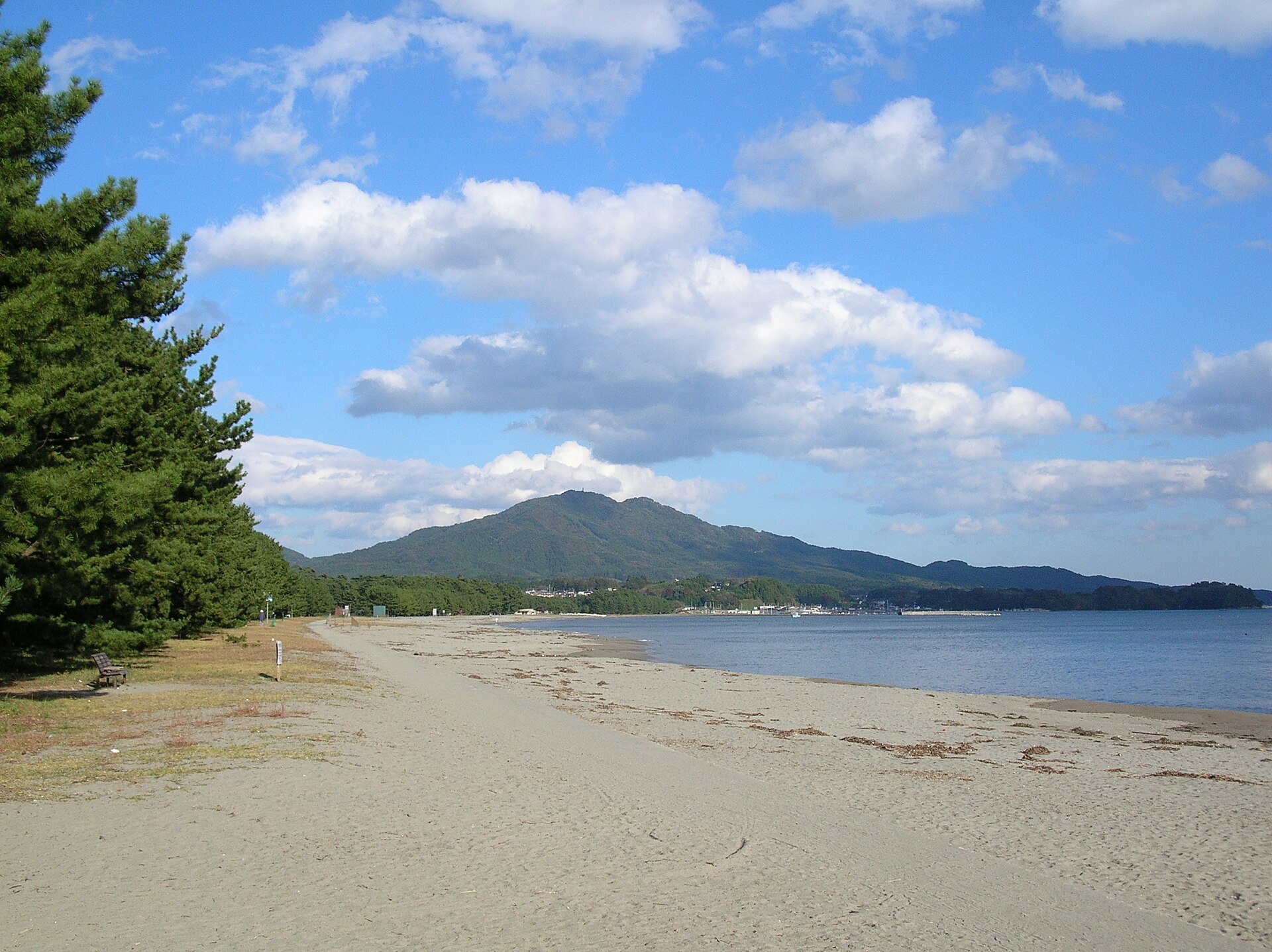
The forest was not wild. According to Rikuzentakata City’s account of the site, planting began in 1667 (the seventh year of Kanbun) under Kanno Mokunosuke (菅野杢之助), with help from the Sendai domain and local people. The Kanno family went on tending and replanting it for three generations. In the Kyōhō era of the early 18th century, Matsuzaka Shin’emon (松坂新右エ門) planted and managed it in turn.
The purpose was practical. The city’s description says the pines protected the farmland behind them from blowing sand and salt-laden wind.
What it had become by 2011
By the 20th century the forest was a landmark. It was designated a national Place of Scenic Beauty (名勝, meishō) on 13 November 1940, and is also listed among the “100 Selected White Sand and Green Pine” beaches of Japan. The city gives the length of the sandy beach as about 1.9 km. A Forestry Agency publication puts the stand before the disaster at 70,000 black and red pines combined.
The forest had been hit before
The 2011 wave was not the forest’s first. A Ministry of Land, Infrastructure, Transport and Tourism report on the site records that the 1960 Chilean tsunami knocked down 2,000 to 3,000 pines at Takata-matsubara, and that residents cleared the fallen trees, gave emergency care to weakened ones and replanted. The forest that met the 2011 wave was itself partly a repaired forest.
Edo-period coastal forests across Japan
Takata-matsubara was not unique. The Forestry Agency’s white paper notes that during the Edo period, forests for windbreaks and coastal sand control were established in many parts of Japan. The Forestry and Forest Products Research Institute’s species notes say Japanese black pine (Pinus thunbergii, kuromatsu) has long been planted for windbreak and tide-protection forests.
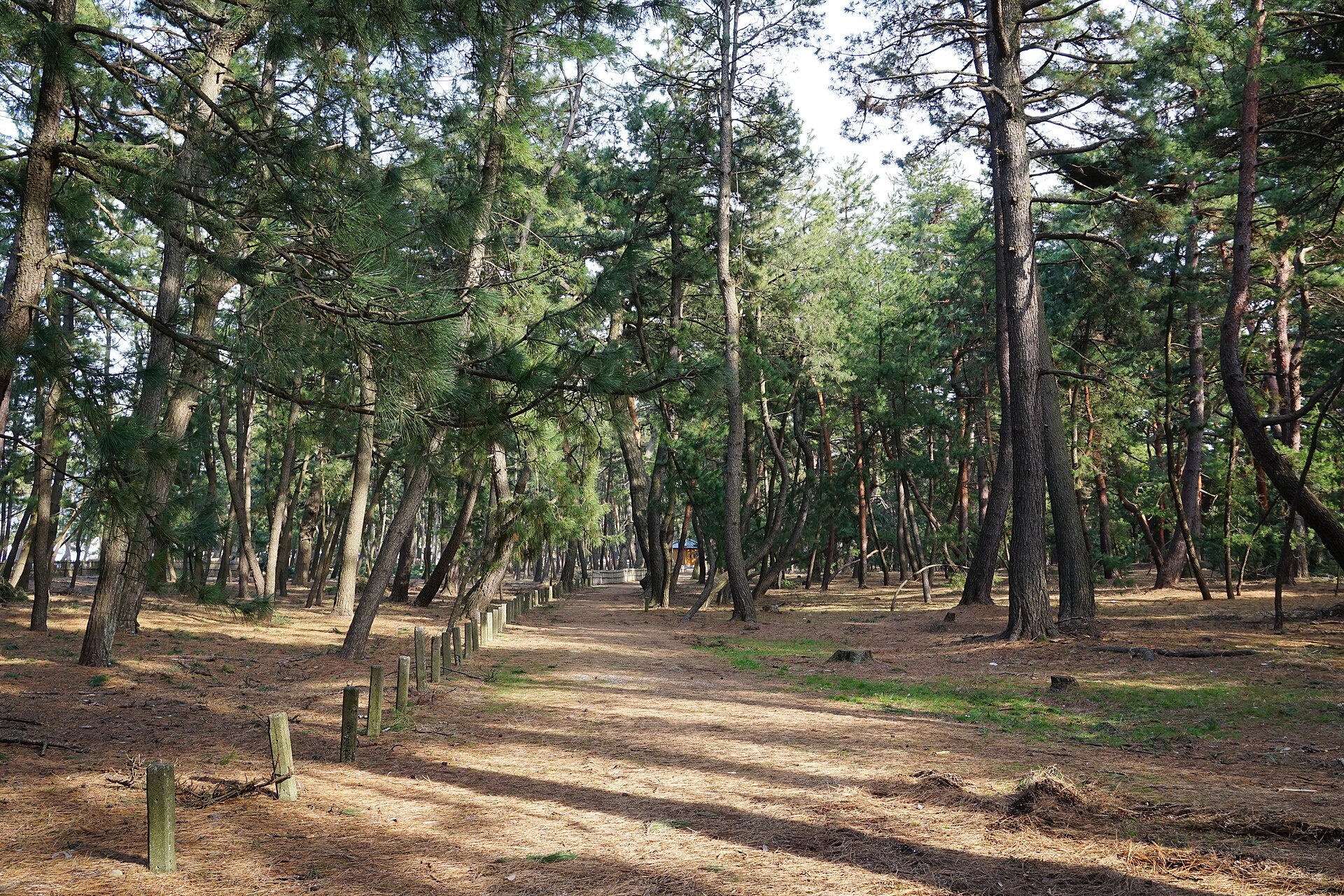
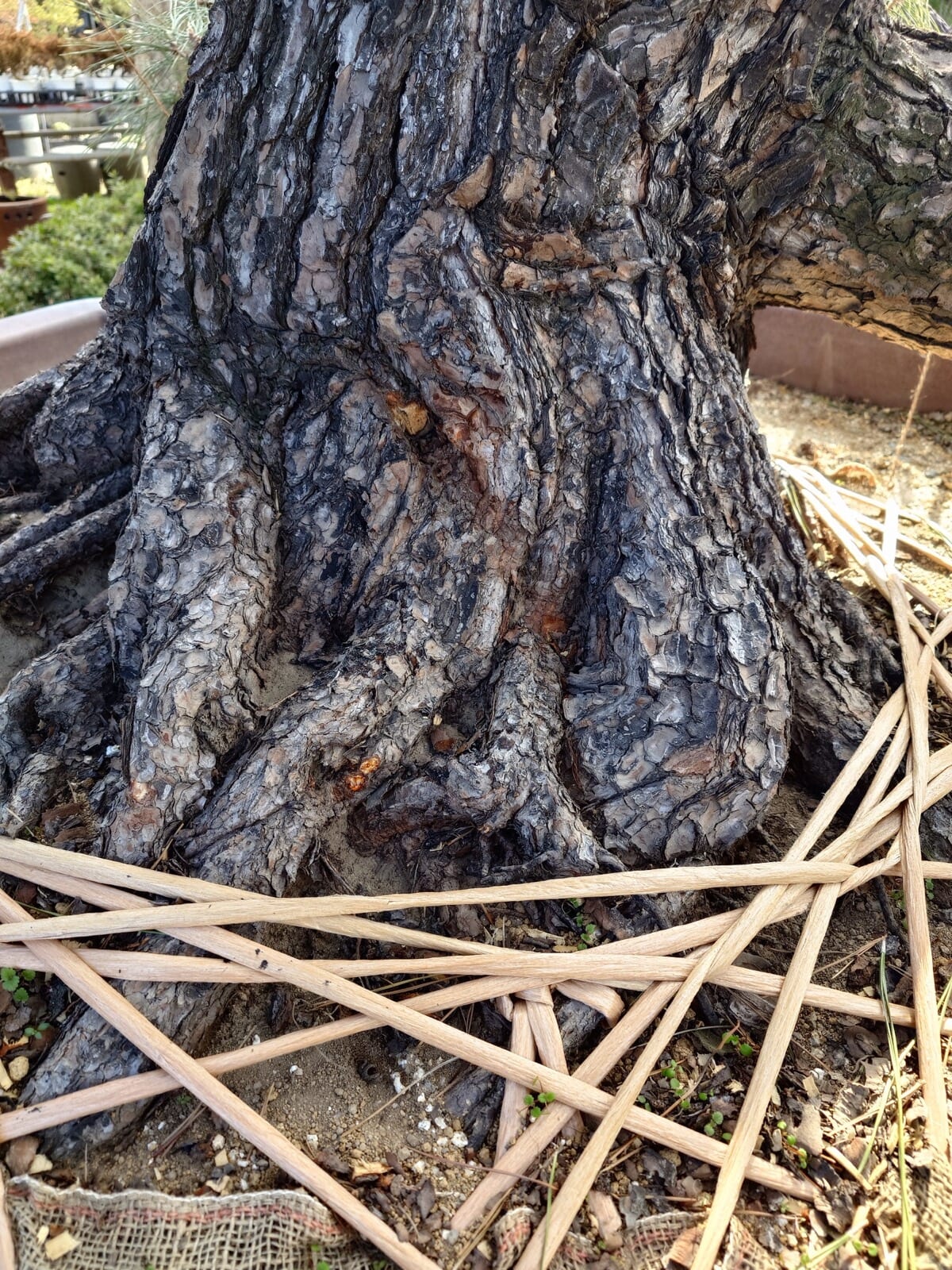
A belt of pines like this works only if its roots can breathe. As the rest of this story shows, the depth between the roots and the groundwater decided the Miracle Pine’s fate.
Why One Tree Stood — What the Records Say, and What They Don’t
The hostel that took the impact
The tree stood next to the Rikuzentakata Youth Hostel. The multilingual tourism description of the site published by the Ministry of Land, Infrastructure, Transport and Tourism says the building is thought to have absorbed the force of the tsunami and so protected the tree. That wording is careful, and it should stay careful. The sources used here contain no measurement of the flow around the tree. The hostel may have shielded the tree, but the sources cited here contain no flow measurements that would establish how much.
How big the tree was
Measurements differ by source and date. A June 2011 report from the Tohoku Regional Breeding Office of the Forest Tree Breeding Center records a height of 27.7 m and a trunk diameter at breast height of 87 cm. A later City of Nagoya description gives 27.5 m, a trunk diameter of 90 cm and an age of 173 years. The reason for the differences is not recorded, so no single figure should be treated as exact.
Which pine it was
Even the species is not settled in the records. The forest was a mix of black and red pine. The Tohoku Regional Breeding Office’s 2011 report and its later list of repatriated trees record the Miracle Pine as a Japanese red pine (Pinus densiflora, akamatsu). An article by the same office from fiscal 2015 calls it ainoko-matsu (アイノコマツ), a name used in Japan for crosses between black and red pine. The records disagree. What can be said safely is that it was a pine of the Takata-matsubara stand.
| Item | What the sources say | Source |
|---|---|---|
| Planting of the forest began | 1667, Kanno Mokunosuke | Rikuzentakata City |
| Pines before 2011 | About 70,000, black and red pine | Forestry Agency, Tohoku |
| Height of the Miracle Pine | 27.7 m (June 2011); 27.5 m (later) | Tohoku Breeding Office; City of Nagoya |
| Trunk diameter | 87 cm at breast height (June 2011); 90 cm (later) | Same as above |
| Age | About 173 years | City of Nagoya |
| Ground subsidence at the tree | About 80 cm | Kawai et al., 2012 |
| Death confirmed | May 2012 | Rikuzentakata City |
| Felled for preservation | 12–13 September 2012 | Rikuzentakata City |
| Monument completed | End of June 2013; ceremony 3 July 2013 | Rikuzentakata City |
Why It Died Anyway — Sunken Ground, Salt Water, Drowned Roots
The ground dropped
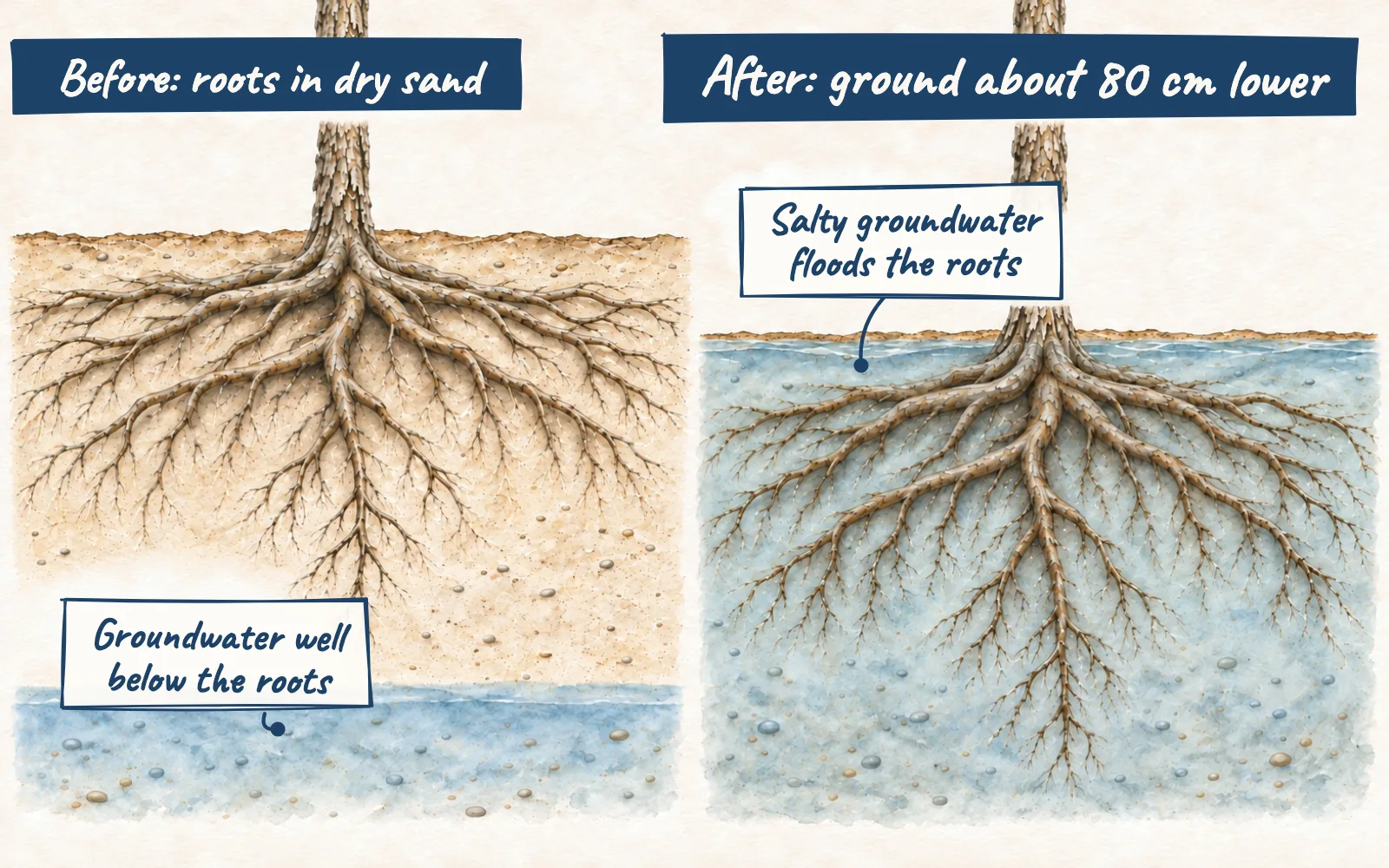
The wave was only the first blow. The earthquake itself lowered the land. A 2012 paper by Kawai and colleagues, which modelled salt movement in the soil around the tree, states that the site subsided by about 80 cm and that the groundwater table moved close to the surface. You will sometimes read that the ground under the tree sank by 84 cm. In the joint protection report that figure is the maximum at an observation point in Otomo, a different part of the city. Around the tree, about 80 cm is the figure to use.
Salt water stood around the roots
Rikuzentakata City’s own explanation is short: ground subsidence let seawater seep in, salt built up in the soil to harmful levels, and the tree weakened and died. The joint report on protecting the tree, published in December 2011 by the Japan Landscape Contractors Association, the Japanese Institute of Landscape Architecture and the Japan Greenery Research and Development Center, adds the mechanism. When roots sit in water, they suffer two kinds of damage at once, from lack of oxygen for respiration and from salt, and root rot follows.
The important point in that report is that a single dousing of seawater was not the main problem. The groundwater itself had changed, and the roots were left sitting in water that was both salty and short of oxygen.
What salt does inside a root
Plant physiologists describe salt damage in two stages. In a review in the Annual Review of Plant Biology, Rana Munns and Mark Tester separate a rapid, osmotic phase from a slower, ionic phase. In the first, salty water around the roots makes it harder for the plant to draw water in at all, so the tree behaves as if it were in drought even when it is standing in water. In the second, sodium and chloride ions build up in the tissues to toxic levels. Salt tolerance, in their account, depends on keeping Na⁺ and Cl⁻ out and on tolerating what gets in. Tolerance of salt spray on foliage does not necessarily mean tolerance of roots sitting for months in saline groundwater.
On the same coast, a 2012 Forestry and Forest Products Research Institute study of Japanese cedar stands after the tsunami discussed excess sodium dissolving into soil water as a possible cause of inhibited water uptake. That was cedar, not the Miracle Pine, but it points to the same kind of mechanism.
Alone in the heat
There was a third stress. The joint report notes that once the surrounding forest was gone, the tree stood isolated and was exposed to high temperatures and drying.
The Rescue Attempt — Steel Walls and Pumps Around One Tree
Cutting the tree off from the groundwater
People did try to save it. According to Kawai and colleagues, steel sheet piles were driven into the ground in a square about 15 m on each side around the tree, to cut off the surrounding salty groundwater, and water was pumped out to lower the water table inside the enclosure. The aim was to lower the groundwater around the remaining roots.
Too late for the roots
The joint report records what the team found in October 2011. Every root that could be examined was already decayed. By then the question was no longer how to protect the roots but whether any living roots remained to protect. Rikuzentakata City states that the death of the tree was confirmed in May 2012. The sources do not say who made that determination or on which day.
The Monument — A Dead Tree Rebuilt Around a Carbon-Fibre Core
Taking the tree apart
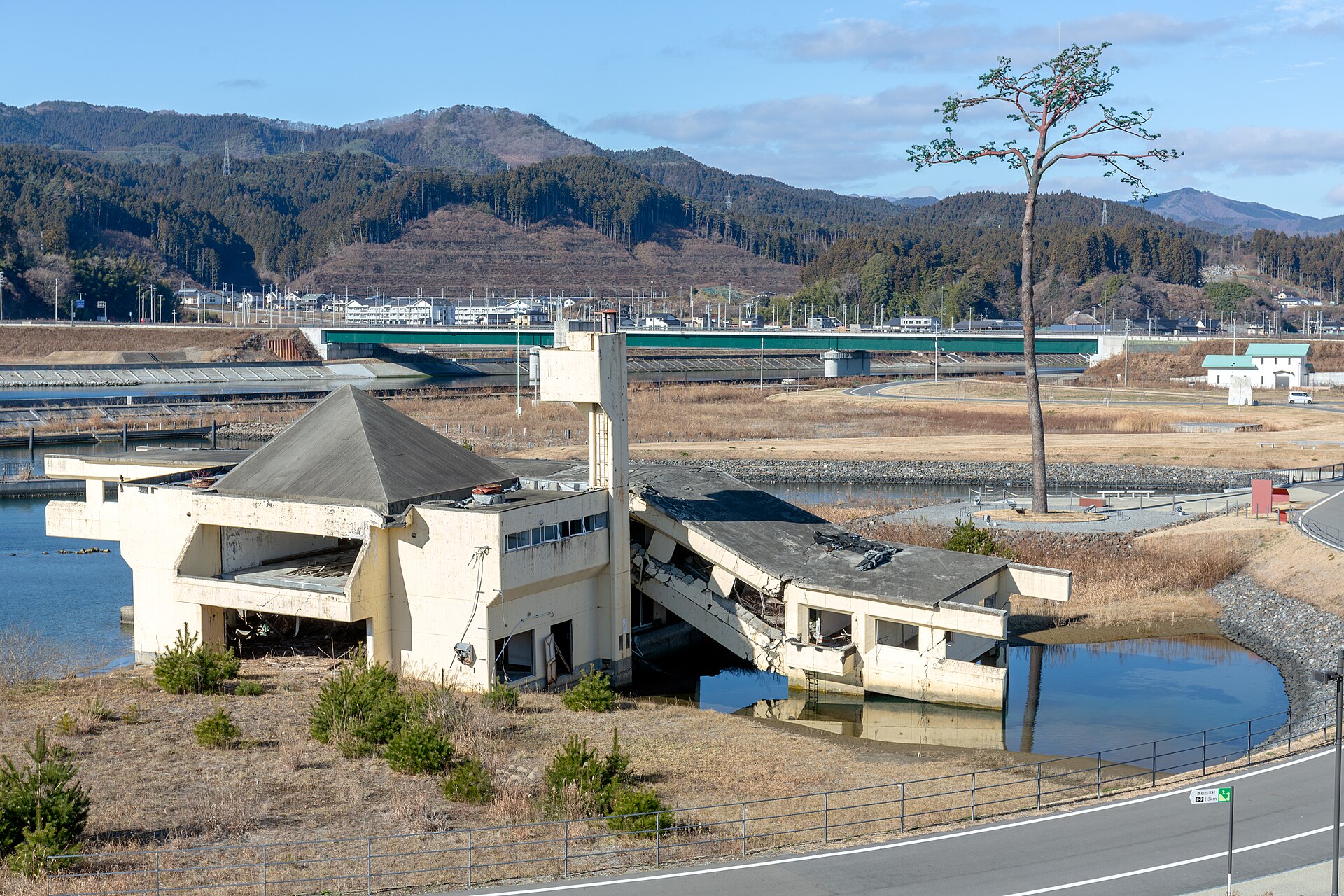
The city decided to keep the tree standing as a memorial. It was felled and removed on 12 and 13 September 2012, and the preservation work was contracted to Nomura Co., Ltd. (乃村工藝社). The policy was to keep as much of the original tree as possible, while the upper branches and foliage would be moulded and reproduced as replicas.
What holds it up now
The preservation plan specified a main structure of carbon-fibre-reinforced plastic (CFRP). A Ministry of Land, Infrastructure, Transport and Tourism document on the site describes the plan for the base as a concrete foundation, with the actual roots to be preserved separately. In May and June 2013, before completion, the angles at which the replica branches were attached were corrected. The work was finished at the end of June 2013, and a completion ceremony was held on 3 July 2013.
What it cost, and who paid
The city’s published accounts show the main preservation contract at ¥59,990,000 paid in fiscal 2012 and ¥90,002,500 in fiscal 2013, a total of ¥149,992,500. Preservation of the roots was a separate item of ¥8,925,000. The city launched a fund-raising campaign in July 2012 and reports that it reached its ¥150 million target as of 1 July 2013.
The decision was not without dispute. A residents’ audit request challenging the contract and spending was filed on 9 January 2015. The city’s audit commissioners dismissed it without examination, on the grounds that it repeated an earlier request in content and purpose. The documents record a disagreement, not a finding of wrongdoing.
A monument that needs maintenance
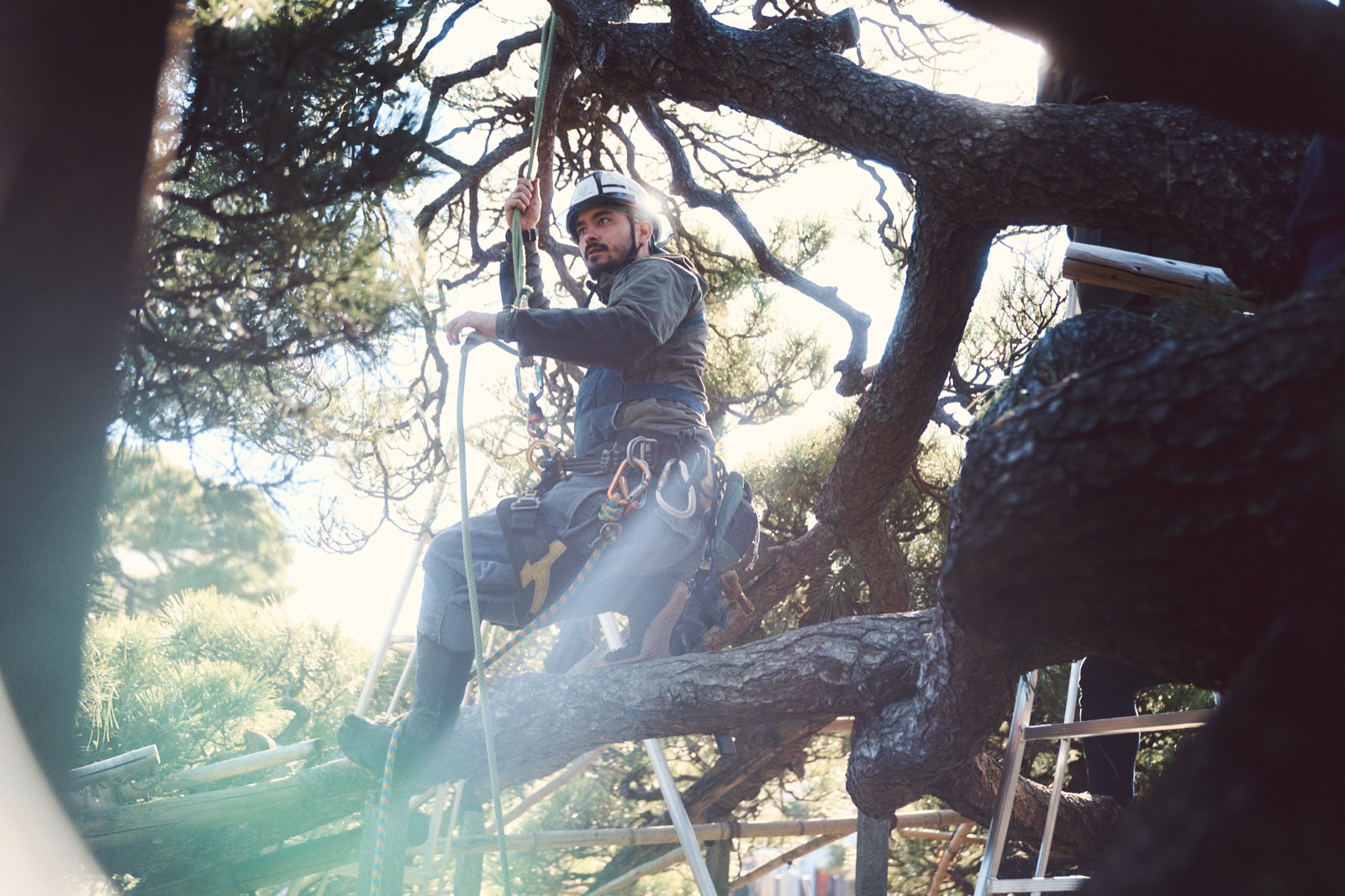
A replica tree on the coast still needs care. The operator of the national memorial facility announced inspection and repair work on the pine using scaffolding and an aerial work platform for five days, 3 to 7 November 2025. Rikuzentakata City lists both the Miracle Pine and the Rikuzentakata Youth Hostel among the disaster remains to be preserved within the park.
The Grafts — Twigs Cut Six Weeks After the Tsunami
22 April 2011
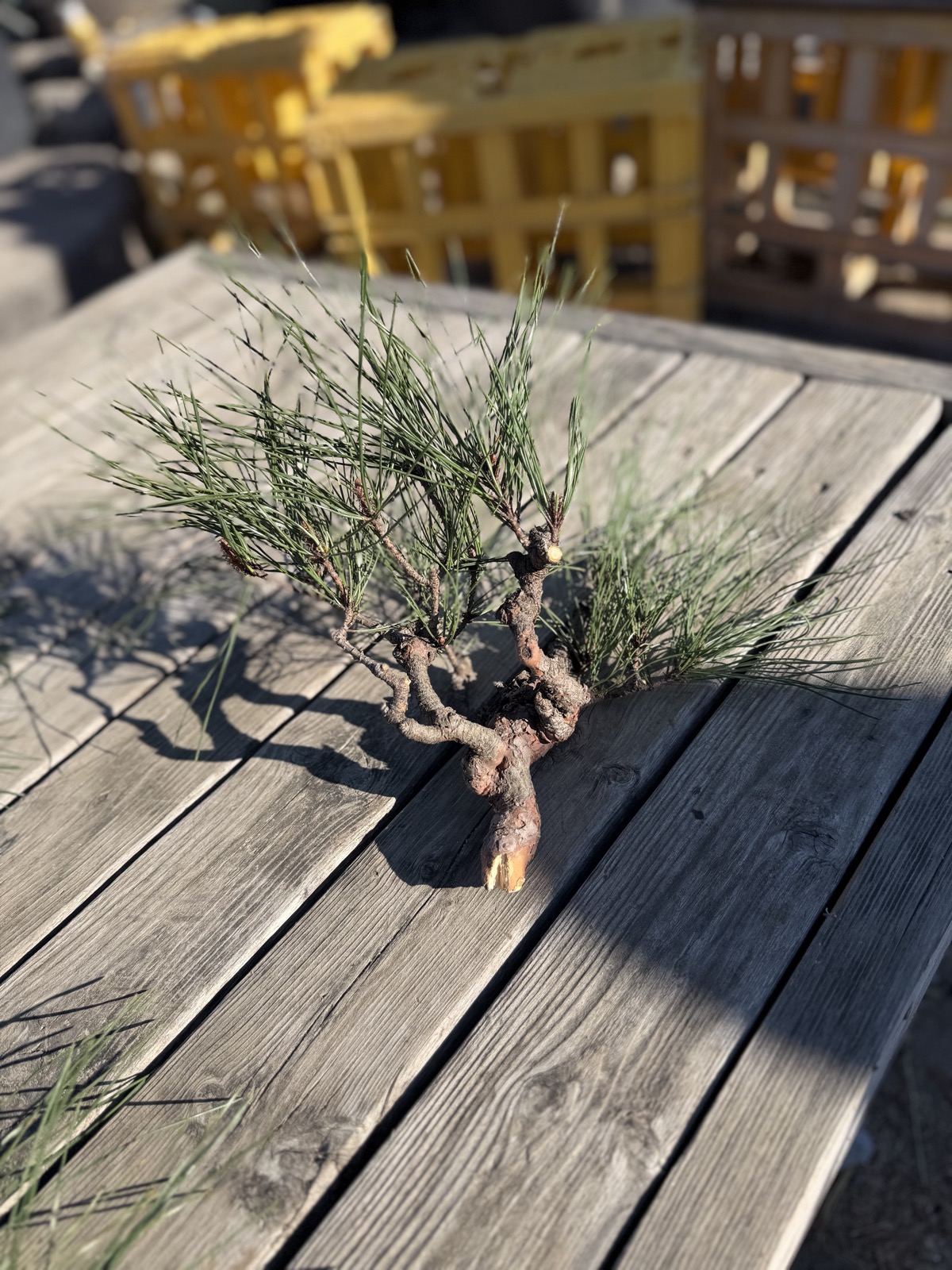
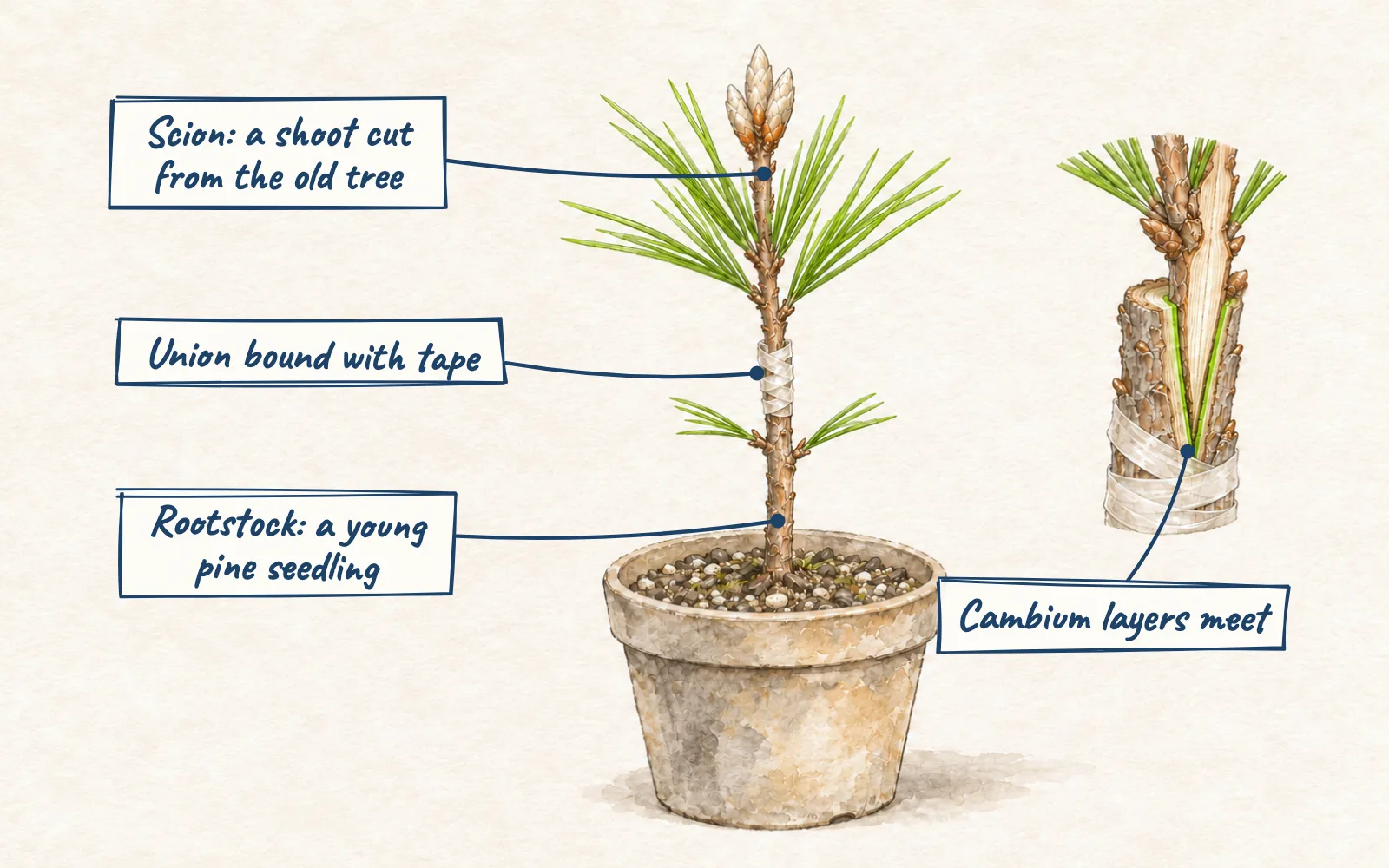
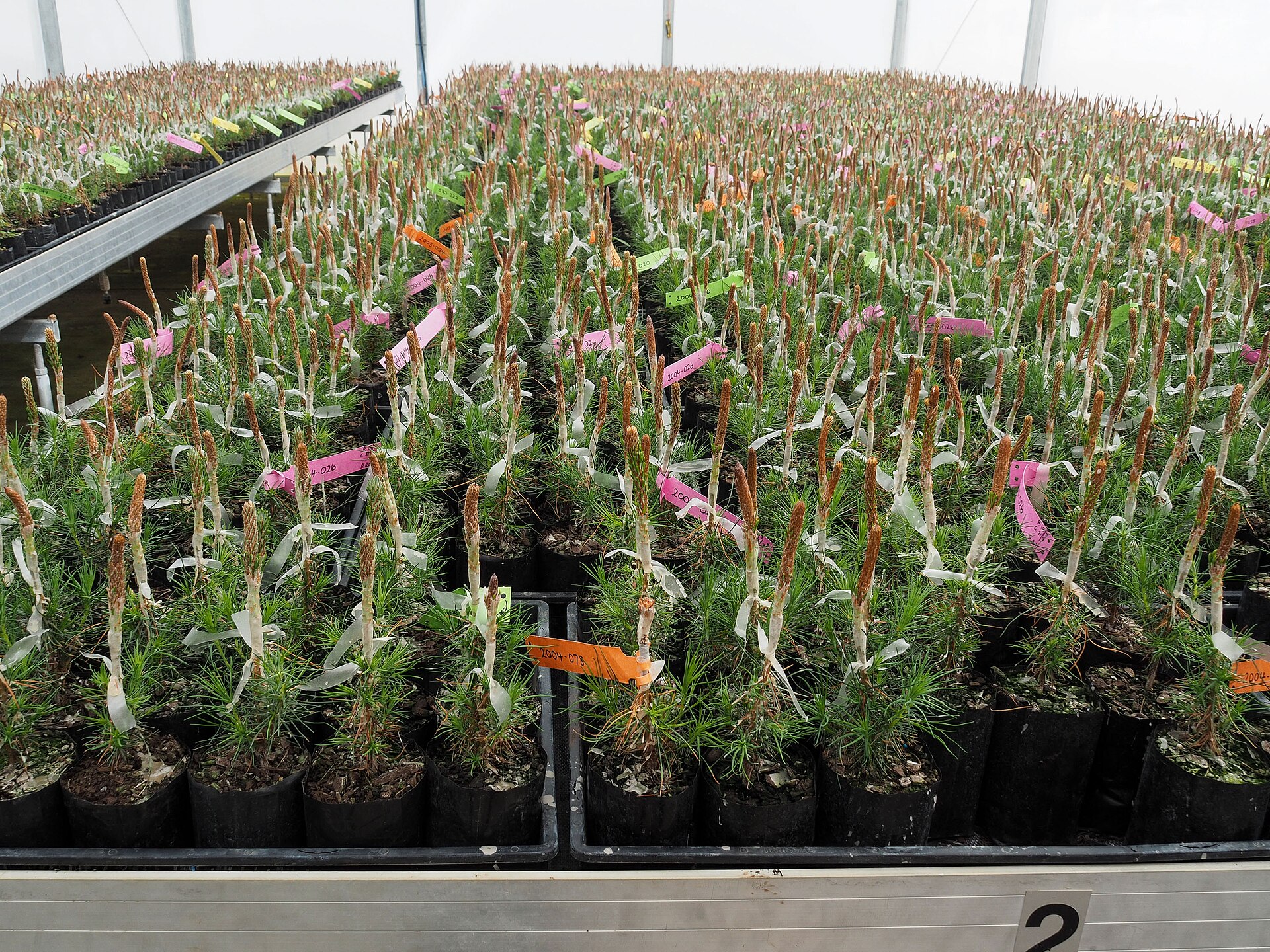
The living line of the tree began a year before its death was confirmed. The Tohoku Regional Breeding Office collected scions (hogi, 穂木), short shoots for grafting, from the Miracle Pine on 22 April 2011, and grafted them at its own site that same afternoon.
Grafting joins a shoot of one tree, the scion, to the stem and roots of another, the rootstock (daigi, 台木). When the shoot takes and grows on, everything that grows from it carries the genes of the tree it was cut from; the roots remain those of the rootstock.
What the breeders did, step by step
The office’s report describes a careful, quick procedure.
- Prepare rootstocks. About 60 red pine and about 40 black pine seedlings were used as rootstocks.
- Wash off the salt. The scions had come from a tree that had been in seawater, so salt on their surfaces was rinsed off with fresh water before grafting, to help the union take.
- Graft the same day. The scions were grafted on the afternoon of the day they were collected.
- Shade and hold humidity. After grafting, reed screens (yoshizu, 葦簀) kept direct sun off the young grafts, and each scion was covered with a plastic bag to keep moisture in.
The aim was to give the scions what the parent tree no longer had: a healthy root system, fresh water and shelter.
Nine survivors from one hundred
In an article published in January 2014, the breeding office reported that of the 100 grafts it had made, nine were growing. It named four of them the “four graft brothers” (tsugiki yon-kyōdai): Nobiru (“grow”), Taeru (“endure”), Inochi (“life”) and Tsunagu (“connect”).
Sumitomo Forestry ran a parallel effort. It reports that by December 2011 it had three grafted plants and 18 seedlings.
Why grafting matters for old pines
Grafting is the standard way to copy one particular tree. A seed gives a new individual; a scion gives more of the same one. The breeding office used grafting to preserve the genotype of this particular tree. The pine wilt–resistant stock now planted on Japan’s coasts comes from a different programme, covered in our article on pine wilt disease in Japan.
Seeds versus Grafts — Two Kinds of Descendant
Seedlings from the old tree’s cones
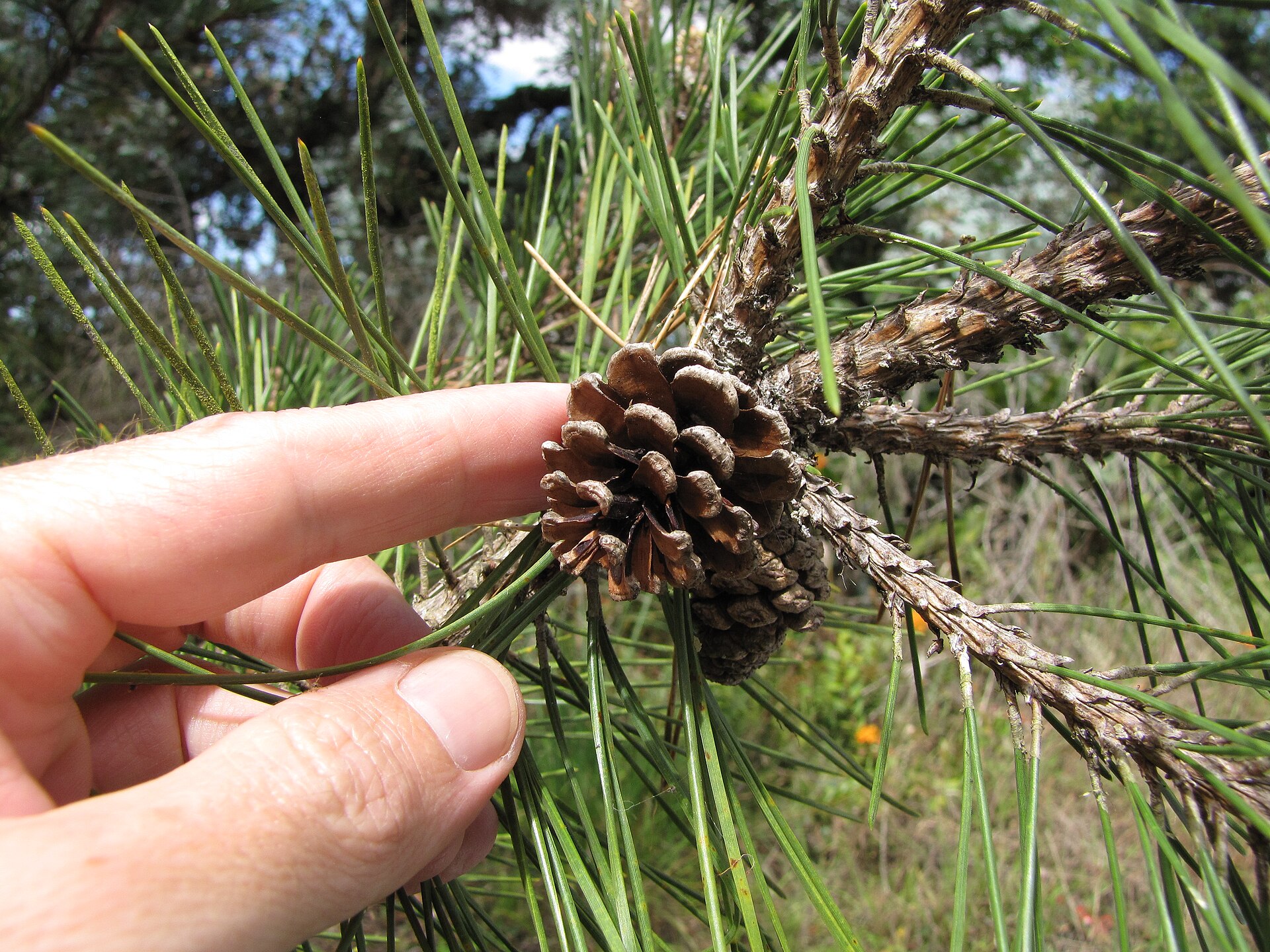
Seeds were the other route. The Tohoku breeding office sowed 65 seeds in May 2011, taken from cones on branches sampled to assess the tree’s vigour, and reported 17 seedlings growing in 2014. Sumitomo Forestry’s first 18 seedlings from 2011 had all died by June 2013. When the tree was felled in September 2012, the company collected about 1,000 cones, broke them apart, and obtained 75 seeds. Sown in March 2013, they gave nine seedlings by June that year.
The genetic difference
It is easy to call all of these “children of the Miracle Pine”, and in everyday speech that is fair. Genetically they are different things. The Forestry and Forest Products Research Institute explains that plants raised from seed carry genes from both parents, while grafts and cuttings reproduce an individual with the same genes as the parent tree.
| Graft | Seedling | |
|---|---|---|
| Material | Scion (shoot) from the old tree, joined to a rootstock | Seed from the old tree’s cones |
| Genes | Shoot identical to the old tree; roots are the rootstock’s | Inherited from both parents; pollen source not recorded |
| Roots | Belong to the rootstock (here, red or black pine seedlings) | The seedling’s own |
| Results recorded | Breeding office: 9 of 100 growing (reported 2014). Sumitomo Forestry: 3 (Dec 2011) | Breeding office: 17 from 65 seeds (reported 2014). Sumitomo Forestry: 9 from 75 seeds (Jun 2013) |
| Called in Japanese | Tsugiki (接ぎ木) | Mishō (実生) |
The table explains an inconsistency in the English press material on the 2026 seed donation. A comment in the English press material calls the donated seeds genetically identical to the original tree. The company’s main text is more precise: the grafted successors are clones, and the seeds carry on the tree’s genes. A seed from a grafted clone has the old tree’s genes on its mother’s side. The pollen source is not recorded, and no genetic analysis of the seeds was found.
Successors Today — From Rikuzentakata to Nagoya to Kew
Coming home in 2019
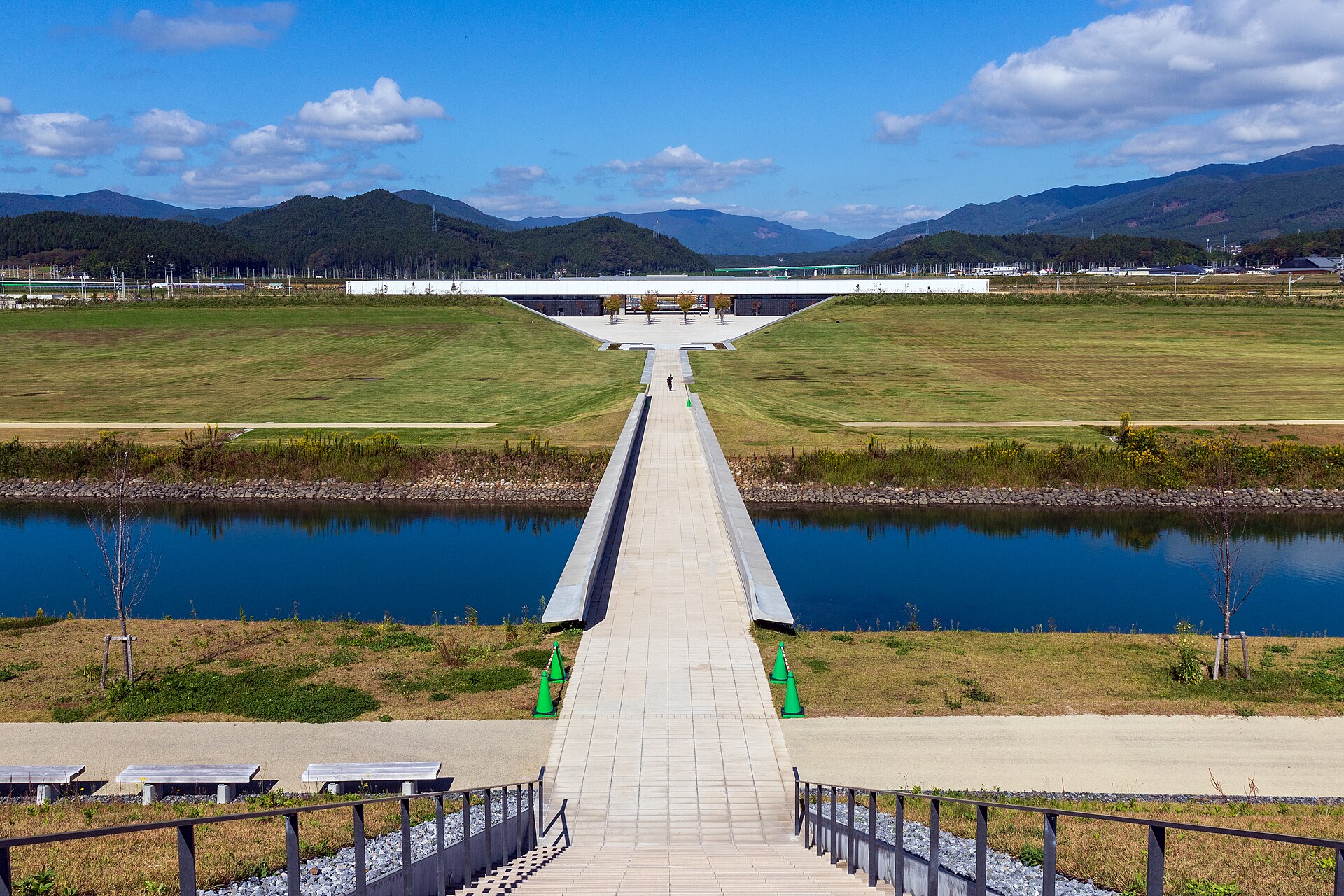
The successors went back to the coast eight years after the disaster. The Tohoku breeding office records a “homecoming” of its successor trees on 12 April 2019. On 22 September 2019, when the main facilities of the Takata-matsubara Tsunami Reconstruction Memorial Park opened, three of Sumitomo Forestry’s successor trees were planted at the opening ceremony, along with seedlings raised by the breeding office. The Iwate Tsunami Memorial Museum (東日本大震災津波伝承館) opened the same day.
Beyond Iwate
Successor trees have also travelled. On 23 March 2021, a successor donated by Rikuzentakata City was planted at Higashiyama Zoo and Botanical Gardens in Nagoya, and the City of Nagoya still presents it as a symbol of exchange between the two cities. In June 2023, at the 73rd National Tree Planting Festival held in Iwate, Sumitomo Forestry donated one more successor to Rikuzentakata.
No public source used here gives a current total for all surviving successors. The breeding office’s numbers and Sumitomo Forestry’s numbers come from different years and programmes and should not be added together.
Seeds for Kew
The newest chapter began in October 2025, when seed was collected from the cones of Sumitomo Forestry’s grafted successors, 14 years after they were grafted. On 21 May 2026 the seeds were handed over at the British Embassy in Tokyo to the British Ambassador, and the company announced on 22 May that they are to be donated to the Millennium Seed Bank at Wakehurst, run by the Royal Botanic Gardens, Kew, after plant quarantine and other export procedures. Kew’s own pages do not yet confirm when the seeds were received or how many there were.
There is an earlier link to Kew. According to the company, Kew asked about conserving seed in 2012 as well, but what was supplied then was seed of a red pine from Ryūsen-ji, a temple in Rikuzentakata, not seed of the Miracle Pine. The two are easy to confuse.
| Date | Event | Source |
|---|---|---|
| 22 Apr 2011 | Scions collected and grafted the same day | Tohoku Breeding Office |
| May 2011 | 65 seeds sown at the breeding office | Forestry Agency, Tohoku |
| Dec 2011 | Sumitomo Forestry has 3 grafts, 18 seedlings | Sumitomo Forestry |
| Sep 2012 | About 1,000 cones collected at felling; 75 seeds | Sumitomo Forestry |
| Jan 2014 | 9 grafts (incl. the “four brothers”), 17 seedlings growing | Forestry Agency, Tohoku |
| 12 Apr 2019 | Breeding office successors return to Rikuzentakata | Tohoku Breeding Office |
| 22 Sep 2019 | Successors planted at the memorial park opening | Sumitomo Forestry |
| 23 Mar 2021 | Successor planted in Nagoya | City of Nagoya |
| Jun 2023 | One successor donated to Rikuzentakata | Sumitomo Forestry |
| Oct 2025 | Seed collected from a 14-year-old graft | Sumitomo Forestry |
| 21 May 2026 | Seeds handed to the British Ambassador, for Kew | Sumitomo Forestry |
Replanting the Forest — 40,000 Pines on Raised Ground
Who planted, and how many
The coastal forest was replanted through a separate restoration programme. Iwate Prefecture began disaster-recovery works on the site in fiscal 2014 and coastal forest construction in fiscal 2017. The NPO Takata-matsubara wo Mamoru Kai (高田松原を守る会, the society to protect Takata-matsubara) began full-scale planting in June 2017. According to the Reconstruction Agency, planting of about 40,000 trees was completed on 18 May 2021: about 30,000 by the prefecture and about 10,000 by the NPO.
Six hundred of those trees have a story of their own. They were grown from seed in cones that had been gathered at Takata-matsubara in the year before the disaster and kept in storage. They are offspring of the old forest as a whole, not of the Miracle Pine in particular.
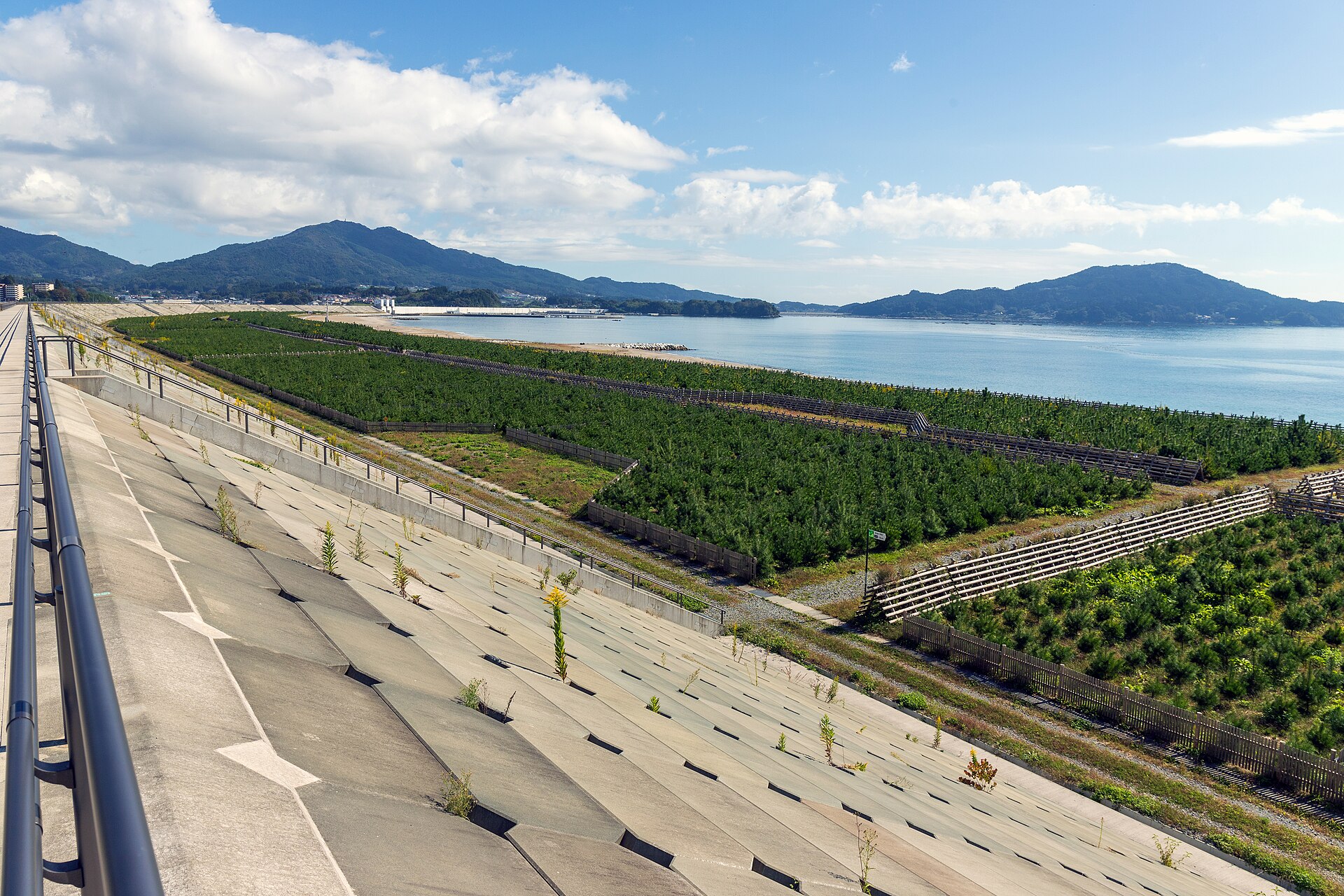
The design: what was learned from 2011
The new forest reflects lessons from the 2011 damage to coastal forests. The Forestry Agency’s white paper notes that where the water table was high, planted trees could not root deeply, and in 2011 they were more easily uprooted and turned into floating debris. Its review panel for coastal forest restoration set out raising the planting base by about 2 to 3 m above the groundwater level.
At Takata-matsubara, Iwate Prefecture raised the planting base to about T.P. +4 m (T.P. is Japan’s standard height datum, so this is an elevation, not the thickness of fill) with the groundwater level in mind, so that the pines could root fully.
| Design element | Takata-matsubara (Iwate Prefecture) | Why |
|---|---|---|
| Planting base | Raised to about T.P. +4 m | Keep roots above groundwater |
| Forestry Agency review panel | Fill about 2–3 m above the groundwater level | Deep roots resist uprooting |
| Seaward planting | Japanese black pine | More tolerant of salt damage |
| Landward planting | Japanese red pine | Inland side of the belt |
| Planting stock | Pine wilt–resistant container seedlings | Protect against pine wilt disease |
| Density | 5,000 trees per hectare | Basic density in the plan |
| Seawalls | First line 3.0 m; second line 12.5 m | Second line protects the town |
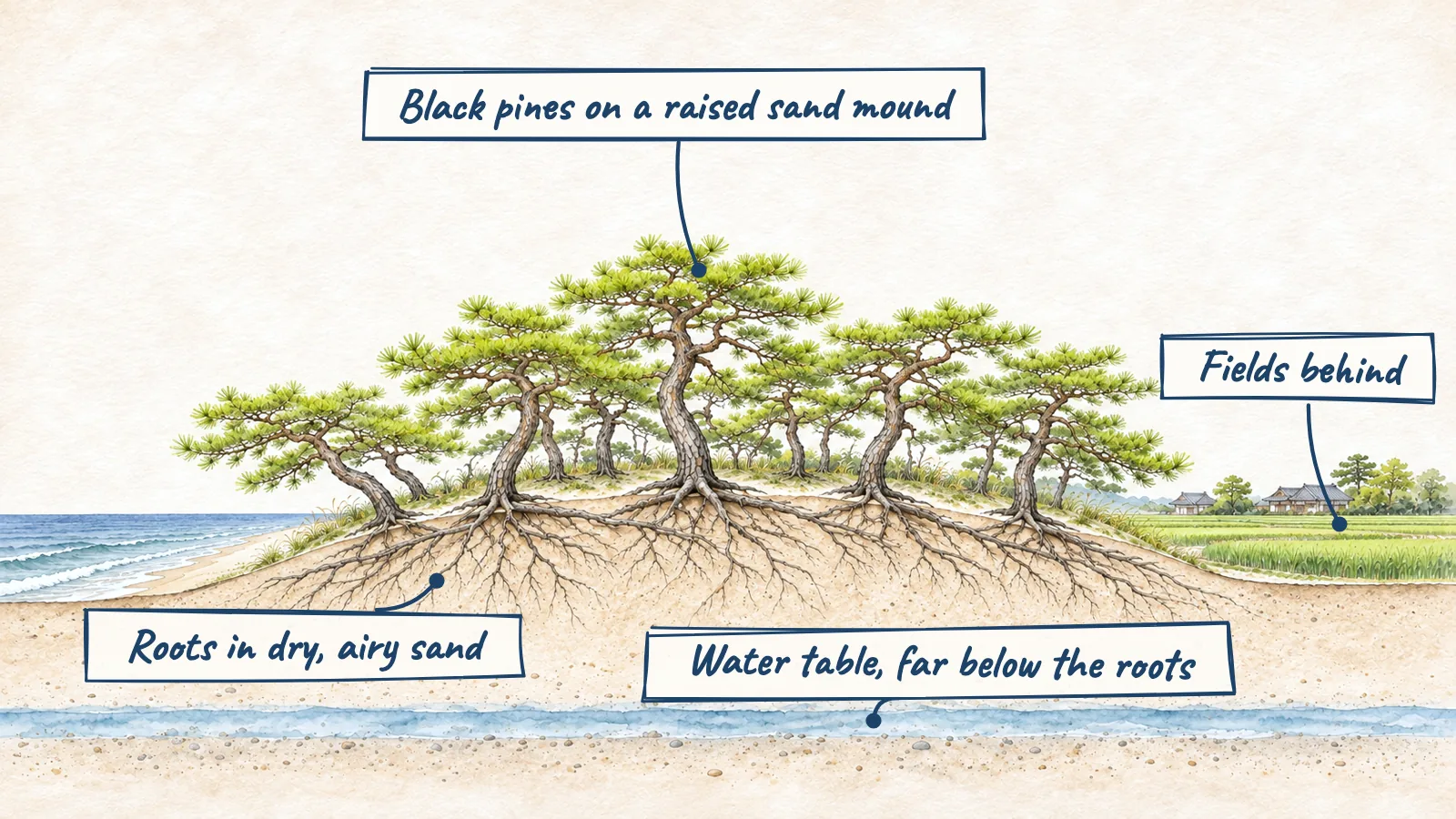
Black pine in front, red pine behind
Iwate Prefecture’s plan places black pine, which is more resistant to salt damage, on the seaward side and red pine on the landward side. The seedlings are pine wilt–resistant container stock.
What an Arborist Takes From It — Lessons for Coastal Trees
Look below the ground, not only at the wave
Read as a tree record, the Miracle Pine is a case study in root-zone conditions. It survived the initial wave, then declined in an altered, saline groundwater environment. Assessing a flooded coastal tree means asking where the water table is now, not only whether the tree was submerged.
Common misreadings
– “The wave killed it at once.” The tree survived the wave. The sources point to the sunken ground with salty groundwater in the root zone as what followed. – “Salt on the needles was the problem.” The joint report put the root zone first: roots in water, damaged by lack of oxygen and by salt. – “It was a black pine.” Breeding records list it as a red pine; one later article calls it ainoko-matsu. – “The seeds for Kew are clones.” The grafted shoots are clones. The seeds inherit genes from both parents. – “The new forest descends from the Miracle Pine.” The roughly 40,000 trees planted by 2021 came from a separate restoration programme using pine wilt–resistant stock; 600 were grown from seed gathered at the old forest in the year before the disaster.
Why the story is so Japanese
Three threads run through it. A coastal forest whose planting in 1667 is credited to a named man and his descendants. A national tree breeding office that took scions six weeks after the tsunami. And a public fund-raising drive that reached its ¥150 million target to keep a single dead pine standing, though not without dispute. The replica on the plain marks where the tree stood. The grafts, and the seeds intended for Kew, carry the living tree forward. For more on how Japan keeps old trees alive across centuries, see why Japan’s ancient trees live for a thousand years, and for another tree that survived a catastrophe, Hiroshima’s survivor trees.
Frequently asked questions
Why did the Miracle Pine die if it survived the tsunami?
The earthquake lowered the ground around the tree by about 80 cm, and the groundwater, now salty, rose into the root zone. Roots standing in salty, airless water suffered from both lack of oxygen and salt, and rotted. When examined in October 2011, every root that could be checked was decayed. According to the city, its death was confirmed in May 2012.
Is the Miracle Pine still alive?
The original tree is dead. What stands in Rikuzentakata is a monument built around the preserved trunk, with a carbon-fibre core and replica branches and needles, completed in 2013. Living successors exist as grafted clones and seedlings, some planted at the memorial park in 2019.
How was the Miracle Pine grafted?
On 22 April 2011, the Tohoku Regional Breeding Office collected shoots (scions) from the tree, rinsed off the salt with fresh water and grafted them the same afternoon onto about 60 red pine and 40 black pine rootstocks. The grafts were shaded with reed screens and covered with plastic bags to keep them moist. Of 100 grafts, nine were growing by 2014.
Are the seeds intended for Kew genetically identical to the Miracle Pine?
No. Seeds produced by a grafted clone are offspring, not clones. The seeds were collected in October 2025 from grafted clones of the Miracle Pine, so the old tree’s genes come down on the mother’s side, but seeds inherit genes from both parents. Only the grafted shoots are genetically identical to the original.
How many trees were replanted at Takata-matsubara?
About 40,000, completed on 18 May 2021: about 30,000 by Iwate Prefecture and about 10,000 by the NPO that protects the site. Black pine was planted on the seaward side and red pine on the landward side, on ground raised to about T.P. +4 m.
Can you visit the Miracle Pine?
The monument stands beside the preserved Rikuzentakata Youth Hostel within the Takata-matsubara Tsunami Reconstruction Memorial Park, whose main facilities opened on 22 September 2019 together with the Iwate Tsunami Memorial Museum. Check the park’s current notices before visiting; an earlier notice announced repair work for 3–7 November 2025.
Sources
– Rikuzentakata City, “Takata-matsubara (national Place of Scenic Beauty)”: https://www.city.rikuzentakata.iwate.jp/soshiki/kyouikusoumuka/bunkazaigakari/1/1/2/2654.html (checked 2026-10-30) – Rikuzentakata City, “Takata-matsubara and the Miracle Pine”: https://www.city.rikuzentakata.iwate.jp/machizukuri_sangyo/kisekinoippommatsu/3854.html (checked 2026-10-30) – Rikuzentakata City, “Miracle Pine preservation project”: https://www.city.rikuzentakata.iwate.jp/machizukuri_sangyo/kisekinoippommatsu/3857.html (checked 2026-10-30) – Rikuzentakata City, “Miracle Pine preservation fund”: https://www.city.rikuzentakata.iwate.jp/soshiki/tochikatsuyosuishinka/toshikeikakukakari/2_1/2912.html (checked 2026-10-30) – Japan Landscape Contractors Association, Japanese Institute of Landscape Architecture, Japan Greenery Research and Development Center, report on protecting the “pine of hope” (December 2011): https://www.jpgreen.or.jp/matsusaisei/jiten/matsu/tsunami/houkoku1212.pdf (checked 2026-10-30) – Kawai et al., growth environment assessment of the Rikuzentakata pine by simulation of salt movement in the ground, JSCE Journal A2 (2012): https://da.lib.kobe-u.ac.jp/da/kernel/90003364/90003364.pdf (checked 2026-10-30) – Tohoku Regional Breeding Office, Tōhoku no Rinboku Ikushu No. 196: https://www.ffpri.go.jp/touiku/research/documents/touhokunorinbokuikusyu_no196.pdf (checked 2026-10-30) – Forestry Agency Tohoku, Mori no Ohanashi No. 118: https://www.rinya.maff.go.jp/tohoku/koho/koho_si/pdf/morinoohanashi_no118.pdf (checked 2026-10-30) – Sumitomo Forestry, news release, 24 September 2019: https://sfc.jp/information/news/pdf/2019-09-24.pdf (checked 2026-10-30) – Sumitomo Forestry, news release, 22 May 2026: https://sfc.jp/information/news/2026/2026-05-22.html and English version https://sfc.jp/english/news/pdf/20260522_Miracle_Pine.pdf (checked 2026-10-30) – Forestry and Forest Products Research Institute, press release with glossary, 8 March 2011: https://www.ffpri.go.jp/press/2011/20110308/documents/20110308.pdf (checked 2026-10-30) – Iwate Prefecture, recovery of the Takata-matsubara coastal disaster-prevention forest: https://www.pref.iwate.jp/_res/projects/default_project/_page_/001/045/706/tisangenkou.pdf (checked 2026-10-30) – Reconstruction Agency, “Regenerating the pine beach washed away by the tsunami” (2021): https://www.reconstruction.go.jp/portal/chiiki/2021/20210812100108.html (checked 2026-10-30) – Forestry Agency, Forest and Forestry White Paper FY2018: https://www.rinya.maff.go.jp/j/kikaku/hakusyo/30hakusyo_h/all/chap2_3_2.html (checked 2026-10-30) – Forestry Agency, coastal forest restoration panel, 5th meeting materials: https://www.rinya.maff.go.jp/j/tisan/tisan/pdf/dai5kai-siryou1-4-4.pdf (checked 2026-10-30) – Munns, R. & Tester, M. (2008), Mechanisms of salinity tolerance, Annual Review of Plant Biology: https://doi.org/10.1146/annurev.arplant.59.032607.092911 (checked 2026-10-30) – Iwate Prefecture, human damage by municipality (as of 2025-09-30): https://www2.pref.iwate.jp/~bousai/shiryo/kako_saigai/h23shinsai/jintekihigai/jinteki20250930.pdf (checked 2026-10-30)