

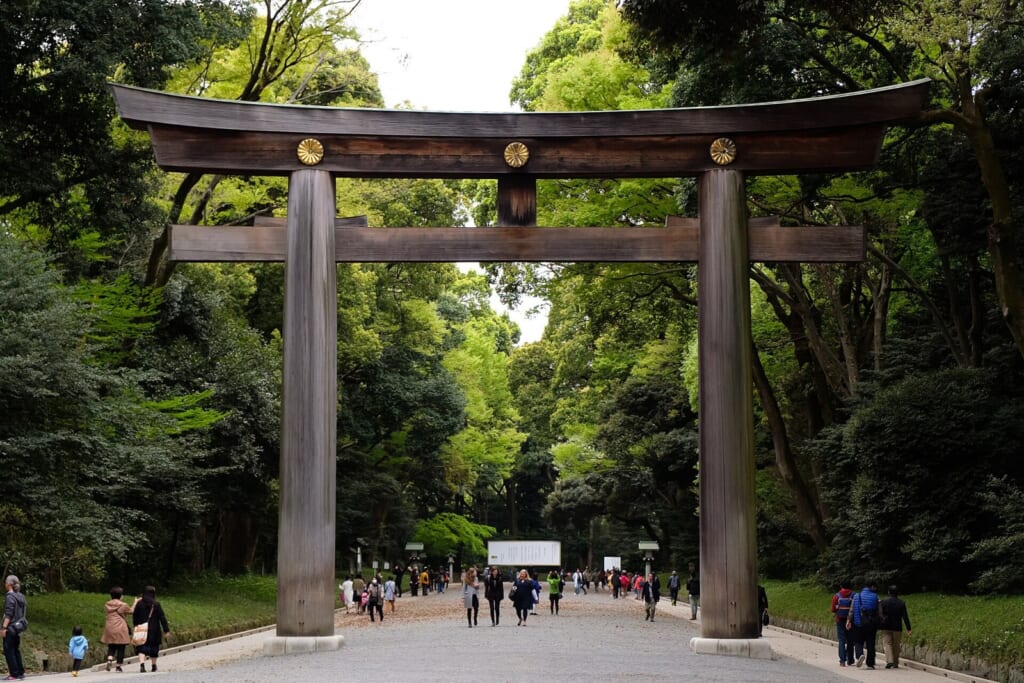
The Meiji Jingu forest in central Tokyo looks like an ancient wood, but it began as a planting project. A new shrine for Emperor Meiji and Empress Shōken needed a sacred grove, and the land at Yoyogi was mostly fields, so from 1915 forestry scientists designed a forest of about 70 hectares and about 100,000 donated trees were brought in, with youth groups from across Japan helping to plant them. The planners chose evergreen broadleaf trees suited to the site and to natural regeneration, and drew the forest in four stages, aiming for a wood that would renew itself from its own seed over a century or more.
Under the Great Torii — What a Visitor Sees
A gate of 1,500-year-old cypress
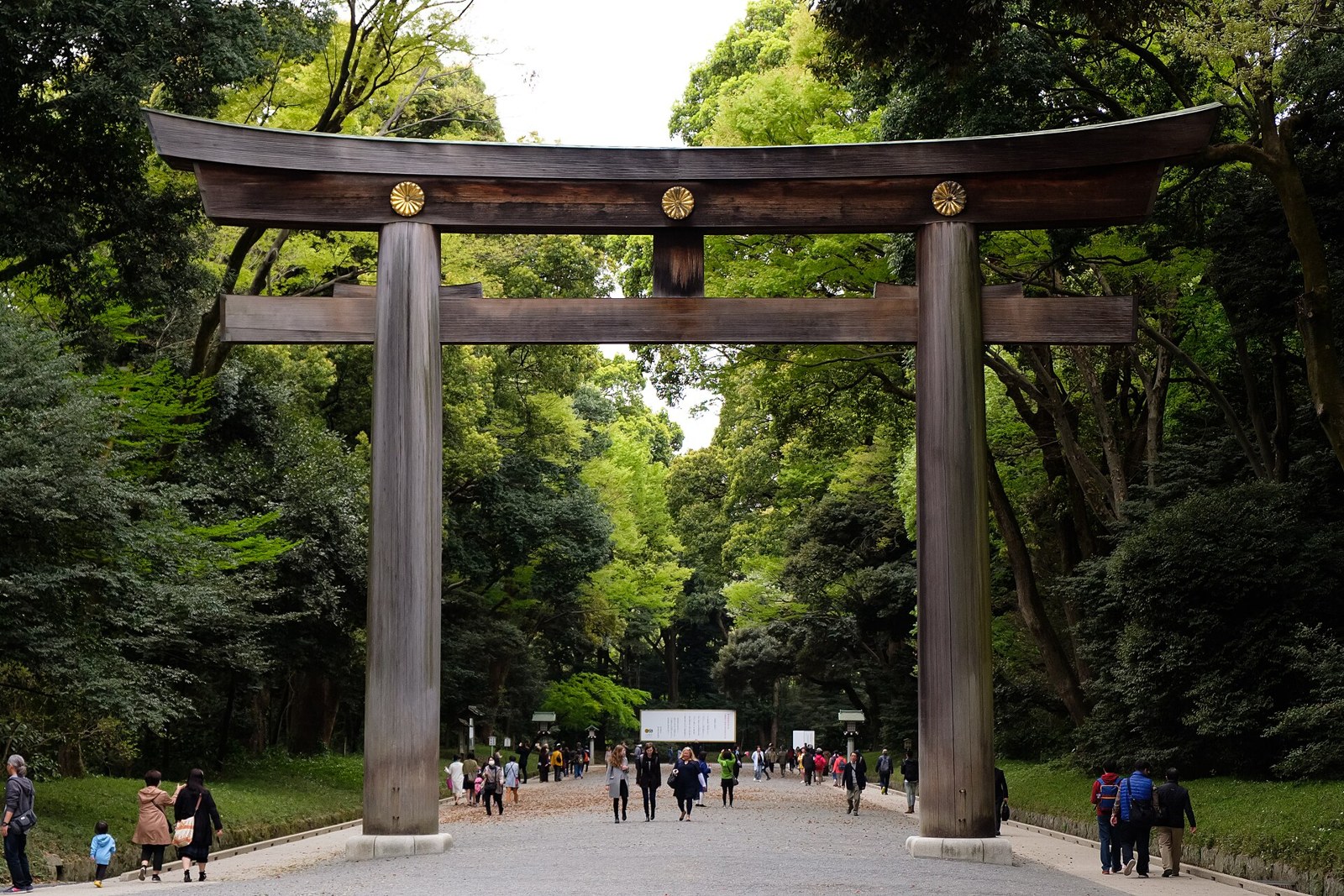
Stand where the northern and southern approaches meet and look up. The great torii is a wooden myōjin-style gate 12 meters high, and Meiji Jingu’s own text for it says the timber is hinoki cypress from Mount Dandai in Taiwan, about 1,500 years old. Around it, the gravel approach is wide and the evergreen trees on both sides rise high enough that the gate does not look oversized.
To me the forest looks as if it has always been there. It has not. The shrine states it plainly: the forest is a planted forest, made with about 100,000 trees donated from across Japan. Some of today’s trees have no doubt grown from seed since, but the forest itself started as a design on paper.
The question
So why would a nation plant a forest in the middle of its capital, and how do you design a wood that will still be growing into its intended form a century after planting? The answers are partly religious, partly scientific, and partly a matter of soil.
Before the Forest — Fields at Yoyogi
A garden in the middle of farmland
The site at Yoyogi had a long history before the shrine. In the Edo period it held a secondary residence (shimo-yashiki, 下屋敷) of the Ii family, the lords of Hikone, and the garden there had belonged in turn to the Katō and Ii families. In the Meiji era the land came under the Imperial Household Ministry and was called the Minami-Toshima Imperial Estate (南豊島御料地). Around 1893, Emperor Meiji had the garden laid out as a strolling garden where Empress Shōken could take exercise. That garden survives as today’s Inner Garden, south of the shrine buildings.
Outside that garden, the land looked very different from today. The shrine’s own description says that, except for the area of the present Inner Garden, the grounds were almost entirely fields, with a landscape like wasteland (「荒れ地のような景観」). Scholars who studied the forest plan note that the planners also worked with red pine and deciduous coppice already growing on the estate. So the starting point was not bare earth everywhere, but it was nothing like the large, continuous forest of today.
Why a shrine, and why here
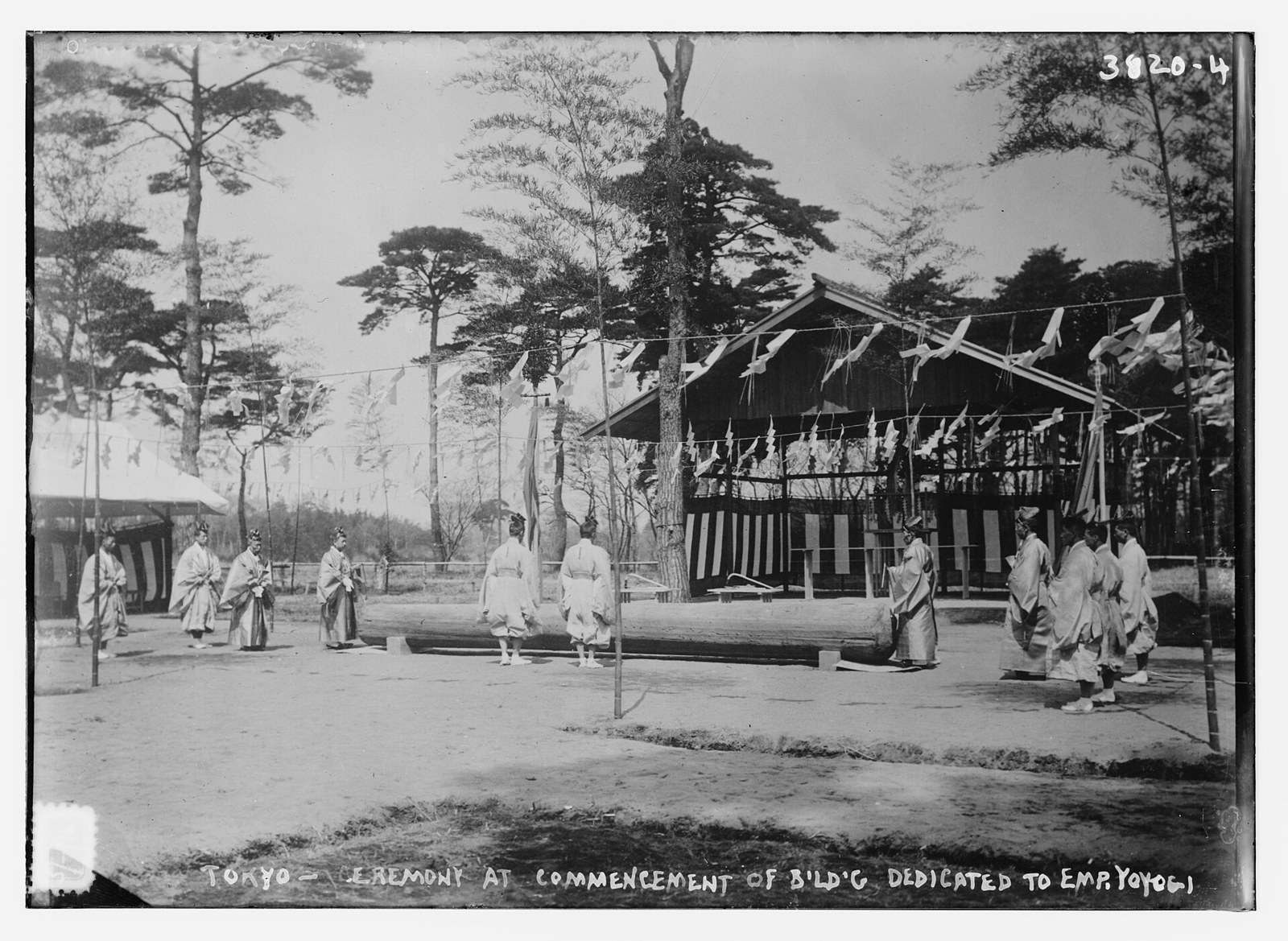
Emperor Meiji died in 1912 and Empress Shōken in 1914. The shrine explains that it was founded because people across the country asked for a place where the spirits of the two could be enshrined. On May 1, 1915, the government set up the Meiji Jingu Construction Bureau (明治神宮造営局) inside the Home Ministry. The shrine was dedicated on November 1, 1920.
A shrine in Japan is usually surrounded by trees. The Japanese term is chinju no mori (鎮守の森) — the sacred grove around a shrine, which Japan’s Tourism Agency describes as a holy space that separates the precinct from the everyday world. Many older shrines already had established groves. A new shrine on farmland in Tokyo had no grove of its own. It would have to be made.
The Planners — Three Foresters and a Forest Plan
Honda, Hongo, and Uehara
Three forestry scientists are named again and again in the shrine’s own account: Seiroku Honda (本多静六), Takanori Hongo (本郷高徳), and Keiji Uehara (上原敬二). In the Construction Bureau, Honda served as an adviser (参与), Hongo as an engineer (技師), and Uehara as a technical assistant (技手). A review of the research puts their roles simply: Honda drew the grand design, and Hongo turned it into a working plan.
Honda was already a leading figure in Japanese forestry. He had studied in Germany from 1890 to 1892, at the forestry school in Tharandt and at the University of Munich, and he designed Hibiya Park in Tokyo. Uehara, the youngest, published a book in 1919 called Jinja Keidai no Sekkei (神社境内の設計), “The Design of Shrine Precincts”. A later study of his thinking says he found the solemnity of a sacred grove in the living process of natural regeneration — the forest renewing itself from its own seed.
A forest plan written as a manual
Hongo wrote the forest plan. Researchers date it to 1921; one study says Hongo submitted it in 1922. The document has an introduction and three chapters: the design of the forest, how to carry out the plan, and how to protect and manage the forest in the future. The planners were writing instructions for people who would manage the forest long after they were gone.
The plan also carries a German influence. A 2015 study compared Hongo’s plan item by item with Forest Aesthetics by the German forester Heinrich von Salisch, and found 22 points of similarity and 13 of difference. One of the clearest links is the way the plan used the trees already on the site and treated growing them on as the cultivation of beauty.
| Person | Role in the Construction Bureau | What he contributed (according to the sources) |
|---|---|---|
| Seiroku Honda (本多静六) | Adviser (参与) | The grand design; trained in Germany 1890–92 |
| Takanori Hongo (本郷高徳) | Engineer (技師) | The written forest plan, dated 1921 |
| Keiji Uehara (上原敬二) | Technical assistant (技手) | Author of Jinja Keidai no Sekkei (1919); natural regeneration as the source of a grove’s solemnity |
The Cedar Argument — Why Not a Forest of Sugi
The prime minister’s grove
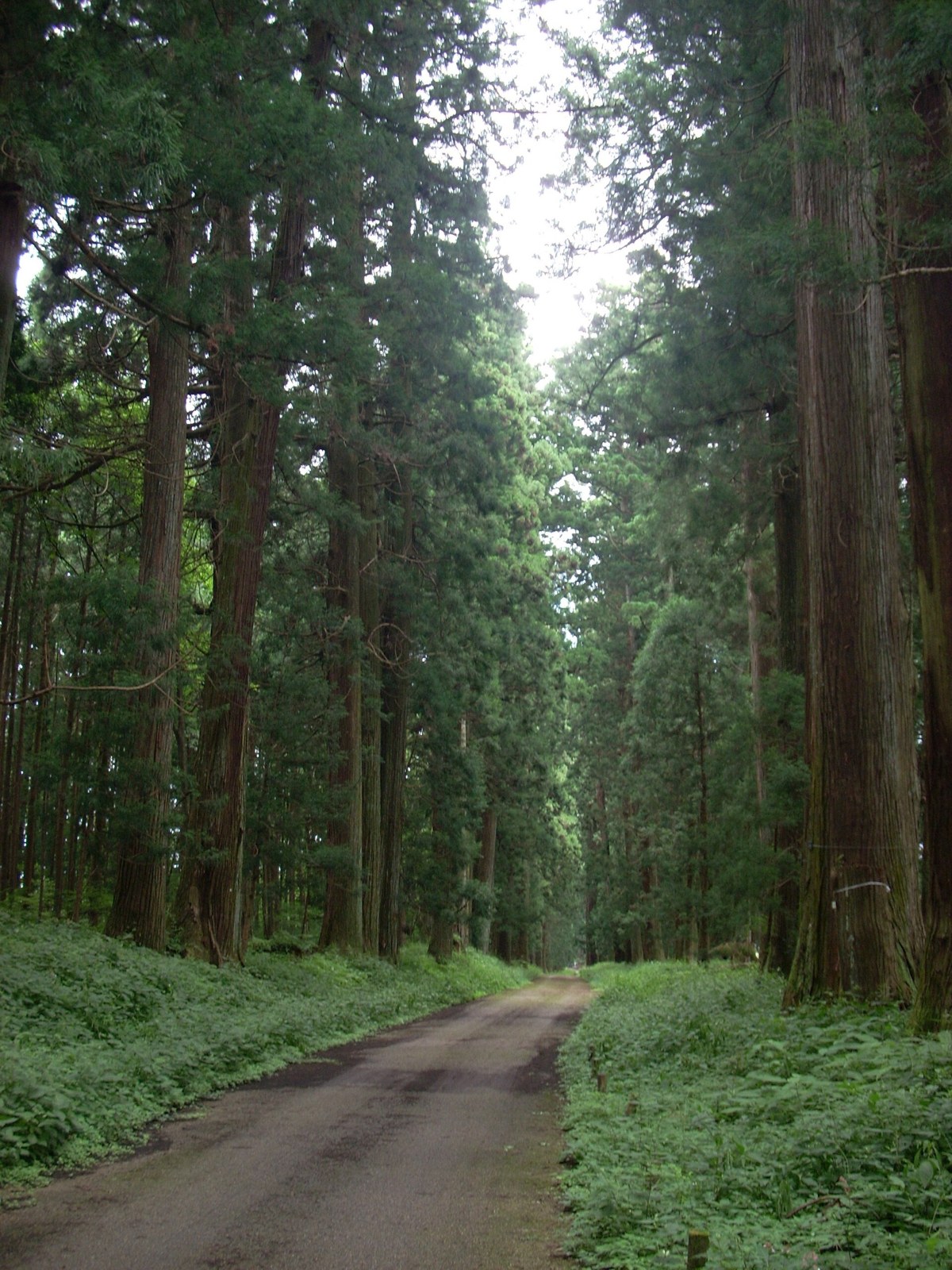
The best-known story about the forest is a disagreement. The shrine’s website recounts that Prime Minister Shigenobu Ōkuma wanted the grounds planted with sugi (Japanese cedar, Cryptomeria japonica), saying it should be a cedar forest. The shrine’s FAQ describes what he had in mind as something grand and solemn, like Ise Jingu or the cedar avenues of Nikkō Tōshōgū. Tall, straight cedars were what a great shrine looked like.
The foresters said no, and the shrine says they explained their reasons until he was finally persuaded (「説明してようやく納得させたそうです」). The shrine tells this as a story handed down, so the exact words should be treated as tradition rather than a record of a meeting. The reasons, though, are clear in the shrine’s own texts.
Soil, smoke, and a forest that seeds itself
The first reason was soil. The shrine’s FAQ says sugi grows well in valleys with plenty of moisture, and that the Kantō loam at Yoyogi is not suited to it (「谷間の水気が多いところでこそ杉は育つが、関東ローム層の代々木では不向き」). Nikkō’s cedars stand in mountain country; Yoyogi is Kantō loam in the middle of the Tokyo plain.
The second reason was the city. The shrine says that pollution was advancing in Tokyo, and that large old trees in the city were dying one after another. The planners needed trees that could stand the city’s smoke for generations.
The third reason was the planners’ own goal. A study of the design history concludes that the species were chosen for three things: suitability to the site, the ability to regenerate naturally from seed, and tolerance of smoke (「適地適木や天然下種更新の適性,耐煙性を条件に樹種が選定された」). On that basis the planners put their weight on evergreen broadleaf trees: evergreen oaks (kashi), shii (chinquapin), and camphor (kusunoki). Camphor was a special case. Hongo judged that it could grow in Tokyo if it was protected while young (「幼時に保護を加えればクスノキが生育する」), so it was a choice made with care rather than an obvious local fit.
| Test | Sugi (Japanese cedar) | Evergreen broadleaf trees (kashi, shii, camphor) |
|---|---|---|
| Site | Grows best in moist valleys; Kantō loam at Yoyogi unsuitable (shrine FAQ) | Chosen as suited to the site (design-history study) |
| City air | Concern over long-term survival as Tokyo’s large old trees died in the pollution (shrine) | Chosen for smoke tolerance (design-history study) |
| Renewal | Not the planners’ choice for a self-renewing grove | Chosen with natural regeneration from seed in mind |
| Image | The solemn cedar avenues of Ise and Nikkō | A dense, dark evergreen wood |
The Four-Stage Plan — Drawing a Forest Through Time
A forest drawn in four pictures
The heart of the plan is a drawing. Meiji Jingu holds a prediction diagram that shows the forest in four successive stages (「4段階の林相予想図」) — a sequence showing how the forest was expected to develop.
In the first stage, the tallest layer was pine — red pine and black pine, some of them trees already on the imperial estate. Beneath the pines stood conifers such as hinoki cypress, sawara cypress, sugi, and fir. At the bottom, in the shade, were the young evergreen oaks, shii, and camphor that were meant to inherit the forest.
In the second stage, the faster, vigorous conifers such as hinoki were expected to overtake the pines and take the top of the canopy.
In the third stage, after roughly a century, the evergreen oaks, shii, and camphor were expected to become the dominant trees, with some large conifers — sugi, hinoki, sawara, fir — still standing among them.
In the fourth stage, the broadleaf trees were expected to grow further and the conifers to disappear, leaving an evergreen broadleaf wood meant to renew itself from its own seed.
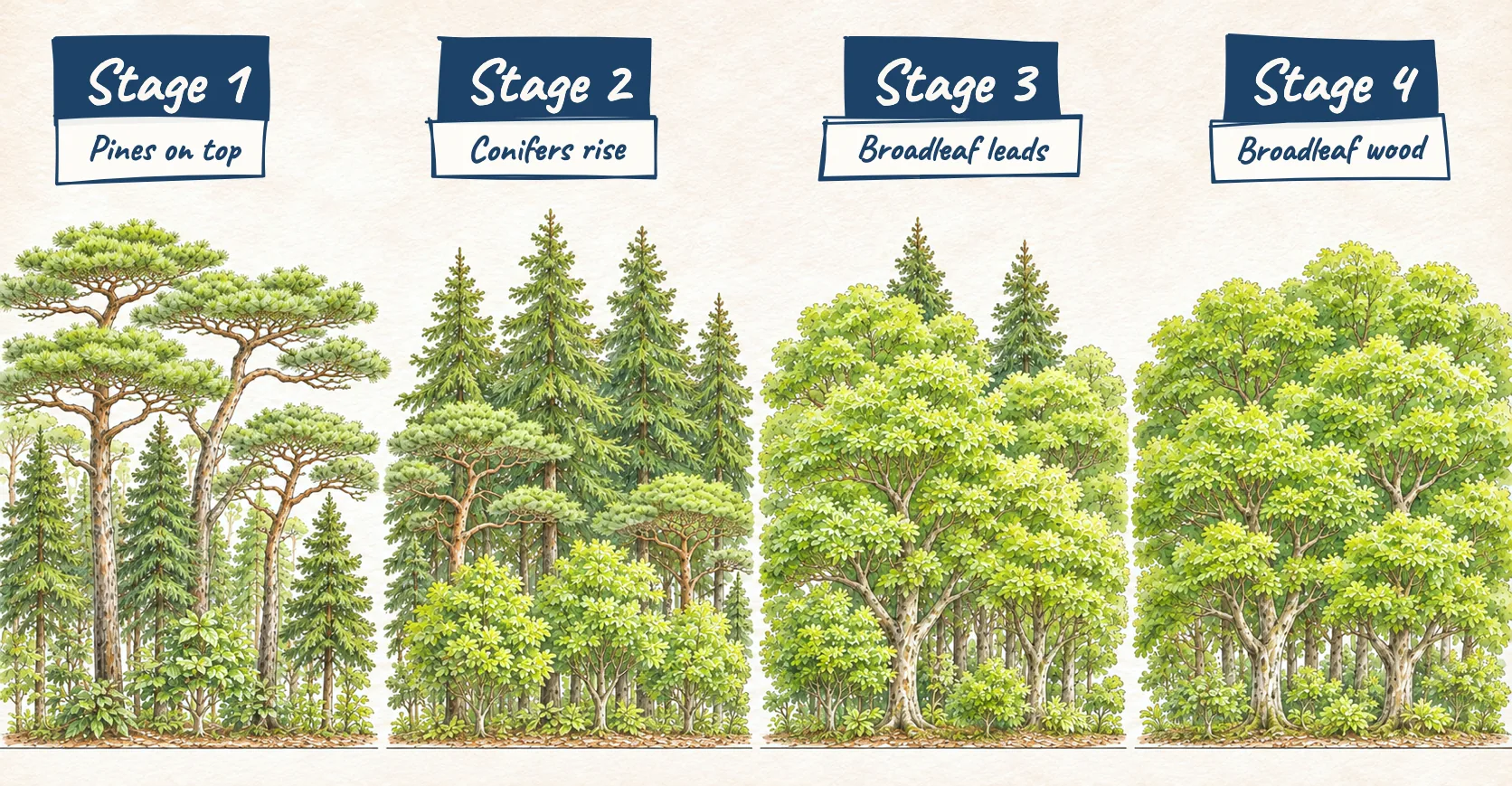
| Stage | Dominant trees | Mixed in or remaining | Expected state |
|---|---|---|---|
| 1 | Red and black pine on top (some already on the site) | Hinoki, sawara, sugi, fir beneath; evergreen oaks, shii, camphor at the bottom | A layered mix, pines tallest |
| 2 | Hinoki and other vigorous conifers | Pines overtaken | Conifers take the canopy |
| 3 (about a century) | Evergreen oaks, shii, camphor | Some large sugi, hinoki, sawara, fir | Broadleaf trees dominant |
| 4 | Evergreen broadleaf trees | Conifers gone | A wood renewing from its own seed |
Why plant trees you expect to lose
The plan looks wasteful at first glance. Why plant pines and conifers that the planners expected to stop dominating? Part of the answer is time. A shrine needed to look like a shrine grove on its dedication day, and the broadleaf trees meant to inherit the forest were small. The pines and conifers filled the canopy in the meantime, and the drawing shows the young broadleaf trees growing up beneath them.
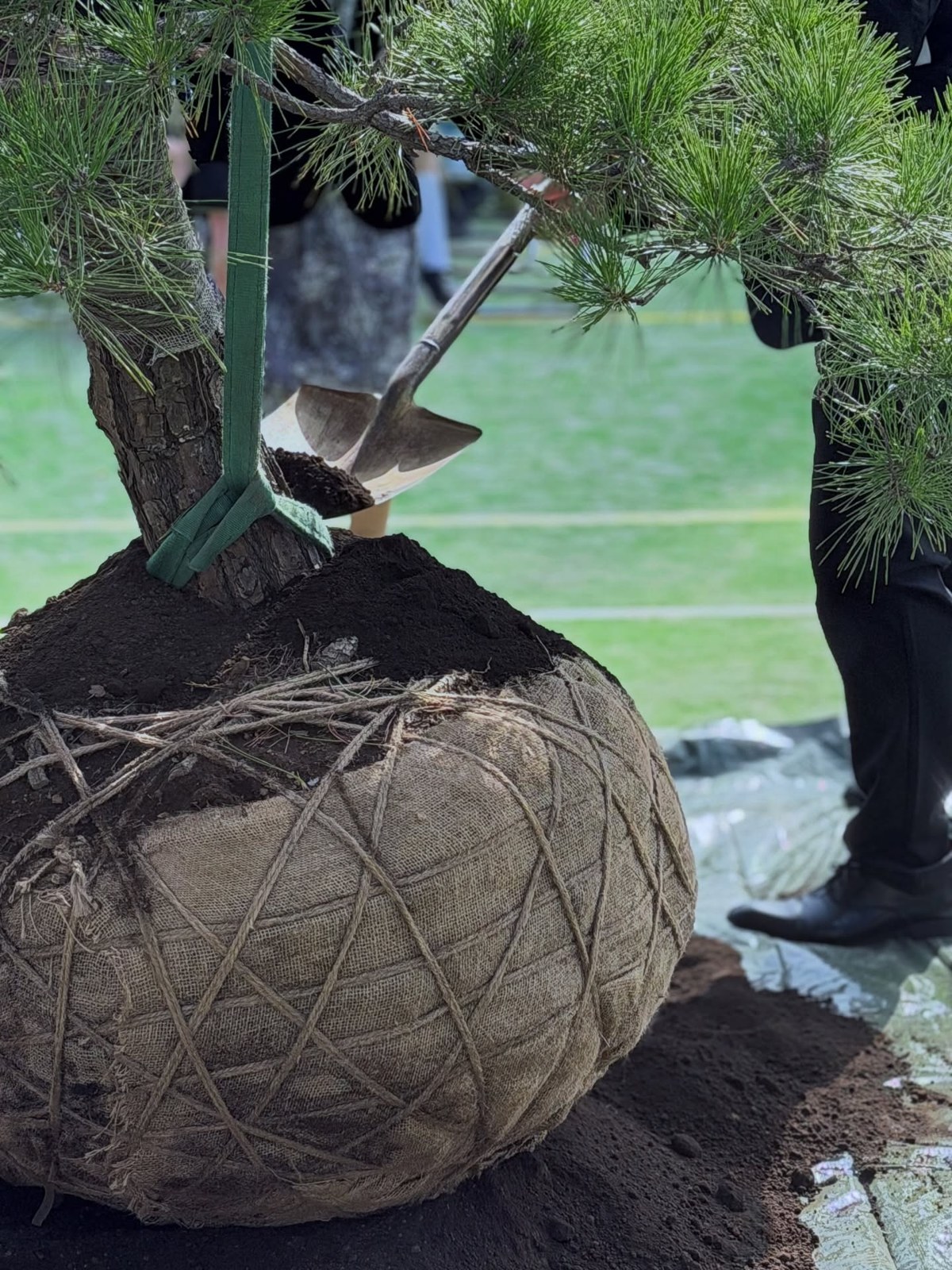
The planners also brought in large trees for the same reason. A study of Uehara’s work records that big cherry, sugi, fir, kunugi (sawtooth oak), and konara oak were transplanted, and that deciduous canopy trees were planted to give an immediate landscape effect while the intended forest grew (「一時的な風致効果を与えるために落葉喬木が植えられた」). A shrine was being dedicated in 1920. It could not stand in a field of saplings.
100 years, 150 years — what the numbers mean
The figure of 150 years has a source: a University of Tokyo research report describes the goal as creating, in 150 years, a natural forest suited to Tokyo’s climate and urban environment, citing Hongo’s 1921 plan. A Japan Institute of Landscape Architecture field report also describes stages after 50, 100, and 150 years. But the four-stage drawing as published carries no year labels, the shrine’s English history says the forest was planned “foreseeing 100 years ahead”, and its English forest page speaks of 100 or 200 years. I could not confirm that the words “150 years” appear in Hongo’s original text. The honest summary is this: the planners designed a forest to mature over a century or more, and sources describe the horizon as 100 years, 150 years, or 100 to 200 years.
100,000 Trees and the Youth Groups — Who Planted It
Trees from Sakhalin to Taiwan
The trees were gifts. The shrine says that about 100,000 trees were donated (「約10万本が奉献」), and its FAQ says they came from as far north as Sakhalin and as far south as Taiwan, and also from Manchuria and Korea. Including the trees already growing on the site, the new inner precinct held about 120,000 trees of 365 species (「在来木等を含め365種約12万本」).
These are two different counts, and they are often mixed up. About 100,000 is the number of donated trees. About 120,000 is the total including existing trees. Neither is the number of trees “planted by volunteers”.
Many of the trees came by rail. A JR East magazine records that many were carried by train, and that two sidings were laid from the old Harajuku Station toward the northern approach. Others came the slow way. The city of Kuki in Saitama records that members of the local youth group hauled a donated camphor tree on a hand-pulled cart, on foot (「人力の荷車を使用し、地元の青年団が歩いて運搬しました」). Written applications to donate trees (kenboku negai, 献木願) from that area still survive.
The youth groups
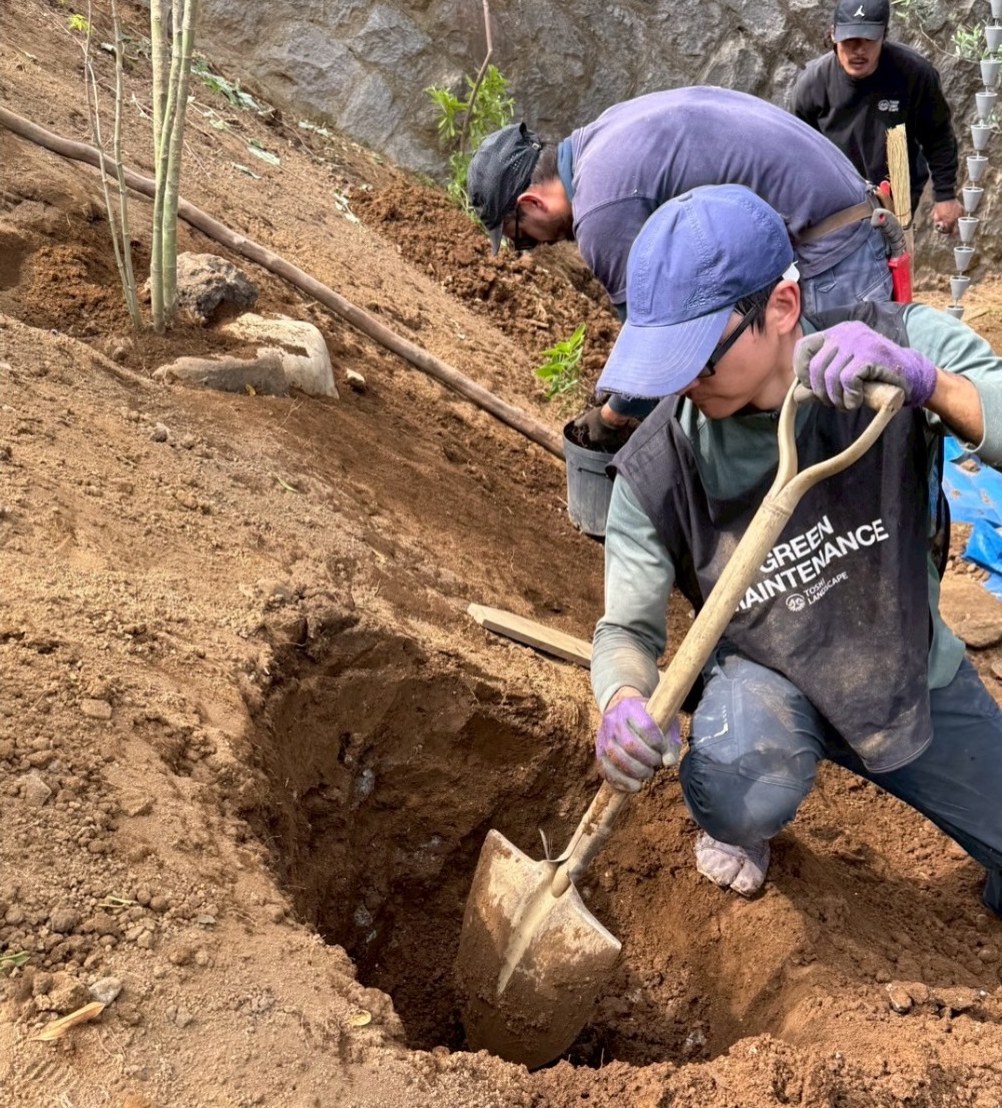
The labor came from young men’s associations, the seinendan (青年団). Meiji Jingu’s historical database records that a trial group of 50 members from Udo Village in Shizuoka began work on October 15, 1919, and that youth-group service continued until December 1922 — two years past the dedication. The Japan Youth Hall, whose founding grew out of this service, counts about 110,000 cumulative attendances from 209 youth groups, working on both the inner and outer precincts. The shrine’s database gives the total as “more than 100,000”.
Note the word cumulative (延べ). The figure counts participations, not 110,000 different people. The shrine says the young volunteers worked on planting trees and building the approaches (「植林や参道づくり」). Records survive in detail for some parties; the shrine holds the papers of a 63-member group from Higashiyamanashi District in Yamanashi.
The service left a building behind. Recognition of the volunteers helped lead to the Japan Youth Hall foundation, approved on September 2, 1921, whose first building opened on October 26, 1925.
| Number | What it counts | Source |
|---|---|---|
| About 100,000 | Trees donated | Meiji Jingu |
| About 120,000 trees, 365 species | All trees at founding, including existing ones | Meiji Jingu |
| About 110,000 | Cumulative youth-group participations in construction, inner and outer precincts | Japan Youth Hall |
| About 36,000 trees, 234 species | Trees recorded in the second comprehensive survey (2011–2013) | Meiji Jingu |
| About 70 ha | Area of the wooded precinct | Meiji Jingu |
Leave the Leaves — How the Forest Is Managed
Swept, then returned
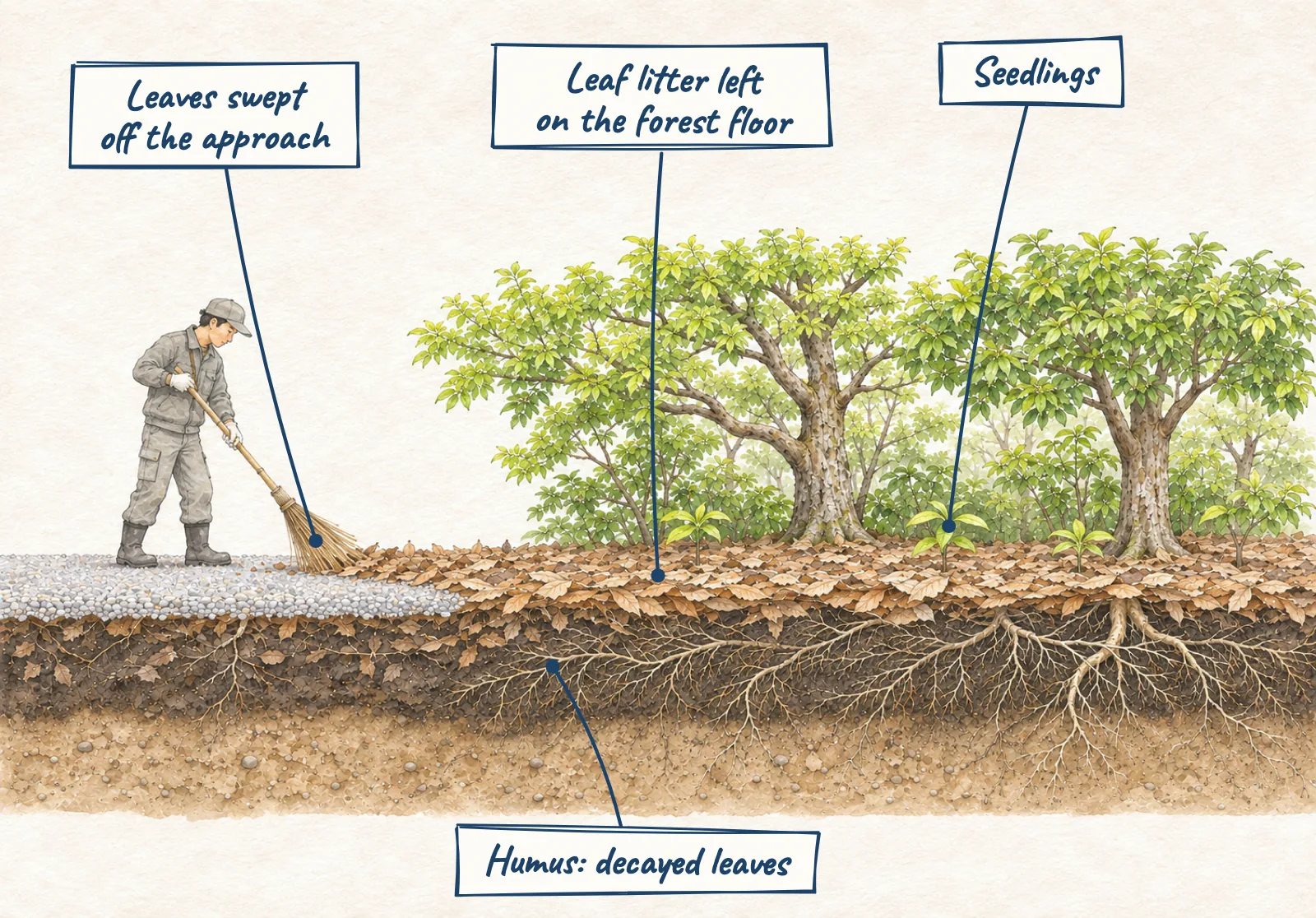
The most visible rule in the forest is about leaves. The approaches are swept, but the leaves are not thrown away. The Ministry of the Environment’s guide to the forest says that even the leaves on the paths are returned to the forest, and gives the reason: removing fallen leaves leads to a decline in soil fertility (「落ち葉を除去すると地力の減退につながる」). A 2012 site report by the Japan Greenery Research and Development Center records the same practice: all the leaves from the approaches go back into the forest.
Fallen trees, dead branches, and safety
The shrine’s English forest page says that when trees fall, they are left as they are, to return to the soil. The same 2012 site report adds that fallen trees in the forest are also reused within the shrine, for signs, steps, and amulets. So fallen trees are sometimes left and sometimes reused.
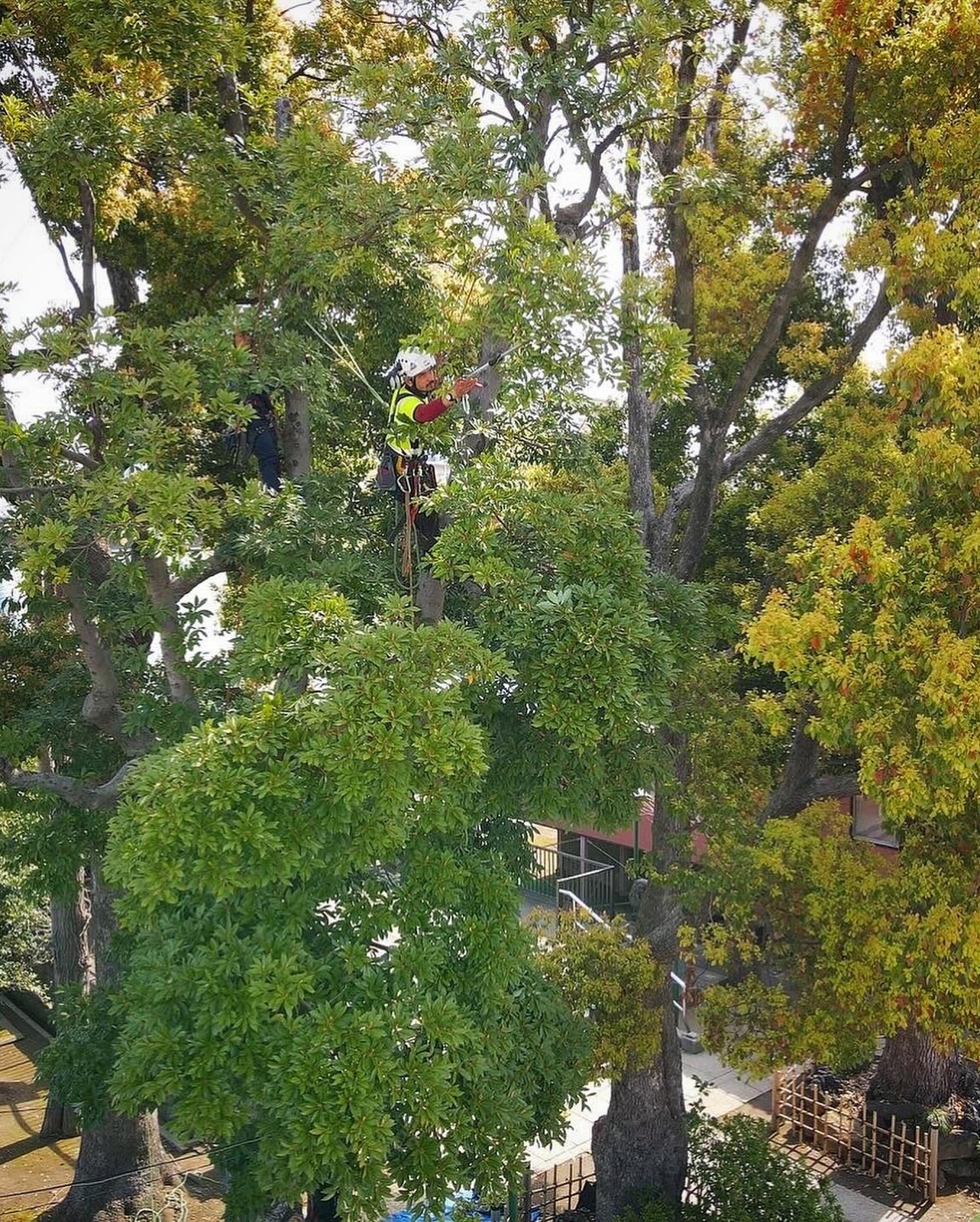
Nor is the forest left completely alone. The shrine’s English page says there has been no human intervention since the forest was created, but its forest manager, interviewed by JR East, describes minimum management for the safety of visitors (「参拝者の安全のため、最低限の管理」). A university fieldwork report describes that work as dealing with dead trees that might fall onto the approaches and minimal pruning of branches in the way. As an arborist, this is the part I find most interesting. The judgment is not “manage or don’t manage” but where people walk. Along the approaches, a dead limb over a crowd is a risk to remove. Deep in the wood, the same dead limb is food for fungi and insects.
Japanese oak wilt and canopy gaps
The forest is not immune to change. A researcher at Meiji Jingu told Kokugakuin University that Japanese oak wilt (nara-gare) has appeared at the shrine and that the problem has become visible. A landscape research report records substantial damage to konara oaks, leaving gaps in the canopy (「ナラ枯れによってコナラが大きく枯損し、ギャップが生じている」). Konara oak was one of the deciduous trees used in the early planting. Its loss opens light gaps; what grows up in them is something the next surveys will need to show.
A Century of Surveys — Did the Plan Work
Counting the forest
Meiji Jingu has measured its forest. A flora survey ran from 1970 to 1973, and the report of the first comprehensive survey of the precinct was published in 1980. In the same year, Akira Miyawaki, Shigetoshi Okuda, and Kayoko Inoue published a phytosociological study of the forest, with a map of its potential natural vegetation. For the centenary, a second comprehensive survey studied the plants and animals of the precinct from 2011 to 2013; its main report was published in September 2013, and a follow-up report produced the first catalogue of species recorded at Meiji Jingu.
The shrine’s summary of the second survey gives about 36,000 trees of 234 species. Research papers give other tree counts whose counting rules I could not reconcile, so the shrine’s round figure is the safest one to quote. The Japan Science and Technology Agency reported 2,840 species of living things recorded in the survey; a later academic account gives 2,844. Either way, the order of magnitude is the point: thousands of species in a planted wood in the middle of Tokyo.
What the forest is made of now
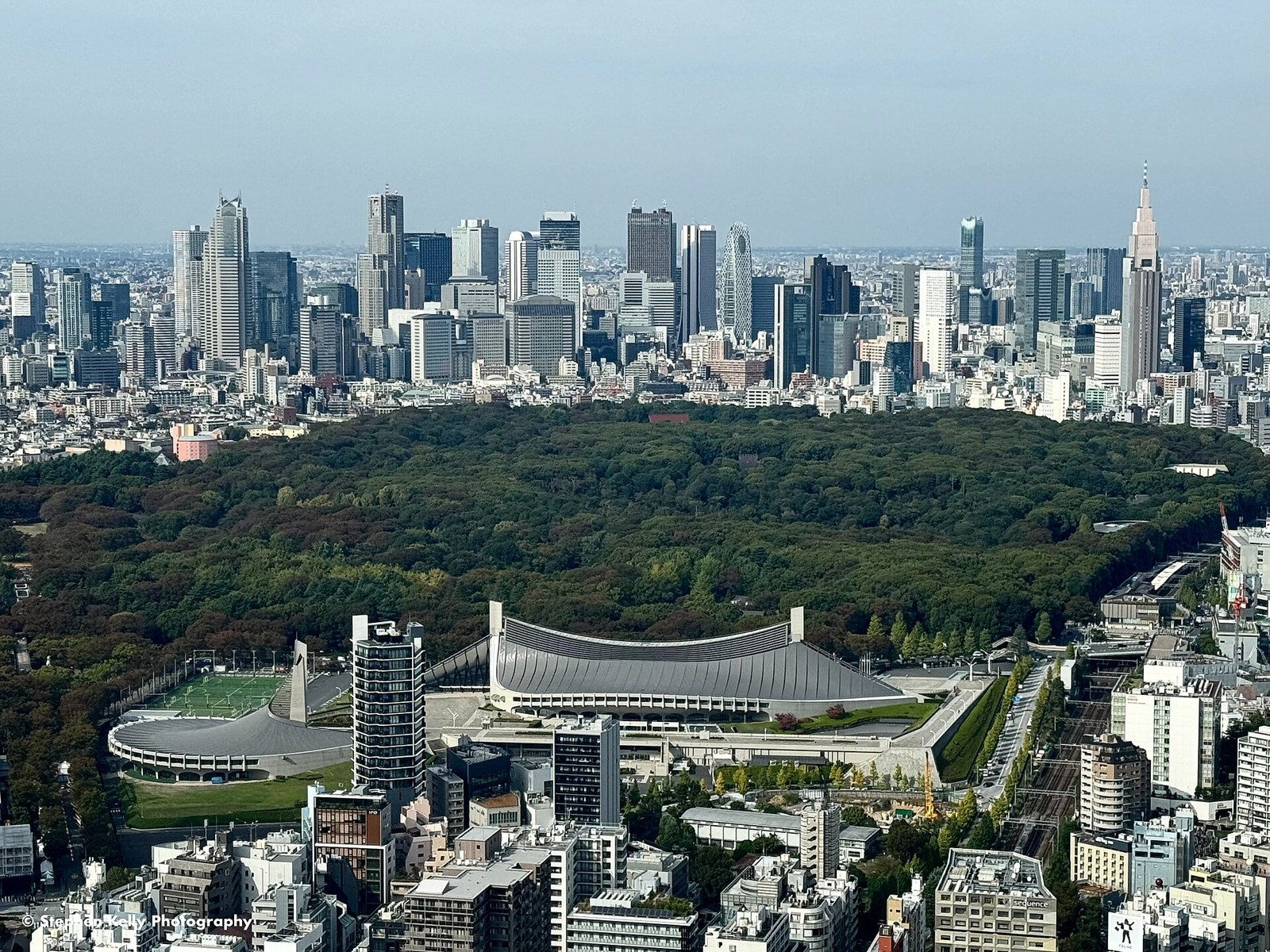
The trees the planners bet on now shape the forest. A landscape research report names camphor, shirakashi (bamboo-leaf oak), sudajii (a shii), and akagashi (Japanese evergreen oak) as the main species of the present landscape, and the shrine’s FAQ says the forest is rich in shii, oak, and camphor. A reanalysis by Japan’s Forestry and Forest Products Research Institute (FFPRI) of its long-term data found that, between survey years, the number of trees per area went down while the total basal area — the combined cross-section of the trunks — went up. In this forest, across those surveys, the trend was fewer, bigger trees. By basal area, camphor ranked first, followed by shirakashi.
Not finished — and not supposed to be
So did the plan work? The sources do not agree on a single word. The University of Tokyo report says the goal was largely achieved. FFPRI, looking at the same century, concluded that the “eternally unchanging forest” the planners foresaw has not yet been reached (「『永遠不変の林相』は、現時点ではまだ到達していない」). Both can be true. The forest is now dominated by the evergreen broadleaf trees the planners chose — that part of the plan has happened. Whether each of those species is replacing itself, so that the wood truly renews itself, is what the research is still testing.
| Planned (four-stage drawing) | Recorded (surveys and research) |
|---|---|
| Evergreen oaks, shii, camphor dominant after about a century | Camphor, shirakashi, sudajii, akagashi are the main species; camphor first by basal area (FFPRI) |
| A final, stable self-renewing forest | Not yet reached, according to FFPRI |
Life the planners never listed
The surveys also found things no one planted. Researchers found a fungus on fallen aoki (Aucuba) leaves that they thought would have to be described as a new genus and species. A parasitic wasp, named Jingū-usumaru-himebachi after the shrine, was reported as a first record for Japan. A Japan Science Council symposium noted that the hairstreak butterfly ura-nami-akashijimi, said to be almost extinct in Tokyo’s wards, is plentiful at Meiji Jingu. A bird survey lists the northern goshawk among the birds that have begun breeding in the precinct in recent decades. A forest built for a shrine has become a refuge.
Common Misreadings — What the Forest Is Not
“It’s a primeval forest”
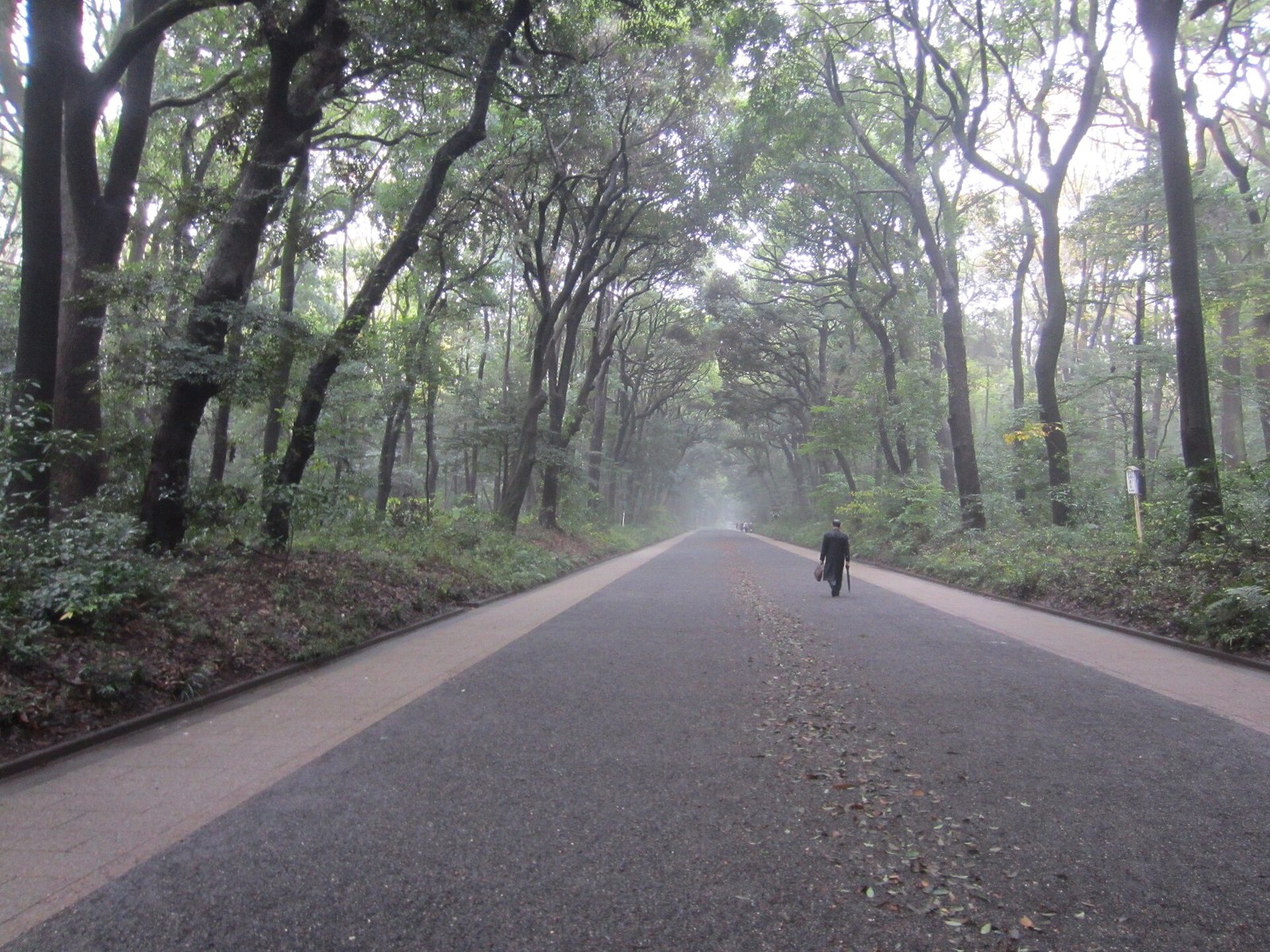
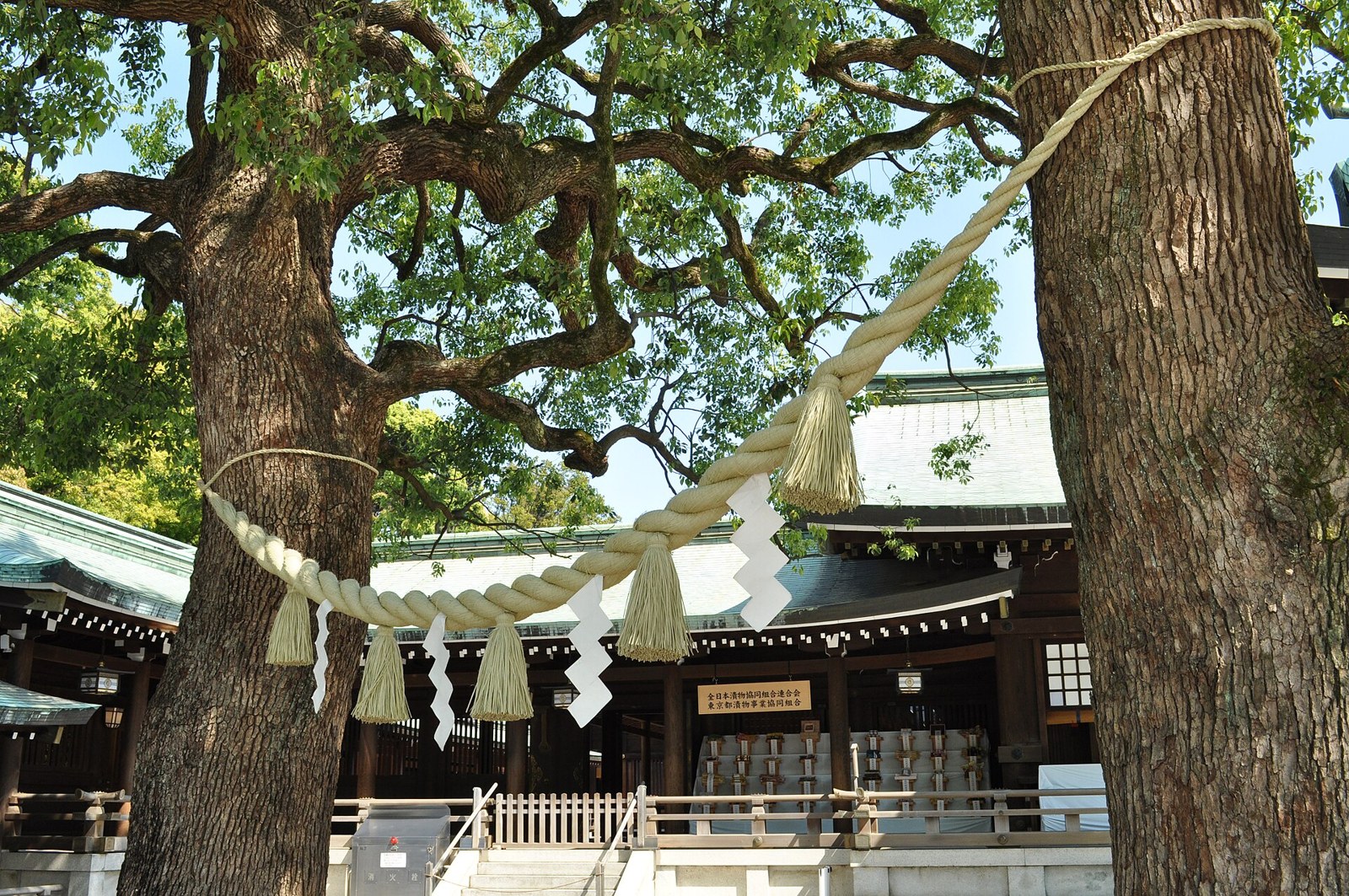
The most common mistake is to think the forest is a surviving piece of old Tokyo wilderness. The shrine says the opposite: it is a planted forest. What makes it look natural is the design — species that suit the place and renew themselves — and a management style that leaves leaves and fallen wood in the forest.
“120,000 trees were donated” or “110,000 people planted it”
As the table above shows, the 120,000 includes existing trees, and the 110,000 counts cumulative participations rather than different people, across both the inner and outer precincts. The donated figure is about 100,000 trees.
“It was made with the Miyawaki method”
Akira Miyawaki’s name is often linked to Meiji Jingu, and he did study the forest: his study with Okuda and Inoue was published in 1980, sixty years after the dedication. I found no primary source saying the forest was created with his method. The planners of 1915–1921 worked from site suitability, natural regeneration, and smoke tolerance, and one design-history study argues that the original species choice was not based on an ideal of potential natural vegetation.
“The forest and the ginkgo avenue are the same project”
Meiji Jingu has two parts. The Inner Precinct (Naien, 内苑) holds the shrine and the forest. The Outer Precinct (Gaien, 外苑) was planned, in Shinjuku City’s words, as a large landscaped ground for public outdoor recreation, in contrast to the inner precinct. Its famous ginkgo avenue was established in 1923 and has 146 trees. One connection: the ginkgo trees were chosen from about 1,600 trees, grown to around six meters, in a nursery within what is now Meiji Jingu.
Planted Forests Elsewhere — A Comparison
Amsterdam: a forest built as relief work
Meiji Jingu is not the only forest planted by hand in a modern city. The Amsterdamse Bos in the Netherlands was also made deliberately; its managers say that between 1934 and 1940 the forestation project gave work to more than 20,000 unemployed men. The two projects differ in purpose — one a shrine grove, one a public park built partly as unemployment relief — but both were planted by large numbers of people on land that was largely not forest.
German forest science, Japanese shrine grove
The more interesting comparison is with the planners’ own teachers. Honda trained in Germany, and Hongo’s plan has been read side by side with von Salisch’s Forest Aesthetics. The German tradition was a forester’s way of making managed woods beautiful. At Meiji Jingu, that science was put to work for a shrine grove: a forest whose purpose was to be sacred, permanent, and, in the shrine’s English phrase, “an eternal forest that recreates itself”. For the 2020 centenary, the shrine used the slogan 「まごころを継ぐ 永遠の杜をめざして」 — roughly, “passing on sincerity, aiming for an eternal forest” (my translation).
As an arborist working on trees in Tokyo, I take from this not a technique to copy but a way of thinking about time. The Meiji Jingu planners balanced two needs: a grove that looked right on dedication day, and a forest their great-grandchildren would see. They planted trees they expected to give way so that others could take over. If you want to see how other old Japanese trees have lasted, our article on why Japan’s ancient trees live for a thousand years looks at that from the tree’s side.
Visiting — Reading the Plan on the Ground
Where to look
You can read the plan as you walk. Under the great torii, look at the canopy: broad, dark evergreen leaves, not the needles of a cedar grove. Look down at the forest edge and you will often see leaf litter left in place. South of the main buildings, the Inner Garden is the part of the grounds that was already a garden before the shrine — the old imperial estate garden. It has an iris field with about 150 varieties and 1,500 plants, and Kiyomasa’s Well, a spring the shrine describes as flowing at an average of 60 liters a minute at about 15°C all year; the name comes from a tradition that the warlord Katō Kiyomasa dug it. Look also for the Meoto Kusu, the two camphor trees planted when the shrine was founded in 1920.
If you want the history in one place, the Meiji Jingu Museum, designed by Kengo Kuma, opened in October 2019 as a centenary project.
What it says about Tokyo’s other trees
The forest is also a contrast with the rest of Tokyo’s greenery. We have written about Tokyo’s street trees, and why they look beautiful but struggle, and about Japan’s falling-trees problem as the postwar planting boom ages. Meiji Jingu shows another path: plant for the forest, not for the single tree. The planners balanced quick effect with long-term renewal, a theme also behind what a submerged forest teaches us about landscape design. And if camphor trees interest you, the 2,000-year-old camphor tree of Kinomiya Shrine shows how large the species can grow when it is left to stand.
Frequently asked questions
Is the Meiji Jingu forest natural? No. It is a planted forest. About 100,000 trees were donated from across Japan and beyond, and the forest was designed by forestry scientists from 1915 onward. It looks natural because the planners chose trees that suit the site and renew themselves from seed.
Who designed the Meiji Jingu forest? Three forestry scientists are credited: Seiroku Honda (adviser), Takanori Hongo (engineer, who wrote the forest plan dated 1921), and Keiji Uehara (technical assistant).
Why wasn’t the forest built around Japanese cedar? Prime Minister Shigenobu Ōkuma reportedly wanted a cedar grove like those at Ise and Nikkō. The shrine says the foresters argued that sugi grows best in moist valleys, not on the Kantō loam at Yoyogi, and that Tokyo’s pollution was killing large old trees. They chose evergreen broadleaf trees instead.
Was it really a 150-year plan? The planners designed the forest to mature over a century or more. A University of Tokyo report and a landscape institute report describe a 150-year horizon, while the shrine’s English pages speak of 100 years, or 100 or 200 years. I could not confirm the figure in the original plan text.
How many trees did the second comprehensive survey record? The second comprehensive survey (2011–2013) recorded about 36,000 trees of 234 species, according to the shrine. Camphor ranks first by basal area.
Why are fallen leaves returned to the forest? Because removing them reduces soil fertility. Leaves swept from the approaches are put back under the trees, so the forest feeds itself.
Sources
– Meiji Jingu, About Meiji Jingu (accessed 2026-10-31): https://www.meijijingu.or.jp/about/ – Meiji Jingu, The forest and highlights (accessed 2026-10-31): https://www.meijijingu.or.jp/midokoro/ – Meiji Jingu, FAQ (accessed 2026-10-31): https://www.meijijingu.or.jp/faq/ – Meiji Jingu, Inner Garden (accessed 2026-10-31): https://www.meijijingu.or.jp/midokoro/gyoen/ – Meiji Jingu, Iris garden (accessed 2026-10-31): https://www.meijijingu.or.jp/midokoro/hanasyoubu/ – Meiji Jingu, Establishment of Meiji Jingu (English) (accessed 2026-10-31): https://www.meijijingu.or.jp/en/about/establishment/ – Meiji Jingu, Forest (English) (accessed 2026-10-31): https://www.meijijingu.or.jp/en/whattosee/forest/ – Meiji Jingu, Precinct map (English) (accessed 2026-10-31): https://www.meijijingu.or.jp/en/map/ – Meiji Jingu, Precinct guide (accessed 2026-10-31): https://www.meijijingu.or.jp/guide/ – Meiji Jingu, Museum (accessed 2026-10-31): https://www.meijijingu.or.jp/museum/ – Meiji Jingu, Centennial festival (accessed 2026-10-31): https://www.meijijingu.or.jp/enshrined100/ – Meiji Jingu, Related publications (accessed 2026-10-31): https://www.meijijingu.or.jp/books/relation.php – Meiji Jingu Historical Database, Construction Bureau (accessed 2026-10-31): https://www.rekishidb.meijijingu.or.jp/glossary/detail.php?id=3 – Meiji Jingu Historical Database, Youth-group construction service (accessed 2026-10-31): https://www.rekishidb.meijijingu.or.jp/glossary/detail.php?id=6 – Meiji Jingu, Yoyogi bulletin, spring 2017 (fungus on Aucuba leaves) (accessed 2026-10-31): https://www.meijijingu.or.jp/books_top/?id=1585018848-671729 – Meiji Jingu, Yoyogi bulletin, autumn 2017 (Higashiyamanashi youth group) (accessed 2026-10-31): https://www.meijijingu.or.jp/books_top/?id=1585018292-675245 – Japan Tourism Agency, multilingual explanations: chinju no mori (accessed 2026-10-31): https://www.mlit.go.jp/tagengo-db/R1-02489.html – Japan Tourism Agency, multilingual explanations: the great torii (accessed 2026-10-31): https://www.mlit.go.jp/tagengo-db/H30-00516.html – Ministry of the Environment, Giant Tree Database, Meiji Jingu observation course (accessed 2026-10-31): https://kyoju.biodic.go.jp/?_action=gtcontents&_command=modelCourse002 – Kokugakuin University, “Overturning common sense: the foresters’ challenge” (accessed 2026-10-31): https://www.kokugakuin.ac.jp/article/260125 – Kokugakuin University, “What can we do for the next 100 years?” (accessed 2026-10-31): https://www.kokugakuin.ac.jp/article/260230 – Mizuuchi, Y., design thought in the Meiji Jingu construction, Landscape Research Japan Online 12 (accessed 2026-10-31): https://www.jstage.jst.go.jp/article/jilaonline/12/0/12_50/_pdf/-char/ja – Okajima, N., Uehara Keiji’s evaluation of coppice trees, Journal of the Japanese Institute of Landscape Architecture 74(5) (accessed 2026-10-31): https://www.jstage.jst.go.jp/article/jila/74/5/74_399/_pdf – Shimizu, Y. and Ito, S., the reception of forest aesthetics in Japan, JpGU 2015 (accessed 2026-10-31): https://www2.jpgu.org/meeting/2015/session/PDF/H-GG01/HGG01-P05.pdf – Kobayashi, research trends on modern shrine precincts, Tokyo University of Agriculture (accessed 2026-10-31): https://nodai.repo.nii.ac.jp/record/672/files/61_126.pdf – Obayashi Foundation, University of Tokyo research report on Meiji Jingu (accessed 2026-10-31): https://www.obayashifoundation.org/upload/pdf/2018_Shourei_08_Hikeisai.pdf – Japanese Institute of Landscape Architecture, Kanto Chapter, 30th anniversary field visit report (accessed 2026-10-31): https://www.kanto.jila-zouen.org/pdf/H25kengakukai-hokoku.pdf – Nippon Foundation Library, nature-guide training text: Meiji Jingu (accessed 2026-10-31): https://nippon.zaidan.info/seikabutsu/2002/01139/contents/004.htm – “Changes in Tokyo’s biota over 100 years”, Journal of the Japanese Institute of Landscape Architecture 89(3) (accessed 2026-10-31): https://www.jstage.jst.go.jp/article/jila/89/3/89_250/_pdf – Forestry and Forest Products Research Institute, Annual Report 2019, “Verifying 100 years of Meiji Jingu forest data” (accessed 2026-10-31): https://www.ffpri.go.jp/pubs/nenpo/documents/2019nenpo_20201111.pdf – Tomizawa, F. and Tanimoto, T., understory diversity in the Meiji Jingu forest, Japanese Forest Society (accessed 2026-10-31): https://www.jstage.jst.go.jp/article/jfsc/117/0/117_0_674/_pdf/-char/ja – Miyawaki, A., Okuda, S. and Inoue, K., phytosociological study of the Meiji Jingu forest, 1980, Yokohama National University repository (accessed 2026-10-31): https://ynu.repo.nii.ac.jp/record/5486/files/meiji_a00.pdf – Japan Greenery Research and Development Center, Meiji Jingu forest site visit report, 2012 (accessed 2026-10-31): https://www.jpgreen.or.jp/saiseishi/2012/meijijingu.pdf – Kyoto University of the Arts, fieldwork report on the Meiji Jingu forest (accessed 2026-10-31): https://g.kyoto-art.ac.jp/reports/5001/ – JR East, Tokyo Moving Round Magazine vol. 55, autumn 2020 (accessed 2026-10-31): https://www.jreast.co.jp/tokyomovinground/docs/vol55.pdf – Kuki City, “Kuki’s tree carried to Meiji Jingu” (accessed 2026-10-31): https://www.city.kuki.lg.jp/miryoku/rekishi_bunkazai/rekishi_dayori/1006206.html – Japan Youth Hall, 100-year history (accessed 2026-10-31): https://nippon-seinenkan.or.jp/history/ – JST Science Portal, “100 years of forest-making at Meiji Jingu” (accessed 2026-10-31): https://scienceportal.jst.go.jp/sciencechannel/b150302007_2/index.html – Science Council of Japan, symposium “The Meiji Jingu forest: the past and next 100 years” (accessed 2026-10-31): https://www.scj.go.jp/ja/event/pdf2/182-s-3-1.pdf – NECTA, Shinji Isoya, lecture materials on nature restoration (accessed 2026-10-31): https://necta.jp/library/pdf/NECTA10th/NECTA10th_09.pdf – Bird Research News, June 2014, “Birds of Meiji Jingu” (accessed 2026-10-31): https://www.bird-research.jp/1_newsletter/dl/BRNewsVol11No6.pdf – Waseda Institute for Advanced Study, Bulletin 13 (Seiroku Honda) (accessed 2026-10-31): https://www.waseda.jp/inst/wias/assets/uploads/2021/03/RB013_all_.pdf – Tokyo Metropolitan Park Association, Hibiya Park (accessed 2026-10-31): https://www.tokyo-park.or.jp/park/hibiya/index.html – Shinjuku City, Jingu Gaien district planning guideline (accessed 2026-10-31): https://www.city.shinjuku.lg.jp/content/000299946.pdf – Meiji Jingu Gaien, the ginkgo avenue through the seasons (accessed 2026-10-31): https://www.meijijingugaien.jp/walk/sight/season.html – Amsterdamse Bos, History (accessed 2026-10-31): https://www.amsterdamsebos.nl/english/history/