

By Isaki Kasahara, a Japanese arborist pruning, assessing and caring for Japan’s trees and gardens · Updated November 18, 2026
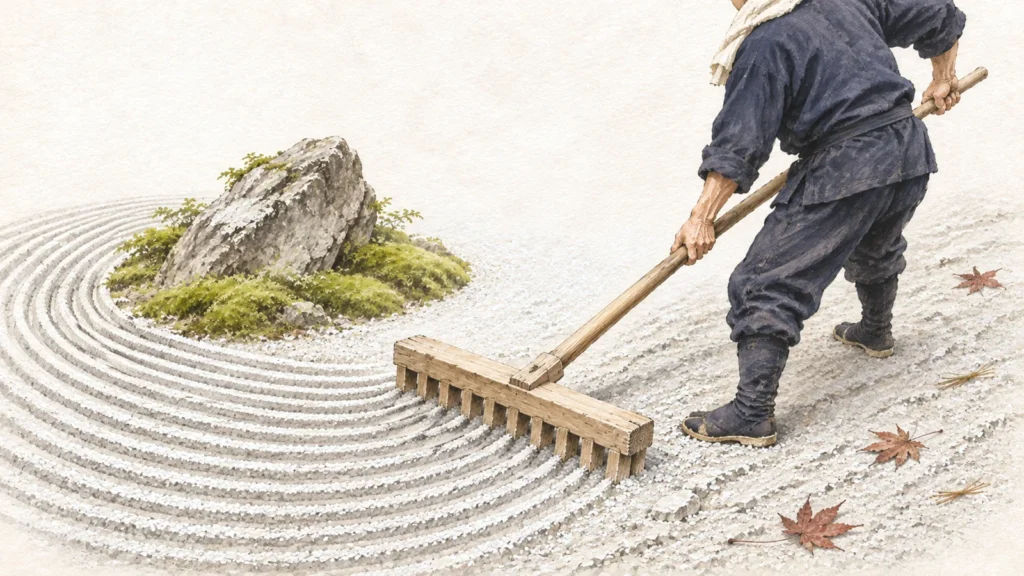
Zen gardens are raked again and again because wind, rain and falling leaves break the raked lines, and the lines are how many karesansui (枯山水), or dry landscape, gardens show water. At Daisen-in in Kyoto, the temple itself explains its gravel as a river running from a waterfall to the ocean; once the lines are scattered, that water can no longer be read, so someone draws it again.
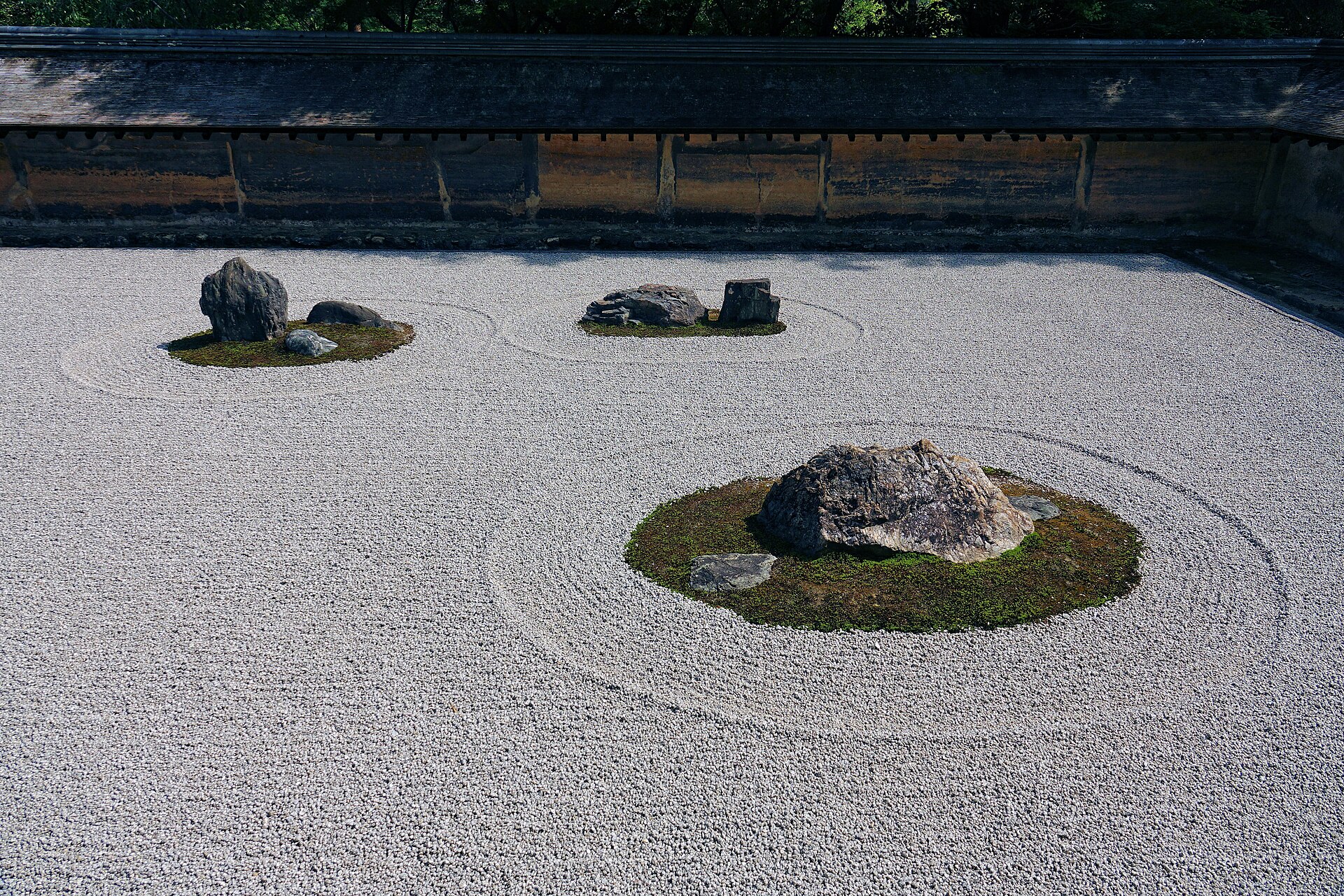
How often that happens is less fixed than the popular picture of dawn raking suggests. A 2015 survey of Kyoto temples found that daily care was uncommon and that two or three times a month was the most frequent answer, and the researchers proposed redrawing patterns only when they have been disturbed, because crushed granite gravel weathers and wears.
At Ryōan-ji, the work is done before the public arrives. According to a TV Tokyo report that included an interview with the head priest, the lines in the rock garden are usually drawn before the gates open, and whenever wind, rain or fallen leaves break them up, they are drawn again.
This article follows the raked gravel of Japan’s karesansui gardens from Ryōan-ji and Daisen-in to Ginkaku-ji: what the patterns are called, which tools draw them, what the gravel is made of, how often the lines are really redrawn, who does the work, and how this use of gravel differs from gravel in Western gardens.
Ryōan-ji — fifteen stones in a field of gravel
A rectangle of white gravel
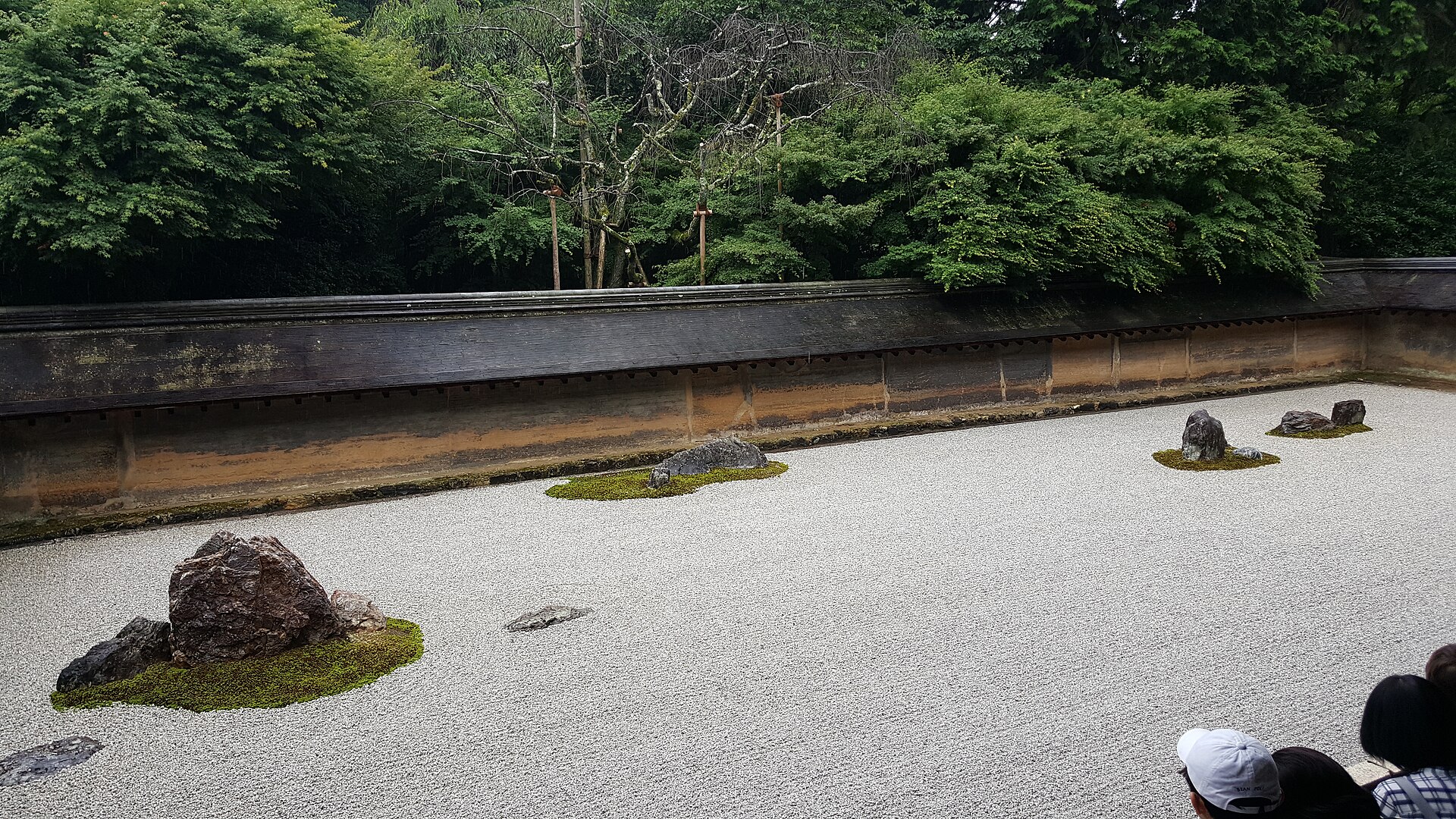
Ryōan-ji in Kyoto is where most people first meet raked gravel, in photographs if not in person. Its abbot’s garden, designated nationally as the Ryōan-ji Hōjō Teien (龍安寺方丈庭園), is a rectangle of white gravel with fifteen stones set in five groups. The Agency for Cultural Affairs’ heritage portal gives its area as about 250 square metres (roughly 2,700 square feet).
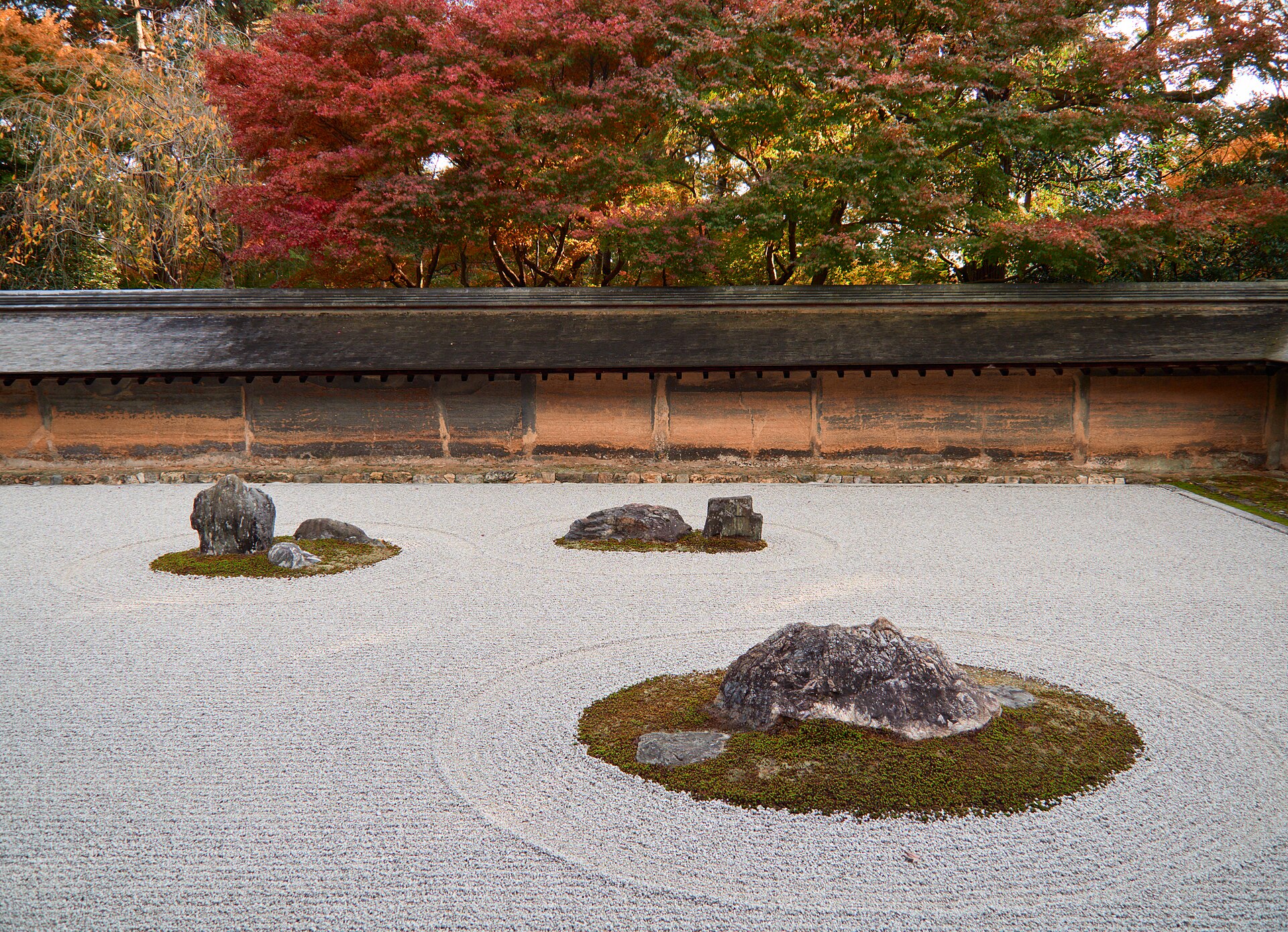
Nobody knows who made it. The Kyoto Prefecture tourism federation states that the maker is unknown and that the intention behind the garden has many theories. The date is also open: the national heritage portal says the garden is thought to have existed by the middle of the fifteenth century, while the Kyoto City tourism association says it is traditionally attributed to the late Muromachi period.
Its standing today
Ryōan-ji’s garden was designated a Historic Site on 9 December 1924 and a Special Place of Scenic Beauty on 20 March 1954. The temple is one of the component properties of the UNESCO World Heritage site “Historic Monuments of Ancient Kyoto (Kyoto, Uji and Otsu Cities)”, inscribed in 1994. It is the temple, among many others, that is on the list, not the rock garden by itself.
Why the meaning stays open
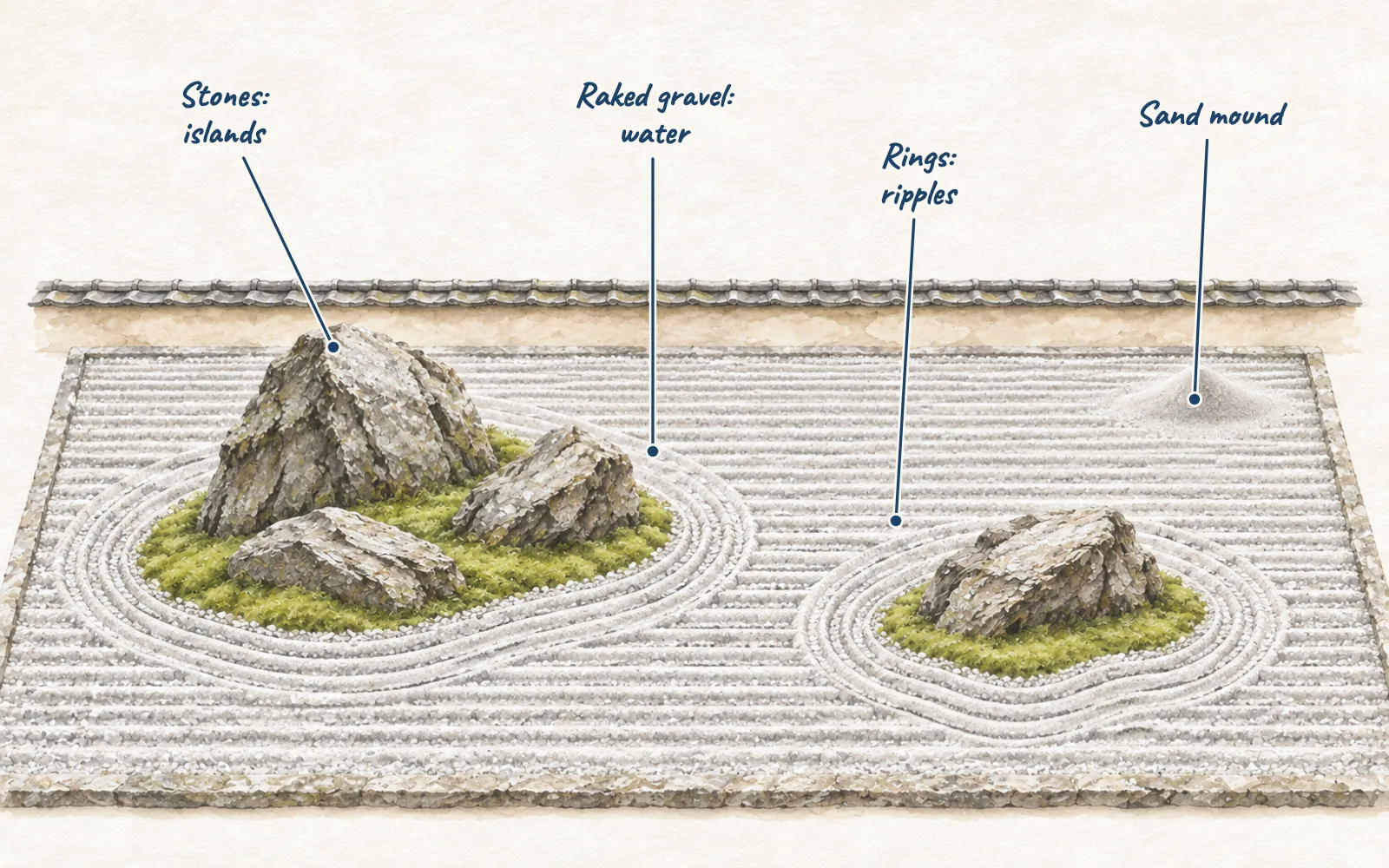
Because the maker and the intention are unknown, there is no official reading of Ryōan-ji’s gravel. Visitors often see the stones as islands in a sea, and that is a natural way to read a field of raked lines, but it is an interpretation, not the temple’s statement. Daisen-in at Daitoku-ji is different: there the temple tells you what the gravel is.
A garden of water with no water — what karesansui means
The definition
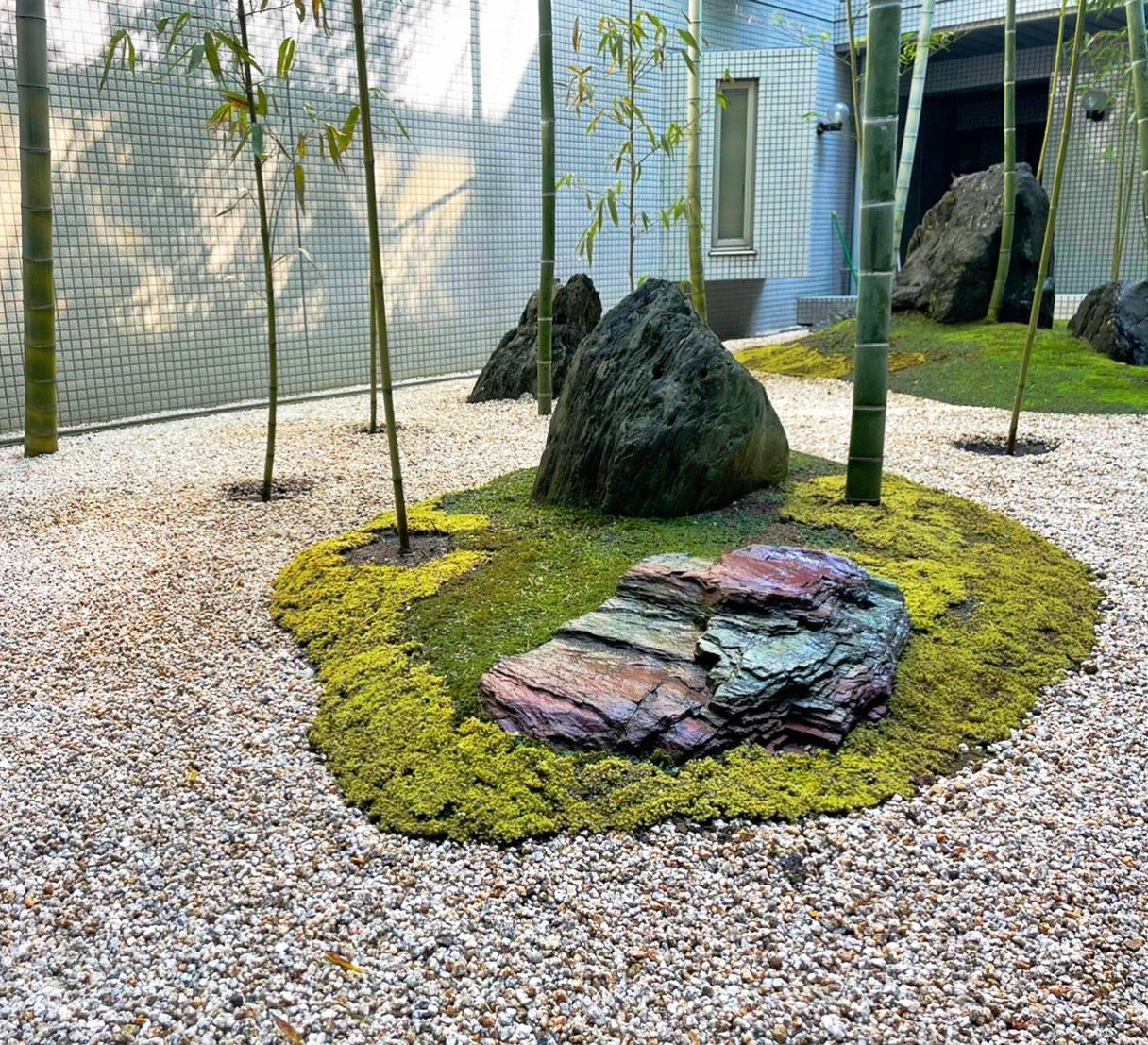
The Nara National Research Institute for Cultural Properties defines the dry landscape garden as one that uses “neither ponds nor streams”, expressing natural scenery symbolically through “stone arrangements, white sand, moss and pruned trees”. The institute dates the emergence of this garden style to the Muromachi period.
The word is older than the style. The same institute notes that karesansui appears in the Sakuteiki (作庭記), the Heian-period gardening manual, where it means a stone arrangement set in a part of the garden without water, not a whole garden built without water. The Sakuteiki and its rules for setting stones are a subject of their own; this article stays with the gravel.
Zen temples and the abbot’s quarters
Many well-known examples are associated with Zen temples. Portland Japanese Garden, describing its own Sand and Stone Garden, puts it carefully: such a garden is often “part of a Zen monastery”, often “attached to the abbot’s quarters” (the hōjō, 方丈), and, in its case, “not meant for meditation [zazen]”.
The style did not freeze in the Muromachi period. A study of Kyoto gardens using Shirakawa sand, published by the Japanese Institute of Landscape Architecture, describes it as formed in the Muromachi period and developed further in the Edo period and into modern times. At Tōfuku-ji, the abbot’s gardens were made by the designer Mirei Shigemori (重森三玲) and, according to the temple, completed in 1939. Karesansui is a living tradition with a medieval beginning.
Reading a dry garden
| Element | Japanese | Role in the gardens in this article | Example |
|---|---|---|---|
| Raked white gravel | 白砂 shirasuna | Water, where the garden is explained that way | Daisen-in: river, then ocean |
| Raked lines | 砂紋 samon / 箒目 hōkime | The surface pattern of that water | Ripple, eddy and wave patterns |
| Stones | 石組 ishigumi | The fixed structure of the composition | Ryōan-ji’s fifteen stones in five groups |
| Sand mounds | 盛砂 morizuna | Varies by garden | Daisen-in’s two mounds; Ginkaku-ji’s Kōgetsudai |
| Moss, pruned trees | 苔・刈込 | Part of the composition | Named in the Nara institute’s definition |
The interpretations in the third column are a guide, not a rule. Every garden has its own explanation, and where a temple gives one, that is the explanation to trust. Clipped shrubs belong to many of these compositions; how they are shaped is the subject of karikomi, Japanese cloud pruning.
Daisen-in — a river you can follow
From a waterfall to the sea
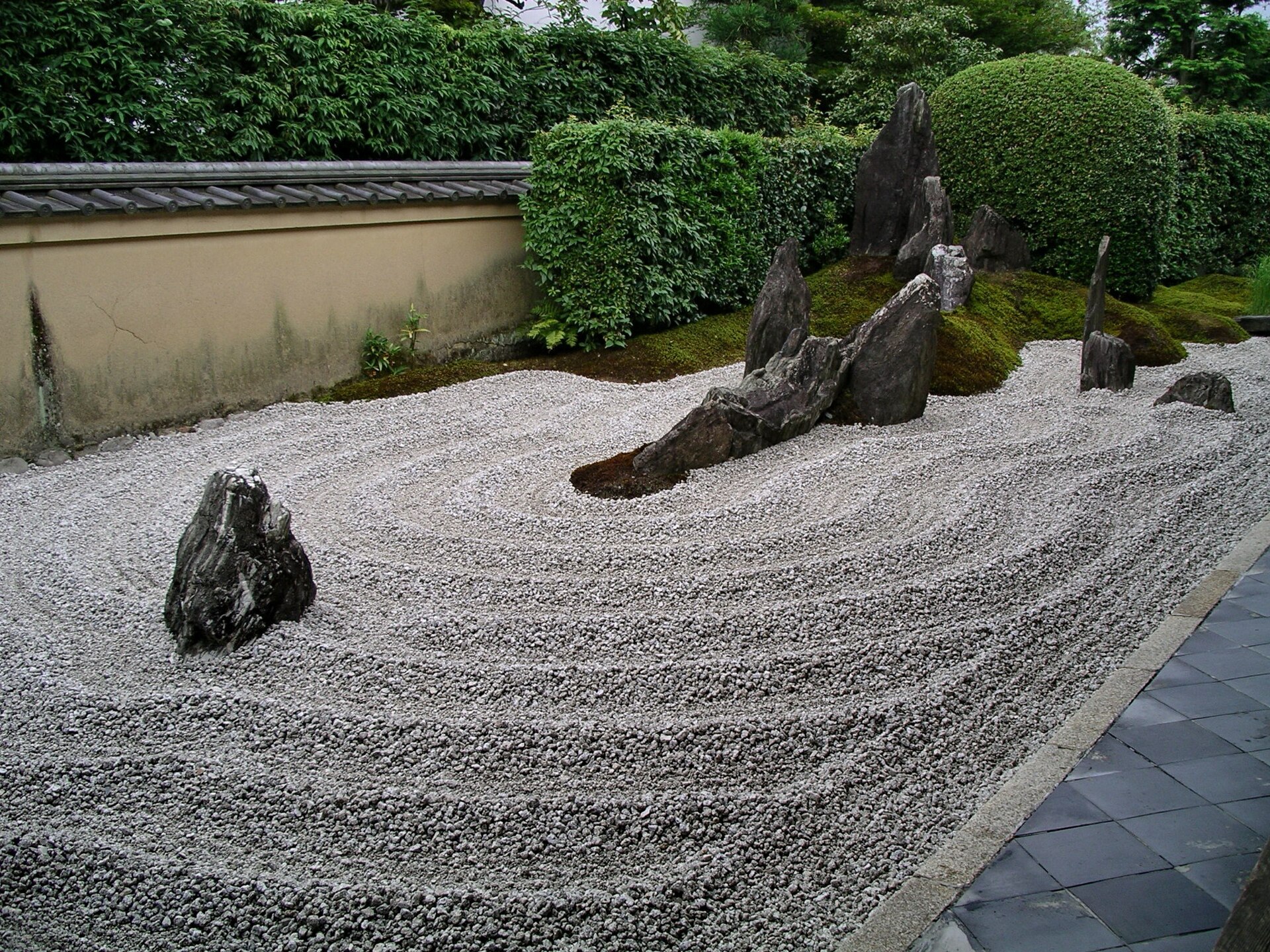
If Ryōan-ji is the garden that asks questions, Daisen-in at Daitoku-ji is the one that tells a story. The sub-temple’s own explanation of its dry garden is that water flows from a waterfall on Mount Hōrai (蓬莱山), becomes a great river, and runs out into the great ocean. The raked gravel carries everything in that story that moves.
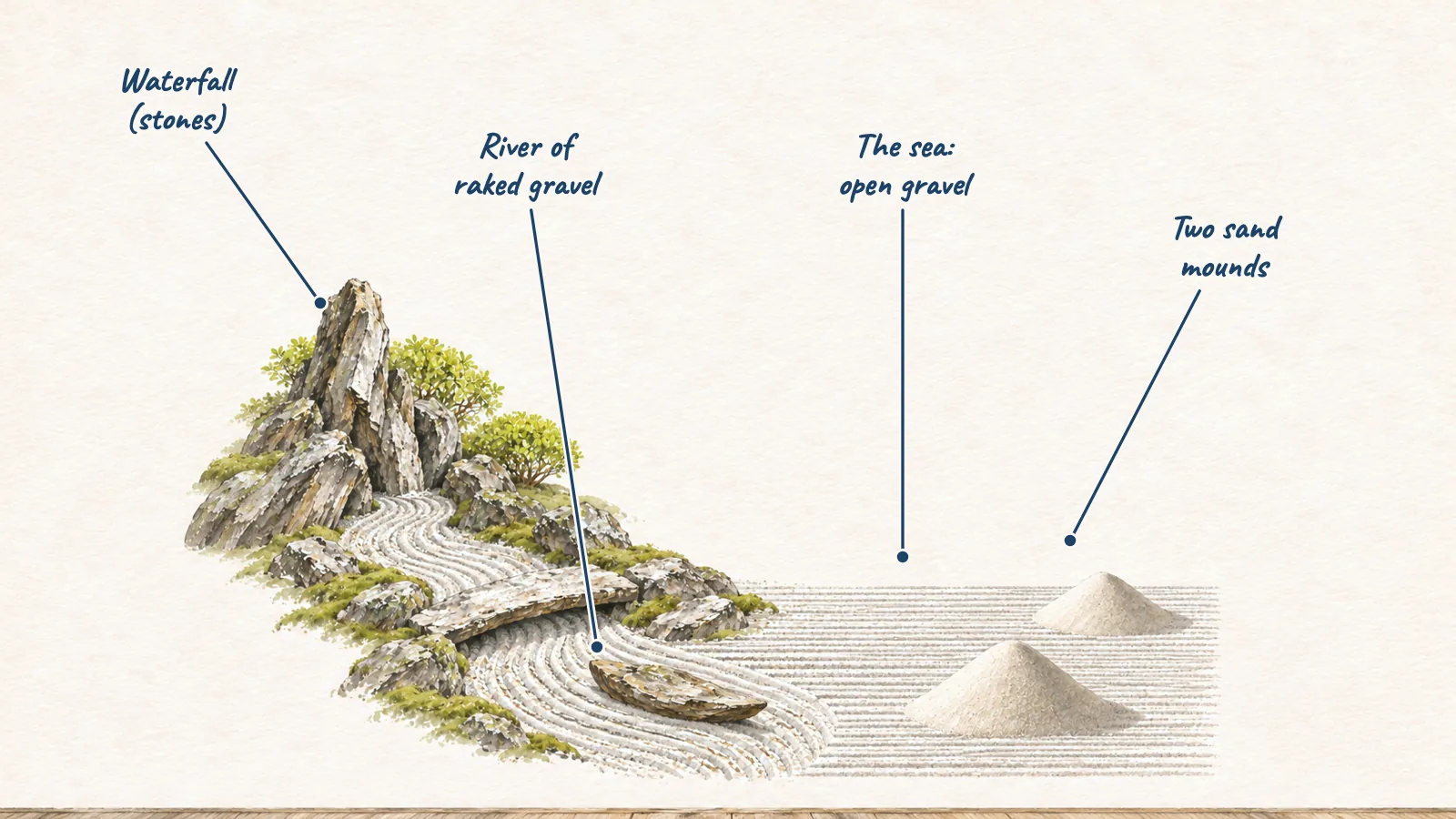
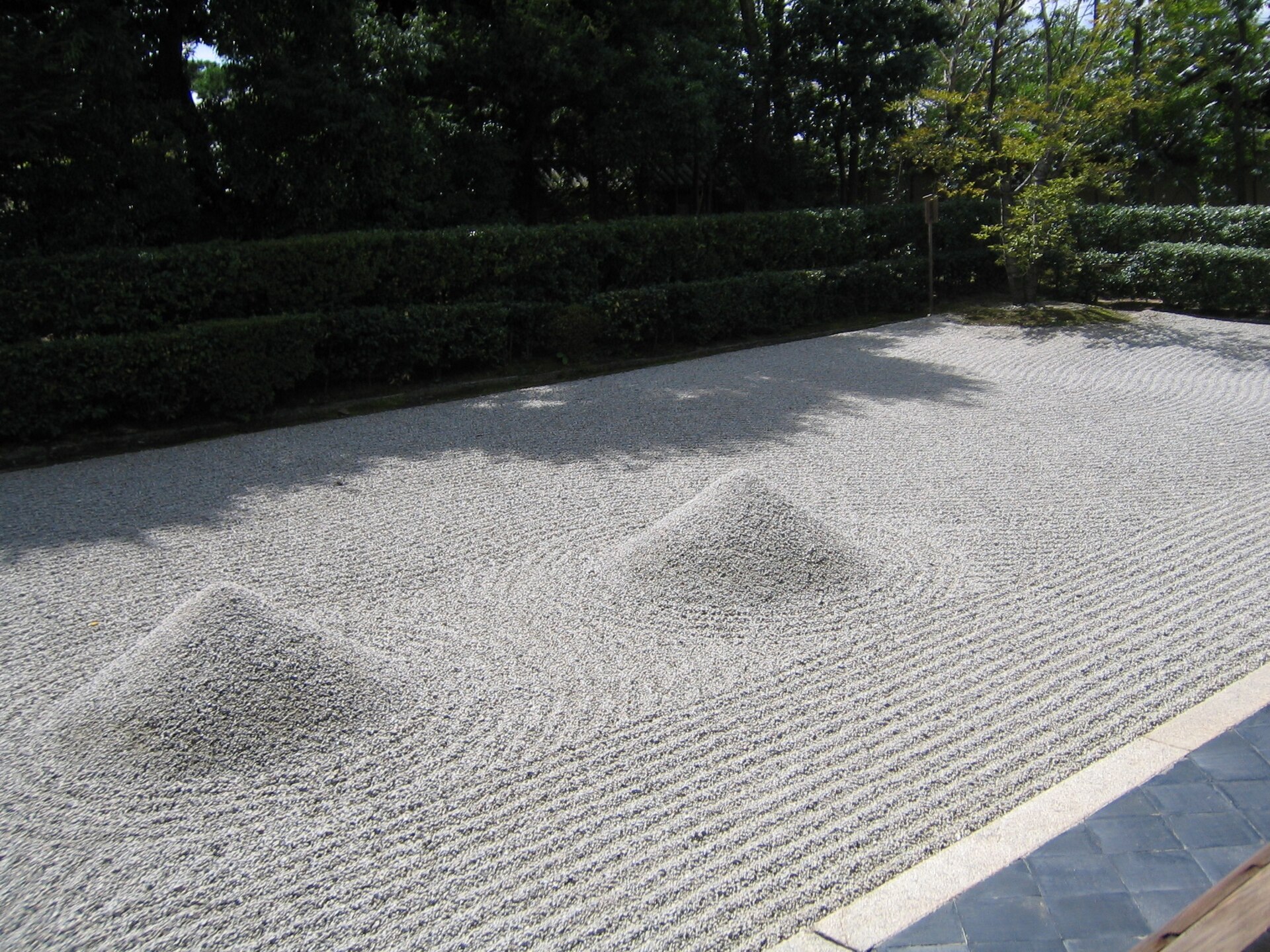
On the south side of the hōjō, the story reaches the sea. According to the Kyoto City Greenery Association’s description, written with the temple’s cooperation, white gravel and two sand mounds there represent the great ocean. Here the sea is drawn in gravel, and it is the raked lines that tell you it is water.
Who made it, and when
Daisen-in’s own website attributes the garden to its founder, the Zen master Kogaku Sōkō (古岳宗亘). The Nara institute’s English description says the hōjō was built in 1513 and that the garden was made around then “under the supervision of chief priest Kogaku Sōkō”. The national heritage database preserves an older tradition naming a different maker and links the garden to the founding of the temple in Eishō 6 (1509), so both the maker and the exact date differ between sources.
The Daisen-in Shoin Garden (大仙院書院庭園) was designated a Historic Site on 9 December 1924 and a Special Place of Scenic Beauty on 29 March 1952. A separate designation, the Daisen-in Garden, made a Place of Scenic Beauty on 3 February 1955, covers the area around the shoin dry garden and the hōjō garden. The Special Place of Scenic Beauty designation applies to the Shoin Garden.
Why the story needs the lines
Daisen-in shows plainly why the gravel is redrawn. The temple describes water moving from a mountain to the sea. In gravel, that movement exists only as raked lines. When rain or leaves scatter them, raking them again restores the pattern that lets the garden be read as the temple describes it.
What the gravel is — Shirakawa sand and its substitutes
Coarser than “sand”
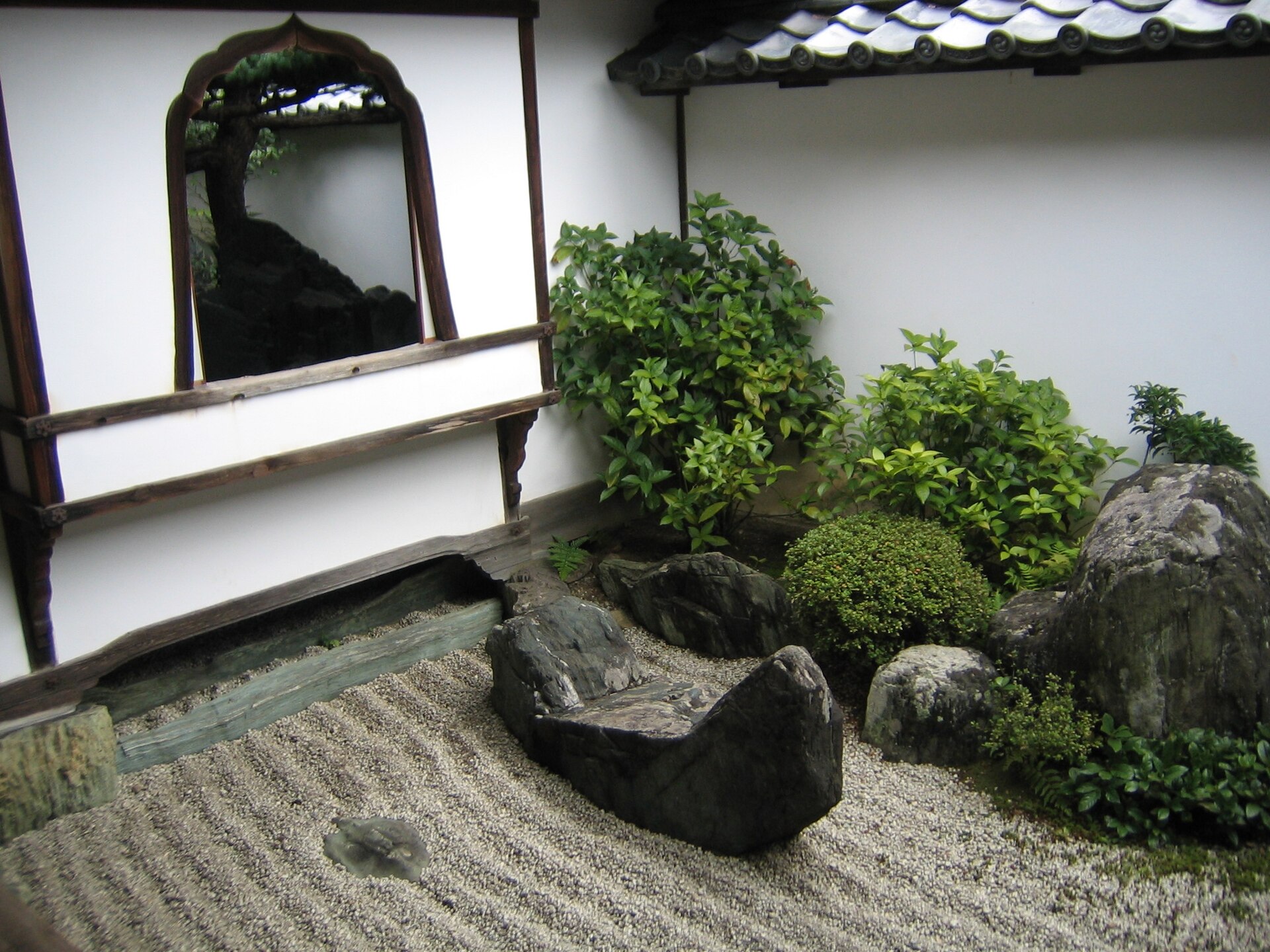
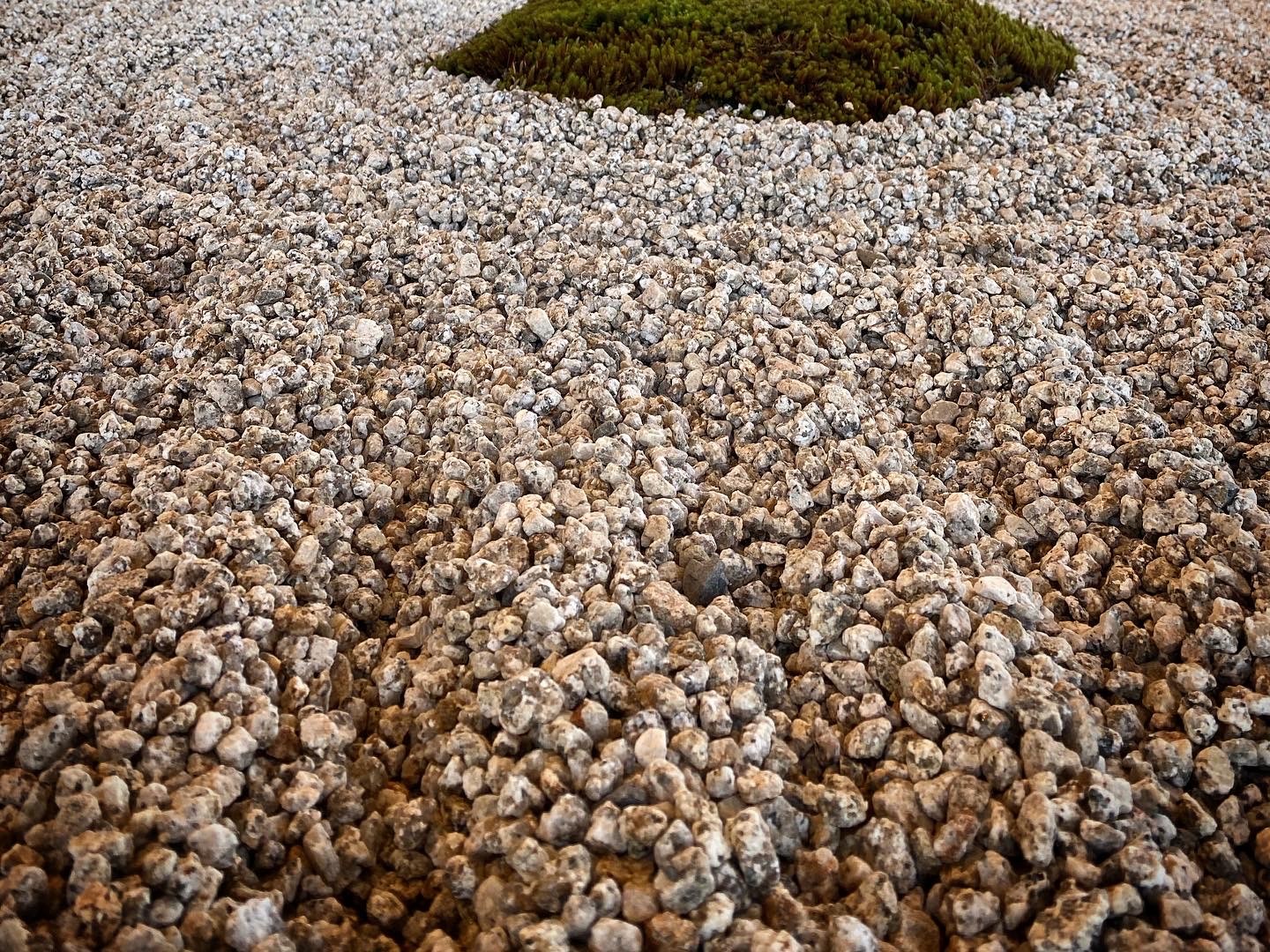
The white “sand” of Kyoto gardens is coarser than the word suggests. In the 2015 survey of Kyoto temples, many of the areas measured had a maximum particle size of about 9 mm (around 3/8 inch). That is grit, closer to fine gravel than to beach sand.
Where Shirakawa sand comes from
The classic material is Shirakawa sand (白川砂). The Nara institute explains its origin: the granite of the Higashiyama hills weathered into a quartz-rich sediment, which streams such as the Shirakawa and the Otowa River at Shūgakuin washed into sand. The famous white gravel is, in other words, the hills of eastern Kyoto, broken down and carried downstream.
Substitutes
A study in the Japanese Institute of Landscape Architecture’s journal states that quarrying of Shirakawa stone was banned, and it compares the colour of other granites as possible substitutes. It found Kitagi stone closest to Shirakawa stone in colour and judged its crushed form an appropriate substitute. That is a research finding about colour, not evidence of what any particular temple now uses; the current mix at Ryōan-ji or elsewhere is not documented in the sources checked here.
Why the researchers advise restraint
The 2015 survey adds a point most visitors never consider: crushed Shirakawa stone weathers and wears easily. The researchers therefore proposed continuing to clean the gravel but redrawing the patterns only when they have been disturbed. That is a conservation proposal, not a rule every temple follows, but it changes the question. A garden raked “again and again” is raked as often as its pattern needs, and the material itself argues against raking more than that.
Samon and hōkime — the names of the patterns
Two words for the same marks
The raked lines are called samon (砂紋, “sand patterns”), and the older literature also calls them hōkime (箒目, “broom marks”). An early study of hōkime by Katsuzō Hirayama, published in the journal of the Japanese Institute of Landscape Architecture, is still cited in recent work on the patterns.
The patterns
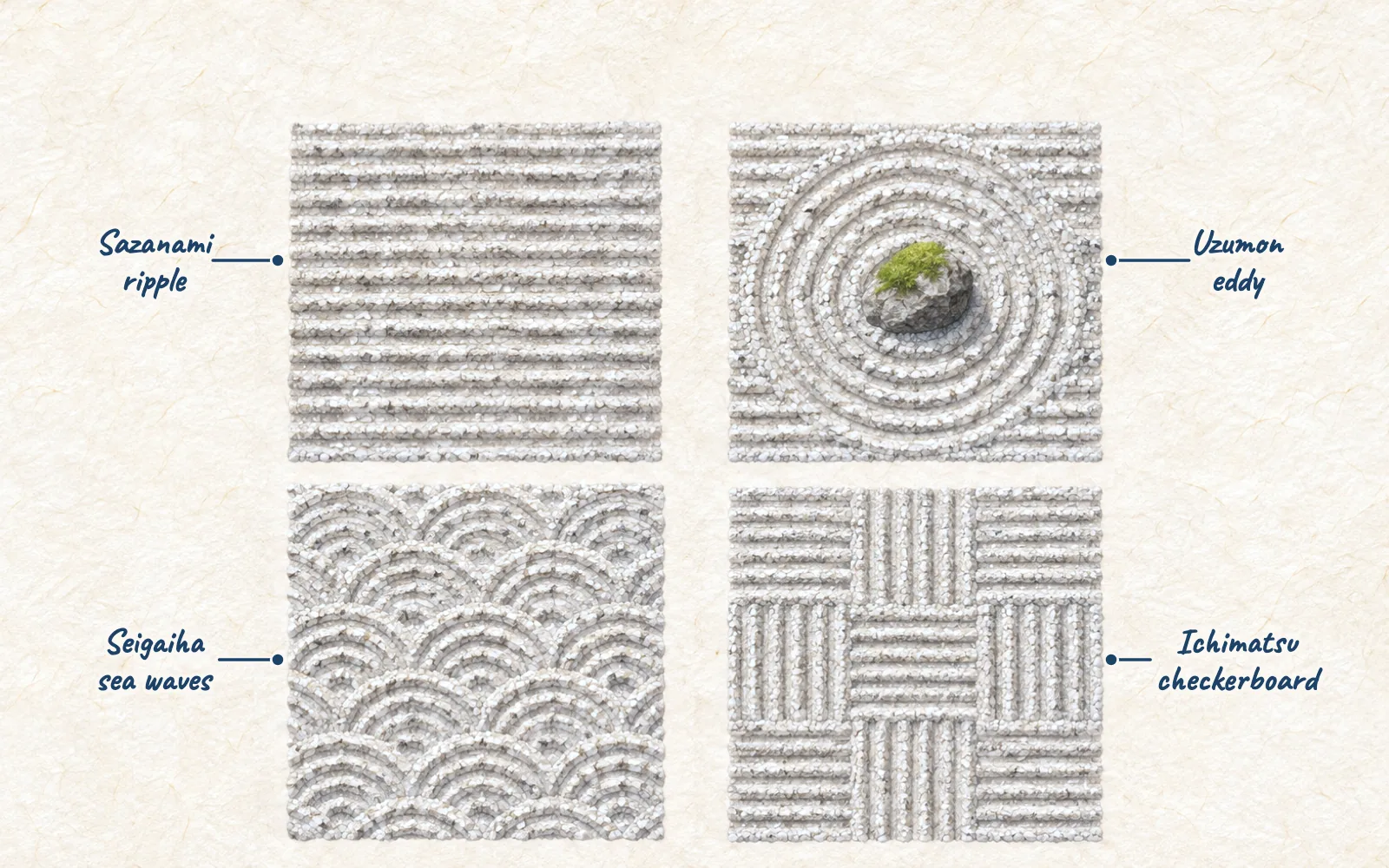
A master’s thesis at Tokyo Metropolitan University, which proposed sand-pattern art for moss balls, compiled the traditional pattern names from earlier literature into a table. The names and meanings below come from that compilation and from gardeners writing for the North American Japanese Garden Association (NAJGA). They are not a national standard: temples and gardeners use their own names, and the same pattern may be read differently in different gardens.
| Pattern | Japanese | What it is said to express | Source of the description |
|---|---|---|---|
| Sazanami (ripple) | 漣 | A calm water surface | Tokyo Metropolitan University thesis |
| Uzumon (eddy) | 渦紋 | Change on the water’s surface | Same |
| Uzumakimon (spiral) | 渦巻紋 | A simplified form of the eddy pattern | Same |
| Kanzemizu | 観世水 | Ripples combined with eddies: changes in flowing water | Same |
| Seigaihamon (blue sea waves) | 青海波紋 | Waves, drawn as tightly interlocking semicircles | NAJGA, “Pushing the Line” |
| Ichimatsu (checkerboard) | 市松模様 | Varies; see Portland below | Portland Japanese Garden |
The thesis treats uzumon and uzumakimon as separate patterns. They are often blurred together in English as “swirls”, but in this literature one is the eddy and the other its simplified form.
A pattern for the Moonviewing Festival
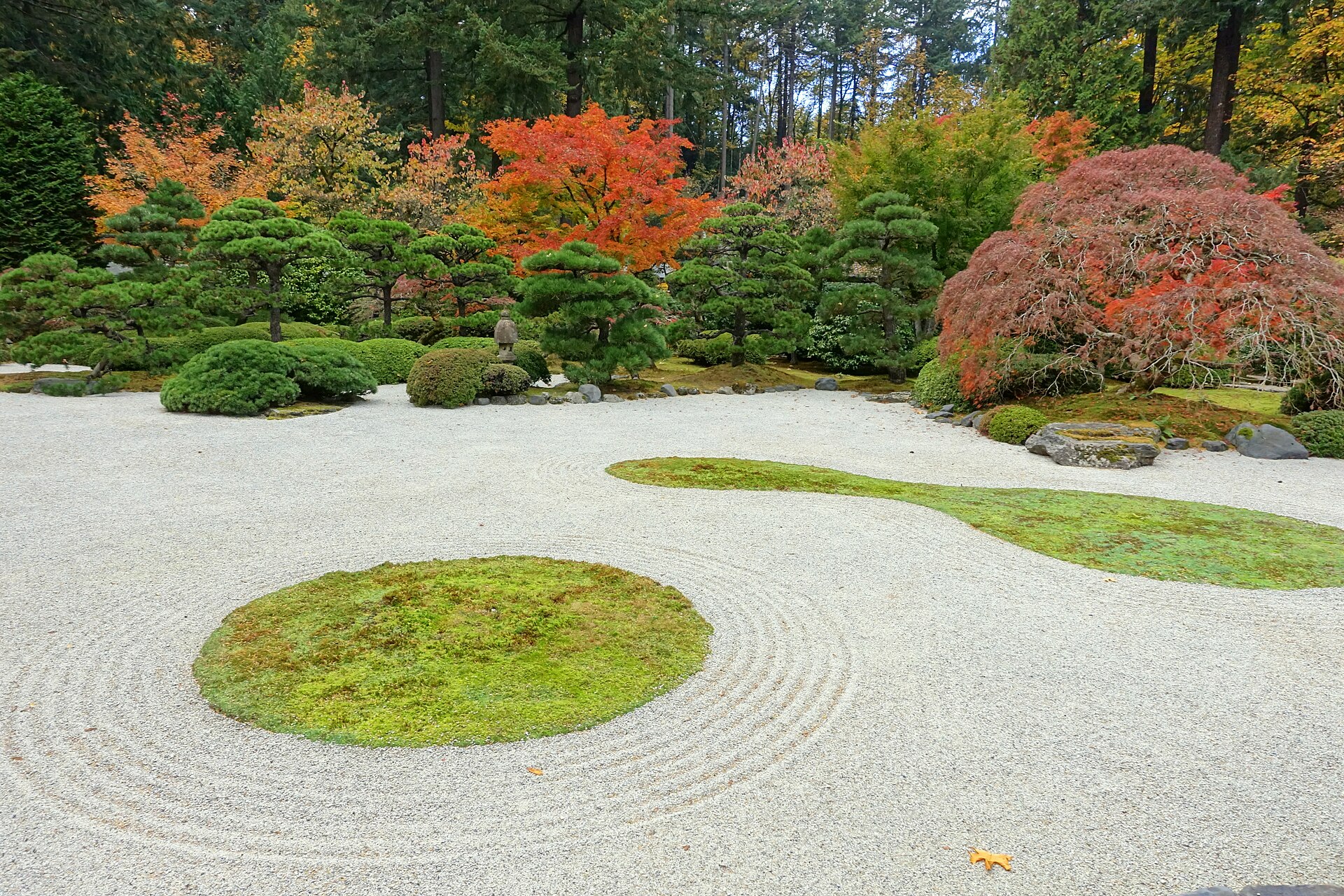
The checkerboard shows how a pattern can belong to an occasion rather than to a garden. Every year, Portland Japanese Garden’s gardeners rake a special ichimatsu checkerboard into the Flat Garden for the harvest moon and the Moonviewing Festival. The garden’s members’ newsletter offers a reading of it: under moonlight, the squares resemble rice fields at harvest time. That is Portland’s interpretation of Portland’s garden, and a good example of how meaning in raked gravel is local.
The rake and the work
The tool
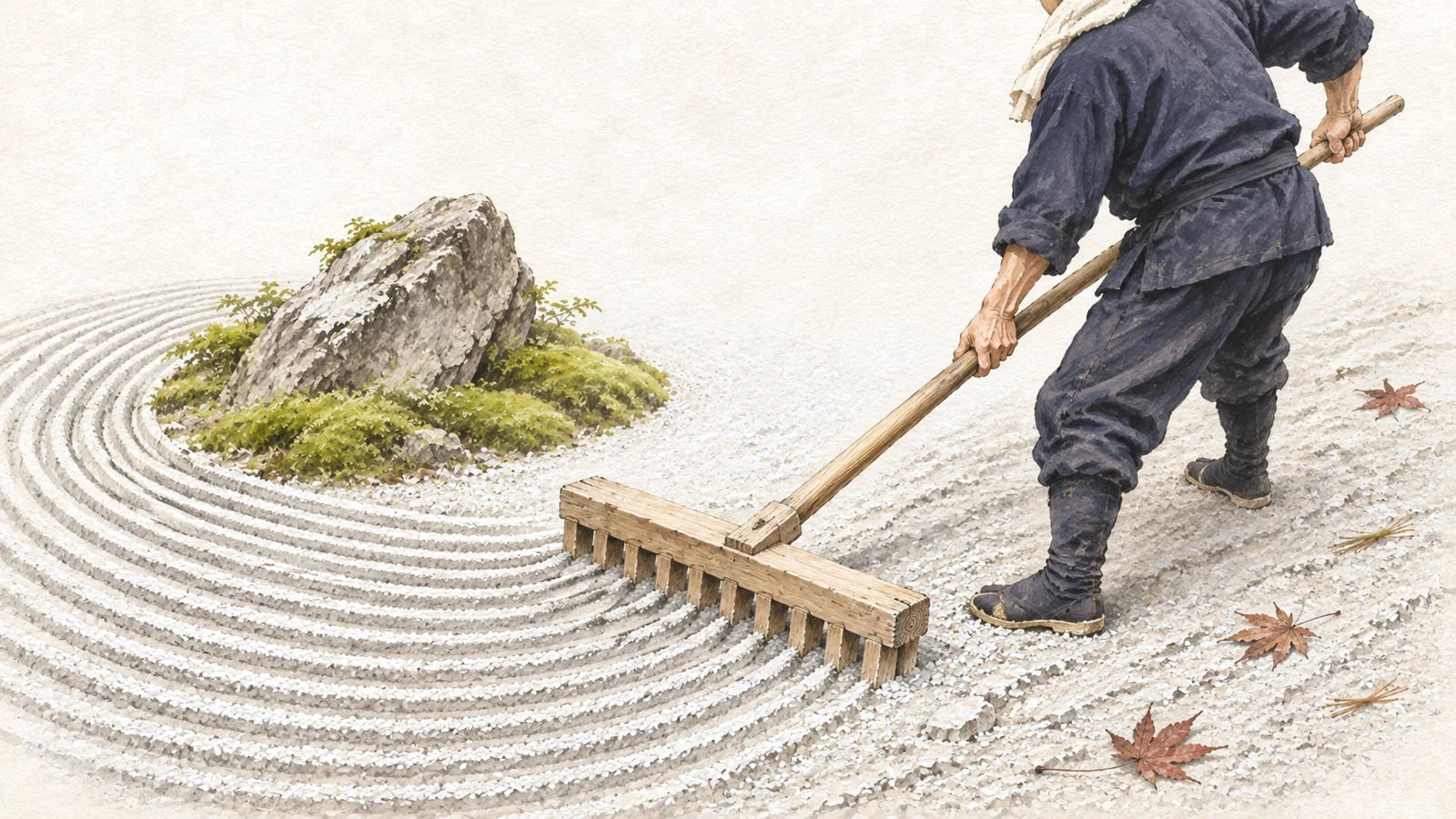
The 2015 survey of Kyoto temples records that the patterns are drawn with a kumade (熊手) or a rēki (レーキ, rake), with tines about 5 cm (2 inches) long.
Gardeners outside Japan have published exact measurements of their own tools. Martin McKellar, who looks after the karesansui garden at the Harn Museum of Art in the United States, describes a wooden rake 30 inches (76 cm) wide with 12 teeth, and records that Portland Japanese Garden’s wooden rake is about 28 inches (71 cm) wide.
Levelling and drawing
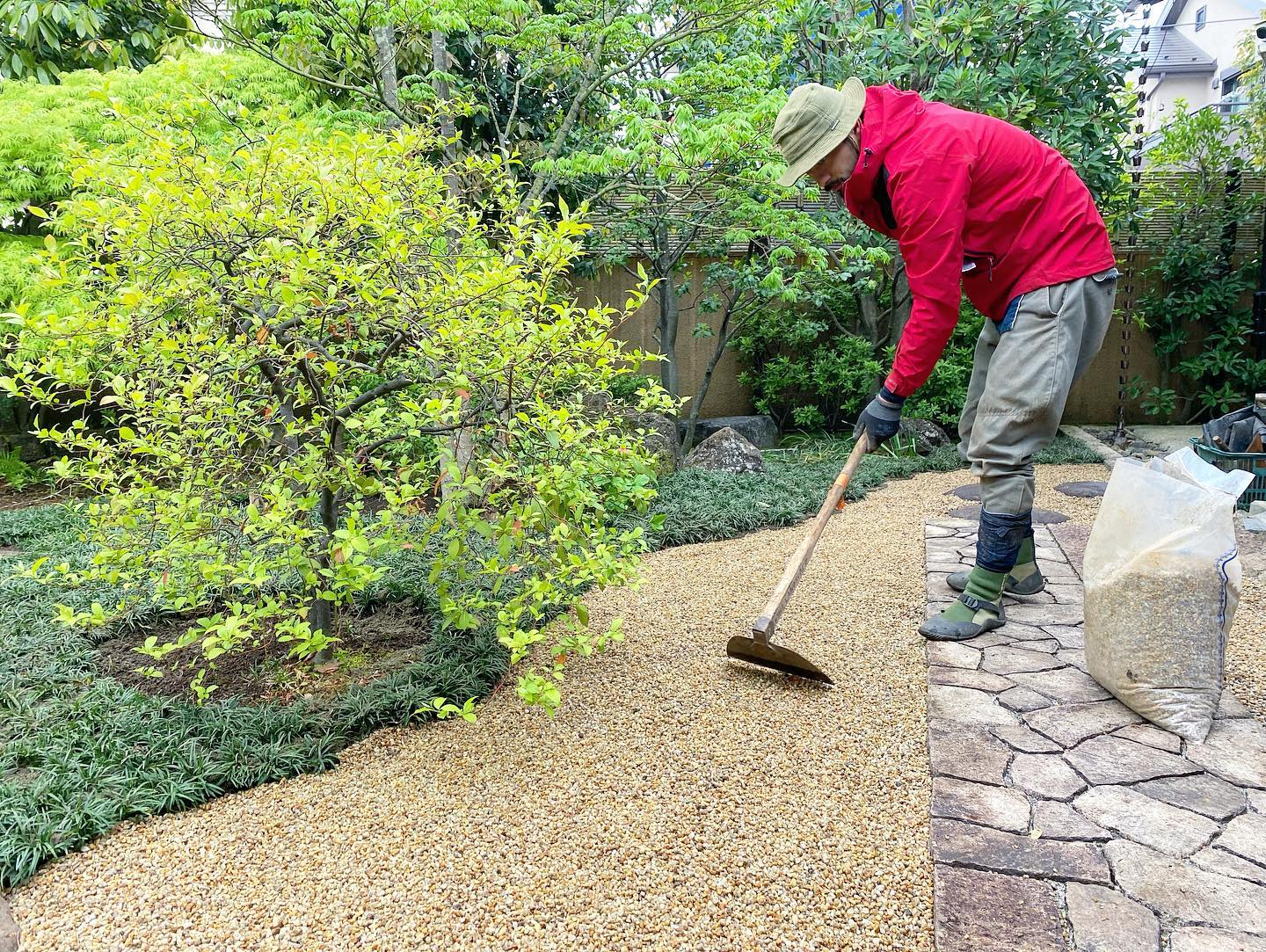
The same article separates two jobs. Levelling the gravel is done with an aluminium rake; the lines are drawn with the wooden rake. Keeping the two tools apart keeps the two tasks apart: one prepares the surface, the other makes the pattern.
Around the stones, and across the field
At the Harn, McKellar writes, the lines around the rock islands are raked every week, while the pattern across the whole garden is not necessarily redrawn every week. The record shows that redrawing need not be all or nothing: one part of the pattern can be renewed on its own schedule.
| Type of work | Tool | What it does | Source |
|---|---|---|---|
| Cleaning | — | Keeps the gravel clean even when lines are not redrawn | 2015 Kyoto survey (researchers’ proposal) |
| Levelling | Aluminium rake | Prepares the gravel surface | NAJGA, “Pulling the Rake” |
| Drawing the pattern | Wooden rake (71–76 cm in the examples) | Draws the lines | NAJGA, “Pulling the Rake” |
| Redrawing around stones | Wooden rake | Renews the lines around rock islands | NAJGA (weekly at the Harn) |
How often, really — what the numbers say
The Kyoto survey
The most useful number comes from the 2015 study of temples in Kyoto. Few temples reported daily care of their white-gravel gardens; two to three times a month was the most common answer. The care counted includes cleaning, so it does not mean a full redraw of every line two or three times a month.
Ginkaku-ji — sand that is rebuilt
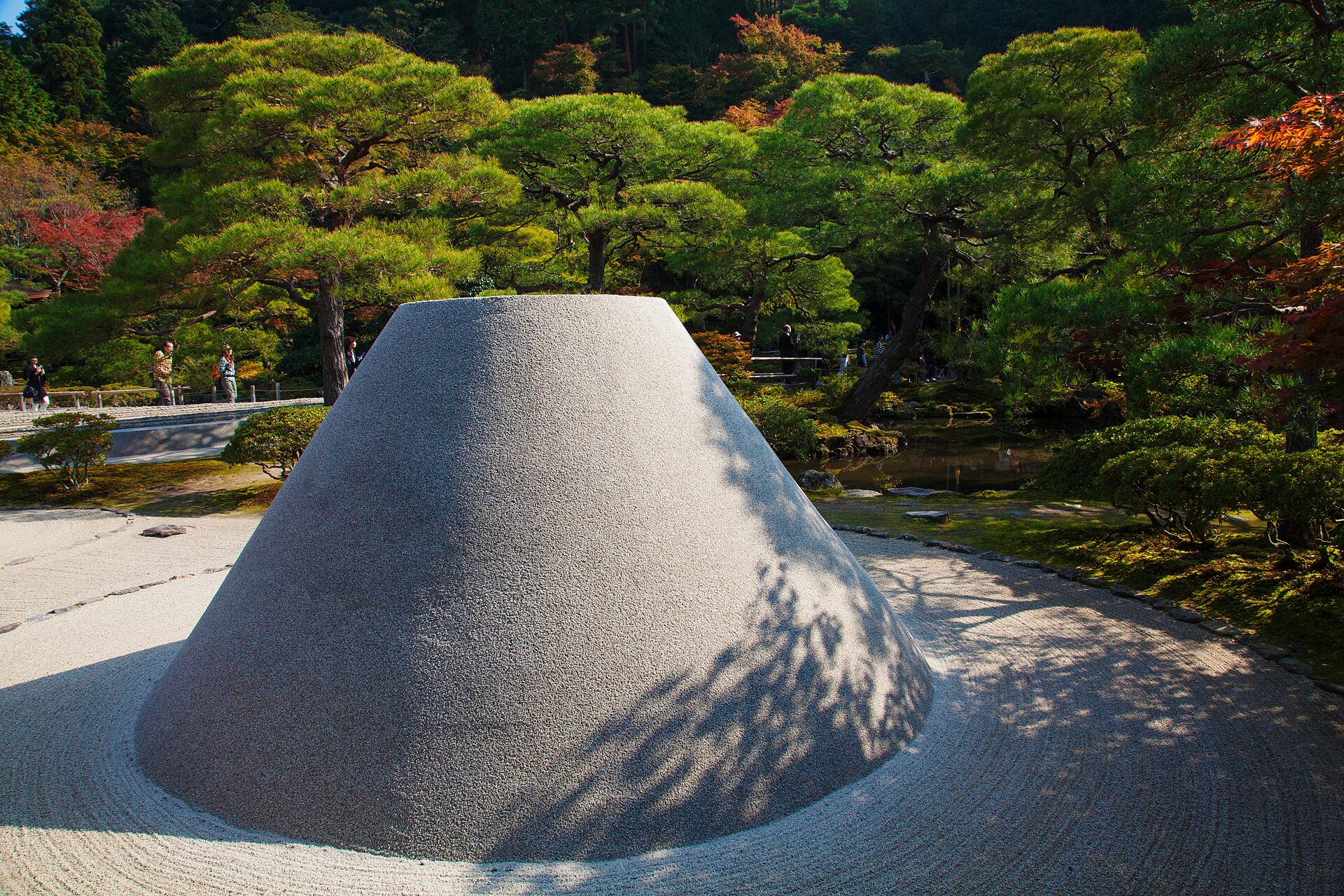
At Ginkaku-ji, the Silver Pavilion, maintenance includes rebuilding three-dimensional sand forms. The temple describes the Ginshadan (銀沙灘) as gravel heaped up in a stepped form and the Kōgetsudai (向月台) as a truncated cone of sand.
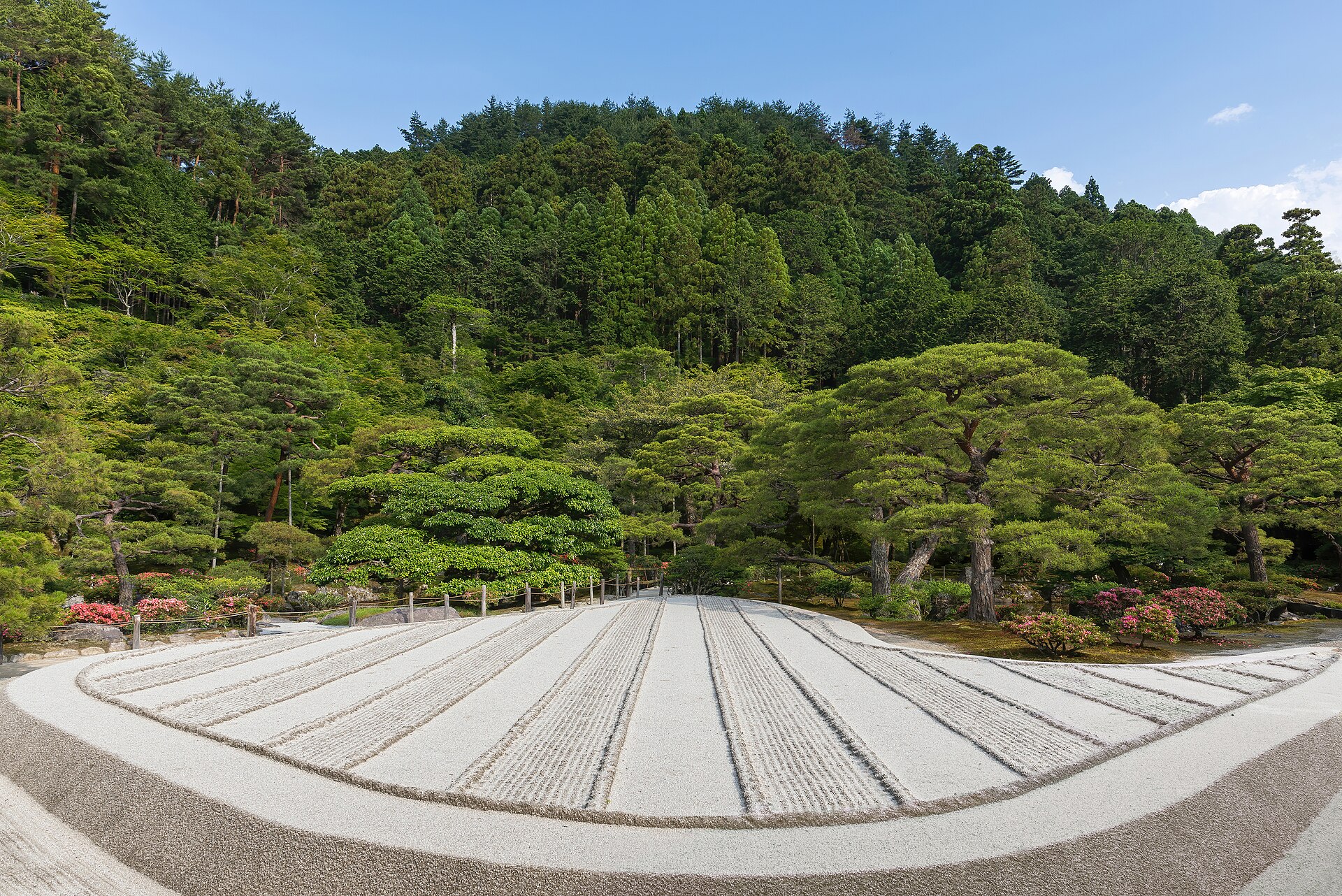
Two sources give two different figures. The Japan Tourism Agency’s multilingual description says the wave lines are retouched “once every four to six weeks”. An article in Enmyō (円明), the magazine of the Shōkoku-ji branch of Rinzai Zen, to which Ginkaku-ji belongs, describes the rebuilding of the Ginshadan as irregular, about ten times a year, with six to seven craftsmen working on the Ginshadan and four on the Kōgetsudai. Its timetable has the Ginshadan taking about three and a half hours in the morning and the Kōgetsudai about three hours in the afternoon. The sources do not explain how the two figures relate.
English guides often say that the Ginshadan reflects moonlight into the pavilion, or that the Kōgetsudai was built for viewing the moon. Ginkaku-ji’s own guide calls these explanations folk theories (俗説), and suggests that the sand forms may date from the early modern period or later.
Side by side
| Garden | What is redrawn | How often | Source |
|---|---|---|---|
| Kyoto temples (survey) | Care of white-gravel gardens, including cleaning | Daily care uncommon; 2–3 times a month most common | Japanese Institute of Landscape Architecture, 2015 |
| Ryōan-ji, Kyoto | Raked lines | Usually before opening; again whenever wind, rain or leaves break them | TV Tokyo |
| Ginkaku-ji, Kyoto | Wave lines of the Ginshadan | Retouched every 4–6 weeks | Japan Tourism Agency |
| Ginkaku-ji, Kyoto | Ginshadan rebuilt | Irregular, about 10 times a year | Enmyō no. 118 |
| Harn Museum, USA | Lines around rock islands | Weekly (whole pattern not necessarily) | NAJGA, “Pulling the Rake” |
| Portland Japanese Garden | Checkerboard in the Flat Garden | Every year, for the Moonviewing Festival | Portland Japanese Garden |
Read down the “How often” column and the single image of daily dawn raking gives way to something more varied: each garden has its own rhythm, set by its weather, its visitors, its gravel and its people.
Who holds the rake — monks, gardeners and samu
Work as practice
In Zen monasteries, physical work is called samu (作務). The Sōtō school’s official website describes samu as the labour of the training monastery and names the care of gardens and buildings, along with farm work, as part of it. It describes samu as a very important form of practice. The same site notes that trainee monks themselves share out jobs such as sweeping the gardens and cleaning the toilets.
Sweeping holds a similar place in the training of Japanese gardeners, a subject of its own in why a Japanese gardener’s first year is spent sweeping.
Not always a monk
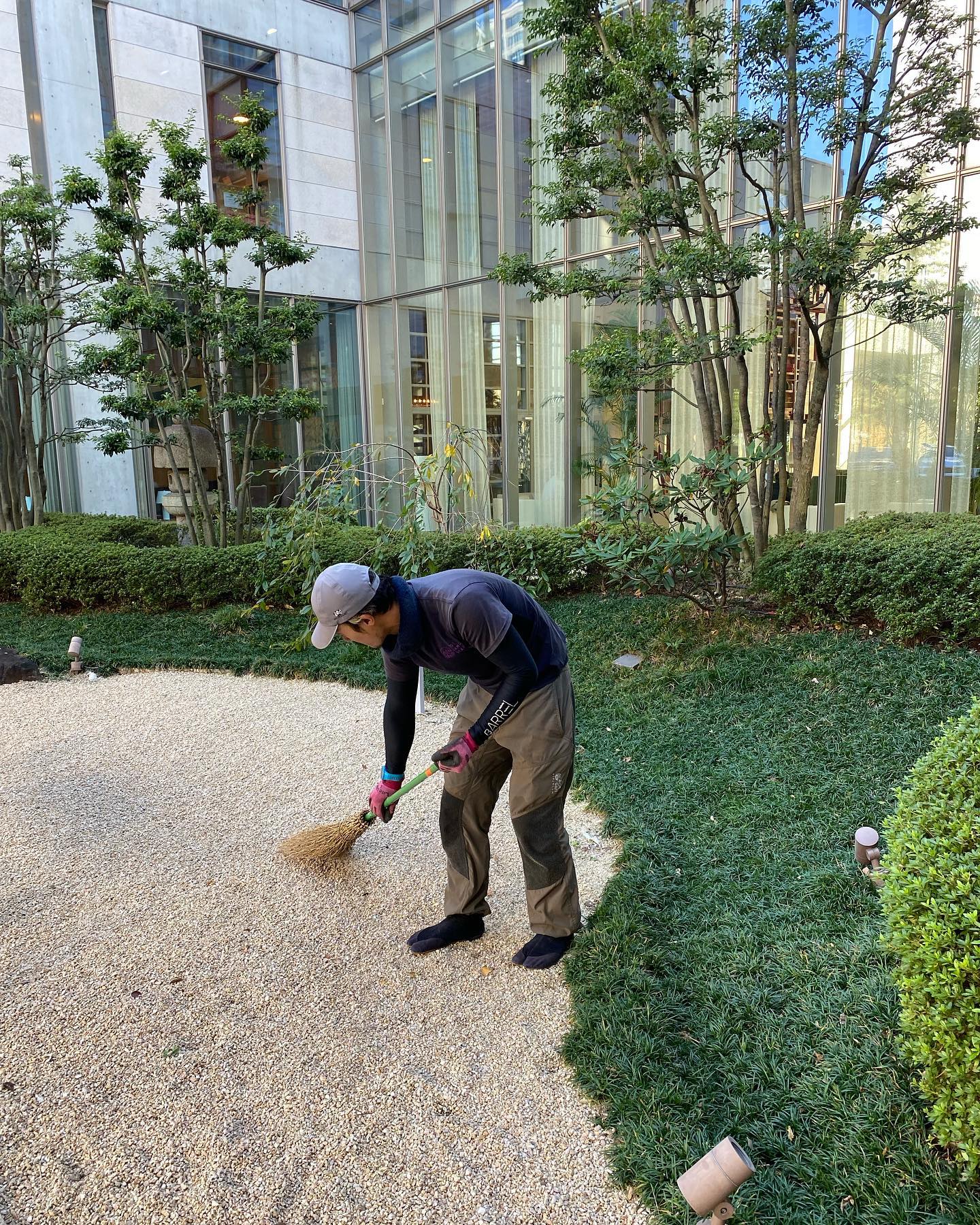
A garden in a temple is not always raked by a monk. The TV Tokyo report also visited Ryūsen-an, a sub-temple of Myōshin-ji, where the rock garden is managed by a landscaping company, and followed the raking there. At Ginkaku-ji, the Shōkoku-ji magazine describes teams of craftsmen rebuilding the sand. In Portland, the garden’s own photograph of the Sand and Stone Garden shows a guest gardener, Anne Hunter, raking while the garden’s gardener, Colin Kaferle, looks on.
So the answer to “who rakes the gravel?” depends on the garden: monks as part of samu, landscaping companies, teams of craftsmen, or a garden’s own staff. How any one temple divides the work is not documented in the sources checked here.
What a computer saw in the empty gravel
The Nature paper
In 2002 Gert J. Van Tonder, Michael J. Lyons and Yoshimichi Ejima published a short paper in Nature, “Visual structure of a Japanese Zen garden”. They analysed the empty space between Ryōan-ji’s stones using a mathematical method called the medial-axis transformation, which finds the “skeleton” of a shape.
The skeleton they found was a dichotomously branched tree, “critically aligned with the temple’s architecture” and with the main viewing position. They proposed that unconscious perception of this structure may contribute to the garden’s appeal. They did not claim to have discovered what the garden’s maker intended, and Nature later published a correction to the date in one figure caption, which the authors said did not affect their conclusions.
What it does and does not show
The paper is about stones and the empty space between them. It is not about how often gardens are raked, or about any benefit of raking, and it should not be cited for either. What it does show is that the open gravel at Ryōan-ji is not leftover space: in this analysis, the structure is found in the gravel between the stones.
Gravel in Western gardens — a different job
Beth Chatto’s Gravel Garden
Beth Chatto’s Gravel Garden in England makes a useful comparison. It began, in the garden’s own words, as “an experiment to test a range of drought-tolerant plants”. Its creation record states that in the spring of 1993 the beds were mulched with local 10 mm gravel to a depth of about 3–5 cm (1–2 inches), to help retain moisture in the soil.
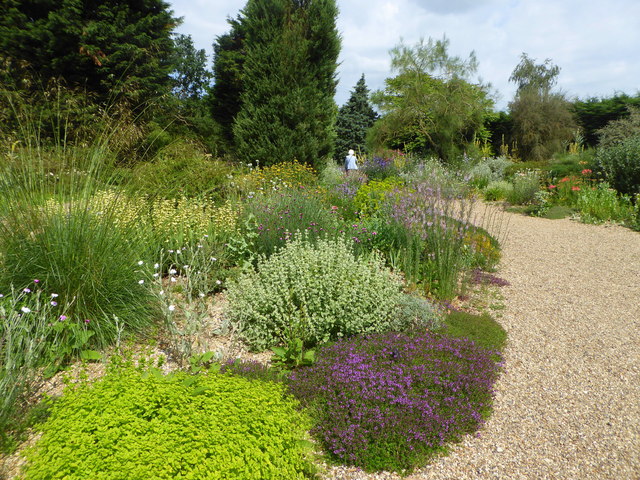
There, the gravel forms a mulch around the plants. At Daisen-in, the white gravel is itself the subject: it is the river and the sea.
| Beth Chatto’s Gravel Garden | Daisen-in | |
|---|---|---|
| What the gravel does | Mulch over planted beds | Represents water: river, then ocean |
| Particle size | 10 mm local gravel | Maximum particle size about 9 mm in many areas of the Kyoto survey (survey of Kyoto temples, not of Daisen-in alone) |
| Form | A 3–5 cm layer | Raked surface; two sand mounds on the south side of the hōjō |
| Why it is maintained | Moisture in the soil for drought-tolerant planting | Keeping the water legible in the design |
These two examples use gravel for different purposes. Neither is the better way; they answer different questions. Comparisons like this are about purpose rather than merit, the same approach taken in niwaki versus topiary.
Common misunderstandings about raked gravel
– “Every Zen garden is raked every morning.” The Kyoto survey found daily care uncommon. Ryōan-ji’s lines are usually drawn before opening and redrawn when broken, but no fixed daily schedule is documented. – “Karesansui gardens are for sitting meditation.” Portland Japanese Garden states that its karesansui is “not meant for meditation [zazen]”. The Sōtō school counts garden care itself as samu. – “The patterns have fixed, universal meanings.” The names in the table come from a compilation of literature and from individual gardeners. The temple’s own explanation should come first. – “More raking is better.” The 2015 researchers proposed the opposite for crushed Shirakawa stone: keep cleaning, but redraw only when the pattern has been disturbed. – “Ginkaku-ji’s sand cone was built to watch the moon.” The temple itself calls the moon explanations folk theories.
Frequently asked questions
Why are Zen gardens raked?
In many karesansui gardens the raked gravel represents water. At Daisen-in, for example, the temple explains it as a river and the ocean. Wind, rain and falling leaves break the lines, so gardens are raked again when the pattern is disturbed.
How often is a Zen garden raked?
It varies by garden. A 2015 survey of Kyoto temples found daily care uncommon and two to three times a month most common. At Ryōan-ji the lines are usually drawn before the gates open and redrawn when weather or leaves break them. For Ginkaku-ji, the Japan Tourism Agency says the wave lines are retouched every four to six weeks, while a Shōkoku-ji magazine describes rebuilding the Ginshadan about ten times a year.
What are the patterns in a Zen garden called?
The raked lines are called samon (砂紋) or hōkime (箒目). Named patterns include sazanami (ripples), uzumon (eddies), kanzemizu (ripples combined with eddies) and seigaihamon (interlocking semicircular waves). Names and meanings vary between gardens.
What is the gravel in Japanese rock gardens?
In Kyoto it is traditionally Shirakawa sand, formed from weathered Higashiyama granite washed down by streams such as the Shirakawa. Quarrying of Shirakawa stone was banned, and researchers have studied substitutes such as Kitagi stone. It is coarse: many areas in a Kyoto survey had a maximum particle size of about 9 mm.
Who rakes the gravel in a Zen garden?
It depends on the garden. In training monasteries, garden care is part of samu, work as Zen practice. Some temple gardens are maintained by landscaping companies, and Ginkaku-ji’s sand forms are rebuilt by teams of craftsmen.
What tool is used to rake a Zen garden?
Japanese sources use the terms kumade (熊手) and rēki (レーキ); a Kyoto survey records tines about 5 cm long. Gardeners abroad have recorded wooden rakes about 71–76 cm wide, one with 12 teeth, and use an aluminium rake to level the gravel.
Sources
– Nara National Research Institute for Cultural Properties, “Dry Landscape Garden” (checked 2026-11-17): https://www.nabunken.go.jp/org/bunka/jgd/pages/DryLandscapeGarden.html – Nara National Research Institute for Cultural Properties, “Garden at Daisen-in Shoin” (checked 2026-11-17): https://www.nabunken.go.jp/org/bunka/jgd/pages/GardenAtDaisenin_Shoin.html – Nara National Research Institute for Cultural Properties, blog on Kyoto’s granite and Shirakawa sand (Japanese; checked 2026-11-17): https://www.nabunken.go.jp/nabunkenblog/2015/07/20150701.html – Agency for Cultural Affairs, Cultural Heritage Online, Ryōan-ji (Japanese; checked 2026-11-17): https://online.bunka.go.jp/special_content/component/38 – Agency for Cultural Affairs, national designation database, Ryōan-ji Hōjō Teien (Japanese; checked 2026-11-17): https://kunishitei.bunka.go.jp/heritage/detail/401/1654 – Agency for Cultural Affairs, national designation database, Daisen-in Shoin Garden (Japanese; checked 2026-11-17): https://kunishitei.bunka.go.jp/heritage/detail/401/1652 – Agency for Cultural Affairs, national designation database, Daisen-in Garden (Japanese; checked 2026-11-17): https://kunishitei.bunka.go.jp/heritage/detail/401/1710 – UNESCO World Heritage Centre, Historic Monuments of Ancient Kyoto (checked 2026-11-17): https://whc.unesco.org/en/list/688 – Kyoto Prefecture Tourism Federation, Ryōan-ji (Japanese; checked 2026-11-17): https://www.kyoto-kankou.or.jp/info_search/3455 – Kyoto City Tourism Association, Ryōan-ji (Japanese; checked 2026-11-17): https://ja.kyoto.travel/tourism/single02.php?category_id=9&tourism_id=2259 – TV Tokyo, report on raking the rock gardens at Ryōan-ji and Ryūsen-an (Japanese; checked 2026-11-17): https://www.tv-tokyo.co.jp/plus/lifestyle/entry/202604/19090.html – Daisen-in, official site, highlights (Japanese; checked 2026-11-17): https://daisen-in.net/about-daisenin/highlights/ – Agency for Cultural Affairs, Cultural Heritage Online, Daisen-in Shoin Garden (Japanese; checked 2026-11-17): https://online.bunka.go.jp/db/heritages/detail/172405 – Kyoto City Greenery Association, Daisen-in (Japanese; checked 2026-11-17): https://www.kyoto-ga.jp/greenery/kyononiwa/2010/05/post_2.html – Shōkoku-ji, Ginkaku-ji precinct guide (Japanese; checked 2026-11-17): https://www.shokoku-ji.jp/ginkakuji/guide/ – Shōkoku-ji, Enmyō (円明) no. 118, pp. 24–25 (Japanese; checked 2026-11-17): https://www.shokoku-ji.jp/wp-content/themes/shokokuji/assets/img/reference/book/pdf/enmyo_118.pdf – Japan Tourism Agency, multilingual description of the Ginshadan and Kōgetsudai (checked 2026-11-17): https://www.mlit.go.jp/tagengo-db/R1-00461.html – Tōfuku-ji, official site, Honbō gardens (Japanese; checked 2026-11-17): https://renewal.tofukuji.jp/guide/honbo/ – Japanese Institute of Landscape Architecture, study of the use and maintenance of Shirakawa sand at Kyoto temples, 2015 (Japanese; checked 2026-11-17): https://www.jila-zouen.org/wpdata/wp-content/uploads/2015/04/497.pdf – Japanese Institute of Landscape Architecture, study of gardens using Shirakawa sand (checked 2026-11-17): https://www.jstage.jst.go.jp/article/jila/80/5/80_437/_article/-char/ja/ – Japanese Institute of Landscape Architecture, colour study of Shirakawa stone and similar granites (checked 2026-11-17): https://www.jstage.jst.go.jp/article/jila/81/5/81_467/_article/-char/ja/ – Katsuzō Hirayama, study of hōkime (『箒目』の研究), Japanese Institute of Landscape Architecture journal (Japanese; bibliographic record checked 2026-11-17): https://www.jstage.jst.go.jp/article/jila1925/1/1/1_1_32/_article/-char/ja – Tokyo Metropolitan University, master’s thesis on sand-pattern art, Table 2 (Japanese; checked 2026-11-17): https://tokyo-metro-u.repo.nii.ac.jp/record/2000318/files/T03264-001.pdf – Sōtō Zen, “Taking on a role” — samu (Japanese; checked 2026-11-17): https://www.sotozen-net.or.jp/zen/duties – Sōtō Zen, “Zen and work” (Japanese; checked 2026-11-17): https://www.sotozen-net.or.jp/zen/work – Van Tonder, Lyons and Ejima, “Visual structure of a Japanese Zen garden”, Nature 419, 2002 (checked 2026-11-17): https://www.nature.com/articles/419359a – Nature, correction to “Visual structure of a Japanese Zen garden” (checked 2026-11-17): https://www.nature.com/articles/421230b – North American Japanese Garden Association, “Pulling the Rake” (checked 2026-11-17): https://najga.org/pulling-the-rake-a-practical-guide-to-raking-karesansui-garden/ – North American Japanese Garden Association, “Pushing the Line” (checked 2026-11-17): https://najga.org/pushing-the-line-a-theoretical-approach-to-raking-a-karesansui-garden/ – Portland Japanese Garden, Sand and Stone Garden (checked 2026-11-17): https://japanesegarden.org/garden-spaces/sand-stone-garden/ – Portland Japanese Garden, “Once-a-Year Flat Garden Scenery” (checked 2026-11-17): https://japanesegarden.org/2022/07/26/once-a-year-flat-garden-scenery/ – Portland Japanese Garden, The Garden Path newsletter (checked 2026-11-17): https://japanesegarden.org/wp-content/uploads/2017/08/BP41224-_PJG_GARDENPATH.pdf – Portland Japanese Garden, Anne Hunter (checked 2026-11-17): https://japanesegarden.org/2025/10/03/anne-hunter/ – Beth Chatto Gardens, Gravel Garden (checked 2026-11-17): https://www.bethchatto.co.uk/garden-nursery/gallery/gravel-garden.htm – Beth Chatto Gardens, Gravel Garden creation and maintenance (checked 2026-11-17): https://www.bethchatto.co.uk/discover/our-blog/guides/gravel-garden-creation-and-maintenance.htm