

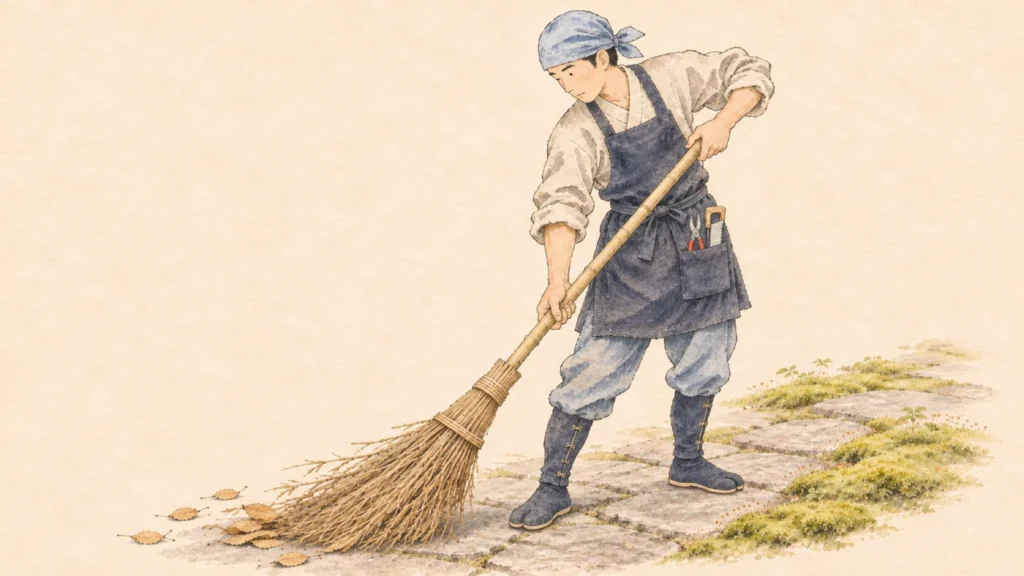
Japanese gardener apprentices start with a broom because the trade’s own descriptions put cleaning first: Japan’s national federation of garden contractors says newcomers begin with cleaning and weeding, then move to hedge trimming. Cleaning is treated as part of finishing a garden, not a chore that comes after it. And in moss and gravel gardens, the broom is a tool that needs real control — a careless stroke damages the very surface it is meant to finish.
What follows traces that first job through moss, gravel, tools and temple practice, checks the “first year of sweeping” story, and sets Japan’s way of training beside the written apprenticeship standards of England, Germany and the US.

The first job — what the trade itself says
Picture the edge of a Japanese garden at the end of a working day. The pruning is done and the ladders are folded, but someone is still on the path with a broom, working leaves out of the gaps between stepping stones. Clippings are lifted out of the moss by hand. Only when the ground is clean does the crew call the job finished. That quiet closing work is where, by the trade’s own account, Japanese gardeners begin.
Cleaning and weeding, then hedges
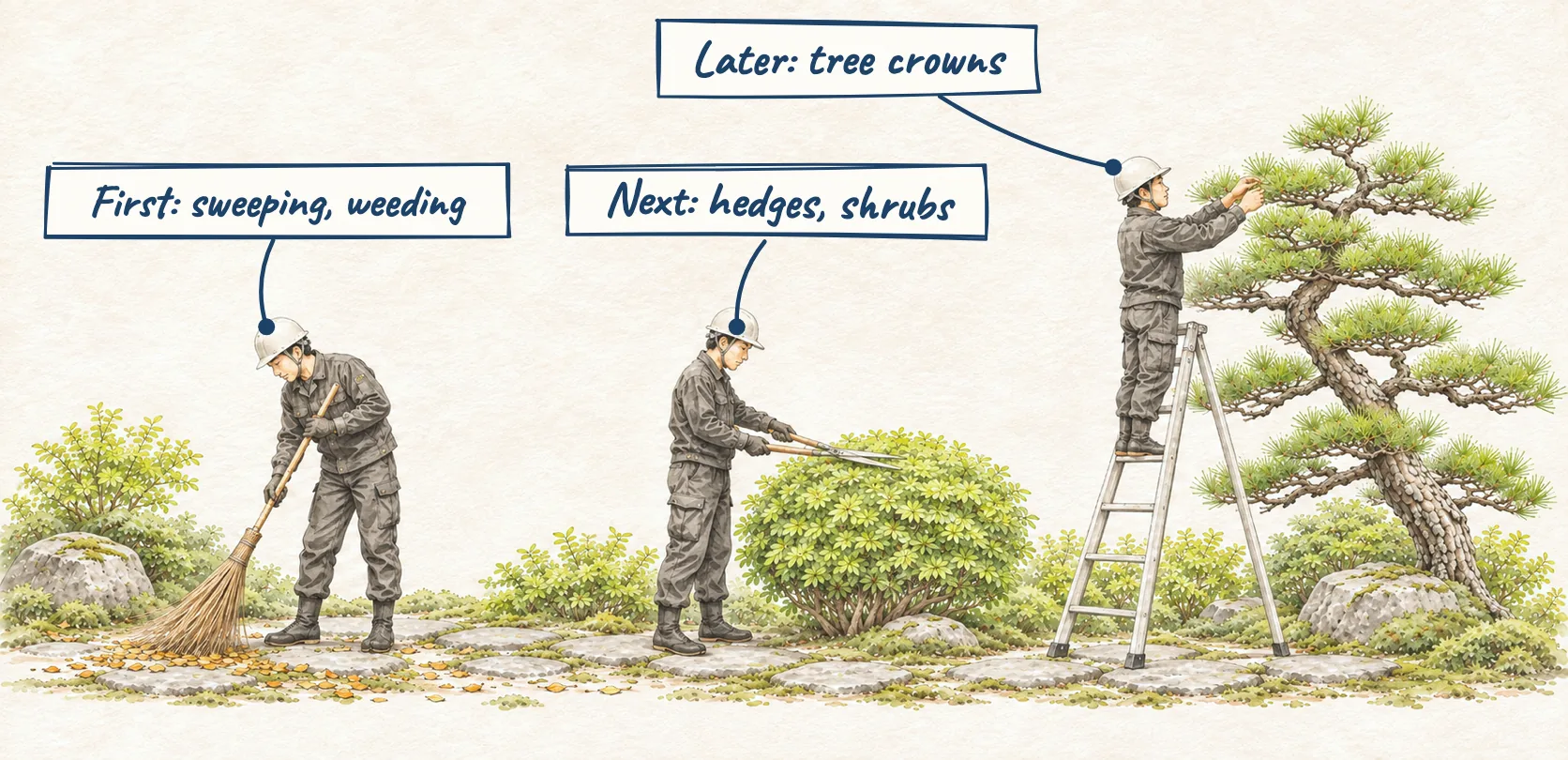
The clearest statement comes from the Japan Federation of Landscape Contractors (日本造園組合連合会, JFLC), the national body of garden contractors’ associations. On its page about hedge trimming, the federation describes newcomers’ first tasks: “What we have newcomers do is, first of all, cleaning and weeding. Once they graduate from that, next is hedge trimming.” (JFLC; our translation)
One Kyoto firm describes a slightly different mix. Ueko Konishi Zoen tells applicants that the first work it entrusts to them begins with trimming roadside trees and cleaning up fallen leaves (Ueko Konishi Zoen). The same page presents this as a way to touch plants directly and build a feel for gardens through each plant’s character and colour.
The door into the trade is open. Japan’s government job information site, job tag, says no particular schooling or licence is required to become a landscape gardener (造園工, zōenkō), and that people acquire knowledge and skills after joining, through site work and skills courses (MHLW job tag).
Is the first year really all sweeping?
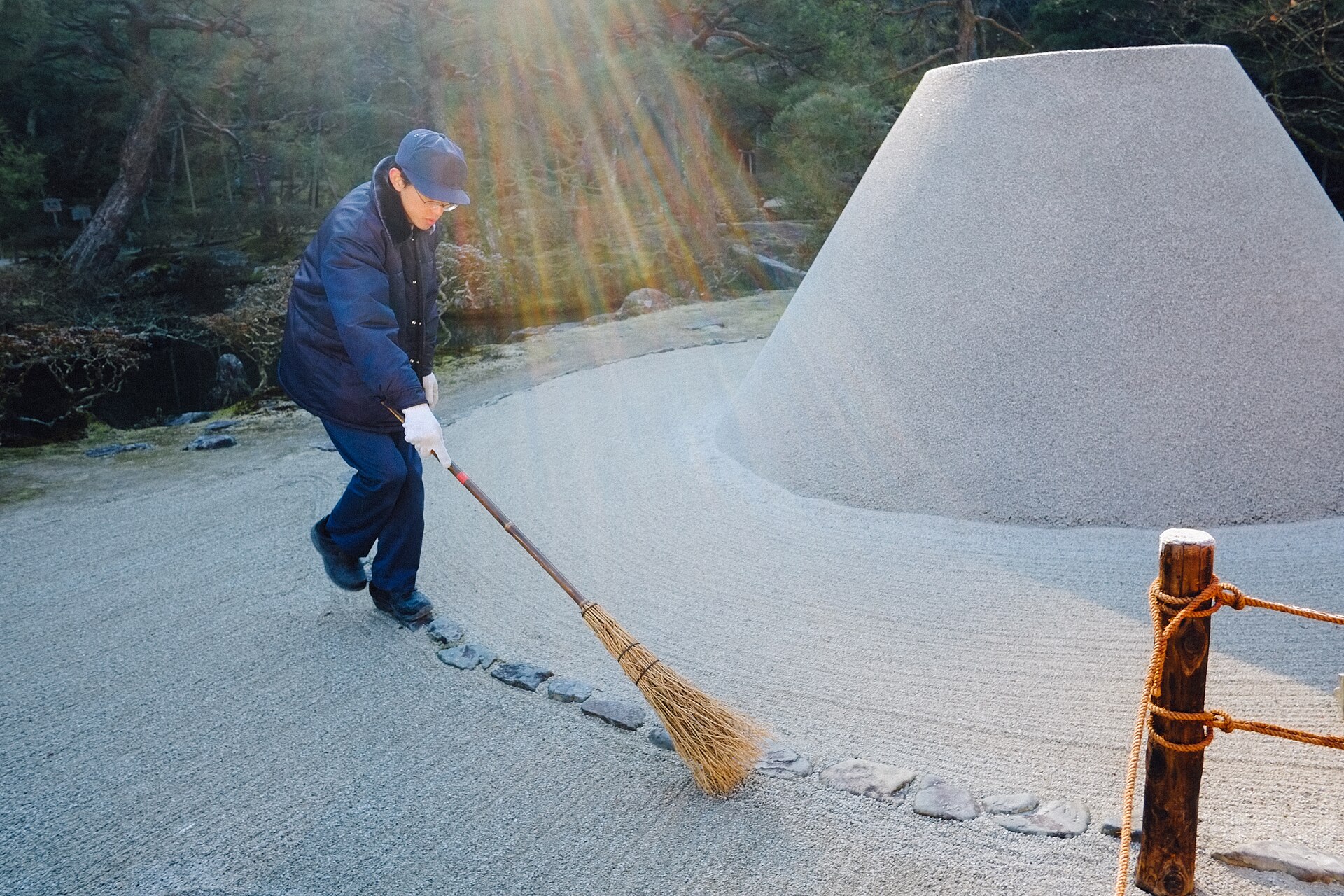
You may have read that a Japanese apprentice gardener spends a full year — or even three — doing nothing but sweeping. We looked for that claim in Japanese industry, government and research sources. None of the sources we reviewed sets a sweeping-only period for gardeners as a general rule. What they do describe is an order of early work — cleaning and weeding, then hedges — without saying how long each stage lasts.
| Source | What it says about entry and early work | What it does not say |
|---|---|---|
| JFLC (national federation) | Cleaning and weeding first, then hedge trimming | How long each stage lasts |
| Ueko Konishi Zoen (Kyoto firm) | First tasks: roadside-tree trimming, fallen-leaf cleaning | A sweeping-only period |
| MHLW job tag | No set qualification; skills learned on site and in courses | Any required order of tasks |
Why start on the ground? A likely explanation
The sources say what newcomers do first, not why. One plausible reading is about consequences. A path can be swept again; a hedge cut too hard cannot be uncut. Ground work lets a beginner contribute real work while staying close to the crew. But cleaning is not risk-free either: as the moss section shows, a heavy hand with the wrong broom does its own damage. (For the hedge stage that follows, see our guide to karikomi, Japan’s clipped shrub masses.)
Cleaning is the last step of the garden — not a chore after it
“Begins with cleaning, ends with cleaning”
The idea that cleaning finishes a garden appears in the government’s own description of the job. Job tag lists ground levelling and cleaning as the finishing work that completes the making of a garden (MHLW job tag). Cleaning sits beside levelling — part of building the garden, not tidying up after it.
The JFLC puts it more briefly in a leaflet for a bamboo-fence and hand-broom workshop: “A gardener’s work is said to begin with cleaning and end with cleaning.” (JFLC leaflet; our translation) The saying describes the whole job, not only the apprentice’s part of it.
What finished looks like
A finished garden in this sense is easy to describe. Clippings are out of the shrubs and off the stepping stones. Paths are swept. Debris has been picked out of the moss, and the ground is level. If any of that is missing, the job tag description suggests the garden-making is not yet complete.
| Finishing task | What it involves | Source of the idea |
|---|---|---|
| Levelling the ground | Smoothing soil, gravel or sand after work | MHLW job tag |
| Cleaning | Removing clippings, leaves, debris | MHLW job tag; JFLC saying |
| Moss cleaning | Lifting leaves off moss without damaging it | Murin-an; Saihō-ji |
| Gravel | Re-drawing raked lines where needed | Kyoto temple study |
Cleaning as a trained skill
Government training material treats cleaning as something to teach. A model curriculum for landscape construction training, published in 2009 by Japan’s Polytechnic University, includes the “5S” workplace practices — seiri, seiton, seisō, seiketsu, shitsuke (sort, set in order, clean, standardise, sustain) — as basic instruction (JEED model curriculum). The Tokyo Metropolitan Engei (Horticulture) High School includes “levelling and cleaning” in its preparation for the Grade 3 landscape skills test, practising in the same order as the actual exam (Engei High School).
The broom needs real control — sweeping moss
Removing leaves from a path is simple. Removing them from moss without harming it is not, because the broom touches a living surface.
Why leaves have to come off the moss
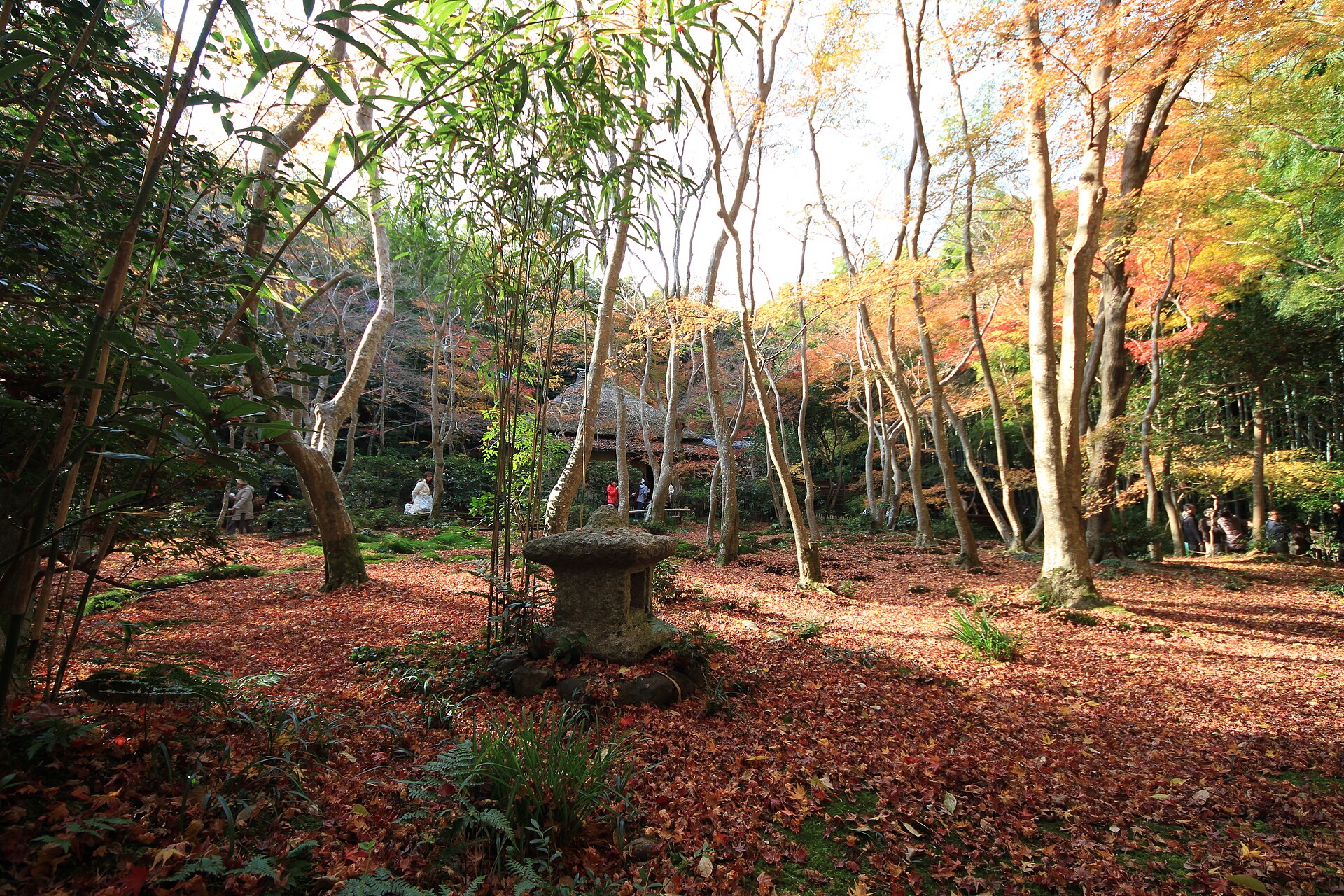
Murin-an, a garden in Kyoto, explains the reason on its official site: where dead leaves block the sun, that part of the moss dies (Murin-an). Saihō-ji, a Kyoto temple famous for its moss, gives a second reason in its English journal: under fallen leaves, the moss cannot gain enough sunlight and night dew (Saihoji).
Three brooms, three stiffnesses
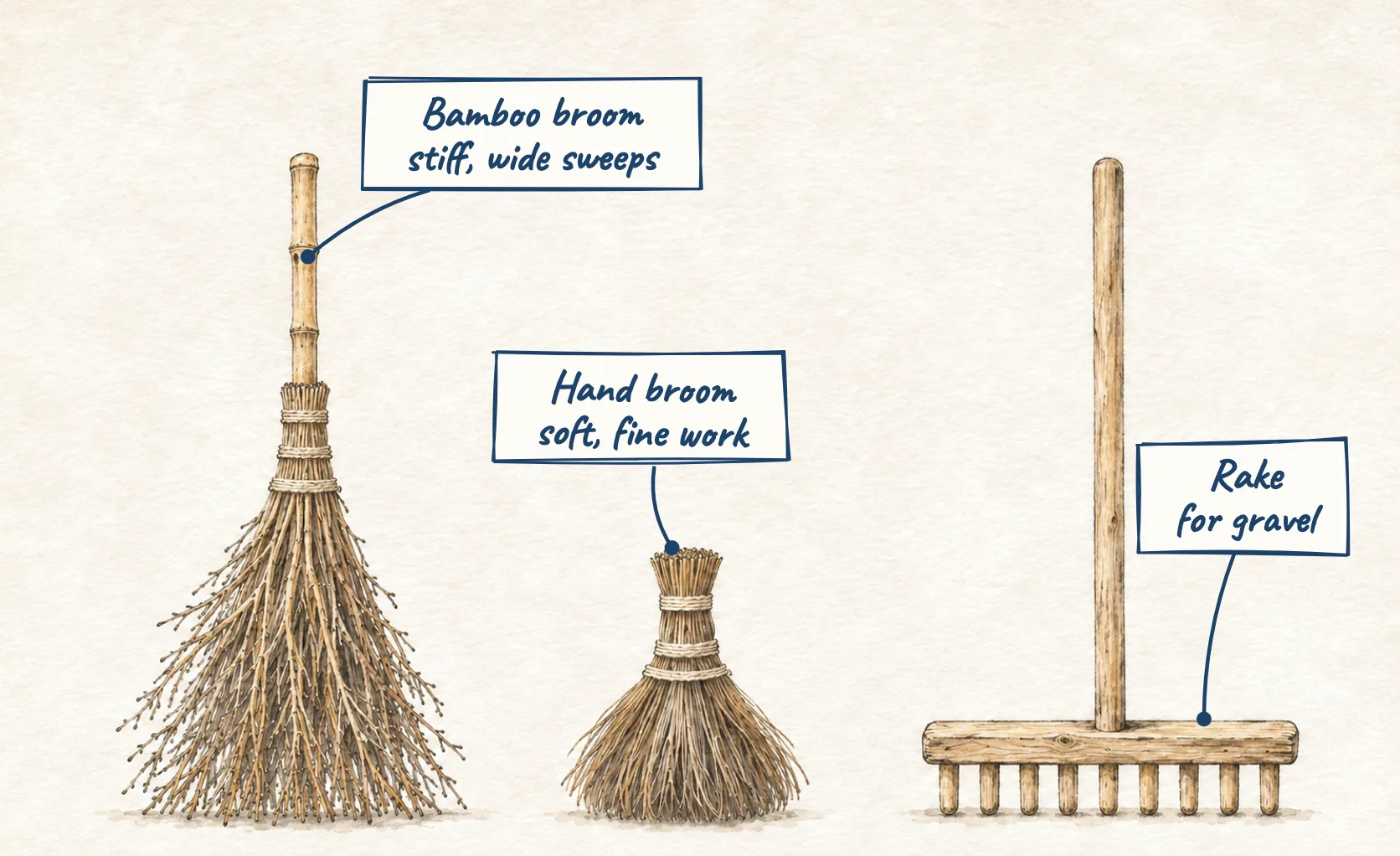
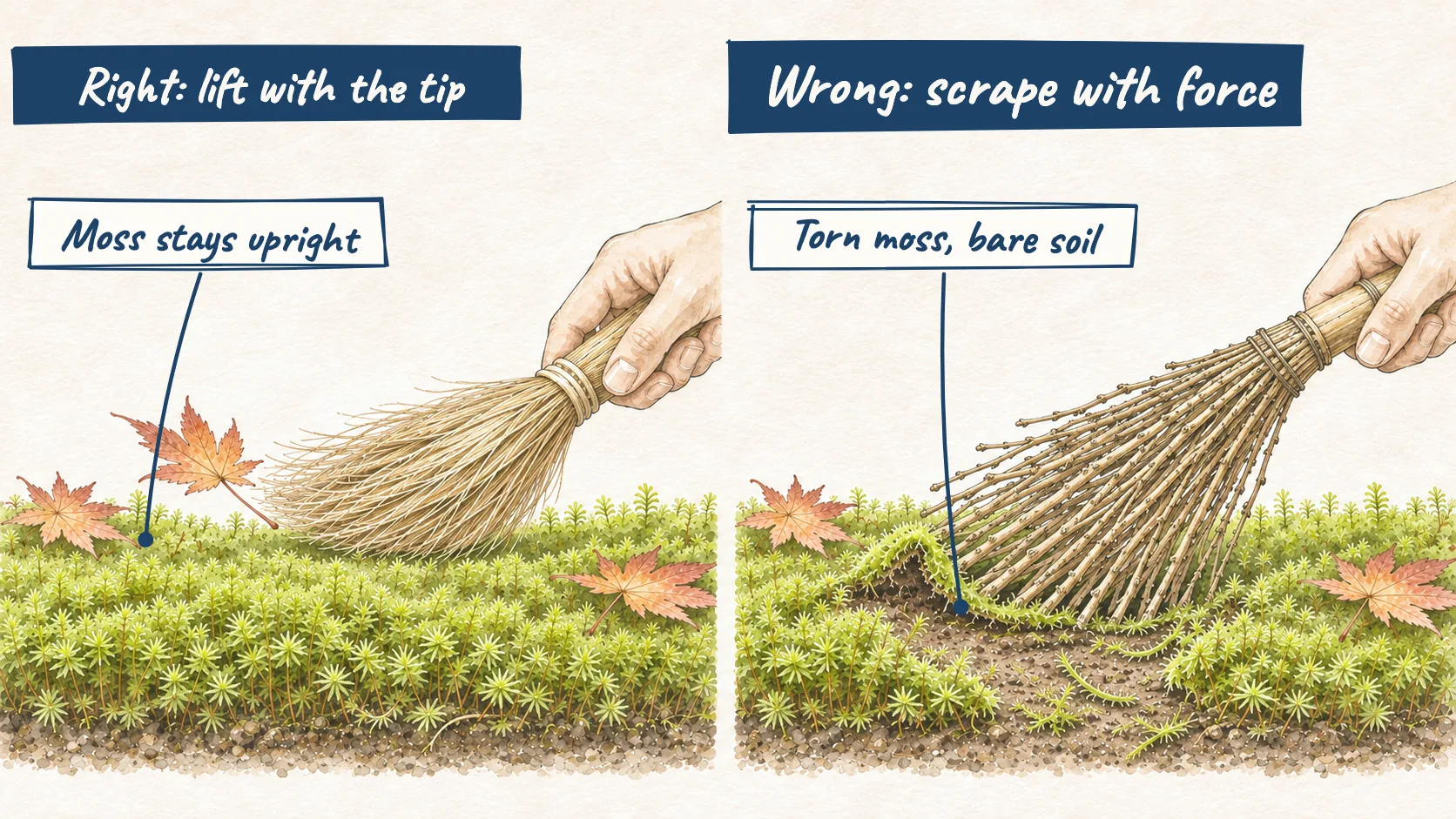
Saihō-ji’s garden department says it mainly uses three kinds of bamboo broom (竹箒, take-bōki) of different stiffness, and changes how it sweeps as well (Saihoji, Japanese). Murin-an’s gardeners describe their technique with a hand broom (手帚, te-bōki): they always use the tip, brushing gently and lifting the surface so as not to damage the moss (Murin-an).
The mistake to avoid is force. Saihō-ji’s gardeners warn that sweeping too hard with a stiff broom can damage newly growing moss (Saihoji). One of them, Koji Miyazaki, recalls that when he first joined the temple, the chief priest corrected him because he was being too rough with the broom (Saihoji). That is the beginner’s lesson in a sentence: the broom has to move the leaf, not the moss.
Knowing when not to sweep
The harder skill is judgement. Saihō-ji does not sweep every surface in every season:
– Where moss is still establishing itself, its gardeners avoid over-sweeping and leave some fallen leaves in place (Saihoji). – In winter, they basically stop cleaning the garden, leaving the leaves down so the moss can rest until spring (Kyoto Prefecture). The English journal adds that the break also reduces the stress of people stepping on the moss (Saihoji). – On rainy days they hold back from sweeping and turn to tool care and broom making instead (Kyoto Prefecture), or to weeding (Saihoji).
| Condition | What the garden does | Reason given |
|---|---|---|
| Leaves on moss (Murin-an) | Brush gently with the hand-broom tip, lifting upward | Leaves block sunlight; the moss dies |
| Leaves on moss (Saihō-ji) | Choose among three bamboo brooms; adjust the stroke | Leaves block sunlight, night dew |
| Young moss (Saihō-ji) | Avoid over-sweeping; leave some leaves | A stiff broom swept hard can damage it |
| Winter (Saihō-ji) | Largely stop sweeping moss | Let the moss rest; less trampling |
| Rain (Saihō-ji) | No broom work; tool care, broom making, weeding | Not stated in the sources |
Murin-an’s English newsletter describes one hour of garden cleaning every day as part of its routine (Murin-an, Sarasara 2025). An hour a day, every day, is a lot of time spent close to the ground — which leads to a less obvious side of sweeping.
Gravel and raked sand — who holds the rake
The rake and its teeth
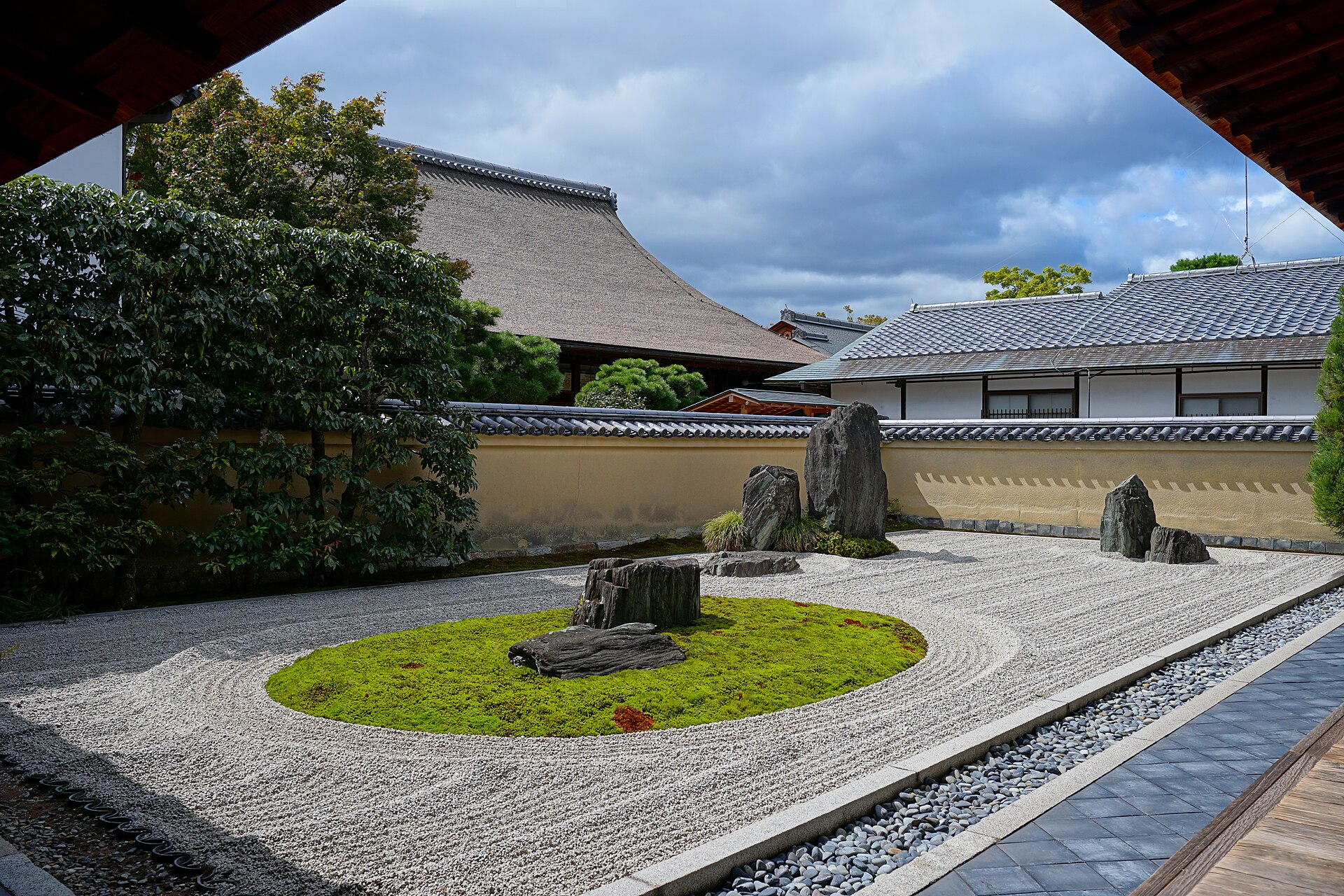
Dry gardens of white gravel need a different tool. A study of white Shirakawa sand in Kyoto temples, published by the Japanese Institute of Landscape Architecture, describes sand patterns (砂紋, samon) being drawn with rakes whose teeth are around 5 cm (2 in) long (Zhang et al.).
Not every morning, not always the gardener
Two details from the research correct common assumptions. First, frequency: in the same study, which surveyed maintenance at 71 gravel areas in 41 temples, few areas were maintained every day, and many were maintained two or three times a month (Zhang et al.). Second, who does it: at Zuihō-in, another sub-temple of Daitoku-ji, a 2018 report says the deep sand patterns of the abbot’s garden are drawn by the former and current head priests (Seibundo Shinkosha).
So raked gravel is not automatically an apprentice’s job, nor a daily one everywhere. What it shares with moss sweeping is the principle: the tool touches the finished surface of the garden, and a careless stroke shows.
What sweeping teaches — learning at the edge of the work
Seeing the garden change
The Kyoto Prefecture booklet on moss, drawing on Saihō-ji, makes a point that goes beyond moss. It notes that cleaning the grounds with a leaf blower makes small changes in the garden harder to notice (Kyoto Prefecture). The implication is that hand sweeping keeps the gardener looking. A beginner who sweeps regularly may start to notice which trees shed when, where moss is thinning and which corners collect debris — the kind of knowledge that later shapes decisions about the trees themselves.
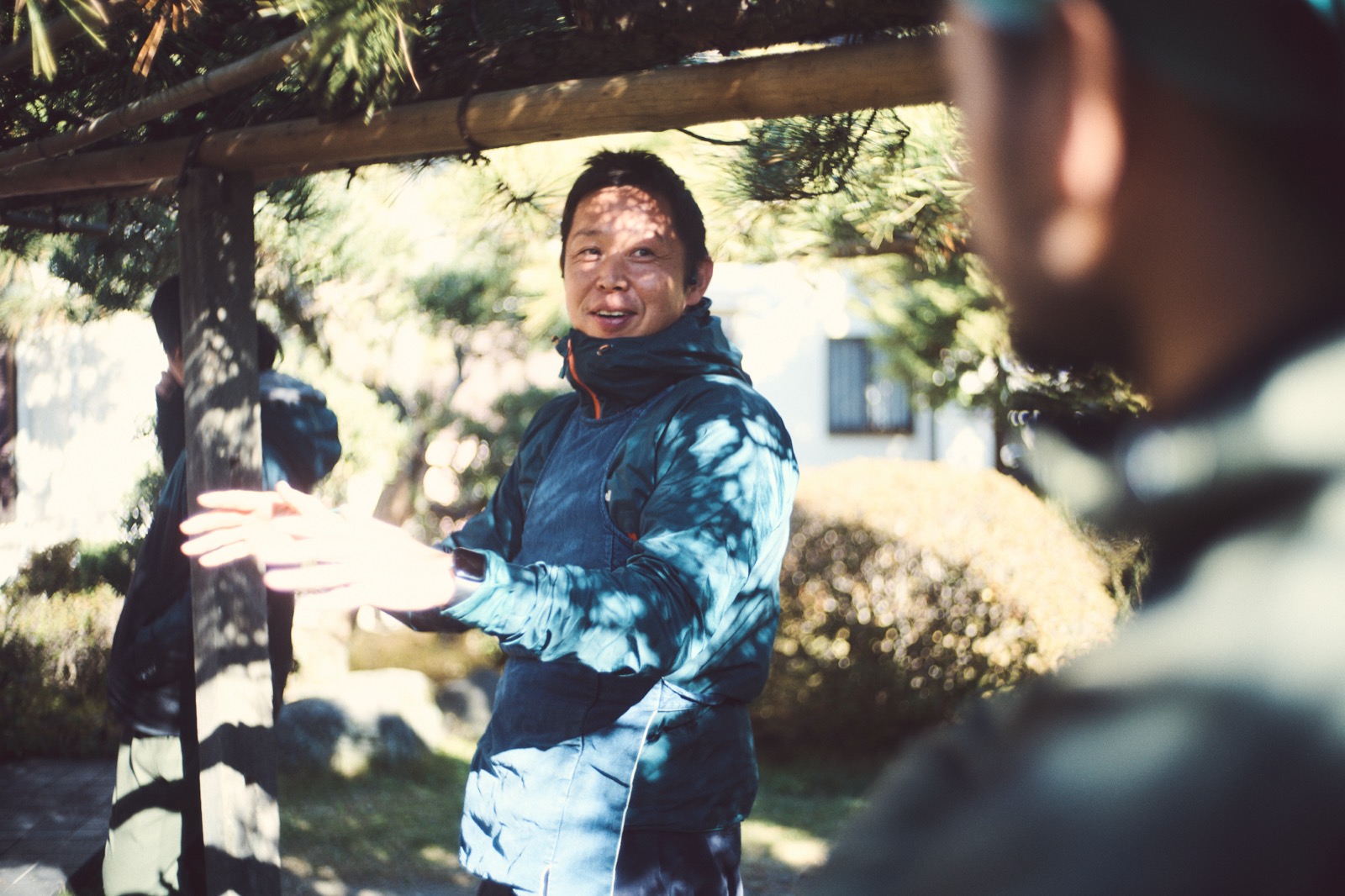
Legitimate peripheral participation
Learning researchers have a name for this kind of start. In their 1991 book Situated Learning, Jean Lave and Etienne Wenger describe learning as a fundamentally social process, and introduce “legitimate peripheral participation”: newcomers take part in a community of practitioners while moving toward full participation in its work (Cambridge University Press). A 2022 doctoral thesis at the University of South Africa summarises the idea as newcomers first taking on simple, low-risk tasks the community recognises, such as running errands (Agyemang, UNISA).
Sweeping fits that description closely. It is real work the crew needs, and it keeps the beginner inside the job — close enough to watch how experienced gardeners work. This is our interpretation, not a finding: the theory was not built from Japanese gardens, and no study we found has tested whether sweeping first makes better gardeners.
A related study points the same way from another Japanese craft. Miyagawa and Willems’s ethnography of sake-making, carried out through an apprenticeship, describes rice, water, invisible microbes and weather as forces that guide and shape the craft (SUTD). A garden is similar: moss, leaves, rain and season set the terms, and much of a beginner’s learning is learning to read them.
What the broom may build — an interpretation
| Early task | What it may train | Supported by |
|---|---|---|
| Sweeping moss | Light, controlled hands | Murin-an; Saihō-ji |
| Sweeping in all seasons | Noticing change in the garden | Kyoto Prefecture booklet |
| Weeding | Knowing plants at ground level | JFLC (task only; benefit is our reading) |
| Tool care | Knowing each tool’s condition | Training curricula (task only) |
Tools as part of training
Care, inspection and storage
Alongside the broom, tools are part of basic training. The 2009 government model curriculum lists handling, maintaining and storing machinery and hand tools as training content (JEED model curriculum). Tokyo’s Engei High School names “tool care and inspection” in its landscape course (Engei High School). Aichi Prefecture’s greening centre runs practical sessions on how to sharpen and store pruning shears and hedge shears and how to use them well (Aichi Greening Center).

We did not find a source saying that sharpening is always a gardener’s first task everywhere in Japan, so we do not claim it. What the sources show is that tool care sits inside basic training rather than being left to chance. Germany’s training profile for landscape gardeners makes the same point in its own terms, listing the use and maintenance of machines and equipment among its core competences (BIBB). For the Japanese tools themselves, see our guide to Japanese pruning shears.
Making the broom
Some gardens go further and make their own brooms. Saihō-ji lists broom making among its rainy-day work (Kyoto Prefecture), and the JFLC has run public workshops in making small hand brooms (小ぼうき, kobōki) alongside bamboo fences (JFLC leaflet).
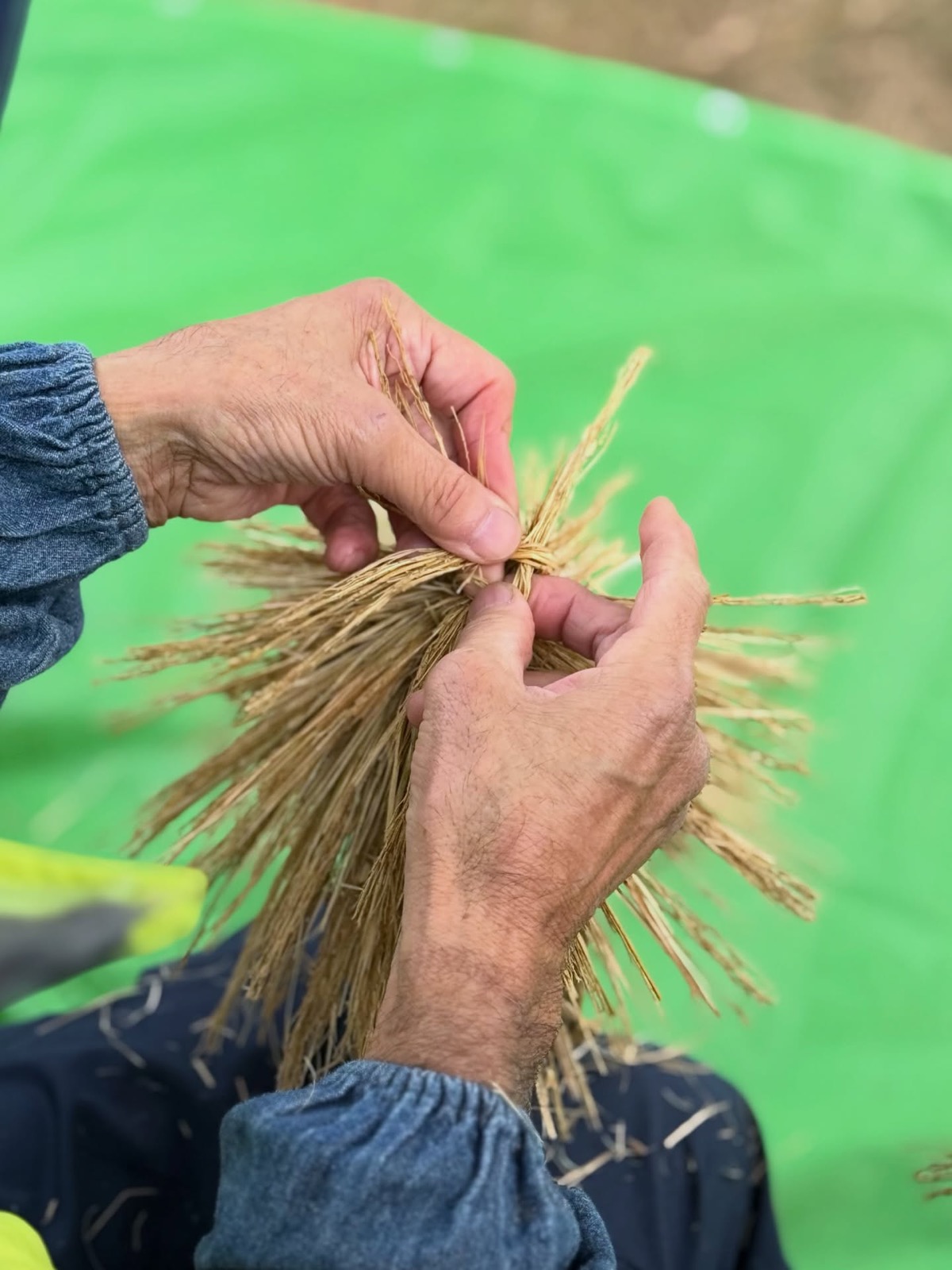
Where the tools live
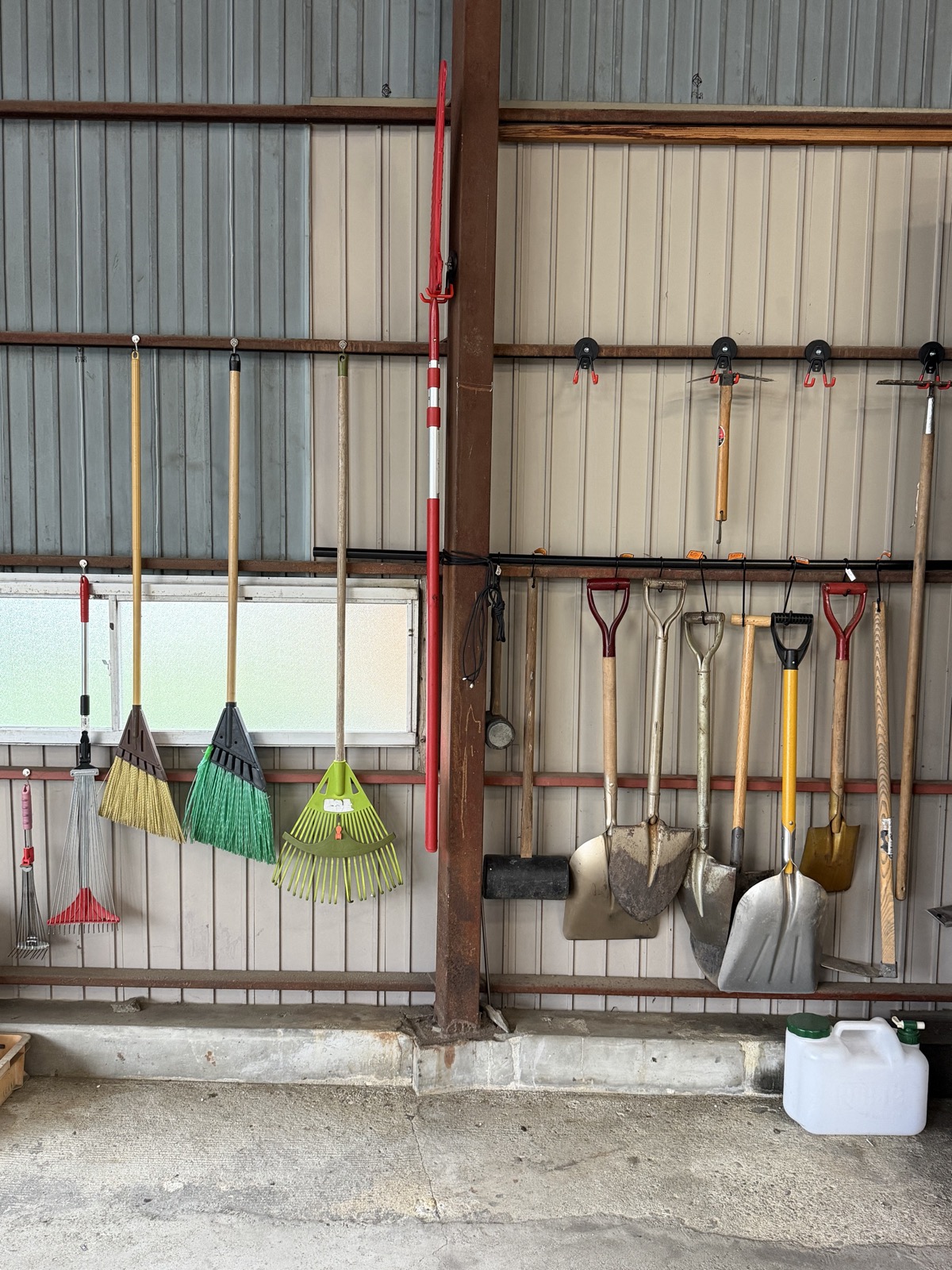
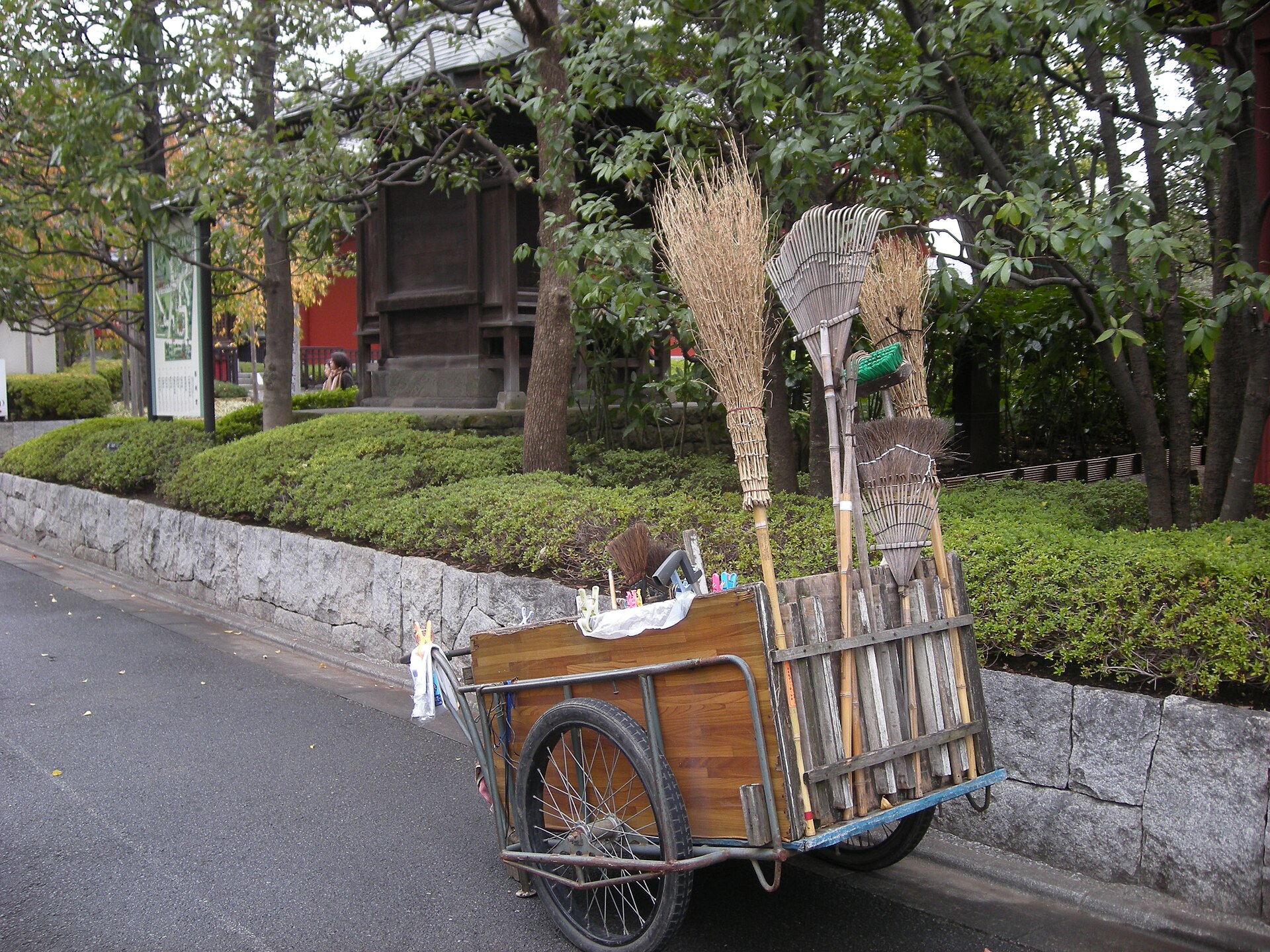
A tool rack like this one is the 5S idea made visible: every tool has a fixed place, and the broom hangs beside the shovel rather than in a corner.
The skills test — a separate ladder
Grades and experience
Japan’s national skills test for landscape gardening (造園技能検定, zōen ginō kentei) is listed by the Japan Vocational Ability Development Association (JAVADA) at Grades 1, 2 and 3 (JAVADA). It is a qualification, not a condition of entry to the trade. For people qualifying through work experience alone, the requirements to sit each grade are (Ibaraki VADA):
| Grade | Work experience to sit the test (experience-only route) | Note |
|---|---|---|
| Grade 3 | No minimum period, but relevant experience | Students on related courses can also sit it |
| Grade 2 | At least 2 years | Other routes via schooling or a lower grade |
| Grade 1 | At least 7 years | Other routes via schooling or a lower grade |
What Grade 1 asks
The Grade 1 practical task for 2026 combines building a bamboo fence, laying a stone water basin, stepping stones and a paved path, placing rocks and plants, and light selective pruning (小透かし剪定, ko-sukashi sentei) (JAVADA 2026 outline). The practical scoring gives 80 points to the making task and 20 to a judgement test (JAVADA). Its published items include accuracy, method, specification errors, working attitude and working time. Cleaning is not listed as a separate scoring item for landscape gardening — though the same page lists “cleaning and tidying” for the related plant-decoration test.
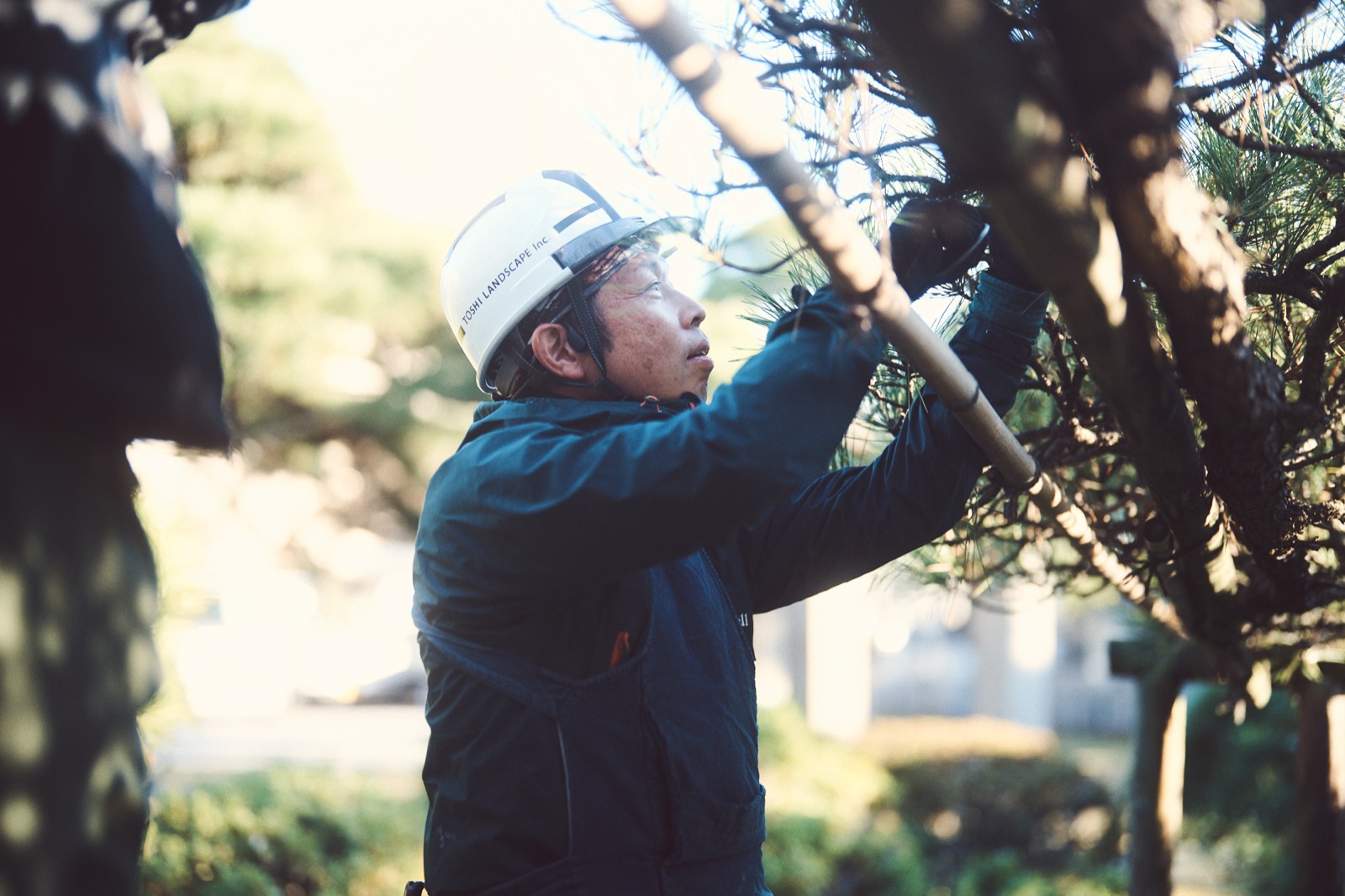
The test sets out what a gardener should be able to do at each grade. It does not decide when a firm lets someone work in the crown of an old pine; that is decided on site. Fine pine work such as midori-tsumi, choosing which spring shoots to keep, sits at the far end of the work from the broom. Working in the crown also needs safe ladder work; see our guide to setting up a tripod ladder.
Parallels in temple and tea-garden practice
Samu: work as practice
Several of the gardens in this article belong to Buddhist temples, and temple life treats cleaning as practice. The Sōtō Zen school defines samu (作務) as all the labour of a training monastery: cleaning, cooking, care of the gardens and buildings, and farm work (Sotozen-net). It regards samu, like other activities, as practice in which one puts oneself in order as a Buddha. Tokuhonji, a Sōtō temple, writes that sweeping and wiping are among the most important parts of practice, equal to seated meditation and chanting sutras (Tokuhonji). An English Sōtō text published by Shasta Abbey says equal importance is attached to samu and to purely religious matters (Shasta Abbey).
Rikyū and the fallen leaves
Tea-garden practice offers another parallel. A study at Kyushu University on the design of wabi cites an anecdote recorded in Chawa Shigetsushū (茶話指月集): the tea master Sen no Rikyū said that for a morning tea gathering the roji (露地, tea garden) should be swept the evening before, and for a midday gathering in the morning — and that after that, leaving the leaves to fall unswept is the mark of a master (Sugimoto et al.). Cleaning, in that telling, is about timing and restraint, not about removing every leaf — close to the judgement Saihō-ji applies to its moss.
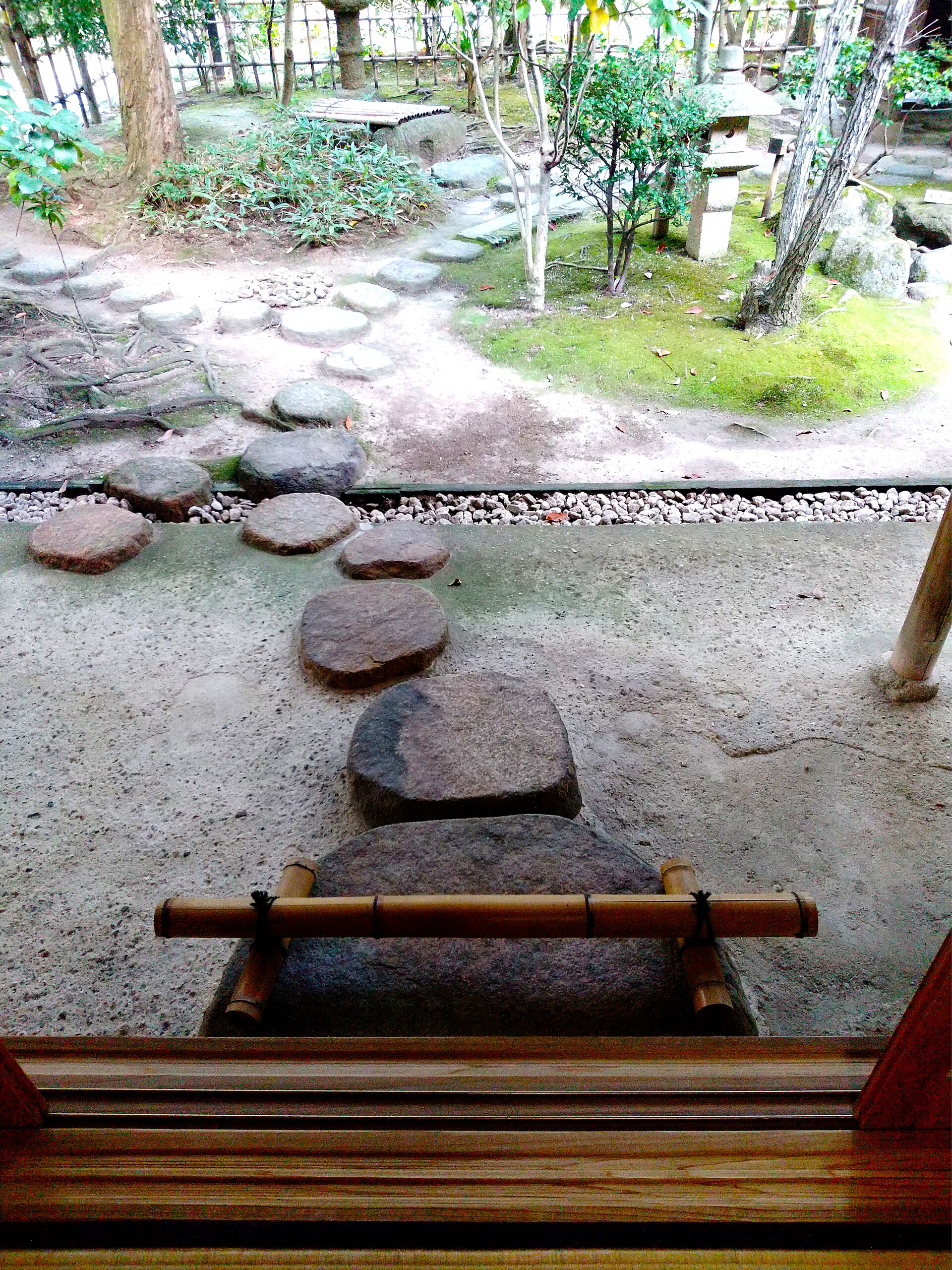
A parallel, not a proven cause
It is tempting to say that gardeners start with a broom because of Zen. We could not find a source that establishes that. Temple samu and the training of garden crews are both well documented; a direct line from one to the other is not. The safer statement is that they share a view of cleaning as part of the work itself — a view the JFLC’s saying also expresses.
Apprenticeship then and now in Japan
Long terms under a master
Historically, Japanese craft training was long. A study of Japanese craft skill formation by Hakoda describes the old apprenticeship as nenki bōkō (年季奉公): the term varied by trade and sometimes exceeded ten years, and apprentices largely shared meals and lodging with the master through a strict training period (Hakoda). That account covers crafts in general, not gardeners specifically.
Formal education arrived early in landscape work. The Tokyo University of Agriculture traces its landscape department to a 1924 step toward systematic teaching aimed at moving beyond apprenticeship-based craft (Tokyo University of Agriculture).
What firms said they prefer
The master–apprentice model has not disappeared. A survey of Kyoto firms that maintain historic gardens, published in 2006, found that 50% of the 58 responses to the relevant question favoured a master–apprentice (師弟関係) relationship for training newcomers, against 29% favouring an employer–employee one (Kato & Shimomura). It describes Kyoto’s historic-garden trade at that time, not Japan today. Ueko Konishi Zoen, the Kyoto firm quoted earlier, offers a dormitory beside its office and daily meals to support its staff (Ueko Konishi Zoen).
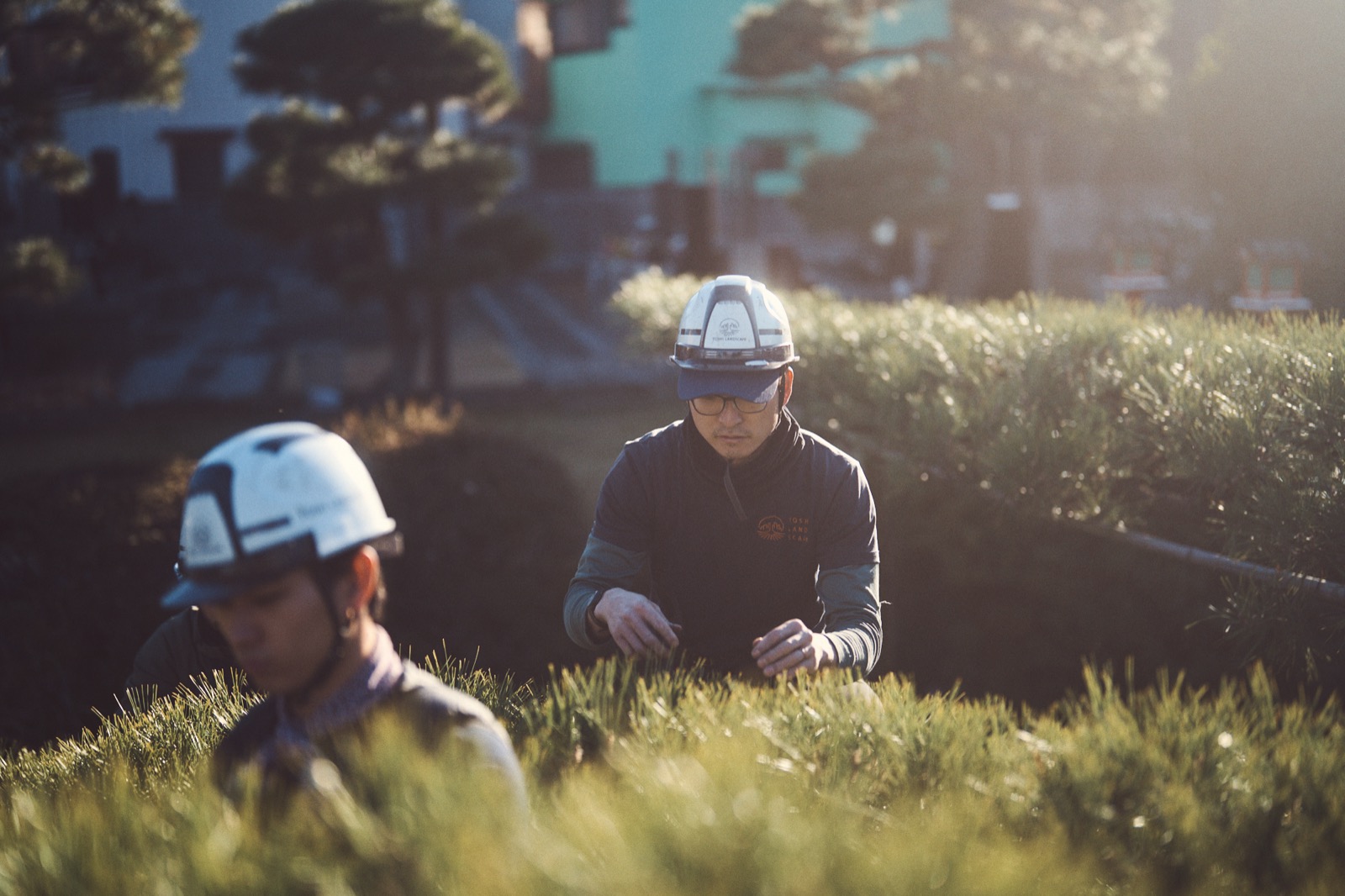
An ageing trade
The trade also faces a supply problem. Job tag reports 122,810 workers in the occupational category linked to landscape gardeners in the 2020 census, and an average age of 49.1 in the 2025 wage survey for its related statistical category — figures the site itself says do not cover that occupation alone (MHLW job tag). The Japan Landscape Contractors Association describes the ageing of skilled workers and the fall in young entrants as a structural problem that makes passing on skills harder (JALC News, April 2025).
Long apprenticeship is not beyond question, either. A 2023 study of Japanese mingei (folk craft) by Holt and Yamauchi cautions that long apprenticeships and repetitive traditions can be hostile to difference, experiment and individuality (Journal of Business Ethics). That study is about folk craft, not gardening, but it is a useful reminder: an order of training is a set of assumptions about how skill is built, not a guarantee.
Elsewhere — apprenticeship standards in England, Germany and the US
What the written standards say
The English and German programmes below are defined in published standards. England’s Level 2 Horticulture or Landscape Construction Operative apprenticeship (standard ST0225, version 1.2) has a typical training period of 24 months plus a 4-month end-point assessment, which combines a practical assessment with questions, a multiple-choice test and a professional discussion backed by a portfolio (Skills England). Typical tasks on the horticulture side include cultivation, pruning and turf care (GOV.UK). The Royal Horticultural Society’s Level 2 apprentices spend two years working full-time with experienced horticulturists, learning both in RHS gardens and at college (RHS).
Germany’s training for Gärtner in Garten- und Landschaftsbau lasts 36 months (BIBB) and runs as a dual system, split between the training company and vocational school (Bundesagentur für Arbeit). In the US, a 1995 Department of Labor list recognised Landscape Gardener as an apprenticeable occupation with a recommended minimum term of 8,000 hours, and Landscape Technician with 4,000 hours (US DOL). One registered Landscape Technician programme in Washington State requires at least 4,000 hours of employment (Washington L&I).
| Japan | England | Germany | US | |
|---|---|---|---|---|
| Programme or rule cited here | No set entry qualification (job tag); optional national skills test | Level 2 standard ST0225 | Gärtner, Garten- und Landschaftsbau | DOL list (1995); one Washington programme |
| Training period on paper | Not fixed | Typically 24 months + 4-month assessment | 36 months | 8,000 h recommended (1995); 4,000 h (Washington, technician) |
| Experience to sit the top test | 7 years (experience-only route, Grade 1) | — | — | — |
| Where learning happens (per source) | Site work, skills courses | RHS: gardens, college | Company, vocational school | Not covered here |
What the comparison can and cannot show
The difference is not that one side sweeps and the other does not. The standards describe outcomes, periods and assessments; they do not say what an apprentice does on the first morning, and we have no source saying apprentices elsewhere skip cleaning. Nor are Japanese gardeners trained without documents — the curricula and school courses above are written down. What the sources do show is a difference in where the early order of tasks is described: in Japan, the clearest statements come from the trade federation and individual firms rather than a national apprenticeship standard.
Japanese gardens abroad
Japanese gardens outside Japan have taken the broom with them. Portland Japanese Garden’s gardeners, in a staff programme called Meet the Niwashi, watched a video of the cleaning process at a Kyoto garden and then discussed how to prioritise tasks when time is short (Portland Japanese Garden). The garden’s Waza to Kokoro seminar covers Japanese garden design, construction and maintenance in about 80 hours of instruction, with hands-on stonework in the tea garden at its core (Portland Japanese Garden). Its horticulture volunteers help with weeding, raking, sweeping and general clean-up (Portland Japanese Garden).
Elsewhere, Anderson Japanese Gardens lists sweeping moss and paths among its volunteers’ tasks (Anderson Japanese Gardens); each volunteer day at Cranbrook’s Japanese garden begins with a training session (Cranbrook); and volunteers at the Seattle Japanese Garden swept the waiting area of its roji during a spring clean in 2024 (Seattle Japanese Garden). For more on how Japanese garden trees differ from Western clipped forms, see Niwaki vs Topiary.
Frequently asked questions
Do Japanese gardener apprentices really sweep for a whole year?
The sources we reviewed do not establish a nationwide sweeping-only period. Japan’s federation of garden contractors describes newcomers starting with cleaning and weeding, then moving to hedge trimming, but it does not say how long the first stage lasts.
Why do Japanese gardeners treat cleaning as part of the job?
Because the government’s description of the work lists ground levelling and cleaning as the finishing work that completes a garden. A saying quoted by the industry federation puts it as “a gardener’s work begins with cleaning and ends with cleaning.”
Why not just use a leaf blower?
Kyoto Prefecture’s booklet on moss, drawing on Saihō-ji, notes one cost of blower cleaning: small changes in the garden become harder to notice. On moss, Saihō-ji chooses among bamboo brooms of different stiffness, and Murin-an brushes gently with the tip of a hand broom.
What cleaning tools do these gardens use?
Saihō-ji mainly uses three bamboo brooms of different stiffness; Murin-an uses hand brooms; Kyoto temples draw sand patterns with rakes whose teeth are around 5 cm long. Some gardens also make their own brooms.
What experience is needed to sit Japan’s landscape gardening skills test?
On the experience-only route, Grade 3 has no minimum period, Grade 2 needs at least 2 years and Grade 1 at least 7 years. Schooling or passing a lower grade opens other routes. The test is a qualification, not a requirement to work as a gardener.
Does the broom-first habit come from Zen?
We could not find a source showing that. Zen temples treat cleaning as practice (samu), and a tea-garden anecdote about Rikyū treats sweeping as a matter of timing and restraint. These are parallels, not a documented origin.
Sources
– Japan Federation of Landscape Contractors (JFLC), “生垣の刈り込み” — https://www.jflc.or.jp/index.php?catid=61&itemid=153 (checked 2026-10-31) – JFLC, bamboo fence / kobōki workshop leaflet — https://www.jflc.or.jp/media/niwa_navi/20101122_1139_32_0265.pdf (checked 2026-10-31) – Ministry of Health, Labour and Welfare, job tag “造園工” — https://shigoto.mhlw.go.jp/Occupation/Detail?occupationId=222 (checked 2026-10-31) – Ueko Konishi Zoen, recruiting page — https://www.ueko1997.com/recruit (checked 2026-10-31) – Polytechnic University (JEED), model curriculum, landscape construction — https://www.tetras.uitec.jeed.go.jp/files/kankoubutu/h-031-01.pdf (checked 2026-10-31) – Tokyo Metropolitan Engei High School, landscape course outline — https://www.metro.ed.jp/engei-he/img_sub/filelink/filelink-pdffile-7778.pdf (checked 2026-10-31) – Aichi Greening Center, 2026 training programme — https://www.aichi-park.or.jp/ryokka/pdf/2026kensyuu-full.pdf (checked 2026-10-31) – Murin-an, “苔のお手入れ” — https://murin-an.jp/fostering-report/eyes-20210127/ ; Sarasara 2025 — https://murin-an.jp/pdf/sarasara/2025ss.pdf (checked 2026-10-31) – Saihō-ji journal — https://intosaihoji.com/journal/tsugu001/ ; https://intosaihoji.com/journal/tsugu006/ ; https://intosaihoji.com/en/journal/tsugu001/ ; https://intosaihoji.com/en/journal/tsugu005/ ; https://intosaihoji.com/en/journal/letter2406/ (checked 2026-10-31) – Kyoto Prefecture, moss booklet — https://www.pref.kyoto.jp/kankyo/documents/kokepamphlet.pdf (checked 2026-10-31) – Zhang et al., white sand in Kyoto temples (JILA) — https://www.jila-zouen.org/wpdata/wp-content/uploads/2015/04/497.pdf (checked 2026-10-31) – Seibundo Shinkosha, Zuihō-in (2018) — https://43mono.com/series/kyoto_garden/garden2/ (checked 2026-10-31) – Sōtō Zen, “役割を担う” — https://www.sotozen-net.or.jp/zen/duties ; Tokuhonji — https://www.tokuhonji.jp/2012/06/881201224611-20/ ; Shasta Abbey, Sōtō Zen — https://www.shastaabbey.org/pdf/bookSotoZen.pdf (checked 2026-10-31) – Sugimoto et al., Kyushu University — https://catalog.lib.kyushu-u.ac.jp/opac_download_md/7181971/7181971.pdf (checked 2026-10-31) – JAVADA, scoring items — https://www.javada.or.jp/ex/jigyou/gino/giken/saitenkoumoku/saitenkoumoku.html ; 2026 practical outline — https://www.javada.or.jp/jigyou/gino/giken/pdf/R08_zenki_jitsugi1.pdf (checked 2026-10-31) – Ibaraki Vocational Ability Development Association, eligibility — https://ibaraki-vada.com/kentei/skill (checked 2026-10-31) – Hakoda, craft skill formation — https://www.i-repository.net/contents/outemon/ir/102/102080910.pdf (checked 2026-10-31) – Tokyo University of Agriculture, department history — https://www.nodai.ac.jp/academics/reg/land/original/about/history/ (checked 2026-10-31) – Kato & Shimomura (2006), J. Japanese Institute of Landscape Architecture — https://www.jstage.jst.go.jp/article/jila/69/5/69_5_425/_pdf (checked 2026-10-31) – Japan Landscape Contractors Association, JALC News April 2025 — https://www.jalc.or.jp/monthly/pdf/613.pdf (checked 2026-10-31) – Lave & Wenger, Situated Learning, Cambridge University Press — https://www.cambridge.org/highereducation/books/situated-learning/6915ABD21C8E4619F750A4D4ACA616CD (checked 2026-10-31) – Agyemang (2022), University of South Africa thesis — https://ir.unisa.ac.za/bitstream/handle/10500/29779/thesis_agyemang_fg.pdf?sequence=1&isAllowed=y (checked 2026-10-31) – Miyagawa & Willems, Voice of Koji (SUTD repository) — https://repository.sutd.edu.sg/esploro/outputs/journalArticle/Voice-of-Koji-an-ethnography-of/9912711409846 (checked 2026-10-31) – Holt & Yamauchi (2023), Journal of Business Ethics — https://link.springer.com/article/10.1007/s10551-023-05500-2 (checked 2026-10-31) – Skills England, ST0225 v1.2 — https://skillsengland.education.gov.uk/apprenticeship-standards/st0225-v1-2?view=epa ; GOV.UK apprenticeships — https://www.apprenticeships.gov.uk/apprentices/horticulture-or-landscape-construction-operative ; RHS apprenticeships — https://www.rhs.org.uk/education-learning/qualifications-and-training/work-based-training/rhs-apprenticeships/horticultural-operative-apprenticeship-level-2 (checked 2026-10-31) – BIBB — https://www.bibb.de/dienst/berufesuche/de/index_berufesuche.php/profile/apprenticeship/98765432?key=98765432 ; Bundesagentur für Arbeit — https://rest.arbeitsagentur.de/infosysbub/berufepool-rest/ct/v1/steckbriefe/588.pdf (checked 2026-10-31) – US Department of Labor, Bulletin 96-02 list — https://www.apprenticeship.gov/sites/default/files/bulletins/BUL96-02%20List%20of%20Appren%20Occupations.pdf ; Washington State L&I, programme standards — https://apps-public.lni.wa.gov/TradesLicensing/Apprenticeship/files/standards/1836.pdf (checked 2026-10-31) – Portland Japanese Garden — https://japanesegarden.org/2026/04/01/meet-the-niwashi/ ; https://japanesegarden.org/japan-institute/thecenter/waza-kokoro-seminar/ ; https://japanesegarden.org/volunteers/ ; Anderson Japanese Gardens — https://andersongardens.org/docents/ ; Seattle Japanese Garden — https://www.seattlejapanesegarden.org/blog/2024/4/5/teahousecleaning ; Cranbrook Center — https://center.cranbrook.edu/japanese-garden-volunteers (checked 2026-10-31)