

By Isaki Kasahara, a Japanese arborist pruning, assessing and caring for Japan’s trees and gardens · Updated November 23, 2026
Before cranes, Japan moved heavy stones with rope, timber and people. Excavated finds and records show the methods: a wooden sledge called a shura dragged over a track of logs or rollers, levers to pry and nudge, and shear legs with a pulley and a hand-turned capstan to lift. For the Fujito stone at Sambō-in in Daigo-ji, Kyoto, a celebrated garden stone, no surviving record says which of these tools was used.
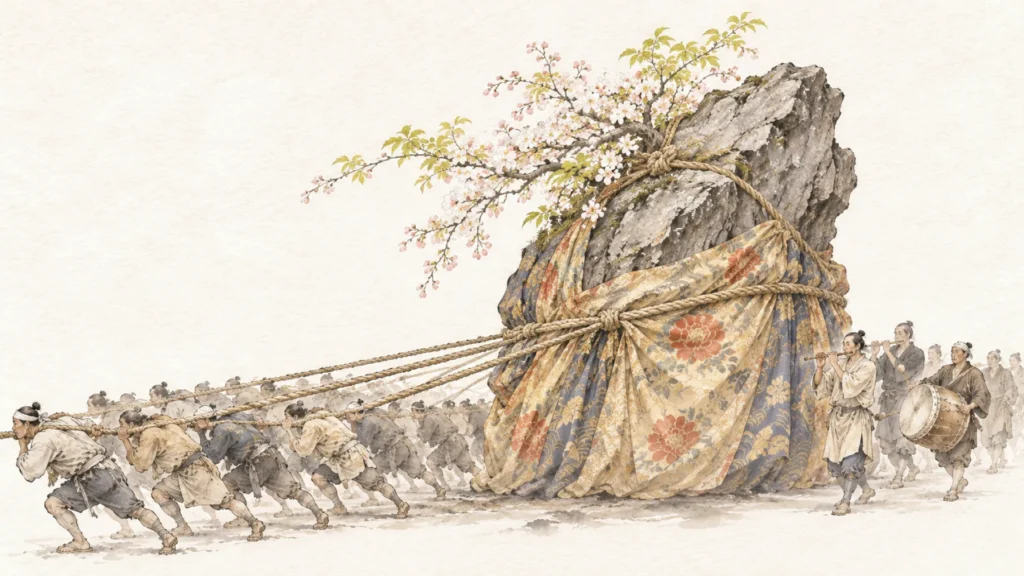
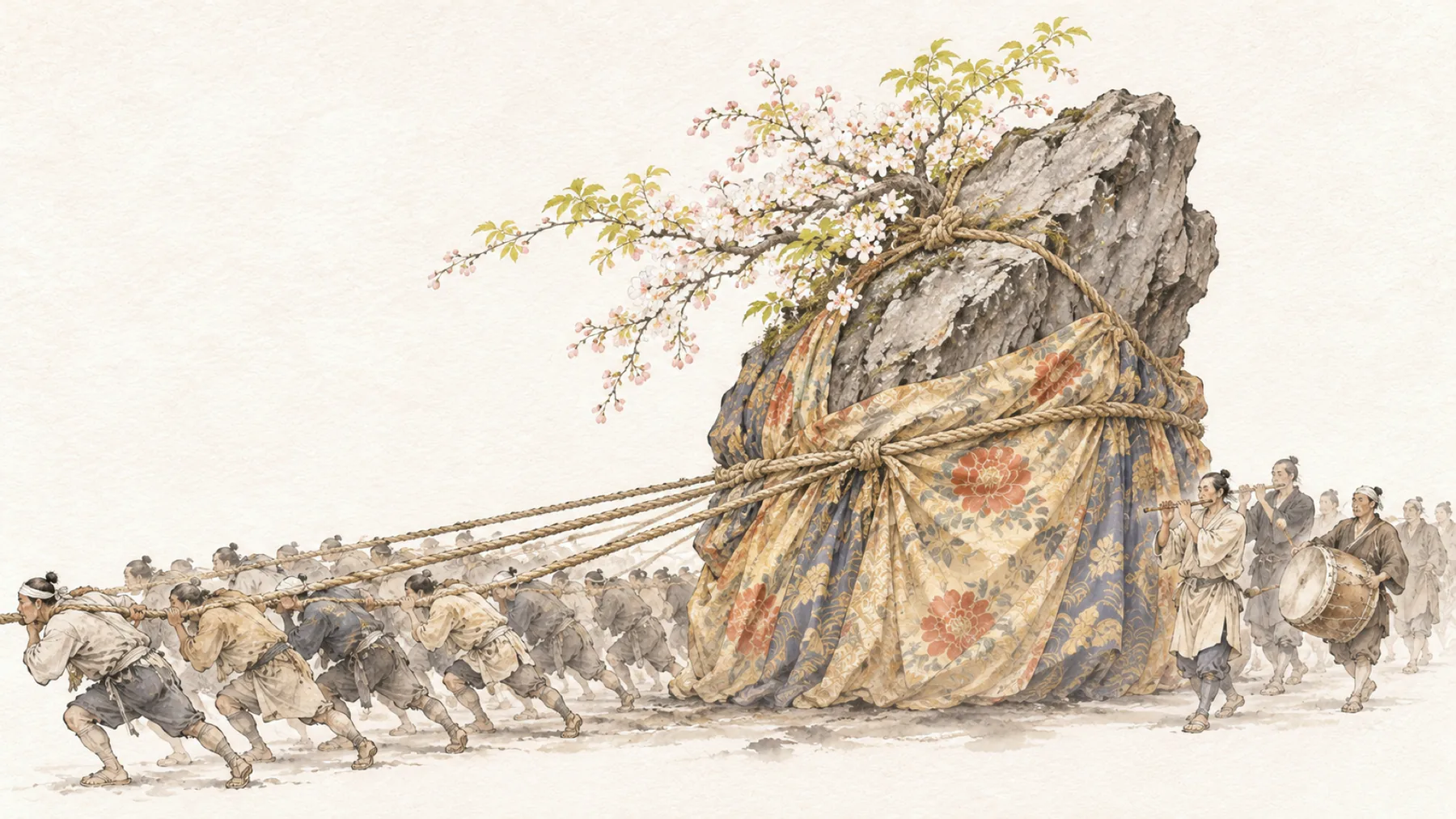
What the record does preserve is a scene. In the spring of 1569, in the streets of Kyoto, a great rock wrapped in damask and brocade and decorated with flowers of many colours moved forward on a mass of ropes, while flutes and drums played and thousands of people pulled. Oda Nobunaga was taking it to a new palace garden.
This article follows that one stone through four sites, then uses the archaeology, the experiments and the tools of Japanese stone setting to answer the practical question behind it: how could a very heavy boulder be moved without a machine, and how is it made to stay where it is put? Translations from Japanese sources are my own.
Standing before the Fujito stone — the centre of Sambō-in
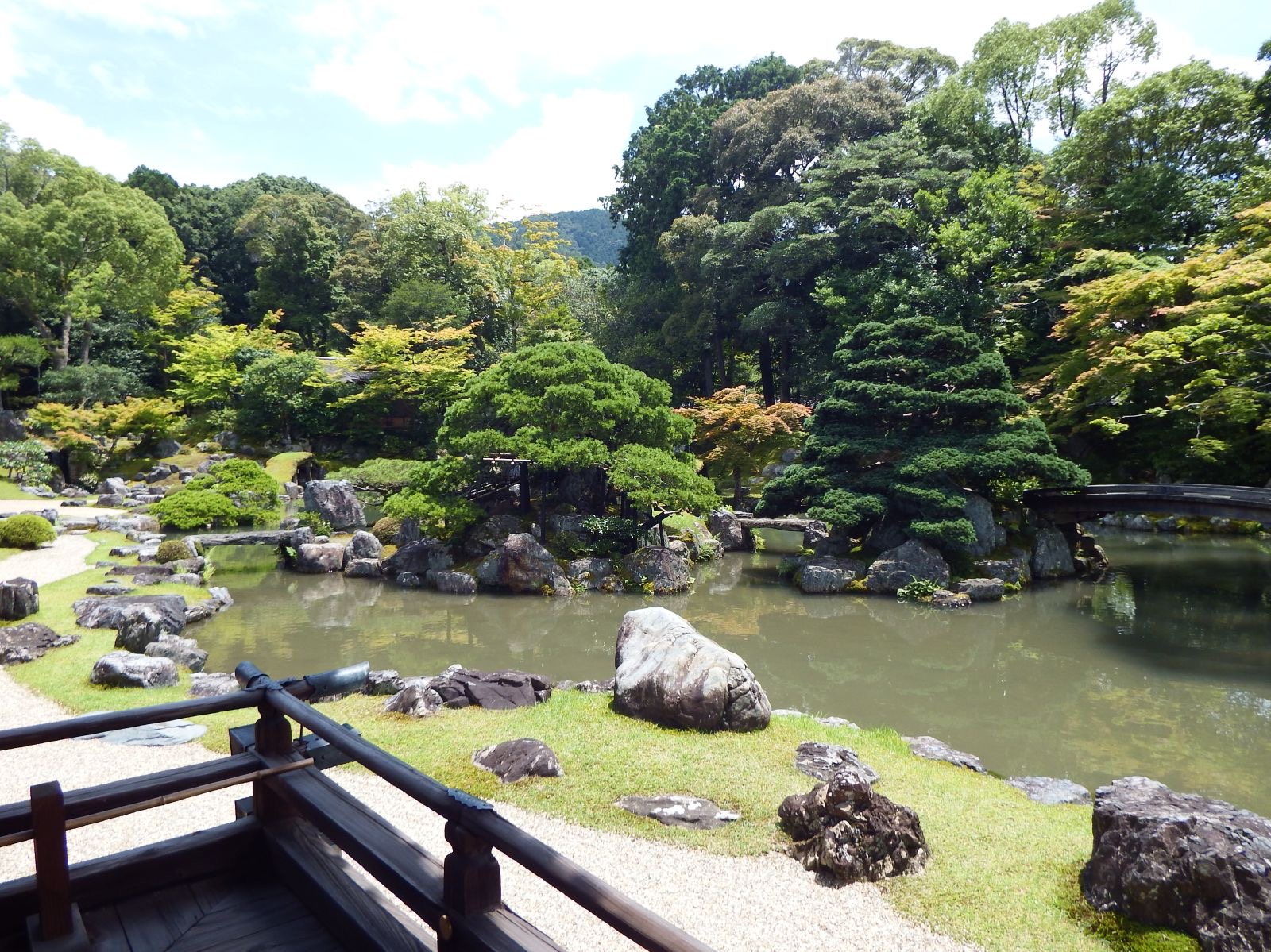
Today the stone is in Sambō-in, a sub-temple of Daigo-ji in Fushimi, southern Kyoto, in a pond garden of islands, bridges and rock-lined banks. It does not stand at the edge. Daigo-ji places it at the centre of the garden, flanked by two other stones.
Three stones, one figure
Daigo-ji explains the arrangement in religious terms. The Fujito stone and the stones on either side of it represent the Amida triad — the Buddha Amida with two attendant bodhisattvas. The temple’s own guide also gives the stone a title: tenka no meiseki (天下の名石), “a celebrated stone of the realm.” Much of its fame comes from the records of its moves.
A garden protected as a monument
Sambō-in garden was designated a Historic Site and Place of Scenic Beauty in 1927, raised to Special Historic Site and Special Place of Scenic Beauty in 1952, and in 1994 became part of the “Historic Monuments of Ancient Kyoto” World Heritage listing. The diary of the abbot Gien records the making of the garden, which is why the stone’s arrival can be followed through dated entries.
A name from a battle — where the Fujito stone came from
Fujito: a ford, a battle and a Noh play
Fujito is in present-day Okayama Prefecture, on the old strait north of what is now the Kojima peninsula — then still separated from the mainland by water. In the Genpei War of the late twelfth century it was the site of a famous crossing, when the warrior Sasaki Moritsuna led his horsemen across the shallows ahead of everyone else. The Noh play Fujito takes the story further: Moritsuna, now lord of Kojima as his reward, is confronted by the mother of a fisherman he killed to keep the secret of the ford.
The stone is said to have come from the Ford of Fujito. The Nara National Research Institute for Cultural Properties, in its Japanese Garden Dictionary, uses exactly that cautious wording — “It is said to have been produced at Fujito no watari” — and Kyoto’s municipal library service also presents it as a tradition. No source checked for this article shows that this particular rock was present at the battle, or that Moritsuna owned it. The name connects the stone to a story known through the Noh play; that connection is part of its value.
In the garden of the Hosokawa
By the mid-sixteenth century the stone was in Kyoto, in the garden of the Hosokawa family, whose senior line had long held the office of kanrei, deputy to the Ashikaga shoguns. The chronicle of Oda Nobunaga, Shinchō Kōki (信長公記), introduces it plainly: “At the Hosokawa residence there is a great stone called the Fujito stone, from of old” (細川殿御屋敷に、藤戸石とて往古よりの大石候).
“From of old” matters. By 1569 the stone already had a pedigree. Owning it meant owning a piece of the capital’s cultural memory, which may be why Nobunaga wanted it — the chronicle does not give his reasons.
1569 — the stone Nobunaga paraded through Kyoto
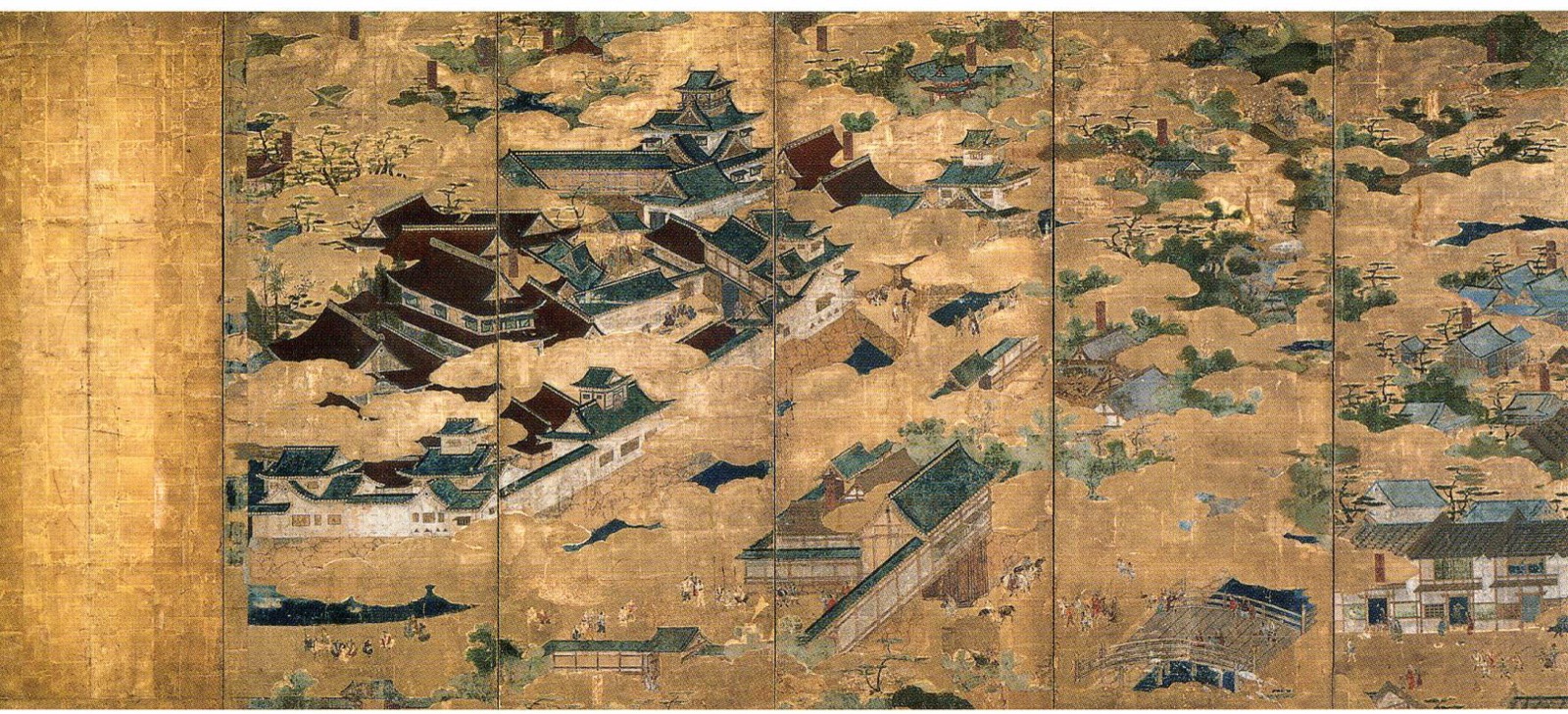
In early 1569 Nobunaga was building the Nijō palace in Kyoto for the shogun Ashikaga Yoshiaki. A new palace needed a garden, and a garden of that rank needed a stone with a name.
Silk, flowers and drums
The Shinchō Kōki describes the move in one sentence that has become the centre of the stone’s legend. Nobunaga had “that famous stone wrapped in damask and brocade, decorated with flowers of many colours, fitted with a great many large ropes, and hauled while flutes, drums and hand-drums played” (彼名石を綾錦を以てつゝませられ、色々の花を以かさり、大縄餘多付させられ、笛大鼓つゝみを以てはやし立).
How many people pulled? The Shinchō Kōki passage does not give a number. A second diary, the Tokitsugu Kyōki (言継卿記) kept by the courtier Yamashina Tokitsugu, does. A study of the source published by Kanazawa University summarises its entry for the third day of the third month of 1569 as: “pulled by three or four thousand people, with flutes and drums playing.”
Three to four thousand people is more than a work crew. The move can be read as a procession through the capital — a public show of who could now command labour on that scale.
Arrival — on the third or the fourth day
The sources disagree slightly on the ending. The Shinchō Kōki says the stone was “pulled straight up into the garden” the same day. The Tokitsugu Kyōki, as tabulated in the Kanazawa study, says the stone did not get across the moat on the third day and was brought in on the fourth. The safe statement is that it reached the Nijō palace garden on the third or fourth day of the third month of 1569.
What the chronicle does not say
Here is the gap at the heart of this article. Neither source says what the stone sat on while it was pulled. The Shinchō Kōki mentions “a great many large ropes” — no sledge, rollers, log track or lifting frame. To answer our question, we have to go to the archaeology and to the methods other records describe.
1598 — Hideyoshi gives the stone its last home
After Nobunaga’s death in 1582, the stone moved again. Toyotomi Hideyoshi took it to his own palace-castle in Kyoto, the Jurakudai. Then, in the last year of his life, he moved it one final time.
A garden laid out for a flower-viewing
In the spring of 1598 Hideyoshi was preparing his famous cherry-blossom party at Daigo-ji, the Daigo no Hanami, held on the fifteenth day of the third month. In the second month the abbot Gien showed him around Sambō-in — then called Kongōrin-in — and Gien noted that Hideyoshi greatly admired the pond. About a week later Hideyoshi came back and decided to direct the making of the garden himself, with work starting in the fourth month so that it would be ready for a planned imperial visit the following year.
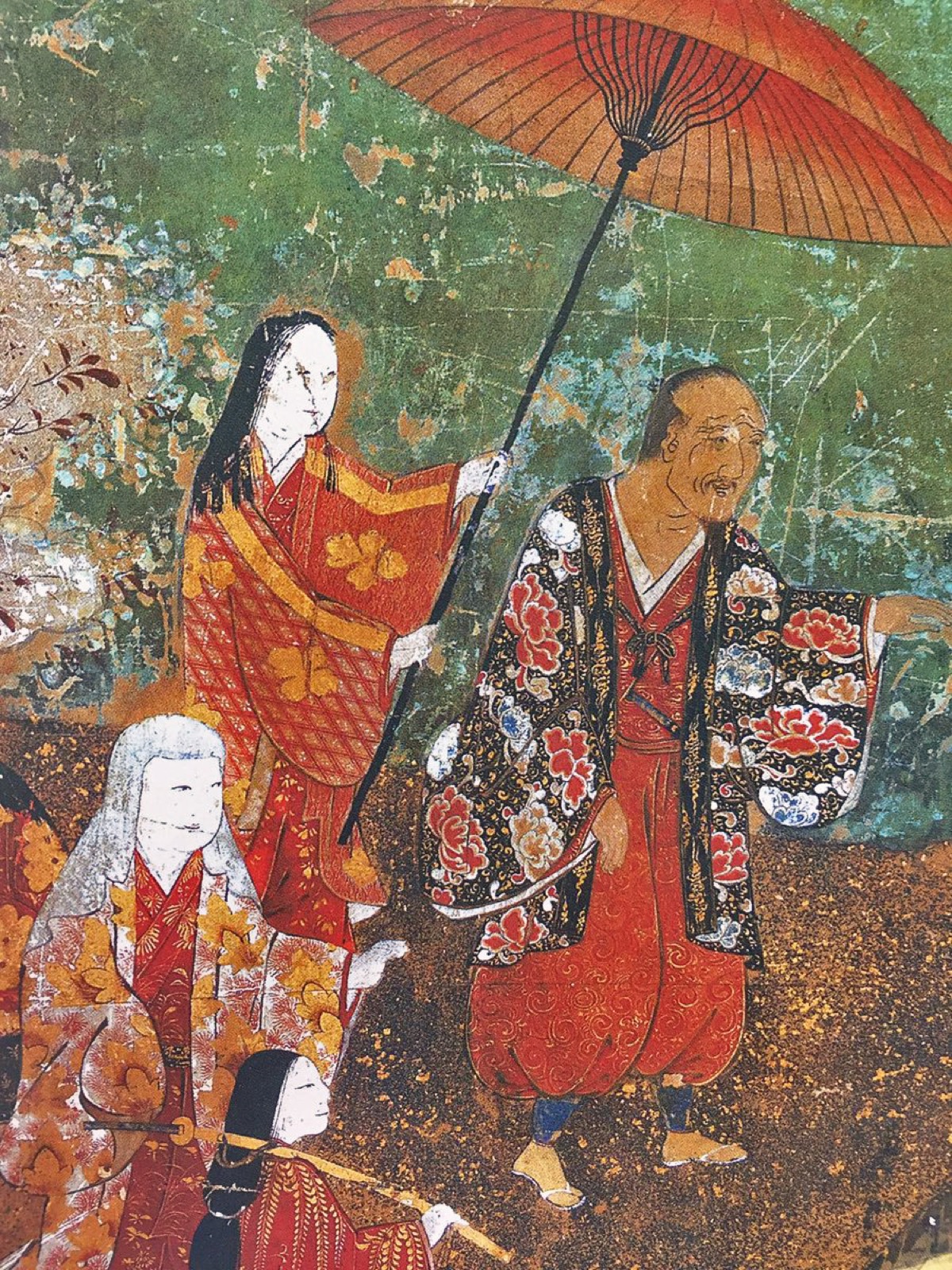
Daigo-ji’s archive places in Gien’s diary Hideyoshi’s instruction to move “the famous stone ‘Fujito stone’ that was at the Jurakudai to the garden of Kongōrin-in.” According to the Kyoto City Archaeological Museum’s lecture notes, the stone was brought in from the Jurakudai the day after the garden’s layout was marked out, and the garden was finished by the middle of the fifth month.
The master stone — and 300 helpers
Gien’s entry for the ninth day of the fourth month is short. The great stone of Fujito was set in the pond garden that day and used as the shujin-ishi (主人石), the “master stone”; three other large stones were stood alongside it; and “three hundred helpers” were on hand (金剛輪院泉水ヘフチト大石今日居リ、主人石一用之…手傅三百人衆).
It is tempting to read “300 helpers” as the number of people who hauled the stone from the Jurakudai to Daigo-ji. The diary does not say that. It records the people working in the garden on the day the stones were set. The journey itself is not described.
Hideyoshi died in the eighth month of 1598. Gien kept working on the garden for another twenty-six years, from 1599 to 1624. The Fujito stone stayed at the centre.
The stone’s four sites
| Year | Where the stone was | Who moved it | What the record says about the move |
|---|---|---|---|
| Before 1569 | Hosokawa residence, Kyoto | — | “A great stone … from of old” |
| 1569 (3rd month, day 3–4) | Nijō palace of Ashikaga Yoshiaki | Oda Nobunaga | Brocade, flowers, many ropes, music; 3,000–4,000 pullers (Tokitsugu Kyōki) |
| After 1582 | Jurakudai | Toyotomi Hideyoshi | Move recorded; method not described |
| 1598 (4th month) | Kongōrin-in (Sambō-in), Daigo-ji | Toyotomi Hideyoshi | Set as the master stone; 300 helpers on the setting day |
For the method, we turn to a sledge pulled out of a moat in 1978.
The shura — Japan’s stone sledge, found in a moat
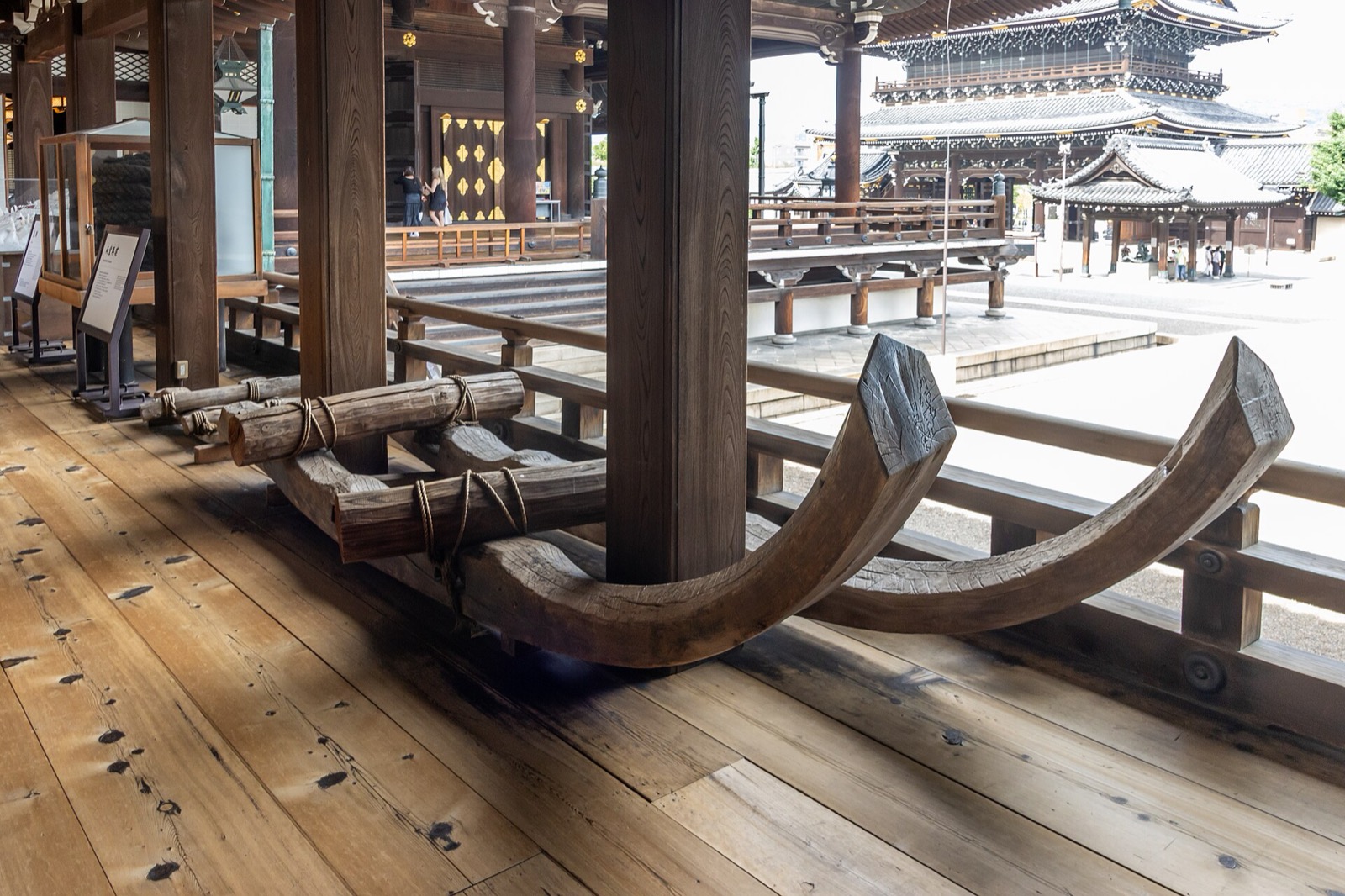
In 1978 archaeologists excavating the moat of the Mitsuzuka mounds in Fujiidera, Osaka Prefecture, found something no one had seen before. In March the head of a large Y-shaped timber appeared from the bottom of the moat. It turned out to be a sledge for hauling heavy stones — a shura (修羅) — together with a smaller one and a lever pole.
Two sledges and a lever
The finds were designated an Important Cultural Property on 9 June 2006. According to the Agency for Cultural Affairs’ Cultural Heritage Online database, the large shura is 8.8 m (29 ft) long and made of akagashi, Japanese evergreen oak (Quercus acuta); the lever pole is also akagashi; the small shura is of kunugi, sawtooth oak (Quercus acutissima). One museum research bulletin gives a different species for the small sledge, but the national database is the reference used here.
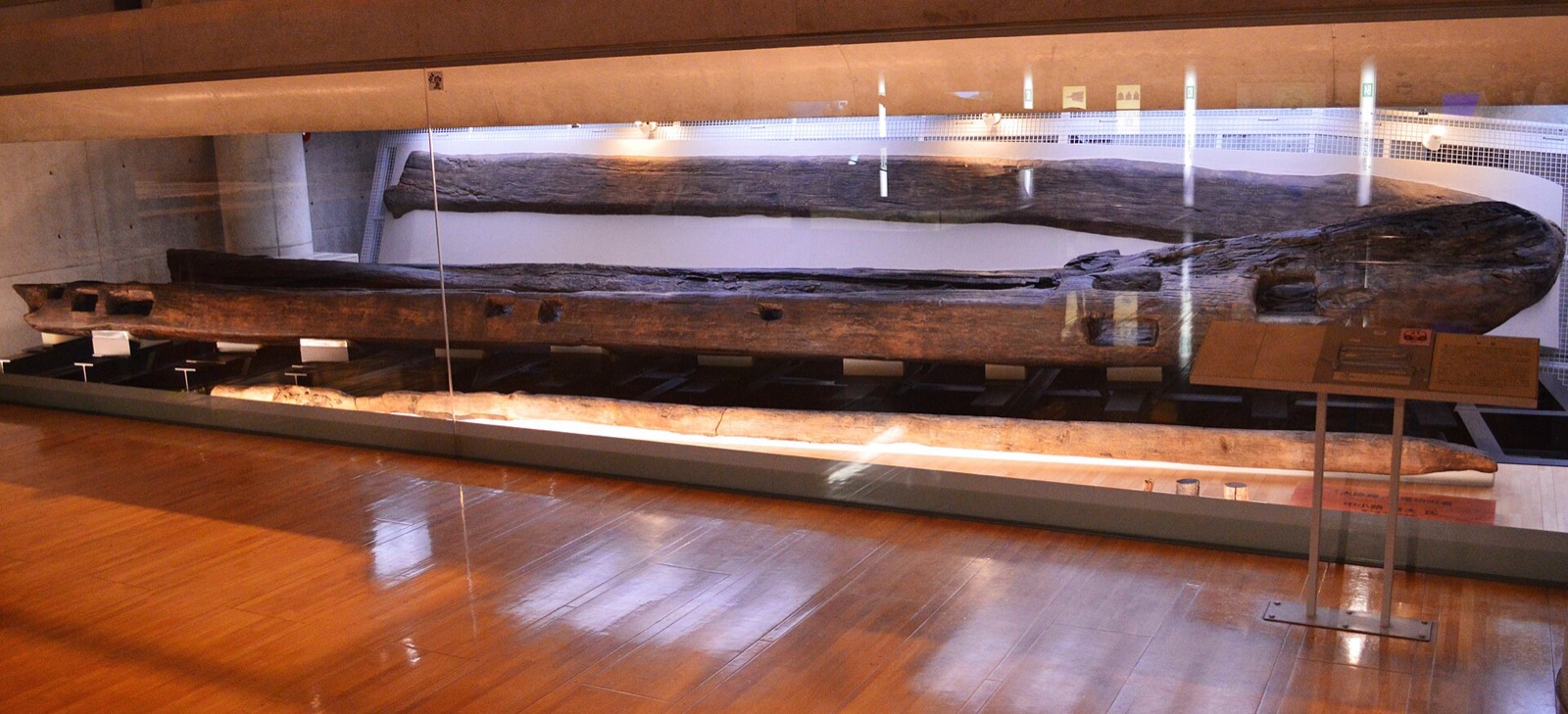
The large shura is now displayed at the Osaka Prefectural Chikatsu Asuka Museum; the small one, with a replica of the large, is on permanent display at the Fujiidera City Library.
The point for our question is simple: a forked hardwood trunk was a real tool for moving heavy stone in ancient Japan. When exactly this one was made and used is still debated — Fujiidera City sets out a fifth-century view and an argument for around the seventh century, and concludes that the date cannot be fixed.
Why it is called “shura”
The name is a pun, and an old one. A fifteenth-century encyclopaedia, the Ainōshō (壒嚢鈔), already asks why a stone-hauling device is called shura, and answers with a word game: “Taishaku” — the god Indra, eternal enemy of the asura (shura) demons — sounds like taiseki, “great stone.” Only an asura can move Taishaku: “帝釈大石ヲ動カス事、修羅ニアラズバアルベカラズ.” Fujiidera City presents this as the traditional explanation of the name, which is the right way to treat it: a medieval etymology, not a linguistic proof.
Three hundred people, five centimetres — the 1978 pulling experiment
Finding a sledge does not tell you how well it worked. So in 1978, the same year as the excavation, a full-scale experiment was staged.
The replica
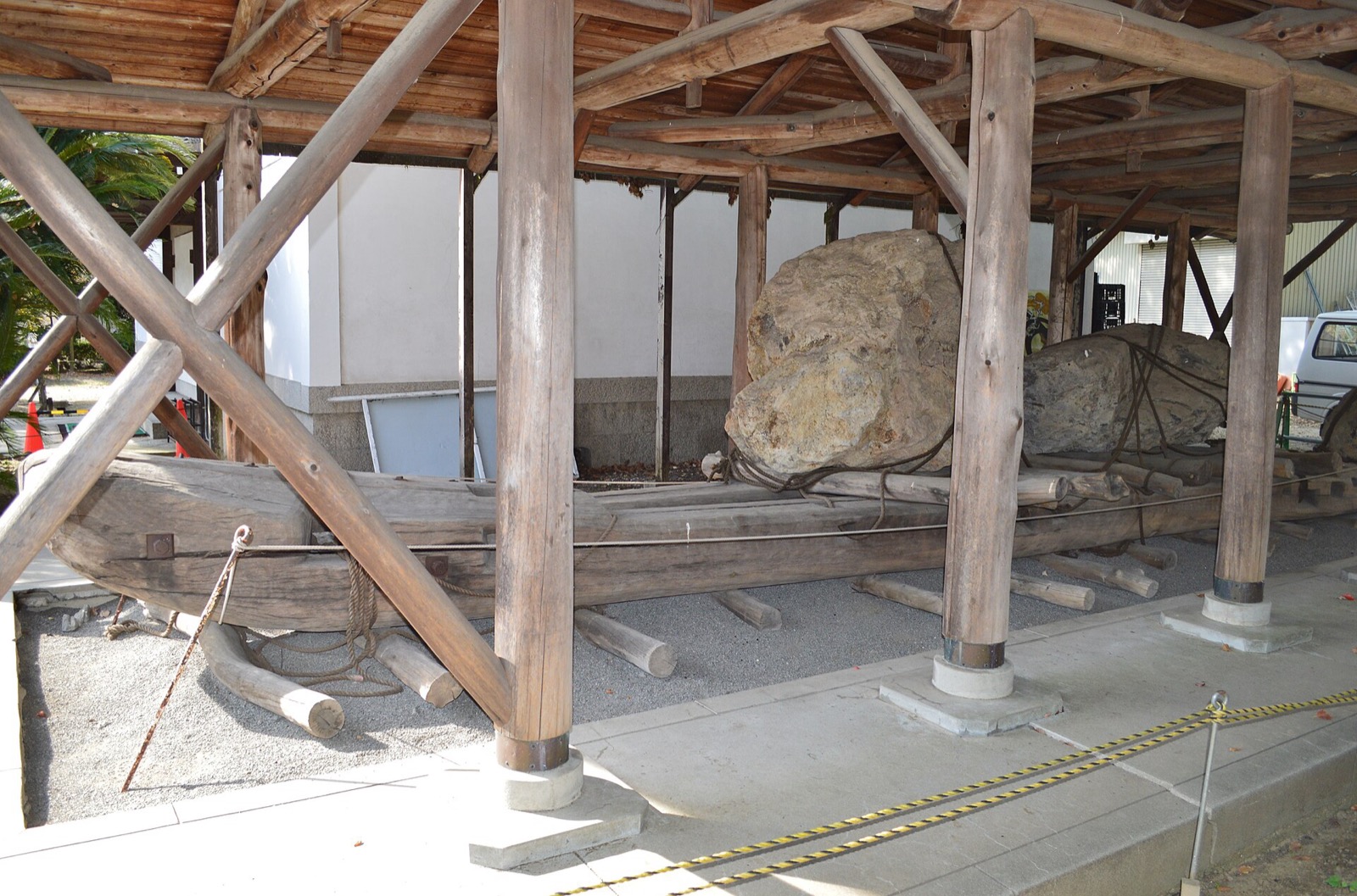
The replica shura was cut from okinawa-urajirogashi (Quercus miyagii), an evergreen oak felled in the old-growth forest of Tokunoshima, and shaped by Nishioka Tsunekazu, the master carpenter of Hōryū-ji. The excavated sledge was a single forked trunk; the replica was made of two timbers bolted together. Before the public trial, a winch-pulling test at Dōshisha University’s Tanabe campus confirmed that the sledge could bear a great stone.
The pull
On 3 September 1978, from nine in the morning, on the riverbed of the Yamato River in Fujiidera, a 14-tonne granite block was loaded onto the replica. About five thousand spectators watched from the embankment.
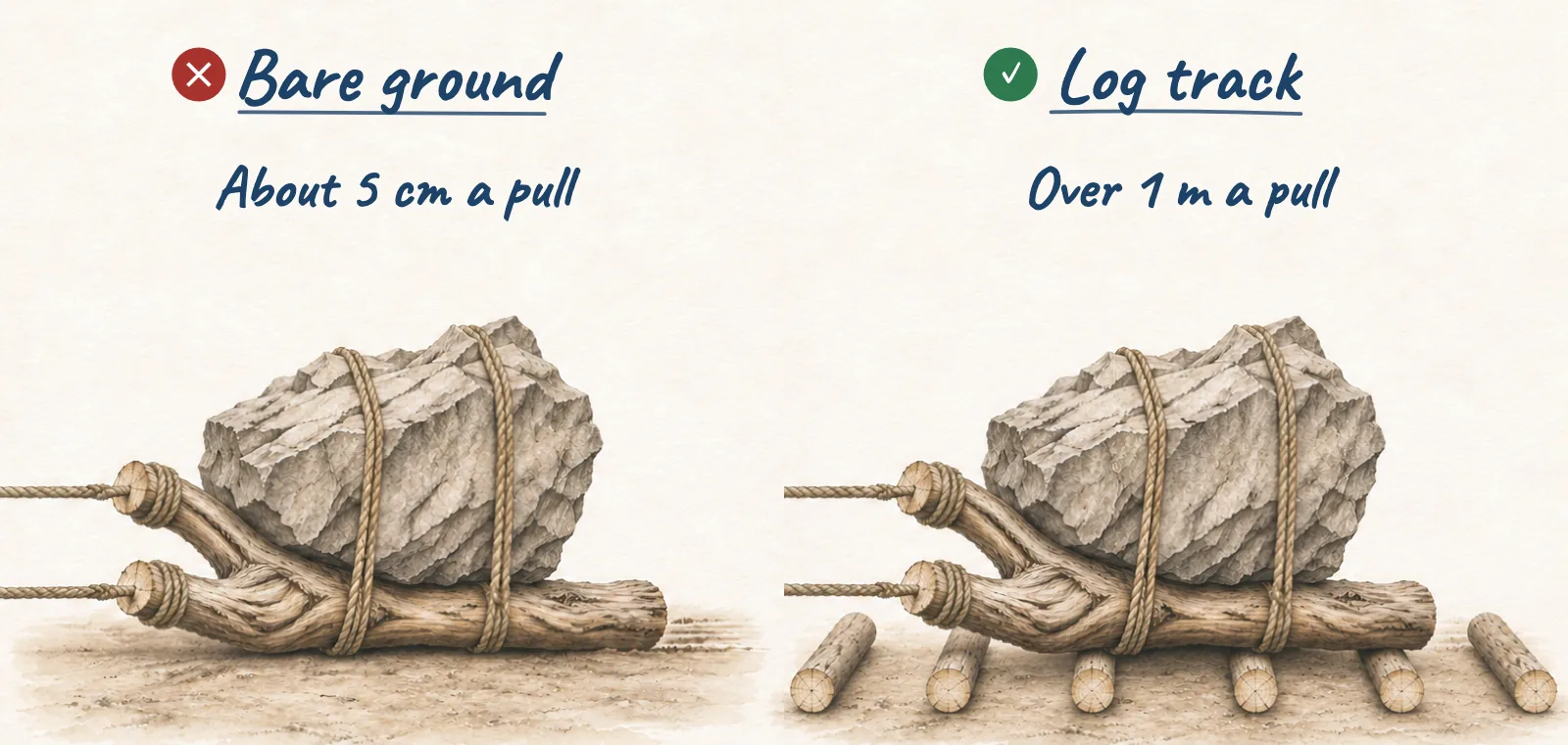
On bare ground, two hundred people could not move it, and one of the ropes snapped. The organisers increased the team to three hundred. The sledge moved — about 5 cm (2 in) with each shout of the pulling chant.
Then the team tried a kinma-michi (木馬道), a track of logs laid crosswise about 80 cm (31 in) apart. On the log track, the sledge with the same stone moved more than 1 m (3 ft 3 in) per shout. The account does not say whether the team was still 300 strong. Fujiidera City’s own conclusion is blunt: dragging directly over the ground was extremely inefficient.
What the numbers show
| Condition | Pullers | Load | Distance per pull |
|---|---|---|---|
| Bare ground, first attempt | 200 | 14 t granite | Did not move; a rope broke |
| Bare ground, second attempt | 300 | 14 t granite | About 5 cm |
| Log track (logs about 80 cm apart) | Not stated | 14 t granite | More than 1 m |
The reported distance per pull was more than twenty times greater on the log track. The account does not break the gain down, but the obvious change was what the sledge slid on — a lesson that applies as much to a garden boulder as to a burial-mound stone.
Why the track matters more than the crowd — friction in practice
Why should a row of logs make such a difference? The force needed to drag a load is roughly its weight multiplied by a friction coefficient, and that coefficient depends on the two surfaces in contact. A runner ploughing into soil digs in and piles material ahead of itself; the same runner on firm logs slides over a narrow, hard contact. The weight is the same; the resistance is not.
Rolling versus sliding
Japanese practice used both ideas. A sori-michi (ソリ道), a sled road, lays split logs or bamboo for the runner to slide on. Koro (コロ), rollers, change the problem from sliding to rolling: the load rides on boards set on round timbers,.
Egypt: water in front of the sledge
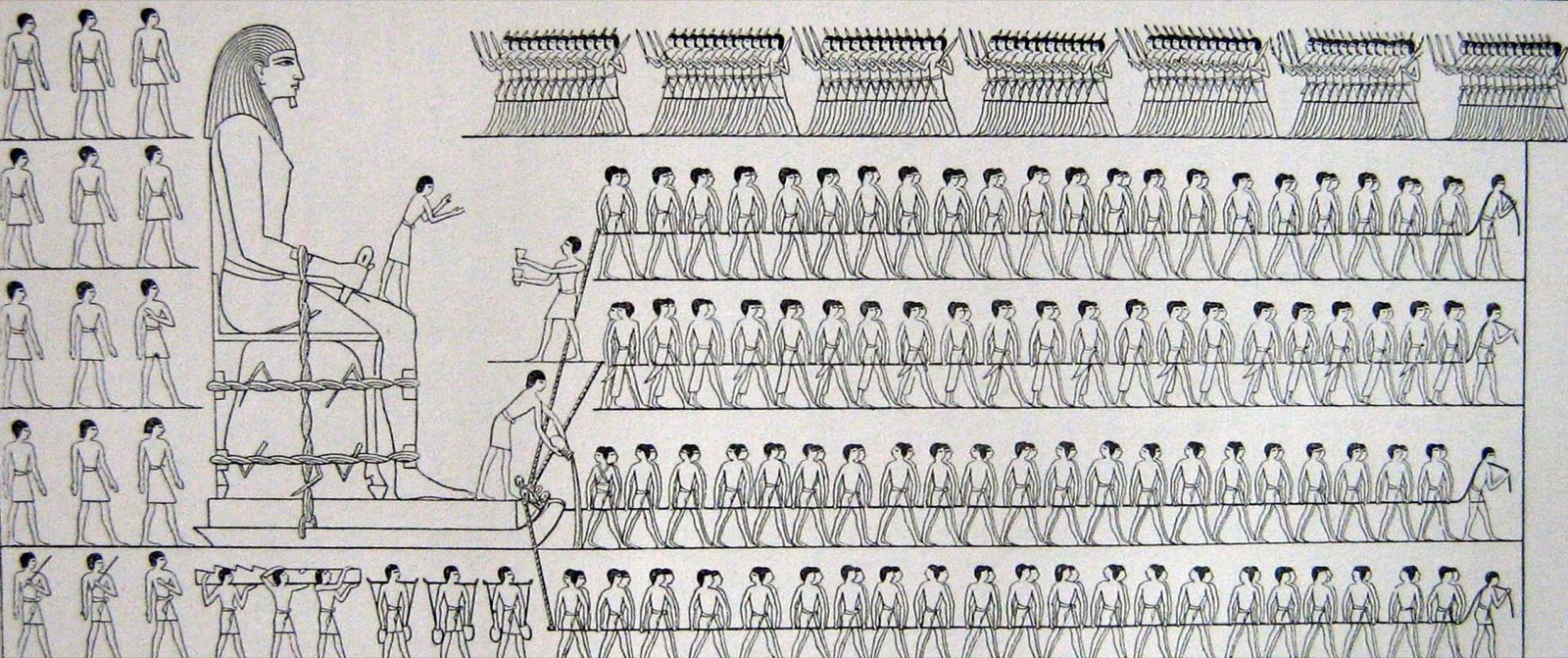
The same physics has been tested far from Japan. In a 2014 paper in Physical Review Letters, Fall and colleagues showed that “the sliding friction on sand is greatly reduced by the addition of some — but not too much — water.” The University of Amsterdam, where the work was done, pointed to a wall painting in the tomb of Djehutihotep, in which a colossal statue on a sledge is hauled while “a person standing on the front of the sledge wets the sand.” Too little water and friction stays high; the right amount cuts it; too much and it rises again.
Stonehenge: ten people and a sledge
In Britain, a 2016 experiment by University College London placed a concrete block of about three-quarters of a tonne on a wooden sledge running over timber rails. The report’s finding: “the force generated by just 10 individuals was sufficient to move the load.” It was a reconstruction of a method, not of the Stonehenge stones themselves.
The same problem, different ground
| Japan (Fujiidera 1978) | Egypt (Fall et al., 2014) | Britain (UCL, 2016) | |
|---|---|---|---|
| Carrier | Oak sledge (shura) | Wooden sledge | Wooden sledge |
| Running surface tested | Bare ground vs logs ~80 cm apart | Dry vs damp sand | Timber rails |
| Key finding | Log track: 1 m+ per pull vs ~5 cm on ground | Right amount of water cuts friction | 10 people moved ~0.75 t |
| What it does not prove | How the Fujito stone was moved | How the pyramids were built | How Stonehenge was built |
Desert sand is not Kyoto clay, so none of these results transfers directly. What they share is the principle: the people pulling a stone are fighting the surface beneath it, and preparing that surface can matter as much as the size of the crowd.
Lifting and setting — levers, shear legs and the kagurasan
Dragging gets a boulder to the garden, not into its hole at the right angle. For the last few metres, a different set of tools takes over.
Levers: the first and last tool
The teko (梃子), a lever, is the simplest stone-moving tool; a lever pole lay beside the Mitsuzuka shura in the moat. A training manual for Japanese landscape trades produced under a Ministry of Health, Labour and Welfare programme lists the wooden lever (kiteko) and the steel lever (kanateko) for exactly this purpose: “to pry up heavy objects such as stones and trees and move them.” The same table adds a caution about the steel lever: it is used like the wooden one, “but not on valuable stones or trees, because it damages them.” So wherever a stone’s surface matters, the wooden lever is the safer tool.
Shear legs and the capstan
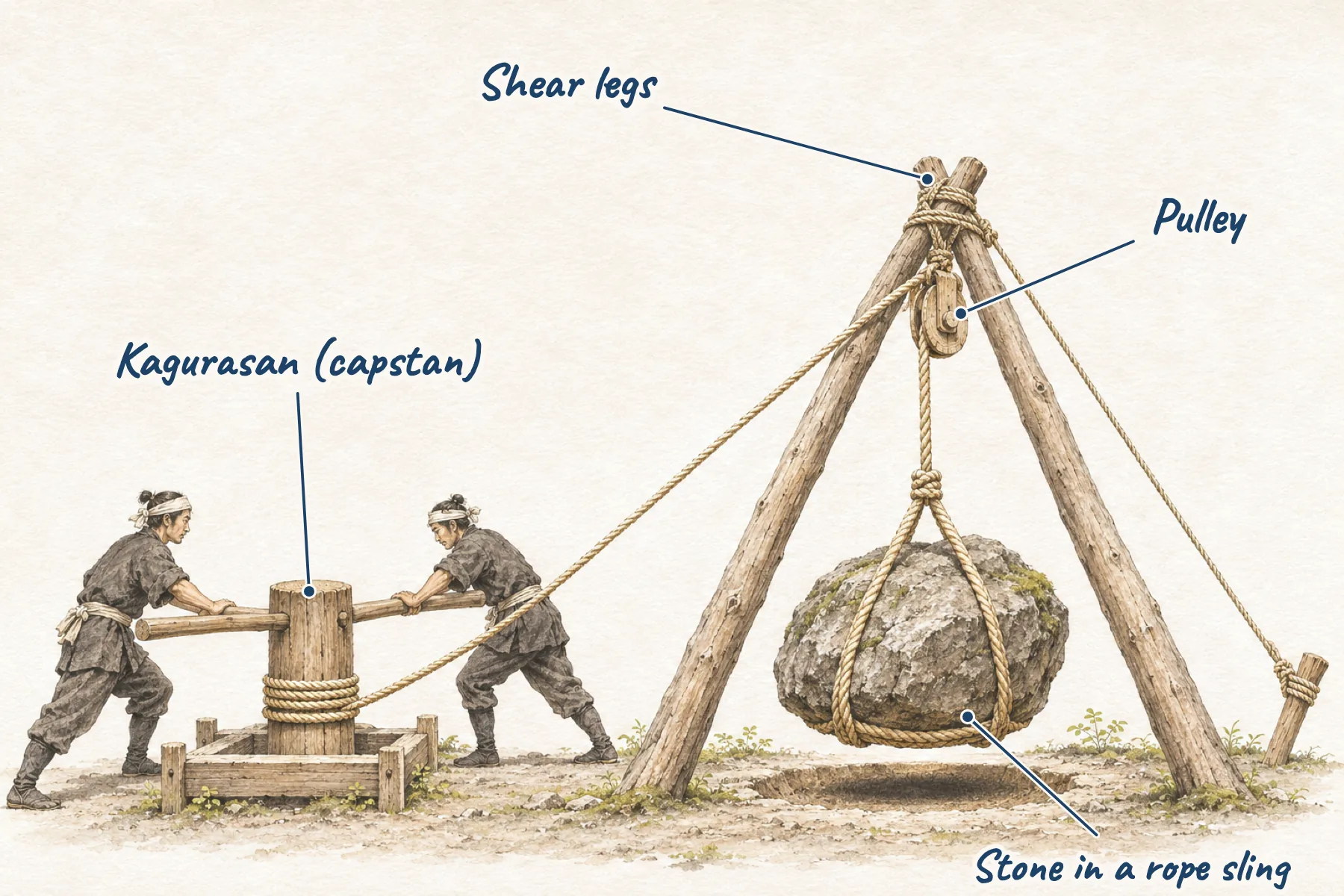
To lift rather than drag, Japanese builders used nimata (二又), two poles lashed at the top — shear legs — or sanmata (三又), a tripod, with a pulley hung from the apex. The rope ran down to a kagurasan (神楽桟), a capstan turned by people pushing on bars, sometimes called a rokuro. Yamanashi Prefecture’s guide to Kōfu Castle describes the arrangement for castle walls: a stone hung from a pulley on the shear legs “rises” as the capstan winds the rope. A document from Ueda City illustrates the same winding device, labelled “Rokuro (kagurasan).”
The Japanese Institute of Landscape Architecture records that rollers were once pulled by the same device: “In the old days a tool called the kagurasan was used to pull the rope by human power.”
The same methods on castle walls
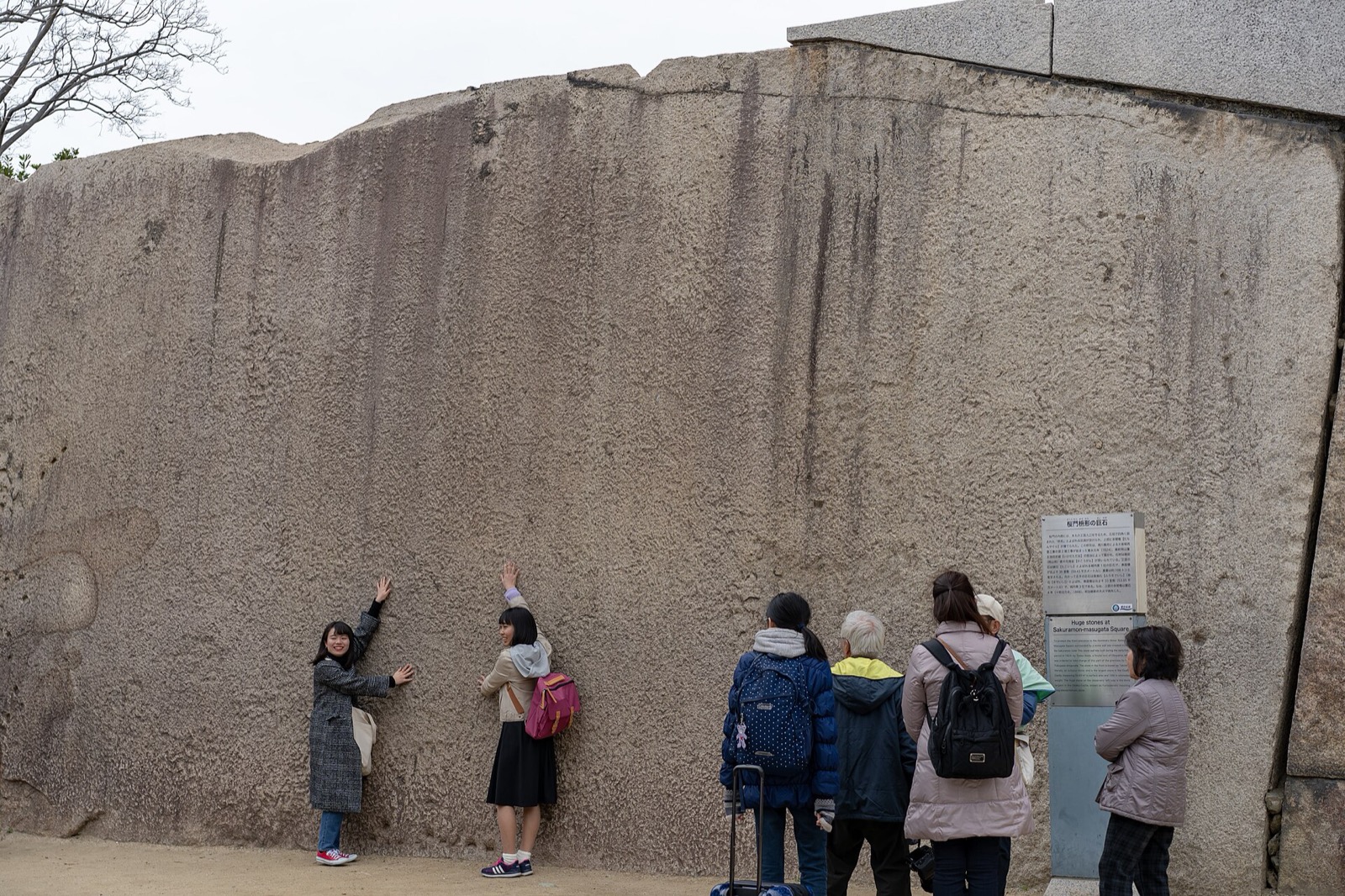
Castle builders used the same tools. Osaka Castle Museum’s leaflet on the castle’s walls explains that the Tokugawa-era walls are almost entirely granite, and describes the method of hauling: a shura loaded with the stone was placed on logs laid in a row and pulled by many people. The museum’s folding screen Ishibiki-zu Byōbu, thought to date from the mid-seventeenth century, shows oxen and labourers “straining with all their strength” to move a great stone — though the museum identifies the scene as the building of Hikone Castle, not Osaka. The largest stone in the Osaka walls, the Takoishi or “octopus stone,” shows a face of about 59 m² (635 sq ft); its weight and the method used to move it cannot be read from that figure. For how these stones were then fitted into dry walls, see the article on the Anō masons and Japan’s mortarless castle walls.
Tools for moving a boulder without a crane
| Tool | Japanese | What it does | Evidence cited here |
|---|---|---|---|
| Sledge | Shura 修羅 | Carries the stone; slides on a track | Mitsuzuka find (1978); Osaka Castle leaflet |
| Log or sled track | Kinma-michi 木馬道 / sori-michi ソリ道 | Reduces friction under the sledge | Fujiidera experiment; JILA record |
| Rollers | Koro コロ | Turns sliding into rolling under a platform | JILA record |
| Lever | Teko 梃子 | Pries, nudges, lets wedges or rollers in | Mitsuzuka lever pole; landscape training manual |
| Shear legs / tripod with pulley | Nimata 二又 / sanmata 三又 | Lifts the stone for short moves | Kōfu Castle guide; training manual |
| Capstan winch | Kagurasan 神楽桟 (rokuro) | Winds the rope by human power | Kōfu, Ueda, JILA |
| Chain block | — | Mechanical hoist on shear legs | Training manual (modern tool) |
The last row is a warning: tripods are old, but the chain block is a modern geared hoist and says nothing about how sixteenth-century stones were set.
Estimating the weight — the first decision on any stone
Weight is not the only thing that decides the method — the route, the ground and the final position matter too, as later sections show — but it is the first number to pin down.
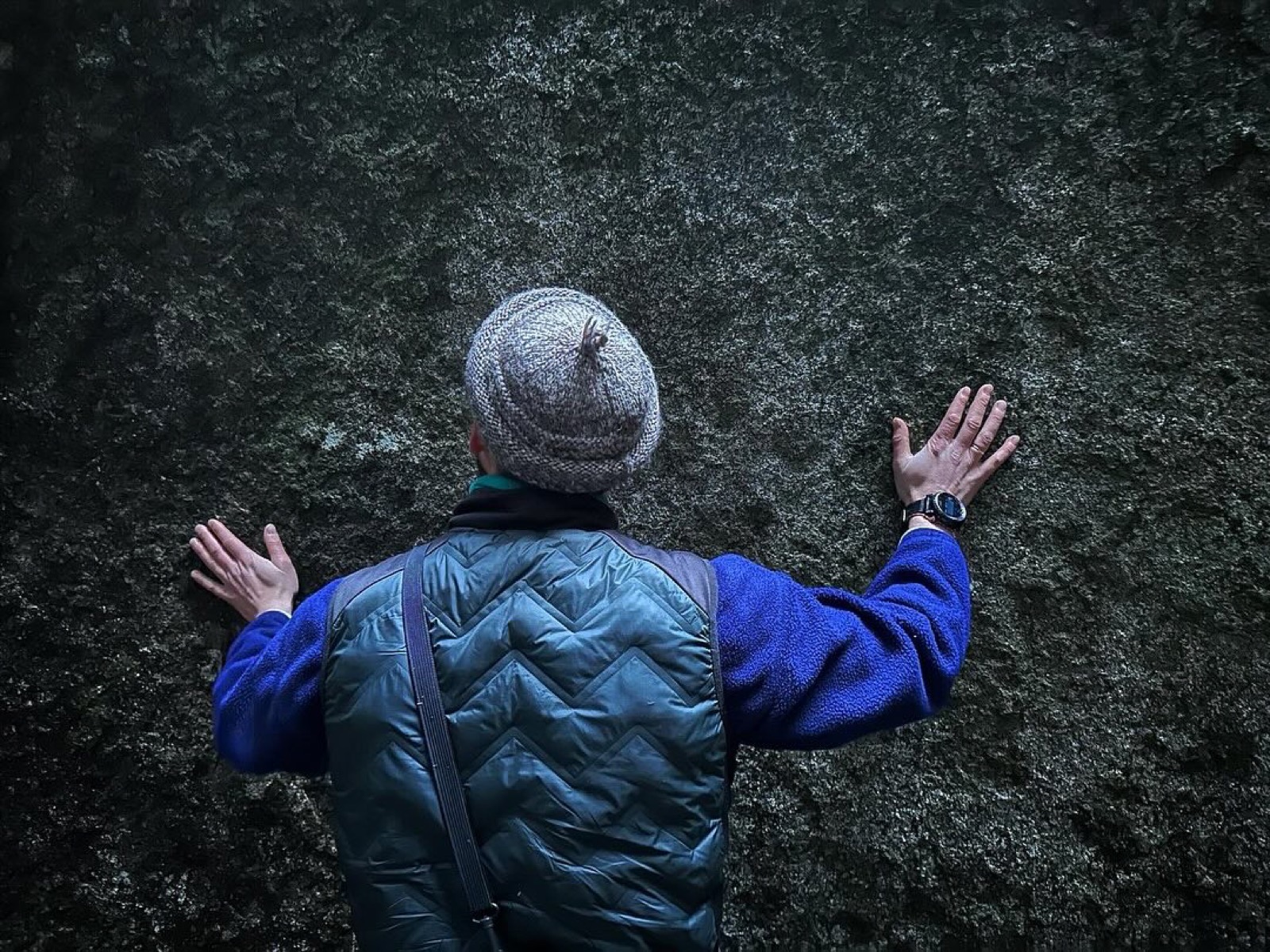
Volume times density
The Geological Survey of Japan gives approximate specific gravities for air-dried rock: 2.6 to 2.7 for granite and granodiorite, and the same range for andesite. In practice that means:
mass (tonnes) ≈ volume (m³) × 2.6–2.7
So one cubic metre of granite or andesite weighs roughly 2.6 to 2.7 tonnes.
Worked examples
– 0.25 m³ (about 8.8 cu ft): 0.65–0.68 t – 0.5 m³ (about 17.7 cu ft): 1.3–1.35 t – 1 m³ (about 35.3 cu ft): 2.6–2.7 t – 2 m³ (about 70.6 cu ft): 5.2–5.4 t
Run the formula backwards and the 1978 experiment comes into focus: a 14-tonne granite block is roughly 5.2 to 5.4 m³ of rock — a large experimental load — and, as the experiment showed, the crew it needed depended as much on the running surface as on the weight.
The trap in the tape measure
Garden stones are not boxes. Measure length, width and height and multiply, and you have the volume of the box the stone fits into, including the air around its curves. That over-estimates the weight, which errs on the safe side for planning but can mislead a comparison. The figure is also only as good as the rock type: the 2.6–2.7 range applies to granite and andesite. No source checked here gives a measured size, weight or rock type for the Fujito stone, so this article does not guess one.
Neire and hidden supports — what holds a garden stone in place
“First understand the general principle of setting stones”
An early Japanese garden treatise, the Sakuteiki (作庭記), opens with stones: “Ishi wo taten koto, mazu ōmune wo kokoroubeki nari” (石をたてん事,まづ大旨をこころうべき也) — “In setting stones, first understand the general principle.” The verb is tateru, “to stand” or “to raise,” but scholars note that it does not mean every stone must stand upright. Ishi wo tateru was simply the phrase for making a garden.
The treatise also lists taboos. One forbids laying down a stone that originally stood upright, or standing up a stone that originally lay flat (一もと立たる石をふせ、もと臥る石をたてる也). It is a rule about how a stone should look, not a law of physics. Whether a stone actually stays put is a separate question — of its foundation, its support and where its weight sits.
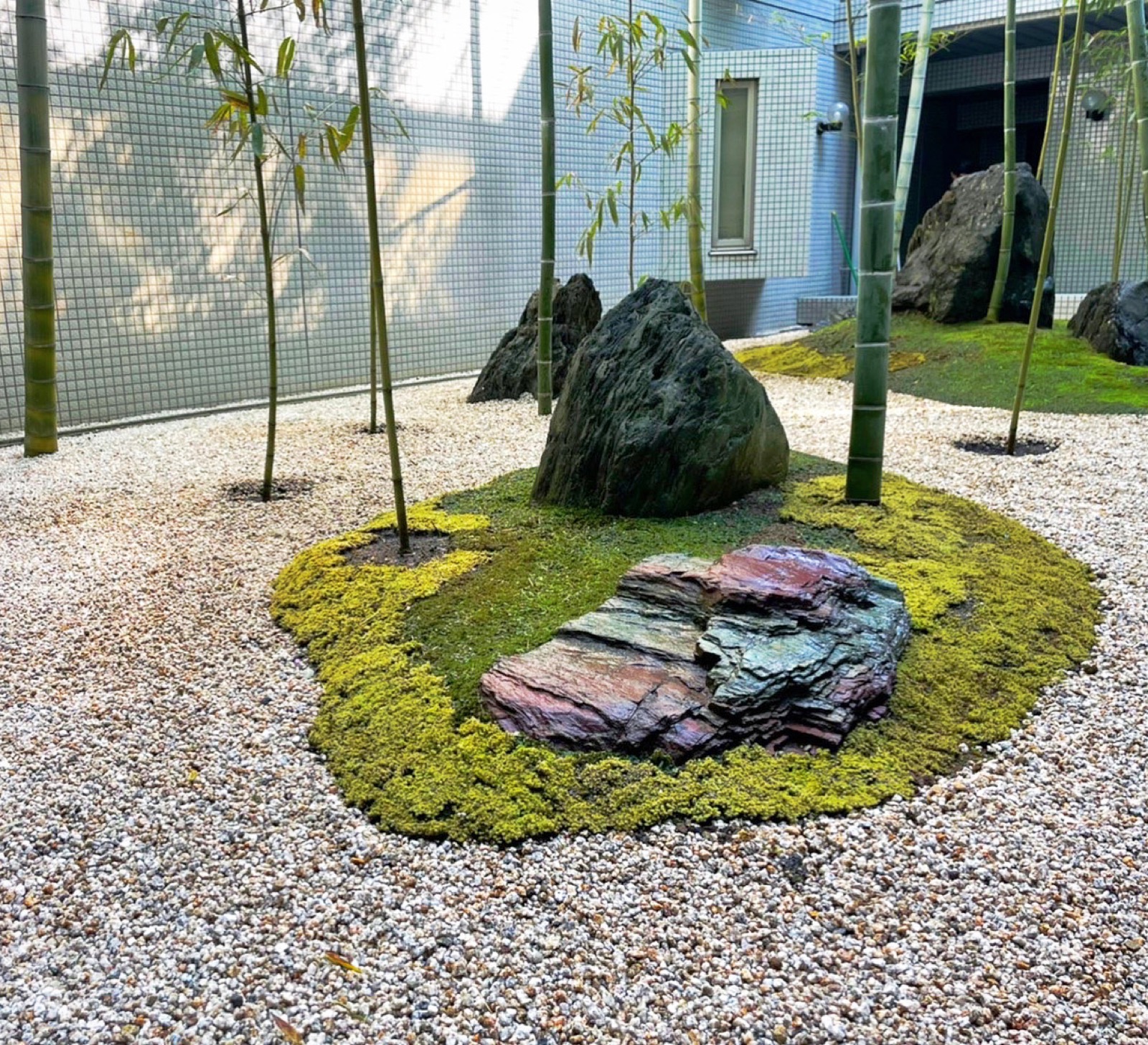
Neire — the part you do not see
Modern Japanese stone-setting practice turns that into a procedure. The Japanese Institute of Landscape Architecture describes the final setting of a garden stone (hon-sue) as choosing whether it is a standing stone or a lying stone from its shape, then fixing its position and depth “taking full account of the neire” — the portion buried in the ground. The buried depth is treated as part of the setting itself, to be confirmed together with the position.
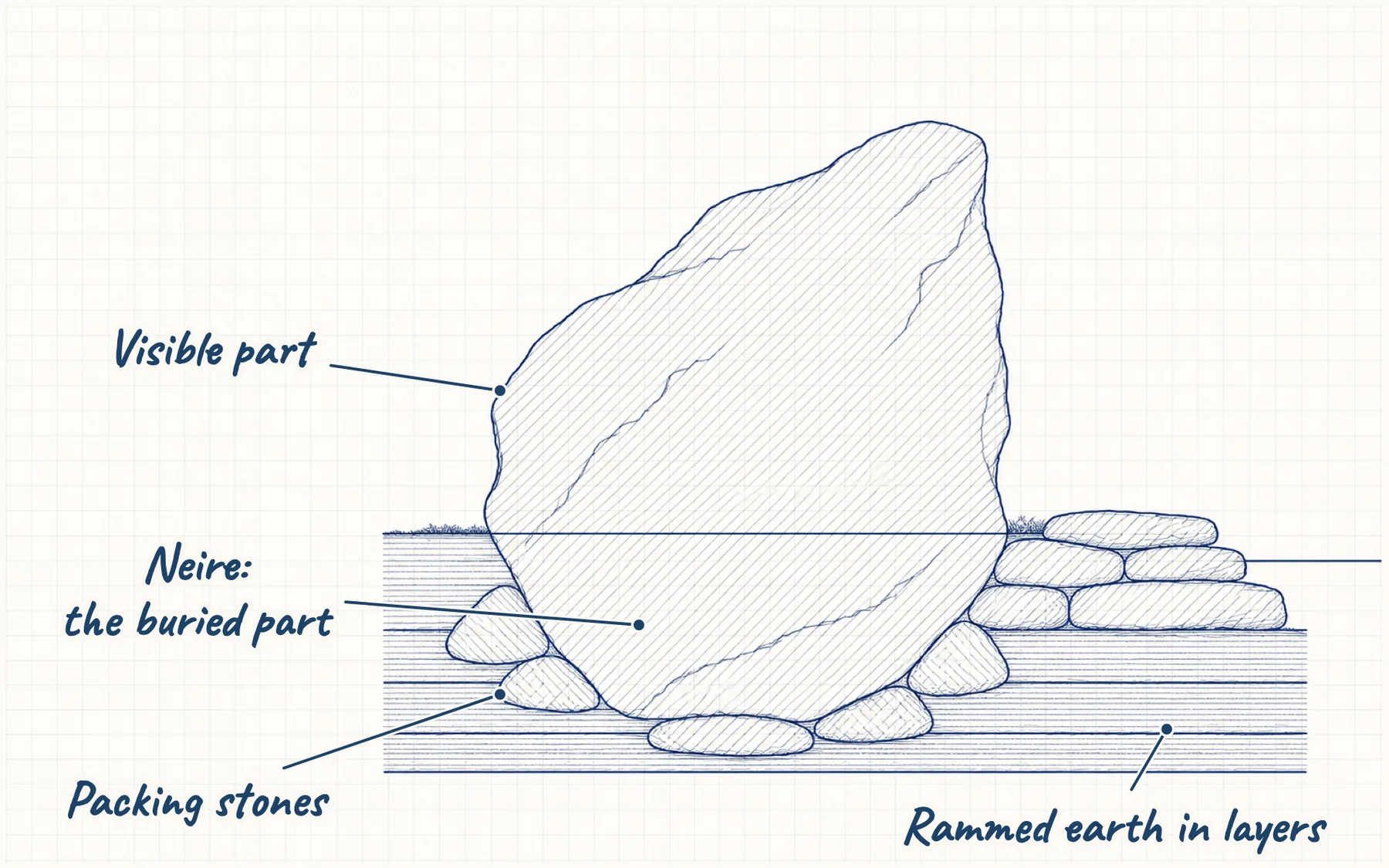
What the Sambō-in excavation found
The excavations at Sambō-in between 2002 and 2008, carried out for the garden’s restoration, showed how far below the surface this thinking went. The pond is up to 1.5 m (5 ft) deep. The large top stones of the banks, the tenba-ishi (天端石), were not set on the pond floor. Between a half and a third of each stone’s base rested on bank soil that had been rammed in layers; the rest sat on stones stacked up from the pond bottom, which both supported the top stone and retained the bank. At the very bottom, retaining stones were buried in the pond bed to stop the bank sliding.
In other words, the stones admired at Sambō-in are the visible tops of structures built to hold them. The Fujito stone may well rest on something similar, but no report checked here describes its foundation.
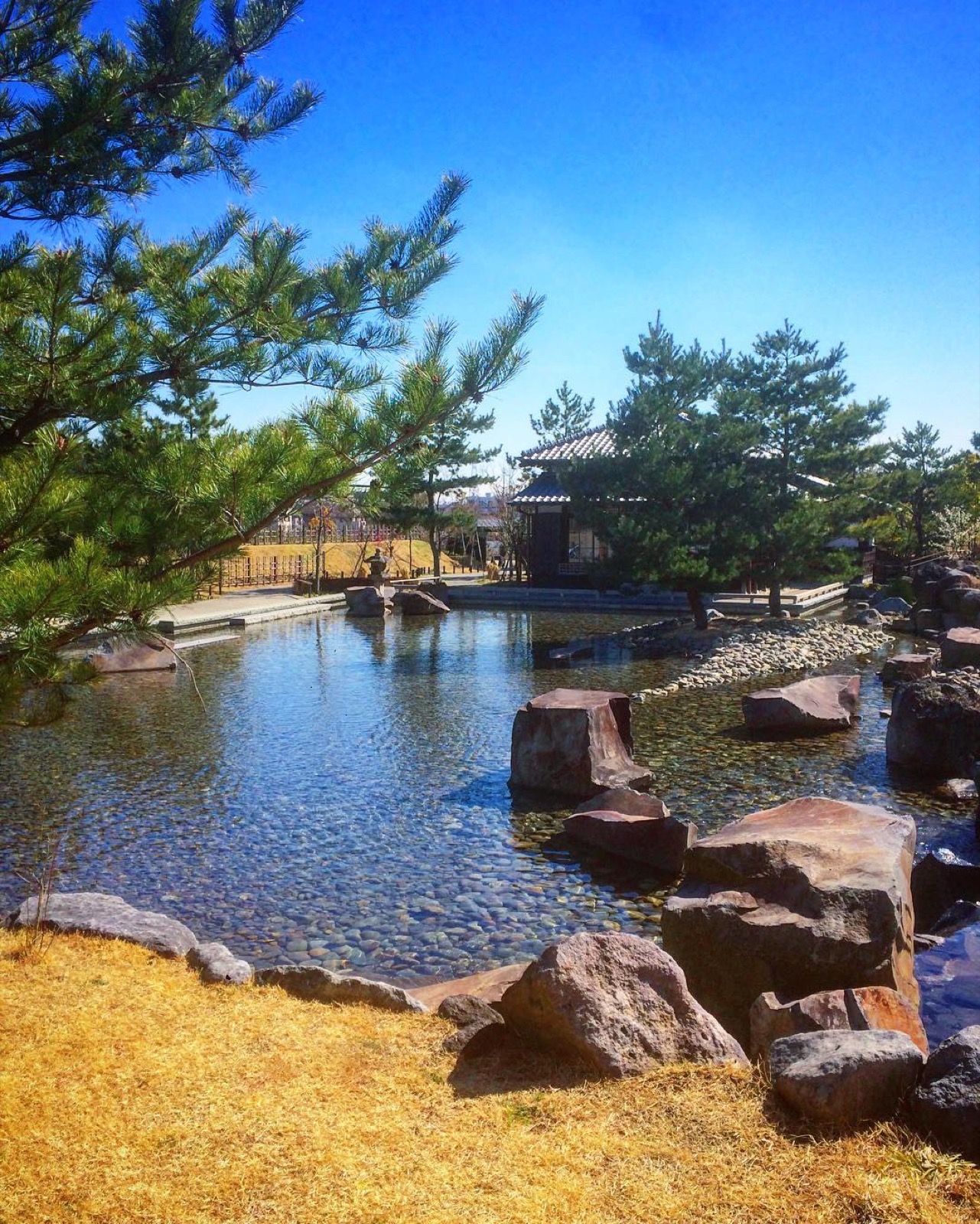
On Japanese sites today — when the crane cannot reach
These methods did not end with the arrival of cranes.
The sled still works
In its recent survey of traditional garden techniques, the Japanese Institute of Landscape Architecture records sliding a sledge along a sled road of split logs or bamboo as a way of moving stones over short distances where machines cannot get in, and notes that it “is still used today on sites where a crane cannot enter.” The same record describes the roller method in layers — boards, rollers, a carrier such as a sledge, then the stone — with a rope pulled from the front.
A crane can reach a long way — as in our article on crane-assisted tree removal — but where it cannot enter, the record above shows that sleds, rollers and boards are still part of the toolkit. The same training manual that lists modern winches and chain blocks also lists the sori (shura) and the koro among the tools for moving stone.
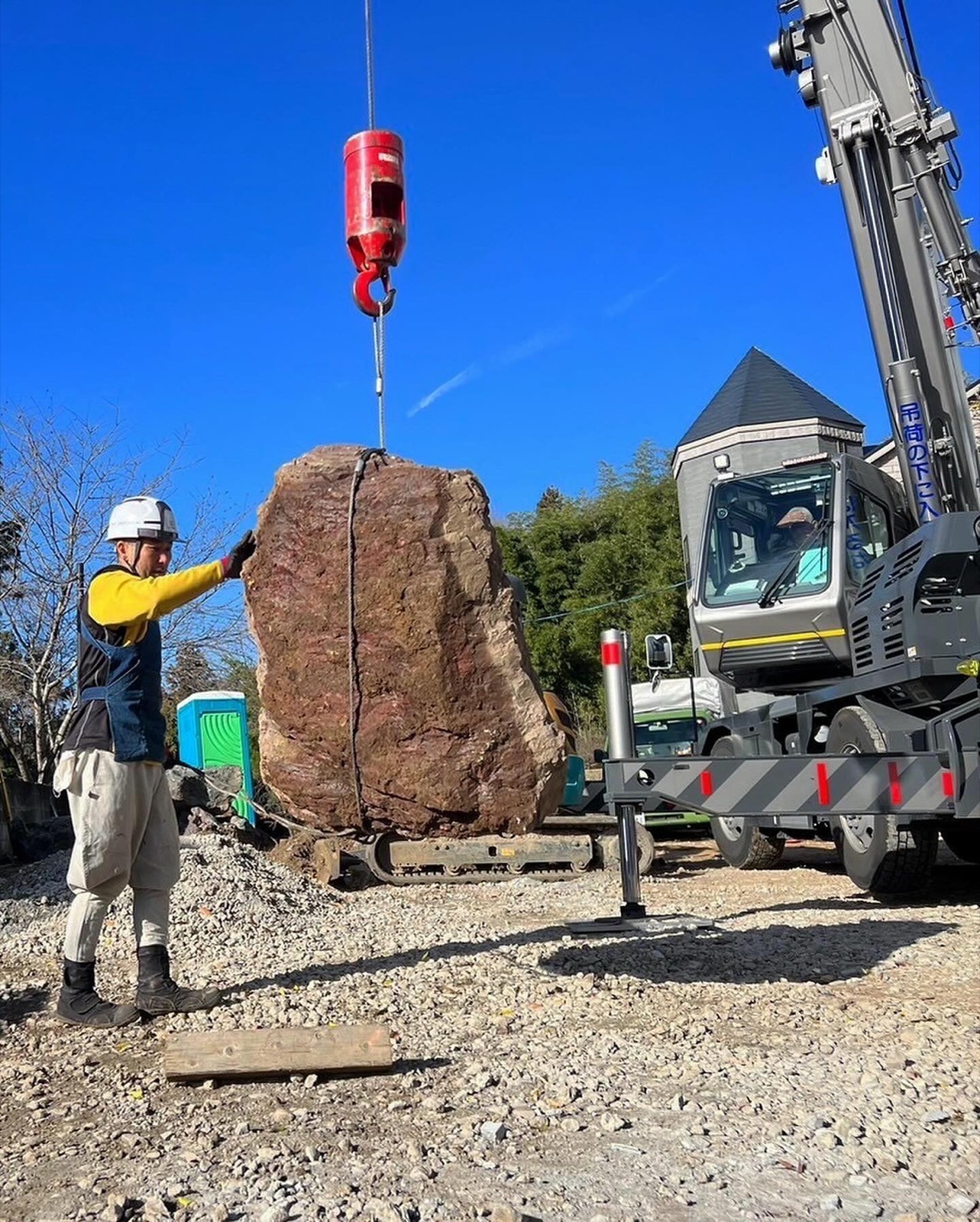
The order of decisions
Put together, the sources in this article suggest an order of questions for any boulder moved without a crane:
- Weight — volume × about 2.6–2.7 for granite or andesite, knowing that a box measurement over-estimates.
- Route — how far, how wide and over what ground the stone must travel.
- Surface — bare ground, a sled road of logs or bamboo, or boards on rollers; the 1978 experiment shows how much this changes the effort.
- Carrier and lifting gear — sledge, rollers, levers, then shear legs or a tripod with a winch or chain block for the final lift, with wooden rather than steel levers against valuable stones.
- Attitude and depth — standing or lying, which face shows, and how much neire goes below ground, confirmed together with the position.
- Support — what the stone rests on, as the rammed earth and stacked stones under Sambō-in’s banks show.
Stones are only one layer of a garden; the clipped shrubs around them are another discipline, covered in our guide to karikomi, and the view beyond them a third, as in shakkei, borrowed scenery.
Common misunderstandings about the Fujito stone
The stone’s fame has gathered a few errors. Each one blurs what is recorded with what is assumed.
– “Hideyoshi paraded the stone through Kyoto.” The brocade, flowers and music belong to Nobunaga’s move in 1569. Hideyoshi moved it to Daigo-ji in 1598. – “It was moved on a shura.” Possible — castle builders of the following decades used the sledge — but no source names the carrier for this stone. – “Three hundred people carried it to Daigo-ji.” The 300 helpers were present on the day of setting. The haul from the Jurakudai is not described. – “It is the rock from the battle of Fujito.” A tradition: “it is said,” in the Nara institute’s words. – “Setting a stone means standing it upright.” Ishi wo tateru means arranging stones; the phrase does not require every stone to stand upright.
Frequently asked questions
What is the Fujito stone?
The Fujito stone (藤戸石) is the central rock of the garden at Sambō-in, Daigo-ji, in Kyoto. Daigo-ji describes it, with the stones beside it, as representing the Amida triad and calls it tenka no meiseki, “a celebrated stone of the realm.” It was moved by Oda Nobunaga in 1569 and by Toyotomi Hideyoshi in 1598.
How did Japan move large stones before cranes?
With a wooden sledge called a shura dragged over a track of logs or rollers, levers to pry and adjust, and shear legs or tripods with a pulley and a hand-turned capstan (kagurasan) to lift. In a 1978 experiment, a 14-tonne granite block on a replica sledge moved about 5 cm per pull on bare ground with 300 people, and more than 1 m per pull on a track of logs.
Was the Fujito stone moved on a shura?
No surviving source says so. The Shinchō Kōki records brocade, flowers, many ropes and music for the 1569 move; Gien’s diary records the stone being set in 1598. Neither names the sledge, rollers or track used.
How do you estimate the weight of a garden stone?
Multiply its volume in cubic metres by about 2.6–2.7, the approximate specific gravity of granite and andesite given by the Geological Survey of Japan. One cubic metre is roughly 2.6–2.7 tonnes. A box measurement over-estimates irregular stones.
Where can I see a real shura?
The large shura excavated at the Mitsuzuka mounds is displayed at the Osaka Prefectural Chikatsu Asuka Museum; the small shura and a replica of the large one are on permanent display at the Fujiidera City Library.
Sources
– Daigo-ji, “Sambō-in” (Fujito stone, Amida triad, tenka no meiseki): https://www.daigoji.or.jp/wedding/sanboin.html — checked 2026-11-14 – Daigo-ji Cultural Property Archives, “Daigo no Hanami”: https://www.daigoji.or.jp/archives/special_article/index.html — checked 2026-11-14 – Kyoto City Archaeological Museum, Lecture 284, “Gardens associated with Toyotomi Hideyoshi” (2017), pp. 1–2: https://www.kyoto-arc.or.jp/news/s-kouza/kouza284.pdf — checked 2026-11-14 – Nara National Research Institute for Cultural Properties, Japanese Garden Dictionary, “Fujito stone”: https://www.nabunken.go.jp/org/bunka/jgd/pages/FujitoStone.html — checked 2026-11-14 – Nohgaku Performers’ Association, “Fujito”: https://www.nohgaku.or.jp/encyclopedia/program_db/fujito — checked 2026-11-14 – National Diet Library, Collaborative Reference Database (Kyoto City Library answer on the Fujito stone): https://crd.ndl.go.jp/reference/entry/reference/show?id=1000183073&page=ref_view — checked 2026-11-14 – Journal of the Japanese Institute of Landscape Architects 5(1), p. 43 (quoting the Shinchō Kōki): https://www.jstage.jst.go.jp/article/jila1934/5/1/5_1_43/_pdf/-char/ja — checked 2026-11-14 – Kanazawa University, Kōkogaku Kiyō 36, p. 67 (Tokitsugu Kyōki entries): https://kanazawa-u.repo.nii.ac.jp/record/6417/files/AN10407034-36-57-70.pdf — checked 2026-11-14 – Agency for Cultural Affairs, Cultural Heritage Online, “Shura and lever pole, Mitsuzuka mounds”: https://online.bunka.go.jp/heritages/detail/214159 — checked 2026-11-14 – Fujiidera City, “Pulling the shura” (1978 experiment): https://www.city.fujiidera.lg.jp/soshiki/kyoikuiinkai/bunkazaihogo/koramukodaikaranomemessezi/shuranohanasi/1387356310797.html — checked 2026-11-14 – Fujiidera City, “Origin of the name shura”: https://www.city.fujiidera.lg.jp/soshiki/kyoikuiinkai/bunkazaihogo/koramukodaikaranomemessezi/shuranohanasi/1387353987925.html — checked 2026-11-14 – Fujiidera City, excavation of the Mitsuzuka shura: https://www.city.fujiidera.lg.jp/soshiki/kyoikuiinkai/bunkazaihogo/koramukodaikaranomemessezi/hakkutumitearuki/1387504248023.html — checked 2026-11-14 – Fujiidera City Library, 1st-floor display: https://www.city.fujiidera.lg.jp/soshiki/kyoikuiinkai/toshokan/shisetsu/11524.html — checked 2026-11-14 – Osaka Castle Museum, “Stone walls of Osaka Castle” leaflet: https://www.osakacastle.net/pdf/leaflet/yukari-ishigaki_202408.pdf — checked 2026-11-14 – Osaka Castle Museum, Ishibiki-zu Byōbu: https://www.osakacastle.net/library/collection/95/ — checked 2026-11-14 – Osaka City, “Features of the Special Historic Site Osaka Castle,” ch. 3: https://www.city.osaka.lg.jp/keizaisenryaku/cmsfiles/contents/0000626/626612/3syou_.pdf — checked 2026-11-14 – Japanese Institute of Landscape Architecture, Nihon Teien no Kokoro to Waza (2024), pp. 82–83, 89: https://researchpromotion.jila-zouen.org/wp-content/uploads/2025/05/2024_nihonteien_seikahoukoku.pdf — checked 2026-11-14 – Landscape skills training material (Ministry of Health, Labour and Welfare programme), tools table, p. 11: https://www.jflc.or.jp/media/niwa_navi/20170327_1338_28_0389.pdf — checked 2026-11-14 – Yamanashi Prefecture, Maizuru Castle Park (Kōfu Castle) guide: https://www.pref.yamanashi.jp/documents/70967/maizulpanfu2.pdf — checked 2026-11-14 – Ueda City, Ueda Castle lecture material: https://www.city.ueda.nagano.jp/uploaded/attachment/76557.pdf — checked 2026-11-14 – Landscape Research Japan 80(5), p. 453 (opening of the Sakuteiki): https://www.jstage.jst.go.jp/article/jila/80/5/80_453/_pdf — checked 2026-11-14 – Tanaka Masahiro, “Sakuteiki,” Journal of the Japanese Institute of Landscape Architects 53(4): https://www.jstage.jst.go.jp/article/jila1934/53/4/53_4_271/_pdf — checked 2026-11-14 – Geological Survey of Japan (AIST), Chishitsu News, Table 5 “Specific gravity of gravels,” p. 25: https://www.gsj.jp/data/chishitsunews/67_08_05.pdf — checked 2026-11-14 – Fall, A. et al. (2014), “Sliding friction on wet and dry sand,” Physical Review Letters 112, 175502: https://journals.aps.org/prl/abstract/10.1103/PhysRevLett.112.175502 — checked 2026-11-14 – University of Amsterdam, “Ancient Egyptians transported pyramid stones over wet sand”: https://iop.uva.nl/content/news/2014/00/prl-egyptian-pyramids.html — checked 2026-11-14 – Harris, B., “Profile: Moving Stonehenge,” UCL Discovery: https://discovery.ucl.ac.uk/id/eprint/10114175/3/Harris_Profile-%20Moving%20Stonehenge_AAM.pdf — checked 2026-11-14