

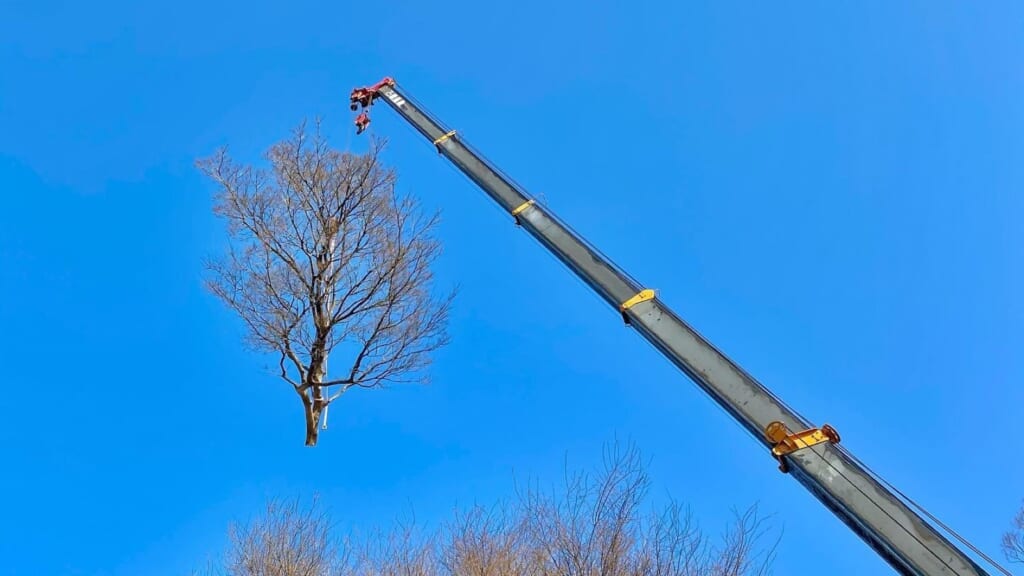
When a big tree in Japan stands between a house, overhead wires and a narrow road, and no direction is left for it to fall, it is not felled in one piece. It is taken down from the top in pieces: a crane holds each piece as the saw finishes the cut, then lowers it under control to a cleared spot on the ground. The work that decides whether this goes safely happens weeks earlier, in permits, wire covers booked with the power company, qualifications tied to the crane’s lifting capacity, and a weight estimate for every piece.
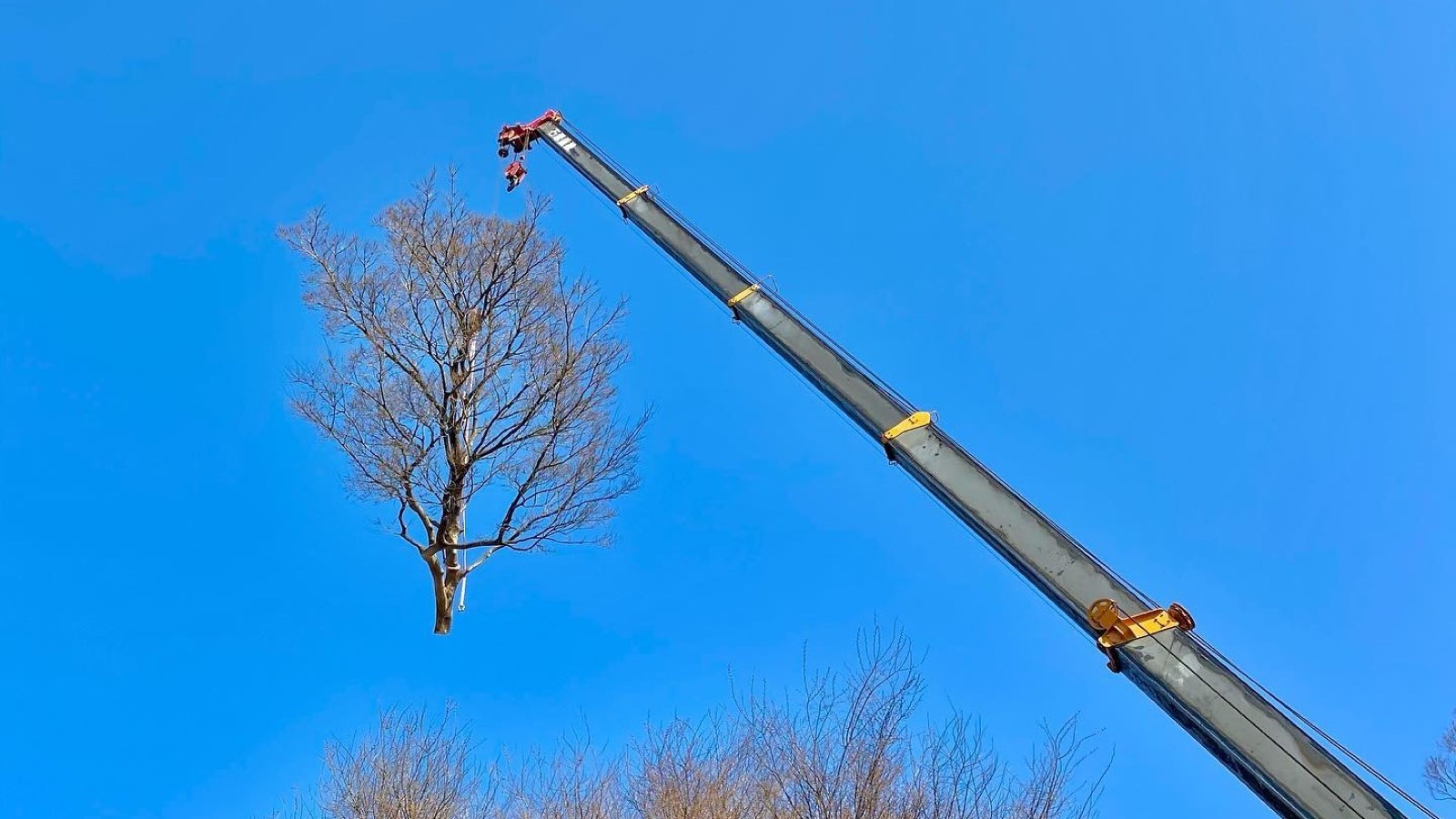
The tree with nowhere to fall — reading the site
Picture a street — an illustrative example, not one recorded job — before anyone has started up a saw. A broadleaf tree, wider than the house beside it, stands a metre or two from the property line. Its crown spreads over a roof on one side and over the road on the other. Distribution wires run past at roughly the height of its lowest limbs. The road is just wide enough for one truck. There is no direction in which the whole tree could be laid down.
Space on such streets is tight. In the 2023 Housing and Land Survey, the average site area of detached and row houses in Tokyo’s 23 wards was 118.27 m² (about 1,273 sq ft), according to the big-city comparison tables published by Sapporo. For comparison, 118 m² is a square less than 11 m on a side, while a tree 15 m tall — a hypothetical figure — needs about 15 m of clear ground in the direction it falls, before fences, cars and the neighbour’s garden are counted.
Why felling is off the table
Felling needs a direction. Japan’s Ordinance on Industrial Safety and Health (Article 477) requires that, for a standing tree with a breast-height diameter of 20 cm or more, the feller cut a face notch at least one quarter of the stump diameter deep, add a back cut of suitable depth, and — except where technically difficult — keep a hinge of suitable width between them. All of that controls where the tree goes. It does nothing when every direction ends on a roof, a wire or a road.
There is a second reason. When a felled tree lodges against another tree, Article 478 requires the hang-up to be dealt with promptly, keeps other workers out of the area if it cannot be, and forbids felling the supporting tree or dropping another tree onto the hang-up to bring it down. In a crowded garden, the supporting tree may be a neighbour’s. Avoiding the hang-up altogether is simpler than resolving it.
What “piece by piece” means in practice
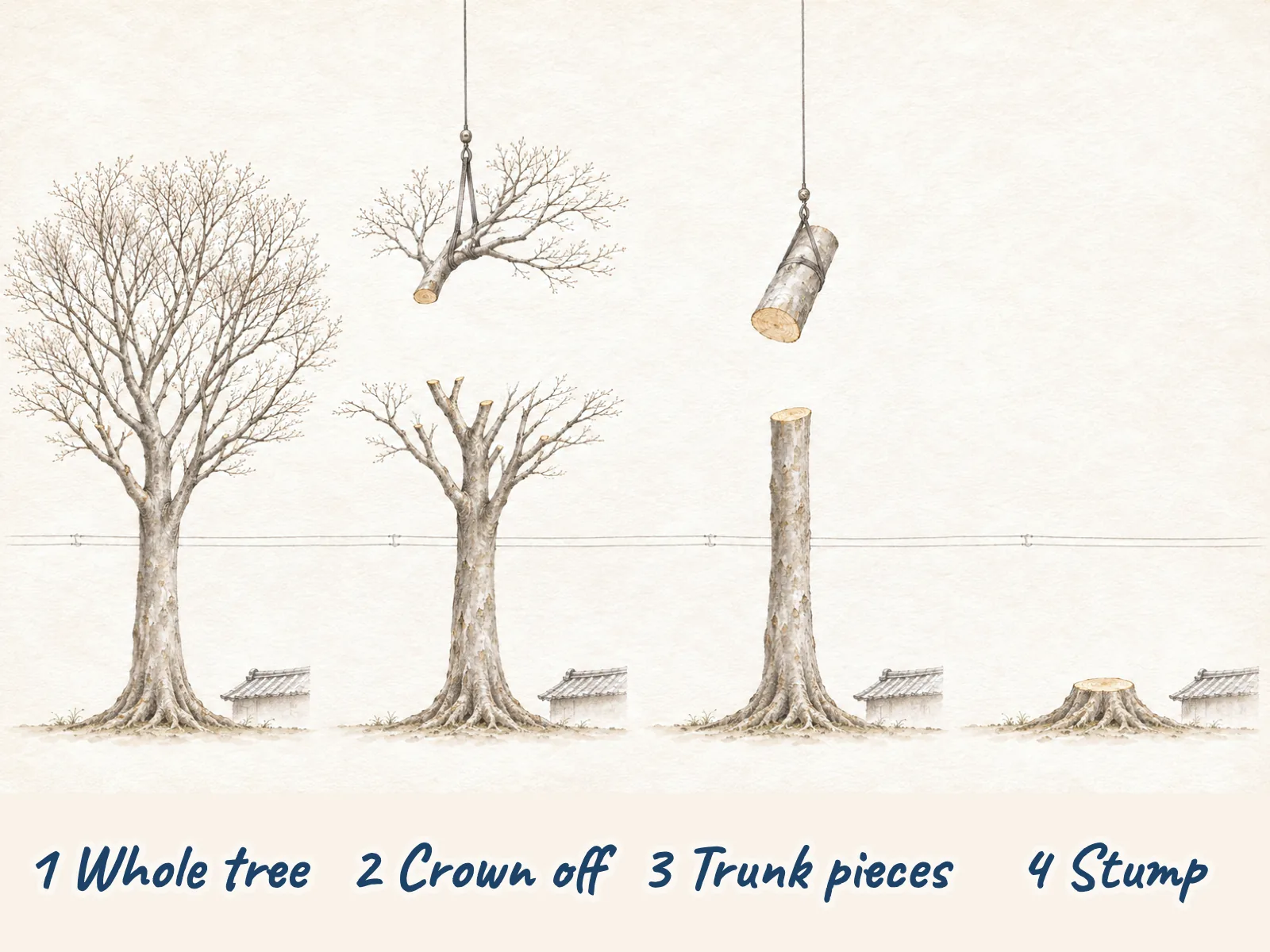
The illustration shows the idea as a simplified sequence. The crown comes off first, in sections small enough to lift, then the larger limbs. What remains is a bare trunk, which arborists call a spar, and it is shortened from the top, one section at a time. The final cut leaves a low stump that can be cut at ground level, ground down, or dug out later.
Tokushu bassai — the Japanese name for working from the top
In Japan this kind of work is called tokushu bassai (特殊伐採), literally “special felling”. A 2025 technical manual from Nagano Prefecture defines it as a method used when ordinary felling is difficult, in which the tree is cut from the top and the cut parts are lowered by suspension or similar means. We found no national legal definition of the term and no separate national licence named after it. It is a description of a method, not a qualification.
Rope or crane — two families of the same method
Japanese specifications also separate the two ways of lowering pieces. A supplementary document for park maintenance contractors issued by the City of Yokohama describes tsurushi-giri bassai (吊し切り伐採) as manual felling in which at least two ropes — one to stop the piece falling, one to guide it — lower cut branches and trunk pieces to a designated place. The same document classes felling with a crane separately, as kikai sekō (機械施工), “mechanised work”.
In Yokohama’s specification, then, the two methods are classified separately, even though both take the tree down from the top. In English, “crane-assisted removal” covers the second.
How a crew chooses
The choice is a judgement made at the site visit. The table lists conditions a crew checks before a crane is chosen; it is a checklist for this article, not an official standard, and each answer can change the plan.
| Condition checked on site | Why it matters for a crane |
|---|---|
| Where can the crane stand, with outriggers fully extended? | Outrigger width, not the crane body, often decides whether it fits (see below) |
| What radius is needed to reach the farthest piece? | Capacity falls as radius grows |
| What will each piece weigh? | Every piece must stay under the rated load at its radius |
| Is the road or the wires involved? | Permits and wire covers set the earliest date |
| How sound is the stem where slings will sit? | Decay changes both weight and how a sling holds |
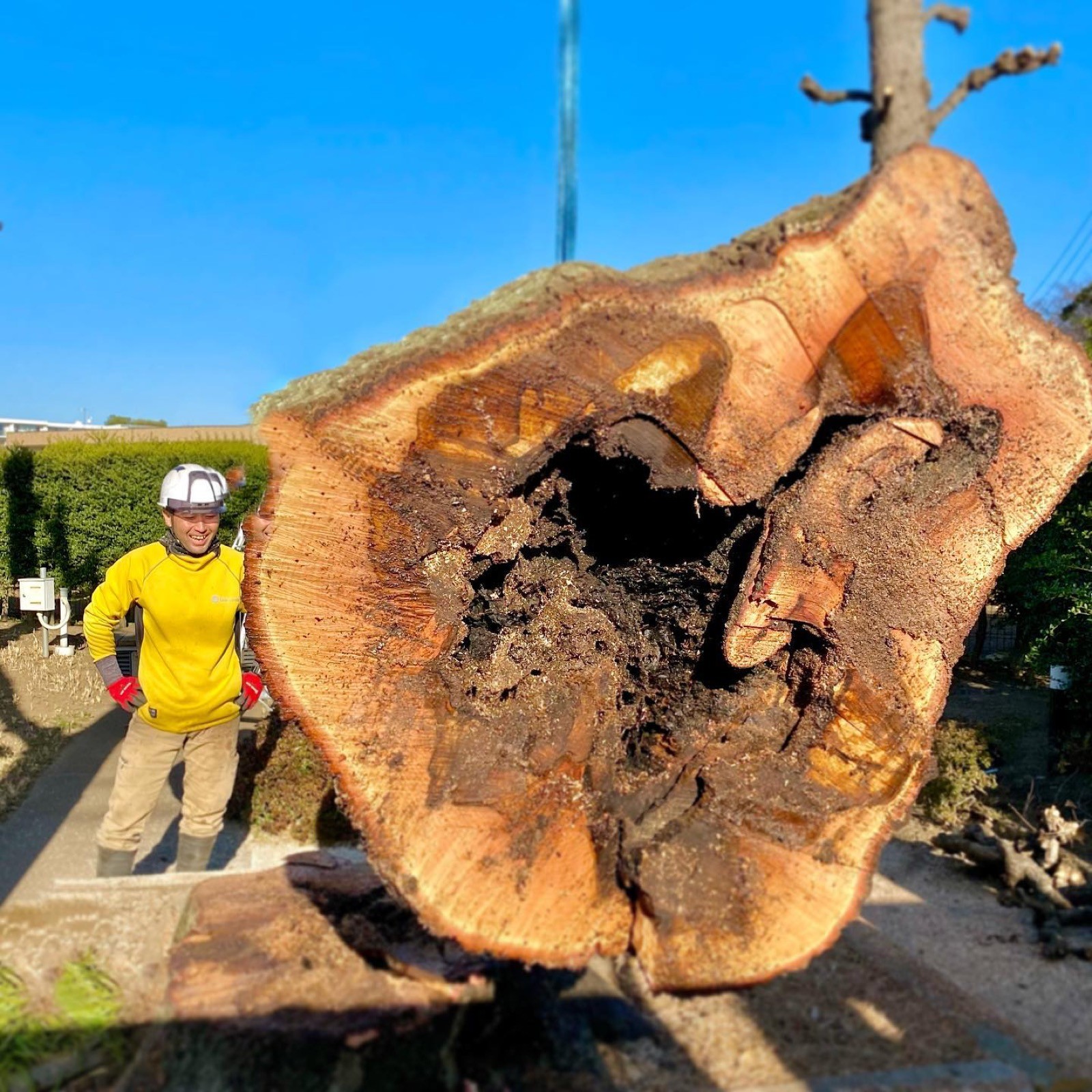
Decay can be an important factor. In many rope systems the tree itself carries part of the lowering load, through a rigging point higher in the stem. A crane carries the weight from outside the tree, which takes that load off a decayed stem — though the wood where the sling sits still has to be sound enough to hold. For a closer look at how decay is read before work begins, see our note on reading tree decay without instruments.
Weeks before the saw — permits, wires and covers
A crane removal in a Japanese residential street often begins at a desk. When the crane uses the road and the work comes near overhead lines, three bodies are involved: the police, the road administrator and the power company.
The road: use permit and occupancy permit
Japan has two different permissions for roads, and they are easily confused. A road use permit under Article 77 of the Road Traffic Act is issued by the chief of the local police station; the National Police Agency lists “carrying out construction or work on a road” as the first category it covers. A road occupancy permit under Article 32 of the Road Act is issued by the road administrator — the city, the prefecture or the national government — for installing structures or objects and using the road continuously.
Whether a crane parked on a city road also needs an occupancy permit depends on the city. Asahikawa, in Hokkaido, stopped requiring occupancy permits for work vehicles such as cranes and backhoes set up on city roads from 1 April 2020, asking instead for a work notice and the police road use permit. Iwakuni, in Yamaguchi, includes “stopping construction vehicles to carry out work” in its explanation of road occupancy. A crew has to ask the road administrator for the street in question; there is no single national answer.
The wires: covers booked with the power company
Under Article 349 of the Ordinance on Industrial Safety and Health, when work near overhead lines carries a risk of electric shock, the employer must move the live line, put up a barrier, or fit insulating protective covers to the line. Only when those three measures are extremely difficult may the employer instead post a watcher to monitor the work.
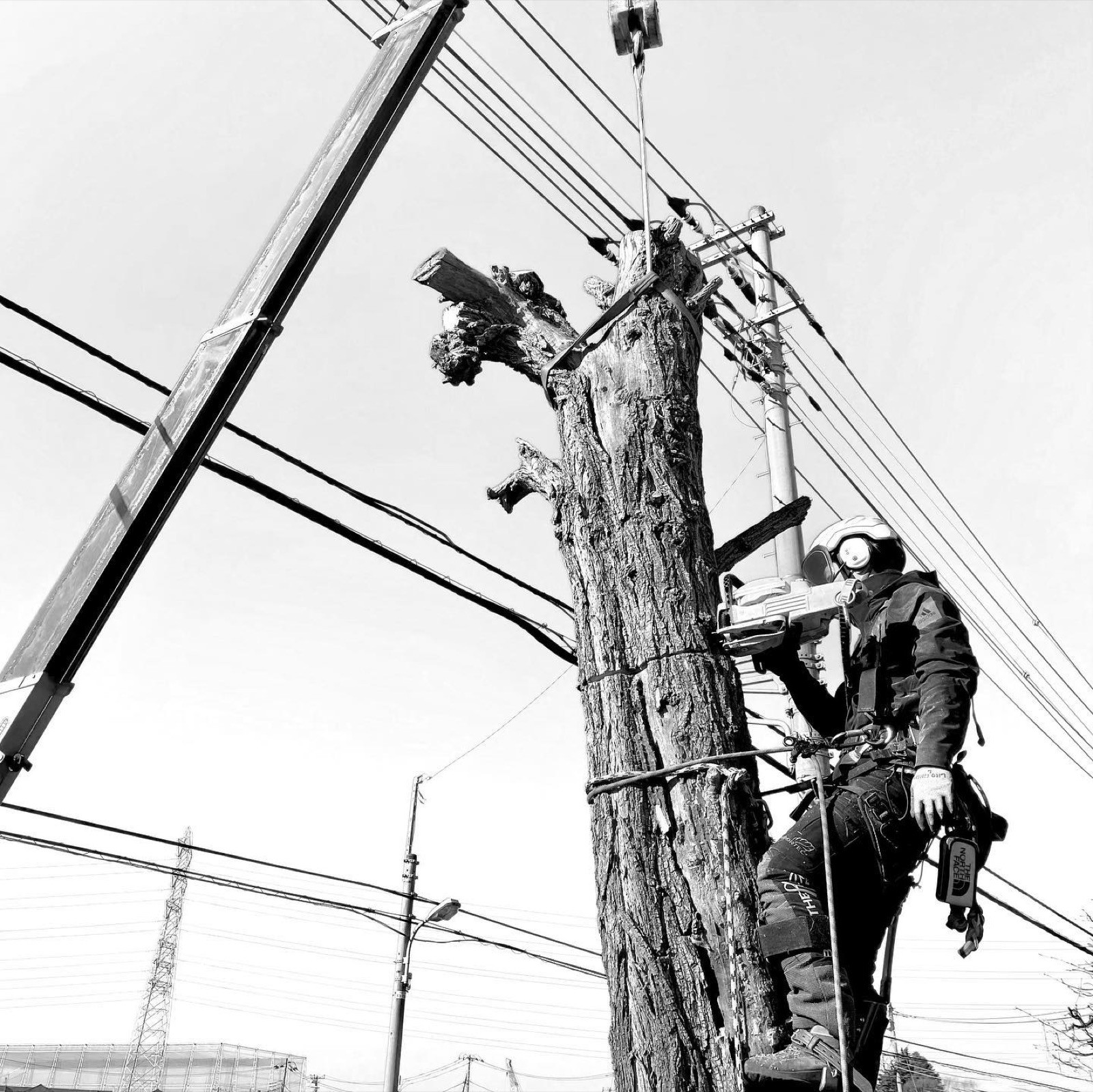
In practice, a crew working near distribution lines asks the power company to fit protective covers. TEPCO Power Grid, which serves the Tokyo area, has charged the applicant for fitting such covers for construction work since April 2018, and its 2025 notice asks for applications at least three weeks before the date the covers are wanted. That lead time has to be built into the schedule before a removal date is fixed.
A simple timeline
| When | What is arranged | With whom |
|---|---|---|
| Site visit | Tree condition, crane position, landing spot, wires | Client, crew leader |
| At least 3 weeks before the covers are wanted (TEPCO area) | Protective covers on distribution lines | Power company |
| Before the work date | Road use permit; occupancy permit where the city requires it | Police station; road administrator |
| Before the work date | Crane type, capacity at the needed radius, operator, slinger | Crane hire company or in-house crew |
| Morning of the work | Wind check, signal person named, exclusion zone set | Whole crew |
Choosing the crane — licences follow the machine
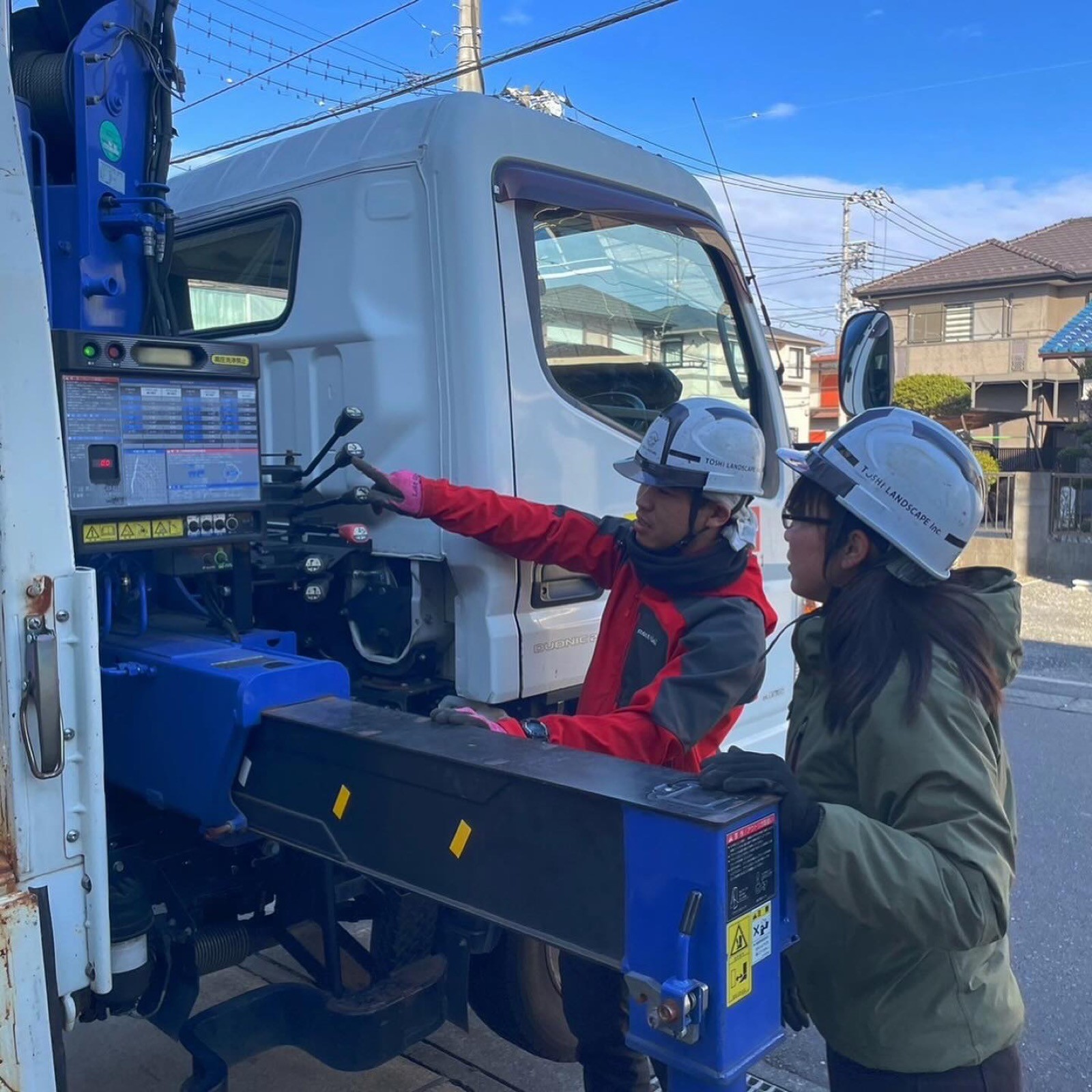
Japanese law ties the operator’s qualification to the crane’s lifting capacity (tsuriage kajū, つり上げ荷重), not to the tree. This is a fixed figure for the machine; it is different from the rated load, which changes with radius, discussed below. Under the Ordinance on Safety of Cranes, a mobile crane with a lifting capacity of 5 tonnes or more requires a mobile crane operator’s licence (Article 68). For 1 to under 5 tonnes, completing the skill training course for small mobile cranes is also accepted. For 0.5 to under 1 tonne, the employer must provide special safety education (Article 67); cranes with a lifting capacity under 0.5 tonnes are outside the scope of this ordinance (Article 2).
The slinger — the worker who does tamakake (玉掛け), attaching the load to the hook — has a parallel scale. Slinging for cranes of 1 tonne or more requires a legally recognised qualification, most commonly completion of the slinging skill training course (Article 221); for cranes of 0.5 to under 1 tonne, special education is required (Article 222).
| Crane’s lifting capacity | Operator | Slinger |
|---|---|---|
| 5 t or more | Mobile crane operator’s licence | Slinging skill training course (or other legal qualification) |
| 1 t to under 5 t | Licence, or small mobile crane skill training course | Slinging skill training course (or other legal qualification) |
| 0.5 t to under 1 t | Special education | Special education |
| Under 0.5 t | Outside the Ordinance on Safety of Cranes | Outside the ordinance |
The table has a practical consequence. Because the qualification follows the machine, a crew that changes to a larger crane to reach further must recheck the qualifications whenever the new machine crosses one of these thresholds, even if each piece is light.
Outriggers first
Article 70-5 of the same ordinance requires outriggers or crawlers to be extended to their maximum. The exception applies only when full extension is impossible and the load is certain to stay below the rated load for the width actually extended. On a narrow Japanese road, this is often the real limit: the crane may fit, but its outriggers may not.
The mini crawler crane — a Japanese answer to the narrow gate
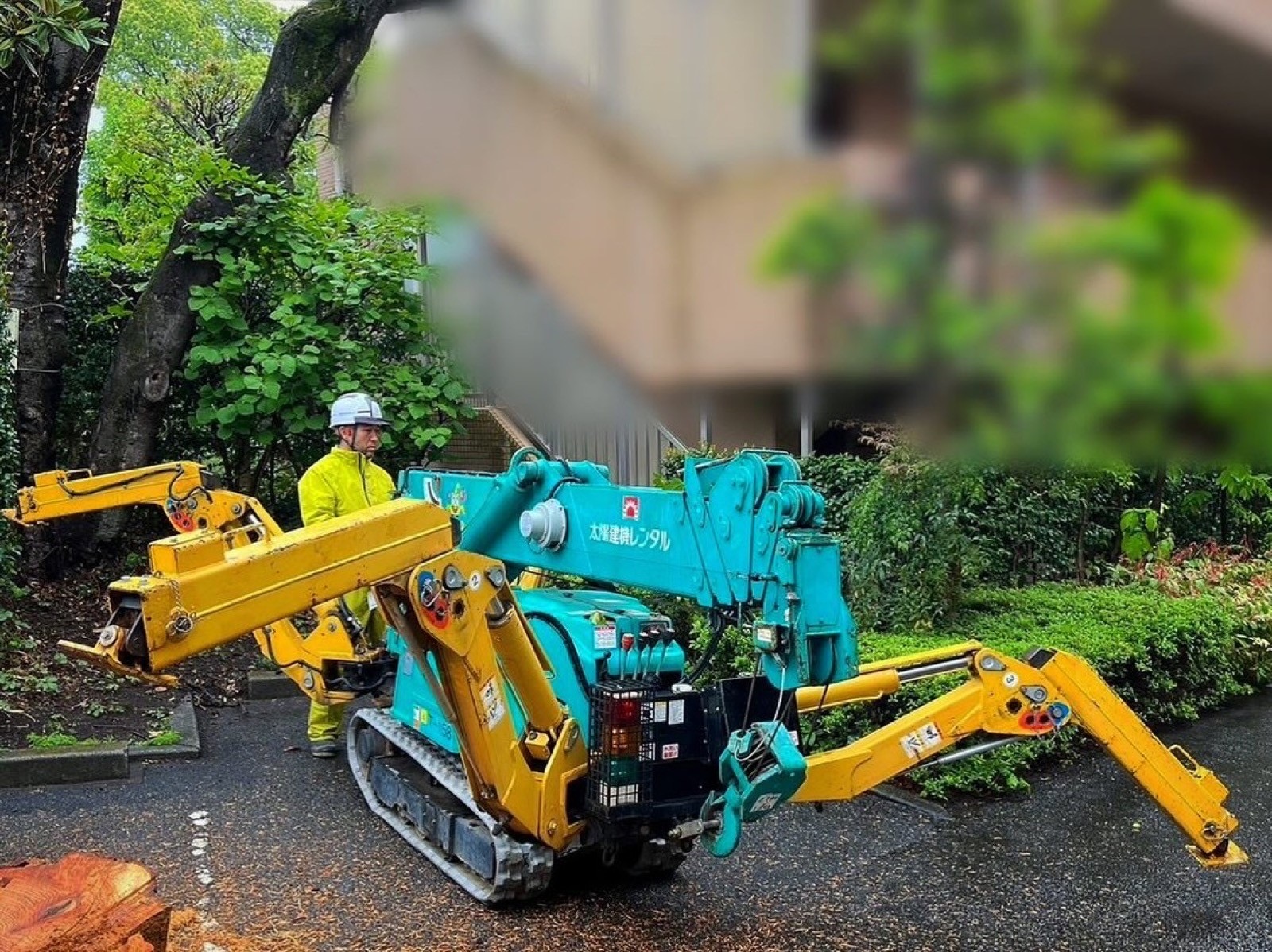
When a truck crane cannot get close enough, one option is the mini crawler crane, known abroad as the spider crane. Maeda Seisakusho’s company history records that it introduced the spider crane in 1980, with the model CP150. Furukawa Unic’s history records the launch of a 2.5-tonne mini crawler crane, the UR254C, in 1991.
Two current machines show why they suit tight sites. Maeda’s MC285C-3 lifts a maximum of 2.82 tonnes at a 1.4 m radius, is 750 mm wide and weighs 1,990 kg in its standard version. Furukawa’s UM325C, which the company announced for sale in Europe in 2024, has a maximum lifting capacity of 3,230 kg and a travelling width of 750 mm — narrow enough, the company says, to pass through an ordinary door.
Radius matters more than size — reading the load chart
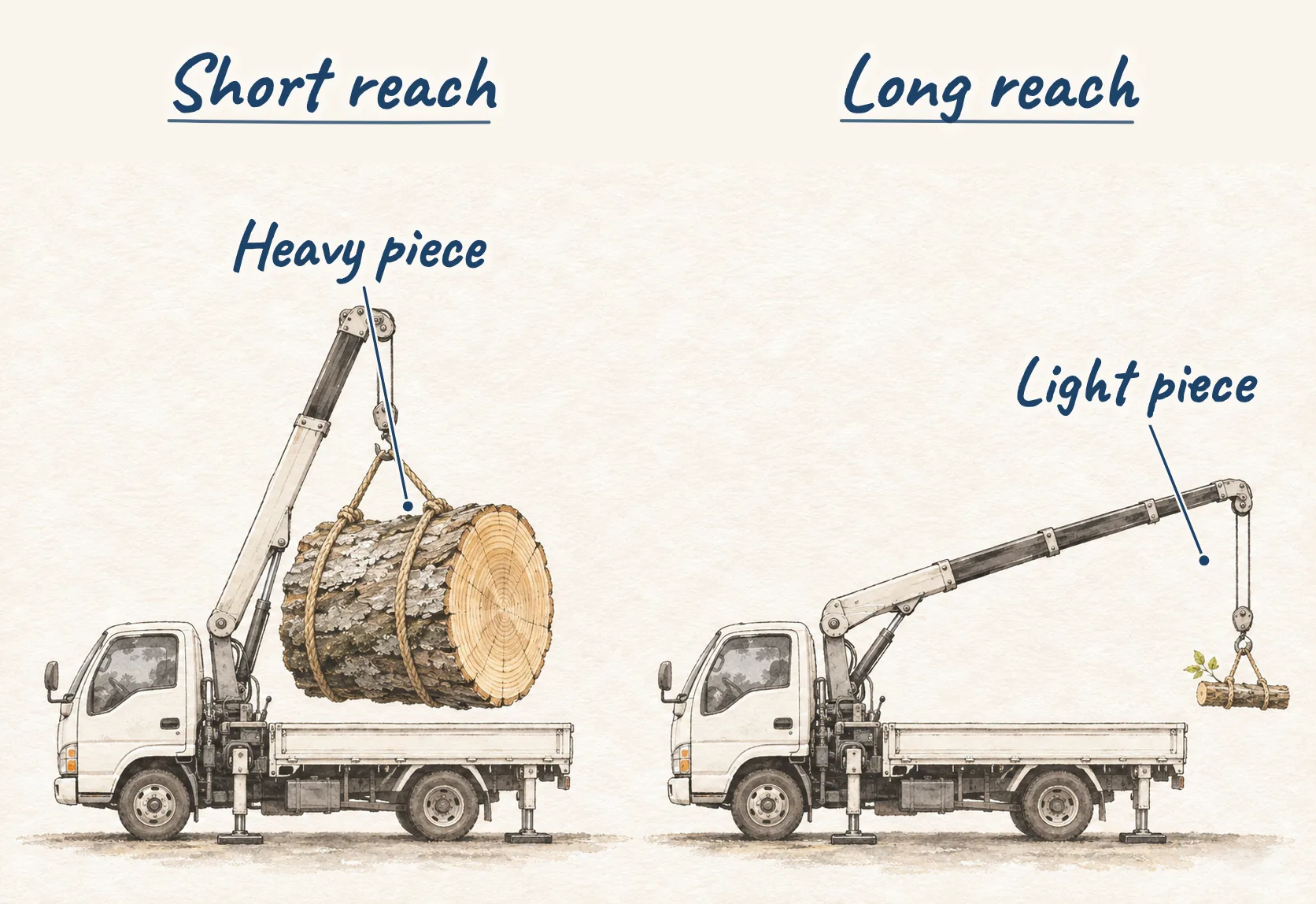
The most important number on a crane removal is not the crane’s headline capacity. It is the rated load at the radius where the piece will hang.
Tadano’s specification sheet for its ZE600 series of small truck-mounted cranes puts it plainly: a crane’s lifting ability gets smaller as the working radius gets larger. Its example for the ZE603, with a 9.5 m boom, outriggers fully extended and the configuration Tadano labels “B performance”, shows how quickly the figure falls.
| ZE603, 9.5 m boom, outriggers full, B performance — working radius (m) | 5.0 | 6.0 | 7.0 | 8.0 | 9.25 |
|---|---|---|---|---|---|
| Rated total load (t) | 2.9 | 2.15 | 1.7 | 1.4 | 1.2 |
From 5 m to 9.25 m, the rated total load falls by more than half. Tadano also notes that the rated total load includes the hook and other lifting gear, so the wood itself must weigh less than the figure in the table.
What happens when the chart is ignored
Article 69 of the Ordinance on Safety of Cranes forbids loading a mobile crane beyond its rated load. Japan’s Ministry of Health, Labour and Welfare publishes accident cases on its workplace safety site, and case No. 101220 shows why the rated load under the actual set-up matters more than the size of the machine: a small mobile crane overturned after lifting 290 kg when the rated load for its outrigger extension and working radius was 160 kg. One worker was injured and needed time off work.
For a tree crew, the lesson is that the cut plan and the crane position are one decision. Moving the crane a few metres closer can allow a larger section; a crane that can only stand far away means smaller pieces and more cuts.
How heavy is that piece? — estimating weight before the cut
Every piece, together with the hook and slings, must stay within the rated total load at its radius, so its weight has to be estimated before it is cut. This is where the arborist’s eye and simple arithmetic meet.
Volume first
A trunk section is close to a cylinder. Its volume is π × radius² × length. A section 50 cm (about 20 in) in diameter and 1 m long holds about 0.196 m³; at 40 cm it is about 0.126 m³, at 60 cm about 0.283 m³. Researchers measuring real logs use a more careful shape. The Mie Prefecture Forestry Research Institute, studying the moisture content of sugi logs, calculated green density by dividing a log’s weight by its volume treated as a truncated cone, which allows for taper.
Then density — and why green wood is heavy
Density is the harder part. The USDA Forest Products Laboratory’s Wood Handbook (2021 edition) notes that the moisture content of green wood — the mass of water relative to the oven-dry wood — can range from about 30% to more than 200%. Its density table gives one useful reference point: wood with a specific gravity (Gx) of 0.50 at 100% moisture content has a density of 1,000 kg/m³ — about the same as water.
Published figures for common Japanese species are usually air-dry specific gravity, measured after the wood has dried. They show how much species differ, but they cannot be converted directly into the weight of a freshly cut piece.
| Species | Air-dry specific gravity (published) | Source |
|---|---|---|
| Sugi, Cryptomeria japonica | 0.30–0.45, mean 0.38 | Japan Wood-Products Information and Research Center (JAWIC) |
| Kusunoki (camphor tree), Cinnamomum camphora | 0.41–0.69, mean 0.52 | JAWIC |
| Ichō (ginkgo), Ginkgo biloba | 0.55 | JAWIC |
| Yamazakura (mountain cherry) | 0.62 | Hokkaido Forest Products Research Institute |
A worked example
To show the arithmetic only, the table below assumes 1,000 kg/m³, the Wood Handbook reference point above. It is not a measured green density for any species, nor a safe upper limit; green wood can be lighter or heavier.
| Section (diameter × length) | Volume | Weight at 1,000 kg/m³ |
|---|---|---|
| 40 cm × 1 m | 0.126 m³ | about 126 kg |
| 50 cm × 1 m | 0.196 m³ | about 196 kg |
| 60 cm × 1 m | 0.283 m³ | about 283 kg |
| 60 cm × 2 m | 0.565 m³ | about 565 kg |
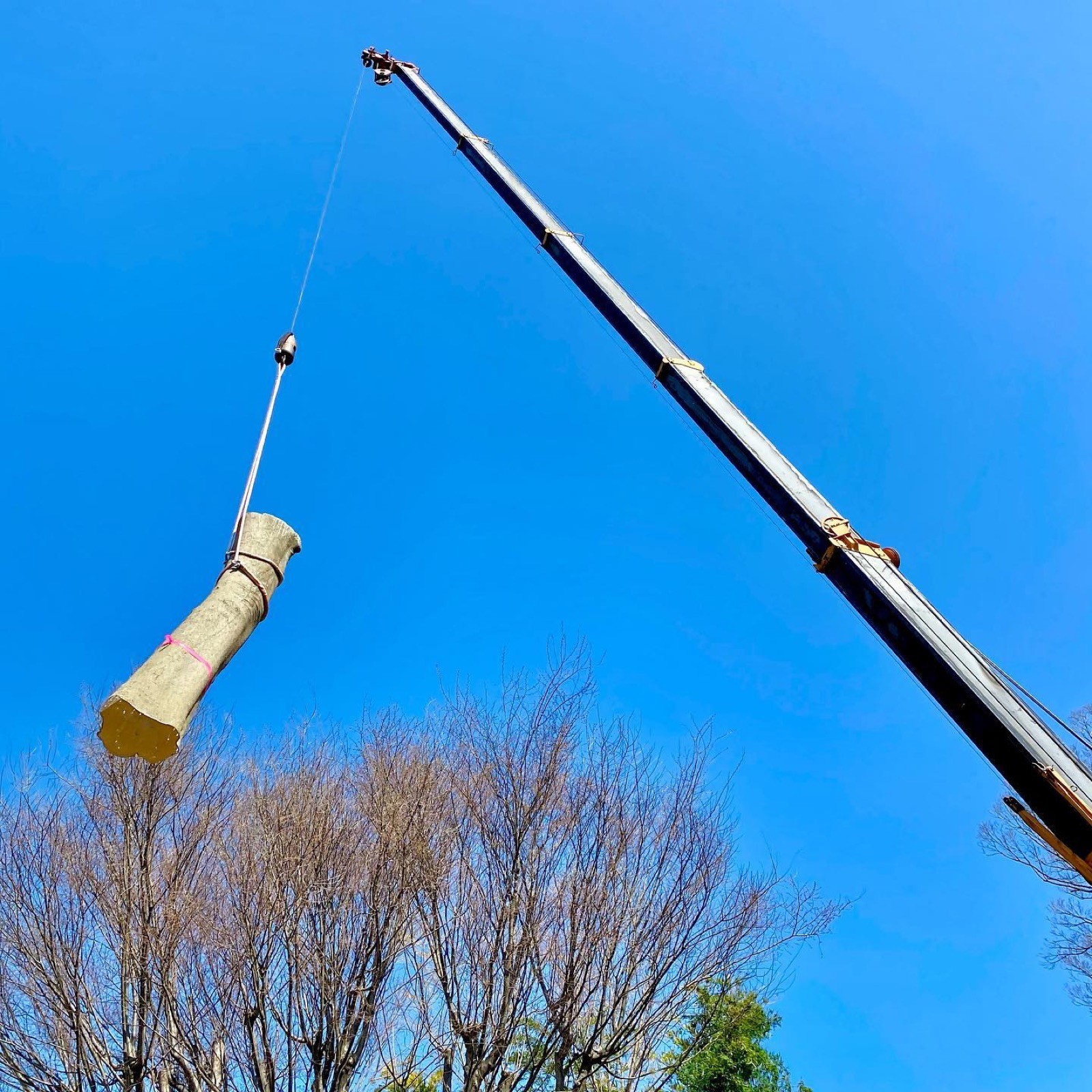
Set against the ZE603 example, the wood alone in a 60 cm section 2 m long (about 565 kg on this assumption) would use about 47% of the 1.2 t rated total load at 9.25 m, before the hook and slings are added. Whether a lift is acceptable depends on the gear’s weight, the machine’s actual set-up and the real weight of the wood. Because green moisture varies so widely, an estimate like this is a starting point, not a measurement.
When the estimate goes wrong
Hollow trunks are lighter than the arithmetic suggests, but they are also less predictable: the sling may sit on thin, decayed wood, and the piece may break or shift as it lifts. Wet wood or a hidden fork can push a piece heavier than expected. A shorter piece reduces weight, but it does not fix doubtful wood under the sling; then the rigging plan itself has to be reconsidered.
The day of the pick — crown, limbs, spar
On the morning of the work, the cuts follow the plan made at the site visit. Each lift repeats a cycle: rig, take up the line, cut, lift clear, lower, unhook.
Rig the piece, then let the crane take the weight
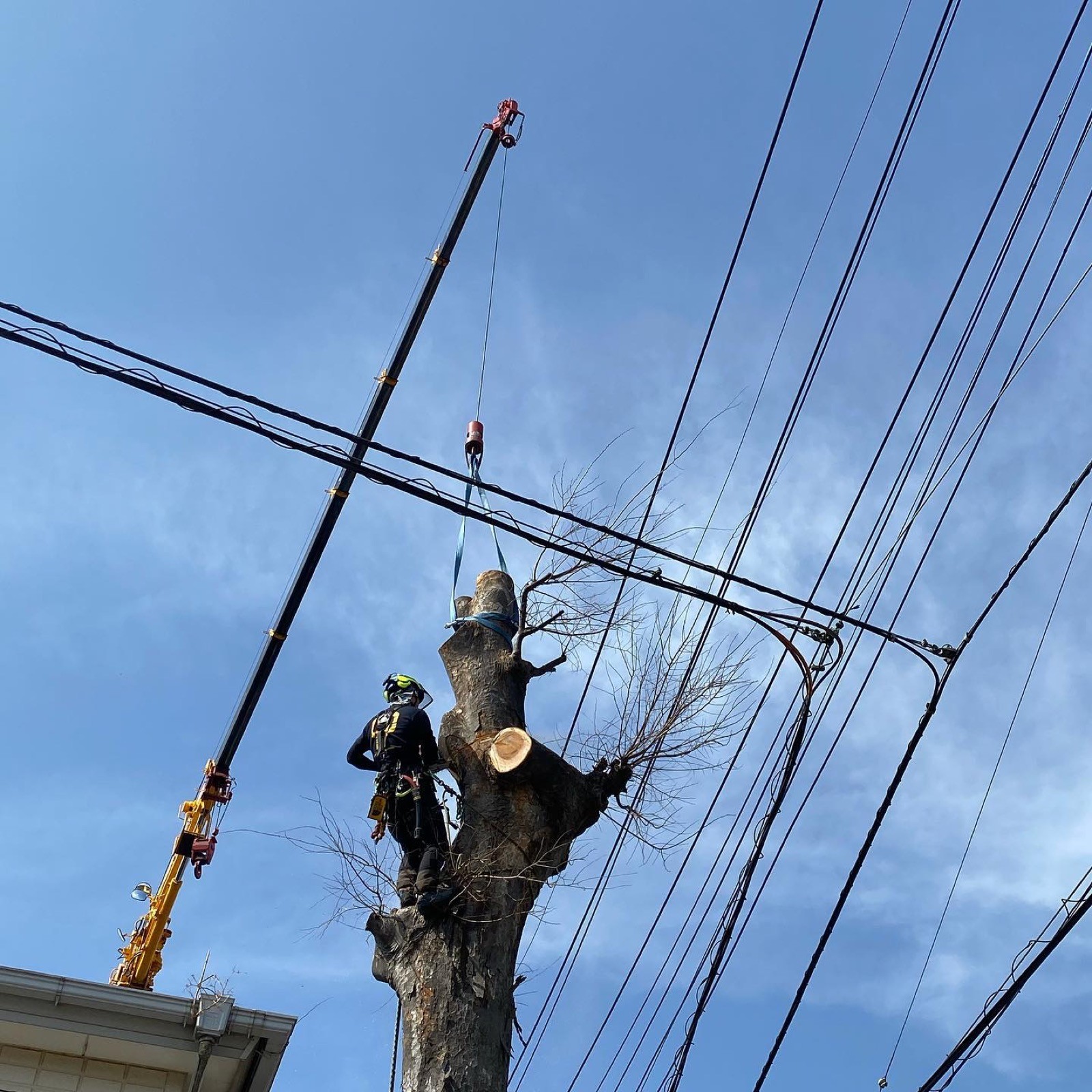
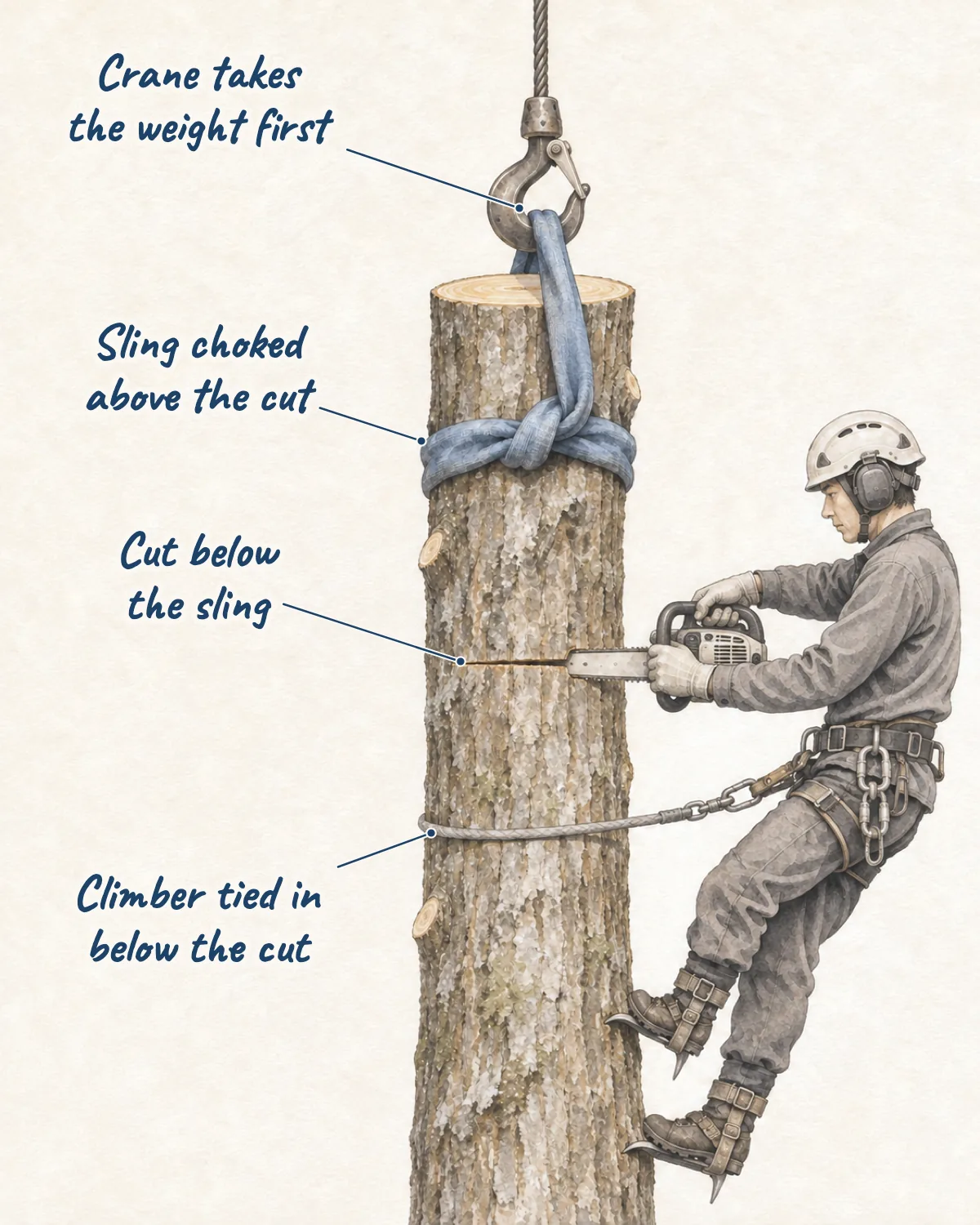
The illustration shows the principle. The climber attaches a sling around the piece above the planned cut and hooks it to the crane. The line is brought taut before the cut, so that once the cut is complete the crane, not the stem, holds the piece. The climber cuts below the sling, while tied in to the tree below the cut. The aim is that, when the cut is complete, the piece is already held by the crane and can be lifted clear under control rather than dropped.
Signals — one voice
Article 71 of the Ordinance on Safety of Cranes requires the employer to set fixed signals and to designate the person who gives them, unless the operator works alone. On a removal, the operator may not be able to see the cut. Normal crane signals then come from the designated signal person, placed where the climber and the load can be seen.
Nobody under the load
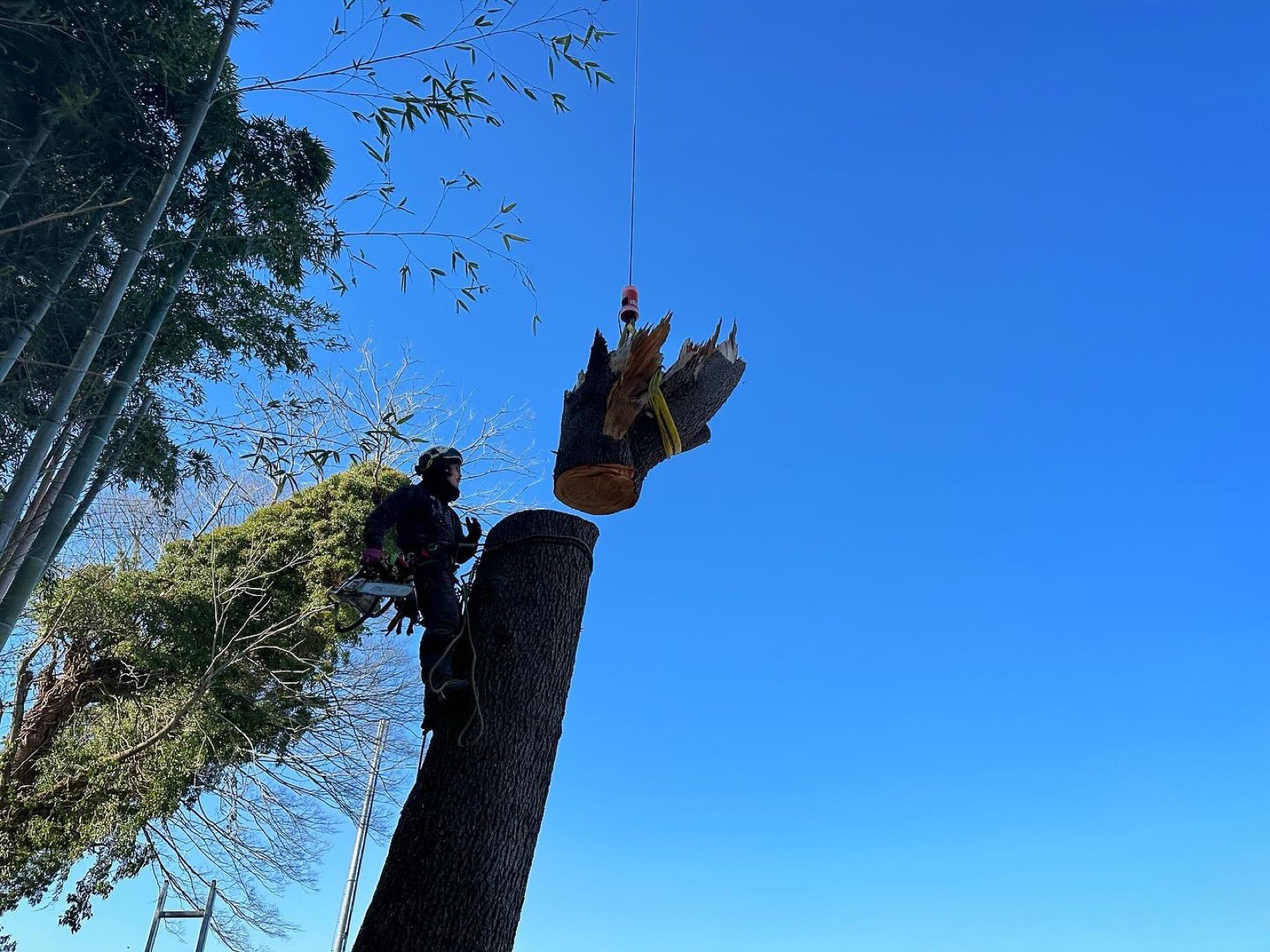
Two articles mark out the ground. Article 74 keeps workers out of places where they could be struck by the crane’s rotating upper structure. Article 74-2 forbids workers from entering the area under a suspended load in the slinging situations it lists. On a residential street this becomes a simple instruction for the ground crew and passers-by: keep clear of the crane’s slewing area and never stand beneath a suspended load.
Wind
Article 74-3 requires work to stop when strong wind makes crane work dangerous. A 1992 Labour Standards Bureau notice defines “strong wind” as a 10-minute average wind speed of 10 m/s or more. The figure defines the term; it is not a promise that lighter winds are safe. A leafy crown section catches wind, so a crew may judge a large lift unsafe at lower speeds as well.
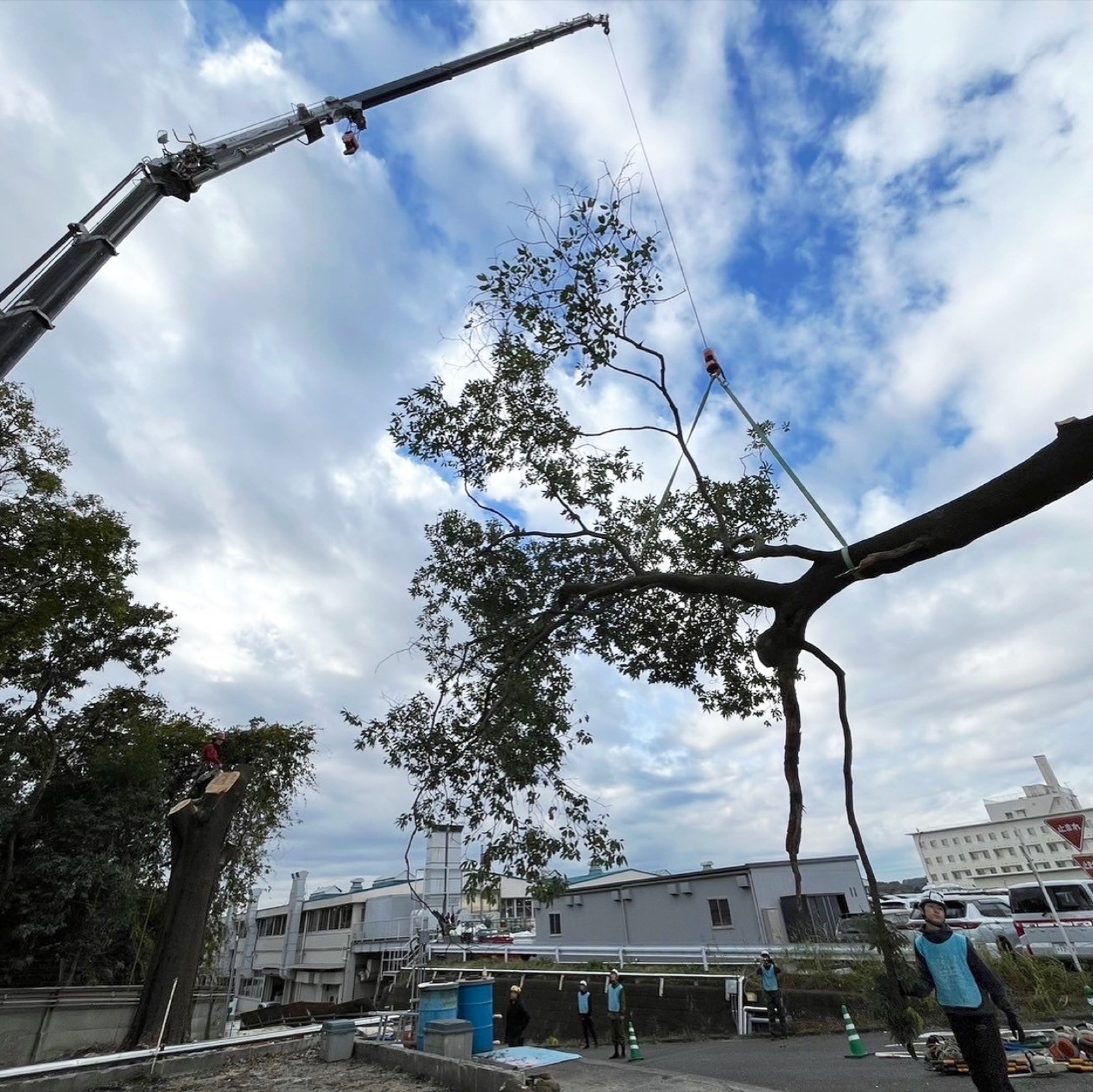
The landing zone — where the pieces come down
On a tight site the landing spot can be smaller than the tree’s crown: part of the road behind cones, a driveway, or a patch of garden. The ground crew guides each piece down, unhooks it, and clears it before the next lift.
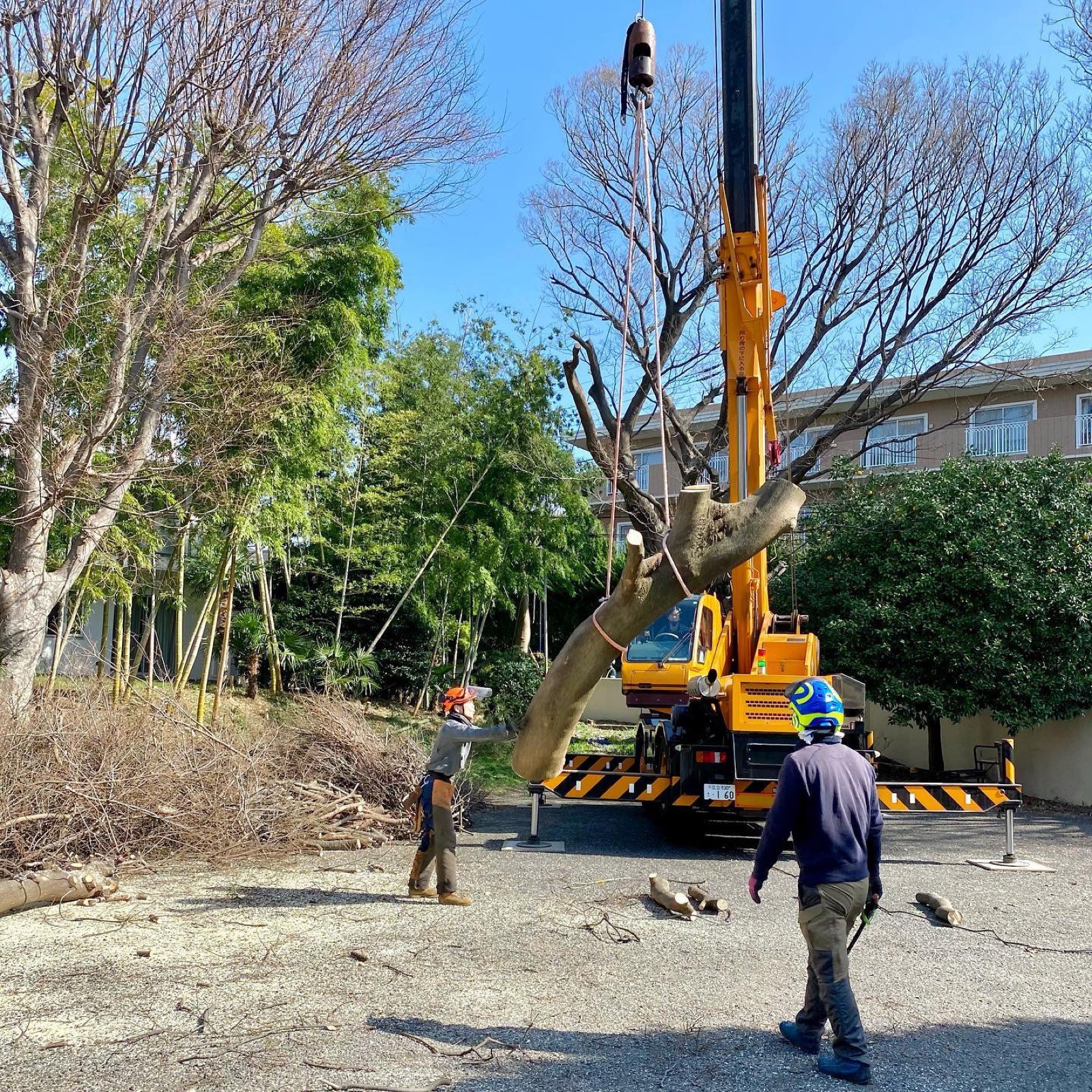
Cut, load, clear
On the ground, sections are cut into lengths that fit the truck, and brush is bundled. A tidy landing zone is a safety measure, not a matter of appearance: the next piece needs an empty place to land, and the signal person needs a clear line of sight.
Seasons and species
Season changes what hangs on the hook. A deciduous tree without leaves presents a crown of bare branches; in leaf, the same crown carries foliage that adds weight and catches wind, as in the leafy limb above. Species changes the wood itself: in the table above, mountain cherry is published as denser than sugi when dry, so a piece of the same size will tend to weigh more.
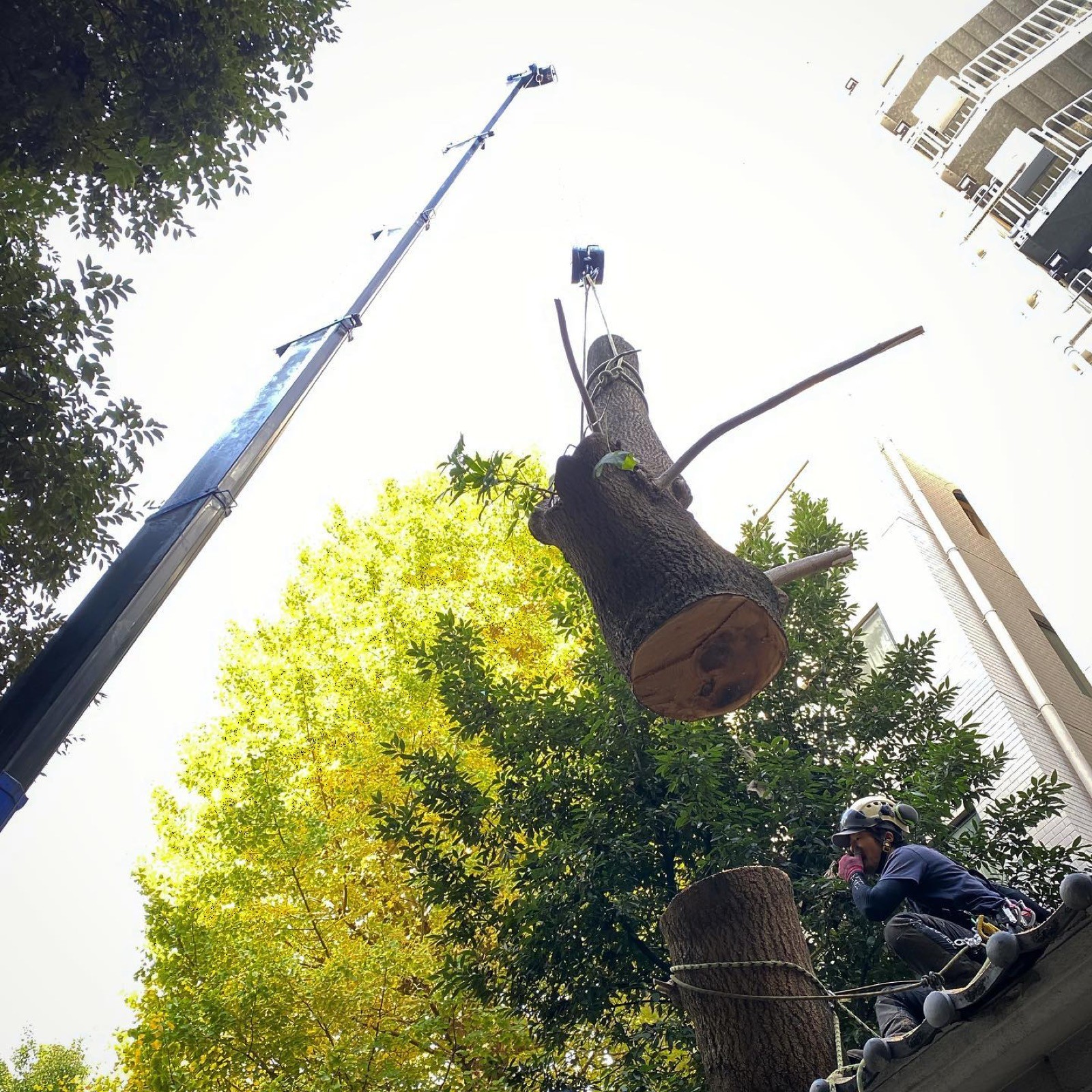
How this differs from the United States and the United Kingdom
The method is international; the rules around it differ.
In the United States, the OSHA construction crane standard (29 CFR 1926 Subpart CC) lists “tree trimming and tree removal work” among its exclusions in §1926.1400(c)(13). The general-industry crane rule still applies to points such as riding the load: §1910.180(h)(3)(v) states that no hoisting, lowering, swinging or travelling shall be done while anyone is on the load or hook. OSHA’s 2021 inspection guidance for tree care adds that an employer’s reliance on the ANSI standard is not a defence to a violation of that provision. The arboricultural safety standard itself, ANSI Z133, was issued in a 2026 edition, available from the International Society of Arboriculture from 27 May 2026. The Tree Care Industry Association offers a Crane Operations Specialist programme with a certificate on completion.
In the United Kingdom, the Health and Safety Executive explains how the Lifting Operations and Lifting Equipment Regulations 1998 (LOLER) apply to tree work, and asks that lifting operations be properly planned, appropriately supervised and carried out safely. The Arboricultural Association’s Safety Guide 4 on mobile cranes in tree work (2020) includes, as one item in its checklist for lifting personnel, whether the safe working load has been reduced by 50%.
| Japan | United States | United Kingdom | |
|---|---|---|---|
| Legal rule cited here | Operator and slinger qualifications by crane lifting capacity; no separate national tree-crane licence found | OSHA construction crane rule excludes tree work; §1910.180 bars hoisting with anyone on the load or hook | LOLER 1998: lifting planned, supervised, carried out safely |
| Industry standard or guidance | Not researched for this article | ANSI Z133 (2026 edition) | Arboricultural Association Safety Guide 4 (2020) |
| Voluntary training | Not researched for this article | TCIA Crane Operations Specialist | Not researched for this article |
| Lifting people | Not researched for this article | §1910.180 restriction above | One AA checklist item: safe working load derated by 50% |
Within the sources used here, one contrast stands out. In Japan, the legal qualifications cited attach to the crane’s capacity and apply to any load, timber included; we found no separate national licence for tree work with cranes. In the United States, tree removal is excluded from the construction crane rule and has its own industry standard.
Common misunderstandings
“A bigger crane is always safer.” A larger crane may reach from further away, but its capacity at that radius may be no better; it may cross a qualification threshold, and its outriggers may not fit the road.
“Below 10 m/s, it is fine to lift.” The 10 m/s figure defines “strong wind” for Article 74-3, which requires work to stop when strong wind makes crane work dangerous. It is not a guarantee that lower speeds are safe.
“The crane’s capacity is the weight of wood it can lift.” Rated total load includes the hook and gear, and it changes with radius and outrigger extension.
“A hollow tree is easy because it is light.” It is lighter, but the wood under the sling may be thin.
“Forestry statistics describe urban removals.” Japan recorded 25 deaths in forestry in 2025, down from 31 in 2024, in the ministry’s final figures. Those numbers cover forestry as an industry, not residential tree removal; we found no national figure for crane-assisted removals alone.
What remains — reading the stump
When the last section has gone, the stump is the record of the tree. Its cut face lets the crew compare what they judged from outside at the site visit — decay in particular — with what was actually inside.
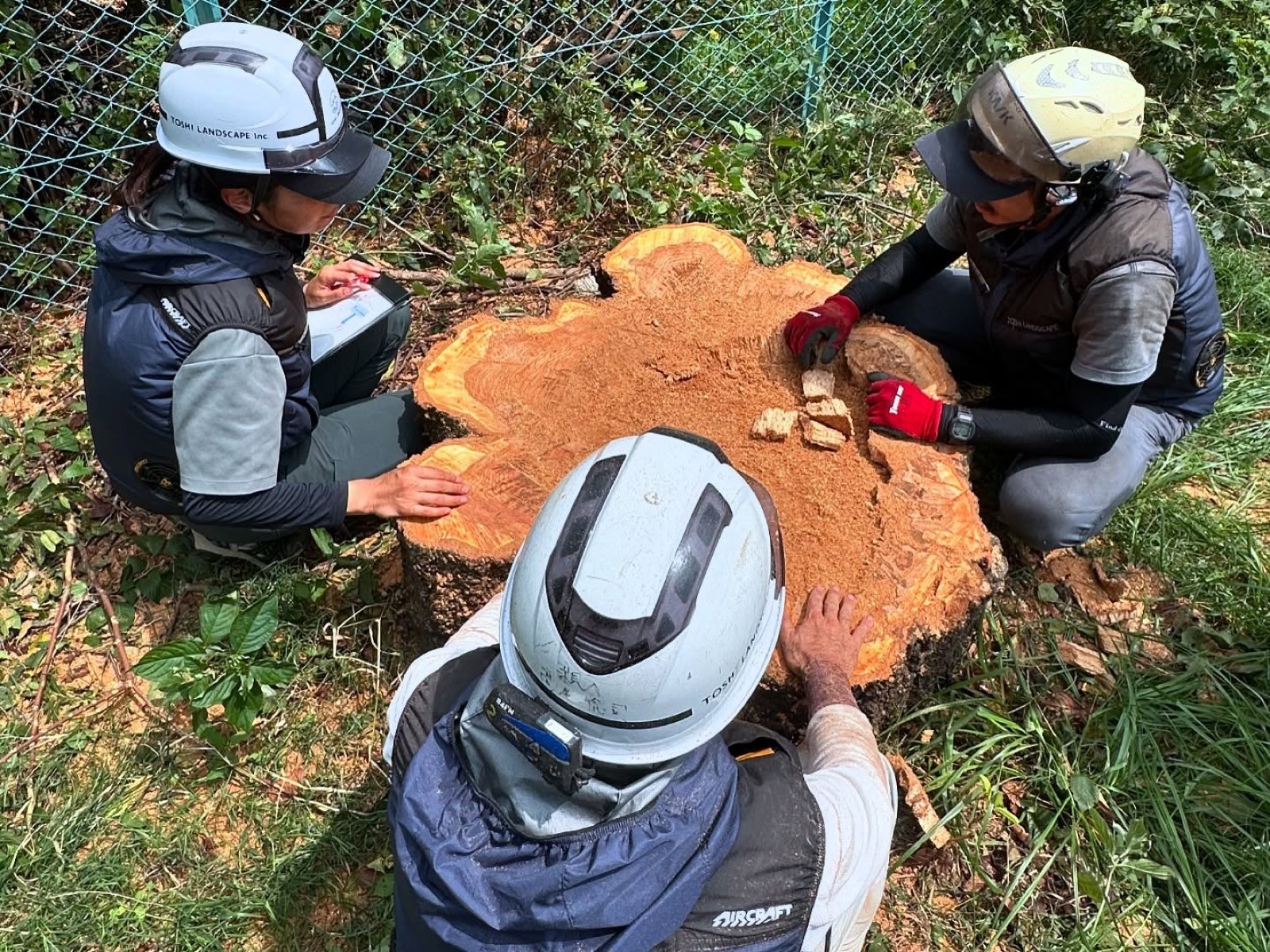
Why the record matters
Why large urban trees are reaching the end of their lives is a separate story, followed in Japan’s falling trees crisis. For the crew, comparing the stump with the judgement made from outside is a check on the next site visit. For the instruments used when the outside view is not enough, see how sonic tomography works.
Removal is not the only answer to a large tree in a small space; pruning approaches are discussed in typhoon-proofing trees.
Frequently asked questions
What is crane-assisted tree removal? It is a method of removing a tree from the top down in which a crane holds each section before it is cut and lowers it to the ground. In Japan it belongs to tokushu bassai, “special felling”, the family of methods used when a tree cannot be felled in one piece.
Why don’t Japanese crews just fell the tree? Felling needs open ground in at least one direction. On small urban lots with houses, wires and roads around the tree, there is often none. Japanese rules on felling (Ordinance on Industrial Safety and Health, Article 477) are built around controlling the direction of fall.
What qualifications are needed to operate a crane for tree work in Japan? It depends on the crane’s lifting capacity: a mobile crane operator’s licence for 5 tonnes or more, a licence or the small mobile crane skill course for 1 to under 5 tonnes, and special education for 0.5 to under 1 tonne; cranes under 0.5 tonnes fall outside the crane ordinance. The slinger needs a separate qualification.
How do crews know how heavy a trunk section is? Volume can be estimated from diameter and length, then multiplied by a density. Green wood can hold from about 30% to more than 200% moisture, so any density figure is an assumption, and the estimate is checked against the rated total load at the working radius, with the lifting gear included.
What is a spider crane? A compact crawler crane with folding outrigger legs, also called a mini crawler crane. Maeda’s history dates its spider crane to 1980; the two current models described above are both 750 mm wide.
Does the crane block the road? If it is set up on the road, a road use permit from the police is required for work on a road, and some cities also require a road occupancy permit.
Sources
– Ordinance on Industrial Safety and Health (Articles 36, 349, 477, 478), Ministry of Health, Labour and Welfare: https://www.mhlw.go.jp/web/t_doc?dataId=74003000&dataType=0 (checked 2026-11-06) – Ordinance on Safety of Cranes, etc. (Articles 2, 67, 68, 69, 70-5, 71, 74, 74-2, 74-3, 221, 222): https://www.mhlw.go.jp/web/t_doc?dataId=74020000&dataType=0&pageNo=1 (checked 2026-11-06) – Labour Standards Bureau notice No. 480 (1992), definition of strong wind: https://www.mhlw.go.jp/web/t_doc?dataId=00tb2052&dataType=1&pageNo=1 (checked 2026-11-06) – Nagano Prefecture, special felling manual (2025): https://www.pref.nagano.lg.jp/ringyo/kensei/soshiki/soshiki/kencho/shinshunoki/documents/manyuaru.pdf (checked 2026-11-06) – City of Yokohama, park maintenance contractor supplement: https://www.city.yokohama.lg.jp/business/nyusatsu/youshiki/kankyo/koenshiryo/download/2ijiitaku-shiyousyo.files/iji-jutakushamukehosoku3104.pdf (checked 2026-11-06) – National Police Agency, road use permits: https://www.npa.go.jp/bureau/traffic/seibi2/shinsei-todokede/dourosiyoukyoka/permission.html (checked 2026-11-06) – Ministry of Land, Infrastructure, Transport and Tourism, Road Act Article 32: https://www.mlit.go.jp/road/soudan/soudan_09_01.html (checked 2026-11-06) – City of Asahikawa, work vehicles on city roads: https://www.city.asahikawa.hokkaido.jp/kurashi/440/443/444/d068525.html (checked 2026-11-06) – City of Iwakuni, road occupancy: https://www.city.iwakuni.lg.jp/soshiki/48/2839.html (checked 2026-11-06) – TEPCO Power Grid, protective covers: https://www4.tepco.co.jp/pg/electricity-supply/operation/distribution/protectivetube.html and https://www4.tepco.co.jp/pg/electricity-supply/operation/distribution/pdf/henkou2025.pdf (checked 2026-11-06) – City of Sapporo, big-city comparison tables 2024 (2023 Housing and Land Survey): https://www.city.sapporo.jp/toukei/hikaku/documents/11r6.pdf (checked 2026-11-06) – Maeda Mini Cranes, history: https://www.maeda-minicranes.com/company/history/ ; Maeda spider crane line-up: https://www.maesei.co.jp/products/spider-cranes/ (checked 2026-11-06) – Furukawa Unic, history: https://www.furukawaunic.co.jp/about/history/ ; Furukawa Co., UM325C release (2024): https://www.furukawakk.co.jp/info/assets/pdf/241004unicum325c.pdf (checked 2026-11-06) – Tadano, ZE600 series specifications: https://mediahub.tadano.com/m/36ccf127bb06b441/original/doc_tadano_ZE600_ZE600SL_Specifications.pdf (checked 2026-11-06) – MHLW workplace safety site, accident case No. 101220: https://anzeninfo.mhlw.go.jp/jirei/sai_101220.html (checked 2026-11-06) – MHLW, occupational accidents in 2025 (final): https://www.mhlw.go.jp/content/11302000/001704887.pdf (checked 2026-11-06) – USDA Forest Products Laboratory, Wood Handbook (2021), Chapter 4: https://research.fs.usda.gov/download/treesearch/62243.pdf (checked 2026-11-06) – Mie Prefecture Forestry Research Institute, log moisture study: https://www.pref.mie.lg.jp/ringi/hp/000203179.htm (checked 2026-11-06) – JAWIC species data: https://www.jawic.or.jp/woods/sch.php?nam0=sugi ; https://www.jawic.or.jp/woods/sch.php?nam0=kusunoki ; https://www.jawic.or.jp/woods/sch.php?nam0=icyou (checked 2026-11-06) – Hokkaido Forest Products Research Institute, wood database (yamazakura): https://www.hro.or.jp/upload/49758/1100105.pdf (checked 2026-11-06) – OSHA 29 CFR 1926.1400: https://www.osha.gov/laws-regs/regulations/standardnumber/1926/1926.1400 ; 29 CFR 1910.180: https://www.osha.gov/laws-regs/regulations/standardnumber/1910/1910.180 ; tree care inspection guidance (2021): https://www.osha.gov/memos/2021-06-30/inspection-guidance-for-tree-care-and-tree-removal-operations (checked 2026-11-06) – International Society of Arboriculture, Z133-2026: https://www.isa-arbor.com/Newsroom/the-z133-2026-standard-is-now-available (checked 2026-11-06) – TCIA, Crane Operations Specialist: https://member.tcia.org/education/tree-care-academy/crane-operations-specialist/ (checked 2026-11-06) – HSE, lifting equipment in arboriculture: https://www.hse.gov.uk/treework/safety-topics/arboriculture.htm (checked 2026-11-06) – Arboricultural Association, Safety Guide 4: https://trees.org.uk/Trees.org.uk/media/Trees-org.uk/Documents/Tech%20Guides/Safety-Guide-4-Form1.pdf (checked 2026-11-06)