

By Isaki Kasahara, a Japanese arborist pruning, assessing and caring for Japan’s trees and gardens · Updated November 24, 2026
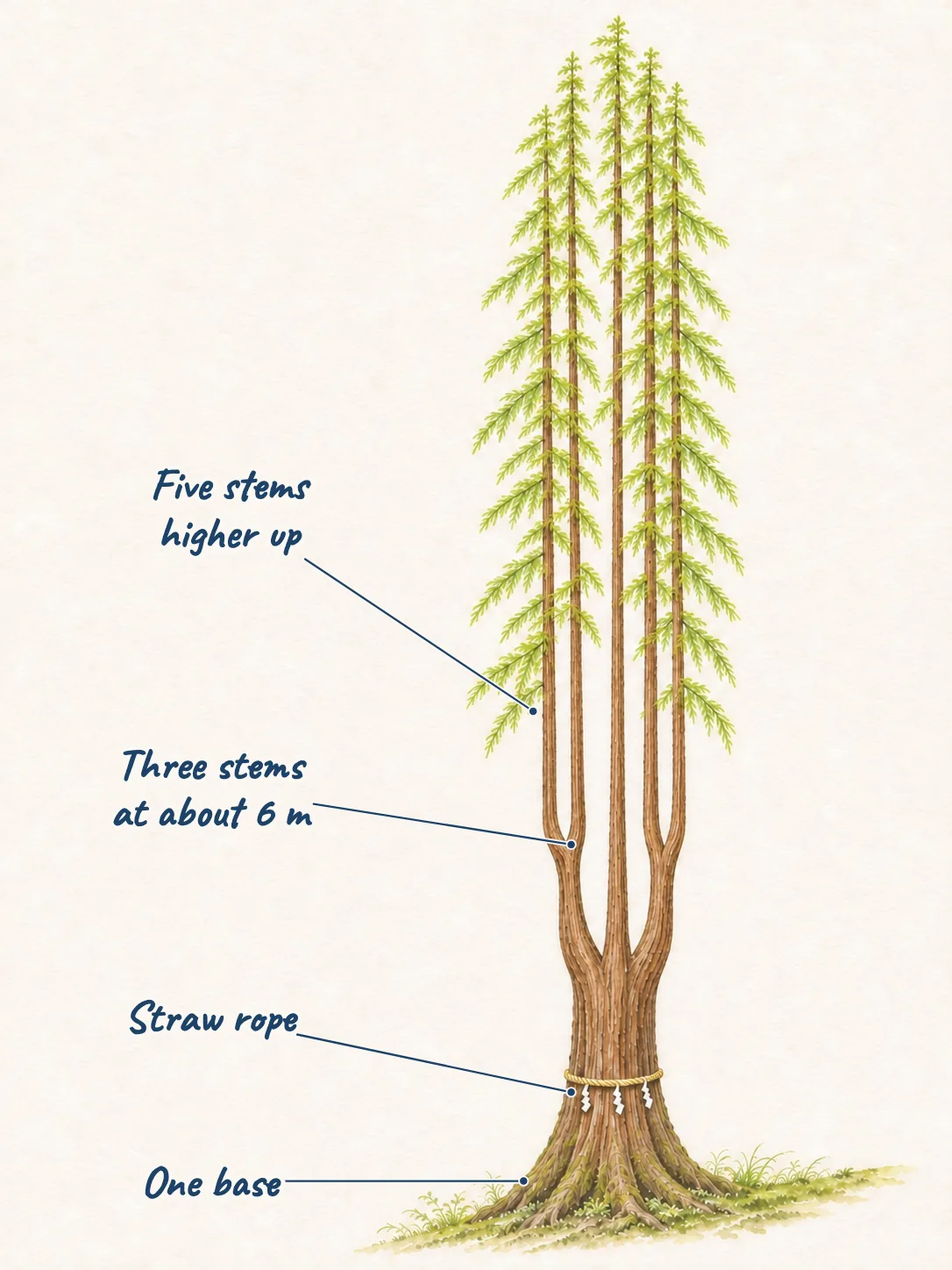
The Gohonsugi (五本杉, “five cedars”) at Senkōji temple in Takayama, Gifu, is not five trees but one Japanese cedar with five trunks. The temple describes a single base that divides into three stems at about 6 m (20 ft), with further division higher up, so that five upright stems of about the same thickness stand side by side; the national designation record says simply that “the trunk divides into five”. The records describe that form, but none of them establishes how it came about.
Its registered name is Senkōji no Gohonsugi (千光寺の五本スギ), and it has been a national Natural Monument since 2 April 1929, owned by the temple with Takayama City as its managing body. Below: what the records say about its shape, the known ways a cedar can come to have several trunks, why the measurements disagree, what the “1,200 years” on the sign rests on, why a Buddhist temple’s tree wears a Shinto rope, and how a tree like this is protected.
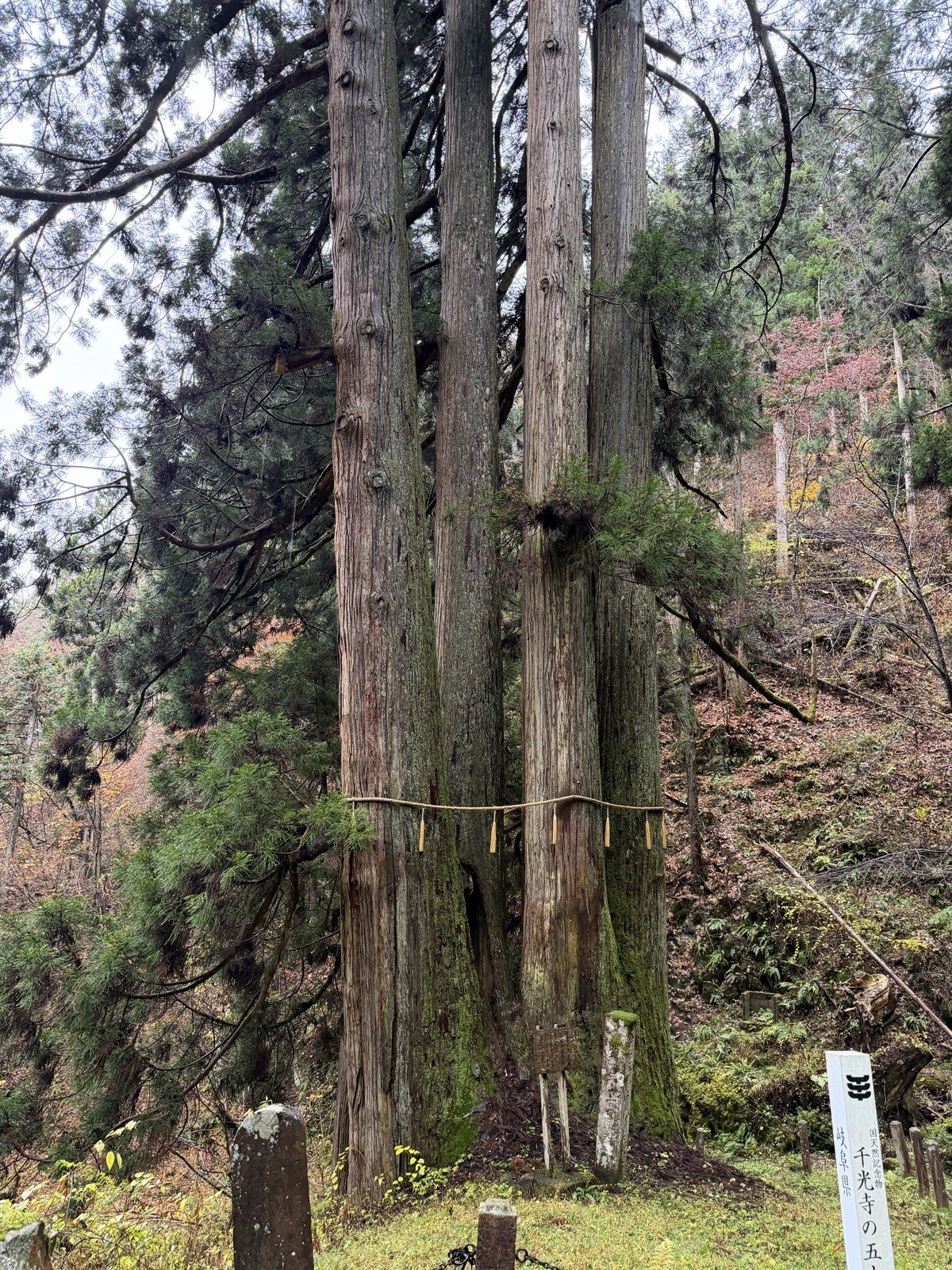
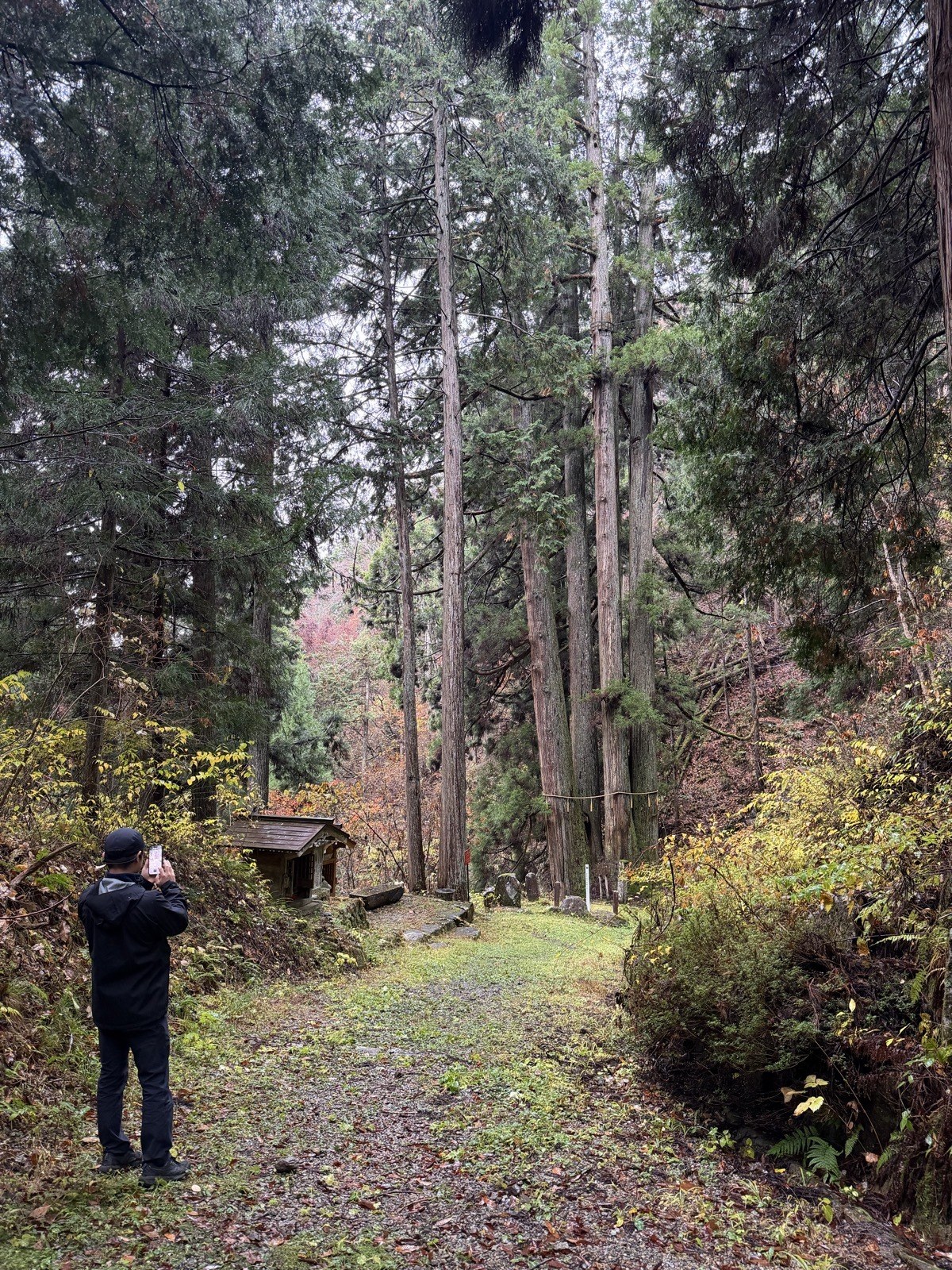
A cedar on the road up to Senkōji — a midday stop in Hida
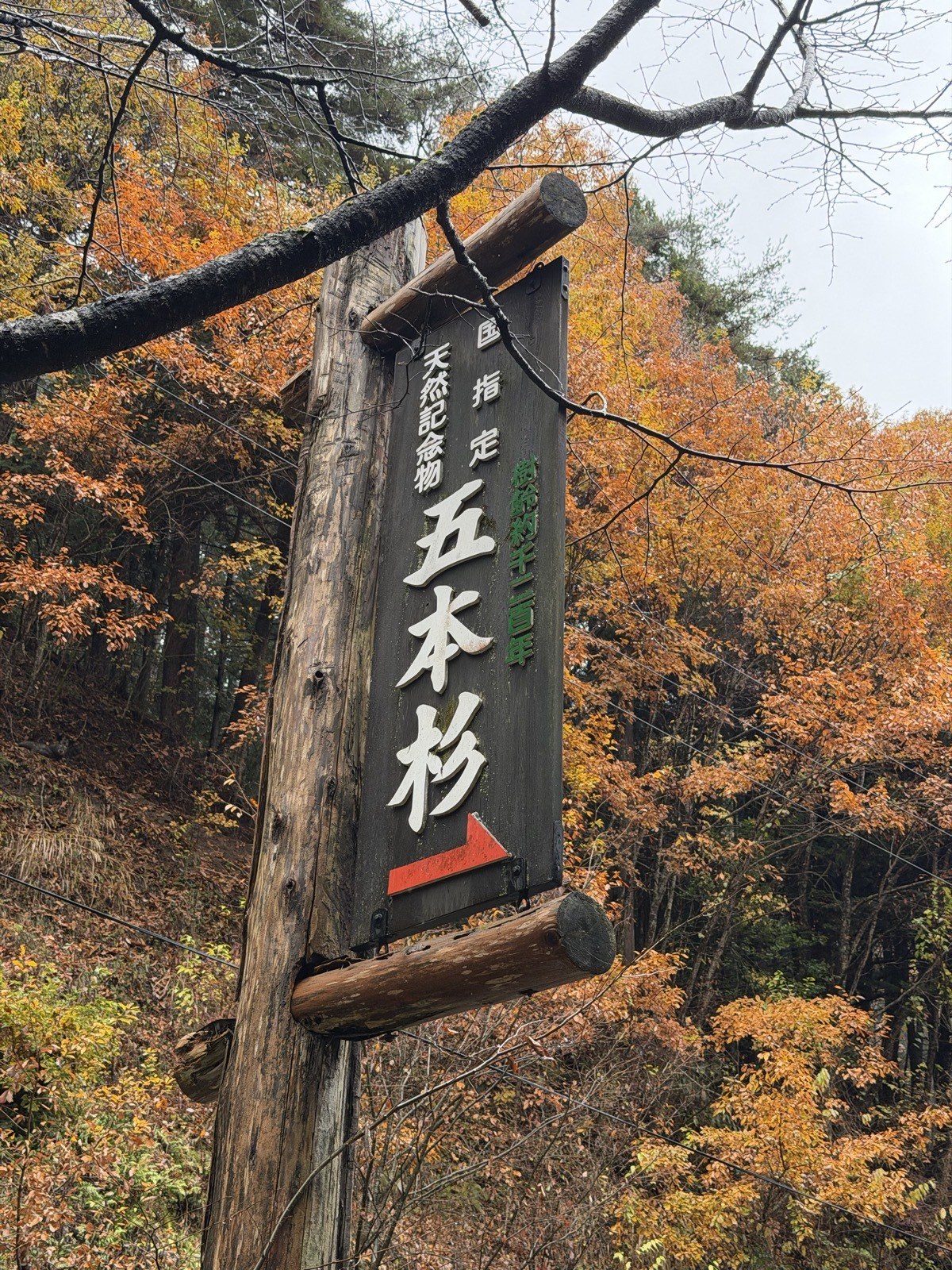
The sign by the road
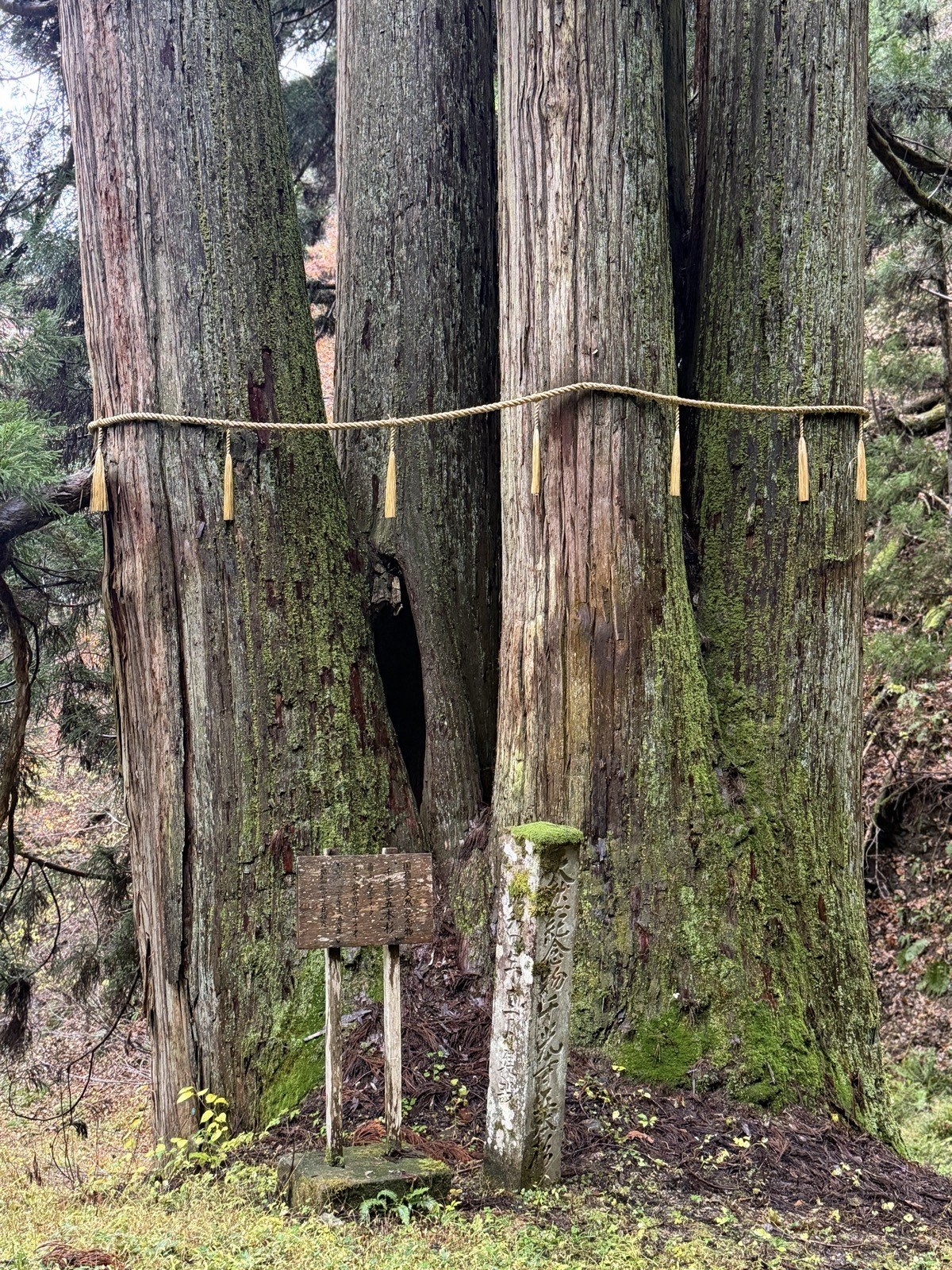
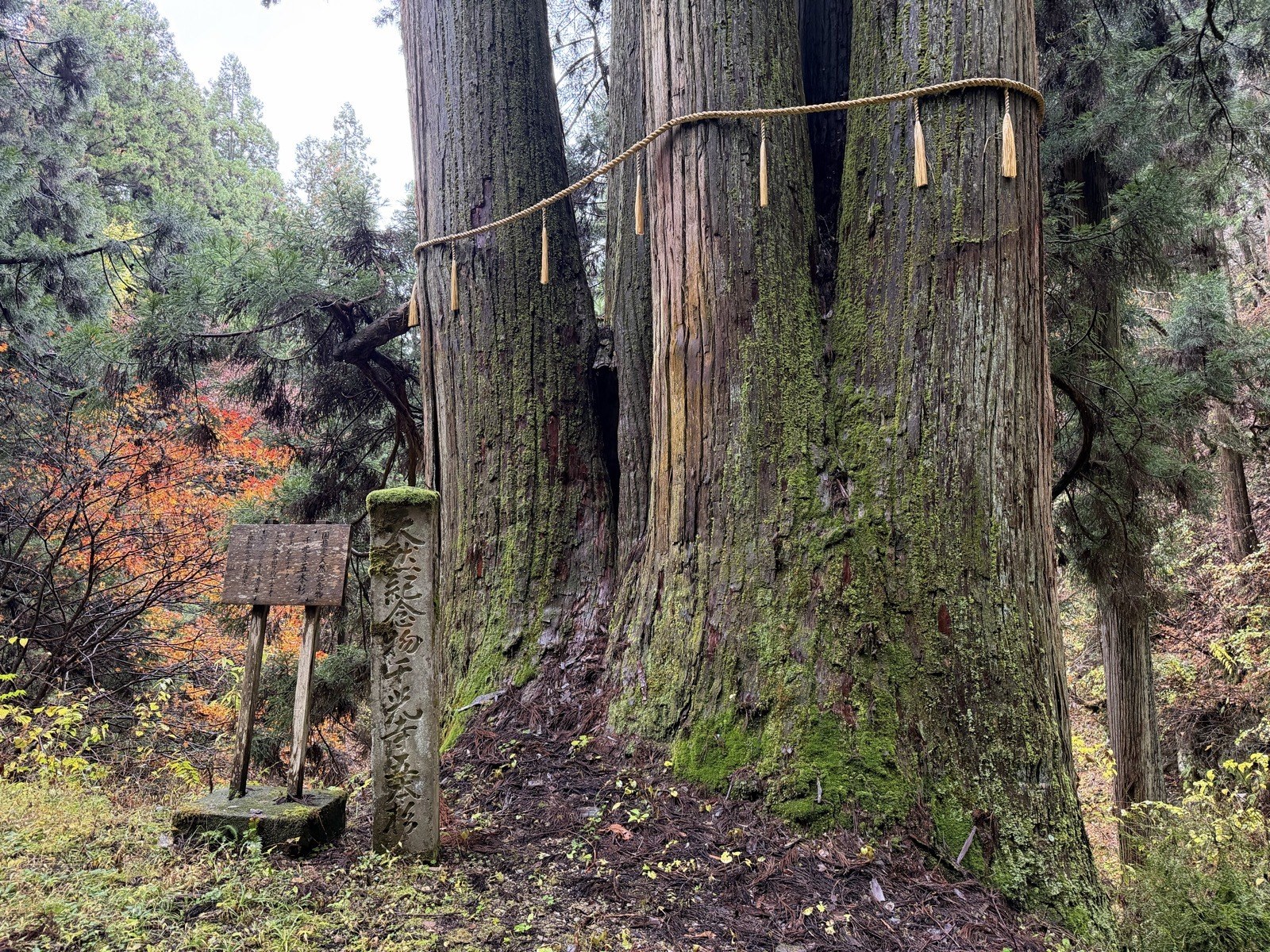
A wooden sign at the roadside reads, top to bottom: 国指定 天然記念物 五本杉 — “Nationally designated Natural Monument, Gohonsugi” — and, in green, 樹齢約千二百年, “about 1,200 years old”. Both lines deserve a closer look. “Gohonsugi” is the short local name; the name in the national register is Senkōji no Gohonsugi, and the national register gives no age at all.
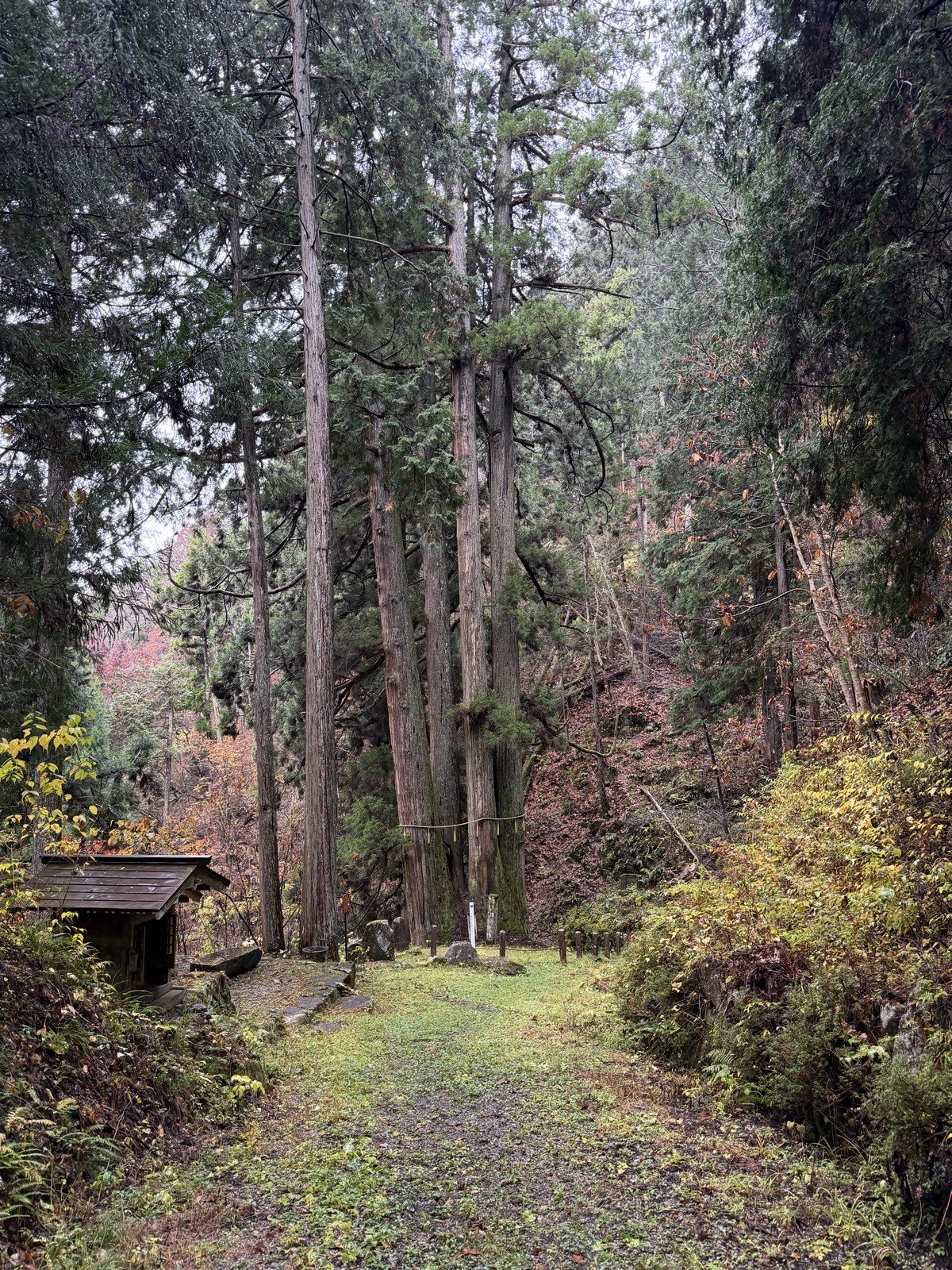
Where the tree stands
Senkōji (千光寺) is a temple of the Kōyasan Shingon school on Mount Kesa (袈裟山), in the Nyūkawa district on the eastern side of Takayama. The temple gives the height of its precinct as about 900 m (2,950 ft) above sea level; the tree stands below it. The cedar does not stand in the temple courtyard. Gifu Prefecture places it on a slope about halfway along the approach, and the temple’s own guide puts it a little below the Niōmon gate, the gate now called the Gokuraku-mon. The address on Takayama City’s list of natural monuments is Nyūkawa-chō Shimobo 1553.
The photographs in this article were taken on 19 November 2026, between 12:26 and 12:34, on the same day as a visit to the giant ginkgo of Hida Kokubunji in Takayama. The photographs show late autumn colour on the slope under a grey sky.
What the photographs show
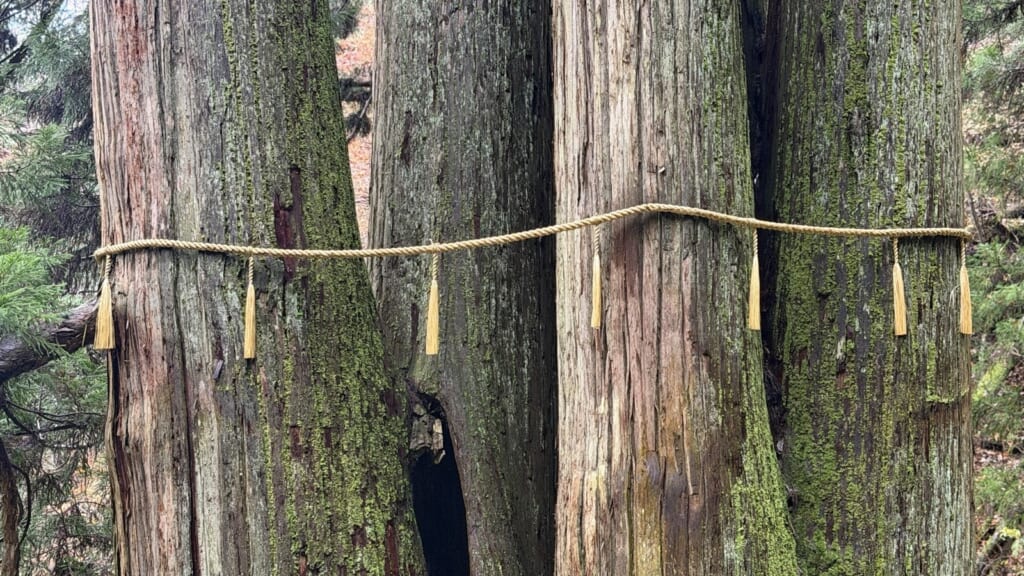
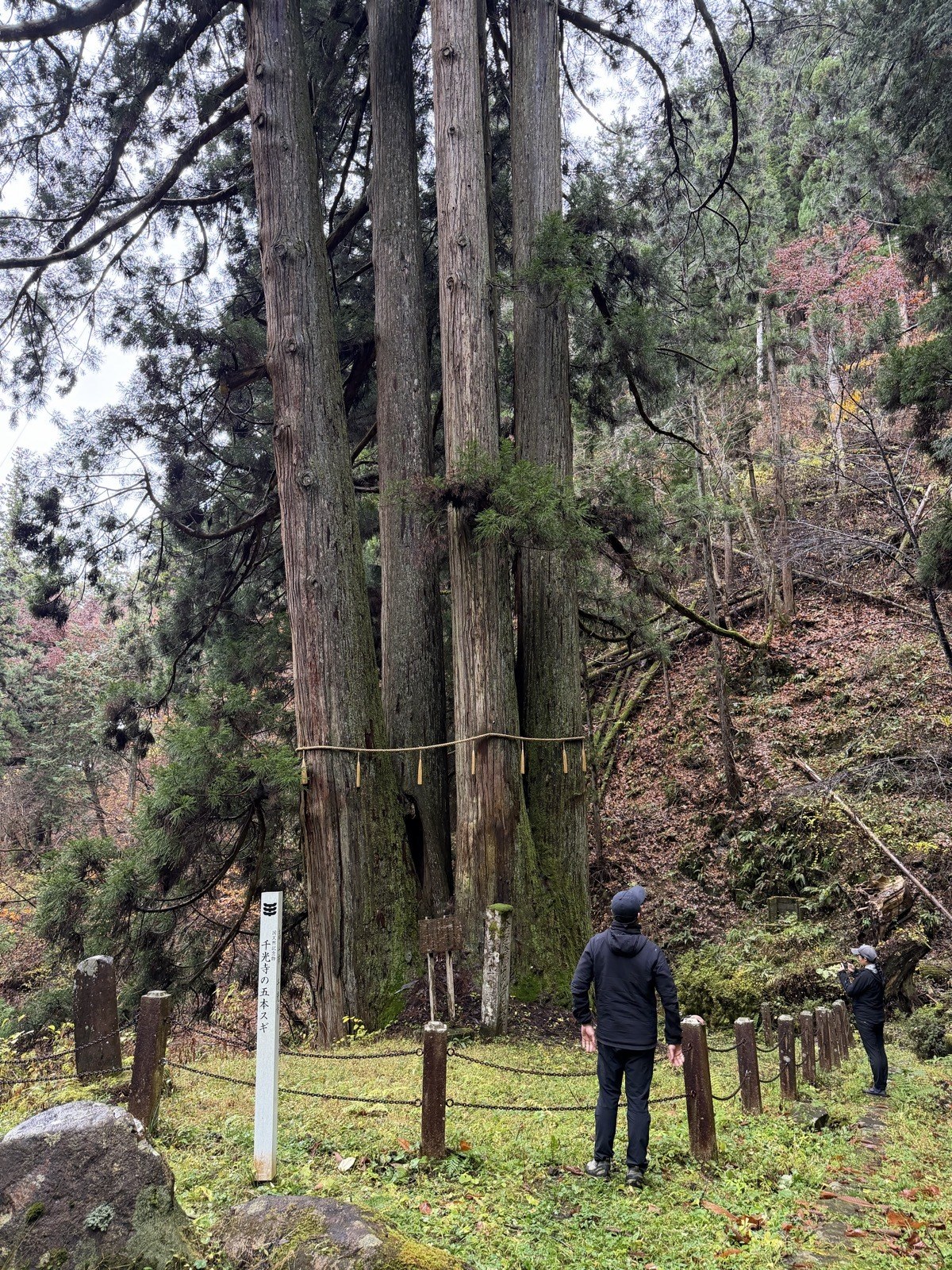
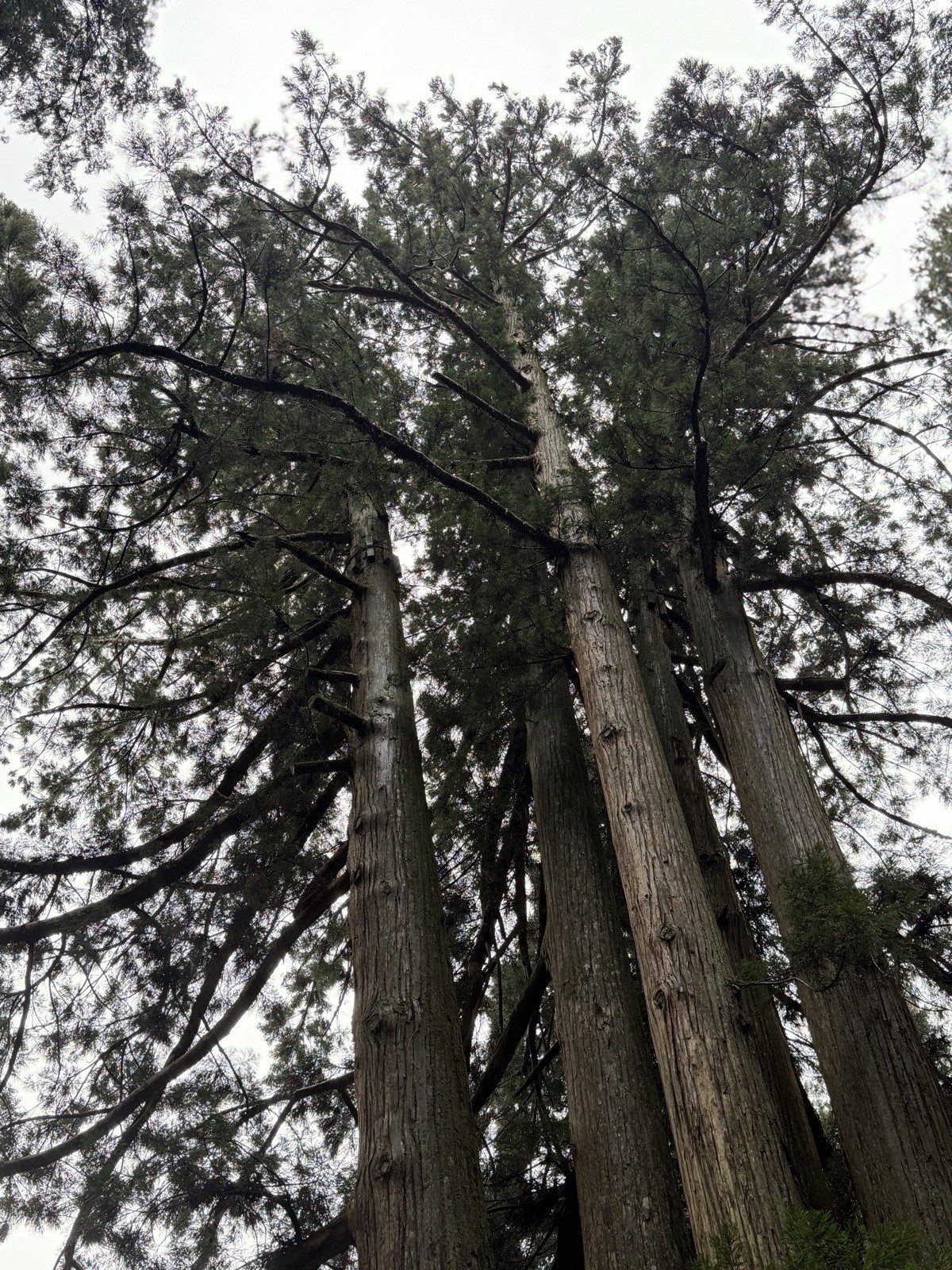
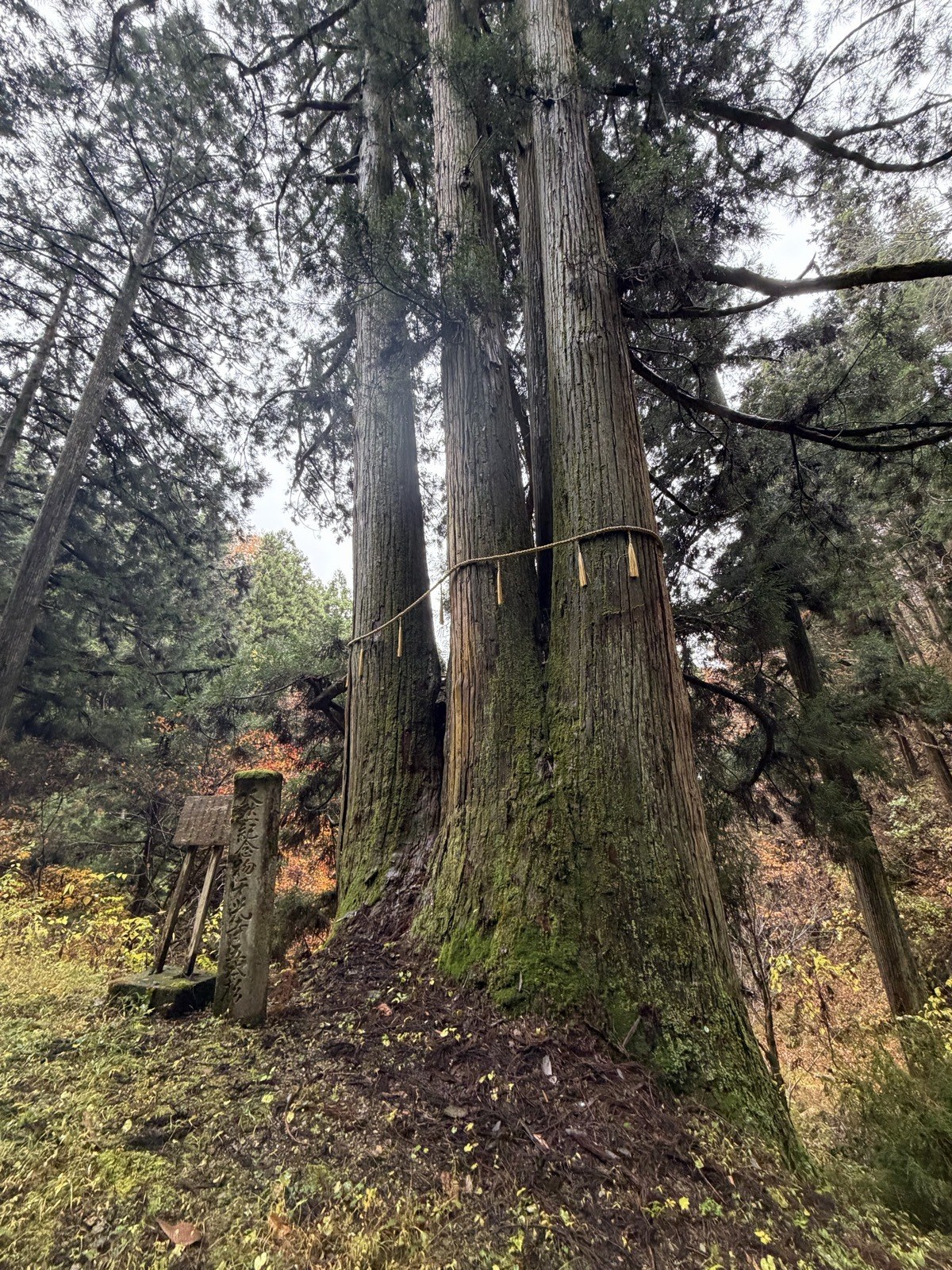
In the photographs the stems stand so close that a single straw rope goes round them all. The records explain this as one tree that divides, though not all in the same words — and the differences in wording matter once you ask how such a tree is measured, dated and cared for.
Five trunks, one tree — what the records say
The designation record
The national record, carried on the Agency for Cultural Affairs’ Cultural Heritage Online, explains the name in clipped classical Japanese: 幹五本ニ分ル、故ニ此ノ名アリ — “the trunk divides into five, hence the name.” The same entry gives a girth measured at eye height, metōri (目通り), of 三丈七尺, three jō seven shaku. In other words, the designation describes one trunk that divides. When that description and measurement were written is not stated.
The prefecture’s wording
Gifu Prefecture’s page on the tree says that by about 6 m above the ground it divides into five branches — 地上6mほどまでに5本の枝にわかれ. So the prefecture speaks of branches, the national record of a trunk, and the temple of stages of division. The prefecture’s page, last updated in April 2025, also describes the tree as still growing vigorously; the page does not say when or how that was assessed.
The temple’s account: one base, three, then five
The fullest description comes from the owner. Senkōji’s guide to its buildings and sights says the tree rises “from one stock” (一つの株から), divides into three at around 6 m, and divides again higher up, so that “five stems of about the same thickness stand upright”. In other words, none of the five is described as a leader with four side branches.
The records side by side
| Source | What it says about the five trunks | Height | Girth |
|---|---|---|---|
| Agency for Cultural Affairs (designation record) | “The trunk divides into five, hence the name” | — | 3 jō 7 shaku at eye height |
| Gifu Prefecture | Divides into five branches by about 6 m above ground | about 47 m | about 12 m |
| Takayama City | — | — | root girth 11.9 m |
| Ministry of the Environment (Chūbu office list) | — | 50 m | 1,220 cm |
| Senkōji (owner) | One stock, three stems at about 6 m, two more divide above; five of similar thickness | about 50 m | 12 m |
None of the sources cited here describes five separate trees that grew together and fused at the base; they agree that this is one tree. None of them explains how it came to divide.
How a cedar ends up with several trunks — four routes, none proven here
Why the cause is not on record
The sources cited here give no ring count, genetic analysis or internal survey that would explain the shape of this particular tree. Its form is recorded; its history is not. What we can do is set out the ways a Japanese cedar, Cryptomeria japonica, is known to produce several trunks, and keep them apart. The Forestry and Forest Products Research Institute describes sugi as a species endemic to Japan, found in natural forests as well as plantations, and it can make new stems in several ways.
Route one: the leader divides
Arborists call two or more main stems of about the same diameter, arising from the same point on the trunk, codominant stems. A University of Massachusetts teaching guide on plant growth notes that they can arise in “conifers that have lost the terminal during development” — when the leader is lost, more than one shoot may grow up to replace it. The Gohonsugi divides at more than one height, so it is not a single codominant fork, and no record says how its forks began.
Route two: sprouts from the base
Basal sprouts have been recorded in large cedars. A 1994 study of Tateyama sugi, a cedar of the mountains of Toyama, reported “sprouts arising from the base of large-diameter trees” (大径木の根元から発生した萌芽枝). That is a finding about Tateyama sugi; whether such sprouts played any part in the Gohonsugi is unknown.
Route three: layering under snow
Snow-country cedar can also root where its branches touch the ground. A note in the Kansai forest-tree breeding newsletter published by the Forestry and Forest Products Research Institute describes lower branches of Ura-sugi pressed to the ground by snow that “eventually root and reproduce vegetatively”. A Kyoto University forest record describes the same: lower branches that “hang down, creep long over the ground, put out roots and finally become independent”. This layering, called fukujō kōshin (伏条更新), describes branches that root and may in time become independent of the parent. Nothing links it to the Gohonsugi.
Route four: people shaping it
In the Kitayama district of Kyoto, foresters grow daisugi (台杉): they raise several trunks on one stock, cut them selectively and let new shoots replace them. The Institute’s Kansai branch describes daisugi as cedar in which “several trunks that divide near the base are each grown on”. It is a reminder that a multi-trunk cedar can also be made by hand — the subject of our piece on whether daisugi is real.
| Route | Where it is documented | What the source describes | Established for the Gohonsugi? |
|---|---|---|---|
| Codominant leaders | US teaching guide, conifers in general | Several leaders after the terminal is lost | No |
| Basal sprouts | Tateyama sugi, Toyama (1994 study) | Sprouts from the base of large trees | No |
| Layering (fukujō kōshin) | Ura-sugi, Kyoto University forest records | Lower branches rooting, later independent | No |
| Daisugi shaping | Kitayama, Kyoto | Several trunks grown on one stock by foresters | No |
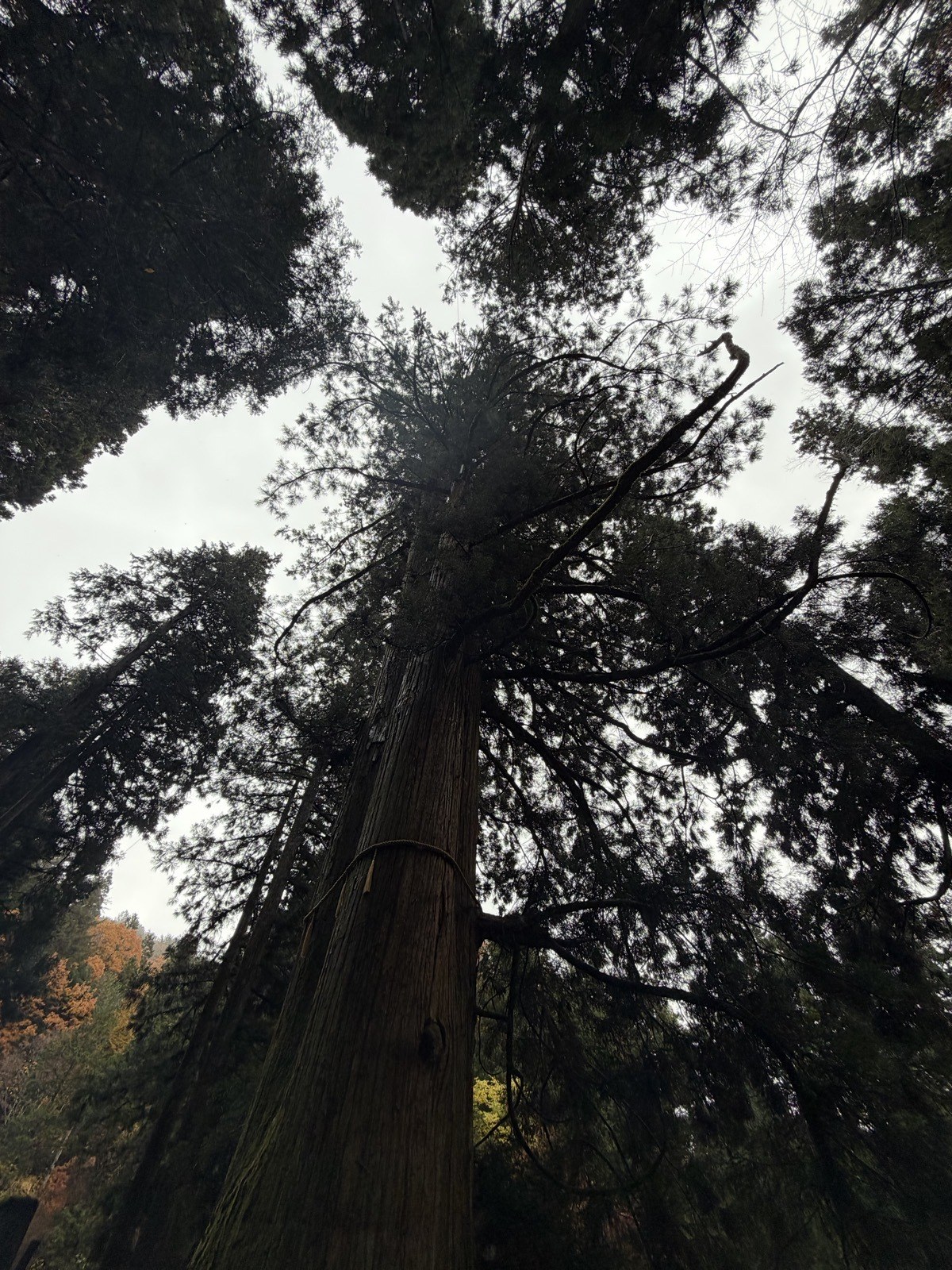
Reading the tree from the path — what the photographs show
From the front, five
In the photograph from the path in front, the stems stand apart, each with its own line of bark running up into the canopy, and the rope binds them into one figure.
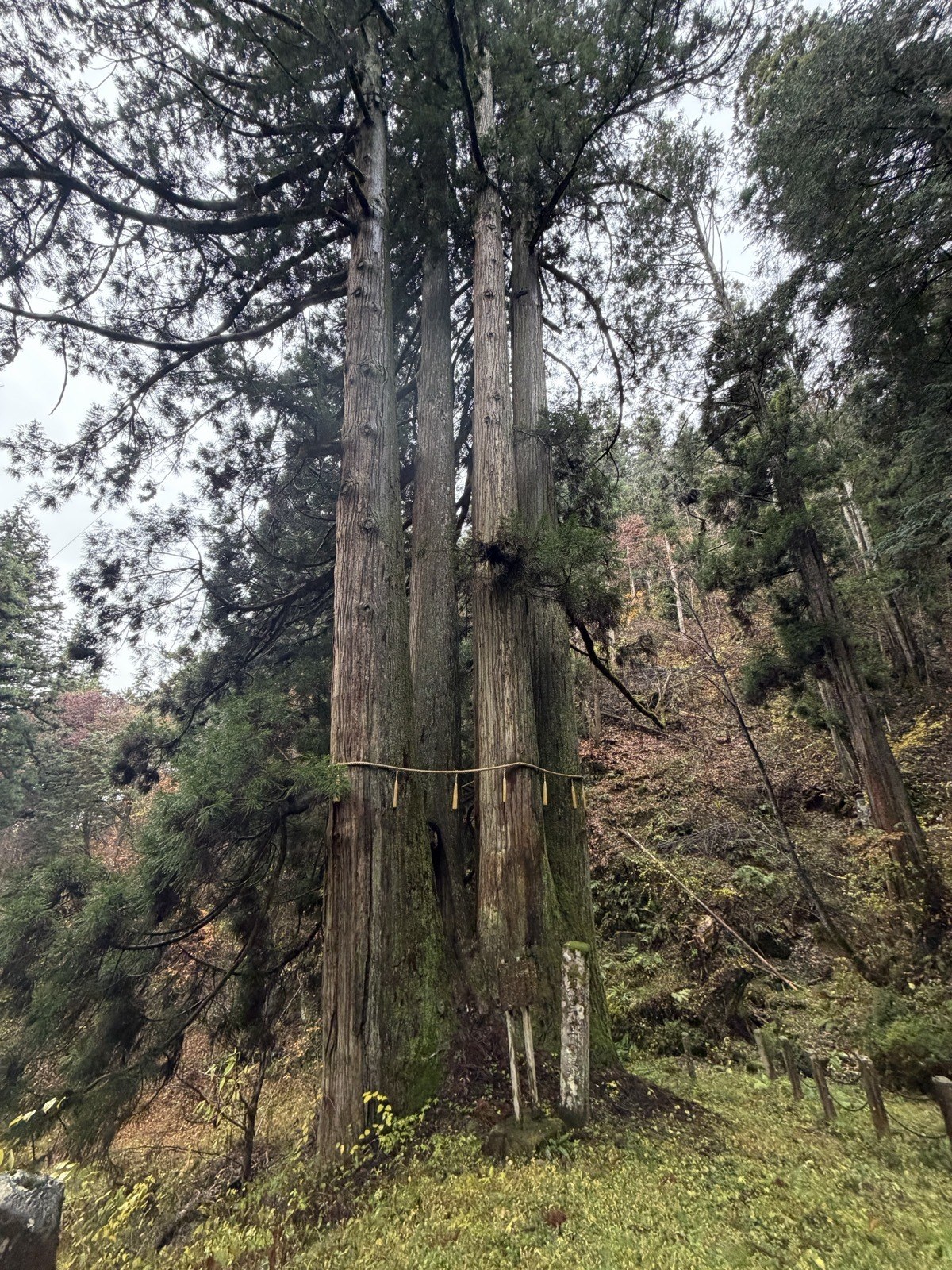
From the side, one
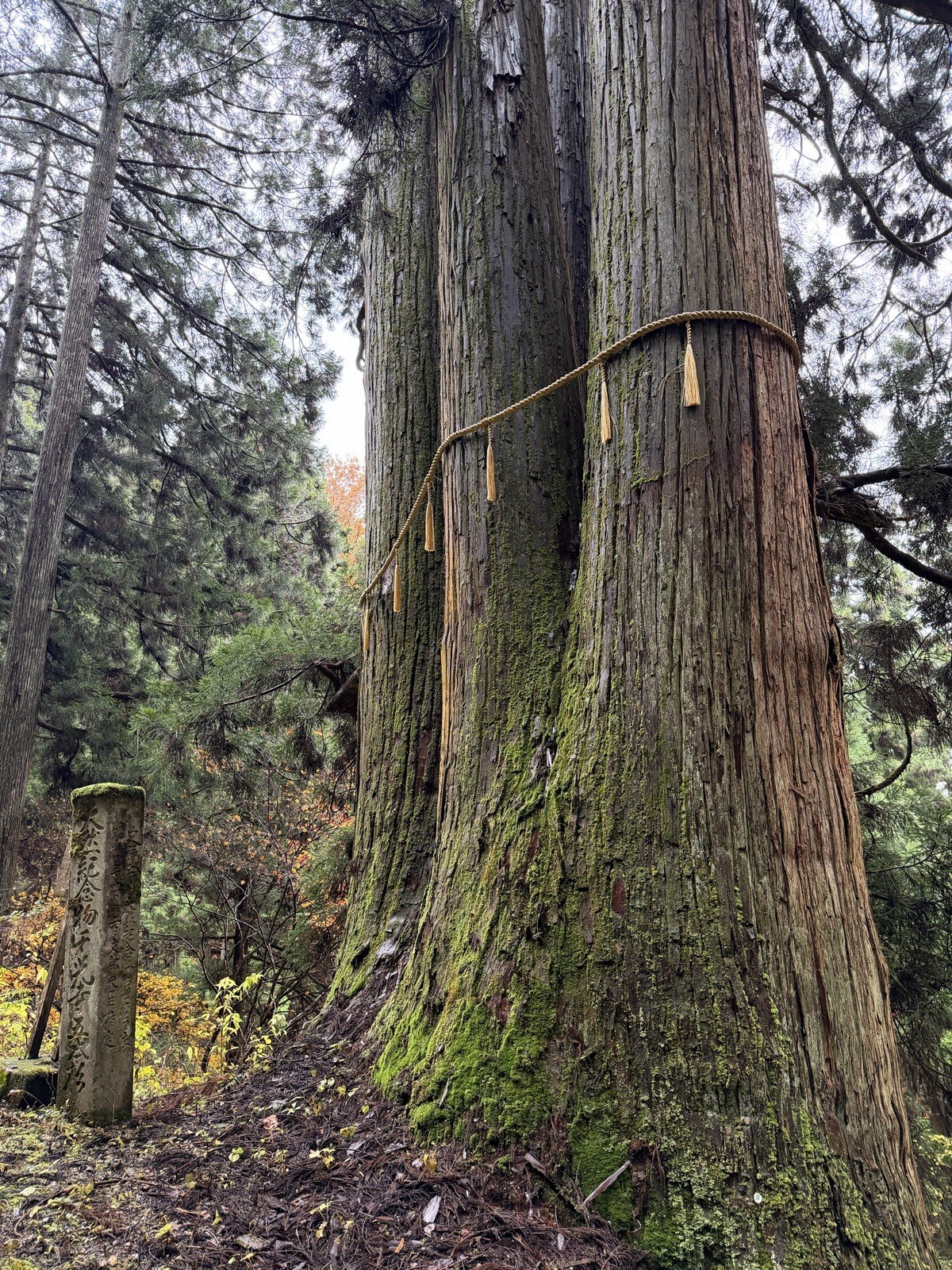
The side-view photograph shows something different. At this angle the stems overlap one behind another, and the tree appears as a single broad trunk with a moss-green buttress spreading downhill. An overlap in a photograph proves nothing about structure; the “one stock” comes from the temple’s description.
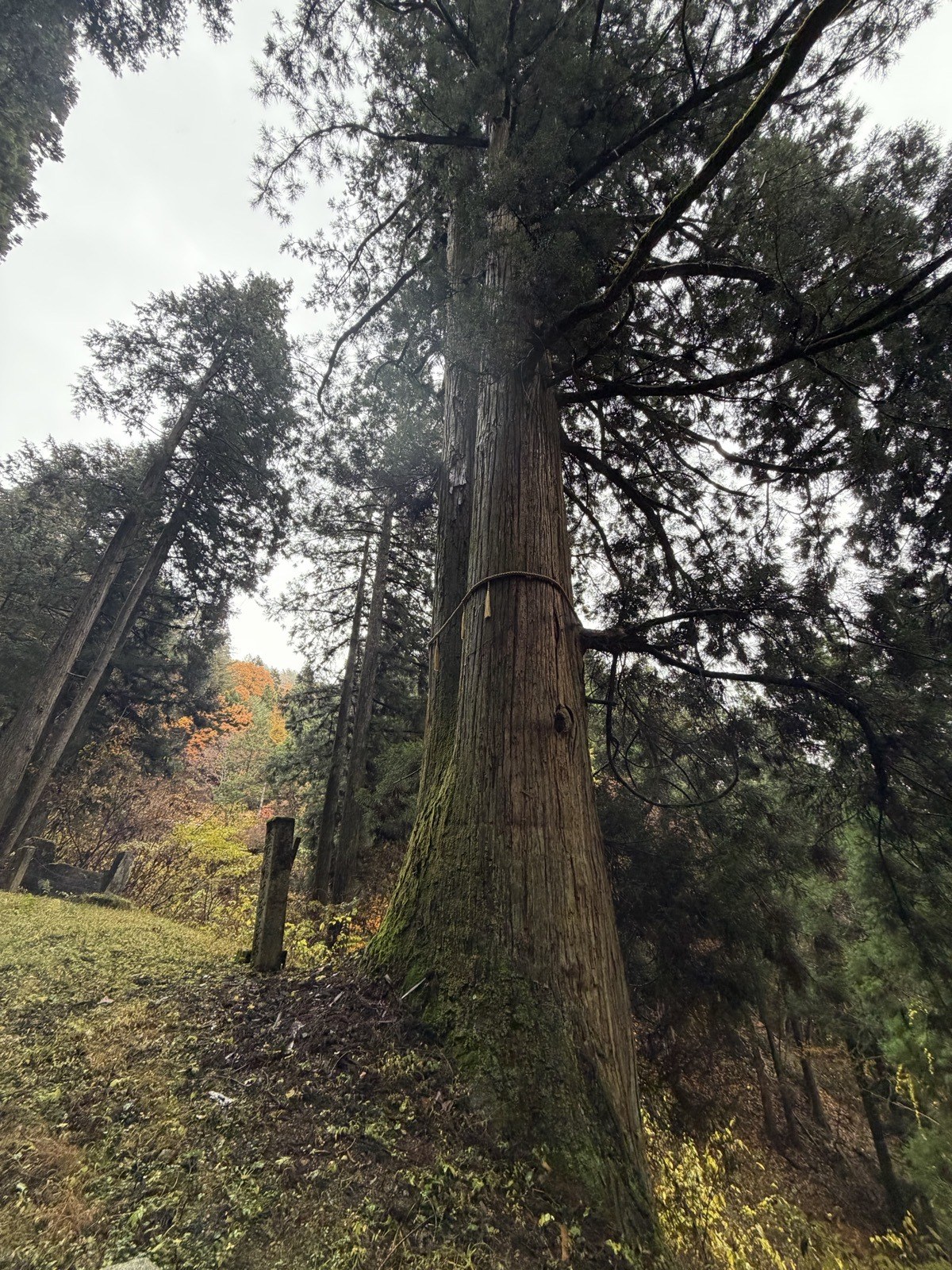
The base
At the foot, the trunk flares into the slope, its lower bark covered in moss. A low fence of wooden posts hung with chain runs in front of the tree.
Between the trunks
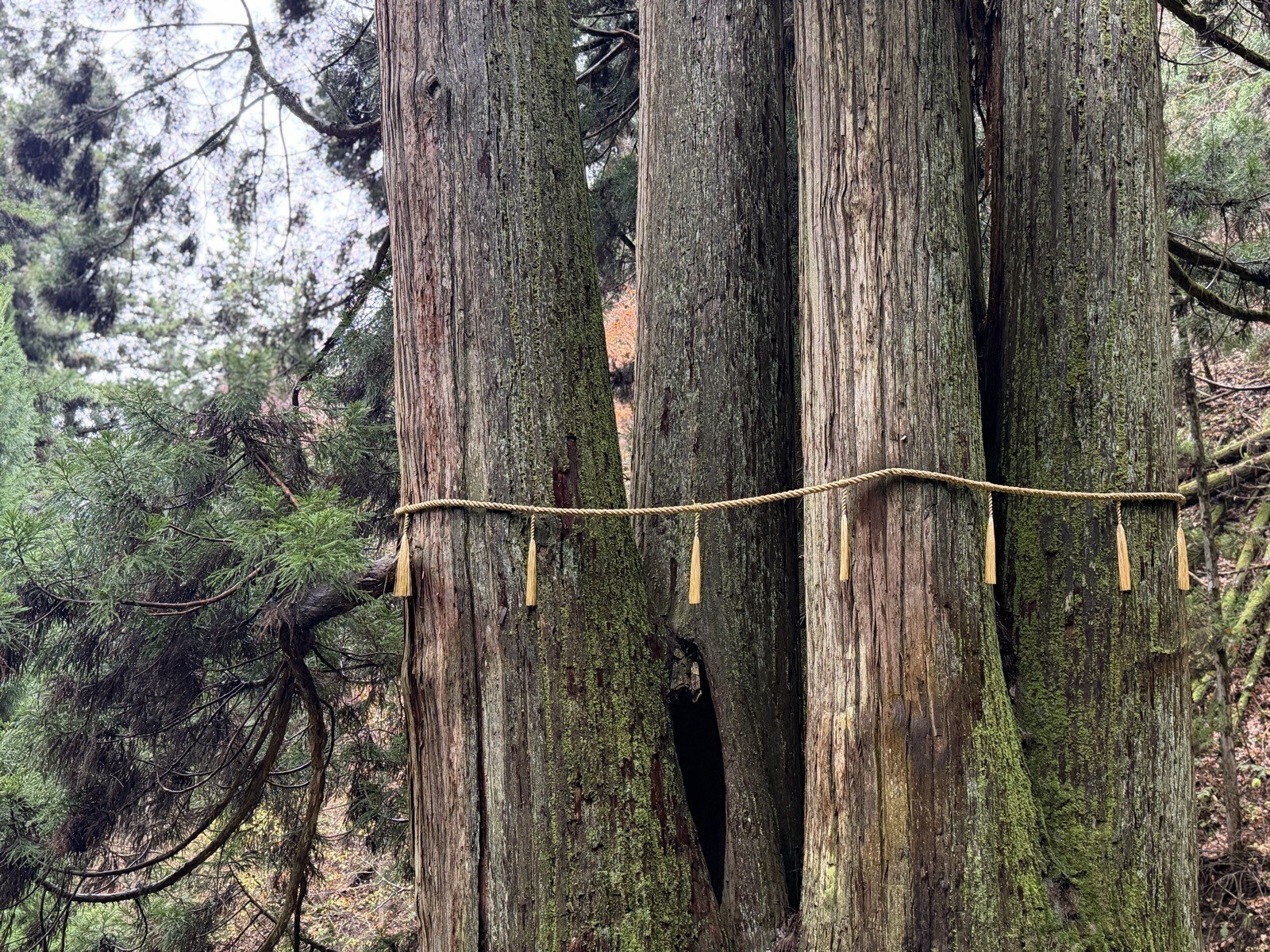
Below the rope, between two of the stems, the photographs show a dark area where the bark of neighbouring stems does not meet. A photograph alone cannot show how deep it goes or what it means for the tree. It does show why the junctions between stems are where attention goes on a tree of this form.
How big is it — measurements that do not agree
Height: 47 m or 50 m
Gifu Prefecture gives the height as about 47 m (154 ft). The temple and the Ministry of the Environment’s Chūbu regional list give 50 m (164 ft). None of the pages says when or how it was measured, so the reason for the difference cannot be identified. The fair way to quote it is with both numbers and their sources.
Girth: four numbers for one trunk
The girth figures differ in kind as well as size. The prefecture’s “trunk girth about 12 m”, the city’s “root girth 11.9 m”, the Ministry’s 1,220 cm and the designation record’s “3 jō 7 shaku at eye height” carry different labels, and most do not say where the tape was laid. Three jō seven shaku is 37 shaku, roughly 11.2 m at the standard shaku of 10/33 m. Girth can change with the height of measurement, and on a tree that divides, the height of the tape decides whether one base or several stems are being measured. The differences cannot be read as growth or decline.
| Figure | Source | Where it is measured |
|---|---|---|
| about 12 m (39 ft) | Gifu Prefecture | “trunk girth”; height not stated |
| 11.9 m | Takayama City | “root girth” |
| 1,220 cm | Ministry of the Environment (Chūbu) | “trunk girth” in a giant-tree list |
| 3 jō 7 shaku (about 11.2 m) | Designation record | at eye height |
What counts as a giant tree in Japan
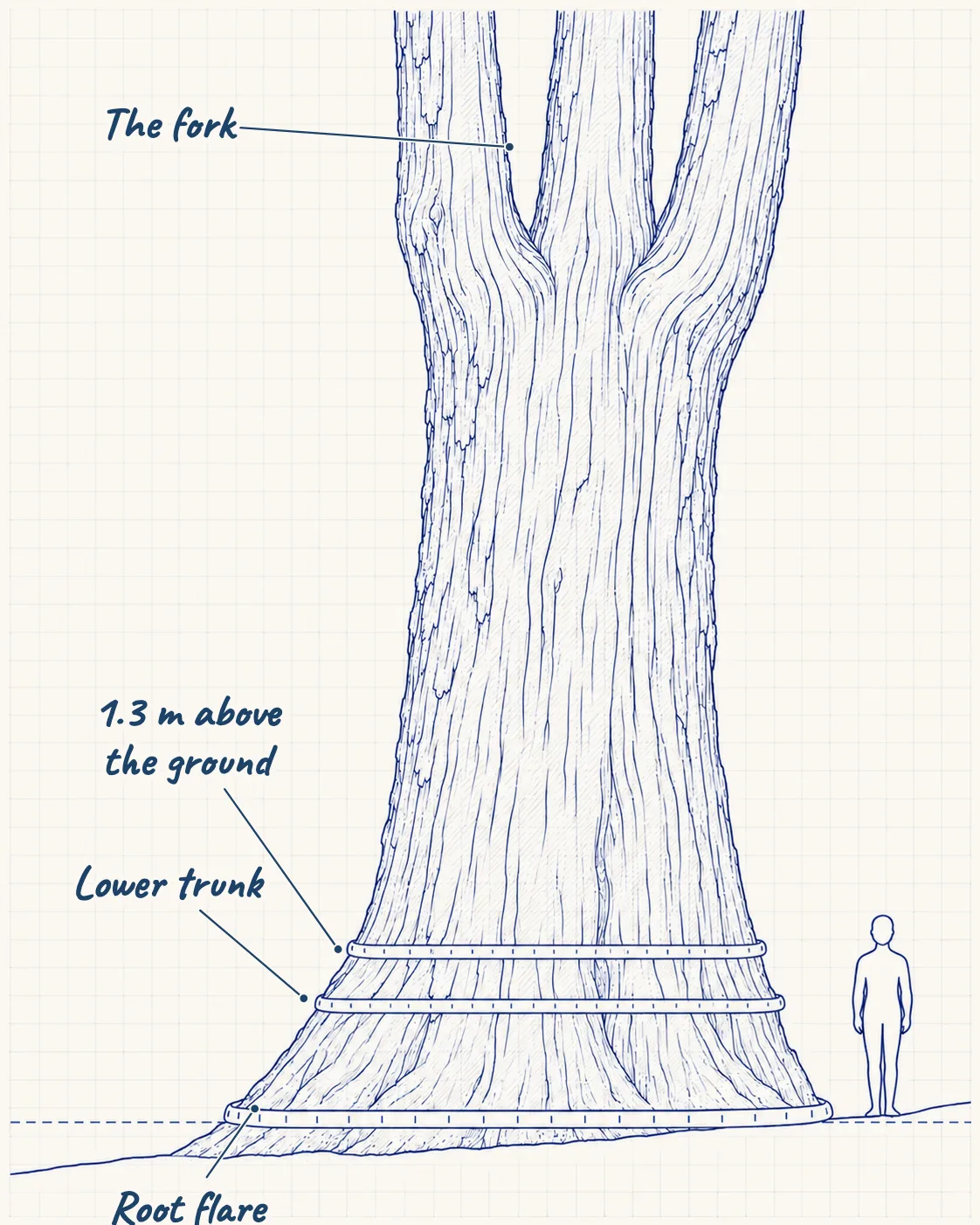
The Ministry of the Environment’s giant-tree survey uses a simple rule: as a rule, a tree counts if its girth at 1.3 m (4.3 ft) above the ground is 3 m (9.8 ft) or more. The sources give the Gohonsugi girths between about 11.2 m and 12.2 m, none of them stated as taken at 1.3 m. It is also in crowded company. In the sixth national survey, carried out in fiscal 1999–2000, sugi was the most numerous species among the giant trees measured, with 14,869 trees.
How old is it — what “1,200 years” rests on
Where the number appears
The roadside sign says “about 1,200 years”. The temple’s page about itself calls the tree “a giant of over 1,200 years”, and its guide to the precinct says “about 1,200 years or more”. The national register, the prefecture and the city give no age.
What it does not rest on
None of the sources cited here gives a ring count, a core sample or a dated record of planting, or says how the figure was arrived at. So “1,200 years” is best reported as the age given by the temple and the sign. Our earlier piece on how old Jōmon Sugi really is shows how widely such estimates can range for one famous cedar.
What an age cannot tell you
An age on a sign says nothing about how the stems are joined or how the base is doing. Those are separate questions, and for a tree with five stems they are the ones a caretaker has to answer.
The shimenawa — a sacred rope on a temple’s tree
Who renews it, how often
Round the stems hangs a thick straw rope, a shimenawa (注連縄), with folded paper streamers. Senkōji says that this great rope is replaced every seven years by young local temple supporters (danshinto), at the ceremony when the temple’s hidden principal image is shown. The image is a figure of the Eleven-Headed, Thousand-Armed Kannon; the temple notes that the hidden Buddha, 1 sun 8 bu tall, is opened to view every seven years.
What the rope means
The Nagano Prefectural Association of Shinto Shrines describes a shimenawa as a rope that sets apart impurity and marks a pure, sacred area. A goshinboku (御神木), a sacred tree, is one thought to be a dwelling place of the divine. On a Buddhist temple’s land that may look like a mix of religions. In Japan it is an old one. The idea is called shinbutsu shūgō (神仏習合), the deep fusion of belief in the Japanese gods with Buddhism, and Senkōji is a clear case: the temple says it served until the late Edo period as bettō, the Buddhist administrator, of Hida Ichinomiya shrine, and its precinct still has an Atago shrine hall as its guardian shrine.
What the records leave open
The sources cited here do not date the first rope on this tree, or tie the rope to a particular deity. The temple describes the tree as a witness to its history of faith, which came through the wars of a turbulent age.
The temple behind the tree — a legendary founder, a wandering sculptor, a fire
Ryōmen Sukuna
Senkōji says it was founded, by tradition, by Ryōmen Sukuna (両面宿儺). In the Nihon Shoki, as summarised by Takayama City, Sukuna is a being with one body, two faces, four arms and four legs, who refused to obey the court and was defeated in the 65th year of Emperor Nintoku. The temple keeps him as its legendary founder. The temple also names Prince-monk Shinnyo, one of Kōbō Daishi’s ten great disciples, as its kaiki, the founder of the temple as an institution.
Enkū
The itinerant monk-sculptor Enkū stayed at Senkōji and had exchanges with its abbot, Shunjō. The Tokyo National Museum notes that a collection of his own poems, the Kesayama hyakushu, survives there. The temple’s museum holds Enkū’s carvings, among them Niō guardian figures carved from standing trees, a seated Ryōmen Sukuna and a set of thirty-three Kannon.
Fire, then revival
The Tokyo National Museum states that the temple was burned in 1564 by a commander serving Takeda Shingen, and revived in 1588 under the Kanamori family, the lords of Hida. (The temple’s own guide gives the year of the fire as Eiroku 7 and prints 1565 beside it; its history page and the museum give 1564.) The records say nothing about the tree in those years; the temple’s history and the tree’s history are separate stories.
How a national Natural Monument is protected — the law, the owner, the city
What designation means
Under Japan’s Law for the Protection of Cultural Properties, the state designates important “monuments” as Historic Sites, Places of Scenic Beauty or Natural Monuments. Natural Monuments are animals, plants and geological features of high scientific value for Japan. As of 31 March 2026, the Agency for Cultural Affairs counted 560 designations of plants, 30 of them Special Natural Monuments. That is a count of designations, not of individual trees.
Who does what
For this tree the roles are clear. The owner is Senkōji. The managing body, designated in 1929, is Takayama City. Changes to the current state of a nationally designated monument, or acts that affect its preservation, generally require the permission of the Commissioner for Cultural Affairs; the law exempts measures of maintenance, emergency measures in a disaster and, for acts affecting preservation, those whose effect is minor. Municipal guidance gives examples of what needs permission — Nara City, for instance, lists land alteration, felling, heavy pruning. A national guideline sets out what a conservation plan, drawn up by the managing body or owner, should contain: how the property is to be kept and how changes are to be handled. In general terms, a problem noticed by the owner or managing body leads to consultation with the cultural-properties authorities and a decision on whether permission is needed; the procedure followed for this particular tree is not published. For trees, Kanagawa Prefecture has published a management manual covering daily checks and how to deal with problems.
What the record shows for this tree
The paper trail is thin but real. Takayama City’s archive lists a file titled “Gohonsugi surroundings improvement work” from 1996. The city’s account of its fiscal 2016 programmes names the Gohonsugi among the natural monuments covered by its protection and management work. The archive list and the programme sheet do not say what work was done, and specific damage or treatment could not be confirmed in a primary source.
| Role | Who | What the sources show |
|---|---|---|
| Owner | Senkōji | Owns the tree; the rope is renewed by young local temple supporters at the temple’s seven-yearly ceremony |
| Managing body | Takayama City (designated 1929) | 1996 surroundings work on file; protection and management in fiscal 2016 |
| Permission | Commissioner for Cultural Affairs | Generally required for changes to the current state, with legal exceptions |
| Plan | Owner or managing body | National guideline sets out what a conservation plan contains |
Multi-stem trees in Western arboriculture — the same shape, a different starting point
The arboricultural vocabulary
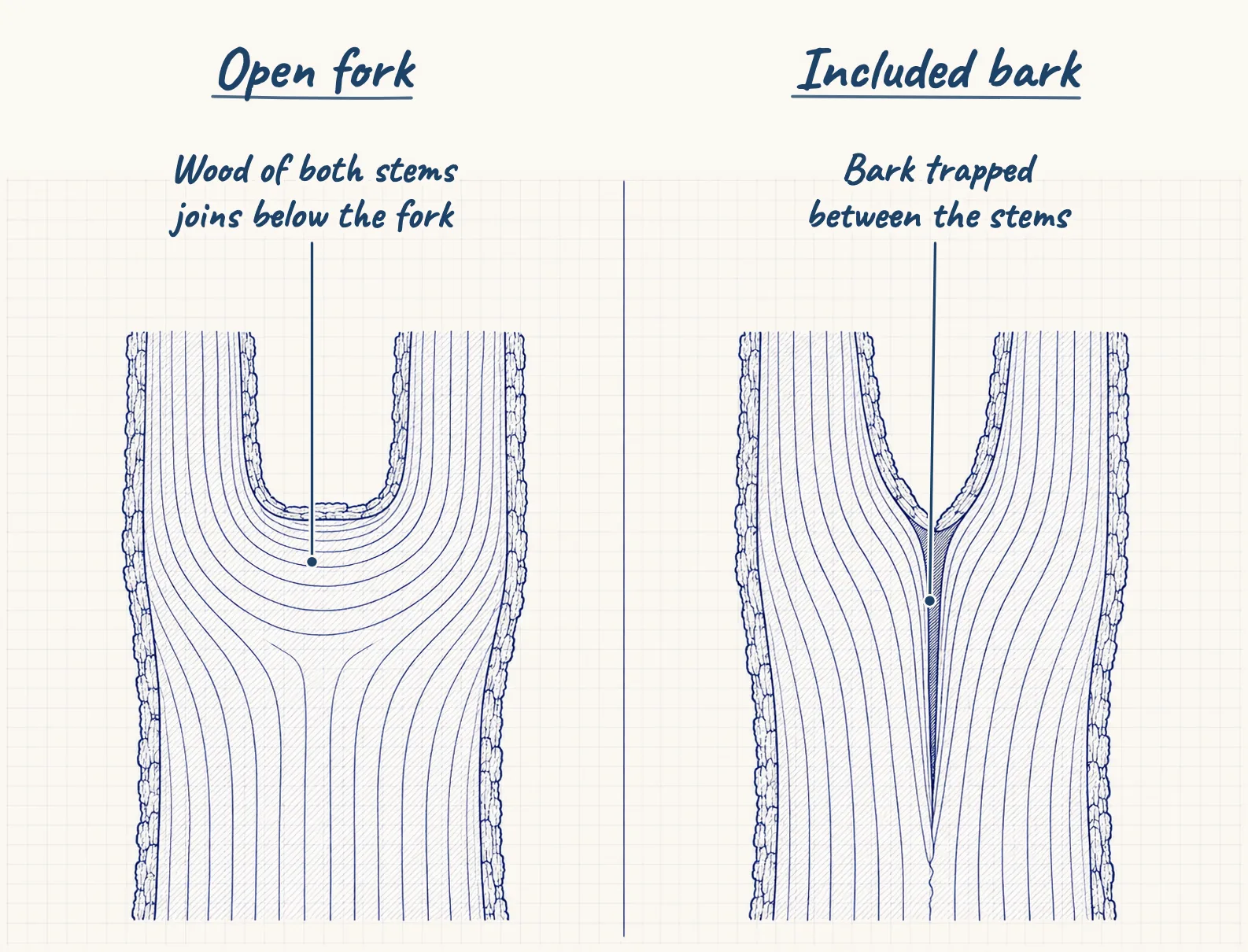
English-speaking arborists have a precise vocabulary for a tree like this. Two or more main stems of about the same diameter arising from the same point are codominant stems. Where they join, bark can be caught between the stems as they thicken: included bark. A University of Florida extension note explains that included bark “acts as a barrier” between the two parts and “does not allow a strong branch union to form”. Cabling is one possible intervention, depending on assessment. Purdue Extension’s guide says that “cabling helps limit the movement of limbs to reduce the likelihood of failure.”
Two frameworks side by side
The American extension material frames a multi-stem tree as a structural question: how each union is formed, whether bark is included, and whether limiting movement by cabling reduces the chance of failure. The Japanese framework for a tree like the Gohonsugi adds a legal and religious layer: the tree is protected as a whole, felling and heavy pruning are examples of acts that need national permission, and the owner gives it religious meaning. The two are not rivals; the second sets the limits within which the first is applied. What assessments have been done on the Gohonsugi is not stated in the sources cited here. Our guide to reading decay without instruments covers the first look an arborist gives a tree like this.
Four easy misreadings
Four distinctions matter for this tree. Five stems do not mean five trees: the records describe one. Designation does not certify an age: the national register gives none. Different girth figures do not show growth or decline: they carry different labels. A dark area between stems in a photograph is not a diagnosis of included bark: that needs an assessment. Protection and care also go together: the law names a managing body for exactly that role. Our piece on why Japan’s ancient trees live so long looks at the other half of that care.
Other multi-trunk cedars on Japan’s monument list
Three that divide
The Gohonsugi is not alone. Cultural Heritage Online describes several nationally designated cedars that divide high on the trunk. The great cedar of Hachiman shrine in Kaga, Ishikawa, divides at about 3.85 m into three trunks of similar thickness. The great cedar of Kayano, also in Kaga, divides in its upper part into two great stems. The Shōgun-sugi in Aga, Niigata, puts out six thick branches above a great side branch.
One that is two trees
Names can mislead. Set side by side, these trees show that a “great cedar” on the monument list may divide into three, two or six, and that a name with a number may mean one tree or two. The Meoto-sugi, the “husband-and-wife cedars”, of Kuzu Hachiman shrine in Gero, Gifu, is also a national Natural Monument, but Gifu Prefecture describes it as two cedars standing behind the main hall. It is a pair, not one divided tree.
| Tree | Place | How the records describe the trunks |
|---|---|---|
| Senkōji no Gohonsugi | Takayama, Gifu | One stock; three at about 6 m, then five |
| Hachiman Jinja no Ōsugi | Kaga, Ishikawa | Three trunks of similar thickness from about 3.85 m |
| Kayano no Ōsugi | Kaga, Ishikawa | Two great stems in the upper part |
| Shōgun-sugi | Aga, Niigata | Six thick branches above a great side branch |
| Kuzu Hachiman Jinja no Meoto-sugi | Gero, Gifu | Two separate cedars |
For a single giant with a very different story, see our piece on the hollow great zelkova of Higashine.
Visiting the Gohonsugi — what to know
Getting there
The tree stands on the approach to Senkōji in the Nyūkawa district of Takayama, a little below the gate. The temple’s guide mentions a Gohonsugi car park, and the temple’s 88-site mountain pilgrimage path starts and ends at the tree; the temple says a full circuit takes about three hours.
What else is there
From its hexagonal meditation hall the temple says you can see Mount Norikura to the east, Mount Ontake to the south and Mount Hakusan to the west.
How to behave at the tree
Stay outside the fence, follow any notices on site, and leave the rope and paper streamers untouched. These photographs were taken on 19 November, with autumn colour on the slope around the tree.
Frequently asked questions
Is the Gohonsugi five trees or one?
One. The national designation record says the trunk “divides into five”, and Senkōji, which owns it, describes one stock that divides into three at about 6 m, then into five higher up. How it came to divide is not recorded.
Where is the Gohonsugi?
On the approach to Senkōji temple, Nyūkawa-chō Shimobo 1553, Takayama, Gifu Prefecture, in the Hida region.
Is it a national Natural Monument?
Yes. It was designated on 2 April 1929 under the name Senkōji no Gohonsugi. Takayama City is the managing body.
How old is it?
The roadside sign says about 1,200 years and the temple says over 1,200 years. The sources cited here give no ring count or method, so the figure is best read as the age given by the temple.
How tall is it?
About 47 m according to Gifu Prefecture, about 50 m according to the temple, 50 m in the Ministry of the Environment’s regional list.
Why does a Buddhist temple’s tree wear a Shinto rope?
Shinto and Buddhist belief were long fused in Japan, and Senkōji itself served as the Buddhist administrator of Hida Ichinomiya shrine until the late Edo period. That is the historical background; when the rope on this tree began is not recorded. Today it is renewed every seven years by young local temple supporters at the temple’s unveiling ceremony.
Sources
– Agency for Cultural Affairs, Database of National Cultural Properties, “千光寺の五本スギ”: https://kunishitei.bunka.go.jp/heritage/detail/401/1253 (checked 2026-11-20) – Cultural Heritage Online, “千光寺の五本スギ”: https://online.bunka.go.jp/heritages/detail/161268 (checked 2026-11-20) – Gifu Prefecture, “千光寺の五本スギ”: https://www.pref.gifu.lg.jp/page/366574.html (checked 2026-11-20) – Takayama City, list of natural monuments: https://www.city.takayama.lg.jp/kurashi/1000021/1000119/1000847/1000994/1004127.html (checked 2026-11-20) – Ministry of the Environment, Chūbu Regional Office, giant trees by prefecture (PDF): https://chubu.env.go.jp/to_2011/data/1213b.pdf (checked 2026-11-20) – Senkōji, “千光寺について”: https://senkouji.com/about/ (checked 2026-11-20) – Senkōji, guide to the precinct: https://senkouji.com/haikan/ (checked 2026-11-20) – Senkōji, Enkū museum: https://senkouji.com/course/enku_jihoukan/ (checked 2026-11-20) – Tokyo National Museum, “飛騨の円空―千光寺とその周辺の足跡―”: https://www.tnm.jp/modules/r_free_page/index.php?id=1556&lang=ja (checked 2026-11-20) – Takayama City, “高山の歴史” (on Ryōmen Sukuna): https://www.city.takayama.lg.jp/kurashi/1000021/1000119/1000846.html (checked 2026-11-20) – Agency for Cultural Affairs, “天然記念物”: https://www.bunka.go.jp/seisaku/bunkazai/shokai/tennen_kinenbutsu/ (checked 2026-11-20) – Agency for Cultural Affairs, “記念物”: https://www.bunka.go.jp/seisaku/bunkazai/shokai/kinenbutsu/ (checked 2026-11-20) – Agency for Cultural Affairs, guideline on conservation plans (PDF): https://www.bunka.go.jp/seisaku/bunkazai/bunkazai_hozon/pdf/93855501_01.pdf (checked 2026-11-20) – Nara City, alterations to designated properties: https://www.city.nara.lg.jp/site/bunkazai/8556.html (checked 2026-11-20) – Kanagawa Prefecture, natural monument management manual (trees): https://www.pref.kanagawa.jp/docs/ar3/naturalmonument.html (checked 2026-11-20) – Takayama City Archives, Nyūkawa village records (PDF, p.119): https://www.city.takayama.lg.jp/_res/projects/default_project/_page_/001/001/415/01_nyukawa_5.pdf (checked 2026-11-20) – Takayama City, cultural properties programme sheet (PDF): https://www.city.takayama.lg.jp/s/_res/projects/default_project/_page_/001/008/730/38_bunkazai.pdf (checked 2026-11-20) – Ministry of the Environment, Biodiversity Center, giant tree survey: https://www.biodic.go.jp/kiso/13/13_kyoju.html (checked 2026-11-20) – Ministry of the Environment, 6th National Survey, giant trees (PDF): https://www.biodic.go.jp/reports2/6th/kyojuflupg/6_kyojuflupg.pdf (checked 2026-11-20) – Forestry and Forest Products Research Institute, Kyushu, “スギ”: https://www.ffpri.go.jp/kys/business/jumokuen/jumoku/zukan/sugi.html (checked 2026-11-20) – Forestry and Forest Products Research Institute, Kansai, Research Information No. 83 (PDF): https://www.ffpri.go.jp/fsm/research/pubs/joho/documents/res_info_083.pdf (checked 2026-11-20) – Taira, H. (1994), “タテヤマスギの更新形態について”, Journal of the Japanese Forestry Society 76(6): https://www.jstage.jst.go.jp/article/jjfs1953/76/6/76_6_547/_article/-char/ja (checked 2026-11-20) – Forestry and Forest Products Research Institute, Kansai Forest Tree Breeding No. 91 (PDF): https://www.ffpri.go.jp/kaniku/business/documents/91.pdf (checked 2026-11-20) – Kyoto University Research Resource Archive, record of layering in sugi: https://keep.rra.museum.kyoto-u.ac.jp/repositories/2/archival_objects/16735 (checked 2026-11-20) – Forestry and Forest Products Research Institute, Kansai, “ダイスギ”: https://www.ffpri.go.jp/fsm/business/jumokuen/04_ta/daisugi.html (checked 2026-11-20) – University of Massachusetts teaching material, “Plant Growth” (PDF, hosted by the City of Springfield): https://www.springfield-ma.gov/park/fileadmin/_migrated/content_uploads/2_Plant_Growth.pdf (checked 2026-11-20) – University of Florida IFAS, “Included Bark: A Hidden Branch Defect”: https://blogs.ifas.ufl.edu/duvalco/2026/11/10/included-bark-a-hidden-branch-defect/ (checked 2026-11-20) – Purdue Extension, “Large Tree Cabling and Bracing” (PDF): https://www.extension.purdue.edu/extmedia/FNR/FNR-550-W.pdf (checked 2026-11-20) – Shirasaki Hachimangū, FAQ on goshinboku: https://www.sirasaki.com/qa/ (checked 2026-11-20) – Nagano Prefectural Association of Shinto Shrines, “祭り方”: https://www.nagano-jinjacho.jp/column/jinjya-yogo/maturikata.html (checked 2026-11-20) – Law for the Protection of Cultural Properties (e-Gov): https://laws.e-gov.go.jp/law/325AC0100000214 (checked 2026-11-20) – National Art Center Tokyo Art Commons, Nara National Museum exhibition “神仏習合”: https://www.nact.jp/artcommons/user/detail/20502 (checked 2026-11-20) – Cultural Heritage Online, “八幡神社の大スギ”: https://online.bunka.go.jp/heritages/detail/171935 ; “栢野の大スギ”: https://online.bunka.go.jp/heritages/detail/190622 ; “将軍スギ”: https://online.bunka.go.jp/heritages/detail/190542 ; Kuzu Hachiman Meoto-sugi: https://online.bunka.go.jp/heritages/detail/201716 (checked 2026-11-20) – Gifu Prefecture, Kuzu Hachiman Meoto-sugi: https://www.pref.gifu.lg.jp/page/367163.html (checked 2026-11-20)