

By Isaki Kasahara, a Japanese arborist pruning, assessing and caring for Japan’s trees and gardens · Updated November 22, 2026
Takayama ties ropes from a pole above its pines in November so that the branches have support from above when the snow comes; snow piling on a crown is what breaks branches and stems. The work falls close to the town’s average first-snow date of 17 November — in 2026 the local paper photographed landscapers tying straw rope to red pines in front of Takayama Jinya on 16 November.
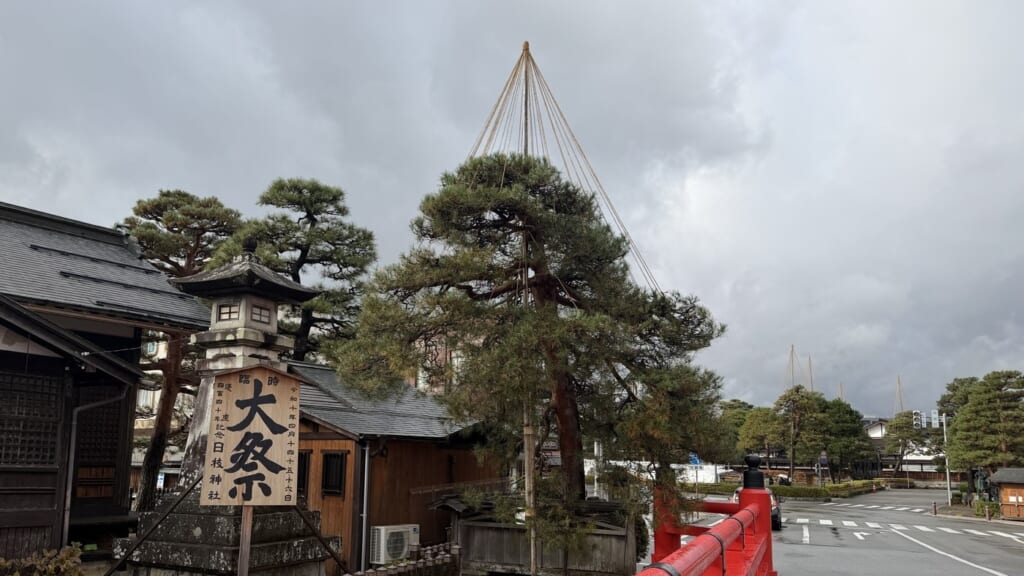
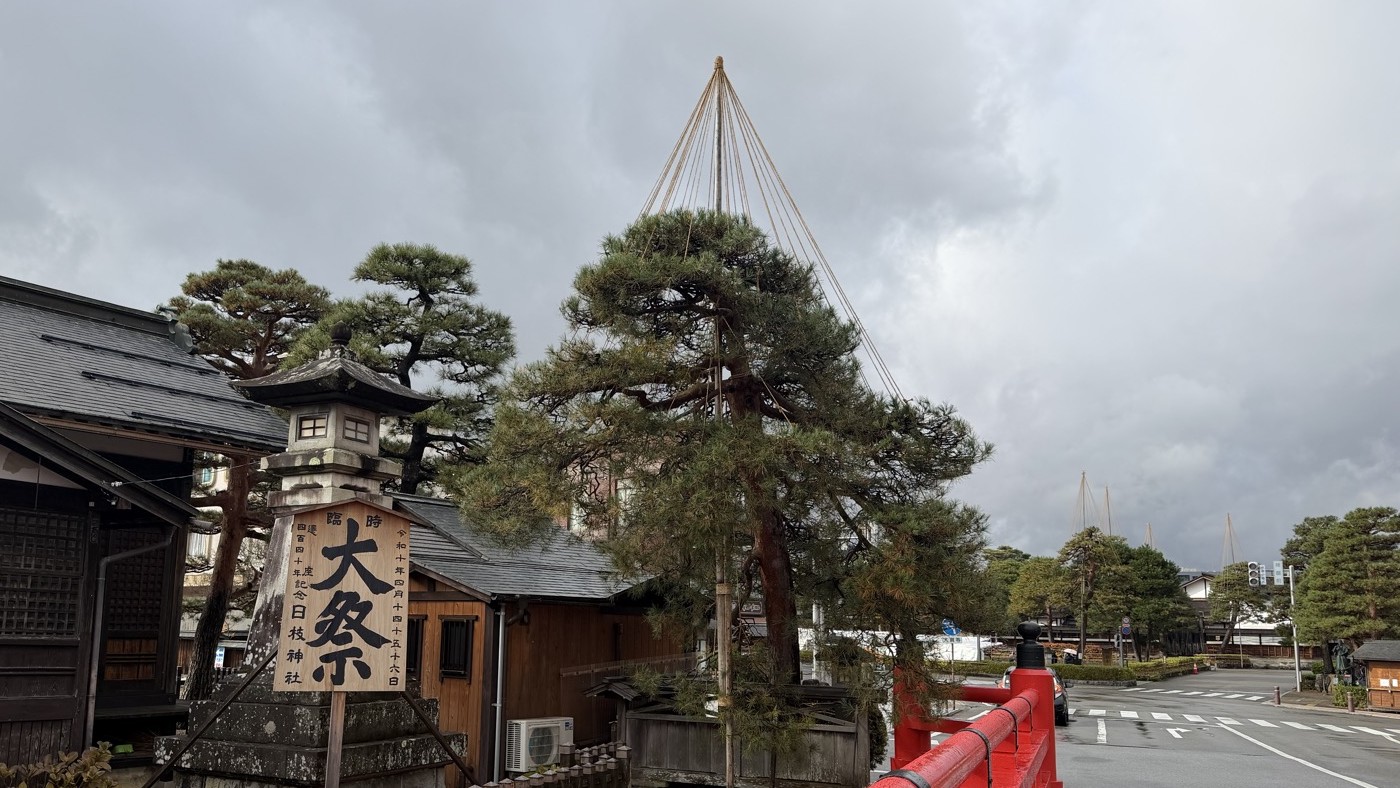
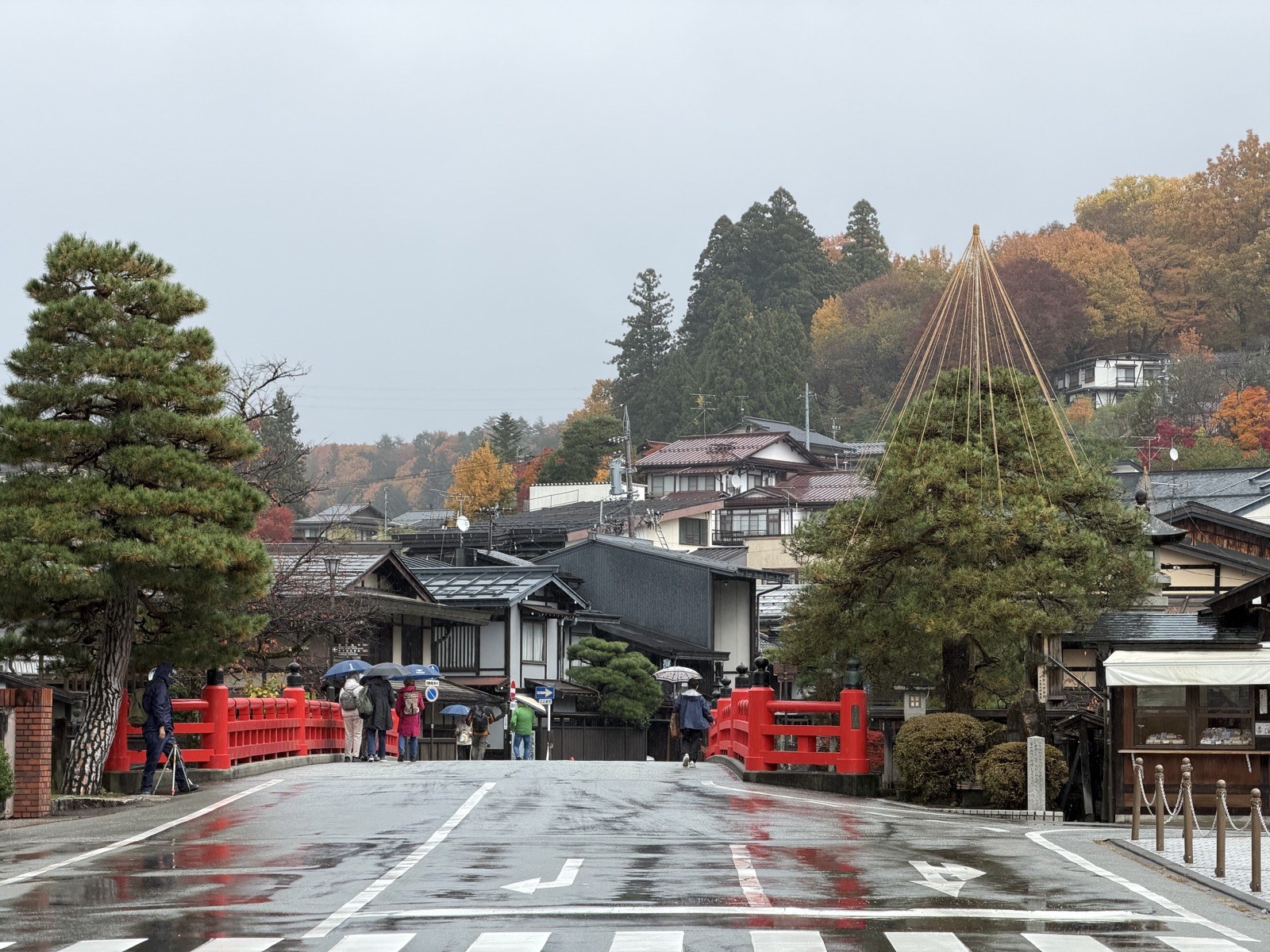
On the morning of 19 November 2026, poles stood above the pines by Nakabashi, the red bridge over the Miyagawa, with pale ropes fanning down from each pole tip to the edge of the crown. Further along the road, more poles rose above more pines. That is yukitsuri (雪吊り), “snow hanging”, and this article follows it through Takayama, Gifu: from the bridge to the old magistrate’s office, down to hedges and shrubs at street level, and into the merchant streets of the old town.
Two November mornings by the Miyagawa — the river before the ropes
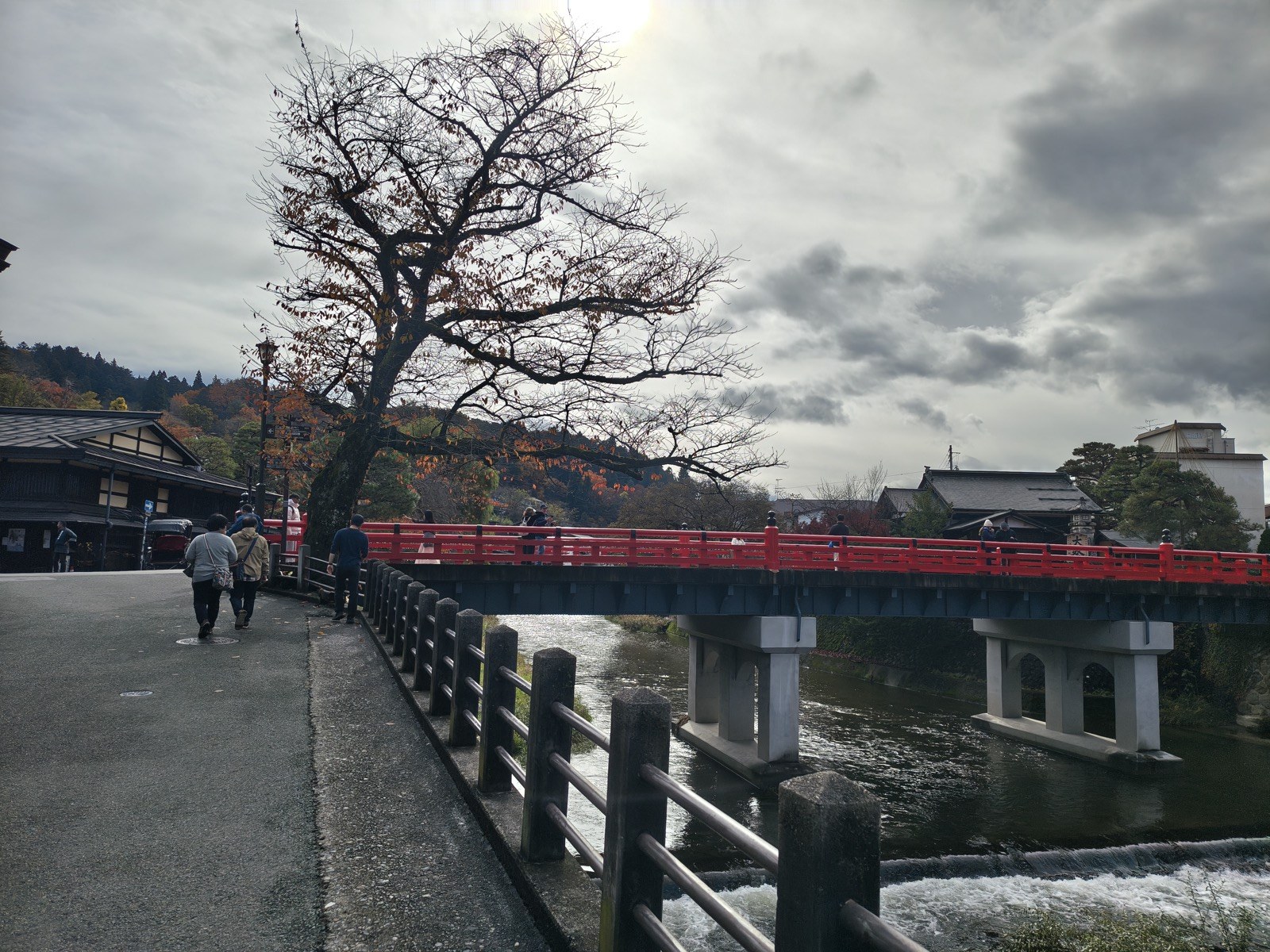
Bare cherry trees beside the river
The photographs in this article were taken on 18 and 19 November 2026. On the first morning, a little before noon, the cherry trees along the Miyagawa had dropped nearly all their leaves; a few orange ones were left at the tips.
Takayama’s landscape plan lists the row of cherries on the Miyagawa embankment among the city’s main river landscapes. In the third week of November it is a line of grey branches over the water.
Nakabashi (中橋) crosses the river here. The city’s town-centre plan describes it as the red bridge that links the old townscape with Takayama Jinya, and the official tourism site calls it a fine spot for anyone who likes to take photographs.
The next morning, poles over the pines
At around 9:20 the next morning, the pines near the bridge already carried their ropes. Each had a single straight pole rising out of the crown, and from the top of that pole a cone of rope ran down to the outer branches. In the background, more poles stood above more pines.
The Japanese is 雪吊り; the Gifu Shimbun, the prefecture’s newspaper, writes it 雪つり. In English the Japan National Tourism Organization uses both yukitsuri and yukizuri. This article uses yukitsuri.
A November job — the 2023 and 2026 reports
On 20 November 2023 the Gifu Shimbun reported the start of that year’s yukitsuri in the square in front of Takayama Jinya and elsewhere, and called it a yearly November job. Around Nakabashi, it said, four landscaping craftsmen were at work, with 54 pines to finish in about a week.
In 2026 the paper’s photograph from 16 November shows landscapers tying straw rope to the branches of red pines in the Jinya square. Three days later, the photographs in this article show finished ropes near Nakabashi and around the Jinya.
Why mid-November — the climate of a mountain basin
Takayama and Kanazawa: snowfall and temperature
The Japan Meteorological Agency’s 1991–2020 normals for the Takayama station give an annual snowfall of 305 cm and a mean annual maximum snow depth of 55 cm. January averages −1.2 °C, with an average daily low of −4.8 °C.
The city gives the reason in its own planning documents: Takayama as a whole has an inland climate, and the Takayama area, lying in a basin, shows it most strongly. The city’s agriculture page adds that the gap between day and night temperatures is large, and that nights are especially cold.
| Station (JMA, 1991–2020 normals) | Annual snowfall (sum of daily new snow) | January mean temperature |
|---|---|---|
| Takayama | 305 cm (120 in) | −1.2 °C (29.8 °F) |
| Kanazawa | 157 cm (62 in) | 4.0 °C (39.2 °F) |
| Tokyo | 8 cm (3 in) | 5.4 °C (41.7 °F) |
Annual snowfall is the total of new snow measured through the winter, not the depth on the ground at any one time. Kanazawa, home of Kenroku-en and its well-known yukitsuri, receives about half Takayama’s snowfall, and its January mean is 5.2 °C warmer.
The dates the ropes have to beat
JMA’s normals for Takayama put the first snow of the season at 17 November and the first day with at least 1 cm on the ground at 8 December. Long-lasting snow cover — chōki sekisetsu, also called ne-yuki, a spell of 30 days or more in which the daily maximum snow depth is 1 cm or more — begins on average on 31 December.
| Event in Takayama | Date or reported timing | Basis |
|---|---|---|
| Yukitsuri work in the Jinya square | 20 Nov 2023; 16 Nov 2026 | Gifu Shimbun reports |
| First snow of the season | 17 November | JMA normal, 2007–2020 (14 years) |
| First day with snow cover of 1 cm or more | 8 December | JMA normal, 1991–2020 (30 years) |
| Start of long-lasting snow cover (ne-yuki) | 31 December | JMA normal, 1991–2020 (23 years of data) |
Set side by side, the reported work dates sit close to the average first snow, about three weeks before snow normally starts to lie on the ground, and some six weeks before it normally lies for the winter.
What snow does to a branch
The Forestry and Forest Products Research Institute describes kansetsu-gai (冠雪害) — damage from snow accumulating in the crown — as snow building up on a tree until its load breaks branches, bends or snaps stems, or tips the tree over at the roots. The Forest Insurance Center describes the same damage as the trunk and roots no longer being able to carry the weight of snow stuck to branches and leaves.
The weight depends on the volume and density of the snow. The National Research Institute for Earth Science and Disaster Resilience gives typical densities of 30–150 kg/m³ for new snow, 200–500 kg/m³ for compacted snow and 300–500 kg/m³ for coarse, granular snow, and notes that rain or meltwater held inside the snowpack raises the density. A cubic metre of compacted snow can weigh several times as much as a cubic metre of fresh powder.
No primary source was found that compares the quality of Takayama’s snow with that of the coast, so this article makes no claim that it is lighter or wetter. What the figures do show is a cold town where snow arrives in November and, on average, lies on the ground from December.
Two people at a temple gate — a pine being fitted
What the photograph shows
At 9:37 that morning, at the gate of a temple in Takayama, two people were working on a pine. One was near the top of the crown, beside the pole. The other stood on a stepladder next to a stone gatepost, reaching into the lower branches. Long ropes hung down from the top of the pole through the crown.
Their faces have been blurred, and the temple is not named. The photograph shows the job in progress: the pole is standing, and ropes run down from its head, still hanging loose.
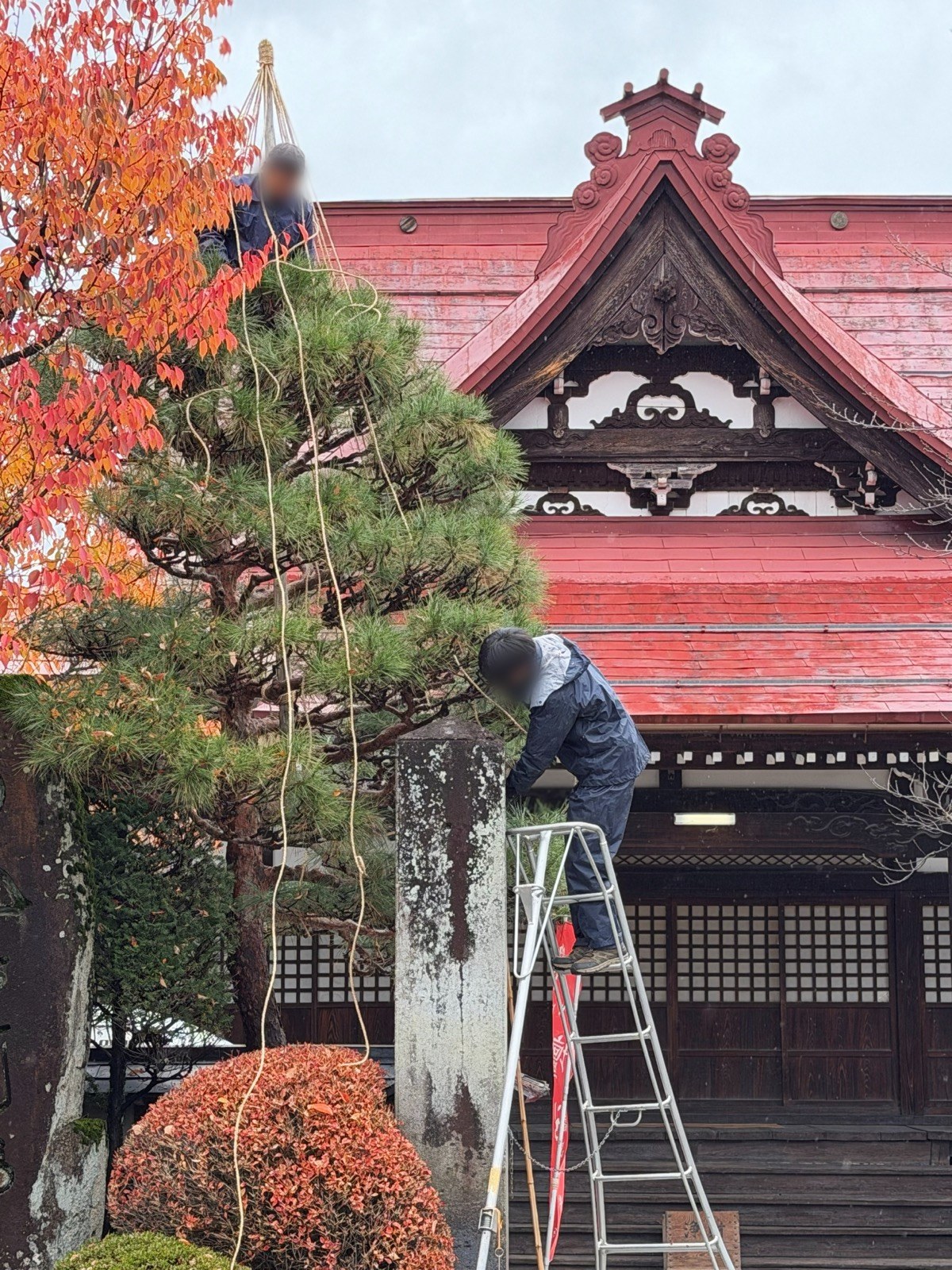
The form and materials
Chiba City’s sheet for the pines in Chiba Park defines ringo-tsuri (りんご吊り), the pole form, as a pole set close to the trunk, with rope stretched radially from its tip to each branch. It separates the materials by job: straw rope for the hanging lines, black hemp-palm rope (shuro-nawa) for binding. Kenroku-en’s 2026 work sheet lists straw rope 6 mm and 8 mm thick, with poles of ate logs and madake bamboo.
Kanazawa’s cultural-heritage office notes that the name ringo-tsuri — “apple hanging” — is said to come from tying up apple branches with rope so that the weight of the fruit would not break them.
How the ropes, pole and spokes are set out on a large pine is covered in Yukitsuri explained: how Japan’s snow ropes spread the load. Here the point is simpler: in Takayama, this is done by hand, from ladders, by people who climb into the crown.
A finished rope umbrella — three things to look at
The pole above the crown
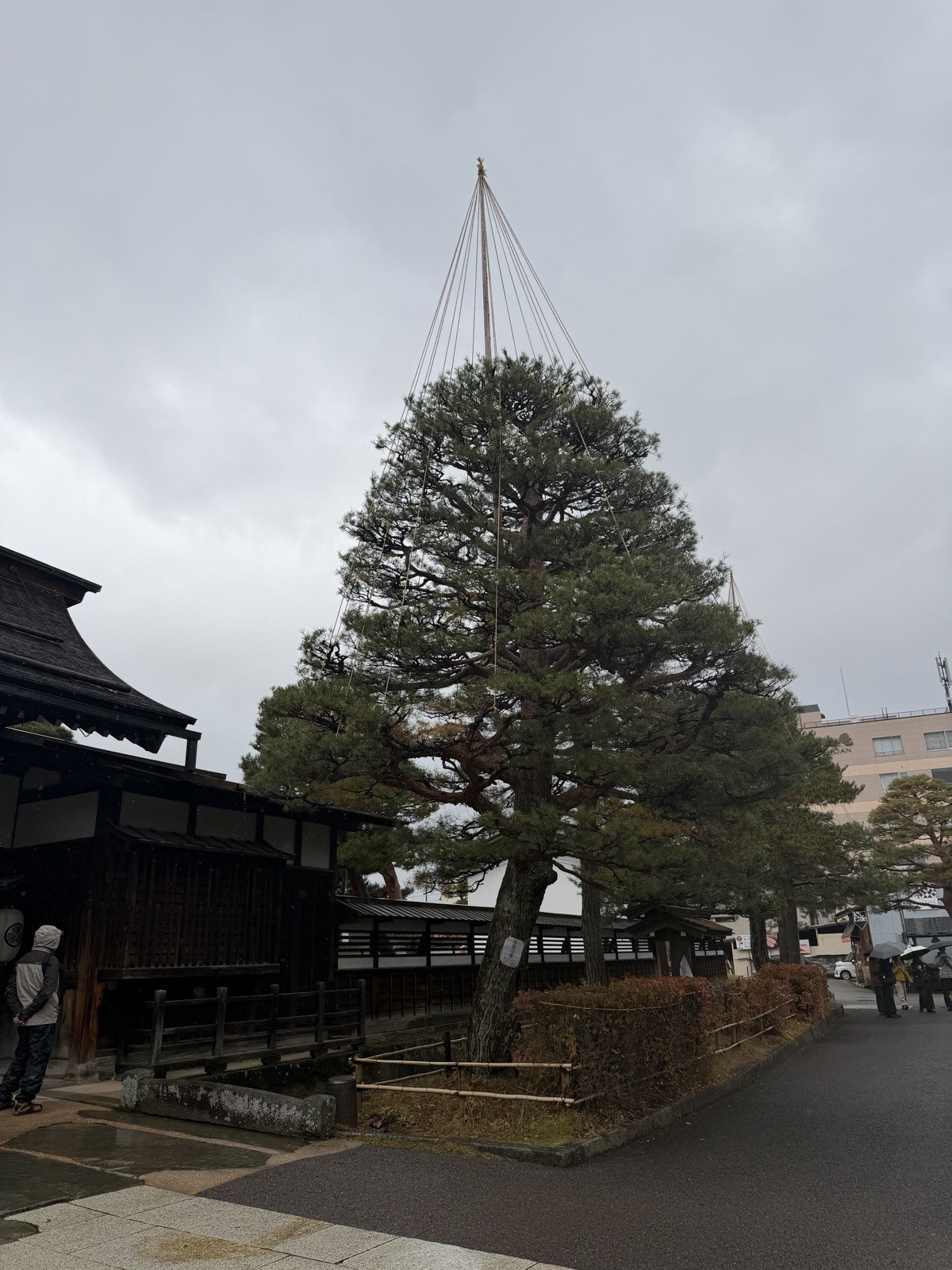
Seen from below against a grey sky, a finished ringo-tsuri is a simple shape: a dark crown, a straight pole standing out of it, and a fan of lines from the pole tip down to the crown. On the pine below, near Takayama Jinya, the pole rises well clear of the foliage, so the ropes leave it at a steep angle.
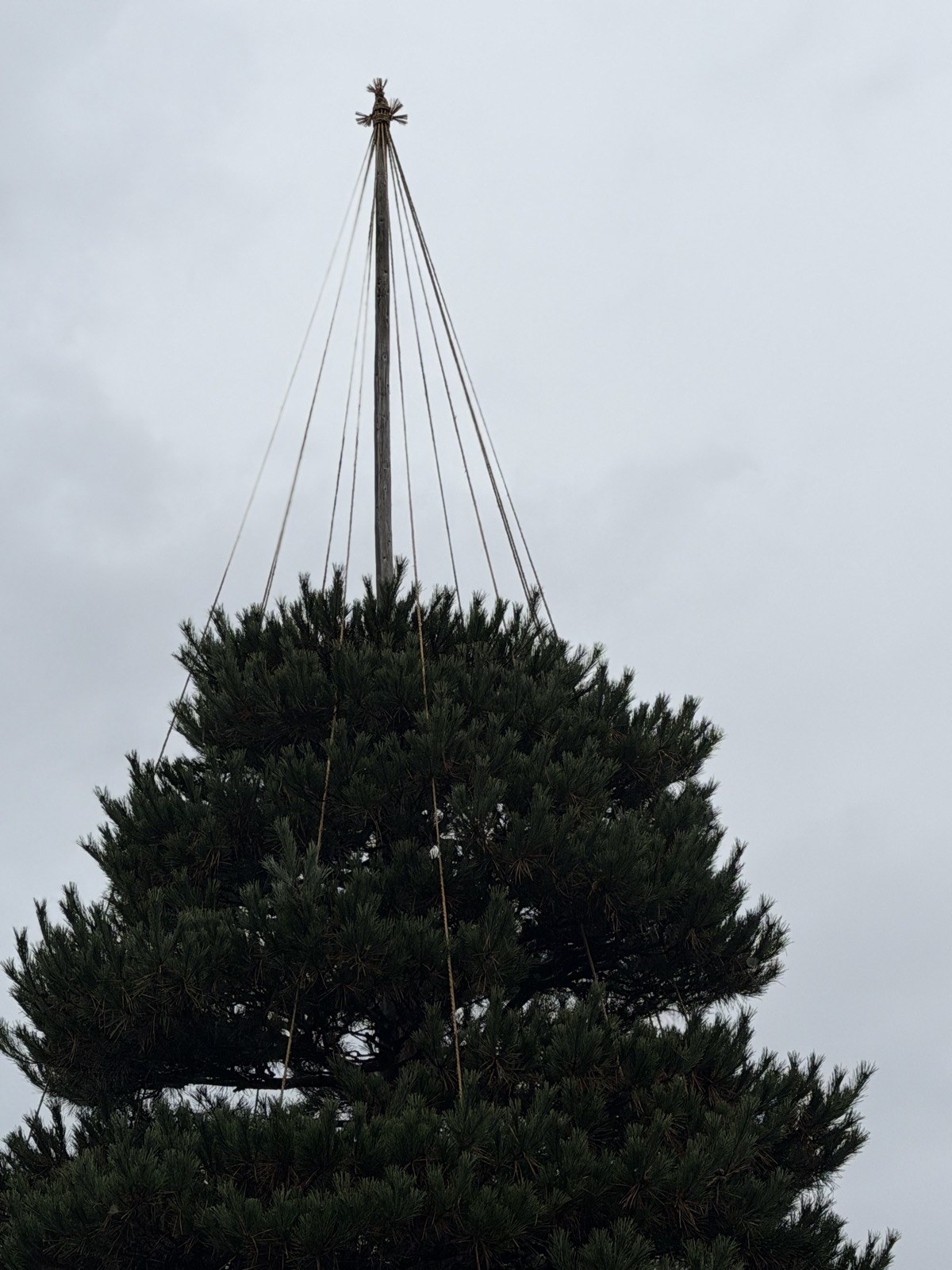
Where the ropes meet
At the top, in the photograph below, several ropes are gathered at the pole head and tied there in one lashing, with the cut ends standing up above it. This pole was photographed seconds after the small shrub frame shown further down, and appears to belong to it.
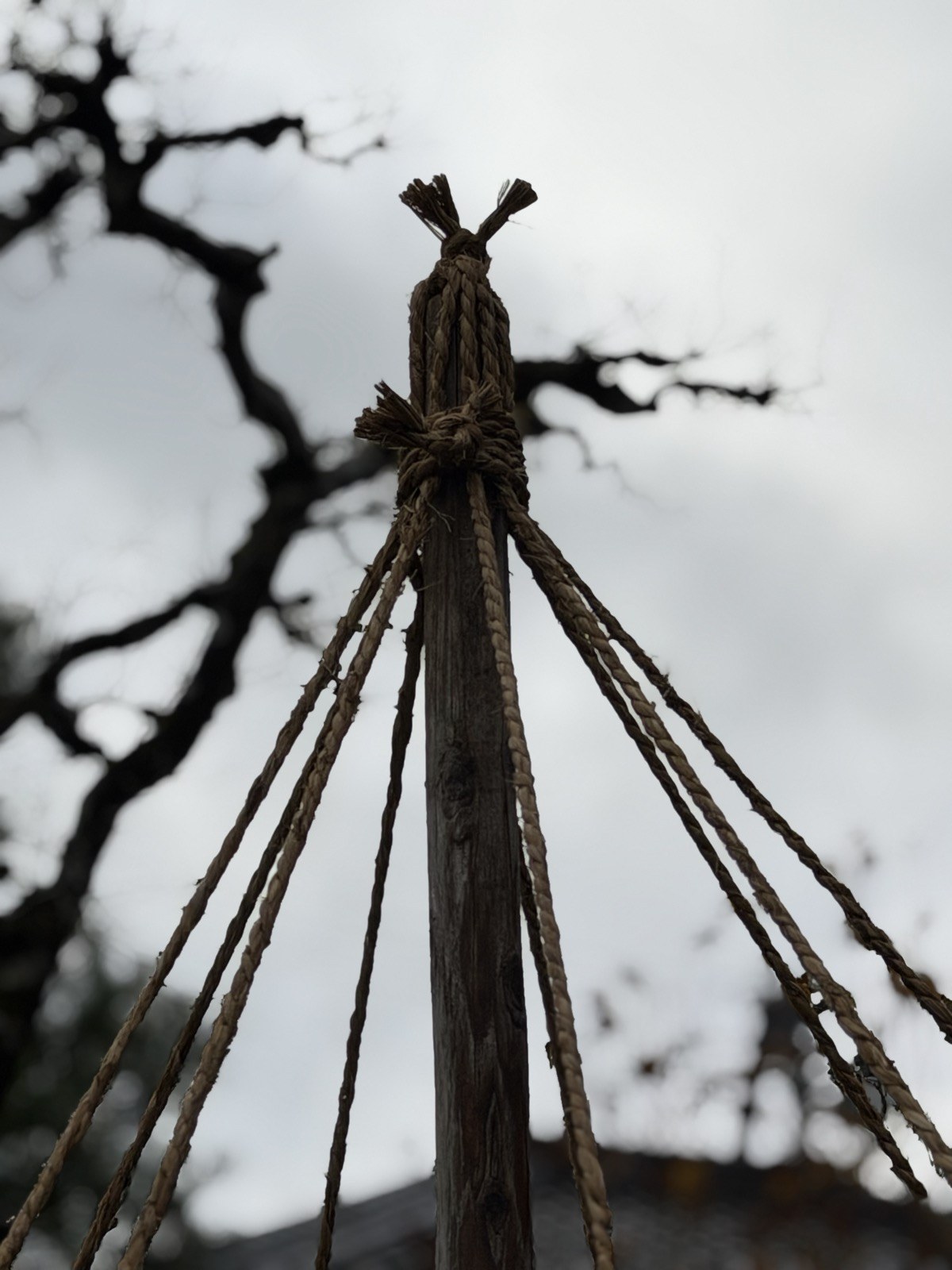
Where a rope meets a branch
At the other end, the rope in the next photograph is knotted part way along a side branch of a pine near Takayama Jinya, with a short tail of straw left below the knot. For the knots Japanese gardeners use on fences and supports, see Otoko-musubi: how Japan ties its garden fences in palm rope.
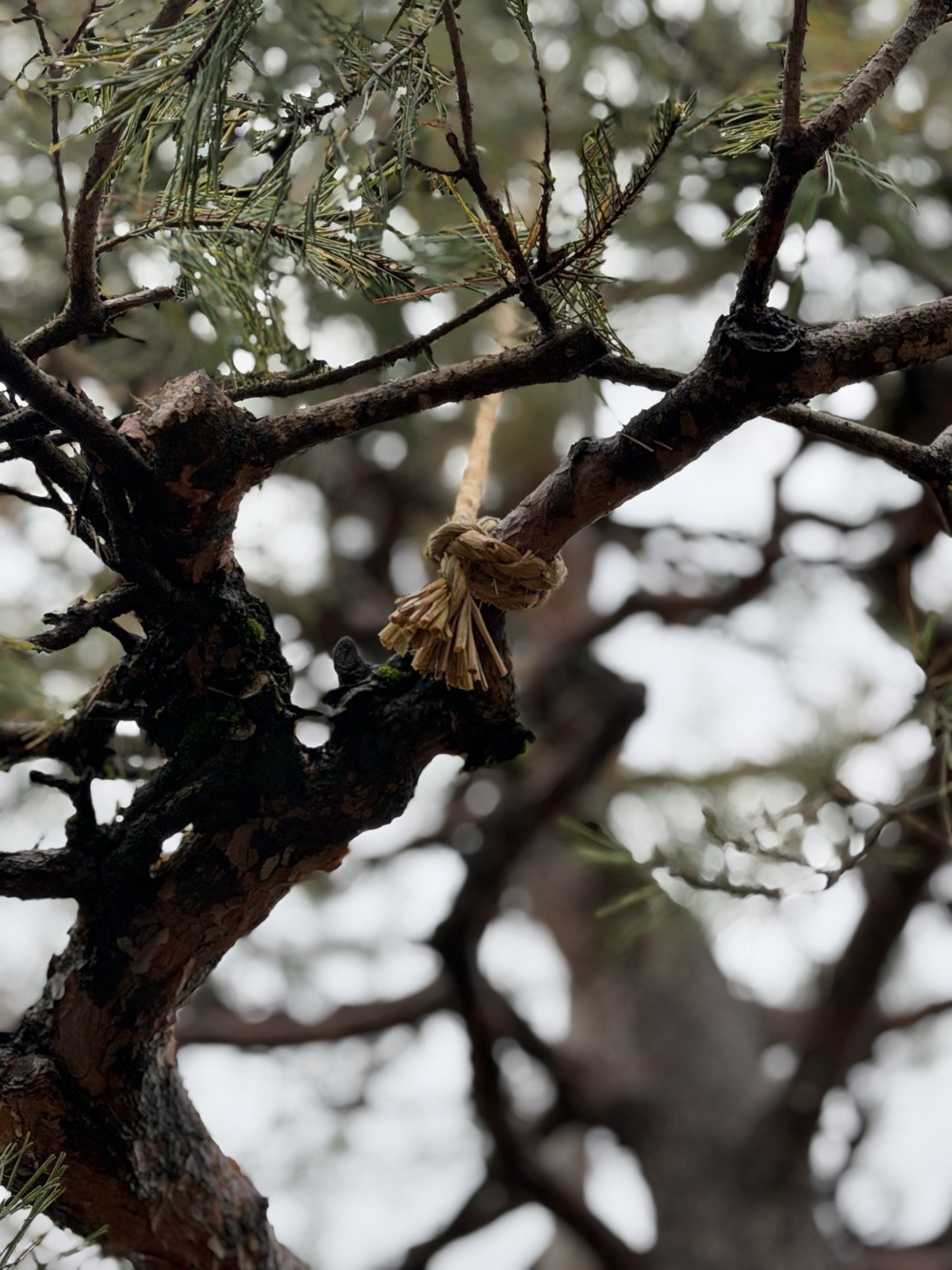
| What you can see | What it is |
|---|---|
| A single pole standing out of the crown | The pole of ringo-tsuri, from whose tip the ropes run to the branches (Chiba City’s definition) |
| Several ropes tied together at the pole head | The point where the ropes are fixed to the pole |
| A rope knotted to a branch | The branch end of one line |
| Ropes hanging loose through the crown | In the temple photograph, a job in progress |
Takayama Jinya — a shogunal government office and its pines
Why this building matters
Several of the pines photographed that morning stand around Takayama Jinya (高山陣屋). The province of Hida came under the direct rule of the Tokugawa shogunate in 1692. The Jinya’s official website counts 176 years of rule by 25 successive daikan and gundai — the shogunate’s district magistrates — up to 1868. The city of Takayama records that the office was moved to its present site in 1695.
After 1868 the buildings remained in use as a government office. Gifu Prefecture records that this role ended in December 1969, when the prefecture’s Hida office moved out. The site was designated a national historic site on 17 December 1929. The main parts survive; others, including the magistrate’s residence and the storekeepers’ row house, were rebuilt, and the official site says the restoration took more than 26 years and was completed in 1996. Of all the magistrates’ offices that existed at the end of the Edo period, the official site says it is the only one whose main buildings remain.
The pines around the walls
The square in front of the gate is where the Jinya-mae morning market is held, and it is where the Gifu Shimbun reported the start of the yukitsuri in 2023 and 2026. In the paper’s 2026 photograph, the trees are red pines. Around the Jinya’s long walls, several more pines carried poles on 19 November; in the photograph below, two poles stand above crowns of different heights.
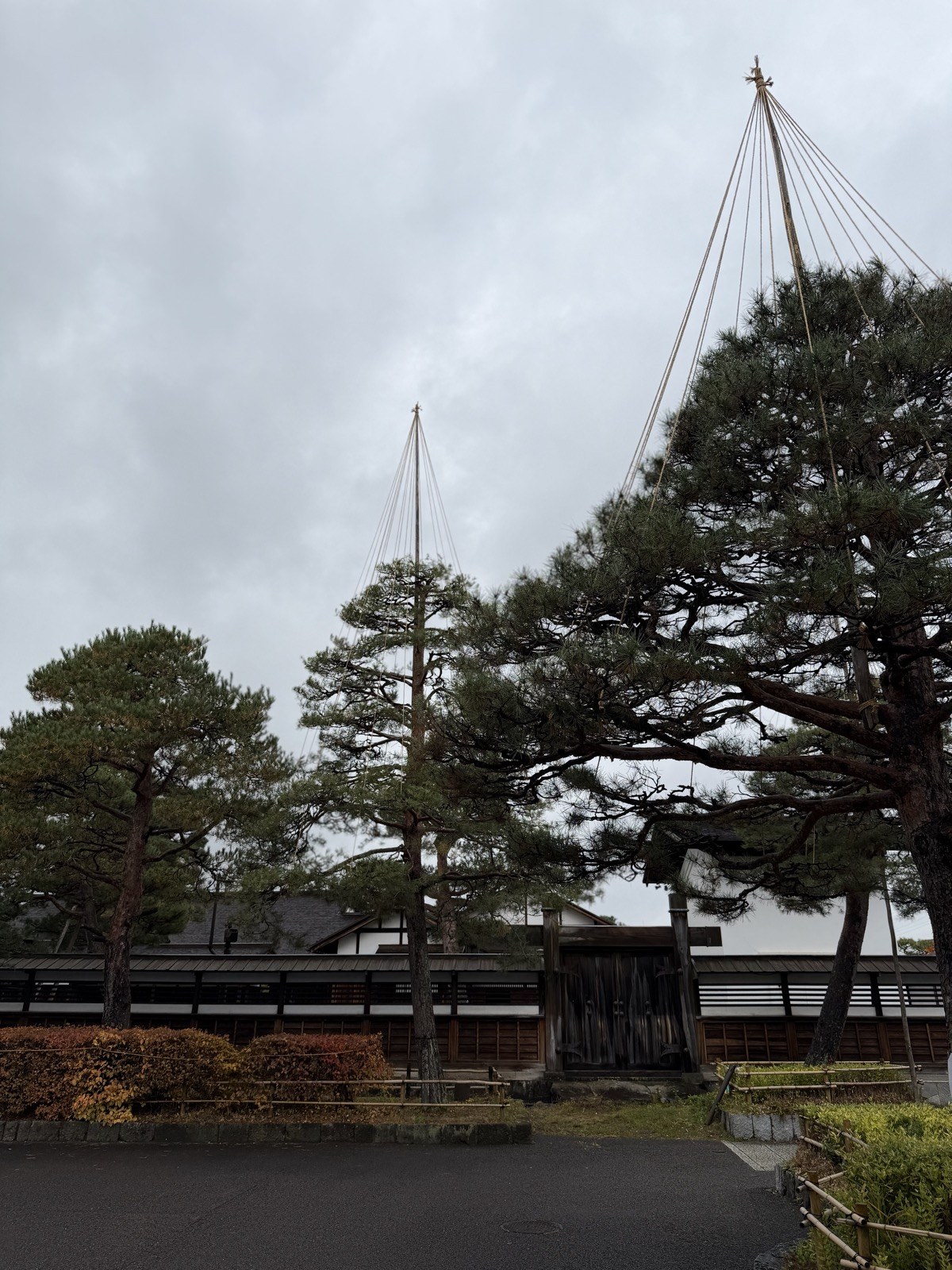
The official site points visitors to the garden seen from the veranda of the great hall, which changes with the seasons. The trees of that inner garden are not covered here: no official description of individual pines inside the compound was found.
Below the pines — hedges, shrubs and straw at street level
Four kinds of protection in one morning’s photographs
The ropes on the pines spread high above the street, but much of what the photographs from that morning record is at knee and waist height. Besides the pines, they show four other kinds of work, each on a different kind of plant.
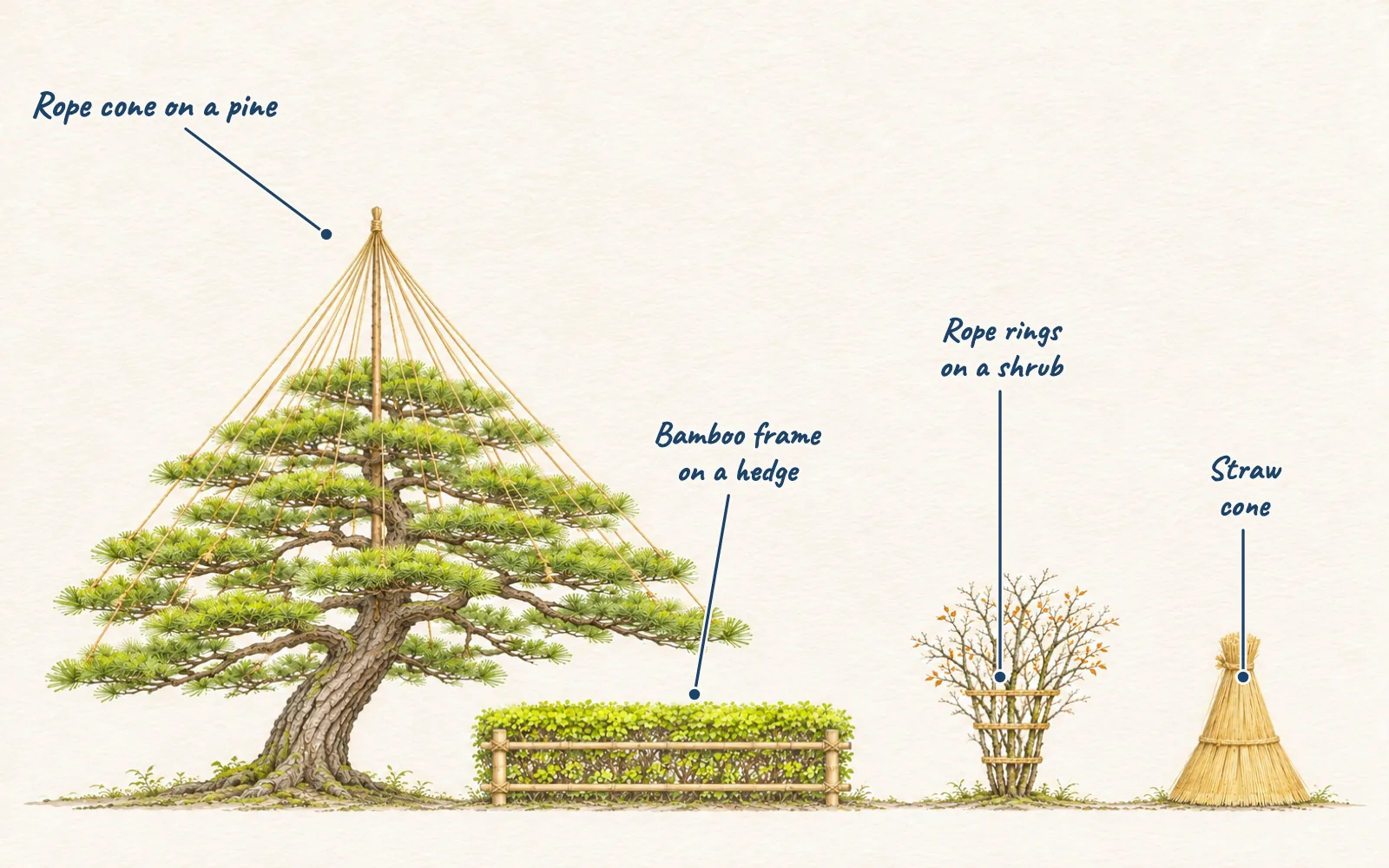
Gifu Prefecture’s standard specification for park works gives the vocabulary. For tall trees it lists miki-tsuri and eda-tsuri, trunk hanging and branch hanging. For small and medium shrubs it lists four forms of snow protection: nawa-maki (rope wrapping), take-gakoi (bamboo enclosure), yane-gakoi (roofed enclosure) and ita-gakoi (board enclosure). Separately, under cold protection for trees, it lists wara-maki (straw wrapping) and wara-botchi (straw hoods).
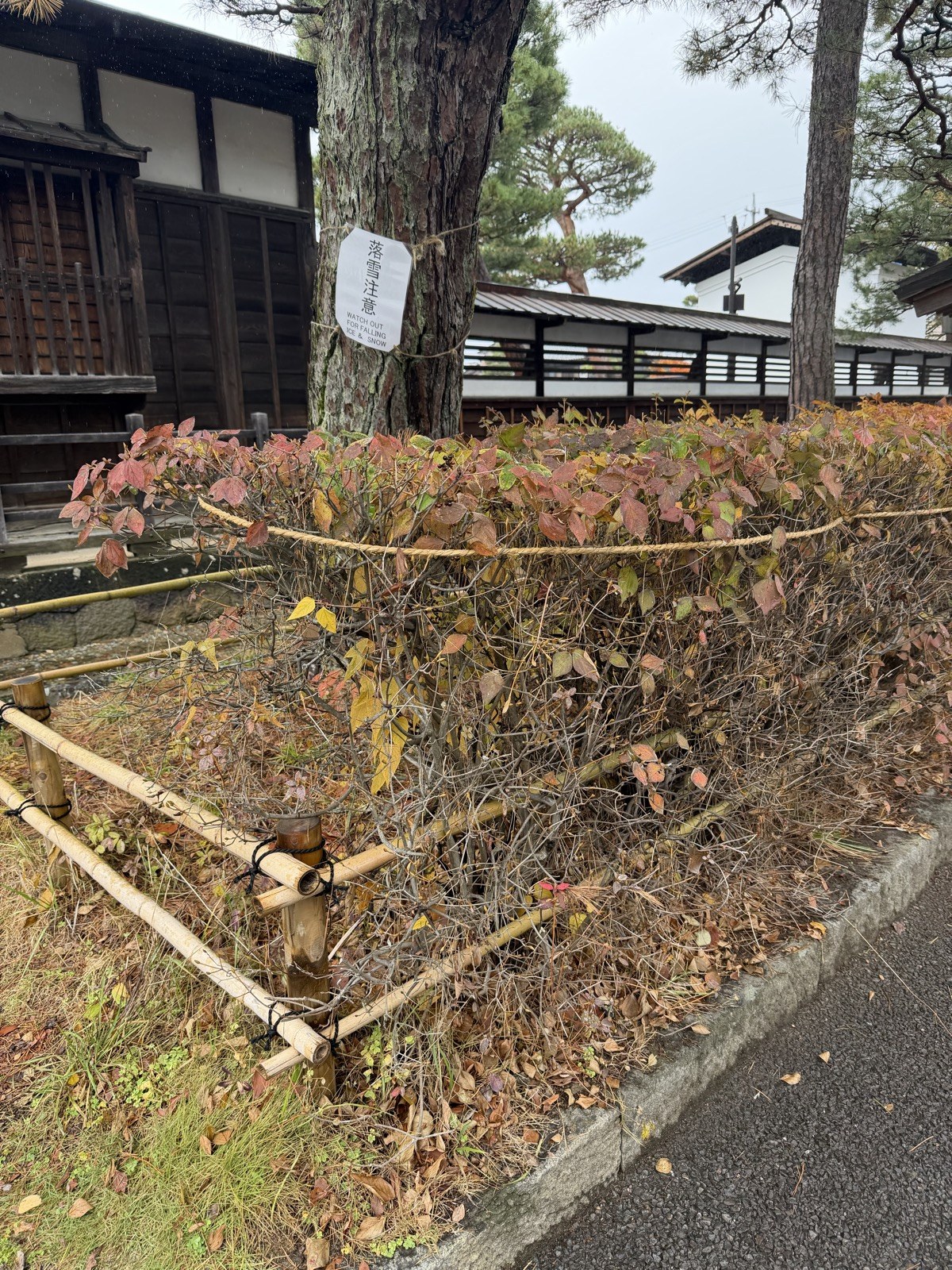
A bamboo frame on a hedge
The first is a low clipped hedge at the foot of a pine with ropes. Thin bamboo poles have been laid along its outer sides and tied at the corners.
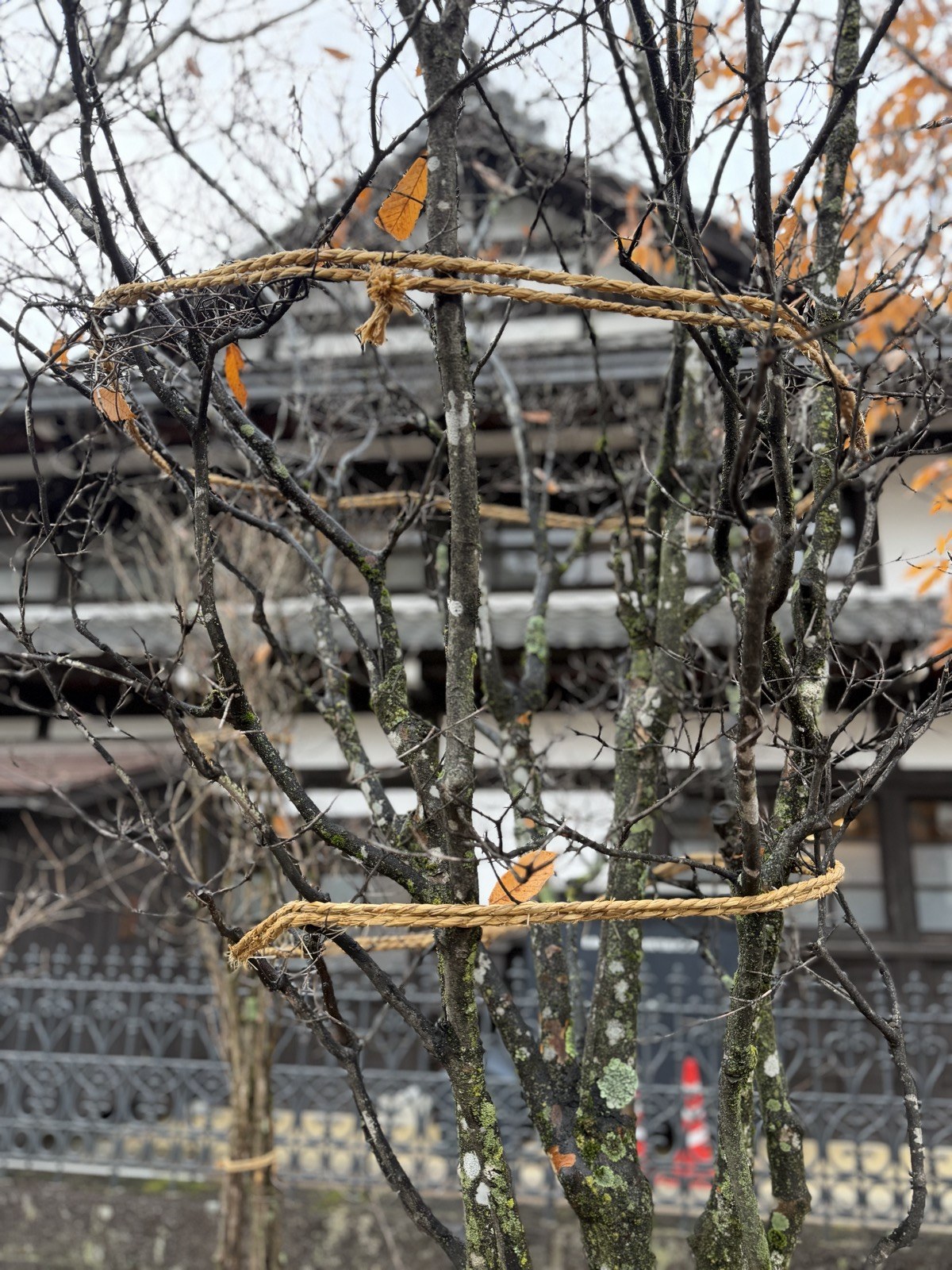
Rope rings on a multi-stemmed shrub
The second is a deciduous shrub with many thin stems, still holding orange leaves. Two or three rings of straw rope have been tied around it at different heights, drawing the stems together.
Gifu’s specification calls rope work on shrubs nawa-maki, rope wrapping, and the Sapporo Park and Greenery Association recommends rope wrapping against branches breaking or splitting under snow.
A small rope frame over a shrub
The third is a round clipped shrub with a frame of its own: a few thin poles stand around it, tied together at the top, with ropes running down to the edge of the shrub. It looks like a small version of the pole-and-rope form on the pines. The name the Takayama crews use for it is not known.
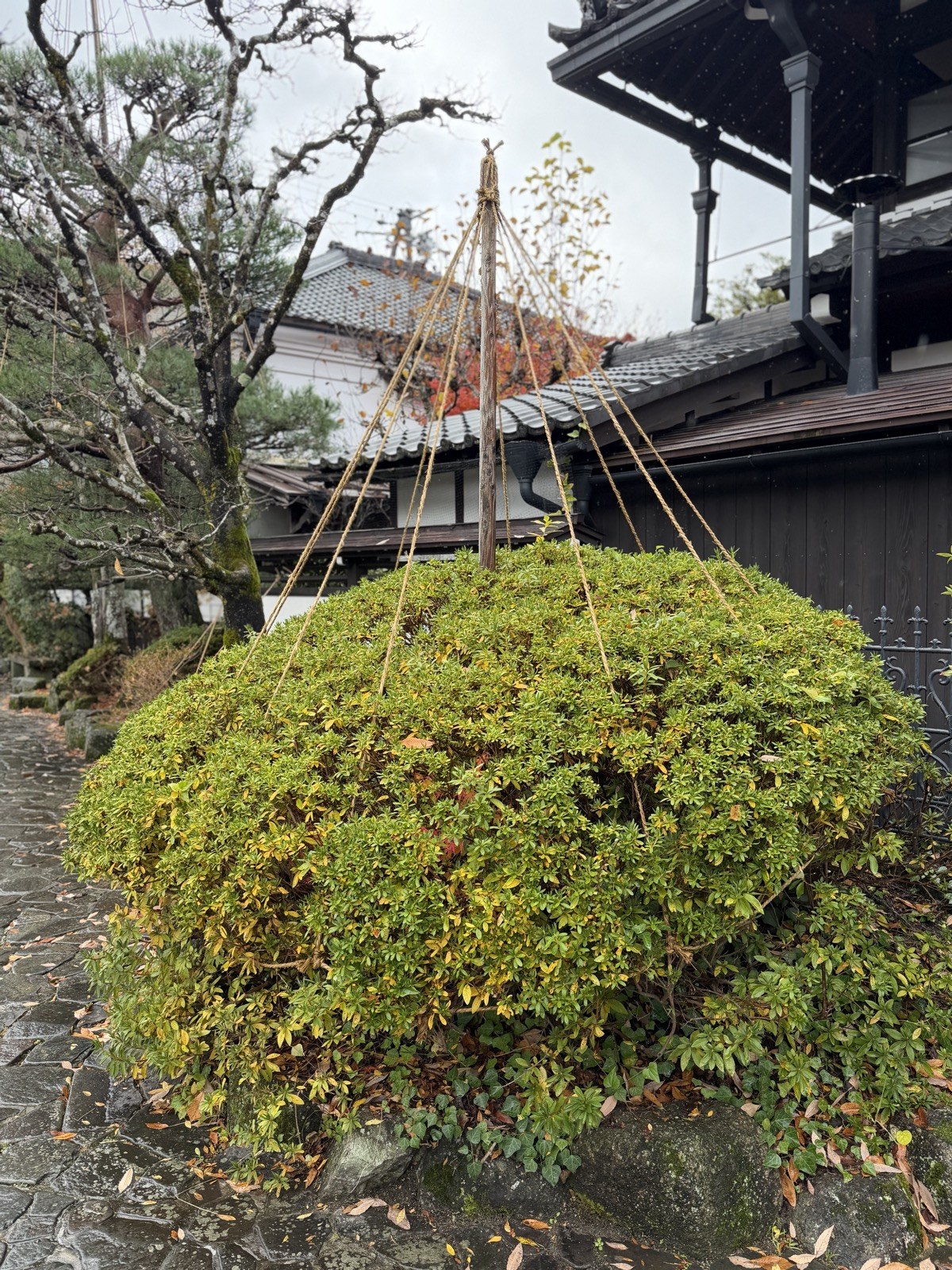
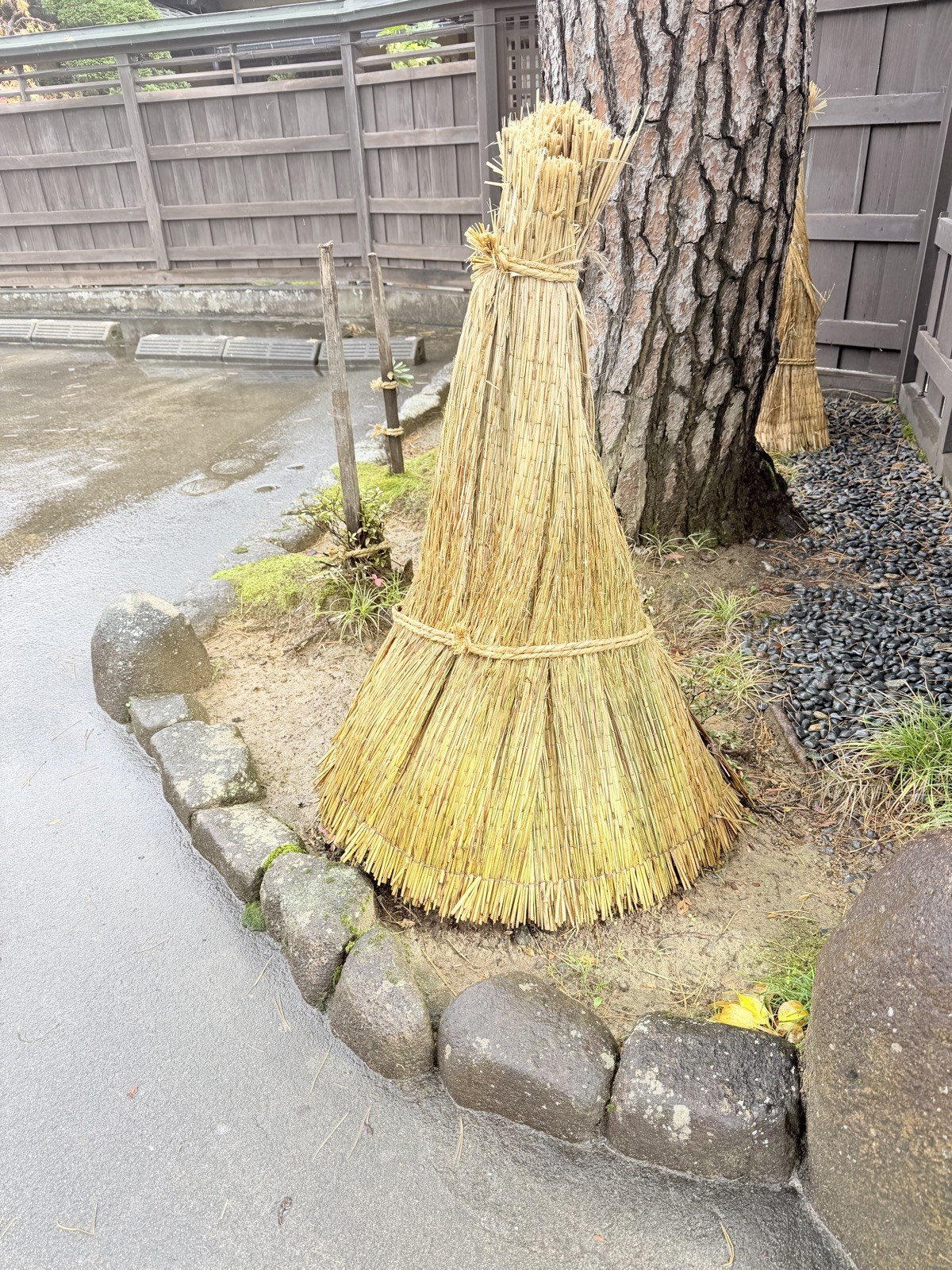
Straw at the foot of a pine
The fourth is straw. Beside the trunk of a pine, small plants have been covered with cones of golden straw, each tied near the top and again around the middle. The Tokyo Metropolitan Park Association describes wara-botchi as a cover woven from straw and placed over plants for both cold protection and ornament.
The general picture of these methods across Japan’s snow belt is in Fuyugakoi: how northern Japan wraps its gardens for winter. For straw hoods made for winter peonies, see Wara-botchi: why Japan puts straw hats on winter peonies.
| Plant in the photographs | What is visible | Closest term in public sources, with its stated purpose |
|---|---|---|
| Tall pine | Pole above the crown, ropes to the branches | Ringo-tsuri (Chiba City): ropes from a pole tip to each branch |
| Low hedge | Bamboo laid along the sides, tied at corners | Take-gakoi, bamboo enclosure (Gifu spec, snow protection for shrubs) |
| Multi-stemmed shrub | Rings of rope around the stems | Nawa-maki, rope wrapping (Gifu spec); against branch breakage (Sapporo association) |
| Round clipped shrub | Small frame of poles with ropes | No confirmed name for this example |
| Small plants under a pine | Straw cones tied in two places | Wara-botchi (Gifu spec, cold protection; Tokyo association, cold protection and ornament) |
The second column is what the photographs show. The third column matches each case to the nearest published term; the crews who did the work may use other names.
Why street shrubs get the same care
There is a public-works reason too. The Civil Engineering Research Institute for Cold Region, writing about street planting in Hokkaido, gives the purpose of winter enclosures as preventing damage from snow and drying; for street shrubs in particular, it names breakage from snow cover and damage from snow clearing. Sapporo puts up bamboo and rope enclosures on its street shrubs before the snow and removes them after the spring thaw. A shrub at the edge of a pavement faces both the snow that falls on it and the snow that is cleared onto it.
Sanmachi — the old merchant streets
A townscape protected building by building
Across the river from the Jinya is the old town. The Sanmachi district (三町), which includes Kami-sannomachi, was selected by the national government as a Preservation District for Groups of Traditional Buildings on 3 February 1979 and extended on 29 May 1997. It covers about 4.4 hectares across parts of Kami-ichinomachi, Kami-ninomachi, Kami-sannomachi, Katahara-machi and Shinmei-machi 4-chōme. A second district, Shimo-ninomachi Ōjinmachi, was selected on 6 July 2004 and covers 6.6 hectares.
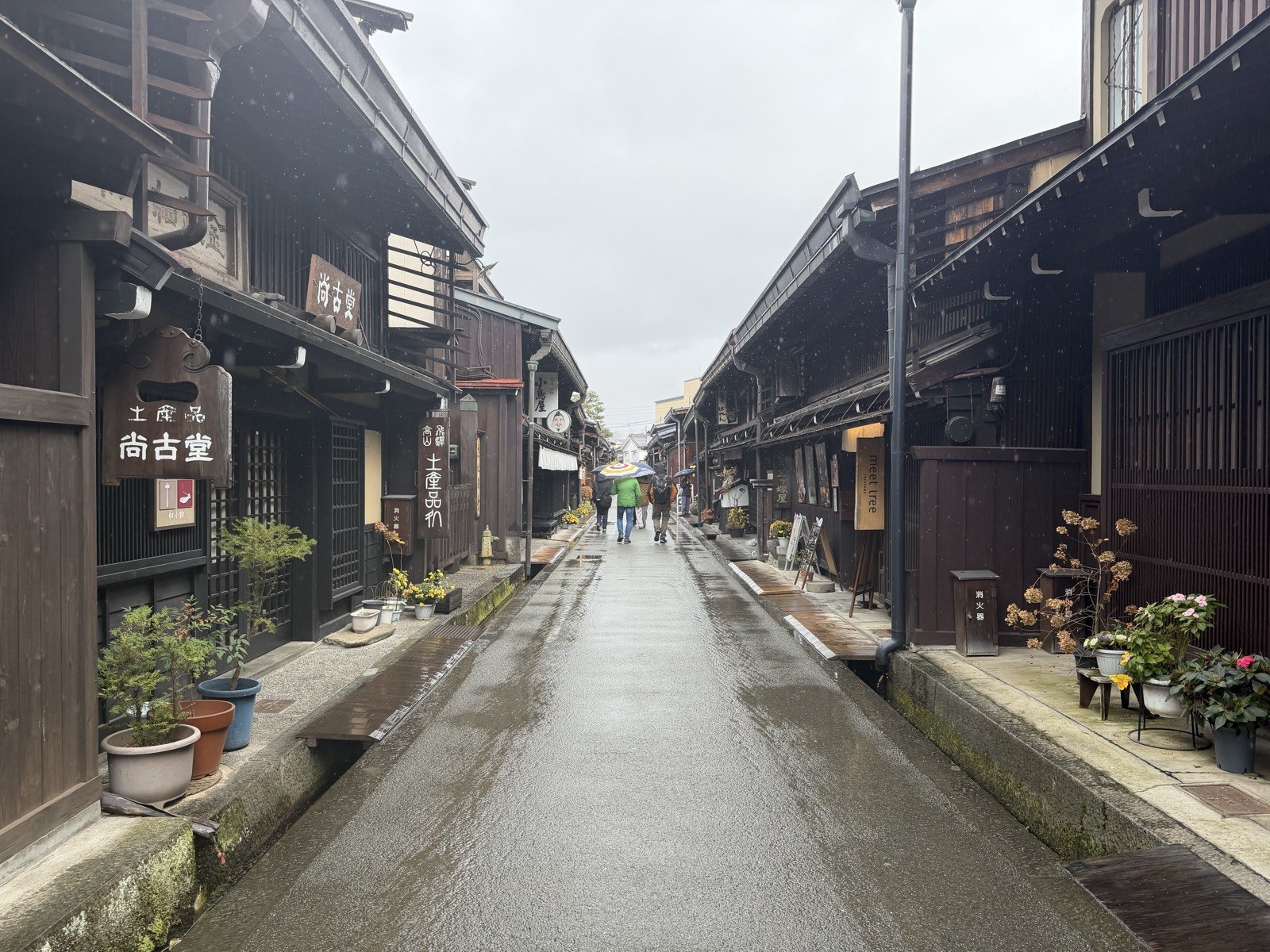
The city describes the Sanmachi merchant houses as having a low upper floor (chū-nikai), a gentle roof pitch and deep eaves. The Takayama board of education’s 1980 design guide notes the projecting lattices (degōshi) on the house fronts, and the water channels along both sides of the street, once used to flush away snow, to fight fires and to wash. A faculty member of Kyoto University of the Arts, reporting from a visit, describes the large upper roof thrusting forward as a design ready for snow.
Where the trees are
In the photographs of Kami-sannomachi from that morning, there are no street trees. The houses stand with adjoining eaves along the street, and the green at street level is potted plants by the doors. In the wider shot below, the autumn colour is on the hillside beyond the roofs.
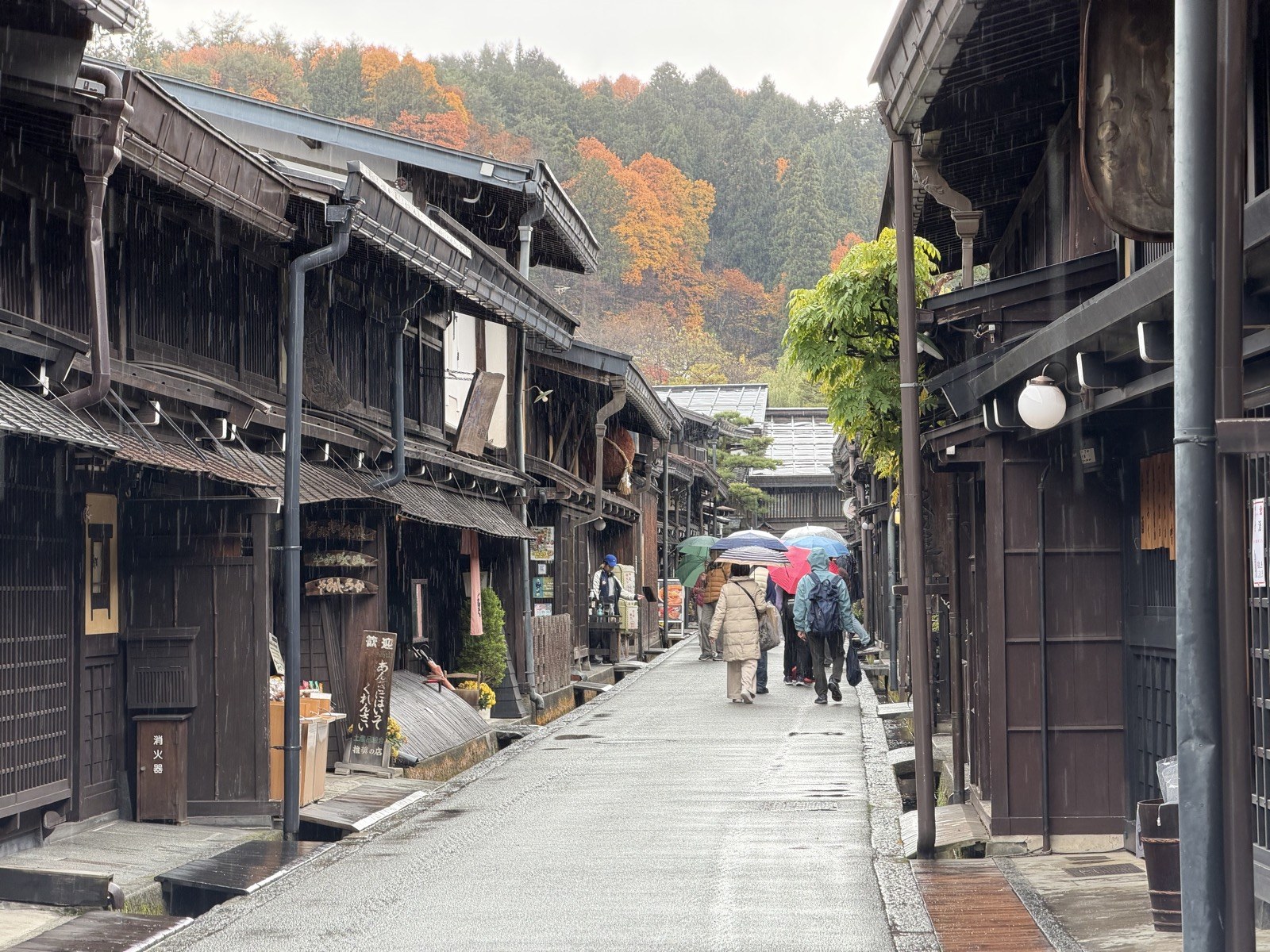
Trees do appear in the rules for these districts. The preservation plan for Shimo-ninomachi Ōjinmachi designates trees and gardens it considers necessary to the district as kankyō bukken (環境物件), “environmental features”. The city lists eight: four tree entries, two gardens and two water channels. Entry 1 in the plan’s schedule is two pines at 138 Hachiman-machi. Whether the Sanmachi plan names individual trees in the same way could not be confirmed.
A raked garden
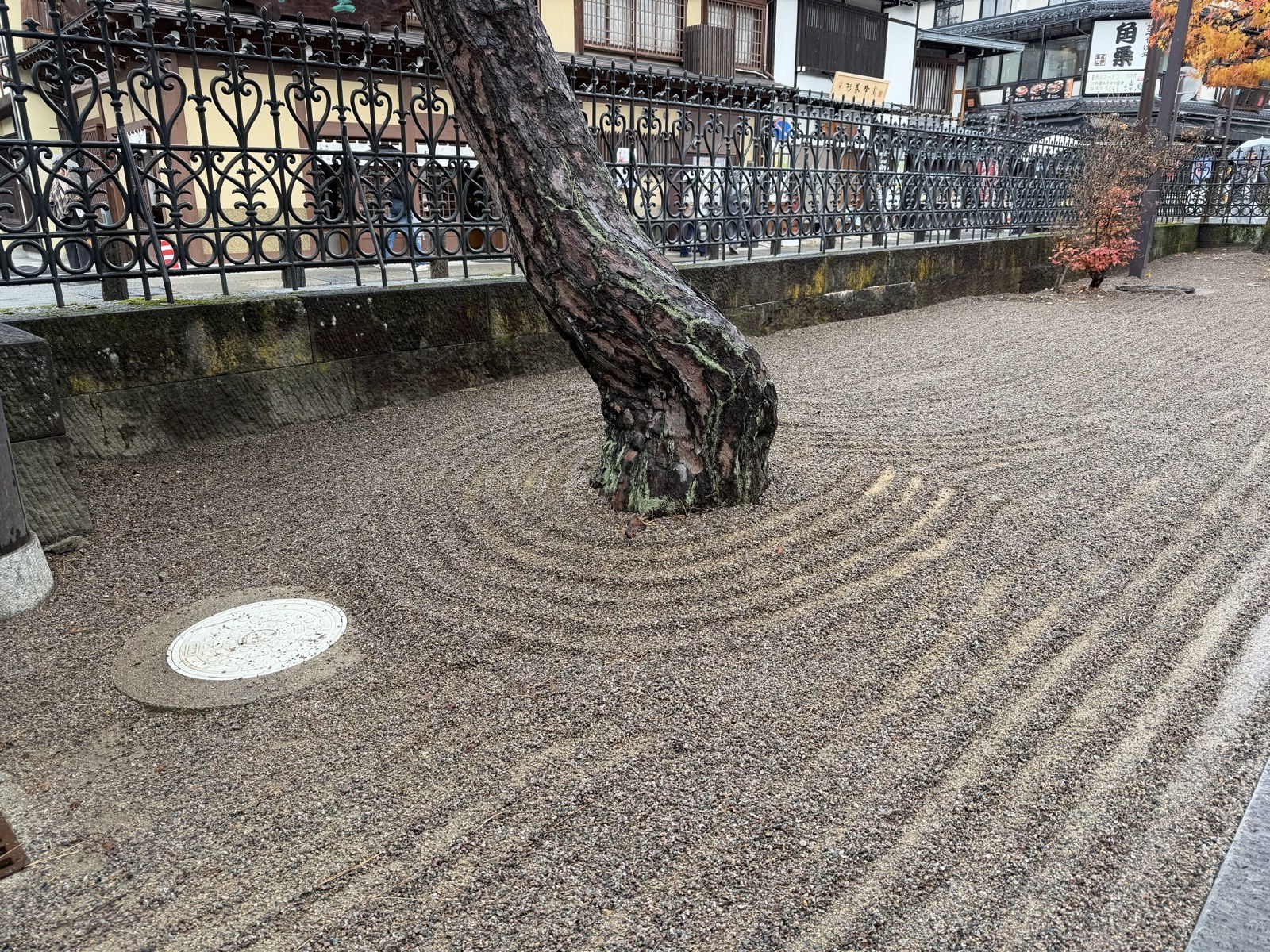
One garden photographed at 11:09 that morning lies behind a low wall with an iron railing. A single pine grows out of raked gravel; the rake lines curve in rings around its trunk before running straight across the bed. No ropes are visible in the photograph.
The river trees — protected by number
Willow No. 59
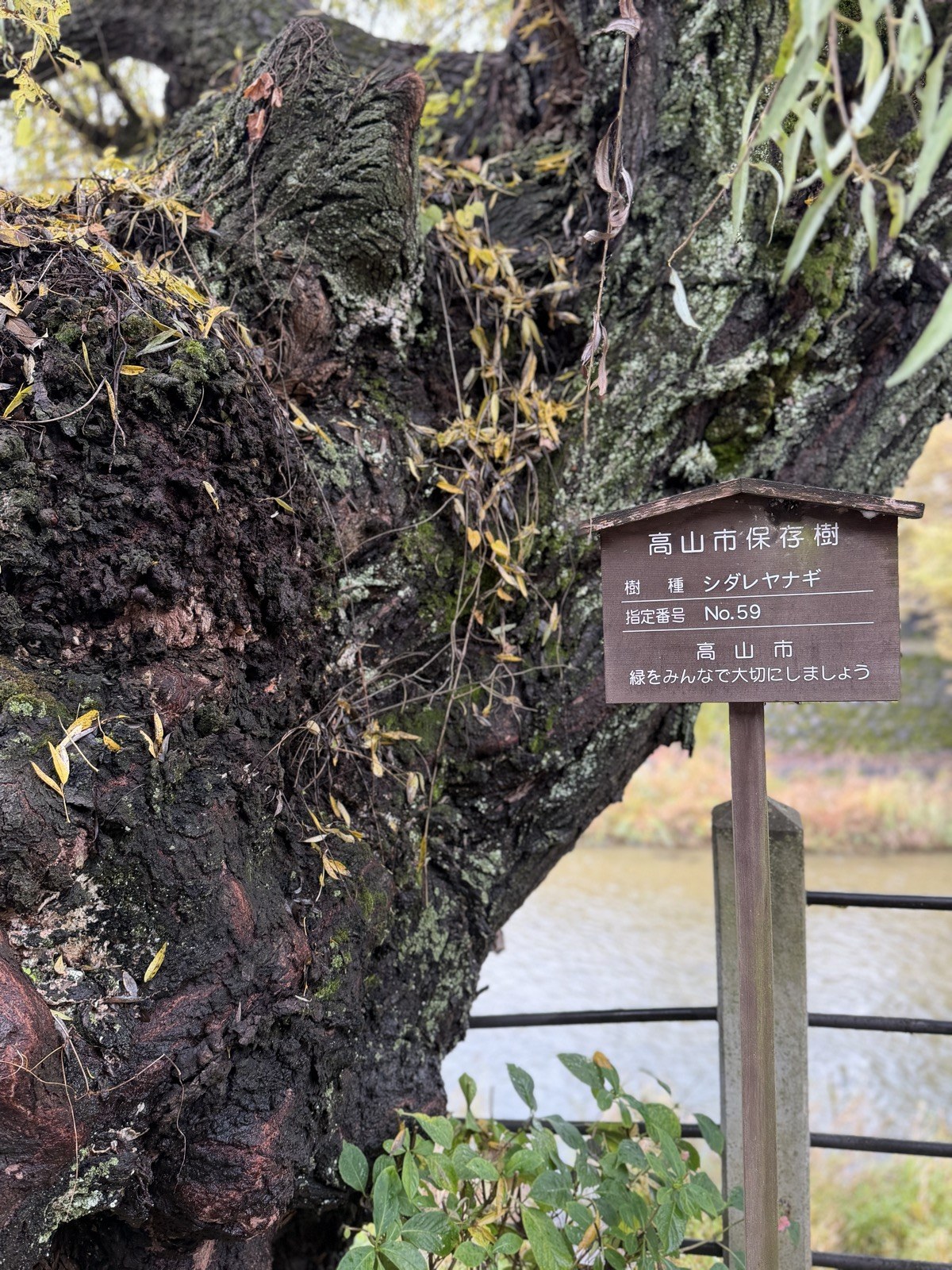
On the Miyagawa, a weeping willow carries a small wooden board on a post: “Takayama City protected tree. Species: shidare-yanagi (weeping willow). Designation number: No. 59.” Below is a line from the city: “Let’s all take good care of our greenery.”
What the designation does
The city’s green-space plan names the legal basis as the Takayama City Ordinance to Protect and Nurture Greenery. Its purpose is to secure a good natural environment and keep the scenic character of the city by protecting trees, woods, grassland and wetland as protected trees, protected woods and protected areas. The city’s FAQ says designation depends on meeting set criteria; the page does not give them.
Two practical rules follow from other city documents. The city subsidises the care of designated trees — mowing, pruning, pest control and fertilisation — at up to one third of the cost, with a cap of ¥30,000 per protected tree. And the city’s guideline on development states that protected trees under Article 9 of the ordinance are not to be felled or transplanted.
The city’s landscape plan also provides for designating keikan jūyō jumoku (景観重要樹木), “landscape-important trees”, with the owner’s consent, and its landscape ordinance lists the felling of trees and bamboo among the acts that must be notified in the landscape-plan area, with exceptions. How many trees, if any, have been designated under the landscape plan could not be confirmed.
| Document | What it covers | What it says |
|---|---|---|
| Green-space basic plan (citing the Ordinance to Protect and Nurture Greenery) | Protected trees, woods, areas | Purpose: natural environment, scenic character |
| Greening subsidy guide | Care of designated trees | Up to 1/3 of costs; max ¥30,000 per protected tree |
| Development guideline | Protected trees under Article 9 | Not to be felled or transplanted |
| Preservation plan, Shimo-ninomachi Ōjinmachi | Environmental features | 4 tree entries, 2 gardens, 2 channels |
| Landscape plan and ordinance | Landscape-important trees; felling | Designation with consent; notification of felling, with exceptions |
Kenroku-en and Takayama — the same ropes on a different calendar
Kenroku-en starts the season
Kenroku-en in Kanazawa begins its yukitsuri on 1 November every year, starting with the Karasaki pine; if it rains, the Karasaki pine is put off and the work begins on smaller pines. In Takayama, the Gifu Shimbun reported the start of the work on 20 November 2023, and photographed it in progress on 16 November 2026 — some two to three weeks after Kenroku-en, close to the town’s average first-snow date.
What the public sources agree on
The materials named in the public documents overlap: straw rope for the hanging lines in Chiba and Kenroku-en, poles of timber or bamboo at Kenroku-en, rope and bamboo in Gifu’s shrub methods. They share one purpose — reducing the risk of branches breaking or splitting under snow — and some methods have others: protection from drying, from cold, against damage from snow clearing on streets, or ornament. The timing differs from place to place; the Kenroku-en and Takayama records sit two to three weeks apart.
Common misreadings
“305 cm of snow means 305 cm on the ground”
The 305 cm figure is the total of new snow over a winter. The mean annual maximum depth on the ground at the Takayama station is 55 cm.
“Yukitsuri always means the pole cone”
The pole cone, ringo-tsuri, is one form. Gifu’s specification also lists trunk hanging and branch hanging for tall trees, and the photographs from Takayama include a small pole frame over a shrub.
“The ropes guarantee nothing will break”
The public sources describe these methods as measures against snow damage — breakage, splitting, damage from snow clearing. None of them promises that a protected tree will come through every winter undamaged.
“Every tree in a historic district is protected”
Protection depends on the document. Willow No. 59 carries a board marking it as a city protected tree (its current status in the city’s register was not checked); the pines at 138 Hachiman-machi are environmental features in a preservation plan. These are separate systems.
Frequently asked questions
When is yukitsuri put up in Takayama?
In November. The Gifu Shimbun reported the start of the work in the Jinya square on 20 November 2023, and photographed it there on 16 November 2026. The average first-snow date for Takayama is 17 November.
Where can I see yukitsuri in Takayama?
Around Nakabashi, the red bridge over the Miyagawa, and in the square in front of Takayama Jinya, where the Gifu Shimbun reported the work. On 19 November 2026 there were also pines with ropes at a temple gate and around the Jinya walls.
How much snow does Takayama get?
JMA’s 1991–2020 normals give an annual snowfall of 305 cm and a mean annual maximum snow depth of 55 cm. January averages −1.2 °C.
What is the difference between yukitsuri and other winter protection?
Yukitsuri supports the branches of a tree with ropes from a pole or from the trunk. Gifu’s specification lists other forms for shrubs — rope wrapping, bamboo enclosures, roofed and board enclosures — and straw wrapping and straw hoods for cold protection. Several of these appear in the Takayama photographs.
Are there trees in Takayama’s old merchant streets?
The photographs of Kami-sannomachi from that morning show no street trees, only potted plants by the doors. In the Shimo-ninomachi Ōjinmachi district, the preservation plan lists four tree entries and two gardens as environmental features.
Is it yukitsuri or yukizuri?
Both spellings are used in English, including by the Japan National Tourism Organization. The Japanese is 雪吊り; the Gifu Shimbun writes 雪つり.
Sources
– Japan Meteorological Agency, normals 1991–2020 for Takayama (checked 2026-11-20): https://www.data.jma.go.jp/stats/etrn/view/nml_sfc_ym.php?prec_no=52&block_no=47617&year=&month=&day=&view= – Japan Meteorological Agency, normals for Kanazawa (checked 2026-11-20): https://www.data.jma.go.jp/stats/etrn/view/nml_sfc_ym.php?prec_no=56&block_no=47605&year=&month=&day=&view= – Japan Meteorological Agency, normals for Tokyo (checked 2026-11-20): https://www.data.jma.go.jp/stats/etrn/view/nml_sfc_ym.php?prec_no=44&block_no=47662&year=&month=&day=&view= – Japan Meteorological Agency, Takayama first and last dates of snow and snow cover (checked 2026-11-20): https://www.data.jma.go.jp/stats/etrn/view/nml_sfc_season.php?block_no=47617&day=23&month=12&prec_no=52&view=&year= – JMA Asahikawa Local Meteorological Office, definition of long-lasting snow cover (checked 2026-11-20): https://www.data.jma.go.jp/asahikawa/shosai/kisetsu_topics.html – Takayama City, depopulated-area development plan, climate (checked 2026-11-20): https://www.city.takayama.lg.jp/_res/projects/default_project/_page_/001/022/985/gi113.pdf – Takayama City, agriculture in Takayama (checked 2026-11-20): https://www.city.takayama.lg.jp/shisei/1000067/1002615/1002626.html – Gifu Shimbun, 20 November 2023 (checked 2026-11-20): https://www.gifu-np.co.jp/articles/-/316076 – Gifu Shimbun, 17 November 2026 (checked 2026-11-20): https://www.gifu-np.co.jp/articles/-/800036 – Takayama City, town-centre revitalisation plan, p. 8 (checked 2026-11-20): https://www.city.takayama.lg.jp/_res/projects/default_project/_page_/001/019/468/chuukatsu20190903-1.pdf – Hida Takayama official tourism site, Nakabashi (checked 2026-11-20): https://www.hidatakayama.or.jp/spot/detail_1114.html – Takayama City, landscape plan, chapter 1 (checked 2026-11-20): https://www.city.takayama.lg.jp/_res/projects/default_project/_page_/001/002/138/02.pdf – Takayama Jinya official site, about (checked 2026-11-20): https://jinya.gifu.jp/about/ – Takayama Jinya official site, highlights (checked 2026-11-20): https://jinya.gifu.jp/highlight/ – Takayama City, Takayama Jinya site (checked 2026-11-20): https://www.city.takayama.lg.jp/kurashi/1000021/1000119/1000847/1000954/1000956.html – Gifu Prefecture, Takayama Jinya site (checked 2026-11-20): https://www.pref.gifu.lg.jp/page/365986.html – Hida Takayama official tourism site, Jinya-mae morning market (checked 2026-11-20): https://www.hidatakayama.or.jp/spot/detail_1126.html – Forestry and Forest Products Research Institute, Tōkamachi site, snow-crown observation (checked 2026-11-20): https://www.ffpri.go.jp/labs/tkmcs/tkmcs_wm_page3C4_j.html – Forest Insurance Center, Forest Research and Management Organization, snow damage (checked 2026-11-20): https://www.ffpri.go.jp/fic/s/taishou_setsugai.html – NIED News No. 188, snow density (2015) (checked 2026-11-20): https://www.bosai.go.jp/information/news/pdf/k_news188.pdf – Chiba City, Chiba Park pine yukitsuri, Nanbu style (checked 2026-11-20): https://www.city.chiba.jp/toshi/koenryokuchi/kanri/chuo-mihama/documents/yukituri-tejun_2_1.pdf – Sapporo Park and Greenery Association, Sukusuku Midori No. 13 (checked 2026-11-20): https://www.sapporo-park.or.jp/pdf/sukusuku/sukusuku_13.pdf – Kanazawa City Cultural Properties Division, yukitsuri (checked 2026-11-20): https://www4.city.kanazawa.lg.jp/soshikikarasagasu/bunkazaihogoka/gyomuannai/3/1/4/7/27914.html – Ishikawa Prefecture Kanazawa Castle and Kenroku-en Management Office, diary of 22 October 2026 (checked 2026-11-20): https://shiro-niwa.pref.ishikawa.lg.jp/kanazawa-castle/diary/9195/ – Ishikawa Prefecture, Kenroku-en yukitsuri work sheet 2026 (checked 2026-11-20): https://shiro-niwa.pref.ishikawa.lg.jp/kanazawa-castle/_wp/wp-content/uploads/2026/10/85d54f50ce0a9a635e48df19219a27f6.pdf – Gifu Prefecture, standard specification for civil works, vol. 9 parks and green spaces, p. 663 (checked 2026-11-20): https://www.pref.gifu.lg.jp/uploaded/attachment/487099.pdf – Tokyo Metropolitan Park Association, winter: yukitsuri (checked 2026-11-20): https://www.tokyo-park.or.jp/special/migoro/winter.html – Civil Engineering Research Institute for Cold Region, road greening technical materials, chapter 6 (checked 2026-11-20): https://scenic.ceri.go.jp/pdf_manual/greenery/greenery_06maintenance.pdf – City of Sapporo, street trees, winter enclosures (checked 2026-11-20): https://www.city.sapporo.jp/ryokuka/midori/machi/hanamidori/gairojyu/index.html – Takayama City, preservation districts for groups of traditional buildings (checked 2026-11-20): https://www.city.takayama.lg.jp/kurashi/1000021/1000119/1023241/index.html – Takayama City, Sanmachi preservation district (checked 2026-11-20): https://www.city.takayama.lg.jp/kurashi/1000021/1000119/1000847/1001005/1001006.html – Takayama City Board of Education, design reference for the Takayama townscape (1980) (checked 2026-11-20): https://www.city.takayama.lg.jp/_res/projects/default_project/_page_/001/023/241/sankouzushuu.pdf – Kyoto University of the Arts, Uryu Tsushin, 10 January 2023 (checked 2026-11-20): https://uryu-tsushin.kyoto-art.ac.jp/detail/1058 – Takayama City Board of Education, Shimo-ninomachi Ōjinmachi preservation plan (checked 2026-11-20): https://www.city.takayama.lg.jp/_res/projects/default_project/_page_/001/023/241/shimoni-oojin_hozonkeikaku.pdf – Takayama City, Shimo-ninomachi Ōjinmachi district (checked 2026-11-20): https://www.city.takayama.lg.jp/kurashi/1000021/1000119/1000847/1001005/1016374.html – Takayama City, green-space basic plan, p. 9 (checked 2026-11-20): https://www.city.takayama.lg.jp/_res/projects/default_project/_page_/001/005/661/r7midori.pdf – Takayama City, FAQ on green-space subsidies (checked 2026-11-20): https://www.city.takayama.lg.jp/faq/1000077/1000181/1003524.html – Takayama City, greening subsidies (checked 2026-11-20): https://www.city.takayama.lg.jp/shisei/1000061/1005209/1003997.html – Takayama City, development guideline, p. 3 (checked 2026-11-20): https://www.city.takayama.lg.jp/_res/projects/default_project/_page_/001/002/136/shin_kaihatsu_shishin.pdf – Takayama City, landscape plan, chapter 6, p. 48 (checked 2026-11-20): https://www.city.takayama.lg.jp/_res/projects/default_project/_page_/001/002/138/05.pdf – Takayama City, landscape ordinance, p. 3 (checked 2026-11-20): https://www.city.takayama.lg.jp/_res/projects/default_project/_page_/001/002/136/urumachizyourei.pdf – Japan National Tourism Organization, Kenrokuen Garden (checked 2026-11-20): https://www.japan.travel/en/spot/1399/ – Japan National Tourism Organization, Yukizuri viewing (2018) (checked 2026-11-20): https://www.japan.travel/en/sg/guide/yukizuri-viewing-winter-kenrokuen-kinpaku-kirara-musashigatsuji-/