

By Isaki Kasahara, a Japanese arborist pruning, assessing and caring for Japan’s trees and gardens · Updated November 18, 2026
Japanese gardens put straw hats on winter peonies to keep frost and snow off flowers that open in the coldest weeks of the year. At Ueno Tōshōgū in Tokyo, the hat — a wara-botchi (藁ぼっち) — is left open to the south to let the sun in, closed completely on days of cold rain or wind, and tied with knots meant to be looked at, so the protection has become part of the winter view. Below: the two kinds of winter peony, how a spring flower is made to open in January, how the straw hat is made and used, and how this differs from tree-peony advice in Britain and the United States.
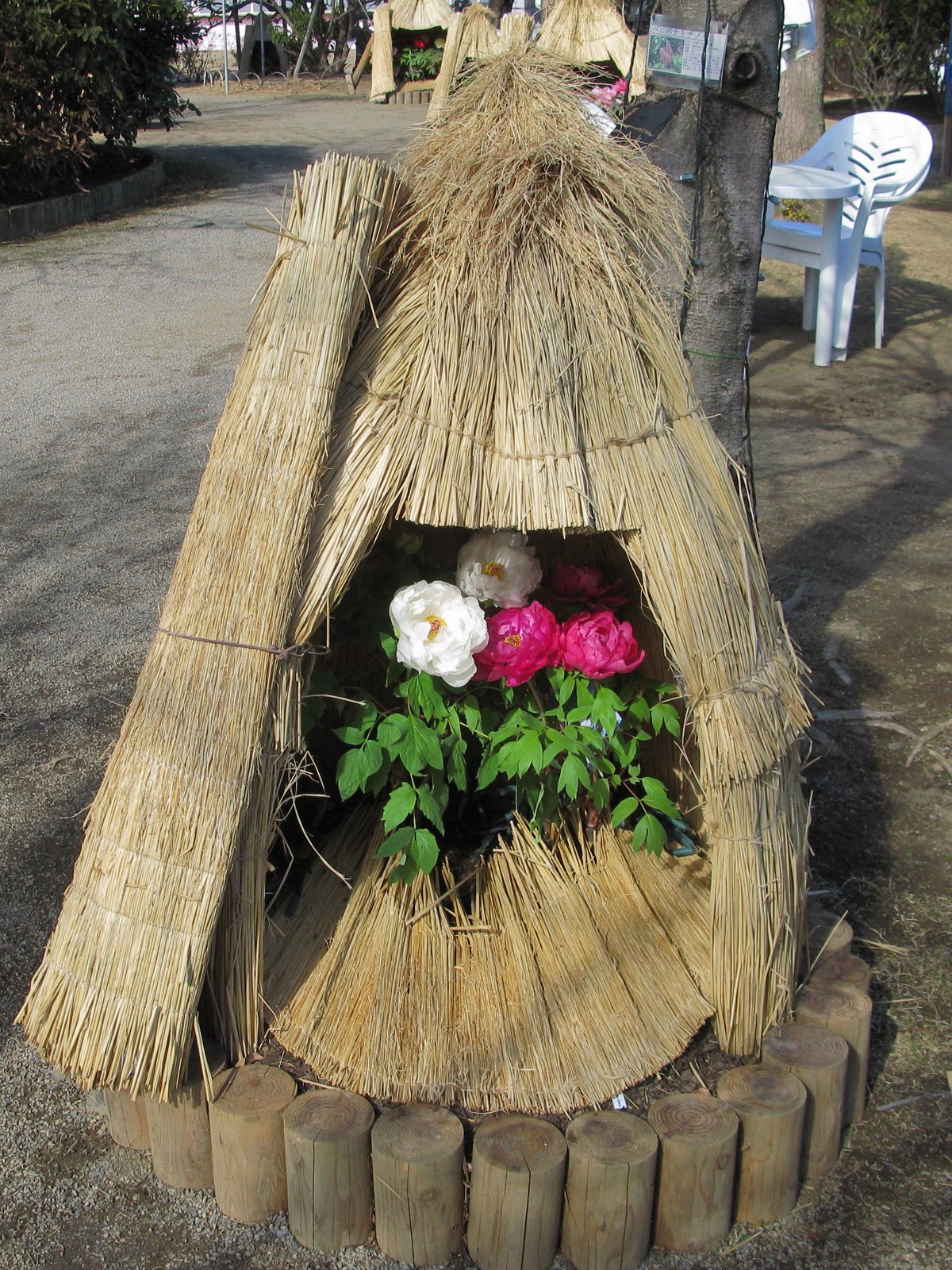
A shrine garden in January — rows of straw hats at Ueno
What you see when you walk in
Walk into the peony garden at Ueno Tōshōgū on a grey January morning and the first thing you notice is not a flower. It is a row of small straw roofs standing side by side on bare winter ground. Under each one, a peony is in bloom. The garden’s own page invites visitors to enjoy the frost covers “standing in rows”, a scene it describes as at once hushed and splendid. The garden’s current flowering guide lists wintersweet from early January, red-flowered plum from late January, and adonis and witch hazel from early February; the timing varies with the weather.
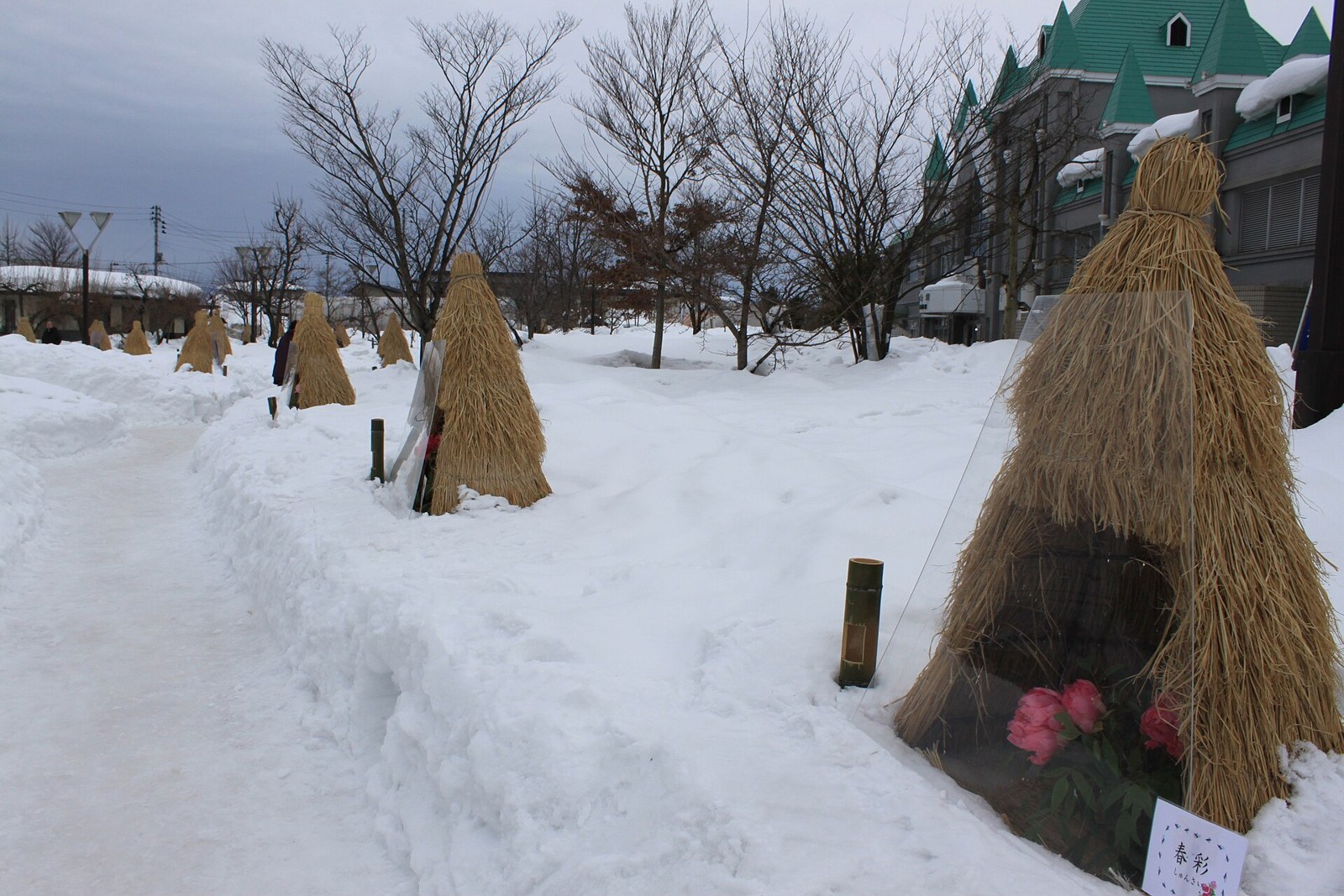
The display has a long history for a modern garden. The shrine’s announcement for 2026 called it the 44th winter peony display, scheduled from 1 January to 23 February 2026, with “about 40 varieties, at least 160 plants” on show at any time.
The knots
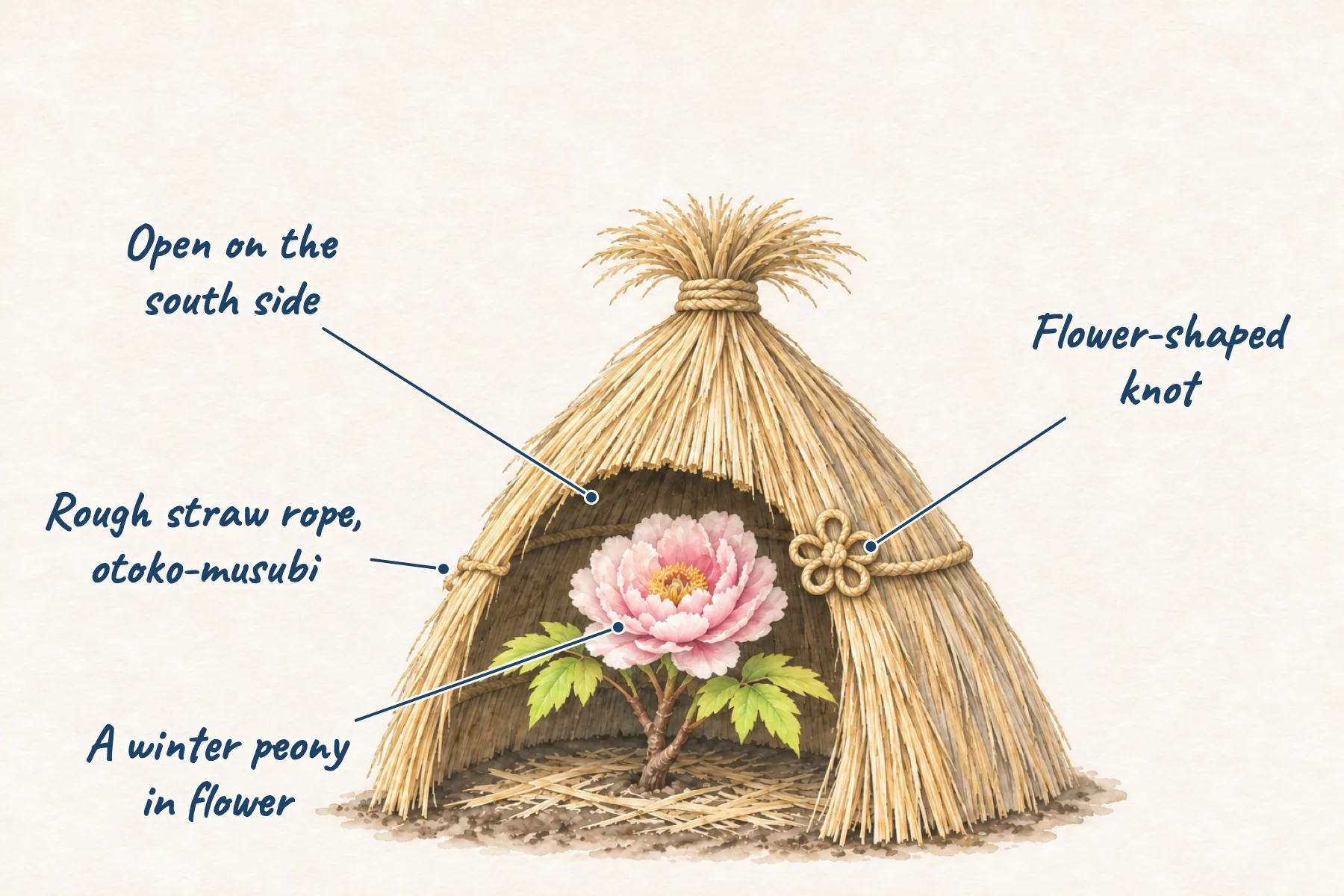
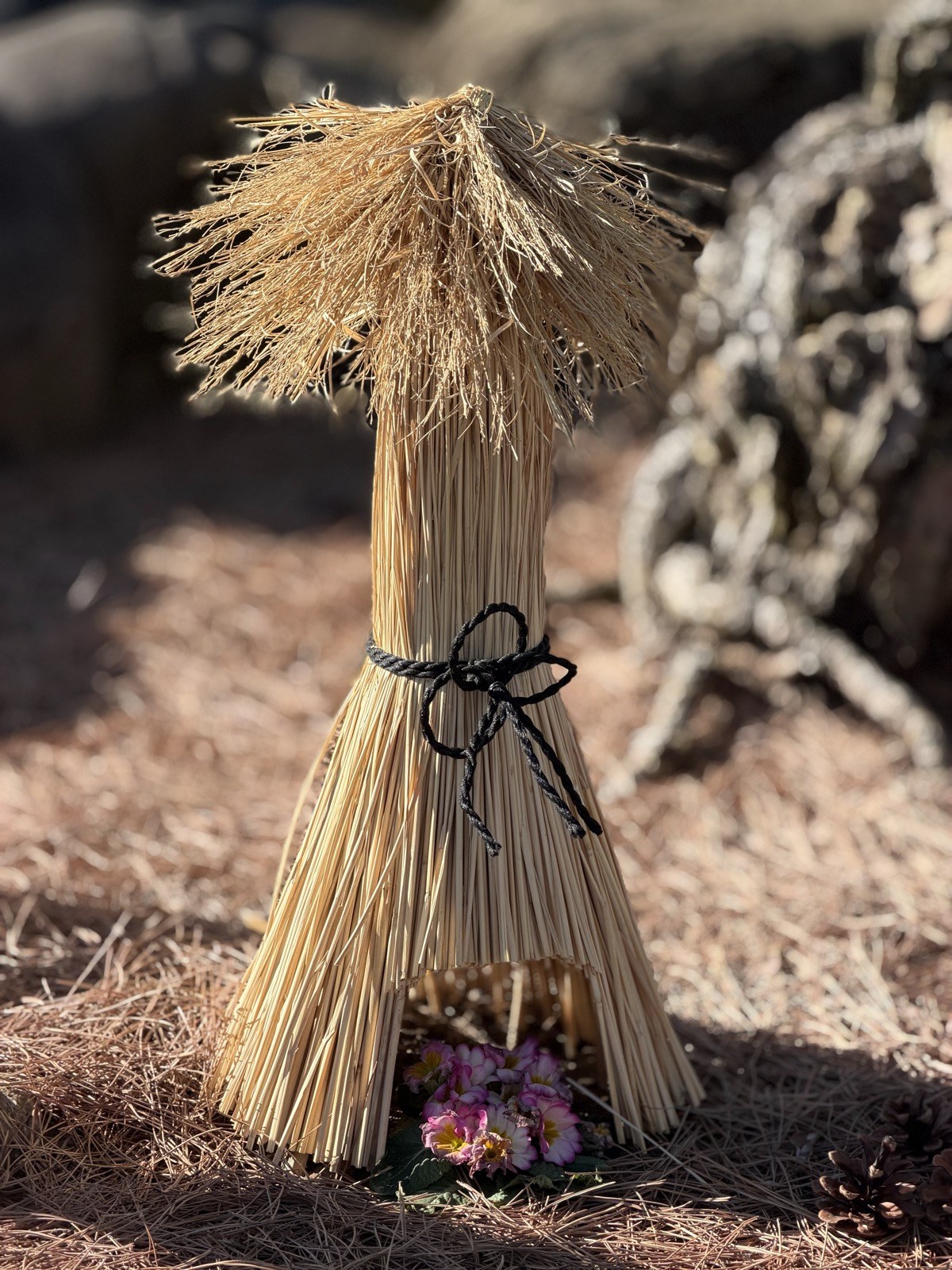
Look closer and the straw roofs are tied with rope. The shrine explains that wara-botchi “vary in shape and in the way they are tied from region to region”, and that since the garden opened it has used rough straw rope tied in otoko-musubi (男結び), a gardener’s knot, together with decorative knots shaped like flowers such as plum blossom. The covers do a job, and the knots are there for the visitor.
To see why the job is needed at all, we first have to understand what a “winter peony” is.
Two kinds of winter peony — kan-botan and fuyu-botan
The plant behind both
The cultivated peonies commonly called botan (牡丹) in Japan are woody peonies, traditionally grouped under the name Paeonia × suffruticosa Andrews; the broader term “tree peony” also includes other species and hybrids. Kumamoto University’s medicinal plant garden describes it as a deciduous shrub native to China, and notes that it is said to have reached Japan in the Nara or Heian period; no exact year is given. The plant is also a medicine: the Tokyo Herbal Medicine Association lists the root bark as the part used for the crude drug botanpi (牡丹皮).
In a normal year a tree peony flowers once, in spring. This article is about peonies that flower in winter: kan-botan can flower in both spring and early winter, while fuyu-botan are spring-flowering cultivars whose flowering time has been shifted by growers.
Kan-botan — the peony that flowers twice
Kan-botan (寒牡丹), “cold-season peony”, is a two-season variant. Sekkōji, a temple in Nara Prefecture that has kept it for generations, describes it as “a variant that flowers twice, in spring and in early winter”. The temple says it opens “without human hands, in its natural state, when its time comes”. It believes the type first appeared as a chromosome irregularity during the breeding of spring peonies, and quotes odds of one in 500 to one in 1,000 for such a plant arising (another page on the same site says “one in several thousand”).
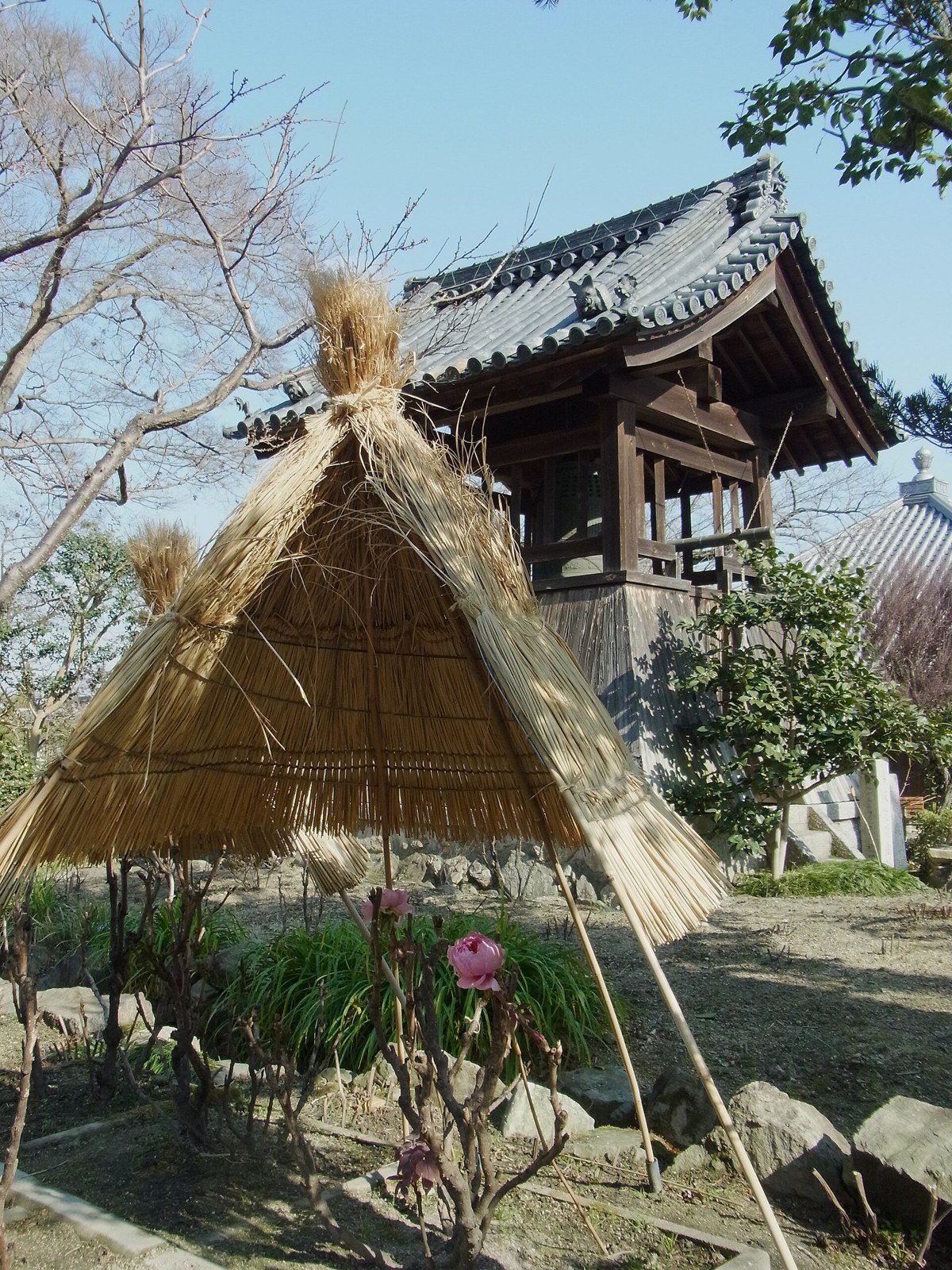
Kan-botan is slow. The temple writes that a plant needs at least ten years before it flowers well, and twenty years or more before it gains enough strength to flower well even in some cold. In May and June it builds thick green leaves and stores food through summer for the winter flowers. Some plants, the temple says, live for thirty years. Its pages show varieties named 初日 (“first sunrise of the year”), 寒紫光 (“cold purple light”) and 大正紅 (“Taishō red”).
A different account appears in a note in the National Diet Library’s Japan Search gallery, which describes kan-botan cultivation as removing the spring buds, cutting off leaves in summer, and raising a second set of buds. The two descriptions are not identical, and this article does not try to settle which is more widely practised.
Fuyu-botan — a spring peony with its timing moved
Fuyu-botan (冬牡丹), “winter peony”, is a different thing: an ordinary spring-flowering variety whose flowering has been shifted. Sekkōji says these plants are put into greenhouses and “artificially brought into a spring state”. Yuushien, a peony garden in Shimane Prefecture, describes its “New Year peonies” in almost the same words: spring varieties “brought into flower by adjusting temperature”.
Ueno’s winter display is of this kind. The shrine names popular varieties such as 八千代椿 (“eight thousand generations of camellia”) and 島錦 (“island brocade”) among the plants it brings into flower for winter, and the garden’s page adds that it also has kan-botan, “carefully raised”, alongside its 160 winter-flowering plants.
The difference at a glance
| Kan-botan (寒牡丹) | Fuyu-botan (冬牡丹) | |
|---|---|---|
| What it is | A two-season variant | A spring variety with its timing shifted |
| When it flowers | Spring and early winter | Winter; Sekkōji says heated forcing can bring flowers from late December |
| How it flowers in winter | By the plant itself (another account describes removing spring buds) | Cold storage and temperature control |
| After winter | Some plants live 30 years (Sekkōji) | Without a greenhouse it will not flower in winter again (Sekkōji) |
| Where you see it | Sekkōji; also at Ueno | Ueno Tōshōgū, Yuushien and other displays |
The names are not always used consistently. Hasedera in Nara has posted a notice on its website correcting an earlier use of “fuyu-botan” to “peonies that flower in the cold season”. The correction is a reminder that a sign in a garden may not tell you which of the two kinds you are looking at.
How a spring flower opens in January — forcing and retarding
Two ways to move the date
There are two ways to move a spring peony’s flowering into winter. Forcing (促成) brings it forward: the plant is chilled to satisfy its winter, then warmed so it behaves as if spring had come. In Sekkōji’s explanation, forcing a peony takes roughly 50 days at 4°C, and heated growing can then bring flowers from late December. The temple adds that potted winter peonies are shipped in December and January to temples and other visitor sites.
Retarding (抑制) pushes flowering back. This is how Ueno describes its plants: brought into flower “by making full use of retarding cultivation”, as an auspicious New Year flower for the season when little else blooms. A 2023 feature in the Japanese government magazine Highlighting Japan, based on the Ueno garden, describes spring varieties kept dormant at low temperature so that flowering comes about eight months later than usual.
What the research says
Japanese horticultural scientists have measured parts of this process. In a 1984 study in the Journal of the Japanese Society for Horticultural Science, Aoki and Yoshino chilled two-year-old grafted plants of the variety 花競 for different lengths of time before forcing. For the shape of the plant as a cut flower, six to seven weeks of cold storage worked best. In that trial, petal formation had already begun inside the buds by 27 August, when observations started — so in that variety, the flower is already taking shape in late summer.
A 2009 paper by Aoki and Zhang tested a hybrid peony, ‘Oriental Gold’. A pre-chill at 15°C advanced the development of the flower buds. In the retarding trial, plants held in long cold storage from January and planted out on 12 October flowered on 13 December.
What this means for the straw hat
A forced or retarded peony is a spring flower opening outdoors in midwinter. That is the plant the gardens say they are protecting. The Ueno shrine also notes something in the gardener’s favour: because winter peonies open in low temperatures, they stay at their best for a long time during the display. The hat is how the gardens look after that long-lasting flower through frost, snow, rain and wind.
Why the hat — frost, snow, cold rain and wind
What the cover is for
The Japanese sources we checked give the same purpose in slightly different words. Ueno’s page calls the wara-botchi a “frost cover”. An essay on Ueno published by the Foundation for Cultural Heritage and Art Research calls it “an enclosure to keep off frost and snow”. The 2026 Ueno announcement says the plants are wrapped “to protect them from the harsh winter environment”. Sengan-en, a garden in Kagoshima that shows peonies at New Year, says its straw covers are there “to protect the flowers from cold and from snow”.
Western advice points at the same weak spot. The Royal Horticultural Society describes tree peonies as fully hardy, but warns that “flower buds can be damaged by late frosts”. A Japanese winter peony is past the bud stage: its flower is already open in the frost season.
Why the south side is left open at Ueno
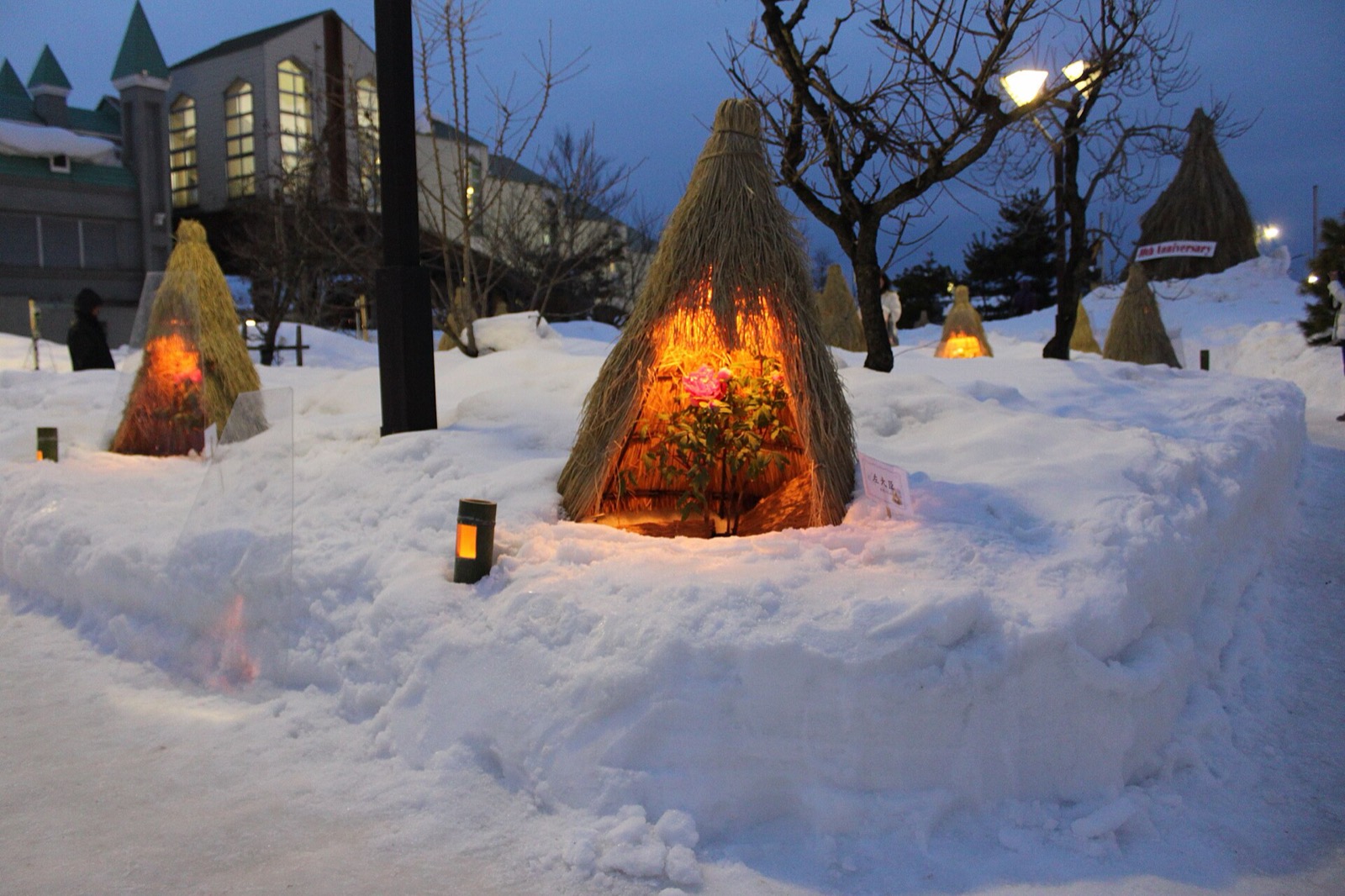
The foundation’s Ueno essay adds the detail that makes the wara-botchi more than a sack: at Ueno the south side “is left open to take in sunlight”. The hat covers the plant from above while the open face lets the low winter sun reach it — and lets visitors see the flower. So the Ueno wara-botchi is not a blackout cover. It is a roof with a window, and the window faces the sun.
When it is closed completely
The Highlighting Japan feature describes how the covers at Ueno are adjusted: when there is cold rain or wind, or the temperature falls, the wara-botchi is “completely covered over”. This is the gardener’s judgement call through the season — open to the sun on an ordinary day, closed when the weather turns.
Why straw
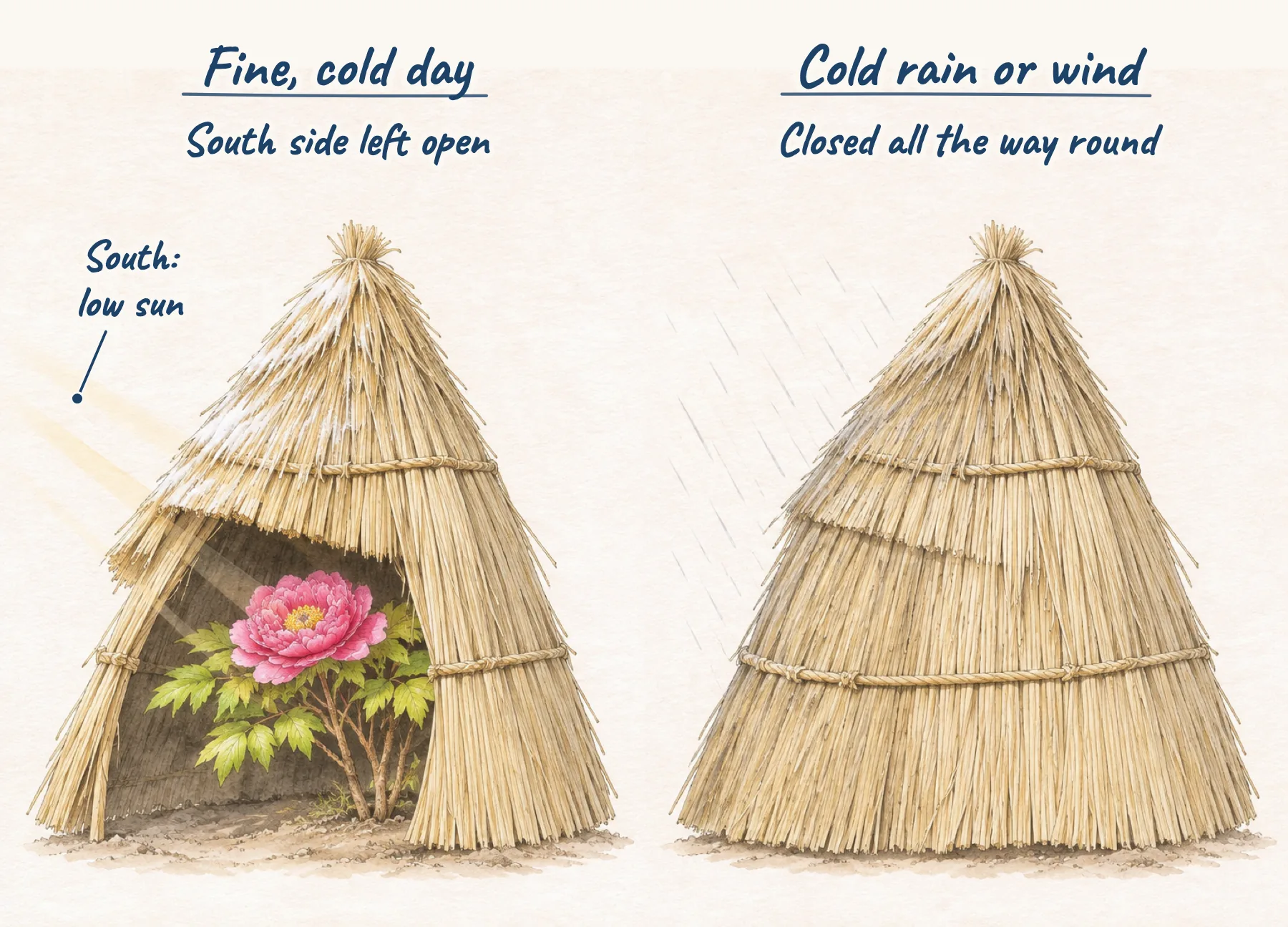
The foundation’s essay names three qualities of straw that the wara-botchi puts to use: heat retention (保温性), water-shedding (防水効果) and breathability (通気性). These are descriptions, not measurements; we found no study of temperature or humidity inside a straw cover over a peony.
How a wara-botchi is made — one company’s method, one garden’s use
Where the shape comes from
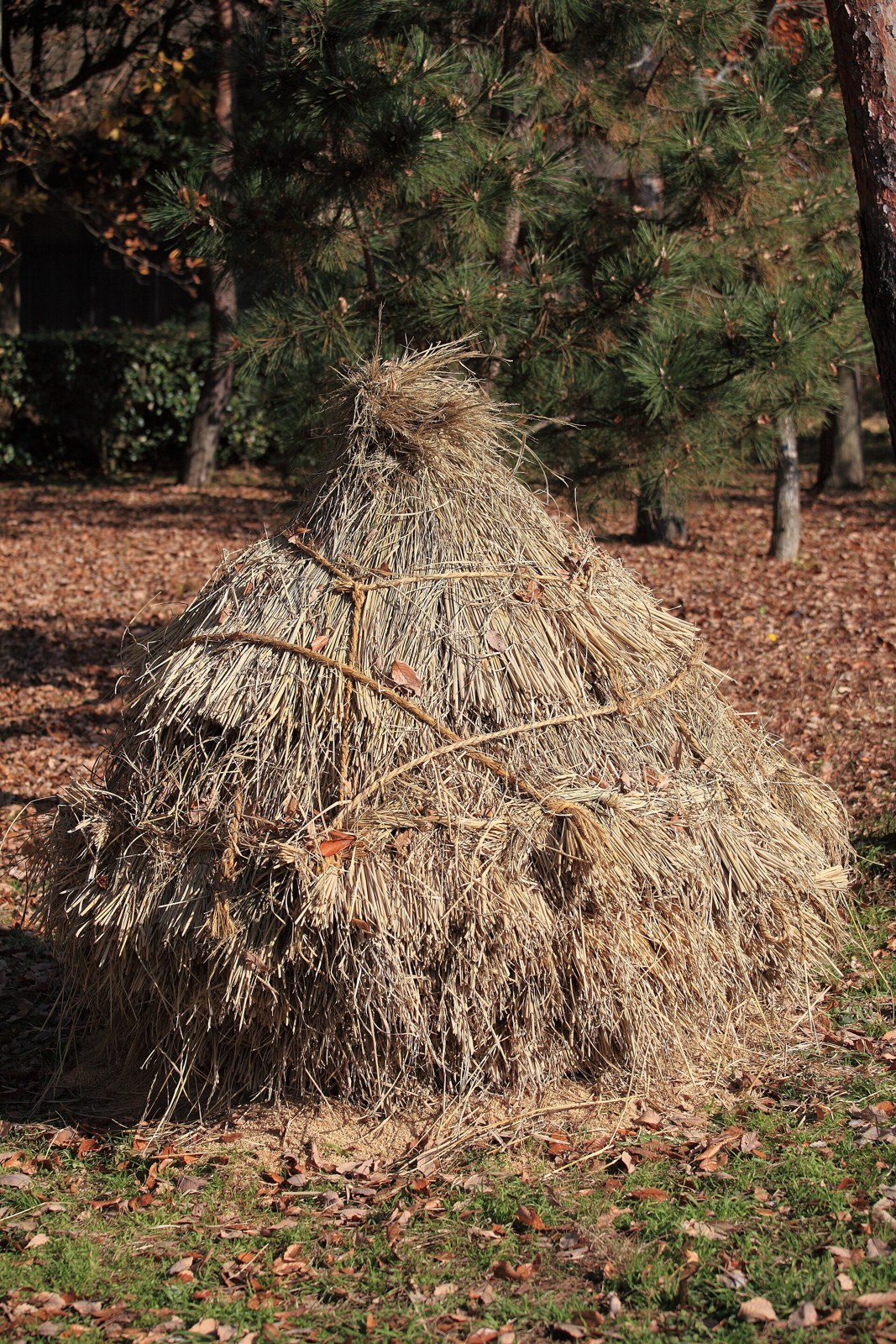
Rau Zōkei, a landscape company that publishes its winter work, gives a hint about the name. It describes the wara-botchi as a garden feature that borrows a winter scene from the countryside: straw tied in bundles and stacked in rice fields after the harvest. Its page presents the wara-botchi as a decorative element; it does not say which plants it covers. Its method is still the clearest public description of how such a straw cone is made.
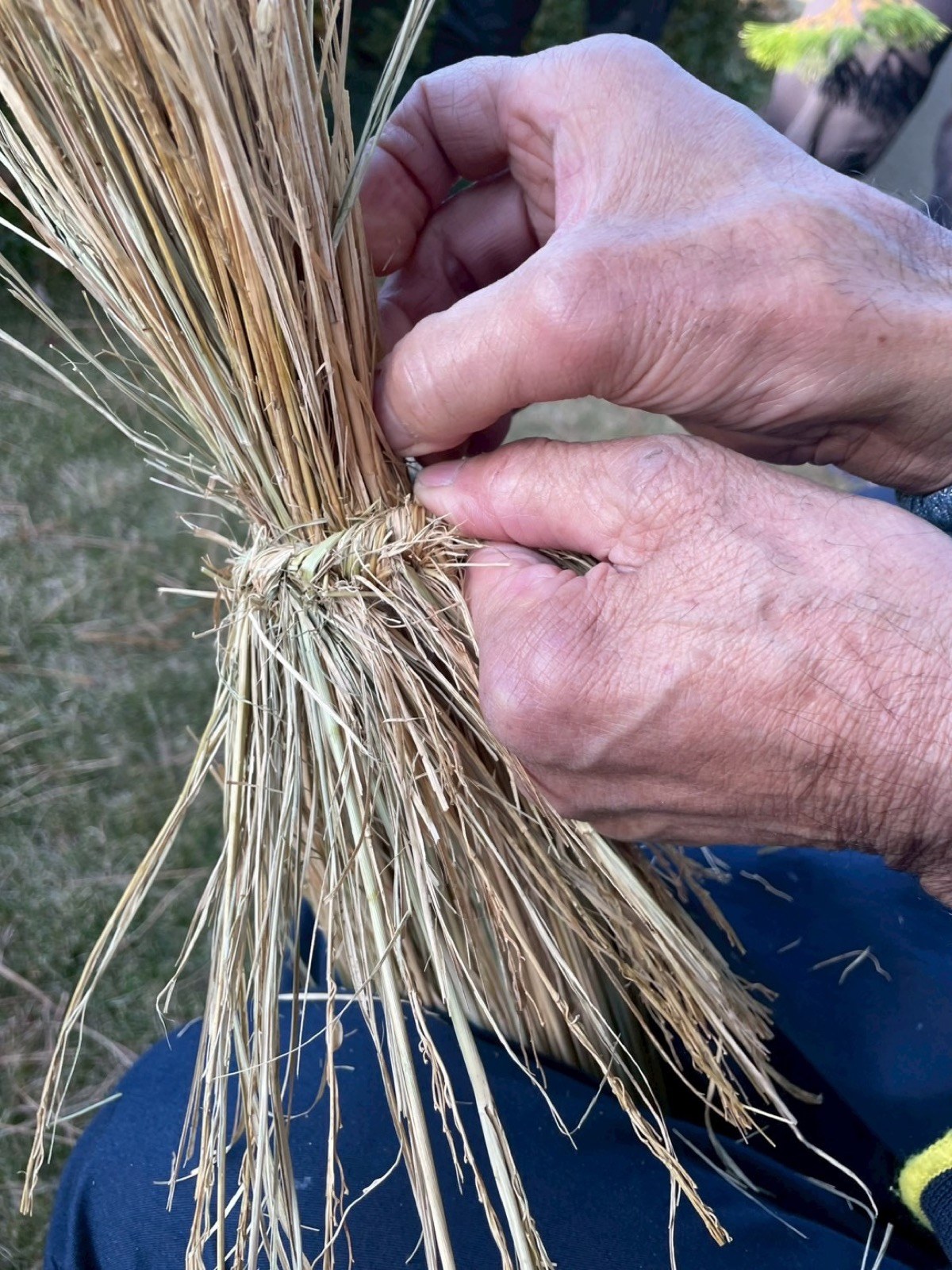
Rau Zōkei’s method, step by step
| Step | What is done |
|---|---|
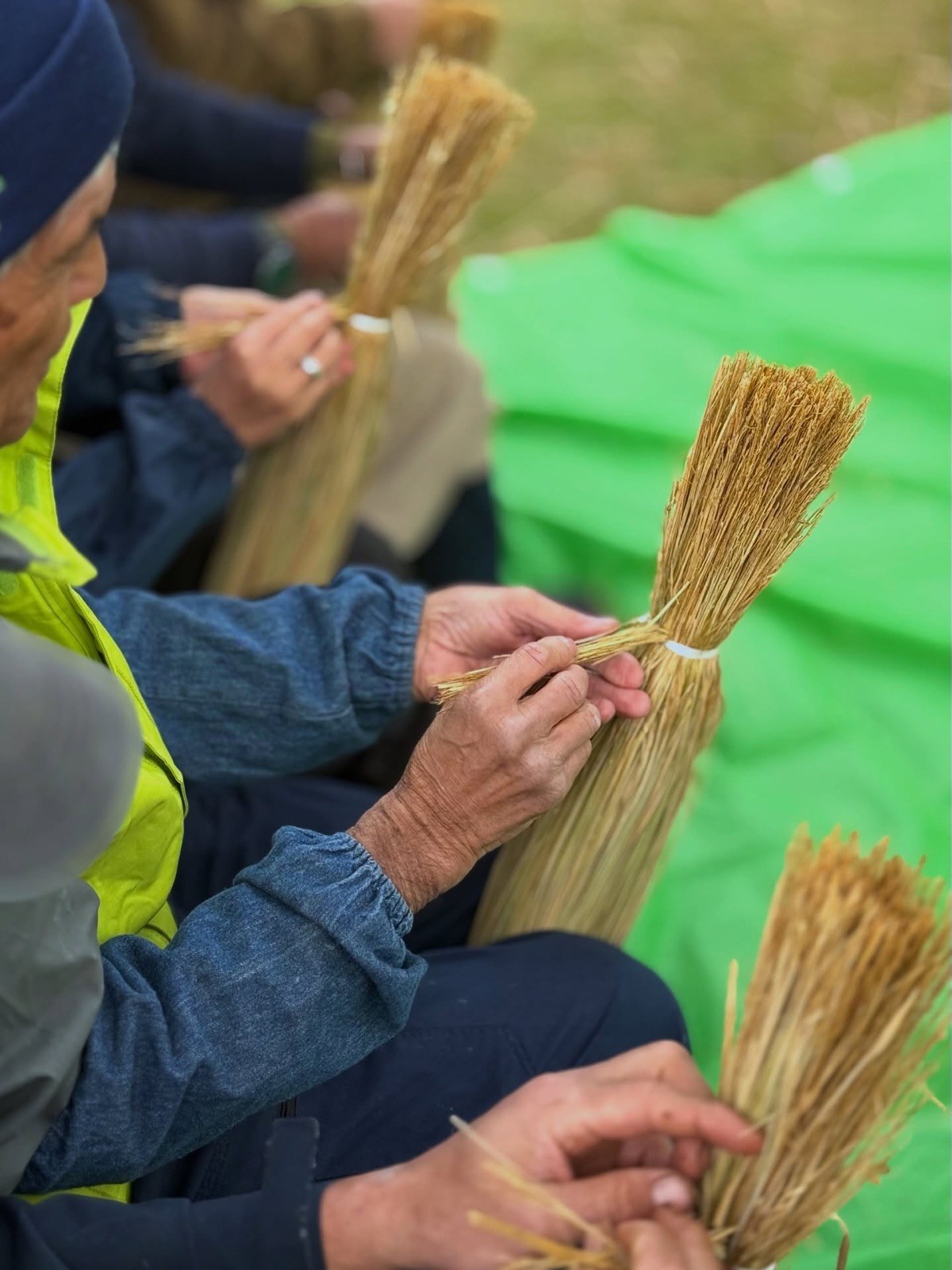
| 1 | Sort the straw and adjust length and amount — about as much as two hands can hold lightly |
| 2 | Tie the bundle with otoko-musubi a little above the halfway point, without pulling too tight |
| 3 | With the ear ends up, weave the straw, taking a fingertip’s grip at first and less each round, finishing with one or two straws |
| 4 | Keep the weave pressed firmly with the left thumb; too much force breaks the straw |
| 5 | Leave three straws at the end and finish by interweaving them in the ishidatami pattern described by Rau Zōkei |
| 6 | Trim the hem straight and tidy loose ends |
We did not find published dimensions, frames or straw thicknesses for peony covers at Ueno or elsewhere, so the table is one company’s method, not any peony garden’s specification.
How the gardens use it
At Ueno, the cover is tied with rough straw rope in otoko-musubi plus flower-shaped decorative knots, set with the south side open, and closed completely in bad weather. At Sekkōji in Nara, Nara TV reported in January 2026 that the straw covers (藁苞) over the temple’s kan-botan are made by hand from rice straw by the chief priest. At Matsumoto Castle, described below, volunteers set the covers over the plants while taking care of the flower buds.
When the hats go up and come down
A calendar from the sources
There is no single national date for putting on a wara-botchi. The table gathers dated examples from the sources we checked. Future dates were announcements at the time of writing.
| Place | What | Date | Source |
|---|---|---|---|
| Yuushien (Shimane) | Winter preparations for kan-botan begin | From 23 November 2026 (announced) | Yuushien, autumn 2026 |
| Matsumoto Castle (Nagano) | Wara-botchi set over about 50 peonies | 1 December 2025 | Shimin Times, 2 December 2025 |
| Sekkōji (Nara) | Kan-botan flowering in succession | From December 2025, expected until about mid-January 2026 | Nara TV, 6 January 2026 |
| Ueno Tōshōgū (Tokyo) | 44th winter peony display | 1 January – 23 February 2026 (announced) | Ueno Tōshōgū, 11 December 2025 |
| Sengan-en (Kagoshima) | New Year peony display under straw | 26 December 2026 – 11 January 2027 (announced) | Sengan-en |
| Matsumoto Castle | Winter covers and snow ropes removed | Planned for 15 March 2026 | Shimin Times, 2 December 2025 |
Reading the calendar
The table mixes two different situations: displays of flowering plants (Ueno, Sekkōji, Sengan-en) and the winter cover of a resting garden (Matsumoto). The first question for a gardener is which of these the cover is for.
Not only for flowers — straw hats over resting peonies
Matsumoto Castle
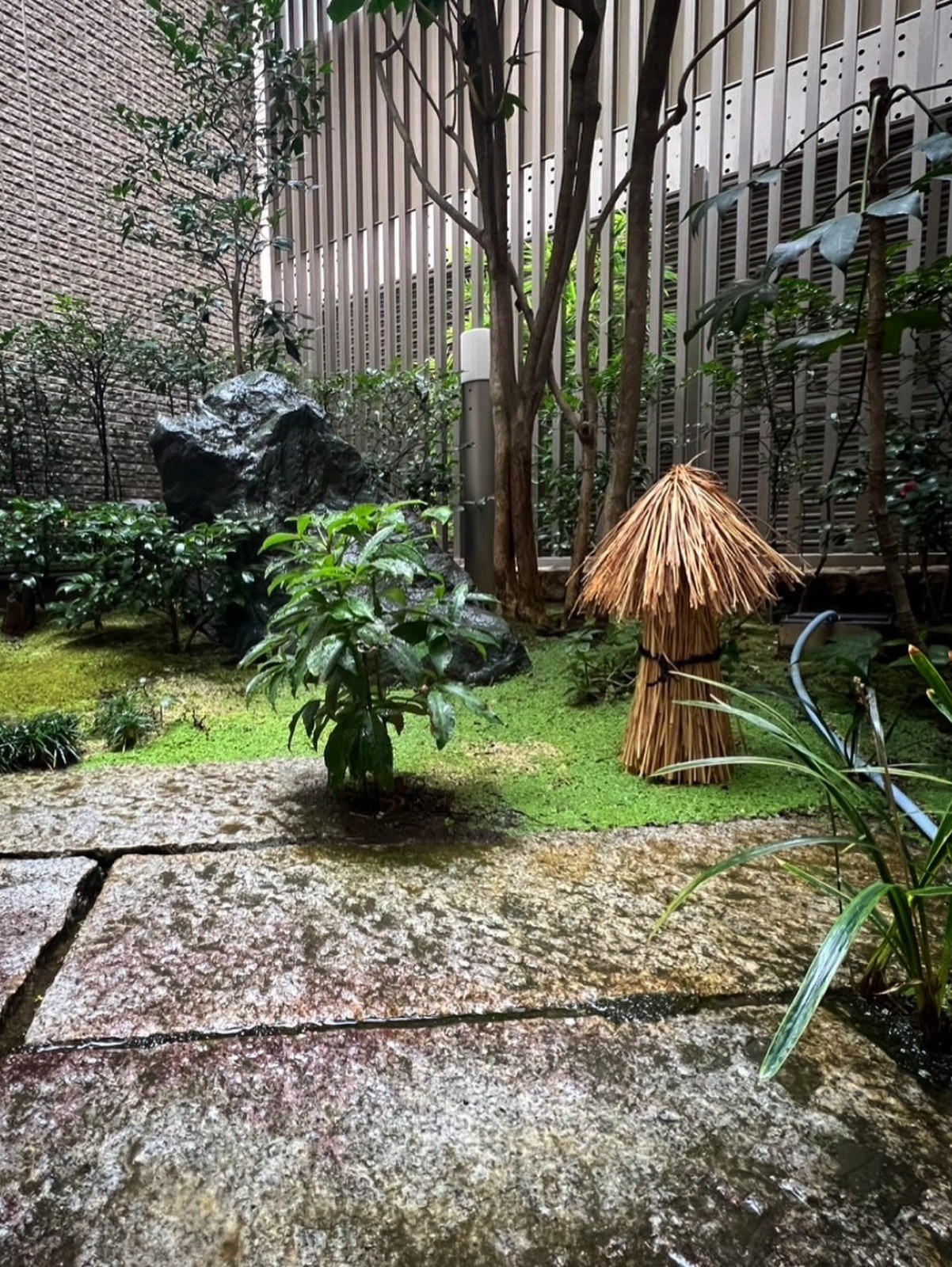
On 1 December 2025, 48 people — members of a castle preservation society and landscape contractors — did the winter work at Matsumoto Castle in Nagano, the local paper Shimin Times reported. They put wara-botchi over about 50 peonies and snow ropes on four trees including red pines, as winter covers “to protect the plantings from wind and snow”. Twenty women from the society set the straw hats over the peonies, “taking care of the flower buds”. The covers were due to come off on 15 March 2026. The castle’s official site describes its Ogasawara peonies as flowering “every May”.
So the same straw hat appears in two jobs. Over a winter display, it shelters an open flower. In a cold inland city, it shelters peonies and their buds through the winter, alongside the garden’s other covers.
What changes from place to place
The Ueno shrine says plainly that wara-botchi differ by region in shape and in how they are tied. Our sources show some of that range: rough rope and flower knots in Tokyo, a priest’s hand-made rice-straw covers in Nara, covers over the buds of a castle garden in Nagano, and New Year displays under straw in Kagoshima. At Yuushien in Shimane, a post from 20 January 2025 shows winter peonies under komo-kake (こも掛け), a straw-mat cover — a reminder that the name of the cover changes too.
Where to see winter peonies under straw
Ueno Tōshōgū peony garden, Tokyo
The peony garden at Ueno Tōshōgū, the shrine dedicated to Tokugawa Ieyasu, opened in April 1980 to commemorate Japan–China friendship. It grows 110 varieties and 500 plants for spring, and 40 varieties and 160 plants for winter. The announcement for the 2026 winter display listed entry at ¥1,000 for adults (junior high school age and over), ¥800 per person for groups of 15 or more, a season pass at ¥2,500, and free entry for children of primary school age and under, with hours of 9:30 to 16:30 (last entry). The garden’s own page gives the season as 1 January to late February.
Tsurugaoka Hachimangū, Kamakura
The shrine’s official guide describes its Shin’en peony garden beside the Genji Pond as planted with both New Year peonies and spring peonies. We could not confirm the dates, plant numbers or fees for the 2026–2027 winter season from the shrine’s own pages, so check before visiting.
Sekkōji, Nara
The temple grows kan-botan. Nara TV reported on 6 January 2026 that it had about 150 plants of 36 kinds, flowering in succession from December 2025. A Nara tourism page gives different figures (about 200 plants, about 40 kinds); we have used the temple’s own count.
Other gardens
– Hasedera, Nara — describes its winter flowers as “peonies that flower in the cold season”; we could not confirm the 2026–2027 dates. – Yuushien, Shimane — on Daikonshima, the island that Matsue City says leads Japan in peony production; winter preparations announced from 23 November 2026. – Sengan-en, Kagoshima — New Year peony display announced for 26 December 2026 to 11 January 2027. – Sukagawa Peony Garden, Fukushima — known for spring peonies; we found no dated record of a public winter-flowering display.
Gardens change their dates every year. Treat these as the most recent dates we could confirm, and check each garden’s site before you travel.
A winter word in poetry — what history can and cannot tell us
Winter peonies in the seventeenth century
The winter peony has been written about in Japan for more than three centuries. In a 2006 study, Isono Naohide traced “fuyu-botan” as a seasonal word in haiku to the collection Zōzoku Yama-no-i of 1663. His tables also record “fuyu-hotan” in the Oyudono no Ue no Nikki, a diary kept at the imperial court, in the first year of Jōkyō (1684). He suggests these early winter peonies correspond to what is now called “fuyu-botan (kan-botan)” — so the old word cannot simply be read as today’s forced plants.
The Haijin Kyōkai, the Association of Haiku Poets, lists kan-botan as a winter seasonal word today.
Peonies as medicine, and a fire of peony wood
Sukagawa City in Fukushima traces its peony garden to 1766, when Itō Chūbē Yūrin bought peony seedlings for medicine from Yamamoto village in Settsu Province — present-day Takarazuka in Hyōgo. The garden now has 290 varieties and 7,000 plants. Sukagawa also holds botan takibi (牡丹焚火), a burning of old peony wood, which the city says entered haiku almanacs as a winter seasonal word in 1978.
What we could not find
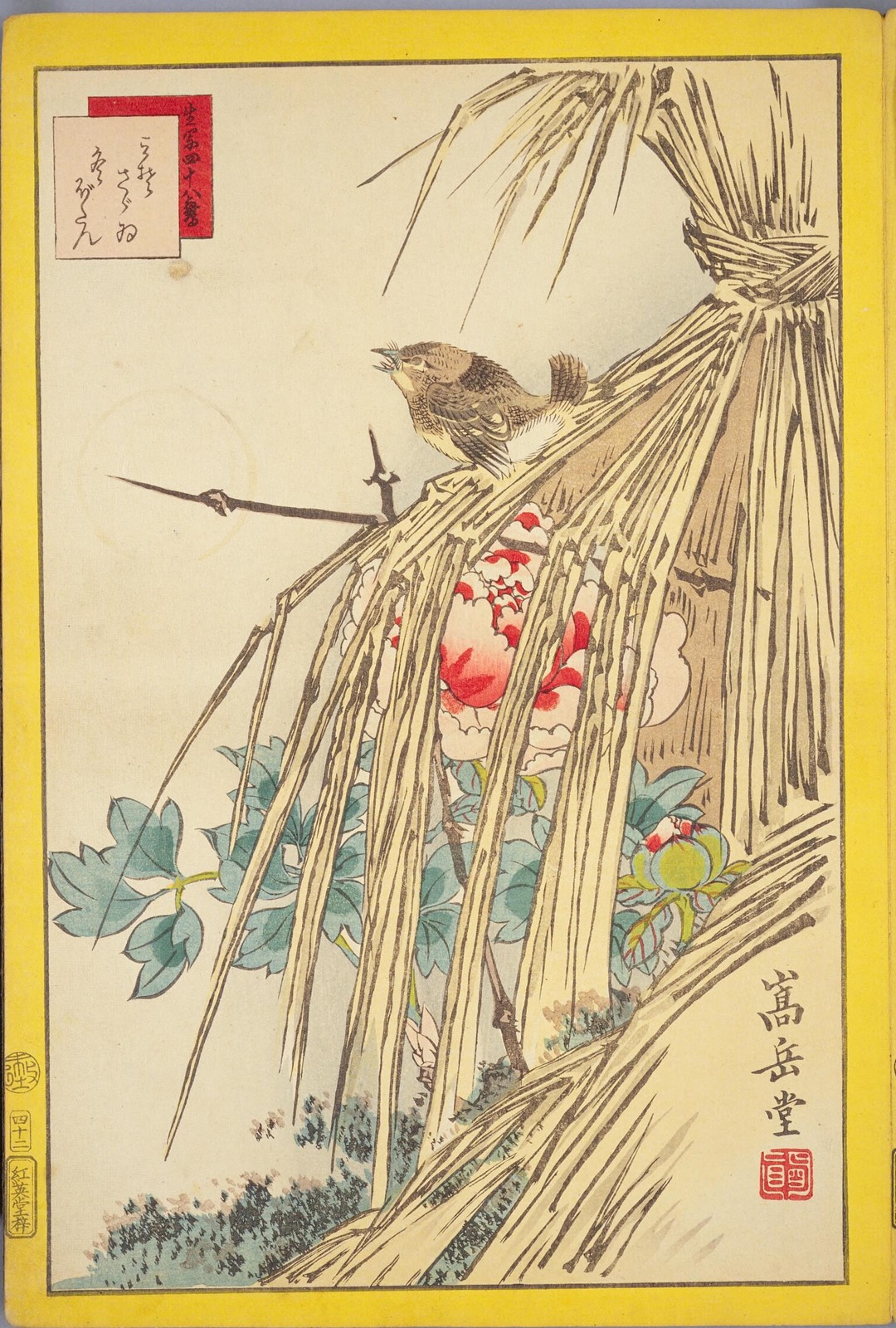
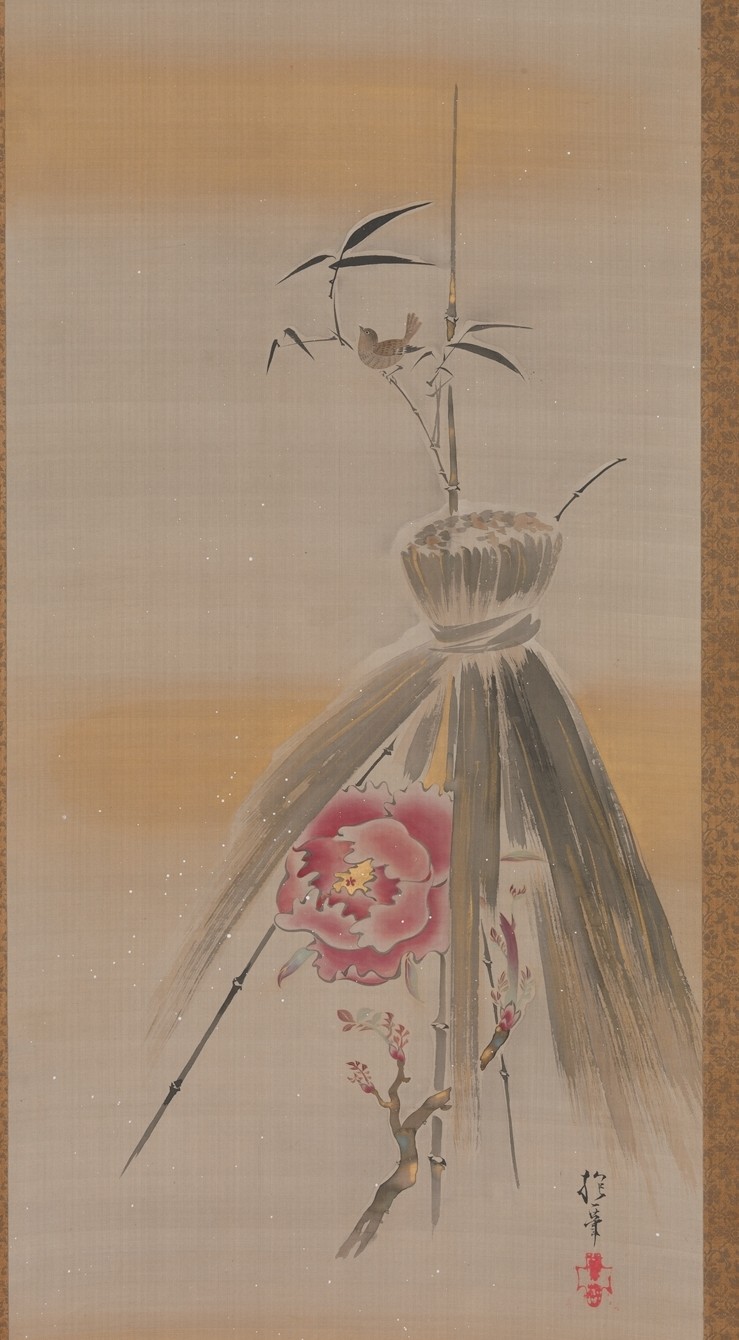
We could not establish when Japanese gardeners first began putting straw covers over peonies or who introduced the practice. The seventeenth-century texts cited here mention winter-flowering peonies, not their covers. However, Edo-period artwork depicts peonies beneath straw shelters. Such images document the motif in that period, but they do not establish its origin or prove that the construction and management of today’s wara-botchi have remained unchanged.
How tree peonies are wintered in British and American advice
What the extension services say
Tree peonies are grown widely in Britain and North America. The RHS calls them fully hardy and recommends mulching in spring. Iowa State University Extension gives USDA hardiness zones 4 to 8 and, for young plants that need it, suggests an enclosure filled with “a light, airy material, such as straw or pine needles”, put on by mid to late November and taken off in early to mid-April. Washington State University Extension notes that tree peonies “may need the protection of mulch their first winter”.
The University of Maine Cooperative Extension answered a gardener who packed leaves around tree peonies inside a burlap screen: “you may in fact be overdoing the protection in the winter”. For a windy site it suggested “a windbreak of some sort”.
A different goal
Read side by side, the British and American advice we checked and the Japanese winter displays are aimed at different things. The advice protects a dormant plant — often a young one — so that it flowers in spring. The Japanese displays protect an open flower so that people can see it in January. Both reach for straw. At Matsumoto, where the peonies flower in May, the Japanese practice looks much closer to the Iowa advice: cover in early winter, remove in March.
Judging whether a peony needs cover
From these sources, the questions that decide whether a cover is needed are: is the plant in flower or dormant; is it young; how cold and snowy is the site; and how exposed is it to wind. The sources give no single temperature threshold, and we have not invented one.
How wara-botchi differs from snow ropes, straw belts and winter wrapping
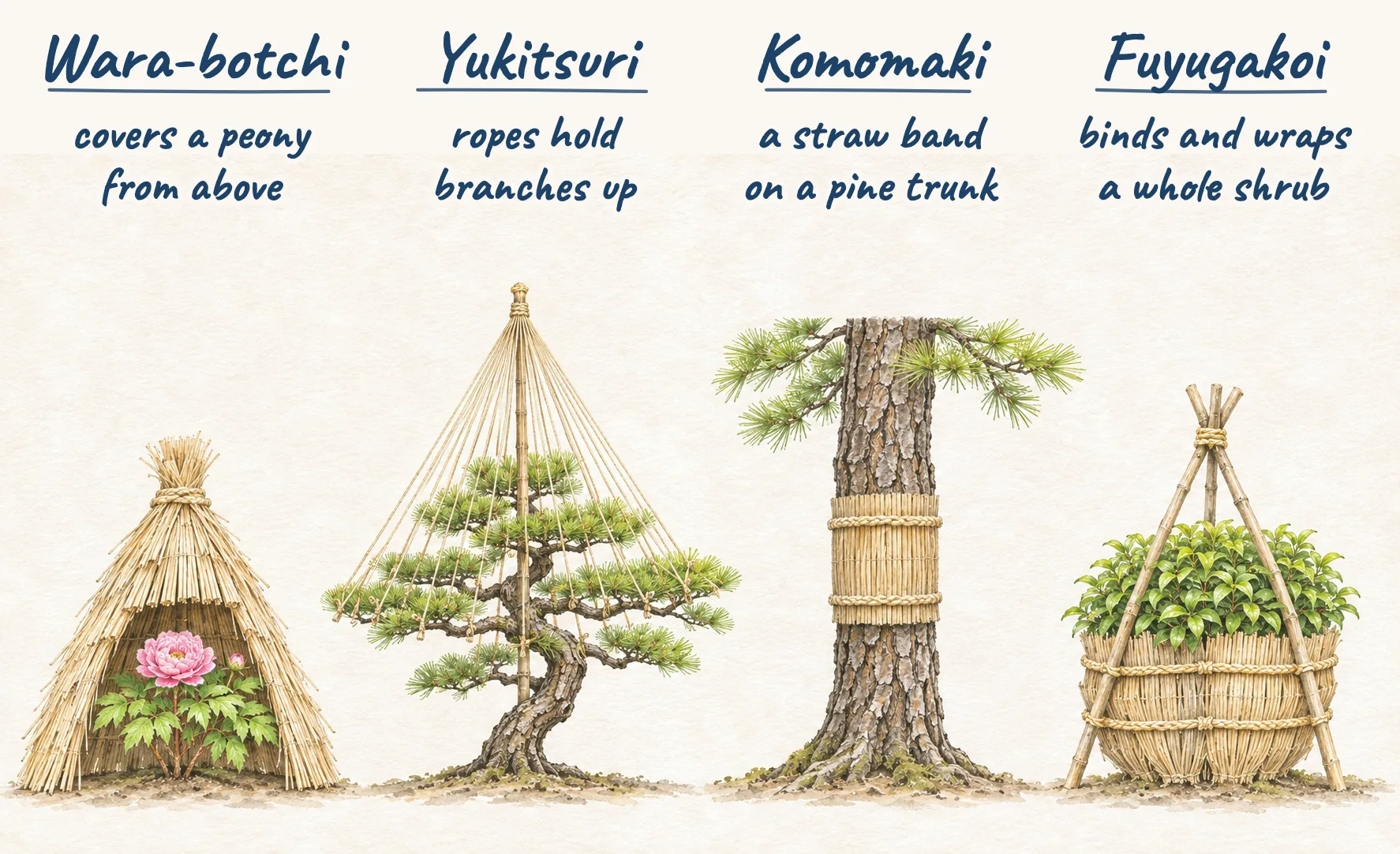
| Practice | What it covers | Main purpose |
|---|---|---|
| Wara-botchi (藁ぼっち) | A peony, from above | Frost and snow off the plant; at Ueno, open to the south for sun |
| Yukitsuri (雪吊り) | The branches of a tree | Ropes keep snow from breaking branches (Tokyo Metropolitan Park Association) |
| Komomaki (菰巻き) | A band around a pine trunk | A traditional pest-control method (Tokyo Metropolitan Park Association) |
| Fuyugakoi (冬囲い) | Trees, shrubs and other garden plants | An umbrella term for winter protection, including binding, wrapping, supporting or enclosing plants; it can include snow ropes and straw covers |
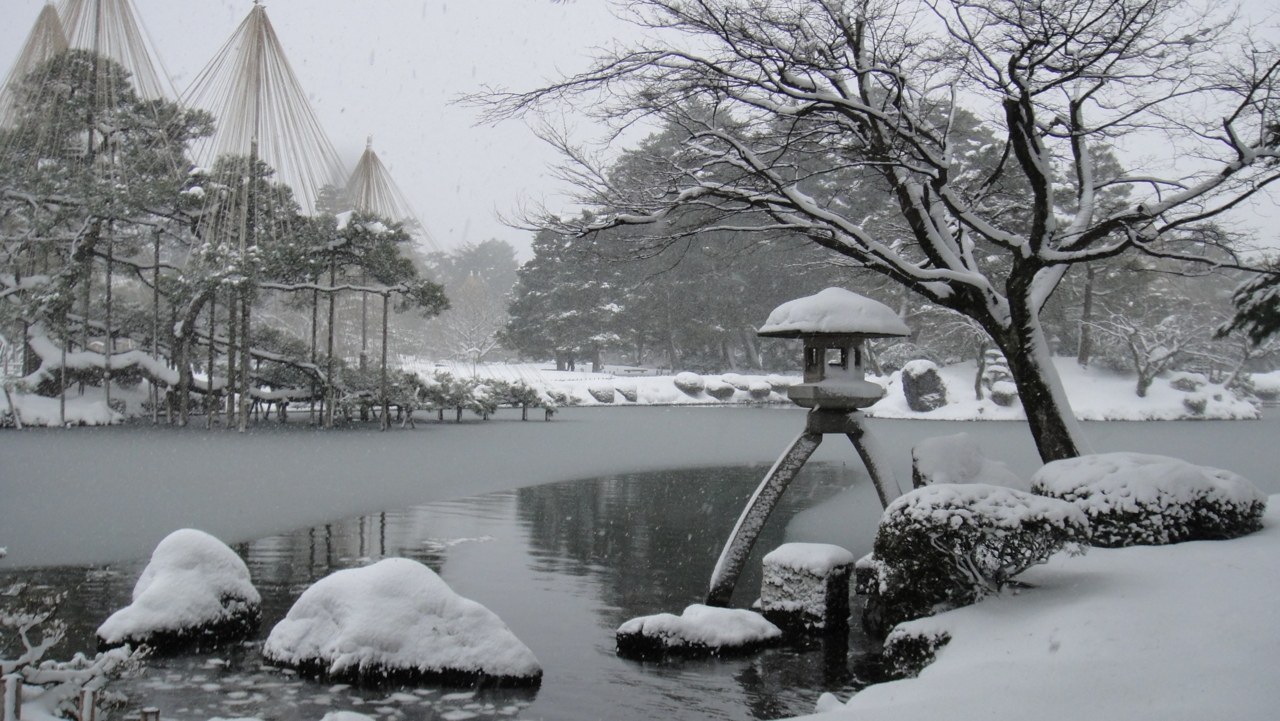
These winter practices often use straw or rope and help shape the appearance of Japanese gardens; at Matsumoto Castle, the peony covers and snow ropes were installed on the same day. The snow ropes support branches, while the straw belts on pines encircle trunks. Fuyugakoi is a broader term for winter protection rather than a single separate technique. In the peony displays discussed here, wara-botchi shelter individual plants from above and, at Ueno, are arranged so that visitors can see the flowers.
Common misunderstandings about winter peonies
“The straw keeps the flower warm like a greenhouse”
The sources describe straw as holding some warmth, but they do not describe the wara-botchi as a heated or sealed space, and we found no measurements of the temperature inside. At Ueno the cover is open to the south except in bad weather. Its stated work is to keep off frost and snow.
“All winter peonies are the same plant”
They are not. Kan-botan are cultivars capable of flowering in spring and again in early winter, although winter flowering depends on the weather and the plant’s condition. Fuyu-botan are normally spring-flowering cultivars brought into winter bloom by temperature control. Ueno displays both.
“A forced peony can go back in the garden and flower again next winter”
Sekkōji says a winter peony that has done its job is a spring variety, so “unless a greenhouse is used” it will not flower in winter again; it hopes such plants will go on to be enjoyed as spring peonies. It also warns that a plant forced out of its natural rhythm may be weakened after flowering: prone to disease, it may die before the end of summer or, if it survives, not flower for two or three years. The temple also warns about soil contamination from diseased plants.
“It is an ancient, unchanged custom”
Winter-flowering peonies appear in Japanese texts from the 1660s, and Edo-period artwork depicts peonies beneath straw shelters. We have not established when the practice began or whether its techniques have remained unchanged. Ueno’s present peony garden opened in 1980, so its opening date alone cannot establish the age of the wider custom.
Frequently asked questions
What is a wara-botchi?
A straw cone or hat set over a plant in winter. Over Japanese winter peonies it keeps off frost and snow; at Ueno Tōshōgū it is left open to the south and tied with rough straw rope in otoko-musubi and flower-shaped knots.
When can I see winter peonies in Japan?
The dated displays we found fall between December and late February. Ueno Tōshōgū announced 1 January to 23 February 2026; Sengan-en announced 26 December 2026 to 11 January 2027. Check each garden’s site for the current year.
Is a winter peony a special species?
No. These names describe flowering habits or cultivation methods, not separate species. Kan-botan are woody peony cultivars capable of flowering in spring and again in the cold season; fuyu-botan are normally spring-flowering cultivars brought into winter bloom by temperature control.
Should I put a straw hat on my tree peony at home?
It depends on the plant and the site. The RHS calls tree peonies fully hardy, Iowa State suggests straw-filled protection for young plants that need it, and Maine warns against overdoing it. Look at whether the plant is young, how cold and snowy your winter is, and how exposed it is to wind.
Is wara-botchi the same as komomaki?
No. Komomaki is a straw band around a pine trunk, described by the Tokyo Metropolitan Park Association as a traditional pest-control method. A wara-botchi covers a peony from above.
Sources
– Ueno Tōshōgū Peony Garden, “Ueno Tōshōgū winter peonies” (Japanese; checked 2026-11-17): https://uenobotanen.com/schedule/winter/ – Ueno Tōshōgū Peony Garden, official site (Japanese; checked 2026-11-17): https://uenobotanen.com/ – Ueno Tōshōgū, announcement of the 44th winter peony display, PR TIMES, 11 December 2025 (Japanese; checked 2026-11-17): https://prtimes.jp/main/html/rd/p/000000025.000023229.html – Government of Japan, Highlighting Japan, “フユボタン(冬牡丹)の庭”, February 2023 (Japanese; checked 2026-11-17): https://www.gov-online.go.jp/eng/publicity/book/hlj/html/202302/202302_05_jp.html – Foundation for Cultural Heritage and Art Research, “Ueno no mori kara (23): Fuyu-botan and kan-botan” (Japanese; checked 2026-11-17): https://www.bunkazai.or.jp/info/pdf/uenonomorikara_23.pdf – Sekkōji, “The real kan-botan” (Japanese; checked 2026-11-17): https://sekkouji.or.jp/flower/kanbotan/ – Sekkōji, “The world of kan-botan” (Japanese; checked 2026-11-17): https://sekkouji.or.jp/flower/kanbotan/02.html – Nara TV, “Winter peonies flower at Sekkōji”, 6 January 2026 (Japanese; checked 2026-11-17): https://www.naratv.co.jp/tvnnews/detail.html?id=52474851354b626d557a6a5948454f37374f483879673d3d – National Diet Library, Japan Search, “Botan” (Japanese; checked 2026-11-17): https://jpsearch.go.jp/gallery/ndl-mv4Z4YROxRv – Yuushien, “Peony growing Q&A” (Japanese; checked 2026-11-17): https://www.yuushien.com/botan/faq.html – Yuushien, “Winter peonies at Daikan”, 20 January 2025 (Japanese; checked 2026-11-17): https://www.yuushien.com/cgi-bin/disp.cgi?code=10219&mode=one2&no=5 – Yuushien, autumn 2026 feature (Japanese; checked 2026-11-17): https://www.yuushien.com/event/2026autumn/index.html – Sengan-en, “New Year peony display” 2026–2027 (Japanese; checked 2026-11-17): https://www.senganen.jp/events/botan2026/ – Tsurugaoka Hachimangū, “Precinct guide” (Japanese; checked 2026-11-17): https://www.hachimangu.or.jp/sightseeing/keidai/ – Hasedera, official site (Japanese; checked 2026-11-17): https://www.hasedera.or.jp/index.html – Shimin Times, “Winter covers at Matsumoto Castle”, 2 December 2025 (Japanese; checked 2026-11-17): https://www.shimintimes.co.jp/news/2025/12/post-6655/ – Matsumoto Castle, “Other sights” (Japanese; checked 2026-11-17): https://www.matsumoto-castle.jp/about/other-spot – Rau Zōkei, “Winter protection work” (Japanese; checked 2026-11-17): https://rau.co.jp/maintenance/fuyugakoi – Aoki and Yoshino (青木・吉野), effects of cold storage on forced tree peony, Journal of the Japanese Society for Horticultural Science 52(4), 1984, pp. 450–457 (checked 2026-11-17): https://www.jstage.jst.go.jp/article/jjshs1925/52/4/52_4_450/_article/-char/ja – Aoki and Zhang (青木・張), forcing and retarding of a hybrid tree peony, journal of the 農業生産技術管理学会, 15(3), 2009, pp. 166–171 (checked 2026-11-17): https://www.jstage.jst.go.jp/article/seisan/15/3/15_KJ00005487526/_article/-char/ja/ – Isono Naohide, “The Oyudono no Ue no Nikki as a source of natural history”, Keio University Hiyoshi Review Editorial Committee (慶應義塾大学日吉紀要), No. 40, September 2006, p. 40 (Japanese; checked 2026-11-17): https://koara.lib.keio.ac.jp/xoonips/modules/xoonips/download.php/AN10079809-20060930-0033.pdf?file_id=10485 – Kumamoto University Medicinal Plant Garden, “Botan”, April 2018 (Japanese; checked 2026-11-17): https://www.pharm.kumamoto-u.ac.jp/gcnrs/facility/medicinal_plant_garden/flower/2018/04/post_24.html – Tokyo Herbal Medicine Association, “Botan” (Japanese; checked 2026-11-17): https://www.tokyo-shoyaku.com/ohana.php?hana=806 – Matsue City, on the nickname of Daikonshima (Japanese; checked 2026-11-17): https://www.city.matsue.lg.jp/gyoseijoho/koho_kocho/kouchou/6/1/11/1_8/8614.html – Sukagawa City, “Sukagawa Peony Garden” (Japanese; checked 2026-11-17): https://www.city.sukagawa.fukushima.jp/bunka_sports/bunka_geijyutsu/1013435/bunkazai/1-3/4156.html – Sukagawa City, “Botan takibi” (Japanese; checked 2026-11-17): https://www.city.sukagawa.fukushima.jp/kanko_sukagawa/event/1006178.html – Haijin Kyōkai, haiku search (Japanese; checked 2026-11-17): https://www.haijinkyokai.jp/system/saijiki/index.php?flag=page&page=668 – Tokyo Metropolitan Park Association, Hama-rikyū Gardens, yukitsuri demonstration, 2024 (Japanese; checked 2026-11-17): https://www.tokyo-park.or.jp/park/hama-rikyu/news/2024/51352.html – Royal Horticultural Society, “How to grow tree peonies” (checked 2026-11-17): https://www.rhs.org.uk/plants/peony/tree/growing-guide – Iowa State University Extension and Outreach, “Do tree peonies need winter protection?” (checked 2026-11-17): https://yardandgarden.extension.iastate.edu/faq/do-tree-peonies-need-winter-protection – Washington State University Extension, “C090 – Peonies” (checked 2026-11-17): https://s3.wp.wsu.edu/uploads/sites/2076/2024/07/C090-Peonies.pdf – University of Maine Cooperative Extension, protecting tree peonies from winter wind, 4 November 2021 (checked 2026-11-17): https://extension.umaine.edu/gardening/2021/11/04/protect-peonies-winter-wind-freezing-temperature/
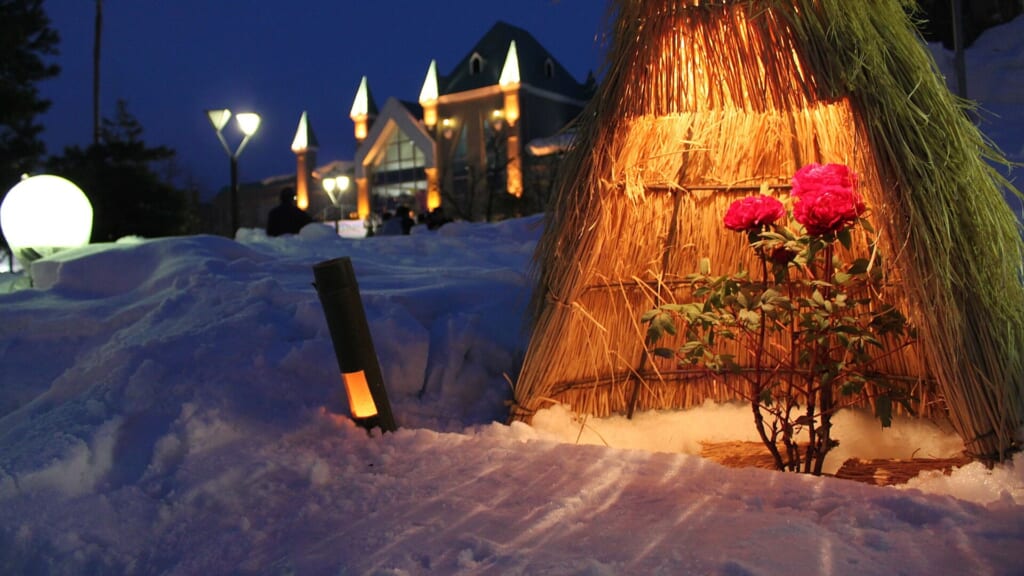
– Featured image: Straw hats over winter peonies, Takahata, Yamagata, February 2011. Photo: くろふね, CC BY 3.0, via Wikimedia Commons: https://commons.wikimedia.org/wiki/File:%E3%81%BE%E3%81%BB%E3%82%8D%E3%81%B0%E5%86%AC%E5%92%B2%E3%81%8D%E3%81%BC%E3%81%9F%E3%82%93%E3%81%BE%E3%81%A4%E3%82%8A_-_panoramio_%288%29.jpg
