

By Isaki Kasahara, a Japanese arborist pruning, assessing and caring for Japan’s trees and gardens · Updated November 18, 2026
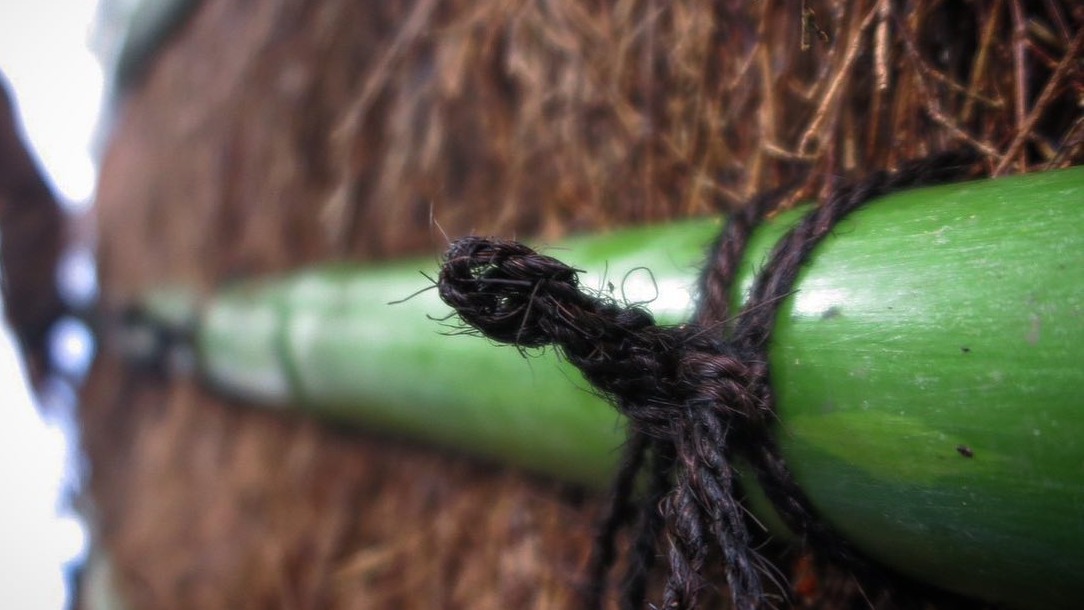
Japanese gardeners do not avoid nails altogether: Kawasaki city’s standard drawing for a bamboo fence nails the rails to the posts. What that drawing, Japan’s national skills test and an Imperial Household Agency repair record all tie in shuro palm-fibre rope is the joint you see — bamboo crossing bamboo — and the knot used there, otoko-musubi (男結び), is described in a North American garden handbook as decorative as well as binding. The sources we checked document that division between nail and rope; none of them explains why rope was first preferred at the crossings.
The exam bench — two bundles of black rope
What the candidate is handed
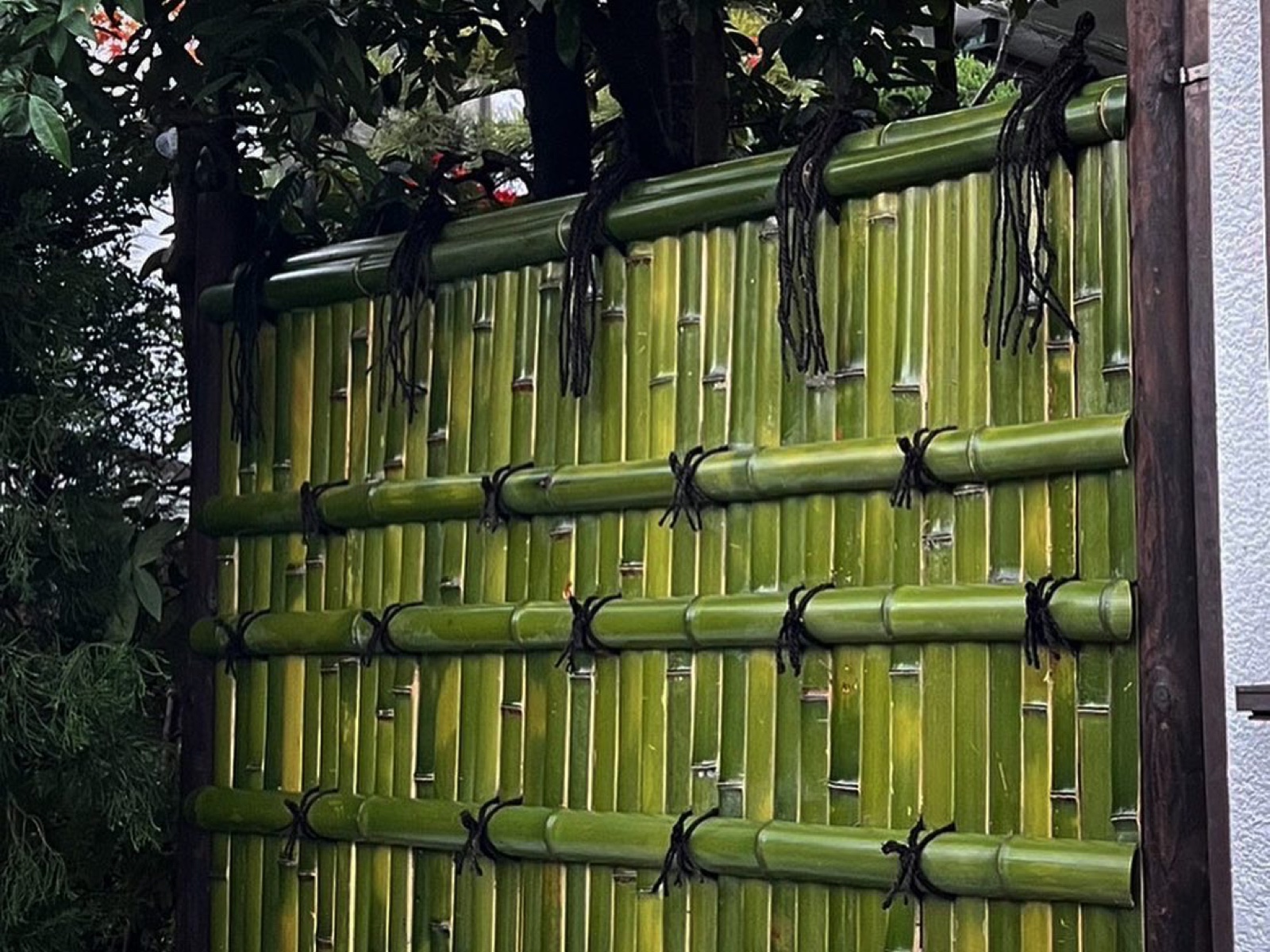
The 2022 second-grade practical paper (Reiwa 4) of Japan’s skills test for landscape gardeners — zōen ginō kentei (造園技能検定) — was compiled by the Japan Vocational Ability Development Association (JAVADA, 中央職業能力開発協会) and published by the Shiga prefectural association. Its materials list sets out what each candidate is given. Among the bamboo and stone: black shuro rope, 3 mm (about 1/8 in) thick, in two bundles of 25 m (82 ft) each.
The task in front of the candidate is a yotsume-gaki (四つ目垣), a “four-eyed” fence: an open lattice of bamboo uprights crossing horizontal rails, the kind that frames a planting rather than hiding it.
What the paper asks for, row by row
The 2022 paper does not leave the knot to the candidate. It says that on the first and third rails each crossing is tied with two strands of rope in ura-ayagake ibo-musubi (裏綾掛けいぼ結び). On the second rail, the rope is used two strands together in karami-musubi (からみ結び), worked from the left. And it fixes the finish: the tails are trimmed to 20 mm (about 3/4 in), measured from the top of the ibo — the knot itself.
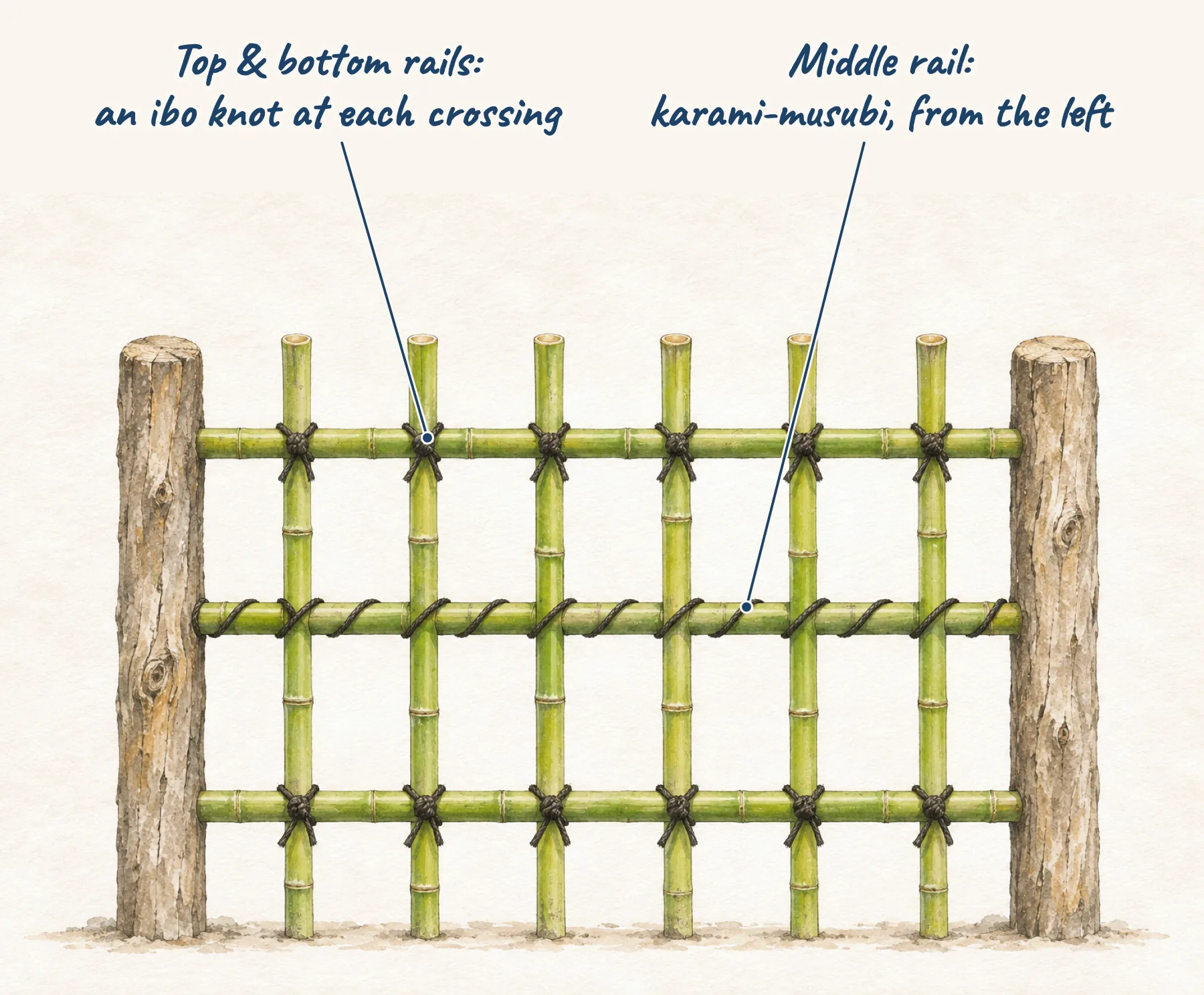
Two details in that wording matter for the rest of this article. First, the paper never uses the word otoko-musubi; it says ibo-musubi. Second, the knot is only half of the instruction. Ura-ayagake describes how the rope is wrapped behind the bamboo before the knot is tied on the front.
Against the clock
JAVADA’s published outline for the 2026 first-half tests (Reiwa 8) still lists a four-eyed fence for second grade, alongside kerbstones, stepping stones and paving, a mound and planting, with a standard time of 2 hours 30 minutes and a cut-off at 3 hours; time over the standard costs marks. The outline does not set out the tying details, and we could not check the current paper itself, so the knot and tail rules above belong to the 2022 paper.
Shuro-nawa — the rope before the knot
Fibre from the sheath of a palm
The rope is shuro-nawa (棕櫚縄), palm-fibre rope. The palm is shuro (シュロ), Trachycarpus fortunei (Hook.) H.Wendl., also called wa-juro (ワジュロ). The medicinal plant garden of Kumamoto University’s pharmacy faculty lists shuro-nawa among the plant’s uses. The fibre is not bark: Okayama University of Science’s plant notes describe the hair-like fibre wrapped around the trunk as the leaf sheaths (葉鞘) of the palm.
The same Okayama notes say the fibre breaks down slowly and hardly rots even when it sits in water. The Japanese Garden Dictionary by Ono Kenkichi and Walter Edwards, published by the Nara National Research Institute for Cultural Properties, translates shuro nawa as “hemp-palm rope” and credits it with “superior water resistance and durability”. Neither source gives a number — no service life in years, no test conditions, no breaking load.
Brown rope and black rope
The dictionary also separates two colours. Rope left in its natural brown is used, it says, for tree supports and straw wrapping; rope “dyed black and called some nawa” (染縄) is used for tying bamboo fences. The skills-test paper’s black rope is consistent with that distinction.
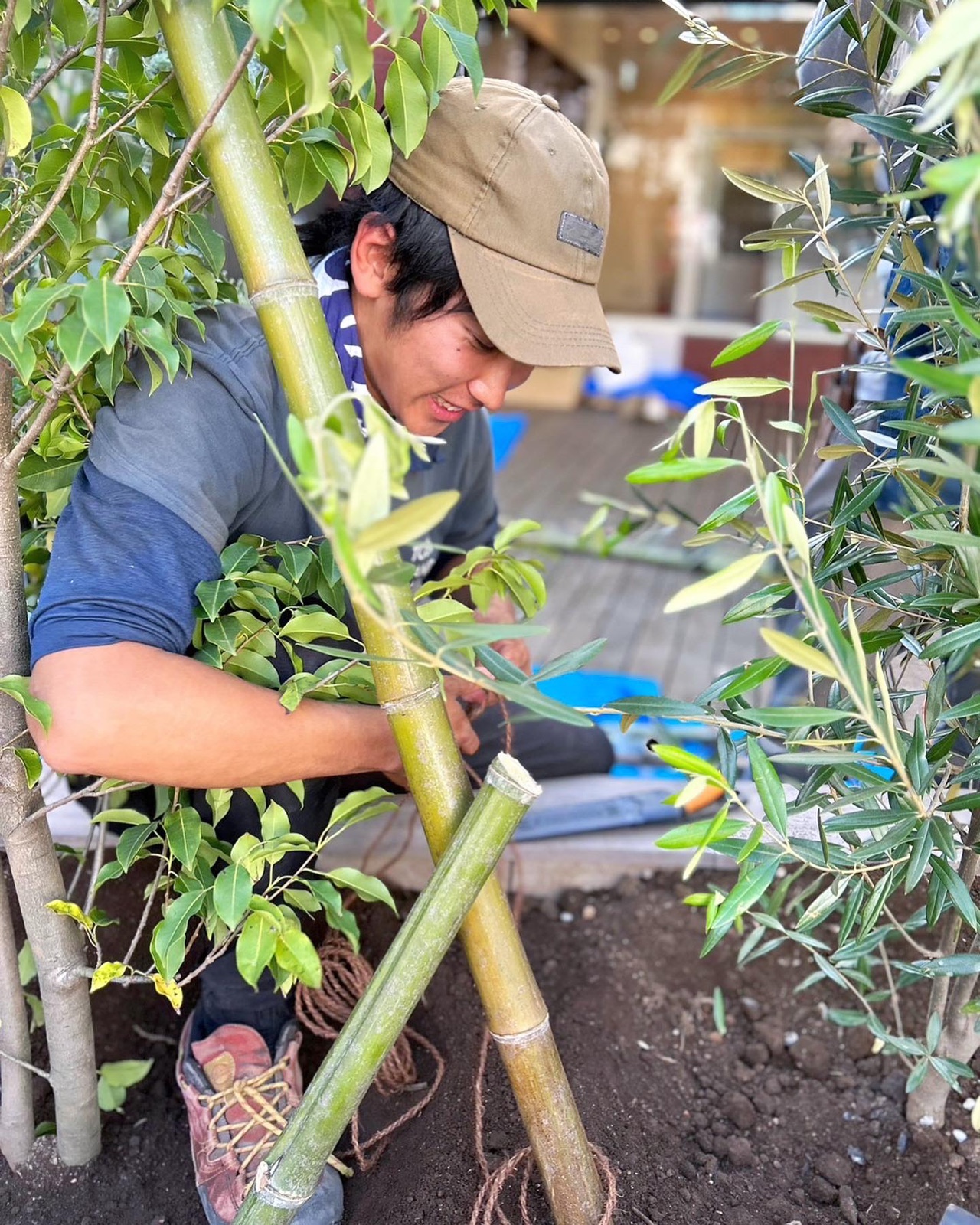
We could not find a primary source that measures whether the black dye changes how long the rope lasts. The distinction in the sources is one of use and appearance.
Where the rope came from
The shuro rope trade has a home in Wakayama Prefecture. A recruitment guide published by the Kainan city job-promotion council traces Kainan’s household-goods industry back to rope, scrubbing brushes and brooms made from palms grown in the Nogami valley (野上谷), an area that takes in the eastern part of former Kainan and part of Kimino town. The same guide says the industry’s raw material moved from shuro to imported palm fibre from Southeast Asia, and then to synthetic fibre.
A chapter on shuro cultivation by Fujita Kazufumi, published through Wakayama University, records that by around 1910 palm fibre from other prefectures and from southern China was also traded. That is history drawn from a trade association’s records, not a picture of today’s market; we found no current figure for how much shuro rope sold in Japan is domestic, imported or blended.
How old is the habit?
The Japanese Garden Dictionary says shuro rope was in use in garden work “by the Muromachi period (sixteenth century)”. We did not check the period source behind that statement, and the date is for the rope, not for the knot. We found no primary source that dates otoko-musubi itself.
What does survive in print is the bamboo fence. A 2024 report by the Japanese Institute of Landscape Architecture’s committee on Japanese garden research notes that Ishigumi Sonō Yaegakiden (石組園生八重垣伝), an Edo-period garden manual by Akisato Ritō, illustrates some 40 designs of bamboo fence. The National Diet Library holds a 1901 edition of the book. Whether the knots drawn in those fences are the same knot taught today cannot be read from the sources we checked, so we leave the knot’s origin open.
One knot, several names — what to call it
Otoko-musubi and ibo-musubi
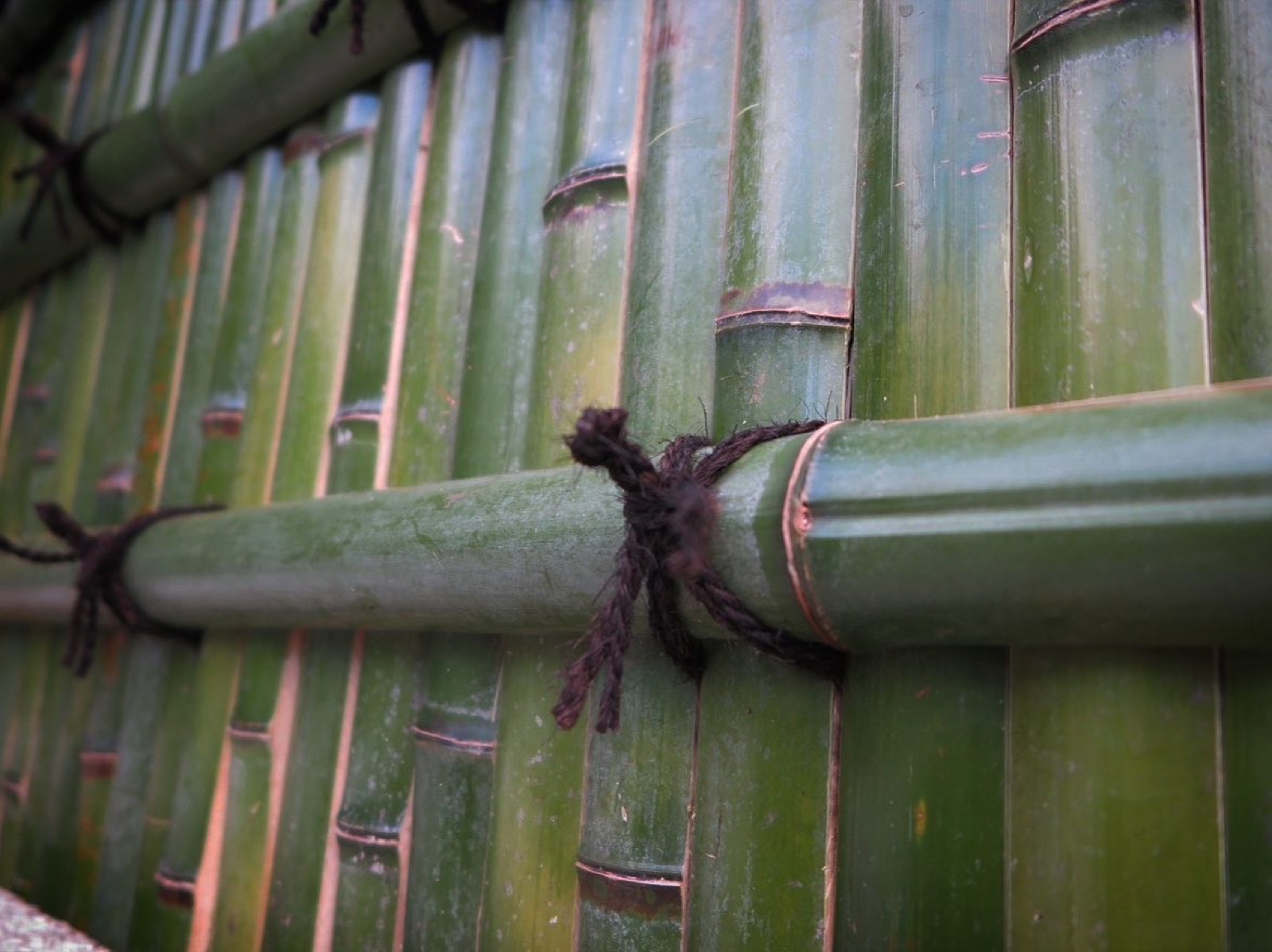
In Japanese garden practice otoko-musubi (“man’s knot”) and ibo-musubi (いぼ結び, “wart knot”) are two names for one knot. Hirakawa city, reporting on a 2021 hedge-building class it ran with professional gardeners, says so in one line: “otoko-musubi is also called ibo-musubi”. The landscape course at Akita Prefecture’s Kanaashi Agricultural High School writes the two names together, “男結び(いぼ結び)”, in its list of practical training.
The skills test uses the ibo name; the Imperial Household Agency’s repair report, as we will see, uses otoko-musubi. In English, the Andrew R. Deane A Japanese Garden Handbook published by the North American Japanese Garden Association calls ibo-musubi also otoko-musubi, “male knot”, and describes it as “a basic decorative knot used to bind bamboo rails”.
What the knot is said to do well
Kanaashi Agricultural High School describes its practical value plainly: the knot is strong, easy to tie, yet hard to undo (強度が強く、結びやすいけれど解けにくい). That is a practitioner’s description, not a test result. We found no study that measures the slip load or breaking load of otoko-musubi in shuro rope against any other knot.
Its relatives on a fence
On a fence the knot is used alongside others. The table sets out the names that appear beside it in the sources we checked.
| Name | Japanese | Where the sources use it | Source |
|---|---|---|---|
| Otoko-musubi / ibo-musubi | 男結び/いぼ結び | Crossings of uprights and rails on four-eyed fences; tree supports; winter protection | Skills test 2022; Imperial Household Agency; Sapporo park association |
| Karami-musubi, also kaizuru | からみ結び/かいづる | Alternate rails of a four-eyed fence | Skills test 2022; Imperial Household Agency |
| Nejiri-ibo-musubi | ねじりいぼ結び | Pressing bars of a kenninji-gaki fence (school build) | Kamo Agricultural and Forestry High School, 2025 |
| Kazari-musubi (tama-kazari) | 飾り結び(玉飾り) | Coping of a kenninji-gaki fence (school build) | Same build |
The Kamo school, in Gifu Prefecture, names nejiri-ibo-musubi — a “twisted” ibo knot — but does not describe it as the same as the plain ibo knot. We found no published diagram that defines how the twisted and decorative forms relate to it, so we treat them as separate knots.
Tying it, step by step — the Sapporo method
Two ends with different jobs
A clear public description of the knot is a one-page feature, “The useful otoko-musubi” (役に立つ男結び), in the November 2017 newsletter (No. 224) of the Toyohira Park Greenery Centre, run by the Sapporo Park and Greenery Association. It introduces the knot for tying tree supports and winter protection, and it names the two ends of the rope: A, the short starting end (初縄), and B, the long working end (元縄).
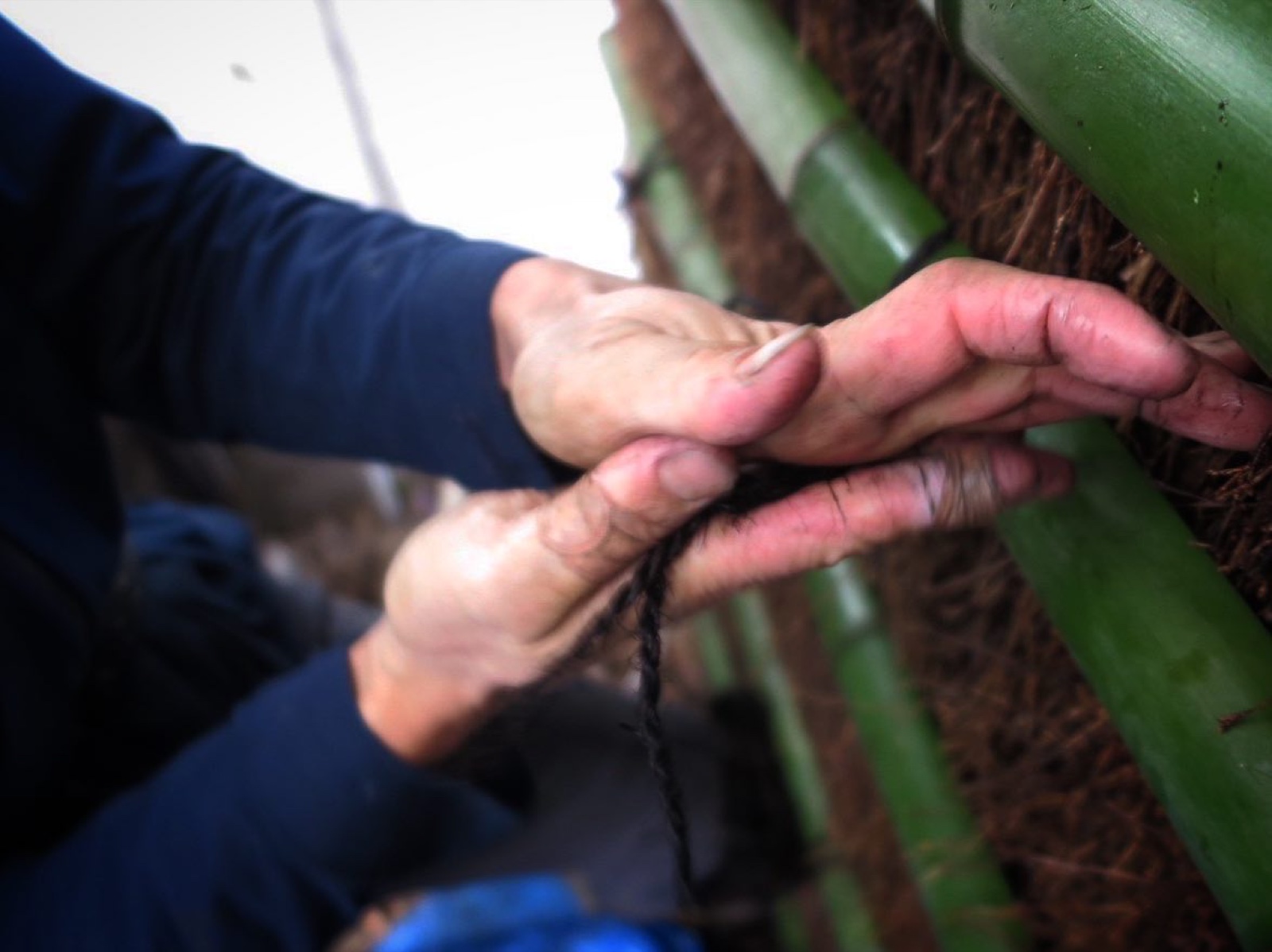
The steps below follow its numbered drawings. Figures 2 and 3 share one caption, so there are seven steps for eight drawings.
The seven steps
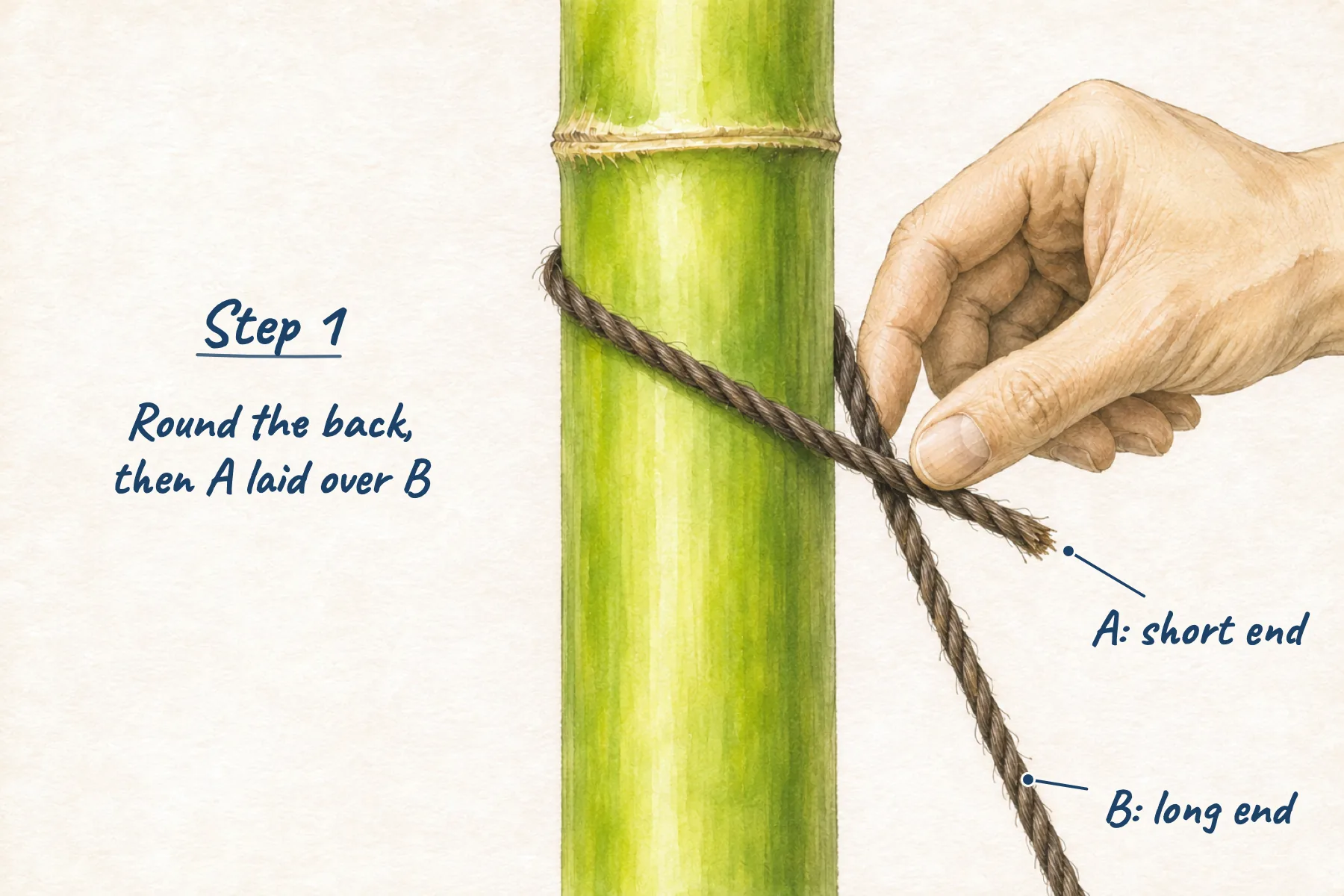
- Go round the work. Take end A round the right-hand side of the object to the back, and bring it out to the front on the left. Lay A over B, and hold the crossing between thumb and index finger.
- Make the loop. Bring B round over the top of A to form a loop.
- Keep A tight. Holding A under tension, take the rope round between the object and your index finger.
- Pass A through. Draw A through the loop made by B, still without letting anything slacken.
- Pinch the crossing. Hold the point where A and B now cross between thumb and index finger.
- Pull it home. Push the near side of the loop outward with your thumb and pull B sharply in one movement to close the knot.
- Trim. Cut both ends to the same length, leaving about 3 cm (1¼ in) from the knot.
Where the tension lives
Read the steps again and one instruction repeats: do not let the rope slacken. Step 1 is held with the fingers, step 3 is done under tension, step 4 is done without letting it go loose, and step 5 pins the crossing before B is pulled sharply in step 6. The rope is kept under tension throughout, and the knot is closed on that final pull. The newsletter’s figures also carry part of the instruction — the direction of each pass — that the captions leave out.
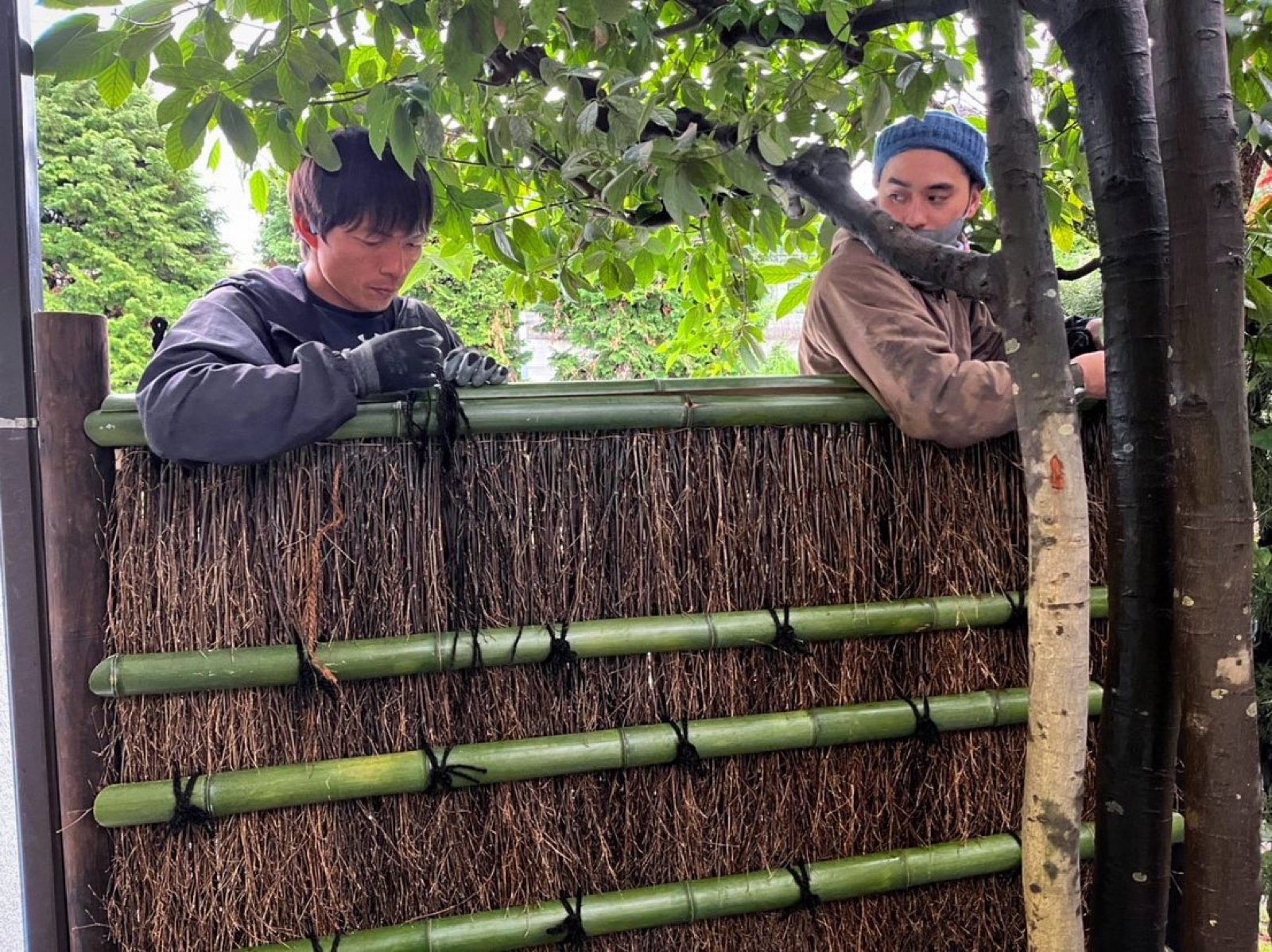
A training-text method — ibo-musubi in nine steps
A training text from the Ministry of Health, Labour and Welfare
Japan’s Ministry of Health, Labour and Welfare publishes vocational training material on its skills website, including a booklet on landscape construction work, Zōen kōji sagyō hen (造園工事作業編). The edition year was not shown on the copy our researcher checked. On pages 12 to 14 it sets out two versions of the ibo knot as tied on a fence rail, as an example of a “post tie” (くい掛け). This is a training text, not the skills test’s own marking procedure, and the steps below are a summary of its text: our researcher read the booklet’s text but did not check every drawing, so the direction of some passes depends on the figures in the original. It uses its own terms for the two ends: the long end (長手) and the short end (短手).
Its method wraps differently from Sapporo’s, so we keep the two apart rather than blend them.
Ura-ni-no-ji ibo-musubi — nine steps
Ura (裏) means “back”, and ni-no-ji (二の字) means “the shape of the character 二” — two parallel strokes. The name describes what the rope looks like behind the bamboo.
- Wrap. Pass the rope from lower right to upper right of the rail, then from lower left to upper left.
- Cross. Change hands between the long end and the short end, and cross them so the short end lies on top.
- Seat the crossing. Hold the base of the crossing and tighten.
- Loop. With the right hand, bring the long end over the short end to make a loop.
- Tighten the base. Hold the loop in the left hand and the short end in the right, pull outward to both sides, and tighten the base of the loop held under the left thumb.
- Tighten once more. Before winding the short end clockwise, pull everything tight once — the booklet’s phrase is musubi o korosu (結びをころす), literally “to kill the knot”.
- Tuck. Feed the short end into the loop from above, and tighten the base where it was wound.
- Shift. Lift the loop up to the right and move the short end to the left of the long end, tightening the base under the left thumb.
- Finish. Keep the left thumb in place and pull the long end towards you to close the knot.
Ura-ayagake ibo-musubi — the crossed back
Ayagake (綾掛け) is a crossed, diagonal wrap. The 2022 skills-test paper named this wrap for the first and third rails. The booklet gives it in five steps that lead into the first:
- Pass the rope lower right, to upper right, to lower left.
- Tuck the short end under the long end.
- Change hands — short end in the left, long end in the right — and tighten in the direction the booklet’s red arrows show.
- Keeping the tension, cross the two ends directly behind the rail.
- Continue with steps 2 to 9 of ura-ni-no-ji above.
Step 3 cannot be followed from text alone: it relies on the booklet’s arrows (p. 14), and we do not guess their direction. Anyone learning this version should work from the original pages.
Three ways of wrapping the back
The Kanaashi high-school course lists three back wraps that are taught alongside the knot: ura-ni-no-ji (裏二の字), ura-ayagake (裏綾掛け) and ura-jūji (裏十字, “back cross”). The knot name alone does not specify the back wrap; the 2022 test paper named both.
Judging the finish — tails, strands and wraps
What changes from one job to the next
The sources we checked do not give one way to finish a tie. They specify it job by job, and the variables are the same each time: which knot, which back wrap, how many strands, how many passes, and how long the tails are.
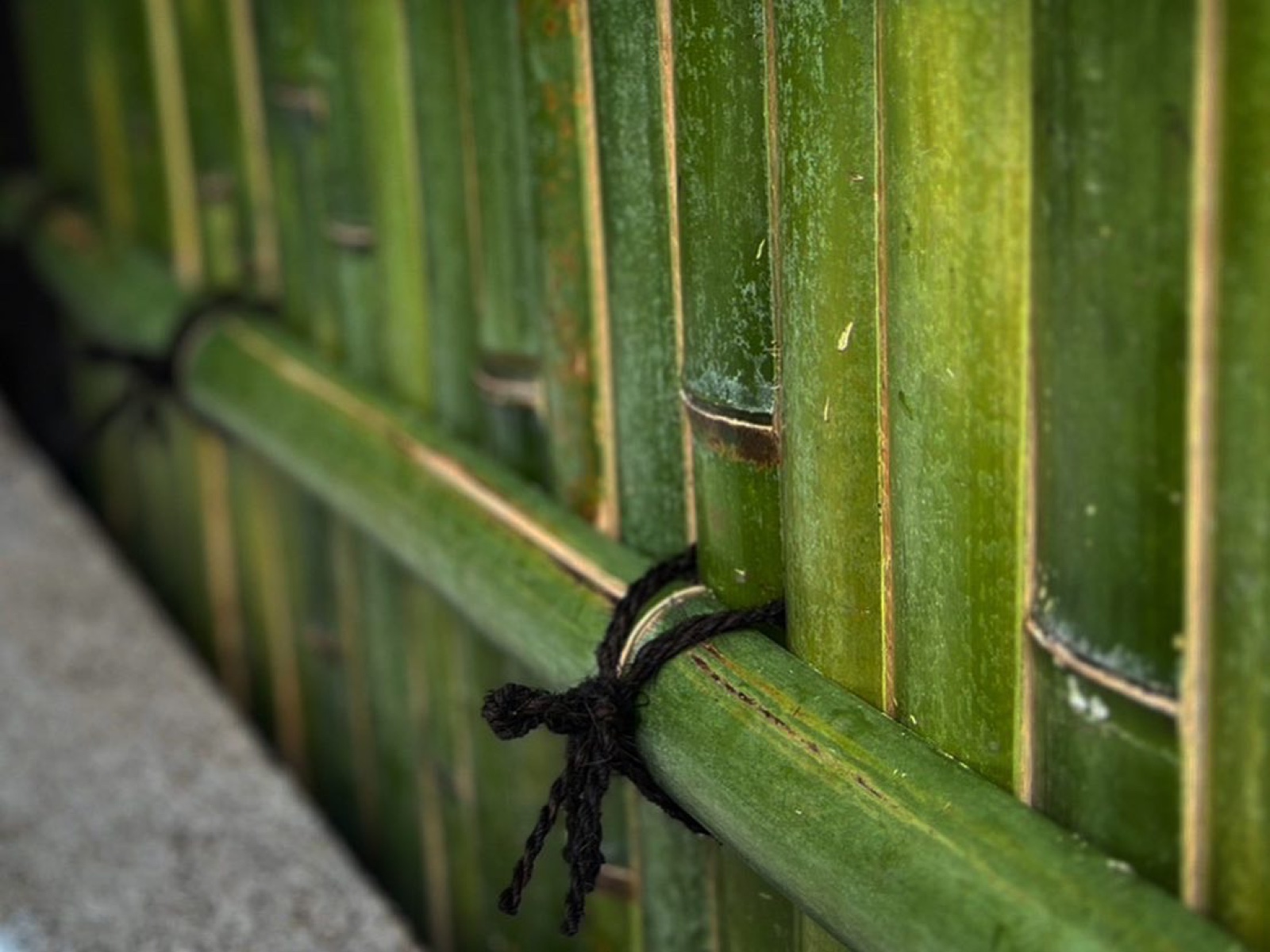
| Source and job | Knot | Wrap | Strands and passes | Tails |
|---|---|---|---|---|
| Skills test, 2nd grade, 2022 — four-eyed fence, rails 1 and 3 | Ibo-musubi | Ura-ayagake | Two strands | 20 mm (about ¾ in) from the top of the ibo |
| Sapporo Park and Greenery Association, 2017 — supports and winter protection | Otoko-musubi | Round the object (step 1) | Not stated | Both ends the same, about 3 cm (1¼ in) |
| Kawasaki city drawing 2203, July 2020 — four-eyed fence | Not named | Ayagake (crossed) | Black rope, two strands | Not stated |
| Akashi city drawing 2-1-7, 2024 — single-pole tree support | Not named | Crossed and split wraps | Two strands; three passes each | Not stated |
Read as a set, the table gives the practical rule: follow the drawing for the job, and where a drawing is silent on a point, decide it before the first tie and keep it the same along the fence. The two sources that state a tail length measure it differently, so the figure only means something with its reference point. Kawasaki’s drawing specifies black rope; the dictionary quoted earlier puts brown rope on tree supports.
Wet the rope first
Kawasaki’s fence drawing adds a note that is easy to miss: soak the rope in water before use (水に浸してから使用). It gives no reason and no soaking time. A Ministry of the Environment regional office, writing up a 2014 workshop for making small New Year kadomatsu decorations, gives a practical one: shuro rope is hard to cinch tight, so dampen it a little before tying.
We found no source that measures what the water does — how much the fibre absorbs, or whether drying makes the tie tighter. The instruction is documented; the mechanism is not.
What we could not find a rule for
We also looked for general rules — that every knot on a fence must face the same way, that the tails must point up, that knots must always be on the front. We looked through the skills-test paper, the ministry booklet, municipal drawings and the Imperial Household Agency report and found individual instructions — tail length, wrap pattern, which rail gets which knot — but no published general rule of that kind. A 2024 report from the Japanese Institute of Landscape Architecture’s research committee is explicit that the spacing of ties on a bamboo fence depends on the space the fence stands in.
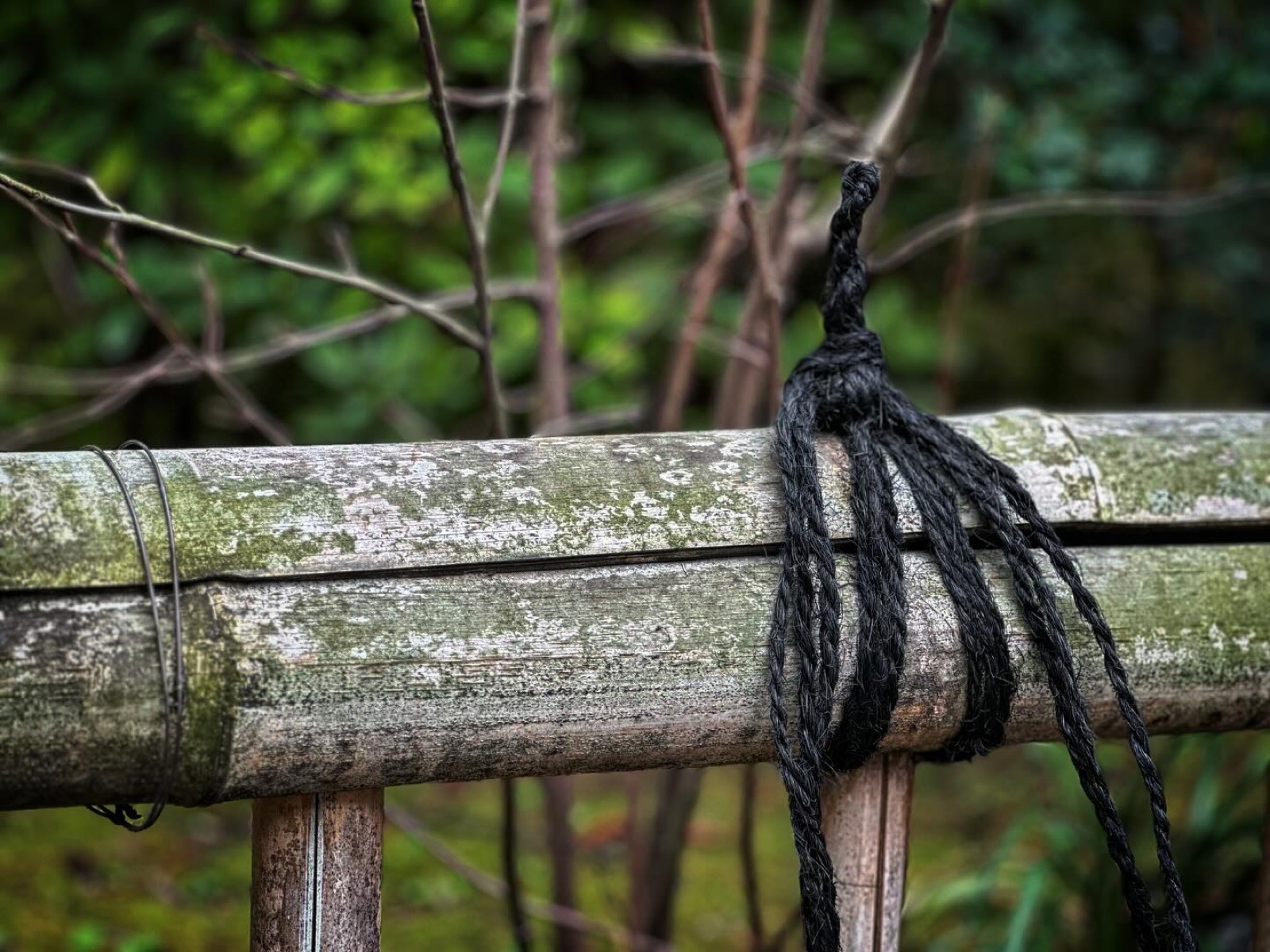
Where the knot goes — fences, supports and palaces
The palace fence at Sento
A detailed record of the knot in use comes from a palace. The Imperial Household Agency’s report on fence repairs at the Kyoto Ōmiya and Sento Imperial Palaces, carried out between November 2019 and March 2020, describes the four-eyed fence around the Yūshin-tei teahouse (又新亭). It was tied with shuro rope, and the report sets out the knots row by row: the first and third rails in kaizuru (karami-musubi), the second and fourth in otoko-musubi.
| Rail | Sento Imperial Palace repair, 2019–20 | Skills test, 2nd grade, 2022 |
|---|---|---|
| 1st | Kaizuru (karami-musubi) | Ura-ayagake ibo-musubi, two strands |
| 2nd | Otoko-musubi | Karami-musubi, two strands, from the left |
| 3rd | Kaizuru (karami-musubi) | Ura-ayagake ibo-musubi, two strands |
| 4th | Otoko-musubi | — |
Both use the same two knots, alternating rail by rail. They simply start on opposite rails. Neither is “the” rule.
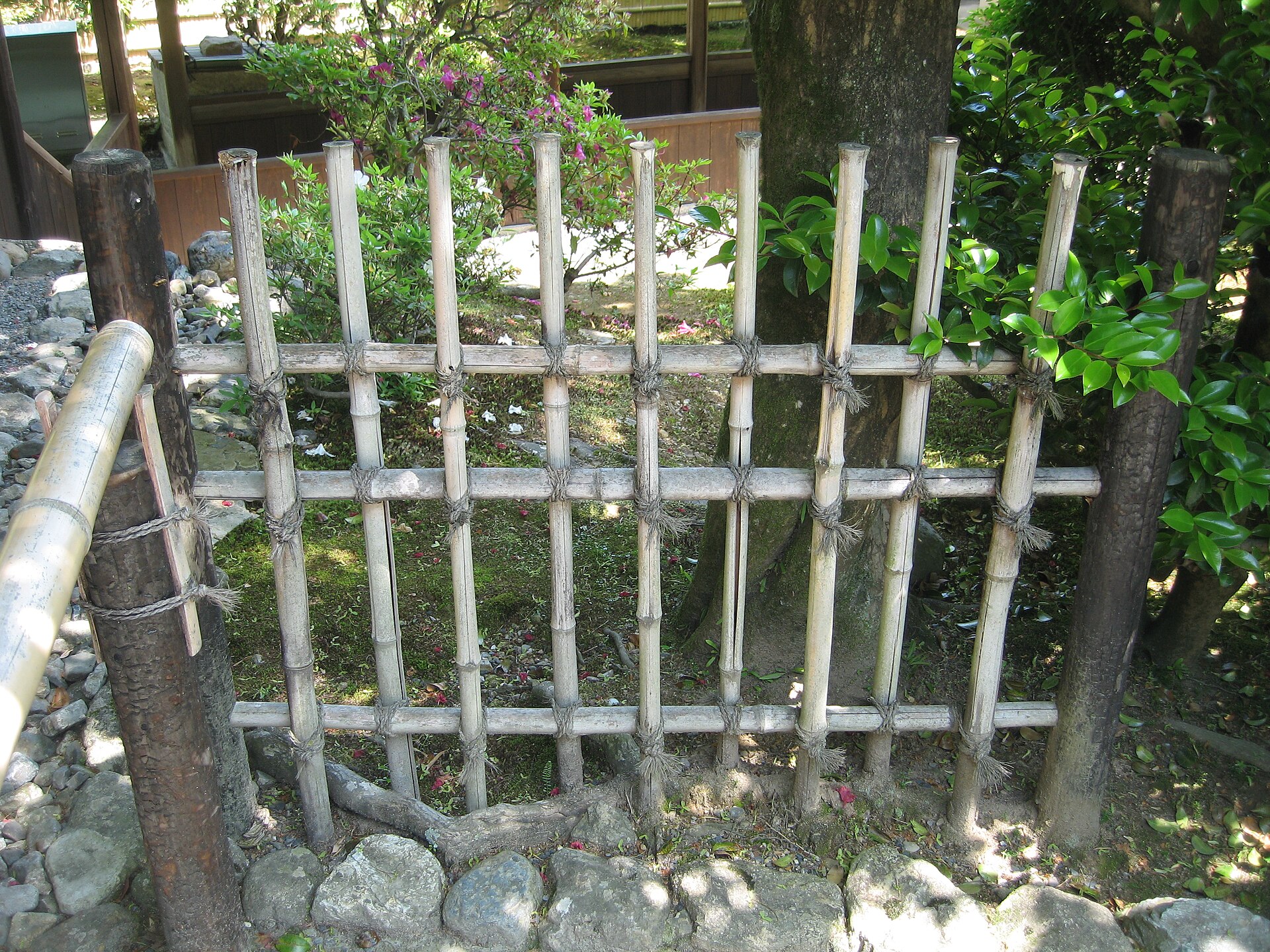
Kenninji-gaki and other solid fences
The Imperial Household Agency describes the kenninji-gaki at Shugakuin Imperial Villa as split bamboo set upright and clamped between half-split bamboo, “tied with shuro rope”; that page names no knot. The Japanese Institute of Landscape Architecture’s 2024 report lists ibo-musubi and karage-musubi (からげ結び) among the basic techniques of the four-eyed fence, and names the decorative knot on the coping as a feature of kenninji-gaki. In the Kamo school’s 2025 kenninji-gaki build, the pressing bars and coping were fixed with nejiri-ibo-musubi and kazari-musubi (tama-kazari). (For the trees of the Japanese garden rather than its fences, see Niwaki vs topiary: what Western gardens get wrong.)
Tree supports and winter work
The same knot ties trees. The Sapporo newsletter introduces it for tree-support ties and winter protection, fuyugakoi (冬囲い). Akashi’s single-pole support drawing shows cedar bark (sugikawa, 杉皮) wrapped round the trunk and shuro rope wound over it in a split wrap. The support types themselves, such as torii and yatsugake, are covered in Japanese tree staking: torii supports vs Western advice, and Japan’s snow ropes in Yukitsuri: how Japan’s snow ropes spread the load.
Rope beside nails — what the drawings actually join
Where metal does go
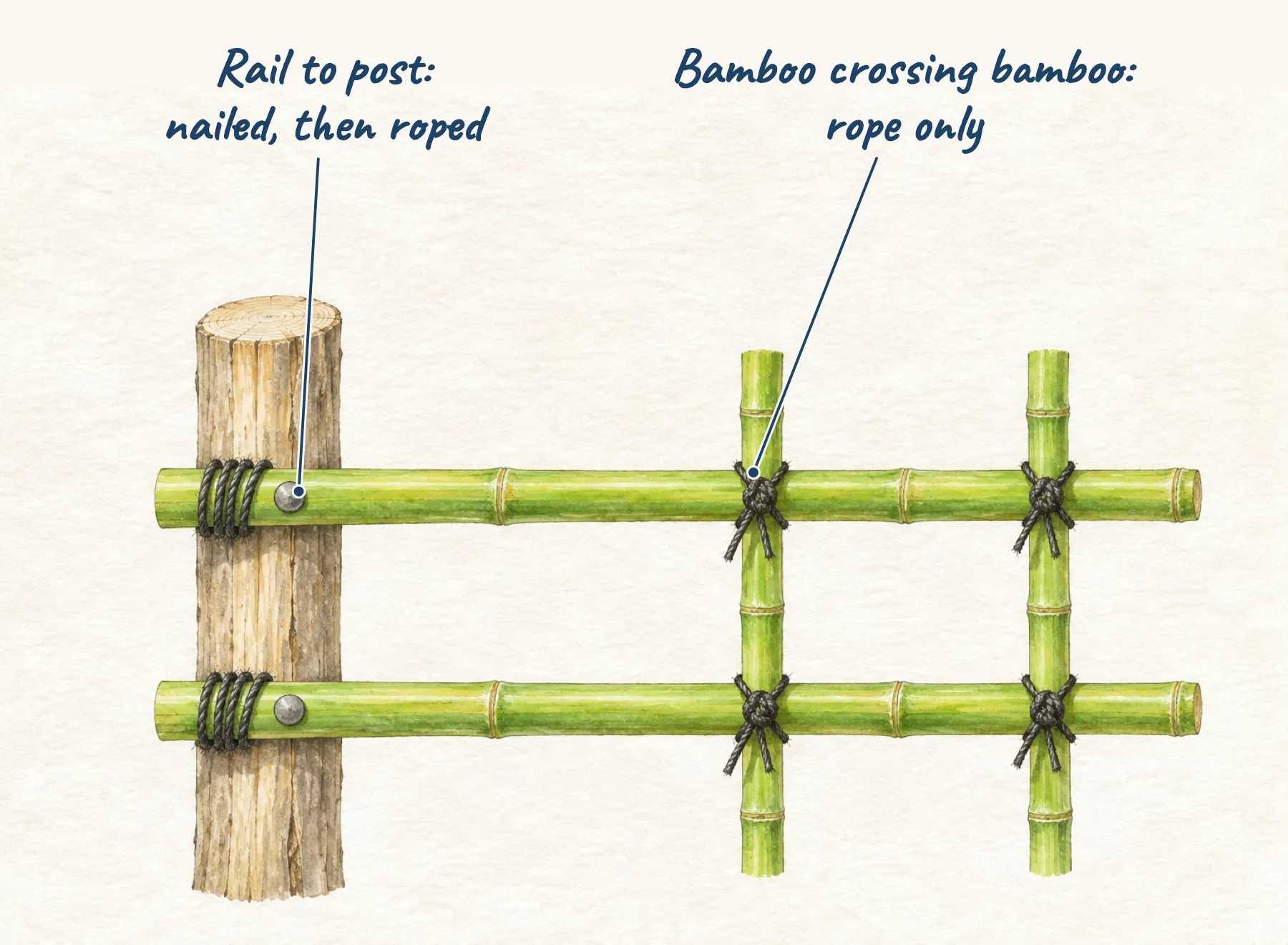
It would be neat to say that Japanese garden fences contain no metal. The drawings do not support it. Kawasaki’s four-eyed fence drawing has the rails nailed to the posts and then bound with palm rope (柱に釘止め、しゅろ縄掛け), while the uprights are tied to the rails with rope.
Where rope stays
What the sources show is narrower: in the drawings, test paper and repair record we checked, the crossing of bamboo over bamboo on the face of the fence is a rope joint. The skills test specifies rope there. The palace repair records rope there. The municipal drawing specifies rope there even while it nails the frame behind. And Deane’s handbook for North American gardeners describes the knot that ties those crossings as decorative.
So the question “why rope, not nails?” has a documented half-answer. The joint people look at is the one tied in rope, with a knot whose finish — tail length, wrap, which rail — is itself written into the test paper. The other half, why each generation of builders made that choice, is not answered directly in any source we found, and we would rather say so than invent a tradition.
The Western knots that look similar
Reef knot and granny knot
The first Western knot to compare is the reef knot. In The Ashley Book of Knots, Clifford W. Ashley describes the reef or square knot, #1204 on page 220, as “two Half Knots, one left and one right”, and the granny knot, #1206 on the same page, as “two identical Half Knots”.
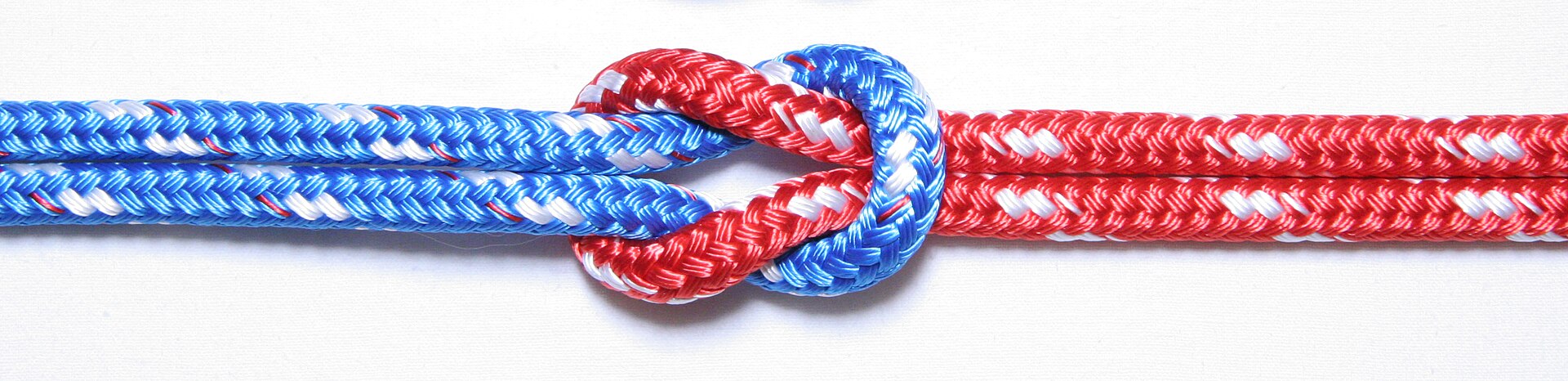
It is tempting to map otoko-musubi (“man’s knot”) onto the reef knot and onna-musubi (“woman’s knot”) onto the granny. A 1991 paper by Koike in a Japanese journal of veterinary anaesthesia and surgery (獣医麻酔外科学雑誌) compared the knot names used in surgical textbooks with the everyday Japanese names, and concluded that the customary otoko-musubi and onna-musubi and the surgical “square” and “granny” knots clearly refer to different knots (異なる結び方を指していることが明らかである). That paper is about surgery, not gardening, and we have not compared the garden knot’s structure with Ashley’s drawings, so it does not prove the two differ. It does show that the English name cannot simply be assumed.
Hitches round a pole
Two hitches in the Western sources are also tied round a pole. Scouting America’s Pioneering merit badge pamphlet (2024 printing) teaches the clove hitch as “composed of two half hitches”; Ashley has it as #1176 and #1177 on page 214. Ashley’s constrictor knot, #1249 on pages 224–225, is described as holding “over a convex surface” with “a ratchetlike grip”. Neither source compares these with a Japanese knot.
Square lashing — the closest job
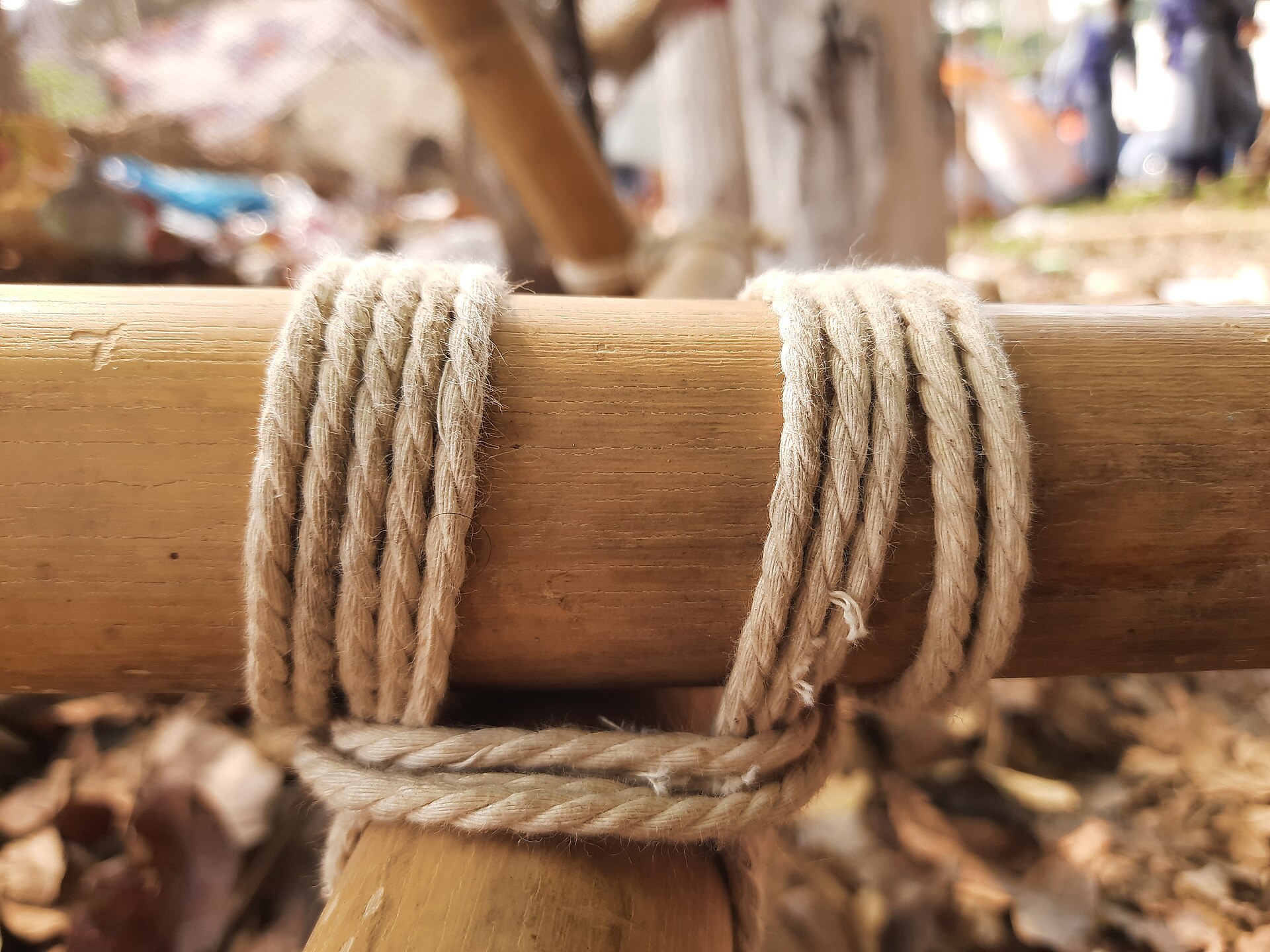
The technique in Pioneering closest in purpose to a fence tie is the square lashing, used where two poles touch and cross at 45 to 90 degrees. Pioneering sets out the clove-hitch version: start with a clove hitch, make three wraps, add two frapping turns between the poles, and finish with a clove hitch. The same pamphlet also teaches a “Japanese Mark II square lashing”, which works both ends of the rope at once and finishes with a square knot. Despite the name, it is not a translation of otoko-musubi.
| Clove-hitch square lashing (Pioneering, 2024) | Ura-ayagake ibo-musubi (skills test, 2nd grade, 2022) | |
|---|---|---|
| Joint | Two poles crossing at 45–90° | Bamboo upright crossing a rail |
| Start | Clove hitch | Crossed wrap behind the rail |
| Body | Three wraps, two frapping turns | The ibo knot tied on the front |
| Finish | Clove hitch | Tails trimmed to 20 mm from the top of the ibo |
| Material named | Rope | Black shuro rope, 3 mm, two strands |
The comparison is about structure as each source describes it. We found no test of which holds better.
Five claims, checked against the sources
| Claim | What the sources show |
|---|---|
| “Otoko-musubi is the Japanese reef knot.” | Not established. Koike (1991) found the everyday and surgical names refer to different knots; no garden-knot comparison was checked. |
| “Ibo-musubi is a different knot.” | Hirakawa city and Kanaashi Agricultural High School give it as another name. Nejiri-ibo and kazari knots are named separately. |
| “The knot name says it all.” | The back wrap (ni-no-ji, ayagake, jūji) is a separate choice. |
| “Japanese fences use no nails.” | Kawasaki’s drawing nails rails to posts; rope ties the crossings. |
| “There is one correct tail length.” | About 3 cm (Sapporo, 2017); 20 mm from the top of the knot (2022 paper). |
Frequently asked questions
What is otoko-musubi?
Otoko-musubi (男結び) is a knot used in Japanese garden work with shuro palm-fibre rope — on bamboo-fence crossings, tree-support ties and winter protection. It is also called ibo-musubi. The Sapporo Park and Greenery Association’s eight drawings are summarised here in seven steps; the 2022 second-grade skills-test paper specified the wrap and the tail length.
Is otoko-musubi the same as a reef knot?
That cannot be assumed. A 1991 Japanese paper comparing knot names found that the everyday Japanese otoko-musubi and onna-musubi and the surgical square and granny knots refer to different knots. Ashley defines the reef knot as two opposite half knots; the Japanese teaching texts describe otoko-musubi by a loop-and-tuck sequence.
What rope do Japanese gardeners use?
Shuro-nawa, palm-fibre rope. University plant notes connect it with the leaf-sheath fibre of the shuro palm, Trachycarpus fortunei; we found no data on the make-up of rope sold today. The Nara institute’s Japanese Garden Dictionary notes its water resistance and durability, and says black-dyed rope (some nawa) is used for bamboo fences and brown rope for tree supports.
Why is the rope soaked before tying?
Kawasaki city’s fence drawing tells builders to soak the rope before use, and a Ministry of the Environment workshop record says shuro rope is hard to cinch tight, so it recommends dampening it slightly. No source we found measured the effect.
Is the knot on the national skills test?
The 2022 second-grade practical paper asked for ura-ayagake ibo-musubi with two strands on the first and third rails of a four-eyed fence, with tails trimmed to 20 mm. The 2026 outline lists a four-eyed fence for second grade and bamboo fences for first and third, but does not give tying details.
Sources
– JAVADA, 2nd-grade landscape gardening practical test paper, 2022 (Reiwa 4), published by the Shiga Vocational Ability Development Association, p. 2 (Japanese; checked 2026-11-17): https://shiga-nokaikyo.or.jp/cms/wp-content/uploads/2023/04/%E4%BB%A4%E5%92%8C4%E5%BA%A6_%E6%8A%80%E8%83%BD%E6%A4%9C%E5%AE%9A2%E7%B4%9A_%E9%80%A0%E5%9C%92_%E5%AE%9F%E6%8A%80%E8%A9%A6%E9%A8%93%E5%95%8F%E9%A1%8C%E3%80%80.pdf – JAVADA, outline of practical test papers, 2026 first half (Reiwa 8) (Japanese; checked 2026-11-17): https://www.javada.or.jp/jigyou/gino/giken/pdf/R08_zenki_jitsugi1.pdf – JAVADA, practical test scoring items and points (Japanese; checked 2026-11-17): https://www.javada.or.jp/ex/jigyou/gino/giken/saitenkoumoku/saitenkoumoku.html – Ministry of Health, Labour and Welfare, Zōen kōji sagyō hen (landscape construction work), pp. 12–14, edition year not shown (Japanese; checked 2026-11-17): https://waza.mhlw.go.jp/shidousya/pdf/zouenkouji.pdf – Sapporo Park and Greenery Association, Toyohira Park Greenery Centre newsletter No. 224, November 2017, “The useful otoko-musubi” (Japanese; checked 2026-11-17): https://www.sapporo-park.or.jp/toyohira/control-panel/wp-content/uploads/2017/11/tayori224.pdf – Imperial Household Agency, report on fence repairs at the Kyoto Ōmiya and Sento Imperial Palaces, 2019–20, p. 62 (Japanese; checked 2026-11-17): https://kyoto-gosho.kunaicho.go.jp/api/reports/b08cf0738f744ed7a48d1dbd9481d55a/file – Imperial Household Agency, “Kenninji-gaki — Shugakuin Imperial Villa” (Japanese; checked 2026-11-17): https://kyoto-gosho.kunaicho.go.jp/garden-detail/4D98 – Kawasaki City, park standard drawing 2203, four-eyed fence, July 2020 (Japanese; checked 2026-11-17): https://www.city.kawasaki.jp/530/cmsfiles/contents/0000071/71088/R03.22.kanrisisetsu.pdf – Akashi City, 2024 tree-maintenance contract specification, drawing 2-1-7 “single-pole support” (Japanese; checked 2026-11-17): https://www.city.akashi.lg.jp/documents/35503/r6-1sekkeisyojumoku.pdf – Hirakawa City, report on the 7th Hirakawa Terakoya hedge class, 2021 (Japanese; checked 2026-11-17): https://www.city.hirakawa.lg.jp/bunka/ibento/hirakawanoterakoya/terakoya_2021_7.html – Akita Prefectural Kanaashi Agricultural High School, landscape and green space course, March 2026 (Japanese; checked 2026-11-17): https://kanano-h.ed.jp/3361/ – Gifu Prefectural Kamo Agricultural and Forestry High School, “Second-year kenninji-gaki build”, February 2025 (Japanese; checked 2026-11-17): https://school.gifu-net.ed.jp/kamo-ahs/gakka/e/pdf/R7.2.18%20kennninnzi.pdf – Japanese Institute of Landscape Architecture, Japanese Garden Research Promotion Committee, report for fiscal year 2024, p. 55 (Japanese; checked 2026-11-17): https://researchpromotion.jila-zouen.org/wp-content/uploads/2025/05/2024_nihonteien_seikahoukoku.pdf – National Diet Library, Ishigumi Sonō Yaegakiden, 1901 edition (Japanese; checked 2026-11-17): https://ndlsearch.ndl.go.jp/books/R100000039-I846174 – Ono Kenkichi, Walter Edwards, Japanese Garden Dictionary, Nara National Research Institute for Cultural Properties, 2010, “shuro nawa” (checked 2026-11-17): https://www.nabunken.go.jp/org/bunka/jgd/pages/HempPalmRope.html – Kumamoto University Faculty of Pharmaceutical Sciences, medicinal plant garden, “Shuro” (Japanese; checked 2026-11-17): https://www.pharm.kumamoto-u.ac.jp/yakusodb/detail/003620.php – Okayama University of Science, plant notes, “Shuro” (Japanese; checked 2026-11-17): https://www1.ous.ac.jp/garden/hada/plantsdic/angiospermae/monocotyledoneae/palmae/syuro/syuro.htm – Kainan City job-promotion council, Kainan Oshigoto Navi No. 1, 2015, p. 1 (Japanese; checked 2026-11-17): https://www.city.kainan.lg.jp/section/contents/iju-turn/files/navi1.pdf – Fujita Kazufumi, chapter 14, “Cultivation and use of shuro as a special forest product”, Wakayama University, p. 287 (Japanese; checked 2026-11-17): https://www.wakayama-u.ac.jp/_files/00636155/Chapter14.pdf – Ministry of the Environment, Chugoku-Shikoku Regional Environment Office, “Mini kadomatsu workshop”, December 2014 (Japanese; checked 2026-11-17): https://chushikoku.env.go.jp/blog/setonaikai/a-takamatsu/index_11.html – Koike (小池壽男), “Names of knots in surgical textbooks” (外科手術書の「結び」の呼称), 獣医麻酔外科学雑誌 22(4): 139–140, 1991 (Japanese; checked 2026-11-17): https://www.jstage.jst.go.jp/article/jvas1989/22/4/22_4_139/_pdf – Clifford W. Ashley, The Ashley Book of Knots, #1176–1177, #1204, #1206, #1249 (checked 2026-11-17): https://archive.org/stream/TheAshleyBookOfKnots/the%20ashley%20book%20of%20knots_djvu.txt – Scouting America, Pioneering merit badge pamphlet, 2024 printing, pp. 17–19, 29–31 (checked 2026-11-17): https://filestore.scouting.org/filestore/Merit_Badge_ReqandRes/Pamphlets/Pioneering.pdf – Andrew R. Deane, A Japanese Garden Handbook, chapter 35, North American Japanese Garden Association, 2017 (checked 2026-11-17): https://najga.org/japanese-gardens-boundaries-and-gates/