

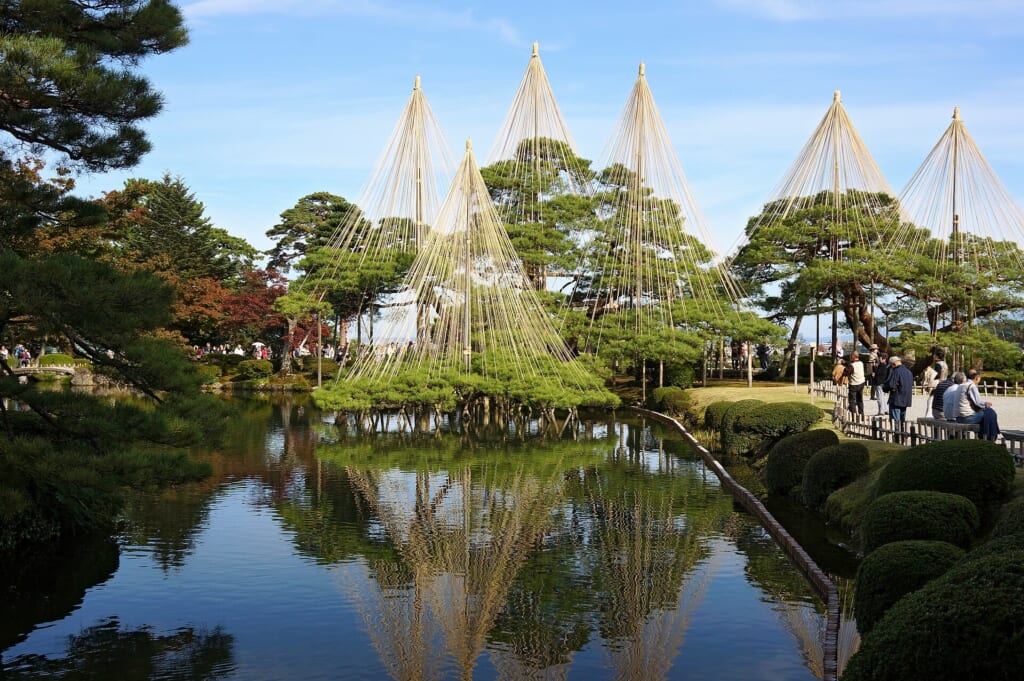
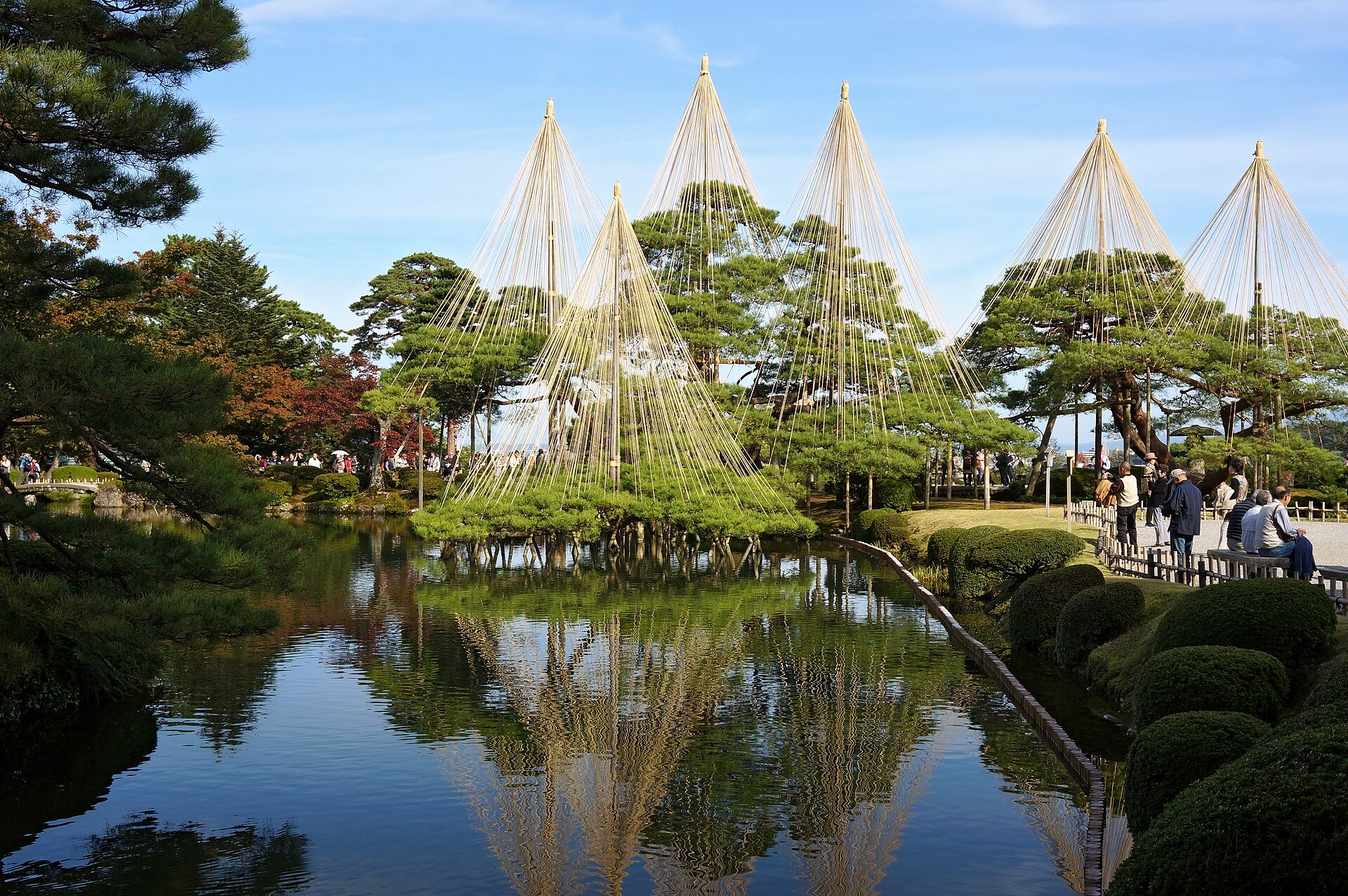
The Karasaki pine (唐崎松, Karasaki-no-matsu) at Kenrokuen in Kanazawa reaches out over Kasumigaike Pond because it has long been kept as a pond-side pine, and each winter the garden hangs its long limbs from five tall poles with about 800 ropes to reduce the risk that Kanazawa’s wet, heavy snow will break them. It is the first tree the gardeners rig every November, and in autumn they prune its pond-side limbs from a boat.
What follows is the life of one tree, from a seed on Lake Biwa to the ropes of this winter, with a look at how Britain and the United States support long limbs.
At the edge of Kasumigaike — the tree you meet first
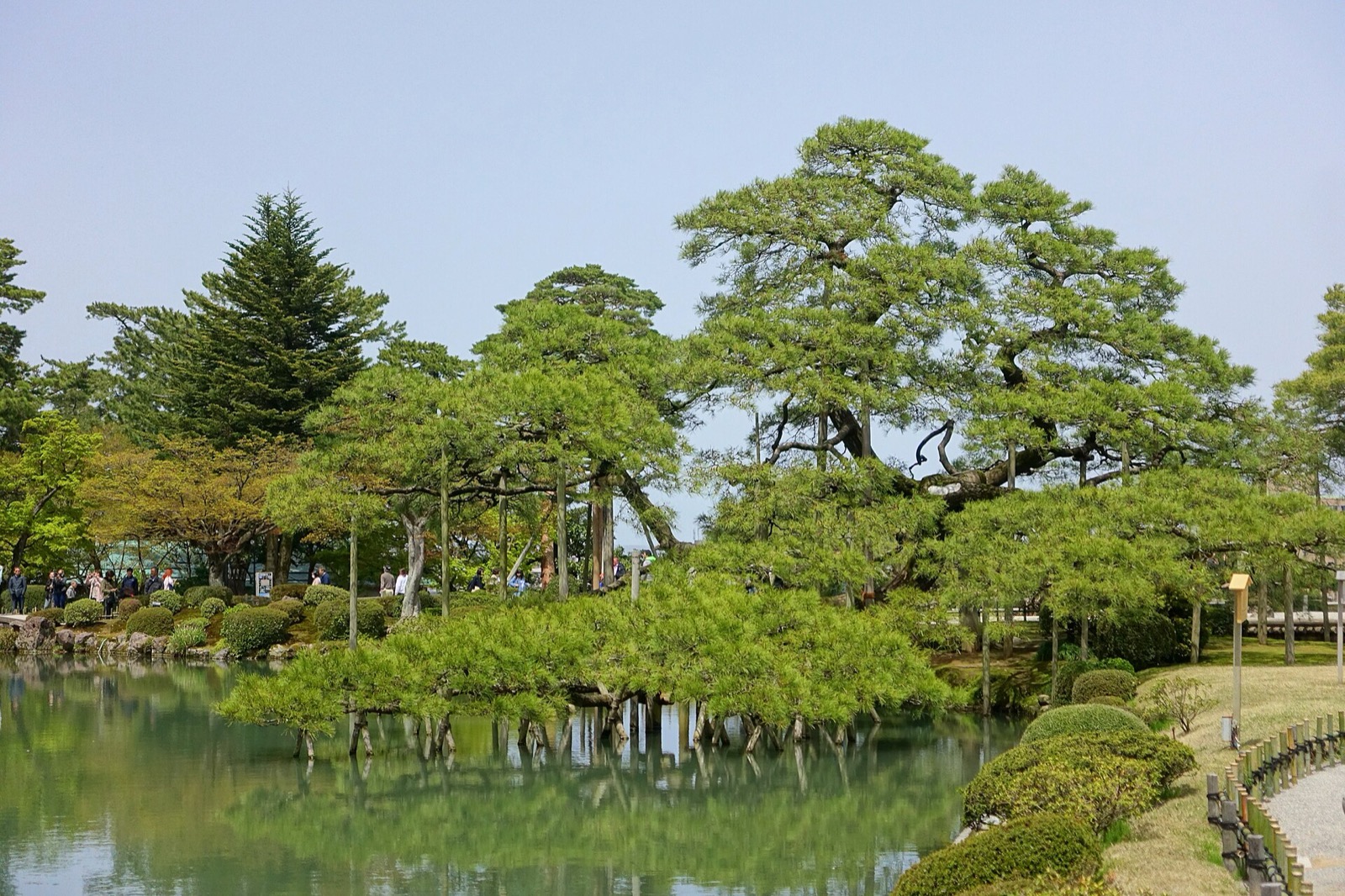
A pine lying along the water
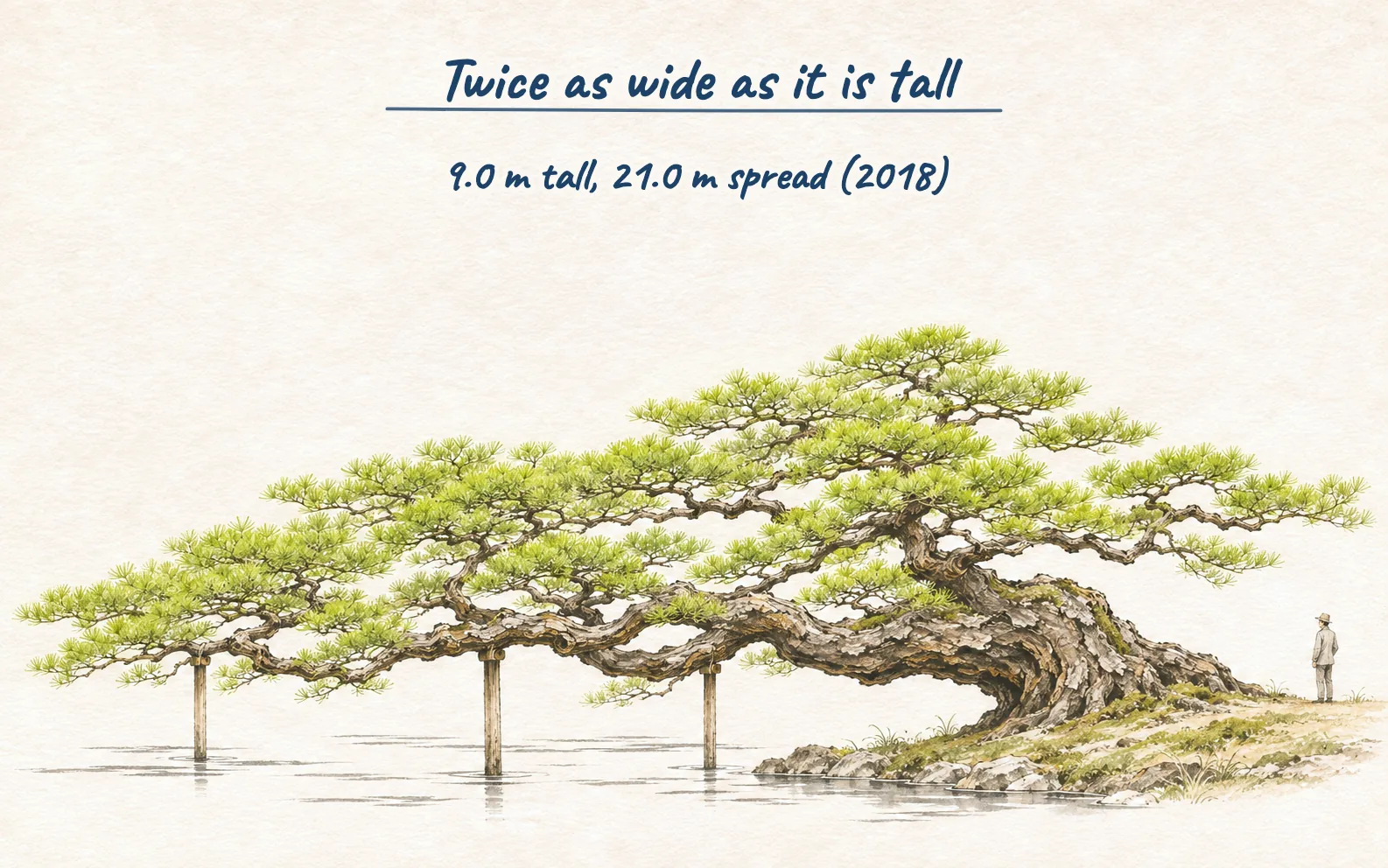
Walk straight up from the Katsurazaka gate toward Kasumigaike, the largest pond in Kenrokuen, and the first thing you see, according to the garden’s tourism association, is the Kotoji lantern. The Karasaki pine stands on the shore of the same pond: a low, wide black pine whose limbs run out over the water instead of rising from it. The pond covers about 5,800 square metres. The garden’s tourism association describes it simply as a pine “stretching its branches over the water”.
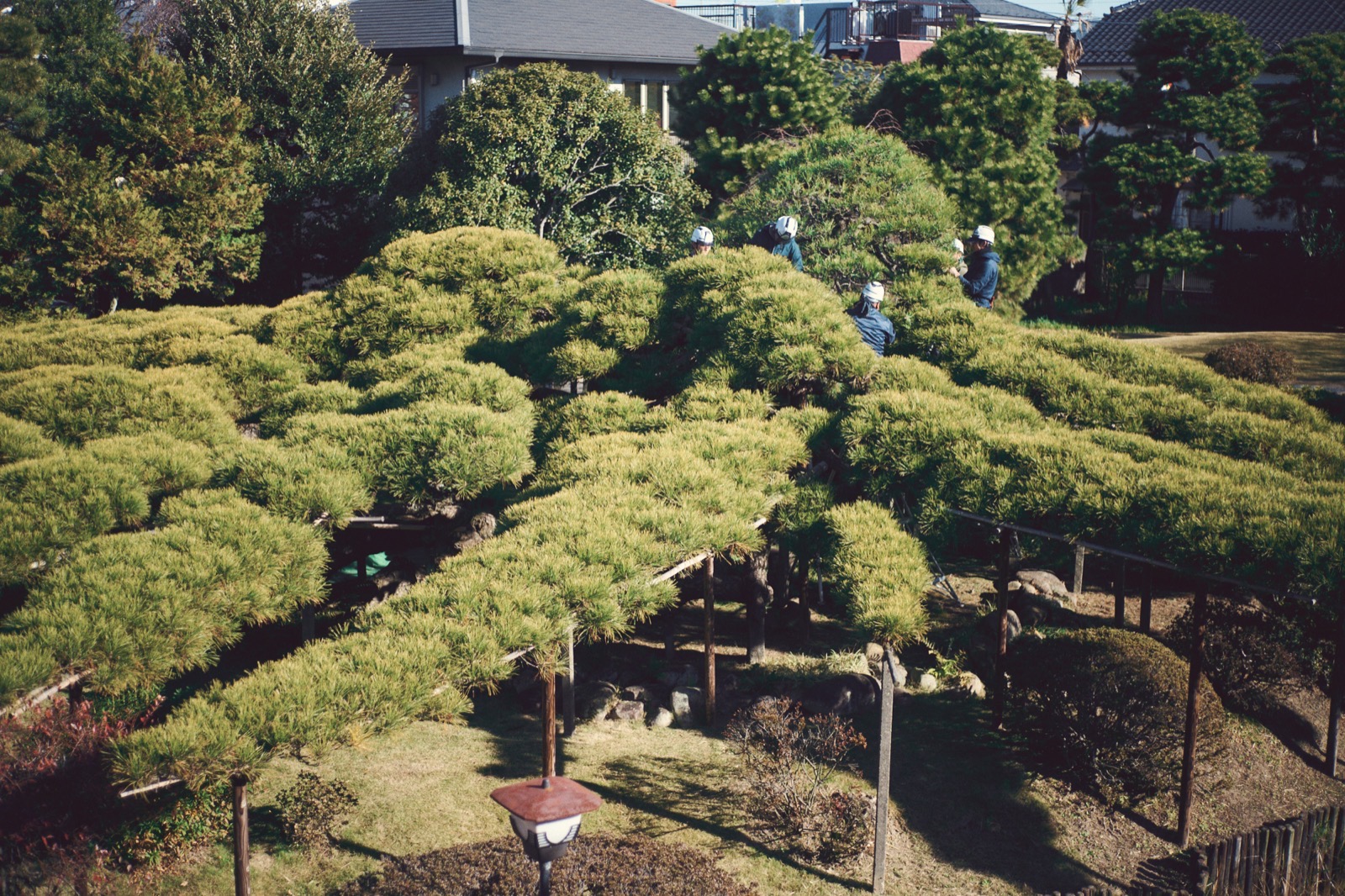
What stops most people is not the height but the spread. In a 2018 document, the Kanazawa Castle and Kenrokuen Management Office gave the tree’s size as 9.0 m tall, with a branch spread of 21.0 m and a trunk girth of 2.6 m. A tree more than twice as wide as it is tall carries much of its weight far from its trunk.
One of nineteen special trees
Kenrokuen has about 8,200 trees. The tourism association ranks 19 of them as tokubetsu meiboku (特別名木, “special named trees”) and 54 as meiboku (名木, “named trees”), and the Karasaki pine is one of the nineteen. Of pines alone, the same page counts about 200 major trees, most of them black pine and red pine.
The association does not publish what the ranking means for day-to-day care. My reading is that, for a tree like this, the form is part of what is being protected, which is why the rest of this article is about keeping a shape as much as keeping a tree.
| The Karasaki pine in figures | Value | Source and year |
|---|---|---|
| Species | Japanese black pine (Pinus thunbergii) | Kenrokuen tourism association |
| Height | 9.0 m (about 30 ft) | Management Office, 2018 |
| Branch spread | 21.0 m (about 69 ft) | Management Office, 2018 |
| Trunk girth | 2.6 m (about 8.5 ft) | Management Office, 2018 |
| Rank | One of 19 special named trees | Kenrokuen tourism association |
| Winter rigging | 5 core poles, about 800 ropes | Ishikawa Prefecture, 2026 plan |
A seed from Lake Biwa — where the name comes from
The pine of Karasaki
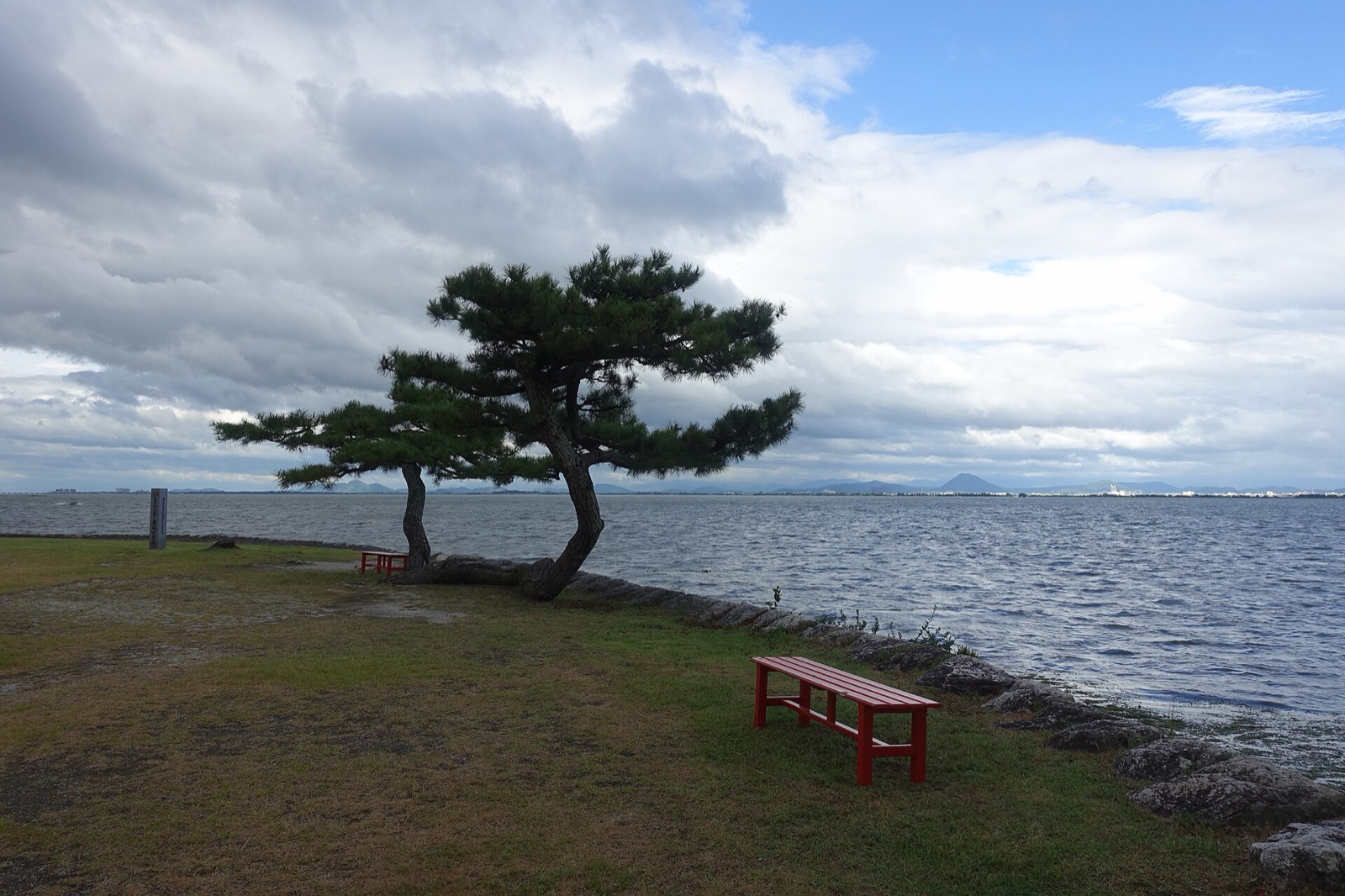
The name is borrowed. Karasaki is on the shore of Lake Biwa in Shiga Prefecture, in the city of Ōtsu, and its pine stands at Karasaki Shrine. The shrine’s own account, published by Hiyoshi Taisha, says that around 633 a man named Kotonomitachi Ushimaru lived at Karasaki, planted a pine in front of his house and called it the nokiba no matsu, “the pine at the eaves”. That is a shrine tradition, not a dated record, and it is the first generation in the shrine’s counting.
The place was already old in poetry. The shrine quotes a poem by Kakinomoto no Hitomaro from the Man’yōshū that names “Karasaki of Shiga”, and a haiku by Matsuo Bashō: Karasaki no / matsu wa hana yori / oboro nite, roughly “the pine of Karasaki, hazier than the blossoms”. In Bashō’s verse the pine is seen dimly, less distinct than the flowers.
Night rain at Karasaki
At the start of the Edo period, according to Shiga Prefecture, the court noble Konoe Nobutada is said to have chosen eight views seen from Zeze Castle, modelled on the Chinese “Eight Views of Xiaoxiang”, and to have written waka poems on them. These became the Ōmi Hakkei (近江八景, the Eight Views of Ōmi), and one of them is Karasaki no yau (唐崎夜雨), “Night Rain at Karasaki”. The scene is the shrine’s pine in the rain after dark, and the shrine still introduces itself as the scenic spot known for that view.
The shrine’s account says the second-generation pine was planted in 1591, and the dates suggest it was this tree that Utagawa Hiroshige drew. The Shiga Prefectural Library holds a print titled Karasaki yau from his series on the Eight Views of Ōmi, dated 1857. The Shiga Cultural Properties Protection Association, writing about the shrine, describes what the prints show: limbs reaching out over the lake and “many pillars” holding them up.
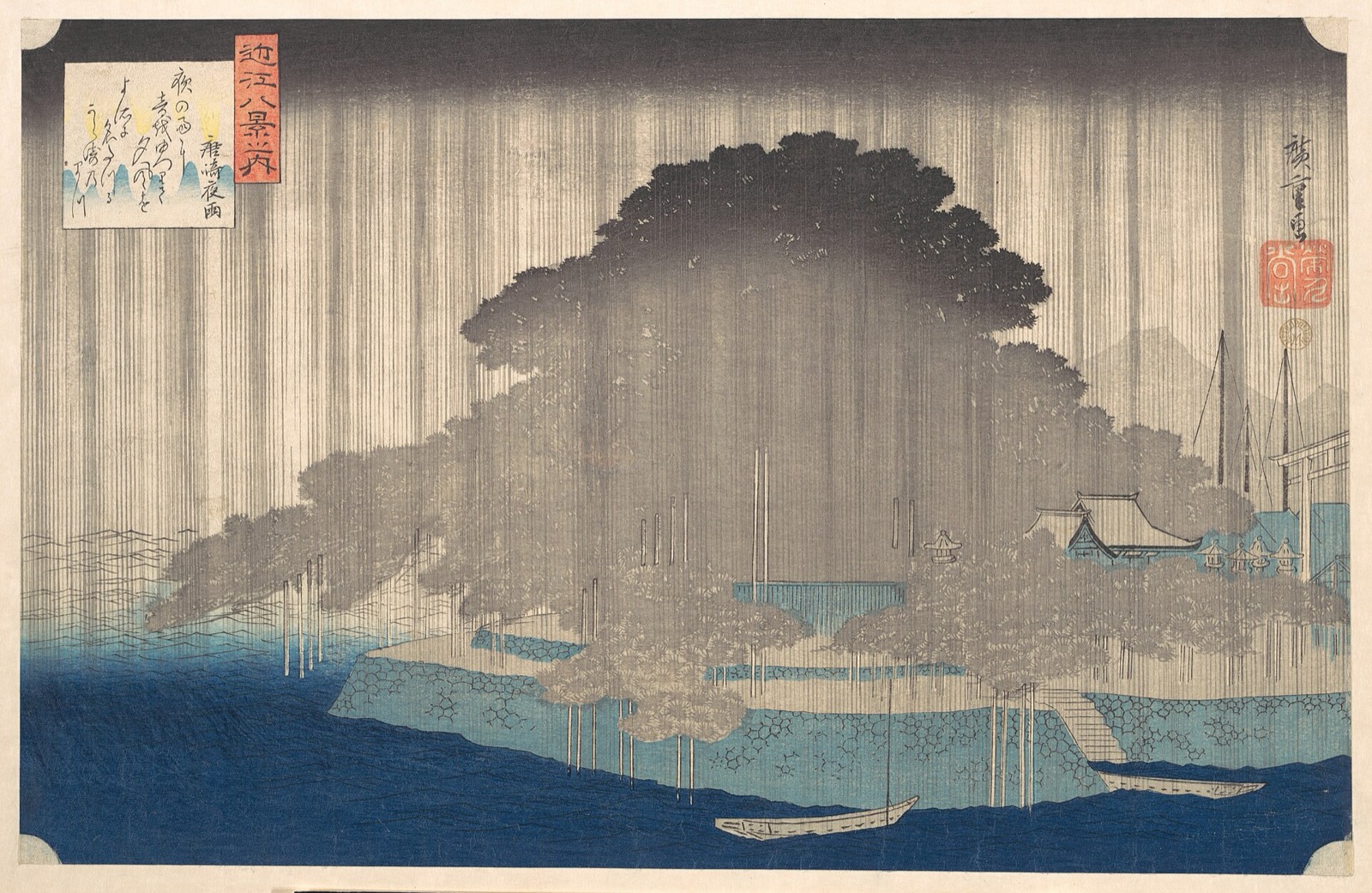
A lakeside tree on timber props
Those pillars were real and they needed work. The Shiga Prefectural Archives record that in 1884 a total of 27 tsuegi (杖木, timber props for the limbs; literally “walking-stick timbers”) under the second-generation pine were to be replaced. So the pine whose seed would travel to Kanazawa came from a famous tree that was itself long-armed, low over water and propped on timber.
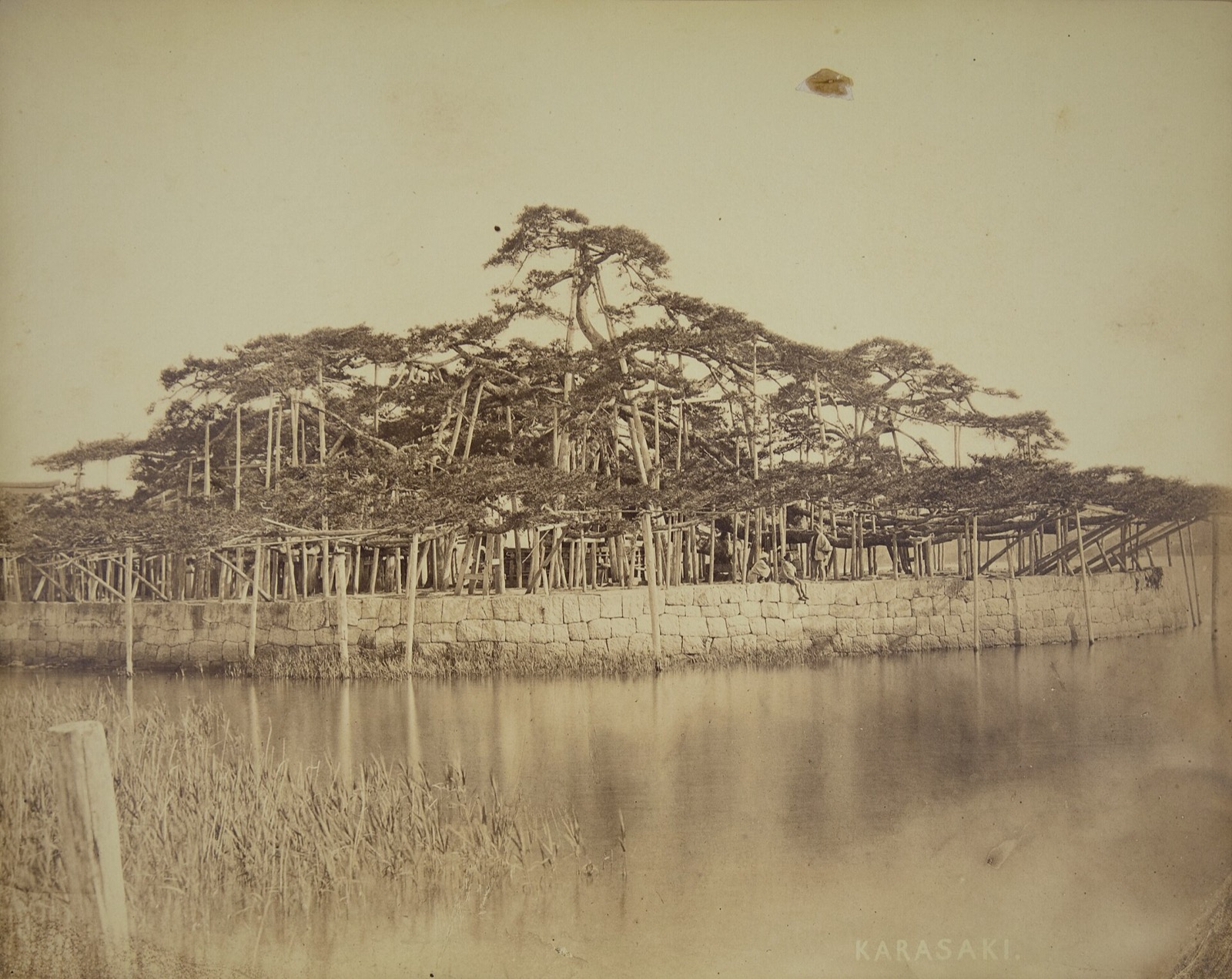
The second generation died in 1921, according to the shrine, which held a ceremony to transfer its spirit, and the third pine took on the role. The protection association adds that the present tree does not have the limbs over the lake or the forest of posts in Hiroshige’s prints. The shrine says the third pine has also weakened, and a fourth, grown from the third’s seed, has been planted on the north side.
| Karasaki Shrine, Ōtsu | Kenrokuen, Kanazawa | |
|---|---|---|
| What stands now | Third-generation pine (shrine’s count), with a fourth grown from its seed | One black pine grown from seed sent from Karasaki |
| Setting | Lakeshore of Lake Biwa | Shore of Kasumigaike, a garden pond |
| Long limbs over water | Shown in Hiroshige’s 1857 print; not present on today’s tree (Shiga protection association) | Present today |
| Recorded supports | 27 tsuegi to be replaced in 1884, on the second generation | Five seasonal poles and about 800 ropes each winter (2026 plan) |
The lord who sent for a seed — Maeda Nariyasu and the widened pond
Forty-four years at the castle
Maeda Nariyasu (前田斉泰), the 13th lord of the Kaga domain, was born in 1811 and died in 1884, according to the Ishikawa Prefectural Library. The prefecture’s conservation plan for Kanazawa Castle gives his years as lord of the castle as 1822 to 1866, forty-four years. His reign covers the decades in which Kenrokuen took the form visitors see now.
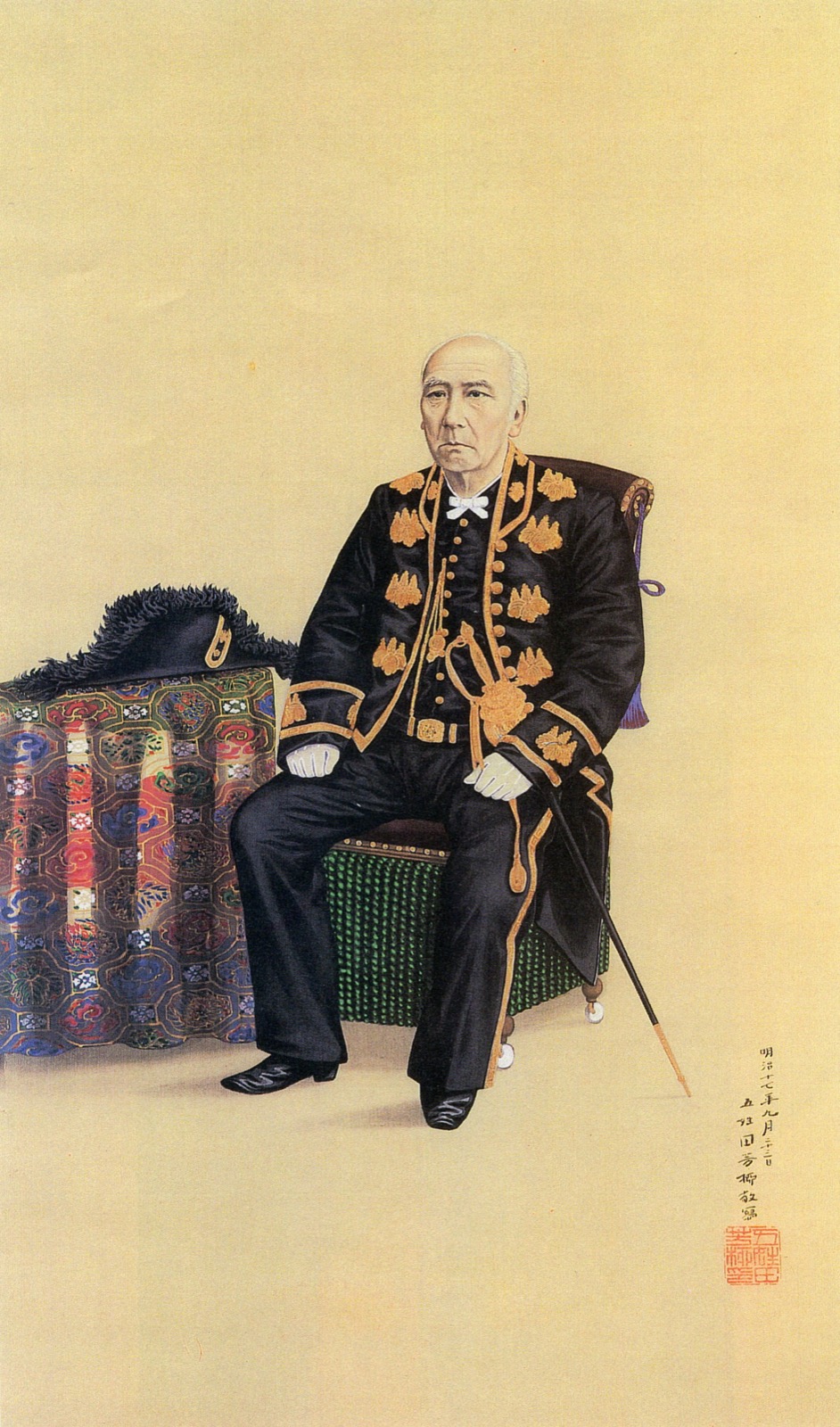
The garden is older than he is. The Management Office dates its beginning to 1676, when Maeda Tsunanori, the 5th lord, built a villa near the castle and turned its surroundings into a garden, the Renchi-tei. In 1822 the 12th lord, Narinaga, built a retirement palace, the Takezawa Goten, and that same year the garden received the name Kenroku-en. The name refers to six qualities (六勝, rokushō) that a garden rarely combines: spaciousness, seclusion, human artifice, antiquity, water features and panoramic views.
Digging the pond, planting the shore
Nariyasu remade the ground. The Management Office’s history says he widened Kasumigaike and planted trees of good form, extending and refining the garden; in 1860 he removed the gate and wall that had separated it from the older Renchi-tei.
The same lord is credited with other trees. The tourism association says the Neagari pine, whose more than forty roots appear to rise from the soil, is said to have been planted by Nariyasu. The Karasaki pine is another of his trees: according to the tourism association, it is a black pine that Nariyasu grew from seed sent from Karasaki on the shore of Lake Biwa.
A Lake Biwa island in a Kanazawa pond
There is a second echo of Lake Biwa on the pond. Kasumigaike has a small island in the shape of a turtle, Hōraijima, and the tourism association notes that it is said to be likened to Chikubushima, the island in Lake Biwa. The sources do not say whether the island and the pine were planned as a pair, so I will not claim it. Both now belong to the same pond: a lake island in miniature, and a pine whose parent tree stood on that lake.
Kenrokuen was designated a national Place of Scenic Beauty on 8 March 1922 and a Special Place of Scenic Beauty on 20 March 1985, according to the Agency for Cultural Affairs. The pine stands inside that designated garden.
A child, not a copy — what growing from seed means
Seedling versus graft
“Grown from seed” sounds romantic, and it is also a precise horticultural statement. The Karasaki Shrine account calls the Kenrokuen tree a mishō (実生), a seedling, of the second-generation Karasaki pine. A seedling is the offspring of its parent, not a clone of it.
Japan’s Forest Tree Breeding Center (part of the Forestry and Forest Products Research Institute) makes the distinction in two places. Its catalogue of improved varieties warns that each seedling raised from seed will not necessarily have the same characteristics as the parent. Its genetic-resources journal separates seedlings from asexual propagation (grafting, cuttings, layering, root division) and treats the asexual methods as the way to keep a tree’s genes as clones.
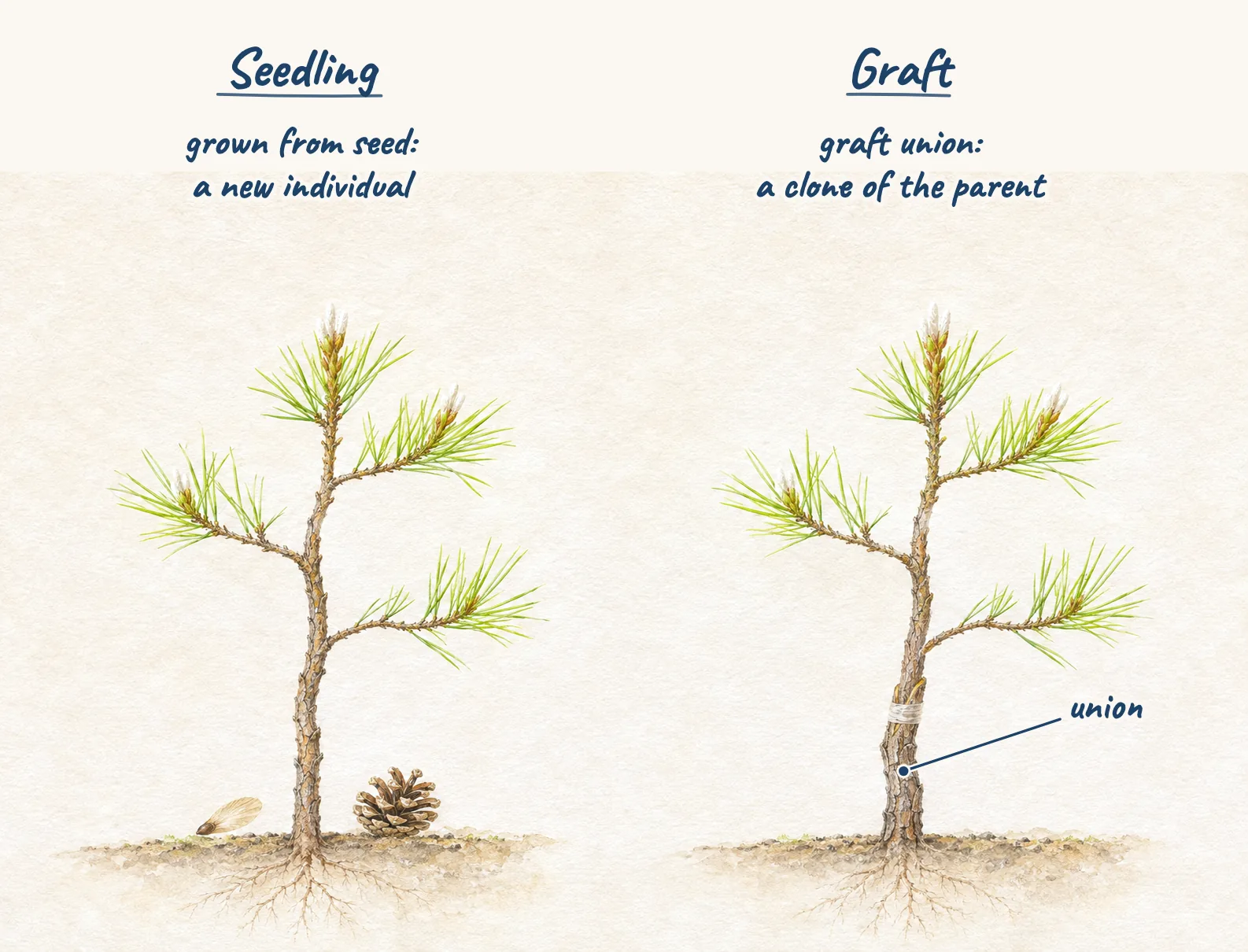
So the Karasaki pine at Kenrokuen is a child of the Karasaki pine that Hiroshige drew, not the same tree carried north. Its long horizontal limbs cannot be explained by inheritance alone; where it was planted and how it has been tended are likely to have shaped them too.
How old is it?
No source I could open gives a planting year, and published ages disagree. The Kenrokuen tourism association says about 180 years. Ishikawa Prefecture’s official note in 2025 said about 190 years. The Japan Tree Doctors Association’s tree data says 170 years. Each figure fits a planting sometime during Nariyasu’s long reign, but none of them is backed by a dated planting record that I could find.
This article therefore does not give the tree an age. Readers who see a precise figure on a travel site should read it as an estimate. The same caution applies to the branch spread: the 2018 document gives 21.0 m, while the prefecture’s 2025 note gave 26 m, without saying how either was measured.
| What is often said | What the sources support |
|---|---|
| “A cutting of the Lake Biwa pine” | Grown from seed (mishō), so a descendant, not a clone |
| “Planted in 18xx” | No planting year found in a primary source |
| “Exactly 180 years old” | Estimates of 170, about 180 and about 190 years, from three bodies |
| “Spread of 21 m” | 21.0 m in 2018; 26 m in a 2025 prefectural note; method not stated |
Why it reaches for the water — a black pine shaped by design
What an old black pine does on its own
Black pine is a coastal tree. The Kansai branch of the Forestry and Forest Products Research Institute describes it as native near the coasts of Japan from the Kantō region westwards. Its Kyushu branch adds a detail that explains a great deal about garden pines: the crown is usually conical, but in old trees the branches thicken, open horizontally and form an umbrella shape.
That is a tendency of old trees, not of every tree. The garden’s documents that I could open do not record how this pine was trained over the years, but its present form matches that habit of age, turned toward the water.
Nagashi-matsu — the flowing pine
Japanese garden design has a name for a pine placed this way. The Japanese Garden Dictionary of the Nara National Research Institute for Cultural Properties defines nagashi-matsu (流松, “flowing pine”) as a key tree planted near a pond with its branches hanging over the water. By that definition the Karasaki pine reads as a flowing pine, though I have not found a garden document that classes it that way. Its reach toward Kasumigaike is part of the view, not a fault to be corrected.
Our article on why Japanese garden pines lean on crutches follows the same idea through other gardens, including the posts called hōzue. Here the point is narrower: at Kenrokuen, the flowing pine stands on the shore of a pond that its own planter dug wider.
Length is what makes a limb heavy
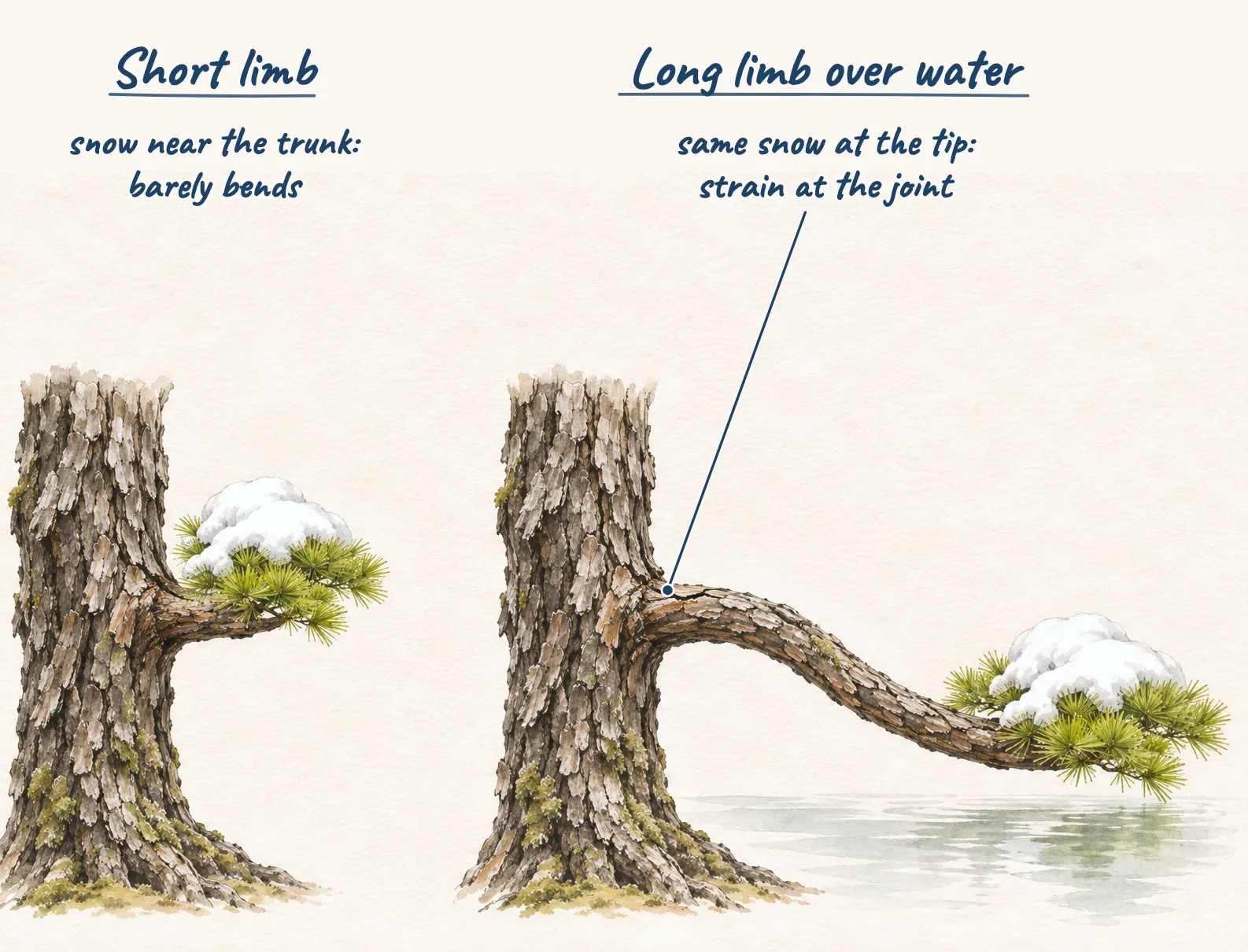
The design has a cost. Japan’s National Institute for Land and Infrastructure Management (NILIM), in its guidance on preventing street-tree failure, states that the bending moment that causes a branch to break becomes larger the longer the branch is and the more load sits towards its tip.
A limb that runs out over water is long on purpose, and it carries its foliage far from the trunk. Add snow to that foliage and the load sits exactly where it does the most harm. Everything the gardeners do to the Karasaki pine in winter follows from that one sentence.
The weight of a Kanazawa winter — wet snow on a long lever
Not powder
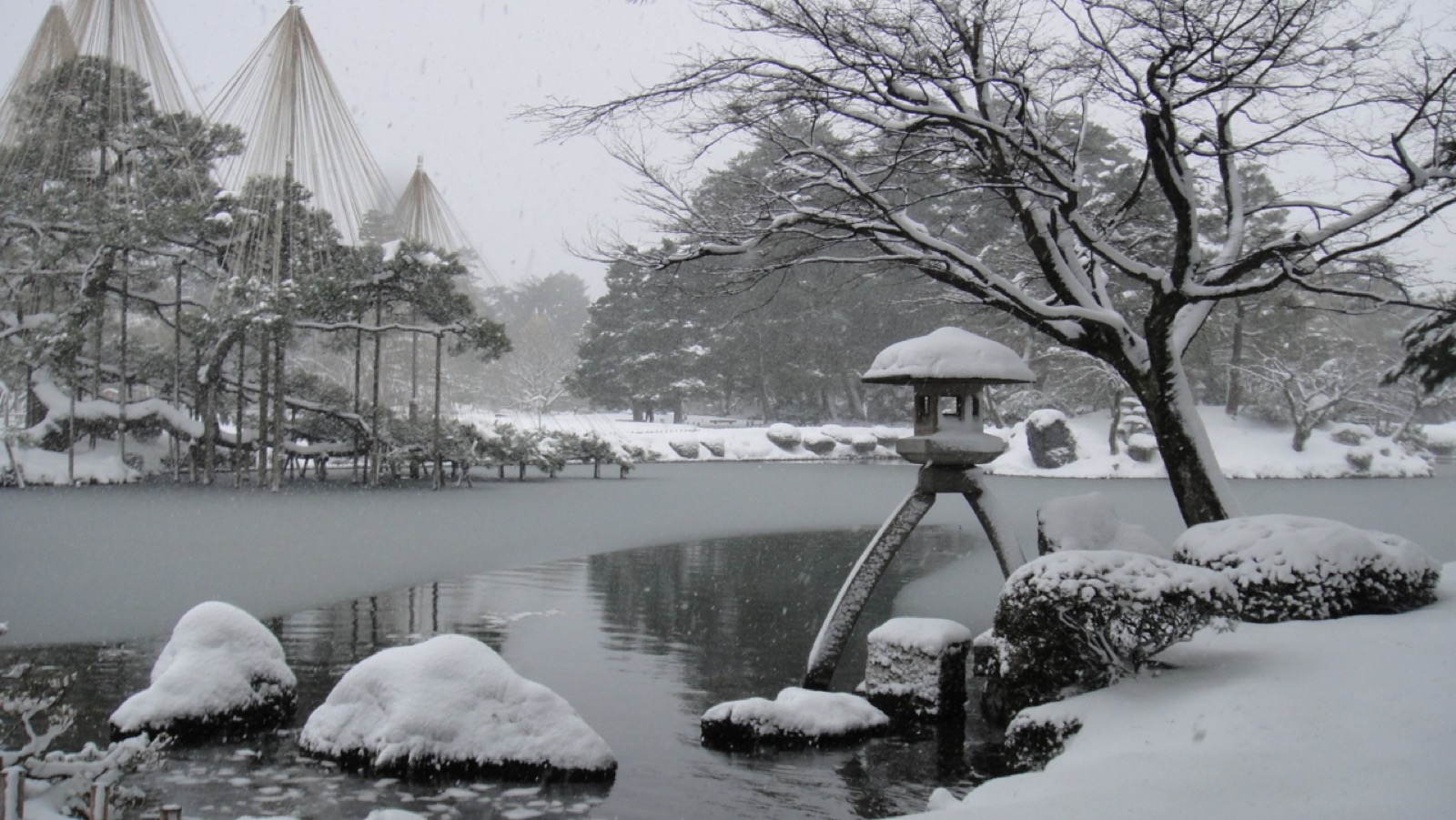
The Management Office describes the reason for its winter work in one line: so that “the wet, heavy snow of Hokuriku” does not pile up and break important branches. Hokuriku is the region on the Sea of Japan coast that includes Ishikawa, and the garden’s own word for its snow is wet, not powdery.
The Japan Meteorological Agency’s normals for Kanazawa (1991–2020) give a yearly total snowfall of 157 cm and an average yearly maximum snow depth of 32 cm. The first figure is the sum of all snowfalls through a winter, not the depth on the ground at one time. What matters to a pine is not the season’s total but a heavy fall that settles on needles and stays.
Snow far from the trunk
A pine keeps its needles through winter, so snow falling on the crown lands on foliage. On the Karasaki pine, much of the 21 m spread lies out over the pond, far from the trunk, which is where NILIM’s rule says load does the most harm.
How ropes redistribute that load is explained step by step in our article on yukitsuri snow ropes, so I will not repeat the mechanics here. For this tree, it is enough to know what is done and in what order.
Five poles and about 800 ropes — the first tree of every winter
1 November
The Management Office’s diary for 1 November 2026 opens: “On 1 November, again this year, winter preparations — yukitsuri work — began at Kenrokuen.” It adds: “Every year, the work begins with the Karasaki pine, which boasts the finest branch form in the garden.”
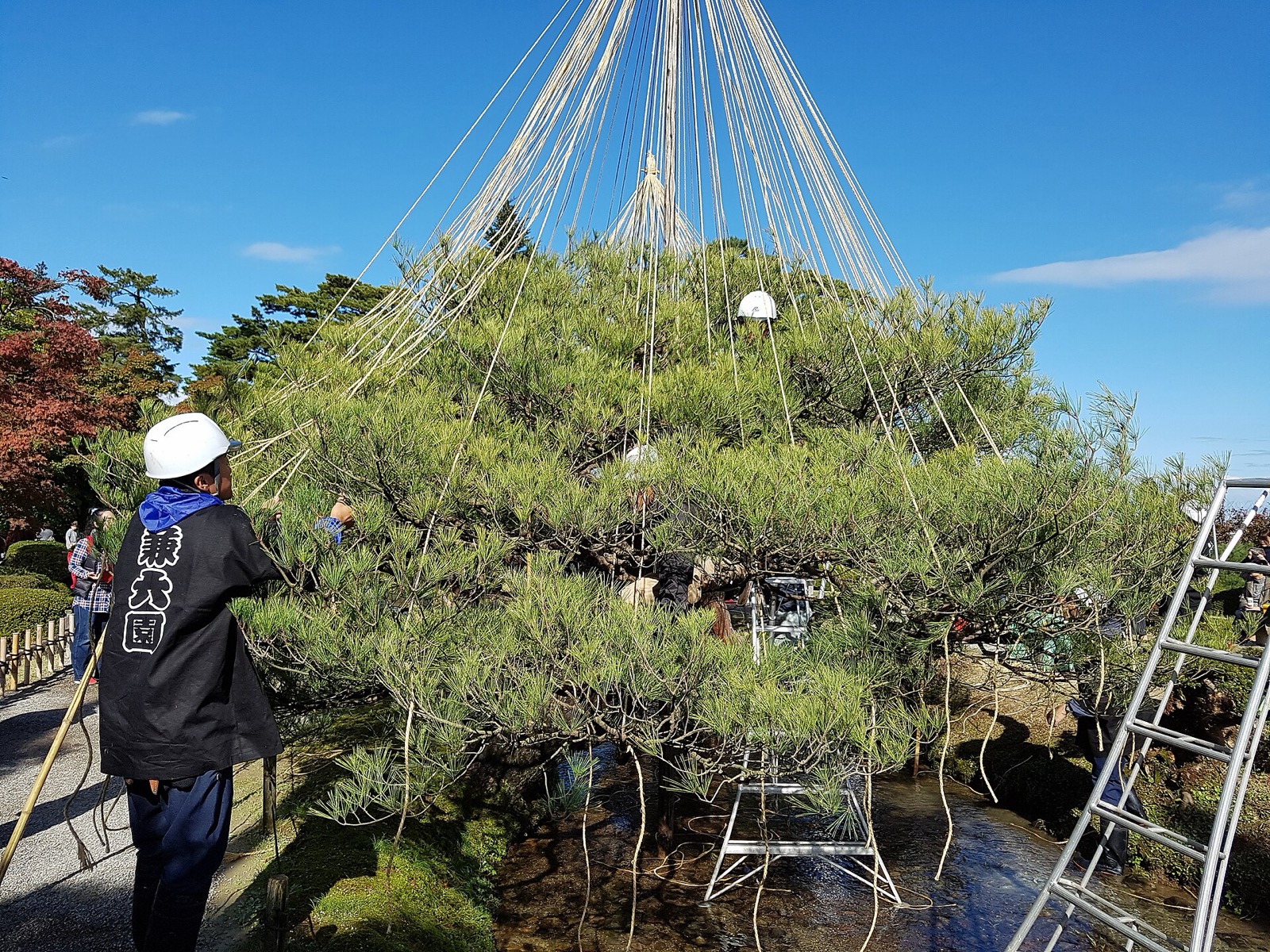
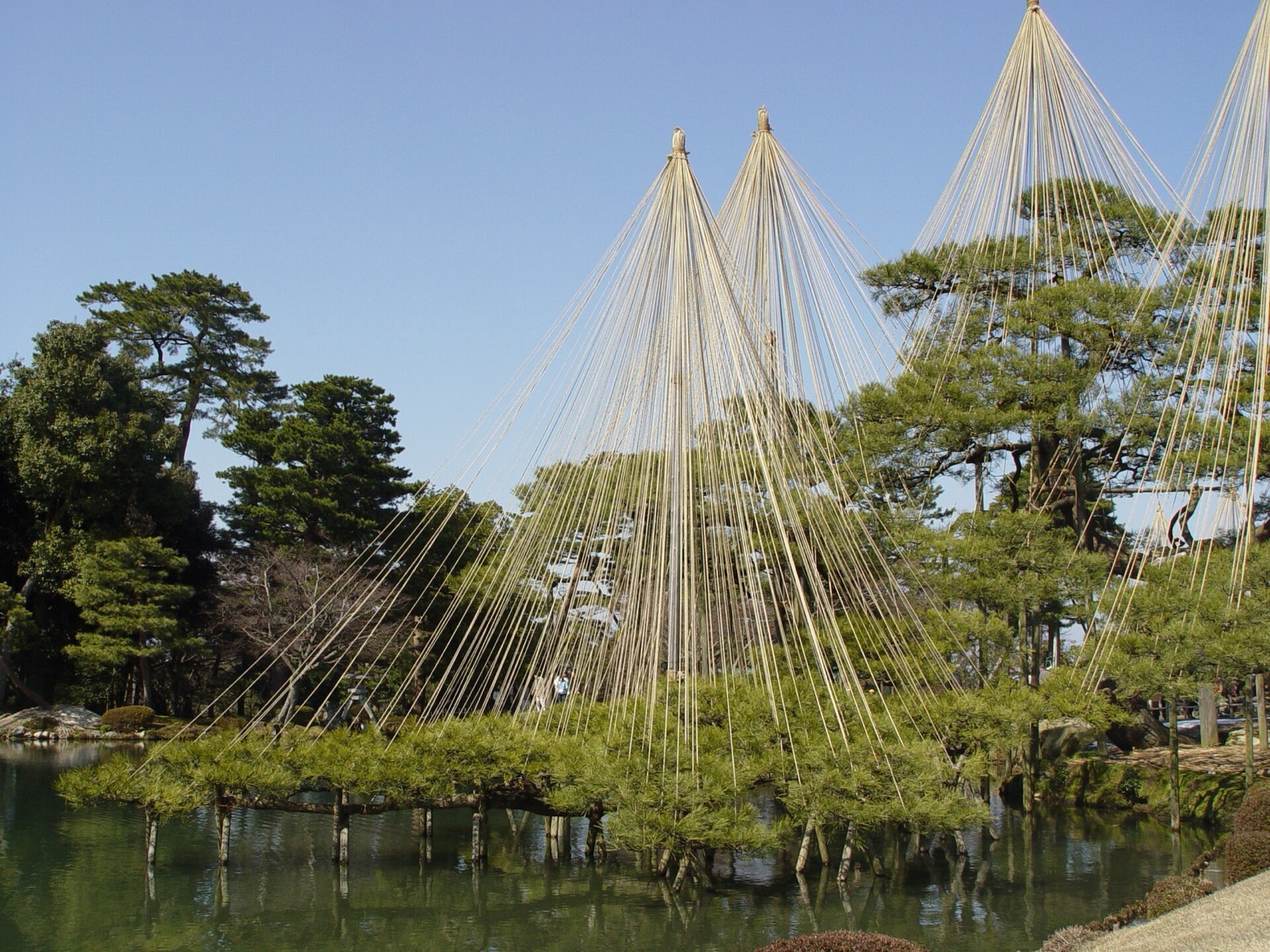
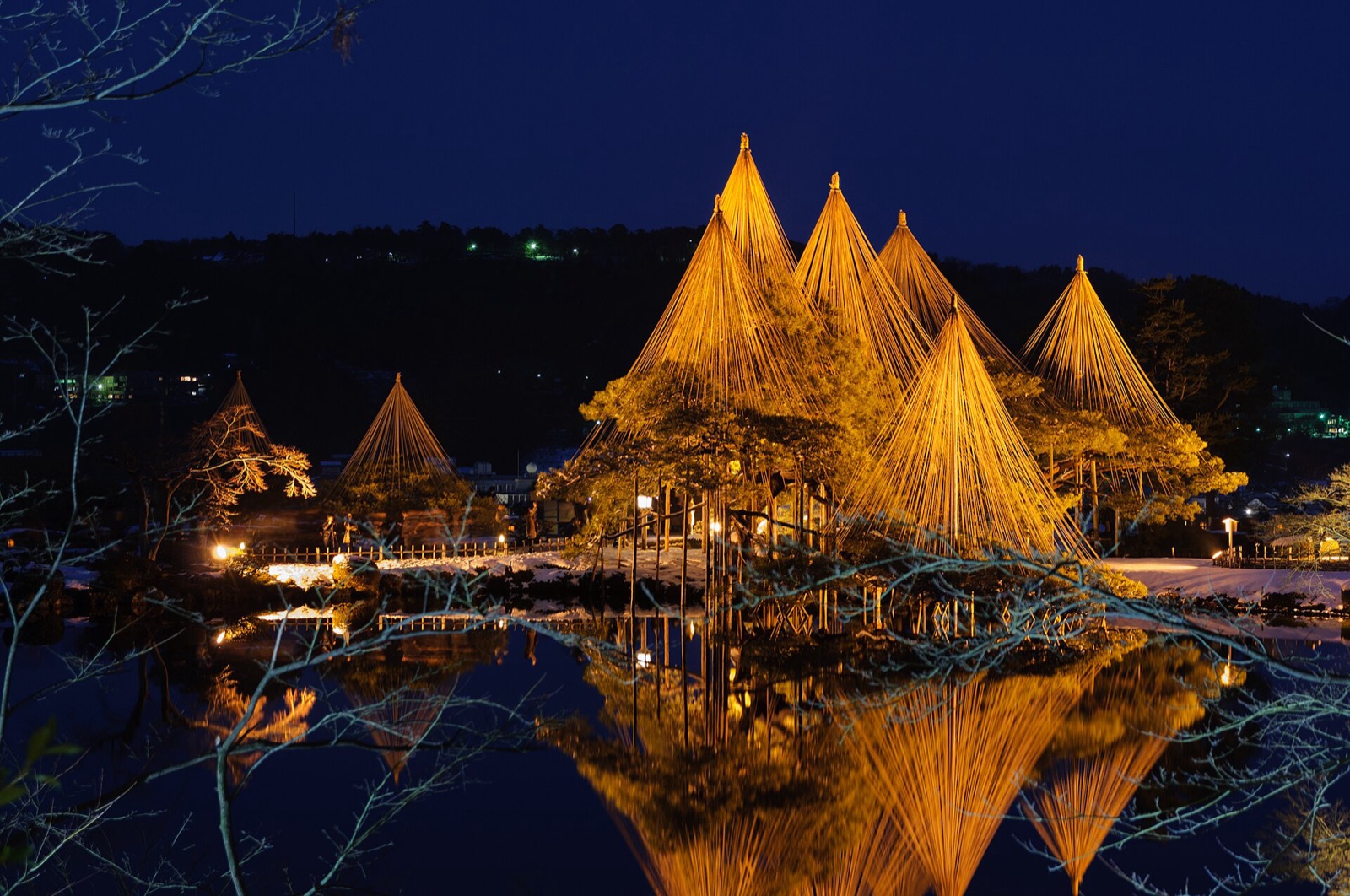
The method on this tree is ringo-tsuri (りんご吊り, “apple hanging”). In the tourism association’s description, ropes run radially from the top of a core pole to each branch. The 2026 plan gives this tree five such poles.
The numbers for 2026
Ishikawa Prefecture’s announcement of 23 October 2026 states that five core poles are raised for the Karasaki pine and its limbs are hung with a total of about 800 ropes. The 2018 Management Office document describes the poles as ate logs (アテ丸太), five of them, with a maximum height of 16.0 m, and gives 50 to 200 ropes per pole. The office’s 2026 diary records the tallest pole that year as 13.6 m to the top.
The two pole heights come from different years and different documents, so I give both with their dates rather than choosing one. The figure of about 800 is for the whole tree.
| Yukitsuri at Kenrokuen, 2026 plan | Figure |
|---|---|
| Start | 1 November, beginning with the Karasaki pine |
| Ringo-tsuri (pole-and-rope) trees | 50 |
| Miki-tsuri (trunk-hung) trees | 59 |
| Other locations | About 700 |
| Straw rope | About 4,000 kg, in 6 mm and 8 mm diameters |
| Core poles | Ate logs, madake bamboo |
| Crew at the start | 7 garden staff, 6 landscape contractors |
| Total work | About 500 person-days |
| Expected finish | Mid-December |
Reused, not replaced
The 2018 document adds one detail about materials: the core poles and bamboo are reused the following year, except those that have deteriorated.
Last off in March
The order reverses in spring. For the 2025–26 season the prefecture announced that removal would start at 9 a.m. on 16 March 2026, and that the ropes were scheduled to come off the Karasaki pine and the Gangetsu pine on 23 March. In that season, the tree was the first to be protected and among the last to be released.
The rigging is also part of the winter view. Ishikawa Prefecture’s tourism site lists the winter light-up for February 2027 (6–10, 13, 20 and 27 February) and names the snow ropes, the Kotoji lantern and the Karasaki pine among the things lit.
Needles plucked from a boat — the rest of the year
Habamushiri — pruning by hand
The ropes are the visible part of the work. The quieter part happens in early autumn. The prefecture’s announcement of 21 August 2026 scheduled the garden’s pine pruning from 1 September to mid-October and named the Karasaki pine and the method: habamushiri sentei (葉むしり剪定, “needle-plucking pruning”).
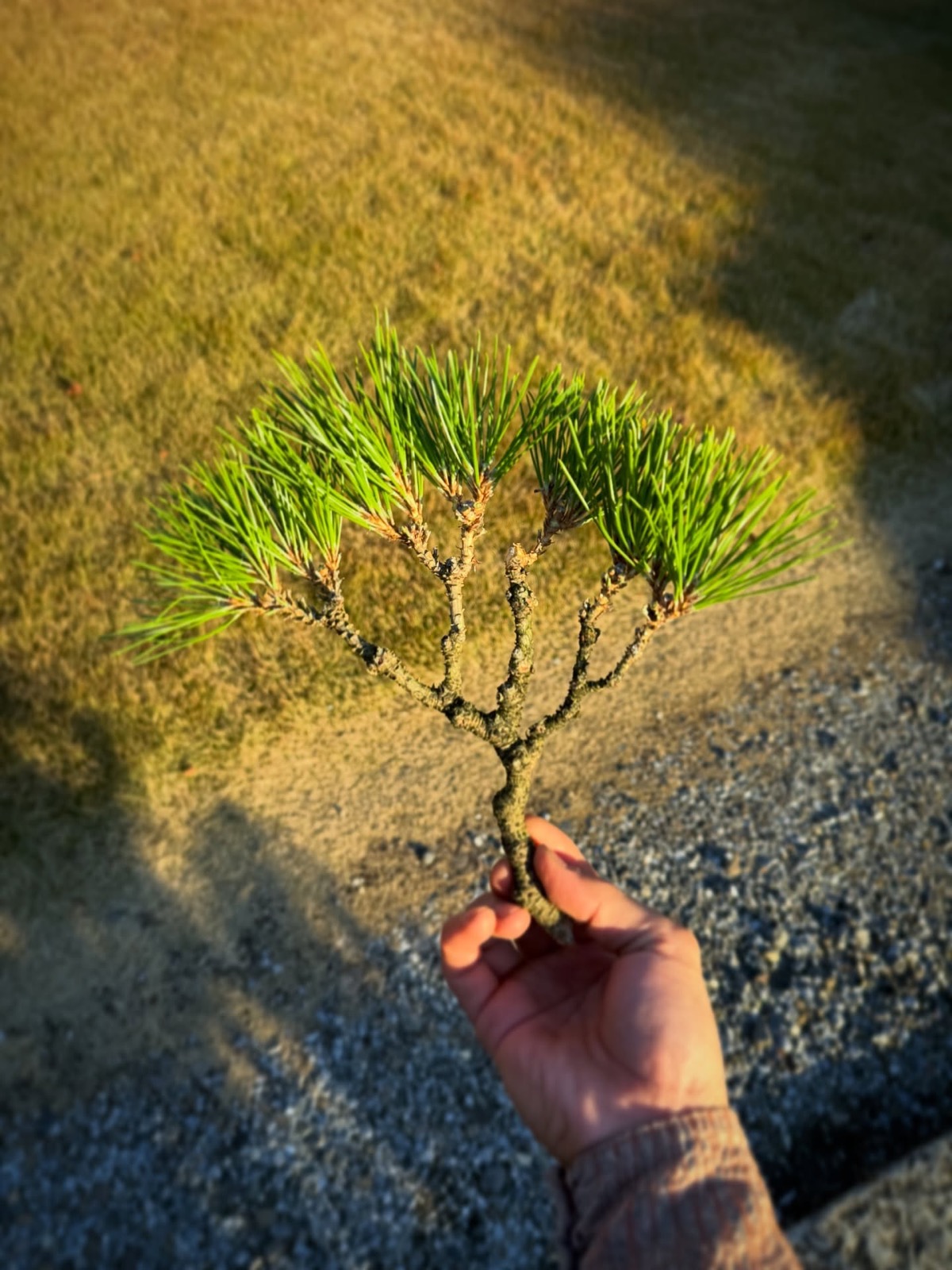
The Management Office’s diary explains it in two ways. In one entry, it is pruning in which the gardeners pluck needles by hand, one branch at a time, adjusting photosynthesis to restrain unnecessary growth. In another, they pluck old needles and adjust the number of new ones to even out the tree’s vigour. An earlier diary entry records that the season’s pruning began with the Karasaki pine on 1 September.
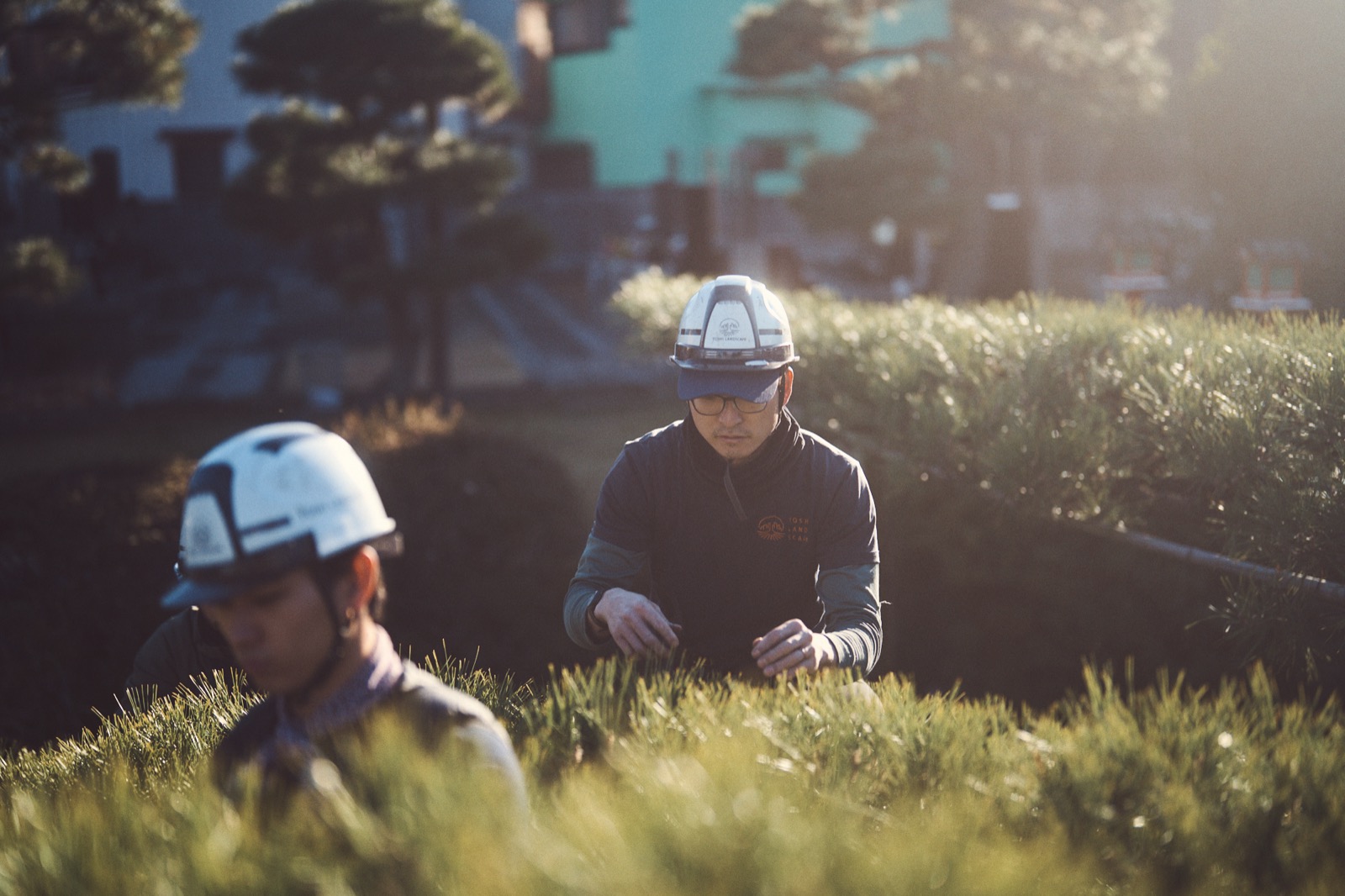
Kenrokuen’s documents use the name habamushiri for this tree, so that is the name I use here. A related job of clearing old pine needles in autumn and winter is described in our article on momiage, the pine needle-plucking.
What the plucking is for
The 2026 diary gives the reasons in plain terms. Removing old needles and unwanted shoots lets wind pass through and lets sunlight into the crown, and the tree becomes less prone to insects and disease.
Working from the water
The limbs over the pond are reached from the water. The Management Office records it directly: one diary entry is headed as “needle-plucking pruning of the Karasaki pine, from a boat”, and the 2026 entry captions a photo with “the branches that stretch low over the pond are worked from a boat.”
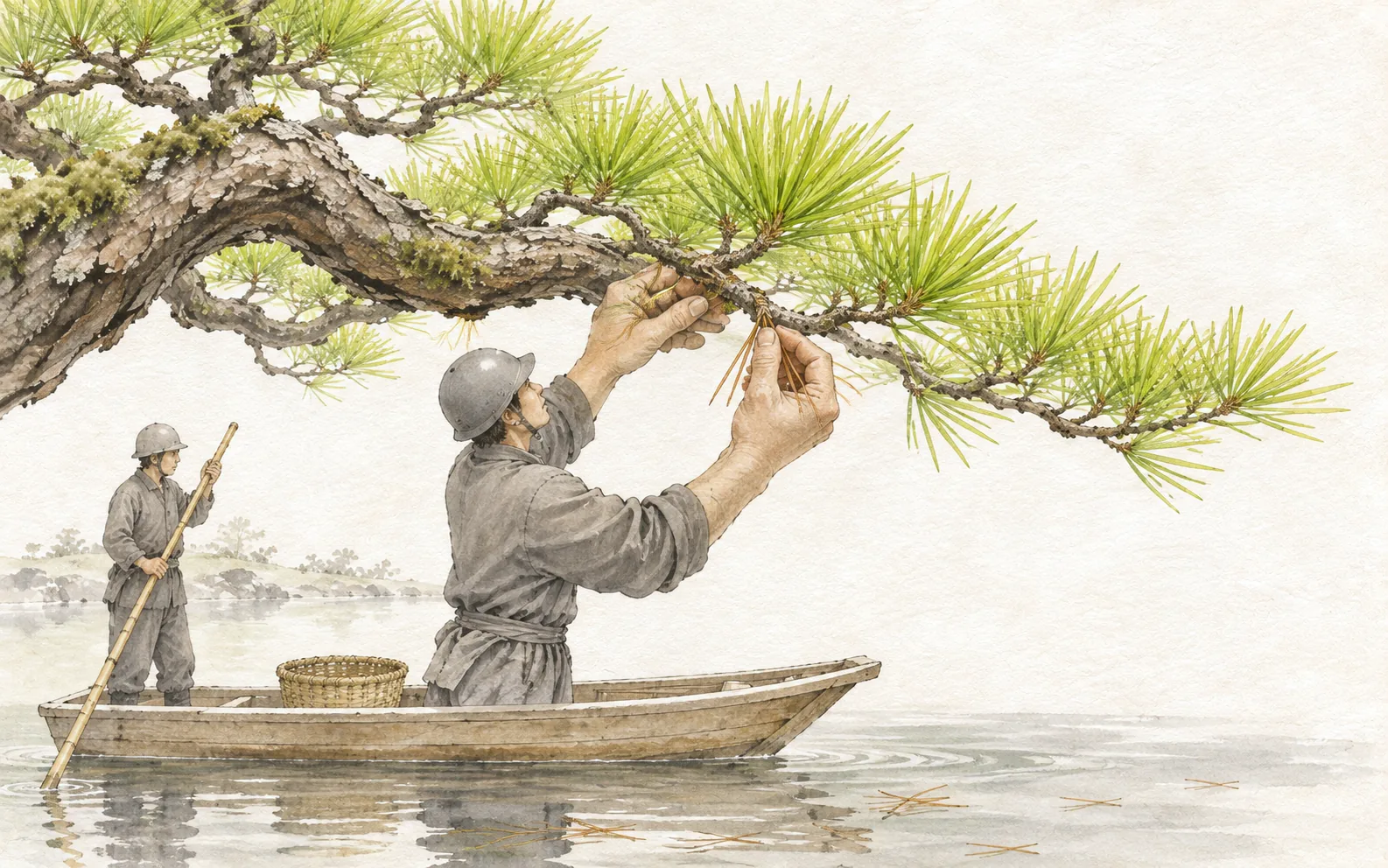
The pruning of this tree is done branch by branch, by hand, and partly afloat. That is the work behind the low line over the water that visitors see.
| Month | Work on the Karasaki pine | Source |
|---|---|---|
| September to mid-October | Habamushiri needle-plucking, starting with this tree; pond-side limbs from a boat | Prefecture, 21 Aug 2026; Management Office diaries |
| 1 November | Yukitsuri begins with this tree: 5 poles, about 800 ropes | Management Office diary, 1 Nov 2026; prefecture, 23 Oct 2026 |
| Mid-December | Garden-wide yukitsuri expected to be complete | Prefecture, 23 Oct 2026 |
| February | Light-up of the snow ropes and the pine (2027 dates announced) | Ishikawa tourism site |
| March | Ropes removed; this tree among the last (16–23 March in 2026) | Prefecture, 9 Mar 2026 |
Under the soil — when the needles turned pale
A report on yellowing needles
Not every threat to the tree comes from above. Hayashi Susumu, who was involved in diagnosing Kenrokuen’s pines, wrote an account titled “Protecting the pines of Kenrokuen” that is published by Tsubaki Sangyō, a company connected with the soil work. In it, he takes the Karasaki pine and the Ohana pine as representative cases and reports needles that had turned yellowish and fine roots that were poorly developed, with moisture conditions tied to clay soil.
His treatment was soil improvement from the surface, which he calls a “forest soil formation method”, followed by continued observation of the roots. He reports that afterwards the needles became a deeper green and root density increased.
How to read that report
Two cautions apply. The report is published by a company involved in the work, and it does not give a treatment year or describe the tree’s condition today. I use it only as evidence that the Karasaki pine was among the pines examined for yellowing needles and weak fine roots, not as a measure of how the tree is now.
Roots and soil are the other half of an old tree’s care. Our article on why Japan’s ancient trees live for a thousand years looks at the same balance between above-ground care and the soil.
Props, cables and ropes — how Britain and America handle a long limb
The same problem, named differently
Arborists everywhere face limbs that are long, heavy at the tip and valued. The International Society of Arboriculture divides supplemental support into four types: cables, braces, guys and props. Purdue University Extension, in its publication on large-tree cabling and bracing, notes that long, spreading limbs can fail under the load of wind, snow or ice, and that cables or props may be used.
The US standard for this work was published as ANSI A300 Part 3, Support Systems; in the 2023 consolidated edition it is Clause 7, Supplemental Support Systems. In Britain, the Ancient Tree Forum’s guide on veteran trees says that propping may be used to prevent limb failure but may need future adjustment and maintenance.
A famous British crutch
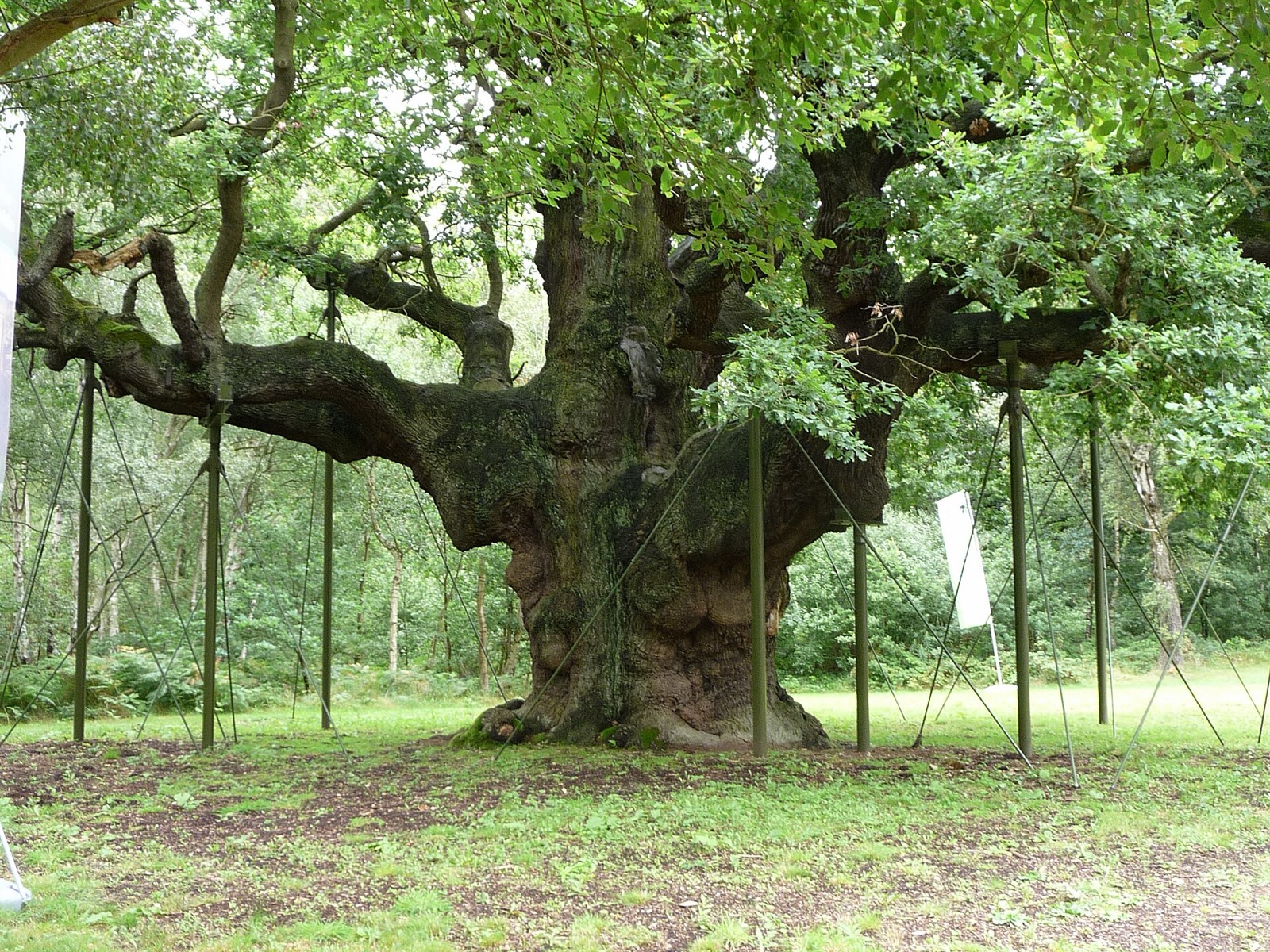
Britain also has its long-propped tree. According to the official account of Sherwood Forest, the Major Oak had iron bracing as early as 1904, with wooden props installed at the same time, and metal props were erected in 2001. Kenrokuen’s pine and the Major Oak share the decision to keep a valued limb rather than remove it.
Where the practice differs
The difference is in the starting point, not the quality. In the British and American guidance cited above, support is described as a way to prevent a limb from failing, and installed systems are expected to need adjustment and maintenance over time. At Kenrokuen, the long limb is the intended form, so support is planned around it every year, and much of it is seasonal.
| Kenrokuen’s Karasaki pine | UK and US guidance cited here | |
|---|---|---|
| Stated purpose | Keep important branches from breaking under wet, heavy snow (Management Office) | Prevent limb failure (Ancient Tree Forum); loads of wind, snow or ice (Purdue) |
| Main support | Seasonal ropes from five tall poles, every winter | Cables, braces, guys or props (ISA’s four types) |
| Snow load | The main reason for the ropes | One of several loads (wind, snow, ice) named |
| What maintenance means | Rig in November, remove in March, reuse sound poles | Inspect and adjust installed systems over time |
These are differences of setting, not of quality. Kanazawa’s snow load is seasonal, and a named garden pine is part of a designed view, so a seasonal frame that is put up and taken down each year suits it.
What the Karasaki pine is not — common misconceptions
“The ropes keep snow off the tree”
They do not. Snow still lands on the needles. The ropes give each limb a second line of support from above, so that the load does not hang only on the junction with the trunk. The tree is meant to carry snow and come through it.
“A roped tree must be failing”
Ropes alone do not tell you that a tree is in decline. The garden begins its whole winter programme with the tree it describes as having the finest branch form. On a named tree, keeping a long limb is the goal, and support is how that goal is met.
Seeing the tree today — what to look for
In autumn and winter
From September to mid-October you may see gardeners in a boat under the limbs, plucking needles. From 1 November the poles go up, and over the following days the ropes are tied until the tree stands inside a cone of straw lines. That is the best time to see the scale of the frame. In February the frame and the tree are lit at night on the announced light-up dates.
The best way to read the tree is to look along a limb from the trunk outwards: where it leaves the trunk, how far it travels over the water, and how low it runs at the tip. That line is what the winter ropes and poles are there to protect. Pines in Japanese gardens are also worked in spring, when the new shoots are pinched; our piece on midori-tsumi, the spring candle pinching of pines explains that job.
Two pines, one name
Karasaki Shrine on Lake Biwa now keeps its third-generation pine and a fourth grown from the third’s seed. Kenrokuen keeps a seedling of the second generation. The second-generation pine that once stretched over the lake on timber props survives in Hiroshige’s print and, through its seed, in Kanazawa. Only the Kenrokuen tree, today, still holds its limbs out over the water.
Frequently asked questions
What is the Karasaki pine at Kenrokuen?
It is a Japanese black pine (Pinus thunbergii) on the shore of Kasumigaike Pond in Kenrokuen, Kanazawa. According to the Kenrokuen tourism association, Maeda Nariyasu, the 13th lord of Kaga, raised it from seed sent from Karasaki on Lake Biwa. It is one of the garden’s 19 special named trees.
Why is the Karasaki pine supported with ropes?
Its limbs spread about 21 m (2018 figure) and reach out over the pond. Kanazawa’s wet, heavy snow on long limbs could break them, so every winter the garden raises five core poles and ties about 800 ropes to its branches (2026 plan) in the ringo-tsuri style.
When does the yukitsuri start on the Karasaki pine?
In 2026 the work began on 1 November, and according to the Management Office the Karasaki pine is the first tree done every year. In 2026 the garden-wide work was expected to finish in mid-December, and in 2026 the ropes were scheduled to come off the Karasaki pine on 23 March, among the last trees.
How old is the Karasaki pine?
No primary record of its planting year has been found. Published estimates are 170 years, about 180 years and about 190 years, from three different bodies. It is safe to say it was raised under Maeda Nariyasu, who ruled from 1822 to 1866.
Is the Karasaki pine a clone of the pine at Karasaki Shrine?
No. It was grown from seed, which makes it a descendant rather than a genetic copy. Japan’s Forest Tree Breeding Center notes that seedlings do not necessarily share their parent’s traits, and that grafts and cuttings are the methods for keeping a tree as a clone.
How do gardeners prune the limbs over the pond?
By hand and from a boat. The garden uses habamushiri needle-plucking pruning from 1 September to mid-October, starting with the Karasaki pine, and the Management Office records that the low limbs over the pond are worked from a boat.
Sources
– Kenrokuen Tourism Association, “Highlights” (Karasaki pine, Kasumigaike, Kotoji lantern, Neagari pine, Hōraijima): https://kenrokuen.or.jp/highlight/ — checked 2026-11-14 – Kenrokuen Tourism Association, “Green story” (8,200 trees, special named trees, pines, age estimate): https://kenrokuen.or.jp/sdgs_green/ — checked 2026-11-14 – Kenrokuen Tourism Association, “Gardeners” (ringo-tsuri): https://kenrokuen.or.jp/sdgs-gardener/ — checked 2026-11-14 – Kanazawa Castle and Kenrokuen Management Office, yukitsuri document, 2018: https://www.pref.ishikawa.lg.jp/kisya/h30/documents/1024kouenryokuti2yukizuri.pdf — checked 2026-11-14 – Kanazawa Castle and Kenrokuen Management Office, history of Kenrokuen: https://shiro-niwa.pref.ishikawa.lg.jp/kenrokuen-garden/history.html — checked 2026-11-14 – Kanazawa Castle and Kenrokuen Management Office, the six attributes: https://shiro-niwa.pref.ishikawa.lg.jp/kenrokuen-garden/6place.html — checked 2026-11-14 – Kanazawa Castle and Kenrokuen Management Office, diary, 1 November 2026: https://shiro-niwa.pref.ishikawa.lg.jp/kanazawa-castle/diary/9216/ — checked 2026-11-14 – Kanazawa Castle and Kenrokuen Management Office, diary on pine care, 2026: https://shiro-niwa.pref.ishikawa.lg.jp/kanazawa-castle/diary/9114/ — checked 2026-11-14 – Kanazawa Castle and Kenrokuen Management Office, diaries on needle-plucking pruning: https://shiro-niwa.pref.ishikawa.lg.jp/kanazawa-castle/diary/7218/ and https://shiro-niwa.pref.ishikawa.lg.jp/kanazawa-castle/diary/7565/ — checked 2026-11-14 – Kanazawa Castle and Kenrokuen Management Office, diary on yukitsuri: https://shiro-niwa.pref.ishikawa.lg.jp/kanazawa-castle/diary/8048/ — checked 2026-11-14 – Ishikawa Prefecture, yukitsuri announcement, 23 October 2026: https://www.pref.ishikawa.lg.jp/kisya/r8/documents/1023_10_kouenryokuti.pdf — checked 2026-11-14 – Ishikawa Prefecture, pine pruning announcement, 21 August 2026: https://www.pref.ishikawa.lg.jp/kisya/r8/documents/0821_10_kouenryokuchi.pdf — checked 2026-11-14 – Ishikawa Prefecture, yukitsuri removal announcement, 9 March 2026: https://www.pref.ishikawa.lg.jp/kisya/r7/documents/0309_10_kouennryokuti.pdf — checked 2026-11-14 – Ishikawa Prefecture, Kanazawa Castle conservation plan: https://www.pref.ishikawa.lg.jp/kouen/siro/documents/kanazawacastlehkplan.pdf — checked 2026-11-14 – Ishikawa Prefectural Library, Maeda Nariyasu: https://www.library.pref.ishikawa.lg.jp/shosho/furucolle/list/prsn11461 — checked 2026-11-14 – Ishikawa tourism site, winter light-up 2027: https://www.hot-ishikawa.jp/event/detail_22104.html — checked 2026-11-14 – Agency for Cultural Affairs, database of designated cultural properties (Kenrokuen): https://kunishitei.bunka.go.jp/heritage/detail/401/986 — checked 2026-11-14 – Hiyoshi Taisha, Karasaki Shrine and the pine of Karasaki: https://www.hiyoshitaisha.jp/karasaki/ — checked 2026-11-14 – Shiga Prefecture, Eight Views of Ōmi: https://www.pref.shiga.lg.jp/ab00/7731.html — checked 2026-11-14 – Shiga Prefectural Library, Hiroshige, Karasaki yau (1857): https://da.shiga-pref-library.jp/item/detail/?id=0500024 — checked 2026-11-14 – Shiga Prefectural Archives, “The Eight Views of Ōmi that were protected”: https://archives.pref.shiga.lg.jp/index.php?catid=76&id=342%3Atenji64-2&view=article — checked 2026-11-14 – Shiga Cultural Properties Protection Association, Karasaki Shrine: https://www.shiga-bunkazai.jp/shigabun-shinbun/best-place-in-shiga/%E6%96%B0%E8%BF%91%E6%B1%9F%E5%90%8D%E6%89%80%E5%9C%96%E4%BC%9A%E3%80%80%E7%AC%AC7%E5%9B%9E/ — checked 2026-11-14 – Japan Meteorological Agency, Kanazawa normals (snow), 1991–2020: https://www.data.jma.go.jp/stats/etrn/view/nml_sfc_ym.php?block_no=47605&day=&month=&prec_no=56&view=a4s&year= — checked 2026-11-14 – Forestry and Forest Products Research Institute, Kansai and Kyushu branches, black pine: https://www.ffpri.go.jp/fsm/business/jumokuen/02_ka/kuromatu.html and https://www.ffpri.go.jp/kys/business/jumokuen/jumoku/zukan/kuromatu.html — checked 2026-11-14 – Forest Tree Breeding Center: https://www.ffpri.go.jp/ftbc/documents/hinsyu.pdf and https://www.ffpri.go.jp/ftbc/iden/kaishi/2017_no1.html — checked 2026-11-14 – Nara National Research Institute for Cultural Properties, Japanese Garden Dictionary, nagashi-matsu: https://www.nabunken.go.jp/org/bunka/jgd/pages/StretchingPine.html — checked 2026-10-31 – National Institute for Land and Infrastructure Management, street-tree failure guidance: https://www.nilim.go.jp/lab/bcg/siryou/tnn/tnn1059pdf/Ks1059006.pdf — checked 2026-10-31 – Hayashi Susumu, “Protecting the pines of Kenrokuen” (Tsubaki Sangyō): https://www.tsubakiltd.co.jp/pdf/kenroku.pdf — checked 2026-11-14 – International Society of Arboriculture, support systems: https://olc.isa-arbor.com/local/catalog/view/product.php?productid=280 — checked 2026-11-14 – Purdue Extension, Large Tree Cabling and Bracing (FNR-550-W): https://www.extension.purdue.edu/extmedia/FNR/FNR-550-W.pdf — checked 2026-11-14 – Ancient Tree Forum, Veteran Trees: A Guide to Risk and Responsibility: https://www.ancienttreeforum.org.uk/wp-content/uploads/2015/03/Veteran-Trees-A-Guide-to-Risk-and-Responsibility.pdf — checked 2026-11-14 – Sherwood Forest, Caring for the Major Oak: https://visitsherwood.co.uk/caring-for-the-major-oak/ — checked 2026-10-31