

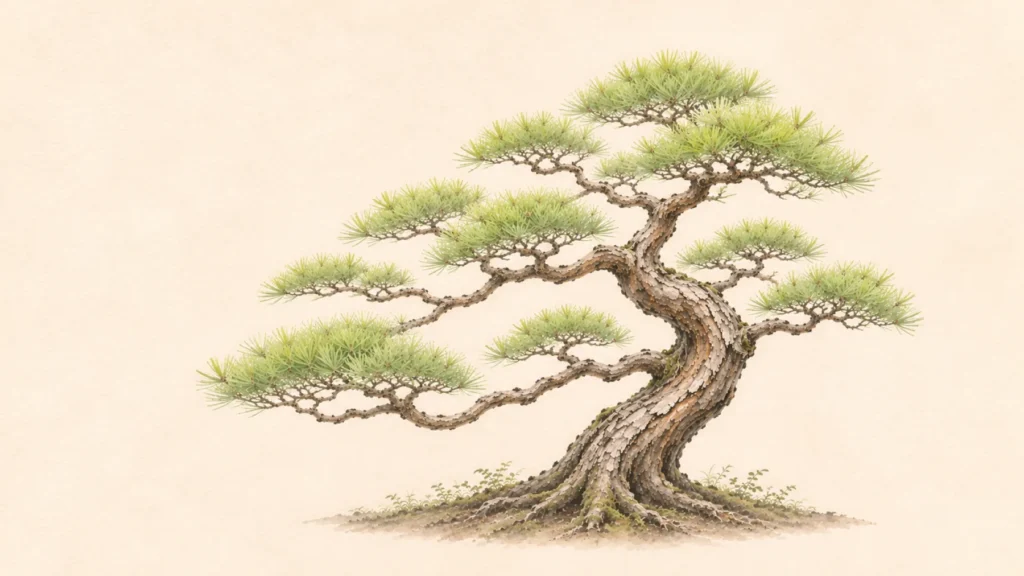
Japanese garden pines carry their foliage as separate rounded pads because gardeners choose that form, in a style Japanese technical sources call tamachirashi (玉散らし, “scattered balls”), and then hold it by working the pine where it grows: at its shoot tips, branch by branch. Each spring they pinch the new candles, each autumn they pluck the older needles and thin crowded twigs, and over the years they tie branches into place, so that each branch carries its own compact mass with open space around it. The pine’s habit of growing in clusters from its tips makes this kind of control possible; the clouds themselves are a human design.
This article follows one pad-trained pine from the path into a pad, then one twig through a year, the rules for where to stop, the history, and how gardens in Japan and abroad organise the work.
A Crew on the Crown — Looking at a Pad-Trained Pine
From the path
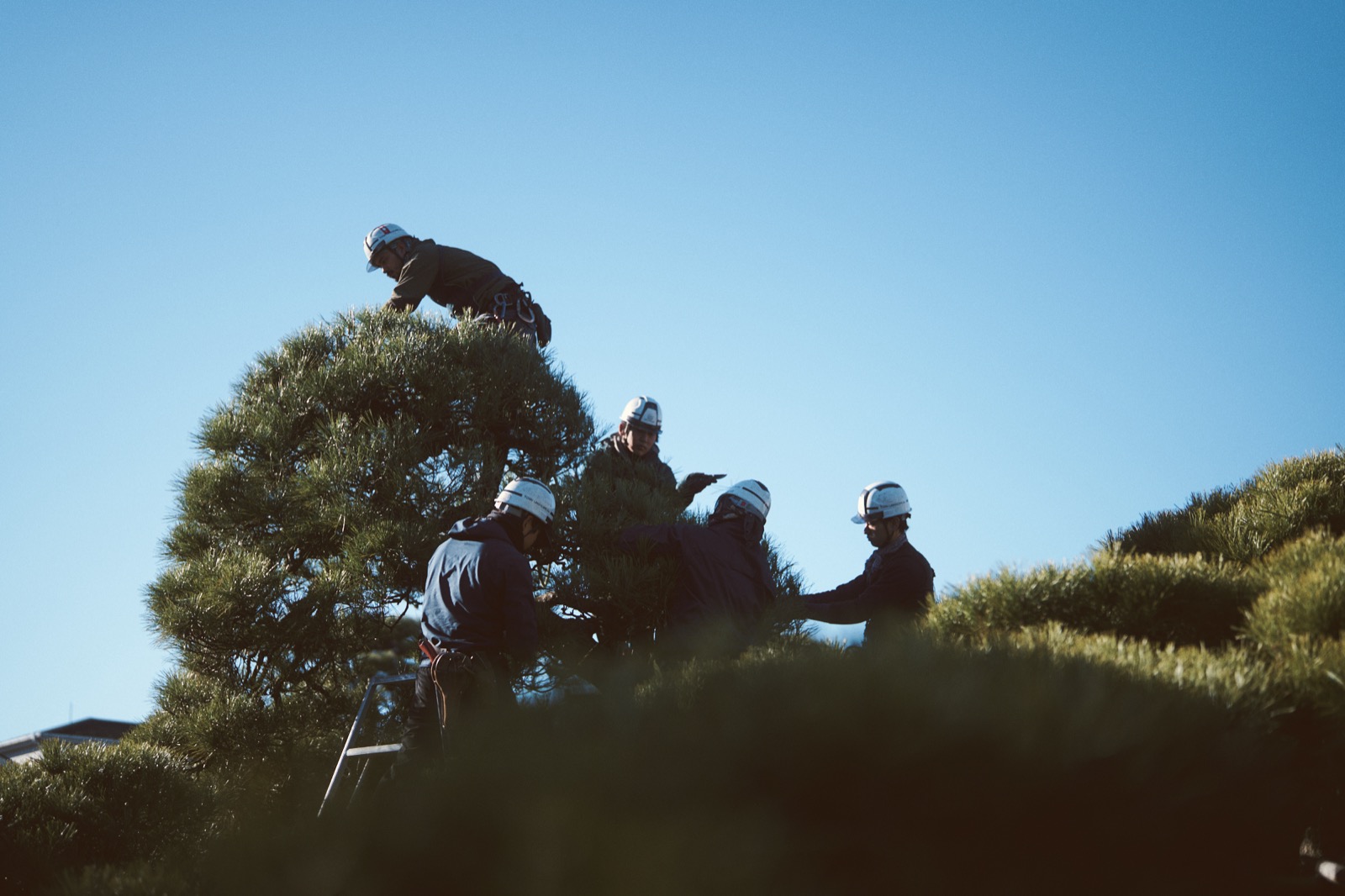
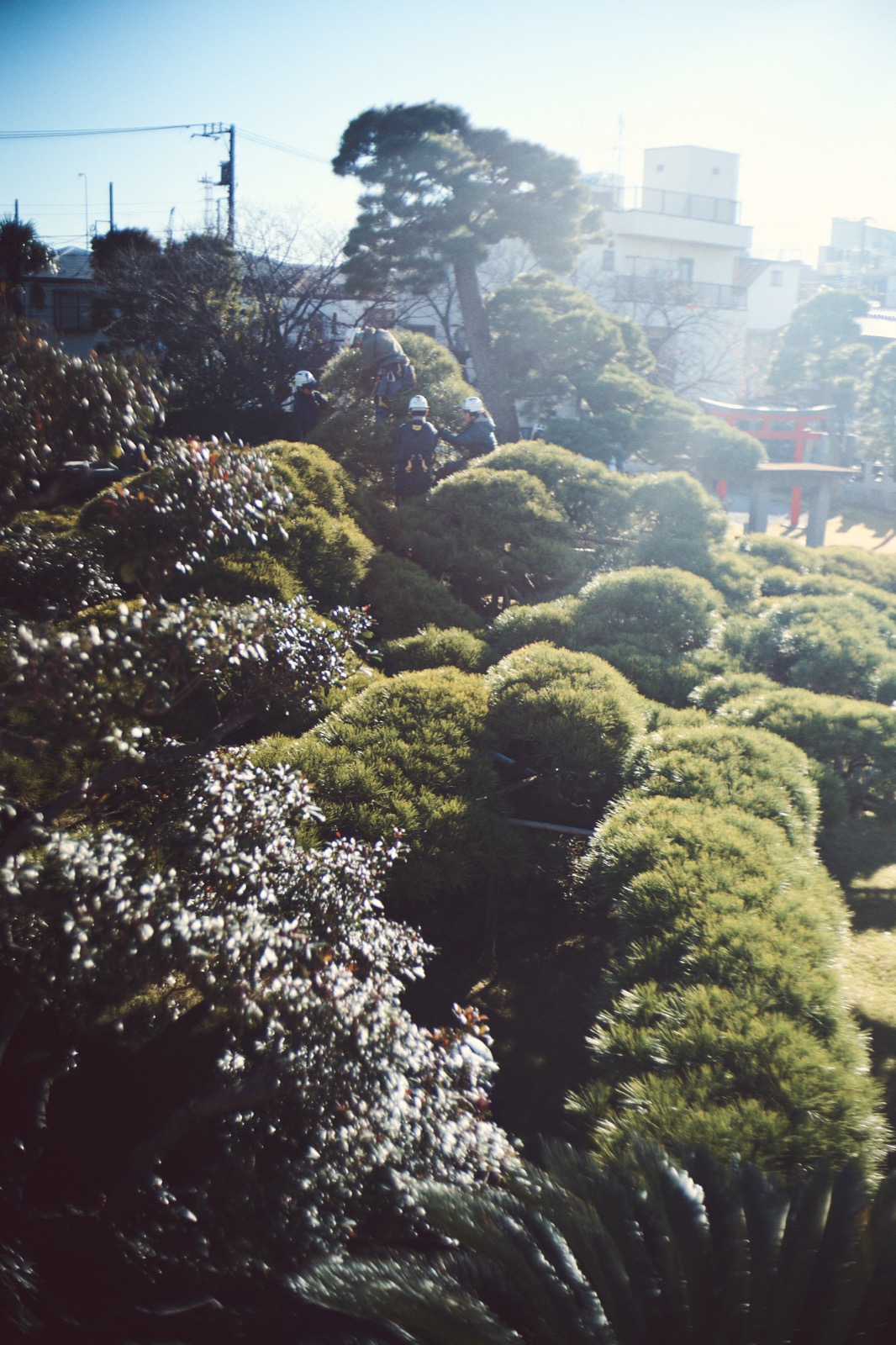
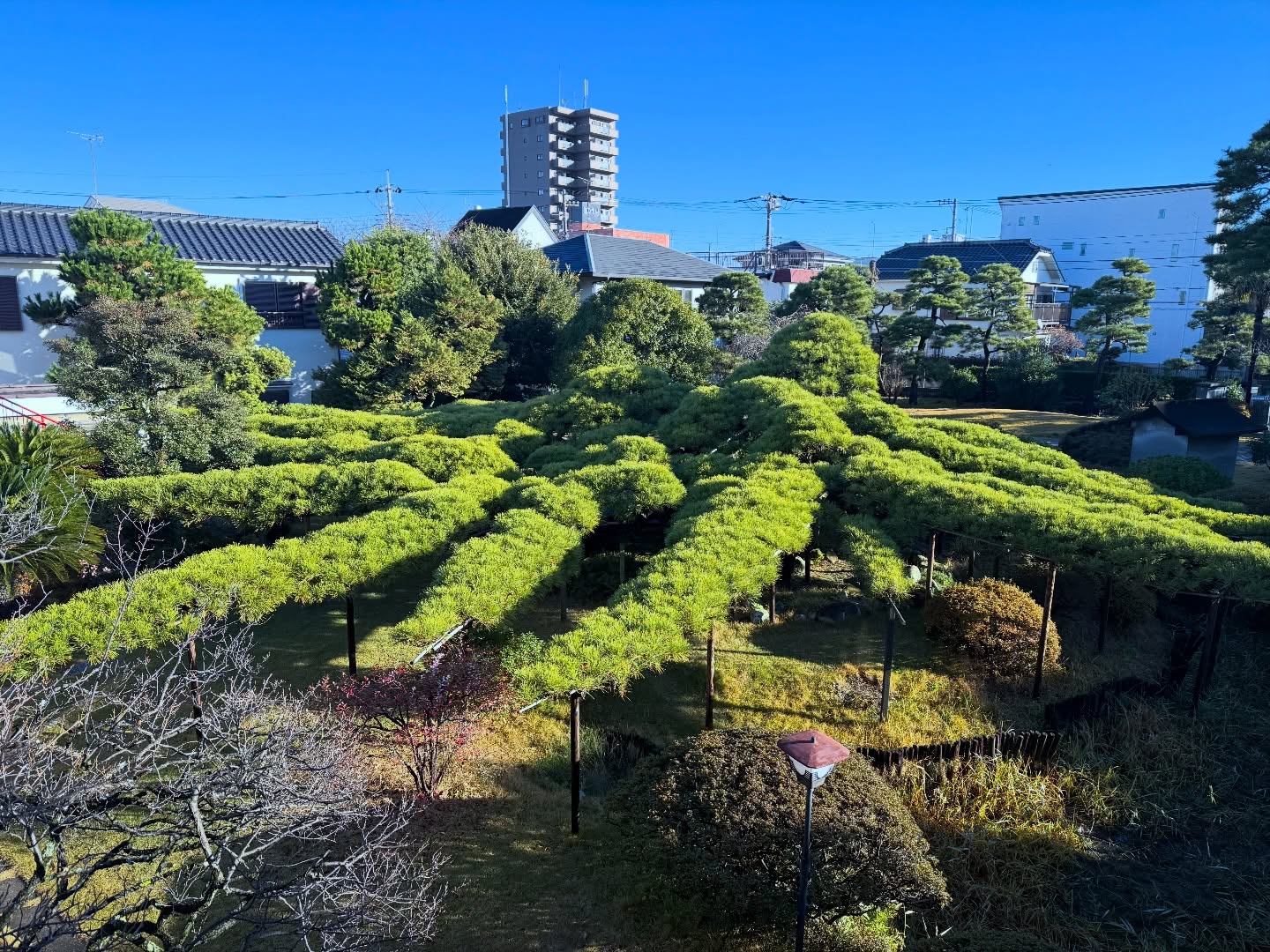
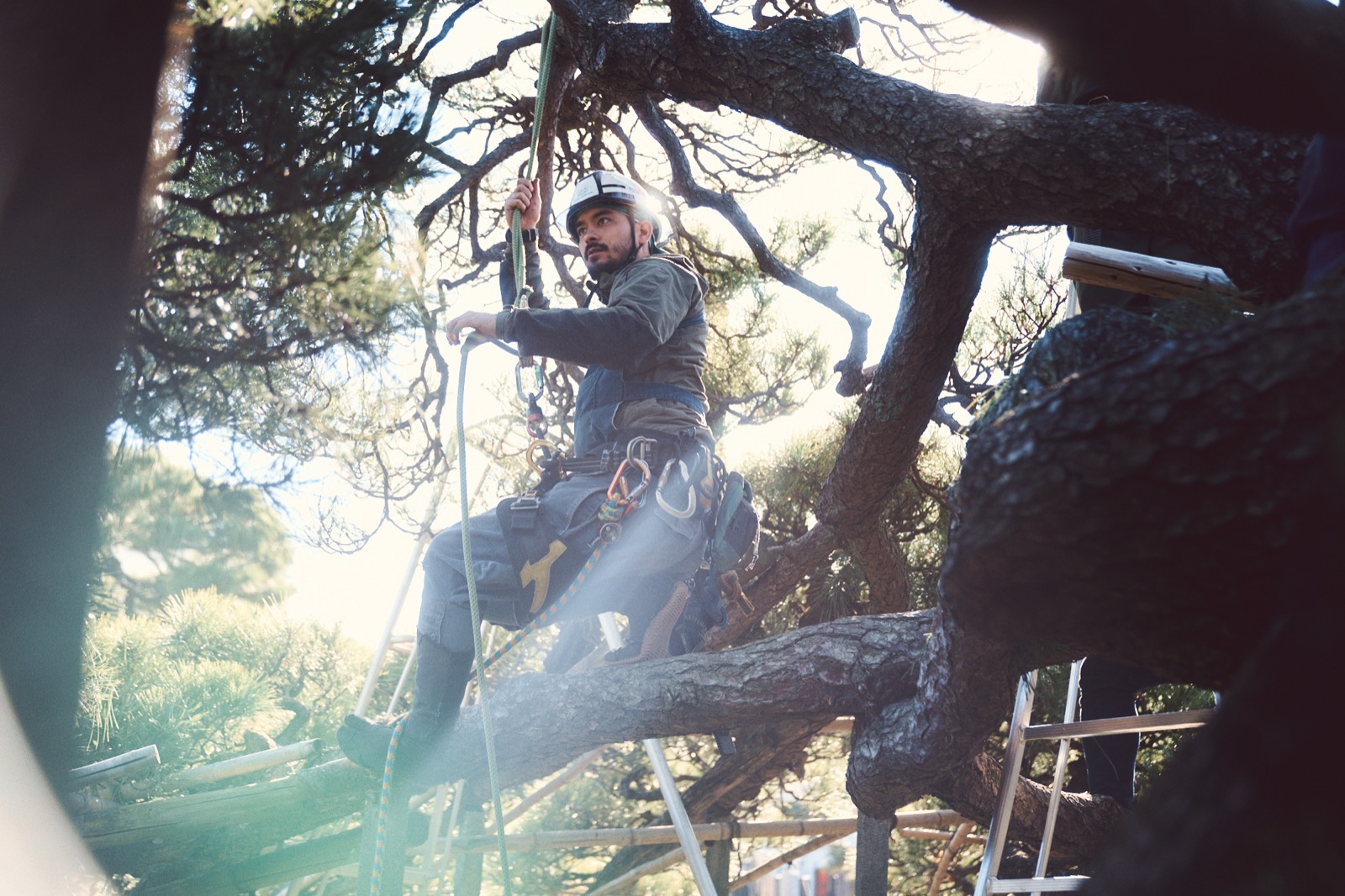
Look at the photograph above. A crew stands on the crown of a Japanese black pine (Pinus thunbergii), helmets white against a winter sky. From the ground the tree reads as a set of green masses held on a dark, twisting frame. Each mass is rounded at its edges and stands apart from its neighbours. Between them you can see sky, the trunk, and the limb that carries each one.
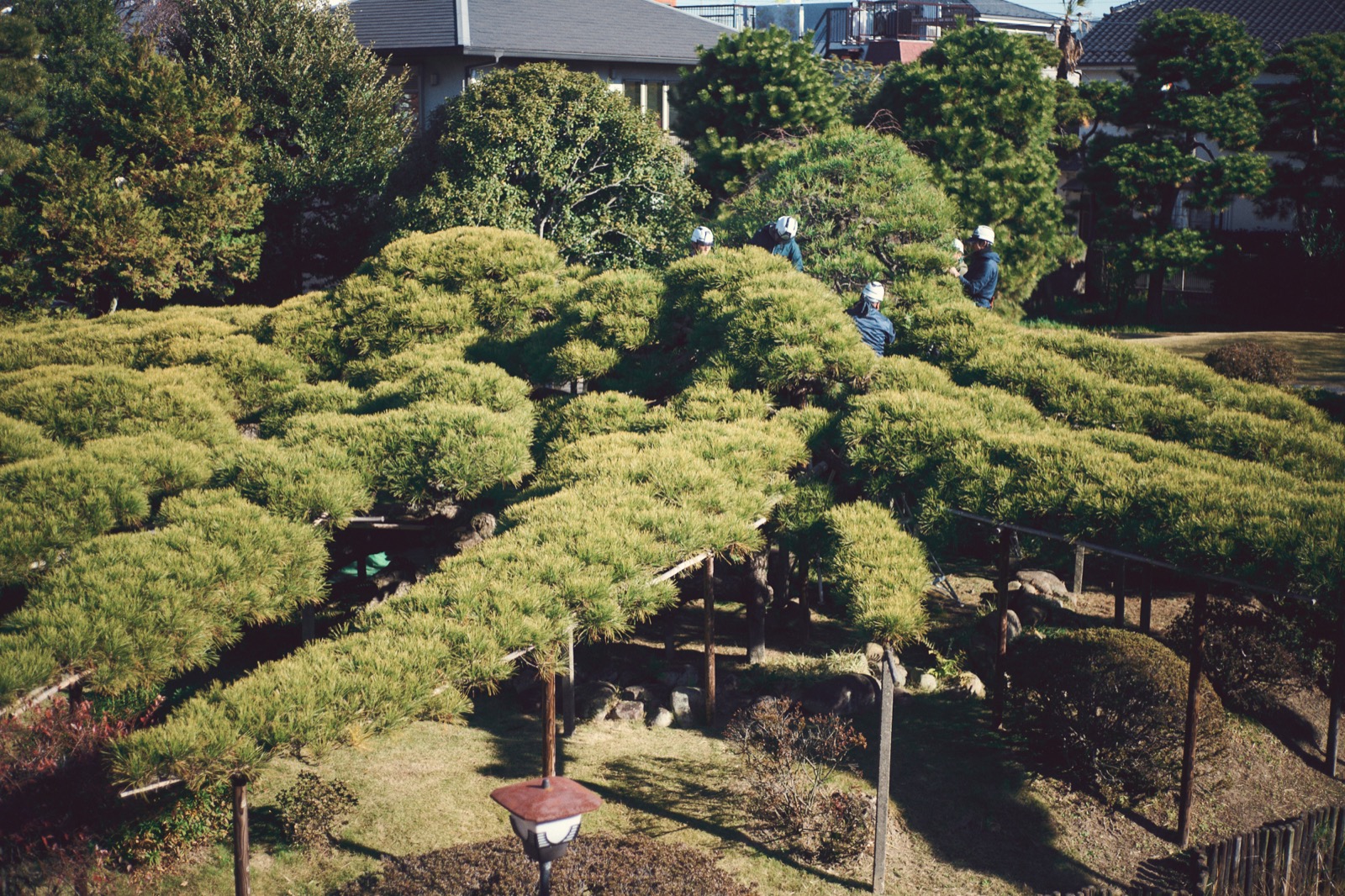
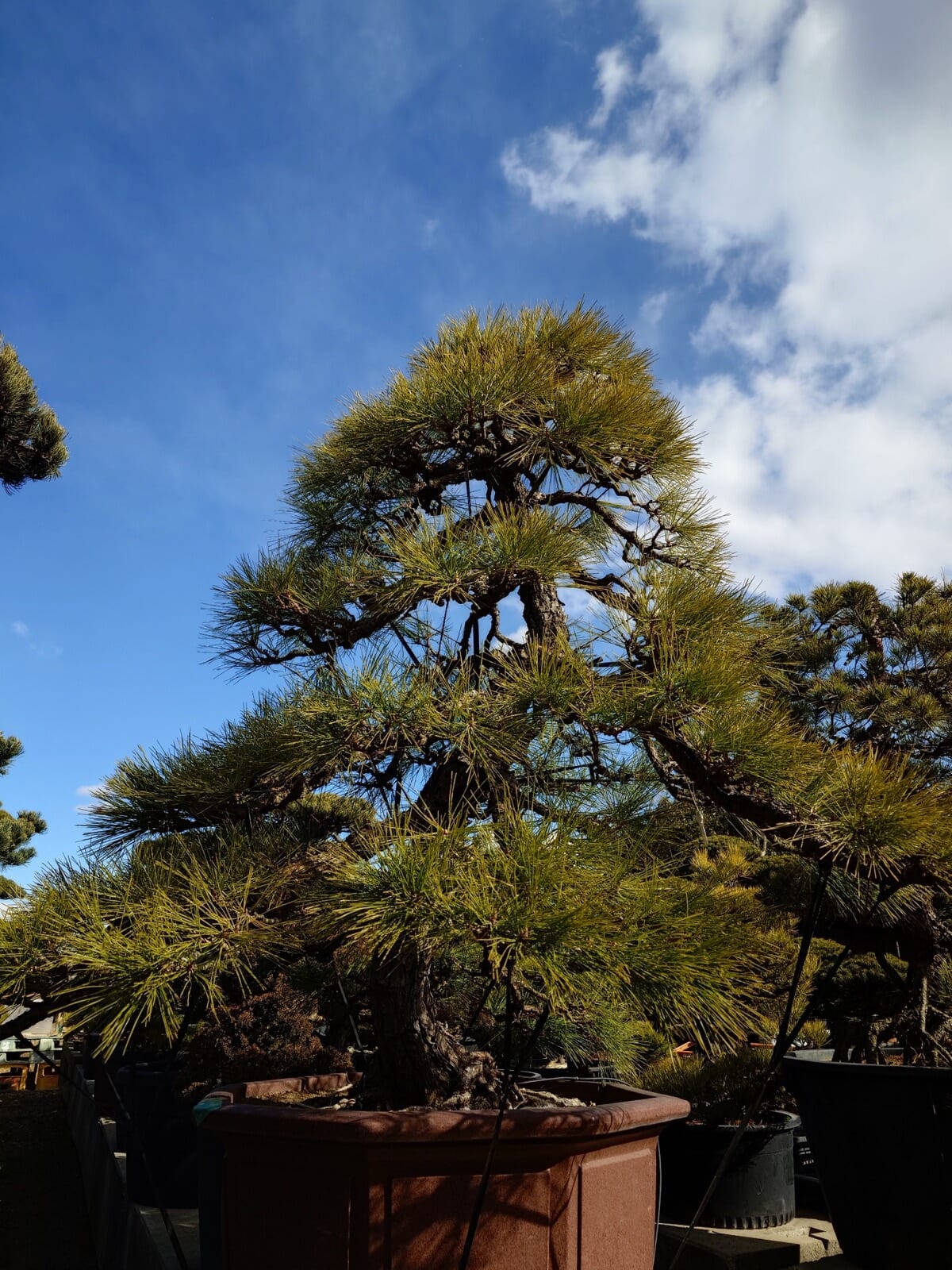
Step back and count, and the pattern becomes clear in the photograph below: branch after branch ends in its own rounded pad, with a gap of air before the next. The gardeners standing among them give the scale.
From inside a pad
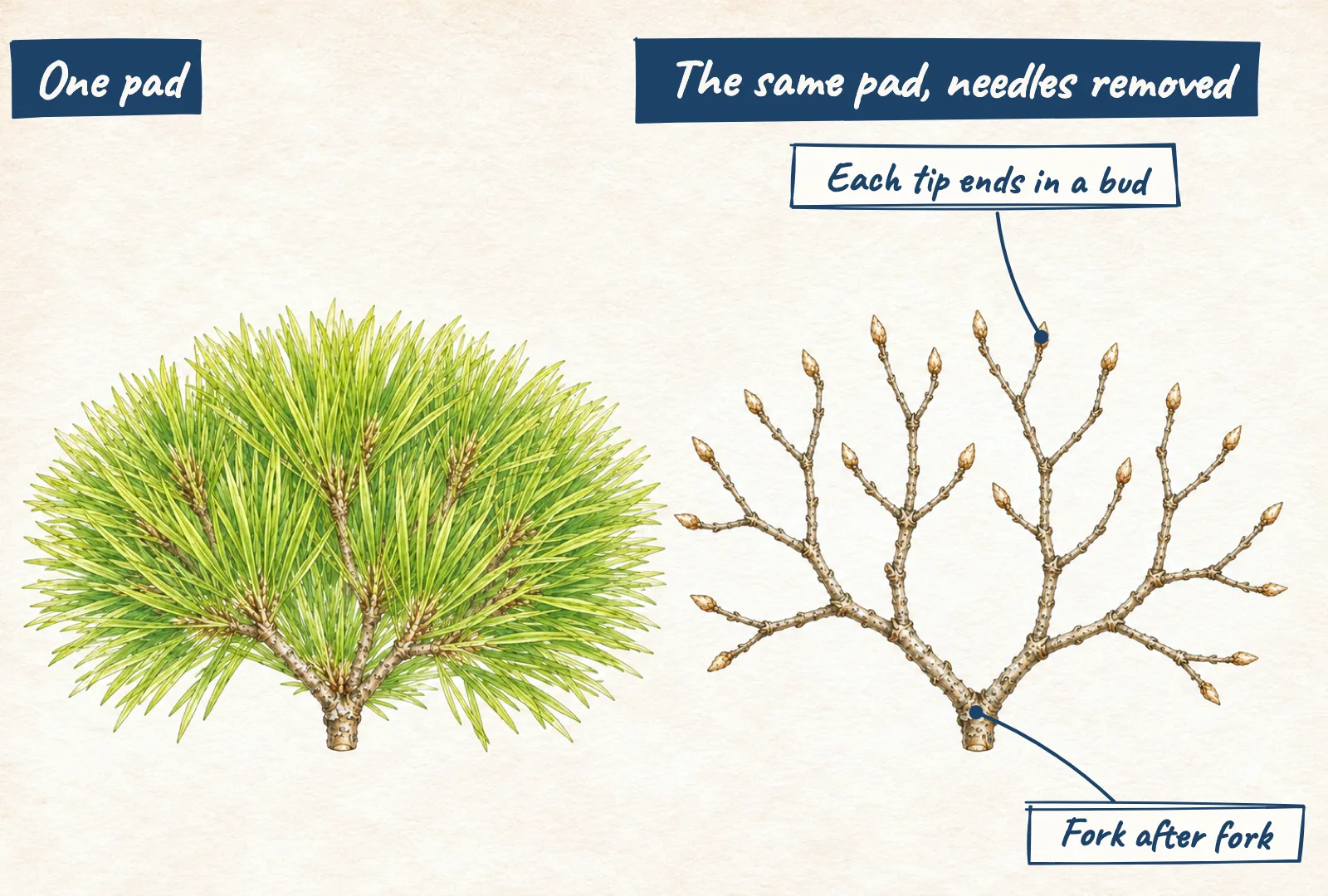
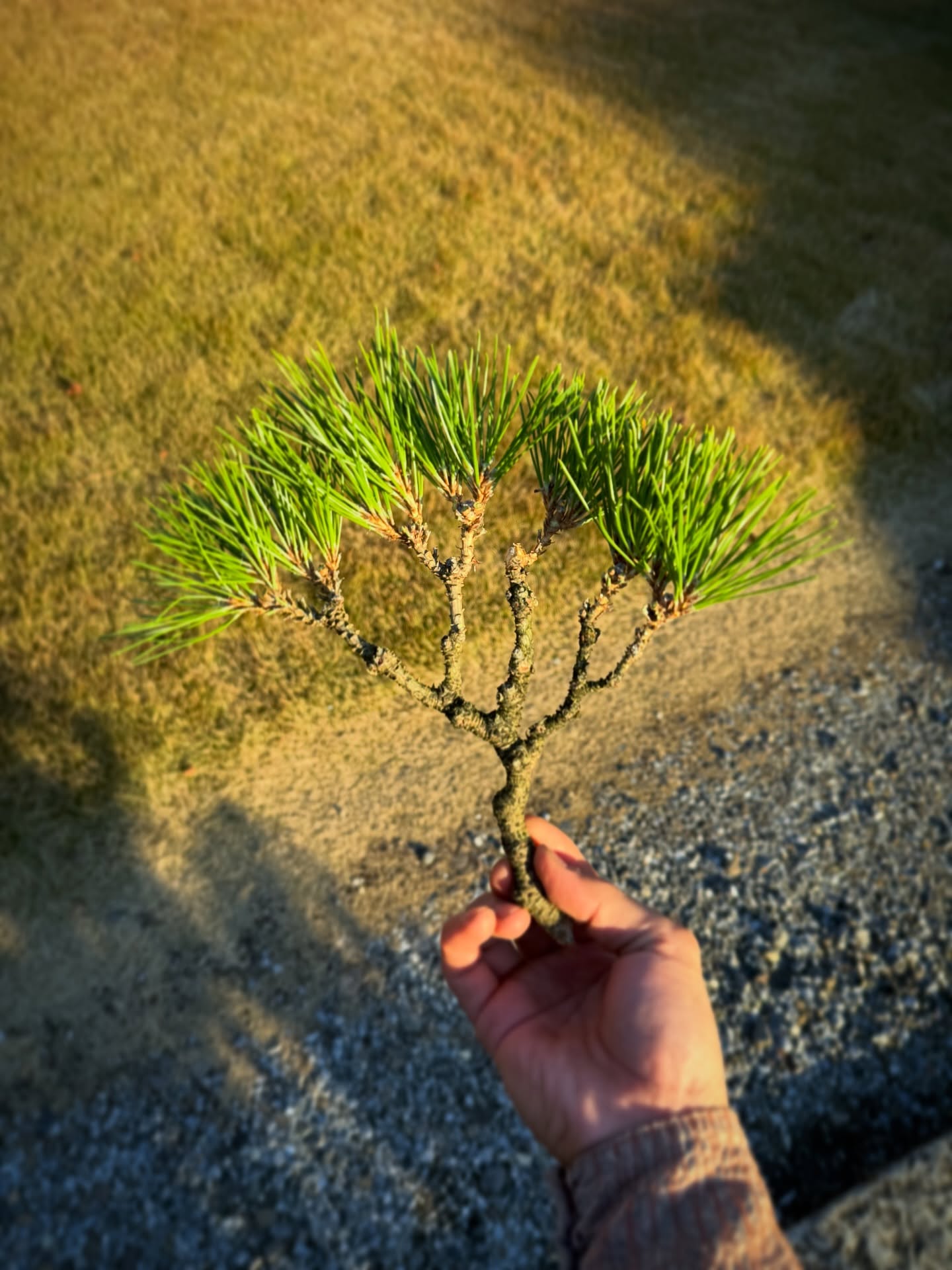
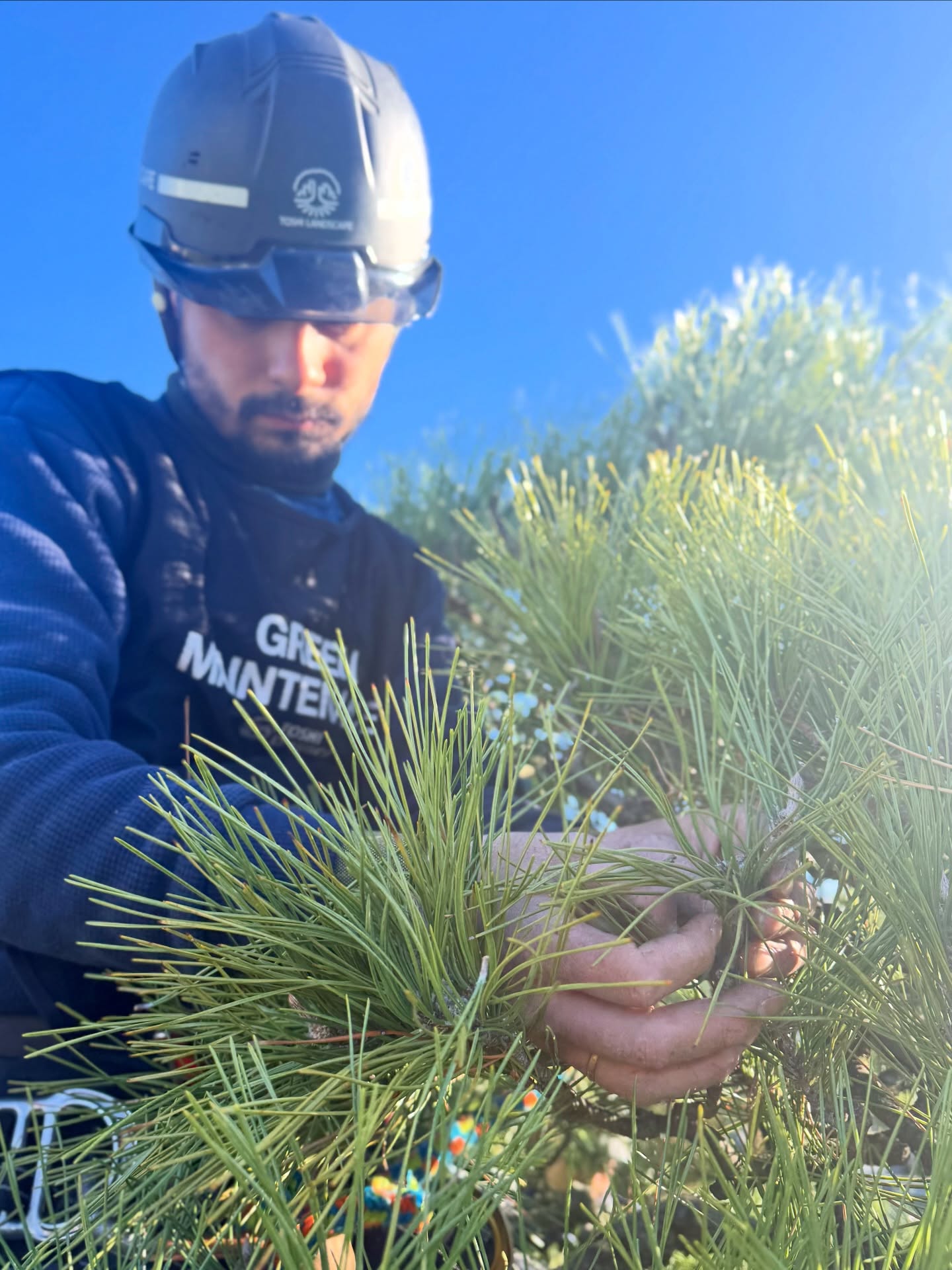
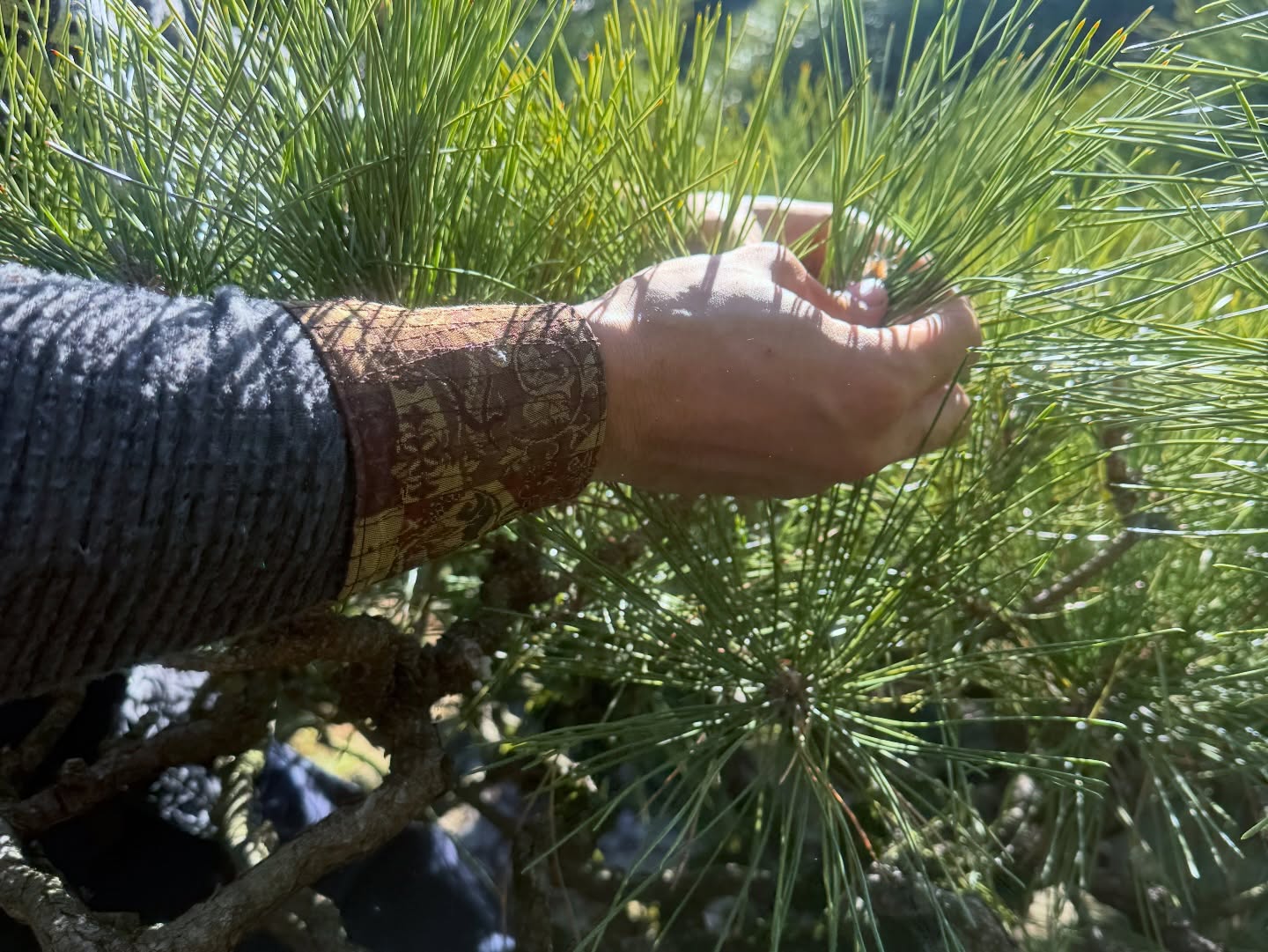
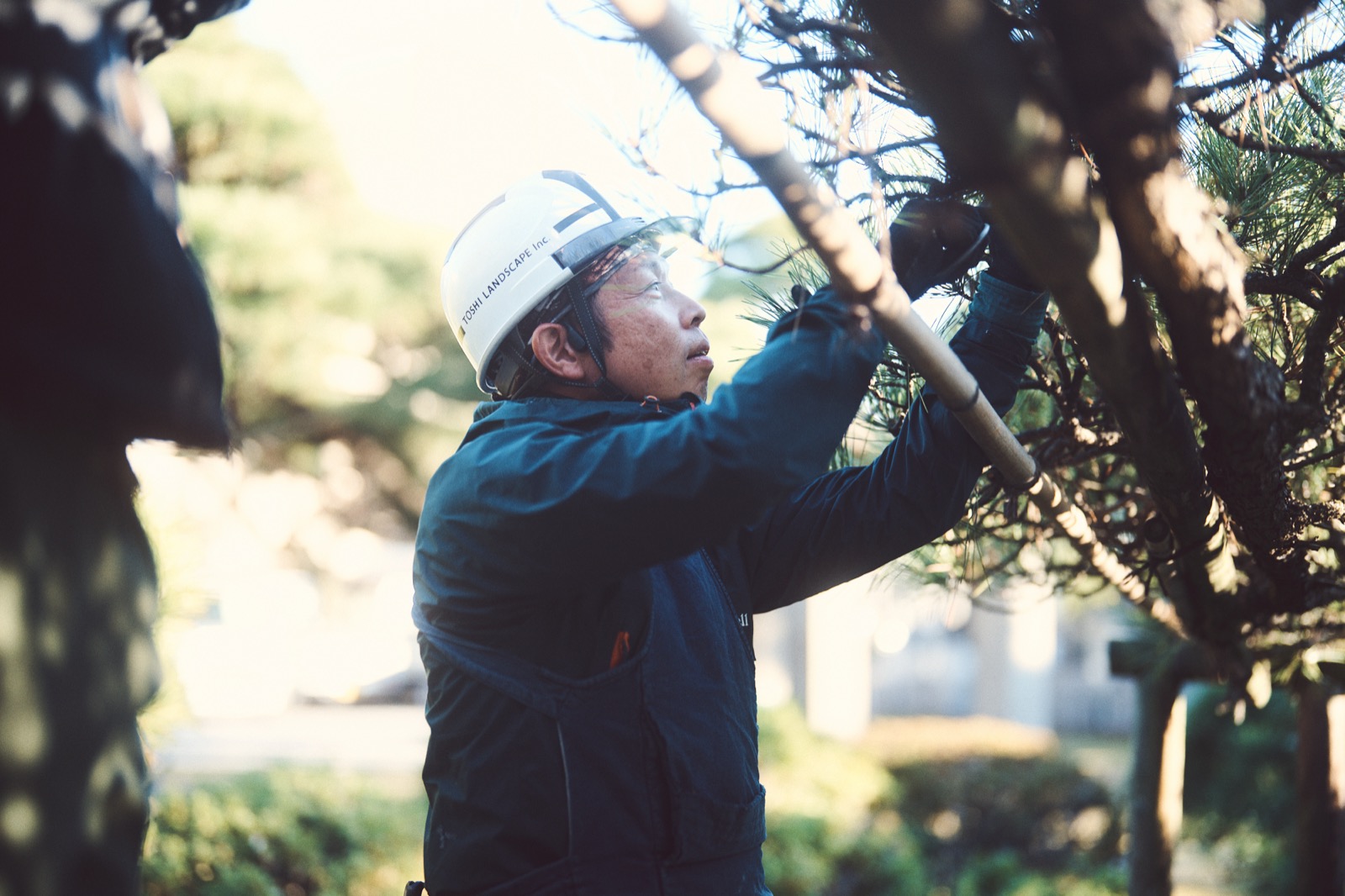
Up close the cloud dissolves. A gardener reaching into a pad does not meet a solid ball of needles. He meets a fan of short twigs, each ending in a tuft of needles, and the work is to reach each tip in turn. Almost none of it is done with shears. The Japan Federation of Landscape Contractors’ basic skills manual describes both of the core yearly jobs, pinching the new shoots around May and removing older needles around October, as hand work.
That is the question this article sets out to answer: why does a gardener choose to manage a pine as many separate pads, and what exactly is he doing at each tip to keep them?

Tamachirashi — What the Word Describes
A definition from Japan’s landscape institute
Tamachirashi joins tama (玉, ball) and chirashi (散らし, scattering). The Japanese Institute of Landscape Architecture’s 2024 research report on Japanese gardens describes it as arranging separately trimmed masses of branch foliage around a tree “as if balls had been scattered” (玉を散らしたように). The definition is about the arrangement, not about any one species, and it does not mention clouds. “Clouds” is the image English speakers bring to it.
How it appears in English
In English the nearest label is cloud pruning. The Royal Horticultural Society presents cloud pruning as a Japanese method and links it to niwaki (庭木, “garden tree”). Japan’s Ministry of Agriculture, Forestry and Fisheries uses the word tamachirashi in an English export brochure on garden plants, glossed, unusually, as “loaf clutters,” for foliage formed into “loaf-shaped structures.” We have not found a source that settles which pine forms every Japanese gardener would call tamachirashi, so in this article we describe what the trees in our photographs look like and use the institute’s definition for the word.
Why Work a Pine One Branch at a Time
A tree that grows from its tips
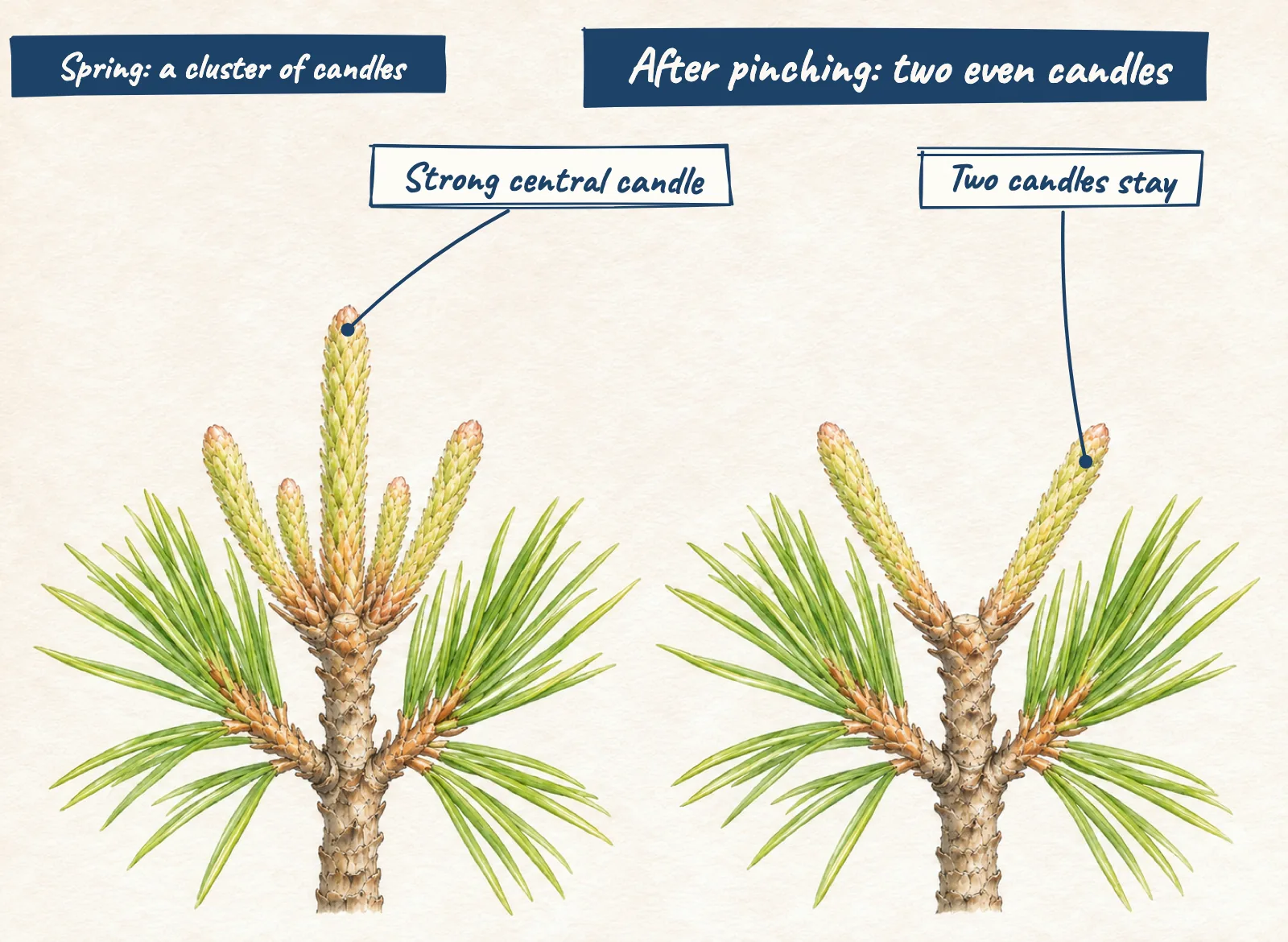
A pine adds most of its new growth at the ends of its shoots. In spring it pushes out candles, which Japanese gardeners call midori (みどり, “green”). Nagano Prefecture’s forestry research center describes three to six new shoots emerging from one point, with the strongest growing straight up from the middle. Left alone, growth keeps being added at the outer ends of each branch.
General guidance on both sides of the Pacific starts from that habit. The University of Minnesota Extension advises, “Don’t prune further back than the current year’s growth.” In other words, the place where a gardener can most safely steer a pine is the youngest wood at the tips.
What the gardener chooses, and what the pine allows
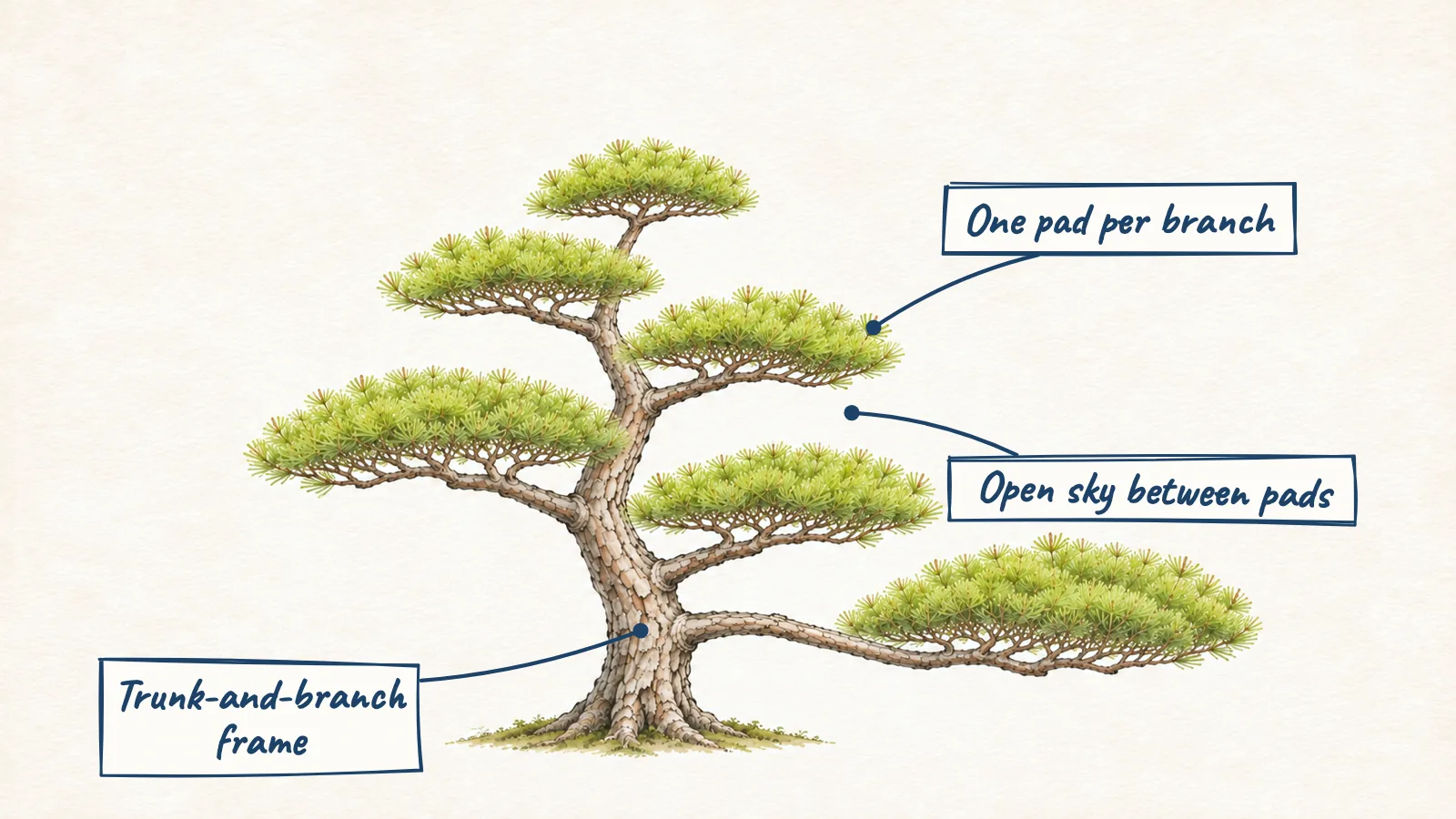
Nothing in this habit by itself produces pads. The pads are a choice of form. What the pine’s growth habit gives the gardener is a handle: because the new shoots arrive in clusters at known points, he can decide, one cluster at a time, how many shoots stay, how far they extend, and how many needles they keep. Make the same decisions consistently along one branch and that branch keeps a compact mass at its end. Keep the spaces between branches open and the tree reads as separate pads.
How far a pine responds to cutting
There is a limit to that handle. A 1973 Kyoto University study by Furuno Tōshū and Yamazaki Toyohiro cut the new shoots of Japanese red and black pines in different ways and found adventitious buds, buds forming where none had been, only under certain treatments: cutting 50 percent of the main axis, or cutting all axes. It does not predict any single tree, but it shows that the response depends on how and how much the new shoots are cut. The practical guides cited below, for their part, describe repeated work at the shoot tips rather than large cuts.
Inside One Pad — Branch, Fork, Tip
The skeleton
Strip a pad on the trees we photographed down to its wood and you find a branch that forks, forks again, and spreads sideways into a fan. Each final twig ends in a tuft of needles. On these trees the fan is broad and fairly flat, so the needles sit on top of it like a canopy. That is one observed example, not a rule for every tamachirashi pine: in the Huntington’s account of its Japanese garden, the visiting gardener Takuhiro Yamada aimed for pines with “a relaxed, soft form, not flat or rigid.”
Choosing which tips stay
The published rules for how many shoots to keep differ by season, species, and purpose, and it helps to keep them apart.
– Spring, crowded shoots (general garden pines): the federation’s manual says that where too many new shoots emerge together, keep about three and remove the rest at their bases. – Spring, the strongest shoot: Nagano’s guide says to remove the strong central shoot of the cluster. – Autumn, black pine: the Kawaguchi Green Center’s guide to pines describes keeping two summer shoots during black pine needle work from mid-October through December. – Bonsai: the North American Rock Garden Society gives, as a general rule for pine bonsai, retaining two candles or buds at each growth tip.
All of them select shoots rather than keep every one; the number kept and the reason for choosing depend on the season and the purpose.
Putting the branch where the pad should be
A pad also has to sit in the right place. Japanese gardeners guide branches with bamboo, poles, and palm-fibre rope (shuronawa, 棕櫚縄). A Japanese landscape company describing its work on a gate pine writes of letting shoots extend and then training them with “bamboo, logs, and palm-fibre rope” (竹や丸太や棕櫚縄で支柱やバチを取付け誘引). On the wide pine in our photographs, the long horizontal limbs rest on wooden posts, so the pads at their ends hold their position.
One Twig Through the Year — Applying the Published Rules
The steps below follow a single twig at the edge of a pad on an ordinary garden black pine. It is a worked illustration built from the Japanese guides cited, not a record of one particular tree.
May: read the cluster before touching it
In spring the twig’s tip shows a cluster of candles. Before pinching, the gardener reads three things: which candle is clearly stronger than the others, how many there are, and how far this tip should be allowed to extend compared with the tips around it.
May: pinch by hand, in order
- Remove the strong central candle. Nagano’s guide names it as the one to take.
- Thin the rest if crowded. Where too many have emerged, keep about three and remove the others at their bases (federation manual).
- Shorten where growth should be held back. For a shoot whose extension you want to restrict, leave about one-third of its length (federation manual).
The federation puts this work around May, by hand, before the needles open. That is the general timing. The Kawaguchi Green Center describes a harder method for vigorous black pines specifically: removing the new shoots at their bases between late April and early June. The two should not be confused. The second is a technique for strong trees.
Public gardens write similar instructions into their contracts. Kyoto City’s maintenance specification for the gardens of Nijō Castle tells contractors to remove “about two-thirds of each elongated shoot by hand” (伸長した芽の2/3程度を手で摘む). We have written about the spring side in more detail in Midori-tsumi: reading a pine tree’s future in its spring candles.
October: count the pairs
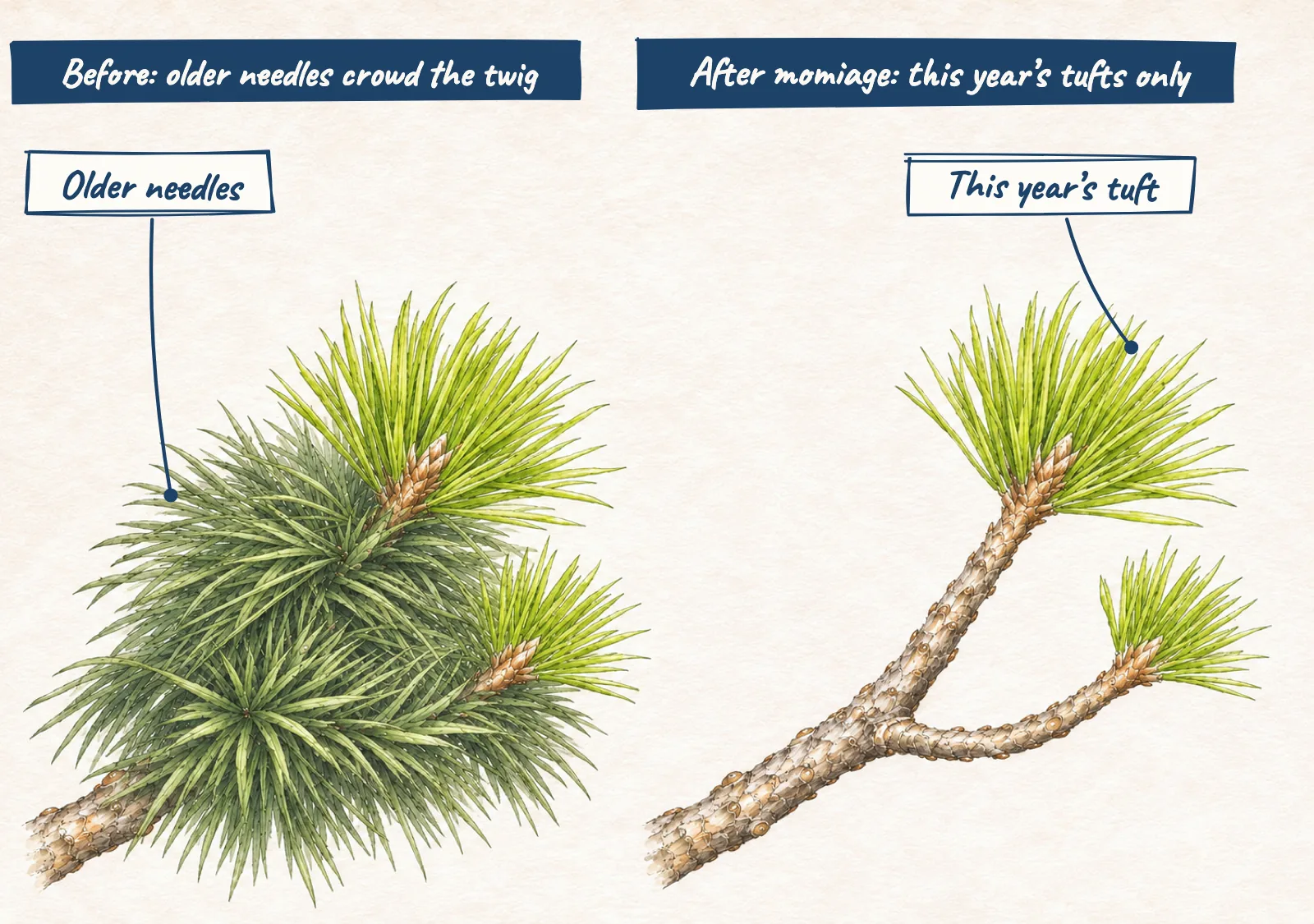
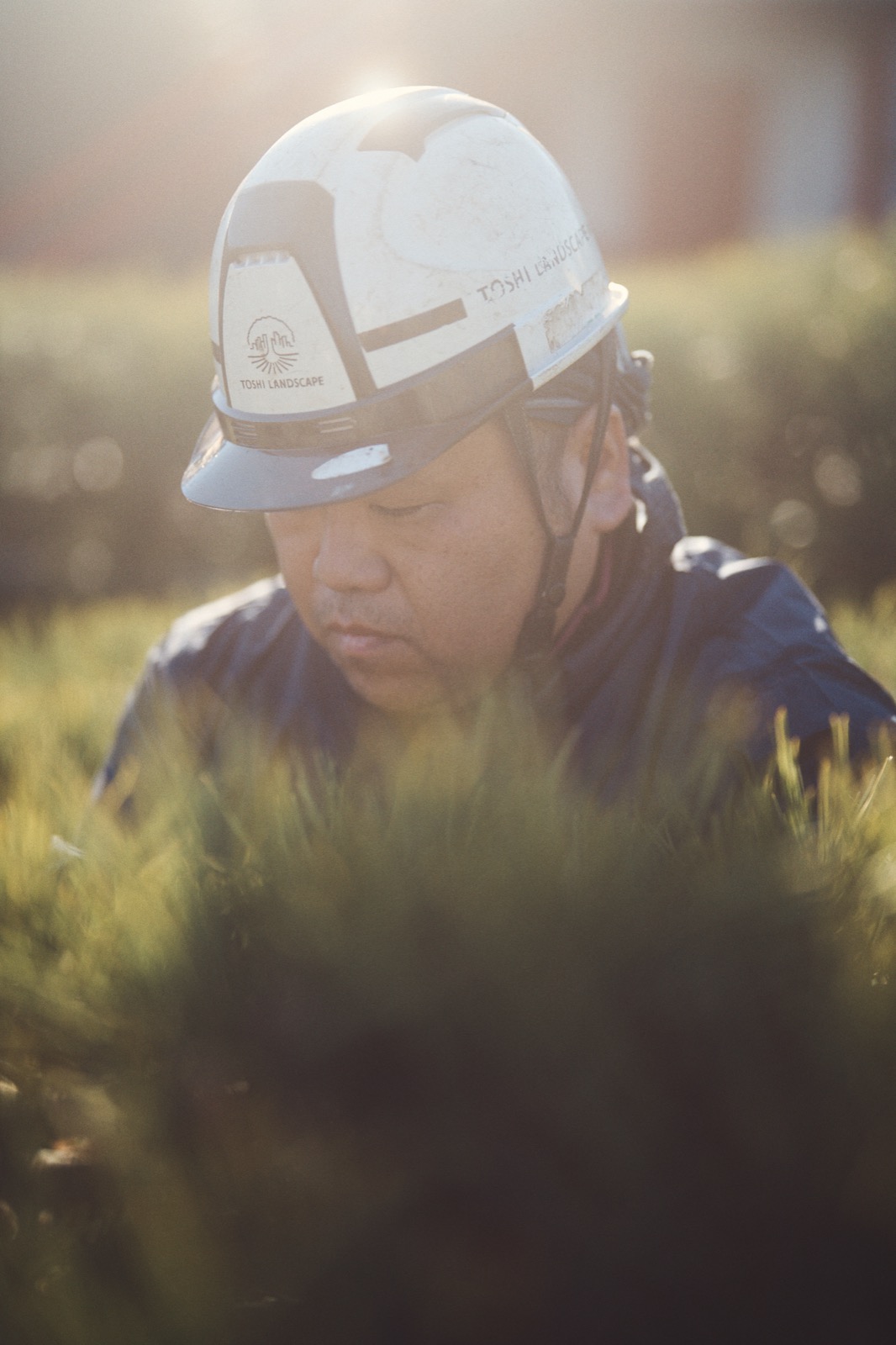
By autumn the twig carries this year’s needles at its tip and older needles further back. A black pine holds needles for several years; Utah State University lists three to five years, Virginia Tech two to four. The federation’s manual places momiage (もみあげ), also called ha-mushiri (葉むしり, “needle plucking”), around October: remove by hand the older needles below the current year’s foliage, and leave about 30 to 40 needles, or 15 to 20 pairs (30~40本(15~20対)), at the end of each current-year shoot. Black pine needles grow in pairs, so the gardener counts in twos.
October: cut what crowds the inside
With the old needles gone, the wood of the pad is visible, and this is when Nagano’s guide has the gardener cut “dead branches and overcrowded branches” (枯れ枝や混みすぎている枝) at their bases. With the needles thinned, the crowded wood is easy to see.
The check: what you should see when you stop
The finished twig shows current-year tufts at its tips, bare wood behind them, and light passing between neighbouring twigs. The aim is to let light in while keeping enough healthy foliage, and how much is enough depends on the species, the tree’s vigour, the region, and the guidance being followed. The next section turns to that limit.
| Season | Job | Japanese | What the sources describe |
|---|---|---|---|
| Around May | Pinching candles | 緑摘み midori-tsumi | By hand before needles open; keep about three if crowded; leave a third of a shoot to restrain it (federation); remove two-thirds by hand (Nijō Castle) |
| Late April – early June | Removing new shoots at the base | 新梢を元から摘む | Vigorous black pines only (Kawaguchi) |
| Around October | Needle removal | もみあげ momiage | Leave 15–20 pairs per shoot (federation); mid-October to December on black pine, keeping two summer shoots (Kawaguchi); late September to mid-October in Hokkaido (Sapporo) |
| With needle work | Branch thinning | 枝抜き edanuki | Cut dead and overcrowded branches at their bases (Nagano) |
| Over years | Training | 誘引 yūin | Bamboo, poles, palm-fibre rope (Niwakou) |
The Gaps Between Pads — Light, and Where to Stop
Why the inside needs light
Nagano’s forestry center explains that removing surplus needles lets light and air reach the pine’s branches. Research points in the same direction, with a caution about scale. In a 1968 Kyoto University shading experiment, Kawanabe Saburō and Shidei Tsunahide found that shade lowered the dry-mass growth rates of Japanese red and black pine seedlings. That was an experiment on seedlings, not on a mature garden pine before and after momiage, and we found no study that measures the effect of needle removal directly. Together they support a general reason for letting light in: shade reduced seedling growth, and the guide explains that removing surplus needles improves light. Neither tested the gaps between pads on a mature garden pine.
Where to stop
Removing too much is the opposite failure. A technical article by Nishimura Masashi of the Japan Tree Doctors Association’s Toyama branch links some pine decline to excessive pruning in which the foliage drops sharply and photosynthetic capacity falls with it (葉の量が極端に減り、光合成能力が著しく低下). The published rules already build in lighter handling for some trees, and each comes with its own conditions.
| Situation | What the source says | Source |
|---|---|---|
| Japanese red pine (Pinus densiflora) | Weaker sprouting capacity than black pine; prune more lightly | Sapporo Park and Greenery Association |
| Japanese white pine (Pinus parviflora) | Needles extend less; pinch more lightly than black or red pine | Kawaguchi Green Center |
| Hokkaido | Needle removal late September to mid-October, keeping roughly half to a third of the foliage | Sapporo Park and Greenery Association |
| Vigorous black pine | New shoots can be removed at their bases in late April to early June | Kawaguchi Green Center |
| Vigorous black or red pine bonsai near Washington, DC | Whole candles removed in early June for a second flush of shorter needles | North American Rock Garden Society |
A Long History of Separate Masses
A medieval pine with sixteen caps
We could not establish when the word tamachirashi first appeared. Training a pine as separate foliage masses has documented precedents, though. In a study of clipping in medieval Japan, the garden historian Yoshinaga Yoshinobu reports a Japanese white pine (goyōmatsu, 五葉松) trained into sixteen cap-like masses, “五葉松で16箇の笠,” “a five-needle pine with sixteen caps.” It does not prove that today’s style descends directly from that tree, but it shows Japanese gardeners treating a pine as a set of separate units centuries ago.
An Edo instruction: the inside first
The Edo-period garden manual Tsukiyama Teizōden (築山庭造伝) carries a preface dated 1735, according to the University of Tokyo’s digitized copy. A passage from it, quoted in Yoshinaga’s study, tells gardeners to clear out “dead branches, old leaves, or insect nests” (中の枯枝古葉或は虫の巣杯をよくよく取払いて) from inside a clipped tree before trimming the outside, and applies this to clipped trees “high or low, round or square” (高木低木丸物角物すべて同じ). The passage is about clipped trees in general, not about tamachirashi pines. Its order of work, though, inside first and outside second, echoes the October step above.
The Names Around It — Related Japanese Forms
Six trained forms in one report
Japanese gardeners name many trained forms, and the institute’s report keeps them distinct.
| Form | Japanese | How the report describes it |
|---|---|---|
| Tamachirashi | 玉散らし | Separate foliage masses scattered around the tree like balls |
| Tamazukuri | 玉づくり | Foliage masses held close to the trunk |
| Tamamono | 玉物 | A semicircular or elliptical form whose lower edge meets the ground |
| Danzukuri | 段づくり | Vertically stacked tiers, with thinner masses than tamachirashi |
| Monkaburi | 門かぶり | A tree beside a gate whose branches extend over the entrance |
| Kengai-zukuri | 懸崖づくり | The trunk bends downward soon after leaving the base |
Usage varies between sources. The Kawaguchi Green Center, a regional greening body, uses tamazukuri or tamajitate for training a whole tree into a single sphere.
Why it is not karikomi
Japan’s other well-known rounded form is karikomi (刈込), shaping by clipping. A pad pine can look related, but the way it is kept is different: the clipped form is shaped at its outer surface, while the pad pine described here is shaped from inside, by choosing which shoots and needles stay. We have written separately about karikomi, Japan’s art of clipped cloud forms.
Japan’s Gardens — Counting the Work Pad by Pad
Hundreds of pines in one contract
In Japan’s historic gardens, this tip-by-tip work is planned at scale. The Nijō Castle specification, for a contract period running to March 2025, lists 326 pines for shoot pinching and 301 for needle removal. An Environment Ministry management schedule for the Imperial Palace Outer Garden specifies one winter pruning round for 1,700 pines in the palace front plaza. A Kagawa Prefecture staff profile says Ritsurin Garden has about 1,400 pines, of which about 1,000 are teire-matsu (手入れ松), pines kept in trained form.
Ishikawa Prefecture announced that Kenrokuen would prune selected pines from September 1 to mid-October 2025: five by needle removal and three by kiriwari (切り割り), a branch-thinning cut. Tokyo’s Hama-rikyu Gardens advertised two ninety-minute public demonstrations of shoot pinching for May 5, 2026, and Ritsurin Garden has advertised gardener-led pruning demonstrations for groups of about twenty.
How long one pine takes
The labour grows with the crown surface of the tree. In a study published in 1966, based on a 1964 survey of autumn pruning at Shugakuin Imperial Villa and the former Kyoto Imperial Palace, Maeda Minoru fitted a formula for the labour: T = 0.214S + 0.1, where T is person-hours and S is the crown surface area in square metres. By that formula, a pine with 50 square metres of crown surface works out to about 10.8 person-hours. It comes from one survey, not a modern standard. It fits what the worked twig above suggests, though: every square metre of a pad is made of tips, and each tip is handled.
Japanese Gardens Abroad — Related Work, Different Schedules
Candling and needling in North America
Japanese gardens in North America describe related work, on schedules of their own. Seattle Japanese Garden describes “candling” in April to May, snapping tender new shoots with the fingers, and reported around 50 pine specimens treated this way in 2015; it keeps autumn pruning for woody growth and larger decisions about form. The Huntington describes major pruning in its Japanese garden in January or February and lighter pruning in May or June; in its account, Tomohiko Kawamura stripped the older needles from a Japanese black pine while keeping its outer growth. Denver Botanic Gardens says the candles in its Japanese garden, Shofu-en, are snapped off in spring and branches trimmed and tied to preserve their shape. Portland Japanese Garden advertised an October 2023 workshop with Sadafumi Uchiyama on “candling, needling, growth regulation, and pruning techniques.”
What the American extension guides say
The general American guides we consulted aim at a different result: a pine kept dense and within bounds as a whole tree. The University of Wisconsin Extension recommends removing about one-half to two-thirds of each elongated candle before the needles expand; Brooklyn Botanic Garden gives the same range and says to break the tips off by hand; the University of Maryland Extension suggests pinching half of a candle when it is about two inches (5 cm) long. Wisconsin also advises not removing lower branches and never removing the central stem. On the arborist side, the Tree Care Industry Association describes the 2023 revision of the ANSI A300 pruning standard as a shift from a rigid “25% rule” to objective-based pruning, with the smallest and fewest cuts needed to meet the objective.
Same candle, different brief
The candle is handled in much the same way in both sets of sources. What differs is the stated objective. The extension guides treat the pine as one crown to be kept compact. The Japanese guides and the garden accounts above also describe needle removal and interior thinning, the work that opens space inside and between pads, though their schedules differ; the Huntington does its major pruning in January or February. The difference reflects the brief each guide is written for, not a better or worse method. We have compared the two mindsets more broadly in Niwaki vs topiary: what Western gardens get wrong.
Common Mistakes — What Undoes a Pad
Shearing it like a hedge
Shearing only the outer surface does not do the shoot selection, needle removal, or interior thinning described in the practical guides cited here. The crowded tips stay, needles are cut through, and the inside of the pad stays shaded.
Cutting into old wood
When shortening a living shoot, the University of Minnesota Extension advises not going further back than the current year’s growth. That is different from removing a dead or overcrowded branch at its base, which Nagano’s guide describes as part of the autumn work.
Treating every pine like a vigorous black pine
Removing new shoots at their bases is described by the Kawaguchi Green Center for vigorous black pines, and the North American Rock Garden Society describes removing whole candles on vigorous black and red pine bonsai around Washington, DC. These are techniques for vigorous trees in a stated context. Carried over to garden red pines, white pines, or weak trees, they risk the excessive foliage loss Nishimura warns about.
Doing only one season
The Japanese guides describe spring pinching and autumn needle work as a pair. Spring work restrains the tips; autumn work clears the inside. Skipping either leaves half of that job undone.
Frequently asked questions
What does tamachirashi mean?
Tamachirashi (玉散らし) means “scattered balls.” Japan’s landscape institute describes it as arranging separately trimmed masses of branch foliage around a tree as if balls had been scattered.
Is tamachirashi the same as cloud pruning?
It is close to what English speakers call cloud pruning, but Japanese sources name related forms separately: danzukuri for stacked tiers, tamazukuri for masses close to the trunk, karikomi for clipped forms. On a pine, the pad form described here is kept mainly by hand, at the shoot tips.
When are pine pads maintained in Japan?
The two main jobs are spring and autumn. General guidance puts shoot pinching (midori-tsumi) around May and needle removal (momiage) around October. Timing shifts with species, vigour, and region: Kawaguchi gives mid-October to December for black pine needle work, and Sapporo gives late September to mid-October in Hokkaido.
How many needles should be left during momiage?
Japan’s landscape contractors’ federation gives about 30 to 40 needles, or 15 to 20 pairs, at the end of each current-year shoot as a general guideline. Guidance from Sapporo for Hokkaido is framed differently, keeping roughly one-half to one-third of the foliage.
Can I train an ordinary pine into pads?
The sources here describe the steps, not a timetable. Start with structure: choose the branches that will carry pads and guide them into place with bamboo, poles, or rope. Then build each pad by thinning shoot clusters in spring and old needles in autumn, keep shortening cuts within the current year’s growth, tell shortening apart from removing whole branches, and handle weak trees, red pines, and white pines more lightly.
Sources
– Japanese Institute of Landscape Architecture, Nihon teien no kokoro to waza, research report 2024, p. 272 — https://researchpromotion.jila-zouen.org/wp-content/uploads/2025/05/2024_nihonteien_seikahoukoku.pdf (checked 2026-10-31) – Kawaguchi Green Center, Jurian dayori, horticultural terms series 25 — https://www.jurian.or.jp/dayori/pdf/0c4945e9462efb1c63f5b2690e2d8b5c.pdf ; Green guide: pines — https://www.jurian.or.jp/pdf/matu.pdf (checked 2026-10-31) – Japan Federation of Landscape Contractors, Zōen shokyū ginō no tebiki, p. 21 — https://www.jflc.or.jp/media/niwa_navi/20150408_0930_52_0831.pdf (checked 2026-10-31) – Nagano Prefecture Forestry Research Center, Mini technical information No. 11, Pine pruning — https://www.pref.nagano.lg.jp/ringyosogo/joho/minigijutsu/documents/mini11.pdf (checked 2026-10-31) – Niwakou, gate pine shoot pinching, 2 May 2023 — https://niwakou.jp/blog/20230502-987/ (checked 2026-10-31) – University of Tokyo Digital Archive, Tsukiyama Teizōden — https://da.dl.itc.u-tokyo.ac.jp/portal/assets/3f8ea4be-3507-6998-6b71-fd53fdc77091 (checked 2026-10-31) – Yoshinaga Yoshinobu, clipping in medieval Japan, Zōen Zasshi 16(1) — https://www.jstage.jst.go.jp/article/jila1934/16/1/16_1_19/_pdf (checked 2026-10-31) – Ishikawa Prefecture, pine pruning at Kenrokuen, 21 August 2025 — https://www.pref.ishikawa.lg.jp/kisya/r7/documents/0821_10_kouenryokuti.pdf (checked 2026-10-31) – Kagawa Prefecture, staff profile (landscape), Ritsurin Garden — https://www.pref.kagawa.lg.jp/jinjii/saiyou/job/garden-6.html ; Ritsurin Garden guided pruning tour — https://www.my-kagawa.jp/files/user/site/2162e079bc6ab0ea4828d3b4ab451f19ab6718fc.pdf (checked 2026-10-31) – Tokyo Metropolitan Park Association, Hama-rikyu Gardens traditional skills demonstration — https://www.tokyo-park.or.jp/park/hama-rikyu/news/2026/5_5_2.html (checked 2026-10-31) – Kyoto City, Nijō Castle garden maintenance specification — https://www.city.kyoto.lg.jp/bunshi/cmsfiles/contents/0000322/322516/T3_siyousyo.pdf (checked 2026-10-31) – Ministry of the Environment, Imperial Palace Outer Garden management schedule — https://www.env.go.jp/garden/content/000262657.pdf (checked 2026-10-31) – Maeda Minoru, pine training and pruning, Zōen Zasshi 29(4), 1966 — https://www.jstage.jst.go.jp/article/jila1934/29/4/29_4_2/_article/-char/ja/ (checked 2026-10-31) – Sapporo Park and Greenery Association, Sukusuku midori No. 21 — https://www.sapporo-park.or.jp/kikin/wp-content/uploads/pdf/sukusuku_21.pdf (checked 2026-10-31) – Furuno and Yamazaki, Forest Research 45, 1973 — https://www.jstage.jst.go.jp/article/forestresearch/45/0/45_9/_article/-char/ja (checked 2026-10-31) – Kawanabe and Shidei, light and tree growth (III), 1968, Kyoto University repository — https://repository.kulib.kyoto-u.ac.jp/items/e8b7dedd-97fa-4013-a3cb-201ac0895f07 (checked 2026-10-31) – Nishimura Masashi, red pine and black pine in gardens, 2010 — https://www.bgtym.org/fgbank/_wp/wp-content/uploads/2019/03/niwaki17.pdf (checked 2026-10-31) – MAFF, garden plants export brochure — https://www.maff.go.jp/j/shokusan/export/e_info/flower_panf_e/pdf/data14.pdf (checked 2026-10-31) – Royal Horticultural Society, Cloud pruning — https://www.rhs.org.uk/plants/types/trees/cloud-pruning (checked 2026-10-31) – Seattle Japanese Garden, Pine candling — https://www.seattlejapanesegarden.org/blog/2015/04/30/gardeners-corner-what-is-candling (checked 2026-10-31) – The Huntington, Pruning, Kyoto-style — https://www.huntington.org/watch-read-listen/verso/pruning-kyoto-style ; Big bonsai? Not really — https://www.huntington.org/watch-read-listen/verso/big-bonsai-not-really (checked 2026-10-31) – Denver Botanic Gardens, Internationally inspired gardens — https://www.botanicgardens.org/york-street/internationally-inspired-gardens (checked 2026-10-31) – Portland Japanese Garden, Pine pruning lecture — https://japanesegarden.org/events/pine-pruning/ (checked 2026-10-31) – Brooklyn Botanic Garden, Growing conifers — https://www.bbg.org/article/growing_conifers (checked 2026-10-31) – University of Wisconsin Extension, Pruning evergreens — https://hort.extension.wisc.edu/articles/pruning-evergreens/ (checked 2026-10-31) – University of Minnesota Extension, Pruning trees and shrubs — https://extension.umn.edu/garden-and-home/yard-and-garden/gardening-in-minnesota/pruning-trees-and-shrubs (checked 2026-10-31) – University of Maryland Extension, Pruning trees in the home landscape — https://extension.umd.edu/resource/pruning-trees-home-landscape (checked 2026-10-31) – TCIA, Stop pruning malpractice with a prescription — https://tcimag.tcia.org/training/stop-pruning-malpractice-with-a-prescription/ (checked 2026-10-31) – Utah State University, Japanese black pine — https://extension.usu.edu/treebrowser/catalog/pine-japanese-black ; Virginia Tech Dendrology, Pinus thunbergii — https://dendro.cnre.vt.edu/dendrology/syllabus/factsheet.cfm?ID=142 (checked 2026-10-31) – North American Rock Garden Society, Bonsai techniques for conifers — https://www.nargs.org/article/bonsai-techniques-conifers-troughs-and-rock-gardens (checked 2026-10-31)