

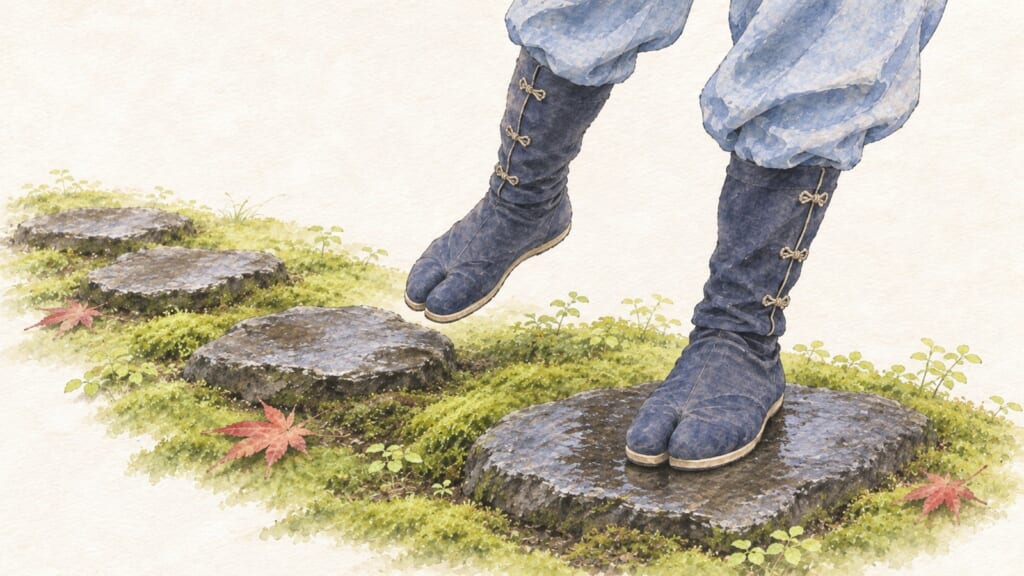
By Isaki Kasahara, a Japanese arborist pruning, assessing and caring for Japan’s trees and gardens · Updated November 18, 2026
Japanese stepping stones, called tobi-ishi (飛石), make you watch your feet because they decide where every step lands: in a tea garden, guests walk only on the stones, and the Omotesenke school of tea writes that the placement of stepping stones and stone paths sets the speed of their steps. In a 2002 eye-tracking study in one Kyoto tea garden, six walkers taught the traditional way of crossing the stones took shorter, slower steps and fixed their gaze on the stone about three stones ahead.
The stones are not necessarily hard to walk on. The same school describes its smallest stones as very easy to walk — for a walker who looks where each foot goes.
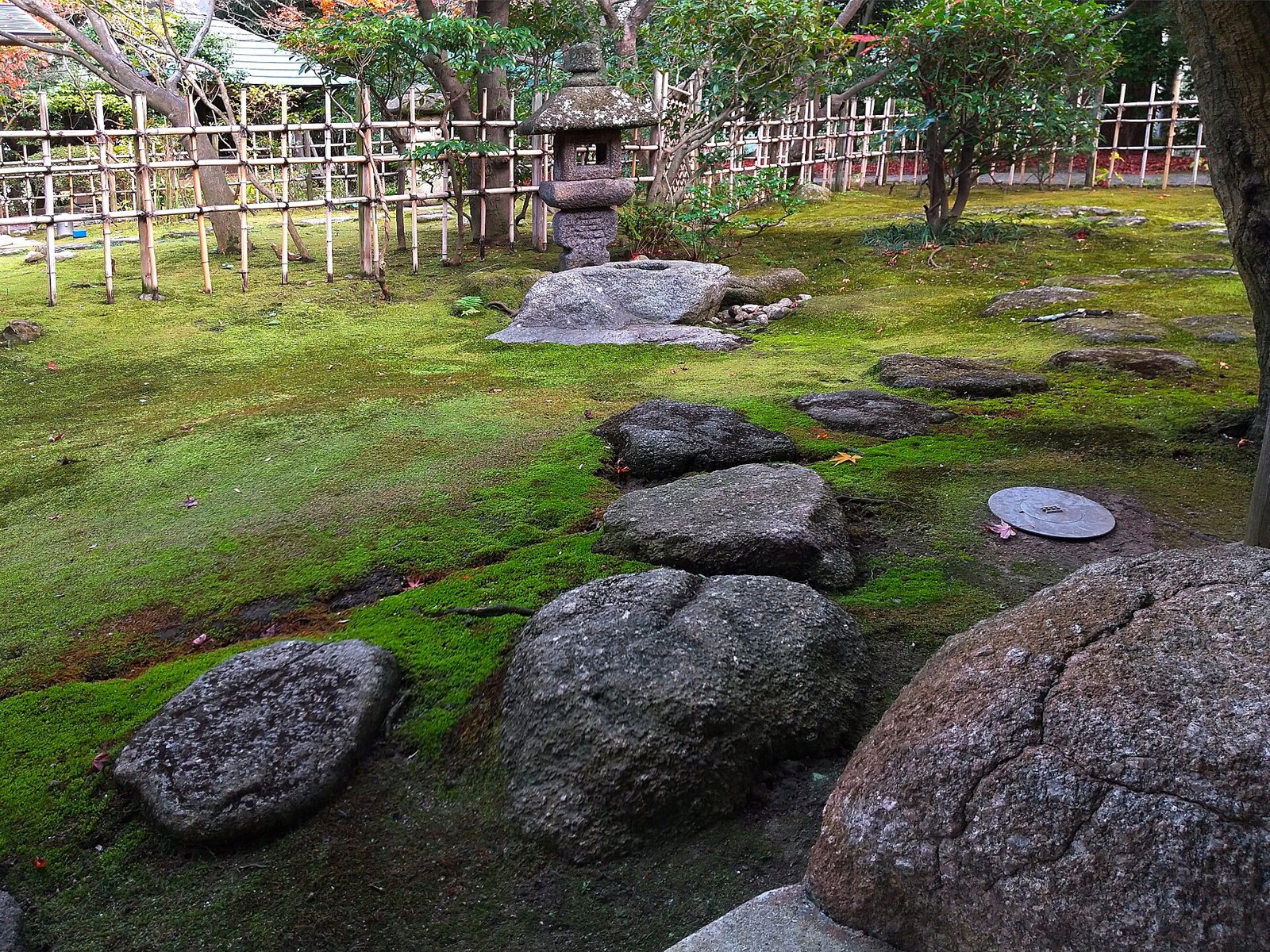
The smallest stones in the garden — Fushin-an’s inner roji
Small stones before the tea room
At Fushin-an (不審菴), the tea house of the Omotesenke school in Kyoto, the inner garden holds the smallest stepping stones in the whole garden. The school says so in its own account of the place, and it adds a sentence that could stand as the theme of this article: the little stones in front of the tea room make the entering guest feel tension “from the feet” (緊張感を足下から感じさせている).
Picture the inner garden as the school describes it: the smallest stones on the whole path, set before the tea room. The school does not claim to know when these stones were brought in; it says that is unknown. What it does say is what they do to the person crossing them.
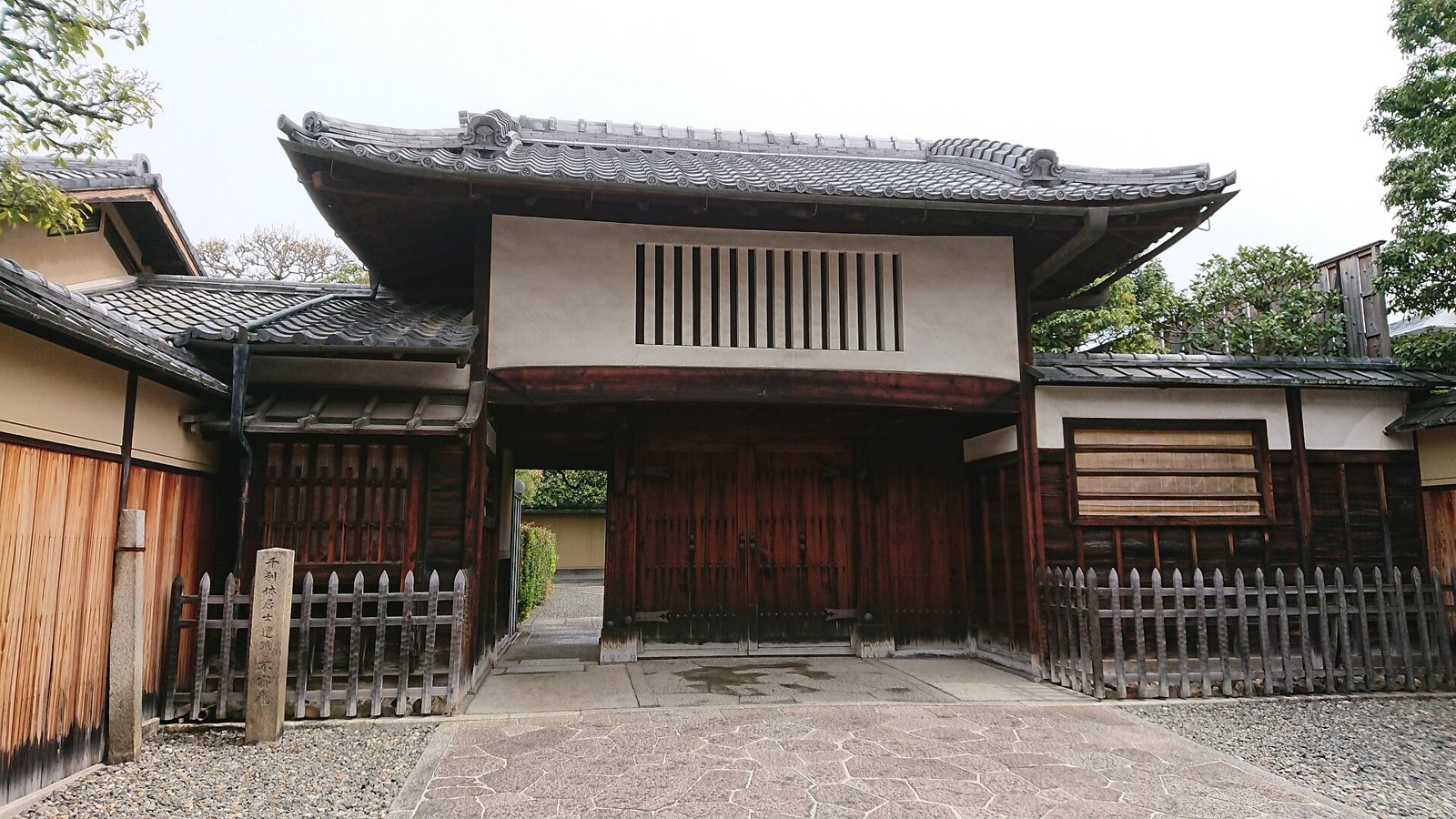
Small, but “very easy to walk”
It would be easy to read this as a garden that is simply awkward to walk through. The same Omotesenke article says something else: the footwork on these small stones is “very easy to walk” (とても歩きよい). The tension and the ease sit side by side. Small stones narrow the choice of where a foot can go, and a walker who wants to step well has to look.
That is the thread this article follows: what the stones do to a walker, where the idea came from, how far apart they actually sit, what the eyes do on them, and how stepping stones in British and American gardens are described for a different purpose.
Where tobi-ishi came from — the tea garden
A path laid on earth
The Nara National Research Institute for Cultural Properties, which publishes a dictionary of Japanese garden terms, defines stepping stones as “stones laid on an earthen path, separately spaced, to facilitate walking.” The key words are earthen and separately. A tobi-ishi path is not a paved strip. It is a line of individual stones, with ground showing between them.
The same dictionary says stepping stones are thought to have come into use in gardens in the Azuchi-Momoyama period, the late sixteenth century, when the tea garden style took shape. That is the period of the tea masters Sen no Rikyū and Furuta Oribe, and it is why tobi-ishi and the tea ceremony are so often mentioned together.
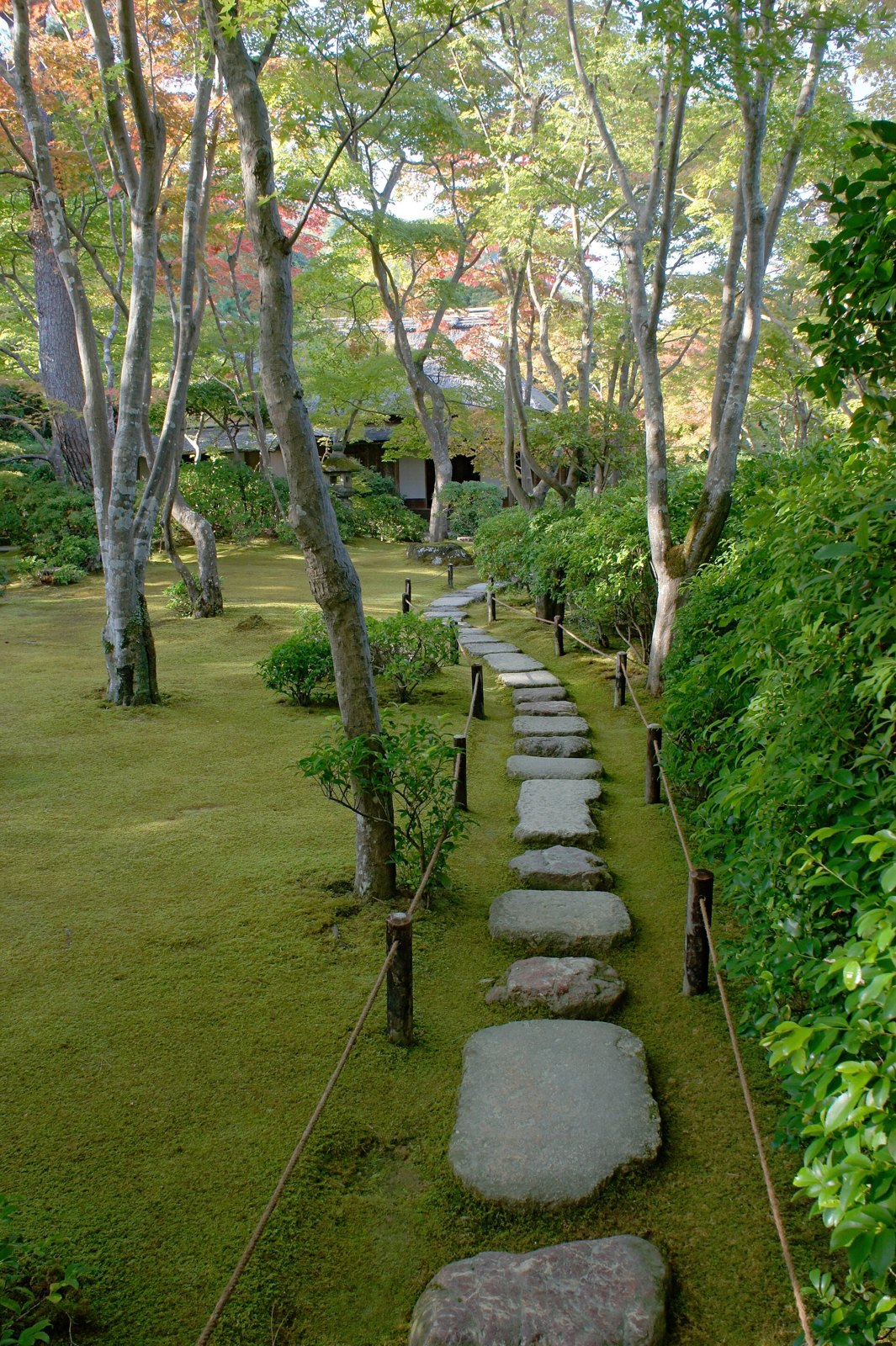
The roji — a garden on the way to tea
A tea garden is called roji (露地). It is experienced on the way to the tea room, step by step. The Omotesenke school explains why the stones matter so much here: guests do not set foot anywhere except on the stepping stones (飛石以外の所へは、足を踏み入れる事はしない), so the stones lead them to the tea room without losing their way, even in a garden meant to feel like a mountain retreat in the middle of a city.
That, the school says, is why the way stepping stones are laid has long been the subject of exacting instruction (古来よりやかましくいわれる), and why setting them in the traditional way is considered very difficult.
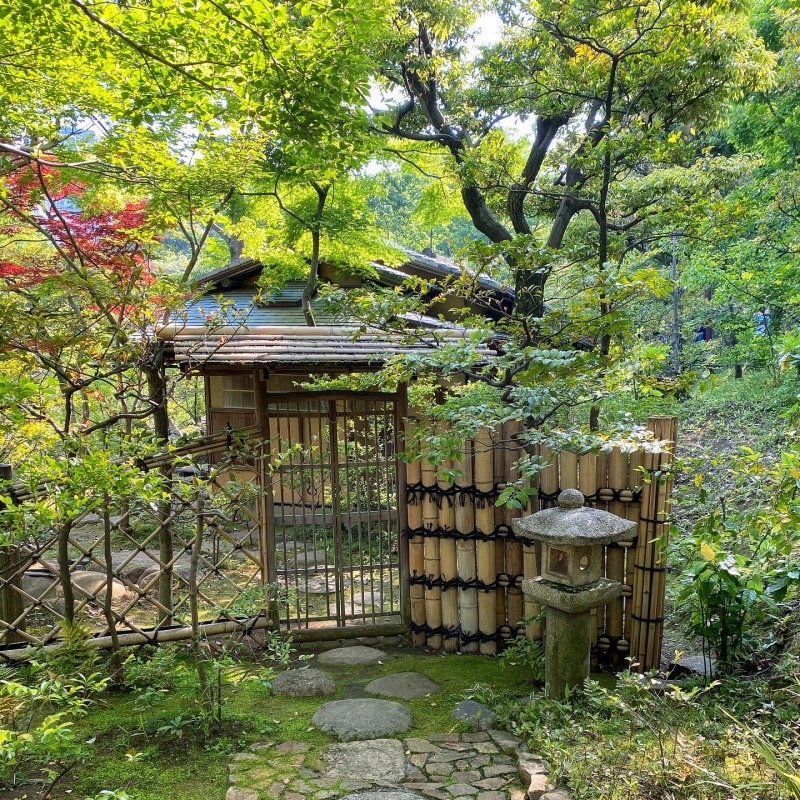
What excavated tea gardens add
Early stepping stones are not only known from books. A 2022 study by Shōda Michihiko and Kanekiyo Hiroyuki measured stepping stones in tea-garden remains at the Special Historic Site of Nagoya Castle (名護屋城) and the encampment sites of the lords around it, in Saga Prefecture (not the better-known Nagoya Castle, 名古屋城, in Aichi), dating them to the end of the Azuchi-Momoyama period. Their finding is a useful warning against neat stories: the average area of a single stone showed no consistency, and stone size seemed to vary with the patron and the use. The distance between stones was, in many cases, longer than in the surviving tea gardens they were compared with.
At least in these remains, there is no single size rule. Whatever conventions later teachers wrote down, the early stones themselves were varied.
Sixty for walking, forty for the view — the saying and its source
What the saying says
A well-known line about stepping stones is a pair of opinions attributed to two tea masters. Rikyū is said to have laid stones with watari (渡り), the ease of crossing, at six parts and kei (景), the view, at four. Oribe is said to have reversed it: four parts walking, six parts view.
The Omotesenke school repeats the saying and gives its source as Sekishū sanbyakukajō (石州三百ヶ条), “Sekishū’s Three Hundred Articles”, a collection of tea teachings. The school then interprets it: Rikyū valued practicality, while Oribe valued the beauty of the scene, for example by setting very large stepping stones.
A version of the line in classical Japanese is quoted in an article by the landscape scholar Taji Rokurō in the journal of the Japanese Institute of Landscape Architecture: 飛石は利休はわたりを六分、景氣を四分に置申候由。織部はわたりを四分、景氣を六分に置申候 — “Rikyū is said to have placed stepping stones with walking at six parts and view at four; Oribe placed them with walking at four and view at six.”
How far to trust it
As a saying, not as a measured rule. The phrase “it is said” (と伝えられている, 由) is built into both versions, and the first written appearance of the saying could not be established in the sources checked for this article.
A separate caution concerns a different book. The famous tea text Nanpōroku (南方録) presents itself as notes taken from Rikyū. A 2020 paper by Sakuramoto Kaori summarises the historian Kumakura Isao’s view that the book is better read as a creation of Tachibana Jitsuzan, about a hundred years after Rikyū’s death. Words attributed to Rikyū through Nanpōroku therefore need care. The six-to-four saying comes through a different text, but it too is reported speech, not Rikyū’s own writing.
Why the saying still matters
None of this makes the saying useless. It names a choice that every stepping-stone path involves: how much weight to give to the foot and how much to the eye. A flat, level stone serves the foot; a stone chosen for its shape, colour or size serves the view, and Oribe’s very large stones are the school’s example. Rikyū’s “six to four” and Oribe’s “four to six” are not formulas. They are two positions on the same scale.
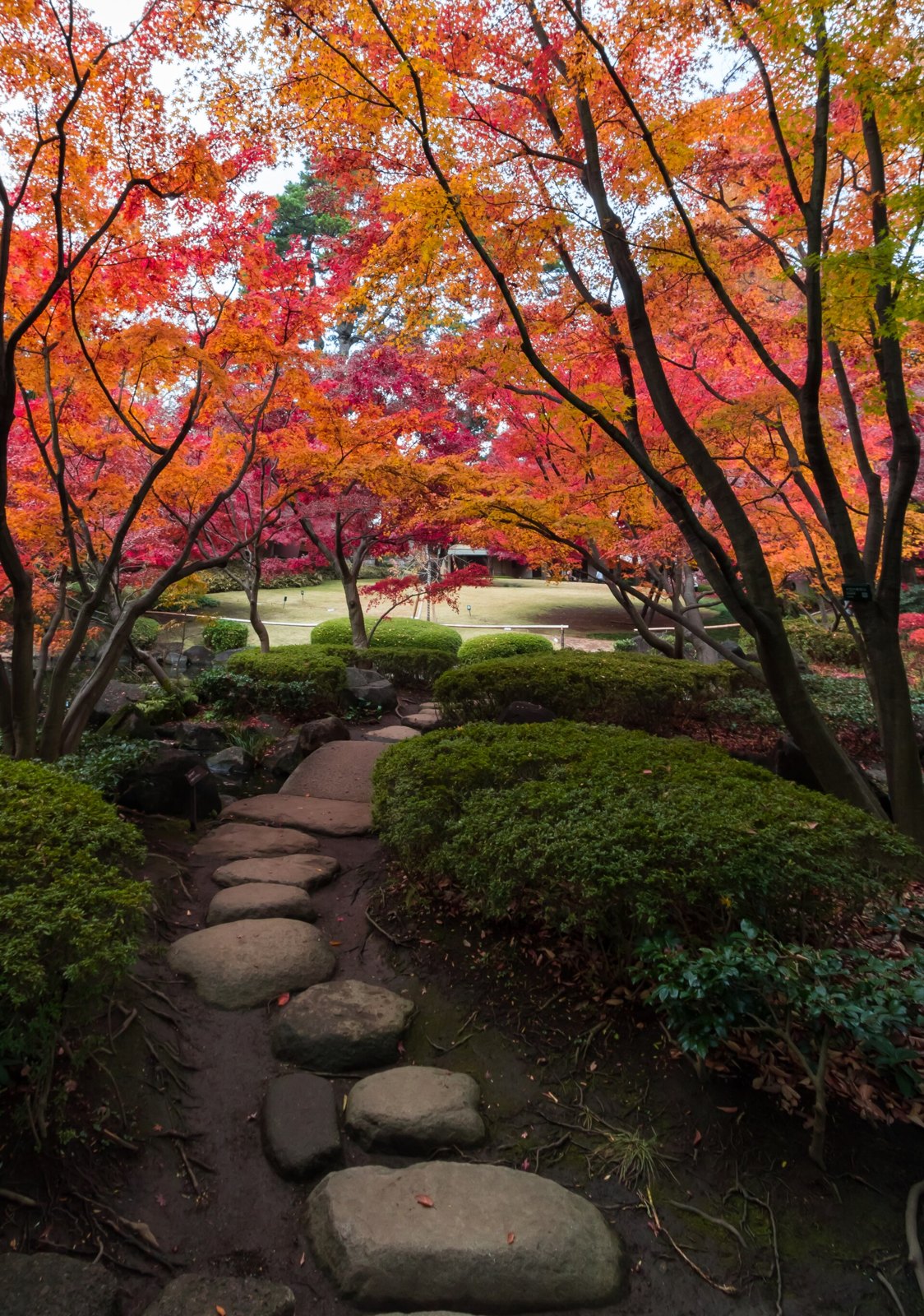
| Rikyū (as told) | Oribe (as told) | |
|---|---|---|
| Walking (watari, 渡り) | Six parts | Four parts |
| View (kei, 景) | Four parts | Six parts |
| Interpretation by the Omotesenke school | Valued practicality | Valued the beauty of the scene, e.g. very large stones |
| Source given | Sekishū sanbyakukajō, as cited by Omotesenke | Same |
| Status | Tradition; first written appearance not established in the sources checked | Same |
What your eyes do on stepping stones — the research
Six students, one tea garden, an eye camera
The claim in the title can be tested, and someone has. In 2002, Nakamura Yūki, Okazaki Shigeyuki and Suzuki Toshitomo published a study of gaze behaviour while walking on stepping stones in the journal of the Architectural Institute of Japan. They used the tea garden in front of the Hoshinsai (保眞齋) tea room at Seifūsō in Kyoto. The subjects were six students who were visiting for the first time and had no knowledge of how to walk on stepping stones. Each wore an EMR-8 eye camera and walked the path three times before and three times after being taught.
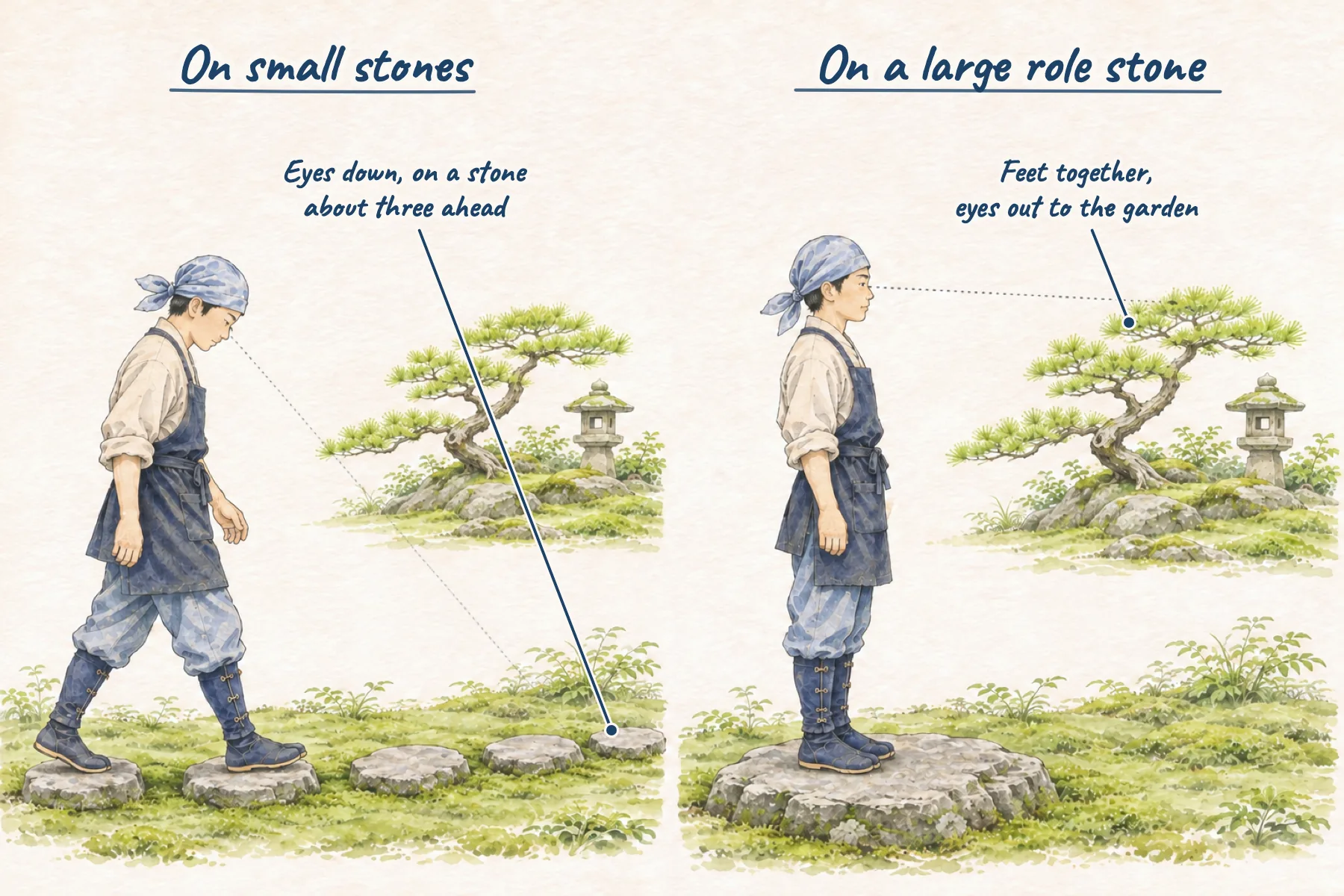
The teaching was the traditional manner: step on each small stone one at a time, and on the large “role stones” (yaku-ishi, 役石) bring both feet together.
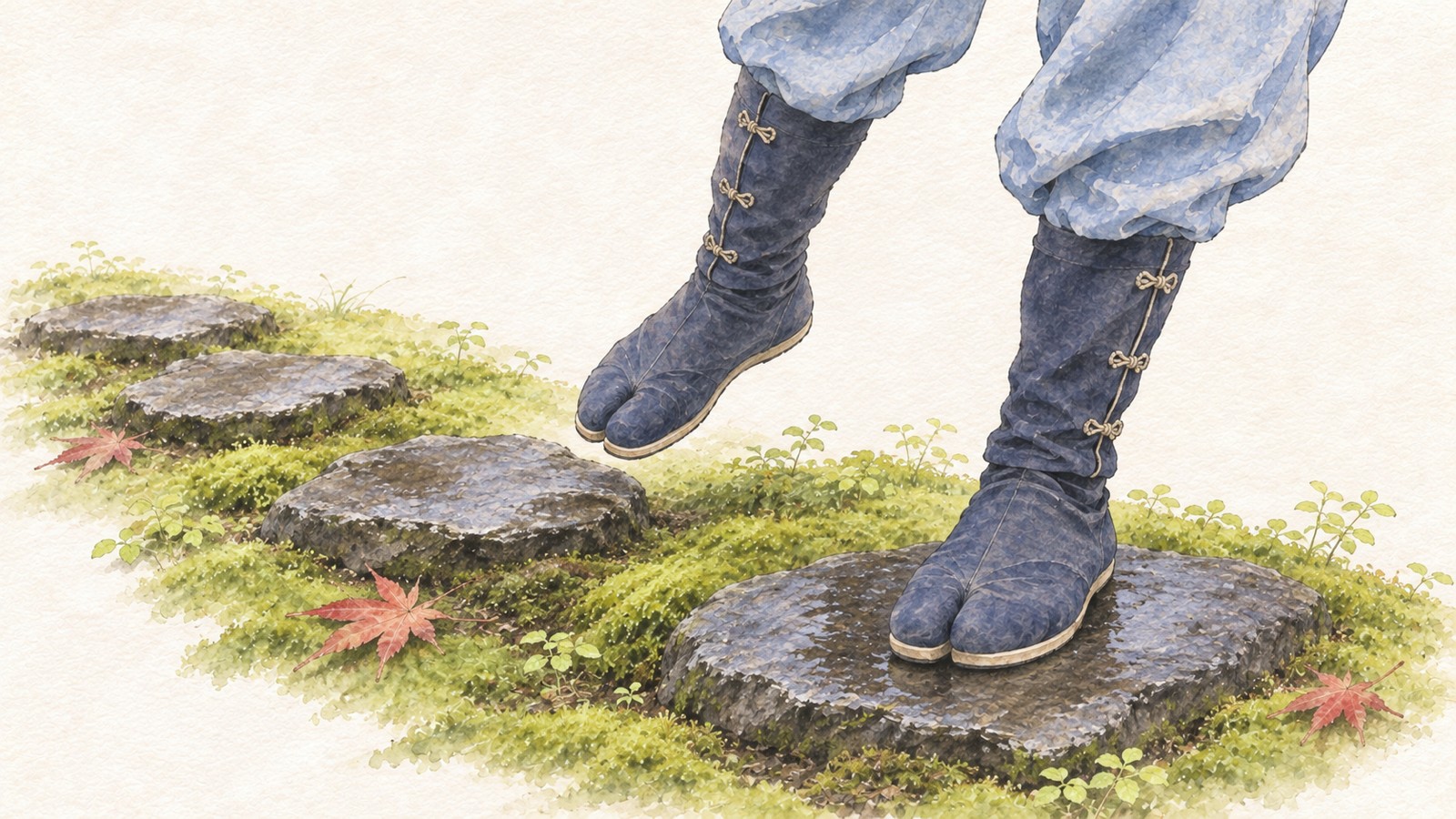
What changed
After the lesson, the walkers’ stride became shorter and their walking speed slower, so the walk took longer. Their gaze also changed. Before, many glances were short, under 100 milliseconds. After, longer fixations of 300 milliseconds or more were more common, and their eyes settled close in front of the body — especially on the stepping stone about three stones ahead.
The most interesting finding concerns the moments when they looked away from the stones. Most of their glances at things other than the stepping stones happened while they were on the large role stones. In this garden, with these walkers, the small stones held the eyes down, and the larger stones were where the eyes went out to the garden.
A second, smaller test
A 2024 conference paper by Wu Yunhui and Suizu Isao for the Japanese Society for the Science of Design asked a different question. Five university students in their twenties walked a stepping-stone path in Nagakute Battlefield Park and ordinary paving on a university campus, three times each, wearing Tobii eye-tracking glasses recording at 50 Hz, with a 450 × 450 mm photograph of a rose set up as a target. Both walks were made slowly, looking at the scenery. The paper reports an average of 29 fixations on the target on the stepping-stone route against 7 on paving, and 13 fixations on other things against 1. The two routes were in different places, the sample was very small, and the statistical result is printed in a form that cannot be correct as written, so these are preliminary descriptive results whose significance could not be verified.
What the research does and does not show
The 2002 study shows what happened to six walkers in one tea garden once they learned the traditional way to cross it: shorter steps, slower walking, eyes on the stones ahead, and looking around mostly from the role stones. That matches what the Omotesenke school says about pace and tension. The 2024 paper is a separate, preliminary look at how a stepping-stone surface may change where people look.
Neither study shows what sixteenth-century gardeners intended. The 2024 paper’s own introduction says only that Katsura’s paths “seem” designed this way. The fair way to put it is that the traditional manner of walking tobi-ishi has been observed to produce these effects, and the tea tradition describes similar effects in its own words.
How far apart — the measured rhythm of a tea path
Centre to centre
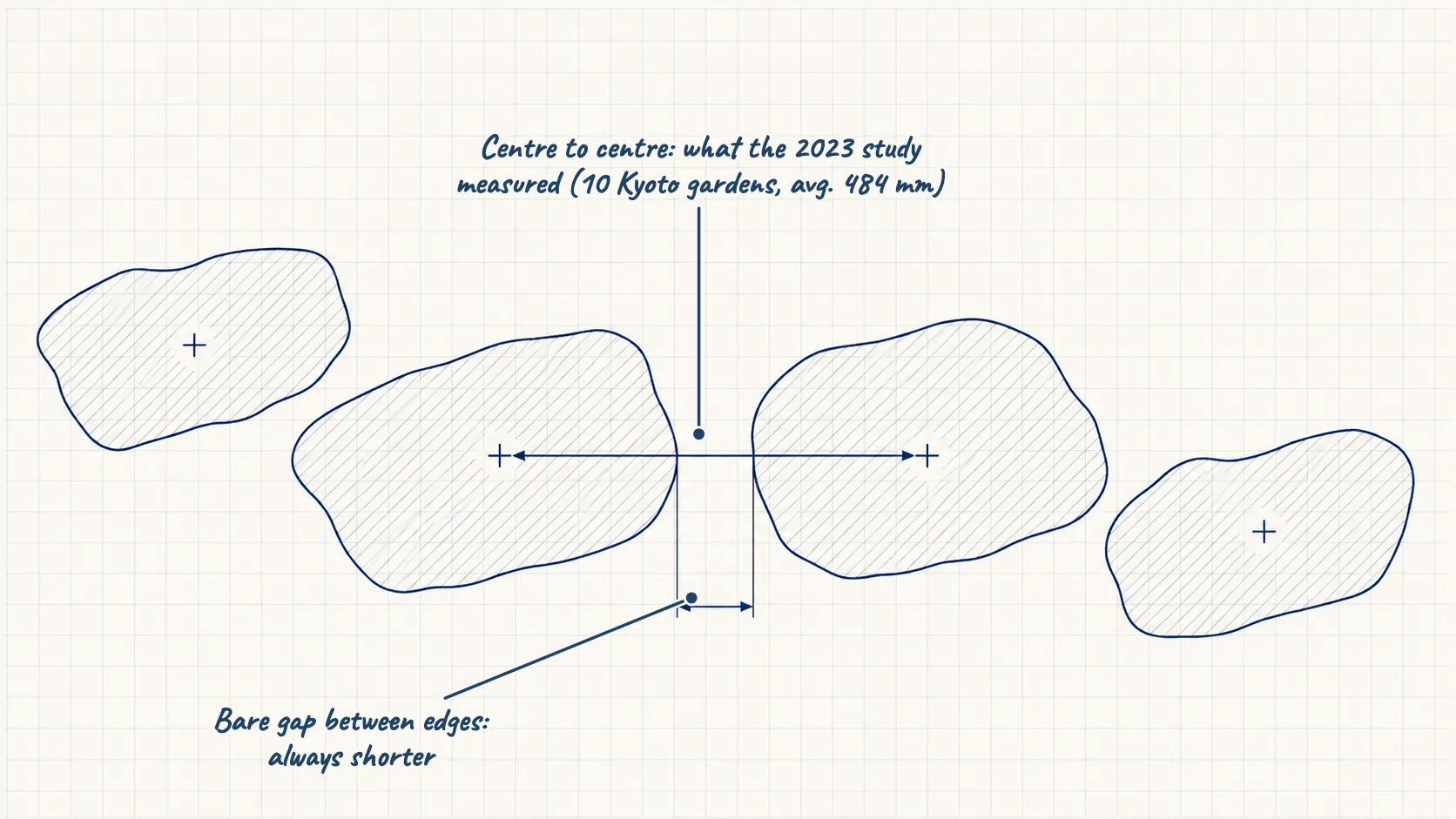
How far apart are the stones in a real tea garden? A 2023 study by Li Luyang, Li Houjun and Shen Yue in Landscape and Horticulture Research, published by the Awaji Landscape Planning and Horticulture Academy, traced the stepping-stone plans of ten Kyoto tea gardens from published survey drawings and measured them on CAD. They measured the distance between the centroids of neighbouring stones’ outlines on the plan — the geometric centre of each stone’s shape — not the gap between edges and not where feet land.
The average for each garden ranged from 417 mm (about 16 in) at Saiō-in to 556 mm (about 22 in) at Kohō-an. Across all ten gardens the average was 484 mm, roughly 19 inches.
What the number tells you
Because these are centre-to-centre distances and stones have width, the bare ground between stones is less than the figure. The number describes the layout of the stones, not the walkers’ steps; the 2002 study, in a different garden, is the one that measured what walkers did. Read together with care, the two say the same kind of thing from different sides: the stones are close-set, and walkers who follow them take short steps.
Kohō-an, the garden with the widest average spacing in the study, is also a good example of a path with a destination. The Enshū school of tea describes stepping stones there running from one end of the main hall to a large shoe-removing stone at the veranda, leading the walker naturally through the opening and on to wash their hands.
The long way round
The same 2023 study measured each path from the garden entrance to the crawl-through door of the tea room. The routes, which the authors defined to include paved stretches and bare ground, ran from 18 to 46 m (about 59 to 151 ft), averaging 33.8 m (about 111 ft). The straight-line distance between entrance and door averaged 21 m (about 69 ft).
So the mean route was about 61 percent longer than the mean straight line. A short distance is turned into a winding approach — a different device from shakkei, the borrowing of distant scenery, but another way in which Japanese gardens shape what a visitor experiences of a limited space.
| Measure (10 Kyoto tea gardens, 2023 study) | Value |
|---|---|
| Average centroid-to-centroid distance, per garden | 417 mm (Saiō-in) to 556 mm (Kohō-an); about 16–22 in |
| Average centroid-to-centroid distance, all gardens | 484 mm (about 19 in) |
| Route length, entrance to tea room door | 18–46 m (about 59–151 ft) |
| Average route length | 33.8 m (about 111 ft) |
| Average straight-line distance | 21 m (about 69 ft) |
What these numbers are not
They are not a building standard. The study measured historic gardens on drawings; it did not prescribe a spacing. The specification checked for this article does not set one either. The City of Yokohama’s general specification for civil works (September 2021 revision) covers natural-stone paving, nobedan and stepping stones, but leaves the thickness of the sand bed and mortar to the design documents for each job.
Setting the stones — what the specifications and records describe
From drawing to stone
Because spacing and sizes are not fixed by a general rule, the work runs through design and the site. For stone paving that includes stepping stones and nobedan, the Yokohama specification sets out these points:
- Design documents fix the thickness of the cushion sand and bedding mortar, and the width and depth of any mortar joints.
- Fitting on site: the joints between stones (合端, aiba) are worked and fitted at the site.
- Surface: the finished surface is to be smooth.
- Drainage: the falls set out in the design are to be kept.
- Edges: the ends of the paving are to be finished with care.
What an old garden shows
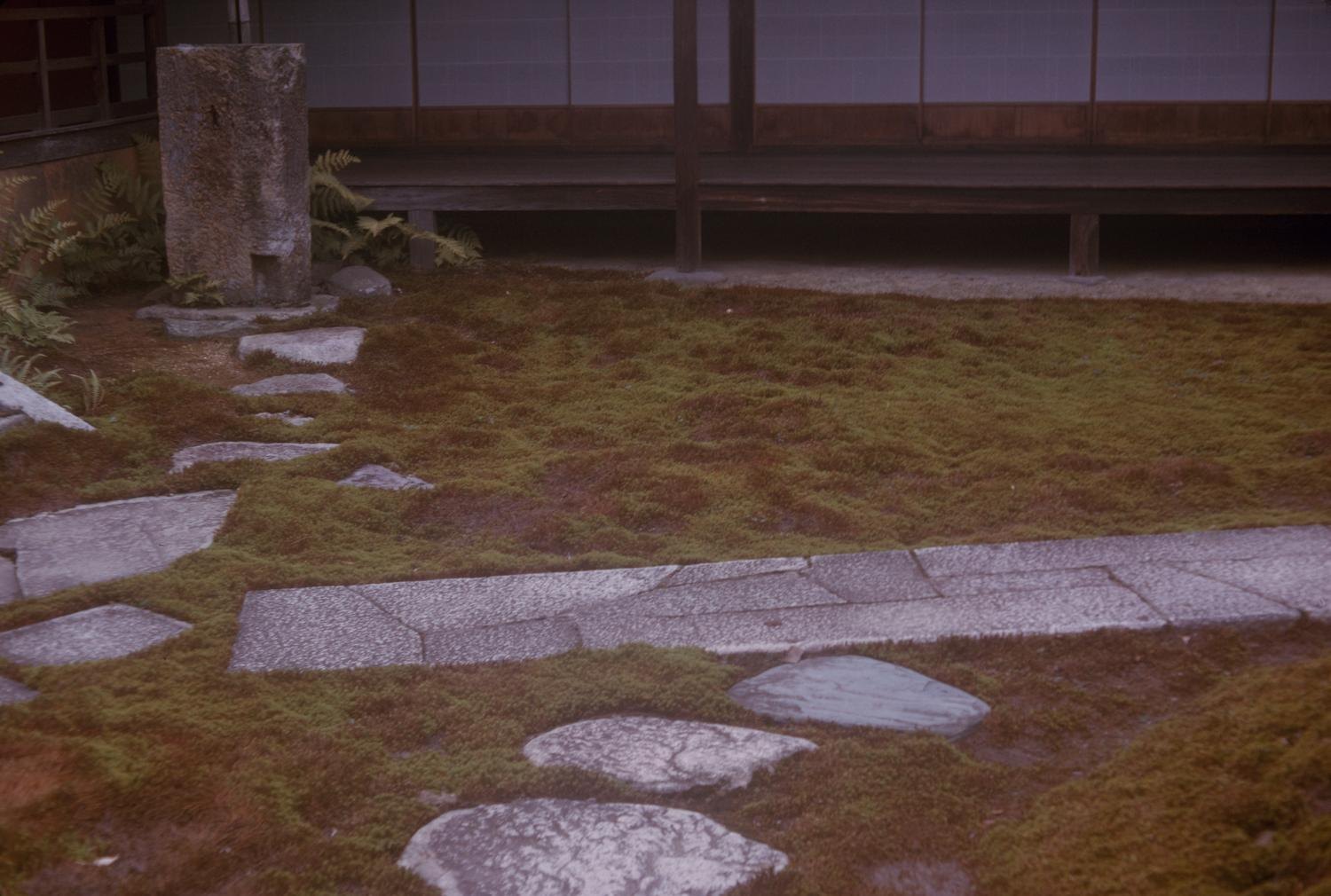
Katsura Imperial Villa gives a historical example of the base. According to the Imperial Household Agency, its nobedan sit on red clay rammed hard (土極め), and in two of the three paths the joints are filled with lime plaster to fix the stones.
What a garden-projects book adds
The RHS garden projects guide adds a step familiar to anyone who has set stones: lay them out on the lawn first and walk them before fixing. In its project, which uses leaf-shaped concrete stepping stones, each one then goes onto a 2.5 cm (1 in) layer of sand. How Japanese gardeners test a tea path before fixing it is not described in the sources checked here.
Patterns with names — chidori, two-stone sets and two-three zigzags
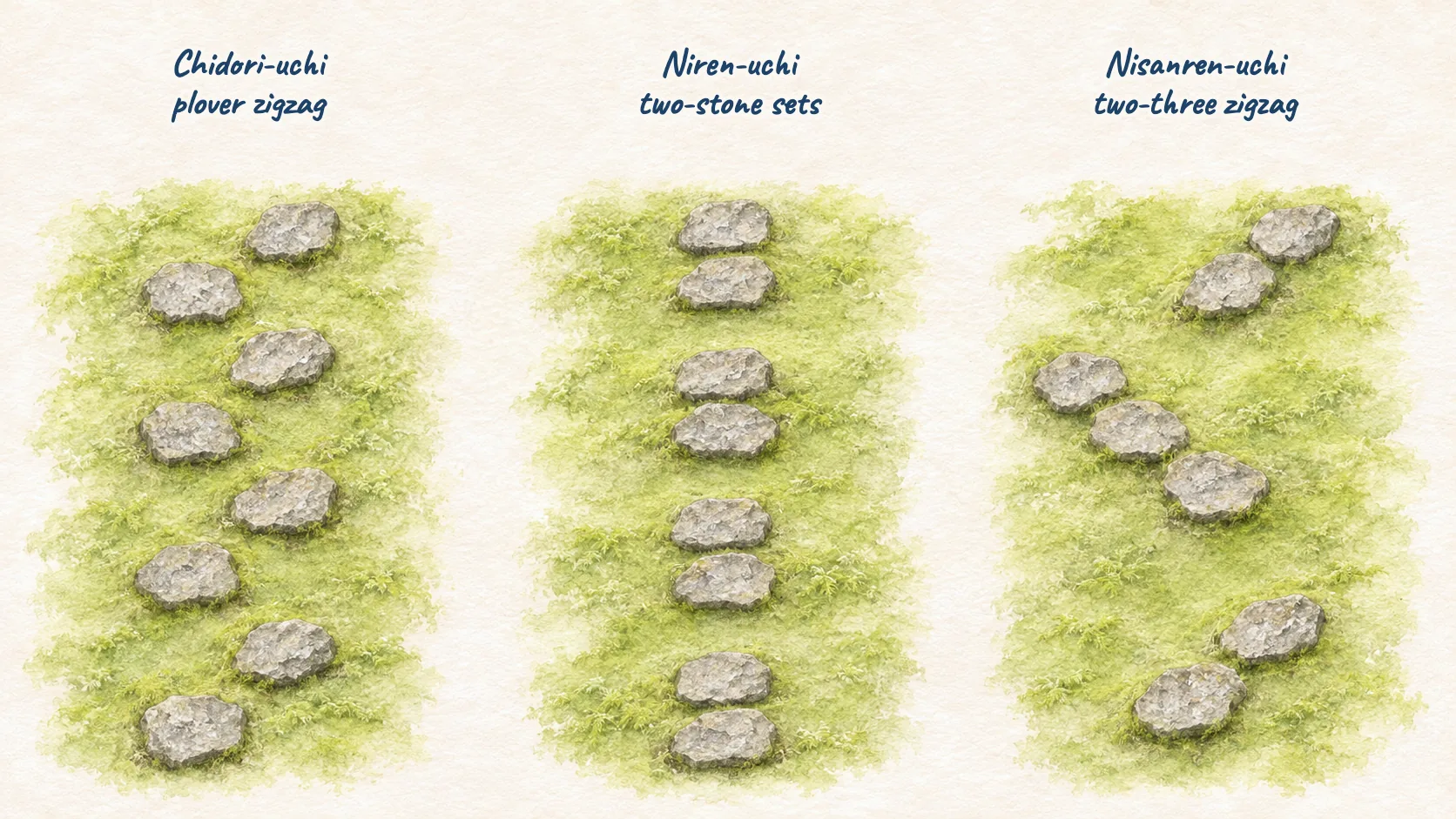
Because the stones are not laid in an even line, gardeners name the rhythms. The Nara institute’s dictionary lists several; three are worth knowing.
– Chidori-uchi (千鳥打ち), or chidori-gake, “plover pattern”: single stones laid alternately left and right, forming a zigzag. – Niren-uchi (二連打ち), “two-stone set”: stones laid in pairs. – Nisanren-uchi (二三連打ち), “two-three zigzag”: rows of two and three stones alternating in a zigzag.
Each name describes an arrangement on the ground. Choosing among them is one of the decisions a path asks for, alongside the size of each stone and how close it sits to the next.
Stones with roles — the yaku-ishi of the roji
The stone where you leave your shoes
Not every stone on the path is a stepping stone in the ordinary sense. Some have roles. These are the yaku-ishi, the role stones, on which the 2002 walkers did most of their looking around.
One is the fumi-ishi (踏石). In a tea garden, the term can refer to the kutsunugi-ishi (沓脱石), the shoe-removing stone set right against the crawl-through entrance (nijiri-guchi) of the tea room; the Nara dictionary notes it is also called the “first stone” (一番石). The same word has other uses in the dictionary, including the front stone of a stone water basin.
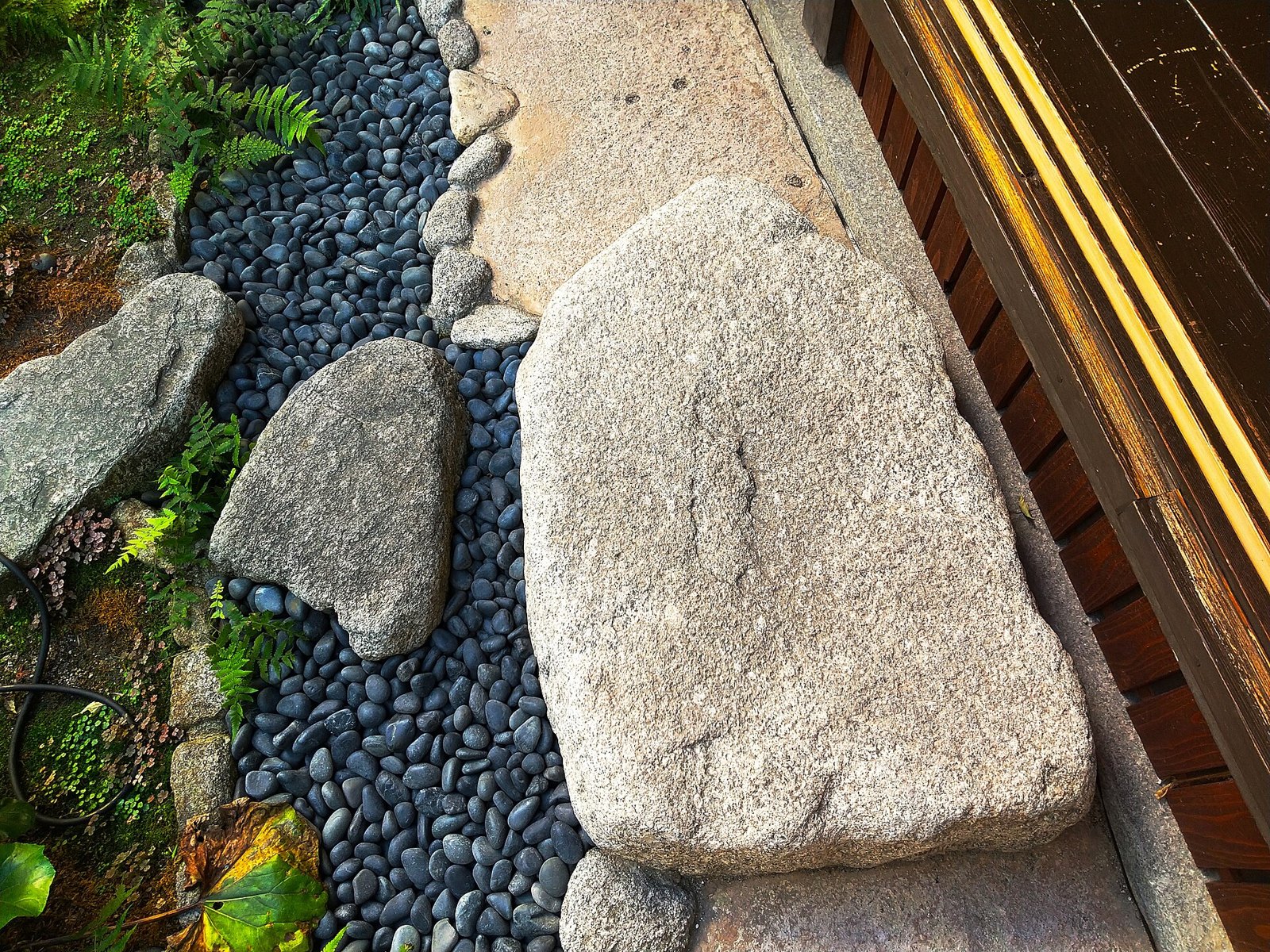
At Urasenke’s Konnichian in Kyoto, at the waiting bench, the stepping stone for the principal guest is especially large. The school calls it the kinin-seki (貴人石), the “noble person’s stone”.
Stones at forks, and a stone that says “no”
Where a path splits, gardeners place a fumiwake-ishi (踏分石), a junction stone. The Nara dictionary explains that it is chosen slightly larger than the other stepping stones so that it is easy to move on from.
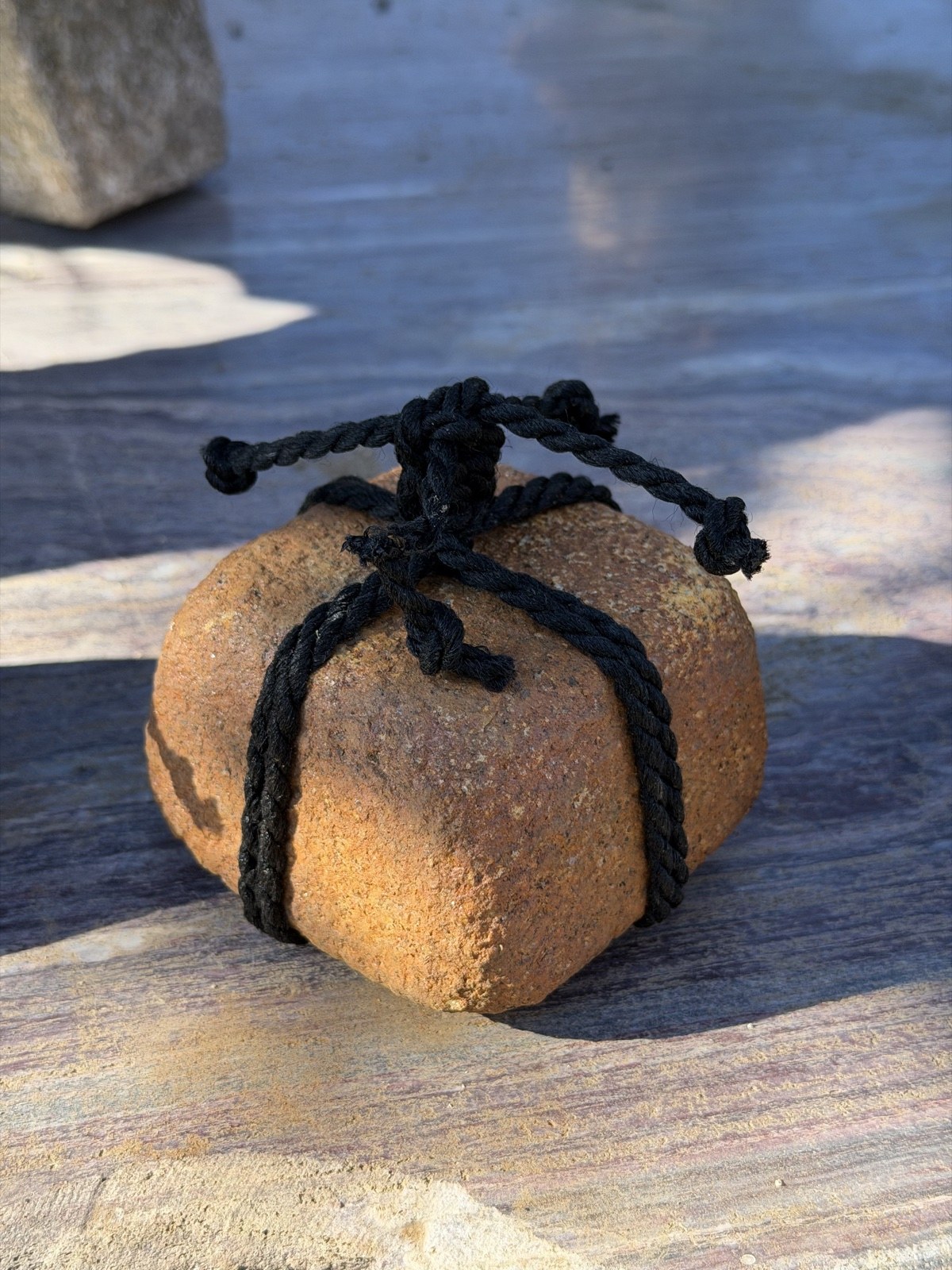
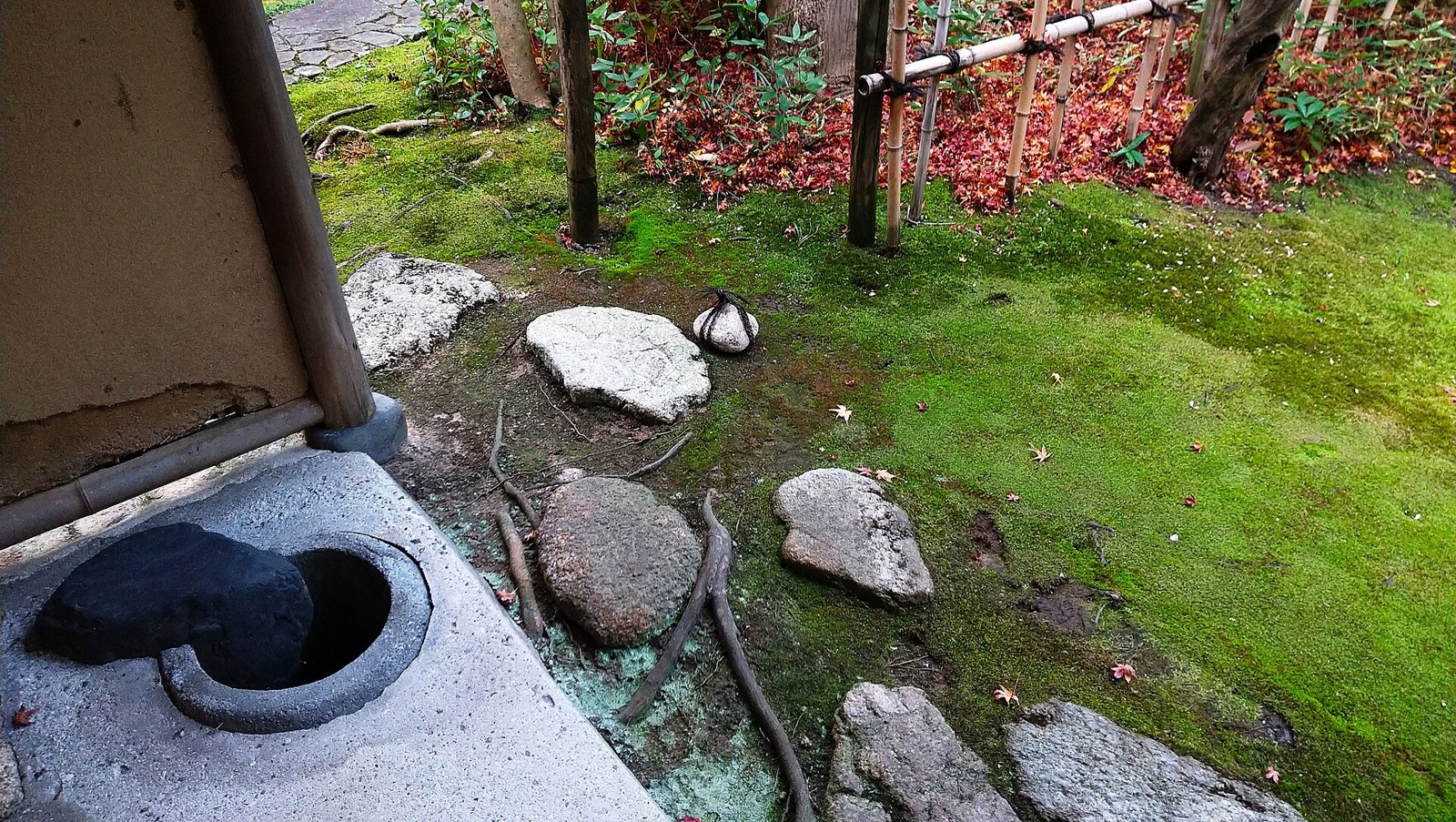
The most charming role stone is the sekimori-ishi (関守石), the “barrier-keeper stone”. It is a fist-sized stone tied with palm-fibre rope in a cross, set on a stepping stone or paved path to warn guests not to take the wrong path. It is also called tome-ishi, the “stop stone”. There is no sign and no fence. A small tied stone says “not this way”, and a guest who is watching the path sees it.
The katana-kake-ishi (刀掛石), the sword-hanging stone, is a stone by the outer wall of the tea room on which one stands to hang a sword on its rack. The Nara dictionary notes that a well-shaped two-step stone is often used.
| Role stone | Japanese | Where | Role |
|---|---|---|---|
| Shoe-removing stone | 踏石 / 沓脱石 | At the tea room’s crawl-through door | Step up, leave sandals |
| Noble person’s stone | 貴人石 | At the waiting bench (Konnichian) | Larger stone for the principal guest |
| Junction stone | 踏分石 | Where the path forks | Slightly larger, easy to move on from |
| Barrier-keeper stone | 関守石 | On a stone or paved path | Tied stone meaning “do not go this way” |
| Sword-hanging stone | 刀掛石 | By the tea room’s outer wall | Stand here to hang a sword |
Reading the role stones as decisions
The role stones show where size is a decision. A junction stone is chosen slightly larger so that it is easy to move on from; at Konnichian the principal guest’s stone is especially large. In the 2002 study, these larger stones were also where walkers looked around the garden.
Nobedan — when the stones join up
Shin, gyō, sō at Katsura
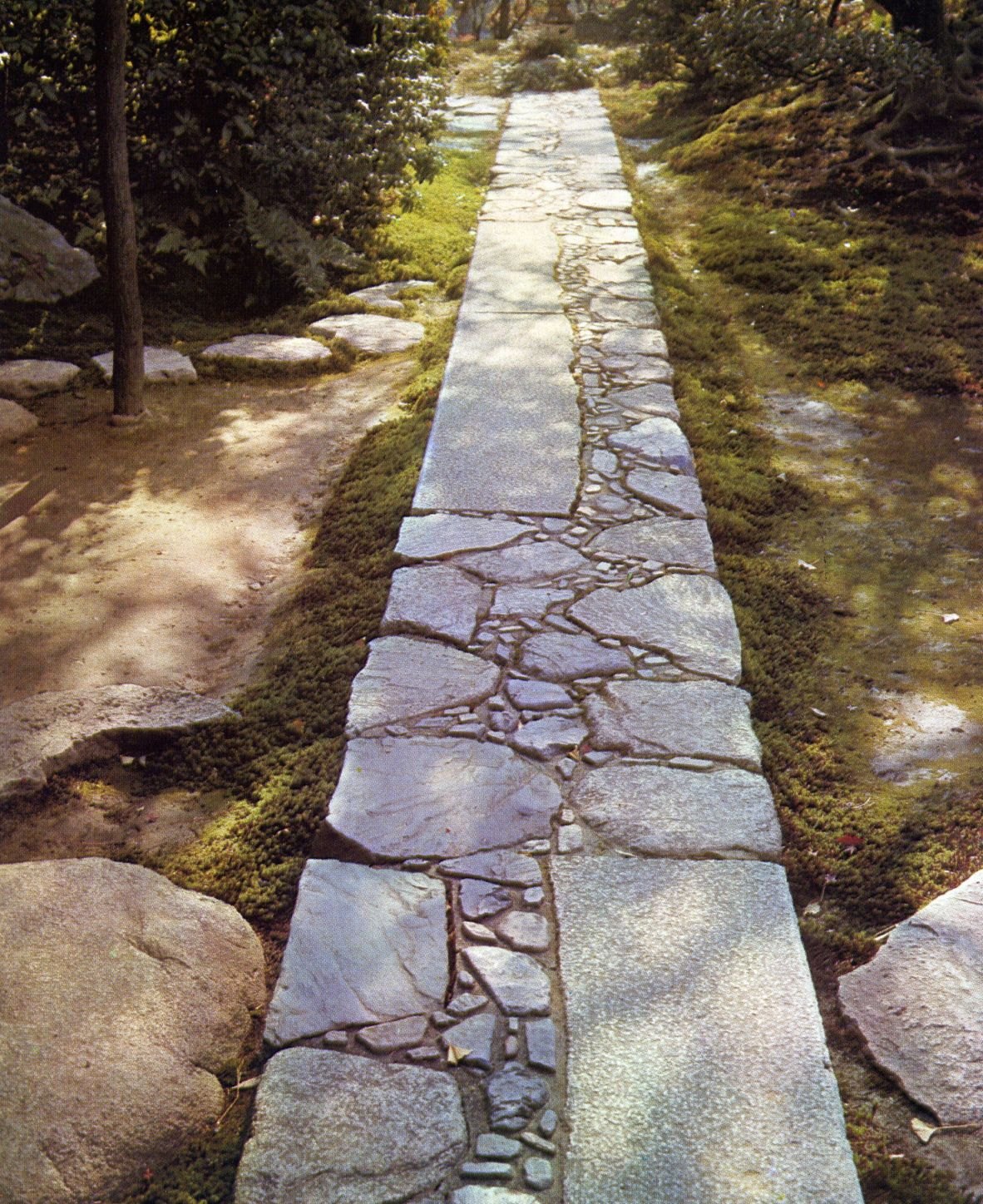
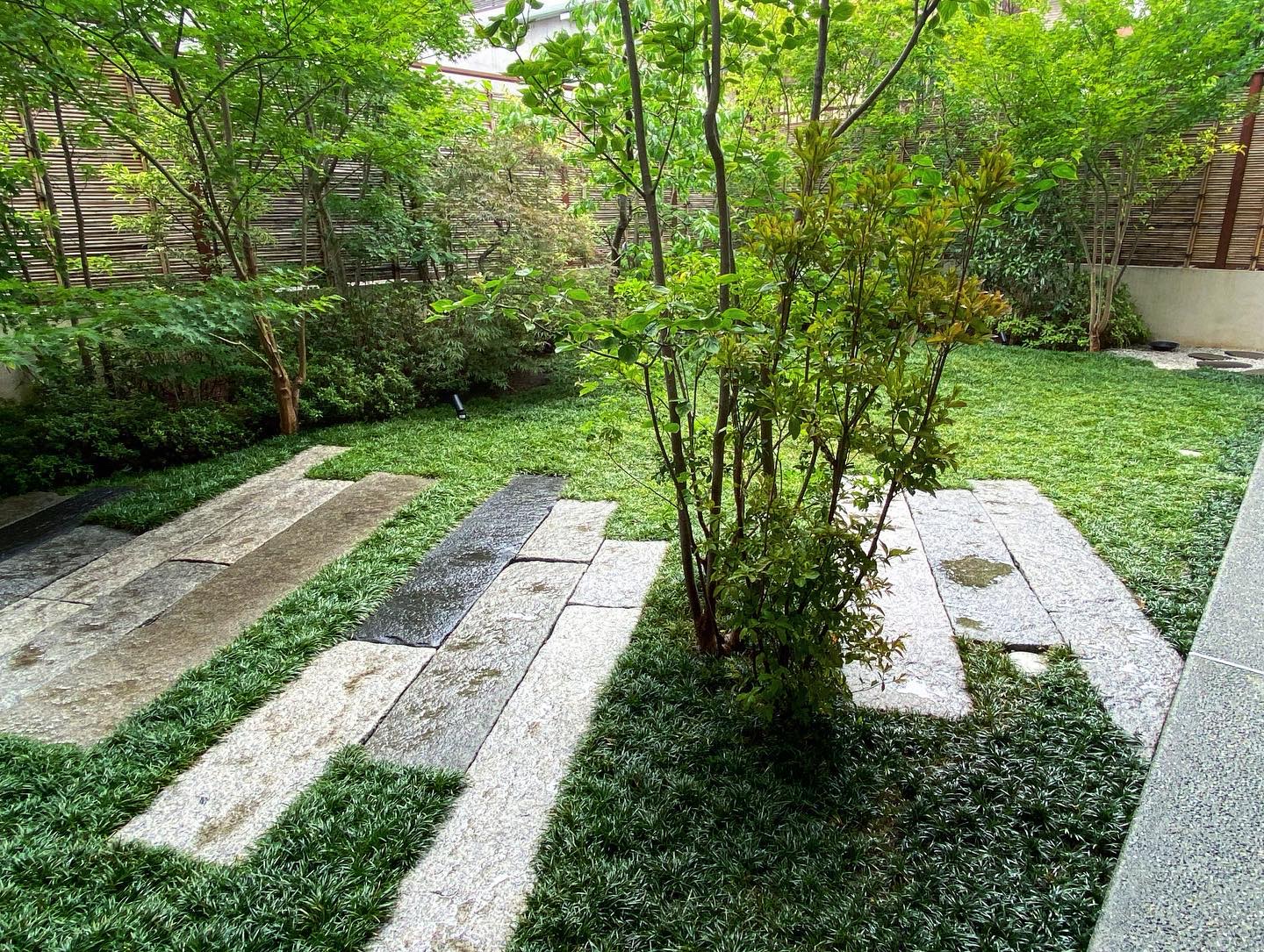
Tobi-ishi have a partner. Nobedan (延段) are a form of continuous stone paving: flat natural or dressed stones laid to make a path of uniform width, also called tatami-ishi. Many roji use both, stepping stones for one stretch and paving for another.
Well-known examples are at Katsura Imperial Villa in Kyoto. The Imperial Household Agency explains them through shin, gyō and sō (真・行・草), terms taken from the three styles of calligraphy: formal block script, semi-cursive and cursive.
– Shin no nobedan (真の延段), also called shin no tobi-ishi, runs from the middle gate to the palanquin entrance of the Old Shoin. It is made of 41 cut granite stones in quadrilateral shapes, including trapezoids. – Gyō no nobedan (行の延段), in front of the outer waiting bench, combines cut stones and natural stones. – Sō no nobedan (草の延段), in front of Shōiken and the Shoin, uses only natural stones.
The agency’s detailed notes for the gyō path list cut granite together with natural granite, chert, sandstone, shale, welded tuff, green schist and aplite granite.
Easy walking, clean feet
The agency also points out the practical side: a stone-paved path is very easy to walk on, and it keeps feet clean of mud in the rain.
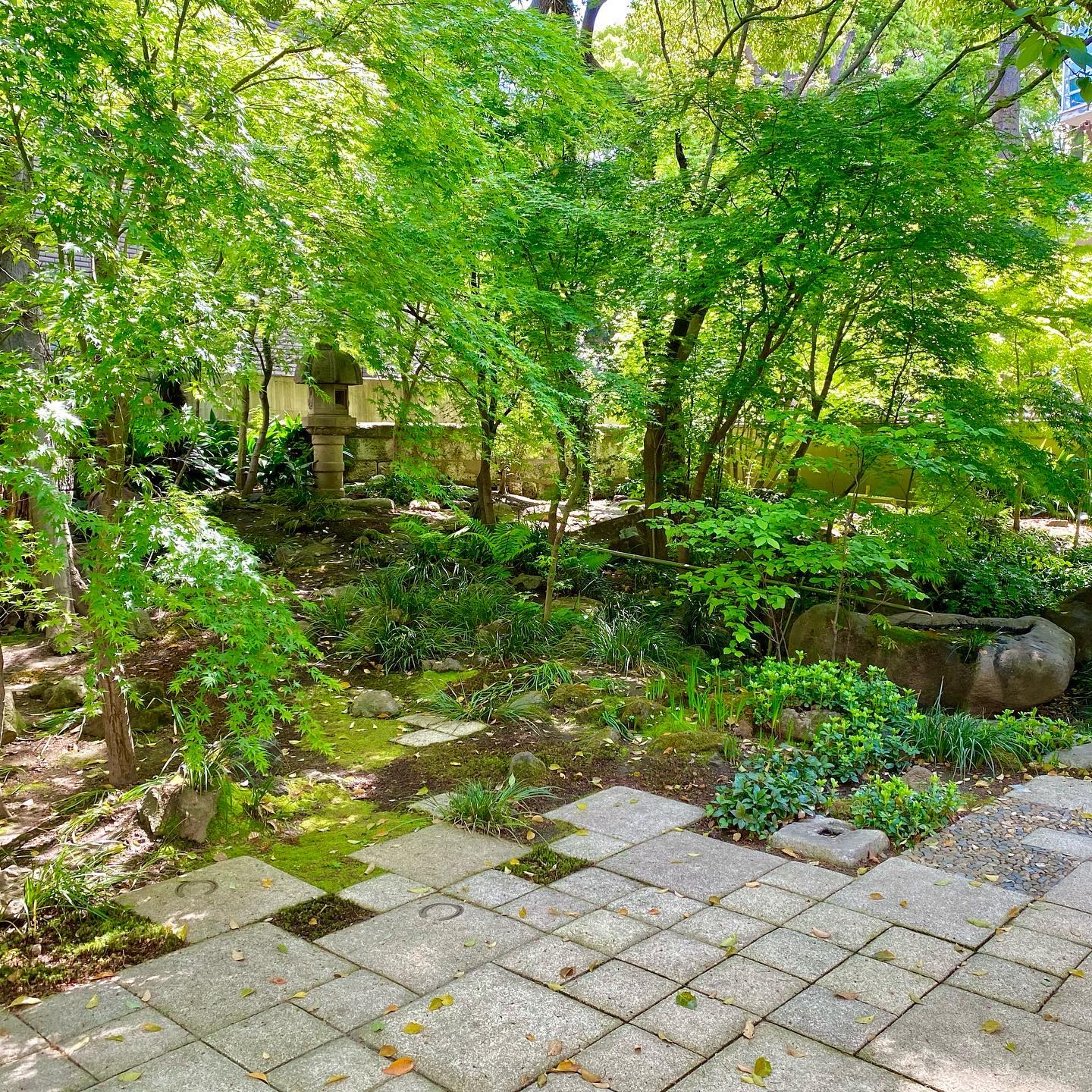
At Konnichian, Urasenke notes that partway along the stepping stones that lead on from the waiting bench, the path changes to arare-koboshi (霰こぼし), “scattered hail”, a paving of small stones. The surface under the guest’s feet changes along a single route.
| Nobedan at Katsura | Stones | Location |
|---|---|---|
| Shin (真) | 41 cut granite stones in quadrilateral shapes, including trapezoids | Middle gate to the Old Shoin palanquin entrance |
| Gyō (行) | Cut stones and natural stones mixed | In front of the outer waiting bench |
| Sō (草) | Natural stones only | In front of Shōiken and the Shoin |
The stone itself — Kurama, Iyo and Shirakawa
Colour underfoot
The stone matters as well as the spacing. The Nara dictionary describes Kurama stone (鞍馬石), a granodiorite from around Kurama in Kyoto, known for its rust-coloured layered pattern and used for shoe-removing stones, display stones and stepping stones. Where it is used, that rust colour becomes part of what a walker sees at their feet.
In Kanazawa, a 2024 guide from the city’s cultural properties office to the Nishi family garden notes a large stone of Iyo blue stone (伊予青石) and a temple foundation stone (garan-seki) of Shirakawa stone (白川石) used as junction stones, with cut Kitagi stone laid as a strip paving.
Japan’s older traditions of setting stones, and its dry gardens of stone and raked gravel, are subjects of their own. This article stays with the stones that are meant to be stepped on.
Water and moss — keeping the path alive
The host waters the garden
Before guests enter a tea garden, the host waters it. The Omotesenke school, writing about tea and folk custom, notes that the host always sprinkles water before guests enter the roji, and describes water as a symbol of purification. Wet stones also look darker than dry ones, and they deserve care underfoot.
What feet do to moss
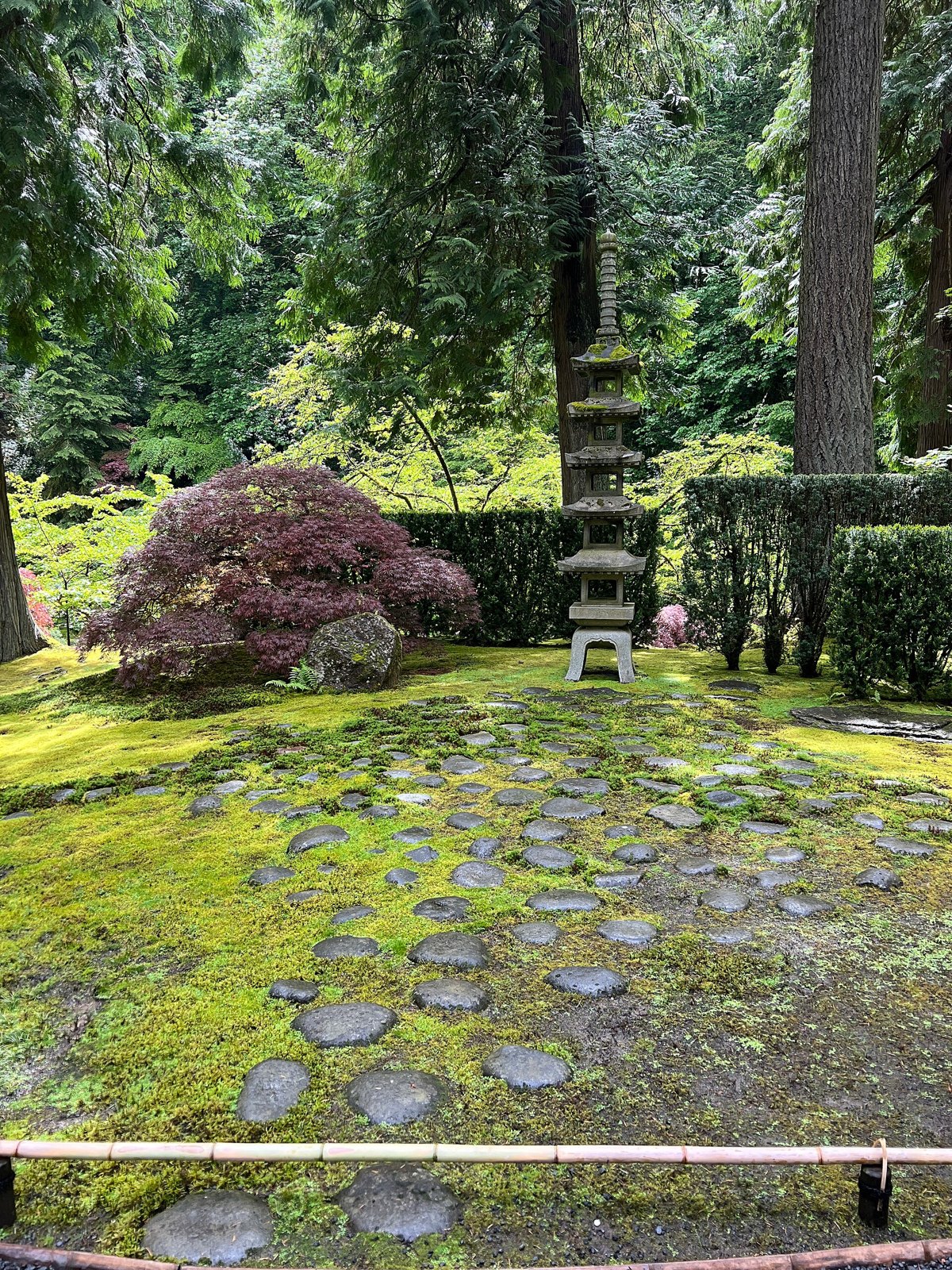
Between the stones lies ground the guest does not step on, often moss. At Katsura Imperial Villa, a report on the moss beds prepared for the Imperial Household Agency lists the causes of moss decline: drying linked to warming and urbanisation, a falling water table, and trampling by visitors. The report found that the moss tends to decline in summer and winter and recover in spring and autumn, recommended March to April and September as the best times for replanting, and said that damage caused by people should be repaired promptly whatever the season.
This is a quiet practical side of “do not step anywhere but the stones”. A path of separate stones gives feet a place to go and leaves the moss between them alone.
Stepping stones in British and American gardens — the same stones, a different brief
Spacing by stride
Stepping stones are common in British and American gardens. The difference lies in how the sources checked here describe their purpose.
The Royal Horticultural Society’s garden projects guide tells readers to lay stepping stones out on the lawn and walk them to check that the spacing suits their stride. The stride decides the stones.
In the Kyoto tea gardens measured in 2023, centroid-to-centroid distances averaged about 19 inches, and in the 2002 study walkers who followed the tea manner shortened their stride. There, the stones shape the stride.
Access and protection
The British and American advice checked here frames stepping stones mainly as access. The RHS suggests putting paving slabs or stepping stones into a chamomile or other alternative lawn if it has to be crossed often. Colorado State University Extension says stepping stones allow easy access through larger garden spaces and prevent soil compaction. An Ask Extension answer on growing thyme between stones recommends leaving about 2 inches (5 cm) between stones so the plants can thrive.
These are sensible, practical purposes, and they overlap with the Japanese one: Katsura’s moss also needs protecting from feet. What the advice checked here does not discuss is using stepping stones to set the walker’s pace or to mark the approach to a particular room. The same kind of split shows up in pruning, as in niwaki and topiary: similar materials, different briefs.
| Stepping stones in the RHS and US extension advice checked | Tobi-ishi in the Japanese tea-garden sources checked | |
|---|---|---|
| Spacing set by | The walker’s stride, tested by walking | Laid out stone by stone; Kyoto average about 19 in, centroid to centroid |
| Main purpose described | Access across lawn or planting; protect soil and plants | Set the pace and route to the tea room; keep feet off moss |
| Named stones | Not discussed | Shoe-removing, junction, barrier-keeper and other role stones |
Neither approach is better. A family lawn needs a path that lets people cross without thinking. A tea garden asks guests to think about each step.
Common misunderstandings about Japanese stepping stones
“They are uneven because they are old”
Irregular spacing, sizes and shapes are not necessarily a sign of age. The Omotesenke school stresses that setting stepping stones is difficult and has long been closely taught, and named patterns such as the plover zigzag are irregular by design. Old paths can also settle or be repaired, so each garden has its own history.
“Rikyū’s six-to-four is a measurement”
It is a reported saying about a balance between walking and view. It gives no figure for spacing, height or size.
“Any stone path is a tobi-ishi path”
Tobi-ishi are separate stones with ground between them. Nobedan are one form of continuous stone paving of uniform width. Many tea gardens use both.
Frequently asked questions
What is tobi-ishi?
Tobi-ishi (飛石) are Japanese stepping stones: individual stones set separately along an earthen path so that people can walk on them. In tea gardens they also lead the guest to the tea room, since guests do not step off them.
Why do Japanese stepping stones make you look down?
They fix where each foot goes. In a 2002 study in one Kyoto tea garden, walkers taught the traditional manner slowed down, shortened their stride and looked at the stone about three stones ahead.
What does “watari rokubu, kei shibu” mean?
It means “walking six parts, view four parts”. It is a saying attributed to Sen no Rikyū about balancing ease of walking against appearance. Furuta Oribe is said to have preferred the opposite balance. The Omotesenke school cites Sekishū sanbyakukajō as the source; it is a tradition, not a rule.
Where can I see tobi-ishi and nobedan in Japan?
Katsura Imperial Villa in Kyoto has the shin, gyō and sō nobedan described by the Imperial Household Agency. Many Kyoto temples and gardens open to visitors also have stepping-stone paths, often through moss under maples that turn in autumn. Follow each garden’s rules about where visitors may walk.
What is the small stone tied with rope on a Japanese garden path?
It is a sekimori-ishi (関守石), or barrier-keeper stone: a fist-sized stone tied with palm-fibre rope in a cross. It tells guests not to take that path.
How far apart are stepping stones in a Japanese tea garden?
In ten Kyoto tea gardens measured on survey drawings in 2023, the average distance between the centroids of neighbouring stones was 484 mm (about 19 in), ranging from 417 to 556 mm by garden. These are measurements of historic gardens, not a standard.
Sources
– Nara National Research Institute for Cultural Properties, Japanese Garden Dictionary: Stepping stones, Chidori zigzag, Two-stone set, Two-three zigzag, Fumi ishi, Path junction stone, Barrier stone, Sword-hanging stone, Nobedan pavement, Kurama stone — checked 2026-11-17 – Omotesenke Fushin-an, 露地の飛石, 不審菴中露地へ, 茶の湯と民俗 — checked 2026-11-17 – Urasenke, 今日庵 — checked 2026-11-17 – Enshū school of tea, 孤篷庵 — checked 2026-11-17 – Imperial Household Agency, 御所と離宮の栞 其の二十六; 桂離宮 延段(行); 桂離宮苔地マスタープラン報告 — checked 2026-11-17 – Taji Rokurō, 李漁の庭園論, Journal of the Japanese Institute of Landscape Architecture 14(2) — checked 2026-11-17 – Sakuramoto Kaori, 『南方錄』における「草庵」の思想, 2020 — checked 2026-11-17 – Shōda Michihiko & Kanekiyo Hiroyuki, 特別史跡名護屋城跡並びに陣跡の茶庭遺構にみる飛石の形態的特徴, 2022 — checked 2026-11-17 – Li Luyang, Li Houjun & Shen Yue, 京都における茶庭の飛石動線の形態及び構成に関する研究, Landscape and Horticulture Research 23, 2023 — checked 2026-11-17 – Nakamura Yūki, Okazaki Shigeyuki & Suzuki Toshitomo, 茶室露地における飛石歩行の際の注視行動, Journal of Architecture and Planning (AIJ) 67(560), 2002 — checked 2026-11-17 – Wu Yunhui & Suizu Isao, 空間認知に影響を与える床面の仕様に関する研究, Japanese Society for the Science of Design, 71st conference, 2024 — checked 2026-11-17 – City of Kanazawa, 西氏庭園見学会, 2024 — checked 2026-11-17 – City of Yokohama, 土木工事共通仕様書, September 2021 revision — checked 2026-11-17 – Royal Horticultural Society, Garden Projects: Stepping stones; Chamomile lawns and alternatives — checked 2026-11-17 – Colorado State University Extension, Perennial Gardening — checked 2026-11-17 – Ask Extension, Question 442364 — checked 2026-11-17