

A kadomatsu (門松, “gate pine”) pairs pine with bamboo because pine appears in the earliest records of the decoration, before bamboo: an evergreen associated with vitality and long life, explained by the Hokkaido Association of Shinto Shrines as a yorishiro — an object through which the New Year deity is welcomed — and by the Government of Japan as a marker that guides the deity to the house. Bamboo, prized for growing straight up, appears to have joined the pine later, probably in the Muromachi period, though even that date is an inference. The famous slanted cut at the top of the bamboo has no settled origin: the popular story about the warlord Tokugawa Ieyasu was dismissed by an early historian as probably no more than a humorous tale, and one academic account treats the level cut called zundō as the earlier form.
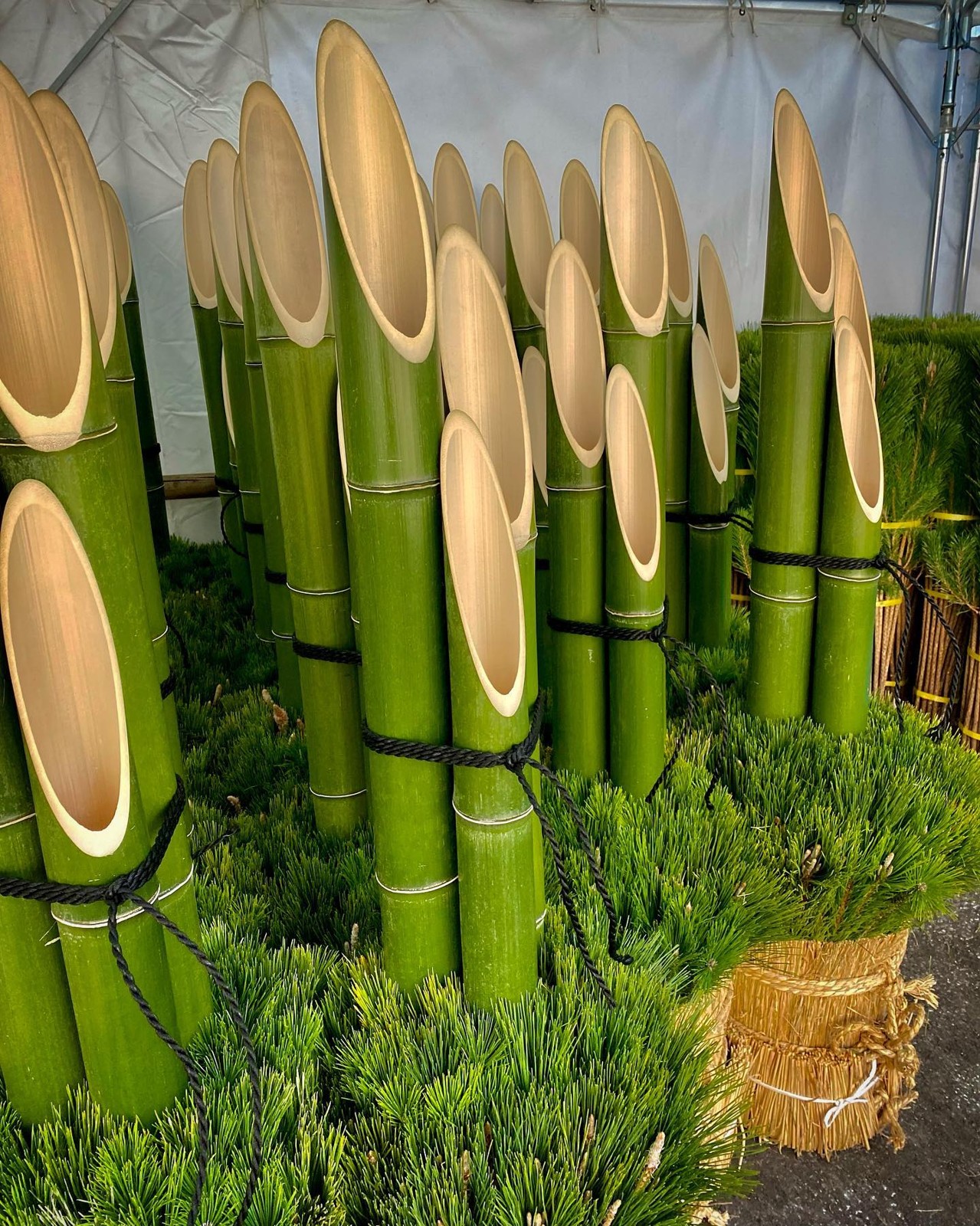
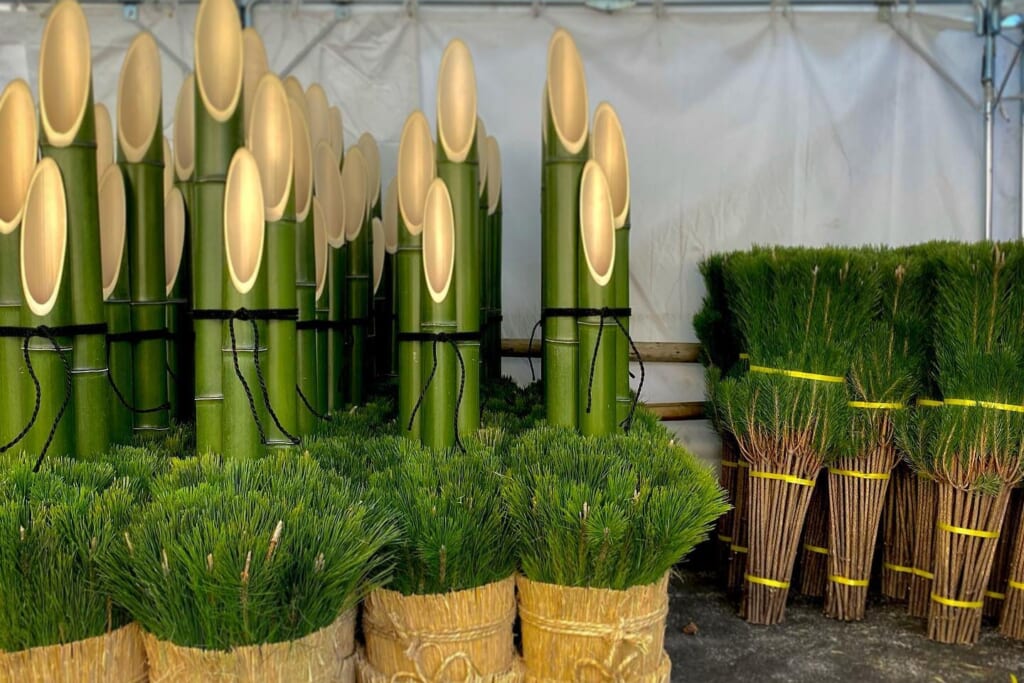
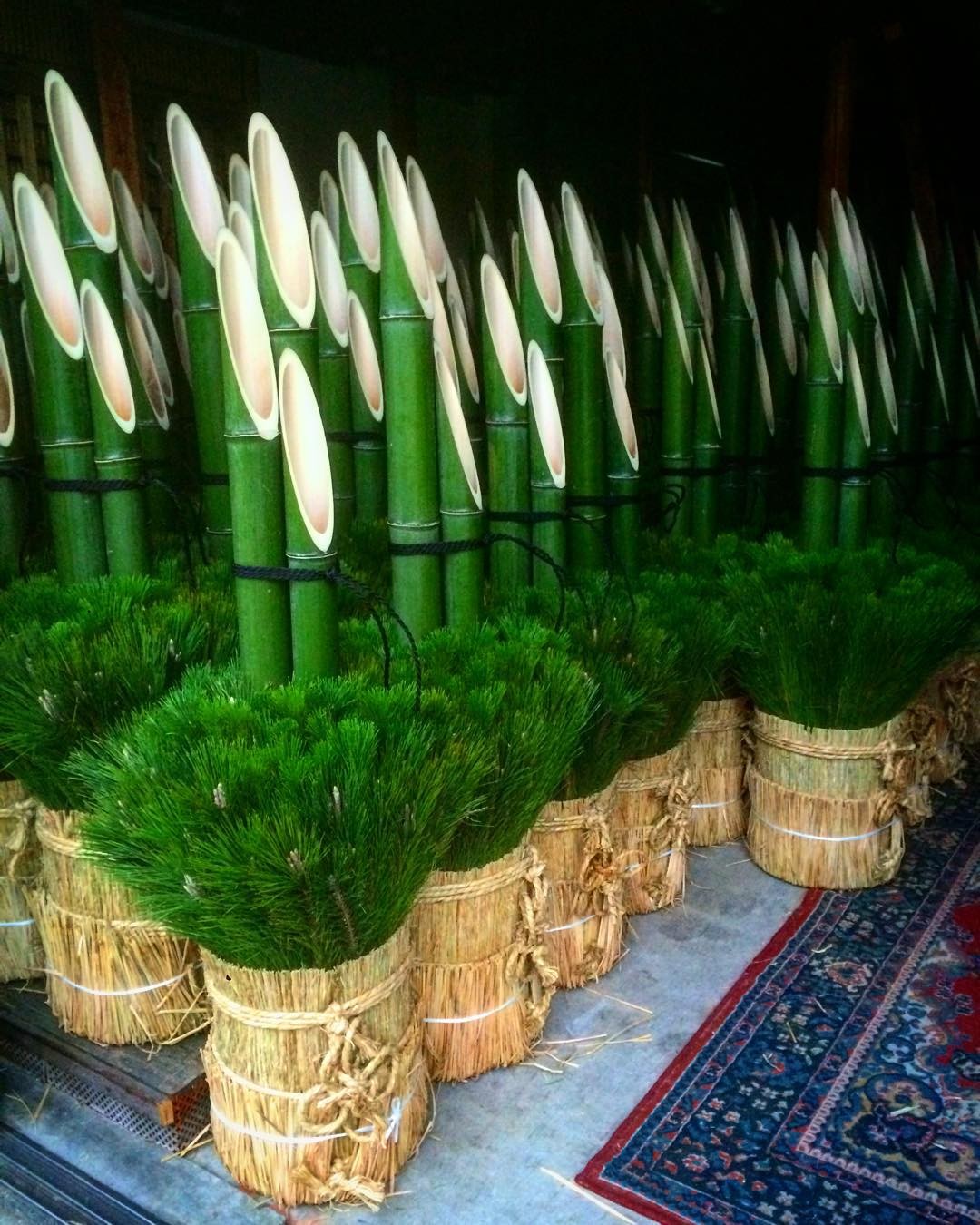
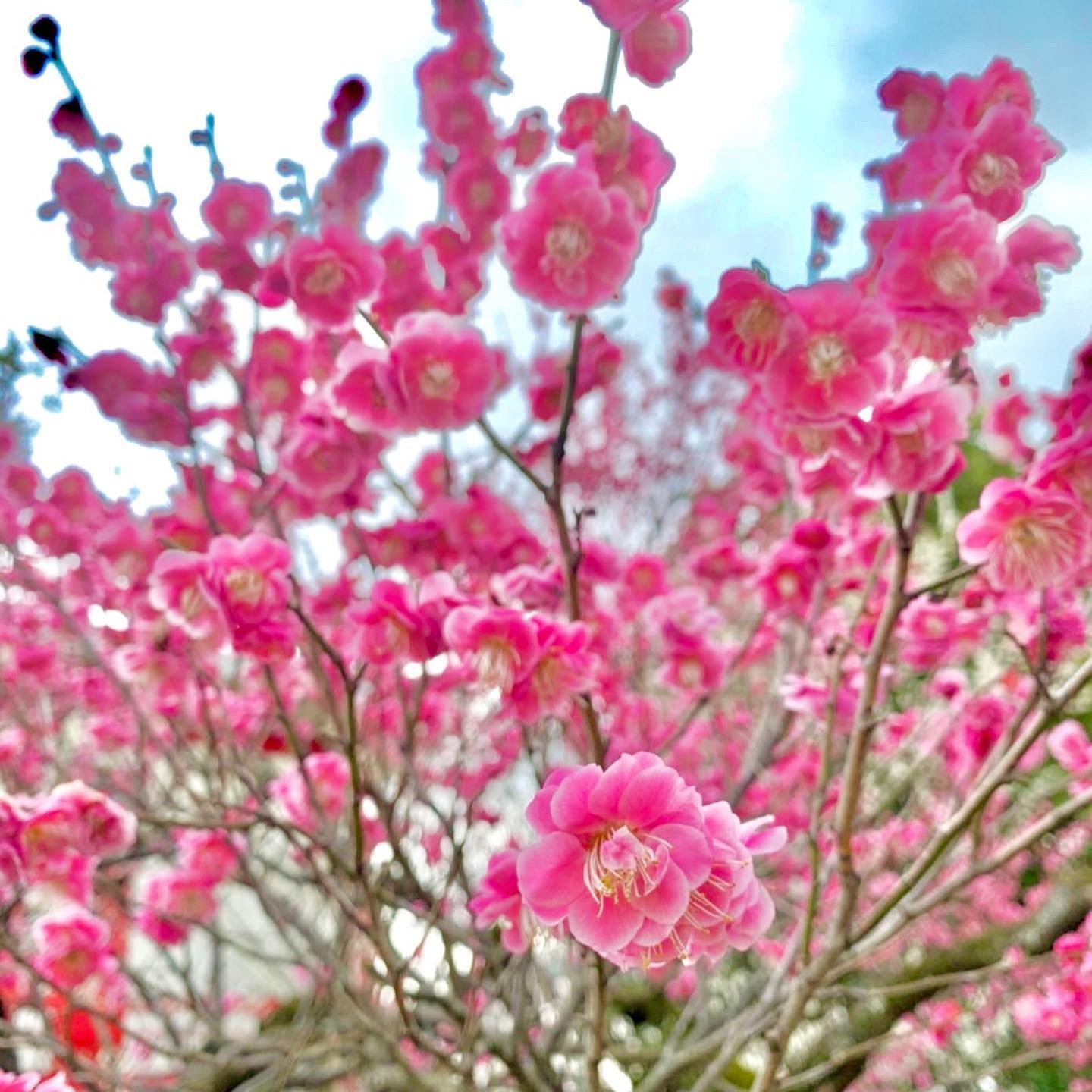
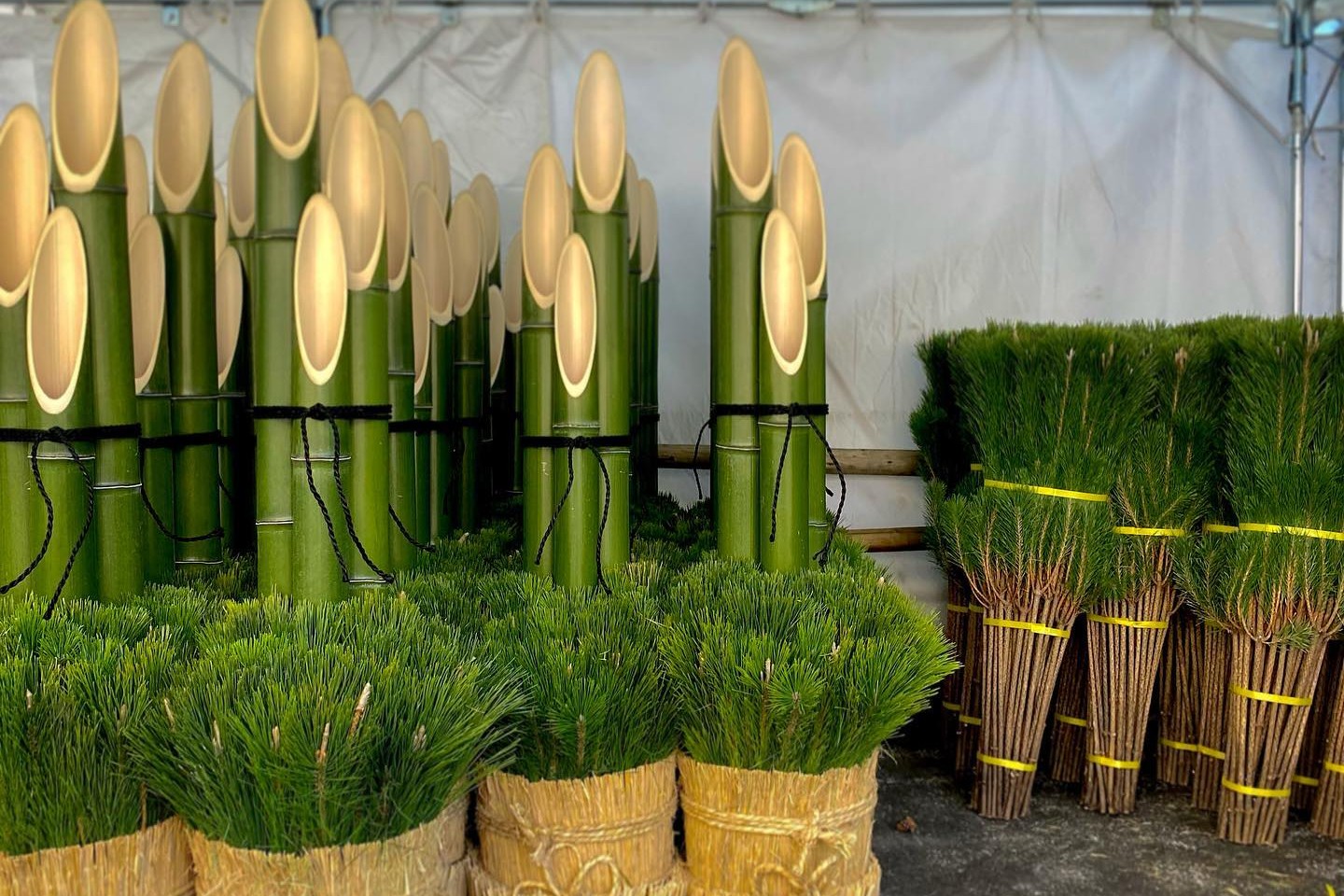
In December, the yard of a Japanese landscaping company changes its smell. Green bamboo, freshly sawn, leans in rows under a tent. Bundles of short pine sprigs sit in straw-wrapped bases, waiting. The work is seasonal and very old, and it is still taught as a trade skill: the Chiba Prefecture Landscaping and Greening Association runs kadomatsu-making classes every year, and Nara Prefecture’s landscaping training course schedules “kadomatsu production” as its December field exercise. Silver Human Resource Centres — locally based nonprofit organisations that find work for retired people — have kadomatsu teams too; a tree-care team in Mitaka, Tokyo, cuts its own bamboo from a grove, hauls it back, and assembles a pair as a year-end ritual, and a team in Matsumoto calls it ideal work for the winter months when there is little to do outside.
What a kadomatsu is for — a seat for the New Year deity
Yorishiro or signpost
One central idea in Japanese New Year customs is a visit. A deity — Toshigami (歳神, the deity of the year) — comes to each household, and the house prepares to receive it. The Hokkaido Association of Shinto Shrines states plainly that “the kadomatsu is a yorishiro (依代) for the Toshigami’s visit”: a physical thing through which the deity is welcomed. The Government of Japan’s public-relations site uses a softer image — a marker (目印) that shows the deity which house to come to.
The two explanations are not quite the same, and Japanese sources are careful about that. The National Museum of Japanese History (Rekihaku) writes that “there are various theories about the origin of kadomatsu, but the theory that it is the yorishiro of the Toshigami is the leading one.” That is the right weight to give it: a leading interpretation, not the only one. If you are new to the idea of a tree as a dwelling place for a kami, the sacred trees of Japan offer a useful comparison: a kadomatsu works, loosely speaking, like a temporary sacred tree, standing only through the first days of the year.
The parts of a kadomatsu
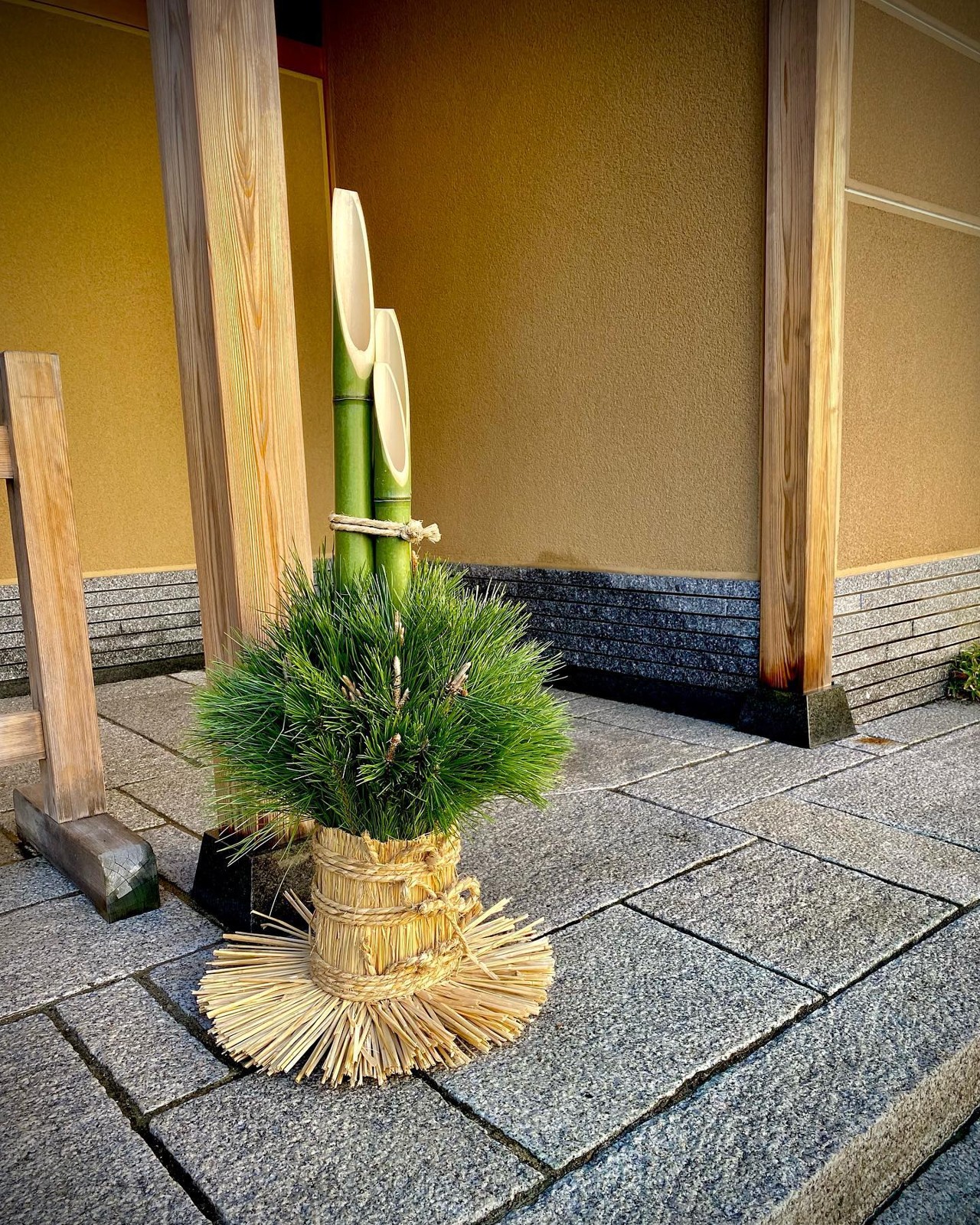
One common form — the Kantō-style kadomatsu that most visitors photograph — can be broken into a few parts, though makers vary every one of them.
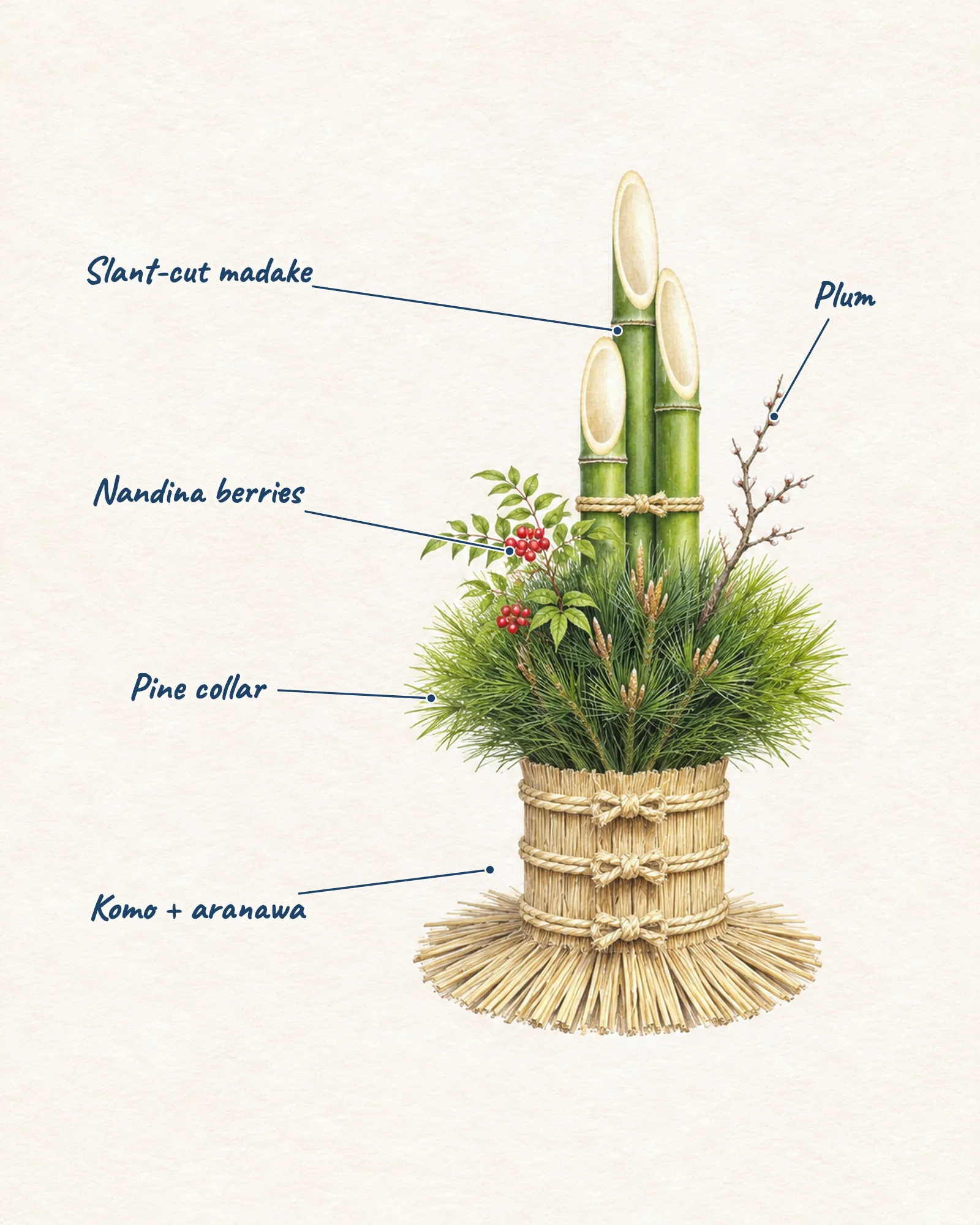
From the top down, as public workshops describe them:
– Three bamboo stems of different heights — madake (Phyllostachys reticulata) in a Ministry of the Environment workshop — with the tops cut on a slant. – A collar of pine around the foot of the bamboo — the part the whole decoration is named after. – Accent plants: nandina (Nandina domestica), plum (Prunus mume), ornamental kale (habotan), small chrysanthemums, depending on the maker. – A base — moso bamboo (Phyllostachys edulis) in several workshops — dressed in komo (菰), a woven straw mat. – Aranawa (荒縄), coarse straw rope, tied around the base.
Matsumukae — going to the mountain for pine
Before there was a supply chain, the pine had to be fetched. Rekihaku records that the act of cutting pine in the mountains for New Year was called matsumukae (松迎え), “welcoming the pine.” The Association of Shinto Shrines (Jinja Honchō) notes that in some regions this was done on December 13, the same day as susuharai, the year-end soot cleaning — and December 13 was itself Shōgatsu kotohajime, the traditional day when preparations for the New Year began.
A thousand years of pine at the gate — the written record
Poems, essays, a painted city
The oldest records are of pine alone. Rekihaku cites a poem attributed to Fujiwara no Akisue in the Horikawa Hyakushu, a 12th-century anthology of a hundred poems, that mentions kadomatsu (「門松をいとなみてるそのほとりに」). Rekihaku’s 2017 column attributes the poem to Akisue; an earlier Rekihaku column gives a different attribution, so treat the name with care. In the 14th century, section 19 of Yoshida Kenkō’s Tsurezuregusa (Essays in Idleness) describes the main streets on New Year’s morning, “pines set up all along them” (大路のさま、松立てわたして).
The Uesugi version of the Rakuchū Rakugai-zu screens — panoramic paintings of Kyoto in and around the city — shows the same thing visually: pine branches set up at house after house along the street. Notice what is absent in all three. None of them shows bamboo as a necessary part.
Edo: pine first, bamboo optional
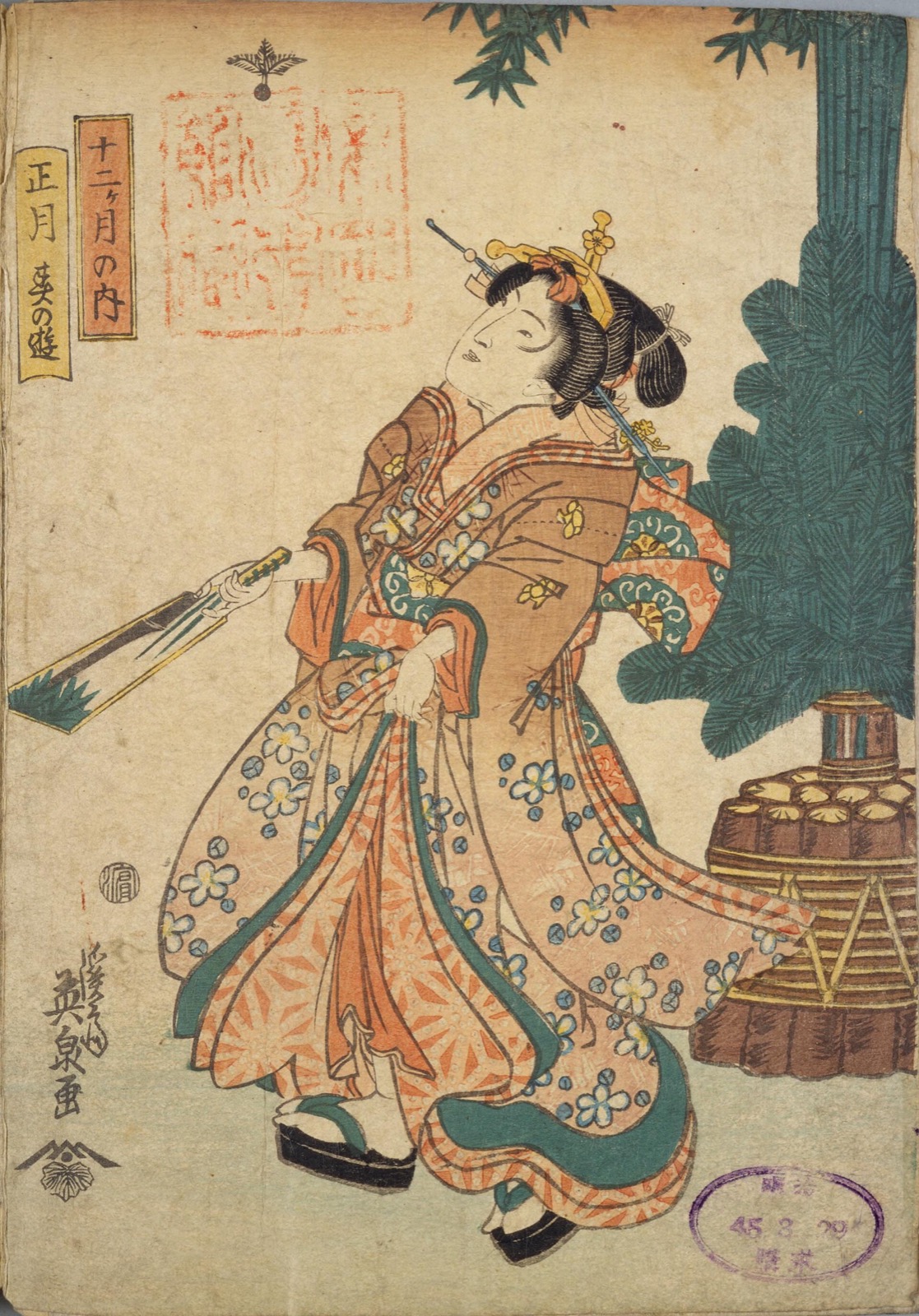
By the Edo period the decoration was still not uniform. The Edo-Tokyo Museum’s library notes that illustrations in Morisada Mankō, an encyclopedia of Edo and Osaka customs, show that “the decorations of samurai residences and large merchant houses often had no supporting bamboo.” Bamboo, in other words, was not yet required.
Why pine — evergreen, long-lived, and a pun
What the pine is said to stand for
The official explanations are straightforward. The Government of Japan calls pine “an evergreen tree that makes one feel life force,” and a symbol of “perpetual youth and long life” that is often used in New Year decorations. In winter, when deciduous trees are bare, a tree that keeps its needles is a visible argument that life continues.

Matsu: to wait, to worship
Then there is the language. Matsu (松, pine) sounds the same as matsu (待つ, to wait) — the Government of Japan gives this as one explanation: the household waits for the deity. Murin-an, a Meiji-era garden in Kyoto, offers another theory: that the word comes from matsuru (祀る), to worship. Both are explanations, not etymologies anyone can prove; Japanese sources present them with “one theory says.”
Two pines, left and right
Kadomatsu stand in pairs, one on each side of the gate. One documented arrangement, from a workshop run by the Ministry of the Environment’s Chūgoku-Shikoku office, puts black pine (kuromatsu, Pinus thunbergii) on the viewer’s left as the “male pine” (omatsu) and red pine (akamatsu, Pinus densiflora) on the right as the “female pine” (mematsu).
| Plant | Japanese | Scientific name | What it is said to stand for |
|---|---|---|---|
| Black pine | kuromatsu (黒松) | Pinus thunbergii | Pine in general: evergreen life, long life. “Male pine” in one paired arrangement |
| Red pine | akamatsu (赤松) | Pinus densiflora | “Female pine” in one paired arrangement |
| Madake bamboo | madake (真竹) | Phyllostachys reticulata | Bamboo in general: straight upward growth; the nodes |
| Moso bamboo | mōsōchiku (孟宗竹) | Phyllostachys edulis | Used for the base in some workshops |
| Plum | ume (梅) | Prunus mume | One of the “Three Friends of Winter” |
| Nandina | nanten (南天) | Nandina domestica | The name read as nan o tenjiru, “turning misfortune around” |
| Ornamental kale | habotan (葉牡丹) | Brassica oleracea var. acephala | A winter-colour accent |
Meanings from the Government of Japan, a Miyazaki Gakuen Junior College paper, Kyoto National Museum and Wakayama Prefecture; scientific names from the Forestry and Forest Products Research Institute and the Ministry of Agriculture’s plant-variety register.
Pine care is a year-round trade in Japan, from the spring candle-pinching called midori-tsumi to winter needle-plucking; the sprigs in a kadomatsu are cut from pine as well.
Why bamboo — and when it joined the pine
Straight up, with joints
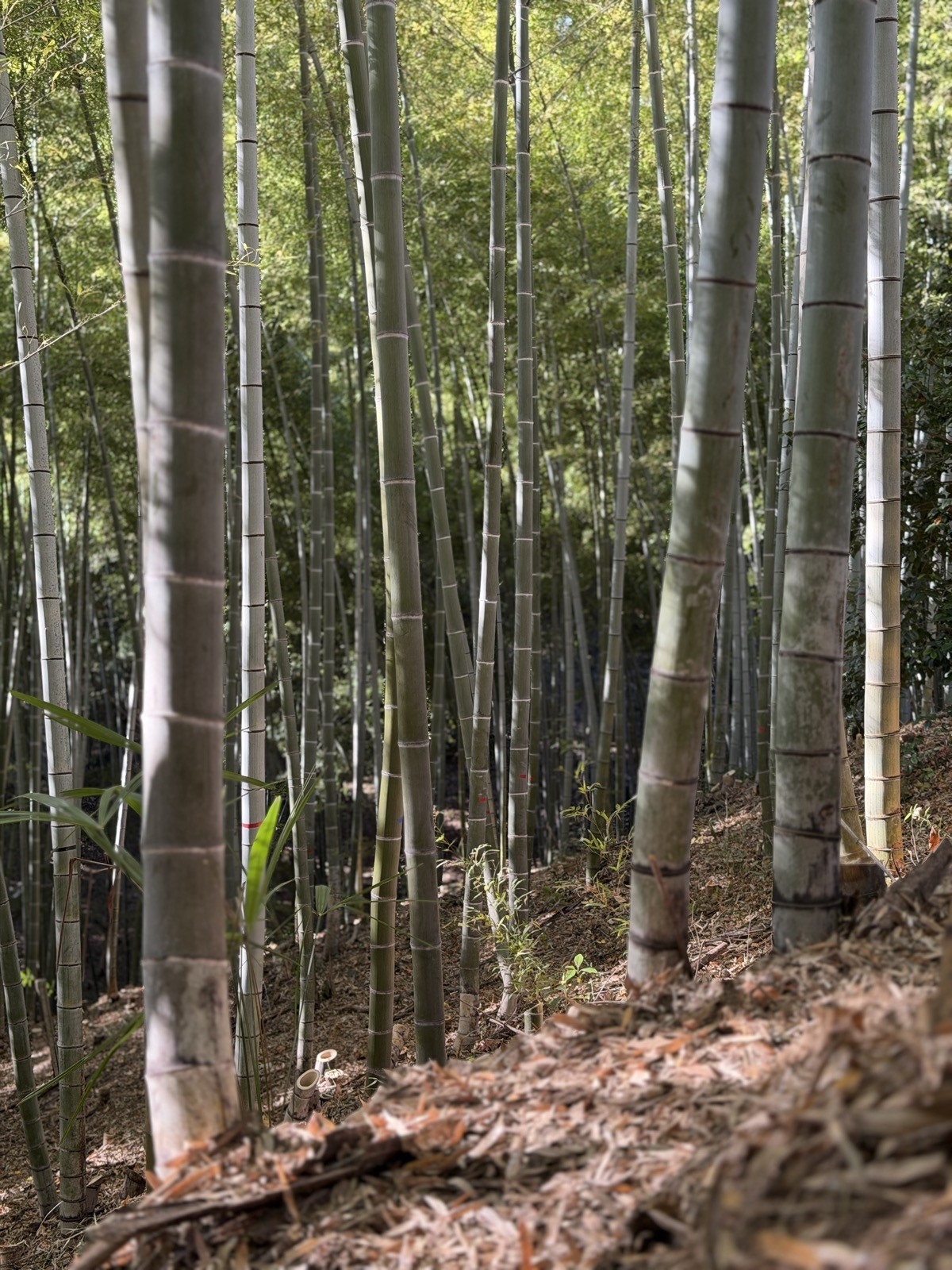
The Government of Japan’s 2026 New Year feature describes the pine-bamboo-plum grouping with “bamboo that grows straight towards the sky.” A paper by Kuranaga in the bulletin of Miyazaki Gakuen Junior College adds a reading of the nodes: bamboo has “nodes within its straight growth” (素直な伸びの中に節), which can be read as a sign of steadfastness.
When bamboo arrived
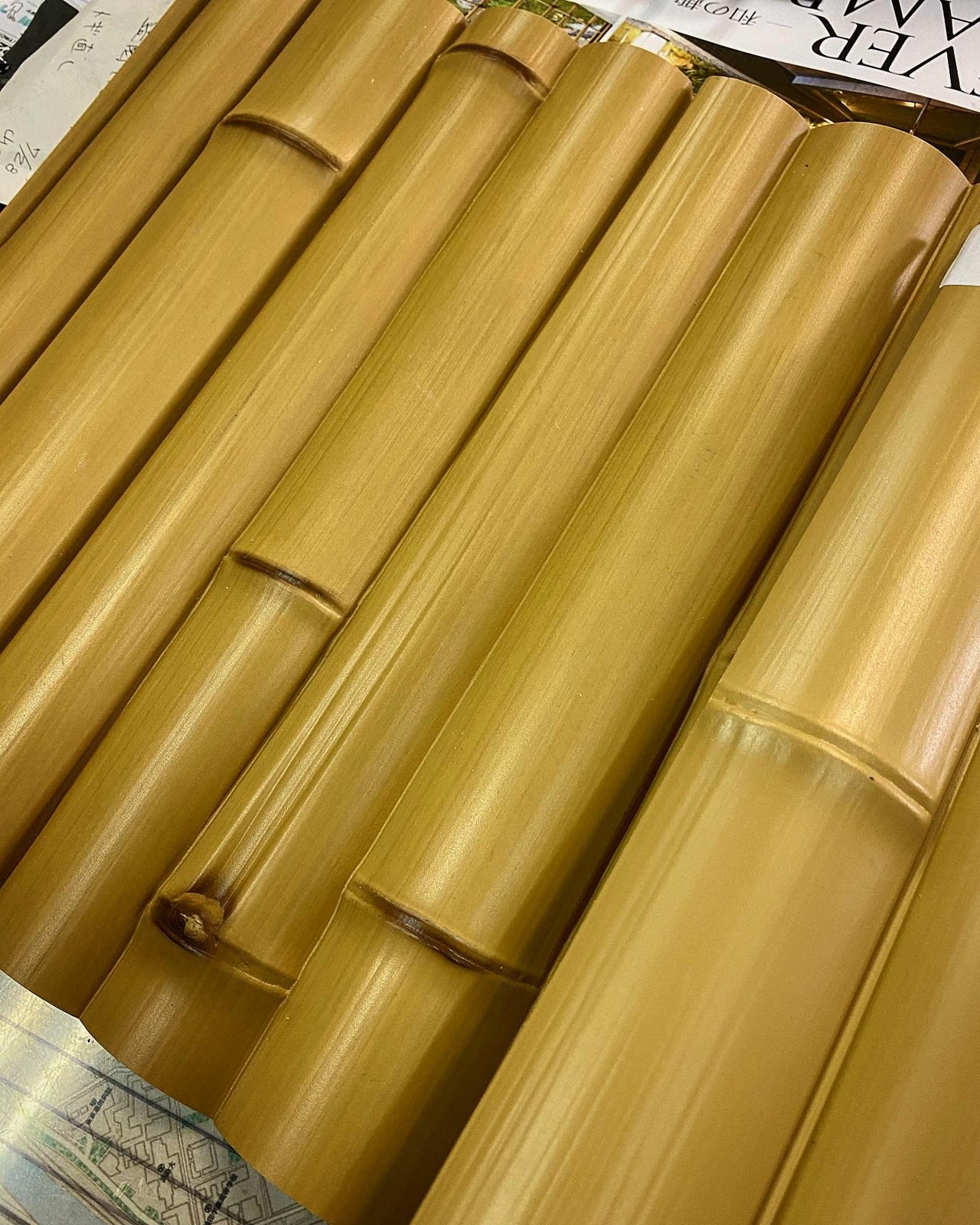
A paper in the research annual of St. Agnes’ University (Heian Jogakuin University) in Kyoto says that “the combination of bamboo with kadomatsu is thought to date from the Muromachi period” (1336–1573). The phrasing — “is thought to” (と思われる) — is the honest state of the evidence. Put that next to the Edo-era samurai houses with no bamboo at all, and the picture is of a decoration that took centuries to settle, and never fully did.
Shōchikubai — the Three Friends of Winter
The trio of pine, bamboo and plum (shōchikubai, 松竹梅) came from China. Kyoto National Museum explains it as the Chinese painting theme suikan sanyū (歳寒三友), “the three friends of the cold season” — plants traditionally admired for keeping their beauty in the cold season. The Nijō Castle office in Kyoto writes that in Japan the combination became a widely used auspicious motif for New Year and other celebrations “from the middle of the Edo period onwards.” That is why plum so often appears in a kadomatsu even though the decoration’s name only mentions pine.
Sogi and zundō — why the bamboo is cut on a slant
Two common cuts
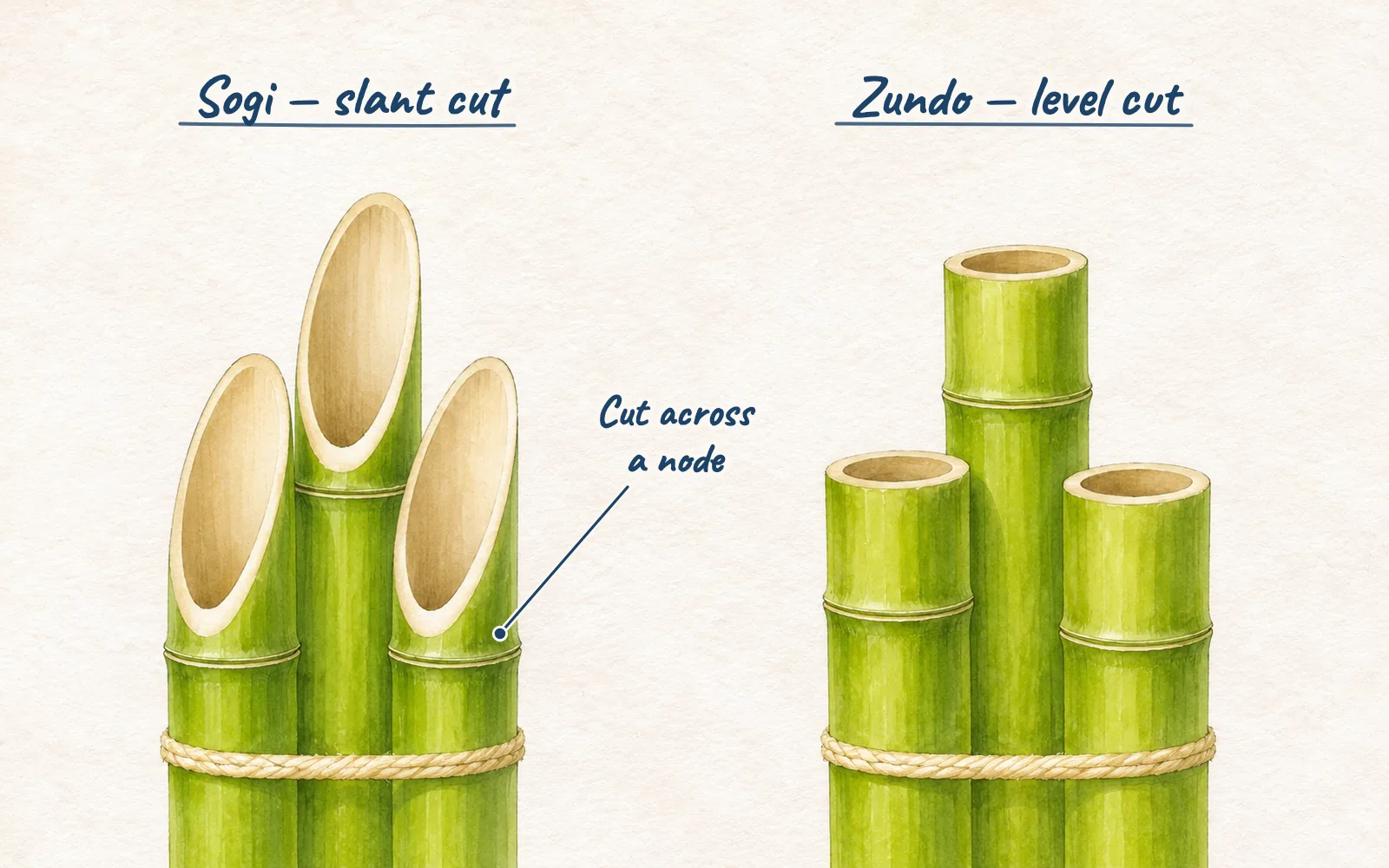
Two common finishes are used for kadomatsu bamboo. A Fukutsu City community centre in Fukuoka, writing up its own kadomatsu work, puts it simply: the bamboo tips may be “sogi or zundō.” Sogi (削ぎ) is the slanted cut; zundō (寸胴) is the level cut, straight across.
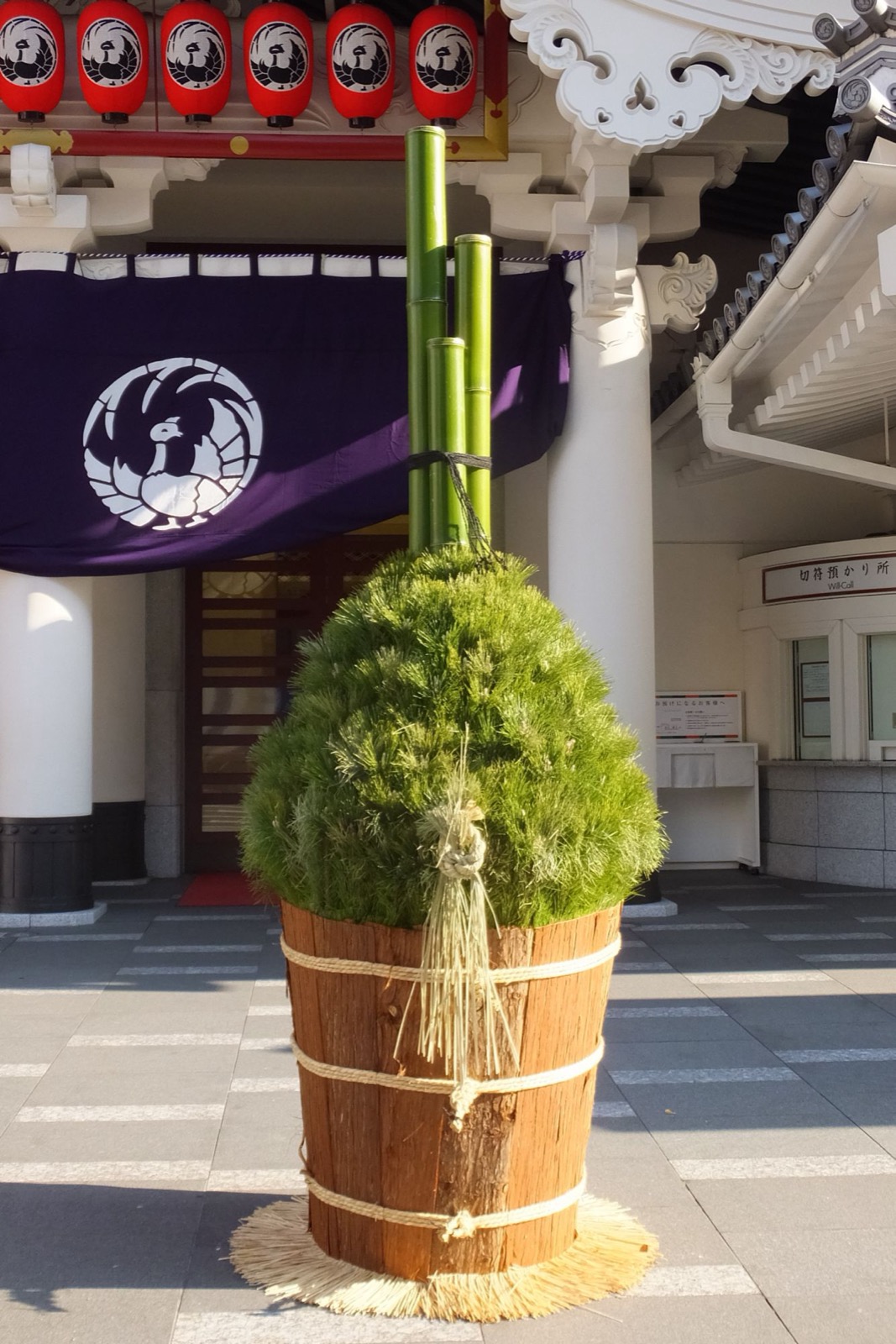
The St. Agnes’ paper considers zundō, already seen in the Muromachi period, an early form — “one could call it the ancestor of kadomatsu,” it says. One place to see it: the kadomatsu photographed outside Tokyo’s Kabuki-za theatre uses tall level-cut bamboo in a wooden tub.
The smiling mouth
The slanted cut is the one most visitors know, and the craft detail is where it crosses the node. At a kadomatsu workshop run by the Ministry of the Environment’s Chūgoku-Shikoku office, participants were told that if you cut on the slant across a node, “the cut face looks like a smiling face.” The Yokohama Greenery Foundation, at Tomioka General Park, calls the cut warai-guchi (笑い口), “the laughing mouth.” The point, in the Ministry’s words, is to cut diagonally across the node (節をまたいで) rather than through a plain section of the tube.
The Ieyasu story — and why to treat it as a story
The tale often repeated: after Tokugawa Ieyasu was beaten by Takeda Shingen at the Battle of Mikatagahara (1572), he cut the kadomatsu bamboo on a slant as a wish to cut down Takeda next time — a reading that turns the bamboo into a sword stroke. The St. Agnes’ paper records it as “an anecdote” (逸話). The Edo-Tokyo Museum’s library goes further, citing an early historical study that dismissed the explanation as “probably no more than a humorous tale” (一笑話柄に過ぎないであらう). No primary record ties the cut to Ieyasu. It is fine to tell the story; it is not fine to present it as history.
Why the slant won
A more practical explanation comes from Iida City in Nagano, whose cultural-properties office writes that the now-familiar three slanted stems spread because they look imposing, are easy to make, and suit the paved entrances that became common. That is a practical explanation from a city’s cultural-properties office rather than a legend, and it fits what the photographs show: three-bamboo kadomatsu standing on stone paving.
Building one in December — materials, steps, and the base
What goes in (and why it varies)
Material lists from public workshops show how much makers vary:
| Source | Base | Upright bamboo | Greenery and accents |
|---|---|---|---|
| Ministry of the Environment workshop, Takamatsu | Moso bamboo | Three madake culms per base | — |
| Ministry of the Environment workshop, Chūgoku-Shikoku (tabletop size) | — | Three culms, 30, 35 and 40 cm | Black pine, red pine |
| Kitahiroshima Town community hall, Hiroshima | Moso bamboo | Small bamboo (shinodake) | Pine, nandina, plum, small chrysanthemum, carnation, hiba, ornamental kale |
| Tendō City Silver Human Resource Centre, Yamagata | Dressed in komo straw matting the team weaves itself | — | — |
Sources: Ministry of the Environment Chūgoku-Shikoku Regional Office; Kitahiroshima Town; Tendō City SHRC. Checked 2026-11-07.
The Kitahiroshima list, with carnations, shows how far the examples range. Pine and bamboo appear in every list here that names the greenery — but, as later sections show, some regional forms leave the pine out.
Step by step, as public workshops describe it
Pieced together from the workshops above, the sequence runs like this:
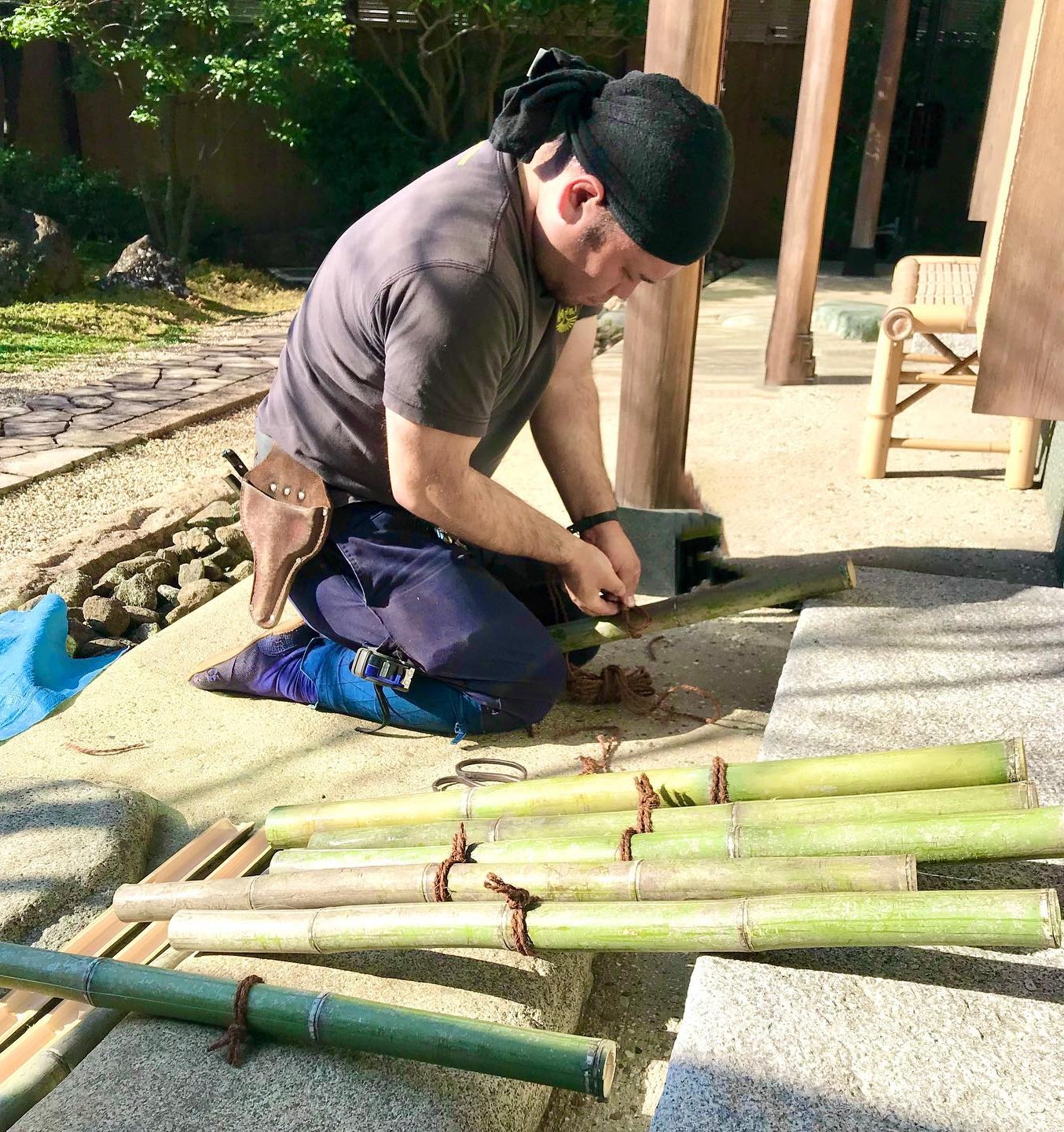
- Cut the bamboo. Teams like the Mitaka group cut culms from a grove in December; the Takamatsu workshop used madake for the upright stems.
- Cut to three heights. The Ministry of the Environment’s small tabletop version used three lengths: 30, 35 and 40 cm (about 12, 14 and 16 inches).
- Make the top cut. Slant (sogi) or level (zundō). For sogi, the cut crosses a node so the “laughing mouth” forms.
- Bind the stems. The three culms are bundled together.
- Build the base. Moso bamboo in the Takamatsu and Kitahiroshima workshops.
- Pack the pine. Short sprigs go in all round the foot of the bamboo until it reads as one dense collar.
- Add accents. Plum, nandina, kale — or none.
- Dress the base. Wrap in komo straw matting, then tie with aranawa.
Straw and rope
The base is where a kadomatsu looks handmade. Tendō City’s Silver Human Resource Centre in Yamagata describes kadomatsu “dressed in komo” — matting woven from rice straw — that the team makes specifically for its kadomatsu. Osaka Prefecture’s Nishikori Park ran a landscaping workshop where participants wrapped aranawa, coarse straw rope, around the bamboo base. Straw and rope are winter materials in Japanese gardens generally; the same coarse rope holds up the snow-supporting ropes called yukitsuri on pines in the north.
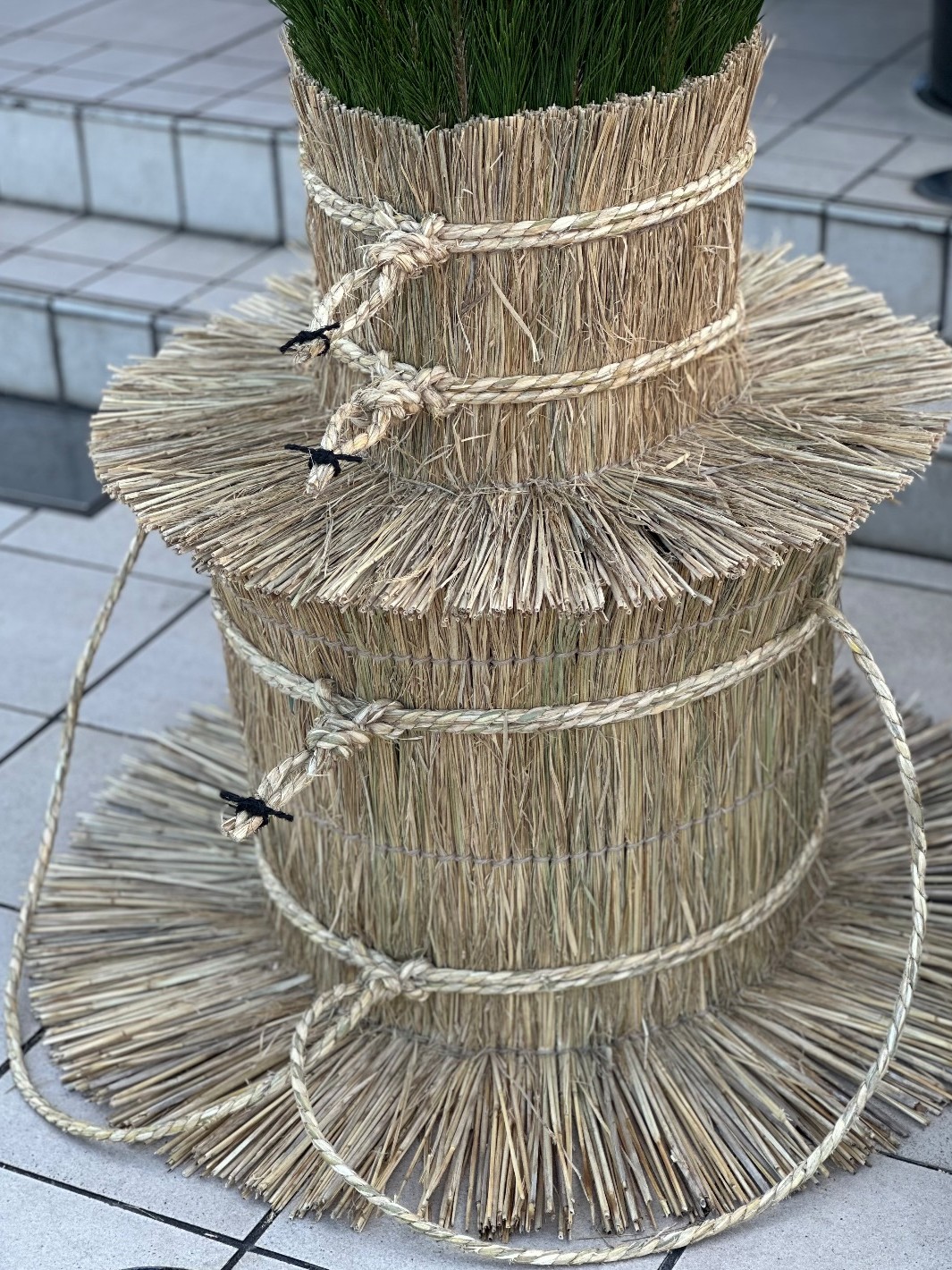
You will read in some guides that the rope must go round seven, five and three times — 7-5-3, the auspicious odd numbers. We could not confirm, from public or academic sources, that this is a practice shared across Japan, so treat it as a maker’s custom rather than a rule.
Who does the work
In Japan this is still trade work. Beyond the Chiba association’s annual classes and Nara’s training course, the Matsumoto Silver Human Resource Centre runs a dedicated kadomatsu team, and community halls such as Kitahiroshima’s run public workshops. For where December sits in the rest of the year’s tree work, see the Japanese gardener’s pruning calendar.
When it goes up — and when it comes down
The days to avoid
Timing is folklore, and folklore varies by household. Some recorded examples:
– Not December 29. Rekihaku records a custom of avoiding the 29th for gathering the pine because ku (九, nine) sounds like ku (苦, suffering). – Not December 31, usually. A decoration put up on the last day is an ichiya-kazari, “one-night decoration,” which many people avoid. But Iida City notes that while some households avoid the 31st, others put it up on the 31st by family tradition. – December 28 in one old household. A household record published by Okaya City, Nagano, notes: “December 28, morning: put up the pine decorations and the sacred rope.”
Matsu no uchi — how long it stands
The period when the decorations stand is called matsu no uchi (松の内), “within the pines.” A column from Doshisha Women’s College of Liberal Arts puts it this way: usually it ends on the 15th, but in Kantō some places end it on the 7th. The Edo-Tokyo Museum’s reference service cites a record that in 1662 (Kanbun 2) the shogunate ordered townspeople to remove street-side pine decorations by January 7 — plausibly part of why some Kantō areas take theirs down earlier.
| Date | What happens | Source |
|---|---|---|
| December 13 | Shōgatsu kotohajime: New Year preparations begin; in some regions, pine is cut in the mountains | Government of Japan; Jinja Honchō |
| December 28 | Put up in the morning, in one recorded household | Okaya City household record |
| December 29 | Avoided for gathering pine: ku sounds like “suffering” | Rekihaku |
| December 31 | Avoided by many as ichiya-kazari — but not by all | Iida City |
| January 7 | End of matsu no uchi in some Kantō areas | Doshisha Women’s College of Liberal Arts; 1662 shogunate order |
| Around January 15 | Little New Year: in many places, decorations burned at dondo-yaki / sagichō | Government of Japan |
Dondo-yaki — sending it back
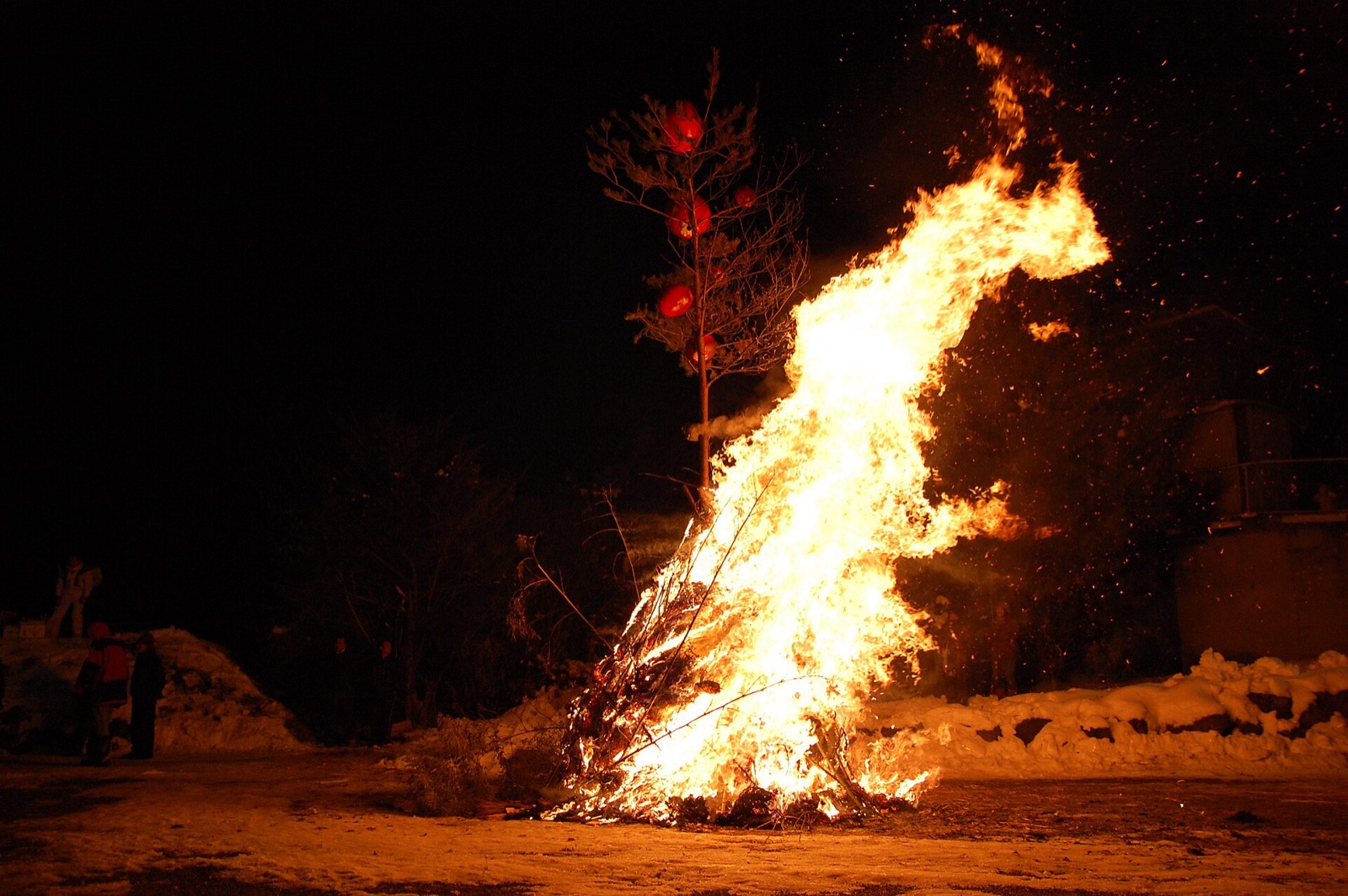
In many places, kadomatsu are not simply thrown away. The Government of Japan describes how New Year decorations are gathered in shrine grounds or on riverbanks around Little New Year (koshōgatsu, January 15) and burned in fires called dondo-yaki or sagichō.
Not everywhere — kadomatsu across Japan
Kyoto’s rooted pine
In Kyoto, one traditional form looks nothing like the Tokyo version. Murin-an, a garden in Kyoto, describes the nebiki-matsu (根引き松, “pulled-root pine”): a young pine displayed “with its roots still attached,” on the gate or at the entrance. At Murin-an the seedling is wrapped with Japanese paper (washi) and tied with mizuhiki, the decorative paper cord used on gifts.
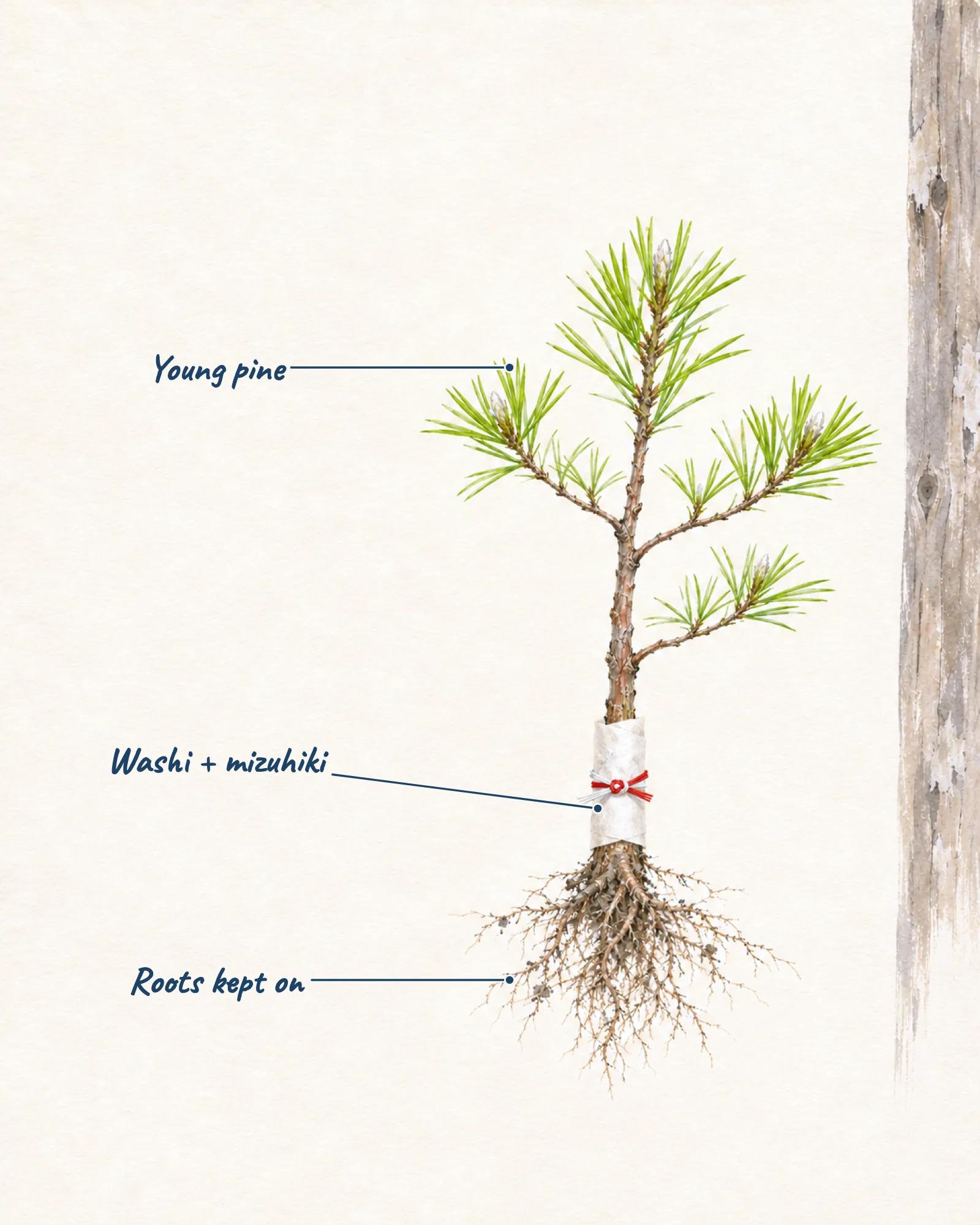
The pine is displayed whole, roots and all. Kyoto also has modern three-bamboo kadomatsu, like the one below.
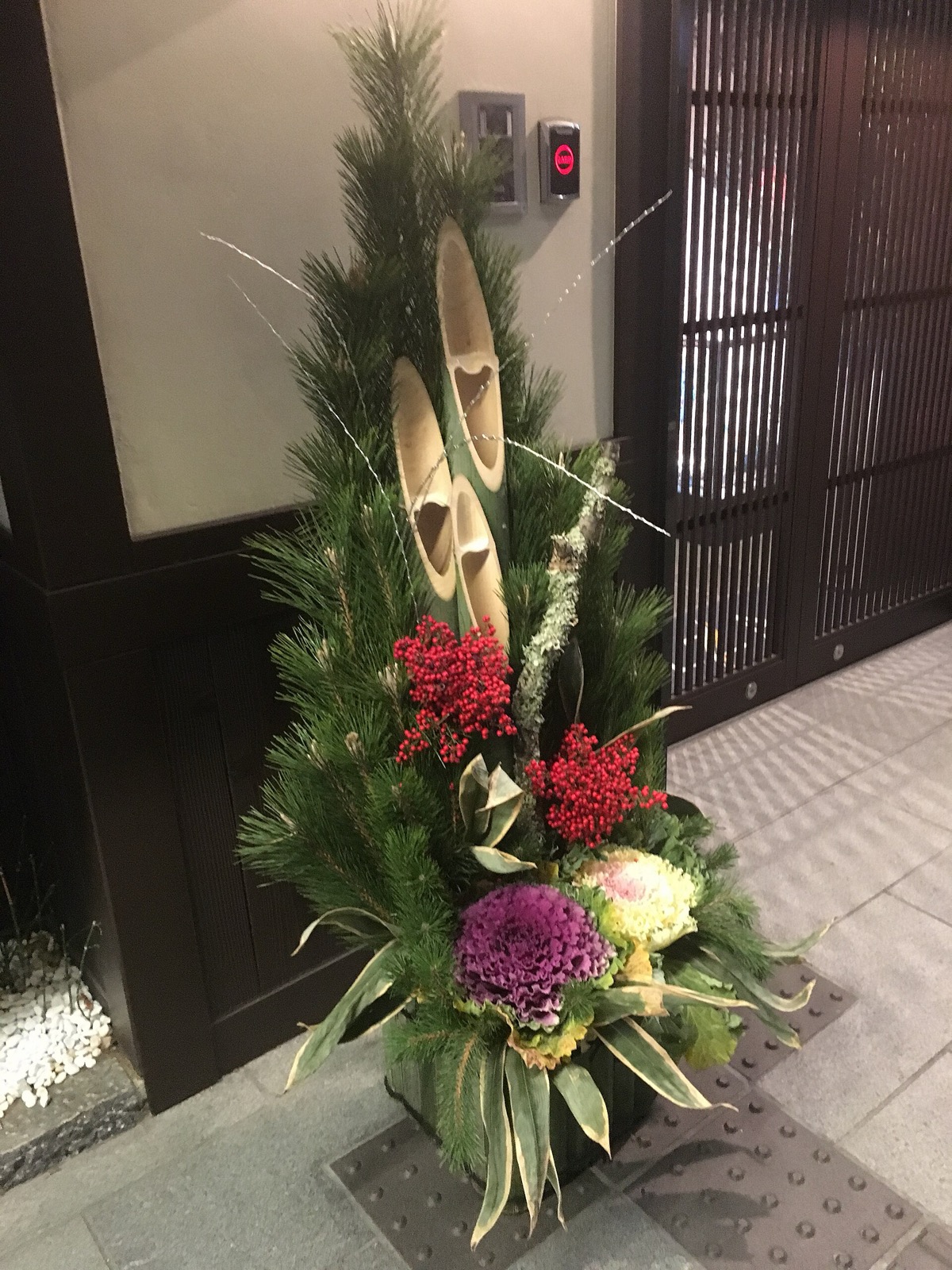
No pine at all
Some places pointedly leave the pine out:
– Fuchū, Tokyo. Ōkunitama Shrine says that “in Fuchū the custom remains of not using pine even in the New Year kadomatsu,” explained through a local legend that turns on the “wait / pine” wordplay. – Tsugaru, Aomori. The Aomori prefectural history records communities that “do not put up kadomatsu, and only hang a sacred rope (shimenawa) at the entrance.” – Katsushika, Tokyo. The ward history records a family that does not put up kadomatsu “in memory of our ancestors’ hardship,” because the founders were said to have arrived as refugees on New Year’s Eve. – Hachimantai, Iwate. The city museum records a district where, instead of standing kadomatsu, two pines were tied to the household shrine and the main pillar.
North and south
In Hokkaido, the Hokkaido Association of Shinto Shrines notes that kadomatsu often used branches of Sakhalin fir (todomatsu) rather than pine. A Hokkaido forest cooperative even made a kadomatsu in which the parts normally made of bamboo were cut from thinned todomatsu from Shimokawa Town. In Okinawa, one oral-history interview published in the Bulletin of the Historiographical Institute of Okinawa describes pine-and-bamboo kadomatsu as “Yamato-jikomi” — a custom borrowed from mainland Japan. That is one person’s testimony from one community, not a statement about all of Okinawa, but it is a useful reminder that “Japanese New Year” is not one thing.
Paper kadomatsu — when cutting pine became a question
The postwar restraint campaign
Cutting young pines and bamboo every December has a cost, and Japan argued about it openly. A Hokkaido Prefectural Library reference article, digitised by the National Diet Library, traces a postwar campaign to restrain kadomatsu to forest conservation and the New Life Movement, quoting the view that “for the protection of resources, restraint in kadomatsu is desirable.” In Tottori, Kurayoshi City’s municipal bulletin of December 1955 urged residents to “refrain from kadomatsu,” and the city distributed a printed paper sign to put up in its place.
Kadomatsu cards today
The custom survives. Ōamishirasato City in Chiba circulates a notice asking residents to use “kadomatsu cards” for “the protection of forests (pine),” and Nakatsugawa City in Gifu still distributes paper kadomatsu cards and now offers a printable digital version as well. A printed card means one less young pine cut for one household’s gate. (Japan’s pines face other pressures too — for one, see pine wilt disease.)
Common misreadings
“The slanted cut comes from Ieyasu”
Present it as a legend: the academic account calls it an anecdote, and an early historian called it probably no more than a humorous tale.
“A kadomatsu must have pine, bamboo and plum”
Pine is the core. Bamboo was added later, plum is common but optional, and some districts leave out the pine itself.
“Seven-five-three turns of rope is the rule”
We could not confirm it as a practice shared across Japan.
“Every kadomatsu comes down on January 7”
January 7 is the end date in some Kantō areas, with a 1662 order in the background. Many other places keep the pines up until around the 15th.
Frequently asked questions
Why is a kadomatsu made of pine and bamboo? Pine appears in the earliest records: an evergreen associated with vitality and long life, explained as a yorishiro through which the New Year deity is welcomed, or as a marker for it. Bamboo, prized for its straight growth, was added later — probably in the Muromachi period, though that date is an inference.
Why is the bamboo cut diagonally? There is no proven origin. The slanted sogi cut, made across a node, gives a “laughing mouth” (warai-guchi). The Tokugawa Ieyasu story is a legend; one academic account treats the level zundō cut as the earlier form. Iida City’s cultural-properties office says the slant spread because it looks imposing, is easy to make, and suits paved entrances.
When should a kadomatsu be put up and taken down? Customs vary. One recorded household puts it up on December 28; the 29th is avoided in a recorded pine-gathering custom (ku, “suffering”), and some households avoid the 31st. It comes down at the end of matsu no uchi — January 7 in some Kantō areas, around January 15 in many other places — and in many places is burned at dondo-yaki.
What plants are used besides pine and bamboo? Plum and nandina are common accents in the examples cited here; ornamental kale, small chrysanthemums and other flowers appear in modern pieces. Material lists vary by maker and region.
Does all of Japan use the same kadomatsu? No. In Kyoto, one traditional form is the rooted young pine (nebiki-matsu); parts of Hokkaido used Sakhalin fir; and communities in Fuchū, Tsugaru and elsewhere put up no pine at all.
What happens to a kadomatsu after New Year? In many places it is gathered with other decorations and burned at dondo-yaki or sagichō fires around January 15.
Sources
– Hokkaido Association of Shinto Shrines, “Q&A: kadomatsu” (hokkaidojinjacho.jp/ritual-dwelling/qa-09/) and “Hokkaido rites” (hokkaidojinjacho.jp/ritual-hokkaido/) — checked 2026-11-07 – Government of Japan, Highlighting Japan, January 2025 and January 2026 features; February 2023 (gov-online.go.jp) — checked 2026-11-07 – National Museum of Japanese History (Rekihaku), plant columns 2004 and 2017 (archive.rekihaku.ac.jp) — checked 2026-11-07 – Edo-Tokyo Museum library reference 10557; Collaborative Reference Database 1000033045 (crd.ndl.go.jp) — checked 2026-11-07 – Jinja Honchō, “Susuharai” (jinjahoncho.or.jp) — checked 2026-11-07 – Murin-an, Kyoto (murin-an.jp) — checked 2026-11-07 – Kyoto National Museum, theme exhibit, January 2020 (kyohaku.go.jp) — checked 2026-11-07 – Nijō Castle Office, Kyoto City (nijo-jocastle.city.kyoto.lg.jp) — checked 2026-11-07 – Heian Jogakuin (St. Agnes’) University research annual; Kuranaga, Miyazaki Gakuen Junior College bulletin no. 7 — checked 2026-11-07 – Ministry of the Environment, Chūgoku-Shikoku Regional Office blog (2012; Takamatsu) — checked 2026-11-07 – Yokohama Greenery Foundation, Tomioka General Park; Osaka Prefecture Nishikori Park — checked 2026-11-07 – Iida City; Fukutsu City; Okaya City; Kitahiroshima Town; Kurayoshi City; Ōamishirasato City; Nakatsugawa City; Hachimantai City Museum; Katsushika Ward History; Aomori Prefectural History database — checked 2026-11-07 – Ōkunitama Shrine (ookunitamajinja.or.jp) — checked 2026-11-07 – Doshisha Women’s College of Liberal Arts, faculty column 13567 — checked 2026-11-07 – Chiba Prefecture Landscaping and Greening Association; Nara Prefecture; Tokyo, Matsumoto and Tendō Silver Human Resource Centres — checked 2026-11-07 – Hokkaido Prefectural Library reference article, NDL Digital Collections (pid 8214994) — checked 2026-11-07 – Hokkaido Kamikawa General Subprefectural Bureau; Bulletin of the Historiographical Institute of Okinawa no. 39 — checked 2026-11-07 – Forestry and Forest Products Research Institute (ffpri.go.jp); Ministry of Agriculture, Forestry and Fisheries plant-variety database; Wakayama Prefecture — checked 2026-11-07