

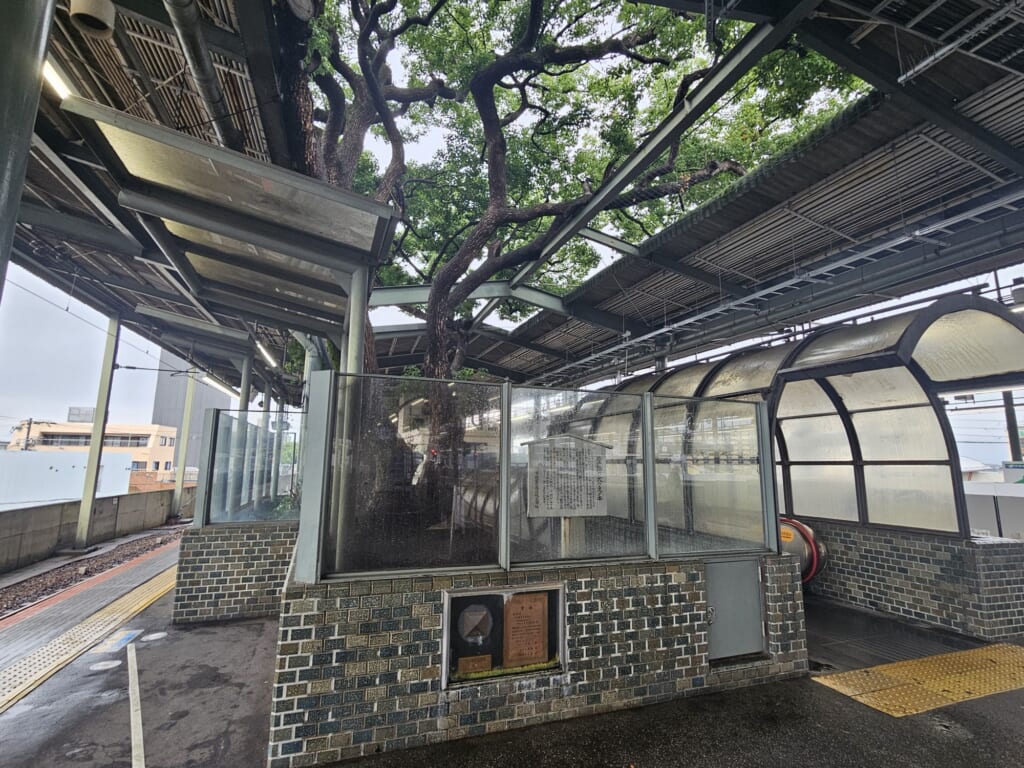
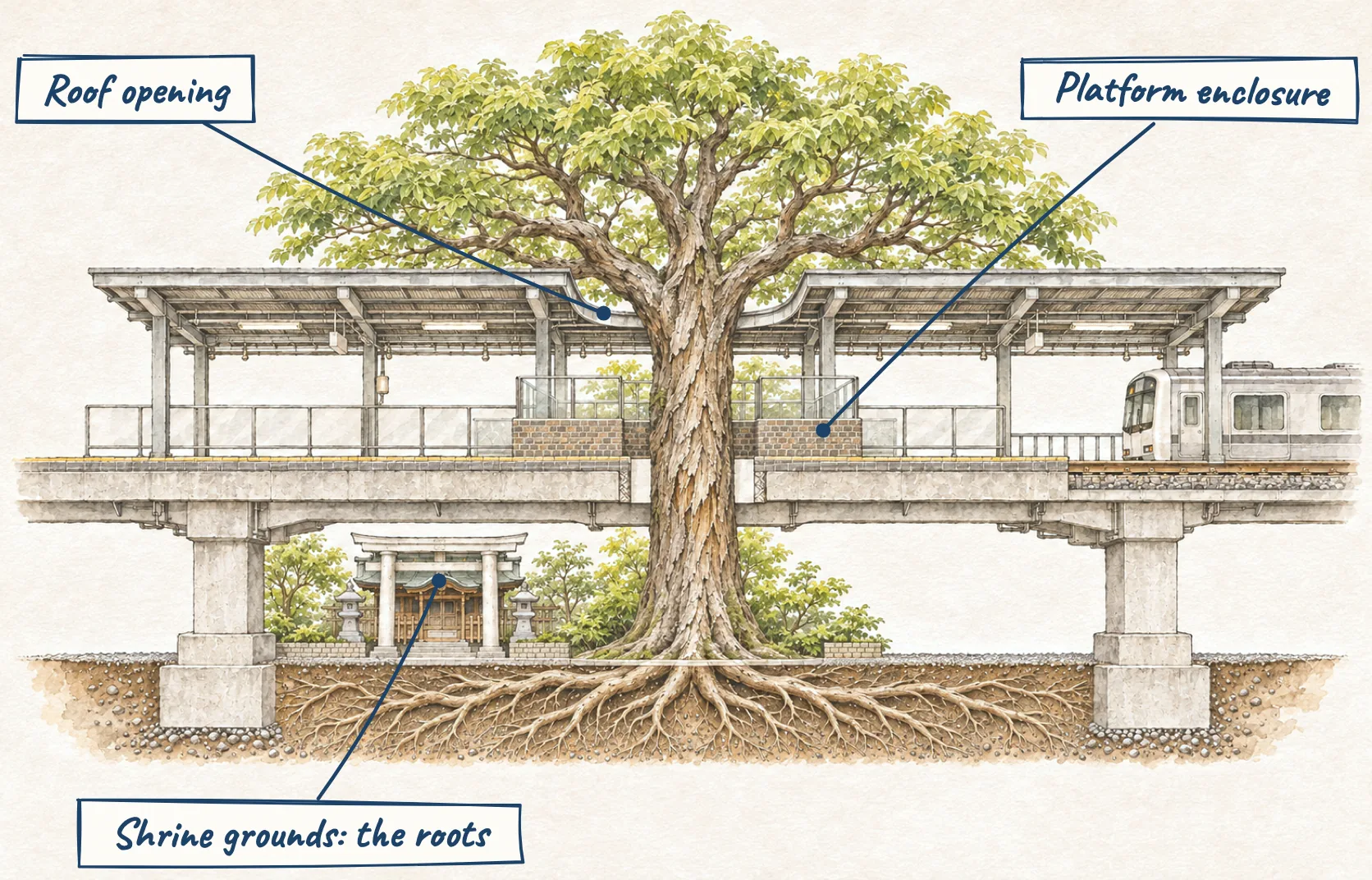
A camphor tree grows through Kayashima Station in Neyagawa, Osaka, because Keihan Electric Railway revised an already completed design to keep it. When the line was raised onto a viaduct — work that began in 1972 and was completed at Kayashima in March 1980 — the plan was to cut down the camphor, the sacred tree of Kayashima Shrine, but strong requests from local residents led the railway to shift the tracks and widen the platform instead. Today the tree, estimated to be about 700 years old, rises from the shrine grounds below the viaduct, through the elevated platform and out through the platform roof.
Below, we follow the tree from the platform down to its roots — the station, the shrine, the reversed plan, and what a structure asks of a tree that lives inside it.
Standing on the Platform — A Tree Where a Pillar Should Be
What you see first
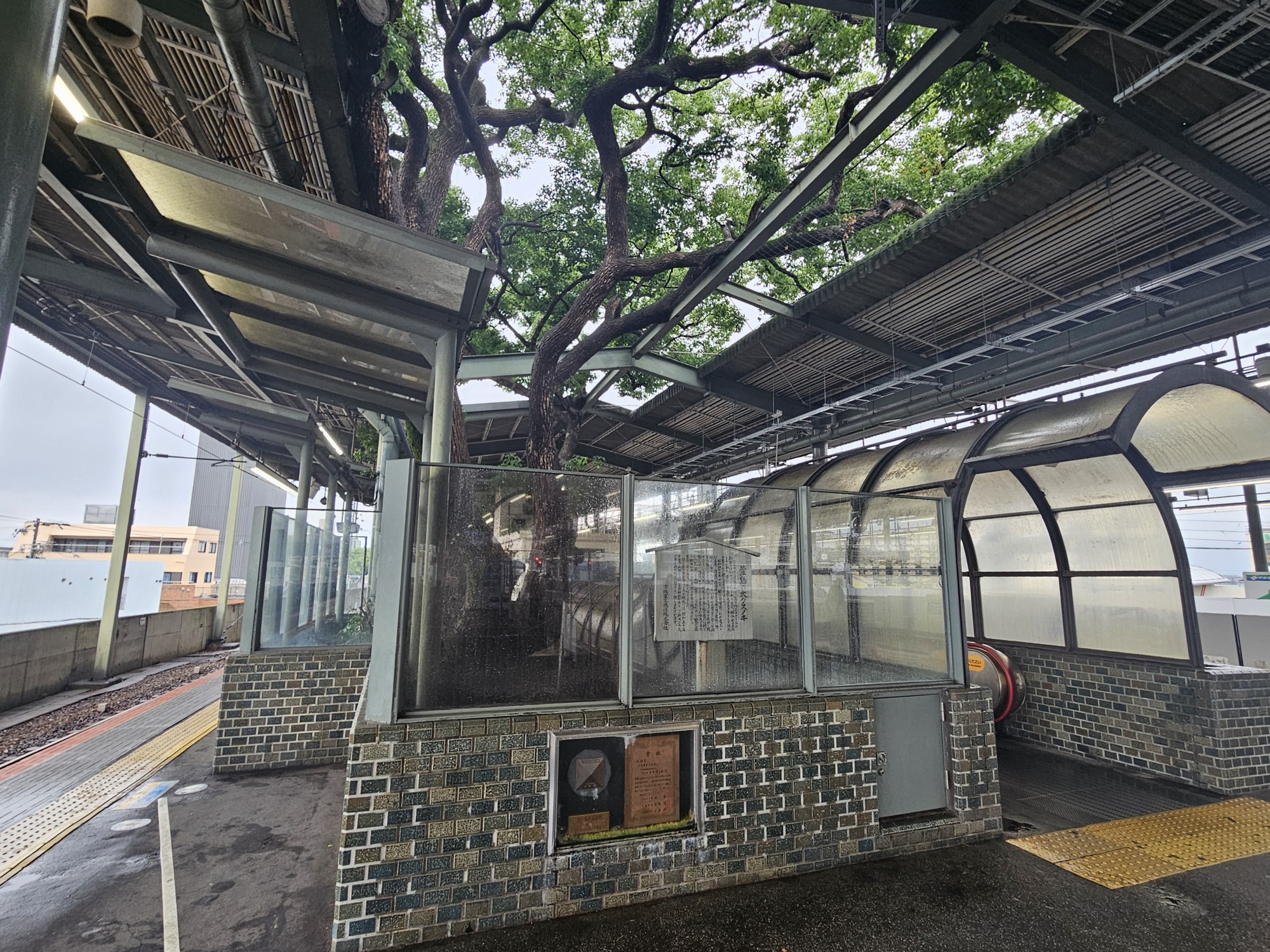
Step off a train on the Osaka-bound side of Kayashima Station and the first thing you notice is the roof. The platform canopy runs along the track as station roofs do, but partway along it has a large, irregularly shaped opening, and through that opening climbs a grey, furrowed trunk that divides into several heavy limbs. Above the roofline, the camphor (Cinnamomum camphora) spreads a dome of glossy evergreen leaves over the station.
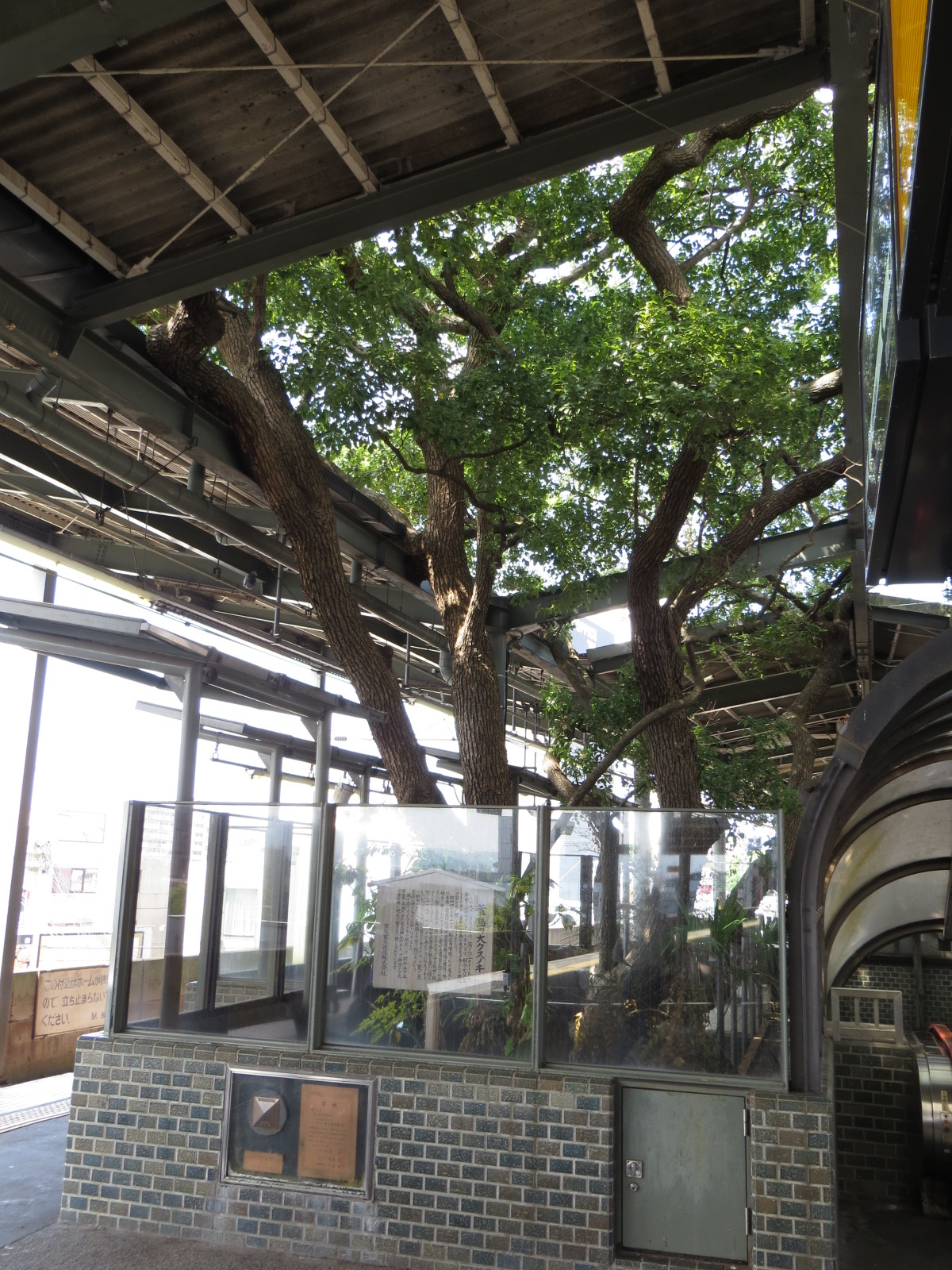
At platform level, the trunk does not stand on the platform at all. It comes up from below, through the concrete deck, and, as photographs of the platform show, is boxed in by a low brick wall topped with glass panels. Commuters walk around it the way they would walk around a stairwell. Trains for Yodoyabashi and Nakanoshima use platforms 3 and 4 here, and the City of Neyagawa describes the tree as preserved “inside the station, on the platform for Osaka-bound trains.”
Where the tree really starts
The tree’s roots are not on the viaduct. They are in the ground of Kayashima Shrine, which sits under the elevated tracks. The station was built over the tree, and the tree was allowed to keep growing through the station. That reversal — a railway structure fitted around a living tree, rather than a tree removed for a railway — is the whole story, and it is why the station appears in Osaka’s tourism material and in national television features.
Size and age, as the city records them
The City of Neyagawa gives the tree’s size in round numbers: about 20 m (66 ft) tall, with a trunk girth of about 7 m (23 ft), and an estimated age of about 700 years. Those figures should be read for what they are. The city presents the age as an estimate and does not say how it was estimated. The city page does not say when or at what height the girth was measured, and a Keihan spokesperson told CBC Radio in 2020 that the company was not currently measuring the tree’s growth. The numbers describe a very large, very old camphor; they should not be treated as recent measurements with a known date.
| Item | What the public record says | Source |
|---|---|---|
| Species | Camphor tree, Cinnamomum camphora | Forestry and Forest Products Research Institute |
| Estimated age | About 700 years (estimate) | City of Neyagawa |
| Height | About 20 m (66 ft) | City of Neyagawa |
| Trunk girth | About 7 m (23 ft); measuring date not stated | City of Neyagawa |
| Local status | Hozonju (保存樹) — a city-designated preserved tree | City of Neyagawa |
| Other recognition | Selected for the Osaka Prefecture “100 Greenery Sites,” April 1989 | Osaka Prefecture / City of Neyagawa |
A Shrine Under the Tracks — Kayashima and Its Sacred Tree
An island in a river bend
Kayashima began as land made by water. The city’s public newsletter describes it as a sandbar formed where the Neya River curves, and the city’s chronology dates the start of land reclamation at Kayashima — the development of Kayashima Ryūsaku Shinden, newly opened farmland — to 1722. Kayashima Shrine is tied to that reclamation: the city’s guide map lists its enshrined deities as Sugawara no Michizane, Toyouke no Ōkami, and the founder who opened Kayashima to cultivation, Kanda Zen’emon (神田善右衛門).
Shinboku — the tree as a sacred presence
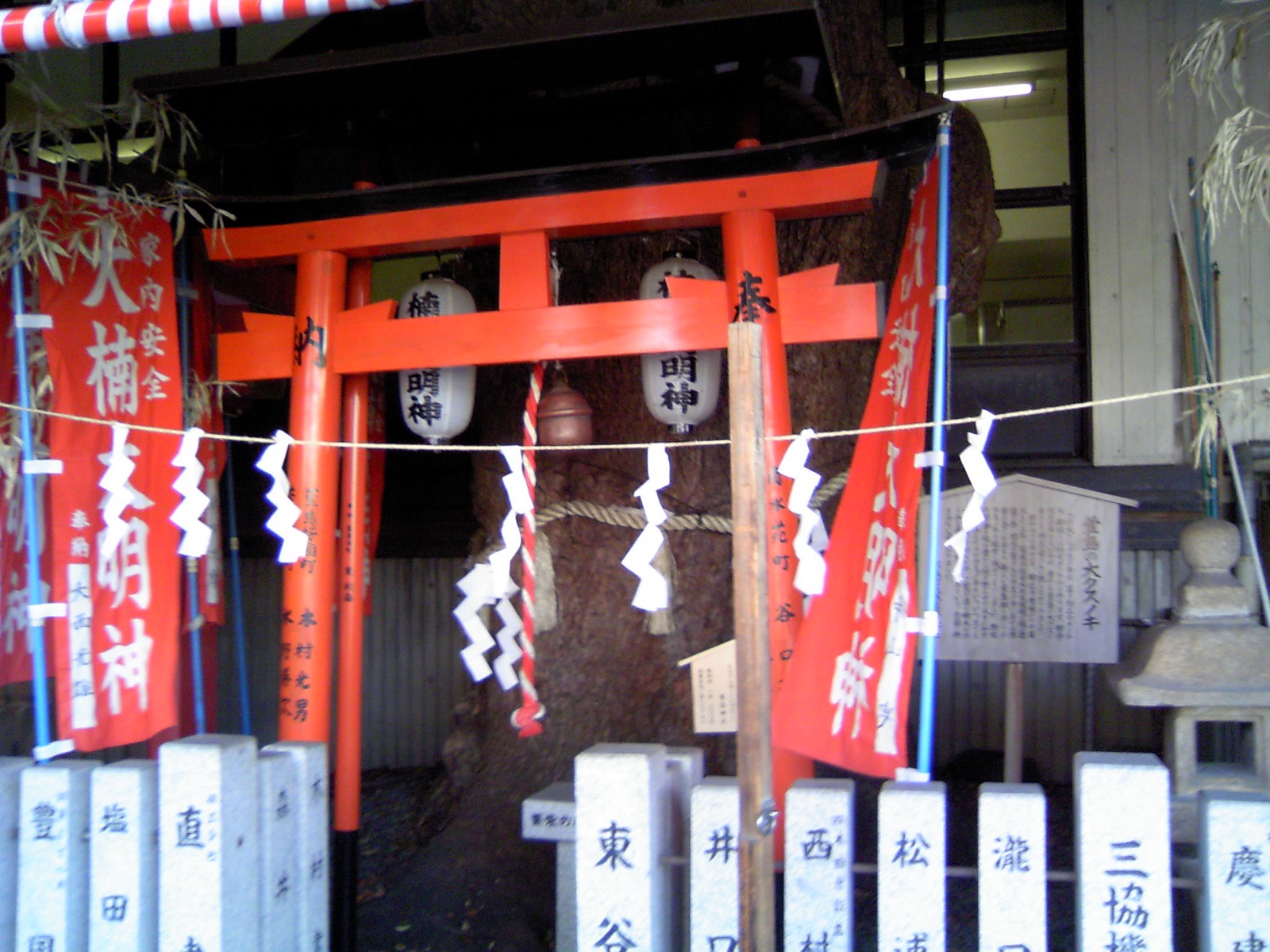
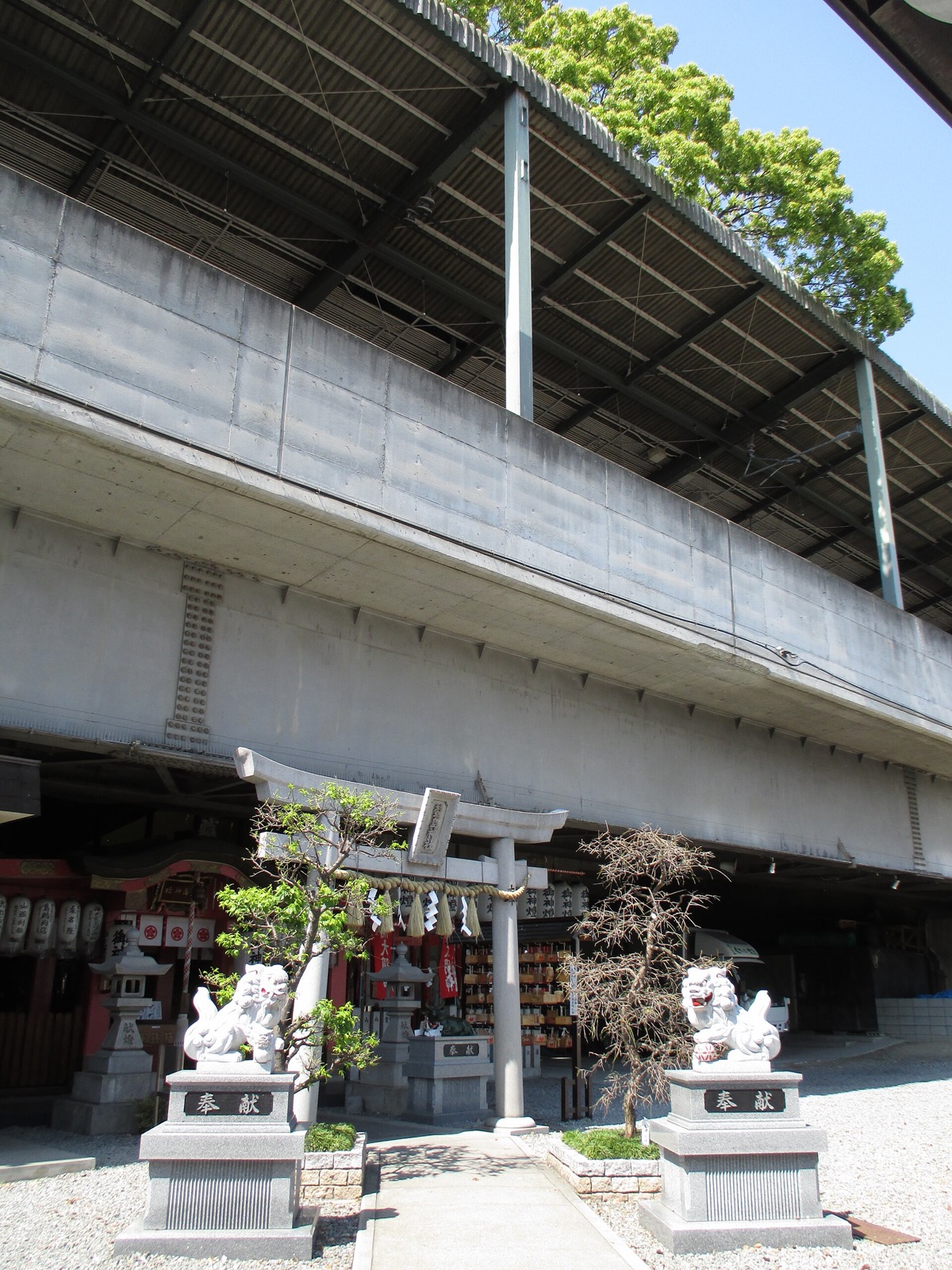
Keihan itself calls the tree “the sacred tree of Kayashima Shrine.” In Japanese this is a go-shinboku (御神木), a shrine’s sacred tree. At the foot of the Kayashima camphor, below the viaduct, photographs show the tree with its own small vermilion torii gate, a shimenawa (注連縄) rope hung with white paper streamers, and red banners reading Ōkusu Daimyōjin (大楠大明神), the “Great Camphor Deity.”
That detail matters for understanding the station. What the railway proposed to cut was not simply a large tree beside its tracks; it was the sacred tree of the local shrine.
The shrine today
The city’s walking guide places the shrine under the elevated station: walk south from the station toward the river, climb the short slope, and you arrive at Kayashima Shrine. From the shrine yard you see the arrangement in section — gravel, guardian lion-dogs, a torii, the concrete underside of the viaduct, and above it the station roof with the camphor’s crown breaking out over the top.
The Plan to Cut It — Raising the Keihan Line
1910 to 1972
Kayashima Station opened in 1910, at the same time as the Keihan line itself, with its tracks at ground level. In November 1972, construction began on an elevated quadruple-track section between Doi and the Neyagawa signal station, to increase the line’s capacity. Kayashima sat inside that project.
The original plan
The city states plainly that a plan was drawn up to fell the tree when the line was elevated and quadruple-tracked. In May 2026, a Keihan spokesperson confirmed the same point to TV Asahi: at the time, the camphor — the sacred tree — had been scheduled to be cut down.
Why the plan made engineering sense
It is worth being fair to the original plan. A viaduct is a long, regular structure: piers at set intervals, a deck of fixed width, tracks laid to fixed curves and clearances. A large tree at the edge of that corridor can be an obstacle in three dimensions — its trunk may sit where a deck should go, its crown where a roof and overhead wires should go, its roots where foundations should go. From an engineering perspective, removing the tree can appear to simplify the design. That is exactly why the decision to keep it is remarkable.
How the Tree Won — Residents and a Changed Design
Strong requests from local residents
The City of Neyagawa gives the reason for the reversal in one phrase: the tree was preserved “due to the strong wishes of local residents.” The public record does not, as far as we could confirm, preserve the details — the number of signatures, the date petitions were delivered, or the names of the organizers. Those details may exist in newspaper archives, but we have not seen the original documents and do not repeat the figures that circulate online.
Moving the tracks, widening the platform
What Keihan did is clearer. CBC Radio reported in 2020, after interviewing Keihan’s press office, that the already-completed design was changed so that the tracks were diverted around the tree and the platform was widened. The city’s guide map adds that changing the design and the construction work took a great deal of money and time. The city’s chronology records the elevation and quadruple-tracking of Kayashima Station as complete in March 1980.
| Year | Event | Source |
|---|---|---|
| 1722 | Development of Kayashima Ryūsaku Shinden begins | City of Neyagawa |
| 1910 | Kayashima Station opens with the Keihan line | City of Neyagawa |
| Nov 1972 | Elevated quadruple-track construction begins | Osaka Museum (Osaka Prefecture) |
| During the elevation works | Plan to fell the tree is reversed; design changed | City of Neyagawa; CBC Radio |
| Mar 1980 | Kayashima Station elevation completed | City of Neyagawa |
| Apr 1989 | Selected for Osaka’s “100 Greenery Sites” | City of Neyagawa |
| Mar 1991 | Treatment carried out to preserve the camphor | Keihan 90th-anniversary history (via Shibusawa database) |
What “changing a finished design” means
The public record names two changes: the tracks were diverted, and the platform was widened. The result is visible today. Because the trunk comes up from the ground below, the deck has to accommodate an opening around the trunk, and the roof another opening for the limbs. Track alignment affects the design of a viaduct and its platforms, although the published accounts do not say which structural elements were changed. The city describes the cost simply as a great deal of money and time.
The shrine’s voice
Nearly half a century later, the shrine still describes the tree as an inheritance. A representative of the shrine told TV Asahi in 2026 that he wanted “to keep this as it is and pass it on to our children and grandchildren.” That is the attitude the station’s design writes into concrete.
Why Japan Keeps Trees Like This — Shinboku and the Camphor
What Japan’s giant-tree survey found
Japan has surveyed its giant trees nationally, and the results help place Kayashima. The Environment Agency’s 1993 Environmental White Paper, reporting on the national survey of giant trees, noted that nine of the top ten trees by trunk girth were camphors, and that about 30 percent of the giant trees surveyed were objects of worship. It also pointed out the large role shrine forests (shasō-rin, 社叢林) play in keeping big trees alive. That ranking is a snapshot from that survey, not a current league table, but it shows why a giant camphor at a shrine is a familiar sight in Japan.
The camphor itself is an evergreen tree of warm-temperate Japan. The Forestry and Forest Products Research Institute notes that it has been planted along warm coasts and on islands, that old individuals survive in many places, and that it was once planted in the mountains for camphor production. Long-lived, large and evergreen, it is a tree often found at shrines in warm parts of Japan — we have written before about another, the great camphor of Kinomiya Shrine.
What protection actually looks like
It is easy to assume a tree this famous is a nationally designated Natural Monument. The designation we could confirm is different: the city lists it as a hozonju (保存樹) — a preserved-tree designation under Neyagawa’s own green-conservation program — and the prefecture included it among its 100 greenery sites. The city’s program includes subsidies for maintenance and for preventing decline, though we found no public record of which, if any, have been paid for this tree. At the decisive moment — the elevation works — what the record shows protecting the tree is the strong wish of local residents to keep the shrine’s sacred tree.
For a broader look at why Japanese old trees reach great ages, see Why Do Japan’s Ancient Trees Live for a Thousand Years?.
Kayashima is not alone
A documented parallel is on the other side of Osaka. On the Hankyu Takarazuka Line, Hattori-Tenjin Station has a camphor tree that grows through its platform roof. Hankyu’s own interview with the chief priest of Hattori Tenjin-gū explains that the station land was once part of the shrine precinct, and that residents asked that the camphor, at least, be left. Hankyu says the tree has stood in the station since it opened in 1910.
| Kayashima (Keihan) | Hattori-Tenjin (Hankyu) | |
|---|---|---|
| Tree | Camphor, sacred tree of Kayashima Shrine | Camphor, sacred tree of Hattori Tenjin-gū |
| How it meets the station | Rises from shrine grounds through the elevated deck, platform, then roof | Grows through the platform roof |
| When it was kept | When the line was elevated (works from 1972, completed 1980) | From the station’s opening in 1910 |
| Documented reason | Strong local requests (City of Neyagawa); tracks diverted, platform widened (CBC Radio) | Residents asked that the camphor be left (Hankyu) |
The two stories differ in one important way. At Hattori-Tenjin, the tree was kept when a station was first built at ground level. At Kayashima, a tree that had already lived beside the tracks for decades was kept through a far larger rebuilding, at the moment when cutting it would have been easiest to justify.
What a Building Asks of a Tree — The Openings
Trunks keep getting thicker
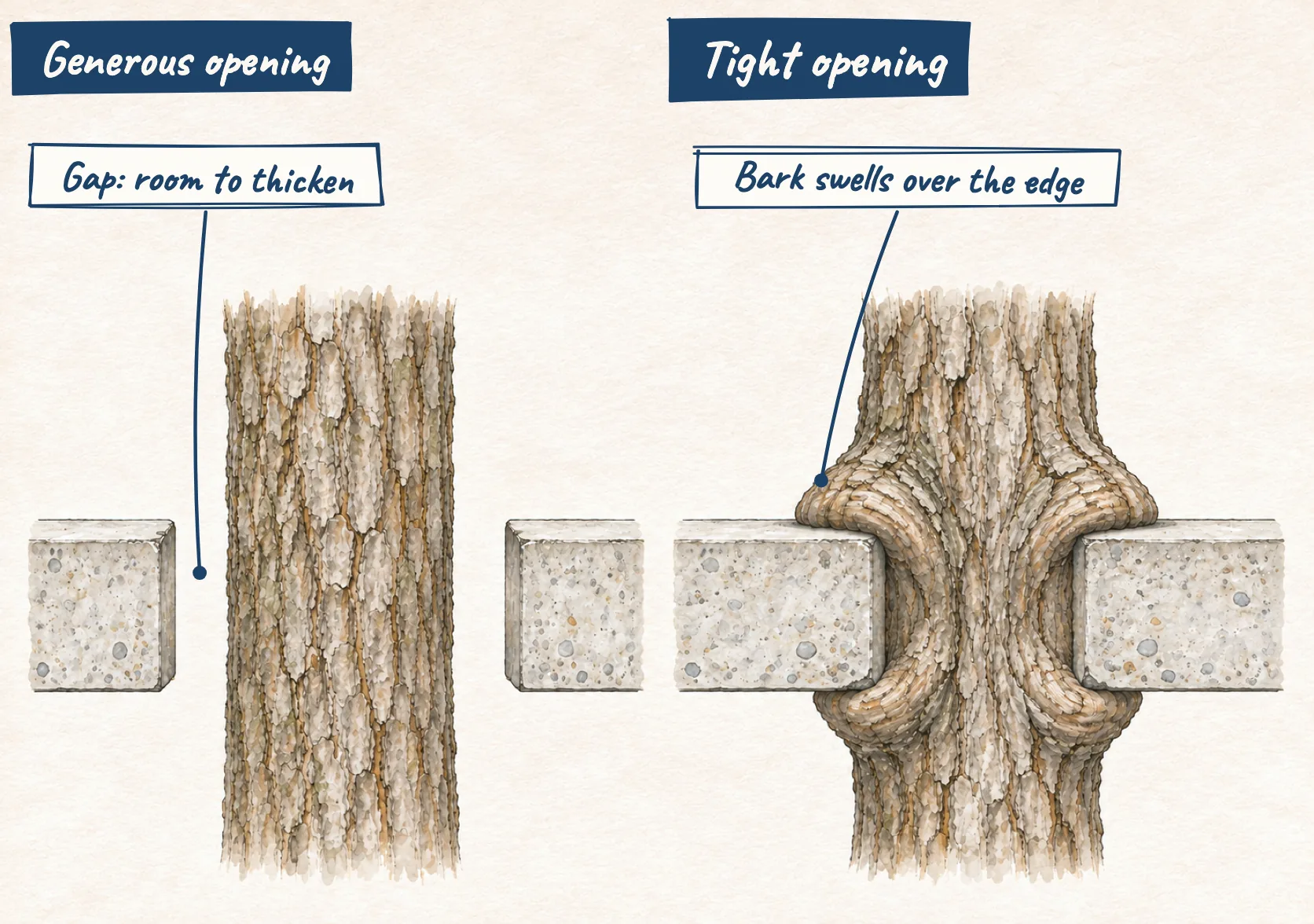
From the tree’s side, the most important fact about Kayashima is simple: a living trunk keeps thickening. A healthy tree adds new wood under its bark in the growing season, so its girth slowly increases over the years. Any structure that wraps around a trunk — a deck, a platform enclosure, a roof — has to allow for that. If the opening is generous, the tree grows into the space. If it is tight, the trunk eventually meets the edge.
What can happen next is familiar to arborists who have removed an old fence wire or a forgotten tree tie. The bark and the living tissue just beneath it are pressed against the hard edge and can be damaged, and over the years the tree may grow around the obstruction, swelling where it meets it. Pressure can damage the inner bark and the cambium beneath it, the thin layer that produces new wood and bark, affecting the transport of sugars. An opening that a tree has outgrown is not a cosmetic problem.
Limbs move, too
The crown is not static either. Limbs thicken, lengthen and sway in wind. Where a limb passes through a roof opening, the edge has to sit far enough from the bark that the limb can move without rubbing. On the photographs of the Kayashima roof, the opening is cut wide, with a large irregular outline around the limbs. We have not found any published specification for its dimensions, drainage or waterproofing, so we can only describe what is visible: an opening shaped around the tree.
Rain and the roof
The obvious question visitors ask is what happens when it rains. Keihan’s press office answered it lightly in the 2020 radio interview: the tree is covered in green, so its leaves act like a roof. That is a description of the experience, not of the drainage design, and we have not seen the technical details. From the tree’s point of view, though, rain raises a different question, which is about the roots.
Under the Viaduct — Roots, Soil and Water
Roots live where the soil allows
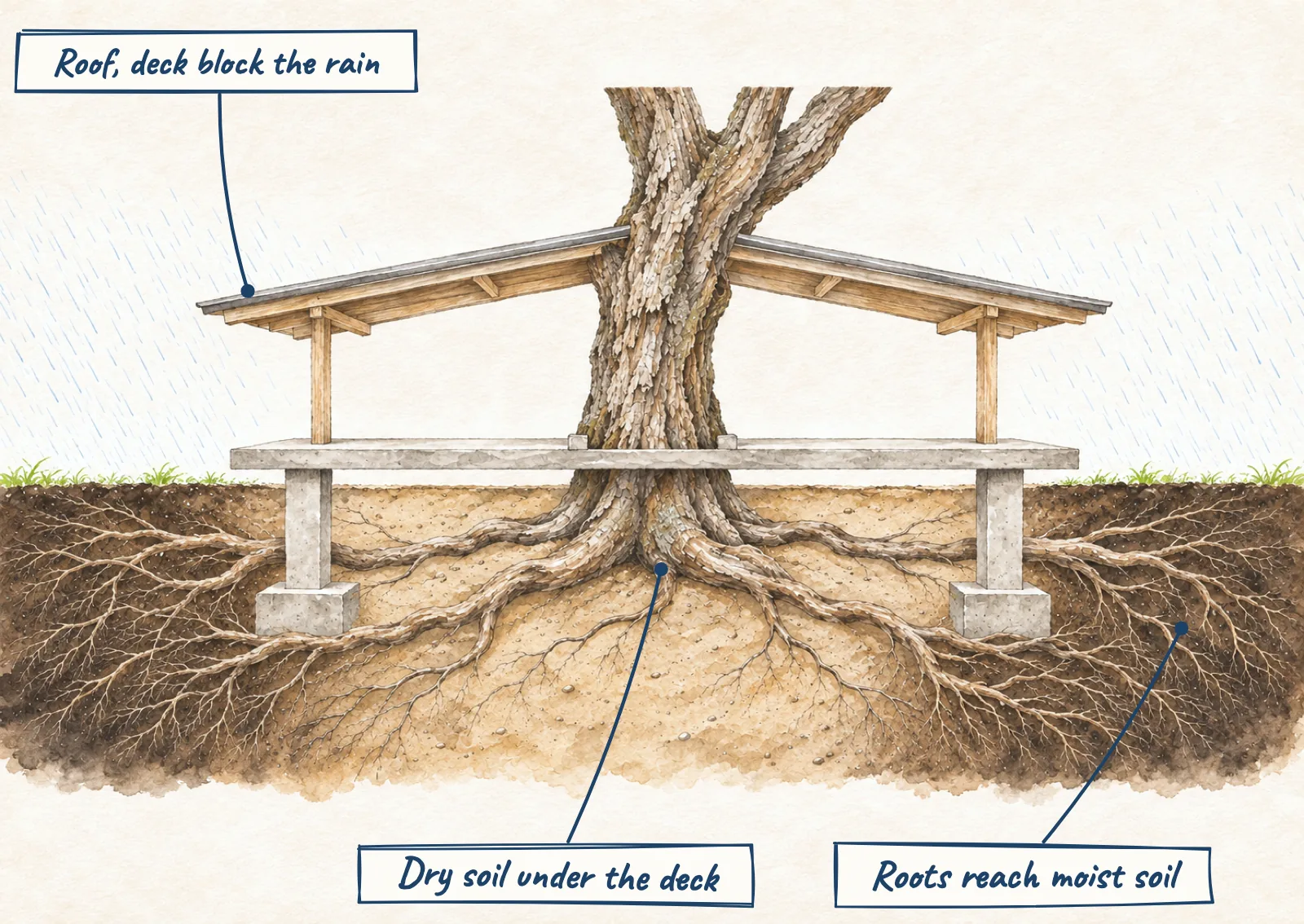
Many trees concentrate their roots in the upper soil, where water and air are available, though depth varies with species and soil. Under a viaduct, three things can work against them. Piers and their foundations occupy ground that roots would otherwise explore. Paving and compacted surfaces can reduce how much water and air enter the soil. And the deck above can cast a rain shadow: rain may reach the ground directly under a wide elevated structure less easily than open ground nearby.
We do not know the layout of the Kayashima tree’s roots relative to the viaduct foundations; no public document we found describes it. In general, where roots grow depends on water, oxygen and soil conditions, so roots near structures tend to develop where those are better — which is why soil conditions are worth checking around any tree hemmed in by construction.
One way to improve soil around old trees
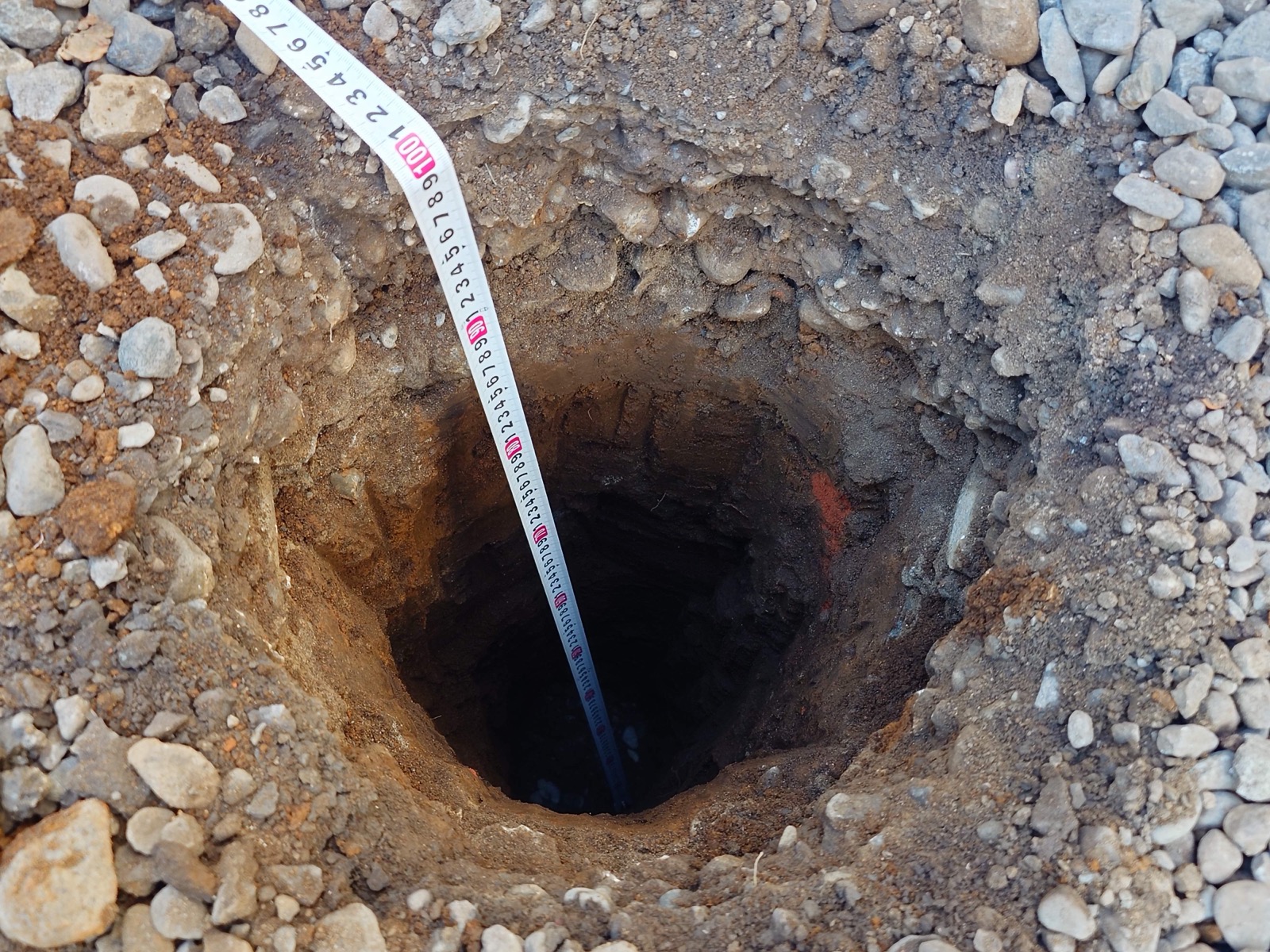
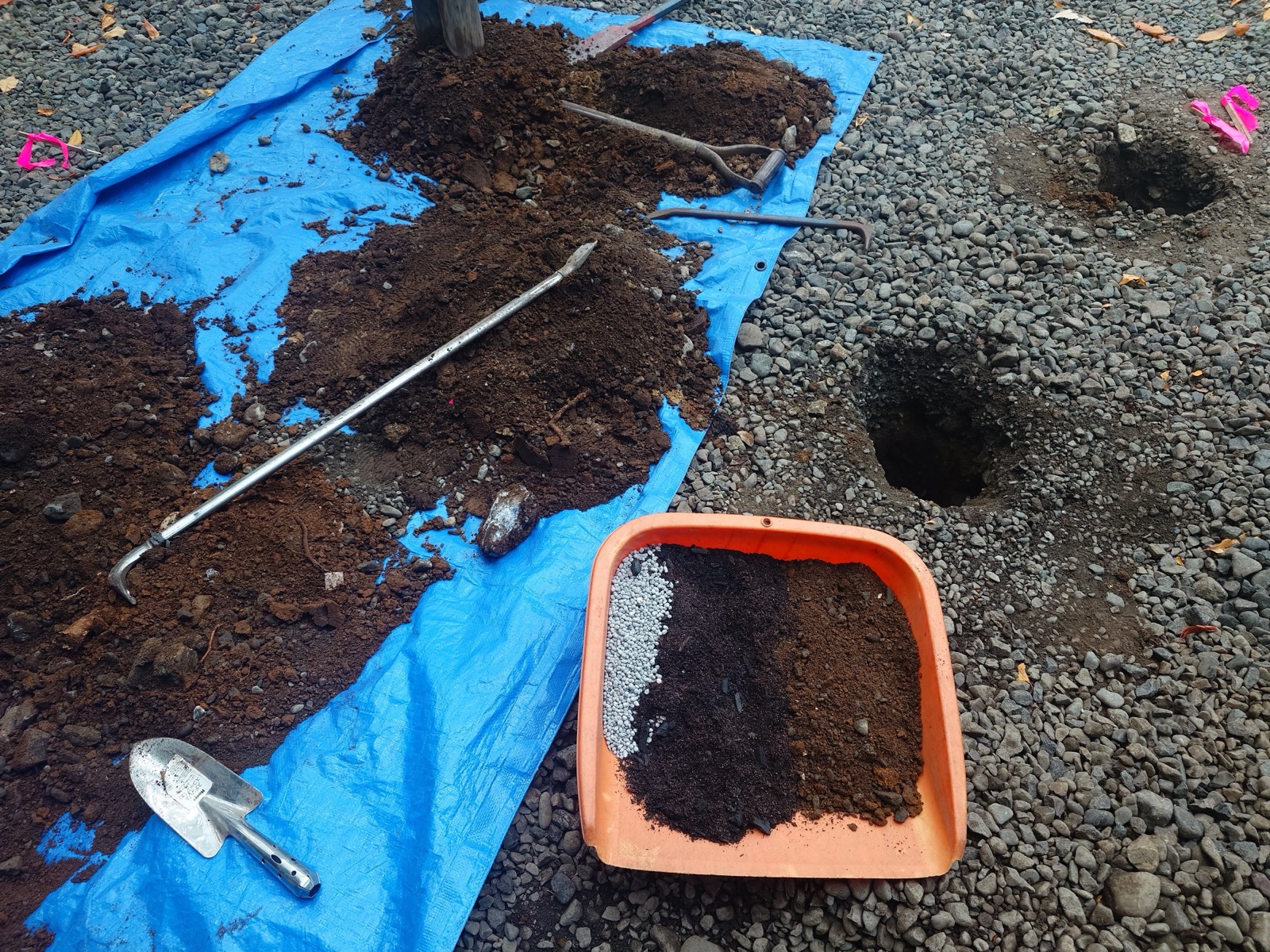
Where an old tree’s roots have limited access to good soil, one option on Japanese sites is to improve the soil without cutting roots. In the example below, from a different site, our crew opened narrow vertical holes in the root zone by hand and refilled them with a mix of organic material and soil, so that air and water can enter and new fine roots can grow into them. The method is chosen after looking at the soil and roots; it is not a fixed recipe, and it is not what was done at Kayashima, where the details of the 1991 treatment are not public.
The 1991 treatment
For Kayashima there is one documented intervention. Keihan’s 90th-anniversary company history, as transcribed in the Shibusawa company-history database, records that on 5 March 1991, treatment was carried out to preserve the great camphor of Kayashima Station. The entry does not say what the treatment was. It does show that, about a decade after the station was rebuilt, treatment to preserve the tree was carried out.
Railway Rules — Why Branches Still Get Cut
The structure gauge
Keeping a tree inside a station is not the same as letting it grow freely. Japan’s technical standard for railways requires each line to set a structure gauge — the space around the track that must be kept clear, allowing for the sway of moving trains — and generally prohibits placing anything other than trains inside it, with exceptions set out in the ordinance. It also forbids placing anything outside the gauge that could collapse into it. For a large tree beside a track, those two sentences define the limits of the crown.
Overhead wires
The same standard requires that where overhead lines come close to or cross other structures or plants, they be installed in a way that prevents contact, electric shock and fire. In 2021 the Ministry of Land, Infrastructure, Transport and Tourism issued operating guidelines on dealing with plants outside railway land that threaten operations, and among the cases it lists is a plant expected soon to grow into the structure gauge or the required clearance from wires. The guideline concerns trees on neighboring land, not a station’s own trees, but it shows how seriously growth toward the clearances is treated.
What this means in practice
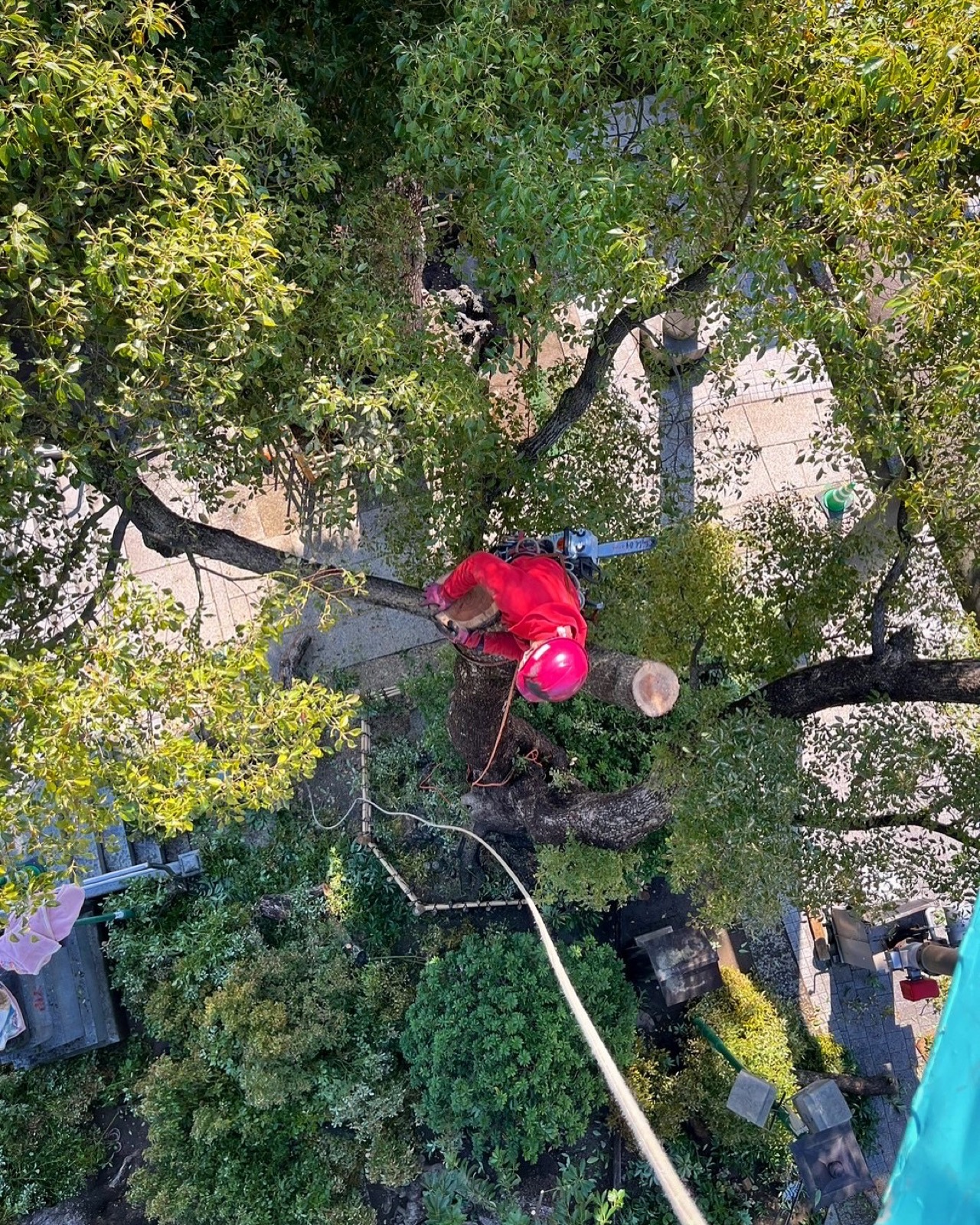
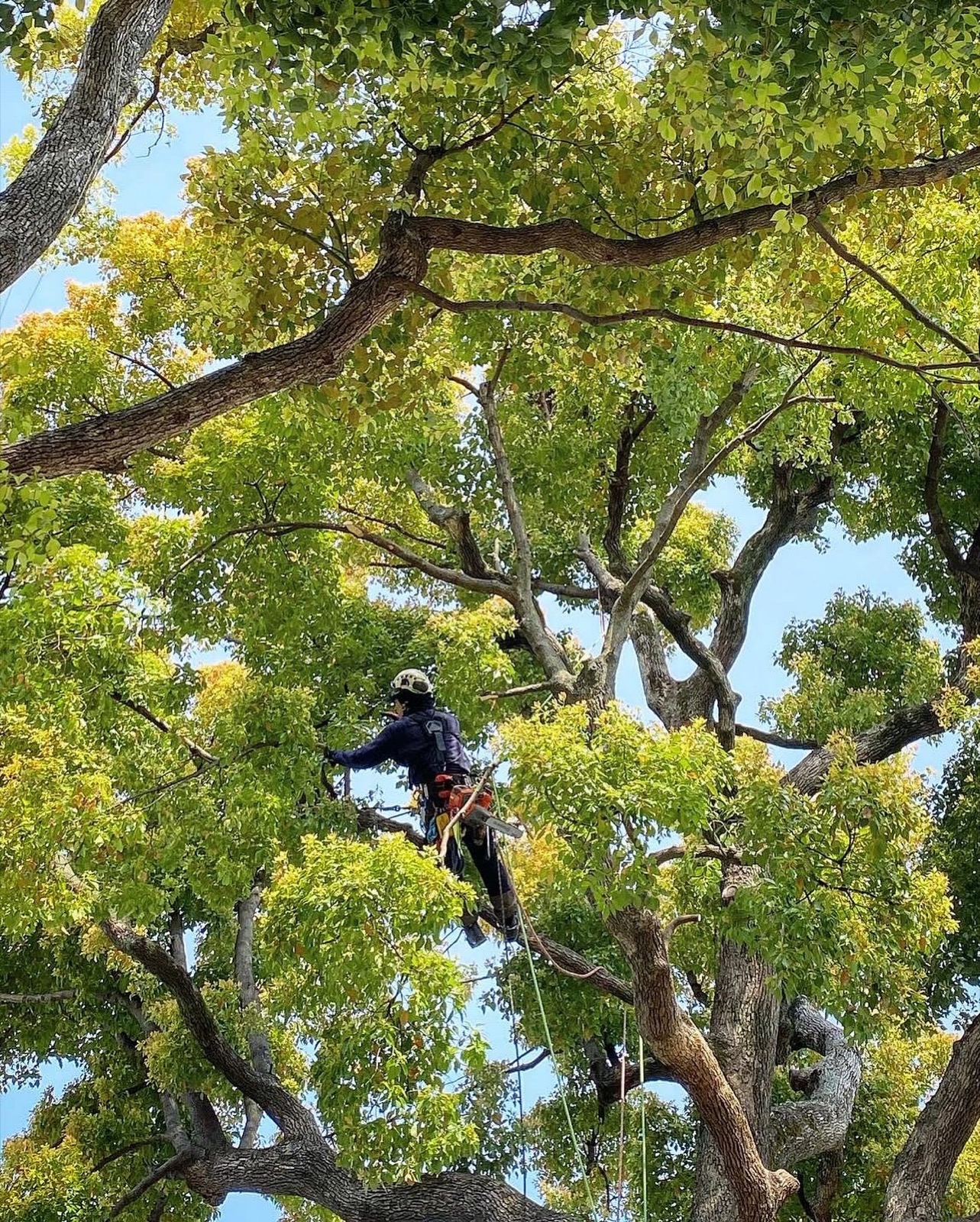
Put together, the rules mean that a tree inside a station has to be kept clear of the structure gauge and the wires. How that is done — pruning, other measures, and how much crown is kept — depends on inspection and on the site. Where limbs over a building have to be cut, a climber can cut them in sections and lower each piece on ropes (rigging); over an operating railway, the railway’s own safety controls for track-side work come first.
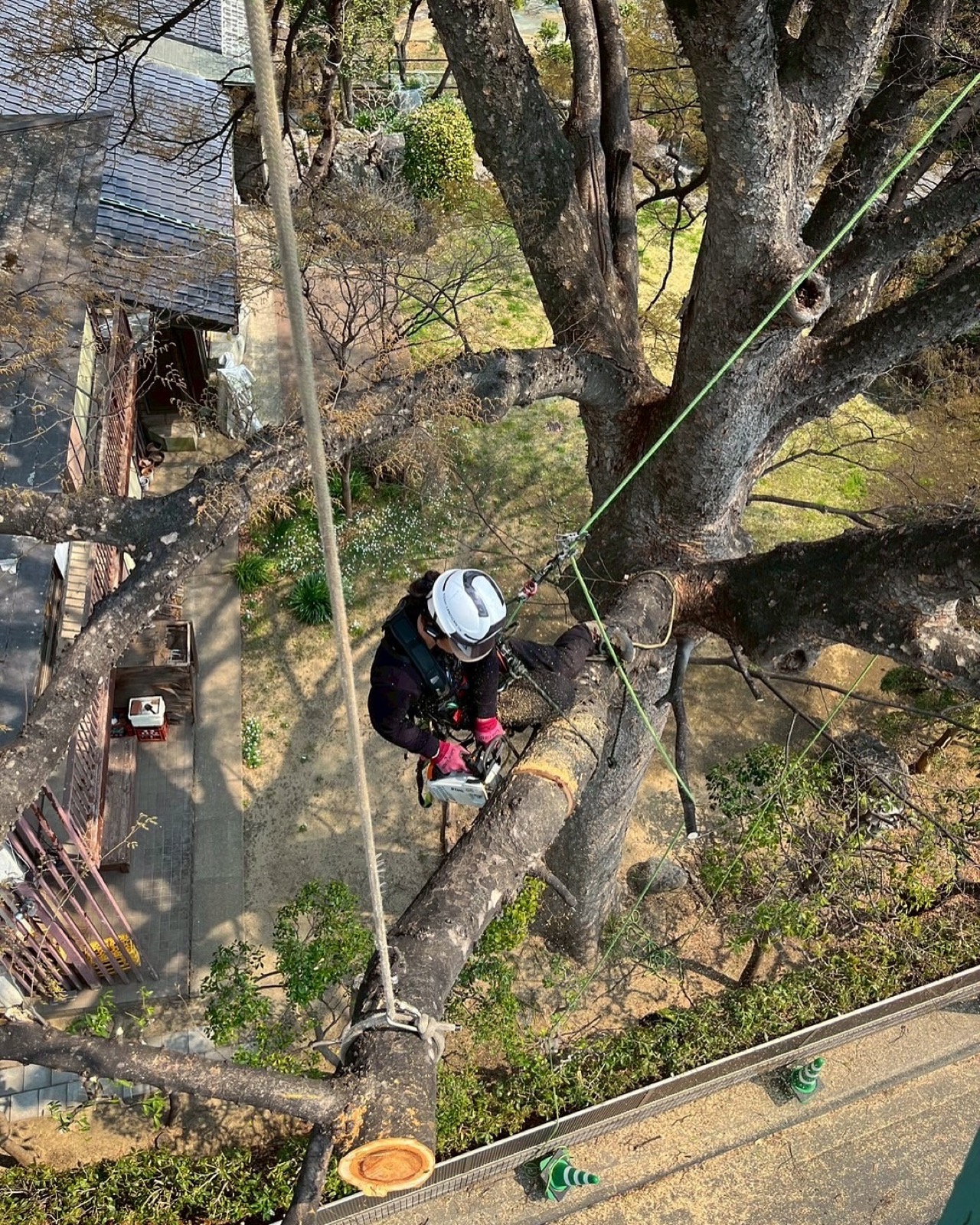
The regulations say what must be kept clear. They do not prescribe how often a tree should be pruned, and we found no published schedule for the Kayashima tree.
Caring for an Old Camphor in a Hard Place — What an Arborist Checks
The questions we would ask
We have not inspected the Kayashima tree and do not know its current condition. What we can describe is how an arborist in Japan looks at an old camphor in a constrained site like this one, because it is the same set of questions we ask when our crew works on old camphors at shrines. For a fuller account of how decay is read in the field, see How to Read Tree Decay Without Technology.
| Where | What we look at | Why it matters at a station |
|---|---|---|
| Crown | Density of leaves, dieback at branch tips, size of new shoots | Possible signs of stress; causes need further assessment |
| Limbs over the track side | Length, angle, cracks, old pruning wounds | Must stay outside the clearances without heavy cuts |
| Trunk at each opening | Bark pressed against edges, swelling, rubbing | The structure must not become a girdle |
| Trunk base and root flare | Cavities, fungal fruiting bodies, soft wood | Hidden decay changes the risk of failure |
| Soil around the base | Compaction, sealing, dryness, root damage | Under a viaduct, rain interception, paving and compaction can limit water and air for roots |
Looking inside the trunk
When a trunk is large and old, the outside does not always tell the whole story about the wood inside. One tool used in Japan by arborists and tree doctors (jumoku-i, 樹木医) is sonic tomography — a ring of sensors around the trunk, tapped in turn, so the speed of sound through the wood can be mapped as a cross-section. Slower zones suggest internal defects such as decay, cavities or cracks; the map is supporting evidence for a diagnosis, not a verdict on its own.
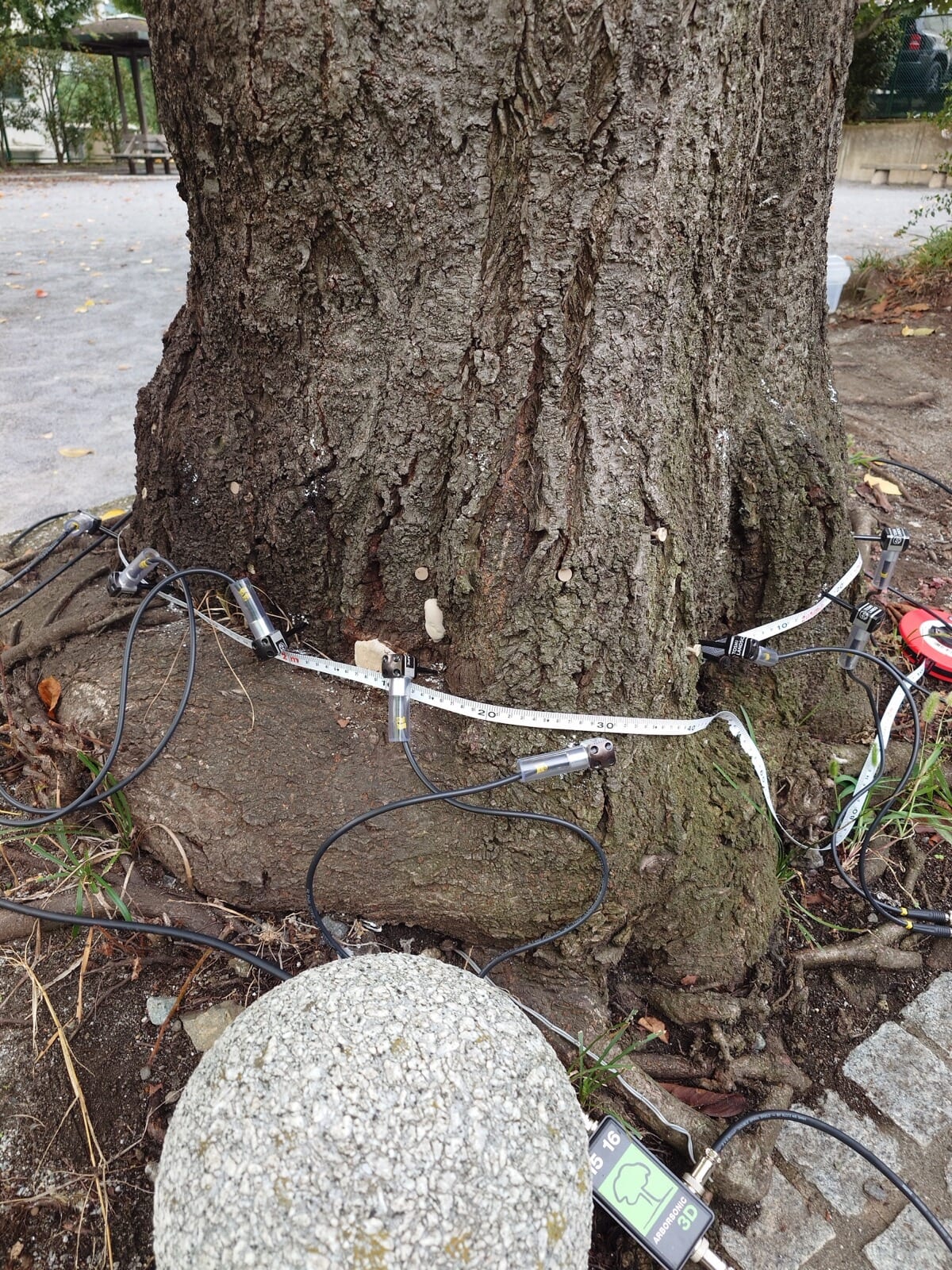
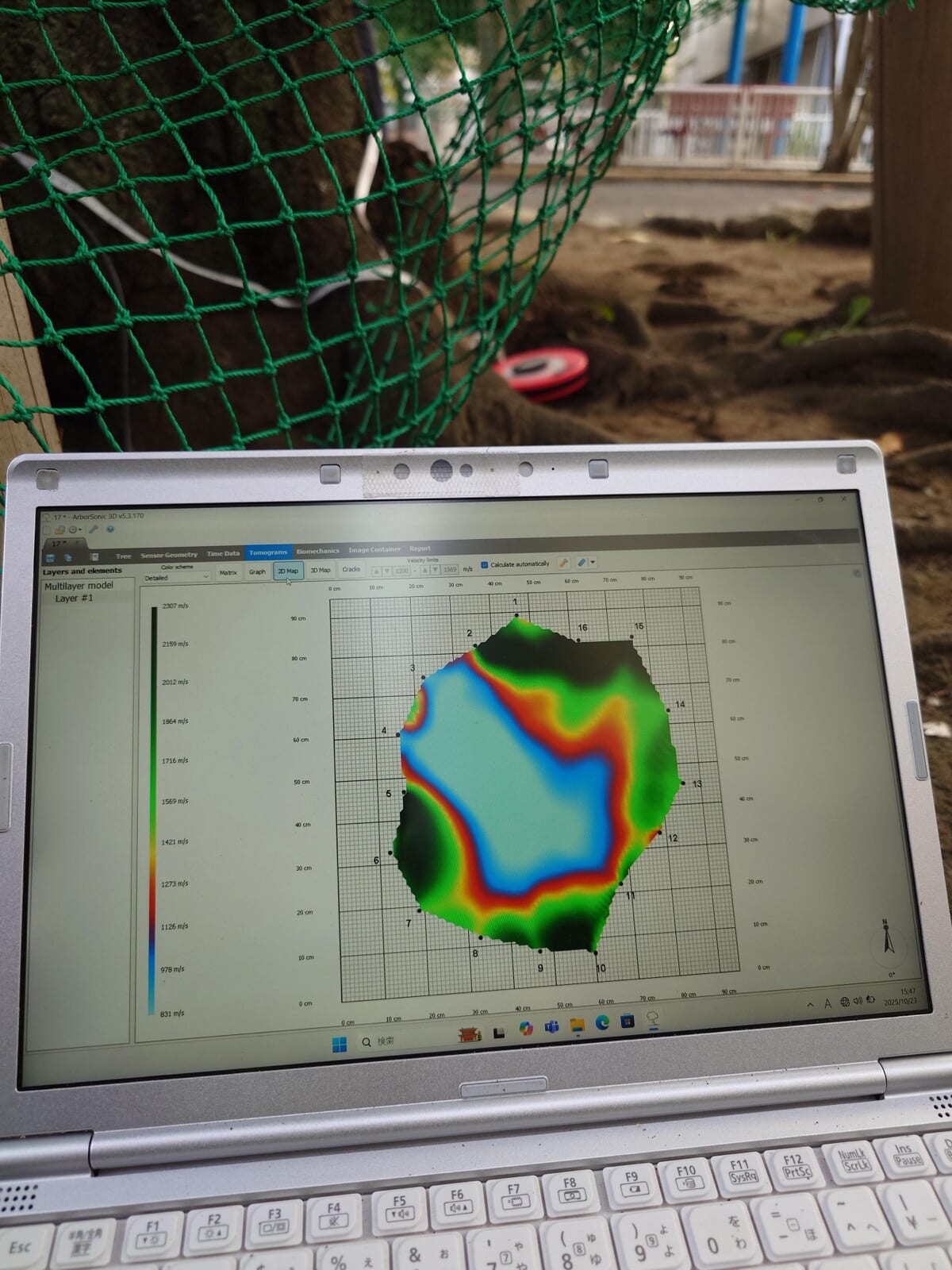
We explain how the method works in How Sonic Tomography Works.
Working in the crown
Rope access lets an arborist work within the crown of an old camphor. A climber anchored high in the crown can reach the ends of long limbs, remove deadwood, and reduce branches heading for a roof or a line, while leaving the tree’s overall form intact. Camphors shed many old leaves in spring as the new ones open, so the crown’s look changes with the season; that is worth knowing before reading the crown, alongside comparison with earlier years and other signs.
Common Misreadings — What the Kayashima Story Is Not
“The tree broke through the roof”
Headlines and social media posts often say the tree “pierces” or “bursts through” the station. Osaka Prefecture’s Osaka Museum guide describes it as growing through the platform and its roof. The tree did not break a roof; the station was redesigned to let it pass.
“It is a designated Natural Monument”
The designation we could confirm is a city hozonju (preserved tree), plus its selection among Osaka Prefecture’s 100 greenery sites. We found no natural-monument designation.
“It is exactly 700 years old, 20 m tall and 7 m around”
All three figures are rounded, and the age is an estimate. They are useful for scale, not for precise comparison with other trees measured at other times.
“Saving it was cheap”
The city says the design and construction changes took a great deal of money and time. A specific figure appears in one television program, but we have not found it in Keihan’s records, so we do not cite it.
Visiting Kayashima Station — Seeing the Tree Well
From the platform
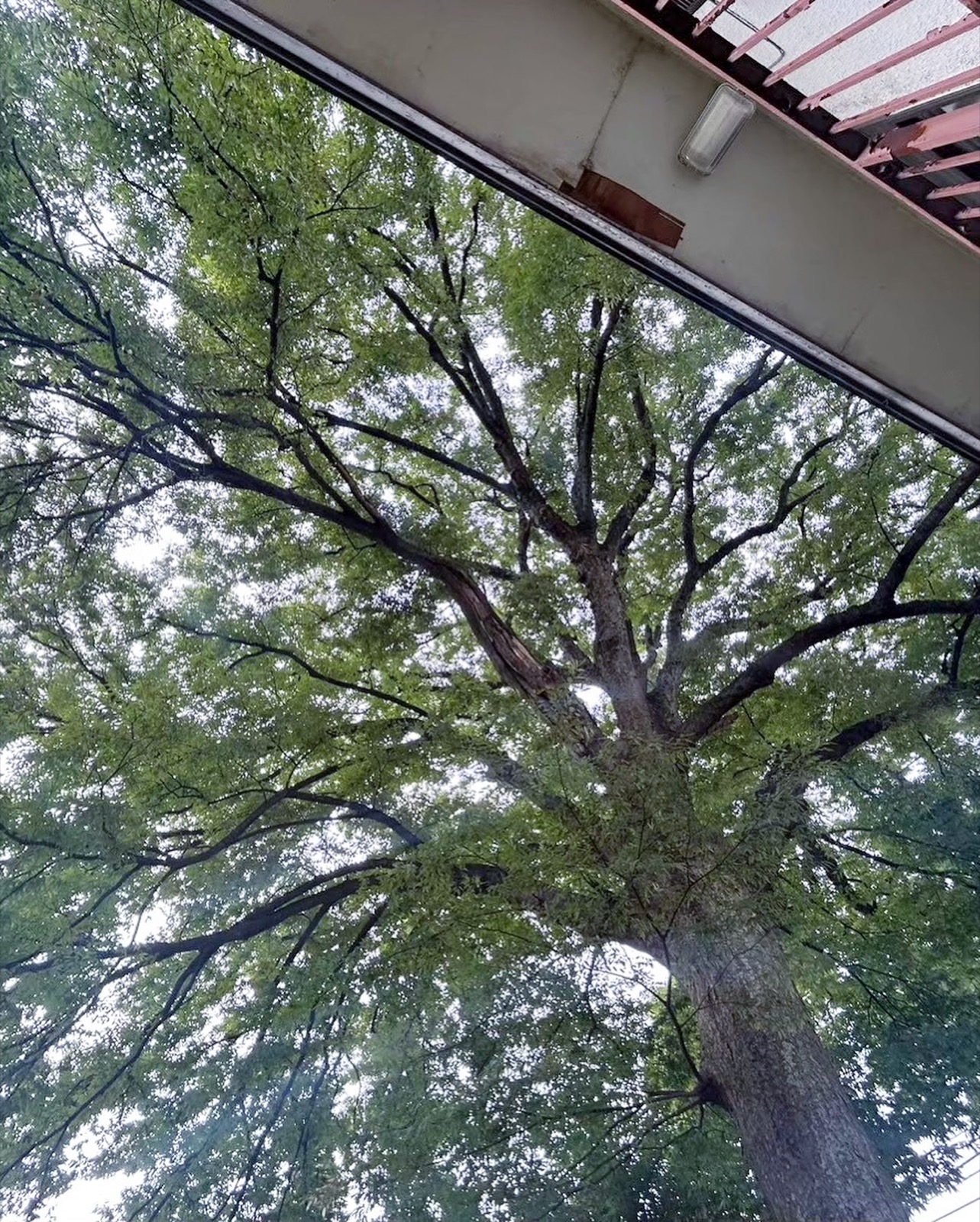
The tree is on the Osaka-bound platforms (3 and 4). From a safe spot on the platform, look along the roof toward the opening to see how the canopy and the roof share the same space. Stand well back from the platform edge, keep out of the way of passengers, and remember that this is a working station before it is a sight.
From the shrine
Then go down to Kayashima Shrine, below the viaduct. From there the relationship between the tree and the shrine becomes clear: its own torii, rope and banners, with the station above. If you visit, treat it as a place of worship — bow at the torii, keep your voice down, and do not touch or lean on the tree or its enclosure.
What the station shows
Kayashima is often presented as a curiosity. For people who design and look after urban landscapes, it is better read as a working example: a large infrastructure project revised a completed design for a tree, at the request of local residents, and so created a lasting need for care — openings with room to grow, limbs kept clear of the railway, roots living under a deck. Much about that care is not public. The decision to keep the tree is. For the opposite problem — trees in Japanese cities that were planted without room to grow — see Japan’s Falling Trees Crisis.
Frequently asked questions
Why does a tree grow through Kayashima Station?
Because Keihan Electric Railway kept the sacred camphor of Kayashima Shrine when it elevated the line. The original plan was to fell the tree, but after strong requests from local residents, the already-completed design was changed to divert the tracks and widen the platform, leaving openings in the deck and roof for the tree.
How old is the Kayashima camphor tree?
The City of Neyagawa estimates it at about 700 years. The figure is an estimate, and the tree’s height (about 20 m) and girth (about 7 m) are given as rounded values.
When was Kayashima Station elevated?
Construction of the elevated quadruple-track section began in November 1972, and the city records the elevation of Kayashima Station as completed in March 1980. The station itself opened in 1910.
Is the Kayashima camphor a protected tree?
It is a hozonju, a preserved tree designated by the City of Neyagawa, and it was selected in 1989 among Osaka Prefecture’s 100 greenery sites. We found no natural-monument designation.
Are there other trees growing through train stations in Japan?
Yes. Hattori-Tenjin Station on the Hankyu Takarazuka Line has a camphor growing through its platform roof. Hankyu says it was kept at residents’ request and has stood in the station since it opened in 1910.
How do you keep a tree healthy inside a structure?
Keep the openings around the trunk and limbs generous so the tree can thicken and sway, keep limbs clear of tracks and wires, check the soil around the roots, and consider further diagnosis of the trunk when there are outward signs of a problem.
Sources
– City of Neyagawa, “New Neyagawa Eight Views — Kayashima Shrine camphor” (accessed 2026-10-30): https://www.city.neyagawa.osaka.jp/organization_list/shiminkatsudou/bunkasport/bunkazai/sinhakkei/1378195376664.html – City of Neyagawa, “Walking course 1: Ōkusu course” (accessed 2026-10-30): https://www.city.neyagawa.osaka.jp/organization_list/shiminkatsudou/bunkasport/bunkazai/sinhakkei/sansaku/22972.html – City of Neyagawa, “Future vision for the Kayashima Station area” report, p.3 (accessed 2026-10-30): https://www.city.neyagawa.osaka.jp/material/files/group/131/R6-3hokoku2.pdf – City of Neyagawa, “Wagaya Neyagawa Map — Kayashima” (accessed 2026-10-30): https://www.city.neyagawa.osaka.jp/material/files/group/20/201241910411.pdf – City of Neyagawa, “Preserved tree program” (accessed 2026-10-30): https://www.city.neyagawa.osaka.jp/kankyo/kouen_ryokuka/ryokka_suisinn_jigyou/10893.html – City of Neyagawa, Kōhō Neyagawa, October 2019 (accessed 2026-10-30): https://www.city.neyagawa.osaka.jp/organization_list/keieikikaku/kikakusanka/kouhou/koho/kohoneyagwatext/h31/1568788223512.html – Osaka Prefecture, Osaka Museum, “A station living with the camphor of Kayashima Shrine” (accessed 2026-10-30): https://www.osaka-museum.com/spot/search/?act=detail&id=370&type=connection – Osaka Prefecture mail magazine No.598 (accessed 2026-10-30): https://openf.pref.osaka.lg.jp/mailmaga/web_dtl.php?hdnID=103020 – Keihan Electric Railway, Kayashima station information (accessed 2026-10-30): https://www.keihan.co.jp/traffic/station/050/info.html – Keihan Electric Railway, Location Service (accessed 2026-10-30): https://www.keihan.co.jp/location/traffic/02.html – Shibusawa Eiichi Foundation, company-history database: Keihan 90th-anniversary chronology (accessed 2026-10-30): https://shashi.shibusawa.or.jp/details_nenpyo.php?class=&d=all&page=3&query=&sid=11860 – CBC Radio, interview with Keihan’s press office, 16 December 2020 (accessed 2026-10-30): https://radichubu.jp/kibun/contents/id=34619 – TV Asahi News, 30 May 2026 (accessed 2026-10-30): https://news.tv-asahi.co.jp/news_society/articles/900191258.html?page6 – Hankyu Railway, Hattori-Tenjin Station (accessed 2026-10-30): https://odekake.hankyu.co.jp/spots/121 – Hankyu Railway, “Hankyu Ensen Oshirabe-gakari,” October 2023 (accessed 2026-10-30): https://cdn.hankyu-app.com/content/article/2023/article_10.html – Environment Agency, Environmental White Paper 1993, giant trees (hosted by the Ministry of the Environment; accessed 2026-10-30): https://www.env.go.jp/policy/hakusyo/h05/9143.html – Forestry and Forest Products Research Institute, Kyushu Research Center, “Kusunoki” (accessed 2026-10-30): https://www.ffpri.go.jp/kys/business/jumokuen/jumoku/zukan/kusunoki.html – Forestry and Forest Products Research Institute, camphor distribution (accessed 2026-10-30): https://www.ffpri.go.jp/labs/prdb/kusunoki.html – e-Gov, Ministerial Ordinance on Technical Standards for Railways, Articles 20, 42 (accessed 2026-10-30): https://laws.e-gov.go.jp/law/413M60000800151 – Ministry of Land, Infrastructure, Transport and Tourism, operating guidelines on cutting plants near railways, 2021 (accessed 2026-10-30): https://www.mlit.go.jp/tetudo/content/001428063.pdf