

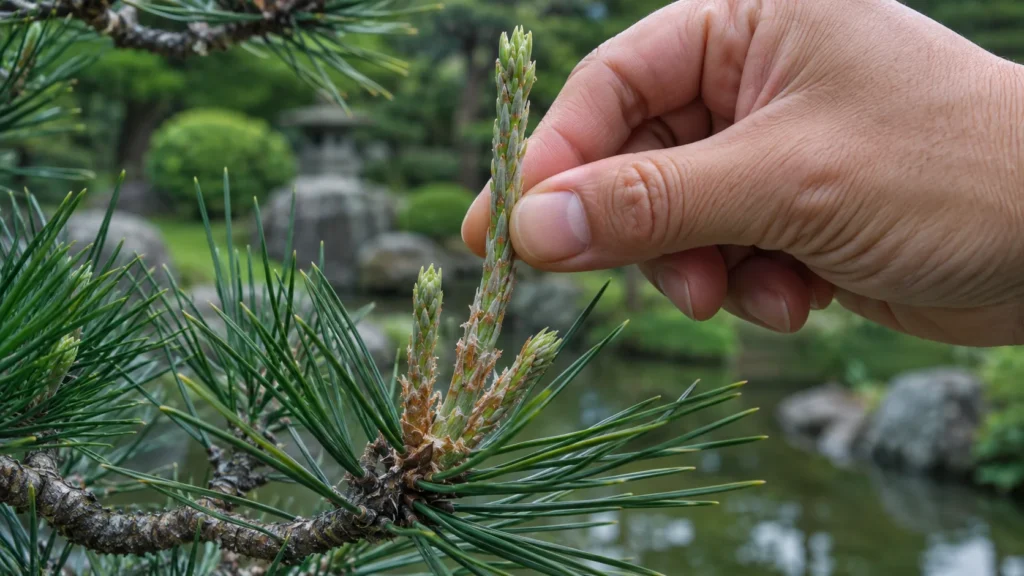
When to prune depends on which tree you mean, because dormancy, cold tolerance, flower-bud formation and the growth of new shoots open different windows for different trees. Japanese public guidance writes those windows down tree by tree: deciduous trees are pruned in winter, azaleas straight after they flower, evergreen broadleaves on either side of the cold, and garden pines in spring and again from autumn. The months vary by region and task, but the logic is the same everywhere: cut each tree when that tree can best afford it.

A year with no single pruning season — the question
Two crews, one garden, one week
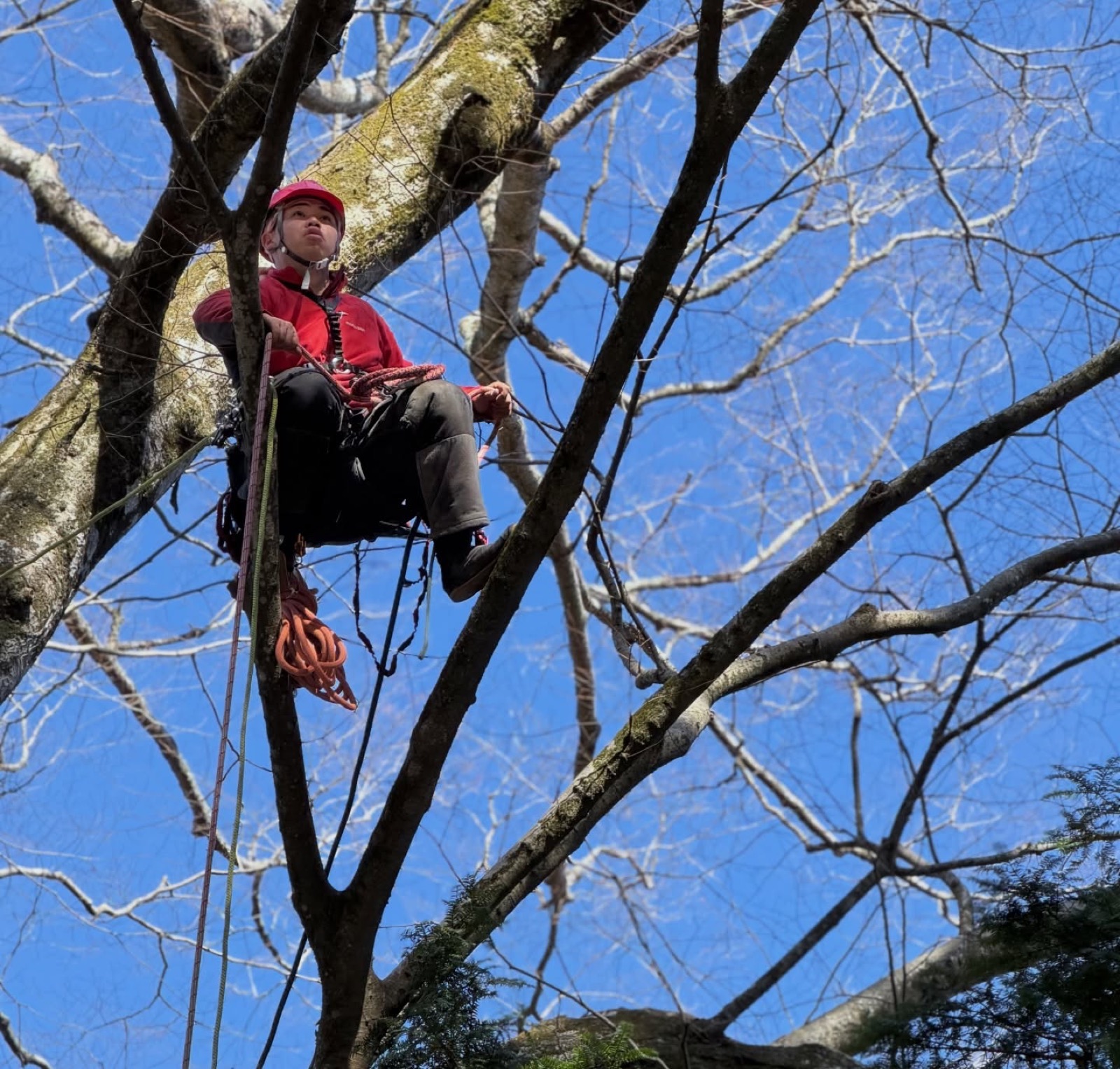
Walk into a well-kept Japanese garden in midwinter and you can find two kinds of work going on at once. In one corner, a climber is up in a bare deciduous tree on a rope, reading the framework of branches that the leaves hid all summer. In another, someone is working within the crown of a pine, going through the needles by hand. Same garden, same week, two different jobs for two different trees.
Ask a Japanese gardener when they prune and the honest reply is a question back: which tree? This article follows the answer month by month, from the bare crowns of winter to the pine needles of December, then asks how to move that calendar to a garden outside Japan.
Why the question matters outside Japan
Many gardens abroad now grow Japanese maples, cloud-pruned evergreens, garden pines and clipped azaleas side by side. A single pruning season will suit some of them and harm others. A tree-by-tree calendar is a useful model for that kind of mixed planting.
The dormant-season rule — one season, set by dormancy
What the guidance actually says
The International Society of Arboriculture (ISA) states the principle carefully. Its homeowner guide Pruning Mature Trees says that growth and wound closure are generally maximised when pruning takes place “before the spring growth flush”. It also notes that most light, routine removal of weak, dead or diseased limbs can be done “at any time during the year” with little effect on the tree.
Iowa State University Extension turns that into a month: “Most trees should be pruned during the late dormant season (February through March).” It explains why. If the cut is made in late winter, the tree’s response to the wound “can begin immediately with the onset of growth in spring”.
The USDA Forest Service guide How to Prune Trees, by Bedker and colleagues, lists the reasons to prune hardwoods without showy flowers in the dormant season: the structure is easy to see, it helps to maximise wound closure, it reduces the chance of transmitting disease, and it avoids excessive sap flow. For conifers, the same guide says they can be pruned throughout the year, but that pruning in the dormant season may minimise sap and resin flow.
What the rule assumes
Notice the tree these sentences mainly describe: a deciduous hardwood in a climate with a real winter. Iowa’s February-to-March window is written for that tree, and even these guides add separate rules for conifers and flowering shrubs.
The rule is not wrong for Japan. Japanese public guidance agrees with it for deciduous trees, as the next section shows. What Japanese guidance does is give the other groups, evergreens, flowering shrubs and trained pines, windows of their own.
The one moment both traditions avoid
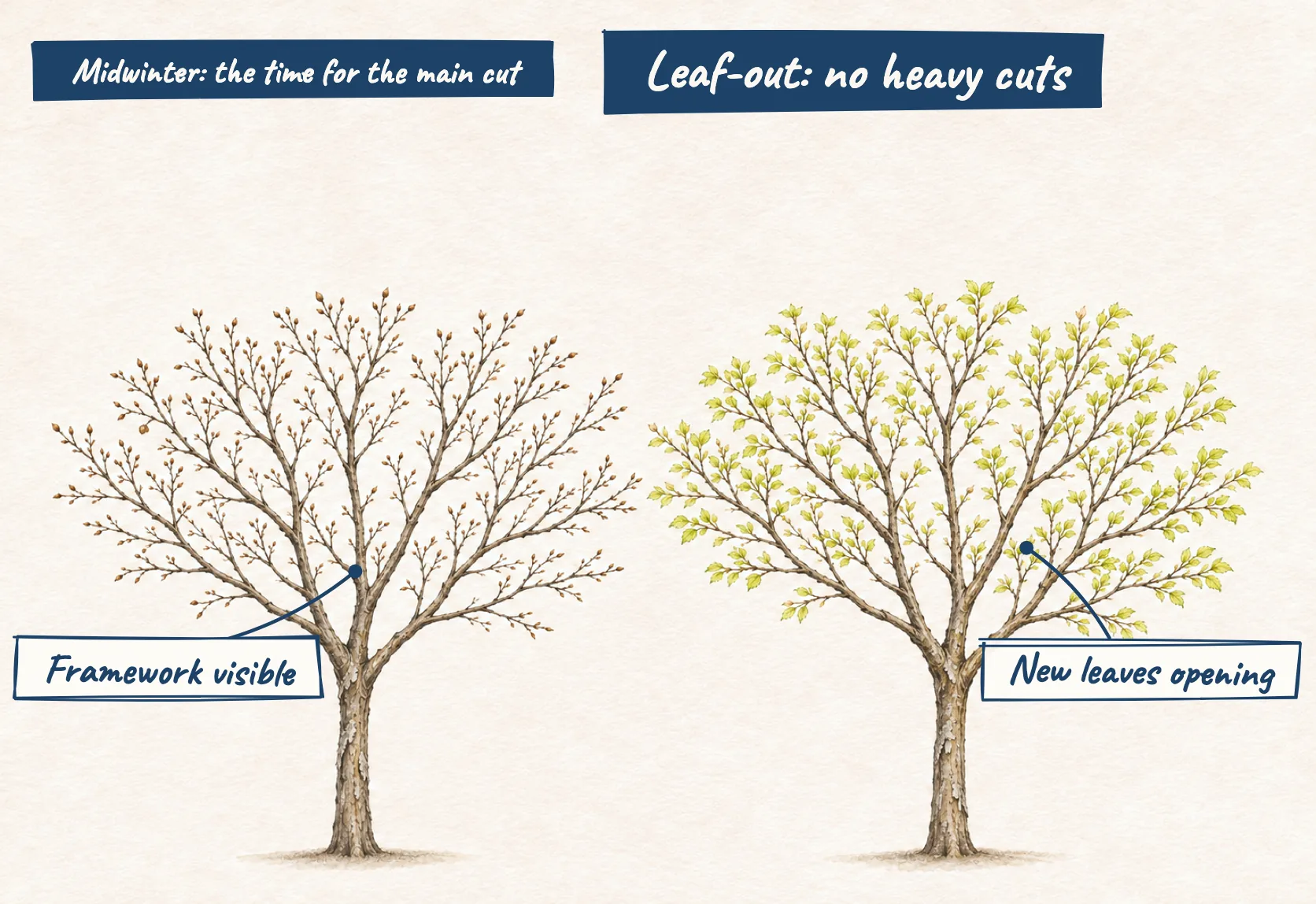
Both traditions warn against one moment in particular. The ISA advises against heavy pruning of live tissue “just after the spring growth flush”, because the tree has just spent a great deal of energy producing leaves and shoots. The University of Missouri Extension explains the cost in plain terms: heavy pruning at that point removes resources the tree has only just mobilised, and leaves it with less foliage to produce carbohydrates to replenish the food reserves of the roots.
That warning is one of the threads running through the Japanese calendar. Each tree has its own flush, and much of the calendar keeps heavy cuts away from it. The other threads, cold, flower buds and the soft shoots of pines, appear as the year goes on.
December to March — the deciduous trees, while the framework shows
Basic pruning, the winter cut
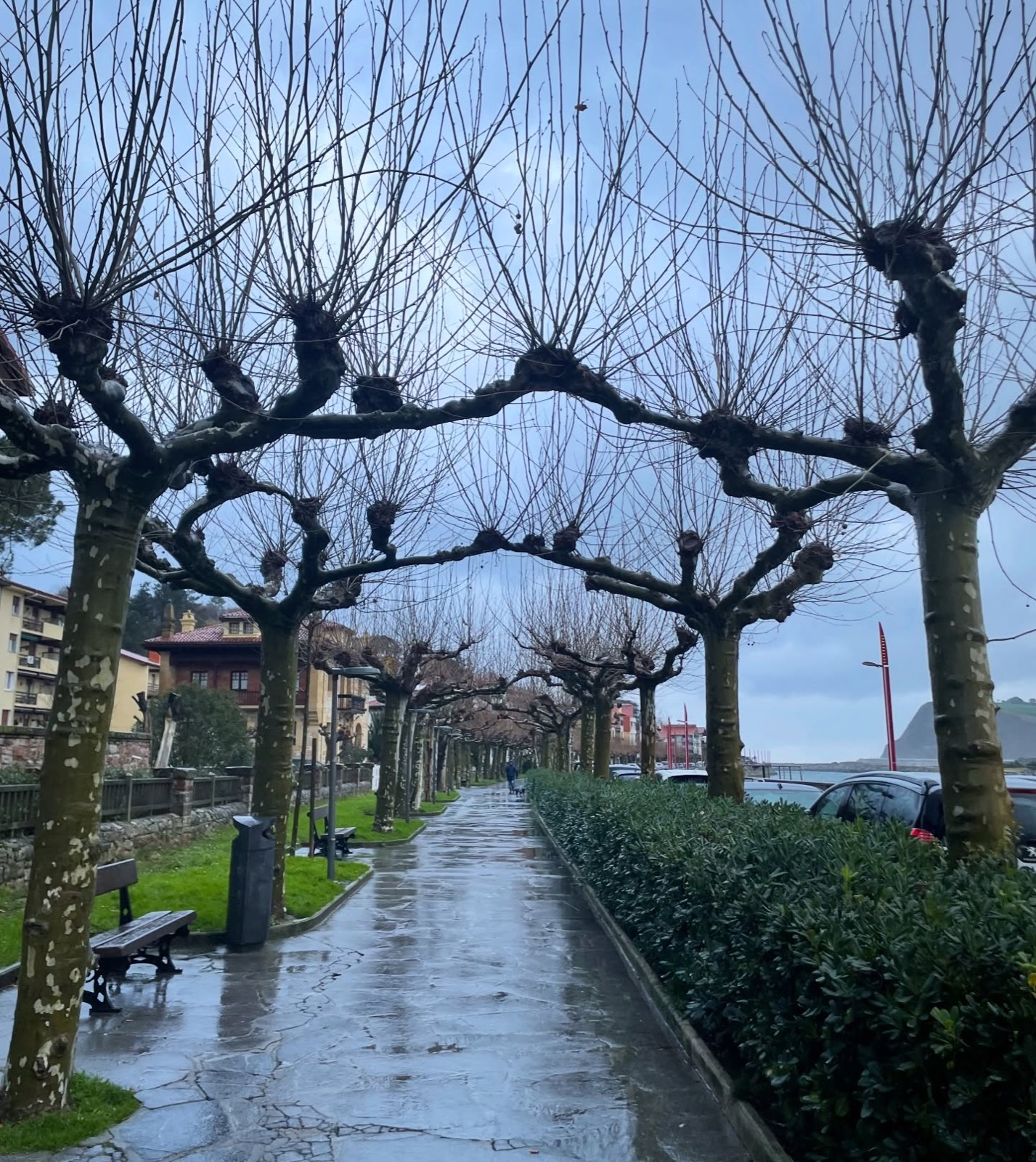
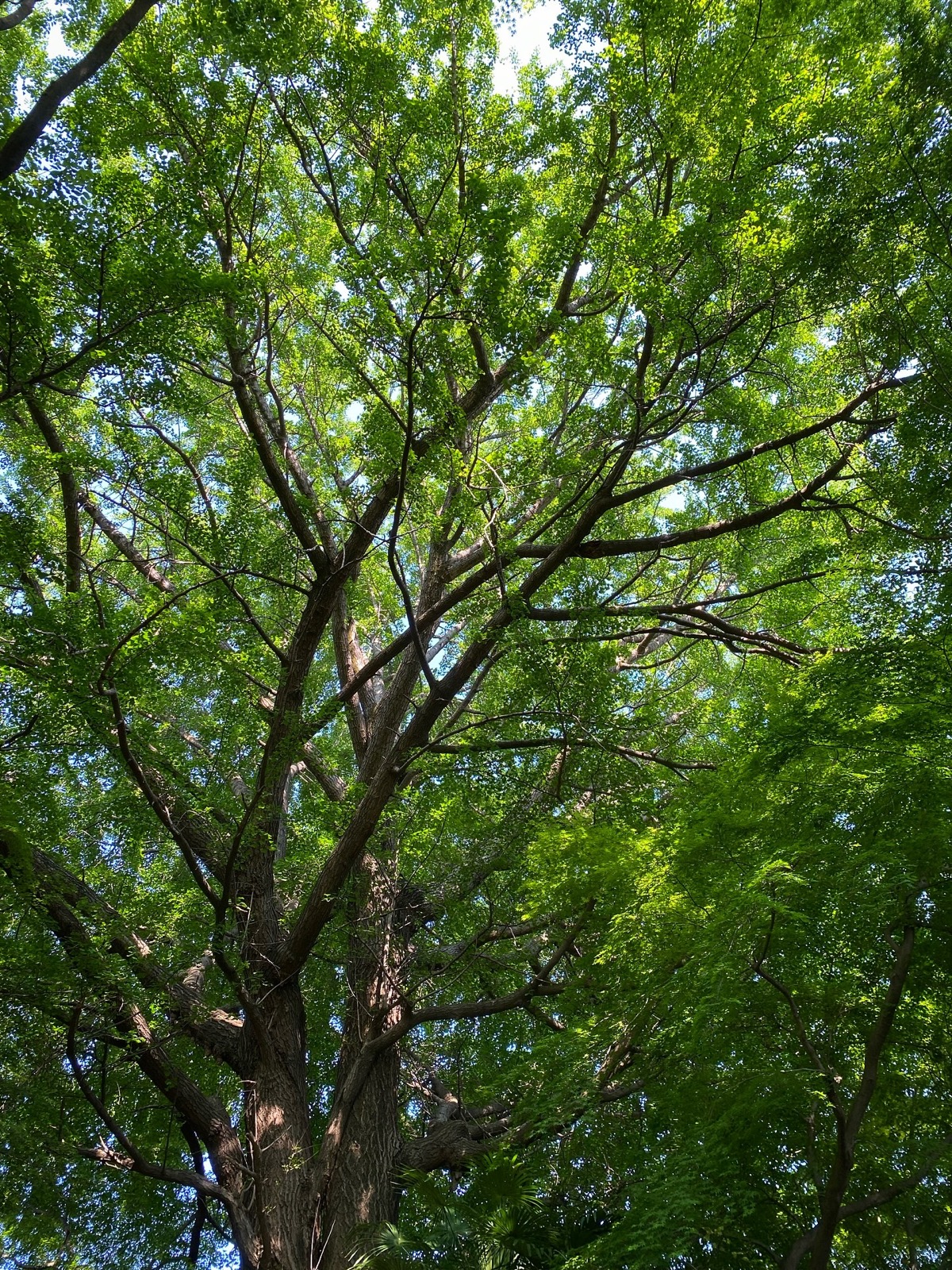
In Japanese practice, the main cut of a deciduous tree is called kihon sentei (基本剪定, basic pruning). The Japan Greenery Research and Development Center defines it as pruning that forms the framework branches, and places it in tōki sentei (冬期剪定, winter pruning), “generally December to February or March”. Saitama City’s tree management guideline gives the same window in its own words: December to March for winter pruning while the tree is dormant.
This is when a gardener decides the future of a tree: which limb becomes the main branch, which crossing branch goes, how far an oversized crown comes back. Those decisions are easiest with the leaves off and a full growing season ahead. It is the same logic as Iowa’s February-to-March window, though Japanese guidance starts in December. For comparison, the Japan Meteorological Agency’s 1991–2020 normals put Tokyo’s mean temperature at 5.4 °C (41.7 °F) in January and 6.1 °C (43.0 °F) in February.
If you want to see how a gardener reads that framework before cutting, our piece on reading tree structure before pruning walks through the main trunk, main branches and side branches.
The coldest weeks on the old calendar
Japan’s 24 solar terms mark this stretch with some of their best-known names. In 2026, the National Astronomical Observatory of Japan (NAOJ) lists Shōkan (小寒, “lesser cold”) on 5 January, Daikan (大寒, “greater cold”) on 20 January and Risshun (立春, “beginning of spring”) on 4 February. These are three of the 24 sekki (二十四節気, solar terms) that divide the year by the position of the sun.
Public pruning guidance is written in months, not solar terms, so it would be wrong to say that a gardener prunes “from Shōkan to Risshun”. But the names describe the season well: the “cold” terms fall in the heart of the window, and some guidance keeps winter pruning going into March, well past the “beginning of spring”.
Cherry and ume — the exception everyone quotes
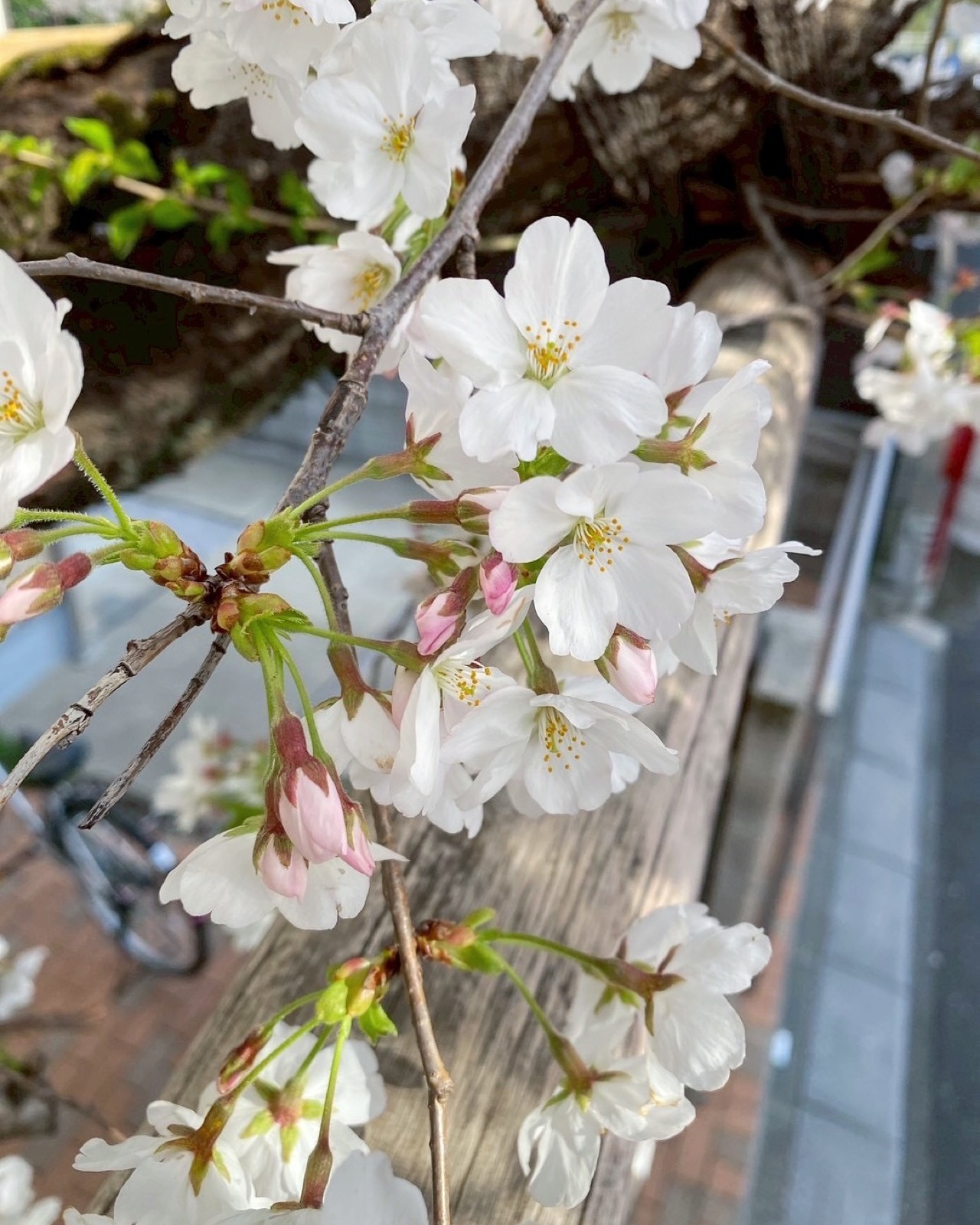
Ask a Japanese gardener about flowering trees in winter and you will probably hear a saying: sakura kiru baka, ume kiranu baka (桜切る馬鹿、梅切らぬ馬鹿), “a fool cuts a cherry, a fool fails to cut a plum”. The Kawaguchi Greenery Center still quotes it on its ume guide.
The official advice behind it is more precise than the saying. The Flower Association of Japan does recommend pruning cherries, but “after leaf fall, from November to early March”, and it warns that cherry branches decay easily from the cut surface and that cutting large branches can weaken the tree. In other words, cherries are pruned in winter, and large cuts are avoided.
For ume (Japanese apricot), the timing depends on what the tree is for. The Kawaguchi Greenery Center advises pruning potted ornamental ume immediately after flowering, to encourage short flowering shoots. For garden ume grown for fruit, it advises winter pruning instead, because a cut after flowering can remove fruit that has just set. It also suggests shortening long, non-flowering ume shoots to about half their length from late December to January.
Maples, and a difference with Britain
Japanese maples are part of the winter work too, but Britain’s Royal Horticultural Society (RHS) puts a sharper limit on them. Its guidance on bleeding from pruning cuts recommends pruning Japanese maples “after leaf fall but before January”, and warns that bleeding-prone plants are particularly vulnerable when pruned in mid- to late winter or early spring. The ISA, for its part, describes early-spring bleeding in maples and birches as generally “of little consequence” to the tree.
The two bodies put different weight on bleeding. Our own reading: for a gardener in Japan, where winter pruning of deciduous trees starts in December, the British cut-off is a useful reminder to do the maples early in the season.
March to May — the evergreens, and the weeks to keep the shears away
Evergreen broadleaves wait for the cold to pass
Evergreen broadleaves, the glossy-leaved trees that fill so many Japanese gardens, do not go bare in winter. Their timing is set by cold and by their spring flush.
Saitama Prefecture’s street-tree pruning manual warns that midwinter pruning of evergreen broadleaves from warm climates exposes the cuts to cold and carries a risk of dieback from the cut surface. So the work moves to either side of the cold. An official specification published by Oita Prefecture in Kyushu places evergreen broadleaf pruning from early March to late April, and adds that it may also be done just before the end of the rainy season. Nagasaki City assigns the basic pruning of evergreen broadleaves to March to June, either before the new shoots emerge or once they have developed to a certain extent.
The flush, the frost and Hachijūhachiya
Between those two moments sits the flush itself, the weeks the ISA warns about. In a Japanese garden this is when deciduous trees are leafing out and evergreens are pushing their new shoots, and it is the time a gardener moves on to other work rather than make heavy cuts.
The traditional seasonal calendar has a marker in these weeks. Hachijūhachiya (八十八夜, “the 88th night”) is one of the zassetsu (雑節), the supplementary seasonal days. NAOJ defines it as the 88th day counting from Risshun and describes it as a reminder to watch for late frost; in 2026 it falls on 2 May. The Astronomical Society of Japan’s dictionary notes that many of the zassetsu are guides for agricultural work. It is not a pruning rule, but it is a reminder of how tender early May growth can be.
April and May — the pine’s spring appointment
Midori-tsumi while the shoots are soft
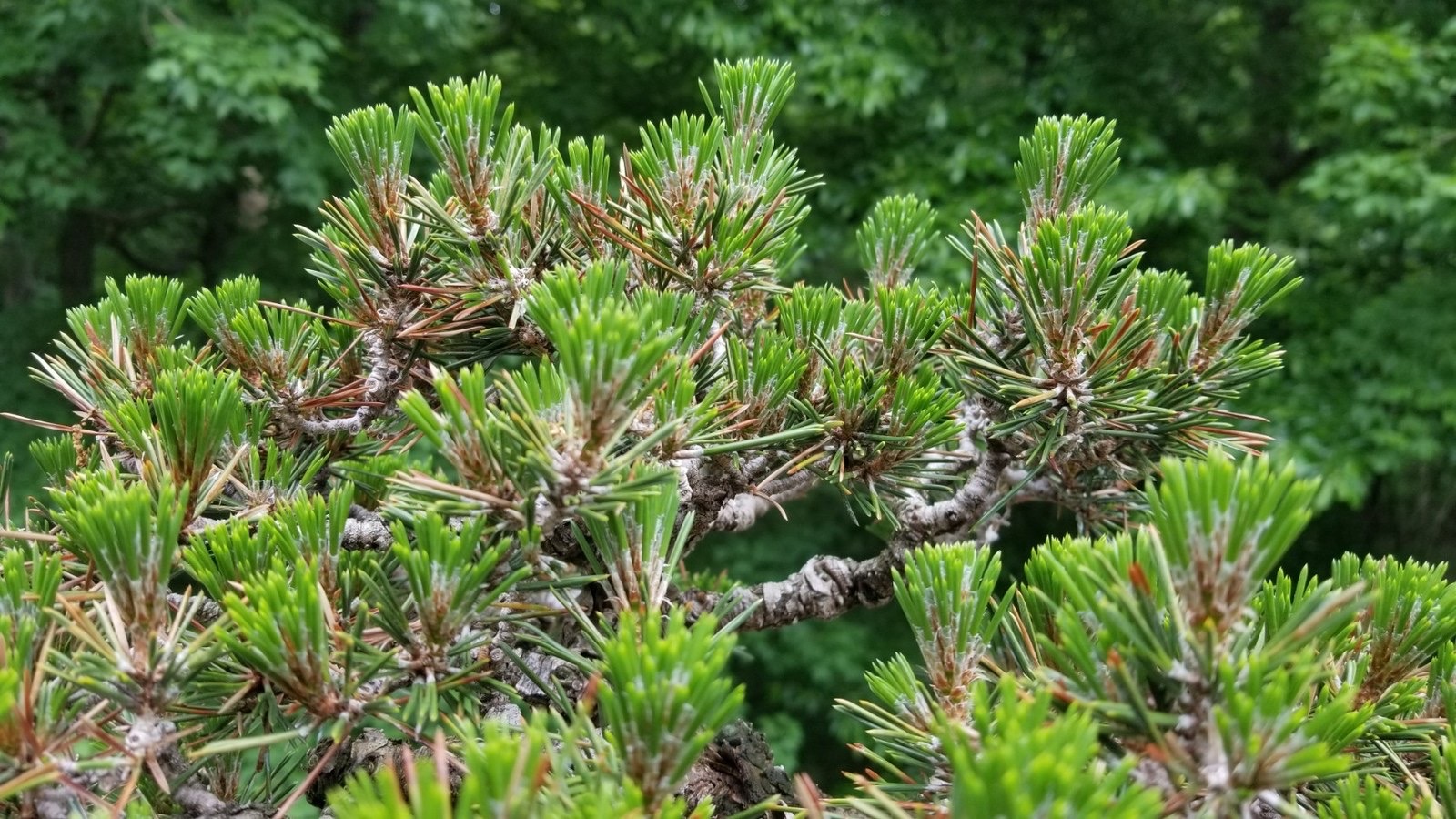
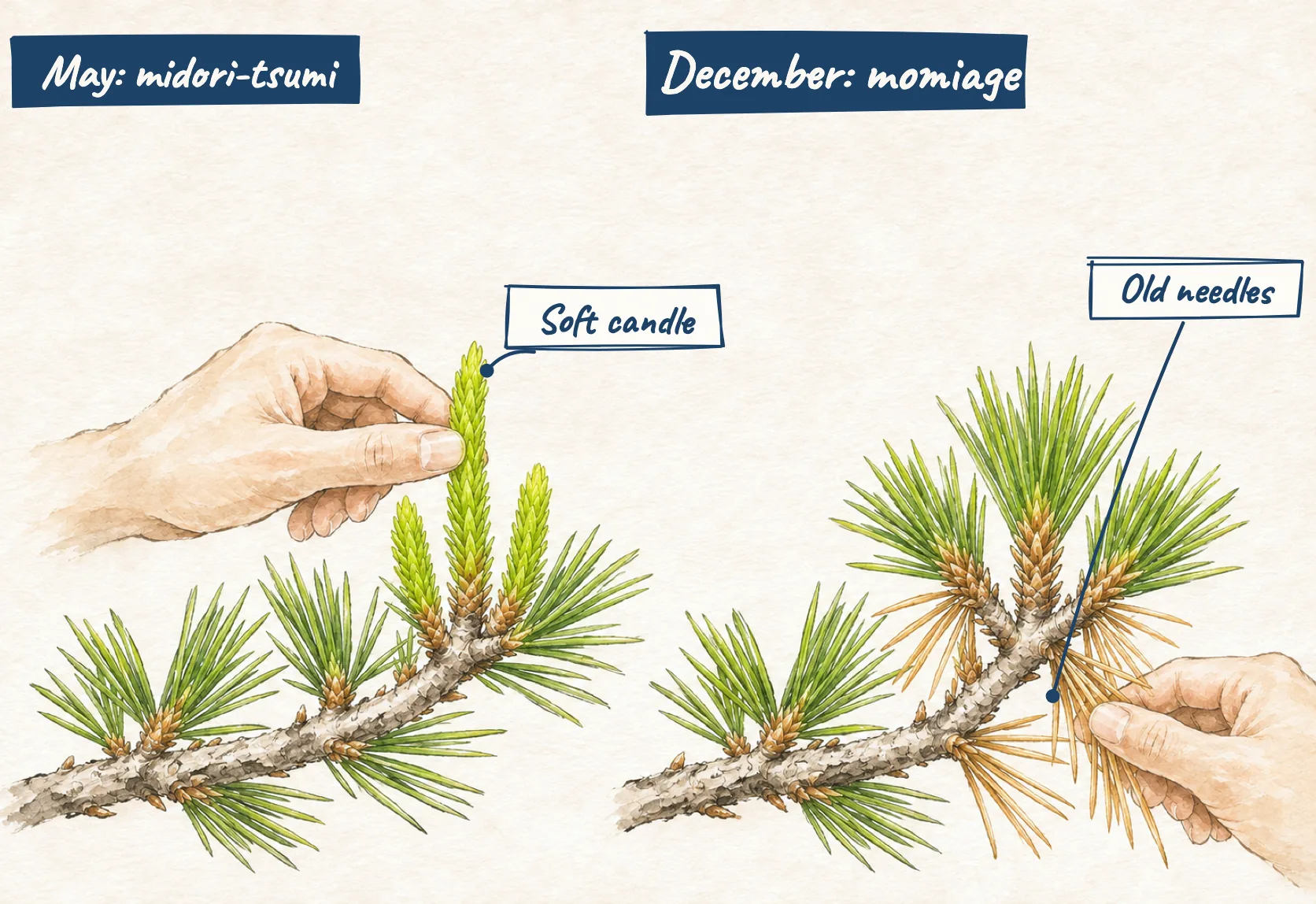
For garden pines, the soft new growth is itself the spring job. Midori-tsumi (緑摘み, “pinching the green”) is the removal of the new shoots, or candles, that rise from the branch tips in spring. Hama-rikyu Gardens in Tokyo defines it as “taking off the pine’s new shoots (midori) to adjust the form of the tree”.
The timing is written into the Tokyo Metropolitan Park Association’s standard maintenance specification: April to May, “while the midori are still soft”. Public gardens schedule demonstrations in that window. In 2026, Kiyosumi Gardens scheduled a candle-pinching demonstration for 26 April, and Hama-rikyu scheduled its own for 5 May, with 6 May as the rain date.
That 5 May date is also Rikka (立夏, “beginning of summer”) on NAOJ’s 2026 calendar. The coincidence is just that, but it is a useful picture of the window: the pine is pinched as spring tips into early summer, while the new shoots are still soft. How a gardener decides which candles to take, and how many, is in our article on midori-tsumi.
Why pines do not follow the dormant rule
A pine is evergreen, so it never shows the bare framework that makes winter the obvious time for a deciduous tree. Instead, Japanese guidance gives it two kinds of work aimed at two different parts of the tree: the soft new shoots in spring, and the older needles from autumn. Each has its own window.
June — azaleas, rain and the race against next year’s buds
Shear straight after the flowers
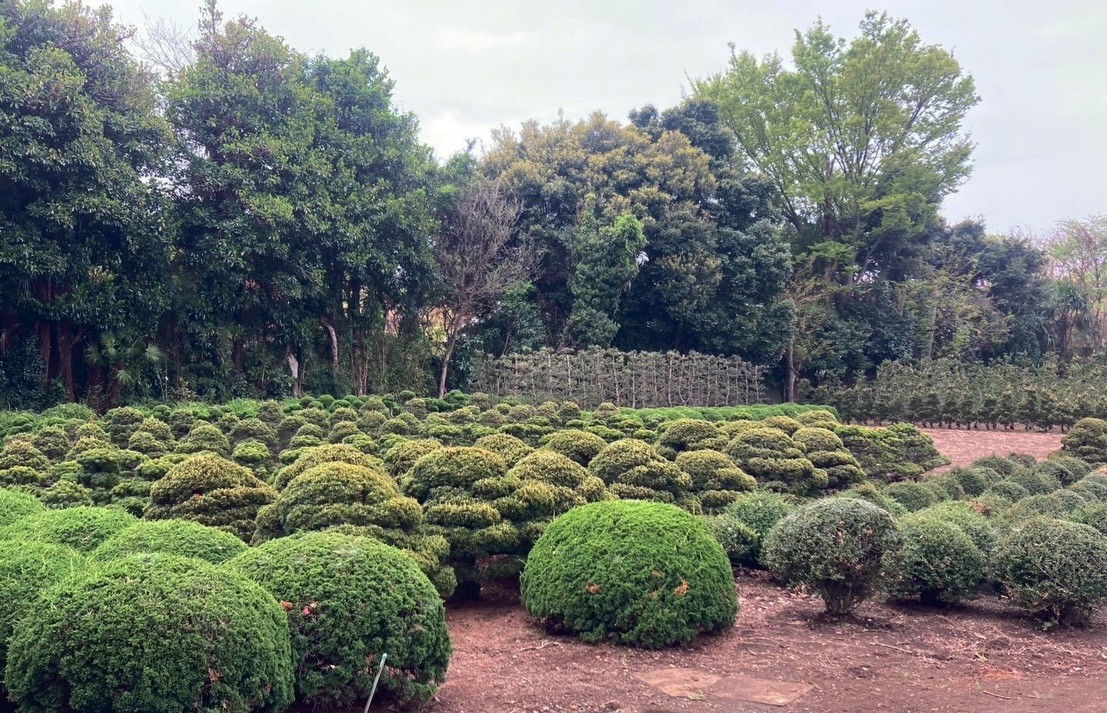
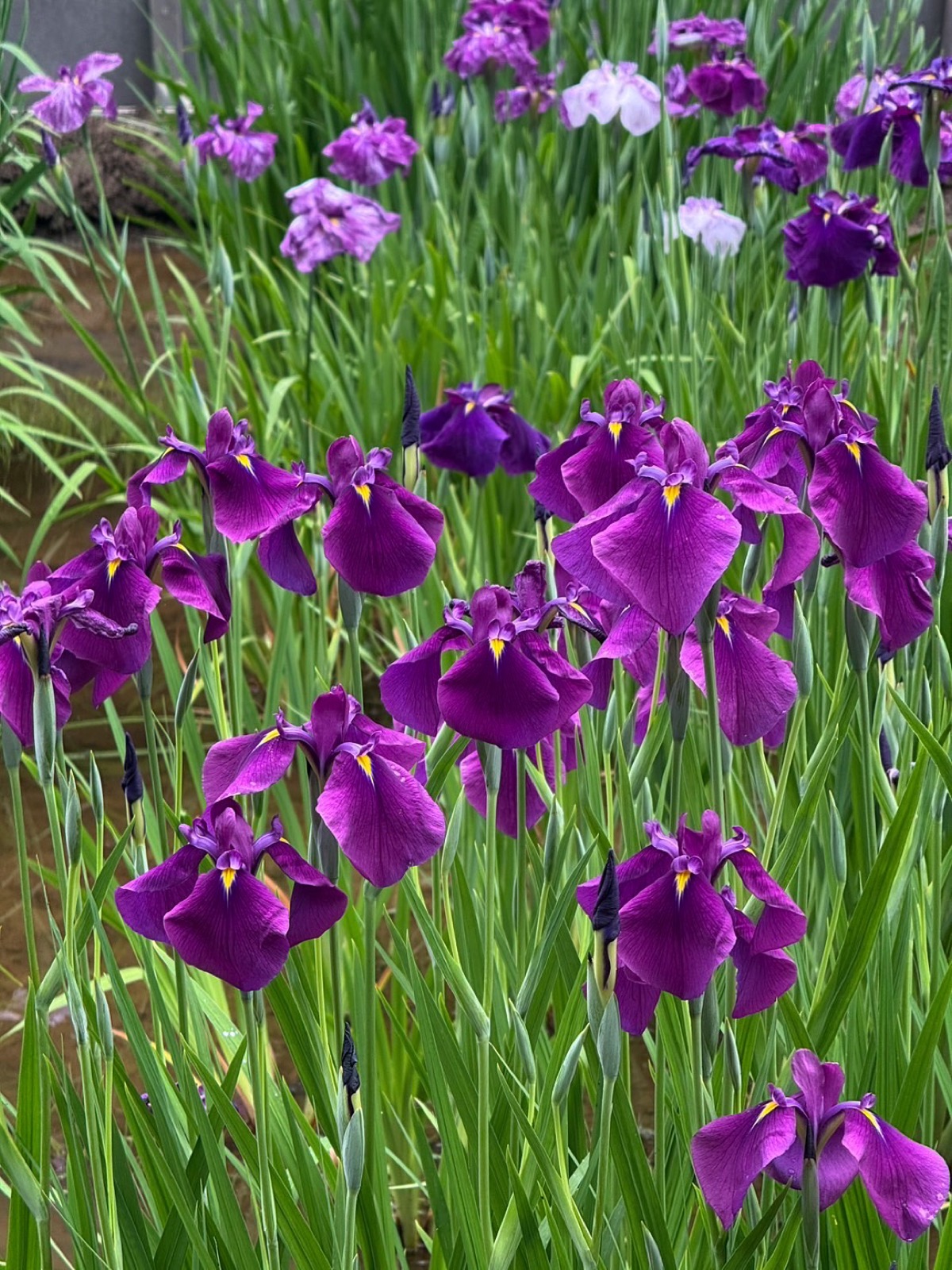
June belongs to the clipped azaleas: satsuki and the many tsutsuji that Japanese gardens clip into rounded mounds and low waves of green. The rule here is the bluntest in the calendar. The Sendai Green Association’s advice on satsuki and tsutsuji says simply: prune azaleas immediately after they finish flowering.
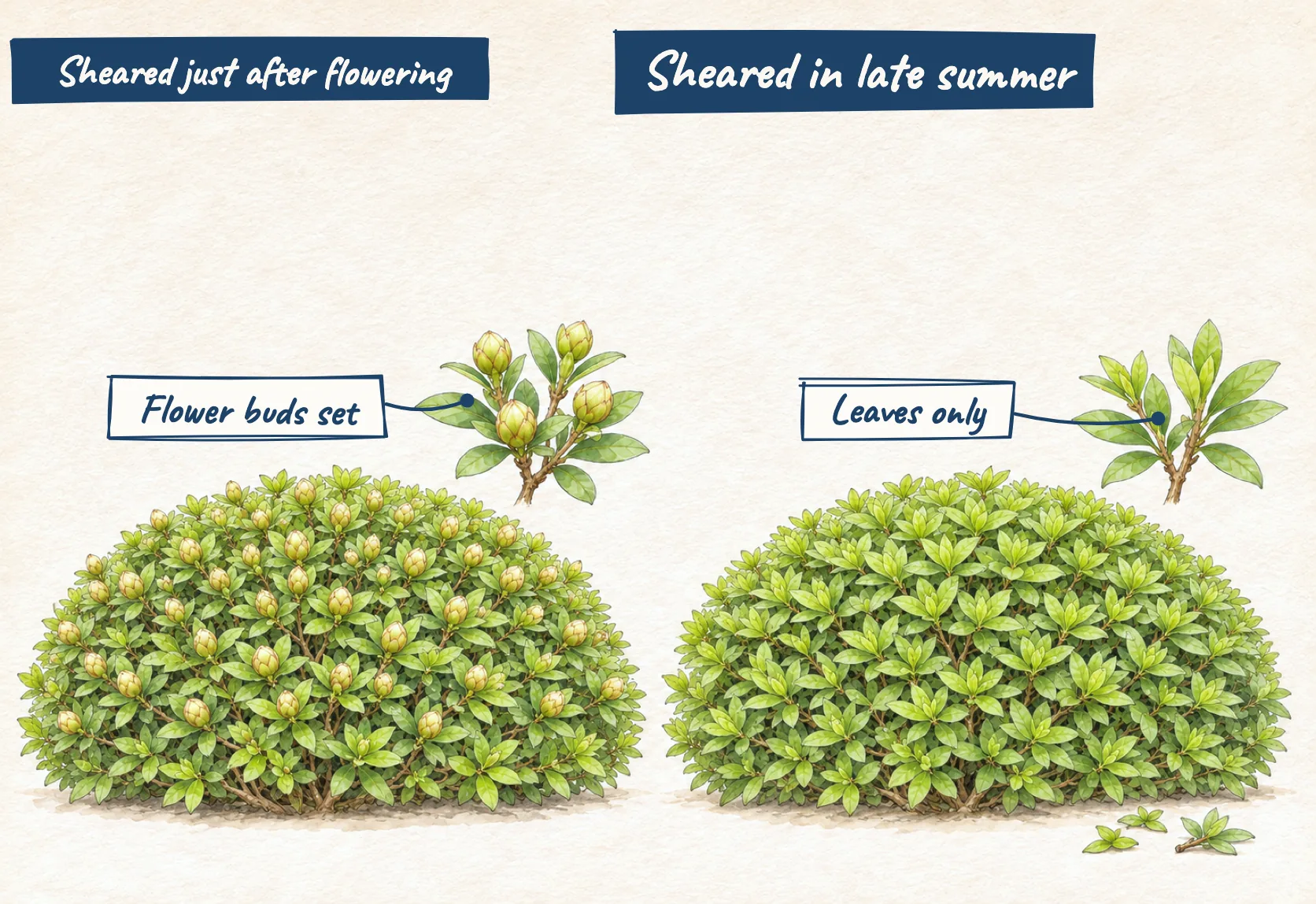
The reason is the flower bud. The same association’s table of flowering habits places flower-bud differentiation in satsuki from late June to early August, and in tsutsuji from mid-June to mid-August. The Amagasaki Greenery Park Association gives the practical consequence for potted satsuki: flower buds form in July and August, “so do this work as early as possible”. A public management manual from Tottori Prefecture schedules azalea shearing once a year, in June, to tidy the form.
Why August shearing costs a spring
The timing is a race. Shear straight after flowering and the shrub has time to grow on before its flower buds form. Shear in late summer and you cut off buds that have already formed. The shrub looks just as neat, but the loss only shows the following spring.
The RHS gives British gardeners the same principle for early-flowering deciduous shrubs, which flower on the previous year’s growth: “Early-flowering shrubs are pruned after flowering.” The underlying rule, cut before next year’s buds form, travels well. The month does not. If your azaleas flower later than Tokyo’s, your shearing window moves with them. If you are choosing shrubs to clip into cloud shapes, our guide to the best plants for cloud pruning looks at which ones take it well.
The rainy season on the calendar
June also brings tsuyu (梅雨), the early-summer rainy season. The Japan Meteorological Agency’s normal dates for the Kantō-Kōshin region, which includes Tokyo, are around 7 June for the start and around 19 July for the end, calculated over 1991–2020. The solar calendar has its own marker: Nyūbai (入梅, “entering the rains”), one of the zassetsu, falls on 11 June in 2026.
The rains matter to the evergreen work as well. Oita’s specification allows evergreen broadleaf pruning just before the end of the rainy season.
July and August — summer’s light hand
Summer pruning means light pruning
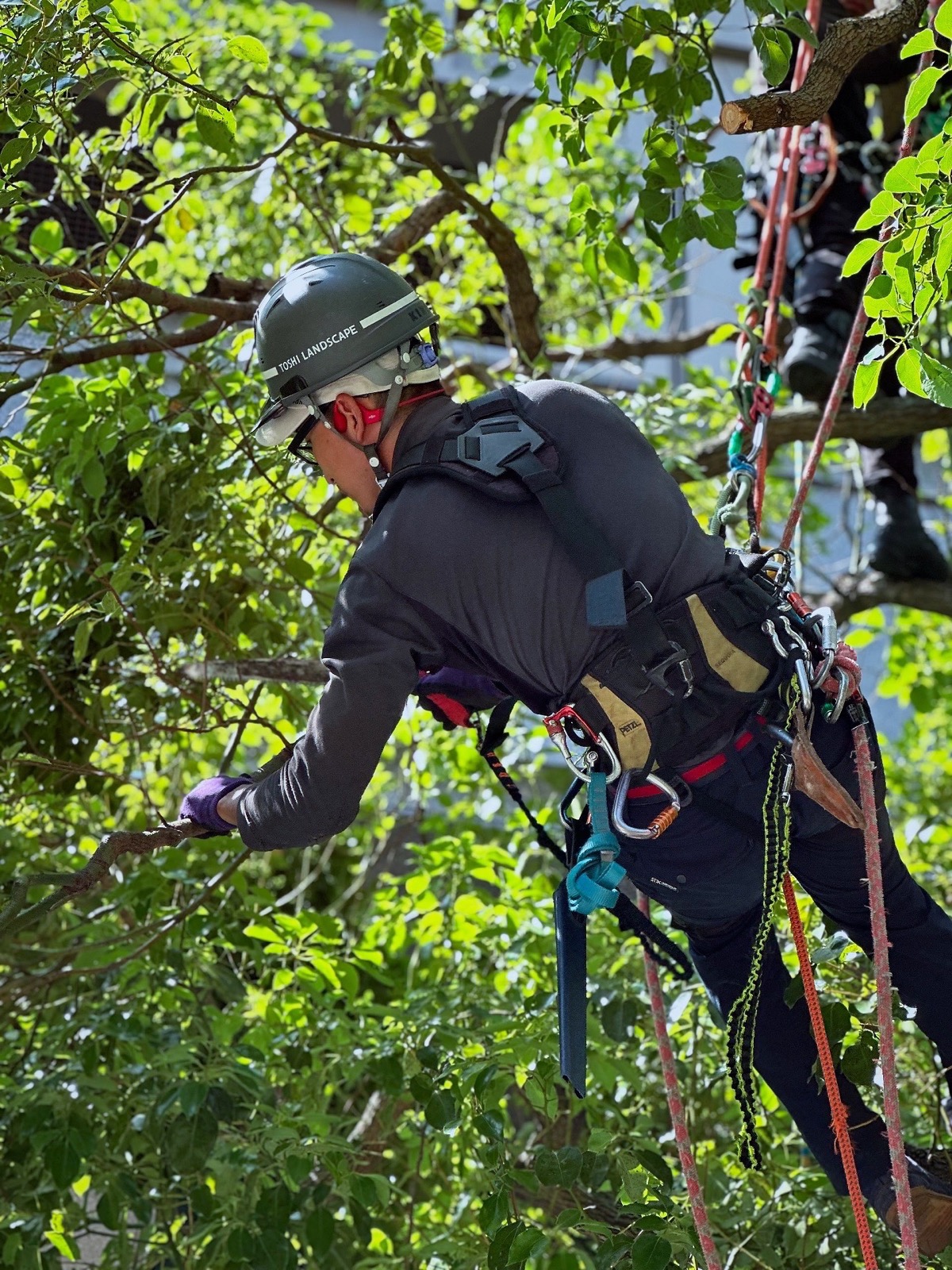
Japanese guidance has a second pruning season for deciduous trees, kaki sentei (夏期剪定, summer pruning), and the sources cited here all keep it light. The Japan Greenery Research and Development Center describes it as kei sentei (軽剪定, light pruning), “light pruning to the extent of correcting an untidy or overcrowded crown”. Saitama City places it in July to September. Saitama Prefecture’s manual sets an upper limit for summer pruning of one-third of the total branches and foliage, and rejects heavy summer pruning outright because removing the green leaves, the tree’s source of nutrition, seriously damages it. Minato City in Tokyo adds that summer pruning should be kept to light correction, and should not be applied to trees whose new growth is weak.
In practice, this is a season for light sukashi (透かし), the thinning that lets light and air through a crown that has filled in since spring. The method, and how much to take, is covered in our article on sukashi pruning.
Heat, and what an open crown risks
The case for keeping summer cuts small is partly physiological and partly about heat. Tokyo’s 1991–2020 normals put the mean temperature at 25.7 °C (78.3 °F) in July and 26.9 °C (80.4 °F) in August. Utah State University Extension warns that opening up a crown in summer can expose bark and tissues to excessive heat or drying, and advises against it.
So summer pruning stays selective: the amount removed is kept down, the work is limited to light correction, and trees with weak new growth are left alone.
September and October — the pines come back
Kenrokuen and Ritsurin begin their pines
As the summer heat eases, the gardener returns to the pines. At Kenrokuen in Kanazawa, the official diary of the garden’s management office records the start of pine pruning on 1 September, running to mid-October, on selected trees. Two kinds of cut are named: hamushiri sentei (葉むしり剪定, needle-plucking pruning) and kiriwari sentei (切り割り剪定, branch-thinning pruning). The diary explains that plucking needles regulates photosynthesis to restrain unnecessary growth, and that thinning branches lets light through to the lower branches.
At Ritsurin Garden in Takamatsu, one of the gardeners told the Kagawa Prefecture Tourism Association that he spends 20 days on his own, from mid-September, tending the great Tsurukame pine. The same interview shows that the calendar also answers to the garden’s events: the Tsurukame pine has to be ready before the autumn illumination, and pines and kadomatsu decorations are set up before New Year.
Momiage, the autumn-to-winter needle work
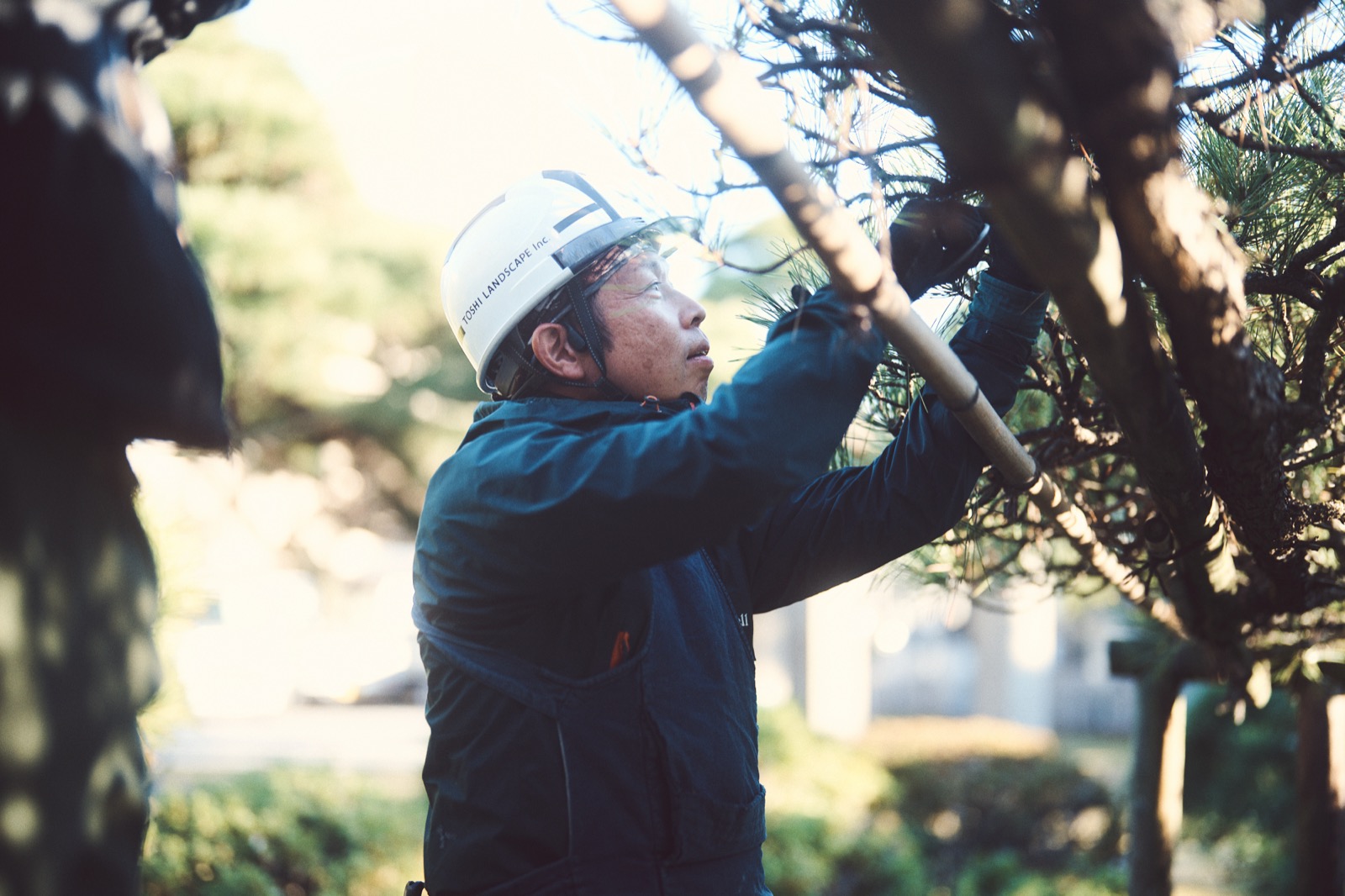
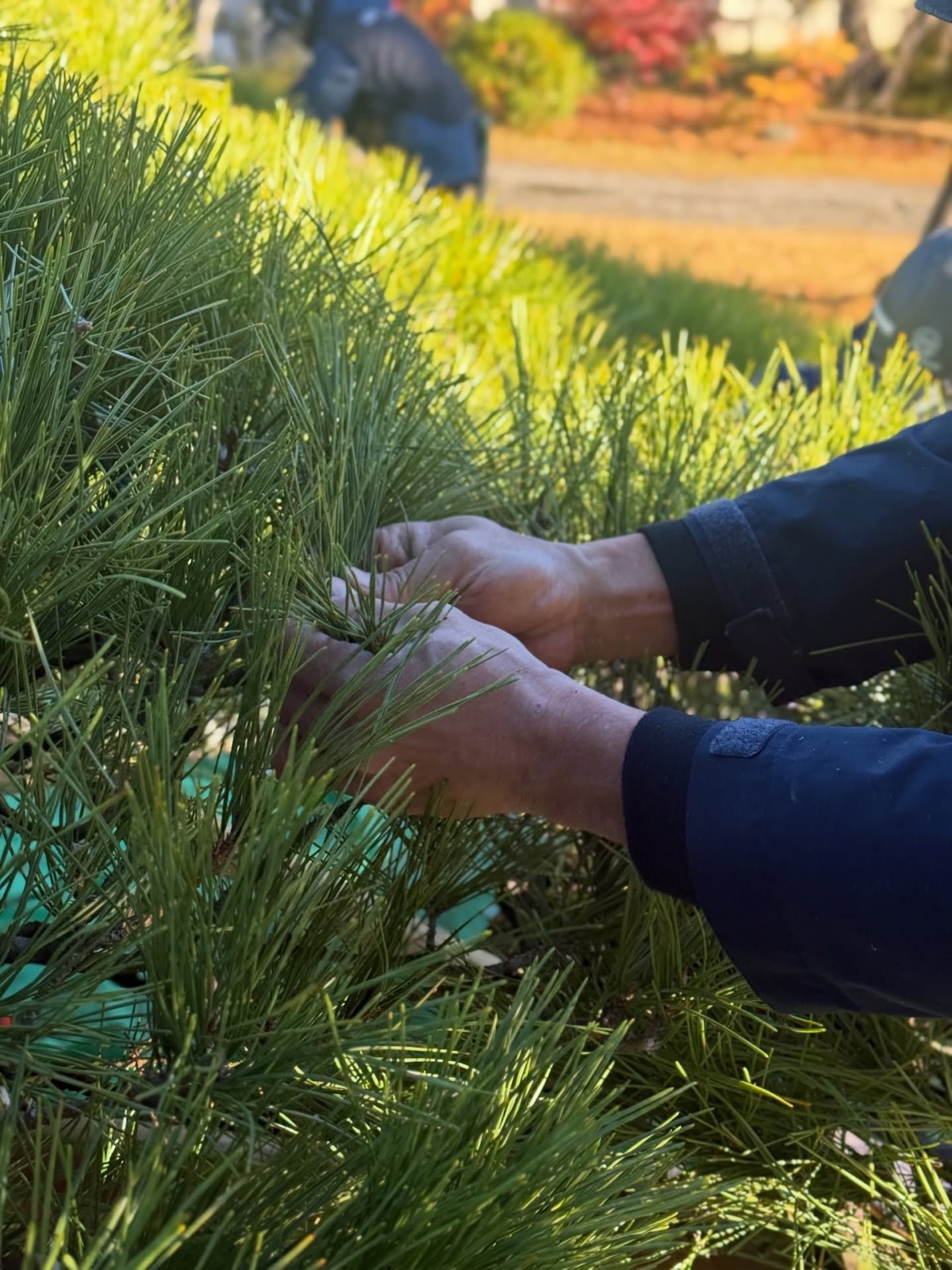
The Japan Federation of Landscape Contractors’ training manual places momiage (もみあげ), the hand removal of older needles, “around October every year”. It describes the aim: leave the current year’s needles, take off the old ones, and let enough sunlight reach the lower branches.
The work is not confined to October. A park run by the Yokohama Greenery Foundation, Kishine Park, reported its momiage on 28 December 2019, with photographs taken the day before. In these examples, the pine work runs from September into late December. Our full guide to momiage covers the hand technique.
Why the deciduous trees still wait
Autumn can look like an easy time to prune deciduous trees too, but the guidance holds off. The University of Missouri Extension warns that pruning before the leaves fall removes minerals that the tree would otherwise move into its stems and roots for winter storage. The Japanese windows agree: the Japan Greenery Research and Development Center starts winter pruning in December, Saitama City in December, and the Flower Association of Japan starts cherries in November, after leaf fall. The evergreens are different again. The Japan Greenery Research and Development Center’s general calendar gives both evergreen broadleaves and conifers a second window in September and October.
November and December — snow ropes, needles and bare wood again
The garden gets ready for winter
November opens with one of the best-known winter jobs in Japanese gardening. Ishikawa Prefecture writes that the snow-rope work at Kenrokuen, yukitsuri (雪吊り), begins on 1 November each year, and that the roughly 800 installations are completed by mid-December. The prefecture counts the labour as a cumulative total of 500 craftspeople over the season, not 500 separate people. The structure of the ropes is explained in our article on yukitsuri snow ropes.
On NAOJ’s calendar, Rittō (立冬, “beginning of winter”) falls on 7 November in 2026, Taisetsu (大雪, “greater snow”) on 7 December, and Tōji (冬至, the winter solstice) on 22 December.
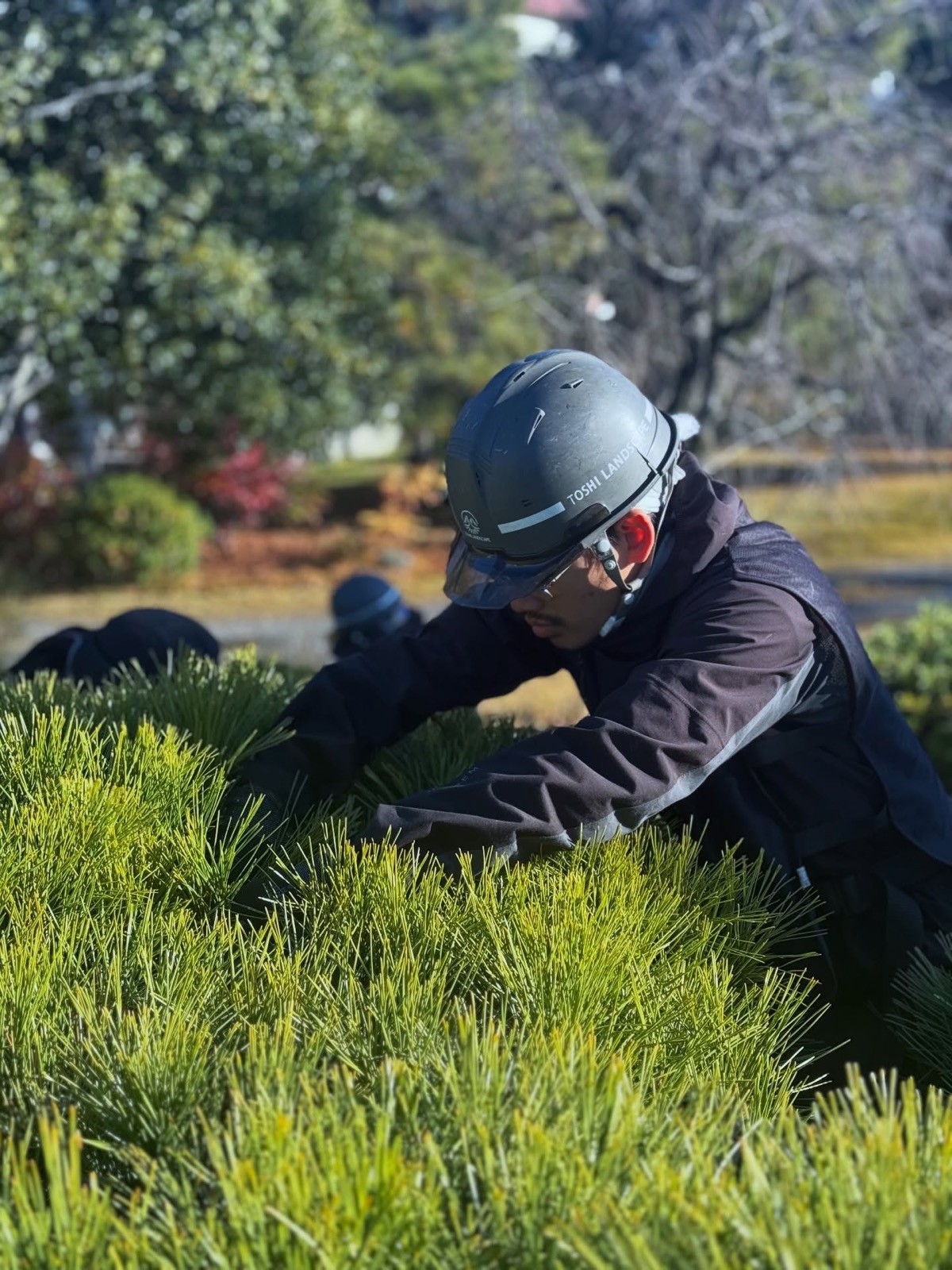
Hands in the needles
Momiage is slow handwork, done shoot by shoot. It complements the spring pinching of soft candles: one job works on the new growth, the other on the old.
Back to the bare trees
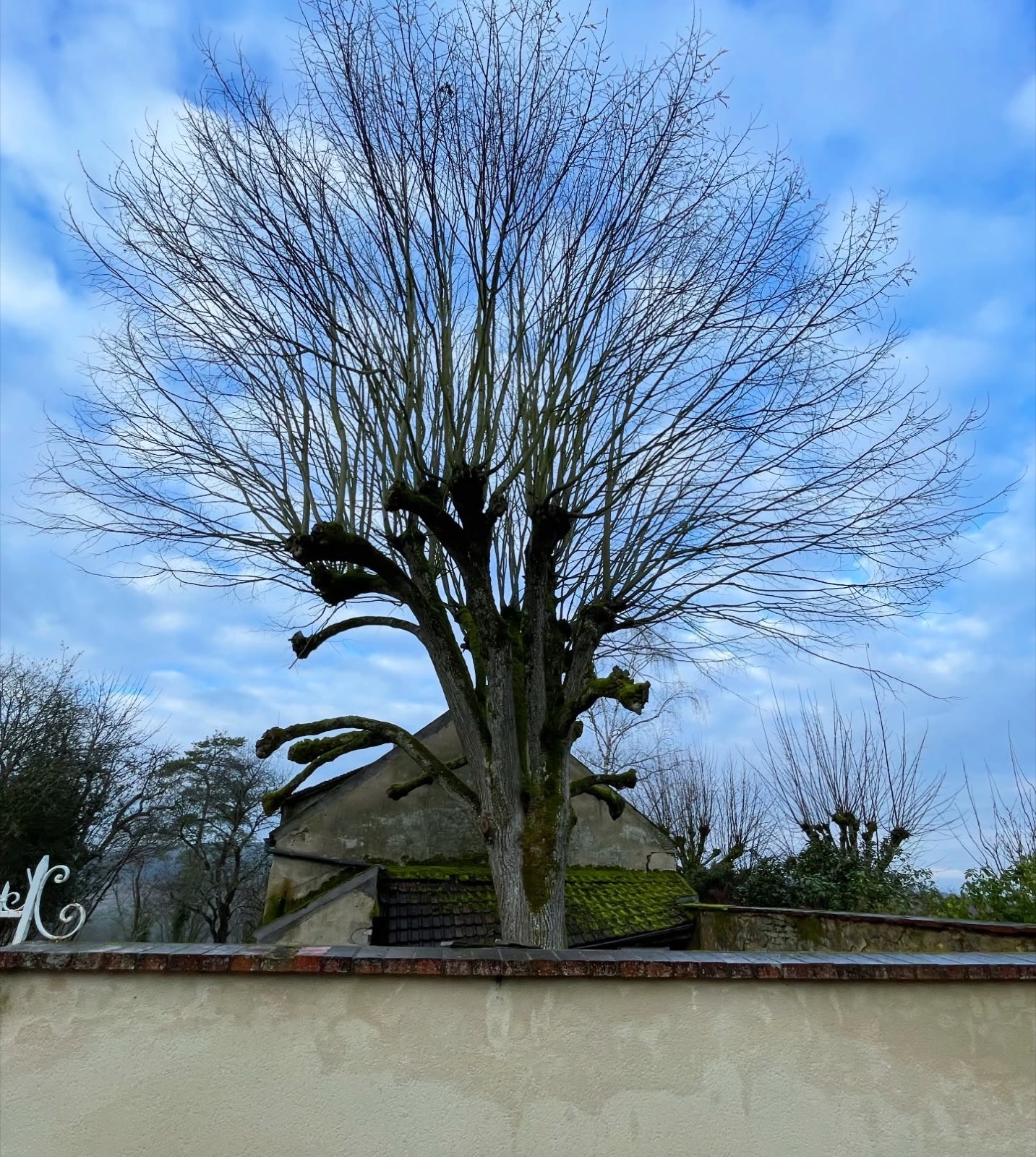
By December the deciduous trees are bare, the framework is visible again, and winter pruning opens.
Why the month follows the tree — four clocks in one garden
The calendar on one page
Set the year out by tree group and the pattern is clear. The months below are examples from the guidance cited, not a single national calendar, and real gardens also work to deadlines of their own, such as Ritsurin’s illumination.
| Tree group | Main work | Months in Japanese guidance | What sets the time | Source |
|---|---|---|---|---|
| Deciduous trees | Basic (winter) pruning | December to February or March; December to March | Dormancy: framework visible, wound closure follows in spring | Japan Greenery R&D Center; Saitama City |
| Deciduous trees | Light (summer) pruning | July to August; July to September | Full leaf: one-third or less, light correction only | Japan Greenery R&D Center; Saitama City; Saitama Prefecture |
| Cherry | Small cuts after leaf fall | November to early March | Decay risk from cut surfaces | Flower Association of Japan |
| Ornamental ume (potted) | After flowering | Straight after bloom | Encourages short flowering shoots | Kawaguchi Greenery Center |
| Evergreen broadleaves | Before or after the flush | Early March to late April (Oita); March to June (Nagasaki); May to June and September to October (general) | Cold risk in midwinter; spring flush | Oita Prefecture; Nagasaki City; Japan Greenery R&D Center |
| Azaleas (satsuki, tsutsuji) | Shearing | Straight after flowering, June | Flower buds form from mid- or late June into August | Sendai Green Association; Tottori Prefecture |
| Garden pines | Midori-tsumi | April to May | Soft new shoots | Tokyo Metropolitan Park Association |
| Garden pines | Needle plucking and thinning | September to mid-October (Kenrokuen); around October (JFLC); into December | Hardened shoots; light to lower branches | Kenrokuen; JFLC; Kishine Park |
Four clocks, not one rule
Underneath the table are four clocks: dormancy for the deciduous tree, cold and the spring flush for the evergreen broadleaf, flower-bud formation for the shrub, and shoot stage for the pine.
The dormant-season rule describes the first clock. The Japanese guidance does not contradict it; it adds the other three.
Where the solar terms fit
It is tempting to say that Japanese gardeners prune by the 24 solar terms. The evidence supports a more modest claim. NAOJ explains that the calendar was indispensable as a guide to agricultural work and festivals. A farming handbook published in 1870, Nōgyō Hanagoyomi (農業花暦), held in the Iwase Bunko library, includes a section that explains farm work for each of the 24 solar terms. Earlier gardening books also organised their advice by season: Kadan Kōmoku (花壇綱目), first published in 1681, describes flowers and cultivation methods season by season.
What these sources show is a long habit of tying garden and farm work to the turning of the seasons. They do not show that today’s pruning months were fixed in the Edo period, and modern public guidance is written in calendar months. The solar terms remain a vivid way to describe the gardener’s year, not a rulebook for it.
| Western dormant-season rule | Japanese tree-by-tree calendar | |
|---|---|---|
| Tree it is written for | Mainly deciduous hardwoods, with separate notes for conifers and flowering shrubs | Deciduous trees, evergreen broadleaves, flowering shrubs and trained pines, each with its own window |
| Main signal | Dormancy and the spring growth flush | The same, plus cold for evergreens, flower-bud timing for shrubs, shoot stage for pines |
| How the year is written | One preferred window with exceptions | A calendar with a window for each group |
| Light work | Light, routine removal of weak, dead or diseased limbs at any time of year (ISA) | Summer pruning kept to light correction; Saitama Prefecture caps removal at one-third or less |
Carrying the calendar outside Japan — move by stage, not by month
Read the tree, then the month
The months in this article come from Japanese guidance written mostly for mild-winter regions, from Tokyo and Saitama to Kyushu, where summers are hot and wet. Copying them into a colder or drier garden will put some jobs in the wrong place. The safer approach is to keep the stage and let the month float:
- Deciduous trees: basic pruning between leaf fall and bud break. In Iowa, that becomes February to March.
- Japanese maples: early in the dormant season. In Britain, the RHS says after leaf fall but before January.
- Evergreen broadleaves: outside the hardest cold, before the spring flush or once it has settled.
- Azaleas and other spring-flowering shrubs: straight after flowering, before the next flower buds form.
- Garden pines: pinch candles while they are soft; remove old needles from autumn into early winter.
Five questions before the cut
The calendar is easier to carry abroad as a sequence of questions than as a list of months:
- What is the tree, and what is it for? A fruiting ume and a potted ornamental ume have different windows.
- What stage is it at? Dormant, flushing, setting flower buds, or carrying soft new shoots.
- How vigorous is it? Japanese guidance skips summer pruning on trees whose new growth is weak.
- Is there a local disease that travels through wounds? If so, that window overrides the calendar.
- How much needs to come off? Light correction fits many windows; heavy cuts belong only in the main window for that tree.
Local disease comes first
Some local rules override any calendar. The ISA advises against pruning susceptible trees during periods when diseases are actively transmitted, because pruning wounds can let pathogens in. In Britain, the RHS recommends summer pruning for plums and cherries susceptible to silver leaf, a disease caused by Chondrostereum purpureum that infects mainly through pruning wounds. It gives two reasons: the fungus produces most of its infectious spores in autumn and winter, and summer wounds close more quickly.
That puts British cherries in summer and Japanese cherries, under the Flower Association of Japan’s guidance, in November to early March. The RHS gives silver leaf as its reason; we have not found a study that compares the two recommendations directly, so neither should be read as a model for the other. Check with your local extension service or national horticultural body before borrowing a Japanese month for a cherry or plum.
The real lesson of the Japanese gardener’s year is not a list of dates. It is the habit of asking, before every cut, what this tree is doing now: resting, flushing, setting buds or hardening its shoots.
Frequently asked questions
What is the best month to prune trees?
There is no single best month. Most deciduous trees are pruned in the dormant season, from leaf fall until before bud break (December to March in Saitama City’s guideline, February to March in Iowa). Spring-flowering shrubs are pruned straight after flowering. Garden pines are worked in spring and again in autumn.
Why do Japanese gardeners prune different trees in different months?
Because a Japanese garden mixes trees that run on different clocks. Deciduous trees follow dormancy, evergreen broadleaves avoid deep cold and their spring flush, azaleas must be sheared before next year’s buds form, and pines are worked when their shoots are soft and again when they have hardened.
Can I prune trees in summer?
Yes, lightly. Japanese guidance treats summer pruning as light correction, and Saitama Prefecture limits it to one-third of the branches and foliage or less. Avoid heavy summer cuts and avoid opening crowns to strong sun.
When should azaleas be pruned?
Straight after flowering. In Japan, satsuki form flower buds from late June to early August and tsutsuji from mid-June to mid-August, so shearing later in summer removes next spring’s flowers.
When do Japanese gardeners prune pines?
In the examples here, in spring and again from autumn. Midori-tsumi, pinching the soft new candles, is done in April to May in Tokyo. Needle plucking and branch thinning follow from September, around October in the national training manual, and can continue into December.
Should I prune cherry trees in winter or summer?
Follow your local guidance. The Flower Association of Japan advises small cuts after leaf fall, from November to early March. In Britain, the RHS advises summer pruning for cherries and plums to reduce the risk of silver leaf.
Sources
Quotations from Japanese sources are our translations.
– International Society of Arboriculture, Pruning Mature Trees (TreesAreGood, 2021) — https://www.treesaregood.org/Portals/0/TreesAreGood_Pruning%20Mature%20Trees_0621.pdf (accessed 2026-10-31) – Iowa State University Extension, “Proper Time to Prune Trees and Shrubs” — https://yardandgarden.extension.iastate.edu/how-to/proper-time-prune-trees-and-shrubs (accessed 2026-10-31) – Bedker, P. J., et al., How to Prune Trees, USDA Forest Service (rev. 2012) — https://research.fs.usda.gov/download/treesearch/12602.pdf (accessed 2026-10-31) – University of Missouri Extension, Pruning Ornamental Trees and Shrubs — https://extension.missouri.edu/publications/mg8 (accessed 2026-10-31) – Utah State University Extension, “Sunscald Injury or Southwest Winter Injury on Deciduous Trees” — https://extension.usu.edu/forestry/publications/utah-forest-facts/021-sunscald-injury-or-southwest-winter-injury-on-deciduous-trees (accessed 2026-10-31) – Royal Horticultural Society, “Silver leaf” — https://www.rhs.org.uk/disease/silver-leaf ; “Bleeding from pruning cuts” — https://www.rhs.org.uk/pruning/bleeding-from-cuts ; “Shrubs: pruning early-flowering” — https://www.rhs.org.uk/plants/types/shrubs/pruning-early-flowering (accessed 2026-10-31) – Japan Greenery Research and Development Center, “Pruning techniques for greening trees” (緑化樹木の剪定技術) — https://www.jpgreen.or.jp/kyoukyu_jyouhou/gijyutsu/sentei/index.html (accessed 2026-10-31) – Saitama City, tree management guideline for public land (公共用地における樹木等の管理ガイドライン) — https://www.city.saitama.jp/001/010/019/001/p012111_d/fil/jumokukanrigaidokaiteiban.pdf (accessed 2026-10-31) – Saitama Prefecture, street-tree pruning manual (街路樹剪定マニュアル, December 2020) — https://www.pref.saitama.lg.jp/documents/4144/gairozyusenntei1.pdf (accessed 2026-10-31) – Minato City, tree management manual (樹木管理マニュアル, April 2023) — https://www.city.minato.tokyo.jp/documents/175871/20260213135612.pdf (accessed 2026-10-31) – Oita Prefecture, published landscape specification, Article 207 — https://www.pref.oita.jp/uploaded/life/2003014_3736099_misc.pdf (accessed 2026-10-31) – Nagasaki City, “How to prune trees” (樹木の剪定方法) — https://www.city.nagasaki.lg.jp/page/5245.html (accessed 2026-10-31) – Sendai Green Association, satsuki and tsutsuji care — https://sendai-green-association.jp/consul/data/satsuki/ ; garden-tree pruning — https://sendai-green-association.jp/consul/data/niwaki/ (accessed 2026-10-31) – Amagasaki Greenery Park Association, June gardening Q&A — https://www.amaryoku.or.jp/files/file/fl00000255.pdf (accessed 2026-10-31) – Tottori Prefecture, published management manual, chapter 4 — https://www.pref.tottori.lg.jp/secure/1116466/04_chapter4_1.pdf (accessed 2026-10-31) – Kawaguchi Greenery Center, ume guide — https://jurian.or.jp/guide/ume.php (accessed 2026-10-31) – Flower Association of Japan, cherry pruning — https://www.hananokai.or.jp/sakura/sakuramihonen-info/sakuramihonen-info-list7/ ; planting and care guide — https://www.hananokai.or.jp/wp/wp-content/themes/hananokai/images/sakura/sakura-plant/uekaka_sodatekata.pdf (accessed 2026-10-31) – Tokyo Metropolitan Park Association, standard maintenance specification (rev. October 2025) — https://www.tokyo-park.or.jp/association/assets/bid01-standard-specification_1023.pdf ; Hama-rikyu Gardens, midori-tsumi 2026 — https://www.tokyo-park.or.jp/park/hama-rikyu/news/2026/5_5_2.html ; Kiyosumi Gardens, Golden Week 2026 — https://www.tokyo-park.or.jp/park/kiyosumi/news/2026/2024_1.html (accessed 2026-10-31) – Japan Federation of Landscape Contractors, Zōen Shokyū Ginō no Tebiki (revised ed., 2015) — https://www.jflc.or.jp/media/niwa_navi/20150408_0930_52_0831.pdf (accessed 2026-10-31) – Ishikawa Prefecture Kanazawa Castle and Kenrokuen Management Office, pine pruning diary — https://shiro-niwa.pref.ishikawa.lg.jp/kanazawa-castle/diary/7218/ ; Ishikawa Prefecture, Kenrokuen yukitsuri — https://ishikawa-pref.note.jp/n/n76b0b5bd40d0 (accessed 2026-10-31) – Kagawa Prefecture Tourism Association, Ritsurin gardener interview — https://www.my-kagawa.jp/feature/interview/interview2 (accessed 2026-10-31) – Yokohama Greenery Foundation, Kishine Park, pine momiage — https://www.hama-midorinokyokai.or.jp/park/kishine/details/post-9190.php (accessed 2026-10-31) – National Astronomical Observatory of Japan, 2026 calendar (令和8年 暦要項) — https://eco.mtk.nao.ac.jp/koyomi/yoko/2026/rekiyou262.html ; solar terms and zassetsu — https://eco.mtk.nao.ac.jp/koyomi/faq/24sekki.html ; “The 24 solar terms and the calendar” — https://eco.mtk.nao.ac.jp/koyomi/exhibition/054/ (accessed 2026-10-31) – Astronomical Society of Japan, Astronomical Dictionary, entry on zassetsu and higan — https://astro-dic.jp/higan/ (accessed 2026-10-31) – Japan Meteorological Agency, rainy season records for Kantō-Kōshin — https://www.data.jma.go.jp/cpd/baiu/kako_baiu09 ; Tokyo climate normals — https://www.data.jma.go.jp/stats/etrn/view/nml_sfc_ym.php?prec_no=44&block_no=47662&year=&month=&day=&view= (accessed 2026-10-31) – National Diet Library Search, Nōgyō Hanagoyomi (Iwase Bunko) — https://ndlsearch.ndl.go.jp/books/R100000094-I219081 ; Osaka Prefectural Library, “Edo gardening” — https://www.library.pref.osaka.jp/nakato/shotenji/37_engei.html (accessed 2026-10-31)