

By Isaki Kasahara, a Japanese arborist pruning, assessing and caring for Japan’s trees and gardens · Updated November 18, 2026
Japan still wraps tree root balls in straw rope because its specifications treat the wrap as a binding that tightens soil against the roots, and they ask for a material that is strong enough for transport and then breaks down in the soil. Japan’s national public building specification, in its 2025 edition, still tells contractors to bind the root ball firmly “with straw rope, straw mats and the like”, and the clause quoted asks for no steel basket. A Japanese study of two deciduous species found no effect on growth or rooting from the wrapping left in the ground under its test conditions.
A ball of soil, not a parcel — what nemaki is for
The scene: a tree standing on a column of earth
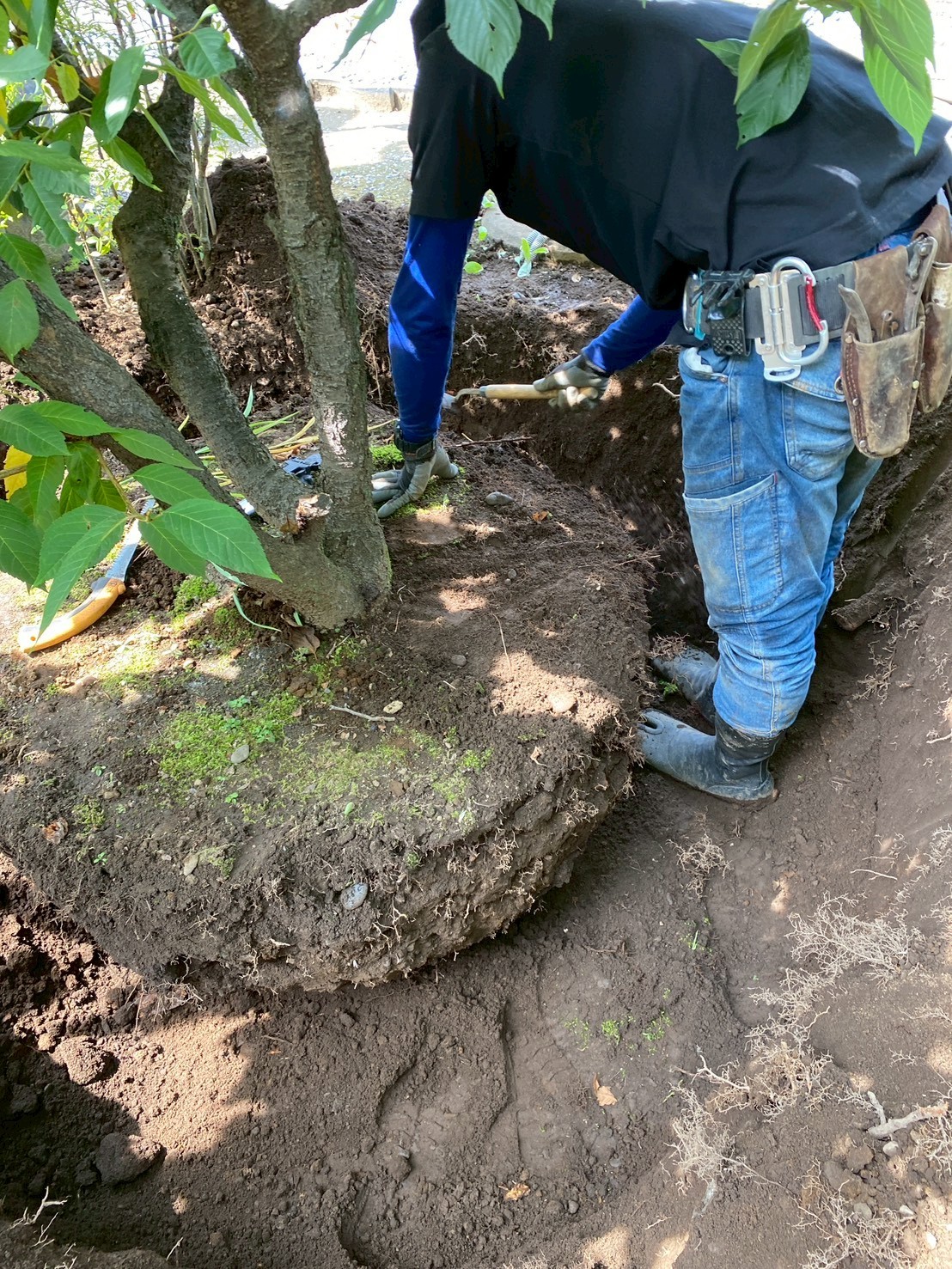
Picture a garden tree with a comparatively large root ball about to be moved. The crew has dug a trench in a circle around the trunk, straight down, leaving the tree standing on a drum of soil. The sides of that drum are cut clean. Roots poke out of the wall where the spade went through. Nobody has lifted anything yet. The next step is not to pull the tree out. It is to start winding rope around the soil while the tree is still standing in the ground.
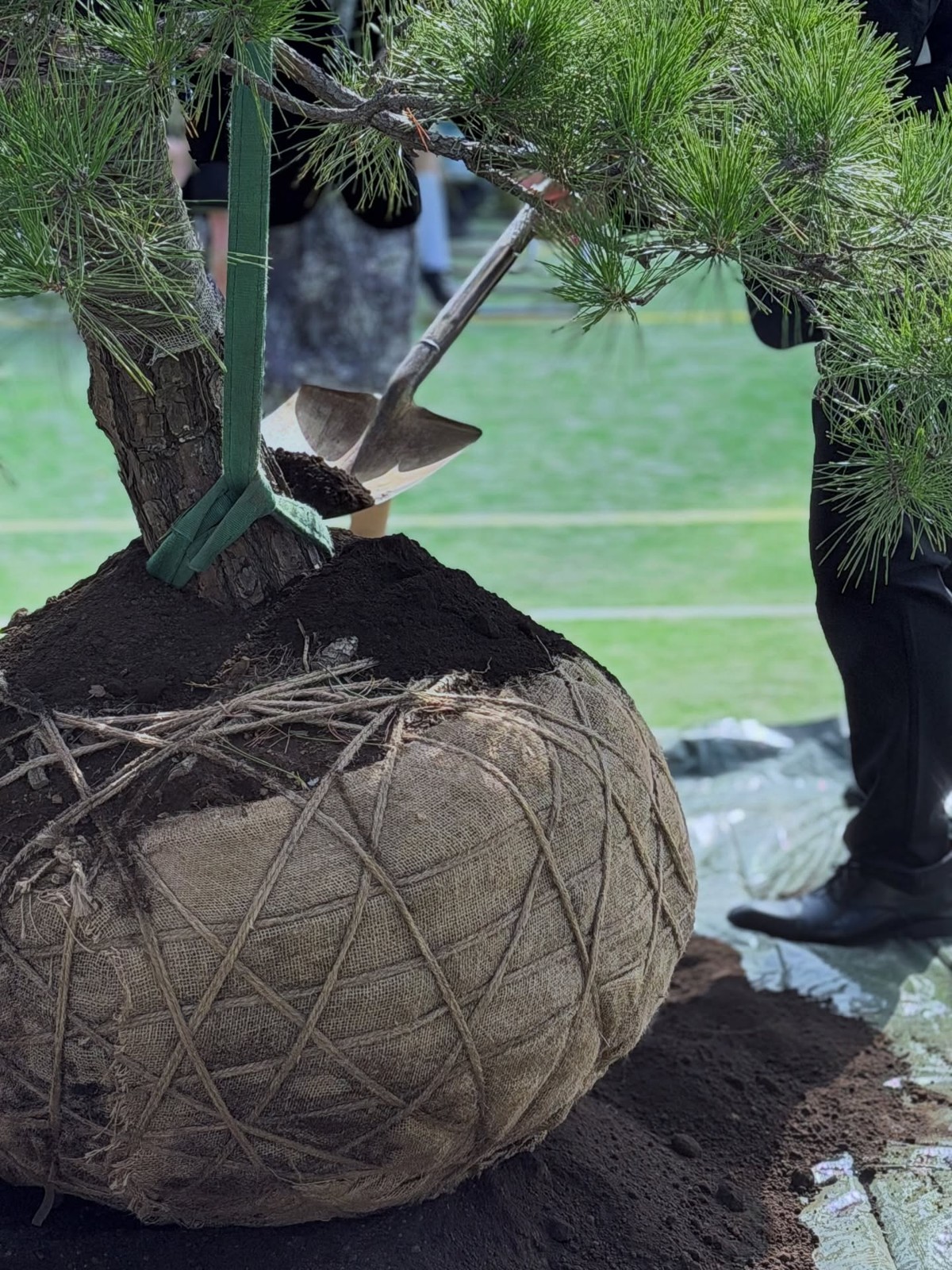
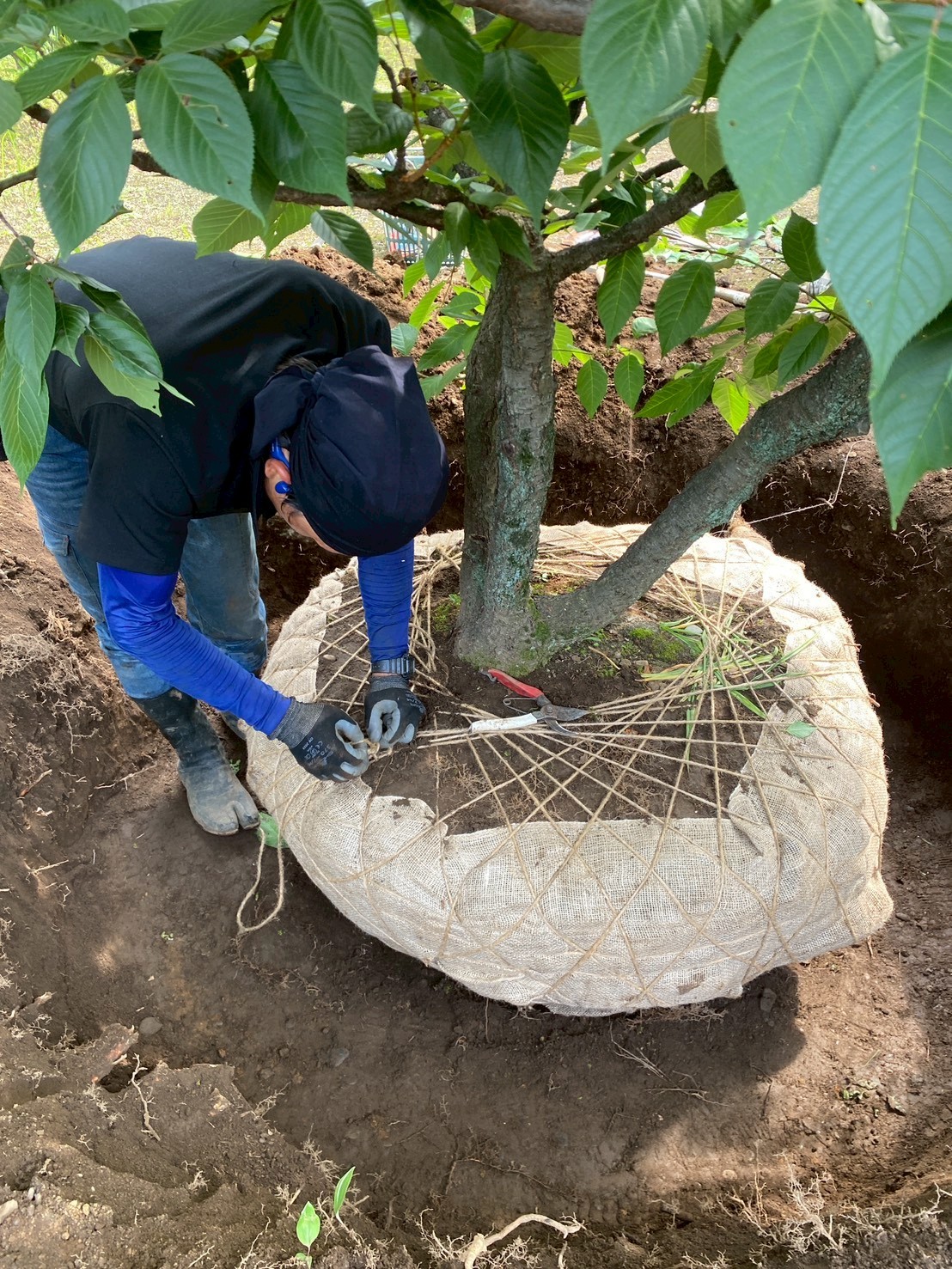
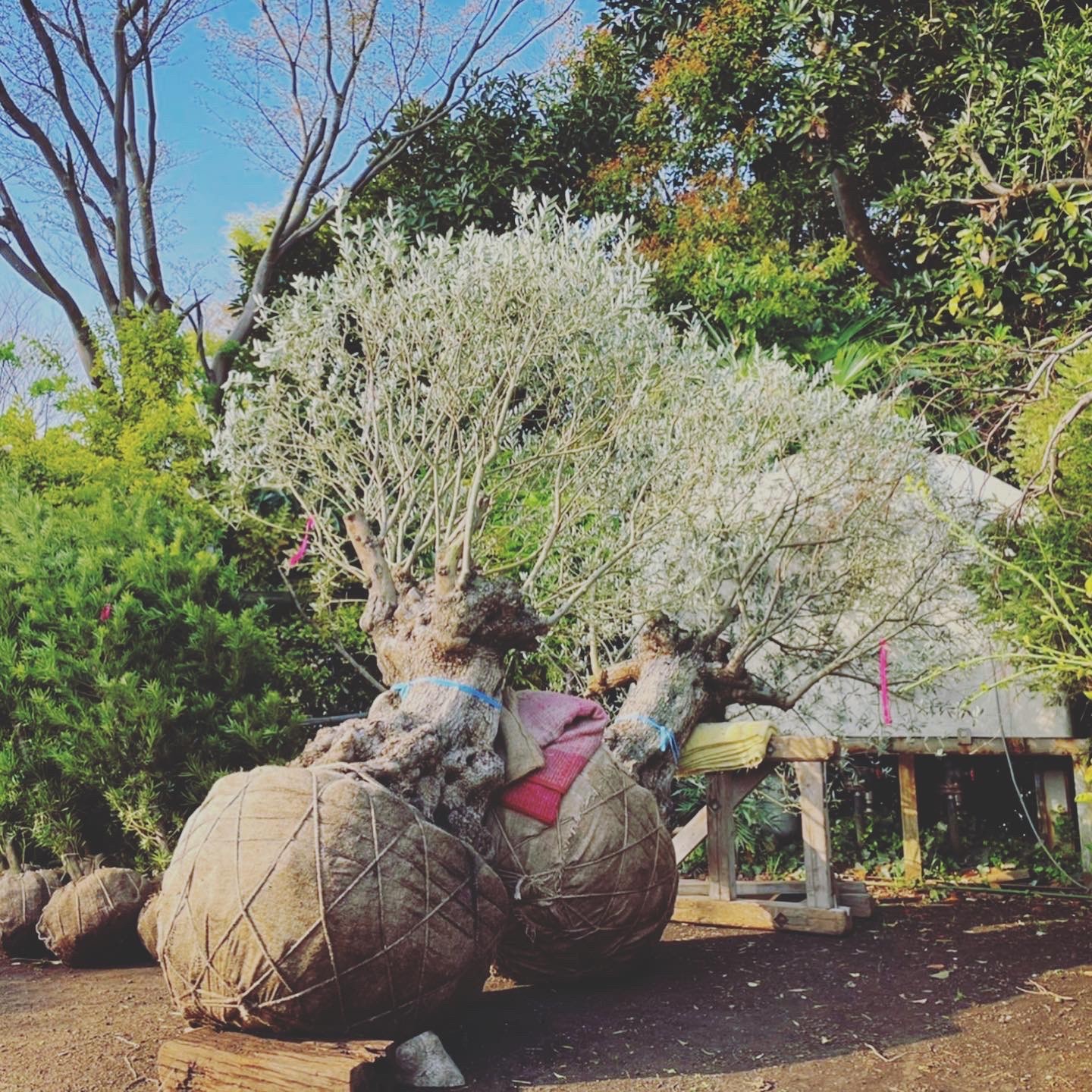
That rope work is called nemaki (根巻き) — root-ball wrapping. The drum of soil is the nebachi (根鉢) — the root ball. Japan’s Ministry of Land, Infrastructure, Transport and Tourism (MLIT) defines the root ball in its quality standard for public planting stock as “a mass of soil containing the root system” (根系を含んだ土のまとまり). It defines nemaki as digging the ball with its soil attached and then binding the surface firmly “with rope or other materials” (縄その他の材料で十分締め付けて) so the soil does not fall away.
Binding, not covering
That word “binding” is the key to the whole practice. The Japan Greenery Research and Development Center, in its commentary on the public planting standard, lists four purposes for nemaki: stopping the ball from cracking, keeping the roots in close contact with the soil, preventing the roots from drying out, and so helping the tree to establish. Its commentary says that simply wrapping the surface is not enough. What matters, it says, is to “tighten the soil around the roots” (根の土を締め込むことが大切).
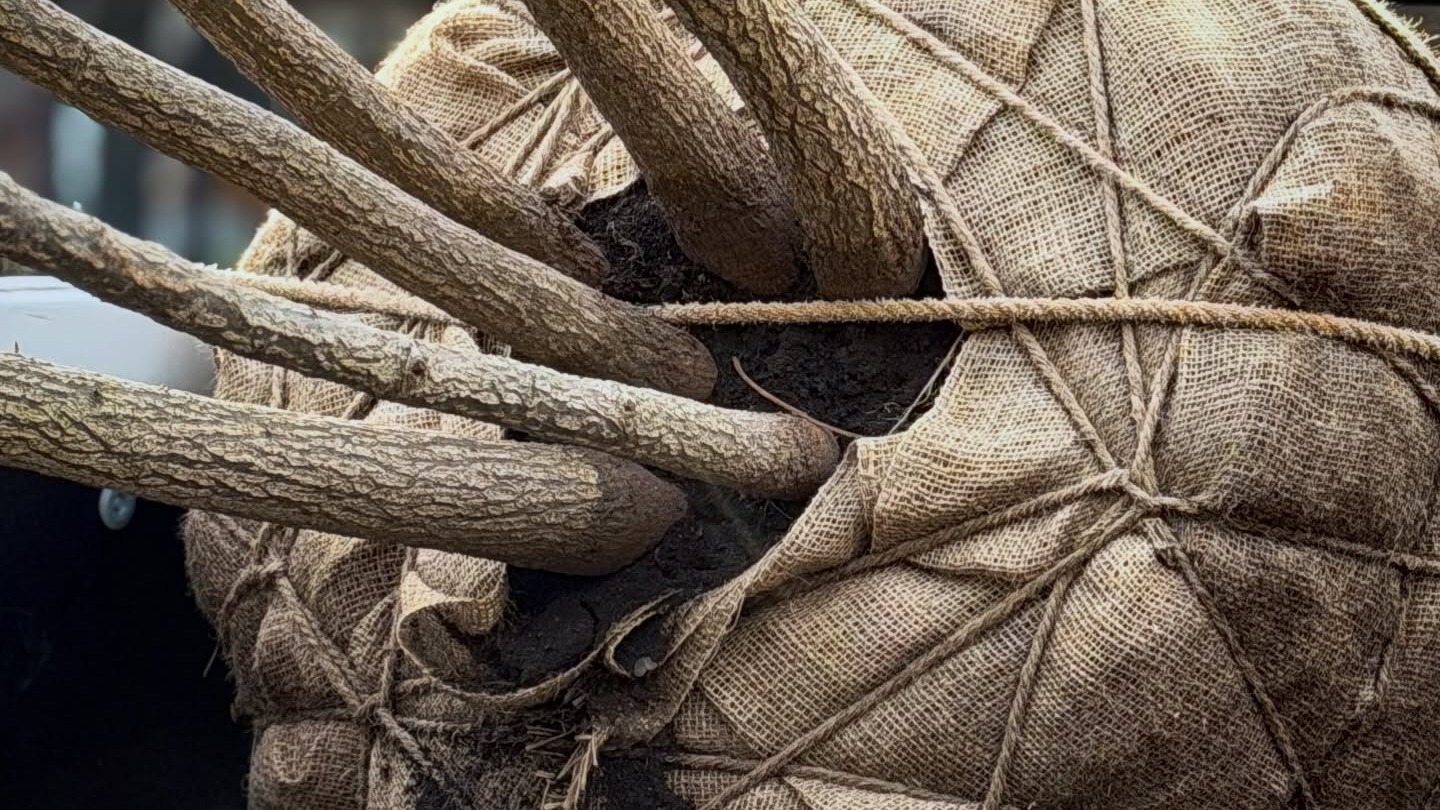
Nursery stock bought abroad can arrive as a finished package: hessian or burlap around the outside, sometimes a steel basket around that. The Japanese texts quoted here describe the rope as a tool for compressing soil onto the roots, not only as a cover that holds the ball together for lifting and transport. Below, the article follows one ball from the first wrap to the planting hole, and then compares the American and British documents.
Not the same as nemawashi
Nemaki is easy to confuse with nemawashi (根回し), the root preparation done ahead of transplanting a large tree. Kagoshima Prefecture’s planting specification and MLIT’s park-works specification treat them as two separate operations. In nemawashi, roots are cut around the future ball and the trench is backfilled so the tree can grow fine roots inside that ring. Nemaki belongs to the digging itself, when the ball is cut out and bound for transport. A separate article on this site will cover nemawashi in detail. This one stays with the rope.
How big the ball must be — reading the trunk
Shapes named for the roots below
Before anyone picks up rope, the crew decides the shape of the ball. The Japanese Institute of Landscape Architecture (JILA), in a report for fiscal year 2024 from its committee on Japanese garden research, describes three shapes:
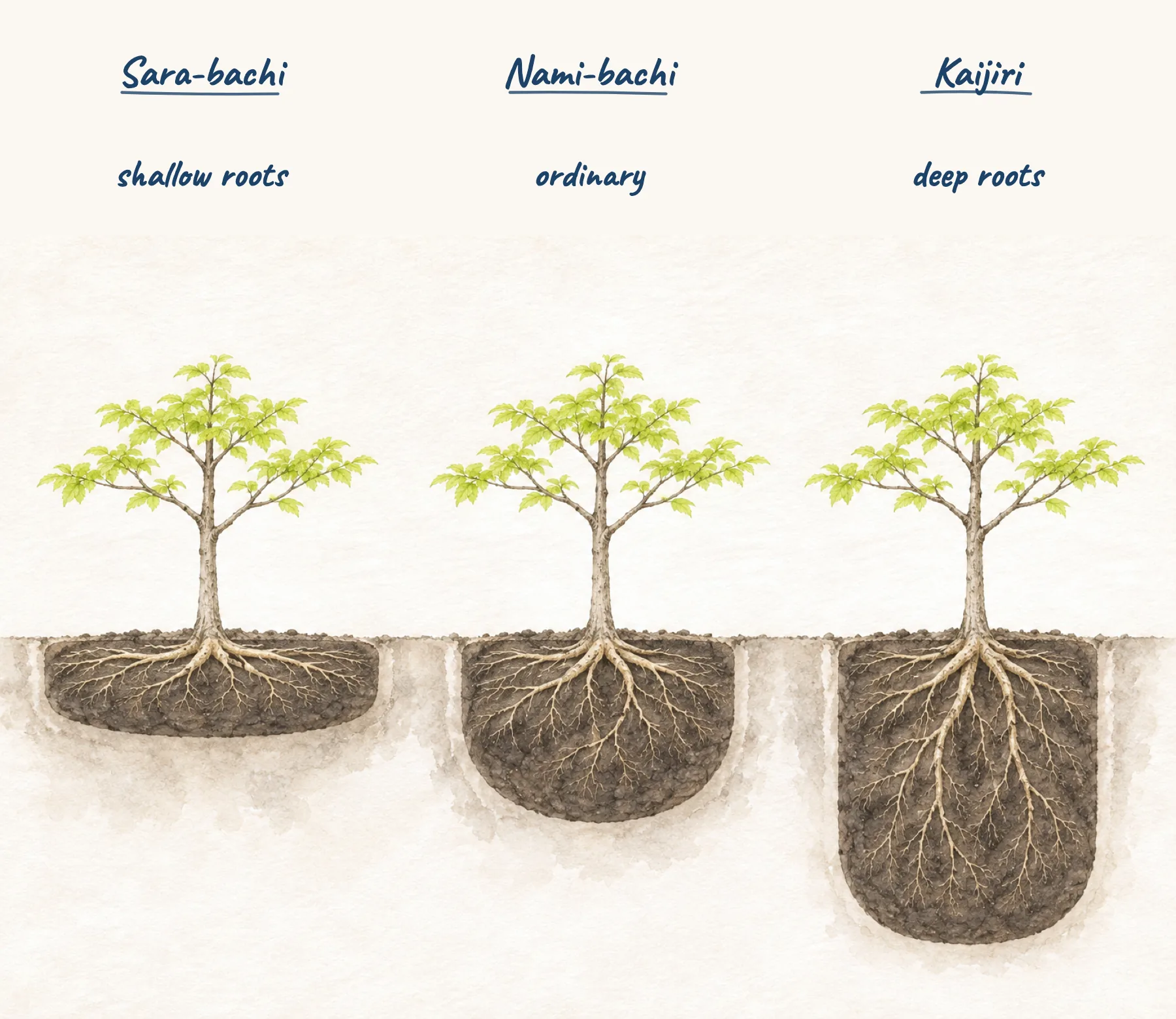
– Sara-bachi (皿鉢) — a “plate” ball, shallow and wide, for trees whose roots sit near the surface – Kaijiri (貝尻) — a deep ball, for deep-rooted trees whose roots run downward – Nami-bachi (並鉢) — the “ordinary” ball between the two
In that description, the ball follows the roots of that tree, not a single template. Separately, MLIT’s park-works specification gives the digging instruction for large transplants: dig straight down to the required diameter and round off the bottom (垂直に掘り下げ、底部は丸味をつけて).
The shape names and the wrap names are different things. A sara-bachi is not a type of wrap, and a wrap name does not tell you the shape of the ball.
Diameter as a multiple of the trunk
The Japanese specifications quoted here size the ball from the trunk’s root-collar diameter (nemoto-kei, 根元径), the trunk measured where it meets the ground. There is no single national figure. Different documents give different ratios:
| Document | Root-ball diameter rule | Notes |
|---|---|---|
| Kagoshima Prefecture planting specification (2010) | 3–5 × root-collar diameter | Contract specification |
| MLIT Kyushu Regional Bureau reference material (2010) | “Generally” 4–5 × root-collar diameter | Explanatory reference, not a contract rule |
| MLIT airport civil-works specification (2025 revision) | Evergreen: 5 × or more; deciduous: 6 × or more | Evergreens wrapped with rope or straw mats; deciduous roots covered with wet straw mats |
| MLIT public building specification (2025) | “A size suited to the tree’s characteristics” | No fixed ratio |
So a tree with a 10 cm (4 in) root-collar diameter would need a ball of roughly 30–50 cm (12–20 in) under the Kagoshima rule, and at least 50 cm (20 in) if it were an evergreen planted under the airport specification. The ratio depends on which specification governs the job.
Why the ratio is not comparable with ANSI
The American Standard for Nursery Stock sizes balls from caliper, a trunk measurement defined in its own measuring rules, which vary with the plant type and trunk size. A root-collar ratio from a Japanese specification cannot be laid directly over an ANSI caliper table. The American numbers appear below, but the two systems measure the trunk differently.
Taru-maki — the barrel wrap
Wrapping the sides while the tree still stands
The first named wrap is taru-maki (樽巻き) — literally “barrel wrap”. The JILA report describes it as a method for comparatively large balls (比較的大きな鉢の場合) in which rope is wound horizontally around the ball’s circumference, working from top to bottom (上から下へ).
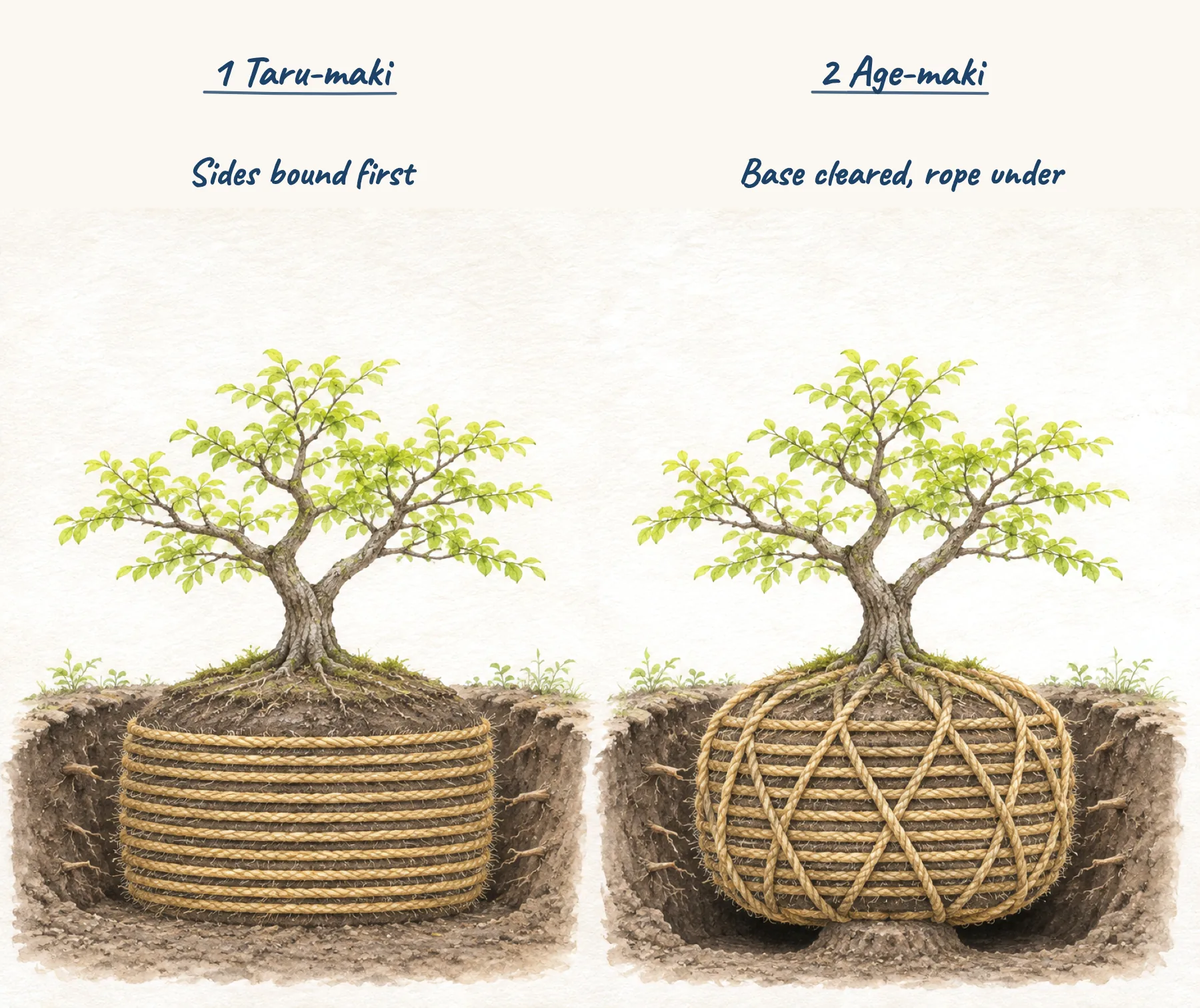
The order matters. The ball is still attached to the ground at its base, so the side walls are held by rope before anyone works underneath. In the JILA description, the undercutting comes only after the sides are bound.
Cutting back the roots before the rope
MLIT’s park-works specification adds a step before wrapping: ne no kirikaeshi (根の切り返し), recutting the roots exposed on the ball’s wall. Tokyo Metropolitan Government’s civil-works specification (2022 edition) follows the same sequence: recut the roots, then wind straw rope tightly, using straw mats as well where needed. Tokyo’s text uses the word hachimaki (鉢巻き) — “ball wrapping” — for this operation.
When straw mats go on first
MLIT’s park-works specification makes straw rope the base material, but says that “depending on soil type or root condition” (土質または根の状態によっては) the ball should first be protected with straw mats (komo, こも) and then bound. The clause gives no specific line between, say, sand and clay.
For large or valuable trees, the Japan Greenery Research and Development Center describes a double wrap: rope bound directly on the soil, then the ball covered with straw mats or hessian (コモや麻布等), with a second binding over that.
Age-maki — the second wrap, under the ball
Clearing the base
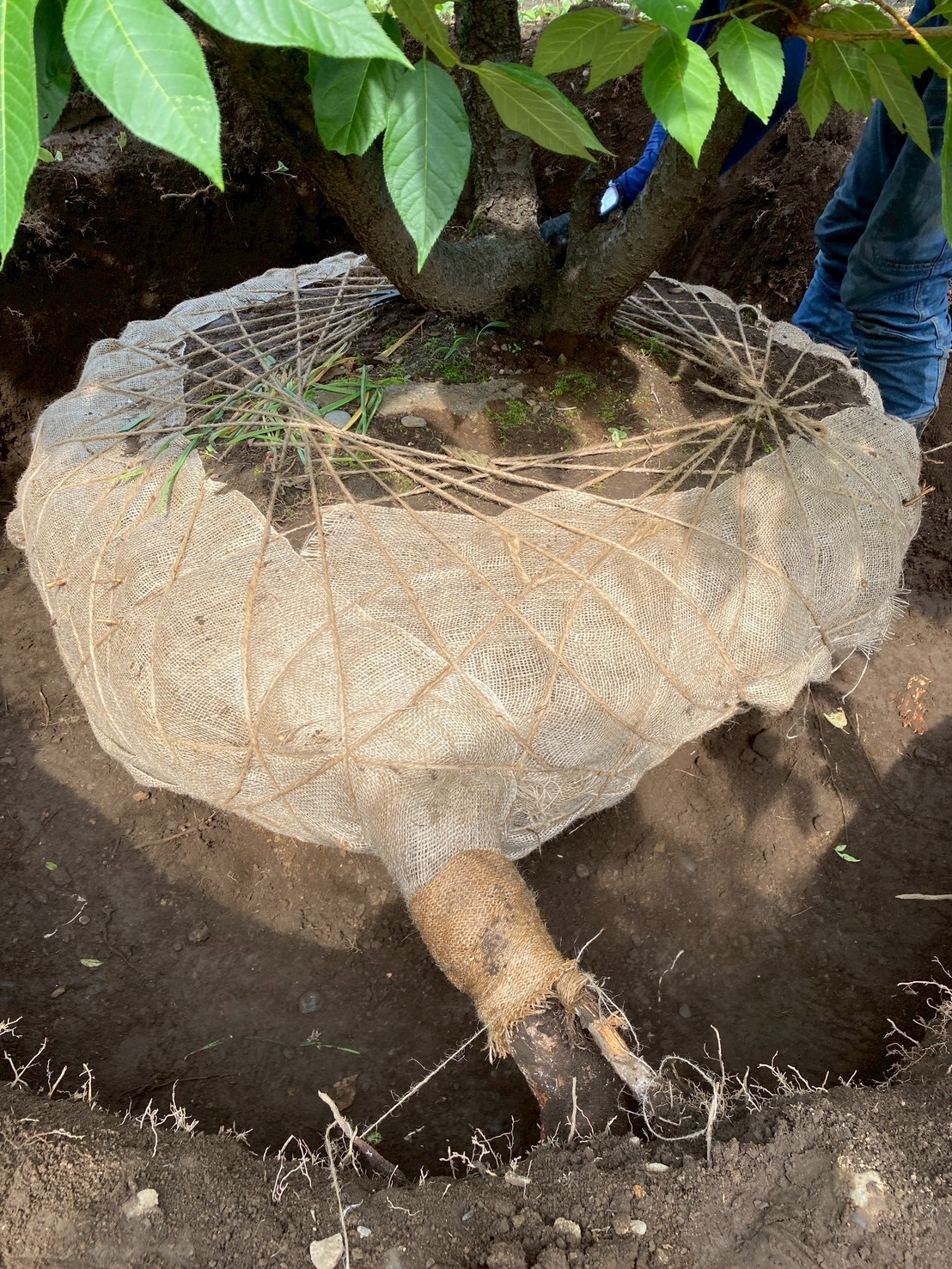
Once the sides are held by the barrel wrap, the crew works under the ball. The JILA report describes cutting the downward-growing roots while clearing soil from beneath the ball, with the side soil kept intact, and only then moving on to the next wrap. So the ball is not cut free first and wrapped afterwards. In the JILA description of a large ball, wrapping and undercutting are interleaved.
Mitsukake, yotsukake, itsutsukake
The second named wrap is age-maki (揚巻き); the first character means “to raise”. The JILA report lists variants called mitsukake (三ツ掛け), yotsukake (四ツ掛け), itsutsukake (五ツ掛け) — “three-”, “four-” and “five-kake”, where kake (掛け) is a hooking or looping of the rope — and gurumaki (グル巻き, round-and-round wrap). The crew chooses among them by looking at the size of the ball and how dense the roots are (鉢の大きさ、根の粗密).
The report names those two factors rather than giving a conversion table, so the choice is made by looking at the ball itself.
Small balls: straw or mat, after lifting
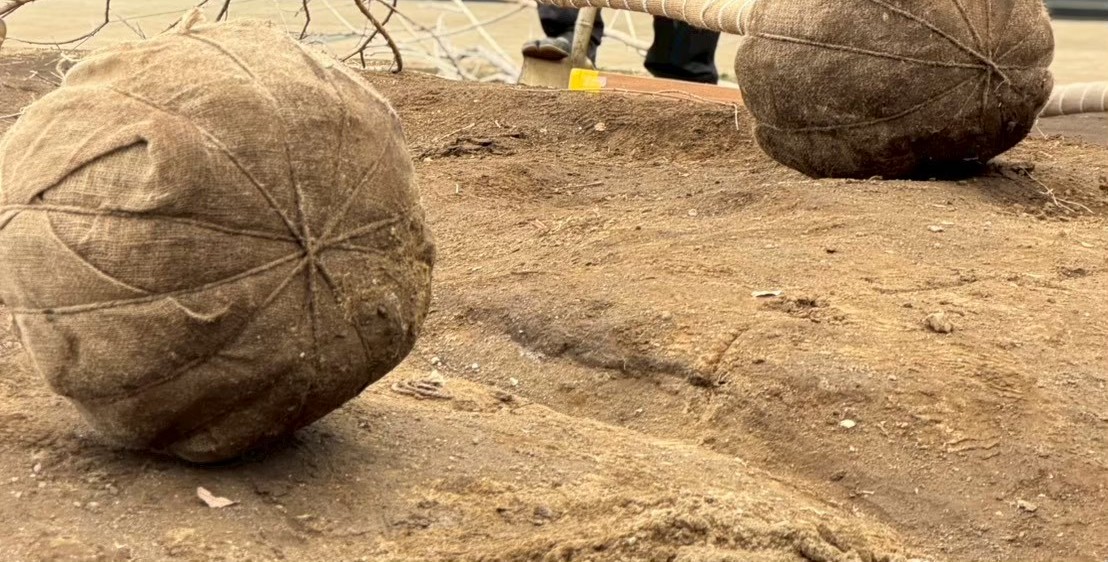
Not every tree gets a barrel wrap. The JILA report says that wara-maki (ワラ巻き, straw wrap) and komo-maki (コモ巻き, straw-mat wrap) are used for small balls that can be lifted out of the hole first and then wrapped, with a guide figure of 45 cm (about 18 in) or less in ball diameter (鉢の直径45cm以下).
The named wraps at a glance
| Japanese name | Literal meaning | When it is used (per JILA report, FY2024) |
|---|---|---|
| Taru-maki (樽巻き) | Barrel wrap | Comparatively large balls; wound horizontally round the sides, top to bottom |
| Age-maki (揚巻き) | “Raise” wrap | After the base is cleared; variants chosen by ball size and root density |
| Mitsukake / Yotsukake / Itsutsukake (三ツ掛け・四ツ掛け・五ツ掛け) | Three- / four- / five-kake | Variants of age-maki |
| Gurumaki (グル巻き) | Round-and-round wrap | Variant of age-maki |
| Wara-maki / Komo-maki (ワラ巻き・コモ巻き) | Straw wrap / straw-mat wrap | Small balls, about 45 cm (18 in) diameter or less, wrapped after lifting |
This table is limited to the names found in a published technical source.
Why straw — what the material has to do
Strong for the trip, gone in the ground
Taisai Hori, writing a technical course in Tree and Forest Health (樹木医学研究), the journal of the Tree Health Research Society, Japan, set out the two conditions a root-wrapping material must meet: it must be strong enough to survive transport, and it must break down in the soil so that it does not block root growth. He also noted that hessian cloth and asa-nawa (麻縄, bast-fibre rope) were often used for root wrapping (麻布と麻縄がよく使われている). Straw rope is not the only material in Japanese practice. It is the one that the public specifications quoted here name first.
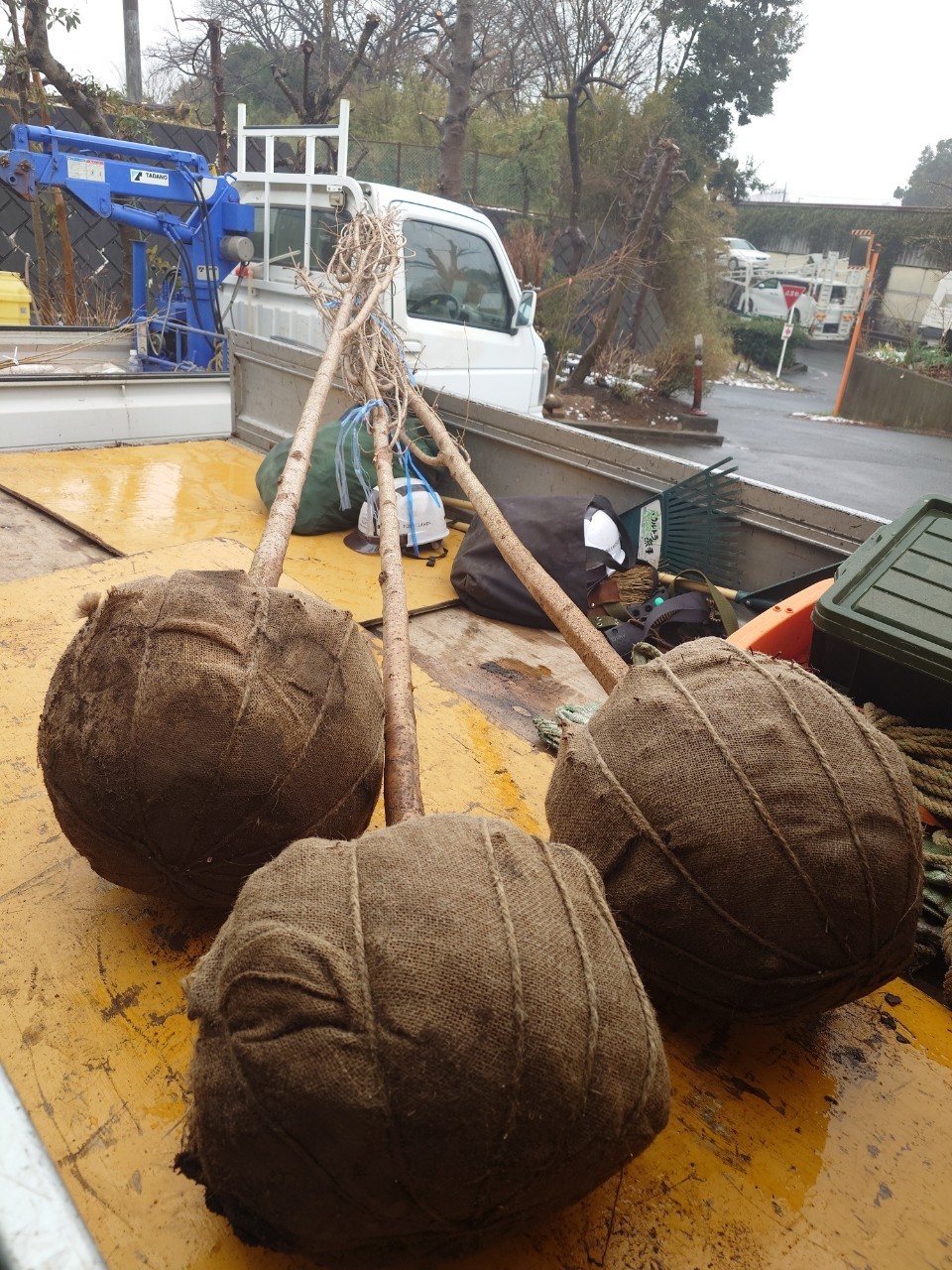
The editions cited here are explicit. MLIT’s public building specification, 2025 edition, section 23.3.5, says: “bind the root ball firmly with straw rope, straw mats and the like” (わら縄、こも等で堅固に根巻きを行う). MLIT’s 2024 park-works specification makes straw rope the base material. Tokyo’s 2022 civil-works specification says to wind straw rope tightly around the roots. None of these requires a steel basket.
Rice straw in the statistics
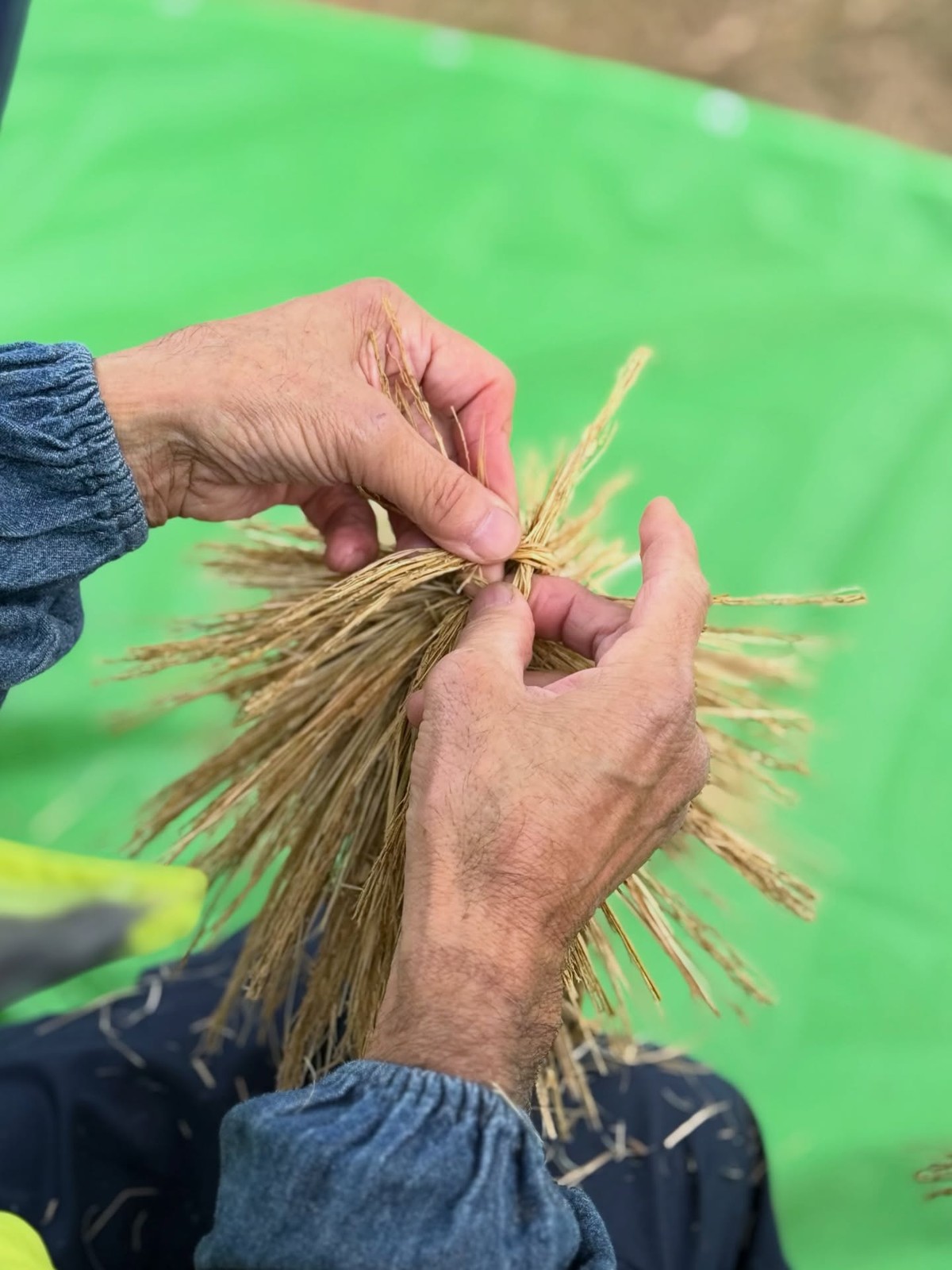
Straw is a by-product of rice, Japan’s staple crop. A Ministry of Agriculture, Forestry and Fisheries (MAFF) summary of prefectural returns for the 2024 rice crop put rice straw in the responding prefectures at 6,286 thousand tonnes in total, of which 3,930 thousand tonnes, 62.5%, was ploughed back into the fields. MAFF itself cautions that these are figures from the prefectures that replied. They say nothing about how much goes into rope. A separate MAFF feed report, dated June 2026, says that about 600,000 tonnes of domestic straw is used as livestock feed while about 200,000 tonnes of feed straw is imported from China. No official statistic on straw rope production, or on the share of imported straw rope, was found for this article. These figures describe rice straw as a whole, not rope.
Specifications remove what does not rot
Kagoshima Prefecture’s planting specification adds the reverse rule: root-wrapping material that does not decay, such as vinyl, “must always be removed” (腐食しない根巻き材は必ず取り除く) at planting. In that specification, the test is whether the material decays, not whether it is straw.
What happens to straw in the soil — the research
Buried for a year
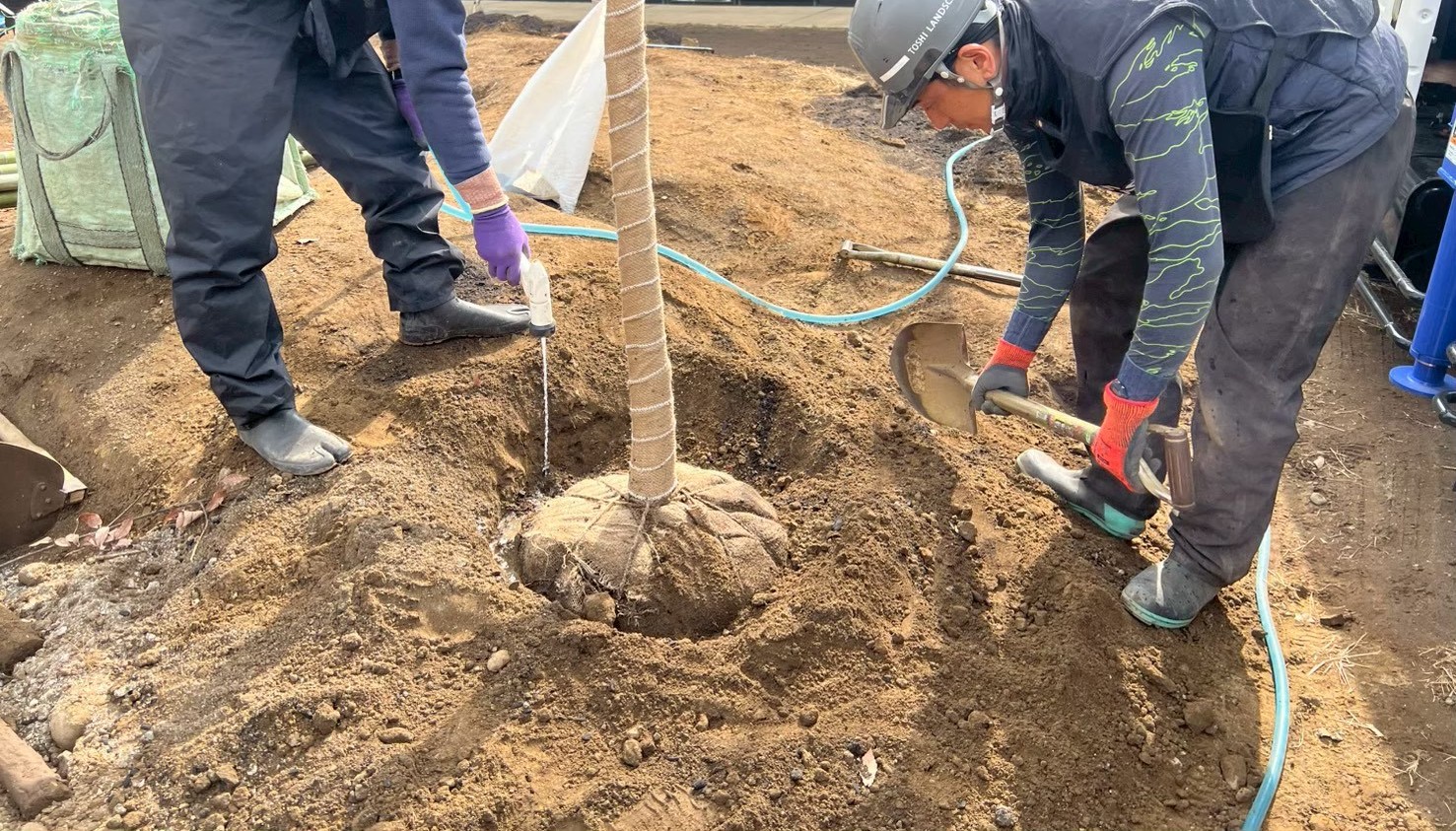
The obvious question is whether the straw really does go away. Uchida Hitoshi and colleagues buried straw, paper, jute sacking and hessian in red soil and in masa (decomposed granite soil) and tracked them, publishing the results in the Journal of the Japanese Institute of Landscape Architecture (ランドスケープ研究, vol. 62, no. 5). After 12 months, the carbon-to-nitrogen ratio of the materials was approaching 10 (埋設12ケ月でC/N比が10に近づく傾向), a sign that decomposition was well advanced.
That is not the same as saying the material had vanished after a year. The study reports decomposition by this measure, not total disappearance.
Did it hurt the trees?
In a separate study (same journal, vol. 61, no. 5), the same group planted deciduous trees — Kobushi magnolia (Magnolia kobus) and sawtooth oak (Quercus acutissima) — with and without wrapping and with different wrapping materials. Twenty-eight months after transplanting, they found no effect on growth or rooting from either the presence of wrapping or the choice of material (生育と発根状況には影響がない). The wrapping materials had lost about 69–88% of their weight (重量分解率が69~88%程度).
Two deciduous species, the tested conditions, 28 months: this is a specific result and should not be stretched to every tree in every climate. Under those conditions, the wrapping left in the ground showed no effect on growth or rooting.
Cold ground is different
The picture changes in cold regions. The Civil Engineering Research Institute for Cold Region, in its technical guidance on road planting in Hokkaido (2020), names slow decomposition of wrapping in cold climates as a problem. Its guidance is that, in principle, the wrapping should be removed before the tree is set in place (根巻材をはずして立て込むことを原則とする). If the ball would fall apart, the tree is set first and the sides of the wrapping are cut open afterwards.
So even within Japan, the guidance on leaving wrap in the ground depends on the region. For Hokkaido, the Civil Engineering Research Institute for Cold Region recommends taking it off in principle.
Burlap and wire — the Western root ball
What the American standard asks for
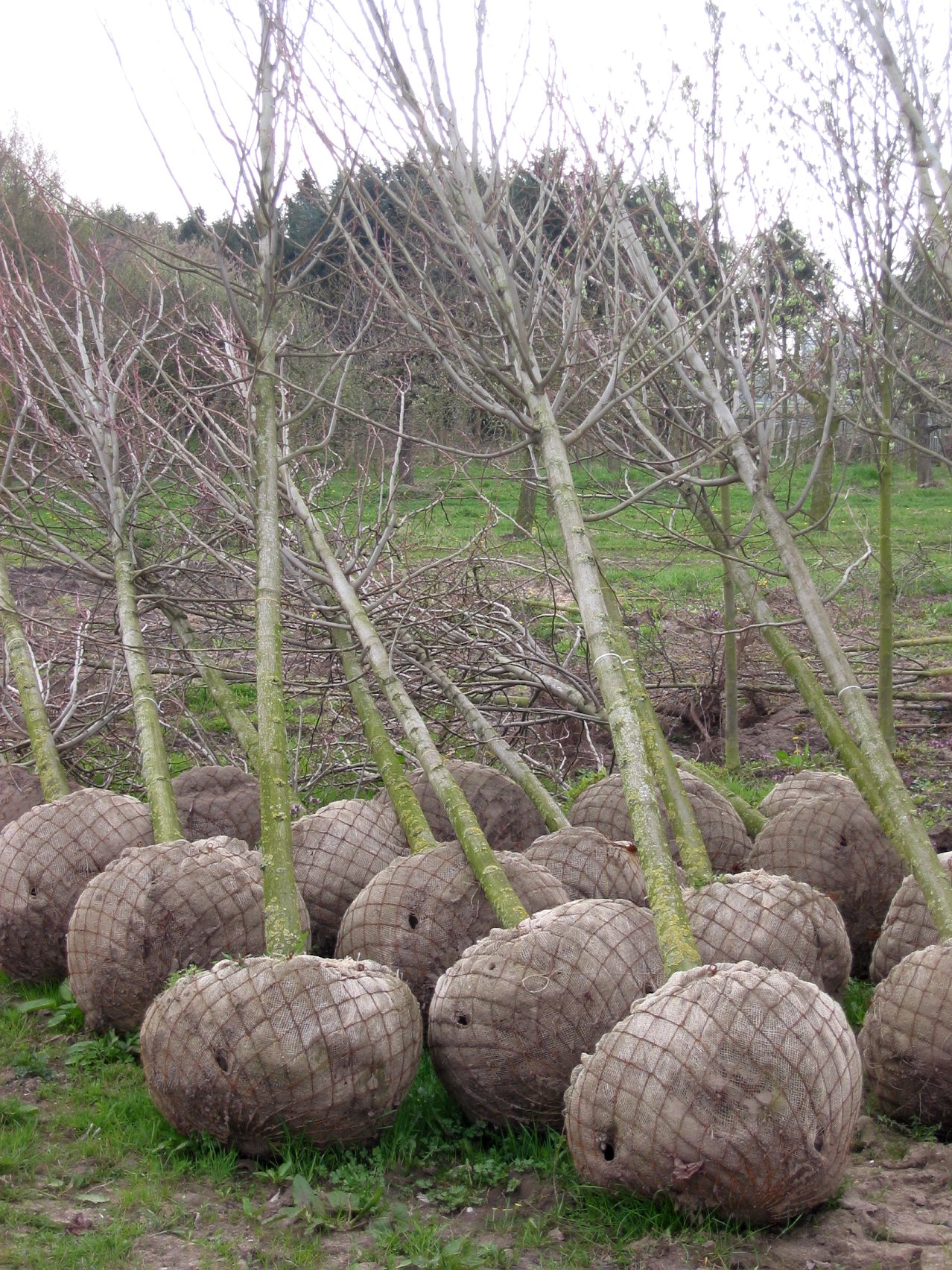
In North America, a common nursery form is the balled-and-burlapped (B&B) tree. The American Standard for Nursery Stock sets minimum ball diameters by caliper. For Type 1 shade trees, Table 3 of the 2014 edition (ANSI Z60.1-2014) gives the following, and the current edition carries the same three sizes:
| Caliper | Minimum ball diameter (ANSI Table 3, shade trees) |
|---|---|
| 2 in (5 cm) | 24 in (61 cm) |
| 3 in (7.6 cm) | 32 in (81 cm) |
| 4 in (10 cm) | 42 in (107 cm) |
The current edition, published in 2025 as ANSI Z60.2-2025, keeps those sizes and the same rule on materials. The standard requires that burlap and similar ball coverings “shall be biodegradable”, and that where a wire basket or similar support is used, it keeps the ball in a “firm, rigid condition”.
The wording of the documents differs. The Japanese texts quoted above talk about tightening soil with rope. The American standard, where a basket is used, talks about keeping the ball firm and rigid.
“Burlap” does not always mean jute
University of Maine Cooperative Extension warns that B&B wrapping can be “either natural jute or plastic”. A grower or buyer cannot assume that anything called burlap is a natural fibre. Natural hessian treated with a preservative is a third case. Kuhns and Sydnor, in a 1976 paper in the Journal of the American Society for Horticultural Science, found that copper compounds “retarded its deterioration in soil”. At 24 °C, burlap treated with copper sulphate kept useful strength for an average of 27 weeks, and burlap treated with copper naphthenate for between 8 and 72 weeks. Those are figures for how long the cloth stayed strong, not how long it took to disappear.
What the British standard asks
In the UK, the equivalent form is the rootballed tree. BS 8545:2014, Trees: from nursery to independence in the landscape, in a section reproduced with BSI’s permission by Cambridge City Council, says that any wire or rope fixed around the stem must be removed before planting. It adds: “Remove the wire cage where practicable.” Where that is not practicable, the planter should “peel back the wire cage and hessian” inside the planting pit. BSI now lists the current edition as BS 8545:2014+A1:2026; the wording quoted here is from the 2014 text.
At the planting hole — what comes off
What three North American institutions advise
Purdue University’s plant-diagnostics team (2021) advises removing the twine at the top and removing “the wire and burlap 1/3 to ½ way down the root ball”, leaving the lower part so the ball does not collapse. The Morton Arboretum tells planters to set the ball in the hole and then “remove twine and cut away as much burlap as possible” and “remove as much wire as possible”. The University of Florida’s IFAS Extension says that synthetic wrapping and twine should all be removed, because “it will not break down and can girdle the roots in the future”.
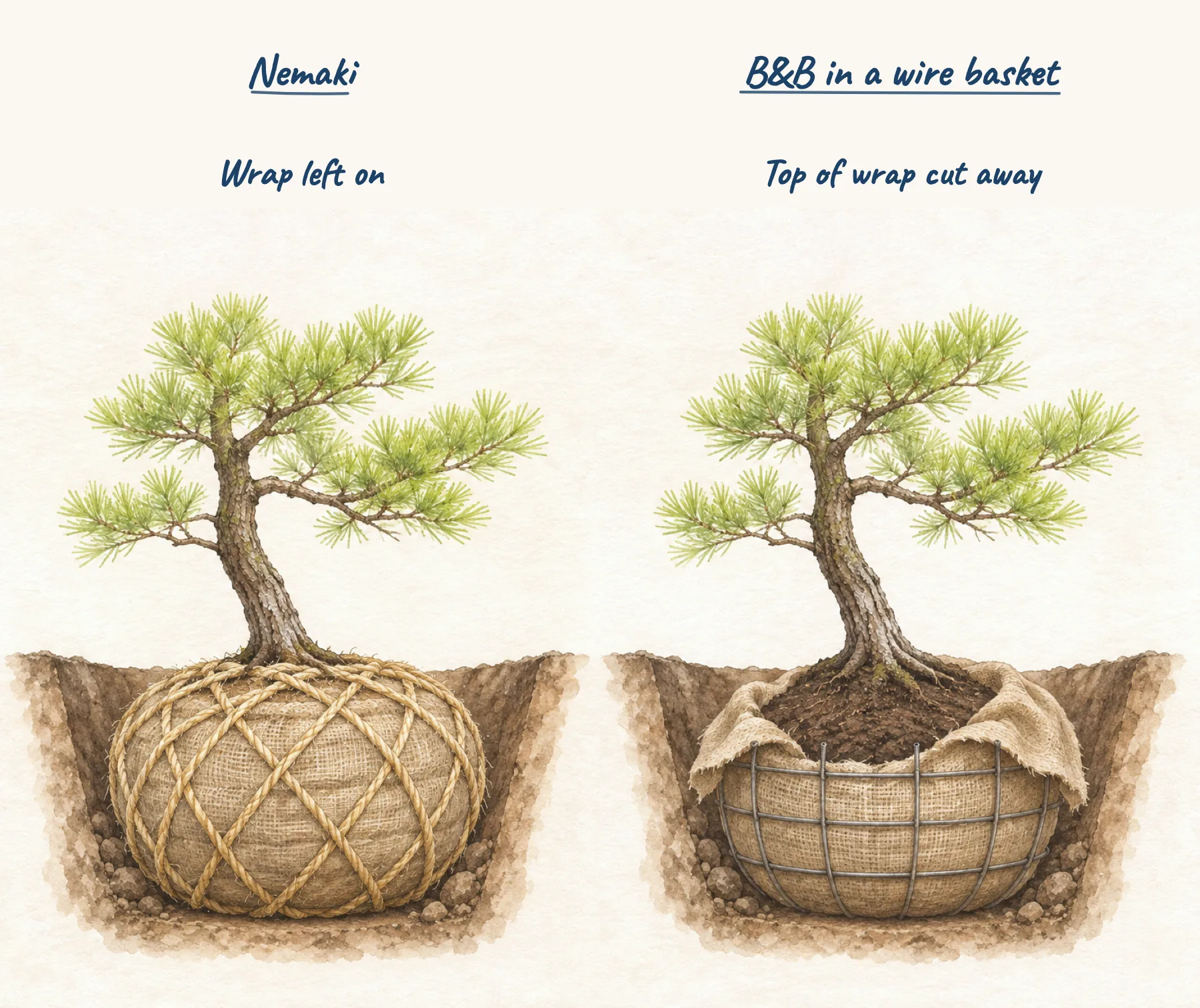
Side by side
| Japan | North America | UK | |
|---|---|---|---|
| Wrapping named in the documents | Straw rope, straw mats (MLIT 2025, Tokyo 2022) | Burlap, which may be jute or plastic (Univ. of Maine) | Hessian (BS 8545:2014) |
| Rigid support | None in the clauses quoted | Where a wire basket is used, it keeps the ball “firm, rigid” (ANSI) | Wire cage, where fitted (BS 8545:2014) |
| Material rule | Non-decaying material must be removed (Kagoshima) | Ball covering “shall be biodegradable” (ANSI) | — |
| At planting | Wrap removed in principle in cold regions (Hokkaido guidance) | Remove wire and burlap 1/3 to ½ down (Purdue); as much as possible (Morton); all synthetic wrap (UF/IFAS) | Remove stem ties; remove cage where practicable, else peel back |
Neither approach is simply better. Each cell above belongs to a specific document, and the advice at the planting hole follows the reasons each source gives: synthetic material that does not break down, the risk of girdling, and keeping the ball from collapsing.
The wire question — what the research shows
When roots are squeezed
A common worry is that a wire left in the ground will strangle the roots. Goodwin and Lumis, in a 1992 paper in the Journal of Arboriculture, tested this by binding roots tightly with wire. Full girdling “significantly reduced foliage dry weight in Fraxinus and the rate of transpiration in Fraxinus and Celtis” — that is, in ash and hackberry.
That is a test of deliberate girdling, not of a basket left in a planting hole.
When baskets are left in the hole
Koeser and colleagues, in Arboriculture & Urban Forestry in 2015, planted Norway maple and honey locust with the wire basket fully removed, partly removed, or left in place. Over two to three years, the treatment “had limited impact on tree caliper, twig elongation, or chlorophyll fluorescence”.
Put these two papers together and you get a careful answer: full wire girdling reduced foliage dry weight and transpiration in the trees tested; baskets left in the ground showed limited effect in the first few years for those two species. Neither paper shows that a basket is always fatal or always harmless over the tree’s life. The Japanese clauses quoted in this article specify rope and straw mats, and do not call for steel in the ball.
Where straw is not the whole answer
Season and leaf type
At least one Japanese specification treats evergreens and deciduous trees differently. The MLIT airport specification asks for larger balls for deciduous trees (6 × root-collar diameter or more) than for evergreens (5 × or more). It also says that evergreens are wrapped with rope or straw mats, while the roots of deciduous trees are covered with wet straw mats.
Timing differs too. Osaka Prefecture’s guidance on transplanting seasons gives, as local guide figures, late October to early December for deciduous trees after leaf fall; late March to early April, or early June to early July, for evergreen broadleaves; and late February to late April for conifers. Those windows apply to Osaka’s climate, not to all of Japan.
Biodegradable fabrics
Manufactured biodegradable materials have also been tried. The Japan Nurserymen’s Association (日本植木協会) has published a report by Hiroharu Kumashiro on trials of below-ground containers made from biodegradable non-woven fabric, including large trees whose root balls were wrapped in that fabric while they were being grown on (生分解性不織布を使用して根巻き養生した大径木). No study measuring how long biodegradable root-ball netting takes to break down in the soil, or how freely roots pass through it, was found for this article.
Edo-period sources
Japanese papers on root-wrapping materials refer back to older cultivation books such as Shuju Hiyō (種樹秘要) by Satō Nobuhiro. A library catalogue records a self-preface dated Bunka 6 (1809), and the National Diet Library holds an edition dated July 1885. The text of that book has not been checked for this article, so no claim is made about what it says on root-ball wrapping.
Common misunderstandings
“Nemaki is just a Japanese name for B&B”
The materials can look similar, but the documents describe different things. Nemaki is defined in Japanese standards as binding the soil, and the named wraps — taru-maki, age-maki and their variants — describe how rope is laid to compress a ball that is still being dug. B&B in the ANSI standard describes a covered ball held rigid, with a wire basket where one is used.
“Straw rope disappears in a few months”
The Japanese research does not say this. In the burial study, decomposition was well advanced by the carbon-to-nitrogen measure after 12 months. In the separate transplanting study, the materials had lost roughly 69–88% of their weight after 28 months. In Hokkaido, the guidance is to remove the wrap in principle.
“Any burlap is natural and safe to leave”
University of Maine Extension warns that burlap can be plastic. In the Kuhns and Sydnor study, copper treatment slowed the deterioration of natural burlap in soil, measured as how long it kept useful strength.
“Japan has one fixed rule for ball size”
It does not. The ratios differ by document — 3–5, 4–5, 5 or more, 6 or more times the root-collar diameter — and the national building specification only asks for a size suited to the tree.
“Leaving a wire basket always kills the tree”
The research does not support that, nor the reverse. Full wire girdling reduced foliage dry weight and transpiration in ash. Baskets left in place had limited effect over two to three years in maple and honey locust.
What this means if you plant Japanese-grown trees, or train Japanese-style
If you work outside Japan and want to apply the idea, the transferable part is not the straw. It is the order of work and the question behind the material:
- Size the ball from the trunk, and shape it to the roots — shallow, ordinary or deep.
- Recut the roots exposed on the ball face before wrapping.
- For a comparatively large ball, bind the sides from the top down before undercutting. A small ball (about 45 cm or less) can be lifted first and wrapped afterwards.
- Choose the age-maki (base wrap) variant by ball size and root density.
- Protect the ball against damage, collapse and drying, and move it to the new site without delay, as MLIT’s building specification requires (直ちに移植場所に運搬する).
- At planting, remove anything that will not decay, such as plastic, and ties around the stem. For wire and the rest of the wrapping, follow your local standard and climate.
For how Japanese garden trees are shaped once they are planted, see Niwaki vs Topiary: What Western Gardens Get Wrong and Karikomi, the Japanese art of cloud pruning. For the conditions trees face in Japanese streets, see why Japanese street trees are so small, and for wind, typhoon-proofing trees in Japan.
Frequently asked questions
What is nemaki?
Nemaki (根巻き) is Japanese root-ball wrapping. A tree is dug with its soil attached, and the surface of the ball is bound firmly with rope or other materials so the soil stays in contact with the roots during lifting and transport.
Why do Japanese gardeners use straw rope instead of wire baskets?
Japanese public specifications ask for a firm binding with straw rope and straw mats, and Japanese technical writing asks that the material be strong enough for transport and then decompose in the soil. The clauses quoted here do not call for a rigid wire structure.
Do you remove straw rope when planting?
Under Kagoshima Prefecture’s specification, non-decaying material such as vinyl must be removed. In Hokkaido, the Civil Engineering Research Institute for Cold Region advises removing the wrapping in principle, because it breaks down slowly in cold ground.
How big should a root ball be in Japan?
There is no single national ratio. Specifications range from 3–5 times the root-collar diameter (Kagoshima) to 5 times or more for evergreens and 6 times or more for deciduous trees (MLIT airport specification). The national building specification asks for a size suited to the tree.
Does leaving burlap or a wire basket harm a tree?
It depends on the material. UF/IFAS Extension says synthetic wrapping will not break down and can girdle roots. Full wire girdling reduced foliage dry weight and transpiration in a 1992 study, while a 2015 study found limited effect from baskets left in place over two to three years in two species. Purdue advises removing the wire and burlap from the top third to half of the ball.
Is nemaki the same as nemawashi?
No. Nemawashi (根回し) is root preparation done before transplanting, to grow new fine roots inside the future ball. Nemaki is the wrapping done when the ball is dug for transport.
Sources
– MLIT, quality and size standards for public planting stock (draft), 1996 notice — definitions of root ball and nemaki (Japanese; checked 2026-11-17): https://www.mlit.go.jp/notice/noticedata/sgml/035/76000224/76000224.html – Japan Greenery Research and Development Center, commentary on public planting stock standards, p. 27 (Japanese; checked 2026-11-17): https://www.jpgreen.or.jp/book/books/koukyouyou_2.pdf – Japanese Institute of Landscape Architecture, Japanese Garden Research Promotion Committee, report for fiscal year 2024, item 093 “Root-ball digging”, p. 172 (Japanese; checked 2026-11-17): https://researchpromotion.jila-zouen.org/wp-content/uploads/2025/05/2024_nihonteien_seikahoukoku.pdf – MLIT, Standard Specifications for Public Building Works (Building Works), 2025 edition, 23.3.5 (Japanese; checked 2026-11-17): https://www.mlit.go.jp/gobuild/content/001888816.pdf – MLIT, Common Specifications for Park and Green Space Works, May 2024, 2-4-3 and 2-4-4 (Japanese; checked 2026-11-17): https://www.mlit.go.jp/toshi/park/content/001742862.pdf – Tokyo Metropolitan Government, Civil Works Standard Specifications, 2022 edition, 4.4.5 (Japanese; checked 2026-11-17): https://www.zaimu.metro.tokyo.lg.jp/kentikuhozen/eizen/04dobokuhyoujyun.pdf – Kagoshima Prefecture, Common Specifications for Planting Works, 2010 (Japanese; checked 2026-11-17): https://www.pref.kagoshima.jp/ah03/infra/kokyo/gizyutu/siyousyo/documents/syokusai.pdf – MLIT Kyushu Regional Development Bureau, 2010 reference material, landscape works (Japanese; checked 2026-11-17): https://www.qsr.mlit.go.jp/s_top/h22doboku/common/1-04.pdf – MLIT, Common Specifications for Airport Civil Works, 2025 revision comparison table (Japanese; checked 2026-11-17): https://www.mlit.go.jp/koku/content/001880341.pdf – Taisai Hori, technical course, Tree and Forest Health (樹木医学研究) 12(3): 150–156 (Japanese; checked 2026-11-17): https://www.jstage.jst.go.jp/article/treeforesthealth/12/3/12_KJ00006259322/_pdf/-char/ja – Uchida H. et al., basic properties and decomposition of root-wrapping materials, Journal of the Japanese Institute of Landscape Architecture 62(5): 511–516 (Japanese; checked 2026-11-17): https://www.jstage.jst.go.jp/article/jila1994/62/5/62_5_511/_article/-char/ja – Uchida H. et al., effects of root wrapping and wrapping materials on growth and rooting of deciduous trees, Journal of the Japanese Institute of Landscape Architecture 61(5): 487–492 (Japanese; checked 2026-11-17): https://www.jstage.jst.go.jp/article/jila1994/61/5/61_5_487/_article/-char/ja – Civil Engineering Research Institute for Cold Region, technical guidance on road greening in Hokkaido (draft), 2020, chapter 4 (Japanese; checked 2026-11-17): https://scenic.ceri.go.jp/pdf_manual/greenery/greenery_04planting.pdf – Japan Nurserymen’s Association, report on biodegradable containers (Japanese; checked 2026-11-17): https://www.ueki.or.jp/index.php?catid=130&itemid=509 – MAFF, rice-farming reference materials, straw and husk generation (Japanese; checked 2026-11-17): https://www.maff.go.jp/j/syouan/keikaku/soukatu/attach/pdf/inasaku-211.pdf – MAFF, feed situation report, June 2026 (Japanese; checked 2026-11-17): https://www.maff.go.jp/j/chikusan/sinko/lin/l_siryo/attach/pdf/index-1552.pdf – Osaka Prefecture, transplanting seasons (Japanese; checked 2026-11-17): https://www.pref.osaka.lg.jp/o130140/koen/fuuchi/fuuri_sannkou.html – ANSI Z60.1-2014, Table 3 and 1.5.4–1.5.5 — the public copy checked during research (City of Bowling Green, Ohio) no longer resolves; the same sizes and material rule appear in the 2025 edition below – ANSI Z60.2-2025, American Standard for Nursery Stock, published by AmericanHort — sections 1.5.4–1.5.5 and Table 3 (checked 2026-11-17): https://americanhort.org/wp-content/uploads/2026/02/nursery-stock-standards.pdf – University of Maine Cooperative Extension, Bulletin 2366 (checked 2026-11-17): https://extension.umaine.edu/publications/2366e/ – Purdue University, “The Wire Basket Conundrum”, 2021 (checked 2026-11-17): https://ag.purdue.edu/department/btny/ppdl/potw-dept-folder/2021/wire-basket-conundrum.html – The Morton Arboretum, How to plant trees (checked 2026-11-17): https://mortonarb.org/plant-and-protect/tree-plant-care/plant-care-resources/how-to-plant-trees/ – UF/IFAS Extension, Avoid future tree blow-overs, 2017 (checked 2026-11-17): https://blogs.ifas.ufl.edu/charlotteco/2017/09/20/avoid-future-tree-blow-overs/ – Kuhns L.J. and Sydnor T.D., Copper compounds influence deterioration of burlap in soil, JASHS 101(1), 1976 (checked 2026-11-17): https://journals.ashs.org/downloadpdf/view/journals/jashs/101/1/article-p84.pdf – Goodwin C. and Lumis G., Journal of Arboriculture 18(3), 1992 (checked 2026-11-17): https://joa.isa-arbor.com/article_detail.asp?ArticleID=2497&IssueID=3&JournalID=1&VolumeID=18 – Koeser A.K. et al., Arboriculture & Urban Forestry 41(1), 2015 (checked 2026-11-17): https://joa.isa-arbor.com/article_detail.asp?ArticleID=3346&IssueID=1&JournalID=1&VolumeID=41 – Cambridge City Council, Framework for Arboricultural Services, Appendix 5A (BS 8545:2014 extract reproduced with BSI permission), p. 85 (checked 2026-11-17): https://www.cambridge.gov.uk/media/hftpfxjj/framework-for-arboricultural-services.pdf – BSI, BS 8545:2014+A1:2026 product page (checked 2026-11-17): https://knowledge.bsigroup.com/products/trees-from-nursery-to-independence-in-the-landscape-code-of-practice – National Diet Library, bibliographic record for Shuju Hiyō (Japanese; checked 2026-11-17): https://ndlsearch.ndl.go.jp/books/R100000002-I000000481040 – Tokugawa Institute for Forest History, catalogue of former Hōsa Bunko materials (Japanese; checked 2026-11-17): https://rinseishi.tokugawa.or.jp/image_holder02/kyuu_housa02-mokuroku.pdf