

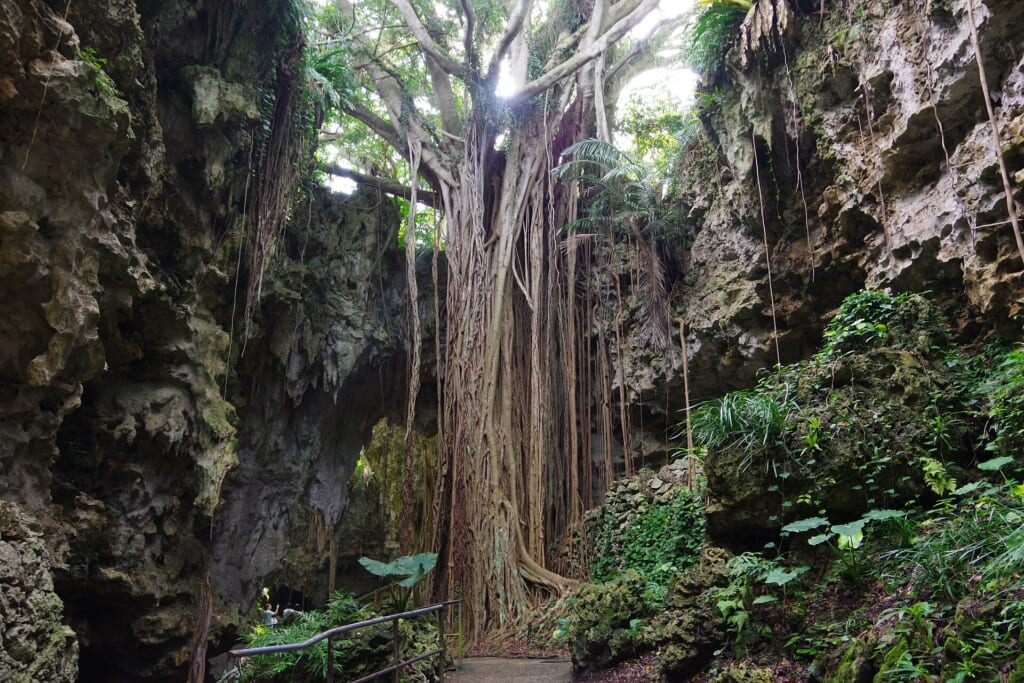
Okinawans say a small red-haired spirit, the Kijimuna, lives in the gajumaru (Ficus microcarpa), Okinawa’s banyan tree. No source checked here fixes when or why the belief began, but Okinawan botanists and researchers offer one explanation: the gajumaru’s strange form and vitality — a fig that can start life in the air, strangle its host, stand on its own roots and grow old hollows — made it a sacred tree. The folk records are clearer about what the Kijimuna does: it fishes, it plays tricks, and it takes revenge when its home is burned.
Under the Gajumaru — A Tree That Stands on Its Own Roots
What you see first
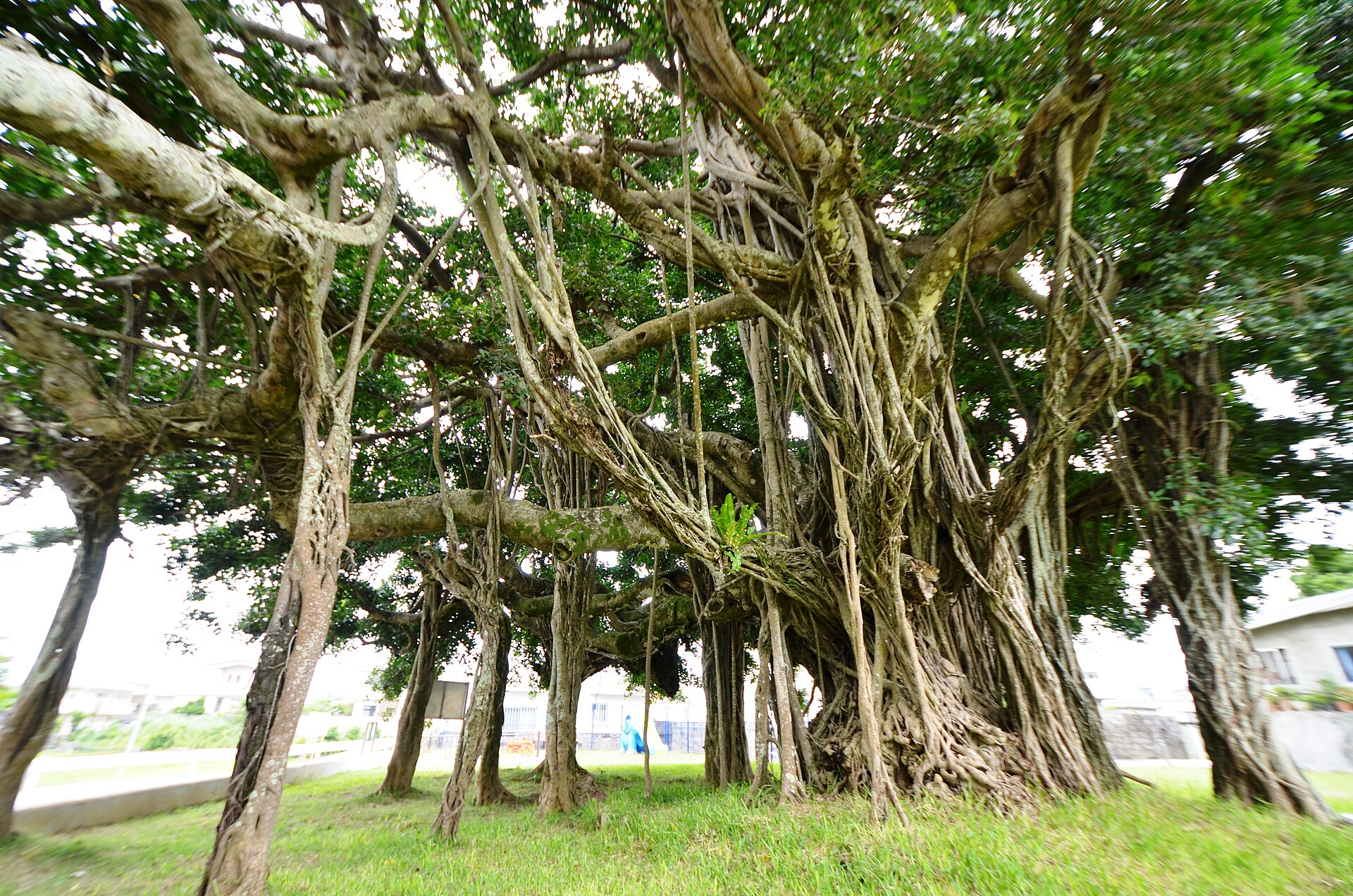
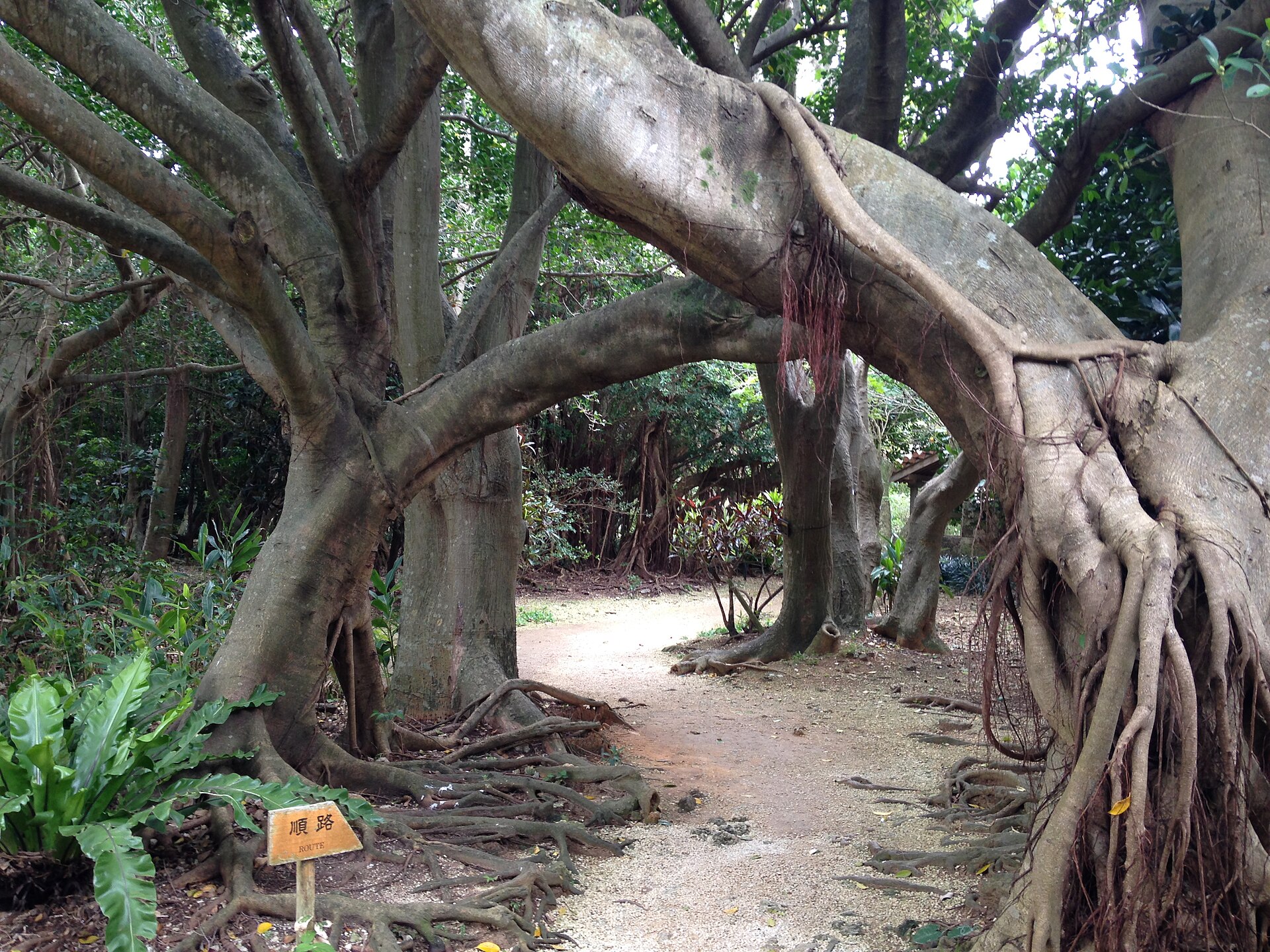
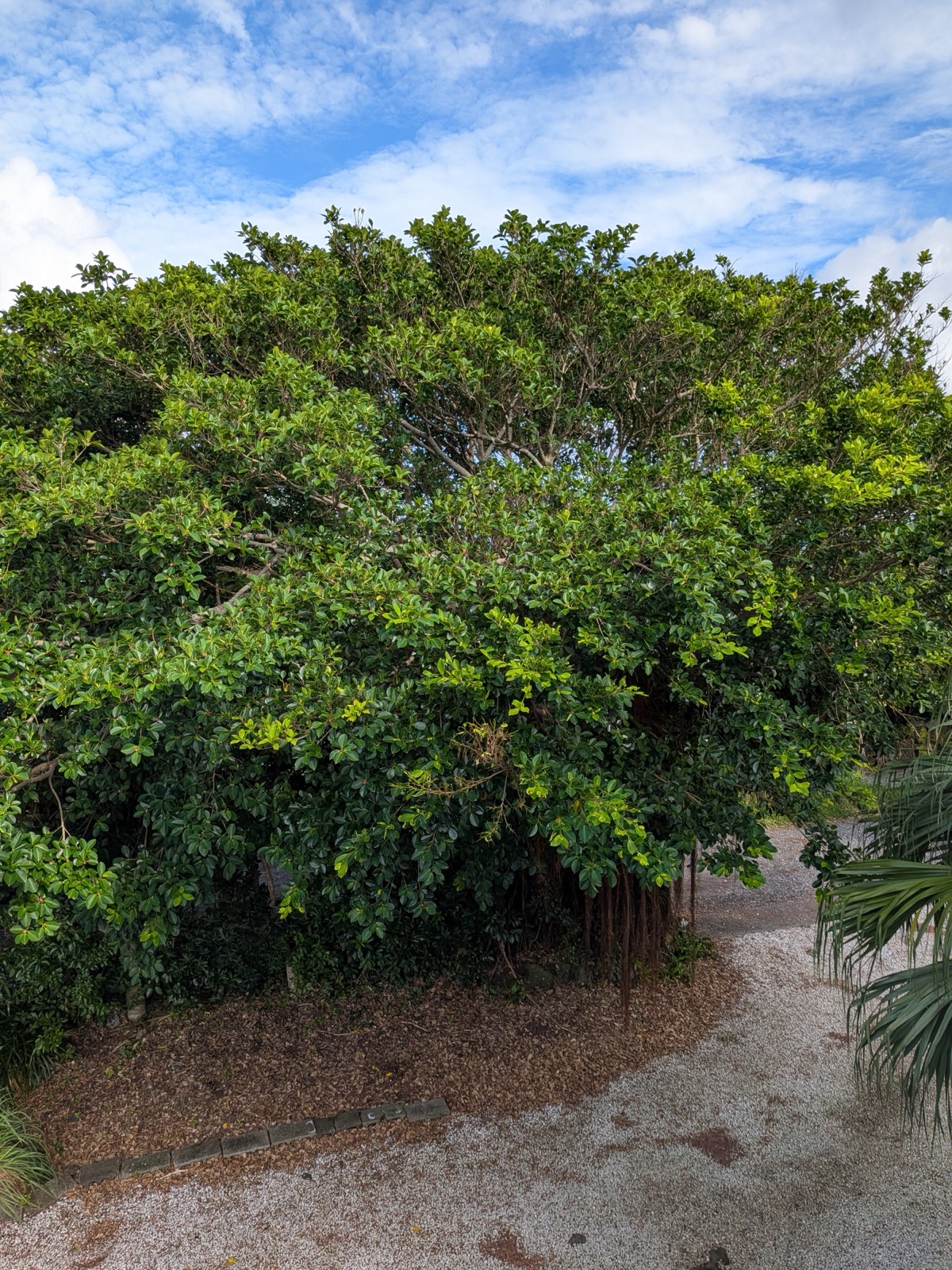
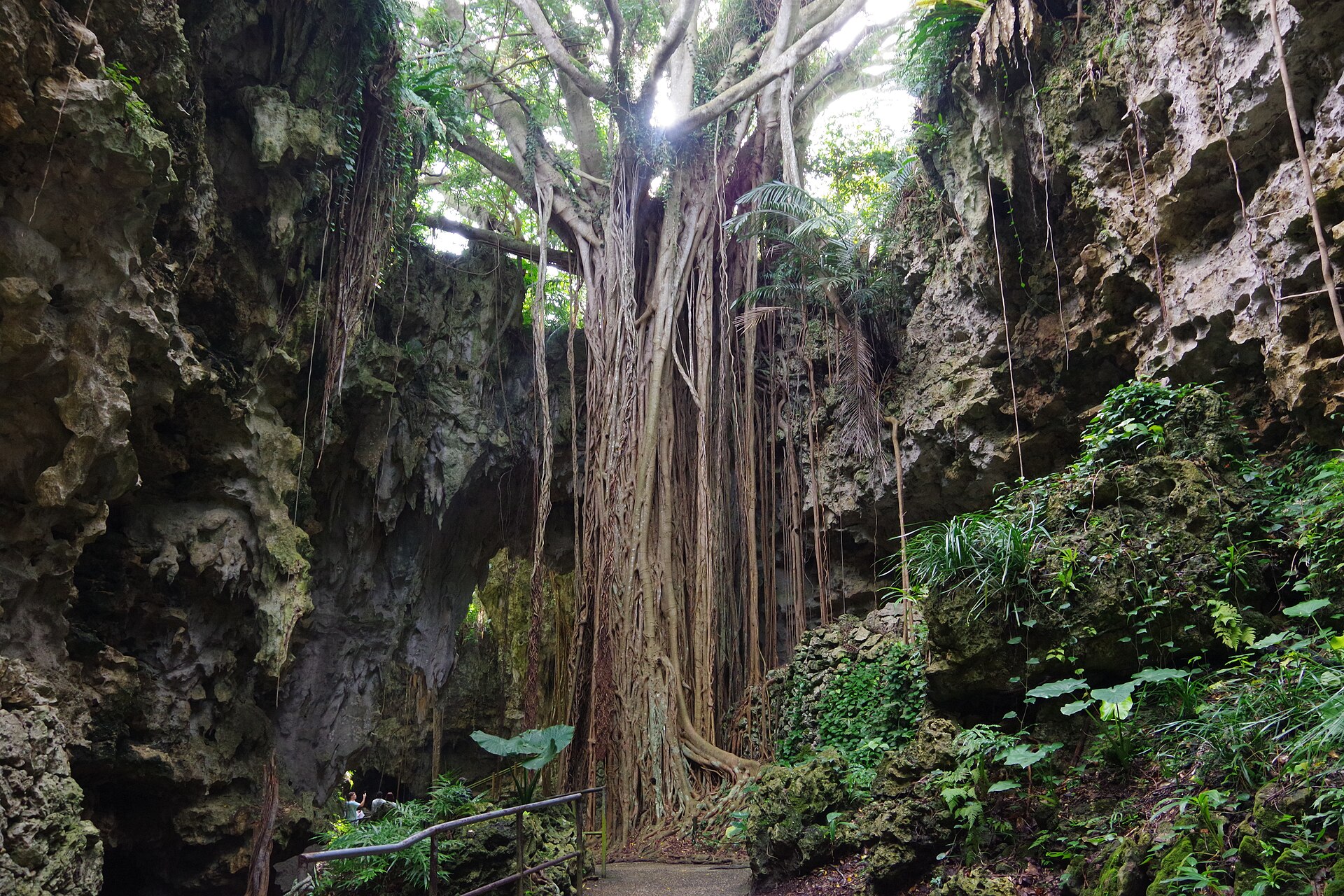
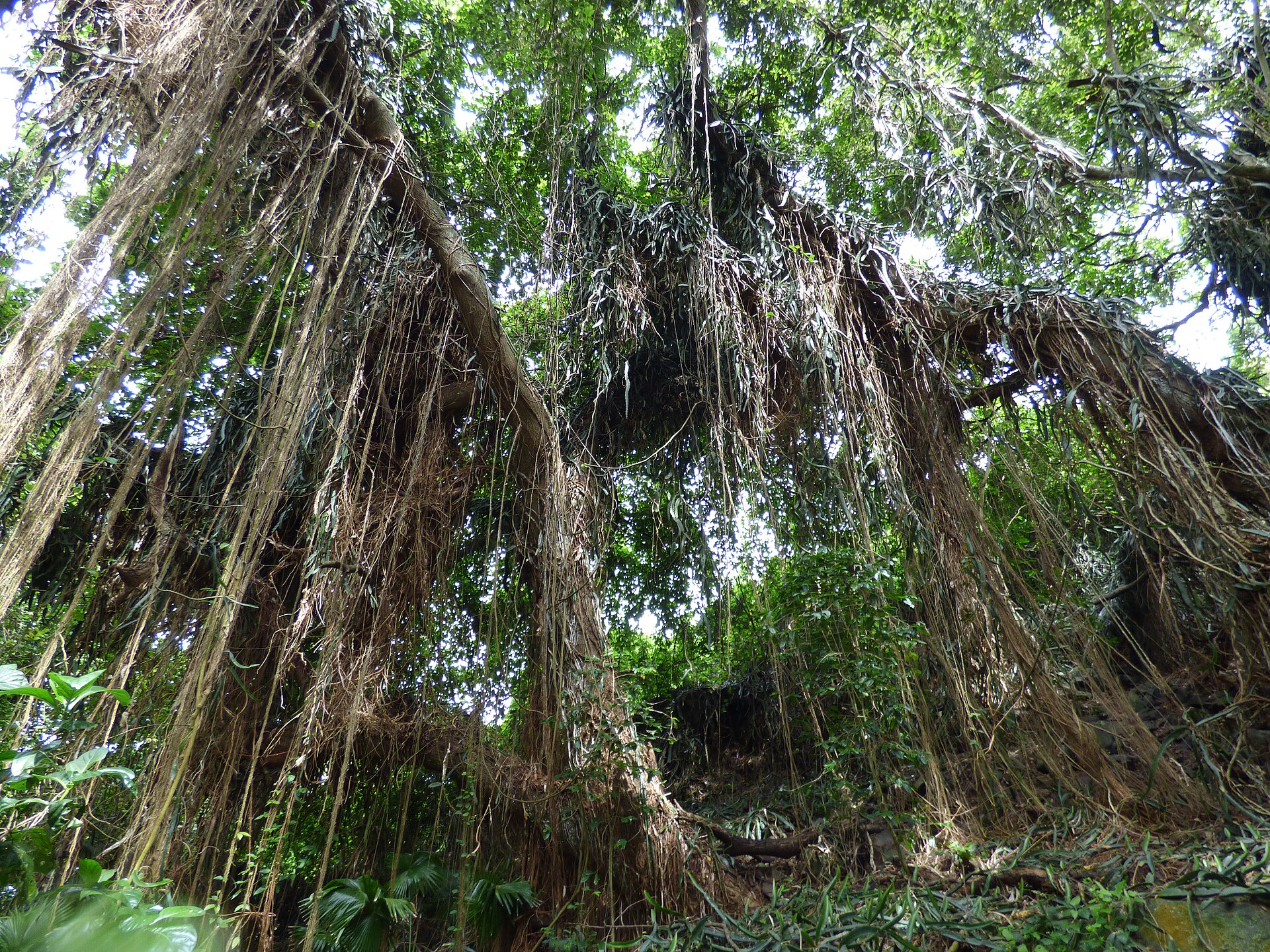
Stand under an old gajumaru and the first thing you lose is the idea of “the trunk”. There are many. Some are thick and grey, some are bundles of rope still twisting together, and some are only threads hanging from the branches, swaying a little above the ground. The crown is a dark, glossy, evergreen roof; under it the light turns green and dim. Pale roots grip stones and creep across paths. It is a single tree, but it reads like a small room built of wood.
Botanists have a plain name for what you are looking at. The Okinawa Prefectural Forest Research Center describes the gajumaru as a tall evergreen tree that hangs aerial roots (“気根を垂れる常緑の高木”). It belongs to the mulberry family, in the fig genus Ficus (クワ科イチジク属), according to the Okinawa Prefectural Museum & Art Museum. In Japan it grows wild from Yakushima and Tanegashima south through the Nansei Islands; abroad its range runs from Taiwan to India and south to Australia, according to Okinawa Prefecture’s biodiversity site. Trees can reach about 20 m (65 ft), says Flower Park Kagoshima.
The tree in the middle of the road
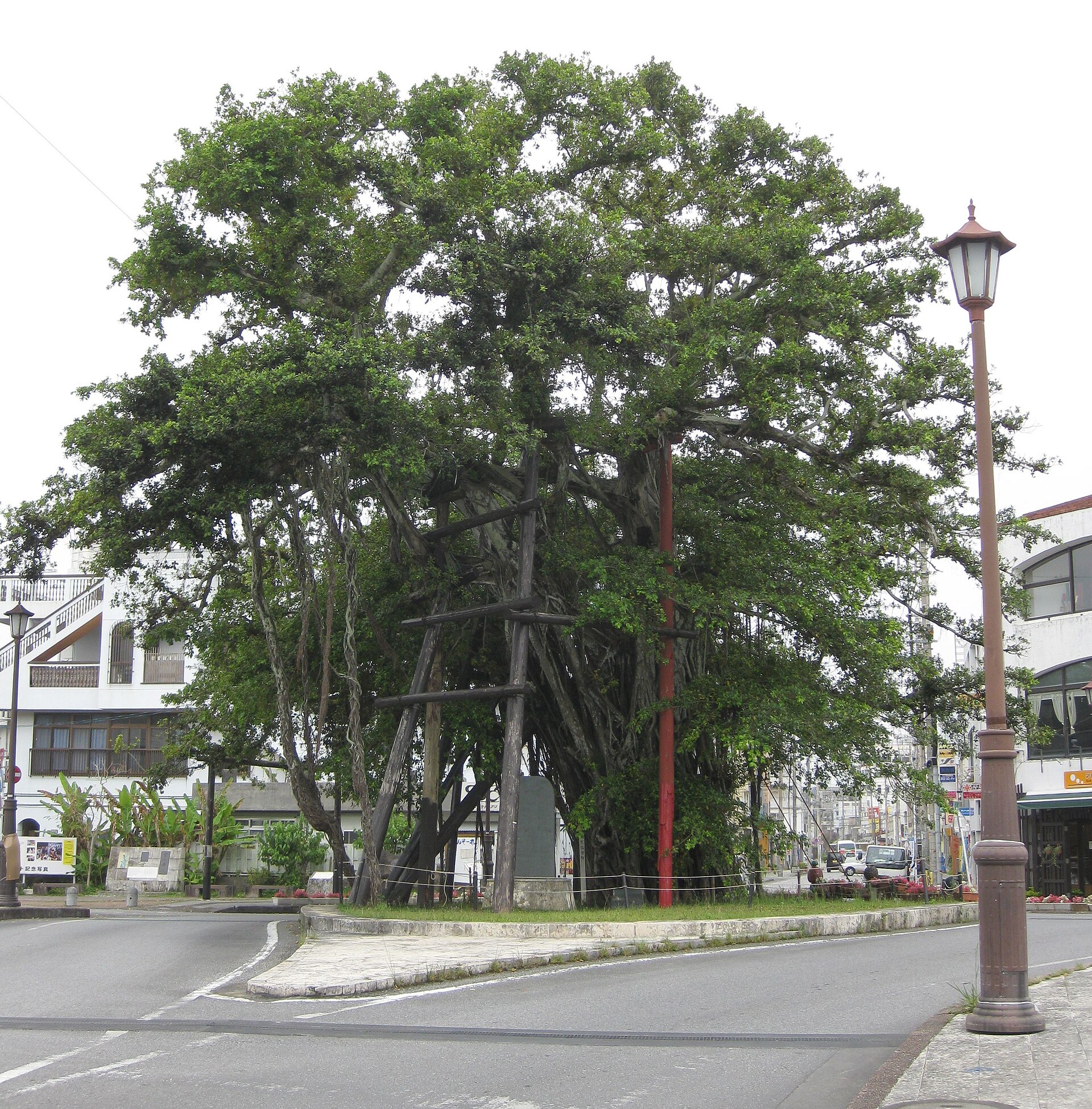
The largest gajumaru known in Japan does not stand in a forest at all. The Hinpun Gajumaru grows on the street in the centre of Nago, in northern Okinawa Island. Japan’s Agency for Cultural Affairs designated it a national natural monument on 2 September 1997. Its official description gives a height of about 19 m (62 ft), a trunk girth at breast height of 10.1 m (33 ft), a crown about 27 m (89 ft) across at its widest, a crown area of about 600 m² (6,500 sq ft), and an estimated age of 240 years at the time of that record.
The name tells you how people saw it. A hinpun (ひんぷん) is the screen wall that stands between the gate and the main house of a traditional Okinawan home: it blocks the view from the street and, in belief, blocks evil spirits. One explanation, which the Agency gives with a careful “it is also said” (ともいわれている), is that a stone monument beside the tree came to be called the “hinpun stone” because of its shape, and locals then called the tree growing there the hinpun gajumaru. The Agency also notes that people have kept the tree as a sacred tree (“神木として大切にされてきた”), that the Nansei Islands are the northern limit of the species (“分布北限地帯”), and that this is the largest gajumaru known today (“現在知られる最大の巨樹”).
A name that may mean “to entangle”
Where does the word gajumaru come from? One explanation, given by Flower Park Kagoshima, links it to an Okinawan word meaning “to entangle” (からまる, karamaru). It is a plausible story for a tree made of tangled roots, but treat it as a theory, not a settled etymology.
How a Gajumaru Strangles — A Fig That Starts Life in the Air
A seed in a fork
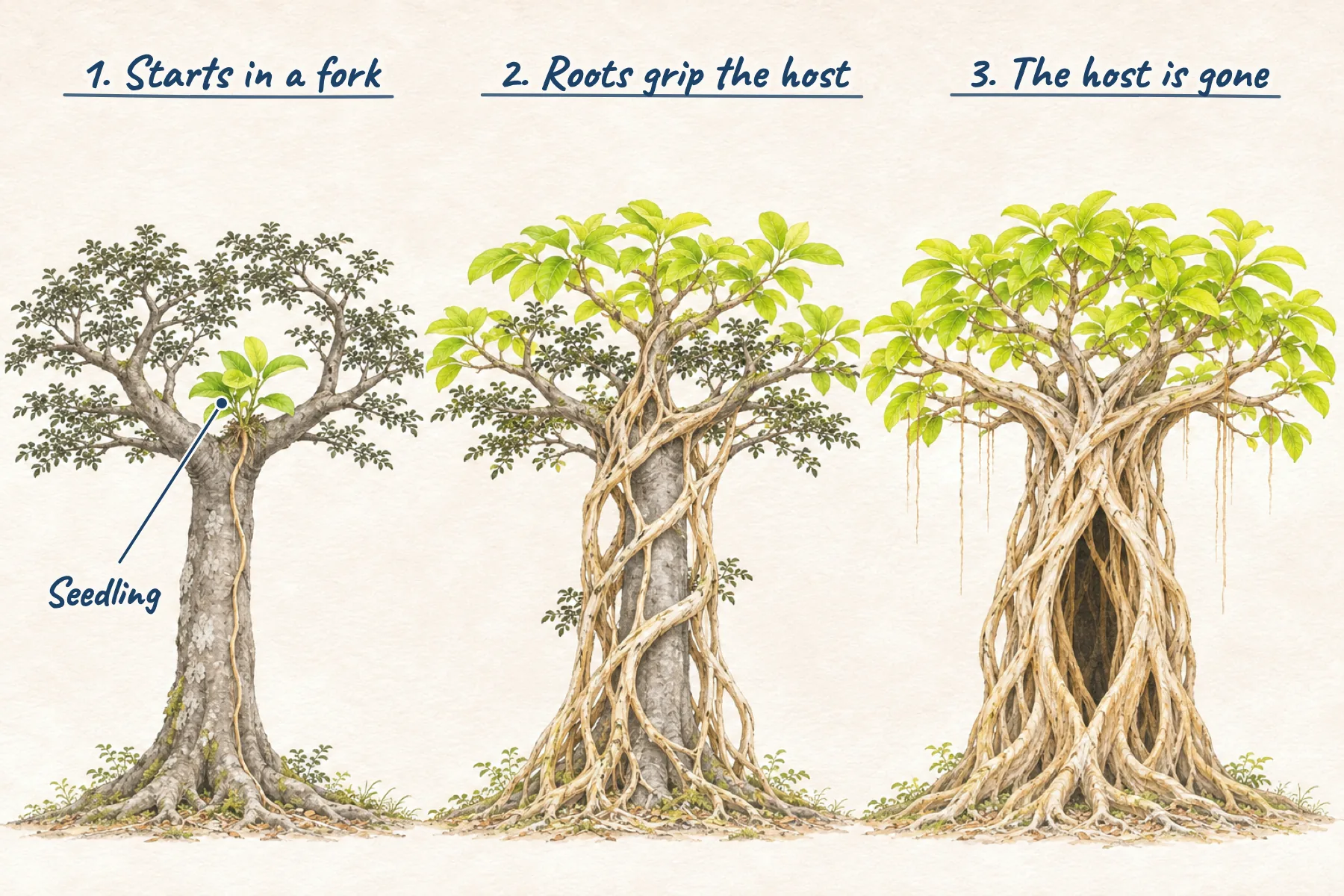
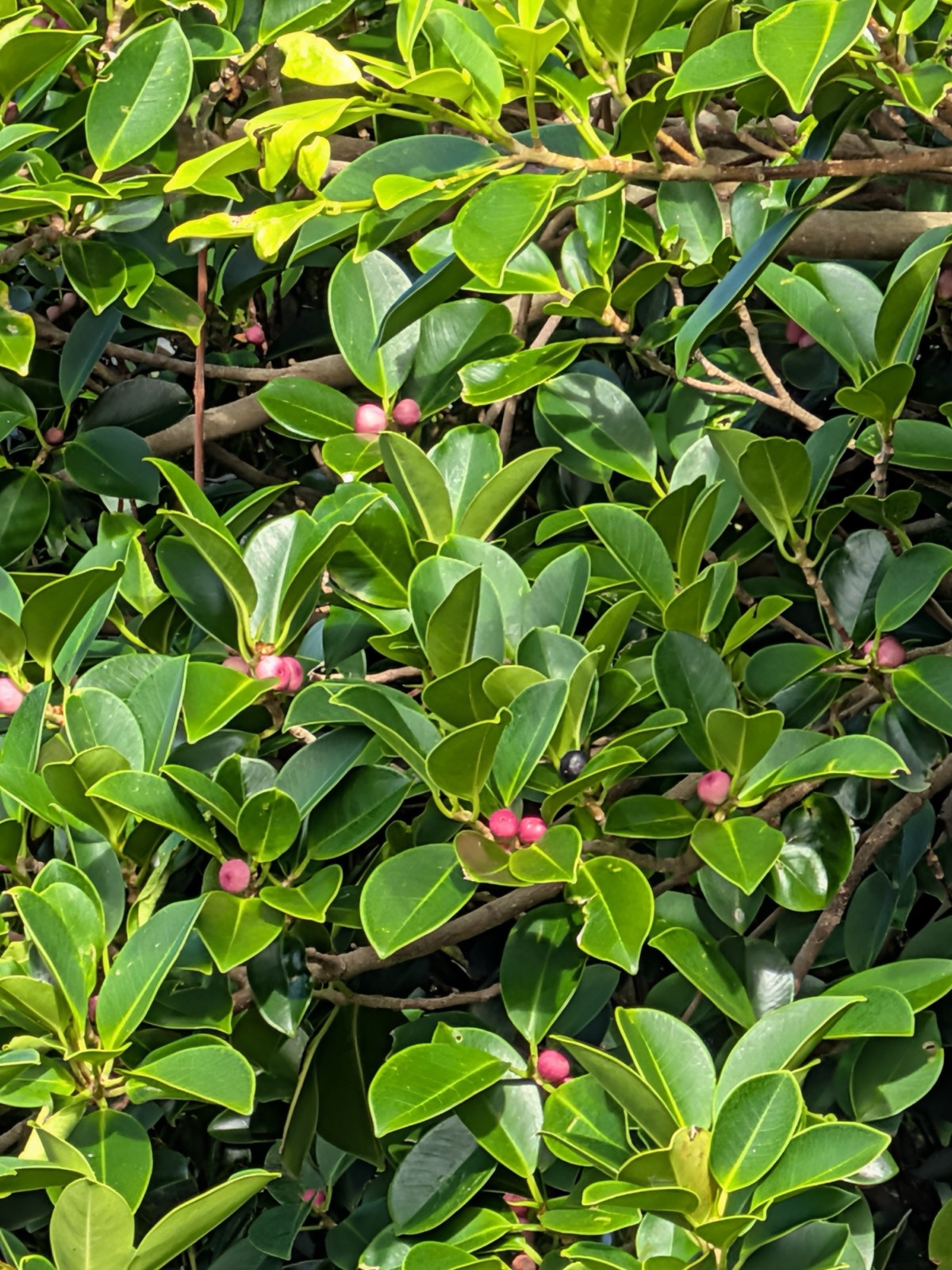
Most trees begin in the soil. A gajumaru can begin in the branches of another tree. Birds eat the small figs and spread the seeds, and the seeds can germinate in the crotches of other trees, according to the University of Hawai’i’s weed-management sheet on the species (“germinate in the crotches of other trees”). Botanists call a plant that starts as an epiphyte and later roots in the ground a hemiepiphyte; a 1991 paper in the American Journal of Botany describes Ficus microcarpa in exactly those terms: “a hemiepiphytic fig”.
In Okinawa the brown-eared bulbul (hiyodori) is recorded eating gajumaru fruit in bird surveys of southern Okinawa Island, in a paper by Nakamura Kazuo published by Okinawa University. Fruit bats eat it too: a study in the journal TROPICS calls Ficus microcarpa “the main food of the Orii’s flying-fox”. The Hawai’i sheet credits birds with spreading the seed; whatever drops it, a seed that lands in a fork has a chance.
Roots down, crown up
Once the seedling has light, it sends roots down the host’s bark to the soil. Above, the fig’s own crown spreads over the host’s. Below, the roots that reached the soil can, in the Hawai’i sheet’s words, “form columnar stems”.
What “strangling” means
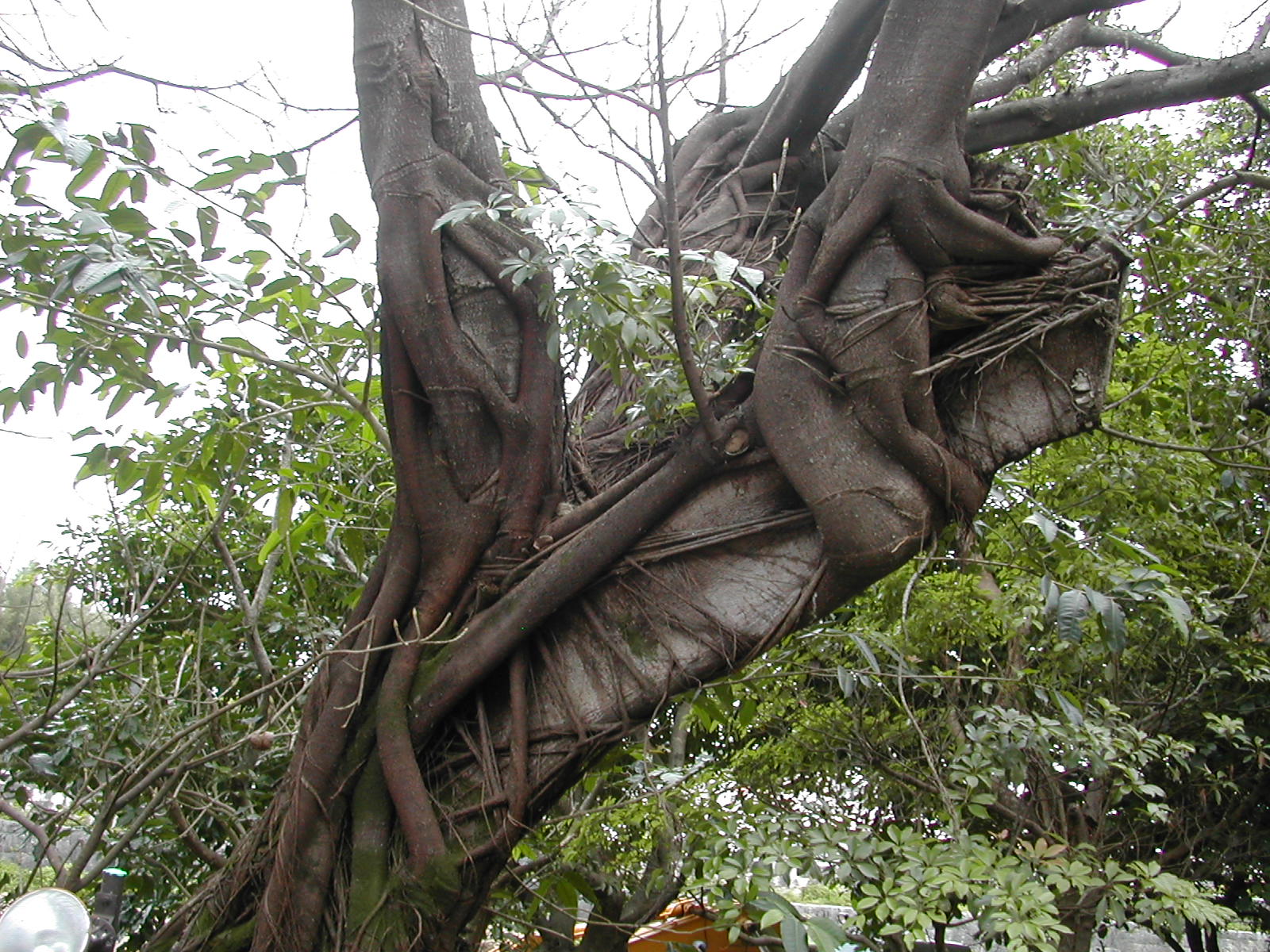
A paper by Shinzato Takakazu and Shiba Masami, published in the University of the Ryukyus repository, says plainly that a gajumaru growing on another tree can strangle its host (“宿主樹木を絞殺する”). The paper uses the word and leaves the details there; I will do the same. What a visitor can see on old strangler figs is the end result: a fig standing on a lattice of roots, sometimes around a gap where something else once stood.
One caution: “strangler” describes what can happen, not what always happens. The Hinpun Gajumaru stands in a town street; the gajumaru in gardens and windbreaks were planted in the ground. Whether a given tree once grew on a host is something only its history, not its name, can tell you.
Aerial Roots Into Pillars — How One Tree Becomes a Grove
From threads to trunks
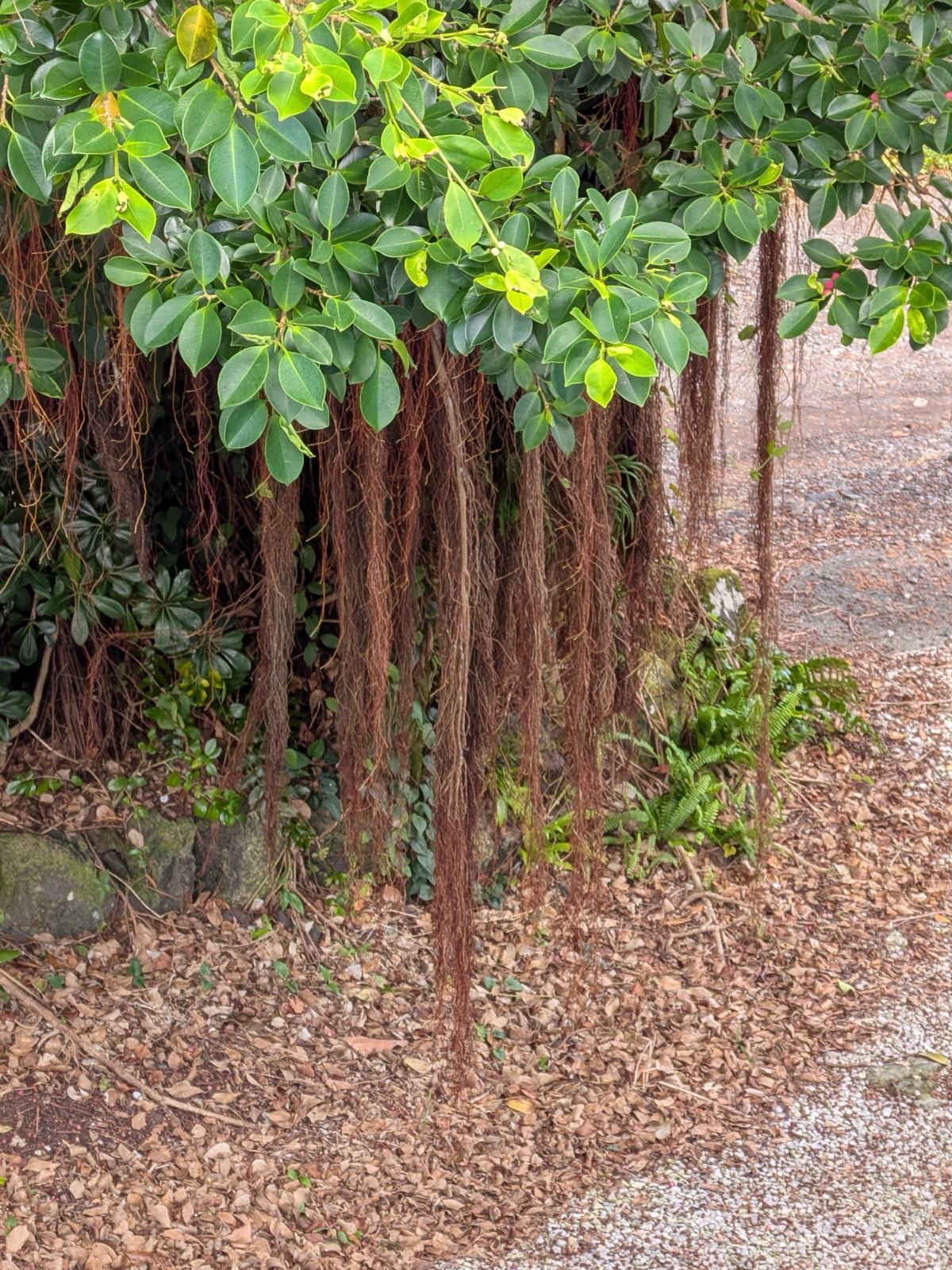
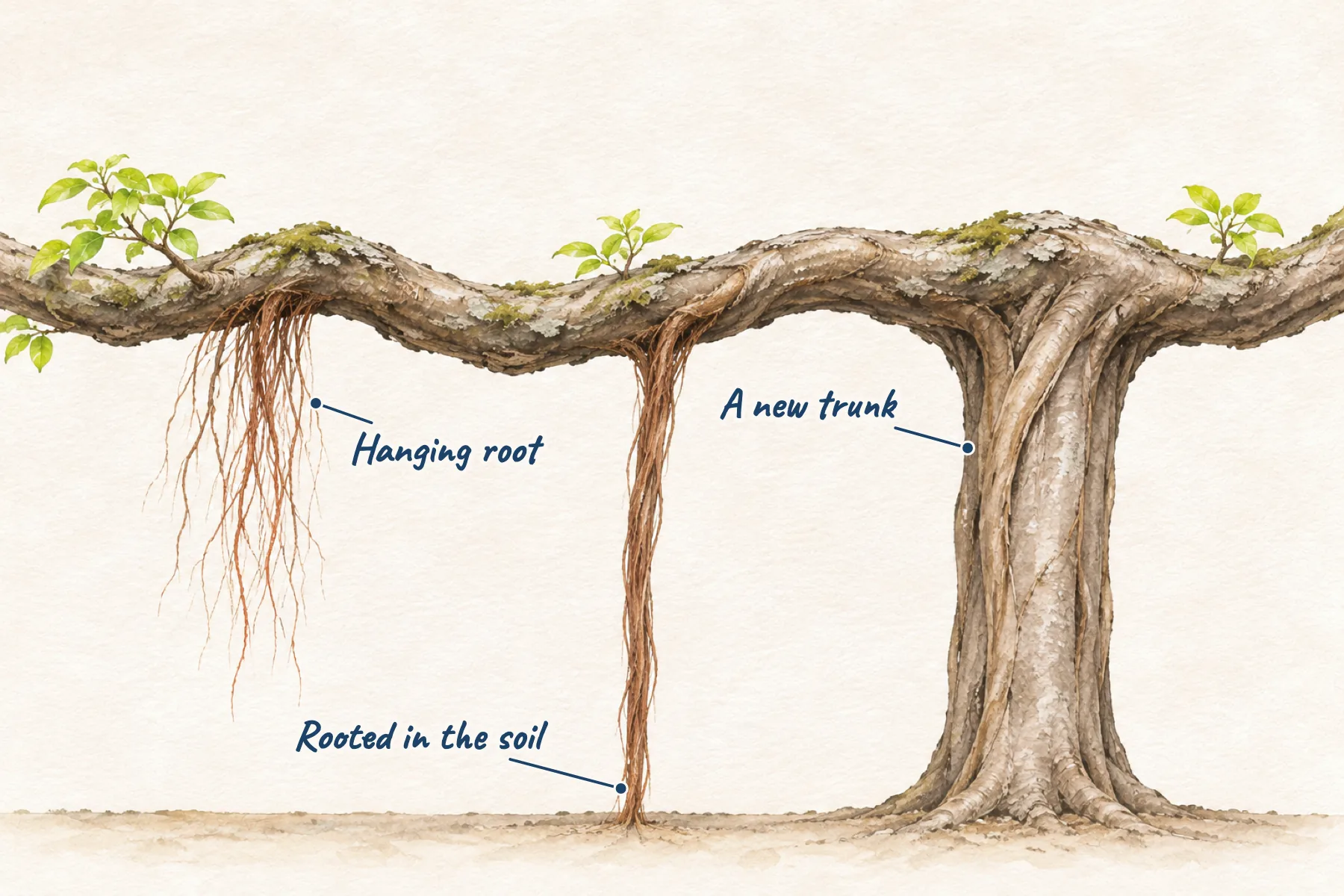
The second trick is the one that makes a single gajumaru look like a grove. Aerial roots hang from the branches. Flower Park Kagoshima puts the next step simply: when a hanging root reaches the ground, it becomes a prop root that holds up the branch (“支柱根となって枝を支えます”). The University of Hawai’i sheet adds that these roots can “form columnar stems” — pillars that look and work like extra trunks.
| Stage | What you see | What it does |
|---|---|---|
| Hanging root | Fine reddish threads, often in bundles, swaying below a branch | Not yet in the soil |
| Rooted | One cord running from branch to ground, a little thicker | Anchored at the base; a prop in the making |
| Prop root | A woody, bark-covered pillar | Carries the weight of the branch to the ground; the crown can keep spreading outward |
Why this matters for the shape of the tree
Flower Park Kagoshima’s phrase is the key: the prop root “supports the branch”. A branch with a prop under it is no longer only a long lever hanging off the trunk. Look at the Hinpun Gajumaru’s numbers with that in mind — about 19 m tall, about 27 m across. The tree is wider than it is tall, and props are one reason a banyan-type tree can carry limbs that far out.
What an arborist reads in the roots
What follows is a way of looking, not a published standard. On a banyan-type tree, the roots are worth reading first, in three steps:
- Count the props under each long limb. A limb resting on a woody pillar is carried in two places; a limb with only hanging threads is still carried by the trunk alone.
- Look for props that were cut. A stump of a pillar under a limb means that limb has lost a support. That goes in the notes before anyone decides how to shorten or thin the limb above it.
- Decide which threads to protect. Hanging roots over a path or lawn are often trimmed for tidiness. If a limb above them has no prop yet, those threads are its future support, and leaving a few to reach the ground keeps that option open.
In old gardens you can see what happens when roots are left to do their work: at Shikina-en in Naha, old gajumaru arch over a path on their own roots.
Flowers Hidden Inside a Fig — The Wasp, the Bird, the Bat
A fig is a closed garden
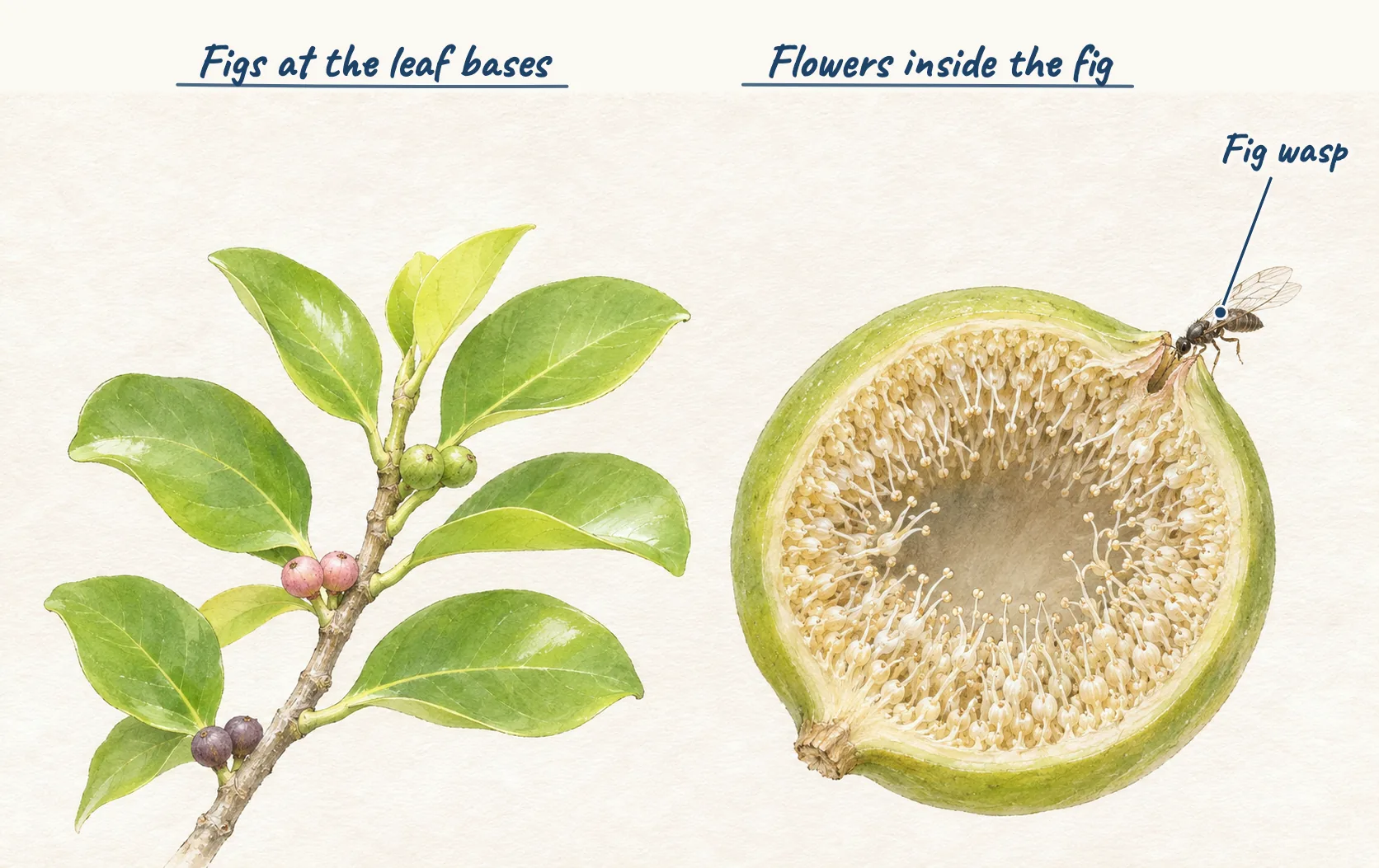
Look at a gajumaru branch and you will not find a flower. The flowers are inside. The Okinawa Prefectural Museum & Art Museum explains that fig plants grow a great number of flowers inside a chamber the plant makes by reshaping its stem or branch tissue (“幹や枝を変化させて作った部屋”), the syconium (花囊, kanō), and that what looks like a fruit is that chamber. Cut one open and you are looking at the inside of a flower garden, not at a fruit with seeds in a core.
The wasp that gets in
Those hidden flowers are pollinated by tiny fig wasps. The museum describes the bargain: the fig draws female wasps into the chamber to lay their eggs, and the new females that grow up there carry pollen away. For Ficus microcarpa, a field study in Yunnan, China, published in full on PubMed Central, names Eupristina verticillata as “the described active pollinator” at that site.
Who eats the figs
The figs feed more than wasps: bulbuls in the bird records, flying-foxes in the bat study. A fruiting gajumaru is a place animals come to. Keep that in mind for the stories.
Meet the Kijimuna — What Okinawa’s Folk Records Say
Where it lives
Kijimuna (キジムナー) is a spirit of the Okinawa Islands — a yōkai, or “said to be a tree spirit” (樹木の精霊ともいわれている), as the University of the Ryukyus Library’s Okinawa materials column puts it — and the folk records tie it to trees. Kurihara Ken’s paper, titled after an Okinawan warning to be careful at sea at night, describes the Kijimuna as “said to live in gajumaru trees” (“ガジュマルの木に棲むとされるキジムナー”), and quotes the Okinawa Daihyakka Jiten (Okinawa Encyclopedia) as saying it lives in the holes of old, large trees (“古い大樹の穴に住む”).
It is not only the gajumaru. A tale from Aguni Island, in the folk-tale collection of the Okinawa Prefectural Museum & Art Museum, tells of a Kijimuna living with its children in a large usuku tree (ウスク), another large tree of the islands. The encyclopedia’s “holes of old, large trees” and the Aguni tale’s big tree point the same way: the Kijimuna’s home is a large, old tree, not a particular species.
What it looks like
The same library column gives it the height of a young schoolchild, a red face and messy red hair (“小学校低学年くらいの身長で、赤い顔にボサボサの赤い髪”). In Ōgimi village in the north of Okinawa Island, a closely related spirit goes by the name Bunagaya. Ōgimi’s village site, citing the local history Kijoka-shi, says the Bunagaya’s whole body is red and that it is small, like a child (“からだ全体が赤くて、子供のように小さい”).
Related spirits, several names
The names and details change with the place, and the library column is careful about how they relate: such spirits are sometimes regarded as the same as the Kijimuna and sometimes as its companions (“キジムナーと同じと見なされたり、仲間だとされたりする”). The column gives Bunagaya as the name used mainly in the north, and Sēma as the name on Kouri Island and in central-northern Okinawa Island. Each has its own details: the Bunagaya carries fire (bunagaya-bī), and under a Sēma’s tree, people say, you find the shells of the snails it has eaten. Ōgimi declared itself “the village of the Bunagaya” (ぶながやの里) on 24 July 1998 and uses the Bunagaya as its symbol for local revitalisation.
| Name | Where it is used, per the source | Source |
|---|---|---|
| Kijimuna (キジムナー) | The Okinawa Islands (the spirit itself) | Okinawa Prefectural Museum folk tales; University of the Ryukyus Library |
| Bunagaya (ブナガヤ) | Mainly northern Okinawa Island; Ōgimi village’s symbol. Same as, or a companion of, the Kijimuna | University of the Ryukyus Library; Ōgimi village |
| Sēma (セーマ) | Kouri Island, central-northern Okinawa Island. Same as, or a companion of, the Kijimuna | University of the Ryukyus Library |
Fishing Partners and Fish Eyes — The Stories People Tell
A friend on the night sea
Not every Kijimuna story is frightening. The library column sums up both sides: a Kijimuna may befriend a person and bring them wealth, or play tricks, or, if angered, do something cruel. In the museum’s tale “Kijimuna and Handaba Usumē”, an old man called Handaba Usumē becomes friends with a Kijimuna. In “Nakachi and Kijimuna”, the Kijimuna shows the man where the fish are, so that Nakachi has a big catch every day (“毎日大漁だった”), and it carries a light ahead of him to lead the way (“灯をつけ先導し”).
The eye of the fish
One detail runs through the fishing stories: the fish eye. The Okinawa Daihyakka Jiten, quoted by Kurihara, says the Kijimuna eats the left eye of the fish (“魚の左目を食い”). A recorded tale in the museum collection is less precise: the fish the man was given had one eye eaten (“片目が食べられていた”), with no side named. Between these two sources, the encyclopedia gives a neat rule and the recorded tale gives a local version. The library column sides with the left eye: a fish caught with its left eye missing, it says, is a Kijimuna’s leftover.
Kijimuna fire
Lights belong to the Kijimuna. The museum collection has a tale called “Kijimuna-bi” (キジムナー火, Kijimuna fire), about a light that appears at night; in it, when someone tells the Kijimuna to put out its fire, the fire goes out.
How the Friendship Ends — Octopus, Roosters, Nails and Fire
What drives it away
The same records list what the Kijimuna cannot stand. The University of the Ryukyus Library column says it dislikes octopus and farts (“苦手なものは蛸とおなら”). A museum tale says that if you stick an octopus on it, it runs away (“蛸をくっつけると逃げていく”). In “Kijimuna and Handaba Usumē”, when the man flaps his arms to imitate a rooster, the Kijimuna flees (“鶏の真似をしてパタパタすると、キジムナーは逃げて行った”).
The weight on your chest
Not every encounter is friendly. The Okinawa Daihyakka Jiten, quoted by Kurihara, says the Kijimuna presses down on the chest of a sleeping person (“寝ている人の胸を押さえる”). A museum tale describes being touched by a Kijimuna and being unable to move while still conscious (“意識はあるが、体が動かなくなる”) — an experience that readers today may recognise from their own nights.
Nails, fire and revenge
The stories that matter most for the tree are the endings. In the museum’s tale “Kijimuna and a Friend”, the way to get rid of a Kijimuna is to drive a five-sun nail (五寸釘, about 15 cm or 6 in) into its tree and set fire to its nest with straw (“木に五寸釘を打ち込んで巣には藁で火をつけて燃やす”). In the Aguni tale, the Kijimuna whose home was burned takes revenge (“それで仇討ちをしたという”).
A common retelling says that simply hammering a nail into a gajumaru brings revenge. In the tales checked for this article, the nail and the fire come together; I did not find a recorded tale where the nail alone is the cause. Two other details you may meet in retellings — an aversion to heated pot lids, or revenge by burning a house when a gajumaru is cut — are indexed in a Japanese folklore database, but they point to older papers that I could not read in the original, so I have left them out here. Mainland Japan has its own custom around cutting a tree that matters — the purification rite performed before a tree is felled.
Why the Gajumaru? — Reading the Tree Behind the Story
What the sources say
The sources checked here do not establish when or why the Kijimuna first came to be associated with gajumaru trees. The oldest record the University of the Ryukyus Library column points to is the Irō Setsuden (遺老説伝), compiled in 1745, and the line it highlights names a different tree: an old mulberry that must have turned into a spirit (“老木となった桑樹が妖魔になったに違いない”). From the start, it seems, the idea was an old tree turning into something alive — not one species. What we have for the gajumaru are explanations from people who know the tree. The Ocean Expo Park’s plant guide says that because the peculiar form of an old gajumaru looks mysterious and uncanny, it becomes a sacred tree (“その特異な形状が神秘奇怪に見えることから神木霊木にもなる”). Shinzato and Shiba, in their University of the Ryukyus paper, connect the gajumaru’s role as a ritual tree to its vitality and its unusual growth form (“その樹体の特異性にあると考えられる”). That is their interpretation, carefully worded, not a proof of origin.
A tree reader’s view
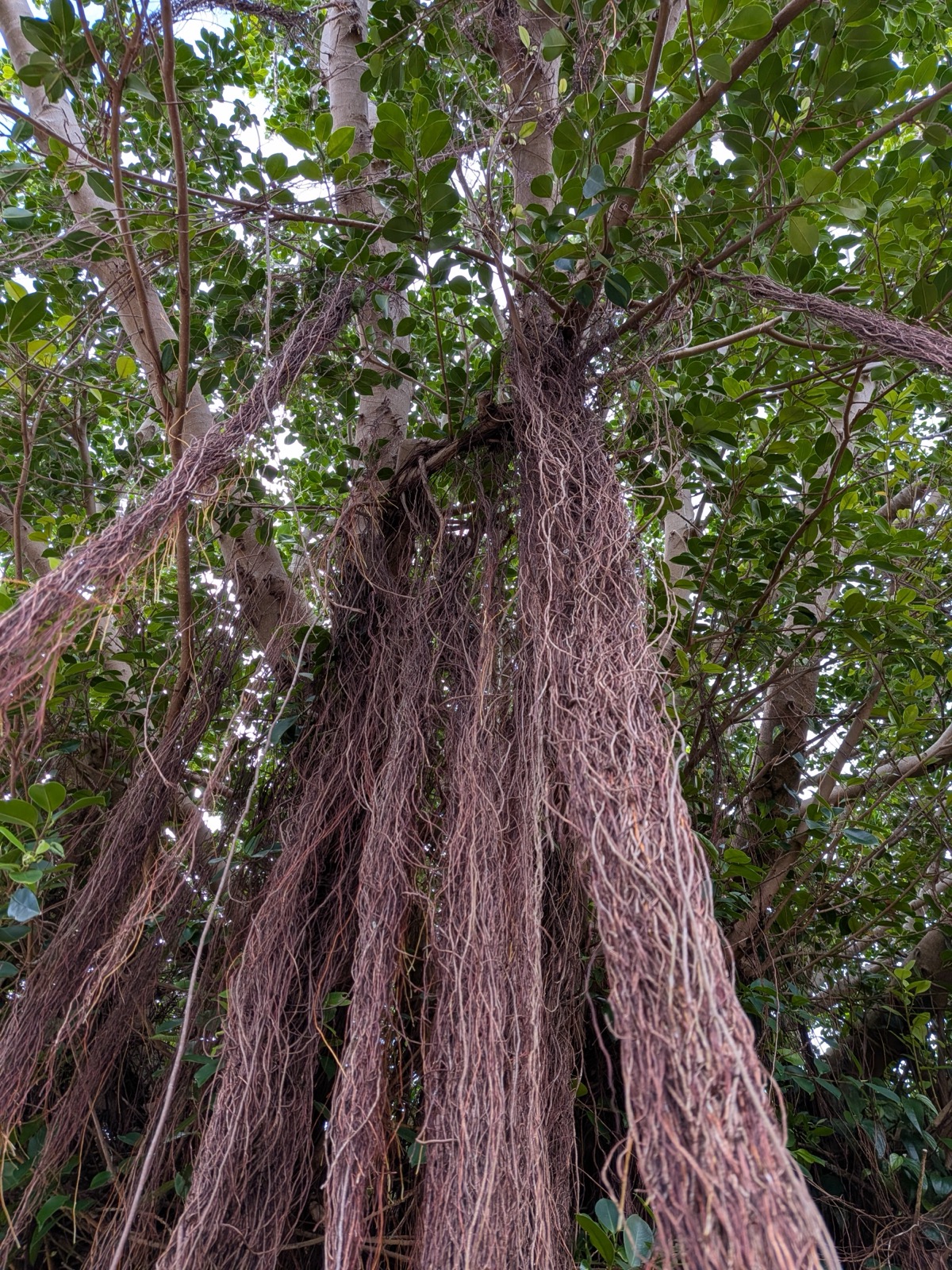
Read with an arborist’s eye, the tree gives a story-teller almost everything the Kijimuna needs. Hanging roots like long hair — reddish, in the young root curtain photographed above, like the spirit’s red hair. Gaps and hollows inside an old trunk woven from roots — the kind of “holes of old, large trees” that the encyclopedia names as home. A hollow does not necessarily mean an old tree is dying, as explained in why Japan’s ancient trees live for a thousand years. Figs that draw birds and flying-foxes, so that the tree has visitors. A tree that can start in the air, walk outward on its own roots, and slowly close over another tree is a tree that seems to have intentions.
This is an interpretation, not a historical finding. It is consistent with what the Ocean Expo Park and the University of the Ryukyus authors say, but it cannot tell us how the association first arose.
The gajumaru in ritual
The gajumaru also has a place in ritual that is better documented. Shinzato and Shiba record that in the Unjami rite at Tana, Iheya village, participants wear headbands of rice straw with gajumaru branches tucked in (“ガジュマルの枝を挿した稲藁の鉢巻”). The Hinpun Gajumaru, as noted above, has been kept as a sacred tree. And at the Kyō-no-uchi sacred area of Shuri Castle, the park’s vegetation guide lists the gajumaru among the plants found inside the utaki (御嶽, sacred grove).
Rope or Story — Okinawa’s Sacred Trees and Mainland Goshinboku
The rope that marks the sacred
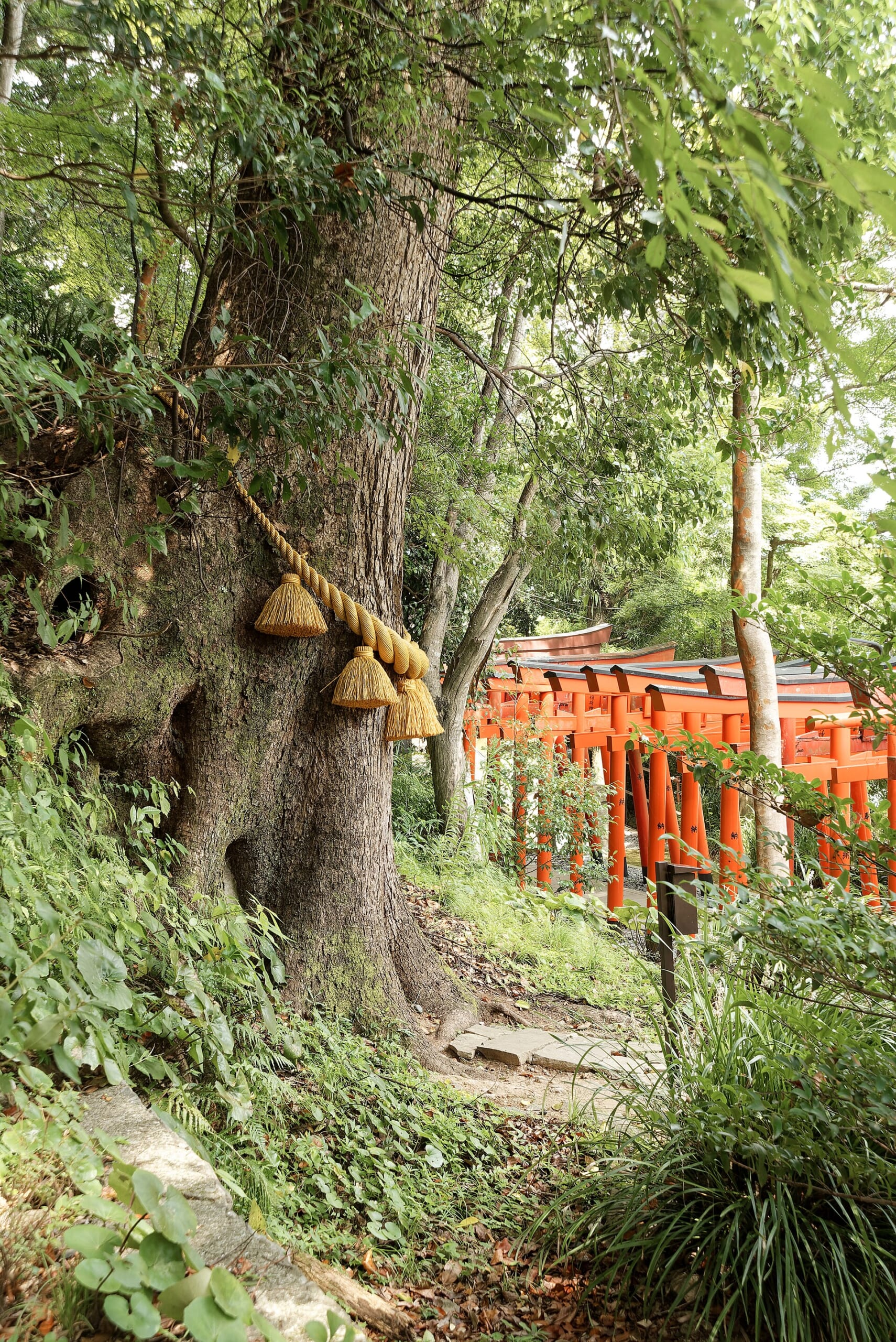
In mainland Japan, a sacred tree (御神木, goshinboku) at a shrine is often marked with a shimenawa. The Association of Shinto Shrines (Jinja Honchō) defines a shimenawa as “a twisted straw rope that serves to delineate sacred space and objects.” I wrote about one roped giant in Japan’s sacred giant at Kinomiya Shrine. Shrine reports still record the remaking of ropes for a sacred tree, as in one report from Kawamo on Sado Island that lists “御神木用注連縄新調” (new shimenawa for the sacred tree).
The grove, not the single tree
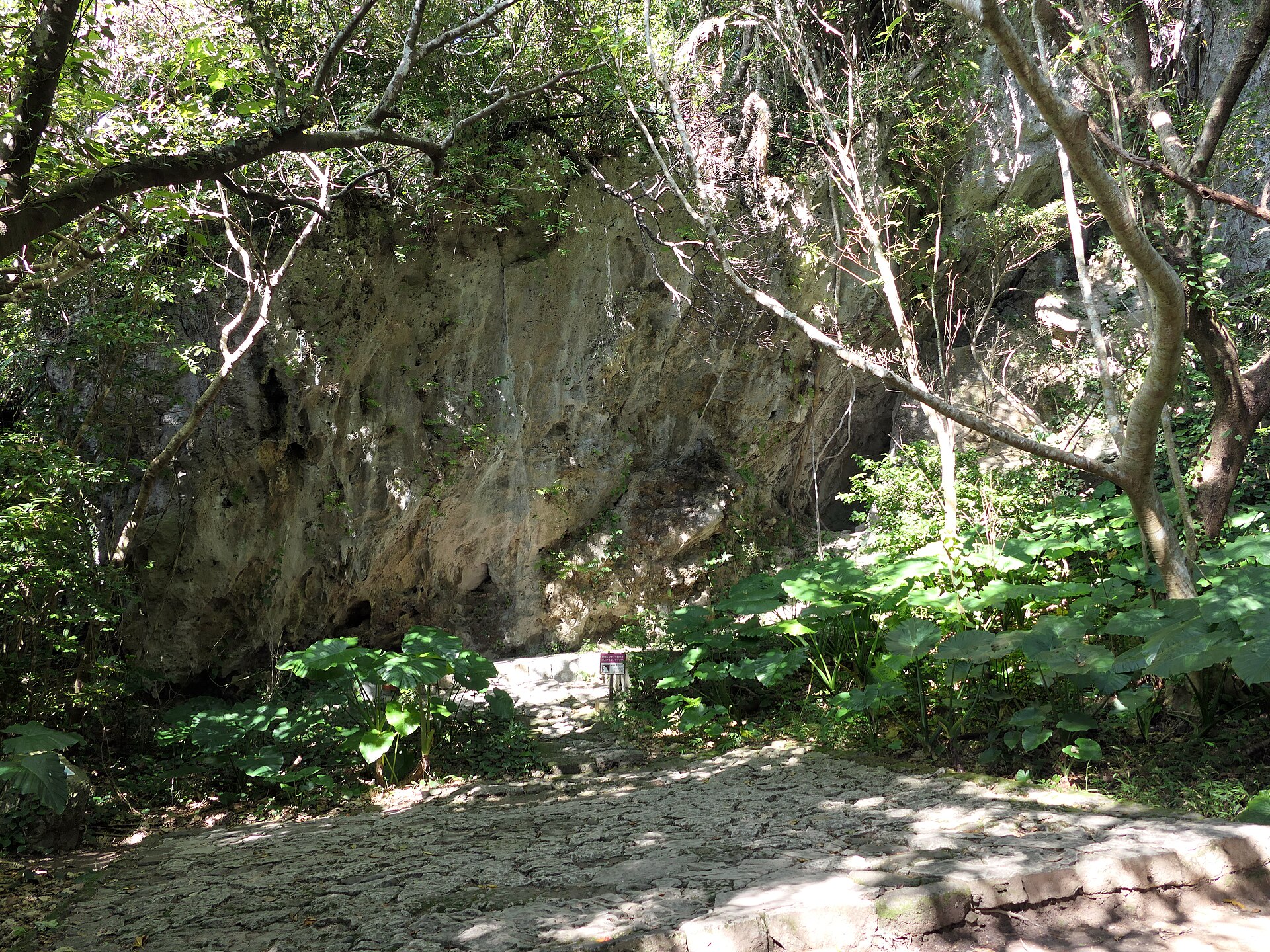
Okinawa’s utaki add another layer. An utaki is a sacred grove or site, and the Agency for Cultural Affairs describes Sēfa-utaki as made up of strangely shaped rocks and woodland (“様々な形状をした奇岩や樹林地”). At the Shoshi Utaki plant community in Nakijin, the Agency explains that the grove has kept the character of the old lowland forest because it has long been an object of faith (“古くから信仰の対象となっていたため”).
Where the Kijimuna fits
Put the sources side by side and what stands out is not that one region respects trees more. It is the kind of story attached to the tree.
| Mainland goshinboku | Okinawan gajumaru in the Kijimuna stories | |
|---|---|---|
| What the sources here describe | A shimenawa rope that delineates sacred space | A large, old tree with holes, home to a spirit |
| Who is there | The tree is honoured within a shrine’s sacred space | A neighbour: a small red spirit that fishes, plays tricks, takes revenge |
| What the tales record | — | Nailing the tree while burning the nest drives the spirit out; burning its home brings revenge |
| Examples in this article | Suwa Shrine, Nagasaki; a shrine report from Sado | Hinpun Gajumaru (kept as a sacred tree); gajumaru inside Kyō-no-uchi, Shuri |
The comparison is narrow on purpose. Okinawa also has trees kept as sacred, and the mainland has its own tree spirits; neither side fits one box. Goshinboku, spirit trees and utaki are different things and should not be lined up one-to-one by region. What this table shows is only the sources used here: a rope in one set, a story about who lives in the tree in the other.
Living With a Strangler — Windbreaks, Stone Walls and Old Ruins
A tree planted beside the house
Okinawans did not only tell stories about the gajumaru; they planted it near their homes. The Forestry and Forest Products Research Institute notes that it is planted near houses as a windbreak (“防風林として人家付近に植栽される”). An Okinawa Prefecture survey of the Nakanishi village records gajumaru, yūna and fukugi planted inside house plots for wind, fire protection and shade (“防風や防火、緑陰を目的にガジュマルやユーナ、フクギ等”). A spirit in the tree next door is easier to imagine when the tree really is next door. Windbreak planting is a southern answer to the same problem I covered in Japan’s wind-resistant pruning methods.
Roots in the stone
Roots that find a crack will go into a wall. At Gushikawa Castle ruins in Itoman, a city report on the site states that the roots of gajumaru and other trees have penetrated inside the stone walls (“ガジュマル等の根が石垣内部まで侵入しており”). For anyone caring for heritage stonework in Okinawa, this is the practical side of the strangler: the tree is valued, the wall is valued, and the roots are working inside one of them. When a gajumaru grows on a wall, the question is not only the tree’s health but what the roots are doing to the stones.
When the forest takes a building back
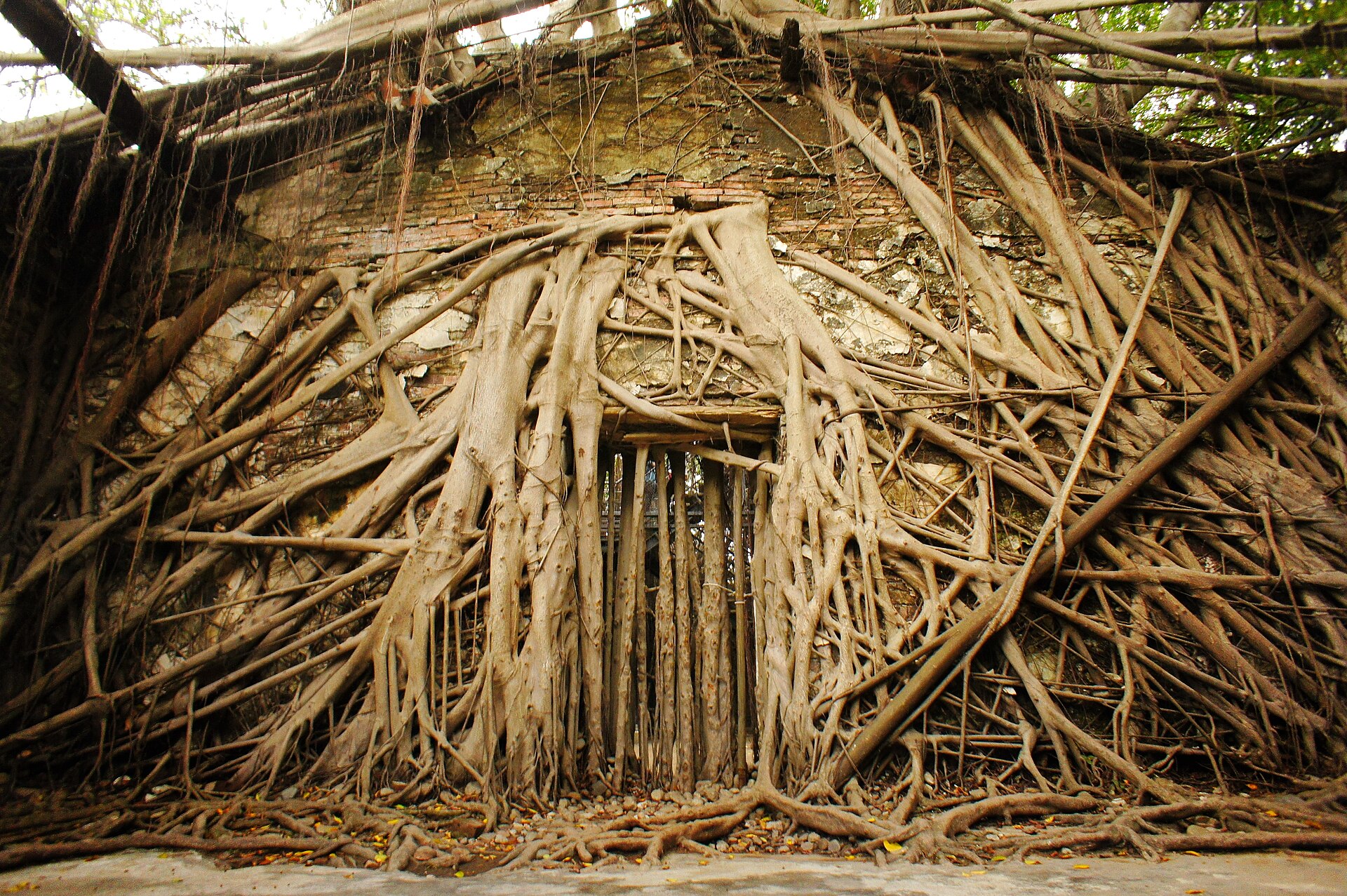
Given time, a gajumaru can cover a structure — the reverse of the Osaka station that was built around a camphor tree nobody would cut. Tokyo Metropolitan Government’s islands site shows the entrance of the old Kitamura school on Hahajima, in the Ogasawara Islands, covered by gajumaru and returning to forest (“ガジュマルに覆われ、森へと還りつつある”). For a picture of where that can end, look outside Japan, to the Anping Tree House in Tainan, Taiwan, where banyan roots cover the walls of an old building.
Beyond Okinawa — Yakushima, Hawaii, Florida and the Houseplant
The northern edge
Japan holds the northern edge of the gajumaru’s natural range. On Yakushima, at the island’s Nakama settlement, a huge gajumaru stands beside Nakama Bridge, and Yakushima Town lists a gajumaru in Nakama-kamimachi as a town-designated cultural property, designated on 19 December 1970.
| Tree | Designation | Date | Estimated age |
|---|---|---|---|
| Hinpun Gajumaru, Nago | National natural monument | 2 September 1997 | about 240 years (Agency record) |
| Gajumaru, Nakama-kamimachi, Yakushima | Town cultural property | 19 December 1970 | — |
A wasp that changed Hawaii
Outside Asia, the same tree is a different story. In Hawai’i, the pollinating wasp Eupristina verticillata was purposely introduced from the Philippines in 1938, “to facilitate propagation of the tree for reforestation,” according to a paper by J. W. Beardsley published by the Hawaiian Entomological Society. The wasp was brought in so the tree could set seed, and it did. The University of Hawai’i now reports the tree “naturalized on all the main islands”, listing “threat to host plants” among its environmental impacts.
Florida
In Florida, the University of Florida’s IFAS plant directory lists Ficus microcarpa as a “FISC Category 1 Invasive.” The University of South Florida’s plant atlas records that it “began spreading by seed in the 1970s, following an apparently accidental introduction of species-specific pollinating wasps.”
The contrast with Okinawa is not about one place being right. It is about context. In Okinawa the gajumaru is a native tree at the edge of its range, planted beside houses and kept at sacred sites. In Hawai’i and Florida it is an introduced tree that spreads by seed, and Hawai’i lists it as a threat to host plants. Being sacred and being invasive are not opposites — they are judgements made on different grounds — but the same biology reads very differently in each setting.
The “lucky tree” on a mainland windowsill
On mainland Japan you will often meet the gajumaru as a potted houseplant. Shops sell it under names including takō no ki (多幸の木, “tree of much happiness”), as one garden centre’s listing shows. I could not find when that name began. My guess, and only a guess, is that a tree with a friendly spirit in it is an easy tree to give as a gift.
Frequently asked questions
What is a Kijimuna?
A Kijimuna is a tree spirit of Okinawan folklore. Folk records describe it with a red face, red hair, the size of a child, living in old gajumaru and other large trees. Related spirits — sometimes treated as the same, sometimes as companions — are called Bunagaya in northern Okinawa and Sēma on Kouri Island and in central-northern Okinawa.
Why do people say the Kijimuna lives in the gajumaru?
No source checked here fixes the origin; the oldest record cited by the University of the Ryukyus Library (1745) names an old mulberry. Okinawan sources link the gajumaru’s sacred status to its strange form and vitality: a tree that can start in the air, strangle its host, stand on its own roots and grow hollows. Those hollows match the encyclopedia’s description of the Kijimuna living “in the holes of old, large trees”.
Is the gajumaru really a strangler fig?
Yes, it can be. Seeds spread by birds can germinate in the forks of other trees, and a University of the Ryukyus paper records that a gajumaru growing on another tree can strangle its host. Planted gajumaru in gardens and windbreaks, though, start in the ground.
What happens if you cut a gajumaru with a Kijimuna in it?
In the recorded tales, burning the Kijimuna’s tree or nest brings revenge, and driving a nail into the tree while burning the nest is a way to drive it out. You may meet claims that a nail alone, or cutting the tree, brings revenge, but I could not confirm them in an original folk record.
Where can I see a famous gajumaru in Japan?
The Hinpun Gajumaru in Nago, a national natural monument since 1997, grows in the town centre. Further north, Yakushima Town has designated a gajumaru in Nakama as a town cultural property.
Why is the gajumaru invasive in Hawaii but sacred in Okinawa?
In Okinawa it is native. In Hawai’i its pollinating wasp was introduced in 1938, which let the tree set seed and spread; it now grows wild on all the main islands and can harm host plants.
Sources
All checked 6 November 2026.
– Okinawa Prefecture Forest Research Center, gajumaru: https://www.pref.okinawa.lg.jp/shigoto/kenkyu/1010919/1021637/1003010/1003035.html – Okinawa Prefectural Museum & Art Museum, “ガジュマルの花”: https://okimu.jp/museum/column/1562757532/ – Okinawa Prefecture, Biodiversity Okinawa, gajumaru: https://biodiversity.okinawa/video_pages/reference/gajyumaru.html – Flower Park Kagoshima, gajumaru: https://www.fp-k.org/hanazukan/4274/ – University of Hawai’i CTAHR, Ficus microcarpa weed sheet: https://www.ctahr.hawaii.edu/invweed/WeedsHI/W_Ficus_microcarpa.pdf – Kaufmann et al., American Journal of Botany (1991): https://bsapubs.onlinelibrary.wiley.com/doi/abs/10.1002/j.1537-2197.1991.tb14501.x – Shinzato Takakazu, Shiba Masami, University of the Ryukyus repository: https://u-ryukyu.repo.nii.ac.jp/record/2009693/files/No64p055.pdf – Pollination study of F. microcarpa (PubMed Central): https://pmc.ncbi.nlm.nih.gov/articles/PMC8364199/ – Nakamura Kazuo, Okinawa University Chiiki Kenkyū No. 15: https://www.okinawa-u.ac.jp/wordpress/wp-content/uploads/2020/10/%E3%80%90%E3%83%87%E3%83%BC%E3%82%BF%E3%80%91%E5%9C%B0%E5%9F%9F%E7%A0%94%E7%A9%B6No.15.pdf – Nakamoto et al., TROPICS: https://www.jstage.jst.go.jp/article/tropics/17/1/17_1_43/_article – Agency for Cultural Affairs, Hinpun Gajumaru: https://online.bunka.go.jp/db/heritages/detail/203236 – Forestry and Forest Products Research Institute, gajumaru: https://www.ffpri.go.jp/labs/prdb/gajumaru.html – Okinawa Prefecture, village survey (Nakanishi): https://www.pref.okinawa.lg.jp/_res/projects/default_project/_page_/001/019/252/12-3shou6.pdf – Itoman City, Gushikawa Castle ruins: https://www.city.itoman.lg.jp/uploaded/attachment/2457.pdf – Tokyo Metropolitan Government, Tokyo Islands (Hahajima): https://shima.metro.tokyo.lg.jp/post/hahajima01/ – Kurihara Ken, repository paper quoting the Okinawa Daihyakka Jiten: https://mgu.repo.nii.ac.jp/record/501/files/%E3%80%8C%E5%A4%9C%E3%80%81%E6%B5%B7%E3%81%B8%E8%A1%8C%E3%81%A3%E3%81%9F%E6%99%82%E3%81%AB%E3%81%AF%E3%80%81%E6%B0%97%E3%82%92%E3%81%A4%E3%81%91%E3%82%8B%E3%82%93%E3%81%A0%E3%82%88%E3%80%82%E3%80%8D.pdf – Okinawa Prefectural Museum & Art Museum, folk tales: https://okimu.jp/sp/museum/minwa/1582446488/ ; https://okimu.jp/museum/minwa/1582447995/ ; https://okimu.jp/museum/minwa/1582430513/ ; https://okimu.jp/museum/minwa/1582449560/ ; https://okimu.jp/museum/minwa/1582443853/ ; https://okimu.jp/museum/minwa/1582423113/ ; https://okimu.jp/museum/minwa/1582424529/ ; https://okimu.jp/museum/minwa/1582443165/ – University of the Ryukyus Library, Okinawa materials column (checked 7 November 2026): https://www.lib.u-ryukyu.ac.jp/lib_uploadfile/column/h2712_jpn.pdf – Ōgimi Village, “Bunagaya no Sato”: https://www.vill.ogimi.okinawa.jp/sitekanri/gaiyo/profile/331.html – Ocean Expo Park, plant guide: https://oki-park.jp/kaiyohaku/plantsbook/detail/6700 – Shuri Castle Park, Kyō-no-uchi: https://oki-park.jp/shurijo/guide/3061/ – Association of Shinto Shrines, Precinct: https://www.jinjahoncho.or.jp/en/at-a-jinja/precinct/ ; shrine report: https://www.jinjahoncho.or.jp/sys/10724 – Agency for Cultural Affairs, Sēfa-utaki: https://online.bunka.go.jp/special_content/component/67 ; Shoshi Utaki plant community: https://kunishitei.bunka.go.jp/heritage/detail/401/3039 – Yakushima Town, Nakama gajumaru: https://www.town.yakushima.kagoshima.jp/soshiki/kanko_machizukuri/kankosushin/kankospot/kankoshisetu/835.html ; cultural properties: https://www.town.yakushima.kagoshima.jp/bunka_sports/rekishi_bunkazai/2326.html – Beardsley, Hawaiian Entomological Society: https://files01.core.ac.uk/download/pdf/5104751.pdf – University of Florida IFAS, Ficus microcarpa: https://plant-directory.ifas.ufl.edu/plant-directory/ficus-microcarpa/ – University of South Florida, Florida Invasive Plants: https://plantatlas.usf.edu/flip/plant.aspx?id=67 – Niitsu Flower Land, gajumaru: https://nf-land.com/care/363/