

By Isaki Kasahara, a Japanese arborist pruning, assessing and caring for Japan’s trees and gardens · Updated November 27, 2026
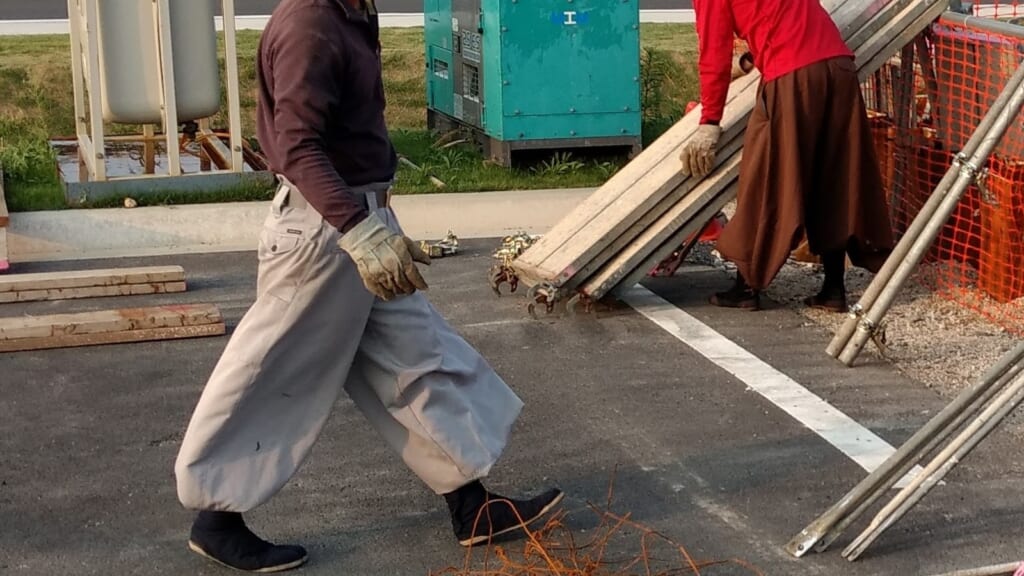
Many Japanese construction workers, above all the tobi who build scaffolding and erect steel frames, wear balloon-shaped “tobi pants” because, in the explanations of makers and the industry, the loose cloth around the knee lets them bend, crouch and lift a leg high, while the narrow hem keeps the ankle from catching. A construction-industry training booklet adds two more reasons: the fluttering cloth shows how strong the wind is, and the fabric touches a protrusion before the leg does. None of these reasons has been tested against accident data, and one site manager reports banning the longest styles at his site because the wide cloth itself catches on steel.
Below, the explanations are sorted by who gives them, and the trousers are followed from the New York word knickerbockers to today’s slimmer, stretch cuts.
On the Scaffold — What the Trousers Look Like
A silhouette you notice from the street
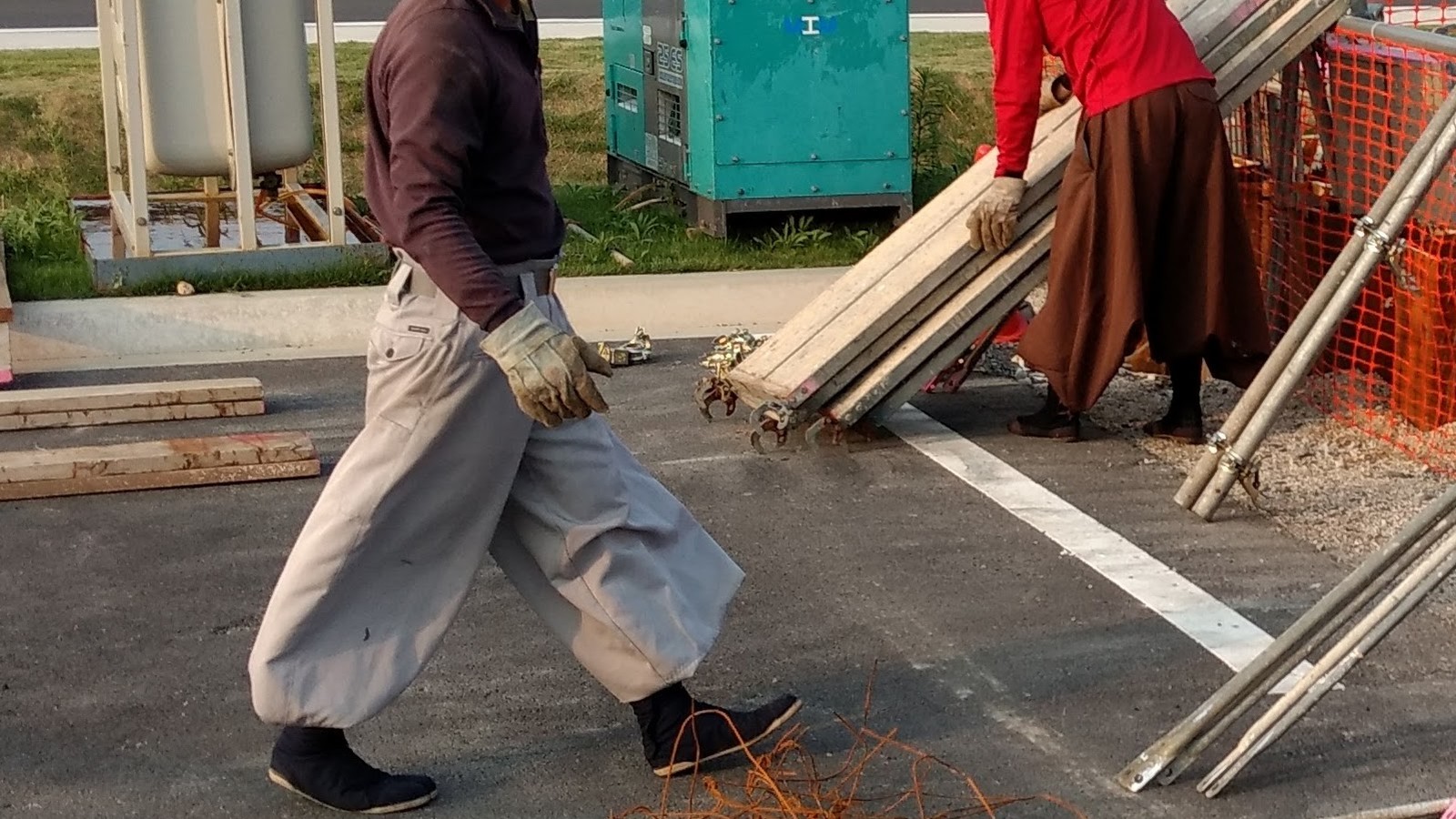
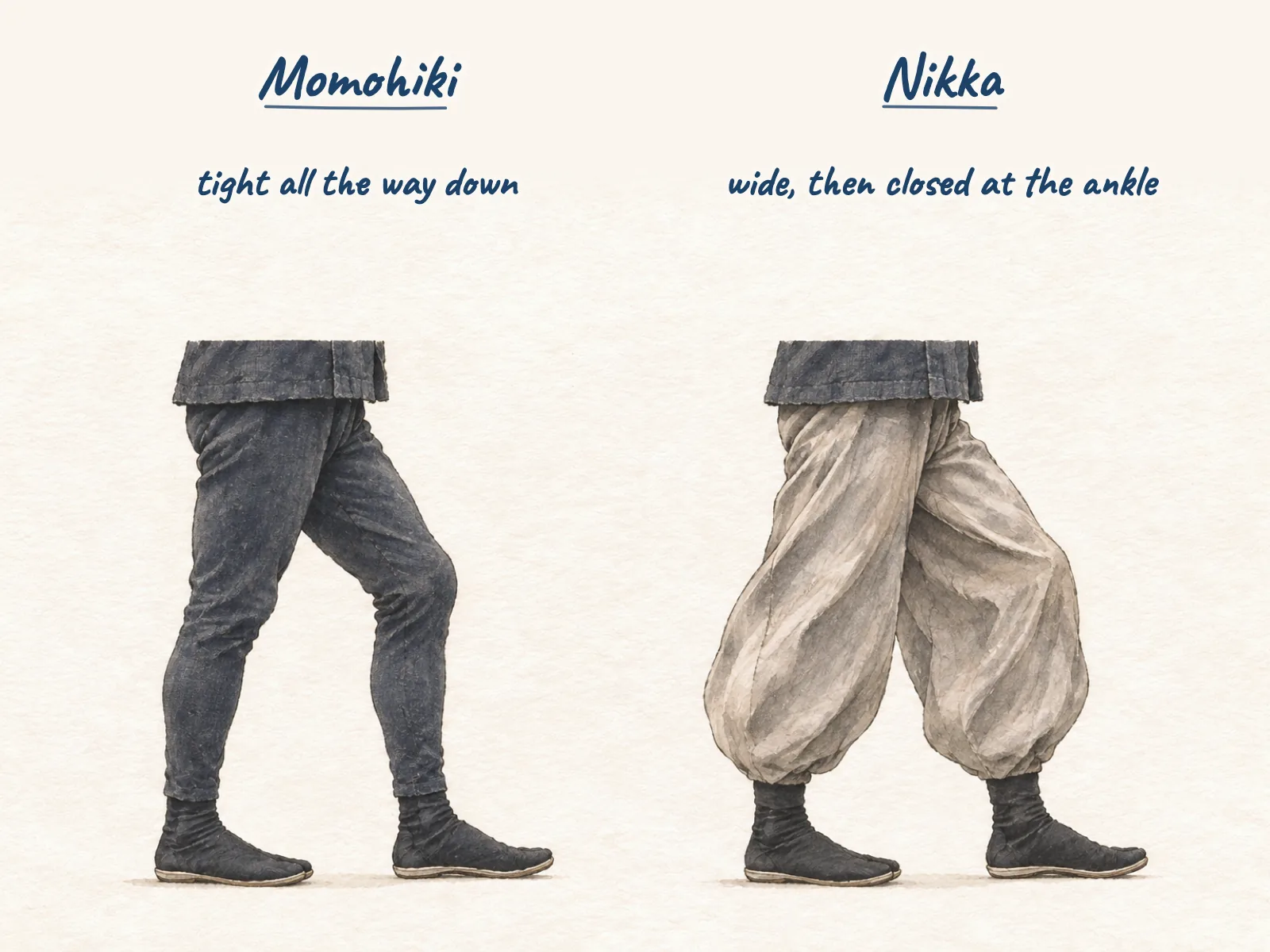
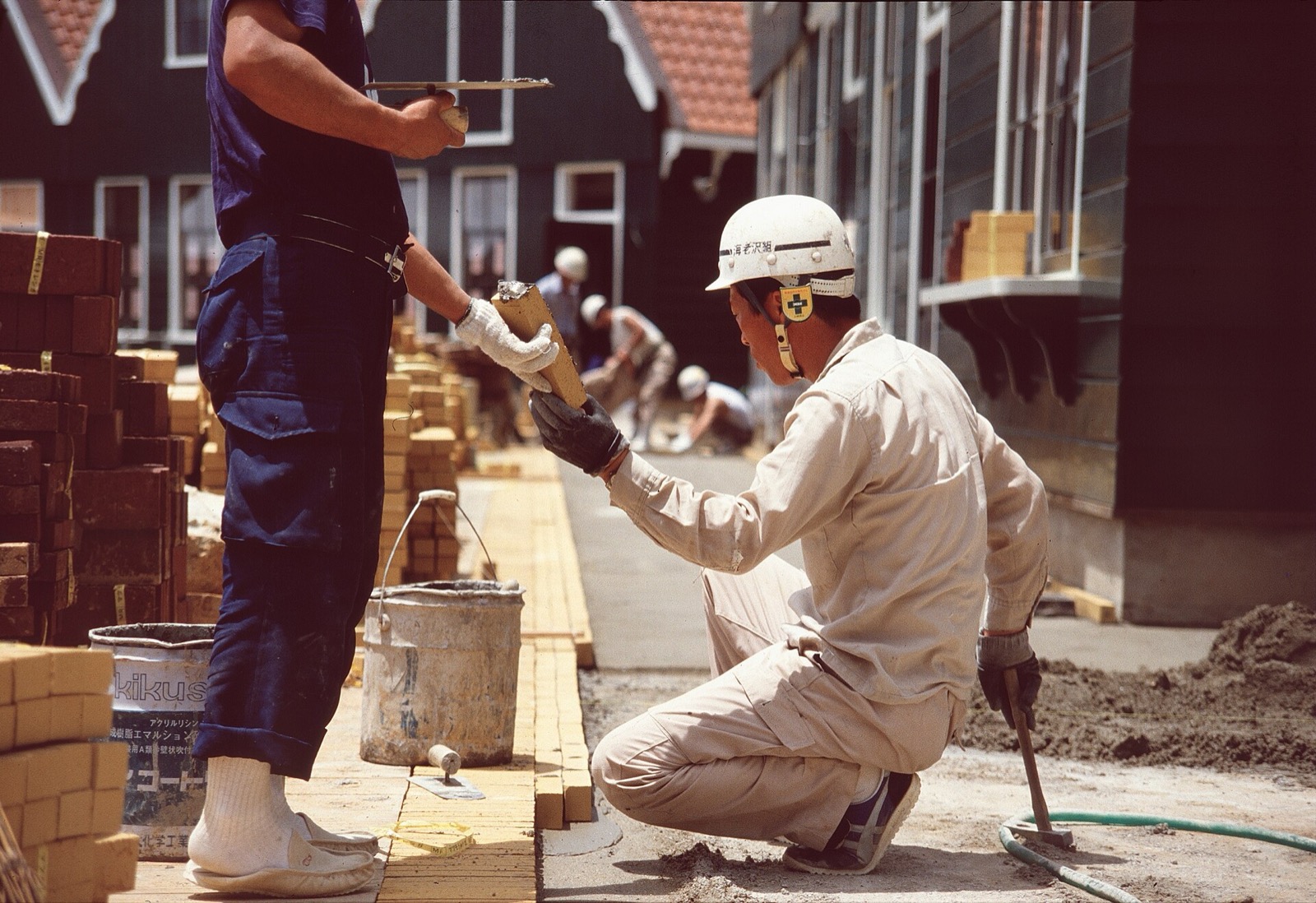
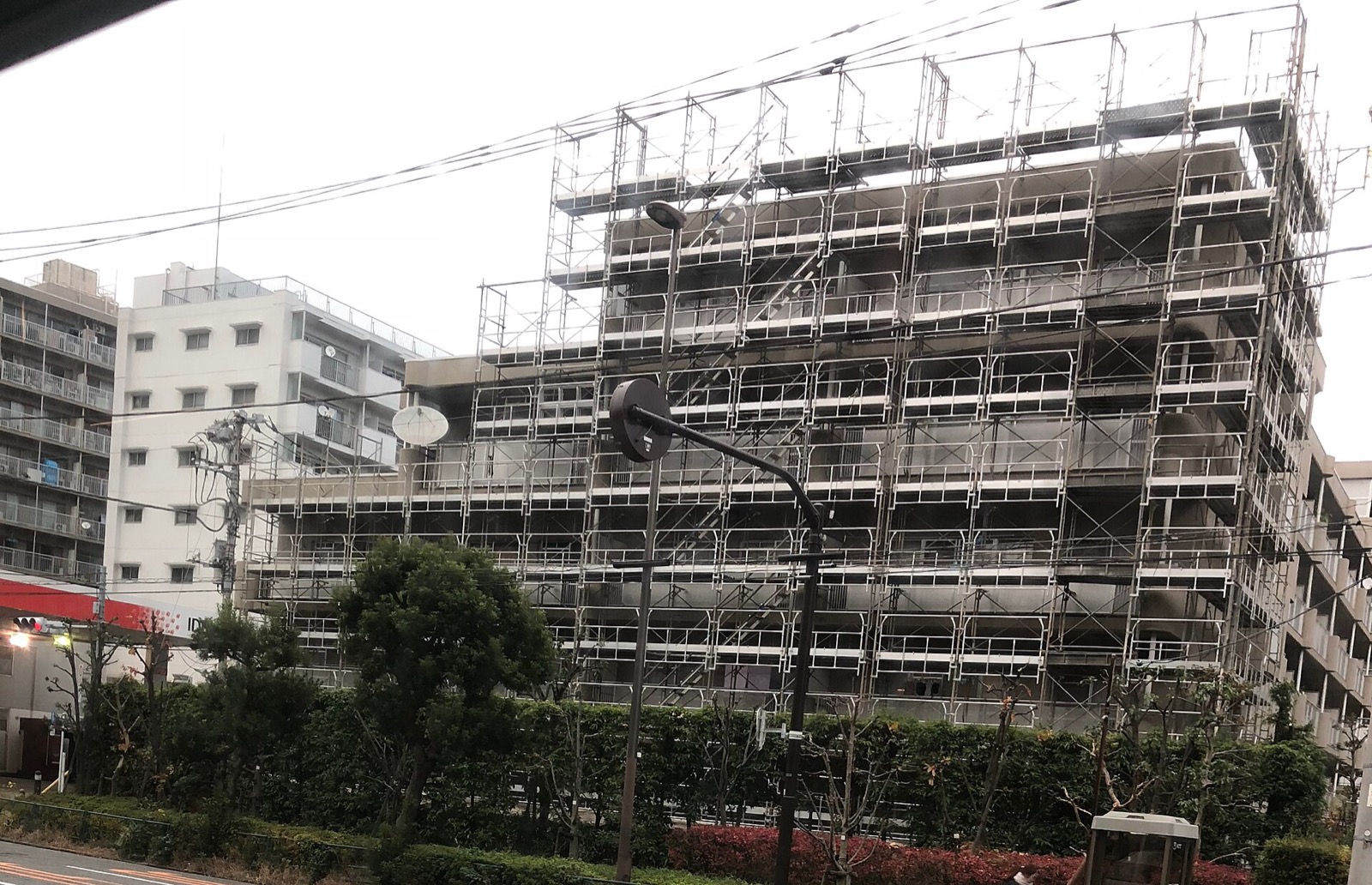
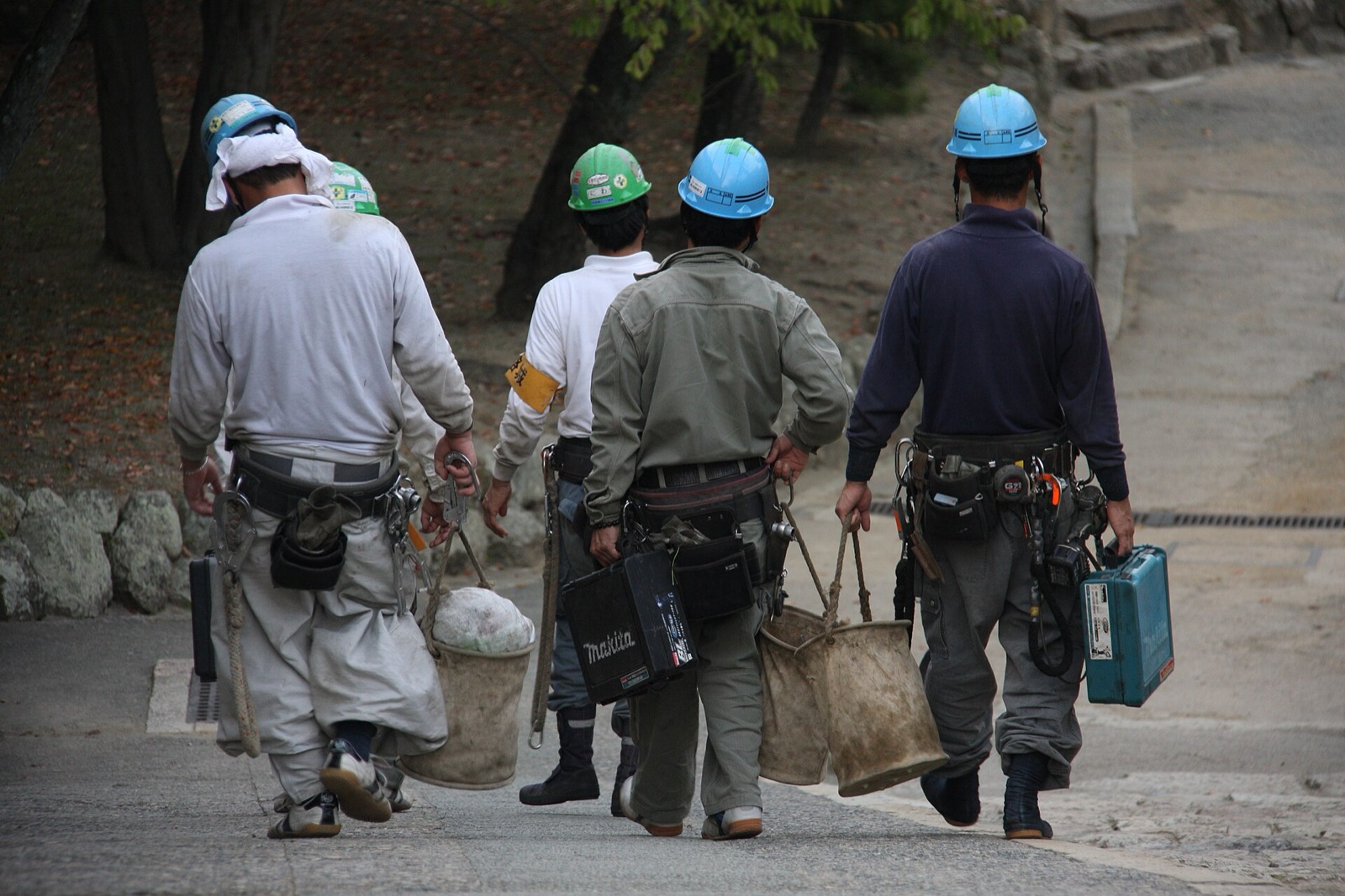
Walk past a building site in Tokyo and look up at the scaffold. Some of the workers on the boards wear trousers that seem far too big: wide from the thigh down, swelling below the knee, then pulled in hard at the ankle where the hem disappears into split-toe boots. The English edition of nippon.com describes the shape in one line: “Billowing outward below the knee, they taper sharply at the ankles.”
In Japanese the trousers are usually called nikka-pokka (ニッカポッカ), or just nikka (ニッカ) on site. The whole outfit, trousers and matching shirt, is called tobi-fuku (鳶服) — tobi clothing — or goto-gi (ゴト着), according to the same nippon.com report. Toraichi, a leading maker, calls the outfit tobi shōzoku (鳶装束), “tobi attire.” In English they have picked up names such as “tobi pants” and, from visitors, “balloon pants.”
Who the tobi are
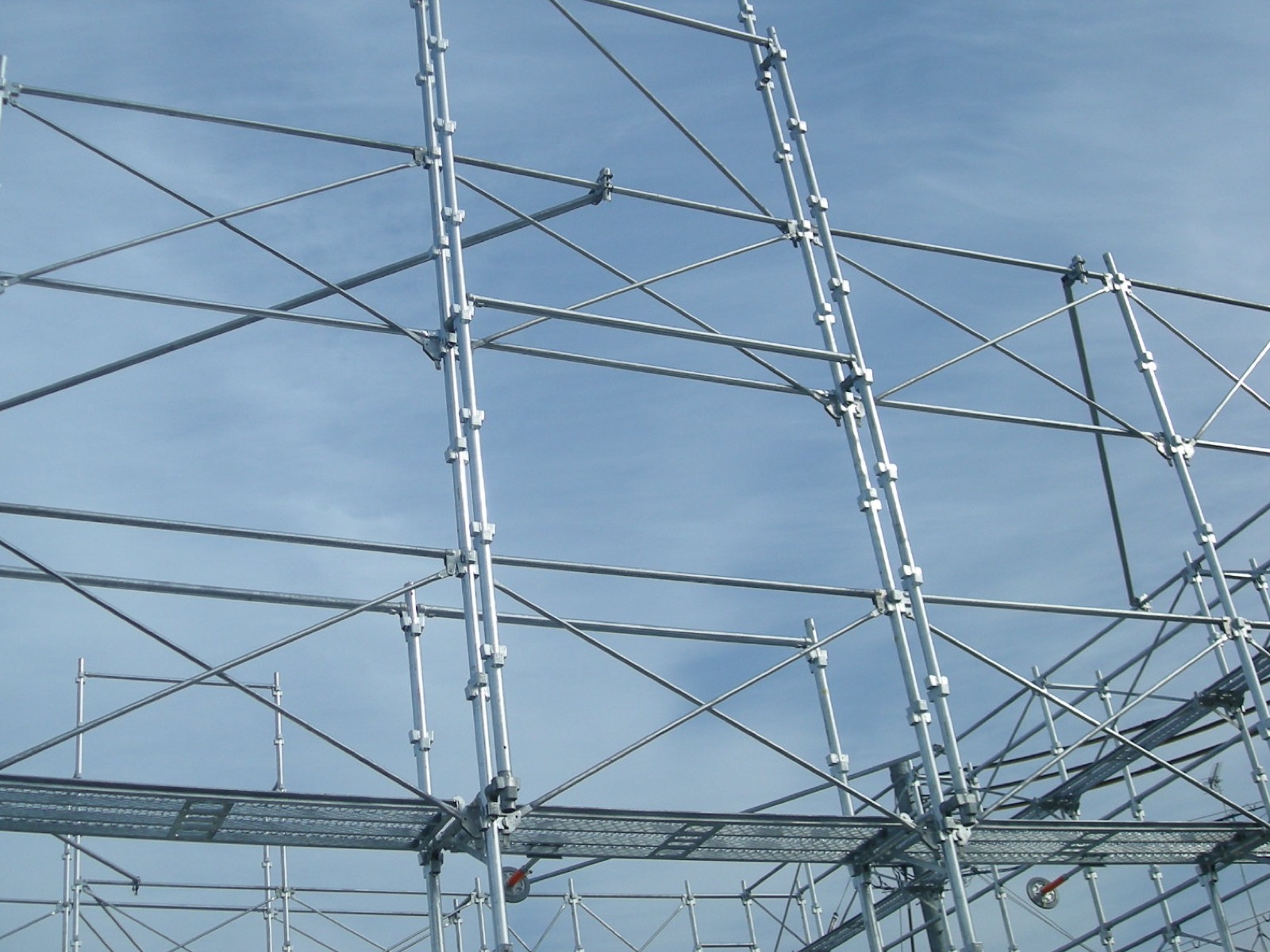
Tobi (鳶) are a construction trade. Japan’s Ministry of Health, Labour and Welfare describes them as the workers who set up temporary structures such as scaffolding and who assemble the steel frames that form a building’s skeleton. Their work puts them on the scaffold boards and the steel, often at the highest point of the site.
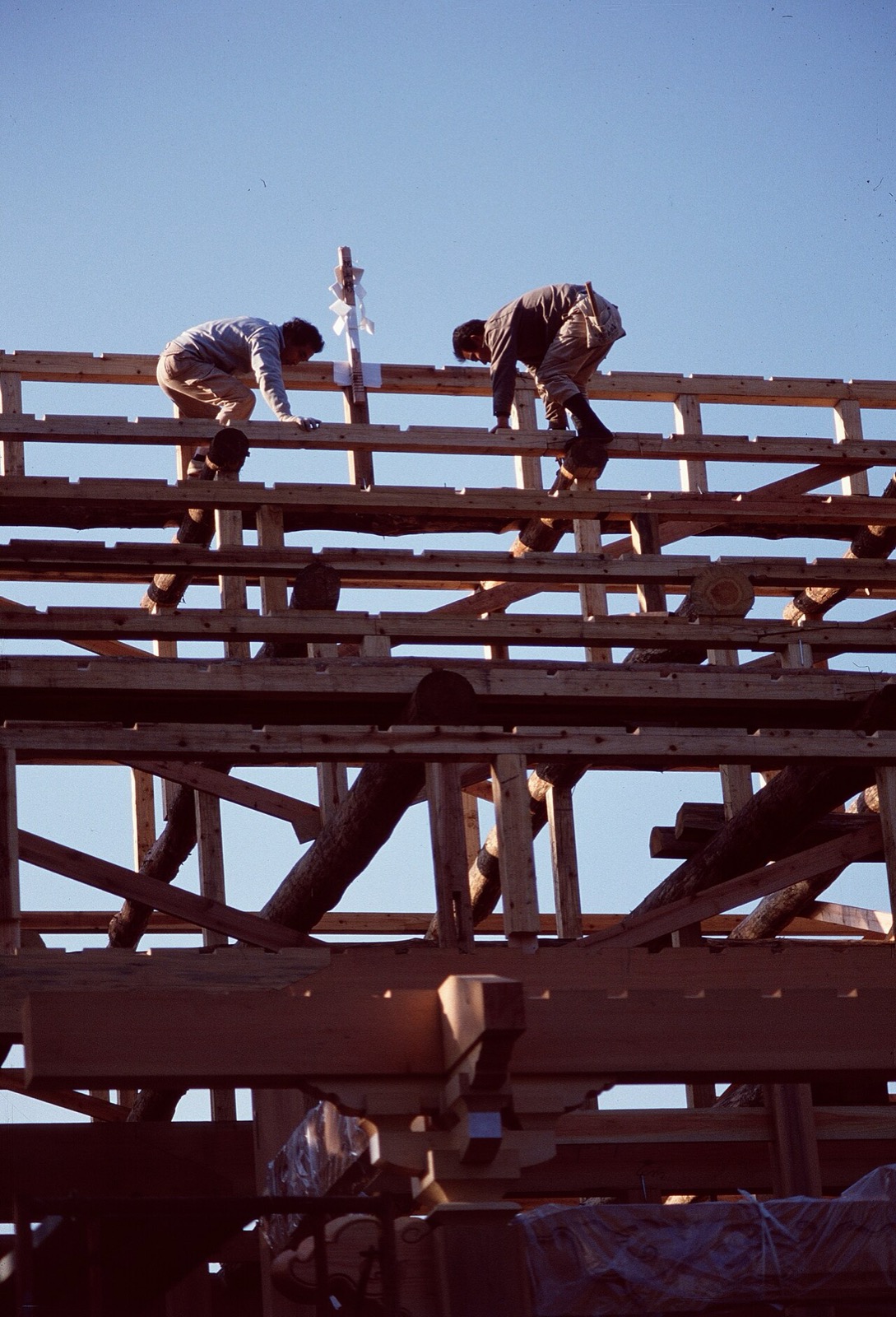
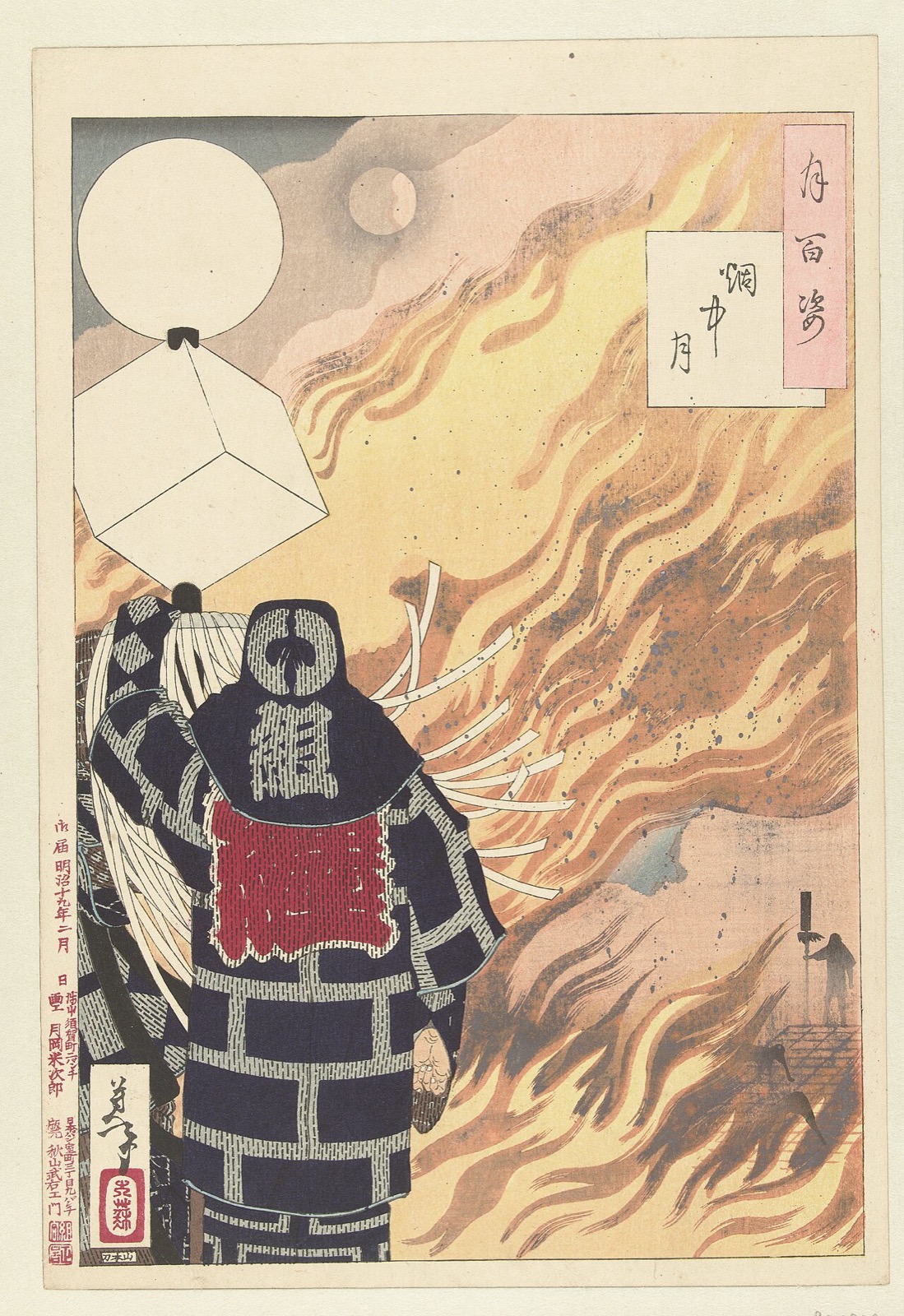
The trade is older than steel. In Edo, the city that became Tokyo, tobi who knew how buildings were put together served in the town fire brigades, pulling down houses to stop fires from spreading. The history of Minato City records that “tobi, who knew the structure of buildings well, were very active as town firefighters.” That is a record of the work, not of the trousers. Nothing in it says Edo tobi wore anything like the modern nikka.
What the trousers are not
It is easy to assume that a shape this distinctive must be ancient. On Japanese building sites, it is not. Before the change, the building trades wore momohiki (股引), close-fitting leggings, and the balloon shape spread on sites only in the twentieth century. Its name is English.
A Name From New York — From Knickerbockers to Nikka-pokka
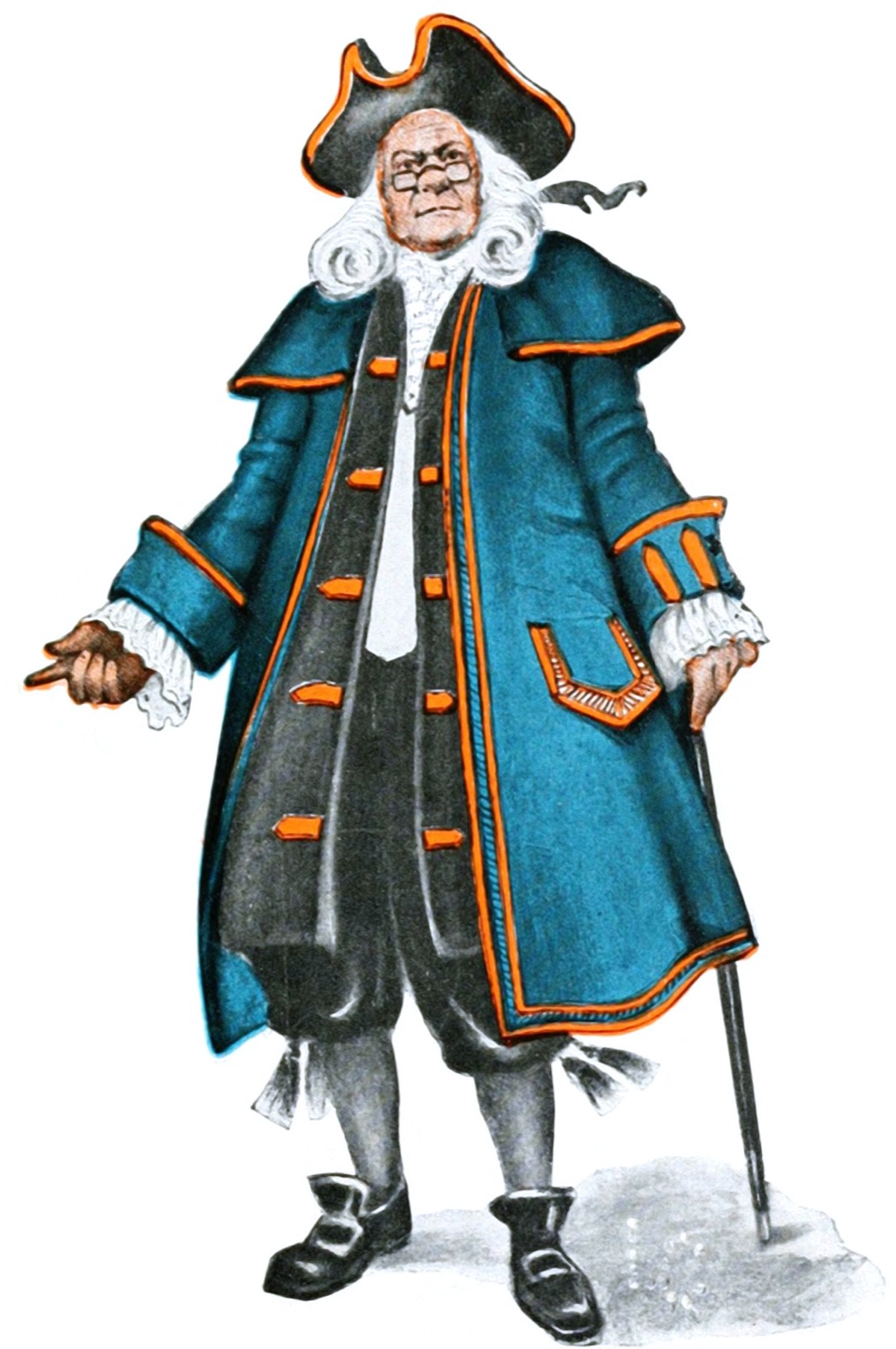
Diedrich Knickerbocker, 1809
The Japanese nikka-pokka is a borrowing of the English knickerbockers. The Britannica International Encyclopaedia, in its Japanese edition, describes the original garment as “seven-tenths trousers” with the knee made wide and the hem fastened with a buckle.
Where the English word came from is itself a little uncertain. In 1809, Washington Irving published A History of New York under the invented name Diedrich Knickerbocker. A Columbia University Libraries text notes that the name was later “attached to a distinctive and Dutch-like kind of trousers.” The Japanese encyclopaedia gives the Irving pen name as one explanation and, alongside it, says the trousers were also said to take their name from the Dutch settlers called knickerbockers. It does not choose between the two.
Bicycles and golf
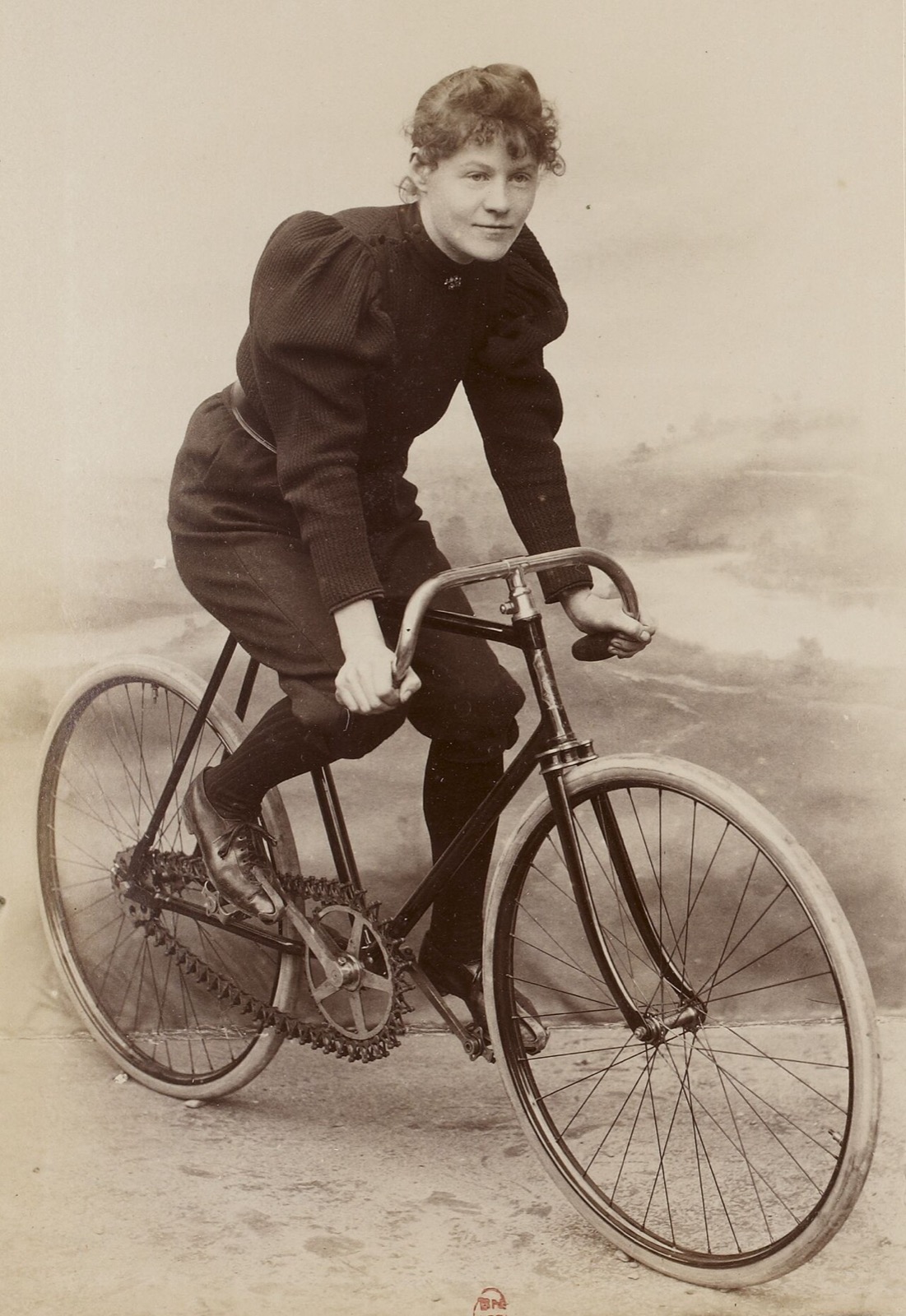
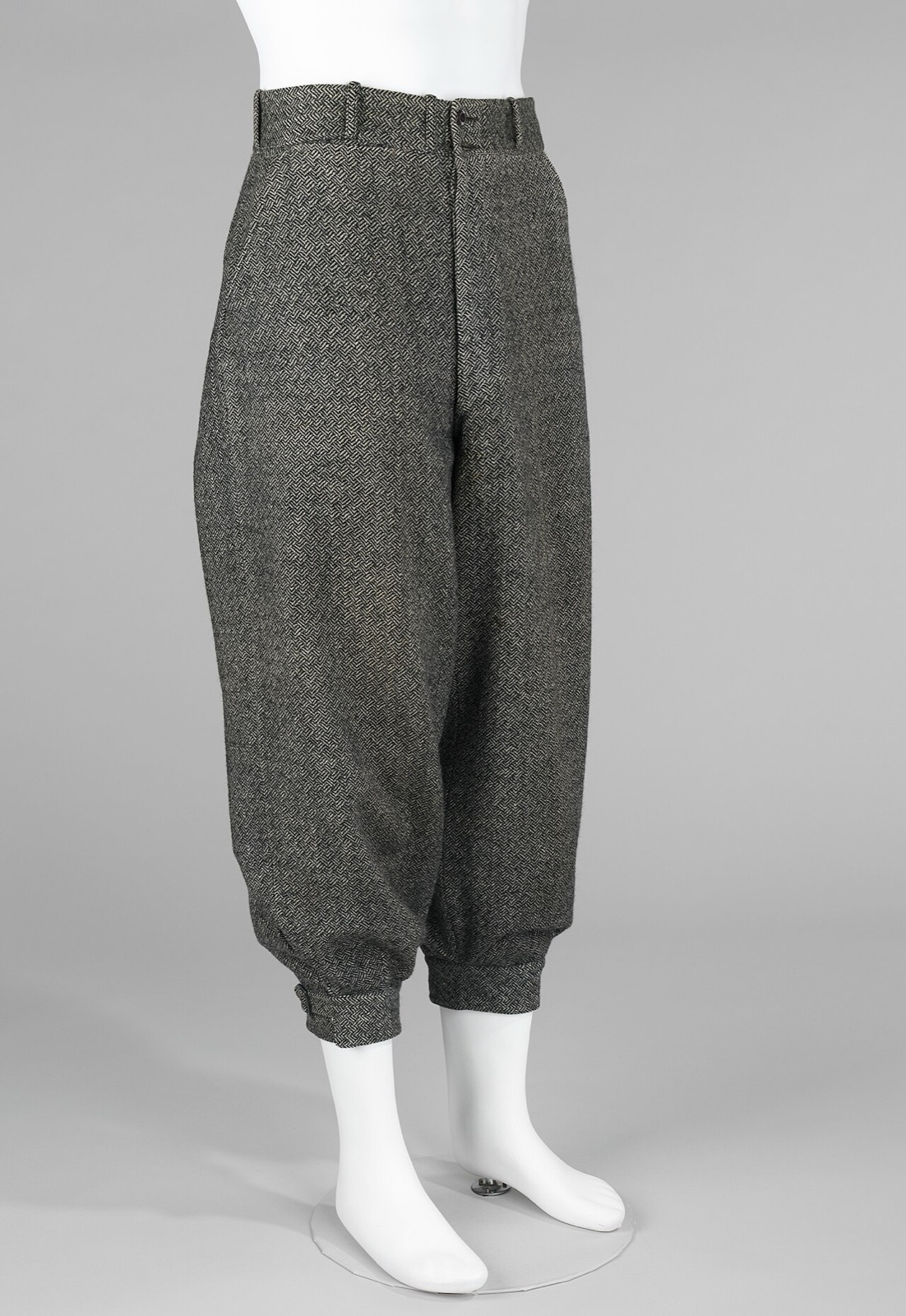
Knickerbockers became sports clothing. The Metropolitan Museum of Art holds a woman’s cycling suit from 1896–98 and notes that “other more daring ensembles featured fully bifurcated Knickerbockers.” Another Met object, from about 1925, is a pair of knickerbockers of the kind “worn in the 1920s for sporting activities, especially golf” — the style called plus fours.
The word arrives in Japanese
The Nihon Kokugo Daijiten, a historical dictionary of Japanese, quotes the word nikka-pokka from a literary work titled Asakusa dated 1931. That shows the word was in Japanese use by then. It does not show that tobi were wearing the garment in that year.
| Name | Script | Where you hear it | What it refers to |
|---|---|---|---|
| Nikka-pokka | ニッカポッカ | General Japanese | The balloon-shaped work trousers |
| Nikka | ニッカ | On site (short form) | The same trousers |
| Shichibu | 七分 | On site, in catalogues | “Seven-tenths”: the classic cut |
| Hachibu | 八分 | Catalogues | “Eight-tenths”: a related cut |
| Tobi-fuku / goto-gi | 鳶服・ゴト着 | On site | The whole outfit |
| Tobi shōzoku | 鳶装束 | Makers | “Tobi attire,” trousers with shirt |
| Jōba zubon | 乗馬ズボン | Makers’ histories | Riding breeches, the earliest form in Toraichi’s account |
From Leggings to Knickers — How the Trousers Reached Building Sites
Momohiki, haragake, hanten
Before the balloon trousers, construction workers in Japan dressed much like other urban labourers. Daimaru Hiroshi, writing in the National Museum of Ethnology’s research notes on modern Japanese dress, describes the shared outfit of the building trades, tobi included, as momohiki leggings and a haragake work apron under a hanten jacket — “股引に腹掛け、上に半天をはおる恰好.”
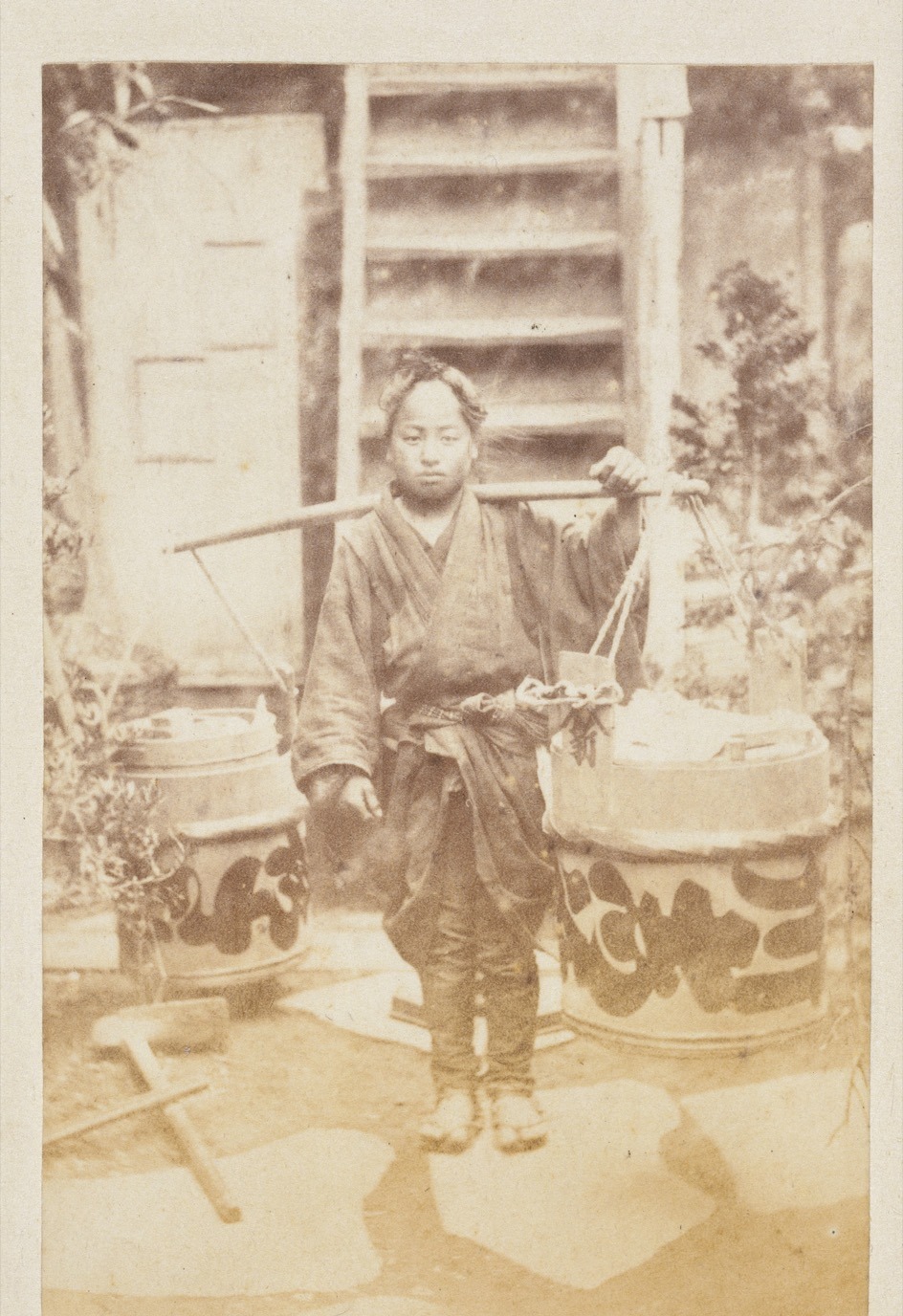
Daimaru argues that this outfit had a problem for people who climbed. The tight momohiki, cramped around the knee, “were not originally suited” to the way tobi moved at height. He adds that the old durable fabrics were stiff and hard on the skin, and that the softer materials of the later trousers were part of the reason workers changed.
The 1930s
In Daimaru’s account, construction and civil-engineering workers began wearing knickers in the 1930s, the prewar Shōwa years, and by the Pacific War the building trades, tobi among them, had “almost finished” the change to working knickers.
He is careful about how. He suggests that the clothes of contractors and foremen spread down to the workers they employed, and he labels this a guess — “という推測.” The research notes describe their sources as interviews, photographs and measurements of garments, along with town histories from around 1930; they do not cite a single contemporary document for the 1930s change itself.
The cavalry guess
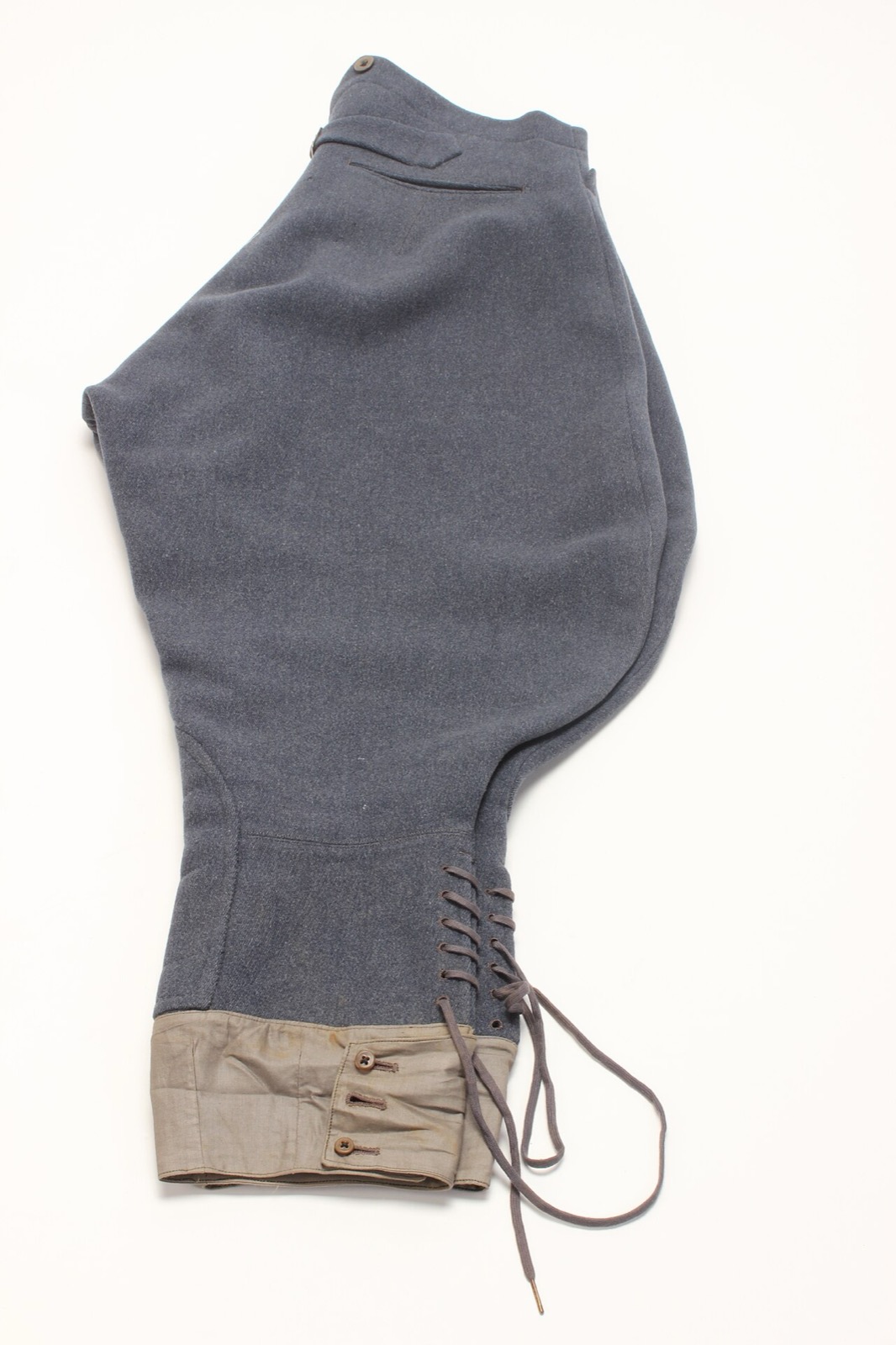
A second guess comes from Akiyama Fumio, who wrote a reader on construction-site vocabulary for the publisher Shōkokusha in 2017. In his entry on the trousers, he writes that he thinks they may have begun when someone used riding-style military trousers as workwear. He presents this as his own idea (“と思います”), not as a finding.
Toraichi, one of the best-known makers, tells a related story in its own product history: tobi attire “started from riding breeches” and then moved through the seven-tenths and eight-tenths cuts. That is the maker’s account of how its shapes evolved, not a record of the first person to wear them on a site.
The makers’ dates
The firmest dates belong to the companies that make the trousers today.
| Year | Event | Source |
|---|---|---|
| 1809 | A History of New York by “Diedrich Knickerbocker” | Columbia University Libraries |
| 1896–98 | Knickerbockers in women’s cycling dress | Metropolitan Museum of Art |
| Taishō era (1912–1926) | Start of the Kanto Tobi brand, in the brand owner’s account | Cocos Nobuoka |
| 1930s | Construction workers start wearing knickers | National Museum of Ethnology (Daimaru) |
| 1931 | The word nikka-pokka in a literary work, Asakusa | Nihon Kokugo Daijiten |
| 1959 | Murakami Hifuku Honten founded at a home in Kojima, Okayama (now Toraichi) | Toraichi |
| 1960 | Toraichi starts making and selling “nikka zubon” | Toraichi |
| 1966 | Toraichi starts making the tobi-attire “shichibu” trousers | Toraichi |
| 1998 | Cocos Nobuoka takes over the Kanto Tobi brand | Cocos Nobuoka |
The 1960 and 1966 entries are one company’s production records. They should not be read as the date nikka trousers came to Japan. By the museum’s account, workers had been wearing knickers for a generation before Toraichi made its first pair.
Five Reasons People Give — Sorted by Who Gives Them
Room for the knee
One commonly given reason is movement. The Japan Uniform Council, an industry body, says of tobi trousers that the leg has a wide range of motion and “bends and stretches easily.” Daimaru’s argument — that tight momohiki did not suit climbing — is the same idea from the historian’s side.
nippon.com’s Japanese report connects the longer cuts to the same movements. A tobi lifts a leg high to step onto the next level of a scaffold and crouches to work on the boards, and the report links the arrival of ankle-length “long” styles to those actions. That is the article’s explanation, not a quote from a worker.
The cloth as a warning, according to a training booklet
The second reason is the one visitors find most surprising. A booklet from the Foundation for Construction Industry Promotion (建設業振興基金), Basic Knowledge for Working on a Construction Site, lists two functions for the wide trousers:
– “The flutter of the trousers lets you gauge the strength of the wind from below” (ズボンのなびきで下から風の強さが把握できる). – “The trousers touch a protrusion first, so you recognise the danger” (ズボンが出っ張り等に触れることで危険を認識する).
This is a training text, written to explain the trade to newcomers. It does not report a test, and we found no study comparing near misses or injuries between workers in wide and narrow trousers.
A tight hem that does not catch
The third reason is about the other end of the leg. nippon.com’s English article explains that “keeping them tight at the hems prevents them from catching.” The claim is about the ankle, not the balloon: the nikka narrows hard at the bottom.
Older Japanese clothing dealt with loose hems in another way. Maki-kyahan (巻脚絆) are cloth puttees wound around the shin, and a folk-collection note from Iwakura City in Aichi Prefecture describes them as wrapped over trousers to stop the hem from catching on obstacles.
Air around the knee
Toraichi adds a comfort reason. Describing its long nikka, the maker says the cloth does not cling to the knee, which it presents as “comfortable ventilation.” In Japan’s hot summers that matters, but it is a description of how the trousers feel, not the result of a heat test.
Looking the part
The last reason is pride. The photographer Matsuda Tadao, who began photographing construction workers on real sites in 2014 for his “Shokunin Shashin” (craftsman photographs) series, told nippon.com that he thought the wish to stand out was the underlying motive for the wider and longer cuts. Cocos Nobuoka sells its Kanto Tobi range under the line “誇り高く、粋を纏う”, roughly “proud, and wearing iki (粋)” — a Japanese word for stylish flair. Toraichi itself says the extra-extra-long cut may have been meant to make the wearer stand out, while admitting that “the background is not known in detail.”
| Reason given | Who says it | Kind of source | Tested? |
|---|---|---|---|
| Easy to bend, crouch and lift the leg | Japan Uniform Council; Daimaru (museum notes); nippon.com | Industry body; historian; magazine | No test found |
| Flutter shows wind strength | Foundation for Construction Industry Promotion | Training booklet | No test found |
| Cloth touching a protrusion alerts the wearer | Same booklet | Training booklet | No test found |
| Tight hem does not catch | nippon.com (English) | Magazine | No test found |
| Air around the knee | Toraichi | Maker | No heat test found |
| To stand out, to look like a tobi | Matsuda Tadao; Cocos Nobuoka; Toraichi | Photographer; makers | A matter of opinion |
The Case Against — Sceptics and Site Managers
“Mayutsuba” — take it with a grain of salt
Not everyone accepts the sensor story. Akiyama, in his reader on construction-site vocabulary, says that a claim that the trousers lower your centre of gravity makes no sense because cloth has no weight, and that the idea of measuring a gap with the slack of the cloth is mayutsuba — “it’s not part of your body, so that’s dubious.” He does not reject the movement argument.
The museum notes are sceptical too. Daimaru points out that once stretch fabrics arrived after the war, “there is not much practical need for a large amount of slack.” In his reading, the balloon may have been useful for the stiff cloth of the 1930s and then kept for other reasons.
Steel that catches cloth
The strongest objection comes from site managers. In a column for Sekō no Kamisama, a Japanese site for construction managers, one site manager wrote that he had many times seen workers in extra-extra-long trousers catch them on starter bars and trip over. Starter bars are the rebar ends left sticking up from concrete for the next pour. His site bans the long eight-tenths and extra-long cuts, and allows the seven-tenths.
That is one manager’s experience, not an accident statistic. But it turns the sensor argument around: the same cloth that is supposed to warn of a protrusion can also catch on one.
Seeing your own feet
Another commonly repeated claim is that the nikka lets you see your feet. A scaffolding contractor that explains the trousers on its own site lists the opposite as a concern: the wide shape can make it “harder to see your footing.” We could not find a source that supports the visibility claim, so we do not repeat it as a benefit.
Who decides
There is no national law in Japan that bans nikka on building sites. Topcon, the survey equipment maker, explains in its Japanese guide to the trousers that bans are decided by each company or site and are “not uniformly required by law.” The Industrial Safety and Health Regulations (Article 110) require employers to provide suitable work caps or clothing where a worker’s hair or clothing might be caught in powered machinery. That rule is about rotating machines, not scaffolds, and it does not name any style of trousers.
Seven-Tenths, Eight-Tenths, Extra-Extra-Long — Reading the Cuts
What the numbers mean
Japanese catalogues sort tobi trousers by names that sound like ratios: shichibu (七分, seven-tenths), hachibu (八分, eight-tenths), long hachibu, chō-long (超ロング, extra-long) and chō-chō-long (超超ロング, extra-extra-long). Akiyama, quoting a tobi-clothing maker, describes the history as “seven-tenths, then eight-tenths, then long,” each step adding length and width.
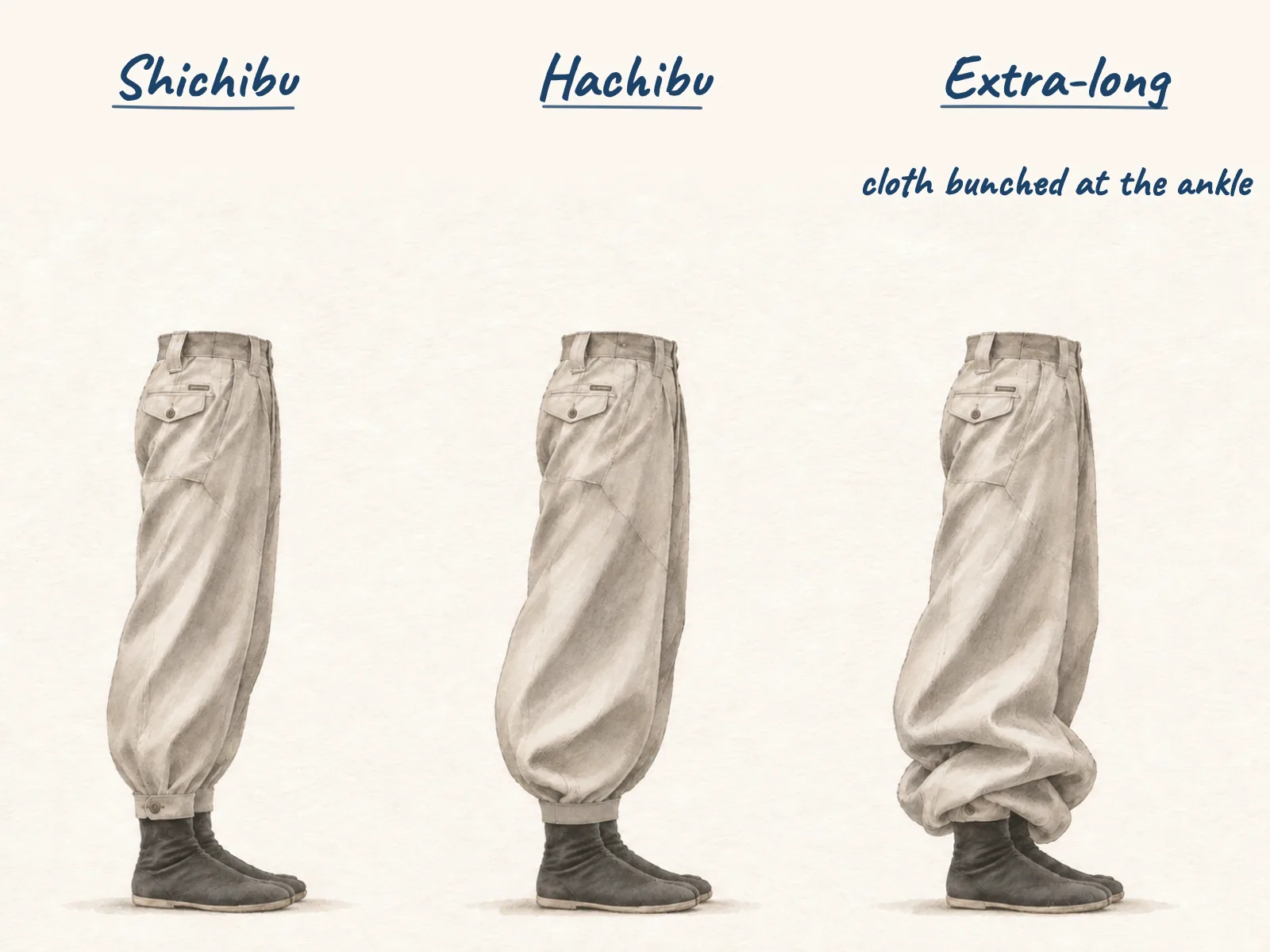
The names do not measure anything precisely. In Toraichi’s 2530 series, the shichibu and the hachibu share the same 70 cm (27.6 in) inseam in the 79 cm (31 in) waist size. The difference is the hem: the shichibu closes with six buttons, the hachibu with a zip. Toraichi’s own guide says the hachibu is essentially the zip version of the shichibu, with “almost no change in silhouette.”
Measured from one maker
| Toraichi 2530 series, waist 79 cm | Inseam | Thigh width | Hem closure |
|---|---|---|---|
| Shichibu (2530-401) | 70 cm (27.6 in) | 40.5 cm (15.9 in) | Six buttons |
| Hachibu (2530-402) | 70 cm (27.6 in) | 42 cm (16.5 in) | Zip |
| Long hachibu (2530-412) | 77 cm (30.3 in) | — | — |
| Extra-long hachibu (2530-410) | 84 cm (33.1 in) | — | — |
| Extra-extra-long hachibu (2530-418) | 102 cm (40.2 in) | — | — |
An inseam of 102 cm on a trouser for a 79 cm waist sounds absurd until you remember that the extra length is not meant to reach the floor. It is gathered at the ankle and allowed to hang as a fold. That is why the inseam figure cannot be read as where the hem sits when the trousers are worn.
These are one maker’s figures for one series. Another maker, Murakami Hifuku’s Hooh brand, lists its 4700 shichibu with a 59 cm (23.2 in) inseam and a buttoned hem. The names are shared across the trade; the measurements are not.
Cloth
Materials differ as well. Toraichi’s 2530 series is 90 percent polyester and 10 percent cotton; its 4441 extra-extra-long is 100 percent cotton, as are Hooh’s 4700 shichibu and 4002 extra-extra-long. Toraichi offers a matching tobi shirt (トビシャツ) in its 2530 series — the 2530-301, with a concealed front placket — and advises buyers to match the first four digits of the product number when buying a top and trousers in the same colour.
Down to the Ankle — Jika-tabi and the Tucked Hem
Into the boot
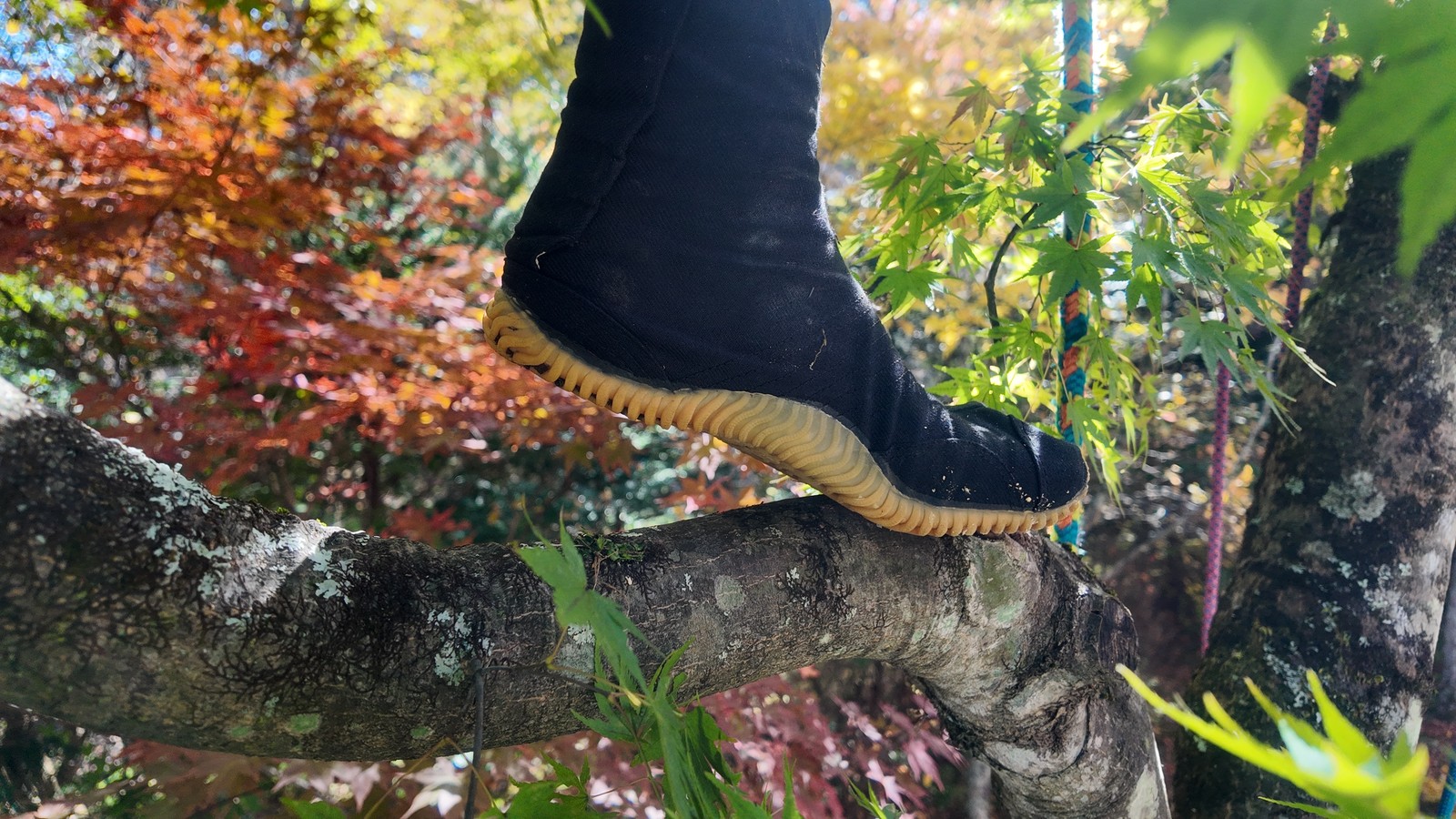
Watch a tobi dress and the last step is the ankle. A scaffolding contractor’s guide to the trousers says the hem is tucked inside the jika-tabi, so the narrow end of the trouser disappears into the boot and nothing hangs loose above the sole.
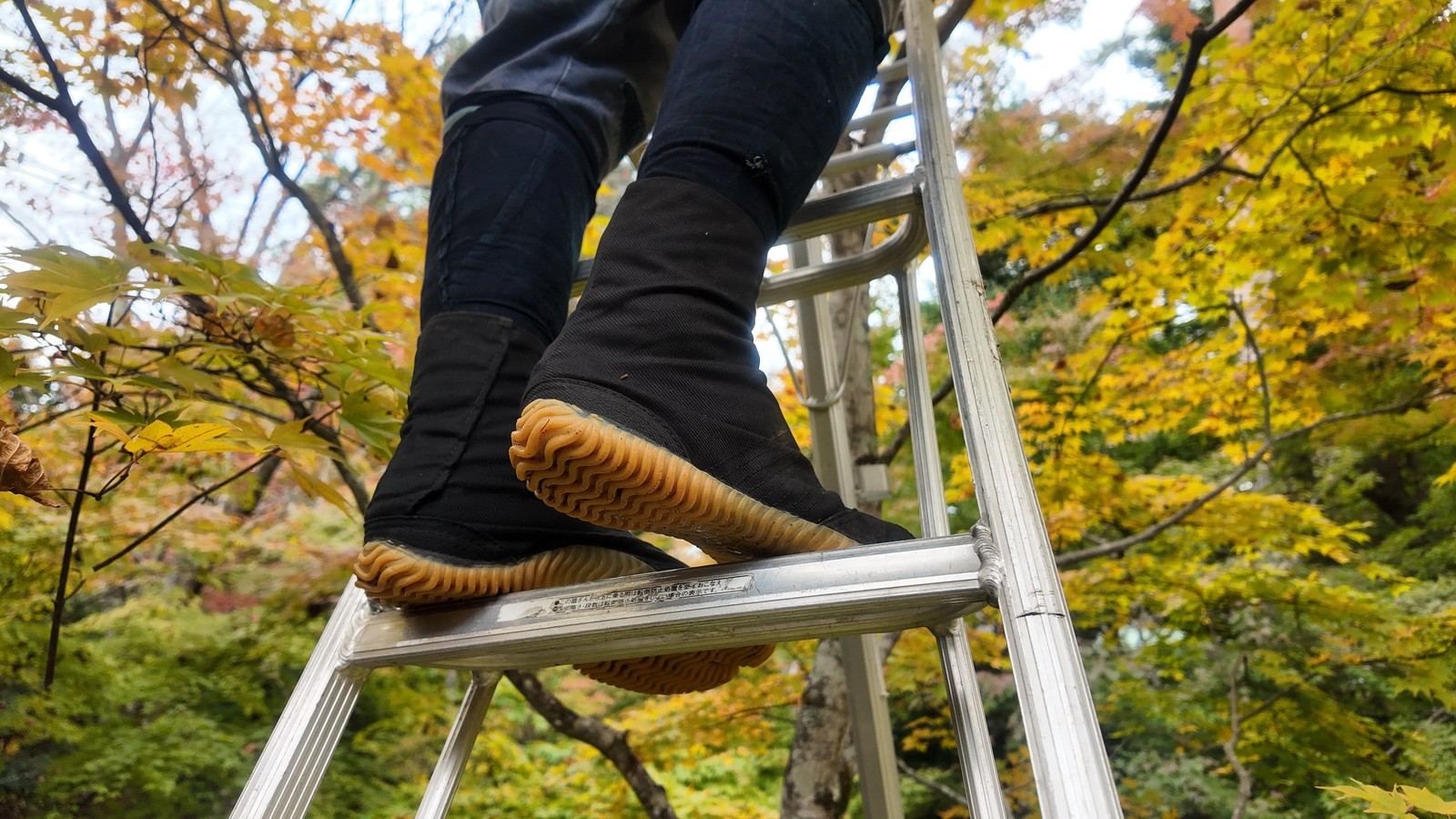
nippon.com’s Japanese report notes that scaffolders, who climb more than most, are often seen in nikka with jika-tabi, and quotes the view that the feel of the sole underfoot is important. We looked at those boots, and at what the evidence does and does not show about them, in our article on jika-tabi split-toe boots.
Where the comparison stops
Of all the explanations, the narrow ankle has the plainest practical account: a closed hem has less to catch. But the pairing explains the ankle, not the balloon. Tucking the hem into a boot would work just as well with straight trousers, and the makers’ catalogues now include cargo and stretch trousers with no balloon at all. The image of a worker in balloon trousers and split-toe boots is real, but it is one way of dressing on Japanese sites, not the only one.
Harnesses, Rules and the Safety Case
Falls are the main risk
Trousers on a scaffold matter because of falls. In 2025, according to the Japan Construction Occupational Safety and Health Association (建災防), 214 construction workers died at work in Japan, and 91 of those deaths — 42.52 percent — were classed as falls. The Ministry of Health, Labour and Welfare gives the same total of 214, a 7.8 percent fall from the year before. Those 91 are all falls, not falls from scaffolds alone, and no national data links them to the shape of anyone’s trousers.
The harness rules of 2019
Japan changed its rules on fall-arrest equipment from February 1, 2019. Full-body harnesses became the principle, with body belts still allowed in some cases depending on the height of the work. Equipment made to the old standard could be used until January 1, 2022, and the new standard applied in full from January 2.
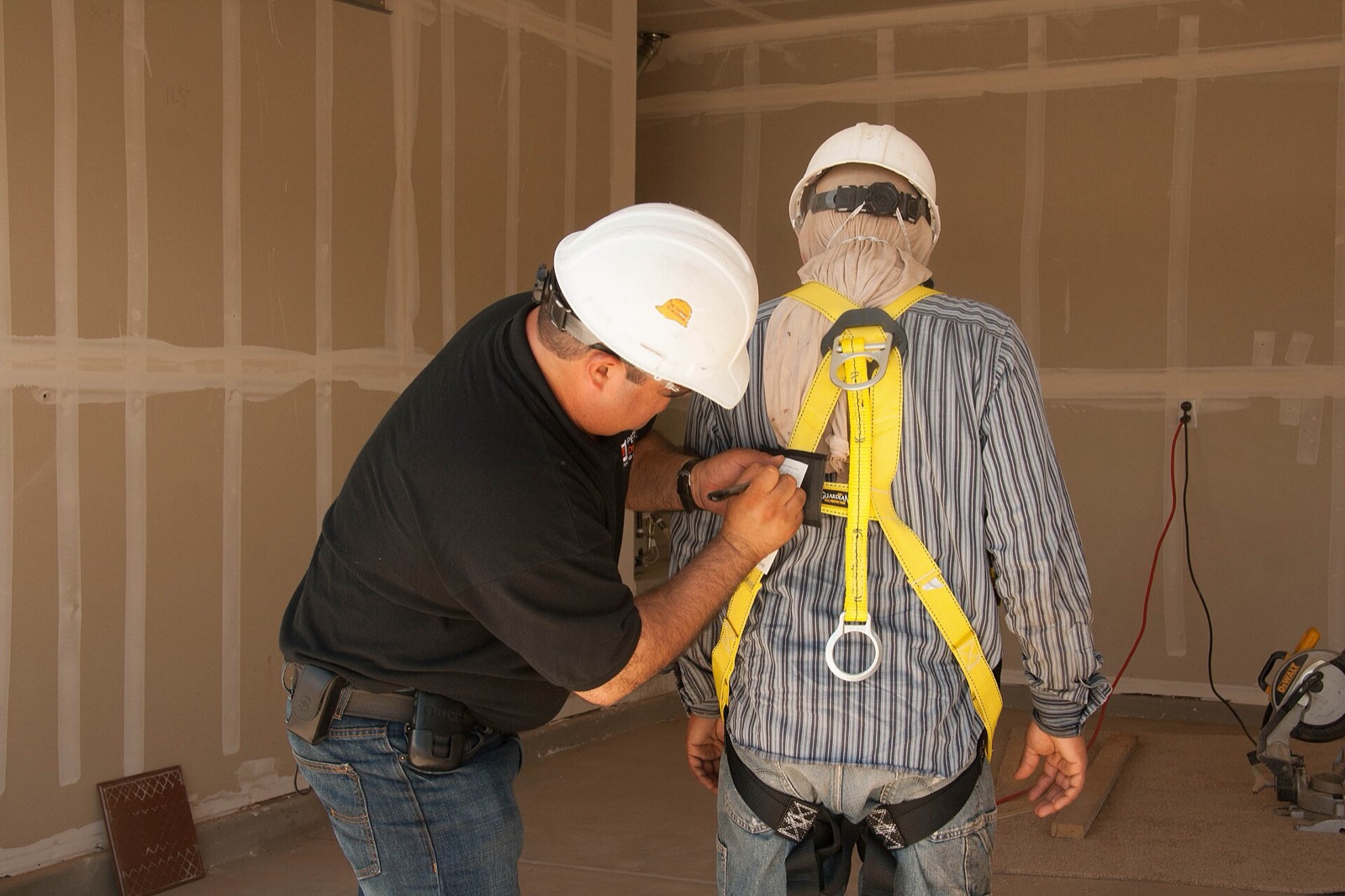
People sometimes link the harness rules to the decline of the nikka. The Ministry’s documents do not support that. The harness rules are about the equipment that stops a fall. They say nothing about trousers.
Where the choice is made
So the choice sits on site. A general contractor or a site manager can set a dress rule, as the manager writing for Sekō no Kamisama did; and Topcon’s guide makes clear that this is a company or site decision rather than a legal one. Work at height in tight Japanese streets raises the same kind of question in tree work; our article on how Japanese crews take down large trees piece by piece looks at that side of it.
Japan and Elsewhere — How Other Countries Talk About Loose Clothing
“Never wear loose clothing”
The English-language guidance we found starts from a different place. The UK Health and Safety Executive, in its guidance on machinery, says: “Never wear dangling chains, loose clothing” near moving parts. A US OSHA construction training text gives the same advice — “avoid wearing loose clothing or jewelry that can be caught in moving parts.” Both are about entanglement in machines. Neither mentions scaffolds or a style of trousers.
Cuffs on a steel frame
The closest English-language parallel to the Japanese debate comes from Canada. The Infrastructure Health and Safety Association of Ontario, in its safety manual for ironworkers, tells workers: “Don’t have cuffs on your pants or sleeves because they can get caught.” The same manual recommends long-sleeved shirts and full-length pants to protect the skin.
That is the same worry as the Japanese site manager’s, from the other side of the Pacific: cloth that sticks out can catch. The Japanese tobi cut narrows the hem hard and leaves room above it; the Ontario manual simply asks for no cuffs.
| What the cited sources say | Japan | UK / US / Canada (Ontario) |
|---|---|---|
| Rule on trouser shape | Not required by law; decided by company or site (Topcon) | No source found naming a trouser style |
| Machine entanglement | Suitable clothing required (Industrial Safety and Health Regulations, Art. 110) | Avoid loose clothing near moving parts (HSE; OSHA) |
| Catching on steel | Some sites ban the longest cuts | No cuffs on pants or sleeves (IHSA, Ontario) |
| Typical stated benefit of wide trousers | Movement, wind and obstacle “sensor,” pride | Not described in the guidance found |
Different premises, not better or worse
None of this makes one approach the right one. Japanese tobi climb in a tradition where the trousers carry identity as well as function, and where the trade’s own literature describes reasons for the shape. The English-language guidance cited here is written for a broader set of trades and starts from machinery. Both agree on the point that matters most: whatever you wear, nothing should hang where it can catch.
Slimmer, Stretchier, and on the Catwalk — How the Trousers Are Changing
Slimmer cuts in the catalogues
The trousers are changing in two directions at once. In the catalogues, slimmer and stretchier cuts have arrived. Toraichi now sells a “slim extra-extra-long hachibu” — the traditional cut narrowed — in a fabric that stretches both lengthwise and across. Murakami Hifuku’s Hooh catalogue for spring–summer 2025 lists a cargo nikka and plain stretch trousers alongside its classic tobi cuts. For summer 2026, Toraichi offers a shirred nikka in a thin nylon sold on lightness and a cool feel against the skin.
These are product changes, not a measured trend. We could not find national figures for how many tobi wear nikka today, or how that has changed. Tokyo Weekender, an English-language magazine in Tokyo, reports that the trousers’ “presence on actual construction sites in Japan is fading.” That is the magazine’s observation rather than a count.
From the site to the shop
The other direction is fashion. In a 2020 autumn–winter release, Toraichi sold its nikka zubon through the select-shop chain Freak’s Store as casual trousers under the name “tuck pants.” In the United States, Esquire described “an entire subculture obsessed with the tobi pant.” Tokyo Weekender, in the same article that notes the decline on site, describes the uniforms’ turn toward high fashion.
What stays
Two things have stayed constant through all the changes. In the makers’ catalogues, the tobi cuts still close at the ankle, by button or zip, and Toraichi still sells shirt and trousers as a matching set. Whatever the cut above, the narrow hem remains.
Reading the Trousers on a Site — What to Look For
Three things to notice
If you are in Japan and want to read what you are seeing on a scaffold, three details tell you most:
– The hem. In Toraichi’s 2530 series the shichibu buttons and the hachibu zips; scaffolders often tuck the hem into jika-tabi. A closed, narrow ankle is the constant. – The fold. The long cuts carry far more length than the leg needs, gathered as a fold at the ankle — the cuts one site manager bans. – The rest of the outfit. A matching shirt in the same colour is the maker’s idea of a full set.
The same question in tree work
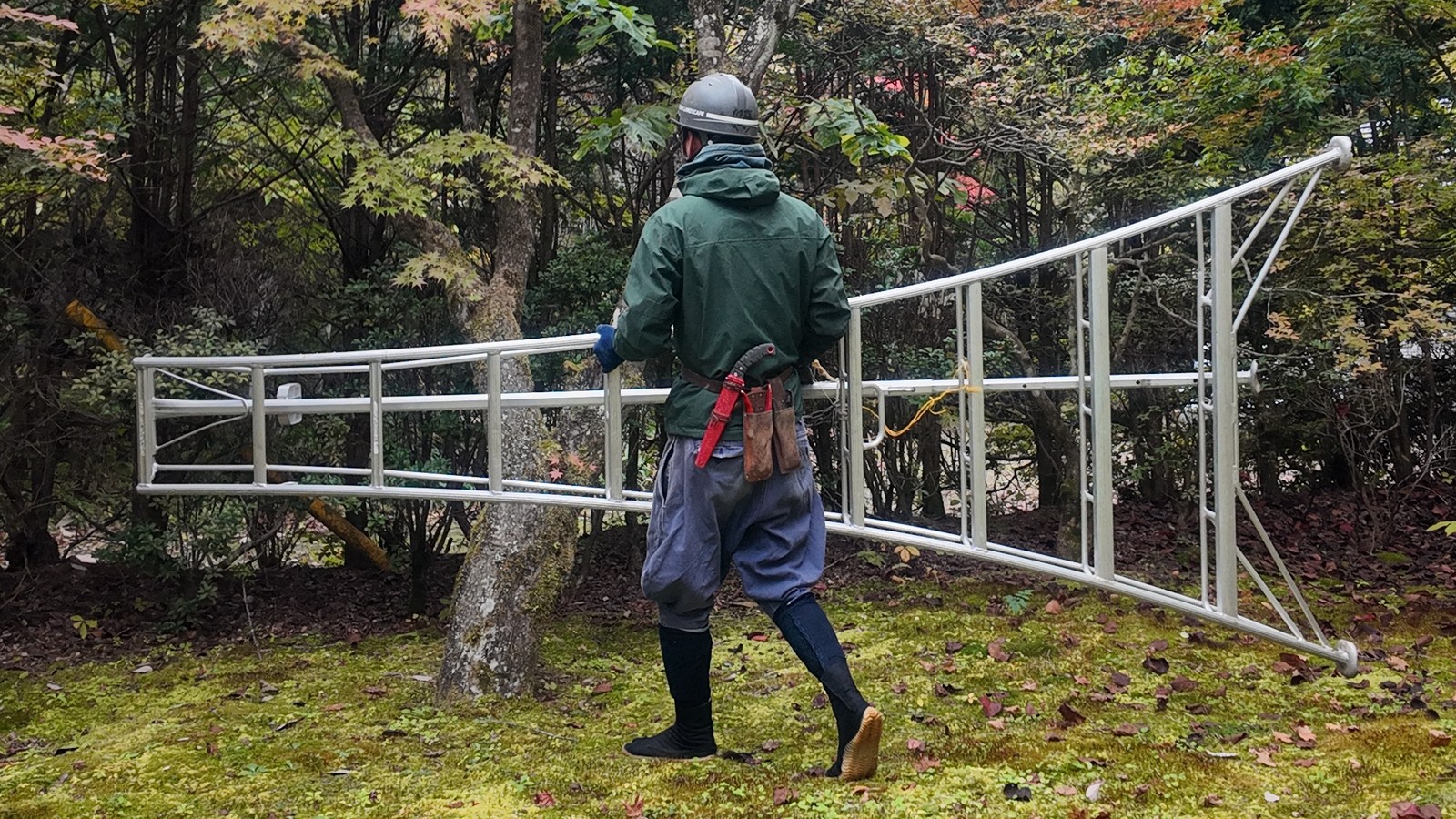
Japan’s tree trade has its own climbers: the sorashi (空師), who climb tall trees to take them down from the top. Our article on Japan’s sorashi tree climbers looks at that work. The sources on tobi trousers keep returning to one practical point that any climber will recognise: cloth that hangs loose can catch.
Frequently asked questions
Why do Japanese construction workers wear baggy pants?
The wide trousers, called nikka-pokka or tobi pants, give room to bend, crouch and lift a leg high on a scaffold, and the narrow hem keeps the ankle from catching. A Japanese construction-industry training booklet also says the fluttering cloth shows wind strength and that the fabric touching a protrusion alerts the wearer. These reasons have not been tested against accident data.
What are Japanese construction pants called?
Nikka-pokka (ニッカポッカ), shortened to nikka on site, after the English knickerbockers. The common cuts are shichibu (seven-tenths), hachibu (eight-tenths) and the long cuts up to chō-chō-long (extra-extra-long). The whole outfit is called tobi-fuku or tobi shōzoku.
When did Japanese workers start wearing nikka-pokka?
The National Museum of Ethnology’s research notes place the change from momohiki leggings to knickers in the 1930s and say it was almost complete by the Pacific War. The maker Toraichi began making nikka trousers in 1960; that is the company’s start, not the start of the style.
Are the sensor claims true?
They are stated in a training booklet from the Foundation for Construction Industry Promotion, but we found no study testing them. The author of a reader on construction-site vocabulary calls one version “dubious,” and a site manager reports workers catching the wide cloth on starter bars and tripping.
Are nikka-pokka banned on Japanese building sites?
Topcon’s guide says bans are not uniformly required by law and are set by individual companies or sites; one site manager allows the seven-tenths cut but bans the long and extra-long cuts. The 2019 harness rules did not ban the trousers.
Can you buy tobi pants as fashion?
Yes. Toraichi has sold its nikka through a fashion select shop as “tuck pants,” and Esquire has described “an entire subculture obsessed with the tobi pant.”
Sources
– Kotobank / Britannica International Encyclopaedia (Japanese edition), “Knickerbockers” (accessed 2026-11-14): https://kotobank.jp/word/%E3%81%AB%E3%81%A4%E3%81%8B%E3%81%BC%E3%81%A4%E3%81%8B%E3%83%BC%E3%81%9A-109783 – Kotobank / Nihon Kokugo Daijiten, “Nikka-pokka” (accessed 2026-11-14): https://kotobank.jp/word/%E3%81%AB%E3%81%A4%E3%81%8B%E3%83%BC%E3%81%BC%E3%81%A4%E3%81%8B%E3%83%BC-3215449 – Topcon Positioning Asia, column on nikka-pokka (accessed 2026-11-14): https://www.topconpositioning.asia/jp/ja/column/work/w-0025/ – Columbia University Libraries, text on Washington Irving’s A History of New York (accessed 2026-11-14): https://www.columbia.edu/cu/lweb/digital/collections/cul/texts/ldpd_6309312_009/ldpd_6309312_009.pdf – Carnegie Mellon University Libraries, 1809 edition record (accessed 2026-11-14): https://iiif.library.cmu.edu/file/Posner_016.82_G87OB1/Posner_016.82_G87OB1.pdf – Metropolitan Museum of Art, Cycling suit, 1896–98 (accessed 2026-11-14): https://www.metmuseum.org/art/collection/search/159074 – Metropolitan Museum of Art, Knickerbockers, ca. 1925 (accessed 2026-11-14): https://www.metmuseum.org/art/collection/search/157033 – nippon.com (Japanese), construction craftsmen in nikka-pokka (accessed 2026-11-14): https://www.nippon.com/ja/articles/-/10557 – nippon.com (English), nikka-pokka on the construction site (accessed 2026-11-14): https://www.nippon.com/en/articles/-/19379 – nippon.com, author profile of Matsuda Tadao (accessed 2026-11-14): https://www.nippon.com/ja/authors/6a6c5e5f6b208d9ee40017d6 – Ministry of Health, Labour and Welfare, Kensetsu Welcome: tobi (accessed 2026-11-14): https://kensetsu-welcome.mhlw.go.jp/character/tobi/ – Minato City History, early modern volume (accessed 2026-11-14): https://adeac.jp/minato-city/texthtml/d110022/mp100010-110022/ht000160 – National Museum of Ethnology, research note RN0146 (accessed 2026-11-14): https://htq-fs.minpaku.ac.jp/mcdrefn/RN0146 – National Museum of Ethnology, research note RN0169 (accessed 2026-11-14): https://htq-fs.minpaku.ac.jp/mcdrefn/RN0169 – Shōkokusha, Akiyama Fumio, Sekō Genba-go Dokuhon (2017), bibliographic page (accessed 2026-11-14): https://www.shokokusha.co.jp/?p=8946 – Shōkokusha, sample pages including “Nikka-bokka,” p. 69 (accessed 2026-11-14): https://www.shokokusha.co.jp/pdf/978-4-395-32094-3.pdf – Toraichi, company history (accessed 2026-11-14): https://www.corporation.toraichi.com/history/ – Toraichi, guide to tobi attire (accessed 2026-11-14): https://concept.toraichi.com/2024/03/23/tobi_instagram2024/ – Toraichi, long nikka (accessed 2026-11-14): https://concept.toraichi.com/2020/02/29/long-knicker-pants-by-toraichi/ – Toraichi online store, 2530-401, 2530-402, 2530-412, 2530-410, 2530-418, 2530-301, 4441-418, 9561-406, 9561-448 (accessed 2026-11-14): https://store.toraichi.com/products/2530401 ; https://store.toraichi.com/products/2530402 ; https://store.toraichi.com/products/2530412 ; https://store.toraichi.com/products/2530410 ; https://store.toraichi.com/products/2530418nt ; https://store.toraichi.com/products/2530301 ; https://store.toraichi.com/products/4441418 ; https://store.toraichi.com/products/9561406 ; https://store.toraichi.com/products/9561448 – Toraichi, sale through Freak’s Store (accessed 2026-11-14): https://concept.toraichi.com/2020/09/12/freaksstore2020aw/ – Cocos Nobuoka, Kanto Tobi (accessed 2026-11-14): https://www.co-cos.co.jp/product/kantotobi.html – Murakami Hifuku (Hooh), 4700 and 4002 (accessed 2026-11-14): https://hooh.jp/product/pd-4700/ ; https://hooh.jp/product/pd-4002/ – Murakami Hifuku (Hooh), spring–summer 2025 catalogue (accessed 2026-11-14): https://hooh.jp/wp-content/uploads/2025ss_h2-01.pdf – Foundation for Construction Industry Promotion, Basic Knowledge for Working on a Construction Site (accessed 2026-11-14): https://www.kensetsu-kikin.or.jp/assets/img/database/database04.pdf – Japan Uniform Council, knowledge of work clothing (accessed 2026-11-14): https://juc.or.jp/knowledge/ – Sekō no Kamisama, site manager’s column (accessed 2026-11-14): https://sekokan-navi.jp/magazine/5568 – Ashiba Best Partner, guide to nikka-pokka (accessed 2026-11-14): https://ashiba-best-partner.co.jp/magazine/knickerbockers/ – Iwakura City, folk collection: maki-kyahan (accessed 2026-11-14): https://www.city.iwakura.aichi.jp/bunkazai_db/0000001673.html – e-Gov, Industrial Safety and Health Regulations, Article 110 (accessed 2026-11-14): https://laws.e-gov.go.jp/law/347M50002000032?occasion_date=20261101 – Ministry of Health, Labour and Welfare, basics of safety belts (accessed 2026-11-14): https://www.mhlw.go.jp/content/000495691.pdf – Ministry of Health, Labour and Welfare, full application of the new standard (accessed 2026-11-14): https://www.mhlw.go.jp/stf/newpage_31255.html – Ministry of Health, Labour and Welfare, fall-arrest equipment Q&A (accessed 2026-11-14): https://www.mhlw.go.jp/web/t_doc?dataId=00tc4573&dataType=1&pageNo=1 – Japan Construction Occupational Safety and Health Association, 2025 confirmed figures (accessed 2026-11-14): https://www.kensaibou.or.jp/safe_tech/statistics/construction/r07.html – Ministry of Health, Labour and Welfare, occupational accidents in construction (accessed 2026-11-14): https://www.mhlw.go.jp/content/11600000/001764343.pdf – UK Health and Safety Executive, introduction to machinery safety (accessed 2026-11-14): https://www.hse.gov.uk/work-equipment-machinery/introduction.htm – OSHA, Construction Focus Four: Caught-In or -Between Hazards, p. 11 (accessed 2026-11-14): https://www.osha.gov/sites/default/files/caught_iorb_ig.pdf – IHSA, Construction Health and Safety Manual: Ironworkers (accessed 2026-11-14): https://www.ihsa.ca/rtf/health_safety_manual/pdfs/trades/Ironworkers.pdf – Esquire, tobi pants (accessed 2026-11-14): https://www.esquire.com/style/mens-fashion/a12192017/tobi-pants-japan/ – Tokyo Weekender, how Japanese construction uniforms went high fashion (accessed 2026-11-14): https://www.tokyoweekender.com/art_and_culture/how-japanese-construction-uniforms-went-high-fashion/