

By Isaki Kasahara, a Japanese arborist pruning, assessing and caring for Japan’s trees and gardens · Updated November 23, 2026
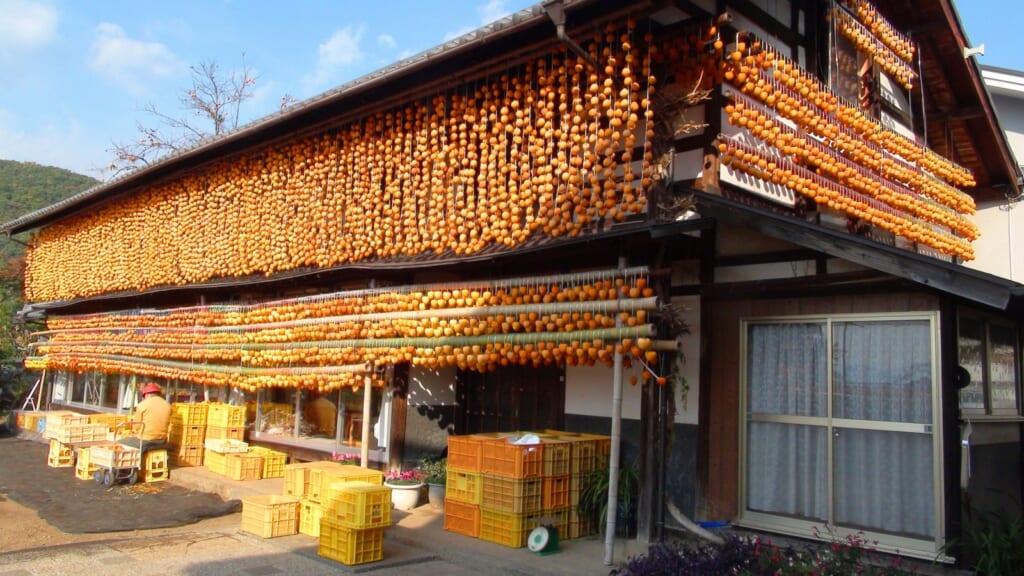
Japanese farmhouses hang peeled persimmons under their eaves in November because the fruit grown for drying is astringent when fresh, and weeks of hanging in dry winter air turn it into hoshigaki (干し柿), a dense, sweet dried persimmon. In Matsuzato, Yamanashi Prefecture, the Koshu Hyakume persimmon is picked in November, peeled, hung in rows that look like orange curtains, massaged by hand and dried for over a month, and the finished korogaki (枯露柿) goes on sale from mid-December. One historic house there hung 2,000 fruit in the 2021 season.
This article follows one fruit from the branch to the New Year table, and then to California, where Japanese American makers keep the same craft.
An Orange Curtain in Matsuzato — What You See in November
Rows of fruit under the eaves
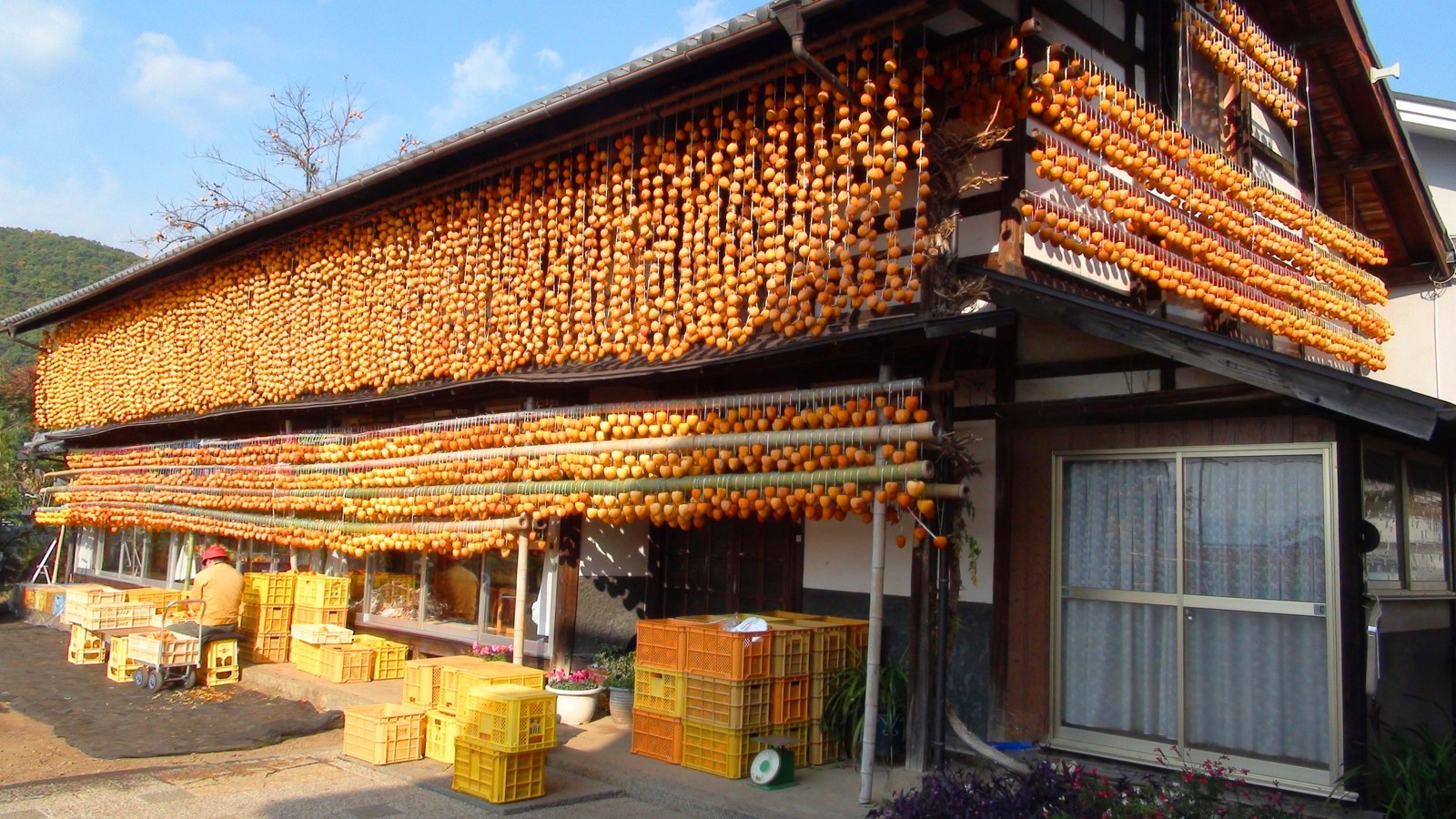
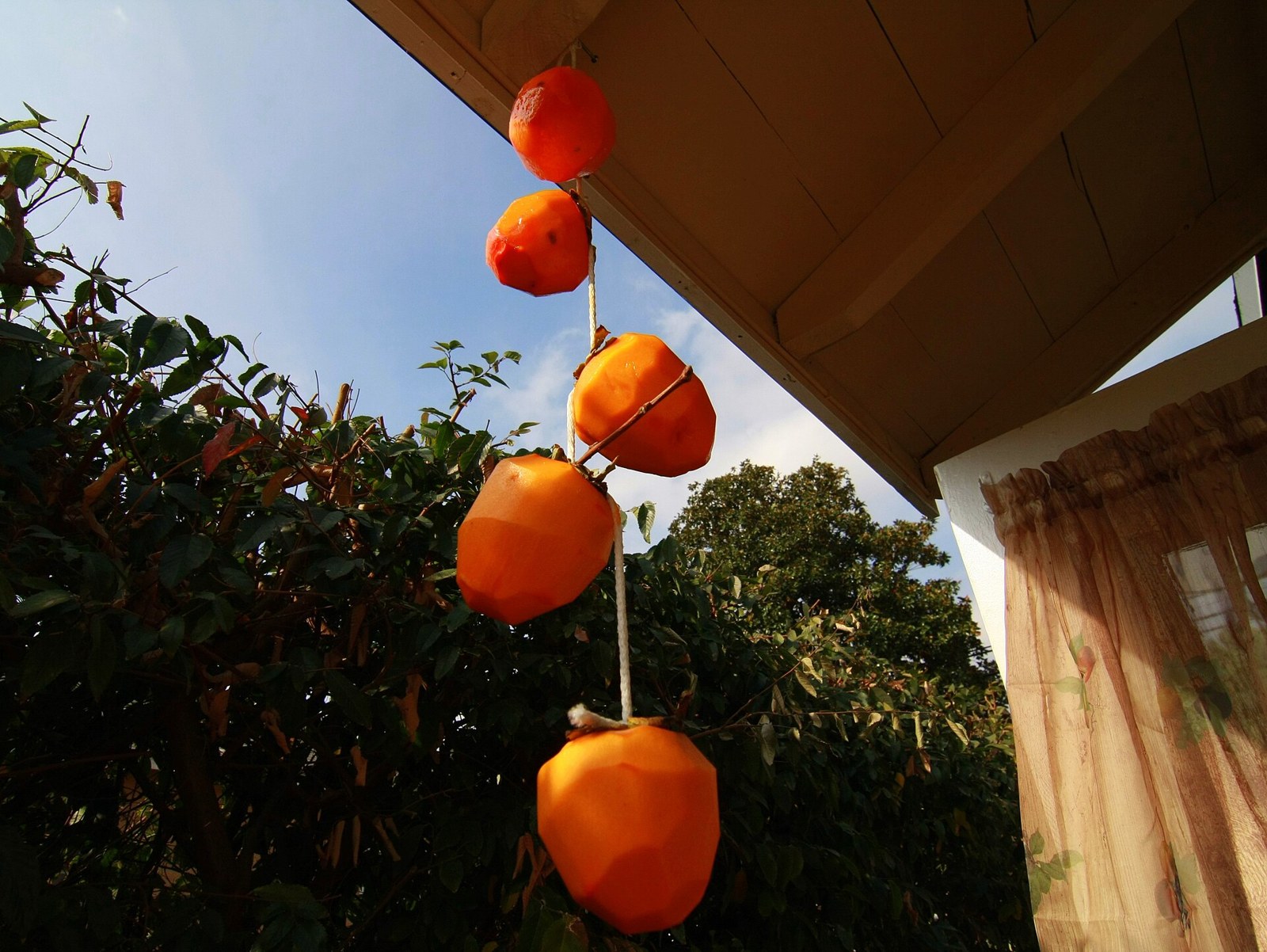
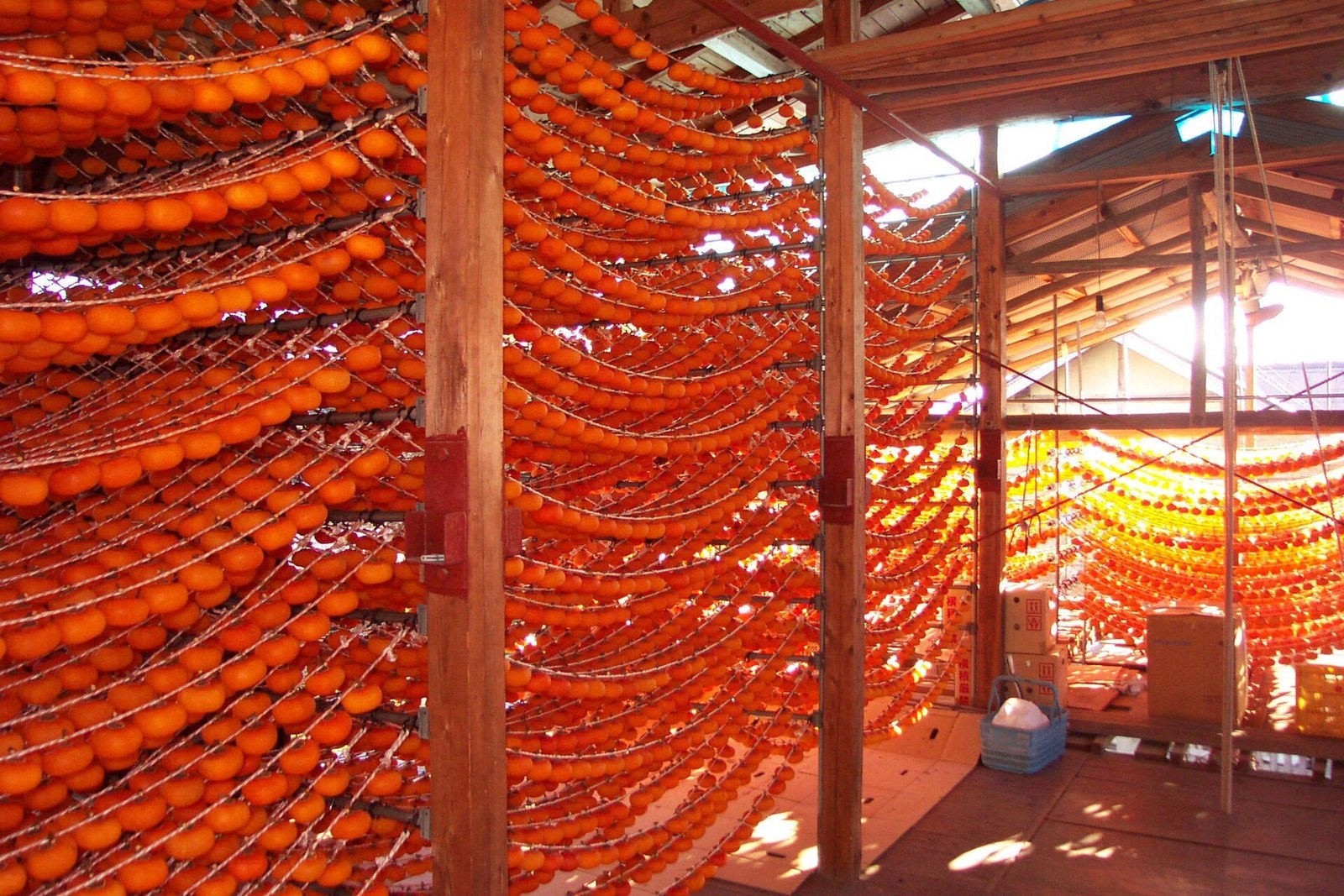
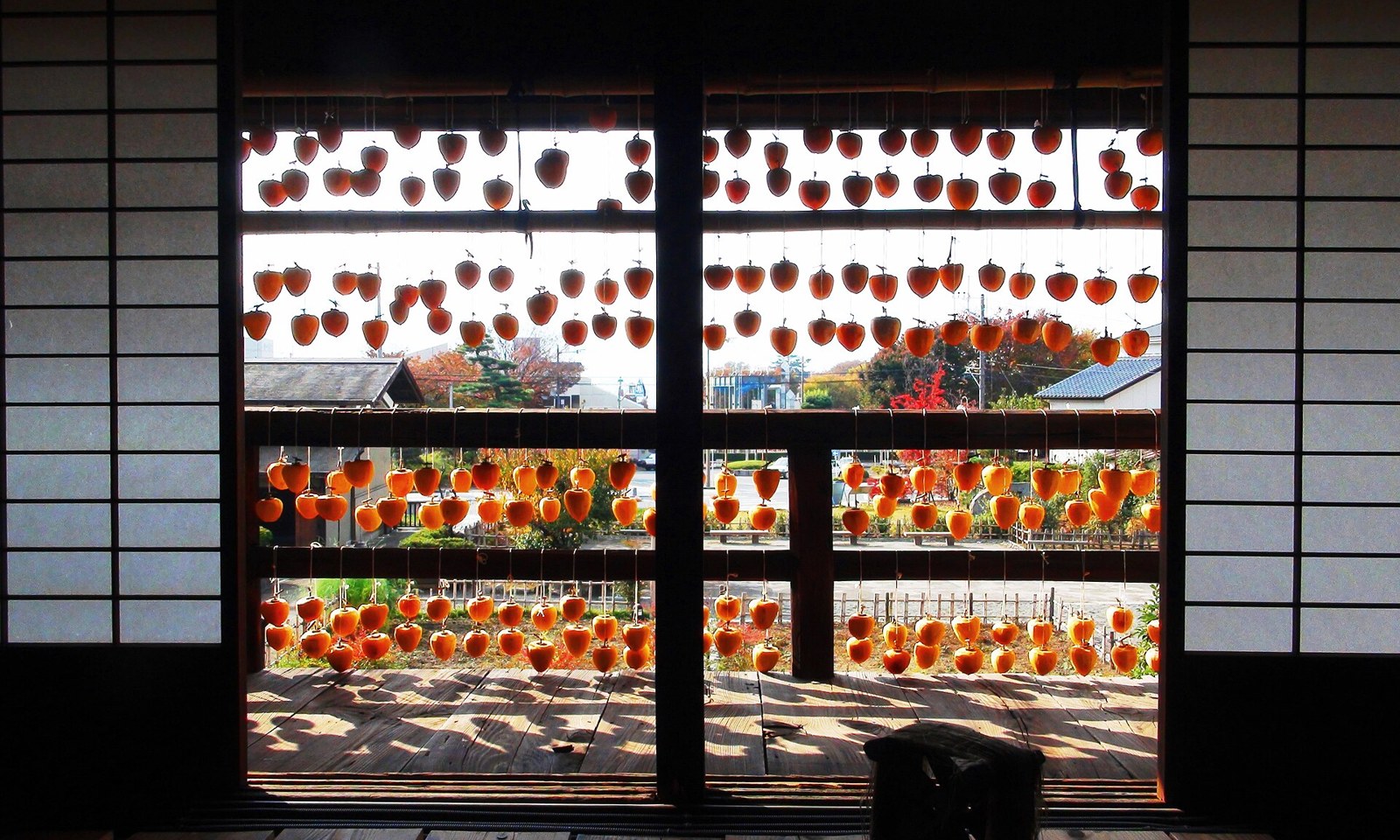
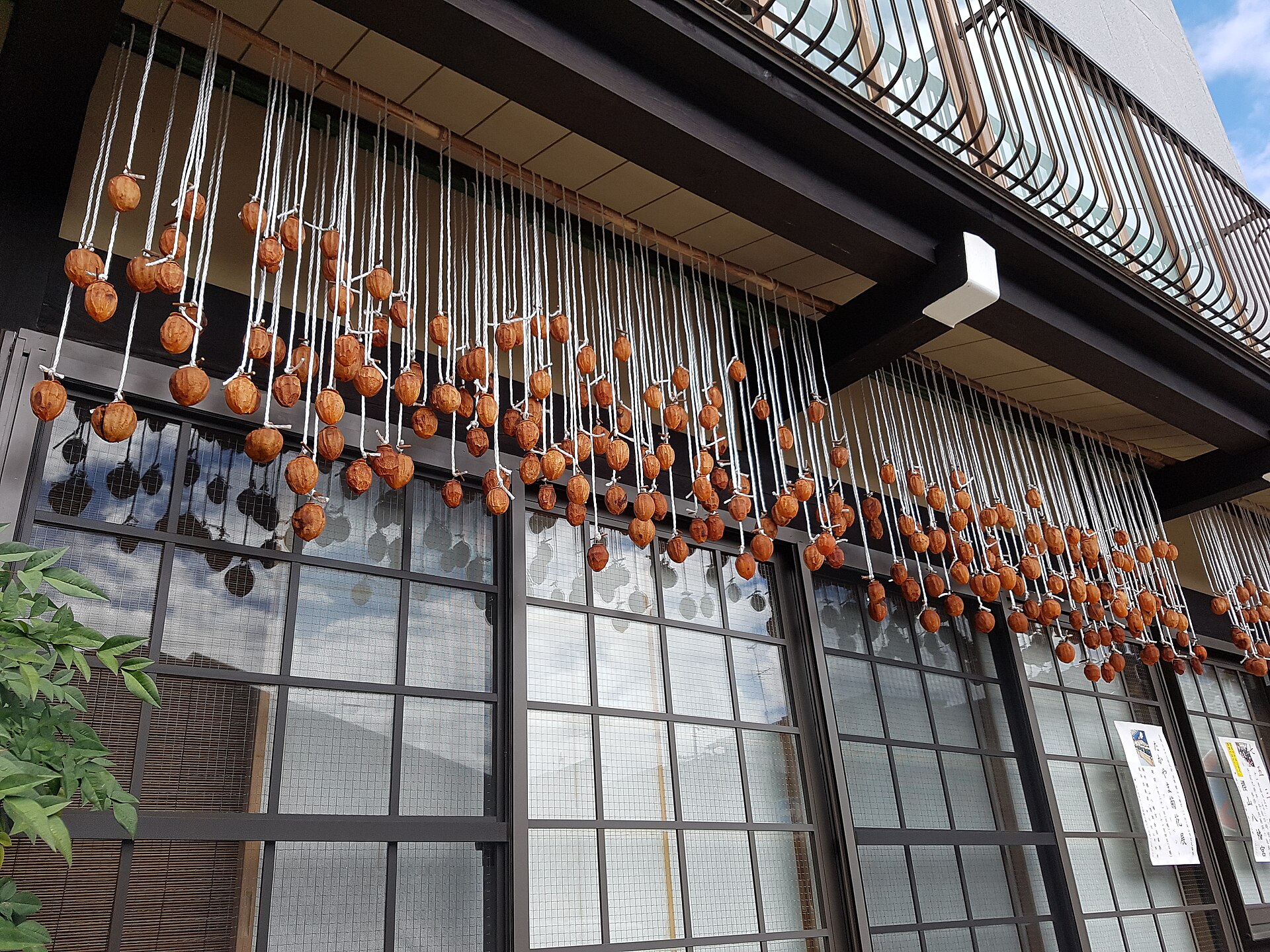
Walk through the Matsuzato district of Enzan, in Koshu City, in November and the farmhouses seem to be wearing curtains. Under the eaves, and on frames set up in the yards, hang vertical strings of peeled persimmons, one fruit above the next, the colour of a ripe apricot. Japan’s Ministry of Agriculture, Forestry and Fisheries (MAFF) describes the scene plainly: every year, from November to around early December, korogaki are hung under the eaves and gardens of private houses, and the hanging fruit looks like an orange curtain.
In Japanese the sight is called kaki-sudare (柿すだれ), “persimmon blinds”. The word hoshigaki is the general Japanese word for dried persimmon. This article follows Yamanashi’s korogaki.
One house, two thousand fruit
One documented public place to see the curtain is the Kanzo-yashiki (甘草屋敷), the former Takano family residence near Enzan Station in Koshu City. The city’s record of the 2021 season says that 2,000 korogaki were hung there on 6 and 7 November, that the fruit stayed under the eaves until the end of November, and that after that it was moved to drying racks. That figure is for one season at one house. How many fruit hang there in 2026, and on which days, should be checked with the city before a visit. Private houses in Matsuzato are homes and workplaces, not attractions; look from the road.
A landscape the city wants to keep
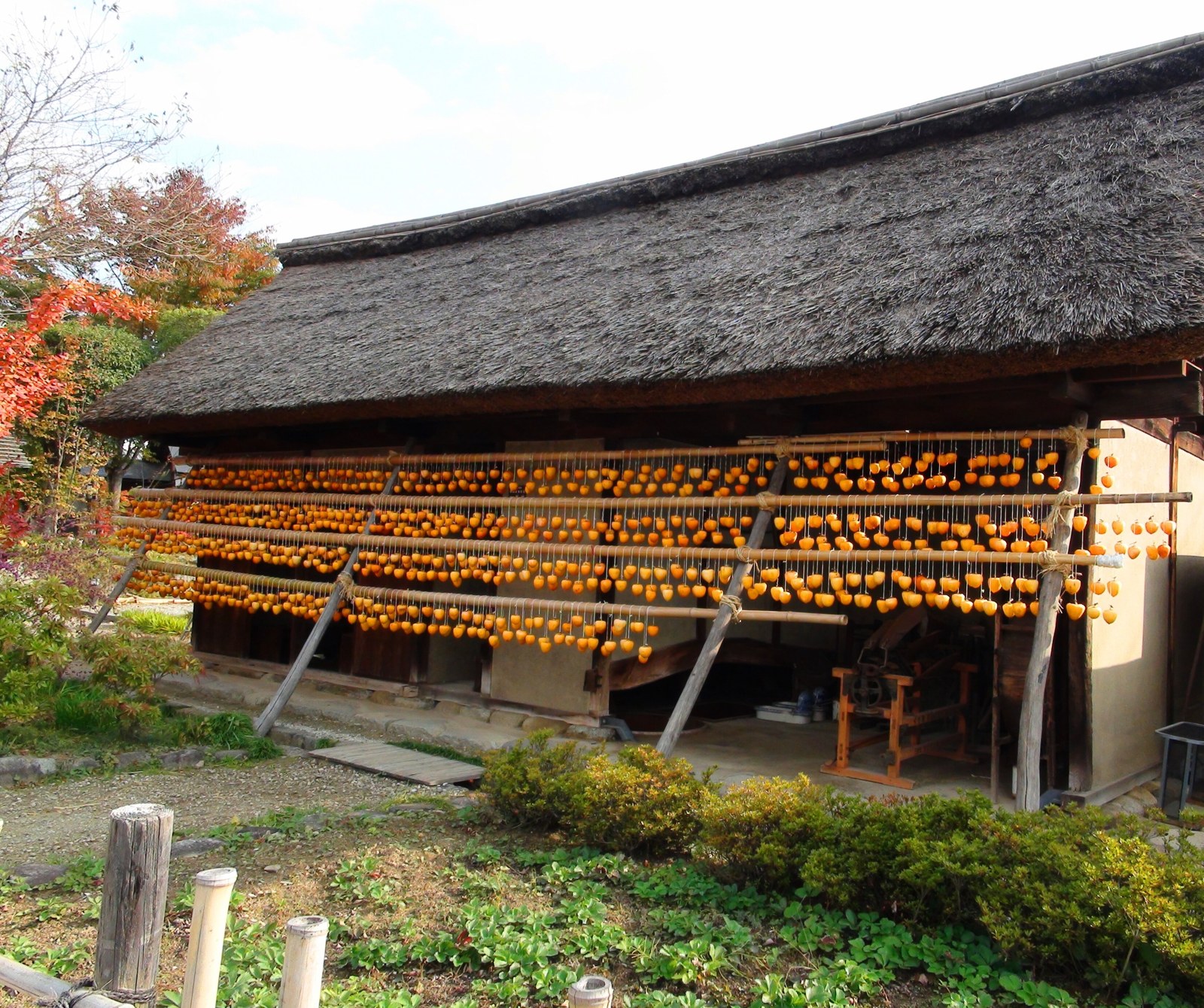
The curtain is not only a seasonal photograph. Koshu City’s plan for maintaining and improving its historic landscape treats Matsuzato as a farming landscape in which three things belong together: the traditional main houses, the large persimmon trees planted inside the house plots, and the sight of drying persimmons. The plan identifies that combination as a historic character worth keeping. The same document infers that in the Edo and Meiji periods, households in Matsuzato made korogaki from persimmon trees planted close at hand, inside their own plots.
Read that way, the curtain belongs with the house and the tree beside it. The eaves also have a practical advantage that the sources below return to: the fruit must be kept out of the rain while the air passes between it.
A Fruit Too Astringent to Eat — Koshu Hyakume and the Problem of Tannin
The variety: a hundred-monme persimmon
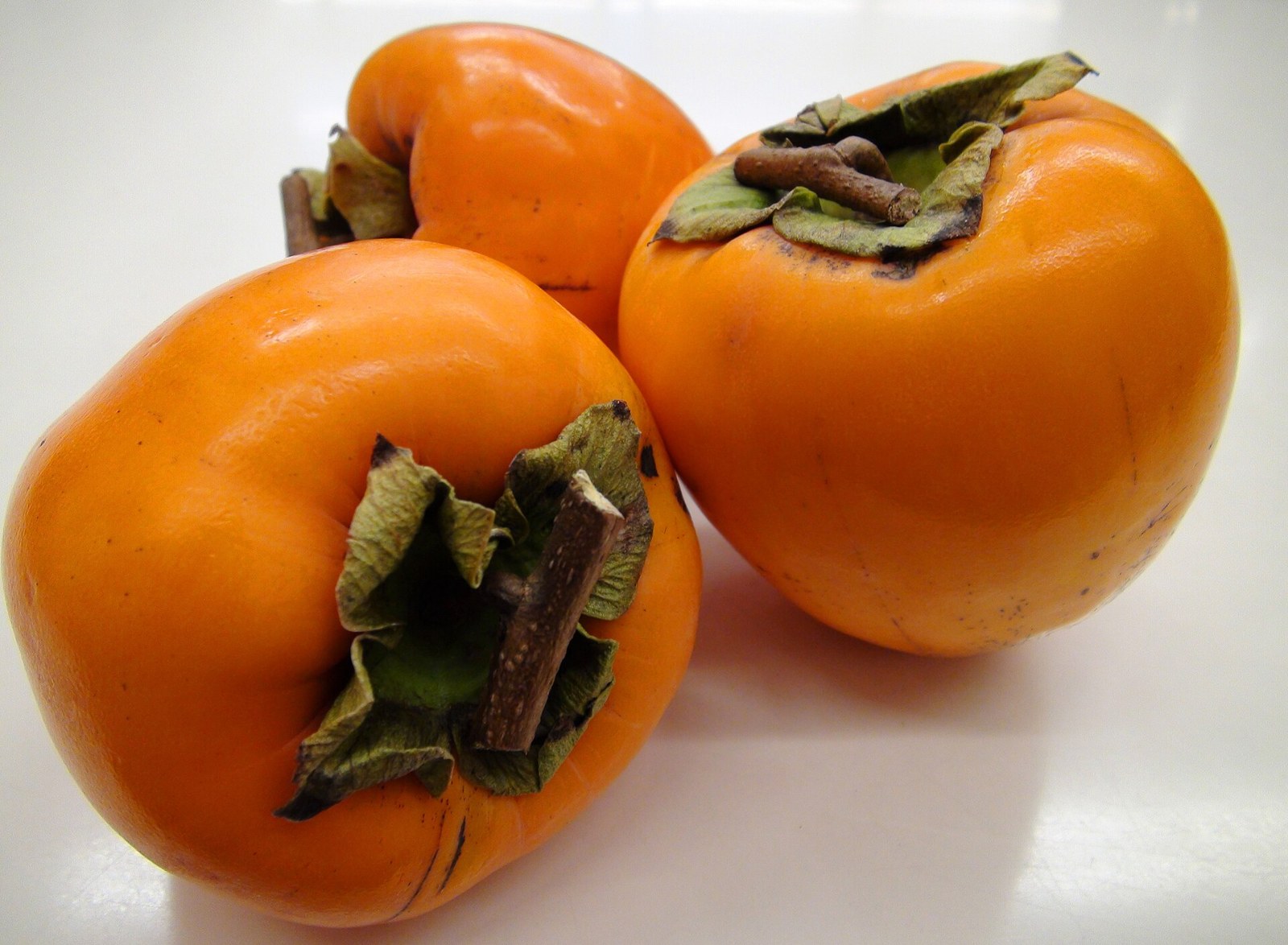
The fruit hanging in Matsuzato is mainly Koshu Hyakume (甲州百目), an astringent persimmon. MAFF’s page on korogaki says the fruit used is mainly Koshu Hyakume grown in Koshu City. The Yamanashi prefectural guide to making korogaki at home names Yamato Hyakume as well as Koshu Hyakume among the varieties grown in the prefecture that suit the process.
The variety is large. Koshu City puts a fresh Koshu Hyakume used for korogaki at about 350 to 400 g (12 to 14 oz) each. Its historic-landscape plan describes the fruit as bell-shaped, notes that large ones exceed 400 g, and passes on the explanation that the name Hyakume comes from a fruit weighing a hundred monme (百匁), about 375 g. The plan presents that as the traditional explanation of the name, which is how it should be read.
Why it cannot be eaten from the tree
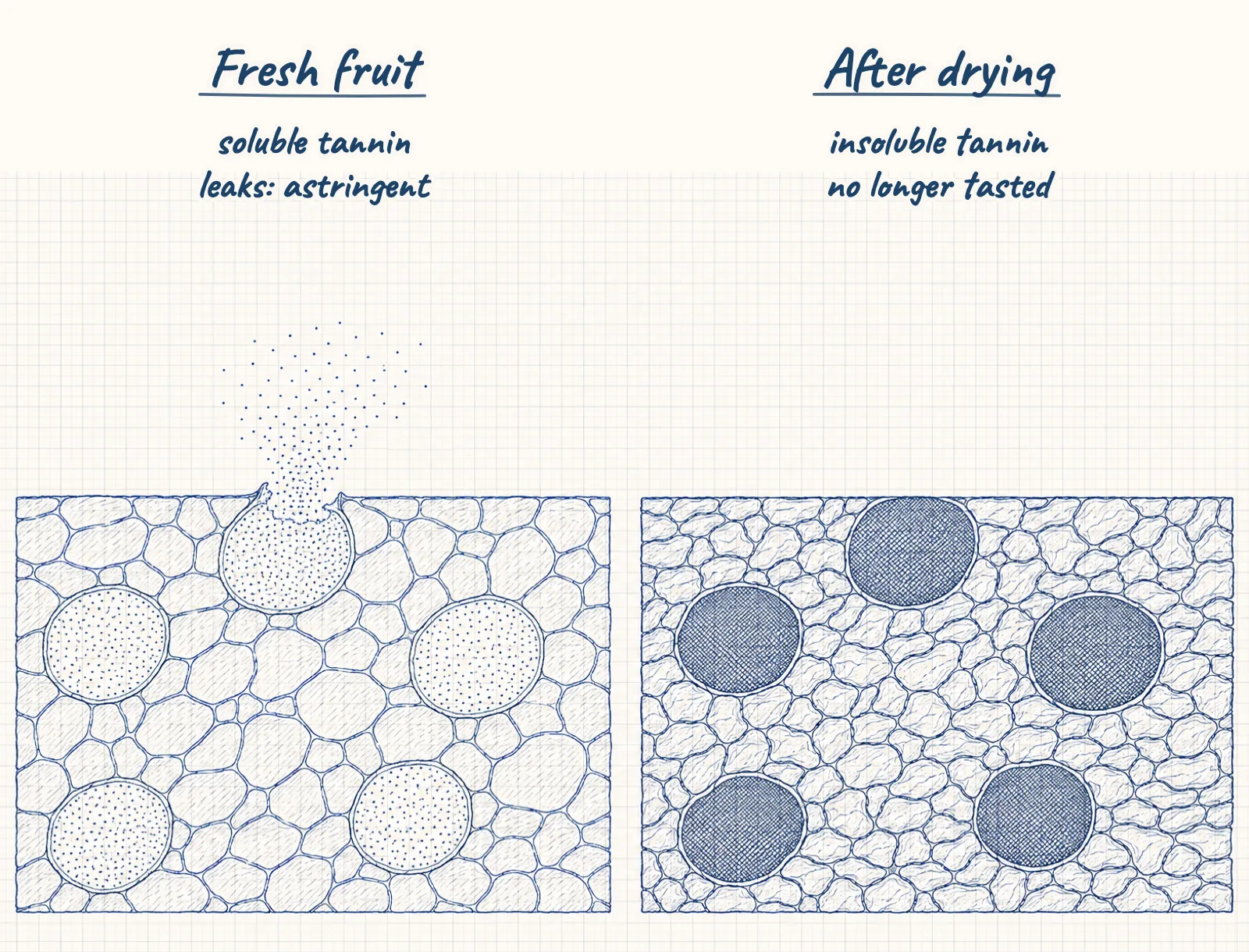
The Japanese persimmon is Diospyros kaki. Some varieties can be eaten firm; others are astringent when firm. A MAFF answer page for children puts it simply: the source of a persimmon’s astringency is water-soluble tannin, the kind that dissolves in the mouth, and drying the fruit as hoshigaki removes the astringent taste.
The same split in California: Hachiya and Fuyu
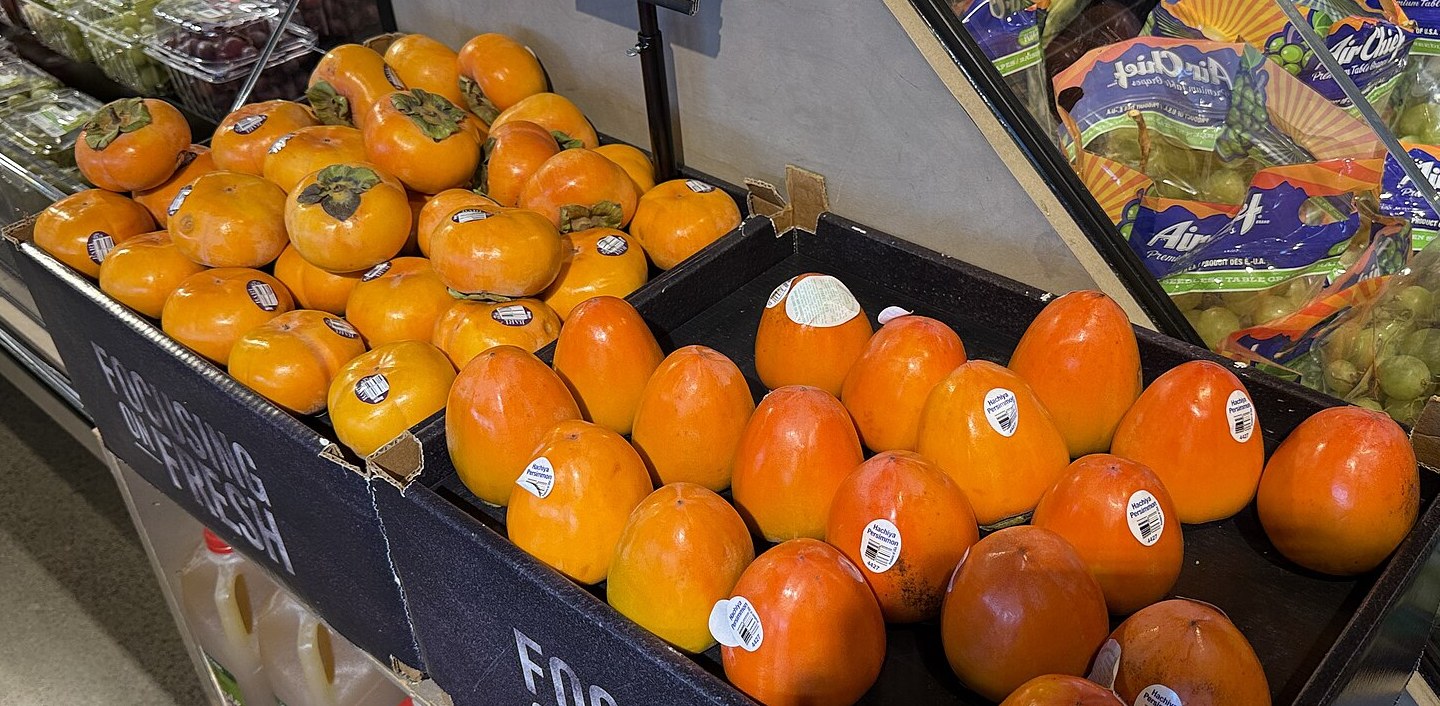
Readers in North America already know this split from the supermarket. University of California Cooperative Extension material for the Marin Master Gardeners describes ‘Hachiya’ as firm, astringent fruit that can be dried, and ‘Fuyu’ as non-astringent, edible while still firm. Hachiya plays the part in California that Koshu Hyakume plays in Yamanashi. They are not the same variety, and nothing in the sources reviewed for this article says they are; what they share is that both are astringent types named in the sources as fruit for drying.
| Astringent type | Non-astringent type | |
|---|---|---|
| Example in Yamanashi | Koshu Hyakume, Yamato Hyakume | (not covered in the sources used here) |
| Example in California | ‘Hachiya’ | ‘Fuyu’ |
| Eaten firm? | No: water-soluble tannin makes it astringent | Yes |
| Use named in the sources | Drying (hoshigaki, korogaki) | Eaten firm |
From Branch to Rope — Harvest, Peeling and Hanging
Step 1: picking with a T-shaped stem
The work starts at the tree. Koshu City’s description of Matsuzato says that when November comes, people begin picking Koshu Hyakume all at once and hang the fruit under the eaves of their houses. MAFF’s Yamanashi recipe gives the first detail that matters: the fruit is picked with the stalk left in a T shape, so there is something to tie a string to.
Step 2: katatori, the shoulder cut
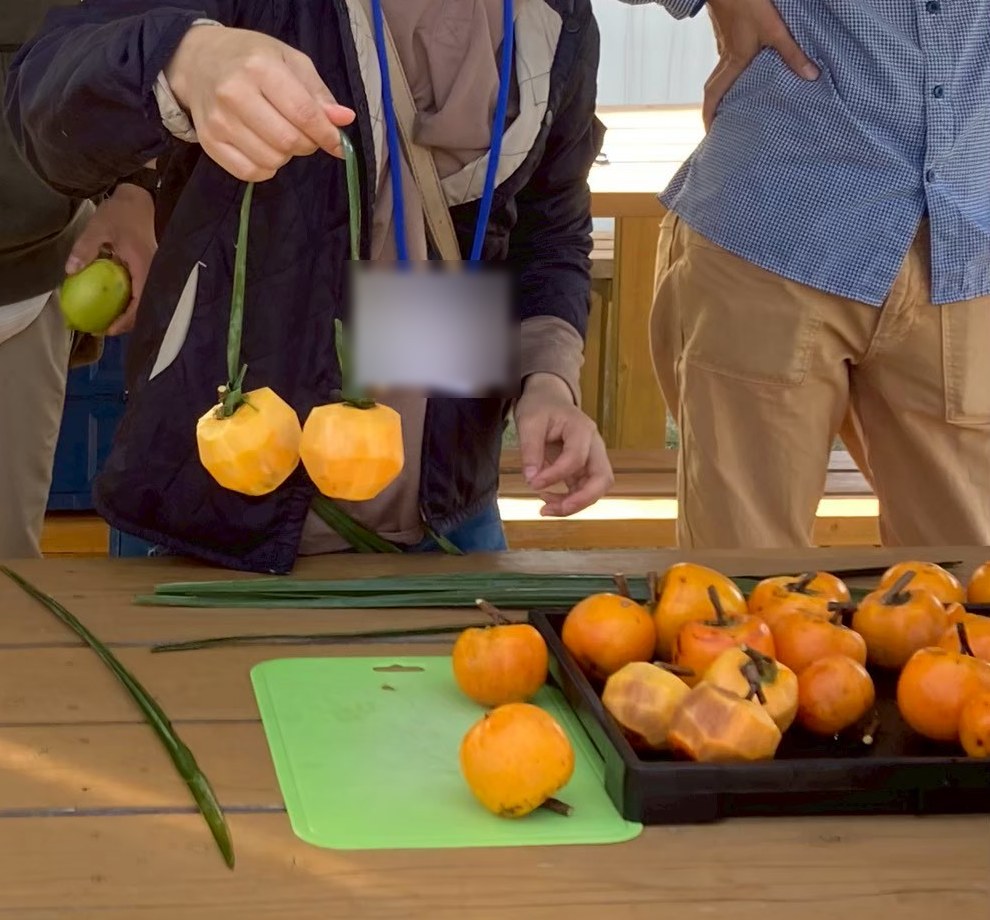
Peeling in Matsuzato is divided into stages. Koshu City’s historic-landscape plan records that the first cut is made around the calyx with a small knife, horizontally, a step called katatori (肩取り), “taking the shoulder”. After that, the rest of the skin is peeled lengthwise with an ordinary commercial peeler.
MAFF’s Yamanashi recipe adds that the skin is peeled off except for a small piece at the very tip of the fruit’s bottom. Other sources describe the leftover skin differently: the 2004 University of California, Davis report on hoshigaki in California describes leaving a little skin around the stem. The two sources describe different places for the skin left on the fruit, and no single Yamanashi rule for it turned up in this research.
Step 3: tying — nagekon and ren
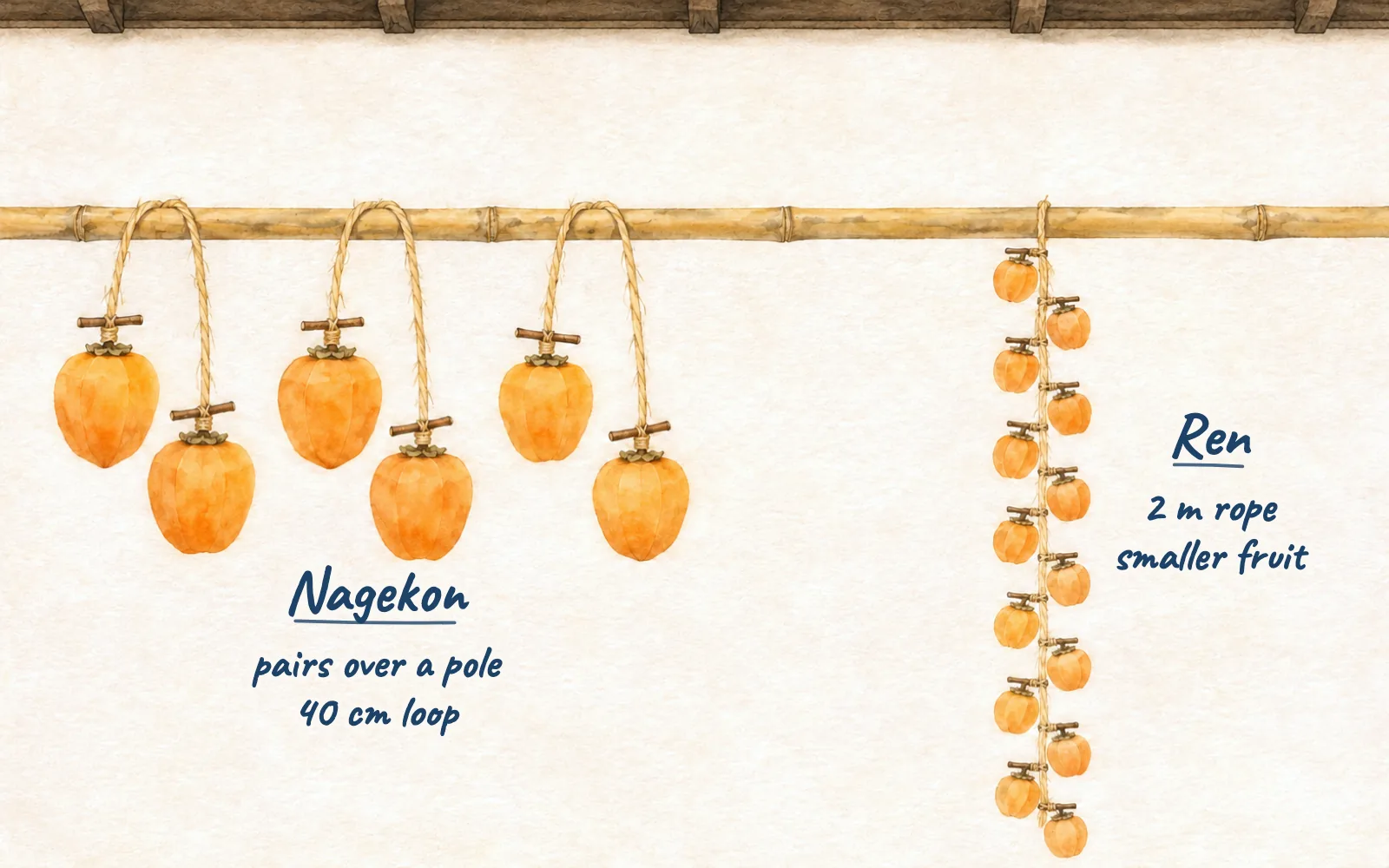
Koshu City records two ways of tying in Matsuzato.
– Nagekon (ナゲコン): for large fruit. A looped string about 40 cm (16 in) long has a persimmon tied at each end, and the pair is hung over a pole. – Ren (レン): for smaller fruit. Persimmons are strung along a rope about 2 m (6.5 ft) long. The city notes that the number of fruit on one rope differs from maker to maker, and that a full rope weighs about 10 kg (22 lb).
Large fruit hung in pairs are adjusted so that neighbouring fruit sit at different heights, one higher and one lower, so that they do not overlap and air can pass between them. That staggering is what gives the curtain its look of a woven pattern rather than a solid wall.
| Step | What is done | Why | Source |
|---|---|---|---|
| Pick | Stalk left in a T shape | Something to tie to | MAFF Yamanashi recipe |
| Katatori | Knife cut around the calyx | Clears the awkward shoulder | Koshu City plan |
| Peel | Remaining skin peeled lengthwise with a peeler | Bare flesh dries | Koshu City plan |
| Sulphur | Fruit smoked with burning sulphur | Surface sterilised, darkening slowed | Koshu City plan |
| Tie | Nagekon (pairs on a 40 cm loop) or ren (2 m rope) | Hanging by size | Koshu City plan |
| Hang | Neighbours staggered up and down | Airflow between fruit | Koshu City plan |
Sulphur Smoke — Why the Fruit Is Fumigated
What Koshu City says it is for
Between peeling and hanging comes a step that visitors rarely see. Koshu City’s description of Matsuzato says the fruit is peeled and then smoked with sulphur, and its record of a korogaki-making class at the Kanzo-yashiki includes a photograph labelled “sulphur fumigation”. The city’s historic-landscape plan explains the purpose: the fumigation sterilises the surface of the fruit and prevents it from over-ripening and from the skin turning black.
In the city’s account, then, the sulphur is a surface treatment, applied after peeling and before the long hang.
Fifteen minutes or thirty: do not mix up the numbers
There is no single fumigation time in the sources, and the two numbers that appear come from different contexts.
– In a 1987 study published in the journal of the Japanese Society for Food Science and Technology, Komiyama and Tsuji used a fumigation room belonging to a farm in Matsuzato. They hung 800 peeled fruit, burned sulphur and took the fruit out 30 minutes later. That is the condition of one experiment, not a rule for the district. – The product specification registered for Ichida-gaki, the dried persimmon of Nagano Prefecture protected as a geographical indication (GI), sets sulphur fumigation at 15 minutes. That is a rule for Ichida-gaki, not for Yamanashi.
The registered GI for Date no Anpo-gaki, a dried persimmon produced in Fukushima Prefecture and other areas, goes further and treats sulphur fumigation as part of its history: the registration describes a “sulphur fumigation technique” that keeps the fruit’s colour as a distinctive feature of the product.
Two Weeks Under the Eaves — What Happens Inside the Fruit
The hanging period
MAFF’s description of the Matsuzato process says the fruit hangs under the eaves in the sun for about 14 to 20 days. After that it is laid flat and dried further. The total time varies by source: the Yamanashi prefectural home guide says about 40 days from hanging under the eaves; Koshu City’s Matsuzato guide says to dry for about 50 days. In the 1987 Matsuzato experiment, the drying time needed before the fruit could be shipped ranged from 31 to 36 days. These are estimates from different guides and one experiment, not a single schedule.
Tannin that stops being soluble
The fruit does not lose its tannin. It changes what the tannin can do. University of Shizuoka material on persimmons explains that during drying, the soluble tannin in the fruit becomes insoluble, so it is no longer tasted as astringency, and the sweetness the fruit already had comes forward. A column by a researcher at Tokyo University of Agriculture describes the chemistry of removing astringency: acetaldehyde increases in the fruit and binds with the water-soluble tannin, and the column states that dried persimmons become sweet by basically the same mechanism. The tannin is still there; it has been locked up.
How quickly? In a 1982 study by Ishii and Yamanishi, Hachiya and Hyakume persimmons were sun-dried, and soluble tannin was no longer detected seven days after drying began, and the fruit no longer tasted astringent.
Weight, water and sugar
The fruit also loses much of its weight. In the 1987 Matsuzato experiment with Koshu Hyakume, the fruit weighed about two-thirds of its starting weight after 6 days, and the finished product weighed about one-quarter of the starting weight. The same study tracked the sugars: sucrose made up 50% of the total sugar in fresh fruit, 26% after 6 days and 2% after 18 days, and none was detected after 24 days.
| Days of drying | What the studies recorded | Source |
|---|---|---|
| 0 | Sucrose 50% of total sugar | Komiyama and Tsuji, 1987 |
| 6 | Weight about 2/3 of the start; sucrose 26% of total sugar | Komiyama and Tsuji, 1987 |
| 7 | Soluble tannin no longer detected; no astringent taste | Ishii and Yamanishi, 1982 |
| about 10 | Sucrose clearly gone in that experiment | Ishii and Yamanishi, 1982 |
| 18 | Sucrose 2% of total sugar | Komiyama and Tsuji, 1987 |
| 24 | Sucrose not detected | Komiyama and Tsuji, 1987 |
| finished | Weight about 1/4 of the start | Komiyama and Tsuji, 1987 |
The rows come from two separate experiments with different fruit and weather, so they should be read study by study, not as one continuous timeline.
The Massage — Why Makers Knead Persimmons by Hand
Kneading and rolling
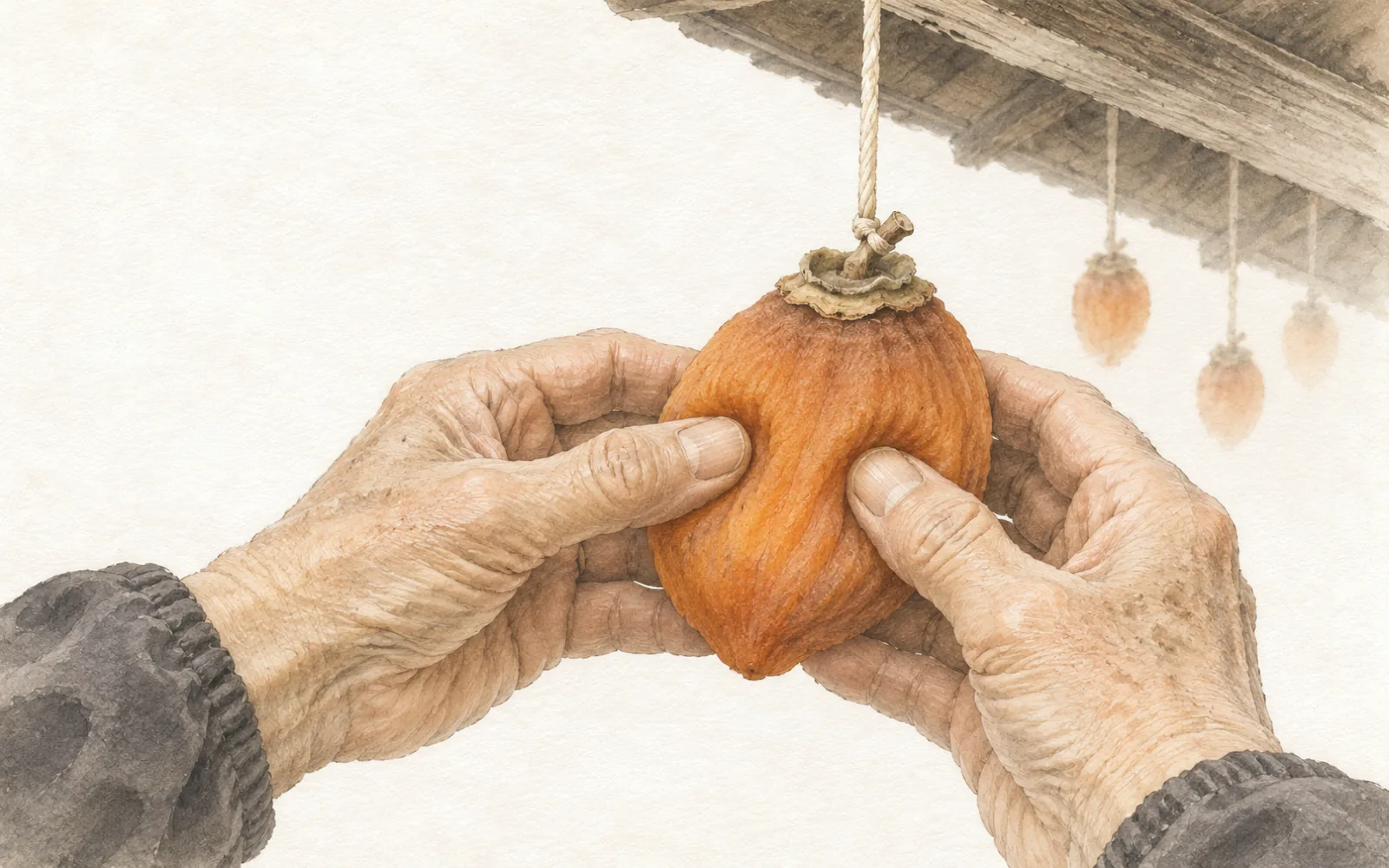
The most distinctive part of the Yamanashi method happens after the fruit has hung for a while. MAFF’s description says that for about 7 to 10 days after the hanging period, the makers knead the fruit and roll it, korokoro, repeating the work every day. The Yamanashi prefectural guide repeats the common explanation of the name: the fruit was rolled so that the sun reached it evenly, and that, it is said, is why it is called korogaki. The prefecture presents it as “said to be”, and it is best left that way.
In the 1987 experiment, the fruit was massaged by hand, one at a time, 16 days after drying began, and the core was cut at the same time. From day 22 it was moved to racks and alternated between drying and resting.
What the massage does
Koshu City’s plan gives the makers’ reasons: the massage smooths the wrinkles, shapes the fruit and helps it dry evenly. Pressing also crushes the core inside the flesh, so the calyx comes away more easily when the fruit is eaten.
A paper on the rheology of dried persimmons published in the Journal of Home Economics of Japan gives the physical reason in one phrase: hand massage spreads moisture from deep in a large fruit to its surface and increases the drying rate.
The Ichida rule: knead several times
Nagano’s Ichida-gaki specification is explicit about this step. It calls for kneading and powdering according to how far the drying has progressed, and recommends, as a rule, kneading several times with a persimmon-kneading machine. The specification links the repeated kneading to the chewy texture of the flesh and to a fine white powder on the finished fruit.
Wind, Rain and a Warm November — What Can Go Wrong
The dry wind
JA Fruits Yamanashi, the agricultural cooperative, describes korogaki as astringent varieties such as Koshu Hyakume processed in the karakkaze (空っ風), the dry winter wind. A Yamanashi prefectural disaster-prevention plan describes the climate behind that word: in winter, strong north-westerly seasonal winds blow in the basin and at the foot of the Yatsugatake mountains, and the air is dry from winter into spring. That is a description of the prefecture’s climate, not a named wind for Matsuzato’s eaves, but it is the kind of dry air the cooperative’s description points to.
Rain, contact and mould
The Yamanashi home guide warns about two risks. It warns makers to keep the fruit from getting wet in the rain, and it notes that fruit touching each other is a cause of damage and mould. The staggered hanging in Matsuzato and the eaves themselves answer both warnings: one keeps the fruit apart, the other keeps it dry.
A warm year: 2015
The risk is real. A case report from JA Bank’s support for affected farmers records that high temperatures from November 2015 caused poor drying and mould in korogaki and anpo-gaki in Yamanashi, and that production fell sharply.
Criteria the makers check
The Ichida-gaki GI specification is the most precise written set of criteria found for this article, and it shows what the makers watch for. It is a Nagano rule, not a Yamanashi one, but the checks are the same kind of judgement.
| Check | Ichida-gaki specification (Nagano) |
|---|---|
| Drying conditions to aim for | 10 to 15 °C (50 to 59 °F), humidity 50 to 60% |
| Astringency check | About 15 days after peeling, and again before taking the fruit down |
| When to take the fruit in | Weight at 33 to 35% of the peeled weight (a weight ratio, not a moisture content) |
| Peeling | Peeling machine; area around the calyx sterilised with ethanol |
The White Bloom — Sugar Rising to the Skin
Not mould
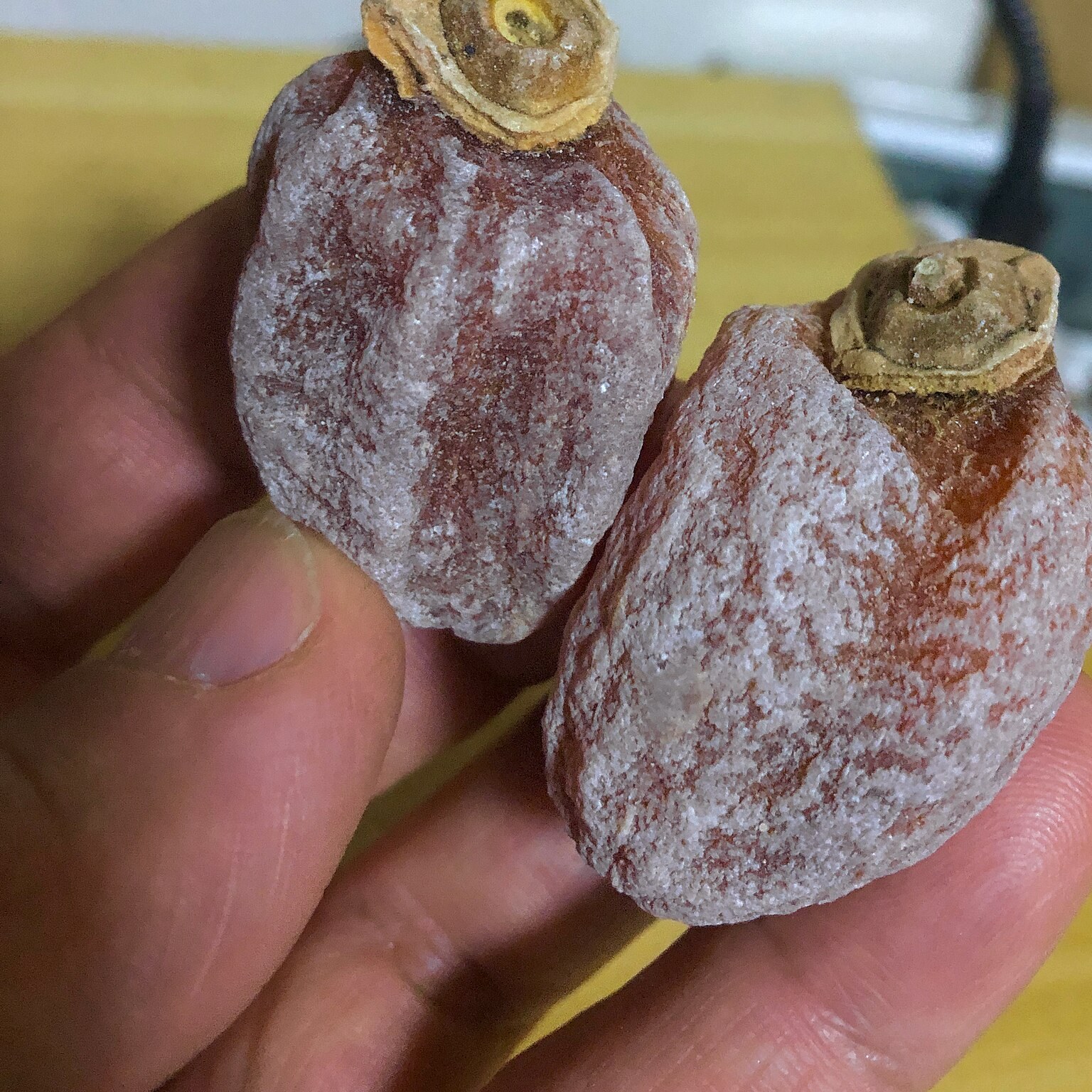
A finished korogaki is dark, firm and dusted white. JA Fruits Yamanashi states that the white powder on the surface is glucose. The 1987 study measured it: in the finished fruit, the flesh held glucose and fructose at a ratio of 51 to 49, while the white powder on the surface was 79 to 21. The powder is sugar from the fruit that has come out on the surface and crystallised, as the cooperative describes it.
What a good one is
The rheology paper reports that in its taste tests, the dried persimmons judged good were roughly 30% of their original weight, with a sugar content of 62 to 66%. Those are findings from one study, not a standard for every variety and method. The 1982 Ishii and Yamanishi study recorded the combined glucose, fructose and sucrose at about 60% of the dry matter throughout drying, which is a share of the solids, not the sugar reading of a fresh fruit.
Timed for the New Year
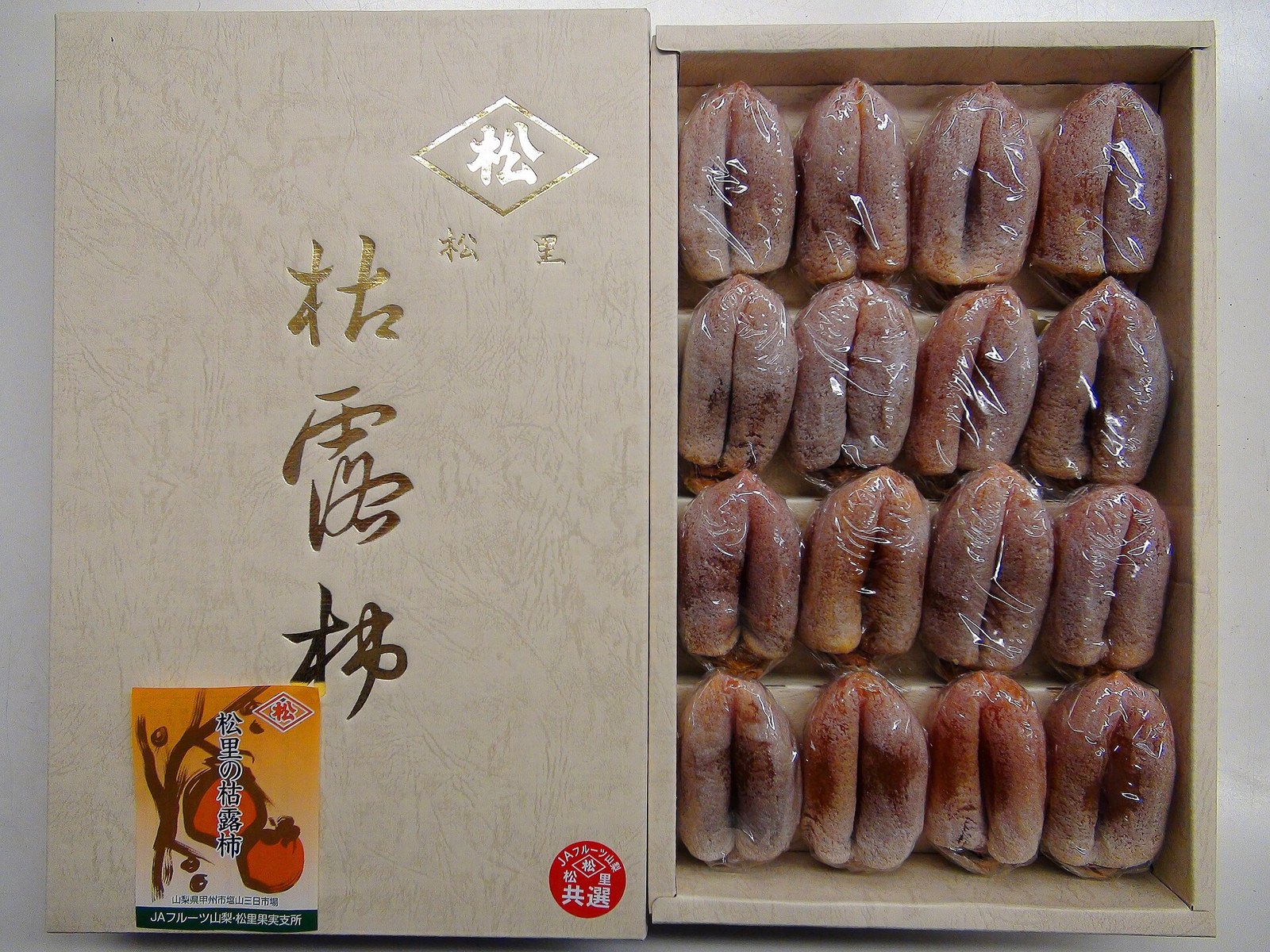
MAFF’s page on Yamanashi’s local dishes says finished korogaki are sold from mid-December to late January. Picking in November and around 40 to 50 days of drying bring the finished fruit to market over the New Year.
Korogaki, Anpo-gaki, Ichida-gaki — One Fruit, Three Regional Finishes
How dry is dry
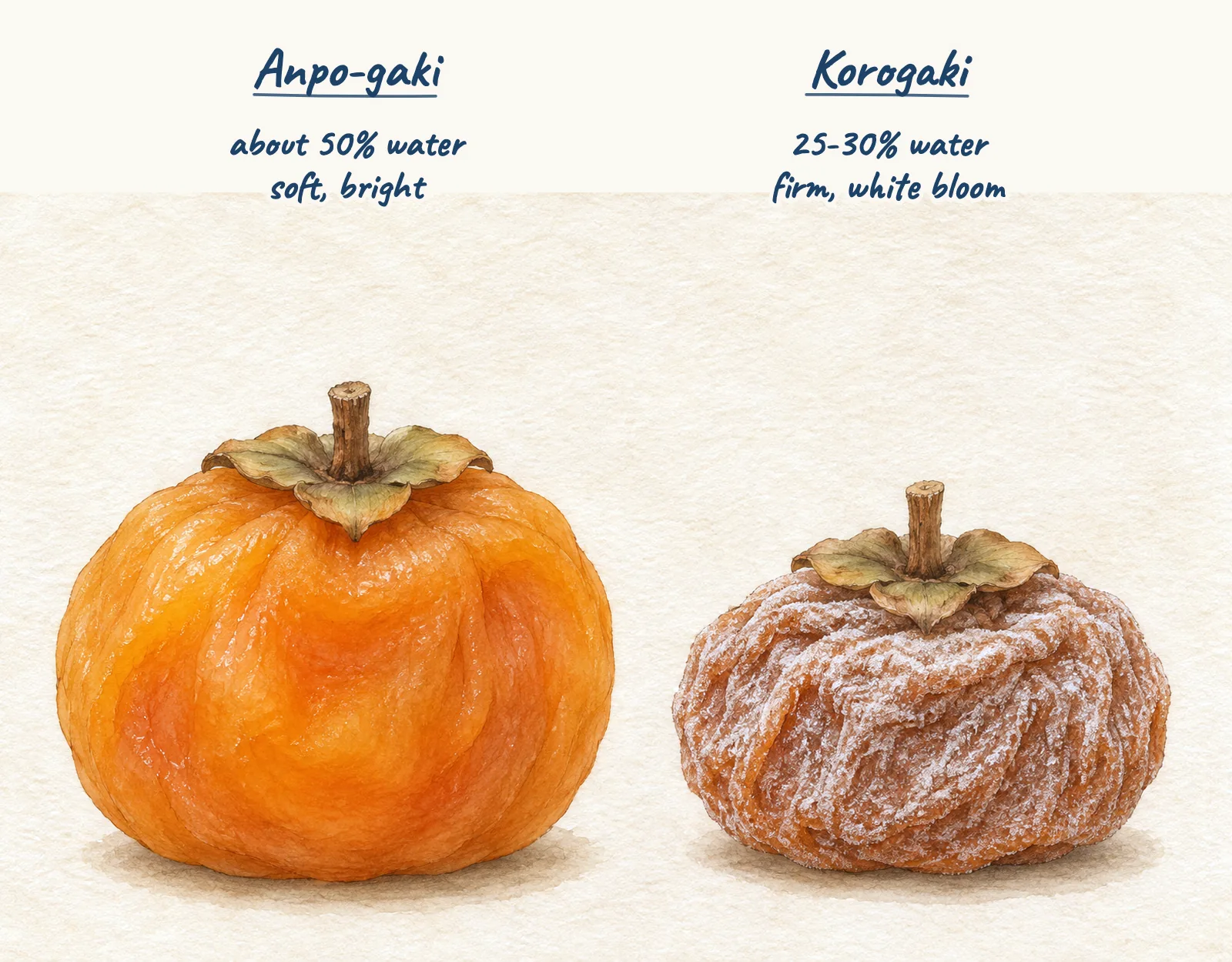
MAFF draws the line between the two main styles by moisture. Anpo-gaki keeps about 50% moisture and stays soft; korogaki is dried down to about 25 to 30%, firm enough to hold its shape.
| Korogaki (Yamanashi) | Ichida-gaki (Nagano) | Date no Anpo-gaki (Fukushima and others) | |
|---|---|---|---|
| Main fruit | Koshu Hyakume, a large astringent persimmon | Small Ichida persimmon | (see the GI registration) |
| Moisture (MAFF) | About 25 to 30% | (not given in the sources used here) | About 50% for anpo-gaki |
| Weight when taken in | (not given) | 33 to 35% of peeled weight (a weight ratio) | (not given) |
| Feature in official sources | Kneading and rolling daily for 7 to 10 days | Kneading; fine glucose bloom | Sulphur fumigation to keep the colour |
| GI registration | No GI found in this research | 12 July 2016 | 31 January 2023 |
Scale
Two MAFF statistics give a sense of scale, though they measure different things in different years. MAFF’s crop statistics give the 2025 harvest of persimmons, as fresh fruit, at 179,600 tonnes nationally. For dried persimmons, a MAFF prefectural summary gives national production in 2023 of 6,660 tonnes, of which Yamanashi produced 338 tonnes, fourth among the prefectures. That figure covers all dried persimmons from the prefecture, not korogaki alone.
Why the Week of 23 November — Harvest Thanks and the New Year Table
Labour Thanksgiving Day
This article appears on 23 November, a national holiday in Japan. Under the current Act on National Holidays, the day is Kinro Kansha no Hi (勤労感謝の日), Labour Thanksgiving Day, whose stated purpose is to honour labour, celebrate production, and give thanks to one another. Before the present law, 23 November was a holiday as Niinamesai (新嘗祭), the festival at which the year’s new grain is offered, and the Association of Shinto Shrines notes that Niinamesai is still held on that day.
Kushigaki on the New Year rice cake
Dried persimmons also appear in New Year decorations. The Kinki Regional Agricultural Administration Office of MAFF introduces kushigaki (串柿), persimmons dried on skewers in Shigo, Katsuragi Town, Wakayama Prefecture, as a decoration placed on top of kagami-mochi, the stacked New Year rice cakes. On a ten-fruit skewer, six sit in the middle and two at each end. The office passes on the meanings attached to it: the skewer is likened to the sword of the three imperial regalia; the arrangement is read as a pun meaning “always smiling, living in harmony”; and the white powder stands for the white hair of a long life together.
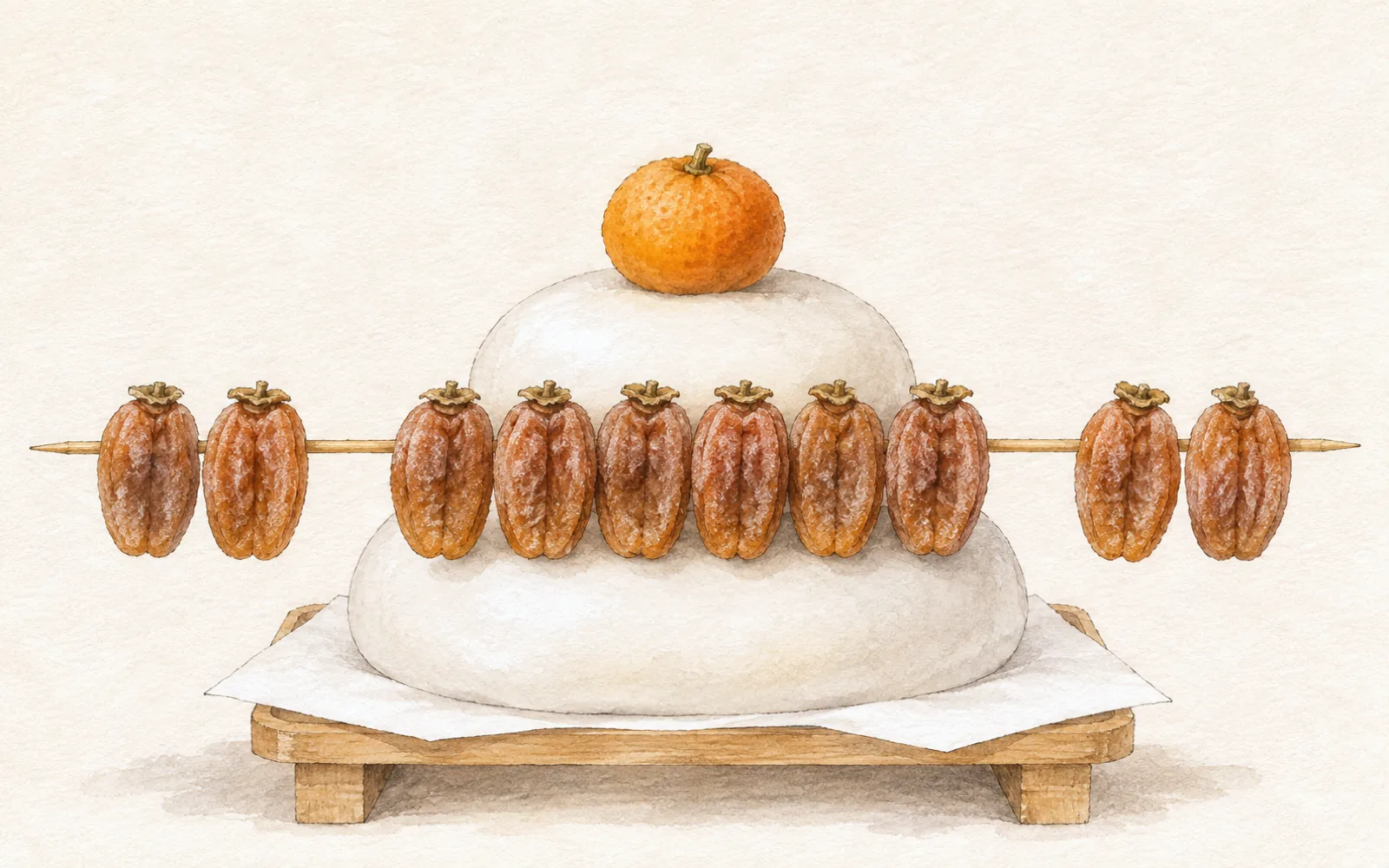
That is a Wakayama custom, separate from Yamanashi’s korogaki, and it sits among the other New Year decorations made from plants, such as the pine and bamboo of kadomatsu.
Takeda Shingen and an 1859 written record
Many accounts say korogaki spread under the Takeda clan. MAFF puts it carefully: production as a preserved food spread, it is said, through the encouragement of Takeda Shingen. No document from Shingen’s own time was found for this article, so it remains a tradition. A firmer date comes from Minami-Alps City’s local history material, which describes a document from 1859 (Ansei 6) asking permission to open a trading house in Yokohama; the goods listed include korogaki, alongside grapes, pears and Gosho persimmons. That shows korogaki as a named trade product by that year.
Persimmon Trees in the Farmyard — and the One Fruit Left Behind
The tree behind the curtain
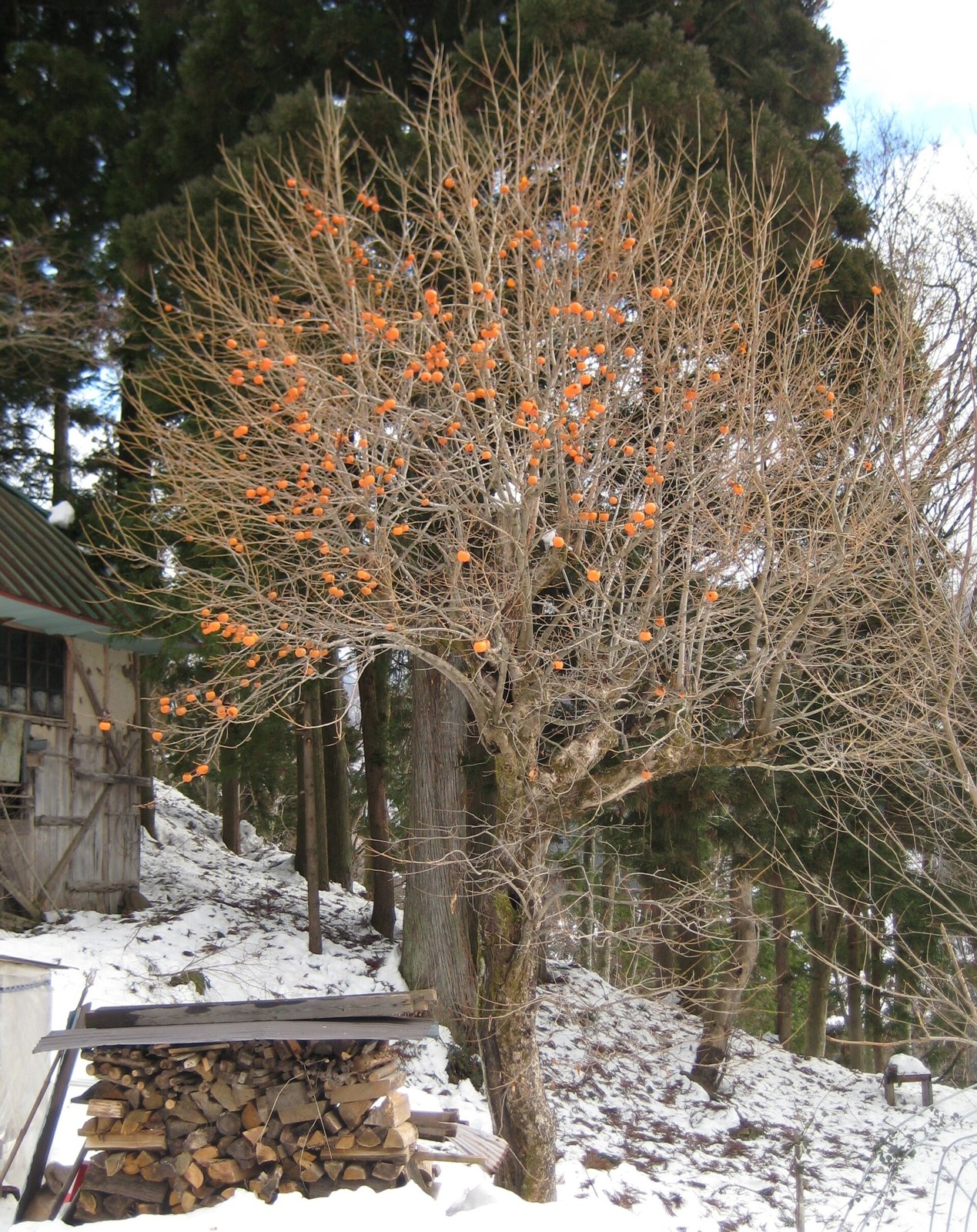
Everything in this story starts with a tree, and for an arborist that is where the curtain points. Koshu City’s plan places large persimmon trees inside the house plots at the centre of Matsuzato’s landscape, alongside the houses and the drying fruit. In other words, the curtain is the visible end of a tradition of growing persimmon trees within house plots.
For gardeners, the curtain belongs to the same turn of the season as other late-autumn work on trees, such as the straw bands on pine trunks described in our article on komomaki and the winter protection covered in fuyugakoi.
Kimamori: leaving one fruit
There is also a custom of not picking every fruit. University of Shizuoka material describes kimamori-gaki (木守柿): a single persimmon left on the tree after the harvest. The explanation given is a wish for a good crop the following year, and leaving the fruit for small birds.
Hoshigaki in California — The Same Craft Abroad
Placer County’s makers
The method is also kept outside Japan. In 2004 the Sustainable Agriculture Research and Education Program (SAREP) at the University of California, Davis published a report on hand-dried persimmons in Placer County, California, where Japanese American families have kept the hoshigaki technique. The authors write that they interviewed four hoshigaki artisans in the county.
The method, step by step
The steps the report describes will look familiar after Matsuzato.
– Fruit: usually Hachiya. – Picking: a piece of branch is left in an L shape so the fruit can be hung. – Peeling: a little skin is left around the stem. – Tying: two persimmons per string, one at each end, hung over a pole, the same pairing Koshu City records as nagekon. – First massage: four to seven days after hanging. – Later massage: frequency varies, but many makers massage at least once a day for quality. – Time: drying takes four to six weeks; in the report’s general guide, the fruit is ready to pack, freeze or store after about four weeks, with a warning that fruit not dry enough can mould in the box.
Prices, and the Ark of Taste
The prices the report recorded from Placer County makers in 2004 were $5.50 to $10.00 a pound. The report also carries a reprinted article by another writer mentioning one maker, Martha Miyamura, selling hoshigaki for $1 each at a Sunday farmers’ market in Sacramento; that is one person’s sale, not the survey price. The report includes testimony from people involved at the time that hoshigaki had recently been accepted onto Slow Food’s Ark of Taste; its current listing on Slow Food’s own site was not checked for this article.
Set side by side, Yamanashi and Placer County share the same elements: an astringent fruit, a stalk to hang it by, air between the fruit and regular massage. What differs is the setting. In Matsuzato the curtain hangs from farmhouse eaves as part of a landscape the city plans to protect; in Placer County the report’s evidence comes from interviews with four artisans.
Frequently asked questions
Why do Japanese people hang persimmons outside?
To dry them. The varieties hung, such as Koshu Hyakume in Yamanashi, are astringent when fresh. Hanging them peeled in dry air for weeks turns the soluble tannin insoluble, so the astringency disappears. In one 1987 Koshu Hyakume experiment, the finished fruit weighed about a quarter of its starting weight.
When can you see hoshigaki curtains in Japan?
In Matsuzato, Koshu City, Yamanashi, MAFF describes the curtains hanging from November to around early December. At the Kanzo-yashiki in 2021, the fruit was hung on 6 and 7 November and stayed under the eaves until the end of November. Dates change with the weather each year.
Is the white powder on dried persimmons mould?
The white bloom on a finished korogaki is sugar: JA Fruits Yamanashi states it is glucose. A 1987 study found the powder mostly glucose with some fructose, 79 to 21, against 51 to 49 inside the fruit. This article does not cover how to tell sugar from mould on a damaged fruit.
Why are hoshigaki massaged?
Koshu City explains that kneading smooths wrinkles, shapes the fruit, helps it dry evenly, and crushes the core so the calyx comes off easily. Research on dried persimmons adds that massage moves moisture from deep inside a large fruit to the surface, speeding the drying.
What is the difference between korogaki and anpo-gaki?
Moisture. MAFF describes korogaki as dried to about 25 to 30% moisture and anpo-gaki as keeping about 50%, so anpo-gaki is soft and korogaki is firm.
Can I make hoshigaki from Fuyu persimmons?
The sources for this article do not test Fuyu. The methods they describe use astringent fruit: Hachiya in California, Koshu Hyakume or Yamato Hyakume in Yamanashi. UC Cooperative Extension material describes Fuyu as non-astringent and eaten firm, and Hachiya as the astringent type that can be dried.
Sources
– MAFF, traditional foods, “Korogaki”: https://www.maff.go.jp/j/keikaku/syokubunka/traditional-foods/menu/korogaki.html (checked 2026-11-14) – MAFF, Uchi no Kyodo Ryori (Yamanashi), “Korogaki” (recipe, sale period, moisture of anpo-gaki and korogaki): https://www.maff.go.jp/j/keikaku/syokubunka/k_ryouri/search_menu/menu/korogaki_yama_nashi.html (checked 2026-11-14) – Yamanashi Prefecture, how to make korogaki: https://www.pref.yamanashi.jp/shokuhin-st/shokuiku/yamanashinoshoku/korogaki.html (checked 2026-11-14) – Koshu City, guide to the Matsuzato district: https://www.city.koshu.yamanashi.jp/docs/2021020300053/file_contents/2021020300053_kurashi_files_20190315_06_koushuushimatsuzatochiku.pdf (checked 2026-11-14) – Koshu City, korogaki at the Kanzo-yashiki (2021 record): https://www.city.koshu.yamanashi.jp/docs/2021111700021/ (checked 2026-11-14) – Koshu City, “Korogaki at the Kanzo-yashiki”: https://www.city.koshu.yamanashi.jp/docs/2018120700180/ (checked 2026-11-14) – Koshu City, historic landscape maintenance and improvement plan, chapter 2: https://www.city.koshu.yamanashi.jp/docs/2020101400057/file_contents/2020101400057_rekisi_bunka_files_20170412_koushuushirekishitekifuuchiijikoujoukeikaku_2shou.pdf (checked 2026-11-14) – JA Fruits Yamanashi, persimmons: https://www.ja-fruits.or.jp/fruits/kaki/ (checked 2026-11-14) – Yamanashi Prefecture, regional disaster prevention plan (general disasters): https://www.pref.yamanashi.jp/documents/5127/r8sousoku_ippannsaigai.pdf (checked 2026-11-14) – JA Bank, support for affected farmers, case report (2017): https://www.jabank.org/about/contribution/tiikimittyaku/pdf/joukyou201703/a_b3_08.pdf (checked 2026-11-14) – MAFF, children’s questions, persimmon astringency: https://www.maff.go.jp/j/heya/kodomo_sodan/0411/01.html (checked 2026-11-14) – University of Shizuoka, persimmons (September 2022): https://www.u-shizuoka-ken.ac.jp/guide/outline/oike02/september-2022/ (checked 2026-11-14) – Tokyo University of Agriculture, teacher column 0049: https://www.nodai.ac.jp/research/teacher-column/0049/ (checked 2026-11-14) – Ishii and Yamanishi (1982), Nippon Shokuhin Kogyo Gakkaishi 29(12): 720: https://www.jstage.jst.go.jp/article/nskkk1962/29/12/29_12_720/_pdf (checked 2026-11-14) – Komiyama and Tsuji (1987), Nippon Shokuhin Kogyo Gakkaishi 34(6): 376: https://www.jstage.jst.go.jp/article/nskkk1962/34/6/34_6_376/_pdf/-char/ja (checked 2026-11-14) – “Studies on the rheology of foods (6)”, Journal of Home Economics of Japan 19(1): 8: https://www.jstage.jst.go.jp/article/jhej1951/19/1/19_1_8/_article/-char/ja (checked 2026-11-14) – MAFF, GI registration No. 13, Ichida-gaki, and product specification: https://www.maff.go.jp/j/shokusan/gi_act/register/0013/index.html and https://www.maff.go.jp/j/shokusan/gi_act/register/0013/pdf/0013_specification.pdf (checked 2026-11-14) – MAFF, GI registration No. 123, Date no Anpo-gaki: https://www.maff.go.jp/j/shokusan/gi_act/register/0123/index.html (checked 2026-11-14) – MAFF, crop statistics, 2025 persimmon harvest: https://www.maff.go.jp/j/tokei/kouhyou/sakumotu/sakkyou_kazyu/pdf/syukaku_senasi_25.pdf (checked 2026-11-14) – MAFF, prefectural summary 2026 (Yamanashi): https://www.maff.go.jp/j/kanbo/tiho/15sonota/2026PDF/todouhuken_gaiyou2026-19.pdf (checked 2026-11-14) – MAFF Kinki Regional Agricultural Administration Office, kushigaki of Shigo (December 2024): https://www.maff.go.jp/kinki/tiiki/wakayama/photo/img/20241217/202412_kusigaki.html (checked 2026-11-14) – Cabinet Office, national holidays: https://www8.cao.go.jp/chosei/shukujitsu/gaiyou.html and https://www8.cao.go.jp/chosei/shukujitsu/gaiyou/kaku/keii.html (checked 2026-11-14) – Association of Shinto Shrines, Niinamesai: https://www.jinjahoncho.or.jp/omatsuri/koureisai/ (checked 2026-11-14) – Minami-Alps City local history material (2018): https://sannichi.lekumo.biz/minamialps/2018/11/kakicaqui-ba30.html (checked 2026-11-14) – UC Cooperative Extension, persimmon (Kern): https://kare.ucanr.edu/files/123828.pdf (checked 2026-11-14) – UC Marin Master Gardeners, persimmon: https://ucanr.edu/site/uc-marin-master-gardeners/document/persimmon (checked 2026-11-14) – UC Davis SAREP, Hoshigaki: Hand-Dried Persimmons (2004): https://sarep.ucdavis.edu/sites/g/files/dgvnsk5751/files/inline-files/HoshigakiHandDriedPersimmons_2004.pdf (checked 2026-11-14)