

By Isaki Kasahara, a Japanese arborist pruning, assessing and caring for Japan’s trees and gardens · Updated November 18, 2026
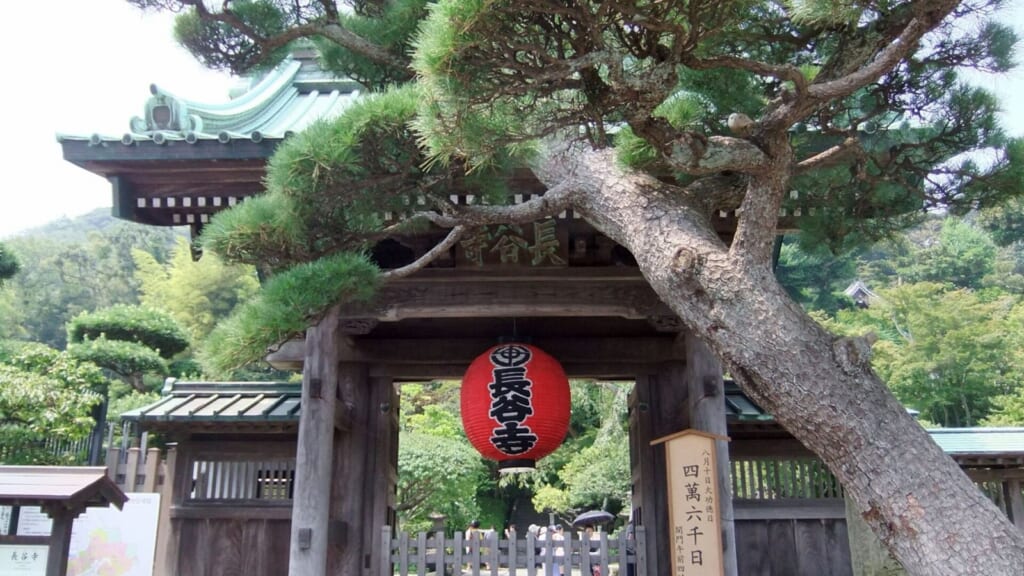
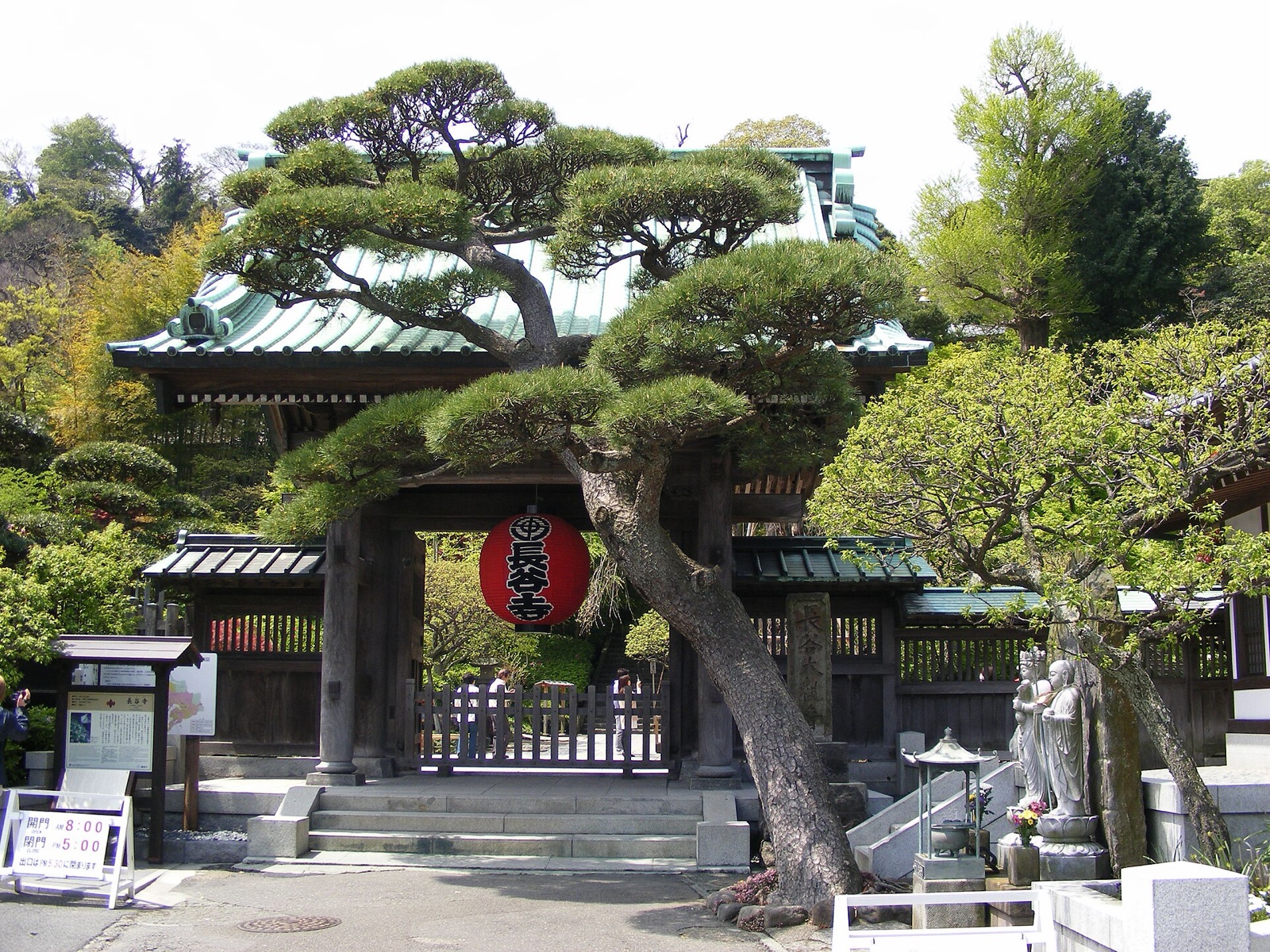
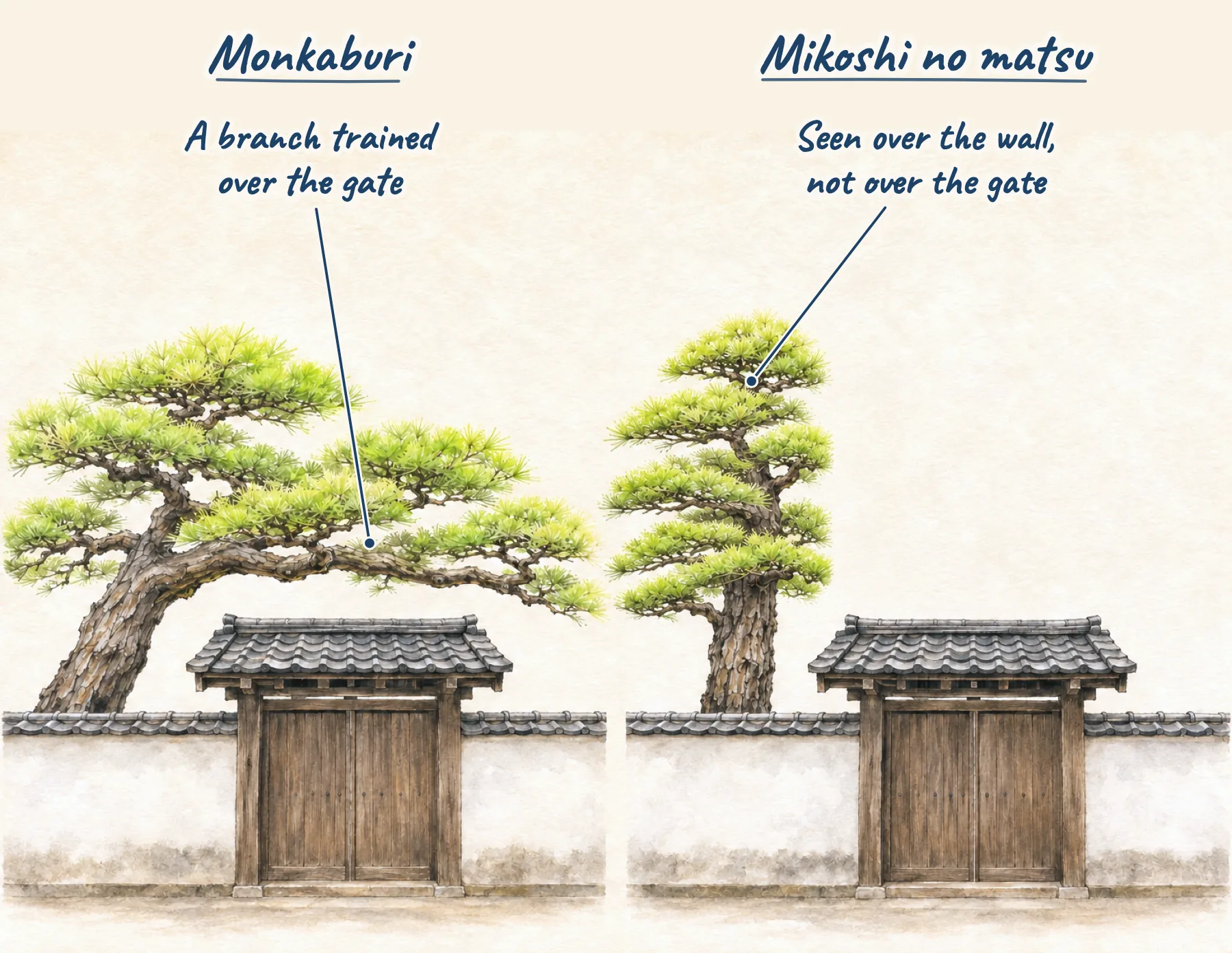
A monkaburi (門冠り) is a tree, most often a pine or podocarp, trained so that its branches cover the top of a gate, and it is there to make the entrance itself: a 1998 Shinshu University study of Matsumoto’s old samurai quarter found the overhanging tree combining with gateposts and walls into “a gateway with a certain formality”. How the habit began is less certain. Minoh city, near Osaka, relays a tradition that under Edo-period limits on gate styles, a pine or podocarp reaching over the gate became a status symbol — but presents it as a tradition, using the phrase “it is said”, rather than as a documented fact.
What follows covers what a monkaburi is, what the sources do and do not say about its meaning, how the overhanging arm is formed and held, and how it compares with topiary, espalier and pleaching.
A pine over the old highway — what the city points out
The scene
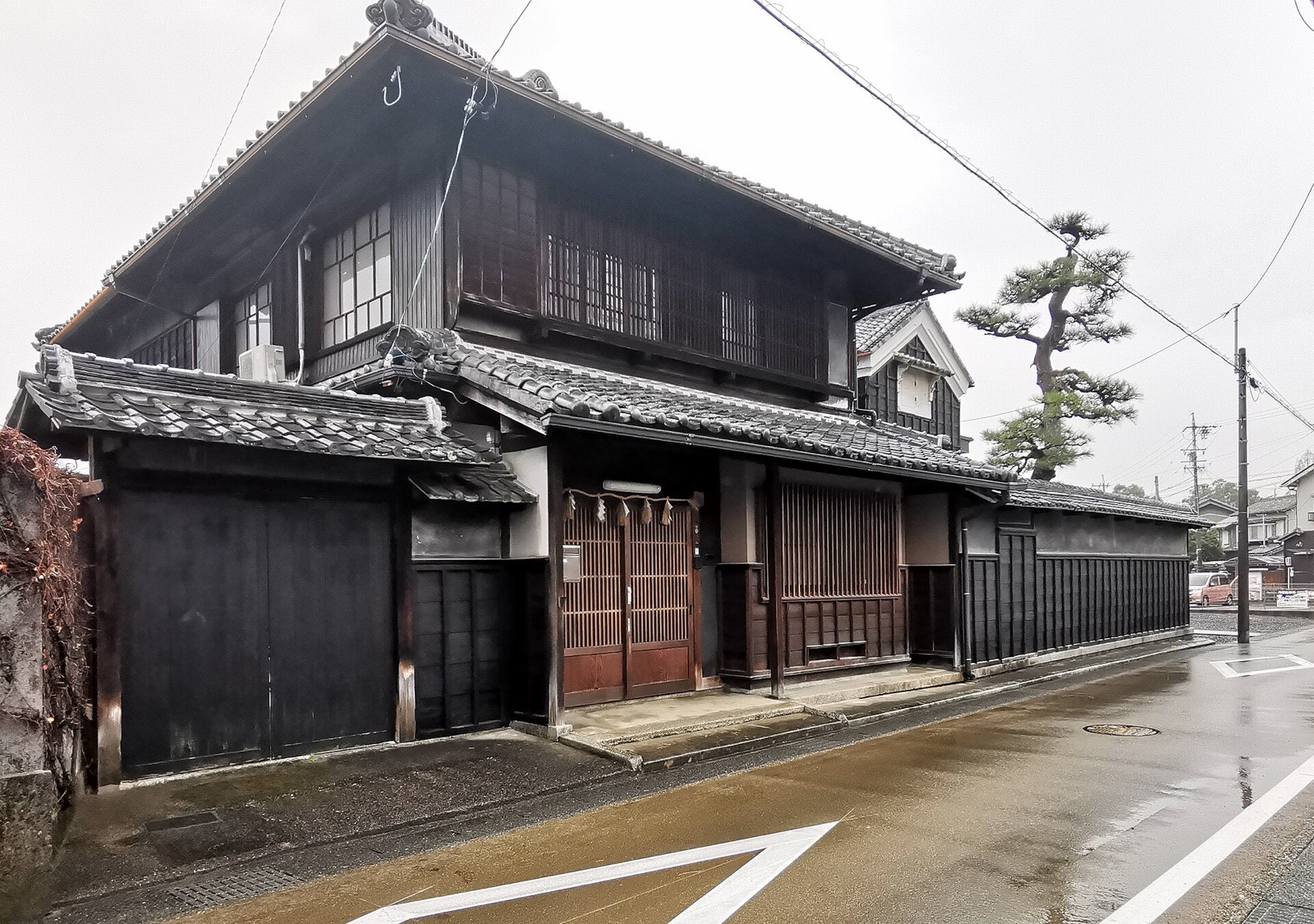
Minoh city’s guide to “old greenery along the old highways” follows the old Saigoku road through the city. One of its photographs, taken in the Onohara-nishi neighbourhood, carries a short caption: a monkaburi over the wall, species kuromatsu — Japanese black pine.
The caption describes a tree on the far side of a wall whose branches have been brought over the gate. Picture it from the road: wall, gate, and above the gate a level arm of pine. To go in, you pass under it.
A shape someone chose
That arm is the result of training. Japan’s technical commentary on trees for public works defines a trained tree, shitatemono (仕立物), as one whose shape has been made artificially, and names bending the trunk and branches and yūin (誘引) — guiding a branch into position — as the ways it is done. A monkaburi is a tree in which someone chose an arm, bent it and fixed it so that it reaches over the gate.
Monkaburi, defined — and how it differs from mikoshi no matsu
The word and its spellings
Minoh city writes the word 門被り and glosses the reading as monkaburi. The Japan Greenery Research and Development Center — in its commentary on the draft quality and size standards for landscape trees used in public works, written for the standards’ fifth revision — writes it 門冠り. Both spellings appear in public sources; this article uses the romanised monkaburi throughout.
JAANUS, the Japanese Architecture and Art Net Users System dictionary, defines monkaburi (門冠) as a tree planted beside a garden gate so that its branches extend over the gateway; sometimes the branches are trained to run parallel to the top of the gate. Its notes on species are about pine: red pine in the Kantō region, black pine in the Kansai region.
That definition names a position, not a species, and other public sources apply the same word to podocarp as well (see below). A monkaburi is not a species or a variety. It is a form, made by training.
Two types in the standard
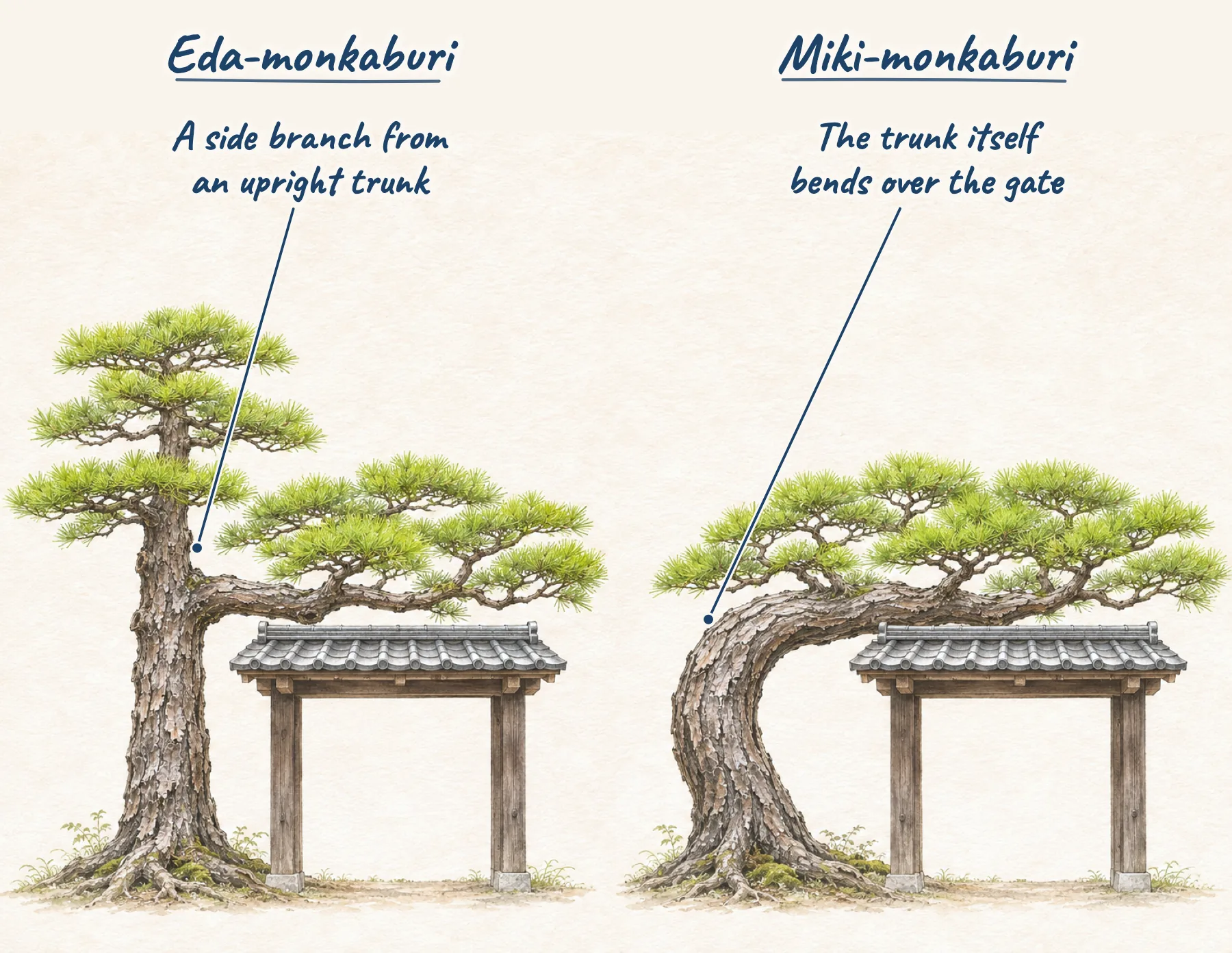
The Greenery Center’s commentary lists monkaburi among the forms of trained trees and divides it into two: eda-monkaburi (枝門冠り, literally “branch monkaburi”) and miki-monkaburi (幹門冠り, “trunk monkaburi”). The commentary gives the two names without describing them in the passage checked for this article. Read literally, the names point to whether the overhanging arm is formed from a branch or from the trunk itself.
Mikoshi no matsu — the pine seen over the wall
A related phrase is mikoshi no matsu (見越しの松). The Digital Daijisen dictionary defines it as a pine standing by a wall and arranged to be seen from outside. The Seisenban Nihon Kokugo Daijiten gives a similar definition and an alternative reading, mikoshimatsu.
The two terms answer different questions. Mikoshi is about the view from outside — a pine glimpsed over a wall. Monkaburi is about one specific shape — branches laid over the gate. The dictionary entries point at different things: one at the branches over the gate, the other at a pine placed to be seen from outside. Minoh’s caption (“a monkaburi over the wall”) shows that one tree can be both, but the words are not synonyms.
| Term | Japanese | What it describes | Source |
|---|---|---|---|
| Monkaburi | 門冠り/門被り | A tree trained so its branches cover the top of the gate | JAANUS; Greenery Center commentary |
| Eda-monkaburi / miki-monkaburi | 枝門冠り/幹門冠り | The two named types in the standard | Greenery Center commentary |
| Mikoshi no matsu | 見越しの松 | A pine by a wall, arranged to be seen from outside | Digital Daijisen; Seisenban Nihon Kokugo Daijiten |
A tree that is made, not found — shitatemono
Where monkaburi sits
The same table in the Greenery Center’s commentary that names the two monkaburi types also lists clipped forms such as hōrai-zukuri, dan-zukuri and tamachirashi. In that table, monkaburi is one trained form among several that Japanese nurseries grow and train.
Where trained trees are grown
Japan’s trained trees come from nursery towns that specialise in them. Sosa city in Chiba prefecture describes itself as “a town of garden trees” and points to its “fine shaping techniques” on podocarp (maki) and black pine. The Sosa garden-tree growers’ association calls inumaki — Podocarpus macrophyllus — its flagship product, and says the town’s trees are exported to China, Europe and many other countries.
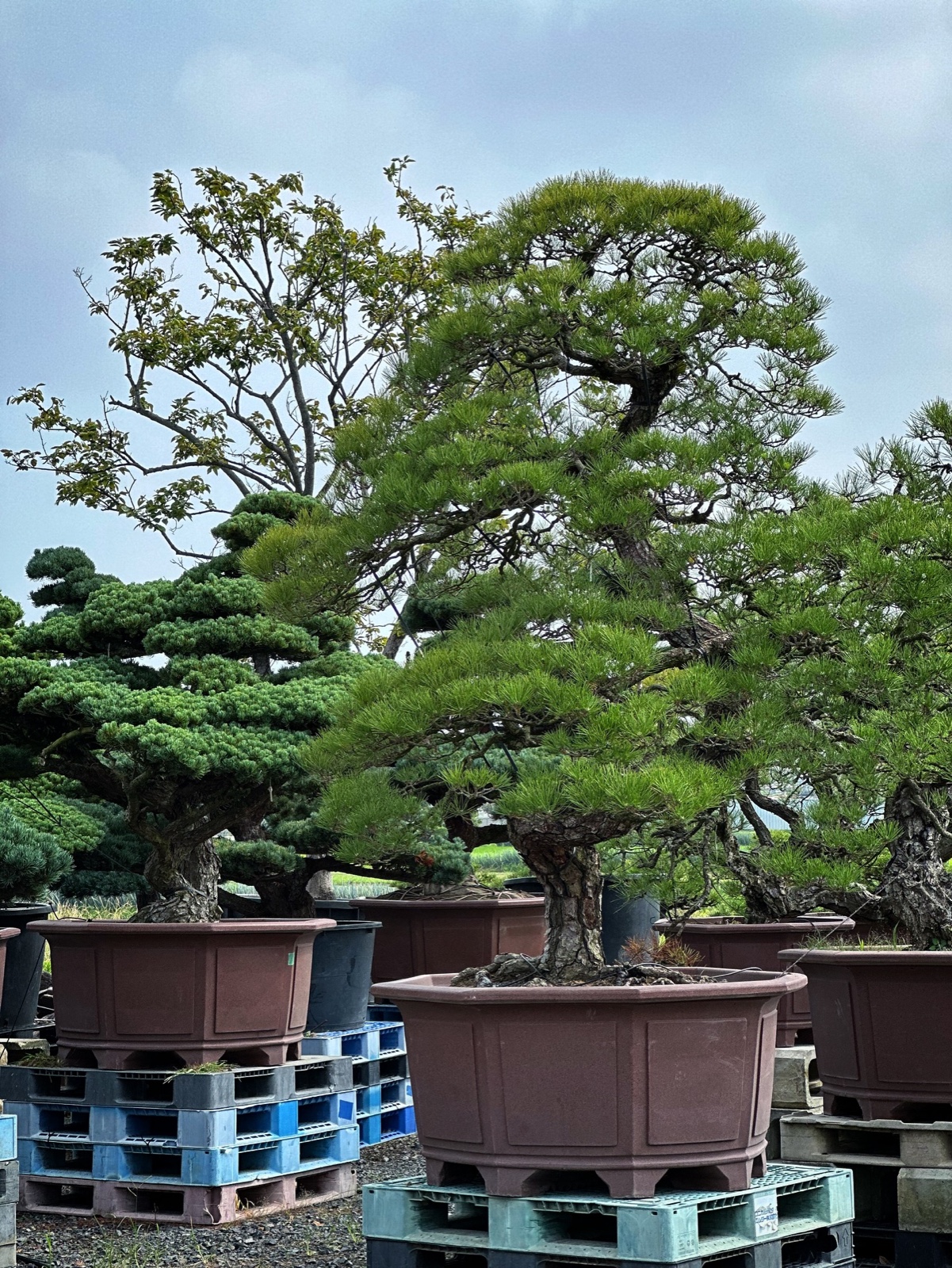
The same association describes a local technique called kujiki (くじき): inserting a chisel into a branch so that it can be bent freely without breaking. And it gives a time estimate for Sosa’s shaped trees: the association says they are made over “ten years or more”.
In Saitama prefecture, Kawaguchi city’s public magazine lists magemono (曲げ物) — “bent pieces”, in the city’s words a bonsai-style training — among the basic techniques of Angyō, a nursery district that JA Saitama calls one of Japan’s four great garden-tree producing areas.
Ten years or more — and a long working life
The ten-year figure covers Sosa’s shaped trees in general; no published standard was found for how many years a monkaburi takes from seedling to finished tree. What the sources do show is how long a single monkaburi can carry its role once it stands at a gate. Utsunomiya’s Kōyō Junior High School wrote in 2021 that its black-pine monkaburi had served “as the symbol of the school gate for 30 years or more” before it died. In Shiojiri, the city says the red pine at Seba Elementary School known as “the monkaburi pine” was planted to mark the new school building in 1902.
A black pine can carry such a role for a long time. A Kyushu University stem-analysis study of old coastal black pines (Masutani and colleagues, 1995) found that six of the eight sampled trees were 150 years old or more, and that some kept growing well, or grew faster, at ages of 100 years or more. These were forest trees, not trained garden trees, and their ages do not set a lifespan for the species; they show only that black pine is not a short-lived tree.
Why over the gate? What the evidence says
Formality: the Matsumoto study
The most careful account found is a study of residential streets in Matsumoto’s old castle town, published in the Journal of the Faculty of Agriculture, Shinshu University in 1998 by Hiraoka Naoki and colleagues. Looking at the old samurai quarter, the authors read the monkaburi not as a tree alone but as one element of the gateway. Combined with gateposts and the fence or wall, they write, it appears “as a gateway with a certain formality”.
That is a reading of the street as it stands, not an origin story. It does, however, put the monkaburi at the threshold, as one part of how a household’s entrance is composed.
Status under Edo rules — a story, not a record
Minoh city’s guide offers a more specific explanation and is careful about how it frames it. Under the Edo-period system, it says, the form of a gate was restricted by family rank; extending a pine or podocarp over the gate then gradually became a status symbol — “it is said” (to iwarete imasu).
The research for this article looked for Edo-period laws, garden manuals or prints that state this directly and did not find one that could be checked page by page. A Nagano Prefectural Library reference answer points to modern garden books that mention monkaburi, but that is not the same as an Edo source. So this article treats the status story as exactly what Minoh calls it: a tradition.
Pine as a lucky tree
Kōyō Junior High School, writing about its lost gate pine, adds a third layer: pines have long been seen in Japan as “lucky trees” that “protect against misfortune”. That is a belief about pines in general. It does not explain why branches should be laid over a gate rather than the tree simply planted beside it.
What could not be confirmed
Two other explanations — that the branch is there to welcome guests, or that it began as a screen — were not found in the primary sources checked, so they are left out. What the sources support is narrower: a monkaburi belongs to the gateway, researchers in Matsumoto read it as part of a formal entrance, and its history before the modern era is told as tradition.
| Explanation | Status | Source |
|---|---|---|
| Part of a formal gateway composition | Researchers’ reading of Matsumoto streets | Hiraoka et al., 1998 |
| Status symbol under Edo gate restrictions | Tradition (“it is said”) | Minoh city |
| Pine as a lucky, protective tree | General belief about pines | Kōyō Junior High School |
| Welcome for guests; screening | Not found in the primary sources checked | — |
Which trees, and where — pine, podocarp and others
Matsumoto: mostly red pine
The Matsumoto study counted the species of monkaburi in the old samurai districts of Nishimachi and Dōmachi. At least three-quarters were akamatsu — Japanese red pine. That figure belongs to those two districts, not to Japan as a whole.
Higashi-Osaka: more podocarp than pine
A survey on the western foot of Mount Ikoma in Higashi-Osaka, reported in the Japanese Institute of Landscape Architecture’s newsletter in 2013 by Kawaguchi Masatake and colleagues, recorded 1,058 monkaburi. Of these, 54.0% were inumaki podocarp and 42.6% were pine. The survey groups pines together, so it does not tell us how many were black pine.
Other species in public sources
Black pine (Pinus thunbergii) appears in Minoh’s caption and at Kōyō Junior High School. Chiba prefecture’s list of 100 notable garden trees includes, as number 88, an inumaki trained as “a well-shaped monkaburi”. A Toyama greening handbook says Japanese white pine, goyōmatsu, can be used “as the main tree, and also for monkaburi”.
| Species | Japanese | Where the source places it |
|---|---|---|
| Japanese red pine | アカマツ | At least three-quarters of monkaburi in two Matsumoto districts; Seba Elementary, Shiojiri |
| Japanese black pine (Pinus thunbergii) | クロマツ | Minoh old highway; Kōyō Junior High, Utsunomiya |
| Inumaki podocarp (Podocarpus macrophyllus) | イヌマキ | 54.0% of 1,058 in the Higashi-Osaka survey area; Chiba notable tree no. 88 |
| Japanese white pine | ゴヨウマツ | Toyama greening handbook |
The two surveys point in different directions. In the Matsumoto districts, red pine made up at least three-quarters of the monkaburi; in the surveyed area at the western foot of Mount Ikoma, podocarp outnumbered pine. The sources do not explain why. For black pine, the Forestry and Forest Products Research Institute notes long use in windbreak and tide-break forests, and also use in gardens and bonsai.
A temple gate in Nakatsugawa
Not every monkaburi stands at a house. Nakatsugawa’s city history records an old pine beside the right side of the temple gate of Zenshō-ji, called “the monkaburi pine” or “the pine over the road”, and gives its height as 10 m (about 33 ft). That figure comes from the city history, not from a recent measurement.
How the arm is formed — bending, guiding, holding
The fullest technical description found is a glossary of garden techniques in a 2025 report by the Japanese Institute of Landscape Architecture (JILA), Nihon teien no “kokoro” to “waza” — “the heart and craft of Japanese gardens”. It does not give a monkaburi recipe from seed to gate, but it names the techniques a grower uses and, in one entry, ties a technique directly to monkaburi pines.
Bending while the tree is young
The report’s entry on kyokkan (曲幹) training — a curved trunk — says that the bends are put in “while the tree is young”. That entry is about curved trunks in general, not about monkaburi specifically.
Twisting and fixing the trunk
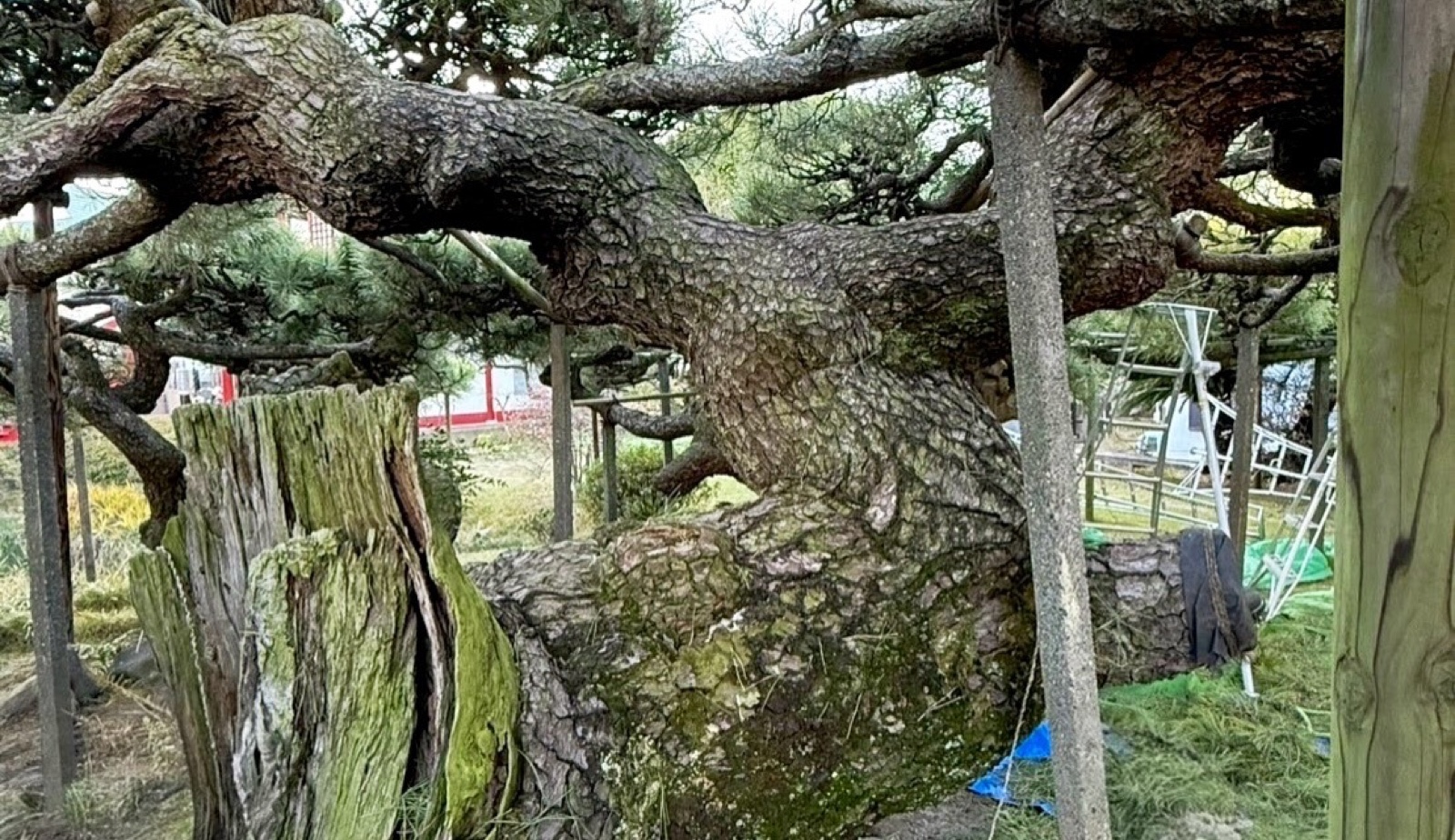
The most specific line concerns monkaburi itself. The report describes twisting and bending a trunk and fixing it in place with heavy wire (bansen, 番線) or bamboo, and says this is used to form the sashi-eda — the projecting arm — of a monkaburi pine. Here the “trunk” and “branch” types in the standard start to make sense: the overhanging arm may be a bent trunk, not only a side branch.
Guiding the branch: yūin
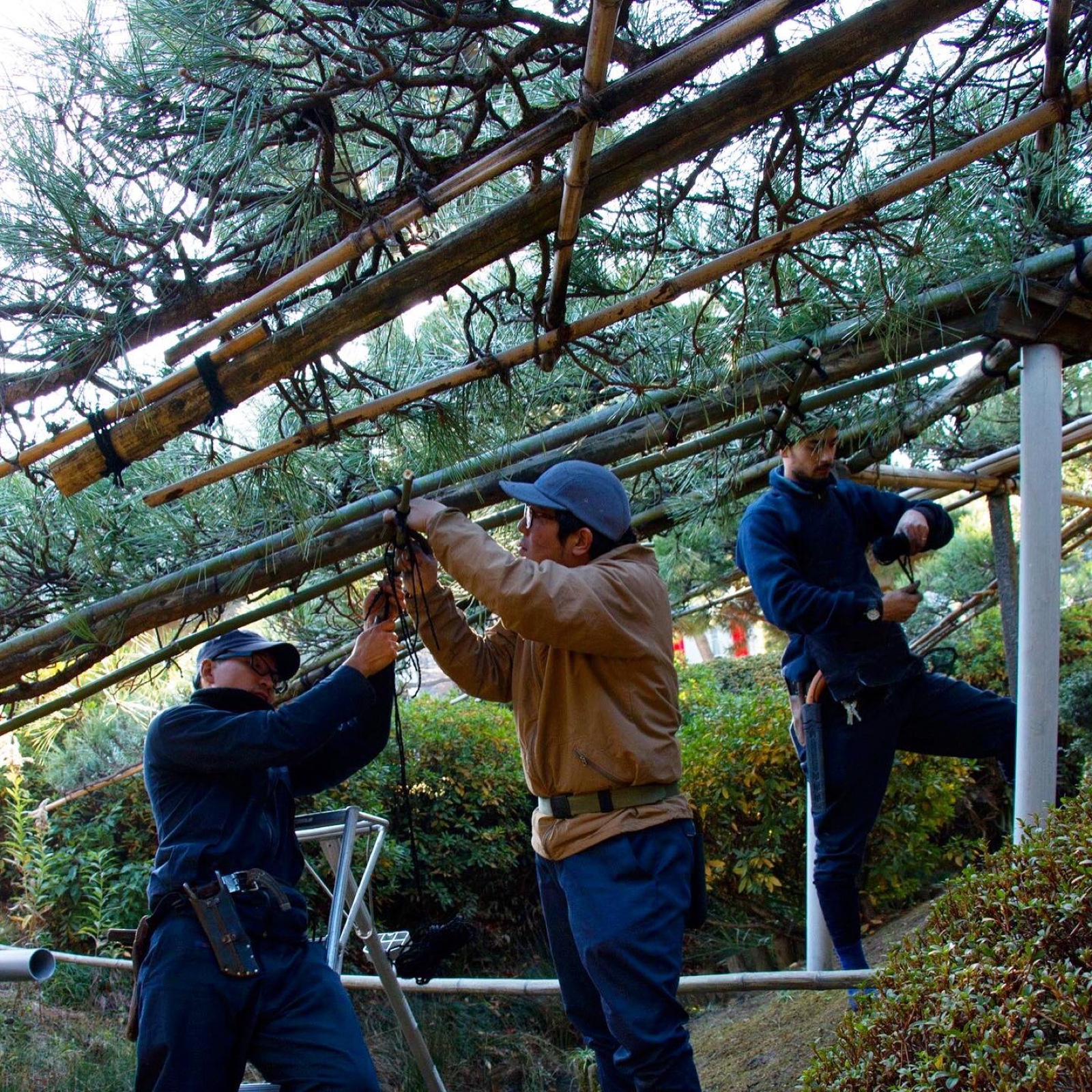
Yūin is defined in the report as fixing a branch in the direction you want and leading it there. The means named are supports, pulling, and wiring. Two specific methods are listed:
– Bachi-ate (ばち当て): lowering a branch by setting a bamboo splint or small pole along it. – Sage-nawa (下げ縄): adjusting a branch’s droop or sideways swing with shuro palm-fibre rope or wire.
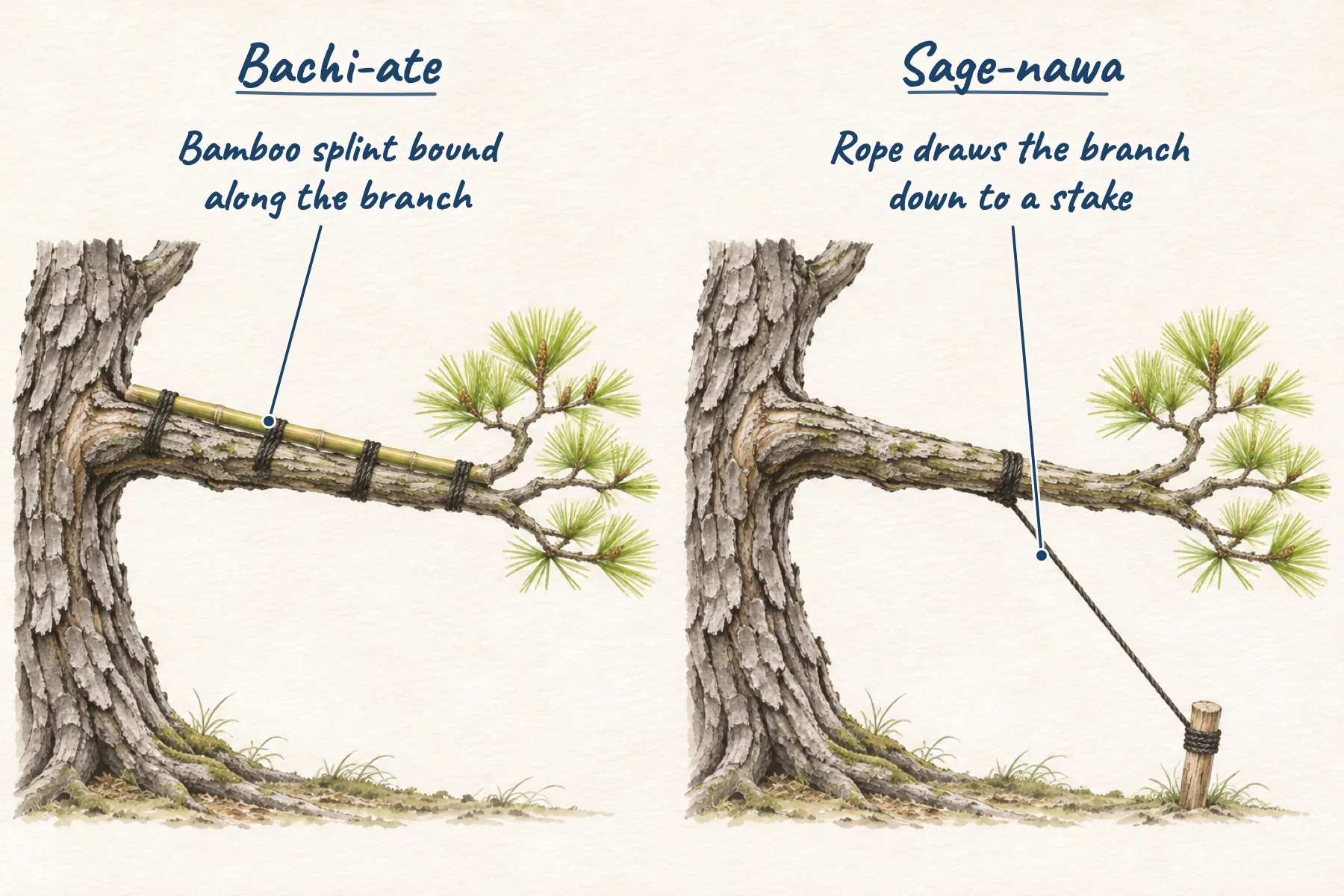
The table below lists these techniques as the sources name them. It is not a fixed sequence: the sources do not give one, and which technique a grower uses depends on the tree.
| Technique | What it does | Materials named | Source |
|---|---|---|---|
| Kyokkan (曲幹) | Puts bends in a trunk while the tree is young | — | JILA 2025 report |
| Trunk twisting for sashi-eda | Twists and bends a trunk, fixed in place, to form a monkaburi pine’s projecting arm | Heavy wire (bansen), bamboo | JILA 2025 report |
| Bachi-ate (ばち当て) | Lowers a branch with a splint set along it | Bamboo splint, small pole | JILA 2025 report |
| Sage-nawa (下げ縄) | Adjusts a branch’s droop or sideways swing | Palm-fibre rope, wire | JILA 2025 report |
| Kujiki (くじき) | Lets a branch be bent without breaking, using a chisel; described for Sosa’s shaped trees in general | Chisel | Sosa growers’ association |
Keeping it — and holding a long arm
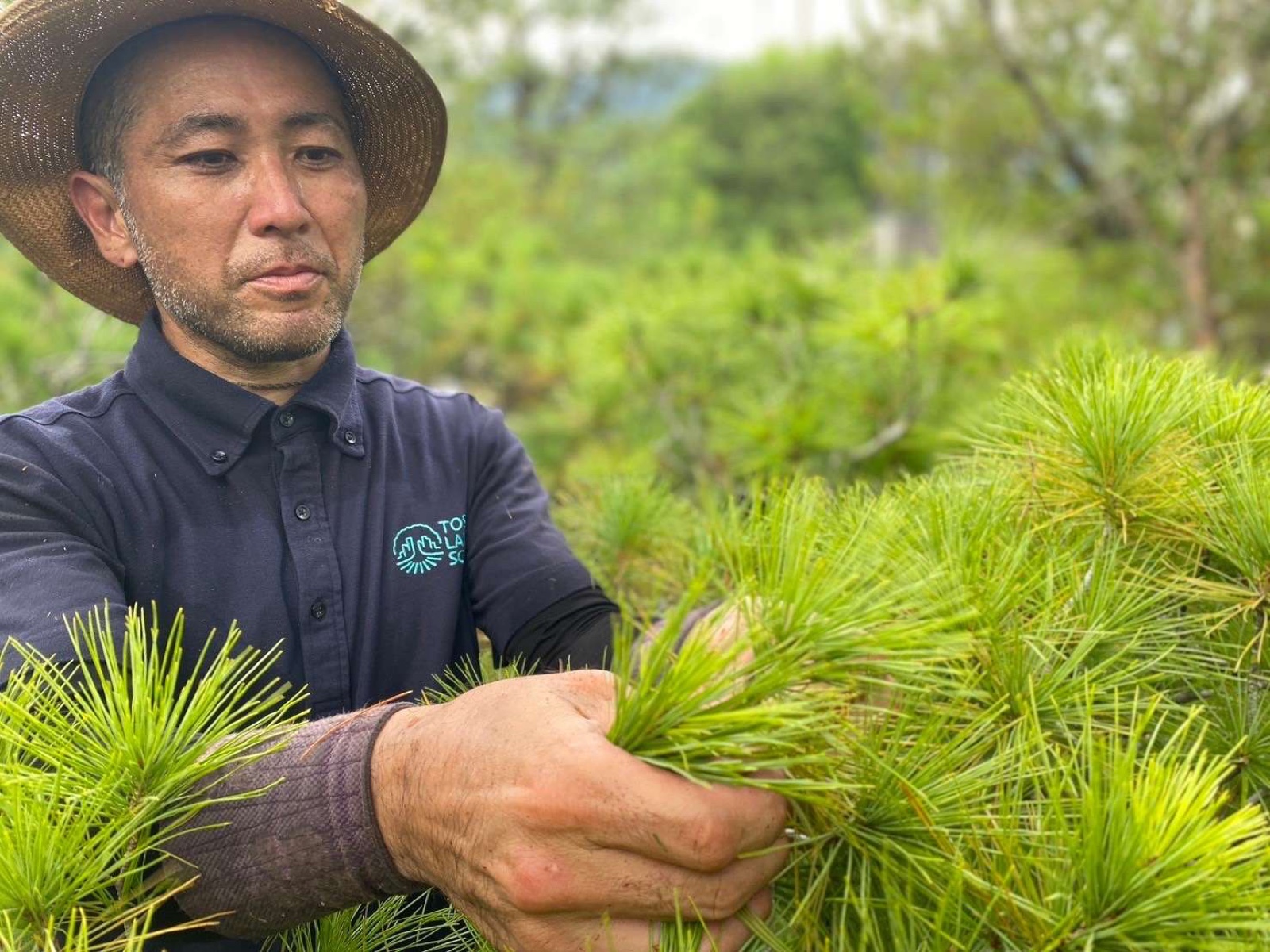
Annual pine care, in brief
Once the arm is in place, a pine monkaburi gets the same annual care as other trained pines. The Japan Federation of Landscape Contractors’ beginners’ manual describes midori-tsumi (緑摘み), candle pinching, as breaking off new shoots partway to adjust the number of branches and their extension, “around May every year”, and momiage (もみあげ) as removing the old needles below the current year’s growth, “around October every year”. It also warns that pine care varies by region, shaped by “the climate and character of that region”, so these months are guidelines, not a national calendar. On a monkaburi, candle pinching adjusts the extension of new shoots, including those on the arm; how candle pinching reads a pine’s future shape and momiage, the autumn needle plucking each have their own article.
Supports for a long arm
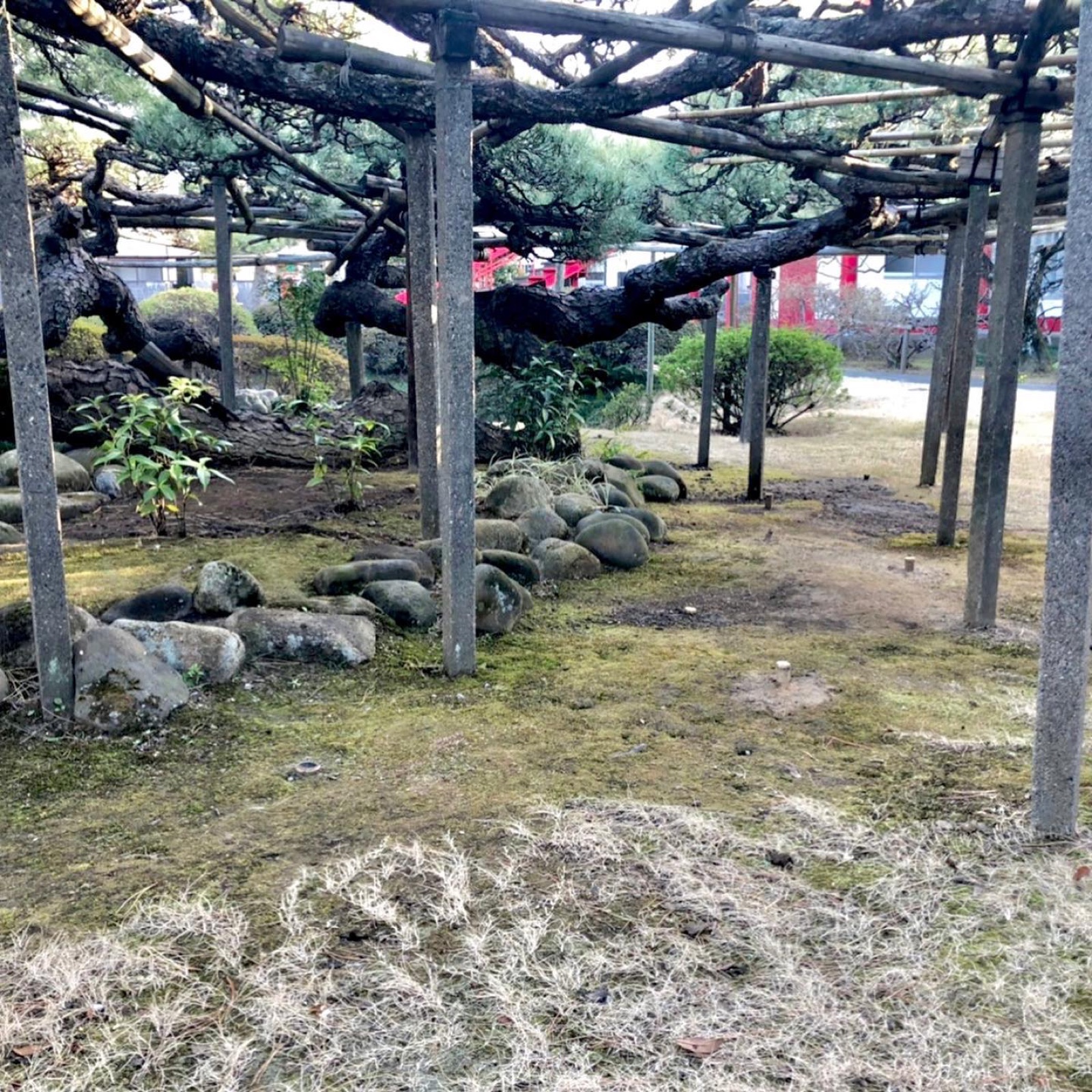
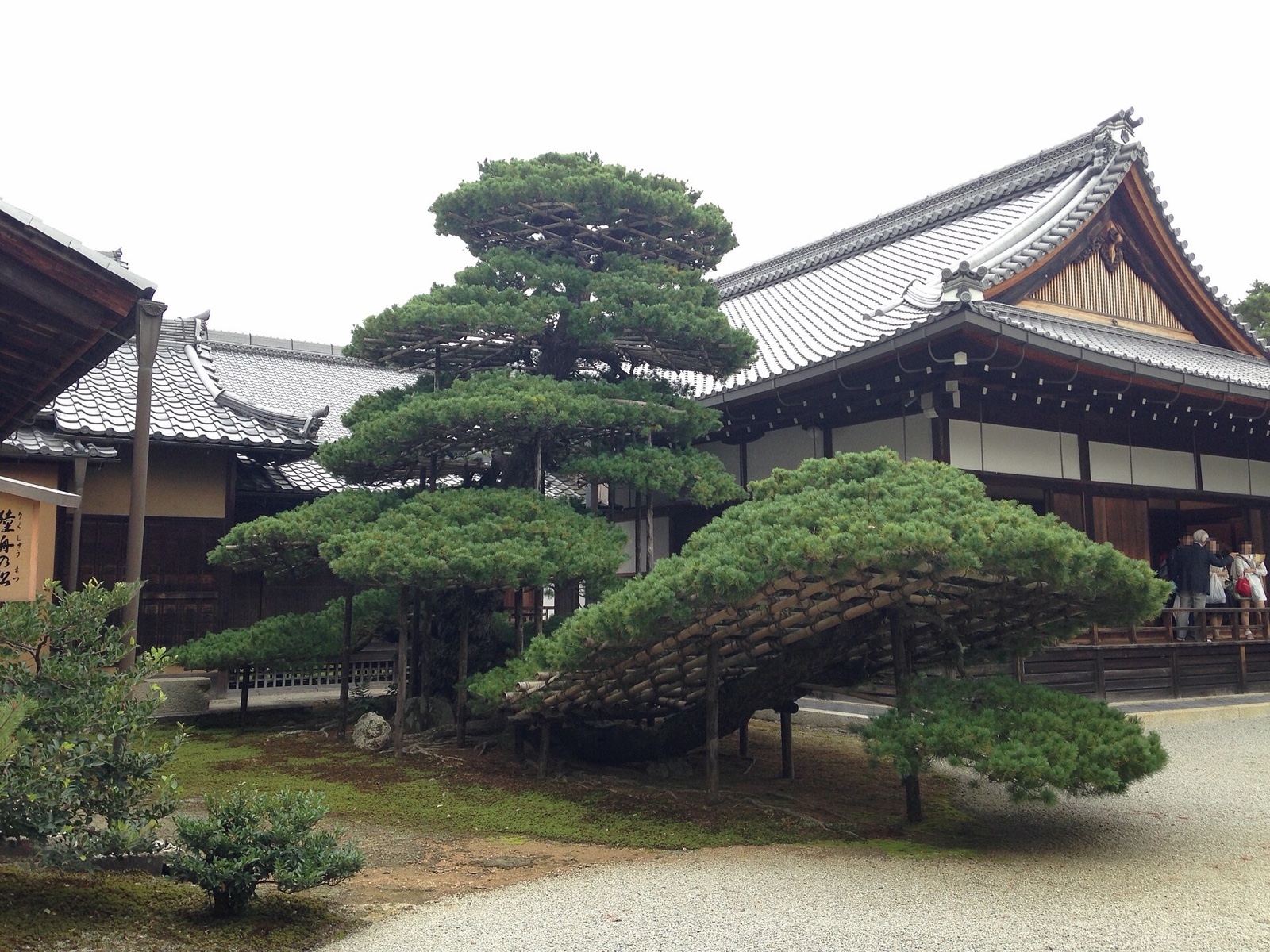
A pine trained horizontally can be held up as well as tied. At Yoshimine-dera temple in Kyoto, the Japan Tourism Agency’s multilingual description says the temple’s famous horizontal pine is cared for so that it grows level along wooden supports. We looked at why Japanese garden pines lean on crutches in a separate article.
The far end of the idea — two famous horizontal pines
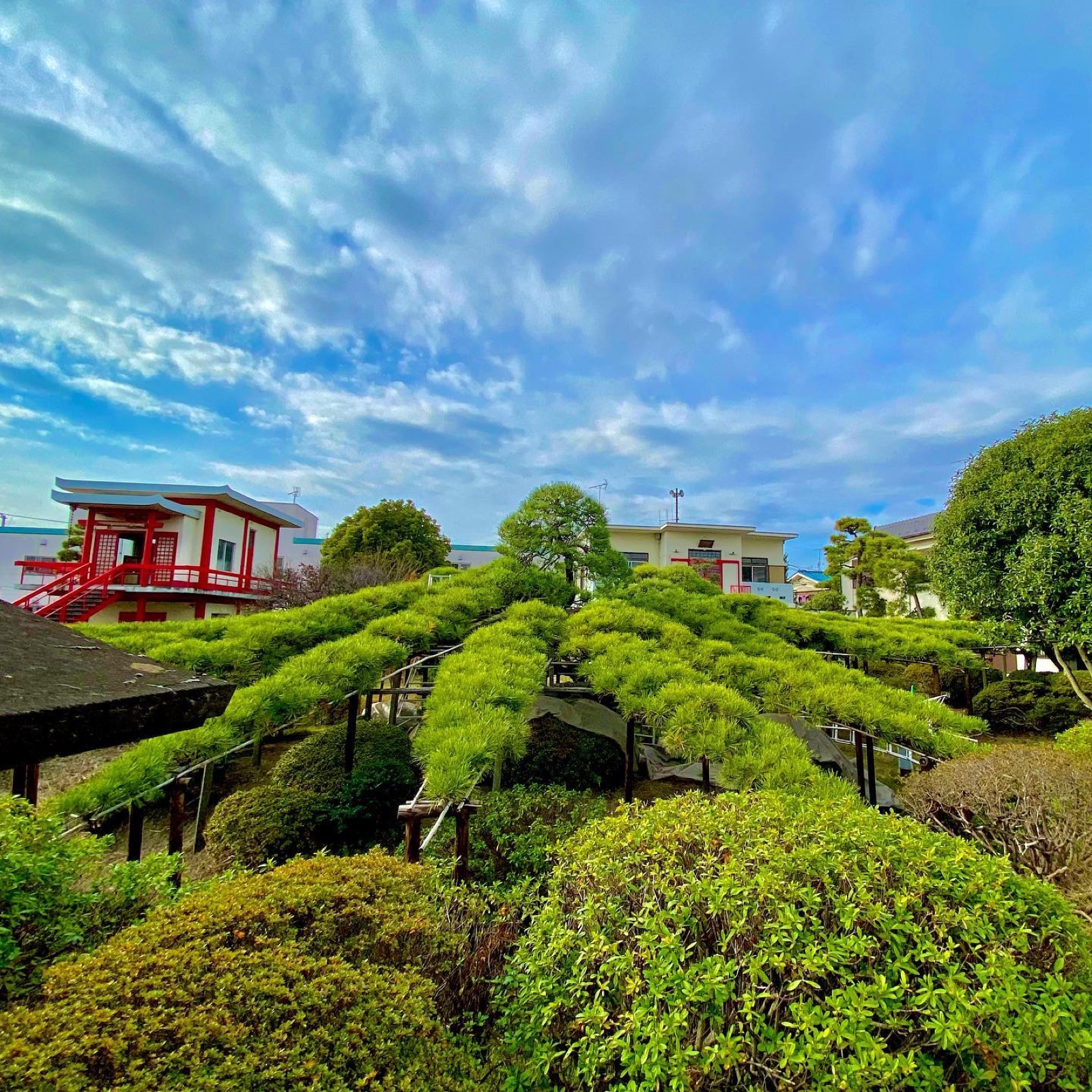
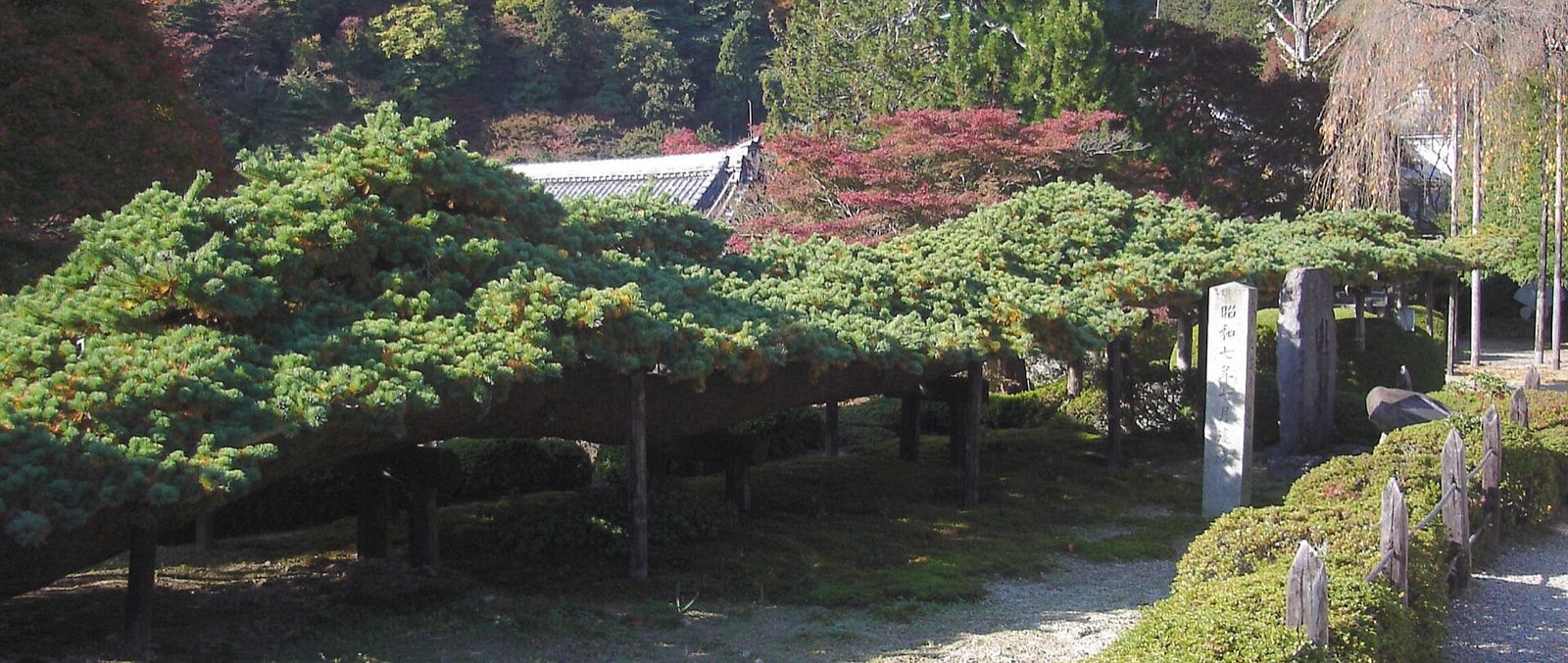
Yūryū no Matsu (遊龍の松), “the playing-dragon pine” at Yoshimine-dera in western Kyoto, is not described by the temple as a monkaburi, and it is not called one here. It is a comparison: it shows how far laying a pine out horizontally can go. The temple gives the species as goyōmatsu, Japanese white pine; its age as at least 600 years; and its total length as 37 m (about 121 ft). It was designated a national natural monument in 1932 (Shōwa 7), according to the temple’s list of cultural properties.
At Kinkaku-ji, Kyoto city’s history pages describe Rikushū no Matsu (陸舟の松), “the land-boat pine”, as a very fine pine in the shape of a boat, and relay the tradition that it was planted by the shogun Ashikaga Yoshimitsu — introduced, again, with “it is said”. No age or length was found for it in the sources used here.
The shitatemono family — dan-zukuri, kengai and other forms
Monkaburi is one of several named forms. They are kept brief here; tamachirashi has its own article on turning one pine into a sky of clouds.
| Form | Japanese | Defining feature in the source | Source |
|---|---|---|---|
| Monkaburi | 門冠り | Branches cover the top of a gate | JAANUS; Greenery Center |
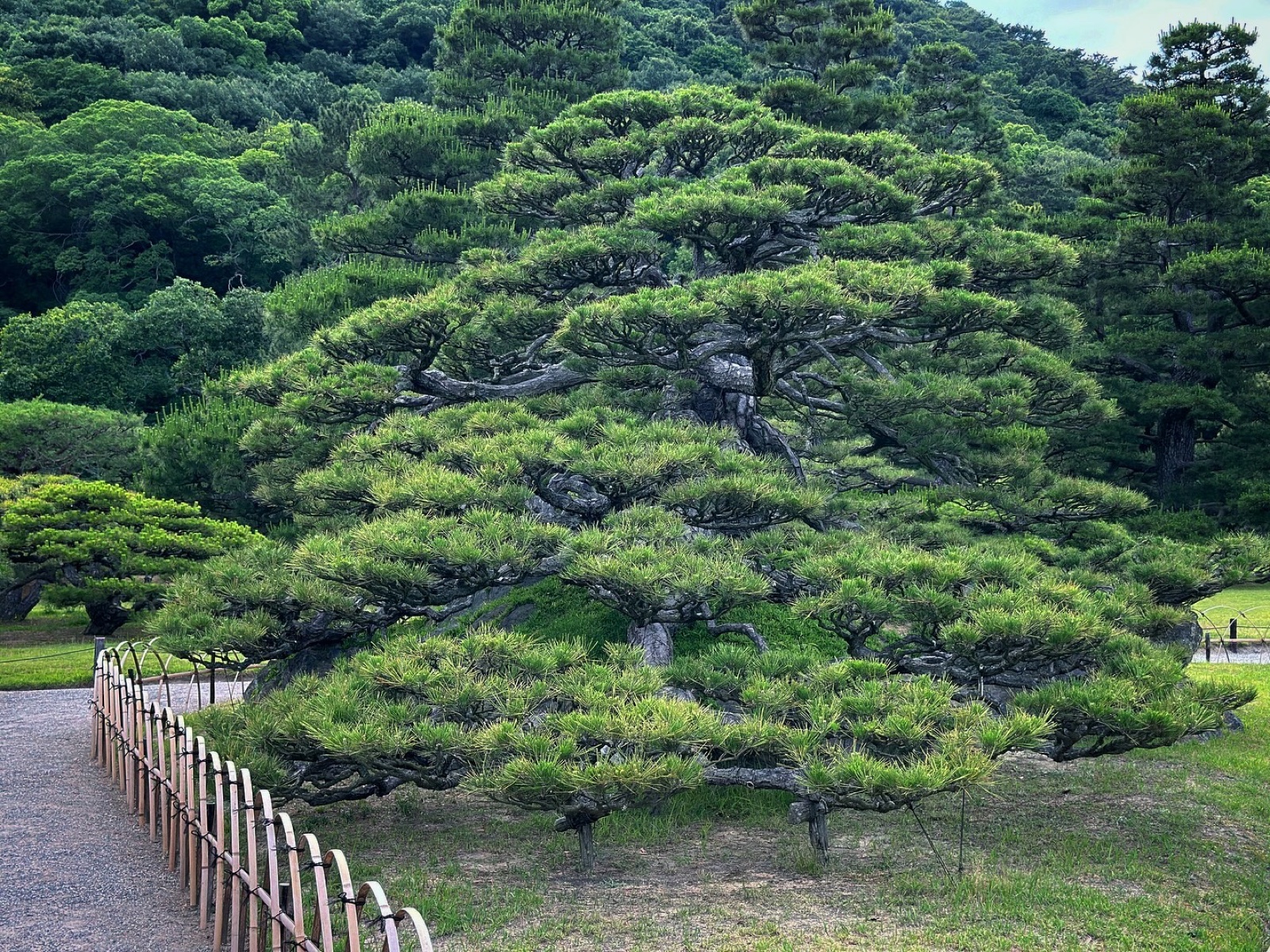
| Dan-zukuri | 段づくり/段作り | Foliage gathered branch by branch and clipped so the tiers show one above another | JILA 2025; Greenery Center |
| Tamachirashi | 玉散らし | Rounded pads of foliage arranged around the tree as if scattered | JILA 2025; Greenery Center |
| Tama-zukuri | 玉づくり | Rounded pads placed close to the trunk | JILA 2025 |
| Kai-zukuri | 貝づくり | Each branch’s foliage clipped like an upturned shell | JILA 2025 |
| Hōrai-zukuri | 蓬莱作り | Listed among clipped forms (no description in the passage checked) | Greenery Center |
| Kengai | 懸崖 | Bonsai term: stems or branches made to hang below the roots, outside the pot | Digital Daijisen |
Of the forms in this table, monkaburi is the one whose definition names something outside the tree: the gate. Dan-zukuri, tamachirashi, tama-zukuri and kai-zukuri are described here by how their foliage is grouped or clipped. Kengai, as the dictionary defines it, is a bonsai term about a tree in a pot.
Monkaburi, topiary, espalier and pleaching
European gardens shape trees too. The comparison below is about what each form is defined by, using the definitions in the sources.
Topiary
The Royal Horticultural Society defines topiary as “the art of training plants (typically evergreen shrubs and trees) into intricate or stylized shapes and forms”. A monkaburi fits that broad definition. What the RHS definition does not include, and the monkaburi definition does, is a position relative to a structure: monkaburi is defined by the gate beneath it. We compare the two traditions more broadly in niwaki vs topiary.
Espalier
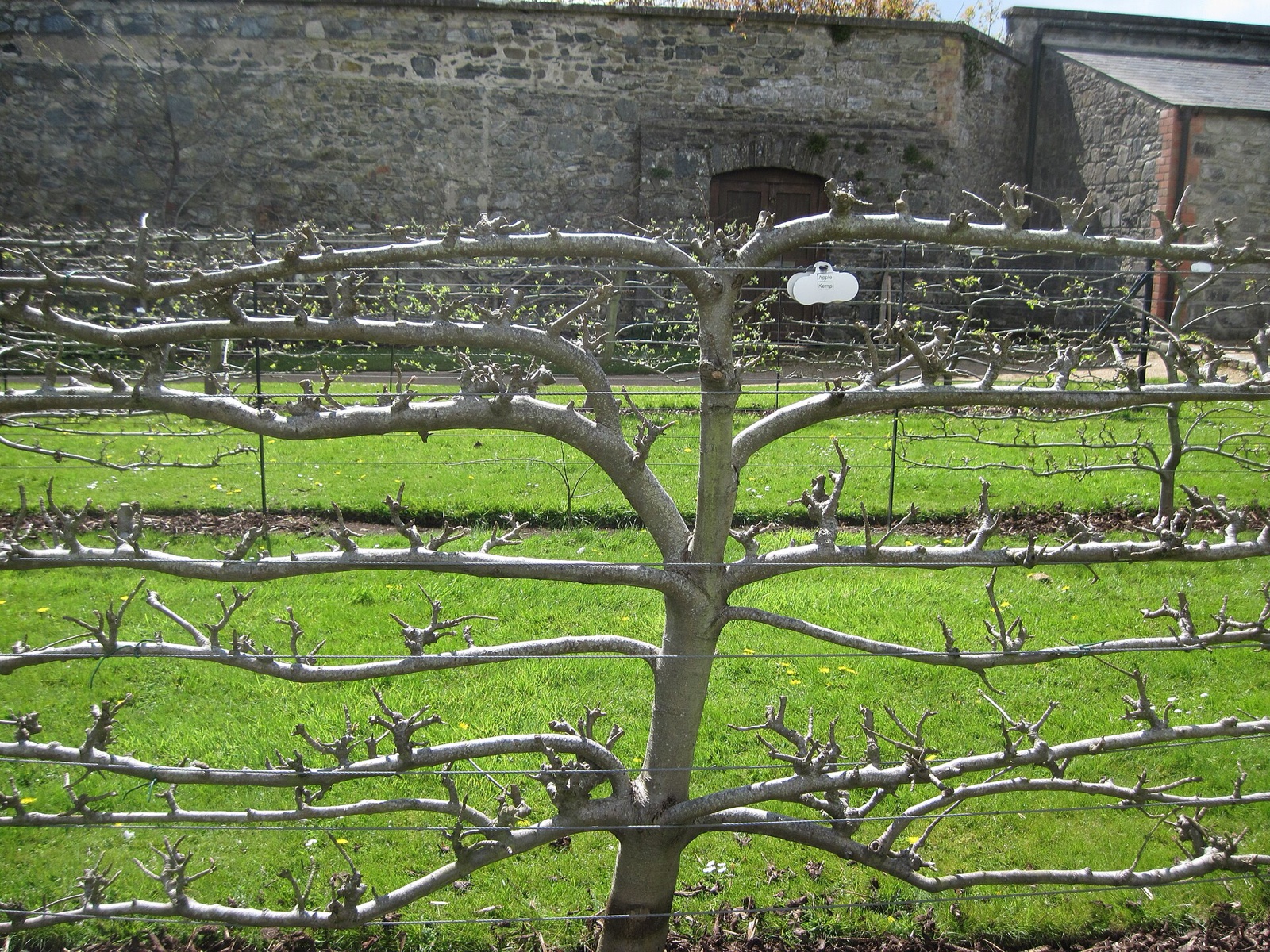
The RHS describes an espalier as a tree “trained flat against a support”, with “a central vertical stem and several tiers of horizontal branches”, and notes that espaliers “need a permanent support structure”. The University of Wisconsin–Madison Extension says the basic framework of simple designs may be established in three or four years; the Chicago Botanic Garden says it generally takes five to seven years to create a completed apple espalier and harvest fruit.
Like a monkaburi, an espalier is a tree whose branches are laid where people choose and held there. The differences are in plane and in what the shape answers to: the RHS espalier is flat against its support, and in the RHS guide it is a fruit-tree form; a monkaburi’s branches reach out over an opening, and its definition is about covering the gate.
Pleaching
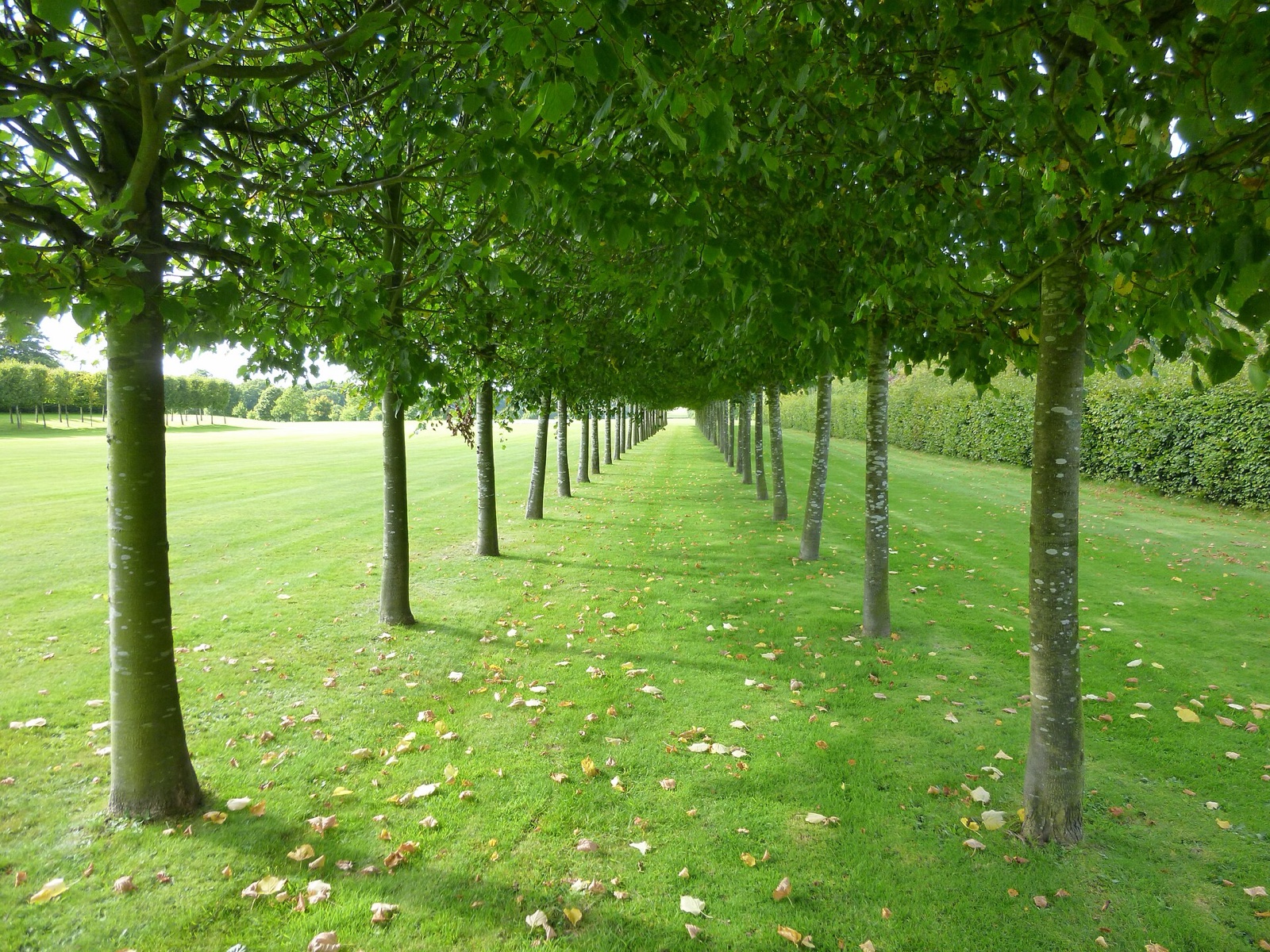
The RHS describes pleaching as tying in and interlacing flexible young shoots along a supporting framework; Purdue University’s arboretum defines it as interweaving branches to form a hedge or arbour. Pleaching, like a monkaburi, can make a structure people walk under. The method differs: pleaching interlaces shoots along a framework, while the monkaburi techniques in the JILA report bend, fix and tie a projecting arm.
| Monkaburi | Topiary | Espalier | Pleaching | |
|---|---|---|---|---|
| Definition in source | Branches cover the top of a gate | Plants trained into intricate or stylised shapes | Tree trained flat against a support, central stem with horizontal tiers | Young shoots tied in and interlaced along a framework |
| Plants named in sources | Pine, inumaki podocarp | Typically evergreen shrubs, trees | Apple (RHS guide) | Trees on a framework |
| Defined in relation to | The gate | The shape | The support | The framework |
| Methods named in sources | Bending, fixing with wire or bamboo, splints, rope | Training | Training on a permanent support | Tying in, interlacing |
| Time stated in sources | No monkaburi-specific figure found | Not found | Simple frame 3–4 years; finished apple espalier 5–7 years | Not found |
| Source | JAANUS; Greenery Center; JILA | RHS | RHS; UW–Madison; Chicago Botanic Garden | RHS; Purdue |
Reading a monkaburi from the street — five things to look for
The sources above give a visitor enough to read a monkaburi on the spot, without entering the garden.
- Does the tree cover the gate? That is the definition in the JAANUS dictionary. A pine visible over a wall but not over the gate is closer to mikoshi no matsu.
- Is the arm a branch or the trunk? The standard’s two names, eda-monkaburi and miki-monkaburi, invite the question. Follow the arm back toward the ground: does it leave a standing trunk, or is it the trunk itself, bent over?
- What is the tree? Pine is only one possibility. The Matsumoto districts were mostly red pine; in the Higashi-Osaka survey area, inumaki podocarp outnumbered pine; white pine also appears in public sources.
- What is holding it? Look for wire, bamboo, palm-fibre rope or a wooden prop under the arm — the materials named in the JILA report and at Yoshimine-dera.
- What does it belong to? Gateposts, wall and tree together are what the Matsumoto researchers read as a formal entrance. A monkaburi is read with its gate, not alone.
| Question | What to look at | Source for the distinction |
|---|---|---|
| Monkaburi or mikoshi? | Branches over the gate, or a pine seen over the wall | JAANUS; Digital Daijisen |
| Branch or trunk type? | Where the overhanging arm starts | Greenery Center commentary |
| Which species? | The tree itself; expect regional differences | Matsumoto and Higashi-Osaka surveys |
| How is it held? | Wire, bamboo, rope, props | JILA 2025 report; Japan Tourism Agency |
Common misunderstandings
“It is an old samurai rule”
The Edo status story is presented by Minoh city as something that “is said”, and no Edo-period record confirming it was found. The Matsumoto study supports the idea that monkaburi belongs to formal gateways in the samurai districts it surveyed; it does not establish a rule.
“It is a big bonsai”
Bonsai and garden trees in Japan share techniques — Kawaguchi’s magazine glosses magemono as bonsai-style training — but a monkaburi is planted in the ground, at full scale, at a real gate. The line between a pot-grown tree and a full-size garden tree is the subject of a separate comparison of niwaki and bonsai.
“It is a kind of pine”
The sources record monkaburi in red, black and white pine, and in inumaki podocarp, and in the Higashi-Osaka survey area podocarp outnumbered pine. Monkaburi names the form, not the tree.
“Once shaped, it stays shaped”
A trained tree keeps growing. The sources describe several separate jobs that keep a monkaburi in shape: candle pinching adjusts the number and extension of new shoots, momiage removes old needles, and ties and supports hold the arm in position.
Frequently asked questions
What is a monkaburi pine?
A monkaburi (門冠り, also written 門被り) is a tree trained so that its branches cover the top of a gate. The Japan Greenery Research and Development Center’s commentary on public-works tree standards lists it as a shitatemono, or trained tree, with two named types, eda-monkaburi and miki-monkaburi.
Why do Japanese houses have a pine over the gate?
It makes the entrance: researchers studying Matsumoto’s old samurai district read the monkaburi, with gateposts and walls, as part of a formal gateway. Minoh city relays a tradition that, under Edo-period limits on gate styles, a pine or podocarp over the gate became a status symbol, but presents it as a tradition, using the phrase “it is said”, rather than as a documented fact.
What trees are used for monkaburi?
Public sources record Japanese red pine, Japanese black pine, Japanese white pine and inumaki podocarp. In a survey of 1,058 monkaburi at the western foot of Mount Ikoma in Higashi-Osaka, 54.0% were inumaki and 42.6% were pine.
How long does it take to train a monkaburi?
No published standard was found for monkaburi specifically. The Sosa garden-tree growers’ association in Chiba says its shaped trees in general are made over ten years or more.
What is the difference between monkaburi and espalier?
An espalier, as the RHS describes it, is trained flat against a permanent support, usually as a fruit tree. A monkaburi is defined by its position: its branches are trained to cover the top of a gate.
Sources
Quotations from Japanese sources are the author’s translations.
– JAANUS (Japanese Architecture and Art Net Users System), “monkaburi 門冠” (checked 2026-11-18): https://projects.mcah.columbia.edu/jaanus/node/2330 – Minoh City, “Discovering greenery in town: old greenery along the old highways”, updated 12 October 2017 (Japanese; checked 2026-11-17): https://www.city.minoh.lg.jp/nousei/midori/20100813matinaka.html – Japan Greenery Research and Development Center, Kōkyōyō ryokka jumoku-tō hinshitsu sunpō kikaku kijun (an) no kaisetsu (commentary on the draft quality and size standards for public landscape trees), edition for the 5th revision of the standards, p. 29 (Japanese; checked 2026-11-17): https://www.jpgreen.or.jp/book/books/koukyouyou.pdf – Shogakukan, Digital Daijisen and Seisenban Nihon Kokugo Daijiten, “mikoshi no matsu”, via Kotobank (Japanese; checked 2026-11-17): https://kotobank.jp/word/%E8%A6%8B%E8%B6%8A%E3%81%97%E3%81%AE%E6%9D%BE-637526 – Shogakukan, Digital Daijisen, “kengai”, via Kotobank (Japanese; checked 2026-11-17): https://kotobank.jp/word/%E6%87%B8%E5%B4%96-22247 – Hiraoka Naoki et al., “Spatial composition of residential areas in the former castle town of Matsumoto”, Journal of the Faculty of Agriculture, Shinshu University 35(1), 1998, pp. 25, 27 (Japanese; checked 2026-11-17): https://soar-ir.repo.nii.ac.jp/record/10566/files/v35n01_03.pdf – Kawaguchi Masatake et al., study of monkaburi in the western foothills of Mount Ikoma, Higashi-Osaka, Japanese Institute of Landscape Architecture newsletter 25(1), 15 November 2013, p. 41 (PDF page 42) (Japanese; checked 2026-11-17): https://www.jila-zouen.org/wpdata/wp-content/uploads/2012/02/Newsletter25-1v2.pdf – Japanese Institute of Landscape Architecture, Nihon teien no “kokoro” to “waza” (the heart and craft of Japanese gardens), research report, March 2025, pp. 272, 279 (Japanese; checked 2026-11-17): https://researchpromotion.jila-zouen.org/wp-content/uploads/2025/05/2024_nihonteien_seikahoukoku.pdf – Japan Federation of Landscape Contractors, Beginners’ guide to landscape skills, revised edition, March 2015, p. 21 (Japanese; checked 2026-11-17): https://www.jflc.or.jp/media/niwa_navi/20150408_0930_52_0831.pdf – Tokyo Metropolitan Park Association, Hama-rikyū Gardens, midori-tsumi workshop notice, 25 April 2025 (Japanese; checked 2026-11-17): https://www.tokyo-park.or.jp/park/hama-rikyu/news/2025/5_5.html – Sosa City, Sosa, a town of garden trees, March 2017 (Japanese; checked 2026-11-17): https://www.city.sosa.lg.jp/data/doc/1694744328_doc_149_0.pdf – Sosa Garden Tree Association, “Sosa, a town of garden trees” (Japanese; checked 2026-11-17): https://www.sosa-ueki.jp/about/ – Kawaguchi City, Kōhō Kawaguchi, November 2013, p. 31 (Japanese; checked 2026-11-17): https://www.city.kawaguchi.lg.jp/material/files/group/3/14339500.pdf – JA Saitama, “Garden trees” (Japanese; checked 2026-11-17): https://www.ja-saitama.or.jp/products/specialty/ueki.php – JA Kagawa, bonsai press release, 27 February 2024 (Japanese; checked 2026-11-17): https://www.kw-ja.or.jp/wp-content/uploads/2024/02/56bfed1877f8c44f99aec1c0b9259620.pdf – Takamatsu City, “About Takamatsu bonsai”, p. 1 (Japanese; checked 2026-11-17): https://www.city.takamatsu.kagawa.jp/kurashi/kosodate/shougai_gakushu/manabican/manabi_internet/bonsaiwalkshop.files/b1_s.pdf – Chiba Prefecture, “100 notable garden trees, list (3)”, no. 88, updated 16 June 2026 (Japanese; checked 2026-11-17): https://www.pref.chiba.lg.jp/seisan/ueki/meiboku3.html – Flower and Green Bank Foundation (Toyama), Toyama greening, p. 77, “Goyōmatsu” (Japanese; checked 2026-11-17): https://www.bgtym.org/fgbank/assets/file/techology/green_p53-p112.pdf – Utsunomiya Kōyō Junior High School, “The history of the school-gate pine (monkaburi-matsu)”, 11 November 2021 (Japanese; checked 2026-11-17): https://www.ueis.ed.jp/school/koyo-j/blogs/blog_entries/view/57/10f4261508ba5f5ef81f987596db49e9?frame_id=57 – Shiojiri City, “Nishina Kaidō (Chikuni Kaidō)”, Seba Elementary School red pine (Japanese; checked 2026-11-17): https://www.city.shiojiri.lg.jp/soshiki/35/3950.html – Nakatsugawa City, History of Nakatsugawa, vol. 2, part II, “Zenshō-ji” (Japanese; checked 2026-11-17): https://adeac.jp/nakatsugawa-city/texthtml/d100020/mp000020/ht040340 – Yoshimine-dera, “Garden and precincts” (Japanese; checked 2026-11-17): https://yoshiminedera.com/guide/garden/index.html – Yoshimine-dera, “Cultural properties” (Japanese; checked 2026-11-17): https://yoshiminedera.com/guide/properties/index.html – Japan Tourism Agency, multilingual description, “Yoshimine-dera”, p. 2 (Japanese; checked 2026-11-17): https://www.mlit.go.jp/tagengo-db/common/001781179.pdf – Kyoto City, “Cultural history 09: Kinkaku-ji (Rokuon-ji)” (Japanese; checked 2026-11-17): https://www2.city.kyoto.lg.jp/html/somu/rekishi/fm/nenpyou/htmlsheet/bunka09.html – Forestry and Forest Products Research Institute, Kyushu Research Center, arboretum guide, “Kuromatsu” (Japanese; checked 2026-11-17): https://www.ffpri.go.jp/kys/business/jumokuen/jumoku/zukan/kuromatu.html – Forestry and Forest Products Research Institute, arboretum guide, “Inumaki” (Japanese; checked 2026-11-17): https://www.ffpri.go.jp/fsm/business/jumokuen/01_a/inumaki.html – Masutani Toshihiro, Kakihara Michiyoshi, Kunisaki Takashi, “Growth characteristics of old coastal black pines by stem analysis”, Science Bulletin of the Faculty of Agriculture, Kyushu University 49(3–4), 1995, pp. 179–189 (Japanese; checked 2026-11-17): https://doi.org/10.15017/23547 – Royal Horticultural Society, “Topiary” (checked 2026-11-17): https://www.rhs.org.uk/plants/types/hedges/topiary – Royal Horticultural Society, “Apples: espalier training” (checked 2026-11-17): https://www.rhs.org.uk/fruit/apples/training-espalier – Royal Horticultural Society, “Apples: starting an espalier” (checked 2026-11-17): https://www.rhs.org.uk/fruit/apples/starting-an-espalier – Royal Horticultural Society, “Pleached walks, tunnels and arbours” (checked 2026-11-17): https://www.rhs.org.uk/plants/types/trees/pleached-arbours – Purdue University Arboretum, “Pleaching” (checked 2026-11-17): https://www.arboretum.purdue.edu/explorer/definitions/pleaching/ – University of Wisconsin–Madison Extension, “Espalier” (checked 2026-11-17): https://hort.extension.wisc.edu/articles/espalier/ – Chicago Botanic Garden, “Espalier an Apple Tree” (checked 2026-11-17): https://www.chicagobotanic.org/plant-information/tips/espalier-apple-tree